
Downtown is the part of Dubai built around the Burj Khalifa, the Dubai Mall and a fountain lake, and it works as a base only if you value walking out of your door into the city’s busiest stretch. This Downtown Dubai guide covers both decisions, visiting and living, with transport, costs and trade-offs checked against official sources.
This Downtown Dubai guide starts with a plain verdict. Downtown suits you if you want landmarks, restaurants and a Metro station within walking range, and you can live with crowds, event-night closures and some of the highest rents in the city. It suits you less if you need a quiet evening, a beach, a school on your doorstep or a cheap commute by car.
For visitors, the area is a half-day to a full-day stop, not necessarily a place to sleep. The Burj Khalifa observation decks, the Dubai Mall and the Dubai Fountain are all within one walkable cluster, and the Red Line Metro station connects to the mall by an air-conditioned walkway of about 820 metres.
For residents, rents have been softening: Property Finder reports median advertised apartment rent in Downtown fell from AED 230,000 to AED 180,000 a year between Q3 2025 and Q3 2026. Treat every price here as dated, indicative and worth re-checking before you sign.
This is a desk-research guide. Nobody on the DubaiEveryday.com team has stayed in the buildings, queued at the decks or walked the routes for this page, and nothing here is presented as personal experience. What we did instead for this Downtown Dubai guide: read the operators’ and regulators’ own pages, cross-checked prices and rents across several published reports, and ran our own arithmetic on the inputs.
On 29 October 2026 we checked Dubai Land Department (DLD) service pages, the Dubai Mall’s own hours and parking pages, Emaar’s fountain announcements, Visit Dubai, the Roads and Transport Authority (RTA) fare table, and recent press coverage of rents and New Year’s Eve arrangements. Some official pages (the Burj Khalifa ticketing site, RTA timetables, Salik) could not be read in full, so those numbers come from secondary reporting and are labelled as such.
Rents, tickets and timings move, so treat every number in this Downtown Dubai guide as dated. Where a figure is our own estimate it says “our calculation”. Inclusion of any venue was not paid for, and there are no affiliate or booking links. This is general information, not individual legal, financial, medical or property advice.
What Downtown Dubai is, and where it ends
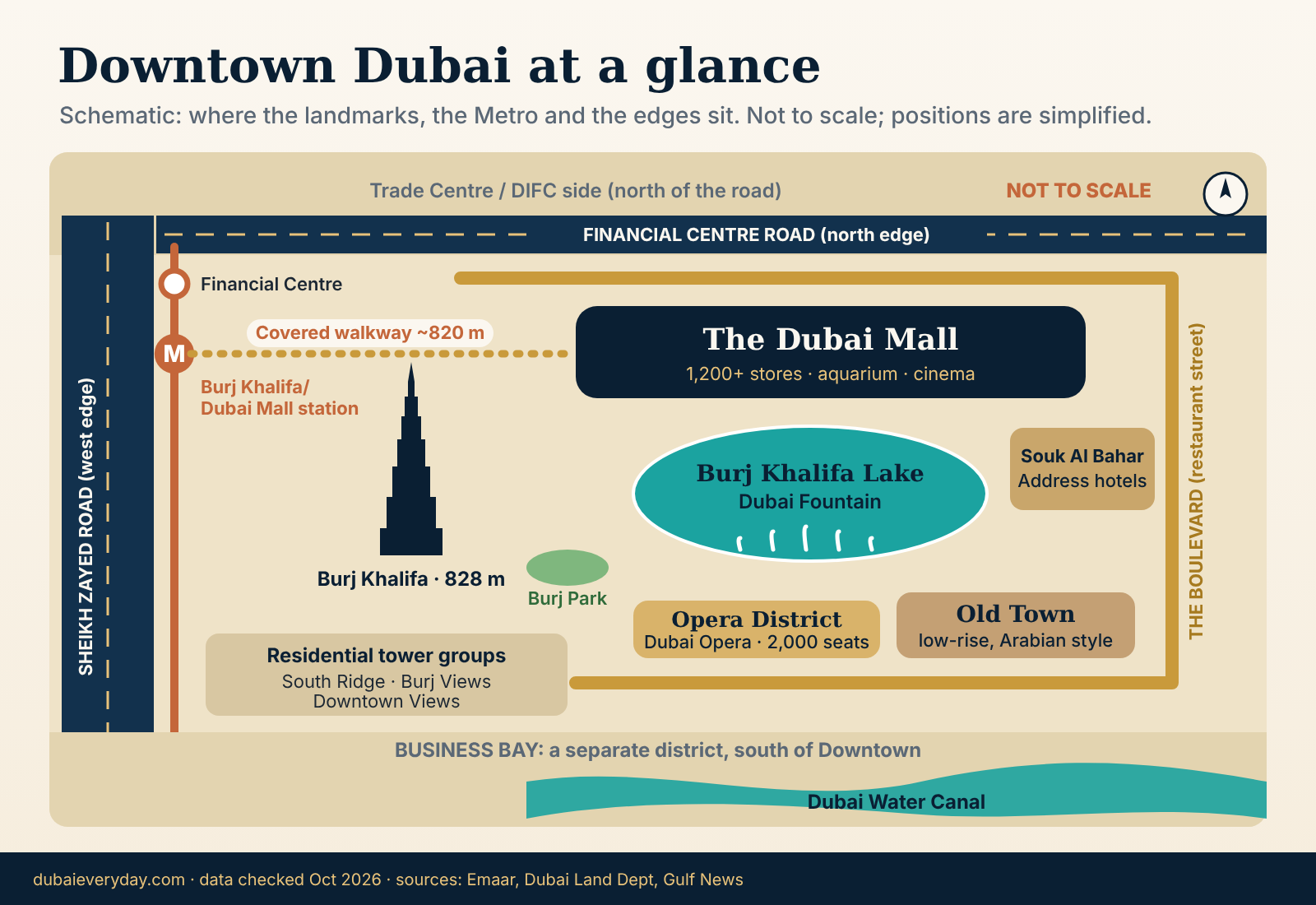
Downtown Dubai is a master-planned district developed by Emaar Properties. Emaar describes it as sitting between Sheikh Zayed Road and Financial Centre Road, and lists the Burj Khalifa, The Dubai Mall, the Dubai Fountain, Dubai Opera, Souk Al Bahar and the man-made Burj Khalifa Lake as its anchors. Secondary sources used for this Downtown Dubai guide put the footprint at roughly 2 square kilometres, which is small enough to cross on foot if the pavement, the heat and the crowds cooperate.
That official-sounding definition hides the first practical problem that any Downtown Dubai guide has to deal with: “Downtown” is both a developer’s master plan and a loose way of describing everything that looks like the skyline. Listing sites use the word generously. A flat that is a 15-minute walk from the Dubai Mall, across the other side of a canal in Business Bay, may still be advertised with “Downtown” in the headline. Knowing the real edges protects you from paying a Downtown premium for a different neighbourhood.
The core pieces, in plain terms
Think of the district in this Downtown Dubai guide as five clusters wrapped around the lake. The Burj Khalifa district holds the tower itself, its Armani-branded hotel and residences, and the Burj Park lawn at its base. The Dubai Mall covers the lake’s long side, with the Waterfront promenade where most people watch the fountain. Souk Al Bahar and the Address hotels sit across a bridge on the opposite side of the water.
The Opera District is the newer arts-and-residential cluster, anchored by Dubai Opera, a 2,000-seat venue opened in 2016 that can switch between theatre, concert hall and flat-floor event space. Old Town is the low-rise, Arabian-styled pocket with its own island feel. Sheikh Mohammed bin Rashid Boulevard, the restaurant street, loops through much of this and is the spine most residents mean when they say they live “on the Boulevard”.
Further out sit the residential tower groups (South Ridge, the Residences, Burj Views and Burj Vista, Downtown Views, Boulevard Point and similar names). These matter in the living section below because their distance from the Metro and the mall varies a lot.
Where the edges blur
For the purposes of this Downtown Dubai guide, the clearest edge is Sheikh Zayed Road on the west, where the Red Line Metro runs alongside and the Burj Khalifa/Dubai Mall station sits. The northern edge is Financial Centre Road, which separates Downtown from the Trade Centre and DIFC side of the city. Between those two lines, you are unambiguously in Downtown.
The southern edge is where marketing and map disagree. Wikipedia describes Business Bay as lying immediately south of Downtown, and Business Bay is a separate development with its own towers, its own Metro station and a canal network. The Dubai Water Canal, a 3.2-kilometre waterway that links Business Bay with the sea via Safa Park and Jumeirah, forms a natural line on that side. A building with a canal view and a Business Bay address is not in Downtown, even when the Burj Khalifa is in the window.
The practical test in any Downtown Dubai guide is simple. Ask the agent which master community the building is registered under, and check it against the Dubai Land Department’s property status and project status services at dubailand.gov.ae. If the answer is “Business Bay”, the rent should be compared with Business Bay, not with the Boulevard.
What a Downtown Dubai guide must say Downtown is not
It is not a beach district. The nearest sea is a drive away, and the lake is for looking at. It is not a family-villa neighbourhood either: Bayut’s area guide notes that the area is mostly apartments with only a few villas. It is also not a quiet, low-rise residential grid, which surprises people who book a flat after a daytime viewing and then meet a Friday night on the Boulevard.
And it is not the whole of Dubai’s centre. Deira and Bur Dubai are the old city, on the other side of the Creek. The business districts near the Trade Centre sit just north across Financial Centre Road. If a place needs an hour in traffic to reach, it was never Downtown.
Before you pay a Downtown rent, look up the building name on the Dubai Land Department’s project status service, then walk the route from the front door to the Burj Khalifa/Dubai Mall Metro station on a map. Under roughly 10 to 12 minutes on foot, the “Downtown” label is fair. Over 20 minutes, you are paying for a view, not for access.
The visitor’s Downtown Dubai guide: what is actually here
If you are in Dubai for a few days, Downtown is usually a stop rather than a base, and the visitor half of this Downtown Dubai guide is built around that idea. The cluster is dense: one Metro station, one very large mall, one lake and one tower, with the fountain show, the Opera and the Boulevard restaurants layered on top.
For a wider look at what else deserves your time in the city, the editorial ranking in our guide to the best things to do in Dubai puts Downtown in context with desert, old Dubai and the coast.
Burj Khalifa in the Downtown Dubai guide: decks and what they cost
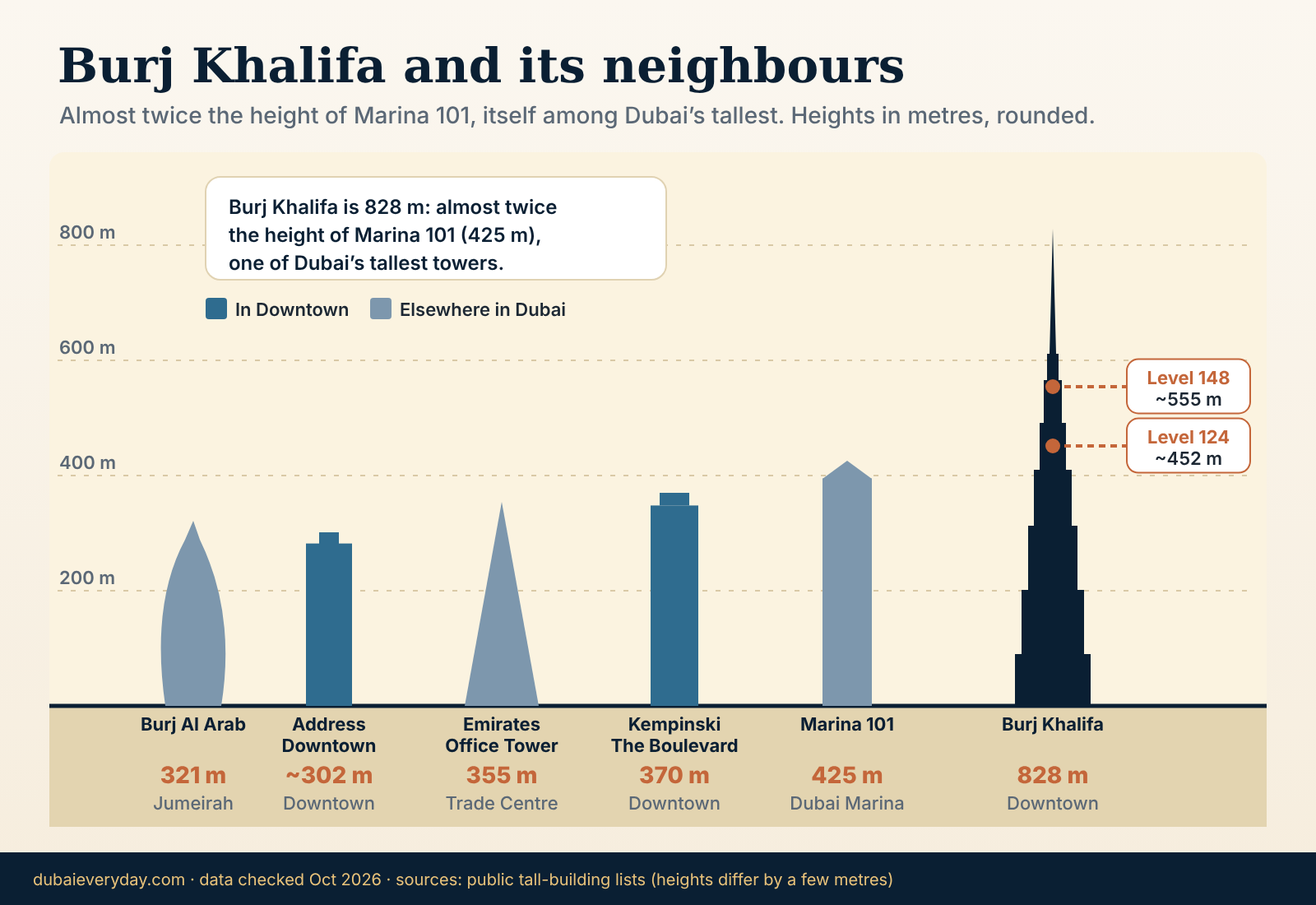
The tower at the centre of this Downtown Dubai guide is 828 metres tall (architectural height), opened in January 2010 and was designed by Skidmore, Owings and Merrill. Visitors use two main observation experiences. At the Top covers Levels 124 and 125, with Level 124 at about 452 metres. The SKY experience on Level 148 sits at about 555 metres, higher still, and is priced as a separate, more expensive ticket.
Prices move by time of day. The Better Vacation, a travel site that republishes the operator’s rates, listed adult tickets for Levels 124 and 125 at AED 173 off-peak and AED 250 in the prime 4 pm to 7 pm window in May 2026, and Level 148 at AED 400 and AED 554. Visit Dubai’s own booking page showed “from” prices in a similar range but carries an old update date, so treat all of these as ballpark and check the official booking page before you commit.
Plan on 60 to 90 minutes for Levels 124 and 125, per secondary sources, and longer if you add Level 148. Queue reports conflict: some sites say elevator queues run 20 to 45 minutes at peak times, others say 60 minutes or more. Both can be true on different days. The cheapest way to avoid the worst of it is a timed ticket bought in advance, for a weekday morning or a late-evening slot.
One honest note on value. The decks give a view over Downtown, the Gulf and the desert edge, and on clear days that is striking. Visibility depends on haze and dust, which you cannot book around, so look at the sky on the day. If your visit falls between June and September, a slot after sunset, when the city lights are on and the heat has dropped, is a more comfortable use of the ticket than midday.
The Dubai Mall in a Downtown Dubai guide: size, hours and what is inside
The mall opened on 4 November 2008. Visit Dubai counts more than 1,200 stores, and Wikipedia cites a leasable area of about 350,000 square metres and a record 105 million visits in 2023. Those numbers explain why visitors arrive intending a “quick look” and leave at closing time. A walk from one end to the other is a sensible workout, and the layout rewards a plan.
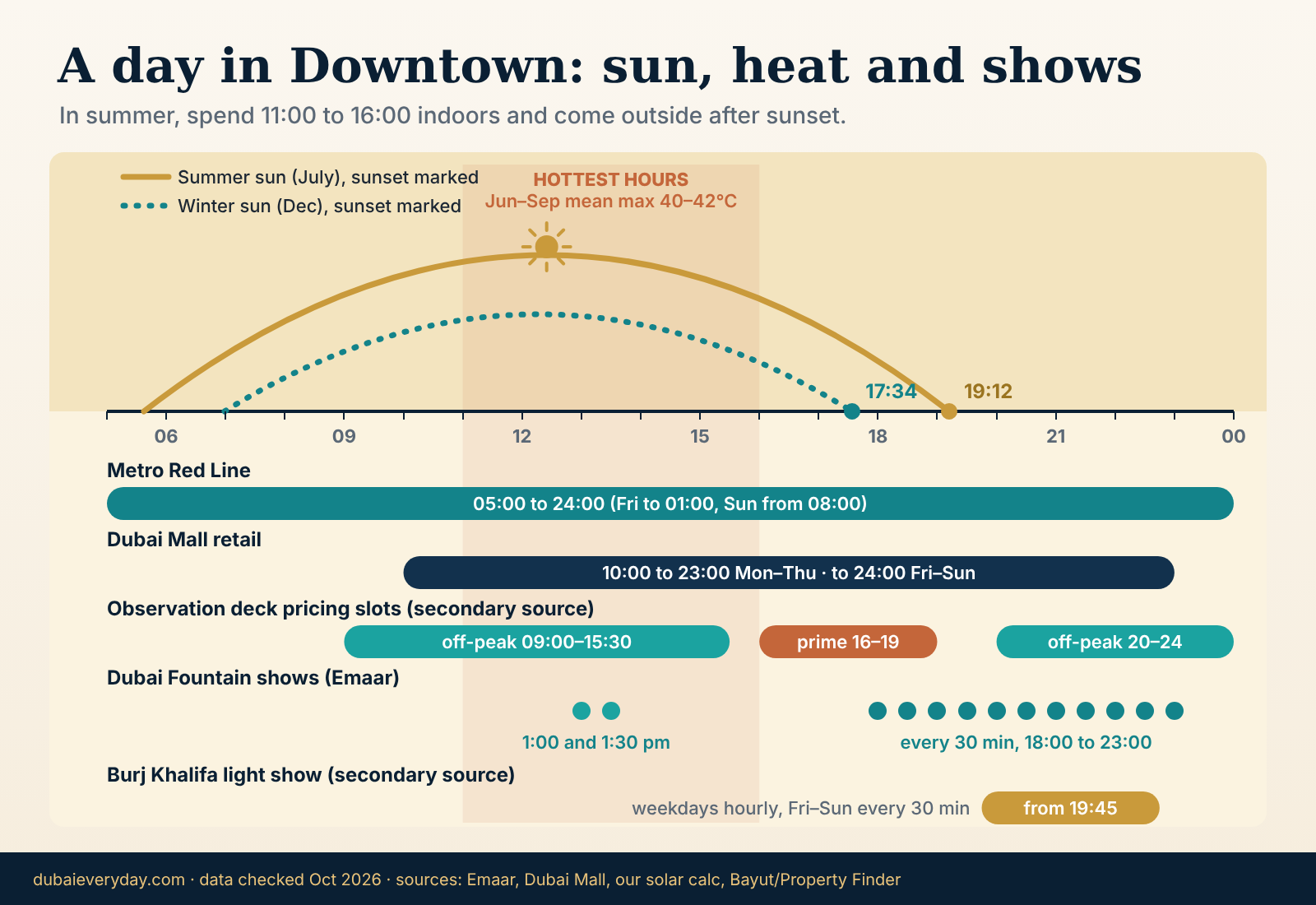
The mall’s own opening-hours page (checked 29 October 2026) lists retailers open from 10:00 to 23:00 Monday to Thursday and 10:00 to midnight Friday to Sunday, with restaurants and food courts running until midnight on weekdays and 01:00 on Friday to Sunday. The same page lists a supermarket, a pharmacy and a Mediclinic branch with longer or earlier hours than the shops. Ramadan and public-holiday hours change, so check the page on the day.
Inside, the big non-shopping draws include the Dubai Aquarium and Underwater Zoo, an Olympic-size ice rink, a 22-screen cinema and a children’s attraction called KidZania, according to Wikipedia. The aquarium’s own page lists a 48-metre tunnel on the ground level and an underwater zoo on Level 2, with 15 to 30 minutes suggested for the tunnel and 45 to 90 minutes for the zoo. Visit Dubai shows tickets from AED 150.
If you have two hours
Take the Metro, walk the air-conditioned link, do the aquarium tunnel or the observation deck (not both), and catch one fountain show at dusk from the promenade.
If shopping is the point
Go on a weekday morning. The mall is at its quietest between opening and lunch, and the Metro link is empty enough to walk without dodging luggage.
If you have kids
Book the aquarium or KidZania slot first and build the day around it. Everything else in the mall is easier with a fixed anchor.
If you can only book one paid item, book the observation-deck slot and let everything else flex around it. The promenade, the Boulevard, Burj Park and most of the mall are free to enter, so they can move by an hour either way without a penalty, while a timed deck ticket cannot.
The Dubai Fountain: timing and where to stand
The fountain sits in Burj Khalifa Lake, a man-made lake of more than 120,000 square metres according to Emaar. Shows are short: secondary sources put each performance at about five minutes. Emaar’s reopening announcement after the 2025 renovation lists afternoon shows at 1:00 pm and 1:30 pm (2:00 pm and 2:30 pm on Fridays) and evening shows every 30 minutes from 6:00 pm to 11:00 pm. Visit Dubai says the fountain performs every 30 minutes from 6 pm.
Closures have happened. The fountain was shut for about five months for renovation from April 2025, reopened on 1 October 2025, and Emaar flagged a second phase of works for 2026. An operator listing for the paid Boardwalk mentions a 10-day show suspension from 21 September 2026. In short, timings are not guaranteed, and a quick check of Emaar’s or the mall’s channels on the day is worth the minute.
Emaar’s fountain page suggests four viewing spots: the Waterfront promenade at the mall, the Souk Al Bahar terraces, Burj Park, and the Fountain Boardwalk, a floating walkway that gets you close enough to feel spray. Visit Dubai lists Boardwalk tickets from about AED 25 and lake boat rides from about AED 73. The free options are perfectly good; the paid ones buy proximity and a slightly shorter crowd, not a different show.
Secondary guides warn that the central exit onto the mall’s waterfront and the bridge to Souk Al Bahar jam up 10 to 15 minutes before each show. If you have a pushchair or a wheelchair, choose the quieter promenade ends, or arrive well before the 6:00 pm and 6:30 pm shows, which are widely described as the busiest.
Opera, Souk, Park and Boulevard
Dubai Opera sits in the Opera District facing the tower and the fountain, and runs a programme rather than daily admission. Check the venue’s own schedule and dress notes before you plan an evening around it; they differ by event. If you only want the building, walking past on the Boulevard costs nothing.
Souk Al Bahar is an Arabian-styled market with more than 100 shops by Wikipedia’s count, and for most visitors it is really a place for restaurant terraces with lake views. Burj Park, the lawn at the tower’s base, is free and, according to Property Finder, open daily from 8:00 am to 11:00 pm. It is also where the ticketed New Year’s Eve viewing zone has been run.
Sheikh Mohammed bin Rashid Boulevard is the restaurant street, and Emaar notes bicycle and e-scooter rental along it. In summer it is an evening street; in winter it can be a pleasant walk at any hour.
What a Downtown Dubai guide would skip, honestly
Two things catch first-timers who read a Downtown Dubai guide and then try to do everything. First, trying to see the observation deck, the aquarium, the fountain and a restaurant dinner in one afternoon: the queue maths does not work, and you will remember the lift lobby more than the view.
Second, booking a hotel in Downtown purely to be near these sights when a Metro ride from elsewhere would do. Our first-time Dubai travel guide covers how to sequence a short trip so that Downtown gets one good block of time, not three rushed ones.
Timing, heat and crowds: when Downtown works and when it does not
Downtown is mostly an evening district, which is the first rule of any Downtown Dubai guide that takes heat seriously. The outdoor parts, the lake promenade, the Boulevard and Burj Park, are pleasant for perhaps half the year and a test of character for the other half. The indoor parts, the mall, the aquarium and the observation decks, work all year, which is why the area copes with summer better than most Dubai attractions.
The seasons in numbers: a Downtown Dubai guide to the weather
The 1991 to 2020 climate normals for Dubai International Airport, reproduced on Wikipedia from NOAA data, give mean daily maximums of 24.4°C in January and 26.1°C in February, rising to 33.7°C in April, 38.2°C in May and 40.0°C in June. July and August peak at 41.5°C and 41.9°C, with mean minimums above 31°C. September still averages 39.5°C, October 35.9°C, November 30.7°C and December 26.5°C.
Our reading of those numbers for anyone using this Downtown Dubai guide to plan a visit: November to March is the comfortable window for the outdoor stretches, with mean maximums under 31°C. April and October are workable in the evening. May to September means treating the area as an indoor destination with short outdoor dashes, and building the day around air conditioning and the Metro link rather than the promenade.
In June to September, the outdoor leg from the lake to the Metro link or your taxi is where the heat hits. Book a car to a pick-up point near an entrance, rather than walking to a street stand at 14:00, and carry water for the unshaded stretches. A mean maximum above 40°C is an average; hot days run higher.
A Downtown Dubai guide to the day: sun, shows and shops
Sun times shape the evening, and this Downtown Dubai guide works them out for you. Our calculation from standard solar formulae for Dubai’s latitude puts sunset at about 17:34 around the winter solstice and about 19:12 in July. So the golden-hour deck slot lands around 17:00 to 17:30 in December and well past 18:30 in summer. That matters because, as noted above, the prime ticket window is described as 4 pm to 7 pm, and in winter the sun is gone for half of it.
The fountain’s evening programme runs from 18:00 to 23:00 every 30 minutes, so you have more than ten chances to catch it, and the lighting looks better the darker the sky gets. Secondary sources describe a Burj Khalifa light show starting at about 19:45, hourly on weekdays and every 30 minutes Friday to Sunday, though the programme is subject to change.
A half-day plan that respects the queues
Here is a four-to-five-hour route for this Downtown Dubai guide, built from the published opening hours and show slots. It is a suggestion, not a tested itinerary.
- Arrive by Metro, earlyGet off at Burj Khalifa/Dubai Mall station and take the covered link to the mall. In summer, aim for before 10:30 so the outdoor leg is short.
- Deck first, shops secondBook a timed Level 124 and 125 ticket in advance. Off-peak slots cost less than the prime window, and the lift lobby is calmer on weekday mornings or late evenings.
- Late lunch insideThe mall’s food courts and restaurants stay open until midnight or later, so there is no rush to eat at 13:00 when everyone else does.
- Fountain at duskPick a show 20 minutes after the light starts to fade. Stand at the Waterfront promenade ends rather than the middle, or book the Boardwalk if you want a closer view.
- Dinner on the Boulevard or at Souk Al BaharReserve ahead for lake-view tables on Friday and Saturday nights. Leave via a Metro station that is not packed: Business Bay is an alternative to the main station after big shows.
Three things change most often and are worth checking on the morning itself: whether the fountain is running, the Metro hours for that weekday (Friday and Sunday differ), and the mall’s hours if it is a holiday or Ramadan. Ten seconds on each saves a wasted trip.
A full day if you are staying close
With a full day, move the heavy indoor items into the hottest hours. Start with the observation deck when it opens. Spend 11:00 to 15:00 inside: the aquarium (about two hours including the zoo level), a long lunch, and maybe the ice rink or cinema. On days when afternoon fountain shows run, the 13:00 and 13:30 slots (14:00 and 14:30 on Fridays) avoid the evening crush, but in high summer standing outdoors at that hour is a poor trade.
Between 15:00 and 17:00, rest at your hotel or a quiet café. Return for the golden-hour glow, one fountain show, and an unhurried dinner. If you only have one day in the city, our Dubai travel guide for first-timers explains how to pair Downtown with a second block elsewhere, such as the old Creek area or a beach morning, rather than packing everything here.
When Downtown is miserable: the Downtown Dubai guide to event nights
New Year’s Eve is the extreme case. For the 2025/26 event, press coverage of RTA announcements said roads around the Burj Khalifa began closing in phases from 4 pm on 31 December, the Burj Khalifa/Dubai Mall station stopped admitting passengers from 5 pm (or earlier if full), and the Metro and Tram ran for about 43 hours straight. Free public viewing zones opened at 5 pm on a first-come basis, and a ticketed Burj Park zone priced adults at AED 997.50.
As of 29 October 2026, the 2026/27 operational details had not been published, so treat all of that as the likely pattern, not a promise. The practical conclusions hold either way. Do not drive into the cordon. Expect to walk. If you live inside it, reports from the last event describe cars parked inside the cordon being held until about 1 am to 2 am.
The lesser version happens on any big event night, public holiday evening and many Fridays and Saturdays after 18:00, when the promenade, the bridge to Souk Al Bahar and the Boulevard fill up. Residents often plan errands around those windows.
Fountain and mall schedules change during Ramadan, and secondary sources report no afternoon fountain shows and later evening starts. The Metro and the Dubai Mall publish updated hours each year; check them in the week before you go. Our guide to the best beaches in Dubai is a useful companion for planning a cooler, water-side day on the same trip.
Where to stay in and around Downtown
A hotel in Downtown buys you two things: a short walk to the lake and the mall, and a view. It does not buy you quiet, a beach or lower prices, and it does not necessarily buy you the shortest path to the Metro. Our guide to the best hotels in Dubai, by area and budget compares districts side by side; this section of the Downtown Dubai guide only covers what is specific to Downtown.
The hotel types you will actually find
Emaar’s own community page names The Address and Vida as the five-star brands in the district, and area guides add the Armani Hotel inside the Burj Khalifa, The Palace Downtown, Kempinski The Boulevard (formerly Address Boulevard), Address Fountain Views and Vida Residences. In practice, this Downtown Dubai guide sees you choosing between three types.
Lake-facing tower hotels
Hotels in the Address, Kempinski and Palace class sit around the lake and Old Town. Expect the district’s premium rates and more activity on show nights. Pay for these only if the lake is the point of the trip.
Serviced and branded apartments
Residences such as Vida Residences and Address Fountain Views operate hotel-style services inside residential towers. A kitchen and a second room help families and week-long stays; ask exactly which services are included, because arrangements differ by building.
Edge-of-district options
Along Sheikh Zayed Road, around Financial Centre Road and in northern Business Bay, hotels trade a short Metro ride or 10 to 15 minute walk for lower rates. For many visitors this is the sensible compromise.
Rules this Downtown Dubai guide applies when comparing hotels
Do not rank by district label; rank by walking time to the Burj Khalifa/Dubai Mall Metro station and to the lake. A hotel across the canal in Business Bay can be farther from the fountain than one on the Boulevard, and a higher floor in a tower is no use if the lift queue eats ten minutes each way.
Check which side of Sheikh Zayed Road the hotel is on, because crossing it on foot may mean a bridge or an underpass. Look at the event calendar for your dates, since rooms facing the lake are in demand and cost more on New Year’s Eve and other big nights. And ask whether the room’s view is of the lake, the tower or a building site, since Downtown is still being completed in places.
Hotel prices are the one number this Downtown Dubai guide leaves out. Rates swing so much by season and event that quoting a number would mislead. Use the dated comparison method in the hotels guide and check the hotel’s own site for current rates.
Getting around: Metro, the walkway, taxis and commute logic
The transport case in this Downtown Dubai guide rests on one fact: it has its own Red Line Metro station, called Burj Khalifa/Dubai Mall, between Financial Centre station to the north and Business Bay station to the south. That sounds trivial until you compare it with districts where the nearest station is a long walk or a feeder bus away.
The Metro: hours, fares and the sums
Red Line hours as listed by Bayut and Property Finder (timings in force since 24 June 2024, restated in October 2026) are 05:00 to midnight Monday to Thursday, 05:00 to 01:00 on Friday, 05:00 to midnight on Saturday and 08:00 to midnight on Sunday. RTA changes them for holidays and events, so check before a late night.
The RTA fare table (checked 29 October 2026) prices a trip by zones crossed. On a Silver card, one zone costs AED 3, two adjacent zones AED 5 and more than two zones AED 7.50. A Gold ticket is double. A single-use Red Ticket costs AED 4, AED 6 or AED 8.50 respectively. Children aged five and under travel free, and a journey can last up to 180 minutes with up to three transfers; a Metro-to-bus transfer must be made within 30 minutes.
The nol card itself costs AED 25 with AED 19 of credit for a Silver card, according to a 2024 Bayut guide; check RTA for the current price. In our calculation, a daily commuter making 44 trips a month at the AED 5 two-zone fare spends AED 220, which is less than one taxi round trip to the Marina and back.
The walkway between station and mall
The Metro link opened in December 2012. Gulf News reported it as 820 metres long, air-conditioned and fitted with travelators, with exits along its length, and designed for roughly 30,000 users a day. Bayut’s area guide puts the walk at about 10 to 15 minutes.
Our arithmetic agrees: 820 metres at a steady 1.0 to 1.4 metres per second is roughly 10 to 14 minutes before you add ticket gates and any stops at shops on the bridge. The mall’s hours page even lists “Metro Link Bridge outlets”, so the walkway is partly a retail street.
Two caveats. The link takes you into the mall and from there outdoors to the lake, so “air-conditioned all the way” applies to the bridge and the mall, not the final stretch to the fountain terraces or the Boulevard. And after a big show or on New Year’s Eve the station can be over capacity: the same station is the one RTA has closed to entry early.
The alternative is Business Bay station. Secondary guides describe it as roughly a 15-minute walk from the fountain and often quieter in the evening. It is also the station you want if you live in the southern towers.
Taxis, ride-hailing and buses
Taxis are plentiful. After the November 2025 RTA revision reported by Gulf News, street-hail fares start at AED 5 by day (AED 5.50 at night) with a minimum fare of AED 12, while app bookings carry a booking fee of AED 4 to AED 7.50 depending on peak status and a minimum of AED 13. Airport pickups start at AED 25, and waiting time is AED 0.50 a minute. Treat these as a guide: fares are adjusted with fuel prices and by event.
Buses serve the district too: Bayut’s area guide lists Route 27 from Gold Souq to the mall, feeder F13 and an on-demand service priced at around AED 5 per trip. For day-to-day Downtown life, the Metro plus taxis for the last mile covers most needs.
Downtown Dubai guide to commute logic: five destinations, honest ranges
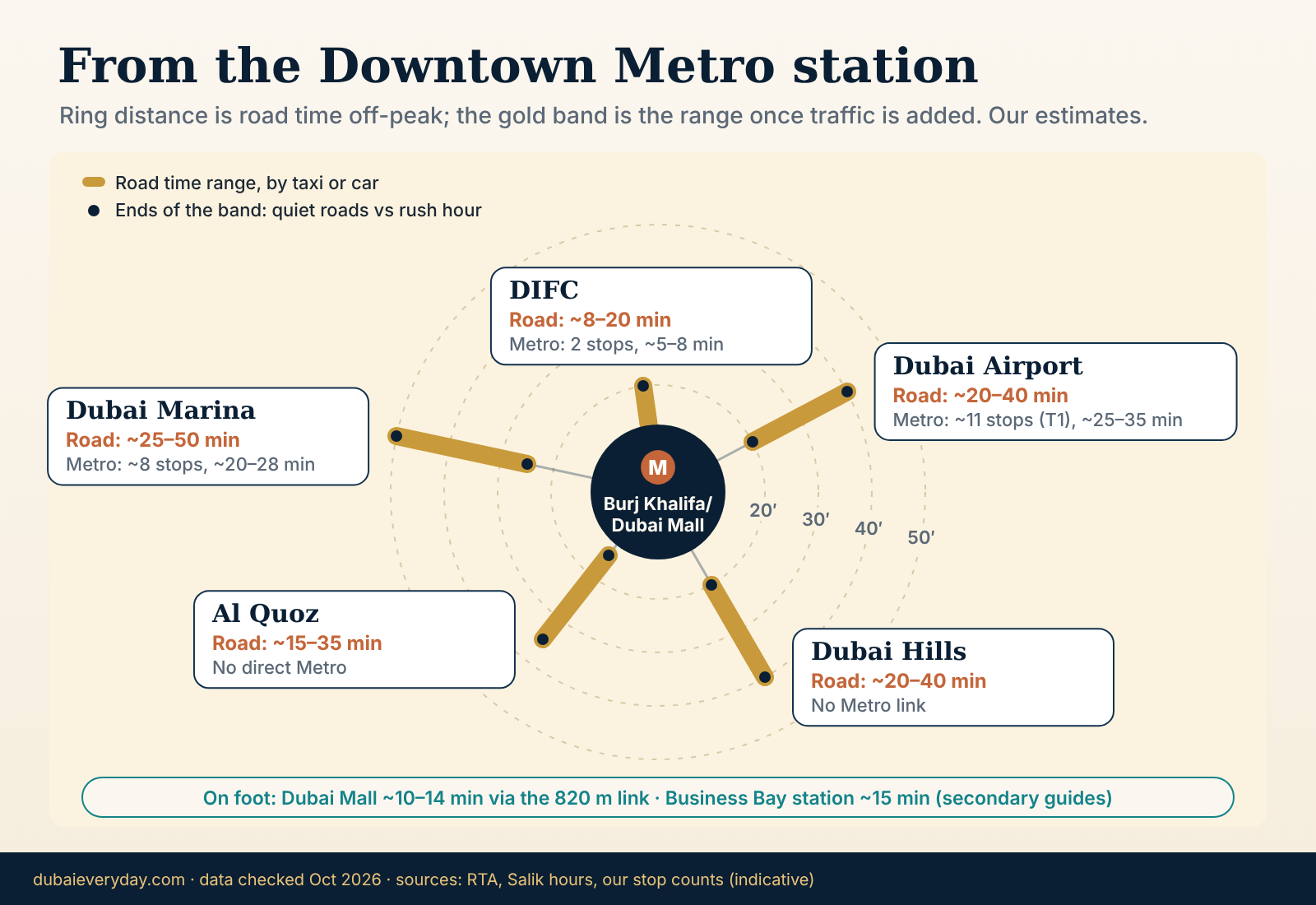
RTA publishes no door-to-door times, so the ranges below are our estimates built from stop counts on the Red Line and typical Dubai road conditions. They are not measured journeys. Rush hour is the same window Salik treats as peak, 06:00 to 10:00 and 16:00 to 20:00 on weekdays, and it can lengthen any road trip well beyond the ranges here. Plan on the upper end then.
- DIFC: two Metro stops (Financial Centre, then Emirates Towers), about 5 to 8 minutes on the train. By road, roughly 8 to 20 minutes depending on the hour and the gate you need.
- Dubai Marina: about eight stops on the Red Line to Sobha Realty station, roughly 20 to 28 minutes on the train, plus the walk or Tram at the far end. By road, roughly 25 to 50 minutes.
- Dubai Airport: Terminal 1 is about 11 stops away, roughly 25 to 35 minutes on the train; Terminal 3 is one stop further. By road, roughly 20 to 40 minutes.
- Al Quoz: no direct Metro to most of its warehouse and gallery districts; a taxi or car of roughly 15 to 35 minutes.
- Dubai Hills: no Metro; a car or taxi of roughly 20 to 40 minutes, longer at peak.
Ranges are no substitute for one real trial. Before you sign a lease, make the commute you will actually do, at the hour you will actually do it, and time it from your building’s door to your destination’s door. Station-to-station time is the number that misleads.
Walkability and heat
Walking works well inside the cluster, in the cooler months, which is the honest summary of walkability in this Downtown Dubai guide: the pavements are wide, the Boulevard is built for pedestrians, and a lot of the movement is under cover in the mall or along the bridge.
Beyond it, distances are bigger than they look. Sheikh Zayed Road and Financial Centre Road are major arterials, so check how you will cross them on foot before you rely on a short map distance. If you plan to live here without a car, count the Metro station as your home base, not the nearest cafe.
Driving, Salik and parking: the car side of Downtown
Downtown sits at an intersection of arterials. Sheikh Zayed Road (E11) runs along its western side, Financial Centre Road (D71) along the north and Al Khail Road (E44) just south, which Bayut’s area guide lists as the main roads for the district. The driving half of this Downtown Dubai guide comes down to timing. That means very good road access in off-peak hours and a long evening and morning struggle at the edges when everyone leaves at once.
Salik: the quiet cost of a car commute
Dubai’s toll gates charge per crossing, and since variable pricing began in early 2025 the fee depends on the hour. Arabian Business reported AED 6 on weekdays from 06:00 to 10:00 and 16:00 to 20:00, AED 4 from 10:00 to 16:00 and 20:00 to 01:00, free from 01:00 to 06:00, and AED 4 all day on Sundays outside holidays. Property Finder’s July 2026 explainer repeats those bands and adds 5% VAT and no daily cap. Check Salik for the current schedule.
Which gates matter? Property Finder’s list of active gates includes Al Barsha, Al Safa (north and south), Business Bay Crossing, Al Maktoum Bridge, Al Garhoud Bridge and the Airport Tunnel.
A drive from Downtown down Sheikh Zayed Road toward the Marina or Dubai Hills side typically crosses the Al Safa and Al Barsha gates, and Property Finder’s own worked example assumes two gates between Al Barsha and Downtown. A hop to DIFC along the same road stays north of both. Airport runs typically cross one gate, depending on whether you take the Garhoud or Maktoum bridge side.
This page does not map routes, so confirm the crossings on Salik’s own gate map for your commute.
Our calculation for a daily car commute to the Marina side at two gates each way: four crossings a day, 22 working days, at an average of AED 5 comes to AED 440 a month before VAT. That is real money against a Metro commute, and it is only the toll, not fuel, parking or insurance.
Parking at the Dubai Mall
For drivers using this Downtown Dubai guide, the mall’s own parking page (checked 29 October 2026) states that the first four hours are free on weekdays and the first six hours free on weekends.
After that, weekday charges step up from AED 20 for the fourth to fifth hour to AED 60, 80 and 100 for each following hour, then AED 200 over eight hours, AED 500 over twelve and AED 1,000 over a day. Weekend charges start at AED 80 for the sixth to seventh hour. Gulf News reported that plates are scanned on entry and fees deducted from a Salik account on exit, with no barriers.
The sensible reading: for a normal shopping trip you will not pay, and the charges bite only if you leave the car all day, for example while taking the observation deck, lunch, a film and a dinner. Valet is a separate service with its own pricing on the mall’s site, so read it before you hand over the keys. Four parking zones are listed (Fashion, Cinema, Zabeel and Fountain Views), each showing “limited” availability, which means you should not count on the nearest one on a Friday evening.
Event nights shift the picture. For the last New Year’s Eve, press reports described around 20,000 parking spaces in the Burj Khalifa area and RTA advised against driving into Downtown at all. Residents should check their building’s visitor-parking rules before inviting guests on a big night.
Living in Downtown: building types and what daily life feels like
This section is the heart of any Downtown Dubai guide for residents, because the word “Downtown” covers very different homes. Emaar lists 17 projects in the district on its community page, and apartments are the dominant product. Bayut’s area guide describes high-rise apartments mostly between one and four bedrooms, luxury penthouses, serviced residences and a limited number of villas.
Old Town: the low-rise pocket
Wikipedia describes Old Town as a low-rise district in Arabic style. The buildings are shorter than the glass towers around the lake, which changes the street-level scale. We did not find a reliable per-building rent source for Old Town, so we do not quote a figure; compare listings by unit type and check the building against the Dubai Land Department rental index.
Boulevard-area towers
Boulevard Point, 29 Boulevard and Boulevard Central are among the names that appear in area guides. They sit on or near Sheikh Mohammed bin Rashid Boulevard, which Emaar describes as lined with restaurants. The advantage is that the restaurants, a pharmacy and the pedestrian street are on the doorstep. The cost is that the Boulevard is a destination, so evening noise and crowds belong to the package.
Burj Khalifa and branded residences
The Burj Khalifa itself contains hotel and residential floors. Wikipedia records that the Armani Hotel occupies floors 1 to 8 with Armani Residences on floors 9 to 16, and Emaar lists “The Residence | Burj Khalifa” among its Downtown projects. Address-branded and other serviced residences are in the same price tier. These suit people who value hotel-style services and a landmark address, and they also carry the service charges and the sale prices to match.
The tower groups: South Ridge, Burj Views and the rest
South Ridge, The Residences, Burj Views, Burj Vista, Downtown Views and similar names are residential tower clusters. Bayut notes bus stops at South Ridge Towers 1 and 2. For these, the single most important number is not the view but the walk or shuttle to the Metro and the mall. Measure it on a map before you decide: a tower on the lake side and one on the far side of the district are different lifestyles.
Opera District
The Opera District is the arts-oriented cluster around Dubai Opera, with towers such as Opera Grand (listed at about 288 metres on Wikipedia) and a retail plaza. It faces the lake and the tower, so you get proximity to the Opera and the lake in exchange for show-night activity on your doorstep.
Ask three questions of any building before you compare rents: how many minutes is the walk to the Metro station on a real map; which master community is it registered under; and what exactly are the cooling and service arrangements. Two flats at the same rent are not equal if one has a 20-minute walk and a separate cooling bill.
Unit types, cooling and service charges: the Downtown Dubai guide’s hidden costs
Studios exist but are relatively rare: Bayut’s 2025 rental report had no studio data for Downtown because it classes the area as luxury, whereas Engel and Völkers, using Property Monitor data, listed an average studio rent of AED 81,067 in mid-2026. One-bedrooms, two-bedrooms and three-bedrooms are the bulk of the stock.
Two recurring costs surprise newcomers who rely on a Downtown Dubai guide written around rent alone. The first is district cooling: Gulf News lists Downtown among communities that use it, with a separate bill from the provider rather than from DEWA.
Emicool, one of the two main providers, describes a bill with a fixed capacity charge, a metered consumption charge, a DEWA fuel surcharge and a meter fee, plus a refundable deposit equal to eight months of the capacity charge. Check whether your building’s cooling is included or “chiller-free” before you compare rents.
The second is service charges, which owners pay per square foot to the building’s management. A February 2026 review put the Downtown average at about AED 28 per square foot a year, with an observed range of AED 18 to 44. That is a secondary source, and the DLD’s Service Charge Index lets you look up the approved figure for a specific project. As a tenant you do not pay it directly, but landlords price it into rent.
Renting in Downtown: rent bands and the process
Renting is where most Downtown decisions are made, and where published numbers disagree most. The disagreement among this Downtown Dubai guide’s sources is not sloppiness. It comes from what is being measured: advertised asking rents, registered Ejari contracts, or one agency’s portfolio. Read the table in this Downtown Dubai guide as a spread, not a price list.
Downtown Dubai guide to rent bands, as of October 2026
| Source and method | Period | Studio | 1-bed | 2-bed | 3-bed |
|---|---|---|---|---|---|
| Engel and Völkers, Property Monitor average | YTD to 17 May 2026 | 81,067 | 120,285 | 188,791 | 284,674 |
| Bayut, average asking rent | Calendar 2025 | n/a | 142,000 | 242,000 | 395,000 |
| Manage My Property, typical range | Updated Sep 2026 | 70,000 to 85,000 | 90,000 to 140,000 | 130,000 to 200,000 | n/a |
| Property Finder, median asking, all apartment sizes | Q3 2026 | AED 180,000 a year (Q3 2025: AED 230,000, down 21.74%) | |||
| dataHabibi, median of registered Ejari contracts, all sizes | 12 months to Jul 2026 | AED 150,000 a year | |||
All figures are annual rent in AED for apartments and indicative only. Our reading of the spread for this Downtown Dubai guide: for a one-bedroom, AED 90,000 to 140,000 covers most unfurnished listings and agency averages in 2026, with the Property Monitor average of about AED 120,000 sitting in the middle. A two-bedroom spans roughly AED 130,000 to 240,000, and the top of that range tends to reflect lake views and branded towers.
The direction matters more than the level. Property Finder reports median advertised apartment rent in Downtown down 21.74% year on year in Q3 2026, and fäm Properties found registered new leases down 11% for January to September compared with the same period of 2025. Property Finder’s CRO told reporters the fall held across every apartment size. Daily apartment listings were up 55.1% in September 2026 on a year earlier while enquiries rose 15.4%, which points to more choice for tenants.
One caution on reading that as a bargain. Asking-rent medians can move because the mix of listings changes, and one month’s rebound from AED 100,000 to AED 105,000 in the combined index of ten communities is not a trend, as Property Finder itself says. Negotiate, but do not assume that the lower number you saw in a headline applies to the building you like.
The DLD rental index: what it does and does not do
The Dubai Land Department’s rental index page is a public calculator. Its residential tab asks for a contract end date, property type, a way to identify the unit (DEWA premise number, Ejari contract number, or area and building or community name), the number of bedrooms and the current annual rent, and it uses a captcha. Other tabs cover commercial, industrial, staff accommodation and a location map.
What it is for matters. Khaleej Times and The National describe the index as setting how much a landlord may raise rent on renewal, compared with the average for similar units in the area: no increase if the current rent is up to 10% below the average, 5% if it is 11% to 20% below, 10% for 21% to 30%, 15% for 31% to 40% and 20% above that.
Written notice of a change in terms must reach the tenant at least 90 days before renewal. Those reports are from January and August 2025, so confirm the bands on the DLD site.
The limits are as important. The index is a compliance tool for existing contracts, not a market price list for a new tenancy. It does not show you what a specific neighbour pays, it does not include building-level rent results in the public page text we could read, and it cannot tell you whether a unit is fairly priced against a similar tower across the road. Do not accept a quoted “index figure” for a building from an agent unless you can reproduce it on the DLD page yourself.
The renting process in this Downtown Dubai guide, step by step
- Set a budget and a Metro-walk limitDecide the maximum rent and the maximum walk to the station before you view anything. Both filters remove listings that are Downtown in name only.
- Check the listing and the agentReal estate permits are issued through the Trakheesi system. The DLD offers a public service to validate a licence or permit, so use it on the agent and the advert rather than trusting a phone number.
- View and verify the ownerAsk who owns the unit. The DLD runs a title deed verification service, and the landlord named on the tenancy contract should match the owner or a legally authorised representative.
- Agree terms and the cheque planDubai tenancies are usually paid by post-dated cheques in one to twelve instalments. Ask how the price changes with the number of cheques, and who pays for maintenance below a stated amount.
- Sign the unified tenancy contractRead the notice, break-clause and renewal terms. Photograph the condition of the unit and attach a dated snag list.
- Register EjariEjari is the official tenancy registration. The DLD fee page lists AED 220 through a registration trustee centre or AED 177.75 through the Dubai REST app or website, with different eligibility rules for each channel.
- Connect utilitiesDEWA needs a refundable deposit, and district cooling needs its own account. Both usually ask for an Ejari certificate.
- Diarise renewalPut the renewal and notice dates in your calendar. Ninety days is the notice most reports describe for a change in rent.
In a market where advertised rents fell, a landlord’s first number is an opening bid. Compare at least three similar units in the same walking radius, ask what the unit was advertised at a year ago, and trade on cheques, a rent-free period or included parking rather than asking for the lowest price alone.
Deposits, fees and cheques: law versus custom
Most items on a Dubai move-in list are custom, not statute. The security deposit is commonly 5% of annual rent for unfurnished and 10% for furnished homes, and Bayut notes this is contractual practice rather than law. The agency fee for a new lease is typically 5% and negotiable. Dubai Municipality’s housing fee, 5% of annual rent, is billed monthly through DEWA bills according to Bayut. DEWA’s refundable deposit is reported as AED 2,000 for an apartment.
Take a one-bedroom at AED 120,000 a year paid in four cheques. First cheque AED 30,000, deposit at 5% AED 6,000, agency fee at 5% AED 6,000, Ejari AED 220, DEWA deposit AED 2,000 and activation of about AED 130. That is roughly AED 44,350, or about USD 12,100 at the 3.6725 peg, before any district-cooling deposit, moving costs or furniture. Your actual cheque split and fees may differ.
Mistakes a Downtown Dubai guide for renters should flag
Paying a “holding deposit” in cash without a receipt is the classic one. A close second is signing before checking whether district cooling is included, since a lower rent can be offset by a monthly cooling bill. Third is accepting a rent increase notice delivered late: Law No. 33 of 2008 as summarised by The National requires 90 days’ written notice. Fourth is assuming that a verbal promise of repairs or a furniture inventory counts for anything if it is not in the contract.
If a dispute does arise, the Rental Dispute Centre is the route for landlord and tenant claims in Dubai, and the DLD offers a complaints service for brokers and companies. This page cannot assess your case. Treat it as pointers to the official channels, and take individual legal advice for a specific dispute.
Buying in Downtown: fees, mortgages and honest caution
Buying is a different decision from renting, and the buying chapter of this Downtown Dubai guide treats it that way, and it should not be made in the same afternoon as a viewing. This section separates three intents: living in the flat yourself, buying to rent it out, and buying off-plan. None of them comes with a guaranteed return, and this Downtown Dubai guide does not forecast prices.
What the market is saying: Downtown Dubai guide data, dated and sourced
Engel and Völkers, using Property Monitor figures built on Dubai Land Department transactions, put the average price in Downtown at AED 3,011 per square foot for 1 January to 6 June 2026, against AED 2,547 in Business Bay and AED 2,058 in Dubai Marina. For scale, Cavendish Maxwell put the average sales price across Dubai at AED 1,639 per square foot by June 2026, up 1.9% year on year. Downtown sits at roughly 1.8 times the citywide average.
Bayut’s Q3 2026 market report, as reported by Gulf Today on 28 October 2026, describes asking prices in luxury and ultra-luxury areas as broadly stable, with most movement within 2%, and a “marginal asking-rent correction” in popular luxury rental areas such as Downtown. In the same period, new supply is arriving: Cavendish Maxwell counted 24,800 homes delivered in the first half of 2026, up 37.6% on a year earlier and described as a record, and projects further large deliveries in 2027 and 2028.
Supply matters because rent and resale price depend on it, but Downtown has little vacant land, so the pressure comes from neighbouring areas such as Business Bay rather than from new Downtown towers. Treat that as our reading, not a forecast.
Government fees: the buyer’s side of the bill
The Dubai Land Department homepage links to the registration trustee centres, title deed verification and payment services but does not publish a single fee schedule on its front page. The table below, the fee reference for this Downtown Dubai guide, draws on law-firm and brokerage reporting of DLD charges (Property Finder, July 2026; AGBI, November 2024). Confirm every amount with the DLD or a registered trustee at the time of purchase.
| Charge | Amount reported | Notes |
|---|---|---|
| DLD transfer fee | 4% of the price | Legally shared 2% each in one report; usually paid by the buyer unless agreed otherwise |
| Registration (trustee office) | AED 4,000 plus 5% VAT at AED 500,000 and above; AED 2,000 below | Paid at the trustee centre |
| Title deed issuance | AED 250 (about AED 580 with related charges) | Figures differ slightly between reports |
| Mortgage registration | 0.25% of the loan plus about AED 290 | Only if you finance |
| Bank valuation | AED 2,500 to 3,500 plus VAT | Charged by the lender |
| Agency commission | Negotiable | Ask for the figure in writing |
Our calculation for a AED 2.7 million apartment, using AED 2.7 million because Emaar’s Downtown page lists one new project starting at about that level: transfer fee AED 108,000; registration AED 4,200 including VAT; title deed and related AED 580; if you borrow 80%, mortgage registration AED 5,400 plus AED 290; a valuation of about AED 3,000 plus VAT. That is roughly AED 121,600, or 4.5% of the price, before agent commission and the down payment of AED 540,000.
Mortgage basics for residents
Central Bank loan-to-value limits are the main constraint on any buyer following this Downtown Dubai guide. Khaleej Times (30 August 2026) summarises them as 80% for an expatriate’s first home under AED 5 million and 70% above that, 60% for second homes and investments, and 50% for off-plan, with the down payment required to come from the borrower’s own resources rather than a personal loan.
Another 2026 guide gives 65% for first homes at AED 5 million and above, so the threshold detail varies between sources. Ask your lender for the written LTV before you pay a reservation fee.
Other widely reported limits include a debt burden ratio of 50% of gross monthly income and a maximum term of 25 years under the 2013 regulations. Lenders can be stricter than the cap, and they changed policy quickly in 2026: one major lender introduced temporary LTV restrictions in April and withdrew them by 1 July. Mortgage pre-approval is a lender’s opinion, not a commitment, so get it before you fall in love with a unit rather than after.
Ready or off-plan
A ready flat can be inspected, rented immediately and valued by a bank on what exists. An off-plan unit is cheaper to enter on a payment plan, but you carry completion, handover and market risk for years. Most lenders cap off-plan financing at 50% and some do not lend at all. The DLD’s real estate project status service shows completion percentages for registered projects, which gives you an independent check on a developer’s own progress claims.
Yield and appreciation: why this Downtown Dubai guide promises neither
Cavendish Maxwell reported average gross apartment yields of 6.9% for Dubai in mid-2026, but that is a citywide figure and Downtown prices are far above the average. Our illustrative calculation, with an assumed 800 square foot one-bedroom (our assumption): at AED 3,011 per square foot the price is about AED 2.41 million.
At the Property Monitor average one-bedroom rent of AED 120,285, gross yield is about 5.0%. Subtract service charges at the reported Downtown average of AED 28 per square foot, about AED 22,400, and the figure drops to about 4.1% before vacancy, fees and maintenance.
Those inputs are averages from different sources and different months, so the result is a way of thinking, not a measurement. Appreciation is a separate story that depends on supply, rates and demand; rents falling 11% to 22% depending on the measure, as in 2026, is an obvious warning against assuming that rents only rise.
Nothing here is a recommendation to buy. Prices, rents and lending rules in 2026 are moving, the sources disagree on several figures, and your tax, residency and financing position is not ours to assess. Take advice from a licensed adviser and read the contract before you pay a reservation fee.
Buyer-occupier
Value the walk to the Metro and your daily errands more than the view. Model the whole monthly cost including service charge and cooling, and compare it honestly with renting the same flat.
Investor
Use net yield after service charges, vacancy and fees. Look at registered transactions, not asking prices, and assume rents can fall as well as rise.
Off-plan buyer
Check the developer permit, escrow arrangements and project completion on the DLD services, and ask the lender whether they finance the project at all.
One more point for renters. If the landlord decides to sell, the tenancy law summarised by The National lets an owner end a tenancy by giving 12 months’ notice through a notary or registered mail, and verbal or WhatsApp notices do not count. It is another reason to read the break and notice clauses before you sign.
Daily convenience: groceries, clinics, gyms, schools, parks and pets
This is the layer of a Downtown Dubai guide that decides whether a place is pleasant on an ordinary Tuesday. Here we describe categories and what the official or area-guide sources say. We deliberately do not publish a directory of shops and clinics; those lists go stale and drift towards advertising.
Groceries and everyday errands
Bayut’s area guide lists several supermarket chains within or next to the district, including Spinneys (three branches), Waitrose in The Dubai Mall, Carrefour Market and Choithrams, plus smaller independents. The Dubai Mall’s own hours page also lists a supermarket and a pharmacy with earlier opening than the shops: the supermarket from 07:00 and the pharmacy from 08:00. Most residents also use delivery from supermarkets and apps, and coverage depends on the exact building, so check your address in the app before assuming it works.
Practical point: in a district built around a mall, the nearest supermarket is often inside it. That is convenient in summer and annoying during a sale weekend, when the walk from your tower to the mall and back with bags is the real cost.
Clinics, hospitals and the DHA licensing note
The mall’s hours page lists a Mediclinic branch open 08:00 to 20:00 Monday to Saturday and 10:00 to 20:00 on Sunday. Bayut’s area guide names a few more clinics in the area. For anything beyond a routine appointment you will travel: the major hospitals are a short drive outside the district. Before you move, work out which 24-hour emergency department you would use and how long the drive takes.
The Dubai Health Authority (DHA) licenses health professionals and facilities in Dubai through its Sheryan system. The DHA page we read does not describe a public lookup tool, so if you want to confirm a clinic or doctor is licensed, contact the Health Regulation Sector on 800-342 or [email protected] (published hours Monday to Thursday 7:30 to 15:30 and Friday 7:30 to 12:00).
Standard UAE emergency numbers are 999 for police, 998 for ambulance and 997 for fire; we could not re-load the official emergency page today, so confirm them on u.ae.
Gyms and pools
Area guides list gyms and spas in and around the district, but the more relevant question for a resident is what the building includes. Pool and gym upkeep sit inside the service charge, according to a 2026 review of Dubai charges, so towers with big amenity floors cost more to run and that cost is priced into rent. Ask for the amenity hours, since some pools close for maintenance on certain days.
Schools and nurseries: the honest note
The school run goes outside the area, which is the most common surprise for families reading a Downtown Dubai guide. Bayut’s guide says options in Downtown itself are limited and families may need schools in nearby areas such as Al Wasl, and Haus and Haus makes the same point, placing primary and secondary schools in Business Bay, Jumeirah and Al Safa. Bayut’s list names several nurseries in or close to Downtown and a single school-age option, JSS Private School in Al Safa.
The Knowledge and Human Development Authority (KHDA) regulates private schools in Dubai. Its school directory lists inspection ratings and approved fees, but it blocked our automated reading today, so check it directly at khda.gov.ae. For a family, the working method is to choose the school first, then test the drive from the building at 07:15 on a school day. If the commute is over 25 or 30 minutes each way, Downtown stops being convenient and becomes a second-home lifestyle.
Parks, green space and fresh air
Burj Park, at the base of the tower, is free and, per Property Finder (January 2026), open daily from 8:00 to 23:00, with walking and cycling paths and bike rental at the entrance. Zabeel Park charges AED 5 and Safa Park AED 3, with children under 2 and 12 admitted free respectively, and Safa Park looks across the Dubai Water Canal to the skyline. Both are a short drive or Metro-plus-taxi hop, not a stroll, so a daily park habit from Downtown needs a plan.
Places of worship
Bayut’s guide lists two nearby mosques, Sheikha Abdullah Salem Mosque and Al Ghafoor Mosque, plus prayer facilities in The Dubai Mall. Places of worship for other faiths are located in specific parts of the city rather than every district. If that matters, map your nearest one before you sign a lease.
Pets
Dubai Municipality requires pet registration. As summarised by Bayut, you need your Emirates ID or passport with a UAE visa, a vaccination card and a microchip; the fees listed are AED 10 for registration and AED 50 for numbering, plus VAT, and registration is renewed every year. Building rules are separate: policies vary by building and landlord, and Bayut notes only that Burj Park is described as pet-friendly. Get permission in writing before you sign.
Draw three circles around any flat you are considering: five minutes on foot, fifteen on the Metro, thirty by car. Then place your weekly needs inside them: groceries, a pharmacy, a gym, the school drop, a park. The flat that puts most of them in the first circle is the better home, whatever its view.
The Downtown Dubai guide to monthly costs: three renter scenarios
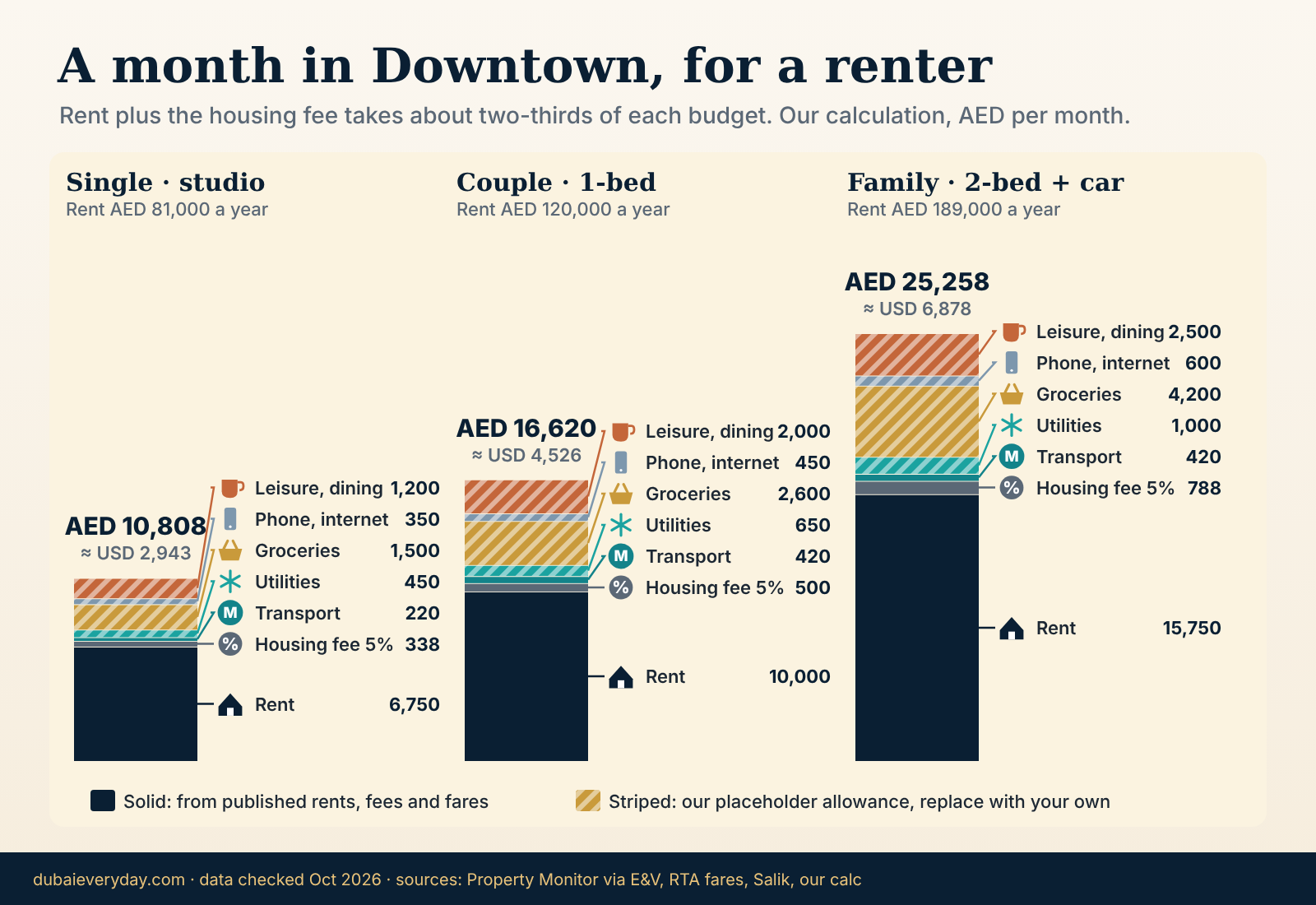
These are our calculations for this Downtown Dubai guide, built from the published numbers earlier on this page. The rent inputs are rounded Property Monitor averages from Engel and Völkers (AED 81,000 for a studio, AED 120,000 for a one-bedroom, AED 189,000 for a two-bedroom, annual), the housing fee is Dubai Municipality’s 5% of annual rent, and transport uses RTA fares and Salik rates. Utilities, groceries, phone and leisure are our round-number allowances, shown separately because they depend on you.
The three scenarios
The first scenario in this Downtown Dubai guide is a single renter in a studio. Rent is AED 6,750 a month, the housing fee about AED 338, transport AED 220 (44 Metro trips at the AED 5 two-zone fare), plus allowances of AED 450 for electricity, water and cooling, AED 1,500 for groceries, AED 350 for phone and internet and AED 1,200 for leisure. The total is about AED 10,800, or roughly USD 2,900.
The couple takes a one-bedroom. Rent is AED 10,000, the housing fee AED 500, transport AED 420 (one Metro commuter plus eight ride-hail trips at an assumed AED 25), and allowances of AED 650, AED 2,600, AED 450 and AED 2,000. The total is about AED 16,600, roughly USD 4,500.
The family takes a two-bedroom and keeps one car. Rent is AED 15,750, the housing fee AED 788, transport AED 420 (one Metro commuter plus about 40 Salik crossings a month at an average AED 5), and allowances of AED 1,000, AED 4,200, AED 600 and AED 2,500. The total is about AED 25,300, roughly USD 6,900.
School and nursery fees, which vary widely between schools and are set within KHDA rules; car purchase, fuel, insurance and registration; health insurance; domestic help; furnishing; and one-off move-in costs (about AED 44,000 for the one-bedroom, as worked out above). Parking is also not included: ask whether your lease comes with a space and what extra spaces cost.
What the sums tell you
The main lesson of the Downtown Dubai guide arithmetic is that rent plus the housing fee takes roughly 63% to 66% of each scenario. That is why the neighbourhood choice dominates the budget.
Using the same Property Monitor averages, a one-bedroom averages AED 94,206 a year in Business Bay and AED 97,434 in Dubai Marina against AED 120,285 in Downtown, a difference of about AED 2,170 and AED 1,900 a month respectively. In our reading, the Downtown premium is the price of the walkable cluster and the Metro station, so it is worth paying only if you will use them.
A 10% fall in rent saves about AED 1,050 a month for the couple (AED 1,000 rent plus AED 50 housing fee). Given that asking rents fell by more than that in a year on Property Finder’s measure, it is worth asking a landlord for a lower number and for a rent-free period, and checking what the same unit asked a year ago.
Trade-offs: noise, traffic, crowds and seasons
Every Downtown Dubai guide that only lists the advantages is selling something. The trade-offs here are real, and they are the reason many people who like the area still choose to live elsewhere.
Noise and activity
Life in a district built around attractions means that the attractions’ schedule becomes your schedule. The fountain performs every 30 minutes in the evening, a light show runs on the tower at night, restaurants line the Boulevard, and big events close roads. None of this is a defect; it is the product. But a flat on the lake side, the Boulevard side or the Opera side is a different experience from a flat on a quieter street, and you cannot judge it from a Tuesday-morning viewing.
Our suggestion in this Downtown Dubai guide is to visit a building at the time you will actually be home: an evening after 20:00 on a Friday or Saturday. Stand on the balcony, then walk to the Metro, then try to find a taxi.
Traffic and the pinch points
The district has good road links, but the same links are where everyone queues. Emaar calls The Dubai Mall the world’s most visited retail and entertainment destination (Wikipedia cites 105 million visits in 2023), so car traffic around its entrances is a feature of everyday life. Salik’s peak window of 06:00 to 10:00 and 16:00 to 20:00 matches the times when the surrounding arterials are slowest, and the fee model itself is designed to nudge drivers away from them.
Crowds, tourism and what residents plan around
Tourist peak season in Dubai runs roughly October to March according to secondary guides, which is also the nicest weather. So the best months to be outdoors are also the busiest on the Boulevard and in the lift lobbies. Residents learn to shop in the morning, to dine early or late, and to know which exits of the mall to avoid before a fountain show.
Heat across the year
Between June and September mean maximums are around 40°C or higher, with nights that stay at or above 28°C. The covered link, the mall, the hotel lobbies and car parks are what make Downtown liveable then. It also makes for a different pace: fewer people strolling on the promenade at noon, more people moving between air-conditioned places.
Cost, in non-rent terms
Service charges are among the highest in Dubai on a 2026 review (average about AED 28 per square foot a year, against AED 18 in Business Bay and AED 22 in Dubai Marina). Visitor parking, valet and restaurant prices follow the district’s positioning. Some of that is the price of having everything in one place; some is just the address.
Light sleepers, anyone who needs to drive to a suburb for school or work in rush hour, people who want a beach or a garden, and buyers who need a high rental yield. Each of these is better served by a different area, and the next section says which.
Downtown Dubai guide comparison: Downtown vs Business Bay, DIFC and Marina
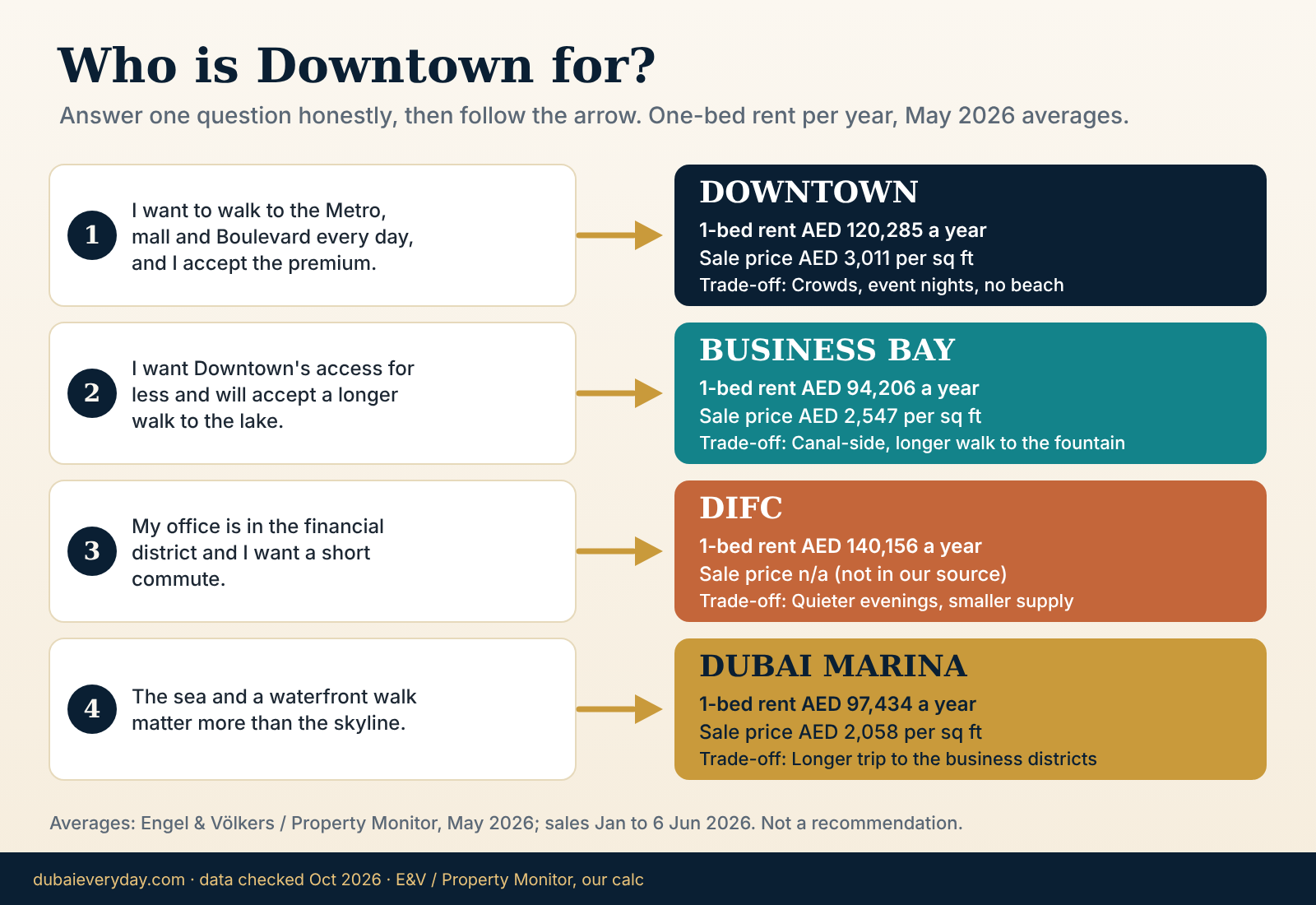
Most people using a Downtown Dubai guide are really choosing between four neighbourhoods. The comparison below uses the same sources as the rest of this Downtown Dubai guide; it is a briefing for the decision, not a ranking.
Downtown Dubai
Best for people who want the Metro station, the mall and a pedestrian street within a short walk, and who accept the premium. Average one-bedroom rent in Engel and Völkers’ May 2026 data is AED 120,285, the average sale price about AED 3,011 per square foot, and the average service charge about AED 28 per square foot. Downsides: noise, crowds, schools elsewhere, and the highest prices in this comparison for sales.
Business Bay
Immediately south of Downtown, with its own Red Line station and a canal network. Engel and Völkers lists a one-bedroom average of AED 94,206, a sale price near AED 2,547 per square foot, and a 2026 service charge average around AED 18 but with a very wide range.
Property Finder reports asking rents there fell 12.5% year on year in Q3 2026, less than Downtown. Business Bay suits people who want Downtown’s access at a lower price and will accept a longer walk to the lake. For a fuller comparison, our things-to-do guide shows which attractions each area sits next to.
DIFC
A financial district of about 110 hectares with its own common-law courts, per Wikipedia, and a shopping and dining area at Gate Avenue with 185 outlets. It is the choice for people who work there and want a short walk or a two-stop Metro ride. Engel and Völkers shows a studio average of AED 94,000 and a one-bedroom average of AED 140,156, higher than Downtown on that measure. Evenings and weekends can be quieter, and the residential supply is smaller.
Dubai Marina
A waterfront district around a roughly 3-kilometre canal, with a population of 70,550 in 2024 per Wikipedia, a Tram line linking to the Red Line, and the beach at Jumeirah Beach Residence nearby. A one-bedroom averages AED 97,434 on the same data, the sale price about AED 2,058 per square foot, and Property Finder’s median asking rent is AED 130,000, down 16.13% year on year.
The Marina is the pick if the sea matters more than the skyline; the trade-off is a longer trip to the business districts, and the road journey to Downtown was estimated earlier at roughly 25 to 50 minutes.
How to use this Downtown Dubai guide’s comparison
Pick the two areas you are tempted by. Compute your actual commute and your actual monthly bill for both using the method in the cost section. And stay short-term first if you can: a few weeks in a serviced apartment, found with the area-by-area method in our hotels guide, tells you more about an area’s noise, queues and walking than any viewing.
Downtown fits a renter who will use the Metro and the walkable cluster daily and who can pay the premium. Business Bay fits the same person with a smaller budget. DIFC fits someone whose work is there. The Marina fits someone who wants the sea. If none of those sentences describes you, the cheapest Downtown flat is not the answer.
Myths worth dropping
A Downtown Dubai guide should clear out the lazy claims first, because they cost real money.
- “Downtown is walkable end to end.” Inside the cluster, yes, in the cooler months. The covered link alone is about 820 metres, and the secondary guides suggest roughly a 15-minute walk from the fountain to Business Bay station.
- “A Burj Khalifa view means a Downtown flat.” Towers outside the master community can have the Burj Khalifa in the window too. Check the master community on the title or the DLD project service.
- “The lake is a waterfront.” It is a man-made lake in front of a fountain. The sea and public beaches are elsewhere; our best beaches in Dubai page explains where and how to get there.
- “Rents only go up in Dubai.” In 2026, advertised Downtown rents fell by more than a fifth on one measure and registered new leases fell 11% on another.
- “The Dubai Mall charges a fortune to park.” The first four hours are free on weekdays and six on weekends; the high rates apply to long stays.
- “The Metro runs all night.” Not normally. Hours end at midnight or 01:00 on Fridays, and only special events such as New Year’s Eve extend them.
- “The fountain runs all day.” Published slots are two in the afternoon and a run from 18:00 to 23:00, with closures for works, holidays and Ramadan changes.
The first 72 hours checklist
Use this checklist from the Downtown Dubai guide either as a visitor or as a new tenant; the two lists are separate.
If you are visiting: your Downtown Dubai guide checklist
- Day 1, before you leave your hotel: check the fountain status and the Metro hours for your day, buy or top up a nol card, and book your deck slot online.
- Day 1: arrive at Burj Khalifa/Dubai Mall station and walk the covered link in daylight to see how long it takes you; note the exits.
- Day 1 or 2: do the deck and the aquarium on separate days if you can; book restaurant tables for the evening you want a fountain view.
- Day 2 or 3: use Business Bay or Financial Centre station if the main station looks full after a show; pre-book your airport or onward transfer for a quiet time of day.
If you have just moved in: your Downtown Dubai guide checklist
- Hour 0 to 24: photograph every room, list defects in writing, and send the list to the landlord or agent by email.
- Day 1: confirm Ejari is registered and keep the certificate; connect DEWA and, if the building uses district cooling, open that account.
- Day 1 to 2: test the commute at the real hour you will travel, on the Metro or the road, and count the Salik gates.
- Day 2: register the pet if you have one, find the nearest clinic that is open late, and save the building’s security and maintenance numbers.
- Day 3: set renewal and notice dates in your calendar, and check how visitor parking and event nights work in your building.
Downtown Dubai guide FAQ
Is Downtown Dubai a good place to live?
On the evidence in this Downtown Dubai guide, it is a good place if you value a Metro station, restaurants and the mall within walking range, and you can absorb the rent premium, event-night crowds and the school run outside the area. It is a poor fit if you want quiet, a beach or a garden. Rents were falling through 2026, which improves the value side. Read the trade-offs section of this Downtown Dubai guide, then test an evening at the building before you sign.
Where exactly is Downtown Dubai?
Emaar describes it as lying between Sheikh Zayed Road and Financial Centre Road, with the Burj Khalifa, the Dubai Mall, the fountain lake, Dubai Opera, Souk Al Bahar and Old Town inside it. Business Bay is the neighbouring development immediately south, and DIFC lies across Financial Centre Road to the north. Listings sometimes use “Downtown” loosely, so verify the building’s master community on the Dubai Land Department services.
How much does it cost to rent in Downtown Dubai?
Published numbers in this Downtown Dubai guide range widely because they measure different things. In 2026 averages, a studio sits around AED 70,000 to 85,000 a year, a one-bedroom around AED 90,000 to 142,000 and a two-bedroom around AED 130,000 to 240,000. Property Finder’s median asking rent across all apartment sizes was AED 180,000 in Q3 2026, down 21.74% from a year earlier. All figures are indicative and dated; compare with the DLD rental index before agreeing a renewal, as the renting section of this Downtown Dubai guide explains.
How long does it take to walk from the Metro station to the Dubai Mall?
The covered link is reported at 820 metres, air-conditioned and fitted with travelators. Bayut’s area guide says about 10 to 15 minutes, and our arithmetic for a steady walking pace of 1.0 to 1.4 metres per second gives roughly 10 to 14 minutes before gates and shop stops. After big shows or on New Year’s Eve, queues at the station can add more time, and RTA has closed the station to entry early on past New Year’s Eves.
What time is the Dubai Fountain show?
Emaar’s announcement after the 2025 renovation lists afternoon shows at 1:00 pm and 1:30 pm (2:00 pm and 2:30 pm on Fridays) and evening shows every 30 minutes from 6:00 pm to 11:00 pm. Visit Dubai describes the fountain as performing every 30 minutes from 6 pm. Shows last a few minutes, schedules shift in Ramadan and on holidays, and works have caused suspensions, so check Emaar or the mall on the day.
How much are Burj Khalifa tickets, and when should I go?
Secondary sources in May 2026 listed Levels 124 and 125 at about AED 173 off-peak and AED 250 in the prime 4 pm to 7 pm window, and Level 148 at AED 400 to AED 554. Visit Dubai’s booking page shows “from” prices in a similar range but carries an old update date. Book a timed slot online. Weekday mornings and late evenings are quieter, and in summer a post-sunset slot is more comfortable than midday.
Is Downtown Dubai worth visiting in summer?
Yes, as an indoor destination, which is how this Downtown Dubai guide treats the hot months. Mean daily maximums at the airport station are 40.0°C in June, 41.5°C in July and 41.9°C in August, so plan the mall, aquarium and observation deck for the middle of the day and the fountain for after dark. The covered Metro link keeps the walk from the train largely out of the sun, but the lake promenade is outdoors. A first-timer travel guide covers timing across the year.
Is parking free at the Dubai Mall?
For short visits, yes. The mall’s parking page says the first four hours are free on weekdays and the first six on weekends, and that fees apply after that, rising from AED 20 for the fifth hour on weekdays to AED 200 beyond eight hours. Gulf News reported that plates are read on entry and charges are taken from a Salik account. Valet is separate and priced separately. Check the mall’s page, because zones and rates can be revised; the parking figures in this Downtown Dubai guide date fastest.
What are the fees for buying a property in Downtown?
The buying chapter of this Downtown Dubai guide lists reported charges: a 4% DLD transfer fee, a registration fee of AED 4,000 plus 5% VAT for properties of AED 500,000 and above, about AED 580 for the title deed and related items, and for mortgages a registration fee of 0.25% of the loan plus about AED 290. On a AED 2.7 million flat our calculation gives about 4.5% of the price before agent commission. Confirm every amount with the DLD or a registered trustee.
Downtown Dubai or Business Bay: which should I choose?
The comparison in this Downtown Dubai guide comes down to this: choose Downtown if the walkable cluster around the lake and the mall matters daily and you accept the premium. Choose Business Bay if you want similar Metro and road access at lower rents. Engel and Völkers’ 2026 averages put a one-bedroom at AED 94,206 in Business Bay against AED 120,285 in Downtown. Business Bay’s quality varies more by building, so compare by walking time to a station rather than the label on the listing.
Is Downtown Dubai good for families with children?
A family-focused Downtown Dubai guide has to say that it has family attractions, parks nearby and a Mediclinic branch in the mall, but schools sit outside the district, mostly in Al Wasl, Al Safa, Business Bay and Jumeirah. Pick the school first and test the drive at school-run time, using the KHDA directory for ratings and fees. Apartments dominate, with few villas. For many families the compromise is a two-bedroom in the quieter tower groups rather than on the Boulevard.
What happens in Downtown on New Year’s Eve?
For 2025/26, roads around the Burj Khalifa began closing from 4 pm, the Burj Khalifa/Dubai Mall Metro station closed to entry from 5 pm, and free viewing zones opened at 5 pm. A ticketed Burj Park zone charged adults AED 997.50. As of 29 October 2026, the 2026/27 details had not been published, so plan on the same pattern: arrive early by Metro, expect to walk and expect a long wait to leave.
Do I need a car if I live in Downtown?
Not for the district itself. The Metro, walking and taxis cover most daily needs, and a car adds Salik tolls and parking. This Downtown Dubai guide’s answer is that a car becomes useful if you commute to places without a Metro, such as Dubai Hills or parts of Al Quoz, or if the school run is outside the area. Our worked example in the cost section puts the toll for a Marina-side commute at about AED 440 a month before VAT.
Where to go next
If you take one idea from this Downtown Dubai guide, make it the boundary check and the evening test: confirm the master community, then stand in the place at the hour you will really be there. Everything else, from fares to rents, will have moved by the time you read this, so re-check the dated numbers first.
- Emaar: Downtown Dubai community page — district boundaries, landmarks, project count, Boulevard rentals (official developer, accessed 29 Oct 2026)
- Emaar: Dubai Fountain reopening announcement — show times and reopening on 1 October 2025 (accessed 29 Oct 2026)
- Emaar: Dubai Fountain show timings and viewing spots — viewing locations and Boardwalk (accessed 29 Oct 2026)
- The Dubai Mall: opening hours — retail, restaurant, supermarket and clinic hours (accessed 29 Oct 2026)
- The Dubai Mall: paid parking — free hours and rate steps (accessed 29 Oct 2026)
- Dubai Aquarium and Underwater Zoo: plan your visit — hours and time needed (accessed 29 Oct 2026)
- Visit Dubai: Burj Khalifa — official tourism listing, ticket link (accessed 29 Oct 2026)
- Visit Dubai: The Dubai Fountain — evening schedule, Boardwalk and lake ride starting prices (accessed 29 Oct 2026)
- Visit Dubai: Downtown Dubai neighbourhood — official neighbourhood summary (accessed 29 Oct 2026)
- Visit Dubai Experiences: At the Top tickets — “from” prices, with an old update date (accessed 29 Oct 2026)
- Dubai Land Department: homepage and e-services — rental index, service charge index, project status, title deed verification, Trakheesi (accessed 29 Oct 2026)
- Dubai Land Department: rental index — calculator inputs (accessed 29 Oct 2026)
- Dubai Land Department: Ejari registration and renewal — fees, documents, channels (accessed 29 Oct 2026)
- Dubai Land Department: service charge index — how to look up approved charges (accessed 29 Oct 2026)
- RTA: nol fares for Metro, Tram and Bus — zone fares and transfer rules (accessed 29 Oct 2026)
- Dubai Health Authority: Sheryan licensing system — licensing scope and contact (accessed 29 Oct 2026)
- KHDA: Knowledge and Human Development Authority — regulator and school directory (not readable in full; accessed 29 Oct 2026)
- Arabian Business: Dubai asking rents, Q3 2026 — Property Finder data, context (secondary, accessed 29 Oct 2026)
- Gulf News: rents fall in prime areas — asking rents and registered leases (secondary, accessed 29 Oct 2026)
- Engel and Völkers: average apartment rental in Dubai — Property Monitor averages by bedroom (secondary, accessed 29 Oct 2026)
- Engel and Völkers: average price per square foot — Property Monitor and DLD transaction data (secondary, accessed 29 Oct 2026)
- Khaleej Times: mortgage financing and down payment — LTV limits (secondary, accessed 29 Oct 2026)
- Property Finder: DLD fees in Dubai — fee breakdown dated July 2026 (secondary, accessed 29 Oct 2026)
- The National: New Year’s Eve closures, Metro and parking — 2025/26 arrangements (secondary, accessed 29 Oct 2026)
- Bayut: Downtown Dubai area guide — building names, services, transport (secondary, accessed 29 Oct 2026)
- Wikipedia: Climate of Dubai — NOAA 1991–2020 normals for the airport station (secondary, accessed 29 Oct 2026)
- Gulf News: new Metro link to Dubai Mall — walkway length and design (secondary, 2012 report, accessed 29 Oct 2026)
Update log: 29 October 2026 — first publication; all facts re-checked against the sources above. Next review due: 30 November 2026 for rents, tickets, fountain timings and New Year’s Eve arrangements, then quarterly. Corrections welcome. This page is general information, not individual legal, financial, medical or property advice.