

Dubai is easy to enter, hard to pace and unforgiving about timing. This Dubai travel guide puts the decisions in the order that saves money and stress: current conditions, season, entry rules, cost, arrival, transport, and only then the days themselves.
A useful Dubai travel guide for first-timers comes down to six decisions, made in the right order: whether current regional conditions suit your risk tolerance, which month to travel, whether your passport and visa route are sorted, what the trip really costs, where to sleep, and how you will move around in the heat.
Read your own government’s UAE advice first, because the region has been unsettled since February 2026. Then pick a month. November to March is the comfortable window, with average afternoon highs of roughly 24 to 31 °C, while June to August averages 40 °C or more. Check that your passport has at least six months of validity, confirm your visa route on an official page, and buy insurance that covers medical care and disruption.
Budget about AED 400, AED 1,000 or AED 2,500 per person per day for a lean, comfortable or premium trip (our calculation: two people sharing a room, flights excluded). Stay near a Metro line, use a Nol card for most journeys, and keep outdoor plans to the early morning and late afternoon for much of the year. Everything below is dated 29 October 2026.
This Dubai travel guide is research-based. Nobody at DubaiEveryday.com has stayed in the places, ridden the routes or eaten the meals described here, and the page does not pretend otherwise. On 29 October 2026 we read government travel advice (UK FCDO, US State Department, Australian Smartraveller), UAE federal and Dubai authority pages (the UAE government portal, GDRFA, ICP, the Federal Tax Authority, the RTA), operator pages (Etihad Rail, Visit Hatta, Dubai Airports) and dated news reports for event schedules.
Climate figures are the 1991–2020 NOAA normals for Dubai International Airport as compiled on Wikipedia; sea temperatures are indicative averages. Where an official page would not load or left a figure out, we used a named secondary source and say so, or we hedged the number. Budgets and taxi estimates are our own calculations with stated assumptions. We did not field-test routes, check live prices or book anything. Inclusion was not paid for, and the page contains no affiliate links. This is general information, not individual legal, medical, financial or security advice.
Start here: check the current situation before you book
Any Dubai travel guide dated October 2026 has to open with something older guides never needed to say. The region has been unsettled since the end of February, and that touches flights, insurance and how flexible your bookings should be. It does not settle the question for you. Treat it as a planning variable and price it in before you pay for anything non-refundable.
What the official sources say
The US State Department’s UAE advisory carries Level 3, “Reconsider Travel”. It says hostilities between the United States and Iran began on 28 February 2026 and cites the threat of drone and missile attacks, flight disruption and terrorism risk. The version we read was dated 3 March. The UK Foreign Office page was updated on 27 October and still current on 29 October. It calls the situation “deeply unpredictable”, warns of a high risk of sudden escalation and tells travellers to expect possible flight cancellations and airspace closures.
Australia’s Smartraveller advice tells people to reconsider their need to travel, and says that includes transiting. Governments weigh the same facts differently, and your nationality changes the picture. Read the page for your own passport rather than relying on a summary, including this Dubai travel guide: the US advisory and the UK advice are the two most detailed.
On the ground, press reports from early May say the UAE lifted all airspace restrictions on 4 May and that its civil aviation authority described operations as back to normal. A trade analysis published on 16 September put international overnight arrivals for August 2026 at about 869,000, the strongest month since February, with hotel occupancy around 66 per cent. Those are secondary figures, and they describe a recovery that is uneven.
Flights and attractions: what has changed
Dubai International (DXB) is open around the clock, and Emirates and flydubai are flying from it. Several foreign airlines are not. Time Out Dubai’s list on 27 October had British Airways paused through 3 November, Air France through 31 October, the Lufthansa Group’s return pushed to 25 November, Cathay Pacific cancelled through 31 January 2027, and Air Canada and United off the route until spring 2027. Dates like these move weekly. Treat them as an example of the pattern, and confirm your own flight with the airline.
A few headline places are also closed for reasons that have nothing to do with security. The Museum of the Future closed its galleries on 1 September and plans to reopen in the first quarter of 2027. The Burj Al Arab shut in April for an 18-month restoration, with guests expected back in October 2027, according to Gulf News. Barasti Beach Club (closed 21 June) and the Armani Hotel (closed 1 April) are also out until 2027. If you travel this winter, build the plan without them, and see the guide to the best things to do in Dubai for what is worth the slot instead.
A decision rule that works
Our reading: no Dubai travel guide can answer “is Dubai safe” for you. The useful question is “what happens to this trip if flights stop for 48 hours, or an alert sends me indoors for an afternoon?” If the honest answer is that you lose money you cannot spare or miss something you cannot reschedule, wait, shorten the trip or restructure it. If the answer is a delay and some rebooking, you are in a position to go.
- Read your government’s current UAE advice and sign up for its alerts if it offers them (the UK Foreign Office has an email service).
- Choose refundable or changeable flights and room rates, and hold off on prepaying tours until about two weeks out.
- Ask your insurer in writing whether the current advisory level affects cover, whether war or terrorism is excluded, and what “disruption” actually pays.
- Avoid tight same-day connections, and do not land on the same day as a non-refundable onward flight.
- Keep documents, medication, a power bank and some cash in your carry-on.
If a phone alert sounds
The UAE’s alert system broadcasts messages to phones in a defined area. According to The National’s explainer of 19 August, which summarises guidance from the national emergency authority, the advice is simple. Outdoors, move into the nearest building and stay away from glass and external walls. In a car, keep driving carefully rather than stopping on the road, and head for indoor shelter if you can. In a hotel or flat, move away from balconies and windows to a central area, follow building announcements and avoid lifts unless told otherwise. Stay put until the follow-up message says normal activity can resume.
Do not film interceptions or debris, which the same guidance says is prohibited, and do not touch fragments, which the FCDO also warns against. Hotels typically announce instructions themselves, so listen to staff first.
This section summarises published government advice on a fast-moving situation. It is not security advice and it cannot predict what happens next. Check the official pages linked above on the day you book, and again before you fly.
The Dubai travel guide roadmap: what to decide, and in what order
Most planning mistakes come from deciding in the wrong order. People book a hotel before they know the month, or fix the month before checking a passport. This Dubai travel guide follows the sequence that keeps your choices reversible for as long as possible, and the figure below is the whole plan on one page.
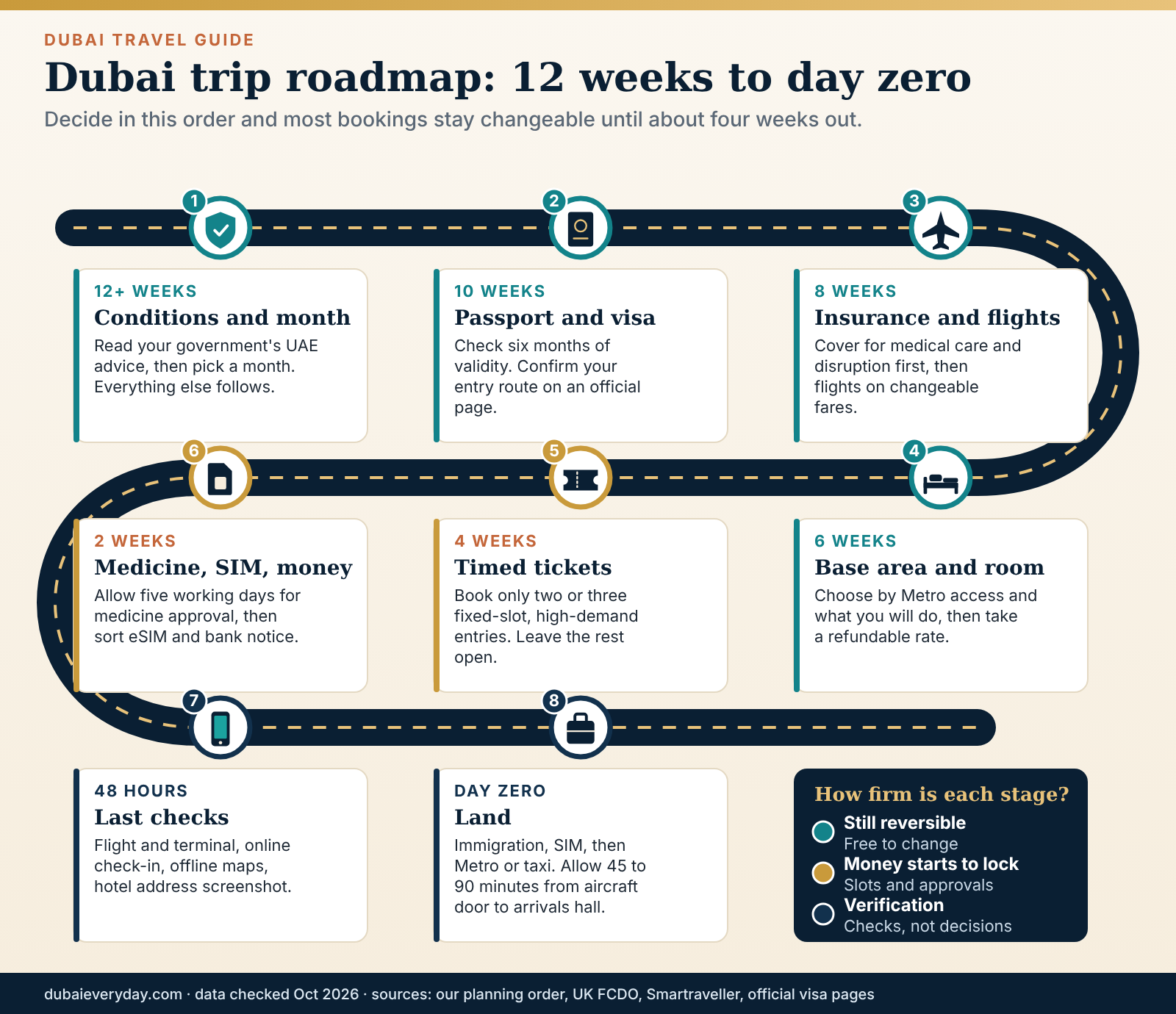
- Twelve weeks or more out: conditions and monthRead the official advice for your passport, then choose a month using the climate and event section below. Everything else depends on these two choices.
- Ten weeks: passport and visa routeCheck six months of passport validity and find out which entry route applies to your nationality on an official page. Renewing a passport is slow; a visa application can be quick.
- Eight weeks: insurance and flightsBuy cover that handles both medical care and disruption, then book flights on changeable fares. Insurance bought after a disruption starts is usually worthless for that disruption.
- Six weeks: base area and roomPick the area by Metro access and what you will do, then a refundable rate. The hotels and Downtown guides linked later in this Dubai travel guide help with this step.
- Four weeks: timed tickets for two or three anchorsBook only the entries with fixed time slots and real demand, and leave the rest open. Add any day-trip transport that sells out.
- Two weeks: medicines, phone, moneyApply for approval if you carry controlled medication, set up an eSIM or plan a SIM, tell your bank, and decide how you will get a Nol card.
- Forty-eight hours: the last checksRe-check your flight and terminal, check in online, download offline maps, and screenshot your hotel address in English.
- Day zero: landImmigration, SIM, then Metro or taxi. The arrival part of this Dubai travel guide has the timings.
When to go: a month-by-month Dubai travel guide to heat, crowds and events
Every Dubai travel guide should admit that Dubai has three seasons, and only one of them suits ordinary sightseeing. The temperatures below are the 1991–2020 normals for the airport weather station, compiled from NOAA data. They are averages, so individual days will run hotter or cooler, and the heat feels worse near the coast because of humidity.
From November to March, average afternoon highs sit between 24.4 °C (January) and 30.7 °C (November), and nights cool to roughly 15–21 °C. April and October are the shoulder months at 33.7 °C and 35.9 °C. From May to September the average high is 38 to 42 °C, and in July and August the average night is still about 31 °C. There is no cool-down, which is why Dubai’s summer is lived indoors.
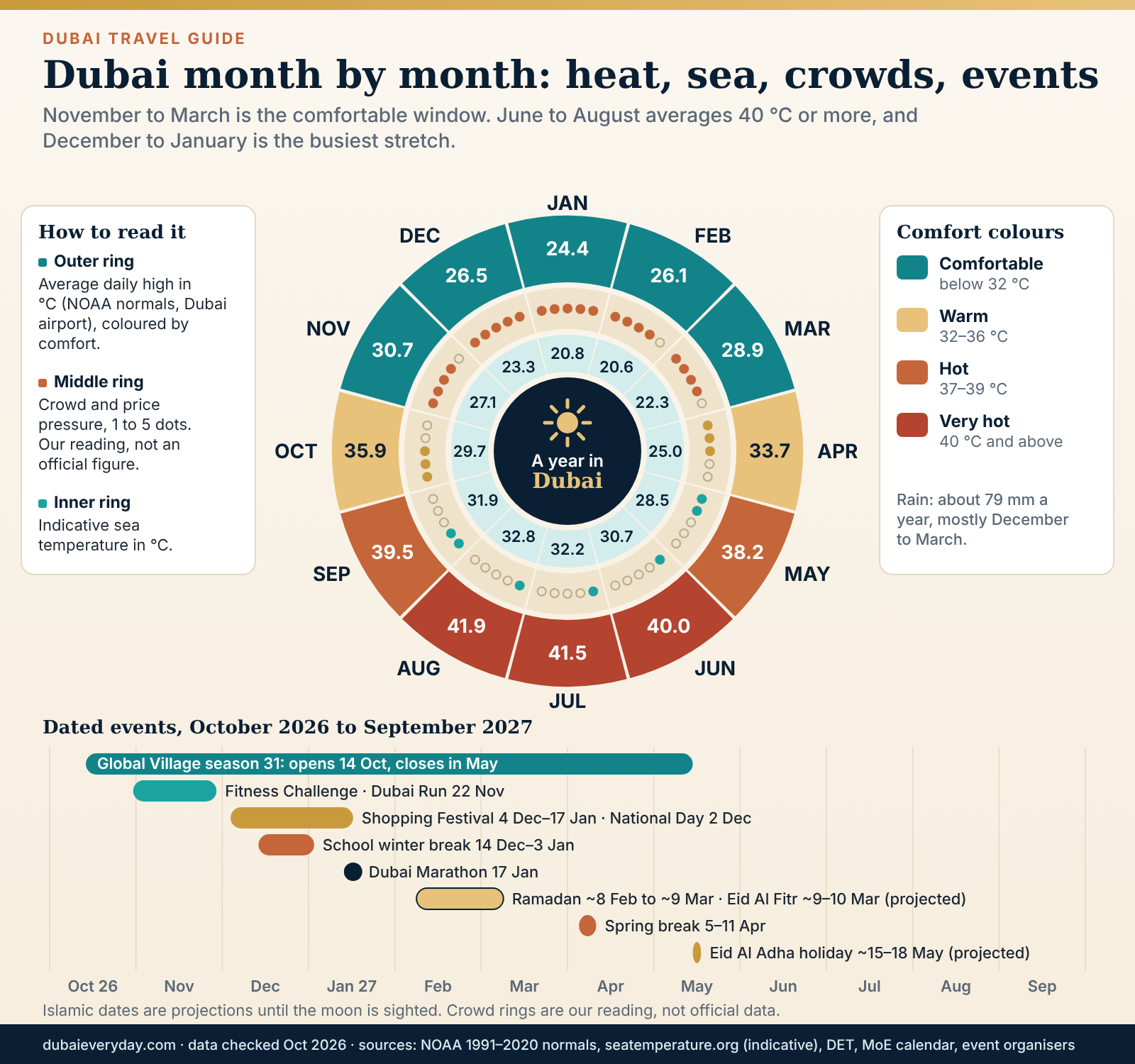
Rain is rare but not absent. The annual normal is about 79 mm, almost all of it between December and March (January 20.8 mm, March 21.7 mm). When it arrives it can be heavy; Dubai saw record flooding in April 2024, so a wet forecast is a reason to move outdoor plans, not ignore the warning. The UAE’s National Centre of Meteorology publishes the official forecasts and warnings.
November to March: the comfortable window, and the priciest
This is the season most first-timers should aim for. It is also when demand peaks. Dubai’s tourism department reported 80.7 per cent average hotel occupancy for 2025 and an average daily rate of AED 579 (about US$158), and December 2025 became the first month to pass two million international visitors. Our reading: that pressure is concentrated in the weeks around the school winter break (14 December 2026 to 3 January 2027) and New Year’s Eve, when you should book earliest and expect the least discount.
If this Dubai travel guide had to pick one month for a typical first visit, it would be November, for people who want a warm sea and fewer crowds: the average high is 30.7 °C and the sea is about 27 °C. February and early March are the cooler end of the season, with the sea near 21–22 °C, which is fine for a pool-and-sightseeing trip but cold for anyone expecting a swim in the Gulf without a heated pool. The beaches guide covers which public and hotel beaches work in each season.
April, May and October: shoulder months with a catch
In a month-by-month Dubai travel guide, April still gives you a mean high of 33.7 °C, but spring break (5 to 11 April 2027) pulls family demand back in, and the first week of May is when Hatta’s activity season ends. May is already 38.2 °C on average, and Eid Al Adha is expected to bring a public holiday from 15 to 18 May 2027. October looks tempting on a price sheet, and the average high is still 35.9 °C, so plan on the morning-and-evening rhythm described in the itinerary section. Global Village opens its season in mid-October, which is the clearest sign that the outdoor year has restarted.
June to September: Dubai as an indoor city
Summer works in a Dubai travel guide for one kind of traveller: someone who wants a pool, air-conditioned malls and museums, low demand and hotel-based leisure, and who accepts that anything outdoors happens before 9 am or after sunset. The sea is 31–33 °C, which feels more like a bath than relief. Outdoor seasonal attractions close, so your list of things to do shrinks. It is a poor fit for first-timers who want to walk the old districts, take the abra, visit Hatta or drive into the desert.
An average August high of 41.9 °C is an average. Individual days run higher, humidity makes the coast feel worse than the thermometer says, and a record of 49 °C has been logged in Dubai. If you have a medical condition, travel with children or are over 65, treat June to September as a hotel-and-mall trip and read the heat section of this Dubai travel guide before booking.
Events and dates to plan around, 2026 to 2027
Event dates change the experience more than they change the weather. These are the ones this Dubai travel guide treats as planning anchors for a first visit, with the source of each date noted in the sources box. Islamic holiday dates are astronomical projections until the moon is sighted.
Global Village, Season 31
Opened on 14 October 2026 and closes for summer in May. Reported entry is AED 25 Sunday to Thursday and AED 30 on Friday and Saturday; Tuesdays are reserved for ladies and families except on public holidays.
Dubai Fitness Challenge
31 October to 29 November 2026. Dubai Ride is on Sunday 1 November and Dubai Run on Sunday 22 November, when Sheikh Zayed Road is closed to cars until about 9 am. Stand Up Paddle in Hatta runs 7–8 November.
Dubai Shopping Festival
The 32nd edition runs 4 December 2026 to 17 January 2027, 45 days of promotions, concerts and mall events. National Day falls on 2 December, with the holiday length set by the government.
School winter break
14 December 2026 to 3 January 2027 on the unified Ministry of Education calendar, which most Dubai schools follow. Family demand and hotel pressure peak here.
Dubai Marathon
Sunday 17 January 2027, with a marathon, a 10 km race and a 4 km fun run. Check the route map on the race website before booking early-morning transport.
Ramadan 2027
Projected to start on 8 February 2027 and run 29 or 30 days. Eid Al Fitr is expected on 9 or 10 March, with a holiday of three or four days. Moon sighting confirms the dates.
Spring break and Eid Al Adha
School spring break is 5 to 11 April 2027. The Eid Al Adha public holiday is expected from 15 to 18 May 2027, with the exact days confirmed after moon sighting.
Ramadan deserves a clear-eyed note in any Dubai travel guide. It falls in the cool season in 2027, so weather is not the problem. The adjustment is cultural: the FCDO advises visitors not to eat, drink, smoke or chew gum in public during daylight hours, and opening hours of shops and restaurants shift. Evenings are lively, and some visitors choose the month for exactly that. If you want a normal schedule of daytime restaurants, it is a worse fit. The rules section covers the details.
The Dubai travel guide month picker: which month for which traveller
First visit, sightseeing-heavy: late November, or February to mid-March outside Ramadan, and avoid 14 December to 3 January unless the festive atmosphere is the point. Beach-first: late October and November (sea near 27–30 °C) or April, accepting that April afternoons are hot. Lowest cost: June to August, with the heat as the price. Older travellers or anyone sensitive to heat: December to February. Families on school calendars: you are probably locked into peak dates, so spend your flexibility on the hotel rate and booking early.
Whichever month you pick, the rest of this Dubai travel guide assumes the cool season unless it says otherwise. The sights themselves are covered in the best things to do in Dubai guide, which helps you decide what to keep and what to drop once the dates are fixed.
Entry and visa basics for first-time visitors
Who needs what depends entirely on your passport, and this Dubai travel guide will not guess. The UAE government portal sorts visitors into three groups: GCC citizens, who enter visa-free; citizens of listed countries, who receive a visa on arrival (it describes 30-day and 90-day categories); and everyone else, who needs an entry permit arranged in advance through a sponsor such as an airline, hotel or licensed travel agency. The page does not print the country lists and says they change, so the only check that counts is the one for your own passport.
The official places to run it are the Visit Dubai visa guide, the Dubai residency department (GDRFA), the federal ICP smart services (helpline 600522222, or +971 600 522222 from abroad) and the UAE embassy in your country. Your airline will also refuse to board you without the right paperwork, which makes it a useful final check. Bookmark these before you read the rest of this Dubai travel guide.
The Dubai travel guide entry check, step by step
- Passport validityThe UAE portal and the UK Foreign Office both say at least six months from the date of entry. Australia’s advice adds that the passport needs a numeric date of birth and both name fields completed, and that emergency passports and passports with an “X” or “U” gender marker are not accepted. Ask your own embassy if your passport is unusual.
- Entry routeRun your nationality through an official tool. For scale, the UK government says British passport holders get a free visa on arrival for up to 90 days in any 180-day period, and Australia’s says Australian passport holders are eligible for a tourist visa on arrival. Those statements are about those citizens only.
- If you need a pre-arranged permitGDRFA’s single-entry tourist visa lists AED 200 for 30 days or AED 300 for 60 days, plus 5 per cent VAT, with 48 hours expected for processing. Conditions include six months of passport validity, a ticket to continue or leave, and medical insurance valid in the UAE. Only accredited tourism offices can issue it, so you cannot apply as an individual on that page. Fees can change; confirm before paying.
- Carry the proofKeep a return or onward ticket, your first-night address and your insurance policy on your phone and in print. They are the documents an officer or airline agent may ask for.
- Know your end dateOverstaying is charged per day (the government page says AED 50 a day, counted from ten days after the visa expires). Extensions for Dubai entries go through GDRFA, and elsewhere in the UAE through ICP.
- Transit is differentThe government portal lists transit permits with validity as short as two days. If you are only changing planes without passing immigration, the medicine and passport rules differ slightly, but you still need the right documents for your onward flight.
We have deliberately not listed eligible countries. Official lists change, and a blog’s list is only as good as its last edit. If a page, including this Dubai travel guide, tells you “you don’t need a visa”, confirm it with GDRFA or ICP and your airline before you buy a ticket.
Health rules and insurance
For a Dubai travel guide health check, there is no routine vaccination requirement for visitors. The FCDO says a yellow fever certificate is needed only if you arrive from a country with a risk of transmission, and points to the UK’s TravelHealthPro service for everything else. Check your own country’s equivalent at least eight weeks out, because some vaccines need a course.
Insurance is where visitors get caught, and a Dubai travel guide that skipped it would leave out the item that costs the most when it goes wrong. The FCDO warns that UAE hospitals can refuse treatment without insurance or the means to pay, and that you may be stopped from leaving if you cannot settle a medical bill. A policy for a Dubai trip should cover medical treatment and evacuation, cancellation and disruption, and the specific activities you plan, such as desert driving. Then read the exclusions for war and terrorism against the situation described at the top of this page.
Medicines, customs and what not to pack
Some ordinary prescription and over-the-counter medicines are controlled in the UAE. The FCDO says narcotic, psychotropic and other controlled medicines need prior Ministry of Health approval, that applications usually take around five working days, and that unapproved medicines can be confiscated and the traveller prosecuted. The limit it states is a three-month supply, reduced to one month for medicines on the approval list. Australia’s advice says to carry no more than three months with a prescription and a doctor’s letter.
Practical rule: look up the active ingredient of every medicine, not the brand name, and apply early. Keep medicines in original packaging in your hand luggage.
Other customs points from the same official advice: declare cash above AED 60,000 or its equivalent, expect pork products and pornography to be illegal, and note that some CBD and herbal products, including certain skincare items and vape refills, can be confiscated. Weapons and related items need permission whatever the quantity. Drones are a separate problem, covered in the rules section.
Work, debts and other entry traps
In this Dubai travel guide, the short version of the work rules is that a visit visa does not allow paid or unpaid work. The FCDO also warns that unresolved legal issues, unpaid debts or an unclosed work visa from a previous stay can lead to detention or a travel ban, and that unpaid bills, including hotel bills, can be treated as financial crimes. For a normal holiday none of this matters. For anyone who has lived or worked in the UAE before, it is worth a check with the relevant authority before booking.
Money, fees and a realistic daily budget
The dirham and how to pay
Everything in this Dubai travel guide is priced in dirhams, with approximate US dollars where it helps. The UAE dirham has been pegged to the US dollar at 3.6725 since 1997, so AED 100 is about US$27.23 and the rate does not drift against the dollar. Your own currency will, so check the live rate when you budget.
Cards are accepted across malls, hotels and most restaurants, but cash still matters in small ways: the RTA lists the motorised traditional abra across the Creek as AED 1 per passenger, paid in cash. Carry a small float of notes, and when a card machine offers to charge you in your home currency, choose dirhams.
Cash entering the country above AED 60,000 (or the equivalent) must be declared, according to Australian government advice. ATM fees and foreign transaction charges come from your own bank, so ask it before you leave rather than after the first withdrawal.
What the advertised price leaves out
In any Dubai travel guide budget, advertised quotes are a starting point. The UAE government portal lists the Tourism Dirham fee at AED 7 to 20 per room per night, depending on hotel category, for a maximum of 30 consecutive nights, and notes that UAE hotels may also add a service charge and municipality fee on top of the room rate. VAT is 5 per cent. The combination differs by property, so read the final screen, not the headline rate, and compare like with like.
Restaurants often add a service charge, and the same 5 per cent VAT applies. If a service charge is already on the bill, a further tip is a courtesy rather than a requirement; there is no tipping law we could verify, so treat it as custom. Rounding up a taxi fare is common practice, not a rule.
Transport has its own add-ons. Press reports of the November 2025 fare changes put the Salik toll pass-through at about AED 4 to 5 per gate, and taxis can have a higher starting fare at big event venues: the RTA has set an AED 20 flag fall at locations such as Expo City and Global Village on major event days, and press reports put it at AED 20 to 25.
Tourist VAT refund: worth it above a threshold
Eligible visitors can reclaim VAT on goods bought from registered retailers through the Planet scheme run for the Federal Tax Authority. The authority’s page lists a minimum of AED 250 per refund transaction, validation within 90 days of the invoice, and deductions of 13 per cent of the VAT plus AED 3.60 per transaction. You must be 18 or over and not a UAE resident, and you validate at a Planet kiosk or desk when you leave, with the goods and your original passport.
Our Dubai travel guide calculation: a purchase of AED 1,000 before VAT carries AED 50 of VAT. The fees are AED 6.50 plus AED 3.60, so you get back about AED 39.90, which is roughly 4 per cent of the spend. That is worthwhile for a large electronics or jewellery purchase and not worth a detour for a souvenir. Leave extra time at the airport; the authority describes validation at kiosks and manned desks at exit points, and the goods may be inspected.
Dubai travel guide budget: three tiers, worked through
Most Dubai travel guide budgets give one headline number. A better method shows the parts, so you can change the ones that matter to you. The figure below stacks five cost blocks for three tiers, per person per day, assuming two people share a room and excluding flights.
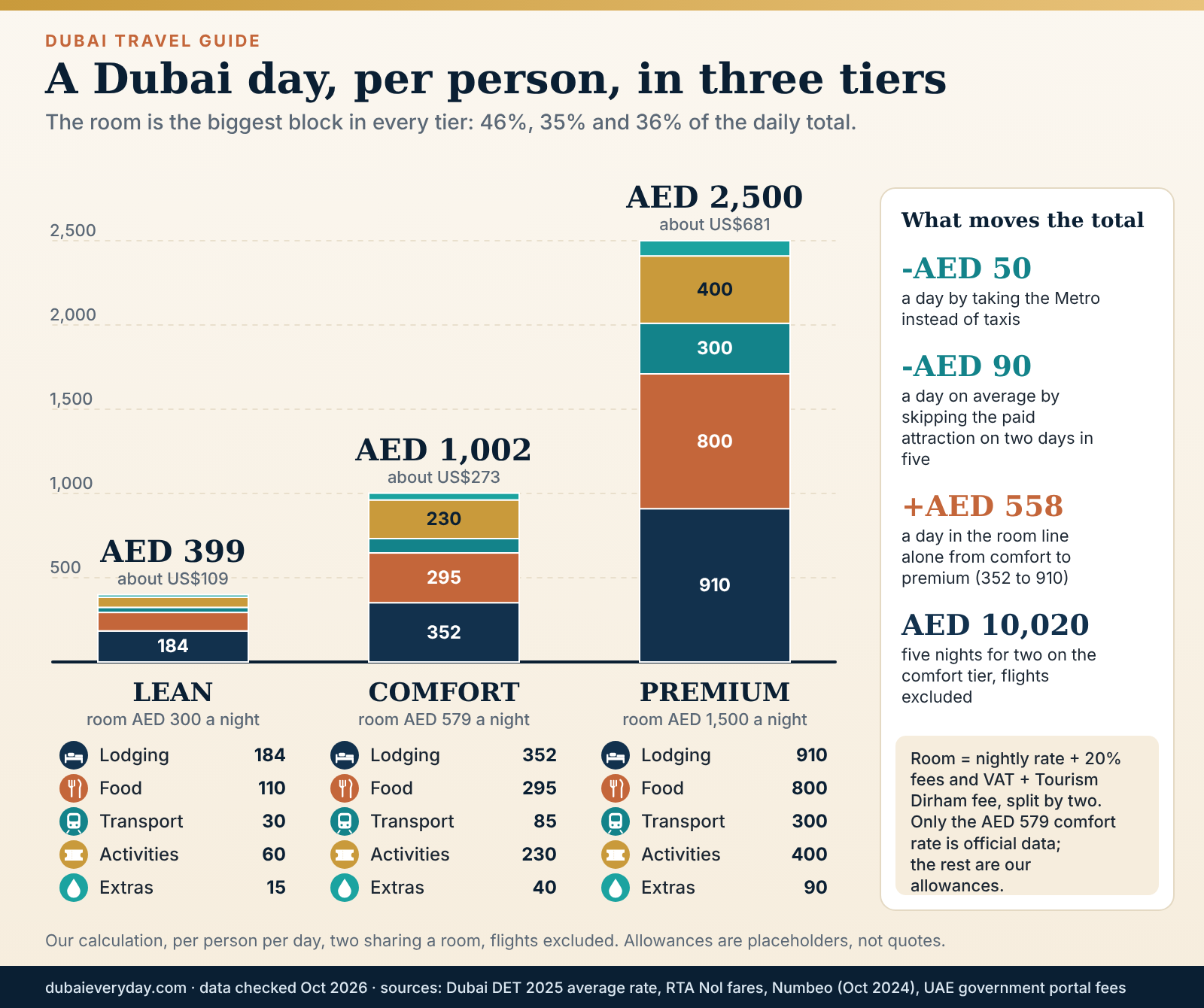
The method is simple. Lodging starts from a nightly room rate, adds a 20 per cent allowance for service charge, municipality fee and VAT, adds the Tourism Dirham fee, and divides by two. The comfort tier uses AED 579, the 2025 average daily rate reported by Dubai’s tourism department. The lean and premium rates (AED 300 and AED 1,500) are our own assumptions for a simple hotel and a beach-resort-style room, not quotes.
Food uses crowd-sourced price data from October 2024: roughly AED 40 for a basic restaurant meal and AED 300 for a mid-range three-course dinner for two. Transport uses the Silver Nol fares of AED 3, 5 and 7.5 per ride. Activity allowances are placeholders, because ticket prices change by time slot and we have not verified them.
Here is the comfort tier line by line. A room at AED 579 plus 20 per cent is AED 694.80, and a mid-band Tourism Dirham fee of AED 10 makes AED 704.80 per room, so AED 352 each. Food is about AED 295 (breakfast, a modest lunch, half of a mid-range dinner for two, and drinks). Transport is about AED 85, made of AED 30 of Metro rides and one AED 55 taxi. A daily activity allowance of AED 230 and AED 40 for SIM, water and sun protection brings the total to about AED 1,002.
The sensitivity matters more than the total. Moving from taxis to Metro saves roughly AED 50 a day. Dropping the paid attraction on two days out of five saves around AED 90 a day on average. Moving from a mid-range to a premium hotel adds more than any other single choice. Using this Dubai travel guide’s comfort tier, a five-night trip for two comes to about AED 10,020 (roughly US$2,730), excluding flights. The best hotels in Dubai guide is the place to test different room rates against your area and beach needs.
The numbers in this Dubai travel guide are planning allowances, not price quotes. Hotel rates swing widely with the date, the food figures come from a crowd-sourced database, and the premium tier can be exceeded by one dinner. Replace our allowances with real quotes for your dates as soon as you have them.
Arriving: DXB, DWC and the ride into the city
Which airport, which terminal
This part of the Dubai travel guide assumes you land at Dubai International (DXB), as almost every visitor does. It runs 24 hours. It has three passenger terminals, and the airline you fly largely decides which you use. Terminal 3 is Emirates’ home, Terminal 2 handles much of flydubai’s network, and Terminal 1 serves more than 50 other international carriers, according to Wego’s airport status page (a travel-news site, updated 19 October). Assignments can change during disruption, so check your booking or app the day before.
The terminal matters because of the Metro. The Red Line has stations at Terminal 1 and Terminal 3. Terminal 2 has no Metro station, so a flydubai arrival there will use a taxi, ride-hailing or bus. The Dubai Airports website carries maps and live flight information.
Al Maktoum International (DWC) is a different case. It is about 37 km south-west of central Dubai, has a single passenger terminal and, as of 9 October, listed only a few scheduled passenger services on its official board. Dubai Airports’ chief executive has said the long-term plan is to move operations there in phases, but the first full phase is expected only in the early 2030s. Unless your ticket says DWC, plan for DXB. If it does, expect a taxi of about AED 120 to 180 and 45 to 60 minutes to downtown, or the F55 bus to a Metro station every 30 minutes, paid by Nol card only.
Immigration and the first hour
Passport control is where timing is least predictable, and no Dubai travel guide can promise a queue time. Registered travellers in eligible groups can use the Smart Gates, which scan a face or passport without a stamp. Gulf News, relaying the residency department’s rules, lists UAE and GCC citizens, residents, visa-on-arrival and Schengen guests and pre-issued visa holders, with a minimum height of 1.2 metres, and says you can check registration on the GDRFA website before you fly. Everyone else queues at a desk.
No official page gives a reliable queue time, and it swings with the arrival waves of Gulf carriers. Our planning allowance, not an official figure: allow 45 to 90 minutes from the aircraft door to the arrivals hall including bags, and more if two long-haul flights land together. Do not book a pre-paid transfer or a Metro-dependent plan that assumes the fast end.
SIM and eSIM for a Dubai trip
Two operators, du and e&, have offered visitors a free eSIM with 10 GB of data valid for one day, activated after immigration at UAE airports, according to Gulf News in September 2025. After that, du’s paid follow-on was a 4 GB plan with 30 minutes for AED 49 for 28 days, and e&’s Advance plan was 10 GB with 60 minutes for AED 94.28 plus VAT. These offers change, so treat them as a pattern and check at the arrivals hall. You need an eSIM-capable, unlocked phone and to be 18 or over.
Voice and video calls through internet apps are restricted on many UAE plans, and some visitors find messaging works while calls do not. Check the provider’s tourist plan before you rely on it.
Getting into the city
In this Dubai travel guide, four routes cover almost every case. The figure shows them from DXB and DWC to three common destinations, with the times and costs we could verify or calculate.
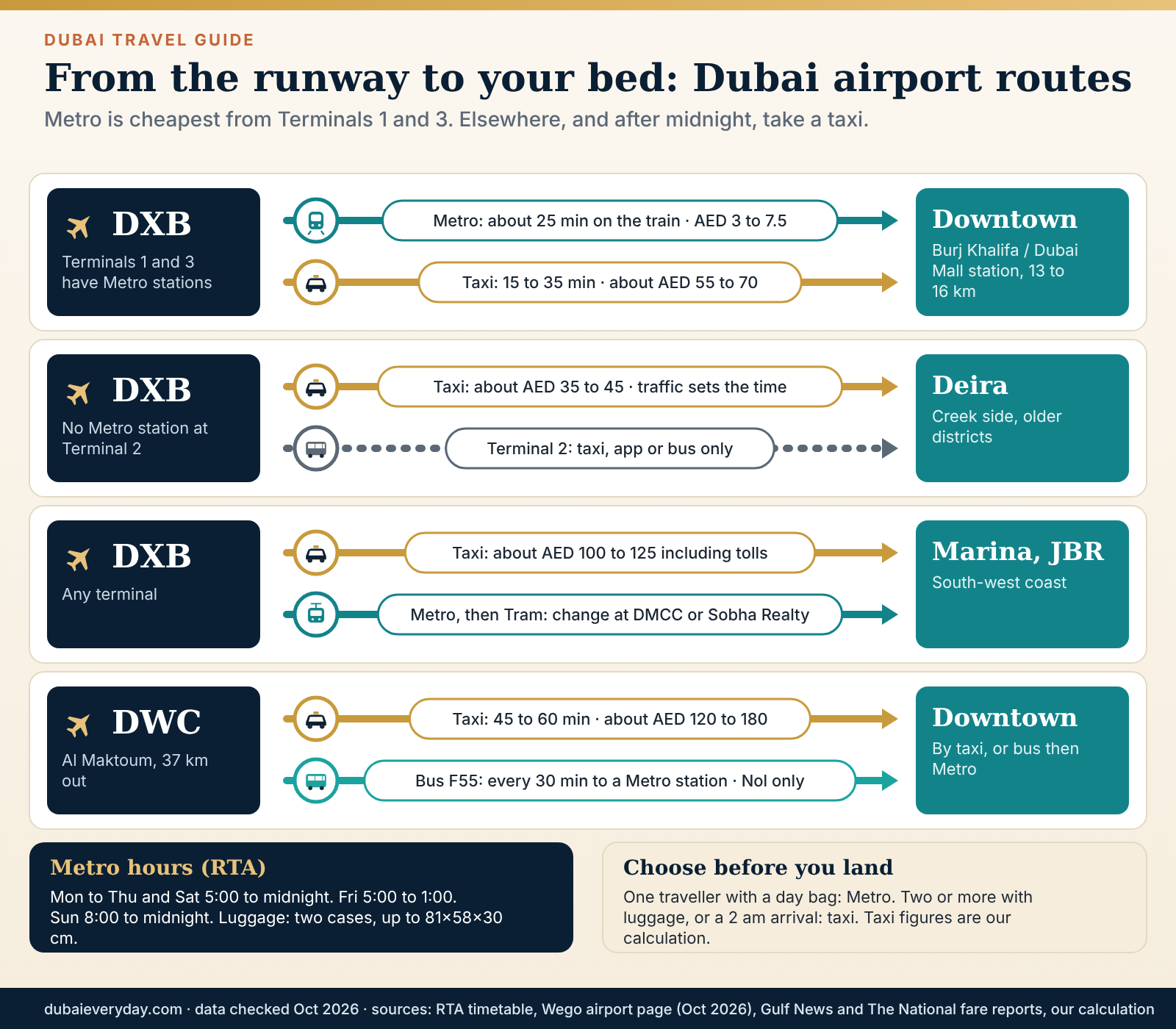
- Metro from Terminal 1 or 3 to the Burj Khalifa/Dubai Mall station: roughly 25 minutes on the train, plus walking and any wait. Silver Nol fares are AED 3, 5 or 7.5 depending on zones crossed.
- Taxi to Downtown (about 13 to 16 km): roughly AED 55 to 70 and 15 to 35 minutes depending on traffic.
- Taxi to Deira: roughly AED 35 to 45. Taxi to Marina/JBR: roughly AED 100 to 125, including a couple of tolls.
- Ride-hailing through the apps the FCDO names, Uber and Careem, is priced by the app, so check the quote and the pickup point.
The taxi arithmetic is ours. The RTA’s November 2025 fare changes, as reported by Gulf News and The National, put the DXB flag fall at AED 25 and the per-kilometre rate at about AED 2.14 to 2.33, with Salik tolls added when you pass a gate. Multiply by the distance and you land on the ranges above. The meter decides the final fare. Use only licensed taxis (cream cars with coloured roofs, pink roofs for female drivers) or recognised apps, as the FCDO advises.
Baggage rules are a Metro catch. Gulf News reports that passengers may bring up to two suitcases, with a large size limit of 81 × 58 × 30 cm, stored in the dedicated luggage area. If you have more, or a pushchair plus two cases, a taxi is simpler.
The Metro does not run all night. According to the RTA, trains run from 5:00 am to midnight Monday to Thursday and Saturday, 5:00 am to 1:00 am on Friday, and from 8:00 am to midnight on Sunday. A 2 am arrival, or a 6 am Sunday arrival, means a taxi. If you land at midnight, assume the last train is out of reach after immigration.
The last arrival decision in this Dubai travel guide is to choose the transfer before you land, not at the kerb. Metro for one traveller with a day bag, taxi for two or more with luggage, a hotel transfer if your hotel offers a fixed price and you land late. Where the hotel sits determines the rest, which is the next section.
Where to base yourself
This part of the Dubai travel guide is deliberately short, because choosing a base is a whole decision with its own guide. The principle is what matters here: in Dubai, where you sleep sets your transport cost, your heat exposure and how many evenings you actually use. The city had 154,264 hotel rooms across 827 establishments at the end of 2025, according to the tourism department’s figures as reported by AGBI, so supply is not the problem. Choosing well is.
Use three questions. Do you want to be on a Metro line? Do you need a swimmable beach within walking distance? Is your first-night arrival late? Our reading of the network says that Downtown and Business Bay, the older districts around the Creek in Deira and Bur Dubai, and Marina and Jumeirah Lakes Towers all have Metro or Tram access. Beach resorts on Palm Jumeirah and along the Jumeirah coast sit largely off the rail network, so budget for taxis in the daily total.
First visit, short stay
Stay near a Metro station and a cluster of sights. The Downtown Dubai area guide explains what the area costs, how it moves and who it suits.
Beach-first holiday
Accept taxi dependence and compare resort versus public beach access in the best hotels in Dubai guide, which sorts options by area, budget and beach access.
Budget-led
Look at Creek-side and Metro-adjacent districts, then add the Tourism Dirham fee and tax allowance from the money section before comparing.
One closure to know about: the Burj Al Arab is shut for restoration until about October 2027, and the Armani Hotel is closed until about March 2027, so some famous addresses are not available this season.
Getting around: Metro, Nol card, taxis and the rest
A Dubai travel guide has to be straight about this: Dubai is a car city that has built a decent rail spine. Most first-timers can do 80 per cent of their trip on the Metro, Tram and taxis, and the sensible plan is to mix them by time of day and temperature rather than choose one.
Dubai travel guide to the Metro: two lines that matter
The Red Line runs the length of the city, from Centrepoint in the north-east, past the airport stations, through Union and BurJuman, along Sheikh Zayed Road past the Burj Khalifa/Dubai Mall station and Mall of the Emirates, to the south-west. A branch runs to Expo 2020. The Green Line serves the old districts of Deira and Bur Dubai and ends at Creek. The RTA lists Union and BurJuman as the two stations where the lines cross.
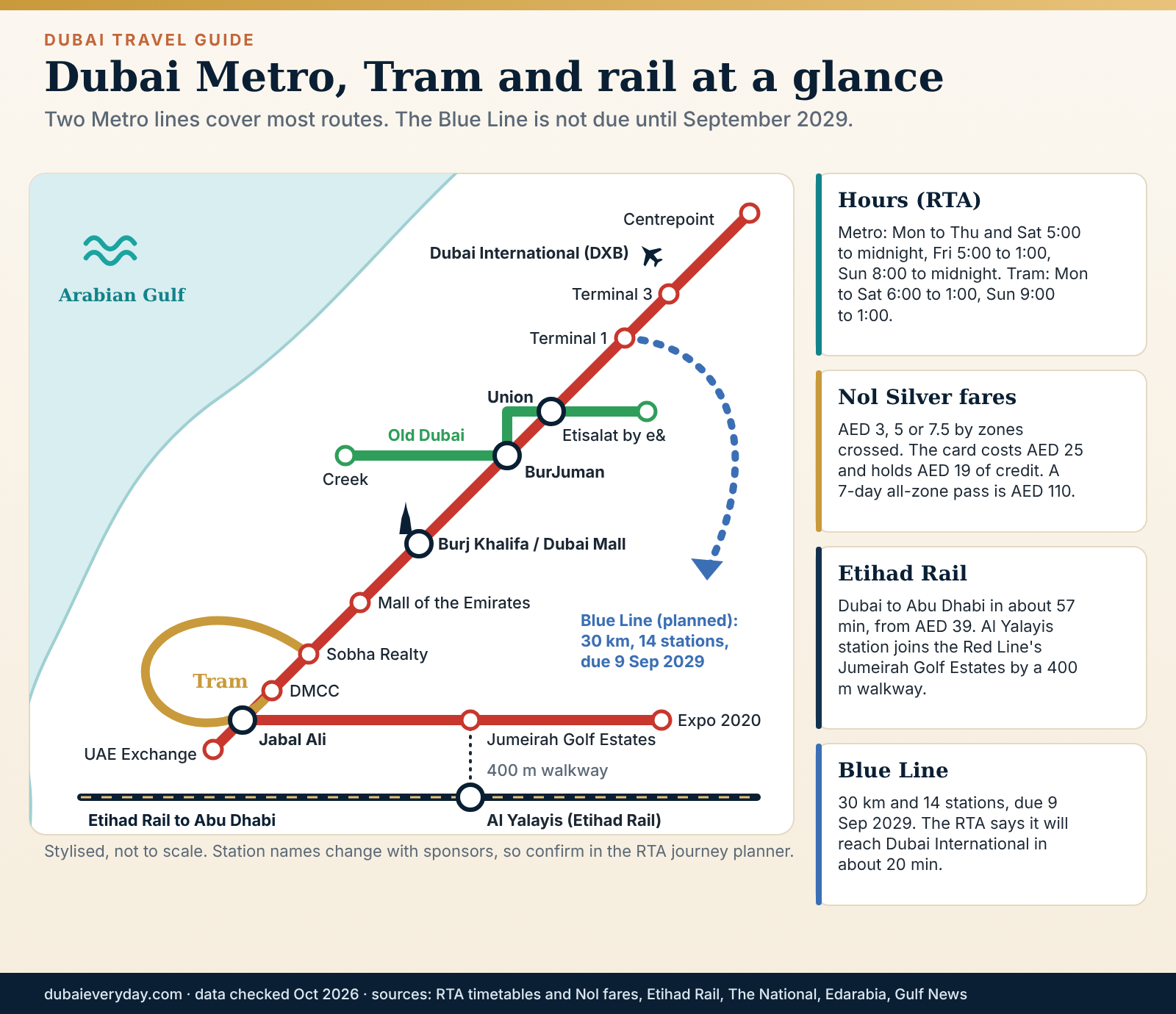
RTA hours are Monday to Thursday 5:00 am to midnight, Friday 5:00 am to 1:00 am, Saturday 5:00 am to midnight and Sunday 8:00 am to midnight. The Tram runs Monday to Saturday from 6:00 am to 1:00 am and Sunday from 9:00 am to 1:00 am, and the Metro and Tram meet at the Sobha Realty and DMCC stations. Dubai Bus runs from 4:00 am to 1:00 am. Station names change when sponsors change, so confirm the current name in the RTA journey planner.
Two small etiquette points save embarrassment: carriages have a section reserved for women and children, and the Gold class cabin has a higher fare. Eating and drinking on the Metro is restricted, so look at the signage before unwrapping anything.
Dubai travel guide Nol card advice: what to buy and what it costs
The Nol card is the stored-value card for the Metro, Tram, bus and water transport. The Silver and Gold cards cost AED 25 and include AED 19 of travel credit, per the RTA’s card information as relayed by Edarabia and Gulf News, so the card itself effectively costs AED 6. A single-trip Red ticket costs AED 2 and works on one mode only. Children aged five and under travel free.
Fares depend on the number of zones crossed. The RTA’s published Silver fares are AED 3 within one zone, AED 5 across two adjacent zones and AED 7.50 across more than two. Red tickets cost AED 4, 6 and 8.50, and Gold cards pay double on the Metro and Tram. The RTA counts a journey as up to 180 minutes with up to three transfers, and a change between modes counts as the same journey if you make it within 30 minutes.
Our calculation for a week: four rides a day averaging AED 5 comes to about AED 140 over seven days. The RTA’s 7-day Silver pass covering all zones is AED 110, so it wins if you ride around three times a day or more. Anonymous cards can buy only the 7-day pass, so check what it covers on the RTA page before buying. For a three-day trip, pay per ride.
Taxis and ride-hailing
For most visitors in this Dubai travel guide, taxis are plentiful, metered and the right answer at night, in summer midday and with luggage. Press reports of the RTA’s changes in November 2025 describe a street-hail flag fall of AED 5 by day and AED 5.50 at night with a minimum fare of AED 12, and a higher AED 13 minimum for app bookings, plus a booking fee of AED 4 off-peak and up to AED 7.50 at peak. Tolls are added on top. The sources do not agree on every figure, so treat the formula as an estimate and let the meter or the app quote decide.
Water transport, walking and the heat
The abra is the cheapest sightseeing in the city. The RTA lists heritage petrol abras across the Creek at AED 2 per person on routes including Dubai Old Souq to Baniyas and Al Fahidi to Deira Old Souq, and a motorised traditional abra at AED 1 per passenger, paid in cash. The Marina water taxi costs AED 7 for a single stop-to-stop route. Check operating hours on the RTA timetable page.
Walking works in short bursts. Neighbourhoods are far apart and built around roads, and outdoor links between them are rarely shaded. The Creek-side areas and Downtown’s promenades are pleasant in the cool season and punishing at midday for the rest of the year. Plan walking legs for the morning or evening and let the Metro carry you between them.
Rental cars, Salik and parking for Dubai visitors
In this Dubai travel guide’s view, a rental car makes sense for Hatta, desert driving or a family with many bags. It does not make sense for a Downtown-and-Creek trip. Dubai’s toll gates use the Salik system, which since January 2025 has charged AED 6 at peak weekday hours (6 am to 10 am and 4 pm to 8 pm), AED 4 off-peak and nothing between 1 am and 6 am; Sundays are AED 4 all day, according to Gulf News. Those rates may have changed, so ask the rental company, including whether it adds an admin fee.
Licence rules depend on your nationality: the FCDO says a UK photocard licence is valid, while Australia’s advice says tourists need an International Driving Permit. Ask the rental firm. The FCDO also notes that flashing headlights often mean “I’m coming through”, not “go ahead”, that you must stop and call the police after a crash, and that alcohol limits are effectively zero.
What is changing on the network
For a 2026–27 trip, this Dubai travel guide finds nothing new on the network apart from the Etihad Rail link. The Blue Line is a 30 km, 14-station project, scheduled by the RTA to open on 9 September 2029, and the RTA says it will give direct journeys to Dubai International in about 20 minutes. A Gold Line is planned for around 2032. The new Etihad Rail station at Al Yalayis is joined to the Red Line’s Jumeirah Golf Estates station by an elevated walkway of about 400 metres, which matters for the day-trip section.
Dubai itineraries for 3, 5 and 7 days
Itineraries in a typical Dubai travel guide fail the same way: they list eight stops a day and ignore that each hop in Dubai costs 20 to 40 minutes plus a queue. The plans in this Dubai travel guide use two anchors a day, one buffer, and a rest block when it is hot. They are built from the Metro timetable, the event dates above and the closures listed at the top, and they are desk-based plans rather than a record of someone’s trip.
How to build a heat-aware day
The rule behind every plan in a Dubai travel guide is the sun, not the clock. In the cool season you can be outdoors from mid-morning until the light fades. In summer, the useful outdoor hours shrink to the first couple after sunrise and the evening after sunset. Sunset moves from roughly 5:30 pm in midwinter to just after 7 pm at midsummer (approximate; check a sun-times tool for your dates). The figure compares a January day with a July day.
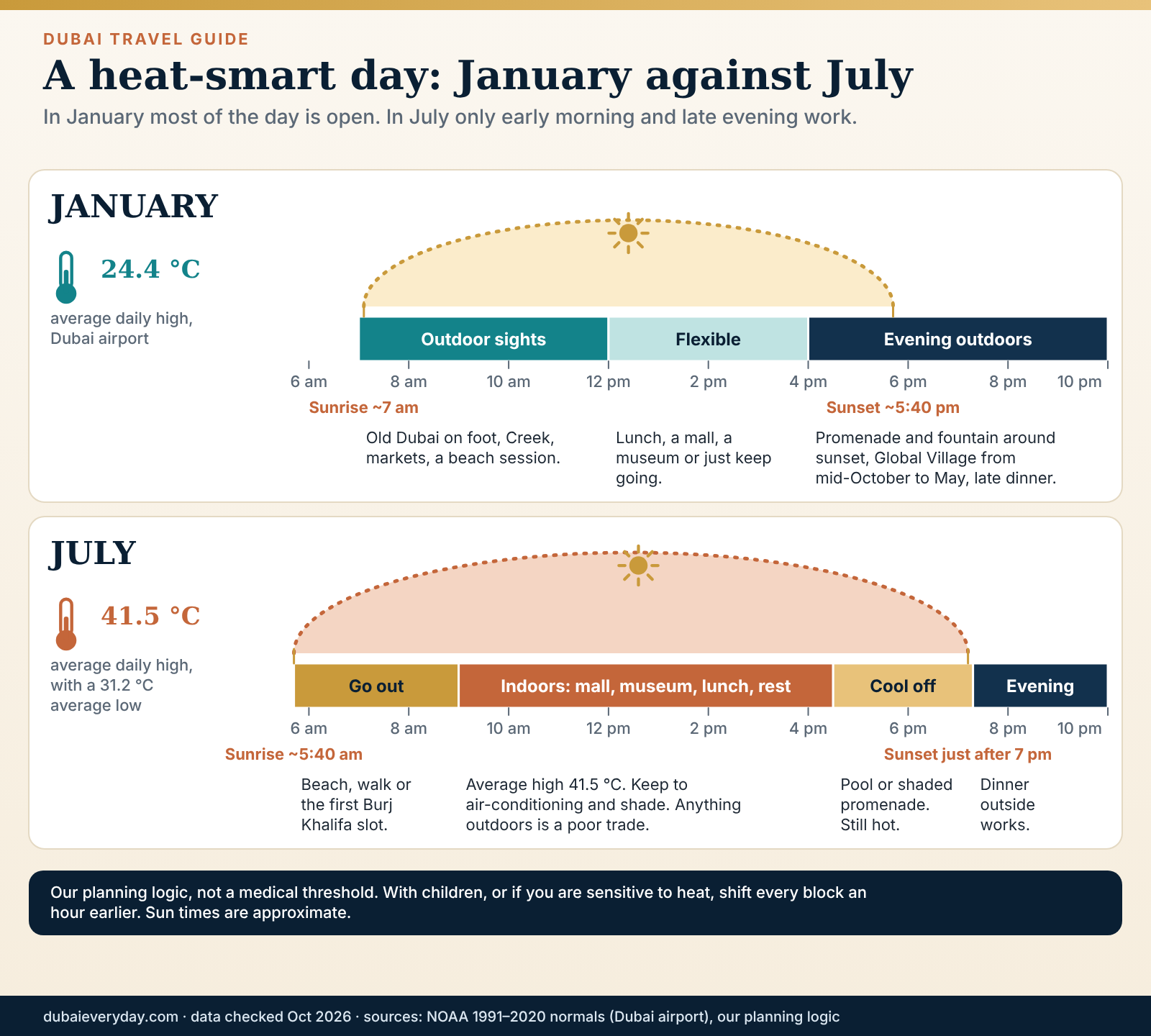
The blocks that matter: early outdoor time for walking, markets and photographs; an indoor middle of the day for malls, museums, lunch and rest; and a second outdoor window from late afternoon. A January average high of 24.4 °C leaves most of the day open. In July the average high is 41.5 °C and the average low 31.2 °C, so even the second window is warm. If you are travelling with children or are heat-sensitive, move the whole plan an hour earlier.
Three days: the core of any Dubai travel guide itinerary
This plan suits a first visit and keeps you close to the Red Line and the Creek. It assumes the cool season; for summer, use the swap list below.
- Day 1: Downtown and the towerBook a timed slot at the Burj Khalifa observation deck for the morning, and allow about two hours with security and queueing (our estimate; the operator’s page has slot rules and prices). Spend midday inside The Dubai Mall, which doubles as a heat refuge. Take the Red Line to the Burj Khalifa/Dubai Mall station rather than a taxi, because the area clogs at peak hours. In the evening, walk the lake promenade and check the Dubai Fountain schedule on the mall’s site before you plan around it. The Downtown Dubai area guide covers the district’s walking routes and costs in more detail.
- Day 2: Old Dubai and the CreekGo early. Start in Bur Dubai’s historic Al Fahidi area and Al Seef (Green Line), cross the Creek by abra for AED 1 to 2, and walk Deira’s spice and gold souks before the heat builds. Lunch in Deira, then return to the hotel. Opening hours for museums and galleries vary, so check each before you set off. The old districts suit mornings far better than afternoons.
- Day 3: the coast or the desertChoose one. A morning at a public or hotel beach works from roughly October to April, and the best beaches in Dubai guide compares access and facilities. Alternatively, join a desert evening with a licensed operator. Ask for the company’s Dubai tourism licence, check the pickup time and expect several hours including transfers.
Five days: add depth
The five-day version of this Dubai travel guide keeps the first three days, then adds two. The extra days spread the load and remove the feeling of rushing between sights.
- Day 4: a slower day with an evening outLeave the morning open for a second coast session or a neighbourhood walk, rest through midday, and spend the evening at Global Village between mid-October and May. Reported entry is AED 25 Sunday to Thursday and AED 30 on Friday and Saturday, and Tuesdays are reserved for ladies and families. A taxi to major event venues can start at AED 20 to 25, so factor that into the evening.
- Day 5: a day tripHatta or Abu Dhabi are the two realistic options. The day-trip section sets out the times, fares and the catches.
The Museum of the Future is closed until its planned reopening in the first quarter of 2027, so drop it for winter 2026–27. On Sunday 22 November, Sheikh Zayed Road is closed to cars for the Dubai Run until about 9 am, which affects any early taxi to Downtown that day. The things to do in Dubai guide lists alternatives when a headline sight is unavailable.
Seven days: the Dubai travel guide version with room to breathe
A seven-day Dubai travel guide plan has room for the three-day core, a day trip and two genuinely slow days. They are also long enough that tiredness and heat build up, so the plan gives you rest by design.
- Day 6: a deliberate rest dayPool, spa or mall. Most plans skip this and then lose the next day to exhaustion. If you only do one thing, make it a long late lunch and a short evening walk.
- Day 7: flexible half-day, then departure logisticsHold it for weather, a queue that went wrong or a second look at something you liked. Sharjah is a short trip from Dubai, with the alcohol and dress rules described below. Follow your airline’s check-in guidance for the airport, remembering that the Metro opens at 8:00 am on Sundays.
Swapping for summer in a Dubai travel guide plan
For a summer Dubai travel guide plan from June to September, invert the plan. Put Burj Khalifa at the first slot of the day, replace the Creek walk with an evening visit, and move the beach to the first hour after sunrise or the hour after sunset. Add indoor options: malls, aquariums, museums and indoor entertainment venues listed in the things-to-do guide. Hatta and desert activities are poor fits in these months, and Hatta’s activity season officially runs from 1 October to 5 May, according to the Visit Hatta site.
The last test for any Dubai travel guide itinerary is a simple one. Can you do it with a delayed flight, a hot afternoon and one cancelled booking? If not, take out one anchor.
Rules and etiquette that trip visitors up
A Dubai travel guide has to say it plainly: Dubai is relaxed about tourists in many ways and strict in a few that surprise people. The cleanest way to think about it is in three layers. Some things are criminal offences. Some need a licence or permit. And some are simply expected, where the penalty is disapproval, not arrest. This part of the Dubai travel guide keeps them apart and relies on government travel advice, with the UK and Australian pages as the main sources.
The Dubai travel guide to what is actually illegal
Drugs come first because the consequences are the harshest. The FCDO states that the UAE has zero tolerance. Possession of any amount, including cannabis and residual traces, can bring at least three months in prison or a fine of AED 20,000 to 100,000, and drugs detected in the bloodstream can count as possession. Some CBD products, certain skincare items and vape refills are also illegal. Airport staff screen baggage, including for transit passengers. Do not carry anything you cannot identify.
Alcohol is legal for adults aged 21 and over in Dubai, in licensed venues such as hotels, restaurants and bars. It is an offence to be drunk or to drink in public, and driving with any alcohol in your system is illegal. Sharjah bans alcohol entirely, which matters for day trips. The FCDO adds that tourists can obtain a temporary one-month liquor licence from two named distributors, valid only in Dubai, if they want to buy for private consumption. Ask your hotel how that works in practice before relying on it.
A handful of other offences catch people because they feel minor. The FCDO lists swearing and rude gestures, including online, as illegal, with potential jail or deportation, and says kissing in public can lead to arrest. You should cross roads only at designated crossings. Under-18s cannot stay in a hotel without an accompanying adult. Unpaid bills, hotel bills included, can become criminal matters.
The FCDO states that same-sex sexual activity is illegal and same-sex marriages are not recognised, and that extramarital relationships between consenting adults are generally legal but a complaint from a spouse or parent can lead to prosecution. Private life is generally respected; people have been punished where there is a public element or offence has been caused. This applies to residents and visitors alike.
Photography, drones and recording
Photographing government buildings and military sites is illegal, and plane-spotting near airports can be misunderstood. The FCDO says not to photograph people without permission and notes that men have been arrested for photographing women on beaches. Some equipment, including satellite phones, radio transmitters and powerful cameras or binoculars, may need a licence, and media work needs a permit from the National Media Council.
Leave the drone at home. The General Civil Aviation Authority’s permit scheme, which The National reported in January 2025, is open to UAE citizens and residents with a training certificate, and says visitors and tourists are excluded for now. Separately, in the current climate, filming interceptions or debris is prohibited under the national alert guidance.
Dubai travel guide dress code: law, venue rule and etiquette
There is no law that says tourists must wear a particular outfit, and the FCDO’s advice is the practical version. In public places such as malls, women should cover shoulders and knees, underwear should not show, and clothing should not be transparent or carry offensive images or slogans. Swimwear is for beaches and pools only. Cross-dressing is illegal. Some venues, such as nightclubs and certain restaurants, set their own dress codes.
A simple kit solves most of it: a light shirt or scarf for shoulders, trousers or a long skirt for older districts and mosques, and a layer for aggressively air-conditioned malls. Mosques and some heritage sites ask for modest dress and may supply coverings on entry.
Ramadan, as a visitor
Ramadan is expected to run from about 8 February to 8 or 9 March 2027. The FCDO’s visitor advice is to avoid eating, drinking, smoking or chewing gum in public during daylight, including in your car, to avoid loud music, dancing and swearing, to dress more conservatively, and to expect shop and restaurant hours to change. It also warns of erratic driving around sunset as people rush home to break the fast. In practice, hotels and many restaurants adapt for visitors, but a daytime picnic in a park is a poor idea.
Etiquette that is not law
Ask before photographing a person, even where no one would be arrested. Keep your voice and phone volume down on public transport. Do not assume that every shop or street is a place for swimwear because the nearest beach is a few minutes away. Dress and manners are judged more kindly when they are visibly considerate, and nobody expects visitors to know the finer points. Staying out of the headline offences above is what matters.
Health, heat and safety
Emergency numbers
The FCDO lists 999 for police, 998 for an ambulance and 997 for the fire service. Australia’s advice says 999 works for police, fire and medical emergencies, so if you are unsure, dial 999. Dubai Police also run a non-emergency line on 901 for general enquiries and some services, and a tourist police desk that Gulf News described in 2022 as reachable through 901 and a Dubai Police app. Put these numbers in your phone first, as the top item on any Dubai travel guide safety list. Save your embassy or consulate number before you travel, and get a police report for any crime you report, which insurers usually require.
Heat: how it actually hurts
Heat illness is the main health risk a Dubai travel guide can warn you about, and it often builds across a day of walking and too little water. The UK’s NHS lists heat exhaustion as tiredness, dizziness, headache, nausea, heavy sweating with pale clammy skin, cramps and intense thirst. Heatstroke is the emergency version: a very high temperature, hot skin that is not sweating, fast breathing and pulse, confusion and seizures. The NHS advice for heat exhaustion is to move to a cool place, loosen clothing, drink water or an oral rehydration drink, and cool the skin, with recovery expected within about 30 minutes.
Treat heatstroke as an emergency and call 998 in the UAE. Dubai Health Authority’s summer guidance also names burns, skin cancer risk and UV damage as hazards. The prevention list is not mysterious: drink steadily, wear loose light clothes and a hat, use sunscreen and reapply it, take indoor breaks, avoid alcohol in the heat, and never leave a child or pet in a parked car.
Water, food and healthcare
Dubai Electricity and Water Authority stated in 2018 that tap water meets international and World Health Organization standards, while noting that responsibility ends at the meter and that building tanks and pipes are the owner’s responsibility. Many visitors drink bottled water anyway, and hotels usually supply it. If you have a sensitive stomach or are staying in an older building, bottled is the cautious choice.
UAE healthcare facilities are comparable to those in the UK, according to the FCDO, but treatment can be refused without insurance or the means to pay. Keep your policy number, the insurer’s 24-hour line and any prescriptions in your phone and on paper.
Sea, roads and weather
The FCDO warns that rip currents can occur at any beach, that red flags mean dangerous swimming, and that you should swim only at beaches with lifeguards. On tourist boats, make sure life jackets are provided. The FCDO also says speeding is common and the accident rate high, which is the main reason to prefer the Metro for many trips. Heavy rain can cause flooding, and the National Centre of Meteorology publishes warnings.
General information based on public health and government advice, not individual medical advice. If you have a heart, lung or kidney condition, take medication that affects heat tolerance, or are pregnant, ask a doctor about a summer trip before booking.
Food basics
Nobody at this site has eaten the food described here, so this part of the Dubai travel guide gives you the structure for choosing, not a list of restaurants to trust. Dubai’s food reflects the communities who live there: South Asian, Levantine, Persian, Filipino, East African and international kitchens sit alongside Emirati cooking. The traditional dishes worth looking for are machboos (spiced rice with meat), luqaimat (fried dumplings with date syrup) and Arabic coffee served with dates, and menus in most districts will cover them or something close.
Price levels vary far more than the quality signal does. A crowd-sourced database (October 2024, so indicative only) puts a basic restaurant meal at about AED 40, within a range of AED 20 to 100, and a mid-range three-course dinner for two at about AED 300, with a range of AED 175 to 500. A cappuccino is about AED 22. Hotel restaurants and anything with a view sit above these figures. Our reading: your best-value meals will be in neighbourhood places away from the tourist towers, and your worst-value meals will be anything with a view and no menu price shown until you sit down.
- Check whether a service charge is on the bill before you tip, and remember that 5 per cent VAT applies.
- Alcohol is served only in licensed venues, mostly hotels, and not at all in Sharjah.
- In Ramadan, expect daytime hours to change and evenings to be busiest.
- Book popular dinners ahead in the cool season, especially around December and January.
- Tell staff about allergies directly; do not assume a label or menu note covers them.
Day trips from Dubai
A good Dubai travel guide treats day trips as logistics problems first. The golden rule: work backwards from the last way home. Several of the options below involve a long final leg or a timetable with only a few departures, and the new Etihad Rail services change the picture for Abu Dhabi and Fujairah. All times here are published or reported figures, not trips we have taken.
Abu Dhabi
By Etihad Rail, the reported journey from Dubai’s Al Yalayis station to Mohammed Bin Zayed City station takes about 57 minutes, with fares from AED 39 in Comfort class. The catch is the connection at each end and a launch timetable whose last train back left Abu Dhabi at 5:43 pm.
Hatta
About 90 minutes by car, according to Visit Hatta. The RTA Hatta Express (H02) runs from the Dubai Mall area and costs AED 25 with a Nol card. Most activities run from 1 October to 5 May and are booked on site.
Sharjah
Roughly 30 to 40 minutes by car in light traffic and much longer at rush hour. It is a museum, waterfront and souk day, and it is dry: alcohol is illegal throughout the emirate.
Ras Al Khaimah
About an hour by taxi from central Dubai, or 1.5 hours by intercity bus from Union station on 2022 information. Its own airport handles charters only, so visitors arrive by road. Hotels there add a tourism fee of AED 15 per room per night.
Fujairah
The reported train time between Fujairah and Dubai is about 70 minutes, at AED 29 in Comfort class. At launch the service ran as a midday pair of trains rather than a morning-out, evening-back pattern, so check the live timetable before planning a same-day return.
Abu Dhabi: the honest comparison
Khaleej Times compared ways to get from Deira to Hamdan Street in Abu Dhabi in October 2026, and its estimates are the most useful door-to-door view we found. Intercity bus: AED 37 to 38 and about 3 to 3.25 hours. Metro plus Etihad Rail plus shuttle and local bus: AED 59 to 61 and 3.5 to 4 hours. Driving: AED 72 to 85 including tolls and fuel, parking extra, in 1.5 to 2 hours. Taxi: roughly AED 390. They flag that the times include connections and are not timed trips.
Our reading of that data is that the train is fast between stations and not automatically faster door to door, because the Abu Dhabi station sits in Mohammed Bin Zayed City rather than the centre. It suits someone heading to a specific place near that station, or a traveller who dislikes driving and is happy with a 7:14 am departure. For a first visit to the capital’s main sights, a guided day or a rental car often works better, or you can stay a night.
Hatta: a different kind of day trip
Hatta is a mountain and reservoir area inland from Dubai, and its activities run only in the cooler part of the year. The Wadi Hub is open daily with hours that Visit Hatta lists as 9 am to 7 pm in one place and 8 am to 7 pm in another, so confirm before you go. Most activities are for ages 6 and over, and some for 16 and over.
The H02 timetable shows a two-hourly service and the last return time matters, so check it on the RTA site. Hatta earns a place in a Dubai travel guide because it is a change of scene, and it fits travellers who want a break from city sightseeing better than Abu Dhabi does.
Pre-arrival countdown and packing list
The roadmap near the top shows the order of decisions. This Dubai travel guide checklist is the part you print or screenshot: what to hold, what to download and what to leave at home. Treat the lists as a final audit, not a first plan.
Documents and money
- Passport with at least six months of validity, undamaged, with the right name fields and date format.
- Proof of your entry route: visa or permit approval if you needed one, or confirmation from an official tool that you can enter on arrival.
- Return or onward ticket and your first-night address, on your phone and on paper.
- Travel insurance policy number and the insurer’s 24-hour number, plus the wording that covers disruption.
- One card that works abroad, a backup card kept separately, and a small float of dirhams for abras and small shops.
- Medical approval documents and a doctor’s letter if you carry any controlled medication, with medicines in original packaging.
- Emergency contacts: your embassy or consulate, your airline, and the numbers 999, 998 and 997.
Phone and apps
- An unlocked, eSIM-capable phone, or a plan for buying a visitor SIM at the airport.
- Your airline’s app, with notifications on, and your embassy’s alert service if it has one.
- The RTA’s S’hail app for taxis and the Nol Pay app for travel passes and balance, and the Etihad Rail app if a rail day trip is planned.
- Offline maps of Dubai and a saved screenshot of your hotel address in English.
- A way to receive official alerts: do not disable cell-broadcast emergency alerts in your phone settings.
Dubai travel guide packing: clothing and kit
The Dubai travel guide packing rule is to pack for two climates: the outdoors and the malls. Light, breathable long sleeves and trousers cover sun and dress rules at once, and a light layer helps against heavy air-conditioning. Add a hat, sunglasses, sunscreen, a refillable water bottle, comfortable closed shoes for walking and a swimsuit for pool and beach. In winter, pack one warmer layer for evenings, desert trips and the cooler days.
Most outlets take UK-style three-pin plugs at 230 volts, but check your devices and bring an adaptor. A power bank is worth carrying all trip, since maps and tickets drain a phone fast.
Leave at home
- A drone, which visitors cannot register to fly.
- Any medicine you have not checked against the controlled list, and any CBD or hemp product.
- Weapons and items that look like them, and anything you would not want to explain at screening.
- Swimwear as day wear, and clothing with offensive slogans or images.
The 12 most common first-timer mistakes
These are the errors that the official advice, the timetables and the cost data in this Dubai travel guide make most likely. They are drawn from research, not from reader stories.
- Booking non-refundable before checking conditionsWith airlines still suspending and restarting routes, a prepaid tour you cannot move is a risk worth avoiding until closer to travel.
- Choosing July for sightseeingAverage highs of 41.5 °C and a 31.2 °C night make outdoor sightseeing a poor use of the trip. Pick November to March, or switch to an indoor plan.
- Assuming the visa rule from a forumEntry routes depend on nationality and lists change. Check the official tool for your own passport.
- Carrying unchecked medicineSome prescription and over-the-counter items need approval, and unapproved medicine can be confiscated with prosecution possible.
- Packing a drone, vape refills or CBDVisitors cannot register drones, and some CBD and vape products are illegal.
- Stacking three outdoor sights between 11 am and 4 pmIn the warm months, this is the fastest route to a headache and a wasted afternoon.
- Judging distance by the mapA short line on a map can be a 30-minute taxi in traffic. Cluster by Metro line and plan two anchors a day.
- Living off taxis from a far-flung resortFares add up, and event days add a higher flag fall. Add the transport cost to the hotel comparison.
- Trusting the Metro for a very late or early Sunday arrivalThe Metro does not run overnight and opens at 8:00 am on Sundays.
- Treating the advertised room rate as the final priceService charges, municipality fees, VAT and the Tourism Dirham fee all sit on top.
- Dressing and behaving as at a beach resort in publicShoulders and knees covered in malls, and no kissing in public, are the practical rules to follow.
- Planning a day trip without the last returnThe launch Abu Dhabi timetable had a last train back at 5:43 pm, and Hatta’s bus is two-hourly. Check the return before you commit.
Dubai travel guide FAQs
Is Dubai safe to visit right now?
Official advice differs by country and has changed through 2026. The UK Foreign Office, on 29 October, describes the regional situation as unpredictable with a high risk of sudden escalation, and advises preparing for flight disruption. The US State Department carries Level 3 (Reconsider Travel) and Australia advises reconsidering travel. Local authorities run an emergency alert system, and operations at the main airport have been running. This Dubai travel guide is not a security service and nobody can promise safety, so read your own government’s page, buy insurance that covers disruption and book flexible rates.
What is the best month to visit Dubai for the first time?
This Dubai travel guide’s pick for ordinary sightseeing is late November or February to mid-March. Average afternoon highs are about 31 °C in November and 26 to 29 °C in February and March, and nights are comfortable. December and January are lovely but busy and expensive, especially during the school break from 14 December to 3 January. Ramadan 2027 is projected to start on 8 February, so check whether you want to travel then. June to August is the cheapest and hottest period, with average highs of 40 °C or more.
How many days do you need in Dubai?
In this Dubai travel guide, three days cover the core: Downtown, the old districts and one coast-or-desert experience. Five days add a slower day and a day trip, which is a more comfortable pace if you are flying a long way or travelling with children. Seven days give time for a rest day and a second excursion. The limiting factor is rarely the number of sights. It is the heat, the travel time between districts and how tired you get by day four.
Do I need a visa to visit Dubai?
It depends on your passport. The UAE government portal describes visa-free entry for GCC citizens, visa on arrival for citizens of listed countries, and a pre-arranged entry permit for everyone else. The portal does not print the lists, this Dubai travel guide does not either, and they change, so check an official tool such as GDRFA Dubai or ICP, and confirm with your airline. Your passport needs at least six months of validity from the date of entry, and you should carry a return ticket and proof of insurance.
How much money do I need per day?
Our calculation in this Dubai travel guide, for one person with two sharing a room and flights excluded, is about AED 400 a day for a lean trip, AED 1,000 for a comfortable trip and AED 2,500 for a premium trip. That is roughly US$109, US$273 and US$681. The comfort tier uses the 2025 average hotel rate reported by Dubai’s tourism department. The lean and premium room rates are our assumptions, so replace them with real quotes for your dates.
What should I wear in Dubai as a tourist?
The FCDO advises women to cover shoulders and knees in public places such as malls, avoid transparent clothing and offensive slogans, and keep swimwear for beaches and pools. Men are well served by the same sensible approach. The packing rule in this Dubai travel guide is light long sleeves and trousers for sun and dress rules, a layer for strong air-conditioning, and modest clothing for mosques and heritage sites. Some venues have their own dress codes.
Can tourists drink alcohol in Dubai?
The short answer in a Dubai travel guide for first-timers is yes: adults aged 21 and over can drink in licensed venues such as hotels, restaurants and bars in Dubai. Being drunk or drinking in public is illegal, driving after any alcohol is illegal, and Sharjah bans alcohol entirely. The FCDO says tourists can get a temporary one-month liquor licence from two named distributors to buy for private consumption, valid only in Dubai. Ask your hotel how that works before you rely on it.
How do I get from Dubai airport to the city?
In this Dubai travel guide’s route comparison, the Red Line Metro from DXB Terminal 1 or 3 reaches the Burj Khalifa/Dubai Mall station in roughly 25 minutes on the train, and Silver Nol fares are AED 3 to 7.50 depending on zones. A taxi to Downtown comes to roughly AED 55 to 70 by our calculation from the reported AED 25 airport flag fall and about AED 2.3 per kilometre. Terminal 2 has no Metro station. The Metro does not run overnight, so late arrivals need a taxi.
Is the Metro enough, or do I need a car?
For most first-timers in this Dubai travel guide, the Metro, Tram and taxis are enough. The Red and Green lines cover the airport, Downtown, the old districts and Marina, and RTA hours are 5:00 am to midnight on most days, 1:00 am on Fridays and 8:00 am to midnight on Sundays. A car helps for Hatta and desert driving, but it adds Salik tolls, parking and fines, and licence rules depend on your nationality. Cars are a poor fit for a Downtown-and-Creek trip.
Is Dubai tap water safe to drink?
For a Dubai travel guide health question, the official line comes from Dubai Electricity and Water Authority, which said in 2018 that its water meets international and World Health Organization standards, while noting that its responsibility ends at the meter and building tanks and pipes belong to the building. Many visitors drink bottled water anyway, and hotels usually supply it. If you have a sensitive stomach or are staying in an older building, bottled water is the cautious choice.
Can I visit Dubai during Ramadan?
Yes, and this Dubai travel guide treats it as a choice rather than a barrier. Ramadan 2027 is projected to run from about 8 February to 8 or 9 March, with Eid Al Fitr expected on 9 or 10 March. The FCDO advises visitors not to eat, drink, smoke or chew gum in public during daylight hours, to avoid loud music and to dress more conservatively. Shop and restaurant hours change, and evenings are busy. If you want a normal daytime schedule, another month is a better fit.
Can I fly a drone in Dubai as a tourist?
No, and no Dubai travel guide should suggest otherwise. The General Civil Aviation Authority’s permit scheme, as reported in January 2025, is for UAE citizens and residents and says visitors are excluded for now. Flying without a permit risks penalties. Under the current national alert guidance, filming interceptions or debris is also prohibited. Leave the drone at home and use a phone or camera for photos of the city, avoiding government and military sites.
What is the best day trip for a first visit?
It depends on what you want. Hatta suits outdoor activities between October and early May and is about 90 minutes away by car or by RTA bus for AED 25. Abu Dhabi is the classic choice, and Etihad Rail now links Dubai and Abu Dhabi in about 57 minutes between stations, from AED 39. But the Abu Dhabi station is in Mohammed Bin Zayed City, so the connection matters, and the launch timetable had a last train back at 5:43 pm.
Keep planning beyond this Dubai travel guide
- UK Foreign, Commonwealth and Development Office: UAE travel advice — current status and update date (accessed 29 Oct 2026)
- FCDO: UAE warnings and insurance — regional tension, shelter and insurance advice (accessed 29 Oct 2026)
- FCDO: UAE entry requirements — passport validity, visa on arrival for UK passports, medicines, customs (accessed 29 Oct 2026)
- FCDO: UAE safety and security — local laws, dress, alcohol, drugs, photography, Ramadan, roads, swimming (accessed 29 Oct 2026)
- FCDO: UAE health — vaccines, insurance, medication (accessed 29 Oct 2026)
- FCDO: UAE getting help — emergency numbers 999, 998, 997 (accessed 29 Oct 2026)
- US Department of State: UAE travel advisory — Level 3 and reasons (accessed 29 Oct 2026)
- Australian Government Smartraveller: UAE — advisory, passport rules, cash declaration, medication (accessed 29 Oct 2026)
- UAE Government portal: Do you need an entry permit or a visa — entry categories, passport validity (accessed 29 Oct 2026)
- UAE Government portal: Entry permits — permit validity range, overstay charge (accessed 29 Oct 2026)
- UAE Government portal: Taxes in tourist facilities — Tourism Dirham fee range (accessed 29 Oct 2026)
- GDRFA Dubai: Issuance of a single-entry tourist visa — fees, conditions, processing time (accessed 29 Oct 2026)
- Federal Authority for Identity, Citizenship, Customs and Port Security (ICP) — visa services and helpline (accessed 29 Oct 2026)
- Federal Tax Authority: VAT refund for tourists — eligibility, minimum spend, fees (accessed 29 Oct 2026)
- Roads and Transport Authority: nol fares — zone fares, transfer rules, travel passes (accessed 29 Oct 2026)
- RTA: public transport timetables — Metro, Tram and bus hours, Hatta routes (accessed 29 Oct 2026)
- RTA: marine transport — abra and water taxi fares (accessed 29 Oct 2026)
- Dubai Media Office: Metro Blue Line progress — route, stations, 9 September 2029 target (accessed 29 Oct 2026)
- Dubai Airports — airport information and Smart Gates (accessed 29 Oct 2026)
- Visit Hatta: plan your visit — travel time, H02 bus fare, activity season (accessed 29 Oct 2026)
- Visit Dubai: visa information — official visitor visa guide (accessed 29 Oct 2026)
- Dubai Department of Economy and Tourism: travel updates — official travel updates page (accessed 29 Oct 2026)
- NHS: heat exhaustion and heatstroke — symptoms and first aid (accessed 29 Oct 2026)
- Wikipedia: Climate of Dubai (NOAA 1991–2020 normals) — monthly temperature and rainfall normals; secondary compilation (accessed 29 Oct 2026)
- The National: UAE emergency alerts explained — alert system guidance, secondary (accessed 29 Oct 2026)
- The National: Ramadan 2027 expected dates — projected dates, secondary (accessed 29 Oct 2026)
- Gulf News: UAE school calendar 2026–27 — winter and spring breaks, secondary (accessed 29 Oct 2026)
- TradeArabia: Dubai Shopping Festival 32nd edition — 4 December 2026 to 17 January 2027, secondary (accessed 29 Oct 2026)
- Gulf News: Etihad Rail stations and fares — Dubai–Abu Dhabi launch, fares, secondary (accessed 29 Oct 2026)
- Khaleej Times: Dubai to Abu Dhabi cost and time comparison — door-to-door estimates, secondary (accessed 29 Oct 2026)
- Gulf News: Dubai landmarks reopening in 2027 — Museum of the Future, Burj Al Arab and other closures, secondary (accessed 29 Oct 2026)
- Time Out Dubai: airlines suspending flights at DXB — airline status as of 27 October, secondary (accessed 29 Oct 2026)
- AGBI: International visitors gave Dubai hotels a lift in 2025 — occupancy, average daily rate, room inventory, secondary (accessed 29 Oct 2026)
Update log: 29 October 2026 — first publication; all facts re-checked against the sources above. Next review due: 30 November 2026 (conditions, flights, event dates), then monthly until the 2027 season starts. Corrections welcome.
This Dubai travel guide offers general information, not individual legal, medical, financial or security advice. Rules, fares, opening hours and advisories change; confirm with the official source before you rely on any figure.