
School fees Dubai parents pay for 2026-27 start from frozen tuition, but the real bill also holds deposits, a bus, uniforms, books and trips. This guide prices every layer from published fee pages and reported KHDA rules, then turns it into a budget you can adapt.
Nobody opens a school brochure hoping to do sums, but the sums are where Dubai families get caught out. The tuition figure sits in large print. The bus quote, the uniform list, the deposit deadline and the trip that costs far more than expected arrive later, usually in the same month.
This guide prices all of it, line by line, for the 2026-27 year, so the number you plan around is the one you will actually pay. Because school fees Dubai parents face are frozen on tuition but not on anything else, we separate what KHDA fixes from what the school and its suppliers decide. You also get a budget model for two children at three fee levels, plus the questions worth asking in writing before you pay a dirham.
School fees Dubai families pay in 2026-27 start with tuition, which KHDA froze for the year, and the published figures we could read run from about AED 7,400 to AED 111,800 a year. On top sit one-off charges (an application fee reported as capped at AED 500, and a registration deposit of up to 10% of tuition that is deducted, not added), then transport, uniforms, books, devices, trips and activities, none of which the freeze covers.
Three rules do most of the protecting. Written notice at least 60 days before the start date secures a deposit refund. After term starts, refunds step down at two weeks and one month, counted from the day the school receives your written request. And bus fees in 2026 press reports run from about AED 3,500 to over AED 10,000 a year per child, set school by school.
Our calculation for two children, in Year 3 and Year 8, at three published price levels gives about AED 43,000, AED 151,000 and AED 199,000 a year. Extras are 40% of the lowest bill and 19% to 24% of the others. Get each school’s Fees Fact Sheet, add the lines it leaves out, and compare annual totals, not tuition.
This is a desk-research guide to school fees Dubai parents pay. DubaiEveryday.com has not visited, toured, enrolled a child in or paid any school named here, and nothing on this page describes a personal visit.
On 29 October 2026 we read the Dubai Media Office fee-freeze announcement, the UAE government portal, 2026-27 fee pages published by three schools, and press reports of KHDA rules and fee data from Gulf News, Khaleej Times, The National and others. A summary of the Federal Tax Authority’s education VAT guide came from PwC. Every source is listed at the end.
What we could not do is open KHDA’s own website, which blocks automated readers, so KHDA rules on deposits and refunds are reported through the press and cross-checked against two school fee pages. Where sources disagree we say so. Figures from commercial advisory sites are labelled as indicative. Schools are named only to show published price levels; none is ranked or recommended, and inclusion was not paid for. This is general information, not individual financial or education advice. Confirm every figure with the school before you pay.
School fees Dubai: what this page covers and where the edges are
This page answers one question: what do the school fees Dubai parents pay add up to over a year, line by line, and which of those lines can you control? It prices tuition, the application fee, registration and re-registration deposits, instalment terms and refunds, school buses, uniforms, books and devices, trips, activities and exam fees. It ends with a budget model you can rebuild with your own numbers.
What it does not do is help you pick a curriculum or a school. For that, start with the Dubai schools guide, which covers curricula, locations and admissions rules. For what inspection grades do and do not tell you, use the KHDA ratings guide. The wider move, including visas, housing and banking, sits in the moving to Dubai guide.
Two limits are worth stating early. First, we cover private schools and, briefly, nurseries. Government schools follow different rules and are only touched on in the section about lowering the bill. Second, every school sets its own price list inside the regulator’s framework. Every school fees Dubai figure here is a dated data point from a published fee page or a press report, not a quote for your child. Treat the numbers as a way to ask better questions.
Who sets school fees Dubai families pay: KHDA, the freeze and the fee sheet
Private school fees Dubai parents pay are regulated by the Knowledge and Human Development Authority, KHDA. A school cannot simply decide to raise tuition. Under the School Fees Framework, a for-profit school that wants to raise its school fees Dubai parents see has its request measured against two inputs: its latest inspection grade from the Dubai Schools Inspection Bureau, and the Education Cost Index, a figure that tracks what it costs to run a school. For 2025-26 the Education Cost Index for for-profit schools was 2.35%, according to the UAE government portal.
What the 2026-27 freeze actually froze in school fees Dubai-wide
On 22 May 2026 the Dubai Media Office reported that KHDA had confirmed no increase in private school fees Dubai-wide for the 2026-27 academic year, on the directive of the Crown Prince of Dubai. It sat inside a second support package of AED 1.5 billion for the sector, which brought the total across two packages to AED 2.5 billion. Most of the measures in that package help operators, with deferred licence-renewal fees and similar relief, not parents directly.
The freeze covers approved tuition, which is only one part of the school fees Dubai parents pay. Trade press that reviewed the announcement was careful on one point: transport, uniforms, extracurricular activities, devices and trips are separate lines that “may vary”. Registration and re-registration fees also stay in force under KHDA rules. In other words, the tuition column on a fee sheet is frozen; the other columns are negotiated between you, the school and its suppliers.
The Fees Fact Sheet is the document that matters
Since June 2022 every private school in Dubai has had to give parents a one-page School Fees Fact Sheet before each academic year. It is valid for one year and carries a QR code so you can check it is genuine. It sorts charges into three groups. Mandatory fees are tuition, application, registration and re-enrolment. Additional fees are transport, extracurricular activities, school trips and books. Optional items are things outside curriculum delivery that you must agree to before you pay.
You can find the sheet in three places: the KHDA online school directory (open the school’s listing and look for the fees sheet), the school’s own website, and the Parent-School Contract. If a school cannot show you the current sheet before you pay a deposit, treat that as a finding in itself. The sheet is also the quickest way to compare school fees Dubai schools charge on the same footing, because it forces both to list the same categories.
What happens after the freeze
Nobody has announced rules on school fees Dubai-wide for 2027-28 yet, and we did not find a published Education Cost Index for that year. Full inspections were paused from mid-2024, and press coverage notes that most published grades still date from the 2023-24 round. That matters because the grade normally decides how much a school may ask for. Until KHDA says otherwise, the sensible approach is to plan for a modest rise and not assume another freeze.
Here is an illustrative sensitivity check, not a forecast. If the 2025-26 index of 2.35% were applied again to a tuition of AED 57,983 (the Years 2 to 6 figure on one school’s 2026-27 fee page), the rise would be about AED 1,363 a year for that child.
Parents quoted by Khaleej Times in June 2025 reported 2025-26 increases of roughly AED 200 to nearly AED 5,000 per child, which shows how wide the spread can be between schools. For a family with two children, the planning answer is a cushion of a few thousand dirhams, not a crisis.
A practical habit that follows: when you compare school fees Dubai schools list, put their 2026-27 Fees Fact Sheets side by side, then add a line called “next year” and leave it blank until KHDA announces the rules. That keeps the comparison honest without inventing a number. If your employer pays an education allowance, ask whether it is indexed to actual fees or fixed; we return to that in the section on lowering the bill.
Tuition: what school fees Dubai schools publish, by curriculum and tier
Tuition is the one line everybody quotes when they talk about school fees Dubai-wide, and it is also the line with the least reliable “average”. The main reason is simple. KHDA’s own data pages blocked our reader on the day we researched this guide, and we found no official citywide average fee for 2026-27 in any source we could open. So instead of inventing a market average, this section lays out three kinds of evidence and tells you what each one can and cannot show.
The first is a press-compiled list of the 23 schools rated Outstanding in the 2023-24 round. The second is a press-compiled list of Very Good schools that charge under AED 45,000. The third is the 2026-27 fee pages three schools publish on their own websites. Together they bracket the market without pretending to sample it evenly.
The top of the market: the Outstanding list
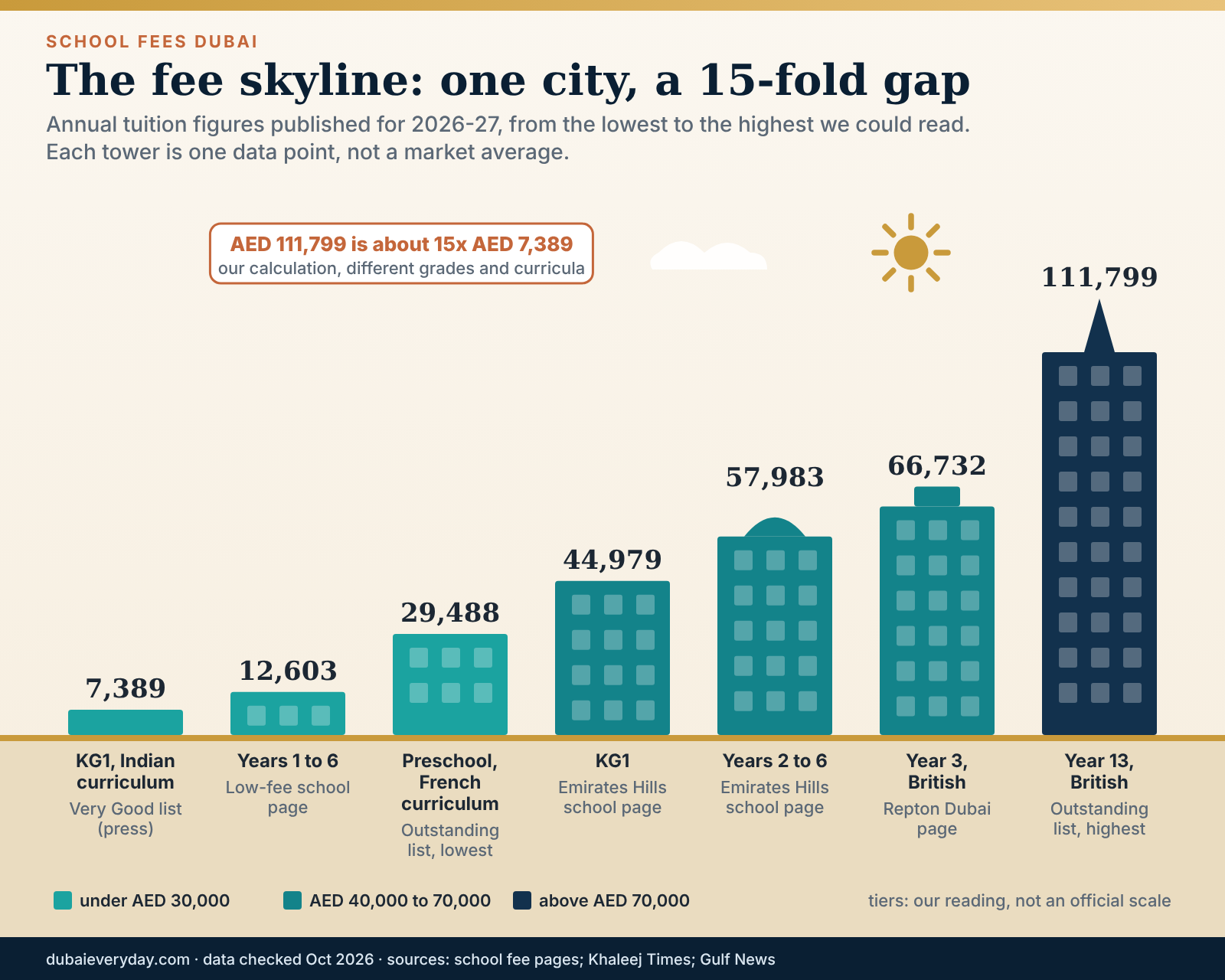
Khaleej Times compiled the 2026-27 tuition of the 23 Outstanding schools in July 2026. The cheapest figure on the list was AED 29,488, a preschool year at a French-curriculum school. The dearest was AED 111,799, for Year 13 at a British school. By curriculum, the 15 British schools ranged from AED 43,084 to AED 111,799, five IB schools from AED 44,616 to AED 89,889, the single American school from AED 66,185 to AED 93,300, the single Indian-curriculum school from AED 38,246 to AED 73,876, and the single French school from AED 29,488 to AED 62,363.
Our calculation: on that list of school fees Dubai parents can see, the dearest figure is about 3.8 times the cheapest (111,799 divided by 29,488). Two cautions apply. The ratings come from the 2023-24 round, because full inspections were paused afterwards. And the report does not say whether the totals include registration, books or transport, so read them as tuition.
The affordable end: Very Good schools under AED 45,000
In a table last updated on 6 August 2026, Gulf News listed eleven Very Good rated schools whose tuition stays under AED 45,000. The lowest figure was AED 7,389 for kindergarten at an Indian-curriculum school; the highest was AED 41,513 for Grade 12 at another. Several Indian-curriculum schools on the list top out below AED 17,000 even in Grade 12. The British-curriculum entries were dearer: one runs from AED 14,950 in Foundation Stage 1 to AED 33,352 in Year 13, and another from AED 24,749 to AED 37,124.
The useful lesson about school fees Dubai-wide is about the grade label. Both lists contain Outstanding or Very Good schools, yet their prices differ by a factor of ten or more. A top grade is not a price signal. It tells you something about the quality of provision at the time of inspection, which the KHDA ratings guide unpacks; it does not tell you what the school will charge, or what you will pay on top.
Published fee pages: a dated sample of school fees Dubai schools list
The table below samples school fees Dubai schools publish for 2026-27, using fee pages from three schools plus the two press lists above. We chose the pages for range, not for quality: one low-fee school, one mid-to-upper international school and one British school at the top end. Nothing here is a ranking or a recommendation, and we have not checked their ratings. The columns are laid out so you can paste them into a spreadsheet.
| Source (2026-27) | Stage | Annual tuition (AED) | Evidence type |
|---|---|---|---|
| Low-fee school, own fee page | FS1 to FS2 | 11,816 | School website |
| Low-fee school, own fee page | Years 1 to 6 | 12,603 | School website |
| Low-fee school, own fee page | Years 7 to 11 | 13,396 | School website |
| Low-fee school, own fee page | Year 12 | 23,990 | School website |
| Dubai International Academy Emirates Hills | KG1 | 44,979 | School website |
| Dubai International Academy Emirates Hills | Years 2 to 6 | 57,983 | School website |
| Dubai International Academy Emirates Hills | Years 12 to 13 | 79,696 | School website |
| Repton Dubai | FS1 | 57,178 | School website |
| Repton Dubai | Year 3 | 66,732 | School website |
| Repton Dubai | Year 13 | 102,753 | School website |
| Outstanding list: lowest figure | Preschool, French curriculum | 29,488 | Press (July 2026) |
| Outstanding list: highest figure | Year 13, British curriculum | 111,799 | Press (July 2026) |
| Very Good list: lowest figure | KG1, Indian curriculum | 7,389 | Press (Aug 2026) |
| Very Good list: highest figure | Grade 12, Indian curriculum | 41,513 | Press (Aug 2026) |
A word on method. The school pages were read on 29 October 2026 and show the fees the schools themselves list as current. Where a school page listed a range of year groups under one price, we kept that grouping. The Dubai International Academy page and the Repton page are the two that spell out their payment terms, and we use them again in the sections on deposits and instalments.
Three working tiers
A commercial advisory site, International School Advisor, published indicative 2025-26 bands in 2026: roughly AED 12,000 to 30,000 for the budget tier, mostly Indian-curriculum schools; AED 35,000 to 65,000 for mid-market British and American schools; and AED 70,000 to 110,000 or more for the premium tier. That site sells listings, its figures are its own estimates, and it points readers to a newer guide, so we use it only as a sanity check. It does line up with what the school pages show.
Our reading of the data, then, is three practical tiers of school fees Dubai families meet for a primary-age child in 2026-27. Under about AED 30,000, you are mostly in Indian-curriculum and other lower-fee schools. Between about AED 40,000 and 70,000, you are in the large middle where British, American and IB schools overlap. Above about AED 70,000, you are paying for senior years or the most expensive campuses. The boundaries blur, and a few schools sit in the gaps, so use the tiers as a first filter and nothing more.
What tuition usually does and does not include
Tuition normally pays for teaching, the curriculum and the school day. Everything beyond that depends on the school, which is why the Fees Fact Sheet exists. One school page we read lists transport, books, uniform, trips, technology, meals, stationery, external exams and insurance as additional costs and gives no prices for any of them.
Another states plainly that tuition does not cover lunches, transport or educational trips. A third lists transport prices by area but not books or uniforms. So the number on the front of a prospectus rarely tells you the school fees Dubai families really pay.
That is not a criticism of those schools, and it does not make school fees Dubai-wide unusual. It is how the system is organised, and the rules do not require a single all-in price. The consequence is yours to manage: ask each shortlisted school for the current Fees Fact Sheet and a written list of anything that is not on it. The sections that follow price those lines one at a time.
Why tuition climbs with every year group
A fee sheet is not one number. School fees Dubai families pay form a staircase, and the steps are where families get caught out. Tuition in Dubai generally rises as a child moves from early years to primary, secondary and sixth form, because older pupils need specialist teachers, laboratories, examination entries and smaller option groups. That pattern shows up on every school fees Dubai page we read for this guide.
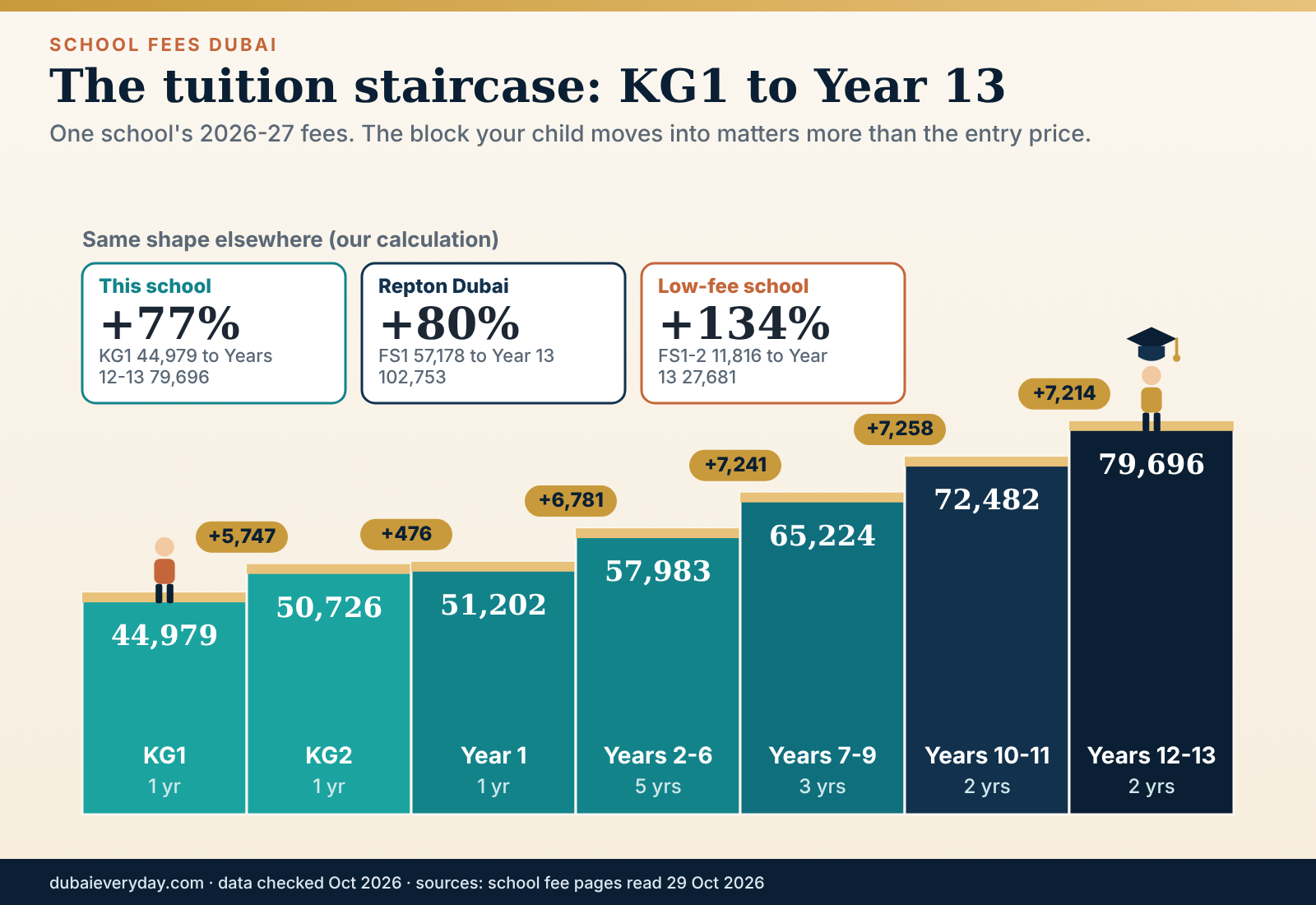
At Dubai International Academy Emirates Hills, the 2026-27 tuition runs from AED 44,979 in KG1 to AED 79,696 in Years 12 and 13. That is a rise of 77% (our calculation). At Repton Dubai it runs from AED 57,178 in FS1 to AED 102,753 in Year 13, a rise of 80%. At the low-fee school we sampled, the climb is steeper in percentage terms: AED 11,816 in FS1 and FS2 to AED 27,681 for Year 13, a rise of about 134%, mostly because of a jump at sixth form from AED 13,396 to AED 23,990.
Where the big steps are
Do not budget from the primary figure. At the Emirates Hills school the move from KG1 to KG2 adds AED 5,747, and KG2 to Year 1 only AED 476. After that, every step up adds a lot: Year 1 to Year 2 (AED 6,781), Year 6 to Year 7 (AED 7,241), Year 9 to Year 10 (AED 7,258) and Year 11 to Year 12 (AED 7,214).
At Repton the biggest steps are Year 4 to Year 5 (AED 8,687) and Year 9 to Year 10 (AED 8,653). Those are our subtractions from each school’s published figures. A family who budgets school fees Dubai-wide from the entry price will pay a noticeably different number at eleven and sixteen.
Add the steps up and the picture sharpens. Our calculation, at 2026-27 prices with no future increases, puts the tuition from KG1 to Year 13 at about AED 936,850 at the Emirates Hills school, and the tuition from FS1 to Year 13 at about AED 1,183,255 at Repton. Real totals will be higher, because fees rarely stay flat for fifteen years. They are also lower in practice for most families, because most children do not spend all fifteen years in one school. Either way, the question to ask is not “can we afford Year 3?” but “can we afford Year 10?”.How the age rule moves your fee curve
The year group your child enters decides which part of the school fees Dubai staircase you start on. For children registering in the KHDA system for the first time in 2026-27, the age cut-off for September-start schools moved to 31 December, instead of 31 August.
A child born between September and December can therefore start a year group earlier than before. That pulls the whole cost curve forward by a year, and it pulls the expensive senior years forward too. The Dubai schools guide explains the placement rules; for budgeting, simply note which year group your child will enter, and price from there.
A smaller point: many schools list one price for a block of years, such as “Years 2 to 6”. Inside such a block the fee is flat, so moving from Year 2 to Year 3 costs nothing extra. The step comes when the child crosses into the next block. If you are choosing between two schools of similar entry price, count how many year groups your child will spend in each price block, because that is what the staircase really costs you.
Application fees, registration and deposits
This is where good intentions meet small print. Moving a child into a Dubai private school adds a handful of one-off school fees Dubai parents rarely see on a prospectus, each with its own refund rule. The rules below are the ones Gulf News summarised, in an article last updated on 19 August 2026, as KHDA requirements. KHDA’s own policy documents were blocked to our reader, so treat the press summary as a map and the school’s Fees Fact Sheet and Parent-School Contract as the territory.
The application fee
Among the school fees Dubai parents pay, the application fee for a new pupil is capped at AED 500. It is refundable if the school offers no place after the assessment, or if the school did not tell you before payment that no place was available or that you would join a waiting list. It is not refundable if you are offered a place and decline it.
A fee that is not refunded cannot be deducted from tuition later. Two of the school pages we read show AED 525 for an assessment or application: Repton lists AED 500 and AED 525 including VAT, and the Emirates Hills school lists an entrance test at AED 525 including 5% VAT. Our reading is that 525 is simply the AED 500 cap plus VAT.
Practical consequence: applying to four schools can cost around AED 2,000 to AED 2,100 in application fees alone before a single offer arrives. That is worth it if you need a shortlist, and wasteful if you apply to schools you would never attend. It is the first of the school fees Dubai families pay, and it falls due before any offer. Ask whether the fee is refunded if the school has no seat before you apply, and ask the question in writing.
The registration deposit for new pupils
Once a school makes a formal offer and you accept, it may ask for a registration deposit of up to 10% of annual tuition. Reported rules say a school can request the deposit only after the offer is accepted, that the money is deducted from tuition once the child starts, and that it is refundable if you give 60 calendar days’ written notice before the start date. So the deposit is not an extra charge in the long run. It is an advance payment of tuition that you can lose if you leave without notice.
What the deposit does to your cash flow is the real cost of this part of school fees Dubai parents pay. Our calculation: 10% of AED 12,603 is AED 1,260; of AED 57,983 it is AED 5,798; of AED 66,732 it is AED 6,673.
For two children at the middle tier, the deposits alone can exceed AED 12,000 several months before term starts. Some schools describe their advance as non-refundable on their fee pages, which reads differently from the reported 60-day rule. If your page says that, ask how the two fit together and get the answer in writing.
The re-registration deposit for returning pupils
Each spring, existing families are asked to confirm their child’s place for the following year with a re-registration deposit, another of the school fees Dubai parents pay in advance. Reported rules say it is deducted from next year’s tuition and is the only payment that can secure the place.
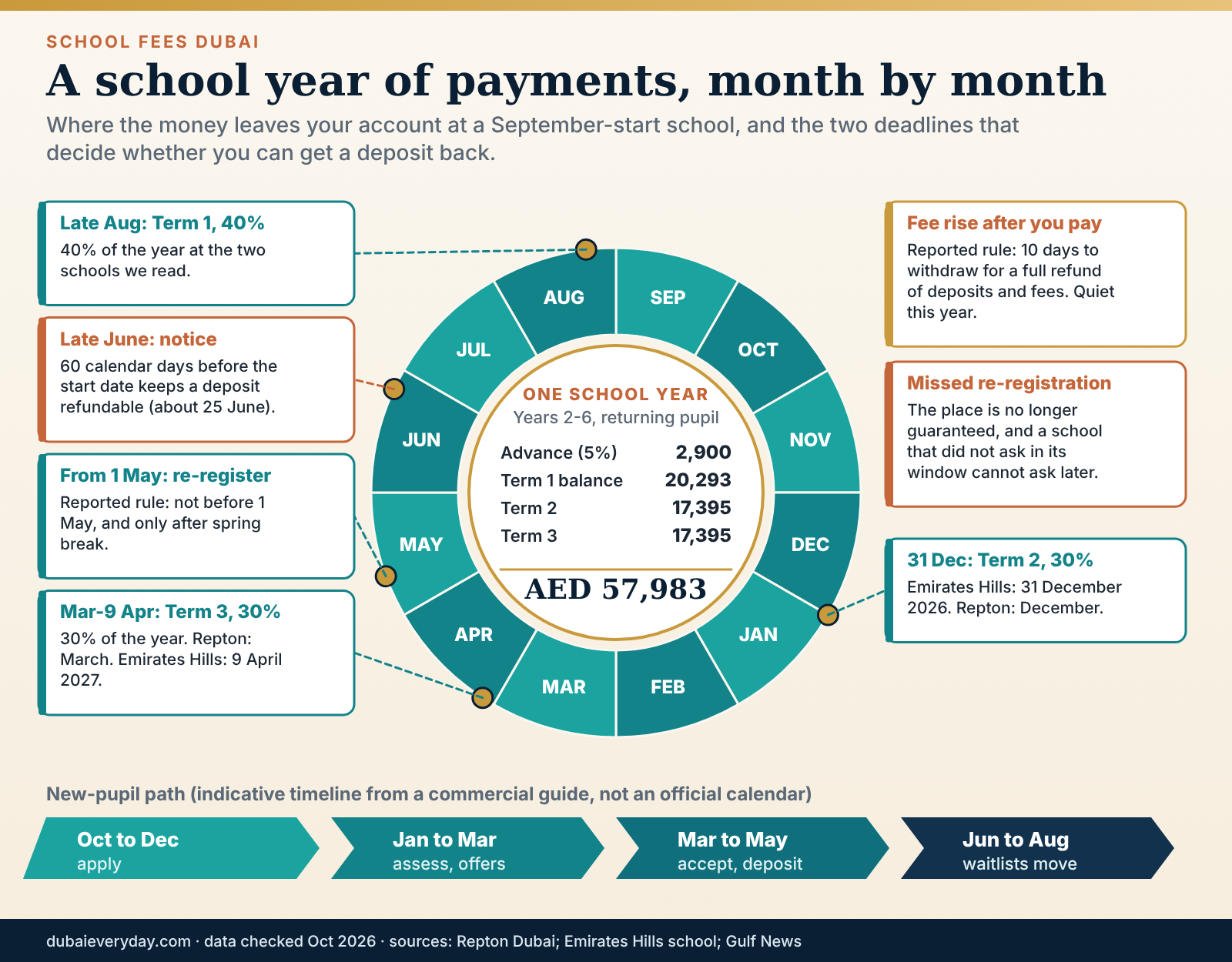
Timing is regulated: a September-start school may collect it only after spring break and no earlier than 1 May, while an April-start school may not collect it before 1 February. If the school does not ask within its permitted window, it cannot ask for the deposit later. If you miss the deadline, the place is not guaranteed.
On the amount, sources disagree, and the disagreement is worth knowing about. The August 2026 press summary says “5% of tuition or AED 500, whichever is lower”. An older press summary, and the Repton fee page, say “whichever is higher”.
The Emirates Hills school page lists returning-pupil advances of AED 2,900 for Years 2 to 6 and AED 3,985 for Years 12 and 13, which is 5% of tuition and far above AED 500. On that evidence “higher” is how schools are applying it. Do not rely on either wording; read the figure on your own sheet.
Reported KHDA rules say schools cannot charge any other fee or deposit to guarantee enrolment, and that a place is secured only by the registration or re-registration deposit. If a school asks for an additional “holding fee”, a larger percentage or payment before a formal offer, ask which rule it relies on, and keep the reply. Do not pay cash without a stamped receipt.
Two clocks to put in your calendar
Two deadlines catch more families than any price in school fees Dubai-wide. The first is the 60-day notice: to get a full refund of a registration or re-registration deposit, the school must receive your written notice 60 calendar days before the start date or the next academic year. For a school starting in the last week of August, that means notice by about the end of June.
The second is the 10-day window. If KHDA approves a fee increase after you have paid, reported rules give you 10 days to withdraw and receive a full refund of applicable deposits and fees. With the 2026-27 freeze in place, that second clock is quiet this year, but it will matter again.
Paying in instalments, withdrawing and getting money back
Much of the difficulty with school fees Dubai families face is about timing, not totals. A bill of AED 58,000 is manageable if it arrives in three pieces and unmanageable if a school expects a deposit in spring, a term payment in August and a bus fee in July. This section covers how tuition is normally collected, what the credit options really are, and what you can recover if you leave.
How school fees Dubai schools collect tuition
The common pattern for school fees Dubai schools collect is three term instalments. Repton Dubai’s 2026-27 page asks for 40% of annual tuition in August, 30% in December and 30% in March, or the full year at the start.
The Emirates Hills school page shows the same shape: the Term 2 and Term 3 payments are each 30% of the annual fee, with Term 2 due on 31 December 2026 and Term 3 on 9 April 2027, and a Term 1 balance due on 28 August after the advance. An older press summary of KHDA rules also describes a ten-equal-monthly-instalments option, so ask whether your school offers it.
Payment channels vary. The Emirates Hills page lists an online school app, bank transfer, cheque (post-dated cheques accepted for Terms 2 and 3), card at the school office, and cash against a signed and stamped receipt. If you pay by transfer, put the child’s ID and name in the reference, because school accounts teams reconcile by those details. Keep every receipt until the child has left the school.
Buy-now-pay-later and other credit
Some schools now allow instalments through third-party providers such as Tabby, Postpay and Zip, as well as monthly, per-semester or annual plans. Trade press that reviewed the 2026-27 freeze noted that these are credit arrangements, not discounts, and that missed payments can bring late fees. That is sound advice. Spreading AED 58,000 of school fees Dubai parents owe over more payments is convenient, but it adds a debt that sits outside your salary-to-rent ratio, so only use it if you have read the provider’s terms, not just the school’s.
The opposite move also exists for school fees Dubai parents who can pay early. One parent told Khaleej Times in 2025 that paying a year up front earned a lump-sum discount. We have no verified list of which schools do this, so treat it as a question, not a tactic. Ask what the school will offer for annual payment, in writing, and compare the saving with what your money would earn if left in your account for the months in between.
What you can recover when you leave
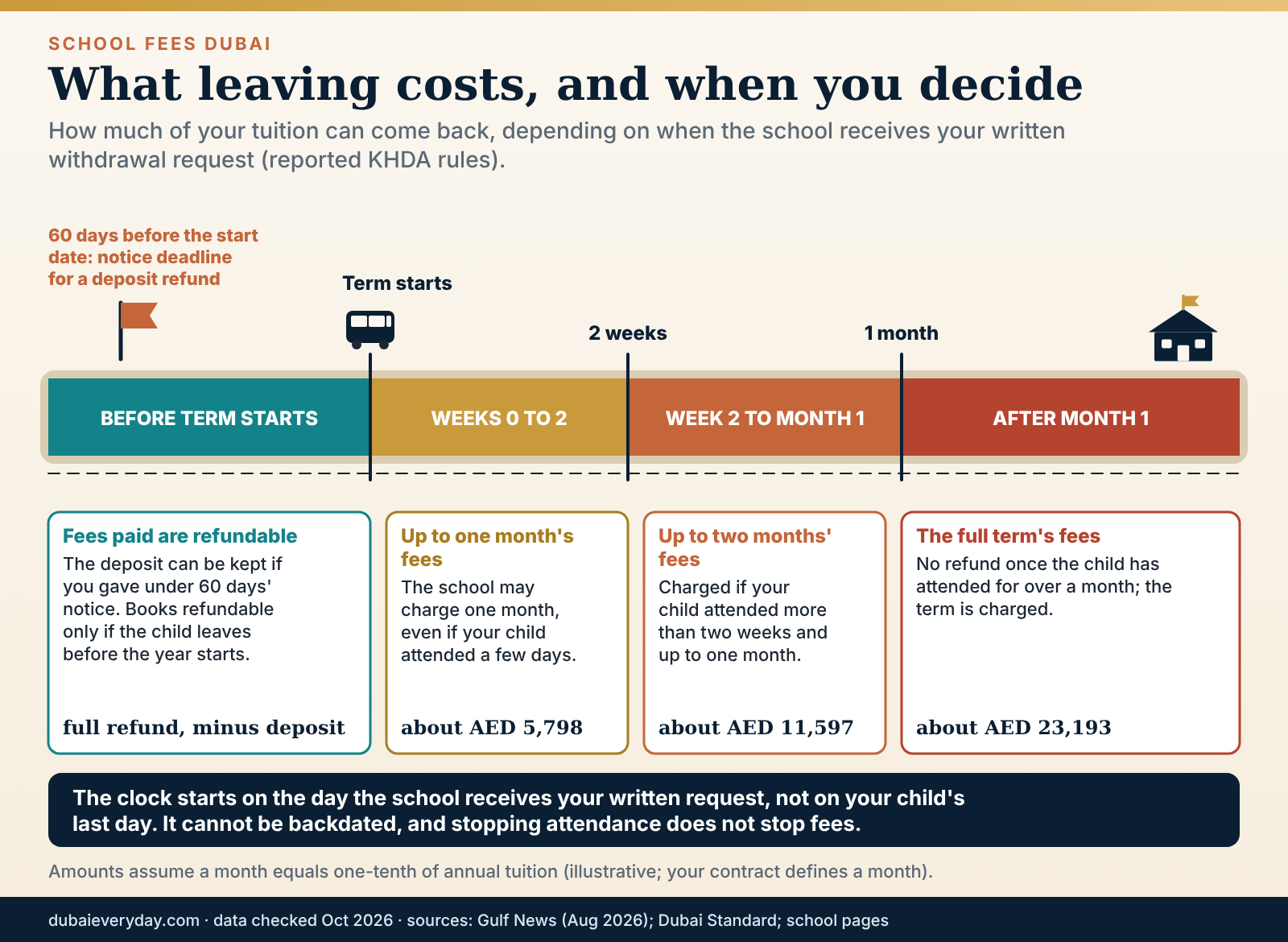
Reported KHDA rules tie refunds of school fees Dubai parents have paid to the date the school receives your formal written withdrawal request. They do not depend on your child’s last day in class, and requests cannot be backdated. Stopping attendance does not stop fees while the child is still enrolled. Before the academic year starts, fees paid are generally refundable, although the deposit may be kept if you did not give 60 days’ notice.
Once the year has started, the scale is as follows. If the child has attended for up to two weeks, the school may charge one month’s fees. Between two weeks and one month, it may charge two months’ fees. After one month, the full term’s fees can be charged and no refund is due. Book fees are refundable only if the child leaves before the school year begins. Mandatory service fees paid before the year are refundable, while optional services such as transport, activities and trips follow the terms you agreed in writing at enrolment.
A worked example of the cost of leaving late
Illustrative example, not a quote. Take a child with annual tuition of AED 57,983 and a school that counts a month as one-tenth of annual tuition, the convention in the ten-instalment option. One month is then about AED 5,798 and two months about AED 11,597. A term at 40% of the year is about AED 23,193.
If your written request arrives in week one, you might owe about AED 5,798. If it arrives in week three, about AED 11,597. If it arrives after the first month, you may owe the full term of about AED 23,193, even though the child left days later.
Your contract defines what a “month” is, so check the clause rather than the arithmetic. The practical lesson on school fees Dubai-wide is the same everywhere: if there is any chance of a move, a job change or a school switch, send the written notice the day you decide, not the day your child finishes. A job offer abroad on a Monday and a week of hesitation can cost more than the application fees for three schools.
If a school cannot teach: closures and distance learning
Reported rules also cover the unusual case in which school fees Dubai parents have paid buy no teaching. If a school cannot provide education because of a suspension or a government-ordered closure, parents must be compensated for the affected period, through a credit note valid for six months, a credit transferable to a sibling at the same school, or a full refund. If education continues under KHDA-approved distance learning or another approved arrangement, fees remain payable. Declining the available service does not by itself entitle you to a reduction.
It is worth reading how your contract treats this, because the answers matter if schools close for weather or any other reason. A sentence such as “fees remain payable during distance learning” is consistent with the reported rule and is not, on its own, a red flag.
If an employer pays your school fees Dubai invoices directly, the refund usually goes back to whoever paid. Ask your HR contact who the school will refund, and whether the allowance is clawed back if the child leaves mid-year. Read the education clause in your contract before you accept an offer; the Dubai employment contract guide explains where benefits like this appear.
School bus costs and cheaper ways to get to class
Transport is the line of school fees Dubai families see vary most between households, and it is one the tuition freeze does not touch. Bus fees in Dubai are agreed between each school and its private operator.
A 2022 Khaleej Times explainer on the Fees Fact Sheet says KHDA does not regulate transport charges, and The National reported in August 2026 that Dubai school transport fees are set between individual schools and private providers. It contrasted that with Abu Dhabi, where fees are overseen by that emirate’s education department under a fixed-price system. In the August 2026 coverage we read, no rule setting or capping Dubai bus fees was described.
What a school bus costs per year
Khaleej Times reported on 29 August 2026 that the bus part of school fees Dubai parents pay runs from AED 3,500 to more than AED 10,000 per student per year, depending on location and school. An Emirates Transport spokesman told The National that typical annual fees run from AED 3,000 to AED 10,000, varying by school and emirate. Those two ranges agree closely, which gives them some weight. A commercial advisory site quotes AED 5,000 to 12,000, and we treat that as a looser estimate.
The spread comes mostly from distance and sector. One low-fee school publishes a 2026-27 price list by pick-up zone: AED 3,500 for Al Nahda Dubai, AED 5,500 for Dubai and Al Warqa, AED 6,000 for Sharjah and AED 6,500 for Ajman.
An education consultant told Khaleej Times that monthly fees generally run from AED 250 to AED 400 depending on route and service, which is AED 2,500 to AED 4,000 over ten months (our arithmetic). A Dubai parent quoted by The National pays AED 2,700 per term, two-way, for a home near the school; that is about AED 8,100 over three terms. Live close, pay less. Live across a creek, pay more.
What changed for 2026-27
Some school fees Dubai parents pay rose despite the tuition freeze. Gulf News reported on 24 July 2026 that STS Group, which runs buses for one Dubailand school, told parents transport fees would rise 5%, and that another school, Delhi Private School, said its increase was between 3% and 4%. Both cited fuel costs.
STS also said transport fees are agreed individually with each school and that no standard increase applies across its clients. Our calculation: 5% on AED 5,500 is AED 275 a year per child, and on AED 10,000 it is AED 500. Not dramatic, but it is money the freeze does not protect.
Fuel prices rose again in August 2026, with The National reporting increases between 5.56% and 6.23% across fuel grades. The same article quoted Emirates Transport saying it would absorb those costs and not pass them to parents or employees in 2026-27. That is one operator, and it did not name the schools it serves in Dubai.
Practical takeaway: ask your own operator whether the 2026-27 fee is final, and whether a mid-year surcharge clause exists. Some schools also asked parents to re-register for the bus by late July to keep a seat, so a late application can mean no route at all.
The alternatives, with real prices
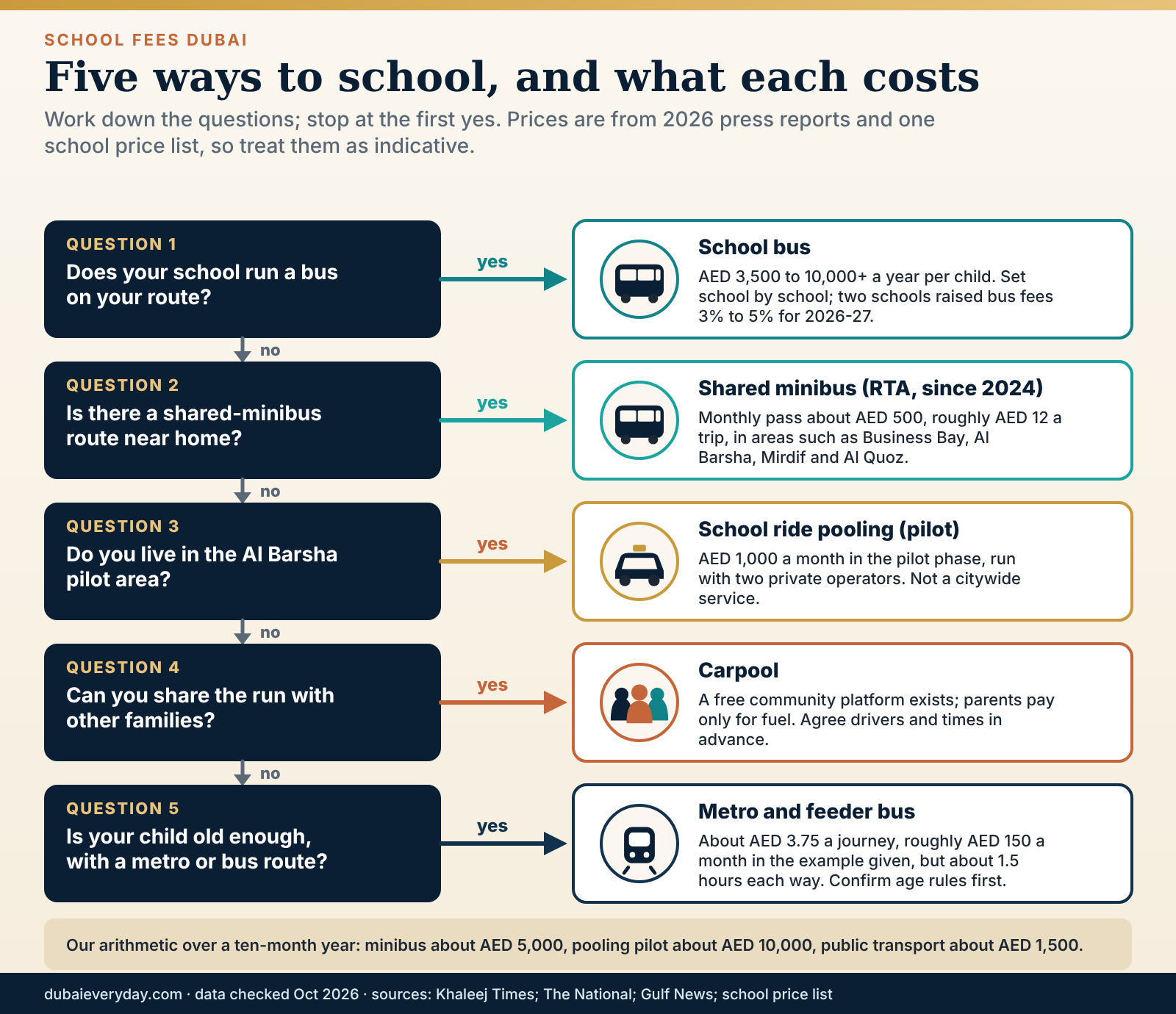
A school bus is not the only option, and for some commutes it is not the cheapest. Khaleej Times listed several in August 2026. A free community carpool platform exists, where parents pay only for fuel. The RTA launched shared minibus booking in 2024, and the article put monthly passes at about AED 500, or roughly AED 12 a trip, in areas including Business Bay, Al Barsha, Mirdif and Al Quoz.
An RTA school ride-pooling pilot with two private operators runs in Al Barsha at AED 1,000 a month, in pilot phase only. And a student who takes the metro and a feeder bus pays about AED 3.75 a journey, roughly AED 150 a month in the example given.
Our arithmetic, assuming a ten-month school year, puts the minibus at about AED 5,000 a year, the pilot pooling service at about AED 10,000, and the public-transport example at about AED 1,500. Compare that with AED 3,500 to AED 10,000 for a bus, which is the largest add-on to school fees Dubai parents pay in our budget model below.
Cost is not the whole story, though. The public-transport example in that article takes roughly 1.5 hours each way. A cheap commute that eats three hours a day is not a saving. Match the option to your child’s age, the route and your own working hours.
Questions to settle before you sign for a bus
The RTA reminded operators in August 2025 that drivers and attendants need RTA-supervised training, that buses need the required safety features, that operators should keep regular contact with parents, and that attendants should escort children to the point nearest home at drop-off. Khaleej Times also reported a 30-day RTA inspection campaign on school buses in 2026. Those are the minimums. Beyond them, a few questions are worth asking in writing.
- How long is the longest ride on my route, and what is the pick-up window?
- Is there an attendant on every bus, and is there a tracking app for parents?
- Is the fee billed per term or per year, and what is refunded if we move or leave mid-year?
- What happens to the fee if the route changes or my address changes?
- Is there a fuel or mid-year surcharge clause in the transport agreement?
One more detail for the cautious. Reported KHDA rules say optional services such as transport follow the terms agreed in writing at enrolment, so the transport agreement, not the tuition contract, decides your refund. Read it separately. We could not verify an official age rule for children travelling unaccompanied on public transport, so confirm that with the school and the RTA before relying on the cheapest option for a young child.
Uniforms, books, devices and the daily extras
These lines of school fees Dubai parents pay are small individually and large in aggregate. A Khaleej Times explainer on the Fees Fact Sheet says KHDA does not regulate uniform prices unless the school itself supplies them, and that books and uniforms can be mandatory, with some schools letting parents choose where to buy. So the same school can send you to its own shop, to an approved supplier or to any retailer. The policy decides the price more than inflation does.
What families reported paying in 2026
A Khaleej Times back-to-school piece updated on 18 August 2026 put uniforms at AED 600 to AED 2,000 per child, with some parents reporting nearly AED 5,000 a year at specific schools. It estimated stationery, books and technology at AED 1,500 to AED 4,000, without stating the basis, and put secondary textbook sets at up to AED 1,200 according to parents.
Stationery with a backpack came to AED 300 to AED 500. Its estimate for total back-to-school extras was AED 2,000 to AED 10,000 per child. Treat that as a media estimate, not an official benchmark.
Individual parents give a feel for the range of extra school fees Dubai families report. One British expat parent told Khaleej Times that one child’s uniform bill was AED 456, made up of AED 175 for the uniform and AED 260 for the PE set, and that families buying two sets per child spend about AED 1,500 before shoes.
Shoes ran AED 200 and three pairs of socks AED 50. A Dubai parent quoted by The National spent about AED 1,000 per child on uniforms for three children, excluding shoes and accessories, and about AED 1,000 more on bags and stationery for all three. These are anecdotes, not averages.
Prices moved in 2026
The National reported on 24 August 2026 that one parent saw a uniform shirt rise from AED 63 to about AED 83, a rise of roughly 32%. The article describes prices rising across back-to-school items. Another parent said specialist equipment, such as a standing frame for a 15-year-old, was costing more because stock was limited. We cannot say how widespread that is. What it does mean is that a freeze on tuition does not freeze the school fees Dubai parents meet on what children wear and carry.
Devices are the line to plan separately. Parents quoted in the August 2026 coverage mentioned about AED 3,000 for a replacement iPad and about AED 1,300 for a tablet. Device policies differ by school, so the questions to ask are which model is required, how long it must last and who pays for repairs.
Cheaper habits that do not cost the child anything
Ask whether outside suppliers are allowed. Ask whether the school runs a second-hand uniform sale. Check how many sets are actually required before you buy, because a list that says two sets of PE kit does not need three. And if the school lists a multi-set requirement, ask which items must carry the logo and which can be plain.
On tax: PwC’s summary of the Federal Tax Authority’s 2026 education-sector VAT guide says uniforms are generally standard-rated at 5% and that paid extracurricular activities are generally 5%, while curriculum-related materials may qualify for zero-rating. Do not do your own VAT maths. Read the invoice, and ask the school to explain any line that looks unusual.
Trips, activities and exam fees
This is the most elastic part of the school fees Dubai parents pay, and the part families regret least when they pushed back. The Khaleej Times explainer on the Fees Fact Sheet says school trips and extracurricular activities are not regulated by KHDA and are governed by agreements between parents and schools. Reported KHDA rules add that optional services follow the terms agreed in writing at enrolment. In plain terms: nobody caps them, so the school’s own policy and your willingness to say no are the only brakes.
Trips: from a few dirhams to a year of tuition
The spread in the school fees Dubai trips add is enormous. In a January 2024 Khaleej Times report, one Year 2 parent had spent up to AED 50 on field trips so far, a Legoland visit cost AED 190, a gym trip AED 170, and an optional overnight trip to Ras Al Khaimah for a Year 5 pupil cost AED 2,000.
The same report quoted “several thousand dirhams” for camping excursions in Year 7 and above, and AED 15,000 or more for international trips. A separate May 2025 report put a Japan trip at AED 13,000 for one family, and said educators support overseas trips mainly from Grade 6 upwards, often with deposits requested months ahead.
Those reports are older than the rest of our data, so read them as order-of-magnitude indicators. Our calculation: a AED 13,000 overseas trip is slightly more than a full year of tuition at the low-fee school we sampled (AED 12,603 for Years 1 to 6). For a family in that tier, one optional trip can cost more than the school itself. It is also why we left overseas trips out of the school fees Dubai budget model below and treated them as a decision, not a default.
Two practical notes. The January 2024 report said Dubai schools do not need KHDA permission for each trip, but that trips are expected to link to the curriculum, with site risk assessments done in advance. That covers safety, not price, and it is a report of the rule, not the rule itself.
And a parent quoted in the May 2025 coverage observed that in the UAE “parents just foot the bill”, with no fundraising tradition to offset it. If a trip is optional, you can decline. If your child will feel left out, decide that with open eyes before the deposit deadline.
Activities and clubs
The August 2026 Khaleej Times calculator estimated extracurricular activities at AED 1,000 to AED 8,000 or more a year and cited KHDA data of AED 100 to AED 8,000 a year. The gap between the two ranges tells you something: many schools offer cheap or free clubs at the low end, and the high end is paid specialist coaching. In practice, ask who runs the club. A school-run club and an outside provider using the school’s facilities can price very differently, and the second may sit outside the Fees Fact Sheet completely.
A sensible rule: choose one paid activity per child at a time, check the minimum term, ask what happens if your child drops out in week three, and see whether the fee is quoted per term or per year. If a school lists the activity fee on the sheet, that figure is at least comparable. If it is billed by a third party, you are signing a separate contract.
Exam entries and senior-year costs
Senior years add school fees Dubai primary families never see. A commercial advisory site notes that IGCSE, A Level and IB exam entries can add “several thousand dirhams” in senior years without giving a figure, and we could not find a verified Dubai-wide number. Ask the school for its examination fee schedule for Years 10 to 13, or the equivalent for your curriculum, and put it in a separate budget line for each year. Also ask whether the school passes exam-board entry fees through at cost or adds a handling charge.
Other charges: learning support, EAL, nurseries, boarding and VAT
Some school fees Dubai charges apply to only some families, which is exactly why they surprise. None of them should be a shock if you ask about them at the assessment stage, before you accept an offer.
Learning support and English as an additional language
KHDA’s Dubai Inclusive Education Policy Framework, launched in 2017, says schools may not refuse admission to a student because of special needs, must budget for the facilities and resources involved, and may only charge families reasonable, good-value fees for required disability-based services. In rare, complex cases the additional fee must reflect the actual cost.
At launch, one parent estimated that a learning support assistant could add AED 40,000 to AED 70,000. That was a 2017 parent estimate, not policy, and we cite it only to show why the question matters. A 2026 report on KHDA’s placement rules also mentions a Non-Admission Notification form used when a school declines a place for inclusion capacity reasons.
English language support has its own price at some schools. The Emirates Hills school page lists an EAL fee of AED 4,500 a year, non-refundable, payable if the school’s teachers decide the pupil needs it, and a condition of admission. That is one school’s policy. Ask every shortlisted school whether language support is charged, whether the assessment decides it, and whether the price is on the fee sheet. For the admissions side of inclusion, the Dubai schools guide has the process.
Nurseries and early years
Early childhood centres are a separate sector, and we have less verified data on them. We could not confirm that the 2026-27 tuition freeze covers nurseries: the Dubai Media Office release we read does not say, so ask each centre in writing.
A property-portal blog published on 26 May 2026 quotes nursery bands of AED 12,000 to AED 25,000 a year at the budget end, AED 25,000 to AED 45,000 in the middle and AED 45,000 to AED 70,000 or more at the premium end, citing Edarabia. That is a broker’s summary, so treat it as a loose guide. Seventeen new early childhood centres were reported among the 26 new private institutions for 2026-27, which may change local supply.
For early years, ask for the same things you would ask a school: the current fee sheet, the registration and deposit rules, and whether prices depend on daily hours. The daily-hours question is especially useful for working parents, because many centres price by the length of the day.
Siblings, boarding and other one-school policies
Do not assume a sibling discount on school fees Dubai-wide. The Emirates Hills school page lists none for the first three children and 10% of annual fees from the fourth child onwards. Another school may offer something different, so ask.
At the other end of the market, Repton Dubai lists full boarding (Sunday to Saturday) at AED 72,000 on top of tuition, weekly boarding at AED 66,500, a boarding deposit of AED 50,000 refundable on departure, a visa fee of AED 5,000 for full boarders and medical insurance of AED 8,400 for boarders under 18. Few families need that, but it shows how fast extras can approach tuition in size.
VAT on school fees Dubai schools charge
The Federal Tax Authority published its Education Sector VAT Guide on 29 June 2026. PwC’s summary says tuition at a qualifying institution on a qualifying curriculum is zero-rated, pre-enrolment application and registration fees are generally 5%, school bus transport is exempt as local passenger transport, uniforms and meals are 5%, curriculum-related trips may be zero-rated while recreational ones are 5%, and paid extracurricular activities are generally 5%.
That explains why the AED 500 application fee shows up as AED 525 on two school pages. This is a summary of a summary, so use it to understand your invoice, not to dispute it. General information, not tax advice.
An annual budget model for school fees Dubai families can adapt
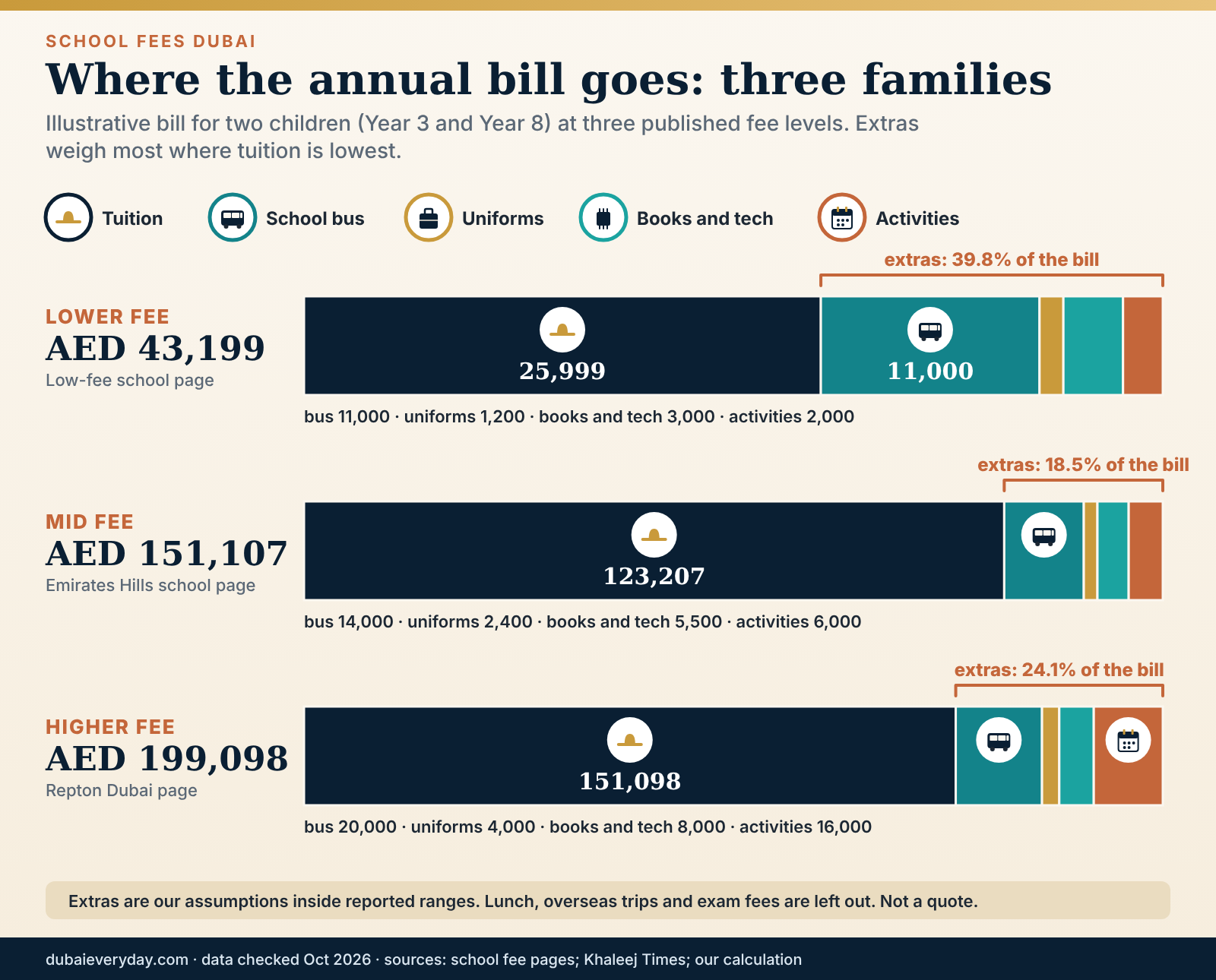
Everything above on school fees Dubai parents pay can be turned into a calculator. The model below prices a two-child family, one child in Year 3 and one in Year 8, at three levels of school fees Dubai families might face. Tuition comes from the 2026-27 fee pages: the low-fee school, the Emirates Hills school (Years 2 to 6 and Years 7 to 9) and Repton Dubai.
The extras are our assumptions, set inside the ranges that Khaleej Times and others reported in August 2026. This is an illustrative model, not a quote and not a prediction for any school, and the three schools are samples of price levels, not recommendations.
| Line (AED, two children) | Lower fee | Mid fee | Higher fee | Basis |
|---|---|---|---|---|
| Tuition, child in Year 3 | 12,603 | 57,983 | 66,732 | School fee pages |
| Tuition, child in Year 8 | 13,396 | 65,224 | 84,366 | School fee pages |
| School bus (2 children) | 11,000 | 14,000 | 20,000 | 5,500 / 7,000 / 10,000 each; press range |
| Uniforms | 1,200 | 2,400 | 4,000 | 600 / 1,200 / 2,000 each; press range |
| Books, stationery, technology | 3,000 | 5,500 | 8,000 | 1,500 / 2,750 / 4,000 each; press range |
| Activities and day trips | 2,000 | 6,000 | 16,000 | 1,000 / 3,000 / 8,000 each; our assumption |
| Annual total | 43,199 | 151,107 | 199,098 | Our calculation |
| Extras as share of total | 39.8% | 18.5% | 24.1% | Our calculation |
| One-off: 2 application fees | 1,000 | 1,000 | 1,000 | AED 500 each at the cap |
| Monthly equivalent (total / 12) | 3,600 | 12,592 | 16,592 | Our calculation |
The sums on school fees Dubai families face are simple, and one result is not. At the lower-fee level, extras are about 40% of the bill and equal about 66% of tuition. At the mid level they are about 19% of the bill and 23% of tuition, and at the higher level about 24% and 32%.
A Khaleej Times calculator piece assumes total education costs run 10% to 25% above tuition. Our model agrees with that for the mid tier and breaks it at both ends. The reason is that a bus and a uniform cost much the same at a low-fee school as at an expensive one, so they weigh more when tuition is small.
What the school fees Dubai model leaves out on purpose
Lunch, overseas trips, exam entries, learning support, EAL fees, nursery fees, boarding and a second-hand device purchase are not in the totals, because they depend too much on the child and the school. Add them as separate lines if they apply. Deposits are not in the totals either, because they are deducted from tuition when you pay it; our calculation puts the cash you must find early at about AED 2,600 in the lower scenario, AED 12,321 in the mid scenario and AED 15,110 in the higher scenario (10% of tuition for both children).
Stress-testing the number
Take the mid-fee total of school fees Dubai parents might face and run three checks. A tuition rise of 2.35% (the 2025-26 index, used here only as a yardstick) adds about AED 2,895. A 5% bus increase adds about AED 700.
And a 10% to 15% overall stress test, the range the Khaleej Times calculator piece uses, adds AED 15,111 to AED 22,666. Compare that with your annual savings after housing and you will know quickly whether the plan has slack. A plan that only works if every figure holds is a plan with a bill waiting in it.
One last use of the model is to compare monthly cash against your pay. Divide the annual total by 12 and compare it with your take-home pay, then add rent. For the wider relocation sequence, including visas, health insurance and housing costs that sit alongside school fees, the Dubai relocation checklist sequences the first months.
Ways to lower the bill without lowering the standard
You cannot negotiate the tuition part of school fees Dubai schools publish. KHDA approves it and schools publish it. What you can influence is everything around it, plus which fee band you enter in the first place. The levers below are ordered by how much money they usually move, from largest to smallest, based on the data in this guide.
Start with the price band, not the rating
The biggest saving in school fees Dubai parents pay is the choice of school. Gulf News listed eleven Very Good rated schools in August 2026 whose tuition stays under AED 45,000, and several of them stay under AED 17,000 even in the final year. The Outstanding list, by contrast, starts at AED 29,488 and reaches AED 111,799.
A rating describes quality at the time of inspection; it does not set a price. If two schools with similar grades differ by AED 30,000 a year, the question is not “why is one cheaper?” but “what does the dearer one provide that matters to my child?” The KHDA ratings guide helps you answer that.
KHDA also says the affordable segment is growing. The Dubai Media Office reported about 9,000 new affordable places in 2025-26 and about 7,500 more planned over the next two years, and press coverage of a KHDA briefing in October 2026 put planned affordable seats at about 18,000 across the next two academic years. More supply in a segment is not a promise of lower prices, but it does mean more choice, and more choice improves your hand when you ask about discounts.
Treat the commute as a fee
The commute shapes two bills. A bus can cost AED 3,500 or AED 10,000 depending on the route, and a long commute costs a child sleep. One school’s published zones show AED 3,500 for the nearest sector and AED 6,500 for the farthest, which is a difference of AED 3,000 per child per year (our subtraction). If you are still choosing a home, put the school at the centre of the map first. The moving to Dubai guide covers the order of decisions, and the housing guides cover rent trade-offs.
Use payment terms deliberately
Paying school fees Dubai schools bill by term is normal, and paying early can be cheaper if the school offers a discount. A Khaleej Times calculator piece uses an example of a 3% discount for annual payment, saving about AED 2,400 on an AED 80,000 bill. That is the article’s example, not a school’s published offer, so ask whether yours has one. Weigh any saving against the cash you would tie up. Avoid buy-now-pay-later plans unless you would otherwise miss a deadline, because the school may be paid on time while you carry the debt.
Get the allowance in writing before you sign
Some employers include an education allowance in the package. We did not find an official source that obliges an employer to pay school fees Dubai residents face, so treat it as a negotiated benefit that lives in your offer letter and contract.
Ask the questions that decide its value: is it per child or per family, is there an annual cap, is it paid to the school or reimbursed to you, is it indexed to fees or fixed, and what happens if a child leaves mid-year? The Dubai employment contract guide shows where such clauses sit, and the guide to finding a job in Dubai covers how offers are structured before you reach that stage.
A fee freeze does not help if your allowance is a fixed amount below the school fees Dubai schools charge your children. Run the numbers in the budget model with your allowance subtracted from the total, so you see the gap you pay yourself. If you are relocating on a sponsored visa, the school bill arrives before many other things settle, so line up the allowance conversation early; the Dubai work visa guide explains what the employer handles.
Check eligibility for government schools, with care
Expatriate children can be admitted to UAE government schools in some cases. The UAE government portal page we read, dated September 2023, said tuition was AED 6,000 per student, admission was for grades 2 to 12, the parent had to work for a government, semi-government or local entity, students needed at least 85% in Arabic, English and Maths, both student and parent needed valid UAE residence, and expatriates were capped at 20% of capacity per school and classroom.
That page is more than three years old, so confirm every point with the Ministry of Education before building a plan around it. For most private-sector expat families it will not apply, so private school fees Dubai-wide remain the working assumption.
Three illustrative families and where their money goes
The following invented examples of school fees Dubai families might meet are built from the budget model, not real families. They show how the same lines behave under different circumstances.
One child, lower-fee school, long commute
A family with one child in Year 3 at a school like the low-fee example faces tuition of AED 12,603, the base of the school fees Dubai families pay at that level. Add a bus at AED 5,500, uniform AED 600, books and stationery AED 1,500 and activities AED 1,000, and the total is about AED 21,203.
Extras are 40% of the bill. The best lever here is the commute: if a shared minibus pass at about AED 500 a month on a ten-month year is available on the route, the transport line falls to AED 5,000. Savings are small in dirhams but large in proportion.
Two children, mid-fee school, one employer allowance
The mid-fee family from the model pays about AED 151,107. Suppose, purely for illustration, that the employer pays AED 50,000 a year per child as a fixed allowance. The family covers the remaining AED 51,107. The pressure points are the senior-year steps and the bus, not the tuition they already know. The best lever is to ask the employer whether the allowance is indexed, because a flat figure loses value every time the school adds a block of years.
A teenager, higher-fee school, exam years ahead
Take a higher-fee family whose older child is in Year 8 at AED 84,366 and heading into Year 10, where the Repton page adds AED 8,653 in one step (our subtraction from published figures). Over the next three years the child moves from AED 84,366 to AED 86,529, then AED 95,182 and AED 95,182 again, before sixth form at AED 102,753. Add exam entries, which we could not price. The best lever is to ask now for the exam-fee schedule and to decide on trips and activities for the exam years deliberately.
Mistakes that inflate the bill, and questions to ask in writing
Most overspending on school fees Dubai-wide is avoidable, and most of it comes from the same handful of habits. Here are the ones the evidence points to.
Budgeting from the entry-year figure is the first. Tuition climbs about AED 7,000 a step at one school, and its senior years cost about 1.8 times its first year. Treating deposits as extra costs is the second; they are advances, and the real risk is losing them by missing the 60-day notice. Missing the re-registration window is the third, because the place is then not guaranteed.
Paying an unlisted “holding fee” is the fourth. Sending withdrawal notice by phone, or after the child has stopped attending, is the fifth; the clock runs from written receipt. And forgetting that the freeze covers tuition only is the sixth, which is how a bus rise of 5% turns up in September as a surprise.
The last one is the quiet one: comparing school fees Dubai schools list by tuition alone. A school that is AED 6,000 cheaper but needs a AED 9,000 bus is not cheaper. Use the same four lines for every school you consider.
- Get the current Fees Fact SheetDownload it from the KHDA directory listing or ask the school for it, and note the academic year printed on it.
- Add the lines the sheet leaves outAsk in writing for the uniform list and supplier, the book and device policy, the bus quote for your address and the expected trips and clubs.
- Check the refund and deposit termsRead the Parent-School Contract for the notice period, the deposit rule and what a month means in the withdrawal clause.
- Build the total in the modelUse the same lines for each school and compare the annual total and the first-year cash needed.
Questions worth sending in one email
- What is the full-year cost for my child’s year group, including every mandatory and additional fee?
- Is the registration deposit deducted from tuition and refundable with 60 days’ written notice?
- When is the re-registration deposit due and how is it calculated?
- What will the bus cost from my address, and who sets any mid-year surcharge?
- Are uniforms and books sold only by the school, or can I buy elsewhere?
- Which trips and clubs are optional, and are fees quoted per term or per year?
- Is there a sibling or annual-payment discount, and is it in writing?
- If my child needs learning or language support, what could it cost and when would I be told?
Keep the replies. If a school declines to put a fee in writing, that is a reason to look at the next school on the list.
The bottom line on school fees Dubai families can plan for
School fees Dubai families pay are more predictable this year than for a long time, because tuition is frozen. That predictability ends at the tuition line. Price the bus, the uniform, the books, the clubs and the deposits before you compare two schools, and compare the annual totals, not the headline numbers. Protect yourself with two habits: get every fee and every refund rule in writing, and send any withdrawal notice early and in writing.
Then use the budget model to test the plan against a rise next year. If the sums work with a cushion, you are ready to apply. If they only work when every figure holds, look again at the fee band, the commute or the allowance. For help with the wider move, the moving to Dubai guide and the Dubai schools guide cover what sits around school fees Dubai parents have to budget for.
Paperwork that sits next to the fees
Admissions need a child’s documents, and the cost of those lives outside this guide. A 2024 copy of KHDA’s admissions guidelines, hosted by a school, says schools may admit a pupil while a residence visa or Emirates ID is still pending, within time limits, so do not delay a school place waiting for paperwork. The routes to those documents are in the Dubai residence visa guide, the Emirates ID guide and the medical fitness test guide. We have not priced them here because the fees change and belong with those pages.
School fees Dubai FAQ: the questions parents ask most
How much are school fees Dubai parents pay for 2026-27?
There is no single figure for school fees Dubai-wide. In the samples we could read, tuition runs from AED 7,389 for a kindergarten year at an Indian-curriculum school to AED 111,799 for Year 13 at the dearest Outstanding-rated British school. A practical reading is under about AED 30,000 for lower-fee schools, about AED 40,000 to 70,000 for the large middle and above AED 70,000 for senior years and premium campuses. These are tuition-only data points, not market averages.
Did school fees Dubai-wide go up for 2026-27?
KHDA confirmed on 22 May 2026 that approved tuition fees do not increase for 2026-27. That freeze covers tuition, not the rest of the school fees Dubai parents pay. Bus fees rose by 3% to 5% at two schools according to Gulf News in July 2026, and uniform and equipment prices were reported to have moved. Check the Fees Fact Sheet for your school and ask about the lines the freeze does not cover.
What is the Fees Fact Sheet and where do I find it?
It is the one-page KHDA document that lists the school fees Dubai private schools may charge, and every private school must give it to parents before each academic year. It lists mandatory fees (tuition, application, registration, re-enrolment), additional fees such as transport, activities, trips and books, and optional items. It is valid for one year and has a QR code for verification. You can find it in the KHDA school directory listing, on the school’s website or in the Parent-School Contract.
How much is the application fee?
Reported KHDA rules cap the application fee at AED 500 for a new pupil. It is refundable if the school offers no place after assessment, or did not tell you beforehand that no place was available. It is not refundable if you are offered a place and decline it, and it is not deducted from tuition. Two school pages show AED 525, which appears to be the AED 500 cap plus 5% VAT.
Is the registration deposit refundable?
Reported rules say a school can request up to 10% of annual tuition as a registration deposit, only after you receive and accept a formal offer. It is deducted from tuition once the child starts. It is refundable if the school receives your written notice at least 60 calendar days before the start date. Some school pages describe their advance as non-refundable, so ask how that fits with the 60-day rule and keep the answer.
What is the re-registration deposit and when is it due?
It is the payment that secures a returning pupil’s place for the next year and is deducted from next year’s tuition. Reported rules say a September-start school may collect it only after spring break and no earlier than 1 May, and an April-start school not before 1 February. The amount is described as 5% of tuition or AED 500; sources disagree on whether the lower or higher figure applies, and two school pages charge 5%, so read your own sheet.
Can I pay school fees Dubai schools charge monthly?
Many schools collect tuition in three term instalments of roughly 40%, 30% and 30%, as the two school pages we read do. An older press summary also describes a ten-monthly-instalment option, so ask whether yours offers it. Some schools accept payment through providers such as Tabby, Postpay and Zip. Those are credit arrangements, so late payments can bring penalties. Read the provider’s terms as well as the school’s.
What happens if I withdraw my child mid-year?
Reported rules on school fees Dubai parents can recover measure from the date the school receives your written request. Up to two weeks after the start, the school may charge one month’s fees; between two weeks and one month, two months’ fees; after one month, the full term. Before the year begins, fees are generally refundable, though the deposit can be kept if you missed the 60-day notice. Stopping attendance does not stop fees while the child is enrolled.
How much does a school bus cost in Dubai?
Khaleej Times reported AED 3,500 to more than AED 10,000 per student per year in August 2026, and an operator told The National that typical fees are AED 3,000 to AED 10,000. One school lists AED 3,500 to AED 6,500 by pick-up zone. Fees are set between schools and operators, and two schools reported rises of 3% to 5% for 2026-27. Ask for a quote for your address.
Are uniforms and books included in tuition?
Often not, so any comparison of school fees Dubai schools publish should add them. The Fees Fact Sheet treats books and uniforms separately from tuition, and a Khaleej Times explainer says KHDA does not regulate uniform prices unless the school supplies them. Book fees can be mandatory, optional or included in tuition depending on the school. Press reports in August 2026 put uniforms at AED 600 to AED 2,000 per child and books, stationery and technology at AED 1,500 to AED 4,000, though the basis of those estimates is not stated.
Are school trips compulsory, and what do they cost?
Trips are generally treated as additional or optional services, and KHDA does not regulate their fees; they follow the agreement you made with the school. Reported costs range from under AED 50 for primary field trips to AED 13,000 or more for overseas trips in secondary school. Those reports are from 2024 and 2025, so ask your school for current prices and whether you can opt out.
Do employers have to pay school fees Dubai families owe?
We did not find an official source that obliges employers to pay private school fees Dubai staff face. It is normally a negotiated benefit that appears in your offer letter or contract, with its own cap and conditions. Ask whether it is per child, whether it is paid to the school or reimbursed, and whether it changes when fees rise. The Dubai employment contract guide shows where to find such clauses.
Can expat children attend government schools?
Sometimes, with narrow eligibility. A UAE government portal page dated September 2023 described admission for grades 2 to 12 at AED 6,000 tuition per student, for parents working in the government or semi-government sector, with minimum marks in Arabic, English and Maths and a 20% cap on expatriates. That page is old, so confirm the current rules with the Ministry of Education before you plan around it.
Related reading
Sources and further reading (38 links)
- Dubai Media Office: KHDA confirms no fee increase for 2026-27 — freeze, support package, affordable places
- UAE Government Portal: School fees — fee regulation, Education Cost Index
- UAE Government Portal: Admission of expatriates in government schools — eligibility and tuition
- Dubai Media Office: Dubai’s private school sector — sector size and curricula
- KHDA: Data and statistics — official dataset; our reader could not open it
- KHDA: A Parent’s Guide to Fees, Deposits and Refunds for Private Schools in Dubai — official guide; read through press summaries only
- KHDA: Registration and Refund Policy for all Dubai Private Schools — official policy; read through press summaries only
- Gulf News: KHDA clarifies Dubai school fee deposits, refunds and key deadlines — application fee, deposits, refund scale
- Gulf News: What is the Dubai School Fees Fact Sheet and how to use it — fact sheet contents
- Gulf News: Dubai schools under Dh45,000, top-rated KHDA schools with affordable fees — fee ranges of Very Good schools
- Gulf News: UAE school bus fees to rise in 2026-27 — bus fee increases
- Gulf News: Dubai school rules 2026-27, fees, age and calendar — age cut-off, calendar
- Khaleej Times: Dubai school fees 2026-27 at Outstanding schools — fee ranges by curriculum
- Khaleej Times: How much UAE parents pay for school transport — bus and alternatives
- Khaleej Times: UAE back-to-school cost calculator 2026-27 — uniform, book, activity ranges
- Khaleej Times: What UAE parents can expect to spend as school starts — parent-reported uniform, bus and device costs
- Khaleej Times: Dubai school fees fact sheet, full list of payments — which fees KHDA regulates
- Khaleej Times: UAE costly international school trips — overseas trip costs
- Khaleej Times: Dh2,000 for school field trip, parents divided — field trip costs, trip rules
- Khaleej Times: Dubai schools hike fees, how parents manage — 2025-26 increases
- Khaleej Times: Parents hail KHDA’s new inclusive policy — inclusion framework
- Khaleej Times: RTA reminder on school bus safety — operator duties
- Khaleej Times: Dubai to open 26 new private institutions in 2026-27 — new schools and early childhood centres
- The National: UAE school bus fees will not increase, Emirates Transport — fuel, Dubai fee-setting
- The National: Families feel strain as back-to-school costs rise — uniform and bus costs from parents
- Dubai Standard: Dubai private school fees remain frozen, but parents still have details to review — what the freeze does not cover
- Dubai Standard: Parents face higher school bus fees for 2026-27 — bus fee increases
- Edarabia: Dubai private school fees frozen, but parents still have things to review — refund scale, instalment platforms
- SchoolsCompared: KHDA cracks down on unfair application fees — older summary of fee rules
- Dubai International Academy Emirates Hills: Fee structure 2026-2027 — tuition, advances, EAL, payment terms
- Repton Dubai: School fees 2026-27 — tuition, deposits, boarding, payment terms
- msbdubai.com: Fee structure for A.Y. 2026-27 — low-fee tuition and bus price list
- PwC Middle East: FTA publishes VAT guide for the education sector — guide publication
- PwC: VAT guide for the education sector — VAT treatment of school charges
- Gulf Business: KHDA rolls out new rules for age limits and admissions — placement rules, non-admission notification
- KHDA: Updated Guidelines for Admissions and Transfers (2024 copy hosted by a school) — documents pending at admission
- International School Advisor: International school fees in Dubai, 2026 cost guide — commercial; indicative tiers only
- Real Estate Club Dubai: Preschool and nursery guide — broker; indicative nursery bands only
Update log: 29 October 2026 — first publication; figures re-checked against the sources above. Next review due: January 2027, when applications for September 2027 open and KHDA may publish fee rules for 2027-28; sooner if KHDA announces a fee decision. Corrections welcome. This page gives general information, not individual financial, tax or education advice; confirm fees, dates and rules with the school and KHDA before you pay.
About DubaiEveryday and this guide
DubaiEveryday.com is an independent editorial project that publishes practical, research-based guides to everyday life in Dubai: where to live, what things cost, how the rules work and how to get around. This page was written and edited by the DubaiEveryday editorial team. It is not signed by a named expert, doctor, lawyer or adviser, and we do not claim first-hand testing of a venue, clinic or service unless the page says so.
Each guide is built from official sources such as government and regulator pages, operator websites and established news outlets, cross-checked where we can. When we could not confirm something, we say so in the text, and examples that use made-up numbers are labelled as illustrations. Mentions are editorial choices, not paid placements, and a link is not an endorsement.
Dubai changes quickly. If you spot something that is out of date or wrong, please tell us through the contact options on DubaiEveryday.com and we will check it and correct the page.