

KHDA ratings are Dubai’s official five-grade verdicts on private schools, and the latest full set dates from the 2023-24 academic year. This guide shows how to read them, what sits behind the grade, and what KHDA ratings leave out.
A school’s grade can feel like a verdict on your child’s whole future. A single word cannot hold that much, yet it sits at the top of many parents’ shortlists. One detail often goes unnoticed: the latest full set of ratings comes from the 2023-24 academic year, and full inspections were paused from June 2024. The label in front of you may describe a school as it was a couple of years ago.
Learning to read khda ratings takes less time than a campus tour, and it makes the tour more useful. This guide explains the five grades, shows what sits behind them, from wellbeing to fees and academic data, and gives you a 15-minute check for any school. It ranks no school and promises no outcome, but it should leave you asking sharper questions.
KHDA ratings are the grades Dubai’s education regulator gives private schools after inspection: Outstanding, Very Good, Good, Acceptable or Weak, awarded through the Dubai Schools Inspection Bureau (DSIB). Use them as a first filter and a source of questions, not as a ranking. A grade is a category, and two schools wearing the same label can feel very different to a child.
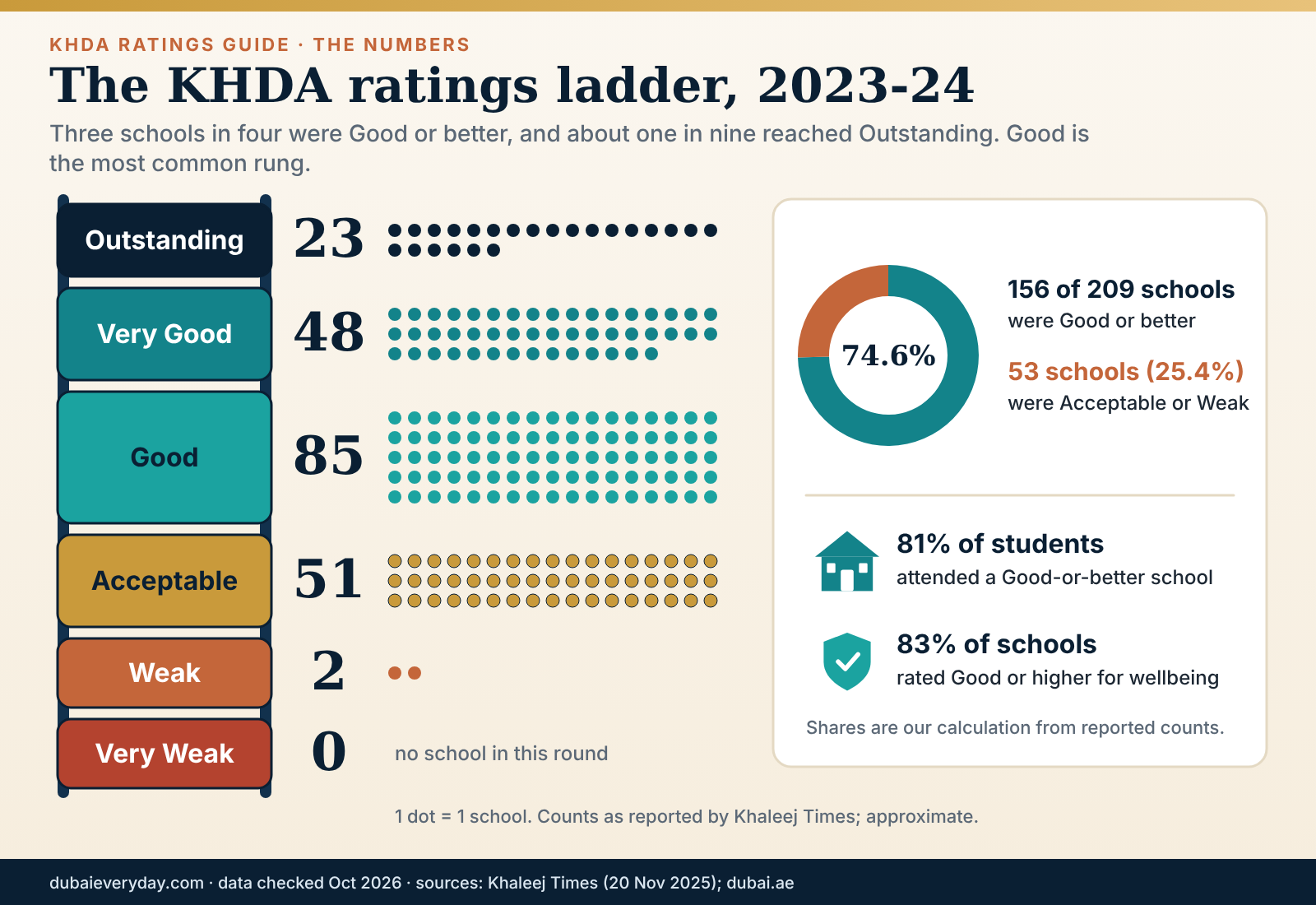
Three facts decide how far to trust KHDA ratings in late 2026. The last full round was 2023-24, when the 209 schools counted by Khaleej Times split into 23 Outstanding, 48 Very Good, 85 Good, 51 Acceptable and 2 Weak. Full inspections were then paused from June 2024, so most grades on the public record are more than two years old. And Dubai froze approved tuition for 2026-27, so KHDA ratings do not change what you pay this year.
Below you will find how to read an inspection report, what the wellbeing, fee and academic information means, and a 15-minute check you can run on any school. This page ranks no school, and nothing on it was field-tested.
This is a desk-research guide. DubaiEveryday.com has not visited, toured, enrolled a child in or paid any school, and nothing here describes a personal visit. Facts were read on 29 October 2026 from the Dubai government’s schools rating page, the UAE government portal’s school fees page (marked as updated 21 October 2026), Dubai Media Office releases and press reports of KHDA briefings.
KHDA’s own website blocks automated readers, so we could not open its data pages or any individual school report. That is why this page names no school grade: we could not check one against the source. Where a number comes from a news report, we say so. Illustrative examples are labelled and are not quotes or market facts. Inclusion was not paid for. This is general information, not individual educational, legal or financial advice: confirm every grade, fee and date with KHDA and the school before you commit money.
What this KHDA ratings guide covers
The search behind this page is narrow. A parent has seen a grade next to a school’s name, or an agent has said “it’s Outstanding”, and wants to know what that means in practice. So this guide covers inspection results, the wellbeing and academic information that sits around them, the link between KHDA ratings and fees, and the things a grade cannot tell you. It is about reading evidence, not about choosing a curriculum or filling in an application.
Those wider jobs belong to the Dubai schools guide, which covers curricula, fee bands, admissions rules, locations and a shortlist method. When we reach a topic that guide already handles in depth, we summarise it in a sentence and send you there. Nothing is copied between the two pages, so reading both costs you no repetition.
Where each question goes
Which curriculum?
Exit routes, exam systems and what each curriculum means for university. That decision comes before any grade, and the schools guide walks through it.
The whole move
Visas, housing, banking and the order of first-month tasks sit in the moving to Dubai guide, with a dated list in the relocation checklist.
The family budget
School fees are one line in a bigger sum. The cost of living guide places them next to rent, utilities and insurance.
Children’s visas
A child normally needs residency before enrolment is complete. Dependants’ routes are in the residence visa guide.
Why this one label gets so much weight
Families lean on KHDA ratings for a simple reason: they are the only quality signal for Dubai private schools that is official, public and comparable across 17 curricula. Everything else is a brochure, a forum post or a friend of a friend. That scarcity gives KHDA ratings more authority than any single word can bear.
Four misreadings of KHDA ratings turn up again and again. The first treats a grade as a rank, so that “Outstanding” means “number one”. The second treats a grade as current, when it may describe a school as it stood three academic years ago. The third treats a grade as a prediction of your child’s happiness. The fourth treats a grade as a price signal. Each section below takes one of these apart with the evidence we could read.
How to read the dates on this page
School information goes stale fast, so every figure here carries its year. “2023-24” means the academic year that ran from the autumn of 2023 to the summer of 2024. “2026-27” is the year that began on 31 August 2026 in most schools. Counts of schools by grade are always from the 2023-24 round unless a line says otherwise.
When we do our own arithmetic on published numbers, the line says “our calculation”. When we interpret, it says “our reading”. When a figure came from a commercial or media source rather than from KHDA or a government page, we name the outlet. Treat anything undated as a prompt to check, not as a fact.
How KHDA ratings work: the inspector, the scale and the stakes
KHDA, the Knowledge and Human Development Authority, is the Dubai body that regulates private education in the emirate. Inspection is carried out by a unit inside it, the Dubai Schools Inspection Bureau. The Dubai government’s rating page states that DSIB produces the school rankings, although in practice what it produces is a graded judgement for each school rather than a league table. That distinction matters later.
KHDA ratings in plain language: the five grades
The government page lists five categories, from highest to lowest: Outstanding, Very Good, Good, Acceptable and Weak. Earlier reporting also records a sixth, Very Weak, which no school held in the 2023-24 round. We treat Very Weak as an existing grade that is currently empty and say so where it affects a rule.
The official descriptors for each grade sit in the inspection framework, which we could not open. Below is our reading of how the labels behave in practice, based on how the distribution looks and how they are used in fee and admission rules. It is a reader’s shorthand, not the regulator’s wording.
Outstanding
The strongest official signal. In 2023-24 about one school in nine held it. It tells you inspectors found high quality across the areas they looked at. It does not tell you the school suits your child or your budget.
Very Good
Close to the top and a large group: 48 schools in the 2023-24 round. For many families a Very Good school with the right curriculum and a sensible commute beats an Outstanding one that is far away.
Good
The centre of the system, with 85 schools in 2023-24. It is the single most common grade, held by roughly four schools in ten. Read the report: Good can hide strong and weak areas side by side.
Acceptable
A grade that sounds mild and is not a failure, but is below the middle. It means inspectors saw clear room to improve. The report and the school’s improvement plan matter more than the word.
Weak
Two schools in 2023-24. It signals significant concerns and a requirement to improve. It also carries legal weight for some families, covered in the next part.
What inspectors look at when they set KHDA ratings
The government rating page names several areas that inspection assesses, including students’ progress in Arabic as a first language and in Islamic Education, assessment, self-evaluation and improvement planning, and governance. Khaleej Times, reporting the latest results, lists a wider set: attainment and progress, teaching quality, curriculum adaptation, personal and social development, environmental responsibility, community engagement, health and safety, wellbeing, inclusion, leadership and the use of assessment data.
The two lists are not identical, and the framework wording changes between editions. So treat both as a sketch of the territory rather than the official table of contents. The point for a parent is that a single grade is a summary of many separate judgements, and those judgements are in the report.
Where KHDA ratings carry weight beyond reputation
KHDA ratings are not only labels. The UAE government portal says that Dubai’s for-profit private schools can raise fees according to their DSIB grade, alongside an Education Cost Index. The same page notes that since 2016-17 UAE nationals have been barred from registering or funding private schools rated Very Weak. A 2024 version of KHDA’s admissions guidance, hosted on a school’s website, goes further and says Emirati students may not be placed in schools rated Weak or below. We flag that difference in the special-cases part because the wording matters if it applies to you.
For expatriate families, KHDA ratings have no equivalent legal effect on enrolment. What it has is influence: on fee-increase headroom (when fees are not frozen), on a school’s marketing, and on how landlords, recruiters and relocation agents describe an area. That is why the interpretation work falls to you.
What KHDA ratings do and do not cover
KHDA ratings apply to the private schools it licenses. Government schools run by the Ministry of Education are a separate system, and the KHDA ratings discussed here do not describe them. Higher education and training providers are also regulated separately. We could not confirm whether early childhood centres carry the same five-grade labels, so we treat nursery ratings as a question to ask, not a fact, and return to it in the special-cases part.
It is also worth knowing what a published ranking is not. Lists headed “best schools in Dubai” on agent and portal sites are usually built from KHDA ratings plus fees, and sometimes from parent reviews. The ratings themselves are categories. The sources we read give no official table that places one Outstanding school above another, and this page does not create one.
KHDA ratings in numbers: the 2023-24 distribution
Before deciding how much weight KHDA ratings deserve, it helps to know how the grades are spread. Khaleej Times reported the outcomes of the 2023-24 round, the most recent full inspection cycle, in November 2025. We converted the counts into shares ourselves. Treat the counts as approximate: the newspaper says only that more than 200 schools were inspected, and a commercial advisory blog we read gives slightly different figures for Good and Acceptable.
| Grade (2023-24 round) | Schools | Share of the 209 counted (our calculation) |
|---|---|---|
| Outstanding | 23 | 11.0% |
| Very Good | 48 | 23.0% |
| Good | 85 | 40.7% |
| Acceptable | 51 | 24.4% |
| Weak | 2 | 1.0% |
| Very Weak | 0 | 0% |
Source for the counts: Khaleej Times, 20 November 2025, reporting the 2023-24 KHDA results. Shares are our calculation from those counts and are rounded to one decimal place.
What the shares say
Add the top three grades and you get 156 of 209 schools, or 74.6% rated Good or better. Add Acceptable and Weak and you get 53 schools, or 25.4%. In other words, roughly three schools in four were at Good or above, and one in four was below that line. The system is not dominated by failing schools, and it is not a sea of excellence either.
Two further figures from the same Khaleej Times report matter. About 81% of Dubai’s private-school students attended a school rated Good or better, and about 83% of schools were rated Good or higher for wellbeing. Both are reported figures; neither is ours. They sit alongside the 74.6% we calculated, and the gap between 74.6% and 81% is worth a moment.
Schools versus students: a rough calculation
If 74.6% of schools are Good or better but 81% of students attend such schools, then the Good-or-better schools must be larger on average than the rest. A back-of-envelope version: 81% of students spread across 156 schools is about 0.52 percentage points of the system per school, while 19% across 53 schools is about 0.36. That makes the typical Good-or-better school roughly 45% larger than the typical school below the line.
This is our calculation, and it is rough. The 81% may use a slightly different base of schools and students than the 209 count, and school size varies enormously. But the direction is sound. Bigger schools were more likely to sit in the upper grades, which is why a parent who visits three large, well-known schools may see mostly Good-or-better grades and conclude that the whole market looks like that.
Why 209 is not 227
A Dubai Media Office release put the number of private schools at 227 for 2024-25, with 387,441 students. The 2023-24 round counted 209. The gap is not explained in any source we read. Our reading is that it reflects schools opened or reclassified since the round, plus year-to-year differences in what counts as one school. If you are comparing a school to the table above, expect that some schools simply have no grade from this round.
What the distribution means for your shortlist
Imagine a shortlist restricted to Outstanding and Very Good schools. That is 71 schools out of 209, or 34%. You have removed two thirds of the market before looking at a commute, a fee or a curriculum, and you are competing with other families for the same places. An Outstanding-only list is smaller still, at 23 schools.
The reverse also holds. A Good grade puts a school in the largest group, which means it is the normal outcome of a competent school, not a warning. Parents who treat “only Good” as a disappointment may be rejecting 85 schools that include excellent fits. The Dubai schools guide makes the broader point that curriculum, commute and cost should come first, with KHDA ratings as a later filter.
Quick test. Before you reject a school for being “only Good”, ask what the Outstanding alternative costs in tuition, in minutes on the road, and in the difficulty of getting a place. If the answer is “a lot” on all three, you have not found a better school. You have found a more expensive trade-off.
How old are the KHDA ratings you can see today?
Here is the fact most guides skip. The KHDA ratings on a school’s public record in late 2026 mostly come from inspections carried out during 2023-24. That is not a typo in a table. It is the result of a deliberate pause in the inspection programme.
The pause and what followed
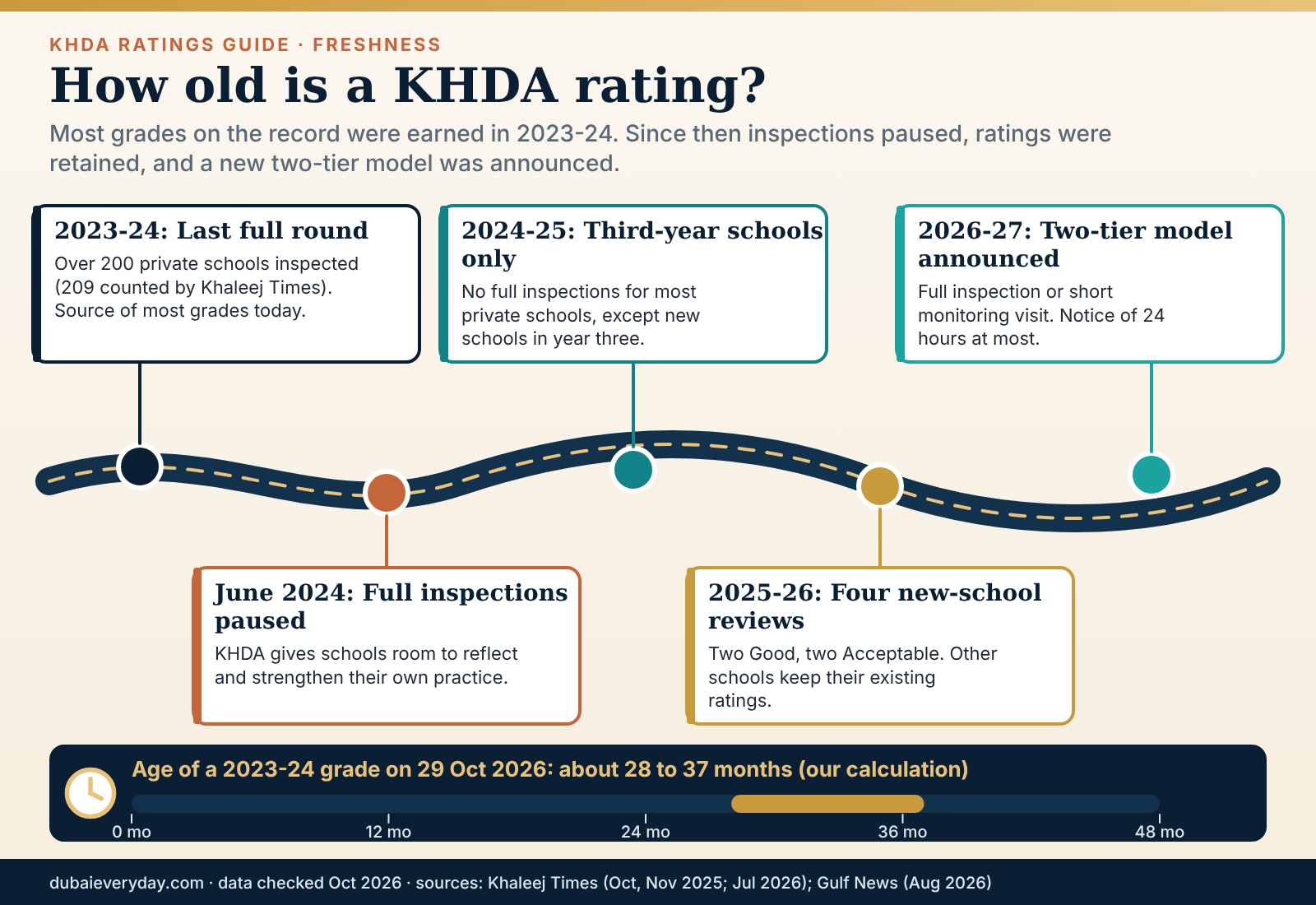
Khaleej Times reported that KHDA paused full inspections in June 2024, framing it as room for schools to reflect and strengthen their own practices. Over 200 private schools had full inspections in 2023-24. In 2024-25, according to Khaleej Times in October 2025, private schools did not receive full inspections, with the exception of new schools in their third year of operation.
In 2025-26 only four schools received full reviews, all of them schools that opened in 2022. Two were rated Good and two Acceptable, as reported in November 2025. A later Khaleej Times report in July 2026 said KHDA retained existing ratings for 2025-26. Put plainly, for most schools the label you see today was set in the 2023-24 year and has been carried forward, not re-earned.
How much can change in two and a half years
Count the months. If a school was visited early in 2023-24, its inspection is now about 37 months old. If it was visited in the final weeks of the year, it is closer to 28 months old. Either way, a grade seen on 29 October 2026 is between two and a third and three years old.
Think about the pupils. A primary school typically spans six year groups. Over 28 to 37 months, roughly 39% to 51% of a six-year phase has passed (our calculation: 28 or 37 months divided by 72). Assuming year groups are similar in size and ignoring mid-year arrivals, about four to five in every ten primary pupils the inspectors observed have since moved on to the next phase or left. The cohort behind these KHDA ratings is largely not the cohort in the building now.
Staff change too. Principals move, heads of department leave, and a school that grew fast may have added a second building. We have no statistic on teacher turnover to quote, and we will not invent one. The safe statement is narrower: any of these changes could move a school’s quality in either direction, and retained KHDA ratings cannot reflect them.
The 2026-27 model
Gulf News, in a report last updated on 7 August 2026, described a new two-tier approach for 2026-27. A school will receive either a comprehensive inspection that results in a full performance rating, or a shorter monitoring visit concentrating on priority areas identified from performance data. Inspectors will give no more than 24 hours’ notice, with the stated aim of seeing everyday teaching and learning rather than a prepared inspection day. Schools entering their third year of operation will automatically receive a full inspection.
Related headlines on the same page suggest that inspections are returning after a two-year pause and that early childhood provision, Emirati students, inclusive education and Arabic teaching may be priorities. We could read only the headlines, not the stories, so treat those priorities as unconfirmed. We found no published new overall ratings round under this model as of 29 October 2026.
That has a practical consequence. Between now and whenever the first new-model KHDA ratings appear, you are looking at an old photograph. The new-model monitoring visits may reveal useful signals, but we could not confirm whether KHDA publishes monitoring-visit findings. Ask each school what it was told.
How to treat KHDA ratings by their age
Under a year old
Rare in 2026. Treat it as current, but read the report: inspectors saw the school recently, so the written findings are a reliable guide to what you will meet.
One to two years old
Still useful as a starting point. Ask about leadership changes, building work and staffing since the visit before you lean on it.
Two to three years old
This is where most 2023-24 KHDA ratings now sit. Use the grade to shortlist and the report to generate questions, and ask the school for newer evidence.
No grade yet
Seven new schools opened for 2026-27, according to Khaleej Times, and newer schools wait for a full inspection in their third year. Judge them on leadership, plans and what you can verify.
What “retained” means for a fee-paying parent
A retained rating is a label held in place, not a re-test. Khaleej Times noted that, with ratings frozen, all schools were limited in 2025-26 to the Education Cost Index figure of 2.35%, regardless of grade. So the pause had a financial effect as well as an informational one: it flattened the differences between schools in the fee-increase system. Our reading is that the pause removed one of the few mechanisms through which a better inspection result would have translated into pricing power. The fees section returns to this.
A school’s website may show an inspection grade with no year, or a banner that reads “Outstanding” beside a photo of a new building. If the date is missing, assume it is old and ask. A grade without a date is a claim, not evidence.
Inspection results: how to read a report, not just the grade
The grade is the headline. The report is the story, and good use of KHDA ratings starts with the story. The Dubai government’s rating page links to an overall performance report and a key findings document for 2023-24, and DSIB publishes a detailed report for each inspected school on KHDA’s website. We could not open those documents, so we cannot quote what any individual school’s report says. What we can do is give you a method for reading one, built on how the published summaries describe the inspection areas.
What a report is likely to contain
Report layouts change between editions, so check the one you are holding. In general, expect an overall grade, separate judgements for the main areas inspected, a narrative of what the school does well, and a list of what it must improve. The areas named in the press coverage of the latest round include attainment and progress, teaching, curriculum, personal and social development, health and safety, wellbeing, inclusion and leadership.
Some reports break judgements down by phase, such as primary, middle and secondary. Where that happens, a school’s overall grade may hide a split: a strong secondary phase and a weaker primary, or the reverse. That is the first thing to look for, because your child lives in one phase, not in the average.
A seven-step way to read an inspection report
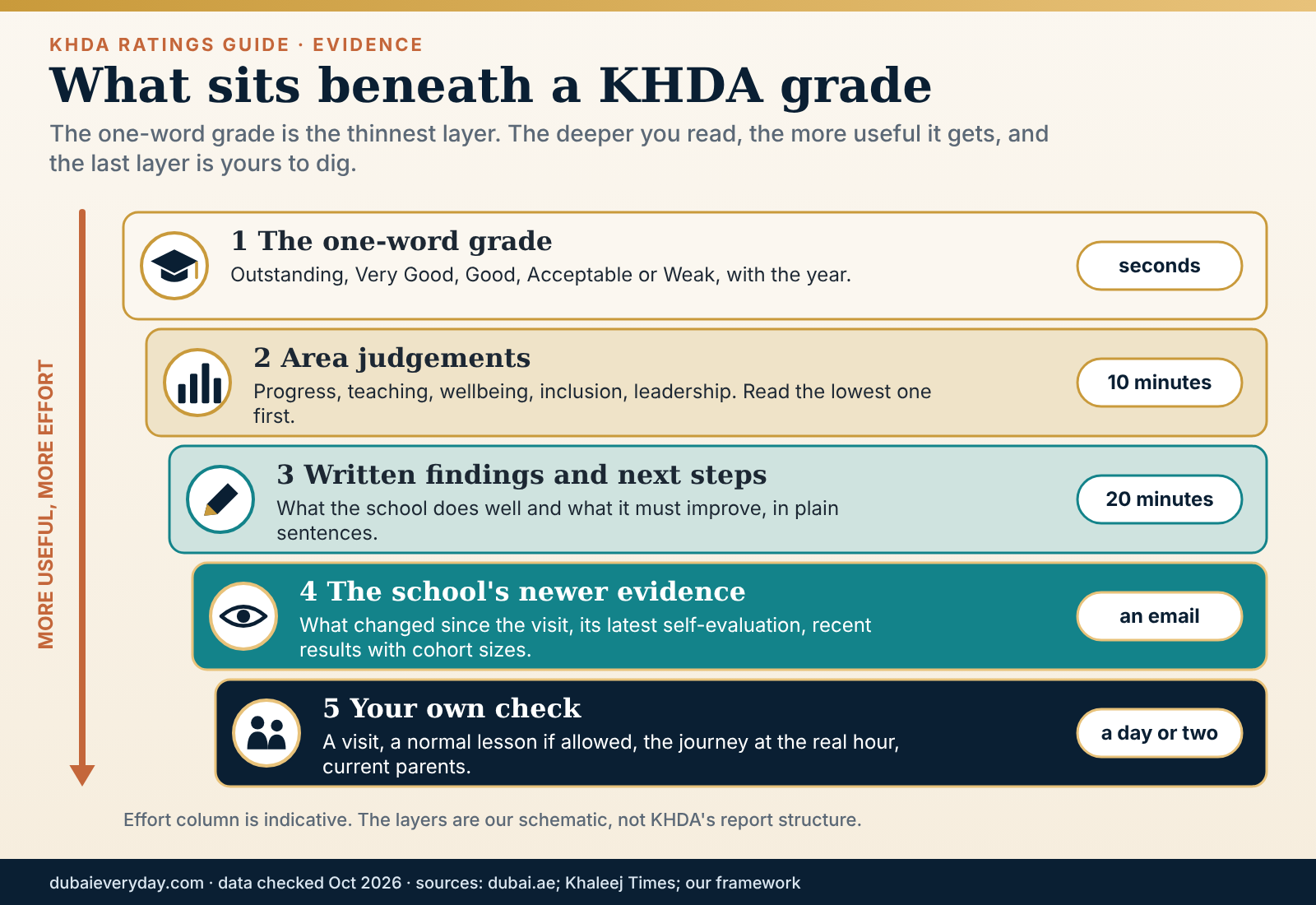
- Find the dateNote the inspection year before you read a word. A 2023-24 report and a 2025-26 new-school review are different kinds of evidence, and neither describes 2026-27.
- Look for the splitIf the report gives judgements by phase or by area, write down the one that matches your child’s year group, not the headline.
- Read the lowest-rated area firstThe weakest judgement shows where the school struggles. A Good school with an Acceptable attainment judgement has a different risk from a Good school that is Good across the board.
- Separate attainment from progressAttainment is the level children reach. Progress is how far they move from where they started. A school that admits strong readers may show high attainment with modest progress, and the reverse can be true elsewhere.
- Read the “what must improve” sectionThis is the most practical page. Ask whether the issues are things you would notice (marking, consistency, lesson pace) or things you would not (governance paperwork).
- Check the areas that matter to youArabic, Islamic education, inclusion and wellbeing each have their own judgements. If your child needs language support or has learning needs, those are not footnotes.
- Turn findings into questionsEvery weakness in the report becomes a question for the school: what has changed since the visit, and what evidence can you show?
Reading the language
Inspection reports tend to use graded words for quantity and consistency: “most”, “some”, “a minority”, “inconsistent”, “variable”. These are not decoration. A report that says most students make good progress is making a different claim from one that says some do. If a report defines its quantity words, read the definitions once. If it does not, treat the order of the words as a ladder: all, nearly all, most, many, some, a few.
Watch also for the contrast words that signal a mixed picture: “however”, “but”, “although”. A sentence that begins with a strength and turns on “however” is usually where the useful information lives. Highlight those sentences and ask the school about them.
Same grade, different schools: an illustrative example
The example below is invented to show the reasoning. It does not describe any real school, and the judgements are not data.
Illustrative example (not a quote or market fact). School A and School B are both rated Good overall. School A’s report shows Very Good for personal development and wellbeing, Good for teaching, and Acceptable for attainment in mathematics, with a note that tasks are not always challenging enough. School B’s report shows Good in every area, with a note about inconsistent marking.
For a quiet child who needs a caring environment and is secure in maths, School A may be the better fit despite the same overall grade. For a child aiming at a competitive maths pathway, School B’s even profile may be safer. The word “Good” is identical. The decision is not.
What the four 2025-26 reviews show
Khaleej Times summarised four full reviews of newly opened schools in November 2025, two rated Good and two Acceptable. Counting from that summary (our tally, and a newspaper’s reading of the reports rather than the reports themselves), academic attainment or literacy was named as a development area in three of the four, and health and safety was a named strength or a Very Good judgement in three of the four. One review recommended a more structured way of monitoring wellbeing, and another asked for stronger inclusion systems and individual education plans.
Our reading is that new schools often get the environment right first and the academics later. That is a pattern across four schools, not a rule. It is a useful reminder that a school’s profile of strengths and weaknesses is more informative than its grade.
Turning a weakness into a question
A good question is specific, polite and answerable with evidence. If the report noted inconsistent teaching, ask: “How do you now check lessons are consistent across classes, and could I see what changed?” If it noted weak progress in a subject, ask for the school’s own recent data in that subject and how it is tracked. If it flagged Arabic or Islamic education, ask how many hours the timetable gives them and who teaches them.
The tone matters. A school that welcomes these questions is showing you something good. One that deflects, or answers only with the grade, is showing you something too.
Wellbeing: what the grade covers and what it cannot see
Parents often search for KHDA ratings and wellbeing in the same breath, because the number they actually care about is whether their child will be happy. Khaleej Times reported that about 83% of schools received a Good or higher judgement for wellbeing in the 2023-24 round. That is a useful number. It is also a number about schools as systems, not about your child.
What the wellbeing part of KHDA ratings can see
An inspection can look at policies, the presence of pastoral staff, how behaviour is managed, how concerns are recorded, how safe students feel when asked, and how adults and children talk to one another. Inspectors can talk to pupils and read records. In a visit of limited length, they can form a sound view of whether the machinery of care exists and works.
What they cannot do in a short visit is know how the machinery behaves for a particular child in a particular class across a whole year. A quiet transfer student in a large year group, a child who has lost a friendship group, or a teenager hiding stress can all be invisible to a snapshot.
The Student Wellbeing Census: what we could and could not verify
KHDA has run a Dubai Student Wellbeing Census with the Department for Education in South Australia. According to a public encyclopaedia summary, which is a secondary source, the first round in November 2017 surveyed about 65,000 students in 168 schools. It reported that 84% of students were happy most of the time, 77% felt safe at school and 76% had close friendships. It also linked wellbeing to breakfast, sleep and good relationships with adults.
That is nine years old and describes the system, not any school. We could not verify later rounds or whether school-level results are published. If a school quotes census results, ask for the year and whether the figure is for your child’s phase. The findings about sleep and breakfast are worth keeping regardless: they are the part of wellbeing you control.
Wellbeing factors that sit outside the grade
Several things shape a child’s day in Dubai and appear in none of the KHDA ratings. The length of the bus ride, the time the school day starts, how breaks are handled in hot months, the amount of homework, the way the school helps a new arrival make friends, and the pressure around exam years all matter. Our reading is that these are often more decisive for a child’s mood than the wellbeing grade itself.
Heat is a Dubai-specific example. In summer terms, ask how outdoor time is managed, whether there are shaded or indoor break areas, and when PE is scheduled. We did not verify any KHDA rule on this and mention it only because it is a legitimate question about daily experience. The same logic applies to the journey: ask the bus provider for the real door-to-door time at the real hour, and remember that an early pick-up eats into sleep, which the census links to wellbeing.
Questions that surface wellbeing quality
- Who does a child talk to if something is wrong, and how many pupils does that person look after?
- What happens in the first two weeks for a child who joins mid-year?
- How does the school record and follow up bullying, and can you see the policy in writing?
- How does it monitor wellbeing between inspections, and what does it do with the results?
- What is the homework expectation for your child’s year, in minutes per night?
- How are children with different home languages helped to join in socially, not only academically?
Inclusion and children of determination
If your child has learning differences or additional needs, the wellbeing judgement is not enough. KHDA’s inclusive education policy framework, launched in November 2017 according to Khaleej Times at the time, said schools may not refuse admission to students with special needs, must budget for the facilities and resources they require, and must keep any costs charged to families for required disability-based services reasonable. The same report quoted one parent estimating that a learning support assistant could add AED 40,000 to 70,000 a year. That is a parent’s estimate, not a policy figure.
Gulf Business, reporting 2026-27 placement rules, noted that a school declining admission because of inclusion capacity or a child’s specific needs must submit a Non-Admission Notification form, and that the framework expects support within the year group through differentiated teaching, targeted interventions and English as an additional language support. Evidence for need can include individual education plans, individual learning plans and specialist reports.
The practical advice is to read the inclusion judgement in the report, ask for the school’s inclusion policy, and ask who would work with your child and for how many hours. If you need an assessment before applying, the Dubai healthcare guide explains how clinics and appointments work, and the health insurance guide covers what dependants’ plans usually include. Check coverage before you book, since assessments are often excluded.
Do this. Ask any school you are serious about to put in writing what support it would give your child and what each element would cost. A verbal “we’re very inclusive” is pleasant. A written plan with hours and fees is something you can hold the school to.
KHDA ratings and school fees: the link, the freeze and the real price
Fees and KHDA ratings are tied together in Dubai’s rulebook, which is why parents often assume that a higher grade means a higher price. The truth is more tangled, and in 2026-27 the link is switched off. This section separates three questions: what a grade used to do to fee increases, what the rules say for 2026-27, and what you will actually pay. For the full fee picture, including registration, deposits and payment plans, see the Dubai schools guide.
How KHDA ratings moved fees before the pause
The UAE government portal explains that Dubai’s for-profit private schools can raise fees based on their DSIB grade together with the Education Cost Index, a figure KHDA calculates regularly. Khaleej Times described the same mechanism: a school’s latest rating determines how large an increase it may ask for, and higher-rated schools are generally allowed bigger requests. Fee levels are regulated by the emirate’s education authority, and KHDA publishes a School Fees Framework document that the portal links to but does not summarise. We could not open it, so we cannot give you the grade-by-grade percentages.
The logic is easy to follow. A better inspection result earns a school more room to raise fees, on the theory that quality can be priced. A lower result limits that room. Families therefore care about KHDA ratings twice: as a quality signal and as a clue to future price movements.
2025-26: the cap that flattened every grade
With full inspections paused, ratings were frozen, and Khaleej Times reported that every school was limited to the Education Cost Index for 2025-26, set at 2.35% for for-profit private schools, whatever its grade. Parents quoted in the paper’s June 2025 coverage reported increases ranging from about AED 200 to almost AED 5,000 per child per year. Those are parents’ reports rather than official statistics, and they reflect different starting fees.
2026-27: no increase
On 22 May 2026, the Dubai Media Office reported that KHDA confirmed private school fees in Dubai will not rise for the 2026-27 academic year, under directives from the Crown Prince of Dubai. The announcement tied the decision to a second economic incentives package worth AED 1.5 billion, bringing recent incentives to AED 2.5 billion, with 33 initiatives running over three to 12 months. Schools get deferred or instalment-based licence renewal fees and deferred fines, and early childhood centres are exempt from licence renewal fees and some other charges.
The same release said about 9,000 new affordable places opened this academic year in a segment serving around 230,000 students, with roughly 7,500 more planned over the next two years. It also described a KHDA service called Girnas Educational Advisor, which offers a smart chat and one-to-one sessions to help families, including Emirati families, choose schools. If you want official help in addition to this guide, that is an official starting point; we have not tested it.
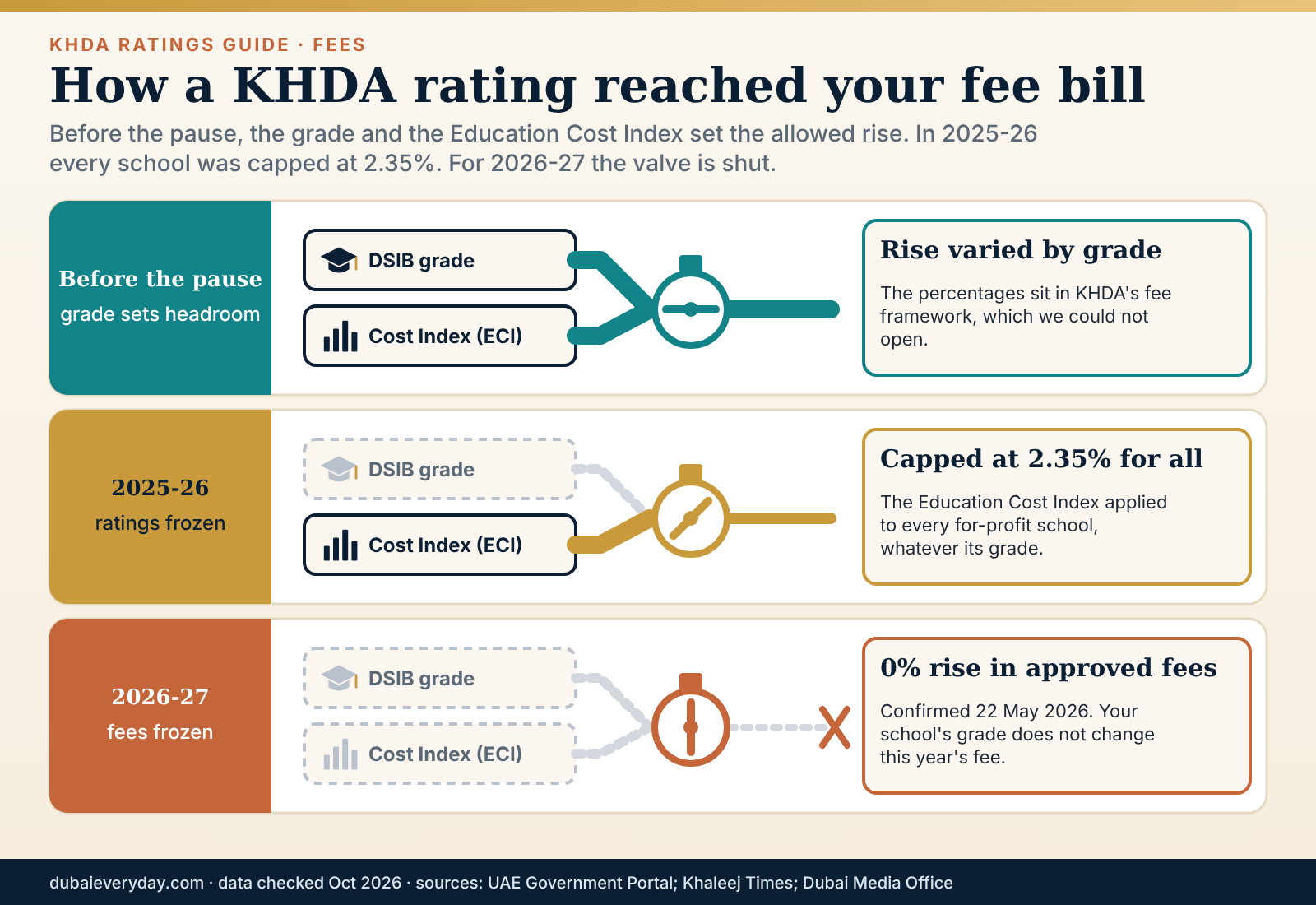
What the freeze means for you. For 2026-27 a higher grade will not make your school more expensive this year, and a lower grade will not make it cheaper. Our reading: until ratings are refreshed and fee rules for later years are announced, KHDA ratings are a poor guide to what you will pay. Confirm next year’s position with KHDA and the school before you sign a multi-year commitment.
Do higher KHDA ratings cost more? What we could and could not find
The only fee-by-grade data we could read covers the top grade. Khaleej Times, in July 2026, reported on tuition at the 23 Outstanding schools for 2026-27. The cheapest fee listed was AED 29,488, for a preschool year at a French-curriculum school, and the most expensive was AED 111,799, for Year 13 at a British-curriculum school. Our calculation puts that spread at about 3.8 times from lowest to highest.
By curriculum, the same report gave annual ranges of AED 43,084 to 111,799 for 15 British-curriculum schools, AED 44,616 to 89,889 for five IB schools, AED 66,185 to 93,300 for the one American school, AED 38,246 to 73,876 for the one Indian-curriculum school and AED 29,488 to 62,363 for the one French school. An earlier Khaleej Times piece, from October 2025, gave somewhat different ranges and warned of inconsistencies between its summary and its school list. It also did not say whether the figures included registration, books, uniforms or transport.
What we cannot do is tell you the average premium for Outstanding over Good or Acceptable. We found no official dataset pairing every school’s fee with its grade, and we will not guess. The honest conclusion is narrower and still useful: the top grade spans a very wide price range, so Outstanding is not a synonym for expensive, and nothing in the data suggests a fixed price for any grade.
Illustrative example: what a premium has to buy
Illustrative example (not a quote or market fact). Suppose School X, rated Outstanding, charges AED 30,000 a year more than School Y, rated Good, for one child. Over a six-year primary phase that is AED 180,000. For two children it is AED 360,000, before any later increases.
The question is not whether X is better. It is what the extra AED 360,000 would change for your children, and whether you could spend part of it on something more targeted, such as tutoring, language support or a longer holiday home, if School Y suits them. Put the figure on the table when you compare. Parents who do usually decide with their eyes open.
Questions that link grades and fees
- What is the approved fee for my child’s year in 2026-27, and can I see the schedule in writing?
- Which charges sit outside the tuition fee: registration, deposit, books, uniform, trips, exam entry, bus, meals, technology?
- Does the school expect to ask for an increase once the freeze ends, and on what basis?
- If the school’s grade changes after a new inspection, does that affect my fee or my contract?
- Is there a discount for paying a year up front, and what happens to the money if we leave mid-year?
If your employer offers an education allowance, check whether it is capped per child or per family, and whether it covers extras. Contract terms are covered in the work visa guide, and the cost of living guide shows where schooling sits in the monthly budget. Our reading is that most families who run short on school fees do so because of extras they did not price, not because of tuition.
Academic data behind KHDA ratings
Academic evidence reaches parents through three channels: the judgements in an inspection report, the results a school publishes for itself, and large studies that compare education systems. Each answers a different question, and mixing them up is a common way to be misled. This section separates them and shows how to read the second, which is where most of the persuasion happens.
Attainment, progress and why both matter
Attainment is where students end up: a mark, a level, a grade. Progress is the distance travelled from their starting point. A selective school can post high attainment with modest progress because it admits students who were already ahead. A non-selective school with outstanding teaching can post lower attainment and strong progress because its students began further back. The inspection report can speak to both. A raw results table usually speaks only to the first.
If your child is a typical learner, progress is the more useful signal. If your child is exceptionally strong or has a gap to close, you need both, and you need them for the subjects and the phase that apply. Ask the school directly whether its published results are for all students or only those who sat the exam, and what it uses to measure progress.
Reading school results next to KHDA ratings
Dubai schools publish exam results in different formats because they teach different curricula. Do not compare a percentage from one system with a grade distribution from another. When you see a result, check six things.
- The year, and whether three years are shown or only the best one.
- The cohort size, because small groups swing wildly.
- Whether results are for all students or exclude those who left or resat.
- How the school admits students; selective entry lifts outcomes.
- Which grading scale is used, since exam boards differ.
- Whether the headline number is a pass rate, a top-grade rate or an average.
A worked example of cohort noise
Illustrative example (not a quote or market fact). A year group has 24 students. Each student is 4.2 percentage points (1 divided by 24). If 22 achieve a target grade, the school can say “92%”. If 20 do the next year, it is “83%”. The difference is two students.
Reading that drop as decline, or the earlier figure as excellence, would be unfair. In small cohorts, the right habit is to look at three years together and to ask about the number of students, not only the percentage.
System-level studies and what they cannot say about one school
Large international studies compare education systems. The TIMSS 2023 website lists Dubai among its benchmarking participants, which means Dubai is measured as its own education system in that study. We did not read Dubai’s scores and do not quote any. Even if we had, results like these describe the emirate or a sampled group, not a particular school.
That matters because marketing sometimes borrows national or emirate-wide success as if it belonged to a specific school. A strong Dubai-wide result is context, not evidence about the building you are considering. The inspection report and the school’s own cohort data are the closer tools.
University destinations and other “outcome” claims
Schools sometimes quote university offers or destinations. Ask for the denominator: how many students were in the leaving cohort, how many applied, and how many received offers from the places quoted. “Offers from leading universities” without a count tells you very little. A school that gives the numbers and the context is showing confidence in its evidence.
The schools guide discusses how curriculum choice shapes exit routes. Put that first: results mean little if the curriculum does not lead where your family is going.
Questions to ask about academic data
- Can I see results for the last three years, with cohort sizes?
- How do you measure progress between exams, and what are the figures for my child’s year group?
- What proportion of students leaving Year 11 or Grade 10 stay on for the final two years?
- Do you enter all students, or only those likely to do well?
- What support is there for a student who arrives behind, and how do you track whether it works?
What KHDA ratings do not tell you
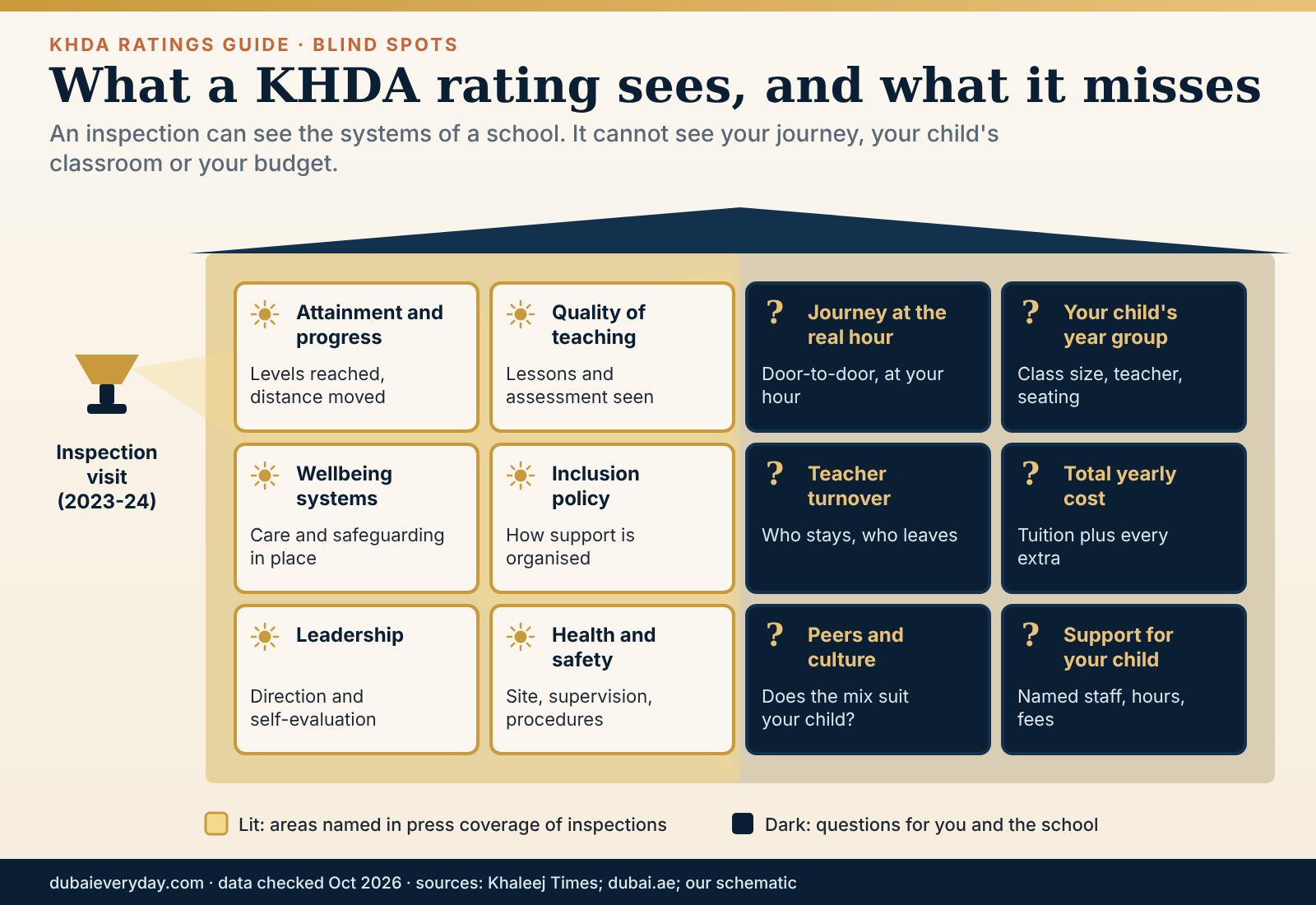
A rating is a considered view of how a school performs against a framework, at a moment, as seen by inspectors. It is not a forecast for one child. The gaps are predictable, and most of them are the things that decide whether a family is still happy at the end of the first term. This part walks through them one by one.
The journey is not in the report
The commute is the single biggest practical factor KHDA ratings cannot capture. Dubai’s roads are fast when empty and slow when they are not, and the school run happens at the worst hour. A school that looks marginally better on paper but adds 40 minutes each way costs a child more than three hours a week in a bus seat, and costs a parent the same in a car if you drive.
Our reading is that families underweight the commute in September and overweight it by December. The schools guide suggests a commute budget, and the renting guide explains how the choice between living near work and living near school plays out in lease decisions. Treat the order as a family decision: school first, then home, is often easier than the reverse for families with young children.
Your child’s year group, not the school average
An overall grade averages across phases, subjects and classes. Your child will experience one class and one teacher at a time. Ask how many students are in your child’s year group, how many classes the year is split into, who the likely teacher is and whether the school uses classroom assistants. Class sizes are not part of the grade. A good school with a very full year group can feel different from the same school with a half-full one.
Teachers, turnover and continuity
A school’s reputation rests on teachers who may not stay. The Dubai Media Office reported 27,284 teachers in private schools in 2024-25, up 9% on the year, which is evidence that the workforce is growing and, in a growing system, mobile. We have no turnover figures, and the grade does not give them. Ask how long your child’s likely teachers have been at the school and how the school handles departures during the year.
Culture and peers
Dubai’s private schools draw students from 185 nationalities, according to the Media Office. That diversity is real, and it is also uneven: one school may feel strongly shaped by a single community while another is more mixed. Neither is better. The question is which environment suits your child. A shy child may thrive in a smaller, calmer setting. A confident, sporty child may want facilities and teams. KHDA ratings say nothing about which is which.
Support for the child who is different
Inspectors judge inclusion as a system. Whether a school can support your child depends on the children and staff it has this year. Gifted students, students with learning differences and students learning English all depend on specific people. Ask for the names, hours and costs, as noted in the wellbeing section, and treat a strong inclusion judgement as a reason to ask, not a reason to stop.
Moving in, moving out
Most expatriate families will leave Dubai at some point, and many move between schools within it. A school’s grade says nothing about how well its records transfer, how it handles a mid-year departure or whether the curriculum fits the next country. The schools guide covers transfer certificates and timing rules. In short: choose the curriculum for your exit route first, then use KHDA ratings to filter within it.
Money after the tuition line
Ratings do not capture the cost of the whole school year. Registration, deposits, books, uniform, trips, exam fees, activities and bus fees fill in the gap between the tuition line and the real bill. Commercial advisory blogs we read gave bus costs of roughly AED 5,000 to 12,000 a year and book and uniform costs in the low thousands, but those are third-party indications, not official figures, and they vary by school. Price your own list.
When a lower grade can be the right choice
A school rated Acceptable that is five minutes away, has the right curriculum, shows a clear improvement plan and charges a fee you can sustain can be a better decision than an Outstanding school that strains the household budget and adds 90 minutes a day to the commute. The grade is a fact. Your child’s year is the outcome.
The reverse holds too. A high grade can be the wrong answer if the curriculum does not lead where you are going, if the school is oversubscribed so that the offer is a long shot, or if the culture does not suit your child. Neither extreme is a rule. Use the data to ask better questions.
How schools, agents and websites use KHDA ratings
Because KHDA ratings carry so much authority, they get repeated in places you cannot always trust to be accurate. Most uses are honest. Some are lazy, and a few are slippery. A short list of what to check turns the label from a claim into a fact.
Common claims about KHDA ratings and the check for each
| What you hear or read | What to check |
|---|---|
| “Rated Outstanding by KHDA” | The year of the inspection, and whether it is the whole school or one phase. |
| “KHDA-approved” or “KHDA-licensed” | A licence to operate is not a grade. Ask for the actual rating and its year. |
| “One of Dubai’s top schools” | Who ranked it, on what basis, and when. We found no official ranking table. |
| “Always rated Good or above” | Which years, which campus, and whether the school or its operator changed. |
| “New campus, same Outstanding standard” | A new campus may not yet have its own inspection. Ask for that campus’s report. |
| A portal’s “best schools” list | Whether it states its method, its date and whether it earns money from listings. |
Agents, portals and advisers
Relocation consultants and school advisers can save time, especially when you are arriving in a hurry. Some are paid by families, some by schools, and some by both. Ask which applies and what they would earn if you chose a given school. That is a normal question, and a good adviser will answer it. We have no view on any particular adviser, and nothing on this page is a recommendation of one.
Portals that publish “top 10” lists are usually built from the same public KHDA ratings and fee figures you can read yourself. They can be convenient, but they are not neutral just because they look tidy. Check the date, the method and whether the list changes when a school pays.
Social media and word of mouth
Parent groups are good for specific local detail, such as which gate is chaotic, how a particular teacher handles things and how the bus company behaves. They are poor for judging overall quality because experiences are personal, loud voices dominate and older posts linger. Use them to generate questions, then check the answers against the report and the school.
A school that changes name or owner
Schools in Dubai can change operators, rebrand or open additional campuses. A grade belongs to a specific licensed school at a specific time. If a school has changed hands or moved site since its inspection, ask whether the leadership team and teaching staff are the same as when the grade was awarded. The honest answer is sometimes “partly”. Better to hear that from the school than to learn it in November.
A 15-minute method to check KHDA ratings for any school
This is the practical part. It assumes you have one to four schools on a list and want to know quickly whether the rating helps or misleads. It takes about 15 minutes per school once you are used to it. It also works for the second stage of your decision, after you have settled on curriculum and area.
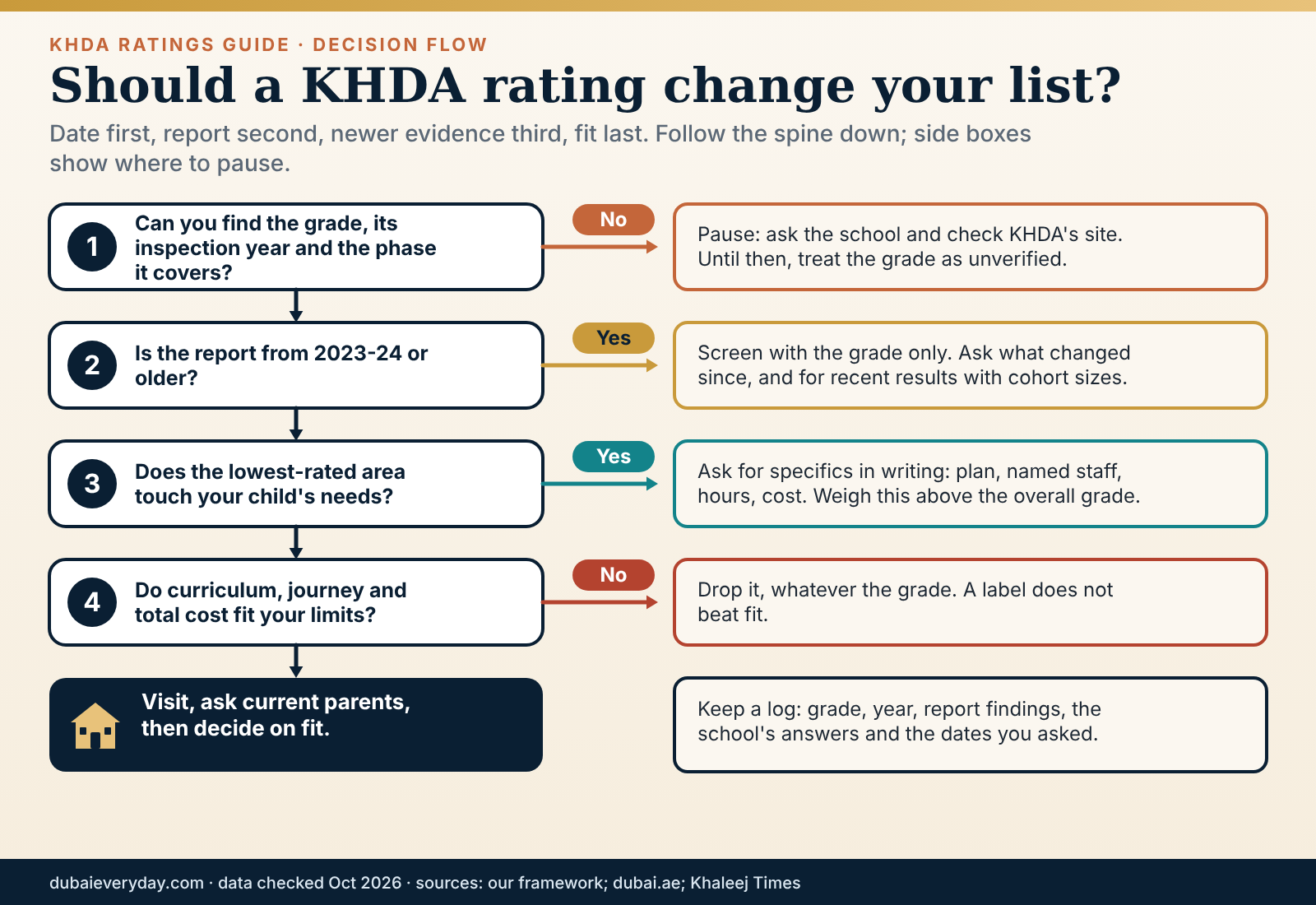
- Write your limits (3 minutes)Note the curriculum you need, the highest fee you can sustain for all children, and the longest journey you will accept. A school outside any limit does not need a check of its KHDA ratings.
- Find the grade and its year (2 minutes)Look up the school on KHDA’s website and note the grade, the inspection year and whether the grade covers all phases. If the school’s own site gives a different grade or year, trust KHDA’s and ask why they differ.
- Open the report (5 minutes)Apply the seven reading steps: date, split, lowest judgement, attainment versus progress, what must improve, the areas that matter to your child, and your questions.
- Ask for newer evidence (2 minutes to send)Email the school. Ask what has changed since the inspection, what its latest self-evaluation says, and for recent results with cohort sizes. Keep a record of answers.
- Weigh fit (2 minutes)Score the school on fit with your exit route, journey, cost, support and the rating, in that order. The schools guide offers a weighting you can adapt.
- Verify in person (later)Visit, watch a normal lesson if the school allows it, and talk to current parents. KHDA ratings should have narrowed the list. The visit makes the choice.
A short email you can adapt
Template. Hello, we are considering a place for our child in Year [X] for [September 2027 / now]. Your latest published KHDA inspection was in [year]. Could you tell us what has changed since then in leadership, staffing and results, share your latest self-evaluation summary, and send the approved 2026-27 fee schedule including all extras? We would also like to know how many students are in the year group. Thank you.
If you are arriving soon
If your move is weeks away, run steps one and two for a shortlist of five and steps three and four for the best two. Speed matters, and so does a documented trail. Check the schools’ application timelines early, and align them with your visa and housing steps using the relocation checklist. A child’s residence status and Emirates ID may affect the enrolment sequence, so the residence visa guide is a companion read.
If you are still on a scouting trip, plan it so that school visits cluster in one or two days. The best time to visit Dubai guide explains the heat and school-holiday patterns that can make mid-summer visits to buildings unrepresentative, since many schools are quiet.
Special cases: new schools, nurseries, Emirati families and mid-year moves
The method above covers the common case. Several situations bend it, and they are exactly the ones where parents most often get conflicting advice. Each deserves a few honest paragraphs.
A new school with no grade
Khaleej Times reported that seven new schools and 17 new early childhood centres were set to open for 2026-27. A new school has no grade of its own, and under the model announced for 2026-27 it should receive a full inspection in its third year of operation. Until then, the KHDA ratings you can find may belong to a sister school run by the same operator. A sister school’s grade is a hint about management, not a rating of the new building.
New schools can be excellent. They can also be uncertain about staffing, year groups and building readiness. Ask which year groups open next year and which open later, and get the answer in writing, because a school that opens with only some year groups may not have a class for your older child in two years’ time. Ask who is already hired, where the principal worked before and what happens if enrolment targets fall short.
A brand-new school’s brochure may use the operator’s other schools’ grades as a headline. Ask whether the rating applies to this licence and this site. If the answer is no, the grade is a story about somewhere else.
Nurseries and early childhood centres
KHDA regulates early childhood centres as well as schools, and the Dubai Media Office release of May 2026 mentioned relief for them, such as exemption from licence renewal fees. We could not confirm whether centres carry the same five-grade labels, or how often they are inspected. So do not assume that a nursery’s quality has been graded the way a school’s has.
What you can do is ask to see the centre’s current KHDA licence, ask whether it has had an inspection or review and what the outcome was, and ask about staff qualifications, staff-to-child ratios and settling-in practice. Gulf Business reported that the 2026-27 age-grade chart applies to nurseries and centres as well as schools, so check your child’s age against the rule before you pay a deposit. The Dubai with kids guide has practical context on family logistics and heat.
Emirati families and the Weak-grade rule
For UAE nationals, KHDA ratings have legal weight. The UAE government portal says that since 2016-17 nationals have been barred from registering or funding private schools rated Very Weak. A 2024 version of KHDA’s admissions guidance, hosted on a school’s website, says Emirati students may not be placed in schools rated Weak or below, and that Emirati students may attend only schools offering certain approved curricula. The Dubai Media Office reported 33,210 Emirati students in private schools in 2024-25 and noted that, among Emirati families, the American curriculum is the most popular, followed by the British and the IB.
The two rules differ: one names Very Weak, the other Weak. We cannot say which applies today. If this affects you, ask KHDA or the Ministry of Education directly and ask the school to confirm in writing that your child’s placement is allowed.
Government schools and KHDA ratings
Government schools run by the Ministry of Education sit outside KHDA’s private-school ratings. The UAE government portal has a page on admission of expatriates to government schools, dated September 2023, which says tuition is AED 6,000 per student for grades 2 to 12, the parent must work for a government or semi-government body, a minimum of 85% in Arabic, English and maths is required, and expatriates are capped at 20% of capacity. That page is old, so confirm with the Ministry before relying on it.
Mid-year arrivals and exam years
When your move date, not your preference, sets the timeline, KHDA ratings matter less than the school’s willingness and ability to take a student in the middle of the year. Gulf Business reported that for 2026-27 complete admissions submissions are generally reviewed within 10 working days, that only schools can appeal a decision, within 30 days, and that Grades 10 to 12 are excluded from the age-grade rules because they follow other exam arrangements. Placement for overseas transfers relies on the valid transfer certificate as the main reference from Grade 1.
For a student in an exam year, the school’s published results and its experience with mid-course entrants matter more than a general grade. Ask how many students have joined the exam course late in recent years, what happened to them and which subjects are open. A school with an excellent grade that does not take late entrants will not help you.
Two children, two phases
If your children are in different phases, the overall grade may mislead more than usual. A school with a strong primary phase and a weaker secondary one, or the reverse, can be an excellent choice for one child and a poor one for the other. Where the report breaks out phases, use the one for each child. Where it does not, ask the school which phase carries the strengths and which carries the improvement points.
When the numbers disagree
You will meet sources that disagree. In our reading for this page, a commercial advisory blog gave different counts for Good and Acceptable from Khaleej Times, and two Khaleej Times articles gave slightly different fee ranges for the Outstanding group. We used Khaleej Times for counts and flagged the differences. When you find a clash, trust the dated source closest to KHDA, ask the school which number is right and write down the answer.
Four illustrative families using KHDA ratings
These scenarios are invented to show how KHDA ratings can be used in practice. No real family, school or fee is described, and the numbers are placeholders for arithmetic. They are not data about any school.
Scenario one: a relocating couple with two young children
Illustrative scenario. A couple have a job offer, a start date in nine weeks and children in Year 1 and Year 3. They shortlist three schools. School P is Outstanding, 45 minutes from their likely flat, and its fees are near the top of their range. School Q is Good, 12 minutes away, mid-priced. School R is Acceptable with a newly built campus, 10 minutes away, cheaper.
They run the method. P’s grade is two years old and its waiting list is long, so a place is unlikely in time. Q’s report shows a strong primary phase. R’s report names attainment as the weak area but shows a clear plan. They apply to Q first, ask R what has changed since inspection and keep P as a backup. The grade shaped the questions, not the final choice.
Scenario two: a Year 10 move in the autumn term
Illustrative scenario. A family moves in October with a 14-year-old halfway through a two-year exam course. The school they like is rated Very Good and is oversubscribed. A second school is Good with a smaller year group.
They ask both how many mid-course joiners they took in the past two years, which subjects are still open and how the school tracks progress for a student who started late. The Good school answers with specifics. The Very Good school answers with a brochure. They choose on the answers, and confirm the transfer certificate and curriculum compatibility before paying the deposit.
Scenario three: a household watching every dirham
Illustrative scenario. A single parent with one child in Year 5 has a tight budget. The nearest affordable school is Acceptable. A pricier school one metro stop away is Good. The parent works out the extra annual cost, the transport difference and the cost over the remaining primary years.
The Acceptable school’s report names two improvement areas that the parent can ask about. The school explains the plan, the head offers a classroom visit and the parent finds other parents who describe a caring environment. The parent decides the Acceptable school is a reasonable, honest choice for now, with a review point at the end of Year 6. The grade did not decide. The evidence did.
Scenario four: a child who needs additional support
Illustrative scenario. A family has a child with a diagnosed learning difference. Two schools carry high grades and strong inclusion language. The family asks each for a written support plan with hours, named staff and costs. One school answers in detail and offers a meeting with the learning support lead. The other replies with a policy document and no costs.
They also check whether either school would have to file a non-admission notification if it felt unable to meet the needs, and ask what evidence it would want. The family does not rely on the grade for this decision. They rely on the plan and the people.
Mistakes and red flags
Most errors with KHDA ratings are small and compounding: a date overlooked, a phase ignored, a premium never priced. Here are the seven we would put on a refrigerator door.
Seven mistakes with KHDA ratings that cost time or money
1. Treating the grade as a rank
Two Outstanding schools are not ranked against each other. Compare them on curriculum, journey, cost and support.
2. Ignoring the date
A grade from 2023-24 describes a school that has since changed its pupils, and possibly its leaders.
3. Reading the label, skipping the report
The weak area inside a Good grade is often the thing that matters to your child.
4. Assuming grade equals fee
Outstanding spans a roughly 3.8 times fee range in the data we read. Price the school you are considering.
5. Forgetting the journey
A 40-minute extra commute each way outweighs a grade step for many families. Test it at the real hour.
6. Rejecting Good
Good is the most common grade and the normal outcome of a sound school. Do not discard it.
7. Skipping the written evidence
Fees, support plans, year groups and transfer rules belong in writing, with dates.
Red flags when a school or adviser leans on KHDA ratings
- The school quotes a grade without a year, or quotes a grade for a different campus.
- It answers questions about newer evidence with the grade alone.
- It asks for a large non-refundable payment before sharing the fee schedule.
- The adviser cannot say who pays them or what they earn if you choose a given school.
- A “ranking” appears with no method, date or author.
- It cannot or will not say how many students are in your child’s year group.
- Promises are verbal: a place, a fee level, a teacher.
If a school’s behaviour concerns you, the legal basics guide explains where to verify consumer rules. Our reading is that none of these flags proves bad faith. Together, two or three of them are enough reason to slow down and ask for everything in writing.
The short version: using KHDA ratings well
If you remember nothing else, remember five things. KHDA ratings are categories awarded by the Dubai Schools Inspection Bureau, not a league table. The last full round was 2023-24, so the KHDA ratings you see are probably two to three years old. A single grade summarises many judgements, and the report tells you which ones are strong. Fees are frozen for 2026-27, so KHDA ratings do not predict your bill this year. And no grade can see your commute, your child’s year group or your child.
The way to use KHDA ratings well is to let them narrow the list and then spend your effort where the grade is silent. Check the date, read the report’s weakest area, ask for newer evidence in writing, price the real total and test the journey. A school that answers all of that clearly has earned your trust more than its label has.
This week. Pick your top three schools. For each, write the grade, the inspection year, the lowest-rated area and the one question you will ask about it. Send those questions by email today. By the time the replies arrive you will know more than the grade could tell you.
FAQ
What are KHDA ratings?
KHDA ratings are the official grades Dubai’s education regulator gives private schools after inspection by the Dubai Schools Inspection Bureau. The Dubai government’s rating page lists five categories: Outstanding, Very Good, Good, Acceptable and Weak. Earlier reporting also records Very Weak, which no school held in the 2023-24 round. The rating summarises inspectors’ judgements across areas such as teaching, progress, wellbeing, inclusion and leadership. It describes a school at the time of inspection, so always check the year.
How many KHDA ratings are there?
Five grades appear on the Dubai government’s rating page, from Outstanding to Weak, and a sixth, Very Weak, appears in earlier reporting and in the 2023-24 count with zero schools. The word “ratings” also refers to the overall performance and key findings reports published for each inspection round. If a school or website uses other labels, such as stars or a score, those are not KHDA grades, so ask where they come from.
Are KHDA ratings still current in 2026?
For most schools, they are old. Full inspections were paused from June 2024, and Khaleej Times reported that only four newly opened schools had full reviews in 2025-26 while existing ratings were retained. So most grades visible in October 2026 date from 2023-24. Gulf News described a new two-tier inspection model for 2026-27, but we found no new overall ratings round published as of 29 October 2026. Treat any of the KHDA ratings as a dated starting point.
Where can I find a school’s KHDA rating and report?
KHDA publishes ratings and inspection reports on its website, and the Dubai government’s rating page links to the 2023-24 overall performance and key findings documents. KHDA’s site blocks automated readers, so we could not open school pages ourselves, and we cannot give you a verified click path. Search for the school on KHDA’s site, note the grade and the year, and compare it with what the school’s own website says. If they differ, ask the school why.
Does a higher KHDA rating mean higher fees?
Not necessarily. Before the pause, a school’s grade influenced how much it could request in a fee increase, but it did not set the fee level. The 23 Outstanding schools alone ranged from AED 29,488 to AED 111,799 for 2026-27, according to Khaleej Times, a spread of about 3.8 times by our calculation. Fees are frozen for 2026-27, so KHDA ratings do not change your tuition this year. Ask the school for its approved fee schedule in writing.
Is a Good rating a bad sign?
No. Good was the most common grade in the 2023-24 round, held by 85 of the 209 schools counted by Khaleej Times, about 41% by our calculation. About 75% of schools were Good or better. A Good school can be an excellent fit, especially if it has the right curriculum, a short journey and strong judgements in the areas that matter to your child. Read the report to see where it is strongest and weakest before deciding.
Is an Outstanding school always best for my child?
No. Outstanding is the top grade and about one school in nine held it in 2023-24, but it says nothing about distance, class size in your child’s year, culture, cost or support for specific needs. It may also be two or more years old. An Outstanding school that is far away, over budget or on the wrong curriculum can be a worse choice than a Good school that fits your family. Use the grade to filter and fit to decide.
Do KHDA ratings apply to nurseries?
KHDA regulates early childhood centres, but we could not confirm whether they carry the same five-grade labels or how often they are inspected. Do not assume a nursery has been graded like a school. Ask to see the centre’s current KHDA licence, ask whether it has had an inspection and what the outcome was, and ask about staff qualifications and ratios. Also check your child’s age against the 2026-27 age rules before paying a deposit.
Do the ratings cover government schools?
No. The KHDA ratings discussed here apply to private schools licensed by KHDA. Government schools run by the Ministry of Education are a separate system. Expatriate access to government schools is limited and conditional; a UAE government page dated September 2023 lists conditions such as a parent working for a government body and a minimum score in Arabic, English and maths. That page is old, so confirm the current rules with the Ministry before you plan around it.
What changes with the 2026-27 inspection model?
According to Gulf News, KHDA plans a two-tier approach: either a comprehensive inspection that gives a full performance rating, or a shorter monitoring visit focused on priority areas identified from data. Notice will be no more than 24 hours, and schools in their third year of operation will receive a full inspection. We found no published new overall ratings under this model yet. Ask each school whether it has had a visit and what it was told.
Can Emirati children attend any private school regardless of its rating?
Not necessarily. The UAE government portal says UAE nationals have been barred since 2016-17 from registering or funding private schools rated Very Weak, and a 2024 KHDA admissions document hosted by a school says Emirati students may not be placed in schools rated Weak or below. The two statements differ, so confirm the current rule with KHDA or the Ministry of Education and ask the school to confirm your child’s placement in writing.
Are online “best schools in Dubai” lists reliable?
Treat them as starting points. KHDA’s grades are categories, and the sources we read give no official ranking table. Lists are usually built from public KHDA ratings, fees and sometimes reviews, and many do not state their method or date. Before relying on one, check how it was made, when it was updated and whether schools or advisers pay to be included. Then verify the grade and its year on KHDA’s website.
How can I judge wellbeing beyond the rating?
The rating tells you whether a school’s systems for care existed and worked when inspectors visited. To judge wellbeing for your child, ask who a child would talk to, how bullying is recorded and followed up, what happens to a mid-year joiner in the first two weeks, how long the journey and school day are, and how the school handles hot-weather breaks. Visit if you can, and talk to current parents in your child’s year group.
Related reading
Sources and further reading (15 links)
- Dubai.ae: Schools rating — rating categories, DSIB role, areas assessed, links to 2023-24 reports
- UAE Government Portal: School fees — DSIB grade and Education Cost Index in fee regulation, ECI 2.35% for 2025-26, rule on Very Weak schools (page marked)
- Dubai Media Office: KHDA confirms no fee increase — 2026-27 fee freeze, incentives package, affordable places, Girnas advisor
- Dubai Media Office: Dubai’s private school sector — 227 schools, 387,441 students, 185 nationalities, teachers, Emirati enrolment
- Khaleej Times: Dubai schools’ new KHDA ratings — 2023-24 counts, 81% and 83% figures, inspection pause, four 2025-26 reviews, ECI cap (news)
- Khaleej Times: fees at Outstanding KHDA schools — fee ranges and caveats; no full inspections in 2024-25 (news)
- Khaleej Times: 2026-27 tuition at Outstanding schools — fee range by curriculum, ratings retained for 2025-26 (news; figures reused from earlier research)
- Gulf News: Dubai school rules for 2026-27 — two-tier inspection model, 24-hour notice, third-year inspections (news)
- Gulf Business: KHDA rolls out new rules for age limits and admissions — placement process, appeals, non-admission notification, inclusion expectations (news)
- Khaleej Times: 26 new private institutions for 2026-27 — seven new schools and 17 early childhood centres (news)
- Khaleej Times: Parents hail KHDA’s inclusive education policy — inclusion framework principles and a parent’s cost estimate (news; reused from earlier research)
- TIMSS 2023: Results — Dubai listed among benchmarking participants; no scores quoted
- Wikipedia: Knowledge and Human Development Authority — KHDA and DSIB roles, Student Wellbeing Census first round (secondary source; context only)
- KHDA admissions and transfers guidelines (2024 copy hosted by a school) — rule on Emirati students and Weak-rated schools (older version; reused from earlier research)
- KHDA: Data and statistics — the official starting point for ratings and reports; our reader was blocked, so confirm figures here first (not accessed)
Update log: 29 October 2026 — first publication; facts re-checked against the sources above where they could be opened. Next review due: when KHDA publishes the first ratings under the 2026-27 model, and in any case by 31 January 2027, then at least once per academic year. Corrections welcome. This page is general information about school ratings, not individual educational, legal or financial advice.
About DubaiEveryday and this guide
DubaiEveryday.com is an independent editorial project that publishes practical, research-based guides to everyday life in Dubai: where to live, what things cost, how the rules work and how to get around. This page was written and edited by the DubaiEveryday editorial team. It is not signed by a named expert, doctor, lawyer or adviser, and we do not claim first-hand testing of a venue, clinic or service unless the page says so.
Each guide is built from official sources such as government and regulator pages, operator websites and established news outlets, cross-checked where we can. When we could not confirm something, we say so in the text, and examples that use made-up numbers are labelled as illustrations. Mentions are editorial choices, not paid placements, and a link is not an endorsement.
Dubai changes quickly. If you spot something that is out of date or wrong, please tell us through the contact options on DubaiEveryday.com and we will check it and correct the page.