

The Dubai driving test is three exams taken in a fixed order: knowledge, parking (the smart yard) and the road test. This guide explains what each one checks, why people fail, and what a retake costs, read against RTA sources on 29 October 2026.
Most people who fail the Dubai driving test can actually drive. What sinks them is a mirror they forgot to check, a roundabout where they did not give way, or a nervous second when everything they practised drained out of their head. Annoying, yes, but also the most fixable kind of failure.
This guide walks you through the theory, parking and road stages in order and shows what the cameras and the examiner are looking for. It also lays out what happens, what it costs and how long it takes if a test goes wrong. Read it before you book, and you will walk into the yard with a plan instead of a worry.
The Dubai driving test is three tests taken in order: a knowledge (theory) test, a yard test made of five parking and car-control manoeuvres, and a road test with an RTA examiner. The RTA’s service page lists the test types as Knowledge, Yard and Road, plus a VIP option for light vehicles, and says each one is booked after the matching training stage.
The yard test is marked by cameras and sensors, and the 2026 version also watches mirror checks, blind-spot checks and hand position. The road test is where most people stumble, and the usual cause is a skipped check or an old habit, not poor steering: failing to give way at a roundabout, stopping in a yellow box, entering a no-entry road, changing lanes without looking.
Money and time, as reported in October 2026: the road test costs AED 220 (about USD 60), a failed road test brings mandatory extra training before you can rebook, and the wait afterwards can reach 14 working days. If you take no official test for six months, the RTA suspends your file. We could not find a current official pass rate or marking sheet, so treat any exact pass mark you read online as unconfirmed. For the whole route, including eligibility and fees, start with our Dubai driving licence guide. This page covers the tests only.
This is a desk-research guide. The editorial team has not sat the tests or watched one, so nothing here is a first-hand account. The core facts come from the RTA’s new-licence service page, two RTA announcements (the smart yard automation and the 2026 curriculum update), the Dubai Executive Council resolution on driving instruction, and reporting by Gulf News and Khaleej Times. For how a school actually sequences things we read one large institute’s own pages and treat them as an example, not a rule. Everything was read on 29 October 2026.
The RTA does not publish a marking sheet, a question count or a current pass rate that we could find. Where unofficial guides disagree with each other we show the disagreement instead of picking a winner. Anything dated before 2024 is labelled as such. Worked numbers marked “illustrative” are arithmetic, not quotes. This is general information, not legal or professional advice, and inclusion of any institute or publisher was not paid for.
Dubai driving test: the October 2026 status board
Before the detail, here are the figures that frame the Dubai driving test. Each was checked on 29 October 2026, either on an RTA page or in a press report that names the RTA rule it relies on.
The first two numbers describe the structure, and the structure is stable. The next two come from Gulf News on 19 October 2026, which means they are press reports of RTA practice, not text from an RTA page we could open. The last is on the RTA’s own service page. We say which is which throughout, because a fee that a newspaper reports is not the same as a fee the RTA publishes, and a test is a bad moment to find out the difference.
For scale, Khaleej Times reported on 13 September 2026 that the RTA issued 119,188 licences in the first half of 2026, about 96,400 of them new. On a simple average, which is our arithmetic, that is roughly 530 new licences a day, each one behind a road test pass.
What this page covers, and what it hands on
Our Dubai driving licence guide follows the whole first-time route: eligibility, the traffic file, institutes, the full fee table, renewal and the law. It touches the tests in one section. This page spends its whole length on them: the knowledge test, the parking test, the road test, the habits that fail people, how to prepare and what to do when a result goes wrong.
Two neighbours cover the rest. If you already hold a licence from a country on the RTA’s list, you may not sit these tests at all, and the licence exchange guide explains that route. If you are still choosing a school, packages and test availability are in our driving schools guide.
How the Dubai driving test works, stage by stage
The Dubai driving test is not a single appointment. The RTA’s service page says training is completed in stages and that after each stage you book the required test, which is Knowledge, Yard or Road. In practice the learner moves along a line: open a traffic file and pass an eye test, take theory lectures, sit the knowledge test, do practical lessons, pass internal checks at the school, sit the RTA parking test, sit the RTA road test, then receive a temporary licence.
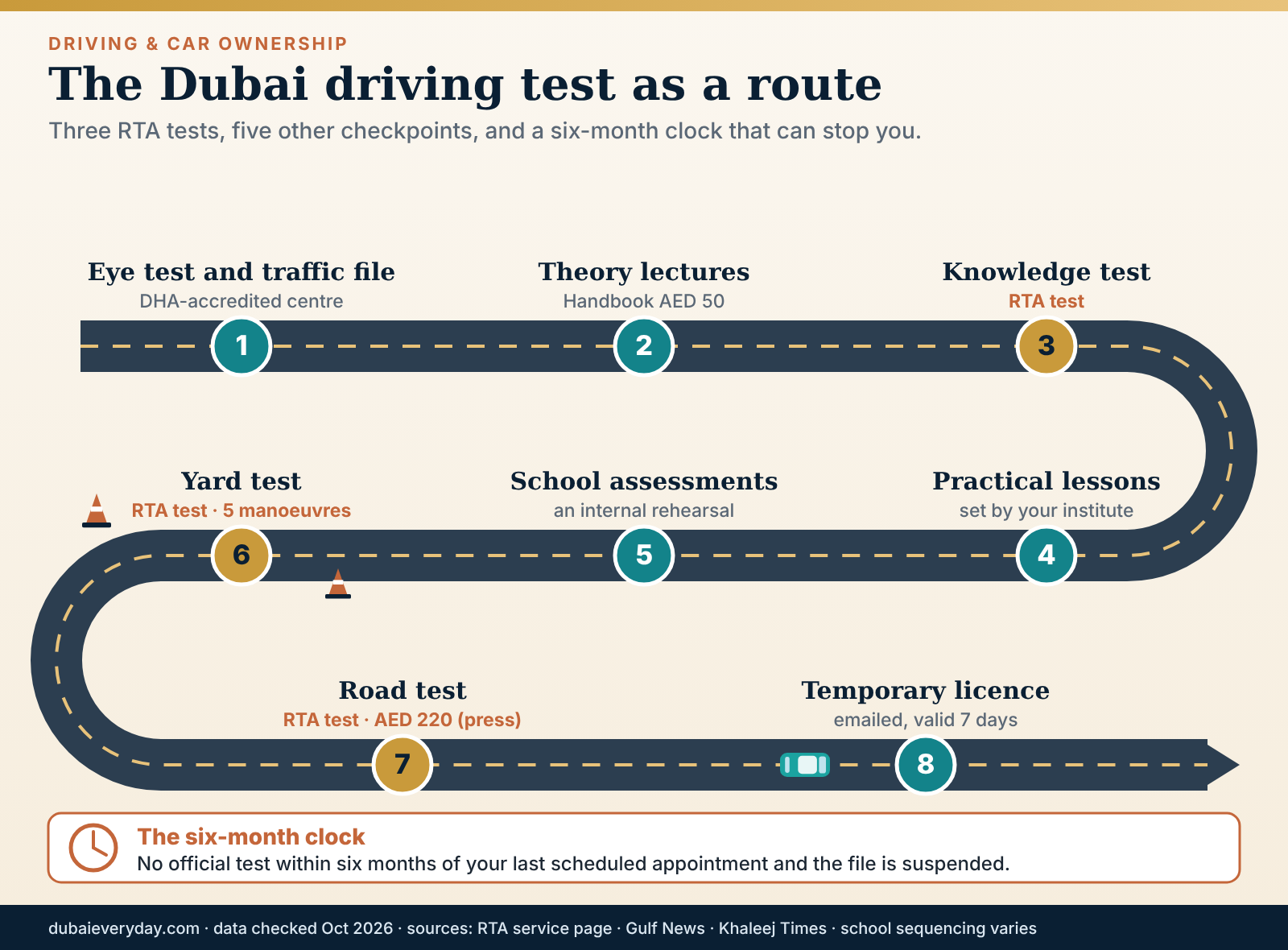
Who runs which part of the Dubai driving test
The RTA runs the official tests. The school, called an institute, runs everything around them: lectures, lessons and its own assessments. Khaleej Times described those internal assessments and parking tests as steps before the RTA road test in its September 2026 report. Think of the internal ones as a rehearsal under the school’s rules. They cost you nothing in reputation, which makes them the cheapest place to hear that you are not ready.
The official tests are booked either through the RTA website or app or through your institute. Gulf News describes the online route as logging in with Emirates ID, passport or UAE Pass, confirming a one-time password, entering the learning permit number and date of birth, choosing a date and paying. Some institutes handle booking by SMS link or call centre and only let you test at the main centre where you registered.
How one large school sequences it
The Emirates Driving Institute’s step sheet for its 20-hour car course, dated April 2019, shows how many stages a school can add. It lists eight lectures, the RTA theory test, a simulator class, practical lessons, an internal road assessment, an internal yard assessment, the RTA parking test, four hours of independent and highway driving, and then the RTA road test. That is one school’s old sheet, not the RTA process.
The useful detail is the order: that sheet holds back the road test until the extra hours are done. So the gap between “I can park” and “I can book the road test” can be longer than a newcomer expects. Ask your own institute for its current sheet before you plan the Dubai driving test around a date.
The clock that sits behind every stage
The RTA’s page says that if no official test is taken within six months of the last scheduled appointment, the file is suspended. A suspended file can be resumed if the suspension is under four years, the knowledge result is under two years old and the yard result is under one year old. Otherwise the tests must be retaken, and after more than four years everything restarts. Separately, a licence is not issued if a year or more passes after the road test without completing the transaction.
The wording does not say whether the four years count from the suspension or from the last test. Our reading is that three clocks run: one between tests, one on the shelf life of passed results, and one after the road test. Ask your school which dates it holds on record. The rest of this guide returns to the clock wherever it changes a decision about the Dubai driving test.
The knowledge test: format, content and languages
The knowledge test is the theory part of the Dubai driving test. It is the first RTA test you meet, it is taken at an institute, and it is the one with the least official detail online. The RTA’s service page names it as a test type and says nothing about the number of questions, the time allowed or the pass mark. That gap is why so many websites state a precise pass mark with total confidence.
What the sources say about the format
We found three unofficial descriptions and one official silence. They do not agree on the question count, which is the clearest sign that none of them should be treated as the rule. The table sets them side by side, with the date each page showed when we read it.
| Source | Date shown | Questions | Pass mark and time | Cites an RTA document? |
|---|---|---|---|---|
| RTA new-licence service page | Read 29 Oct 2026 | Not stated | Not stated | It is the RTA page |
| eZhire blog (car rental company) | Byline Feb 2025, titled “2026 Guide” | 35 | 23 correct (65%), 30 minutes | No |
| PolicyBazaar UAE (insurance comparison site) | Updated Sep 2026 | 35 | 23 correct (65%), about 30 minutes | No |
| Bin Yaber (driving institute blog) | Updated Oct 2026 | 40, across 10 topics | Not given | No |
On the Dubai driving test theory paper, two independent-looking pages agree on 35 questions and a pass mark of 23, but neither cites the RTA, and a school’s own blog says 40. Our reading: expect somewhere between 35 and 40 multiple-choice questions and a pass mark in the region of two-thirds, then confirm the real numbers with your institute when you book. If a site sells “real RTA exam questions”, be sceptical. We found no official question bank in any source.
What the Dubai driving test theory covers
Khaleej Times and Gulf News (13 September 2026), reporting the RTA’s own description, say the theory content covers traffic laws, speed limits, safe following distances, pedestrian rights, phone distraction, lane discipline, and traffic signals and signs. It is the same list the examiner expects you to behave by later.
One change matters if your friend learned years ago. On 12 May 2026 the RTA announced that Advanced Driver Assistance Systems had been added to the light-vehicle curriculum: forward collision warning, blind-spot monitoring, lane departure warning and lane keeping, parking assist, night vision, ABS, and conventional and adaptive cruise control. The material went into the handbook, the theory and practical programmes and the awareness lectures. The RTA did not say whether the test questions changed, so study the whole handbook, which the RTA lists at AED 50.
Languages and interpretation
You can sit the theory test with help in your own language, but the details are institute-level and the history is long. In 2018 Gulf News reported an RTA Remote Interpretation System covering more than 192 languages and dialects through a video link, with interpreters only helping candidates understand the questions. The fee then was AED 400, booked seven days ahead.
That fee is history. The Emirates Driving Institute now lists the service at AED 435 and says it must be requested when the RTA file is opened. The Dubai Executive Council resolution on driving instruction, issued on 17 February 2026, also carries an interpretation fee for knowledge tests in its schedule, though the text we read does not show the figure. If English or Arabic is not comfortable for technical vocabulary, say so on day one, not the week before the test.
Studying for it
This is our suggestion, not an RTA requirement. Make three passes: read the handbook once without notes, then attend the lectures and write down every number, then use your institute’s practice questions and treat each wrong answer as a reading task. Numbers and signs are where theory tests punish half-learning, so give them extra time. Sit the test soon after you finish: under the RTA’s file rules, a suspended file can only be resumed if the knowledge result is under two years old.
If you fail the knowledge test
The RTA page does not set a catch-up rule that we could find, so this is school policy. The Emirates Driving Institute says failing the RTA theory test means attending eight theory lectures again before a retake. Ask what your institute requires and charges, because a retake also means a new booking.
The parking (smart yard) test: five manoeuvres, one machine marker
The second RTA test in the Dubai driving test is held in a closed yard, and the sources call it the yard test, the parking test and the smart yard test, interchangeably. They are the same thing. Schools add a confusing extra layer: many run their own “smart yard assessment” before the RTA one, in the same yard, on the same five manoeuvres. The RTA one is the official pass or fail.
The five manoeuvres
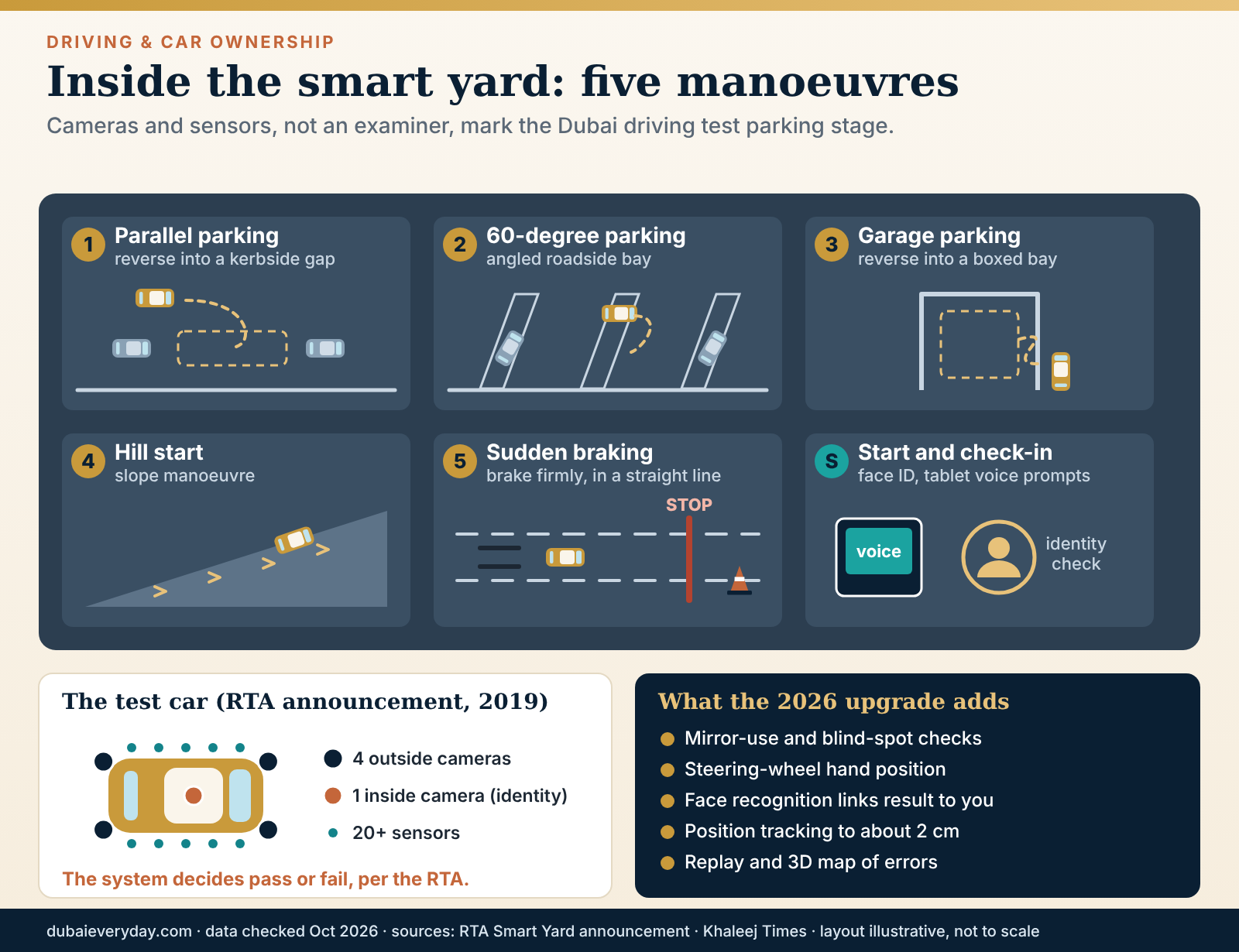
The RTA announced full automation of the smart yard in June 2019 and named five manoeuvres: parallel parking, side parking at a 60-degree angle, garage parking, a hill manoeuvre, and sudden braking. Gulf News listed the same five when the system launched in 2018. Those lists are old, and the RTA has not, to our knowledge, republished a new one. The Emirates Driving Institute’s older step sheet still describes the same five (garage, parallel, 60-degree, hill and emergency stop), so we treat the list as current but worth confirming at your school.
How the machine marks you
The RTA’s 2019 announcement said a high-speed processor in the test vehicle analyses camera and sensor data and decides pass or fail without human intervention. Each test car carries five cameras, four outside to guide the candidate through the manoeuvres and one inside to verify identity, plus more than 20 sensors to help avoid collisions. Brake and seatbelt use are recorded, and the system then ran at 15 yards.
Gulf News added in 2018 that a tablet gives voice instructions and a safety system stops the car if it exceeds 35 km/h or gets too close to an object. Treat that speed figure as a dated report about the early system. The point is that nobody can argue with a camera.
What changed in 2026
Khaleej Times reported on 29 September 2026 that the RTA had upgraded the smart system for light-vehicle yard tests. AI, computer vision and data analysis monitor manoeuvres in real time and score them against standard criteria. Smart cameras check mirror use, blind-spot checks and steering-wheel hand positions, facial recognition links the result to the right person, and tracking accurate to about two centimetres detects path and parking-position errors.
The report adds that automatic braking can step in, that the system works in different weather and lighting, and that learners can review a replay and an interactive 3D map marking major and minor errors. It gives no pass rates and no scoring thresholds.
What that means for how you drive in the yard
Our reading is that the upgrade shifts the yard section of the Dubai driving test from a test of parking geometry to a test of habits. A camera that counts mirror use and hand position does not care that you reached the final bay perfectly. If you skip the head check because the yard is empty, the system can note it. So rehearse the full routine on every manoeuvre: belt, mirrors, a visible head turn, smooth speed.
General technique, which your instructor will refine for the school’s cars, runs like this. For parallel and 60-degree parking, learn two or three reference points on the car and the bay, and move slowly enough to correct. For garage parking, the straight finish matters as much as the entry angle. For the hill, control the roll as you pull away. For sudden braking, brake firmly and straight with both hands on the wheel.
Fail a manoeuvre, then what?
Under the 2026 system, according to Khaleej Times, a learner can see where errors happened, so ask for the replay or the 3D error map before you book anything. The old Emirates Driving Institute sheet says a failed manoeuvre meant one hour of practical training and a retest of only that manoeuvre. That is one school’s 2019 rule, so ask your own institute whether single manoeuvres can be retested. Also check which yard your booking uses: that school holds its smart yard tests only at its main centres and asks for arrival 30 minutes early.
The road test: what the examiner assesses
The road test is the last RTA test and the part of the Dubai driving test with a human in the car. You drive on public roads with an RTA examiner, in a vehicle that, by our reading, matches the transmission type on your permit. The fee is AED 200 plus the AED 20 knowledge and innovation fee, so AED 220 in total according to Gulf News on 19 October 2026. The RTA’s page does not list a separate road test fee, which is why we flag it as press-reported.
Logistics that decide whether you start the Dubai driving test calm
Gulf News says to arrive at least 30 minutes before the test, and the Emirates Driving Institute gives the same instruction. At that school the road test runs from 7:30 to 3:25 on weekdays, with an extra charge for weekend slots, so a day of leave is part of the plan. Unofficial guides put the drive at 15 to 20 minutes (Dubizzle) or about 20 (PolicyBazaar). The RTA does not publish test routes, so what you can practise is the kind of road, not a fixed loop.
Bring your Emirates ID and learning permit, and anything else your school asks for. If two or three candidates share one car, an older Khaleej Times piece quoting the Emirates Driving Institute advises the next driver not to fiddle with the seat and mirrors before the previous one has settled in the back.
The first 30 seconds: setting up the car
Examiners watch you before the car moves. The checklist published by Dubizzle lists the basics: doors closed, seat and mirrors adjusted for visibility, seatbelt on, and a quick check that lights, wipers, horn and engine behave. Khaleej Times (2017, quoting an institute) adds that dawdling over the mirrors reads as a lack of confidence. So do it quickly and in the same order every time, and the routine becomes automatic when nerves arrive.
What gets marked on the road
The RTA does not publish a current marking sheet, so the closest evidence is a mix of RTA statements and unofficial checklists. Taken together, they describe the same behaviours.
- Mirror checks before braking, signalling or moving sideways, plus a visible head check for the blind spot.
- Signals given on time, for every lane change and turn, in the right direction.
- Lane discipline: starting turns from the correct lane, finishing them in one lane, and holding a steady position.
- Giving way where required, at roundabouts, to pedestrians and to other traffic, without obstructing anyone.
- Speed matched to conditions and a safe gap to the car ahead and to parked vehicles.
- Smooth gear use and no stalling or coasting in neutral, if you are on a manual permit.
- Stopping with the wheels behind the stop line, and finishing reversing and parking neatly.
The last item has a number attached in Dubizzle’s checklist: reversing and parking should finish in four moves or fewer. That figure comes from an unofficial page, so ask your instructor whether it matches what the school teaches, but the principle of a tidy finish is safe.
Major and minor errors on the Dubai driving test
In 2018 an RTA official explained the scoring to Gulf News. Candidates were assessed on five major criteria and 16 minor ones. Failing any major criterion ended the test at once, and one example was failing to stop at a red light, stop sign or stop line. To pass, a candidate had to clear at least 12 of the 16 minor criteria and avoid every major error. The same official said a major mistake late in the test still fails you even if the rest went well.
A 2026 guide from PolicyBazaar describes it a little differently: one major mistake fails you, and up to about 12 minor mistakes are allowed with 13 or more failing. The two descriptions do not line up (twelve of sixteen cleared versus twelve allowed), and neither is a current RTA document. What they agree on is the shape: some errors are binary and immediate, the rest accumulate. That is the useful rule to prepare under.
What counts as major, as far as the sources say
The sources name a similar short list. PolicyBazaar’s examples are a collision or near-miss, running a red light, failing to give way at a roundabout, entering a no-entry road, stopping in a yellow box junction, speeding well over the limit and skipping mirror or blind-spot checks. Gulf News (February 2026) adds weak lane discipline and poor vehicle control. Khaleej Times (2017) adds a small, vivid one: pressing the accelerator while in neutral.
One rule outranks your preferences. The same 2017 piece says the examiner’s instructions take priority: if asked to do something normally prohibited, you may say so but should comply if the examiner insists.
Recorded, reviewable, and still human
Gulf News (February 2026) says appeals against a failed road test are reviewed by a committee that checks the result against road test video footage. That suggests your drive is recorded and the examiner’s decision can be checked. We could not find an RTA description of what is recorded. The appeals route is in the section on what to do after a failed test.
Automatic or manual, decided before you start
The permit sets the car. The RTA page says a learning permit can be changed from manual to automatic, or the other way round, for AED 220, and from regular to special for free. If you learn on an automatic and later want a manual licence, the Emirates Driving Institute lists a conversion at AED 618.50 including VAT, made up of AED 293.50 to book the road test and AED 325 for the manual licence. Decide before you buy lessons, because the cost of changing your mind later is another road test.
Why people fail the Dubai driving test: a tally of six sources
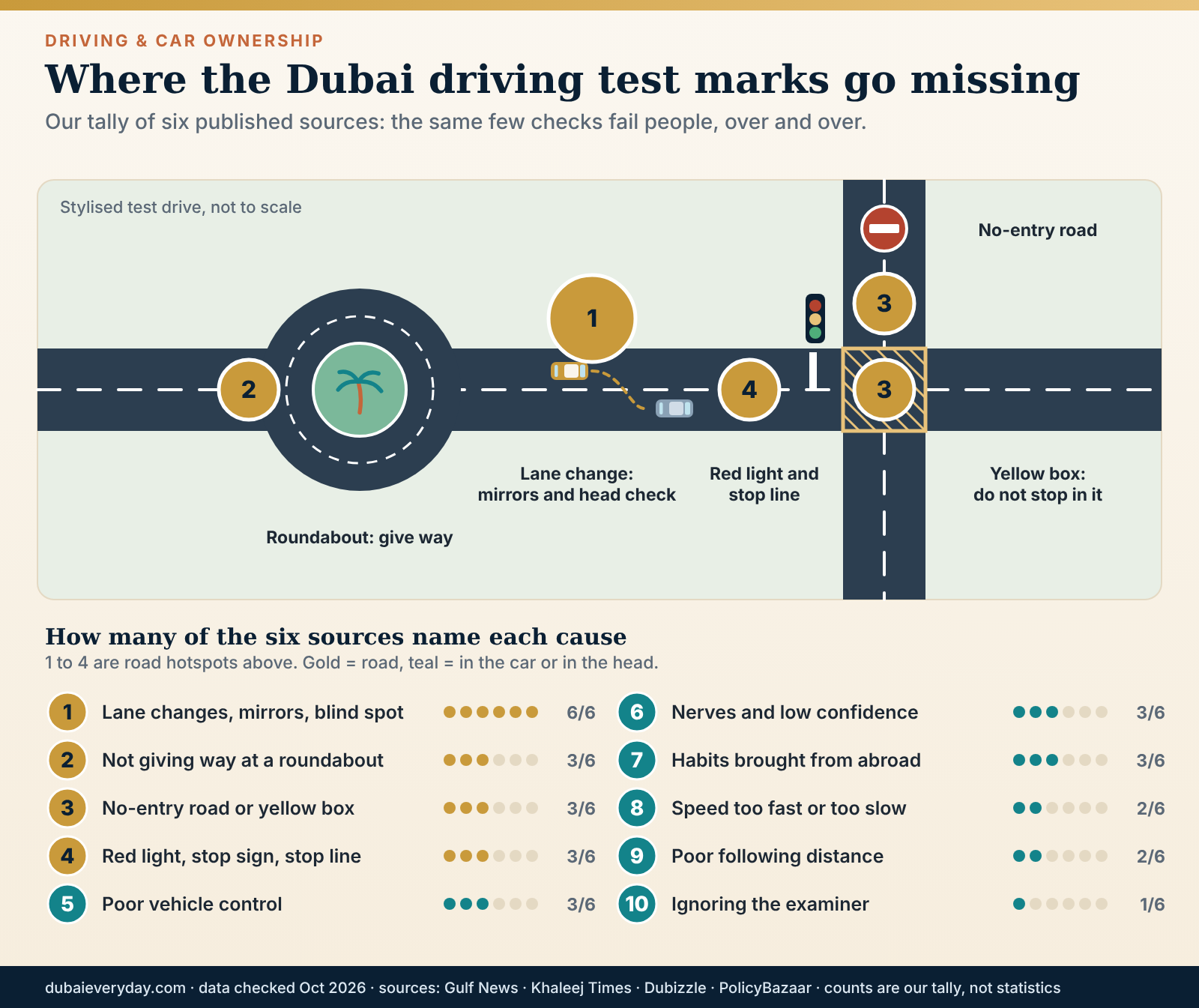
Failure explanations for the Dubai driving test tend to be a long list of everything that can go wrong, which helps nobody prioritise. We took a more modest approach and read six published sources on road test failure, from 2017 to 2026, to see which causes keep appearing. The sources are the RTA’s own explanation to Gulf News in 2018, two Gulf News pieces from 2019 and 2026, Khaleej Times in 2017, Dubizzle’s 2026 checklist and PolicyBazaar’s 2026 guide.
The tally counts how many of the six sources name a cause. It says nothing about how often the cause happens. Three of the sources date from 2017 to 2019, before the automated yard and the 2026 curriculum update. Use it to decide what to practise first, not to predict your odds.
What came up most often
The most-cited cause is also the easiest to drill on purpose. All six sources describe some version of lane changes and mirror checks: not looking before moving sideways, not checking blind spots, hesitating or lurching. Three sources name each of the next causes, and they are the classic hard failures: not giving way at a roundabout, entering a no-entry road or stopping in a yellow box, and failing to stop at a red light, stop sign or stop line.
Three sources also name nerves, and three name vehicle control, from stalling to accelerating in neutral. Three name habits imported from another country. Two sources each name speed that is too fast or too slow, and keeping a poor following distance. One source, the 2017 institute piece, names ignoring the examiner. The ordering is not a ranking of danger. A single red light outweighs any number of small slips.
The pattern behind the list
Read together, the reasons for failing the Dubai driving test are mostly not skill failures. They are checks that did not happen. An RTA official said in 2018 that fear of failure was the main cause, because nervousness reduces concentration and control. Gulf News (2026) quotes a Dubai driving centre chief executive describing a mental block and suggesting simulators for nervous learners.
The 2019 Gulf News piece, quoting instructors from two Dubai schools, adds the arithmetic of accumulation: repeated minor errors can add up to a fail even if none caused another road user to react. Newer drivers tend to be hesitant and spot hazards late; experienced ones tend to follow too closely, signal late and speed.
The foreign-habit trap
If you have driven for years elsewhere, read this twice. The risk is not that you cannot drive. It is that you drive well by the standards of a different place: one-handed steering, rolling through a stop line, a casual indicator habit or a roundabout approach that works at home. Gulf News (2026) says experienced drivers from abroad may struggle to drop such habits.
The fix is boring. Do the head check even when it feels excessive, stop completely at the line, and signal early where the examiner can see it. If your country is on the RTA’s list, you may not need to sit the test, so see our guide to exchanging a foreign driving licence in Dubai first.
What is the Dubai driving test pass rate?
In 2018 an RTA official told Gulf News that more than 1,800 candidates took the test daily and that only 35 per cent left with a licence. Gulf News’s February 2026 article notes that no recent official pass-rate figures have been published. So the only official number we found is eight years old and predates the automated yard and the ADAS curriculum.
It is tempting to do arithmetic with it. If every attempt had a 35 per cent chance and attempts were independent, you would expect about three tries (1 divided by 0.35 is roughly 2.9). That is our calculation and a poor model, because people improve between attempts and the article does not say whether the figure counted first attempts. Use it only as a reminder that failing once is common enough to plan for.
Preparing for the Dubai driving test: a four-week plan and test-day routine
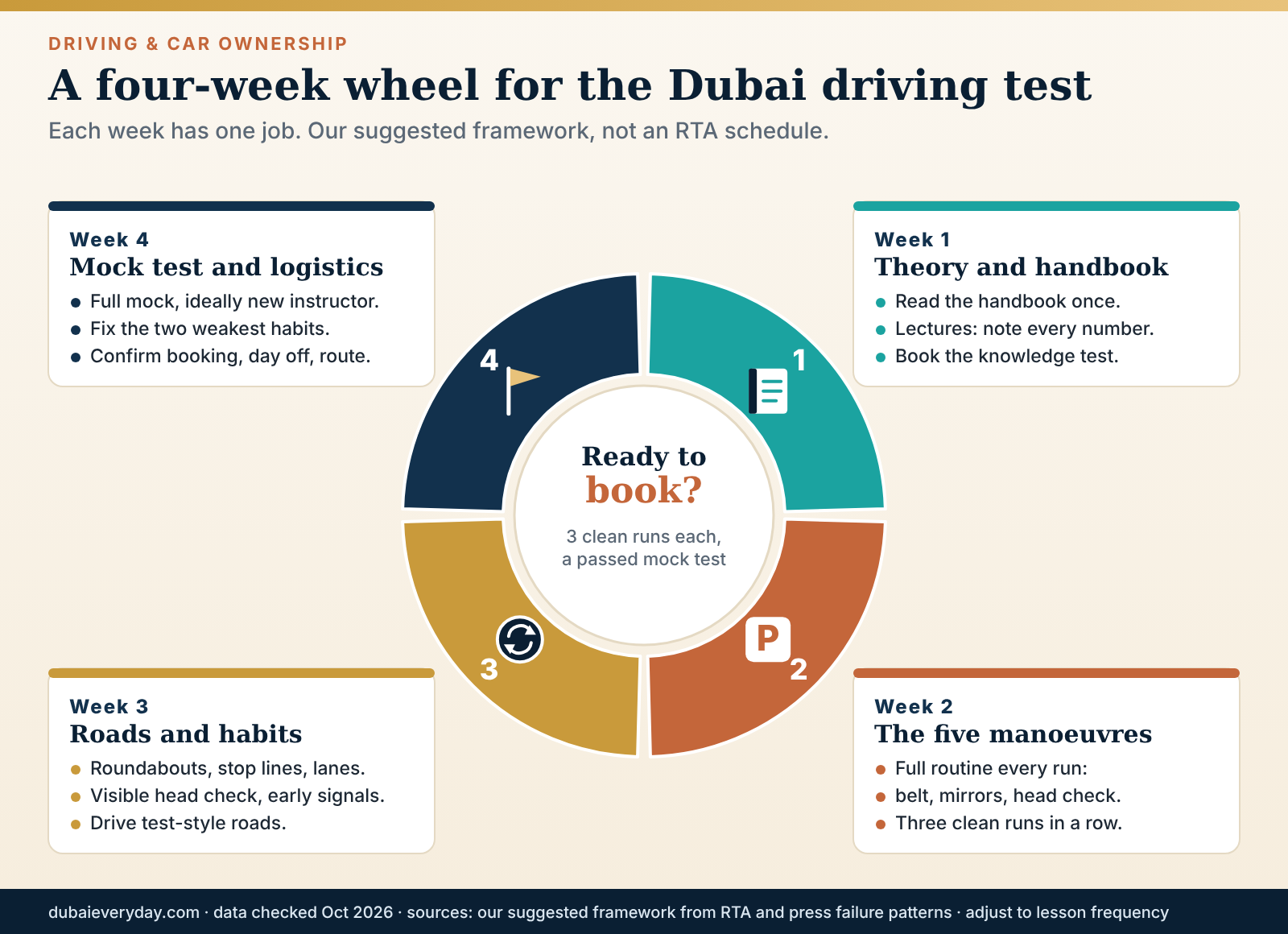
There is no official readiness standard that says “you are ready for the Dubai driving test when…”. The RTA sets training stages, your institute sets the lessons, and your instructor decides when to put you forward for the internal assessments. What follows is our own planning framework, built from the failure patterns above. It is not an RTA requirement, and your instructor’s judgement beats a calendar.
A four-week plan
The plan assumes several lessons a week. If you train less often, stretch it in proportion, but keep an eye on the six-month file clock. Each week has one job, so you do not spend your last lesson learning a manoeuvre for the first time.
Week 1: theory and the handbook
Read the handbook once, attend the lectures, and learn the numbers and signs. Book the knowledge test for the end of the week or the start of the next, while it is fresh.
Week 2: the five manoeuvres
Practise each one with the full routine: belt, mirrors, head check, smooth speed. The target is three clean runs in a row for each, not one lucky run.
Week 3: roads, roundabouts and lane changes
Drive the kinds of roads a test uses. Rehearse giving way at roundabouts, the stop line habit, and lane changes with a visible head check, until the routine is automatic.
Week 4: mock test and logistics
Ask for a full mock road test, ideally with an instructor who has not taught you. Fix the two weakest habits, confirm the booking, and sort the day off and the route to the yard.
Readiness gates before you book the Dubai driving test
Booking is cheap to do and expensive to regret, because a missed slot means rebooking and paying again, according to Gulf News. Before you commit, check these gates, which are also our suggestion rather than an RTA rule.
- Each of the five yard manoeuvres is clean three runs in a row, with the head checks included.
- You have passed a mock road test under test conditions without prompts from the instructor.
- You can explain, without looking, when to give way at a roundabout and where a yellow box applies.
- You have never needed a reminder to stop with the wheels behind the line in the past three lessons.
- Your documents are together, and you know which centre the test is at.
- You have counted six months from your last scheduled appointment and are well inside the window.
Nerves, treated as a practical problem
The RTA official in 2018 and the driving centre chief executive in 2026 both put nerves at or near the top of the causes. That is useful, because nerves before the Dubai driving test respond to preparation. Khaleej Times says RTA learners practise rain, fog and emergencies on advanced simulators, so ask whether your school offers one and whether it is in the package. Repetition under test conditions helps too: do your mock test at the time of day and on the type of road you will face.
A fixed setup routine (seat, mirrors, belt, same order) means that when your head empties, your hands still know the sequence. Eat something, bring water, and remember that a parked car in Dubai can feel like an oven before you set the mirrors.
Dubai driving test day: the routine
- The night beforeConfirm the booking, the centre and the time. Your Emirates ID and learning permit are the two items Dubizzle’s checklist lists; your school will say what else it wants.
- Arrive 30 minutes earlyGulf News and the Emirates Driving Institute both give this figure. A missed test means a new booking and a new fee.
- Set up the car in your usual orderDoors closed, seat, mirrors, belt, a glance at the controls. Do it briskly, since Khaleej Times says slow adjustments can read as hesitation.
- Drive the routine, not the resultSay your checks silently: mirror, signal, head check, move. If you slip, do not dwell. Under the RTA’s 2018 description only major errors end the test at once, so a clean recovery matters.
- Follow the examinerThe examiner’s instructions take priority, and the examiner is responsible for safety in the car.
- AfterwardsIf you pass, the RTA page says a temporary licence valid for seven days is emailed. If you fail, ask your institute for feedback before you rebook.
If you fail the Dubai driving test: cost, waiting time and appeals
A failed Dubai driving test is not a verdict on whether you can ever drive here. It is a process with a fee, a retraining requirement and a queue. The consequences differ by test, so the table below puts them side by side, with the source of each rule so you can see which ones the RTA publishes and which come from a newspaper or a school.
| You failed… | What the sources say happens next | Cost reported | Wait reported |
|---|---|---|---|
| Knowledge test | No catch-up rule on the RTA page. One large school requires eight theory lectures again | New booking; interpreter at one school AED 435 | Set by booking availability |
| Yard test | Replay and 3D error map available (Khaleej Times, 2026). One school’s 2019 sheet: one hour of training, then retest the failed manoeuvre | School-specific | School-specific |
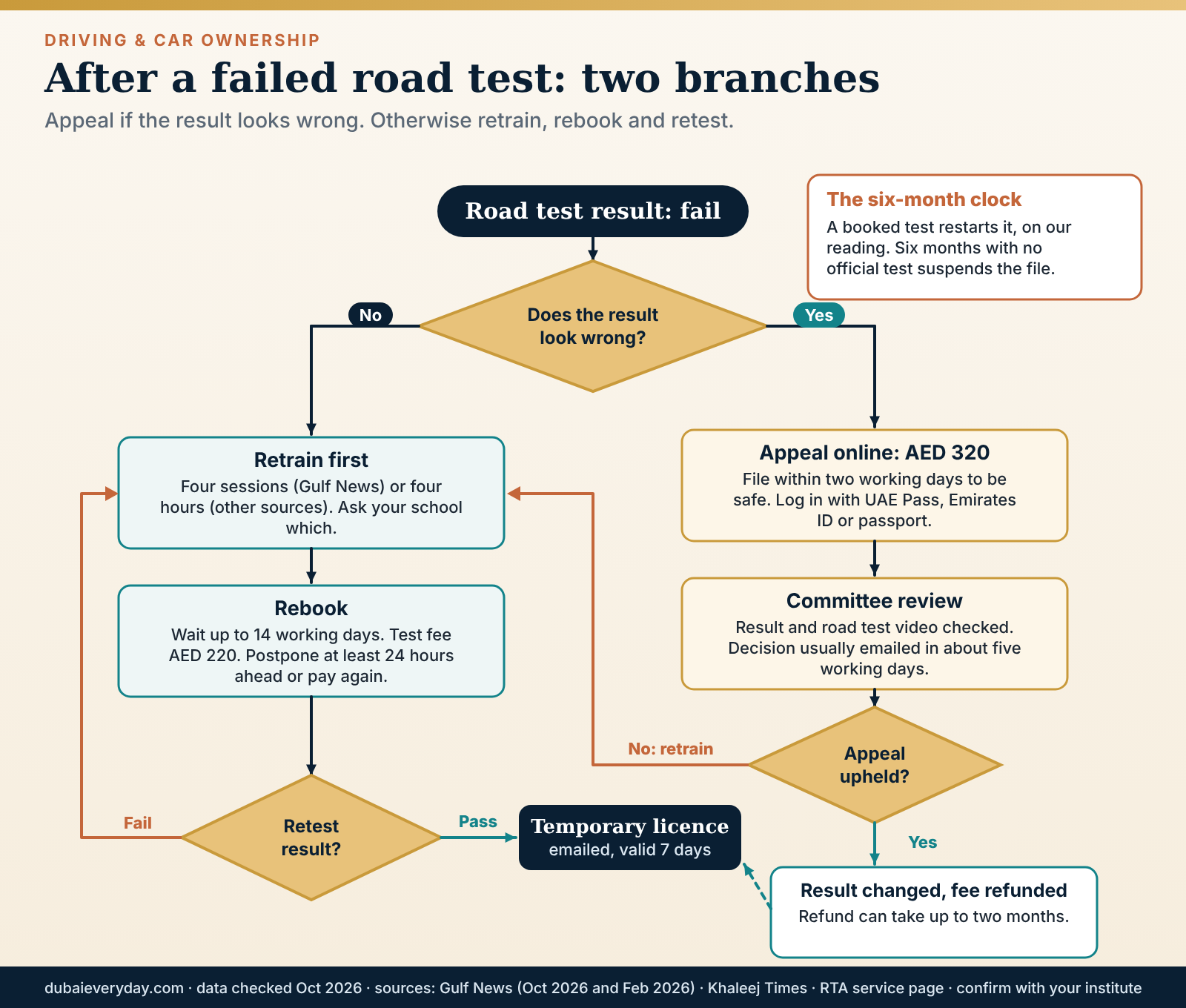
| Road test | Mandatory practical training before rebooking: four sessions (Gulf News, Oct 2026); other sources say four hours | AED 220 test fee, plus training at your school’s rate | Up to 14 working days after training |
| Road test, Golden Visa route | A four-hour course after each failed road test (RTA page) | As above | As above |
| Road test, Golden Chance | Training hours without the theory part (RTA page) | Not stated | Not stated |
| Road test, result looks wrong | Online appeal, reviewed with video footage | AED 320, refunded if upheld | Decision usually within five working days |
Four sessions or four hours?
This one matters for your wallet. Gulf News (19 October 2026) says four mandatory practical training sessions at your institute before you book another Dubai driving test attempt, without stating the length of a session. PolicyBazaar (2026), the Emirates Driving Institute and the RTA’s own Golden Visa line all say four hours. Our reading is that four hours is the most-repeated unit, but the RTA page for ordinary candidates does not say, so ask your institute what “four” means in your contract and whether the retraining is in your package.
The Dubai driving test retake clock, in days
Here is our calculation, not an RTA figure. Suppose you fail the road test on day zero. You complete four one-hour sessions, perhaps one a working day. Then you book and, in the worst case reported by Gulf News, wait up to 14 working days. That is 18 working days, which is close to four calendar weeks once weekends fall in. In a quick scenario the gap could be much shorter, because the 14-day figure is a ceiling and slots vary by school and season.
Six months is about 26 weeks. The RTA’s wording counts from the last scheduled appointment, so our reading is that every booked slot restarts the clock. The six-month limit therefore rarely catches someone who keeps trying. It catches someone who stops: a holiday, a heavy work month, a bad week of discouragement. If you pause, put the date six months from your last appointment into your calendar the same day.
What a road test retake costs
The RTA fee is known. The training is the variable. The formula is AED 220 for the test, plus four times the price of a lesson at your institute, plus AED 320 only if you pay to move to an earlier slot (the fee Gulf News reports, which also notes that tests on official public holidays may carry extra institute fees).
Illustrative example (not a quote or market fact): at AED 150 per lesson hour, a retake would be 220 plus 600, so AED 820, before any earlier-slot fee. Check what your package includes. At the Emirates Driving Institute the Normal package covers one of each test with additional fees from the second, while Fixed packages cover unlimited training and tests until you pass. The package maths is in our guide to driving schools in Dubai.
Appealing a failed Dubai driving test result
If you believe the result was wrong, there is an official route. Gulf News (17 February 2026) and Khaleej Times (2024) describe it. You apply online through the RTA website, logging in with UAE Pass, Emirates ID or passport details, and choosing the road test appeal service. The fee is AED 320, which Khaleej Times splits as AED 300 plus the AED 20 knowledge and innovation fee. A committee reviews the result and the road test video footage and may contact you for clarification.
Decisions are usually emailed within five working days. If the appeal is upheld, the result is changed and the fee is refunded, though a refund can take up to two months. If it is rejected, you complete further training and retake the test. Once submitted, an appeal cannot be cancelled. We found the appeal service described only for road tests, not for the knowledge or yard tests.
Gulf News (February 2026) says to file within 14 days of the result, and also says the request for a light-vehicle test should go in within two working days of the appointment, citing RTA guidance. Khaleej Times (2024) says two working days. We cannot tell which is current. If you want to appeal, file within two working days and treat that as the deadline.
An appeal checks how the test was marked. It is not a second chance, and our reading is that “I was nervous” is not a ground. It is worth considering when you have a specific, checkable reason, such as a major error you are sure did not happen. If you were not sure what went wrong, ask your institute to review the result with you first.
Fast lanes, exemptions and when you may not need the Dubai driving test
Not everybody takes the same path to the same licence. The RTA page describes several routes that change which parts of the Dubai driving test you sit, and the press describes paid fast tracks. Here is what is known, and what is unclear.
Golden Visa holders and the Golden Chance
The RTA’s new-licence page says Golden Visa holders can schedule the theory and road tests on the same day and get their licence faster. Those with a valid licence from any country need no training courses, the institute books the road test, and each failed road test brings a four-hour course before a retake.
The Golden Chance is a separate route for holders of a previous licence that cannot be exchanged. It requires the knowledge and road tests with no training hours and can be used only once. After a failed road test, you take training hours without the theory part.
For anyone on these routes the road test is close to a single throw, so the advice on habits, mirrors and mock tests applies with extra force.
VIP and instant Dubai driving test options
The RTA lists a VIP test for light vehicles in its test tables but does not explain what it is or who qualifies. Gulf News (19 October 2026) fills in the price: VIP at AED 2,620, and an instant test service at AED 420 for eligible applicants with non-exchangeable licences and those on the Golden Chance route. By our arithmetic the VIP price is about 12 times the standard road test fee (2,620 divided by 220 is roughly 11.9), and the instant fee is nearly double it.
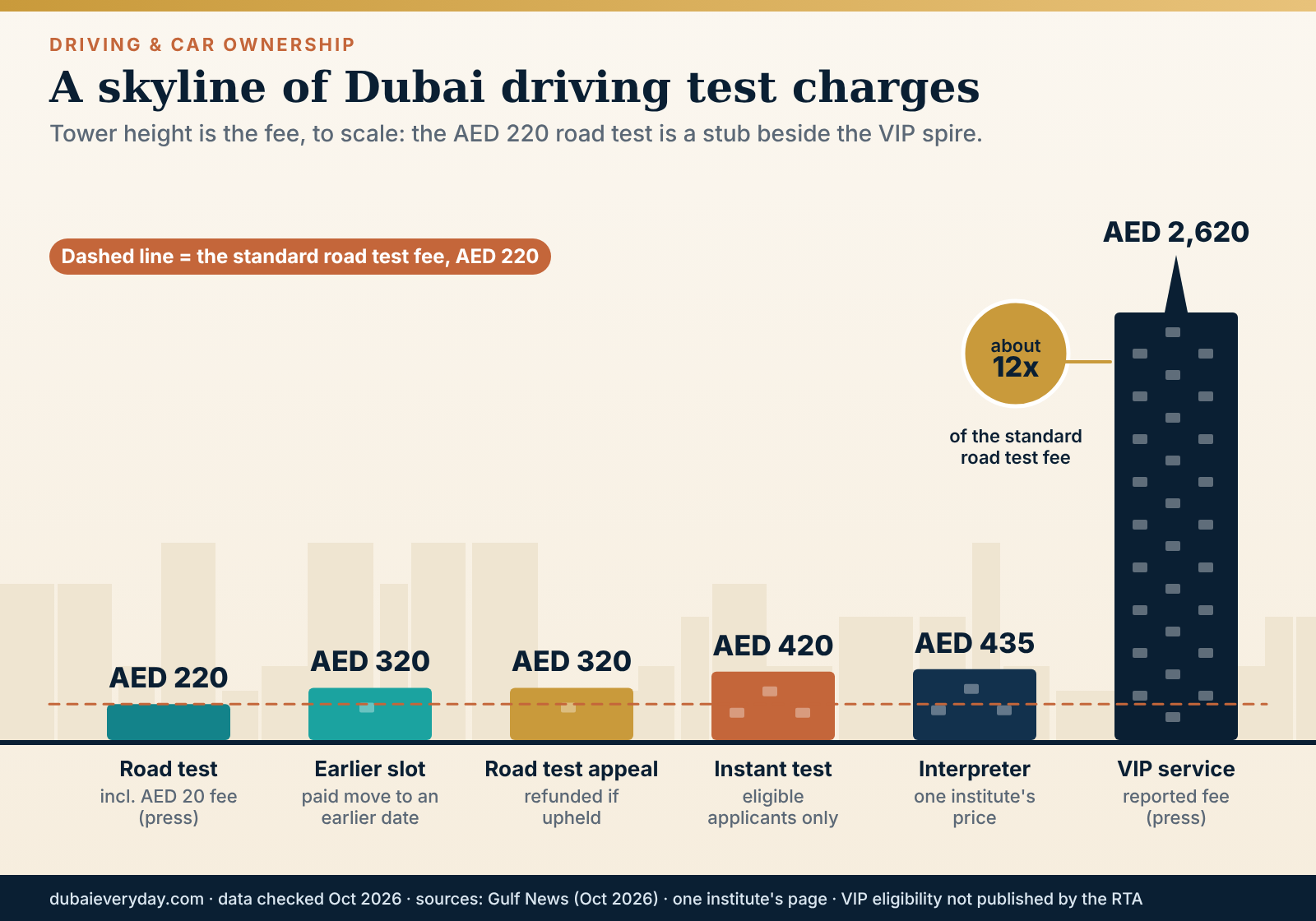
We found no RTA page describing VIP eligibility, so do not assume it is available to you just because the fee is published. Ask your institute whether you qualify and what is included, in writing, before paying. For most learners the cheaper and more reliable way to save time is to be ready on the first attempt.
Foreign licence holders
If your licence comes from a country on the RTA’s exchange list, you may skip the tests entirely: see our guide to exchanging a foreign driving licence in Dubai.
If it does not, you do the training route, but with fewer training sessions. The RTA’s page counts them in sessions: 20 if the foreign licence was issued more than five years ago, 30 if it is two to five years old, and 40 if it is under two years old. The Dubai driving test still applies in full. The page does not say how long a session is, so ask your institute to convert the number into lesson hours and into money before you sign.
Visitors, commuters and people who would rather not drive
The Dubai driving test belongs to the licence process for people the RTA lists as applicants, such as citizens, residents holding a Dubai or other-emirate visa, and diplomats. Visitors are not on that list. A tourist driving a hire car does not sit these tests, and rental companies set their own licence and age requirements, so check with the firm. Our car rental guide and airport car rental guide cover the comparison and the paperwork.
Residents waiting on a licence have options too. A monthly car rental may suit someone whose existing licence still lets them hire a car, and the Dubai Metro guide and Nol card guide explain the car-free routes. For a short visit, the Dubai travel guide and Downtown Dubai guide show how much of the city works without a licence.
Ten process mistakes that waste a test slot
The driving errors are covered above. These are the paperwork and planning mistakes that cost money and weeks on the Dubai driving test, and all of them are avoidable.
- Booking the road test before passing a mock test under test conditions. A failed attempt costs AED 220 plus retraining.
- Treating the date as flexible at the last minute. Gulf News says you can postpone up to 24 hours before; after that, a missed test means a new booking and a new fee.
- Paying AED 320 to jump to an earlier date without checking how soon the ordinary slot is.
- Arriving at the minimum time. Both Gulf News and the Emirates Driving Institute say 30 minutes early, and that school holds its yard tests at its main centres only.
- Asking for interpreter support late. At that school it must be requested when the RTA file is opened.
- Letting the six-month clock run during a pause, then finding the file suspended.
- Assuming the package covers retakes. At that school the Normal package includes one of each test, with additional fees from the second.
- Switching institutes without pricing it. The RTA says a different institute needs a Clearance Certificate and a fee that varies.
- Practising on public roads outside lessons. The Dubai Executive Council’s resolution says trainers may teach only learners with valid learner permits, and our driving licence guide reads the federal traffic law as requiring authorised training.
- Trusting old numbers. Pass marks, fees and the “four sessions or four hours” detail have all conflicted over the years. Confirm the number you are about to pay.
Five learners facing the Dubai driving test
These are illustrative scenarios, not case studies. Where a number appears, it comes from a source cited earlier or is marked illustrative.
The 19-year-old with a day job
A first-time learner under 21 gets a licence valid for one year, and the RTA lists the issuance fee at AED 100 for under-21s. The problem is time, not money: road tests run in working hours at the school we examined, with extra charges for weekend slots. Book the road test for a day of planned leave, keep the knowledge result fresh, and avoid long gaps that could trigger the six-month rule.
The experienced driver whose country is not on the list
Fifteen years of driving does not exempt you from the tests when your country is not on the exchange list. The RTA page would put the training at 20 sessions for a licence held more than five years. The risk is habit: one-handed steering, a casual stop line, an easy-going indicator. Do a mock test with a stricter instructor and make every lane change get a visible head check, even when it feels like theatre.
The learner who failed the road test once
Ask for feedback first. If you are certain a major error was marked in error, consider the appeal within two working days. Otherwise accept the retraining as targeted coaching on the habit that failed you, and rebook promptly. At an illustrative AED 150 per lesson hour the retake is AED 820 before any earlier-slot fee. The cheapest outcome is a pass on the second attempt.
The shift worker with an unpredictable roster
The real enemy is the calendar. Each scheduled test restarts the six-month window on our reading, but retraining and a wait of up to 14 working days eat the same calendar. Book while the roster is known, use the 24-hour postponement rule only for genuine emergencies, and ask the institute which weekday slots are most often free, since the school example we found offers its road test in weekday hours only.
The Golden Visa holder with a licence from home
No training is required, and the theory and road tests can sit on the same day. That sounds like a shortcut, and it is, but one failed road test brings a four-hour course. Spend a few lessons, even though they are optional, on local roundabout and lane habits, and read the handbook.
The bottom line
The Dubai driving test rewards boring consistency. The theory is a handbook exercise, the yard is a camera-marked rehearsal of five manoeuvres, and the road test is a short drive in which a few binary errors and a handful of habits decide the result. The most-cited reasons for failing are checks that did not happen, so build the checks into every lesson until you stop noticing them.
Plan the money and the calendar as carefully as the driving. Know the fee (AED 220 for the road test as reported in October 2026), the retraining rule and the six-month file clock, and ask your institute to answer in writing the questions the RTA does not publish. If a result goes wrong, the process is mechanical and survivable. Book the Dubai driving test when the mock test says you are ready.
Dubai driving test FAQ
How many tests are in the Dubai driving test?
Three: the knowledge (theory) test, the yard or parking test, and the road test. The RTA’s service page lists Knowledge, Yard and Road, plus a VIP option for light vehicles, and says each is booked after the matching training stage. Golden Visa holders can schedule the theory and road tests on the same day, and exchange applicants from listed countries may not sit them at all.
How much does the Dubai driving test cost?
The road test is AED 220, made up of AED 200 plus the AED 20 knowledge and innovation fee, according to Gulf News in October 2026. The RTA page we read does not list separate knowledge or yard test fees. One large institute says its prices include AED 1,350 of RTA fees in total. The full fee table is in our Dubai driving licence guide.
How many times can I retake the Dubai driving test?
We found no maximum number of attempts on the RTA page or in the press reports. The real limits are practical: each road test retake needs mandatory training and a new fee, and a file with no official test for six months is suspended. A suspended file can be resumed if it has been suspended under four years and the knowledge and yard results are still within their limits.
How long is the Dubai driving test road section?
There is no RTA figure that we could find. Dubizzle says about 15 to 20 minutes and PolicyBazaar says about 20, depending on traffic and the examiner’s route. Treat that as a rough guide. What matters more is that a major error can end the drive at once, and that you should arrive 30 minutes early, since a missed test means a new booking and a new fee.
What happens if I fail the road test?
Gulf News reported in October 2026 that you must complete four mandatory practical training sessions at your institute before booking another attempt. Other sources say four hours, so ask which applies. You pay the AED 220 fee again, and after training you may wait up to 14 working days. If you think the result is wrong, you can appeal for AED 320.
Can I appeal a failed Dubai driving test result?
For the road test, yes. The RTA website has an online appeal service. Gulf News (February 2026) puts the fee at AED 320, refunded if the appeal is upheld, and says a committee reviews the result and the video footage. Decisions are usually emailed within five working days. The deadline is reported inconsistently, from two working days after the test to 14 days after the result, so file within two working days.
What is the pass mark for the Dubai driving test theory section?
The RTA page does not state it. Two unofficial pages say 35 questions with 23 correct needed, and an institute blog says 40 questions across ten topics without giving a pass mark. Ask your institute for the current numbers when you book, and study the whole handbook, including the driver-assistance material the RTA added in May 2026.
Is the Dubai driving test available in English and other languages?
English is covered, and other languages with some planning. One large institute offers its theory lectures online in English, Arabic or Urdu, and an RTA interpretation service has covered more than 192 languages since 2018. The institute we checked quotes AED 435 for interpretation and says it must be requested when the RTA file is opened.
Do I need to take the Dubai driving test if I already have a licence?
Maybe not. If your licence is from a country on the RTA’s exchange list, you may swap it without tests; our exchange guide explains how. If it is not, you take the training route with fewer sessions but still sit the tests. Visitors driving legally on a foreign licence or a hire car do not take the test, and rental firms set their own requirements.
Can I practise in a friend’s car before the Dubai driving test?
On public roads, probably not. Dubai’s driving instruction resolution says trainers may teach only learners holding valid learner permits, and our licence guide reads the federal traffic law as requiring a permit and authorised training. We are not lawyers, so ask the RTA or your institute about private land. Between lessons, rehearse your checks, read the handbook and use the school’s simulator if it has one.
Related reading
Sources and further reading (23 links)
- RTA: New driving licence service page — test types, training stages, file suspension rules, Golden Visa and Golden Chance conditions, fees
- RTA: Full automation of drivers’ testing at the Smart Yard — five manoeuvres, cameras, sensors and automated pass or fail
- RTA: Updating the driver training curriculum with advanced driver assistance systems — 2026 curriculum change
- Dubai Legislation Portal: Executive Council Resolution No. (2) of 2026 on the activity of driving instruction — trainer and learner rules, fee schedule
- Khaleej Times: Dubai’s smart system lets you see where you went wrong — 2026 upgrade to the yard test system
- Khaleej Times: RTA issues 119,188 Dubai driving licences in first half of 2026 — licence volumes, test process, simulators
- Gulf News: Failed your RTA driving test in Dubai? How to rebook and what it costs — road test fee, retraining, waiting time, rebooking rules
- Gulf News: Most common reasons for failing the RTA road test in Dubai — failure causes and expert comment
- Gulf News: How to appeal a failed road test result in Dubai — appeal route, fee and timing
- Khaleej Times: Failed RTA’s final road test? How to file an appeal — appeal steps and fee breakdown
- Gulf News: Drivers fail Dubai road test due to fear, says RTA — RTA explanation of major and minor criteria and failure causes
- Gulf News: Why UAE residents fail driving tests — instructor views on common errors
- Khaleej Times: 5 reasons why people fail driving tests in Dubai — institute advice on road test errors
- Gulf News: Automated parking test for trainees launched in Dubai — yard test manoeuvres and equipment at launch
- Gulf News: Smart driver testing yard in Dubai to use sensors and cameras — how the smart yard works
- Gulf News: Driving theory test in 192 languages in Dubai — remote interpretation for the knowledge test
- Emirates Driving Institute: Car driving page — one institute’s test arrangements, retake rules and extras
- Emirates Driving Institute: Step-by-step guide for the 20-hour car course — an example of school-level sequencing
- Gulf Insider: Dubai updates driving licence tests — coverage of the ADAS curriculum update
- Dubizzle: All about the RTA driving test checklist — unofficial road test checklist, context only
- PolicyBazaar UAE: How to pass the RTA driving test on the first attempt — unofficial description of test stages, context only
- eZhire: How many questions are in the RTA theory test in Dubai — unofficial knowledge test format, context only
- Bin Yaber: Dubai driving licence guide — institute blog, knowledge test format claim, context only
Update log: 29 October 2026, first publication; all facts re-checked against the sources above. Next review due: April 2027, or sooner if the RTA changes the test process, fees or the smart yard system. Corrections welcome. This page is general information, not legal or professional advice, and fees, rules and test arrangements can change without notice.
About DubaiEveryday and this guide
DubaiEveryday.com is an independent editorial project that publishes practical, research-based guides to everyday life in Dubai: where to live, what things cost, how the rules work and how to get around. This page was written and edited by the DubaiEveryday editorial team. It is not signed by a named expert, doctor, lawyer or adviser, and we do not claim first-hand testing of a venue, clinic or service unless the page says so.
Each guide is built from official sources such as government and regulator pages, operator websites and established news outlets, cross-checked where we can. When we could not confirm something, we say so in the text, and examples that use made-up numbers are labelled as illustrations. Mentions are editorial choices, not paid placements, and a link is not an endorsement.
Dubai changes quickly. If you spot something that is out of date or wrong, please tell us through the contact options on DubaiEveryday.com and we will check it and correct the page.