
Your first purchase is decided long before the viewing: by what a bank will lend you, what the paperwork really costs and who you let near your deposit. This guide takes a first time buyer Dubai property purchase from budget to keys, using Dubai Land Department and Central Bank rules checked on 29 October 2026.
The flat looks perfect, the broker is charming and the payment plan fits on one slide. That is exactly the moment most first-time owners stop asking questions. The price on the listing is only the opening number, though, and the real bill, the real borrowing limit and the real timetable sit further down the page.
This guide to a first time buyer Dubai property purchase puts them in order. You will see what cash you need on completion day, what a bank can lend, how to check a broker before you pay anyone, and what the transfer actually involves. None of it is financial advice, but it should stop the expensive surprises.
A first time buyer Dubai property purchase is manageable if you do the arithmetic before you fall for a unit. Budget for the price plus roughly 8% in registration, broker and bank costs (our calculation on a AED 1.2 million resale), which means a resident expat taking an 80% mortgage needs about 28% of the price in cash on completion day.
The Central Bank caps a first-home loan at 80% of value up to AED 5 million for expatriates, limits total debt repayments to 50% of income, and expects the down payment to come from your own money. Verify the broker and the advert permit on Dubai Land Department tools before you pay anyone, sign the Form F only once pre-approval and checks are in hand, and book an independent inspection before transfer.
Registration itself takes about 20 minutes at a trustee office, but a whole purchase usually runs two to ten weeks, longer with a mortgage. A resident buying below AED 5 million can also register for the free DLD First-Time Home Buyer Programme, which suits any first time buyer Dubai property shopper.
This first time buyer Dubai property guide is research-based, not field-tested. On 29 October 2026 we read the Dubai Land Department (DLD) service pages for sale registration, mortgage registration, off-plan registration, broker and permit verification, title-deed and project checks, the Service Charge Index and the First-Time Home Buyer Programme. We also read the Central Bank of the UAE mortgage rulebook and the DLD’s copy of Law No. 6 of 2019 on jointly owned property.
Bayut, a mortgage broker’s rate page and press reports were used only for market ranges and context, and they are named as such. Bank rates, bank fees and broker commission are not regulated figures, so they appear as clearly labelled assumptions. Every worked example is an illustration of the arithmetic, not a quote. Inclusion was not paid for. This is general information, not legal, financial or mortgage advice; a licensed adviser should check your own case.
What a first time buyer Dubai property purchase involves
This page covers the decisions a first-time owner has to make in order: whether to buy at all, how much cash and borrowing you really have, who to trust with the deal, what to check, and how the transfer runs. It does not repeat the full full purchase workflow, which sits in our guide to buying property in Dubai. Overseas buyers should start with buying Dubai property as a foreigner, and the legal meaning of freehold is covered in the Dubai freehold property guide.
Two meanings of “first-time buyer”
In everyday talk, a first time buyer Dubai property shopper is simply someone who has never bought a home. The DLD uses a narrower definition for its programme: a UAE resident aged 18 or over who does not own freehold residential property in Dubai and is looking at property valued below AED 5 million. Owning a flat in another emirate, or a non-freehold home, does not disqualify you on the programme page.
The Central Bank has a third meaning, and it matters more to your wallet. Its “first home” loan-to-value limits apply to one property per borrower. Buy a second flat and you move to the lower investment ceiling. Keep that in mind if you plan to buy a small unit now and a family home in three years.
The nine steps, in the order that protects you
Most first time buyer Dubai property mistakes are sequencing mistakes: paying a deposit before checking the broker, or falling for a unit before knowing the borrowing limit. The order below is our editorial reading of the DLD and Central Bank rules, not a legal requirement.
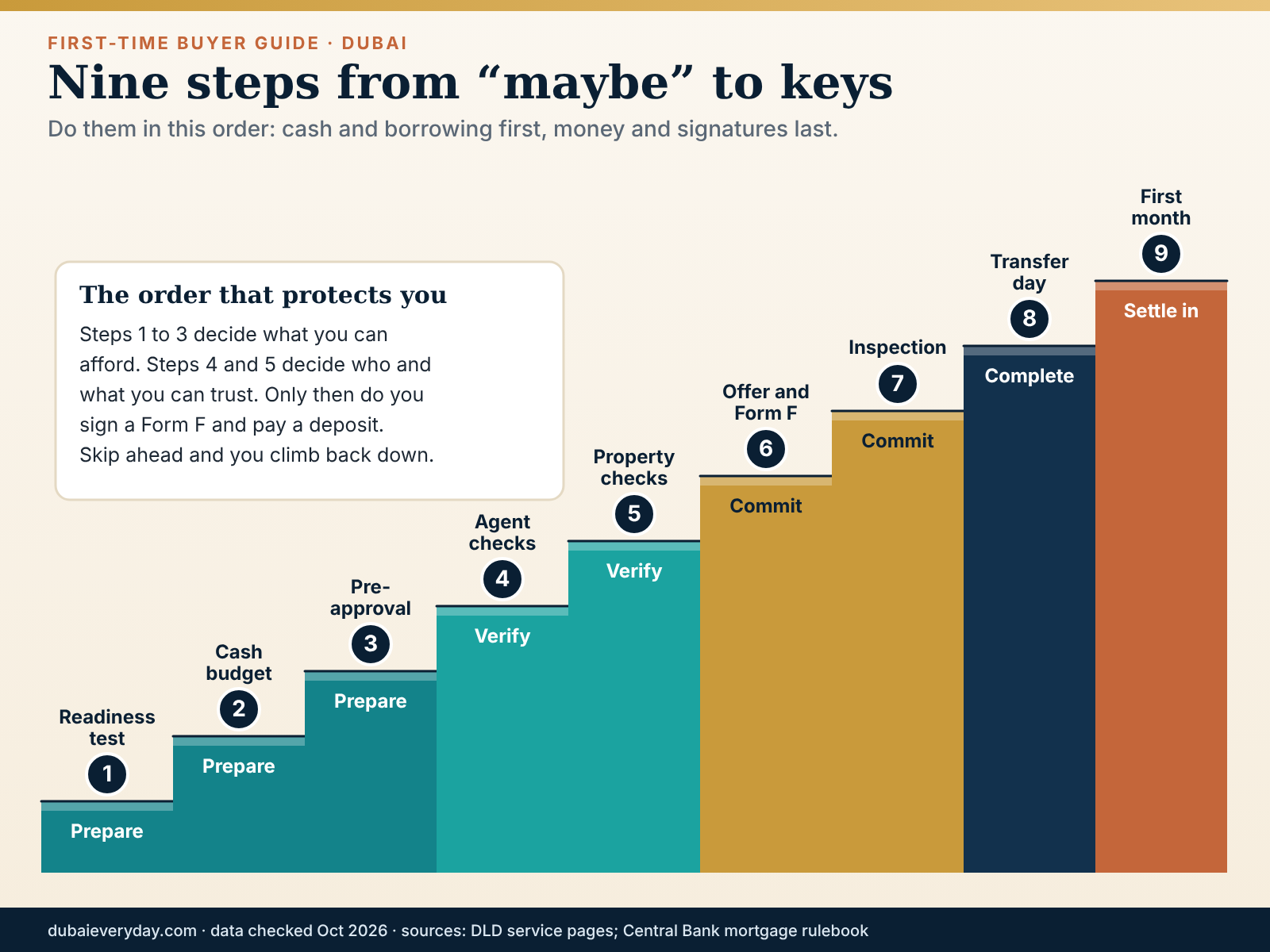
- Readiness testDecide whether you will stay long enough for buying to beat renting.
- BudgetWork out the completion-day cash, not just the deposit.
- Pre-approvalGet a lender’s written view of your borrowing before you shop.
- Agent checksVerify the broker card, the advert permit and who holds your money.
- Search and diligenceCheck title, status, service charges and the building.
- Offer and Form FAgree the price and conditions; pay a deposit only on documents you have read.
- InspectionTest the unit with a professional or a disciplined checklist.
- TransferSettle at the trustee office with the NOC, cheques and registration.
- First monthActivate utilities, record defects and set up the service-charge routine.
What the market numbers can and cannot tell you
Press reports put Dubai sales at 165,018 transactions worth AED 574.12 billion for January to September 2026, described as the second-highest nine-month value on record, though that report does not name its data source. Another aggregator’s September figure, built from DLD records, is far lower. We could not reconcile the two, probably because they count different transaction types.
For a first time buyer Dubai property decision, the useful lesson is modest. Headline totals describe the market, not your unit. Your price is set by comparable sales in your own building, and you can check those, as the due-diligence section explains.
Who this page is not for
If you are buying purely as an investment, skip to the property investment guide, because the lower investment loan limits and yield maths change the answer. If you are still comparing a house move with a rental, our renting in Dubai guide covers the tenant side, and the next section helps you decide which side of a first time buyer Dubai property decision you belong on.
Rent or buy: the readiness test for a first time buyer Dubai property purchase
Rent is not money thrown away. It is the price of being able to leave. A purchase swaps that flexibility for equity, and it charges you an entry fee, which is why the first question for any first time buyer Dubai property plan is not “which area?” but “how long will I stay?”
The entry fee is the problem. On the resale example we use throughout this page, the costs that you never get back (registration, broker, bank and valuation fees) come to about AED 98,000 on a AED 1.2 million flat. You pay selling costs too when you leave, about 4.5% of the price in our model. A move after two or three years rarely clears both on its own.
Our rent-versus-buy calculation
We built a simple model so you can see what has to be true for a first time buyer Dubai property purchase to beat renting. It is an illustration, not a forecast. The flat costs AED 1.2 million with an 80% mortgage over 25 years at 5.5%. Service charge and upkeep are set at AED 15,000 a year, selling costs at 4.5% of the exit price, and the renter is assumed to invest the same cash and the monthly difference at 4%. Prices and rents move together by the same percentage each year.
The table shows the first year in which the owner’s equity after selling costs overtakes the renter’s savings pot. “Gross rent” is the annual rent for a comparable flat as a percentage of its price; our rental yield guide explains gross and net figures.
| Illustrative break-even (years) | Prices and rents flat | Rise 2% a year | Rise 4% a year |
|---|---|---|---|
| Gross rent 5% of price | 20+ | 14 | 5 |
| Gross rent 6% of price | 20+ | 8 | 4 |
| Gross rent 7% of price | 18 | 5 | 3 |
Read it as a map of conditions, not a prediction. Buying wins quickly only when rents are high relative to prices or the market rises, and neither is in your control. With flat prices, you may wait close to two decades. At a 6% gross rent and 2% annual growth, the break-even moves from 6 to 8 to 11 years as the mortgage rate goes from 4.5% to 5.5% to 6.5%.
Our reading, for a first time buyer Dubai property plan: if you cannot see yourself in the same flat or the same city for at least five years, renting is the cheaper form of certainty. If you can, the case improves, but do not build a plan that needs prices to rise.
A readiness checklist that is not just about money
Use this first time buyer Dubai property readiness list before you book a single viewing.
- You can pay the 28% cash need described below without emptying your emergency fund.
- You would still cover six months of instalment plus service charge if your income paused.
- Your residency is tied to something stable, such as an employer you trust or your own licence, because a mortgage runs for decades while visas run for years.
- You have settled the area question by living near it, not just by scrolling listings.
- You have no unsecured debts that will eat your debt-burden allowance (more on that in the mortgage section).
Testing an area is cheap. Rent in or near the building for a season, use the DLD Rental Index on the DLD website or Dubai REST app to see average rents by area and room count, and read our guides to renting an apartment and renting a studio for the building-level questions, such as chiller charges and parking, that you will inherit as an owner. A weekend in an area, if you book a hotel nearby from our best hotels in Dubai guide, is a weaker test than a season, but better than a single viewing.
The first time buyer Dubai property budget: cash needed on completion day
In any first time buyer Dubai property budget, the deposit is the number everyone quotes. It is not the number that matters. The number that matters is the total cash leaving your accounts between signing and collecting the keys, and it is reliably larger than the down payment alone.
What each cost is and how solid the figure is
The official items in a first time buyer Dubai property budget come from the DLD’s sale and mortgage registration pages. Commission, bank charges and valuation fees are market practice, so treat them as ranges you confirm in writing.
| Cost | Amount (checked 29 Oct 2026) | Status of the figure |
|---|---|---|
| Sale registration | 4% of the price; the DLD page lists 2% seller and 2% buyer, but buyers commonly pay all of it, which is negotiable | Official |
| Registration trustee fee | AED 4,000 + VAT from AED 500,000; AED 2,000 + VAT below | Official |
| Title deed, map, knowledge and innovation fees | AED 250 + AED 250 (villa or apartment map) + AED 10 + AED 10 | Official |
| Mortgage registration | 0.25% of the loan + AED 250 + AED 20 in fees, plus a AED 4,000 + VAT partner fee | Official |
| Broker commission | Often quoted as 2% + 5% VAT | Market custom, negotiable |
| Bank arrangement fee | Often quoted up to 1% of the loan | Varies by lender |
| Mortgage valuation | AED 2,500 to 3,500 + VAT as a market range | Varies by valuer |
| Developer NOC | Set by the developer; no figure on the DLD page | Ask the building |
Worked example: AED 1.2 million, 80% mortgage
This is the first time buyer Dubai property example we reuse across the page. It assumes a resale flat, a resident expat buying a first home, a 25-year loan, the buyer paying the full 4%, and bank, valuation and commission costs at the upper end of market ranges. Our calculation is below.
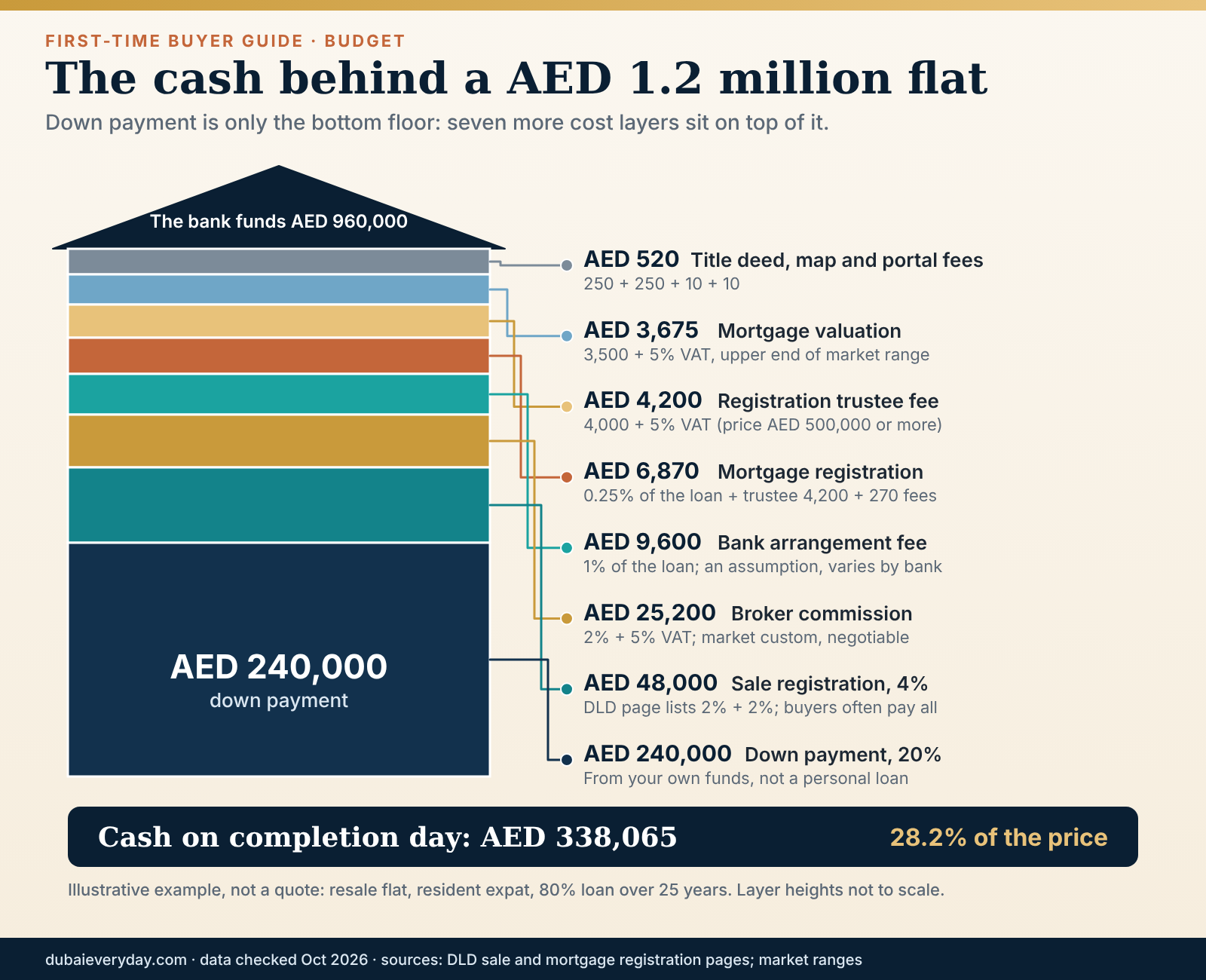
The down payment is AED 240,000. Registration at 4% adds AED 48,000, the trustee fee AED 4,200 and the small title and map items AED 520. Mortgage registration costs AED 6,870. A 1% bank fee on the AED 960,000 loan is AED 9,600, valuation AED 3,675 and a 2% broker commission with VAT AED 25,200. Fees total AED 98,065, so the cash you need is AED 338,065, or 28.2% of the price.
If the bank waives its arrangement fee, the figure drops to AED 328,465, or 27.4%. Add a reserve for furniture, a utility deposit and moving, and a first-time buyer is realistically looking at 30% of the price before the first instalment.
Two rules that change how you fund a first time buyer Dubai property purchase
First, banks may not roll the registration fee or broker commission into your loan. The National reported the Central Bank’s instruction, effective 1 February 2025, which keeps the loan at the original 80% of value. You pay those costs from savings.
Second, the down payment must come from your own resources. A legal Q&A in Khaleej Times on 30 August 2026 cites Central Bank resolution 96 of 2019, which rules out personal loans and credit cards as the source. The DLD programme page, separately, describes interest-free instalment plans for registration fees on eligible credit cards. Those are different pots, so ask your bank in writing which applies to you before relying on a card.
Savings to price: a rule of thumb
Working backwards from our fee assumptions, AED 250,000 of available cash supports a purchase of about AED 875,000. AED 350,000 supports about AED 1.24 million, and AED 500,000 supports about AED 1.8 million, provided your income clears the debt-burden test in the next section. Those are planning figures. Change the price and the fixed items (trustee, valuation) shift the total slightly.
Costs after you own
A first time buyer Dubai property budget that stops at the keys is incomplete. Owning has a running bill that renters see only in part. The service charge is set by the building’s management and approved under RERA rules; you can look up approved fees by project, use and year in the DLD’s Service Charge Index. Add district cooling or AC maintenance, electricity and water, contents insurance and a repair reserve. Under Law No. 6 of 2019, an owner’s unit cannot be disposed of until service charges are paid, so arrears become a sale problem, not just a bill.
Mortgage sizing and pre-approval for a first time buyer Dubai property purchase
Every first time buyer Dubai property search should start with a bank, not a portal. A pre-approval tells you the ceiling before you fall for a flat above it. It is also the document that makes an offer credible. It is not a guarantee: the lender still values the property, checks your documents again and can change the terms.
The Central Bank rules that set your ceiling
The Central Bank of the UAE publishes the mortgage limits in its rulebook, and every licensed lender works inside them. These are the ones that bind a first time buyer Dubai property budget.
- Loan-to-value for an expatriate buying a first, owner-occupied home is up to 80% when the property is below AED 5 million and 70% above that. A second or investment home is limited to 60%, and off-plan purchases to 50%. For UAE nationals the first-home ceilings are 85% and 75%.
- Total monthly debt repayments may not exceed 50% of gross salary and regular income from a defined source.
- Lenders test affordability at a rate 2 to 4 percentage points above the loan’s current rate, and for introductory rates they test at the rate that applies afterwards.
- The maximum term is 25 years, and each lender sets its own maximum age at the end of the loan.
- Expatriate borrowers can be lent up to seven times annual income (eight for nationals), and end-of-service benefits cannot count as a source of repayment.
The “first home” limits apply to one property per borrower. The page words the AED 5 million boundary slightly differently for nationals and expatriates, so a purchase priced at exactly AED 5 million deserves a written answer from the lender.
What the 50% rule does to a first time buyer Dubai property price range
In practice the debt-burden ratio binds before the seven-times rule. Take the AED 960,000 loan from our budget example over 25 years. At 4.5% the instalment is about AED 5,336 a month, at 5.5% about AED 5,895, at 6.5% about AED 6,482 and at 7.5% about AED 7,094 (our calculation).
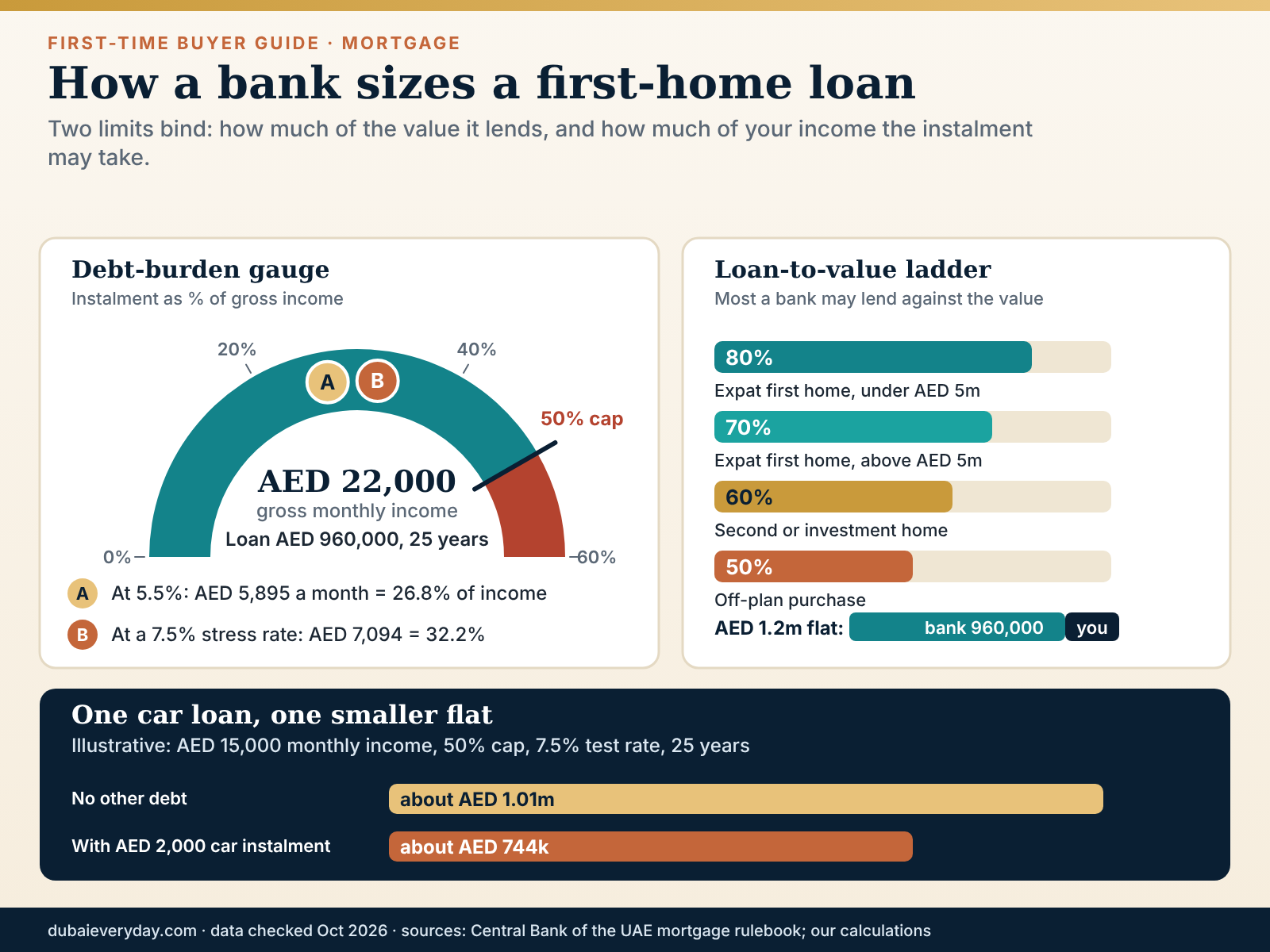
If a lender stresses your loan at 7.5%, a AED 7,094 instalment at the 50% limit needs gross monthly income of about AED 14,200 with no other debts. At the live 5.5% rate the same loan sits at about AED 11,800. Lenders also add your car loan, credit cards and personal loans to the sum, which is the next point.
Existing debt is the quiet budget killer
For a first time buyer Dubai property application, a AED 2,000 car instalment sits inside the same 50% allowance as your mortgage. On a AED 15,000 monthly income with no other debt, a 7.5% test rate supports a loan of roughly AED 1.01 million. Add that car loan and room falls to AED 5,500, which supports roughly AED 744,000, about AED 270,000 less. The figures are illustrative, because each lender chooses its own stress rate and treats card limits differently. The principle is real: clear or avoid unsecured debt before applying, where that makes sense for you.
Pre-approval, step by step
- Collect your documentsBanks publish their own lists, but expect identity, proof of income and recent statements.
- Ask for the key facts in writingRate type and reset date, arrangement fee, valuation fee, insurance requirements and early-settlement terms.
- Compare two or three lendersOn total cost over your likely holding period, not the headline rate alone.
- Note the validity periodA pre-approval expires; ask how long it lasts and what changes it.
- Plan for the valuationBanks commonly lend against the lower of the valuer’s figure and the price, so confirm how yours does it.
On rates, our first time buyer Dubai property examples deliberately use a spread. A mortgage broker’s rate page dated 17 June 2026 quoted indicative resident fixed rates from about 3.75% to 4.19%, and variable pricing as a margin over the three-month EIBOR. That page also labelled its rates “for September”, so we treat it as direction only. Ask for today’s offer in writing, and test your budget at a rate a couple of points higher.
The DLD First-Time Home Buyer Programme
The DLD runs a free programme that suits any first time buyer Dubai property shopper, and it is worth registering even if you are months from buying. According to the DLD page, you qualify if you are a UAE resident aged 18 or over, own no freehold residential property in Dubai and are targeting a property below AED 5 million. You register through the DLD website or the Dubai REST app, and eligible applicants receive a QR code by email. It stays valid until you buy and register a property.
The listed benefits are priority access to new launches and existing inventory, discounted prices and flexible payment plans on some off-plan units, interest-free instalment plans for DLD registration fees on eligible credit cards, and better rates, preferential fees and faster approvals for ready properties from participating banks. The page names 21 participating developers and five banks: Commercial Bank of Dubai, Dubai Islamic Bank, Emirates NBD, Emirates Islamic and Mashreq Bank.
What it gives you
A route to partner offers, launch notifications and a free registration. You do not need a mortgage to join, and there is no application fee.
What it does not say
The page publishes no discount amounts, no interest rates, no start or end dates and no document list. Treat every benefit as an offer to compare, not a promise.
The catch to weigh
It is one-time. Once you buy under the programme you lose first-time buyer status for good, and benefits work with only one developer and one bank.
Our reading: for a first time buyer Dubai property purchase the programme is a useful door-opener, and it costs nothing to register. Do not let it set the pace. A partner developer’s “preferential” price still deserves a comparison with the resale market, and a partner bank’s rate with an open-market offer. Joint purchases are allowed only when both buyers are eligible, so a spouse who already owns a Dubai freehold flat can rule a couple out.
Agent checks before you pay anyone
A first time buyer Dubai property deal often begins with a friendly message on a messaging app, and the friendliness is the risk. Dubai has a regulated brokerage system, which means you can verify almost everything a broker tells you before any money moves. Few buyers do, and a first time buyer Dubai property shortlist should not survive without these checks.
How the system is meant to work
The DLD’s Real Estate Brokerage Practice Guide sets the baseline. Brokers must hold a licence registered in the Trakheesi system and receive an electronic broker card. The DLD publishes a list of licensed brokers. Every advertisement must show its permit number. Sales and marketing run on electronic contracts: Contract A is the seller’s agreement with the brokerage, Contract B is the buyer’s expression of intent to purchase through a broker, and Contract F is the sale agreement between seller and buyer.
For off-plan, the guide tells brokers to confirm that the project is licensed and registered and has an escrow account, and that buyers should deposit money only into that project’s escrow account. It does not address commission levels or dual representation, which is why you must agree both in writing yourself.
The five-minute verification route
Each of these services is on the DLD website or the Dubai REST app, is open to all residency statuses and returns results immediately, according to the DLD pages. Take screenshots as you go; they are your record if anything is disputed later.
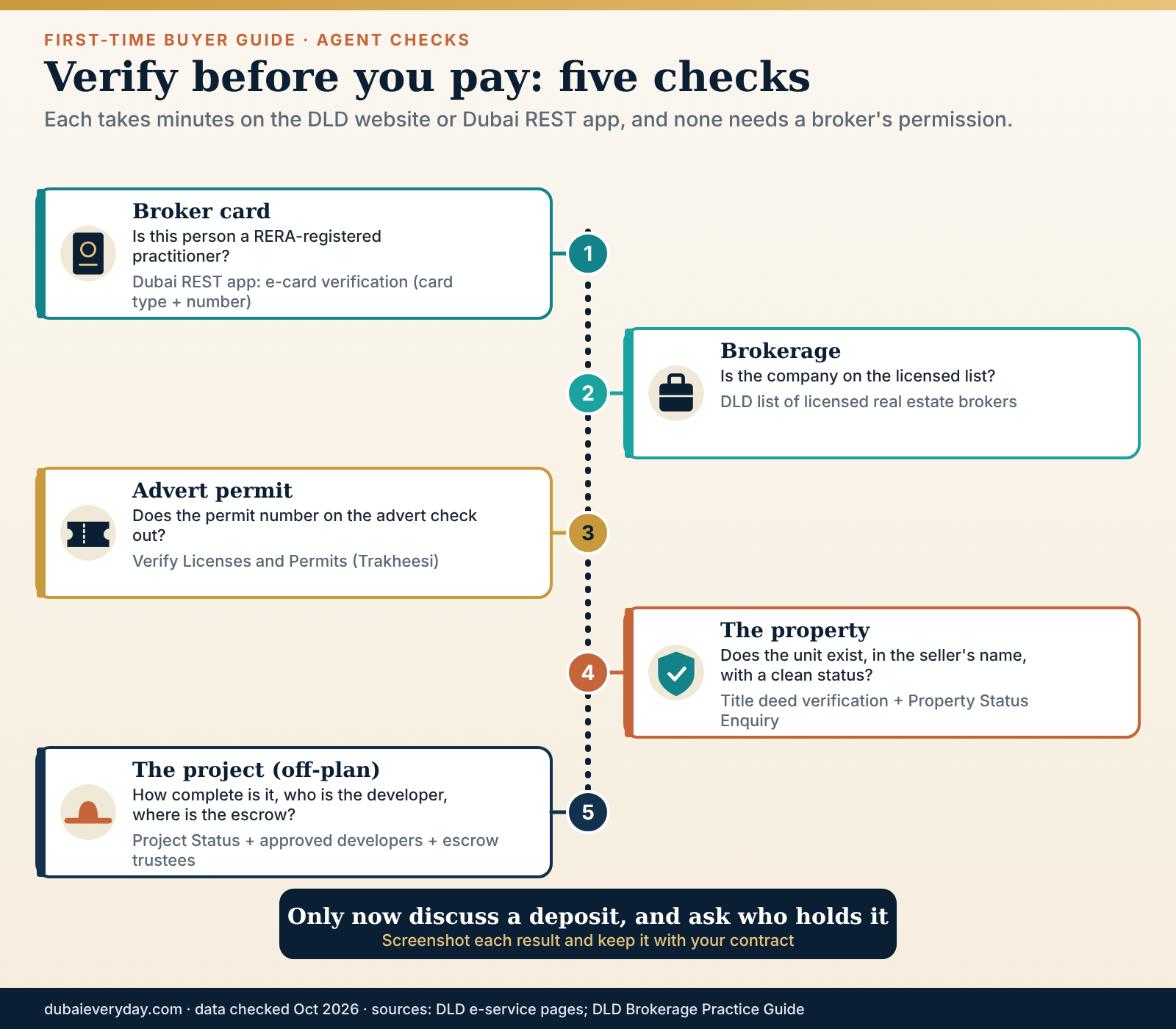
- Broker cardAsk for the card type and number, then run the e-card verification in the Dubai REST app. It confirms the card was issued by RERA to a practitioner in Dubai.
- BrokerageLook the company up in the DLD’s list of licensed brokers.
- Advert permitEnter the permit number from the advert in the “Verify Licenses and Permits” service. No permit number, no deal.
- The propertyUse the title-deed verification and Property Status Enquiry to confirm the unit exists, its status and that the seller’s papers match.
- The project (off-plan)Check the Project Status Enquiry for completion percentage, then the DLD’s lists of approved developers and escrow trustees.
The DLD pages say these tools return “the required information” but do not list every field, so use them as confirmation of identity and status. They do not tell you whether the price is fair or the building is sound.
Who is on your side?
A broker is paid when the deal completes, usually by commission, which makes them a guide to the market but not a neutral adviser. Ask three plain questions. Who pays you, and how much? Are you acting for the seller as well? Which of your answers can I verify? A good broker answers the third without discomfort.
For a first time buyer Dubai property purchase that includes a mortgage, many buyers also use an independent mortgage adviser or a lawyer for the contract. That is a choice, not a legal requirement, and we do not recommend any named firm. If you want a deal reviewed, pay a licensed professional who has no share in the commission.
Pause the deal if you are asked to pay a deposit into a personal account, if an advert has no permit number, if the price is far below comparable flats, if someone promises guaranteed returns, if the seller will not let you verify the title, or if you are pushed to sign “today”. Real flats are still there next week.
Search, shortlist and due diligence
Searching feels like the fun part, which is why it deserves rules. Decide the route first, because it sets how much a bank will lend and what you can inspect.
Ready, resale or off-plan?
A resale flat is built, can be inspected and is eligible for the first-home ceiling of 80% for an expatriate under AED 5 million. An off-plan unit is cheaper to start, often on a staged payment plan, but the Central Bank’s limit for off-plan purchases is 50% and you carry delivery risk. Developers register the sale in the provisional register within 90 days of signing, with the same 2% and 2% registration fees, and the DLD page shows payment can come from the project’s escrow account.
Our default for a first time buyer Dubai property purchase is a ready unit. You can see it, test it, and the lender will fund a bigger share. Off-plan can suit someone with spare cash and a long horizon, provided the project passes the checks above. We could not verify buyer remedies for late handover, assignment rules or tranche funding, so read the sale contract and take legal advice before committing to a plan.
Compare like with like
Build a first time buyer Dubai property shortlist of three units in two or three buildings, and compare the price per square foot, floor, view, parking and service charge on the same basis. Ask the broker for recent registered sales in the same building and cross-check them against what neighbours are asking. We did not verify a public DLD tool that lists building-level sale prices for ordinary buyers, so ask where the broker’s figures come from. Our guide to living in Downtown Dubai shows how much daily convenience, parking and building fees vary inside a single district.
First time buyer Dubai property due-diligence checklist
- Verify the title deed on the DLD service, then confirm the seller’s name, the unit number and whether it is in a freehold area (see the freehold guide for what that means for ownership).
- Run the Property Status Enquiry and ask whether the unit has a mortgage; a seller’s mortgage must be settled before the NOC can be applied for.
- Compare the seller’s stated service charge with the DLD Service Charge Index for that project, use and year.
- Ask for a clearance showing no service-charge arrears. Under Law No. 6 of 2019, a unit may not be disposed of until the charges are paid.
- Confirm the parking space and storage are registered with the unit. The law treats allocated car parks as part of the unit.
- Check whether the unit is tenanted and how the tenancy ends. If you plan to move in yourself, get a lawyer to review the timing.
- Ask for the building’s completion date, because the developer’s ten-year structural liability under the law runs from the completion certificate.
None of these first time buyer Dubai property checks guarantees a flawless purchase. It removes the avoidable surprises, and it costs a few hours.
Offer, Form F and the deposit
Once a unit survives your checks, you make an offer. Price is only one of the terms. For a first time buyer Dubai property deal the clauses that decide whether you get out safely are the ones about mortgage approval, valuation, deposit handling and completion date.
Negotiate with the valuation in mind
The valuer working for your bank may value the flat below the agreed price. Suppose you agree AED 1.2 million and the valuation comes in at AED 1.1 million. An 80% loan on AED 1.1 million is AED 880,000, not AED 960,000, so you must find AED 80,000 more in cash (our calculation). Ask for the offer to be conditional on mortgage approval at the agreed loan amount, and agree in advance what happens if the valuation falls short: the seller reduces the price, you cover the gap, or either side may withdraw.
Cash buyers hold a stronger hand on speed. A seller who needs a quick, certain completion may accept less from a buyer who is already pre-approved or paying cash. That is a negotiating observation, not a rule.
What Form F is
Form F is the electronic sale agreement between seller and buyer, issued through the DLD’s brokerage contract system. Bayut, whose legal-steps page was updated on 12 October 2026, describes it as a witnessed memorandum of understanding usually signed at a registration trustee office, with a 10% security deposit paid and the deal then registered within 60 days. We could not find the 10% or the 60-day period on the DLD pages we read, so treat them as common practice and read your own contract.
Who holds the deposit, and when it comes back, is where a first time buyer Dubai property deal can go wrong. The Bayut wording is ambiguous on whether the deposit is returned or credited to the price. We also found no statutory cooling-off period on the DLD pages, so assume that signing commits you.
The clauses to read line by line
- The price, what is included (appliances, furniture, parking and storage) and the completion date.
- Which side pays the registration fee, the developer NOC and any clearance charges.
- What happens to the deposit if the mortgage is declined or the valuation falls short.
- The penalty if either side withdraws, and who decides.
- Whether the flat will be delivered vacant, and the state it must be in on transfer.
- How outstanding service charges and utility bills are cleared.
If you are in a dispute over a Form F, the practice guide says the parties can apply through Trakheesi for a meeting to try to reach an amicable settlement, and that otherwise they must go to the judicial authorities. That is slow. The cheaper protection is a clause you understood before signing.
The developer NOC
In a first time buyer Dubai property resale of a freehold unit, the DLD’s sale registration page lists a developer e-NOC obtained through the Dubai REST app as a required document. The developer sets the fee, and the DLD page gives no figure, so ask the broker and the building management what it will be and who pays. If the seller still has a mortgage, Bayut says it must be settled in full before the NOC can be applied for, which adds a step and a day-of-transfer dependency.
Inspection: what to test before you transfer
On a new flat you have a handover inspection against the sale contract. On a resale you are buying the unit as it stands, so the inspection is your only chance to spot problems before the title changes hands. Every first time buyer Dubai property inspection has one purpose: to put defects on the table while you still have leverage. Do it before the transfer day, not after.
What the law gives you, and what it does not
Under Article 40 of Law No. 6 of 2019 on jointly owned property, as published by the DLD, a developer remains liable for structural defects for ten years from the completion certificate and for defective mechanical, electrical, sanitary and sewerage installations for one year from handover. Our reading is that on an older resale unit the one-year installation warranty is long gone, and the structural clock is running from the building’s completion date, not from your purchase. Ask for that date.
For a resale, the practical protection is a written inspection report tied to your Form F, with a clause that lets you renegotiate or withdraw if the report finds major defects. We found no official register of inspection firms on the DLD pages we read, so judge a firm on a sample report, insurance, clear scope and independence from the seller and broker. We did not verify inspection fees; get a fixed quote based on the unit size.
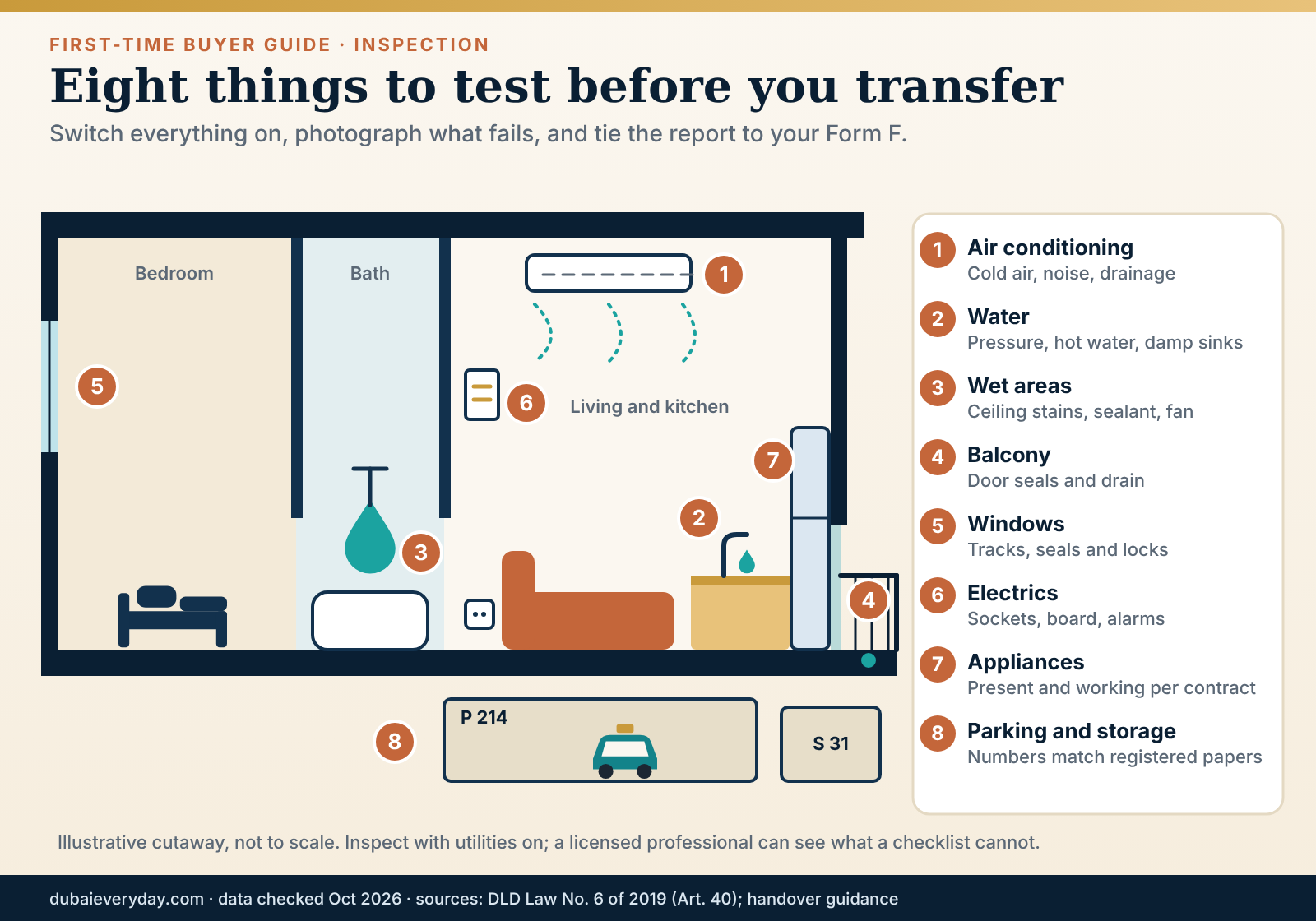
What to test, room by room, on a first time buyer Dubai property viewing
Run every test with the utilities switched on, and photograph anything odd. This is a checklist for you or for the inspector you hire; it is not a substitute for a professional’s eye on hidden structure and services.
- Air conditioning: switch each unit on and let it run for 20 minutes. Check cold air, noise, drainage and the thermostat, and ask what the cooling bill has been.
- Water: open every tap and shower together to test pressure, check hot water, and look under sinks for damp or corrosion.
- Bathrooms and kitchen: look at ceilings for stains, grout and sealant for gaps, and the extractor fan for airflow.
- Balcony and windows: test door seals, sliding tracks and balcony drainage, since heavy rain exposes poor sealing.
- Electrics: test sockets, light switches, the distribution board and any smoke alarm, and ask whether alterations were approved by the building.
- Appliances and fittings listed in the sale contract: confirm they are present and work.
- Parking and storage: check the numbers on the bay and storeroom match the registered documents.
- Noise and light: visit at a different time of day and on a weekday evening to judge traffic, neighbours and construction.
New-build handover
On a new unit in a first time buyer Dubai property purchase, compare what you see with the sale and purchase agreement and record every defect in writing at the handover. Bayut’s handover guide advises keeping the contract, payment receipts, Oqood or title documents, the snagging report, defect records, key and parking records and appliance warranties. Keep them in one folder. They are your evidence if a defect claim ever reaches the developer.
Transfer timeline and the first month
In a first time buyer Dubai property purchase the transfer day is short and the run-up is long. The DLD lists 20 minutes as the service time for sale registration at a registration trustee centre, and 20 to 25 minutes for mortgage registration. Almost everything that can go wrong happens in the weeks before, when approvals, valuations and documents wait on other people.
A planning calendar for a first time buyer Dubai property mortgage purchase
Bayut puts the whole purchase at about two to ten weeks, and longer with a mortgage. Our planning ranges are editorial estimates built around that figure: roughly three to six weeks for a cash purchase and six to ten for a mortgage, counted from signing the Form F. The list below follows the mortgage track. Nothing in it is an official deadline.
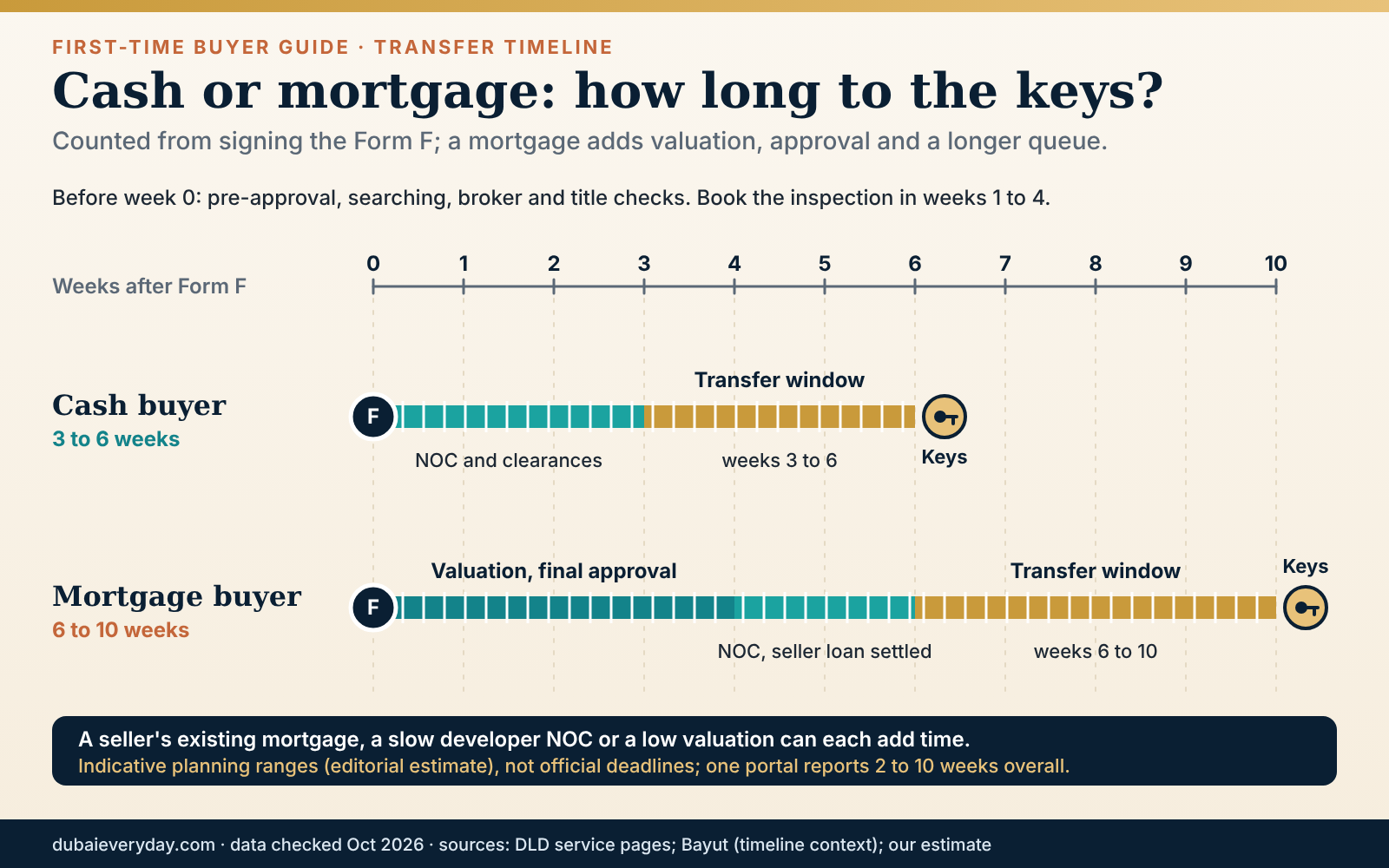
- Before you sign: pre-approval, searching and checksGet the lender’s written indication, run the broker, permit and title checks, and shortlist. Allow a few weeks.
- Week 0: Form F and depositSign with the mortgage-approval and valuation conditions written in.
- Weeks 1 to 4: valuation and final approvalThe bank values the unit and issues its final offer. Arrange the inspection now.
- Weeks 4 to 6: NOC and settlement of any seller mortgageApply for the developer NOC; the seller clears any existing loan.
- Weeks 6 to 10: transfer dayRegister the sale and the mortgage at the trustee centre and receive the e-title deed.
- After transfer: keys and utilitiesCollect keys, activate utilities and record the condition on day one.
What happens on transfer day
According to the DLD page, you present your Emirates ID (or a passport if you are a non-resident foreigner) and the developer e-NOC for freehold property. The trustee’s employee enters the data, an audit follows, and you pay by ePay, Dubai Pay, Noqodi wallet or manager’s cheque. The outputs are an electronic title deed and electronic map. For a mortgage, the bank submits the mortgage documents, and the DLD charges 0.25% of the loan plus fixed fees.
Practical points we infer from the payment methods: ask the trustee office in advance for the exact amounts and payees, order manager’s cheques to those names, and keep a buffer in your account for card or wallet payments. If a cheque has the wrong name or amount, the day can slip. Also ask whether the NOC carries an expiry date.
After the title deed
The first month after a first time buyer Dubai property transfer is administrative, and it protects what you have bought.
- Verify your new title deed in the DLD title-deed verification service and keep the PDF in two places.
- Activate DEWA in your name. Secondary sources report a refundable deposit of AED 2,000 for an apartment and AED 4,000 for a villa; DEWA’s own page could not be read, so confirm the amount on screen.
- Set up the service-charge payment with the building’s management and keep receipts, because arrears block a future sale.
- Insure your contents. Under Article 41 of Law No. 6 of 2019 the management entity insures the building itself, with the premium recovered through service charges.
- Photograph the condition of the flat on day one, including meter readings.
- If you plan to let the flat, read our guide to calculating Dubai property ROI before you price it.
Four first time buyer Dubai property cases, worked through
These four first time buyer Dubai property cases are illustrations of the arithmetic, not real people or market quotes. They use the rules and fee assumptions above.
A. The salaried mortgage buyer
Earns AED 22,000 a month gross and buys a AED 1.2 million resale with an 80% loan. The instalment is about AED 5,895 at 5.5%, which is 26.8% of income, and AED 7,094 at a 7.5% test rate, or 32.2%. Cash needed is AED 338,065. Six months of instalment plus service charge adds about AED 42,900 of reserve, so AED 380,000 is the comfortable figure, not AED 338,000.
B. The cash buyer
Buys a AED 700,000 studio with savings. Registration is AED 28,000, trustee AED 4,200, small fees AED 520 and a 2% broker commission with VAT AED 14,700, for AED 47,420, or 6.8%, on top. No bank fees, and the timeline can run toward the short end. The cost is opportunity: that cash is tied up. Read our studio guide for the space and building trade-offs.
C. The off-plan buyer
Looks at a AED 1.5 million off-plan unit. Registration at 4% is AED 60,000 plus AED 20 in small fees. A completed-unit mortgage limited to the 50% off-plan ceiling would be AED 750,000, with an instalment of about AED 4,606 at 5.5%, so AED 750,000 plus fees must come from the payment plan and savings. How a lender applies the limit at handover varies; ask in writing.
D. The buyer with a car loan
Earns AED 15,000 a month. With no other debts the 50% limit gives AED 7,500 of repayment room, supporting roughly AED 1.01 million at a 7.5% test rate. A AED 2,000 car instalment cuts that to roughly AED 744,000. The seven-times-income rule would allow AED 1.26 million, but it is not the one that binds.
The pattern: the cash need drives a first purchase more often than the price, and existing debt drives the loan more often than income. A first time buyer Dubai property plan that starts with those two numbers rarely collapses at the bank.
Mistakes and red flags in a first time buyer Dubai property purchase
Most of the avoidable trouble in a first time buyer Dubai property purchase comes from a short list of habits. None needs expertise to fix, only discipline about the order of events.
- Shopping before sizing: viewing flats above what the debt-burden test allows, then discovering the ceiling after you have an emotional favourite.
- Counting the deposit as the budget, and forgetting that registration, commission and bank charges arrive as cash, not as part of the loan.
- Trusting a broker’s word instead of the DLD card, permit and title checks.
- Signing the Form F without reading the deposit, mortgage-condition and withdrawal clauses.
- Skipping the inspection on a resale because the flat “looks fine”.
- Ignoring service charges, which can differ sharply between buildings and are checkable in the DLD index.
- Buying for a three-year stay, then paying entry and exit fees twice.
- Using up the first-time buyer programme on a deal that was never compared with the open market.
- Leaving no reserve, so the first service-charge invoice or AC repair becomes a loan.
You cannot verify who is receiving your deposit, the seller or developer will not confirm the title or escrow account in writing, or a lender or adviser promises an outcome. Nothing in this guide is a substitute for a licensed adviser who has read your documents.
First time buyer Dubai property FAQ
How much cash does a first time buyer Dubai property purchase need?
On a AED 1.2 million resale with an 80% mortgage, our calculation puts completion-day cash at about AED 338,000, or 28% of the price. That is the AED 240,000 down payment plus about AED 98,000 of registration, trustee, mortgage registration, broker, bank and valuation costs. A cash purchase of the same flat needs less in fees. Add a reserve for moving, furniture and the first months of running costs.
Can an expat get a first time buyer Dubai property mortgage?
Yes, residents can, within the Central Bank rules: up to 80% of value for a first, owner-occupied home below AED 5 million, 70% above, a 25-year maximum term and total debt repayments capped at 50% of income. Each bank sets its own documents, rates and approval criteria. Non-resident buyers face different bank policies, so read our guide on buying Dubai property as a foreigner.
Who qualifies for the DLD First-Time Home Buyer Programme?
According to the DLD page, UAE residents aged 18 or over who do not own freehold residential property in Dubai and are seeking a property valued below AED 5 million. Registration is free, and you receive a QR code if eligible. You need no mortgage to join. Status ends permanently once you buy under the programme, and benefits can be used with one developer and one bank.
Does the buyer have to pay the whole 4% DLD fee?
The DLD sale registration page lists 2% for the seller and 2% for the buyer, yet buyers commonly agree to pay the full 4%. It is a negotiating term, not a law of nature. Put the agreed split in the Form F, and remember that the trustee fee, title-deed fee and map fees are charged on top.
Can I use a personal loan or credit card for the down payment?
A legal Q&A published by Khaleej Times on 30 August 2026 cites Central Bank resolution 96 of 2019: the down payment should come from the borrower’s own resources, not from personal loans or credit cards. The DLD programme page separately describes instalment plans for registration fees on eligible cards. Ask your lender in writing which costs the rule covers.
How long does a first time buyer Dubai property transfer take?
The registration itself takes about 20 minutes at a trustee centre, according to the DLD. The whole process usually takes two to ten weeks, according to Bayut, and longer with a mortgage. Our planning ranges are three to six weeks for cash and six to ten for a mortgage, counted from signing the Form F. A seller’s mortgage or a slow NOC can add time.
Do I need a lawyer for a first time buyer Dubai property deal, or is a broker enough?
Neither is mandatory for a standard resale, because the sale is completed through a registration trustee centre. A broker helps you find and negotiate, but is paid on completion. A lawyer reviewing the contract, title and any mortgage terms is an extra cost many first-time buyers consider worthwhile, especially for off-plan, joint ownership or unusual clauses. Choose someone licensed and paid by you, not by the deal.
How do I check that a broker is licensed?
Ask for the broker’s card type and number and run the e-card verification in the Dubai REST app. Look the company up in the DLD’s licensed brokers list, and check the advert’s permit number in the Verify Licenses and Permits service. All three are open to every residency status and return results immediately, according to the DLD pages. Keep screenshots.
Is off-plan safer or riskier for a first time buyer Dubai property purchase?
It is different, not safer. Off-plan lets you pay in stages, but the Central Bank’s off-plan loan-to-value limit is 50%, you cannot inspect the finished unit, and you depend on the developer delivering. Check the project’s status, licence and escrow account on DLD tools, and pay only into the escrow account. We could not verify late-delivery remedies, so get legal advice on the contract.
What is Form F?
It is the electronic agreement to sell a property between seller and buyer, as the DLD practice guide describes it. It records the price, deposit, completion date and conditions. Read it as a binding commitment and negotiate mortgage, valuation and withdrawal terms before you sign. Disputes go to a DLD meeting through Trakheesi first and then to the courts.
Do I need an inspection on a resale flat?
It is not a legal requirement, but a resale gives you no developer handover process, and the one-year installations warranty under Law No. 6 of 2019 has usually expired. An independent inspection before the transfer, tied to a renegotiation or withdrawal clause, is the practical safeguard. Fees vary, so get a fixed quote for the unit size.
Where to go next
Sources and further reading (25 links)
- Dubai Land Department: First-Time Home Buyer Programme for eligibility, benefits, partners and limits
- Dubai Land Department: Property Sale Registration for registration fees, trustee fee, documents and steps
- Dubai Land Department: Mortgage Registration for mortgage registration fees and process
- Dubai Land Department: Register the Initial Sale (off-plan) for provisional registration fees and the 90-day rule
- Dubai Land Department: Real Estate Brokerage Practice Guide for broker licensing, contract forms, permits and escrow
- Dubai Land Department: Broker e-card verification for checking broker cards
- Dubai Land Department: Verify licences and permits for advert permit checks
- Dubai Land Department: Licensed real estate brokers for the broker list
- Dubai Land Department: Title deed verification for confirming a title deed
- Dubai Land Department: Property status enquiry for checking a unit’s status
- Dubai Land Department: Project status enquiry for off-plan completion percentage
- Dubai Land Department: Service Charge Index for approved service fees by project
- Dubai Land Department: Approved escrow account trustees for the escrow trustee list
- Dubai Land Department: Approved real estate developers for the developer list
- Dubai Land Department: Registration trustee centres for finding a trustee office
- Dubai Land Department: Rental Index for average rents by area
- Dubai Land Department: Law No. 6 of 2019 on jointly owned property for warranties, service charges, parking and insurance
- Central Bank of the UAE Rulebook: Mortgage loan ratios for loan-to-value, debt burden, term and income multiples
- The National: UAE property mortgages and fees for the ban on financing registration and broker fees (press)
- Khaleej Times: Personal loan for a mortgage down payment for the own-resources rule (legal Q& A; press)
- Bayut: Legal steps to buy property in Dubai for Form F practice and timelines (portal; context only)
- Bayut: Dubai property handover for the handover document list (portal; context only)
- Emirates 24|7: Dubai real estate transactions in nine months for headline market totals (press)
- FAM Properties: Dubai real estate report for a DLD-derived September sales count (aggregator; context only)
- Huspy: Monthly mortgage rates UAE for indicative rate ranges (broker page; context only)
Update log: 29 October 2026, first publication; facts re-checked against the sources above. Next review due by 29 January 2027, or sooner after any change to DLD fees, the First-Time Home Buyer Programme or Central Bank mortgage rules. Corrections welcome. This page is general information, not legal, financial or mortgage advice.
About DubaiEveryday and this guide
DubaiEveryday.com is an independent editorial project that publishes practical, research-based guides to everyday life in Dubai: where to live, what things cost, how the rules work and how to get around. This page was written and edited by the DubaiEveryday editorial team. It is not signed by a named expert, doctor, lawyer or adviser, and we do not claim first-hand testing of a venue, clinic or service unless the page says so.
Each guide is built from official sources such as government and regulator pages, operator websites and established news outlets, cross-checked where we can. When we could not confirm something, we say so in the text, and examples that use made-up numbers are labelled as illustrations. Mentions are editorial choices, not paid placements, and a link is not an endorsement.
Dubai changes quickly. If you spot something that is out of date or wrong, please tell us through the contact options on DubaiEveryday.com and we will check it and correct the page.