

Dubai property investment is no longer the one-way bet it looked like in 2025. This guide shows what the numbers, fees, lending rules and risks look like on 29 October 2026, so you can decide whether to buy, what to buy and how to leave.
Not long ago, buying a flat in Dubai was talked about as if it only went one way. Late 2026 asks for a calmer, more careful look. Sales slowed after the regional conflict that began in February 2026, prices have eased in several apartment markets, and new supply is still arriving through 2027.
That makes this a good moment to ask hard questions before any money moves. Does the rent cover the costs once you subtract fees? What happens if you need to sell in a quiet market? The guide on dubai property investment works through yields from gross to net, buying and selling costs, mortgage rules, area screening and exit planning. It is written to help you decide whether to buy at all, with no promise of any particular return.
Dubai property investment can still work in late 2026, but only if you treat it as a long-hold, cash-flow-first decision and not as a quick flip. Sales volumes fell sharply after the regional war that began on 28 February 2026, prices have drifted lower in several apartment markets, and new supply is arriving through 2027. That is a buyer-friendly negotiation climate and a seller-unfriendly exit climate at the same time.
Three numbers decide most Dubai property investment outcomes. Buying, holding and selling one ready flat can absorb about 18% of the price over five years (our worked example below). Net rental yield on a typical flat is far lower than the advertised gross figure. And with the Central Bank capping loans at 60% of value for an expatriate’s second or investment home, leverage cuts both ways.
This page covers the whole Dubai property investment decision: market data, fees, yield, financing, area selection, downside scenarios and exit. It does not repeat the paperwork steps of buying a home; for those, see our buying property in Dubai guide.
This is a research-based guide to Dubai property investment. Nobody at DubaiEveryday.com bought, sold, let or managed property for this article, and nothing here is field-tested. We read the Dubai Land Department (DLD) service pages, the Central Bank of the UAE rulebook, the UAE government portal and the published market reports of CBRE, Cushman and Wakefield, UBP, betterhomes, Cavendish Maxwell and fäm Properties, plus press coverage from Gulf News, Khaleej Times and Fortune. All were accessed on 29 October 2026.
Official pages are used for rules, fees and lending limits. Market reports and news are used only for context, and we say which tracker a number comes from because trackers disagree. Every worked calculation is labelled as ours and rests on stated assumptions, not on market statistics.
Not re-checked today: current mortgage pricing and EIBOR, holiday-home permit fees, and the Federal Tax Authority’s treatment of personal rental income. They are flagged where they matter. No broker, developer, lender or area is recommended or ranked, and inclusion was not paid for. This is general information, not individual financial, legal or tax advice. Speak to a licensed professional before committing money.
Dubai property investment in late 2026: the market snapshot
Any guide to Dubai property investment that ignores 2026 is out of date on arrival. Iran’s strikes on the UAE began on 28 February, according to an interview with the head of the Dubai Economic Development Corporation, and a US-Iran ceasefire took hold on 8 April. Tension has not gone away. On 1 October Gulf News described the conflict as in its 215th day with indirect talks continuing, UAE airports open and no attacks on UAE territory reported that day, while some regional flights were still being cancelled.
Dubai property investment took the hit in the numbers before it took it in the price. The figures below come from different trackers with different definitions, so for Dubai property investment treat the direction as reliable and the exact values as indicative.
What the transaction data says about Dubai property investment
Activity in Dubai property investment fell fast, then steadied at a lower level. Khaleej Times, reporting a fäm Properties analysis, put the first quarter at AED 176.7 billion from 47,996 sales, with off-plan at 70% of transactions. CBRE then counted just under 37,000 residential sales in the second quarter, down 29% on a year earlier, worth AED 88 billion against nearly AED 154 billion. Cavendish Maxwell reported AED 72.6 billion on about 34,000 transactions for the third quarter, down 47% in value and 38% in volume year on year.
Not every headline matches, and that is worth understanding. Emirates 24|7 reported AED 574.12 billion across 165,018 registered transactions for the first nine months, the second-highest nine-month total on record. The article does not name its source, and the total appears to cover all registered transactions, not only sales. A record “all transactions” total and a 44% fall in monthly sales can both be true. When you read a market headline, check whether it counts sales, all registrations, or value.
Resale has been the weakest part of Dubai property investment. In the second quarter, resale transactions fell 41.8% year on year against 23.1% for off-plan, according to Khaleej Times citing JLL. By September the fäm data shows 4,057 resale deals against 7,283 primary-market deals, and the page warns that “primary” does not simply mean off-plan. Cash dominates the resale market: the first-quarter report found 67% of resale deals were cash purchases. Thin resale volume is the practical meaning of “liquidity risk” in Dubai property investment.
Prices: four trackers, four answers
Prices for Dubai property investment have not collapsed, but the direction depends on whose basket you read. CBRE had citywide sale prices up 1.9% year on year in the second quarter. Cushman and Wakefield had them down 4% quarter on quarter. UBP calculated that price per square metre was down about 10% year to date to May, with off-plan down 10.8% and delivered units down 2.4%. betterhomes’ September medians were up 2.2% for apartments and 4.1% for villas and townhouses year on year.
The DLD-based median for September is AED 1,656 per square foot, down 2.0% year on year, with apartments at AED 1,675 (down 3.5%) and villas at AED 1,568 (up 15.5%, on a small sample of 836 sales that the page itself warns can swing with the mix of properties sold). Our reading of the data: apartments, especially investor-heavy ones, are where the correction sits, while family villas in established communities have held up better.
For anyone weighing Dubai property investment, the practical lesson is to price a specific unit against recent sales in its own building, not against a city average. The citywide figure is a mix of studios in JVC and mansions on the Palm.
Rents and the new-versus-renewal gap
Rents have cooled from a February peak, which matters to any Dubai property investment built on rental income. UBP measured new contracts down 4.8% since the peak and renewals up 3.1%, because renewals follow Dubai’s rent-increase rules and many tenants simply stay put.
CBRE had average rents down 2.6% year on year and 6.2% on the quarter. betterhomes reported median apartment rents down 3.8% between June and September, yet also reported its busiest leasing month since records began in January 2024.
These are the firm’s own enquiry data, so read them as a signal, not a statistic.
The DLD-based September medians show the gap directly: new apartment contracts at AED 70,000 a year and renewals at AED 60,000. If you are underwriting a Dubai property investment, the current tenant’s renewal rent and the market rent for a new tenant are two different numbers. Use the lower one for a cautious case.
Supply, lenders and the official view
Supply is the part of the Dubai property investment picture that moves slowest and matters most. Cushman and Wakefield counted more than 13,200 homes completed in the second quarter and expects about 32,000 more in the second half. UBP puts the pipeline at roughly 350,000 homes through 2030 while noting that historically at most half of such pipelines arrive on schedule.
S&P Global expects Dubai’s residential stock, especially apartments, to grow by about 20% over two years, with deliveries in 2027 and 2028 able to accelerate the correction in investor-driven apartment segments. S&P’s base case assumes war-related disruption continues into 2027.
Credit analysts are cautious but not alarmed. Fitch, as reported by Fortune on 1 June, now expects a larger correction than the 15% it forecast before the war, citing weaker economic activity, tourism and population growth. Moody’s flagged absorption risk if population inflows slow. S&P noted that Damac, Emaar, Omniyat and Sobha carry large revenue backlogs and limited payment delinquencies. A betterhomes report, source for the number not named, puts Dubai’s population at 4.8 million on 29 September, up about 227,000 since January.
Several analysts quoted above say the full effect of the war on prices will only be clear later. This guide cannot tell you whether prices will rise or fall next year, and nobody else can either. What it can do is show you which parts of a purchase survive a bad year and which do not. Anyone promising a guaranteed return from Dubai property investment right now is selling, not informing.
Is Dubai property investment right for your situation?
Start with the job you want your Dubai property investment to do, because the four common jobs pull in different directions. A flat bought for rental income wants a cheap price per square foot, a low service charge and a tenant pool that never dries up.
A flat bought for growth wants scarcity, which usually means paying more and earning less rent. A flat bought to qualify for residency wants a specific price tag. A flat bought to diversify out of your home currency wants easy exit.
No single unit does all four jobs well, which is why vague Dubai property investment plans disappoint.
Income first
For income-led Dubai property investment, you care about net rent after charges. Look at established, rentable communities, check the building’s service charge and expect modest growth. The risk is vacancy and rising charges.
Growth first
You accept thin rent for the chance of price gains, the riskiest style of Dubai property investment right now. This is the segment most exposed to new supply and to a weak resale market. Treat it as a bet, and size it as one.
Residency first
Property is the entry ticket in this style of Dubai property investment, so the purchase price and the rules matter more than yield. Verify the current threshold with the authorities before signing, because it has changed before.
Diversification first
You want an asset outside your home country. Cash buyers in ready, liquid buildings fit best. Remember the dirham is pegged to the dollar, so currency risk against your own money still exists.
Who should probably not buy
Three profiles struggle with Dubai property investment. The first is anyone who needs the money back within about three years. Transaction costs alone can eat that horizon, and the 2026 resale volumes show how long a sale can take when buyers go quiet.
The second is anyone who needs rent to cover a mortgage from month one on a thin yield. The third is anyone who is buying off-plan with money they will need for instalments and cannot comfortably lose. The Fortune report of 1 June described exactly this pattern: investors who bought off-plan expecting monthly rises and were left exposed when instalments came due.
If you are still deciding whether to live in Dubai at all, renting first is cheaper than starting a Dubai property investment wrongly. Our renting in Dubai guide and cost of living in Dubai guide show what a normal year costs before you tie up capital.
A readiness checklist for Dubai property investment
Before you look at a single listing for a Dubai property investment, answer these honestly. If two or more are a no, the right move is usually to wait.
- You can hold the property for at least five years without selling.
- You hold a cash reserve equal to at least six months of mortgage, service charge and maintenance, separate from the purchase money.
- The investment still works with 3 months of vacancy a year and rent 10% below today’s quote (we run this test in the yield section).
- You know how much a mortgage would cost at 1 to 2 percentage points above today’s offers and could still carry it.
- You have a plan for a bad exit: renting for longer, or selling at a discount.
- Your income and the property’s rent are not tied to the same shock (for example, a Dubai salary plus a Dubai flat).
The last point deserves a pause. In March 2026, flights stopped, schools moved to remote learning and some residents left for a period, according to the conflict timeline compiled on Wikipedia and the Dubai economic chief’s April interview. Someone with a Dubai job and a Dubai mortgage felt the same event twice. Our reading: diversification is the strongest argument for Dubai property investment if your income comes from somewhere else, and the weakest if it does not.
What this page covers, and what its siblings cover. This is the investor’s overview of Dubai property investment: whether to buy, how to judge returns, how to finance, where to look and how to exit. For the line-by-line yield formula, go to rental yield in Dubai. For a full ROI calculation including finance and sale costs, see how to calculate Dubai property ROI. For the buying paperwork, use buying property in Dubai, and for who may buy where, buying Dubai property as a foreigner.
The rules of Dubai property investment: freehold, regulators and what protects you
For Dubai property investment, foreigners can buy, but only in designated freehold areas, and the area you choose decides the kind of title you get. Before anything else, confirm that the exact community and plot are open to your nationality. The UK government’s guidance for buyers makes the same point: check that you may purchase in your chosen area, deal only with registered agents and take advice from a local lawyer. Our freehold property guide lists how title registration works and what to check on the title itself.
Who does what
Three public bodies and the developer matter to you. The Dubai Land Department registers ownership and publishes the digital services you will use. RERA, its regulatory arm, licenses brokers and approves service charges. The Central Bank sets the lending limits. And developers operate under an escrow regime for off-plan projects. The practical tools are all free to use on the DLD site or the Dubai REST app.
Registration
The DLD’s property sale registration service records the sale and issues an electronic title deed. It is completed at a Real Estate Registration Trustee centre or through Dubai Now, and the DLD lists about 20 minutes of service time for the transaction itself.
Broker licensing
RERA-licensed brokers appear in a searchable list on the DLD site and Dubai REST app. If an agent is not on it, stop. The UK guidance also warns that freelance agents are illegal.
Service charges
Charges are approved by RERA and published in the DLD’s Service Charge Index by project and year. You can multiply the AED per square foot figure by the area on your title deed before you buy.
Escrow
For off-plan projects the DLD runs an escrow account service, so buyers’ instalments are held against construction. It reduces one risk. It does not guarantee the market value when the keys arrive.
The tools we would use in the first hour
You can check a surprising amount of a Dubai property investment without speaking to anyone. The DLD’s Verify Title Deed service confirms that a title deed is valid. The Property Status Enquiry service lets you look up a property by area and land number. The Rental Index calculates the rental increase and the average rent for an area from the contract end date, property type, number of bedrooms and current rent. The Service Charge Index shows the approved charge. All four list their residency status as open to everyone.
Use them in this order: broker licence, then title deed, then service charge, then rental index. Each one removes a category of unpleasant surprise, and none costs anything but ten minutes. The sources box at the end links each service directly.
What does not protect you
Registration protects title in any Dubai property investment. It does not protect value. A perfectly registered flat can still lose 20% of its price, sit empty for six months or carry a service charge that rises faster than rent. Nor does escrow cover a developer’s marketing promises about “guaranteed rental returns” or “assured resale”. If a promise matters, it has to be in the sale and purchase agreement in plain terms, and you should have it read by a lawyer licensed in the UAE.
Dispute resolution in Dubai property investment is slower than most people expect. The UK government’s guidance notes that complaints to RERA can take many months, and sometimes years, and that a foreign embassy cannot intervene in private legal disputes. That is not a reason to avoid Dubai. It is a reason to spend money on a lawyer before the deposit, not after the problem.
Who pays the 4%?. The DLD’s fee schedule lists 2% payable by the seller and 2% by the buyer. In resale deals, market practice often puts the whole 4% on the buyer, according to a betterhomes cost guide, unless the agreement says otherwise. It is negotiable and you should know the answer before you make an offer. The agreement between the parties, typically on the standard memorandum of understanding known as Form F, should show who pays what.
What Dubai property investment really costs: buy, hold, sell
The sticker price is the smallest honest number in a Dubai property investment. Friction costs arrive in three waves: on the day you buy, every year you hold, and on the day you sell. Most online comparisons of Dubai property investment quote only the first wave, which is why advertised returns look better than owner statements.
Day one: the cost of buying
The DLD’s own fee schedule for property sale registration lists a fee of 2% of the sale value for the seller and 2% for the buyer, a title deed issuance fee of AED 250, map fees (AED 250 for apartments and villas on the page), small knowledge and innovation fees of AED 10 each, and a service partner (trustee) fee of AED 4,000 plus VAT for sales of AED 500,000 or more, or AED 2,000 plus VAT below that.
A betterhomes cost guide, a market source rather than an official one, adds the usual agent commission of 2% plus 5% VAT and notes that the developer’s no-objection certificate (NOC) fee is set by the developer and can run to several thousand dirhams.
| Cost on a resale purchase | Amount | Basis |
|---|---|---|
| DLD transfer fee | 4% of price (2% each side on paper) | DLD service page; buyer often pays all of it |
| Trustee (service partner) fee | AED 4,000 + VAT at AED 500,000 or more; AED 2,000 + VAT below | DLD service page |
| Title deed, map, small fees | About AED 520 on an apartment | Our sum of DLD line items |
| Agent commission | Typically 2% + 5% VAT | betterhomes guide; negotiable |
| Developer NOC | Set by developer; one cited example up to about AED 5,000 | betterhomes guide |
| Mortgage registration (if borrowing) | 0.25% of loan + AED 4,000 + VAT | betterhomes guide |
| Bank valuation | AED 2,500 to 3,500, sometimes plus VAT | betterhomes guide |
Two traps hide in this list of Dubai property investment costs. The registration fee jumps at AED 500,000, so a flat at AED 499,000 and one at AED 501,000 carry different trustee fees. And lenders’ own arrangement fees vary by bank, so we did not find a single published figure. In our worked example below we allow 1% of the loan as a placeholder; replace it with the quote you actually receive.
No stamp duty applies to property purchases in Dubai, according to the same cost guide. That is a relief, and it is easy to mistake for “no tax”. The 4% registration fee is the closest equivalent, and it is bigger than most countries’ purchase taxes at the price points where Dubai investors usually buy.
Every year: the cost of holding
Holding costs are the quiet part of Dubai property investment. The first is the service charge: an approved AED-per-square-foot rate multiplied by the unit’s area on the title deed, covering security, cleaning, maintenance contracts, insurance, utilities of common areas and a reserve. RERA approves the budget after review by an approved auditor, and management companies should not collect charges until it is approved, according to the DLD’s FAQ. Look the building up in the Service Charge Index before you offer, not after.
The second is vacancy, which quietly drags down Dubai property investment income. Between tenants a flat earns nothing but still carries its service charge and any cooling or utility bills. The third is repairs and replacement: air-conditioning units, appliances, repainting between tenants.
The fourth is management, if you do not handle letting yourself. And the fifth is anything specific to the building, such as district cooling connection deposits. The betterhomes guide lists chiller activation charges and refundable deposits at the start of a tenancy that can be material for an owner who is also the first occupant.
For the worked example we assumed a 750 sq ft apartment, an approved service charge of AED 15 per square foot (illustrative, not a market statistic), one month of vacancy a year, maintenance reserve of 0.3% of price and management at 5% of rent. Those are our assumptions, and you should replace each one with a quote for the building you are considering.
Exit day: the cost of selling
Selling costs in Dubai property investment are mostly an agent and paperwork. A seller’s agent commonly asks for 2% plus VAT, which we use in the example. The developer’s NOC may cost several thousand dirhams. If you have a mortgage, early settlement is capped by the Central Bank at 1% of the outstanding balance or AED 10,000, whichever is lower, following its October 2019 amendment, and the bank will also want its own paperwork. Remember the 4% DLD fee may also be negotiated onto the seller in a weak market.
Putting it together on a AED 1.5 million flat
Our worked Dubai property investment example buys one ready AED 1.5 million flat with cash, holds it for five years and sells it at the same price. The buying costs are AED 96,220, which is 6.4% of the price: AED 60,000 DLD fee, AED 31,500 agent (2% plus VAT), AED 4,200 trustee fee including VAT and about AED 520 in title and map fees. Over five years the holding costs we modelled add AED 143,750, including lost rent from vacancy. Selling adds AED 36,500: AED 31,500 agent plus a AED 5,000 allowance for the NOC.
The total for this Dubai property investment is AED 276,470, or 18.4% of the purchase price. Another way to read it: the net rent in the example is AED 68,750 a year, so buying costs alone take 1.4 years of net rent to earn back.

The break-even point is the useful output of this Dubai property investment example. Counting the example’s net rent but ignoring the time value of money, a cash buyer gets back every dirham if the flat sells for about AED 1.28 million after five years, roughly 14% below the purchase price. A rent that arrives is cushioning the fall. But that cushion exists only if the flat is let at the assumed rent for most of the five years, and, as the next section shows, that is not a safe assumption.
Our rule of thumb. Before you offer, write down the three costs you do not know yet: the exact service charge, the exact developer NOC fee and the lender’s arrangement fee. If any of them cannot be found in an hour, the price you are being asked to pay is not yet a price.
Rental yield: from gross to net
In Dubai property investment, gross yield is annual rent divided by price. Net yield is what is left after the property’s running costs, divided by the price you actually paid. The gap between them is where Dubai property investment disappoints people, because advertised yields are almost always gross and almost always based on asking rents. For the full formula set, including finance and sale costs, see our guides on rental yield in Dubai and how to calculate Dubai property ROI; this section shows the investor’s version.
The formula we use for Dubai property investment is simple: net yield equals annual rent, minus vacancy, service charge, maintenance and management, divided by the price paid. If you want to be strict, add your buying costs to the denominator, which gives a yield on total cash invested.
The worked example
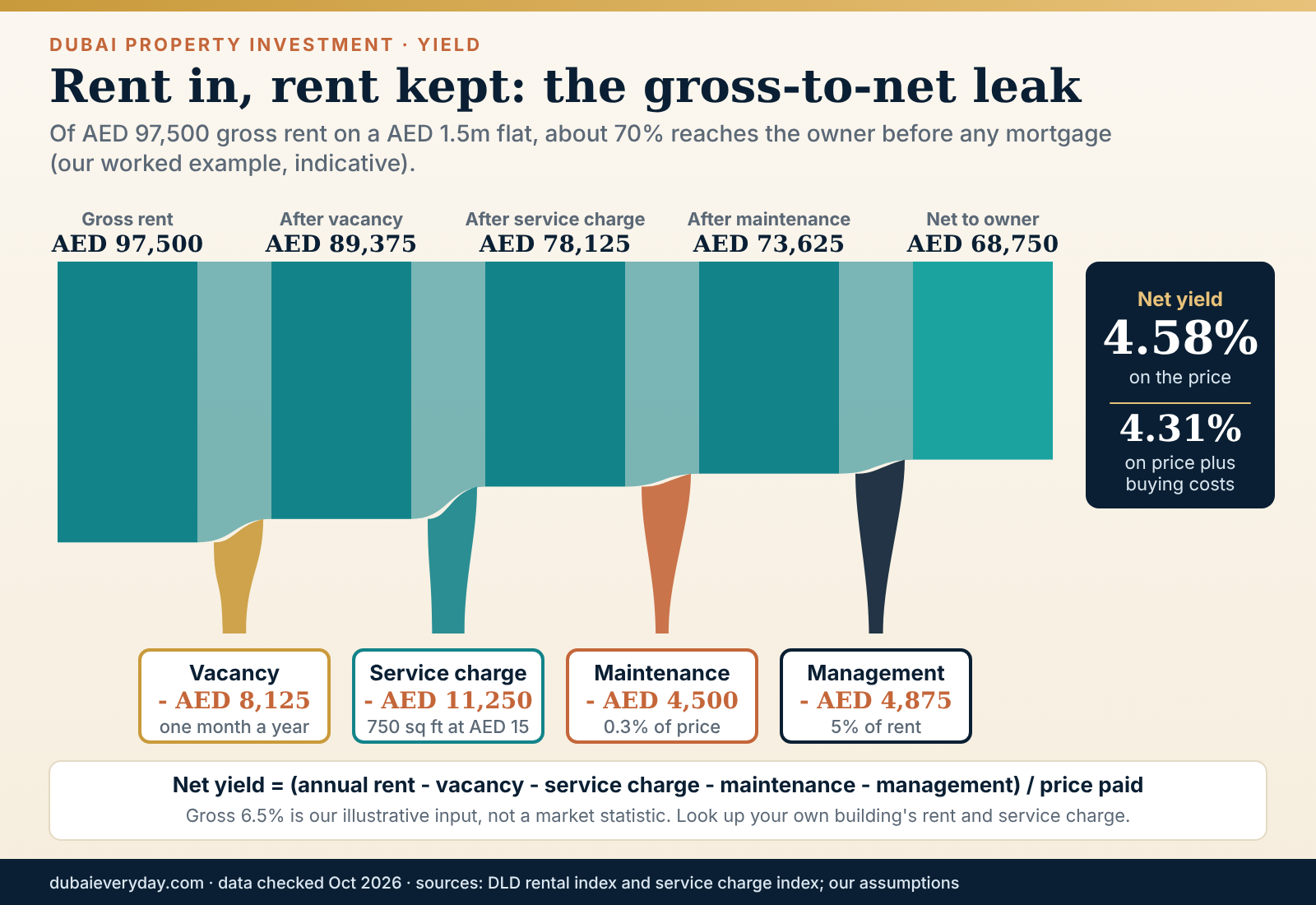
Take the same AED 1.5 million, 750 sq ft apartment as our Dubai property investment example. We assume a gross yield of 6.5% for illustration, which gives AED 97,500 of annual rent. That figure is our input, not a market statistic; the DLD’s own pages do not publish yields, and fäm Properties states explicitly that yield is not calculated by dividing rent medians by unrelated sales medians.
From the rent we subtract one month of vacancy (AED 8,125), a service charge of AED 15 per square foot (AED 11,250), maintenance at 0.3% of price (AED 4,500) and management at 5% of rent (AED 4,875).
That leaves AED 68,750, or 70.5% of the gross rent. The net yield is 4.58% on the price, and 4.31% on the price plus AED 96,220 of buying costs. Put plainly, a 6.5% gross yield is a 4.3% to 4.6% real yield before any mortgage. That is the number to compare with other uses of your money.
How sensitive is the result?
Small changes in inputs move the answer a lot, which is why we prefer a range to a point. Holding the other assumptions steady, a gross yield of 5.0% becomes a net yield of 3.28%. At 5.5% gross it is 3.72%, at 6.0% it is 4.15%, at 7.0% it is 5.02% and at 7.5% it is 5.45%. In other words, you lose roughly 1.7 to 2.0 percentage points between gross and net in this example, and the loss grows when the service charge is high relative to rent.
Service charge is the biggest single lever in Dubai property investment yields. Raise it from AED 15 to AED 25 per square foot, a plausible gap between a newer and an older tower but still our illustration, and the net yield drops from 4.58% to 4.08%, about half a percentage point. Charges are approved by RERA and published by building in the DLD’s Service Charge Index, so there is no reason to guess.
Now the cautious case, which we recommend as your base case for Dubai property investment if you are uncertain. Cut the rent by 10% and assume three months of vacancy a year instead of one. Gross rent becomes AED 87,750, vacancy AED 21,938, and the net income AED 45,675. The net yield falls to 3.05%. If your Dubai property investment only works at 6.5% gross with full occupancy, it does not work, it merely has not been tested.
Rent rules limit your upside, not just your downside
Landlords in Dubai property investment cannot raise rent whenever they like. The DLD’s FAQ says that where a rise is based on the Smart Residential Rent Index, the increase depends on the gap between the current rent and the average market rent for that kind of property, in a range of 0% to 20%, and that the owner must give three months’ notice.
It also says the index is indicative for a new lease and becomes mandatory when the parties disagree on the increase at renewal. If either side wants to change the rent or terms, the other must be notified at least 90 days before the contract ends, unless both agree otherwise.
Eviction rules also matter for a Dubai property investment with an exit date. The same FAQ says a landlord who wants the property back for personal use, sale or demolition must give at least 12 months’ notice, through a notary public or registered mail. Selling a tenanted flat is therefore a slower process than selling an empty one, and many buyers prefer vacant possession. Our tenant rights in Dubai guide explains the tenant’s side of these rules, which is useful when you are negotiating renewals.
Two further data points help calibrate expectations. UBP found new contracts down 4.8% from the February peak while renewals were up 3.1%, and the DLD-based September medians show new apartment rents at AED 70,000 against AED 60,000 for renewals. A sitting tenant is not automatically a below-market tenant, but the market gap can work in your favour if you are buying with an existing contract. It can work against you if you are buying to re-let at a rent the building no longer commands.
A seven-step yield audit
- Find the real rentUse the DLD Rental Index with the area, bedrooms and current rent, and ask the agent for the current Ejari contract rather than an advertised figure.
- Look up the service chargeUse the DLD Service Charge Index for the building and year, then multiply by the area on the title deed.
- Apply vacancyUse at least one month a year, and three months for the cautious case.
- Add a maintenance reserveWe used 0.3% of price a year; older buildings and villas deserve more.
- Add management and letting feesGet the agent’s fee in writing, including renewal and re-let charges.
- Compute net yield on price and on total cash investedInclude the buying costs in the second calculation.
- Compare with your cost of moneyCompare it with the mortgage rate if you are borrowing, and with your best alternative if you are not.
If the result is a net yield of 4% to 5% and you are fine with that, the property may still be a good choice for stability or for the residency benefit. If you were told it would be 8%, ask the person who said so to show you the calculation. Our approach is not to doubt that some units yield more. It is to insist that the working is visible, line by line.
Financing a Dubai property investment: mortgage rules and leverage maths
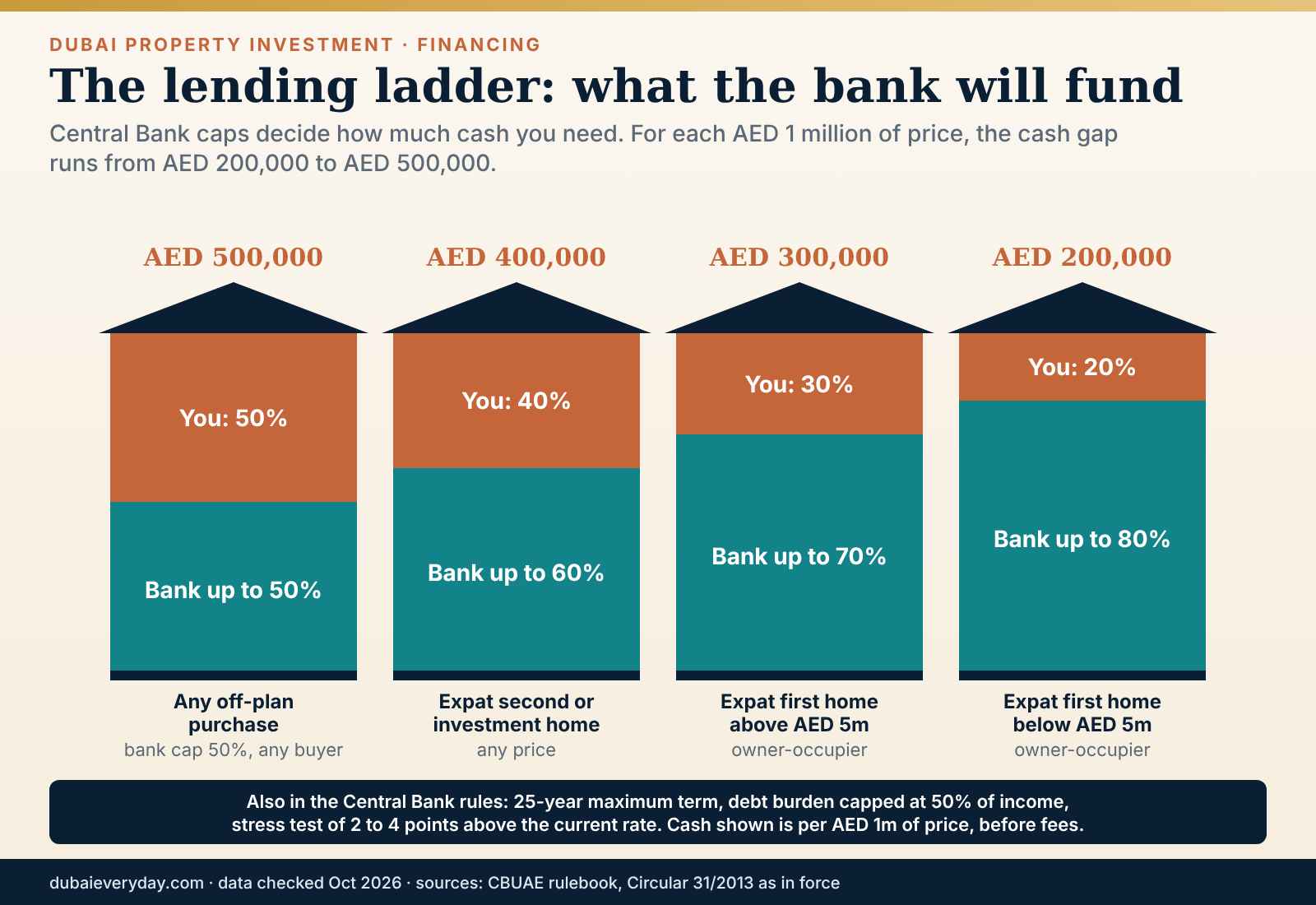
Borrowing changes the shape of the risk in Dubai property investment more than the size of the return. The Central Bank of the UAE’s mortgage rules, in force under Circular 31/2013 as shown in its rulebook, set the ceilings. For an expatriate buying a first home, the loan can reach 80% of value if the property is below AED 5 million and 70% above. For a second or investment home, the cap is 60% whatever the price. For any off-plan purchase the cap is 50%, regardless of buyer or purpose. UAE nationals have higher caps.
The financing rules beyond loan-to-value
Four other limits shape what you can actually borrow for Dubai property investment. The maximum term is 25 years, though each lender sets its own maximum age at the end of the loan. Total debt repayments are capped at 50% of gross salary and any regular income from a defined, specific source.
Lenders must stress-test mortgages at 2 to 4 percentage points above the current rate, depending on the rate cycle. And for investment property, as we read the rulebook, lenders must deduct at least two months of rental income in the debt-burden calculation. Total financing is also limited to a multiple of annual income, seven years for expatriates according to the rulebook.
The practical effect: a 60% loan on a AED 1.5 million flat means AED 900,000 of debt and AED 600,000 of your own money, plus fees. Our example uses AED 96,220 of purchase costs and AED 18,450 of mortgage costs: DLD mortgage registration (0.25% of the loan plus AED 4,000 and VAT, AED 6,450 in total), a AED 3,000 valuation and a 1% arrangement-fee placeholder (AED 9,000). Total cash needed is AED 714,670.
What we could not verify about rates
We could not retrieve current bank rate cards or the three-month EIBOR benchmark today, so we do not quote a rate as “the market”. One data point exists: on 26 August 2026 Khaleej Times reported that ADCB and the developer Ellington offered pre-approved off-plan finance of up to 50% of value from 3.49% a year fixed for three years, “for a limited period”, with processing and valuation fees waived.
That is a promotional, developer-linked offer. For the maths below we use 4.5%, 5.5% and 6.5% as an illustrative stress band, not as a quote, and you should replace it with a written offer from a bank.
The leverage maths for a Dubai property investment, on the same flat
Borrow AED 900,000 over 25 years and the monthly payment is about AED 5,002 at 4.5%, AED 5,527 at 5.5% and AED 6,077 at 6.5%. Year-one interest is about AED 40,100, AED 49,100 and AED 58,100. Our worked example’s net rent is AED 68,750. After debt service, annual cash flow is therefore about plus AED 8,720 at 4.5%, plus AED 2,430 at 5.5% and minus AED 4,170 at 6.5%. On AED 714,670 of invested cash, that is a cash-on-cash return of 1.2%, 0.3% and minus 0.6%.
Read the pattern. The net yield on the flat (4.58%) is lower than a 5.5% mortgage rate. This is called negative carry: each borrowed dirham costs more than it earns, so leverage only pays if the price rises enough to cover the gap.
With a 5.5% loan the break-even sale price after five years, counting all costs and rent, is about AED 1.55 million, 3.4% above the purchase price. At 4.5% it is about AED 1.506 million, and at 6.5% about AED 1.597 million.
A cash buyer in the same flat breaks even at about AED 1.28 million.
That is the trade-off in one sentence. Leverage lowers the price rise you need to break even only when the property’s net yield exceeds the borrowing cost. In this example it does not. Mortgage finance works best for Dubai property investment when the rent already pays the interest, which in Dubai often means lower prices per square foot and higher gross yields, and those units usually have their own risks.
Valuation risk in a soft market
A bank lends against the lower of the price and its own valuation. In a rising market, the two are close. In a falling market, a valuation below the contract price leaves a cash gap. Suppose you agree to buy a AED 1.2 million off-plan flat and, at handover, the bank values it at AED 1.08 million.
At a 50% cap the bank lends AED 540,000, not AED 600,000, and you fund the AED 60,000 difference from your own pocket. This is our illustration, not a prediction, but it is how a manageable purchase turns into a stretched one.
Fortune’s 1 June report noted that resale prices of off-plan apartments often trade 10% to 15% below original prices, citing market participants. If that discount is present at handover, bank valuers will see it too. That is why we treat any off-plan purchase as needing a spare cash cushion of at least a fifth of the unpaid balance, a rule of thumb that is ours, not a regulator’s.
Cash, mortgage or developer plan?
Cash
Simplest and safest way into Dubai property investment in a falling market. Opportunity cost is the real price: compare the AED 68,750 net rent with what the same money earns elsewhere. About two-thirds of resale deals in the first quarter were cash, so cash buyers also meet cash sellers.
Mortgage
Raises a Dubai property investment’s exposure to rates and valuations. Use only if net rent plus your salary can carry the payment at 2 points higher than today’s offer, which is roughly the stress band the Central Bank asks lenders to use.
Developer plan
Looks like interest-free credit, but you carry construction and market risk during the plan. Ask for the full schedule and what happens if you miss one instalment.
Four lender conversations to have before you commit
- Ask for the lender’s mortgage-in-principle in writing, including rate type, fees and the property value it assumes.
- Ask what the lender does if its valuation comes in below the contract price, and how long the offer stays valid.
- Ask for the early settlement terms. The Central Bank caps the fee at 1% of the outstanding balance or AED 10,000, whichever is lower, but confirm the bank’s own paperwork charges.
- Ask whether the loan is in dirhams. If your income is in another currency, a dirham mortgage carries exchange-rate risk against that income even though the dirham is pegged to the dollar.
We could not re-check today the official dirham-dollar peg of 3.6725, which has been fixed for many years. Confirm the current rate with the Central Bank of the UAE if you are converting large sums.
The two worst Dubai property investment combinations in the data we read are a high-leverage purchase of a low-yield flat, and an off-plan purchase funded by money you need elsewhere. Both depend on rising prices to work, and neither has a plan for the year when prices do not rise.
Off-plan or ready: choosing the structure
In Dubai property investment, off-plan means buying a unit before the building exists, paying the developer in instalments and receiving the keys at handover. It dominates Dubai’s sales. Fortune, citing the DLD, reported that off-plan made up 69% of sales transactions and 65% of value in 2025, and the first-quarter 2026 report had it at 70% of transactions. It is popular for good reasons: a small initial outlay, a payment plan and new stock. It also carries the risks that make a downturn feel worse.
How the money flows
A typical plan, which we show for illustration only because every developer sets its own, splits the price into a booking payment, a run of construction-linked instalments and a final payment at handover. For a AED 1.2 million flat that might look like 10% at booking, 40% over the build and 50% at handover.
By the time you hold the keys you have paid AED 600,000 and still owe AED 600,000, which is where the bank comes in. Under the Central Bank’s 50% cap for off-plan purchases, that is exactly the maximum loan, but only if the valuation equals the price.
Buyers’ instalments sit in an escrow account the DLD supervises for off-plan projects. That protects the money against being spent elsewhere. It does not protect you from a project that is late, a finish that disappoints or a market that has moved. Registration of the contract with the DLD for off-plan units is known as Oqood. The betterhomes cost guide lists the DLD’s initial Oqood registration fee at 2% from each side, mirroring the resale schedule, so ask the developer whether it is absorbing any of it as an incentive.
The four risks that matter most
Delay is the first. Cushman and Wakefield warned in August that contractor capacity limits and supply chain issues may delay handovers. UBP said historically at most half of announced pipelines arrive on schedule. Fortune reported that many of the roughly 65,000 apartments and 12,500 villas due by the end of 2026 were expected to slip into 2027. Delay is not always bad for the buyer, since it defers instalments, but it extends the period during which your capital earns nothing.
Valuation is the second, covered in the financing section. Instalment risk is the third: if your income changes, you still owe the next payment. Fortune quoted a market participant saying some investors may struggle to fund later instalments, creating distressed sales. The fourth is exit: while a building is incomplete, resale is an assignment of your contract, and the developer’s conditions and fees apply. Those conditions differ by developer and by project, so they belong in your pre-signing reading.
What to read before you sign an off-plan contract
- The registered project name, the developer’s licence and the escrow account details, all checkable with the DLD.
- The handover date and the grace period, plus what the developer owes you if it misses them.
- What happens if you miss an instalment: grace, penalty, forfeiture of what you have paid.
- Whether and when you may sell the contract on, and what the developer charges to approve it.
- The permitted size variation on the final unit and how the price adjusts.
- The service charge you will pay from handover, which you can compare with the DLD’s index for similar buildings.
These are not legal advice, and no checklist for Dubai property investment replaces a UAE-licensed lawyer reading the actual contract. Our buying property in Dubai guide walks through the offer, deposit and transfer sequence for ready property, which is worth reading even if you intend to go off-plan.
Ready versus off-plan at a glance
| Question | Ready property | Off-plan |
|---|---|---|
| When does income start? | Immediately, if let | Only after handover and letting, which can be years away |
| Cost certainty | Service charge and rent are observable | Charge and market rent are estimates |
| Mortgage cap (expat) | 60% for investment, 70% to 80% for a first home | 50%, any purpose |
| Liquidity | Comparable sales in the same building | Resale means contract assignment on developer terms |
| Main risk | Price, vacancy and building age | Delay, valuation gap and instalment funding |
Our reading: in the present market, ready property in a building with several recent sales and a published service charge is the lower-risk route into Dubai property investment, even if the entry price looks higher. Off-plan Dubai property investment suits buyers with spare cash, a 5-to-7-year horizon and a developer record they have researched, not buyers chasing a cheaper way in.
The honest trade-off. Off-plan discounts are real in many launches, but they pay for risk you are carrying and a delay in income you will not see until handover. Convert the discount into a yearly figure over the whole waiting time before you compare it with a ready unit that already pays rent.
Area selection: a five-question screen
Choosing an area is where most Dubai property investment decisions are made, and where most are made on slogans. A better approach is a short screen of questions that you answer with data, using your shortlist of two or three communities. We use five, ordered by how often each one changes the answer.
- Who rents here, and why?Name the tenant: a finance worker near DIFC, a family needing a school, a couple commuting by metro. If you cannot name the tenant, you are guessing the demand.
- How much new supply is coming within two years?Look at announced launches and handovers in the same community, not citywide totals. S&P expects about 20% more homes citywide over two years; your community may see more or less.
- What does the service charge do to the net yield?Compare the DLD Service Charge Index for the building with the rent. A charge above about 15% of rent is a flag in our judgement.
- How liquid is it?Count recent resales in the building and the community. Many sales a month means you can exit; three in a year means you may not.
- What is the daily-life case?Commute, metro or tram access, schools, parking and noise decide whether a tenant renews.
Area archetypes for Dubai property investment, not a league table
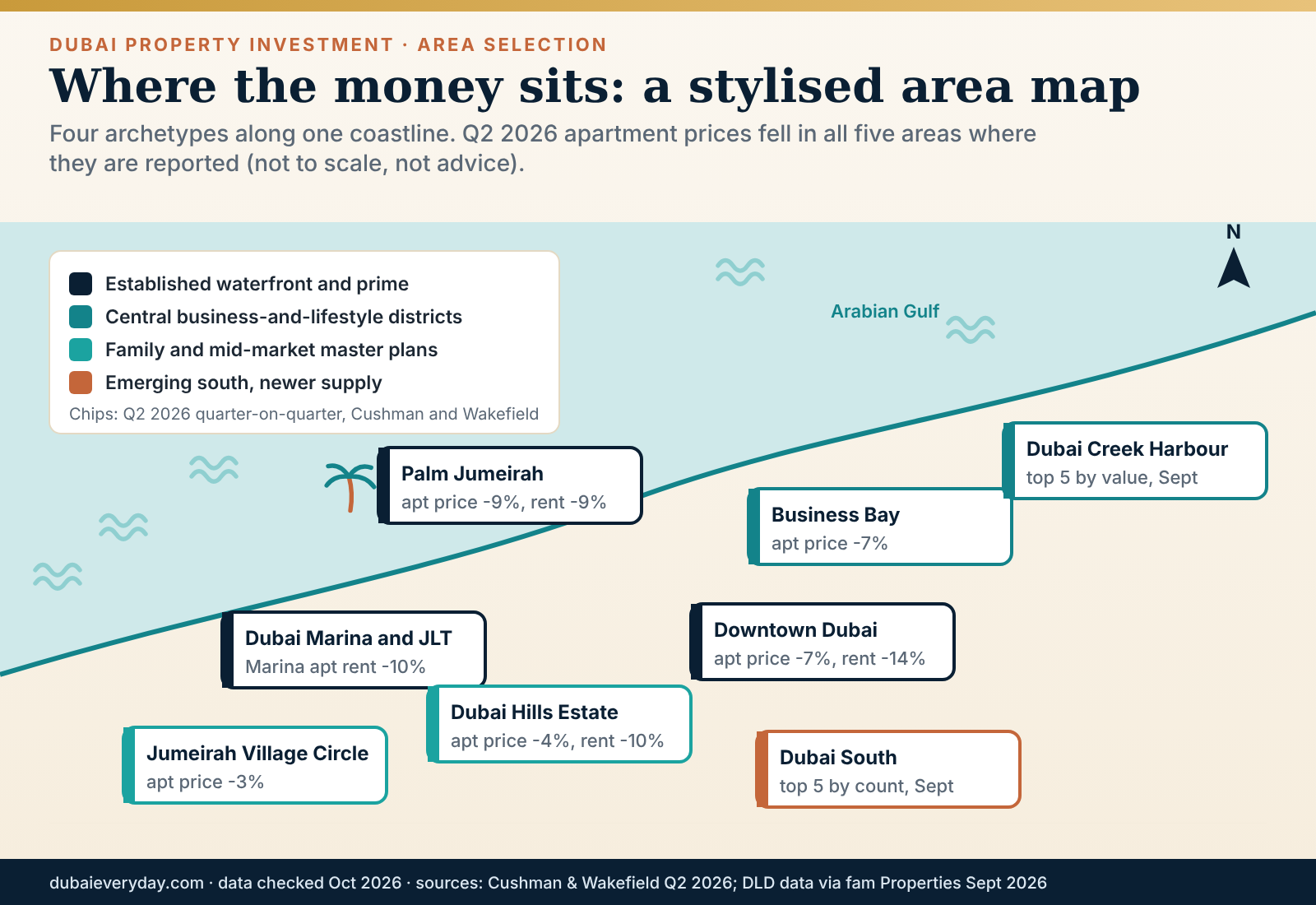
We group areas for Dubai property investment into four archetypes and deliberately avoid ranking them, because the data we can verify does not support ranking by return. Established waterfront and prime areas such as Palm Jumeirah, Dubai Marina and Downtown Dubai trade on location and scarcity.
Central business and lifestyle districts such as Business Bay and Dubai Creek Harbour trade on proximity and new supply. Family and mid-market master plans such as Dubai Hills Estate and Jumeirah Village Circle trade on space, schools and price.
Emerging southern areas such as Dubai South trade on lower entry prices and future infrastructure.
What the 2026 data says by area
The Cushman and Wakefield second-quarter report gives quarter-on-quarter price and rent changes for six communities. Apartment sale prices fell 9% on Palm Jumeirah, 7% in Downtown Dubai, 7% in Business Bay, 4% in Dubai Hills Estate and 3% in Jumeirah Village Circle. Apartment rents fell 14% in Downtown Dubai, 10% in Dubai Hills Estate, 10% in Dubai Marina and 9% on the Palm. Villa prices fell 9% in The Springs and The Meadows and 5% in Dubai Hills Estate, while villas on the Palm and in JVC were modestly up.
The firm expects further moderation from subdued volumes, a gap between buyers’ and sellers’ expectations and new supply, and expects established end-user communities to be comparatively resilient. A betterhomes September report, on its own basis, found Dubai Marina among the apartment communities with quarterly price gains (3.7%), while Jumeirah Golf Estates led villa gains. Different firms’ baskets give different answers, which is why we say the screen matters more than any one table.
The DLD-based September data from fäm Properties shows where deals actually happen: Business Bay led by sales value, then Palm Jumeirah, Al Yufrah 1, Dubai Creek Harbour and Jabal Ali First. By count, Al Barsha South Fourth led, then Dubai South, Wadi Al Safa 3, Jabal Ali First and Business Bay. The page itself cautions that these rankings show concentration of transactions, not returns. High activity tells you an area is liquid. It does not tell you it is cheap or profitable.
Use the map as a question list. For each area you shortlist for Dubai property investment, write the five answers on one page. Seeing three areas side by side exposes the thin spots much faster than reading three brochures. Our Dubai Marina guide, Downtown Dubai guide and Palm Jumeirah guide describe daily life in those areas, which is the fifth question.
Market risk in Dubai property investment: scenarios and stress tests
Risk in Dubai property investment is easiest to manage when it is written down before the purchase, with a number next to each item. We group the risks into eight and then run a simple scenario test on the worked example.
The eight risks, in order of how much we would worry
Supply. For Dubai property investment, deliveries of about 32,000 homes in the second half of 2026, S&P’s 20% stock growth over two years and UBP’s 350,000-home pipeline through 2030 all point the same way. Some of it will slip, and some of it will be absorbed by population growth, but investor-owned apartments compete directly with each other for the same tenants.
Geopolitics. The conflict that began on 28 February is arguably the first time Dubai’s property market has had to price in missile risk. By 14 October Gulf News reported a US naval blockade of Iranian ports continuing, attacks on vessels in the Strait of Hormuz and some regional flight cancellations, while UAE airspace had no blanket suspension. S&P’s base case assumes disruption continues into 2027. Nobody can price this reliably, so treat it as a tail risk that affects tenants’ and buyers’ behaviour at once.
Liquidity. When buyers vanish, sellers wait. With 67% of first-quarter resale deals paid in cash and resale transactions down more than 40% year on year in the second quarter, an investor who needs to sell quickly may have to cut the price. Fortune cited a combined AED 2.36 billion in listing-price cuts across 3,292 properties by the end of May, per a price-drop tracker, with the largest cut at 61.2% on a single villa. Asking-price cuts are not transaction prices, but they show where sellers are under pressure.
Rates and credit. Higher rates raise the carrying cost of leveraged investors and squeeze the buyer pool. Fortune reported that corporate real estate was 13% of UAE bank loans at the end of 2025 and retail mortgages about 10%. Fitch says corporate real estate loans are the likelier source of new bad loans if the conflict is prolonged, though it did not yet see major pressure on bank asset quality.
Developer and project risk. The largest developers carry big backlogs, according to S&P, and payment delinquencies have been limited. Smaller developers, delayed projects and unusual payment structures are where problems tend to appear. Capital Economics, quoted by Fortune, flagged government-related entities’ exposure but judged the risk of severe debt problems low for now.
Currency. The dirham is pegged to the dollar, which matters for Dubai property investment. If your own currency strengthens against the dollar, your dirham income and capital shrink in your currency, even if nothing happens in Dubai.
Policy and regulation. Rules change. In 2026, Fortune reported that Dubai removed the AED 750,000 minimum property value for two-year residency visas, and the Central Bank’s limits, the DLD’s fees and the rent-index rules are all subject to revision. We checked the current versions today and they may be different when you read this.
Operations. Rent arrears, building defects and service charge rises are small risks individually and the ones most owners actually meet.
What happened to Dubai property investment last time
Dubai property investment has had a bust before. Global Property Guide, citing a Colliers index, reported that a measure of foreign-ownership property prices rose 116% between the first quarter of 2007 and the third quarter of 2008, then fell 50% from that peak by the fourth quarter of 2010.
It also reported that almost half of UAE construction projects, worth about AED 1.1 trillion, were put on hold or cancelled, and that the two largest mortgage lenders, which together held over half of UAE mortgages, stopped new lending. The index is not a perfect price series, so read the 50% as an order of magnitude, not a precise loss.
Today’s Dubai property investment market differs. Off-plan money is escrowed, loan-to-value caps are in force and the regulator’s tools are better developed. Those features reduce the worst excesses. They do not stop prices from falling, and they do not make a leveraged flip in a weak market a safe plan.
A downside scenario test on the worked example
Our Dubai property investment test takes the AED 1.5 million flat and runs three paths over five years. Net rent stays flat at AED 68,750 in every case, which is generous in the falling-price scenario and conservative in the rising one. The exit cost is 2.1% (agent plus VAT) plus a AED 5,000 allowance. The mortgage case borrows AED 900,000 at an illustrative 5.5% over 25 years and pays a 1% early settlement charge at the end.
If prices fall 20% to AED 1.2 million, the cash buyer ends five years about AED 82,700 behind, an annualised return of about minus 1.2%. The leveraged buyer ends about AED 344,200 behind, about minus 12.4% a year on AED 714,670 invested. If prices are flat, the cash buyer gains about AED 211,000, about 2.7% a year, while the leveraged buyer loses about AED 50,500. If prices rise 20%, the cash buyer gains about AED 504,700 (6.1% a year) and the leveraged buyer about AED 243,200 (6.1% a year).
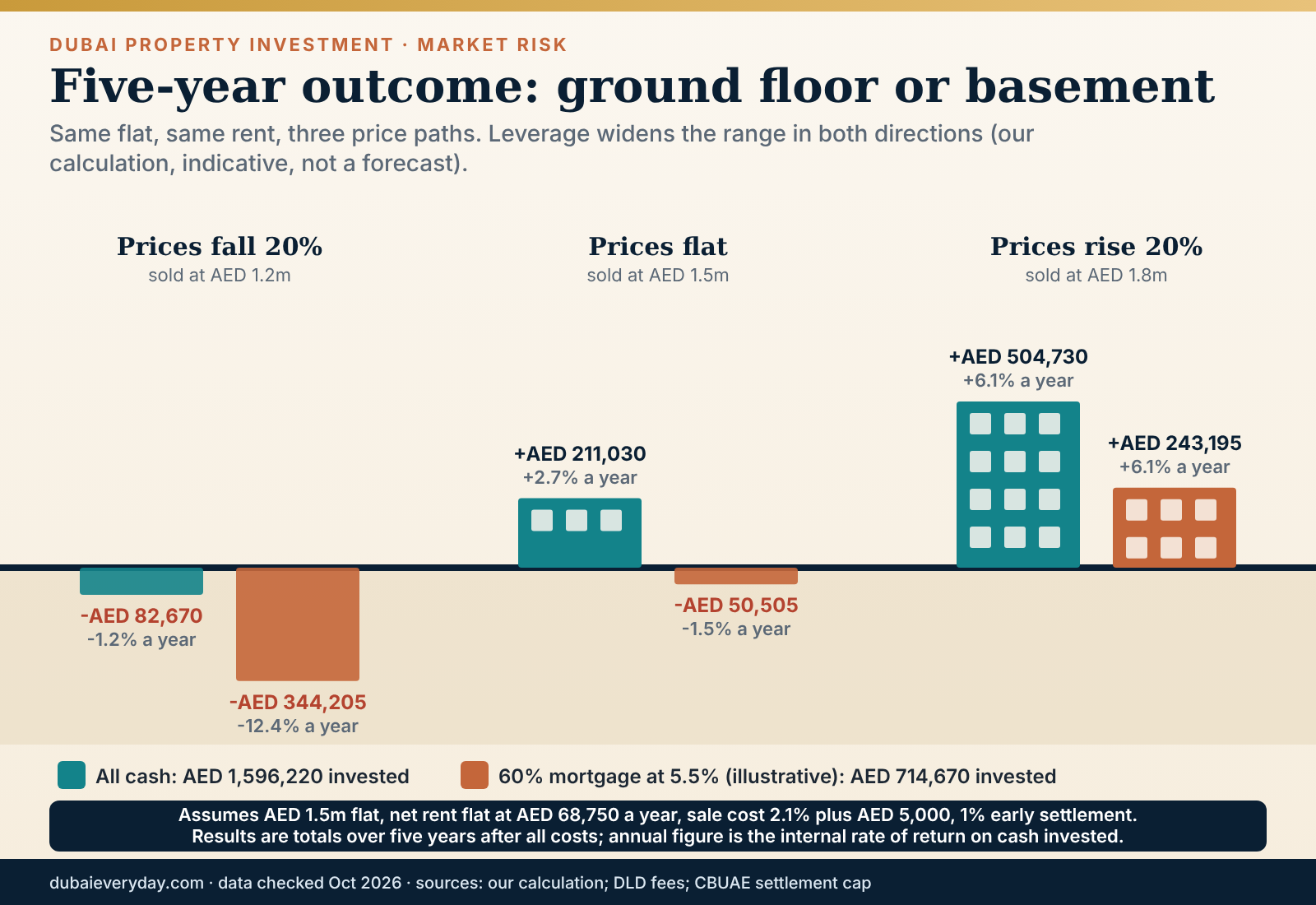
Three lessons follow. In a flat market the unleveraged buyer is the only one who makes money, because rent covers the costs. Borrowing amplifies the bad case more than the good. And even a 20% rise produces a mid-single-digit annual return for either buyer once costs are counted. It is a respectable result, but nothing like the returns that fed the 2025 boom, and the arithmetic does not depend on whether the flat is in Marina or JVC.
Early-warning indicators to watch
You do not need a data subscription to keep an eye on Dubai property investment. Public sources can answer most of what you need to know once a quarter.
- Monthly DLD sales counts and the resale share, published by trackers like fäm Properties and by DLD itself.
- New-contract rents versus renewal rents in the DLD’s Rental Index, for your own building.
- The service charge approved for your building each year in the Service Charge Index.
- Handover announcements and delays for projects within a few kilometres of your property.
- Developer incentives: waived fees, extended payment plans and discounts, which tend to precede price cuts.
- Flight, hotel and population news from official sources, because they feed tenant demand.
Set triggers, not opinions. Decide in advance what would make you sell or stop buying: for example, net yield below your mortgage rate for two years, or vacancy above three months. Triggers written in calm conditions are easier to follow than decisions made after a bad headline.
Rental strategy: long let, short let and management
Most Dubai property investment income comes from a standard annual tenancy, and the paperwork is straightforward. The tenancy is registered in the Ejari system. The DLD’s FAQ lists the fee through the app or website as AED 100 plus AED 10 knowledge and AED 10 innovation fees, and through a trustee centre as AED 120 plus a service partner fee of AED 95 plus VAT.
Owners, real estate companies and their representatives can register. Our renting in Dubai guide shows the tenant’s view of the same contract, and the apartment rental guide and villa rental guide show what tenants look for when deciding whether to renew.
Annual let: what to decide
Four decisions drive the result of a Dubai property investment let. The first is the rent and its payment pattern. Khaleej Times reported on 23 July that the DLD’s Flexi Rent option lets tenants pay monthly, quarterly or semi-annually, which suits tenants and may shift cash-flow risk onto landlords, so ask your agent how it works in practice.
The second is tenant selection: references, employer, length of residence. The third is maintenance responsibility. The fourth is whether you self-manage or hire a manager. A manager typically takes a percentage of rent; we assumed 5%, which is our assumption and not a market statistic, so ask for written quotes.
Pay attention to the first months of a tenancy. Utility connections, district-cooling deposits and snagging all produce disputes when nobody knows who pays. Our home setup checklist and DEWA move-in guide explain what the tenant must do, which tells you what to write into the handover checklist.
Short let: when it can beat a long let, and when it does not
Holiday homes need a permit from the Department of Economy and Tourism (DET). DET’s hospitality services page describes guidelines and procedures for hotel, holiday home and timeshare permits, but we could not load the fee and eligibility details today, so we cannot quote them. Check them directly before you plan on short-let income. Your building’s owners’ association rules may also restrict short lets.
We can show what a short let has to achieve. Suppose the same flat earns AED 97,500 on a long let and nets AED 68,750. For a short let to net the same, using our assumptions of a 20% operator fee and AED 12,000 a year in cleaning and utilities on top of the same service charge and maintenance, booked revenue has to reach about AED 120,600 a year. That is about 24% more than the long-let rent, every year, before you allow for bad months.
Short-let demand in Dubai property investment can swing hard. In March 2026 hotels cut prices as bookings were cancelled, according to the conflict timeline, and by mid-April Emirates was running about two-thirds of its prewar flights, per the Dubai economic chief. Seasonality adds to it: our best time to visit Dubai guide shows why July and August are quiet, and our best hotels in Dubai guide shows the hotel competition a holiday home has to beat on price and service.
Short let is a business, not a flat. You are running a small hospitality operation with permits, taxes, guest service and platform fees. If you want passive income, a standard annual tenancy with a manager is almost always simpler. If you take the short-let route, ask the operator for the full fee schedule in writing and for last year’s actual occupancy on the same unit, not a projection.
Residency, tax and legal checks
These three topics are where a good Dubai property investment can still go wrong for reasons that have nothing to do with the flat. They are also the topics where this page is most careful, because rules change and the stakes are personal. Treat what follows as a map of the questions to ask a licensed professional, not as advice.
Residency through property
The UAE government portal lists a Golden Visa category for investors, with five years’ residency (ten for public investments). The page, updated on 28 July 2026, lists a minimum capital of AED 2 million for the investor category and gives ownership of property as one route. It does not state a minimum property value for that route and does not say whether a mortgaged or off-plan property counts. We would not rely on any blog’s answer to those two questions. Confirm with the DLD and the immigration authorities, in writing, before you sign.
Fortune reported on 1 June that Dubai removed the AED 750,000 minimum property value for two-year residency visas. We could not confirm the detail from an official page today, so verify it if a lower-value residency route is part of your plan. Our Dubai residence visa guide explains the main routes, and our moving to Dubai guide covers what happens after the visa arrives.
One planning point matters more than the headline rule. A residency threshold anchors your purchase price to a number, and if prices fall you can end up holding a unit that no longer qualifies, or that qualified only on a mortgage you cannot easily refinance. Do not let the visa choose the flat.
Tax on Dubai property investment: what we can and cannot say
The costs of owning Dubai property are mainly fees and service charges, not an annual property tax. The betterhomes cost guide states that no stamp duty applies, and the official DLD fee schedule lists the 4% registration fee. We did not find a single official page listing every tax that touches a residential owner, so we do not claim there are none.
Corporate tax is the area to check. The UAE portal says corporate tax applies to individuals who conduct business under a UAE commercial licence, and to foreign individuals who run a trade or business in the UAE on an ongoing basis. Taxable income up to AED 375,000 is taxed at 0% and above that at 9%.
The page does not address whether passive rental income from a personally owned home is in scope, and says the Federal Tax Authority is the body to ask. Treat that as an open question to put to an adviser, especially if you buy through a company or let several units. Our guides to accounting services in Dubai and business setup in Dubai explain when entity structures come into play.
Your home country may tax rental income and gains from a property abroad, regardless of Dubai’s rules. Double-tax treaties vary. This is a cross-border question for a tax adviser who knows both systems, and it is one of the most commonly missed items in Dubai property investment plans.
Legal and money-handling checks
Three items deserve more attention than they get in Dubai property investment. First, payment method. The UK government’s guidance warns that bouncing a cheque is illegal in the UAE and can lead to arrest and detention. If a developer’s plan uses post-dated cheques, check you can honour every one, and ask for the schedule in writing.
Second, source of funds. Real estate transactions attract identity and source-of-funds checks, and you should keep a clean paper trail for the money you use. Pay only through the channels stated in the contract, such as escrow accounts for off-plan and manager’s cheques at the trustee centre, and never to an individual’s personal account.
Third, succession. The rules that apply to your property on death may not match what you intend, and the answer depends on your nationality, religion and any will you have registered. Speak to a UAE-licensed lawyer about wills and co-ownership before you buy, not after. Our Dubai legal basics guide explains where to verify the rules that apply to residents.
Insurance
Building insurance is usually part of the service charge for apartments in managed buildings; the DLD’s FAQ lists insurance among the services the charge covers. Contents and landlord liability cover are separate decisions. See our insurance guide for how policies are structured and what to compare.
Exit strategy: plan the sale before you buy
An exit plan is not the same thing as a prediction. It is a list of the conditions under which you would sell, hold or restructure, written while the numbers are calm. In Dubai property investment, the exit is where the friction costs of the first section stop being theoretical.

Four ways out
Sell on the open market
The standard route. Price against recent sales in the same building, allow for the 2.1% agent cost in our model and plan for the developer NOC and any mortgage settlement.
Keep and rent
The best fallback when net rent covers costs. It buys time for a better market, at the price of capital that stays tied up.
Refinance or restructure
Ask the lender about a better rate or term before arrears start. Early settlement is capped at 1% of the balance or AED 10,000, whichever is lower.
Assign an off-plan contract
Sell your place in the payment plan, subject to the developer’s conditions. Terms vary, so read the sale and purchase agreement first.
The sale sequence
- Set the price from evidenceLook at recent sales in the same building and compare asking prices with achieved prices. The DLD also lists a property valuation service among its e-services.
- Gather the fileTitle deed, Ejari contract, service charge status, mortgage statement and the unit’s floor plan.
- Agree terms with the buyerUse the standard memorandum of understanding and state who pays the 4% fee, the commission and the NOC.
- Obtain the developer NOCFor freehold areas the DLD’s registration page lists an electronic NOC from the developer, requested through the Dubai REST app.
- Settle the mortgage, if anyAsk the bank for a settlement letter and the release procedure well before the transfer date.
- Transfer at a trustee centreBoth sides present IDs, pay the fees and receive the electronic title deed for the buyer. The DLD lists about 20 minutes of service time for the transaction itself.
- Close the loose endsCancel the Ejari or transfer it, close utilities in your name and hand over keys and access cards.
The cost of selling in a hurry
In a weak market the largest exit cost of Dubai property investment is not the commission, it is the discount. If you accept a price 10% below your asking price on a AED 1.5 million flat to complete in a hurry, you give up AED 150,000, which is about 2.2 years of the example’s net rent.
Fortune’s reporting that off-plan resales often trade 10% to 15% below original prices shows how large that discount can be in some segments. Part of a good exit plan is a cash reserve that lets you wait for a fair price instead of a fast one.
Selling a tenanted flat has its own rules. A landlord who wants possession for sale must give at least 12 months’ notice through a notary public or registered mail, per the DLD’s FAQ, so many sales of tenanted flats complete with the tenant in place, and the buyer takes on the tenancy. That narrows your buyer pool to investors, which matters when investors are scarce. Plan the lease end date for the year you expect to sell.
Write your exit rules down. Before you buy, write three lines: the longest you will hold, the lowest net yield you will accept and the price at which you will stop waiting. They cost nothing and are the only decision tool that does not depend on your mood on the day.
Due diligence checklist, red flags and mistakes
Due diligence in Dubai property investment is a sequence of cheap checks that kill expensive mistakes. Do them in order and stop when one fails. The tools named are listed on the DLD site or the Dubai REST app, and the sources box links each one.
The checklist
- Check the broker appears in the DLD’s list of licensed brokers and brokerage companies.
- Ask to see the title deed and verify it with the DLD’s Verify Title Deed service.
- Run the Property Status Enquiry using the area and land number.
- Look up the building’s service charge in the DLD’s Service Charge Index and multiply by the unit area.
- Read the current Ejari contract and run the DLD Rental Index for the building’s area.
- Check the memorandum of understanding states price, deposit, who pays each fee and the completion date.
- Ask for the developer’s NOC requirements and fee before you pay a deposit.
- Get a mortgage-in-principle in writing if you need finance, including the valuation it assumes.
- Pay deposits only in the way the contract says, never to an individual account.
- Have a UAE-licensed lawyer read the contract before you sign.
Red flags worth walking away from
Guaranteed returns come first among Dubai property investment red flags. Nobody can guarantee rent or resale prices in a market where rents and prices moved by several percent in a single quarter in 2026. Next is pressure to pay quickly to “hold” a unit before you have read the paperwork.
A price far below recent sales in the same building should make you ask why before you celebrate. An agent who is not on the DLD list, a seller who will not show the title deed, and any request for cash or for payment to a personal account are reasons to stop.
Cheque-based payment plans need particular care because of the criminal consequences of a bounced cheque.
Ten Dubai property investment mistakes that cost real money
- Comparing gross yields across listings without checking service charges.
- Using the asking rent, not a signed contract, in the calculation.
- Borrowing to the cap on a flat whose net yield is below the mortgage rate.
- Buying off-plan with money that may be needed for the next instalment.
- Assuming a bank valuation will equal the contract price.
- Ignoring the supply due in the same community in the next two years.
- Paying the 4% fee without checking who the contract says should pay it.
- Letting a visa threshold choose the property.
- Skipping a lawyer to save a few thousand dirhams on a purchase worth a million or more.
- Having no exit rules, which turns every bad month into a decision made under stress.
Our guide for foreign buyers goes deeper on residency, ownership and the due-diligence steps specific to non-residents, and the freehold property guide covers title registration.
Three worked investor profiles
The Dubai property investment profiles below are hypothetical, built from the assumptions in this guide, and show how the same rules produce different answers. They are not case studies of real investors and nothing in them is a recommendation. Replace every input with your own quotes.
Profile one: the cash buyer who wants steady income
This investor has AED 1.7 million available and buys a ready AED 1.5 million apartment in an established rental community with a building that has several recent resales. Cash needed is AED 1,596,220 including buying costs, leaving about AED 100,000 as a reserve. The gross rent assumed is AED 97,500 and the net income AED 68,750, a 4.58% net yield on the price and 4.31% on the total cash invested.
In the cautious case, with rent 10% lower and three months of vacancy, the net income falls to AED 45,675, or 3.05%. Over five years with a flat price, our model gives a gain of about AED 211,000, roughly 2.7% a year. If prices fall 20%, the model shows a loss of about AED 82,700. The investor is not rich in the good case and is not ruined in the bad one, which is exactly what a cash, income-first position is for.
The weak point of this Dubai property investment is opportunity cost. The same capital might earn more elsewhere with less effort, so the case for this purchase rests on diversification, on a lifestyle use of the flat and on the investor’s own tolerance for property. It is a defensible plan. It is not a high-return plan.
Profile two: the first-time investor who borrows to the cap
The second investor buys the same flat with a 60% mortgage of AED 900,000 at an illustrative 5.5%. Cash needed is AED 714,670. Net rent covers the payment with about AED 2,430 a year to spare, a cash-on-cash return of 0.3%. A 1-point rise in the rate would push the annual cash flow below zero, and the stress test the Central Bank asks lenders to apply points the same way.
The break-even sale price after five years is about AED 1.55 million, 3.4% above the purchase price. In a flat market the investor loses about AED 50,500. In a 20% fall the loss is about AED 344,200, about 48% of the cash invested. In a 20% rise the gain is about AED 243,200, similar to the cash buyer’s percentage return but on less than half the capital.
This profile is not bad judgement. It is a bet on price growth with thin protection, and it works only if the investor holds a reserve large enough to survive a year of arrears without selling into a falling market. An investor with that reserve and a long horizon might reasonably choose it. An investor without it should choose a lower price, a bigger deposit or a different asset.
Profile three: the off-plan buyer on a payment plan
The third investor buys an AED 1.2 million off-plan flat with an illustrative 10% at booking, 40% during construction and 50% at handover. By handover, AED 600,000 has been paid. The Central Bank cap of 50% allows a AED 600,000 mortgage if the bank’s valuation equals the price. At 5.5% the payment is about AED 3,685 a month, AED 44,200 a year. On the same net yield of 4.58% as before, net rent of about AED 55,000 would cover it with roughly AED 10,800 to spare.
The risks are in the timing. If handover is delayed, the capital is idle. If valuation comes in 10% lower at AED 1.08 million, the loan falls to AED 540,000 and the investor must find an extra AED 60,000. If the investor’s income has fallen by then, the plan stops working. And if the market is weak when the unit finishes, it will compete with other newly completed flats in the same building and the same community.
The sensible version of this plan keeps a cash cushion of at least a fifth of the unpaid balance (our rule of thumb), picks a developer with a documented record of on-time handovers, and treats the discount as compensation for the waiting time and not as free money. See the off-plan section for the contract checks.
Dubai property investment FAQ
Is Dubai property investment still worth it in 2026?
It can be, for long holders who can fund the costs of Dubai property investment without relying on price gains. Sales volumes fell sharply after the regional conflict began on 28 February, prices have softened in several apartment markets and supply is due to rise through 2027.
That makes negotiating easier and exiting harder. Our worked example shows a cash buyer breaking even on a five-year hold even if prices fall about 14%, while a leveraged buyer at an illustrative 5.5% needs prices to rise about 3.4%.
It depends on your horizon, reserves and the specific building.
What is a realistic rental yield in Dubai right now?
We cannot give you an official figure, because neither the DLD’s service pages nor the September market data we read publish yields. Consultancies publish gross yields by community, and they differ by method. Our worked example assumes 6.5% gross, which falls to 4.58% net after vacancy, service charge, maintenance and management, and to about 3% in a cautious case. Calculate your own using the DLD Rental Index, the Service Charge Index and a real contract, then compare it with the mortgage rate.
How much does it cost to buy a flat, apart from the price?
On a resale flat of AED 1.5 million, the buying costs in our example are AED 96,220, about 6.4%: the 4% DLD fee, a 2% agent commission plus VAT, the trustee fee of AED 4,000 plus VAT and a few hundred dirhams in title and map fees. A mortgage adds the DLD mortgage registration fee, a valuation and the lender’s own fees. Developer NOC fees on resale and any off-plan incentives vary, so ask for the full list in writing before you make an offer.
Can foreigners buy property in Dubai?
Yes, in designated freehold areas. The UK government’s guidance says to confirm that you may purchase in your chosen area, deal with registered agents and take advice from a local lawyer. The DLD’s registration service accepts a passport for non-resident foreigners. Eligibility depends on the community and your nationality, so check the exact plot first. Our guides on foreign buyers and freehold property explain the rules in more detail.
How much cash do I need if I take a mortgage?
Under the Central Bank rulebook, an expatriate can borrow up to 80% on a first home below AED 5 million (70% above), up to 60% on a second or investment home, and up to 50% on any off-plan purchase. That means a cash gap of 20% to 50% of the price, plus fees, which were AED 96,220 plus AED 18,450 of mortgage costs on our AED 1.5 million example. Lenders may lend less than the cap, and the cap applies to the lower of price and valuation.
Is off-plan safer or riskier than ready property?
Different, not simply riskier. Off-plan funds sit in an escrow account supervised by the DLD, which addresses one risk. It leaves delay, valuation and instalment-funding risk with you. UBP notes that historically at most half of announced pipelines arrive on schedule, and the 50% mortgage cap applies to off-plan. Ready property gives you observable rent and service charge. In the current market we see ready property in a liquid building as the lower-risk route into Dubai property investment, though it may cost more up front.
Do I pay property tax in Dubai?
The official sources we read list fees and service charges, not an annual property tax, and a cost guide states there is no stamp duty. We did not find one official page listing every tax, so we do not claim there are none. The UAE portal says corporate tax applies to individuals who conduct a business under a UAE licence or on an ongoing basis, and does not address passive rental income. Your home country may tax Dubai rent and gains, so take advice from a tax professional.
Does buying property give me residency?
It can, but only in the categories and at the values set by the authorities. The UAE portal, updated on 28 July 2026, lists a five-year Golden Visa for investors with a minimum capital of AED 2 million and property ownership as one route. It does not say whether mortgaged or off-plan units count. Fortune reported that the AED 750,000 minimum for two-year visas was removed. Confirm the current rules in writing before you buy. Our residence visa guide covers the main routes.
What are the biggest risks of Dubai property investment?
In our order for Dubai property investment: new supply, regional conflict, liquidity, interest rates and credit, developer and project risk, currency, policy change and ordinary operating problems such as arrears and service charge rises. Dubai has had a bust before: a Colliers index cited by Global Property Guide fell about 50% from its third-quarter 2008 peak to late 2010. Today’s rules are tighter, but they reduce the worst excesses and do not prevent falling prices. Write down your triggers before you buy.
Can I rent my flat as a holiday home?
Holiday homes need a permit from the Department of Economy and Tourism, and your building’s owners’ association may restrict short lets. We could not retrieve the DET’s fee details today, so check them directly. In our model, a short let needs about AED 120,600 of booked revenue a year to net what a AED 97,500 long let does, using our assumptions of a 20% operator fee and AED 12,000 of cleaning and utilities. It is a business with seasonal demand, not a passive income.
How long does it take to sell a flat in Dubai?
The registration itself is quick: the DLD lists about 20 minutes of service time for a sale registration at a trustee centre. The rest depends on finding a buyer, the developer NOC and any mortgage settlement. In the second quarter of 2026 resale transactions were down more than 40% year on year, so selling can take longer than in a strong market. If the flat is tenanted, an owner who wants possession for sale must give at least 12 months’ notice, so many tenanted flats sell with the tenant in place.
How do I check a broker, a title deed or a service charge?
Use the DLD tools, which list open access for all residency statuses. The licensed brokers list shows RERA-licensed brokers and companies. Verify Title Deed confirms a deed is valid. Property Status Enquiry looks up a property by area and land number. The Service Charge Index shows the approved rate by project and year, and the Rental Index calculates the average rent and the increase for an area. All run through the DLD website or the Dubai REST app.
Should I buy now or wait?
Nobody can time this reliably, and several analysts say the full effect of the 2026 conflict is not yet visible. Instead of asking about timing, ask whether the investment survives your cautious case: rent 10% lower, three months of vacancy, a mortgage rate 1 to 2 points higher. If it does, a purchase in a weak market may be reasonable. If it only works when prices rise, waiting costs you little, and watching the early-warning indicators in this guide will tell you more than a headline will.
Where to go next
Pick the next page by the question you are stuck on. If it is the arithmetic, start with yield and ROI. If it is the paperwork, start with buying and freehold. If it is whether to live in Dubai first, start with renting.
Sources and further reading (31 links)
- Dubai Land Department: Property Sale Registration — fee schedule, NOC requirement, channels and service time
- Dubai Land Department: FAQ — rent increase rules, notice periods, Ejari fees, eviction notice, service charge rules
- Dubai Land Department: Rental Index — what the calculator does and its inputs
- Dubai Land Department: Service Charge Index — RERA-approved charges by project
- Dubai Land Department: Licensed Real Estate Brokers — broker list service
- Dubai Land Department: Verify Title Deed — title validity check
- Dubai Land Department: Property Status Enquiry — property lookup by area and land number
- Central Bank of the UAE Rulebook: Mortgage regulations, Circular 31/2013 — loan-to-value caps, term, debt burden and stress test
- Central Bank of the UAE: October 2019 mortgage announcement — early settlement fee cap
- UAE Government Portal: Golden Visa — investor category, duration, minimum capital
- UAE Government Portal: Corporate tax — scope for individuals, rates and thresholds
- UK Government: How to buy property in the UAE — due diligence, escrow, agent and cheque warnings (page)
- fäm Properties: Dubai market figures — DLD-record analysis of sales, prices, rents and areas; secondary source
- Cushman and Wakefield: MarketBeat Residential Q2 2026, Dubai — quarter-on-quarter area changes and supply; secondary source
- Khaleej Times: Dubai residential real estate shows resilience amid quieter market — UBP and CBRE figures; secondary source
- Gulf News: Dubai rents ease 6.2% while home prices stay above 2025 levels — CBRE Q2 data; secondary source
- Khaleej Times: Dubai apartment prices could fall further as supply set to rise 20% — S&P Global view and Cavendish Maxwell Q3; secondary source
- Fortune: Dubai property prices after the Iran conflict — Fitch, Moody’s, off-plan share and visa change; secondary source
- betterhomes: Dubai property market report Q3 2026 — September medians, leasing enquiries, supply; secondary source
- betterhomes: Hidden costs when buying property in Dubai — agent commission, NOC, mortgage registration and valuation fees; secondary source
- Khaleej Times: UAE banks roll out easier financing options for off-plan homebuyers — example off-plan finance products; secondary source
- Khaleej Times: Dubai property sales reach Dh87.9 billion despite slowdown — Q2 resale and off-plan changes, Flexi Rent; secondary source
- Khaleej Times: Dubai property market records growth in March despite regional conflict — Q1 sales, off-plan share and cash share of resale; secondary source
- Emirates 24|7: Dubai real estate transactions hit Dh574 billion in nine months — all-transactions total; secondary source
- Gulf News: US-Iran war, what UAE residents need to know — conflict status and aviation; secondary source
- Semafor via Yahoo Finance: Dubai domestic spending nearly recovered — Dubai economic chief’s account of the 28 February start and 8 April ceasefire
- Wikipedia: United Arab Emirates in the 2026 Iran war — timeline context only, not used for rules or fees
- Gulf News: US-Iran war, what UAE residents need to know — blockade, Hormuz incidents and flight cancellations; secondary source
- Khaleej Times: Dubai home prices, rents decline as supply rises — Cushman and Wakefield Q2 data and delivery warning; secondary source
- Dubai Land Department: All e-services — index of services including property valuation and rental dispute enquiries
- Global Property Guide: UAE price history — 2008 to 2010 downturn context citing a Colliers index
Update log: 29 October 2026 — first publication; all facts re-checked against the sources above. Next review due: 29 January 2027, or sooner after any change to DLD fees, Central Bank lending limits, residency thresholds or a major market move. Corrections welcome. This page is general information, not individual legal, tax, mortgage or investment advice; check material decisions with a licensed professional and the relevant authority.
About DubaiEveryday and this guide
DubaiEveryday.com is an independent editorial project that publishes practical, research-based guides to everyday life in Dubai: where to live, what things cost, how the rules work and how to get around. This page was written and edited by the DubaiEveryday editorial team. It is not signed by a named expert, doctor, lawyer or adviser, and we do not claim first-hand testing of a venue, clinic or service unless the page says so.
Each guide is built from official sources such as government and regulator pages, operator websites and established news outlets, cross-checked where we can. When we could not confirm something, we say so in the text, and examples that use made-up numbers are labelled as illustrations. Mentions are editorial choices, not paid placements, and a link is not an endorsement.
Dubai changes quickly. If you spot something that is out of date or wrong, please tell us through the contact options on DubaiEveryday.com and we will check it and correct the page.