

The Dubai laws expats meet in daily life fall into six areas, and each has a different rule-maker and a different place to complain. This guide maps all six, shows what is verifiable today, and tells you exactly where to check before you rely on any of it.
Nobody moves abroad planning to read legislation. You just want to rent a flat, sign a job contract and drive to work without trouble. Then one day a landlord, an employer or a traffic fine raises a question you never thought to ask.
The tricky part is that dubai laws expats run into are not a single rulebook. Different rules come from federal law, from Dubai itself and from specific authorities, and each has its own place to complain. This guide maps six everyday areas and points you to the official sources to check, so you know who to contact first. It is general information, not legal advice.
The Dubai laws expats need to know in everyday life sit in six areas: tenancy, employment, consumer rights, traffic, family and personal status, and general conduct. Each is shaped by federal UAE law, by Dubai’s own legislation, or by a specific authority, and that layer decides who you call when something goes wrong.
Three anchors help. Employment runs on Federal Decree-Law No. 33 of 2021, as amended. Traffic runs on Federal Decree-Law No. 14 of 2024, in force since 29 March 2025. Consumer protection runs on Federal Law No. 15 of 2020, with Dubai’s Department of Economy and Tourism taking complaints. Tenancy is the most Dubai-specific of the six, handled through Ejari and the Dubai Land Department’s rental dispute centre.
Do not treat any blog, including this one, as the law. Check the text on the official legislation portal, remember that the Arabic version prevails, and see a licensed lawyer for anything with money, residency, custody or a criminal angle. This page is general information, not legal advice.
This guide covers the Dubai laws expats meet most often. It is desk research, not legal advice and not a field test. On 29 October 2026 we opened official pages from u.ae, the UAE Legislation portal, the Dubai Land Department, Dubai.ae and the DIFC Courts for employment, termination, labour disputes, leave, gratuity, unemployment insurance, consumer protection, traffic, cybercrime, leasing, civil marriage, divorce and wills, and recorded every figure against its source. Where an official page did not state a number, we either left it out or labelled it as a general-knowledge range to confirm.
Two Gulf News explainers were used as secondary context where official pages gave no figures (consumer complaint steps and traffic penalties), and they are labelled as such. Selection of topics follows the questions residents most often have, not commercial interest. No lawyer, agency or service is recommended, and inclusion was not paid for. Laws and fee schedules change; the update log at the end shows when this page was last checked.
The layers behind the Dubai laws expats must follow
Anyone studying the Dubai laws expats must follow soon asks: “What is the law in Dubai?” The more useful question is “which law, written by whom, and enforced by which office?” Dubai sits inside the United Arab Emirates, a federation of seven emirates. Some subjects belong to the federal level and apply identically in Dubai, Abu Dhabi and Sharjah. Others are local and written by the Dubai government. A third group is administered by authorities that publish their own rules and fee schedules.
The employment statute is a clean example of a federal law. The government portal u.ae gives the private-sector law as Federal Decree-Law No. 33 of 2021, as amended by Federal Decree-Law No. 20 of 2023, in force from 2 February 2022, and says it replaced Federal Law No. 8 of 1980 (u.ae, employment laws). A worker in Dubai Marina and one in Sharjah read the same text.
Tenancy is the opposite. Dubai has its own tenancy legislation and its own rental dispute centre inside the Dubai Land Department. The u.ae leasing page names the Rental Dispute Centre as the body for tenancy disputes and points to rent-increase rules from 2013 applied through the Real Estate Regulatory Agency calculator (u.ae, leasing a property). Move to Abu Dhabi and the framework changes.
The four layers, from top to bottom
To picture the Dubai laws expats deal with, imagine a stack. At the top sits federal law: the criminal code, labour, traffic, consumer protection, commercial law, and the personal status laws. Below it sits Dubai legislation: local laws and decrees on tenancy, property registration, licensing of businesses and a long list of public-service rules. Below that are the regulators and operators who turn laws into procedures and fees, such as the RTA for roads and transport, the DLD for property, DET for trade and consumers, DHA for healthcare, and KHDA for schools.
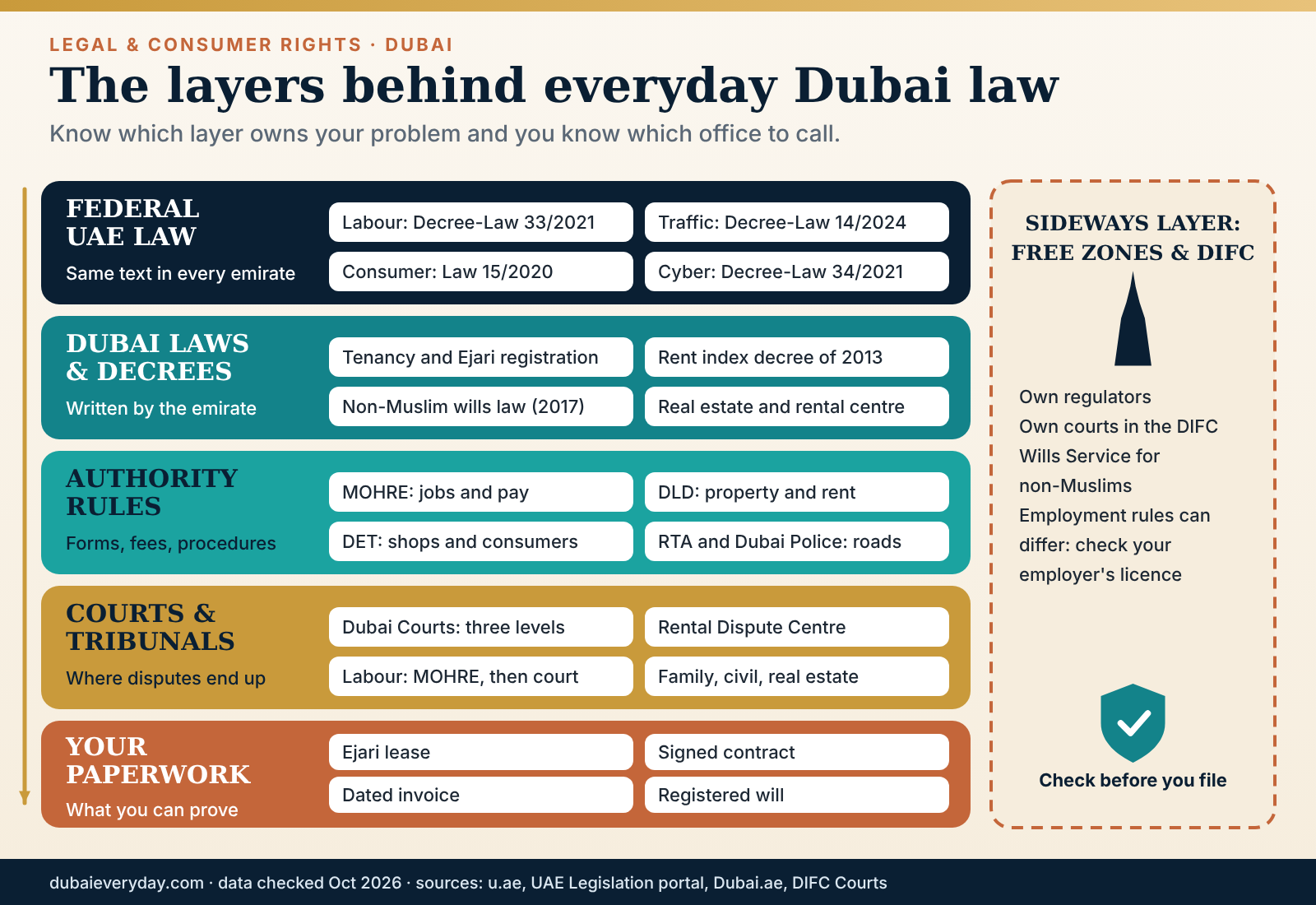
The fourth layer runs sideways rather than downward. Free zones and special jurisdictions, such as the Dubai International Financial Centre, can have their own civil and employment rules, their own regulators and, in the DIFC, their own English-language courts. That matters if your employer or your landlord sits inside one of them. We return to this in the free-zones section.
Why the layer matters for Dubai laws expats in practice
A typical resident does not need to memorise every instrument behind the Dubai laws expats hear about. What matters is the routing. If your pay is late, the federal labour framework applies and the Ministry of Human Resources and Emiratisation (MOHRE) takes the complaint.
If your landlord refuses to return a deposit, you are in Dubai’s tenancy system. If a shop sells you a faulty phone, you are in federal consumer law with a Dubai complaint channel. If you collect a speeding fine, you are in federal traffic law with Dubai Police and RTA handling the payment.
The second practical point is language. The UAE Legislation portal states, on the traffic decree-law page, that the Arabic text prevails over the English version if the two conflict (UAE Legislation portal). English translations are very useful for orientation, but a lawyer working on a live dispute will go back to the Arabic.
Anything on this page that mentions a fine, a deadline, a fee or a threshold is a snapshot. The official source is always the final word. Before you act on money, residency or a notice period, open the linked government page, check its date, and if the stakes are high, ask a licensed UAE lawyer to confirm.
Residents, visitors and everyone in between
Most of the Dubai laws expats live under assume you are a resident: someone with a residence visa, an Emirates ID and a tenancy or employment contract. Visitors are subject to the same traffic and conduct rules, and the same consumer protections apply to a tourist buying a watch.
For visa mechanics and arrival rules, our Dubai travel guide covers the visitor side, and the residence visa guide explains the main residency routes. Here we deal with the rules you live under once you have a place and a job.
One more scope note, so this page does not duplicate others. Tenant rights get their own deep treatment in our tenant rights guide, and the practical side of finding and signing a lease is in the renting in Dubai guide. This page gives the tenancy rules at overview depth, then shows how they connect to the other five areas. Work visas, insurance and company formation also have their own pages, linked where relevant, so this guide stays focused on the Dubai laws expats meet after they arrive.
Who to call first: a decision map for Dubai laws expats actually use
Most legal stress around Dubai laws expats face comes from sending a complaint to the wrong office. A salary dispute filed with the Dubai Land Department goes nowhere, and a deposit dispute filed with MOHRE goes nowhere either. The map below shows the first official stop for the most common problems, built from the government pages we checked. It is a routing aid, not a promise that every case will succeed.
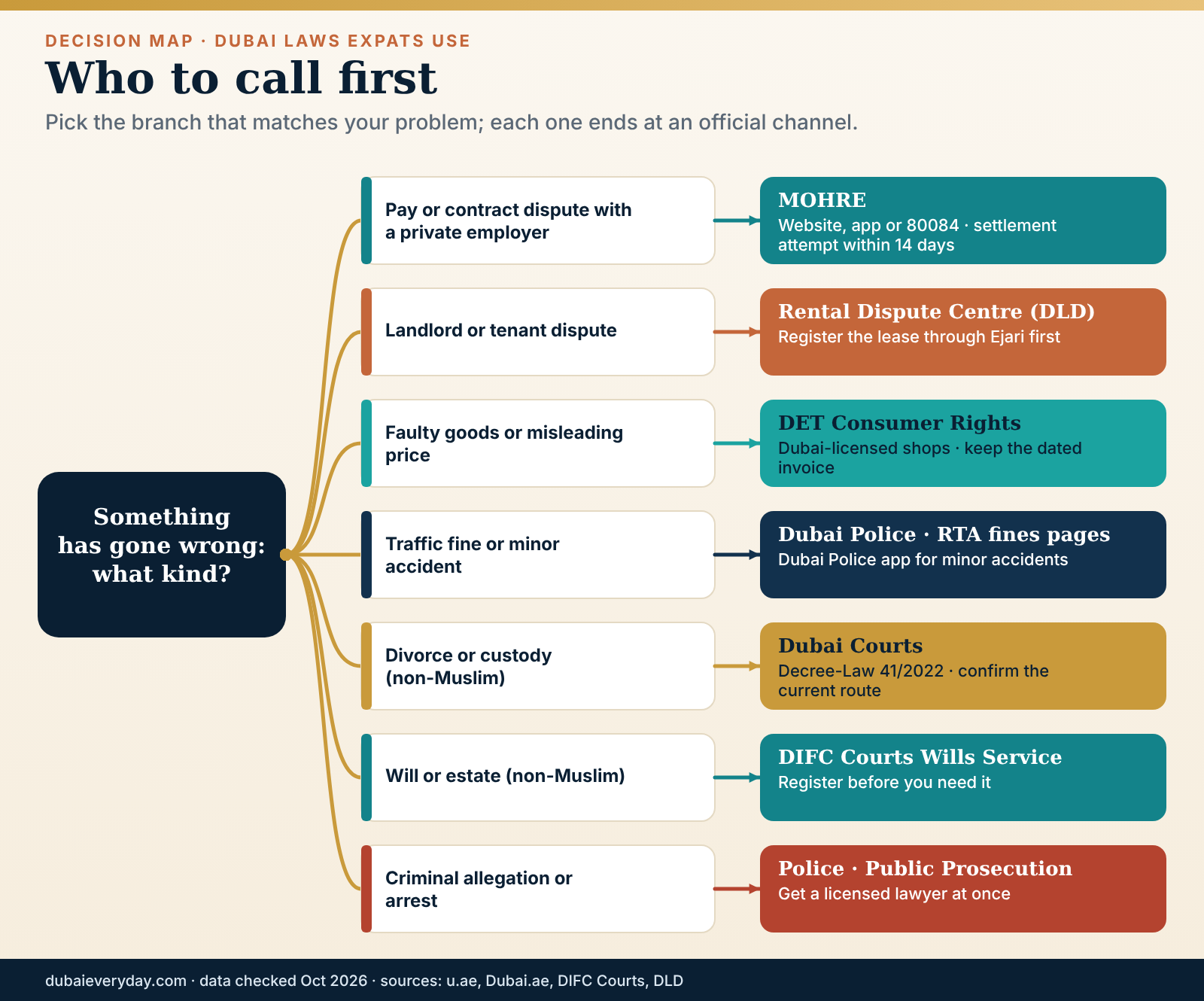
| Your problem | First official stop | Main instrument | Detail worth knowing |
|---|---|---|---|
| Unpaid or late salary, contract dispute with a private employer | MOHRE: website, app or the 80084 call centre | Federal Decree-Law 33 of 2021, as amended | MOHRE tries to settle within 14 days; claims are not heard more than one year after the violation |
| Landlord or tenant dispute in Dubai | Rental Dispute Centre, Dubai Land Department | Dubai tenancy legislation, registered through Ejari | An unregistered lease is a weak starting point |
| Faulty goods, misleading price, refused repair | Dubai Department of Economy and Tourism: consumerrights.ae | Federal Law 15 of 2020, as amended | Keep the dated invoice; it is a legal requirement for suppliers |
| Traffic fine or accident report | Dubai Police and RTA fine portals; Dubai Police app for minor accidents | Federal Decree-Law 14 of 2024 | In force since 29 March 2025 |
| Divorce or custody, non-Muslim couple | Courts (family matters for non-Muslims) | Federal Decree-Law 41 of 2022; Cabinet Resolution 122 of 2023 | Either spouse may file under home-country law or ask for UAE law |
| Will or probate, non-Muslim | DIFC Courts Wills Service | Dubai Law 15 of 2017; DIFC registry rules | Without a registered will, local court rules where the assets sit apply by default |
Two entries on that map of Dubai laws expats use deserve a warning. First, the employment route assumes your employer is a private-sector business under the federal labour law. Government employees, armed forces, police and security staff, and domestic workers are outside it, according to u.ae, and domestic workers have their own Federal Decree-Law No. 9 of 2022, amended in 2023 (u.ae). Second, if your employer sits inside a free zone, the rules and forum can differ, which we cover later.
Build the paper trail before Dubai laws expats rely on it
Every route for Dubai laws expats use runs on evidence. The government pages tell you what to submit, but the habit that helps most is simple: keep a dated, searchable record from day one. For a rental, that means the signed contract, the Ejari certificate, cheque copies, and photographs of the unit on move-in day. For a job, it means the offer letter, the signed contract, payslips and the text of any resignation or warning. For a purchase, it means the invoice, the warranty and a screenshot of the advertised price.
The u.ae labour-rights page makes a similar point for workers: keep a copy of the signed job offer from your home country and make sure the contract you sign after arrival matches it (u.ae, labour rights). If the two differ, ask why before you sign, not after.
- Save every contract as a PDF in a folder that is not on your work laptop, so a job change does not cut you off from your own records.
- Write down dates and amounts as they happen. A note made the same day beats a memory three months later.
- Use email or an app message to confirm verbal promises, in one sentence: “To confirm what we agreed on the phone…”
- Keep copies of your passport, visa page, Emirates ID and tenancy contract in one place you can open from a phone.
Free and low-cost help with Dubai laws expats meet
MOHRE runs a Labour Claims and Advisory Call Centre on 80084 for workers and employers. Dubai’s consumer complaint service runs through the DET portal, and court offices provide legal support in labour disputes, according to u.ae. None of these replaces a lawyer where your rights are complicated, but they are the right first call for the problems they cover, and several of them tell you explicitly when a matter has to be taken to court instead.
If you do need a lawyer, ask for the licence details and check them. The official Dubai portal’s legal affairs page explains how the courts, prosecution and dispute-resolution routes fit together, and it carries a “Find a lawyer in Dubai” link (Dubai.ae, Legal Affairs). We do not rank or recommend firms here.
If you are choosing between a general adviser and a specialist, our advice is to prefer the specialist whenever your problem is a tenancy dispute, an employment claim, a family case or a property transaction, because each has its own procedure and its own deadlines.
Practical habit. Before paying any lawyer, ask three things in writing: who exactly will handle the file, what the fee covers and what it does not, and what a realistic timeline looks like. Reputable advisers answer without hedging. Be wary of anyone who promises a result.
Tenancy: Ejari, rent, notice and disputes
Housing is the first of the Dubai laws expats meet, and it is where Dubai’s rules diverge most from the rest of the UAE. This section gives the framework, the numbers the Dubai Land Department (DLD) publishes, and the places where tenants and landlords usually trip. For the full tenant-side treatment, including deposits, maintenance disputes and what to do at each stage, go to our tenant rights guide. The point here is to understand how tenancy fits among the other Dubai laws expats deal with.
Ejari: the registration that everything else leans on
Every tenancy in Dubai is supposed to be registered through Ejari, the DLD’s system. The DLD’s tenancy guide says registration with the Real Estate Regulatory Agency is mandatory under Law No. 26 of 2007, Article 4(2), and that courts and government bodies will not hear lease disputes for unregistered contracts (DLD tenancy guide). Read that twice. An unregistered lease is not “cheaper” or “flexible”; it is a lease you may struggle to enforce.
Ejari is also the gateway to services. The u.ae leasing page says registration of lease contracts is compulsory to connect utilities, which is why a DEWA move-in request leans on it (u.ae, leasing). Our DEWA move-in guide explains the sequence. The documents the DLD lists for registration include the original contract, the latest DEWA invoice, the title deed or land map, and the tenant’s passport or trade licence.
Two details save arguments. Sub-lease contracts between tenants are not registered through Ejari, according to the same guide, which is another reason to treat subletting carefully. And companies must register through Ejari rather than at a typing centre.
What the lease costs beyond rent
The u.ae leasing page states that tenants pay a housing fee to Dubai Municipality of 5% of the yearly rental charges, which is added to the monthly electricity and water bills. It also says some brokers may charge a commission of up to 5% of the total rent. Treat those as the official starting points and confirm current practice before you sign.
The deposit is separate: Article 20 of Law No. 26 of 2007 lets a landlord take a deposit to secure maintenance at the end of the lease, and requires the landlord to refund it, or the balance, when the lease expires. The tenancy guide sets no percentage cap, so the amount is whatever you agree in the contract.
Ask the landlord or broker to itemise every amount: rent, deposit, commission, Ejari fee, maintenance deposit and any chiller or parking charge. Compare the list against the Ejari contract. An item that appears only in a chat message is an item you may not be able to recover later. Our apartment rental guide and villa rental guide cover the building-level extras.
How much can rent go up under Dubai laws expats rely on?
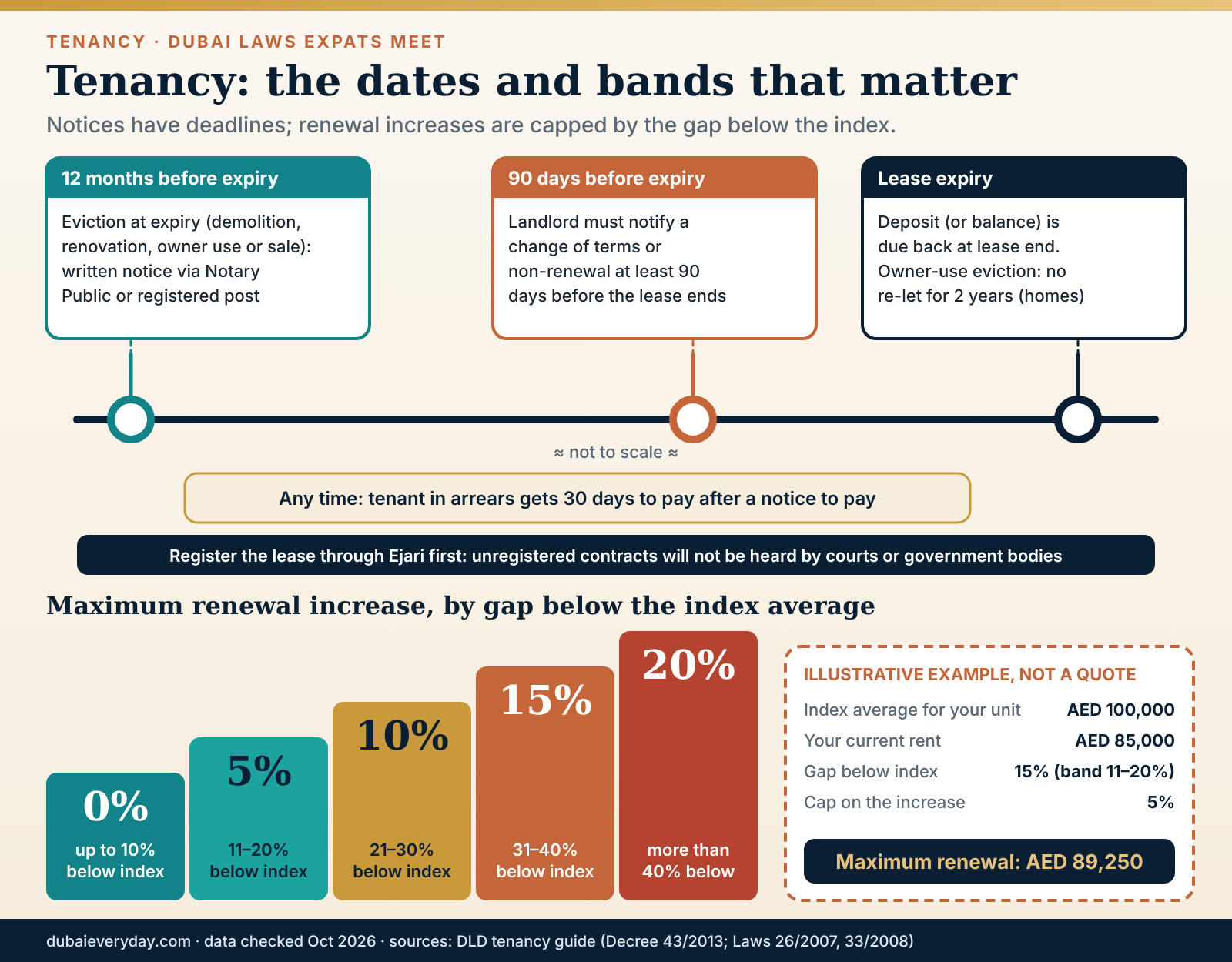
Dubai ties renewal increases to a Rent Index published by the DLD. Under the 2013 decree cited in the tenancy guide, the permitted increase depends on how far your current rent sits below the index average for a comparable unit. The guide’s bands are below.
Note a naming wrinkle: the DLD tenancy guide and u.ae cite the decree as No. 43 of 2013, while a 2025 DLD press release about the Smart Rental Index refers to “Decree No. (34) of 2013”. We use 43, the number on the guide and on u.ae, and suggest you confirm the instrument on the DLD site if you are drafting a formal notice.
- Contract rent up to 10% below the index average: no increase.
- 11% to 20% below: up to 5%.
- 21% to 30% below: up to 10%.
- 31% to 40% below: up to 15%.
- More than 40% below: up to 20%.
The DLD announced a “Smart Rental Index” on 2 January 2025, describing a building classification system that rates structure, finish, maintenance quality, location and services, covering all residential areas of Dubai including free zones (DLD announcement). The press release says increases still follow the gap between current rent and average market rent. It did not describe a new tenancy law, so the practical effect on you is that the “average” is now calculated more granularly, which is worth checking with the DLD tool rather than guessing from a listing site.
Illustrative example (not a quote or market fact). Suppose a tenant pays AED 85,000 and the index average for the same type of unit is AED 100,000. The tenant is 15% below the average, which falls in the 11% to 20% band, so the cap is 5%: AED 4,250, giving a maximum renewal of AED 89,250.
If the same tenant paid AED 95,000, they would be 5% below and the permitted increase would be zero. The DLD’s own worked example in the guide uses AED 60,000 against AED 80,000, a 25% gap, 10% allowed, new rent AED 66,000. Always run the DLD calculator with your actual unit details.
Notice periods and eviction
Of all the Dubai laws expats read about, two deadlines matter most for tenants, and they are different. The first is the 90-day notice. According to the guide, a landlord who wants to change the terms or not renew must notify the tenant at least 90 days before expiry, citing Law No. 33 of 2008, Article 14. Our reading is that this is the deadline a rent-increase dispute has to fit inside: a notice that arrives later than 90 days before expiry is worth challenging, ideally with advice.
The second is the 12-month notice for eviction at expiry. The guide says that if the landlord wants the tenant out because the building will be demolished or renovated, or because the owner needs it for personal use or wants to sell, the notice must be given at least 12 months before the eviction date through a Notary Public or registered post (Law No. 33 of 2008, Article 25(2)).
It adds that the original 90-day requirement in Law No. 26 of 2007 was superseded. If the owner evicts for personal use, the property cannot be re-let for two years (residential) or three years (non-residential) according to Article 26.
For non-payment, the guide gives the tenant 30 days after a notice to pay. Subletting without the landlord’s written consent is a ground for eviction, and Article 24 of the 2007 law bars subletting or assigning without written consent unless the contract says otherwise.
What to do with a notice. If you receive a notice, photograph the envelope or save the email, write down the date of receipt, and compare the notice period against the lease expiry on your Ejari certificate. Do not ignore it, and do not negotiate verbally. A written reply that keeps the record clean is worth more than a heated phone call.
Maintenance and handover
The tenancy guide sets a simple split. The landlord must hand over the property in good condition (Article 15), handles maintenance and repairs that affect the intended use unless the contract says otherwise (Article 16), and is responsible for defects and wear not caused by the tenant (Article 17).
The tenant must maintain the property as an ordinary person would (Article 19). Among the Dubai laws expats face at move-in, the boundary between “ordinary use” and “maintenance” is written in a clause, so read the clause, not just the cover page. Take dated photographs of every room on day one.
Where tenancy disputes go
The u.ae leasing page names the Rental Dispute Centre of the DLD as the dispute body. The tenancy guide identifies the Special Tribunal for Settlement of Disputes between Landlords and Tenants as the forum for lease disputes in the 2007 law and advises registering the contract first. Neither official page lists current filing fees or step-by-step procedure, so we do not quote any. The DLD site and its Dubai REST app are where to confirm what applies today, and our tenant rights article keeps the process in more detail.
When you leave, the housekeeping rules matter too. The DEWA move-out guide covers the final bill and the utility deposit, which is a separate matter from the landlord’s deposit. Close the utility account, take exit photographs, and keep the handover note signed by both sides.
Employment: contracts, hours, leave and gratuity
If you work for a private-sector employer on the mainland, most of the Dubai laws expats rely on for work come from one federal statute: Federal Decree-Law No. 33 of 2021, as amended by Federal Decree-Law No. 20 of 2023. It applies to employees across the UAE, Emirati or expatriate, and excludes government employees, the armed forces, police and security personnel, and domestic workers, according to the u.ae employment-law page.
This section covers the Dubai laws expats meet while a job runs. The next one covers exits and disputes. For the visa side of getting hired, see our Dubai work visa guide, and for the search itself, the job-search and scam-check guide.
The contract: what Dubai laws expats can now expect
The law abolished unlimited contracts and recognises limited, or fixed-term, contracts. The u.ae page on contract duration sets no fixed maximum term, lets a fixed-term contract be extended or renewed for a similar or shorter period, and says that if a fixed-term contract expires but both sides keep performing it, it is treated as renewed on the original terms. Extensions and renewals count toward end-of-service benefits (u.ae, contract duration and models).
The same page lists the work models the law recognises: full-time, part-time, temporary, flexible, remote and job sharing. If your employer proposes “flexible” or “remote” terms, ask for them in the contract text, with hours, days and pay stated. A model that exists in the statute is not the same as a promise in your offer.
The most useful guidance on the Dubai laws expats meet as new hires comes from the labour-rights page: make sure the contract you sign after arrival matches the job offer you accepted, keep a copy of the signed offer, and store your identification documents securely. The page also says charging recruitment fees to prospective employees is illegal, and that the employer bears recruitment and travel costs and the cost of your residence permit (u.ae, labour rights).
Probation: shorter than many people think
Probation cannot exceed six months and cannot be extended, per the u.ae contract page. During it, an employer who ends the job must give 14 days’ prior written notice. An employee who wants to move to another UAE employer must give at least one month’s written notice, and the new employer compensates the old one’s recruitment costs unless the parties agree otherwise. An employee leaving both the job and the country gives 14 days’ notice.
There is a trap. The u.ae termination page says a worker who quits during probation when the employer has not breached the contract may not obtain a new work permit for one year. If you are thinking of walking away in month two, read that sentence again, and get advice before you hand in a letter.
Pay, passports and basic protections
The labour-rights page is clear on several points that still catch people out. Confiscating a worker’s passport is prohibited, and workers do not need their employer’s permission to leave the country. The Wage Protection System exists to ensure employees are paid in full and on time, with Ministerial Resolution No. 346 of 2022 amending its rules, though the page does not state the exact payment deadline. The law also prohibits forced labour, discrimination based on gender, race, colour, sex, religion, national or social origin or disability, and bans employing children under 15.
Hold on to your documents. If an employer says it must keep your passport “for safety”, the official page says confiscation is prohibited. Politely decline, offer a copy, and if pressure continues, log the date and contact MOHRE on 80084. Keep your Emirates ID and passport in your own possession.
Hours, rest and overtime
The standard week is 8 hours a day or 48 hours a week under Article 17, according to u.ae. During Ramadan, working hours are reduced by two hours a day. Overtime is capped at two extra hours in a day and pays normal hourly rate based on basic salary plus 25%, rising to 50% extra if the overtime falls between 10 pm and 4 am, though the overtime rule does not apply to shift workers.
Working on an off-day earns either a substitute rest day or normal pay plus 50%. After five consecutive hours you are entitled to breaks totalling at least one hour, which do not count as working time (u.ae, working hours).
Summer midday break. Work directly under the sun in open places is not allowed from 12:30 pm to 3 pm between 15 June and 15 September each year, under Ministerial Resolution No. 44 of 2022. This is an employer obligation, not a courtesy. If you manage outdoor staff or contract site work, build it into schedules; if you are the worker, it is the rule to quote.
Leave under Dubai laws expats rely on: the numbers
The u.ae leave page is the best single reference. These are the entitlements it lists, and each has conditions, so read the page for the exact wording before you plan around any of them.
Annual leave
30 fully paid days after one year of service. For service between six months and one year, 2 days per month. Leave is pro-rated if service ends before it is used.
Sick leave
Up to 90 days per year after probation: the first 15 at full pay, the next 30 at half pay, the last 45 unpaid. Notify your employer within 3 days with a medical report.
Maternity and parental
Maternity: 60 days, 45 fully paid and 15 half paid, starting up to 30 days before the due date. Parental leave: 5 paid working days for either parent within six months of birth.
Bereavement
Five paid days for the death of a spouse and three for a parent, child, sibling, grandchild or grandparent, counted from the date of death.
Study leave
Ten paid working days a year for exams, with at least two years of service and enrolment in an accredited UAE institution.
Hajj leave
Up to 30 unpaid days, granted once during employment with the same employer.
Note what is missing: no leave type on that page covers “personal days” or “mental health days” as a legal right. Many employers offer them by policy, and that is a contract matter. The legal minimum is the floor; your offer letter can be above it but not below.
End-of-service gratuity: how it is calculated
For expatriate full-time workers, Article 51 sets the formula. You need at least one year of continuous service. After that, gratuity is 21 days’ basic salary for each of the first five years and 30 days’ basic salary for each year after the fifth, with a cap equal to two years’ wage.
Allowances such as housing, transport, utilities and furniture are excluded; it is calculated on basic salary. It is due, with other outstanding wages and entitlements, within 14 days of termination, and employers may deduct amounts the worker owes (u.ae, end-of-service benefits).
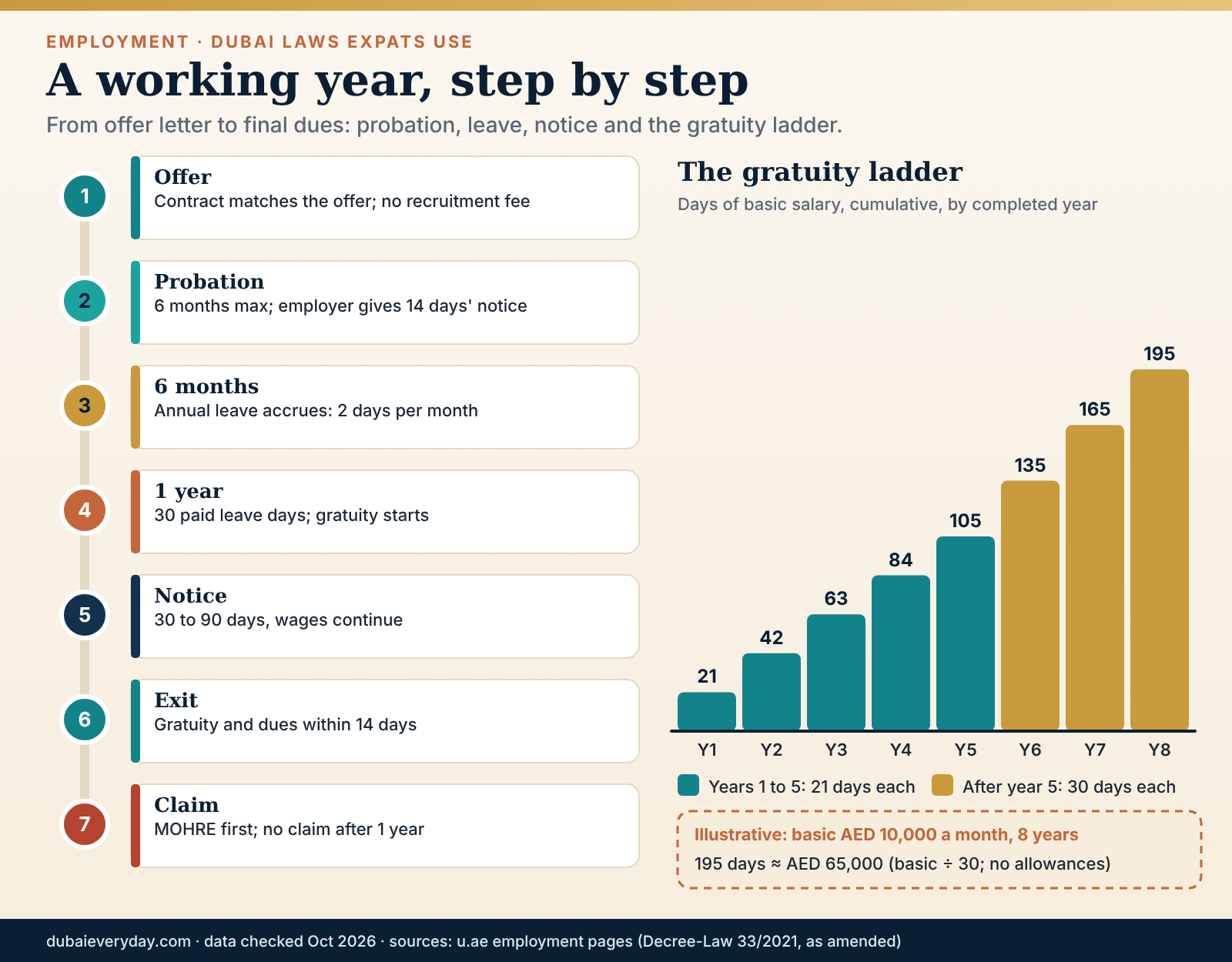
Illustrative example (not a quote or market fact). Take a basic salary of AED 10,000 a month and a total package of AED 16,000 that includes allowances. Using the common convention of dividing basic salary by 30 to get a daily rate (AED 333), eight years of service gives 5 x 21 + 3 x 30 = 195 days, or about AED 65,000.
Three years gives 63 days, about AED 21,000. The allowances do not count. Employer calculators and your own lawyer may handle part-years and unpaid absence differently, so treat this as arithmetic to understand the logic, not an entitlement estimate.
Two refinements matter. First, days of unpaid absence do not count toward service. Second, an employer may opt into a voluntary Savings Scheme that replaces traditional gratuity for enrolled employees, with employer contributions based on basic monthly salary: 5.83% if the employee has under five years’ service and 8.33% above five.
Funds, with returns, are paid within 14 days of termination, and employees may add voluntary contributions up to 25% of wages. If your contract mentions a scheme, ask which one applies, because the comparison with the traditional gratuity depends on your tenure.
Unemployment insurance: a small cost, a short cushion
Under Federal Decree-Law No. 13 of 2022, employees in the federal government and the private sector must subscribe to the unemployment insurance scheme, with exclusions including investors, domestic workers, temporary-contract employees and juveniles. The u.ae page says the premium is no more than AED 5 a month for basic salaries under AED 16,000 and no more than AED 10 a month above that, and that not subscribing or not paying premiums each carries a AED 400 fine.
Compensation is 60% of the subscription salary for up to three months, capped at AED 10,000 a month in the first category or AED 20,000 in the second. You need 12 continuous months of subscription, must claim within 30 days of the end of employment, and the scheme does not pay on resignation or disciplinary dismissal (u.ae, unemployment insurance).
Check your payslip and your employer’s records for it. Health cover is a separate subject, covered in our health insurance guide.
When work goes wrong: termination, resignation and claims
Most questions about Dubai laws expats put to lawyers are about endings: a resignation that went badly, a dismissal that felt sudden, a final settlement that came in lower than expected. The Dubai laws expats meet at exit are detailed, and several rules are strict, so this section follows the u.ae page on terminating contracts closely and flags where the page is silent.
Notice: 30 to 90 days, and wages continue
Either party may end a contract for a legitimate reason with written notice. The notice period must be not less than 30 days and not more than 90 days, the contract continues during notice, and the worker keeps full wages for that time (Article 43). The actual number for you sits in your contract, inside that range. If your contract says 120 days, it is worth asking a lawyer how that clause is likely to be read.
The employer must give written, justified notice, and the worker is entitled to keep earning until the notice ends. If you resign, deliver the notice in a way you can prove: an email with a read receipt, or a signed copy, in addition to any system click. A resignation that cannot be proved is a resignation your employer can dispute.
Dismissal without notice: the ten cases
Article 44 lists the situations where an employer may dismiss without notice.
According to u.ae, they include using a false identity or forged documents; causing substantial material loss through error or deliberately damaging property; violating posted written safety instructions; continuing to fail basic duties after two warnings; disclosing confidential industrial or intellectual property information; being drunk or under prohibited drugs during working hours; assaulting the employer, a manager, a supervisor or a colleague; being absent without valid excuse for more than 20 non-consecutive days in a year or more than seven consecutive days; unlawfully exploiting one’s position for personal gain; and joining another establishment without following the required procedures.
Read the procedure as carefully as the list. The employer must conduct a written investigation first, and the dismissal notice must be written, justified and delivered to the employee (u.ae, terminating contracts). A verbal “you are fired, collect your things” does not match that description. If you are in this position, ask for the notice in writing and keep it.
When you can leave without notice
Article 45 gives workers a short list too. A worker may leave without notice and keep end-of-service entitlements if the employer breaches contractual or legal obligations (after the worker notifies MOHRE 14 working days before quitting and the employer fails to fix the breach after MOHRE notifies them); assaults or harasses the worker (reported within five working days); assigns fundamentally different work without written consent except in cases of necessity; or ignores known grave safety or health dangers.
The sequence is the key detail. Walking out because pay is late, without going through MOHRE, can turn a strong position into a weak one. If your employer is in breach, the route is to document the problem, notify MOHRE, and let the process run.
The one-year permit bar. The u.ae page says a worker who quits during probation when the employer did not breach the contract may not obtain a work permit for one year, and a separate bar applies after a proven “work abandonment” report. That is different from an ordinary resignation after notice. If you are in the grey zone between “unhappy” and “abandoned”, take advice before you stop going to work.
Arbitrary dismissal and compensation
Dismissal is unlawful if it results from a valid, serious MOHRE complaint or a proven lawsuit against the employer. Compensation is set by the court and, according to the page, must not exceed three months of the employee’s last wage. The worker may also claim gratuity, notice-period dues and other unpaid amounts. The cap is a reminder to keep the evidence tidy, because the court weighs documents.
Claims under Dubai laws expats use: MOHRE first, then court
The labour-dispute process within the Dubai laws expats rely on is more structured than the rumour mill suggests. Per the u.ae labour-dispute page, either party files a complaint with MOHRE through its website, the MOHRE app or by phone. MOHRE examines it and tries to settle it amicably within 14 days of the application. If no settlement is reached, MOHRE refers the dispute to the competent court with a memo summarising both sides and its recommendation, and the court must fix a hearing within three days of receiving the request.
Those four numbers describe the shape of a typical claim. MOHRE can issue a final decision on a claim under AED 50,000, or record an amicable settlement of any size. A claim above AED 50,000 that the parties cannot settle goes to court. Workers or their heirs are exempt from judicial fees at all litigation and execution stages for claims under AED 100,000 (Article 55). The one-year limit is the one that bites: do not wait to see whether the problem “sorts itself out” (u.ae, resolving labour disputes).
Evidence a labour complaint needs
The official pages do not list a document checklist, so this is our practical reading of what the process rewards. Gather the signed contract, the offer letter, payslips or bank statements showing what was actually paid, any written warnings, your resignation or termination notice, and messages that show dates. For wage claims, a simple month-by-month table of what was due, what was paid and what is outstanding helps whoever reads the file.
- Contract and any addenda, plus the original offer.
- Three to six months of payslips and bank transfers.
- The notice, in writing, and proof of delivery.
- A one-page timeline with dates, written within days of events.
- Your Emirates ID, passport and visa page copies.
Mainland vs free-zone employers and Dubai laws expats meet
The u.ae employment-law page says the labour law applies to all employees in the UAE except the excluded groups, but it does not discuss free zones, and MOHRE’s own complaint services list a separate “register free zone complaint” option. Some free zones, including the DIFC, run their own employment regimes.
The practical rule: ask your HR team which authority licenses your employer and read that authority’s employment rules. If your employer is a free-zone company, do not assume the mainland route above is the whole story; confirm before filing. Our business setup guide explains how free-zone and mainland structures differ for companies, which is the same distinction that matters here.
If you are the employer. The same pages bind founders. If you hire staff, you owe them written contracts, wages through the Wage Protection System, leave, gratuity and a termination process that matches Articles 43 to 45. Our accounting services overview covers payroll, VAT and corporate tax support, and the mainland company guide covers licensing. For founders, legal compliance is part of the setup cost, not an afterthought.
Consumer rights in Dubai: invoices, refunds and complaints
Consumer law is the part of the Dubai laws expats will use most often and think about least. It covers the phone that stops working, the gym that keeps billing, the online order that never arrives, and the price tag that does not match the till. The framework is federal, the complaint channel for Dubai-licensed businesses is local, and a few exclusions catch people out.
What the federal law says about Dubai laws expats use as shoppers
The base instrument is Federal Law No. 15 of 2020 on Consumer Protection, as amended by Federal Decree-Law No. 5 of 2023, with Cabinet Resolutions No. 56 and 57 of 2024 dealing with telemarketing and its penalties. According to u.ae, the law covers goods and services supplied by suppliers, advertisers and commercial agents on the mainland and in free zones, including goods sold through UAE-registered e-commerce platforms. It does not cover e-commerce between UAE customers and businesses registered outside the UAE (u.ae, consumer protection).
That last sentence matters for anyone who shops on foreign marketplaces. If the seller is registered abroad, the Dubai consumer route is not your route. Your recourse sits with the payment provider or card issuer, and with whatever terms the platform sets.
Rights and supplier duties, in plain terms
The page lists the consumer’s rights as a safe environment for buying goods or receiving services, correct information, awareness of rights and obligations, the right to choose the most suitable product, fair compensation for losses from defective goods or inadequate or unprofessional services, protection of personal data (which suppliers may not use for marketing), and health and safety protection.
On the supplier side, several duties are concrete. Suppliers must issue a dated invoice showing the trade name, address, type of goods or service, price, quantity and any other data the Executive Regulation requires, and the invoice must be in Arabic, with other languages optional. E-commerce businesses must disclose their licensing entity, Arabic product information, specifications, contract terms, payment details and warranty information. Contract clauses that harm consumers, or that exempt suppliers from their legal obligations, are void.
Why the invoice is your key document. A dated invoice is a legal requirement for the supplier and your main exhibit for any complaint. Ask for it even for small purchases, photograph it, and keep it for the warranty period. A card statement is a weaker substitute because it does not describe what you bought.
What the penalties tell you about priorities
The official page states that suppliers who fail to provide clear information and labelling, advertise misleading prices or false data, or fail to repair or replace a defective product at no charge face imprisonment of up to two years and a fine of up to AED 2 million. You are unlikely to see a shopkeeper in court, but the list shows what the law treats as serious: unclear labelling, misleading prices and refusal to repair. Those are the three complaints with the best legal footing.
The part the official page does not say
The u.ae page does not state refund, return or warranty periods. You may hear that Dubai has a fixed “return within a set number of days” right. We could not verify one on an official page today, so we do not state it. Shops set their own return policies, but a policy cannot remove a statutory duty to repair or replace a defective product, and clauses that exempt suppliers from their legal obligations are void under the page.
When a shop says “no refunds”, ask what the receipt or the posted policy says about defects and warranty, and ask for it in writing. For shopping logistics, tax refunds and returns practice, our shopping guide is the better place.
How to file a complaint under the Dubai laws expats can use
The Department of Economy and Tourism (DET) runs Dubai’s consumer rights service. A Gulf News explainer updated on 3 October 2026, which we treat as secondary reporting rather than an official source, describes the process as follows. Try to resolve the issue with the business first, asking for a manager if frontline staff cannot help.
If that fails, file online with your name, contact details, whether you are a resident or tourist, the company name and sector, a description and supporting documents. The article says a DET employee contacts you within two working days, DET then contacts the business and mediates, approved settlements are finalised within four days of the investigation ending, and the process typically takes four to 10 working days (Gulf News).
The same article gives a DET Consumer Rights call centre number, 600 545 555, for eligibility questions. Confirm that number on consumerrights.ae before you call, because we could not open the DET page itself today. The u.ae page also lists the Ministry of Economy’s consumer line, 800 1222.

What the Dubai route does not cover
According to the same explainer, DET’s consumer route is for businesses holding a Dubai trade licence and does not cover purchases from businesses in other emirates, telecom and internet, real estate and leases, spoiled or expired food, electricity and water, banking and investments, insurance, fraud and cybercrime, and construction disputes. That is a long list, and it explains why people get bounced around. Matching each to its proper body:
- Tenancy disputes: the Rental Dispute Centre at the DLD, not DET.
- Banking and insurance complaints: the regulator named in your bank or insurer’s complaints procedure, typically the Central Bank of the UAE. Our insurance guide explains how to compare policies.
- Fraud or cybercrime: Dubai Police, not a consumer complaint.
- Utilities: the provider’s own complaints channel first. See our home setup guide for the utility basics.
The explainer does not say whether free-zone businesses fall within DET’s Dubai consumer route, so confirm by phone. The federal law itself says it covers goods and services supplied in free zones, which suggests a route exists; the question is which office takes the file.
Everyday situations covered by the Dubai laws expats use as consumers
Gym membership that will not cancel
Read the contract for the cancellation clause and any minimum term. Clauses that exempt the supplier from legal obligations are void, but ordinary agreed terms usually stand. Ask for cancellation in writing and keep the reply. Our gym guide lists the contract points worth checking before you join.
Cleaning or repair that was not done
Photograph the result, message the provider the same day, and give a reasonable chance to fix it. If it escalates, you need the booking, the invoice and the messages. See the cleaning services guide for licensing checks.
Price differs from the shelf tag
The law treats misleading prices as a serious matter. Photograph the tag and the receipt, raise it at the till, and use the price complaint form on the DET site if the shop refuses.
Unwanted sales calls
Federal rules now deal with telemarketing through Cabinet Resolutions 56 and 57 of 2024. The Gulf News explainer points to a DET page for complaints about calls from DET-registered businesses.
Scope note. Consumer complaints involve a trade-off between speed and certainty. DET mediation is usually quicker than a court case, but it produces a settlement, not a precedent, and it does not apply to every category of dispute. For larger sums, talk to a lawyer about whether court or arbitration is the better path, and check the time limits that apply.
Traffic and driving rules
For many residents, traffic is the area of the Dubai laws expats meet most directly, usually through a camera. The framework is federal, enforcement is local, and the most important point of the past two years is a new decree-law that changed the penalty regime. Licence mechanics, such as getting or converting a licence, live in our driving licence guide and the licence exchange guide; this section is about the Dubai laws expats drive under and what happens when you break them.
The new federal traffic law among Dubai laws expats must follow
The UAE Legislation portal lists the Federal Decree-Law on Traffic Regulation as issued on 30 September 2024, published in Official Gazette No. 784 and effective 29 March 2025, with status active. The u.ae road-safety page gives it as Federal Decree-Law No. 14 of 2024, says it came into effect on 29 March 2025, and lists drink or drug driving, hit-and-run, and driving with a suspended licence among the serious violations. It also states a minimum driving licence age of 17 (u.ae, road safety).
The official pages do not list fine amounts for the new decree-law. That gap is why drivers rely on news summaries, which are useful but secondary.
A Gulf News summary published around the law’s start reports, for example, that driving under the influence of alcohol carries imprisonment and/or a fine of AED 20,000 to AED 100,000 with licence suspension of three months for a first offence, and that leaving the scene of an accident without providing information can carry up to one year’s imprisonment and/or AED 50,000 to AED 100,000 (Gulf News). Treat such figures as indicative, and read the decree text for any real decision.
Alcohol and driving. The u.ae page lists driving under the influence of alcohol, drugs or psychotropic substances as a serious violation but gives no numeric limit. We found no official page stating a safe amount, so the only reliable planning rule is zero. Pre-book a taxi or ride, and do not drive the morning after a heavy night. Our nightlife guide covers alcohol rules and transport for evenings out.
Fines and black points: a snapshot, with a caveat
The u.ae road-safety page links to a PDF titled “List of traffic offences and violations”. When we opened it, the document was an Abu Dhabi Police excerpt of Ministerial Resolution No. 178 of 2017 on traffic control rules and procedures, without its own effective date.
That is an older instrument than the 2024 decree-law, so some entries may since have changed. We still think it is worth reading as a map of how the system scales penalties, and we list a few items below as published there. For your own plate and your own fines, use the Dubai Police or RTA portals.

Reading the ladder, the pattern in the Dubai laws expats must follow is clear. Small speed overages cost money only: the list gives AED 300 for up to 20 km/h over, AED 600 for up to 30, AED 700 for up to 40 and AED 1,000 for up to 50.
Beyond that, black points and vehicle impound enter: AED 1,500 with 6 black points and 15 days’ impound for up to 60 km/h over, AED 2,000 with 12 points and 30 days for over 60, and AED 3,000 with 23 points and 60 days for over 80.
The same list shows other offences with a points component, such as AED 800 and four points for using a mobile phone while driving, AED 1,000 with 12 points and a 30-day impound for running a red light in a light vehicle, and AED 400 with four points for not wearing a seat belt.
Some entries are money-only. The list gives AED 400 for jaywalking, AED 500 for improper parking and AED 400 for parking on pavements. Press coverage of the 2024 decree-law reports that jaywalking can now attract far higher penalties, in particular where it causes an accident or happens on a road with a speed limit of 80 km/h or more. If you walk near fast roads, the safe reading is to treat the old AED 400 as possibly out of date. Use crossings.
Three traffic rules that Dubai laws expats misjudge
First, foreign licences. The law has hard edges for an “unrecognised” foreign licence: the Gulf News summary reports AED 2,000 to AED 10,000 for a first offence, with harsher penalties for repeats. If you have just arrived, check whether your country’s licence is recognised before you drive, and read the exchange guide before you assume anything.
Second, accidents. The u.ae page says minor accidents can be reported through the MOI UAE app, the Saeed app, the Dubai Police app and other emirate apps. The Gulf News summary adds that not giving details to the police can attract up to three months’ imprisonment and/or AED 10,000 to AED 20,000. In a collision, stay put, call the police if there is injury or dispute, and use the reporting tool for minor cases. Never leave.
Third, a suspended licence. The same summary reports up to three months’ imprisonment and/or a fine of at least AED 10,000 for driving while suspended. If you are unsure of your licence status, check it through the official channels before you drive, not after.
Paying and challenging fines
The u.ae page lists the official payment routes: the Ministry of Interior’s online fines service and its MOI UAE app, the Emirates Vehicle Gate, the Dubai Police fines inquiry, and the RTA Dubai public fines payment page. Use those links, not a text message from an unknown sender. Scam texts that imitate government fine notices are a standing risk; always type the official address yourself.
The official pages we opened do not describe a challenge or appeal procedure, so we do not either. If you believe a fine is wrong, start with the issuing authority’s service (Dubai Police or RTA), keep the notice, and see a lawyer if the amount or consequences, such as impound or suspension, are significant.
Renting a car or sharing one
Rental cars carry the same rules. Before you rent, read how the company passes on fines, tolls and any administrative charge, and photograph the car at pickup. Our car rental guide and the cheap car rental guide explain deposits, insurance and charges that surprise people. If you are learning, the driving schools guide covers the training side.
Family, marriage, divorce and children
Family law is the area of Dubai laws expats where “which law applies to me?” has the least obvious answer, because it depends on religion, nationality and sometimes on the choice of the people involved. The UAE has separate frameworks for Muslims and non-Muslims.
For non-Muslim residents, the central instrument is Federal Decree-Law No. 41 of 2022 on Civil Personal Status, with Cabinet Resolution No. 122 of 2023 as its executive regulations, according to u.ae. For Muslim couples, u.ae names Federal Decree-Law No. 41 of 2024, the Personal Status Law, which applies to Muslim couples including a Muslim husband with a non-Muslim wife.
This guide to Dubai laws expats is not a family-law manual, and it cannot be. What it can do is show you the entry points that are documented on official pages, point out where those pages disagree, and say plainly when a lawyer is not optional.
Civil marriage for non-Muslims among Dubai laws expats can use
Civil marriage does not apply to Muslims. In Dubai, the u.ae page says the route is through Dubai Courts, with a civil wedding licence offered in 24 hours. It lists these conditions: both parties are non-Muslim, at least one is a Dubai resident, both are at least 21, both appear in person or through an authorised representative, and original IDs and proof of being single are provided.
Foreign documents need certified Arabic translations stamped by the UAE Ministry of Justice, and foreign documents must be certified by the issuing country’s foreign ministry, the UAE embassy there and the UAE Ministry of Foreign Affairs and International Cooperation (u.ae, civil marriage).
The same page also describes Abu Dhabi’s civil marriage service, with a lower minimum age of 18 and published fees, which is a different system. If you are reading a blog that quotes Abu Dhabi fees for a Dubai wedding, close the tab. The u.ae page states no fee for Dubai.
The attestation chain takes time. The paperwork chain can take longer than the ceremony. The u.ae page asks for proof of being single, Arabic translations and a multi-step attestation of foreign documents, and each step takes time. Start collecting documents before you book, and ask a lawyer or the Dubai Courts which documents are needed for your nationality.
Divorce: two official pages, two slightly different stories
Here is a good example of why you verify. The u.ae divorce page says non-Muslim divorce is simple in structure: either spouse can end the marriage by declaring intent before the court, no reasons or fault are required, the case is exempt from family guidance and heard directly by the court, and a decision is issued at the first hearing. Either spouse may file under the laws of their home country, or either party may request that UAE law governs (u.ae, divorce).
The Dubai.ae divorce page, by contrast, says both Muslim and non-Muslim couples start by registering the case with the Family Guidance Section, that conciliation is mandatory, and that a referral letter can be submitted to court within three months. It adds that non-Muslim couples may file at the Dubai Courts or through their consulate or embassy, depending on their national or religious requirements (Dubai.ae, divorce).
We cannot reconcile the two pages from desk research. The u.ae page is federal and focused on the newer civil law; the Dubai page may describe a process that predates it or that varies by case. The practical advice: before you file, ask Dubai Courts or a family lawyer which route currently applies to your nationality and faith, and do not trust a blog’s step-by-step list, including ours.
What the u.ae page says about money and children
For non-Muslim divorces, the u.ae page says the wife may apply for alimony after the judgment; if it is not agreed in the marriage contract, the court sets the amount and duration, considering the length of the marriage, her age, both parties’ finances, each party’s role in the divorce and any harm suffered, ending on remarriage or when she no longer has custody.
Either party may seek adjustment. For custody, joint custody is the general rule for non-Muslims, with the court deciding on the child’s best interests if parents dispute. Under joint custody, a parent cannot take the child abroad over the other’s objection without court permission, and either parent may request a temporary travel ban.
The page does not state a child-support rule for non-Muslims and does not cover residency consequences of divorce. That second gap matters, because for many expats the legal residency of a spouse or children depends on the sponsor. If your residence visa is linked to your marriage, speak to a lawyer and the immigration authority about status before any step you cannot undo. Our residence visa guide explains the main sponsorship routes at a general level.
Children: schools, health and travel in Dubai laws expats meet
Family law touches the practical side of life with children. School choice runs through KHDA rules and parental agreement; see our schools guide and the KHDA ratings guide. Health cover for dependants is covered in the health insurance for residents guide. For day-to-day life with young children, the Dubai with kids guide and Dubai with a baby guide cover logistics.
The legal point to keep in mind is travel: the u.ae page says that, under joint custody, a parent cannot take the child abroad over the other’s objection without court permission. If a separation is possible, get advice on travel consent before booking tickets.
Muslim couples
For Muslim couples, the u.ae divorce page describes revocable and irrevocable divorce, Khula, and judicial divorce, with registration at the Family Guidance Section and a mandatory family counsellor session.
It says Muslim divorces must be documented with the court within 15 days and that custody goes first to the mother, then the father, then the next most entitled relative, always subject to the child’s best interests, with a child aged 15 or older able to choose which parent to live with unless the court decides otherwise. These are federal rules summarised from one page; the actual process is more detailed, and family matters of this kind belong with a licensed lawyer.
Where this section stops. We have not summarised inheritance rules for Muslims, guardianship, adoption, paternity or cases involving a foreign court order. Each has its own legal tests and its own documents, and the official pages we opened do not explain them. If one applies to you, treat this guide as a map to where to start asking, not as an answer.
Wills and what happens to your assets if you die in Dubai
This is the least pleasant corner of Dubai laws expats and probably the most valuable for anyone with a family, a car loan, a bank account or a property in the UAE. The short version for non-Muslims is that a registered will gives you control, and the lack of one hands the question to default rules that you may not like. The rules for Muslims are different and follow their own framework, so this section is about non-Muslim residents and owners.
What the DIFC Courts Wills Service offers
The DIFC Courts runs a Wills Service for non-Muslims. Its FAQ says applicants must be non-Muslim, must never have been Muslim, and must be at least 18, and they must own assets in the UAE and/or have minor children living with them in the UAE.
Residency is not required and registration can be done virtually from anywhere. The service was established by Resolution No. 4 of 2014 of the DIFC President, and the DIFC Courts says its authority was reaffirmed by Dubai Law No. 15 of 2017, which regulates inheritance, wills and probate for non-Muslims (DIFC Courts, Wills FAQ).
The service is not a legal adviser. The FAQ recommends consulting a registered Wills Draftsman for legal advice, and the Wills Service itself does not provide it. That distinction is worth remembering when you see online ads for “DIFC will in 10 minutes”.
Which type of will under Dubai laws expats can use?
The FAQ lists several forms, and the differences are practical.
Full Will
Covers all movable and immovable property in the specified jurisdiction, including property acquired after registration. It can also appoint guardians for children.
Property Will
Covers up to five UAE real estate properties. It cannot appoint guardians.
Business Owners Will
Covers up to five UAE shareholdings. It cannot appoint guardians.
Financial Assets Will
Covers up to ten UAE bank and/or brokerage accounts. It cannot appoint guardians.
Guardianship needs a Full Will or a Guardianship Will, and the FAQ says guardianship provisions apply only if the minors are residing in Dubai or Ras Al Khaimah at the time of probate. If your children live elsewhere, or you might move, that detail is worth discussing with a professional.
The FAQ refers to a fee schedule rather than listing every registration amount, but it does state a few: AED 550 per will to modify one, USD 1,500 to apply for a Grant of Probate, and no fee to withdraw a will. Registration fees are not subject to 5% VAT. Confirm amounts before booking, because fee schedules change.
What happens without a will under Dubai laws expats must follow
The FAQ says that if a person dies without a DIFC Courts will, the laws of the local courts of the emirate or emirates where the assets are located will apply by default. For a non-Muslim with property in Dubai and bank accounts in Abu Dhabi, that may mean two systems, and rules you did not choose. The DIFC Courts also say Dubai Courts execute DIFC probate orders as a standard formality, which is what makes a registered will workable across the emirate.
A DIFC Courts newsroom item dated 1 November 2017 describes the law as strengthening registration and enforcement of DIFC wills, giving non-Muslims freedom of choice over inheritance, and creating a streamlined enforcement process, with wills registered before the law remaining valid (DIFC Courts newsroom). It does not say what happens in a particular intestacy, so we do not guess.
When to revisit. The Dubai laws expats use for estates reward regular review. Review your will after a marriage, divorce, birth, purchase of property, move between emirates or country, or change in business ownership. A will that names a person you are no longer in contact with, or that omits a new asset, causes more trouble than no will at all. Check the registry’s rules for amendment before you rely on a quick edit.
Property, joint ownership and finance
Ownership structure changes what a will can do. If you own freehold property, your buying documents, any mortgage and the title record all matter, and a will does not override a lender’s rights. For the buying side, see our property buying guide, the guide for foreign buyers and the freehold guide, which cover ownership and registration at a general level. Ask the lawyer drafting your will to review the property documents, not just your wishes.
Digital life belongs here too. Make a list of accounts, devices and where documents are kept, and tell a trusted person where to find it. That is not a legal requirement; it is the kind of low-cost step that saves a family weeks.
Beware of cheap “will” shortcuts. We could not find an official page that explains what happens to an unregistered home-made will, so do not assume it will be enforced the way you expect. Use the official registry, read the FAQ, and use a licensed professional where the estate is large or the family arrangement is complicated.
Everyday conduct rules that catch newcomers
Some of the highest-consequence Dubai laws expats meet are the ones that look like etiquette elsewhere. The criminal code and the cybercrime law apply to residents and visitors alike, and a few of their provisions cover behaviour that feels trivial: a photograph, a comment, a forwarded voice note. This section sticks to what official texts say, and keeps the cultural advice in the sibling guides.
The two statutes to know by name
The UAE Legislation portal lists the Crimes and Penalties Law as a Federal Law by Decree issued on 20 September 2021, in force from 2 January 2022 and published in Official Gazette 712. It is the general criminal code (the commonly cited number is Federal Decree-Law No. 31 of 2021, which the portal page does not show, so check it).
The u.ae cyber-laws page lists a second key text: Federal Decree-Law No. 34 of 2021 on Combatting Rumours and Cybercrimes, alongside Federal Decree-Law No. 45 of 2021 on the Protection of Personal Data (u.ae, cyber laws).
Photos, posts and messages: the Dubai laws expats overlook
The cybercrime law’s text is blunt, and the numbers are large. According to the UAE Legislation portal’s copy of Decree-Law 34 of 2021, Article 44 covers invasion of privacy. Taking photos of third parties in any public or private place carries imprisonment of at least six months and/or a fine of AED 150,000 to AED 500,000.
Publishing images or information to harm a person is covered even if it is true, with the same range, and so is publishing images of injured or dead persons or accident or disaster victims without consent. Altering a photo or scene to defame or insult someone carries at least one year and/or AED 250,000 to AED 500,000 (UAE Legislation portal, Decree-Law 34 of 2021).
For a resident, this has three practical consequences. Do not photograph strangers, especially children or people in distress, and do not film accidents. Do not upload or forward such material, including in a group chat. And think twice before posting a photo of a person you disagree with.
The law does not require the photo to be false or the person to be famous. Article 57 says attempts at misdemeanours receive half the penalty, and Article 68 allows settlement with the victim for the privacy and defamation offences, which tells you how seriously the victim’s wishes matter, but it is not a plan to rely on.
Group chats are not private. Of all the Dubai laws expats overlook, this one is the quietest. A message in a family or neighbourhood WhatsApp group can travel far. If a message insults a named person or shows someone who has not agreed to appear, treat it as published. When in doubt, do not send it, and if you receive it, do not forward it.
Insults, reviews and rumours
Article 43 covers using an information network or device to insult someone or attribute to them a quality that would expose them to punishment or contempt. The listed penalty is imprisonment and/or AED 250,000 to AED 500,000, and committing it against a public official during duties is an aggravating circumstance.
Article 52 covers disseminating false news or data, or false, tendentious, misleading or erroneous rumours, with imprisonment of at least one year and a fine of at least AED 100,000. If the act incites opinion against UAE authorities or is committed during epidemics, crises, emergencies or disasters, the minimum rises to two years and AED 200,000.
What does that mean for an ordinary review or a complaint on social media? We would not give anyone a legal opinion on where criticism ends and defamation begins. The safe habit is to state facts you can document, avoid insults and speculation about motives, and route serious complaints through the official channels described earlier, such as DET for shops or MOHRE for employers. If you are the subject of a complaint, the settlement provisions in the law suggest talking to a lawyer early.
Personal data
Federal Decree-Law No. 45 of 2021 on personal data protection exists, according to u.ae, and the consumer-protection page says suppliers may not use consumers’ personal data for marketing. We have not summarised the data law’s detailed obligations because the official pages we opened did not include them.
As a resident, the practical points are simple: do not share copies of other people’s IDs, be wary of requests for your Emirates ID number by message, and ask a business why it needs a document before you hand one over. Our internet and mobile guide covers digital ID and payments in more detail.
Dress, behaviour and public life
Etiquette and legal risk overlap, but they are not the same thing. Dress rules for malls, beaches and government offices, behaviour during Ramadan, and photography etiquette sit in our etiquette guide and dress code guide. Nightlife and alcohol rules are in the nightlife guide. We do not restate them, because the right answer for a rooftop bar is not the right answer for a government counter.
Money, cheques and debts under Dubai laws expats face
Cheques play an outsized role in Dubai because rent is often paid by post-dated cheque. The u.ae leasing page says tenants provide post-dated cheques covering the agreed lease period. Whether a bounced cheque is a civil or criminal matter depends on current law and circumstances, and the official pages we opened do not say.
The practical rule is simple: do not issue a cheque you cannot cover on its date, and ask the landlord for a payment schedule that matches your income. If you are already in arrears on a lease, a loan or a card, speak to a lawyer before you ignore a notice, particularly if travel is planned.
Pets, drones and other regulated things
Some everyday items need registration or permits. Pets are a common example: our pet ownership guide and pet registration guide cover microchipping and municipality records. If you plan to use a drone, import medication, or bring anything unusual into the country, check the rule with the relevant authority before you pack. The cost of checking is a few minutes; the cost of being wrong can be a confiscation or a charge.
Free zones, DIFC and Dubai laws expats meet at work
Dubai has many free zones, and some have their own regulators and rule books. For most residents the question is not “what is a free zone?” but “does anything change for me?” For Dubai laws expats the answer is: sometimes, and mainly in employment, disputes and courts.
The federal consumer law covers goods and services in free zones, according to the u.ae consumer page. The DLD’s Smart Rental Index covers all residential areas of Dubai including free zones, according to the DLD announcement.
The labour page, by contrast, speaks only of “all employees in the UAE” and excludes certain groups, and MOHRE’s list of complaint services includes a separate option for free-zone complaints. Put those together and the picture is: some federal and Dubai rules apply everywhere, while some questions, especially employment, have a free-zone dimension that the general pages do not explain.
The DIFC Courts: a separate forum
The DIFC Courts operate inside the Dubai International Financial Centre and also run the Wills Service described earlier. The Dubai legal-affairs page lists them, with the Dubai International Arbitration Centre, among the alternative dispute resolution options (Dubai.ae, Legal Affairs). If your contract says disputes go to the DIFC Courts or to arbitration, that clause matters: you cannot simply file with a different body because it is nearer.
A practical check for employees and tenants
- Look at the licensing authority named on your employer’s trade licence or contract. It may be a free-zone authority.
- Ask HR which labour rules govern your contract, and where disputes are heard.
- For a lease, check whether the property or landlord sits in a special development or free zone, and register the lease through the system the DLD or the master developer requires.
- Read dispute-resolution clauses in any contract. Venue and language are part of the bargain.
If you are starting a company rather than joining one, the choice of mainland or free zone is partly a legal one: it determines licensing, ownership and who regulates you. Our business setup guide and the mainland company guide go through the trade-offs, and bookkeeping basics matter from the first month, since tax and VAT records are legal obligations, not only accounting habits.
When something goes wrong: a first-days playbook for Dubai laws expats
Knowing the Dubai laws expats live under is useful. Knowing what to do in the first 72 hours of a problem is better, because early habits decide whether a complaint is strong or weak. The playbook below is general. It is built from the official processes described earlier and from common sense about evidence. It is not individual legal advice, and it does not replace a lawyer where a criminal charge, custody, residency or a large sum is in play.
- Stay calm and stay put if it is a road or safety incidentDo not leave the scene of an accident. The u.ae road-safety page lists fleeing the scene or failing to provide information as a violation under the new traffic decree-law. Use the Dubai Police app for minor accidents and call the police for injuries or disputes.
- Write down what happened while it is freshDates, times, names, amounts, who said what. Use your phone notes and email them to yourself so there is a timestamp.
- Keep every document, and photograph the ones you cannot keepContracts, notices, receipts, payslips, invoices, cheque copies and screenshots. If a notice arrives by courier or email, record how and when.
- Identify which layer owns the problemUse the decision map earlier in this guide. A salary claim goes to MOHRE, a lease dispute to the Rental Dispute Centre, a shop complaint to DET, a fine to the issuing police or RTA service.
- Check the deadlineSeveral routes have hard time limits, listed in the table below. A missed deadline is the single most avoidable way to lose a good case.
- Use the free official channel firstMOHRE and DET both run complaint services that try to settle disputes before they reach court, and workers are exempt from judicial fees for labour claims under AED 100,000, according to u.ae.
- Take advice before you sign, pay or travelIf you are asked to sign a settlement, resign, vacate, pay a large amount or leave the country while a dispute is open, get a licensed lawyer to read the paper first.
The deadline cheat-sheet for Dubai laws expats use
Most of the time limits in the Dubai laws expats use every day are short. We collected the ones stated on the official pages we opened, so you can see them side by side. They apply in the situations described, not generally, so read the relevant section before relying on any of them.
| Situation | Time limit or period | Source page |
|---|---|---|
| Landlord wants to change terms or not renew | At least 90 days before lease expiry | DLD tenancy guide (Law 33 of 2008, Art. 14) |
| Landlord evicts at expiry for demolition, renovation, own use or sale | 12 months’ notice by Notary Public or registered post | DLD tenancy guide (Art. 25(2)) |
| Tenant in arrears after a notice to pay | 30 days to pay | DLD tenancy guide (Art. 25(1)(a)) |
| Employer or employee ends a contract with notice | 30 to 90 days, wages continue | u.ae termination page (Art. 43) |
| Probation: employer ends the job | 14 days’ written notice | u.ae contracts page |
| Worker leaves for employer breach, no notice | Notify MOHRE 14 working days before; report harassment within 5 working days | u.ae termination page (Art. 45) |
| MOHRE amicable settlement attempt | 14 days from application | u.ae labour dispute page |
| Gratuity and final dues | Due within 14 days of termination | u.ae end-of-service page |
| Labour claim after a violation | Not heard after one year (Art. 10) | u.ae labour dispute page |
| Unemployment insurance claim | Within 30 days of the end of employment | u.ae unemployment insurance page |
| Sick leave notification | Within 3 days, with a medical report | u.ae leave page |
Counting the days. The pages do not always say whether days are calendar or working days, or exactly when the clock starts. Where the page says “working days”, we kept the term. Where it says “days”, assume the safest reading: count from the earliest date you could argue the clock began, and act earlier than the deadline, not on it.
What to bring to a lawyer about Dubai laws expats meet
A one-hour consultation is expensive if you spend half of it describing the problem. Bring a folder: the contract, the notices, a one-page timeline, a list of questions and your ID. Ask whether the lawyer handles this specific kind of case, who will actually work on it, what happens if the case is lost, and how fees are calculated.
If a lawyer or a “consultant” offers to guarantee an outcome, that is a red flag, not a reason to hire. In regulated or high-value matters, prefer advisers whose licences you have checked on the official channels.
Scams that exploit legal fear
Where there is legal anxiety, there are scams. Fake fine notices by text, “visa agents” who ask for fees before an offer exists, and callers who claim to be from a ministry and demand a transfer are all common patterns. The u.ae labour page makes one important point: charging recruitment fees to prospective employees is illegal.
The consumer page lists the official complaint channels. If something arrives out of the blue and asks for money, close it and go to the official site by typing the address. Our job-search guide has a section on scam checks, and the moving to Dubai guide and relocation checklist show where legitimate paperwork fits.
Where to verify Dubai laws expats rely on (and how to read them)
The title of this guide promises “where to verify rules”, so this section is the working core. The goal is not to turn you into a lawyer, but to let you check any of the Dubai laws expats hear about. It is to give you a repeatable check that takes ten minutes and catches most errors, whether the error is in a blog, a broker’s message or an HR email.
A ladder of sources for Dubai laws expats, strongest first
Not every source deserves equal trust. We rank them by how close they are to the rule itself. The top of the ladder is the legal text; the bottom is commentary.
1. The legal text
The UAE Legislation portal publishes federal laws with issue date, effective date, Official Gazette number, status and “last updated”. The Arabic text prevails in a conflict. Dubai laws are reachable through the Dubai Legislation Portal and the Official Gazette of Dubai, both linked from the official Dubai legal-affairs page.
2. Official service pages
u.ae and dubai.ae explain how services work in plain language. They are authoritative on process, but they can lag behind amendments and sometimes differ from each other, as the two divorce pages do.
3. The authority itself
MOHRE for employment, the DLD and the Rental Dispute Centre for tenancy, DET for consumer complaints, Dubai Police and RTA for fines, Dubai Courts and the DIFC Courts for litigation. Their call centres and apps answer procedural questions.
4. A licensed lawyer
The only source that applies the law to your facts and takes professional responsibility for the answer. Use one for anything involving custody, residency, a large sum or a criminal angle.
5. News and blogs
Useful for what changed and when, and for plain-English summaries. Never final. Use them to find the official source, then check it. That is how we used news reports in this guide.
How to read a law page on Dubai laws expats rely on
The UAE Legislation portal’s page for a law is short and tells you the most important meta-facts before you open the text. For the traffic decree-law, for instance, it shows a title, an issue date of 30 September 2024, an effective date of 29 March 2025, Official Gazette No. 784 and an “active” status. For the Crimes and Penalties Law, it shows issue date 20 September 2021, effective 2 January 2022, Gazette 712 and a last-updated date of 1 October 2025 (UAE Legislation portal).
- Find the instrument by name and yearA decree-law, a cabinet resolution and a ministerial resolution are different levels. Decree-laws sit above resolutions and regulations, which often carry the detail such as fines and procedures.
- Check the effective dateA rule that “takes effect” on a date has no force before it. The traffic decree-law’s effective date is the one in the portal entry, not the announcement date.
- Look for amendments and “last updated”The employment page, for example, cites the 2021 labour law as amended by a 2023 decree-law. If a source quotes only the original, ask whether it is current.
- Find the executive regulation or resolutionFines, forms, fees and calculation methods are often in the regulation, not the main law. Gratuity percentages, midday-break dates and rent-index bands are examples of details that live outside the headline statute.
- Cross-check with the authority’s service pageIf the portal text and the service page disagree, the legal text prevails, but the authority is the one that will accept or reject your filing. Call and ask.
The tools by topic
- Employment: MOHRE website and app, the 80084 call centre, and the u.ae employment pages we cited for leave, hours, termination and gratuity.
- Tenancy: Dubai Land Department, Ejari, the Rental Index, the Dubai REST app and the Rental Dispute Centre.
- Consumers: the Department of Economy and Tourism’s consumer rights service, and the Ministry of Economy line listed on u.ae.
- Traffic: Dubai Police fines inquiry and app, the RTA fines payment page, and the Ministry of Interior’s service links on u.ae.
- Family and wills: Dubai Courts for civil marriage and personal status, the DIFC Courts Wills Service for registered wills.
- Legislation: the UAE Legislation portal, and the Dubai Legislation Portal and Official Gazette of Dubai through the Dubai legal-affairs page.
Red flags in online claims about Dubai laws expats
When you read a blog, a forum thread or an agent’s message about Dubai laws expats should follow, look for these warning signs. A fine or fee with no source and no date. A “new law” described without a number or an effective date. Claims that “everyone in Dubai” must do something, when the rule applies to a category. Promises that a lawyer or consultant can “guarantee” a result. Screenshots of documents without a visible source. Prices quoted in a currency or year that has changed.
A common error in secondary legal content is the stale mix: an old rule quoted next to a new one, as if they were both current. The traffic fine list on u.ae is a live example. It is an excerpt of a 2017 ministerial resolution, while the new traffic decree-law dates from 2024 and applies from March 2025. Both are official, and a careful reader should ask which is current for the offence in question.
How often should you re-check Dubai laws expats rely on?
Our rule of thumb, and the one this page follows, is to re-check every three to six months, and immediately after a reported change. A short list of volatile items deserves special attention: fines, fees, thresholds, notice periods, rental index methods and any figure with “AED” next to it. Items that rarely change are the broad structure: which authority handles which problem. Set a calendar reminder when you sign a lease or contract, to review the rules two months before renewal.
What we could not verify. For the Dubai laws expats covered here, several items we looked for were not stated on pages we could open. We did not find an official page with a fixed return or refund period for consumers, a DET page opened directly, current Rental Dispute Centre fees, an official fines list updated for the 2024 traffic decree-law, or a family-sponsorship salary threshold. We have left them out or labelled them as press reports, and the update log records the gaps.
Free or low-cost official help
A final point on verification: you do not need to pay to ask the right office the right question. MOHRE’s call centre, DET’s consumer line, the DLD’s services and the courts’ guidance counters exist for exactly that. Bring the document, the date and a specific question: “My notice says 60 days; the law says 90. Is the notice valid?” is better than “Can my landlord do this?” A precise question gets a precise answer.
If you want to go deeper on any one area after this overview, the dedicated pages are better than a general guide. For rent and housing, try the tenant rights guide. For living costs that shape your legal obligations, the cost of living guide and the single-person budget show what the real numbers look like.
Six worked scenarios: how Dubai laws expats apply in practice
The scenarios below show Dubai laws expats meet in practice, and they are illustrative. They are invented to show the logic of the rules we verified, not reports of real cases, and the numbers are examples. Each one says which official page to check and where professional advice becomes sensible.
Scenario 1: the rent notice that arrives late
A tenant’s lease expires on 30 June. On 15 May, the landlord emails that the rent will rise by 15%. The tenant pays AED 85,000, and the index average for comparable units is AED 100,000, which puts the tenant 15% below the average.
Under the bands in the DLD tenancy guide, the cap for that gap is 5%. The email is also less than 90 days before expiry. The guide says a landlord who wants to change terms must notify at least 90 days before expiry, and 15 May to 30 June is about six weeks.
The tenant’s sensible steps: reply in writing, citing the lease dates and asking the landlord to confirm the basis for 15%; run the rent calculator on the DLD site; and keep the email. If the landlord insists, the Rental Dispute Centre is the forum. Everything depends on the lease being registered through Ejari. This is the kind of case where our tenant rights guide goes into detail on documents and process.
Scenario 2: two months of late salary
An employee on a private mainland contract has been paid late twice in a row and now the March salary is three weeks overdue. The u.ae labour-rights page says the Wage Protection System exists to ensure employees are paid in full and on time and that the employee should contact MOHRE if salary is not paid in full and on time. The employee has options: raise it in writing with HR, then file with MOHRE through the website, the app or the 80084 line.
MOHRE tries to settle within 14 days. If the claim is under AED 50,000, it can issue a final decision; above that, it refers the case to court, where workers are exempt from judicial fees for claims under AED 100,000. The one-year limit means the employee should not wait. What the employee should not do is stop attending work without advice: the termination page lists absence rules and a one-year permit bar tied to abandonment reports. For job-hunting afterwards, see the jobs guide.
Scenario 3: resigning in month three of probation
A new hire joins a company, finds the role is not what was advertised, and wants to leave in the third month. According to the u.ae contract page, probation can be up to six months and cannot be extended. Leaving to join another UAE employer requires at least one month’s written notice, and the new employer compensates the old employer’s recruitment costs unless agreed otherwise. Leaving the job and the country requires 14 days’ notice.
The twist is the work-permit bar. The termination page says a worker who quits during probation when the employer did not breach the contract may not obtain a work permit for one year. The scenario’s question is therefore whether the job really differs from what was agreed.
If the signed offer and the work actually given diverge fundamentally, the employer may be in breach (Article 45 lists assignment of fundamentally different work without written consent). That is a question for MOHRE or a lawyer, not a blog. Our work visa guide explains how permits and visas connect.
Scenario 4: a washing machine that fails in the first month
A shopper buys a washing machine, it fails within weeks, and the shop says “no refunds”. Under the federal law as summarised on u.ae, suppliers who fail to repair or replace a defective product at no charge face penalties, and clauses that exempt suppliers from their legal obligations are void. The shopper should locate the dated invoice, photograph the defect, put the complaint in writing and ask for repair or replacement. If the shop refuses, the shopper can use the DET consumer complaint service if the business holds a Dubai trade licence.
If the shop was an online seller registered outside the UAE, the federal law does not cover that transaction, according to the page, and the card issuer’s dispute process is the main fallback. The invoice matters in both cases. Our shopping guide covers what to check at the counter.
Scenario 5: a fine on a hire car
A visitor rents a car for a week. A fine arrives afterwards, charged by the rental company with an administration fee. The offence list that u.ae links to gives AED 800 and four black points for phone use while driving, but it is an excerpt of a 2017 ministerial resolution, so the amount may have changed. The right first step is to ask the rental company for the fine notice and the offence details, and to check the Dubai Police or RTA fines page for the plate.
What matters legally is how the rental contract allocates fines and fees, so read it before you sign. If the incident was an accident, the u.ae page says minor accidents can be reported through the Dubai Police app. If someone was hurt, call the police and stay. Our rental guide and cheap rental guide set out the deposit and charge logic.
Scenario 6: a couple with a toddler thinks about a will
A non-Muslim couple, both working in Dubai, own a flat and have a two-year-old. They have no will. The DIFC Courts FAQ says without a DIFC Courts will, the laws of the local courts where the assets are located apply by default. A Full Will can cover all movable and immovable property in the jurisdiction and can appoint guardians; Property, Business Owners and Financial Assets Wills cannot appoint guardians.
The couple’s question is whether a Full Will fits, and the FAQ recommends a registered Wills Draftsman for legal advice. The guardianship provisions apply only if the minors live in Dubai or Ras Al Khaimah at the time of probate, so a family that might move abroad needs to discuss it. The couple would then review the will after any change: a second child, a mortgage, a move. For the property side, see our foreign buyers guide.
What the scenarios share. Each of the six turns on the same three moves: identify the layer that owns the problem, find the stated deadline or threshold on an official page, and keep a document trail from day one. These habits are the real answer to which Dubai laws expats should learn first.
Common mistakes that Dubai laws expats make
These are patterns in the way people misuse Dubai laws expats must follow, drawn from the structure of the official processes rather than from anyone’s personal story. Each one has a fix that costs little.
- Renting without Ejari, then discovering that courts and government bodies will not hear disputes for unregistered contracts. Register first, argue later.
- Treating the 90-day notice and the 12-month eviction notice as the same thing. They are different rules for different situations.
- Resigning by voice note or chat message, with no written notice you can prove.
- Quitting during probation without checking the one-year work-permit bar.
- Walking out over unpaid salary without going through MOHRE, which can weaken a claim that would otherwise be strong.
- Waiting more than a year to claim, then learning that no claim is heard after one year from the violation date.
- Calculating gratuity on the full package instead of basic salary, then being surprised by the payout.
- Assuming a shop’s “no refund” sign overrides the supplier’s legal duty to repair or replace a defective product.
- Believing an out-of-date fine list, or a blog’s fine table, instead of checking the plate on Dubai Police or RTA.
- Photographing or filming other people casually, and forwarding clips in group chats, without realising the privacy provisions carry heavy penalties.
- Assuming a foreign licence, foreign will or foreign marriage certificate works automatically in Dubai.
- Copying Abu Dhabi rules, fees or minimum ages into a Dubai plan.
The mistake behind the mistakes with Dubai laws expats
Nearly all of these come from one root: believing a rule is universal when it is conditional. “Dubai laws expats should know” sounds like a single list, but each item has a scope, a layer and a date. The tenancy bands apply to renewals compared with the index average. The gratuity formula applies to full-time expatriates with at least a year of service. The consumer route applies to Dubai-licensed businesses. A sentence without its condition is half a rule.
The second root is confidence from the wrong place. A friend’s experience, a forum screenshot or a colleague’s memory of “how it worked at my last company” is evidence of something, but not of what the law says today. We have tried to keep each rule in this guide attached to the page it comes from, so you can read the source and judge for yourself.
What would change our advice
Three developments in the Dubai laws expats follow would justify an update soon. A new or amended federal decree-law in employment or traffic, because both have changed within the past few years. A change to the rent index or the tenancy decrees. And any change to the family-court procedures that currently look inconsistent between two official pages. We will log changes in the update note below. If you spot a rule that has changed, tell us, and cite the source.
FAQ: Dubai laws expats ask about most
What are the most important Dubai laws expats should know before moving?
Start with five: the federal labour law (Decree-Law 33 of 2021, as amended) for work, Dubai’s tenancy rules and Ejari registration for housing, the federal consumer protection law (Law 15 of 2020), the traffic decree-law in force since 29 March 2025, and the cybercrime and privacy rules, especially about photographing or insulting people. Add the family and wills rules if you have a spouse, children or assets. Check the official source for each before you act, since details change.
Do Dubai laws apply to expats and tourists in the same way?
Criminal, traffic and conduct rules apply to everyone in the UAE, including visitors. Some rules apply only to residents with contracts, such as tenancy registration, labour law and unemployment insurance. Consumer protection applies to goods and services supplied in the UAE, so a tourist buying from a Dubai-licensed shop is covered. Residency status changes which services you can use, not whether the law applies. If you are visiting, our travel guide covers the practical side.
Can my landlord raise my rent whenever they like?
Not on renewal beyond the bands in the DLD tenancy guide, which are among the Dubai laws expats rely on most for housing. The bands depend on how far your rent sits below the index average: no increase up to 10% below, then 5%, 10%, 15% and 20% in steps. The guide also says changes to terms need notice at least 90 days before expiry. Check the DLD rent calculator with your unit details, keep your lease registered through Ejari, and see our tenant rights guide before replying to a notice.
How long is probation in Dubai, and can I leave during it?
Probation is one of the Dubai laws expats trip over early. According to u.ae, it cannot exceed six months and cannot be extended. An employer ending the job in probation gives 14 days’ written notice. An employee moving to another UAE employer gives at least one month’s written notice, and leaving the country needs 14 days. The termination page adds that quitting in probation without an employer breach can mean a one-year work-permit bar. Read both pages and consider advice before resigning.
How is end-of-service gratuity calculated?
For expatriate full-time workers, you need at least one year of continuous service. Gratuity is 21 days of basic salary for each of the first five years and 30 days for each year after, capped at two years’ wage, calculated on basic salary without allowances. It is due within 14 days of termination. Some employers use a voluntary savings scheme instead. Our worked example in the employment section is illustrative; confirm your own figure with MOHRE or a lawyer, since this is one of the Dubai laws expats most often miscalculate.
Where do I file a complaint about an unpaid salary?
With MOHRE, through its website, its app or the phone line, for private-sector employees. MOHRE attempts an amicable settlement within 14 days, and refers the case to court if that fails. It can issue a final decision on claims under AED 50,000, and workers are exempt from judicial fees for claims under AED 100,000. The u.ae page says no claim is heard more than one year after the violation date, so do not wait. Free-zone employers may follow a different route.
What are my rights if a shop will not refund a faulty item?
The u.ae consumer page says suppliers who fail to repair or replace a defective product at no charge face penalties, and contract clauses that exempt them from legal obligations are void. It does not state a fixed refund period, so we do not claim one. Keep the dated invoice, ask in writing, and if the business holds a Dubai trade licence use the DET consumer complaint service. Purchases from foreign-registered online sellers fall outside the federal law, according to the page. Consumer rules are among the Dubai laws expats use most.
How big are traffic fines in Dubai now?
It depends on the offence and on which instrument applies, and the Dubai laws expats face as drivers have changed since 2024. The old list linked from u.ae shows AED 300 to AED 3,000 for speeding bands, with black points and impound for larger overages, but it is an excerpt of a 2017 resolution. The 2024 decree-law reportedly raised penalties for offences such as drink driving and hit-and-run. For your own fines, check your plate on the Dubai Police or RTA fines pages rather than relying on any article, including ours.
Is it illegal to take photos of people in Dubai?
Privacy is one of the Dubai laws expats overlook most. The cybercrime law’s Article 44, as published on the UAE Legislation portal, covers taking photos of third parties in any public or private place, with imprisonment of at least six months and/or a fine of AED 150,000 to AED 500,000. Publishing images to harm someone is covered even if true. Skip photographing strangers, especially children and anyone in distress, and do not forward such images. If you want a photo that includes people, ask them first.
Can non-Muslim expats get married and divorced in Dubai?
Yes. The u.ae page says Dubai Courts offers civil marriage for non-Muslim couples, with at least one party a Dubai resident, both at least 21, and a civil wedding licence in 24 hours. The legal basis is Federal Decree-Law 41 of 2022. For divorce, the u.ae page says either spouse may file under home-country law or ask for UAE law, but the Dubai.ae page describes a family-guidance step. Confirm the process with the courts or a family lawyer.
Do I need a will as an expat in Dubai?
If you are non-Muslim with UAE assets or minor children here, the Dubai laws expats can use for estates make a registered will worth considering. The DIFC Courts Wills Service says that without one, the local courts’ rules where your assets sit apply by default. Full Wills can appoint guardians; Property, Business Owners and Financial Assets Wills cannot. Fees stated in the FAQ include AED 550 to modify a will. Take advice from a registered Wills Draftsman, since the service itself gives no legal advice.
Where can I check whether a Dubai law or fine is current?
To check Dubai laws expats rely on, use the UAE Legislation portal for federal texts, which shows issue date, effective date, Gazette number and status; the Arabic text prevails. The official Dubai legal-affairs page links to the Dubai Legislation Portal and the Official Gazette of Dubai. For procedures, use u.ae, dubai.ae and the authority involved, such as MOHRE, the DLD, DET, RTA or Dubai Police. See the verification section above for a step-by-step routine.
When should an expat in Dubai hire a lawyer?
Hire one whenever there is a criminal allegation, a custody or residency question, a dispute over a large sum, a property transaction, or an official notice you do not understand. For smaller claims, official channels such as MOHRE and DET can be enough. Ask for the lawyer’s licence details, scope and fee basis in writing, and avoid anyone who guarantees an outcome. This guide is general information, not individual legal advice.
What to do this week with these Dubai laws expats rules
Reading about the law is not the same as being ready for it. If you take five small steps this week, you will be ahead of most residents. None of them requires a lawyer, and each one makes the next problem easier to solve.
- Start your own file of Dubai laws expats rely on: put your lease, Ejari certificate, employment contract and offer letter in one folder, backed up outside your work account.
- Note the dates that matter: lease expiry, the 90-day notice point before it, probation end, and the date your unemployment insurance started.
- Save the official channels on your phone: MOHRE (80084), the DET consumer service, Dubai Police and RTA fines pages, the DLD and Dubai REST app.
- Check your plate and your licence status on the official fines pages, and make sure your foreign licence is valid for use here.
- If you own assets or have children here, ask a registered professional about a will.
The Dubai laws expats need to know are less mysterious than the folklore suggests, and more conditional than a summary can show. The best habit is not memorising a list; it is checking the source, the date and the layer every time. Where we could not verify something, we said so, and we will update this page as the sources change.
Sources and further reading (27 links)
- UAE Government Portal (u.ae): Employment laws and regulations in the private sector — labour law number, amendments, scope and exclusions
- u.ae: Employment contracts, duration and models — probation, notice in probation, contract renewal, work models
- u.ae: Working hours and overtime — hours, overtime, Ramadan, midday break
- u.ae: Types of leaves — annual, sick, maternity, parental, bereavement, study and Hajj leave
- u.ae: End of service benefits — gratuity formula, cap, savings scheme
- u.ae: Terminating employment contracts and arbitrary dismissal — notice, dismissal without notice, resignation without notice
- u.ae: Protection of workers’ rights — passports, recruitment fees, complaint channels
- u.ae: Resolving labour disputes — MOHRE process, thresholds, fee exemption, time limit
- u.ae: Insurance against job loss — unemployment insurance premiums, fines, compensation
- u.ae: Consumer protection — Federal Law 15 of 2020, supplier duties, penalties, complaint channels
- u.ae: Road safety — traffic decree-law, accident reporting, fines payment routes
- u.ae: List of traffic offences and violations (PDF) — fines, black points, impound days from the excerpt of Ministerial Resolution 178 of 2017
- UAE Legislation portal: Federal Decree-Law on Traffic Regulation — issue date, effective date, Gazette number, Arabic prevails
- UAE Legislation portal: Crimes and Penalties Law — issue and effective dates, Gazette number
- UAE Legislation portal: Federal Decree-Law 34 of 2021 on Combatting Rumours and Cybercrimes — Articles 43, 44 and 52 penalties
- u.ae: Cyber laws — list of cybercrime, data protection and electronic transactions laws
- u.ae: Leasing a property in the UAE — Ejari, housing fee, broker commission, Rental Dispute Centre
- Dubai Land Department: Tenancy guide (PDF) — rent increase bands, notice periods, deposit, maintenance, Ejari
- Dubai Land Department: Smart Rental Index announcement — index method and coverage
- u.ae: Civil marriage (personal status for non-Muslims) — Dubai civil marriage conditions and documents
- u.ae: Divorce in the UAE — governing laws, divorce process, custody, alimony
- Dubai.ae: Divorce — Dubai-side process and documents
- Dubai.ae: Legal Affairs — court structure, dispute resolution, legislation portals
- DIFC Courts: Wills FAQ — eligibility, will types, fees, guardianship, default rules
- DIFC Courts newsroom: Law for Administration of Non-Muslim Estates in Dubai — background on the 2017 law
- Gulf News: How to file a consumer complaint in Dubai — secondary reporting on DET complaint steps
- Gulf News: New UAE traffic law, eight key fines and rules — secondary reporting on penalties under the 2024 decree-law
Update log: 29 October 2026 — first publication; all facts re-checked against the sources above. Next review due: by 28 April 2027, or sooner after any reported change to the labour, traffic, tenancy or consumer rules. Corrections welcome. This page is general information based on desk research, not legal advice; for your own situation, consult a licensed UAE lawyer and confirm every figure on the official source.
About DubaiEveryday and this guide
DubaiEveryday.com is an independent editorial project that publishes practical, research-based guides to everyday life in Dubai: where to live, what things cost, how the rules work and how to get around. This page was written and edited by the DubaiEveryday editorial team. It is not signed by a named expert, doctor, lawyer or adviser, and we do not claim first-hand testing of a venue, clinic or service unless the page says so.
Each guide is built from official sources such as government and regulator pages, operator websites and established news outlets, cross-checked where we can. When we could not confirm something, we say so in the text, and examples that use made-up numbers are labelled as illustrations. Mentions are editorial choices, not paid placements, and a link is not an endorsement.
Dubai changes quickly. If you spot something that is out of date or wrong, please tell us through the contact options on DubaiEveryday.com and we will check it and correct the page.