

Dubai with kids is easy to enjoy and surprisingly easy to get wrong: the heat, the distances and the ticket prices punish a plan that was built from a list of attractions. This guide builds the plan around your children’s ages, the season and one home base, then fills in hotels, restaurants, transport and the everyday logistics of living here.
Imagine a toddler melting down in a queue at two in the afternoon in July, while you hold a stroller, a water bottle and a ticket that cost more than lunch. Nobody enjoys that day. It is a very Dubai problem, and it usually starts with a plan built from a list of attractions. Heat, distance and ticket prices punish that kind of plan.
Planning Dubai with kids works better when the children’s ages, the season and one home base come first. This guide builds the trip that way, then fills in hotels, restaurants, transport and everyday logistics. You will see which months suit outdoor days, how to cluster activities and what to do when it is simply too hot.
Dubai with kids works best when you plan around heat, age and distance first, and attractions second. From mid-November to March, daytime highs sit between roughly 24 and 31°C, the outdoor parks, farms and markets are open, and you can run two outdoor sessions a day. From June to September the average afternoon high is above 39°C, so everything shifts indoors or to the first and last hours of daylight.
Pick one base for Dubai with kids and cluster your days around it: Downtown and Business Bay, Marina and JBR, or Palm and Jumeirah. Use the Metro and tram for the corridors they serve (children aged 5 and under travel free), and use a car or taxi with a proper child seat for everything else. Under UAE traffic rules reported by Gulf News, children under four need a child seat and children under ten, or shorter than 145 cm, should stay out of the front seat.
One caution applies to every plan for Dubai with kids this season. The UK Foreign Office described the regional situation as “deeply unpredictable” in an update dated 27 October 2026, so read the status board below before you book anything non-refundable.
This is a desk-research guide to Dubai with kids. DubaiEveryday.com has not stayed at the hotels, queued at the attractions, ridden the Metro with children or eaten at the restaurants mentioned here, and nothing below describes a personal visit. Facts were gathered on 29 October 2026 from official and operator-level pages where they could be read: the UK Foreign Office travel advice for the UAE, the RTA nol fares page, Dubai Municipality and Dubai Media Office releases, Dubai Airports, and attraction operators.
Attractions were included if they were reported open for the 2026-27 season, offer something specific to families and could be checked against at least one operator or government source. Some pages (the Foreign Office advice, RTA fares, Dubai Safari Park, Global Village and several news reports) were read directly for this guide. Others were read by the DubaiEveryday research desk on the same day and are marked “research log” in the sources list.
Where only a news report or a ticket marketplace was available, we say so and label the number “reported” or “marketplace price”. Marketplace prices are not operator prices. Selection of attractions is research-based, not field-tested, and inclusion was not paid for. This is general information, not individual medical, legal or financial advice. Anything marked “our calculation” is arithmetic on the inputs shown, not a quote.
Dubai with kids right now: what is open, closed or uncertain
Start here, because 2026 has not been a normal year for Dubai tourism. Several big outdoor attractions run seasonally, and the 2026-27 season only began in the first half of October. At the same time, a few landmarks that families used to rely on are closed for long periods. The board below separates what was confirmed as open, what is closed, and what you should treat as moving.
Open for the 2026-27 season
Reported open
Dubai Safari Park opened its eighth season on 12 October. Dubai Parks and Resorts reopened on 7 October. Dubai Miracle Garden began Season 15 on 8 October and runs to 31 May 2027. Global Village opened Season 31 on 14 October and is planned to run into May 2027. Hatta Wadi Hub reopened on 28 September.
Closed or restricted
Not available
The Museum of the Future closed on 1 September 2026 and is reported to reopen in 2027, with no firm date. The Burj Al Arab was reported closed for an 18-month restoration. Al Fahidi Fort is closed for restoration. We could not confirm the current status of Wild Wadi, so treat it as unverified until the operator says otherwise.
Moving, so check before booking
Verify
Airline schedules (several foreign carriers have suspended Dubai routes into 2027), fountain show times while upgrade works continue, and exact season end dates. Children’s prices and age bands for Dubai with kids change between seasons, so confirm them on the operator page on the day you buy.
The regional-tension question for Dubai with kids, stated plainly
The UK Foreign Office page for the UAE was updated on 27 October 2026 and describes the Middle East situation as “deeply unpredictable”, with a high risk of sudden escalation. It tells travellers to expect possible flight cancellations and airspace closures at short notice, and it names falling debris from intercepts as the greatest risk during an attack. Other governments publish their own levels, and those differ, so read your own country’s advice rather than relying on ours.
For a family planning Dubai with kids, the practical consequences are logistical rather than dramatic. Book refundable or flexible fares where you can. Check that your travel insurance covers disruption caused by regional conflict, because many policies exclude it. Keep passports, children’s medicines and a day of food and water within reach. The official guidance on what to do if told to shelter is simple: stay indoors, choose an interior stairwell or a room with few external walls or windows, and do not touch fragments.
A calm way to prepare children. Tell children before you travel that phones can make a loud alert sound, and agree on one rule: we go to the interior room together, we do not film, and we do not touch anything on the ground. It is our suggestion, not an official script, but a rehearsed rule is easier for a six-year-old to follow than a surprise.
Visitor numbers have been recovering: Dubai’s hotel occupancy was reported at about 66 percent in August 2026, and the airport was reported to be operating around the clock. That does not make the advisory go away. It does mean crowds at family attractions in the first weeks of the season are likely to be lighter than in a record year, which is useful if you can accept the uncertainty.
What this guide covers, and what other guides cover better
This page answers one job: how to plan and run Dubai with kids from roughly age 2 to 17, for visitors staying a week and for families arriving to live here. It covers attractions, hotels, restaurants, transport, heat and everyday family logistics at decision level. It deliberately does not repeat deeper guides on adjacent jobs, and it links to them where they do the job better.
- Travelling with a baby or toddler in a pram: feeding rooms, strollers, taxis and nappy logistics are in our Dubai with a baby guide.
- Choosing a beach for shallow water, shade and play areas: see the family beaches guide and the free public beaches guide.
- Rainy-day and summer-proof ideas in more depth: the indoor things to do guide.
- Choosing a school, reading inspection reports and fees: the schools guide and the KHDA ratings guide.
- Named hotels, with room rules and prices: the best hotels in Dubai guide.
What remains here is the connective tissue: how the pieces of Dubai with kids fit together on a hot day with a seven-year-old and a nine-year-old who disagree about everything, and how families who live here run a week.
When to go to Dubai with kids: season, school holidays and crowds
The single biggest lever on a trip to Dubai with kids is the month, because the month decides how many hours of the day your children can be outside. Long-term averages for Dubai airport (NOAA 1991 to 2020 normals, as compiled on Wikipedia, so a secondary source) put the average daily high at 24.4°C in January, 26.1°C in February, 28.9°C in March, 30.7°C in November and 26.5°C in December. Those are comfortable numbers for a park, a beach or a market.
The other end of the year is a different place. The same normals give 40.0°C in June, 41.5°C in July, 41.9°C in August and 39.5°C in September, with overnight lows in July around 31°C. October at 35.9°C and April at 33.7°C sit in between: pleasant at the edges of the day, unforgiving from late morning to mid-afternoon. The figure below turns the year into a wheel with the heat bands and the family calendar on one page.
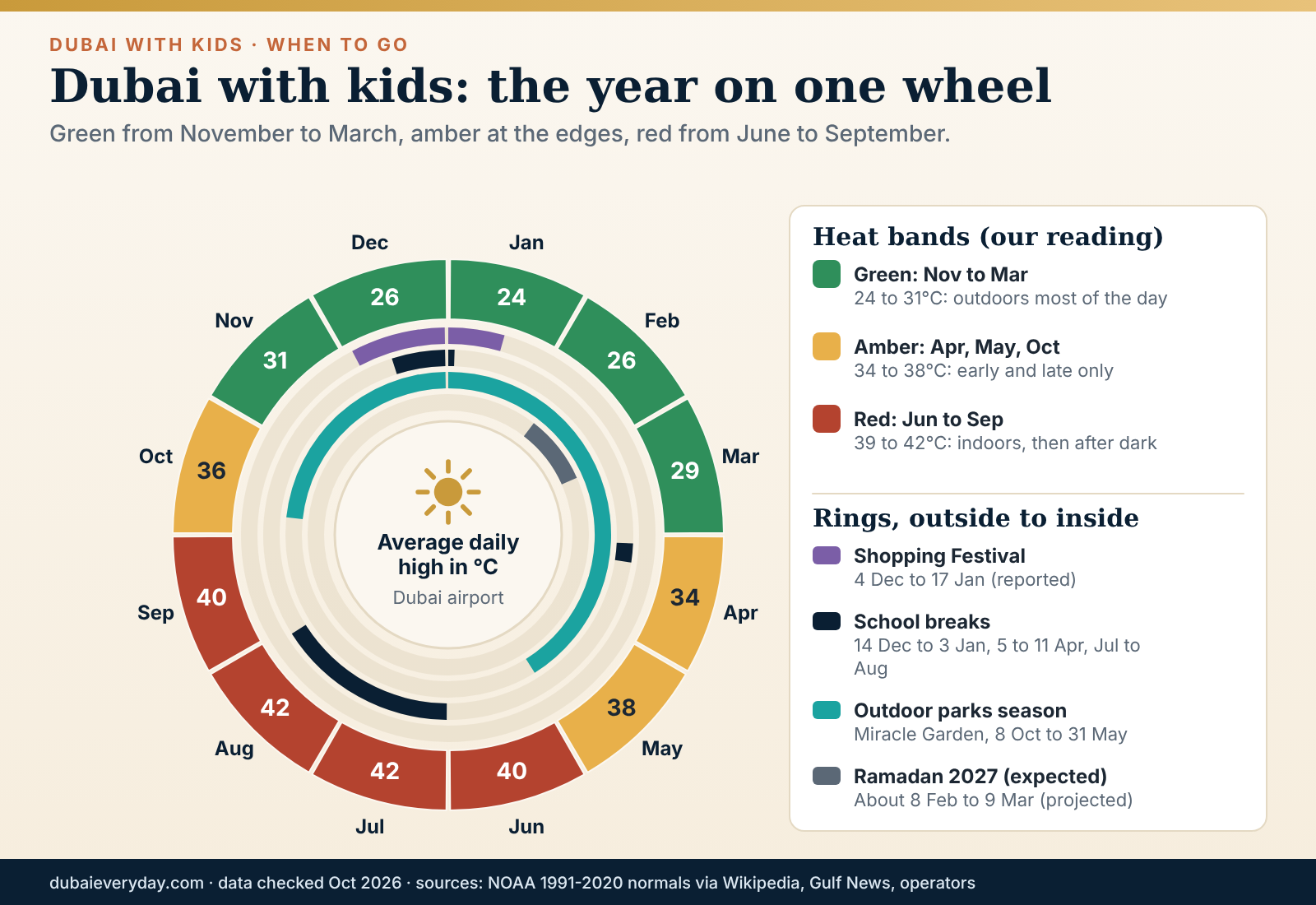
Our reading: three seasonal bands for Dubai with kids
We group the year into three bands. These are editorial judgements built on the temperature normals above, not an official comfort scale, and a heat-sensitive child may need the thresholds moved down.
Green: November to March
Highs of about 24 to 31°C. Outdoor parks, beaches, farms, markets and the desert are all sensible. This is the only period when you can plan two outdoor sessions in a day, and the only one when a toddler can nap in a pram in the shade.
Amber: April, May, October
Highs of about 34 to 38°C. Plan outdoor time before about 10:00 and after about 17:00, with an indoor block in the middle. Beaches work early and late. Water parks work if there is real shade.
Red: June to September
Highs of about 40 to 42°C. Treat the outdoors as a thing you cross, not a place you spend time. Choose indoor attractions, hotel pools in the evening and trips to the beach after sunset where the municipality runs night swimming.
The sea follows the same logic with a lag. Indicative averages put the water at around 21°C in January and about 33°C in August. A January swim is a cold shock for a young child, and an August swim is bathwater that offers little relief. Mid-spring and mid-autumn are the sea’s sweet spot, but the air is then hotter than you would like by midday.
School holidays: the crowd calendar for Dubai with kids that you do not control
For Dubai with kids who are in school, the term calendar decides your dates. Gulf News reported the 2026-27 UAE private-school year as running from 31 August 2026 to 2 July 2027, with a winter break from 14 December 2026 to 3 January 2027 and a spring break from 5 to 11 April 2027. Those dates matter beyond Dubai’s own schools, because the pattern lines up with the holidays of many families who fly in from India, Pakistan, the UK and Europe.
Expect the heaviest attraction and hotel demand in the winter break, which also overlaps the Dubai Shopping Festival (reported as 4 December 2026 to 17 January 2027). Expect a second surge around Easter and around European half-terms in February.
If your dates for Dubai with kids are flexible, the stretch from mid-November to early December and the second half of January are the calmer green-band weeks. This is our reading of the calendar, not a measured crowd count. The Dubai events calendar guide explains how to track dates, and the pages on January events and February events show what those months add.
Ramadan and Eid: what changes for Dubai with kids
Ramadan 2027 is expected to begin around 8 February, with Eid Al Fitr around 9 or 10 March, according to projections from the UAE astronomy community reported by The National. The official dates depend on moon sighting. In practice, family attractions often adjust their hours, restaurants fill up after sunset, and the pace of the whole city moves later. Eid Al Adha is projected for roughly 15 to 18 May 2027. For rules on eating, dress and behaviour during Ramadan, see the etiquette guide.
Best months, our pick by age. Dubai with kids under five: mid-November to early December, or late January to February, when the sun is mild and the hotel pool is warm enough. Primary-age children: the winter break gives the best attractions but the highest prices and queues. Teenagers: March is the compromise, with long days, tolerable heat and fewer families.
A cost lens on the calendar
Hotel prices follow the same curve. Dubai’s 2025 average daily rate was reported at AED 579, with occupancy at 80.7 percent, according to figures in a Dubai Media Office release. Working from the reported totals, the November and December average was well above the rest of the year, which matches what every family discovers when comparing a late-December week with a late-August one.
Occupancy was reported at about 66 percent in August 2026. A family doing Dubai with kids in the red band can find the best room rates of the year, and spend the savings on indoor attractions and taxis. The best time to visit Dubai guide compares the seasons for every traveller type, not only for families.
If you live here, the same calendar applies in reverse. The comfortable season is when you host visitors, book outdoor birthday parties and do the weekend desert or Hatta trip. The red band is when you do swimming lessons, indoor soft play and long mall days, and when many resident families travel abroad. The section on living in Dubai with kids returns to this rhythm.
Heat, sun and water: the safety rules that matter for children
Heat is the one hazard that shapes every other decision about Dubai with kids, so it is worth handling as a system rather than as a list of tips. The system has three parts: when you are outside, how much shade and water you control, and how well you can watch children who are near water. Get those three right and the rest of the trip is mostly logistics.
Plan the day around the sun, not around opening hours
Attraction opening hours tell you when the gates are open, not when your children can cope with being outdoors, which is the central puzzle of Dubai with kids in summer. In the red and amber bands, build the day in three blocks: an outdoor session soon after sunrise or opening, an indoor block through the middle, and a second outdoor session once the sun is low.
In Dubai the sun rises about 05:30 in midsummer and sets after 19:00 (our calculation for the city’s coordinates, so approximate). That leaves a short early window and a longer evening one, with a long gap between.
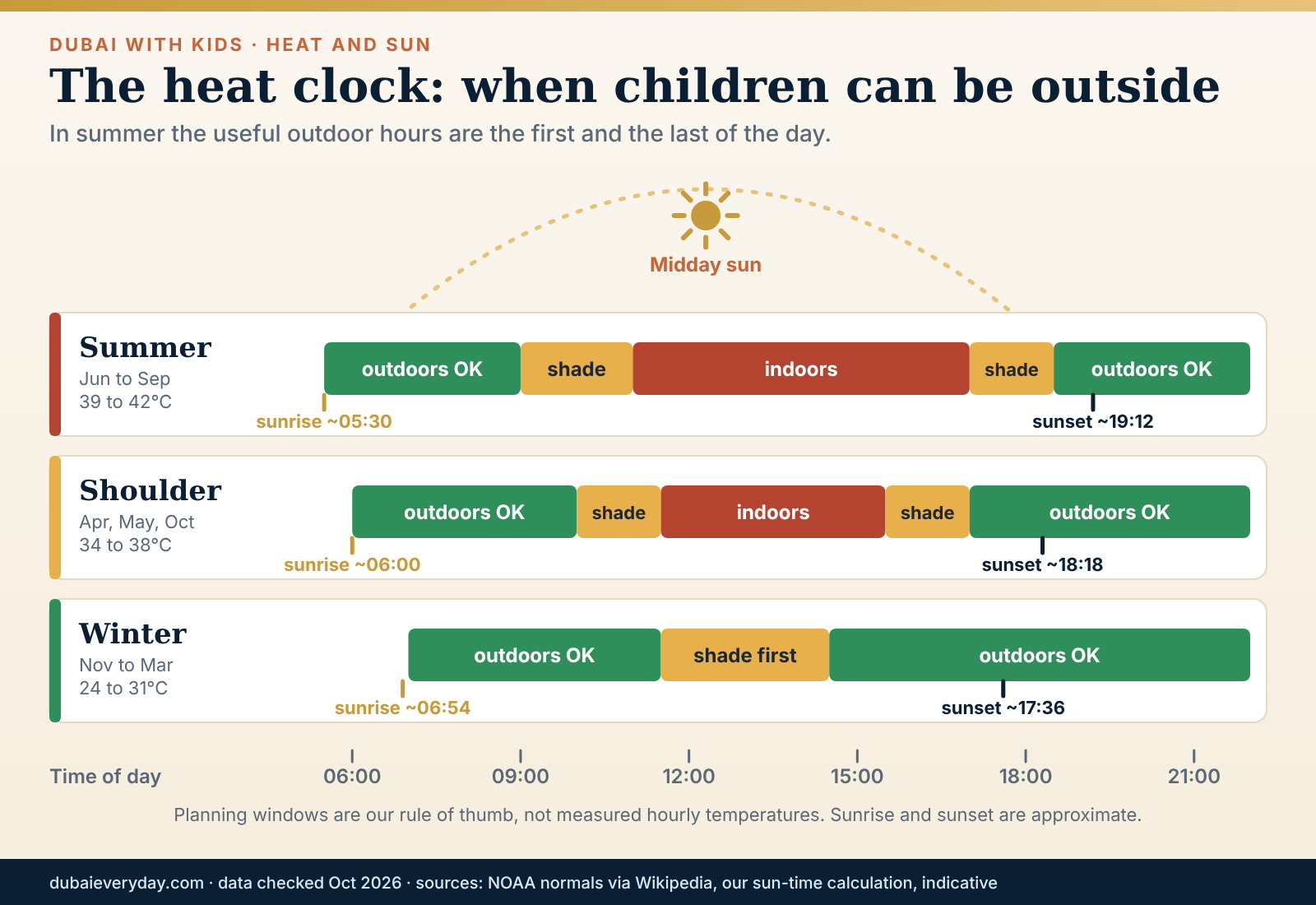
The clock above is a planning aid. Hourly temperatures vary by humidity, wind and the surface you stand on, and we have not measured any of them. The logic, though, is robust: the early window and the evening window carry the outdoor plan in summer, the whole day carries it in winter, and the shoulder months sit between the two.
The practical heat kit
The list below is not exotic, but families doing Dubai with kids year-round treat it as routine. It is general information based on common practice, not medical advice.
- A refillable water bottle per child, filled before you leave, plus a spare in the pram or bag.
- A wide-brimmed hat or cap, and light, loose clothing with sleeves for children who burn easily.
- Sunscreen applied before leaving the hotel and re-applied after swimming, with the stick or small tube kept in a cool bag because a bottle left in a car becomes unpleasantly hot.
- Closed shoes or sandals with straps for playgrounds and pavements. Metal slides, sand and dark paving can be hot enough to blister bare skin in summer.
- A thin layer for indoor air conditioning, which is often set very cold in malls, cinemas and aquariums.
- Wet wipes and a small towel for sticky hands, sandy feet and hot necks.
For ultraviolet exposure, the World Health Organization’s UV index guidance classes a reading of 8 or above as “very high”. Check the daily UV forecast in a weather app and treat shade as the default whenever it shows 8 or more, which in a sunny city includes much of the year around midday.
Spotting heat trouble early
Children often say they feel fine until they suddenly do not. Watch for flushed skin, unusual quietness or irritability, headache, nausea, heavy sweating or cramps. Move the child into air conditioning or deep shade, remove extra layers, give small sips of water and cool the skin with damp cloths.
If a child becomes confused, stops sweating, has hot and dry skin, vomits repeatedly or is hard to wake, treat it as an emergency and call 998, the ambulance number published on the UAE government portal. Our healthcare guide explains how emergency care and hospital access work in Dubai.
Never leave a child in a parked car. A closed car in Dubai sun gets dangerously hot far faster than most adults expect, and leaving the engine on does not solve it. Take children with you even for a two-minute errand. We did not verify a specific penalty and do not quote one, but the physical risk is reason enough. Seat buckles and car-seat harnesses can also burn: cover them or turn a sunshade over the seat when you park.
Pools, beaches and the quiet danger of water
Water is the second hazard of Dubai with kids, and it is the one parents underestimate because Dubai’s hotel pools and sandy beaches look so manageable. A National report published on 9 October 2026 on keeping children safe on UAE beaches gives the plain version of what matters, and its advice matches common water-safety practice worldwide.
Keep children within arm’s reach or clear view in and around the water, and put the phone down. Swim only at lifeguarded beaches and only in the designated area. Lifeguards generally monitor beaches from sunrise to sunset, and some beaches are not monitored at all, so read the signs before you enter. Choose bright swimwear (orange and pink are easiest to see) and rash vests for sun and visibility. Agree a “what if” plan before you get in: where is the lifeguard, what do the flags mean, who calls for help?
Flags and night beaches
The flag system used on Dubai’s municipal beaches is simple. Green means safe for swimming, yellow means swim with caution, red means do not enter the water, and purple signals possible harmful marine life such as jellyfish. Red and yellow flags together mark the lifeguarded swimming zone.
Dubai Municipality restricts swimming after sunset outside designated night-swimming beaches. Those named by the municipality are Jumeirah 2, Jumeirah 3 and Umm Suqeim 1, plus the newly opened Khor Al Mamzar beach, whose swimming shoreline of about 3.6 km includes lifeguard towers. Night beaches are floodlit, which suits red-band summer evenings.
What drowning actually looks like
The National quotes water-safety guidance that drowning is quiet and fast: a child in trouble may not shout or splash. The cue to step in is a child tiptoeing, losing footing or with water rising toward the chin. A non-swimmer may stay upright, facing the shore, with climbing-like arm movements, and a weak swimmer may tilt the head back and sit low. If something goes wrong, call for help and alert a lifeguard first, and do not attempt a rescue you are not trained for, because an untrained rescuer can become a second casualty.
The same report notes that drowning statistics are not centrally published every year across all seven emirates, so we do not quote a Dubai-specific figure. National Ambulance reported responding to more than 194 drowning-related incidents at pools and beaches in the Northern Emirates in 2021, with lapses in supervision and swimming when lifeguards were off duty among the common factors. That is a reminder about patterns, not a Dubai number.
Villa and hotel pools when you visit Dubai with kids
Hotel pools vary: some have a lifeguard on duty at set hours and some post a sign saying swimming is at your own risk, so read the sign before the children get in. Villa and compound pools commonly have no lifeguard at all.
If you rent a holiday home with a pool, ask the host about fencing and gates before you book, keep the gate shut, and treat the pool as off limits to any child who is not with an adult. Residents with villas find more on this in our guide to renting a villa in Dubai.
For choosing a beach with shallow water, shade and play areas, the best family beaches guide goes beyond what fits here, and the main beaches guide compares public and hotel beaches.
Getting around Dubai with kids: airport, Metro, taxis and car seats
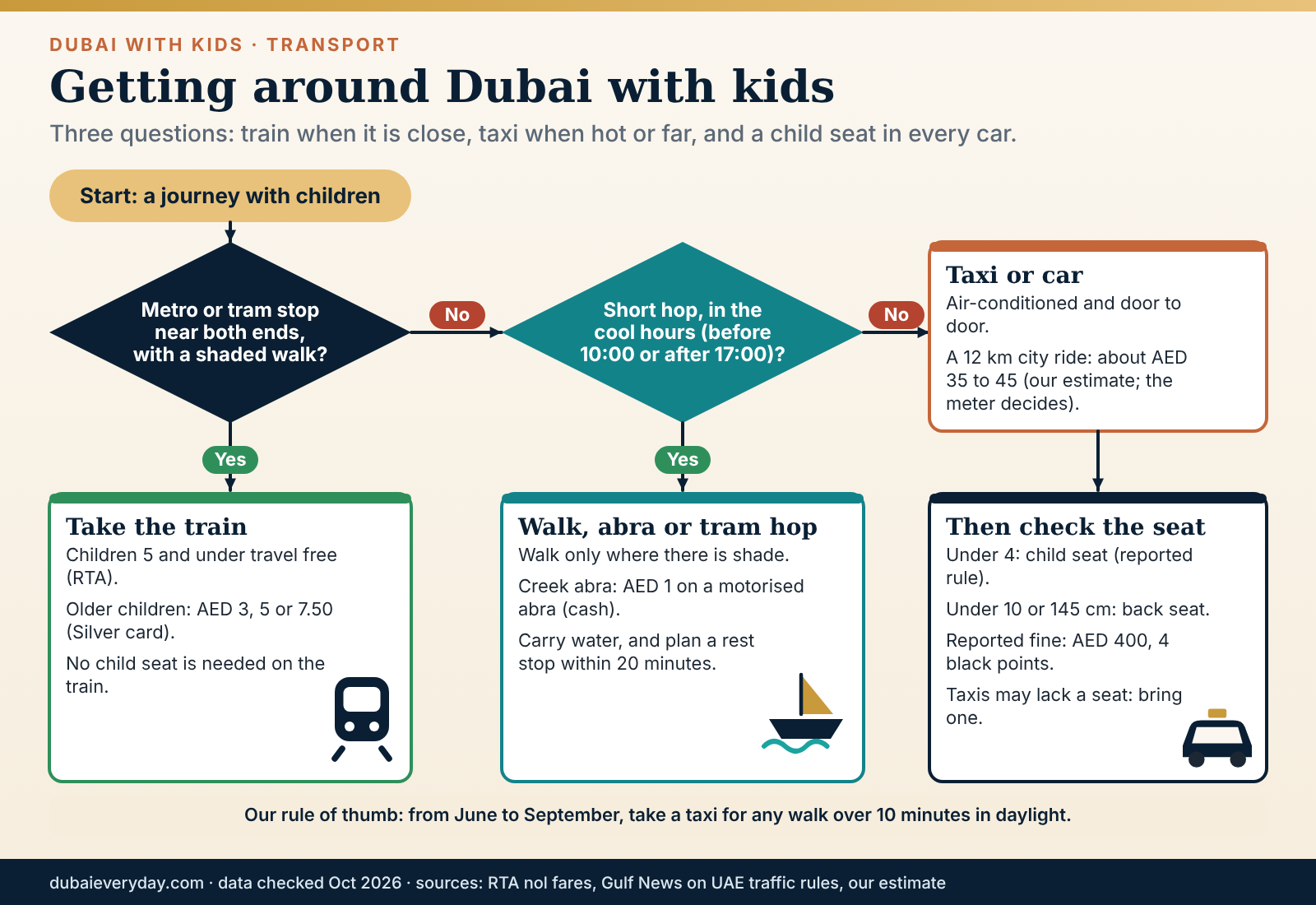
Transport is where the plan for Dubai with kids either holds together or collapses into whining in a taxi queue. The city is long and thin rather than compact, the Metro covers a few corridors very well and others not at all, and the law on child seats applies whether or not the vehicle in front of you has one. This section sorts the options by what they cost, what they require and when they stop making sense.
Arriving at DXB with kids in tow
Dubai Airports’ own pages give a few details that matter to families. Terminals 1 and 3 have Metro stations on the Red Line, and Terminal 2 does not, so a Terminal 2 arrival means a taxi, a bus or a pre-booked car. Taxi ranks run around the clock at each terminal, with a start fare of AED 25 at the airport, and ride-hailing apps use marked pickup points. Terminal 3 offers free showers at Gates A and B, free buggies for passengers on Concourses B and C, and a family zone near the B gates.
Immigration is the step to plan for. Dubai Airports’ immigration page lists groups that cannot use the automated Smart Gates, including people under 1.2 m tall and very large strollers, and the airport has also said that children over 12 can use the gates.
The practical reading is simple: with young children you will probably use the staffed desks, and you should keep passports and any entry documents for every child in one folder. Dubai Airports’ 2025 service statistics reported that 98.8 percent of arrivals cleared passport control in under 15 minutes, but that is an average across all passengers and says nothing about a family at a busy hour.
The Metro and tram for Dubai with kids
RTA’s nol fare page is explicit on one point that saves a family doing Dubai with kids real money: children aged 5 and below travel free on every card type and on the nol Red Ticket. There is no height limit mentioned on that page, so we do not quote one. Children aged 6 and over pay as adults on a standard card, and the fare table makes no distinction for a seven-year-old.
- Fares on a Silver nol card are AED 3 for one zone, AED 5 for two adjacent zones and AED 7.50 for more than two. A Gold card pays double.
- A Silver or Gold card costs AED 25 and includes AED 19 of credit. You need at least AED 7.50 on it to check in.
- The paper-style Red Ticket costs AED 2 for the card plus fares of AED 4, 6 or 8.50, and is meant for occasional use.
- Metro hours are 05:00 to midnight Monday to Thursday and Saturday, 05:00 to 01:00 on Friday, and 08:00 to midnight on Sunday. The tram runs 06:00 to 01:00 Monday to Saturday and from 09:00 on Sunday (RTA timetables).
For our own sums, a family of four with two adults and two children aged 7 and 10 pays four fares. A journey across more than two zones costs 4 x AED 7.50 = AED 30 each way on Silver cards, plus a one-time AED 25 for each of four cards (AED 19 of which is usable credit).
A family with a four-year-old and a seven-year-old pays three fares, because the four-year-old is free. Sunday services start at 08:00, so a Sunday morning outing to anywhere early needs a taxi, and Friday trains run an hour later than on other weekdays.
The air-conditioned shortcut. Press reports from the time of opening describe an air-conditioned, travelator-equipped walkway of about 820 m linking the Burj Khalifa/Dubai Mall Metro station to the mall. For children in summer, a covered walk is not a luxury, so check that route in the Dubai Metro guide and in the Dubai Mall guide.
Metro trains include a section reserved for women and children (we did not re-check the carriage rules today), and the details on etiquette and luggage sit in the Metro guide. We could not find a stroller rule on the RTA fare page, so do not assume a large pram will be treated the same as a foldable one. The Red Line guide and the Green Line guide show which stations connect to attractions.
Abra and water transport
Children tend to remember the boat before the museum. RTA lists the traditional abra crossing of Dubai Creek at AED 1 on motorised abras (cash) and AED 2 on heritage abras. It is the cheapest ride in the city and it shortens the walk between Bur Dubai and Deira. The Marina water taxi is a more expensive novelty at AED 7 per RTA’s marine page. Treat both as part of the trip, not as transport, and keep the heat in mind: a Creek crossing at noon in July is a bad idea.
Taxis and ride-hailing for Dubai with kids
Taxis are metered and plentiful. Press reports of the November 2025 changes put street-hail flag-fall around AED 5 with a minimum fare near AED 12, and Dubai Taxi lists AED 2.45 per kilometre with Salik tolls added. Our calculation: a 12 km city ride with a booking fee lands around AED 35 to 45, and the meter decides.
For four people, that compares with AED 30 on the Metro if the trip is more than two zones. The Metro is cheaper, the taxi is faster door to door and kinder to a tired five-year-old, and from June to September the taxi’s air conditioning is often the better trade.
Whether a particular taxi or ride-hailing car carries a child seat is not something we could verify, so do not plan on it. If you are travelling with a child under four, bring a lightweight seat from home or hire one with a rental car. The next subsection explains why this matters legally.
Child seats and the front-seat rule
Gulf News, summarising UAE federal traffic rules, reports that children under four must be in an appropriate child seat, and that front-seat passengers should be at least 10 years old and at least 145 cm tall. Its report gives a fine of AED 400 and four black points for a child-seat violation.
The same report notes that police wording in other emirates describes the front-seat limit slightly differently, so the cautious reading is to keep every child under 10 or under 145 cm in the back. The traffic framework is Federal Decree-Law No. 14 of 2024, which took effect on 29 March 2025 per the UAE government portal; check the u.ae road safety page for the current text and offence list.
Hiring a car for Dubai with kids
A rental car solves the car-seat problem and makes Hatta, the desert and out-of-the-way parks feasible, and it creates other costs: deposits, Salik tolls, parking and the stress of Dubai traffic. Child seats are typically offered by rental companies for a daily fee, but fees and availability are company-specific, so request seats at booking and photograph the fitting. Our car rental comparison, the page on hidden charges on cheap rentals and the airport car rental guide cover that decision in depth.
If you plan to drive on a foreign licence, check the rules first in the driving licence guide. Visitors and residents have different obligations, and the car seat rule applies to everyone.
A distance rule of thumb for Dubai with kids
Treat every cross-district move as 30 to 45 minutes door to door in daytime traffic, and more at rush hour. That is our planning assumption, not a measurement, but it gives the right answer more often than looking at a map. It is the reason this guide recommends choosing a base and building each day within one cluster: two hops in a day for a family with a five-year-old can eat the afternoon.
Where to stay in Dubai with kids: areas and room checklist
Choosing where to stay in Dubai with kids matters more than choosing which hotel, because the area decides your commute to the beach, to the nearest Metro station and to the four or five attractions you will actually use.
A beautiful resort 45 minutes from everything you booked is a worse family base than an ordinary hotel in the right cluster. Think of three questions in this order: what is the main thing the children will do, how will you get them to it, and what happens at 14:00 when they need to be indoors?
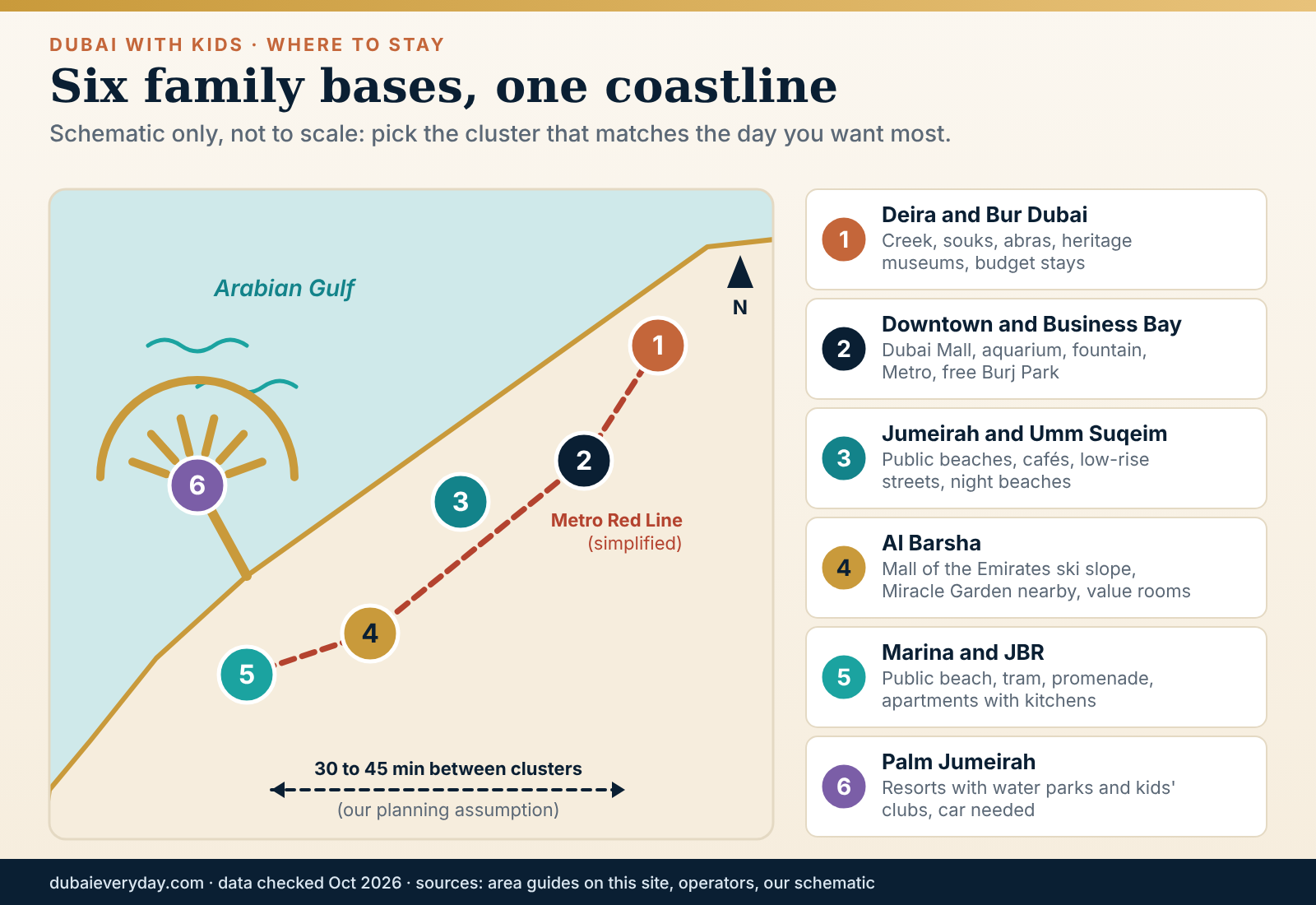
Six family bases for Dubai with kids, compared
The figure below is a schematic, not a map: it places the main family bases along the coast and marks what each cluster gives children and parents. Distances are not to scale, and the only timing it carries is our 30 to 45 minute planning assumption for moving between clusters.
Downtown and Business Bay
Best for rainy-day and summer-proof families. The Dubai Mall, the aquarium, the fountain shows and a Metro station sit in one cluster, and Burj Park is reported free to enter. The trade-off is that there is no beach on the doorstep, so beach days mean a taxi. Our Downtown Dubai guide covers the area in detail.
Marina and JBR
Best for beach-first families who want restaurants, a tram and a walkable promenade. The beach is public and close, the rooms are often apartments with kitchens, and the trade-off is traffic and a long ride to Downtown or Old Dubai. See the Dubai Marina guide.
Palm Jumeirah
Best for a resort week with a water park, private beach and kids’ club as the main event. The trade-off is isolation: almost every outing off the Palm needs a car. The Palm Jumeirah guide explains the island’s transport quirks.
Jumeirah and Umm Suqeim
Best for beach-and-café families who like a low-rise feel and a public beach nearby. The trade-off is limited Metro access and a shortage of large attractions, so you will drive or taxi. The Burj Al Arab is reported closed for restoration.
Al Barsha and Mall of the Emirates
Best for value and one big indoor anchor, because the mall hosts the Ski Dubai slope and a Metro station. The trade-off is distance from beaches and Old Dubai.
Deira and Bur Dubai
Best for budget-minded families and for culture: the Creek, abras, souks and heritage museums are close. The trade-off is fewer pools and no beach, and hot narrow pavements in summer. The budget hotels guide covers options near the Metro.
Match the base to the length of your Dubai with kids trip
For three to four nights, a single base in Downtown or Marina keeps transfers low. For a week, a split stay can make sense: three nights in the area with the indoor attractions, then four nights in a resort with a beach and a pool. Every move costs a morning, so do not split a stay of fewer than six nights. For stays of a week or more, ask about a serviced residence or hotel apartment, where a kitchen reduces restaurant spend and lets you feed a fussy eater on schedule.
The hotel and room checklist for Dubai with kids
Star ratings say little about family fit. These are the details that cause trouble when they are wrong.
- Legal occupancy: how many people the room sleeps, and what counts as a child. Some brands cap a standard room at two adults and one child, which makes a family of four a two-room booking.
- Age cut-offs for free child places and kids’ clubs. One airport hotel lists one child under 5 free using existing beds, for example, and another hotel’s club takes ages 4 to 12 only.
- Connecting rooms, family rooms or a suite. A family suite is often cheaper than two rooms, which also matters for the Tourism Dirham because it is charged per room.
- Pool facts: is there a shaded, shallow family pool, are there lifeguard hours, and what time do pools close? A pool that shuts at 19:00 does not help a summer evening.
- Beach access: private beach, shared beach with a shuttle, or a walk. Ask how long the walk is in the heat, not in the brochure’s minutes.
- Balcony and window safety: check the latches, and move furniture a child could climb away from the railing.
- Breakfast hours and kids’ meal policies, and whether a buffet charges children by age band.
- Blackout curtains, because sunrise is early and jet lag is not kind to parents.
These details are drawn from the hotel pages summarised in our best hotels in Dubai guide, which lists named resorts with their child policies; the luxury hotels guide and the budget hotels guide cover the top and bottom of the price range. We name no “best” resort here, because family fit depends on the age mix and the month.
Fees: the price on the screen is not the price you pay
Dubai hotel rates often exclude several charges. The government portal describes a service charge (commonly 10 percent), 5 percent VAT and a per-room, per-night Tourism Dirham fee of AED 7 to 20 depending on the hotel grade, for up to 30 nights. Dubai Municipality fees have also been reported, and a 2026 relief package was reported to waive some charges for registered establishments with no end date found. So ask the hotel what is currently added.
Our calculation, as an illustration only: on a rate of AED 1,000, assuming a 10 percent service charge, a 7 percent municipality fee, 5 percent VAT on the subtotal and a AED 20 Tourism Dirham, the total comes to about AED 1,248.50. A family of five in two rooms pays the Tourism Dirham twice. The order in which a hotel applies these charges can differ, so treat the total as indicative. The pattern to remember is that a 25 percent uplift is a better planning figure than the rate on the screen.
“Kids stay free” almost always has an age limit, a bedding condition (existing beds, no extra bed) and a maximum number of children. A twelve-year-old can count as an adult for the purposes of breakfast and extra-bed charges even where the hotel treats them as a child for the kids’ club. Read the conditions line, not the headline.
Staying in a rental home
Short-term holiday homes can work well for Dubai with kids in a larger family, with a kitchen, a washing machine and separate bedrooms. The risks are specific to children: pools without fences, balconies without latches, and buildings without lifeguard-supervised amenities. Check licensing with the host before booking and ask in writing about safety features. If you are moving rather than visiting, the next family decision is villa or apartment, covered in the residents section below and in the guides to renting an apartment and renting a villa.
Dubai with kids by age: what works from toddler to teenager
The best attraction for a four-year-old is rarely the best attraction for a ten-year-old, and the rules for Dubai with kids change with the birthday as often as the children do. Entry is free under 3 at several places, the Metro is free to 5, a child seat is required under 4, the front seat opens at 10 or 145 cm, and the airport’s Smart Gates are reported as open to children over 12. The ladder below puts those thresholds on one page so you can see which ones apply to your children this year.
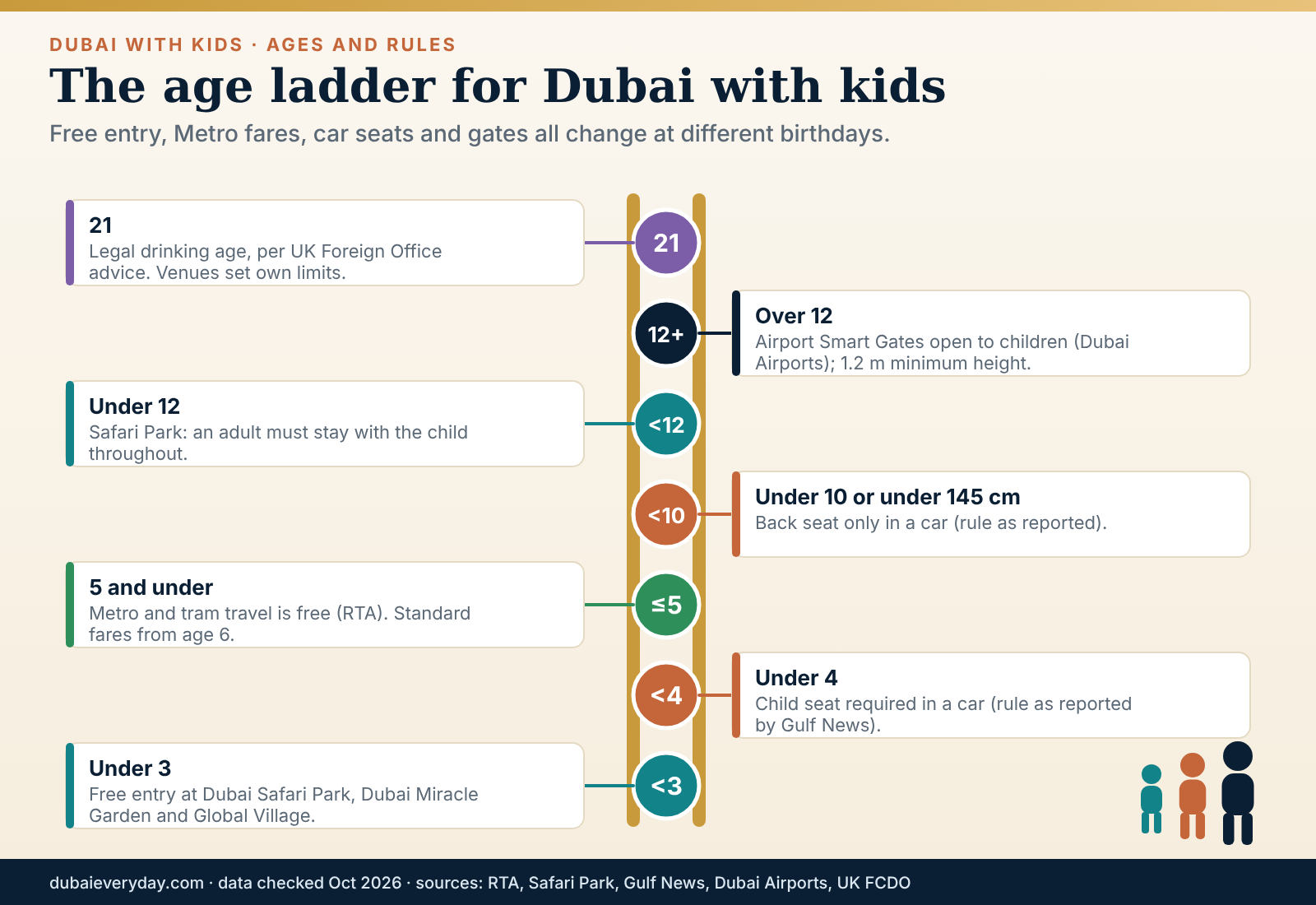
Thresholds are only half of planning Dubai with kids. The other half is what children of each age actually tolerate for a day. The sections below assume the green or amber band and give a realistic block of time, because the most common error is trying to fit a full-day adult itinerary around a child’s attention span.
Dubai with kids under 3
Plan for two outings a day at most, around naps, with a hotel pool as the reset. Children under 3 enter Dubai Safari Park, Dubai Miracle Garden and Global Village free, and travel free on the Metro, so the real cost is the adult’s ticket. Pram-friendly, shaded and air-conditioned places win, and so does anything with a short walk from drop-off. Public parks with a playground, a morning on a family beach and the aquarium in the Dubai Mall work better than a theme park, where most rides have age or height limits.
For feeding rooms, changing facilities, taxis with prams and baby-specific gear, the Dubai with a baby guide goes much further than this page does. We keep this section to the thresholds that matter when the baby is also in the group.
Dubai with kids aged 3 to 5
This is the easiest age for a green-band holiday: children are mobile, still cheap or free on transport, and delighted by animals, water and sand. Dubai Safari Park charges AED 50 for the Safari Park Pass from age 3 (children under 3 free), which includes unlimited rides on the park train and workshops. Dubai Miracle Garden lists children from AED 84 and adults from AED 105 for Season 15, with under-3s free. Add a beach morning, a playground and the Creek abra crossing at AED 1 per person, and a four-day trip is full.
Keep outdoor stretches to roughly two to three hours with shade breaks. Keep the car seat rule in mind for every taxi or hired car, because the rule as reported covers children under four, but a four-year-old is still small enough that a seat is the safer choice. The law is a minimum, not a safety recommendation. See the section on car seats above.
Dubai with kids aged 6 to 9
Children in this range are the sweet spot for theme parks, aquariums and water parks, and for the first time they pay for the Metro. Dubai Parks and Resorts reopened on 7 October with MOTIONGATE Dubai (29 rides and attractions, from AED 295), Real Madrid World (40+ attractions, from AED 295) and the LEGOLAND Dubai Resort, which includes a theme park with 40+ rides and a water park with 20 slides and water attractions, according to Gulf News.
The World of Riverland is the cheap add-on with entry from AED 25. Height and age requirements for individual rides are set by each park and change by ride, so check them against your child’s height before you queue.
This is also the age to try a morning desert experience. Operators set their own age policies, and some restrict dune driving for the youngest, so ask about minimum age, seat belts and the length of the drive when booking. The morning desert safari guide and the desert safari comparison explain the formats.
Dubai with kids aged 10 to 13
Pre-teens gain access to thrill rides and to more of the city. They can sit in the front seat of a car once they meet both the 10-year and 145 cm tests, so the child who is 10 but shorter than 145 cm stays in the back. This is the age where an observation deck, an indoor ski slope, a big water park or a role-play centre earns its ticket.
Dubai Mall hosts several of these in one building, and the Dubai Mall guide explains how to cluster them. For a ten-year-old who is already bored by the aquarium, a trade to a city skyline view or an activity session such as a ski slope often works better than a second animal experience.
Dubai with kids who are teenagers
Teenagers want independence, food, shopping and anything they can post, and Dubai with kids of this age is mostly about negotiated freedom. Dubai suits that if you set boundaries early.
Beach clubs and venues set their own minimum ages: one reported beach club lists guests aged 21 and over, with 16 to 20 allowed when accompanied by a parent, and the legal drinking age is 21 in Dubai, as the UK Foreign Office advice notes. The dress code guide is worth reading with teenagers before they pack, because malls, mosques and public beaches have different expectations.
Good teenage-friendly options include the big water parks, the indoor ski slope, desert activities, Global Village on a Tuesday evening, and free or cheap sport. The Dubai Fitness Challenge runs from 31 October to 29 November with free registration, and has Dubai Ride on 1 November and Dubai Run on 22 November, both reported with free registration. The sports guide and the main things to do guide help build days around their interests.
Dubai with kids who have additional needs
Many attractions publish concessions for People of Determination. Dubai Safari Park lists free entry for People of Determination with one companion, and says its electric vehicles, safari buses and park trains are wheelchair accessible. Global Village has a free-entry category for People of Determination. Dubai Airports runs an Assisted Travel Lounge in Terminal 2 and asks passengers to arrange special assistance through the airline. If a child has sensory sensitivities, ask the operator in advance about queues, noise and any quieter arrangements; we did not find published sensory-friendly sessions.
Our pick, matched to age. Age 3 to 5: Safari Park, Miracle Garden, a beach morning. Age 6 to 9: a theme park day plus a morning desert experience. Age 10 to 13: a water park, a ski slope and a skyline view. Teens: sport, Global Village, a desert activity and shopping with a time limit.
If your children are of very different ages, build days around the younger child’s energy and give the older child a distinct activity, such as a ride they alone can do, while the younger one naps or swims. It is more satisfying than trying to find a single activity that suits both.
The big family days: parks, animals, water and aquariums
Every trip to Dubai with kids has two or three big days, the ones that cost real money and use a full day. The mistake is to book five of them. A child’s tolerance for queues, noise and sun is finite, and a theme park on Monday followed by a water park on Tuesday leaves the third day for recovery. This section covers the main candidates for Dubai with kids, with what was verifiable on 29 October 2026, then compares them on cost and time for one example family.
Dubai Safari Park
Season 8 opened on 12 October. The park’s own FAQ lists a Safari Park Pass at AED 50 covering all six zones with unlimited park-train rides, and an online-only Safari Bundle at AED 117 that adds a 35-minute guided Explorer Safari Tour. Children under 3 enter free, and the FAQ lists no separate child price. Children under 12 must be accompanied by an adult throughout the park, and workshops for young explorers are included with the pass. Feeding experiences cost extra.
Practicalities: strollers and wheelchairs are available to rent at the main entrance, and outside food and drink are not allowed except baby food and water. The FAQ gives winter (November to March) hours of 09:00 to 20:00 and summer (April to October) hours of 09:00 to 18:00, and says last entry is one hour before closing, while the homepage banner says last entry is 17:00.
Because those two statements conflict, and a press preview described different hours again, confirm the day’s times before you go. The park is in Al Warqa 4, off the E311 at Exit 52, so it needs a car or taxi from most of the city.
Our reading: this is the best value in the city for ages 3 to 9, because AED 50 buys a half day and the train lets small legs rest. Go at opening, because the morning is the cooler part of the day and you can leave before the midday heat. It is a poor choice for a summer afternoon.
Dubai Miracle Garden
Season 15 runs from 8 October 2026 to 31 May 2027, daily from 09:00 to 21:00, in Al Barsha South 3. Gulf News lists adult tickets from AED 105 and child tickets from AED 84, with under-3s free. The article describes more than 50 floral displays over 72,000 square metres, plus weekly themed celebrations this season. UAE residents with an Emirates ID can claim two free tickets on their birthday through the garden’s website.
It suits ages 3 to 8, pre-teens who like photography and grandparents. It is less good for a restless ten-year-old after the first hour, and the heat in the amber band makes the late-afternoon hours the best. The article did not state stroller or outside food policies, so check before packing a picnic.
Dubai Parks and Resorts
Dubai Parks and Resorts reopened on 7 October, just before the October mid-term break, per Gulf News. MOTIONGATE Dubai (29 rides and attractions) and Real Madrid World (40+ attractions) are listed from AED 295, and the World of Riverland entertainment hub from AED 25. The LEGOLAND Dubai Resort includes a theme park with 40+ rides, a water park with 20 slides and water attractions, and a hotel; the article gave no ticket price for it. Opening hours and ride height limits were not stated, and we have not verified them.
Practical logic for Dubai with kids: the complex is in the south-west of the city, so a day there is a long transfer, and it works better when you treat it as a full day with an early start. Pick one park, not two, unless your children are all over 8. It is not a good fit for babies and under-2s, and it is a poor use of money for a family that dislikes queues. Because pricing differs by park, date and ticket type, compare the official site with a marketplace before buying.
Global Village
Season 31 opened on 14 October and is planned to run into May 2027, with no exact end date announced. The official site lists Sunday to Wednesday opening from 16:00 to midnight and Thursday to Saturday from 16:00 to 01:00. Tickets are AED 30 for any day and AED 25 for weekdays (Monday to Thursday, excluding holidays), including VAT, with free entry for children under 3, adults 65 and over, and People of Determination. Rides and shows cost extra. Tuesdays are reserved for ladies and families, except on public holidays.
It is open when it is cool, which makes it a good heat-band activity, but it is large and long evenings are tiring for children. Taxi flag-fall at event venues like this was reported at AED 20 on major days. Eat at the pavilions before you buy a ride wristband and set a time to leave before the youngest melts down.
Aquariums and indoor attractions
The Dubai Aquarium & Underwater Zoo in the Dubai Mall is listed on a ticket marketplace from AED 209 (30-day validity, last entry 20:15), with a combination with the Sky Views Observatory at AED 252 versus AED 297 bought separately, a saving of AED 45 by our arithmetic.
The Green Planet, an indoor rainforest, lists adult tickets from AED 175 and child tickets from AED 150 on the same kind of marketplace. IMG Worlds of Adventure lists roughly AED 255 to 365 and Ski Dubai from AED 250. These are marketplace prices, not operator prices, and they move with the date and the bundle.
The point of this group is shelter. In the red band, they are the day. For the full indoor playbook see the section below and the indoor things to do guide.
Aquaventure and water parks
Aquaventure at Atlantis The Palm shows ticket prices of about AED 234 to 285 on the marketplace listing we checked, which is the adult headline price; child prices are usually listed separately, so check them on the operator page.
Water parks set height and age rules for individual slides, so check each slide’s rules against your child’s height, and consider a visit on a weekday morning, because queues for the biggest slides build through the day. We could not confirm the status of the older Wild Wadi park on the day, so treat that as unverified.
KidZania and role-play
KidZania Dubai, in the Dubai Mall, appears on several ticket sites, but we could not read its official page, which blocks automated access, so we do not state its age band, price or session length. Confirm all three before booking. Role-play centres of this type usually suit primary-age children who like structure, and they are a decent indoor block, but a four-hour session can be wasted if the child is not interested.
Hatta
For families with children aged about 8 and up who have a car, Hatta is a day out of the city. The Hatta Wadi Hub reopened on 28 September for its ninth season, and Visit Hatta lists activities from 1 October to 5 May. It is about 90 minutes by car, and a public bus from Dubai (H02) costs AED 25 with a nol card. The drive, not the activity, is the hard part with young children.
A worked cost check for Dubai with kids
Our calculation, for two adults and two children aged 7 and 10 paying the headline rate where no child price was published, using only the prices above:
| Attraction | Basis | Family of four (AED) | Time to plan |
|---|---|---|---|
| Dubai Safari Park | 4 x AED 50 pass (operator FAQ) | 200 | Half day |
| Dubai Miracle Garden | 2 x 10⁵ + 2 x 84 (Gulf News) | 378 | 2 to 3 hours |
| Global Village, weekday | 4 x AED 25 (official) | 100 | Evening |
| Global Village, any day | 4 x AED 30 (official) | 120 | Evening |
| The Green Planet | 2 x 175 + 2 x 150 (marketplace) | 650 | 1 to 3 hours |
| Dubai Aquarium | 4 x 209, adult rate for all (marketplace) | up to 836 | 2 to 3 hours |
| MOTIONGATE or Real Madrid World | 4 x 295, adult headline for all (Gulf News) | up to 1,180 | Full day |
For Dubai with kids on a fixed budget, the pattern is clear: the AED 200 half day and the AED 100 evening cost less than a single aquarium visit, and the theme park costs several times a Safari Park. That does not make the cheaper options better, but it shows where to hold back when a trip has a ceiling. The times are our planning allowances, not operator guidance.
Low-cost and free days for Dubai with kids
Dubai’s reputation for expensive family days is earned at the ticket desk, but it ignores a layer of cheap and free things that fill a surprising number of days. Public beaches charge no entrance fee, municipal parks charge between nothing and a few dirhams, the Creek crossing costs a dirham and the fountain shows are free to watch from the promenade. Children rarely care what a day cost, which is the argument for building Dubai with kids around one big paid day for every two cheap ones.
Parks
Gulf News reported in early October that Dubai’s public parks charge between AED 0 and AED 5. Earlier reports put Zabeel Park at AED 5 and Safa Park at AED 3, and Burj Park, beneath the Burj Khalifa, was reported free and open from 08:00 to 23:00. Al Mamzar Beach Park was reported at AED 5 per person plus AED 30 per car in a 2024 report, so confirm the current fees. Parks are most useful in the green band, in the late afternoon, and for the age group that just needs somewhere to run.
If you live here, a park routine for Dubai with kids becomes the backbone of the weekend. Many parks have playgrounds, shaded seating and picnic areas, and Gulf News headlined the start of the park season in early October. A short list of features to look for: shade over the toddler area, a kids’ bike track, a fenced playground and a toilet block within a minute’s walk. We have not field-tested any park, so use the municipality and Gulf News park guides for current facilities.
Beaches
Dubai Municipality’s public beaches have no entrance fee, lifeguard towers at the main swimming zones and facilities that vary from beach to beach. Khor Al Mamzar beach opened in May 2026 with about 3.6 km of swimming shoreline, lifeguard towers, a night beach and more than 5.5 km of tracks, according to the Dubai Media Office. Jumeirah 1 reopened in 2026 after a rebuild with lockers and other new facilities, according to press reports. Jumeirah 2, Jumeirah 3 and Umm Suqeim 1 have been designated for night swimming.
Municipal rules prohibit pets, barbecues, shisha, overnight stays, set limits on photography, and ask for swimwear to be covered in passageways. For a deeper comparison, including shallow-water beaches and shade, the free public beaches guide and family beaches guide go beach by beach.
Nature, heritage and views
The Ras Al Khor Wildlife Sanctuary has free viewing hides from which flamingos can be seen, with the peak season running from October to March according to Emaar and Dubai Municipality pages. Check opening times with the municipality before you drive, and bring binoculars if the children are old enough to use them.
Old Dubai rewards a morning: the abra crossing at AED 1, the souks and a heritage museum. Al Shindagha Museum charges AED 50 for individuals and the Etihad Museum AED 25, per a 2024 fee resolution, although neither source gave a child rate. See the free things to do guide for more free options.
The Dubai Fountain
Emaar lists daytime fountain shows at 13:00 and 13:30 (14:00 and 14:30 on Fridays) and evening shows every 30 minutes from 18:00 to 23:00. Upgrade works and a new look were reported in October, so confirm the schedule. Watch from the lakeside promenade, where it is free, and choose the early evening in summer, when the sun is down. Children who are afraid of noise should stand back, because the show includes music and bursts of water.
What a cheap day of Dubai with kids costs
Our calculation for a family of four (two adults, a seven-year-old and a four-year-old, the youngest travelling free): a beach morning at no cost, a lunch you bring or buy, two Metro journeys across two zones for three paying passengers at AED 5 each (AED 30), an abra crossing at AED 1 each (AED 4), a free fountain show and a park hour.
That is about AED 34 in fares. Add the one-off AED 25 for three Silver cards, of which AED 19 each is usable credit, and the true non-credit cost is AED 18 more. All-in transport for the day: roughly AED 52, before food.
Dubai with kids in summer: the indoor playbook
June to September is when many Dubai residents leave, hotel rates fall and a family willing to adapt can have a good Dubai with kids trip. The adaptation is structural. Seasonal outdoor attractions such as Dubai Miracle Garden (to 31 May) and Global Village (into May) are closed, and the Safari Park runs in seasons, so a summer plan starts from the indoor list rather than the outdoor one. Dubai Summer Surprises ran from 2 July to 30 August in 2026; the 2027 programme had not been announced on the date we checked.
The summer day in four blocks
- Early outdoor block, sunrise to about 09:00Beach or park while the sun is low. In midsummer the sun rises about 05:30, so a 07:00 start is already late in the cool window.
- Indoor anchor, about 10:00 to 14:00An aquarium, indoor rainforest, ski slope, role-play centre or soft play, then lunch in the same building so you do not have to cross a car park twice.
- Rest block, about 14:00 to 17:00Hotel room, nap or quiet pool shade. This is the block parents resist and children need.
- Evening outdoor block, after about 18:30Pool, fountain show, floodlit night beach or promenade, then a late dinner when restaurants fill.
The Dubai Mall is the obvious indoor cluster, with the aquarium, an observation deck and a Metro link. Other indoor candidates reported in the guide-level sources include The Green Planet, Ski Dubai, IMG Worlds of Adventure and the Dubai Frame (which is a mix of indoor and outdoor, with an elevator ride). The indoor things to do guide covers more, and the shopping guide explains mall logistics beyond the family angle.
Summer pitfalls
The first pitfall of Dubai with kids in summer is pace: three indoor attractions a day exhaust children as thoroughly as three outdoor ones. The second is the walk from the car park to the entrance, which can be the hottest part of a mall visit, so use valet or covered parking where you can. The third is boredom after day four, when the indoor options repeat. A week in the red band is workable only if some days are deliberately empty, with the hotel pool and a sleep-in as the programme.
The summer rule of thumb. If a plan needs more than ten minutes outdoors between 11:00 and 17:00 from June to September, change it. Cars, taxis, valet and covered walkways are not luxuries in that period. They are how you keep children functional.
Eating out in Dubai with kids
Dubai has more restaurants than any family could try in a year, and almost none of them is designed around the clock of a six-year-old. The result is a city where lunch in a mall food court can be the easiest meal of the day and a famous dinner reservation at 21:00 can be a battle.
Eating well in Dubai with kids is mostly a matter of choosing the format and the hour, then the cuisine. We name no restaurant as “best for kids”, because we have not eaten in any of them, and we could not verify a current kids’ policy for a long list of places.
Choose the format first
Mall food courts and casual chains
Cheap, air-conditioned, near toilets and with space for a pram. The trade-off is noise and sameness. They are the right answer for a hot afternoon and for a child who will only eat three things.
Hotel buffets and brunches
Good for fussy eaters because the child chooses. Check the child price bands (by age or height), the end time of the breakfast service and whether juice and soft drinks are included. Brunches are long, so check whether a children’s area exists before you book.
Independent cafés and sit-down restaurants
Best at lunch and early dinner, when they are quiet. Outdoor terraces are comfortable in the green band and unusable in summer unless misted or covered, so ask about indoor seating when you book.
For Dubai with kids, the cuisines come after the format. Levantine, Persian, Indian and Emirati restaurants are familiar territory in Dubai and tend to serve shared dishes that suit a table with mixed appetites: bread, rice, grilled meat, hummus and yoghurt are easy anchors for a picky child. Our best restaurants guide and best cafés guide compare venues by area and style, and the Michelin restaurants guide is useful mainly as a map of where to go when the children have grown up.
Questions to ask before you book
- Do you have high chairs and a children’s menu, and can the kitchen do a half portion?
- Is there indoor, air-conditioned seating, and is the table near the exit or the toilets?
- What time does the kitchen close between lunch and dinner? Some kitchens close in the afternoon.
- Is a service charge added, and do children count towards a set-menu or brunch price?
- If a child has an allergy: who in the kitchen can confirm ingredients, and can you see an allergen list?
On allergies, we could not verify a Dubai-wide labelling standard for restaurants, so assume knowledge varies. Carry the allergy in writing in English and, if useful, Arabic, ask the question in the same words each time, and keep any prescribed emergency medicine in its original packaging with the prescription. Dubai Airports’ FAQ requires medicines to be in original packaging with a prescription, and controlled medicines need approval, which we cover below.
Timing beats booking when eating out with kids
Our reading is that the best time to eat with young children in Dubai is early: around 12:00 for lunch and 18:00 to 18:30 for dinner. That gets you a quiet room, quick service and a child who has not yet fallen apart. Weekend evenings are the busiest dining period in any city, and Dubai in the cooler season is no different. In summer, the later evening hours are better because the cooler air makes the walk to the car bearable, but children lose their patience first.
What meals cost
A crowd-sourced Numbeo survey from October 2024 put a basic restaurant meal at about AED 40 (range 20 to 100) and a mid-range dinner for two at about AED 300 (range 175 to 500). It is two years old and self-reported, so use it only as a rough anchor. Our calculation for a family of four eating one casual lunch and one mid-range dinner a day: lunch at the basic figure is 4 x AED 40 = AED 160.
For dinner, take half the dinner-for-two figure for each adult (AED 150 x 2 = AED 300) and about AED 40 for each child’s meal (AED 80), which makes AED 380. That gives a food budget of roughly AED 540 a day before drinks and snacks, and a range of AED 450 to 650 once you allow for where you eat. We show a fuller budget below.
Groceries and supplies
Hotel stays with a kitchen change the economics. The Dubai Mall’s supermarket opens from 07:00 and its pharmacy from 08:00, according to the mall’s official hours page, which is useful for early breakfast supplies. For residents and long stays, the supermarket guide and the Carrefour guide compare chains and delivery. For a baby, see the baby guide.
Malls, strollers, toilets and lost-child planning
For Dubai with kids, malls are the family infrastructure of the city: air-conditioned, secure, full of toilets and open late. They are also huge, which is where the logistics of Dubai with kids go wrong.
The Dubai Mall’s official hours page lists retail from 10:00 to 23:00 Monday to Thursday and 10:00 to midnight Friday to Sunday, with the supermarket from 07:00, the pharmacy from 08:00 and the Mediclinic from 08:00 to 20:00 Monday to Saturday and 10:00 to 20:00 on Sunday. The mall’s parking page lists the first four hours free on weekdays and the first six on weekends, with charges escalating after that, and four parking zones.
The mall day plan
- Pick the zone before you parkLarge malls have several car-park zones and entrances. Photograph the zone sign and level, and choose the entrance nearest the attraction you are visiting first.
- Agree a meeting pointChoose a fixed, visible place such as a shop front near the entrance. Tell children older than about five to stay put and find a staff member if separated.
- Put your number on the childWrite your mobile number on a wristband or temporary tattoo, or on the inside of the child’s sleeve, and keep a photo of the child in today’s clothes on your phone.
- Fuel and rest before the crashPlan food and a quiet sit-down in the middle of the visit, not at the end.
- Leave while it is still funMall days tend to end badly when parents try for one more shop. Our planning rule is two to three hours for under-6s and four for older children.
Strollers, toilets and changing rooms
Strollers are widely used in malls, and many malls offer hire at guest services, though we did not verify the policy or price at any specific mall. Ask at the information desk. Family toilets, changing rooms and mothers’ rooms exist in the larger malls, with details covered in our baby guide and the Dubai Mall guide. For a toddler, a lightweight fold-up stroller usually beats a heavy travel system, because it fits in a taxi boot and on the Metro.
If a child goes missing
Do not wait or search alone. Alert the nearest staff or security member at once, give a description and photo, and ask them to alert the centre. Mall security teams run their own procedures. In an emergency, the police number is 999, published on the UAE government portal. At beaches, alert the lifeguard first. These are general safety steps, not an official protocol, and we did not find a published Dubai-wide lost-child procedure.
Teach children one thing. Tell children that if they are separated they should stand still, look for a person in uniform or a parent with children, and say their parent’s name and phone number. Practising it once in a quiet place does more than any gadget does.
Dress and behaviour with children in malls
Malls expect modest dress, and children are treated more leniently than adults, but swimwear belongs at the beach and the pool. Teenagers need more guidance than toddlers. The dress code guide and the etiquette guide set out the expectations.
What Dubai with kids costs: a worked family budget
Most online estimates of what Dubai with kids costs are either a single per-person number or a luxury brochure. The more useful question is where a family’s money goes, and which line you can control. Below is a five-night budget for two adults and two children aged 7 and 10, built from the verified prices in this guide plus clearly labelled allowances. It excludes flights, travel insurance and souvenirs, and it is a model, not a quote. All amounts are in dirhams, with US dollars at the fixed peg of 3.6725 AED per USD.
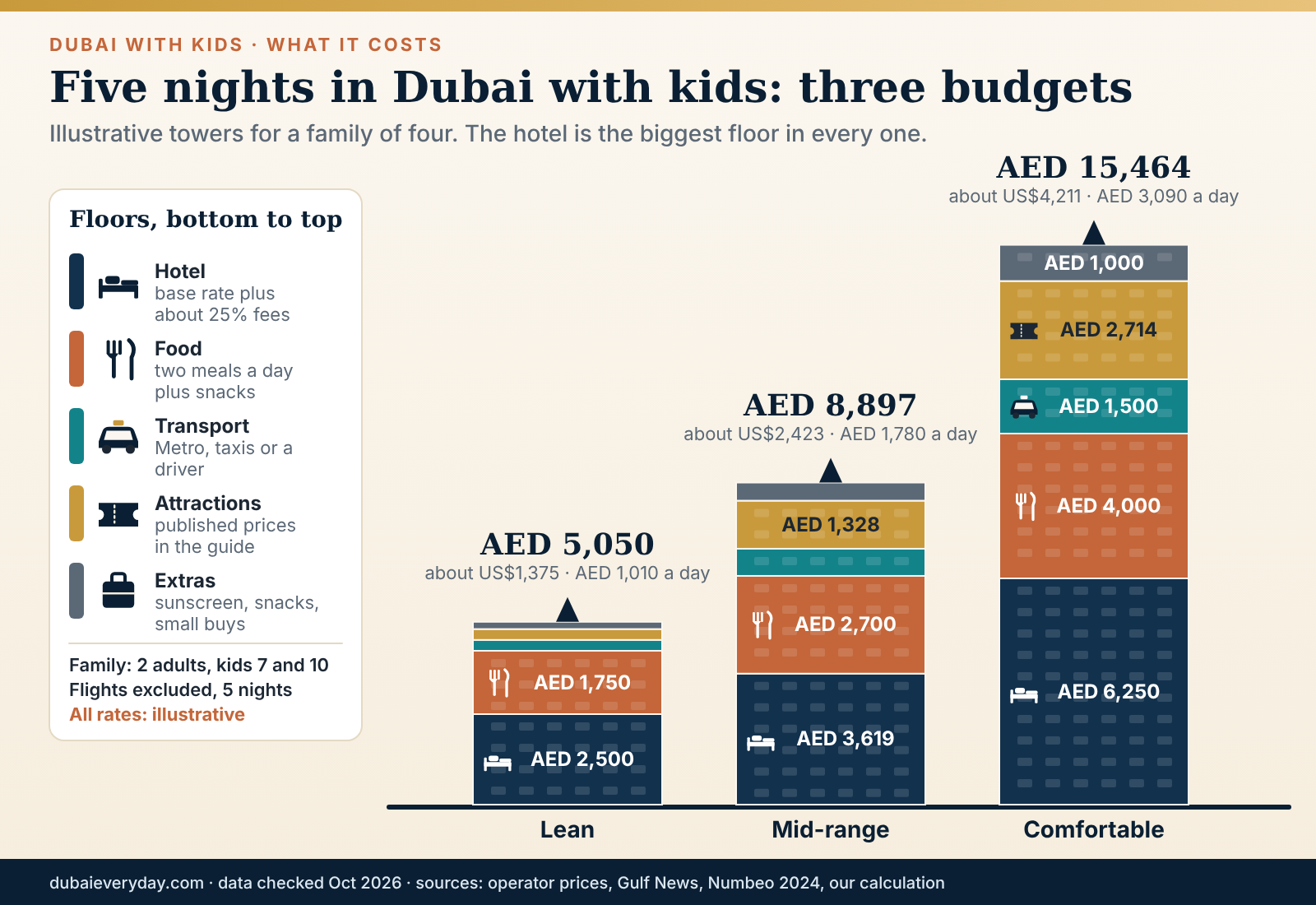
Lean: about AED 5,050
Roughly AED 1,010 a day, about US$275. A family room at an assumed AED 400 base rate, a kitchen or food courts, Metro-based transport and two paid days (Safari Park and Global Village), with the rest free or cheap.
Mid-range: about AED 8,900
Roughly AED 1,780 a day, about US$485. A room at the reported 2025 average rate of AED 579, mixed restaurant meals, taxis for most moves and four paid attractions.
Comfortable: about AED 15,500
Roughly AED 3,090 a day, about US$840. An assumed AED 1,000 base room, restaurant dinners, a driver or rental car and big paid days including a theme park and the aquarium.
How each Dubai with kids tower is built
Our calculation takes the hotel base rate, adds 25 percent for service charge, municipality fee, VAT and Tourism Dirham (the fee stack described above), and multiplies by five nights. Food uses AED 350, 540 and 800 per day, where the middle number comes from the Numbeo-based sums earlier and the others are allowances. Transport uses AED 60, 150 and 300 per day.
Attractions are summed from published prices: the lean tower is the Safari Park for four (AED 200) plus Global Village for four (AED 100); the mid tower adds Miracle Garden (AED 378) and The Green Planet (AED 650); the comfortable tower keeps the Safari Park and Miracle Garden, drops The Green Planet, and adds MOTIONGATE (AED 1,180 at the adult headline price for all four) and the aquarium (AED 836 on the same basis), with Global Village on an any-day ticket (AED 120). Extras are AED 40, 100 and 200 per day.
The totals for Dubai with kids in this model are AED 5,050, 8,897 and 15,464. In every tower, the hotel is the largest single floor, which is why where and when you stay matters more than which attractions you choose. The attractions floor is the one that shrinks fastest if you skip a theme park.
Where families doing Dubai with kids actually save money
- The calendar: the same room costs less outside the winter break, and August occupancy was reported at about 66 percent, so shoulder and summer rates tend to have more room to negotiate.
- A family room or connecting rooms instead of two doubles, which also avoids a second Tourism Dirham charge.
- A kitchen: a serviced apartment can replace one restaurant meal a day.
- Age cliffs: children under 3 are free at several attractions and children 5 and under ride the Metro free, so timing a trip before a birthday can save real money.
- Paid days spaced out and cheap days in between, as the low-cost section shows.
Flights (very variable this season, with several foreign airlines suspended into 2027), travel insurance, visa fees for nationalities that need a visa, Salik tolls and parking if you hire a car, child seats, and tips. Marketplace prices are not operator prices and include no guarantee of availability. Treat the model as a way to compare plans, not as a forecast.
For longer stays or a move, the cost of living guide sets out monthly budgets, including rent, utilities, schooling and childcare, and the single-person budget guide shows how a lone resident’s costs compare.
Five-day plans for different ages
These plans for Dubai with kids are designs, not reports of trips. Each plan keeps a day within one area, schedules outdoor time in the cooler hours and leaves a rest block in the middle. Prices are those in this guide. They are written for the green band (November to March), with a summer variant at the end.
Plan A: two preschoolers (ages 2 and 4)
- Day 1: land softlyHotel check-in, pool and an early night. Do not schedule anything. Taxi with your own child seat from the airport.
- Day 2: Dubai Safari Park in the morningArrive at opening, ride the park train, home for a nap. Cost for two adults and the four-year-old: 3 x AED 50 = AED 150; the two-year-old is free.
- Day 3: beach and CreekLifeguarded beach early, nap, an abra crossing in the late afternoon (AED 1 per person on a motorised abra).
- Day 4: Dubai Mall aquarium clusterA mid-morning aquarium visit, lunch in the mall, home for a rest, fountain show at 18:00 with a short walk.
- Day 5: Miracle Garden late afternoonChildren’s tickets from AED 84 (under 3 free), the late light, and an early dinner.
Plan B: primary-age children (ages 7 and 10)
- Day 1: DowntownThe aquarium and fountain, with the Metro link. Burj Park is free for a breather.
- Day 2: Dubai Parks and ResortsOne park only, starting at opening. Compare the official ticket with the marketplace before buying.
- Day 3: beach morning and Old DubaiEarly swim, midday indoors, then the souks and abra in the late afternoon.
- Day 4: Safari Park and Global VillageThe park at opening, rest at the hotel, Global Village from 16:00 on a weekday (AED 25 each), leaving before 21:00.
- Day 5: morning desert experienceOperator-booked, with age limits and seat belts confirmed in advance.
Plan C: teenagers (ages 13 and 15) in summer
- Day 1: pool and an evening walkRecover from the flight. Dinner somewhere with a view after dark.
- Day 2: indoor ski and mallA slope session, lunch and shopping with a fixed finish time.
- Day 3: early water parkThe big slides at opening. Rest after lunch.
- Day 4: indoor rainforest and role-playChoose one, not both. A swim at one of the municipality’s night-swimming beaches after sunset.
- Day 5: observation deck at sunsetBook a timed slot, then dinner and the fountain show.
For ideas beyond families, the things to do in Dubai guide ranks the main attractions for every kind of traveller, and the Dubai travel guide covers visas, money and arrival in one place. If this is your first time, the first-time plan handles the basics.
Living in Dubai with kids: schools, childcare, home and weekly rhythm
A visitor to Dubai with kids needs a good week, but a resident needs a workable year. Living in Dubai with kids rewards families who organise around three fixed points: the school, the home and the heat calendar. This section is for new arrivals and long-term residents; it summarises the decisions in the order they usually arise and points to the guide that goes deeper on each. It is general information, and visa, insurance and school rules should be confirmed with the authorities named below.
Choose the school first, then the home
Our recommendation for resident parents is to pick the school, then the area. Dubai’s traffic makes a school run across the city a daily tax on the whole family, and the best-rated school is a poor choice if it adds ninety minutes to every day. Our reading is that the commute should drive the housing search, not the other way round, particularly for primary-age children who cannot manage a long bus ride.
KHDA ratings run from Outstanding down to Weak, as the Dubai government’s education page describes them, and a Khaleej Times report on 9 October 2026 said Dubai private-school enrolment had passed 406,000, with seven new schools adding about 17,000 places. Fees vary widely by curriculum.
A 2024 crowd-sourced survey put an international primary school at about AED 47,491 a year, which is two years old, and the Khaleej Times report quoted examples starting around AED 43,500, so use each school’s published fees and KHDA information rather than an average. The schools guide explains curricula, admissions and fees, and the KHDA ratings guide explains what an inspection rating does and does not tell you.
Visa, insurance and documents for Dubai with kids
Under the UAE family sponsorship rules summarised on the government portal, a sponsor generally needs a monthly salary of at least AED 4,000, or AED 3,000 plus accommodation, to sponsor a spouse and children, covering unmarried daughters and sons under 25. Dependants have a six-month grace period after the sponsor’s visa is cancelled or expires. Health insurance is mandatory in Dubai under Law No. 11 of 2013, and sponsors are responsible for insuring dependants.
Our guides on the move to Dubai, the residence visa, the relocation checklist and health insurance set out the steps in order. We could not read several official pages today, so the specifics on documents for children, including attestation of birth certificates, should be confirmed with GDRFA, ICP or your employer’s PRO.
The school calendar as a family planner
Gulf News reported the 2026-27 private-school calendar as running from 31 August 2026 to 2 July 2027, with a winter break from 14 December to 3 January and a spring break from 5 to 11 April 2027. Expect Eid breaks as well, whose dates depend on moon sighting. Airlines and hotels price against this calendar, so book school-break travel early. Check your own school’s circulars for the exact dates, because individual schools publish their own calendars.
Childcare, nannies and helpers
Families in Dubai often use nurseries for under-4s, after-school clubs, and domestic helpers or nannies. Check any nursery’s licence and latest inspection with KHDA, whose pages we could not read today, so confirm the current process. Domestic workers are covered by a separate federal law (Federal Decree-Law No. 9 of 2022, amended in 2023), and employment contracts, rest days and wages are regulated by MOHRE; the legal basics guide explains where to verify employer duties. For paid cleaning help, see the cleaning services guide.
For maternity and parental leave, the government’s private-sector leave page lists 60 days of maternity leave (45 on full pay and 15 on half pay), five paid working days of parental leave for either parent within six months of birth, and nursing breaks of up to one hour a day for six months.
Home safety when living in Dubai with kids
High-rise living and private pools both raise specific risks for children. These are general safety points, not legal requirements we verified:
- Balconies and windows: check that balcony doors latch out of a child’s reach, that windows have restrictors, and that furniture is away from railings.
- Pools in villas and compounds: look for a fence and self-closing gate before you sign, and consider a pool alarm. Teach swimming early; the National’s water-safety advice stresses it.
- Cooling and chillers: older buildings with central chillers can have separate charges and usage rules, which the guide on setting up a home explains.
- Parked cars: never leave children in a car, and keep keys out of reach so a child cannot lock themselves in.
The renting guide, apartment checklist and villa rental guide include viewing checklists to add child-safety checks to.
A resident family’s year of Dubai with kids
The rhythm of the year is set by the heat. From November to March, weekends are for parks, beaches, markets and Global Village; Tuesdays are reserved for ladies and families there. In the amber months, outdoor sport and play move to early mornings and evenings.
From June to September, swimming lessons, indoor play and mall hours take over, and many families travel. The Dubai Fitness Challenge (31 October to 29 November this year) is a free chance to try activities as a family. UAE residents with an Emirates ID can also claim two free Miracle Garden tickets on their birthday through the garden’s website.
Two money cautions. First, the cost of a family of four is dominated by rent and school fees, not by weekend activities. Our moving guide’s illustrative family-of-four monthly budget came out at about AED 28,600, built from a 2024 crowd-sourced survey plus allowances, so treat it as a starting model; the cost of living guide shows the components. Second, utility connections for a new tenancy follow Ejari registration; the DEWA move-in guide covers deposits and activation.
Health, medicines, documents and emergencies
This section on Dubai with kids is general information, not medical or legal advice. Dubai has a large private and public health system, and the most useful preparation is to know three things before you need them: the emergency numbers, your insurance position and your medicines.
Emergency numbers and hospitals for Dubai with kids
The UAE government portal lists 999 for police, 998 for ambulance, 997 for fire and 996 for the coast guard. Dubai Health, the government health system, lists six hospitals including Al Jalila Children’s Hospital, a 24-hour customer line on 800 60, and notes that emergency services are not free of charge, although hospitals must give initial treatment in an emergency.
To check a private clinic or doctor, the Dubai Health Authority’s Sheryan registry lists licensed professionals and facilities. See our healthcare guide and hospital comparison for how to choose, and the resident health insurance guide for cover for dependants.
Visitors: insurance and costs
A visitor’s usual home insurance does not follow you automatically. Buy travel insurance that covers medical costs and children as named travellers, and read the exclusions for regional conflict and pre-existing conditions. For the same reason, bring prescriptions and a summary of any chronic condition. We could not verify whether visitor health insurance is checked at entry, so do not rely on a report you have seen.
Medicines and children’s prescriptions
Dubai Airports’ FAQ says medicines should be carried in original packaging with the prescription, and that certain medicines need prior approval. The UK Foreign Office and other governments’ travel advice describe a Ministry of Health and Prevention approval process for controlled medicines, with an approval taking about five working days, and a supply limit of three months (one month for some categories).
Some medicines prescribed to children can fall into controlled categories, so check each drug name against the ministry’s lists before you pack, and apply early. We could not read the ministry’s own site today. If a child needs an emergency auto-injector, carry the prescription and a doctor’s letter with the generic name.
Entry documents for children
- Every child needs their own passport, valid for at least six months from the date of entry, per the UAE government portal.
- Visa rules depend on nationality, not age. Citizens of many countries receive a visa on arrival, others must arrange a visa beforehand, and GDRFA lists single-entry tourist visas at AED 200 for 30 days and AED 300 for 60 days plus 5 percent VAT; whether children pay the same is not something we verified.
- Overstay fines are AED 50 a day, counted from ten days after expiry according to government portal text.
- If one parent is travelling alone with the child, carry the birth certificate and a signed consent letter from the other parent. Airlines and the countries on your route, not this guide, set the requirement.
- A yellow fever certificate is needed only if you arrive from a country with a risk of transmission.
When the alert sounds
Guidance published by The National on 19 August 2026 about UAE emergency alerts says to move indoors and away from glass, and not to film or touch debris. The UK Foreign Office suggests an interior stairwell or a room with few external walls or windows. With children, rehearse the rule and keep a small bag with water, snacks, charging cables and essential medicines ready.
Mistakes that cost families time and money
Most failures in Dubai with kids are predictable. They come from planning the city as if it were compact, cool and cheap. These are the ones this research points to, with the fix beside each.
- Booking a hotel for the pool and ignoring the commute. A resort 45 minutes from the three attractions you picked turns every outing into a transfer. Choose the cluster first, as the base section explains.
- Stacking big days. Two theme or water parks in a row cost double and deliver half the enjoyment on the second day. Alternate a paid day with a free one.
- Treating “kids stay free” as unconditional. Age limits, bedding rules and maximum occupancy decide whether the headline is true. Read the conditions.
- Skipping the child seat because a taxi did not offer one. The rule on seats applies to the people in the car, not to the vehicle. Bring a light seat or hire one with a car.
- Planning outdoor midday blocks from May to September. If a plan needs more than ten minutes outdoors between 11:00 and 17:00, change it.
- Buying tickets from the first search result. Marketplace prices differ from operator prices, and child bands differ again. Compare the two before you pay.
- Relying on a closed or seasonal attraction. The Museum of the Future is closed, several outdoor attractions are seasonal and the Burj Al Arab is reported closed. Check before booking.
- Assuming supervision at the water. Lifeguards generally work from sunrise to sunset and some beaches have none. Stay within arm’s reach.
- Over-scheduling the first day. Jet lag and heat flatten children. Start with a pool day.
- Forgetting travel disruption. With a regional advisory in force and airline suspensions into 2027, choose flexible fares and insurance that covers disruption.
The common thread is that each mistake spends children’s energy rather than parents’ money, and energy is the scarce resource. A shorter plan with a rest block almost always beats a fuller one in Dubai with kids.
Dubai with kids: frequently asked questions
Is Dubai with kids safe right now?
Day to day, the hazards families meet most in Dubai with kids are heat, water and traffic, and the guide above covers each. This season there is a second question: the UK Foreign Office advice updated on 27 October 2026 describes the regional situation as deeply unpredictable, with a high risk of sudden escalation and possible flight disruption. Other governments publish their own levels. Read the advice for your nationality, choose flexible bookings, and agree a family plan for what to do if an alert sounds. This is general information, not individual travel advice.
What is the best time to go to Dubai with kids?
November to March is the comfortable window for Dubai with kids, with average daily highs of roughly 24 to 31°C. Mid-November to early December and the second half of January are our picks for calmer weeks. School winter break and the Shopping Festival (reported as 4 December to 17 January) are busiest and most expensive. June to September brings highs above 39°C, so plan around indoor attractions, hotel pools and night beaches, and expect lower hotel prices.
How many days do you need in Dubai with kids?
Five to seven days is a comfortable length for most Dubai with kids trips, based on our planning: two or three big days, two cheap days, one rest day and a buffer for jet lag. Four days works if you stay in one cluster and skip the theme parks. A split stay only makes sense from about six nights. Children under six usually do better with fewer outings per day than a first-time adult itinerary suggests.
Do children need car seats in Dubai taxis?
Gulf News, summarising UAE federal traffic rules, reports that children under four must be in an appropriate child seat and children under 10 or shorter than 145 cm should not sit in the front. A fine of AED 400 and four black points was reported for a child-seat violation. We could not verify whether a given taxi or ride-hailing car will carry a seat, so bring a light seat or book a vehicle with one. Check the current offence list on the UAE government portal.
Is the Dubai Metro free for children?
RTA’s nol fare page says children aged 5 and below travel free on every card type and on the Red Ticket. The page mentions no height limit. Older children pay standard fares: AED 3, 5 or 7.50 on a Silver card depending on zones. A Silver card costs AED 25 and includes AED 19 of credit. Metro hours are 05:00 to midnight on most days, 05:00 to 01:00 on Fridays and from 08:00 on Sundays.
Which family attractions are free for toddlers?
Dubai Safari Park, Dubai Miracle Garden and Global Village all list free entry for children under 3, according to the operator FAQ, a Gulf News report and the official Global Village page. Public beaches have no entrance fee, and Burj Park was reported free. Rides, feeding experiences and food cost extra. Confirm age bands on the day, because seasons change them.
Is Dubai too hot for kids in summer?
Dubai with kids in summer is manageable if you accept a different style of holiday. Average highs reach roughly 40 to 42°C from June to September, so outdoor play belongs in the first hours after sunrise and after about 18:30. Between those, use air-conditioned attractions or rest. Seasonal outdoor attractions are closed, but indoor options, hotel pools and floodlit night beaches work. Children with heat sensitivity, chronic conditions or very young babies may be better served by another month.
Which area is best to stay in Dubai with kids?
It depends on the main activity. Downtown suits indoor attractions and the Metro, Marina and JBR suit beach-first families, and the Palm suits a resort week with a water park. Jumeirah offers beaches and cafés without big attractions, Al Barsha gives value and an indoor ski slope, and Deira and Bur Dubai suit budget and culture. We have not stayed in any of them, so our ranking is a logic of access, not a review.
Can you use a stroller on the Metro and in malls?
Strollers are widely used in malls, and attractions such as Dubai Safari Park rent them at the main entrance. We could not find a stroller rule on the RTA fare page, so check the RTA station guidance for large prams on the Metro. A lightweight foldable stroller is the safest choice for taxis, trains and crowded attractions. See our Dubai with a baby guide for pram logistics in detail.
Do children need their own visa and passport for Dubai?
Every child needs their own passport valid for at least six months from entry, per the UAE government portal. Visa rules depend on nationality, not age, so check whether your passport gets a visa on arrival or needs advance approval. GDRFA lists single-entry tourist visa fees of AED 200 for 30 days and AED 300 for 60 days plus VAT, but we could not verify whether children pay the same. Carry birth certificates, and a parental consent letter if one parent travels alone.
Can I bring my child’s medicine into Dubai?
Carry medicines in original packaging with a prescription, as Dubai Airports’ FAQ advises. Some medicines require prior approval from the UAE Ministry of Health and Prevention, and government travel advice describes an approval process taking about five working days and limits on supply. Some medicines prescribed to children can be controlled, so check each drug name before you travel and apply early. We could not read the ministry site today, so confirm there.
Is it safe to swim at night in Dubai with kids?
Swimming after sunset is allowed only at designated night-swimming beaches. Dubai Municipality names Jumeirah 2, Jumeirah 3 and Umm Suqeim 1, and Khor Al Mamzar beach also has a night beach. Floodlights are provided there, but lifeguard hours vary, so read the signs. Keep children within arm’s reach, use the flag system (green safe, yellow caution, red do not enter, purple marine life) and avoid swimming outside designated areas.
How much does a week in Dubai with kids cost?
For two adults and two children aged 7 and 10, our illustrative five-night model came to about AED 5,050 (lean), AED 8,900 (mid-range) and AED 15,500 (comfortable), excluding flights. The hotel is the biggest cost in every version. Marketplace prices are not operator prices, and lean and comfortable room rates are our assumptions. Use the model to compare plans, not to forecast your bill.
Related reading
Sources and further reading (24 links)
- UK Foreign, Commonwealth & Development Office: Travel advice, United Arab Emirates — regional situation, alerts and shelter guidance (read directly)
- RTA: nol fares — child fare rule, zone fares (read directly)
- Dubai Safari Park: Frequently asked questions — pass prices, hours, strollers, food rules, supervision (read directly)
- Global Village: official site — Season 31 dates, hours, tickets, free entry (read directly)
- Gulf News: Dubai Parks and Resorts to reopen in October — reopening date, parks, from-prices (news report; read directly)
- Gulf News: Dubai Miracle Garden Season 15 — dates, hours, adult and child prices (news report; read directly)
- Gulf News: UAE seat belt rules and fines — child seat and front-seat rules as reported (news report; read directly)
- The National: How to keep children safe on UAE beaches — supervision, flags, lifeguard hours (news report; read directly)
- UAE Government Portal: Road safety — traffic law framework; no child-seat text found on the page (read directly)
- RTA: Metro and tram timetables — operating hours (research log)
- Dubai Airports: FAQs and immigration information — medicines, Smart Gates, terminal facilities (research log)
- The Dubai Mall: opening hours and parking — mall hours and parking rules (research log)
- Dubai Media Office: Khor Al Mamzar beach opens — new beach facilities (research log)
- Dubai Municipality: Night swimming beaches — Jumeirah 2, Jumeirah 3, Umm Suqeim 1 (research log)
- Dubai Media Office: Tourism performance 2025 — occupancy and average daily rate (research log)
- World Health Organization: The ultraviolet (UV) index — UV index categories (research log)
- Gulf News: UAE school holidays 2026-27 — term and break dates (news report; research log)
- UAE Government Portal: Residence visa for family members — sponsorship rules (research log)
- UAE Government Portal: Types of leave, private sector — maternity and parental leave (research log)
- Wikipedia: Climate of Dubai (NOAA 1991 to 2020 normals) — monthly average highs (secondary; research log)
- The National: UAE emergency alerts, what to do — alert guidance (news report; research log)
- RTA: Marine transport — abra and water taxi fares (research log)
- Visit Hatta: Plan your visit — activity season and transport (research log)
- Khaleej Times: Museum of the Future to close temporarily — closure from 1 September 2026 (news report; research log)
Update log: 29 October 2026, first publication; all facts re-checked against the sources above where they could be read. Next review due: 29 January 2027, then quarterly for prices, seasons and closures, with a full review each autumn. Corrections welcome. This guide is general information, not individual medical, legal, financial or travel advice; confirm rules, fees and opening status with the operators and authorities named.
About DubaiEveryday and this guide
DubaiEveryday.com is an independent editorial project that publishes practical, research-based guides to everyday life in Dubai: where to live, what things cost, how the rules work and how to get around. This page was written and edited by the DubaiEveryday editorial team. It is not signed by a named expert, doctor, lawyer or adviser, and we do not claim first-hand testing of a venue, clinic or service unless the page says so.
Each guide is built from official sources such as government and regulator pages, operator websites and established news outlets, cross-checked where we can. When we could not confirm something, we say so in the text, and examples that use made-up numbers are labelled as illustrations. Mentions are editorial choices, not paid placements, and a link is not an endorsement.
Dubai changes quickly. If you spot something that is out of date or wrong, please tell us through the contact options on DubaiEveryday.com and we will check it and correct the page.