
VAT is a federal tax, so the 5% rate is the same in Dubai as anywhere else in the UAE. What differs from one company to the next is how cleanly it registers, invoices, files and keeps records. This guide takes a Dubai business through each step using the official rules as read on 29 October 2026.
Most Dubai founders hear about VAT the same way: an accountant mentions it, a bank asks for a registration number, or a client emails to say your invoice is missing something. None of it feels urgent until a letter from the Federal Tax Authority arrives. By then a small slip, such as an invoice issued late or a return filed a day after the deadline, has already turned into a fixed fine.
The good news is that VAT is one of the more rule-bound taxes a small company will meet. It is 5% in every emirate, the thresholds are published, and the calendar is the same every quarter. This guide to VAT business Dubai owners need explains who must register, what a valid tax invoice contains, which input VAT you can claim, how long to keep records and what each mistake costs, so you can set it up once and stop worrying about it.
VAT business Dubai rules come down to six duties. Register with the Federal Tax Authority (FTA) once your taxable supplies and imports pass AED 375,000 over the previous 12 months, or you expect them to pass it in the next 30 days.
Charge 5% on standard-rated sales and issue a proper tax invoice within 14 days of the supply. File a return for every tax period and pay within 28 days of the period ending. Recover input VAT only where you hold a valid invoice and the cost relates to taxable business. Keep the records. Know the fines.
Businesses below the mandatory line may register voluntarily from AED 187,500. Since 14 April 2026 the penalty tables have been rewritten: a late return costs AED 1,000 for a first offence, a missing tax invoice costs AED 2,500 per detected case, late registration costs AED 10,000, and late payment accrues at 14% a year. Several rules also moved on 1 January 2026 and 1 October 2026, so older blog posts are a poor guide.
Our reading of the evidence: most small Dubai companies get into trouble on timing, not on tax theory. They register late, invoice late or file on day 29. A calendar, a template invoice and a monthly input VAT check prevent most VAT business Dubai trouble. The sections below give the thresholds, a decision tree, a worked return, the penalty table and a 30-day plan.
This is a desk-research guide to VAT business Dubai compliance. DubaiEveryday.com has not filed a VAT return, used an accountant or dealt with the FTA on anyone’s behalf, and nothing here describes a personal experience. The facts come from the Federal Tax Authority, the Ministry of Finance, the UAE government portal and the consolidated legislation, read on 29 October 2026. Where an official page did not load or did not state a detail, the text says so and tells you to confirm it, and secondary summaries from advisory firms are labelled as secondary.
We do not rank or recommend accountants, tax agents or software, and inclusion was not paid for. Worked examples with invented figures are marked illustrative. Fee levels are not given because no official price list exists. General information only: this is not individual tax, legal or financial advice, and a registered tax agent or the FTA should confirm your own position.
What VAT business Dubai owners are dealing with
VAT in the UAE is a consumption tax set by federal law, and Dubai does not add a local layer of its own. The standard rate in the VAT law is 5%, charged on taxable supplies of goods and services and on imports. The Federal Tax Authority administers it for every emirate, so a company in Business Bay and one in Ras Al Khaimah follow the same rulebook, the same portal and the same penalty tables.
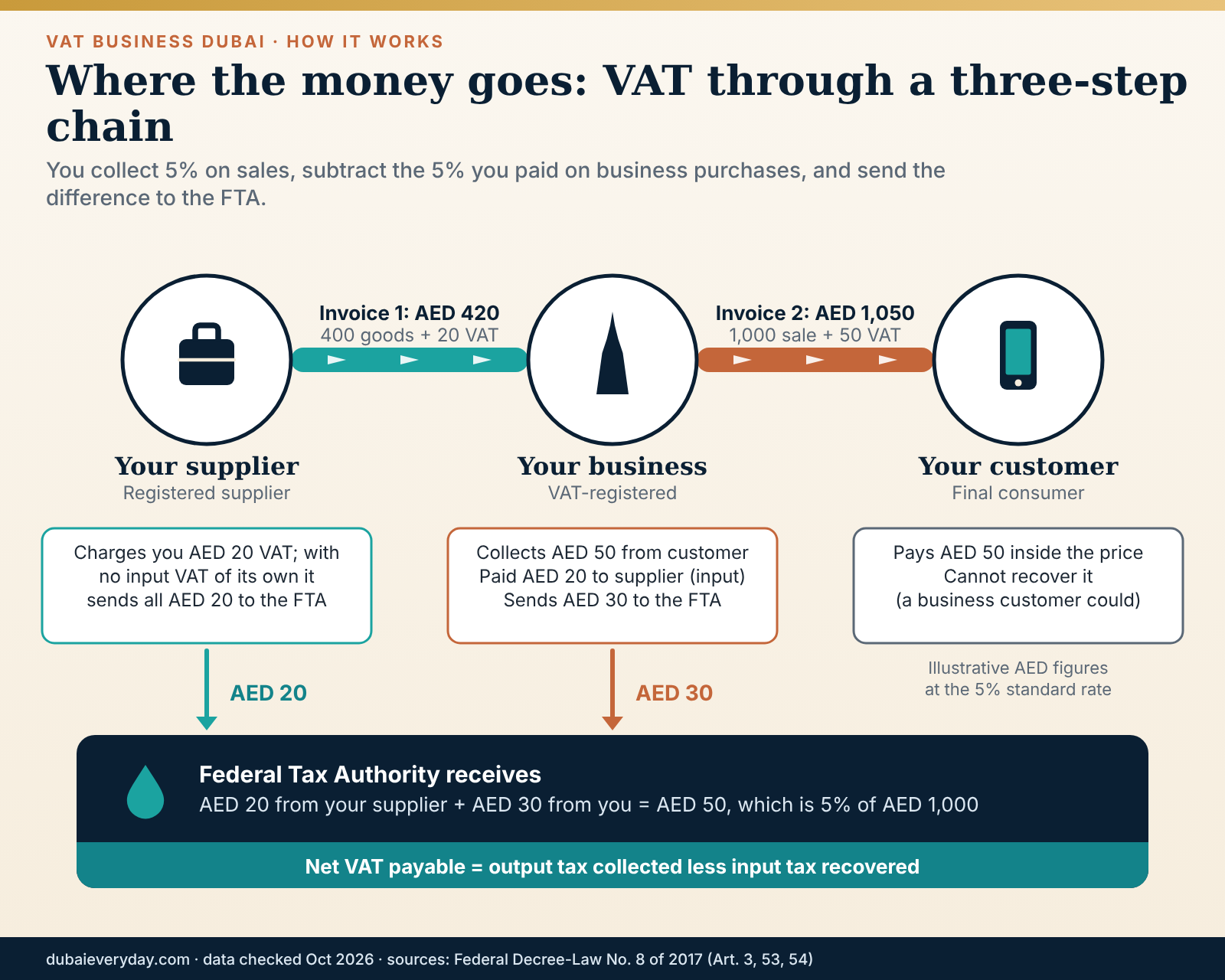
What makes it a business matter rather than a consumer matter is the mechanism. You do not pay VAT out of your own pocket. You collect it from customers on behalf of the FTA, subtract the VAT you paid on business costs, and hand over the difference. When the mechanism is run properly it is a pass-through, and the only real costs are admin time and the cash you hold between collecting and paying.
What this page covers, and what it leaves to other guides
This guide handles VAT business Dubai compliance: registration, tax invoices, returns, input VAT, records and penalties. The wider picture of who keeps the books, how corporate tax fits in and what an outsourced accountant costs belongs in our accounting services in Dubai guide. Day-to-day ledger habits such as bank reconciliation and receivables are covered in the bookkeeping in Dubai guide. Choosing a licence and a jurisdiction is in the Dubai business setup guide.
Corporate tax is a separate tax with separate deadlines from your VAT business Dubai calendar, and so are excise tax and customs duty. They appear here only where they touch VAT, for example when the same ledger feeds both returns.
The Dubai angle
The rule is federal, but three things make VAT business Dubai practice specific. First, your licence comes from a Dubai authority: the Department of Economy and Tourism for mainland companies, or the free zone authority for a free zone company. That licence has no effect on whether you owe VAT, which is the first misunderstanding to clear up.
Second, the return asks you to split standard-rated sales by emirate, and Dubai has its own line. Third, import VAT is collected at the border, and in Dubai that usually means Dubai Customs and your clearing agent. You can read how the licence choice works in the mainland versus free zone comparison.
A practical way to think about it: your licence tells the government what you may do, and VAT tells the government what you sold. They meet only at the point where your licensed activity creates supplies in the UAE.
The numbers worth memorising
Everything else in VAT business Dubai compliance hangs off those five figures. If you remember nothing else, remember that registration is triggered by looking backwards 12 months and forwards 30 days, and that both the return and the invoice have short fuses.
VAT business Dubai registration: who must register and when
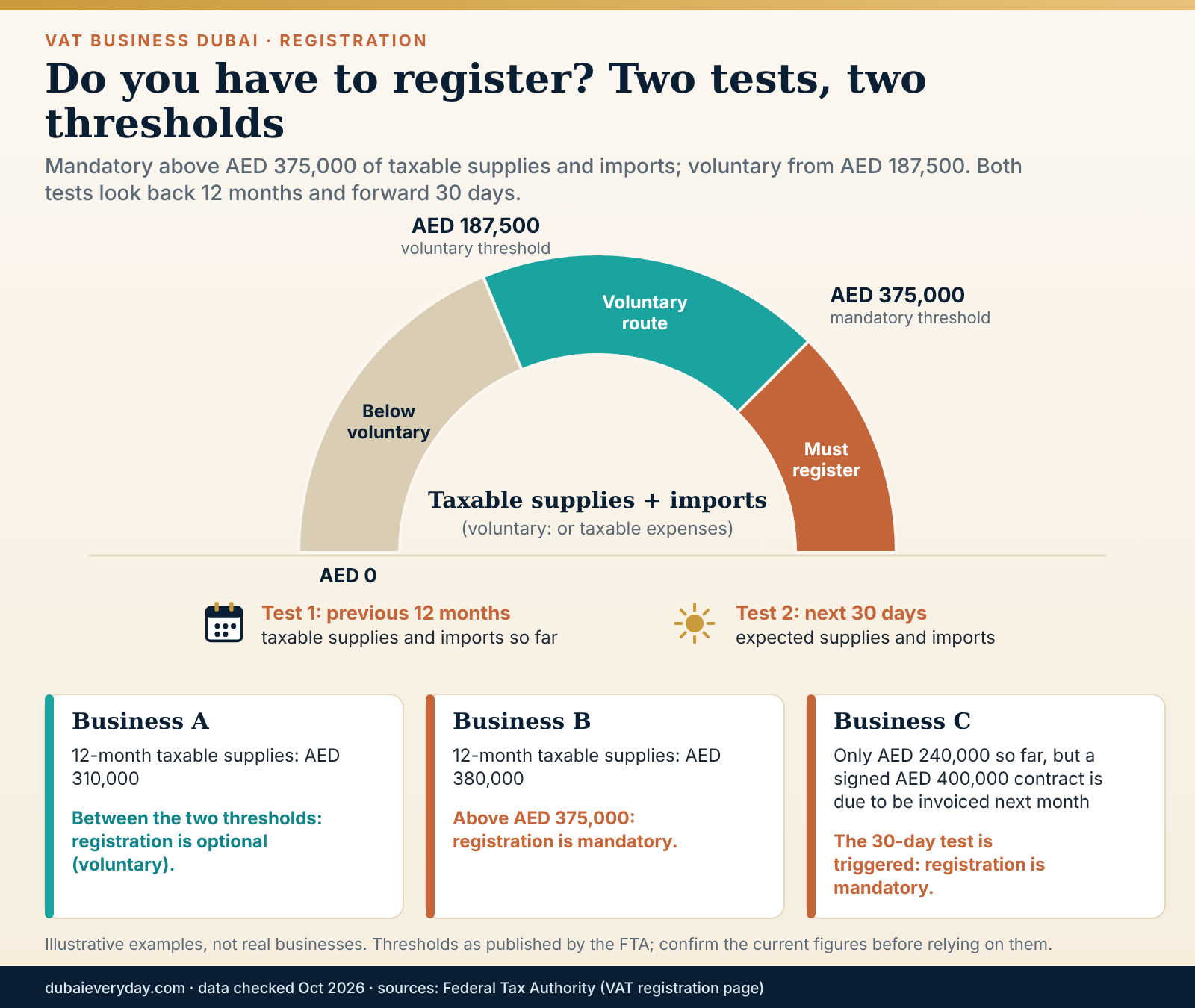
The FTA sets two VAT business Dubai thresholds. Mandatory registration applies when the total of your taxable supplies and imports exceeds AED 375,000 over the previous 12 months. Voluntary registration is open to a business whose taxable supplies, imports or taxable expenses exceed AED 187,500 over the same period. The FTA’s own registration page adds that both thresholds also work prospectively: if you expect to pass the limit in the next 30 days, the test is met today.
The 12-month test in plain terms
Count taxable supplies, which includes zero-rated sales but not exempt ones, plus imports, across the preceding 12 months. Do it on a rolling basis, not by calendar year. A company with a September start that has billed AED 380,000 by the following August has crossed the line even though it has not completed a financial year. The calendar year is a trap here: accountants often check at year end, which can be up to eleven months too late.
Zero-rated supplies count towards the threshold because the law treats them as taxable supplies at a 0% rate. An exporter selling AED 400,000 of goods abroad has to register even though it charges no VAT at all. That surprises people, and for a VAT business Dubai exporter it is a good reason to register early: the exporter then recovers VAT on its costs.
The 30-day forward test
This is the test that catches new, fast-growing and project-based businesses. If you sign a contract today that will be invoiced next month and will take you over AED 375,000, the obligation exists now. The practical VAT business Dubai advice is to watch your order book, not just your invoices. A consultancy with AED 240,000 billed so far and a signed AED 400,000 project starting in three weeks is in the same position as Business C in the graphic above.
The FTA’s VAT registration service page adds a deadline: the application must be submitted within 30 days of the date you were required to register. The late-registration penalty is AED 10,000 under the penalty table, and the amendments that took effect on 14 April 2026 keep that figure. The penalty is not the only cost. Until you are registered you cannot issue tax invoices, and VAT you should have charged is still owed, which means paying it out of your own margin.
The most common way to miss the threshold is to test it once a year. Add one line to your month-end routine: rolling 12-month taxable supplies, plus signed work due to be invoiced in the next 30 days. If either figure is close to AED 375,000, start the registration paperwork before you cross it.
Voluntary registration: when it helps and when it hurts
In VAT business Dubai terms, between AED 187,500 and AED 375,000 you have a choice. Registering makes sense when your customers are VAT-registered businesses who will recover the VAT anyway, and when you carry meaningful input VAT, such as a company fitting out an office or buying stock. Zero-rated exporters are the clearest case, because they charge no output VAT and therefore get regular refunds.
It hurts when your customers are private individuals who cannot recover VAT. You either raise prices by about 5% or absorb it, while taking on a quarterly filing routine for a small sum. There is also a lock-in: the VAT law does not allow a voluntary registrant to deregister within 12 months of registering. Treat voluntary VAT business Dubai registration as a 12-month decision, not a trial.
Foreign businesses are different. The FTA states that the mandatory threshold does not apply to non-residents: a non-resident making taxable supplies in the UAE must register regardless of value, unless another UAE party is responsible for settling the VAT on those supplies. If that describes you, ask a registered tax agent rather than relying on this guide.
Free zone licence does not equal VAT exemption
The most common VAT business Dubai misreading is that a free zone company does not deal with VAT. The licence determines your regulator, ownership rules and visa quotas. VAT follows the place of supply and the type of goods or services. A consultancy with a free zone licence that bills Dubai clients is making standard-rated supplies in the UAE and must register on the same thresholds as a mainland company. The free zone company setup guide explains the licence side of this; the VAT effect shows up later in the section on designated zones.
One more point about thresholds. The FTA’s registration page says the rule applies to any natural or legal person carrying out an economic activity in the UAE, even without a trade licence, so an unlicensed side business is not a loophole.
It also says all sole establishments owned by the same natural person are registered under one TRN, with the threshold calculated on their combined activity, and that a company with several branches files one return for all of them. If you have two separate companies under common control, ask a professional about tax groups: splitting turnover only to stay below AED 375,000 is the kind of arrangement that invites questions.
How to register for VAT, step by step
VAT business Dubai registration is done online through the FTA’s EmaraTax platform. The FTA’s pages state that its services are available only through UAE PASS, the national digital identity, so the first job is to make sure the person who will act for the company has an active UAE PASS account. It needs a smartphone and an Emirates ID, and it is the step people leave until the day the deadline bites. The service is free, and the FTA estimates about 45 minutes to complete the form.
- Work out the numbers first.Pull taxable supplies and imports for the last 12 months, month by month, and list signed contracts that will be invoiced in the next 30 days. The application asks for a signed and stamped turnover declaration, and the FTA publishes a template letter on its registration page. The same workings are your VAT business Dubai evidence if the FTA later asks why you registered on a given date.
- Set up UAE PASS for the person who will act for the company.That is usually the owner or manager named on the licence. Decide who else needs access, such as an accountant, because delegating to an agent is a separate step.
- Create and activate an EmaraTax account.From the dashboard, create a new taxable person profile, open the taxable person account and choose Register under Value Added Tax. The licence details must match the licence authority’s record, so check the spelling of the legal name before you type it.
- Attach the documents.The FTA lists, depending on legal form: incorporation documents, the trade licence and any branch licences, Emirates ID and passport copies for owners and signatories, a power of attorney where one signs for the company, the turnover declaration, and supporting evidence such as invoices, contracts or purchase orders. Files are PDFs of up to 15 MB each. A bank letter is optional, but a company account must be in the company’s name.
- Submit and answer queries.The FTA estimates 20 business days from receipt of a complete application. Incomplete files restart the clock, so answer queries quickly: an open query leaves you in limbo while the late-registration exposure keeps running.
- Collect the certificate and read it.It appears in your EmaraTax dashboard once the application is approved. It carries your tax registration number (TRN) and your assigned tax period. Check the effective date of registration shown there, because invoices from that date onwards must show VAT.
If you register on the expenses test or sit in a designated zone
Two cases ask for more. A business registering because its taxable expenses pass the voluntary threshold needs to show at least five VAT invoices for those expenses, according to the FTA’s document list. A business located in a designated zone is assessed case by case, and the FTA says it may ask for a business flow and supply chain documents. Both are reminders that VAT business Dubai registration is not a formality: the form expects evidence.
What to do in the first week after you get the number
For VAT business Dubai invoicing, update your invoice template with the TRN and the words “Tax Invoice” before the first sale after the effective date. Add the TRN to quotes, contracts and email footers if you invoice from them. Configure the 5% code, the 0% code and the exempt code in your accounting software, and decide how you will label sales that are outside scope.
Tell your bank and your key customers. Business customers will want your TRN to claim input VAT, and a customer cannot recover VAT on an invoice that lacks one. Check your suppliers too: the FTA site includes a TRN verification tool that takes a 15-character TRN and a 10-character TIN, so you can test a new supplier’s number before you pay VAT to it.
Registering a business that has not started trading
Pre-revenue companies sometimes pursue VAT business Dubai registration early because they are spending heavily on a fit-out, stock or equipment and want to recover that VAT. This is the voluntary route, and the taxable expenses test is what makes it available. The trade-off is the 12-month lock-in and the filing duty from day one.
If your first year is mostly costs, it can be worth it, but expect the FTA to look for real activity behind the application. The VAT law also limits recovery on services received more than five years before registration, so very old costs cannot be revived.
Mistakes at the registration stage
Three VAT business Dubai registration mistakes come up repeatedly. Applying on the day you cross the threshold, rather than when you could see you would cross it, is one. Entering a trade name that differs from the licence is another, since mismatched data can stall the application.
The third is forgetting that VAT registration does not replace corporate tax registration: they are separate applications to the same authority, and our accounting services guide sets out how the two calendars sit side by side. The FTA also warns that incorrect or misleading financial data in an application may lead to penalties, so do not round figures into a more convenient shape.
Standard, zero-rated, exempt and outside scope
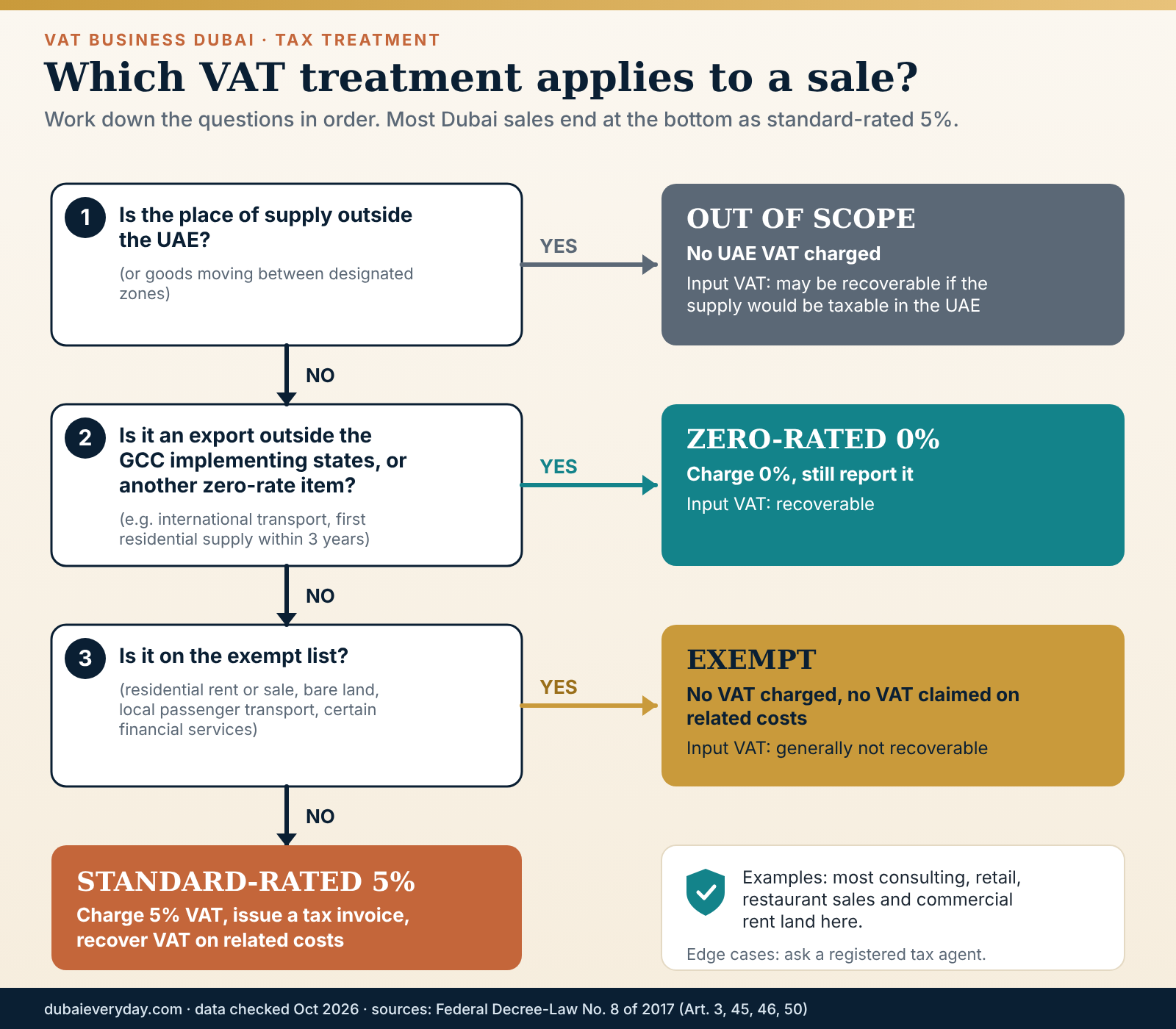
Registration is a one-time event. In VAT business Dubai practice, treatment is a decision you make on every sale. The law sorts supplies into four boxes, and the box decides what you charge, what you report and what input VAT you can claim. Most of your sales will land in the first box, but the exceptions are expensive when misjudged, so it pays to learn the structure properly.
Standard-rated: the default at 5%
Under Article 3 of the VAT law, the VAT business Dubai rate of 5% applies to taxable supplies and imports unless a specific rule moves them elsewhere. In practice that covers retail sales, restaurant and café sales, consulting and professional fees, software, most B2B services, advertising, construction services, commercial rent and many more. If you cannot find a reason a sale belongs in another box, it is standard-rated.
For a consultancy billing a Dubai client AED 20,000 for a project, the invoice shows AED 20,000, VAT of AED 1,000 and a total of AED 21,000. The client, if registered and using the service for taxable business, recovers the AED 1,000. If the client is a household or an exempt business, it carries that AED 1,000 as a real cost.
Zero-rated: taxable, but at 0%
Article 45 lists the zero-rated categories, and there are fourteen of them. The first is the export of goods and services outside the implementing states, which are the GCC countries that have put the regional VAT agreement into force. Others include international transport, the first supply of a residential building within three years of its completion, and crude oil and natural gas. The list also reaches certain education and basic healthcare services; read the article for the conditions rather than trusting a summary.
In VAT business Dubai terms, zero-rating is not “no VAT”. It means VAT is charged at 0%, the sale still goes in your return, and, crucially, you can recover input VAT on the costs of making it. That is why exporters and freight forwarders are often in a refund position. Zero-rated sales also need evidence: the FTA expects export documents, customs declarations and transport records on file, and a zero-rated sale that cannot be proved can be reassessed at 5%.
Exempt: no VAT, and no recovery of the VAT you paid
Article 46 lists the exempt supplies. They include certain financial services, residential sales and leases other than the zero-rated first supply, bare land, and local passenger transport. Exempt does not mean outside the VAT business Dubai system. It means you charge no VAT and, as a rule, cannot recover the VAT on costs that relate to those sales. A landlord letting flats to residents is the classic case: the rent is exempt, so VAT paid on repairs, agents and management fees is a cost.
The contrast with commercial property matters in Dubai, where many investors hold both. Commercial rent is standard-rated, and VAT on its related costs can be recovered. If you own a mixed portfolio, you must allocate shared costs between the two. Yield maths is a separate exercise, and the tax side deserves a tax agent’s attention before you commit to a structure.
Outside the scope
Some supplies fall outside the UAE VAT system altogether because the place of supply is not in the UAE, or because the goods are kept in a designated zone and treated as outside the State. No UAE VAT is charged and the sale does not usually appear in the standard-rated boxes, though the law still lets you recover related input VAT in some of these cases. The outcome depends on facts, so keep the contract, the delivery proof and a short note of why you decided it was outside scope.
Mixed supplies and apportionment
Many companies with a VAT business Dubai registration make a mix of taxable and exempt supplies, such as a company that sells commercial units and also lets residential ones. For them, input VAT must be apportioned.
The VAT Executive Regulation was amended by Cabinet Decision No. 149 of 2026, issued on 1 September 2026; secondary summaries say most changes apply from 1 October 2026, while revised input tax apportionment provisions apply from the first tax year starting after 1 October 2027. If you are partially exempt, put that date in your diary and have your adviser model both methods.
The Ministry of Finance announcement lists the amendments but gives no effective dates; the dates here come from KPMG and Deloitte summaries, which agree with each other. For the operative VAT business Dubai wording, use the legislation page of the FTA.
Tax invoices and credit notes that survive a check
In a VAT business Dubai file, a tax invoice does three jobs at once. It tells the customer how much VAT it can recover, it is the document the FTA matches against your return, and it is the document your own supplier’s customers check before they pay you. Of all the VAT paperwork, it is also the one most likely to be wrong, because it is produced by sales staff, not by finance.
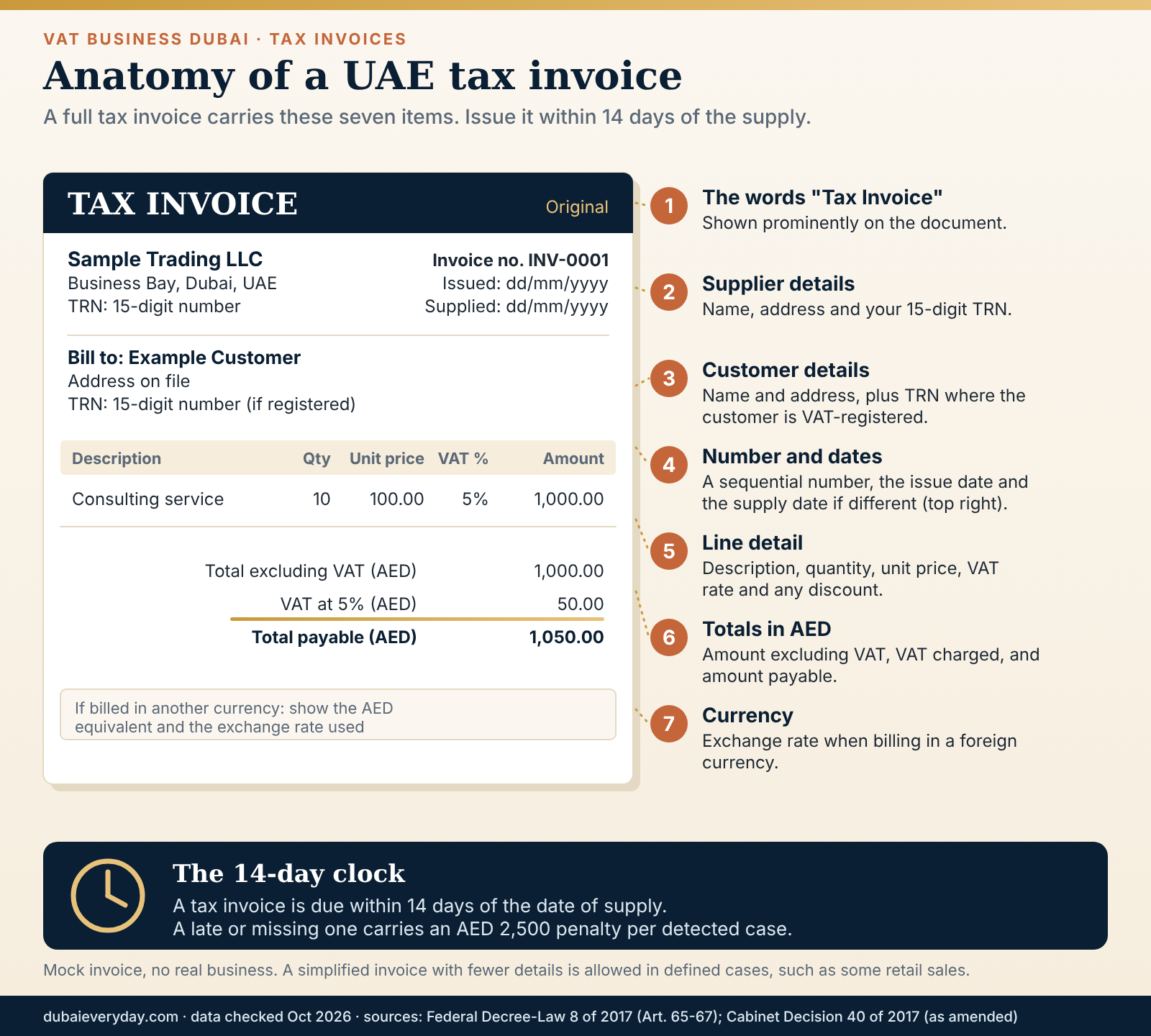
The legal clock on VAT business Dubai invoices is short. Article 67 of the VAT law requires the tax invoice to be issued within 14 days of the date of supply, and the penalty table in Cabinet Decision 40 of 2017, as amended in 2025, sets AED 2,500 per detected case for not issuing a tax invoice or its alternative document within the legal period.
What a full tax invoice contains
The list below follows the VAT Executive Regulation as summarised by advisory sources, because the FTA’s PDF of the regulation could not be opened on the day of research. The regulation was amended by Cabinet Decision No. 149 of 2026 with effect from 1 October 2026, and two advisory summaries report that the only invoice-related change is a labelling point for credit notes. Even so, check the FTA legislation page before you lock a template.
- The words “Tax Invoice” displayed clearly.
- The supplier’s name, address and TRN.
- The customer’s name and address, plus its TRN where the customer is registered.
- A sequential number or other unique identifier.
- The date of issue and, where different, the date of supply.
- A description of each good or service, with unit price, quantity, VAT rate, any discount and the gross amount.
- The total payable and the total VAT, both in dirhams.
- The exchange rate where the invoice is expressed in another currency.
Government guidance for retailers describes a lighter simplified tax invoice that still shows the words “Tax Invoice”, the supplier’s name, address and TRN, the date, a description, the total consideration and the tax charged. When that format is allowed depends on conditions in the regulation, and the amount of the sale and the type of customer both matter. A figure of AED 10,000 is widely quoted for business customers; confirm it before relying on it.
Date of supply: the quiet source of late invoices
VAT business Dubai teams often assume the 14 days start when they send the bill. They start from the date of supply, and our reading of the VAT law is that the tax point is generally the earliest of the supply itself, the issue of an invoice, or receipt of payment. The consequence is that a deposit or advance payment can create a VAT liability and an invoice duty before you deliver anything. A studio that takes a 50% deposit on 3 March and delivers on 20 April has a tax event in March.
The VAT business Dubai fix is operational. Make the deposit receipt a tax invoice from the start, or issue a proper tax invoice for the advance, and make sure finance sees every payment received. If you use project billing, build the invoice trigger on payment received as well as on milestone completion.
Credit notes and corrections
When a sale is cancelled, discounted after invoicing or partly returned, the output VAT you declared must go down, and the legal tool for that is the tax credit note, covered by Article 70. It follows the same 14-day logic, and the penalty table has its own AED 2,500 line for a credit note not issued in time.
The 2026 amendment clarifies that the words “Tax Credit Note” must appear on the credit note itself. Reduce your output VAT only when a credit note supports it. Where an invoice was simply wrong, the usual route is a credit note plus a corrected invoice, not an overwritten document.
Keep VAT business Dubai invoice numbering unbroken. If an invoice is voided, mark it as cancelled and keep it; a missing number in the sequence invites exactly the question you do not want to answer in an audit.
Price tags and the VAT-inclusive rule
If you sell to consumers, the VAT business Dubai rule is that the consumer-facing price must include VAT. The penalty table lists AED 5,000 for not displaying prices inclusive of tax, a line that matters to anyone running a shop, a salon, a clinic, a gym or a restaurant menu in Dubai. The cleanest practice is to show the all-in price and let the till or invoice break out the VAT. A price shown “plus 5%” in a consumer setting is the thing to avoid.
Language and format
Dubai businesses invoice in English every day without drama. The Tax Procedures Law, however, says tax returns and related records are to be submitted in Arabic, and its executive regulation says the FTA may accept records in English but may require an Arabic translation, certified under the State’s translation law. Advisory summaries of the 2026 penalty changes report that failing to provide Arabic-language records on request now carries AED 5,000, down from AED 20,000. The practical meaning: budget for certified translation if you are audited, and do not redesign your invoices.
Checking invoices you receive
Your VAT business Dubai input claim is only as good as your suppliers’ invoices. Build a short check into accounts payable: the words “Tax Invoice”, a valid TRN, the supplier’s legal name matching the payee, VAT shown separately, a date, and a total that adds up. Use the TRN checker on the FTA’s registration page when a supplier is new or the invoice looks off.
The VAT law now also lets the FTA deny input tax where a supply is part of an evasion chain and you knew or should have known, a change effective 1 January 2026 reported by advisory firms and attributed to Federal Decree-Law No. 16 of 2025. A new supplier that offers an unusually low price and an unusually vague invoice is the profile to question.
VAT returns: periods, boxes, payment and refunds
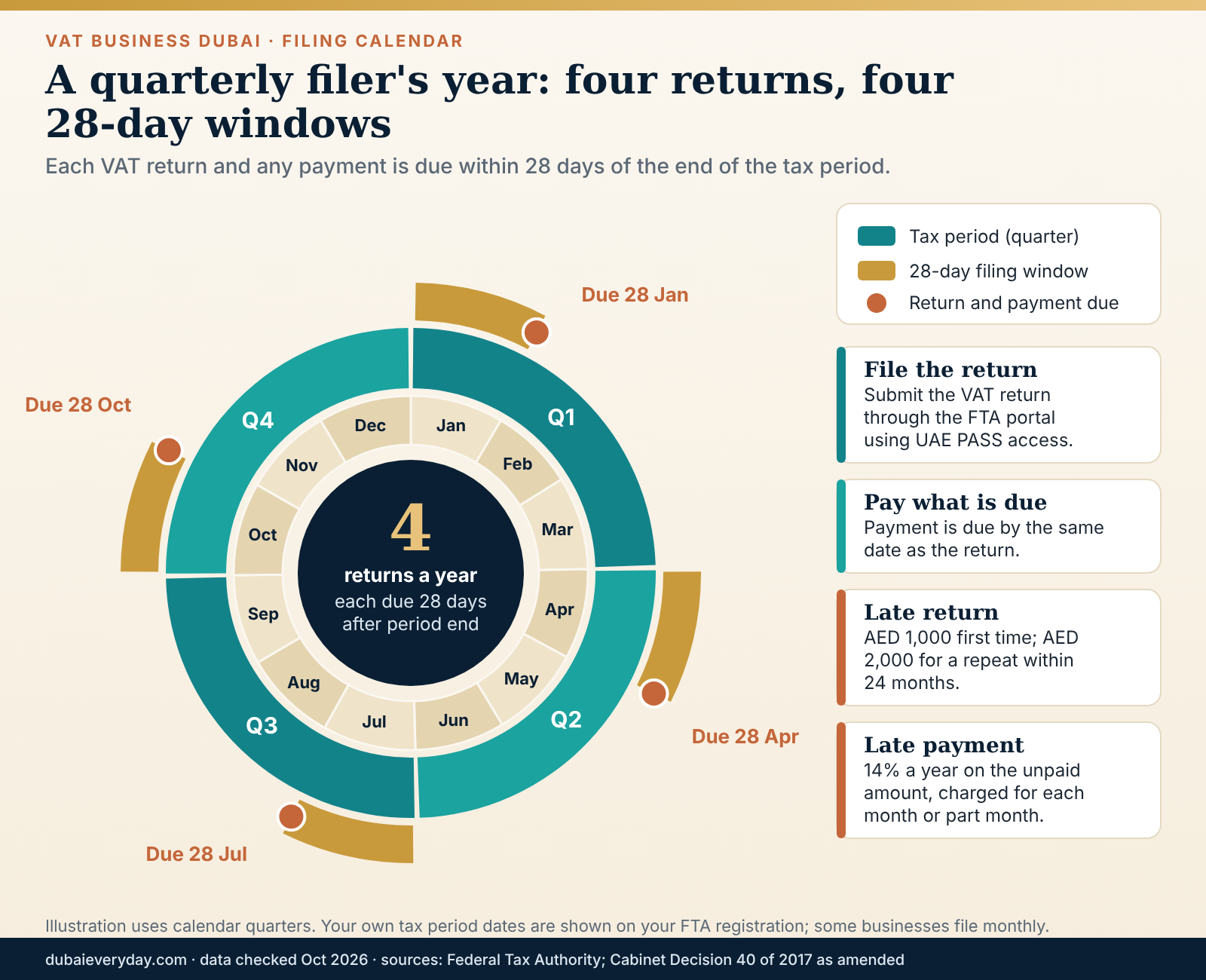
A VAT business Dubai registrant files a return for every tax period, even a period with no sales. The deadline is the same for the return and the payment: within 28 days from the end of the tax period, according to the FTA’s filing page. Filing is done through the FTA’s online services, which are available only through UAE PASS.
Tax periods: quarterly for most, monthly for some
The government’s VAT guidance says returns are filed quarterly or monthly depending on annual turnover, and that the FTA may set a different period. We could not find an official page giving the turnover cut-off for monthly filing, so rely on the period shown for your account. Advisers also describe staggered quarterly groups, so your quarter may not end in March, June, September and December at all. The wheel above uses calendar quarters because they are the easiest to read.
For a quarter ending 31 March, 28 days later is 28 April; for 30 June it is 28 July; for 30 September it is 28 October; for 31 December it is 28 January. A government guide adds that where the date falls on a weekend or public holiday the next working day applies. Do not plan around that: file two working days early and the point is moot.
What the return asks for
The FTA’s return walkthrough describes the main parts: VAT on sales and other outputs, VAT on expenses and other inputs, and the net VAT due. In practice the VAT business Dubai return asks for standard-rated supplies split by emirate, so your Dubai sales go on the Dubai line, then zero-rated supplies, exempt supplies, goods imported, adjustments and reverse charge items, followed by recoverable input VAT and the net figure. Check the current form on the portal, because lines change over time.
A worked example
The figures below are an illustrative VAT business Dubai example, not a quote or a market fact. They show how one quarter’s return is built from the ledger.
| Line in the ledger | Value (AED) | VAT (AED) | Treatment |
|---|---|---|---|
| Standard-rated sales to Dubai customers | 410,000 | 20,500 | Output VAT, Dubai line |
| Zero-rated exports | 60,000 | 0 | Reported at 0% |
| Local purchases with valid tax invoices | 150,000 | 7,500 | Input VAT, recoverable |
| Goods imported, VAT paid at customs | 40,000 | 2,000 | Input VAT, with import documents |
| Client entertainment | 6,000 | 300 | Not claimed, stays a cost |
| Net VAT payable | 11,000 | 20,500 less 9,500 recoverable |
Taxable turnover for the quarter is AED 470,000, standard-rated plus zero-rated, which is why this business would already be past the registration threshold in a single quarter. The AED 300 of VAT on entertainment is not deducted. If the quarter ends on 31 March, the AED 11,000 is due by 28 April. If purchases had exceeded sales, the result would be a refund position instead.
Paying and getting refunds
The portal gives you a payment reference, and payment must reach the FTA by the same deadline as the return. The pages we read did not list payment channels, so use whatever the portal currently offers and keep the confirmation with the return. A late payment is charged at 14% a year, computed for each month or part of a month on the unpaid amount, under the 2026 table.
If input VAT exceeds output VAT, you can ask for a refund or carry the credit forward in your FTA account. The FTA’s refund service page says processing usually takes 25 business days from a complete application, and 55 working days if an audit review is needed; older government guidance quotes 20 working days, so treat the FTA service page as the current figure.
The refund application needs the output and input tax report plus tax invoices and supporting documents. The Ministry of Finance announced that from 1 January 2026 a five-year limit applies, running from the end of the relevant tax period, to claiming a refund or using a credit balance. Do not leave a credit sitting in the account for years.
VAT business Dubai refunds draw scrutiny, and exporters know it. Expect questions, and keep export evidence, supplier invoices and bank statements ready as a single file per period. The executive regulation also lets the FTA defer a refund until overdue returns have been filed, which is one more reason to keep the filing record clean. That discipline is also what makes the next quarter’s return fast.
The monthly close that makes the return a ten-minute job
VAT business Dubai returns go wrong when finance first looks at VAT in the last week. A better rhythm runs in the ledger all month. Code VAT on every invoice and bill when you enter it. Reconcile the VAT control account to the ledger monthly. Review a short exceptions list: bills with no TRN, invoices without a tax code, entries posted to a date outside the period. Our bookkeeping guide describes the underlying reconciliations in more detail.
Input VAT: what you can recover and what you cannot
In a VAT business Dubai ledger, input VAT is the VAT your suppliers charge you. It is the half of the system that makes VAT a pass-through for businesses, and the half where small errors compound. Under-claim and you lose money. Over-claim and the FTA reclaims it with a penalty. The idea fits in one picture: you hand the FTA the difference between what you collected and what you paid.
The conditions in the VAT law
Articles 54 to 56 of the VAT law set the VAT business Dubai input logic. Input tax is recoverable where the goods or services are used to make taxable supplies, and zero-rated supplies count as taxable for this purpose. Article 55 lists the conditions: a valid tax invoice or import documents, payment, and retention of the documents. If you miss a claim in the right period, you can claim it in the next return. Input tax on purchases that are not used for taxable supplies is not recoverable under Article 56.
The VAT law was also amended with effect from 1 January 2026 by Federal Decree-Law No. 16 of 2025. Advisory summaries report a five-year limit on claiming or carrying forward excess recoverable input tax, and a power to deny input tax where a supply is part of an evasion chain and the claimant knew or should have known. The first point argues for claiming promptly. The second argues for knowing who your suppliers are.
What usually qualifies
Usually recoverable
Commercial office rent and service charges invoiced with VAT, professional fees, software and cloud subscriptions, stock bought for resale, advertising, business utilities, business phone and internet lines, equipment used in the business. Each needs a valid tax invoice in the company’s name.
Check before claiming
Staff accommodation and benefits, vehicles with any private use, premises used partly for exempt activity, costs paid in cash, anything bought before registration, and any invoice with a missing or doubtful TRN.
Usually not recoverable
Client entertainment, personal spending run through the company, costs linked to exempt sales such as residential lettings, and any cost with no valid tax invoice behind it.
Entertainment, vehicles and employee costs
Government guidance for retailers names entertainment expenses, motor vehicles used for personal purposes and employee-related expenses as costs on which VAT cannot be reclaimed. The third of these has just been revised. Cabinet Decision No. 149 of 2026, effective 1 October 2026 for most provisions, amends the employee-benefit rule: the labour-law exception now covers free zone labour legislation as well as designated zones, employer-provided accommodation qualifies only where the Ministry of Human Resources and Emiratisation makes it mandatory, and the old “normal business practice” test is replaced by cases and conditions the FTA will specify.
The FTA has since issued Decision No. 17 of 2026 on the cases and conditions for recovering input tax on employee expenses, issued on 9 September 2026 and published on 28 September 2026. We could read its title on the FTA legislation page but not its text. If you pay for staff housing, meals, transport or training in Dubai, read it with your adviser before the next return, and do not assume the old treatment still applies.
Cash payments: a new restriction
The same amendment adds a restriction on input tax recovery for supplies above a value set by the Minister of Finance where the consideration is paid, or intended to be paid, in cash. At the time of writing the threshold has not been published; the Ministry of Finance says it will be set by a separate ministerial decision.
Dubai still has plenty of cash-based trades such as small suppliers, wholesalers in the souks and trade counters. The cheap VAT business Dubai precaution is to pay business suppliers by bank transfer, cheque or card and keep the statement. That habit also helps your corporate tax file.
Mixed businesses: apportionment
A VAT business Dubai registrant with both taxable and exempt supplies cannot recover all of its shared costs. The law requires apportionment. The 2026 amendment replaces the input-tax-based method for commercial businesses with an output-based one: recoverable percentage equals the value of supplies that allow recovery divided by the total value of all supplies, applied to residual input tax, with capital asset supplies and certain reverse-charge receipts left out.
The KPMG and Deloitte summaries both place the start at the first tax year that begins after 1 October 2027, which for a calendar-year taxpayer is 1 January 2028. Government entities and charities keep their existing method.
Here is an illustrative example, not a market fact. A company has AED 800,000 of taxable supplies and AED 200,000 of exempt supplies in the year. The ratio is 800,000 divided by 1,000,000, so 80%. If residual input VAT is AED 10,000, it recovers AED 8,000 and carries AED 2,000 as a cost. The FTA’s service list also includes a request to change the input tax apportionment method, so a special method is possible where the standard one distorts the result.
Capital assets
Larger purchases can fall under the capital assets scheme. The AED 5 million threshold in the executive regulation is unchanged by the 2026 amendment, but its wording now refers to a business asset with a cost rather than a single item of expenditure. Separately, the VAT law requires records for capital assets to be kept for at least ten years. Most small VAT business Dubai registrants never reach the scheme; those that do should involve a tax agent at the purchase stage, not at filing.
A monthly input VAT review that takes an hour
- Every bill carries a tax code and a supplier TRN in the ledger.
- Bills without a valid tax invoice are listed, chased or coded as non-recoverable.
- Staff costs and vehicle costs are checked against the current rules.
- Payments above your cash comfort level are flagged.
- VAT on bills dated in the period equals the amount you will claim.
- Credit notes received have been matched to the original bill.
Imports, reverse charge, free zones and designated zones
Dubai is an import and re-export economy, so the edges of VAT business Dubai compliance matter more here than in many cities. Four ideas cover almost every situation: import VAT, the reverse charge, zero-rated exports and designated zones. Each has a Dubai flavour, and each has a documentation burden.
Importing goods
Goods brought into the UAE are subject to VAT on import, and VAT business Dubai importers meet this at customs. Older official FTA guidance for importers says that a VAT-registered importer can defer import VAT to its tax return, so the payment falls due with the return, while an unregistered importer pays at customs through the FTA’s payment form, in some cases with an electronic guarantee.
That guidance was written around the 2018 launch, so confirm today’s procedure with your clearing agent or Dubai Customs. It also lists exceptions, including some personal effects and travellers’ goods up to a stated value.
The VAT business Dubai cash-flow effect is real. A registered importer that can defer import VAT to the return avoids paying at the border and then waiting to recover it. An unregistered importer that pays at customs has paid VAT it cannot recover. This is one of the cleanest arguments for registering voluntarily if you import and resell.
The reverse charge: VAT on services from abroad
If you buy goods or services from outside the UAE for business use and the reverse charge applies, Article 48 of the VAT law treats you as making a taxable supply to yourself. In practice you declare output VAT in your return and, if the cost is recoverable, claim the same amount as input VAT in the same return. For a fully taxable business the net cash effect is nil, but the return must show both sides.
Typical VAT business Dubai cases are software subscriptions billed from overseas, online advertising from foreign platforms, consultants or freelancers based abroad and some freight services. These pass through the card statement without a UAE tax invoice, which is why they are often missed.
Federal Decree-Law No. 16 of 2025 removed the self-invoice requirement for business imports under the reverse charge, according to advisory summaries, but the declaration itself remains. A separate reverse charge for metal scrap trading among registrants was introduced by Cabinet Decision No. 153 of 2025, and the FTA published a public clarification on it in October 2026.
Exports and re-exports
Exports of goods outside the GCC implementing states are zero-rated, as the earlier section explained. VAT business Dubai traders who re-export often assume that zero-rating comes automatically. It does not. It depends on documentary proof, such as the customs export declaration and evidence the goods left the UAE, and on a supply chain that fits the legal definition. Supplies to other GCC states follow different place-of-supply rules, so do not use the “export” label without checking.
Free zones and designated zones are not the same thing
This is the single most repeated VAT business Dubai mistake. A free zone is a licensing concept. A designated zone is a VAT concept, defined by Cabinet decision. Articles 50 to 52 of the VAT law treat qualifying designated zones as outside the State for certain supplies of goods and allow goods to move between designated zones without VAT. Being in a free zone does not by itself put you in a designated zone, and the treatment as we read it applies to goods, not to services.
The FTA issued a general procedure titled “Free Zones and Designated Zones for Tax Purposes”, TAXP010, on 2 October 2026, which covers corporate tax, VAT and excise together. We could see its title and date in the FTA’s guide listing but not its content, so we do not summarise it.
The takeaway is practical: if your premises are in a Dubai free zone and you handle physical goods, ask your zone authority and a tax agent whether the area is a designated zone for VAT, and keep the answer in writing. Our free zone company guide and the mainland company guide cover the licensing side.
Tax groups
Related companies in the UAE can register as a VAT tax group, treated as one taxable entity under a single TRN. The FTA’s service page says each member must be a legal person with a place of establishment or fixed establishment in the UAE, the members must be related parties, each must make taxable supplies or import concerned goods or services, and the group cannot be formed unless its combined taxable supplies and imports exceed the mandatory threshold.
The application goes through a representative member, and every other member signs a no-objection letter. The FTA estimates 20 business days to process it.
The FTA also published a directive in July 2026 on adjusting output tax and input tax after a registrant leaves a tax group. Groups simplify internal invoicing but make exit more complicated, so the decision is for a tax agent, not for a template.
VAT business Dubai records: what to keep, how long, which language
A VAT business Dubai return is a summary. The records behind it are what the FTA actually audits, and the penalty table treats failure to keep them as a serious offence: AED 10,000 per violation, rising to AED 20,000 for a repeat within 24 months. Dubai companies are generally good at issuing invoices and weaker at finding them again five years later, especially after a change of accountant, a software migration or a staff departure.
What counts as a record
The executive regulation of the Tax Procedures Law, Cabinet Decision No. 74 of 2023, splits records into two groups. The first is accounting records and books: balance sheets, profit and loss accounts, payroll, fixed asset records and inventory records. The second is the supporting paperwork: invoices, contracts, licences, business correspondence and the working papers showing how tax was calculated. The FTA may also ask for other information it needs to verify your obligations.
Government VAT guidance for retailers adds the VAT-specific items: records of supplies and imports, tax invoices and credit notes issued and received, records of exports, adjustments and purchases where VAT was not deducted, and a VAT account showing output tax and recoverable input tax. In a VAT business Dubai file, the evidence for zero-rated exports and the import documents are the two groups most often missing.
How long: five years is the floor, not the plan
For a taxable person, the Tax Procedures executive regulation requires records to be kept for five years after the relevant tax period. The government guidance for retailers says the same. Four things push that period out. The regulation extends it where there is an open dispute, an incomplete audit or an announced audit, and where a refund application is undecided.
The VAT law separately requires records for capital assets to be kept for at least ten years. Corporate tax records must be kept for seven years from the end of the tax period, according to an FTA release, and your ledger feeds both taxes. Certain real-estate records carry longer periods, and the texts we read quoted different figures.
The FTA’s audit window is generally five years from the end of the tax period, but it extends to 15 years where tax evasion or a failure to register is involved. Our VAT business Dubai recommendation, which is a judgement and not a legal rule: keep everything for seven years, capital asset files for ten, and property records for as long as you hold the asset plus the longest figure your adviser quotes. Storage is cheap; reconstruction is not.
Format, language and location
The regulation allows originals, or a register plus copies, or electronic records. There is no need to print. On language, the Tax Procedures Law expects Arabic, the FTA may accept English and may require an Arabic translation, and the translation must be certified.
The text we read does not state that records must physically be kept inside the UAE, and for e-invoices the Ministry of Finance removed a UAE-storage requirement in Ministerial Decision No. 197 of 2026 with effect from 1 October 2026. Even so, make sure you can produce the files quickly, because an audit notice is generally at least 10 days under the Tax Procedures Law, other than in the no-notice cases it lists.
A records pack per tax period
- The filed return and the FTA acknowledgement.
- A sales invoice register and a purchase bill register that tie to the return totals.
- The VAT control account reconciliation.
- Import documents and customs declarations; export evidence for zero-rated sales.
- Credit notes issued and received, with the original invoices they relate to.
- Reverse charge workings for overseas services.
- Payment confirmation, bank reference and date.
- A short memo for any unusual item: a refund claim, a late invoice, a treatment you decided was out of scope.
Give the VAT business Dubai folder a consistent name, such as year, quarter and TRN, and keep it in cloud storage the company owns. When a bookkeeper leaves or a provider changes, your records should not leave with them. Our bookkeeping guide covers the monthly reconciliations that make the pack quick to assemble.
Records after you deregister or close
The VAT business Dubai record obligation does not end when the TRN does. The retention clock runs from the end of the tax period, not from the day you close the company. Before you wind up a Dubai company, move the archive to a place that survives the closure, and give a named person responsibility for it. This is the stage where records disappear, because the accounting software subscription is the first thing to be cancelled.
E-invoicing and your VAT routine
UAE e-invoicing is a change to how a VAT business Dubai tax invoice is produced and exchanged, not to what VAT is due. The FTA’s page describes an e-invoice as structured data exchanged through the system and reported to the authority, and says a PDF or an email is not an e-invoice. The Ministry of Finance is the source of the rules, and they have shifted several times in 2026. Our accounting services guide covers readiness for the finance function; this section covers the VAT consequences.
The dates
Under the Ministry of Finance’s September 2025 decisions, as amended: a pilot began on 1 July 2026 for selected taxpayers. Businesses with revenue of AED 50 million or more must appoint an accredited service provider, with the deadline extended in May 2026 to 30 October 2026, and go live on 1 January 2027. Businesses under AED 50 million appoint a provider by 31 March 2027 and go live on 1 July 2027. In-scope government entities go live on 1 October 2027. The scope covers business-to-business and business-to-government transactions and electronic credit notes.
The VAT law itself points to the same system: Article 70 requires electronic tax credit notes where the e-invoicing system applies. And the penalty table has a dedicated AED 2,500 per detected case line for not meeting the conditions for issuing tax invoices and credit notes electronically.
What changed on 1 October 2026
Ministerial Decision No. 197 of 2026, announced by the Ministry on 19 October 2026, amends the earlier rules. Transactions between members of the same tax group are excluded for 24 months from 1 January 2027, the requirement to store e-invoices in the UAE is removed, and the system-failure notification article is repealed. The Ministry lists 80 accredited service providers on its website; we do not rank or recommend any of them, and inclusion on that list is the only filter we can point to.
What it means for a small Dubai business
If your revenue is below AED 50 million, you have until 31 March 2027 to appoint a provider on the current timetable. That is not a reason to wait. Three tasks help now: clean your customer master data so each business customer has a correct name, address and TRN; make sure your accounting software can connect to an accredited provider; and decide who owns the process. B2C sales to individuals are not in the stated scope, but the dates and rules have moved before, so watch the Ministry’s announcements rather than a blog’s summary.
VAT penalties in Dubai: amounts, logic and how to limit them
The VAT business Dubai penalty tables were rewritten by Cabinet Decision No. 129 of 2025, which the FTA has announced as in force, with the consolidated VAT table giving 14 April 2026 as the effective date. Several fixed amounts fell, some percentage charges were simplified, and others did not change. The table below follows the Ministry of Finance’s consolidated text of Cabinet Decision No. 40 of 2017, as amended, which is the primary source. It covers the items a VAT-registered Dubai business is most likely to meet.
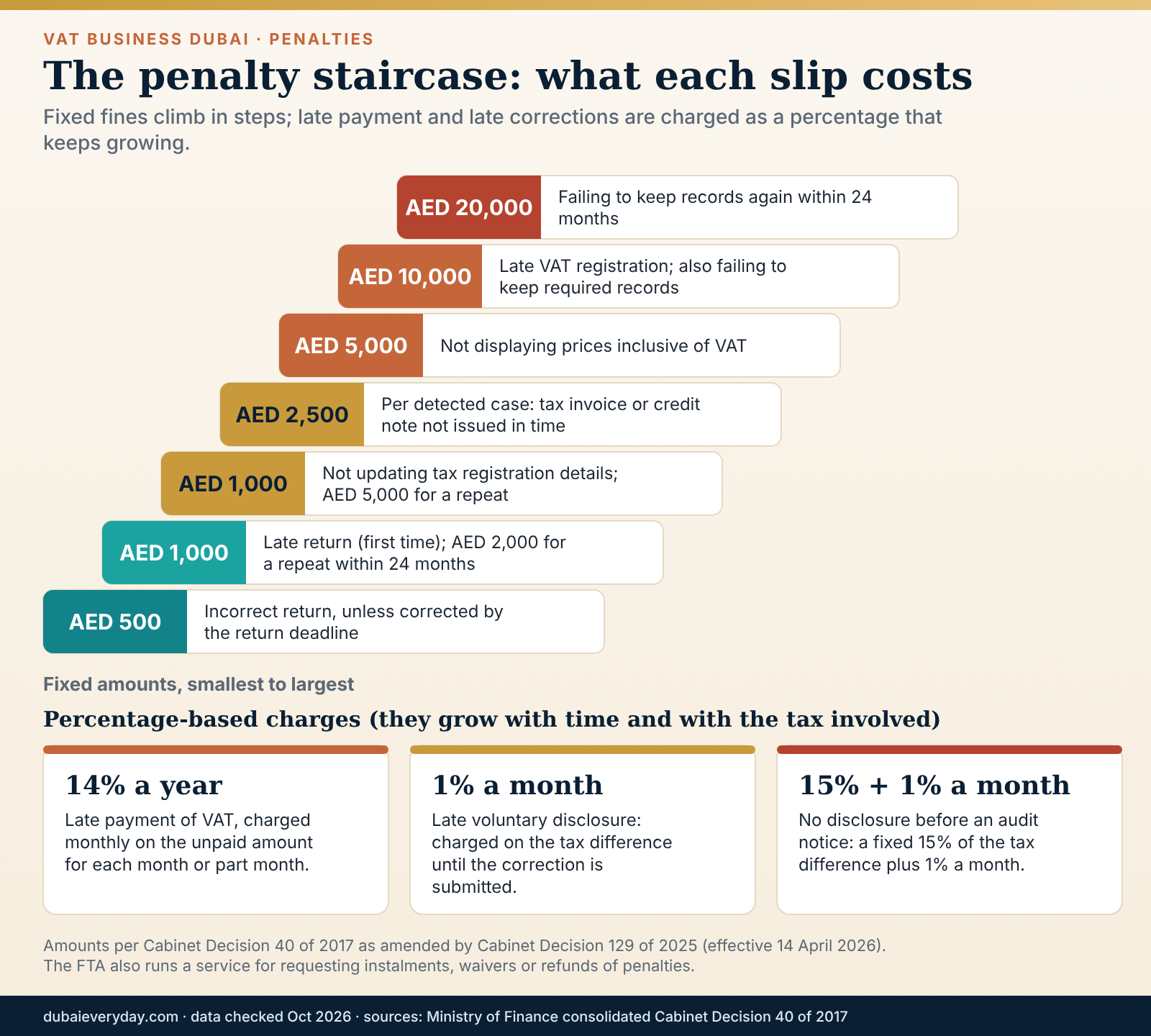
| What goes wrong | Penalty (as consolidated, effective 14 April 2026) |
|---|---|
| Late VAT registration | AED 10,000 |
| Failure to keep required records | AED 10,000 per violation; AED 20,000 for a repeat within 24 months |
| Tax invoice or credit note not issued within the legal period | AED 2,500 per detected case |
| Electronic issuing conditions not met | AED 2,500 per detected case |
| Prices not displayed inclusive of VAT | AED 5,000 |
| Late return | AED 1,000 first time; AED 2,000 for a repeat within 24 months |
| Incorrect return | AED 500, unless corrected by the return deadline or the disclosure creates no tax difference |
| Late payment | 14% a year on the unsettled amount, charged monthly for each month or part of a month |
| Failure to update tax record details | AED 1,000 per violation; AED 5,000 for a repeat within 24 months |
| Late deregistration application | AED 1,000, then AED 1,000 monthly, up to AED 10,000 |
| Voluntary disclosure after the return deadline, before any audit notice | 1% a month of the tax difference |
| No disclosure before an audit notice | 15% of the tax difference plus 1% a month |
| Goods in or moved between designated zones without meeting conditions | The higher of AED 50,000 or 50% of the tax on the goods |
| Failure to calculate tax due on imports | 50% of the unpaid or undeclared tax |
Two further points. Advisory summaries report that the penalty for failing to submit Arabic-language records on request is now AED 5,000, down from AED 20,000; we could not confirm that line in the primary text we read. And the FTA’s own announcement of the new decision is the place to check for transitional relief, which we did not find.
The late payment arithmetic
In VAT business Dubai penalties, the late payment line is the one to understand because it scales with the tax. Our calculation, assuming each month or part month counts as a full month: 14% a year is 1.17% a month. On AED 20,000 of VAT paid 40 days late, two months have begun, so the charge is AED 20,000 times 14% times two twelfths, which is about AED 467.
On AED 200,000 paid six months late it is AED 14,000. Add AED 1,000 if the return was also late. The old regime, which advisory firms describe as a 2% charge plus 4% a month, was far heavier, but that is history; do not use older articles for planning.
VAT business Dubai disclosure works differently. Under the executive regulation of the Tax Procedures Law, an error that understates tax by more than AED 10,000 needs a voluntary disclosure within 20 working days of discovering it, while smaller errors can be corrected in the next return. The 2026 amendments, reported by the Ministry of Finance and advisory firms, ease this for errors that change no tax due.
Take advice before using the shortcut. As an illustration, a tax difference of AED 50,000 corrected four months after the return deadline attracts about 1% times four, so AED 2,000, plus the tax. The same difference found by the FTA in an audit would start at 15%, or AED 7,500, before the monthly 1%.
Ways to limit VAT business Dubai penalties
- Put every return and payment deadline in the shared calendar two working days early, with a named owner and a backup.
- Use maker and checker: the person who prepares the return is not the person who submits it.
- Fix errors as soon as you find them; the percentage charges run monthly.
- Keep invoicing triggers tied to payment received and to delivery, not just to milestones.
- Reconcile the VAT control account monthly so the return is a transfer, not a discovery.
- Notify FTA changes, such as a new licence number or address, within 20 business days.
If you are penalised: instalments, waivers and reconsideration
The FTA runs a service for requests for instalments, waivers or refunds of administrative penalties, free of charge through EmaraTax. Instalment requests require unsettled penalties and no payable tax outstanding for the period, with a minimum of AED 50,000 that the committee may change. The FTA says it reviews requests within 110 business days. The FTA page gives no waiver criteria of its own and refers to Article 4 of Cabinet Decision No. 105 of 2021, so do not plan on a waiver.
If you believe a decision is wrong, a reconsideration request goes to the FTA within 40 business days of the decision, free, with a review period of up to 45 business days. Disputes after that go to the Tax Dispute Resolution Committee. The late corporate tax registration waiver the FTA runs is specific to corporate tax and should not be assumed to apply to VAT.
VAT business Dubai scenarios: what goes wrong for six kinds of company
VAT business Dubai rules are easier to remember when they are attached to a situation. The six profiles below are composites built from the rules, not case studies of real companies, and the figures are invented. Each shows where the mechanics tend to break and what the usual fix is.
The free zone consultancy that assumed it was outside VAT
A two-person consultancy holds a free zone licence and bills clients in Dubai mainland. Revenue passes AED 375,000 and nobody registers, because the owner was told the free zone has “no tax”. The licence tells the regulator what the company may do; the sales are standard-rated supplies in the UAE.
The exposure is the AED 10,000 registration penalty plus 5% on every sale since the threshold date, absorbed from margin because clients were never charged VAT. The fix is to register immediately, then ask a tax agent how to handle the back period. Do not backdate invoices.
The café that priced “plus VAT”
A café lists prices without VAT because that is how its supplier price list works. Customers see a higher total at the till. The penalty table has a line for not displaying prices inclusive of tax, AED 5,000, and consumer-facing prices are the point of it.
The fix is a menu and shelf price that includes VAT, with the till showing the breakdown. Second weak spot: small cash suppliers. Input VAT on goods bought for cash from a supplier without a proper tax invoice cannot be claimed, and the new cash-payment restriction targets large cash payments for the same reason.
The trader that imports, stores and re-exports
A trading company brings in goods through Jebel Ali or Dubai Airport, stores some in a bonded or free zone warehouse and re-exports part of the stock. Three VAT questions arise: whether import VAT is paid at customs or accounted for on the return, whether the warehouse is in a designated zone, and whether re-exports are properly evidenced as zero-rated.
A wrong answer on the second can attract the designated-zone penalty, which is the higher of AED 50,000 or 50% of the tax on the goods. The fix is a written supply chain map, reviewed by a tax agent, and a customs and export file per shipment.
The online seller with deposits and refunds
An online shop takes payment at order, ships days later and refunds some orders. VAT arises on the earliest of payment, invoice or supply, so the timing sits with the payment. Refunds need credit notes within the legal period, otherwise output VAT cannot be reduced. Marketplace commission and overseas advertising are often billed from abroad without UAE VAT, so the reverse charge applies. The FTA has a dedicated e-commerce VAT guide on its site; the fix is a daily extract of orders, refunds and fees that ties into the ledger.
The landlord with a mixed portfolio
A company owns two flats let to residents and one commercial unit let to a business. Residential rent is exempt; commercial rent is standard-rated. VAT on the repairs and fees for the flats is a cost, VAT on the commercial unit’s costs is recoverable, and shared costs such as the property manager’s retainer must be split.
Revenue from the commercial unit may push the company over the registration threshold even though the residential income does not count. The fix is to track costs by property from the first day, and to ask a tax agent which method will apply when the output-based apportionment starts after 1 October 2027.
The pre-revenue startup with a large fit-out
A new company is spending AED 400,000 on a studio and equipment before opening. VAT on those costs is AED 20,000, which looks worth recovering. Voluntary registration can be available on the taxable expenses test, supported by at least five VAT invoices, and the company will then file returns from the start, even for periods with no sales. The registration cannot be reversed within 12 months. The fix is to decide deliberately: model the recovery against the compliance cost and the lock-in, and register only if the numbers and the plan to trade are real.
Correcting errors, updating details and deregistering
A VAT business Dubai registration is never finished. Companies change names, move offices, renew licences, restructure or close, and each of those events carries a clock.
Updating your registration details
The FTA’s tax records amendment service says changes must be notified within 20 working days of the date the change occurs. It lists the business or trading name, principal place of business address, primary business activities, trade licence renewal or amendment, and authorised signatory details.
The service is free through EmaraTax, and the FTA aims to review within 20 business days. The penalty table sets AED 1,000 per violation for failing to update details, and AED 5,000 for a repeat within 24 months. A trade licence renewal in Dubai is a recurring trigger: every renewal is also an update to your tax record.
Correcting a mistake in a filed return
Under the Tax Procedures executive regulation, an error that understates tax by more than AED 10,000 requires a voluntary disclosure within 20 working days of discovering it; smaller errors can be corrected in the next return. Advisory summaries of Federal Decree-Law No. 17 of 2025, effective 1 January 2026, say errors with no effect on tax due can be corrected in the next return without a voluntary disclosure.
The penalty table matters here: an incorrect return costs AED 500 unless corrected by the deadline, and late disclosures attract 1% a month on the tax difference. In practice that makes early correction cheap and late correction expensive.
Deregistration: when it is required and what it takes
The FTA’s deregistration page lists the reasons: the business no longer makes taxable supplies, for example after cancelling or selling its licence, taxable supplies fall below the AED 187,500 voluntary threshold, or the registration is a duplicate or a branch. Where deregistration is mandatory, the application must be submitted within 30 business days from when the obligation arose. The FTA estimates 30 business days to process a complete application, and a further 30 if it asks for more information. A voluntary registrant cannot deregister within 12 months of registering, under the VAT law.
Two practical rules. First, the final return and any tax payable are due within 28 days of the effective date of deregistration. Second, the deregistration certificate is issued only after the final return is approved and all outstanding tax and administrative penalties are settled. If you plan to close a Dubai company, sequence the steps: settle VAT, file the final return and deregister, keep the records, and only then abandon the accounting system. The late deregistration penalty starts at AED 1,000 and adds AED 1,000 a month up to AED 10,000.
Asking the FTA a question
Where a rule is unclear for your facts, the FTA offers a private tax clarification request through its services list and a general inquiry channel. A written answer from the authority is worth more than a verbal comfort from an adviser. The FTA toll-free number printed on its site is 800 82923, and it also lists 04-7771777.
Doing VAT yourself or hiring help
Whether to run VAT business Dubai compliance in-house depends on volume, complexity and how much a mistake would cost. There is no regulatory requirement to use an accountant, and a sole operator with simple standard-rated sales can file. The cost is the owner’s time and the risk of an error that nobody reviews.
When in-house works
Self-filing a VAT business Dubai return works when sales are almost entirely standard-rated and domestic, purchases are few and well documented, there are no imports or overseas services, and someone in the company can learn the portal. Even then, a one-off review by a registered tax agent after the first return is cheap insurance.
A tax agent is an individual or firm registered with the FTA, and the FTA publishes a searchable register; when we checked on 29 October 2026 it listed 802 entries, with filters including emirate and area of experience. The register does not itself verify an individual’s fitness for your case.
When outside help earns its fee
Bring in VAT business Dubai help when you import or export, hold stock in a free zone, make exempt and taxable supplies, run multiple entities, use reverse charge services heavily, have a refund position, or have received an FTA query. The same applies if e-invoicing integration is coming, because the software and the process change together.
We do not quote fees because no official price list exists and quotes vary with scope; ask three firms for the same written scope and compare the scope before the price. The accounting services guide gives a fuller approach to engagement models and fee logic.
Questions to ask before you hire
- Is the individual who signs your filings a registered tax agent, and can you see the registration?
- Who files the return, and whose UAE PASS is used? Insist on delegation through the portal, not shared credentials.
- Who pays a penalty caused by a missed deadline: you or the firm? Put it in the engagement letter.
- What is in scope: registration, quarterly returns, input VAT review, refunds, FTA correspondence, e-invoicing set-up?
- Where do the working papers live, and do you receive a copy each quarter?
- What happens to your records if you leave?
Walk away from anyone who asks for your UAE PASS password, promises a refund before reviewing your records, describes a free zone as a way to avoid VAT, or offers to register you “with no documents”. Registration requires evidence and a signed declaration. Check any firm’s tax agent status on the FTA register before sending a document.
A note on software
For VAT business Dubai purposes, an accounting package that produces compliant tax invoices, tracks VAT codes and exports a return working is enough for most small companies. We do not recommend a product. Ask three questions: can it show the TRN and the invoice fields listed in the earlier section, can it hold a VAT control account that reconciles, and has the vendor said how it will connect to an accredited e-invoicing provider. Our bookkeeping guide goes through software choices from the ledger side.
A 30-day VAT business Dubai plan
If you are starting from zero, or inheriting a messy VAT business Dubai file, this sequence turns the guide into action. It assumes you have a trade licence and a ledger of some kind.
- Days 1 to 3: establish your status.Add up taxable supplies and imports for the last 12 months and the next 30 days. Compare with AED 375,000 and AED 187,500. If you are over the line, start registration the same day.
- Days 4 to 10: fix invoicing.Update the invoice template with the words “Tax Invoice”, your TRN, the customer’s details and AED totals. Set the 14-day rule, deposits and credit notes as written procedures.
- Days 11 to 18: review input VAT.List last quarter’s bills with VAT. Remove entertainment, check staff costs against the current rules, and flag cash payments and invoices without a valid TRN.
- Days 19 to 24: build the records pack.Create a folder per tax period, store the return, registers and reconciliation, and decide the retention period and the person responsible.
- Days 25 to 30: set the calendar and test e-invoicing readiness.Enter the return dates, set reminders two working days early, and ask your software vendor how it will connect to an accredited provider.
At the end of 30 days you should be able to answer six VAT business Dubai questions without searching: which tax period you are in, when the next return is due, who files it, what your last invoice looked like, where the evidence for each zero-rated sale sits, and what a late return would cost.
If you cannot, book an hour with a registered tax agent and take this page with you. For the wider decisions around licence, jurisdiction and ownership, return to the Dubai business setup guide, and for where to verify rules beyond tax, see the Dubai legal basics guide.
FAQ
Do I have to register for VAT if my Dubai company is below AED 375,000?
Not on the mandatory test, no. Mandatory registration applies when taxable supplies and imports exceed AED 375,000 over the previous 12 months, or you expect them to in the next 30 days. Between AED 187,500 and that line you may register voluntarily, using supplies, imports or taxable expenses. Voluntary registration is a 12-month commitment, because the VAT law does not allow a voluntary registrant to deregister within 12 months. If your customers are mainly VAT-registered businesses or you carry heavy input VAT, registering early can help; if they are consumers, it usually just adds admin.
What is the VAT registration threshold for a business in Dubai?
The FTA publishes two VAT business Dubai numbers: AED 375,000 for mandatory registration and AED 187,500 for voluntary registration. Both apply to a rolling 12 months and to a forward-looking 30-day test. Taxable supplies include zero-rated sales but not exempt ones. The thresholds apply to the person, not to each licence, and the FTA says sole establishments owned by one natural person are registered under one TRN with turnover combined. Check the FTA registration page before relying on any figure in an article, including this one, because thresholds can be amended.
Do free zone companies in Dubai pay VAT?
Often yes. For VAT business Dubai purposes, a free zone licence is a licensing arrangement; VAT depends on the place and nature of the supply. A free zone company selling services to Dubai customers makes standard-rated supplies in the UAE and registers on the same thresholds as a mainland company.
A narrow exception exists for designated zones, which are a VAT concept defined by Cabinet decision and mostly concern goods. Being in a free zone does not make you a designated zone, so ask your zone authority and a tax agent, and keep the answer in writing.
How often do I file a VAT return in Dubai, and what is the deadline?
VAT business Dubai registrants file for each tax period, quarterly or monthly according to the period the FTA assigns. The FTA’s filing page says the return and payment are due within 28 days from the end of the tax period. For a quarter ending 31 March the deadline is 28 April, and so on. File even if you had no sales that period. An FTA notice on its VAT page gave 28 October 2026 as the final deadline for one VAT filing window, which is a reminder that deadlines arrive quickly.
What is the penalty for filing a VAT return late in the UAE?
Under the VAT business Dubai penalty table as consolidated for 14 April 2026, a late return costs AED 1,000 for a first offence and AED 2,000 for a repeat within 24 months. Late payment is charged separately at 14% a year on the unsettled amount, computed for each month or part of a month. Incorrect returns attract AED 500 unless corrected by the deadline. Waiver and instalment requests exist through EmaraTax, but the FTA page sets conditions and does not promise relief, so aim to file two working days early.
What must a UAE tax invoice include?
As advisory sources summarise the Executive Regulation, a full tax invoice shows the words “Tax Invoice”, the supplier’s name, address and TRN, the customer’s details and TRN where registered, a sequential number, the issue date and supply date, a line description with unit price, quantity, VAT rate and any discount, the total and VAT in dirhams, and the exchange rate if billed in another currency. It must be issued within 14 days of the supply. A simplified version is allowed in defined cases. Confirm against the current regulation.
Can I claim VAT on staff accommodation, meals or client entertainment?
Client entertainment is generally not recoverable. Employee-related costs are in transition: Cabinet Decision No. 149 of 2026, effective 1 October 2026 for most provisions, changes the employee-benefit rule and refers to cases and conditions the FTA will specify, and FTA Decision No. 17 of 2026 addresses recovery on employee expenses. Employer-provided accommodation qualifies only where the Ministry of Human Resources and Emiratisation makes it mandatory, according to advisory summaries. Read the FTA decision, or ask a tax agent, before claiming staff costs.
How long must I keep VAT records in Dubai?
For a VAT business Dubai taxable person the Tax Procedures executive regulation requires five years after the relevant tax period, and the government guidance for retailers says the same. The period extends during an open dispute, an incomplete or announced audit, or an undecided refund application. The VAT law requires records for capital assets for at least ten years, and corporate tax records are kept for seven years. A practical rule is to keep everything for seven years, and ask your adviser about property records. Failing to keep required records carries AED 10,000 per violation.
Do I charge VAT on exports from Dubai?
Exports of goods and services outside the GCC implementing states are zero-rated under Article 45 of the VAT law. That means VAT at 0%, the sale reported in your return, and input VAT on related costs recoverable. Zero-rating needs evidence, such as customs export declarations and transport records. Supplies to other GCC states follow different place-of-supply rules, so do not label them exports without checking. Exporters often end up in a refund position, and the FTA says processing usually takes 25 business days from a complete application, longer if audited.
How do I deregister from VAT?
Through EmaraTax, under VAT, Actions, De-Register. The FTA lists reasons including ceasing taxable supplies, falling below AED 187,500, or a duplicate registration. Where deregistration is mandatory, apply within 30 business days from when the obligation arose. The FTA estimates 30 business days to process a complete application. File the final return and settle the tax within 28 days of the effective date; the certificate is issued only after the final return is approved and tax and penalties are paid. Voluntary registrants cannot deregister within 12 months.
Is VAT charged on rent in Dubai?
Residential leases are exempt under Article 46 of the VAT law, so landlords charge no VAT and generally cannot recover VAT on related costs. Commercial rent is standard-rated at 5%, and a landlord that is registered charges VAT on the rent and can recover input VAT on its costs. The first supply of a residential building within three years of completion is zero-rated. A landlord with both types must split shared costs. Take advice on any specific lease before relying on a general rule.
Does e-invoicing replace tax invoices in the UAE?
For a VAT business Dubai registrant, it changes the format and the channel, not the VAT due. An e-invoice is structured data exchanged through an accredited service provider and reported to the FTA; a PDF or an email is not an e-invoice.
Under the Ministry of Finance timetable as amended, businesses with revenue of AED 50 million or more go live on 1 January 2027, and smaller businesses on 1 July 2027, with a provider to be appointed by 31 March 2027. The scope covers business-to-business and business-to-government supplies. Watch the Ministry’s announcements for further changes.
Related reading
Sources and further reading (30 links)
- Federal Tax Authority: Registration for VAT — thresholds, 30-day test, foreign businesses
- Federal Tax Authority: VAT registration service — 30-day application window, documents, processing time, sole establishments, branches
- Federal Tax Authority: Filing VAT returns and making payments — 28-day deadline, UAE PASS access
- Federal Tax Authority: VAT deregistration service — reasons, deadlines, final return, certificate
- Federal Tax Authority: Tax refund to registered taxpayers — refund documents and processing time
- Federal Tax Authority: Tax records amendment — 20 working days to notify changes
- Federal Tax Authority: Tax group registration (VAT) — eligibility and process
- Federal Tax Authority: Requests for instalment, waiver and refund of administrative penalties — conditions and review time
- Federal Tax Authority: Reconsideration request — deadline and review period
- Federal Tax Authority: VAT legislation — 2026 decisions and directives, executive regulation listing
- Federal Tax Authority: VAT guides, references and public clarifications — designated zones procedure, clarifications listing
- Federal Tax Authority: E-services — service list, apportionment and clarification requests
- Federal Tax Authority: UAE e-invoicing — definition of an e-invoice
- Federal Tax Authority: Corporate tax record-keeping release — seven-year corporate tax records
- Federal Tax Authority: Registered tax agents — public register of tax agents
- Ministry of Finance: Federal Decree-Law No. 8 of 2017 on VAT and amendments (unofficial English translation) — rate, zero-rated and exempt lists, input tax, invoices
- Ministry of Finance: Cabinet Decision No. 40 of 2017 and its amendments — consolidated administrative penalty tables
- Ministry of Finance: Amendments to the VAT Executive Regulation — Cabinet Decision No. 149 of 2026 summary
- Ministry of Finance: Amendments to the Tax Procedures Law — five-year refund limit and other 2026 changes
- Ministry of Finance: E-invoicing scope and timelines — phases and revenue bands
- Ministry of Finance: Amended e-invoicing regulations — Ministerial Decision No. 197 of 2026
- Ministry of Finance: Accredited e-invoicing service providers — list of accredited providers
- UAE Legislation portal: Cabinet Resolution No. 74 of 2023 — record retention, voluntary disclosure, refund decision times
- UAE Legislation portal: Federal Decree-Law No. 28 of 2022 on Tax Procedures — language, audit limitation periods, notification duties
- UAE Government portal: VAT guidance for retailers — simplified invoice, records, non-recoverable VAT
- UAE Government portal: VAT guidance for importers — import VAT and deferral (older guidance)
- Dubai Department of Economy and Tourism: Licences and permits — mainland licensing entry point
- KPMG UAE: Cabinet Decision 149 of 2026 (secondary; advisory-firm summary) — amendment details and effective dates
- Deloitte Middle East: Amendments to the UAE VAT Executive Regulation (secondary; advisory-firm summary) — apportionment and employee benefits
- Baker McKenzie: UAE VAT and Tax Procedures Law amendments (secondary; law-firm summary) — context for the 2026 changes
Update log: 29 October 2026, first publication; all facts re-checked against the sources above. Next review due: by 29 January 2027, or immediately after any change to penalties, the VAT Executive Regulation, the cash-payment threshold or e-invoicing dates. Corrections welcome.
General information only. This is not individual tax, legal, accounting or financial advice; confirm your own position with a registered tax agent or the Federal Tax Authority.
About DubaiEveryday and this guide
DubaiEveryday.com is an independent editorial project that publishes practical, research-based guides to everyday life in Dubai: where to live, what things cost, how the rules work and how to get around. This page was written and edited by the DubaiEveryday editorial team. It is not signed by a named expert, doctor, lawyer or adviser, and we do not claim first-hand testing of a venue, clinic or service unless the page says so.
Each guide is built from official sources such as government and regulator pages, operator websites and established news outlets, cross-checked where we can. When we could not confirm something, we say so in the text, and examples that use made-up numbers are labelled as illustrations. Mentions are editorial choices, not paid placements, and a link is not an endorsement.
Dubai changes quickly. If you spot something that is out of date or wrong, please tell us through the contact options on DubaiEveryday.com and we will check it and correct the page.