
A free zone company Dubai founders set up is licensed by the zone authority, not by the Department of Economy and Tourism, and it can be 100% foreign-owned. This guide walks you through choosing the zone, the licence, the desk, the visas, the bank account and the yearly renewal, with the numbers we could verify.
Ask around about why founders pick a Dubai free zone and the answer usually starts with the price of the licence. That is the wrong place to begin. The better question is who will pay you, because the licence you buy decides where you are allowed to invoice them.
A free zone company Dubai structure can be a lean way to hold 100% of a business, sponsor a few residence visas and sit in a sector-friendly address. It can also leave you unable to sell to the Dubai customer who is already waiting. This guide walks through the zone, the desk, the visas, the bank account and the renewal in the order that saves rework, with the dirham figures we could verify and a plain note on the ones nobody publishes.
A free zone company Dubai licence is a business permit issued by one of the emirate’s free zone authorities, and it lets a foreign owner hold 100% of the company, work from a zone address and bring in a small team of residence visas. What it does not do, by default, is let you invoice customers across the Dubai mainland like a mainland company.
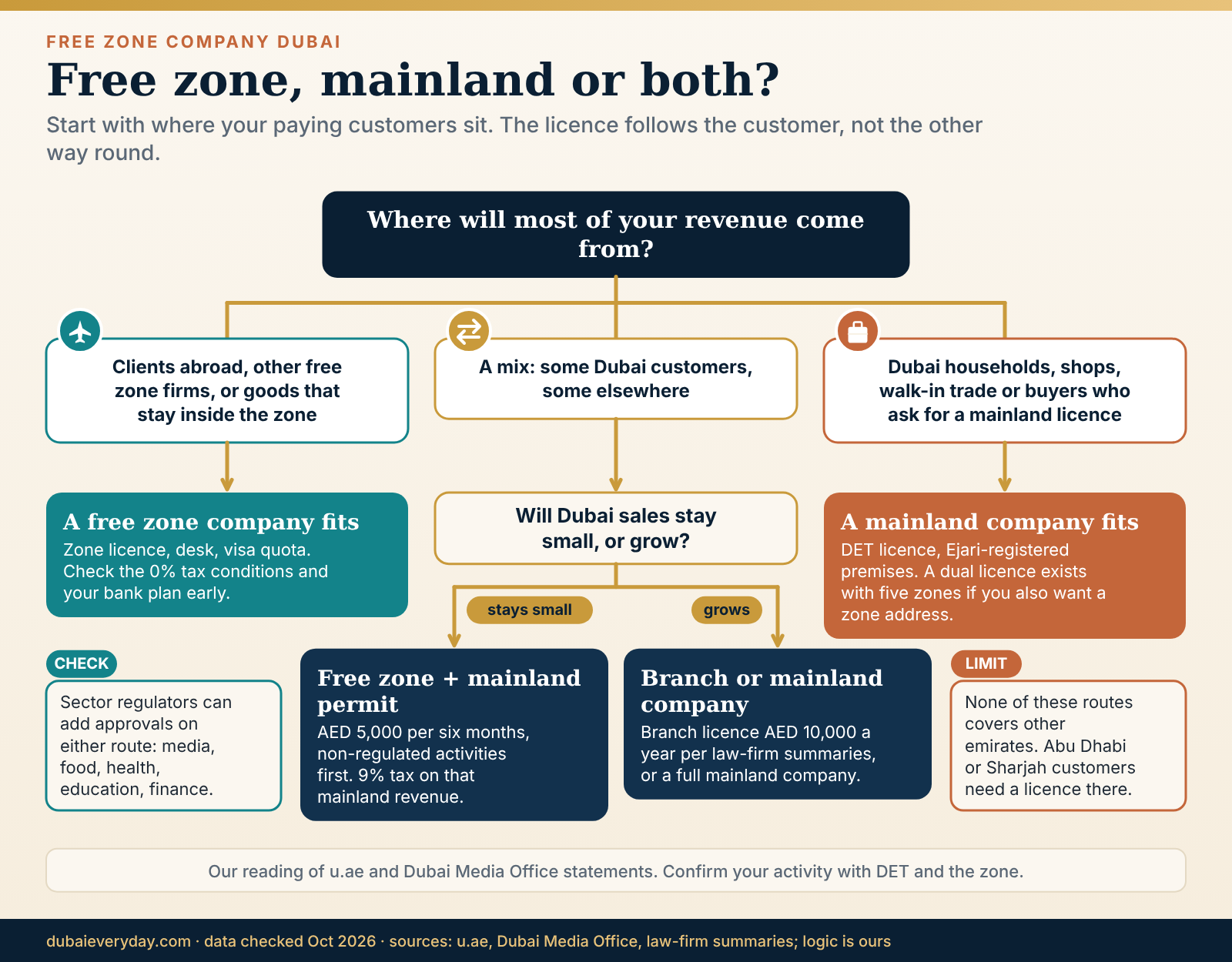
The decision therefore starts with your customers, not with the cheapest price list. If most of your revenue comes from clients abroad, from other free zone firms or from trade that never leaves the zone, a free zone company Dubai structure is usually the lighter route. If your clients are Dubai households, shops or government bodies, look at the mainland, or at the mainland operating permit introduced in October 2025.
Costs for a free zone company Dubai are published as zone-by-zone price lists, so expect a first year somewhere in the tens of thousands of dirhams once licence, desk, visa and registration lines are added. Our calculation from the DMCC schedule gives about AED 46,800 for a solo founder with one visa and a flexi desk package. Banking, tax registration and renewal are the three steps that surprise most free zone company Dubai founders, and each has its own section below.
This is a desk-research guide. DubaiEveryday.com has not formed a company, sat in a zone sales office or used any bank or formation agent mentioned here, and nothing below describes a personal experience.
On 29 October 2026 we read the federal portal u.ae, the Dubai government portal, the Dubai Media Office, the Federal Tax Authority, the Ministry of Finance, the General Directorate of Residency and Foreigners Affairs in Dubai, and the published price lists or guides of DMCC, Meydan Free Zone, JAFZA, Dubai Silicon Oasis, Dubai Airport Freezone and DIFC. The full list is in the Sources box at the end.
What we did not do: we did not request quotes, test any online calculator, call a bank, or read every one of the 21 zones. Prices come from DMCC’s schedule of charges and a Meydan Free Zone cost page, and both are price lists published by the zone itself, so treat them as advertised prices, not totals.
Zone fees can change without notice. Several pages we needed (DET licensing, some zone sites) load their detail dynamically, so some items are marked “confirm first”. Inclusion was not paid for, we have no referral link or lead relationship with any zone, bank or agent, and no zone is ranked. This is general information, not legal, tax or financial advice.
What a free zone company Dubai is, and what the licence does not let you do
Dubai has a lot of free zones. The Dubai government portal lists 21 of them, from Dubai Multi Commodities Centre (DMCC) and Jebel Ali Free Zone (JAFZA) to Dubai Silicon Oasis, Dubai Studio City, Dubai Healthcare City, Meydan Free Zone, Expo City Dubai and the Dubai International Financial Centre (DIFC). Each is a defined area with its own authority, its own rule book, its own fee list and, usually, a sector it wants to attract. A free zone company Dubai owner is therefore not licensed by one central office but by whichever zone authority issues the licence.
That structure explains almost every practical difference a free zone company Dubai owner will notice. The federal portal u.ae describes free zone companies as open to full foreign ownership, with 0% customs duty on goods imported into the zone and no duty on goods stored there for re-export. Duty applies only if goods move into the mainland market. For a trader, that is a real saving. For a consultant who never touches physical goods, it is irrelevant, and the attractions are the simpler setup and the visa support.
What a free zone company Dubai licence gives you
Four things come with a free zone company Dubai licence, though the exact form varies by zone. First, a legal entity or branch with a trade licence naming the permitted activities. Second, an address, which might be a desk, an office, a warehouse or a plot. Third, the right to sponsor residence visas through the zone, subject to a quota. Fourth, access to the zone’s services: licensing, visa processing, sometimes banking introductions and customs facilities.
The Dubai portal adds that free zone company Dubai setup can mostly be done online, although each zone has its own requirements and timelines. The u.ae page on starting a business in a free zone describes the same sequence: pick the sector and the zone, pick the legal entity type, estimate costs, choose a trade name, apply on the zone’s website, and receive the licence within 14 working days after review. Fourteen working days is the government’s description of the process. Individual zones advertise much faster routes, and we cover those in the timeline section.
What a free zone company Dubai licence does not give you
Here is the trap. The u.ae page is blunt that free zone companies are treated as outside the mainland jurisdiction, and that direct mainland sales are generally not permitted without the right licences or approvals. To sell goods or services locally, the page says a free zone company must either work through a licensed mainland distributor or set up a mainland branch or company. A free zone company Dubai licence is therefore not a cheaper version of a mainland licence. It is a different instrument with a different reach.
Two other limits matter. A free zone company Dubai licence does not cover other emirates; one law-firm summary of Dubai’s 2025 resolution notes that none of the cross-over routes authorise activity outside Dubai, so a business serving Abu Dhabi or Sharjah customers still needs the right licence there. And the licence does not protect you from tax. The UAE corporate tax regime applies to free zone companies, with a 0% rate available only to those that meet strict conditions, which we explain in the tax section.
Where this guide stops
One search job per page keeps both useful. This guide covers setting up and running a free zone company Dubai from zone choice to renewal. The broader question of how the licence families fit together lives in our Dubai business setup guide, and the mainland route has its own page on setting up a mainland company in Dubai. We link to both rather than repeat them. Personal budgeting for a founder who is also relocating sits in our Dubai cost of living guide.
Free zone or mainland: the question that decides the rest
Ask one question before you open a single price list: where do your paying customers sit? If you can answer “mostly abroad”, “mostly other companies inside free zones” or “mostly traders re-exporting goods”, a free zone company Dubai licence fits naturally. If the honest answer is “people and businesses in Dubai who will not care what licence I hold”, the free zone saves you nothing, because every sale into the mainland needs a workaround.
Most people answer this question with a feeling, not a revenue forecast. Try making it concrete. Take the first twelve months of expected invoices and sort them into three piles: customers outside the UAE, customers inside a free zone, customers on the Dubai mainland. If the mainland pile is more than a small share, you should price the workaround (a permit, a branch, a distributor or a separate mainland company) into your budget now, not after the first big client asks for a trade licence they can recognise.
When a free zone company Dubai is the lighter route
A free zone company Dubai tends to be the lighter route for five patterns. Consultants, designers, developers and other service providers who bill foreign clients. Online sellers who ship from a warehouse inside a logistics zone. Holding or investment vehicles. Commodity and trading businesses that deal in bonded goods. And companies that want a Dubai base for staff visas without opening a retail-style premises.
What these have in common is that the buyer is not standing in a Dubai shop. The zone gives you a legal home, a quota of visas and a licence that foreign banks and counterparties recognise, and you avoid the mainland rules on premises that we describe in the mainland company guide.
When a free zone company Dubai is the wrong tool
Retail, restaurants, salons, clinics outside healthcare zones and any business that depends on walk-in customers want a mainland address. So do suppliers to Dubai government entities and large developers who may insist on a mainland licence in tender documents. The u.ae page on running a business in a free zone explains the underlying reason: the zone company is outside mainland jurisdiction, so local trading is regulated.
There is also a quieter wrong-tool case. A founder who needs a physical shop-front or a large team may find the zone’s space expensive or capped. Visa quotas are tied to office size in many zones, and moving to a bigger unit changes the price list. We deal with that arithmetic in the office section.
Usually fits a free zone company Dubai
Foreign-client services, e-commerce shipped from a zone warehouse, bonded trading, holding structures, and small teams that need residence visas more than they need street frontage.
Usually fits the mainland
Walk-in retail, food service, local B2C services, supply to Dubai government buyers who ask for a mainland licence, and teams that need to contract widely with Dubai companies.
Worth pricing both
Businesses with a split customer base. The mainland operating permit, a mainland branch or a dual licence can bridge the gap, and we price the bridge in the mainland access section.
The dual licence and the Dubai Unified Licence are different things
People mix these up constantly. The dual licence, described on the Dubai portal, lets a free zone company operate on the mainland without leasing extra office space or bringing in a local partner, and it is currently offered with five free zones. The Dubai Unified Licence (DUL) is something else: a digital registry and business identity launched by the Department of Economy and Tourism with the Dubai Free Zones Council on 11 December 2023. It gives each mainland or free zone business a licence number and a QR code that can be displayed in place of a paper certificate.
The DUL matters to a free zone company Dubai owner in two ways. It is the identity the October 2025 mainland operating permit relies on, and the Dubai authorities credit it with faster bank onboarding. Both points get fuller treatment later. For now, remember the shorthand: dual licence is about where you may trade; DUL is about how your company is identified.
How to choose a zone for your free zone company Dubai
The mistake we would flag first for any free zone company Dubai plan is choosing a zone from a comparison blog that sorts by price. Price lists differ because the zones sell different things: one sells a licence for a commodities hub, another a desk in a tech park, another a warehouse. Comparing the cheapest line of each is like comparing a bicycle and a van by the price of the wheels. Start from the activity, then the customer, then the practicalities, and only then the fee table.
Dubai.ae describes the 21 zones as sector-focused areas, with some allowing general trading across many sectors and others covering a few specialist ones. u.ae offers a Free Zones Gateway comparison tool that filters Dubai zones by sector and shows facilities such as warehousing and land plots. It is the sensible neutral starting point, because it lists what each zone allows before anyone tries to sell you something.
Eight questions that narrow 21 zones to three for your free zone company Dubai
- Is your exact activity on the zone’s list?Do not accept “yes, we can do that” from a sales call. Ask for the activity name as it will print on the licence, and ask whether it needs a sector regulator’s approval.
- Who are the customers, and do they care about the address?A zone in a tech park suits a software firm. A bonded warehouse suits an importer. A zone with a recognisable business address helps a consultancy meeting banks and investors.
- How many visas do you need in year one and year three?Zone quotas follow office size. We explain how in the office section.
- Will you ever sell on the mainland?Check whether the zone takes part in the dual licence scheme and how it handles the mainland operating permit.
- Do you need physical space?A desk, a serviced office, a warehouse and a plot are four different budgets. Do not buy space you will not use, but note that tax substance rules may need real activity in the zone.
- What is the all-in year-one price, and the renewal price?Ask for both in writing. A low entry price sometimes comes with a higher renewal.
- How does the zone handle banking?Some zones introduce clients to banks; none can promise an account. Banks decide.
- How do you leave?Cancellation, visa cancellation and deregistration fees are published for some zones and hidden for others. Read them before you sign.
Zone families, in plain terms
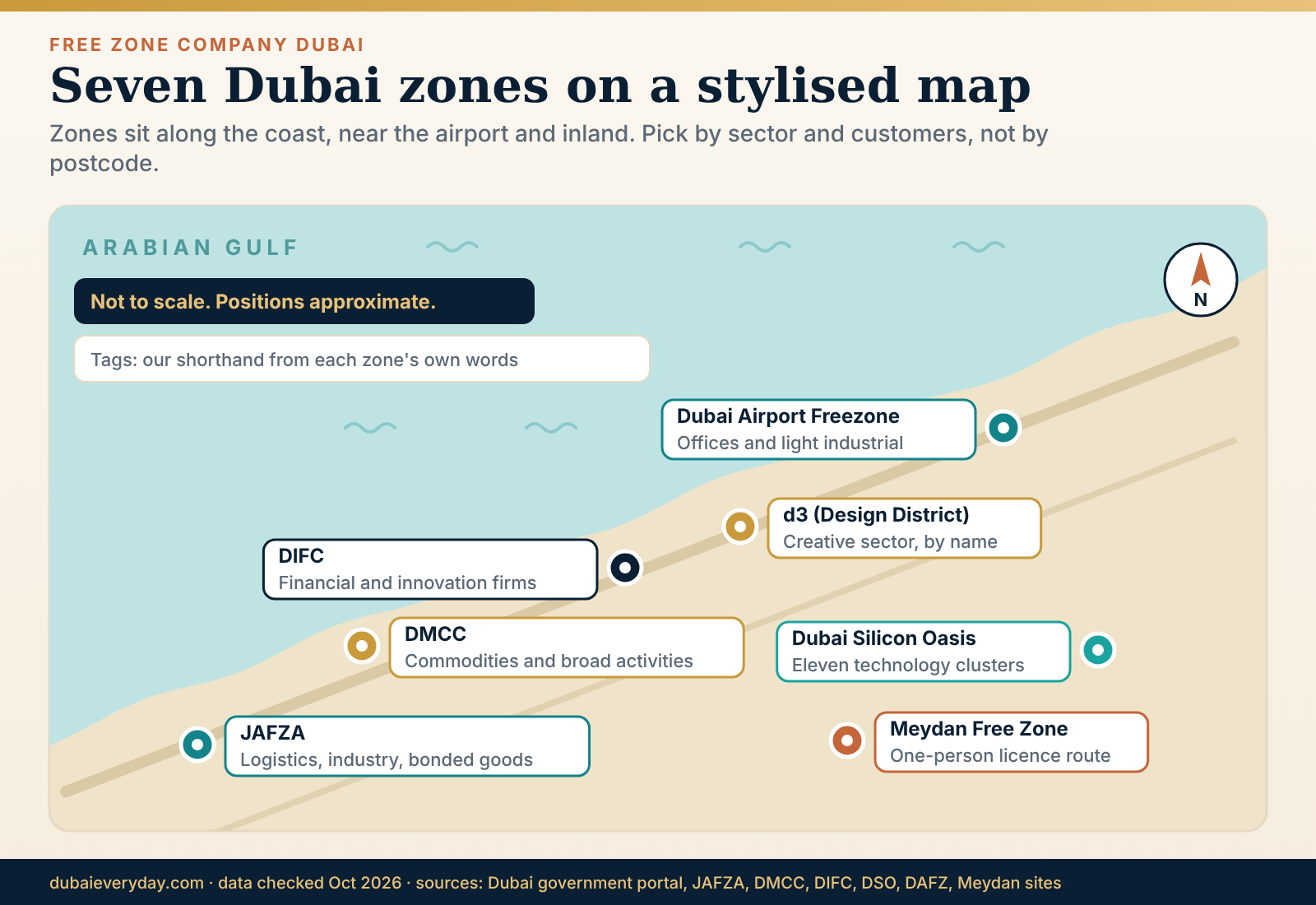
Our shorthand below is editorial. It groups the zones by what their own sites and the government portal emphasise. It is not an official classification, and a zone can sit in more than one family.
Commodities and broad business
DMCC is the example the government portal uses for breadth: u.ae says it covers many sectors, including agro, gold, diamonds, energy, technology, gaming, crypto, AI, e-commerce and financial services. It also includes the JLT and Uptown Dubai areas.
Logistics, industry and goods
JAFZA describes itself as the largest customs-bonded zone in the region, with warehouses, plots and offices, and licences for trading, service, industrial and logistics activities. Dubai Airport Freezone offers offices, light industrial units and retail space.
Technology, research and startups
Dubai Silicon Oasis organises its members into 11 clusters, such as AI, robotics, cybersecurity and Web 3.0, and sits under the Dubai Integrated Economic Zones Authority with Dubai Airport Freezone and Dubai CommerCity. Meydan Free Zone markets a one-person licence route.
Finance, healthcare, media and education
DIFC splits firms into financial and non-financial groups and runs a common-law judicial system. Healthcare, media, creative and academic zones exist as named areas on the Dubai list, and each activity there normally involves its own sector regulator.
A decision table for the first shortlist
The table below is a first-pass filter, not a recommendation. It tells you which questions to bring to a zone’s sales team. Where the zone sites we read gave numbers, we have used them; where they did not, we say so.
| If your business is | Zone families to check first | Verify before paying |
|---|---|---|
| Consulting or services for clients abroad | Broad-activity zones such as DMCC or Meydan Free Zone, or a tech-park zone | Exact activity wording, flexi desk visa quota, renewal price |
| Software, AI or other tech startup | Dubai Silicon Oasis clusters, DMCC technology centres, DIFC innovation track | Cluster eligibility, co-working terms, whether startup packages renew at the same rate |
| Importer, trader or e-commerce with stock | JAFZA, Dubai Airport Freezone, DMCC for commodities | Warehouse lease terms, customs treatment, how mainland sales are handled |
| Financial services or fund activity | DIFC, or DMCC for non-regulated finance-adjacent work | Regulator licence first, then zone licence; DIFC entities are excluded from Dubai’s mainland resolution |
| Media, design or content | Named media and creative zones on the Dubai list | Media regulator approval, equipment or studio needs |
| Education or training | Academic and knowledge zones on the Dubai list | KHDA or other education approvals, student visa rules |
Two cautions about the table. First, the zone you pick for the licence may not be where your staff live or where your clients visit; Dubai is large and traffic is real. Look at the commute for the people who must be in the zone. Second, a zone address can be more than a postal convenience for tax: the corporate tax rules for a 0% rate look at substance, and we come to that later.
Comparing zones without being sold to
Zone sales teams are paid to close, which is not a scandal, just a fact. Treat their quotes as offers to compare, ask for the schedule of charges rather than a bundle price, and request the same four lines from each: licence, registration, desk or office, and one residence visa. If a zone will not itemise, that is information.
The better test is a one-page worksheet. List each shortlisted zone in a column and fill the rows with the quoted figures, the date of the quote and the name of the person who gave it. Two weeks later the zone’s own website might say something different, and a dated worksheet is how you notice. Our Dubai business setup guide includes a wider checklist for this stage.
Entity type, licence and activity wording for a free zone company Dubai
After the zone comes the structure of your free zone company Dubai. u.ae lists five legal forms available in free zones: a Private Limited Liability Company (LLC), a Free Zone Company (FZ Co.), a Free Zone Establishment (FZE), a Public Limited Liability Company (PJSC) and a branch of a local or international company. The page adds that entity types differ mainly in the number of shareholders and whether each shareholder is a person or a legal entity, and that not every zone registers every type.
FZE, FZCO, LLC and branch: a plain-English chooser
The Dubai portal gives the cleanest rule of thumb. An FZE is formed by a single shareholder, who can be a person or a company. An FZCO needs at least two shareholders, who can be people or companies. An LLC under the Dubai list can have between two and fifty shareholders. A branch is not a separate legal entity: it is an extension of an existing company, local or foreign, and carries that parent’s liabilities.
For a sole founder forming a free zone company Dubai the choice is usually between an FZE (one owner, simple) and a branch of an existing foreign company (useful if you want the parent’s name and balance sheet behind the Dubai operation). For two or more founders it is an FZCO or LLC. The nuance is that zones label these differently. Meydan’s materials, for example, use “LLC-FZ”, and JAFZA’s page lists FZE, FZCo, a public listed company, a branch and an offshore company. When a quote says only “company”, ask which entity form it prices.
FZE
One shareholder, person or company. Simple governance. If that owner is a company, expect the zone to ask for the parent’s constitutional documents.
FZCO or LLC
Two or more shareholders. Dubai’s list gives LLCs a range of two to fifty. A shareholders’ agreement matters more than the zone’s template articles when co-founders disagree.
Branch
Not a separate legal person. Common for foreign groups that want a Dubai presence. Liabilities flow to the parent.
PJSC and special forms
Public structures and family-office style vehicles exist in some zones. DMCC, for example, describes a family office structure that follows its standard LLC format. They are specialist choices; take legal advice.
Share capital: a fee, a floor or a deposit?
Share capital is one of those words that means three things in three free zone company Dubai price lists. DMCC’s published schedule includes a one-time share capital deposit of AED 2,120 for companies with AED 50,000 in share capital, and DMCC’s partner-visa description ties eligibility to holding at least 50 shares with total share capital of AED 50,000.
A DMCC cost page also gives about AED 50,000 as an average share capital, described as refundable or usable for business expenses. The right reading of those three lines together is: the capital is not a fee you lose, but it may be locked into the visa rules. Other zones set different numbers, so ask.
Reading the licence: activity, not just name
A free zone company Dubai licence is a list of what you may do. JAFZA describes trading, service, industrial and logistics licences and says it follows the business activity list published by the Dubai Economic Department. DMCC’s schedule prices a standard trading and service licence, an industrial licence by floor-area band and a separate, higher-priced General Trading licence.
The difference between a narrow and a broad licence shows up in the fee: DMCC’s General Trading licence is listed at AED 50,265 a year against AED 20,285 for the standard licence setup, a gap of AED 29,980 that the zone does not wrap into the headline price.
Activity wording is where problems start months later. A bank, a customs broker or a landlord may read a free zone company Dubai licence line by line. If your invoices say “software development and consulting” and the licence says “management consultancy”, someone will ask why. Write out your real revenue lines before you meet the zone, and ask for those exact words, or the closest approved ones, on the licence.
Sector regulators sit on top of a free zone company Dubai licence
A free zone company Dubai licence does not replace sector approval. u.ae notes that media activities involve media authorities, and that food and beverage activities involve the municipality or food-safety authority of the relevant emirate. Healthcare, education and financial services follow the same pattern with their own regulators. The practical effect is sequencing: for regulated activities, the regulator’s no-objection may have to come before the zone issues the licence, and the timeline in the government portal (14 working days after review) assumes no regulator delay.
Trade name rules for a free zone company Dubai
The u.ae page lists the general naming rules a name must meet. It must not offend public morals or order, must include the company’s legal form, must not already be registered, must suit the activity and legal status, and must not contain religious names, names of governing authorities or names or logos of external bodies.
DMCC publishes a list of restricted names, and the page points to name-search tools for Dubai and other emirates. Check the name with the zone before you print business cards or register a domain. If your brand is already trademarked elsewhere, naming rules and trademark law are separate questions, and we did not research trademark registration.
Office, flexi desk and the visa quota for a free zone company Dubai
The word “office” covers four very different products in a free zone company Dubai price list, and the one you choose quietly sets your visa ceiling, your tax position and your renewal bill. They are, in rising order of space and cost: a flexi desk, a shared or serviced office, a dedicated office, and industrial space such as a warehouse or plot. Most first-year founders buy the first and are surprised later by what it does and does not include.
What a flexi desk really is for a free zone company Dubai
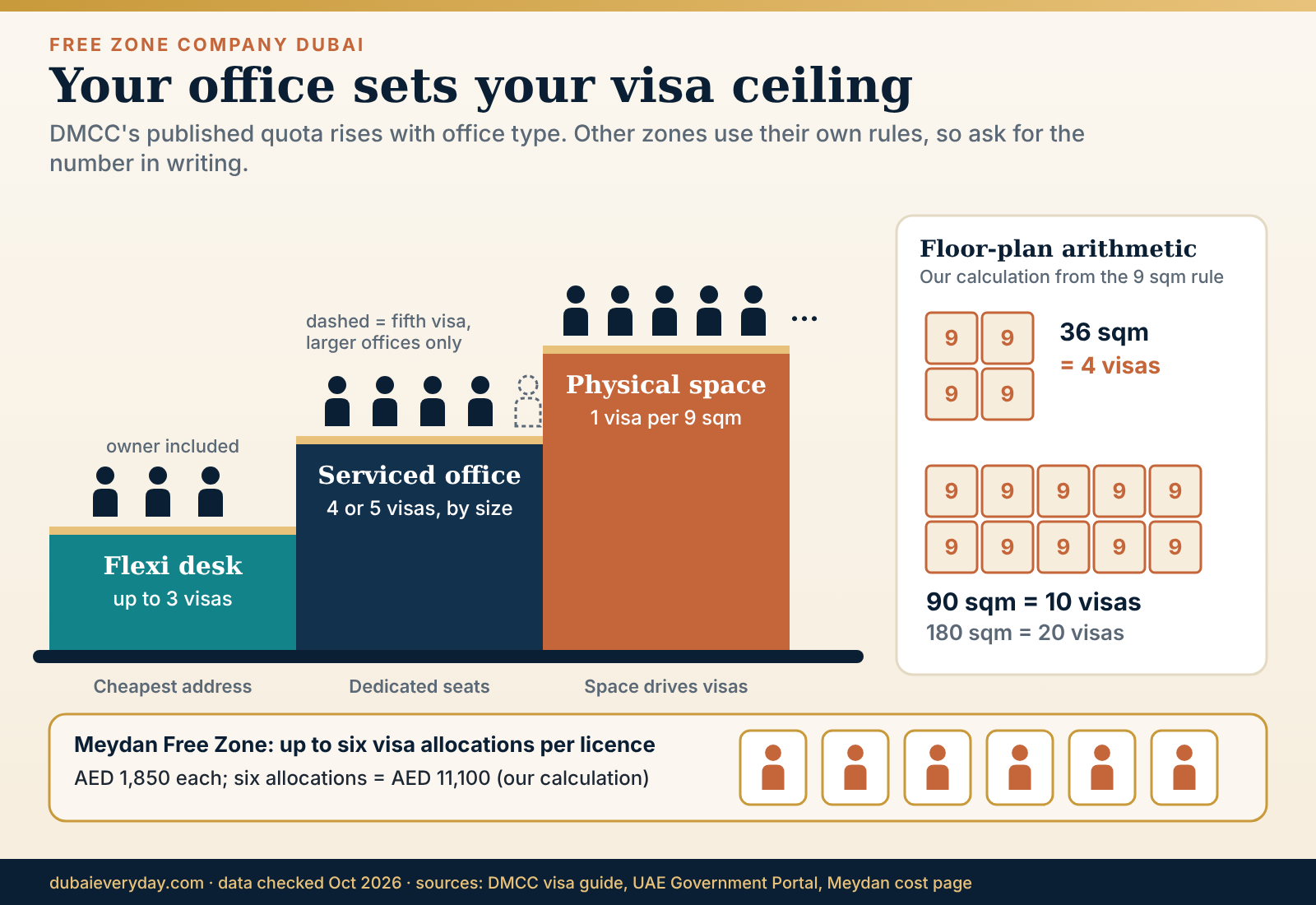
DMCC describes the flexi desk as the cheapest office option and as the product that satisfies the requirement for a registered address in the zone. Its schedule of charges lists a flexi desk (under the business centre heading) at AED 16,000 to 19,000, payable upfront at the start of the tenancy and covering admin charges, a deposit and rent.
Meydan Free Zone takes a different approach: its cost page says a flexi desk is included with every licence at no extra charge, with upgrades available at AED 3,500 per month for a dedicated desk, AED 15,000 a year for a shared office and AED 30,000 a year for a dedicated office.
Read those Meydan numbers twice. A dedicated desk at AED 3,500 a month is AED 42,000 over twelve months (our calculation), which is 40% more than the AED 30,000 listed for a dedicated office and 2.8 times the shared office. The page does not say how large the dedicated office is, so the comparison is not like for like, but it shows why monthly prices are a poor way to compare office products. Multiply by twelve before you compare anything.
The visa quota is the hidden price tag
The government’s recruiting-in-free-zones page says most free zones cap the number of visas per business, and that you can raise the cap by moving to a larger office or by applying for an increase that the authority must approve. DMCC’s own visa page spells out its version: up to three visas on a flexi desk, four or five on a serviced office depending on size, and one visa for every nine square metres of physical space. Meydan lists up to six visa allocations per licence at AED 1,850 each.
That produces simple arithmetic for any free zone company Dubai hiring plan. A three-person company, owner included, fits a DMCC flexi desk exactly. A fourth hire means a serviced office or physical space. At the 9 sqm rule, a team of ten visas needs 90 square metres (our calculation), and a team of twenty needs 180.
Whether that space is cheaper than a mainland office depends on the zone, the building and the market, and we did not find a zone figure for the cost per square metre of office space that we could cite. What we can say is that headcount is the lever that most often turns a cheap-looking flexi package into a different product.
Does a flexi desk match your plans?
- You expect no more than three residence visas, owner included, for at least two years.
- Clients meet you in cafes, their offices or online, not at your zone address.
- You do not store stock, equipment or documents that need a lock-up.
- Your bank, landlord and clients accept a flexi desk address on the licence.
- If you hope for a 0% corporate tax rate, your adviser has confirmed that your staffing and activity can meet the substance conditions with that desk.
If you cannot tick all five, price a serviced or dedicated office for your free zone company Dubai in the same zone, or look at a different zone. A flexi desk in a zone you will outgrow in twelve months is a cost, not a saving.
Physical space: warehouses, plots and light industrial
For goods businesses the office of a free zone company Dubai is secondary. JAFZA offers plots of land, warehouses, offices, showrooms, retail outlets and co-working spaces, and its page quotes a starting rate of AED 400 per square metre for pre-built warehouses without stating the period, so read that as a headline, not a budget.
Dubai Airport Freezone lists offices, light industrial units and retail space but gave no AED figures on the page we read. DMCC prices industrial licences by floor-area band, from AED 8,265 for 50 to 100 square metres to AED 25,265 for the 1,001 to 1,500 band. If you ship goods, ask the zone how customs treatment, warehouse leases and mainland delivery interact before you pay a deposit.
Substance: why the desk matters to the tax office
Here is the link between this section and the tax section. The UAE corporate tax rules for a Qualifying Free Zone Person require adequate substance. A KPMG summary of the rules notes that only full-time employees count towards adequate staffing, and that some activities may be outsourced to a person based in a free zone or designated zone, if adequately supervised.
We read that as a warning against treating the 0% rate as automatic for a one-person company on a flexi desk. It does not mean a flexi desk can never work. It means the question must be asked before you pay, not after the first tax return.
What a free zone company Dubai costs: year one and year three
An advertised price is the number on the poster. A total cost is what leaves your account over a year. For a free zone company Dubai founder the gap between the two is routinely tens of thousands of dirhams, because the poster usually shows the licence and sometimes the desk, while visas, medicals, Emirates ID, insurance, accounting and the bank sit elsewhere. This section builds the arithmetic from two published sources and shows where each assumption comes from.
The free zone company Dubai price points we could verify
We found two zones that publish line-item prices for a free zone company Dubai we could read on 29 October 2026: DMCC’s schedule of charges and a Meydan Free Zone cost page. The DMCC schedule carries no visible update date and states that all fees are subject to change without prior notice.
The Meydan page was published on 17 March 2026 and updated on 30 June 2026. We did not retrieve price lists for JAFZA, Dubai Silicon Oasis, Dubai Airport Freezone or DIFC; JAFZA and DSO point to calculators or investor guides, and Dubai Airport Freezone’s page gave no AED figures.
| Line (AED) | DMCC schedule | Meydan cost page |
|---|---|---|
| Application or registration | Application 1,035; registration 9,020; articles 2,020 | Not itemised separately |
| Annual licence | 20,285 at setup; 20,265 renewal | From 12,500, three activity groups and lease agreement included |
| Establishment card | 1,825 a year | Not stated |
| Flexi desk | 16,000 to 19,000 upfront | Included |
| Employment visa | 2,672 (1 year, inside the country, no amendment) | 3,500 |
| Investor or partner visa | Not itemised on the schedule we read | About 4,000 |
| Visa allocation | Set by office type | 1,850 each, up to six |
| Packaged year one | Basic Biz 35,484; Jump Start flexi 43,780 | Fawri one-person licence from 15,000 |
A few honest notes. DMCC lists most fees with an additional AED 20 Knowledge and Innovation Dirham. Meydan’s page contains a summary that says registration starts at AED 9,000 and licences run AED 10,000 to 50,000, while its body and FAQ do not support those figures, so we used the body figures. And Meydan’s page does not state renewal fees, deposits or share capital, which means we cannot compare year two between the two zones. That missing line matters, because a cheap first year with an expensive renewal is a common pattern in this industry.
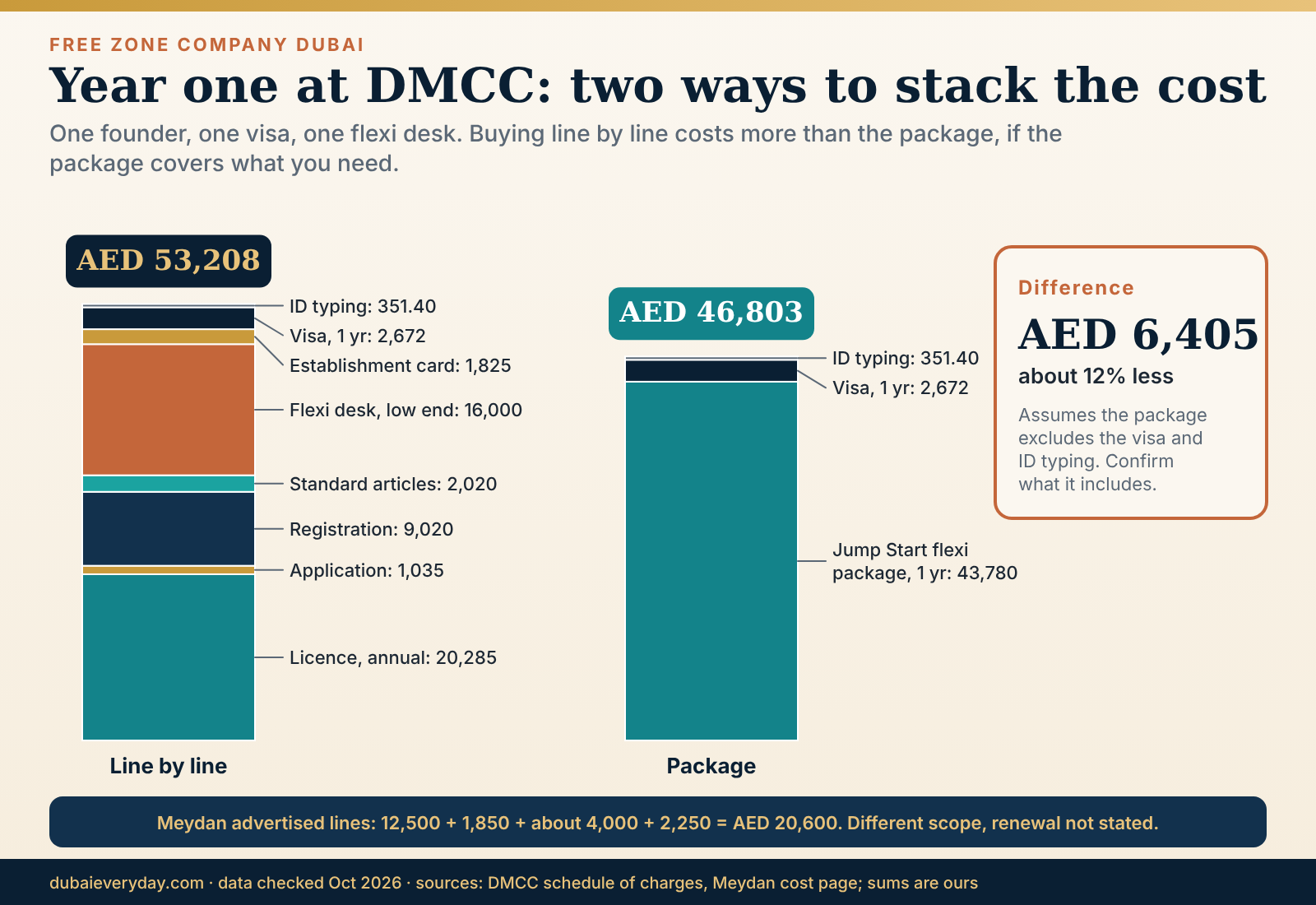
Our calculation: a solo free zone company Dubai founder at DMCC
Take a single founder who wants one residence visa and a flexi desk. Buying the lines separately from the schedule, the application (1,035), registration (9,020), standard articles (2,020), licence (20,285) and establishment card (1,825) add to AED 34,185. Add the lower end of the flexi desk band (16,000) and the total is AED 50,185. A one-year employment visa inside the country adds AED 2,672 and Emirates ID typing adds AED 351.40, which takes the sum to AED 53,208.40. At the top of the flexi band the same stack would be AED 3,000 higher.
Now take the Jump Start package at AED 43,780, add the same visa and ID typing, and the sum is AED 46,803.40. The package therefore costs AED 6,405 less than the line-by-line route (our calculation), a gap of about 12%. The caveat is that we do not know exactly what the package includes. If it already bundles a visa allocation or the card, the real gap is wider; if it excludes something the à la carte route covers, it is narrower. Ask the zone for the package’s line list in writing.
Our calculation: the same founder at Meydan
From the Meydan page, the licence is AED 12,500 and includes three activity groups and a flexi desk. A visa allocation is AED 1,850, an investor or partner visa about AED 4,000, and the page lists AED 2,250 for medical test and Emirates ID assistance. The sum is AED 20,600.
That is AED 26,203.40 below the DMCC package figure above, but the two are not equivalent. DMCC licenses commodities, crypto and large trading activities that a narrow-licence zone may not. Meydan’s renewal is unstated. And the quoted lines are advertised prices on the zone’s own page, so they exclude anything the page does not list.
A licence-only figure from one zone and a bundled figure from another are not comparable. Ask every zone for one scenario written the same way: one owner, one visa, one flexi desk, standard articles, first year and renewal year, with every government and zone line itemised. Then compare totals.
Year two and year three: where the real cost of a free zone company Dubai sits
Renewal of a free zone company Dubai licence is cheaper than setup on paper, because the application and registration fees fall away. At DMCC the standard renewal is AED 20,265, the establishment card is AED 1,825 and the flexi desk will presumably be charged again; if we assume the desk costs the same AED 16,000 to 19,000, year two before visas is AED 38,090 to 41,090 (our calculation, with the desk renewal an assumption we could not verify). Add AED 2,200 to renew one visa for one year and the range becomes AED 40,290 to 43,290.
Multi-year packages change the shape of free zone company Dubai costs. DMCC lists the Jump Start flexi package at AED 43,780 for one year, AED 81,881 for two and AED 120,000 for three. Spread out, that is AED 40,940.50 a year over two years (6.5% less than the one-year price) and AED 40,000 a year over three (8.6% less).
Over three years the saving against three one-year purchases is AED 11,340 (our calculation). The price you pay for the discount is commitment: if the business fails or moves in month 14, the unused months are not obviously refundable, and we found no refund rule on the schedule.
One year
DMCC Jump Start flexi: AED 43,780. Best for a first test of the market when a pivot is plausible.
Two years
AED 81,881, or AED 40,940.50 a year. A 6.5% saving for locking in 24 months.
Three years
AED 120,000, or AED 40,000 a year. An 8.6% saving, AED 11,340 over three years, for the longest commitment.
A note on multi-year renewal “discounts”
DMCC’s schedule shows licence renewal for two years at AED 40,530 and describes it as a 5% discount, three years at AED 60,795 with 10%, and five years at AED 101,325 with 20%. Those totals are exactly 2, 3 and 5 times the one-year renewal of AED 20,265 (our calculation), so the stated discounts are not visible against the one-year figure. They may be measured against another base, or the schedule may apply them elsewhere. If a multi-year renewal is on your shortlist, ask what the discount is measured against.
Costs that sit outside the zone’s list
None of the following appears in the zone price lists we read, and we are not inventing numbers for them. They are lines to ask about:
- Medical fitness testing and Emirates ID fees for each resident, beyond the typing services DMCC lists.
- Health insurance for employees. See our guides to health insurance in Dubai and business and other insurance in Dubai.
- Bookkeeping and accounting, which we cover in accounting services in Dubai and bookkeeping in Dubai.
- Audited financial statements, where your tax position requires them.
- Bank charges, minimum balance fees and the cost of the first twelve months of account maintenance.
- Your own home: a residence visa usually goes with a tenancy, which you can read about in our guide to tenant rights in Dubai.
For a founder building a personal budget on top of free zone company Dubai costs, our single-person monthly budget and couple’s monthly budget give the household side of the arithmetic.
Setup timeline and documents for a free zone company Dubai
Three free zone company Dubai timelines compete in the sources, and they measure different things. The government portal says the licence is issued within 14 working days after the zone reviews and approves the application. DMCC’s cost page says full setup takes about two to three weeks, can be completed remotely, and that the e-licence follows within two to three working days once setup is complete. Meydan Free Zone says its Fawri one-person licence is issued in under 60 minutes, with a menu line describing company formation online within 24 hours.
None of these includes the bank account, the tax registration, the residence visa or the medical. Those steps start after the licence and are where calendars slip. When a salesperson says “you can be up and running in a day”, the accurate version is “you can hold a licence in a day, subject to the zone’s checks”.
The free zone company Dubai sequence, step by step
- Fix the activity and the customer splitWrite the revenue lines you expect and where each customer sits. This is the input to every other choice.
- Shortlist two or three zones and collect itemised quotesUse the same scenario in each request. Note the date of every quote.
- Choose the entity form and the trade nameCheck the name against the zone’s restricted list and the general naming rules before you commit to branding.
- Apply through the zone’s online portalUpload passports, shareholder details and any corporate documents. The u.ae page describes online application with documents uploaded, followed by review.
- Obtain any sector approvalFor media, food, healthcare, education or financial activities, the relevant regulator may need to approve before or alongside the licence.
- Pay, sign and receive the licenceRead the articles of association before signing. They are a legal document, not a form.
- Start the bank account and tax registrations in parallelThe bank needs the licence. The Federal Tax Authority registration can start once you have the documents it asks for.
- Start visas for the owner and staffEntry permit, medical, Emirates ID biometrics and stamping follow the zone’s process.
Our reading of the critical path
The FTA says a completed corporate tax registration takes about 20 business days to process, and the online application about 25 minutes to submit. Registration is free. If the authority’s banking claims are right and an account can open in about five days, tax registration, not banking, is the longest administrative wait after the licence (our calculation: 20 business days is four working weeks, against five days). In real life the bank is more variable, which is why we suggest running both in parallel and not waiting for one before starting the other.
Founders often forget a second parallel track: their own home. A residence visa typically goes with an address, and a founder arriving from abroad may spend weeks in a hotel while the paperwork clears. Our guides to choosing a hotel in Dubai by area and budget and the Dubai travel guide for first-time visitors cover the arrival side, and the Downtown Dubai area guide is a good starting point if your zone is near DIFC or Business Bay.
Documents to prepare before a free zone company Dubai application
Zone checklists differ, so treat this as the common core and confirm it with your zone. Expect passport copies for each shareholder, director and manager, a recent photograph, proof of address, a short description of your business and source of funds, and, for corporate shareholders, certified constitutional documents. Documents issued abroad may need attestation or translation. We could not verify the exact checklist of any zone on 29 October 2026 beyond the bank and tax documents described in later sections, so ask for the zone’s current list in writing.
A consistency rule is worth following. Use the same spelling of names, the same activity wording and the same address everywhere: the licence, the memorandum, the bank forms, the tax registration and your website. A Meydan Free Zone banking article lists inconsistent company names or activity descriptions across documents as something that can make a bank hesitate. It is promotional content from a zone, but the advice is cheap to follow.
Visas for owners, staff and family under a free zone company Dubai licence
This is where a free zone company Dubai earns its reputation, and where the rules are most zone-specific. The government’s recruiting page states that the free zone authority handles work permits and residence visas, and that each zone has its own rules. DMCC, for example, issues and sponsors employment visas itself, not the employer. For the personal side of residency for non-founders, our guide to the basic Dubai legal rules for residents is a useful companion, and we link to it again in the legal section of the mistakes list.
The four visa types DMCC describes
Employment residence
For people who will live and work for a DMCC company. Steps: apply on the Member Portal, get an entry permit, enter or change status, sign employment documents, complete the medical and Emirates ID, receive the visa and employment card.
Partner or investor
For foreign nationals who launch or invest in a company. DMCC ties eligibility to at least 50 shares and AED 50,000 in share capital. Valid for three years, with no immigration deposit needed.
Business visit
Lets a company bring a team member for business for one month; up to three can be requested at a time. Not renewable and not refundable.
Student
For students at a DMCC-licensed university or institute, with KHDA letters required. Only relevant to education businesses.
Other zones will not mirror these four, but the pattern holds: an owner or investor category, an employee category, a short visit category and a dependant category. If you are travelling in only for meetings, a business visit visa is not a residence route. Read our guide to travel insurance for Dubai visitors if you will be commuting in and out during the setup phase.
What visas cost: the published DMCC lines
DMCC’s schedule lists an employment residence permit for one year at AED 2,237 outside the country, AED 2,672 inside the country without amendment and AED 3,439 inside with amendment. Two-year versions are AED 2,972.50, AED 3,407.50 and AED 4,220. Renewal is AED 2,200 for one year or AED 2,790 for two. Visa amendment is AED 812.50, and cancelling an employment visa costs AED 438 inside the country or AED 580 outside. Volume discounts are noted for 50, 100 and 200 visas.
A pattern jumps out. Two one-year inside-country visas cost AED 5,344; one two-year visa costs AED 3,407.50, a saving of AED 1,936.50 or about 36% (our calculation). Renewals follow the same logic: two one-year renewals are AED 4,400 against AED 2,790 for one two-year renewal, a saving of AED 1,610. We have not seen a rule that ties visa length to licence length, so check whether a two-year visa is allowed on a one-year licence before you plan on it.
The Meydan page lists different lines: an employment visa at AED 3,500, an investor or partner visa at about AED 4,000, a dependent visa at about AED 6,000 per person, and the visa allocation fee of AED 1,850 for each slot up to six. A family of three dependants would therefore carry about AED 18,000 in dependent-visa fees at the page’s approximate figure (our calculation), plus medical tests and Emirates ID for each. These are advertised figures, so ask for the final price in writing.
Medical, Emirates ID and insurance: the chain after approval
DMCC’s own description of the process places the medical fitness test and Emirates ID registration after the entry permit and before the residence visa is stamped. DMCC’s cost page adds that the medical and biometric registration must be done in the UAE. The schedule lists typing services for the medical certificate and Emirates ID, and not a separate medical examination fee, so assume the clinic charges its own fee and ask.
Insurance sits alongside. The Dubai government portal explains health insurance obligations for employers in Dubai. We do not know how each zone enforces them, so ask the zone what cover it requires at visa stage. Our health insurance in Dubai guide explains mandatory cover, employer policies and dependants, and the Dubai insurance guide covers the business side.
Can a free zone employee work for other companies?
Generally not without permission. The government page, using one named zone as its example, says employees may work only for the sponsoring company inside the free zone, and that working elsewhere requires special permission. Treat that as a pointer, not a universal rule, and ask your zone how it handles secondments, client-site work and mainland assignments. This question matters more than it looks if your staff will spend most of their time at client offices.
Golden visa and other investor routes
Founders often ask whether owning a company earns long-term residency. u.ae lists a Golden Visa for investors, valid for 10 years for public investment and 5 years for real estate investment, with a minimum capital of AED 2 million, and a five-year route for entrepreneurs that needs proof of an innovative or technical project, supporting documents and a letter from an incubator or relevant authority. The page lists no minimum investment for entrepreneurs. A company in a free zone does not by itself earn either; they are separate applications with their own tests.
The General Directorate of Residency and Foreigners Affairs in Dubai also describes a green residence for partners and investors, valid up to five years, with listed fees of AED 200, AED 10, AED 10, AED 500 in-country and AED 20 delivery, which sum to AED 740 before VAT, medical and Emirates ID (our calculation).
It requires a partnership agreement, memorandum or investment contract and a trade licence, and approval from the competent authorities. We could not tell from the page whether free zone shareholders use it or go through their zone, so we do not recommend a route; ask the zone which one applies to you.
Employment law and Emiratisation: two questions to ask early
We could not confirm from a government page which employment rules apply to each zone’s employees, and DIFC runs its own legal system, so ask which law governs your employment contracts and end-of-service payments. Our Dubai legal basics guide explains the general rules for residents and points to where to verify them.
On Emiratisation, a Gulf Today report from 29 June 2026 describes a mainland rule for private companies with 50 or more employees, a 2% yearly increase in skilled Emirati headcount, and a contribution of AED 10,000 a month for each unfilled post after the 30 June 2026 deadline. We did not verify whether or how that applies to free zone companies, so we leave it as a question for your adviser.
Banking for a free zone company Dubai
If there is a single step in this guide where free zone company Dubai founders lose weeks, it is this one. A licence is a permission; a bank account is a decision by a third party who owes you nothing. The zone can introduce you, help with paperwork and sometimes pre-screen, but it cannot open an account for you, and any sales promise to the contrary is a red flag we return to in the mistakes section.
Banks run their own checks on the company, its owners, its activity and the origin of funds, and can decline or ask for more. Do not sign a long office lease, hire staff or promise clients a payment date until the company account is working.
What banks usually ask of a free zone company Dubai
A Meydan Free Zone banking article, last updated on 2 August 2026, lists the common core. A valid trade licence comes first. Then passport copies and visa pages for shareholders, plus an Emirates ID copy, the memorandum of association, the company stamp, proof of address such as a utility bill or tenancy contract, and a business plan.
Some banks hold a due diligence interview. The article says a personal account cannot be used for business transactions, whether the company is on the mainland or in a free zone. It is promotional zone content, so use it as a checklist, not as a promise.
The same article names the typical stall points. Incomplete paperwork is the most common reason applications stall. A mismatch between the licence activity and the bank’s risk appetite can slow or block an application. Founders must explain where their capital comes from. The Meydan piece also suggests choosing a bank by how you will actually operate, such as digital onboarding, fees, trade finance or credit needs, not by brand.
What the authorities say about speed
The Dubai Business Registration and Licensing Corporation, part of the Department of Economy and Tourism, has linked faster account opening to the Dubai Unified Licence. Gulf News reported on 12 November 2025 that the average time to open a business bank account in Dubai had fallen from about 65 days to about five, that more than 3,000 accounts had been opened through the system since October 2024, and that banks including Emirates NBD and Mashreq were connected.
A later Gulf News interview, updated on 3 September 2026, quotes a fall from about 90 days to about three. The two reports use different baselines and endpoints.
Our reading: these are the corporation’s own figures, reported by a newspaper, about the part of the process the DUL speeds up, which is identity and document verification. They are plausible best cases, not a promise for your file. At the 65-day to five-day claim, the reduction is about 92% (our calculation), but a bank’s risk review of an unusual activity or a complex ownership chain can still take much longer. Plan for a range, and have a second bank in mind.
How to make the file easier to approve
- Choose activity wording a bank can understand in one sentence, and describe your real customers and suppliers consistently.
- Prepare a short written business plan with expected monthly turnover, main counterparties and countries of trade.
- Document the source of the initial capital before you are asked.
- Keep names, spellings and addresses identical across documents.
- Be ready for a video call or an in-person verification, depending on the bank.
- Do not open the account using a borrowed address or someone else’s documents.
If the first bank says no
Ask for the reason in writing if the bank will give one, fix the file, then try a bank with a different risk appetite or product focus. Do not apply to five banks on the same day with five slightly different descriptions of your business. Compliance teams across banks look for exactly that pattern. If you consider a non-bank provider as an interim option, check that it is licensed by the Central Bank of the UAE, and confirm what protection your funds have, because we did not review such products here.
Founders of a free zone company Dubai ask whether a foreign shareholder with no UAE residence visa can open an account. A dated DMCC article from 2020 listed lack of residency as a friction point, and the more recent Meydan checklist asks for visa pages and Emirates ID copies, which suggests a resident founder has an easier file. We found no current bank-published rule, so ask each bank directly. Once the account works, a good bookkeeping routine matters; our bookkeeping in Dubai guide shows how monthly records and bank reconciliation fit together.
Corporate tax, VAT and compliance for a free zone company Dubai
The old pitch for free zones was “no tax”. It was never quite that, and since the federal corporate tax regime began, it is not even close. A free zone company Dubai owner now has a corporate tax number, a tax return and a decision to make about which of two regimes applies. This section explains the structure in plain terms. It is not tax advice, and the numbers below are for illustration. Take the actual decision to a licensed tax adviser, and see our guide to accounting services in Dubai for how outsourcing models work.
The two regimes in one paragraph for a free zone company Dubai
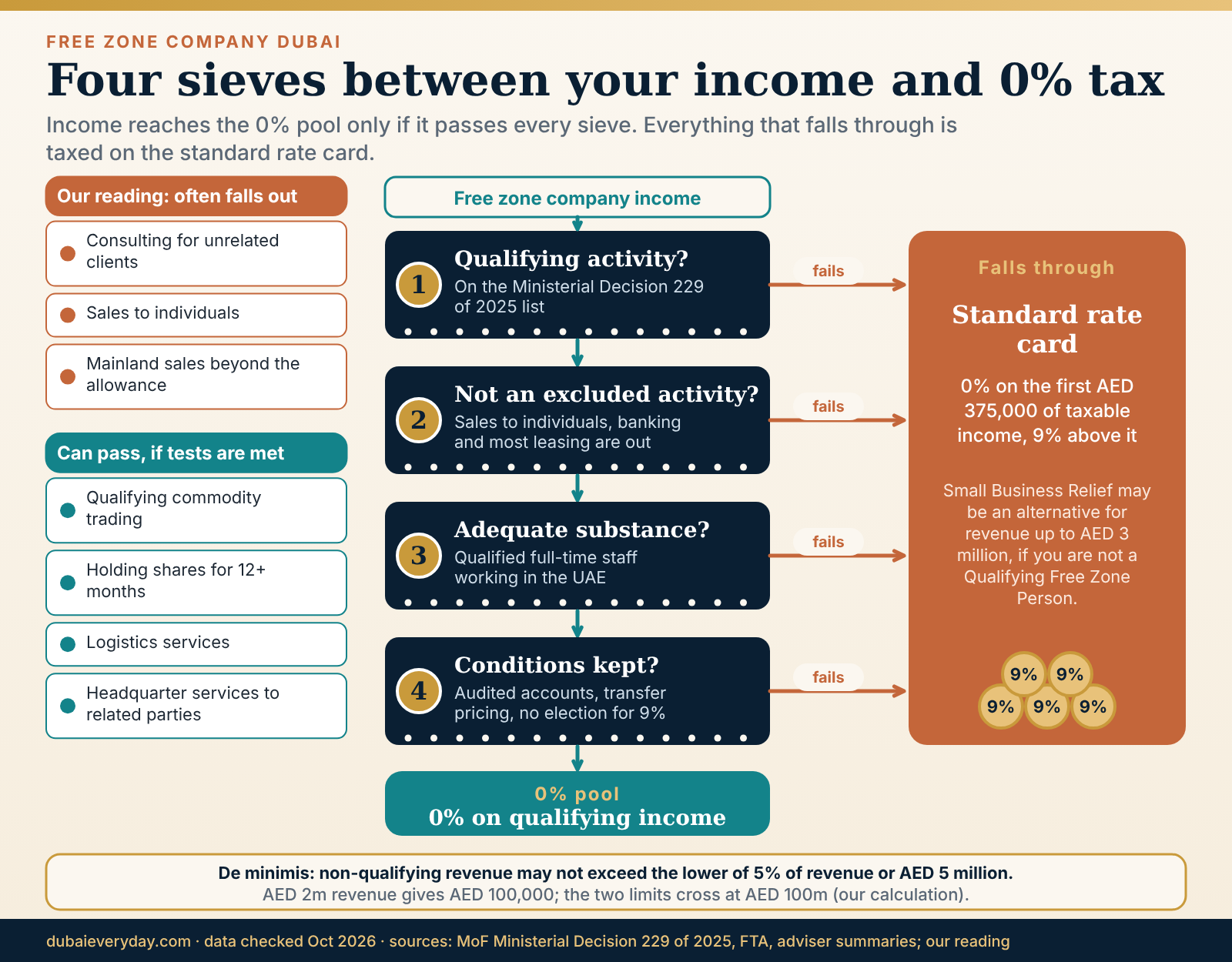
The Ministry of Finance states that corporate tax is 0% on taxable income up to AED 375,000 and 9% above, and 0% for Qualifying Free Zone Persons on qualifying income. The Federal Tax Authority adds that profits attributable to a Qualifying Free Zone Person’s permanent establishment in the UAE outside the free zones, or abroad, are taxed at 9%. A free zone company is generally treated as a Qualifying Free Zone Person unless it fails one of the prescribed conditions, according to a Deloitte summary of the FTA guide. Everything else on this page hangs on that sentence.
What counts as a qualifying activity
Ministerial Decision No. 229 of 2025 sets the lists. Qualifying activities include manufacturing and processing, trading of qualifying commodities, holding shares and securities for investment for at least 12 months, owning and operating ships in international transport, reinsurance, fund and wealth management, headquarter services to related parties, treasury and financing services for related parties, aircraft financing and leasing, distribution of goods in or from a Designated Zone, logistics services, and ancillary activities.
Excluded activities include transactions with individuals (with exceptions for ship, fund and wealth management, and aircraft leasing), banking, insurance (except reinsurance and headquarter services), most finance and leasing, and owning or operating immovable property (with exceptions for certain commercial property in a free zone leased to a free zone person). Read the exclusions first. They hit many ordinary small businesses.
Our reading for a typical small free zone company Dubai
A one-person free zone company Dubai consultancy billing unrelated clients abroad does not obviously appear on the qualifying list we read, and a business selling to consumers runs into the exclusion for transactions with individuals. Those readings are ours, not an official ruling, and your adviser may see exceptions. The consequence, if we are right, is that the company is taxed under the standard rate card: nothing on the first AED 375,000 of taxable income and 9% above it.
Illustrative example (not a quote or market fact): taxable income of AED 500,000 leads to 9% of the AED 125,000 above the threshold, which is AED 11,250 (our calculation). If the company qualified as a Qualifying Free Zone Person on all its income, the same profit would face a 0% rate. The point is that qualification can be worth five figures a year to a profitable small company, and the conditions are strict enough that it is not worth assuming.
The conditions behind the 0% rate
Adviser summaries of the rules list several conditions. The company must have adequate substance in the UAE, which KPMG says means an adequate number of qualified full-time employees. It must earn qualifying income. It must not have elected to be taxed under the standard regime. Summaries also list transfer pricing compliance and audited financial statements.
Deloitte reports that a Free Zone Person may elect to be taxed at 9% either during the period or after it ends, before the return is filed, and that the status is then lost for five tax periods. Failing a condition has comparable consequences in the adviser summaries we read, so treat qualification as something you maintain, not something you obtain once.
The de minimis rule, with numbers
A qualifying company may earn some non-qualifying revenue without losing status. Ministerial Decision 229 sets the limit at the lower of 5% of total revenue or AED 5 million in a tax period. The two limbs cross at AED 100 million of revenue, because 5% of AED 100 million is exactly AED 5 million (our calculation).
Below that, the percentage limb binds: with AED 2 million of revenue, the allowance is AED 100,000. Above it, the AED 5 million cap binds: with AED 150 million of revenue, 5% would be AED 7.5 million, but the allowance is still AED 5 million.
For a small free zone company Dubai, the practical message is that the allowance is tiny. A qualifying trading company with AED 2 million of revenue that makes AED 250,000 of sales to mainland customers has 12.5% non-qualifying revenue (our calculation), well past the 5% limb. This is why the mainland access options in the next section need a tax adviser at the table, not an afterthought.
Small Business Relief as the other road
For a small company that is not a Qualifying Free Zone Person, the Federal Tax Authority describes Small Business Relief for resident persons with revenue of AED 3 million or less in the current and all previous periods, elected for each period. Reports of Ministerial Decision No. 131 of 2026 say it was extended to tax periods ending on or before 31 December 2029.
The relief is not available to Qualifying Free Zone Persons, so the two regimes are alternatives, not additions. For a consultancy under the revenue cap, relief can be the cleaner choice; for a larger trading company, the 0% regime may be worth the compliance cost. Compare the two with your adviser before the first period closes.
Registration, returns and records
Registration of a free zone company Dubai with the Federal Tax Authority is free and done through EmaraTax, with a login via UAE Pass. The FTA says the online application takes about 25 minutes and processing about 20 business days. Documents include the licence, incorporation papers, and passport and Emirates ID details for owners of more than 25% and for authorised signatories.
Late registration carries a penalty of AED 10,000, and the FTA’s waiver initiative cancels it if the first tax return is filed within seven months of the end of the first tax period. The FTA also states that returns and payment are due within nine months of the end of the tax period and that records must be kept for seven years.
VAT in one section
VAT is separate from corporate tax. The FTA states that you must register if taxable supplies and imports exceed AED 375,000 over the previous 12 months or are expected to in the next 30 days, and you may register voluntarily above AED 187,500 on supplies, imports or expenses. The standard UAE VAT rate is 5%.
The FTA registration page we read does not address free zones or Designated Zones, so we cannot say how VAT treats goods moving between them. That is a specialist question for your accountant, and the questions to put to them are in our accounting services guide. Do not assume a free zone address exempts you from VAT registration.
Economic substance reporting is gone, but substance is not
Older guides tell founders to file annual economic substance notifications and reports. The Ministry of Finance announced on 14 October 2024, through Cabinet Decision No. 98 of 2024, that companies no longer file them for financial years ending after 31 December 2022, although obligations for earlier years and requests from regulators remain. The old reporting regime ended. The “substance” idea survives inside the corporate tax test for Qualifying Free Zone Persons, as the office section noted.
Where e-invoicing and other new duties fit
The Ministry of Finance has published an e-invoicing timeline for UAE businesses and amended it as recently as 19 October 2026, according to the ministry’s announcement. We did not verify how it applies to free zone companies, and the dates depend on revenue bands, so ask your accountant whether you are in scope and when. The safe habit is to ask at each year end: what has changed in tax, invoicing and reporting since last year, and does it apply to us?
Selling on the mainland from a free zone company Dubai
Section two explained why the mainland matters. This section explains the doors. Dubai’s Executive Council Resolution No. 11 of 2025, published in the Official Gazette on 3 March 2025, created a framework for free zone companies (outside DIFC) to operate in the mainland. Law-firm summaries describe two instruments: a branch licence at AED 10,000 per year and a temporary permit at AED 5,000 for up to six months, each approved by the Department of Economy and Tourism and the free zone authority, with separate financial records for the mainland activity.
The Free Zone Mainland Operating Permit
On 8 October 2025 the Dubai Business Registration and Licensing Corporation, with the Dubai Free Zones Council, announced the Free Zone Mainland Operating Permit under that resolution, according to the Dubai Media Office. The announcement says it lets free zone companies operate on the Dubai mainland, including domestic trading and government contracts previously open only to mainland-licensed firms. Eligible companies hold a Dubai Unified Licence. Applications are fully online through the Invest in Dubai platform. The fee is AED 5,000 for six months, renewable at the same fee.
The initial scope is non-regulated activities, such as technology, consultancy, design, professional services and trading, with regulated sectors planned for later. Mainland revenue from the permitted activities is subject to 9% corporate tax, and companies must keep separate financial records. Permit holders can use their existing staff for mainland work without hiring new employees. The announcement projected cross-jurisdictional activity to rise by 15% to 20% in the first year, which is a government forecast, not a guarantee.
Operating permit
AED 5,000 per six months. Fast, online, non-regulated activities first. Needs a Dubai Unified Licence. Best for testing the mainland market.
Branch licence
AED 10,000 per year, per the law-firm summaries. A longer-term licence for sustained mainland trading, with approvals from DET and the zone.
Dual licence
Lets a free zone company operate on the mainland without extra office space or a local partner, offered with five free zones per the Dubai portal.
Distributor or separate mainland company
The older routes remain: sell through a licensed mainland distributor, or set up a mainland branch or company as described in our mainland company guide.
Our comparison: permit versus branch
At face value the two cost the same per year: two six-month permits are AED 10,000, the same as one annual branch licence (our calculation). The difference is not price but status and conditions. A permit is a temporary, renewable instrument with a defined activity scope; a branch licence is a continuing licence.
If you plan to trade on the mainland for years, the question to ask DET is which instrument it expects you to hold and whether the permit can be renewed indefinitely. We could not find an official answer, and the eligible-activity list that law-firm summaries said DET would publish was not confirmed on the sources we read.
The transition rule matters if you are already trading on the mainland from a free zone. Law-firm summaries say companies in that position had one year from the resolution’s effective date of 3 March 2025 to regularise, with a possible one-year extension. Whether that window was extended is not something we could confirm, so if this describes you, speak to a licensed adviser now.
What mainland revenue does to a free zone company Dubai tax position
The official announcement is clear that mainland revenue under the permit is subject to 9% corporate tax. For a company aiming at the Qualifying Free Zone Person regime, that revenue is most likely non-qualifying and so counts against the de minimis allowance from the previous section (our reading).
A company with AED 10 million of revenue has an allowance of AED 500,000, and mainland sales above that could put 0% status at risk. A company happy to pay the standard rate card does not have that problem. Which of those describes you is a tax question to settle before the first mainland invoice.
Mainland work also raises ordinary questions: VAT treatment, contracts with Dubai customers, and local law. Our Dubai legal basics guide explains where to verify rules. One more limit from earlier: none of these routes authorises activity in other emirates, so a business serving Abu Dhabi or Sharjah customers needs the appropriate licence there.
Renewal, changes, dormancy and closing a free zone company Dubai
A free zone company Dubai licence is annual in the zone we have data for, and the renewal date is the one number a founder should put in three calendars. DMCC’s schedule lists the standard trading and service licence renewal at AED 20,265 for one year. The establishment card is AED 1,825 a year. Visas have their own dates, and so do the desk, the tax period and the audit. They rarely align.
What happens if you are late
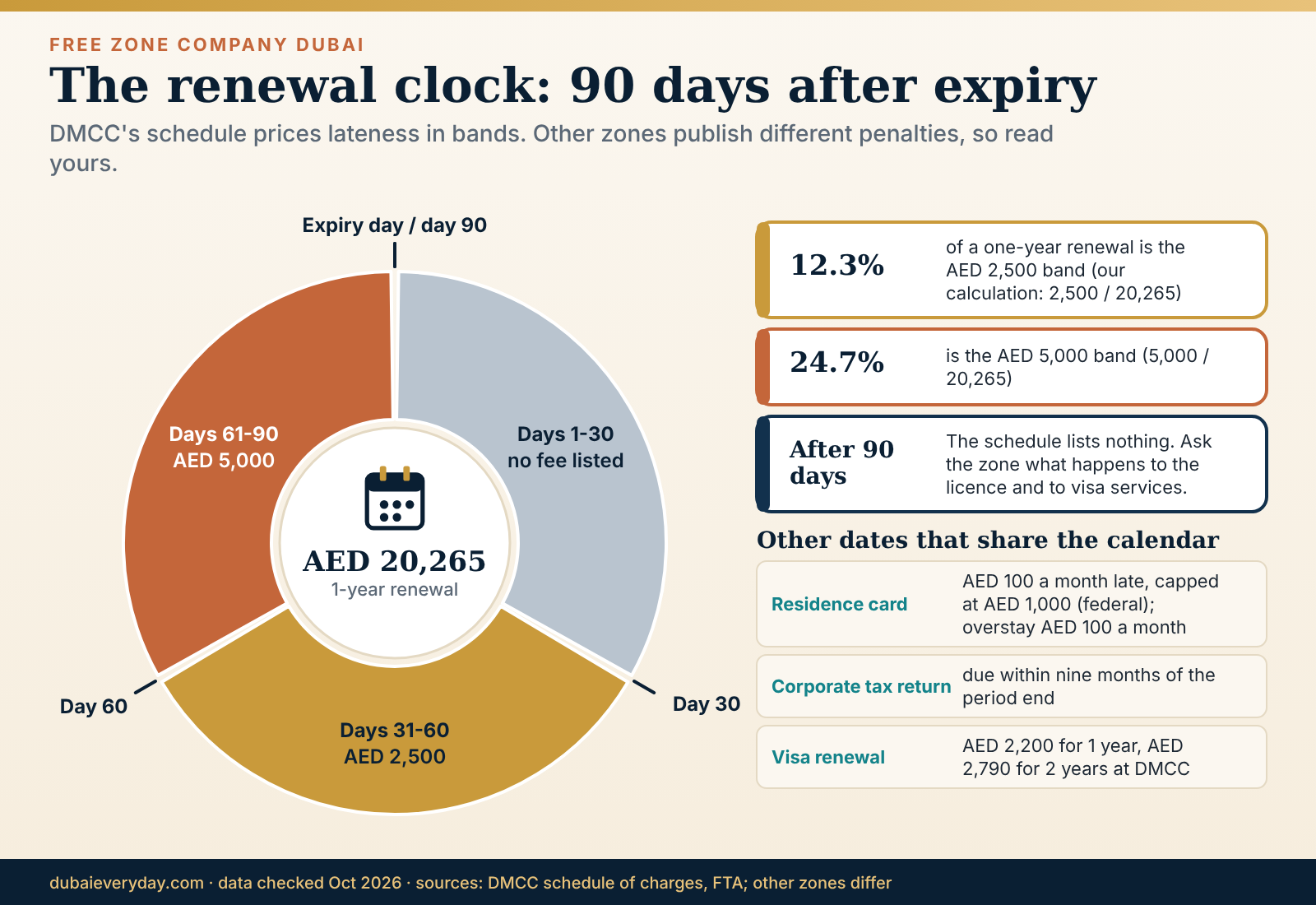
DMCC’s schedule lists a licence late-renewal penalty of AED 2,500 for 31 to 60 days and AED 5,000 for 61 to 90 days, and no fee for 0 to 30 days. Against the one-year renewal of AED 20,265, those penalties are 12.3% and 24.7% (our calculation). The schedule lists nothing beyond 90 days, so ask the zone what happens after that. Separately, residence card late renewal is AED 100 per month capped at AED 1,000, a figure the schedule attributes to the federal authority, and overstay is AED 100 per month.
The no-fee window can mislead. A blank in a fee table is not the same as permission to be late, and the zone may restrict services such as visa processing on an expired licence. We found no zone statement on that, so treat it as a question for your zone, not an assumption.
Renewal checklist for a free zone company Dubai
- Licence and establishment card renewed before expiry, with the invoice stored.
- Desk, office or warehouse lease renewed or deliberately ended.
- Every residence visa dated, with renewal windows in the calendar.
- Employee insurance renewed and cards updated.
- Dubai Unified Licence data current, if the zone asks for updates.
- Corporate tax return and any audited accounts on the tax calendar; returns are due within nine months of the period end.
- VAT returns, if registered, on their own calendar.
- Bank mandates, signatories and company documents matching the licence.
Amendments and what they cost
Changing something mid-year on a free zone company Dubai licence has a price. DMCC lists AED 1,515 each for a licence address or activity amendment, for a change of director, secretary or legal representative, and for a change of manager. A company name change is AED 4,515, an operating name change is AED 1,515, and a company suffix change is free.
A share capital increase or decrease is AED 4,515, and an increase with a new shareholder is AED 7,224. Visa amendments are AED 812.50. These numbers are one zone’s, but they show the pattern: small changes cost a four-figure sum, so get the name, activity and shareholders right at the start.
Dormancy, winding up and cancellation
When a business behind a free zone company Dubai licence pauses, DMCC offers voluntary dormancy at AED 5,000 for 12 months, AED 10,000 for 24 months and AED 15,000 for 36 months, with extensions at AED 5,000 a year. Against a renewal of AED 20,265, dormancy costs about 24.7% of an active year (our calculation).
To close for good, the schedule lists licence termination at AED 2,000, company winding up at AED 4,015, and de-registration of a company that was registered but never licensed at AED 2,015. Employment visa cancellation is AED 438 inside the country and AED 580 outside, and cancelling a new company application is AED 1,035.
Our reading of the order of operations for closing, which is logical sequencing and not an official procedure: settle staff and cancel their visas, deal with the bank and any tax obligations, then terminate the licence and wind up the company. Ask your zone and adviser for the zone’s exact sequence, and note that tax authority deregistration is a separate step. Dormancy is attractive when you expect to resume within a few years, and closure when you do not; the break-even is about the price of one dormant year against the cost of re-registering later.
Which setup fits which business: seven profiles for a free zone company Dubai
Profiles beat generalisations when you are choosing a free zone company Dubai. The seven below are archetypes we built from the sources, not people we met. Each uses only the verified numbers from earlier sections, and each ends with the one question that tends to decide the case.
1. The solo consultant billing clients abroad
Profile: one owner, no staff, invoices in foreign currency to companies outside the UAE. A flexi desk and one visa cover the need of this free zone company Dubai. On the numbers we verified, the first year sits between about AED 20,600 (Meydan’s advertised lines) and about AED 46,800 (DMCC package plus visa and ID typing), and the gap says more about what each licence covers than about value.
The deciding question: does your activity fall under the qualifying list, or will you be taxed at the standard rate card? Small Business Relief, where it applies, may beat the 0% route.
2. The two-founder tech startup with a small team
Profile: two shareholders, an FZCO or LLC, five hires within the year. On a DMCC flexi desk, three visas are the ceiling, so you need a serviced office (four or five visas) or physical space within months. Dubai Silicon Oasis’s cluster model and DMCC’s technology centres exist for this free zone company Dubai profile. The deciding question: what will you do when the sixth person arrives, and what does that unit cost? Ask for the next office step’s price before you sign the first.
3. The e-commerce seller with stock
Profile: a free zone company Dubai importer that buys goods, stores them and ships to customers. A logistics zone such as JAFZA, with warehouses and a customs-bonded status, or a zone with light industrial units, fits better than a desk. Goods inside the zone carry 0% customs duty, and duty applies if they move to the mainland.
The catch is local selling: direct mainland sales are generally not allowed, so Dubai customers mean a distributor, a branch, the operating permit or a mainland company. Sales to individual consumers also run into the tax exclusion for transactions with individuals. The deciding question: what share of sales will go to people in Dubai?
4. The commodity or bulk trader
Profile: buys and sells bonded goods, perhaps metals, energy products or agricultural commodities. DMCC’s own pages list agro, gold, diamonds and energy among its sectors, and its schedule prices a General Trading licence at AED 50,265 a year, well above the standard AED 20,285. Qualifying commodity trading is on the tax list, but with a condition about distribution, warehousing, logistics or inventory functions making up 51% or more of revenue. Bank due diligence will be heavy. The deciding question: do your trades fall inside the qualifying commodity definition, and can you show it?
5. The holding or investment vehicle
Profile: a company that owns shares in other businesses, perhaps with a small number of staff. Holding shares for investment for at least 12 months is a qualifying activity, and DMCC publishes a family office structure that follows its LLC format. DIFC and other regulated environments exist for fund activity. The deciding question: what substance does the holding company need, and who in the UAE provides it? A mailbox holding company is the structure the substance rules were written to test.
6. The freelancer or creator
Profile: a designer, writer, coach or media producer who bills a handful of clients. DMCC’s schedule lists FreelanceUAE renewal packages at AED 4,020, AED 9,136 and AED 14,136, and we do not know what each includes. Creative and media zones in Dubai exist for this profile, and media activity brings sector regulators. The deciding question: is the freelancer package a licence to trade or a reduced-service product, and does your bank accept it? Ask for the licence text, not the brochure.
7. The foreign group opening a regional hub
Profile: an overseas company opens a Dubai branch or subsidiary to serve a region. A branch carries the parent’s liabilities; a subsidiary (FZE or FZCO) separates them. Headquarter services to related parties are on the qualifying list, which is why this profile often looks at free zones. Staff numbers climb, so space and visas dominate cost. The deciding question: do you want the Dubai entity to contract with outside customers, or only to serve the group? The answer changes the tax test and the bank file.
Smallest budget
Solo consultant or freelancer. Flexi desk, one visa, standard rate card or Small Business Relief.
Most space-sensitive
E-commerce and trading. Warehouse terms and mainland delivery dominate the plan.
Most tax-sensitive
Trading, holding and group hubs. The qualifying list and substance rules decide whether 0% is realistic.
Mistakes, red flags and a pre-payment checklist for a free zone company Dubai
Most expensive errors with a free zone company Dubai come from skipping a question, not from breaking a rule. The list below is ordered by how early in the process you can still fix them.
Ten mistakes we would avoid
- Choosing the zone before the customer split. A beautiful zone that cannot invoice your main customers is a hobby.
- Comparing a licence price from one zone with a package price from another.
- Buying the smallest desk for a team that will outgrow it, and discovering the visa ceiling at hire number four.
- Assuming the 0% rate is automatic. It depends on activity, income mix, substance and paperwork.
- Trading with Dubai customers from a free zone company Dubai licence with no permit, branch or distributor.
- Letting the licence lapse because the renewal email went to an old inbox. Put the date in three calendars.
- Using different activity wording and company spellings across the licence, the bank forms and the tax registration.
- Treating the bank account as a formality and signing a lease or client contract before it is open.
- Ignoring exit costs, such as cancellation, visa cancellation and winding up, until you need them.
- Relying on a blog (including ours) for current fees. Zone price lists change without notice.
Red flags in a sales conversation
A zone or agent that will not itemise the quote. A promise that the bank account is guaranteed. Pressure to pay today for a “limited” price. A refusal to state the renewal price. Vague answers on visa quotas. A request to pay into a personal account or an unrelated company. Advice that a free zone company Dubai licence lets you “sell anywhere in the UAE”. Any claim that tax is simply zero. If you hear one of these, pause and ask for it in writing.
We disclose our position plainly. DubaiEveryday.com has no referral arrangement with any zone, bank or formation agent named in this guide, we take no commission on anything described here, and no entity paid to be included. Business setup is the kind of subject where a conflict of interest is easy to hide, which is why we say it in the open.
Where to verify before you pay
Use three layers. First, the zone’s own schedule of charges and licence terms, in writing and dated. Second, the government portals: u.ae and the Dubai government portal for process rules, the Dubai Unified Licence directory to check a company’s licence, and the Federal Tax Authority for tax duties.
Third, a licensed adviser for your own situation: a lawyer for structure and contracts, a tax adviser for the corporate tax position, and an accountant for the books. Our Dubai legal basics guide explains where residents can check rules, and our cost of living guide helps you check that the personal side of your budget works.
Pre-payment checklist
- Customer split written down and sorted into abroad, free zone and mainland.
- Activity wording agreed, with regulator approvals identified.
- Itemised quote for year one and renewal year, dated and written.
- Visa quota matched to the headcount plan for years one to three.
- Entity type, shareholders and share capital agreed and understood.
- Bank plan, with documents ready and no commitments that depend on the account.
- Tax position discussed with an adviser, including qualifying status or Small Business Relief.
- Mainland access plan, if any: permit, branch, distributor or separate company.
- Calendar entries for licence, visas, insurance, tax return and VAT.
- Exit costs known: cancellation, visa cancellation, dormancy and winding up.
FAQ: free zone company Dubai questions people search
Can a foreigner own 100% of a free zone company in Dubai?
Yes. The federal portal u.ae describes free zone companies as open to full foreign ownership, and the Dubai portal says free zones allow 100% foreign ownership. Individual zones set their own rules on entity types, shareholders and documents, so confirm that your chosen zone registers the structure you want. A free zone company Dubai owner who is a foreign national does not need a local partner, although some regulated sectors need extra approvals. Ownership of the company is also separate from residency, which depends on the visa rules we cover above.
How much does a free zone company in Dubai cost?
The cost of a free zone company Dubai depends on the zone and the package. On the price lists we could read on 29 October 2026, DMCC’s Jump Start flexi desk package was AED 43,780 for a year, and our calculation gives about AED 46,800 once a visa and ID typing are added. Meydan Free Zone advertised licences from AED 12,500 with a flexi desk included. Neither figure covers medical tests, insurance, accounting or banking. Ask each zone for an itemised first-year and renewal quote, and treat headline prices as the start of the budget.
How long does it take to set up a free zone company in Dubai?
For a free zone company Dubai, the government portal says the licence is issued within 14 working days after review. DMCC says its full setup takes about two to three weeks, and Meydan Free Zone says its one-person Fawri licence can be issued in under an hour. Those timelines cover the licence, not the bank account, visas, medical or tax registration. The Federal Tax Authority says tax registration takes about 20 business days to process. Plan several weeks to be fully operational, and longer if a sector regulator is involved.
Can a free zone company in Dubai trade on the mainland?
A free zone company Dubai cannot trade directly with the mainland by default. u.ae says direct mainland sales are generally not permitted without the required licences or approvals, and that a company must use a mainland distributor or set up a mainland branch or company. Since October 2025, Dubai has offered a Free Zone Mainland Operating Permit at AED 5,000 for six months, renewable, for eligible non-regulated activities and companies with a Dubai Unified Licence. Mainland revenue under that permit is subject to 9% corporate tax. Ask DET which route fits your activity.
Do I need a physical office for a free zone company in Dubai?
A free zone company Dubai needs a registered address in the zone, which can be a flexi desk, an office or a warehouse depending on the zone and your activity. DMCC describes its flexi desk as satisfying the requirement for a registered address, and Meydan includes a flexi desk with every licence. A flexi desk usually caps your visa quota, and it may not give you the substance a tax adviser needs to support a 0% corporate tax position. Decide on space from your headcount, your tax plan and your customers’ expectations.
How many visas can a free zone company get?
The quota for a free zone company Dubai depends on the zone and the office type. DMCC states up to three visas for a flexi desk, four or five for a serviced office, and one per nine square metres of physical space. Meydan lists up to six visa allocations per licence at AED 1,850 each. The government page on recruiting in free zones notes that most zones cap visas and that caps can be raised through a larger office or an authority-approved increase. Ask your zone for the quota in writing before you plan hiring.
Does owning a free zone company give me a residence visa?
In practice, a free zone company Dubai licence lets the zone sponsor a residence visa for shareholders who meet its conditions. DMCC’s partner or investor visa, for example, requires holding at least 50 shares with AED 50,000 of share capital, and it is valid for three years. Other zones set their own tests. The visa is separate from the company, and it normally requires a medical test and Emirates ID registration in the UAE. Golden Visa routes are separate applications with their own investment or project requirements, so do not assume a company earns one.
Do free zone companies in Dubai pay corporate tax?
A free zone company Dubai is within the UAE corporate tax system. The Ministry of Finance states a 0% rate on taxable income up to AED 375,000 and 9% above it, with a 0% rate for Qualifying Free Zone Persons on qualifying income. Qualification depends on activity, substance and other conditions, and mainland income is taxed at 9% under the permit rules. Many small service businesses will not qualify, in our reading of the activity list, so a company may pay 9% on profit above AED 375,000 unless Small Business Relief applies. Take advice.
Is a corporate bank account guaranteed once I have a licence?
No. Banks decide independently of your free zone company Dubai licence, using checks on the owners, the activity, the source of funds and the documents. Dubai authorities say the Dubai Unified Licence has cut average account opening time sharply, with Gulf News reporting a fall from about 65 days to about five, but those are the corporation’s figures, not a promise. Incomplete paperwork, inconsistent names and activity mismatches are the usual causes of delay. Prepare a business plan, keep documents consistent, and avoid commitments that depend on the account.
What is the difference between a dual licence and the Dubai Unified Licence?
They solve different problems. The dual licence, described on the Dubai portal, lets a free zone company operate on the mainland without leasing extra office space or bringing in a local partner, and it is offered with five free zones. The Dubai Unified Licence, launched on 11 December 2023, is a digital registry and business identity covering mainland and free zone companies, with a licence number and QR code. The mainland operating permit relies on it. One is about where you may trade; the other is about how your company is identified.
What happens if I miss the licence renewal date?
It depends on the zone. DMCC’s schedule lists a late-renewal penalty of AED 2,500 for 31 to 60 days and AED 5,000 for 61 to 90 days, with no fee listed for the first 30 days, against a one-year renewal of AED 20,265. The schedule does not say what happens after 90 days or whether services are suspended in the meantime. Renew before the expiry date, and ask your zone what restrictions apply to an expired licence, including visa processing.
Can I set up a free zone company in Dubai from abroad?
Partly. DMCC says free zone company Dubai setup can be completed remotely, and the u.ae page describes online application. However, residence visas require a medical fitness test and Emirates ID registration in the UAE, and a bank may require a video call or in-person verification. A non-resident founder can usually obtain the licence remotely but should plan a trip for the visa and banking stages. Our guides to planning a Dubai trip help with that side of the schedule.
Which free zone in Dubai is best?
There is no best free zone company Dubai, only a better fit. We did not field-test any zone and we do not rank them. The right choice follows your activity, customers, headcount, visa needs, tax position and budget, in that order. Use u.ae’s Free Zones Gateway to filter zones by sector, get itemised quotes from two or three, and compare the first-year and renewal totals written the same way. If a zone cannot give you that, it is already telling you something.
Related reading
Sources and further reading (37 links)
- UAE Government Portal (u.ae): Starting a business in a free zone — steps, entity types, naming rules, 14-working-day licence timeline
- UAE Government Portal (u.ae): Running a business in a free zone — ownership, customs, mainland sales rules
- Dubai government portal: Free zones in Dubai — the list of 21 zones
- Dubai government portal: Business set-up options — FZE, FZCO, LLC, dual licence
- Dubai Media Office: Dubai launches Free Zone Mainland Operating Permit — permit scope, fee, tax treatment
- Dubai Media Office: Department of Economy and Tourism launches Dubai Unified Licence — what the unified licence is
- Invest in Dubai: Dubai Unified Licence guide — business directory and licence number
- Dubai Department of Economy and Tourism: New growth for investors — operating permit announcement
- Dubai Department of Economy and Tourism: Business licensing — mainland licensing entry point
- DMCC: Schedule of charges — licence, registration, visa, renewal, penalty and closure fees
- DMCC: The four types of Dubai free zone visas — visa types and quota by office type
- DMCC: Dubai free zone company setup cost — cost ranges, timeline, flexi desk package
- Meydan Free Zone: Company setup cost breakdown — licence, visa and office price points
- Meydan Free Zone: Banking 101 for startups in the UAE — typical bank documents and delays (zone marketing content)
- JAFZA: official site — licence types, entity types, space options
- Dubai Silicon Oasis: official site — authority, clusters and workspace types
- Dubai Airport Freezone: official site — space options
- DIFC: official site — financial and non-financial licensing categories
- UAE Government Portal: Recruiting in free zones — work permits, visas and quotas
- UAE Government Portal: Golden visa — investor and entrepreneur routes
- GDRFA Dubai: Green residence for partners and investors — validity, fees, documents
- Federal Tax Authority: Corporate tax registration — who registers, documents, penalty, timing
- Federal Tax Authority: Corporate tax guide on free zone persons — Qualifying Free Zone Person overview
- Federal Tax Authority: VAT registration — thresholds and the 30-day test
- Federal Tax Authority: Small Business Relief — revenue cap and eligibility
- Ministry of Finance: Explanatory guide for corporate tax purposes — 0% and 9% rates
- Ministry of Finance: Ministerial Decision No. 229 of 2025 — qualifying and excluded activities, de minimis rule
- Ministry of Finance: Amendment to Cabinet Decision on economic substance requirements — end of ESR reporting
- Ministry of Finance: Amendment to electronic invoicing regulations — e-invoicing timeline change
- KPMG UAE: Free zones, updated corporate tax legislation — substance and qualifying income (adviser summary)
- KPMG UAE: Dubai resolution enabling free zone companies to operate on the mainland — branch licence and permit fees (adviser summary)
- Reed Smith: Executive Council Resolution No. 11 of 2025 — routes, transition and approvals (law-firm summary)
- Deloitte Middle East: FTA corporate tax guide on free zone persons — election to be taxed at 9% (adviser summary)
- Gulf News: Open a business bank account in Dubai in just five days — authority’s account-opening claim (news report)
- Gulf News: How Dubai is making business setup faster and easier — DBLC interview, licence counts (news report)
- The National: UAE extends corporate tax relief for small businesses until 2029 — Small Business Relief extension (news report)
- Gulf Today: Deadline for firms to achieve Emiratisation target ends on June 30 — Emiratisation contribution (news report)
Update log: 29 October 2026, first publication; all facts re-checked against the sources above. Next review due by 28 February 2027, or sooner after any change to zone fee schedules, the mainland operating permit or corporate tax rules. Corrections welcome. This page is general information, not legal, tax or financial advice.
About DubaiEveryday and this guide
DubaiEveryday.com is an independent editorial project that publishes practical, research-based guides to everyday life in Dubai: where to live, what things cost, how the rules work and how to get around. This page was written and edited by the DubaiEveryday editorial team. It is not signed by a named expert, doctor, lawyer or adviser, and we do not claim first-hand testing of a venue, clinic or service unless the page says so.
Each guide is built from official sources such as government and regulator pages, operator websites and established news outlets, cross-checked where we can. When we could not confirm something, we say so in the text, and examples that use made-up numbers are labelled as illustrations. Mentions are editorial choices, not paid placements, and a link is not an endorsement.
Dubai changes quickly. If you spot something that is out of date or wrong, please tell us through the contact options on DubaiEveryday.com and we will check it and correct the page.