

Good bookkeeping Dubai owners can trust is a monthly routine, not a year-end rescue. This page explains the five jobs that make it work (records, bank reconciliation, receivables, expenses and software), what the tax rules in force expect you to keep, and how to run each job with a small team.
Most small business owners do not fall behind on their books in one big moment. It happens in tiny ones: a receipt left in a taxi, a bank transfer nobody can explain, an invoice that quietly turns three months old. Then a bank, a buyer or a tax officer asks for the numbers, and the scramble begins.
Good bookkeeping dubai owners can rely on is far less dramatic than that scramble. It is a handful of small jobs done on a steady rhythm, with a team of ten or only yourself. This guide lays out those routines one by one, so the next request for your records feels routine instead of frightening.
Bookkeeping Dubai businesses can defend to a tax officer, a bank or a buyer comes down to five routines repeated every month: record each transaction with a document behind it, reconcile every bank and payment-gateway account, age and chase your receivables, code expenses with VAT and corporate tax in mind, and run all of it in software that handles AED, VAT and, from 2027, e-invoicing.
The legal anchor for bookkeeping Dubai companies is simple. The Federal Tax Authority (FTA) says corporate tax records must be kept for seven years from the end of the tax period they relate to. VAT returns are due within 28 days of the period end, and that clock only works if the ledger is current. Corporate tax returns are due nine months after year end, so a messy twelve months becomes an expensive catch-up.
Our reading of the evidence: most owner-run Dubai companies do best with a ten-day month-end close, a bank reconciliation done by someone other than the person who signs payments, and a written rule for receipts and tax invoices. In bookkeeping Dubai teams actually run, software matters less than discipline, but it must be able to export your data and cope with e-invoicing. This page gives the routines, worked examples and checklists to put that in place.
This is a desk-research guide to the bookkeeping Dubai businesses are expected to do. DubaiEveryday.com has not run a bookkeeping practice, used any accounting package or hired any provider, so nothing here describes a personal engagement. Rules and dates come from official sources read on 29 October 2026: the Federal Tax Authority (corporate tax record-keeping release, VAT filing) and the Ministry of Finance (corporate tax, e-invoicing service providers).
Several items could not be re-read today, including the VAT record-retention period, the full tax invoice content list and end-of-service gratuity rules. Where we mention them, they are marked “Confirm first”. All AED figures in worked examples are labelled illustrative. They show arithmetic, not market prices. We do not rank or recommend any software, accountant or bank, and inclusion was not paid for. General information only; it is not tax, accounting or legal advice for your company.
What bookkeeping Dubai businesses need, and what this page leaves out
Bookkeeping is the recording job. It means capturing every sale, purchase, payment and payroll run in a ledger, matching the ledger to the bank, and keeping the paperwork that proves each entry. Accounting sits above it: year-end adjustments, financial statements, tax returns and analysis. In a small Dubai company one person often does both, which is why the two words get used as if they meant the same thing. They do not, and the difference decides what you should pay for.
This page covers the monthly mechanics of bookkeeping Dubai companies can run themselves. The wider job of choosing an accounting firm, filing VAT and corporate tax returns, building management accounts, understanding audit rules and comparing fees belongs to our accounting services in Dubai guide. We link to it where the two overlap rather than repeat it. If your question is “who should I hire and what will they charge”, start there. If your question is “what exactly should happen each month and how do I check it”, stay here.
The five jobs bookkeeping Dubai owners have to get right
Every section below belongs to one of five jobs. Most bookkeeping Dubai problems described in regulator guidance and practitioner commentary trace back to one of them being skipped for a few months. The cards show the job, the question it answers and where to find it on this page.
Monthly records
Is every transaction in the ledger, with a document, in the right period? A repeatable close keeps this true. See the ten-day close.
Bank reconciliation
Does the ledger agree with what the bank says you hold? Every difference needs a name. See the reconciliation walk-through.
Receivables
Who owes you money, how old is each debt and what happens next? See invoicing and ageing.
Expenses
Which costs can you document, recover VAT on and deduct for corporate tax? See the expense routine.
Software
Can the system hold AED, VAT codes, a clean audit trail and an e-invoicing link? See the software checks.
Who this page is for
It is written for people who keep or supervise their own books, and for buyers of bookkeeping Dubai services who hire someone and want to know what good looks like. That includes freelancers with a trade licence, one-person free zone companies, mainland LLC owners, e-commerce sellers, start-up founders and residents who hold investment property through a company. If you are an employee with no business income, most of this will not apply to you, though the budgeting ideas in our monthly budget for one person in Dubai use the same logic at a personal scale.
It is not written for large groups with an in-house finance department and an ERP team, whose bookkeeping Dubai needs are different. They will find the controls and e-invoicing notes useful as a checklist, but their problems are different.
Bookkeeping Dubai rules: what you must keep and for how long
There is no single “bookkeeping law” you can read in an afternoon. The obligation comes from several places at once: the tax laws, the rules of whichever authority licensed you, and your bank’s or investor’s own requirements. The tax rules are the ones with penalties attached, so they set the practical floor for bookkeeping Dubai companies. Below is what we could verify from official pages on 29 October 2026, followed by what we could not.
Corporate tax: seven years and four record types
In an August 2025 release the FTA set out record-keeping expectations for corporate tax. Taxable and exempt persons must keep relevant records for seven years from the end of the tax period they relate to. The release names four groups: transaction records, records of assets including purchases and disposals, records of liabilities, and records of shares held at period end. Exempt persons must also keep the documents that prove the basis of their exemption.
The same release warns that failing to keep required records can lead to administrative penalties, and that late filing or payment can add fines. It does not publish amounts in the part we read, so neither do we. The practical consequence for bookkeeping Dubai companies is easy to state. A seven-year clock means a company that closes its books in 2026 must still be able to produce them for a period ending 31 December 2026 until the end of 2033.
VAT: what we could confirm and what we could not
The FTA’s VAT pages confirm the 28-day filing window and the registration thresholds: AED 375,000 of taxable supplies and imports makes registration mandatory, and AED 187,500 allows voluntary registration. The pages we could open today did not state the VAT record-retention period or list the contents of a valid tax invoice. Do not read that as “no rule exists”. Both are set in the VAT legislation and executive regulation, which we did not re-read.
Practitioner summaries have long described a five-year retention period for most VAT records, with longer periods for some property records. We could not verify that against an official page today, and 2025 amendments to the VAT and tax procedures laws may have changed details. Until your adviser confirms the current figure in writing, keep everything for the longer corporate tax period of seven years. Storage is cheap; reconstruction is not.
Other sources of bookkeeping Dubai obligations
Your licensing authority may ask for annual financial statements or audited accounts at renewal, depending on the free zone or the activity. Rules differ between authorities, and the licensing pages for the Dubai Department of Economy and Tourism (DET) load dynamically, so we could not extract fee or audit details from them. Check your own licence conditions on the DET licences and permits page or with your free zone. Banks also ask for statements and management figures when you apply for credit or when a periodic review flags unusual activity.
Small Business Relief, which treats qualifying businesses with revenue of AED 3 million or less as having no taxable income, now runs for tax periods ending on or before 31 December 2029. Relief changes the tax calculation. We found no official statement that it removes the need to keep books, and the record-keeping release applies to taxable persons without exempting relief claimants. Plan as if every record is still required.
For the filing side of these dates, including the 0% rate trap and which businesses must register, the accounting guide has the full treatment. Here the point is narrower: every one of those filings is a summary of the ledger, and bookkeeping Dubai ledgers are only as good as the month they were built in.
Setting up the books once
Most of the pain in bookkeeping Dubai companies experience in their second or third year was decided in the first month. The company was formed, the licence arrived, the bank account opened, and nobody wrote down how money would be recorded. A couple of hours of set-up removes a large share of later clean-up. If you are still choosing a legal structure, our Dubai business setup guide covers licences, ownership and ongoing costs before you get here.
Fix the basics in writing
Four decisions go into a one-page note that every future bookkeeper can read. First, the financial year end. The corporate tax period normally follows the financial year, so pick a date that suits the business and keep it. Second, the currency: AED as the ledger currency, with foreign-currency invoices converted and the original amount noted. Third, the accounting basis, which your accountant should settle in writing (our accounting services guide explains why accrual versus cash matters for tax).
Fourth, the tax profile that any bookkeeping Dubai provider will ask for first: VAT registration number, corporate tax registration, tax period, and who holds the UAE PASS login used for FTA services.
Add the list of bank, card and payment-gateway accounts, the name of anyone with access, and the date each opened. A one-person company can do this on a single sheet. A company with three partners needs it more, not less.
A short chart of accounts for bookkeeping Dubai companies
A chart of accounts is the list of “buckets” every transaction falls into. Small companies tend to make it either too thin (“Expenses: general”) or too thick (140 lines, half of them unused). A workable middle for a service company is 40 to 70 lines. The Dubai-specific ones are worth creating on day one in any bookkeeping Dubai ledger, because they otherwise get buried in “miscellaneous”:
- Licence, registration and renewal fees, kept separate from visa and immigration costs
- Establishment card, Emirates ID, medical and PRO or typing-centre fees
- Office rent, Ejari or free zone desk fees, and utilities such as DEWA and chilled water
- Salik, vehicle and traffic-fine lines, so personal and company fines can be separated
- Salaries, end-of-service gratuity expense and the matching liability account
- VAT input, VAT output and a VAT control account that you reconcile to the return
- Corporate tax expense and payable, plus a shareholder current account
- Prepayments and refundable deposits, including utility and rental deposits
Do not copy a chart from a template without trimming it. Unused accounts invite miscoding, and every extra line is one more thing to explain when a lender asks.
The shareholder current account
This is the single most useful account in owner-managed bookkeeping Dubai files, and the one most often missing. Whenever the owner pays a company cost personally, the company owes the owner and the shareholder account records it. Whenever the owner takes money out or the company pays a personal bill, the owner owes the company. At any date the balance tells you who owes whom.
Without it, personal spending leaks into expenses, and the corporate tax return inherits the problem. Under the corporate tax law, withdrawals by an owner and benefits paid to an owner are not deductible expenses, so mislabelling them can create a tax cost as well as untidy books.
Decide what counts as a document
Write one bookkeeping Dubai rule that everyone follows: no transaction is entered without a document, and the document is stored where the bookkeeper can find it. Documents include supplier tax invoices, receipts, contracts, bank advice slips, payroll sheets and credit notes.
A phone photo is fine for day-to-day capture, but keep the original where the supplier issues one that matters, such as a customs document or a signed contract. Name files consistently (date, supplier, amount) or use the software’s own attachment feature. Pick one inbox address for supplier invoices so nothing sits in an owner’s personal email; it is a small habit that pays for itself in bookkeeping Dubai work.
Tip. Open a separate company card or account for software subscriptions and recurring bills. It turns thirty scattered receipts into one monthly statement, which makes bookkeeping Dubai month-ends far easier than chasing thirty email receipts.
Monthly records: a ten-day close
A close is the routine that turns a month of activity into a finished set of books, and it sits at the centre of bookkeeping Dubai work each month. We suggest a ten-working-day target for a small company, which is our own planning figure rather than a legal rule. It is long enough to get statements, short enough that people still remember what the payments were for. The ring below shows one way to spread the work across the days.
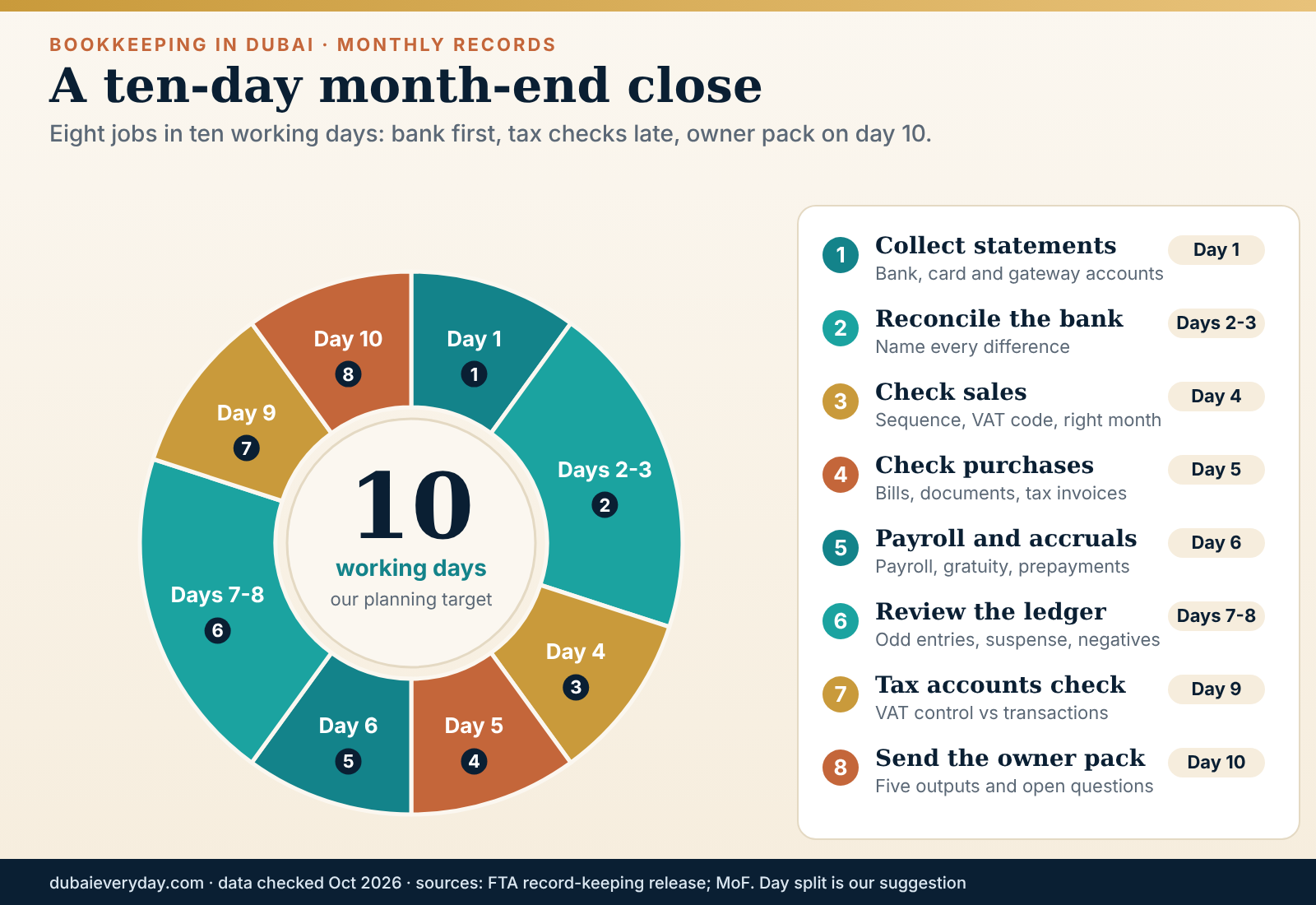
The eight steps, in the order that saves time
Order matters because each step feeds the next. Reconciling the bank before entering sales, for example, tells you which customer payments to match, and reviewing the VAT control account last tells you whether the earlier steps were done properly.
- Collect the statements (day 1)Download bank, card and payment-gateway statements for the month, and ask each bank for the closing balance in writing if the statement is delayed. Without the statements nothing else is reliable.
- Reconcile the bank (days 2 to 3)Match every line on each statement to a ledger entry or create the missing entry. The method is in the next section.
- Enter and check sales (day 4)Confirm each invoice issued is in the ledger, in the right month, with the right VAT code. Check that invoice numbers run in sequence without gaps and that credit notes are recorded as credit notes.
- Enter and check purchases (day 5)Enter supplier bills and expense claims, attach the document, and flag any bill without a valid tax invoice. This is where the expense routine takes over.
- Book payroll and period-end items (day 6)Record payroll, gratuity movement, leave accruals, prepayments, depreciation and accrued costs that arrived after the month end.
- Review the ledger (days 7 to 8)Scan for odd entries: round-number transfers, repeated payments, large items in suspense, negative balances in places where they cannot exist.
- Check the tax accounts (day 9)Compare the VAT output and input accounts with the transaction detail and note anything that will not match the return.
- Send the owner pack (day 10)Deliver the five outputs described below, plus a short list of questions that need an owner’s answer.
Cut-off: which month does it belong to?
Cut-off is the discipline of putting each transaction in the month it belongs to. A supplier invoice dated 29 October for work done in October belongs in October even if it arrives on 6 November. A customer deposit received in October for a service delivered in December is a liability at 31 October, not October income. Getting cut-off wrong in bookkeeping Dubai files moves profit between months, and when it crosses a VAT period it can move tax between returns.
The simple test is two questions. When was the goods or service supplied? When is the tax point under the VAT rules for that supply? For ordinary invoices the dates are often the same, but advance payments and long projects can differ, and your accountant should set a policy for them. Our reading of the VAT guidance is that the tax point rules are detailed enough to deserve a written position for any business that takes deposits.
What the owner pack should contain
Bookkeeping Dubai month-ends that serve both management and tax produce five items. If your bookkeeper cannot show you a sample of each, you are paying for data entry rather than bookkeeping.
- A bank reconciliation for every account, including card and gateway balances, signed and dated
- An ageing list of unpaid customer invoices, with a note against anything over 60 days
- A list of unpaid supplier bills with due dates, so cash is not a surprise
- A profit and loss and balance sheet for the month, with VAT shown separately from net amounts
- A short list of open questions: undocumented payments, unexplained receipts, anything parked in suspense
How long should the monthly work take?
Nobody publishes an official benchmark for bookkeeping Dubai workloads, so treat this as an illustration of the logic. Suppose a bookkeeper spends two minutes on each routine transaction (matching, coding, attaching a document) and ten minutes on each exception. A company with 150 transactions a month and 10 exceptions needs about 5 hours plus 1 hour and 40 minutes of exceptions, about 6 hours 40 minutes. At 400 transactions and 30 exceptions the same arithmetic gives about 13.3 plus 5 hours, or roughly 18 hours.
The lesson is not the totals. It is that exceptions weigh more than volume, so the best way to cut bookkeeping time is to remove the causes of exceptions: undocumented spending, mixed personal payments and unclear customer transfers. These are the habits the later sections tackle.
Illustrative example, not a quote or market fact. The two-minute and ten-minute figures are assumptions chosen to show how workload scales. Your own times will differ with software, document quality and the person doing the work. Time a real month before using any figure to negotiate or budget.
Bank reconciliation, step by step
A bank reconciliation compares two lists that should describe the same money: what your ledger says you hold in an account, and what the bank says. They are rarely identical on the last day of the month, but every difference must have a name. Cheques issued and not yet cashed, a customer payment that has not landed, a fee the bank took that you have not booked. If a difference has no name, something is wrong.
It is the most valuable monthly check in bookkeeping Dubai companies can run, for two reasons. It catches your own mistakes: double entries, missed receipts, wrong amounts. And it is the best early warning of fraud, because a payment you do not recognise has nowhere to hide on a statement that you match line by line.
How the two-sided method works
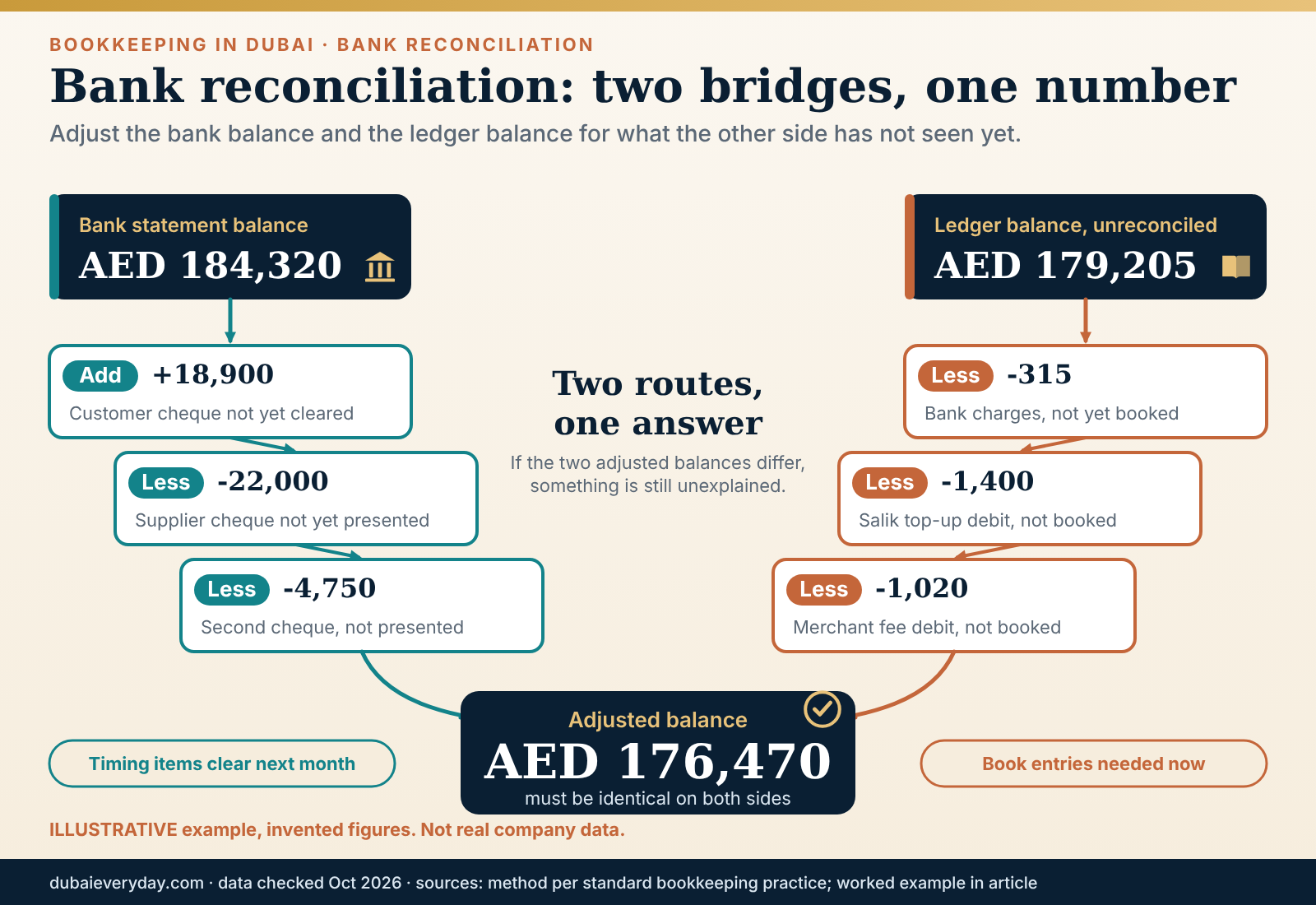
Think of it as two bridges that must end at the same number. Start from the bank statement balance and adjust for timing items the bank has not seen yet: deposits you have made that are not yet cleared, and payments you have issued that have not yet been presented. The result is the adjusted bank balance. Then start from your ledger balance and adjust for items the bank has recorded that you have not: charges, direct debits and receipts you had not yet entered. The result is the adjusted book balance. The two adjusted balances must be equal.
Timing items clear themselves on the next statement. Book-side items are your homework: each needs a ledger entry before the month can close. That is why this step comes early in the close.
A worked example with illustrative numbers
The figures below are invented to show the arithmetic. A small service company has one AED operating account. On 31 October the bank statement shows AED 184,320. The ledger says AED 179,205 before reconciliation.
| Bank side | AED | Ledger side | AED |
|---|---|---|---|
| Balance per bank statement | 184,320 | Balance per ledger, before reconciliation | 179,205 |
| Add: customer cheque deposited 30 Oct, not yet cleared | 18,900 | Less: bank charges not yet booked | (315) |
| Less: supplier cheque issued, not yet presented | (22,000) | Less: Salik top-up debited by the bank, not booked | (1,400) |
| Less: second supplier cheque, not yet presented | (4,750) | Less: monthly merchant-services fee debited, not booked | (1,020) |
| Adjusted bank balance | 176,470 | Adjusted ledger balance | 176,470 |
Illustrative example (not a quote or market fact). The bank side starts at 184,320, adds 18,900 and subtracts 22,000 and 4,750 to reach 176,470. The ledger side starts at 179,205 and subtracts 315, 1,400 and 1,020, a total of 2,735, to reach 176,470. Both sides agree, so the month can proceed once the three book-side items are entered.
Where reconciliations go wrong in bookkeeping Dubai practice
The method is easy. The traps in bookkeeping Dubai teams fall into are in the habits around it. Four deserve a warning.
Forcing the match. When a gap of a few hundred dirhams will not clear, the temptation is to book a “balancing” entry and move on. Do that once and the same excuse is available next month. Park unexplained amounts in a suspense account with a date, and set a rule that anything older than the next close must be cleared or escalated.
Reconciling to the wrong date. Banks cut off at their own time. A payment made late on the last day may appear next month. Reconcile to the statement date and list the timing item, rather than editing the ledger date to suit the statement.
Skipping the minor accounts. Payment-gateway balances, a second currency account, a prepaid card and petty cash all hold real money. Forgotten accounts are where small leaks sit for a year.
Letting the payer reconcile. If the person who signs payments also reconciles, nobody is checking the signer. In a tiny team, the cheapest fix is for the owner to open and review the statement personally each month, and for a second person to do the matching.
Dubai frictions to build into the routine
Some patterns are specific enough to Dubai small-business banking that bookkeeping Dubai routines should plan for them rather than treat each as a surprise.
- Post-dated cheques. Cheques remain common for rent, supplier terms and some customer payments. Keep a register of cheques issued and received with date, number, payee, amount and status. A cheque that has not cleared at month end is a timing item. A cheque that bounced is a receivable again, and needs action.
- Gateway payouts. Card sales are normally settled to your bank after a delay and net of fees and refunds. The payout on the statement is therefore never equal to the sales in your system. Reconcile via a clearing account: record gross sales into it, fees and refunds out of it, and payouts against it, until the account returns to zero.
- Foreign-currency transfers. A payment in USD or EUR converted to AED arrives at the bank’s rate with fees. The ledger needs the AED received, the foreign amount noted and any exchange difference booked, rather than the invoice amount.
- Bank charges and tax. Some bank fees carry VAT. Check how your bank shows them on the statement and ask your accountant how to code the tax part.
- Unlabelled transfers. Customers pay without references. Keep the bank’s transfer advice, ask the customer for remittance details and match by amount and date.
- Transfers between your own accounts. Book both legs and check they net to zero; a missing leg is the usual cause of an odd difference.
A practical reconciliation checklist
- Statement downloaded straight from the bank, not retyped, with opening and closing balances matching last month
- Every statement line ticked to a ledger entry; every ledger entry in the month ticked to a statement line or marked as a timing item
- Timing items listed with dates, and last month’s timing items confirmed as cleared
- No unexplained balancing entries; suspense items dated and owned by someone
- Signed and dated by the preparer, and reviewed by someone who does not sign payments
Spot-checking helps any bookkeeping Dubai review as well. Ask the bookkeeper to trace three random lines from the statement back to a document, and three random documents forward to the statement. If both directions work, the books are probably in decent shape. If either takes more than a few minutes, the filing system needs work before the software does.
How often to reconcile
Monthly is the minimum for any company running bookkeeping Dubai accounts. A business with heavy card volume, cash handling or several people with payment authority gains from weekly reconciliation, because errors are far easier to trace when only seven days of transactions are in play. Retail and restaurants often reconcile cash daily because the till count is itself a reconciliation. For a freelancer with a handful of payments a month, the monthly rhythm is plenty, provided it actually happens.
What matters more than frequency in bookkeeping Dubai reviews is the evidence. A reconciliation that exists only in someone’s head is not evidence. A dated sheet or software report, saved with the month’s records, is what you hand over if the FTA, a bank or a buyer asks how you know your cash figure is right.
Receivables: invoicing, ageing and chasing
Receivables are what customers owe you for work already delivered. They are the least glamorous part of bookkeeping Dubai companies manage and the one that most often decides whether the business has cash. Profit on paper does not pay rent. An invoice that sits unpaid for 90 days is a loan you made to your customer, at your risk and your cost.
The bookkeeping Dubai job here has three parts that must run together: issue correct invoices promptly, keep an up-to-date picture of who owes what and for how long, and follow a calm, predictable chasing routine. Skipping any one weakens the other two.
Start with an invoice that gets paid
Most late payment begins at the invoice. A payer’s accounts team will park an invoice that is missing a purchase-order number, shows the wrong legal name, or has no bank details. Before you chase anyone, check that your own invoice is hard to reject. A reliable invoice has a unique sequential number, the customer’s exact legal name, a clear description of what was supplied, the amount, the VAT shown separately, the due date, your bank details and any reference the customer requires.
For VAT-registered businesses the invoice is also a tax document. The VAT executive regulation sets out the required contents of a tax invoice and a deadline for issuing it after the supply. Practitioner summaries commonly cite details such as the words “Tax Invoice”, both parties’ names and addresses, your tax registration number, an invoice date and number, the amounts in AED and the VAT amount in AED, with a 14-day issue deadline.
We could not re-read the VAT tax invoice rules on an official page today, so treat the list above as a prompt for your adviser, not as the legal text. A tax invoice that fails the rules can cost your customer their VAT recovery, which makes the dispute commercial as well as technical. Ask your accountant for an invoice template they have checked against the current rules.
E-invoicing changes what an “invoice” is
From 2027 the meaning of a B2B invoice changes for in-scope businesses. The Ministry of Finance has said an e-invoice is structured data exchanged through an accredited service provider and reported to the FTA, and that PDFs and emails are not e-invoices. Businesses with revenue of AED 50 million or more go live on 1 January 2027; smaller businesses must appoint a provider by 31 March 2027 and go live on 1 July 2027. The software section below sets out the dates and what to ask your system vendor.
For receivables in bookkeeping Dubai files, the effect is practical. A customer on the new system will be able to reject or match your invoice automatically. Clean customer master data, correct legal names and tax registration numbers stop being tidiness and become a condition of getting paid.
The ageing report: your weekly early warning
An ageing report lists every unpaid invoice and groups it by how long ago it fell due or was issued: current, 31 to 60 days, 61 to 90 days and over 90. It is the single document that turns “customers pay slowly” into a decision. Ask for it every month in the owner pack, and look at it weekly if sales are volatile. It is the most useful receivables page in any bookkeeping Dubai file.
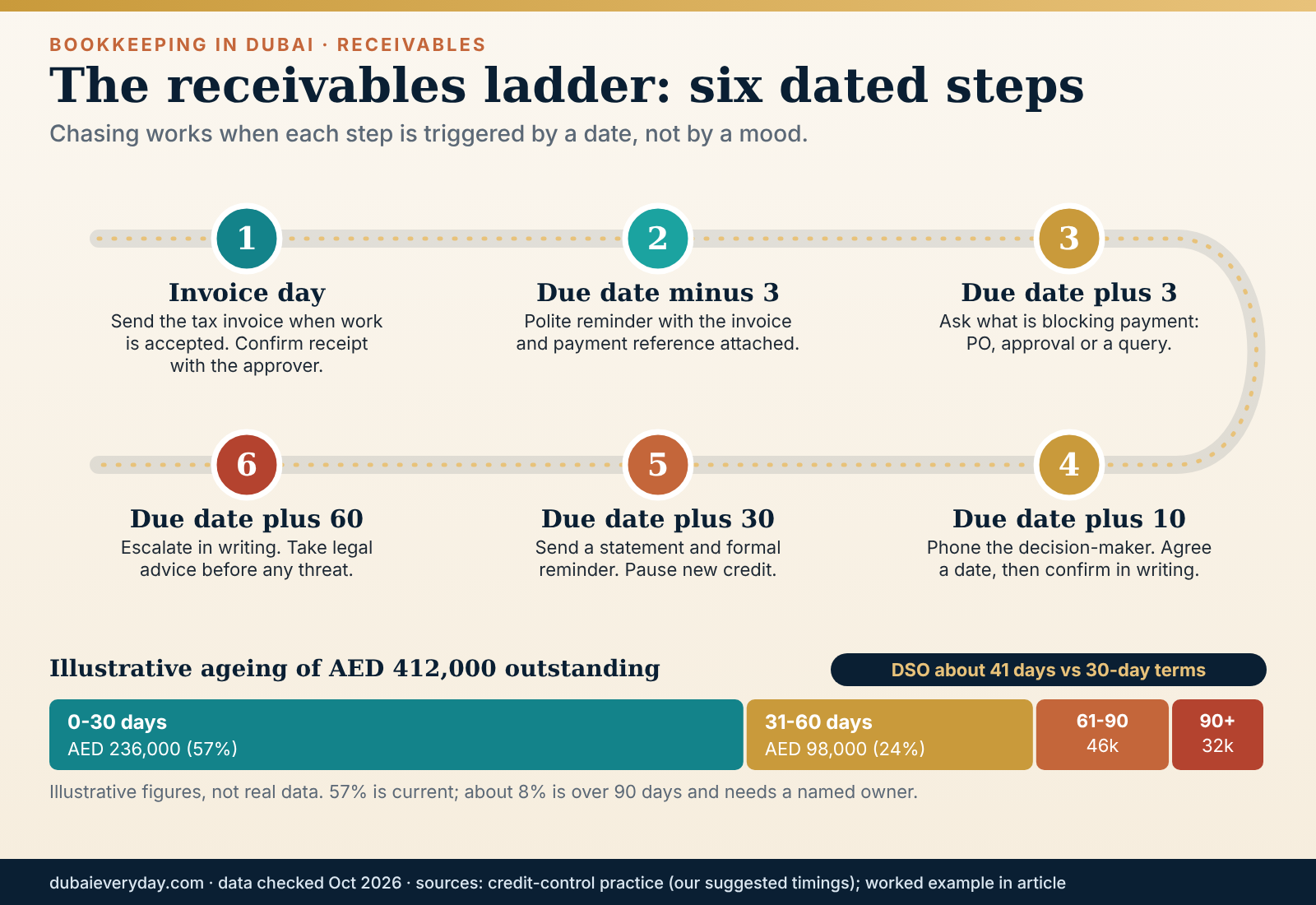
Take an illustrative example, not real data. A company has AED 412,000 outstanding. Of that, AED 236,000 is in the first 30 days, AED 98,000 is 31 to 60 days old, AED 46,000 is 61 to 90 days and AED 32,000 is older than 90 days. That is 57% current and roughly 8% in the over-90 bucket. The over-90 amount is small, but it is the part with the worst odds of ever being collected, and it deserves a name against each invoice.
A second lens is days sales outstanding, or DSO: how many days of credit sales are tied up in receivables. If that company invoices AED 300,000 a month on credit, DSO is 412,000 divided by 300,000, times 30 days, or about 41 days. If its stated terms are 30 days, customers are paying roughly 11 days late on average. The number is crude, but a rising DSO is an early sign of trouble well before the bank balance shows it.
A chasing routine that keeps the client
Chasing works when it is boring and predictable, which is true of most bookkeeping Dubai routines. The routine below is a suggestion we built from common credit-control practice, and every business should adjust it to its customers. The principle is that each step is triggered by a date, not by a mood.
- Invoice daySend the invoice the day the work is accepted. Confirm receipt to the person who approves payment, not only a shared inbox.
- Three days before the due dateA short, polite reminder with the invoice attached and the payment reference. Many late payments are simply forgotten.
- Due date plus three daysAsk whether anything is blocking payment: a missing purchase order, an approval pending, a query on the amount.
- Due date plus ten daysPhone or message the decision-maker. Agree a payment date and write it down in an email afterwards.
- Due date plus thirty daysSend a statement of account and a formal reminder. Pause new work or new credit until a payment plan exists.
- Due date plus sixty daysEscalate in writing, and take legal advice on the options before sending anything that sounds like a threat.
Cheques, promises and what Dubai practice adds
Payment by cheque, including post-dated cheques, is still part of many Dubai commercial relationships, and a bookkeeping Dubai file should show it. Keep a cheque register alongside the ledger, deposit cheques as soon as they fall due, and treat a returned cheque as an unpaid invoice with a fresh date for action.
The legal treatment of bounced cheques has changed over recent years, and it differs from other disputes, so get current advice before relying on a cheque as your only protection. Our guide to Dubai legal basics for residents explains where to verify rules, and a lawyer should confirm what applies to your case.
Written evidence is the other local habit worth adopting. Keep the signed quotation or purchase order, delivery confirmations, WhatsApp or email approvals and any change requests together with the invoice. In a dispute, the file that shows what was agreed and what was delivered is worth more than a perfect ageing report.
Credit notes, disputes and write-offs
If you issue an invoice in error, or the customer returns goods or disputes a charge, do not overwrite or delete the original. Issue a credit note that refers to it, and a corrected invoice if needed. Sound bookkeeping Dubai practice is to correct forward and never to erase. Deleting invoices breaks the number sequence, and that sequence is part of the audit trail the tax authority expects. For VAT, a credit note also adjusts the tax you reported, so it must be dated and coded correctly.
Write-offs need the same care. Record a doubtful-debt provision when you judge a debt may not be collected, and a write-off only when collection has been abandoned. VAT law has a relief mechanism for output tax on debts that go bad, with conditions on time and evidence. Corporate tax also has rules on when a bad debt is deductible. We have not verified either set of conditions, so ask your accountant before writing off a large balance, not after.
Confirm first. Our understanding, from general practitioner commentary and not checked against the legislation today, is that VAT on a sale is generally due for the period of the tax point rather than the period of payment. If so, a company can owe VAT to the FTA on an invoice its customer has not paid. This is a good reason to chase early and to keep VAT cash aside. Ask your accountant how it applies to your invoices.
Extending credit with eyes open
Receivables risk in bookkeeping Dubai work is easiest to manage before the invoice exists. Run a basic check on new customers: legal name, trade licence, how long they have traded and whether they pay other suppliers on time, which you can often learn by asking for trade references. For large or first-time orders, ask for an advance or milestone payments. Keep an eye on concentration: if one customer accounts for a third of your receivables, a delay from that one account can freeze the whole business.
Customer deposits are not income when you receive them. They are a liability until the work is done, and should sit in a separate ledger line. Mixing them with revenue makes the profit look better than it is and hides the obligation to deliver.
Expenses: receipts, VAT recovery and deductibility
Every expense in a bookkeeping Dubai ledger has to answer three questions: did the business really incur it, can you prove it, and what does it do to your tax position? Answering them at the moment of entry takes seconds. Answering them a year later takes hours, and sometimes the honest answer is “we cannot prove it”.
That is why every bookkeeping Dubai expense routine is built around the document. The rule is the same as in the set-up section: no document, no entry, or at least no entry without a flag. The rest of this section shows how to sort what arrives.
Two tax tests for every cost
A cost can pass one tax test and fail the other, so they are kept apart.
The first is VAT recovery. If you are VAT-registered, input VAT on business purchases is generally recoverable against the VAT you charge customers, provided you hold a valid tax invoice and the purchase is used for taxable business activity. A receipt without your company’s name and the supplier’s tax registration number is usually not enough to support a claim.
Recovery is also subject to blocks and time limits. Practitioner summaries of the 2026 amendments say input tax recovery is limited to five years from the end of the relevant tax period, and that input tax can be denied where a supplier chain evaded tax and you knew or should have known. We treat these as secondary-source context and would ask an adviser to confirm them.
The second is corporate tax deductibility. Taxable income starts from accounting profit and is adjusted by the tax rules. The consolidated text of the corporate tax law published by the Ministry of Finance in January 2026 (an unofficial English translation) contains rules every bookkeeper should know by heart.
- Entertainment, amusement and recreation spending, including entertaining customers or suppliers, is deductible at 50% (Article 32).
- Fines and penalties are not deductible, other than amounts awarded as compensation for damages or breach of contract (Article 33).
- Bribes and other illicit payments are not deductible (Article 33).
- Dividends and profit distributions to an owner, and withdrawals by an owner, are not deductible (Article 33).
- Payments to owners, directors and other connected persons are deductible only up to market value, and only if incurred wholly and exclusively for the business (Article 36).
Good bookkeeping Dubai accountants rely on makes these rules visible at entry. Give entertainment its own ledger line so the 50% adjustment is a single number, put traffic fines on a line that is clearly flagged, and record owner payments through the shareholder account. A year-end tax adjustment then takes minutes, not an afternoon of digging through “sundries”.
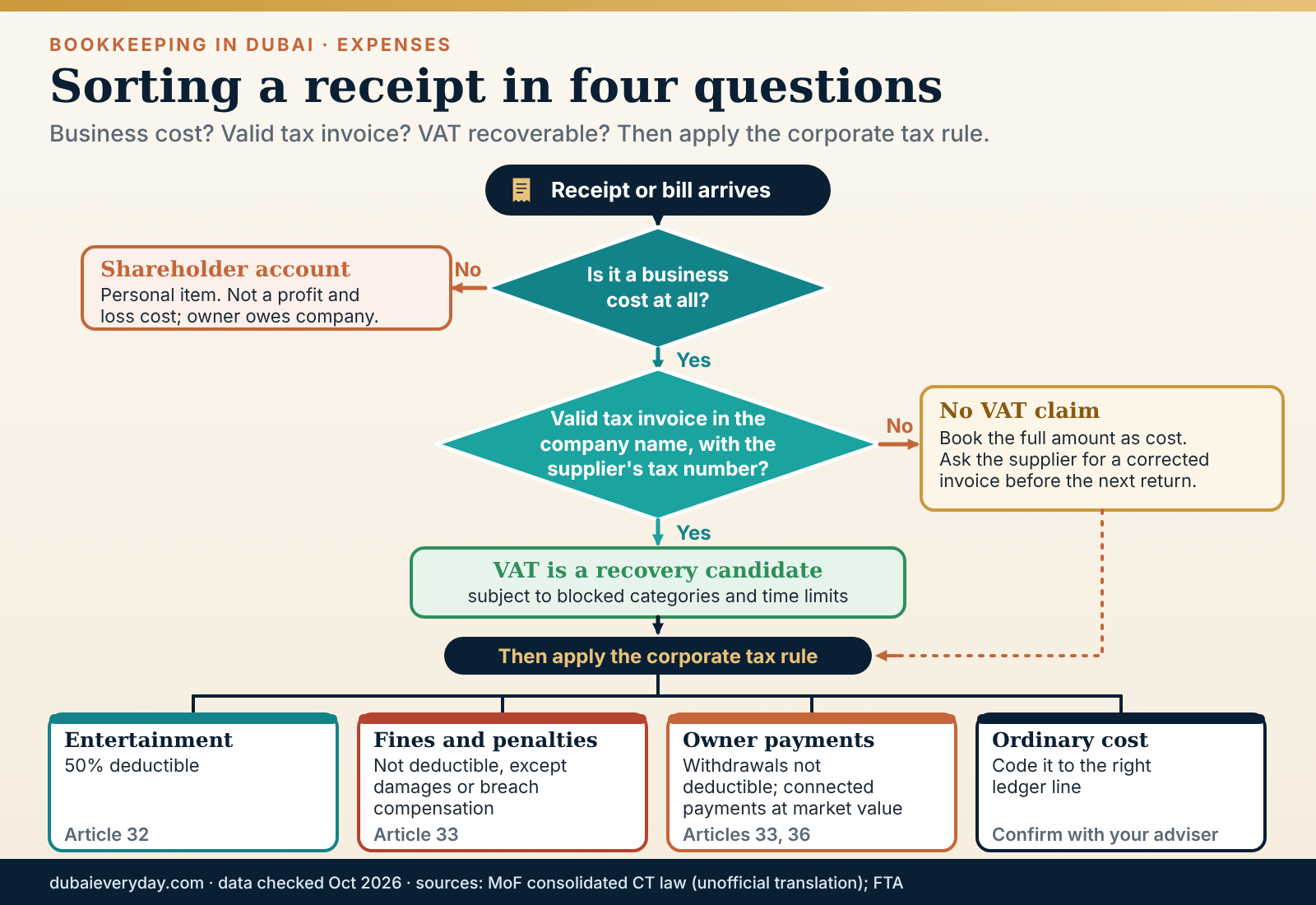
Sorting what arrives, in the right order
A small team can follow the tree in the figure without thinking about it. First ask whether the cost is a business cost at all. If the owner paid a personal bill from the company account, it goes to the shareholder current account and not to the profit and loss. Second ask whether you hold a proper tax invoice in the company’s name. If you do, the VAT part is a recovery candidate. If you do not, record the full amount as a cost, claim no VAT, and ask the supplier for a corrected invoice before the next return.
Third, apply the corporate tax rule that matches the type of cost, and code it to the right line.
Cases that need an explicit policy rather than a guess include staff meals and gifts, client entertainment, personal use of company cars and phones, and anything paid to a relative of an owner.
Foreign suppliers and subscriptions
Many Dubai businesses pay for software, advertising and cloud tools to suppliers outside the UAE. These purchases may require you to account for VAT yourself under the reverse charge, even though the supplier charged none. The 2025 amendments, as described in secondary commentary, relaxed the self-invoicing requirement for reverse-charge transactions. We did not verify the detail from an official source, so use this as a prompt to ask your accountant how your subscriptions are treated and how they should appear in the ledger.
For bookkeeping Dubai teams, the actionable part is simple. Tag every overseas supplier in the system so that reverse-charge purchases can be pulled out at VAT time, keep the supplier’s invoice, and note the AED amount you were charged on the card statement, not the invoice currency.
Employee claims, company cards and petty cash
Three small channels leak most in bookkeeping Dubai files. Claims paid back to staff need a form, a receipt and an approver who is not the claimant. A company card needs a monthly statement review where each charge is matched to a document within a set number of days. Petty cash needs a float, a custodian, a count and a rule that top-ups are made only against receipts.
For missing receipts, a short internal declaration listing date, amount, payee and reason is better than silence, and it should be used rarely. It is a record of what happened, not a substitute for a tax invoice, and it will not support a VAT claim.
Capital items and prepayments
Some purchases in bookkeeping Dubai ledgers benefit more than one month. A laptop, office furniture or fit-out should be recorded as a fixed asset and depreciated, not expensed in one go. Choose a capitalisation threshold with your accountant and write it down. A figure such as AED 2,000 is only an example of what a policy might say. Items below it are expensed at once, and items above it go on the asset register with purchase date, cost and expected life.
Prepayments work the same way in time in any bookkeeping Dubai ledger. A trade licence renewal, a year of insurance or a prepaid visa cost is spread across the months it covers. If you are comparing cover, our Dubai insurance guide explains policy types and how to compare them. In the ledger, the premium is an asset (prepaid insurance) on day one and an expense in twelve parts afterwards.
Payroll, visas and gratuity in the ledger
If you employ anyone, payroll becomes the largest cost in the books, and Dubai adds lines that generic templates miss, so bookkeeping Dubai payroll needs its own treatment. The goal of this section is to show the lines, not to give labour-law advice. For the rules on contracts and employee rights, start with our legal basics guide and the relevant authority.
The payroll run and the bank
Each payroll should leave a clean trail: a payroll register listing basic pay, allowances, deductions and net pay per employee, the bank file or transfer evidence, and journal entries to the ledger. Salaries for most private-sector employees are paid through the labour ministry’s Wage Protection System (WPS). We did not re-check the current rules today, so confirm with your payroll provider or bank how WPS applies to your staff. For bookkeeping Dubai staff, WPS means salary payments appear as batch debits, so the register total and the bank debit must agree before the reconciliation is signed.
Visa and immigration costs
Employment visas, Emirates ID, medical tests and establishment card fees add up quickly. They are real costs of employing someone, and good practice is to record each one against the employee or the establishment so you can see what a hire actually cost. Many companies treat these as prepayments spread across the validity of the visa; others expense them when paid. Pick a policy with your accountant and apply it consistently. If you are hiring, our Dubai work visa guide explains the process the costs belong to.
End-of-service gratuity as a liability
Employees who complete the qualifying period are usually owed an end-of-service gratuity when they leave. The amount builds up month by month, so the books should show it as a growing liability rather than a surprise on the exit date. The formula commonly cited for private-sector employees is 21 days of basic wage for each of the first five years and 30 days for each year after, subject to a cap.
Confirm first. We could not open the official page for gratuity rules today, and the details change with contract type and law updates. Treat the figures here as a description of how the accounting works, not as an entitlement calculator. Confirm the rate, cap and exclusions with the labour authority or an HR adviser, and use the employee’s contract.
Illustrative example, not an entitlement. An employee has a basic monthly wage of AED 8,000. A daily rate of one thirtieth is AED 266.67. Twenty-one days is AED 5,600 for a year of service. The monthly accrual is AED 5,600 divided by twelve, or about AED 467. After three years the liability is AED 16,800. If the books show nothing, the first resignation arrives as a cash demand with no warning.
Leave, health cover and other staff costs
Unused annual leave that is carried forward or paid out on exit is a liability too. Employer-paid health insurance is a monthly or annual cost that should be allocated by period. Our health insurance guide explains what mandatory cover involves, which helps you check that the amounts on an insurer’s invoice make sense. Salary advances and staff loans go in a receivable line, not in payroll expense, and each should have a repayment schedule.
Finally, keep personnel files and payroll evidence with the same discipline as financial records. When a dispute, audit or sale of the company comes, the payroll file is among the first things requested.
Cash is not profit: VAT money, tax reserves and owner draws
Well-run bookkeeping Dubai ledgers answer a question that the bank balance cannot: how much of the money in the account is actually yours? In a VAT-registered Dubai company the answer is “less than it looks”. Part of every taxable sale belongs to the tax authority. Part of every month’s profit will become a corporate tax payment nine months after year end. Part of every salary run creates a gratuity liability. The bank balance mixes all of it together.
One invoice, five claims on the same cash
The picture below follows a single illustrative invoice. A company invoices AED 100,000 plus 5% VAT, so the customer pays AED 105,000. All the money lands in the same account, but different people have a claim on different parts of it. The figures are invented and simplified, and they ignore input VAT on purchases.
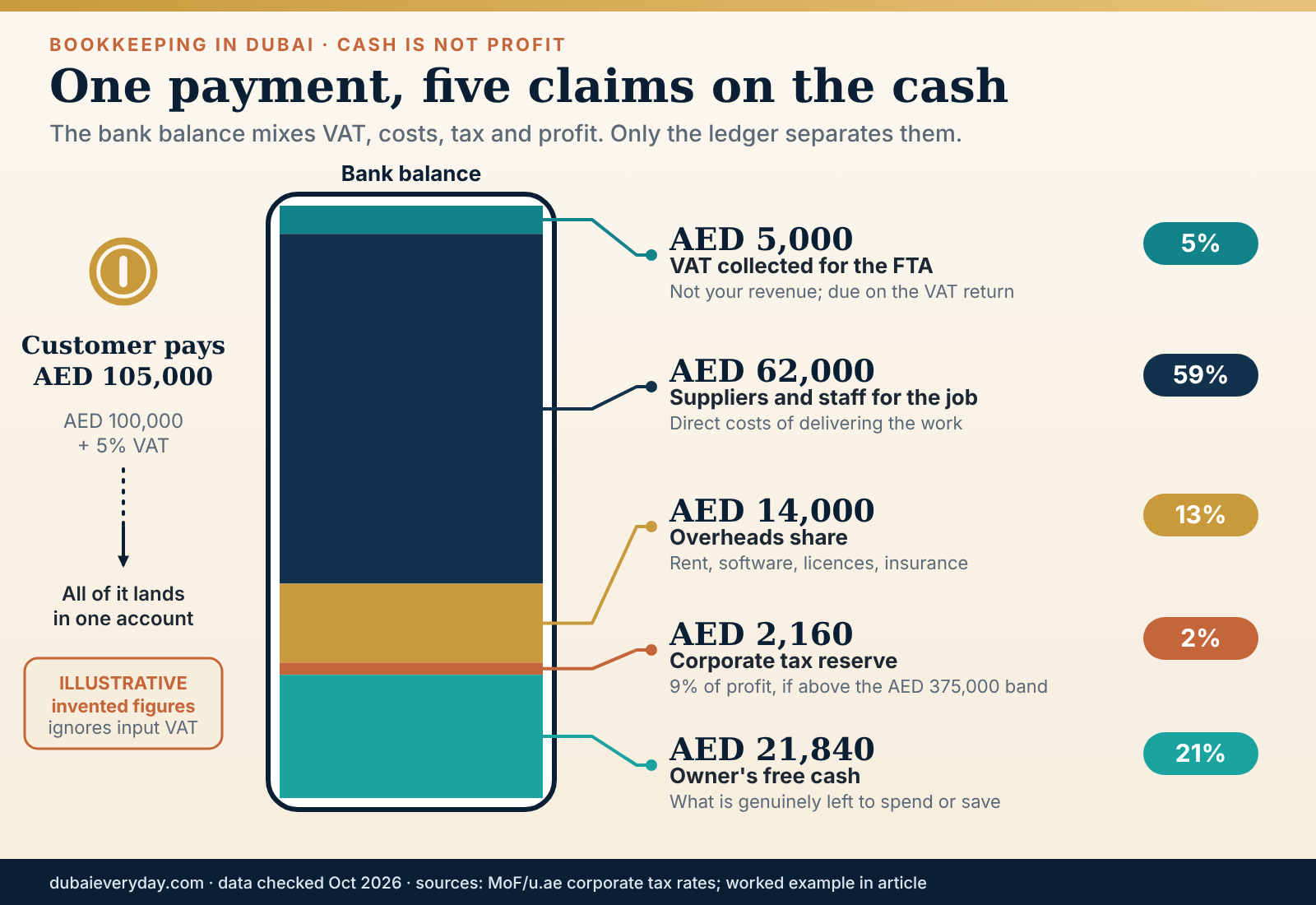
Of the AED 105,000, AED 5,000 is VAT collected for the FTA. Another AED 62,000 pays for the suppliers and staff who did the work, and AED 14,000 is the job’s share of overheads such as rent and software. That leaves profit of AED 24,000 on the AED 100,000 sale. If the company’s annual taxable income sits above the AED 375,000 band that is taxed at 0%, the next dirhams are taxed at 9%, which would reserve AED 2,160. The owner’s genuinely free cash is then AED 21,840, a fifth of what the bank statement suggests.
The corporate tax details depend on your tax position. The rate and the AED 375,000 band come from the Ministry of Finance and the UAE government portal, and a company claiming Small Business Relief, or a qualifying free zone person, will see different results. The point of the example is the habit, not the number: look at a ledger, not a bank balance, before deciding what to spend.
Three habits that keep cash honest
First, set aside the VAT as it arrives. Moving the output VAT portion of each receipt into a separate savings or sub-account turns the quarterly return into a transfer rather than a cash scramble. Second, estimate the corporate tax each month in the management figures, so the nine-month filing deadline is not a shock. Third, keep a simple rolling cash forecast for the next 13 weeks: known receipts from the ageing report, known payments from the supplier list, and fixed dates such as payroll, rent cheques and licence renewals.
None of this needs special software. A spreadsheet that starts with the bank balance, adds receivables by expected week and subtracts payables and payroll by due week is enough to warn you when a gap is coming. The owner pack described earlier already contains the inputs.
Owner pay: salary, dividend or draw
How owners take money out of a company is a tax and legal question, so we do not advise on it. The bookkeeping Dubai rule is narrower. Whatever route you use, each payment must be labelled for what it is. A salary goes through payroll. A dividend needs a decision and, where relevant, sufficient profit. Anything else goes to the shareholder current account. Under the corporate tax law, distributions and owner withdrawals are not deductible, so labelling affects the tax outcome as well as the tidiness of the books.
Bookkeeping software in Dubai: what to check before you commit
Choosing a package is the decision people agonise over, and it matters less than the routines above. In bookkeeping Dubai companies actually do, a disciplined owner on a basic tool beats a careless one on an expensive tool. Software becomes decisive in bookkeeping Dubai work in three situations: when volume grows beyond what a person can match by hand, when VAT and e-invoicing demand structured data, and when several people need access with different permissions.
We do not rank or recommend products. Inclusion in any list would be a judgement we cannot back with field testing, and commercial relationships should not decide it. What we can give you is a list of checks that apply to any bookkeeping software Dubai businesses consider, plus the official dates that your choice has to meet.
The checks that matter in the UAE
- AED as the home currency, with foreign-currency invoices and payments converted and exchange differences posted automatically.
- VAT codes and a return report that lets you tie the ledger to each box of your return and shows the transactions behind every number.
- Tax invoice templates that include the fields your adviser confirms are required, and the option of English and Arabic wording if your customers need it.
- Bank connectivity for the banks you actually use. Test with your own statement files before you trust a brochure.
- Audit trail and permissions: who changed what and when, and different access levels for owner, bookkeeper and viewer.
- Document attachment on every transaction, so evidence travels with the entry.
- Full data export in a usable format, so you can leave without losing your history.
- E-invoicing path: either a direct connection to an accredited service provider or a clear statement of how that connection will be added.
Four kinds of setup
Software choice is easier if you start from the type of setup rather than the product. The table is our own rule of thumb for bookkeeping Dubai setups, not an official classification, and the volume ranges are illustrative.
| Business profile | Illustrative monthly volume | Reasonable setup | Watch-out |
|---|---|---|---|
| Freelancer or sole establishment, not VAT-registered | Under about 30 transactions | Structured spreadsheet or entry-level cloud ledger, plus a folder system | Spreadsheets have no audit trail and no e-invoicing link; fine until VAT or growth arrives |
| VAT-registered service company | About 30 to 300 | Cloud accounting package with VAT reports and bank import | Confirm VAT return report and export before you buy |
| Trading or e-commerce business with stock | 300 and above, with many small sales | Cloud accounting with inventory or an integrated order system | Gateway payouts, returns and stock valuation need a clearing-account design |
| Multi-entity, multi-currency or larger team | Any, with several users | Mid-market or ERP-grade system with an implementation partner | Implementation cost and time often exceed the licence cost |
E-invoicing: the dates your bookkeeping Dubai software must meet
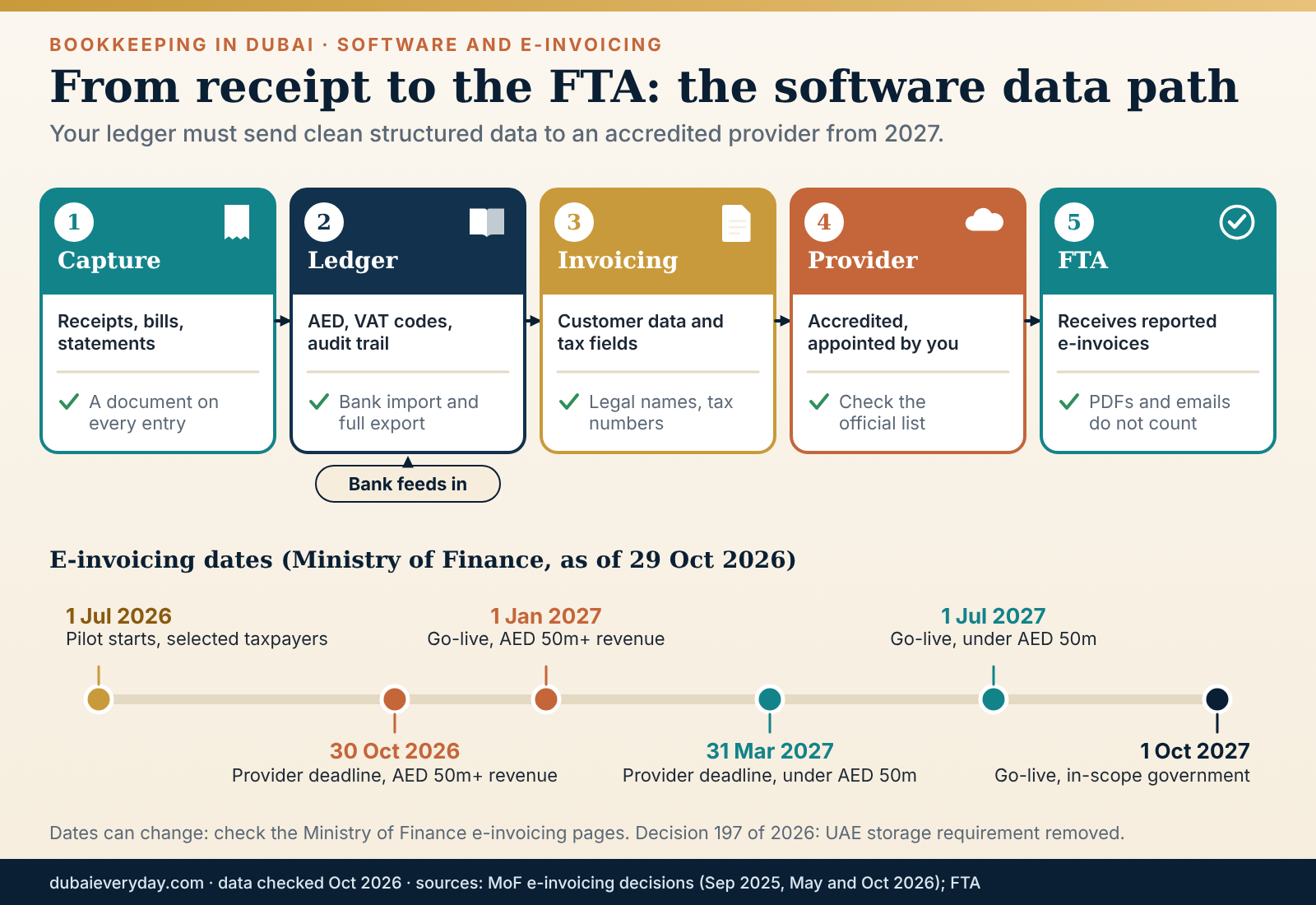
The Ministry of Finance announced the rollout timetable in September 2025 and has amended it since. Our summary of the current position, as of 29 October 2026, is as follows. A pilot began on 1 July 2026 for selected taxpayers. Businesses with revenue of AED 50 million or more must appoint an accredited service provider by 30 October 2026, after an extension from 31 July, and go live on 1 January 2027. Businesses below that threshold must appoint a provider by 31 March 2027 and go live on 1 July 2027. In-scope government entities follow on 1 October 2027.
On 19 October 2026 the ministry also published Ministerial Decision No. 197 of 2026, effective 1 October 2026. It excludes transactions within the same tax group for 24 months from 1 January 2027, removes the requirement to store e-invoices in the UAE, and repeals a system-failure notification article. E-invoices must still be kept for the period required by the tax procedures law and made available to the FTA. The ministry’s published list of accredited providers held 80 entries on 29 October 2026, which is a snapshot that will change.
A trial script before you pay
Most vendors offer a free trial. Treat it as an exam for your bookkeeping Dubai setup, not as a demonstration. With a copy of one real month of your own data, enter a standard sales invoice with VAT, a credit note, a foreign-currency purchase, a reverse-charge subscription and a petty-cash claim. Import a bank statement and reconcile it. Run the VAT report and compare the totals to a manual calculation. Export everything. If any of these takes longer than expected, or needs a workaround, you have learned something a sales page would not tell you.
Then ask three questions in writing. How will you support our e-invoicing connection, and at what cost? Where is our data held, and how do we get it out if we leave? What happens to the price when we add users or invoices? Written answers are what you rely on later, when the person who made the promise has moved on.
Migration and switching
Changing bookkeeping Dubai software mid-year is possible, but do it at a natural break, such as a quarter end or a VAT period end. Carry over opening balances, an open-items list for receivables and payables, the fixed asset register and the VAT position, and keep a read-only export of the old system for the whole retention period. Run both systems in parallel for one close if you can afford the time. Our accounting services guide has a longer note on switching providers without losing continuity.
Who does the bookkeeping Dubai companies need: you, a freelancer, a firm or a hire
There are four realistic ways to get the bookkeeping Dubai companies need done each month. Each shifts cost, control and risk differently, and the right answer changes as the business grows. We deliberately do not quote fees. No official price list exists, and a figure we could not verify would anchor your negotiation in the wrong place. The accounting guide explains how providers price and how to vet them; this section focuses on the bookkeeping scope.
The owner does it
Realistic for freelancers who do their own bookkeeping Dubai work, or a company with a few dozen transactions a month. It is cheap, you understand your numbers, and you can spot a problem early. The risks are time, patchy discipline and the lack of a second pair of eyes. If you go this route, put the ten-day close in your diary as a recurring appointment, reconcile before you do anything else, and pay for an accountant to review the tax filings at least.
A freelance bookkeeper
Often the best value for a small company with moderate volume. The person knows the software, can work part-time and is flexible. The risks are continuity (what if they leave or are unavailable in the close week?) and verification, because a freelancer’s quality is hard to judge from outside. Ask for a sample monthly pack and keep your own access to the software and the bank statements so you never depend on a single person for the records.
A bookkeeping or accounting firm
Suitable when you want a bookkeeping Dubai team, a cover plan and a link to VAT and corporate tax filing under one roof. It is more expensive per hour and tends to work to a fixed scope, so what is outside the scope matters. Ask whether receivables chasing, payroll journals, fixed asset registers and VAT reconciliations are in or out, and who covers a holiday week.
An in-house hire
Makes sense when volume, complexity or the need for daily responsiveness justifies a salary, with the visa, insurance and gratuity costs that come with it. For many small firms the cost of a full-time hire exceeds the work available. Part-time external support often fits better until volume really warrants it.
What to put in a bookkeeping Dubai scope
Whichever option you choose, write the scope down, in plain language. Vague scope is where disputes start. A useful scope sheet covers the following.
- Which accounts and platforms are reconciled, and how often
- Who enters sales invoices, who enters purchase bills, and who approves payments
- Document standards: what the owner must supply and by which day of the month
- The close timetable and the deliverables in the owner pack
- Payroll journals, gratuity and leave accruals: included or separate
- VAT coding and the monthly VAT control reconciliation
- Access and ownership: the company owns the file and the login, not the provider
- What happens on termination, including a full data export and handover within a stated number of days
Who does what each month
Even with outside help, some jobs stay with the owner, and the arrangement works better if that is stated up front. The owner provides documents on time, answers open questions within a few days, approves payments and personally reviews the bank statements. The bookkeeper records, reconciles, produces the pack and flags exceptions. The accountant or tax agent prepares returns, judges tax treatments and signs off on year-end positions. Mixing these roles, especially letting the person who records also approve and reconcile, weakens the checks described in the controls section.
Bookkeeping Dubai scenarios: six businesses, six routines
Routines differ with the shape of the business. These are research-based composites, not case studies of real clients, and the volumes are illustrative.
The freelancer with a trade licence
A handful of clients, invoices sent from a template, one bank account. The bookkeeping Dubai routine is light: one monthly sitting of two to three hours to reconcile, file invoices and receipts, and update a simple receivables list.
The thing to watch is the turnover line. The FTA has said that a natural person doing business in the UAE with turnover above AED 1 million in a calendar year is subject to corporate tax and must register by 31 March of the following year. Track cumulative turnover monthly so that threshold is never a surprise. Keep personal spending out of the business account.
The one-person free zone company
Typically one owner, a few clients, perhaps overseas. The main risk is blurred personal and company money, since the owner can move funds with a tap. Use a shareholder current account, pay yourself in a labelled way, and keep the free zone’s renewal and audit conditions in your calendar. Free zone persons are generally still within the corporate tax system and must register, even where a 0% rate may apply to qualifying income. Rules differ by free zone and by activity, so confirm with your adviser rather than assuming.
The mainland LLC with a small team
Payroll, rent, a vehicle, supplier credit and customer cheques turn bookkeeping Dubai work into a weekly job. The routine adds a payroll reconciliation, a cheque register, a gratuity accrual and a weekly look at the ageing report. A bookkeeper working three days a month rarely fits; a part-time arrangement with a defined close timetable does. If you are still deciding between structures, our mainland company setup guide shows what a mainland licence involves in ongoing terms.
The online seller
Many small sales, gateway fees, refunds, couriers and stock. The ledger cannot be built from payout amounts alone. Build a gateway clearing account, record sales gross, show fees and refunds separately, and reconcile payouts to the clearing balance. Track inventory at cost with regular counts. VAT on imports and cross-border sales has its own rules, and a mistake multiplies across hundreds of orders, so get a written VAT treatment before scaling.
The property investor holding through a company
Few transactions, but each carries weight: purchase costs, service charges, rent receipts, deposits, maintenance, mortgage interest. Keep a ledger per property, so that income and cost by unit can feed your yield maths. Our rental yield guide explains gross versus net returns, and a clean set of books is what makes those numbers real rather than estimated. How purchase fees and finance costs are treated for tax is a point for your accountant to settle, not for a template.
The start-up with investors
Investors want a monthly pack: cash balance, burn, runway, receivables and a budget versus actual comparison. The bookkeeping Dubai job extends to tracking founder loans, convertible instruments and grant income correctly, so the closing balance sheet is understood by someone outside the company. Early discipline here is cheap, because the due-diligence request in a funding round will ask for exactly these records.
Behind on the books: a 30-day bookkeeping Dubai catch-up plan
Many owners reach this page with six or twelve months of bookkeeping Dubai backlog and unreconciled accounts. It is fixable, usually in a month of focused work, and the sequence matters more than speed. Before starting, check the filing position with your accountant: if returns are overdue, the priority list changes and a registered tax agent should be involved. The accounting guide shows how to check an agent against the FTA’s public register.
- Week 1: stabiliseList every bank, card and gateway account. Download all statements back to the start of the open period. Stop mixing personal and company payments from today. Confirm who holds the FTA and bank logins.
- Week 2: rebuild from the bankWork month by month, oldest first. Enter every statement line, coding it as best you can, and mark each line “document found”, “document requested” or “no document”. Do not wait for paperwork before moving on.
- Week 3: chase the documentsAsk suppliers for duplicate tax invoices, pull customer invoices from sent mail, and request statements from major vendors. Prioritise large amounts and anything with VAT.
- Week 4: reconcile and reviewReconcile each month to the bank, build the receivables and payables lists, and compare the VAT accounts to any returns already filed. Produce a first owner pack and a list of what remains unresolved.
Expect to find things. Duplicate payments, forgotten subscriptions and unrecorded customer receipts commonly turn up in a catch-up. Resist the urge to hide errors that affected tax. Secondary commentary on the 2025 changes says minor VAT errors can be corrected in the next return, but anything larger, or any past-due filing, should go to a registered adviser before you decide how to correct it.
Controls for a small team: keeping money and records safe
Internal controls sound like something for large companies, but small firms need them more. With two or three people handling money, one weak habit can sit unnoticed for a year. The aim of bookkeeping Dubai controls is not bureaucracy. It is making errors and fraud visible to someone who is not the person who made them.
Separate the three jobs where you can
Three activities should ideally sit with different people: approving a payment, making it, and recording and reconciling it. In a company of three that may not be possible in full, so pick the pairs that matter most. The person who reconciles the bank should not be the person who releases payments. The person who creates a supplier should not be the person who approves that supplier’s invoices. Where you cannot separate them, add a review: the owner opens the bank statement each month and picks a sample of payments to trace.
Bank access and payment approvals
Use dual authorisation for payments above a threshold you choose. Keep a list of everyone with banking access, and remove leavers on their last day. Set transaction limits on cards and online banking. Do not share one login among staff, since it destroys the record of who did what. If the bank allows alerts for payments above a certain size, switch them on for the owner’s phone.
The change-of-bank-details trap
Risk. A common fraud pattern worldwide is an email that appears to come from a regular supplier saying their bank account has changed. The next payment goes to the fraudster. Build a rule: any change to supplier bank details is confirmed by phone, using a number you already hold, by someone other than the person who received the request. Log the confirmation with the date and the name of who spoke.
The same rule applies to payroll bank details and to customer refund requests. If a “director” sends an urgent instruction to pay a new vendor, treat that as a prompt for more checking, not less.
Control over the books themselves
Give each user their own login with only the access they need. Lock closed periods so entries cannot be quietly changed after a VAT return is filed. Review the audit log for deleted or edited invoices at least quarterly. Keep a list of journal entries that were manual, with a reason, and have someone other than the preparer review them. Back up exports of the ledger, the receivables and payables lists and the fixed asset register on a schedule, to a place that does not depend on one person’s laptop.
For digital access, remember the practical dependency on one person: the holder of the company’s UAE PASS login for FTA services. If that person leaves or is unreachable, the company can be locked out of a filing. Our internet and digital life guide explains how UAE PASS and digital ID work, which helps when you design a backup access plan with your adviser.
Year-end, handover and keeping records
A year-end close is the same as a monthly close, with a longer list of adjustments and a hard stop at the end. If the monthly routine has run all year, the year-end is a few extra days. If not, it is the expensive rebuild this page is meant to prevent. The tax returns depend on it: corporate tax is due within nine months of the period end, and the ledger must support the figures.
A year-end bookkeeping Dubai checklist
- Every bank, card and gateway account reconciled to the last day of the year, with statements saved
- Receivables reviewed invoice by invoice; a doubtful-debt provision decided; confirmations requested from large customers
- Payables completed, including bills that arrived after year end for work done before it
- Stock counted and valued, if you hold inventory
- Fixed asset register reconciled and depreciation posted
- Prepayments and accruals updated, including licence fees, insurance and visa costs
- Gratuity and leave liabilities trued up to the staff list and contracts
- Shareholder current account reconciled and reviewed with the owner
- VAT control account tied to the returns filed for the year
- Draft figures passed to the accountant, with a list of judgement items
What to keep, in what form
Corporate tax records must be kept for seven years from the end of the tax period. For VAT, keep the longest period your adviser confirms. For contracts, keep them for their term plus a margin. Payroll files follow the labour rules for your employer type, which you should confirm. The practical bookkeeping Dubai solution is to keep everything financial for seven years and review annually what can be deleted.
Store records in a form you can produce on demand: searchable PDFs or native exports, in folders by year and type, with an index. On e-invoicing, Ministerial Decision No. 197 of 2026 removed the requirement to store e-invoices in the UAE. They still have to be kept for the period the tax procedures law requires and made available to the FTA. That makes a cloud archive acceptable as long as you can retrieve it quickly and it is under your control.
Handover, exit and what happens when people leave
Bookkeeping Dubai records outlive jobs. When a bookkeeper or accountant leaves, or a provider contract ends, take a complete export, the document archive, the reconciliations and the list of open items, and confirm the final month was closed. When an owner leaves Dubai or closes a company, someone still needs access to seven years of records. Decide who holds them, and where, before you close the bank account that pays for the software subscription.
If you are moving provider, the accounting guide’s handover list covers the pack a new firm will request.
Bookkeeping Dubai mistakes and what they cost
None of these bookkeeping Dubai mistakes is exotic. They are the ordinary failures that the guidance and commentary we reviewed return to, and each has a direct fix.
Waiting until the year-end
Skipping the monthly close saves a few hours in the quarter and costs days in the final month. Worse, VAT returns filed from half-built records carry errors that are hard to correct. Fix: put the close in the calendar and treat the owner pack as a deadline.
Mixing personal and company money
Personal spending in the company account makes expense totals in any bookkeeping Dubai file unreliable and creates non-deductible items. The tax consequence is real because owner withdrawals are not deductible. Fix: the shareholder current account, plus a rule that the company card is for the company.
Entries without documents
A bank line with no invoice behind it cannot support a VAT claim or a cost deduction, and a year later nobody remembers what it was. Fix: no document, no entry without a flag, and a monthly list of undocumented items that the owner must clear.
Forced reconciliations
Balancing entries and an ever-growing suspense account make a reconciliation look complete while hiding errors. Fix: name every difference, date every suspense item and clear them at the next close.
Ignoring VAT on overseas purchases
Software and advertising bought abroad can carry reverse-charge VAT. Missing it means an understated liability. Fix: tag overseas suppliers and ask your accountant to confirm treatment.
Chasing too late
Waiting for a customer to volunteer payment makes every month’s receivables worse. Fix: date-triggered reminders and a receivables ladder that everyone follows.
Single points of failure
One person holds the software login, the bank token and the FTA access. Fix: written access list, a second authorised person and the company, not an individual, as the account owner.
Choosing software that cannot leave
A package without proper export locks the history inside it. With e-invoicing arriving, a system that cannot connect to an accredited provider will need replacing within months. Fix: run the trial script before you commit.
Assuming relief means no books
Small Business Relief, a 0% free zone rate or a modest turnover is not an exemption from record keeping. The FTA’s seven-year rule applies to taxable and exempt persons alike. Fix: keep the full routine and let your accountant decide what to file.
What to do this week
These six actions are the quickest wins for bookkeeping Dubai owners starting from a weak position.
- Write the one-page books note: year end, currency, basis, tax profile, accounts and access list
- Download last month’s statements for every account and reconcile them, even imperfectly
- Create the shareholder current account and move any personal items into it
- Run an ageing report and call the three oldest debtors
- Check your software against the trial script and the e-invoicing dates that apply to your revenue
- Book a short review with a registered adviser for anything you flagged as “Confirm first”
FAQ: bookkeeping Dubai questions owners ask most
What is bookkeeping, and how is it different from accounting in Dubai?
Bookkeeping Dubai companies pay for is the recording layer: entering sales, purchases, payments and payroll, matching the bank and keeping the supporting documents. Accounting builds on that ledger to produce financial statements, make year-end adjustments, prepare tax returns and explain results. In a small company one person may do both, but the jobs are different, and a quote for “accounting” may or may not include monthly bookkeeping. Ask for the scope in writing. Our accounting guide explains the wider service layers and how they are priced.
Is bookkeeping compulsory for a company in Dubai?
In practice, bookkeeping Dubai tax rules make it compulsory. The FTA says taxable and exempt persons must keep records for corporate tax for seven years, and VAT-registered businesses must file returns supported by their records. Licensing authorities and banks can also ask for accounts. We did not review every commercial law that touches books, so treat this as a floor, not the full list, and ask a registered adviser to confirm what applies to your licence type and free zone.
How long must I keep accounting records in the UAE?
For corporate tax, the FTA says seven years from the end of the tax period the records relate to. For VAT, practitioner summaries have long cited five years for most records, but we could not confirm the current period from an official page on 29 October 2026, so ask your adviser. The simple bookkeeping Dubai rule is to keep all financial records for seven years and longer for contracts and anything under dispute. Digital copies are fine if you can produce them quickly and they are readable.
Do freelancers and sole establishments need bookkeeping in Dubai?
Yes, in a simpler form. Bookkeeping Dubai freelancers need a record of every invoice and payment, receipts for costs, and a monthly bank reconciliation. The FTA has said natural persons with business turnover above AED 1 million in a calendar year are taxable for corporate tax and must register by 31 March of the following year, so tracking turnover matters. VAT registration becomes mandatory above AED 375,000 of taxable supplies. A tidy spreadsheet can work at low volume, though a cloud ledger gives you an audit trail.
Do free zone companies need bookkeeping?
Yes. Free zone companies are generally within the corporate tax system and must register, even where a 0% rate can apply to qualifying income. Many free zones also ask for financial statements or audited accounts at licence renewal, though requirements differ by authority and activity. We could not extract details from licensing pages, so check your own free zone’s conditions. Either way, you need records that support the tax return and any audit, so the same monthly bookkeeping Dubai routine applies as on the mainland.
How often should I reconcile my bank account?
Monthly is the minimum for any bookkeeping Dubai file. Weekly suits businesses with heavy card volume, many payments or several people with payment authority, because errors are easier to trace over seven days than thirty. Cash-heavy retail often counts cash daily. Include every account that holds money: payment gateway balances, second-currency accounts, prepaid cards and petty cash. Keep the signed reconciliation with the month’s records, and have someone who does not sign payments review it.
Can I do my own bookkeeping on a spreadsheet?
For very low-volume bookkeeping Dubai files without VAT registration, a structured spreadsheet can be enough if it is backed up and every row has a document. The weaknesses are no audit trail, no VAT reports, easy accidental edits and no connection to e-invoicing. Once you register for VAT or your monthly transactions pass a few dozen, a cloud ledger usually saves time. Whatever you pick, test that you can export your complete history before you commit.
What does e-invoicing mean for my bookkeeping?
The Ministry of Finance describes an e-invoice as structured data exchanged through an accredited provider and reported to the FTA. PDFs and emails do not count. Businesses with revenue of AED 50 million or more go live on 1 January 2027; smaller ones must appoint a provider by 31 March 2027 and go live on 1 July 2027. For bookkeeping Dubai teams, this means clean customer data, a system that can connect to a provider and an invoice process that does not rely on manual PDFs. Check the ministry pages for amendments.
Which bookkeeping software is best in Dubai?
We do not rank products because we have not field-tested any and inclusion should never depend on commercial relationships. Choose bookkeeping Dubai software by checks: AED and foreign-currency handling, VAT codes and a return report you can tie to the FTA return, bank import for your banks, audit trail and permissions, document attachments, full data export and a credible e-invoicing path. Run the trial script in this guide on a month of your own data, and ask for written answers on support and pricing.
Can I claim VAT on an expense without a tax invoice?
Generally no. Input VAT recovery needs a valid tax invoice and a business purpose for the purchase, and a plain receipt rarely meets the test. Record the full amount as a cost, claim no VAT, and ask the supplier for a corrected invoice before the next return. Some categories are blocked altogether, and recovery has time limits, so ask your accountant how your expenses are treated. The VAT tax invoice rules were not re-read for this page, so confirm the exact contents.
What should I do about customers who pay late or whose cheques bounce?
Use a date-triggered bookkeeping Dubai routine: remind before the due date, ask what is blocking payment shortly after it, phone the decision-maker around day ten, and send a formal statement around day thirty. Treat a bounced cheque as an unpaid invoice that needs action, and keep written evidence of what was agreed and delivered. The legal treatment of cheques has changed over recent years, so take current legal advice before escalating. Our legal basics guide explains where to verify rules.
How should end-of-service gratuity appear in the books?
As a liability that builds up month by month, with a matching expense, rather than a cost recorded only when someone leaves. The commonly cited private-sector formula is 21 days of basic wage per year for the first five years and 30 days after, subject to a cap, but we could not verify the current rules today. Use the employee’s contract and the labour authority’s guidance, and have your accountant set the accrual method. Review the balance against the staff list at each year end.
What should a monthly bookkeeping pack include?
Five things: a bank reconciliation for every account, an ageing list of unpaid customer invoices, a list of unpaid supplier bills, a profit and loss and balance sheet with VAT separated from net amounts, and a short list of open questions such as undocumented payments or suspense items. If a bookkeeping Dubai provider cannot show a sample of each, you are probably buying data entry. Ask for the pack by a fixed working day, such as day ten after month end.
Related reading
Sources and further reading (18 links)
- Federal Tax Authority: record-keeping release — seven-year corporate tax retention, record categories, penalties warning
- Federal Tax Authority: Filing VAT returns and making payments — 28-day filing and payment window
- Federal Tax Authority: Registration for VAT — AED 375,000 and AED 187,500 thresholds
- Federal Tax Authority: Small Business Relief — AED 3 million revenue condition and election
- Federal Tax Authority: natural persons and corporate tax registration — AED 1 million turnover test, 31 March registration
- Federal Tax Authority: UAE e-invoicing — definition of an e-invoice, PDFs not accepted
- Federal Tax Authority: VAT guides, references and public clarifications — checked for tax invoice and record-keeping guidance; not found on the visible items
- Federal Tax Authority: registered tax agents — public register for checking an agent
- Ministry of Finance: Corporate tax in the UAE — nine-month filing window, accounting profit as starting point
- Ministry of Finance: Federal Decree-Law 47 of 2022, consolidated (unofficial English translation) — Articles 32, 33 and 36 on entertainment, fines, owner withdrawals and connected persons
- Ministry of Finance: Small Business Relief extended to 2029 — tax periods ending on or before 31 December 2029
- Ministry of Finance: e-invoicing scope and timelines — original rollout dates and thresholds
- Ministry of Finance: targeted amendments to e-invoicing decisions — extension of the provider-appointment deadline to 30 October 2026
- Ministry of Finance: Ministerial Decision 197 of 2026 on e-invoicing — tax group exclusion, UAE storage requirement removed
- Ministry of Finance: accredited e-invoicing service providers — list of 80 providers as at 29 October 2026
- UAE Government portal: Corporate tax — 0% up to AED 375,000 and 9% above
- Dubai Department of Economy and Tourism: licences and permits — licensing authority starting point; page loads dynamically, no details extracted
- Baker McKenzie: UAE VAT and tax procedures law amendments — secondary commentary on input tax time limits and reverse charge, context only
Update log: 29 October 2026, first publication; facts re-checked against the sources above. Next review due by 29 April 2027, or sooner if the e-invoicing decisions, VAT record-keeping rules or corporate tax relief rules change. Corrections welcome. This page is general information and not tax, accounting or legal advice; a registered professional should confirm your own position.
About DubaiEveryday and this guide
DubaiEveryday.com is an independent editorial project that publishes practical, research-based guides to everyday life in Dubai: where to live, what things cost, how the rules work and how to get around. This page was written and edited by the DubaiEveryday editorial team. It is not signed by a named expert, doctor, lawyer or adviser, and we do not claim first-hand testing of a venue, clinic or service unless the page says so.
Each guide is built from official sources such as government and regulator pages, operator websites and established news outlets, cross-checked where we can. When we could not confirm something, we say so in the text, and examples that use made-up numbers are labelled as illustrations. Mentions are editorial choices, not paid placements, and a link is not an endorsement.
Dubai changes quickly. If you spot something that is out of date or wrong, please tell us through the contact options on DubaiEveryday.com and we will check it and correct the page.