

A single adult can live in Dubai on about AED 5,000 a month or on more than AED 21,000, and rent explains most of the gap. This Dubai budget single person guide prices four dated, illustrative monthly budgets, with rent scenarios, food, transport, gym, insurance and savings, then shows the take-home pay each one needs.
Two people can both live alone in Dubai, and one spends about AED 5,000 a month while the other spends more than AED 21,000. Same city, same sunshine. The gap comes mostly from one line on the spreadsheet, and gym memberships and coffee habits are rarely the cause.
A realistic dubai budget single person plan starts with that line, then builds outward through food, transport, insurance and savings. This guide prices four illustrative lifestyles, shows the take-home pay each one needs, and flags the annual bills that never appear in a monthly average. Swap in your own rent and you will see quickly whether the numbers hold. It is general information, not financial advice, so treat the figures as a frame to test.
A workable Dubai budget single person plan costs about AED 5,100 a month (roughly USD 1,380) for a studio in a lower-cost community, about AED 6,800 for a better-connected studio, about AED 11,300 (USD 3,080) for a mainstream one-bedroom, and about AED 21,200 (USD 5,780) for a car-owning life in a Marina or Downtown-type tower. Those are our illustrative models, built from dated inputs, not market averages.
Rent and the municipality housing fee take 45 to 52 per cent of every one of the four budgets. Transport is the second lever: an annual Nol pass averages AED 147.50 a month, while running a car costs about AED 1,100. Gym, insurance and eating out matter far less than people expect.
To save 20 per cent of take-home pay you need roughly AED 6,300, 8,500, 14,100 or 26,500 a month after deductions, depending on the scenario. Savings are the part most Dubai budget single person plans skip, so we price them, along with the annual costs (flights, renewals) that never show up in a monthly average.
This is general information, not financial advice. Replace our rent with your real lease before you trust any total.
This Dubai budget single person guide is desk research. Nobody on the DubaiEveryday team has rented the flats, joined the gyms or ridden the routes described here, and we claim no first-hand experience. Official pages were read on 29 October 2026 where they would open: the RTA Nol fare table, the Dubai Land Department rental index service, and the UAE government’s end-of-service benefits page.
Many other inputs (DEWA slabs, rent medians, fuel prices, gym fees) come from our companion guides’ research logs of the same date and from press and broker pages, and each is labelled by type.
What we could not verify: DEWA’s own tariff pages, du plan prices, a full official rent-by-area table, taxi tariffs (sources disagree) and any airfare. Where a number is our assumption it is called an allowance or an illustrative example. Every Dubai budget single person total is our own arithmetic. No provider paid to be mentioned and nobody is ranked. General information only, not individual financial, legal or insurance advice.
How this Dubai budget single person model works
Search for a Dubai budget single person plan and you will find two kinds of page. One gives a single “average” that matches nobody. The other lists thirty prices with no total. Neither helps when you hold a job offer, a lease draft and a calculator. This page does one narrower job: it builds a complete monthly budget for one adult, shows the arithmetic, and lets you swap each line for your own quote.
The wider question of what Dubai costs a household, including families, schools and long-run price trends, belongs to the cost of living in Dubai guide. We reuse its dated inputs where they apply and link to it for the rest. Here we go deeper on four things it only touches: rent scenarios for one tenant, the gym line, the insurance line, and what is left to save.
What counts in a Dubai budget single person plan
Fifteen lines make up every Dubai budget single person scenario below. Rent, the municipality housing fee, DEWA, district cooling where it applies, home internet, mobile, transport, groceries, eating out, gym, out-of-pocket health costs, the compulsory unemployment insurance premium, leisure, shopping and miscellaneous, and an annual sinking fund. The last one turns yearly costs into a monthly figure: flights home, ID renewals, an insurance top-up, a new laptop.
What is left out on purpose: savings and investments (treated separately), debt repayments, money sent to family, buying a car or furniture, and the one-off cost of moving in. That last item has its own section, because it is the largest cash demand most newcomers meet in their first month.
Four scenarios, one logic
The Dubai budget single person model uses four anchor lives, not “typical” ones. Each is labelled illustrative because none of them is a statistic.
Floor
A studio at AED 30,000 a year in a low-rent community, annual Nol pass, home cooking, the cheapest published gym, a 5G home internet plan and a prepaid-style mobile allowance.
Lean
A studio at AED 40,000 a year, a 30-day pass plus occasional taxis, a mid-priced fibre plan, a multi-club gym membership and a modest social life.
Mid
A one-bedroom at AED 65,000 a year in a mainstream area, metro plus taxis, a mix of cooking and eating out, a mid-tier annual gym plan.
Comfortable
A one-bedroom at AED 110,000 a year in a district-cooled tower, one car, regular dining out and a premium gym.
The Lean, Mid and Comfortable rents match the companion guide so the two pages stay consistent. We added the Floor scenario because the cheapest registered studios in the data sit well below the other three, and because a floor tells you what you cannot go beneath without leaving the formal rental market.
Rules we applied to every number
First, any published price is dated and typed: official page, press report, broker page or our own allowance. Second, tariffs are multiplied by stated usage, never guessed from a feeling. Third, VAT at 5 per cent is added where the source excludes it. Fourth, USD figures use the long-standing peg of 3.6725 dirhams per dollar, which we did not re-read on the Central Bank’s own page today.
Fifth, when two sources disagree we say so and plan with a range. The best example is taxi fares, where an operator’s own pages and press reports of the November 2025 tariff change give different starting numbers. Sixth, any Dubai budget single person model is a snapshot. Fuel is repriced monthly, and Dubai’s consumer price index was up 5.54 per cent year on year in August 2026, per EnterpriseAM’s report on official data, so a figure that was right in spring may be short now.
None of the four Dubai budget single person households exists. The totals show how the lines interact, which ones move the result and which do not. If your employer pays for housing, transport or health cover, delete those lines. If you already hold a lease, replace our rent with your real contract figure first, because rent is the input the budget is most sensitive to.
How this page relates to the cost of living guide
Our Dubai budget single person totals are higher than the companion guide’s by design. Against its Lean, Mid and Comfortable budgets, this page adds a gym line, the unemployment-insurance premium and an annual sinking fund. That is a bridge of AED 645 for Lean, AED 1,061 for Mid and AED 2,244 for Comfortable. The rest of the inputs are identical. If you see two different totals for “one person in a one-bedroom”, that bridge is the whole explanation.
Dubai budget single person: four monthly budgets side by side
The table below is the spine of the Dubai budget single person model. Every later section explains one or more of its lines and shows where the number came from. Read down a column to see a life, and across a row to see how fast a line grows when the life gets bigger. All amounts are dirhams per month unless stated.
| Monthly line (AED) | Floor | Lean | Mid | Comfortable |
|---|---|---|---|---|
| Rent (annual rent / 12) | 2,500 | 3,333 | 5,417 | 9,167 |
| Municipality housing fee (5% of rent) | 125 | 167 | 271 | 458 |
| DEWA electricity and water | 260 | 260 | 385 | 185 |
| District cooling (chiller) | 0 | 0 | 0 | 500 |
| Home internet | 216 | 286 | 366 | 478 |
| Mobile | 60 | 100 | 150 | 250 |
| Transport | 200 | 335 | 400 | 1,200 |
| Groceries | 550 | 700 | 1,000 | 1,400 |
| Eating out and coffee | 250 | 400 | 900 | 2,000 |
| Gym | 209 | 240 | 356 | 734 |
| Health: co-pays and dental allowance | 80 | 100 | 150 | 350 |
| Unemployment insurance (ILOE), before VAT | 5 | 5 | 5 | 10 |
| Leisure and social | 150 | 250 | 600 | 1,500 |
| Shopping and miscellaneous | 200 | 250 | 600 | 1,500 |
| Annual sinking fund (flights, renewals, one-offs) | 250 | 400 | 700 | 1,500 |
| Monthly total | 5,055 | 6,826 | 11,300 | 21,232 |
| Approx. USD at 3.6725 | 1,376 | 1,859 | 3,077 | 5,781 |
| Annual total | 60,660 | 81,912 | 135,594 | 254,784 |
| Rent plus housing fee as share of total | 52% | 51% | 50% | 45% |
All four Dubai budget single person totals are our calculation, summed from the rounded lines shown. They are illustrative models, not market averages and not quotes. Each line is explained in the sections that follow, with the source or the stated assumption behind it.
Reading the Dubai budget single person table honestly
Notice that the total gap (4.2 times) is wider than the rent gap (3.7 times). Rent is not the only thing that grows with the life you choose. Cars, dining out and leisure stack on top of a bigger flat, so the Comfortable budget spends AED 11,607 a month outside rent and fee, against AED 2,430 for Floor. That is 4.8 times as much.
The Mid scenario is the most useful Dubai budget single person benchmark for newcomers on an average professional package. Its rent and fee are AED 5,688 of AED 11,300, or about half. Food is AED 1,900, utilities and telecoms AED 901, leisure and shopping AED 1,200, the annual fund AED 700, transport AED 400, and gym, health and the unemployment premium together AED 511. Notice how small the last two are.
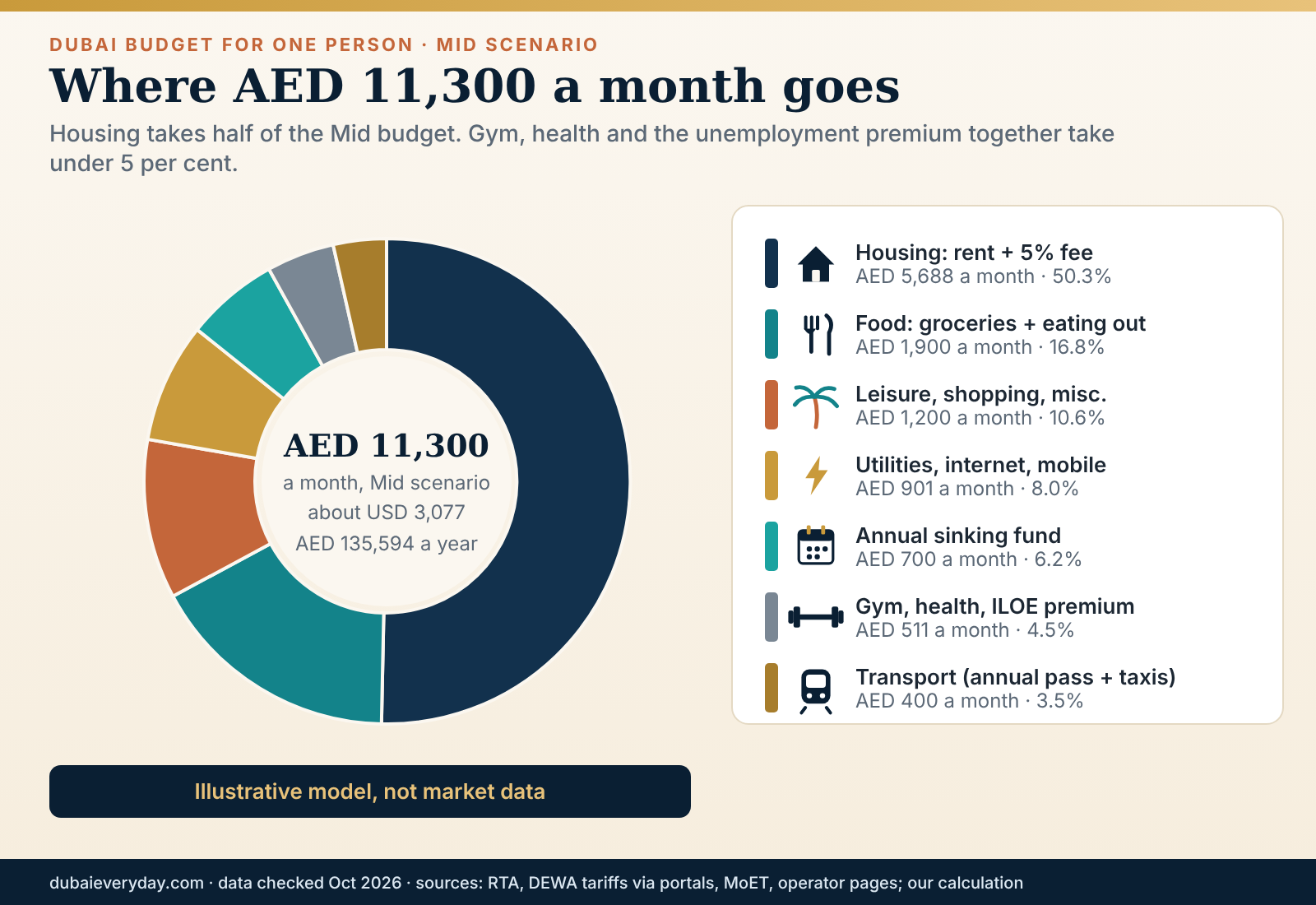
Gym, health co-pays and the unemployment premium are the lines that budgeting advice loves to fuss over and that barely move the total. A AED 356 membership is 3.2 per cent of the Mid budget. A AED 10,000 difference in annual rent is worth AED 875 a month once the 5 per cent fee is added, which is more than twice the whole gym line. We return to this comparison in the section on levers.
What the table cannot tell you
It cannot tell you your income. A Dubai budget single person plan is a cost, and whether it is affordable depends on take-home pay, which depends on how your package splits between basic salary and allowances. Dubai has no personal income tax, as the UAE government’s taxation page states, so gross and net are usually close, but deductions still exist, and your offer letter decides them. The savings section turns each total into a pay figure.
It also cannot tell you the cash you need on day one. The first month of a tenancy takes a large lump of money that is mostly refundable or one-off, and it never appears in a monthly average. The rent section shows that number for a AED 65,000 flat under five cheque schedules. If you are still weighing the move itself, the moving to Dubai guide covers visa, banking and first-month setup, and the relocation checklist sequences the tasks.
How to use the table in three steps
- Start from your lease or your target rent.Replace our rent line, then multiply by 1.05 to include the municipality housing fee. That is your housing cost per year, divided by twelve.
- Swap in any quote you already hold.Internet contract, gym agreement, car insurance, employer health cover. Delete a line entirely if your employer pays it.
- Divide the total by 0.8 for the pay you need.That gives the take-home that leaves a 20 per cent savings rate. Use 0.9 for 10 per cent or 0.7 for 30 per cent.
Our rule of thumb for newcomers who have an offer but no lease yet: run the Dubai budget single person model on the Mid column first, then see how far your pay is from it. If you are well above, use the Comfortable column’s rent and transport lines as upper bounds. If you are below, the Floor and Lean columns show which lines have room to give and which do not. Spoiler: the answer is nearly always rent and the car decision.
A quick sanity test. If your rent plus the 5 per cent fee is more than about half your take-home pay, the budget has almost no slack. Every scenario above lands close to that line, which is why a lease renewal at a higher rent is the single most disruptive event in a Dubai budget single person plan. The rent section shows how the renewal rules cap it.
Rent scenarios: the line that decides the budget
In every Dubai budget single person scenario above, rent plus the housing fee is the largest line, and it is the one you choose once a year rather than every month. That makes it both the most powerful lever and the one with the messiest data. Before comparing any two numbers in a Dubai budget single person plan, know which of three kinds you are looking at.
Three kinds of rent number
Asking rents are what landlords hope for in a listing. New-lease rents are what tenants have just agreed. Contract medians come from registered tenancies and blend new leases with renewals signed a year or two ago. A listing is a starting position, a median is a description of the past, and the number you will pay is whatever you negotiate. Quote a median to a landlord and they will answer with a listing, so bring comparable listings and recent contract evidence as well.
The most useful public anchor is the median on registered Ejari contracts, because it reflects what people actually signed. We could not reach a complete official table of medians by area and bedroom count, so the figures below come from two independent aggregators that say they work from Dubai Land Department data, plus a dated set of price bands. They disagree with each other, and we show both.
Five rent scenarios for a Dubai budget single person plan
These are the five annual rents used across the Dubai budget single person model. The first, second, third and fifth drive the four full budgets. The fourth, AED 90,000, is a stepping stone we use in the rent maths because a lot of single professionals land between Mid and Comfortable. Monthly figures include the 5 per cent municipality housing fee. USD uses the 3.6725 peg.
AED 30,000 a year: Floor studio
AED 2,625 a month with the fee (about USD 715). DataHabibi’s studio median for International City over the twelve months to July 2026 is AED 30,000. Savills’ Q3 2026 data, reported by Khaleej Times, showed International City rents almost flat year on year (down 0.4 per cent), so this tier has not softened the way towers have. Expect an older building, longer commutes and fewer amenities.
AED 40,000 a year: Lean studio
AED 3,500 a month with the fee (about USD 953). DataHabibi puts the Dubai Silicon Oasis studio median at AED 40,000 and Discovery Gardens at AED 41,000. The citywide studio median is AED 41,000 (houserent.ae, June 2026 data) or AED 44,100 (DataHabibi), so this is a mainstream studio, not a bargain one.
AED 65,000 a year: Mid one-bedroom
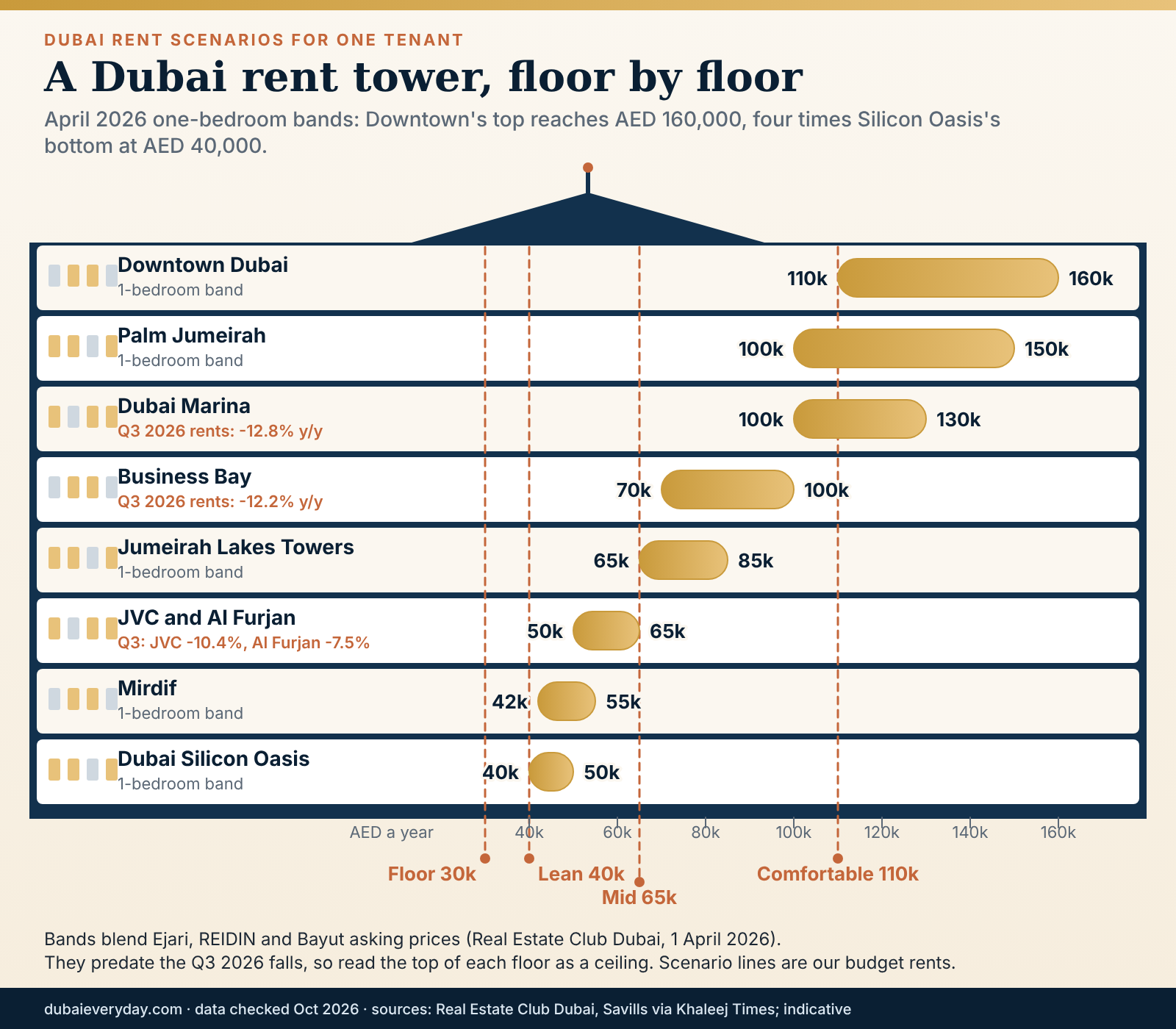
AED 5,688 a month with the fee (about USD 1,549). The two aggregators put the citywide one-bedroom median at AED 57,000 and AED 68,000, so 65,000 sits inside the disagreement. An April 2026 band had Jumeirah Village Circle and Al Furjan at AED 50,000 to 65,000, before Q3 falls of 10.4 and 7.5 per cent.
AED 90,000 a year: Upper-mid one-bedroom
AED 7,875 a month with the fee (about USD 2,144). Real Estate Club Dubai’s April 2026 band for Business Bay one-bedrooms was AED 70,000 to 100,000 and for Jumeirah Lakes Towers AED 65,000 to 85,000. Business Bay rents fell 12.2 per cent year on year in Q3, so this is a ceiling to negotiate down from.
AED 110,000 a year: Comfortable tower
AED 9,625 a month with the fee (about USD 2,621). The same April band had Dubai Marina one-bedrooms at AED 100,000 to 130,000 and Downtown Dubai at AED 110,000 to 160,000. Marina rents fell 12.8 per cent year on year in Q3, so a unit in the lower half of the range is a realistic target.
Two cautions for your Dubai budget single person numbers. The April bands blend Ejari registrations, REIDIN data and Bayut asking prices, per the publisher, and they predate the third-quarter falls. Our reading: treat them as ceilings, not midpoints. And a studio and a one-bedroom are not interchangeable units. The studio medians above and the one-bedroom bands come from different tables, so compare within a unit type.
What the contract data says about neighbourhood
DataHabibi’s studio medians by community show how much the address matters inside one unit type. International City AED 30,000. Dubai Production City AED 36,000. Dubai Silicon Oasis AED 40,000. Discovery Gardens AED 41,000. Jumeirah Village Circle AED 50,000. Jumeirah Lakes Towers AED 60,000. Business Bay AED 70,000. The same type of unit costs 2.3 times as much at the top of that list as at the bottom.
If you are choosing between two or three districts for your Dubai budget single person plan, the area guides carry the daily-life trade-offs the rent number hides. The Dubai Marina guide covers apartments, tram and beach access, and the Downtown Dubai guide covers what the premium buys. For the building-level questions (chillers, parking, amenities), see the apartment renting guide.
Which way are rents moving?
Sources agree on direction and disagree on size. Savills’ Q3 2026 apartment data, reported by Khaleej Times, shows year-on-year falls of 12.8 per cent in Dubai Marina, 12.2 per cent in Business Bay, 10.4 per cent in Jumeirah Village Circle, 7.5 per cent in Al Furjan and 7.3 per cent in DIFC, with International City almost flat. The same report counted 181,900 rental transactions in the quarter and described the market as rebalancing.
Other trackers cut it differently. Property Finder’s basket of ten communities, reported by Khaleej Times, showed median asking rent falling from about AED 135,000 in December 2025 to AED 100,000 in June 2026, then edging back to AED 105,000 in September. Enquiries per listing were reported down 23 per cent while listings rose 55 per cent year on year.
For a tenant, that means more choice and more leverage than a year ago, mostly in towers built in volume. It does not mean every district is cheaper, and it does not mean the fall continues. Dubai’s consumer price index still shows housing and utilities up 6.7 per cent year on year in August, because the index follows every lease in force, including old renewals. In your Dubai budget single person plan, assume flat-to-slightly-lower apartment rents over the next twelve months, and do not extrapolate a double-digit fall into your budget.
Why we do not print an area league table. The Dubai Land Department publishes rental data, but we could not open a complete official table by area and bedroom count today. Instead of building a ranking from a patchwork of broker pages, we show the two contract-based medians, one dated set of bands and the Q3 direction of travel. Use them to bracket a search, then check live listings and ask an agent for recent contracts on comparable units.
The rent line is more than the rent
Whatever rent you choose for your Dubai budget single person plan, four extra items attach to it. A municipality housing fee of 5 per cent of annual rent is charged to expatriate tenants and collected through the DEWA bill in twelve instalments, according to Bayut’s explainer (updated September 2026) and Property Finder’s DEWA guide. On a AED 65,000 lease that is AED 3,250 a year, or AED 271 a month, and it appears on the utility bill, not in the lease. Sources differ on edge cases, so check your first bill.
A security deposit is customarily 5 per cent of annual rent for unfurnished homes and 10 per cent for furnished ones. Agent commission is customarily 5 per cent with a minimum of about AED 5,000, per Gulf News’ list of extra moving costs (updated 22 October 2026). Both are market practice that can be negotiated, not statutory rates. Ejari registration of the tenancy costs AED 177.75 online or AED 220 at a trustee centre, according to the Dubai Land Department.
The fourth is the DEWA connection: a refundable deposit of AED 2,000 for an apartment (AED 4,000 for a villa) plus activation fees of about AED 130, as Gulf News and Bayut report citing DEWA. We could not open DEWA’s own pages, so confirm. The DEWA move-in guide explains the sequence and the renting in Dubai guide covers contracts and Ejari.
Day-one cash: cheques, deposits and the first month
A monthly Dubai budget single person total hides the biggest cash demand a tenant meets. At signing you pay the first rent cheque or cheques, a deposit, the agent’s commission, the Ejari fee and the DEWA deposit with activation. Most of that is a one-off, some is refundable, none of it appears in a monthly average. How many cheques you negotiate changes the number dramatically.
The table below shows our Dubai budget single person calculation for three flats. Fixed items are a 5 per cent deposit, commission at the customary 5 per cent with a AED 5,000 floor, Ejari at AED 177.75, a AED 2,000 DEWA deposit and about AED 130 in activation. That fixed block is AED 8,808 for the AED 30,000 flat, AED 9,308 for AED 40,000 and AED 10,558 for AED 65,000. The rest is the first cheque. Movers, cleaning and furniture are extra.
| Cheques on the lease | AED 30,000 flat | AED 40,000 flat | AED 65,000 flat |
|---|---|---|---|
| 1 cheque | 38,808 | 49,308 | 75,558 |
| 2 cheques | 23,808 | 29,308 | 43,058 |
| 4 cheques | 16,308 | 19,308 | 26,808 |
| 6 cheques | 13,808 | 15,974 | 21,391 |
| 12 cheques | 11,308 | 12,641 | 15,974 |
Going from one cheque to twelve cuts the day-one cash on the AED 65,000 flat by 79 per cent. That is why a newcomer without a UAE credit history often wants more cheques, and why landlords sometimes price them. Cheque count is negotiated, not a right, and rules differ by landlord and building, so ask early and get the schedule in the contract.
Suppose a landlord asks AED 63,000 for one cheque or AED 65,000 for four. The extra AED 2,000 buys you the use of up to AED 46,750 for part of the year. By our calculation, with the freed balance shrinking as each cheque falls due, that is an implied cost of roughly 9 per cent a year on the average balance. Whether that is a fair price depends on what else you could do with the cash. It is worth knowing the number before you accept or decline.
Fewer, larger cheques are not free money either. A cheque is a commitment, and a bounced one can cause real trouble with your bank and your landlord, so do not sign a schedule you might not fund. The tenant rights guide covers deposits, maintenance and dispute routes, and the resident legal basics page lists where to verify rules.
The refundable parts deserve a separate mental account. On a AED 65,000 flat the deposit (AED 3,250) and the DEWA deposit (AED 2,000) tie up AED 5,250. They come back, in principle, when the tenancy ends. A deposit dispute can take months, and the money earns nothing meanwhile. Treat refundables as a loan to your landlord and the utility, not as spending, and do not count them as cash you can reach.
The renewal rules that cap your increase
The most valuable fact in a Dubai budget single person plan is a rule, not a price. Under Decree No. 43 of 2013, a landlord’s increase at renewal depends on how far your rent sits below the average for similar units in the Real Estate Regulatory Agency’s rental index.
Rent up to 10 per cent below that average: no increase. From 11 to 20 per cent below: up to 5 per cent. From 21 to 30 per cent below: up to 10 per cent. From 31 to 40 per cent below: up to 15 per cent. More than 40 per cent below: up to 20 per cent.
Illustrative example, not a quote: your one-bedroom costs AED 65,000. If the index average for it is AED 72,000, you are about 10 per cent below and no increase is allowed. If the average is AED 80,000, you are 18.75 per cent below and the cap is 5 per cent, which means at most AED 68,250 (AED 285 more a month including the fee).
At an average of AED 90,000 you are 27.8 per cent below, the cap is 10 per cent and the ceiling is AED 71,500 (AED 569 more a month). At AED 110,000 you are 40.9 per cent below, the cap is 20 per cent and the ceiling is AED 78,000.
The Dubai Land Department runs a rental index service for this. Its page, read today, says you enter the contract’s expiry date, the property type, the region, the number of rooms and the current annual rent, and the service returns the rental increase and the average rent for the area. It is available through the Ejari system on the Land Department website, the Dubai REST app and the Dubai Now app. The page states no fee. Run it before you answer a renewal notice, not after.
Landlords are expected to give at least 90 days’ written notice of changed terms before a lease ends, a requirement quoted in Gulf News and Khaleej Times coverage of the rental index. The full legal route is in the tenant rights guide. Since January 2025 the Land Department has also run a Smart Rental Index that rates buildings on technical and location criteria. Its announcement does not say where a tenant can look up a rating, so ask the landlord to show the calculation.
Stay or move: the Dubai budget single person break-even
Moving has a price in every Dubai budget single person plan. Our calculation for a AED 65,000 flat: agency commission of AED 5,000 (the customary 5 per cent with a AED 5,000 floor), movers at AED 1,000 to 1,500 for a one-bedroom, Ejari at AED 177.75, DEWA activation of about AED 130, and a deep clean at AED 200 to 600. Total: AED 6,508 to 7,408. Deposits are extra and refundable.
So a rent cut only pays if it beats about AED 6,500 to 7,400 in year one, before your time and the hassle. If a comparable flat is AED 10,000 cheaper, move. If it is AED 4,000 cheaper, negotiate harder where you are. The move cost is nearly fixed in dirhams, which creates a quirk that most budgeting advice misses: it is a much bigger share of a cheap lease.
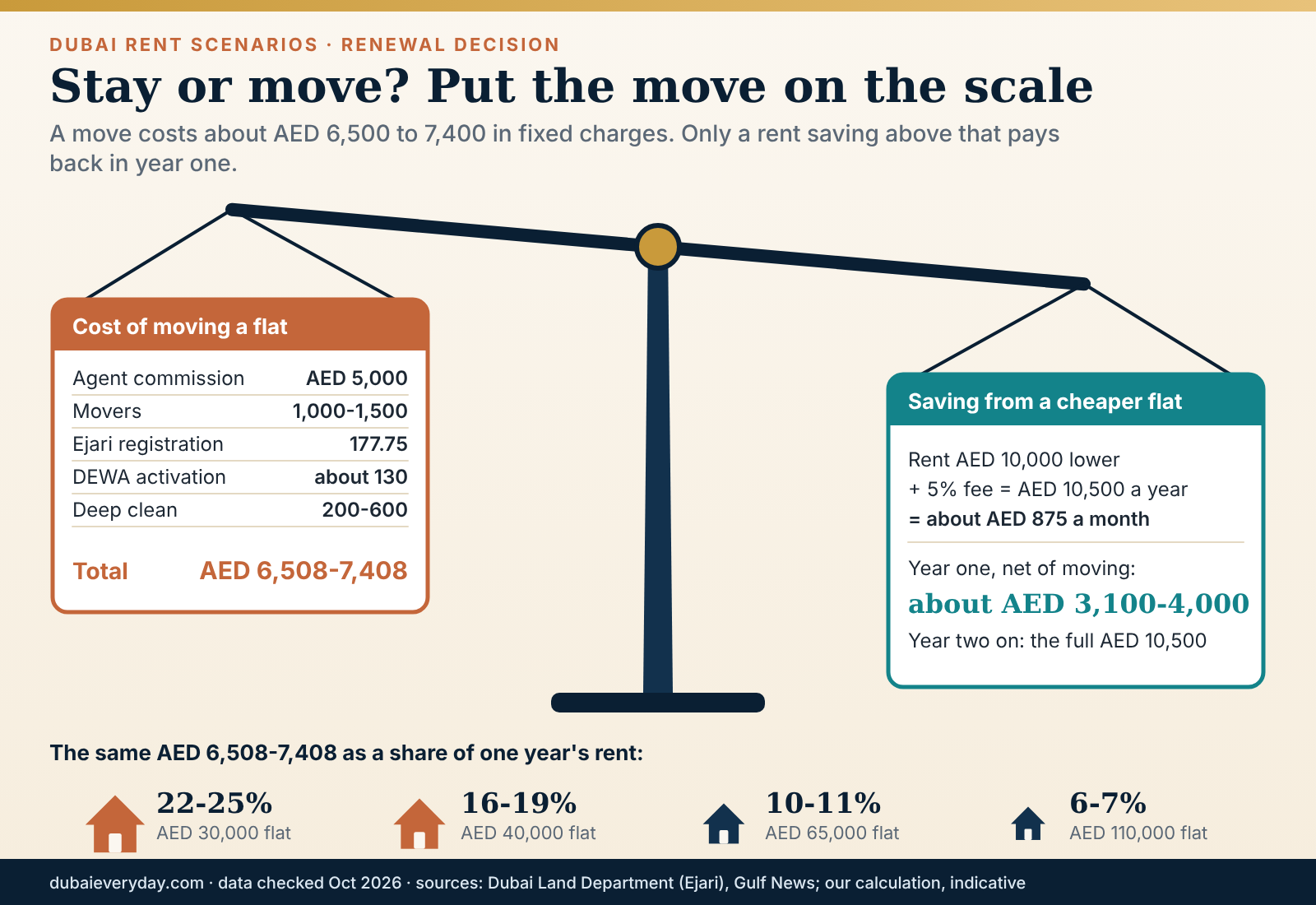
On the AED 30,000 flat the same AED 6,508 to 7,408 is 22 to 25 per cent of a year’s rent. On AED 40,000 it is 16 to 19 per cent, on AED 65,000 it is 10 to 11 per cent, and on AED 110,000 (with commission at 5 per cent, AED 5,500) it is 6 to 7 per cent.
The commission floor does the damage. Our reading: the cheapest flats are the most expensive to leave, so a Floor or Lean tenant should treat a first lease as a multi-year decision and negotiate for stability at renewal rather than hopping for AED 3,000.
A practical order of play at renewal: run the rental index, gather three comparable listings or recent contracts, then ask for a flat renewal and cite the market. In a year when apartment rents are falling in several districts, that is a normal request, not a cheeky one.
If the landlord refuses and the cap lets them raise rent, compare the new figure with the move break-even above, not with your feelings about the building. Investors reading the same data from the owner’s side will find it in the Dubai rental yield guide.
Shared rooms and the lean end of the market
The cheapest rents in any city are rooms and partitioned units. Dubai changed the rules this year. Law No. 4 of 2026 on shared housing was announced by the Dubai Media Office on 11 March 2026 and, as Gulf News reported, took effect on 26 August 2026. It restricts who may let shared accommodation and bars tenants from subletting. Fines run from AED 500 up to AED 500,000 and double for repeat breaches.
We found no verified, dated source for room rents, so we print none. What we can say is how to test an offer. Ask for the permit before you pay anything. Ask who is on the Ejari, who holds the DEWA account and who is liable if the household is fined.
A bed-space whose cost depends on the landlord ignoring a law that carries fines of this size is not a budget line, it is a risk you are holding on someone else’s behalf. A registered studio is a different product from a cheap room, which is why the Dubai budget single person Floor scenario prices a lease, not a bed.
When your employer pays for housing
Some packages include a housing allowance or accommodation. Three effects follow. Your rent line becomes zero or partly covered, the 5 per cent housing fee is a separate charge that you should ask your employer about, and the allowance may count differently in other calculations. End-of-service gratuity, for example, is based on basic salary only, not on allowances, as the UAE government’s page states. Ask HR which part of your pay is basic before you decide how much of an allowance to take as cash.
If the allowance is a lump sum rather than a lease paid by the company, your Dubai budget single person plan works as above, with the allowance reducing the pay you need rather than the cost you face. A AED 4,000 monthly housing allowance covers the Lean flat’s rent and fee (AED 3,500) with AED 500 to spare, and it covers about 70 per cent of the Mid flat’s AED 5,688.
Utilities, internet and mobile for one person
After rent, the fixed bills in a Dubai budget single person plan are small but not trivial. For the four scenarios, electricity, water, cooling, internet and mobile together come to AED 536 (Floor), AED 646 (Lean), AED 901 (Mid) and AED 1,413 (Comfortable) a month. The spread is far narrower than rent, which is why chasing a cheaper internet plan will never rescue a Dubai budget single person plan with a rent problem. It is still worth getting right, because these are the lines with contract traps.
DEWA: the tariff and what a season does to it
Residential electricity is billed in slabs: 23 fils per kWh for the first 2,000 kWh a month, 28 fils for 2,001 to 4,000, 32 fils for 4,001 to 6,000 and 38 fils above that. A fuel surcharge of 6 fils per kWh is added. Water for residents is AED 7.70 per cubic metre up to 27 m³, AED 8.80 up to 54 m³ and AED 10.12 above. VAT of 5 per cent applies, with small meter and other charges on top.
Our sourcing note: DEWA’s own tariff pages did not load for our research team, so the slab figures come from two property portals (Property Finder and Dubizzle) that agree to the fil. Confirm in DEWA’s calculator before treating them as final. The usage figures below are our assumptions, not meter data.
A single person in a flat rarely leaves the cheapest slab, so the bill scales almost linearly with usage. What changes it is cooling. Our calculation for a one-bedroom: a cool-month bill at 400 kWh and 9 m³ comes to about AED 195. A shoulder-month bill at 850 kWh and 12 m³ is about AED 356. A summer bill at 1,100 kWh and 14 m³ is about AED 448. Add roughly AED 30 for meter and sundry charges and the three become about AED 225, AED 385 and AED 478.
The Mid Dubai budget single person scenario carries AED 385, the shoulder figure, as an annual average. In a mild winter month you will be about AED 160 under it, and in a hot August about AED 90 over. For a studio, the same method gives about AED 178 in a mild month, AED 260 at average use and AED 317 in a hot one, which is why the Floor and Lean scenarios use AED 260.
District cooling: the bill that is not on DEWA
Many towers in the Marina, JBR, JLT, Business Bay and DIFC use district cooling, billed by a provider such as Empower, not by DEWA. A June 2026 broker explainer gives Empower’s tariff as AED 0.568 per refrigeration-ton hour plus a capacity charge of AED 750 per ton a year, billed monthly, with a refundable deposit of AED 2,000 for an apartment. It models a one-bedroom at roughly AED 5,500 to 6,500 a year, or AED 458 to 542 a month.
That is secondary data built from published rates and stated assumptions, so treat it as a planning range and ask the building for the real tariff. The Comfortable scenario carries AED 500 for cooling and just AED 185 for the DEWA bill, because the tower’s air conditioning is not on the DEWA meter. The decision rule is simple: a district-cooled one-bedroom with rent AED 6,000 lower than a chiller-free alternative is a wash, not a saving. The home setup guide covers cooling, internet and gas sign-ups in order.
Home internet: price the contract, not the speed
The four Dubai budget single person scenarios use four plans. Floor uses a 5G home plan: e&’s Home Wireless Advance was listed at AED 206 a month before VAT (shown as reduced from AED 229) on a 12-month commitment, with a promotional discount for the first three months and a connection locked to your home address. With VAT that is AED 216. Check whether AED 206 is the promotional price before you budget it for twelve months.
Lean, Mid and Comfortable use fibre plans at AED 286, AED 366 and AED 478 a month including VAT. Those come from a broker’s compilation of du’s 1 Gbps home plans (AED 272, 349 and 455 before VAT), last updated 21 September 2026, because du’s own pages were closed to our research tools. The broker lists 24-month contracts. e&’s Neo 1 Gbps plan was listed at AED 399 before VAT on a 12-month commitment, with a 20 per cent online offer for three months.
The trap is the term. A 24-month plan on a 12-month lease leaves a tail you must either move or pay out. The broker notes early cancellation fees may apply, and that moving a connection costs AED 100 (du) or AED 150 (e&). If you are on your first lease, a 12-month commitment that matches the lease is worth a small premium. The home internet guide compares du and e&, building availability and installation.
Mobile: a smaller line with a wide range
e&’s home page shows postpaid plans starting from AED 100 a month and prepaid from AED 30, and its prepaid page lists a SIM at AED 40 with AED 40 of credit loaded. A broker guide from July 2026 puts entry postpaid plans at AED 100 to 150 a month and mid-tier at AED 200 to 350. Those are ranges from one non-official source and one operator’s headline prices. Our Dubai budget single person allowances are AED 60 (prepaid-style use), AED 100, AED 150 and AED 250.
Check the term and the exit fee before you sign a postpaid plan, and check whether your employer offers a corporate line. The internet and mobile guide covers eSIM, number portability and the apps you will need. For a short stay, a visitor line or prepaid bundle is the right product, not a postpaid contract.
Food: groceries and eating out for one
Food is the part of a Dubai budget single person plan that you can measure with official data, and the part where habits matter more than prices. The four Dubai budget single person scenarios spend AED 800, AED 1,100, AED 1,900 and AED 3,400 a month on groceries and eating out together. Per day, that is about AED 27, AED 37, AED 63 and AED 113. Two people with the same salary can sit at opposite ends of that range without feeling they live differently.
What staples actually cost
The UAE Ministry of Economy and Tourism runs an Essential Goods Prices Platform that compares shelf prices of basic staples across thirteen retail outlets, including Carrefour, LuLu, Spinneys and Union Coop. It is the nearest thing to a neutral price list for a Dubai kitchen. The ministry’s August 2026 monitoring table gives average prices in AED: basmati rice 16.62 a kilo, fresh full-fat milk 9.46 a litre, yogurt 1.97 for 170 grams, a tray of 30 brown eggs 23.05, a whole chicken 22.97 a kilo and white sugar 8.75 a kilo.
Our calculation turns that into a one-adult monthly staples basket: 2 kilos of rice, a 2-kilo bag of flour, 8 litres of milk, one tray of eggs, 4 kilos of chicken, a 1.5-litre bottle of canola oil, a kilo of sugar and 20 yogurts. The total is AED 308.23. That is the floor, not the budget. It excludes vegetables, fruit, fish, red meat, snacks, cleaning products, coffee and everything branded or imported.
Why show a floor? Because it tells you what the rest of the grocery line is made of. In the Floor scenario the staples basket is 56 per cent of the AED 550 allowance. In Lean it is 44 per cent of AED 700, in Mid 31 per cent of AED 1,000 and in Comfortable 22 per cent of AED 1,400.
The remainder is produce, protein, household items and convenience, which is where your choices live. Our grocery allowances in the Dubai budget single person model are assumptions: the ministry does not publish a full-basket price.
Where you shop is the cheapest lever
The platform’s page, updated on 28 October 2026, lists the cheapest and most expensive listed price per unit in each category. Cooking oil ranged from AED 5.10 to 18.67. Rice from AED 4.20 to 16.00. Chicken from AED 11.31 to 21.33 a kilo. Sugar AED 2.35 to 5.25. Bread AED 4.98 to 9.17. Dairy AED 3.48 to 5.99. Eggs AED 0.23 to 0.75 each.
Read these carefully. The platform does not normalise for brand, pack size or product form, and the page itself shows some empty fields, so a 4x gap on rice compares a bulk store brand with a premium specialty rice. Our reading of the data: even after discounting that, the gap between outlets for similar staples is wide enough that where you shop matters more than which week you shop.
The platform lets you build a “My List” and compare totals, which is the right way to use it. A caution on press reports of the very lowest prices: Gulf News’ 23 October piece names cooperative outlets in Sharjah and Umm Al Quwain among the winners. Those bargains are not necessarily available to a Dubai resident without a drive. Check which outlets deliver to your community. For store-by-store positioning, the supermarket guide and the Carrefour guide go further.
Food is up, not flat. Dubai’s consumer price index showed food and beverages up 7.4 per cent year on year in August 2026, per EnterpriseAM’s report on official data. A grocery line in a Dubai budget single person plan copied from a 2024 blog is likely too low. Re-price your own basket quarterly, and remember that price platforms show averages, while your list includes items at the expensive end of each category.
Eating out: an allowance, not a measurement
There is no official restaurant price index we could find, so the eating-out lines are allowances. The only honest way to anchor them is arithmetic. If an inexpensive restaurant meal costs around AED 40 (a figure from a crowd-sourced database whose last update was October 2024, so an order of magnitude only), then AED 250 a month is about six meals, AED 400 is ten, AED 900 is about 22, one for each working day, and AED 2,000 is about 50 or a mix of cheap lunches and AED 150-plus dinners.
That is the most elastic line in a Dubai budget single person plan. A person can spend AED 400 or AED 4,000 a month and live roughly the same life with a different calendar. Delivery apps add fees and prices that vary by platform; we did not verify them, so if you order in often, track what you spend for a month before setting the line. People who do this often find the figure is two or three times what they assumed.
If you want to know what a good meal out costs before you set your allowance, the restaurant guide covers value positioning by cuisine and location, and the cafe guide does the same for the daily coffee and breakfast habit. The specialty coffee guide is worth a skim if one cup a day sounds harmless, because AED 25 a cup on 22 working days is AED 550 a month.
Transport: pass, taxi or car
Transport is where the city splits a single person’s budget into two economies. One runs on a Nol tap of AED 3 to 7.50. The other runs on fuel, tolls, parking and insurance. In our Dubai budget single person scenarios the gap is AED 200 for Floor against AED 1,200 for Comfortable, and the right choice depends on one question: how much of your life sits within walking distance of a station?
Metro, bus and tram: the fare maths
The RTA’s Nol fare table, read on 29 October 2026, gives Silver-card single trips at AED 3 within one zone, AED 5 across two adjacent zones and AED 7.50 across more than two. Up to three transfers within 180 minutes are allowed, and switching between metro and bus must happen within 30 minutes of checking out. The page mentions no daily cap. Passes for registered Silver cards run for 7, 30, 90 or 365 days; anonymous cards can only buy the 7-day pass.
Prices in AED, one zone / two zones / all zones: 7 days 50 / 80 / 110, 30 days 140 / 230 / 350, 90 days 330 / 550 / 830, and 365 days 1,060 / 1,770 / 2,670. Gold cards cost more per trip, and the Nol tickets and cards are covered in the Dubai Metro guide, which also explains stations, timings and tourist use.
Our calculation for a standard commute: 22 working days, 44 trips. Across two zones at AED 5 that is AED 220, and the 30-day two-zone pass costs AED 230, so the pass only wins if you make more than 46 trips. All-zone, 44 trips at AED 7.50 is AED 330 against a AED 350 pass, with a break-even near 47 trips. The 30-day pass is a convenience, not a discount, unless you ride well beyond work.
The annual pass is the real prize
A 365-day two-zone pass at AED 1,770 averages AED 147.50 a month. Twelve 30-day passes would cost AED 2,760, so the saving is AED 990 a year, or 36 per cent. Over 44 trips a month, you pay about AED 3.35 a trip, less than the AED 5 single fare. For all zones the annual pass is AED 2,670 against AED 4,200 for twelve 30-day passes, a saving of AED 1,530.
The catch is commitment. By our calculation the two-zone annual pass costs the same as a rolling 30-day pass if you stop using it after about 7.7 months, so it pays off only if your job and address stay stable for roughly eight months. You also need a registered card. A person who is on probation, or who might change jobs, can sensibly take the 30-day pass for the first few months and switch once the pattern holds.
That reasoning drives the transport line of the three non-car Dubai budget single person scenarios. Floor uses the annual pass plus about AED 50 of other rides, for AED 200. Lean uses a 30-day two-zone pass at AED 230 plus about AED 105 of occasional taxis, for AED 335. Mid uses the annual pass plus about AED 250 of taxi and ride-hailing for evenings and awkward trips, for AED 400. The Red Line guide and the Green Line guide show which districts sit on a line.
Taxi: sources disagree, so plan with a range
Taxi tariffs are the least reliable numbers on this page. Dubai Taxi’s FAQ lists a daytime base fare of AED 11 and says prices can be estimated in its app. Other pages of the operator quote AED 2.45 per kilometre with minimum fares of AED 12 for street hail and AED 13 for app bookings.
Press reports of the November 2025 tariff changes cite a street-hail flag-fall of about AED 5 by day and a per-kilometre rate near AED 2.14 to 2.33. The airport start fare at Dubai International is AED 25, per Dubai Airports.
For planning, our calculation for a 12 km city ride is AED 34 to 42 depending on which tariff and booking route applies, before Salik tolls. We use AED 35 as a working figure. A daily taxi commute of 44 rides at AED 35 is AED 1,540 a month, more than six times the AED 230 pass. Taxis are a tool for the awkward trip, not a commuting plan, and any Dubai budget single person plan that says otherwise is hiding something.
Car: what a month of driving costs
For a driver covering 1,200 km a month at 8 litres per 100 km (both our assumptions), the Dubai budget single person running-cost model has five parts. Fuel: 96 litres at the October Special 95 price of AED 4.28 is AED 411.
Tolls: Salik at AED 6.30 peak and AED 4.20 off-peak since 1 June 2026 (Gulf News), so 20 peak and 20 off-peak crossings cost AED 210. Parking: an allowance of AED 150, assuming free parking at work. Insurance: AED 230 a month. Maintenance: an allowance of AED 100. Total: AED 1,101, rounded to AED 1,200 in the Comfortable Dubai budget single person scenario to cover occasional taxis.
Fuel is repriced monthly. The UAE Fuel Price Committee set October 2026 prices at AED 4.40 for Super 98, AED 4.28 for Special 95, AED 4.21 for E-Plus 91 and AED 4.80 for diesel, against September’s 3.80, 3.69, 3.61 and 4.30, per Khaleej Times and Emirates 24|7. That is a 16 per cent rise for Special 95 in a month, worth about AED 57 on our 96 litres. November prices are normally announced at the very end of October, so today’s number is a snapshot.
Test the weak points. Parkin’s public tariff is AED 4 an hour in standard zones and AED 6 in premium zones, Monday to Saturday from 8am to 10pm, with free parking on Sundays and public holidays, per Emirates 24|7 (18 October 2026). Eight hours of on-street parking on 22 workdays at AED 4 is AED 704, nearly five times our AED 150 allowance. Insurance rests on a February 2026 broker guide: third-party AED 1,200 to 2,000 a year, comprehensive AED 2,000 to 3,500, depending heavily on driver age and claims history.
What the car figure leaves out. No purchase, finance, depreciation or registration. A car payment of AED 1,500 a month wipes out the apparent saving over taxis (AED 1,540 against AED 1,101 plus the payment) and makes the metro pass look like a rounding error. If you do not yet hold a UAE licence, the RTA’s fixed fees for an adult licence add up to about AED 670 and driving institute packages run from roughly AED 3,200 to 4,600, per one institute’s published figures. The driving licence guide and the licence exchange guide hold the detail.
A decision rule for the Dubai budget single person commute

Our decision rule, not an official guideline: if both your home and your workplace are within a 10 to 15 minute walk of a station, skip the car and buy the annual pass. If one end is not, price a month of taxis or ride-hailing, or a short rental, before buying a vehicle. The cheap car rental guide shows how deposits and extras change the headline daily rate, and the car rental comparison explains how to check licensed companies.
The point of the flow is that this one choice moves a Dubai budget single person total by AED 900 to 1,400 a month, much more than any grocery trick. It also interacts with rent. A flat AED 10,000 cheaper but 40 minutes from a station may force a car and cost more than it saves. A flat AED 8,000 dearer on a Metro line may let you sell the car. In a Dubai budget single person plan, add the transport line to the rent line before you compare any two addresses.
Gym and fitness: price the contract, not the poster
A gym is a small line in a Dubai budget single person plan, between 3 and 4 per cent of each scenario. It is also the line most likely to leak, because it comes with a contract, a joining fee you did not see on the advert and a card that expires. The companion guides on cheap gyms and the best gyms in Dubai do the full comparison. This section pulls out the prices and the contract logic that feed the budget.
Published monthly prices, as of 29 October 2026
For a Dubai budget single person plan, operator pages read by our research team on 29 October 2026 show the following. GymNation’s club pages list Core at AED 209 a month for one club, Plus at AED 240 for all its clubs, and Signature at AED 399 or AED 449 depending on the club. Its Dubai overview page advertises “from AED 99”, which does not match any club page, so use the club-page figure until a staff member writes the cheaper plan into an agreement.
Warehouse Gym’s join page shows four tiers on annual plans at monthly equivalents of AED 252 (Light, AED 3,025 for the year), AED 356 (Standard, AED 4,270), AED 430 (Premium, AED 5,155) and AED 734 (Premium+, AED 8,808). On monthly billing the same tiers are AED 363, 525, 630 and 840. The page does not say whether prices include VAT. Fitness First and Gold’s Gym did not publish membership prices on the pages we read, so ask for a written quote.
The Dubai budget single person scenarios use these as follows. Floor takes GymNation Core at AED 209. Lean takes Plus at AED 240, on the logic that a second branch near work or home is worth AED 31 a month. Mid takes the Warehouse Standard annual plan at AED 356. Comfortable takes the Premium+ annual plan at AED 734. They are not like-for-like products, because the tiers differ in clubs, extras and recovery services, but together they bracket what a single person pays.
The contract is the price
A gym that costs AED 209 a month and locks you in for twelve payments is a different product from one that costs AED 363 and lets you leave after three. Our simple formula: committed cost equals monthly fee times minimum payments, plus any joining fee, plus extras you must buy. Divide that by the months you will actually attend to get the price you really pay.

On Warehouse Gym’s published prices, an annual plan beats monthly billing after about 8.3 months for Light, 8.1 for Standard and 8.2 for Premium, and 10.5 for Premium+. Stay beyond that and the annual plan wins, by AED 1,331 on Light, AED 2,030 on Standard and AED 2,405 on Premium over a year. Leave before it and you have overpaid. Quit a Standard annual plan after four months and you have paid AED 1,067 for each month you used, against AED 525 on monthly billing.
GymNation’s terms, as published, make Core and Plus a twelve-month commitment with early exit allowed for listed reasons such as relocation, illness or redundancy, with proof. If you do not qualify, a four-month stay on Core costs AED 627 a month in effect. That is why the Floor scenario should be read with a caveat: its AED 209 is cheap only if you are certain you will be in Dubai, and in the same part of town, for a year.
Cost per visit is the honest comparison
In a Dubai budget single person plan, divide the fee by your realistic attendance. With 4.33 weeks in a month, one visit a week is about 4.3 sessions, two a week 8.7, three a week 13 and four a week 17.3. Our calculation, joining fee excluded:
- GymNation Core at AED 209: about AED 48, 24, 16 and 12 a visit at one, two, three and four visits a week.
- GymNation Plus at AED 240: about AED 55, 28, 19 and 14.
- Warehouse Standard on the annual plan at AED 356: about AED 82, 41, 27 and 21.
- Warehouse Premium+ on the annual plan at AED 734: about AED 170, 84, 56 and 42.
The useful comparison is not between plans but between your honest attendance and your imagined attendance. A plan that costs AED 16 a visit at three times a week costs AED 48 at once a week. Use last year’s pattern, not January’s resolution. If you rarely last past six weeks, the cheapest contract is the one that lets you leave, even at a higher monthly fee.
Small charges that make a cheap plan less cheap
GymNation lists a towel at AED 30 and a vending-machine padlock at AED 20, which takes a first month of Core to AED 259 before any joining fee. It also lists an admin fee of AED 200 for a late or failed payment, which is 96 per cent of a Core month.
The usual cause is not forgetfulness but an expired or replaced bank card, so put the card expiry date in your calendar the day you sign. Fitness First’s terms show a late fee of AED 50 plus tax after the 15th and a freeze fee of AED 47.50 plus tax a month.
Distance has a price too, and it belongs in a Dubai budget single person total. A gym AED 30 a month cheaper that needs twelve extra return Metro trips loses on price as soon as the return fare exceeds AED 2.50. At 13 visits a month and return fares of AED 6 to 15, the Metro adds AED 78 to 195 on top of the fee, taking Core to roughly AED 287 to 404. The fare table in the transport section shows which return fare applies to you.
Free and seasonal options
The Dubai Fitness Challenge runs from 31 October to 29 November 2026 with free registration, per the official site and cross-checked in Gulf News and Emirates 24|7. Gulf News reports three free Fitness Villages and more than 23 community fitness hubs for the period. In the cool months, public beaches, parks and promenades carry a free routine; see the public beaches guide and the free things to do guide for places to start.
Studio fitness is a different price tier. Reformer Pilates, padel and boutique classes are priced per class or per package and sit in the leisure line, not the gym line. The reformer Pilates guide and the sports guide explain how packages work, and we did not verify a price to put in this budget.
Insurance and health costs for one person
In a Dubai budget single person plan for a salaried employee, insurance is mostly someone else’s bill. That is the good news, and it is also why people stop reading the policy. This section is a YMYL topic, so a scope note first: it is general information drawn from regulators, press and broker pages, not individual insurance or medical advice, and a licensed adviser should check any policy before you buy or rely on it.
Who pays for your health cover
Under Dubai’s health insurance law, employers must provide health insurance for their employees, free zones included. The FAQ on the Dubai Health Authority’s insurance portal (ISAHD), as logged by our research team, says employers bear the full premium and may not deduct it from salary.
The legal floor is the Dubai Health Authority’s Essential Benefits Plan. Gulf News, updated in July 2026, gives the typical premium for that basic plan as AED 550 to 650 a year. For a single person on an employer contract, health insurance is therefore close to zero in the monthly budget.
The Dubai government’s health insurance page, which we read today, says employers are responsible for providing cover and sponsors must extend it to dependants. It does not say who pays the premium or whether deductions are allowed, so we rely on the ISAHD portal’s FAQ for that. If your contract says you must contribute, ask HR to show you the legal basis in writing before you accept.
Our health line in the Dubai budget single person model, AED 80 to 350 a month, is therefore not the premium. It is an allowance for what the policy does not pay: co-pays, dental, pharmacy items and, in the Comfortable scenario, a personal top-up. The full structure of cover, networks and exclusions is in the health insurance guide for residents and the mandatory cover guide.
What the basic plan asks you to pay
The DHA’s Circular GC 03/2024 set updated benefits for the plan year starting 1 January 2025. As summarised in the companion health insurance guide, the headline limits are an annual aggregate of AED 150,000, basic cover within Dubai and emergency treatment anywhere in the UAE.
You pay about 20 per cent of most outpatient costs. Medicines carry 30 per cent coinsurance with an annual limit of AED 2,500. Inpatient coinsurance is capped at AED 500 per encounter and AED 1,000 a year. Basic dental is limited to AED 500 a year with 30 per cent coinsurance.
The federal government’s basic health insurance product, described on u.ae, is priced at AED 320 a year with a two-year policy and different cost-sharing: 25 per cent outpatient coinsurance capped at AED 100 a visit, and a medicine cap of AED 1,500. The two sets of figures disagree and neither source says which governs a Dubai employer’s policy. Ask HR or the broker to name the plan category and show you the Table of Benefits in writing. Do not guess from the card.
Illustrative example, not a quote or market fact. A visit is billed at AED 350 for the consultation, AED 280 for a lab panel and AED 120 for two prescriptions, AED 750 in total. Under the DHA floor you pay 20 per cent of the consultation (AED 70), 20 per cent of the lab work (AED 56) and 30 per cent of the medicines (AED 36).
Your share is AED 162 and the insurer pays AED 588. An allowance of AED 150 a month, AED 1,800 a year, covers about eleven visits of that kind, or fewer visits plus dental work beyond the AED 500 allowance.
Dental is the cost people most often learn about too late when they build a Dubai budget single person plan. A scale and polish may fit inside the AED 500 allowance, but a root canal and crown will not, and prostheses and orthodontics are excluded under the basic floor.
See the dentist guide for how clinics price treatment and what to verify. Counselling is also capped: outpatient mental health care is limited to AED 800 a year under the circular as summarised, which two sessions at AED 400 would use up. A Dubai budget single person plan should hold a reserve for both.
For choosing a hospital, an emergency route or a pharmacy, the Dubai healthcare guide goes further. None of those pages gives clinical advice, and neither does this one.
When you pay for cover yourself
The employer-pays assumption disappears if you run your own company, work freelance or take a contract that does not include cover. Then you buy a policy. The DHA’s circular sets an index rate band of AED 550 to AED 750 per member per year, plus VAT, for insurers’ pricing of the basic plan.
That is a regulatory guide for insurer filings, not a retail price list, so quotes can differ. A broker comparison updated on 9 October 2026 (PolicyBazaar) shows annual premiums of AED 725 to 5,945 for basic plans, AED 1,300 to 6,600 for semi-comprehensive and AED 3,000 to 12,000 for comprehensive.
Treat those as the shape of the market. The page mixes emirates in places and contains an internal inconsistency in its comprehensive range, which our research team noted. It also says renewals typically rise 5 to 10 per cent a year and that moving into an older age band can add 20 to 25 per cent. In the freelancer section below we use AED 250 a month as an illustrative planning figure, inside that range and well above the regulatory floor.
Unemployment insurance: the AED 5 premium
Most private-sector and federal employees in the UAE must subscribe to the unemployment insurance scheme known as ILOE. The premium is AED 5 a month for a basic salary under AED 16,000 and AED 10 above, plus VAT, according to the dubai.ae page and the scheme’s policy terms. The two pages differ on whether exactly AED 16,000 falls in the lower or higher category, so check yours. Our Floor, Lean and Mid Dubai budget single person scenarios use AED 5 and Comfortable uses AED 10.
The benefit is 60 per cent of your average basic salary over the preceding six months, for up to three months a claim, subject to caps of AED 10,000 or AED 20,000 a month depending on category. You need twelve months of continuous subscription before you can claim, and the scheme covers involuntary job loss only. Investors and establishment owners, domestic workers, people on temporary contracts and under-18s are excluded.
Illustrative example: with a basic salary of AED 8,000, 60 per cent is AED 4,800 a month, so a three-month claim is up to AED 14,400. That is useful, but it is not an emergency fund. It starts after a wait, pays a fraction of basic salary (not allowances) and ends after three months. The savings section treats it as one layer of a buffer, not the whole thing. The scheme’s penalties for not subscribing are reported in secondary sources at AED 400; confirm on the official site.
Car, contents and everything else
Car insurance is covered in the transport section: third-party cover is compulsory and ranges roughly AED 1,200 to 2,000 a year, comprehensive AED 2,000 to 3,500, per a February 2026 broker guide. Rules and pricing for motor insurance have moved in recent years, and press reports in 2025 and 2026 describe renewal premiums rising even without claims, so ask for a quote every year rather than auto-renewing.
Renters’ cover for your belongings is optional for most tenants, and we found no verified price, so the model leaves it out. Landlords or building management insure the structure, not your laptop, bike or wardrobe. If your inventory is valuable, ask a licensed insurer to price replacement cover.
Travel and life insurance prices are not published by any regulator we found, so we print none. For how to compare policies and check a broker is licensed, the Dubai insurance guide sets out the checks, including the Central Bank’s register and the free Sanadak complaints route, which asks you to contact the insurer first.
Savings in a Dubai budget single person plan: what is left and where it sits
Spending is half of a Dubai budget single person plan. The other half is what you keep, and most Dubai cost pages stop before they reach it. This section turns each of the four totals into a required take-home pay, shows how fast a buffer builds, and explains the savings mechanisms that exist by law in the UAE: gratuity, an optional savings scheme and unemployment insurance. It is general information, not financial advice. We name no savings product, promise no return and recommend no provider.
What take-home pay each budget needs
Dubai has no personal income tax, as the UAE government’s taxation page states, so your take-home pay is close to your contractual pay minus any deductions your employer applies. Our calculation: divide the monthly total by one minus the savings rate you want.
At a 20 per cent rate the monthly pay you need is AED 6,319 for Floor, AED 8,533 for Lean, AED 14,125 for Mid and AED 26,540 for Comfortable. At 10 per cent it is AED 5,617, 7,584, 12,556 and 23,591. At 30 per cent it is AED 7,221, 9,751, 16,143 and 30,331.
Floor
Costs AED 5,055. Take-home of AED 6,319 saves AED 1,264 a month (AED 15,165 a year) at a 20 per cent rate. Rent plus fee is 42 per cent of that pay.
Lean
Costs AED 6,826. Take-home of AED 8,533 saves AED 1,707 a month (AED 20,478 a year). Rent plus fee is 41 per cent of that pay.
Mid
Costs AED 11,300. Take-home of AED 14,125 saves AED 2,825 a month (AED 33,900 a year). Rent plus fee is 40 per cent of that pay.
Comfortable
Costs AED 21,232. Take-home of AED 26,540 saves AED 5,308 a month (AED 63,696 a year). Rent plus fee is 36 per cent of that pay.
These Dubai budget single person figures are arithmetic, not eligibility thresholds. No landlord, bank or visa rule requires them, and they ignore debt, remittances and employer-provided benefits. Still, one pattern deserves a pause. Many budgeting rules of thumb put rent near a third of income. At a 20 per cent savings rate, none of the four scenarios gets there: housing takes 36 to 42 per cent of pay. Either Dubai rent is heavy for a single person, or the other lines are lean, or you save less. Usually it is the third.
How long a buffer takes to build
Here is a useful piece of arithmetic that does not depend on your salary. Saving 20 per cent of take-home pay for twelve months builds exactly three months of living costs. At 10 per cent, a year builds about 1.3 months, so three months takes just over two years and six months takes four and a half.
At 30 per cent, a year builds about 5.1 months, so a three-month buffer takes seven months and a six-month buffer about fourteen. Our calculation: months of costs per year equals 12 times the rate divided by one minus the rate.
In dirhams, a three-month buffer in the Dubai budget single person model is AED 15,165 for Floor, AED 20,478 for Lean, AED 33,900 for Mid and AED 63,696 for Comfortable. Six months doubles each. Most advice for people in a stable job is somewhere in that range, though the right size depends on your contract, your visa link to the job and your dependants. Nobody can set it for you, and we do not.

Why a single expatriate’s buffer is different
In a Dubai budget single person plan, your job, your visa and your lease are usually linked, so losing one can start a clock on the others. That argues for a buffer on the larger side of the range, and for one that includes a flight home. It also argues for keeping the buffer somewhere you can reach quickly, which excludes deposits tied up in your lease. Remember the refundable AED 5,250 on a AED 65,000 flat: it is not cash you can reach in a month.
Unemployment insurance is a layer, not a substitute. As covered in the insurance section, ILOE pays 60 per cent of average basic salary for up to three months, after twelve months of subscription, and only for involuntary job loss. It starts later than most bills fall due and pays less than your costs. If your basic salary is a small part of your package, the benefit is smaller still, because allowances do not count.
End-of-service gratuity: a saving you cannot spend
The UAE government’s page on end-of-service benefits for private-sector employees, which we read today, sets the rules for full-time expatriate workers. You need at least one year of continuous service. Gratuity is 21 days of salary for each of the first five years and 30 days for each year after that. It cannot exceed two years’ wages, and it is based on basic salary only, not on allowances such as housing, transport or utilities.
Illustrative example, using a 30-day month as the daily-rate convention: with a basic salary of AED 8,000 the daily rate is AED 266.67, so each of the first five years adds AED 5,600. After three years that is AED 16,800 and after five years AED 28,000. With the same basic salary after seven years, add two years at 30 days (AED 8,000 each) for AED 44,000. Confirm the calculation basis with HR, because the contract and the labour law decide it.
Two lessons for a Dubai budget single person plan. First, gratuity depends on how your package is split, so a high allowance and a low basic salary looks good monthly and weak at exit. Second, it is paid when you leave, not when you need it, so do not count it as a liquid buffer. It is real money, and worth knowing about before a job change in your first year, because nothing is due below one year of continuous service.
The optional savings scheme
The same government page describes a voluntary alternative to traditional gratuity, launched by the Ministry of Human Resources and Emiratisation. Where an employer enrols its staff, it contributes 5.83 per cent of monthly basic salary into an approved investment fund if service is under five years, and 8.33 per cent if over.
Employees may add voluntary contributions of up to 25 per cent of their total monthly wage. Options include a capital-guarantee portfolio (which the page describes as meant for unskilled workers), risk-based portfolios and Sharia-compliant funds. The scheme is overseen by the Ministry and the Securities and Commodities Authority, and payout is due within 14 days of termination.
Our arithmetic shows the percentages are the gratuity entitlement expressed as a share of pay: 21 days a year over a 360-day year is 5.83 per cent, and 30 days is 8.33 per cent. On AED 8,000 of basic salary, 5.83 per cent is AED 466 a month, about AED 5,597 a year, almost exactly what the traditional method accrues. The difference is that the scheme is invested, so the outcome depends on the portfolio. The page notes that gratuity accrued before enrolment must be settled.
Do not guess here. If your employer offers the scheme, get the portfolio options, charges and exit terms in writing and compare them with the traditional gratuity. Investment risk is real in the risk-based and Sharia-compliant options, and we cannot tell you which suits you. A licensed adviser can. Treat anyone who promises guaranteed returns on dirhams as a red flag and check their licence first on the Central Bank’s register.
Sending money home without losing a slice
Remittances are outside our Dubai budget single person model, but many single expatriates send money regularly, so the cost deserves a paragraph. The true cost of a transfer is the visible fee plus the gap between the rate you get and the mid-market rate on the same day. Many people compare fees and ignore the margin.
Illustrative example, not a quote: you send AED 5,000. Provider A charges AED 15 and gives a rate 0.5 per cent below mid-market, so the total cost is AED 15 plus AED 25, or AED 40 (0.8 per cent). Provider B charges nothing but gives a rate 1.5 per cent below, costing AED 75 (1.5 per cent). The “free” transfer is nearly twice as expensive. Over twelve monthly transfers the difference is AED 420.
The Central Bank of the UAE licenses and supervises financial institutions, and its licensing page offers a searchable register that can be filtered by name, licence type or head office. A search returning “No Record” means the exact name or licence type needs rechecking, not necessarily that the firm is unlicensed, and an in-principle approval is not a final licence. Compare the total received amount on the same day and keep receipts.
The sinking fund line in a Dubai budget single person plan
The last line of each budget is the one most people leave out. It converts yearly costs into a monthly sum: AED 250 for Floor (AED 3,000 a year), AED 400 for Lean (AED 4,800), AED 700 for Mid (AED 8,400) and AED 1,500 for Comfortable (AED 18,000). The sums are allowances, because the biggest item is a flight home and we found no verified fare. Dubai’s August consumer price index showed passenger airfares up 23.2 per cent year on year, so a flight budget set last year is probably short.
The verified items inside it are small. The Federal Authority for Identity, Citizenship, Customs and Port Security lists an Emirates ID fee of AED 100 per year of residence plus a AED 100 service fee, so a two-year card is AED 300.
Visa and permit costs are normally an employer matter but not always, so confirm with HR. Insurance renewals, a phone or laptop replacement and gifts or travel for family make up the rest. Move the monthly sum into a separate account the day you are paid, and the invoice never feels like an emergency.
A year in the budget: seasons and annual bills
A monthly average is a convenient lie. Spending in a Dubai budget single person plan has a built-in seasonal swing that a flat monthly figure smooths away, and a handful of annual bills that arrive as lumps. Knowing the shape of the year does not change the total, but it changes whether the total hurts when it arrives.
The heat sets the shape
Wikipedia’s climate table, which cites Dubai’s meteorological office, puts mean daily maximum temperatures at 24.0 degrees Celsius in January and 25.0 in February, rising to 39.9 in June, 41.7 in July and 42.1 in August, then falling to 36.5 in October and 31.0 in November. That is a secondary source, but the shape is not in doubt: roughly five months of winter-like comfort, a long hot stretch and two shoulder periods.
Three lines in a Dubai budget single person plan follow that curve. Electricity does, as the DEWA section showed: our one-bedroom model runs from about AED 225 in a cool month to about AED 478 in a hot one. Leisure does, because the same weekends that cost nothing on a beach in January move indoors in July. And transport does, because a 12-minute walk to a station is a pleasure in winter and a decision in August, so the occasional taxi creeps up.
Illustrative example, not a measurement: a Dubai budget single person plan with AED 600 a month for leisure may spend about AED 300 in January and about AED 900 in July. Over a year the average holds, but if you save the January surplus you can pay the July deficit.
The free options in the free things to do guide carry the cool months, and the indoor activities guide prices the summer half. Big days (a desert safari, a brunch, a concert) are events, not months, and belong in the sinking fund. The events calendar guide shows how to track them.
Drift: prices are moving under you
Dubai’s consumer price index rose 5.54 per cent year on year in August 2026, according to EnterpriseAM’s report on official data, after a peak of 5.7 per cent in June. In that report transport was up 12.7 per cent (fuel and lubricants 31.3 per cent, airfares 23.2 per cent), housing and utilities up 6.7 per cent and food up 7.4 per cent. Emirates NBD Research lifted its year-end 2026 forecast to 5.6 per cent from 2.9 per cent and expects easing in 2027, which is a forecast, not a fact.
Our arithmetic for a Dubai budget single person plan: the Mid scenario’s non-rent spending is AED 5,612 a month. If those lines rose at the August pace for a year, they would add about AED 309 a month. Rent and the housing fee are locked by your lease until renewal, so the drift lands on everything else.
Build in a margin of a few per cent on the non-rent lines, and re-price your own groceries and fuel each quarter. A Dubai budget single person plan that does not drift with the economy will break in the second half of the year.
A calendar of money moments for your Dubai budget single person plan
Annual bills and renewal decisions follow a rough order. This sequence is our suggestion, built from the rules covered above, and not an official timetable.
- Four months before your lease endsRun the Land Department rental index with your expiry date, rent and area. Collect three comparable listings or recent contracts.
- Three months beforeLandlords are expected to give written notice of changed terms about 90 days ahead. Compare any new rent with the cap and with the move break-even of AED 6,500 to 7,400.
- Two months beforeDecide: renew at a negotiated figure or move. If moving, start the commission and cheque questions early, because they set your day-one cash.
- At your health policy renewalAsk your employer for the new Table of Benefits and the network list. Medicine and dental allowances reset with the policy year, not the calendar year.
- At your Nol pass and gym renewalsCheck whether your commute and your attendance justify another year. Annual plans pay off only if you stay beyond about eight months.
- At the end of each quarterRe-price groceries, fuel and your phone plan against the last three months. Move the sinking fund sum on pay day, not when you remember.
Travel is the biggest seasonal lump. If you plan to go home in the summer holidays, book against your sinking fund early and compare options in the Dubai airport guide, which covers terminals and transport at both ends of the trip. If you plan to host visitors, the Dubai travel guide and the best time to visit guide explain how prices and weather interact, which helps you ask them to come in January rather than August.
Founder, freelancer or contractor: what changes
Everything above assumes a salaried employee with an employer who pays for health cover and contributes to end-of-service gratuity. If you run your own company, work freelance or hold a contract that does not include those, four lines in the Dubai budget single person plan change and one new risk appears. This section is general information; the right structure for a business depends on facts we cannot see, and a licensed adviser should confirm it.
The four lines that move
Health cover becomes yours to buy. Our illustrative planning figure is AED 250 a month, AED 3,000 a year. It sits above the Dubai Health Authority’s index band of AED 550 to 750 per member per year for the basic plan (plus VAT), and well inside the broker ranges quoted earlier, so it is a reasonable middle estimate and not a quote. A wider network, dental and optical cover would raise it, and so would age.
Unemployment insurance may not apply. The dubai.ae page on the scheme lists investors and establishment owners among those excluded. If you are an owner, take the AED 5 line out, and do not assume the scheme will pay if the business stops paying you. Whether a freelancer on a particular permit must subscribe depends on the permit and contract type, so check the scheme’s own site before you assume either way.
Gratuity disappears. There is no employer accruing 21 days of basic pay for every year you stay. If you want the equivalent, you have to build it. A sensible reference point is the traditional entitlement: on a notional basic of AED 8,000 it accrues about AED 5,600 a year, or AED 467 a month. Whether you set that aside, and how, is your choice; the point is that the money is no longer automatic.
In a Dubai budget single person plan for the self-employed, the buffer gets bigger. With variable income, the three-month buffer that suits a stable salary looks thin. Our reading: a freelancer or founder whose income can fall to zero in a quarter should think in terms of six months of costs, or more, and treat unpredictable invoices as a reason to hold the cash, not spend it.
The Mid scenario for a self-employed person
Illustrative example, using our own assumptions. Start with the Mid Dubai budget single person total of AED 11,300. Remove the AED 5 unemployment premium. Add AED 250 for self-paid health cover. The monthly cost becomes AED 11,545. A six-month buffer is AED 69,270. The take-home that leaves a 20 per cent savings rate is AED 14,431 a month. If you also set aside AED 467 a month to stand in for gratuity, the cost line becomes AED 12,012 and the pay needed at a 20 per cent rate is AED 15,015.
That is a bigger number than the employee version, which is the quiet cost of independence. It is not an argument for or against it. Your invoices are not your take-home either: they carry business costs, VAT where you are registered, and in time corporate tax on profits, none of which is in this personal budget.
Keep the personal and the business apart
Mixing the two is the commonest self-employed money mistake. A personal Dubai budget single person plan needs a stable monthly amount from the business, paid to you on a schedule, not a raid on the company account whenever rent is due. Pay yourself a fixed monthly figure that matches the budget above, keep the buffer in a personal account, and let the business hold its own working capital.
The business side sits beyond this page. The business setup guide covers licences, free zones and ongoing costs, and the mainland company guide covers the mainland route in detail. For the money mechanics, the accounting services guide explains VAT and corporate tax, and the bookkeeping guide covers monthly records and bank reconciliation, which is how you find out what you can safely pay yourself.
If you are still job hunting. Price the budget before you choose between offers, not after. A package with housing and health included can beat a higher cash salary once you delete those lines. The jobs in Dubai guide covers search strategy and scam checks, and the work visa guide explains the employer-sponsored route that decides who pays for what.
Where the dirhams are: levers ranked
Budgeting advice treats every line as equally negotiable. It is not. Using the Mid Dubai budget single person scenario and the inputs from this page, here is what each lever is worth per month. Every figure is our arithmetic from the numbers already stated, and the order is by size, not by ease.
- Owning and running a car instead of using a pass: about AED 953Running costs of AED 1,101 against the annual pass at AED 147.50. This excludes purchase or finance, so the true gap is wider.
- A rent AED 10,000 a year lower: AED 875The figure includes the 5 per cent fee. The one-off move cost of AED 6,508 to 7,408 means the first-year net gain is about AED 3,100 to 4,000, and the full amount from year two.
- Ten fewer restaurant meals at about AED 40: about AED 400An illustrative figure that depends on your habit and local prices, but this is the largest lever that needs no paperwork.
- A 5G home plan instead of a fibre plan: about AED 150AED 366 against AED 216, where the building and the speed you need allow it, and with the term matched to your lease.
- An annual gym plan instead of monthly billing: AED 169On Warehouse Gym’s Standard tier, AED 525 against AED 356 a month, but only if you stay beyond about eight months.
- An annual Nol pass instead of rolling 30-day passes: AED 82.50The AED 990 a year saving, with the same stability condition.
- A cheaper mobile plan: about AED 50AED 150 to 100, plus whatever your employer’s corporate line saves.
Two things stand out. The top two items, a car and a rent level, are each worth roughly twice as much as the four smallest levers combined (about AED 450 a month). And the second-ranked lever, rent, is the only one that comes with a large one-off cost, the only one with a legal cap on its increase, and the only one you can reopen once a year. That is why we devoted so much of this page to it.
The sums also tell you where a Dubai budget single person plan should stop optimising. If you are about to spend an evening hunting for a AED 20 saving on a streaming plan while renewing a lease without checking the rental index, the arithmetic says you have your priorities upside down. In the Mid Dubai budget single person scenario, negotiating a 5 per cent cut on a AED 65,000 rent is worth AED 284 a month once the fee is included. Nothing on the grocery list comes close.
Ten mistakes that break a Dubai budget single person plan
These are the errors a Dubai budget single person plan is most likely to contain, and the arithmetic above is designed to prevent them. None needs an expert to avoid. Each is a fact you can check before you sign.
- Budgeting the advertised rentThe 5 per cent housing fee adds AED 3,250 a year to a AED 65,000 lease, and it arrives on your DEWA bill, not in the contract.
- Counting deposits as spendableAED 5,250 of refundable money on a AED 65,000 flat is not available for a month, and in a dispute it can be unavailable for much longer.
- Forgetting day-one cashThe first month of a AED 65,000 tenancy needs AED 26,808 on four cheques and AED 75,558 on one. Plan the number before you view flats.
- Matching a 24-month contract to a 12-month leaseThe internet or gym term outlives the tenancy, and the exit fee falls on you.
- Buying annual passes before the job and the address are settledThe annual Nol pass and annual gym plans pay off only after about eight months of use.
- Ignoring parking and tollsEight hours of on-street parking on 22 workdays at AED 4 costs AED 704 a month, nearly five times the allowance in a typical car budget.
- Trusting stale price databasesA crowd-sourced cost site our research team opened still showed petrol at AED 3.04 with a last update of October 2024. The real October 2026 price is AED 4.28.
- Assuming employer cover is completeUnder the basic plan, dental is capped at AED 500 a year and medicines at AED 2,500, with coinsurance inside both. Ask for the Table of Benefits.
- Treating gratuity and unemployment insurance as an emergency fundOne is paid on exit, the other pays 60 per cent of basic salary for up to three months after a twelve-month wait.
- Skipping the annual lineFlights are the biggest yearly cost, airfares were up 23.2 per cent year on year in August, and a budget without a sinking fund meets that rise as an emergency.
If you take only one habit from this list, make it a quarterly re-run. Open the table, replace each line with a recent real figure, and see whether the total moved by more than 5 per cent. If it did, find out which line caused it. Most of the time the answer is rent, the car or a contract that rolled over.
Who this page is not for
This Dubai budget single person page prices one adult. If you are moving with a partner or children, the arithmetic changes in ways a single-person model cannot capture: school fees, dependants’ health premiums, a second income, sponsorship rules and larger homes. The cost of living guide prices a family of four, and the Dubai with kids guide covers the logistics.
It is also not a visitor budget. If you are in Dubai for a few days, the relevant costs are hotels, attractions and transfers, covered in the first time in Dubai plan. It is not a property-buying model either: a mortgage, service charges and transfer fees replace rent, and the buying property guide sets out that route. And it is not advice on tax, investments or your obligations in your home country. For any of those, a licensed professional who knows your facts is the right source.
Finally, it is not a ranking of where to live. The areas named are examples of price bands, not recommendations. We have not lived in them, and we say so. Use the numbers to bracket your search, then check live listings, building rules and the commute for yourself.
Dubai budget single person: frequently asked questions
How much is a realistic Dubai budget single person plan per month?
Our four illustrative models run from AED 5,055 (a AED 30,000 studio, annual Nol pass, home cooking) through AED 6,826 (AED 40,000 studio) and AED 11,300 (AED 65,000 one-bedroom) to AED 21,232 (AED 110,000 tower with a car). Each includes a gym, the compulsory unemployment premium and an annual sinking fund. They are not market averages. Replace our rent with your actual lease, delete lines your employer pays, and the total becomes yours.
Is AED 10,000 a month enough for a Dubai budget single person?
It depends on rent. A take-home of AED 10,000 covers our Lean budget (AED 6,826) with about AED 3,200 left, a savings rate near 32 per cent. It falls about AED 1,300 short of the Mid budget (AED 11,300). A one-bedroom at AED 50,000 instead of AED 65,000 would close almost all of that gap, because the AED 15,000 difference is worth AED 1,313 a month with the housing fee. Illustrative arithmetic, not a guarantee.
Can one person live in Dubai on AED 5,000 a month?
Barely, and only with a narrow set of choices. Our Floor budget costs AED 5,055 a month, including a AED 250 annual fund and a AED 209 gym. It assumes a registered studio at AED 30,000, an annual Nol pass, home cooking and no car. There is nothing left to save, a rent rise would not fit, and cheaper options such as shared rooms now carry legal risk under Law No. 4 of 2026. Treat AED 5,000 as a floor, not a plan.
How much rent should a single person pay in Dubai?
There is no official rule. In our Dubai budget single person scenarios, rent plus the 5 per cent fee is 36 to 42 per cent of the take-home pay that leaves a 20 per cent savings rate, above the one-third rule of thumb often quoted elsewhere. Rent below about 40 per cent of take-home leaves room to save. Check your area’s average with the Dubai Land Department rental index, compare listings, and remember the move cost of AED 6,500 to 7,400 if you change flats.
Do I need a car in a Dubai budget single person plan?
Not if home and work are each within a 10 to 15 minute walk of a Metro station. In that case an annual Nol pass costs about AED 147.50 a month on the two-zone tariff, against about AED 1,101 a month to run a car before any purchase or finance cost. If either end is far from a station, price a month of taxis or a rental first. This is our decision rule, not an official guideline.
How much does a gym membership cost in Dubai?
Published prices read on 29 October 2026 range from AED 209 a month (GymNation Core, one club) to AED 734 a month (Warehouse Gym Premium+ on an annual plan, AED 8,808 up front). Fitness First and Gold’s Gym did not publish prices on the pages we read. The contract matters more than the fee: a twelve-month commitment at AED 209 costs AED 2,508 whether or not you attend. Get joining fees, term and exit rules in writing.
Do I have to pay for health insurance myself in Dubai?
If you are an employee, no. Dubai’s health insurance law makes the employer responsible for cover, and the Dubai Health Authority’s insurance portal says employers bear the full premium without deducting it from salary. You do pay co-pays and anything outside the plan, such as dental beyond the AED 500 basic allowance. If you are self-employed or an owner, you buy your own policy. Ask for the Table of Benefits in writing before you rely on any plan.
How much should I save in a Dubai budget single person plan?
Nobody can set that for you. As a reference point, saving 20 per cent of take-home pay builds three months of living costs in a year, and our Dubai budget single person scenarios imply savings of about AED 1,260 to 5,300 a month at that rate. A lower rate works if your costs are secure and you have no dependants, and a higher one if your income is variable. This is general information, not financial advice, and a licensed adviser can look at your whole position.
What cash do I need to start a tenancy?
On a AED 65,000 flat, our calculation is AED 75,558 on one cheque, AED 43,058 on two, AED 26,808 on four and AED 15,974 on twelve. That includes a 5 per cent deposit, commission at the customary 5 per cent with a AED 5,000 floor, Ejari at AED 177.75, a AED 2,000 DEWA deposit and about AED 130 in activation. Movers, cleaning and furniture are extra, and cheque count is negotiated, not guaranteed.
Is the 5 per cent municipality housing fee real, and who pays?
Bayut’s explainer (updated September 2026) and Property Finder’s DEWA guide say expatriate tenants pay a municipality housing fee of 5 per cent of annual rent, collected through the DEWA bill in twelve instalments. We could not open an official page, and sources differ on edge cases. Check the first bill and ask your landlord or employer who is responsible. On a AED 65,000 lease it is AED 3,250 a year, or AED 271 a month.
How much does food cost for one person in Dubai?
Our Dubai budget single person models use AED 800 (Floor) to AED 3,400 (Comfortable) a month for groceries and eating out together, which is roughly AED 27 to 113 a day. The Ministry of Economy and Tourism’s August 2026 staples basket for one adult comes to AED 308, the floor of the grocery line. Everything else is an allowance. Food prices were up 7.4 per cent year on year in August, so re-price your own basket every quarter.
How often should I update my Dubai budget single person plan?
Quarterly, and at every lease renewal. Fuel is repriced monthly, Dubai’s consumer price index was up 5.54 per cent year on year in August 2026, and rents are moving differently across districts. Run the Land Department rental index about four months before your lease ends, because the cap on your increase depends on how far your rent sits below the area average. Re-run the Dubai budget single person table whenever your pay, address or employer changes.
Related reading
Sources and further reading (36 links)
- Roads and Transport Authority: Nol fares — Silver single fares, pass prices, transfer rules (official)
- Dubai Land Department: Rental Index service — what the service asks for and returns (official)
- Dubai Land Department: register or renew an Ejari contract — Ejari fees AED 177.75 and AED 220 (official; carried from companion log)
- Dubai Legislation Portal: Decree No. 43 of 2013 on rent increases — renewal bands 0 to 20 per cent (official; carried from companion log)
- UAE Government Portal: end-of-service benefits, private sector — gratuity rules and the voluntary savings scheme (official)
- UAE Government Portal: taxation — no personal income tax, 5 per cent VAT (official; carried from companion log)
- Dubai Government: health insurance — employer and sponsor responsibility (official)
- Dubai Health Authority insurance portal (ISAHD): FAQ — employer pays full premium, no salary deduction (official; carried from companion log)
- UAE Government Portal: getting health insurance — federal basic product at AED 320 a year (official; carried from companion log)
- ILOE: policy terms and conditions — premium categories, benefit and waiting period (scheme operator; carried from companion log)
- Ministry of Economy and Tourism: Essential Goods Prices Platform — staples prices and outlet spreads (official; carried from companion log)
- Central Bank of the UAE: licensing register — how to check a financial institution (official; carried from companion log)
- Federal Authority for Identity, Citizenship, Customs and Port Security: Emirates ID — card fees (official; carried from companion log)
- Dubai Media Office: law regulating shared housing — Law No. 4 of 2026 announcement (official; carried from companion log)
- Khaleej Times: October 2026 fuel prices — Special 95 at AED 4.28 against 3.69 in September (press on official announcement)
- EnterpriseAM: Dubai inflation at 5.5 per cent — August 2026 consumer price index and forecast (press on official data)
- Khaleej Times: Savills Q3 2026 rent data — year-on-year rent changes by area (press on broker research)
- Khaleej Times: Property Finder rent and listings data — asking-rent trend, listings and enquiries (press on broker research)
- DataHabibi: studio apartments in Dubai — studio and one-bedroom medians by community (aggregator; context only)
- houserent.ae: average rent in Dubai 2026 — citywide medians (aggregator; context only)
- Real Estate Club Dubai: rent map 2026 — April 2026 one-bedroom bands (broker; context only)
- Gulf News: extra costs when renting in Dubai — commission, deposits, DEWA deposit, movers (press)
- Bayut: Dubai Municipality housing fee — 5 per cent of annual rent in twelve instalments (broker explainer)
- Property Finder: DEWA calculator guide — electricity slabs and water rates (broker; DEWA’s own page unreadable)
- Bayut: Dubai internet packages — du home plan prices before VAT (broker compilation)
- e&: Home Wireless — 5G home plan price and terms (operator page; carried from companion log)
- GymNation: gyms in Dubai — Dubai clubs and headline price (operator; carried from companion log)
- Warehouse Gym: join — tier prices by commitment (operator; carried from companion log)
- Fitness First UAE: terms and conditions — late-payment and freeze fees (operator; carried from companion log)
- Dubai Fitness Challenge: official site — 31 October to 29 November 2026, free registration (official; carried from companion log)
- Emirates 24|7: Parkin tariffs — AED 4 and AED 6 hourly rates (press)
- Gulf News: Salik and Parkin from 1 June 2026 — Salik AED 6.30 peak and AED 4.20 off-peak (press)
- Dubai Taxi: FAQs — base fare and app estimates (operator; sources disagree)
- Gulf News: does your employer have to pay for health insurance — basic plan premium AED 550 to 650 (press)
- PolicyBazaar UAE: cost of individual health insurance — premium ranges by plan tier (broker; context only)
- Wikipedia: Climate of Dubai — mean daily maxima citing Dubai’s meteorological office (secondary; context only)
Update log: 29 October 2026 — first publication; figures re-checked against the sources above where the pages would open, and others carried from companion research logs of the same date. Next review due: by 28 February 2027, or sooner if fuel prices, rent data, tariffs or regulations change. Corrections welcome. General information only, not financial, legal, tax or insurance advice; confirm any figure that affects a contract or a payment with the provider or a licensed professional.
About DubaiEveryday and this guide
DubaiEveryday.com is an independent editorial project that publishes practical, research-based guides to everyday life in Dubai: where to live, what things cost, how the rules work and how to get around. This page was written and edited by the DubaiEveryday editorial team. It is not signed by a named expert, doctor, lawyer or adviser, and we do not claim first-hand testing of a venue, clinic or service unless the page says so.
Each guide is built from official sources such as government and regulator pages, operator websites and established news outlets, cross-checked where we can. When we could not confirm something, we say so in the text, and examples that use made-up numbers are labelled as illustrations. Mentions are editorial choices, not paid placements, and a link is not an endorsement.
Dubai changes quickly. If you spot something that is out of date or wrong, please tell us through the contact options on DubaiEveryday.com and we will check it and correct the page.