

A monthly car rental Dubai contract trades the flexibility of a daily hire for a lower rate, a fixed kilometre allowance and a longer paper trail. This guide shows what the published terms say about rates, mileage, servicing, deposits and resident use, and how to work out your own total before you sign.
The monthly rate is the number every rental site wants you to see first, and it is rarely the number your card statement ends up showing. Behind it sit a kilometre cap, a card hold that can swallow half your credit limit, a toll account with its own handling fee and an insurance excess that waits for the first scratch. Dubai contracts are easy to sign and slower to unwind.
If you are a new arrival waiting for a licence, a visitor staying for a month or a commuter tired of taxi fares, a monthly car rental Dubai contract can be a sensible bridge. This guide goes through what the published terms actually say, builds a full monthly bill from the fees we could verify, and shows where residents get stopped by paperwork. It is research-based, so you get sourced terms and worked arithmetic, not stories from the driver’s seat.
A monthly car rental Dubai contract is one rent for roughly 30 days, a fixed kilometre allowance, a credit-card hold and a list of extras billed on top. Advertised monthly prices we checked on 29 October 2026 run from about AED 900 for a small car to about AED 2,800 for a mid-size SUV, but the figures cover different things, so they are not comparable until you know what is inside.
The terms to compare are the kilometre cap (published plans range from 2,400 to 5,000 km a month), the excess per extra kilometre (AED 0.30 to 1.00 in the terms we read), who services the car, the size of the card hold, and the toll and fine handling fees. Residents need a UAE driving licence for a monthly car rental Dubai booking and, at some firms, proof of a UAE address. Visitors on a visit visa use a recognised foreign licence or an International Driving Permit.
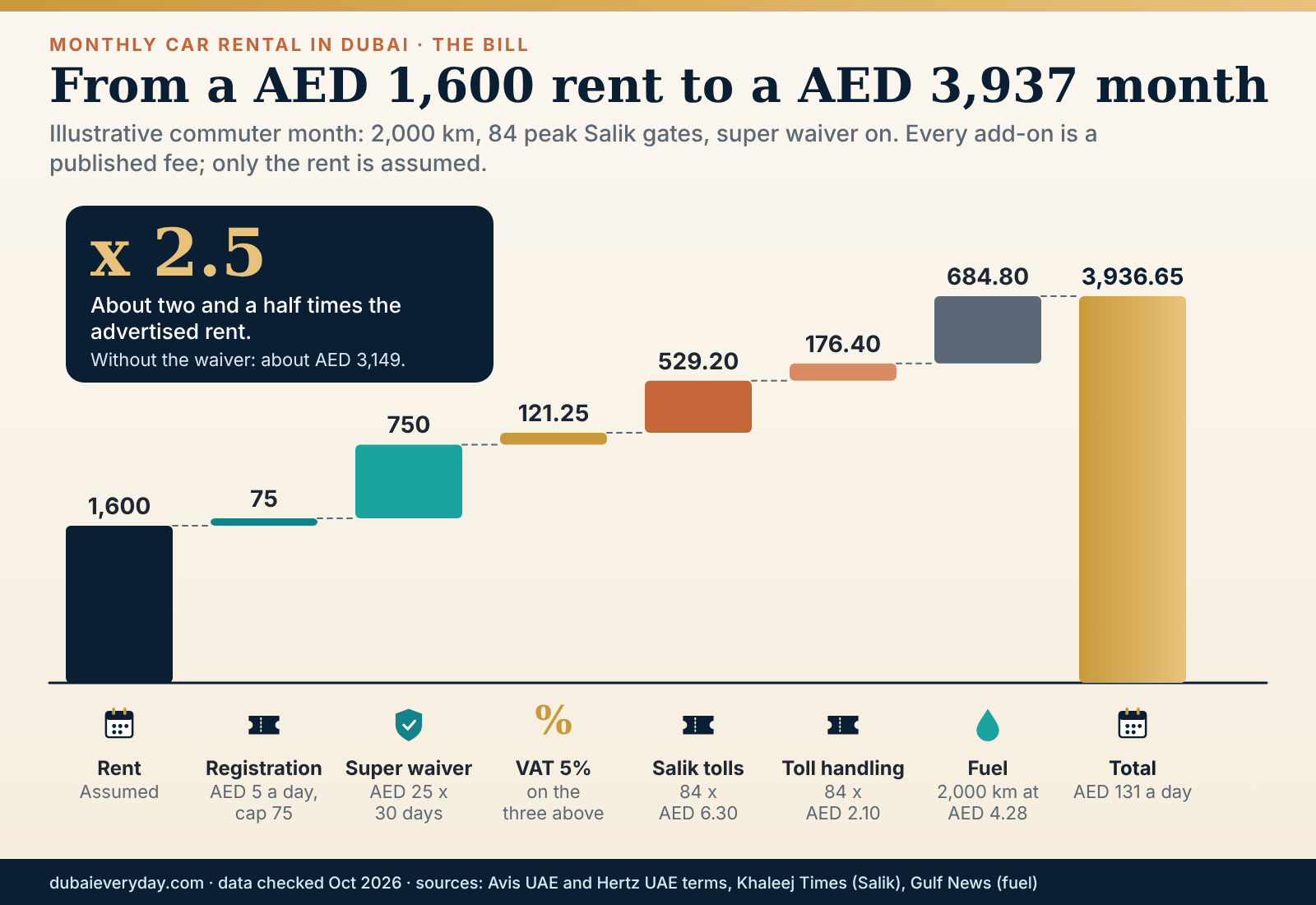
Our worked example for a commuter driving 2,000 km comes to about AED 3,900 a month once insurance cover, VAT, Salik and fuel are added to a AED 1,600 rent. That is an illustration, not a quote.
This is a desk-research guide to monthly car rental Dubai terms. Nobody on the DubaiEveryday team rented a car for it, and nothing here describes a personal experience behind the wheel. On 29 October 2026 we read the published terms of two international rental brands operating in the UAE (Hertz UAE and Avis UAE), pages from local operators and subscription platforms, reports in Gulf News, Khaleej Times and The National, and the RTA licence FAQ.
We did not mystery-shop quotes, we could not check any firm’s licence against a public register, and we did not test apps or checkout pages. Prices are advertised “from” figures, dated to the day we read them. Inclusion was not paid for, and no company is ranked here. Numbers labelled illustrative are our own arithmetic on stated assumptions. This is general information, not legal, insurance or financial advice. Confirm the contract in front of you.
What a monthly car rental Dubai contract actually is
Start with the label, because it hides four different products. A monthly car rental Dubai deal is a short-term hire, normally 28 to 30 days or more, from a company that holds the vehicle’s registration and insurance. You pay rent, the company keeps the car on the road, and you hand it back. A subscription is a similar monthly arrangement sold as a bundle with insurance and servicing. A lease is a longer commitment, usually 6, 12, 24 or 36 months. Buying is buying.
Adverts blur these lines. One Dubai operator’s monthly page sells rentals, subscriptions and a “micro lease” side by side, and its FAQ treats the micro lease as the plan that includes servicing. Another platform sells a monthly subscription with insurance and maintenance bundled in. So whenever a price appears under a heading like monthly car rental Dubai, read the small print for three things: what is included, how many kilometres are allowed and what the security is.
This page covers the contract most people mean when they search for monthly car rental Dubai options: a rental of a month or more, from a licensed Dubai company, for a person who lives in or is staying in the city. A few days’ hire is a different job, and the daily-rate maths is in our guide to cheap car rental in Dubai. Choosing between companies is covered in our guide to comparing licensed car rental companies, and pickup logistics at DXB sit in the Dubai airport car rental guide.
Who a monthly car rental Dubai plan suits
It suits people whose need is real but time-limited. New arrivals waiting for a UAE licence or a first salary are the textbook case. So are project staff here for two or three months, remote workers on a long visit, and households whose own car is in the workshop for weeks. The common thread is uncertainty: you do not know where you will live in six months, so you do not want to buy, register and insure a car yet.
It suits you less if your use is tiny. Someone who needs a car on three afternoons a week is paying for a month of availability and may do better on a daily plan, or with the Metro and the occasional taxi. The Dubai Metro guide has the fares and hours for that comparison, and the worked scenarios further down put numbers on it.
What a monthly rate is made of
Think of the rate on a monthly car rental Dubai offer as a discount for certainty. The company knows the car is out of its fleet for a month, so it quotes a lower daily equivalent and does less handling work. In return it limits your distance, holds more on your card and may leave some costs outside the rate. One operator’s blog claims monthly pricing is 15 to 20 percent below the daily rate. That is a marketing claim, not a measurement, so treat it as a direction.
The honest way to compare monthly car rental Dubai offers is to build the same bill for each one. The rest of this page supplies the pieces. The staircase below shows the shape of the bill we use throughout, with figures from the commuter example in the running-costs section.
Monthly car rental Dubai prices: what the advertised figures show
Nobody publishes an official average for monthly car rental Dubai prices. What exists is a set of advertised “from” prices, which change with the fleet, the season and the offer of the week. On 29 October 2026 we read the pages below. They show the spread, and they are not quotes you can book.
Operator price page
A Dubai rental and leasing company listed monthly prices from AED 899 for a Toyota Yaris and AED 1,099 for a Hyundai Accent, up to AED 2,299 for a Mazda CX-5 and AED 2,809 for a Ford Territory. It gave no kilometre allowance and described a zero-deposit option for some cars only.
Subscription platform
A subscription platform, in a post updated in August 2026, listed AED 1,190 for a 2022 MG 5, AED 1,288 for a 2024 Hyundai Grand i10 with 5,000 km, and AED 1,360 for a 2023 Kia Picanto, with insurance and maintenance in the single payment.
Trade-media guide
A YallaMotor consumer guide, updated 26 October 2026, quoted long-term rental from AED 1,170 for an economy car, AED 1,650 for a sedan or compact SUV and AED 2,100 for a mid-size SUV, with insurance, maintenance and registration included.
All three are commercial. The operator and the platform sell what they describe, and the guide is a motoring-site article, not independent price research. Older figures also circulate: a rental marketplace put an economy car at AED 1,800 for a full month in a guide updated in November 2025, against about AED 120 a day, and a 2024 Gulf News analysis gave a subscription range of AED 400 to AED 1,900. The top of the market is another league: one operator’s listing showed a Porsche Cayenne at AED 28,500 a month.
Why the same car carries two prices
Four things move the monthly figure more than the badge on the bonnet. The first is age: a 2022 model and a 2026 model of the same size are different products. The second is what is bundled. A rate with servicing, registration and basic insurance inside is not comparable with a bare rent that adds each later.
The third is the kilometre cap, since a 2,500 km plan and a 5,000 km plan are priced for different drivers. The fourth is commitment: a rate that needs three or six months upfront is cheaper per month than a true month-to-month rental.
Our reading of the three monthly car rental Dubai pages is that small and mid-size cars cluster between roughly AED 900 and AED 1,700 a month, and mid-size SUVs between roughly AED 2,100 and AED 2,800, as advertised. That is a reading of three adverts, not a market statistic, and it excludes premium brands. Use it to spot offers that look too good, not to anchor a negotiation.
Advertised price against total cost
An advertised monthly car rental Dubai price almost never equals your monthly cost. The terms we read add, at various companies, a registration or vehicle-licence fee (AED 5 a day capped at AED 75 a month at one brand, AED 2 a day at another), a super collision waiver, 5 percent VAT, Salik tolls with a handling fee, fine handling, fuel, and optional tyre and roadside packs. The next sections take them one at a time, and the running-costs section adds them into one worked bill.
Mileage caps: how far a month really goes
The kilometre allowance is the clause that most often turns a cheap-looking monthly car rental Dubai rate into an expensive one. Daily and weekly hires at several companies come with open mileage, and monthly contracts mostly do not. Hertz UAE’s terms say monthly rentals have a fixed allowance per month and put each extra kilometre at AED 0.30 to AED 0.50 depending on the car, leaving the allowance itself to the contract. Avis UAE publishes an excess range of AED 0.35 to AED 1 per kilometre and tells customers to confirm the allowance at booking.
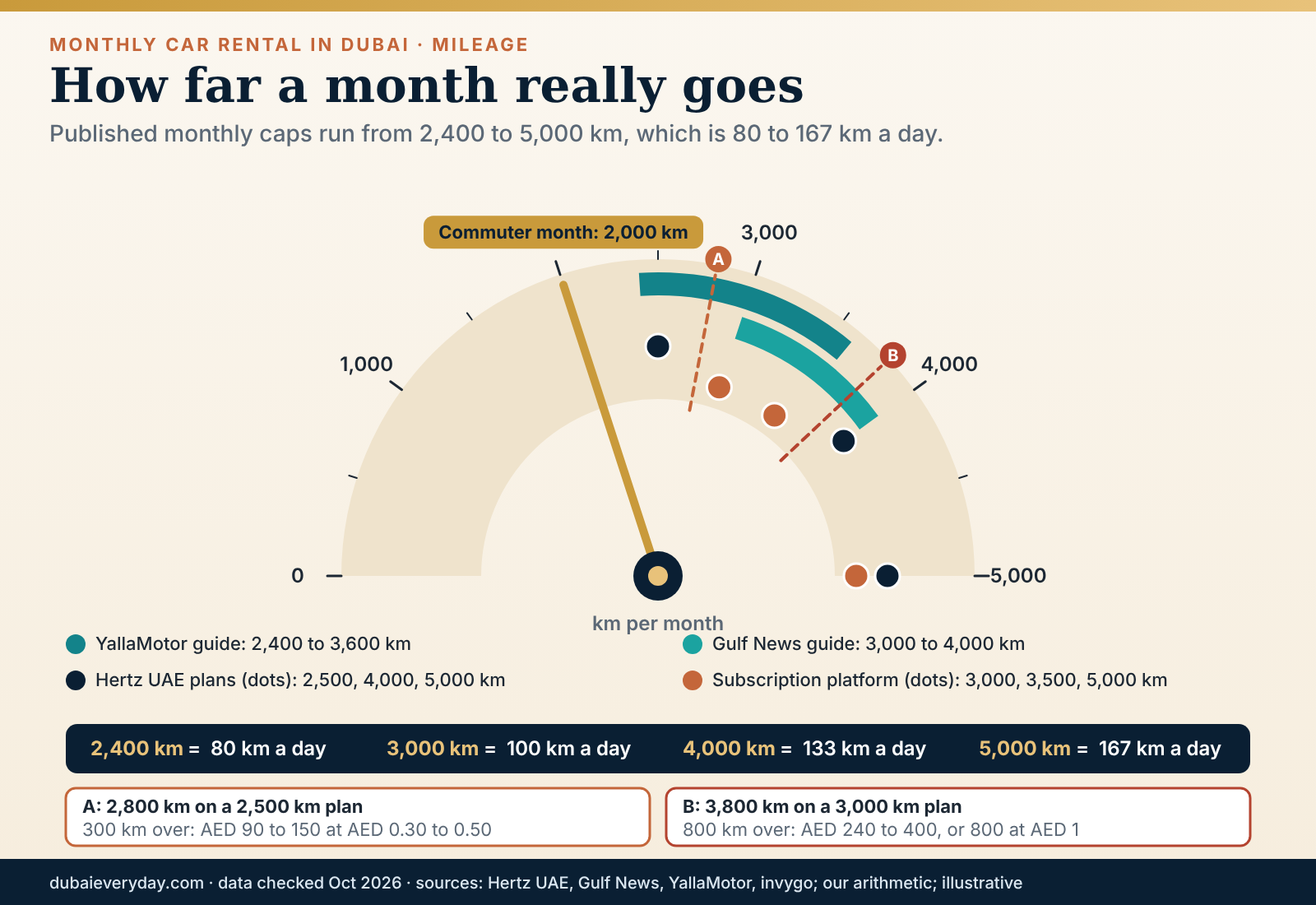
Published monthly car rental Dubai allowances vary widely. Hertz UAE’s plan page lists 2,500 km a month for its month-to-month plan, 4,000 km for a plan running one to six months, and 5,000 km for its longer saver plan. A Gulf News guide updated in December 2024 put typical long-term caps at 3,000 to 4,000 km, the YallaMotor guide at 2,400 to 3,600 km, and one operator promises at least 4,500 km. A subscription platform lists 3,000, 3,500 and 5,000 km options on its small cars.
Turn the cap into kilometres per day
Divide the cap by 30 and the numbers become easier to judge. A 2,400 km cap is 80 km a day, 3,000 km is 100, 4,000 km is about 133, and 5,000 km is about 167. Compare that with your real days, not an average one. If you drive 50 km on a quiet Sunday, you have not banked 50 km for Friday.
Check whether the allowance is pooled or prorated. Some contracts count the cap across the whole rental, so unused distance in week one carries forward, while others work per period. The public terms we read did not say which applies, so ask in writing. It matters most in 31-day months and in rentals of 35 or 45 days, where a pooled cap behaves very differently from a monthly one.
Our commuter and weekend-driver test
Here is the arithmetic for a typical monthly car rental Dubai driver. You live in one area, work in another and make a 50 km round trip on each of 22 working days: 1,100 km. Add 500 km of weekend errands and two 200 km day trips and you reach about 2,000 km. A 3,000 km cap leaves a comfortable margin, and so does 2,500 km. The plans start to bite on a cross-emirate commute, where a 100 km daily round trip is 2,200 km across 22 working days before any weekend driving.
Illustrative example (not a quote or market fact): you drive 2,800 km on a 2,500 km plan with an excess of AED 0.30 to 0.50. The excess is 300 km, so the charge is AED 90 to AED 150. Annoying, not ruinous. The same overshoot at AED 1 a kilometre costs AED 300, and a driver who does 3,800 km on a 3,000 km plan pays AED 240 to AED 400 at the Hertz range, or AED 800 at AED 1. Read the excess rate first when your use is uncertain.
Another framing is break-even against an open-mileage plan. If unlimited costs AED 250 more a month and the excess is AED 0.50, you would need to exceed the cap by 500 km before unlimited wins. If your ordinary month lands within 400 km of the cap, ask for the unlimited price before you choose.
What the cap does not count
Mileage is only one limit on a monthly car rental Dubai plan. Avis UAE sets a 250 km daily cap and AED 1 per kilometre excess for approved Oman trips, whatever the plan elsewhere, and Hertz UAE requires prior approval and documents to leave the country.
Both brands bar off-road driving and treat dunes, beaches and rocky desert as outside cover. A monthly car rental Dubai contract gives you more weekends in which to be tempted. If a regular Hatta or desert run is the plan, read the restricted-use clauses first; our guide to things to do in Dubai has outings that stay on tarmac.
Maintenance, servicing and breakdowns
Who looks after the car is the second reason monthly car rental Dubai offers differ so much. In a standard rental the company owns the vehicle and carries the servicing, so you are not paying for oil. In most monthly car rental Dubai packages that does not change, but the terms define how it works, and the details are where friction appears.
Servicing: the company’s car, the company’s schedule
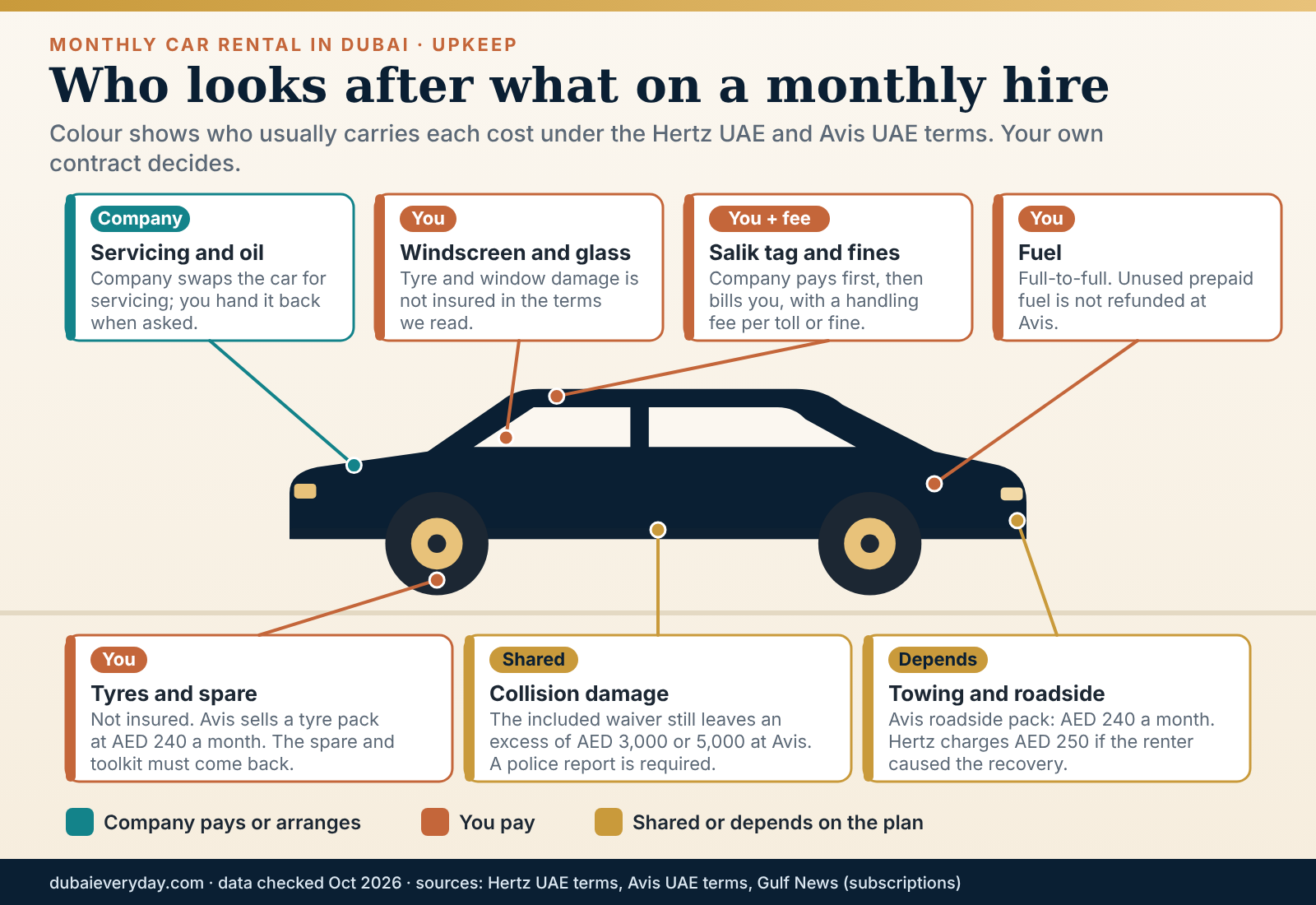
The Hertz UAE terms allow the company to swap the vehicle for servicing, sale, exchange or accident repair, and require you to return it when asked. They state that the same vehicle is not guaranteed and that costs from missed service intervals caused by a late return fall on the renter. No repairs may be made without Hertz’s prior written approval. Avis UAE says repairs and maintenance must be done at its authorised workshops, and makes the renter liable for damage and extra costs from self-repairs, part changes or unauthorised maintenance.
Together that gives a simple rule. You do not service the car yourself and you do not choose the workshop. If a warning light comes on or the brakes feel odd, you call the company. A car driven 3,000 to 5,000 km a month can reach a service interval within a few months. The interval is set by the manufacturer for that model, and the terms we read do not publish one, so ask when the next service is due and who arranges the swap.
The Avis terms page does not say who pays for routine servicing or oil changes, and the Hertz page does not address oil or warning lights. Neither silence is a loophole to rely on, so get the answer in your contract or email. Subscription and micro-lease plans are more explicit: the operators we read say maintenance is part of the monthly payment, and Gulf News says a subscription fee usually covers insurance, maintenance and roadside assistance, leaving you to pay for fuel and a deductible of AED 500 to AED 1,000 after an accident.
Tyres, glass and the things insurance skips
Tyres are the classic argument at hand-back. The Hertz terms state that tyre and window damage is not covered by insurance and that the renter pays for replacement, and the spare and toolkit must come back with the car. Avis UAE sells tyre cover at AED 25 a day, AED 100 a week or AED 240 a month, and without it adds a AED 100 handling surcharge to repair costs. Roadside assistance is priced the same, at AED 240 a month. Windscreen, interior, undercarriage and key damage are listed exclusions at Avis even with the super waiver.
On a monthly car rental Dubai contract, photograph the tyres, windscreen, wheels and interior at pickup, including tread and any chips, and email the pictures to the company the same day. Check the spare and the jack before leaving the car park, not on a highway shoulder. Repeat the photographs on return. It costs five minutes and turns an argument about condition into a comparison of two dated sets of pictures.
Breakdowns, replacement cars and the clock
Roadside help is where terms diverge. Avis UAE runs a 24-hour call centre and sells a roadside pack covering towing, flat tyres, refuelling, lost keys and jump starts; its page does not describe a replacement car. Hertz UAE charges AED 250 when recovery or towing is caused by the renter’s negligence or default, a reminder that wrong fuel, a flat battery and running dry are usually your bill.
Whether you get a replacement car, how fast, and whether the monthly clock stops while you wait are things the public terms did not settle. Ask for the answer in writing. Ask also what happens to your kilometre allowance if the car is swapped. Interior rules apply for a month too: Avis UAE describes its fleet as non-smoking and lists heavy interior cleaning at up to AED 500.
Deposits, card holds and refunds
On a monthly car rental Dubai contract the deposit is bigger in absolute terms and slower to come back, which makes it the item that causes the most stress after the first week. First, a definition. In the terms we read, the “deposit” is rarely cash. It is a pre-authorisation, a temporary block on a credit card that reduces your available limit without moving money. It becomes a charge only if the company deducts something.
What the published terms say
Avis UAE sets the pre-authorisation at the rental price, including extras for the planned length, plus AED 3,000 to AED 5,000. The card must be in the renter’s name, valid for at least three months from the start and physically presented. Debit, prepaid and virtual cards, and Apple Pay and Google Pay, are not accepted as security. For monthly or mini-lease rentals Avis also asks for proof of a UAE address. Hertz UAE accepts Visa, Mastercard, American Express and Diners Club credit cards in the renter’s name and says debit cards cannot secure the hold.
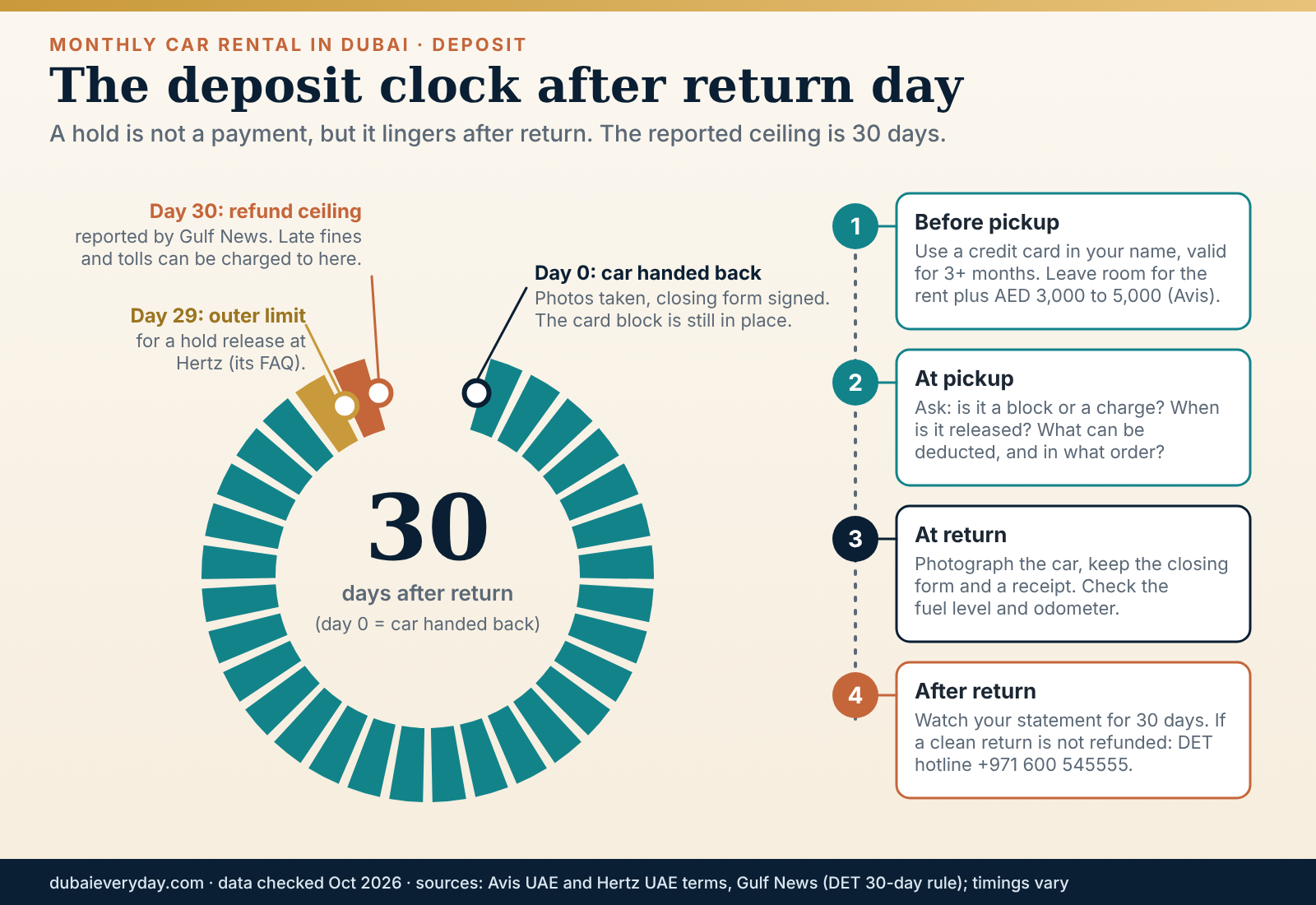
Release times are the second variable on a monthly car rental Dubai deposit. Hertz says refunds are processed 30 days after termination, after outstanding charges are deducted, and its FAQ describes holds as released within 29 days depending on the card provider. Both brands say fines, tolls and other costs that surface after you return the car can be recovered from the card for 30 days after the agreement closes. A clean return does not mean a clean card that afternoon.
The 30-day refund rule and where to complain
A Gulf News report updated on 16 October 2026 describes a rule attributed to the Dubai Corporation for Consumer Protection and Fair Trade, part of the Department of Economy and Tourism (DET): rental firms must refund the deposit within 30 days if the car comes back in good condition with no outstanding fees.
The firm may deduct for damage, fines issued during the rental, Salik charges and other fees. The report gives a complaint route through the consumerrights.gov.ae portal or the hotline +971 600 545555, and says it applies to Dubai-based companies with a valid DET trade licence. We could not open the primary DET page, so check the current wording with DET.
Ask the company, and the bank if needed, whether the amount on your card is a block or a payment. The complaint route above starts with disputing a mistaken charge with your bank. A new arrival with a starter credit card should also check the limit: a hold of several thousand dirhams can use most of it.
Sizing the hold against your card
Illustrative example (not a quote): with a AED 1,600 monthly car rental Dubai rent the Avis-style formula gives a block of AED 4,600 to AED 6,600. If the whole invoice with insurance and VAT is AED 2,546, the block grows to about AED 5,546 to AED 7,546. A card with a AED 10,000 limit is more than half used before fuel and Salik arrive. Plan for a second card or a higher limit before pickup, because debit or a friend’s card will not do.
The Gulf News guide on questions to ask a rental provider gives a wider range of AED 1,000 to AED 5,000 depending on vehicle type and rental length. Small economy cars sit at the low end, premium cars and long hires at the top. Avis says a second card may be required for some high-value vehicles.
Zero-deposit plans: what is the catch?
Several operators advertise deposit-free monthly car rental Dubai plans. A subscription platform says it offers a fleet with zero deposit, a Dubai rental firm describes a “Zero Deposit” option for some vehicles only, and another operator’s listings read “Deposit: Not Required”. Gulf News names two app-based services as deposit-free but notes that traditional deposit-based hires are generally cheaper for long-term use.
The pages we read did not say what replaces the deposit. Common trade-offs elsewhere are a higher monthly rate, a card-validation fee, a sign-up charge or stricter damage terms. Ask whether there is a non-refundable fee instead, how fines and damage are collected afterwards, and whether the zero-deposit rate is the one in the contract and not just the advert.
Cash, passports and other bad ideas
An older Gulf News report, last updated in 2018, said Dubai rental agencies cannot hold a customer’s passport or ID and that deposits should be a card block, not cash. It is dated, but it matches today’s cautious advice: hand over a copy, not your original passport, and get a written receipt for anything paid in cash. A company that insists on keeping an original document is a reason to walk away.
Insurance and excess on a long hire
The insurance in a rental is a damage waiver with an excess, not a promise that nothing costs you anything. On a monthly car rental Dubai contract the sums are bigger and the exclusions matter more, because you are likelier to meet a scratch, a chipped screen or a car park incident in 30 days than in three.
What the standard cover does
Under Avis UAE’s terms a collision damage waiver is included and limits your liability to an excess of AED 3,000 for most groups or AED 5,000 for the higher groups. Theft protection uses the same bands. Hertz UAE’s clauses are similar: liability limited to a stated excess, subject to a valid police report. Both make the police report a condition of cover, and Hertz adds that if the report does not identify the at-fault third party, the renter pays the costs or the excess.
The upgrade is a super collision damage waiver. At Avis the daily price falls with length: AED 45 for one or two days, AED 38 for three to 13, AED 32 for 14 to 20, and AED 25 from 21 days. Avis lists interior, tyre, windscreen, undercarriage and key damage as excluded even with the super waiver, and neither company covers off-road use or driving under the influence.
Is the super waiver worth it on a monthly car rental Dubai plan?
At the 21-plus-day price a month costs AED 750, or AED 787.50 with VAT. That is 26 percent of a AED 3,000 excess and about 16 percent of a AED 5,000 one. In plain terms you pay roughly a quarter of the maximum loss to avoid it. If you park in tight garages and cannot absorb a AED 3,000 bill, the premium can be rational. If you drive quiet roads and have a cash buffer, you may accept the excess. That is a risk preference, so decide it with the numbers, not at the counter.
Subscription plans change the maths. The Gulf News explainer says the all-inclusive fee usually covers insurance and leaves a deductible of AED 500 to AED 1,000 after an accident. Compare the monthly price plus the expected excess, not the monthly price alone.
Your own cover and the additional driver
An insurance broker’s guide advises checking whether your own policy or a credit card already covers rentals before buying extras. Treat that as a prompt to read your policy, not a promise: the rental contracts we read are written around the company’s own insurance, and a foreign card benefit may exclude the region.
A second driver must be named on the contract and meet its age and licence rules, or cover may not apply. The Avis pages list different additional-driver prices in different places (about AED 10 a day in one, AED 28 a day with a cap in another), so ask for the figure that applies to your plan.
Salik, parking, fuel and fines
This is where the advertised rent and the real bill separate. Four costs sit outside the rent on nearly every monthly car rental Dubai contract we read: tolls, parking, fuel and fines. They are the costs an owner would face too, but a rental adds handling fees.
Salik tolls on a rental car
From 1 June 2026 Salik tolls include 5 percent VAT. Khaleej Times and The National report AED 6.30 per crossing at peak (6 to 10 am and 4 to 8 pm, Monday to Saturday), AED 4.20 off-peak (10 am to 4 pm and 8 pm to 1 am), and no charge from 1 to 6 am.
Reports of the Sunday rate differ, so check it. A local operator’s guide explains that rental cars already carry a tag, the company pays tolls first and bills the renter later, weekly or in the final invoice, and that Salik is usually not part of a monthly car rental Dubai rate.
The fee on top varies. Avis UAE charges the toll plus AED 2 plus VAT per crossing. Hertz UAE’s terms give AED 5.00 to AED 7.00 per crossing and do not say whether that is the toll alone or toll plus fee, so ask. Khaleej Times’ commuter example is two gates each way at peak: 84 crossings over 21 working days, or AED 529.20. At an AED 2.10 handling fee, that adds AED 176.40, a third more than the toll itself.
Parking, fuel and fines
The National reports that Parkin standard on-street zones rose to AED 2.10 an hour off-peak and AED 4.20 at peak from 1 June 2026, with premium zones at AED 10.50 and multi-storey car parks at AED 5.25 an hour or AED 42 for 24 hours. If your building does not include a bay, parking becomes a second rent, so settle home and office parking before any rate comparison. For the beach and the mall, our guides to Dubai’s beaches and Downtown Dubai cover getting there and parking.
For a monthly car rental Dubai driver, fuel for October 2026, as reported by Gulf News and Emirates 24|7, is AED 4.28 a litre for Special 95, AED 4.40 for Super 98, AED 4.21 for E-Plus 91 and AED 4.80 for diesel, with Special 95 up from AED 3.69 in September. We carried these from a same-day research log and did not re-open the pages, so check the pump. Avis UAE runs full-to-full and does not refund unused prepaid fuel, so for a month you will fill up yourself.
Traffic fines are issued against the vehicle, so the company hears first and passes the bill on. Avis UAE adds a AED 50 handling surcharge per fine and Hertz UAE adds 12 percent. Fines that arrive after you return the car are charged to your card within the 30-day window.
A 2024 Khaleej Times legal column says black points can attach to the licence of the person who rented the car, and that you should ask the company what each fine is for. Treat that as unconfirmed and check with Dubai Police or the RTA through the official apps. If you do not have a UAE licence yet, our Dubai driving licence guide covers how the process works.
The all-in monthly car rental Dubai bill, calculated
Illustrative example (not a quote or market fact): assume a AED 1,600 rent, a AED 75 registration fee, the AED 25-a-day super waiver, 84 Salik crossings at the peak price with AED 2.10 handling on each, and 2,000 km at 8 litres per 100 km on Special 95 at AED 4.28. Rent, registration and waiver total AED 2,425, VAT adds AED 121.25, tolls AED 529.20, handling AED 176.40 and fuel AED 684.80. The month costs about AED 3,937, or AED 1.97 per kilometre. Drop the waiver and the total is about AED 3,149.
| Line in the illustrative month | AED | Basis |
|---|---|---|
| Monthly rent | 1,600.00 | Assumed |
| Registration fee | 75.00 | Avis-style monthly cap |
| Super waiver, 30 days | 750.00 | AED 25 a day, 21+ day price |
| VAT at 5 percent | 121.25 | On the three lines above |
| Salik, 84 peak crossings | 529.20 | AED 6.30 each |
| Salik handling | 176.40 | AED 2.10 each |
| Fuel, 2,000 km | 684.80 | 8 L/100 km, AED 4.28 |
| Total | 3,936.65 | About AED 131 a day |
Resident use, licences and long-stay visits
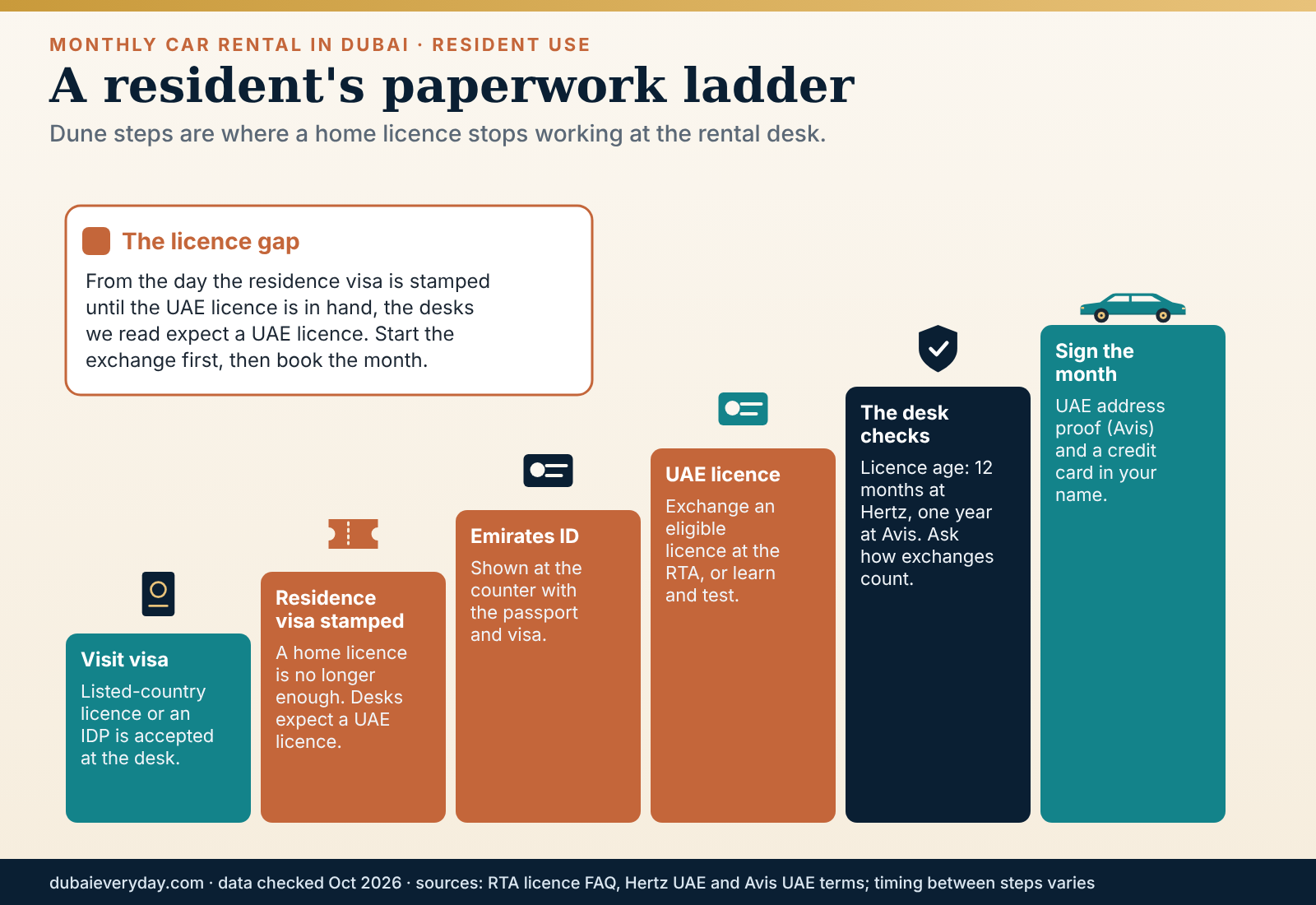
Residents are the largest group taking a monthly car rental Dubai contract, and the group most likely to be caught out by paperwork. The central rule is simple to state and awkward to live with: once you hold a UAE residence visa, rental companies expect a UAE driving licence, not the one from home.
What the companies require from residents
Avis UAE’s terms say UAE residents must hold a valid UAE licence, that driving on a residence or employment visa without one is a violation, and that Avis will refuse the rental. At the counter it asks for a passport, an Emirates ID (or a GCC ID for GCC nationals) and the visa or entry documents, and says the licence must have been issued at least one year before pickup.
Avis also wants proof of a UAE address for monthly car rental Dubai and mini-lease bookings. Hertz UAE asks residents for a UAE-issued licence held for at least 12 months, a copy of the passport and visa pages, and a credit card in the renter’s name.
Hertz’s own pages disagree on licence age: the requirements page says 12 months and the terms say a licence issued at least six months before pickup. That kind of conflict is why we keep saying “ask”. A question we could not answer from public pages is whether a licence you recently obtained by exchange counts from the original foreign issue date or the UAE one.
The gap between a residence visa and a UAE licence
The RTA licence FAQ says a visitor on a visit visa may drive with a GCC or recognised exception-country licence, and that a person who works or lives in the UAE must exchange it. One rental operator says there is no grace period after the residence visa is stamped and quotes a AED 500 fine with 4 black points; we saw that figure in one place only, so confirm it with the authorities. Expect rental desks to refuse you from the day the visa is issued until the UAE licence arrives.
For new arrivals this creates a gap of days or weeks. A tidy sequence helps: rent on the visit visa while it is valid and your foreign licence is accepted, start the exchange early, then ask whether the company will move the contract onto your UAE licence. The RTA page lists 20 exception countries whose licences can be exchanged, including the UK, Germany, France, Japan, Turkey and the US (with an exclusion noted for Texas), and names seven whose licences cannot be replaced. Other pages give longer lists, so check yours.
Our guide to exchanging a foreign driving licence in Dubai covers documents, the eye test and fees. If you are learning from scratch, start with the Dubai driving licence guide and then compare Dubai driving schools. A status change mid-contract is a trap, because the contract does not pause. Hertz UAE’s terms let the company adjust rates if a rental is extended or shortened, so ask what happens on the day your status changes.
What a resident cannot do with a rented car
A monthly car rental Dubai contract is not a work vehicle. The Hertz UAE terms prohibit subletting and carrying paying passengers or goods for hire, which rules out ride-hailing and delivery side-jobs in a rented car whatever the discount.
They also limit driving to the renter or a nominated additional driver, so a flatmate who borrows the car for a weekend is a breach. Spouses and colleagues who will share driving should be added at the start, each with a valid licence. Oman trips need paperwork: Avis UAE wants a request 72 hours ahead, an original no-objection certificate and Oman insurance.
Long-stay visitors: the same car, different papers
Tourists and remote workers taking a monthly car rental Dubai deal use a different set of papers. Hertz UAE asks visitors for a foreign licence from a listed country, valid only with a visit or tourist visa, and says licences from Japan, Turkey, Greece and South Korea need a translation approved by the relevant consulate or embassy.
For other countries it asks for an International Driving Permit and a licence held for 12 months. A valid passport and UAE entry visa are mandatory. Other sources conflict on whether an IDP is also needed with a listed-country licence, so carry both if you have one.
The practical limit is your visa. A contract that outlasts your permitted stay leaves you holding a car you may no longer be entitled to drive, and a 30-day rental on a 28-day visa is a planning error, not a loophole. Match the return date to the visa, with a buffer.
If you are choosing where to stay for the month, parking and access matter, and our guide to choosing hotels in Dubai covers areas by transport. For a first trip, the Dubai travel guide shows how much of the city you can reach without a car, and airport pickup is in the Dubai airport car rental guide.
Monthly rental, subscription, lease or buying
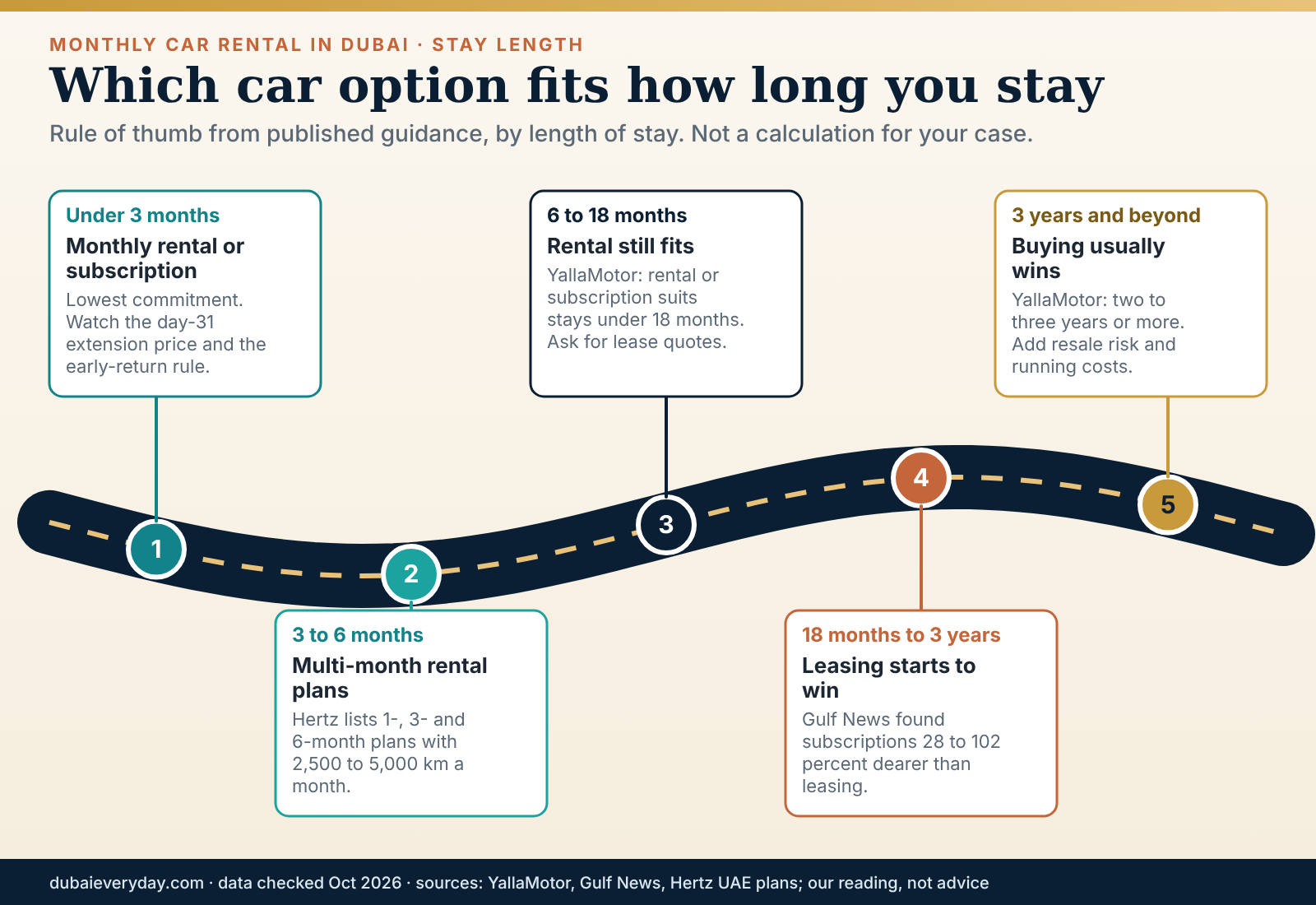
A monthly car rental Dubai contract is not always the right instrument. The honest comparison is by length of stay and by what you want to be responsible for. The published guidance is consistent on the shape of the answer, if not on the numbers.
Where each option wins
The YallaMotor guide suggests a monthly car rental Dubai contract or subscription suits stays under 18 months and that buying usually wins at two to three years or more. Its figures for a Corolla-class car put annual running costs, before loan payments and depreciation, at AED 13,850, and it recommends a reserve of AED 800 to AED 1,500 a month for maintenance on a rental or loan.
Gulf News, writing in 2024, found subscriptions cost about 28 to 102 percent more per month than leasing, insuring and maintaining a comparable car, and called leasing the better choice for anyone who values affordability over flexibility.
| Option | Typical commitment | Servicing and insurance | Best fit |
|---|---|---|---|
| Monthly rental | About 30 days, extendable | Company services; insurance with an excess | One to six months, uncertain plans |
| Subscription | Month to month, swap about every 30 days | Usually bundled; small deductible | Short stays, people who change cars |
| Lease | 6, 12, 24 or 36 months | Varies by agreement | One to three years, steady use |
| Buying | Ownership, resale risk | Yours, including insurance and registration | Two to three years or more |
Extending, shortening and ending early
Contract length is where a monthly car rental Dubai plan can go wrong without any single bad clause. Hertz UAE says early termination of a monthly contract results in a higher rate based on the days used, and that without advance notice an extension renews automatically and is charged to the card. Avis UAE says there is no refund for unused days on prepaid rentals and that an early return may cost more if you no longer qualify for a special offer. One operator says early cancellation is charged at the daily rate.
The sensible reading: a monthly car rental Dubai rate is only a discount if you keep the car for the month. Leave after 12 days and you may pay more than a daily customer would have. Extend by 10 days and you may be priced at a daily rate you did not plan for. Ask for the extension price at signing and keep it in writing.
When you do not need a car at all
A monthly car rental Dubai contract has a fixed cost, so ask what your journeys would cost without one. Illustrative example (not a quote): at our AED 3,937 total, a taxi at an assumed AED 40 a ride would need about 98 rides in the month for the car to cost less, roughly 4.5 rides a day over 22 working days.
A Metro commuter paying the AED 7.50 Silver fare for three or more zones each way spends AED 330 over 22 working days. Taxi fares vary and a car also gives you evenings and weekends, so this tests the extremes. If you live and work along the Red or Green line, the Red Line guide and Green Line guide show how far rail takes you.
Three worked scenarios
The numbers below are illustrations of monthly car rental Dubai decisions, built on assumed rates, not quotes. Their purpose is to show the shape of the decision, so replace our assumptions with the figures in your own offer.
The new arrival who needs a car for six weeks
Illustrative example (not a quote): you land with a valid foreign licence, your UAE licence will take about six weeks, and you want a monthly car rental Dubai deal meanwhile. Assume AED 1,500 for 30 days and AED 90 a day beyond that. Six weeks is 42 days: AED 1,500 plus 12 days at AED 90 (AED 1,080) is AED 2,580, about AED 61 a day. Forty-two days at the daily rate alone is AED 3,780. The monthly-plus-top-up route saves AED 1,200 on these assumptions, before VAT and add-ons.
The risks differ. If your status changes before the end you may not be able to keep driving, and a car handed back early may be repriced at a higher rate. Ask how the company prices day 31 onward and an early return on day 12. If either answer is vague, two weekly rentals may be cleaner, and our cheap car rental guide works through a weekly example.
The cross-emirate commuter
Illustrative example (not a quote): you drive a 100 km round trip on 22 working days and 600 km at weekends, so 2,800 km a month. Plan A is AED 1,500 with a 2,500 km cap and AED 0.50 a kilometre excess. Plan B is AED 1,800 with 5,000 km. On Plan A you pay 300 km of excess, AED 150, so AED 1,650 in total, and Plan A is cheaper. The break-even is where the AED 300 gap equals the excess: 600 km over the cap, or 3,100 km for the month.
That is a narrow margin. A month with a longer weekend trip or a few extra errands tips you over, and the excess rate is the only number that stops it hurting. For a driver whose use varies we would lean towards the larger allowance on a monthly car rental Dubai contract if the price gap is smaller than the cost of an unusually long month, and towards the capped plan if the commute is identical every week. Parking and Salik are separate lines, so price them with the all-in bill above.
The one-month visitor who drives some days
Illustrative example using published figures: a rental marketplace, in a guide updated in November 2025, put an economy car at about AED 120 a day and AED 1,800 for a full month. At those figures the monthly price equals 15 daily rentals, so the monthly car rental Dubai contract wins only if you would otherwise drive on more than 15 days.
A remote worker who wants a car on six weekends and a few weekday errands is nearer 10 days and is better off on a daily or weekly plan, with taxis in between. Prices have likely moved since the guide, so rerun this with today’s quotes.
The visitor also has the visa limit and the hold to think about. A month’s hold is much larger than a weekend’s, and a card already used for hotel deposits can run out of limit. Outings that suit a car are in the things to do in Dubai guide.
Before you sign: checklist and red flags
A good monthly car rental Dubai contract is boring. Every number is written down, every exception is named and nothing important is left to “we will see”. Use the list below at the counter, on the phone or in the quote email.
- The monthly kilometre allowance, whether it is pooled or per day, and the excess rate per kilometre, in writing.
- What the price includes: registration, basic insurance, servicing, roadside help and any replacement car.
- The card hold amount, the card types accepted, when the hold is released and what can be deducted.
- The excess on the standard waiver, the super waiver price for 21 or more days, and the exclusions.
- Salik: the toll, the handling fee per crossing and how often it is billed.
- Fines: the handling fee, how soon you are told, and what happens to black points.
- The extension price after day 30, the early-return price and the notice period.
- Whether a second driver can be added, at what price, and with which documents.
- The company’s DET trade licence details, which you can ask to see.
The handover, step by step
- Photograph everything.Walk round the car with the agent and take dated photos of every panel, wheel, tyre, the windscreen, the interior, and the dashboard showing fuel level and odometer.
- Check the safety kit.Confirm the spare, jack, triangle and manual are present, since the Hertz terms require the spare and toolkit to be returned.
- Read the signed form.Make sure every existing mark is on it and that the allowance and fees match your quote.
- Save the contacts.Store the breakdown and accident numbers and agree who to call for a swap or service.
- Diarise the dates.Note the return time, the 29-minute grace period that Hertz and Avis both state, the extension deadline and the date the hold should release.
Red flags worth walking away from
A company that cannot show a trade licence, insists on cash only, keeps your original passport, offers no written contract or will not state the kilometre cap and excess rate is not one to trust with a month and a large hold. The same goes for a price far below the rest with no explanation, an insurance promise you cannot see on paper, or a refund timeline that is “later”.
If the company is Dubai-based with a DET trade licence, the complaint route described earlier is open to you. If it is not, you have fewer options. Keep screenshots of the advert, the quote and every email, because terms on rental websites change.
Frequently asked questions
How much does a monthly car rental Dubai contract cost?
On 29 October 2026 the advertised monthly figures we read ran from about AED 900 for a small car to about AED 2,800 for a mid-size SUV, with subscription-style offers around AED 1,200 to AED 1,400 including insurance and maintenance. Those are “from” prices on commercial pages, and many omit VAT, Salik, fuel and fine handling. In our illustrative commuter month, a AED 1,600 rent became about AED 3,900. Compare totals, not headline rents.
What is the usual mileage limit on a monthly car rental Dubai contract?
Published plans range from about 2,400 to 5,000 km a month. Hertz UAE lists 2,500, 4,000 and 5,000 km options, Gulf News describes 3,000 to 4,000 km as typical for long-term hires, and one operator promises at least 4,500 km. Divide by 30 to compare with your own days. The excess in the terms we read was AED 0.30 to 1.00 per kilometre, so the rate matters as much as the cap.
Can I get a monthly car rental Dubai contract on a tourist visa?
Generally yes, if you hold a licence the company accepts. Hertz UAE accepts foreign licences from listed countries on a visit visa and asks for an International Driving Permit plus a licence held for 12 months from other countries. The RTA FAQ says visitors on a visit visa may drive with a GCC or exception-country licence. You need a passport, the entry visa and a credit card in your name. Make sure the contract ends before your visa does.
I just got my residence visa. Can I still rent with my home licence?
Expect to be refused. Avis UAE says residents must hold a UAE licence and that it will refuse the rental otherwise, and Hertz UAE asks residents for a UAE-issued licence. The RTA says people who work or live in the UAE must exchange their licence. Start the exchange as soon as your visa and Emirates ID allow.
How big is the deposit for a monthly car rental Dubai contract?
Avis UAE sets the card block at the rental price plus AED 3,000 to AED 5,000. A Gulf News guide puts typical deposits at AED 1,000 to AED 5,000 depending on vehicle and length. It is a hold on a credit card in your name, not a payment, and under the rule reported by Gulf News it must be refunded within 30 days if the car is returned in good condition with no outstanding fees. Some operators advertise zero-deposit plans, so ask what replaces it.
Who pays for servicing and repairs?
On a standard monthly car rental Dubai contract the company owns the car and arranges servicing, and the terms we read bar you from using your own workshop. You still pay for damage insurance does not cover, such as tyres and windscreens at some firms, and for towing caused by your negligence. Subscription and micro-lease plans say maintenance is bundled in. Get the servicing and replacement-car arrangement in writing.
Is Salik included in a monthly car rental Dubai price?
Usually not. Rental cars already carry a Salik tag, the company pays each toll and bills you, and the bill often adds a handling fee, which Avis UAE lists as AED 2 plus VAT per crossing. Tolls are AED 6.30 at peak and AED 4.20 off-peak since 1 June 2026, and free from 1 to 6 am. A peak-hour commuter with 84 crossings a month would pay AED 529.20 in tolls alone.
Can I take a monthly car rental Dubai vehicle to Abu Dhabi or Oman?
Driving between emirates is ordinary use, though companies charge one-way fees if you drop the car in another emirate. Oman is different. Avis UAE needs 72 hours’ notice, an original no-objection certificate and Oman insurance, with a 250 km daily cap, and Hertz UAE needs prior approval to leave the country. Neither covers off-road driving. Ask whether any area is restricted before you plan a trip.
Is a monthly car rental Dubai contract cheaper than a subscription or lease?
It depends on length and what is bundled. Gulf News found subscriptions cost more per month than leasing a comparable car, with leasing cheapest over a long period. A monthly rental has the lowest commitment but not always the lowest price, and the YallaMotor guide suggests buying tends to win after about two to three years. Add the deductible, servicing and mileage terms before comparing.
Do I need a credit card, and can someone else drive?
Yes to the card: Hertz UAE and Avis UAE need a credit card in the renter’s name for the security block, and neither accepts debit cards for it. Another driver must be named on the agreement and meet the age, licence and ID rules; Hertz UAE limits driving to the renter or a nominated additional driver. An unlisted driver puts your cover at risk, so add spouses and colleagues at the start.
What if I return the car early?
Expect to lose some of the discount. Hertz UAE says early termination of a monthly car rental Dubai contract results in a higher rate based on the days used, and Avis UAE gives no refund for unused days on prepaid rentals. One operator says early cancellation is charged at the daily rate. Ask for the early-return calculation, with an example, in writing before you sign.
Sources and further reading (23 links)
- Hertz UAE: Terms and conditions — monthly mileage, servicing, early termination, Salik, fines, restrictions
- Hertz UAE: Flexible monthly plans — plan terms and monthly kilometre allowances
- Hertz UAE: Limited vs unlimited mileage — typical daily and monthly allowances and excess rates
- Hertz UAE: Rental requirements — resident and visitor licence and card rules
- Avis UAE: Terms and conditions — pre-authorisation, insurance excess, super waiver prices, tyre and roadside packs, resident documents
- RTA: Exchange of a foreign driving licence, FAQs — visitor driving rules and exchangeable countries
- SelfDrive: Monthly car rental Dubai guide — advertised monthly prices and plan types (operator marketing)
- SelfDrive: Salik on a monthly car rental — how tolls are billed to renters (operator marketing)
- invygo: Rent a car in Dubai without deposit — subscription prices and mileage options (platform marketing)
- YallaMotor: Long-term rental vs buying vs subscription — price bands, mileage caps and horizon guidance
- Gulf News: UAE car rental deposit refund rules — 30-day refund rule and complaint route
- Gulf News: What to ask before you rent a car in the UAE — deposit and mileage ranges
- Gulf News: Rent, lease or subscribe a car in the UAE — subscription terms and cost comparison
- Gulf News: Fine while driving a rental car — how fines reach the renter
- Khaleej Times: VAT on Salik — toll rates from 1 June 2026 and commuter example
- The National: New Salik VAT and parking fees — toll and Parkin changes
- Khaleej Times: Can traffic fines from rental cars affect your licence — black points question (reader Q& A)
- InsuranceMarket.ae: Saving on a monthly car rental — general consumer tips on cover and mileage
- Friends Car Rental: Monthly vs daily rental — one operator’s monthly terms and mileage (marketing)
- OneClickDrive: Daily vs monthly car rental — economy-car daily and monthly figures (marketplace marketing)
- Thrifty UAE: Convert a foreign driving licence — operator view on licence validity after residence (marketing)
- Gulf News: UAE petrol and diesel prices announced — fuel prices used in the worked bill
- RTA: Nol fares — Silver card fare used in the car-free comparison
Update log: 29 October 2026, first publication of this monthly car rental Dubai guide; the facts above were checked against the sources listed. Next review due within three to six months, or sooner if Salik, fuel or rental terms change. Corrections welcome. This page is general information, not legal, insurance or financial advice, and company terms change, so confirm them in your own contract.
About DubaiEveryday and this guide
DubaiEveryday.com is an independent editorial project that publishes practical, research-based guides to everyday life in Dubai: where to live, what things cost, how the rules work and how to get around. This page was written and edited by the DubaiEveryday editorial team. It is not signed by a named expert, doctor, lawyer or adviser, and we do not claim first-hand testing of a venue, clinic or service unless the page says so.
Each guide is built from official sources such as government and regulator pages, operator websites and established news outlets, cross-checked where we can. When we could not confirm something, we say so in the text, and examples that use made-up numbers are labelled as illustrations. Mentions are editorial choices, not paid placements, and a link is not an endorsement.
Dubai changes quickly. If you spot something that is out of date or wrong, please tell us through the contact options on DubaiEveryday.com and we will check it and correct the page.