

The Dubai Metro Green Line is the 20-station line through Deira, the Creek and Bur Dubai: the one you take for the souks, the abra crossings, Dubai Healthcare City and the older half of the city. This guide gives you the stations in order, what sits beside each, where to change to the Red Line and how long each hop takes.
It is easy to picture the Metro as one long line running past the skyscrapers. The older side of the city, with its souks, the Creek and the abra crossings, sits along a different route. Take the wrong line and you end up on the wrong side of town. Take the right one and a few stations put you beside the gold and spice markets.
The Dubai Metro Green Line has 20 stations and two places to switch lines, and each stop opens a different slice of Old Dubai. This guide lists the stations in order, what sits beside each and how long the hops take. You will know where to change, where to get off and when an abra beats the train.
The Dubai Metro Green Line runs between e& (G11) in north-east Deira and Creek (G30) in Al Jaddaf, with 20 stations and two places where you can switch to the Red Line: Union (G20) and BurJuman (G26). It is the Metro line for Old Dubai. Baniyas Square, Gold Souq and Al Ras serve the Deira souks, Al Ghubaiba and Sharaf DG serve Bur Dubai, Oud Metha and Dubai Healthcare City serve the medical and Wafi side, and Creek is the stop for the Al Jaddaf abra to Festival City.
Stations open at 05:00 Monday to Saturday and 08:00 on Sunday, and close at midnight, or 01:00 on Friday night.
The RTA’s printed timetable puts a last-train run from Union to Creek at about 21 minutes, and the hop from Al Ras under the Creek to Al Ghubaiba at one minute. Fares are the same zone fares as the Red Line (AED 3, 5 or 7.50 on a Silver card), and you need AED 7.50 on the card to tap in. The Dubai Metro Green Line does not serve the airport terminals; Dubai Airports lists only the Red Line for those.
This page covers the Dubai Metro Green Line only. System-wide rules, nol cards and fines are in our Dubai Metro guide, and the other line is in our Dubai Metro Red Line guide.
This is desk research. DubaiEveryday.com has not ridden these trains, walked these platforms or crossed the Creek by abra, and nothing below describes a personal trip. Where we describe what a stop is like, we do it in the third person from official pages and reference sources.
On 29 October 2026 we read the RTA timetable page, the RTA’s station and timings PDF, its nol fares page and marine transport page, the airport operator’s Metro page, and Dubai Media Office releases on the Blue and Gold lines. Station order and codes come from the RTA PDF and are cross-checked against Wikipedia’s Green Line article, which we treat as secondary.
Not verified: fare zones for each station pair, official train frequencies, current opening hours and prices for most Old Dubai attractions, and what stands beside the north-eastern stations. Ride times are our reading of one printed timetable and are labelled as such. Inclusion was not paid for. This is general information, not an official timetable; confirm every journey in the RTA’s s’hail app before you rely on it.
Dubai Metro Green Line status board, October 2026
Start with what is true today. The Dubai Metro Green Line is running, and the sources we read show no closure or diversion on it. That is a statement about what we read, not a guarantee, and the s’hail app is the live source. The RTA’s timetable PDF carries a “station closed” legend, but the text we could extract flags no Green Line station, so we treat the line as fully open.
Hours, fares and structure in one place
The RTA timetable page gives one set of station opening hours for both lines: 05:00 to 00:00 Monday to Thursday, 05:00 to 01:00 on Friday, 05:00 to 00:00 on Saturday and 08:00 to 00:00 on Sunday. It describes the Dubai Metro Green Line as running between e& (G11) and Creek (G30), and names Union and BurJuman as its two Red Line interchanges.
On fares, our Dubai Metro guide records the RTA’s Silver and Personal card prices as AED 3 for one zone, AED 5 for two adjacent zones and AED 7.50 for more, with a Red ticket at AED 4, 6 or 8.50 and Gold Class at AED 6, 10 or 15. A journey can last up to 180 minutes with up to three transfers. We re-read the RTA’s pass table for this page and it matches the Metro guide: a Silver all-zones pass is AED 110 for 7 days and AED 350 for 30 days.
The Dubai Metro Green Line’s own numbers are less official. Wikipedia reports a length of 22.5 km, of which 7.9 km is underground, with 12 elevated and 8 underground stations, a depot at Al Qusais and driverless trains. We could not find those figures on an RTA page, so treat them as reference-grade rather than authoritative. They are consistent with the station list, which has eight underground stops in a row from Salah Al Din (G19) to BurJuman (G26).
What changed recently
Nothing about the Dubai Metro Green Line’s route has changed for years. Per Wikipedia, the line was inaugurated on 9 September 2011 and opened to the public the next day, and its last extension was in 2014, when Al Jadaf and Creek opened on 1 March and took the terminus from Dubai Healthcare City to Creek. If a map or blog post shows the line ending at Healthcare City, it predates 2014.
What has changed is the name and the neighbourhood. The first terminus appears in the RTA PDF as e&, which older material calls Etisalat. The RTA prints the Bur Dubai stop as “DG Sharaf” in that PDF, while most other sources, including our own Metro guide, say Sharaf DG. Sponsor names rotate, so use the G-code and the position in the sequence as your anchor, and read the destination board on the platform.
Two new lines will touch the Dubai Metro Green Line. The Blue Line is under construction and will meet the Green Line at a new Creek Interchange Station in Al Jaddaf, and the Gold Line, approved in April 2026, will start at Al Ghubaiba. The Dubai Media Office gives target dates of 9 September 2029 and 9 September 2032. We found no published schedule of works that would close a Green Line station, but that is a gap in what we could read, not a promise.
What is closed or different around the line
The Dubai Museum in Al Fahidi Fort is a casualty of the restoration programme. Euronews reported in September 2026 that the fort is closed for restoration and set to reopen as a new museum, with no date given, as noted in our free things to do research. Anyone building a heritage day around that museum needs a different anchor, and the Old Dubai section below offers several.
The other change is seasonal and predictable. The Old Dubai stops are mostly outdoor walking, so the Dubai Metro Green Line is a very different proposition in January, when the mean daily maximum is about 24 degrees, and in August, when it is about 42 (NOAA normals as summarised on Wikipedia). The comfort section later in the page turns that into timing advice.
How the Dubai Metro Green Line is laid out
The Dubai Metro Green Line has no branches, no fork and no short-working trains that we could find in the sources. Every train goes from one end to the other, which makes it the easiest line in the network to read. The RTA’s timings PDF labels the two directions “To e&” and “To Creek”, and those are the two names you will see on the platform boards and in the s’hail app.
Station codes do the arithmetic for you
Green Line stations are numbered G11 to G30 and the numbers rise from e& towards Creek without a gap. That means the number of stops between any two stations is just the difference between their codes. Gold Souq (G22) to Al Ghubaiba (G24) is two gaps. Union (G20) to BurJuman (G26) is six. We use this “gap count” throughout the page because the RTA does not publish per-gap times on its public pages, but its timings PDF does let us turn gaps into minutes, as the timetable section shows.
The numbering starts at 11 on both lines, which is simply how the RTA codes them. There are no G1 to G10, and nobody on a platform will explain why. Do not go looking for them.
The shape of the line
Think of the Dubai Metro Green Line as three parts. The first is a long, mostly elevated run from e& through Al Qusais, the Airport Free Zone, Al Nahda and the Abu Hail side down to Salah Al Din, nine stations in all.
The second is the Old Dubai loop, from Union through Baniyas Square, Gold Souq and Al Ras, under the Creek to Al Ghubaiba and Sharaf DG, and into BurJuman. The third is the run back out along the Bur Dubai side of the Creek, on elevated track, through Oud Metha and Dubai Healthcare City to Al Jadaf and Creek.
That middle part is the reason the line exists for most visitors. The Red Line reaches the same two banks of the Creek in a single hop between Union and BurJuman, with nothing in between. The Dubai Metro Green Line takes six hops to get from Union to BurJuman because it stops at the souks and the Creek crossings on the way. Our Dubai Metro Red Line guide covers the Red Line’s side of that pairing and the station-count rule for choosing between the two interchanges; this page covers what you find once you are on the green side.
Underground and elevated, and why it matters
Per Wikipedia’s Green Line article, eight stations are underground and twelve are elevated. The underground stretch is continuous from Salah Al Din (G19) to BurJuman (G26), which is also the part with the Old Dubai stops. Everything from e& to Abu Baker Al Siddique (G18), and everything from Oud Metha (G27) to Creek (G30), is elevated.
For a traveller this changes the access effort. The underground stations in the old districts tend to be entered from street level by stairs, escalators or lifts down to a concourse. The elevated stations are reached up from street level, often across a road or a footbridge. We could not verify station layouts or walking routes on an official page, so treat this as general structure rather than a route guide, and check the exits on the RTA’s station map before you commit to a long walk in the heat.

What the Dubai Metro Green Line is not
It is not the airport line. Dubai Airports’ Metro page names the Red Line as the line serving Terminals 1 and 3 and says nothing about the Green Line or the Airport Free Zone station. It is not the Downtown line either; Burj Khalifa / Dubai Mall, Mall of the Emirates and the Marina side are all on the Red Line. And it is not a fast line. With 20 stations and an end-to-end run of roughly 40 minutes, it is a stopping service for an older, denser part of the city.
If your plan is the Burj Khalifa, the beach or the Marina, read the Red Line guide first and come back for Old Dubai. If your plan is the souks, the Creek or a clinic at Healthcare City, you are in the right place.
Dubai Metro Green Line stations in order, G11 to G30
The full sequence, in the order of the RTA’s timings PDF, is: e& (G11), Al Qusais (G12), Dubai Airport Free Zone (G13), Al Nahda (G14), Stadium (G15), Al Qiyadah (G16), Abu Hail (G17), Abu Baker Al Siddique (G18), Salah Al Din (G19), Union (G20), Baniyas Square (G21), Gold Souq (G22), Al Ras (G23), Al Ghubaiba (G24), Sharaf DG (G25), BurJuman (G26), Oud Metha (G27), Dubai Healthcare City (G28), Al Jadaf (G29) and Creek (G30).
What follows is a practical note on each stretch. Where we say what sits beside a station, the source is named; where we could not find an official statement, we say so rather than guess.
The north-east leg: e& to Salah Al Din (G11 to G19)
e& (G11) is the north-eastern terminus. Wikipedia lists it as the one station with an island platform as well as side platforms, and connects it to the Etisalat bus station. Al Qusais (G12) is where the line’s main depot sits, according to the same article. Dubai Airport Free Zone (G13) serves the free zone that gives it its name; the Dubai government’s own list of free zones includes the Dubai Airport Free Zone, and that is the clearest official fact about it.
After that come Al Nahda (G14), Stadium (G15), Al Qiyadah (G16), Abu Hail (G17) and Abu Baker Al Siddique (G18), all elevated, and then Salah Al Din (G19), the first underground station heading towards Union. These are working residential and business districts of north-east Deira. We found no official page describing what stands beside each one, so we do not name landmarks here. If you are going to a specific address, put it into the s’hail app or a map and look at the walking distance from the exit.
Union (G20): the big one
Union is the first of the two Red Line interchanges and the gateway to Old Dubai from the airport side. The Dubai Media Office’s 2025 ridership release puts it at 13.6 million passengers, third among the stations it named, behind BurJuman and Al Rigga. Wikipedia describes it as covering 25,000 square metres over two levels, about 18 metres deep, and says it was built to handle around 22,000 passengers an hour; we treat those as reported figures.
What matters on the day is that the Green Line and Red Line platforms are on different levels, so a change takes real walking time. The interchange section puts a number on it.
The Deira souk stops: Baniyas Square, Gold Souq and Al Ras (G21 to G23)
These three underground stations are one gap apart and each is about two minutes by the RTA timetable. Baniyas Square (G21) is the first stop after Union and sits at the square of the same name, which the RTA also uses as an abra route name (Dubai Old Souq to Baniyas, route CR3).
Gold Souq (G22) is named for the Gold Souk, which Wikipedia lists as having more than 380 retailers; that count dates from 2024 reporting and the souk has had renovation plans, so check the current state. Al Ras (G23) is the last stop on the Deira side before the line goes under the Creek.
The Bur Dubai stops: Al Ghubaiba, Sharaf DG and BurJuman (G24 to G26)
Al Ghubaiba (G24) is the first stop on the Bur Dubai side, one minute after Al Ras in the RTA’s timetable. It is also the planned starting station of the Gold Line, with a Green Line interchange, according to the April 2026 Dubai Media Office release. Sharaf DG (G25) is the stop for the Al Fahidi area; Wikipedia’s Dubai Museum article still lists the nearby Metro stop as “Al Fahidi”, which looks like the stop’s older name; the RTA’s PDF prints it as DG Sharaf.
BurJuman (G26) is the second Red Line interchange and the busiest station in the whole network, at 17.8 million passengers in 2025 according to the Dubai Media Office. It is also the stop for the BurJuman mall. For plain station geography the Red Line guide does the longer job; here it is enough to say that BurJuman is where the Old Dubai loop ends and the south-western run begins.
The south-west run: Oud Metha to Creek (G27 to G30)
Oud Metha (G27), Dubai Healthcare City (G28), Al Jadaf (G29) and Creek (G30) are all elevated. Wikipedia connects Oud Metha to St. Mary’s Catholic Church and Dubai Healthcare City to Wafi City, and Creek to the Al Jaddaf Marine Station. The Marine Station is the one with a documented use: the RTA lists an air-conditioned abra from Al Jaddaf Marine Station to Dubai Festival City (route BM2) at AED 2 per person each way.
Al Jadaf is where Jameel Arts Centre comes in. The centre’s own visiting page, as recorded in our free things to do research, says entry is free and describes the walk from Al Jaddaf station (the Green Line stop) as about 12 minutes. It closes on Tuesdays. We did not re-read the page for this guide, so confirm before you go.
Quick rule for choosing a stop. For the Deira souks get off at Gold Souq or Al Ras. For Bur Dubai’s heritage lanes get off at Al Ghubaiba or Sharaf DG. For a clinic or Wafi, ride past BurJuman to Oud Metha or Healthcare City. For the abra to Festival City, ride to the end. The stop-chooser flow later in the page turns this into a decision tree.
Dubai Metro Green Line timings and ride times
The RTA publishes two things about Dubai Metro Green Line timings: the hours stations are open, and a PDF listing the first and last train at each station in each direction. It publishes no frequency. Our Dubai Metro guide records secondary-source figures of roughly two to three minutes between trains at peak and five to seven off-peak, but the RTA’s own pages print neither, so plan on “a few minutes” and let the platform board decide.
First and last trains
The PDF’s text comes out scrambled, so we read each row as four pairs of first and last times, in the order Monday to Thursday, Friday, Saturday and Sunday. That reading fits the facts it should fit: Friday’s last times fall just after midnight, Sunday’s first times fall at 08:00, and the other days start around 05:00. Treat the columns as our interpretation and confirm in s’hail.
| Station and direction | First train, Mon to Sat | First train, Sun | Last train, Mon to Thu | Last train, Fri night |
|---|---|---|---|---|
| e& (G11), towards Creek | 05:01 | 08:01 | 23:23 | 00:23 |
| Union (G20), towards Creek | 05:00 | 08:00 | 23:42 | 00:41 |
| Union (G20), towards e& | 05:05 | 08:05 | 23:47 | 00:46 |
| BurJuman (G26), towards Creek | 05:02 | 08:02 | 23:54 | 00:53 |
| BurJuman (G26), towards e& | 05:03 | 08:03 | 23:35 | 00:34 |
| Creek (G30), towards e& | 05:03 | 08:03 | 23:25 | 00:25 |
Source: RTA station and timings PDF (reference “SN: REG_20260925”), read 29 October 2026. Saturday and Sunday last trains in the same rows fall within about two minutes of the Monday to Thursday times. Confirm first.
Three rules the table gives you
The first is that the last train is earlier than the station closing time. Stations close at midnight Monday to Thursday, but the last departure from Union towards Creek is at 23:42, and towards e& at 23:47. Closing time is when the doors shut, not when the last train leaves, so a plan that says “the Metro runs until midnight” is already wrong by up to 20 minutes.
The second is that the last train is not symmetrical. Heading towards Creek, the last train leaves BurJuman at 23:54. Heading towards e&, the last train leaves BurJuman at 23:35. If you are finishing dinner in Bur Dubai and need to get back to the Union or airport side, the real deadline is about 23:35, not 23:54. We can see this because the last trains start at the two termini, e& at about 23:23 and Creek at 23:25, and each train reaches the middle later or earlier depending on which end it started from.
The third is Sunday morning. Everything on Sunday starts at 08:00, three hours later than the rest of the week. Anyone planning a Sunday dawn at the souks, or a Sunday-morning appointment at Healthcare City, will wait for a train that is not running yet. Friday gives you the opposite: the last trains leave about an hour later, around 00:41 at Union and 00:53 at BurJuman.
Our rule of thumb. Treat 23:30 as your cut-off to be on a platform at Union or BurJuman on a Monday to Thursday night, and 00:30 on a Friday night. That leaves a margin for a gate that is slow, a train that is a minute early and the walk down to the platform. It is our planning rule, not an RTA rule.
Dubai Metro Green Line ride times from the RTA timetable
Because the PDF prints one train’s time at every station, we can read the gap between stations directly instead of guessing. We used the Monday to Thursday last train towards Creek, which the PDF lists station by station from Al Qusais (23:26) to Creek (00:03). The minutes are rounded to the minute in the source, so any single gap can be out by one; the cumulative figures are more reliable than individual gaps.
Counted from Union, the train reaches Baniyas Square two minutes later, Gold Souq at four, Al Ras at six, Al Ghubaiba at seven and BurJuman at twelve. Oud Metha follows at 14 minutes, Dubai Healthcare City at 17, Al Jadaf at 19 and Creek at 21. The one-minute hop from Al Ras to Al Ghubaiba is the Creek crossing itself. In the other direction, the last train towards e& takes about 22 minutes from Creek to Union, so the line is close to symmetrical in time.

Two longer figures are worth having. From the PDF, a train that leaves e& at about 23:23 arrives at Creek at 00:03, so the whole line is roughly 40 minutes end to end. In the other direction the printed times give about 37 minutes. That is an average of a little over two minutes per gap, in line with the 2 to 2.5 minutes per gap we used in the Red Line guide, which came from a different source and is therefore a useful cross-check.
Putting minutes on common Dubai Metro Green Line journeys
These are our calculations from the timetable, rounded, and they cover riding time only. Add walking to the platform and waiting for the train.
- Union to Gold Souq: about 4 minutes. Union to Al Ras: about 6.
- Al Ras to Al Ghubaiba, across the Creek: about 1 minute.
- Gold Souq to Sharaf DG: about 5 minutes, which is the Deira-to-Bur-Dubai hop most visitors want.
- Union to BurJuman on the Green Line: about 12 minutes. The same pair on the Red Line is one gap.
- BurJuman to Healthcare City: about 5 minutes. BurJuman to Creek: about 9.
- e& to Union: about 19 minutes, the commuter leg from the north-east.
For journeys that start on the Red Line, add the Red leg and a change. The station counts in our Red Line guide put Terminal 1 four gaps from Union, which at two to two and a half minutes a gap is eight to ten minutes. Add five to ten minutes for the change at Union, which that guide gives for the deep interchanges, then four minutes to Gold Souq. The total is about 17 to 24 minutes from Terminal 1 to the Gold Souq stop. It is a planning estimate, not a promise.
Old Dubai on the Dubai Metro Green Line: souks and heritage
If one reason sends people to the Dubai Metro Green Line, it is this stretch. Between Union and BurJuman the line passes under the part of the city that existed before the towers: the trading streets on the Deira shore, the old lanes on the Bur Dubai shore, and the Creek between them. Five stations do the work: Baniyas Square, Gold Souq and Al Ras on the Deira side, then Al Ghubaiba and Sharaf DG on the Bur Dubai side.
What we can say about the sights themselves is thinner than we would like. Visit Dubai’s pages for Al Fahidi and Al Seef describe the places but print no opening hours, no fees and no station advice, and we could not read an official page for the souks. So this section sticks to what the sources do support, and says where a figure is missing.
The Deira side: Baniyas Square, Gold Souq and Al Ras
Gold Souq (G22) is the station for the Gold Souk, and the name tells you what to expect. Wikipedia reports more than 380 retailers there, a count from 2024 reporting that also mentions renovation plans, so the layout you find may differ from older photos. The souk’s trading hours are set by individual shops and we found no official statement of them. Our advice is to arrive in the morning, when the lanes are cooler and the shutters are going up, and to treat any evening visit as a bonus rather than a plan.
Baniyas Square (G21) and Al Ras (G23) bracket the Gold Souq stop. The RTA uses “Baniyas” as the name of an abra landing, on routes CR3 (Dubai Old Souq to Baniyas) and CR6 (Al Seef to Baniyas), and “Deira Old Souq” as the name of another on routes CR5 and the motorised crossing. Those names show where the old trading waterfront sits on the Deira shore, and they tell you the Metro and the abra serve the same area from different sides: stations are inland, landings are on the water.
For prices, our Dubai shopping guide covers souk shopping, tax refunds and what is worth buying. The Metro’s contribution is simple: Gold Souq to Al Ras is one gap, so you can walk the length of the souk area and leave from the far end.
The Bur Dubai side: Al Ghubaiba and Sharaf DG
Across the Creek, Al Ghubaiba (G24) and Sharaf DG (G25) are the two stops for the old district. Visit Dubai describes the Al Fahidi Historical Neighbourhood as Dubai’s restored old town, with wind-tower buildings, galleries and museums, and recommends walking its lanes. Its page gives no opening hours or fee, so the lanes may be walkable at any hour while individual museums and galleries keep their own times.
Several institutions inside or beside the neighbourhood have official sites of their own. The Sheikh Mohammed Centre for Cultural Understanding has its centre in the neighbourhood at House 26 on Al Musallah Street and offers Emirati cultural meals, with its office open 8am to 8pm daily according to its own page. The Dubai Coffee Museum lists a ground floor with roasting and brewing demonstrations and a first-floor lounge, but prints no hours or prices. Phone before you walk.
The Dubai Museum, which occupies Al Fahidi Fort, is not a safe anchor for a visit right now. Euronews reported on 18 September 2026 that the fort is closed for restoration and is set to reopen with a new museum, with no date given. That is the only source we found, so check Dubai Culture before you go. Older guides and some reference pages still describe the museum as open, which shows how quickly this kind of detail goes stale.
Further out on the same bank, the Al Shindagha Museum is open daily from 10:00 to 20:00 with last entry at 19:00, and costs AED 50 for an individual, according to the Dubai Culture page recorded in our free things to do research (we did not re-read it for this guide). Al Ghubaiba is the closest Green Line stop on our reading of a map, but the walk is a real one, not a hop. Check it in the s’hail app and consider the abra, or a taxi, in summer.
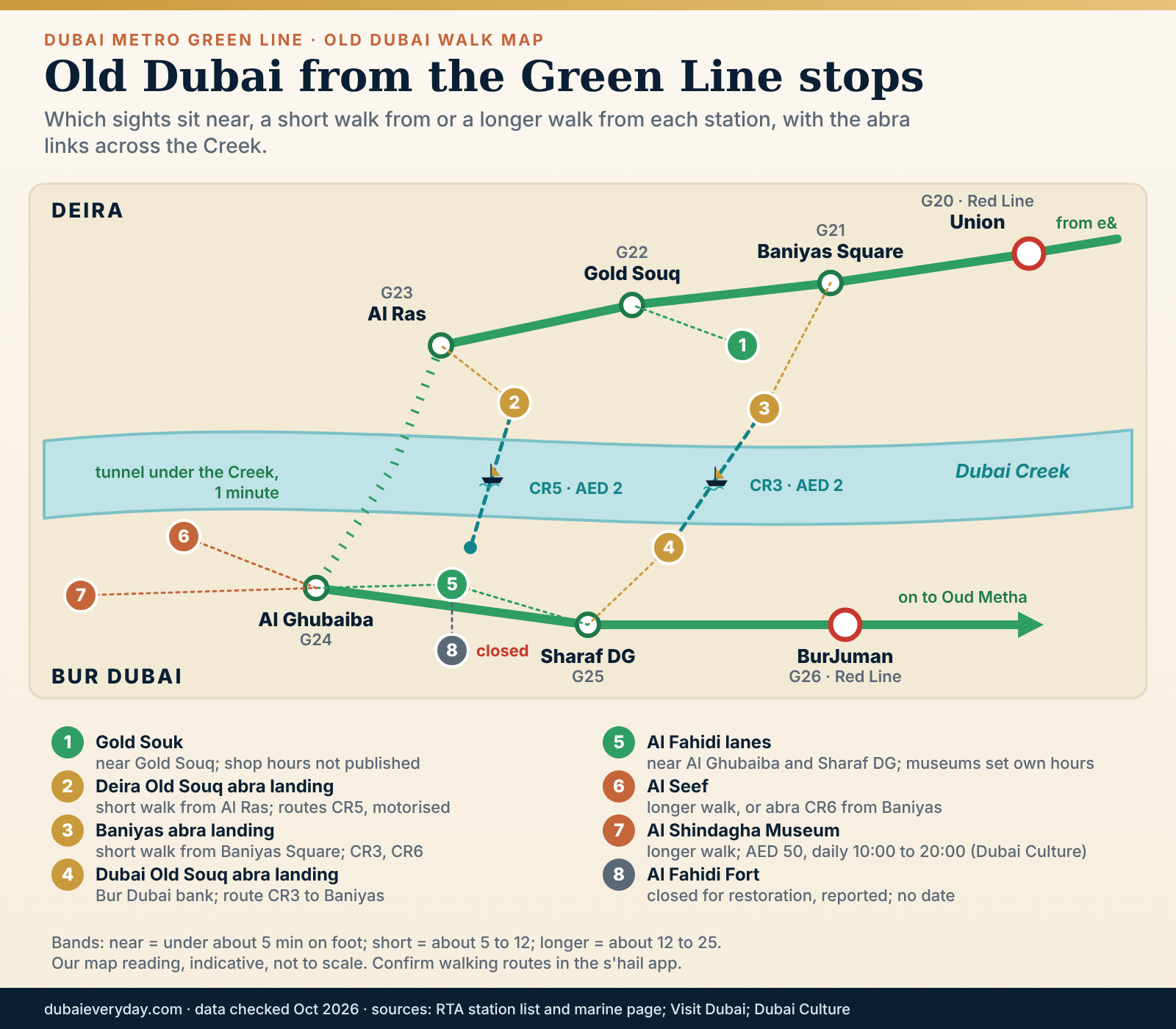
A Dubai Metro Green Line loop that uses both banks
The Dubai Metro Green Line’s geometry lets you build a loop that no other Metro line offers. Start at Gold Souq, walk the Deira trading streets, and leave from Al Ras or head to a Deira abra landing. Cross by abra, spend time in the Bur Dubai lanes, and re-enter the Metro at Al Ghubaiba or Sharaf DG to ride back under the Creek. The whole thing costs one or two Metro fares and one or two abra fares. We build it into the itineraries below with a time and a cost.
The loop works because the Metro crossing is so cheap in time. The Creek, which Wikipedia describes as ranging from about 200 to 1,200 metres wide, takes the train a minute to pass under, so you can choose which direction to cross by water and which by rail. That gives you flexibility on a hot day: do the Deira lanes in the cool of the morning, take the Metro across for lunch indoors, and do the Bur Dubai lanes late in the afternoon.
What to skip, and who this stretch is not for
It is not for anyone who wants air-conditioned comfort all day. The souk lanes and the heritage lanes are outdoors, or semi-covered at best, and the walk from station to site is on open pavement.
It is not for visitors who need a guaranteed opening time, because several of the places that matter publish none. And it is not a good use of an evening if your plan is a late dinner and a quick ride home, because of the earlier last trains described above. Our guide to indoor things to do in Dubai is the better starting point on a 40-degree afternoon.
Crossing the Creek: Metro, abra or both
There are three ways to get from Deira to Bur Dubai without a car: the Dubai Metro Green Line under the water, an abra across it, or a bus or taxi over a bridge. The first two are the interesting pair, and the right choice depends on the time of day and what you want from the crossing.
What the RTA says about the abra
The RTA’s marine page lists four heritage abra routes on the Creek at AED 2 per person: Dubai Old Souq to Baniyas (CR3), Al Fahidi to Al Sabkha (CR4), Al Fahidi to Deira Old Souq (CR5) and Al Seef to Baniyas (CR6). These boats take up to 20 passengers. A separate motorised traditional abra runs between the Bur Dubai Abra Station and the Deira Old Souq Abra Station, and between the Dubai Old Souq and Al Sabkha stations, for AED 1 per passenger, paid in cash.
The page does not print operating hours for the abras, and it says nothing about waiting times. It does say that children under 12 cannot travel on marine transport unaccompanied, that children under 12 with an adult must wear a life jacket, and that a valid ID for the child must be shown at the ticketing office. Confirm hours at the landing or in the s’hail app.
Metro under, abra across
On time alone, the Metro wins as a transport option. From the RTA’s timetable, Al Ras to Al Ghubaiba is one minute on the train. Add the walk to Al Ras station, the descent to the platform, the wait, the climb out at Al Ghubaiba and the walk to where you are going, and the gap shrinks but remains short. On cost alone, the abra wins: AED 1 or 2 against AED 3 at the lowest Silver fare, or more if the pair of stations spans extra zones.
On experience, there is no contest. The abra is the one thing in this guide that the Metro cannot replace. It puts you on the water between the two banks with the old waterfronts in view, which is the point of Old Dubai. Use the Metro to reach the Creek and to get away from it when you are tired, and use the abra for the crossing itself.

Which crossing for which situation
- Cool morning, no hurry, first visit: take the abra, and use the Metro for the return.
- July afternoon or a slow child: take the Metro, and save the abra for a late-evening moment if you want it.
- After dark: the last trains are earlier than the closing time, so check the clock before you plan the return by rail.
- Carrying shopping from the souks: the Metro is easier, because the abra needs a walk down to the landing.
- Going with an under-12: remember the life jacket and ID rules for the boat, and the fare rules for the train (children aged five and under travel free, per the RTA).
Down the Creek: Al Jaddaf and beyond
The Creek does not end at the old souks. At the southern end of the Dubai Metro Green Line, Creek (G30) sits near the Al Jaddaf Marine Station, where the RTA’s air-conditioned abra runs to Dubai Festival City (route BM2) for AED 2 per person each way. The same page lists a Dubai Water Canal route from Al Jaddaf to Dubai Design District (DC3) at AED 2 per stop. We did not find operating hours for either, so confirm them before you plan a day around them.
Wikipedia’s article on the Creek adds that dhows are still built on the bankside at Al Jaddaf. That is a reference-grade statement with no date, so we offer it as a reason to look, not as a promise of a working yard. For a family day that combines the Metro with the water, our Dubai with kids guide covers the heat and logistics side.
Beyond Old Dubai: BurJuman, Oud Metha, Healthcare City and Creek
South-west of the old districts, the Dubai Metro Green Line changes character. The stations become elevated, the neighbourhoods become hospitals, apartment blocks and a growing waterfront, and the reasons for riding shift from sightseeing to appointments, errands and commutes. This part of the Dubai Metro Green Line gets less attention in visitor guides, and it matters more to residents.
BurJuman (G26): shopping stop and hinge
BurJuman is the busiest station on the whole Metro, with 17.8 million passengers in 2025 according to the Dubai Media Office. Part of that is the BurJuman mall; part is the Red Line interchange, because BurJuman is where the Red Line corridor connects to the Green Line. If you want to shop at a mall rather than a souk, our shopping guide sets the options side by side, and BurJuman is the one the Dubai Metro Green Line reaches.
As a station it is a hinge for planning. Everything north-east of it on the Dubai Metro Green Line is the Old Dubai loop and the Deira districts; everything south-west is the medical and Creek side. If you are coming from Downtown on the Red Line, BurJuman is the natural change for anywhere south-west, and Sharaf DG is a single gap away for the Al Fahidi side.
Oud Metha (G27) and Dubai Healthcare City (G28)
These two stations are the reason many residents know the Dubai Metro Green Line at all. Dubai Healthcare City is a healthcare free zone that its own website says was established in 2002, with its own regulator for the clinics inside it. The site quotes 4,425 professionals and 168 clinical facilities, which are the operator’s own figures from our health research, not an independent count.
For a patient, the logistics are what matter. Wikipedia connects the Healthcare City station to Wafi City, and Oud Metha to St. Mary’s Catholic Church; for anything more specific, use the street address from your appointment letter and check the walk from the station exit in a map app before you leave. Our Dubai healthcare guide and the page on comparing hospitals cover how to choose care; this page only covers how to arrive.
Not for emergencies. Do not plan to reach urgent care by Metro. In an emergency, call the emergency numbers, which are widely published as 999 for police and 998 for an ambulance; confirm them on an official government page, because we did not re-check them today. The Metro is for appointments, visits and follow-ups. This is general information, not medical advice.
Appointment timing is where the schedule bites. A Sunday morning appointment before 08:00 means no train. A late appointment near the end of the day means checking the last trains towards Union, which leaves Healthcare City at about 23:29 on a Monday to Thursday. The simplest habit is to pick a slot that lets you travel between about 09:00 and 20:00, when you are well clear of both edges of the timetable.
Al Jadaf (G29): the arts stop
Al Jadaf is a short ride and a very different world from Gold Souq. The Jameel Arts Centre sits at Jaddaf Waterfront, and its visiting page, as recorded in our free things to do research, says entry is free, that you check in at the welcome desk, and that it is open 10:00 to 20:00 daily except Tuesday, when it is closed, with Friday starting at 12:00. The same page gives the walk from the station as about 12 minutes. In summer that is a walk you do early or late.
That is a good example of why the Dubai Metro Green Line is worth reading as a whole. The southern end is the quieter end, which suits a half-day that is more gallery than souk.
Creek (G30): the end of the line, for now
Creek is the south-western terminus, and today it is mostly about the water. The Al Jaddaf Marine Station is nearby, and the air-conditioned abra from there to Dubai Festival City costs AED 2 each way per the RTA. If your destination is Festival City’s mall side, the abra is a more interesting option than a bus or taxi. If you are heading elsewhere, the station is mainly the place to turn round.
Creek will change. The Dubai Media Office says the Blue Line will connect to the Green Line at a Creek Interchange Station in Al Jaddaf, with the first of its two sections running 21 km and 10 stations from Creek Interchange to Academic City. The line passes Dubai Creek Harbour and Dubai Festival City on the way. The target opening date is 9 September 2029. Until then, Creek is the end of the line, and the Festival City abra is the way onward.
The flamingo side, and what we could not place
Ras Al Khor Wildlife Sanctuary is the Creek’s southern wetland. Dubai Municipality’s visitor page, as recorded in our free things research, lists winter hours (October to March) of 07:30 to 17:30 and summer hours of 06:00 to 18:00, with rules on phones, food and pets inside the hides.
We found no source that gives a Metro station for the sanctuary, so plan the last leg by taxi or the Makani app. The same goes for the Dubai Frame: none of the sources we read puts it on the Green Line, and they disagree on which Red Line station is nearest.
Interchanges on the Dubai Metro Green Line
The Dubai Metro Green Line has two rail interchanges today and two more coming. The two that exist, Union and BurJuman, decide where most Dubai Metro Green Line journeys start. The two that are coming, Creek and Al Ghubaiba, will change the shape of the network around it.
Union and BurJuman: which Dubai Metro Green Line interchange to use
Both are Red Line interchanges: Union is R18 and G20, BurJuman is R19 and G26. On the Red Line they are one stop apart. On the Green Line they are six stops and about 12 minutes apart, with the whole Old Dubai loop between. The choice of interchange therefore decides how many Green Line stops you ride. Our Red Line guide counts them out: for Baniyas Square, Gold Souq and Al Ras, Union is nearer or equal; for Al Ghubaiba, Sharaf DG and everything south-west, BurJuman is nearer.
Using the timetable minutes from this page makes the rule concrete. From Union, Gold Souq is about 4 minutes away and Al Ghubaiba about 7. From BurJuman, Al Ghubaiba is about 4 minutes the other way and Healthcare City about 5. Choosing Union for an Al Ghubaiba trip adds roughly three minutes of riding, which is why the Red Line guide’s “pick the nearer interchange” rule saves time.
A Red Line change is not instant. Both interchanges are deep and large, and the Green and Red platforms are on different levels. The Red Line guide allows five to ten minutes for the change, and we use the same range. Wikipedia describes Union as 230 metres long and about 18 metres deep; if that is right, the walk between platforms is a real part of your journey, not an afterthought.
Bus, marine and Etisalat links
The RTA’s fare rules give one useful link rule: if you check in on a bus within 30 minutes of checking out of the Metro, the two legs are charged as one journey based on the combined zones. That applies at any Green Line station with a bus stop, and it is the reason the e& station, which Wikipedia links to the Etisalat bus station, is a practical start for bus travellers coming from the north-east.
On the water side, the abra landings sit near the Old Dubai stations rather than at them, so the connection is a walk, not a transfer. At Creek, the Al Jaddaf Marine Station is the exception, because the abra to Festival City is part of the RTA’s marine network and nol cards can be bought at the air-conditioned abra stations, according to the marine page.
The airport side
Dubai Airport Free Zone (G13) sounds like an airport stop, and it is not an airport terminal. Dubai Airports’ Metro page names Terminals 1 and 3 on the Red Line and does not mention Terminal 2 or the Green Line.
Wikipedia lists a transfer to Terminal 2 from G13, but we could not confirm any current arrangement on an official page, and our Terminal 2 guide is the place to check what the airport itself says. If you land at Terminal 2, treat the Metro as a plan you confirm on the day, and allow for a taxi.
For a Green Line trip from Terminals 1 or 3, the route is Red Line to Union, change, then Green Line. Our Dubai airport guide covers the airport end of that, including luggage rules for the Metro (up to two pieces, per Dubai Airports). The earlier timing example, 17 to 24 minutes from Terminal 1 to Gold Souq, is our calculation and assumes a normal day.
Coming: Creek and Al Ghubaiba
The Blue Line’s Creek Interchange Station and the Gold Line’s Al Ghubaiba interchange are the two new connections. Both are years away, and both are described in the closing sections of this guide. For now, the useful point is that the Dubai Metro Green Line is not a dead end in the network plan. It is the line that two new lines are being built to meet.
The north-east stretch and living on the Dubai Metro Green Line
Nine of the Dubai Metro Green Line’s twenty stations lie north-east of Union, and for most visitors they are scenery seen from the train. For residents they are the point. The stretch from e& to Salah Al Din runs through the working neighbourhoods of north-east Deira, and the Metro is what turns a cheap address there into a workable commute.
What each north-east station costs in time
Using the same RTA timetable that gave us the Old Dubai minutes, the last train towards Creek reaches Union from Salah Al Din in 3 minutes, from Abu Baker Al Siddique in 5, from Abu Hail in 7, from Al Qiyadah in 8, from Stadium in 10, from Al Nahda in 12, from Dubai Airport Free Zone in 14 and from Al Qusais in 16. Add about 3 for e&, which makes the terminus roughly 19 minutes from Union. These are our readings of one train, rounded to the minute, so allow a margin.
Carry the same numbers further and the commute logic opens up. Al Nahda is about 12 minutes from Union and about 24 from BurJuman. Stadium is about 10 from Union and 22 from BurJuman. If your workplace is on the Red Line, the Union change adds its five to ten minutes. If it is in Old Dubai, the Dubai Metro Green Line takes you there directly, and the journey is the number above plus the gap count from Union.
Questions to ask before choosing a flat near a Dubai Metro Green Line station
We do not publish rents in this guide, because we could not verify any from an official source and we do not want to invent a market figure. What we can offer is the transport half of the decision, which is often the half that gets skipped. Our guides to renting in Dubai, renting an apartment and the cost of living cover the contract and budget half.
- How long is the walk from the building door to the station exit, and how much of it is in sun? The RTA does not publish this; a map app does.
- Is the station elevated or underground? North-east of Salah Al Din they are all elevated, which usually means a climb or a lift.
- What time do your shifts start and end? The first train is about 05:00 and the last is before midnight, and Sunday starts at 08:00.
- Do you need to change? A Green Line commute to the Red Line corridor adds a change and five to ten minutes at Union or BurJuman.
- What is the fare for your pair of stations? Tap in once, read the deduction on a gate display or app, and note it; the zone map is a graphic we could not read.
A worked commute comparison on the Dubai Metro Green Line
Illustrative example, not a quote or a market fact. Suppose two flats are offered at similar rents, one near Al Qusais (G12) and one near Salah Al Din (G19), and you work near Gold Souq (G22). Using our timetable minutes, Al Qusais to Union is 16 minutes and Gold Souq adds 4, so about 20 minutes riding. Salah Al Din to Union is 3 minutes and Gold Souq adds 4, so about 7.
The 13 minutes’ difference each way is 26 minutes a day, or roughly nine and a half hours over a 22-day month, before you count the fare. Whether that is worth a higher rent is a personal call, but the arithmetic puts a number on it.
The same method works for the airport side. Dubai Airport Free Zone (G13) is about 14 minutes from Union. If you work in the free zone itself, you may live along the line and never need the Red Line at all. If you do, the Union change is the cost of living north-east of the old districts.
The airport stop and Sharjah
The Dubai Metro Green Line’s airport connection is weaker than its name suggests, as the interchanges section explained. The Dubai Airport Free Zone is a business address, one of the free zones on the Dubai government’s list, and not a terminal. For flights, the Red Line serves Terminals 1 and 3 per Dubai Airports, and the Green Line reaches that line at Union.
Sharjah is the other thing north-east residents ask about. The Metro does not cross the emirate boundary. Intercity buses do, and Dubai Taxi lists a surcharge of AED 20 for trips to Sharjah on top of the meter, according to its fares page as recorded in our cost research.
We could not read an RTA page listing the current Sharjah bus routes and stops, so check the RTA app for those. If you are weighing a move that depends on a daily Sharjah run, our moving to Dubai guide and relocation checklist put transport in the wider picture.
Other things residents use the north-east stations for
Al Qusais is where the RTA says the evaluation test for licence holders is taken, at the Emirates Driving Centre, in the page we recorded for our driving licence guide. That is a task, not a reason to live there, but it shows how the north-east leg serves ordinary errands. For anyone who plans to drive after living car-free for a while, the car rental guide covers renting by the day for the trips the Metro cannot do.
Dubai Metro Green Line fares and nol cards, worked through
Fares on the Dubai Metro Green Line are the same zone fares as everywhere else on the Metro, so the full logic lives in our Dubai Metro guide. This section keeps to what a Green Line rider needs and adds worked examples for the journeys in this guide.
The rules, in short
Per the RTA’s fares page as recorded in the Metro guide, a Silver or Personal card pays AED 3 for one zone, AED 5 for two adjacent zones and AED 7.50 for more. A Red ticket costs AED 4, 6 or 8.50 for the same bands, and Gold Class costs AED 6, 10 or 15. You need at least AED 7.50 on the card to tap in.
A journey can last up to 180 minutes with up to three transfers, and a bus trip within 30 minutes of leaving the Metro is charged as one journey. Children aged five and under travel free.
The honest limit is the zone map. The RTA publishes it as a graphic, and we could not read it, so we cannot tell you which Green Line pairs cost AED 3, which cost AED 5 and which cost AED 7.50. Short hops inside the Old Dubai loop are very likely at the low end and the full line is very likely at the top, but “very likely” is not a fare. Tap in once, read the deduction and you will know.
Which card for the Dubai Metro Green Line
For a visitor with a few trips, a Silver card or a Red ticket works. The RTA page we read prints no card prices.
Two secondary sources, recorded in our Metro guide, put the Silver card at AED 25 with AED 19 of credit, a net cost of AED 6, and the Red ticket at AED 2. On that reading, Silver pays for itself from the fifth journey, because each Silver journey is AED 1 cheaper than the Red ticket. That figure is our calculation, and it depends on prices the RTA did not print, so confirm at the machine.
Passes are a different matter. The RTA’s pass table, which we re-read today, lists a Silver all-zones pass at AED 110 for 7 days, AED 350 for 30 days, AED 830 for 90 days and AED 2,670 for 365 days. Anonymous Silver and Gold cards can only buy the 7-day pass. Registered cards can buy any of the four. Student, senior and Emirati and citizen passes are half the Silver price.
Worked examples
Illustrative example, not a quote. An Old Dubai half-day for a visitor: a Red Line leg to Union, a Green Line leg to Gold Souq, a Green Line ride from Al Ras to Sharaf DG after an abra crossing, and a ride back. That is four Metro journeys at AED 3 to 7.50, so AED 12 to 30, plus two abra crossings at AED 1 to 2 each, so AED 2 to 4, plus the AED 6 net card cost on the Silver card.
The total is AED 20 to 40 for the day. At 3.6725 dirhams to the dollar that is roughly 5.50 to 11 US dollars.
Illustrative example, not a quote. A weekday commuter: 22 working days a month with two journeys each makes 44 journeys. At AED 7.50 each that is AED 330 a month, against AED 350 for the 30-day all-zones pass, so pay-as-you-go wins by AED 20. At AED 5 a journey the commuter pays AED 220 against AED 230 for the 2-zone pass; at AED 3 a journey, AED 132 against AED 140. In other words, at 44 journeys a month the 30-day pass loses at every tier.
The longer passes can win. A 365-day all-zones pass at AED 2,670 works out at about AED 5.06 per journey over 528 journeys. If your typical fare is above that, the annual pass saves money; if you ride mostly single-zone hops at AED 3, it does not. That break-even is our calculation. It also ignores any daily fare cap, because the sources we found disagreed on whether one exists and at what level.
Other costs and rules to know
The RTA says nol cards can be used on the Metro, buses, tram, marine transport and taxis, with micropayments at shops capped at AED 200 per purchase. Registering a Silver or Gold card protects the balance if you lose it. Fines for eating or drinking and for travelling in the wrong cabin are reported by secondary sources, not the RTA page, so we leave amounts to the Metro guide. The practical rule is the same as anywhere: do not eat, do not drink and do not test the gate.
Planning with the Dubai Metro Green Line: stop chooser and itineraries
Most Green Line questions come down to one of two: which stop do I get off at, and how do I fit this into a day. The decision flow below answers the first. The itineraries after it answer the second, with times built from the RTA timetable minutes and costs built from the fares above. All of them are plans, not records of trips.
Which Dubai Metro Green Line stop for which errand
Start from the purpose rather than the map. The flow asks where you are heading, then narrows to a stop and a way of arriving. It reflects the station facts in this guide and nothing we could not source; where a walking distance is unknown, it says to check the exit in a map app.

Two edge cases are worth saying aloud. If you are not sure whether a place is “Deira” or “Bur Dubai”, look at which side of the Creek it is on: Gold Souq and Al Ras serve the Deira shore, Al Ghubaiba and Sharaf DG the Bur Dubai shore. And if the address is a hospital or clinic, use the street address rather than the district name, because a district can span more than one station.
Itinerary 1: an Old Dubai morning on the Dubai Metro Green Line
Illustrative plan, cool season. This assumes you are staying on the Red Line corridor and enter the Dubai Metro Green Line at Union. Ride to Gold Souq (about 4 minutes from Union) and allow 90 minutes for the souk lanes. Walk on to Al Ras, then take an abra across the Creek (AED 1 to 2). Spend 90 minutes in the Bur Dubai lanes and have lunch there. Re-enter the Metro at Al Ghubaiba or Sharaf DG and ride back to Union or BurJuman, whichever suits your next stop.
The time allowances are our planning estimates, not measured times. The cost, for four Metro journeys and two abra crossings plus the card’s net cost, is AED 20 to 40, as worked out in the fares section. Start by 09:00 so that you are in the souk lanes before the hottest hours, and check museum times for the day. If the Dubai Museum is still closed, as reported, the Coffee Museum and the neighbourhood’s own galleries are the nearest substitutes, subject to their hours.
Itinerary 2: a long layover with Old Dubai in the middle
Illustrative plan, with arithmetic. Suppose you land at Terminal 3 at midday with an onward flight departing eight hours later. Reserve the first hour for immigration and bags, which the airport operator’s service-level figures in our Dubai airport guide help you size, and the last three hours for check-in and security. That leaves about four hours. Subtract the Red Line and Green Line rides each way, which on our estimates is 20 to 30 minutes per leg including the change, and you have roughly three hours on the ground.
Three hours is enough for the Gold Souq stop, a walk through the souk, and a return, but not for an abra crossing and the Bur Dubai lanes as well. The planning mistake is to stretch it. The rule that protects a flight is to set your return time first and work backwards, treating anything past it as a bonus. Our first-time-in-Dubai plan has more on arrival logistics, and the Red Line guide has a longer layover plan if you want the other half of the city.
Itinerary 3: an appointment at Healthcare City
Illustrative plan. You have a mid-morning appointment at Dubai Healthcare City. Aim to arrive at the station 30 minutes before the appointment, to leave time for the walk from the exit and for any check-in. From BurJuman the ride is about 5 minutes. From Union it is about 17. From Salah Al Din, in the north-east, it is about 20. Take a nol card with at least AED 7.50 on it, and a plan for the return that does not depend on a train after about 23:30.
If the clinic is a specialist practice, our dentist guide and dermatologist guide cover how to check a licence. This itinerary is only the transport half.
Itinerary 4: dinner in Bur Dubai, home before the last train
Illustrative plan, with the timetable limit. An evening in Bur Dubai is easy to start and awkward to finish. The last Green Line train from BurJuman towards Union and e& leaves at 23:35 Monday to Thursday and 00:34 on a Friday night. If you are heading back to the Red Line, you also need the Red Line’s last train, which we did not read here. Build in a margin and decide in advance whether the fallback is a taxi.
For the taxi fallback, Dubai Taxi’s fares page, as recorded in our cost research, lists AED 2.45 per kilometre with a minimum of AED 12 for a street hail. We did not build a fare estimate from it, because we do not know the distance for your route. Our guides to restaurants and cafes cover where to eat; nothing about the Metro is a reason to pick a table.
Itinerary 5: art and water at the south-western end
Illustrative plan. Ride to Al Jadaf, walk to the Jameel Arts Centre (about 12 minutes by its own account), and spend an hour or two inside. It is closed on Tuesdays. Walk or ride back towards Creek and take the air-conditioned abra from the Al Jaddaf Marine Station to Dubai Festival City, AED 2 each way. Check the abra’s operating times before you rely on a return crossing, because we did not find them published.

Heat, cabins, luggage and accessibility
The Dubai Metro Green Line is a way of avoiding the heat, but the districts it serves are largely outdoors. That makes season the biggest variable of all.
When to walk Old Dubai
NOAA’s normals, as summarised on Wikipedia and recorded in our free things research, put the mean daily maximum at 24.4 degrees Celsius in January and 41.9 in August.
Month by month the figure is 26.1 in February, 28.9 in March, 33.7 in April, 38.2 in May, 40.0 in June, 41.5 in July, 39.5 in September, 35.9 in October, 30.7 in November and 26.5 in December. Our reading is that November to March is the walking season for the souks and lanes, April and October are workable if you start early, and May to September are for short, early or indoor-led days.
Daylight matters as much as temperature. Our sunrise and sunset calculation, using the NOAA formula for central Dubai, gives 06:36 and 17:32 for mid-November, 07:06 and 17:49 for mid-January, and 05:28 and 19:10 for mid-June. In the cool season the lanes fade by about 17:30, so an early start matters. Our best time to visit page puts these seasons in the context of prices and crowds.
Heat rule. From May to September, plan Old Dubai in two short windows: the first hour or two after the stations open, and the last hour of light. Between them, use the indoor parts of the day, such as a mall or a museum, and keep the Metro for the moves between them. Drink water before you feel you need it, and treat the walk from the station exit as part of the exposure, not a free hop.
Dress and conduct
The souks and heritage lanes are everyday places as well as sights, and dress expectations there follow general UAE norms: covered shoulders and knees are the safe standard in traditional districts and at any religious site. Our dress code guide and etiquette guide cover this in detail, including photography of people, which needs permission. On the train itself, the basic rules are the Metro guide’s: no eating or drinking, no sleeping across seats and no gate tricks.
Cabins, luggage and accessibility
We could not verify cabin positions, the rules for the women-and-children and Gold cabins, or the size limits for luggage from an RTA page, so we leave them to the Dubai Metro guide, which flags the same gaps. The one luggage rule we can source is from Dubai Airports: up to two pieces on the Red Line, including hand luggage. We assume the same applies on the Green Line, but we did not see it stated.
On accessibility, the RTA’s fare rules include concessions for People of Determination, but we did not verify station features such as lifts, tactile paths or audio announcements. Station layouts vary, and we cannot say which exits have step-free routes. If you need step-free access, phone the RTA before the trip and map the lift locations at both ends. Families travelling with young children will find the logistics, from strollers to heat, in our Dubai with kids and Dubai with a baby guides.
Holidays and event days
Dubai Airports notes that Metro hours may change on public holidays and during citywide celebrations, and recommends checking the RTA. Dates likely to matter: the National Day holiday is expected on 2 and 3 December 2026, according to a Gulf News report updated in October, and Ramadan is expected to start around 8 February 2027, with Eid Al Fitr around 9 to 10 March, per The National. These are press forecasts, so check the RTA’s holiday banner nearer the time. Our events calendar tracks the larger dates.
When the Dubai Metro Green Line is the wrong tool, and what is coming
An honest guide to a transport line has to say when not to use it. The Dubai Metro Green Line is excellent at one thing, moving you around the old districts and the Creek, and mediocre or useless at several things people assume it does.
Where another option wins
For the airport terminals, use the Red Line, not the Dubai Metro Green Line. Dubai Airports names Terminals 1 and 3 on the Red Line, and its Metro page says nothing about Terminal 2 or the Green Line. For Downtown, the Burj Khalifa area, Mall of the Emirates and the Marina side, the Red Line is the one. Our Downtown Dubai guide and Marina guide cover those districts, and both start from Red Line stations.
For the beach, the Metro is not the answer either; the Dubai Metro Green Line goes nowhere near the sea. Our beaches guide sets out the public and hotel options and how people reach them. For a late night, remember that the last trains leave before midnight, and a taxi is the fallback. For a heavy shopping haul from the souks, a taxi is easier than a platform. For Sharjah, the Metro does not cross the boundary, and the RTA’s intercity buses are the route we could not read in detail.
For flexibility across the whole emirate, a hire car is the alternative, with the usual costs of parking and tolls. Our cheap car rental guide explains deposits, Salik and hidden charges, and the airport car rental guide covers pickups at DXB. Old Dubai is the part of the city where a car is least useful, because the lanes are narrow and parking is scarce, so the Dubai Metro Green Line is usually the better answer there.
The Blue Line and the Creek interchange
The Blue Line is the first of two lines that will change the Dubai Metro Green Line’s role. The Dubai Media Office describes a 30 km line with 14 stations, in two sections: 21 km and 10 stations from Creek Interchange to Academic City, and 9 km and 4 stations from Centrepoint through Mirdif and Al Warqa to International City (1). The Green Line meets it at Creek Interchange Station in Al Jaddaf. The target opening date is 9 September 2029.
On progress, the same release says the work was 10 percent complete five months after the June 2025 groundbreaking, with a target of 30 percent by the end of 2026. The National reported in July 2026 that the first phase of tunnelling was complete, as recorded in our Metro guide.
For a Green Line rider this matters in one way: once the Blue Line opens, Creek stops being the end of the line and becomes the gateway to Dubai Creek Harbour, Dubai Festival City, International City, Dubai Silicon Oasis and Academic City, all of which the release names.
The release also describes a Creek Harbour station designed to be the world’s highest metro station, at 74 metres tall and 38 metres wide, with an expected 70,000 or more passengers a day at opening. That is the Dubai Media Office’s own description, and it is about the Blue Line, not the Green Line. We include it because it shows the scale of what is being built at the Green Line’s southern doorstep.
The Gold Line and Al Ghubaiba
The Gold Line is the second change, and it affects the old districts directly. The Dubai Media Office’s 22 April 2026 release describes a 42 km, 18-station, fully underground line costing about AED 34 billion, running from Al Ghubaiba to Jumeirah Golf Estates at a depth of 40 metres. Its Green Line interchange is at Al Ghubaiba. The tender is due in 2026, the contract award in 2027 and the scheduled opening is 9 September 2032.
The release names Mina Rashid, City Walk, Business Bay and Mohammed Bin Rashid City among its locations, without giving the order of every stop. It also says the line would cut Red Line crowding between BurJuman and the Onpassive station by 23 percent. For Green Line riders, the practical meaning is that Al Ghubaiba would become a two-line hub, and some journeys that now run through BurJuman and the Red Line could run through Al Ghubaiba instead.
Treat the dates as targets. All of these are scheduled or target dates from official releases, not opening dates. We found no published schedule of construction works at Al Ghubaiba or Creek that would affect Green Line service, but that is a gap in what we read. Do not plan a trip, a lease or a move around a date in 2029 or 2032, and re-check the Dubai Media Office and the RTA nearer the time.
Mistakes that cost time on the Dubai Metro Green Line
Most of these come from the same root: treating the Dubai Metro Green Line as a simpler or more central line than it is. None needs special knowledge to avoid; they need a minute of checking.
Timing mistakes on the Dubai Metro Green Line
The most expensive timing mistake is reading “open until midnight” as “trains until midnight”. The last train from Union towards Creek is 23:42 on Monday to Thursday, and the last from BurJuman towards e& is 23:35. A plan built on midnight leaves you on a platform at 23:50 with nothing coming. The second is the Sunday start: services begin at 08:00, so a dawn walk in the souks that relies on the Metro does not work on a Sunday.
The third is the closed fort. If a guidebook or an old video says to spend the morning at the Dubai Museum in Al Fahidi Fort, check the date on it. The fort is reported closed for restoration with no reopening date, so a heritage plan should not hang on it.
Route mistakes
The classic route mistake is changing at the wrong interchange. Union and BurJuman are one gap apart on the Red Line and six apart on the Green Line, so choosing the wrong one adds gaps and minutes. A Red Line rider heading for Oud Metha who changes at Union rides seven Green gaps instead of one, which is about 12 minutes of extra riding on the timetable (14 minutes from Union against 2 from BurJuman).
The second is boarding in the wrong direction. The numbers make this avoidable: if your destination’s code is higher than where you are, you want “To Creek”; if lower, “To e&”. The third is treating Dubai Airport Free Zone (G13) as an airport station. It serves a free zone, and the Metro route to the terminals is the Red Line.
The fourth is underestimating the walk. Several of the sights people want sit a real distance from the nearest station, and the Al Shindagha Museum is the clearest example. A station name on a map is not a door.
Money mistakes
Under-loading the card is the common one: you need AED 7.50 to tap in, even if the journey will cost AED 3, so a card with AED 5 on it will not open the gate. Buying a 30-day pass for a 44-journey month is the next, because at every fare tier pay-as-you-go beat it in our calculation. Buying a 7-day pass for fewer than about 15 journeys is the third, since 110 divided by 7.50 is just under 15.
The last is assuming the abra and the Metro share a fare system. The motorised abra takes cash only, per the RTA, so carry a few dirhams in coins or small notes. The heritage abra fare is AED 2, and we did not verify how it is paid, so ask at the landing.
The short version
The Dubai Metro Green Line is the right Metro line for the souks, the Creek crossings, Bur Dubai, clinics at Healthcare City and the abra to Festival City. It is the wrong line for the airport terminals, Downtown and the beach. Learn three numbers and the rest follows: the last train leaves Union at 23:42, the Creek crossing takes one minute, and Union to BurJuman takes twelve. Everything else on the Dubai Metro Green Line is a variation on those.
Dubai Metro Green Line FAQ
What is the Dubai Metro Green Line and where does it go?
The Dubai Metro Green Line is the Metro’s second line, running between e& (G11) in north-east Deira and Creek (G30) in Al Jaddaf. It passes through Union, the Deira souk stops, a tunnel under the Creek, the Bur Dubai stops, BurJuman, Oud Metha and Dubai Healthcare City. The RTA’s timetable page names those two termini and its two Red Line interchanges, Union and BurJuman. It is the line for Old Dubai and the Creek rather than for Downtown or the airport.
How many stations are on the Dubai Metro Green Line?
Twenty, coded G11 to G30 in the RTA’s timings PDF. Wikipedia reports that twelve are elevated and eight are underground, with the underground run continuous from Salah Al Din (G19) to BurJuman (G26). The numbering has no gaps, so the number of stops between two stations is the difference between their codes: Gold Souq (G22) to Al Ghubaiba (G24) is two. The line opened to the public on 10 September 2011 and gained Al Jadaf and Creek on 1 March 2014, per Wikipedia.
What time does the Dubai Metro Green Line start and stop?
Stations open at 05:00 Monday to Saturday and 08:00 on Sunday, per the RTA. They close at 00:00 Monday to Thursday and Saturday, 01:00 on Friday night and 00:00 on Sunday. The last trains leave earlier than closing: in the RTA’s timings PDF, our reading is 23:42 from Union towards Creek and 23:35 from BurJuman towards e& on Monday to Thursday. Holiday hours differ, so check the RTA banner or the s’hail app on public holidays. Confirm first.
Which Dubai Metro Green Line station is for the Gold Souk?
Gold Souq (G22) is the station named for it, with Baniyas Square (G21) and Al Ras (G23) on either side. All three are underground and about two minutes apart on the RTA’s printed timetable. Union is the nearest interchange from the Red Line for these stops. The souk’s trading hours are set by the individual shops and we found no official statement of them, so go in the morning and treat the evening as uncertain. Check the walk from the exit in a map app.
Where do I change between the Red Line and the Green Line?
At Union (R18 and G20) or BurJuman (R19 and G26). On the Red Line they are one stop apart, but on the Green Line they are six stops and about 12 minutes apart. Pick the one nearer your Green Line destination: Union for Baniyas Square, Gold Souq and Al Ras, BurJuman for Al Ghubaiba, Sharaf DG and anything south-west. Allow five to ten minutes for the change at either, as our Red Line guide does, because the platforms are on different levels.
Does the Dubai Metro Green Line go to the airport?
Not to the terminals. Dubai Airports’ Metro page names Terminals 1 and 3 on the Red Line and does not mention Terminal 2 or the Green Line. The Dubai Metro Green Line has a Dubai Airport Free Zone station (G13), which serves the free zone, and Wikipedia lists a transfer to Terminal 2 from it, but we could not confirm that arrangement on an official page. For Terminals 1 and 3, take the Red Line and change at Union or BurJuman for the Green Line.
How long does the Dubai Metro Green Line take from end to end?
About 40 minutes. In the RTA’s printed times for a last train, a service leaving e& at about 23:23 arrives at Creek at 00:03, and the other direction takes about 37 minutes. That is a little over two minutes per station gap. The Old Dubai section is quicker: Union to Creek is about 21 minutes and Union to BurJuman about 12. These are our readings of one printed train, rounded to the minute, so allow a margin.
How much does a Dubai Metro Green Line ticket cost?
On a Silver or Personal nol card, AED 3 for one zone, AED 5 for two adjacent zones and AED 7.50 for more, per the RTA fares page as recorded in our Metro guide. A Red ticket is AED 4, 6 or 8.50. You need AED 7.50 on the card to tap in. We could not read the zone map, so we cannot say which Green Line pairs fall in which band: tap in once and read the deduction. Children aged five and under travel free.
Which station is closest to Al Fahidi Historical Neighbourhood?
Al Ghubaiba (G24) and Sharaf DG (G25) are the two Bur Dubai stops either side of it on our reading of a map, and Wikipedia’s museum article names a nearby “Al Fahidi” station, which looks like Sharaf DG’s older name. The RTA does not publish walking routes, and Visit Dubai’s page gives no hours or fee for the neighbourhood, so check the exit and walk in a map app. Note that Al Fahidi Fort is reported closed for restoration.
Is there a Dubai Metro Green Line station for Dubai Healthcare City?
Yes: Dubai Healthcare City (G28) is named for it, with Oud Metha (G27) one stop earlier and Al Jadaf (G29) one stop later. Wikipedia connects the station to Wafi City. From BurJuman the ride is about 5 minutes on the RTA’s printed times, and from Union about 17. Use the street address on your appointment letter for the walk, and do not use the Metro for emergencies. This is general information, not medical advice.
Is it better to cross the Creek by abra or by Metro?
It depends on the day. The Metro takes about one minute from Al Ras to Al Ghubaiba on the RTA’s timetable and is independent of the weather, but costs AED 3 or more. The heritage abra is AED 2 and the motorised abra AED 1, cash only, per the RTA, and is the better experience on a cool morning. We found no abra operating hours, so check at the landing.
Will the Dubai Metro Green Line change when the Blue and Gold lines open?
The line itself will not change, but its connections will. The Dubai Media Office says the Blue Line will meet it at a Creek Interchange Station in Al Jaddaf, targeting 9 September 2029, and the Gold Line will start at Al Ghubaiba with a Green Line interchange, scheduled for 9 September 2032. Both are targets from official releases, not opening dates, so do not plan a lease or a move around them.
Can I take luggage on the Dubai Metro Green Line?
Dubai Airports says up to two pieces of luggage, including hand luggage, are allowed on the Red Line, and refers to the RTA for size and weight limits. We did not find the rule stated for the Green Line and assume it is the same, but treat that as unconfirmed. Old Dubai stations have stairs and long walks, so a small case is far easier than a large one. Our Metro guide covers cabin and luggage rules in more detail.
Related reading
Sources and further reading (27 links)
- RTA: Metro and tram timetables page — station opening hours, line endpoints, interchanges
- RTA: Dubai Metro and Tram timings PDF — Green Line station codes, order, first and last trains
- RTA: Nol fares — pass prices, transfer rules (zone fares as recorded by our Metro guide)
- RTA: About Nol card — minimum balance, where nol is accepted (read by sibling guides)
- RTA: Marine transport — abra routes, fares, life-jacket and child rules
- Dubai Airports: Metro — Terminals 1 and 3 on the Red Line, luggage, hours
- Dubai Media Office: RTA records 802 million riders in 2025 — Metro and station ridership
- Dubai Media Office: Gold Line approval — length, stations, Al Ghubaiba interchange, dates
- Dubai Media Office: Blue Line progress — Creek Interchange Station, sections, target date
- The National: first phase of Blue Line tunnelling complete — progress note (read by our Metro guide)
- Wikipedia: Green Line (Dubai Metro) — secondary: opening dates, length, station types, connections
- Wikipedia: Dubai Creek — secondary: width, abras, dhow building
- Wikipedia: Dubai Museum — secondary: Al Fahidi Fort history
- Visit Dubai: Al Fahidi Historical Neighbourhood — description only, no hours or fees
- Visit Dubai: Al Seef — description only, no hours or fees
- Euronews: Al Fahidi Fort set to reopen with new museum — closure and reopening report (read by sibling guide)
- Dubai Culture: Al Shindagha Museum, plan your visit — hours and price (read by sibling guide)
- Jameel Arts Centre: Visit — hours, free entry, walk from Al Jaddaf station (read by sibling guide)
- Dubai Municipality: protected areas, plan your visit — Ras Al Khor Wildlife Sanctuary hours (read by sibling guide)
- Dubai Coffee Museum — exhibits; no hours or price printed (read by sibling guide)
- Sheikh Mohammed Centre for Cultural Understanding — location in Al Fahidi, office hours (read by sibling guide)
- Wikipedia: Climate of Dubai — secondary: monthly mean maximum temperatures (read by sibling guide)
- Wikipedia: Dubai Gold Souk — secondary: retailer count (read by sibling guide)
- Dubai Taxi: taxi fares — per-kilometre rate, minimum fare, Sharjah surcharge (read by sibling guide)
- Dubai.ae: free zones in Dubai — Dubai Airport Free Zone in the official list (read by sibling guide)
- Dubai Healthcare City: FAQ — free zone and regulator (read by sibling guide)
- dubizzle: nol cards explained — secondary: card prices the RTA page does not print (read by our Metro guide)
Update log: 29 October 2026 — first publication of this Dubai Metro Green Line guide; all facts re-checked against the sources above, except where a source is marked as read by a sibling guide. Next review due: 29 April 2027, or sooner after any RTA fare, hours or station change, or a Blue Line or Gold Line milestone. Corrections welcome. This page is general information, not an official timetable or professional advice; confirm every journey in the RTA’s s’hail app.
About DubaiEveryday and this guide
DubaiEveryday.com is an independent editorial project that publishes practical, research-based guides to everyday life in Dubai: where to live, what things cost, how the rules work and how to get around. This page was written and edited by the DubaiEveryday editorial team. It is not signed by a named expert, doctor, lawyer or adviser, and we do not claim first-hand testing of a venue, clinic or service unless the page says so.
Each guide is built from official sources such as government and regulator pages, operator websites and established news outlets, cross-checked where we can. When we could not confirm something, we say so in the text, and examples that use made-up numbers are labelled as illustrations. Mentions are editorial choices, not paid placements, and a link is not an endorsement.
Dubai changes quickly. If you spot something that is out of date or wrong, please tell us through the contact options on DubaiEveryday.com and we will check it and correct the page.