
Travel insurance Dubai visitors buy is a bundle of separate questions: does your visa route ask for a policy, who pays if you land in a hospital, and what happens when a flight, a bag or an activity goes wrong. This guide answers each one from official sources and public policy pages, and tells you which clauses to read before you pay.
Most people shop for travel insurance Dubai trips need the way they shop for a phone charger: grab the cheapest one at the last minute and hope never to use it. Then something small goes wrong in a hot, fast, very well-organised city, and the details of the wording suddenly matter more than the price. A hospital asks about your policy before it asks about your symptoms, a flight slips by nine hours, a bag turns up two days late, and the clause you skipped is the one that decides who pays.
This guide is built for that moment, ahead of time. It sets out what the law says about visitors and health cover, which visa routes ask for a policy, what a sensible medical limit looks like, and how delay, baggage, activity and conflict clauses really behave. It is based on official sources and on public policy pages read on 29 October 2026, not on anyone’s holiday stories, and it is general information rather than financial advice.
Travel insurance Dubai visitors need is not one rule but three separate questions. First, does your visa route ask for a policy? It depends. The UAE government portal lists valid health insurance as a condition of the five-year multiple-entry tourist visa, and Dubai’s immigration directorate lists it for its own multiple-entry visa. The official entry pages we read for visa-free and visa-on-arrival travel do not.
Second, who pays if you need a hospital? Dubai Law No. 11 of 2013 says visitors should be insured, but it limits their benefits to emergency care, and the UAE government says only treatment needed to stabilise you in an emergency is free. Third, what happens when a trip goes wrong? Airlines owe you care and a refund or rebooking, but not compensation when the cause is a closure or conflict.
Our reading: buy a policy before you leave home, put the medical limit and evacuation first, treat delay and baggage as secondary, and read the war, known-event, pre-existing and activity wording before you pay. A cheap plan can suit a healthy four-day visitor and be badly wrong for someone older on a 90-day stay.
This is a desk-research guide. We read the Dubai health insurance law, the UAE government and Dubai immigration visa pages, the Dubai Civil Aviation Authority consumer directive, the UAE emergency-services page, the Central Bank of the UAE licensing and ombudsman pages, UK government travel advice and two public inbound policy pages, all on 29 October 2026. We did not buy or claim on any travel insurance Dubai policy, so nothing here is field-tested.
Public travel insurance Dubai pages describe products, not your contract. Wordings, limits and prices change, and the wording you are issued is what counts. No insurer, broker or comparison site paid for inclusion, and we name no product as best. This is general information, not individual insurance, legal or medical advice. Anything we could not confirm is hedged in the text.
Travel insurance Dubai visitors need: is it a legal requirement?
Start with what this page is. It covers travel insurance Dubai visitors buy before or during a trip to the emirate: medical cover, trip delay, baggage, activities and the visa angle. Mandatory cover for residents and employees is a different job, handled in our guide to health insurance in Dubai. Car, home and life policies sit in the wider Dubai insurance overview. The last section here also covers residents flying out, briefly.
Now the legal question. There is no single sentence in federal or Dubai law that makes a policy mandatory for every tourist. What exists is a layered picture, and it helps to take it in the order a visitor meets it.
What Dubai’s health insurance law says about visitors
Dubai Law No. 11 of 2013 on health insurance in the emirate names visitors in its scope. It defines a visitor as a natural person, tourists included, who visits the UAE through the emirate. Article 7 says visitors, like nationals and residents, are to be enrolled in health insurance, and that the phases and the entities responsible for enrolment are set by an Executive Council resolution.
The law then narrows what a visitor gets. Article 8 describes the visitor benefit as emergency care only, as approved by the Dubai Health Authority. An emergency case means one needing immediate medical intervention to save a life or remove a threat to it. Routine care, follow-up appointments and the long recovery after the emergency are not part of that definition.
Who pays is where it gets uneven. If a visitor is sponsored, the sponsor must enrol the person where no employer covers them, bear the cost and keep the policy valid for the visit. A sponsor must also produce a policy when visit permits are issued, and must bear emergency costs for an uninsured sponsored person. The law’s English text does not say who pays for an unsponsored visitor, and it leaves the enrolling entity for visitors to later determination.
What that means in practice
If you are shopping for travel insurance Dubai authorities will not check at the door, the decision stays with you. Read together, the law creates an expectation that visitors are insured, an emergency-only benefit, and a duty on sponsors. It does not give a tourist at the immigration desk a clear obligation to show a policy. We found no published notice telling visa-free arrivals to produce one. That is absence of evidence, not a promise, so treat the airline check-in desk as the place to confirm.
The Dubai Health Authority has said publicly that the law requires visitors to be insured and that it was working on a new mechanism to make that happen. The press report we found is undated and gives no start date, so we treat it as direction of travel rather than a rule you can plan around. Meanwhile, penalties in the law run from AED 500 to AED 150,000 per violation, aimed at employers, sponsors and providers rather than at an individual tourist.
There is also history worth knowing, because it still colours what travel agents say. In 2018, Gulf News reported that the immigration directorate said a 30-day visit permit must include health insurance, while agents gave conflicting answers and some healthcare providers did not accept the visitor policies on offer. That article is eight years old. It explains why you may still hear “it’s included in the visa” from a seller, and why you should ask to see the policy document rather than accept the sentence.
Why travel insurance Dubai officials never ask about still matters
The legal answer and the sensible answer on travel insurance Dubai trips differ. Even if no officer asks for a policy, the cost of a serious medical episode sits with you. The UK government’s travel advice for the UAE, updated on 27 October 2026, tells travellers to hold insurance for local treatment and unexpected medical evacuation, warns that you may be refused treatment without insurance or the means to pay, and adds that you could be prevented from leaving the country if you cannot pay a medical bill.
The same day, 27 October, the Indian missions in the UAE issued their own advisory, reported by Khaleej Times, after what they described as several cases of citizens facing bills they could not afford because cover was inadequate. They urged visitors to buy suitable insurance with cashless treatment and repatriation. Neither advisory is law. Both reflect the same practical point: the question is not whether Dubai hospitals are good, it is who is guaranteeing the payment.
Scale matters too. Dubai recorded 19.59 million international overnight visitors in 2025, according to the Dubai Department of Economy and Tourism, and Dubai International handled 95.2 million passengers in the same year. With that many people moving through, minor incidents are statistically certain. The useful question is how much of the cost lands on you when one of them is yours, and that is exactly what travel insurance Dubai visitors buy is meant to absorb.
Visa requirements and travel insurance Dubai: route by route
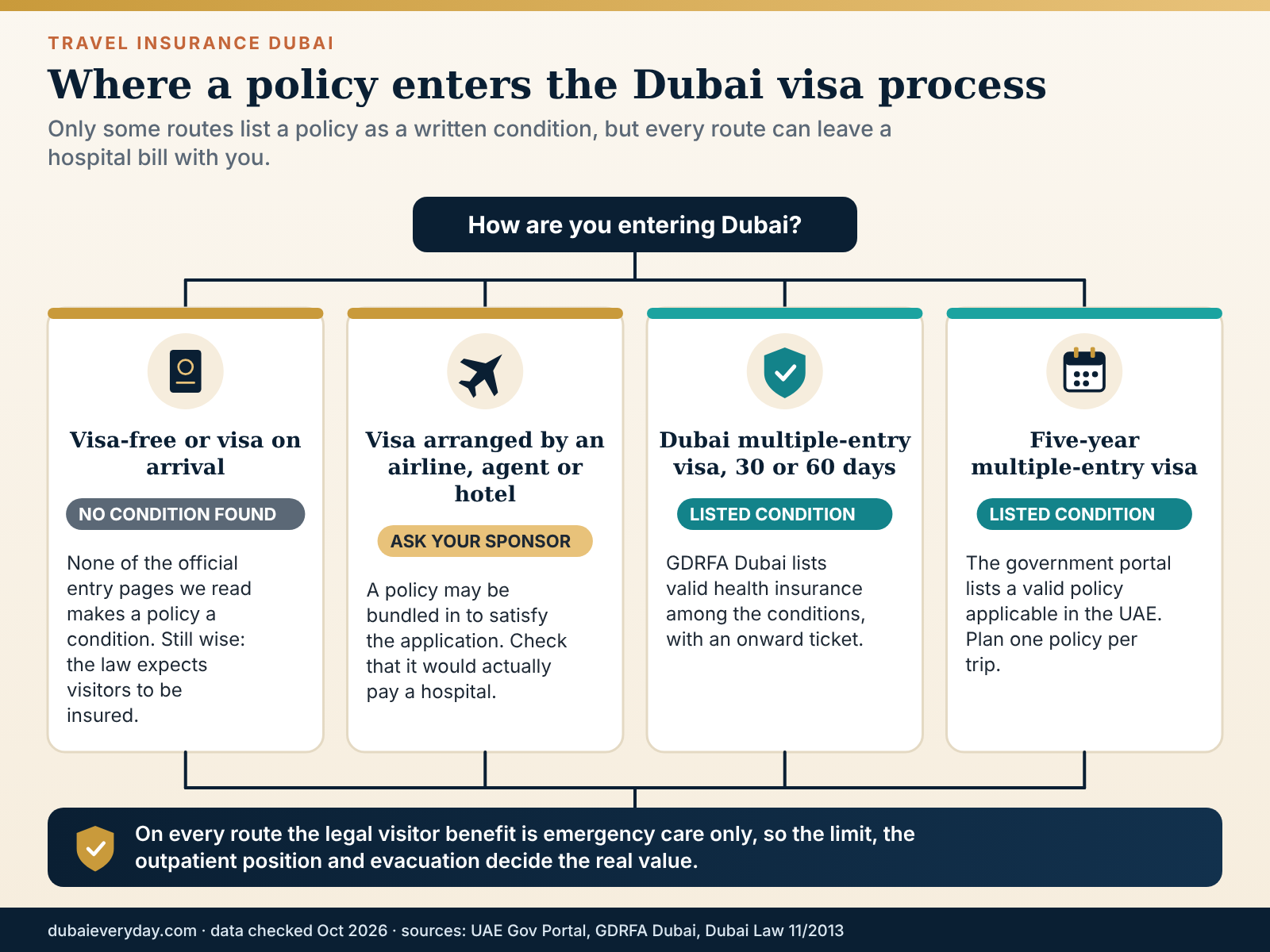
Travel insurance enters the Dubai visa process at different points depending on how you get in. The cleanest way to think about it is as four routes, each with a different answer to “will anyone ask for a policy?”. The map below gives the pattern. The sections after it explain the evidence behind each branch and the practical consequences.
Visa-free and visa-on-arrival entry
Which passports qualify for visa-free entry or a visa on arrival changes from time to time, and the list is long enough that copying it here would be out of date within months. Use the official visa-check tool of the federal identity authority, or your airline, for your own passport. Our job is narrower: what these routes say about travel insurance Dubai visitors hold.
None of the official entry pages we read makes a policy a condition of visa-free or visa-on-arrival entry. One insurer’s public inbound page says the same thing in plain words: visitors who are eligible for visa-free entry or visa on arrival are not legally required to buy insurance, although consulates and governments advise it. That is a product page, not law, so treat it as a second opinion rather than a legal source.
Skipping travel insurance Dubai officials do not ask for is a choice, not an exemption. That does not make the route risk-free. The Dubai health law still names visitors, the emergency benefit is still emergency-only, and the hospital will still want a way to be paid. Entering without a visa conversation is a convenience for you, not a statement about who covers a broken ankle.
Pre-arranged tourist visas through an airline, agent or hotel
If your nationality needs a visa in advance, the usual route is a UAE airline, a licensed travel agent or a hotel, which sponsors the application. Khaleej Times reported in July 2026 that single-entry tourist visas for 30 to 60 days could be approved within 48 hours through authorised tourism offices, following a Dubai immigration announcement. We could not find the original announcement on an official page, so treat the speed as reported, not guaranteed.
Here is the catch with the travel insurance Dubai sellers bundle in. The seller may add a policy to the bundle, and some of those policies exist mainly to satisfy a form. A document that lets the application go through and a travel insurance Dubai policy that pays a private hospital are not always the same thing. Ask the seller for the certificate, the limit and the wording, and compare them against the checklist later in this guide before you accept the bundle.
Dubai’s immigration directorate, GDRFA, publishes a separate multiple-entry tourist visa service for stays of 30 or 60 days. Its page lists valid health insurance among the conditions, along with a passport valid for at least six months and an onward or return ticket. The listed fees were AED 300 for 30 days and AED 500 for 60 days, plus 5% VAT, with about 48 hours to process. The sponsor must be a UAE establishment in the tourism sector.
The five-year multiple-entry tourist visa
This is the route where travel insurance Dubai rules are clearest in writing. The UAE government portal lists a valid health insurance policy applicable in the UAE, a bank balance equivalent to USD 4,000 over the previous six months, a ticket in and out, and proof of accommodation. It describes a 90-day stay per visit, extendable by a further 90 days, and says UAE embassies do not issue tourist visas. The dubai.ae page repeats the insurance and bank-balance conditions.
Sources differ on the per-visit rules. A Gulf News explainer describes stays of 30, 60 or 90 days with a ceiling of 180 days a year. The portal wording is the one to follow, and it is worth re-reading the current version when you apply. What matters for travel insurance Dubai buyers on this visa is the pattern: a five-year visa is five years of entries, and each entry is a separate trip.
A legal Q&A in Khaleej Times, published in December 2022 and updated in February 2024, reports that the identity authority confirmed holders need UAE-approved cover for each trip, covering the whole stay. One inbound product page says the same from the insurer side: a multi-entry visa holder making several visits needs a separate policy for each trip. In practice, buy a travel insurance Dubai policy per visit or check that an annual multi-trip policy really covers the length of stay you plan.
Annual travel insurance Dubai policies and the trip-length trap
Annual multi-trip policies look attractive to a frequent visitor, but travel insurance Dubai buyers should read the per-trip cap first. They often come with a cap on days per trip. One UAE broker’s public page for an inbound product describes multi-trip cover with unlimited trips but a maximum of 14 days each. If your plan is a 60-day family stay on a multiple-entry visa, that product does not fit, and the policy certificate may not satisfy the visa condition either.
The fix is boring and reliable: write down the first and last day you will be in the UAE, add a day each side for flight problems, and check that the policy period contains the whole range. The inbound page we read says premiums depend on trip length, so price both versions and look at the difference. Gaps are what cost money.
Transit, stopovers and extending travel insurance Dubai cover
We found no official page that attaches a travel insurance Dubai condition to a short airport transit, and we would not invent one. The medical logic still applies if you leave the airport on a stopover, because you are then a visitor in the emirate for the hours you are out. We did not check how inbound products treat a stay that short, so ask the insurer in writing if this is your case.
Extensions are a different matter. The same inbound product page says its policy cannot be extended while you are in the UAE, and it caps a trip at three months or 90 days depending on which part of the page you read. If you extend your visa, you may need a new policy, and a new policy bought after you arrive can have a waiting period or a pre-existing-condition rule that the first one did not. Plan the second policy before the first one ends.
What to carry and what to check on a travel insurance Dubai certificate
- The certificate shows your name exactly as in your passport, your dates of cover and the territory, which must include the UAE.
- The medical limit is stated in a currency you can compare, with any excess or co-payment visible.
- The 24-hour assistance number works from the UAE and is not a premium-rate line.
- You have the full policy wording as a file you can open offline, not only a one-page certificate.
- Your visa application reference and your insurance policy number are saved together on your phone.
One more point about overstay. In March 2026 the federal identity authority waived overstay fines for visit-visa holders who could not leave because of airspace closures, covering fines incurred from 28 February 2026, and a 30-day grace period later ran from 10 June to 9 July 2026, according to EY. Those were exceptional decisions, not a standing right. Fines and penalties are a standard exclusion in travel wordings, so check yours, and do not plan a stay around the chance of a waiver.
Medical cover: what travel insurance Dubai hospitals will actually see
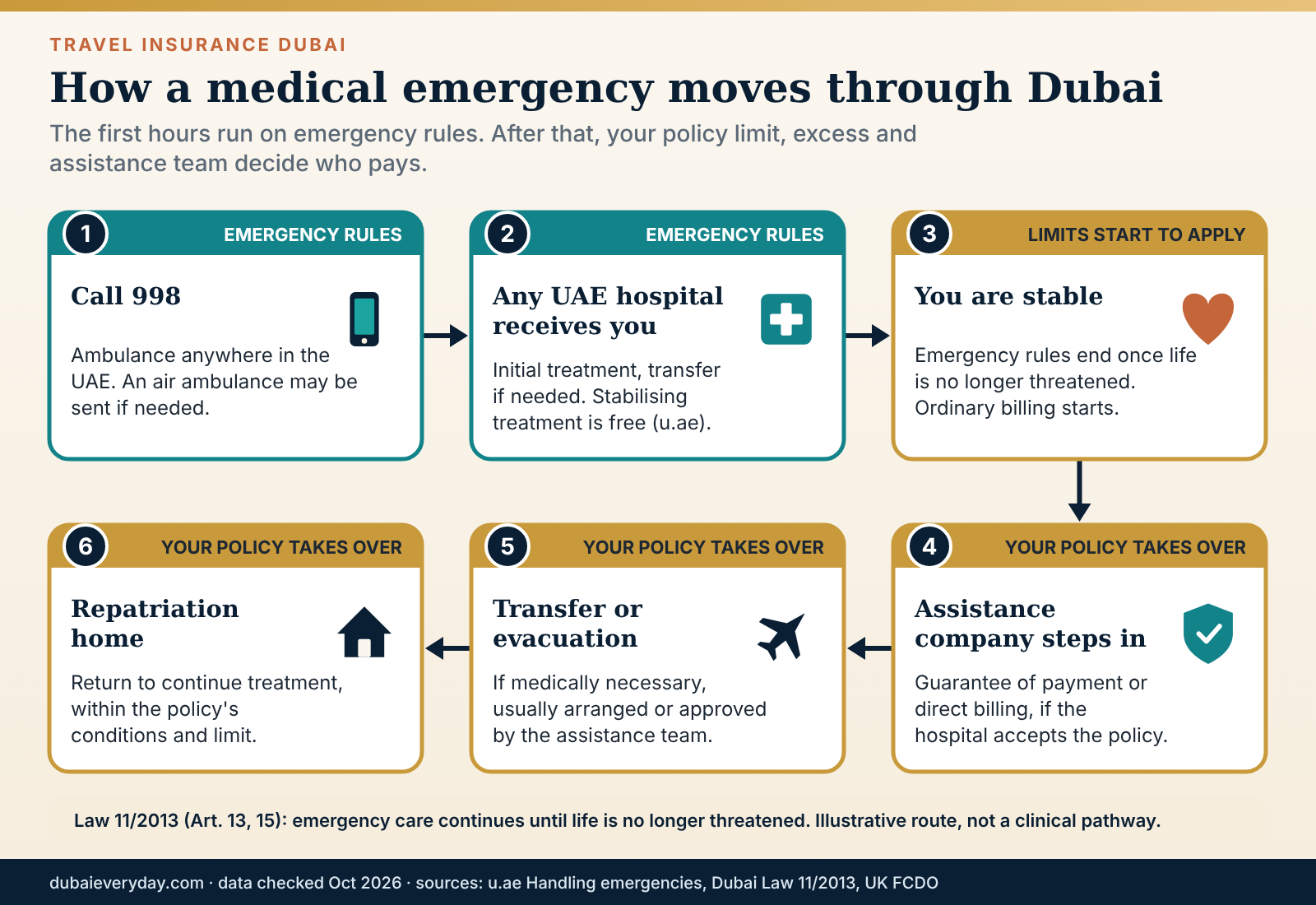
Medical cover is the part of travel insurance Dubai visitors cannot do without, so it gets the most space here. Delay, baggage and activity clauses decide how annoyed you are. The medical section of a travel insurance Dubai policy decides how much money leaves your account. The route below shows how an emergency typically moves, using the official emergency page and the Dubai law, and where an insurer or assistance company has to step in.
How an emergency unfolds
The number to know is 998 for an ambulance, anywhere in the UAE. The government emergency page also lists 999 for police and 997 for civil defence, and mentions that an air ambulance may be dispatched when needed. Any UAE hospital can receive an emergency, give initial treatment and, if needed, transfer you to a better-equipped facility.
The same page says that treatment needed to stabilise you in an emergency is free, and that other treatment must be paid for in cash, by card or through insurance. Read that sentence twice. It is a narrow promise. It covers the first, life-saving phase, not the scan, the night in a ward, the surgeon’s fee, the physiotherapy or the flight home.
Dubai’s health law points the same way. Providers must give emergency care to insured people even outside their network until the person’s life is no longer threatened, and insurers must pay for that care. Notice the phrase “no longer threatened”. Once you are stable, the hospital moves from emergency rules to ordinary billing, and your policy limit, excess and network arrangements take over.
Emergency-only versus everyday care in travel insurance Dubai policies
Plenty of visitors never reach an emergency. They have a stomach upset, a sunburn, an ear infection after a pool day or a sprain from a bad kerb. These are outpatient problems. Whether your policy pays for them is one of the biggest differences between inbound travel insurance Dubai products, and it is not obvious from the price.
The two public inbound product pages we read show the spread in travel insurance Dubai products. One lists emergency medical expenses up to USD 150,000, with emergency evacuation and repatriation. The other, from a UAE broker, lists outpatient treatment under its inbound plans as an exclusion, alongside routine treatment and pregnancy. Neither is wrong. They sell different things. A buyer who assumes “medical” includes a GP visit can be surprised in either direction.
So ask a direct question before you buy: does this policy pay for a non-emergency doctor’s visit, prescribed medicine and follow-up appointments, or only for treatment of an emergency? If the answer is emergency-only, budget for the small stuff yourself. It is usually the smaller bill, but it is the bill you are most likely to meet.
Choosing a medical limit for travel insurance Dubai when no tariff is published
People ask for a figure: how much medical cover is enough in a travel insurance Dubai policy? The honest answer starts with what we could not find. There is no official published price list for visitor treatment, and the broker blogs that quote hospital cost tables cannot be traced to a source we could verify, so we do not repeat them. Anyone who gives you a precise “typical ER bill” is guessing unless they show where it came from.
What we can do is anchor the limit to two verified reference points. The Dubai minimum plan for residents sets an annual limit of AED 150,000. One inbound plan advertises USD 150,000, which is AED 550,875 at the fixed peg of 3.6725 (our calculation). The second figure is about 3.7 times the first. Neither number tells you what a bill will be. They tell you what insurers and the regulator treat as a serious baseline.
Our reading: if a travel insurance Dubai policy offers a medical limit below the resident minimum, ask why. The resident plan is a floor for people who use a defined network, pay a co-payment and have a local employer or sponsor to chase. A visitor is often treated at whichever hospital the ambulance chooses. A limit well above the floor is not a luxury. It is the cushion for the day you land in intensive care on the wrong side of a network.
Excess, co-payment and sub-limits inside the limit
A headline limit is a ceiling, not a promise. Inside a travel insurance Dubai limit you will normally find an excess (an amount you pay per claim), sometimes a co-payment (a percentage you pay), and sub-limits that cap particular items such as dental pain relief, physiotherapy, hospital room rate or mental-health treatment. A policy that says USD 150,000 and then caps room-and-board and specialist fees can behave like a much smaller policy.
Dubai’s own resident rules already use co-insurance, and the health law obliges beneficiaries to pay the co-insurance written in their policy. Visitors who have never seen that structure sometimes treat it as a hidden fee. It is not hidden if you read the schedule. Look for the words “excess”, “deductible”, “co-payment” and “sub-limit”, and write down each figure next to the heading.
Cashless, guarantees and who calls whom
The Indian missions’ advisory asks visitors to hold a policy with cashless treatment. The idea behind cashless is simple: the assistance company contacts the hospital, confirms you are covered and issues a guarantee of payment, so you do not hand over a card for the full amount. In practice, cashless depends on the hospital agreeing to deal with that insurer, which is why the 2018 Gulf News report found some providers refusing visitor policies.
Order of operations matters. Call 998 first if life is at risk. Once you are safe, or a companion can do it for you, call the assistance number on the certificate before you sign anything non-urgent, and before you move to another hospital. Assistance teams usually want to speak to the treating doctor and can tell you whether direct billing is possible. If the hospital insists on payment up front, keep the receipts and the medical report in English, and claim afterwards.
The UK government’s advice puts the risk bluntly: without insurance or the means to pay, treatment can be refused, and you may be prevented from leaving if a bill is unpaid. That is the outcome a cashless guarantee exists to avoid. It is also why a policy with a modest limit and a strong assistance team can beat a bigger limit that you have to claim for months later.
Travel insurance Dubai clauses that look identical but are not
The two inbound pages also differ on epidemics. One lists COVID-19 medical costs inside the main limit, with quarantine accommodation. The other lists any epidemic or pandemic as an exclusion. If you travel in a period when public-health alerts are active, that single clause can reverse the outcome of an otherwise similar claim.
The same goes for sanctions language. The broker page excludes claims that would breach UN, EU, UK or US sanctions. Most visitors never meet that clause. A few, depending on nationality, payment method or destination country, can. If it applies to you, read it before paying, because it can affect whether a payment to a hospital is possible at all.
Pre-existing conditions, pregnancy and age: where travel insurance Dubai claims fail
Most disputed medical claims on travel insurance Dubai policies are not about the emergency. They are about whether the problem was already there. Both inbound product pages we read exclude pre-existing medical conditions. One says plainly that a claim related to a condition existing before the trip is not eligible. That makes this section the one to read slowly if you or a travelling companion take regular medication.
What “pre-existing” can mean
Insurers define it in different ways. Some mean any condition you have been diagnosed with or treated for. Some mean a condition that has not been stable for a stated period before purchase. Some ask health questions and then decide to cover, exclude or surcharge a named condition. The product page rarely shows which approach applies. The policy wording and the medical declaration do.
If you have a chronic condition, a recent procedure or a condition under investigation, say so when asked and keep the answer in writing. Many wordings let the insurer reduce or decline a claim for non-disclosure, so a careless answer can cost more than the premium saved. We cannot tell you how a given insurer will treat a given diagnosis, and no website can. Ask the insurer to confirm in writing what is accepted, what is excluded and at what price.
Complications and flare-ups
A subtle point is the difference between a new problem and a complication of an old one. A visitor with a known condition who breaks a wrist is a new claim. The same visitor who needs urgent treatment because that condition flares is a pre-existing-condition claim. Policies that sell a pre-existing-condition extension often cover emergencies linked to declared conditions, not routine monitoring. Check which of the two you are buying.
Pregnancy
The broker page lists pregnancy as an exclusion. That is common enough to deserve a check on any policy, but it hides a distinction. Some wordings exclude routine antenatal care and childbirth while covering unexpected complications up to a stated week of pregnancy. Others exclude everything pregnancy-related. Airlines also set their own limits on late-pregnancy travel, and those limits are the airline’s, not the insurer’s.
This is medical territory, so the safe rule is to ask your own doctor whether the trip is advisable, then ask the insurer which pregnancy-related events are covered and until which week. Do not assume that a general “medical expenses” heading includes them.
Age limits and older travellers buying travel insurance Dubai cover
Age limits show up as hard caps and as price steps. One inbound page covers ages 0 to 85. The broker page describes senior plans for people aged 66 to 79 and does not state a general limit for other plans. Neither tells you what happens at 80. Ask for the age band that applies to the oldest traveller in the group, and ask whether a medical questionnaire changes the price or the terms.
Older visitors often do better with travel insurance Dubai cover that has a larger medical limit, evacuation to a suitable facility and a named assistance team that speaks to treating doctors. They also have the most to gain from reading the pre-existing-condition wording, because the likelihood of a declared condition rises with age. A cheap policy that excludes conditions you actually have is the worst value on the market, whatever it costs.
Children and families
Children are normally covered on the same certificate. The inbound page we read starts at age 0, but pricing rules for children differ by product. Check the name list and dates of birth for every child, and check whether any adult-only sub-limits apply. The practical side of a family trip, including heat and transport, sits in our Dubai travel planning guide.
Evacuation, repatriation and the bill that follows you home
These two words are used loosely. Medical evacuation is moving you from where you are to a facility able to treat you, which might be another hospital in Dubai or another country. Repatriation is taking you home, usually when treatment can continue there. Both are expensive when arranged privately, and both are usually decided by the assistance company’s doctors rather than by you.
What the two public pages promise
The inbound plan page lists emergency medical evacuation and repatriation, repatriation of remains, return of dependents and emergency travel for a close relative, plus a USD 1,000 search-and-rescue benefit. That last figure is small. A rescue in the desert or at sea is a different cost from a medical flight, so ask whether rescue is a separate cap and what it is meant to pay for.
The Indian missions’ advisory names repatriation to India specifically, and the UK advice names unexpected medical evacuation. Both governments are saying the same thing in different words: the cost that surprises people is not the Dubai hospital, it is the journey after it. Check that the policy covers the leg you are most likely to need, including the cost of a medical escort when the doctor says one is necessary.
The rules that usually apply
Most travel insurance Dubai wordings share three conditions, and you should confirm each in yours. First, evacuation must be medically necessary, as judged by the assistance company’s doctor together with the treating doctor. Second, the assistance company arranges it, or approves it in advance. Third, the destination is the nearest suitable facility or home, not the clinic you would like to attend.
The practical effect is that booking your own air ambulance, or flying commercial against advice, can leave you without reimbursement even though the same flight would have been covered if arranged through the policy. The rule is not sinister. It is a control on cost and a safety check. It works against you when you do not know it exists.
Unpaid bills and leaving the country
Medical bills do not disappear when you board a plane. The UK government warns that people unable to pay a medical bill can be prevented from leaving the UAE. We found no official explanation of the legal mechanism for visitors, so we will not describe how it works. The warning is enough to treat an unresolved hospital bill as a travel-planning issue, not a paperwork issue.
If you are in this position, speak to the assistance company early, ask for a written confirmation of the guarantee or the claim route, and contact your embassy or consulate for general help. Consular staff can advise and in some cases help with contacts, but a broker explainer we read notes that embassies advise rather than pay, which matches how consular help is generally described.
Our reading of the priority order
If your budget forces a choice in travel insurance Dubai cover, put the money where the severity is. Our ordering of risks for a typical visitor, from highest severity to lowest, runs as follows: serious medical event and evacuation, then a prepaid trip that cannot be used, then a long delay on a tight itinerary, then lost or damaged belongings, then activity cover where relevant. Frequency runs in nearly the opposite direction. Delays and lost bags are common; intensive care and air ambulances are rare. Insurance is built for the rare, expensive end.
Travel insurance Dubai for trip delay, missed connections and cancellation
Delay is where travel insurance Dubai buyers most often expect payment and least often check who pays first. There are two layers. The airline owes you certain things by regulation. The insurer pays for what the airline does not, if your policy has a delay benefit at all. Mixing the two layers up is the reason many delay claims fail.
What the airline owes you in Dubai
In April 2026 the Dubai Civil Aviation Authority published a consumer welfare directive, number DCAA/DCAD/2026/00005, covering Dubai-based national airlines, foreign airlines operating from Dubai airports and licensed travel agents. It says airlines must tell passengers promptly why a flight is disrupted and how long it is likely to last. For a delay or cancellation you can choose the next available flight, rerouting on another carrier where practical, or a refund or voucher for the unused part.
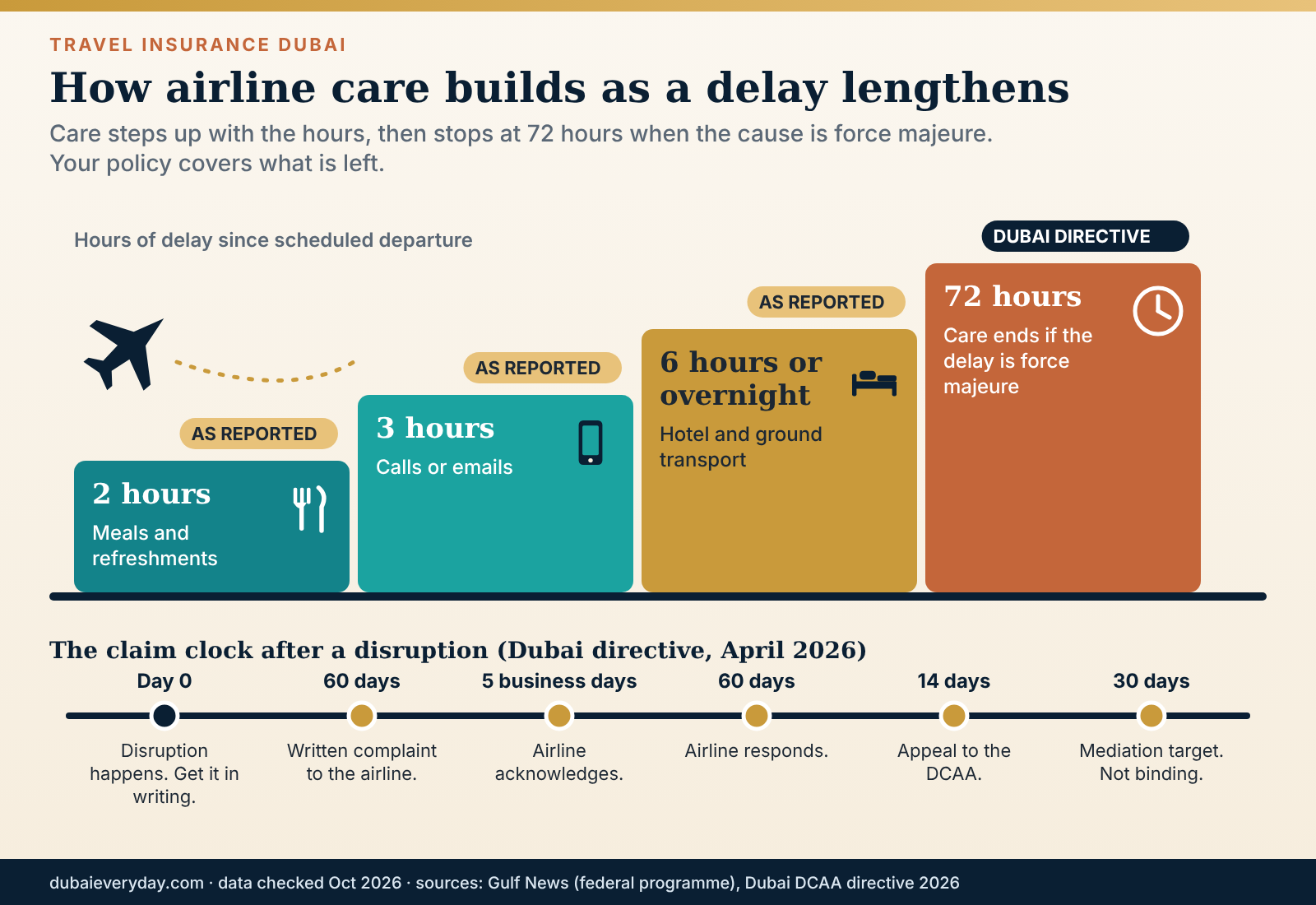
When a delay passes the thresholds set by the federal aviation authority’s passenger welfare rules, the airline must provide meals, refreshments and a way to communicate, plus a hotel and ground transport if you need to stay overnight. The Dubai directive does not repeat those hour thresholds. Gulf News, summarising the federal programme in March 2026, reported meals after two hours, calls or emails after three hours, and a hotel after six hours or overnight. Treat those as reported figures and read the federal text before relying on them.
Now the limit that matters for insurance. The directive says that where a delay is force majeure, including weather, armed conflict, strikes and airport closures, the airline is not liable for compensation, and its care obligations are limited to 72 hours unless the authority extends them for exceptional circumstances. So a long disruption can outlast the airline’s duty of care. That gap is the part a good policy may fill.
What a travel insurance Dubai delay benefit typically does
A delay benefit in a travel insurance Dubai policy normally has a trigger and a cap. The trigger is a number of hours after the scheduled departure, and the cap limits what you can claim for reasonable extra costs such as food, a hotel, local transport or a replacement ticket. Some policies pay a fixed sum instead, once the trigger is met. Receipts and written confirmation from the airline are the usual evidence.
Two limits to look for. First, many wordings pay only for the part not already provided by the airline, so vouchers reduce the claim. Second, the cause of the delay must be a covered one, which is where weather, strikes, mechanical faults and conflict-related closures can be treated differently. A policy that pays for a mechanical delay and refuses a closure delay is not contradicting itself. It is following the cause list.
Many inbound travel insurance Dubai policies have no delay benefit at all. The inbound plan page we read says trip cancellation, baggage loss, baggage delay and personal liability are not included, because the product is built around emergency medical cover. That is a legitimate product, but it means a travel insurance Dubai certificate that satisfies a visa form says nothing about your flight.
Missed connections at a very large hub
Dubai International handled 95.2 million passengers in 2025, which makes it one of the busiest connecting points in the world. If your trip includes a connection, the question is what kind of ticket you hold. On a single ticket, the airline that sold it is responsible for getting you through. On two separate tickets, a late first flight is your problem, and a missed-departure benefit in your travel insurance Dubai policy may be the only help.
Missed-departure cover usually applies when the cause of missing the flight is a covered one, such as a breakdown, an accident on the way to the airport or the delay of a public carrier, and when you left enough time. It rarely applies when you simply cut a connection too fine. If you are building your own connection, keep the buffer generous and keep the evidence of why you missed it.
Cancellation and curtailment
Cancellation cover in travel insurance Dubai policies pays back prepaid, non-refundable costs if you have to cancel for a named reason before you travel. Curtailment cover pays for the unused part and extra travel costs if you have to cut a trip short. Named reasons are usually serious illness or injury, death of a close relative and similar events, and they are listed in the wording. “I changed my mind” is not on the list.
Whether you need this depends on how much money is locked in. A short trip on a refundable room needs little. A family trip with non-refundable flights and a prepaid package has real money at stake. Ask what happens to the hotel and tours you cannot use, and whether the policy pays for a replacement flight home if a named event ends the trip early.
When the weather is the cause
Dubai is not a place people associate with weather disruption, which is why April 2024 is worth remembering. On 15 and 16 April, more than 142 mm of rain fell in Dubai by Tuesday evening, according to reports based on the National Center of Meteorology, which called it the UAE’s heaviest rainfall in 75 years of records. Dubai International reported significant disruption. Emirates suspended check-in for about two days and flydubai cancelled all flights through the next morning.
For a traveller that is a clean example of the layering problem. The airline owes rebooking and, under the rules above, limited care. Your travel insurance Dubai policy owes whatever its delay, cancellation and weather wording says. If weather is excluded, or the delay benefit has a long trigger, the gap is yours. Check how your travel insurance Dubai wording treats adverse weather before you assume that a rare event in a dry city is a covered one.
Illustrative example: a nine-hour delay
Illustrative example (not a quote or market fact). A traveller’s departure from Dubai is delayed by nine hours because of a technical fault. The airline gives meal vouchers early on and a hotel when the delay becomes overnight. The traveller also pays for a taxi to a hotel the airline did not arrange and buys a phone charger.
Suppose the travel insurance Dubai policy pays for reasonable extra costs after a six-hour delay, up to a cap. The meal vouchers and the airline’s hotel are not claimable, because the airline already provided them. The taxi and charger may be, if the policy treats them as reasonable and the receipts exist. The result is a small claim, which is normal. The larger value of a delay benefit is in the long, uncovered tail, not in the nine-hour case.
Evidence and deadlines for delay claims
- A written statement from the airline of the scheduled and actual departure times and the reason for the delay.
- Boarding passes, the booking confirmation and, if relevant, the second ticket you were connecting to.
- Itemised receipts, not card statements alone, for every extra cost.
- A note of any vouchers the airline gave you and what they covered.
- The date you notified the insurer, because many policies expect prompt notice.
The airline complaint clock is separate from the insurance clock. Under the Dubai directive you complain in writing to the airline or agent within 60 calendar days, the airline acknowledges within five business days and responds within 60 days, and you can appeal to the authority within 14 calendar days of the decision. The authority acts as a mediator, not a judge, and force majeure matters are outside mediation.
War exclusions, known events and the purchase-date trap
This section exists because 2026 changed what people ask. Airspace closures that began on 28 February 2026 stranded visitors in Dubai and raised questions about cover that no brochure had prepared them for. The UK government’s travel advice, updated on 27 October 2026, describes the regional situation as deeply unpredictable and tells travellers to expect possible flight cancellations and airspace closures with little warning. We do not forecast events. We explain how travel insurance Dubai policies behave when they happen.
A travel insurance Dubai policy bought after a disruption is widely reported can treat that disruption as a known event and refuse related claims. A war exclusion can also apply whatever the government travel-advice level says. Check the purchase date, the exclusion wording and the known-event rule in writing before you pay, not after you need to claim.
Three clauses that decide most conflict-related claims
The first is the war and hostilities exclusion. Trade press coverage in March 2026 noted that trip cancellation sections of most mainstream policies exclude losses caused directly by war, declared or undeclared, military operations and government-ordered airspace closures. A New Zealand report after July 2026 shows how insurers separate the government advisory level from the war exclusion: lowering the advisory did not suspend the exclusion at the insurers it reviewed.
The second is the known-event rule. The Insurance Council of New Zealand is quoted as saying events already occurring when a policy is bought are known events and unlikely to be covered. One insurer in that report said a conflict was no longer considered unexpected for policies bought after it was widely reported. Optional cancel-for-any-reason and interruption add-ons are usually sold only shortly after the first trip payment for the same reason.
The third is the way indirect effects are treated. The March 2026 trade report says reroutes, crew rescheduling and long delays may fall under delay or missed-connection benefits rather than cancellation, provided the cause is covered and the waiting period is met. Hotel costs are typically recoverable only under those benefits, and insurers expect you to use airline and government assistance first.
What stays covered, and what does not
The same New Zealand report records one insurer saying unrelated events such as medical episodes and theft remain covered whatever the advisory level. That matches how war exclusions are usually written: they remove losses caused by war, not every loss that happens in the same country. A broken leg in a safari accident in Dubai does not become a war claim because of the headlines.
What does not stay covered is anything the wording attributes to the conflict: a cancelled flight caused by a closure, a hotel extension forced by a closure, a prepaid trip you decide not to take because you feel unsafe. The last is the one most people overlook. Feeling uneasy is not a covered reason on a standard policy, and an advisory against travel may remove cover entirely for new bookings.
An airline-sold alternative, and what to ask about it
In June 2026 trade press reported that Emirates had launched a Comprehensive Travel Cover product, with the insurance component provided through Travel Guard, including up to USD 25,000 in conflict-related medical coverage, hotel support during eligible disruptions and a trip extension of up to 30 days. The report says the cover remains valid regardless of government advisories and that it can be bought at booking or added to an existing reservation.
We did not read that wording and we are not endorsing it. The same report quotes an insurance executive warning that the medical limit may be too low for some serious cases, and advising buyers to read the fine print. If you are considering any airline-sold cover, ask four things: who the underwriter is, what the medical limit is, whether it applies if you do not fly that airline, and what is excluded.
The purchase-date timeline
The easiest way to see the known-event rule is on a timeline. The line below is abstract on purpose: it shows how the date you buy relates to the date an event becomes public. A traveller who buys before the event is a different customer, in the eyes of the policy, from one who buys after it.
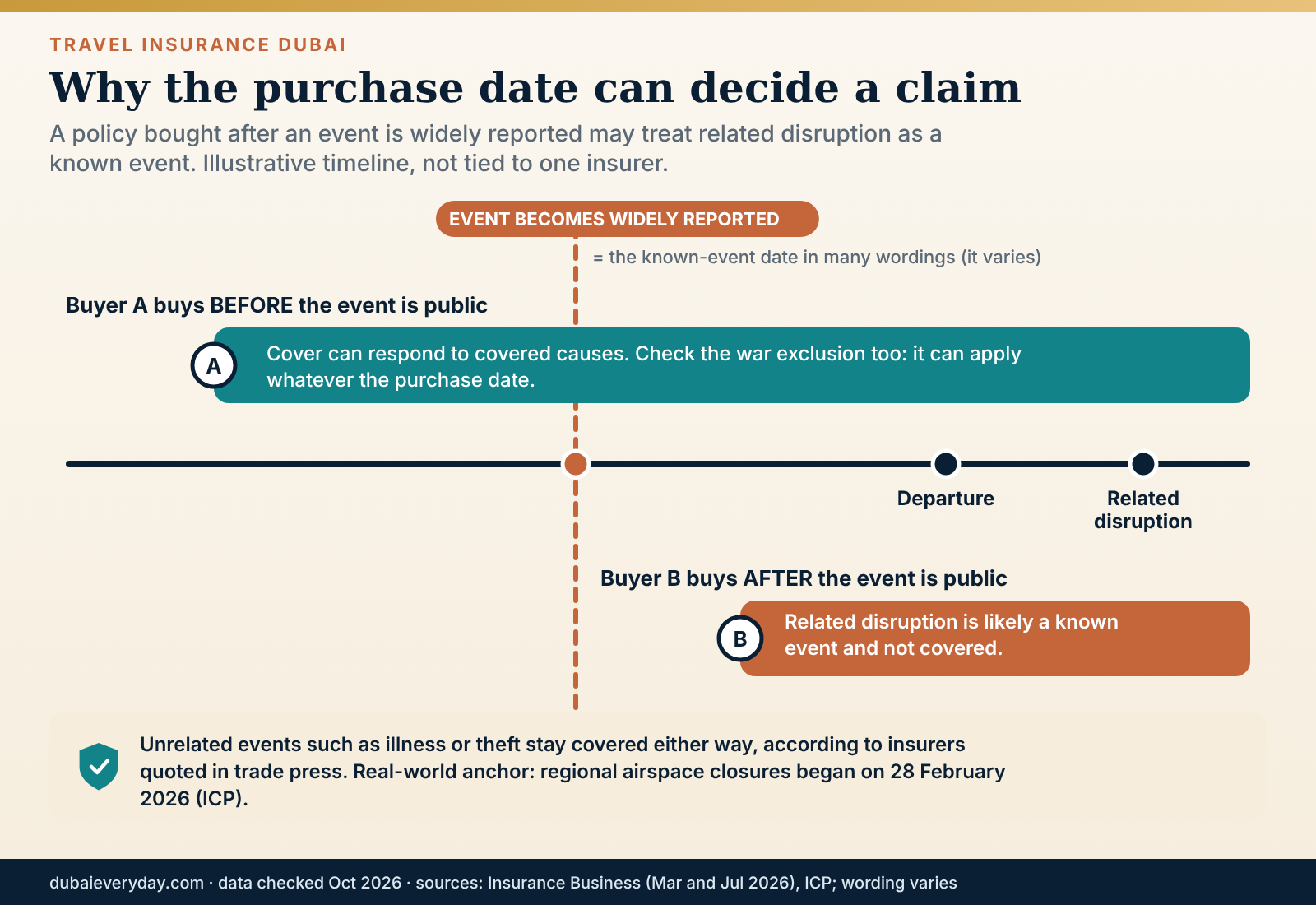
What to do about conflict clauses when buying travel insurance Dubai cover
Buy your travel insurance Dubai policy early, when you book, and keep the purchase confirmation. If you are connecting through Gulf hubs on the way to or from another destination, apply the same questions to the whole route, as the March 2026 trade report advises. If you are travelling for business, check whether the company policy covers disruption caused by conflict, because corporate policies are often written differently from consumer ones.
After purchase, keep monitoring the official advice of your own government and the airline. Insurers expect you to act sensibly on warnings, and a claim made after ignoring an explicit instruction to leave or avoid an area is harder to win. If you are already in Dubai and cannot leave because of a closure, keep every receipt and written airline notice, and follow the immigration authority’s official channels about your visa status.
Baggage, valuables, documents and medicines
Baggage claims are the most common small claims on any travel insurance Dubai policy, and the area where airline rules and insurance rules overlap most. Three layers sit between you and a lost suitcase: the airline’s own process, the legal cap that applies to most international flights, and your travel insurance Dubai policy. Each pays differently, and you need to start with the first.
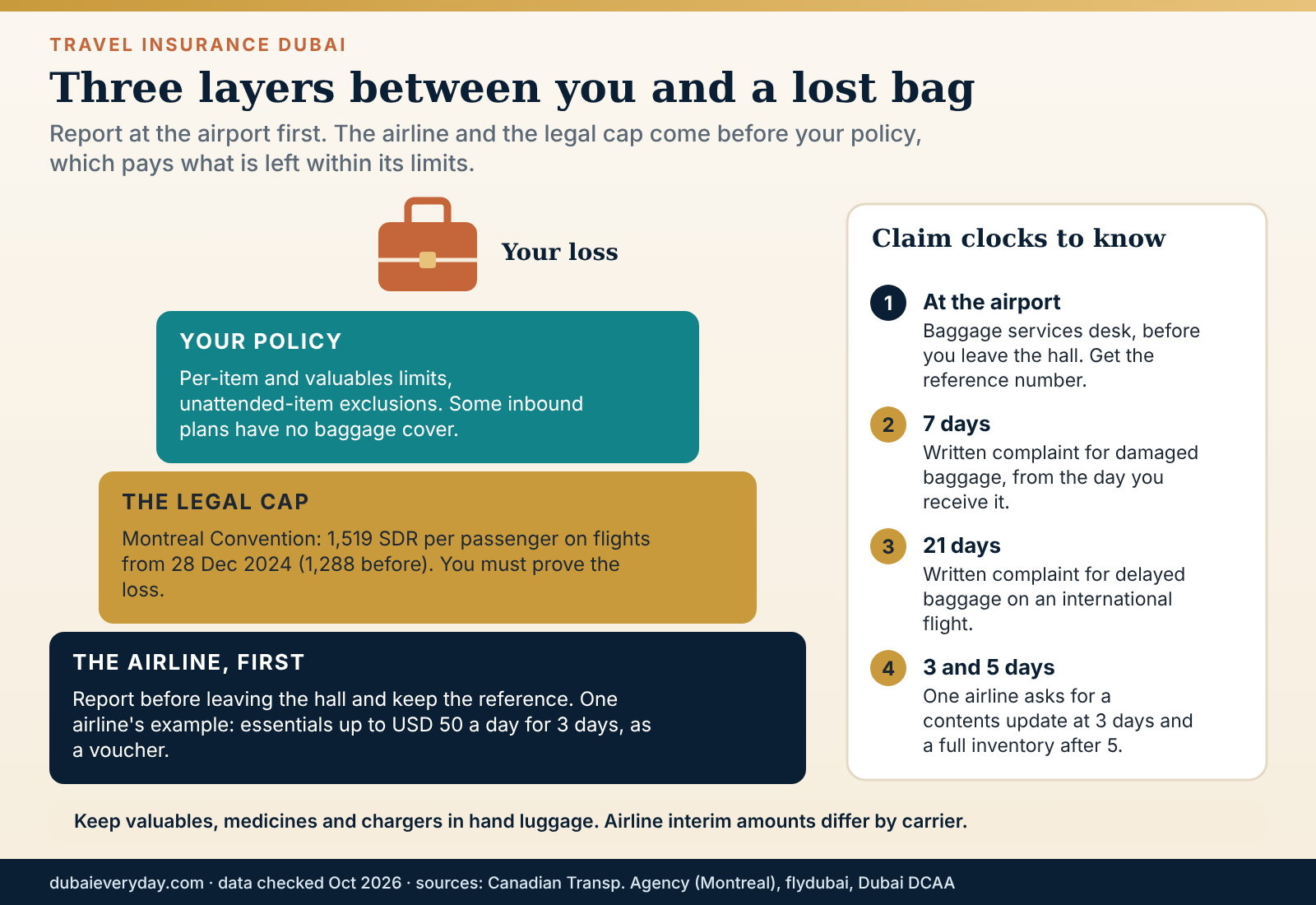
Layer one: the airline, and the report you must make at the airport
If your bag does not appear, do not leave the baggage hall before you report it. Dubai International’s own advice, issued in a February 2024 scam alert, is to report a missing bag at the baggage services desk near the claim area, where the airport issues a reference number for tracking. That reference, usually called a property irregularity report, is the document every later claim depends on.
Airlines then run their own timelines. flydubai, as one published example, asks for an immediate report at the arrival airport, or a web form within seven days of arrival if you did not report there, an update of the contents after three days and a full inventory form if the bag is still missing after five days. Other airlines will have different dates. The point is not the exact number, it is that the clock starts at the airport.
The same airline states that it reimburses essential items for a delayed bag up to USD 50 a day for a maximum of three days, as a voucher, and that residents of the country where the flight landed are excluded. It also says it accepts no liability for valuables, fragile or perishable items. That wording is typical of how carriers limit risk, which is why valuables belong in your hand luggage, not in the hold.
Layer two: the legal cap
For international flights covered by the Montreal Convention, the carrier’s liability for baggage is capped per passenger. For flights from 28 December 2024 the limit is 1,519 special drawing rights, up from 1,288, according to the Canadian Transportation Agency’s summary of the convention. The same source gives time limits for written complaints: within seven days of receiving damaged baggage, and within 21 days for delayed baggage on an international flight.
The Dubai directive confirms that airlines must meet their baggage obligations under the Montreal or Warsaw convention and that passengers must follow the airline’s baggage terms and provide receipts for claimed losses. We have not converted the SDR figure into dirhams because the special drawing right moves daily, and an inexact conversion would look more precise than it is.
The practical reading of the cap is simple. It is a ceiling per passenger, it requires proof of what you lost, and airlines routinely depreciate items. If your checked bag held a camera, a laptop and a week of clothes, the legal cap may be your outer limit even if the replacement cost is higher.
Layer three: your travel insurance Dubai policy
Travel insurance Dubai policies sit on top of the first two layers. Their baggage sections typically have an overall limit, a lower limit per item, a lower limit still for valuables, and a ceiling on cash. They usually pay the current value of an item, not the price of a new replacement. They commonly exclude items left unattended or in a vehicle, and they expect you to have reported the loss to the airline or police within a short window.
Two reminders from the public pages. The inbound plan we read lists baggage loss and baggage delay as not included. If your certificate comes from a plan like that, you have no baggage cover whatever the sales email said. Second, delayed-baggage benefits inside a policy normally have a waiting period and a cap on essential purchases such as toiletries and basic clothing. Ask for both figures.
A stolen phone is a good test. Many wordings treat phones as valuables with a lower sub-limit, require a police report and exclude loss without evidence of theft. If your phone is the most expensive thing you carry, check its position in the schedule before you buy.
Documents, passports and replacement costs
Losing a passport in Dubai is mostly a consular process: you contact your embassy or consulate for an emergency travel document and may need a police report. The insurance question is narrower. Does the policy pay for the document fees, the extra hotel nights and the cost of a rebooked flight? Some do within a small cap. Many do not. Look for a heading such as “loss of passport” or “emergency travel documents”.
Keep digital copies of your passport photo page, visa and policy certificate in a cloud folder you can open from another device. Save a copy of your visa or entry permit as well. The practical benefit is speed, not drama: embassies, police and insurers all ask for the same documents.
Medicines: the permit that sits outside insurance
Medicines are the one baggage topic that can turn into a legal problem, not just an insurance one. The Dubai government’s page says travellers carrying controlled medicines into Dubai need prior approval and medical documentation, including a valid prescription from a licensed professional. It links to a permit application for importing medicines for personal use. The UK government’s advice adds that some UK prescription and over-the-counter medicines are classed as controlled in the UAE and need advance approval from the UAE Ministry of Health, which it says is usually processed within five working days.
Why does this belong in an insurance guide? Because travel insurance Dubai cover does not fix it. A seized medicine is not a lost-baggage claim, and most wordings exclude confiscation by customs or other authorities. A traveller who arrives without approval for a controlled medicine and has it taken may face a legal problem and a health gap at once. Check the medicine list before you pack, apply early and carry the approval with the original packaging in hand luggage.
If you take regular medication, also ask your insurer how a lost or delayed bag with medicine in it is handled. Some policies pay for emergency replacement of prescribed medicines. Others treat medicine as an ordinary medical expense under a limit, or as a pre-existing-condition matter. A one-line email before you buy gets a better answer than a phone call after the bag goes missing.
Habits that make a travel insurance Dubai claim easier
- Photograph the bag, its tags and the contents before you leave home.
- Keep receipts or order confirmations for high-value items in the same cloud folder as your policy.
- Carry medicines, documents, chargers and anything irreplaceable in hand luggage.
- Get the baggage reference number before leaving the airport, and keep it.
- Ignore anyone online who offers to sell back or trace lost luggage. The airport has warned about fake profiles doing exactly that.
Activities and travel insurance Dubai exclusions: desert, water, air and wheels
Activities are where a cheap travel insurance Dubai policy most often disappoints, because the sport clause is short and the list of tourist experiences is long. Dubai sells adventure in every format: dune drives, quad bikes, hot-air balloons, scuba, jet skis, skydives, indoor skiing. Insurers classify them differently, and some classify them by activity, not location. That last point catches people out.
An injury from an activity your travel insurance Dubai policy excludes is typically not covered at all, and the medical bill falls on you in full. The inbound plan page we read offers an optional sports cover add-on, which shows that basic cover does not assume it. Confirm each planned activity in writing before you book it.
A rough gauge, and why it is only a gauge
The graphic sorts common Dubai experiences by how often we would expect a standard policy to treat them as ordinary, to need an add-on, or to exclude them. It is our reading of how wordings are generally structured, not a statement about any named policy, and it will be wrong for some. Use it to know which questions to ask, not to skip the asking.
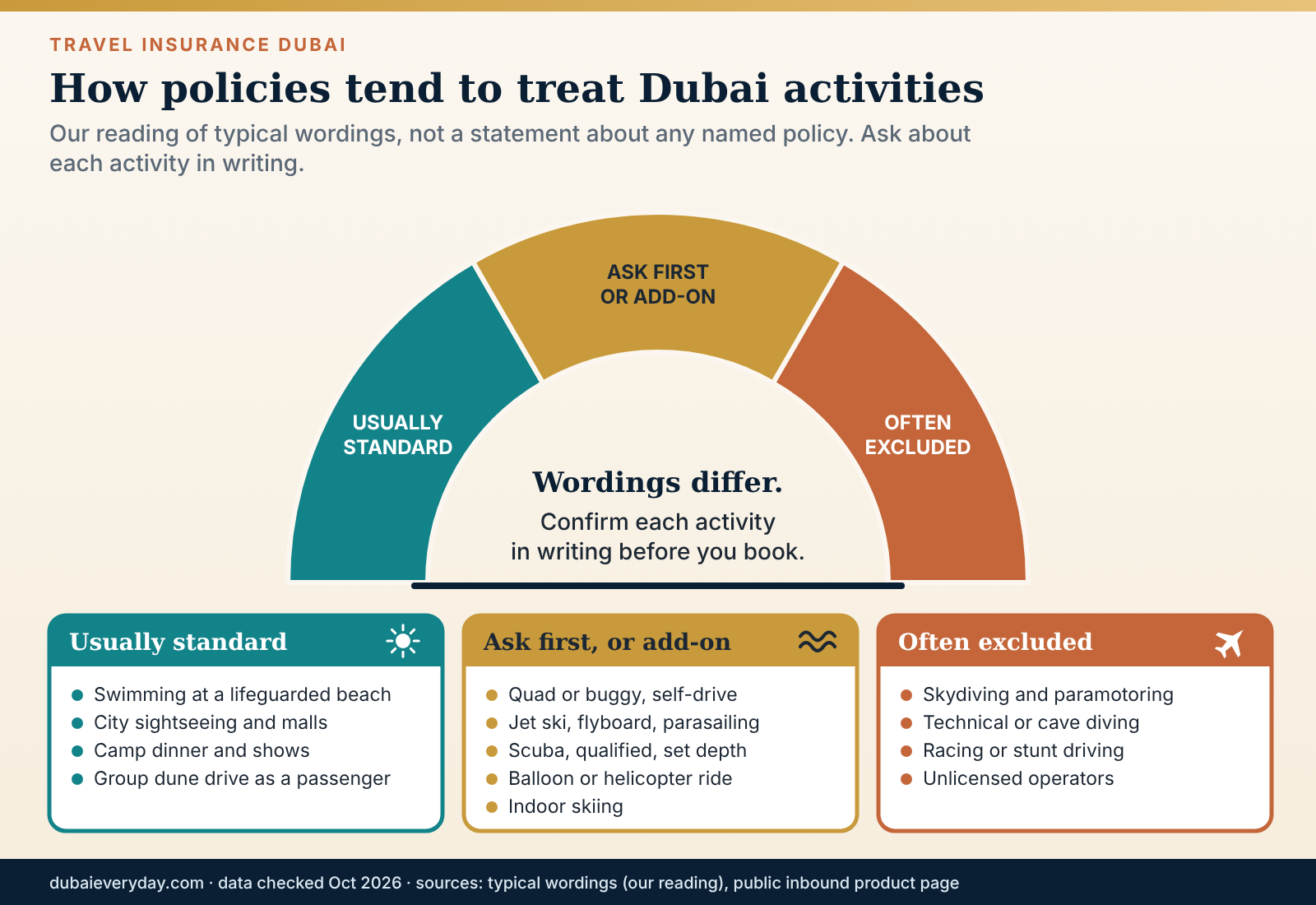
Desert experiences
A passenger on a group dune drive is usually treated differently from a person driving a quad or buggy. Sandboarding, camel rides and camp dinners generally sit in the ordinary leisure group, though a few wordings list motorised off-road activities as hazardous whoever is driving. Ask which side of that line your trip falls on.
The Dubai tourism department introduced desert tour rules in 2018, reported by Gulf News, which set quality benchmarks for operators including health and safety and insurance coverage, required drivers to hold a tour guide certification and the correct transport licences, and made safety briefings mandatory. That is useful context for choosing an operator. It is not the same as your travel insurance Dubai cover. An operator’s insurance protects the operator’s liability. It does not pay for your repatriation, your flights home or your missed connection.
Heat belongs here too. A heat illness is a medical event like any other, but an insurer may argue negligence if you ignored operator advice. Follow the briefing, drink water and respect the rest stops. Our guide to things to do in Dubai sets out which experiences suit which seasons.
Water activities
Swimming at a beach with lifeguards and walking along a corniche are ordinary leisure for almost every policy. Jet skis, flyboards, parasailing and banana boats are where wording splits. Some policies treat them as ordinary when run by a licensed operator, some require an add-on and some exclude motorised water sports outright. Our Dubai beaches guide covers lifeguard coverage and facilities at public and hotel beaches.
Scuba diving usually depends on qualification and depth. A policy may cover recreational diving to a stated depth for qualified divers, and may require an add-on for beginner or introductory dives or for depths beyond the stated one. Ask for the depth limit, whether an instructor must accompany you, and whether the policy covers a decompression chamber and the transport to one.
Air activities
Skydiving, paramotoring and balloon rides are where most standard policies say no or ask for an add-on. A balloon ride is sometimes treated as an ordinary passenger activity and sometimes not, depending on whether the wording lists “ballooning” as hazardous. Helicopter sightseeing as a passenger is another place wordings differ. These are unusual enough that the only reliable answer is one in writing.
Wheels and winter sports
If you plan to hire a car, motorbike or quad, the policy will usually require you to hold the correct licence for that vehicle and may exclude riding without a helmet. Medical cover for a car accident is usually fine; liability to a third party is a separate thing, and the inbound plan we read lists personal liability as not included. Rental insurance is a separate product and a separate conversation, handled in rental terms, not in your travel certificate.
Indoor skiing and snowboarding raise an odd question. Many wordings define winter sports by the activity, not the location, so an indoor slope in a mall can fall under the winter-sports exclusion or add-on. We have not seen a wording that settles this, so ask. It is one of the few activity questions that sounds silly and has a real answer.
Questions to put to an insurer
- Is this specific activity covered, for a participant and not a professional, with a licensed operator?
- Is there a limit on depth, altitude, engine size or speed?
- Does my medical limit apply in full, or is there a lower sub-limit for the activity?
- Does the optional add-on change the medical limit, evacuation or rescue limit?
- Is cover affected if I have had alcohol, even a small amount?
How to read a travel insurance Dubai policy before you pay: the 14-phrase scan
Most people buying travel insurance Dubai cover read the sales page and the price. A faster, better habit is to open the policy wording and search for fourteen phrases. You do not have to understand all of it. You have to find each phrase, note the number or condition next to it, and notice any phrase the document does not contain. A missing heading is information too.
- Territory. Confirm the UAE is inside the area of cover, and note whether the cover applies in the country you live in or only abroad.
- Period of insurance and maximum trip length. Check the first and last day against your plans, and whether the policy can be extended after you arrive.
- Emergency. Find the definition. A narrow one cuts out ordinary illness and follow-up care.
- Outpatient. Look for whether doctor visits, prescriptions and tests without admission are covered or excluded.
- Pre-existing. Read the definition and any stability period, and whether you can buy a declared-condition extension.
- Excess and co-payment. Write down both, plus whether they apply per person, per claim or per event.
- Sub-limits. Note the caps for dental pain relief, physiotherapy, hospital room, and each baggage item.
- Hazardous activities. Read the definition and the list, then compare with your plans.
- War, terrorism and known events. Find the exclusion and the date or condition that makes an event known.
- Epidemic. See whether infectious-disease outbreaks are covered or excluded.
- Sanctions. Check whether payments that would breach sanctions are excluded, and what that means for your nationality or route.
- Alcohol and negligence. Look for conditions that reduce or refuse a claim after drinking or reckless behaviour.
- Unattended and single-item limits. These decide most baggage and phone claims.
- Claims notice and assistance approval. Note the number of days you have to notify, and which costs need approval before you incur them, especially evacuation.
If a phrase is missing from the wording, ask the insurer in writing which clause deals with it. A written reply you can keep is worth more than an assurance on the phone. If the insurer replies in marketing language instead of citing a clause, treat that as an answer.
Check the order of precedence too. The certificate, the schedule, the wording and the sales page can say slightly different things, and the contract wins over the brochure. Keep the version you were sent on the day you bought, not whatever the website says next month.
Ten traveller profiles and the travel insurance Dubai cover each one needs
Generic advice fails because the right travel insurance Dubai policy for one person is the wrong one for another. The profiles below are not personas with invented lives. They are common combinations of age, trip length, visa route and plans, each with the clauses that matter most and what to skip. Find the one closest to you, then read the sections above that it points to.
1. The four-night city break, healthy, visa-free
For a city break, travel insurance Dubai priority one is an emergency medical limit and evacuation, priority two is the outpatient question, and everything else is optional. A medical-focused inbound plan at the low end of the price range, such as the plan that starts from AED 50 on one public product page, can fit this traveller if the limit is high and the wording is clear. Add delay and baggage only if the trip is prepaid and tight. Check that the policy dates run from the day you leave home.
2. A family with young children in summer
Summer in Dubai pushes families indoors, and that makes the itinerary predictable: malls, aquariums, indoor play, hotel pools. The insurance consequences are medical and logistical. Look for a policy that covers every child by name, has no unusual age caps, and includes delay and baggage, because a late flight with a toddler is a bigger problem than for a solo adult. Our Dubai travel guide covers heat and planning for families.
3. A long visit to relatives: 60 to 90 days
Long stays flip the priorities for travel insurance Dubai buyers. Over weeks, an ordinary illness is more likely than a catastrophe, so the outpatient exclusion matters more than for a weekend visitor. Check the maximum trip length, because one inbound page caps a trip at three months or 90 days and says the policy cannot be extended after you arrive. Ask what happens if your visa is extended. Read the pre-existing wording for every adult, since long stays attract older travellers.
4. A five-year multiple-entry visa holder
The visa invites frequent short trips, so travel insurance Dubai planning becomes trip-by-trip planning, and the government portal lists valid health insurance as a condition. Map your planned entry and exit dates against the policy period. An annual multi-trip product may cap each trip, as the 14-day cap in one broker’s description shows. If you stay longer on some trips, you may need a single-trip policy for those. Keep each trip’s certificate in one folder with the date of the entry stamp.
5. An older traveller, 70 or over
Age affects the availability and price of travel insurance Dubai cover. The two public product pages differ on upper age limits, and neither covers everyone. Ask for the limit that applies to the oldest traveller, whether a medical questionnaire changes price, and how pre-existing conditions are treated. A larger medical limit and strong assistance are worth the extra premium for this group. Bring a medication list and a doctor’s letter, and read the medicines section above.
6. A traveller with a chronic condition, any age
The central issue is not Dubai, it is disclosure. Declare the condition when asked and ask the insurer to confirm in writing whether it is covered, excluded or covered at extra cost. If the answer is excluded, the policy still has value for unrelated events, but you need a plan for the condition itself, and your own doctor should be part of it. The medicine permit rules apply to any controlled medicine you carry.
7. The adventure traveller
When buying adventure cover, travel insurance Dubai shoppers are really buying the activity clause, not the medical limit. Put your planned list on the table: scuba to a given depth, a quad, a skydive, a hot-air balloon. Ask which are covered, which need an add-on and what the add-on changes. One public inbound page offers a sports add-on from AED 62, which tells you the add-on is priced separately, though it does not tell you what is in it. Keep the operator’s licence details with your booking.
8. The business visitor or founder scouting a company
Short business trips are often covered by an employer or corporate policy, so check it before buying a second travel insurance Dubai policy. Look for equipment cover if you carry a laptop, a clear statement of who pays for medical evacuation, and any limits on conflict-related claims. If the visit is part of setting up a company, our Dubai business setup guide covers the next steps, and resident health insurance becomes a legal matter once you hold a residence visa.
9. The stopover passenger
A stopover of a night or two is the shortest stay that raises travel insurance Dubai questions at all. The medical logic is the same as for a longer trip, because a visitor who leaves the airport is a visitor in the emirate. The delay and missed-connection cover matters more here than for a city break, especially if your onward flight is on a separate ticket. Check that the policy period includes the whole journey, not only the days in Dubai.
10. The pregnant traveller
Pregnancy is excluded on at least one public inbound product. It is also a medical decision, so start with your own doctor. Then ask the insurer which pregnancy-related events are covered, to which week, and whether complications are treated differently from routine care. Check the airline’s own limits on late-pregnancy travel, which are separate from insurance. If the insurer cannot give a clear written answer, assume the pregnancy is not covered and plan accordingly.
Buying travel insurance Dubai visitors can trust: licence, price, timing
Buying travel insurance Dubai cover well is mostly a matter of order. Decide what you need from the sections above, confirm that the seller is licensed, compare like with like, and buy at the right moment. The steps below are in the order that saves the most trouble.
Who is allowed to sell travel insurance Dubai visitors buy
Federal Decree-Law No. 48 of 2023 on insurance activity came into force on 30 November 2023, according to a Clyde & Co summary. The Central Bank of the UAE supervises the sector after the insurance regulator merged into it. Under the law, insurers and their branches need a Central Bank licence, and so do insurance professions such as agents and brokers. That is the verification angle for buyers: a legitimate seller of UAE insurance should be on the regulator’s books.
The Central Bank’s licensing page offers two registers. One is a searchable register of licensed financial institutions. The other is a downloadable list of insurance entities, labelled as the entity list for 2026. The page does not say how to verify an individual broker, so ask the seller for the Central Bank registration number and the insurer’s name, then cross-check the insurer against the downloadable list. If a seller cannot or will not give you the number, treat that as the answer.
A gap remains. The decree-law’s licensing rule is about insuring UAE risks, and we found no guidance on how it applies to a visitor who buys an overseas policy online from home. If you buy abroad, the equivalent check is your home regulator’s register. If you buy a policy sold in or from the UAE, use the Central Bank list.
Where and when to buy travel insurance Dubai cover
Both inbound product pages we read say the policy must be bought before the trip begins, and one adds that it cannot be bought after you have reached the UAE. Treat that as a rule of thumb for inbound products: the last sensible moment is before you leave home, and the best moment is when you book. Cancellation and known-event rules both depend on the date you buy.
Home-country policies are the alternative. A comprehensive policy from your home market may include delay, baggage and cancellation benefits that a UAE inbound product lacks. Check that the territory includes the UAE and, if you are applying for the five-year visa, check that the certificate satisfies the government’s “applicable in the UAE” wording. If a UAE-based inbound plan makes the application simpler, it can be the more practical choice even if the benefits are narrower.
What travel insurance Dubai costs, and what a low price usually means
We can give you one verified price point and no market range. The inbound plan page we read says plans start from AED 50, an optional sports add-on starts from AED 62, and the exact premium depends on trip length. Broker pages and comparison blogs quote more numbers, but we could not verify them against a primary source, so we leave them out.
Our reading of the low end: a very low premium usually means a medical-focused product with no baggage, delay or cancellation cover, perhaps with outpatient treatment excluded. That can be a sensible purchase if you understand it. It is a poor one if you assume it is a full travel policy. The way to compare is to ask each insurer for a quote for the same people, dates, activities and conditions, then line up the limit, excess, outpatient position, pre-existing position and exclusions side by side.
Cards, employers and other sources of cover
Some bank cards include travel benefits, and some employers provide corporate cover. We did not review UAE card terms, so we make no claim about them. The questions to ask are the same: which events are covered, for how many days, whether you must pay for the trip with the card, whether there is an age cap, and whether the benefit applies to an inbound visitor or only to a cardholder resident in the UAE.
Reciprocal state health cards, where your home country has them, are designed for specific countries. Do not assume yours applies in the UAE; check the issuer’s list. Employer health plans for Dubai residents cover residents. A relative’s resident policy does not cover a visiting family member unless the policy says so. Our guide to health insurance in Dubai explains who is covered under resident plans.
Red flags when buying travel insurance Dubai cover
- A seller who cannot give a Central Bank registration number or the name of the underwriting insurer.
- A certificate with no policy number, or a PDF that does not show the dates, the limit and the territory.
- No access to the full wording before payment.
- Payment to a personal account, or pressure to pay within hours.
- A policy described as “visa insurance” that cannot tell you what a hospital will be paid.
- Promises of “full cover” with no exclusions listed.
For wider consumer-rights context, our Dubai legal basics guide explains where to verify rules and how complaints generally work. If something looks wrong before you pay, stop. A refund request after payment is slower than a pause before it.
Travel insurance Dubai residents need when travelling out
Many people searching for travel insurance Dubai residents can use are not visitors at all but residents planning a trip out, so a short section is warranted. It does not replace the detailed treatment of resident health cover, which lives in our health insurance in Dubai guide, and the wider overview of policy types in the Dubai insurance guide.
Check where your resident plan works
Dubai’s minimum health plan is a scheme for care in the UAE, with an annual limit of AED 150,000. We found nothing suggesting it pays for treatment abroad, and many employer plans are written around UAE networks. Read the territory clause of your own plan. Some resident plans include emergency cover abroad for a limited number of days, and some do not. If yours does not, a separate travel insurance Dubai residents buy for trips abroad fills a real gap, not a theoretical one.
Schengen and other destination rules
If you are a Dubai resident applying for a Schengen visa, the insurance rule is concrete. The European External Action Service form sets the minimum at EUR 30,000, requires coverage of repatriation for medical reasons, urgent medical attention and emergency hospital treatment, and requires the policy to be valid throughout the stay in the Schengen area. Check the visa centre’s current instructions for the exact wording they accept.
Other destinations set their own rules, or none. Check the destination country’s official page, not a generic insurance blog. The principle is the same one used for Dubai visitors: the visa rule asks for a document, and the policy has to pay a hospital.
Residency status and eligibility
Many travel policies ask where you live and where the trip begins. A UAE resident may need a policy sold to UAE residents, and some products sold abroad exclude them or price them differently. Declare your residence honestly. A mismatch between the address on the policy and the Emirates ID is the sort of detail that causes trouble at the claim stage.
For budgeting, the cost of an annual multi-trip policy belongs in the insurance line of your monthly plan. Our cost of living in Dubai guide and the single-person monthly budget show where insurance sits among the other costs of living in the emirate.
Travel insurance Dubai claims and complaints: the evidence pack and the escalation route
Travel insurance Dubai claims are won on paperwork. Insurers pay what they can document, so assemble the documents as you go, not at the airport on the way home. The evidence pack differs a little by claim type, but the core is the same.
The evidence pack
- Policy certificate, policy number and the version of the wording you were sent.
- Passport copy, visa or entry permit, and boarding passes showing dates.
- For medical claims: the medical report or discharge summary in English, itemised invoices, proof of payment, prescriptions and referrals.
- For baggage: the airline’s reference number, an inventory with values, receipts or order confirmations, and photos.
- For delay: written airline confirmation of times and reason, plus itemised receipts for extra costs.
- A log of dates and names for every call to the assistance company or insurer.
The sequence
- Call the assistance number firstFor anything beyond minor costs, speak to the assistance team before incurring avoidable expense. In a life-threatening situation, call 998 and sort out the policy afterwards.
- Report to the right authorityAirline for baggage and delay, police for theft, hospital for the medical report.
- Notify the insurer within the policy’s windowMany wordings expect prompt notice. Do it in writing and keep the confirmation.
- Submit the claim with the full packIncomplete files restart the clock. Check the list against the insurer’s claim form.
- Keep the original documentsInsurers may ask for originals, or for further medical records.
- Escalate in the right orderIf the claim is rejected or delayed, use the insurer’s complaints process, then the regulator route below.
If the insurer says no
Read the rejection letter against the clause it cites. Many rejections rest on a definition, such as what counts as pre-existing or hazardous. Ask for the clause and the evidence in writing. Where a decision appears to misapply the wording, say so, in writing, with the clause numbers.
The Central Bank of the UAE runs Sanadak, an ombudsman unit for complaints about licensed financial institutions and insurance companies. According to Sanadak’s FAQ, it handles complaints against Central Bank-licensed insurers across health, car, property, general, marine and life insurance. For insurance complaints, the FAQ says you go to Sanadak first, not to the courts. Initial complaints are free for consumers. An appeal costs AED 500, refunded when the decision favours the appellant.
You can file by website, app or phone. Confirm the current contact details on Sanadak’s own site, since its pages show more than one address and number.
The time limit is up to three years from the conduct complained of, or two years from when you became aware of it, whichever is longer. The complaint cannot duplicate one already open or one that is before a court. A Clyde & Co summary from March 2024 adds that the Banking and Insurance Dispute Resolution Unit replaced the earlier insurance disputes committee and that its decisions of AED 50,000 or less are final and enforceable. Rules in this area have been changing, so verify the current limits with the Central Bank before you rely on that figure.
Our reading of Sanadak’s scope: it deals with companies licensed by the Central Bank. If your policy was issued by an overseas insurer, the practical route is that insurer’s complaints process and the ombudsman or regulator in its home country. Check which entity issued your policy, which is stated on the certificate.
Airline complaints in Dubai
For delay, cancellation and baggage disputes with an airline or travel agent, the Dubai directive sets a separate path: written complaint to the airline within 60 calendar days, acknowledgment within five business days, a response within 60 days, then an appeal to the Dubai Civil Aviation Authority within 14 days. The authority mediates and does not set compensation or make binding decisions, and you can still go to court. Mediation does not cover force majeure events.
A pre-departure and in-trip timeline
Buyers often treat travel insurance Dubai trips need as a one-click purchase, but the order of decisions matters. This timeline puts them in the sequence that avoids the most common gaps.
- Four to six weeks out: define the tripList dates, visa route, activities, pre-booked costs and who is travelling. Identify medicines that might need a permit and start that application.
- At booking: buy the policyCancellation cover starts when you buy, and known-event rules key off the date. Save the certificate and the full wording.
- Two weeks out: verifyCheck the seller’s registration, the policy dates, and any written answers on conditions and activities. Re-read your government’s travel advice.
- One week out: build the digital folderPut passport, visa, policy, assistance number, flights and hotel into one folder you can open offline, and share it with a companion.
- Day before: set the alertsSave 998 and the assistance number in your phone. Photograph your bag and carry medicines in hand luggage.
- On arrival: report problems at onceA missing bag is reported at the baggage services desk before you leave the hall.
- During the trip: ring before you payFor any non-urgent medical visit, call assistance first and ask about direct billing.
- If plans change: tell the insurerExtending a stay or adding an activity can mean a new policy or an add-on. Do it before, not after.
- After the trip: claim within the windowSubmit the full pack and keep copies until the claim is closed.
Frequently asked questions
Is travel insurance mandatory for Dubai?
There is no single rule saying every tourist must hold a policy. Dubai Law No. 11 of 2013 expects visitors to be insured but limits their benefit to emergency care, and the official pages we read for visa-free and visa-on-arrival entry do not make a policy a condition. Some visa routes do, notably the five-year multiple-entry tourist visa, where the government portal lists valid health insurance. Treat travel insurance Dubai cover as mandatory in practice, because the cost of an uninsured emergency lands on you.
Do I need travel insurance for a Dubai tourist visa?
It depends on the route. If an airline, agent or hotel sponsors your visa, they may bundle a policy or ask for one. Dubai’s immigration directorate lists valid health insurance among the conditions for its multiple-entry tourist visa. The government portal lists it for the five-year visa. Ask your sponsor in writing what insurance is required and whether the policy included meets it. Then check that the policy would pay a hospital, not just satisfy a form.
Does the five-year visa need insurance every time I enter?
The government portal lists a valid health insurance policy applicable in the UAE as a condition. A Khaleej Times legal Q&A reports that the identity authority confirmed holders need UAE-approved cover for each trip, covering the whole stay, and one insurer’s inbound page says a separate policy is needed per trip. The safest practice is a policy whose dates cover each visit, with the certificate saved next to your entry record.
How much does travel insurance for Dubai cost?
We could verify one price point: an inbound plan page says plans start from AED 50 and an optional sports add-on starts from AED 62, with the premium depending on trip length. We did not find a verified market range, so we do not quote one. Prices for travel insurance Dubai buyers vary with limit, age, trip length, outpatient cover, pre-existing conditions and activities. Get quotes for the same people and dates, then compare the limit, excess and exclusions, not only the premium.
Does travel insurance cover hospital treatment in Dubai?
Travel insurance Dubai policies with a medical section generally cover emergency hospital treatment up to a stated limit, subject to excess, sub-limits and exclusions. Whether ordinary doctor visits are covered varies, and one UAE broker’s inbound page lists outpatient treatment as an exclusion. Pre-existing conditions are excluded on both public pages we read. Check the emergency definition, the outpatient position and whether direct billing is available before you buy.
Can I buy travel insurance after I arrive in Dubai?
Both inbound product pages we read say the policy must be bought before the trip begins, and one says it cannot be bought after you have reached the UAE. Other products may differ, so ask. Even where late purchase is possible, expect waiting periods or conditions that a policy bought at home would not have, and note that known-event rules apply from the purchase date. Buy when you book.
Does travel insurance cover desert safari and quad biking?
It depends on the wording. A passenger on a group dune drive is often treated as ordinary leisure, while driving a quad or buggy can fall under a hazardous-activity exclusion or need an add-on. One public inbound page offers sports cover as an optional extra from AED 62. Ask your insurer in writing about each specific activity, for a participant, with a licensed operator. An operator’s own insurance does not replace your cover.
Is flight delay covered by travel insurance for Dubai?
Only if the travel insurance Dubai policy has a delay benefit. The inbound plan page we read lists trip cancellation, baggage and personal liability as not included. Where a delay benefit exists, it normally has a trigger in hours and a cap on reasonable extra costs, and it pays for what the airline has not already provided. Dubai’s directive requires airlines to provide care for delays beyond federal thresholds, so claim from the airline first.
Will insurance cover cancellation because of war or airspace closures?
Often not. Trade reports in 2026 say trip cancellation sections in most mainstream policies exclude losses caused directly by war, military operations and government-ordered airspace closures. Events that are already public when you buy may be treated as known events. Some indirect costs may fall under delay or missed-connection benefits if the cause is covered. Read the war exclusion and the known-event rule before you pay, and keep your purchase confirmation.
What happens if I need a hospital in Dubai and have no insurance?
Call 998. The UAE government says treatment needed to stabilise you in an emergency is free and any hospital can receive an emergency, but other treatment must be paid for in cash, by card or through insurance. The UK government warns that you can be refused treatment without insurance or the means to pay, and may be prevented from leaving the UAE with an unpaid medical bill.
Does my UAE resident health insurance cover me when I travel abroad?
Do not assume it does. Dubai’s minimum plan is a scheme for care in the UAE, and many employer plans are written around UAE networks. Read the territory clause of your own policy, which will state whether emergency treatment abroad is covered and for how many days. If it is not, buy a separate travel insurance Dubai policy for the trip. For Schengen visa applications, the minimum is EUR 30,000 including repatriation and emergency treatment.
How do I check that an insurer or broker is licensed?
Insurers, agents and brokers selling travel insurance Dubai visitors can buy need a Central Bank licence under the 2023 insurance law. The Central Bank’s licensing page offers a downloadable list of insurance entities. Ask the seller for the registration number and the insurer’s name, and cross-check the insurer against that list. For an overseas insurer, check the register of its home regulator. If a seller will not give you the details, do not buy.
How do I complain if my claim is rejected?
Start with the insurer’s own complaints process and the clause it cited. If that fails and the insurer is licensed by the Central Bank of the UAE, Sanadak handles insurance complaints and, according to its FAQ, insurance complaints go there before the courts. Initial complaints are free. Airline complaints follow a separate route through the airline and then the Dubai Civil Aviation Authority within 14 days of a decision.
Sources and further reading (33 links)
- Dubai Legislation Portal: Law No. (11) of 2013 regarding health insurance in the Emirate of Dubai — visitor definition, enrolment, emergency-only benefit, sponsor duties, penalties
- UAE Government Portal: Tourist visa — five-year multiple-entry visa conditions including health insurance
- Government of Dubai (dubai.ae): Multiple-entry 5-year tourist visa — insurance, bank balance and ticket conditions
- GDRFA Dubai: Issuing a tourist visa for several entries — conditions, fees and processing time for the multiple-entry visa
- Federal Authority for Identity, Citizenship, Customs and Port Security: Overstay fines waiver for those affected by airspace closure — scope of the March 2026 waiver
- UAE Government Portal: Handling emergencies — emergency numbers, stabilising treatment, air ambulance
- Government of Dubai (dubai.ae): Controlled medicines — prior approval for controlled medicines
- Central Bank of the UAE: Licensing registers — financial institutions register and insurance entity list
- Sanadak (Central Bank of the UAE): Frequently asked questions — insurance complaints, fees and time limits
- Dubai Civil Aviation Authority: Consumer Welfare Directive DCAA/DCAD/2026/00005 — airline care, force majeure, baggage and complaint timelines
- UK Foreign, Commonwealth and Development Office: UAE health travel advice — insurance, treatment costs, medicines
- UK Foreign, Commonwealth and Development Office: UAE travel advice — regional situation and insurance advice
- European External Action Service: Schengen medical travel insurance form — minimum cover and scope
- Canadian Transportation Agency: Compensation for lost, damaged and delayed baggage — Montreal Convention limits and claim deadlines
- flydubai: Delayed, lost or damaged baggage — example of an airline’s reporting steps and interim expense policy
- Dubai Media Office: Dubai tourism industry third successive record-breaking year — 2025 international visitor numbers
- Emirates News Agency (WAM): Dubai International welcomes 95.2 million guests — 2025 passenger traffic
- Allianz Assistance UAE: Inbound to UAE travel insurance — example of a public inbound product page
- InsuranceUAE.com: Easy Journey inbound travel insurance — example of a broker’s inbound product page and its exclusions
- Clyde & Co: The new UAE insurance law — Federal Decree-Law No. 48 of 2023 and dispute resolution
- EY: UAE cancels waiver of overstay fines and introduces 30-day grace period — grace period dates
- Khaleej Times: Is travel insurance mandatory for 5-year tourist visa holders every time they fly to the UAE? — legal Q&A on per-trip cover
- Khaleej Times: Indians travelling to UAE urged to secure medical insurance — missions’ advisory of 27 October 2026
- Khaleej Times: UAE visa rule changes 2026 — reported 48-hour tourist visa approvals
- Gulf News: Flight cancelled or delayed in UAE? 10 things you’re entitled to — reported care thresholds under the federal programme
- Gulf News: Mandatory requirement of health insurance for visit visas a grey area — 2018 background on visit permits
- Gulf News: Dubai Tourism reveals new desert tour and camp regulations — 2018 operator rules
- Gulf News: Dubai International Airport issues scam alert against lost luggage — baggage services desk advice
- Al-Monitor: Dubai floods bring travel to halt after heaviest UAE rainfall on record — April 2024 airport disruption
- Insurance Business: Middle East airspace crisis puts travel insurance war exclusions to the test — how war exclusions treat closures
- Insurance Business NZ: UAE travel warning drops, but insurance coverage questions remain — advisory levels versus war exclusions and known events
- Afar: Emirates now offers travel insurance that covers conflicts — report on an airline-sold conflict cover
- Arabian Business: Dubai announces mandatory health insurance for visitors (report) — undated report of a planned mechanism
Update log: 29 October 2026 — first publication; all facts re-checked against the sources above. Next review due: 29 January 2027, or sooner if visa rules, aviation rules or conflict-related policy wordings change. Corrections welcome. This page is general information, not individual insurance, legal, financial or medical advice; wordings, limits and prices change, and the policy you are issued is what counts.
About DubaiEveryday and this guide
DubaiEveryday.com is an independent editorial project that publishes practical, research-based guides to everyday life in Dubai: where to live, what things cost, how the rules work and how to get around. This page was written and edited by the DubaiEveryday editorial team. It is not signed by a named expert, doctor, lawyer or adviser, and we do not claim first-hand testing of a venue, clinic or service unless the page says so.
Each guide is built from official sources such as government and regulator pages, operator websites and established news outlets, cross-checked where we can. When we could not confirm something, we say so in the text, and examples that use made-up numbers are labelled as illustrations. Mentions are editorial choices, not paid placements, and a link is not an endorsement.
Dubai changes quickly. If you spot something that is out of date or wrong, please tell us through the contact options on DubaiEveryday.com and we will check it and correct the page.