

Emirati food is easy to want and surprisingly easy to miss in a city where most menus come from somewhere else. This guide sorts the Emirati restaurants Dubai can seat you at today from the stale press lists, and explains the dishes, the breakfast, the modern cooking and the table manners.
You search for Emirati food in Dubai and land on lists that look the same: a courtyard photo, a plate of rice, and no word on whether the place is open this month. In a city where most menus come from somewhere else, finding the real thing takes a little sorting. Some famous names are in old press features only, and a few have changed branches or hours since.
So this guide does the sorting. It shows which Emirati restaurants Dubai diners can check against a current page, what to order, what breakfast looks like, and what a meal costs once the sums are done. It also explains the coffee, the sharing and the small manners that make a table feel welcome, so you can walk in without guessing.
The Emirati restaurants Dubai visitors and residents can rely on today come down to five places we could check against a current page. Al Fanar is the plain, family-style meal. Al Khayma Heritage Restaurant in Al Fahidi is the courtyard with a 2026 Michelin Bib Gourmand. Siraj at Souk Al Bahar is the modern Emirati and Levantine dinner. Arabian Tea House is the Al Fahidi original that says it has served Emirati food since 1997. The Sheikh Mohammed Centre for Cultural Understanding runs a hosted meal where the conversation matters as much as the plate.
Order machboos first, then luqaimat and karak. On Al Fanar’s current menu a chicken machboos is AED 65, a two-person machboos tray is AED 219 and a plate of legaimat (its spelling of luqaimat) is AED 28, which puts dinner for two near AED 275 before any taxes or service charge (our calculation). The hosted cultural meal is AED 130 to 160 per person, according to a September 2026 Gulf News feature.
Hours matter more than rankings when you choose among Emirati restaurants Dubai offers. Al Fanar’s Al Seef branch opens at 13:00, Al Khayma at 08:00, Siraj at noon. Ramadan 2027 is projected to start around 8 February, so confirm hours before you travel.
This is a desk-research guide to Emirati restaurants Dubai diners can use. DubaiEveryday.com has not eaten at, paid for or been hosted by any place below, and nothing here describes a personal meal. On 29 October 2026 we read the operator pages for Al Fanar (branches, hours, full menu), Arabian Tea House and the Sheikh Mohammed Centre for Cultural Understanding, and the MICHELIN Guide pages for Al Khayma and Siraj. Press features from 2019 to 2025 were used for context and are labelled as older.
Selection criteria: a current official page, a clearly Emirati menu, a stated opening time. Inclusion was not paid for. This is general information, not a booking service; confirm hours and prices with the venue.
What counts as Emirati food, and what does not
This page covers one search job: finding Emirati restaurants Dubai can actually seat you at, with the dishes, breakfast, modern cooking and etiquette that go with them. For an all-round choice across cuisines, our guide to the best restaurants in Dubai is the better start. For starred rooms, see the Michelin restaurants in Dubai page. Tasting menus and occasion dining sit in the fine dining guide, and budget meals in the cheap eats guide.
A short definition
Emirati cooking is the home food of the Gulf coast, the desert and the oases of the United Arab Emirates. The UAE government’s culture portal says the harsh climate limited farming, so people leaned on animal products, fish and dates. Bread and pancakes came before rice. Trade later brought rice and spices, and the portal lists Arabian, Indian, Iranian, Mediterranean and Turkish influences on some dishes.
That history explains the plate. Coastal families had fish, and dried it so it could travel inland. Desert and mountain communities relied on camel milk and camel, sheep and goat meat. Date palms grew in the oases, and dates were a vital food. Cinnamon, saffron, turmeric, nuts, limes and dried fruit flavour many of the dishes. Most Emirati restaurants Dubai offers today draw on this pantry.
Emirati, Khaleeji and Levantine: why menus blur
Most restaurants in Dubai that call themselves Arabic serve Levantine food: hummus, kibbeh, grills and shawarma. That is good food, and it is not the subject of this page. Khaleeji, meaning Gulf, is the wider family that Emirati cooking belongs to. Neighbouring countries share machboos-style rice dishes, harees and the coffee tradition, and the UNESCO listing for Arabic coffee was submitted jointly by the UAE, Saudi Arabia, Oman and Qatar. Expect overlap, not a hard border.
Blurring is also deliberate. Siraj, which the MICHELIN Guide describes as drawing on Emirati and Levantine traditions, puts lobster kebbe and shrimp kunafa on one menu. That is a legitimate way to cook in Dubai in 2026, and the reason we separate the traditional rooms from the modern ones later in this guide.
Three tests for a genuinely Emirati menu
Heritage decor is not evidence of the kitchen. A courtyard, a wind tower and a waiter in a kandura tell you about the room. To judge the menu of any of the Emirati restaurants Dubai lists, run three quick tests before you book.
- Does it list rice dishes of the machboos family and a stew such as saloona or thereed, rather than only grills?
- Is there an Emirati breakfast, with balaleet, chebab or regag bread, even if it stops at midday?
- Are dessert and drink local: luqaimat, khabeesa, karak tea, gahwa served with dates?
Two yeses is a good sign. Three is what you want from a restaurant calling itself traditional. The traditional rooms on our shortlist pass on the evidence of their own menus or the Guide’s description, and we say where. Siraj is the deliberate exception, because it is a modern kitchen and is judged as one.
One more caution on supply. Emirati restaurants Dubai offers are few compared with the number of kitchens serving other cuisines, and the traditional ones cluster in two heritage districts, Al Fahidi and Al Seef, with a few branches elsewhere. That clustering helps planning. It also means a table can feel scarce on a weekend evening, so we come back to timing in the practical section.
The shortlist: Emirati restaurants Dubai can seat you at
We did not rank these Emirati restaurants Dubai readers ask about, because the jobs differ too much for a league table to mean anything. Each one earned a place by having a current official page that says what it serves and when it opens. Seven more names appear further down, in a separate block, because we found them only in press features and could not confirm their current status. Treat that second group as leads to phone about, not recommendations.
These are the five Emirati restaurants Dubai readers can check against a current page.
Al Fanar
Family-style Emirati food in three Dubai branches: Al Seef, Dubai Festival City and Al Barsha Pond Park. Walk-ins are welcome. Hours differ by branch, from 09:00 at Festival City to 13:00 at Al Seef.
Al Khayma Heritage Restaurant
Al Fahidi courtyard with a 2026 Bib Gourmand and Emirati cooking. The Guide lists it open daily from 08:00 to 23:00, so it works for breakfast and dinner.
Siraj
Souk Al Bahar, Downtown. Emirati and Levantine dishes with modern touches, open from noon until 01:00 or 02:00 depending on the day. Pick it for an occasion.
Arabian Tea House
An Al Fahidi original that describes itself as an Emirati restaurant since 1997. Its site publishes branches and a booking page but no opening hours, so phone first.
Sheikh Mohammed Centre for Cultural Understanding
A hosted Emirati meal in Al Fahidi with a guide who answers questions. Book at least a day ahead. Priced per person, not per dish.
Al Fanar: the default family table among Emirati restaurants Dubai offers
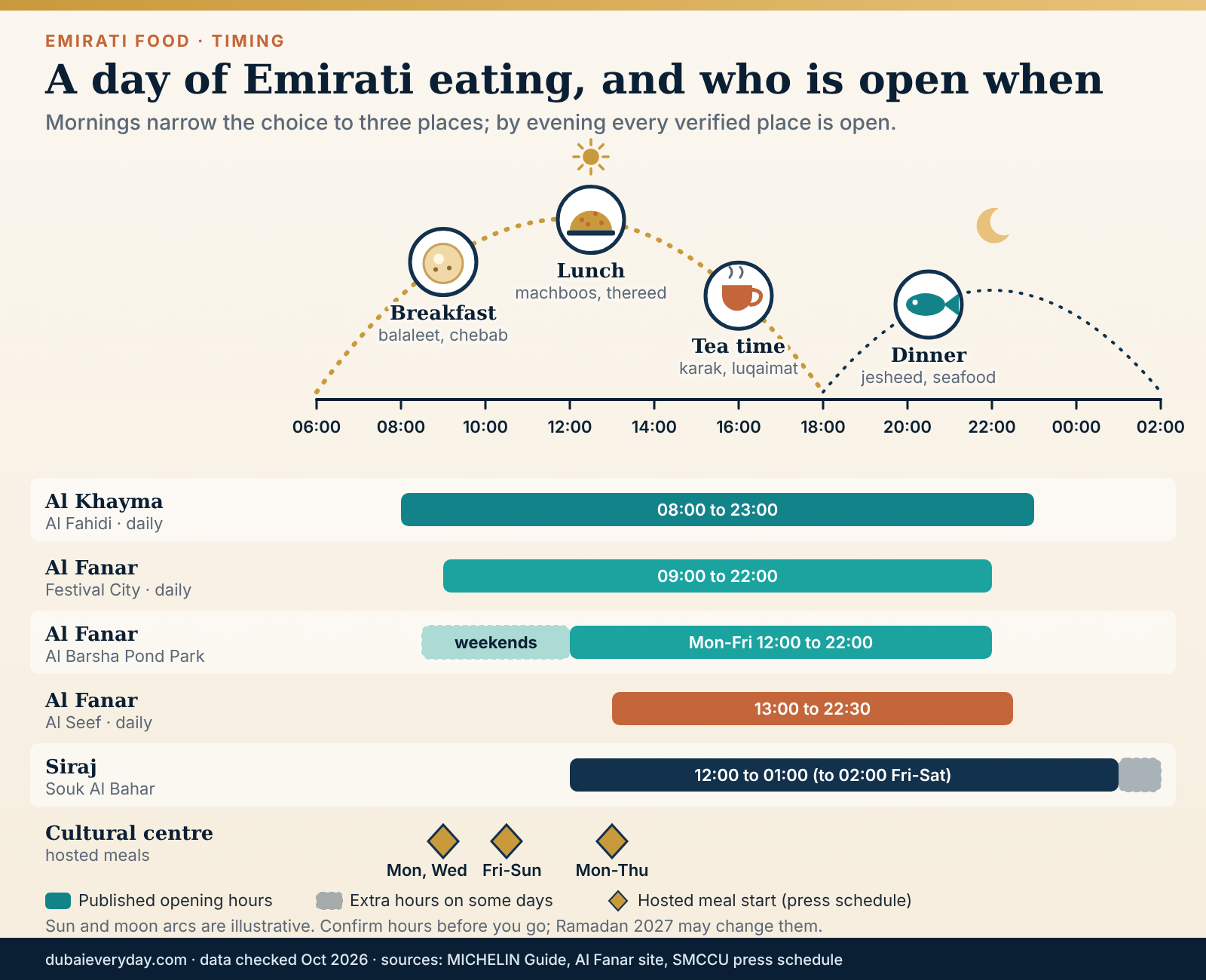
Al Fanar describes itself as a family-run restaurant that opened in 2011. The name means the lantern, and the interiors are built to recall the UAE of the 1960s. Its operator page lists three branches in Dubai. Dubai Festival City, a restaurant and cafe inside the mall, opens daily 09:00 to 22:00. Al Barsha Pond Park, branded a seafood market, opens 12:00 to 22:00 Monday to Friday and 08:30 to 22:00 on weekends. Al Seef, also a seafood market, opens 13:00 to 22:30 daily.
The Al Seef branch is the one in the 2026 MICHELIN Guide selection, according to the operator. The inspectors’ notes, as the operator reports them, mention the rustic interior, the warmth of the team and a terrace over the water and the boats. A selection mention is not a star or a Bib Gourmand. It means the Guide’s inspectors listed the place; nothing more.
The menu is broad, about 120 items across 20 sections by our count, and the Emirati core sits inside it: machboos in chicken, mutton, fish and shrimp versions, jesheed, thereed, stews, chebab and regag bread, legaimat and karak. It also sells biryani, calamari, avocado toast and smoothies, so you need to order deliberately. The trade-off is simple. You get an easy table for a mixed group, and you give up the narrower focus of a smaller kitchen.
Two details to know before you go. Walk-ins are welcome, but the operator recommends booking for weekends, public holidays and larger groups. And the 2023 press describing a harees soup is out of date for the menu page we read, which lists no harees at all.
Al Khayma Heritage Restaurant: the courtyard
Al Khayma is the only one of the Emirati restaurants Dubai offers in our group with a Bib Gourmand. The MICHELIN Guide lists it in the 2026 Bib Gourmand category, which it defines as good quality, good value cooking. The address is Villa 54-44 in the Al Fahidi Historical District, the price band is two dollar signs, and the page shows daily hours from 08:00 to 23:00. The inspectors describe a place that is half restaurant and half museum. Rustic Emirati dishes are served in an air-conditioned, covered courtyard under a tree, with bread baked in view and live music.
The inspectors’ own order is a useful template: start with a salad and bread, share the lamb machboos, finish with luqaimat or the sticky date pudding. A 2023 feature in The National adds breakfast items such as eggs with tomato, spiced chickpeas and balaleet, plus chebab and meat or seafood platters. Those are older press details, so check the current menu.
What we could not find: a menu with prices or a booking policy we could read. Plan around the listed hours, and phone ahead if you are a large group.
Siraj: the modern dinner
The MICHELIN Guide lists Siraj as a Guide restaurant, with no star or Bib Gourmand shown on its page, in the Middle Eastern category and the two-dollar-sign price band. It sits in Souk Al Bahar. The inspectors describe a stylish, modern room with many Arabic cultural references and a terrace facing the nightly fountain show. The menu draws on Emirati and Levantine traditions with light modern changes, for instance lobster kebbe and shrimp kunafa.
Listed hours are noon to 01:00 from Sunday to Thursday and noon to 02:00 on Friday and Saturday. A 2024 Gulf News feature also names camel tenderloin and saffron lobster, and What’s On names karak cake and sticky date pudding; both are older and we cannot say whether those dishes are still on the menu. For the neighbourhood around it, our Downtown Dubai guide covers the transport and the surrounding streets.
Arabian Tea House: the old-quarter breakfast
Among Emirati restaurants Dubai lists, it claims the longest history. The operator’s website calls it the first authentic Emirati restaurant since 1997 and says it serves halal traditional Arabic food. That is a self-description, not an independent ranking.
It lists branches at Al Fahidi, Sharjah, a kiosk in Umm Suqeim, the Archaeological Site, Mercato Mall and Montenegro. The page has a reservation link and routes delivery through Talabat, but it does not print opening hours. A 2024 press feature gave daily hours in the morning to late evening for the Al Fahidi branch; because it is two years old, we have not repeated the times as fact.
The Sheikh Mohammed Centre for Cultural Understanding: the hosted meal
The centre’s tagline is Open Doors. Open Minds. Its website describes cultural meals of about 90 minutes, with an Emirati breakfast in a courtyard on floor cushions, Arabic coffee, dates, local dishes and dessert. It is not a restaurant, so it sits outside the strict count of Emirati restaurants Dubai offers, but it answers the same search job.
It also lists a rooftop Dinner Under the Stars in Al Fahidi, a trolley tour called Heritage Express that ends in a cultural meal, and a visit to Jumeirah Mosque with a light breakfast at the majlis opposite. The office is open daily 08:00 to 20:00, and bookings go through a form, WhatsApp or the phone.
The site gives no prices. A Gulf News lifestyle feature, updated on 23 September 2026 and also carried by Dubai Standard, lists a Monday and Wednesday breakfast at 09:00 for AED 130, a Monday to Thursday lunch at 13:00 for AED 145, a Friday to Sunday brunch at 10:30 for AED 130, a Tuesday fuala tea-time for AED 150 and a Tuesday dinner for AED 160, all per person. It adds that bookings need a day’s notice and dietary needs 24 hours.
The address is House 26, Al Musallah, in Al Fahidi. Confirm times and prices with the centre, because the primary page does not publish them.
Named in the press, not confirmed
A 2024 press feature lists an Al Fanar branch at Expo City. The operator’s page we read on 29 October 2026 lists three Dubai branches and does not include it. Opening hours and even locations in older lists can be wrong, so phone before travelling.
Several other Emirati restaurants Dubai features name repeatedly appear in 2019 to 2025 lists. Aseelah, in the Radisson Blu hotel on Deira Creek, is described by the hotel as Emirati and Middle Eastern cooking, and its page lists a Saturday brunch from 12:30 to 16:00 without giving other days or a status. Local House, in the Majlis Gallery building in Al Bastakiya, is described in press as serving breakfast, camel dishes and mixed grills. Logma has been described as a modern Emirati and Khaleeji kitchen at The Dubai Mall and at City Centre Mirdif.
Al Jalboot on Jumeirah Beach Road, Al Jawareh in Al Qusais, Sikka Cafe (listed at City Walk, La Mer and Al Khawaneej) and Seven Sands at The Beach in JBR round out the list. We could not open a reliable current page for any of them, so we do not recommend them here. If one of these suits your route, treat the press line as a lead, confirm that it is open and check the menu.
Traditional dishes to order and how to read the menu
The Emirati restaurants Dubai runs mostly write menus for people who already know the dishes, and the English spellings change from one printer to the next. A short field guide saves you from ordering four versions of the same rice. The descriptions below come from the UAE government’s culture portal, a Dubai culinary academy’s food guide and the menus themselves, and we say which where it matters.
Rice and meat: machboos, biryani and khuzi
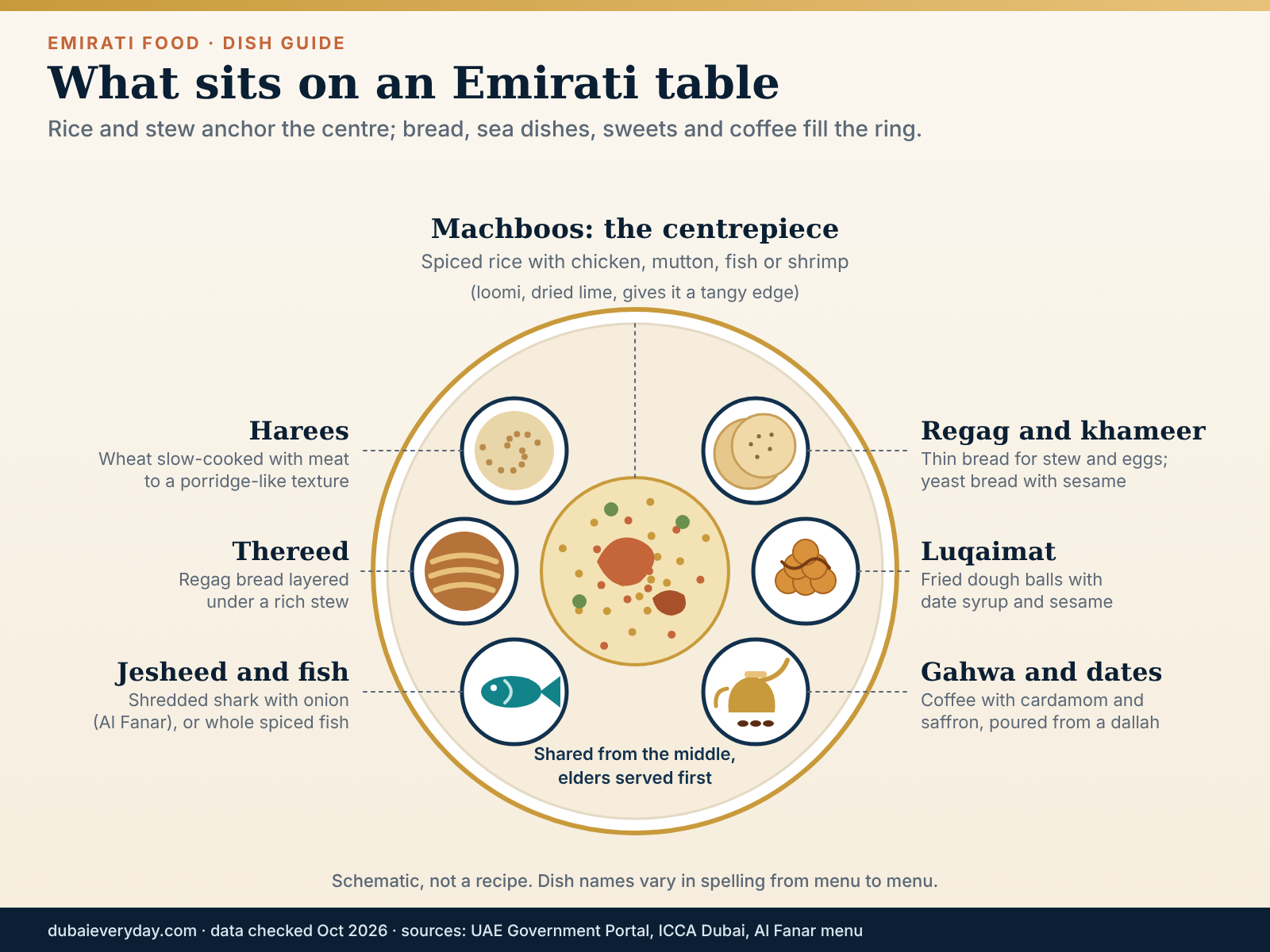
Machboos is the dish most Emirati restaurants Dubai diners visit will put first. The government portal describes it as lamb or chicken layered with spiced rice and saffron, and the culinary academy calls it the national dish and says dried lime, loomi, gives it a tangy depth. Fish and shrimp versions exist. On Al Fanar’s menu you can see all four: chicken at AED 65, fish at AED 76, shrimp at AED 78 and mutton at AED 79.
Biryani appears on the same menus. The portal files it as meat cooked with Indian-style spiced rice, and that is a fair reminder of how much the Gulf trade shaped the table. Khuzi, the portal’s name for a whole roast lamb or goat stuffed and served on spiced rice, is a feast dish. The academy’s guide says lamb ouzi is served at Eid and weddings. You will rarely find the full version on a regular restaurant menu, so ask if it exists and whether it needs notice.
Wheat and stew: harees, thereed and saloona
Harees is wheat slow-cooked with meat until the texture is porridge-like. The academy’s guide says it is especially popular in Ramadan, when it is handed out to mosques and communities, and a Bayut glossary adds Eid and weddings. Because it is so seasonal, many restaurants keep it for Ramadan. Al Fanar’s current menu page lists no harees, although 2023 press mentions a harees soup there. If you want it, ask on the day.
Thereed layers regag bread with a rich stew, so the bread drinks up the sauce. Al Fanar lists chicken thereed at AED 65 and mutton at AED 79. Saloona is the stew itself. On Al Fanar’s page it appears as a sauce choice for its one-pot stews, and press features mention it at Al Khayma and Local House. When a menu says saloona, expect a meat or fish stew, then confirm the main ingredient with staff.
From the sea: jesheed, mhammar and madrooba
The Gulf was a fishing and pearling coast, and the sea dishes are some of the most distinctive on the menu. Jesheed, which Al Fanar describes as shredded shark with onion and Emirati spices, sells for AED 72 in regular or spicy versions. The government portal describes mhammar as a whole spiced fish with sweet caramelised onions and sweet yellow rice, a deliberate mix of savoury and sweet. It describes al madrooba as salted fish in a thick sauce, seasoned with spices and finished with saffron and nuts, served with rice.
Samak mashwi, grilled fish, is the simplest way in. The academy’s guide names hammour as the usual fish. Al Fanar’s menu also lists fish kofta at AED 54 and grilled squid at AED 52; both are good seafood, but neither proves the kitchen is traditional. Among Emirati restaurants Dubai offers, if seafood is your priority, the Al Seef and Al Barsha Pond Park branches of Al Fanar are branded seafood markets, which is a reasonable hint about the kitchen’s emphasis.
Bread and pancakes
Bread came before rice in this region, and a good Emirati kitchen still treats it seriously. Khameer is a yeast bread with flour and powdered milk, topped with sesame and eaten with cheese or honey, according to the government portal. Regag, also spelled reqaq, is the thin bread used in thereed and for breakfast. Al Fanar sells it plain for AED 24 and with cheese and honey for AED 34. Chebab is a pancake of flour, eggs, sugar, cardamom and saffron served with date syrup. Al Fanar lists it at AED 34.
Sweets: luqaimat, khabeesa and friends
Luqaimat are fried dough balls with date syrup and sesame, and the academy says they are especially loved in Ramadan and typically paired with gahwa. A Khaleej Times feature describes them as crunchy outside and soft inside. Al Fanar spells the dish legaimat and sells it for AED 28, with chocolate and pistachio versions at AED 38 as limited-time items. Other sweets include khabeesa, batheetha and aseeda, built on dates, ghee and grains, and the menu lists khabisah at AED 30.
Date syrup, called dibs, turns up everywhere. The portal says it is used as a dip for both savoury and sweet dishes. If you are choosing between a Western dessert and a plate of luqaimat, the second one is what you came for.
Reading spelling variants
Menus in Dubai do not agree on spelling, and neither do the sources we read. The same dish may appear in several forms.
- Luqaimat can appear as legaimat, lugaimat or luqaimat.
- Balaleet is printed as balalit on Al Fanar’s menu.
- Chebab is sometimes chabab; regag is sometimes reqaq or rigag.
- Machboos is sometimes majboos or machbous.
At any of the Emirati restaurants Dubai has, if the English is unfamiliar, point at the dish and ask how it is cooked. Staff in these rooms are used to the question, and the answer tells you more than the menu does.
Emirati breakfast: balaleet, chebab, regag and karak
If you only have time for one Emirati meal, breakfast is the strongest candidate. It is the cheapest, the least crowded and the one most likely to be cooked from scratch. It also fits Dubai’s weather: the old quarters are far kinder to walk in the morning than at dinner time in summer. The catch is that not every one of the Emirati restaurants Dubai lists serves one, and the ones that do have different start times.
What is on the breakfast table
Balaleet is the dish people mention first. The culinary academy’s guide describes it as vermicelli flavoured with saffron and cardamom and topped with a thin omelette, a sweet and savoury breakfast. Chebab, the cardamom and saffron pancake, comes with date syrup and cheese. Regag bread arrives plain, with egg, or with cheese and honey. Around them sit eggs with tomato, spiced chickpeas, cheese, dates and a pot of karak or Arabic coffee.
The Al Fanar menu shows how this looks in practice. Balalit costs AED 42, shakshooka AED 46, scrambled eggs and tomato AED 42 with wagafi bread or AED 44 with regag, dango (a chickpea dish) AED 22, foul AED 29 and chebab AED 34. Two sharing formats sit above them: a Build Your Breakfast Tray for two at AED 99, and an Emirati Breakfast Set for four at AED 249, sold daily until 12:00.
Emirati restaurants Dubai for breakfast, by opening time
The simplest rule is to start from the clock. Among the Emirati restaurants Dubai diners can check, the Guide lists Al Khayma open daily from 08:00, which makes it the earliest of the verified rooms. Al Fanar’s Festival City branch opens at 09:00. The Al Barsha Pond Park branch opens at 08:30 on Saturdays and Sundays but only at 12:00 from Monday to Friday, and Al Seef opens at 13:00. So Al Fanar’s breakfast set is realistic at Festival City every day and at Al Barsha at weekends; at the other two it is not, on the hours published.
That is our reading of the operator’s published times, not a statement that the kitchens refuse breakfast outside them. The operator’s site does not give breakfast hours branch by branch, so phone the branch you plan to use. Arabian Tea House’s own site quotes a visitor praising its Emirati breakfast trays, but it publishes no hours.
The cultural centre is the other morning option. Its breakfast is listed on Mondays and Wednesdays at 09:00, and its brunch on Fridays to Sundays at 10:30. Both are hosted meals with commentary, which is a different product from a table at a restaurant. We compare the two in the cost section.
Karak, gahwa and what to drink
Karak tea is the drink most visitors meet first at Emirati restaurants Dubai offers. Al Fanar sells the original at AED 14 and a saffron version at AED 16. Arabic coffee, gahwa, comes in a pot at AED 21 on the same menu. The two are not interchangeable. Karak is a milky, sweet tea, and gahwa is the coffee flavoured with cardamom and saffron, poured in small cups as a gesture of welcome; we say more about how it is served in the cultural section.
If you are a specialty coffee drinker, note that these rooms also stock espresso drinks, with flat whites and lattes at AED 20 on the Al Fanar menu. A dedicated roaster is a better answer for that need. Our specialty coffee guide and the best cafes in Dubai page cover them.
A simple breakfast plan
- Pick the morning that suits the hoursWeekends open more doors. Al Barsha Pond Park, for example, only serves from 08:30 on Saturdays and Sundays.
- Arrive before the heatAl Fahidi is made of lanes and courtyards. Early light and shade make the walk comfortable, and the Guide lists Al Khayma open from 08:00.
- Order one tray, not five dishesAt Al Fanar the two-person tray costs AED 99, against AED 42 or more for a single balalit.
- Add karak at the endA pot or glass is cheaper than most coffee and fits the meal.
- Keep the next stop closeThe Creek, the abra crossing and the lanes are all within the same district, which we map later.
Cafe-style breakfast with no Emirati focus is a separate job. Here we stay with the dishes you cannot easily get elsewhere.
Modern Emirati cooking: where the recipes get rewritten
Modern Emirati is a loose label. Among the Emirati restaurants Dubai markets that way, it helps to know which of three things a restaurant means by it. Some serve heritage dishes in a contemporary room. Some mix Emirati and Levantine cooking on one menu. Others sit in hotels, where the room and the service set the tone and the menu follows. Dubai has examples of all three, and the descriptions we can verify are short.
Siraj: Emirati and Levantine with a polish
Siraj is the clearest verified example. The MICHELIN Guide inspectors place the menu between Emirati and Levantine traditions and flag subtle modern touches, with lobster kebbe and shrimp kunafa as examples. Neither dish belongs to a traditional Emirati table, and that is the point of the place. It reads as a Gulf kitchen borrowing from the Levant, not a museum piece.
The setting is part of the order. The Guide describes a stylish room with many Arabic cultural references and a terrace with a view of the nightly fountain show. That makes it a sensible choice for an anniversary or a visitor’s last night, and a poor choice if you want to see a grandmother’s recipe. If your question is whether to book the terrace, check with the restaurant, because the Guide page we read gives none.
The listed hours help a late booking. Siraj opens at noon and runs until 01:00 on Sunday to Thursday and 02:00 on Friday and Saturday. Souk Al Bahar sits close to The Dubai Mall, and our Dubai Mall guide covers the Metro station, parking and how long to allow. The RTA’s published timetable names the Red Line stop as Burj Khalifa / Dubai Mall.
Hotel Emirati: Aseelah as a lead
Aseelah, in the Radisson Blu hotel on Dubai Creek, is the second name worth knowing. The hotel’s page describes it as an award-winning restaurant blending Emirati culture and heritage with hospitality and a modern style, with a glass-walled terrace, and lists Emirati and Middle Eastern cooking. The page lists a Saturday brunch from 12:30 to 16:00 and gives no other days, no address and no status, so we keep Aseelah in the lead group.
A 2019 Lonely Planet feature described Aseelah as the most adventurous take on local cuisine in the city and the only Emirati restaurant in its list that served alcohol. That is seven years old, and we have not confirmed either point. Check the licence and the dress guidance with the hotel; our Dubai dress code guide explains the general expectations.
A note on stars and Emirati restaurants Dubai readers ask about
Readers sometimes ask for a starred Emirati restaurant. A 2023 report in The National named Erth in Abu Dhabi as the first Emirati restaurant to win a MICHELIN star. It is in Abu Dhabi, so it falls outside this page. In Dubai we did not find an Emirati restaurant in the starred category on the pages we read; the Emirati restaurants Dubai diners can verify are Bib Gourmand or Guide-listed. For the stars themselves, see the Michelin restaurants in Dubai guide, and for tasting-menu dining use the fine dining guide.
One practical rule for modern rooms: ask which dishes are Emirati and which are Levantine or international. Menus mix them without labels, and a sharing order that includes one traditional dish, a machboos or a stew, keeps the meal anchored to the place.
Cultural context: gahwa, the majlis and the cultural meal
Food in the Emirates is bound up with hospitality, and the first thing a host offers is not a plate. It is coffee and dates. Knowing what that gesture means makes a meal at any of the Emirati restaurants Dubai offers easier, because staff in traditional rooms often serve in that spirit. You do not need to memorise a script. A few facts are enough.
Gahwa: more than a drink
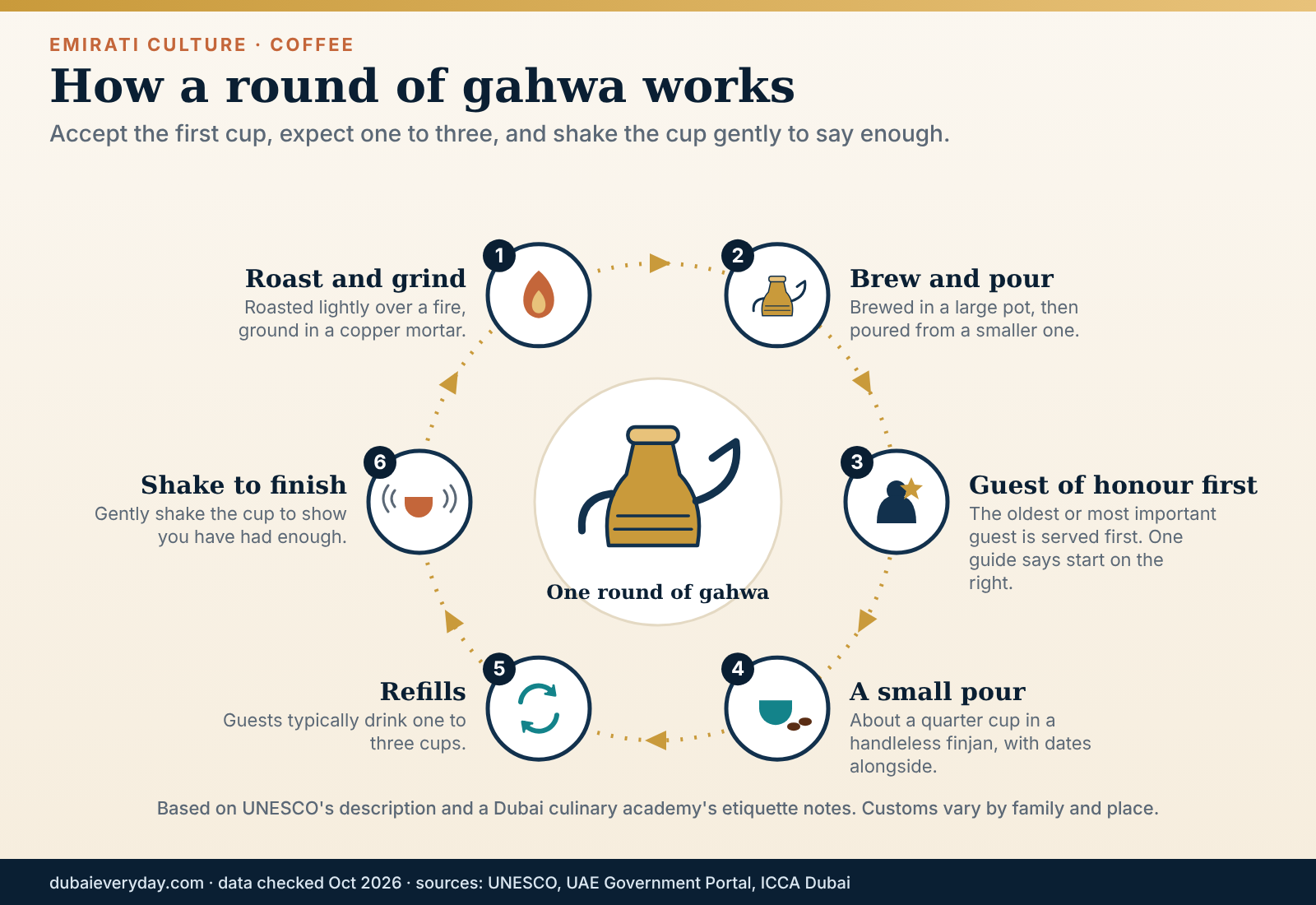
UNESCO added Arabic coffee, described as a symbol of generosity, to its Representative List of the Intangible Cultural Heritage of Humanity in 2015. The UAE, Saudi Arabia, Oman and Qatar submitted it together. UNESCO describes serving the coffee as a ceremonial act of hospitality, usually prepared in front of guests. The beans are lightly roasted over a fire, ground in a copper mortar and brewed in a large copper pot, then moved to a smaller pot and poured into small cups.
The order of service matters. UNESCO says the oldest or most important guest is served first, receiving a quarter of a cup that can be refilled, and that guests typically drink between one and three cups. The UAE government’s portal adds that the local gahwa is blended with cardamom and saffron and served in small handleless cups called finjans, with dates beside it.
What guests are expected to do
A Dubai culinary academy’s guide gives the practical version. Coffee is poured from a dallah, the long-spouted pot, starting with the guest on the right. Guests gently shake the cup to show they have had enough. The same guide says that declining the first cup is traditionally read as rejecting the host’s hospitality, so accept one even if you take no more. Those are one guide’s account, and families differ, but they match UNESCO’s picture of a ritual with an order.
For a visitor the rule of thumb is short. Take the first cup. Shake it gently when you have had enough. If you are unsure, watch what the host and the other guests do. Our Dubai etiquette guide covers greetings, tipping and photography in more depth.
The majlis table
A majlis is the sitting room where guests are received, and a majlis meal is communal. The academy’s guide says people eat from shared platters with the right hand, elders are served first and hosts make sure guests are satisfied before they eat themselves. Al Fanar’s trays, and the Guide’s advice to share the lamb machboos at Al Khayma, follow the same logic, which is why ordering for the table works better than ordering one plate each.
Two small adjustments help in the Emirati restaurants Dubai offers. Let the oldest person at the table start. And order a little more than you think you need, because sharing formats are built on generosity, not on portion control. The trays on Al Fanar’s menu are labelled as serving two or four, so you can plan for headcount directly.
The hosted cultural meal
The Sheikh Mohammed Centre for Cultural Understanding exists for this purpose. Its motto is Open Doors. Open Minds, and Visit Dubai describes it as a guide to Dubai’s tradition, culture and religion. Its meals let visitors ask questions about local life with Emirati hosts present. A Gulf News feature describes the format as a traditional spread with Emirati presenters leading the conversation. It is the lowest-risk way to ask the questions that feel awkward elsewhere.
A few things to do before you go. Send dietary requirements at least 24 hours ahead, since the centre asks for that in the press feature we read. Wear modest clothes, as the UK Foreign Office advises for public places in the UAE, with shoulders and knees covered. Ask before photographing people, because the same advice says not to photograph people without permission. And arrive on time; the sessions are scheduled.
Finding Emirati restaurants Dubai area by area
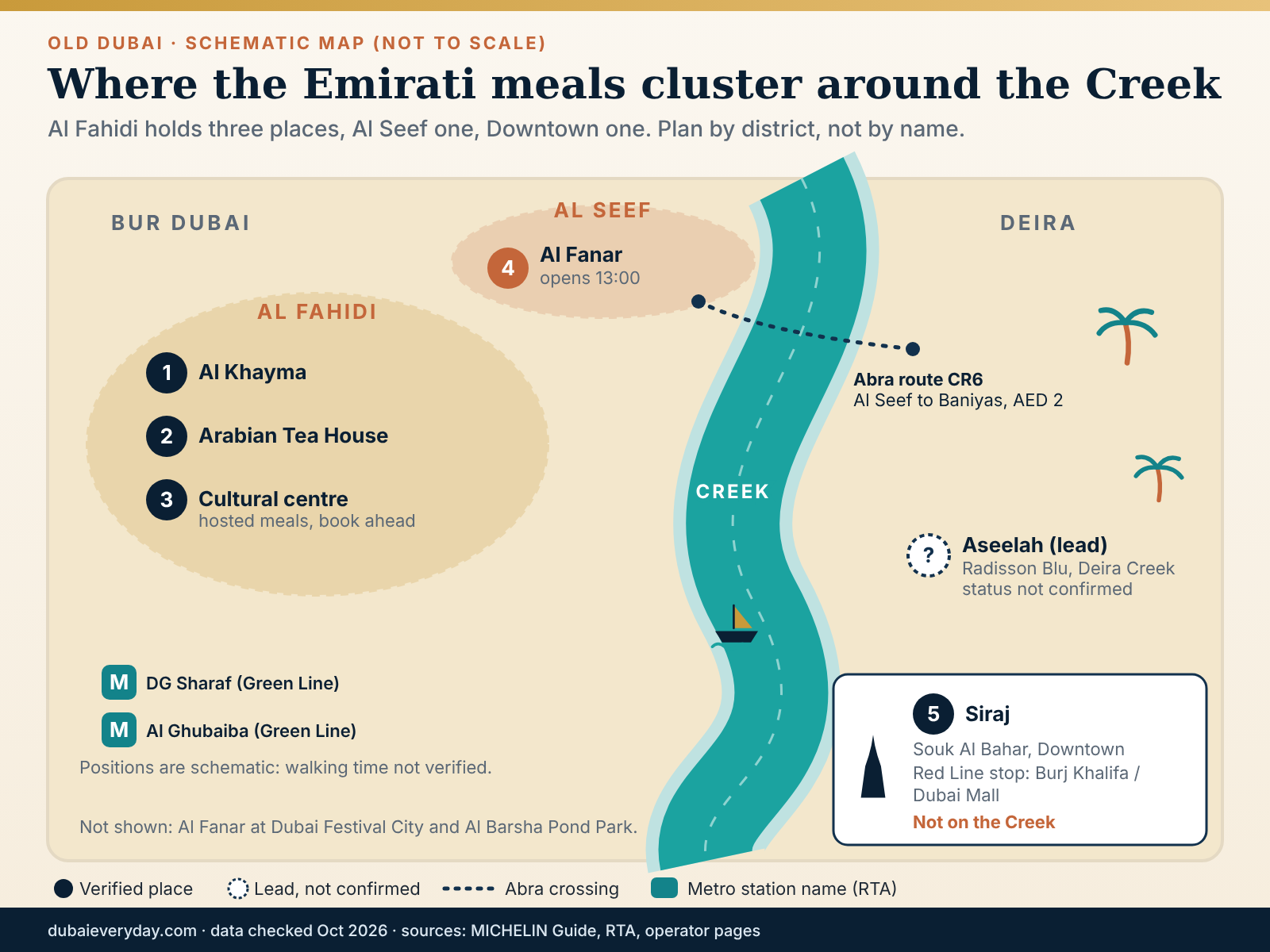
The Emirati restaurants Dubai readers can verify fall into four clusters, and each cluster suits a different kind of day. The first two are walking districts on the Bur Dubai side of the Creek, the third is a mall and park pair on the Al Fanar network, and the fourth is Downtown. Distances and walking times were not verified on any official page, so the map below shows relationships, not minutes.
Al Fahidi: three places, one district
Al Fahidi is the heritage quarter of Bur Dubai. Two of the Emirati restaurants Dubai offers, Al Khayma and Arabian Tea House’s original branch, sit here with the cultural centre and the Local House lead. The houses are courtyard buildings of sea stone and gypsum topped with wind towers, built by merchant families who came mainly from Persia in the early twentieth century, according to a 2025 Aramco World review. Much of the old fabric was demolished in the 1980s and 1990s, and a restoration programme began in 2005.
For transport, the RTA’s Metro timetable names two Green Line stations that serve Bur Dubai, Al Ghubaiba and DG Sharaf. The timetable does not say how far either is from the lanes, so allow for a walk in the heat and check the route on a map. Our things to do in Dubai guide has heritage stops that fit the same morning.
Al Seef: the creekside dinner
Al Seef is the waterfront strip on the Bur Dubai bank, and Al Fanar’s seafood-market branch is the only one of our Emirati restaurants Dubai shortlist on this stretch. It opens at 13:00, so it is a lunch-to-dinner stop, not a breakfast stop. The operator lists parking and valet. By water, the RTA’s marine page lists a heritage abra route, CR6, from Al Seef to Baniyas on the Deira side at AED 2 per trip. The page does not list operating hours.
Festival City and Al Barsha: the easy parking
Al Fanar’s two other branches are practical rather than atmospheric. The Dubai Festival City branch sits inside the mall and opens daily from 09:00 to 22:00. The Al Barsha Pond Park branch has free parking, according to the operator, and opens at 12:00 on weekdays and 08:30 on weekends. If you are driving with children or a large group, these are the easiest to reach. For other neighbourhoods, see our guides to Dubai Marina and JBR, where we could not verify any Emirati restaurants Dubai readers can rely on.
Downtown: Siraj
Siraj sits in Souk Al Bahar with a terrace facing the fountain show. The RTA’s Metro timetable names the Red Line station as Burj Khalifa / Dubai Mall. If you combine dinner with an evening at the fountain, the practical limiter is the crowd, not the food. Our Downtown guide explains how to get around there.
Which meal for which job
Most readers choosing among Emirati restaurants Dubai offers arrive with one of five jobs. The right pick differs for each, and so does what you should expect to give up.
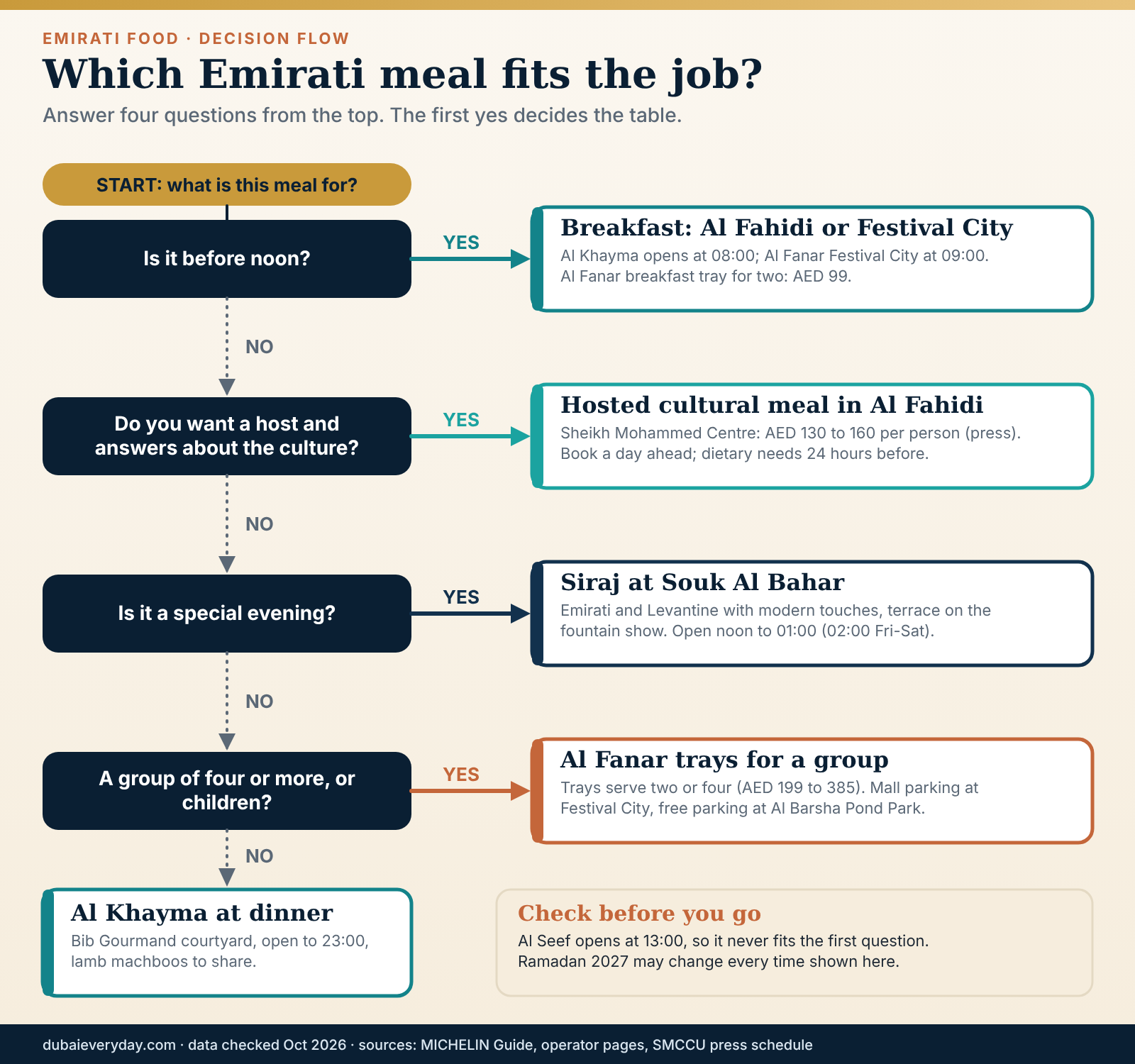
- One Emirati meal on a short visit: breakfast at Al Khayma or at Al Fanar Festival City, because both open early and cost least.
- A table of four or more: the Al Fanar trays, which are priced for two or four.
- A special evening: Siraj, with the terrace and the late hours.
- Questions about the culture: the cultural meal, booked a day ahead.
- A museum-style evening in a heritage lane: Al Khayma at dinner, with live music.
The trade-offs are plain. Al Fanar is the most predictable and also the broadest menu. Al Khayma has the strongest atmosphere and the least published menu detail. Siraj has the fountain-facing terrace and is the least traditional. The cultural meal costs more per head than an ordinary table because you are paying for hosting. Among Emirati restaurants Dubai offers, pick on the job, not on the name.
What Emirati restaurants Dubai charge: a worked budget
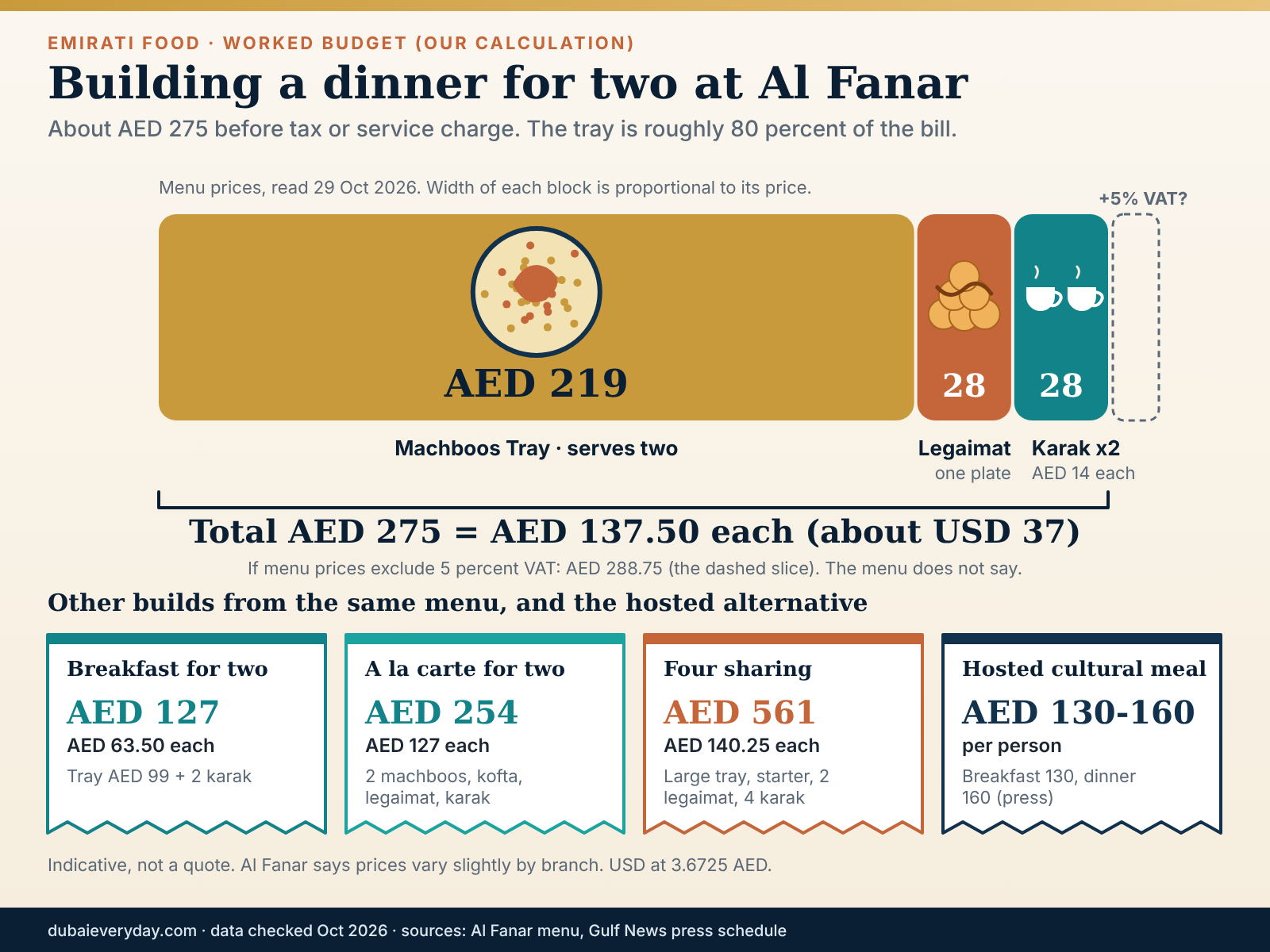
The only one of the Emirati restaurants Dubai readers will compare that publishes a full current price list is Al Fanar, so the budget below is built from its menu, read on 29 October 2026. The Guide gives Al Khayma and Siraj a two-dollar-sign price band, which tells you they are mid-range but not what a bill will be. The sums are our calculation. The menu page does not say whether prices include VAT or a service charge, and it says prices vary slightly between branches.
Five sample bills
A breakfast for two uses the Build Your Breakfast Tray at AED 99 and two original karaks at AED 14 each, which comes to AED 127, or AED 63.50 each. The Emirati Breakfast Set for four, AED 249, works out at AED 62.25 per person before drinks. Both are lower than a hosted cultural breakfast, which the press lists at AED 130 per person.
A dinner for two sharing the Machboos Tray at AED 219, one legaimat at AED 28 and two karaks totals AED 275, or AED 137.50 per person (about USD 37 at 3.6725 AED per USD). Ordering à la carte instead, a chicken machboos at AED 65, a mutton machboos at AED 79, a fish kofta starter at AED 54, a legaimat and two karaks, comes to AED 254, or AED 127 each. The tray is not a bargain per head; it is simply easier.
For a table of four, the large Signature Tray at AED 385, a mixed appetiser at AED 64, two legaimat at AED 56 and four karaks at AED 56 adds up to AED 561, or AED 140.25 each. The Special Business Lunch is AED 79, from 12:00 to 15:00 Monday to Thursday. The menu does not say whether that is per person or what it includes, so ask.
Putting the cultural meal in context
The hosted meal at the cultural centre is listed at AED 130 to 160 per person. Against Al Fanar, that is roughly double for breakfast (AED 130 against AED 63.50) and about 16 percent more for dinner (AED 160 against AED 137.50). The difference is not the food. You are paying for a host, a house in Al Fahidi and time to ask questions. If that is what you want, the price is fair on its face. If you only want the dishes, a restaurant table is cheaper.
An undated Bayut list puts the six Emirati places it names at roughly AED 220 to 260 for two. Our Al Fanar working sits at the top of that range and just above it, which fits the idea that prices have moved since the list was written. Use it as a loose cross-check, not a rate card.
What can change the final number
Four things can move the bill at Emirati restaurants Dubai offers.
- VAT: the Federal Tax Authority’s calculator labels VAT at 5 percent. If a menu price is exclusive, AED 275 becomes AED 288.75.
- Municipal tax: The National reported on 21 May 2026 that Dubai’s relief package suspended the 7 percent municipal tax on hotel and restaurant bills. It gave no end date and did not say how it applies to each restaurant, so read your receipt.
- Service charge: some hotel restaurants add one. Check the foot of the menu and ask before you order.
- Limited-time dishes: Al Fanar’s chocolate and pistachio legaimat cost AED 38 against AED 28 for the standard plate.
For the full logic of bills, taxes and service charges, our best restaurants guide works through the stack, and the cheap eats guide is the place to look if you want South Asian and Middle Eastern value instead.
Booking, halal, alcohol, dress, Ramadan and common mistakes
Booking
Al Fanar welcomes walk-ins and recommends booking for weekends, public holidays and larger groups. The cultural centre needs a day’s notice. Arabian Tea House has a reservation page. Booking rules differ across Emirati restaurants Dubai offers. We found no booking details for Al Khayma or Siraj on the pages we read, so phone them or use their own channels, particularly for Friday and Saturday evenings and for any group.
Halal and alcohol
Of the Emirati restaurants Dubai offers in our group, only Arabian Tea House states on its site that it serves halal food. None of the other pages we read stated halal status either way, so ask if it matters to you.
On alcohol, the UK Foreign Office says drinking in public is illegal in the UAE, the legal age in Dubai is 21, and alcohol is served in licensed venues such as hotels, restaurants and pubs. We found no licence information for any verified place, so assume none and ask. For licensed venues, see our nightlife guide and the best bars guide.
Dress
For public places, the Foreign Office advises that women cover shoulders and knees, that clothing should not be transparent or carry offensive images, and that swimwear is for beaches and pools. Some venues set their own rules. None of the pages we read set a dress code for these Emirati restaurants Dubai offers, so modest, smart-casual clothes are the safe default. Our dress code guide goes through the places where it matters.
The National projects Ramadan 2027 to begin on 8 February and end on 8 or 9 March, with Eid Al Fitr around 9 or 10 March, subject to moon sighting. The Foreign Office says eating, drinking, smoking or chewing gum in public during daylight may cause offence, and notes that some hotels and restaurants serve food during fasting hours behind screens. Al Fanar says its hours may change in Ramadan. We could not verify Ramadan hours for any place, so phone first.
Mistakes that cost the most at Emirati restaurants Dubai offers
- Trusting old press hoursFeatures from 2019 to 2025 give times and branch lists that differ from today’s operator pages.
- Going to Al Seef for breakfastThat branch opens at 13:00 on the published hours.
- Expecting harees all yearIt is a Ramadan, Eid and wedding dish, and it is not on Al Fanar’s current menu page.
- Ordering one plate eachThese menus are built for sharing, and trays serve two or four.
- Reading a Guide mention as a starAl Seef is a Selected-list entry per the operator; Al Khayma holds a Bib Gourmand; neither is a star.
- Confusing the cultural meal with a restaurantIt is hosted, scheduled and booked ahead.
FAQ
Where can I eat traditional Emirati food in Dubai?
The Emirati restaurants Dubai offers that we could check against a current page are Al Fanar (Al Seef, Dubai Festival City and Al Barsha Pond Park), Al Khayma Heritage Restaurant in Al Fahidi and Arabian Tea House’s original Al Fahidi branch. For a hosted meal, the Sheikh Mohammed Centre for Cultural Understanding also serves Emirati breakfast, lunch and dinner by booking. Hours differ by place, so check before you travel.
Which Emirati restaurants in Dubai serve breakfast?
Among Emirati restaurants Dubai lists, on the published hours, Al Khayma opens at 08:00 daily, Al Fanar’s Festival City branch at 09:00, and its Al Barsha Pond Park branch at 08:30 on weekends. The cultural centre lists a breakfast on Mondays and Wednesdays at 09:00 and a brunch from Friday to Sunday. Al Fanar’s Al Seef branch opens at 13:00, and Arabian Tea House publishes no hours, so phone first.
What should I order first at an Emirati restaurant?
At most Emirati restaurants Dubai diners visit, start with machboos, the spiced rice dish with chicken, mutton, fish or shrimp, and share it. Add one sea dish such as jesheed if the menu has it, a bread such as regag, and luqaimat with karak to finish. At Al Fanar, a chicken machboos is AED 65 and a legaimat plate AED 28. The Guide’s inspectors suggest salad and bread first at Al Khayma, then lamb machboos.
Is there a Michelin-starred Emirati restaurant in Dubai?
Among the Emirati restaurants Dubai offers, we did not find one on the pages we read. Al Khayma holds a 2026 Bib Gourmand, which the Guide defines as good quality, good value cooking, and Siraj is listed as a Guide restaurant with no distinction shown. Al Fanar’s Al Seef branch is in the 2026 selection, according to the operator. A 2023 report names Erth in Abu Dhabi as the first Emirati restaurant to win a star.
How much does an Emirati meal cost in Dubai?
On Al Fanar’s current menu, a dinner for two sharing a machboos tray with dessert and karak comes to AED 275, or AED 127 to 137.50 each depending on how you order, before any tax or service charge. Breakfast for two can be about AED 127. The hosted cultural meal is AED 130 to 160 per person. Prices at Emirati restaurants Dubai offers move, and these are menu prices read on 29 October 2026.
Do I need to book Emirati restaurants in Dubai?
For Emirati restaurants Dubai offers, rules differ. Al Fanar welcomes walk-ins and recommends booking for weekends, public holidays and groups. The cultural centre needs at least a day’s notice and 24 hours for dietary needs. Arabian Tea House has a reservation page. We found no booking details for Al Khayma or Siraj on the pages we read, so contact them directly, especially for a Friday or Saturday evening.
Is Emirati food halal, and is alcohol served?
Arabian Tea House states that it serves halal food. The other pages we read did not state halal status, so ask if it matters. For alcohol, the UK Foreign Office says drinking is allowed in licensed venues such as hotels, restaurants and pubs, and the legal age in Dubai is 21. We found no licence details for the verified places, so assume none and ask before you book.
What is the difference between Emirati and Lebanese food?
Lebanese and wider Levantine menus centre on hummus, kibbeh, grills and shawarma. Emirati cooking leans on rice dishes such as machboos, wheat dishes such as harees, stews such as thereed and saloona, fish, dates and saffron- and cardamom-flavoured breads and sweets. Some of the Emirati restaurants Dubai offers, including Siraj, mix both, so ask which dishes are which.
Can visitors join a cultural meal with Emirati hosts?
Yes. The Sheikh Mohammed Centre for Cultural Understanding in Al Fahidi runs hosted meals, a rooftop dinner and a mosque visit, with Emirati presenters taking questions. A September 2026 press feature lists breakfast and brunch at AED 130, lunch at AED 145, fuala at AED 150 and dinner at AED 160 per person. Book at least a day ahead and confirm the schedule with the centre.
Are Emirati restaurants open during Ramadan?
Hours at Emirati restaurants Dubai offers often change in Ramadan. Ramadan 2027 is projected to begin around 8 February, subject to moon sighting. Al Fanar says its hours may change in Ramadan and on public holidays. The UK Foreign Office advises against eating or drinking in public in daylight and notes that some venues use screens. We could not verify Ramadan hours for any place, so phone before you go.
Where to start
If you want one decision, make it a breakfast. Go to Al Khayma in Al Fahidi, or to Al Fanar at Dubai Festival City, order a tray with balaleet or chebab, and finish with karak. It is the cheapest and quietest way into the cuisine, and it uses the hours the Guide and the operator publish. Then, if you want a second meal, choose among the Emirati restaurants Dubai offers by job: Al Fanar for a group, Siraj for a special evening, the cultural meal for questions.
The honest limit of this page is that it is a desk-research guide with five verified places and seven leads. The best Emirati restaurants Dubai readers can find will change as places open, close and update menus, and the older press lists we cited are the first to go stale. We would rather give you five places we could check than twenty we could not. Phone first, order to share and accept the first cup of coffee.
Related reading
Sources and further reading (27 links)
- Al Fanar Restaurant: official site — Dubai branches, hours, walk-in policy, Selected listing, Ramadan note
- Al Fanar Restaurant: menu — dish list and prices used in the worked budget
- MICHELIN Guide: Al Khayma — Bib Gourmand, address, hours, inspectors’ description
- MICHELIN Guide: Siraj — cuisine, price band, hours, inspectors’ description
- Arabian Tea House: official site — branches, halal statement, reservation page
- Sheikh Mohammed Centre for Cultural Understanding: official site — cultural meals, address, office hours, booking
- Dubai Standard: The Emirati Edit — cultural meal schedule and per-person prices
- Gulf News: The Emirati edit — cultural breakfast price, booking and location
- Radisson Blu Hotel, Dubai Deira Creek: Aseelah — cuisine description and listed brunch
- UAE Government Portal: food and Emirati cuisine — history, ingredients, dishes, coffee and hospitality
- UNESCO: Arabic coffee, a symbol of generosity — 2015 inscription and how the coffee is served
- ICCA Dubai: Emirati cuisine guide — dish descriptions and majlis and gahwa etiquette (context)
- RTA: Metro and tram timings — station names serving Bur Dubai and Downtown
- RTA: marine transport — heritage abra routes and AED 2 fare
- UK Foreign, Commonwealth and Development Office: UAE safety and security — Ramadan, dress, alcohol and photography guidance
- The National: Ramadan 2027 UAE dates — projected start, end and Eid
- The National: Dubai relief package — suspension of the 7 percent municipal tax
- Federal Tax Authority: VAT — 5 percent VAT rate shown in the calculator
- The National: six Emirati restaurants in the Michelin Guide — Erth, Al Khayma and Al Fanar notes (older context)
- Aramco World: Dubai neighbourhood and preservation — Al Bastakiya history and restoration
- Khaleej Times: Emirati restaurants in the city — 2024 press leads (older context)
- Khaleej Times: best luqaimat to try in Dubai — how luqaimat is described (older context)
- What’s On: Emirati restaurants in Dubai — 2024 press leads (older context)
- Visit Dubai: Sheikh Mohammed Centre for Cultural Understanding — how the centre is described
- Bayut: Emirati restaurants in Dubai — undated price levels and dish glossary (context)
- Gulf News: top five Emirati restaurants — 2024 press leads (older context)
- Lonely Planet: Dubai’s best Emirati restaurants — 2019 context on Aseelah and others
Update log: 29 October 2026 — first publication; all facts re-checked against the sources above. Next review due: 29 January 2027, or sooner if any of the Emirati restaurants Dubai offers here closes, changes its hours or publishes Ramadan 2027 timings. Corrections welcome. This guide is general information from desk research, not a booking service; confirm hours, prices and policies with each venue.
About DubaiEveryday and this guide
DubaiEveryday.com is an independent editorial project that publishes practical, research-based guides to everyday life in Dubai: where to live, what things cost, how the rules work and how to get around. This page was written and edited by the DubaiEveryday editorial team. It is not signed by a named expert, doctor, lawyer or adviser, and we do not claim first-hand testing of a venue, clinic or service unless the page says so.
Each guide is built from official sources such as government and regulator pages, operator websites and established news outlets, cross-checked where we can. When we could not confirm something, we say so in the text, and examples that use made-up numbers are labelled as illustrations. Mentions are editorial choices, not paid placements, and a link is not an endorsement.
Dubai changes quickly. If you spot something that is out of date or wrong, please tell us through the contact options on DubaiEveryday.com and we will check it and correct the page.