
Dubai is relaxed about what people wear in most places and strict in a few, and the difference between the two is where visitors and new residents trip up. This Dubai dress code guide goes venue by venue, from malls and beaches to mosques, offices, nightlife and government buildings, checked on 29 October 2026.
Picture a first morning in Dubai: shorts and a tank top feel fine at breakfast, but a mosque visit is planned for the afternoon. Do you change? Is a beach cover-up enough for lunch? Questions like these come up every day, and the answers shift from one door to the next.
The good news is that the dubai dress code is mostly venue rules plus common sense, with only a few places that ask for more. This guide goes through malls, beaches, mosques, restaurants, offices, nightlife and government buildings. Then it hands you a four-question method for any outfit you are unsure about, so you can stop second-guessing your suitcase.
The Dubai dress code is mostly venue rules plus good judgement rather than one list of banned garments. In everyday public places such as malls, streets and attractions, cover your shoulders and knees, avoid see-through fabric and offensive slogans, and keep swimwear for beaches and pools. That is the advice the UK and Irish governments give their own citizens, and it fits what Dubai venues publish.
Three places ask for more. Mosques expect arms and legs covered, and women also cover their hair; Jumeirah Mosque lends robes and scarves at the door. Government buildings and business meetings reward neat, fully covered, plain clothing. Restaurants, hotels, clubs and events set their own code, and a published code always beats a general rule.
Three places allow less covering: the sand, the pool deck and the water. The mistake that catches people is the walk between those zones and the rest of the city. Carry something to put on over swimwear, and put it on early. During Ramadan, which is projected to begin around 7 to 8 February 2027, the same clothes carry more weight, so lean towards covered and quiet.
This page is a research-based guide, not legal advice, and it says plainly which points are law, which are venue policy and which are habit.
This Dubai dress code guide is desk research. DubaiEveryday.com has not dressed for, queued at or been turned away from any of the venues below, and nothing here describes a personal visit. Where a venue’s own policy is described, it is described from the venue’s published page.
Facts come from pages read on 29 October 2026: the Jumeirah Mosque dress code page, the Sheikh Mohammed Centre for Cultural Understanding, The Dubai Mall’s visitor page, Dubai Municipality’s beach listing, the UAE government portal u.ae, and the current travel advice of the UK, Ireland, Canada, Australia and New Zealand governments. Foreign advisories are secondary sources: they summarise UAE law for their own citizens, they are not UAE law, and we say which one we are quoting.
What we could not verify: the article numbers and penalty ranges for public-decency offences in the federal Crimes and Penalties Law (the text we could open stopped before them), most venue dress-code wording (several venue pages were blocked or did not load), club door policies and Ramadan restaurant rules for 2027. Those points are marked “Confirm first” or kept general.
Anything labelled “our reading” or “our calculation” is judgement built on the sources, not a published rule. Inclusion of a venue was not paid for, and there are no booking links. This is general information, not legal advice; rules and their enforcement can change, so check the official page before you rely on a detail.
How the Dubai dress code works: law, venue rules and habit
Most arguments about the Dubai dress code go wrong because three different things get blended into one. Some points are law. Some are venue or operator rules. Some are habit: what feels ordinary in a given room at a given hour. Each has a different consequence if you ignore it, and a different place to check.
In the Dubai dress code, the law layer is short and mostly about conduct and public decency rather than a catalogue of garments.
The UK government’s advice for the UAE says to dress modestly in public areas such as shopping malls, that women should cover shoulders and knees and keep underwear out of sight, that see-through clothing and clothing with offensive images or wording should be avoided, and that swimwear is appropriate only at beaches and swimming pools. It also says cross-dressing is illegal. Ireland’s guidance repeats the shoulders-and-knees advice and the swimwear point.
The venue layer is where most day-to-day Dubai dress code decisions sit. The Dubai Mall’s visitor page lists a “courtesy dress code” among its visitor information. Jumeirah Mosque publishes its own dress code page. Hotels, beach clubs, restaurants and nightlife venues apply their own standards at the door, and the UK advice notes plainly that some venues, events and buildings have their own specific dress codes. A venue’s rule can be stricter than the law and it is the one that will actually be applied to you on the day.
The habit layer of the Dubai dress code is the hardest to write down, because it is context. A sleeveless top that nobody notices at a hotel pool is out of place in a government service centre. Shorts that suit a morning on Kite Beach look wrong at a business lunch.
Habit also moves with the calendar: Canada’s advice says Ramadan, expected to begin on or around 7 February 2027, calls for more care in public, and the UK advice says clothing that breaches local norms may cause more offence during that month.
What the Dubai dress code is not
It is not a uniform. Nothing we could find in official sources requires visitors to wear national dress, and Canada’s advice says foreign women are not expected to wear head covers, even though it calls revealing clothing inappropriate. The exception is religious sites, where the UAE government portal asks women to cover their heads. It is also not a blanket permission slip. Calling Dubai “tourist-friendly” is true of hotels, and misleading in a bank branch, a courthouse or a mosque.
There is a third misconception about the Dubai dress code, and it comes from the opposite direction: that visitors must cover from neck to ankle everywhere. The governments quoted above ask for shoulders and knees, not full coverage, outside religious sites. That is a much lower bar, and it is the one the everyday Dubai dress code runs on. Residents of Dubai come from very many countries, and what people wear on the street varies widely within that bar.
How strictly is the Dubai dress code enforced?
Honestly, we cannot give you a number. We found no published tariff of dress-specific fines in the sources we could open, and we did not find an official statement of how often visitors are stopped for clothing.
What the foreign governments do report are arrests and prosecutions for conduct: kissing in public, swearing and rude gestures (including online), drinking in public, and photographing people without permission. Clothing sits next to those topics because it is part of public decency, but the everyday consequence of getting it wrong is usually a request from venue staff to cover up, or refusal of entry.
That is worth keeping in proportion. The realistic worst case for a tourist in a slightly short skirt in a mall is awkwardness and a quiet word. The realistic worst case for deliberately provocative or offensive clothing, or for behaviour that crosses into an indecent act, is a police matter. Our advice on the Dubai dress code, throughout this page, is to stay well inside the first category.
Reading the cover levels
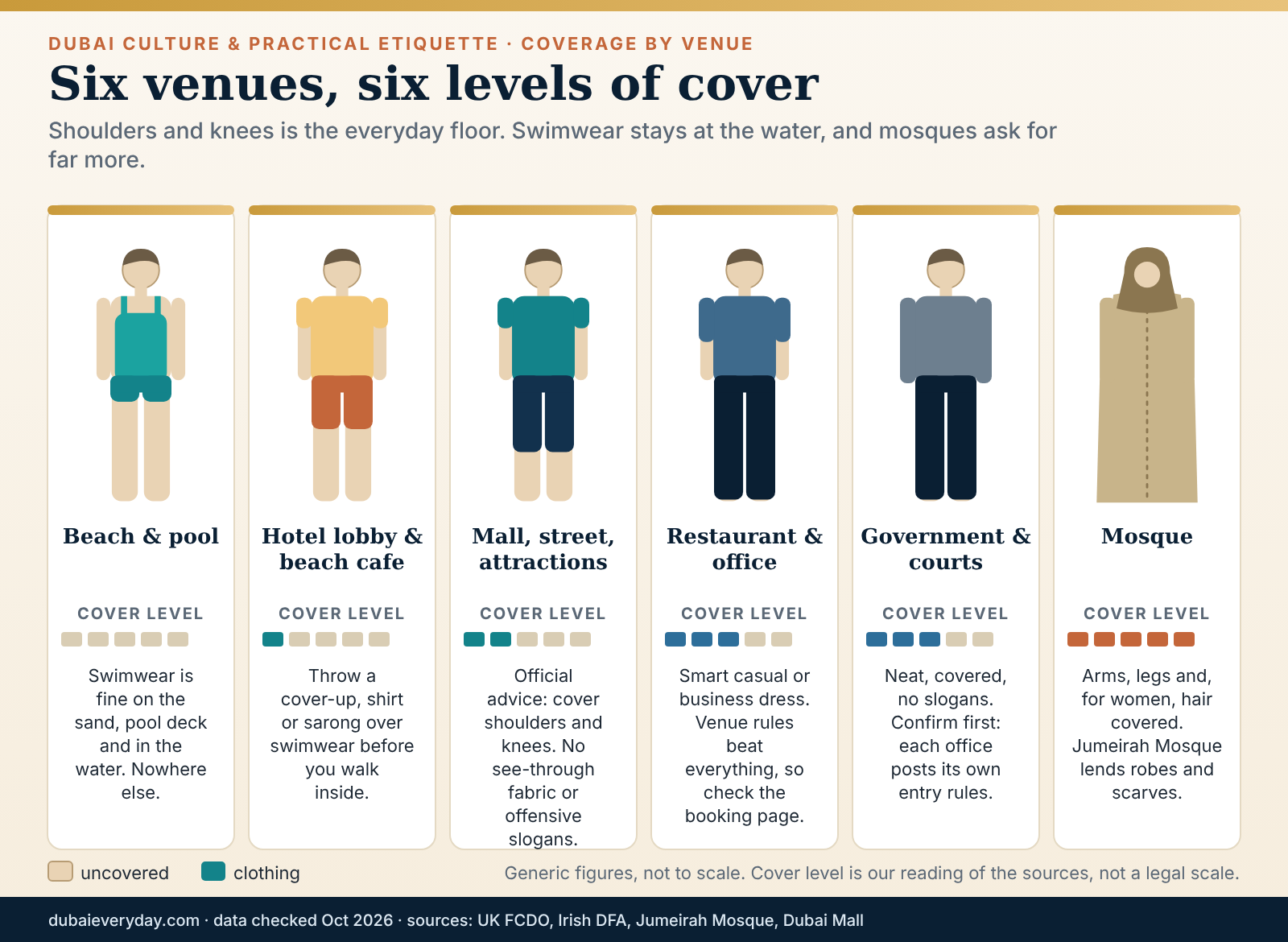
The graphic above uses a simple Dubai dress code scale that this page keeps returning to. Level 0 is swimwear, appropriate only at the water. Level 1 is a cover-up over swimwear, for the walk to a beach cafe or the hotel lobby. Level 2 is the everyday floor: shoulders and knees covered, nothing see-through, nothing offensive.
Level 3 is smart casual or business dress, which is what most restaurants, offices and official buildings expect. Level 5 is the full-cover standard of a mosque. We skipped a level 4 on purpose, to leave room for formal occasions that set their own codes.
The scale is our reading, and the boundaries are fuzzy by design. What matters is the habit it builds: ask which level the next stop needs, and carry whatever lets you move up a level quickly. A light wrap or scarf, a shirt that goes over swimwear, and a pair of long trousers or a long skirt will cover nearly every transition in this guide.
Where this page stops and others start
Clothing is one section of our wider Dubai etiquette guide, which also covers greetings, hospitality, public behaviour, alcohol, tipping and photography. This page does only the clothing side, the Dubai dress code venue by venue, and leaves the rest of etiquette to that guide. For law beyond dress, Dubai legal basics for residents is the better starting point, and if you are planning a first trip, First Time in Dubai puts dress in the context of the whole arrival plan.
What the law and official advice actually say
The honest picture is that official Dubai sources say less about clothing than people expect, and foreign governments say more. That is why this section leans on government travel advice, read on 29 October 2026, and says each time whose words they are. None of the following is legal advice; it is a map of what is published.
The Dubai dress code points governments agree on
Read side by side, the UK, Irish and Australian advisories converge on a short Dubai dress code list. The UK and Irish pages are the most specific, and the Australian page applies the shoulders-and-knees guidance explicitly to Sharjah and Ajman while telling visitors to check the dress code of each attraction, mall and beach.
- Dress modestly in public places such as shopping malls (UK).
- Women should cover shoulders and knees and keep underwear out of sight (UK and Ireland).
- Avoid see-through clothing and clothing carrying images or wording that could offend (UK).
- Wear swimwear only at beaches and swimming pools (UK and Ireland).
- Expect some venues, events and buildings to set their own dress codes (UK).
- Be more careful during Ramadan, when clothing that breaches local norms may cause more offence (UK).
- Check posted or online dress codes for attractions, malls and beaches, and ask locally if unsure (Australia).
Notice what the Dubai dress code advice leaves out. None of these says men may not wear shorts in a mall, none sets a skirt length in centimetres, and none requires a headscarf for visitors outside religious sites. The guidance is addressed mainly to women, and for men it is silent beyond the general “dress modestly”. Our reading is that the same principle applies: cover the torso fully, and treat knee-length as the safe line for shorts.
Conduct rules that sit next to dress
The Dubai dress code rarely gets people into trouble alone. It combines with behaviour. The conduct rules most relevant to what you wear and where you are wearing it are these.
Affection in public. The UK advice says public affection is frowned upon and that kissing in public can lead to arrest. Canada says holding hands and kissing may attract the attention of local authorities, and Australia says intimate displays, including kissing, can lead to arrest. The three agree on the direction and differ on where the line is, which is itself a message: keep it low-key.
Swearing, rude gestures and offensive slogans. The UK and Irish advisories both say swearing and rude gestures, including online, can be prosecuted as obscene acts, with the UK adding that imprisonment or deportation are possible. A T-shirt carrying profanity is a clothing choice that falls under the same logic.
Cross-dressing. The UK advice says it is illegal. If you are a trans or gender-diverse traveller, or travelling with someone who is, this is one to read on the official page and think through before you pack, rather than from a summary here.
Photographing people. The UK advice notes men have been arrested for photographing women on beaches, and Ireland says sharing a photo or video of someone without permission is a criminal offence, with penalties it describes as fines of AED 150,000 to AED 500,000 and at least six months’ imprisonment. That is relevant to dress because the beach, the pool and the mall are where people photograph each other by accident. The photography section later in this page returns to it.
Appearance on entry. New Zealand’s advice adds that authorities can deny entry to people with full facial tattoos, particularly above the eyebrows, which it describes as a recent change. It is the only appearance-based entry rule we found and we have not seen the legal text; if it applies to you, check with the UAE embassy or the airline before you travel.
What we could not read
Our attempt to read the federal Crimes and Penalties Law on the UAE legislation portal did not reach the articles on indecent acts and public decency. The text returned stopped partway through the section on state security, so we cannot give article numbers or penalty ranges.
We did read Article 10, which defines “means of publicity” to include speech, acts and gestures in a public gathering or place, or in a place open to the public. Our reading is that a mall, a beach and a restaurant all count as places open to the public, so conduct rules apply there. That is an interpretation, not a legal conclusion.
The portal itself carries a note that the Arabic text prevails in a conflict with the English version, which is one more reason to treat any English summary, ours included, as a starting point.
Foreign advice versus Dubai’s own pages
Visit Dubai’s practical-information page describes itself as covering local customs, currency and emergency services, and its navigation promises answers “from etiquette to currency”, but the text we could retrieve did not include dress guidance, because much of the site loads through scripts we could not read. The UAE government’s own heritage page includes the one explicit official clothing instruction we found: non-Muslims visiting a mosque should cover shoulders, arms and knees, and women should cover their heads. Everything else comes from foreign governments, venue pages and secondary reporting.
That gap in the Dubai dress code sources is useful to know. It means that if you meet a confident claim about a specific fine for a specific garment, it probably did not come from a page we could confirm. We have left those out.
Government advisories change, and some also carry security notices separate from dress. The UK page we read was updated on 27 October 2026 and the Irish page on 1 October 2026. The US advisory we read is dated 3 March 2026 and carries a Level 3 rating, and it says the UAE has strict rules on social behaviour. Open the UK advice or your own government’s page the week you fly.
Dubai dress code for malls and shopping
Malls are where most visitors meet the Dubai dress code first, and they are also where the rule is easiest to state: cover your shoulders and knees, keep swimwear out, and think of the building as a public space with its own house rules.
The Dubai Mall’s visitor page carries a “Courtesy Dress Code” heading beside its notes that smoking is allowed in designated areas only, that the mall is pet-free, and that it offers prayer rooms for men and women. The page gives no detail under the dress heading, so the exact wording a guest might be asked to follow is Confirm first, on the mall’s own signage or by asking a guest service desk.
A Gulf News explainer from December 2025, which is secondary reporting and not a rule source, says malls, family attractions and parks often post dress guidelines at their entrances and that overly revealing clothing is discouraged. That fits what the venue page implies, and it is a practical cue: look at the entrance signs before you go in, not after you are asked to leave.
What “shoulders and knees” means in practice
The phrase sounds precise and is not, and it sits at the heart of the Dubai dress code for malls. Our practical reading, offered as judgement and not as a rule, works like this.
- Tops: short sleeves or a cap sleeve are fine. A thin-strap vest is where judgement starts, and a cardigan or shirt over it settles the question.
- Bottoms: knee-length or longer. Shorts that stop mid-thigh are the grey area for both women and men.
- Fabric: opaque. If a top is see-through in bright light, it is see-through in a mall.
- Prints: nothing that is profane, sexual or political. This includes slogans in languages you do not speak, so check the label on a T-shirt you bought abroad.
- Underwear: out of sight. Low-cut backs and loose armholes can fail this without you noticing.
For men, the usual reading is the same torso rule plus knee-length shorts. A man in a mall with his shirt off, or carrying it, would be an obvious breach. A man in a football shirt and knee-length shorts is plainly not.
The air-conditioning factor
Malls are deliberately cold, and that changes what is comfortable. In summer the transition from street to mall can feel dramatic, and visitors who dressed for 40 degrees outside find themselves shivering at the cinema. That is a practical reason to carry a light layer, and it conveniently solves the Dubai dress code too: a thin shirt, a linen jacket or a wrap puts you at level 2 in seconds. We would not choose a mall outfit that only works in the heat and fails in the AC.
Souks, supermarkets and the rest of the shopping day
Traditional markets and older districts are more conservative than glass-and-marble malls in the sense that you are walking through an area where residents live and work. Modest clothing is appreciated, according to the same Gulf News piece, in historic areas and places of worship. Supermarkets and neighbourhood shops are everyday public places: level 2 is plenty. Our supermarket guide covers where to shop, and the Dubai shopping guide has the wider picture of malls, souks and outlets.
Beachfront retail strips are a grey zone. Walking from the sand to a shop in swimwear is the specific habit the UK and Irish advice warns against, since swimwear is for beaches and pools. Put a shirt or wrap on before you leave the sand, whatever the shop next door seems to tolerate.
Prayer rooms and prayer times
The Dubai Mall lists prayer rooms for men and women among its services. For visitors, the practical meaning is simple: prayer areas are not attractions. Keep your voice low near them and avoid blocking the corridors that lead to them. Our Dubai Mall guide covers the building’s layout and services in more detail.
Mall by mall: why we do not rank them
You will see claims online that one mall is stricter than another. We did not find a published comparison from the operators or from any regulator, and we cannot verify those claims, so we are not repeating them. Treat every large mall as level 2 under the Dubai dress code, with a courtesy dress code, expect hotel-attached or luxury venues to be level 3 in the evening, and let signs and staff correct you if you have misjudged it.
Mall rule of three. Before you leave the hotel, check three things: shoulders covered, knees covered, nothing printed that would embarrass you in front of your grandmother. If all three pass, you are fine in almost every mall in the city.
Children and teenagers in malls
The Dubai dress code advice quoted above is not age-limited, and the sensible reading is that families dress children to the same standard as adults, without the strictness. Small children in short sleeves and shorts are not the point of the rule.
Teenagers are where families most often disagree, since the fashion they prefer can sit exactly on the line: cropped tops, short shorts, ripped jeans. It is easier to settle the question before the trip with a simple checklist than to argue at the mall entrance. Our guides to Dubai with kids and Dubai with a baby deal with the practicalities of heat, strollers and changing rooms.
The Dubai dress code at beaches, pools and waterparks: where swimwear stops
Dubai is a beach city, and under the Dubai dress code swimwear is normal at the right places. The UK and Irish advisories both say it is appropriate only at beaches and swimming pools, which is the sentence to hold on to. The question that causes the trouble is not “can I wear a swimsuit at the beach?” (yes) but “where, exactly, does the beach end?”
Our schematic below draws two routes: a municipal public beach to the street, and a hotel beach to a restaurant. On both, the swimwear line comes earlier than most visitors expect, at the point where sand turns into corridor, walkway or lobby.

Public beaches
Dubai Municipality’s beach listing names Jumeira Beach and Al Mamzar Beach as open to the public and says the beach centres charge no entrance fee, except for fees tied to requested services. Al Mamzar’s beach park is listed as open daily from 08:00 to 22:00. The municipality’s page for Jumeirah 2 describes a beach designated for swimming, open around the clock, with lifeguards from sunrise to sunset. That page, like the listing, says nothing on dress.
For the dress rules themselves we have a weaker source. Research notes for our beach guides record a municipal rule text that lists, among its prohibitions, swimwear in the access passageways between the road and the sand, as well as pets, barbecues, overnight stays and photography.
When we read the municipality’s own beach pages for this guide (the beach listing, Jumeirah 2 and Al Mamzar), none of them listed any rules, so we could not confirm that text. The corridor rule is Confirm first: read the signs at the beach entrance, which are the version that counts. The practical reading is simple. A beach is the sand and the sea. A path to the beach is a path in the city.
Several public beaches now allow night swimming under lights and lifeguard cover. Our beach research records Dubai Municipality’s 2023 announcement of night swimming at Jumeirah 2, Jumeirah 3 and Umm Suqeim 1, and its media office reported that Khor Al Mamzar opened on 5 May 2026 with a 300-metre night beach. The Dubai dress code does not change after dark. Night does not move the swimwear line.
Our free public beaches guide and the wider best beaches in Dubai comparison cover facilities, parking and lifeguards. Family beaches goes deeper on the shallow-water and shade question.
Women-only options
A Gulf News report on the municipality’s multi-billion-dirham beach programme, updated in April 2026 and used here only for context, mentions a planned women-only area on the Corniche. We have not confirmed whether it has opened or what its rules are. If a women-only space matters to you, check the municipality’s current announcements before you plan around it.
What to wear on the sand
Standard swimwear is fine on a Dubai beach: one-piece or two-piece suits, swim shorts, rash vests. Three points shape the sensible choice.
- Topless sunbathing is not something any source we read treats as acceptable, and we would treat it as a clear no on any public beach and at most hotels.
- Cut matters less than fit. Swimwear that stays in place when you run, wade or lift a child is the standard you should hold it to.
- Sun protection and modesty overlap. A long-sleeved rash vest and leggings, a wide hat and a wrap are sensible in the UV, and they cover more at no cost to comfort. There is no rule requiring modest swimwear for visitors, and nobody should feel they need to explain a choice to wear it.
Hotel beaches, beach clubs and pool decks
Hotels and beach clubs are private venues, and their rules govern, with the Dubai dress code as the floor. Most welcome swimwear on the beach and pool deck, ask for cover-ups in lobbies and restaurants, and apply a stricter dress code to evening venues.
We did not open any hotel’s own dress policy for this guide, so the details are Confirm first with the property. If you are booking a day pass, check the entry conditions and what is expected when you move from the deck to the club’s restaurant. Our hotel guide and the Dubai Marina and Palm Jumeirah area guides help with the choice of location.
A few habits keep you on the right side of almost any resort:
- Keep a shirt, kaftan or sarong in your bag, not in the room.
- Dry off before you go inside. Dripping swimwear is the thing most front-of-house teams object to.
- Wear footwear between the pool and the lobby.
- If you want food at the pool, order from the poolside menu rather than walking to the main restaurant in swimwear.
Waterparks and attractions with water
Waterparks and splash attractions commonly publish clothing rules on safety grounds, such as requiring swimwear-suitable fabric and restricting jeans, loose clothing or street clothes on slides. We could not open the operators’ pages for this guide, so that is general practice and not a verified rule: read the park’s page before you go, and check whether it allows long swim leggings or full-coverage swimwear if you prefer that.
The beach and photography
The UK advice says men have been arrested for photographing women on beaches, and warns against photographing people without their permission. Beaches fill with families, so even a casual panorama can include strangers. The safer habit is to photograph your own group with the sea behind them, point the lens away from other groups, and treat shared pictures with the same care. More on this in the photography section below.
Common beach mistakes
- Walking from the sand to a cafe in swimwear.
- Taking sandy swimwear into a mall or supermarket on the way home.
- Assuming a hotel’s relaxed pool deck is a model for the street outside.
- Changing clothes in a car or on the sand instead of using a changing room, where available.
- Photographing children or adults without asking, then posting the picture.
Mosques and religious sites: the strictest Dubai dress code
Mosques are the one place where the Dubai dress code is explicit, official and the same for everyone who is not Muslim. The UAE government’s heritage page says non-Muslims visiting a mosque should dress modestly, covering shoulders, arms and knees, and that women should cover their heads. Jumeirah Mosque’s own page goes further and gives the details.
Visit Dubai describes Jumeirah Mosque in its page description as the only mosque in Dubai that welcomes non-Muslim guests six days a week. That makes it the usual first stop for visitors who want to see inside a mosque, and a sensible reminder that other mosques are not general tourist attractions.
The Jumeirah Mosque dress code
The mosque’s dress code page asks for modest clothing out of respect for the sacred space. For men, it asks you to avoid shorts and sleeveless tops, and says a kandura (a traditional long robe) can be borrowed.
For women, clothing should cover arms, legs and hair, and abayas and sheilas (headscarves) are available for visitors who do not have suitable clothing. The Centre cleans and maintains borrowed garments. The main visitor page adds that “modest dress is kindly requested” and that women should bring their own head covering or scarf, with head covers, abayas and kanduras also available.
The pages we read say nothing about footwear or photography. Visitors to mosques commonly remove their shoes before entering and ask before photographing worshippers, but we have not seen Jumeirah Mosque’s own instructions on either, so both are Confirm first. Ask on arrival and follow the guide.
Booking, times and cost
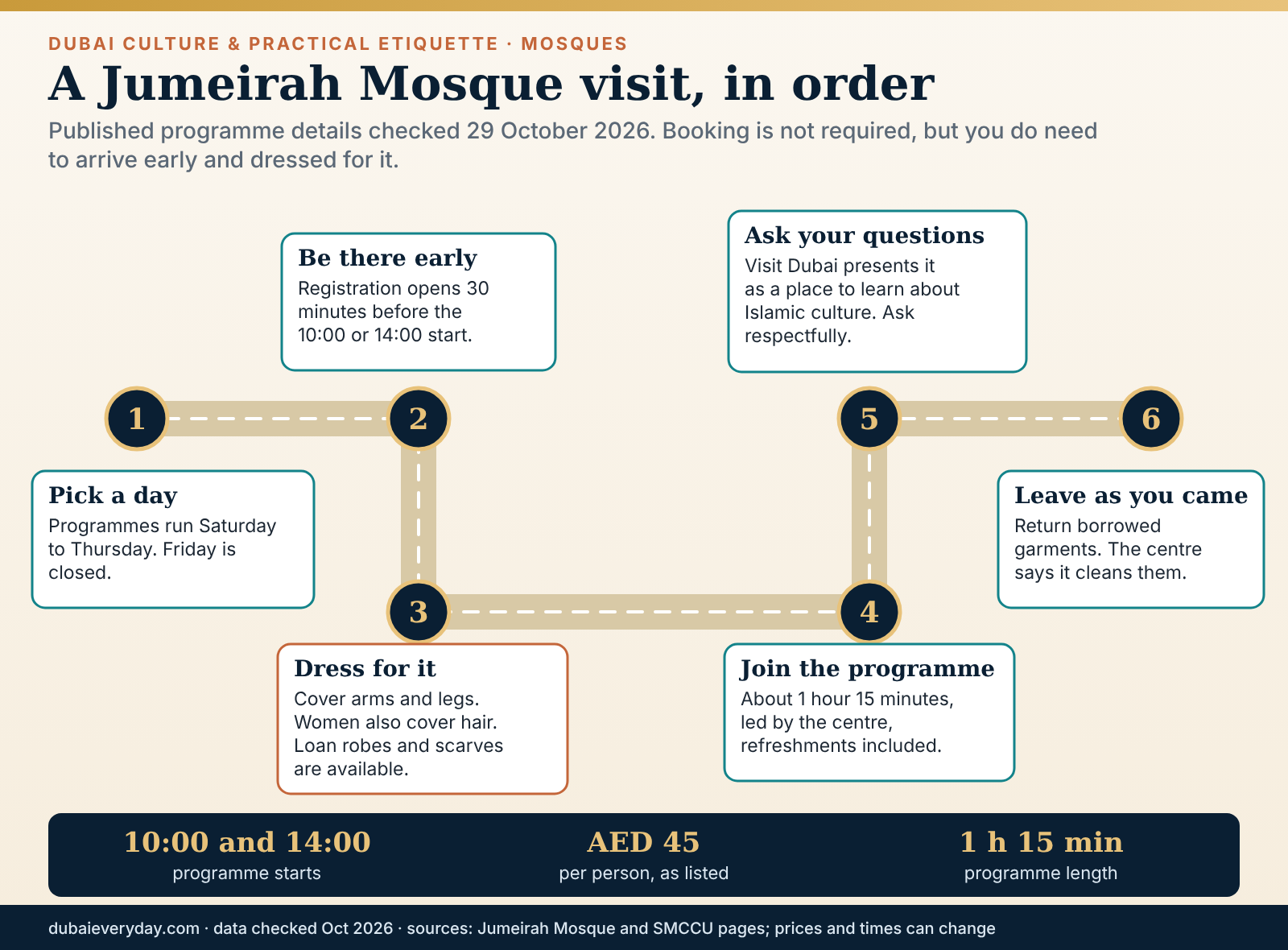
The Sheikh Mohammed Centre for Cultural Understanding runs the visit programme. Its mosque visit page lists the programme at 1 hour 15 minutes, every day except Friday, at 10:00 and 14:00, for AED 45 per person (about USD 12.25 at the 3.6725 peg), with refreshments included.
It says prior booking is not required and that registration starts 30 minutes before the programme. The Jumeirah Mosque site gives the same times and says the mosque visits run Saturday to Thursday and are closed on Friday. Prices and times can change, so confirm them on the day you plan to go.
What to wear underneath
Borrowed robes solve the coverage question and add a layer of fabric in warm weather. Our practical suggestion, not a rule from the Centre: wear light, breathable clothes under the robe, and wear modest clothing to the venue in the first place so you are not changing at the door.
Long loose trousers and a shirt with sleeves for men, a long skirt or loose trousers and a long-sleeved top for women, and a large scarf in the bag, will carry you through. Tight leggings and fitted tops technically cover the skin, but loose cuts better reflect what “modest” means in this context.
Behaviour inside and around mosques
Clothes are only part of the visit. The usual courtesies are to keep your voice low, switch your phone to silent, avoid public affection, and take guidance from the staff member leading the group about where to stand and where to look. Do not walk into a mosque outside a programme, and do not treat a mosque as a backdrop for a photoshoot. We have not read a Jumeirah Mosque conduct policy and these are widely published norms, so follow staff instructions over our summary.
Other mosques and neighbourhood prayer
Do not assume that a mosque you walk past is open to visitors. Visit Dubai’s wording suggests that Jumeirah Mosque is an exception, and we found no list of other Dubai mosques open to non-Muslim visitors. On Fridays the midday congregational prayer fills mosques and spills out onto the pavement nearby, so give people space and avoid loud conversation near them.
Abu Dhabi’s Sheikh Zayed Grand Mosque is the other well-known mosque visit in the UAE. It is in a different emirate with its own published visitor rules, and its website did not allow us to read them, so we are not summarising them here. Check that mosque’s own page if you plan to go.
If you are not sure a place is a place of worship
Small prayer rooms, mosque courtyards and shopping-centre prayer areas are not attractions. If a space has a shoe rack at the entrance, a sign about prayer or people praying inside, treat it as sacred. Stay out unless you are explicitly invited, and keep your phone in your pocket. For wider context on prayer times, Fridays and Ramadan, our Dubai etiquette guide has a section on each.
Restaurants, cafes and hotel dining
Restaurants are where the Dubai dress code stops being a government matter and becomes a hospitality one. There is no citywide dress rule for dining in the sources we could read. What exists is a spectrum of house policies, from a neighbourhood cafe with none to a hotel restaurant that publishes a code and expects you to follow it. The rule that works across all of it is to treat the booking confirmation as the authority and to dress one notch above the strictest person you expect to meet.
Four kinds of table, four levels
Our own grouping of the Dubai dress code at the table, built from how venues describe themselves and not from a regulator’s list, runs like this.
Cafes and casual dining
Level 2. Everyday clothes with shoulders and knees covered. Specialty-coffee shops and neighbourhood restaurants rarely state a code, and the mall standard is the sensible one. See our guides to cafes and specialty coffee.
Hotel and resort restaurants
Level 2 by day, level 3 by evening. Expect cover-ups over swimwear at lunch, and smart casual at dinner. The code is usually on the hotel’s dining page.
Fine dining and tasting menus
Level 3 or above. Smart casual is the common baseline and some venues ask for more. Our Michelin restaurants guide and best restaurants guide cover how to choose.
Rooftops, beach clubs and brunches
Varies by the hour. Many shift from relaxed in the afternoon to dressed-up after sunset, and some state beachwear rules for the deck and a different one for the restaurant.
A decoder for dress-code phrases
Venues use shorthand for their own version of the Dubai dress code, and the words mean different things in different rooms. This is our reading of the common phrases, offered as a starting point and not a standard. Whatever a venue says in its own words is the one that applies.
- Casual or relaxed: clean everyday clothes, covered shoulders and knees. Not swimwear, not gym kit.
- Smart casual: a collared or well-cut shirt, neat trousers or a skirt or dress of sensible length, closed or smart shoes. Plain T-shirts, flip-flops and sportswear are the usual no-gos.
- Elegant or dressy: think dress, tailored trousers, jacket for men, polished shoes. Jeans, if allowed, are usually dark and unripped.
- Resort casual or beach chic: polished daywear. It does not mean beachwear.
- Jacket required: literal. If a venue says it, expect to be asked.
Footwear is the item most often used to refuse entry in hospitality generally, and we would not be surprised to see it enforced here. We did not read a Dubai venue’s footwear policy, so it is Confirm first: if the confirmation email says “no flip-flops”, believe it.
Check the booking page, then ask
Most hotel and restaurant booking pages include a short dress-code line. If yours does not, a one-line email is cheap: “We are planning a family dinner; what is the dress code, and are children welcome in the evening?” The answer arrives in writing, which beats guessing outside the door. If you cannot get an answer, move up a notch: smart casual is almost never wrong in a licensed hotel restaurant, and sometimes it is only barely right.
The cold-restaurant problem
Indoor dining rooms are often cooler than the street by a wide margin. Outdoor terraces can be fans and misters in summer and pleasant in the cooler months. A light jacket, wrap or cardigan lets you manage both and keeps you at level 2 or 3 without effort. A sleeveless outfit that works on the terrace can feel exposed indoors, for comfort as much as for the code.
Ramadan and daytime dining
Canada’s advice says restaurants in Dubai stay open during Ramadan, and the UK advice says restaurants and hotels serving food or drink during fasting hours may use screens to separate non-fasting guests from Muslim guests. Both advise avoiding eating, drinking, smoking or chewing gum in public in daylight, including in a car.
What is permitted in each type of venue in 2027 we cannot say, and it is Confirm first: ask the restaurant, and keep your dress at the more covered end of its range. Ramadan 2027 is projected to begin around 7 to 8 February, so the dates are coming within the planning horizon for many readers.
Cafes as workplaces
Cafes double as offices for residents and remote workers. The dress question there is not the venue’s code but your day: if you are going straight from a video call to a meeting, the cafe outfit needs to survive both. Neat, covered and layered is the practical choice.
Dubai dress code for offices, interviews and business meetings
Offices are the place where the Dubai dress code is set by the employer, not by the city. We found no official source that sets a dress standard for private-sector offices, and the more reliable guide is the one your employer or client gives you. What follows is general practice and our reading of it, and it is Confirm first with the company’s own policy.
The default for a new office
Start the Dubai dress code at level 3: smart, neat and covered, and then adjust to what you see. For most office jobs that means long trousers or a knee-length or longer skirt or dress, sleeves or a jacket, and closed shoes. Finance, law and government-facing roles usually sit on the formal side of that, with suits or equivalent. Technology, media and start-up offices are often lighter, and many have no written policy at all.
If you are starting a job, ask HR for the dress policy in writing, ask what clients see, and ask what changes in summer and in Ramadan. Our guides to finding a job in Dubai and the work visa process cover the steps before that point.
Interviews
Interview dress follows the same logic with one adjustment: go a notch smarter than the role. Neat clothes, minimal fuss and a layer you can add or take off cover the usual surprises, including a cold meeting room and a hot walk from the car park. For a role in a government-facing or conservative sector, the covered end of level 3 is the safe choice. Clothes with logos, slogans or distressed finishes are better left at home.
Meeting Emirati clients, partners and officials
Many Emirati men wear the kandura, a long white robe, with a head covering, and many Emirati women wear the abaya with a headscarf. The UAE government’s social-life page describes a traditional men’s outer garment, the bisht, woven from camel hair. The practical point is respect: wear your usual business clothes, neatly, and do not dress in national dress yourself as a gesture. If you are invited to a home or a majlis, dress at the covered end of smart. Our etiquette guide covers greetings and hospitality.
Summer, air-conditioning and the commute
The commute from car park to lift is the harsh part of a Dubai summer, and offices are often cold. A jacket you can take off in the car and put on in the lift handles both. Fabric choice matters more than style: breathable natural fibres and blends travel better than heavy synthetic suiting. We have no data on office temperature settings, so treat the cold as a probability and not a fact.
Remote and hybrid work
Video calls are workplace settings. The same covered, neat standard applies on camera, and so does the point that other people’s homes, family members and clothing can be visible in the frame. If you work from a cafe, keep the frame tight.
Ramadan in the office
The UAE government’s working-hours page, as recorded in research notes for our legal guide, says private-sector working hours are reduced by two hours a day in Ramadan. Canada’s advice says most government and public-sector offices have reduced hours. Dress conservatively in that month, and ask HR about local norms on eating and drinking at desks and in shared areas.
If a policy raises a legal question
If a dress rule at work raises a question about fairness or contract terms, ask for the policy in writing and read the guidance on employee rights. Our legal basics guide points to the official channels. That is general information, not legal advice. If you are relocating, the moving to Dubai guide and the relocation checklist have the rest of the move.
Nightlife: bars, clubs and the ride home
Nightlife is the section where we have the least published evidence and the most opinions on the internet. Door policies are private decisions and change from week to week. We found no official source on club dress codes and are not repeating anyone else’s list, so the detail below is Confirm first and best settled by asking the venue.
What is reasonable to expect
Licensed hotel bars, restaurants and clubs are the normal setting for drinking in Dubai. The UK advice says drinking alcohol, or being under its influence, in any public place is illegal, and Ireland adds that Irish nationals have been arrested under this law, often together with an offence such as disorderly behaviour. Smartraveller says the legal drinking age is 21 in Dubai and that being intoxicated in public outside licensed venues is illegal. We covered the rules in more depth in our nightlife guide, and the bars guide looks at venues.
On dress, expect the same pattern as restaurants but sharper. Lounges and rooftop bars commonly ask for smart casual or dressier. Clubs often add rules about footwear and sportswear, particularly for men. The consistent exceptions are venues that advertise themselves as casual. We have no verified list and would not make a promise on any named venue’s behalf.
Dress as a decision, not a loophole
The Dubai dress code’s public-decency rules do not switch off when you enter a bar. The UK page tells visitors that swimwear is for beaches and pools and that clothing with offensive wording should be avoided. A licensed venue can set a looser internal code than a mall, but the corridor to the venue, the lift, the lobby and the pavement are public spaces. The practical habit is to treat every transition as a miniature mall: wrap, jacket or long layer over anything you would not wear in the daytime.
The walk to and from the door
The riskiest parts of a night out are the edges. Arriving, you are in a hotel lobby with families and business visitors. Leaving, you may be tired and tempted to carry a drink outside or to linger and argue on the pavement. Our advice is to finish drinks inside, keep voices down in lobbies, and book a licensed taxi or ride-hail pick-up rather than waiting on the street. Public drinking and intoxication are the offences the foreign governments flag.
Ramadan and nightlife
The UK advice says avoid playing loud music, dancing or swearing in public in Ramadan. How individual bars and clubs operate during Ramadan 2027 is not something we could verify, so it is Confirm first: check the venue’s social channels and ask before you plan an evening around it. Dress code changes with it, in the direction of more covered.
Photography and phones
Phone cameras are the main source of trouble in crowded venues. Photographing or filming other guests without consent is the exact conduct the Irish and UK advisories warn about. Ask before you take a group shot, avoid posting pictures with strangers visible, and treat the venue’s own filming rules as binding.
Government buildings, courts, clinics and public services
Public offices get the least attention in any Dubai dress code guide and deserve more, because the stakes of misjudging them are higher. People visit Dubai’s government service centres for visas, licences, tenancy matters and police services, and the staff dealing with you are representing the state, which is a different atmosphere from a hotel lobby.
We could not find a general Dubai dress code rule for visitors to government offices on any official page we could open. The Dubai Courts website blocks automated reading, so its visitor guidance is not summarised here.
The safe approach is to treat every government building as level 3, with the fully covered end of it: shoulders and knees covered at minimum, preferably sleeves and long trousers or a long skirt, closed shoes, nothing with slogans or unusual graphics, and nothing see-through. It is Confirm first at each office, since entry rules can be posted on the door.
The practical list
- Dress neatly and plainly. This is a place for the plainest outfit you own.
- Carry the documents the service needs, plus a spare copy of your passport or Emirates ID.
- Be polite. The UK advice asks visitors to take particular care when dealing with police and officials, and notes that swearing and rude gestures can be prosecuted.
- Leave the camera in your bag. The UK and Irish advisories both say photographing some government buildings and military or security sites is prohibited.
Courts and police stations
If you are summoned or called to a court or police station, the dress standard is formal and covered, and it is better to be overdressed than to cause a reaction. If a legal matter arises, get advice from a licensed lawyer or your consulate and not from a dress-code guide. Our legal basics guide lists where to verify official procedures.
Hospitals and clinics
Healthcare settings are more relaxed in practice and still public. Smart or neat casual with covered shoulders is the right baseline. If you have a preference about the gender of your clinician or about covering for examinations, say so when booking, since we have not verified how individual providers handle it. Our Dubai healthcare guide covers hospitals, clinics and appointments.
Schools, embassies and consulates
School campuses and diplomatic missions publish their own visitor rules, and parents and visitors should read them. Our schools guide explains the system. For a consular appointment, dress as for a government office and expect security screening.
Airports and border points
Passport control is a government service as well as a public space. Comfortable travel clothes are fine, and swimwear, offensive slogans and see-through fabrics are not. If you are unsure what to wear on arrival, apply the mall standard from the moment you leave the aircraft. Our airport guide covers the rest of the arrival.
Attractions, Old Dubai, desert trips, gyms and transport
Most of a Dubai trip is not spent in a mosque or a government office. It is spent at attractions, on public transport, in older districts and outdoors, and the Dubai dress code there is the everyday level 2 with a few practical twists.
Attractions and observation decks
For towers, aquariums, theme parks and museums, the baseline is the mall standard: shoulders and knees covered, nothing offensive. Venues that involve physical activity add their own safety rules about footwear, loose items and clothing, which are operator policies we did not read. Check the ticket confirmation before you go.
If a ride, climbing wall or slide sets clothing requirements, they will be on the booking page, and they are the ones that matter. For ideas on where to go, our guides to things to do in Dubai and indoor activities cover the choices.
Old Dubai, souks and heritage sites
Older neighbourhoods are where modest dress is most appreciated, according to the Gulf News explainer, and where it is easiest to follow, since the heat and sun also favour loose long sleeves. Dubai Culture’s Al Shindagha Museum page lists opening daily from 10:00 to 20:00, with the last entry at 19:00. It does not state a dress code, so treat it as a level 2 venue with modest dress as a courtesy. Walking shoes matter more than style: pavements, souk alleys and abra crossings all involve a lot of standing.
Our free things to do guide covers heritage walks, and the Downtown Dubai guide covers the modern end of the same city.
Desert safaris and outdoor tours
Desert trips are practical clothing exercises more than dress-code ones. Loose long sleeves and trousers, a hat or scarf, sunglasses and closed shoes serve against sun and sand. Evenings and early mornings in the cooler months are cooler than visitors expect, so a light layer helps.
Dress at the camp is generally casual, though that is general practice and not a verified rule. Operators set their own requirements for activities such as sandboarding, quad biking and camel rides, and those are Confirm first with the tour company. Our guides to the best desert safaris, morning safaris and evening safaris go through the options.
Gyms, running and sport
Gym wear is for the gym. Inside a gym, studio or sports club, the club’s own rules decide. The transitions are the trouble: walking from the car to a studio in a crop top, or running along a busy public promenade in very short shorts and a sports bra.
Neither is something the governments’ advice speaks to directly, and both are public places where the general modesty standard applies, so our reading is to choose longer cuts for outdoor running and carry a layer to and from indoor sessions. Tracks within beach parks and promenades are public space too.
Women who prefer a women-only environment have options among Dubai’s gyms and studios, and that is worth checking on a gym’s own page. Our guides to gyms and sports in Dubai cover them.
Public transport and taxis
Metro, tram, bus, ferry and taxi are all public spaces, so level 2 is right. Two additional points are worth keeping in mind. First, the Metro has a reserved women and children cabin; the signs and floor markings on the train are the authority on who should use it, and we have not re-read the RTA’s rules on it for this page, so it is Confirm first.
Second, eating and drinking on the Metro are restricted, with fines reported by secondary sources and not confirmed by us here. Swimwear on a train, as on anything else, is a no. Our Metro guide has the fare and timing detail.
Events, concerts and performances
Event dress codes are set by the organiser and show up on the ticket page. Opera and theatre venues, formal galas and some sports occasions have smart codes. Festival-style events are casual but still public. When in doubt, check the event’s own page, and use our events calendar to find them.
Residential buildings and communal pools
If you live in or stay in an apartment building, the lobby, lifts and corridors are shared spaces. Building management sets rules for pool decks, gyms and lobbies, and a cover-up between the pool and the apartment is a courtesy in most buildings. The rules are Confirm first with the building’s management or your short-let host.
A four-question method for any outfit
You do not need to memorise the rest of this Dubai dress code guide. Four questions, asked in order, settle almost every case. The first “yes” decides the outfit, and the default at the bottom is the everyday standard.

Question one: water, sand or pool deck?
If yes, swimwear is fine, and the real planning task is the cover-up you will need when you leave. This question comes first because it has the clearest official line: swimwear for beaches and pools only.
Question two: a mosque or other place of worship?
If yes, cover arms and legs, and for women also hair. This is the rule with the most explicit official backing and the most specific venue instructions, so it outranks everything that follows.
Question three: an official building, an interview or a client meeting?
If yes, neat, covered and plain. The reason it sits above restaurants is that the cost of misjudging it is higher, and the standard is simpler to meet than to explain.
Question four: does the venue post its own code?
If yes, follow it, and go one notch smarter if you are unsure how strictly it is applied. A published code beats any general rule, and a door team can refuse entry. If the answer is no, fall through to the default: shoulders and knees covered, nothing see-through, no offensive slogans, underwear out of sight.
The three always-on checks
Whatever the answers, three checks sit underneath. Is the date in Ramadan, when everything moves toward more covered? Does the outfit carry words or images that could offend? Is the next stop a transition, where you need something to put on or take off? Answer those and you have a complete decision.
Women, men, teenagers and families
Official Dubai dress code advice addresses women more than men, which is worth saying honestly and without turning it into a stereotype. The UK and Irish pages give women specific instructions (shoulders, knees, underwear out of sight). Nothing equivalent exists for men in the sources we read, other than the general modesty advice and the mosque and venue rules. That gap does not mean men have no expectations. Shirtless in public, swimwear off the beach and sleeveless tops in a mosque are all covered by the same principles.
Women
The Dubai dress code standard for women is explicit and manageable: shoulders and knees covered, nothing see-through, no offensive wording, swimwear only at the water. Canada’s advice says foreign women are not expected to wear head covers, and the UAE government portal asks women visiting mosques to cover their heads.
Gulf News adds that Dubai has no specific restrictions on women’s clothing beyond this and that visitors can generally dress as in any modern city, which is a secondary reading that fits the official advice. The most useful practical items are a large scarf or wrap, a long skirt or loose trousers, and a light shirt or cardigan.
Men
For men the Dubai dress code equivalent is a covered torso, knee-length or longer shorts, and long trousers for smart, official and religious settings. Sleeveless tops are fine at the gym and the beach and out of place in a mosque and many official settings. Men should note the same offensive-slogan caution that applies to everyone, and the same swimwear-boundary rule.
Teenagers
Teens are the group where families most often disagree about the Dubai dress code and what counts as covered, and the disagreement is usually about specific items: crop tops, short shorts, ripped jeans, slogan T-shirts. A calm conversation before packing beats a confrontation in a hotel corridor. Offer a rule they can follow without checking with you: shoulders, knees, nothing printed that you would not read aloud.
Children and babies
Small children are not the target of any of this advice, and families dress them for heat and comfort. Hats, sunscreen and loose cotton matter more than coverage rules. Swimwear for children follows the beach and pool rule like everyone else’s. We have not verified venue rules on nursing in public, so it is Confirm first: baby-care rooms exist in many malls, and the Dubai Mall lists baby-changing among its services. Our baby guide and kids guide cover facilities.
Older travellers and travellers with disabilities
Nothing in the advice exempts or burdens older travellers. Comfort comes first: breathable layers, closed supportive shoes, sun protection. If a venue’s dress policy conflicts with a medical or accessibility need (compression garments, braces, a mobility aid), tell the venue in advance and ask for the policy in writing, since we have not seen how individual venues handle it.
Gender expression and travel
The UK advice says cross-dressing is illegal. The New Zealand advice says passports with an X gender marker may be refused entry or transit. These are the kinds of facts to verify on official pages for your own situation, ahead of travel, and not to take from a general guide. Where a legal question affects your trip, speak to your consulate or a lawyer.
Religious dress
We found nothing in the advice we read suggesting that religious dress worn by visitors is a problem in Dubai. That is an absence of evidence and not a guarantee. If you wear a hijab, a turban or other religious dress and have a specific question, for example about a venue’s security process, ask the venue in advance.
The Dubai dress code through the year: heat, seasons and Ramadan
The Dubai dress code has two clocks. One is the weather, which decides which clothes are bearable. The other is the religious calendar, which decides how much weight your clothes carry. They overlap rarely, and they are easy to plan for if you look at both before you pack.
The weather clock
Average daily highs for Dubai airport, from 1991 to 2020 climate normals as compiled in a secondary reference (indicative, not a forecast), run from about 24 °C in January to about 42 °C in August.
Our calculation from those figures: six of the twelve months (May to October) average a high of 35 °C or more, three months (December to February) average below 27 °C, and the other three, March, April and November, sit in between. The gap between the coolest and hottest month is about 17.5 degrees, which is why a single wardrobe cannot serve both ends of the year.

What the heat does to the dress code
In the hot months, the Dubai dress code and the climate agree more than people expect. Loose, long, breathable clothing is more comfortable in strong sun than bare skin, and it meets the modesty standard in the same garment. Linen, light cotton and technical fabrics that wick moisture are the practical choices. A hat and sunglasses are sun protection that has nothing to do with etiquette.
The sharper problem is the contrast. Streets are hot, malls and offices are cold, and car parks and walkways sit in between. A visitor who dresses for the street spends the afternoon in the mall shivering. Dress for the building you will spend the most time in, and carry something for the other one. Our wider best time to visit Dubai guide goes deeper on weather, crowds and prices by month.
The cooler months
From November to March, the Dubai dress code is easiest to follow, since long sleeves and trousers feel normal and many people want a light jacket for evenings, desert trips and air-conditioned rooms. This is also the season of outdoor dining, events and beach days, so beachwear and cover-ups get used most, and so do the transitions between them. The January events and February events guides give a sense of how busy it gets.
Ramadan: when the same clothes carry more weight
Ramadan is the holy month of fasting for Muslims, and its dates move through the Gregorian calendar. Canada’s advice says Ramadan is expected to begin on or around 7 February 2027, and a projection reported by The National in October 2026 (we took this from research notes for our etiquette guide and did not re-open the article) puts the start about 8 February and the end about 8 or 9 March, with Eid Al Fitr expected around 9 or 10 March. Actual dates depend on moon sightings, so treat these as projected.
The official advice for visitors in that month, as summarised by the foreign governments, is consistent. The UK says avoid eating, drinking, smoking or chewing gum in public during daylight, including in your car. It says avoid playing loud music, dancing or swearing in public, and that clothing that breaches local norms may cause more offence in Ramadan.
Canada says restaurants in Abu Dhabi and Dubai stay open and that most government and public-sector offices have reduced hours. Smartraveller advises avoiding eating, drinking or smoking in public or in front of people who are fasting.
What that means for clothing
Our reading of those points for the Dubai dress code, which is judgement and not a published rule, is to move one level towards covered. Skip the outfits you would hesitate to wear in a mall, keep shoulders and knees comfortably covered, and avoid party wear in public places in daylight. After sunset, evening gatherings and iftar meals are social occasions where smart casual is normal. We have not verified how pool decks and beach clubs operate in Ramadan 2027, so beachwear plans are Confirm first with the venue.
Eid
Eid Al Fitr, the celebration at the end of Ramadan, is expected around 9 or 10 March 2027. It is a festive occasion, and families dress up. As a visitor, the practical point is to expect a public holiday, with public places busy and celebratory and some offices closed; confirm the official dates once they are announced. Our events calendar is the place to track dates once they are confirmed.
Heat and covering up. Covering up in heat is a health question as much as a modesty one. If you are walking outdoors in the hot months, loose long sleeves, a hat and plenty of water are the sensible choice. Take breaks in air-conditioned spaces, and do not treat a short route as a reason to skip protection. For medical advice, see the guidance of the Dubai Health Authority or a doctor.
What to pack: a ten-slot capsule
This is a Dubai dress code packing list, built around the transitions in this page, for a week in Dubai that includes a beach, a mall, a restaurant, a mosque visit and some walking. It is our own capsule, based on the sources above, and not an official list. Adjust for season: add a jacket from November to March, and lighter fabrics from May to October.
- Three short-sleeved tops. Plain or lightly patterned, opaque, nothing printed that could offend.
- Two light long-sleeved shirts. Linen or cotton, worn open over a vest, on their own for sun and for the mosque.
- Two pairs of long trousers. One casual, one neat enough for a smart dinner or an office visit.
- One pair of knee-length shorts or a midi skirt. For beach-adjacent walks and mall days in the heat.
- One long loose skirt or long loose trousers. The mosque and government visit item, which does double duty as a smart dinner outfit.
- A large scarf or wrap. Mosque headscarf for women, shoulder cover, sun shade and air-conditioning layer in one.
- A light jacket or cardigan. For cold malls, evening terraces and desert evenings in the cooler months.
- Two sets of swimwear plus a cover-up. The cover-up should go over your swimwear and reach mid-thigh or below.
- Closed walking shoes and sandals. One pair for souks, deserts and long days, one for hotel and beach.
- Hat, sunglasses and a smart outfit. One outfit you would wear to a good restaurant, ready to go.
Our calculation: with three short-sleeved tops, two long-sleeved shirts, two long bottoms, one short bottom and the long skirt, you have five tops and four bottoms, which is twenty daytime pairings before adding the jacket or the scarf, and every one of them passes the level 2 standard. That is plenty for a week if you have access to laundry.
What to leave at home
- Slogan T-shirts with profanity, drug references or political messages.
- Very thin fabrics that become see-through in bright light or when wet.
- Anything you would be uncomfortable explaining to a government official.
- Costumes or clothing that imitate military, police or religious uniforms. We have no source on the rules, so we treat these as a no.
Photographs, social media and other people’s clothes
The Dubai dress code and photography meet in two places: your outfit in someone else’s picture, and someone else’s outfit in yours. Both are covered by the privacy and cybercrime rules the foreign governments highlight.
Ireland’s advice says sharing a photo or video of someone without their permission is a criminal offence, with penalties described as fines of AED 150,000 to AED 500,000 and at least six months’ imprisonment, rising to up to a year if the content is edited to cause harm. The UK advice says to photograph people only with permission and that men have been arrested for photographing women on beaches. Smartraveller says posting photos of people or their belongings online without consent can be illegal, including people in the background.
Practical habits
- Ask before you photograph anyone, including people in traditional dress, who are not scenery.
- Check the background before you post. A beach selfie with strangers in the frame is the classic trap.
- Do not photograph official buildings, military or security sites. The UK and Irish advice both say some are prohibited.
- Ask staff before photographing inside a mosque, and respect any no-photo areas.
- If you are an influencer or create paid content, read the rules. Canada’s advice says influencers paid for advertising or product placement need a UAE influencer licence.
Online posts about local dress
Canada’s advice says comments considered defamatory, antisocial or culturally insensitive may bring fines, imprisonment or deportation, including on social media. The practical implication for a dress-code article is that mocking local dress or other visitors in a post is not just rude. Keep commentary neutral, and think before you post a rant about a venue that refused your outfit.
Day trips: Sharjah, Ajman and Abu Dhabi
Dubai is one of seven emirates, and rules vary between them, so the Dubai dress code is not the same as the dress code of the whole UAE. Smartraveller says that in Sharjah and Ajman, where it says Islamic law is enforced, visitors should dress modestly, for example covering shoulders and knees.
Ireland says to dress conservatively, especially in Sharjah, where Islamic law is enforced more strictly. Smartraveller also describes Sharjah as dry, meaning that selling or drinking alcohol is illegal there. Treat any day trip north of Dubai as a level 2 to 3 outing: more covered than a hotel beach day, and unlikely to include swimwear anywhere but the water.
Abu Dhabi has its own authorities and its own published rules for places like the Sheikh Zayed Grand Mosque, and we have not summarised them. If you are combining emirates in one trip, check each emirate’s page, and carry the scarf and cover-up from your Dubai capsule. For the broader plan, our Dubai travel guide sets out the first-timer’s timeline.
Eight Dubai dress code scenarios, worked through
Rules are easier to hold in the head when they are attached to a situation. The eight scenarios below are illustrative, built to show how the Dubai dress code works in practice. The people in them are not real, nothing here is a report of what happened to anyone, and each applies the sources and judgement set out above. Venue-specific points remain Confirm first.
Scenario 1: a couple’s beach and mall day
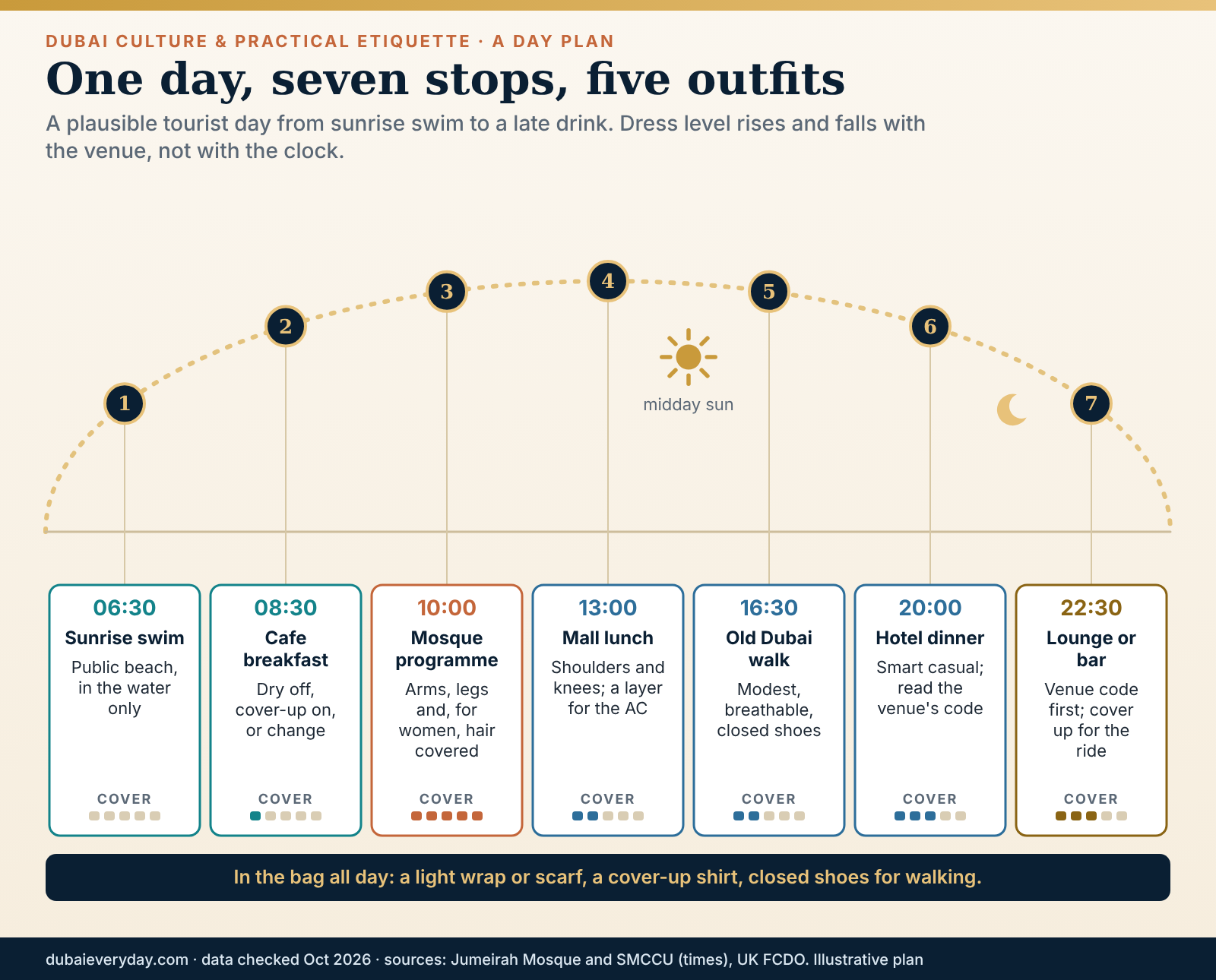
A couple staying in a marina hotel plans a swim at a public beach, lunch in a mall and dinner at the hotel. The Dubai dress code shapes the day in three changes. They swim in swimwear, put on a shirt and a wrap before they leave the sand and walk through any access corridor, and carry light layers for the mall.
For dinner, they check the hotel restaurant’s page for its code, wear smart casual, and keep public affection modest. The one thing that could go wrong is lunch: walking from the beach straight into a mall food court in swimwear is the standard misstep, and it costs nothing to avoid with a bag that holds a shirt and shorts.
Scenario 2: a solo traveller, mosque then Old Dubai
A woman travelling alone plans the 10:00 Jumeirah Mosque programme and an afternoon in older districts. She reads that arms, legs and hair need covering, wears loose long trousers and a long-sleeved shirt, and carries a large scarf. If she forgets any of it, the Centre lends abayas and sheilas.
After the programme she keeps the same clothes for the afternoon, which suits both the heat and the Dubai dress code in historic areas, and takes a light layer for the cold evening mall. She also checks the opening hours of anything she wants to see, since many attractions have their own.
Scenario 3: a family with two teenagers
A family is heading to a large mall, and the teenagers pack crop tops and very short shorts that test the Dubai dress code. The conversation before leaving takes five minutes and uses a simple checklist: shoulders covered, knees covered, nothing see-through, nothing printed that would embarrass anyone.
The teens add a light overshirt and swap shorts for longer ones. Nobody wins or loses, and the family avoids a negotiation at the door. The parents also agree on what happens if a mall security officer or staff member asks anyone to cover up: do it politely, no debate.
Scenario 4: the first week at a new job
A new hire starts at a mid-sized firm in a business district and has no written Dubai dress code policy. The sensible plan is to dress at level 3 on day one, observe what colleagues and clients wear, ask HR whether there is a written policy and whether it changes in summer or in Ramadan, and keep a jacket at the office for client calls.
If the firm turns out to be casual, they can dress down gradually. If it turns out to be formal, they are already there. Our job search guide and the relocation checklist help with the rest.
Scenario 5: a business traveller, meeting then bar
A visiting executive has a mid-morning client meeting and a drink with colleagues in the evening, so the Dubai dress code for the day is two outfits in one. The meeting calls for a neat, covered suit or equivalent. The evening venue is a licensed hotel bar with a smart casual code that the booking page states.
The executive takes the jacket off for the bar, keeps the rest, and leaves via a licensed taxi. Nothing in the evening involves carrying a drink outside, because the foreign governments flag public intoxication and drinking in public as arrestable conduct. The bar guide covers venue choice.
Scenario 6: a rooftop bar in July
Friends plan a rooftop evening in July, when average highs are above 41 °C. The venue’s page says smart casual. The friends choose light fabrics, wear closed shoes they can walk in from the car park, carry a thin layer for the air-conditioned lobby, and avoid wearing anything that works only in the cold.
In this heat, the Dubai dress code and the climate pull in different directions on the walk and in the same direction in the venue, so the plan includes a change of shirt in the car. The venue’s own code, not our summary, sets the final standard.
Scenario 7: a week in Ramadan
A visitor books a week in February 2027, which is projected to fall in the first days of Ramadan, so the Dubai dress code carries more weight. They plan sightseeing earlier in the day, avoid eating or drinking in public during daylight, check restaurants’ hours, and move their clothing one level towards covered.
They keep swimwear for the hotel pool or beach, confirming with the property that it will operate as usual, since we cannot say how each hotel handles the month. Evenings are for smart-casual dinners. The February events guide and the best time to visit guide help with timing.
Scenario 8: a day trip north
A hotel guest books a day trip to Sharjah. Smartraveller and Ireland’s advice both point to stricter norms there, with Smartraveller specifically recommending covered shoulders and knees. The guest wears the same loose long clothes as on a mosque day, carries a scarf, packs swimwear only for a beach or pool they have checked, and does not plan on alcohol, which Smartraveller says is illegal in Sharjah. The result is a simple, covered outfit that would also pass in any Dubai venue, which is the whole point.
Dubai dress code mistakes that cost the most
These Dubai dress code errors are the ones we would expect to cause the most trouble, based on the official advice and on how venue rules work. They are ranked by our reading of the cost of getting them wrong, and not by statistics, which do not exist in the sources we could read.
- Wearing swimwear outside the water zone.The UK and Irish advice is explicit that swimwear is for beaches and pools. The common version is the walk from sand to cafe or from pool to lobby. Carry a cover-up and use it early.
- Treating the mosque like a mall.Mosque rules are the most explicit and the least negotiable. Cover arms and legs, women cover hair, and men skip shorts and sleeveless tops. If you forget, ask for a loan garment at Jumeirah Mosque and do not argue.
- Offensive slogans or imagery.The UK advice flags clothing with images or wording that could offend, and swearing and rude gestures can be prosecuted as obscene acts. Check the T-shirt before you pack.
- Underestimating government buildings.A service centre is not a hotel lobby. Wear neat, covered clothes and keep the camera in your bag.
- Ignoring a venue’s published code.A restaurant, club, event or hotel that publishes a dress code will apply it. Read the booking page, and email if it is unclear.
- Dressing for the street and shivering indoors.Malls and restaurants are cold. Bring a layer, and use it to move between levels.
- Taking no account of Ramadan.The UK advice says clothing that breaches local norms may cause more offence during Ramadan. Move one level towards covered.
- Photographing other people.Beach, pool and mall photographs can fall under the privacy rules the foreign governments describe, with substantial penalties. Ask first and check backgrounds.
- Public affection in the wrong place.Kissing in public can lead to arrest according to the UK and Australian advice. Keep it low-key, whatever you are wearing.
- Carrying a drink out of a licensed venue.Drinking in public places is illegal. Finish inside and take a licensed ride.
- Believing hearsay about fines.Specific penalty amounts for specific garments circulate online without sources. We found none in official pages we could read.
- Over-correcting.Visitors who cover from neck to ankle everywhere in 42 °C heat are following a stricter rule than the one governments describe. Shoulders and knees are the everyday standard. Heat illness is a real cost.
If someone asks you to cover up
We have no data on how often this happens under the Dubai dress code, and it is easier to handle if you have thought it through. The people who ask are usually venue staff such as security officers, front-of-house teams or guides, and they are applying a house rule. The right response is the same in nearly every case.
- Stay calm and comply.Say thank you and cover up. A request to cover up is almost always a house rule, and arguing about it only makes the conversation longer.
- Ask for the practical solution.Many venues can lend a wrap or tell you where to buy one. At Jumeirah Mosque the Centre lends abayas, sheilas and kanduras.
- Do not photograph or film staff.Photographing people without permission is exactly the conduct the foreign governments warn about, and a confrontation filmed for social media can escalate quickly.
- Be polite to police and officials.The UK advice asks visitors to take particular care when dealing with police and officials. Swearing and rude gestures can be prosecuted.
- Ask for the rule in writing if you think it was wrong.If you believe a venue misapplied its own policy, raise it with the manager afterwards, calmly, or by email. A calm complaint is more likely to be heard than an argument at the door.
- Contact your embassy or consulate if the matter becomes legal.If police are involved or you are detained, ask for your consulate and get qualified legal advice. A dress-code guide is not a substitute.
Dress code disputes are almost always resolved in the first two minutes. If you start from the assumption that the venue is entitled to set its terms, and treat the request as a small cost, the Dubai dress code is manageable.
Dubai dress code FAQ
Is there a dress code for tourists in Dubai?
There is no single published list of garments for visitors, which is why people find the Dubai dress code confusing. What exists is official advice (the UK and Irish governments tell women to cover shoulders and knees, and everyone to avoid see-through clothing and offensive slogans), swimwear limited to beaches and pools, and venue rules that vary by place. Mosques are the strictest and most explicit. Check the venue’s own page, and treat our summary as a starting point, not legal advice.
Can women wear shorts in Dubai?
Under the Dubai dress code advice, the UK and Irish advisories ask women to cover shoulders and knees in public, so knee-length shorts are the safe choice and shorter ones are a judgement call that depends on the venue. Beaches and pool decks are different, because swimwear is appropriate there. Mosques and government buildings call for long trousers or a long skirt. Many visitors in hot months find loose knee-length or longer garments the most comfortable choice anyway.
Do I need to cover my hair in Dubai?
Not in everyday public places under the Dubai dress code. Canada’s advice says foreign women are not expected to wear head covers. In a mosque, however, the UAE government portal says women should cover their heads, and Jumeirah Mosque’s dress code asks women to cover arms, legs and hair, lending sheilas and abayas to visitors who do not have them. Carry a large scarf and you are covered for every case.
Can I wear a bikini in Dubai?
Yes, at a beach or pool, where the Dubai dress code treats swimwear as appropriate according to the UK and Irish advice. Put a cover-up on before you leave the sand or the pool deck, since swimwear is not for corridors, lobbies, shops or streets. Topless sunbathing is not treated as acceptable in any source we read. Hotel and beach-club rules can be stricter than public beaches, so check the venue’s page. Our schematic in the beach section shows where the line sits.
What should men wear in Dubai?
Official advice speaks mostly to women, so the male version is our reading: a covered torso in public, knee-length or longer shorts in malls and on streets, long trousers and sleeves for smart restaurants, offices and government buildings, and no shorts or sleeveless tops in a mosque. Swim shorts are for the water. Shirtless in public is the clear no. The Dubai dress code for men is the same principle applied with fewer published specifics.
What is the Dubai Mall dress code?
The Dubai Mall’s visitor page lists a “courtesy dress code” but gives no wording under it. Government advice for malls generally is to dress modestly, with women covering shoulders and knees. The practical approach is level 2: shoulders and knees covered, nothing see-through or offensive, no swimwear. Confirm first on the mall’s signage or at a guest service desk, and see our Dubai Mall guide for the building’s services.
What should I wear to Jumeirah Mosque?
Men should avoid shorts and sleeveless tops. Women should cover arms, legs and hair. The mosque says kanduras for men and abayas and sheilas for women can be borrowed, and that the Centre cleans them. Programmes run Saturday to Thursday at 10:00 and 14:00, the Centre lists AED 45 per person, and registration opens 30 minutes before the start. Pages we read do not specify footwear or photography, so ask on arrival.
Is the Dubai dress code different in Ramadan?
The rules do not change on paper, but the weight of your clothes does. The UK advice says clothing that breaches local norms may cause more offence in Ramadan, and asks visitors to avoid eating, drinking, smoking or chewing gum in public in daylight. Ramadan 2027 is projected to begin around 7 to 8 February. Our reading is to move one level towards covered, and to confirm any beach or pool plans with the venue.
What do people wear to Dubai nightclubs and bars?
We found no official dress code for nightlife and no verified door policies, so we cannot give a list. Hotel bars and lounges commonly ask for smart casual or dressier clothes, and some clubs add rules about footwear and sportswear. The public-decency standards still apply in the lobby, lift and street, so a cover-up for transitions is sensible. Ask the venue before you go, and keep alcohol inside licensed premises.
Can I wear sleeveless tops in Dubai?
Often yes, but under the Dubai dress code it is a judgement call. The government advice asks women to cover shoulders in public places such as malls, so a sleeveless top is on the line there and a light shirt or cardigan over it settles the question. At the beach and pool, sleeveless is fine. In mosques and many government buildings, cover your arms. If you are choosing one item for the Dubai dress code, make it a light long-sleeved shirt.
What is the dress code for Dubai government offices?
We could not find an official Dubai dress code rule for visitors, and each office may post its own, so it is Confirm first. Our safe standard is neat, plain and covered: shoulders and knees at minimum, preferably sleeves and long trousers or a long skirt, closed shoes, no slogans. Be courteous with staff, since the UK advice asks visitors to take particular care when dealing with police and officials, and leave the camera in your bag.
Can you be fined or arrested for clothing in Dubai?
Foreign governments describe arrests for conduct such as kissing in public, offensive gestures, public drinking and photographing people without consent, and they note that some actions legal elsewhere carry serious penalties here. We found no published tariff of fines for specific garments, and we could not read the federal articles on public decency. In practice, the first consequence of a dress breach is usually a request to cover up. Anything more serious is a legal matter for a lawyer or your consulate.
Does the Dubai dress code change in summer?
The Dubai dress code stays the same in summer but the comfortable choices change. Average daily highs run above 35 °C from May to October in the climate normals we used, so breathable long sleeves and trousers, a hat and sunglasses suit both the heat and the standard. Malls and restaurants are cold, so a light layer matters. Our season wheel in the calendar section sets the months against Ramadan 2027.
Related reading
Sources and further reading (21 links)
- UK Foreign, Commonwealth and Development Office: UAE safety and security — dress, swimwear, public affection, Ramadan conduct, photography, alcohol
- Ireland Department of Foreign Affairs: UAE travel advice — conservative dress, shoulders and knees, swimwear, social media and photography penalties
- Global Affairs Canada: UAE laws and culture — conservative dress, public affection, Ramadan, influencers, photography
- Australian Government Smartraveller: UAE — Sharjah and Ajman dress, alcohol rules, photography and social media
- New Zealand SafeTravel: UAE — facial tattoos, gender marker, photography and online rules
- US Department of State: UAE travel advisory — advisory level and note on strict social-behaviour rules
- UAE Government portal: heritage page — mosque dress guidance for non-Muslim visitors
- UAE Government portal: aspects of social life — traditional men’s outer garment and hospitality
- Jumeirah Mosque: dress code — men’s and women’s requirements and borrowed garments
- Jumeirah Mosque: visitor information — programme times, no booking required, closed Friday
- Sheikh Mohammed Centre for Cultural Understanding: Jumeirah Mosque visit — duration, days, times, price, registration
- Visit Dubai: Jumeirah Mosque — page description on non-Muslim visitors
- The Dubai Mall: plan your visit — courtesy dress code heading, prayer rooms, smoking and pet rules
- Dubai Municipality: discover Dubai beaches — public beaches, no entrance fee, Al Mamzar park hours
- Dubai Municipality: Jumeirah 2 beach — swimming-only use, round-the-clock access, lifeguard hours
- Dubai Media Office: Khor Al Mamzar beach opens — opening date and night beach (read in research for our beach guides)
- Dubai Culture: Al Shindagha Museum, plan your visit — opening hours
- UAE Legislation portal: Crimes and Penalties Law — definition of “means of publicity”; the portion we could open stopped before public-decency articles
- Gulf News: five key rules tourists should know — secondary explainer on mall dress notices, mosque dress and beaches
- The National: Ramadan 2027 dates — projected start and Eid dates (read in research notes for our etiquette guide)
- UAE Government portal: private-sector working hours — Ramadan reduction (read in research notes for our legal guide)
Update log: 29 October 2026 — first publication; facts re-checked against the sources above where they could be opened, with the exceptions listed in the method box. Next review due: January 2027, ahead of Ramadan 2027, and again whenever Dubai Municipality, Jumeirah Mosque or a major venue changes its published rules. Corrections welcome.
This page is general information, not legal advice. Rules and enforcement can change, and venues set their own policies, so confirm the detail with the official page or the venue before you rely on it.
About DubaiEveryday and this guide
DubaiEveryday.com is an independent editorial project that publishes practical, research-based guides to everyday life in Dubai: where to live, what things cost, how the rules work and how to get around. This page was written and edited by the DubaiEveryday editorial team. It is not signed by a named expert, doctor, lawyer or adviser, and we do not claim first-hand testing of a venue, clinic or service unless the page says so.
Each guide is built from official sources such as government and regulator pages, operator websites and established news outlets, cross-checked where we can. When we could not confirm something, we say so in the text, and examples that use made-up numbers are labelled as illustrations. Mentions are editorial choices, not paid placements, and a link is not an endorsement.
Dubai changes quickly. If you spot something that is out of date or wrong, please tell us through the contact options on DubaiEveryday.com and we will check it and correct the page.