

Dubai has serious coffee people, a free-zone hub that stores thousands of tonnes of green beans, and a great many menus that simply print the word “specialty”. This guide to specialty coffee Dubai covers roasters, espresso, pour-over, beans and baristas, and shows you how to tell the real thing from the label.
The word “specialty” costs nothing to print on a menu. Say you sit down at a cafe that uses it, order a flat white, and the barista cannot tell you where the beans were roasted. Was it specialty? The word alone cannot answer. Dubai has genuine coffee people and plenty of menus using the label, and the two do not always match.
Finding specialty coffee dubai does well comes down to a few checks you can run in a minute: the roaster, the roast date, the origin, and whether the staff can say something specific about the cup. This guide gives you nine such checks, plus how to read a bag of beans and work out the cost per cup. You will spot the real thing faster and stop paying for a word.
Specialty coffee Dubai comes down to three things you can check yourself: who roasted the beans, how recently, and whether the people serving them can say anything specific about the cup. The Specialty Coffee Association (SCA) treats a score of 80 or more on its cupping form as the specialty band, but it also says specialty is not defined by a score alone.
So a menu that says “specialty” has told you almost nothing. A named roaster, a roast date, an origin and a filter option on the menu tell you a lot.
In Dubai the evidence is easiest to find at roasters that sell direct. RAW Coffee Company roasts at an Al Quoz warehouse and lists a cafe open daily from 07:30 to 18:00. Mokha 1450 lists five Dubai venues and bean prices from AED 85 to AED 400 a pack. The DMCC Coffee Centre in Jebel Ali is a trade facility, not a cafe, but it explains why so much green coffee passes through the city.
For beans to take home, a 250 g bag at AED 60 works out at roughly AED 3.60 to AED 4.32 of coffee per cup (our calculation). Use the nine checks below, keep the heat in mind, and treat any single “best” claim, including ours, with some suspicion.
This is desk research. DubaiEveryday.com has not tasted, brewed or ordered anything described here, and nothing below is a personal visit or a tasting note. There is no cafe ranking on this page and inclusion was not paid for. There are no affiliate or booking links.
On 29 October 2026 we read operator and authority pages: RAW Coffee Company, Mokha 1450, the Dubai Coffee Museum, the DMCC Coffee Centre, Alserkal Avenue, the Specialty Coffee Association, EFSA and World of Coffee. A March 2026 roundup from What’s On is used only to name venues, and Wikipedia only for general coffee reference values. Both are labelled as secondary.
What we could not do: web search was unavailable, several operator sites block automated reading (Nightjar Coffee Roasters, Common Grounds, One Life and Coffee Planet among them), and no cafe coffee price list loaded. So this page quotes no “typical flat white price”, gives no ranking, and marks every venue as either “operator page read” or “confirm first”. Anything labelled “our calculation” is arithmetic on verified inputs. This is general information, not health advice.
Specialty coffee Dubai: the October 2026 status board
Most pages about specialty coffee Dubai are a list of cafe names with adjectives. That format ages badly, because cafes change hours, roasters and owners faster than articles get edited. This page takes a different route. It teaches you to read the evidence a cafe or roaster already publishes, then points to the Dubai operators whose own pages let us confirm something concrete.
One boundary first. If your question is “where should I sit, eat and work with a decent coffee”, that is a different search job, and our guide to the best cafes in Dubai covers atmosphere, food, workability and neighbourhoods. Here the cup, the bean and the person making it come first.
What was verified, and what was not
The honest picture is uneven. Roasters that sell online publish prices and sometimes hours. Cafes that live on social media publish very little a machine can read. We sorted every venue in this guide into one of two tiers, and you will see the tier next to its name.
Operator page read
Checked 29 Oct 2026
RAW Coffee Company, Mokha 1450, Dubai Coffee Museum, Alserkal Avenue (as a district) and the DMCC Coffee Centre. We read the operator’s own page and report only what it said.
Confirm first
Not verified by us
Venues named only in a secondary roundup, plus Tom & Serg, whose page we read but which does not name its roaster. Treat hours, menus and coffee suppliers as unconfirmed until you phone or check the cafe’s own channel.
Not claimed at all
Left out
Cafe coffee prices, tasting notes, barista names, Wi-Fi policies and any ranking. We have no verified source for them and will not invent one.
Why this still helps you
Even with a short verified list, the method travels. A reader who knows what a roast date, an extraction ratio and a filter menu look like can walk into an unfamiliar Dubai cafe and form a fair view in five minutes. That is more durable than our opinion of any one room, and it protects you from the commonest trap in the specialty coffee Dubai market: paying a premium for the word, not the work.
The sections ahead follow the order most specialty coffee Dubai readers need. Definitions and checks come first, then Dubai’s heat and trade context, the roasters and districts, espresso and filter numbers, buying beans, baristas and training, then plans and budgets. If you only have ten minutes, read the nine checks and the mistakes section.
Opening hours, menus and bean stock change without notice. Mokha 1450’s page, for example, showed several beans marked sold out and gave no opening hours for any venue, and the Dubai Coffee Museum page did not publish hours or a ticket price. Phone or message first, especially for a cross-town trip in summer.
What specialty coffee means, and what a menu can claim for free
Nobody awards a licence for the word “specialty”. In Dubai, as elsewhere, a cafe can print it on a wall with no inspection, no roasting records and no third-party score. That is not a scandal, just a fact about vocabulary, and it is the reason this guide to specialty coffee Dubai spends its first pages on what the term is supposed to mean.
The SCA position, in plain terms
The Specialty Coffee Association describes specialty coffee as a coffee or coffee experience with distinctive attributes that earns it a significantly higher market value. It is explicit that this is not decided by a score alone. Sensory quality, consistency, sustainability and the effect on the people who grow and drink the coffee all count.
That wording matters in the specialty coffee Dubai market, because the question “is this specialty?” has no yes-or-no answer at a cafe counter. It has a spectrum of evidence, and you can read most of that evidence without a laboratory.
Where the “80 points” idea comes from
The number people quote is 80. On the SCA’s cupping protocol page, final scores from 80 to 84.99 are labelled Very Good (Specialty), the higher bands sit above that, and anything under 80 is labelled Below Specialty. Each attribute is scored on a scale of 16 quarter-point levels from 6.00 to 9.75, with anchors at 6 (Good), 7 (Very Good), 8 (Excellent) and 9 (Outstanding).
Two caveats. First, cupping is a lab ritual: the protocol calls for 8.25 g of coffee per 150 ml of water (55 g/L), water near 93 °C, a specific grind, and a wait of three to five minutes before the crust is broken. It is how green and roasted coffee is graded for trade, not what happens at your table. Second, the SCA says it began updating its 2004 cupping system in 2020, and the newer Coffee Value Assessment adds four separate assessments: physical, descriptive, affective and extrinsic.
What this means for you. An “80+” claim on a specialty coffee Dubai menu is only as good as the person making it. Ask who scored the coffee, when, and whether the score belongs to the green coffee or the roasted batch in your cup. A real answer is usually a name and a month. A shrug is also an answer.
A shared vocabulary exists, and it is free
World Coffee Research’s sensory lexicon identifies 110 flavour, aroma and texture attributes and provides reference intensities for them. Its Lexicon 2.0, published in October 2017, added new references for 24 attributes and underpins a redesigned Coffee Taster’s Flavor Wheel. You do not need to memorise any of it. The point is that “notes of jasmine and stone fruit” on a bag is a claim someone trained could, in principle, check against a reference.
When a specialty coffee Dubai bag says “caramel, chocolate, nuts” for every product in the range, treat the copy as decoration. When it differs by origin and process, and the processing method is named, treat it as information.
Nine essential checks for any specialty coffee Dubai claim
These are our heuristic, built from the SCA material above and from what a cafe or roaster can plausibly publish. They are not a certification and they do not measure taste. They measure how much evidence stands behind the word. The idea is simple: the more checks a venue passes, the more weight its specialty coffee Dubai claim deserves.

Checks on the source
Check one is who roasted it. In the specialty coffee Dubai market, a named roaster, and a clear answer on whether the cafe roasts in-house or buys from someone else, is the cheapest signal there is. Both models can be excellent. The red flag is vagueness: “our own blend” with no roaster, no country and no date.
Check two is the roast date. Roasted coffee emits carbon dioxide for days, and flavour fades over weeks. A bag with a roast date can be judged. A bag with only a best-before date, often a year away, cannot. On the Wikipedia roasting reference, an optimal shelf life of about two weeks is mentioned, which is a rule of thumb that the page itself marks as needing a citation, so ask the roaster for their own guidance.
Check three is origin and process: country at minimum, then region or farm, and whether the coffee was washed, natural or anaerobic. RAW Coffee Company’s shop, for instance, labels a Brazilian lot as naturally processed and an Ethiopian lot as washed. Those words let you predict, loosely, how a cup will taste. They also let you compare two bags honestly.
Checks on the menu
Check four is whether the roast level fits the claim. Light roasts keep acidity and origin character. Medium roasts add body and mute acidity. Dark roasts push bittersweet flavours and can erase origin entirely, according to the same roasting reference. A dark blend sold as a delicate single origin is a mismatch worth questioning.
Check five is whether the menu has a filter option at all. Espresso with milk hides a lot: sugar, syrup and steamed milk can cover weak or stale coffee. A pour-over, batch brew or filter listed alongside the espresso suggests the kitchen is comfortable being tasted plainly. It is not proof. It is a sign of confidence.
Checks at the bar
Check six is whether staff can talk about the coffee. One sensible question is enough: “What is the espresso right now, and what does it taste like?” Good answers name an origin, a flavour direction and perhaps a recent change. Bad answers recite the menu description back to you. Nobody needs a lecture, and a busy Friday morning is not the time for one.
Check seven is consistency of method. Visible scales, a timer and a habit of tasting a shot before serving are not essential, but they are signs that dose and yield are managed. The numbers behind this are in the espresso section further on, and they are less mysterious than the jargon suggests.
Checks on the bag and the bill
Check eight is price against information. A premium is fair when it buys something you can see: a named farm, a roast date, a lot code, a brew guide. It is harder to defend when the bag has no weight on it. On the Mokha 1450 online collection page we read, the listed prices ran from AED 85 to AED 400 but pack sizes were not stated, so a per-kilo comparison is impossible from that page alone.
Check nine is freshness handling. Valve bags, sealed packs and grind-on-demand are good signs. Open bins in a sunny window are not. In a city where a car dashboard or a balcony can be punishing for much of the year, how a venue stores beans says something about how it thinks.
Reading two specialty coffee Dubai pages with the nine checks
Here is the heuristic applied, with the limits stated. This is our reading of two public web pages on 29 October 2026, not a rating and not an endorsement of either operator.
RAW Coffee Company’s page says the coffee is roasted in-house at its Al Quoz warehouse (check one: visible). It names origins and processes for several single origins (check three: visible). It describes at least two blends by roast character, one as slightly darker with low acidity, another with dark chocolate notes (check four: partly visible). The page we read showed no roast dates and gave no cafe menu, so checks two, five, six, seven and nine need a visit or a message.
Mokha 1450’s collection page names origins such as Colombia, Ethiopia and Guatemala and shows prices. It does not show pack weights, processes, roast levels or roast dates, and it gives no opening hours. That is a page limitation, not a verdict on the venues, which may publish all of this on individual product pages or in person. The exercise shows the point: a specialty coffee Dubai website passes perhaps three or four checks, and the rest are decided at the counter.
A pocket version. If you remember only three checks for specialty coffee Dubai, make them the roaster’s name, the roast date and the existence of a filter option. They are quick to look for, hard to fake, and between them they screen out most of the pure marketing.
Why Dubai coffee behaves differently: heat, imports and the qahwa tradition
Dubai grows no coffee. Every bean behind specialty coffee Dubai menus arrived by ship or plane, which sounds like a handicap and is partly the opposite. A free-zone port city with strong logistics and no import friction for traders can host a surprising amount of coffee infrastructure. The weather, meanwhile, behaves like a rival roaster: it shapes what people drink, when they drink it and how long a bag stays good.
A green coffee hub at Jebel Ali
The most concrete piece of specialty coffee Dubai infrastructure we could verify is not a cafe at all. The DMCC Coffee Centre, in the Jebel Ali Free Zone, describes itself as a temperature-controlled facility of 15,000 square metres, with 9,500 metric tonnes of green coffee storage. Its own page lists two Brambati production roasters, sample roasting in batches from 50 g to 5 kg, three cupping rooms fitted out for Q Grading, and an SCA Premier Training Campus with a 24-person classroom.
That is a trade site. You cannot walk in for a flat white, and the page says physical tours run Monday to Friday at 11:30 and 16:00, excluding public holidays, without saying who may book. Treat tours as aimed at trade and enquire first. A separate DMCC launch announcement quotes smaller figures (a 7,500 square metre facility and a projected 20,000 tonnes a year) and contains dates that contradict each other, so we use only the current facility page and give no opening date.
What it means for a specialty coffee Dubai drinker is modest but real. Dubai has access to a wide range of green coffees, a place where samples can be roasted and cupped to a recognised standard, and a certified training venue. It does not mean any given cafe buys from it. Do not let a vague “sourced through Dubai’s coffee hub” line stand in for a roaster’s name.
Heat is the other variable
Climate data attributed to the Dubai Meteorological Office, as compiled on Wikipedia’s climate table, puts the mean daily maximum at 24.0 °C in January and 42.1 °C in August. Our reading of that table: six months, May to October, have a mean daily high of 36.5 °C or more, and the mean overnight minimum in July and August sits at 30.0 and 30.4 °C. In summer the night does not cool anything down.
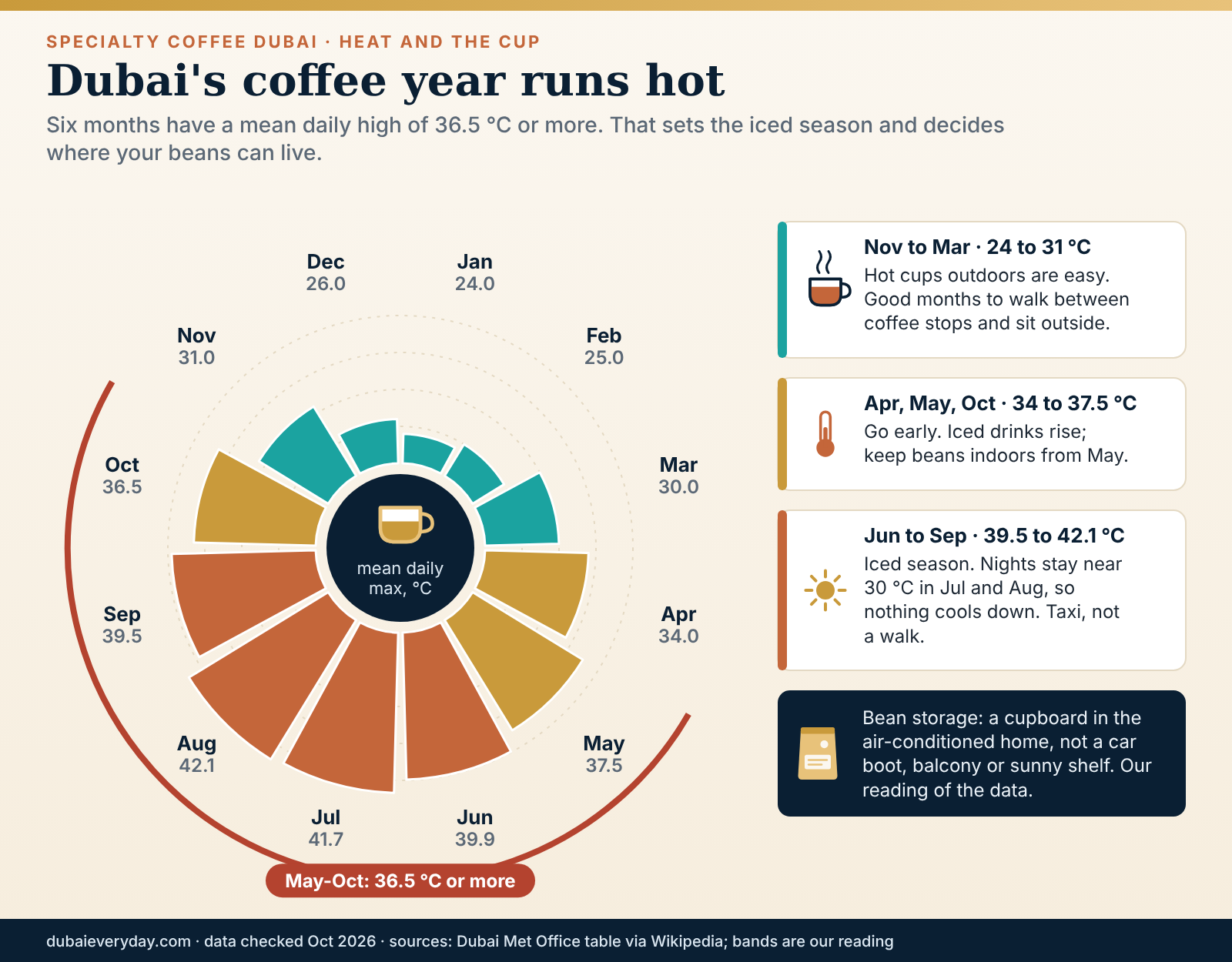
Why does this matter for specialty coffee Dubai drinkers? Three practical reasons follow, and none requires a lab.
- Iced and cold drinks dominate a long season, so the quality of a cafe’s cold options matters more here than in a temperate city.
- Beans left in a car, on a balcony or by a sunny window are exposed to heat for much of the year. Roasted coffee is a perishable food, and warmth speeds its decline.
- Walking between cafes at midday from June to September is a poor plan. Our reading is that the practical window for outdoor coffee hopping is the cooler half of the year.
Summer rule. From May to October, treat the walk from the car or Metro to the cafe as part of the plan. Go early, keep beans in a cool cupboard rather than the car boot, and for a longer errand carry them in an insulated bag. For wider seasonal planning see our guide to the best time to visit Dubai.
What the heat does to the menu
On specialty coffee Dubai menus, cold brew, iced pour-over and iced espresso drinks are not a trend; they are most of the year. The thing to look for is whether a cafe treats them as separate recipes or as hot coffee poured over ice. Brewing hot coffee onto ice at a stronger concentration is a recognised method, and so is slow cold steeping. Either is fine. A watery iced latte made by pouring ordinary hot espresso into cold milk and ice is the version to question.
RAW Coffee Company’s blend descriptions suggest roasters here are aware of the milk-drink market: one blend is described on its page as designed to pair with milk. Mokha 1450’s site has a dedicated cold brew category and cold brew box sets. Both are signals that iced coffee is a product line, not an afterthought, though neither tells you how it tastes.
If you are coming for a short winter break and want to fit a coffee stop into a plan, the weather works in your favour. Our guide to indoor things to do is more useful in August, when coffee stops tend to double as air-conditioned breaks.
The older coffee culture underneath
Before specialty coffee Dubai menus and third-wave cafes, the Gulf had its own coffee tradition. Arabic coffee, usually called qahwa, is made from lightly roasted beans with cardamom, boiled rather than filtered, brewed and poured from a dallah into small handleless cups. The Wikipedia entry summarises UNESCO’s recognition of it as intangible cultural heritage of Arab states. It is a different drink with different rules, and a good Dubai coffee day often includes both. We give it its own section later.
For now the useful point is the contrast. A light-roast Emirati-style qahwa and a light-roast Ethiopian filter coffee share a roast level and little else. One is spiced, boiled and served as hospitality. The other is plain, brewed to a ratio and served as a tasting. Neither is a lesser version of the other, and confusing the two causes most of the awkward moments visitors have at a counter.
What this context changes in practice
Taken together, the trade hub, the heat and the older tradition shape specialty coffee Dubai as a market where the supply side is strong, the weather is demanding and the vocabulary is mixed. The sensible response is to lean on checks you can run, as laid out earlier, rather than on reputation. It also explains why the roasters section next separates three things that are easy to blur: who roasts, who sells beans, and who merely pours.
Specialty coffee Dubai roasters: who roasts, who only serves
In the specialty coffee Dubai market, the word “roastery” gets used loosely. A venue can roast its own beans, buy from a local roaster, buy from an overseas roaster, or serve a house blend made by someone it does not name. All four can sell a good cup. They are not the same business, and knowing which one you are looking at changes what you should ask.
Three models, one question
Model one is the in-house roaster. The company buys green coffee, roasts it on its own machines and sells it in its own bags, usually with a cafe attached. It controls roast level and freshness, and it can answer questions about batches. The risk is narrower range: one roaster’s style across the whole menu.
Model two is the cafe that buys roasted beans from someone else. This can give a more varied menu and, at the best end, a rotating selection from several roasters. The cafe’s skill is then in choosing and brewing, and its limitation is that it cannot tell you what happened before the bag arrived.
Model three is the venue that does not say, and it is common in specialty coffee Dubai menus. This is the one to question gently. Not every undisclosed roaster is a bad sign, because contract arrangements and private labels are common, but “we use specialty beans” with no further detail is exactly where the nine checks earn their keep.
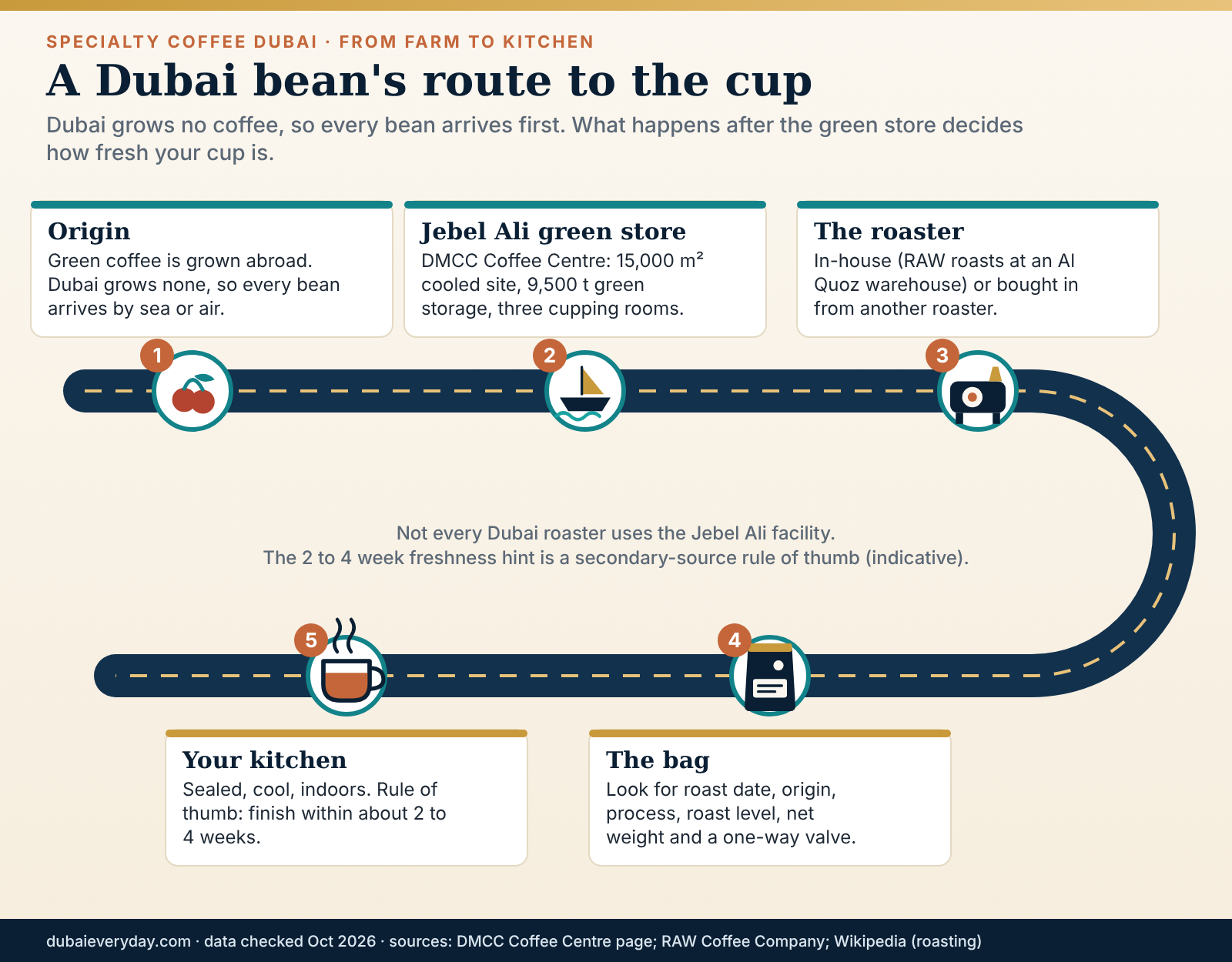
RAW Coffee Company (operator page read)
RAW’s own site, our clearest specialty coffee Dubai roaster example, places its roastery at a warehouse in Al Quoz and says the coffee is roasted in-house. It describes the beans as specialty Arabica sourced directly from growers, which is the company’s claim and one we cannot verify independently. The page also lists a cafe open daily from 07:30 to 18:00 but gives no cafe address, so we cannot say whether it shares the warehouse site. Office hours are Monday to Friday, 08:00 to 17:00.
On the shop side, the page we read listed a Brazilian Campos Altos at AED 78 (naturally processed), a Working Coffee Blend at AED 60 for 250 g and a Black Tie Blend at AED 60 for 250 g, and a Ritual blend at AED 135 described as 85% Arabica and 15% Robusta.
Single origins listed without prices included an Ethiopian washed lot, a Mexican lot, a Ugandan anaerobic natural, a Yemeni anaerobic and a Salvadoran Pacamara. The Ritual price carried no stated weight on the summary we read, so do not divide it by 250.
That 15% Robusta line is worth pausing on. It is disclosed, which is the useful part. Whether a Robusta-containing blend counts as “specialty” is a debate; what matters for you is that the label tells you what is in the bag, and you can decide on taste. Also listed are free delivery in Dubai on orders over AED 300 and same-day delivery for orders placed before 11:00, excluding Saturdays and Sundays. Details sit in RAW’s shipping policy, which we did not read.
Mokha 1450 (operator page read)
Mokha 1450 describes itself as a luxury specialty coffee brand based in the UAE. Its site lists five Dubai venues, each a different format: a coffee boutique at 365 Al Wasl Road in Al Bada’a, a co-working lounge at Andaz Dubai on the Palm Jumeirah, a coffee lounge at Golden Mile Galleria 8 on the Palm, a coffee venue at Emirates Towers Boulevard in DIFC, and a venue on Umm Suqeim Street in Al Barsha Second.
The bean list is the most expensive specialty coffee Dubai shelf we read: from Colombia Red Bourbon at AED 400 and an Extra Turquino Lavado Cuban at AED 350, down to Guatemalan lots at AED 85, with several marked sold out.
Pack sizes were not stated on the collection page, so these are shelf prices, not per-kilo prices. The site also mentions experiences and workshops, including a coffee olfactory experience and masterclasses, with no dates or fees on the page read. No opening hours were published for any venue, so phone before travelling.
A note on price. A very expensive bean is not automatically a better one. Rare lots can be priced for scarcity, packaging and brand as well as flavour. The honest test is the one above: does the price come with a named farm, a process, a roast date and a weight? Ask for those before paying a premium.
Specialty coffee Dubai venues named in roundups (confirm first)
For specialty coffee Dubai leads, a March 2026 roundup from What’s On uses specialty or roasting language for a handful of Dubai venues. We did not verify any of the following ourselves, and the roundup is not an authority on roasting practice. Use them as leads to check, not as picks.
One Life, d3
Confirm first
The roundup says it has its own coffee roastery on the mezzanine of its Dubai Design District branch (Building 5). Its website blocked automated reading, so hours and bean range are unconfirmed.
Common Grounds
Confirm first
Described as serving beans from Encounter Coffee Roasters, a Melbourne-linked roaster, at JBR, DIFC, Mall of the Emirates and JLT. Whether roasting happens locally is not stated.
RX Coffee Apothecary
Confirm first
On Al Athar Street in Jumeirah 3. The roundup says it serves filter and espresso from light-roast beans bought from Japanese and Norwegian roasters, which makes it a model-two venue.
Oath at Wud Flowers
Confirm first
A specialty coffee counter inside a flower shop in a Jumeirah villa on Al Wasl Road, per the roundup. Roaster not named there.
Bageri Form, d3
Confirm first
Specialty coffee alongside Scandinavian baked goods in Dubai Design District. No roasting or origin detail was given.
Others in the same roundup
Confirm first
Lazy Cat (Al Barsha Pond Park), Daughter and Dad Coffee (Warsan 2), Splendour Fields (JLT), Of the Earth (Alserkal Avenue per the text) and Koncrete (Jumeirah, praised for beans but not described in specialty terms).
Tom & Serg: a useful half-answer
Tom & Serg’s page on the EATX site describes a two-level cafe seating 250, open 08:00 to 17:00 on weekdays and 08:00 to 18:00 at weekends, serving “high quality specialty coffee” with Australian-inspired food. The page does not say who roasts the coffee. It links to a roastery called Encounter Coffee Roasters elsewhere on the site, but never states that this supplies the cafe.
So it passes few of the nine specialty coffee Dubai checks on paper, and it shows how normal that is: a large, popular, food-led room is rarely going to publish a bean sheet.
For the full food, atmosphere and work picture of rooms like this, the best cafes in Dubai guide is the better stop. For the cup itself, a polite question at the till still works.
Three questions that work with any roaster or cafe
Ask who roasted the beans and when. Ask what the current filter coffee is and where it is from. Ask whether the beans on sale are the same as the ones in the grinder behind the bar. Those three specialty coffee Dubai questions take under a minute, and the answers sort venues into model one, two or three without any argument.
If the staff are busy, ask by message before you go. Specialty venues in particular tend to be happy to answer a question about beans, because it is the question they hope to be asked.
Where to drink it: Al Quoz, Old Dubai, DIFC, the coast and d3
Dubai is built for cars and spread out like a dropped tray of dominoes. Specialty coffee Dubai clusters in a few districts, and the efficient way to approach it is by cluster, not by name. Each cluster of specialty coffee Dubai below includes only what a source told us. Where a source stayed silent, we say so.
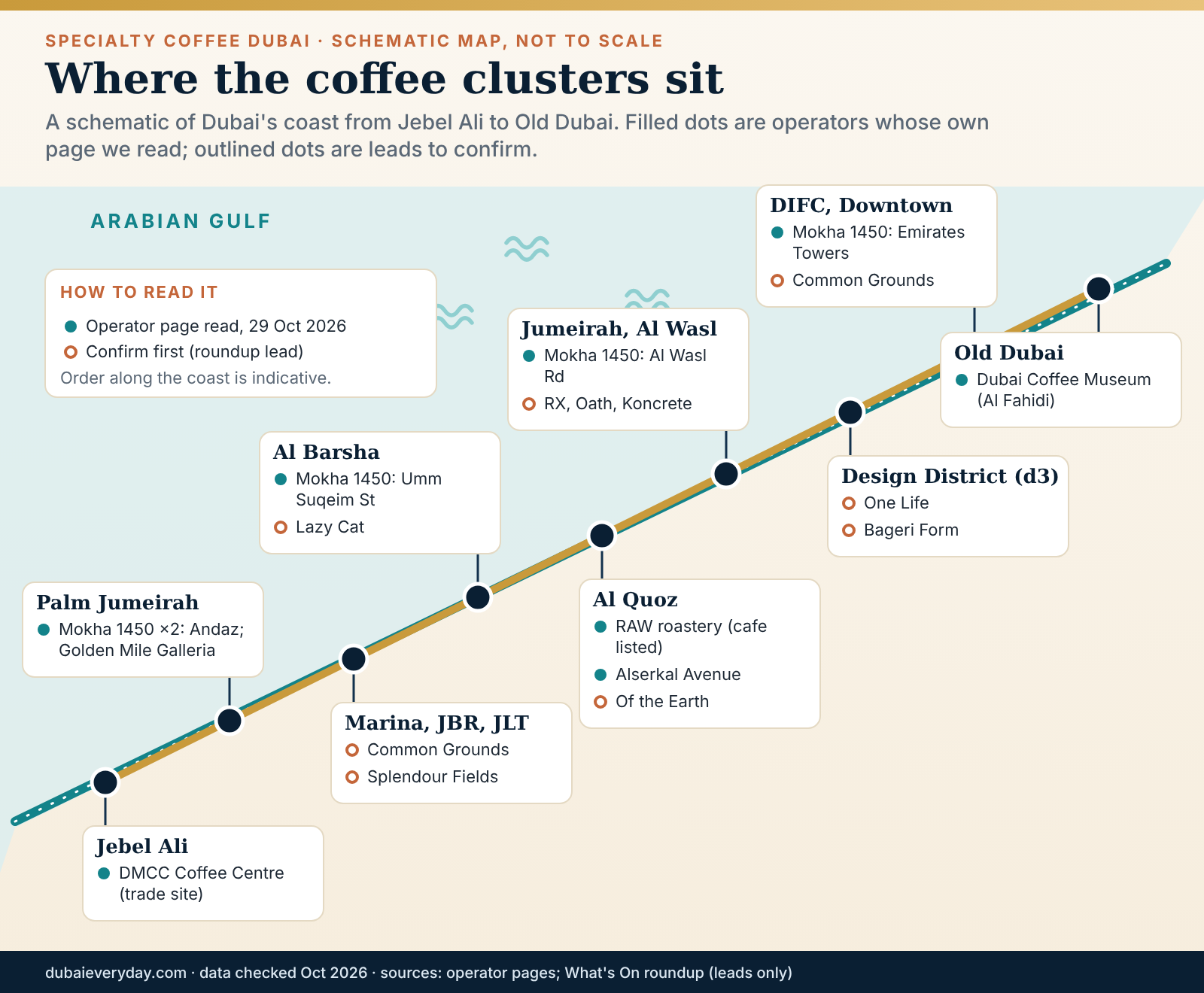
Al Quoz and Alserkal Avenue: the industrial-chic belt
Al Quoz is where the specialty coffee Dubai roaster in our operator-page list lives. RAW Coffee Company places its roastery at a warehouse in Al Quoz and lists a cafe, though its page gives no street address for either, so confirm the location before you set off. Al Quoz is large and warehouse-shaped, so a pin on a map matters more than the district name.
Alserkal Avenue is an arts district in Al Quoz and is better known for galleries than for coffee. RAW’s page does not say whether its warehouse sits inside it, so do not assume one trip covers both. Its own pages list general hours of 10:00 to 19:00 every day, with a warning that individual businesses keep their own hours.
They name Onpassive Metro Station (formerly Al Safa) as the nearest station. A taxi from the station is about five minutes, bus 110 runs about every 12 minutes from Al Safa Bus Terminus beside the station, and walking takes about 30 minutes. Parking is restricted inside the Avenue, with more than 500 RTA spaces nearby under parking code 364C.
The 30-minute walk is real arithmetic, not a suggestion. From May to October, with mean daily highs of 36.5 °C and above, you should treat it as a taxi or bus. Our Dubai Metro guide covers fares, nol cards and hours if you want the full picture.
Old Dubai and the Dubai Coffee Museum
The Dubai Coffee Museum sits in Al Fahidi, in Bur Dubai, the old heritage district. Its own site describes live roasting and brewing demonstrations from different countries on the ground floor, antique coffee items, and a first floor with books and documentaries plus a lounge serving snacks and coffee. Opening hours and ticket price were not on the page we read, and the cafe menu section was marked as under construction.
For a visitor to specialty coffee Dubai, this is the best-fitting place to see how people made coffee before espresso machines, which makes it a natural bridge between the qahwa tradition and third-wave menus. If you are building a day around Old Dubai, our Green Line guide covers the Creek-side areas, and free things to do in Dubai lists walks in the same district that cost nothing.
DIFC and Downtown: weekday coffee
Mokha 1450’s site lists a venue at Emirates Towers Boulevard in DIFC. The financial centre is a weekday district, and anything there is likely to be shaped by office hours; the page gave none, so call. For the wider area context, including transport and how DIFC relates to the rest of the centre, see our Downtown Dubai area guide.
If a visit includes the mall, the Dubai Mall guide helps with parking, Metro and time planning. We have not verified which specialty operators trade inside it, so we name none.
The coast: Jumeirah, Al Wasl and the Palm
Mokha 1450 lists a coffee boutique at 365 Al Wasl Road in Al Bada’a, and two venues on the Palm Jumeirah: a co-working lounge at Andaz Dubai and a coffee lounge at Golden Mile Galleria 8. The roundup also names RX Coffee Apothecary on Al Athar Street (Jumeirah 3), Oath at Wud Flowers on Al Wasl Road and Koncrete in Jumeirah. These are villa-lined streets where parking and access are the main practical question, and none of our sources address either.
The Palm’s two Mokha 1450 venues make it the one coast cluster where a single trip could cover two verified operators. For the island itself, the Palm Jumeirah guide covers transport and everyday logistics. Journeys there take longer than the map suggests, so budget accordingly and avoid peak traffic.
Marina, JBR and JLT
The roundup places Common Grounds at JBR and JLT as well as DIFC and Mall of the Emirates, and Splendour Fields at The Park in JLT. These are confirm-first leads. The area guide for the Dubai Marina explains the tram, traffic and beach access if you are basing yourself there.
Dubai Design District and Al Barsha
One Life (with its own roastery, per the roundup) and Bageri Form are both placed at d3 by the roundup. In Al Barsha, Mokha 1450 lists a venue on Umm Suqeim Street in Al Barsha Second, and the roundup names Lazy Cat at Al Barsha Pond Park. Again: one operator page read, the rest leads.
Jebel Ali: for the curious only
The DMCC Coffee Centre sits in the Jebel Ali Free Zone. It is a coffee industry address, with tours listed on weekdays at 11:30 and 16:00, and it is not a place to go for a drink. Mention it only if you are in the trade or planning a visit through a company.
How to cluster a coffee morning
Our calculation from the specialty coffee Dubai addresses above: the most efficient verified clusters are the Palm (two Mokha 1450 venues), Al Quoz (RAW’s roastery, plus the arts district nearby), and Old Dubai (the museum). DIFC, Al Wasl and Al Barsha each have one verified venue, so they work as additions to other plans, not as destinations.
A sensible rule for any specialty coffee Dubai outing is two coffee stops, never three. Beyond two, the caffeine, the heat and the driving catch up with you. The caffeine ceiling is covered in the budget section, and most people hit it faster than they expect.
Weekend note. RAW lists its Dubai same-day delivery as excluding Saturdays and Sundays, and RAW’s office hours run Monday to Friday. Dubai’s working week and cafe hours change at weekends, so for any venue not listed with weekend hours, assume nothing and ask.
Espresso in Dubai: what a good shot looks like on paper
Espresso is the benchmark drink in most specialty coffee Dubai menus, and it is also the one most disguised by milk. Understanding its numbers does two things for specialty coffee Dubai orders: it lets you order sensibly, and it lets you notice when a cafe is paying attention. None of this requires you to carry a scale into the room.
The reference numbers, and their limits
The Italian National Espresso Institute defines a certified espresso with figures that Wikipedia’s espresso entry reproduces: a dose of 7 g (give or take 0.5 g) of ground coffee, water leaving the machine at 88 °C (give or take 2), pressure of 9 bar (give or take 1), a pour of about 25 seconds (give or take 5) and about 25 ml in the cup (give or take 2.5 ml), including crema. A double takes roughly 14 g and a triple about 21 g.
The same entry is candid about the limits: there is no universal standard, and these numbers describe one institute’s definition. Many specialty cafes elsewhere describe recipes by weight, for example one part dry coffee to two parts liquid espresso, and use heavier doses than the reference. We did not verify any specialty coffee Dubai cafe’s recipe, so read the following as a vocabulary lesson, not a Dubai benchmark.
Shot lengths in plain English
A ristretto is a short shot, around half the volume of a normal one. A normale is the standard pour. A lungo is a long one, double to triple the normale volume. A caffe crema, per the same reference, is longer again and brewed with a coarser grind. Each pulls more or less out of the coffee, and the result moves along a line from concentrated and sweet to thin and bitter.
Cafe menus often add their own names. A long black or Americano is usually espresso with hot water, and a flat white is usually a double shot with silky milk in a small cup. Definitions vary from room to room, which is why asking “what size and how many shots?” is not pedantic. It is how you avoid paying twice for a drink you did not want.
How to judge a shot without equipment
Start with a straight espresso, or a short black if the menu uses that name. Smell it before drinking. Then take a first sip while it is warm, and a second when it has cooled slightly. You are looking for balance: some sweetness, some acidity, and a finish that fades rather than sticks.
Two failure modes are common across the world, and Dubai is no exception.
- Sour, thin or salty-sharp usually points to under-extraction: water ran through too fast or too coarse a grind.
- Bitter, dry or ashy usually points to over-extraction: water ran too slowly, or the coffee was roasted very dark.
These are rules of thumb used by baristas, not measurements. A single sour shot at 07:45 may simply be a machine warming up. A pattern across two visits is a different matter.
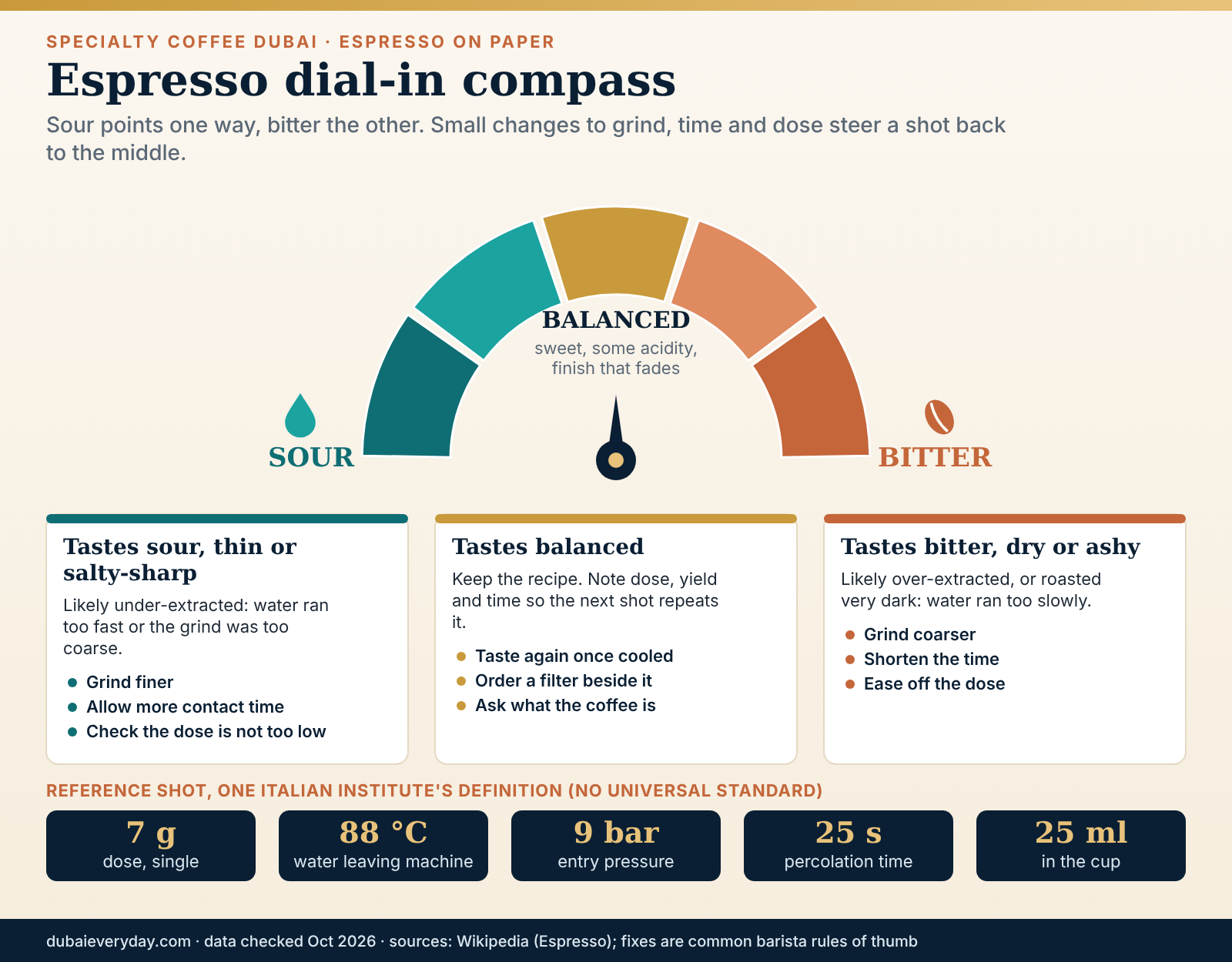
Dialling in: why the first cup of the day can be different
Dialling in means adjusting grind, dose and time until the shot tastes right, and good baristas repeat it as the day changes. Temperature, humidity and how long beans have been in the hopper all shift the result. A bag that has been open for days adds its own drift.
You can use this. If you care about the cup, order your espresso after the first rush, when the machine is warm and the barista has settled the grinder. That is not a promise of better coffee. It is a way to reduce one avoidable variable.
Milk drinks without the mask
Milk drinks are the most-ordered category on specialty coffee Dubai menus as elsewhere, and there is nothing wrong with that. Milk adds sweetness and body, which is why medium and darker roasts are often used for them. RAW Coffee Company, for example, describes one of its blends on its shop page as designed to pair with milk, which is an honest statement of purpose.
The test for a milk drink is whether you can still taste coffee. If the milk has been over-heated, you taste scorched milk. If the espresso is too weak, you taste warm milk. Ask for a flat white or a small cortado-style drink if you want the coffee to remain audible, and remember that definitions vary.
What a double costs in beans
Our calculation, using RAW’s listed price of AED 60 for a 250 g blend: that is AED 0.24 a gram. A single at the 7 g reference dose uses about AED 1.68 of beans. A double at 14 g is about AED 3.36. A heavier 18 g double, which is a common modern dose, is about AED 4.32. A 250 g bag therefore yields about 35 reference singles, or roughly 14 doses of 18 g.
A specialty coffee Dubai cafe’s price covers far more than beans: rent, labour, machine and milk. The calculation is for home brewers, and it explains why a good bag pays for itself quickly.
How we calculated this. Beans cost = price per gram multiplied by the dose. AED 60 divided by 250 g gives AED 0.24 per gram. Multiply by 7, 14 or 18 g. Prices exclude gear, water, electricity and any VAT treatment, and RAW’s bag prices should be confirmed before you rely on them.
Order of operations on a first visit
If you only have time for two drinks in a new specialty coffee Dubai cafe, make them an espresso and a filter coffee. If you only have time for one, choose whichever the venue seems proudest of: a chalkboard line saying “today’s filter” is a clue. A sensible third stop is a milk drink, if you actually like milk drinks. That sequence gives you the straight bean, the gentle bean and the commercial workhorse in about thirty minutes.
Pour-over, filter and batch brew: the numbers behind a clean cup
If espresso is the loud end of specialty coffee Dubai menus, filter coffee is the quiet one. It tastes of the bean more plainly, forgives milk-less scrutiny less, and has a much simpler recipe, which is why specialty coffee Dubai filter lists are worth reading closely. That recipe has an official reference point, and it is easier to remember than most people expect.
The SCA brewing reference
The SCA’s brewing best practices give a coffee-to-water ratio of 55 g per litre, give or take 10%, water at 200 °F, give or take 5 (that is 93 °C give or take 3), and a contact time that depends on grind: one to four minutes for fine, four to six for drip, six to eight for coarse. Think of it as a sensible neighbourhood, not a single address.
The ratio converts easily. At 55 g per litre, 250 ml of water needs 13.75 g of coffee, 300 ml needs 16.5 g, 500 ml needs 27.5 g and a full litre needs 55 g. The plus-or-minus 10% window runs from 49.5 g to 60.5 g per litre, so for 250 ml the range is about 12.4 g to 15.1 g. Our calculation, in plain arithmetic. If a cafe’s filter recipe sits far outside that window, it is a deliberate style, not an accident, and you can ask about it.
Pour-over, immersion, AeroPress and batch brew
Pour-over means pouring water by hand through a cone of ground coffee in a paper filter. It gives clarity and control, and it depends on the person pouring. Immersion, such as a French press, steeps coffee and water together, producing more body and less clarity. The AeroPress uses pressure and a short steep, and is popular for travel. Batch brew is a large automatic machine making a pot at a time, and in a busy cafe it is often the most consistent filter you can order.
None of these is superior for specialty coffee Dubai drinkers. RAW Coffee Company’s shop listed a Bodum Kenya French press at AED 140 and an AeroPress Go at AED 155 (showing as sold out when we read it), which tells you that entry-level immersion and pressure brewers are cheap relative to espresso gear. Prices and stock change, so check the product page.
Pour-over
Clean, bright, detailed. Best for lighter roasts and single origins. Depends on pouring skill, so it varies most between cafes.
Immersion
Fuller body, more forgiving. Good at home, where a French press needs no technique beyond a timer and a coarse grind.
AeroPress
Short, flexible and travel-friendly. A good second brewer for a small kitchen or a hotel room with a kettle.
Batch brew
Large machine, steady recipe. If a cafe offers it, it is often the quickest way to taste a single origin without waiting.
What to order when a menu has a filter list
If a specialty coffee Dubai menu offers two filter coffees, choose two with different processing and compare them. A washed coffee tends to taste cleaner and more tea-like. A natural-processed coffee tends to taste fruitier and heavier. That pairing is the simplest education a cafe can give you in twenty minutes, and it costs far less than a tasting class.
Ask how long ago the coffee was roasted and which brewer is used. A specialty coffee Dubai cafe with a rotating filter and a short explanation per coffee is doing the work that earns a premium. A cafe with a single unnamed “filter” and no explanation is serving hot water and coffee, which is also fine, but not specialty-specific.
Making it cold: the Dubai variation
For specialty coffee Dubai summers, hot coffee poured over ice, sometimes called flash-chilling, is a popular way to make iced pour-over. The trick is that the ice dilutes the drink, so the hot brew has to be stronger than usual.
Illustrative arithmetic, not an SCA standard: if you want a 300 g final drink at 55 g per litre, you need 16.5 g of coffee. Brew that with about 180 g of hot water over 120 g of ice, and the final concentration lands where the reference puts it. Tune it by taste.
Cold brew is the other route: coarse grounds steeped in cold water for many hours, then filtered. It is smoother and lower in perceived acidity, and it keeps in the fridge. Mokha 1450 lists cold brew box sets from AED 325 on its collection page; we did not read what they contain or how long the coffee keeps, so ask before you buy.
Water is most of the cup. A filter coffee is mostly water, so water quality shows. We did not verify the mineral content of Dubai tap or bottled water, so we make no recommendation here. If a cafe’s filter tastes flat or chalky, ask whether it filters its water. At home, start with whatever water you already drink happily and change one variable at a time.
Turkish, cezve and the Gulf link
The World Coffee Championships list seven competitions, and one of them, the Cezve/Ibrik Championship, is dedicated to coffee made in the small pot used across the eastern Mediterranean and the Gulf. That fits Dubai neatly, because boiled, spiced and unfiltered coffee is part of local life. A specialty menu that includes a cezve coffee brewed with care is rarer than a pour-over, and if you find one it is worth ordering.
It also sets expectations. A cezve coffee is meant to be served with the fine grounds still in the cup, so do not drink to the bottom. If you are unsure, watch what the table next to you does, or ask.
A simple home kit and what it costs
For readers who want to try specialty coffee Dubai style at home, the visible entry costs on RAW’s listings suggest a very low floor: a French press at AED 140 is a complete brewer. Add a kitchen scale you already own and a manual or electric burr grinder from any source, and you are brewing to the SCA ratio. The listed Acaia Lunar scale at AED 1,340 is a precision tool for people who want to measure to the tenth of a gram, not a starting requirement.
The one purchase that matters most is freshly ground coffee. A modest grinder paired with good beans usually beats an expensive machine paired with stale pre-ground coffee. That is a widely shared view among coffee professionals rather than something we measured, but the logic is straightforward: grinding releases flavour that starts fading quickly, as the cupping protocol’s 15-minute rule between grinding and brewing suggests.
For those who like numbers: a filter coffee costs about AED 3.96 in beans at RAW’s AED 60 per 250 g price and a 16.5 g, 300 ml cup. That is our calculation, excludes the grinder and the water, and is a home figure for specialty coffee Dubai beans only. The bean section later shows how this compares with batches and bags.
Buying specialty coffee Dubai beans: reading the bag and doing the maths
Buying beans is where the nine specialty coffee Dubai checks pay off most, because a bag carries more evidence than a cup does. It is also where Dubai’s heat and delivery culture matter. Beans are cheap to order and easy to store badly. The goal of this section is to help you buy the right quantity, from the right place, at a price you understand.
What a good bag tells you
A useful specialty coffee Dubai bag, whether in a shop or on a web page, answers a short list of questions. Who roasted it? When? Where did the coffee grow, and how was it processed? How dark is it? How heavy is the bag? Tasting notes are nice but they are the least verifiable item on the list, so weigh them last.
- Roaster named, with a city or address you can look up.
- Roast date, not only a best-before date.
- Country, and ideally region, farm or cooperative, plus process.
- Roast level that matches how you plan to brew.
- Net weight in grams, so you can compare prices.
- A one-way valve or other sealed packaging.
When a page lists a price and nothing else, as with the Mokha 1450 collection we read, the missing line is the weight. Prices from AED 85 to AED 400 cannot be compared with each other until you know how many grams each represents. Ask the venue, or read the individual product page.
The Dubai price anchors we could verify
For specialty coffee Dubai prices, On RAW Coffee Company’s shop page, the Working Coffee Blend and the Black Tie Blend were each AED 60 for 250 g. That is AED 240 a kilogram, or AED 0.24 a gram (our calculation). A Brazilian Campos Altos was AED 78 and the Ritual blend AED 135, both without a weight on the listing we read, so we do not convert them.
Mokha 1450’s collection page showed a ladder of prices: AED 85 for Guatemalan lots, AED 100 for another Guatemalan, AED 171 for a Yemeni, AED 195, AED 222 and AED 228 for Haile Supreme, Ethiopian Adame and Colombia Geisha, AED 315 for a Jamaican, AED 350 for a Cuban and AED 400 for a Colombia Red Bourbon. The top price is about 4.7 times the bottom one (our calculation). Because weights are unstated, that is a shelf-price ratio, not a quality ratio and not a per-gram ratio.

Bag to cup: the arithmetic
At AED 0.24 a gram, a 15 g filter dose costs AED 3.60 in beans and yields about 16.7 cups from a 250 g bag. An 18 g espresso dose costs AED 4.32 and yields about 13.9. These are home numbers. They say nothing about what a cafe should charge, because a cafe’s price also covers rent, labour, equipment, milk and margin.
Our calculation for a home habit: two 15 g filter cups a day use 30 g, which is 900 g in a 30-day month, or 3.6 bags of 250 g. At AED 60 a bag, that is about AED 216 a month. Two 18 g espresso doubles a day use 1,080 g a month, or 4.32 bags, about AED 259. If you share coffee with a partner, double either figure.
RAW lists free delivery in Dubai for orders over AED 300. Six 250 g bags at AED 60 comes to AED 360, which is 1.5 kg. At 30 g a day that is 50 days of coffee, long past the two-week optimal shelf life that the Wikipedia roasting reference mentions as a rule of thumb. Share a big order, or pay for delivery on a small one, rather than buying stale coffee to save a fee. We did not see the delivery fee itself.
Storing beans in a hot city
The principles for specialty coffee Dubai bags are the same as anywhere: keep roasted coffee cool, dry, dark and sealed. Heat adds a practical twist for specialty coffee Dubai buyers, because the places people instinctively leave things (a car boot, a balcony table, a sunny kitchen shelf) are exactly the wrong ones for much of the year. Our reading of the monthly highs is that from May to October, anywhere not air-conditioned is a risk.
Practical rules we would apply from the sources above:
- Buy whole beans and grind just before brewing, as the cupping protocol’s 15-minute limit between grinding and brewing implies.
- Keep the bag in a cupboard inside the air-conditioned part of the home, closed tightly after each use.
- Do not leave beans in a parked car, even for an errand. Our reading of the temperature data is that this is a bad idea for half the year.
- Buy amounts you will finish in about two to four weeks, and ask the roaster what they recommend for their own coffee.
One more practical point from the roasting reference: roasted beans give off carbon dioxide, so very fresh coffee needs several days to settle, and valve bags are designed to let that gas out. Some roasters advise waiting a few days after the roast date before brewing. Ask. Their answer will depend on the roast level and the style.
Where to buy, and what to check at each
From the roaster
The best source for dates, origins and advice. Check the delivery cut-off and weekend rules (RAW lists same-day delivery before 11:00 on weekdays only).
From a cafe’s retail shelf
Convenient and good for sampling. Ask how long the bag has been on the shelf and whether the roast date is printed.
From a supermarket
Useful for convenience, but check dates carefully. Our supermarket guide covers price levels and delivery. We did not verify which supermarkets stock specialty-grade roasts.
A grinder or no grinder?
If you buy a bag and have no grinder, ask the seller to grind it for your brewer on the spot, and use it within days rather than weeks. Pre-ground coffee is a compromise, not a mistake. It loses flavour faster than whole beans, so buy a small bag and drink it quickly.
If you plan to buy specialty coffee Dubai beans for months, a grinder is the best first purchase in the whole coffee-at-home hierarchy. Our view, which is an editorial judgement and not a lab result: a decent hand grinder and a French press will beat a pricey machine fed from a stale bag. For setting up the rest of a kitchen, see our home setup guide.
Is an espresso machine worth it? An illustrative break-even
Illustrative example (not a quote or market fact): suppose you buy a café coffee at AED 25 each day. That figure is an assumption for the arithmetic, not a Dubai price, because we could not verify any cafe’s menu. The beans for an 18 g double cost AED 4.32 at RAW’s blend price, so the notional saving is AED 20.68 per cup.
RAW’s listing showed a Rocket Appartamento espresso machine at AED 7,122 (with a lower sale price displayed, so confirm which applies) and an Acaia Lunar scale at AED 1,340.
Add a grinder at an assumed AED 2,000, and the total is AED 10,462, which at AED 20.68 saved per cup takes about 506 cups to recover. At one cup a day that is about 17 months; at two, a little over eight. That is before milk, descaling and your time. Use it as a framework and replace the assumed figures with your own.
For a French press at AED 140 and a 15 g dose, the saving per cup against the same assumed AED 25 is AED 21.40, so it pays for itself in seven cups. The comparison is not fair, since the drinks differ, but it shows where the real cost sits: in the machine, not the beans.
Carrying beans out of Dubai
Specialty coffee Dubai beans make a good souvenir, and roasters sell sealed bags that travel well. Two cautions. First, some countries restrict the import of food products, and rules for coffee vary, so check the destination’s customs guidance before you pack. We did not verify any country’s rule. Second, keep the bag in hand baggage if you can, away from the hold’s temperature swings. For airport-side logistics, see our Dubai airport guide.
Baristas, training and competitions: how skill is certified
In specialty coffee Dubai circles, a good barista is a mix of habits: consistent dosing, attention to taste, clean equipment and the willingness to tell a customer what is in the cup. None of that can be read from a name tag. What can be read, in the specialty coffee Dubai trade, is the training pipeline behind the profession, because at least two organisations here publish it.
SCA courses on offer in Dubai
RAW Coffee Company’s training page lists Specialty Coffee Association courses in three skill areas (Barista Skills, Brewing Skills and Sensory Skills) at three levels: Foundation, Intermediate and Professional. It also lists an introductory course. Prices we read on 29 October 2026 were AED 1,150 for the introductory SCA course (with a higher regular price of AED 1,265 shown), AED 2,050 for each Foundation course, AED 3,450 for each Intermediate course and AED 6,150 for each Professional course.
The page also lists bundles. All three Foundation courses together cost AED 5,550, and a Foundation-plus-Intermediate pairing in one skill area costs AED 5,050. Our calculation: the three Foundation courses bought separately would be AED 6,150, so the bundle saves AED 600, about 10%. A Foundation-plus-Intermediate pair bought separately would be AED 5,500, so that bundle saves AED 450, about 8%.
What the page did not say matters as much. It listed no course durations, dates or venue addresses, did not include a roasting course, and did not state whether prices include VAT. For those, the page points to a training email address. Confirm everything before paying anything.
Foundation
Entry level. RAW describes Barista Skills Foundation as hands-on basics with a focus on dose, and Sensory Foundation as the fundamentals of evaluating roasted coffee.
Intermediate
Adds taste and flavour. For baristas, the page says it covers how temperature and dose affect the cup. For sensory, it suits people already working in the field.
Professional
Advanced taste balance, flavour and texture for baristas, and in Brewing it covers navigating the brewing control chart. Aimed at people with industry experience.
A second venue: the DMCC campus
The DMCC Coffee Centre’s page lists an SCA Premier Training Campus with a 24-person classroom and a training suite with four La Marzocco machines, two group espresso machines and two batch brewers. Its cupping rooms are set up for Q Grading, a professional grading qualification. That is trade-grade infrastructure and, again, we cannot say whether it takes members of the public.
What a certificate does and does not tell you
Certificates in the specialty coffee Dubai scene show that someone has been trained and assessed on a standard syllabus. They do not guarantee that every drink is excellent, any more than a driving licence guarantees good driving. What they do suggest is that the person has been taught the vocabulary behind dose, extraction and sensory evaluation, which is the vocabulary you can use to talk to them.
If you are thinking of working as a barista in Dubai, a course is not a work permit. Employment and residence rules sit elsewhere; our guides to finding a job in Dubai and the Dubai work visa explain the official routes, and the course providers above are the place to ask about their own enrolment rules.
How to watch a barista, politely
You can learn a lot in the minute before your drink arrives. Is the coffee weighed or dosed to a routine? Does the barista taste the shot, or the milk? Is the steam wand wiped after each use? Does the barista purge the group before pulling? Are there two grinders, and do they appear to be separate coffees?
These are habits, not guarantees, and a rushed morning can disguise a careful team. Still, a visibly tidy bar with a clear routine tends to correlate with care in the cup. It is the only barista test that costs nothing and requires no argument.
Competitions: the public face of skill
The World Coffee Championships site lists seven competitions: the World Barista Championship, Brewers Cup, Latte Art, Coffee in Good Spirits, Cup Tasters, Coffee Roasting and the Cezve/Ibrik Championship. For the Barista Championship, competitors prepare four espressos, four milk drinks and four signature drinks, judged on taste, technical skill, creativity and presentation. Competitors work to a script, in front of judges, with a time limit, so it is a showcase and not a daily reality.
For specialty coffee Dubai events, the same site lists a Dubai round in January 2026 among its events. For 2027, World of Coffee’s own page lists a Dubai edition on 26 to 28 January 2027 at Dubai World Trade Centre.
We did not find what that edition includes for the public, whether tickets are open to non-trade visitors, or which competitions it hosts, so treat it as a date to check, not a plan. The wider events picture is in our Dubai events calendar guide and in Dubai events in January.
If you go to a coffee event. Trade shows usually reward a question list. Bring three: who roasted this, when, and can I buy a sample bag. Those three turn a sea of stands into a short list of operators you can verify later.
Arabic coffee, Turkish and the Gulf cup: where specialty fits
A guide to coffee in Dubai that ignores qahwa would be like a guide to Paris that ignores bread. Arabic coffee is not a competitor to specialty coffee Dubai menus. It is the older tradition, and it is more likely to be offered to you as hospitality than sold to you as a product.
How Arabic coffee is made and served
According to the Wikipedia overview of Arabic coffee, which notes UNESCO recognition as intangible cultural heritage of Arab states, the drink is made from lightly to heavily roasted Arabica with cardamom, sometimes with cloves or saffron. Gulf-style qahwa uses a very light roast and plenty of saffron and cardamom, giving a pale golden or yellow colour. It is boiled, not filtered, and is typically brewed and served from a dallah into small handleless cups called finjan.
Etiquette on the same page is worth knowing. The server pours with the right hand, guests take and return the cup with the right hand, the eldest or most senior guest is served first, the cups are only partly filled, and it is polite to accept up to three. A guest who has had enough gestures to say so. Customs vary between families and regions, so the safest approach is to watch the host and follow along. Our guide to Dubai etiquette covers wider manners, including Ramadan.
Seeing the tradition in context
The Dubai Coffee Museum is the clearest place to see this history set beside other styles, since its ground floor shows roasting and brewing styles from various countries. For a specialty-coffee reader, it is useful because it removes the idea that the story starts with espresso machines.
There is also a thread connecting the traditions. RAW Coffee Company’s shop listed a Yemeni anaerobic lot, and Mokha 1450’s listed a Yemeni Sabree (sold out when we looked). Yemen has a long place in the history of coffee, and specialty coffee Dubai roasters are now selling it in a different way from the market stall: with a process named, a lot labelled and a price that reflects scarcity.
Where specialty fits beside qahwa
The practical way to enjoy both qahwa and specialty coffee Dubai offers is to separate occasions. Qahwa is for hospitality, often with dates, in a majlis or a hotel lobby. Specialty filter or espresso is for tasting, in a cafe or at home. Mixing the two, for example asking a host for a flat white at a traditional welcome, is where awkwardness starts. If you are served qahwa, accept it in the spirit it is offered.
If you want to try a qahwa-style cup in a specialty coffee Dubai setting, ask the venue whether it serves Arabic coffee, and from which roast. We have not verified that any specialty venue named here does. The question is polite and often welcome.
Specialty coffee Dubai plans for visitors, residents and returning visitors
The right specialty coffee Dubai plan depends on who you are, when you are here and how much time the coffee gets. The five scenarios below use only the facts verified earlier. They are structured as decisions, not itineraries, because we cannot confirm hours or menus for most venues.
Scenario 1: a short winter visit, coffee as one stop a day
You are in Dubai for three nights between November and March, when mean daily highs run from 24 to 31 °C on the climate table. Outdoor movement is comfortable, so specialty coffee Dubai hopping can double as sightseeing. A sensible pattern is one deliberate coffee stop each day, chosen from a cluster you will be in anyway.
For example: an Old Dubai morning with the Coffee Museum, then qahwa somewhere traditional. Another day, Al Quoz, where RAW lists a cafe open from 07:30 to 18:00 (confirm its address), with the arts district nearby open 10:00 to 19:00 on its own pages. Keep the third day flexible. For wider planning, the things to do in Dubai guide and the first-time-in-Dubai plan help you fit coffee around the big sights.
Scenario 2: a summer visit
From June to September, mean daily highs on the climate table run from 39.5 to 42.1 °C. Walking between cafes at midday is a poor idea, and our rule is to go early, travel by taxi or car between stops, and treat each cafe as an air-conditioned rest. The Palm cluster, with two Mokha 1450 venues, is the one place where two verified operators sit on the same island.
This is also the season for cold specialty coffee Dubai options. Ask about iced filter or cold brew, and if you are buying beans, plan to carry them home in your hand luggage, not the car. If you are choosing a hotel with coffee in mind, note that Mokha 1450’s site lists a co-working lounge inside Andaz Dubai on the Palm; whether it is open to non-guests is not stated, so ask. Our best hotels in Dubai guide covers choosing by area and trip style.
Scenario 3: a resident who wants better beans at home
For specialty coffee Dubai beans at home, start with the roaster, not the cafe. Read a bag’s details against the nine checks, order a single 250 g bag, and brew it at the SCA ratio for a week before deciding. Pay attention to whether the weekday cut-off for delivery suits you. RAW lists same-day delivery before 11:00 excluding Saturdays and Sundays, and free delivery above AED 300.
Resist the temptation to build a coffee corner on day one. The break-even example in the bean section shows where the money goes, and the French press route is the cheapest way to find out whether you will actually use the kit. For the cost context of a daily habit, our guides to the cost of living in Dubai and the monthly budget for one person show where small daily purchases sit.
Scenario 4: a returning visitor who wants depth
If you have already done the sights and want something specific from specialty coffee Dubai, there are three levers. First, a course: RAW’s SCA training page lists introductory and skills courses with prices, though dates and durations need confirming. Second, an event: World of Coffee lists a Dubai edition on 26 to 28 January 2027, and you should check whether the public can attend. Third, a trade enquiry: the DMCC Coffee Centre lists weekday tours, but who may book is unclear.
Of the three, the course is the most concrete and the event is the most uncertain. A cheaper alternative is simply to compare two or three roasters’ single origins side by side at home, using the same brewer and recipe.
Scenario 5: someone who wants to work from a cafe
The coffee and the desk are different jobs. Our best cafes guide covers workability and found that laptop policies and power sockets were rarely stated anywhere. For a specialty-first search, the sensible compromise is to pick a cafe on its coffee, phone ahead about seating and sockets, and avoid arriving at a peak hour with a laptop and a four-hour plan.
Budget, VAT, caffeine and Ramadan: the practical limits
Four constraints shape any specialty coffee Dubai outing: what it costs, how the tax is shown, how much caffeine is sensible and what the calendar looks like. We cover each briefly and say where our sources stop.
Prices and VAT
For specialty coffee Dubai prices, the UAE’s Federal Tax Authority lists the standard VAT rate as 5%. The page we read does not say how consumer prices must be displayed, so we cannot tell you whether a given menu price already includes VAT. Check the menu footnote or the receipt. For the arithmetic only: if a price is VAT-inclusive, VAT is 5/105 of it, about 4.76%. On a hypothetical AED 25 item, that is about AED 1.19. If instead VAT is added at the till, the same item would total AED 26.25.
Service charge and tipping practice for cafes were not verified from an official source, so we give no rule. Ask whether a service charge applies before you order, especially in hotel venues. Our etiquette guide lists tipping among the customs it covers.
Caffeine: a ceiling worth knowing
The European Food Safety Authority’s published advice, as shown on its caffeine page, is that up to 400 mg a day from all sources, spread through the day, does not raise safety concerns for healthy adults, and that single doses up to 200 mg are also not a concern. For pregnant women it gives 200 mg a day. It cites about 80 mg in a 60 ml espresso and about 90 mg in a 200 ml cup of filter coffee, noting that amounts vary.
Our arithmetic from those numbers: 400 mg is about five 60 ml espressos or four and a half 200 ml filter cups. A 200 mg single-dose limit is 2.5 espressos in one go. A large 350 ml filter mug scales to roughly 160 mg on the same basis, so a double espresso and a big filter coffee together can approach the single-dose figure. These are scaled estimates, not measured values, and real cups vary by bean, dose and brew.
Not medical advice. This is general information from a European food-safety body, not individual health advice. If you are pregnant, have a heart condition, anxiety or a sleep problem, or take medicines that interact with caffeine, follow your clinician’s advice instead. Our Dubai healthcare guide explains how to find a doctor.
Ramadan 2027
The National reports that Ramadan 2027 is expected to begin on 8 February 2027, last 29 or 30 days and end around 8 or 9 March, with Eid Al Fitr expected on 9 or 10 March, subject to moon sighting. Cafe hours and daytime service can change during Ramadan. We did not read a regulator page on cafe operations during the month, so the safest approach is to ask each venue.
For coffee planning, January and early February are the comfortable weeks before it. World of Coffee’s Dubai dates (26 to 28 January) fall just before the month begins. Our Dubai events in February guide helps with the weeks around it.
A realistic outing budget
For specialty coffee Dubai spending, we cannot give a verified price per drink, so here is a framework. Decide your number of paid coffee stops, add your assumed price per drink and a 5% VAT margin if prices are shown before tax, then add beans for home if you plan to buy them. At RAW’s listed price, a 250 g bag is AED 60, so one bag per week is about AED 260 a month. Replace the assumptions with the prices on the menus you actually see.
Mistakes that make a specialty coffee Dubai crawl disappointing
Most disappointments in the specialty coffee Dubai market are predictable. They come from reading too much into labels, ignoring the weather and buying more than you can use. Here are the ones the research above points to, in rough order of how much they cost.
Trusting the word on the door
“Specialty” on a specialty coffee Dubai door is a claim, not a certificate. The SCA itself says specialty is not decided by a score alone. Treat the word as the start of a conversation and run two or three of the nine checks before you spend extra.
Judging a cafe by its milk drinks only
A flat white or latte can hide weak or stale coffee. Order one straight espresso or filter coffee at least once in any specialty coffee Dubai cafe, even if you do not usually drink it. If the cafe will not serve one, that is information as well.
Buying beans for the free-delivery line
Six 250 g bags to pass an AED 300 threshold is 1.5 kg, which at 30 g a day lasts 50 days. That is far longer than the two weeks that a secondary source gives as an optimal shelf life. Pay a small delivery charge, or share the order, and keep your coffee fresh.
Leaving beans in the car or on the balcony
With mean daily highs of 36.5 °C or more for six months of the year, heat is the quiet enemy of roasted coffee. Keep beans in an air-conditioned cupboard, sealed, away from the stove.
Planning a walk between cafes in summer
A 30-minute walk from Onpassive Metro Station to Alserkal Avenue is sensible in January and unwise in July. Use a taxi, bus or car, and cluster your stops so you are not criss-crossing the city at midday.
Treating price as quality
Mokha 1450’s online prices span from AED 85 to AED 400 with no weights stated, so the ratio of about 4.7 to 1 tells you nothing about taste. A high price is justified by information (a named lot, a process, a roast date), not by the word “luxury”.
Skipping the hours check
Several operators we read published no hours (Mokha 1450’s venues, the Dubai Coffee Museum) and Alserkal Avenue warns that individual businesses keep their own hours. A cross-town trip to a closed door is the cheapest mistake to avoid.
Expecting specialty from a qahwa host, or qahwa from a specialty bar
They are different drinks with different etiquette. Accept qahwa as hospitality. Order a filter coffee at a specialty counter for tasting. Do not mix up the occasions.
Stacking caffeine across a crawl
Using the EFSA figures, five 60 ml espressos reach 400 mg. A crawl with three doubles and a big filter coffee can pass the daily guide before lunch. Share drinks, order smaller sizes and leave gaps.
Treating roundups, including this one, as a ranking
Every venue lead we took from a secondary roundup is marked confirm first for a reason. This guide ranks no one. If something looks wrong or has closed, the update log below explains how to tell us.
The shortest version of this guide
For specialty coffee Dubai, ask who roasted it and when, taste it plain once, buy beans in amounts you will finish, and keep them cool. Use the heat as a planning tool, not a hazard, and leave room for qahwa. Everything else is detail.
Specialty coffee Dubai FAQ
What counts as specialty coffee in Dubai?
The Specialty Coffee Association describes it as coffee with distinctive attributes that earn a significantly higher market value, judged on more than a score. Its cupping form labels 80 to 84.99 as Very Good (Specialty). In Dubai no local body licenses the word, so a cafe’s use of it is a claim. Check the roaster, roast date, origin and process, and whether a filter option exists before paying extra.
How can I tell if a Dubai cafe really serves specialty coffee?
Ask four short questions at any specialty coffee Dubai counter. Who roasted the beans? When? What is the filter coffee today, and where is it from? Can I buy the same beans? A venue that answers with a roaster, a date and an origin is giving real evidence. A vague answer does not mean the coffee is bad, but it means the word “specialty” is carrying more weight than the facts.
Does Dubai have its own coffee roasters?
Yes. For specialty coffee Dubai roasting, RAW Coffee Company says it roasts in-house at a warehouse in Al Quoz and lists a cafe. A March 2026 roundup also reports an in-house roastery at One Life in Dubai Design District, which you should confirm. The DMCC Coffee Centre in Jebel Ali lists production roasters and contract roasting for the trade, but it is not a retail cafe.
Where can I buy specialty coffee beans in Dubai?
For specialty coffee Dubai beans, the most transparent route is a roaster’s own shop or website, such as RAW’s, where origins, processes and prices are listed. Mokha 1450 lists beans online and across five Dubai venues. Cafes with retail shelves are another source. Supermarkets are convenient, but we could not verify which stock specialty-grade roasts, so check dates closely there.
How much do specialty beans cost in Dubai?
On the pages we read on 29 October 2026, RAW listed 250 g blends at AED 60, a Brazilian single origin at AED 78 and a blend at AED 135, with weights not shown for the last two. Mokha 1450 listed lots from AED 85 to AED 400 without weights. Prices change, so use these as anchors and confirm the weight before comparing.
How should I store coffee beans in Dubai’s heat?
Keep them sealed, dark and cool in an air-conditioned part of the home, never in a car or on a balcony. Dubai’s mean daily highs reach 36.5 °C or more from May to October, so storage matters for half the year. Buy quantities you will finish within roughly two to four weeks, and ask the roaster for their own freshness guidance.
What should I order to taste the coffee properly?
Start with a straight espresso or short black, then a filter coffee if the menu has one. Milk drinks come last, because milk masks flaws. If two filters are offered, choose one washed and one natural process for a quick education. Ask what size and how many shots each drink contains, as names vary between cafes.
Can visitors tour a roastery or the DMCC Coffee Centre?
The DMCC Coffee Centre’s page lists physical tours on weekdays at 11:30 and 16:00, excluding public holidays, but does not say who may book, so enquire first. RAW’s page describes a roastery and a cafe but we found no public tour programme. Mokha 1450’s site mentions workshops and masterclasses without dates. Always ask before travelling.
Are there barista courses in Dubai?
RAW Coffee Company’s page lists SCA courses in Barista Skills, Brewing and Sensory at Foundation, Intermediate and Professional levels, from AED 2,050 to AED 6,150, plus an introductory course at AED 1,150. The DMCC Coffee Centre lists an SCA Premier Training Campus. Dates, durations and VAT treatment were not shown, so confirm them directly.
Is there a coffee event in Dubai?
World of Coffee lists a Dubai edition on 26 to 28 January 2027 at Dubai World Trade Centre. We could not confirm its programme or whether the public can attend. The World Coffee Championships site also listed a Dubai round in January 2026. Check the organiser’s site for tickets and see our Dubai events calendar for the wider season.
How much coffee is too much?
The European Food Safety Authority advises up to 400 mg of caffeine a day for healthy adults, spread through the day, with single doses up to 200 mg, and 200 mg a day in pregnancy. It cites about 80 mg in a 60 ml espresso and 90 mg in a 200 ml filter cup. This is general information; ask a clinician if you have a health condition.
Is Arabic coffee the same as specialty coffee?
No. Arabic coffee, qahwa, is a traditional, often lightly roasted, cardamom-spiced drink that is boiled and served from a dallah in small cups as hospitality. Specialty coffee is defined by quality and traceability and is usually brewed plain. Both can be excellent, and they suit different occasions. Accept qahwa as it is offered.
Related reading
Sources and further reading (22 links)
- Specialty Coffee Association: What is specialty coffee — definition and the four-part Coffee Value Assessment
- Specialty Coffee Association: protocols and best practices — cupping score bands and brewing reference values
- World Coffee Research: Sensory Lexicon — 110 attributes and flavour wheel
- RAW Coffee Company — roastery, cafe hours, bean and equipment prices, delivery terms
- RAW Coffee Company: training courses — SCA course levels and prices
- Mokha 1450 — Dubai venues and bean prices
- Dubai Coffee Museum — location and exhibits
- DMCC: Coffee Centre — facility size, storage, roasting and training
- DMCC: Coffee Centre opening announcement — launch description; figures differ from the current page
- Alserkal Avenue: plan your visit — Metro, bus, taxi, walking and parking
- Alserkal Avenue: opening hours — general hours
- World of Coffee — Dubai edition dates and venue
- World Coffee Championships — list of championships and Barista Championship format
- European Food Safety Authority: caffeine — intake guidance and per-serving amounts
- UAE Federal Tax Authority: VAT — 5% standard rate
- The National: Ramadan 2027 dates — expected dates, secondary
- What’s On: best cafes and coffee shops in Dubai — venue leads only, secondary
- EATX: Tom & Serg — hours, seating and description
- Wikipedia: Espresso — Italian institute reference values, secondary
- Wikipedia: Coffee roasting — roast levels, degassing, shelf-life rule of thumb, secondary
- Wikipedia: Arabic coffee — preparation and etiquette, secondary
- Wikipedia: Climate of Dubai — monthly temperature table attributed to the Dubai Meteorological Office, secondary
Update log: 29 October 2026 — first publication; all facts re-checked against the sources above. Next review due: April 2027 (every three to six months, or sooner after any closure, price change or the January 2027 World of Coffee dates). Corrections welcome. This page is general information, not individual health, medical or financial advice, and inclusion of any venue was not paid for.
About DubaiEveryday and this guide
DubaiEveryday.com is an independent editorial project that publishes practical, research-based guides to everyday life in Dubai: where to live, what things cost, how the rules work and how to get around. This page was written and edited by the DubaiEveryday editorial team. It is not signed by a named expert, doctor, lawyer or adviser, and we do not claim first-hand testing of a venue, clinic or service unless the page says so.
Each guide is built from official sources such as government and regulator pages, operator websites and established news outlets, cross-checked where we can. When we could not confirm something, we say so in the text, and examples that use made-up numbers are labelled as illustrations. Mentions are editorial choices, not paid placements, and a link is not an endorsement.
Dubai changes quickly. If you spot something that is out of date or wrong, please tell us through the contact options on DubaiEveryday.com and we will check it and correct the page.