
A Dubai job rests on two signed papers and one registration: the offer letter, the MOHRE contract that makes it binding, and the terms that travel inside both. This guide shows what each one must say, what the law already fixes, and where you still have room to negotiate.
Most people read a Dubai job offer for one number: the monthly salary. Then they sign, fly, and discover the paper also decided their probation, their notice, their gratuity and what happens if the company changes its mind.
That is why the employment contract Dubai employers register with MOHRE deserves more attention than the offer it grew out of. The offer is signed once before you travel and again after you arrive, and the second signature is the one that counts. This guide walks through both documents, line by line. It shows what the law already fixes, which parts are open to negotiation, and which clauses are worth a second read. It also explains how to check that an offer is real before you resign from anything.
The employment contract Dubai private-sector employers use is the MOHRE-registered version of the job offer you signed first, and the two documents are meant to match line for line. The government portal describes the order as formal offer, your signature, work permit, work visa, then a second signature on arrival so the offer is registered as the binding contract within 14 days.
Federal Decree-Law 33 of 2021 sets the floor: probation of up to six months, 30 to 90 days’ notice, gratuity after one year, 30 days of annual leave, wages paid through the Wage Protection System. Your contract can add to those rights but cannot take them away.
Before you sign, check four things: the offer carries a MOHRE reference you can look up, you have paid no recruitment fee, the job title and workplace are written down, and the basic salary is a sensible share of the package, because gratuity is calculated on basic pay only. Finding a job and the visa stages have their own guides, linked below.
Three neighbouring jobs are deliberately left to other pages. How to search, apply and interview is in the guide to finding a job in Dubai. The permit, entry, medical, Emirates ID and residency steps are in the Dubai work visa guide. This page starts where those end: you hold an offer, and you want to know what the employment contract Dubai employers register on the back of it will commit you to.
Everything in this employment contract Dubai guide comes from desk research on 29 October 2026, not from field testing. The main sources are the UAE government portal’s private-sector employment pages, the text of Federal Decree-Law 33 of 2021 as published by the Ministry of Human Resources and Emiratisation (MOHRE), MOHRE’s own warnings about fake offers, the Dubai health insurance regulator’s employer guidance, and the DIFC’s published Employment Law. Law firms and newspapers are used only for context and are named as such.
Where official pages disagree or are silent, the text says so instead of guessing. Salary figures are not quoted, because no official source publishes reliable pay by role, and worked examples are labelled illustrative. Nothing here is paid for. This is general information, not legal advice; for a dispute or an unusual clause, speak to MOHRE or a licensed UAE lawyer.
Employment contract Dubai: the three documents that matter
People talk about “the employment contract Dubai companies give you” as if it were one sheet of paper. In practice, three layers sit on top of each other, and mixing them up is how people end up arguing about a promise nobody wrote down.
1. The job offer
A formal letter on MOHRE’s form, signed first by the employer and then by you. It carries the pay, title, contract type and key conditions. The permit application is built on it.
2. The registered contract
The same terms signed again on arrival and registered with MOHRE. This is the document a labour complaint is judged against.
3. Everything else
The HR handbook, bonus plan, relocation letter, allowance policy and any email promises. They matter only as far as they are consistent with layers one and two.
The government portal states that the employment contract Dubai employers register must be based on the signed offer. It also says the employer may not change or replace offer provisions once the contract is signed unless you consent and the change is lawful. That sentence is the most useful protection you have, and the rest of this guide mostly teaches you how to use it: spot what is missing from the offer before you sign, because the offer is where the contract gets its shape.
Who the federal rules cover
Decree-Law 33 of 2021 applies to the private sector. Federal and local government employees, the armed forces, police and security personnel, and domestic workers fall outside it. Domestic workers have their own decree-law. The law took effect on 2 February 2022 and replaced the 1980 labour law; an amending decree (Decree-Law 20 of 2023) followed. If you work for a private company with a Dubai trade licence, this law is the baseline for your employment contract Dubai side.
Free zones add a wrinkle. Employees of the DIFC are under that centre’s own Employment Law, which this page compares briefly further down. For other free zones, check your zone authority and the wording of your contract; a later section explains how.
The rule that quietly governs every clause
Article 65 of the Decree-Law treats workers’ rights as a minimum. Employers may offer better terms, and any term that conflicts with the law is void unless it is more favourable to you. A waiver or settlement that breaches the law is void too. In plain English: a clause saying “no gratuity” or “no sick pay after probation” would not survive, while “35 days’ annual leave” is perfectly fine.
This also explains why negotiating an employment contract Dubai companies draft is mostly about the things the law leaves open: salary, how it is split, flights, schooling, housing support, bonus, title, notice length within the legal range, and start date. The sections that follow sort each item into “fixed by law” or “up to the two of you”, because knowing which is which saves you from asking for something that is already yours, or accepting something that was never allowed.
From offer letter to MOHRE contract, step by step
The government portal lays the private-sector employment process out in four moves: receive a formal offer, sign the contract, receive the work permit, receive the work visa. The detail is in how the offer becomes the employment contract Dubai authorities register, and that is where most confusion starts. A signed offer is not yet a registered contract. It becomes one when both sides sign again after you arrive, and the signed document is registered with MOHRE.
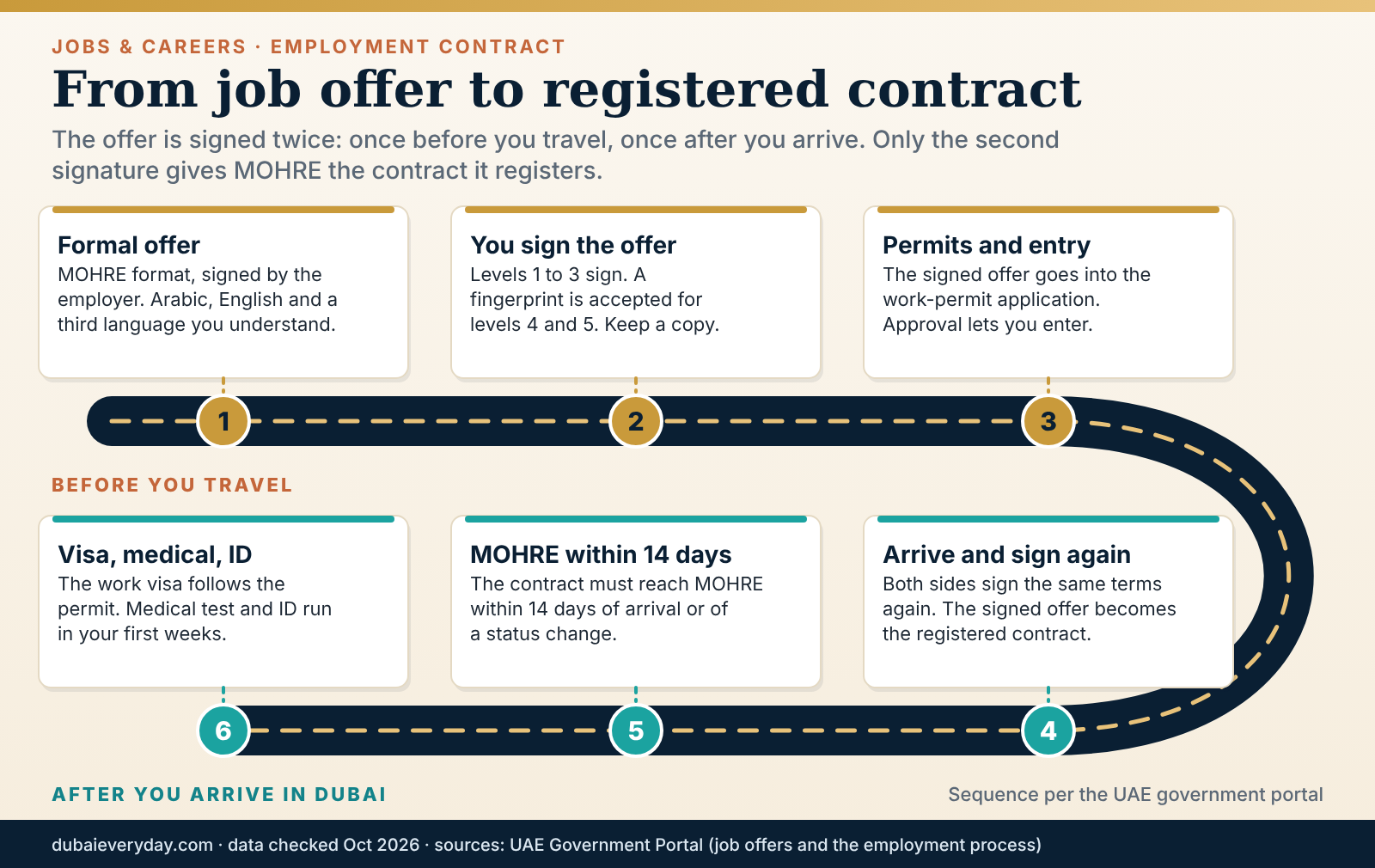
- The employer issues a formal offerThe employer signs it electronically and sends it to you directly, through a recruitment agency or through a designated entity. It must set out the rights and obligations of both sides and the terms of employment, in Arabic and English plus a third language you understand. An annex summarising labour-law provisions, available on the MOHRE website, comes with it.
- You sign the offerWorkers at professional levels 1 to 3 sign. A fingerprint is accepted for levels 4 and 5. The employer is responsible for making sure you have read and understood the offer before the contract is signed, which is a useful sentence to remember if anyone hurries you.
- The signed offer goes into the permit applicationThe signed offer is attached to the initial work permit application, and MOHRE checks that the paperwork is complete. Initial approval is what allows you to enter the UAE. For Dubai, the entry permit comes through the GDRFA system.
- You arrive and both sides sign againOn arrival, employer and worker sign the offer a second time, and it is registered with MOHRE as the legally binding employment contract Dubai law recognises. The contract has to state the start date, type of work, workplace, terms, duration and salary, and it must reach MOHRE within 14 days of your arrival.
- Visa, medical and ID followThe work visa is issued after the work permit. The fitness test, residency stamp and Emirates ID run in parallel with your first weeks; see the medical fitness test guide and the Emirates ID guide for those.
If you are already in the UAE
The same logic applies to a new employment contract Dubai employers sign with people already living in the UAE, for example when you change jobs. You sign the new offer before the employer applies for initial approval to employ you, and the contract must be submitted to MOHRE within 14 days of the status-change date. Visit or tourist visas do not give a right to work, so a Dubai employer who suggests starting before the permit is processed is asking you to take a legal risk that falls on you as well as them.
A dated example of the 14-day window
Illustrative example, with invented dates. You sign the offer on 2 March, the employer applies for the initial work permit, and approval comes through on 16 March. You land on 6 April. The second signature happens that week, and the 14-day window for the employer to submit the employment contract Dubai authorities will register closes on 20 April.
If your visa stamping, medical test or Emirates ID appointment slips, that does not move the deadline for the contract. The point of working through dates is to ask the employer, in advance, who is responsible for the submission and when you will receive your copy.
A good question to put to HR before you travel is simply: “What will I sign on arrival, and can I see the draft now?” An employer that has prepared a clean, registered form will usually be able to send a sample. One that cannot has told you something about how organised the process will be.
What an offer is worth before the contract exists
This is the uncomfortable part. One UAE lawyer, writing in a Khaleej Times legal column in August 2025, described an offer letter as an agreement but not yet an enforceable contract, and noted that if an employer withdraws before a work permit is issued, MOHRE may decline to take the complaint because no registered employment relationship exists. The same writer pointed to a civil claim in the courts as the route for provable losses. That is one practitioner’s reading, not an official position, but it matches the structure of the process.
The practical consequence is simple and does not need a law degree. Do not resign from a secure job, break a lease or book a one-way flight on the strength of a PDF alone. Wait until the work permit has been approved and you hold the entry permit, which you can verify on the issuing authority’s system. A genuine employer will understand the sequencing.
The second signature on an employment contract Dubai staff overlook
The government’s worker-rights page tells workers to expect to sign the contract after arriving, to make sure its terms match the offer signed in the home country, and to keep a copy of the signed offer. It also says that, on arrival, no clause may be replaced or amended unless three things hold: the worker’s rights are not undermined, both parties agree, and MOHRE approves.
So the check on your employment contract Dubai papers at the second signing is mechanical. Put the two documents side by side, tick every number, and ask about anything that appears in one and not the other. If a new clause shows up that you never saw, you are entitled to stop. Say you want to compare it with your offer copy, and if the answer is pressure instead of an explanation, treat that as information about the employer.
How to read a Dubai offer letter line by line
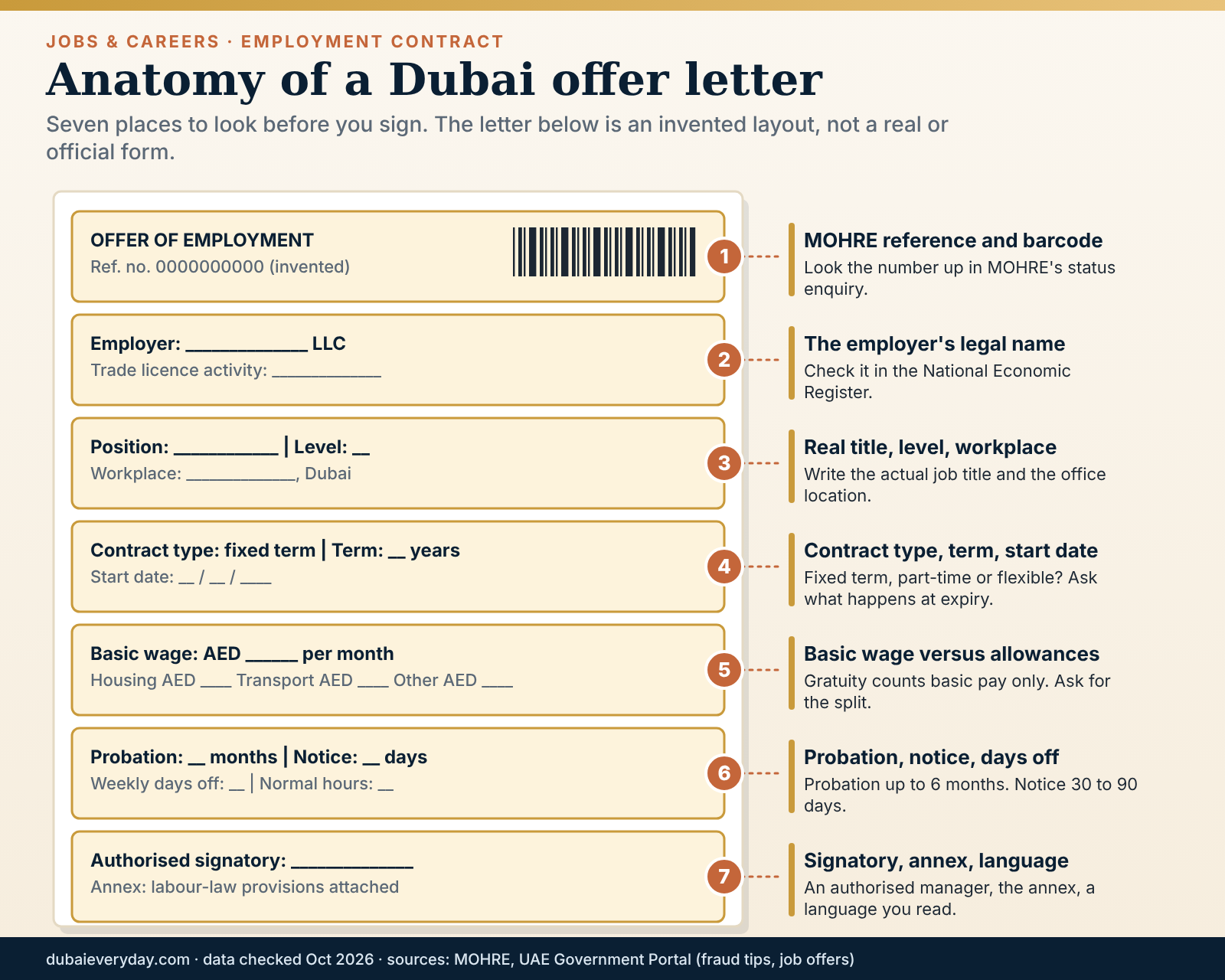
An offer letter looks official because it is formatted and stamped. That says nothing about whether it is complete. MOHRE’s own guidance names the terms it expects to see: contract type, salary, weekly days off and notice period. The sensible way to read any employment contract Dubai employers send is slowly, with that list beside you. A letter missing any of these is not necessarily fake, but it is unfinished, and unfinished is when you ask questions rather than after.
The header: who issued it and can you look it up
The government’s fraud tips say the offer should be issued through MOHRE and signed by an authorised manager, and that its reference number can be checked through the ministry’s application-status enquiry. MOHRE’s own warning from June 2025 adds that offers not on the ministry’s standard template, or lacking its barcode, cannot be verified through its channels. Treat a missing reference number the way you would treat a missing licence number on a restaurant door.
Check the employer’s name too. The same portal suggests searching the company’s English and Arabic names in the National Economic Register to confirm it is legally registered. The legal entity on the offer should match the one in the register and, later, the one on your labour card and visa.
Title, skill level and place of work
The job title is not decoration. The work permit must match the establishment’s licensed activity, and certain roles need professional licences. The skill level behind your role also decides how you sign (signature for levels 1 to 3, fingerprint accepted for 4 and 5) and shapes some exceptions to work-permit bans. If the title on paper is “Executive” and the work you were promised is “Senior Manager”, the paper is what a complaint will be measured against. Ask for the real title now.
Place of work matters because Article 12 of the Decree-Law stops an employer assigning fundamentally different work without your written consent, and makes the employer bear relocation and residence costs if different work requires you to move. A workplace written as “Dubai” gives less protection than “Business Bay office, Dubai”. Not a huge difference, but a documented one.
Pay, hours and the boring boxes
Expect a monthly figure in dirhams, usually split into a basic wage and allowances. The next section explains why that split deserves more attention than the headline. Alongside it, the offer should state weekly days off, normal hours, probation length and notice period. If your role involves shifts, travel or remote work, ask for the working pattern in writing, because “flexible” is a recognised work model that allows hours to vary with the employer’s needs.
- A MOHRE reference or barcode you can verify, and a named authorised signatory
- Legal entity name that matches the National Economic Register
- Job title, workplace and start date written out in full
- Contract type and term (fixed-term, part-time, temporary, flexible, remote)
- Basic wage and each allowance listed separately, in dirhams
- Weekly days off, normal hours, probation length and notice period
- The labour-law annex and the language versions you are able to read
Promises that belong in an attached schedule
Plenty of things people value are not set by statute: annual flights for you and family, school-fee support, housing support, relocation payments, mobile allowance, performance bonus, car or parking. None of this is wrong to ask for, and every item can sit beside your employment contract Dubai paperwork as a signed schedule.
The mistake is relying on a recruiter’s phone call or an email chain. The lawyer quoted earlier noted that a contract may add benefits for the employee and may include annexures that do not conflict with the law. So ask for a one-page benefits schedule attached to the offer, and keep it with your signed copy.
For each item, ask four questions. Who is eligible, you only or family as well? How often, and how is it taken (ticket, cash, voucher)? What happens if you resign or are dismissed within the first year? Is it guaranteed or discretionary? “Subject to company policy” is not an answer, because policies can be rewritten. Moving families will also want to cross-check school support against the Dubai schools guide and the fee reality in the KHDA ratings explainer before treating a “school allowance” as enough.
Salary in your employment contract Dubai: basic, allowances and how you get paid
The headline number in an offer is rarely the number that drives your rights. Federal law distinguishes between the basic wage and the wider wage, several entitlements hang on the first one, and the employment contract Dubai employers register has to state the wage. Reading that split correctly is probably the single most valuable skill in this whole guide.
What the Decree-Law means by basic wage
Article 1 defines the basic wage as the pay fixed in the contract for the work itself, excluding allowances and in-kind benefits. The “wage” is broader: it adds cash allowances and in-kind benefits that the contract or the law treats as part of pay, including allowances for effort, risk or cost of living, and shares of sales or profit. So a housing or transport allowance may be genuinely part of what you earn, yet it sits outside the basic wage.
The government’s wages page lists no statutory minimum salary; it points to general provisions that pay should meet a worker’s basic needs. Article 4 does require equal pay for equal work or work of equal value, which is useful if you suspect a colleague doing the same job on a different structure. Nothing else about the number is regulated. Everything else is negotiation.
Why the split changes real money
Three things in an employment contract Dubai workers sign are calculated on basic pay or on a threshold tied to it. End-of-service gratuity uses the last basic salary only; housing, transport, utilities and furniture allowances are excluded. Overtime is paid at normal hourly pay based on basic salary plus a premium. And the unemployment insurance scheme sorts you into a premium category by whether your basic salary is below AED 16,000.
The effect is easiest to see side by side. Below is an illustrative example, not a quote or market fact: two offers with the same AED 20,000 monthly package and a five-year stay. Our calculation uses the statutory 21 days of basic pay per year and a 30-day month as the divisor, a common convention. Check the final figure with MOHRE before relying on it.
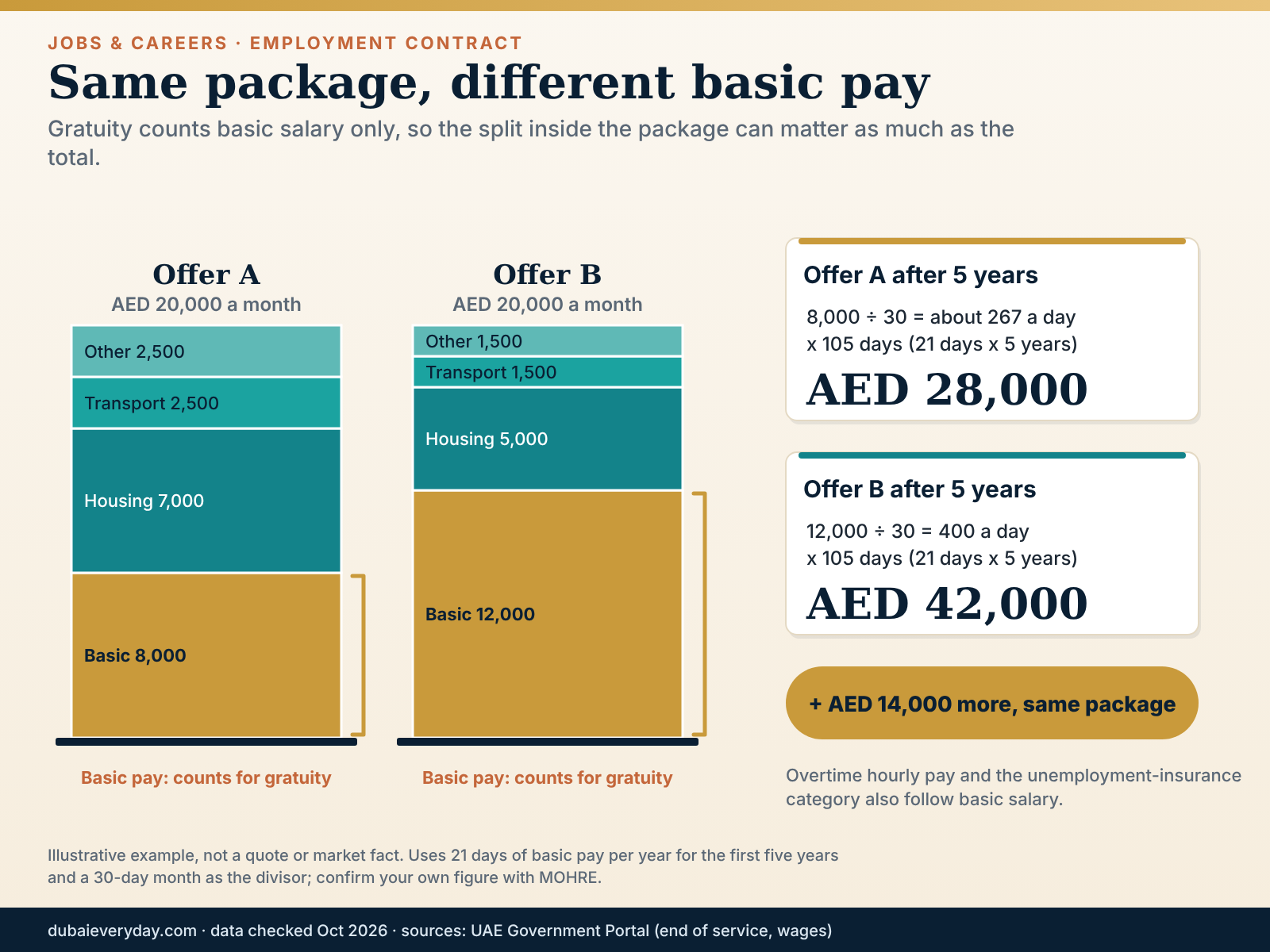
Offer A: basic AED 8,000
Daily basic is about AED 267. Five years at 21 days a year is 105 days, so gratuity is roughly AED 28,000.
Offer B: basic AED 12,000
Daily basic is AED 400. The same 105 days comes to AED 42,000. Same package, AED 14,000 more at the exit.
Offer B costs the employer more at the exit, so it will often push the other way, and that is a legitimate negotiating position on their side. What you want in the employment contract Dubai paperwork is a split that is not absurd. A basic wage that is a small fraction of the package should lead to a polite question about why, since allowances can be restructured later while basic pay is harder to cut.
Questions to settle about the number in your employment contract Dubai offer
- Which allowances are fixed by contract, and which are policy that can change?
- Are allowances paid monthly in the payslip, or in cheques or lump sums?
- Is any bonus or commission guaranteed, or discretionary, and do you have to be employed on the payout date?
- When is salary paid, and is the contract currency dirhams?
- Is there a scheduled review, and in what form is it written down?
On commission-based roles, note that the unemployment insurance scheme lets commission earners with no defined basic salary choose their premium category. That is a small detail, but it shows that commission-only structures are recognised in law and also that “no basic salary” is a status your contract should state clearly, not leave to implication.
How and when you must be paid
Wages go through the Wage Protection System via banks, exchange houses or other financial institutions authorised by the Central Bank, so that MOHRE can monitor payment. Article 22 requires payment on the due date, in dirhams unless the contract agrees another currency. A rule that took effect in 2026 fixes the due date.
MOHRE’s Ministerial Resolution 340 of 2026 took effect on 1 June 2026, replacing the 2022 framework: salary for a given month is due on the first day of the following month, and employers must pay at least 85% of the total wages due on time where lawful deductions apply. Law-firm commentary reads this as leaving employers on an arrears payroll, whose contractual payday falls before the first, free to keep that arrangement.
For you, the point is that your employment contract Dubai wording should name a payday, and that payday should not be later than the first of the following month. If it says “within 15 days of month end”, that is a conversation to have in advance.
What happens when pay is late
The government page sets out an escalation clock, counted from the due date. The details are aimed at employers, but they tell you how the system treats lateness and when you can reasonably expect it to react.
Day 1 to 2
Electronic monitoring of all establishments, then notifications and alerts to those not compliant.
Day 5
New work permits for the establishment are suspended, with a warning.
Day 11
An administrative fine, and the company can be reclassified to the third category for repeat violations within six months.
Day 16 and 21
Automatic labour-dispute registration in certain cases, then enforcement steps such as precautionary attachment, travel bans and possible prosecution referral for repeat offenders.
Do not treat that ladder as a reason to wait three weeks quietly. It describes what the authorities may do to a company, not a timetable you must sit through. If your salary is late or short, the complaint routes later in this guide apply from the first missed day.
Check your first payslip against the contract
The first payslip is the cheapest audit you will ever get. Compare the basic wage and each allowance with the figures in your employment contract Dubai paperwork, line by line. Check the payment date, the bank or exchange house the salary arrives through, and any deduction you did not expect. Keep the payslips: they are evidence of how the contract is actually being performed, and in a dispute that history often matters as much as the clause.
If something differs, ask in writing and by email, not in the corridor. Mistakes in payroll are common and usually innocent. A pattern of unexplained differences is a different matter, and Article 25 means the employer needs a lawful basis for any deduction.
Deductions: the ceiling the employer cannot cross
Article 25 lists the only deductions allowed. Several have caps worth knowing before you sign an employment contract Dubai employers have padded with a clause about “recovery of company losses”. Recovering an overpayment is capped at 20% of the wage. Disciplinary penalties under an approved penalty regulation are capped at 5%.
Repairing damage caused by your error is capped at five days’ wage per month unless a court approves more. Court-ordered debts are capped at a quarter of the wage, though alimony can go beyond that. When several deductions apply at once, the total cannot exceed 50% of the wage.
Loan repayments need your written consent, and the loan must be interest-free. In Dubai, employee health insurance premiums are the employer’s cost and may not be deducted from salary, a rule from the health insurer regulator that we return to in the next section.
If you are comparing offers and wondering what a given monthly figure will buy once you arrive, the Dubai relocation checklist shows the up-front costs that sit outside your first payslip, and that gap is a useful reason to ask whether the employer provides a relocation payment or temporary housing.
Benefits: what the law gives and what you must negotiate
A benefits list in an employment contract Dubai offer mixes three very different things. Some are legal minimums the employer cannot refuse. Some are government schemes that apply to you whether or not the offer mentions them. The rest are commercial promises that exist only if they are written down. Sorting each line into one of those buckets is how you avoid being grateful for something you already had, or relying on something you never got.
Leave: the statutory baseline
The government’s leave page sets annual leave at 30 days once you have a year of service, and two days per month between six months and one year. Unused leave can be carried over only with the employer’s consent, and untaken leave is paid out when the contract ends. Public holidays are paid, and a holiday inside your annual leave counts as part of it unless your contract or policy is more generous.
Sick leave is the one that catches people during their first months. After probation you may take up to 90 days per year, paid at full rate for the first 15, half rate for the next 30, and unpaid for the last 45, with notice to the employer within three days and a medical report. During probation, Article 31 says there is no paid sick leave, though unpaid leave can be granted with a medical report. Work injuries sit under a separate regime.
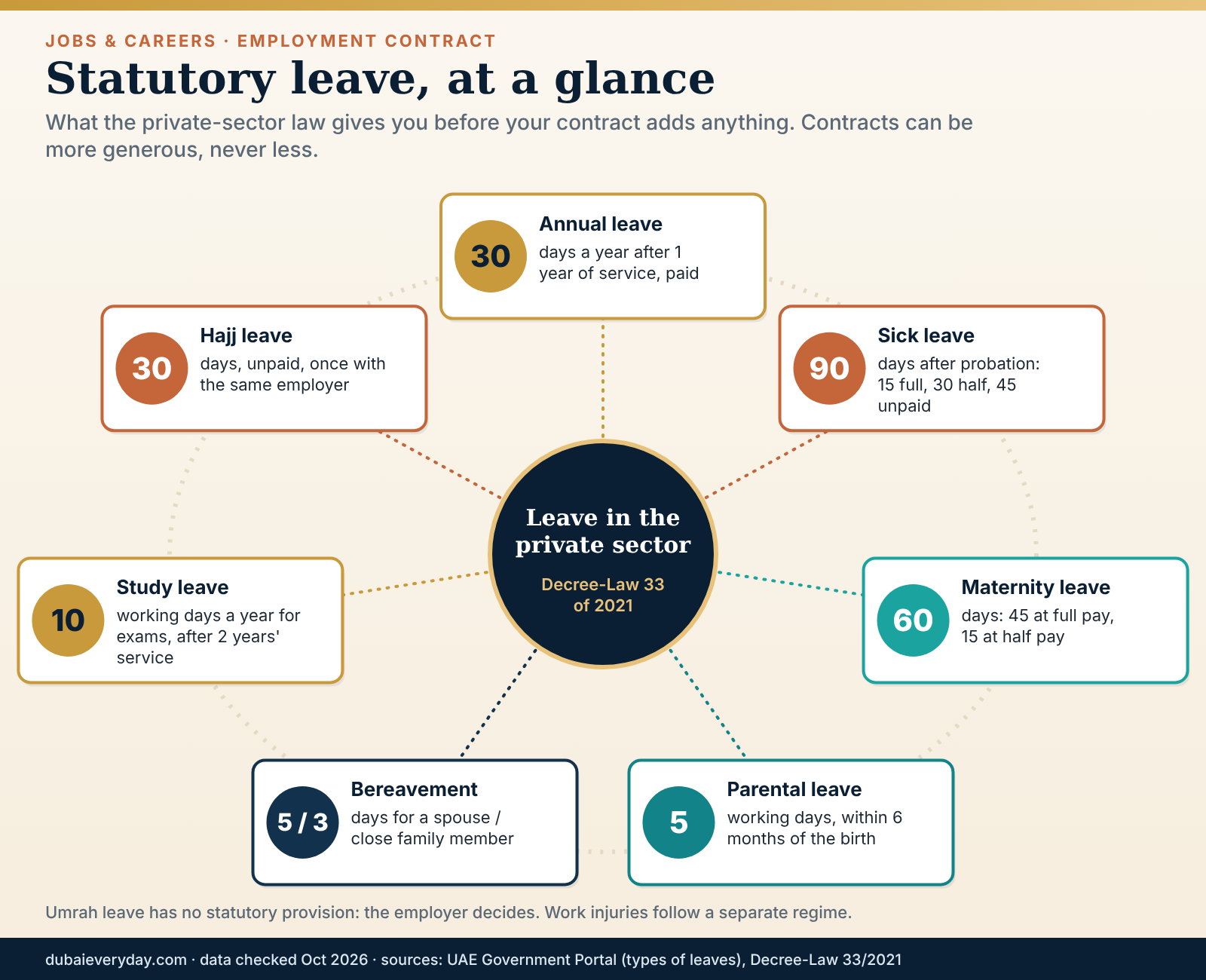
Family-related leave is narrower than many newcomers expect. Maternity leave is 60 days (45 at full pay, 15 at half pay), with up to 45 further unpaid days for illness linked to pregnancy or childbirth. Parental leave is five working days, usable up to six months after birth.
Bereavement is five days for a spouse and three days for a parent, child, sibling, grandchild or grandparent. Study leave is ten working days a year to sit exams, but only after two years of service and at an accredited UAE institution. Hajj leave is up to 30 days, unpaid, once with the same employer. Umrah has no statutory provision, so your employer decides.
Health insurance in Dubai
Dubai has its own health insurance law, Law No. 11 of 2013. The emirate’s government portal says employers must insure their employees, free-zone employers included, and sponsors must also cover dependants such as spouses, children and domestic workers. The Dubai Health Authority’s insurance unit states that employers must pay the full cost of employees’ premiums and that these must not be deducted from salary in any circumstances. The Essential Benefits Plan is the minimum cover.
The statutory floor is cover, not quality. Ask for the insurer, the network, the annual limit and the co-payments, and for whether spouse and children are included or only offered at your own cost. Keep the answers next to your employment contract Dubai papers. Family members also need residence visas sponsored by you; that process is covered in the Dubai residence visa guide.
Unemployment insurance (ILOE)
Private-sector and federal employees must subscribe to the unemployment insurance scheme created by Federal Decree-Law 13 of 2022, with exceptions such as business owners, domestic workers, temporary-contract staff and people under 18. The premium is up to AED 5 a month if your basic salary is below AED 16,000 and up to AED 10 above that. The fine for not subscribing, or not paying, is AED 400.
Compensation is 60% of the subscription salary for up to three months, capped at AED 10,000 or AED 20,000 per month depending on category. You need 12 continuous months of subscription, resignation and disciplinary dismissal are excluded, and a claim must be lodged within 30 days of the employment ending. For a new arrival, the practical reading is that it offers nothing in year one and a small safety net after that. Check at the start that the employer has enrolled you, and that your employment contract Dubai paperwork mentions it.
Gratuity and the savings alternative
Expatriate full-time workers become eligible for end-of-service gratuity after one year of continuous service. The formula is 21 days of basic salary for each of the first five years and 30 days for each year after that, capped at two years’ wages. Days of unpaid absence do not count, and a partial year after the first is paid pro rata. It is due within 14 days of the contract ending, and the employer may deduct amounts you owe.
An employer may instead use the voluntary Savings Scheme described on the same page, contributing 5.83% of monthly basic salary for service under five years and 8.33% beyond that, with the pot paid out with returns within 14 days of termination. Ask which model your employment contract Dubai offer uses, because the scheme turns a formula into a balance that depends on investment returns. Worked gratuity examples appear in the section on ending the contract.
What an employer must carry, whatever you negotiate
Article 6 bars charging workers recruitment and employment costs, directly or indirectly. The government’s rights page says the employer bears recruitment, travel and residence-permit expenses. Work-permit issuance and renewal fees range from AED 250 to AED 3,450 depending on the company’s classification, and they are the employer’s expense. Article 13 adds that the employer may not withhold your official documents, must give a free experience certificate on request at the end of the contract, and is responsible for repatriation costs, with exceptions where you have joined another employer or caused the termination.
Decision table: fixed by law or up to you
| Item | Fixed by law? | What to get in writing |
|---|---|---|
| Annual leave | Yes: 30 days after a year | Carry-over rules and how leave is booked |
| Sick pay | Yes, after probation | Nothing extra unless the employer offers more |
| Gratuity | Yes: formula on basic pay | Basic salary figure; whether a savings scheme is used |
| Health insurance | Yes: employee cover | Insurer, network, limits, family cover |
| Recruitment and permit costs | Yes: employer pays | Confirm in writing that nothing is recoverable from you |
| Return flights | Repatriation: partly | Frequency, class, who is covered, what happens if you leave early |
| Housing, school fees, relocation | No | Amount, payment method, clawback terms |
| Bonus and commission | No | Formula, guaranteed or discretionary, payout-date rule |
| Notice period | Range of 30 to 90 days | Exact length, equal for both sides |
Use the right-hand column as your editing list for any employment contract Dubai offer. Anything in it that your offer does not mention is a gap, and the cheapest moment to fill a gap is before you sign.
Probation in an employment contract Dubai employers issue
Probation is the stretch of an employment contract Dubai employers use to test fit, and it is also the period when you have the fewest protections. The rules are short and fairly strict, which makes them easy to learn and worth learning before you sign.
The rules, in one sweep
Article 9 allows a probation period of up to six months from the start date. The government portal adds that it cannot be extended for another term, and the Article says probation can be used only once per employer. If you stay on after it ends, the contract takes effect on its agreed terms and the probation months count as service.
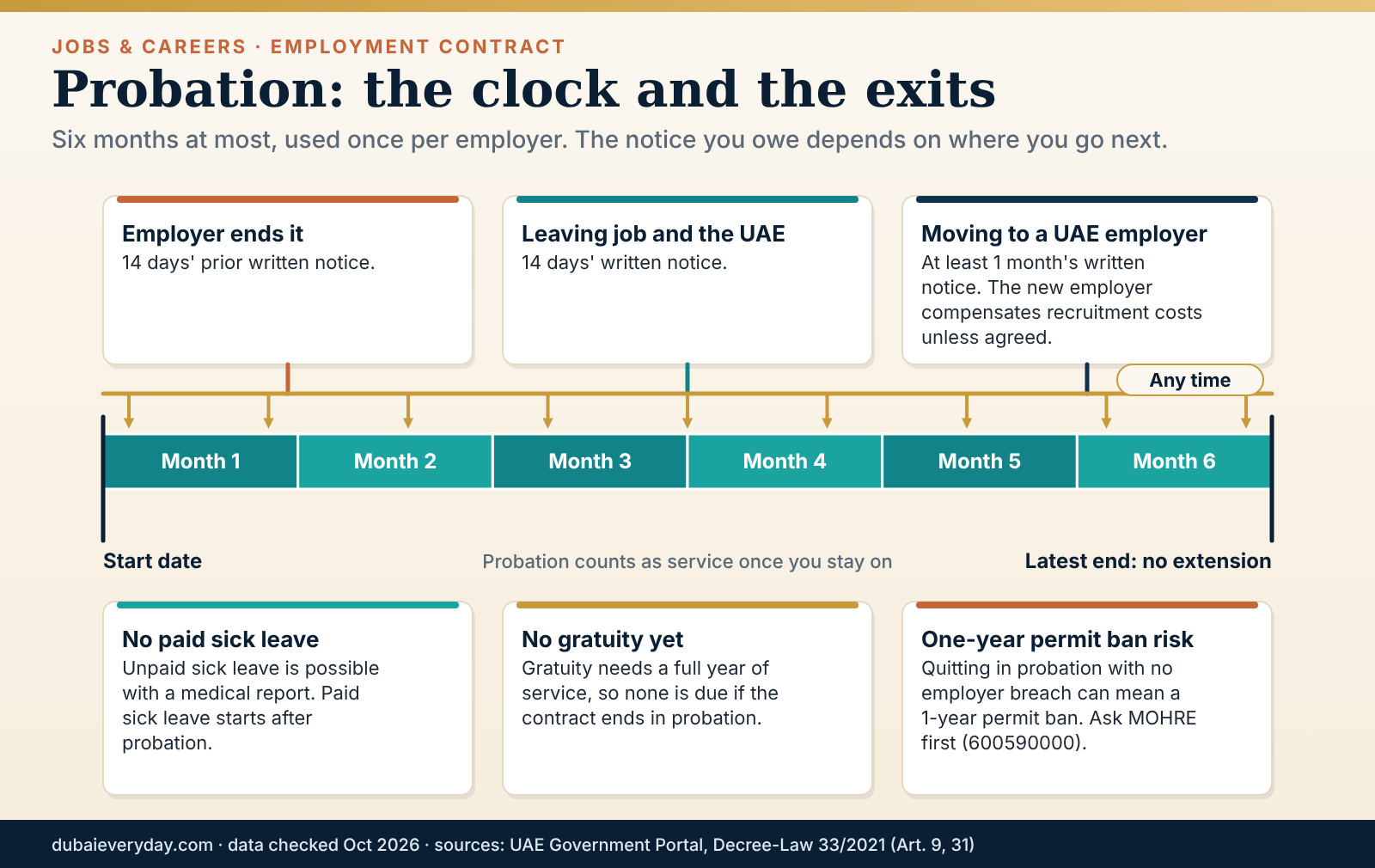
Notice depends on who leaves and where to. If the employer ends the contract during probation, it must give 14 days’ prior written notice. If you resign to leave both the job and the UAE, you give 14 days’ written notice. If you leave to join another UAE employer, you must give at least one month’s written notice, and the new employer compensates the old one for recruitment costs unless the parties agree otherwise. That compensation rule also applies if you leave the country and return within three months on a new work permit.
Ending probation in an employment contract Dubai employers issue without following these rules triggers compensation to the other side equal to the wage for the notice period, or what remains of it. This makes the usual shortcut (“I’ll just stop coming in”) an expensive one.
Two probation gaps people overlook
The first is sick pay. Article 31 says there is no paid sick leave during probation, though unpaid sick leave can be granted at the employer’s discretion with a medical report. The second is gratuity: probation counts toward service, but gratuity needs a full year anyway, so someone dismissed in month five has no end-of-service payment.
Under Ministerial Resolution 47 of 2022, a worker who terminates during probation when the employer has not breached its obligations can be barred from a new work permit for one year, counted from the date they leave the UAE. The government’s ban page lists exemptions, such as family-sponsored residents and Golden Visa holders, but they are described for work-abandonment cases.
Neither the ban page nor the termination page spells out how the ban interacts with the one-month-notice route to a new UAE employer. Before resigning in probation, ask MOHRE directly, through its call centre on 600590000 or its app, and get the answer for your exact situation.
Negotiating probation in an employment contract Dubai, as far as it is negotiable
The ceiling is fixed by law; the actual length is yours to discuss. A six-month probation for someone who arrives fully trained is a fair thing to question, and four or three months is not a strange ask. Equally useful is writing the probation end date as a calendar date rather than “six months from joining”, because it removes any later debate about when the clock started, for instance if your first day slides after arrival.
Ask for two small things in writing. One: the notice terms both ways during probation, so that the one-month rule for moving between UAE employers is not a surprise. Two: a review date, for example a conversation at week 10, so that a decision on confirmation does not arrive on day 179 with 14 days’ notice attached.
Three probation scenarios
The employer ends it in week five
Fourteen days’ written notice is owed. There is no gratuity, because you have not reached a year. Your residence status is tied to the employer, so read the work visa guide about what happens to your visa and make a plan with dates. The government page mentions a grace period after termination but gives no length, so confirm it with the immigration authority.
A better offer arrives in month three
You owe your current employer one month’s written notice, and the new employer is meant to cover recruitment costs unless agreed otherwise. Settle that cost with the new employer before you resign, and get the ban question answered by MOHRE.
You decide to leave the country
Fourteen days’ written notice applies. The ban can still be relevant if you come back on a new permit within a year, so ask first if a return is possible.
All three cases rely on dates, so keep copies of every written notice and note the day it was delivered. If a dispute later comes to MOHRE, a dated email is easier to work with than a verbal memory of a meeting.
Contract term, work models, hours and overtime
Many newcomers picture an employment contract Dubai employers issue as simply “a two-year contract”. The law is more flexible than that, and several defaults affect you when the term ends.
Fixed term, renewal and the expiry trap in an employment contract Dubai
Article 8 says a contract is for a specified term and can be renewed by agreement, with renewal periods counting toward continuous service. If the term expires and both sides keep performing without a new agreement, the contract is treated as renewed on the same terms. The old unlimited contracts had to be converted to fixed-term within a year of the new law taking effect, unless the Cabinet extended that period.
One detail is contested. The government’s job-offers page says a fixed-term contract may not exceed three years, while the contract-models page lists no maximum and a 2022 press report on the new law says the earlier cap was removed. We cannot reconcile those from the pages alone, so read the term in your own contract and ask what happens at expiry: automatic renewal, renegotiation or a new offer.
Work models you may be offered
- Full-time work for one employer, the default
- Part-time work for one or more employers for set hours or days, with permit approval for multiple employers
- Temporary work tied to a specific assignment, ending when it is completed
- Flexible work, where hours or days vary with the employer’s needs
- Remote work, in whole or in part outside the workplace
- Job sharing, with tasks divided as agreed in advance and part-time rules applying
Gratuity for part-time work is the full-time amount scaled by contracted hours against full-time hours, and temporary assignments shorter than a year have none. So a “flexible” label is not neutral. Ask what it means for your pay, your hours and your gratuity, and whether the employer is able to change your days at short notice.
Permit types that change the shape of the contract
Not every employment contract Dubai workers hold follows the standard recruit-from-abroad route. The work-permit page lists 13 permit types, and several change who you are working for and how. A permit for a resident on family sponsorship lets someone already in the country take a job. Golden Visa holders have their own permit type. A part-time permit allows work for more than one employer with approval. A freelance permit is tied to a specific task or period, and a temporary permit is for a worker returning to the original employer after an assignment.
The recruit-from-abroad and transfer permits are both valid for two years. If you are not on a standard full-time permit, ask the employer which permit type your contract sits under, because it affects exclusivity, your right to other work and what happens when the arrangement ends.
Hours, breaks and overtime
Article 17 sets normal working time at eight hours a day or 48 a week, with the Executive Regulations able to adjust that for certain sectors. In Ramadan, daily hours fall by two. After five consecutive hours you are entitled to breaks of at least one hour in total, which do not count as working time. Commuting is not working time for most workers.
Overtime is capped at two extra hours a day and paid at normal hourly pay, based on basic salary, plus 25%, rising to 50% between 10 pm and 4 am. Shift workers are excluded from the premium. If you work on an agreed day off, you receive either a substitute rest day or pay at the normal rate plus 50%. Outdoors, Ministerial Resolution 44 of 2022 prohibits work directly in the sun between 12:30 pm and 3 pm from 15 June to 15 September.
Where an employment contract Dubai employers issue says the salary is “inclusive of overtime”, ask how many hours that assumes. The statute describes overtime as extra hours beyond contracted time, with a daily cap, so a pattern of routinely longer days is worth raising with MOHRE rather than absorbing quietly. Remote work, if you request it, needs the employer to set specific working hours, which is also why a remote role should state them. Travel-heavy jobs should also say who pays, and when you are treated as working, for time on the road.
Clauses that deserve a second read
Most of an employment contract Dubai staff sign is standard, and that is the problem: standard text gets skimmed. A handful of clauses carry most of the risk, and each one is bounded by the Decree-Law, so you can read it against a known limit instead of a vague sense of unease.
Non-compete
Article 10 lets an employer restrict you from competing after the contract ends, but only if your job gives you access to client information or trade secrets. The restriction must specify time, place and type of work, be limited to what protects legitimate business interests, and cannot run longer than two years after the contract expires. It is void if the employer ends the contract in breach of the Decree-Law, and an employer cannot bring a claim for a violation more than a year after discovering it. The Implementing Regulation can exclude certain skill levels or occupations.
What does that mean when you read the non-compete in your employment contract Dubai offer? Test it against the three coordinates. “For two years, anywhere in the GCC, in any role in the industry” is wide on all three. “For 12 months, within the UAE, for direct competitors named in a schedule” is narrower and easier to live with. If a non-compete is non-negotiable for the employer, push for shorter time, a named competitor list and a requirement that the restriction falls away if you are made redundant.
Notice period
Article 43 allows either party to end the contract for a legitimate reason with written notice of between 30 and 90 days, during which the contract and the full wage continue. The period must be the same for both sides unless the variation favours the worker, and it can be reduced or waived by agreement.
An employment contract Dubai employers issue that requires 90 days from you and 30 from the employer is the thing to question. The notice period matters more than people expect when a competing offer has a start date, which is why it is worth negotiating before you sign rather than at resignation.
Duties, place and role changes
An employment contract Dubai employers draft often includes an “any other duties as assigned” line. Article 12 sets the legal limit: work fundamentally different from the contract needs your written consent, except temporarily to prevent an accident or repair damage. If the different work requires you to move, the employer pays the relocation and residence costs. Make your job title and main duties specific enough that this limit has something to measure against.
Confidentiality and company property
Article 16 requires you to keep the confidentiality of work information and not to keep documents containing work secrets without permission. A normal confidentiality clause in an employment contract Dubai employers issue simply mirrors that duty. Read for the unusual: indefinite obligations covering all information including public material, ownership claims over work you do outside hours, or a requirement to hand over personal devices. Those go beyond the statutory duty and deserve a question.
Exclusivity and a second job
A full-time permit means working for one employer only. If you want consulting income, teaching or a side business, the permit types for part-time or freelance work exist for that purpose, but they need the right approvals. An exclusivity clause in an employment contract Dubai employers issue is therefore normal for full-time roles. Ask whether it covers unpaid activities, whether you may seek written consent for specific outside work, and what the employer considers a conflict of interest.
Repayment and clawback clauses
Relocation payments, sign-on bonuses and training costs sometimes come with a promise to repay if you leave early. The Decree-Law does not make these unlawful in the provisions summarised here, but it limits deductions from pay (Article 25), and the government’s gratuity page allows the employer to deduct amounts you owe from the final settlement. So the contract is where the arithmetic gets decided. Look for the amount, the schedule on which it reduces, and the events that trigger it. A clause that triggers repayment when the employer dismisses you without cause deserves a firm “no”.
Changing an employment contract Dubai employers already registered
The employer cannot rewrite salary, job title or nature of work by memo. MOHRE said in July 2026, in a statement reported by the Arab press and relayed by LexisNexis, that contract changes must follow approved procedures through the “Amend Work Permit and Contract” service, and need the employee’s explicit written consent. Terms that conflict with the Decree-Law are void when they reduce the minimum rights, unless they are more beneficial for the worker.
A pay cut, a changed job title or a switch from monthly to hourly pay (Article 24 requires written agreement for moving a monthly-wage worker to a day, weekly, piecework or hourly category) all belong in that category. If you are asked to sign an amendment, ask for the amended text, a day to read it, and a copy of what is submitted to the ministry.
Language and which version governs
An employment contract Dubai employers register is usually produced in Arabic and English, with a third language available on request from a list of nine. As summarised from the published Decree-Law, Article 66 treats Arabic as the approved language for contracts and records and says the Arabic text prevails if the versions conflict. Ask which version is being registered, and ask for a language you read confidently, so that you are not relying on a summary from the person who wants your signature.
Free zones, DIFC and government jobs
Federal rules cover the private sector, but Dubai has pockets where a different legal framework applies to the employment contract Dubai employers there issue. The best documented is the Dubai International Financial Centre, which has its own Employment Law (DIFC Law No. 2 of 2019, in a consolidated version updated in July 2025). It applies to employers with a place of business in the DIFC and to employees based in, or ordinarily working in or from, the DIFC, or who agreed in their contract to be subject to it.
| Topic | Federal private sector | DIFC Employment Law |
|---|---|---|
| Probation | Up to 6 months, once per employer | Up to 6 months |
| Written contract | MOHRE forms; Arabic and English, signed twice | Written English contract within 7 days of starting |
| Notice | 30 to 90 days, set in contract | 7 days under 3 months; 30 days to 5 years; 90 days over 5 years (minimum) |
| Annual leave | 30 days after one year | 20 working days after 90 days of employment |
| End of service | Gratuity formula on basic pay, or savings scheme | Qualifying scheme: employer pays 5.83% of basic wage monthly for the first five years, then 8.33% |
The DIFC column comes from the published consolidated law, which we read in summary form, so confirm anything you depend on with the DIFC or a lawyer. The federal column reflects the government pages cited earlier. The practical point is that probation and notice look similar on paper, while leave, written-contract process and end-of-service money work differently, so an employment contract Dubai DIFC employers issue should not be read against federal assumptions.
Other free zones
The sources we could access today do not state, free zone by free zone, whether federal labour law applies in full. The Decree-Law text we read does not mention free zones. MOHRE’s rights page lists an online complaint service for free-zone employees, which suggests some routes run through the ministry, and the Dubai health insurance requirement expressly applies to free-zone employers. Beyond that, we leave the question open. Read the governing-law and jurisdiction lines in your employment contract Dubai free zone offer, and ask the zone authority which labour framework applies and where complaints go.
Government and domestic work
Federal and local government employees, security forces and domestic workers sit outside Decree-Law 33. Their terms come from separate human-resources legislation or, for domestic workers, Decree-Law 9 of 2022. This guide does not cover them. If you are moving for one of those jobs, rely on the employer’s own official documents, and use the moving to Dubai guide for the non-contract side of setting up.
Offer and contract scams: checks before you resign or fly
Job scams in the UAE share one feature: they ask you to move money or commit yourself before anything official exists. A genuine employment contract Dubai employers register never starts with a request for money, and the law is on your side here. Article 6 bars charging workers recruitment and employment costs, directly or indirectly, and requires a ministry licence for recruitment activity. The government’s rights page says plainly that charging recruitment fees to prospective employees is illegal.
A “visa processing fee”, “medical booking fee”, “security deposit” or “insurance charge” requested from you before you start is the standard shape of a fake offer. The employer bears recruitment, travel and residence-permit costs. If someone insists otherwise, stop and verify the offer through MOHRE before any money moves. MOHRE’s June 2025 warning also said that being told to enter the UAE on a tourist or visit visa to work is illegal and can lead to fines and legal action.
A five-minute check for any employment contract Dubai offer
- Find the offer referenceLook for the MOHRE reference number or barcode. MOHRE says offers outside its standard template, or lacking the barcode, cannot be verified. Enter the number under the ministry’s application-status enquiry on its website, or scan the barcode in its app.
- Check the company existsSearch the company’s English and Arabic names in the National Economic Register. Compare the registered name, activity and licence status with what the offer says.
- Check the entry permitAfter you sign, the employer sends an electronic entry permit. For Dubai, verify it on the GDRFA system; for other emirates, use the federal ICP e-channels. A residence visa cannot be processed from outside the UAE, so you must enter first with a valid entry permit.
- Call the ministryMOHRE’s call centre is 600590000. The Labour Claims and Advisory Call Centre toll-free number is 80084. Ask them to confirm the offer details and what is registered against your name.
- Read the offer against the templateDoes it name the contract type, salary, weekly days off and notice period? Is the signatory an authorised manager? Is the annex attached?
Signs that justify walking away
Any one of these is enough to pause. A request for money from you. A refusal to share the offer before you resign. An offer sent only by a free email address or messaging app, with no MOHRE reference. A recruiter who cannot show a ministry licence. A salary far above anything similar roles pay, combined with urgency. An instruction to arrive on a visit visa and “change status later”. A contract at arrival that looks different from the offer, with pressure to sign without comparison.
Recruiters are a normal channel and most are legitimate; the signal is in what they ask of you, not in the fact they exist. For how to use agencies without paying for placement, see the section on recruiters and scam checks in the Dubai job search guide. If you are flying in to interview, the Dubai travel guide covers arrival basics, and remember that a visit visa is for interviews, not for starting work.
Ending the contract: notice, gratuity and final pay
Exit terms are part of the employment contract Dubai employers have you sign on day one, so read them in the same spirit as the salary clause. Most of the money questions at the end come back to three numbers: how much notice, how much gratuity, and what is deducted.
Notice and what happens if it is not served
Under Article 43, notice is written, runs for 30 to 90 days and carries full wages based on your most recent salary. If either side fails to serve it, the party at fault pays the other an allowance calculated on the worker’s last wage, even if no harm resulted. The government page also says that, where the employer terminates, you are entitled to one unpaid day a week to look for a new job, chosen by you with at least three days’ notice.
Notice can also be shortened or waived by mutual agreement. Get any such deal in writing and keep it. A verbal “you can go early” from a manager is exactly the kind of promise that gets disputed later.
Dismissal and quitting without notice
Employers can dismiss without notice only in ten listed cases under Article 44, including forged documents or a false identity, serious loss caused deliberately or through error, disclosing confidential information that harms the business, being intoxicated at work, assaulting colleagues or managers, absence without a legitimate excuse for more than 20 non-consecutive days in a year or seven consecutive days, and joining another establishment without following the proper procedure. A written investigation comes first, and the dismissal notice must be written, justified and handed to the worker.
Article 45 gives you a mirror right. You may quit without notice and keep your entitlements if the employer breaches its obligations and fails to fix the breach after MOHRE notifies it (you must notify MOHRE 14 working days beforehand), if you are assaulted or harassed at work and report within five working days, if you are assigned fundamentally different tasks without written consent, or if the employer fails to remove a known grave danger to health or safety.
Dismissal can also be arbitrary. If the real reason is a valid complaint to MOHRE or a lawsuit that is proven valid, Article 47 treats it as unlawful, and the court can award compensation up to three months’ wages, in addition to gratuity, notice dues and other unpaid amounts.
Gratuity, worked through
The formula was set out earlier. The easiest way to feel it is with numbers. These are illustrative examples of an employment contract Dubai workers might sign, not quotes. They use a 30-day month for the daily rate, apply the 21-day and 30-day tiers, pro-rate part years after the first, and exclude leave payout, bonus and any deductions.
Basic AED 10,000, 3 years 4 months
63 days for three years plus 7 days for four months, so 70 days at about AED 333 a day: roughly AED 23,300.
Basic AED 15,000, 8 years
105 days for the first five years plus 90 days for years six to eight, so 195 days at AED 500: AED 97,500. The two-year wage cap is not reached.
Basic AED 6,000, 11 months
No gratuity. The one-year minimum is the cliff edge, and a few weeks of service on either side of it changes the result completely.
That last case is the reason resignation timing is worth planning. If you are close to the one-year mark, check the exact start date on your contract before you decide when to give notice, since days of unpaid absence do not count toward service.
Notice shortfall, worked through
Illustrative example: you serve notice of 60 days, but leave after 20 days by agreement that was never written down. The employer later claims 40 unserved days. On a simple 30-day month and a last wage of AED 18,000, 40 days comes to about AED 24,000 (40 ÷ 30 × 18,000). That is a large sum to owe over an unwritten understanding, and it can come out of the final settlement, which is why a written waiver matters.
The final settlement and the exit documents
When an employment contract Dubai staff signed comes to an end, outstanding wages, other entitlements and gratuity are due within 14 days. Untaken annual leave is paid out. The employer must hand over a free experience certificate on request, with nothing in it that harms your prospects, and must not hold your passport or other official documents. Repatriation costs are the employer’s responsibility, with exceptions where you have joined another employer or caused the end of the contract.
Moving to the next job without a ban
The ban we met in the probation section also applies outside probation: a proven work-abandonment report, filed after an employer’s labour complaint, can lead to the same one-year work-permit ban, subject to listed exemptions. So when you want to leave, leave through notice and paperwork, not by disappearing.
Cabinet Resolution 1 of 2022 (Article 27) allows you to work for a new employer after your term expired without renewal, after you terminated under Articles 42 or 45, or after the employer terminated without your fault. Your residency status and the grace period that follows are explained in the Dubai residence visa guide.
When the contract is broken: complaints and claims
If your employment contract Dubai terms are broken, whether pay is late, terms were changed without your consent or you were dismissed in a way you think is unlawful, the government’s labour-dispute process starts with MOHRE, not with a court.
You can complain through the ministry’s website or app or by phone (600590000, or the toll-free labour claims line on 80084). MOHRE first tries to settle the matter between you and the employer, with a stated target of 14 days from the application. If that fails, it refers the case to the competent court with a memo, and the court sets a hearing within a few days.
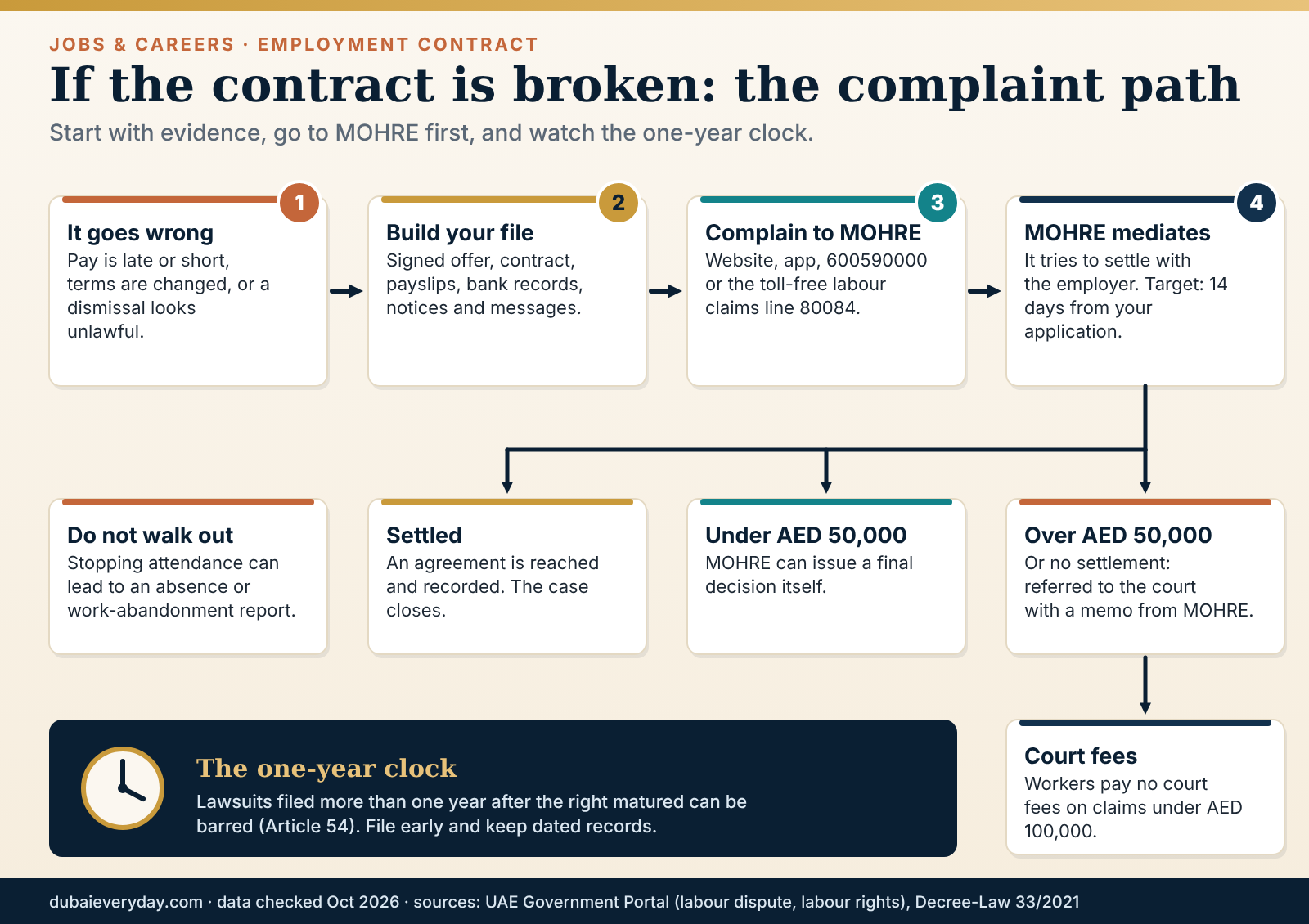
Two thresholds shape what happens next. For claims under AED 50,000, MOHRE can issue a final decision itself, or for any amount if the parties settle amicably; larger claims go to the court. Workers are exempt from court fees on claims under AED 100,000. Time also matters: Article 54 bars lawsuits filed more than one year after the right matured, so a complaint that sits in a drawer can expire.
Build the file behind your employment contract Dubai claim before you need it
- The signed offer and the registered contract, both languages if you have them
- Payslips, bank statements and any WPS transfer records
- Written notices, resignation or dismissal letters with delivery dates
- Emails or messages that confirm an agreement about pay, leave or benefits
- Your attendance and leave records, and any medical certificate you submitted
The principle of proof helps you here: Article 8 says a worker can prove the contract, the wage and their rights by any means of proof. That does not mean a screenshot beats a signed contract, but it means a pattern of consistent messages and payments counts.
A signing checklist and negotiation order for an employment contract Dubai offer
Negotiating an employment contract Dubai employers draft goes better when it follows an order, because some asks change everything else and some are cosmetic. This sequence is our reading of the constraints in the law, not an official procedure.
- Verify firstConfirm the MOHRE reference, the company in the National Economic Register and that no fee has been requested. Nothing else matters if the offer is not real.
- Fix the structureTitle, workplace, contract term, basic share of the package, probation length and notice period. These are the terms that are hard to change after signing and that determine your legal rights.
- Negotiate the moneyTotal package, payday, bonus mechanics and review date, now that the structure is clear enough to compare offers fairly.
- Attach the benefits scheduleFlights, housing, school support, relocation and any repayment terms, written on a page that refers to the offer.
- Trim the restrictive clausesNon-compete scope, repayment schedules and any unusual confidentiality or ownership terms.
- Confirm timing before you resignDo not leave your current job until the permit and entry permit are in hand, and plan your notice dates around your gratuity anniversary if it is close.
The pre-signing checklist
- Offer reference verified through MOHRE channels
- Job title, duties, workplace and start date written specifically
- Basic wage and every allowance listed in dirhams, with payday
- Probation length, with an end date and a review point
- Notice period, equal for both sides unless in your favour
- Annual leave and sick leave at or above the statutory baseline
- Health insurance details, including who is covered
- Benefits schedule attached, with eligibility and clawback terms
- Non-compete limited by time, place and type of work
- A language version you have read and a copy of everything you signed
Where you will work also shapes where you will live and how long you will spend getting there. If the office is in or near a central district, the Downtown Dubai area guide shows what that neighbourhood is like day to day; for the full sequence of arrival tasks, the relocation checklist is the companion page to this one.
Employment contract Dubai mistakes that cost people money
- Resigning from a stable job on the strength of an unverified PDF, before the work permit and entry permit exist.
- Comparing offers on the headline figure instead of the basic wage, which drives gratuity, overtime pay and some insurance categories.
- Treating a recruiter’s phone call, an email or a chat message as part of the contract when none of it is in the offer or schedule.
- Paying any “processing” fee to anyone before you start.
- Resigning in probation without asking MOHRE about notice and the one-year ban.
- Stopping attendance instead of serving notice, which can lead to an absence or work-abandonment report.
- Leaving a month or two before the one-year mark that unlocks gratuity.
- Signing the second, post-arrival document without comparing it against the offer copy.
- Assuming that a free-zone or DIFC employer follows federal rules in every respect, or the other way round.
- Not keeping a personal copy of the signed offer, the registered contract, payslips and notices.
None of these employment contract Dubai mistakes requires a lawyer to avoid. They require a habit: slow down at the two moments the process gives you, before signing the offer and before signing again on arrival, and treat every spoken promise as unfinished until it is written.
Employment contract Dubai FAQ
What is the difference between an offer letter and an employment contract in Dubai?
The offer letter is the first document of an employment contract Dubai process: a formal MOHRE-format offer that you and the employer sign before the work permit is issued. The employment contract is the same terms signed again after you arrive and registered with MOHRE, which the ministry treats as the legally binding contract. The contract must be based on the offer, and the employer cannot replace its provisions unless you consent and the change is lawful.
Is a job offer letter legally binding in Dubai?
Not in the same way as the registered employment contract Dubai authorities hold on file. One UAE lawyer writing in a Khaleej Times legal column described an offer as an agreement but not yet an enforceable contract, adding that MOHRE may not accept a complaint if an offer is withdrawn before a permit is issued. The practical advice is not to resign or relocate until the work permit and entry permit are approved. This is general information, not legal advice for your case.
How long can probation last in Dubai?
An employment contract Dubai employers issue may include probation of up to six months from the start date, and it cannot be extended for another term. It can be used only once per employer, and if you stay on afterwards the probation months count as service. During probation, the employer must give 14 days’ prior written notice to end the contract, and you owe notice too, with the length depending on whether you are moving to another UAE employer or leaving the country.
Can I resign during probation in Dubai?
Yes, with written notice under an employment contract Dubai employers register: 14 days if you leave both the job and the UAE, and at least one month if you move to another UAE employer, in which case the new employer compensates the old one for recruitment costs unless agreed otherwise. A one-year work-permit ban can apply if you terminate in probation when the employer has not breached its obligations, so ask MOHRE about your situation before you resign.
What is the notice period in a Dubai employment contract?
In an employment contract Dubai employers issue, the statutory range for notice is 30 to 90 days, in writing, with full wages during the period. It should be the same for both parties unless the variation favours the worker, and mutual agreement can shorten or waive it. If notice is not served, the party at fault pays the other an allowance calculated on the worker’s last wage. Check the exact length in your contract, since the law leaves the figure within that range to the parties.
How is end-of-service gratuity calculated in Dubai?
Under an employment contract Dubai expatriates sign, a full-time worker with at least one year of continuous service receives 21 days of basic salary for each of the first five years and 30 days for each year after that, capped at two years’ wages. Allowances are excluded, partial years after the first are pro-rated, and payment is due within 14 days of the contract ending. Some employers use a voluntary savings scheme instead. See the worked examples in the section on ending the contract.
Is there a minimum salary in Dubai?
The government’s wages page lists no statutory minimum salary for the private sector, so an employment contract Dubai employers draft is not tested against a legal salary floor. It refers to general provisions that wages should meet the worker’s basic needs. Equal pay for equal work or work of equal value is required by Article 4. Individual visa categories and company programmes may have their own salary thresholds, which are outside the scope of this page; check the specific scheme that applies to you.
Can my employer change my salary or job title after I sign?
An employment contract Dubai employers have registered can be changed only through approved procedures and with your explicit written consent. MOHRE stated in July 2026 that employers cannot change terms such as salary, job title or nature of work outside those procedures, which run through its “Amend Work Permit and Contract” service. Terms that reduce your minimum legal rights are void unless they benefit you. Do not sign an amendment you have not read and received a copy of.
Do I have to pay for my visa, medical or recruitment in Dubai?
No. For any employment contract Dubai employers register, Article 6 bars employers from charging workers recruitment and employment costs, directly or indirectly, and the government’s rights page says the employer bears recruitment, travel and residence-permit expenses. Anyone asking you for a fee before you start is a scam signal. Costs such as your own flights for a personal move or a family member’s visa are different, and are a matter for negotiation in the benefits schedule.
How do I verify a Dubai job offer?
Before accepting any employment contract Dubai employers send, check that the offer is on the MOHRE template with a barcode or reference number, then look it up through the ministry’s application-status enquiry or app. Search the company in the National Economic Register, verify your entry permit on the GDRFA system for Dubai, and call MOHRE on 600590000 if anything looks off. A visit or tourist visa does not give a right to work, so never start on one.
Does my employer have to pay for health insurance in Dubai?
Yes, for employees. Dubai Law No. 11 of 2013 requires employers, including those in free zones, to insure their employees, and the Dubai Health Authority’s insurance unit says the employer must pay the full premium and may not deduct it from salary. Sponsors must also ensure dependants have valid cover, though the employer is only encouraged, not required, to pay for it. Ask which insurer, network and limits apply.
What language will my Dubai employment contract be in?
An employment contract Dubai employers register is usually in Arabic and English, and a third language you understand can be added from a list of nine, including Hindi, Urdu, Tamil and Bengali. As summarised from the Decree-Law, Arabic is the approved language and prevails in a conflict, so ask which version is registered. If you cannot read it confidently, request your language before you sign, not after.
What can I do if my salary is paid late?
For an employment contract Dubai employers register, salary for a month has been due on the first day of the following month since 1 June 2026, and employers face escalating consequences from the second day of delay. You can complain to MOHRE through its website, app or phone lines, keeping your payslips, bank statements and contract. For claims under AED 50,000, the ministry can issue a final decision; larger ones go to the court, with fee exemption for claims under AED 100,000.
Related reading
Sources and further reading (23 links)
- UAE Government Portal: Job offers and the employment process — offer, signing, registration and 14-day rules
- UAE Government Portal: Employment contracts, duration and models — probation, term, work models, non-compete
- UAE Government Portal: Payment of salaries and wages — WPS, due date, 85% threshold, escalation
- UAE Government Portal: Terminating employment contracts and arbitrary dismissal — notice, Articles 43 to 47, work-permit ban
- UAE Government Portal: End of service benefits — gratuity formula, cap, savings scheme
- UAE Government Portal: Types of leaves — annual, sick, maternity, parental, bereavement, study, Hajj
- UAE Government Portal: Working hours and overtime — hours, overtime rates, midday break
- UAE Government Portal: Protection of workers’ rights — recruitment fees, passports, contact lines, fee exemption
- UAE Government Portal: Banning the issuance of a new work permit for one year — ban cases and exemptions
- UAE Government Portal: Work permits — permit types and employer fees
- UAE Government Portal: Tips to avoid labour and visa fraud — verification channels and fraud tips
- UAE Government Portal: Unemployment insurance scheme — premiums, fines, compensation, eligibility
- UAE Government Portal: Employment laws and regulations in the private sector — legal basis and exclusions
- UAE Government Portal: Resolving labour disputes — complaint steps and thresholds
- MOHRE: Federal Decree-Law No. 33 of 2021 and its amendments (PDF) — Articles 1, 4, 6, 8, 9, 10, 12, 13, 16, 22, 25, 31, 65, 66
- Dubai Health Authority insurance unit: Frequently asked questions — employer obligations under Dubai health insurance law
- Dubai.ae: Health insurance — mandatory cover and sponsor duties
- DIFC: Employment Law, DIFC Law No. 2 of 2019 (consolidated version) — scope, probation, notice, leave, qualifying scheme
- Clyde & Co: UAE introduces stricter wage protection system enforcement framework — law-firm commentary on Resolution 340 of 2026
- Gulf News: UAE ministry issues warning against fake job offers — newspaper report of MOHRE’s warning, template and barcode
- Khaleej Times: Can employers cancel job offers — one lawyer’s view on offer letters, context only
- LexisNexis Middle East: UAE ministry clarifies rules on employment contract amendments — MOHRE statement on amendments, secondary report
- Arabian Business: UAE employment law three-year limit scrapped — press report on fixed-term cap, context only
Update log: 29 October 2026, first publication; all facts re-checked against the sources above. Next review due: 29 January 2027, or sooner after any change to the labour law, wage rules or MOHRE procedures. Corrections welcome.
General information only, not legal advice. For a specific dispute, an unusual clause or a free-zone question, contact MOHRE or a licensed UAE lawyer.
About DubaiEveryday and this guide
DubaiEveryday.com is an independent editorial project that publishes practical, research-based guides to everyday life in Dubai: where to live, what things cost, how the rules work and how to get around. This page was written and edited by the DubaiEveryday editorial team. It is not signed by a named expert, doctor, lawyer or adviser, and we do not claim first-hand testing of a venue, clinic or service unless the page says so.
Each guide is built from official sources such as government and regulator pages, operator websites and established news outlets, cross-checked where we can. When we could not confirm something, we say so in the text, and examples that use made-up numbers are labelled as illustrations. Mentions are editorial choices, not paid placements, and a link is not an endorsement.
Dubai changes quickly. If you spot something that is out of date or wrong, please tell us through the contact options on DubaiEveryday.com and we will check it and correct the page.