

Under the eviction rules Dubai enforces, a landlord can end a tenancy only on a short list of legal grounds, and for the ones people worry about most (sale, moving in, rebuilding) the notice is 12 months, not 30 days. Here is each ground, the paperwork it needs and the route to the Rental Disputes Center if the tenant does not leave.
A message that says “please vacate the flat” is enough to ruin an evening. Tenants picture a move they cannot afford, and landlords picture the keys coming back by the end of the month. Both skip the same question: does the law give the landlord a reason at all? Under the eviction rules Dubai applies to leases, a tenancy can end only on a short list of grounds, and “I would rather have a different tenant” is not one of them.
This guide walks through the thirteen grounds, the 12-month notice that applies to sale, moving in, rebuilding and maintenance, and the Rental Disputes Center route if the tenant stays. You will see which notices carry legal weight, what a filing costs in dirhams and where landlords and tenants most often trip. It is a research-based map of the official sources, not legal advice, and it says plainly where we could not confirm a point.
The eviction rules Dubai applies to leases are narrower than most landlords and tenants assume: a landlord cannot end a tenancy just because they want the flat back or can charge more rent. Law No. 26 of 2007, as amended by Law No. 33 of 2008, gives a closed list of grounds.
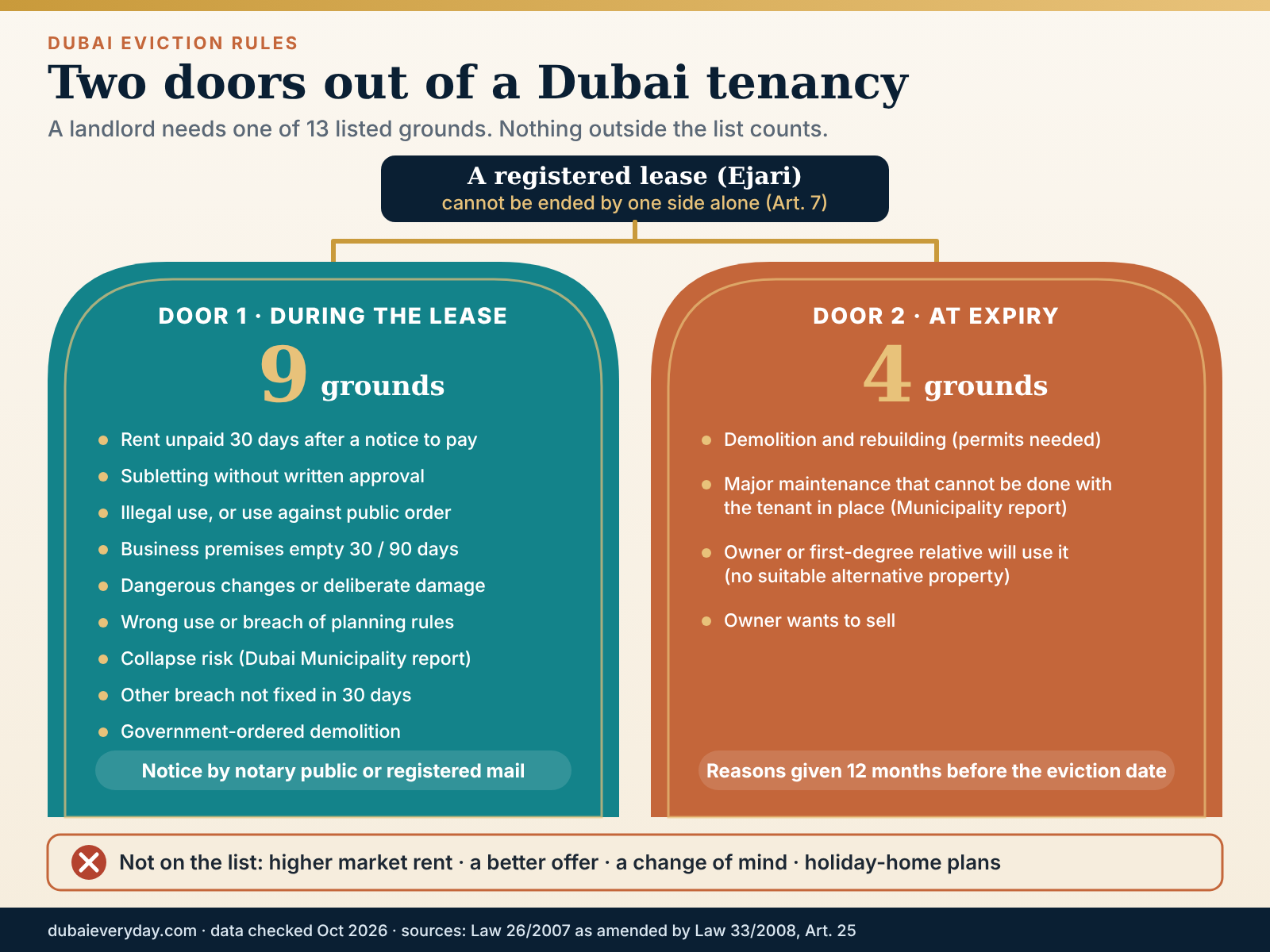
Nine apply during the lease, such as rent still unpaid 30 days after a notice, subletting without written consent, illegal use, serious damage or a building at risk of collapse. Four apply only at expiry: demolition or rebuilding, major maintenance, the owner’s own use (or a first-degree relative’s) and sale. For those four the landlord must give reasons at least 12 months before the eviction date, by notary public or registered mail.
If the tenant stays, the landlord must file at the Rental Disputes Center. Lock changes, removing belongings and cutting power are not lawful shortcuts. Tenants should keep paying rent while a case runs, check that the ground and the delivery method match the law, and keep every document. Below are the eviction rules Dubai courts apply, ground by ground, with the notice clock, the filing route, worked sums and six scenarios.
This is a desk-research guide, not legal advice, and no lawyer has reviewed it. We read the consolidated text of Law No. 26 of 2007 and the amending Law No. 33 of 2008 on the Dubai Legislation Portal, the Dubai Land Department (DLD) tenancy guide, and the Rental Disputes Center (RDC) pages for filing, amicable settlement, writs of payment and FAQs on 29 October 2026. We also read RDC and DLD case reports and two press explainers, which we use for context only.
We did not field-test any process, file any case or speak to the RDC. Fees and procedures move; the figures below are what the official pages showed on the day. Inclusion of any organisation is not paid for. Where we could not confirm something, we say so in the text.
Eviction rules Dubai in one page: who can end a tenancy, and when
A registered Dubai lease is hard to end from the landlord’s side. The law says a valid lease cannot be terminated unilaterally during its term; only agreement between the parties or one of the grounds in the law can do it. That sentence (Article 7 of the 2007 law) is the foundation of the eviction rules Dubai uses.
The grounds themselves sit in Article 25, as replaced in 2008. There are nine for the middle of a lease and four for its end. Anything outside the list, including a better offer from a new tenant, a higher market rent or a landlord who simply changed their mind, is not a legal reason to remove someone.
Eviction rules Dubai: what this page covers and what it leaves out
This page has one job: how a landlord can lawfully end a tenancy and what a tenant can do about it. Repairs, deposits and rent increases sit in our guide to tenant rights in Dubai. The owner’s wider paperwork is in landlord rights in Dubai, and general case-building is in rental disputes in Dubai. Here we go deep on grounds, notices and the eviction case itself.
Eviction rules Dubai at a glance: the thirteen grounds
Use this as a decision table. Find the situation, then read the matching section for what the landlord must prove and what the tenant should check.
| Ground | When it applies | Clock and notice |
|---|---|---|
| Rent unpaid | During the lease | Eviction can be sought if rent stays unpaid 30 days after a notice to pay (unless the contract says otherwise) |
| Subletting without written approval | During the lease | Notary or registered mail; the subtenant is evicted too |
| Illegal use, or use against public order or morals | During the lease | Notary or registered mail |
| Business premises left empty | During the lease | 30 consecutive days, or 90 days in a year, without a valid reason |
| Dangerous alterations or deliberate or grossly negligent damage | During the lease | Notary or registered mail |
| Use other than the lease purpose, or against planning rules | During the lease | Notary or registered mail |
| Building likely to collapse | During the lease | Needs a Dubai Municipality technical report |
| Other breach of the contract or law | During the lease | 30 days to fix after a notice |
| Government-ordered demolition and rebuilding | During the lease | Decision by the competent authority; notary or registered mail |
| Owner demolishes and rebuilds, or adds structures that block use | At expiry | 12 months’ notice; permits needed |
| Restoration or major maintenance that cannot be done with the tenant in place | At expiry | 12 months’ notice; Dubai Municipality report |
| Owner or first-degree relative will live or operate there | At expiry | 12 months’ notice; owner must show no suitable alternative property |
| Owner wants to sell | At expiry | 12 months’ notice, reasons stated |
The table compresses the eviction rules Dubai law sets out, so treat the wording of Article 25 itself as the authority. Section 4 takes the nine mid-term grounds one by one; section 5 handles the four expiry grounds, where most of the disputes and most of the money sit.
The laws and documents behind the eviction rules Dubai uses
Dubai’s landlord and tenant relationship is governed by Law No. 26 of 2007, amended by Law No. 33 of 2008. Law 33 was issued on 1 December 2008 and replaced eleven articles of the original: 2, 3, 4, 9, 13, 14, 15, 25, 26, 29 and 36. The eviction grounds, the 12-month notice and the re-letting bar all live in the replaced text, so anyone reading the 2007 version alone will misstate the eviction rules Dubai now applies.
Disputes go to the Rental Disputes Center, set up in 2013 as the judicial arm of the Dubai Land Department. The DLD describes it as handling rental disputes between landlords and tenants for property in Dubai and its free zones, including counter-claims, urgent requests, appeals and enforcement of its own rulings. Every eviction claim in the emirate ends up there if the parties do not settle.
Six articles that carry the eviction rules Dubai relies on most
Article 7: no unilateral exit
A valid lease cannot be ended by one party during its term. The only exits are agreement or a ground the law provides.
Article 25: the closed list
Nine grounds during the term, four at expiry. The expiry grounds need reasons given 12 months before the eviction date.
Article 26: the re-letting bar
After a personal-use recovery the owner cannot re-let to a third party for 2 years (residential) or 3 years (non-residential), or the tenant may seek compensation.
Article 28: sale does not end a lease
A change of owner does not cut short a fixed-term lease signed with the previous owner.
Article 31: rent keeps running
Filing an eviction claim does not stop rent accruing until the award is issued and enforced.
Article 34: no cut-offs
A landlord may not cut services or otherwise disturb the tenant. The tenant can file a police report or claim damages.
Two more articles matter at the edges. Article 29 gives a tenant a right of first refusal to return after demolition and rebuilding, or after renovation, with rent set by the Article 9 criteria; the tenant has 30 days from the landlord’s notification to use it. Article 35 says vacating awards are enforced through the tribunal itself, while other awards go to the Dubai Courts execution section.
Ejari, the contract and why registration matters
Article 4 requires every lease, and any amendment, to be registered with RERA, the DLD’s regulator. The DLD tenancy guide spells out the consequence: courts and government bodies will not consider disputes over an unregistered contract. In practice the RDC filing page asks for a copy of the latest lease with Ejari, so a landlord who never registered the contract has a problem before the first hearing.
For tenants, the Ejari certificate is also the starting evidence of the term, the rent and the permitted use. Our guide to Dubai legal basics for residents shows where tenancy sits among the other rules you will meet.
Traps in older material
Some official pages still carry earlier numbers. An older DLD article on the RDC speaks of 90 days’ notice and “12 situations” for eviction. The original 2007 Article 25 did set 90 days before expiry, and the original Article 26 a one-year re-letting bar; both were replaced in 2008. Every figure in this guide to the eviction rules Dubai uses comes from the amended text.
The DLD tenancy guide prints both versions, with the 2008 wording marked as the amendment. When you compare against a broker’s blog, check which version of Article 25 it quotes.
What the statute does not say
Three gaps in the eviction rules Dubai statute are worth knowing before you plan around them. We found no statutory relocation payment for a tenant evicted at expiry for sale, rebuilding or maintenance. The text we read lists no specific documents a landlord must attach to prove an intent to sell. And it does not define “first-degree relative” in the sections we read. Each is a question for a lawyer who has the contract and the notice in front of them.
Valid notice under the eviction rules Dubai enforces: channel, content and the 12-month clock
Most failed evictions fail on paper, not principle, because the eviction rules Dubai courts enforce are strict about form. The landlord had a real reason, but the notice went by the wrong channel, said the wrong thing or started the clock too late. So it is worth understanding exactly what the law asks for.
Which channels count
Article 25 says the notice must be served through a notary public or by registered mail. The general definition of “notice” in Article 2, as replaced in 2008, is wider: a written notification sent through a notary, by registered mail, by hand or by another technological means the law approves. Our reading is that for an eviction notice the specific rule in Article 25 controls, and the two channels named there are the safe ones.
The RDC filing page supports that reading in practice. For eviction claims it lists the required evidence as a notarised notice with the notification officer’s report, or a registered-post receipt with the notice acknowledgement. An email, a WhatsApp message or a letter pushed under the door is not on that list, however clear its wording.
What the notice should say
For the four expiry grounds, the law says the landlord must give the reasons. A notice that says only “please vacate” is weaker than one that names the ground, identifies the property and contract, states the eviction date and attaches or references the supporting evidence, such as the permit for demolition or the sale intention. The exact form is not prescribed in the sources we read, so lawyers tend to draft notices to track Article 25 closely.
- The correct names of owner and tenant as they appear on the Ejari contract
- The property address, unit number and contract number
- The specific Article 25 ground relied on, in plain words
- The date by which the property must be vacated
- Proof of delivery: the notary’s report or the registered-mail acknowledgement
The two clocks people confuse
Article 14 deals with changing the terms of a renewal, rent included. A party wanting to amend must tell the other at least 90 days before the lease expires, unless the parties agreed otherwise. That is a renewal-negotiation window. It is not a ground for eviction and it does not let a landlord end a tenancy on 90 days’ notice.
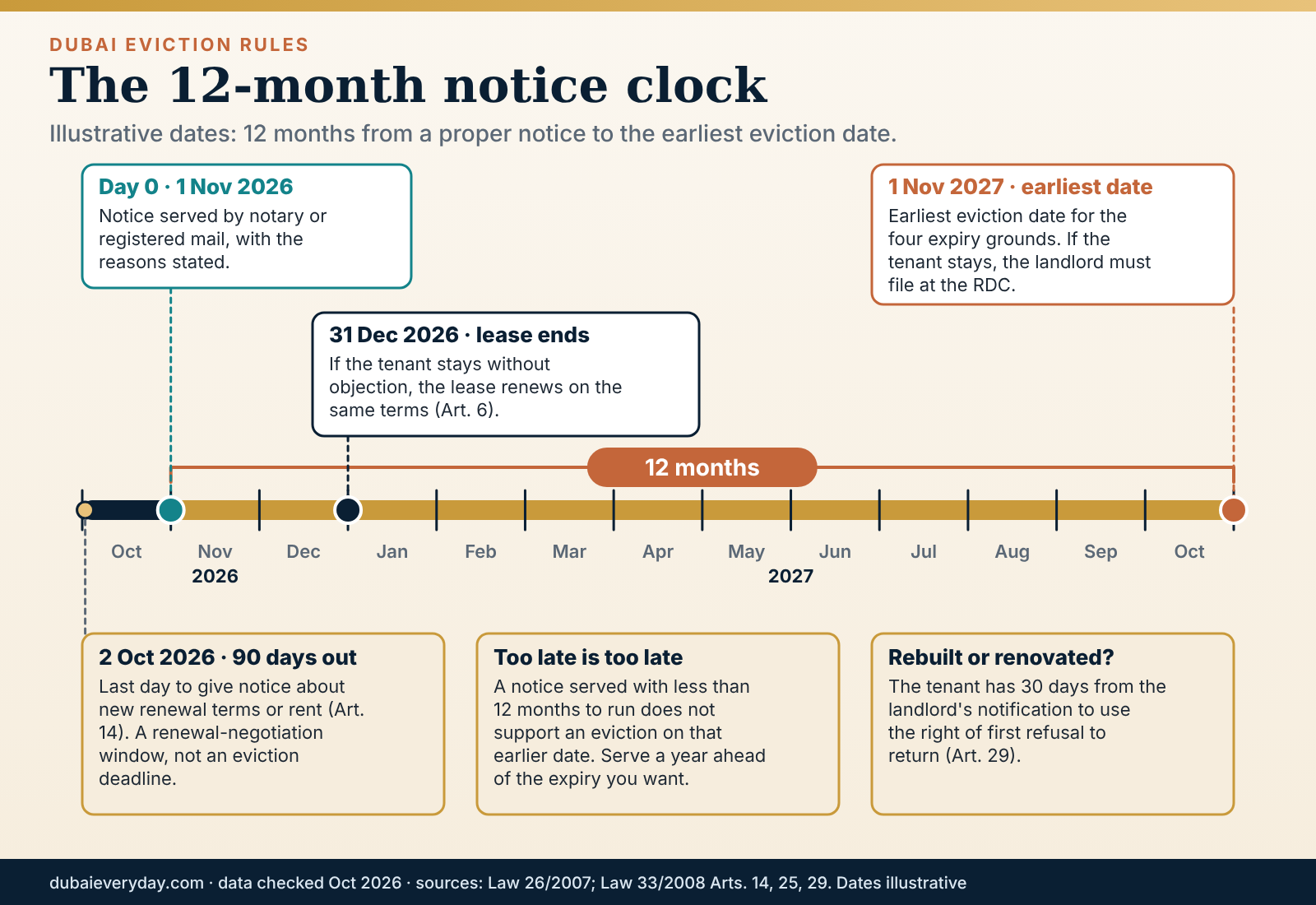
The 12-month clock is the part of the eviction rules Dubai landlords most often get wrong. It belongs to Article 25 and runs from the notice to the eviction date. A landlord who wants a sale, personal-use, rebuilding or maintenance eviction at the end of the current term needs to serve the notice at least a year ahead of that expiry date. Older pages that mention 90 days for these grounds are quoting the pre-2008 article.
A worked example of the date arithmetic
Illustrative example (not a real case): a lease runs from 1 January to 31 December 2026 and the owner serves a sale notice by notary on 1 November 2026. Twelve months after service is 1 November 2027. Because the lease would renew on the same terms for the shorter of the original term or one year if the tenant stays on without objection (Article 6), the tenant could be in a renewed term through 2027.
Our reading is that an eviction date earlier than 1 November 2027 would not satisfy the statute, and that the sensible landlord approach is to serve a year ahead of the expiry they care about. We found no official worked example on this point. Where the dates are tight, ask a lawyer how the notice interacts with the renewed term before relying on either side’s calculation.
Eviction during the lease: the nine grounds, one by one
Under the eviction rules Dubai applies mid-term, ending a tenancy is the exception. Article 25(1) lets a landlord seek eviction before the lease ends only on the listed grounds, and the closing line of that paragraph says the notice must go through a notary public or by registered mail. Most real cases fall into the first two or three grounds below.
Eviction rules Dubai for unpaid rent: the 30-day clock
The first ground is rent not paid within 30 days of a notice to pay, unless the parties agreed otherwise in the contract. Read that carefully. The 30 days run from the tenant receiving the notice, not from the missed due date, and a tenant who pays inside the window takes away the ground. Whether the landlord can then use a later missed payment is a separate question for a new notice.
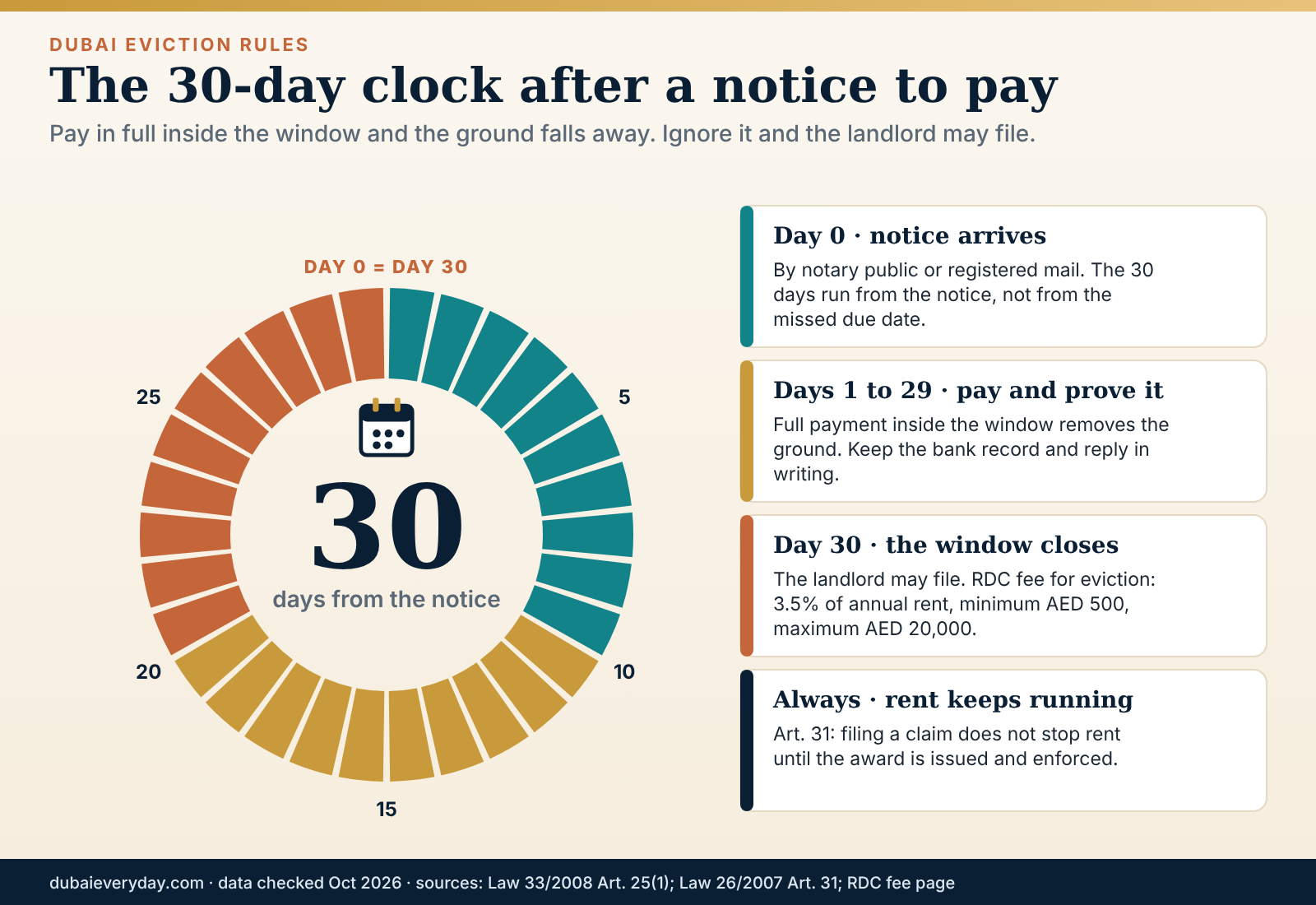
Landlords have two tools here, and they are different. One is an eviction claim, which asks for the property back. The other is a money claim or, where the debt is clear, a writ of payment. For the writ the RDC page requires the debtor to be notified through a notary public or registered mail, and only if they have not paid within five days of that notification can the motion be filed. The writ fee is 3.5% of the claimed amount, minimum AED 500, maximum AED 15,000.
For tenants facing the eviction rules Dubai applies to arrears, the practical lesson is about proof. In a case the RDC itself published in March 2025, a tenant who had paid a full year’s rent to the original owner was sued by the new owner for non-payment. The landlord had recorded a wrong email address, so the tenant never saw the proceedings and a default judgment followed.
The RDC later overturned the eviction, annulled the enforcement and ordered AED 700,000 in compensation. Two habits follow: keep payment evidence that traces to the right owner, and keep your contact details current on the contract.
Subletting without written approval
Article 24 says a tenant may not assign or sublet without the landlord’s written consent, unless the parties agreed otherwise. Doing so is a ground under Article 25(1)(b), and the eviction applies to the tenant and the subtenant. The subtenant keeps a right to seek compensation from the tenant who sublet.
A DLD report from November 2020 shows how the eviction rules Dubai uses on subletting play out. An owner obtained a petition order for an inspection, which found five people living in a unit, each paying AED 500 a month. The tenant said they were employees housed free of charge but could not prove it or produce written consent. The RDC ordered the tenant out. The burden of proof sat with the owner, which is why the inspection mattered.
Illegal use, wrong use and breach of planning rules
Three grounds in the eviction rules Dubai applies are about what the property is used for. Illegal use or use against public order and morals is the plainest. Use for a purpose other than the one in the lease, or in breach of planning, construction or land-use rules, is wider, and in our reading it would catch a residential flat run as a commercial operation where the lease does not allow it. These cases turn on documents: the contract’s stated use, the trade licence or permit, and any official report of the activity.
Empty business premises
The eviction rules Dubai applies to commercial units include a ground that residential tenants do not face. If business premises stay unoccupied without a valid reason for 30 consecutive days, or 90 non-consecutive days in a year, the landlord can seek eviction, unless the contract agrees otherwise. A seasonal business, a fit-out period or a licence delay can be a valid reason, but only if you can show it. Keep dated records of why the unit was closed.
Damage and dangerous alterations
The fifth ground covers changes that endanger the property and cannot be reversed, and damage caused deliberately or through gross negligence. Ordinary wear is not on the list; Article 21 expects the tenant to return the property in its original condition allowing for normal wear or damage beyond their control. Article 19 also bars changes or major repairs without the landlord’s permission and any needed official licences.
Under the eviction rules Dubai uses for damage, evidence decides. Dated move-in photos, an inspection report and written approval for any works are worth more than recollections.
Other breaches and the second 30-day clock
The catch-all in the eviction rules Dubai applies is failure to meet a contract or legal obligation within 30 days of a notice requiring compliance. It is wide, but it only works if the notice names the obligation and the 30 days are given. The same discipline applies as for rent: a clear notice, a proper channel, a record of delivery.
Collapse risk and government-ordered demolition
Two grounds in the eviction rules Dubai uses depend on authorities rather than parties. A building likely to collapse needs a technical report issued or certified by Dubai Municipality. Government-ordered demolition and rebuilding under urban development rules needs a decision from the competent entity. In both cases the tenant is entitled to ask what the document says. Where the paper does not exist, the ground does not either.
A notice that names a mid-term ground but arrives by WhatsApp, email or a hand-delivered note carries little weight at the RDC, which asks for a notarised notice or a registered-post receipt. Equally, a tenant who ignores a properly served notice to pay does not make it go away: the 30 days keep running.
Eviction at expiry: sale, personal use, demolition and maintenance
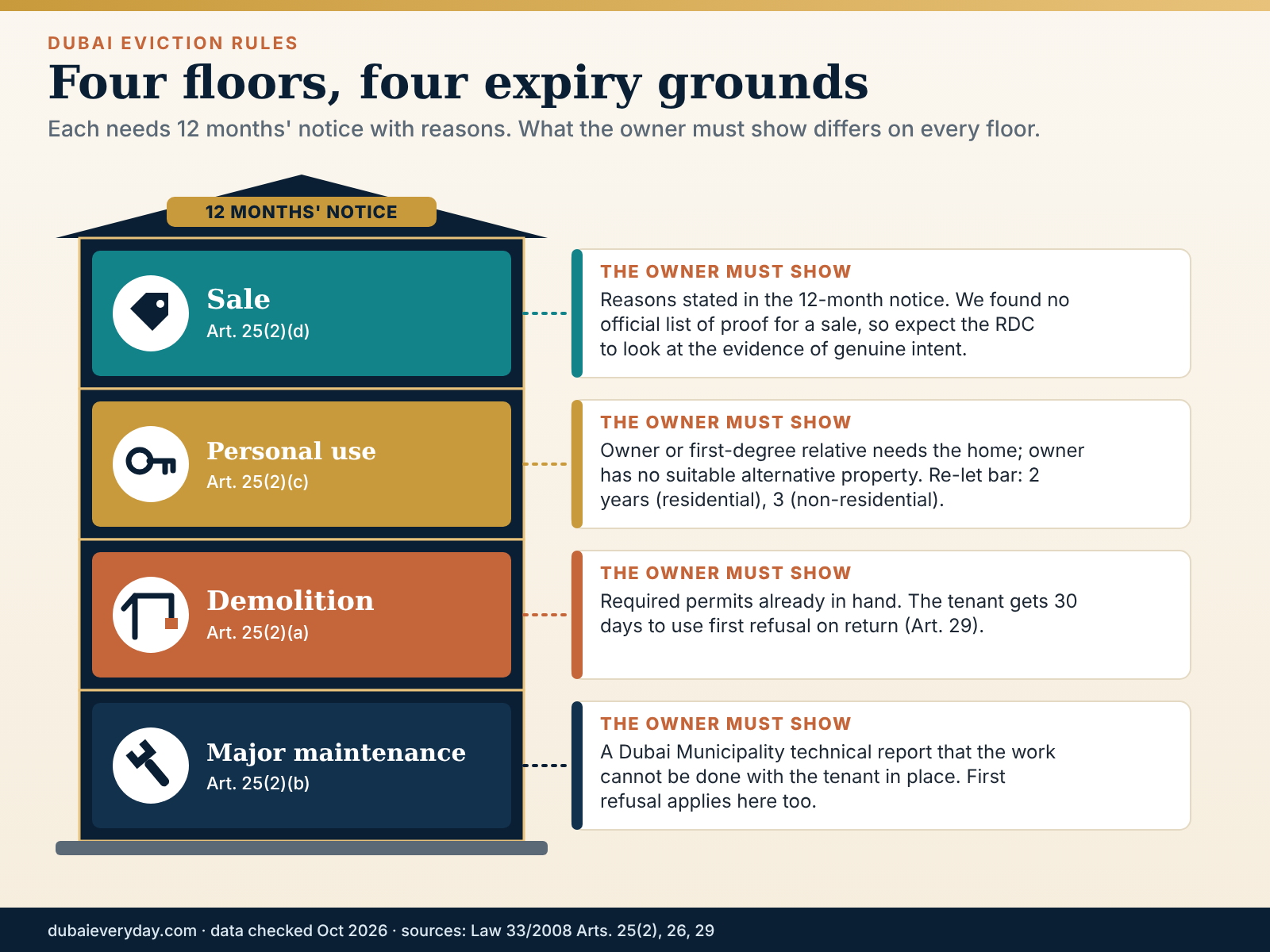
The four expiry grounds in Article 25(2) are where the eviction rules Dubai enforces hit tenants hardest, and where landlords most often lose cases through sloppiness. The common thread is the notice: reasons stated, at least 12 months before the eviction date, by notary public or registered mail. If the tenant does not go, the landlord still needs a ruling and an enforcement order. Nothing here lets an owner act alone.
Eviction for sale
Under the eviction rules Dubai uses for sales, an owner who wants to sell can give a 12-month notice stating that reason. The sale ground did not exist in the 2007 original; it arrived with the 2008 amendment. That history matters when you read older commentary that says a sale never justifies eviction. It did before 2008 and it does now.
The other half of the picture is Article 28: a sale does not end a tenant’s right to stay under a fixed-term lease signed with the previous owner. An owner who sells without a valid notice sells with the tenant in place, so a buyer who wants vacant possession needs the seller to have started the clock early. Buyers should ask for the Ejari contract and any notice before paying a deposit. Our guide to landlord rights in Dubai shows what the owner’s file should hold.
What can a tenant test? The text we read lists no documents an owner must attach to show a real intention to sell, so tribunals weigh the evidence in the round. A listing agreement, a signed memorandum of understanding or a buyer’s offer is the sort of material one would expect. If the same flat reappears on a rental portal after the tenant leaves, document it.
One gap deserves honesty. The re-letting bar in Article 26 attaches by its terms to personal-use recoveries, and we found no equivalent written rule for a sale that never happens. Whether a tenant can claim damages then depends on the facts and the owner’s good faith, which is lawyer territory.
Eviction for personal use or a first-degree relative
The owner may seek to retake the property for their own use or for a first-degree relative, and must show they own no suitable alternative property. Three words carry the weight: owner, relative and suitable. A landlord who is themselves a tenant under a head lease is not the owner; a cousin or an employee is not a first-degree relative in any reading we know of; and a studio the owner holds for investment may or may not be “suitable” for a family of five.
Because the eviction rules Dubai sets for personal use list exact conditions, the case is about evidence. Title deed, identity documents showing the family relationship, and records showing what else the owner holds are the obvious building blocks. The sources we read do not prescribe the form of proof, so we would expect an RDC judge to want something more than a bare statement.
The re-letting bar and compensation
Article 26 is the tenant’s protection against a pretext. If the RDC allows the owner to retake possession for personal use, the owner may not re-let to a third party for at least 2 years (residential) or 3 years (non-residential), counted from retaking possession. If they do, the tenant may ask the tribunal for fair compensation. Older material still quotes a one-year bar from the 2007 text. Some DLD material also describes the tribunal as able to vary the period, so a tenant relying on the full term should check the wording.
Eviction for demolition or reconstruction
Under the eviction rules Dubai uses for rebuilding, an owner who wants to demolish and rebuild, or to add structures that would stop the tenant using the property, must already hold the required permits. That requirement matters. A plan without a permit is a plan, not a ground. Tenants are entitled to ask what permits exist and when they were issued, and a landlord who cannot show them has not met the statute.
The tenant also gets something back. Under Article 29, after demolition and reconstruction the tenant has a right of first refusal to return, with the rent set under the Article 9 criteria (broadly, the market rental value of similar property, looking at the RERA rent index, the property’s condition and comparable rents). The tenant must exercise the right within 30 days of the landlord’s notification, so the landlord’s letter offering it should be treated as a ticking deadline.
Eviction for restoration or major maintenance
This ground in the eviction rules Dubai applies covers restoration or comprehensive maintenance that cannot reasonably be carried out while the tenant lives there. The statute requires verification by a Dubai Municipality technical report. A repaint, a new kitchen or a replaced air-conditioning unit is not obviously in this category, and our reading is that cosmetic upgrades do not qualify. If the landlord cannot produce a municipality report, the tenant has a strong first question.
The right of first refusal in Article 29 applies here too, since it covers renovation and restoration as well as rebuilding. Again the tenant has 30 days from notification. If you are served such a notice, put the date in your calendar and answer in writing within it.
Which ground is hardest to prove?
Reading the eviction rules Dubai law sets for each ground, demolition and maintenance carry the heaviest paperwork, because they depend on outside documents: permits and a municipality report. Personal use needs the owner’s own records and a negative (no suitable alternative property). Sale is the lightest on stated proof, which is why tenants watch it most closely for bad faith.
A 12-month notice does not guarantee the landlord wins. It is the minimum step before a case can succeed. If the tenant disputes the ground, the RDC decides, and Article 31 means rent keeps accruing until the award is issued and enforced, so withholding rent in protest creates a second, simpler claim against you.
What a landlord cannot do, and what it can cost
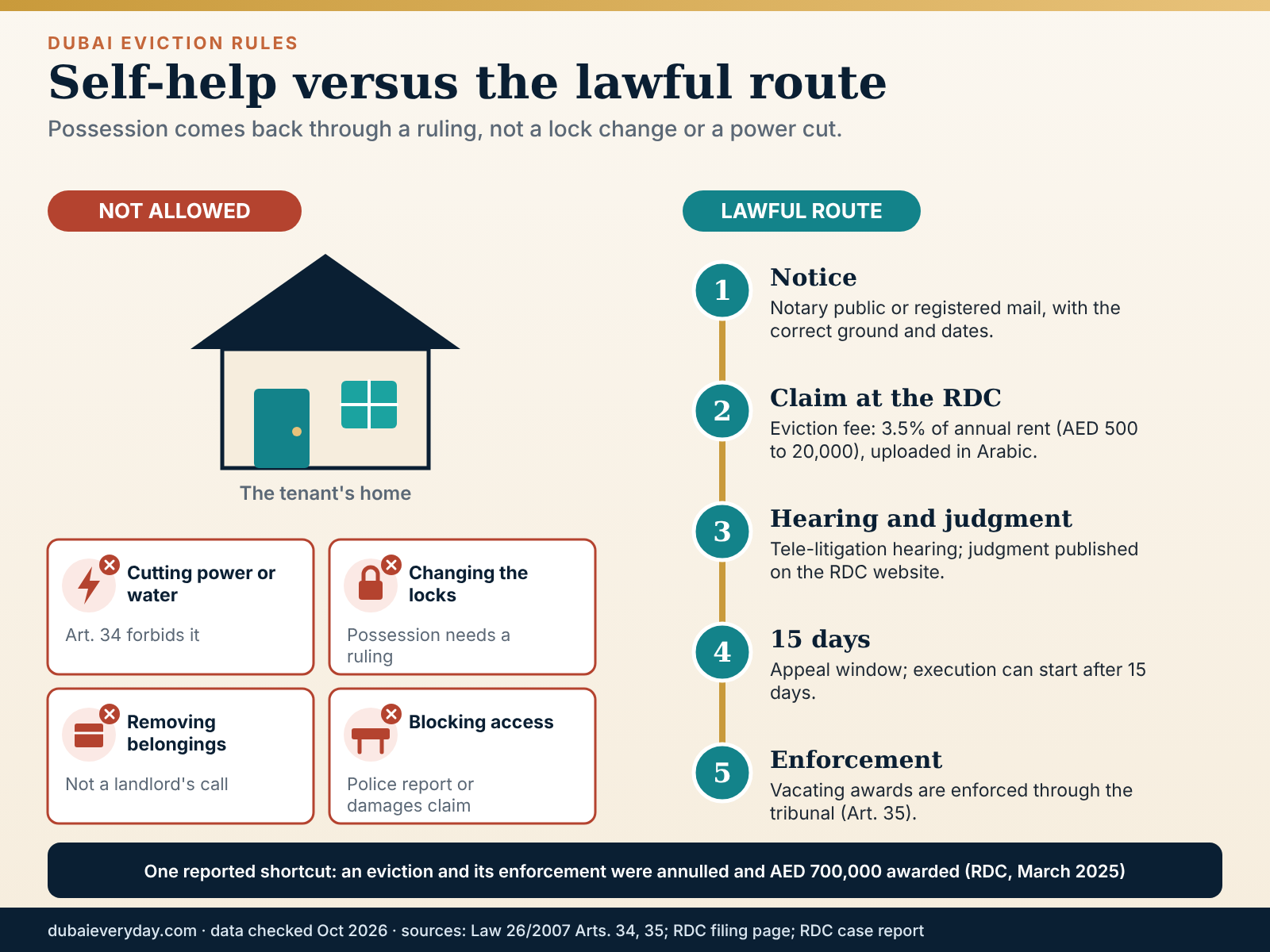
Knowing the lawful route is half of the eviction rules Dubai residents need. The other half is knowing what sits outside it. Under Article 34 a landlord may not cut services or otherwise disturb the tenant. The article gives the tenant two remedies: a police report, or a damages claim before the tribunal, backed by official records. The DLD’s own commentary on the RDC repeats that cutting utilities to push a tenant out is prohibited.
Locks, belongings and “self-help”
The eviction rules Dubai law lays down never use the phrase “self-help”, but their structure makes the point. Possession is recovered through a ruling, and Article 35 says vacating awards are enforced through the tribunal. A landlord who changes locks, removes furniture or blocks entry has skipped the part where a judge decides, and the one place we saw this tested is instructive.
In the March 2025 RDC case mentioned earlier, a landlord used a default judgment obtained on a false non-payment claim, then changed the locks, removed the tenant’s furniture and sought travel bans while the tenant was away. The RDC annulled the judgment and every enforcement measure, restored the tenant’s right to the property and ordered AED 700,000 in compensation, which the RDC described as about three times the annual rent. It said the award took account of financial losses, legal costs, hotel costs and emotional distress.
That is one reported case, not a tariff, and nothing here promises a particular amount. It does show that the downside of a shortcut can far exceed the cost of the proper route.
Compensation in the statute
The eviction rules Dubai law contains one express compensation mechanism for expiry evictions: the personal-use re-letting bar in Article 26. If the owner re-lets within two years (residential) or three (non-residential), the tenant may ask for fair compensation. Mid-term subletting under Article 25(1)(b) has a mirror mechanism: the evicted subtenant may claim compensation from the tenant who sublet.
Beyond those, claims for unlawful conduct rest on general principles, such as the Article 34 damages route and findings of bad faith. We found no fixed formula and no statutory relocation payment for sale, rebuilding or maintenance evictions. Plan on receiving nothing unless you negotiate it or prove a wrong.
Negotiated exits
Plenty of tenancies end by agreement long before the eviction rules Dubai provides for reach a hearing, and the law allows it: Article 7 names agreement as a valid way to end a lease. A landlord who wants possession sooner than 12 months can offer something in return, and a tenant who has found another home can accept an earlier date. If you agree, put it in writing and sign it.
- The agreed move-out date and handover condition
- Whether rent is payable up to that date, and any rent-free period offered
- Deposit return amount and date
- Any moving contribution, in AED and with a payment date
- Ejari cancellation and final utility settlement, who does what and by when
- A statement that the agreement settles any claim over the notice
One practical point: the DLD tenancy guide says a new lease for a unit cannot be registered until the earlier one has ended with the final DEWA invoice and settlement. A landlord who wants to re-let quickly has a reason to cooperate on the paperwork. If you need a rough sense of what a move will cost, our cost of living in Dubai guide shows what to include in a relocation budget.
Received a notice? A tenant’s first steps
A notice does not mean you must leave on its date. Under the eviction rules Dubai applies, it means a clock may have started, and what you do in the first few days affects what you can do later. The sequence below is general information; for a live case a licensed lawyer should look at your documents.
- Read the ground and the channelWhich Article 25 ground does the notice name? Did it come by notary or registered mail, or only by message? Write down the date you received it.
- Work out which clock appliesThirty days for rent or a breach; 12 months for sale, personal use, rebuilding or maintenance. Count the dates from the notice, not from the day you read it.
- Keep paying rentArticle 31 means rent keeps accruing during a claim. Pay by a traceable method and keep receipts. If a landlord refuses payment, document the attempt and ask a lawyer how to proceed; an RDC judge has urged tenants to keep paying and keep communication on official platforms.
- Ask for the paper behind the groundPermits for demolition, a Dubai Municipality report for maintenance or collapse, ownership proof for personal use or sale. If the landlord has none, say so in writing.
- Check your contact detailsThe email, phone and address on the Ejari contract are where court notices go. If they are wrong, correct them now, because you cannot answer a case you never heard about.
- Consider amicable settlementThe RDC’s conciliation service is listed at seven business days. A signed agreement approved by a judge can be enforced at the RDC, and half the paid court fee is refunded. We found no rule making it compulsory before filing.
- Plan the practical sideMoving dates, deposit, utility closure and a bridge stay if the dates do not line up; our guide to choosing hotels in Dubai helps with that. Single renters can use our monthly budget for one person in Dubai to size a new rent; families can check the family budget guide.
For landlords: a file that survives a hearing
An owner applying the eviction rules Dubai law provides should start with the ground, not the date. Pick the Article 25 ground that fits the facts, confirm that you can prove it, then build the notice around it. Working backwards from a date you want, and hunting for a ground afterwards, is how weak cases get filed. A property manager can act, since the law’s definition of landlord includes an agent, but the owner remains the person whose reasons count.
Unpaid rent
The Ejari contract, the payment schedule, bank statements, the notice to pay and its delivery proof. Keep the amount in the notice exact and the due dates matched to the contract.
Sale or personal use
Title deed, identity documents, evidence of the intended sale or the relative’s need, and records on other property you hold. Serve at least 12 months ahead and state the reasons.
Rebuilding or maintenance
Permits for demolition or new structures; a Dubai Municipality technical report for restoration. Say in the notice what will happen and why the tenant cannot stay.
Subletting or misuse
Photos, an inspection under a court order, utility or service records, and the contract clauses on use and sublet. The burden of proof is yours.
A short list of landlord errors
Mistakes with the eviction rules Dubai landlords make are mostly about process. A notice by message instead of notary or registered mail. A notice served at six months instead of twelve. A ground that does not match the facts. A tenant’s contact details copied from an old contract. A claim for rent already paid to the previous owner.
Two habits help. Calendar every date once you hold the delivery proof, and do not re-let after a personal-use recovery until the bar has run. For the owner’s wider paperwork, from rent collection to renewal, see landlord rights in Dubai.
The Rental Disputes Center route: eviction cases, fees and enforcement
When notice does not move the tenant, the next step is a claim at the Rental Disputes Center. This section follows the RDC’s own pages on how the eviction rules Dubai uses are enforced, as they stood on 29 October 2026. For the general mechanics of evidence and case-building beyond eviction, see our guide to rental disputes in Dubai.
Filing under the eviction rules Dubai uses: documents, channels, first hearing
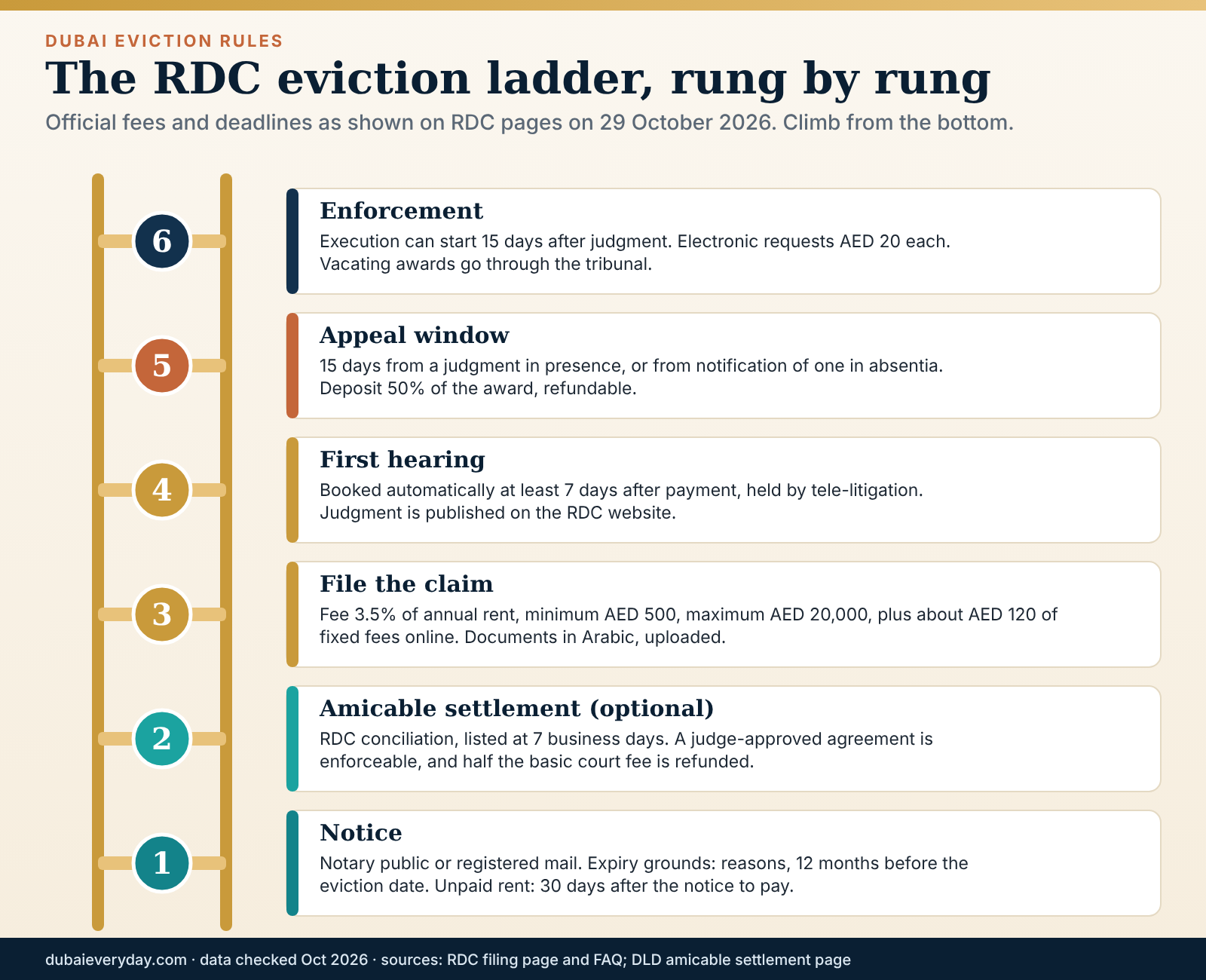
You can file online through the RDC website or through a Real Estate Services Trustees Centre. The page lists the required documents: a copy of the latest lease with Ejari, the Emirates ID (or trade licence and manager’s photo ID for a company), a bank letter or statement showing the plaintiff’s IBAN and, for eviction claims, a notarised notice with the notification officer’s report or a registered-post receipt with acknowledgement. Everything must be in Arabic or legally translated, and uploaded; hard copies are not accepted.
After payment, the first session is booked automatically at least seven days from the payment date, on the earliest available date. Hearings run through the tele-litigation system and judgments arrive through the website. Registration is listed as taking one business day. We found no published average time from filing to judgment, so we give none.
What an eviction claim costs
The RDC charges 3.5% of the annual rent for eviction, renewal, rent claim, lease termination and return-to-premises cases, with a minimum of AED 500 and a maximum of AED 20,000. Add process service (AED 100), a knowledge fee and an innovation fee (AED 10 each), plus a partner fee of AED 130 plus VAT if you file through a trustee centre and AED 25 if a power of attorney needs registering. Our calculation for online filing is below.
| Annual rent (AED) | 3.5% fee (AED) | Plus fixed fees (AED) | Total online (AED) |
|---|---|---|---|
| 40,000 | 1,400 | 120 | 1,520 |
| 60,000 | 2,100 | 120 | 2,220 |
| 90,000 | 3,150 | 120 | 3,270 |
| 120,000 | 4,200 | 120 | 4,320 |
| 250,000 | 8,750 | 120 | 8,870 |
| 600,000 | 20,000 (cap) | 120 | 20,120 |
The cap bites at an annual rent of about AED 571,400, and the minimum would apply below roughly AED 14,300. If a case settles through conciliation, half the fee paid for basic claims is refunded: on a AED 90,000 rent that would be AED 1,575 back. The RDC FAQ also shows a second, lower line for some eviction filings (1% of annual rent, capped at AED 5,000), so read the fee screen at filing rather than relying on a table, including ours.
Rent keeps running
Illustrative example (not a quote): on a AED 90,000 annual rent, each month the case runs adds AED 7,500 of rent. Under Article 31 that obligation continues until the award is issued and enforced. Tenants who stop paying hand the landlord a second ground and a larger bill, and landlords who build a false non-payment claim risk the fate of the 2025 case above.
Appeals and enforcement of the eviction rules Dubai uses
Per the RDC FAQ, an appeal must be filed within 15 days of a judgment given in the party’s presence, or 15 days after notification of a judgment in absentia. The appellant pays a deposit of 50% of the amount awarded in the original case, which is refundable. Eviction appeals have no minimum amount, while financial-only appeals need a claim of AED 100,000 or more. A review of a judgment may be requested after 30 days.
Execution can start 15 days after the judgment. Electronic execution requests are available seven days after the defendant is served with the executive writ notice, at AED 20 per request, with no fee for executing financial claims. For vacating awards, Article 35 says the tribunal enforces them directly. If you are the tenant, the 15-day window is the one that decides what options remain; missing it is the usual way to lose them.
Special cases: holiday homes, shared housing, offices, free zones
The eviction rules Dubai applies to a standard residential lease stretch awkwardly over some situations. These are the ones readers ask about most, with the limits of what we could confirm.
Turning a flat into a holiday home
Under the eviction rules Dubai uses, an owner who would earn more from short stays cannot evict a tenant for that reason. Article 25 has no such ground, and a National columnist reached the same reading in November 2025. Where an owner genuinely sells or plans a major renovation, the 12-month route is open, but the notice has to state that real reason.
Shared housing and room-letting
Dubai issued a separate shared-housing law in 2026, Law No. 4 of 2026, announced by the Dubai Media Office in March. As reported, it introduces permits and fines for shared accommodation. We did not read the full text for this page, so check it before arranging beds or partitions in a rented flat. For eviction purposes the older rule still bites: subletting without written approval is a mid-term ground.
Offices, shops and the business licence
Commercial leases sit under the same eviction rules Dubai applies to homes, with three differences. The empty-premises ground (30 consecutive or 90 non-consecutive days) applies to business premises. The re-letting bar after a personal-use recovery is 3 years rather than 2. And a business tenant usually needs the registered address for a trade licence, so an eviction adds licensing steps to the move. Our guides to mainland company setup and free zone company setup explain how premises and licences connect; confirm with your licensing authority what an address change needs.
Free zones and zones with their own courts
The DLD describes the RDC as handling disputes over property in Dubai or its free zones. Some zones run their own courts and leasing rules, with the Dubai International Financial Centre the best-known case. We did not verify how those regimes treat eviction, so the eviction rules Dubai’s RDC applies may not carry over. If your lease sits in a zone with its own court, ask the zone authority or a lawyer which law governs.
Death, employer housing and unregistered leases
Article 27 says a lease does not end on the death of either party; the tenant’s heirs may end it on at least 30 days’ notice or at expiry if sooner. Article 3, as amended, excludes accommodation an employer provides free of rent, so those occupants sit outside the law. Unregistered leases are hardest: the DLD guide says courts and government bodies will not consider disputes over them.
What we could not confirm
We did not verify how the eviction rules Dubai uses treat hotel apartments, serviced residences and other hospitality-style units, what happens on a mortgage lender’s enforcement against a let property, or how often the RDC grants grace periods to vacate. If any of these is your situation, treat a specialist’s opinion as essential, not optional.
Six scenarios worked through
These are made-up situations built to show how the eviction rules Dubai relies on fit together. They are not real people or cases, and the outcome in any real dispute depends on the facts and the judge.
1. Two months behind, notice by message
A tenant is two months behind. The landlord sends a WhatsApp saying “pay in 30 days or leave”. The ground exists, but the channel is wrong for an eviction claim, since the RDC wants a notarised notice or registered-mail receipt. The tenant’s best move is to pay the arrears at once and keep proof, which removes the ground. A careful landlord re-serves the notice properly, and then the 30 days start.
2. A sale notice with four months to go
The owner serves a notarised sale notice four months before the lease ends and asks the tenant to leave at expiry. The eviction rules Dubai applies ask for at least 12 months before the eviction date. The tenant can reasonably stay beyond expiry and the owner’s realistic options are to wait out the 12 months or negotiate an earlier exit, perhaps with a rent concession. Neither side should assume the shorter period works.
3. A villa for the owner’s daughter
An owner serves a 12-month notice for a first-degree relative’s use. The tenant learns the owner also holds a vacant apartment in another community. The eviction rules Dubai uses for personal use require the owner to show no suitable alternative property, so the apartment becomes the central question: is it suitable for the daughter’s needs? If the RDC allows the eviction, the owner cannot re-let to a third party for two years from retaking possession.
4. A redevelopment notice with no permit
A building owner tells every tenant that the block will be demolished. The notice states no permit. The tenants write back asking for the permit and its issue date. If none exists, the ground under the eviction rules Dubai applies is not met. If one does, the tenants should note that Article 29 gives them a right of first refusal when the new building is ready, and the 30-day response window starts when the landlord notifies them.
5. The power goes off and the locks change
A landlord, angry about a late payment, has the electricity cut and the lock changed. Article 34 of the eviction rules Dubai relies on prohibits the cut-off and offers a police report or a damages claim. The tenant should photograph everything, file a report, gather proof of rent paid and take advice about an urgent application. We cannot say what compensation would follow, but the March 2025 AED 700,000 award shows what a tribunal has been willing to do in a severe case.
6. A shop closed for a refit
A commercial tenant closes a shop for five weeks to refit it, and the landlord points to the 30-consecutive-day vacancy rule. The statute allows eviction only when premises are left empty without a valid reason. A documented refit with the landlord’s consent is a valid reason in any common-sense reading, so keep the approvals, invoices and dated photographs.
Where to verify, and how often
Confirm the current text of the eviction rules Dubai relies on, Law 26 of 2007 and Law 33 of 2008, on the Dubai Legislation Portal, and check the RDC website for fees, forms and deadlines before you file. We review this page every three to six months, or immediately after a change. A lawyer’s confirmation on the day beats any guide, including this one.
FAQ: eviction rules Dubai residents ask
Can a landlord evict a tenant in Dubai without a reason?
No. Under the eviction rules Dubai has set in Law No. 26 of 2007 as amended by Law No. 33 of 2008, a landlord can seek eviction only on the grounds listed in Article 25: nine during the lease and four at expiry. A valid lease cannot be ended unilaterally during its term. Wanting a higher rent, or preferring another tenant, is not on the list. If the tenant stays, the landlord must still bring a claim to the Rental Disputes Center and win it.
How much notice must a landlord give to evict a tenant in Dubai?
Under the eviction rules Dubai applies, it depends on the ground. For sale, personal use, demolition or major maintenance the landlord must give the reasons at least 12 months before the eviction date, by notary public or registered mail. For unpaid rent, the tenant gets 30 days after a notice to pay. For other breaches, 30 days to fix after a notice. Older pages that say 90 days for expiry grounds are quoting the 2007 text that the 2008 amendment replaced.
Is an eviction notice by WhatsApp or email valid?
Article 2 defines notice broadly, but Article 25 names a notary public or registered mail for eviction notices, and the RDC filing page asks for a notarised notice with the notification officer’s report or a registered-post receipt. Our reading of the eviction rules Dubai applies is that a message alone will not support an eviction claim. It can still matter as evidence that the landlord communicated an intention, and tenants should keep it. Do not treat a message as a reason to ignore the issue, though.
Can my landlord evict me because he is selling the property?
Yes, but under the eviction rules Dubai uses, only at the end of the lease and only with a notice stating the reason at least 12 months before the eviction date, by notary public or registered mail. Selling does not by itself end your lease: under Article 28, a fixed-term lease signed with the previous owner continues after a sale. A buyer who wants vacant possession depends on the seller having served a valid notice. The tenant can ask for proof of the intended sale.
Can a landlord evict a tenant to move in himself or a relative?
At expiry, yes, under the eviction rules Dubai sets for personal use, if the owner or a first-degree relative needs the property and the owner can show they own no suitable alternative. The 12-month notice applies. If the RDC allows it, the owner cannot re-let to a third party for 2 years (residential) or 3 years (non-residential) from retaking possession, or the tenant may seek compensation. A landlord who is not the owner, or a more distant relative, falls outside the wording.
Can a landlord evict me in the middle of the lease?
Only on one of the nine mid-term grounds in the eviction rules Dubai law sets out in Article 25(1): rent unpaid 30 days after a notice, subletting without written approval, illegal use, vacant business premises, dangerous changes or damage, use against the lease or planning rules, a building likely to collapse, an uncured breach, or government-ordered demolition. Each needs a notice by notary or registered mail, and each can be challenged at the RDC.
Do I have to keep paying rent after receiving an eviction notice?
Yes, and the eviction rules Dubai uses say so directly. Article 31 says filing an eviction claim does not stop rent accruing until the award is issued and enforced. Stopping payment gives the landlord a second ground and a money claim. Pay by traceable methods and keep receipts. If a landlord refuses to accept payment, document the attempt and take advice. An RDC judge has publicly urged tenants to keep paying and to keep communication on official channels.
Can my landlord cut the electricity or change the locks?
No. Under the eviction rules Dubai uses, Article 34 says a landlord may not cut services or otherwise disturb the tenant, and gives the tenant a police report or a damages claim at the tribunal. Possession is recovered through a ruling and enforcement. In a March 2025 case, the RDC annulled an eviction and the enforcement that followed and ordered AED 700,000 in compensation. That award is a single data point, not a guaranteed amount.
How much does it cost to file an eviction case at the RDC?
The fee for enforcing the eviction rules Dubai uses is 3.5% of annual rent for eviction cases, minimum AED 500 and maximum AED 20,000. Add AED 100 process service and AED 10 each for knowledge and innovation fees, plus AED 130 plus VAT through a trustee centre. On a AED 90,000 rent that is AED 3,150 plus AED 120, or AED 3,270 online. The FAQ shows an alternate lower line for some eviction filings, so check the fee screen when you file.
How long do I have to appeal an RDC eviction judgment?
The RDC FAQ says 15 days from a judgment given in your presence, or 15 days from notification of a judgment in absentia. The appeal needs a refundable deposit of 50% of the amount awarded in the original case. Eviction appeals have no minimum amount. Execution can start 15 days after the judgment, so the same window decides whether you can stop it. Ask a lawyer about urgent steps if the date is close.
What happens if the new owner wants me out after buying my flat?
Under Article 28 of the eviction rules Dubai relies on, a sale does not end a fixed-term lease signed with the previous owner, so the lease continues. The new owner can seek eviction only on an Article 25 ground, for example personal use at expiry with 12 months’ notice. Whether the new owner can rely on a notice the seller served, or must start a fresh 12 months, depends on the dates and the sale documents, and is a question for a lawyer.
Sources and further reading (13 links)
- Dubai Legislation Portal: Law No. (26) of 2007 regulating the relationship between landlords and tenants — Articles 6, 7, 14, 24, 27, 28, 31, 34 and 35
- Dubai Legislation Portal: Law No. (33) of 2008 amending Law No. (26) of 2007 — replaced Articles 2, 3, 4, 9, 13, 14, 15, 25, 26, 29 and 36, including the eviction grounds
- Dubai Land Department: Tenancy guide — original and amended versions of the notice rules, registration and obligations
- Rental Disputes Center: Register a first-instance rental lawsuit — fees, required documents, filing steps
- Rental Disputes Center: Frequently asked questions — fees, notices, appeals, execution deadlines
- Dubai Land Department: Dispute lawsuit for amicable settlement — conciliation service, fee refund and timing
- Rental Disputes Center: Register a writ of payment — conditions, five-day notice and fees for money claims
- Dubai Land Department: RDC evicted a tenant due to subletting — a worked subletting case and the burden of proof
- Dubai Land Department: The Rental Dispute Settlement Centre, a safe gateway — the Centre’s role, with older notice figures flagged in the text
- Rental Disputes Center: Landlord ordered to compensate tenant AED 700,000 for unlawful eviction — the March 2025 case
- Dubai Media Office: Law regulating the management of shared housing — announcement of Law No. 4 of 2026
- Gulf News: Dubai tenants’ rights explained, when eviction is allowed — press explainer with RDC judge comments (secondary)
- The National: UAE eviction notice and short-term rent in Dubai — opinion column on short-term letting as an eviction reason (secondary)
Update log: 29 October 2026 — first publication; statute and RDC pages re-read on that date. Next review due: by the end of April 2027, or immediately if the tenancy laws, RDC fees or procedures change. Corrections welcome.
Scope: general information from public sources, not legal advice and not reviewed by a lawyer. Check the current official text before serving a notice or filing a claim, and use a licensed UAE lawyer for a live dispute.
About DubaiEveryday and this guide
DubaiEveryday.com is an independent editorial project that publishes practical, research-based guides to everyday life in Dubai: where to live, what things cost, how the rules work and how to get around. This page was written and edited by the DubaiEveryday editorial team. It is not signed by a named expert, doctor, lawyer or adviser, and we do not claim first-hand testing of a venue, clinic or service unless the page says so.
Each guide is built from official sources such as government and regulator pages, operator websites and established news outlets, cross-checked where we can. When we could not confirm something, we say so in the text, and examples that use made-up numbers are labelled as illustrations. Mentions are editorial choices, not paid placements, and a link is not an endorsement.
Dubai changes quickly. If you spot something that is out of date or wrong, please tell us through the contact options on DubaiEveryday.com and we will check it and correct the page.