

Luxury villas Dubai travellers book come in three families: villas inside hotels, villas run by licensed operators and holiday homes listed by their owners. This guide explains what each family gives you, what Dubai’s rules require, and what to ask before any money moves.
A villa sounds like the simple choice: your own gate, your own pool and nobody asking you to share a lift. Then the details start to matter. Some of the best-looking luxury villas Dubai listings are hotel units with a plunge pool at the door, others are holiday homes run by a licensed operator, and a few are a permit nobody has asked to see.
This guide separates the three and shows what Dubai’s own rules say about pools, security and paperwork. It also puts numbers on the airport run to the Palm and on the fees that sit above the rate. By the end you will know what to ask, in writing, before any money moves.
The luxury villas Dubai offers split into three kinds, and the kind matters more than the price: a villa inside a hotel or resort, a villa run by a licensed operator, or a licensed holiday home listed by its owner. Hotel villas bring service and one phone number.
Owner-listed villas bring space and privacy, but the safety kit, the staff and the paperwork are only as good as the person behind the listing. A holiday-home villa in Dubai needs a permit from the Department of Economy and Tourism (DET), and asking for that permit number is the fastest check you can make.
On what we could read in October 2026, Al Maha in the desert reserve gives all 42 of its villas a private, temperature-controlled plunge pool, and Anantara The Palm lists 15 Beach Pool Villas with private pools. One&Only The Palm and Bulgari sell villas, but the pages we read do not state villa counts or pool privacy.
Whichever route you take to luxury villas Dubai offers, ask in writing for the licence or permit number, a 24/7 contact, the pool barrier details and every charge above the rate. In our illustrative bills the extras add roughly 6% to 23% to the rate, before transfers.
This is desk research, not a field test. Nobody from this site has slept in, toured or inspected any of the luxury villas Dubai properties mentioned, and nothing here is based on a personal stay.
We read the Dubai Department of Economy and Tourism (DET) guide for leasing out holiday homes, Dubai Law No. 12 of 2016 on the security industry, Dubai Municipality’s private swimming pool safety guidelines, Nakheel’s Palm Jumeirah page and the official pages of the hotels named, on 29 October 2026. Fare and fee figures come from the operators’ pages, and some facts were carried over from other research logs on this site and are flagged as such.
We chose the properties on one test: the page we read says villas exist, or names a villa product with figures. That is a documentation test, not a quality ranking. Inclusion was not paid for, and no link here earns a commission. Prices in the bills are labelled illustrative because we did not find a published villa rate card. This is general information, not legal, insurance or safety advice for a specific trip.
What counts as luxury villas Dubai offers, and what this page leaves to others
“Villa” is a flexible word in Dubai, and luxury villas Dubai marketing stretches it further. It can mean a three-storey house behind a gate on a Palm Jumeirah frond, a thatched suite with its own plunge pool in the desert, or a two-bedroom unit in a resort with a garden you share with nobody. This page uses it for a stand-alone or semi-detached unit that a guest rents for a short stay, with its own entrance and, usually, its own outdoor space.
That covers three kinds of luxury villas Dubai guests actually book. The first is a hotel villa, where a hotel is the licensed operator and the villa sits inside its service model. The second is an operator villa, where a company holds a holiday-home licence from DET and manages a portfolio. The third is an owner listing, where an individual holds a permit for a home they own. The differences between them are about who answers the phone at 11 pm and who is liable when something breaks.
What this page covers, and what sits elsewhere
The search job here is narrow: a short stay in a villa, with attention to private pools, staff, security and booking. Three adjacent jobs have their own homes. If you want the whole-hotel comparison of suites, beaches, dining and transfers, our guide to ultra-luxury hotels in Dubai covers it, and we only repeat its facts where a villa depends on them.
If you want the wider picture of cars, yachts, spas and concierges, start at the Luxury Dubai guide. And renting a villa on a yearly lease, with Ejari and tenancy rights, is a different law and a different decision, so it is not covered here.
One more boundary. This guide does not rank villas or tell you which one is best. We did not stay in any of them, and a ranking without that would be decoration. What it does is show you how to read a villa listing: which claims are documented, which are marketing, and which questions flush out the difference.
Why luxury villas Dubai short stays attract a different kind of guest
Luxury villas Dubai travellers rent change the economics of a group trip. Five bedrooms rented as one unit can cost less per person than five hotel rooms of equal finish, and the group gets a kitchen, a garden and a private pool that no hotel floor plan includes. The trade is service. A hotel has a night manager, a laundry, a lifeguard at the main pool and a locksmith on call. A villa has whatever the operator has arranged, and that varies from a full house team to a key safe and a phone number.
That is why, with luxury villas Dubai listings, the most useful question is never “how nice is the villa?” but “what happens when something goes wrong, and who is on the hook?” The rest of this page is built around that question: what the licence requires, what the pool rules say, what security looks like in layers, and what a sensible booking trail contains.
Luxury villas Dubai in October 2026: what has changed
Any guide to luxury villas Dubai has to start with the year. In 2026 the hospitality market has been unusually uneven, and a villa page that ignores that would mislead you.
Official figures from the Dubai Media Office put 2025 at 19.59 million international overnight visitors and 80.7% hotel occupancy. Press reporting in 2026 describes a sharp dip after the regional conflict earlier in the year: The National reported hotel occupancy of about 36% in March and 66% in August, and Khaleej Times reported close to 7 million visitors in the first eight months of the year.
Cavendish Maxwell data, quoted by Khaleej Times, put luxury occupancy at around 51% in the first half. We treat these as press figures and not as a price forecast, but they explain why some properties are quiet and why others have used the pause to refurbish.
Closures and reopenings that touch the villa market
Gulf News reported in late October that Burj Al Arab closed in April 2026 for an 18-month restoration and that Armani Hotel Dubai closed on 1 April, with full reopening expected in March 2027. Neither sells villas, but the pattern matters: hotel pages do not always say what is paused. Khaleej Times reported that St. Regis Dubai, The Palm, closed for refurbishment in April and would reopen on 1 November 2026.
That is a press report, and the hotel’s own page was not read. The practical rule is simple. If you are paying a deposit for a stay more than a few weeks away, ask the property to confirm in writing that the villa, the pool and the restaurants you are counting on will be operating on your dates.
Safety context for 2026
The UK Foreign, Commonwealth and Development Office’s UAE travel advice, updated on 27 October 2026, describes the regional situation as “deeply unpredictable” and warns of possible flight and airspace disruption. It advises visitors to follow local authority alerts, to keep their travel insurance under review and, if an alert sounds, to shelter indoors away from windows.
We are not security analysts and this is not a risk rating. We mention it because it changes how you read luxury villas Dubai listings: how far a villa is from an airport, whether it has an interior room away from glass, and what your cancellation terms say if flights stop. Later sections turn that into questions you can ask.
Dubai’s tourism authorities also launched a relief package on 21 May 2026, worth AED 1.5 billion across 33 initiatives according to the Dubai Media Office. Among the measures, DET-registered establishments were exempted for a period of three to twelve months from collecting the Tourism Dirham and from certain sales fees on hotel rooms. We could not find an end date. That matters for the bill, and we come back to it in the cost section.
Three routes to a villa: hotel, operator or owner
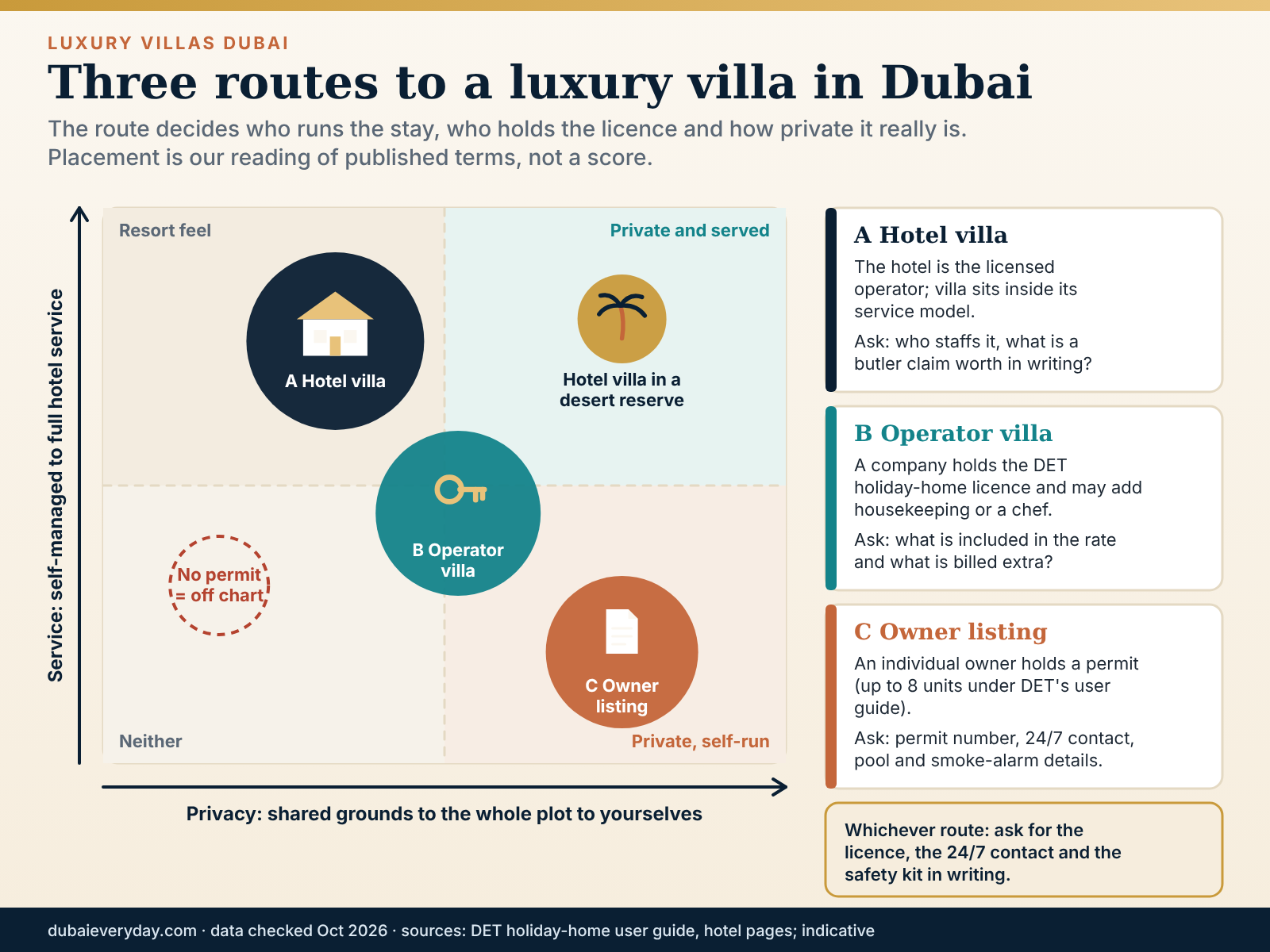
Before comparing any single property, decide which route you are on. For luxury villas Dubai guests book, the route sets who holds the licence, who staffs the place, what safety kit you can expect and where you complain. Two villas of the same size and the same price can sit on different routes and behave like different products.
A. Hotel villa
The hotel is the licensed establishment and the villa sits inside its service model. You get a front office, a security department and a rate card for everything extra. You also get hotel fees on the bill, and you usually share grounds, a beach or a restaurant with other guests.
B. Operator villa
A company holds a DET holiday-home licence and manages several homes. Service ranges from a key safe and a hotline to a house team with a chef. Space per dirham is often better than in a hotel, but the service promise is contractual, not standardised, so the written offer matters.
C. Owner listing
An individual holds a permit for a home they own. DET’s user guide lets one owner hold up to eight permits, and above that a company licence is needed. This can be the best value or the thinnest service, and the listing rarely tells you which.
Figure 1 plots the three routes to luxury villas Dubai guests choose by privacy and by service. The placement is our reading of published terms, not a score from any inspection. The point of the picture is the shape: as privacy rises, hotel-style service tends to fall unless someone is paid to supply it, and the dashed circle at the bottom left is any listing with no permit at all.
What the licence tells you, and what it does not
DET’s hospitality services page covers permits for hotels, holiday homes and timeshare operators, so all three routes sit under the same regulator. That is useful, because it gives you one authority to ask. But a licence is a floor, not a quality mark. It says the unit passed a safety and quality inspection when the permit was issued, and the guide says DET also inspects without warning. It does not tell you whether the pool gate latches today, how good the housekeeping is, or whether the villa you are shown is the villa you are given.
We did not find a public search tool for holiday-home permits on the DET pages we could read. The workable check is therefore a request: ask the host for the permit number and the classification (standard or deluxe), then look for what the guide says must be displayed, which is a laminated QR sticker and a unit information board showing the address, classification, permit number and licensee contact. If a host cannot produce those, treat the listing as unproven, however good the photographs are.
A quick way to pick a route
If the stay is short, the group is small and you want somebody else to solve problems, a hotel villa is the lowest-friction route and the one where the bill is most predictable. If you have six or more adults, children across several ages and a willingness to read terms, an operator villa usually gives the best space-to-price ratio.
An owner listing suits people who can handle a missing detail, like an extra key or a pool pump fault, without a duty manager. No type of luxury villas Dubai offers is better in the abstract. They differ in who absorbs the problems, so pick the one whose problems you can live with.
Hotel villas in Dubai, property by property
Hotels are the easiest place to start researching luxury villas Dubai offers, because they publish details. We read the official pages of five properties on 29 October 2026 and recorded what each says about villas, pools and staff. Where a page was silent we say “not stated” instead of guessing. That silence is information too: it is the gap you fill with an email before you pay.
Al Maha, a Luxury Collection desert resort
Al Maha sits inside the Dubai Desert Conservation Reserve, which the hotel page describes as about 225 square kilometres, or 5% of Dubai’s land area. The page lists 42 private pool villas in four types: Bedouin, Royal, Emirates and Presidential. Each has a temperature-controlled infinity plunge pool, and the resort lists 43 pools in total including the one at the spa. The privacy claim is plain and checkable: every villa has its own water.
The trade-offs are distance and rules. The hotel puts DXB at 65 kilometres, runs no shuttle and offers a GMC Yukon 4×4 transfer at AED 447 one way or AED 894 return. Families are welcome and children of any age can stay, with supplements from age six. For 31 December 2026 the page lists a mandatory New Year’s Eve gala dinner, which is the kind of condition that never appears in the photographs. The page names a Guest Relations Coordinator for each stay, not a butler, and does not describe villa staffing further.
Anantara The Palm Dubai Resort
The Anantara factsheet is the most detailed of the group. It gives 293 rooms and villas, of which 18 are one-bedroom Over Water Villas of 106 square metres, 15 are Beach Pool Villas and four are two-bedroom Luxury Terrace units of 267 square metres.
The Beach Pool Villas split into 12 one-bedroom units of 85 square metres indoors with a private infinity pool and direct ocean access, and three two-bedroom units of 206 square metres with a private pool, an outdoor sala and a kitchenette. The factsheet does not list a private pool for the Over Water Villas or the Terrace units, and mentions no butler service.
By our arithmetic the 33 units named as villas are about 11% of the 293 keys, and only 15 of those have a pool the factsheet calls private. The factsheet puts the airport at 41.5 kilometres and about 40 minutes by car, while its location section says 45 minutes, so the page disagrees with itself. We have not seen the factsheet’s date, so confirm the unit mix before relying on the counts.
One&Only The Palm
The resort page describes rooms, suites and villas on a beachfront site, with accommodation overlooking what it calls a private stretch of sand and a trio of pools shared across the resort. A “Villa and Suite Experience” package adds resort credit and daily sundowners for guests in those categories. The page does not state bedroom counts, villa numbers, private pools or butlers. That does not mean they are absent, only that you cannot rely on them without asking.
Bulgari Resort Dubai
From the research logs of this site, the Bulgari page describes villas of one to three bedrooms alongside rooms and suites on Jumeira Bay Island, with a marina-side Yacht Club, a spa and several restaurants. Beach access and private pools are not stated on the page, and we did not re-read it for this guide. Jumeira Bay is on the city side of the coast, which by our estimate puts it about 17 kilometres from DXB by road, far closer than the Palm resorts.
Jumeirah Beach Hotel and the Palm’s other names
Wikipedia, a secondary source, lists Jumeirah Beach Hotel as 598 rooms and 19 villas. The Jumeirah page we read lists private-beach and pool facilities but not the villa details, so we place it as unverified. Jumeirah Zabeel Saray on the Palm’s west crescent appeared in our reading with an “infinity pool and private beach” line and no accommodation breakdown. If one of the luxury villas Dubai hotels advertise is your reason for booking, a hotel page that does not mention villas is a page without a villa you can verify.
Near-villas: private-pool suites
Some of the most photographed “private pool” stays in the luxury villas Dubai conversation are suites, not villas. Wikipedia reports that Atlantis The Royal opened with 862 keys, 44 of them with private pools, about 5% of the building. Jumeirah Marsa Al Arab, according to its page, offers a Private Pool Club for suite guests, which is a members’ pool, not a pool attached to your door. A suite with a pool is not a villa with a garden, and a pool club is not a private pool. Keep the three apart when you compare prices.
| Property | Villa product on the page | Private pool stated? | Staff named |
|---|---|---|---|
| Al Maha | 42 villas in four types | Yes, temperature-controlled plunge pool in every villa | Guest Relations Coordinator |
| Anantara The Palm | 18 Over Water, 15 Beach Pool, 4 Luxury Terrace units | Beach Pool Villas only | No butler mentioned |
| One&Only The Palm | Villas offered; counts not stated | Not stated | Not stated |
| Bulgari Resort Dubai | Villas of one to three bedrooms (earlier research) | Not stated | Not stated |
| Jumeirah Beach Hotel | 19 villas (Wikipedia, secondary) | Not stated | Not stated |
The table is the honest summary of what the public pages let you conclude about luxury villas Dubai hotels sell. Only one property in five states a private pool for every villa, and none of the five names a butler for the villas. If a butler matters to you, it has to be a line in the written offer.
Palm Jumeirah villas: access, distance and what the island gives you
For many visitors, luxury villas Dubai means a villa on the Palm. The island is the postcard version of the idea: a house with water on two sides, a gate, a private beach on some plots. It is also the place where the gap between the photograph and the logistics is widest, so it deserves its own section.
What Nakheel says about the island
Nakheel’s Palm Jumeirah page, read on 29 October 2026, says the island extends about five kilometres into the Arabian Gulf, covers 560 hectares and is home to roughly 25,000 people. It was launched in 2001 and divides into three parts: the trunk, the crescent and the fronds. Roads off the central spine lead to what the page calls residential gated communities, and it lists private beaches along the trunk, with Palm West Beach marked on the location map. Palma Residences is named as a villa community on the island’s east side.
The page does not give a frond count. The figure of 16 is commonly published, but we did not find an official number, so treat it as common usage. It also says nothing about community management or security staffing, which matters later. For a short-stay guest, the useful reading is simple: the island is a collection of gated communities and hotel plots, and every villa on it sits behind somebody’s rules.
Distance is the real cost of the Palm
Luxury villas Dubai guests book on the Palm are not close to the airport. Anantara’s factsheet puts its resort at 41.5 kilometres from DXB and about 40 minutes by car. Our estimate for the Gateway end of the island, using approximate coordinates and a 1.3 road factor, is about 37 kilometres. At assumed speeds of 55 and 30 kilometres an hour, that is roughly 40 minutes in light traffic and 75 minutes in heavy traffic. Those speeds are our assumption, not a measured journey time. A villa on a frond tip adds more.
Figure 2 draws the airport distances for luxury villas Dubai travellers consider as rings. The Palm resorts sit in the 35 to 45 kilometre band, Jumeira Bay is much nearer, and Al Maha is out at 65 kilometres. The footer of that graphic is the point: using Dubai Taxi’s published rates, each additional ten kilometres costs about AED 24.50 by taxi or AED 39 by limousine before Salik, which is Dubai’s road toll.

Getting around from a Palm villa
From the Gateway end, our estimates put Dubai Marina and Internet City about 3.5 kilometres away, Mall of the Emirates about 8, Expo City and Business Bay about 20, Downtown about 22 and DIFC about 24.
A round-trip evening in Downtown by taxi is therefore a 44-kilometre ride, around AED 108 at the AED 2.45 per kilometre tariff, plus Salik and the pickup minimum. Four such round trips in a week by taxi come to roughly AED 430 in our calculation, or AED 690 to AED 890 by limousine, depending on how the AED 25 start charge is applied.
Public transport helps only at the margins. The Dubai Tram has a Palm Jumeirah stop with an out-of-station interchange to the Palm Gateway, which is useful for Marina days. The Palm Monorail is harder to rely on: the operator’s homepage said on 29 October that service was temporarily suspended until further notice for maintenance, while Khaleej Times reported in July that it had resumed after six months.
Because those two statements conflict, do not plan luggage or an airport leg around it. For a broader view of getting around, our Dubai travel planning guide covers the options.
What to check before booking a Palm villa through a holiday-home operator
Two rules interact here. DET’s guide says it will not permit a unit whose sale agreement prohibits holiday use. It also says villas in closed complexes can be registered as residential or commercial.
So the question for any of the luxury villas Dubai operators offer on the Palm is whether the community and the title permit short stays, and the host should be able to show a DET permit that says so. If the answer is vague, move on. A villa that is not allowed to take paying guests is a villa that can be closed with your holiday in it.
The beach is the second check for waterfront luxury villas Dubai listings. The trunk has private beaches and the fronds have shorelines, but a villa’s garden meeting the sea is not the same as a beach with lifeguards and loungers. If swimming from the property matters, ask about water access, depth and who maintains it. For public and hotel options as a fallback, see our guide to the best beaches in Dubai.
Beyond the Palm: where else luxury villas Dubai guests book sit
The Palm is not the only address for luxury villas Dubai stays, and for some trips it is the wrong one. Here is a short map of the alternatives, with the limits of what we could verify.
Jumeira Bay Island is where Bulgari Resort Dubai sits, on the city side of the coast. By our estimate it is about 17 kilometres from DXB by road, so the arrival day is shorter and the evening trips to central districts are cheaper. If you want to be near the glass towers of Downtown Dubai, this side of the coast is the logical choice, though Downtown itself is mostly towers, not villas.
The desert reserve is the opposite proposition. Al Maha’s distance from the city is the product: quiet, a conservation setting and a villa with its own water. It is the wrong choice for anyone who plans four dinners a week in the city, because every evening out is a long drive, and the airport alone is 65 kilometres away. Pair it with a short city stay, not a replacement for one. Our guide to things to do in Dubai helps you decide how many city days you need.
Inland villa communities such as Dubai Hills, Arabian Ranches, Jumeirah Islands and Tilal Al Ghaf appear in rental-market reports as villa neighbourhoods. We did not verify whether short stays are permitted in any of them, and the rules vary by community and title.
They tend to suit golf, family and extended-stay trips more than beach trips. If a course is the reason for the villa, our golf courses guide covers green fees and visitor access, and the Dubai sports guide covers the wider calendar, including the Hero Dubai Desert Classic listed for 21 to 24 January 2027.
The licence behind luxury villas Dubai holiday homes
The most useful single document for anyone booking one of the luxury villas Dubai operators run outside hotels is DET’s “Leasing Out Holiday Homes” user guide. We read the PDF on 29 October 2026. It shows no edition date we could find, and DET’s separate holiday-homes regulation guide in its legislation library is dated July 2022 and described as a first edition, so confirm you are reading the current version. It is written for operators, but every line is a promise you can ask a host to confirm. The notes below paraphrase it and are general information, not legal advice.
Which homes can be licensed
The guide ties eligibility to the title deed. Apartments must be classed as residential. Houses or villas in a closed complex can be residential or commercial. Independent villas must be commercial, or farms in Hatta only. Hotel rooms and hotel apartments cannot be licensed as holiday homes, and neither can units whose sale agreements prohibit holiday use. An individual owner can hold up to eight permits at one time, and anyone with more needs a company licence. Permits are not renewed automatically, so a host has to apply before expiry.
Gulf News, in an explainer last updated on 14 October 2025, reports that a permit runs for three to twelve months, with fees of AED 300 per bedroom plus small administrative charges, and an annual maximum of AED 1,200 per home. That is a secondary source, but the scale is the point. Against the nightly rate of a luxury villa, the cost of compliance is small. It does not explain an unlicensed listing.
The safety kit DET expects on site
Appendix 1 of the guide lists requirements for holiday homes. Several apply to every category, and a few apply only to villas. In plain terms, a permitted villa should have the following, and you can check most of it in the first ten minutes after arrival.
- A first-aid kit, fire extinguishers, fire blankets, gloves and a torch.
- Emergency procedures posted in Arabic and English, and 24-hour emergency and maintenance contacts in both languages.
- A peephole or intercom on the entrance door and a SIRA-approved smart lock on the main door.
- CCTV at all main entrances and adequate lighting at the entrance, corridors and stairways.
- A building security guard for homes and villas in closed complexes.
- Full fencing for villas and farms, with an exemption for villas in closed communities.
- Pool warnings, signs and safety equipment such as floats, life rings and a first-aid kit.
- A unit information board showing the address, classification, permit number, licensee contact and DET number, plus basic community rules displayed for guests.
The guide also says the operator must print a 5 centimetre square laminated QR sticker through the Holiday Homes 2.0 system and place it below the DEWA premise plaque, fully visible. That sticker is the nearest thing to a public badge, and it is worth looking for at the door.
What the rules say about you as a guest
Several clauses speak directly to guests of luxury villas Dubai holiday homes. The operator must record check-in and check-out in the system within three hours of entry, verifying details against your documents. Building management may view or copy passports and IDs only at check-in. The operator must issue a “Holiday Home Guest check-in document”, and the guide says using any other contract type makes the permit void. A check-in document runs for a maximum of three months. In practice, if you are asked to sign an ordinary tenancy contract for a one-week stay, ask why.
The guide also bars additional service fees unless the developer or building management actually incurred the cost and can show proof, and its penalty table lists charging extra for electricity or water among the violations. As worded, it also says guests are not entitled to any refund of lease fees, which makes your cancellation terms more important, not less. Deposits can be taken before arrival by credit card or mandate, guests must be told that breaches may lead to deductions, and balances must be returned as soon as possible after departure.
Visitors, noise and parties
This is where groups in luxury villas Dubai holiday homes most often collide with the rules. The guide says visitors cannot stay between midnight and 8 am, and that offensive noise is not allowed, especially from 10 pm to 8 am, including on arrival and departure. It says no parties or similar gatherings. It lists breaches that can lead to permit termination, eviction, loss of deposit or extra damage fees.
The visitor limits are stated inconsistently inside the guide: one version allows two adults and two children under 14 per master bedroom, another one adult and one child under 14 per bedroom with a maximum of six visitors. So ask the host for the maximum occupancy in writing, and do not assume a large villa means a large gathering is allowed.
Standard versus deluxe: what the classification means
DET classifies holiday homes as standard or deluxe, and the word “deluxe” here is a minimum list, not a luxury rating. Among the differences, deluxe asks for bedrooms of at least 14 square metres against 12, a main bed of 200 by 180 centimetres against 200 by 150, a hair dryer, a glass shower door, an en-suite bathroom in the master bedroom and a dishwasher in units with two or more bedrooms.
Nothing in the guide says anything about finish, art or service. A deluxe-classified villa can be modest, and a standard-classified one can be beautifully done. The classification still matters in one place: it sets the Tourism Dirham, covered in the cost section.
The complaints route, and what we could not check
Operators must keep a phone line for complaints and emergencies that is accessible 24 hours a day and log each complaint with its date, time and the action taken. The guide gives DET email addresses for disputes and grievances and says a grievance must be filed within 30 days, with DET deciding within 30 days and the decision final.
Contact details change, so confirm them on the DET site before relying on them. We did not find a public look-up for permits. We did not read any hotel-classification standard, so the DET list above does not tell you what a hotel villa must provide. For hotel villas, the practical route is the hotel’s own guest-relations line first and DET’s consumer channels second.
Private pools at luxury villas Dubai guests rent: what the phrase covers and what keeps children safe
“Private pool” is the most overused phrase in luxury villas Dubai listings, and the least standardised. Before you pay for it, work out which of five things the listing means.
- A plunge pool attached to the villa. Small, often cooler or heated by design, used for cooling off. Al Maha states this for every villa, and describes it as temperature-controlled.
- A full-size pool in the garden. Room for laps or for children to play, with a larger barrier and maintenance load. Anantara describes private pools for its Beach Pool Villas.
- A pool shared across a few villas. Private to the group of units, not to you. Check who else has the gate code.
- A pool club for certain guests. Jumeirah Marsa Al Arab’s page lists a Private Pool Club for suite guests. It is exclusive, but it is not at your door.
- A communal resort pool. Fine for a swim, not private. A listing that leans on this should not use the word.
Heat and the water temperature question
Daily maximums in Dubai run around 24 degrees Celsius in January, 37 in May and 41 in July and August, according to climate averages we read on a travel-weather site (a secondary source). A small outdoor pool in August can be warm enough to offer little relief, and in January an unheated one can be cooler than visitors expect.
So ask whether the pool is heated in winter, chilled in summer or neither, and whether that is included or an extra. Al Maha’s page says temperature-controlled, which is the clearest statement we found. We saw no comfort range in the guidelines, only that the pool’s temperature is tested daily before use.
What Dubai Municipality’s guidelines say
Dubai Municipality’s Private Swimming Pools Safety Guidelines (issued in January 2020) are the best benchmark available to guests choosing among luxury villas Dubai properties with pools. We read the document directly on 29 October 2026. They state the following, and the figure shows them as a cross-section.
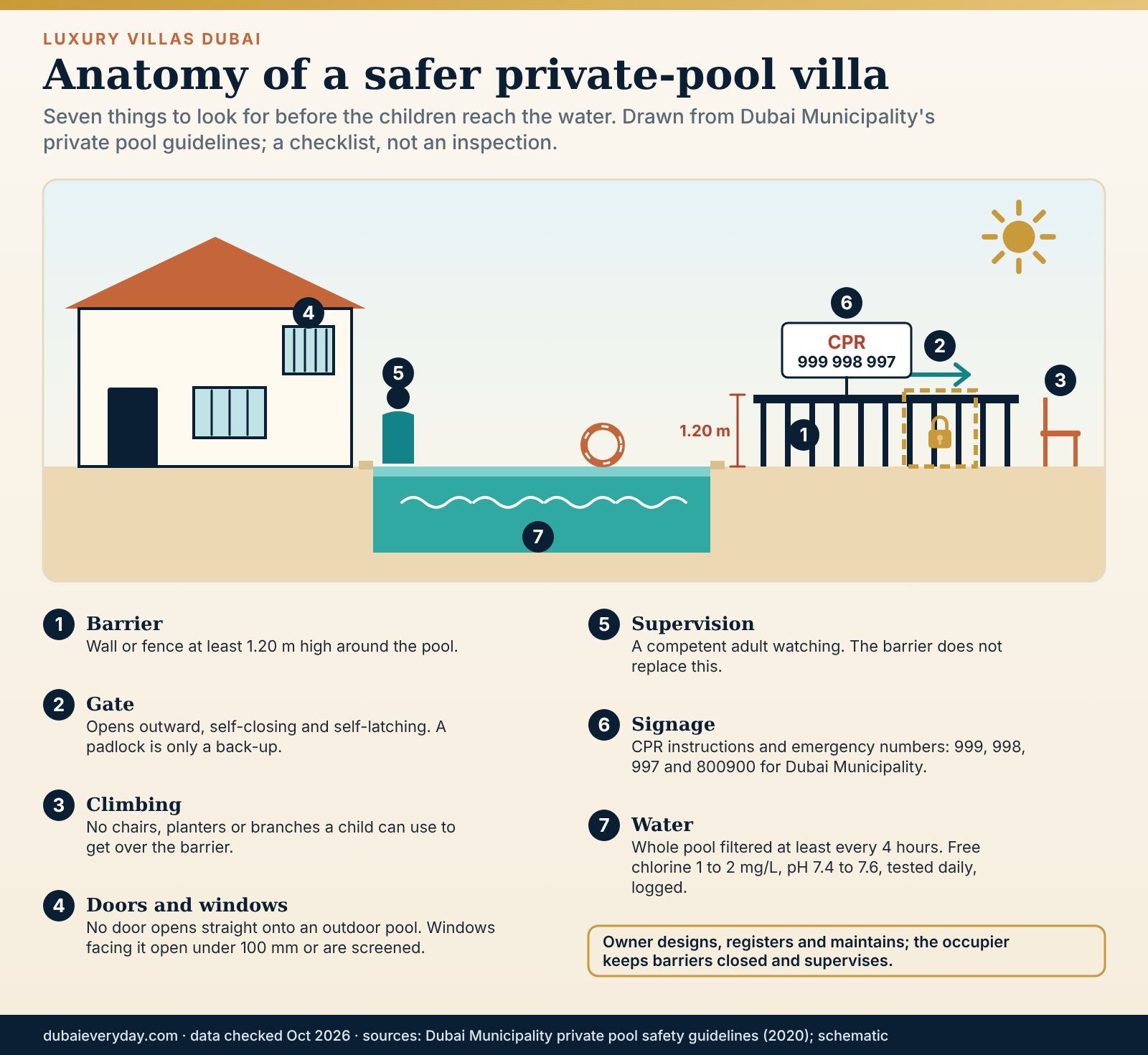
A solid wall or fence must be at least 1.20 metres high, measured on the outside. Rigid bar fences can have openings of no more than 100 millimetres. Anything a child could climb, such as plants, boxes, furniture or steps, must be at least 1.20 metres from the outside of the enclosure and 300 millimetres from the inside.
If the outside setback cannot be met, the barrier must rise to 1.80 metres with a 900 millimetre setback outside. Gates open outward, away from the pool, and must be self-closing and self-latching from any position. A lock alone is not acceptable. It has to supplement the self-closing latch.
Outdoor pools may not use doors as direct access, which means a house door that opens straight onto an outdoor pool is not allowed as part of the barrier. Windows that open onto the pool area need a fixed stop limiting the opening to under 100 millimetres, or fixed security screens, and a lock alone is not enough. The guidelines require competent adult supervision whenever the pool is in use. They also require signage with CPR instructions and the emergency numbers: Police 999, Civil Defence 997, Ambulance 998 and Dubai Municipality 800900.
A barrier is not supervision, and a villa that complies on paper can still be unsafe at 5 pm on the day you arrive. On arrival, walk to the pool before you unpack. Open the gate and let it swing: it should close and latch on its own.
Look for climbable furniture near the wall, check the windows that face the water, and find the CPR sign. If any of it fails, tell the host in writing and keep children away from the pool until it is fixed. Ask also whether a safety net or cover is available. These notes are general information, not safety certification.
Water quality and who is responsible
For water quality, the guidelines set free chlorine at 1 to 2 milligrams per litre, or bromine at 2 to 4, and pH at 7.4 to 7.6. Water retention time must not exceed four hours, which means the pool’s volume should pass through the filter at least that often.
Operators must test pH, chlorine and temperature daily before use, test other parameters every 15 days and microbiology every two months, and record every reading in a log book. You can ask to see the log. A host who cannot find it has told you something about how the pool is run.
Responsibility for the pool at luxury villas Dubai guests rent is split. The owner designs and registers the pool with Dubai Municipality, equips it with the required safety measures and maintains the filtration and disinfection.
The occupier, which is you, keeps the enclosure closed, keeps the gate locked when the pool is not in use, removes climbing hazards, supervises, stores chemicals out of children’s reach and keeps the water level below any safety net or cover. We did not verify how the document applies to a plunge pool attached to a hotel villa, which may fall under other rules, so treat it as a benchmark and not as a guarantee.
Staff: butlers, chefs, housekeepers and who employs them
Staff are where luxury villas Dubai listings lean hardest on adjectives. “Butler”, “concierge”, “private chef” and “dedicated team” appear in brochures with no hours, no names and no price. Our reading of the pages above found something unexpected: none of the villa pages we read for Al Maha, Anantara The Palm, One&Only The Palm or Jumeirah Zabeel Saray promises a butler for the villa.
Al Maha names a Guest Relations Coordinator for each stay and says dining in the privacy of your villa is available. That is a service you can verify and ask about. Everything else is a question.
Staffing is a schedule, not a headline
A useful way to read any staffing claim at luxury villas Dubai operators advertise is to turn it into a timetable. “Daily housekeeping” can mean a ten-minute tidy at 11 am or a full service with turn-down in the evening. “24-hour butler” can mean a person on site or a phone that is answered. “Private chef” can mean breakfast only, or a menu agreed in advance with groceries billed at cost. None of these is wrong. They are different products, and the price depends on which one you are buying.
Ask for four things in writing. First, which roles exist and whether they are on site or on call. Second, the hours for each role and the days off. Third, whether anyone sleeps on the property or in staff accommodation nearby. Fourth, what is billed separately: groceries, overtime, a minimum number of hours, staff meals and any gratuity. A host who answers all four in a paragraph has probably done this before. A host who replies “everything is arranged” has not told you anything.
Who employs the person who walks into your villa
The employer matters for accountability at luxury villas Dubai guests rent. In a hotel villa the staff are the hotel’s employees, and the hotel carries the relationship. In an operator villa they may be the operator’s own team or contractors. In an owner listing a cleaner may be a freelancer or a company the owner hires per turnover. A third-party chef or nanny you hire yourself is a separate contract between you and them, and the villa operator may have no responsibility for what happens.
If you live in Dubai and are hosting a family event at a rented villa, do not borrow a friend’s housekeeper. One Emaar-managed community’s FAQ warns that employing staff sponsored by someone else is illegal and can draw a fine of up to AED 100,000.
That is an operator FAQ for one set of communities, not a statute we read, but it points in a clear direction: hire through a licensed provider. If you plan to bring your own nanny or chef from abroad, check the immigration position with an adviser and tell the operator, because every guest is recorded at check-in.
Food, alcohol and the private chef
Food safety in Dubai is regulated by Dubai Municipality. We did not find a published rule specific to private chefs cooking in rented villas, so the questions are practical. Which licence does the chef or catering company hold? How are allergens handled? Who buys the groceries, and where is the receipt? A hotel chef working under the hotel’s licence is a different arrangement from a freelance cook with a cooler bag.
Alcohol is a separate question, and one to ask rather than assume. The UK FCDO’s UAE advice says licensed hotel bars and restaurants do not require a personal licence, and that visitors can obtain a temporary licence in Dubai. Whether a holiday-home villa can supply alcohol depends on who holds what licence, and we found no official guidance addressed to holiday homes. Ask the operator what it does and does not provide, and follow the venue’s rules.
Keys, codes and who can walk in
DET’s guide requires a SIRA-approved smart lock connected to the Keyless system on the main door of permitted holiday homes. For a guest, the practical questions are who holds master access, whether codes are changed between guests and whether the lock logs entries. A villa with a staff team has more people with access than an owner listing, and that is a privacy cost worth weighing against the service. Ask for the access policy in writing, particularly if you are travelling with a family office, a team or a high-profile guest.
Security and privacy at luxury villas Dubai guests choose
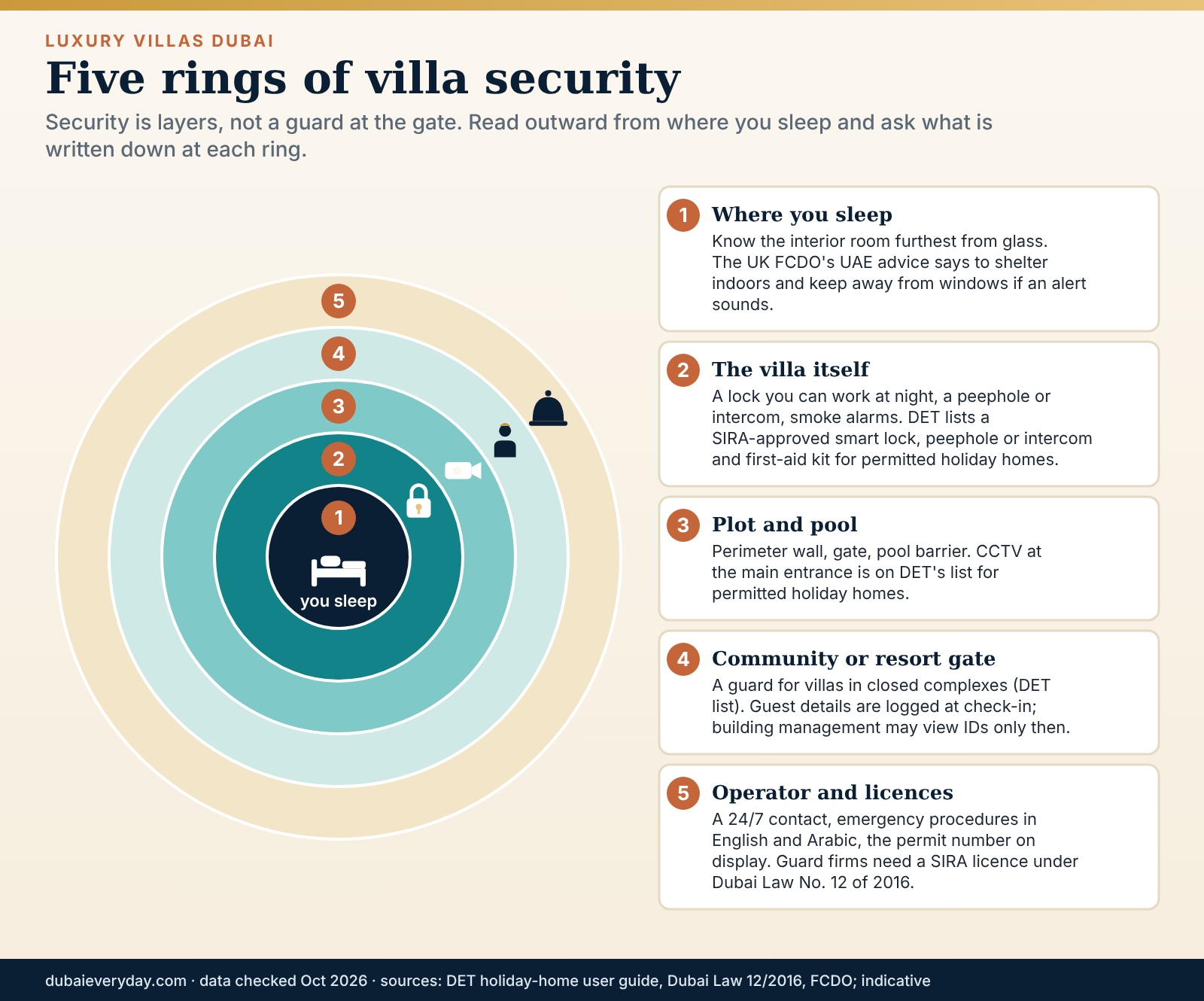
Security at luxury villas Dubai guests rent is layers, not a guard at the gate. Figure 4 shows five rings from the room where you sleep out to the operator’s licences. The useful habit is to read outward and ask what is written down at each ring. A strong outer ring does not fix a weak inner one, and a villa with a guard but no working pool gate is not secure in the way that counts.
Rings one and two: the room and the villa
The innermost ring is the room you would use if an alert sounded. The UK FCDO’s UAE advice, which we read on 29 October 2026, says to shelter indoors and keep away from windows if an alert sounds, and not to touch debris. Many luxury villas Dubai guests rent are built around glass, so ask which room is furthest from large windows and whether it can be used by the whole group.
For the villa itself, DET’s guide lists a peephole or intercom and a SIRA-approved smart lock. The UAE government portal says owners of residential houses must install fire detection devices and subscribe to the civil defence system, so ask whether smoke alarms are fitted and working. Whether the owner or the tenant is responsible is a point we could not settle, so ask the host to show you.
Rings three and four: the plot and the gate
The plot ring is the wall, the gate and the pool barrier. DET lists CCTV at all main entrances and full fencing for villas, with an exemption for villas in closed communities. It lists a building security guard for homes and villas in closed complexes. What it does not say is where cameras point or how long footage is kept.
Ask. A camera on the front gate is a security feature. A camera that covers the pool terrace is a privacy problem, and there is no reason for one inside a bedroom or bathroom. The UAE’s cybercrime law, Federal Decree-Law 34 of 2021, treats photographing people without consent as an offence, so the rule applies to hosts as well as guests.
The gate ring also covers visitors. The DET guide says guests’ details are recorded at check-in and that building management may view IDs only at check-in. Ask how deliveries and drivers are handled, whether guests receive a gate pass and who is on duty overnight. In a closed community, the rules of the community management, not the host’s, may govern who may enter, and a guard can legitimately refuse someone who is not on the list.
Ring five: the operator and the licences
The outer ring is the operator. DET’s guide requires a 24-hour emergency contact and emergency procedures in Arabic and English. Beyond that, if your villa offers guards, a driver-bodyguard or close-protection staff, the security industry itself is regulated. Dubai Law No. 12 of 2016 establishes the Security Industry Regulatory Agency, known as SIRA, as the entity that regulates the industry.
Article 17 bars anyone from providing security services in Dubai without a licence, Article 21 sets fines of AED 10,000 to AED 500,000 for violations and doubling for repeats within a year, and Article 4 says the law applies across the emirate, including special development zones and free zones such as DIFC.
For a guest, the sensible request is simple: ask whoever supplies guards, or whoever recommends a security provider, for the company’s SIRA licence number and for the name of the person who supervises the team. We did not find a public look-up tool, so the check is a conversation. If you are a public figure or a family with specific concerns, a licensed provider can also advise on privacy planning, and that advice belongs to professionals, not to a travel guide.
A ten-minute security walk on arrival
- Test the main lock and every exterior door, including the one to the pool terrace.
- Find the peephole or intercom and the 24/7 number, then call it once to see who answers.
- Locate the first-aid kit, the fire extinguishers and the smoke alarms.
- Walk the perimeter, look for gaps, climbable furniture and unlit corners, and note where the cameras are.
- Agree on the interior room for alerts, and make sure everyone knows the emergency numbers: 999 for police, 998 for ambulance, 997 for civil defence.
- Photograph any damage you find before you use the villa, and send it to the host the same day.
Privacy and photography
Privacy is a security question too at luxury villas Dubai guests choose. Drones are the usual surprise: we did not verify current drone rules in detail, only that a press report in January 2025 described tighter restrictions, so do not fly one at a villa without checking with the operator and the authorities.
If your group includes someone whose face is known, the same logic applies to social media. A tagged location can undo a lot of careful planning. The 2021 cybercrime law is the reason the safest assumption is that photographs of other people need their consent.
How to book luxury villas Dubai offers, step by step
Booking luxury villas Dubai offers is closer to signing a short contract than to reserving a hotel room, and the order of the steps matters. Do the cheap checks first, when you can still walk away, and pay last. Figure 5 shows the seven checkpoints. The text below adds the detail the graphic cannot carry.

- Pick the route first.Hotel villa, operator villa or owner listing. Everything after depends on it, from who you ask about the permit to what a refund looks like.
- Confirm the property is operating.Refurbishments, pauses and partial closures are common in 2026. Ask in writing whether the villa, the pool and any restaurant you are counting on will be open on your dates.
- Ask your questions in writing.Use the enquiry email later in this guide. A written reply is the only record you will have if something differs on arrival.
- Verify the licence or permit.For a holiday home, ask for the DET permit number and classification, and look for the QR sticker and unit board. For a hotel villa, ask the hotel to confirm the villa is part of its licensed inventory.
- Read the terms, not the summary.Check which check-in document you will sign, the deposit and release timing, the cancellation window, the house rules and the maximum number of guests.
- Pay on protected rails.Use a card or a platform with its own payment protection. Ask for an invoice that shows VAT, if charged, and the Tourism Dirham as a separate line.
- Check everything on arrival.Call the 24/7 number, walk the pool and the perimeter, find the interior room, photograph the condition and report problems the same day.
Where to book
You can book luxury villas Dubai hotels operate direct with the hotel or through a travel agent or concierge, and holiday-home villas through local operators or through mainstream booking platforms. We do not rank channels and we do not recommend one. Two principles apply across them.
A listing on a well-known site is not a DET permit, so the number still has to be asked for. And the contract that governs the booking is the one you accept, which may be the platform’s terms, the operator’s or both. Read which one applies to cancellation and to disputes.
If you use a concierge or agent, ask how they are paid. Some are paid by the villa, some by you, and some by both. That is not a reason to avoid them, because a good one can negotiate inclusions and chase problems. It is a reason to ask whether the recommendation is independent. Our own page takes no commission, and the selection above reflects what pages state, not what anyone pays.
Deposits, cancellation and the clauses that bite
DET’s guide allows operators to take a security deposit before arrival by credit card or mandate, requires them to tell guests that breaches may lead to deductions, and says balances must be returned as soon as possible after departure. It sets no number of days. So ask for the deposit amount, the method, the inspection process after you leave and the number of days to release. If the answer is “after we check”, ask how long checking takes.
On cancellation, remember that the guide says guests are not entitled to any refund of lease fees. We read that as the baseline position, with refunds a matter for the written terms. That makes the cancellation clause the clause to negotiate, and travel insurance the sensible companion. With the UK FCDO describing the regional situation as unpredictable and flights possibly disrupted, ask specifically what happens to your booking if flights are cancelled or an alert closes the area.
Walk away, or pause, if the host cannot give a DET permit number and classification, asks you to pay by transfer to a personal account, wants to move the conversation away from the platform before you pay, offers a price far below comparable villas, refuses a video walk-through or the exact address until payment, asks for copies of your passport beyond check-in, or wants you to sign a standard tenancy contract for a short stay. No single flag proves a problem. Several together are a reason to stop. This is general information, not legal advice.
What luxury villas Dubai cost: the bill above the rate
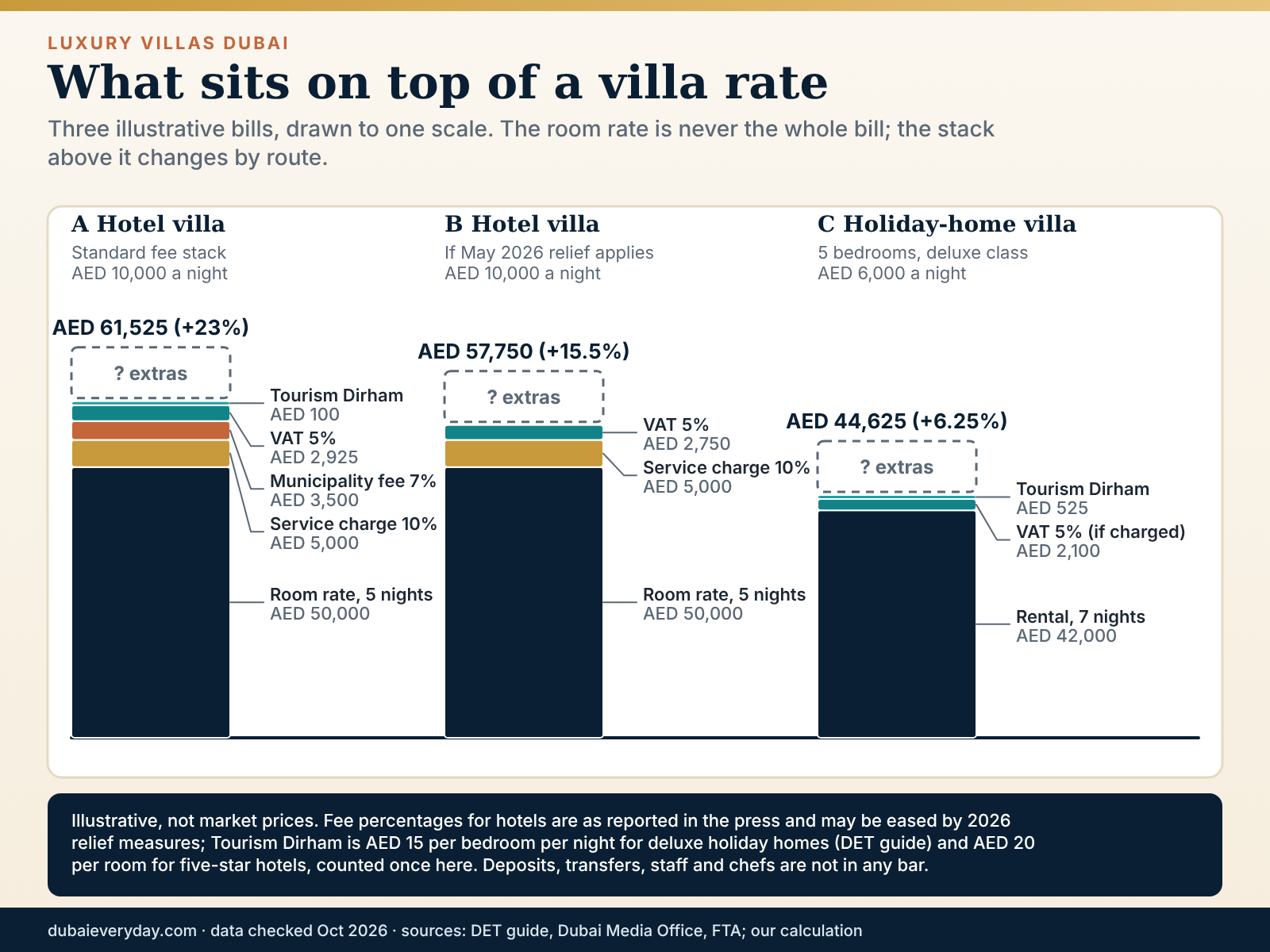
We found no published rate card for the luxury villas Dubai hotels and operators list in this guide, so we do not quote nightly rates. Hotels say “on request”, and holiday-home rates are set listing by listing. What we can do is show the arithmetic of what sits on top of a rate, using the fee rules we could read, and label every number as illustrative. Figure 6 draws three bills for luxury villas Dubai guests might face, to one scale.
The hotel villa stack
Take an assumed hotel villa at AED 10,000 a night for five nights, AED 50,000 before extras. Press reports describe a 10% service charge and a 7% municipality fee on hotel bills, then 5% VAT on the total, the UAE standard rate set out by the Federal Tax Authority.
Add a Tourism Dirham of AED 20 per occupied room per night for a five-star hotel, counted once. The calculation: 50,000 plus 5,000 plus 3,500 equals 58,500; VAT of 2,925 brings it to 61,425; the Tourism Dirham of 100 makes AED 61,525, which is 23.05% above the rate.
The order of charges is our assumption, and the fee percentages are press figures that we could not confirm on a primary page. Under the May 2026 relief package, the Dubai Media Office reported that DET-registered establishments were exempt for three to twelve months from collecting the Tourism Dirham and from certain sales fees.
If that exemption applies to your dates and the municipality fee and Tourism Dirham drop out, the same stay is AED 55,000 plus VAT of 2,750, or AED 57,750, about 15.5% above the rate. We found no end date for the relief, so ask how the hotel will bill the stay.
The holiday-home stack
DET’s guide sets the Tourism Dirham for holiday homes at AED 15 per bedroom per night for deluxe homes and AED 10 for standard homes, remitted by the 15th of the following month, shown as a separate line on the invoice and capped at the first 30 consecutive nights.
For an assumed five-bedroom deluxe villa at AED 6,000 a night for seven nights, the rental is AED 42,000, the Tourism Dirham is 5 times 15 times 7, or AED 525, and VAT at 5%, if the operator charges it, adds AED 2,100. The total is AED 44,625, 6.25% above the rate. Whether VAT applies depends on the operator’s registration and the nature of the supply, so ask for a VAT invoice and for the tax registration number.
The guide’s penalty table lists charging extra for electricity or water among the violations, so ask whether utilities are in the rate and why, if not. The same table lists operators who charge extra service fees without proof of cost. It does not tell you whether a cleaning fee, pool heating charge or damage deposit is acceptable, which is why those items are the dashed question marks in the graphic.
Villa or rooms: a break-even you can use
Here is a piece of arithmetic that helps when a group pricing luxury villas Dubai offers is choosing between one villa and several hotel rooms. Assume a five-bedroom villa at AED 6,000 a night. With VAT of AED 300 and a Tourism Dirham of AED 75, that is AED 6,375.
Now take five comparable five-star hotel rooms at a net rate of r each. With 10% service, 7% municipality fee, 5% VAT and AED 20 Tourism Dirham per room, the bill is about 1.2285 times r plus 20 for each room. Five rooms cost 6.1425 times r plus 100. That equals the villa at an r of about AED 1,020.
So, in this illustration, if comparable hotel rooms cost more than about AED 1,020 a night each before fees, the villa is cheaper, and below that the rooms are cheaper. The model ignores breakfast, the villa’s cleaning and utilities, and the fact that rooms may be better finished. It is a starting point for your own comparison with real quotes, not a market finding.
Transfers: the cost nobody puts in the listing
Transfers sit outside every bill in Figure 6, and they matter most for luxury villas Dubai guests book far from the airport. Dubai Taxi’s limousine page lists a start of AED 25 and AED 3.90 per kilometre, and its taxi page AED 2.45 per kilometre with Salik added. The AED 25 start may be a minimum rather than an addition, so we show a range.
For a 37-kilometre trip to the Palm Gateway our calculation gives about AED 116 by taxi and AED 144 to AED 169 by limousine. For Al Maha at 65 kilometres, a taxi comes to about AED 184 and a limousine to AED 254 to AED 279, against the hotel’s own 4×4 at AED 447 each way. Those figures are one-way and before Salik, so double them for arrival and departure.
When to go: seasons, events and demand
The value of luxury villas Dubai offers follows the weather more closely than hotel value does, because the garden and the pool are half of what you are paying for. Climate averages from a travel-weather site (a secondary source) put the daily maximum at about 24 degrees Celsius in January, 37 in May, 41 in July and August, and 31 in November. Our reading is that November to April is when outdoor space earns its premium, and the summer months are when a villa’s air conditioning and a properly cooled pool matter most.
That does not make summer a bad time. It changes what you should ask. In July, find out how the pool is kept cool, how cooling is billed (DET’s guide, as worded, bars charging extra for electricity or water) and whether the garden has shade you can sit in at 5 pm. In January, ask whether the pool is heated, since a pool that feels refreshing in August can feel sharp on a cool evening in winter.
Dates that move demand
The Dubai Shopping Festival is listed for 4 December 2026 to 17 January 2027, the Dubai Marathon for 17 January, the Hero Dubai Desert Classic golf tournament for 21 to 24 January, and the Dubai World Cup racing night for 27 March 2027, according to Visit Dubai for the festival and press event listings for the rest.
Ramadan is expected to begin around 8 February 2027, with Eid al-Fitr around 9 or 10 March, depending on the moon. The Dubai Racing Carnival opens on 6 November 2026. New Year’s Eve is its own category: Al Maha’s page lists a mandatory gala dinner for 31 December 2026, and other properties may attach minimum stays or set menus that appear only at booking.
For these windows, ask luxury villas Dubai operators about minimum-night rules and special-event surcharges before you ask about price. The rule is not new, but it matters more for villas than for hotel rooms, because a villa that sells as a single unit leaves no cheaper room to fall back on. For the wider calendar and seasonal trade-offs, our Dubai travel planning guide is the place to start.
What the 2026 market does and does not tell you
Occupancy in 2025 averaged 80.7% according to the Dubai Media Office. Press reports put March 2026 at about 36% and August at 66%, with luxury hotel occupancy near 51% in the first half. A softer market can mean more room to ask for inclusions such as a transfer, a late checkout or breakfast. We have no villa-specific rate data and cannot promise discounts. The honest advice is to ask politely for one inclusion, not to expect a price cut, and to compare at least two similar properties before accepting the first quote.
Choosing among luxury villas Dubai offers by trip type
The best of the luxury villas Dubai offers depends on who is going. Here are five common trip types and what we would weigh for each, based on the evidence above. None is a recommendation of a named property.
Family with young children
Weigh pool safety above everything else. Prefer a villa whose pool barrier matches the Dubai Municipality checklist, ask about a safety net or cover, and consider a hotel villa where staff and a clinic are close. Al Maha accepts children of any age, with supplements from six, but is 65 km from the airport.
Multi-generational group
An operator villa gives space and a kitchen, but read the occupancy limit and the visitor rules: DET’s guide bars visitors overnight and asks for quiet from 10 pm. Ask where grandparents will sleep, whether there are stairs, and how far the nearest hospital is.
Privacy-first couple or public figure
Look for private pools, a gated plot and a short list of people with access. Ask who holds master keys, where cameras point and how deliveries are handled. A desert villa gives distance from the city; a Palm villa gives a gate but also a shared island road.
Corporate retreat or VIP stay
Treat a holiday-home villa as accommodation, not a venue. The DET guide says no parties or similar gatherings, so meetings and dinners are better hosted in a hotel or a licensed venue. Ask security providers for their SIRA licence.
Celebration or honeymoon
A hotel villa with in-villa dining suits the occasion better than a larger house with rules about noise and guests. Ask what the restaurants and spa are doing on your dates, since several hotel venues have paused in 2026.
Golf or sports trip
Pick the base by tee times and transport, not by the villa. Our golf courses guide covers visitor access, and the Dubai sports guide helps with dates. Inland communities may be closer to courses than the Palm.
If reading this has made you think a standard hotel room suits you better, that is a fine outcome. Our guide to choosing hotels in Dubai by area, budget and beach access is the right next step, and the ultra-luxury hotels guide covers suites and private beaches in detail.
The enquiry email to send before you pay
A good enquiry is short, specific and written so that every answer is a record. Send the questions below to any of the luxury villas Dubai options on your list, whether hotel, operator or owner, and keep the reply. If a host will not answer in writing, that is informative.
- Please confirm the villa and pool are operating on my dates (state them), and that no refurbishment or closure affects them.
- What is the DET holiday-home permit number and classification (standard or deluxe), or the hotel licence for this villa?
- What is the maximum number of guests, and what do the house rules say about visitors, noise and gatherings?
- Is the pool private to this villa, and is it heated or chilled? Is that included in the rate?
- Does the pool barrier have a self-closing, self-latching gate, and are windows facing the pool restricted or screened?
- Which staff are included, in which hours, on site or on call, and what is billed separately?
- Who has keys or codes, and are codes changed between guests?
- Where do the security cameras point, and is there a guard or gate team at night?
- Which room is best for an alert, and what is the plan if one sounds?
- What is the full price, itemised: rate, service charge, VAT, Tourism Dirham, cleaning, utilities, pool heating?
- What are the deposit amount, method and release timing, and what are the cancellation terms if flights are disrupted?
- Which document will I sign at check-in, and what is the 24/7 contact number?
Paste the list into an email, add your dates and group size and send it to two or three properties. Compare the answers side by side. The property that replies clearly, with numbers, is usually the one that will behave clearly on the day. Ask for the answers to be confirmed in the booking document, not only in the email thread.
Mistakes that cost the most
These are the errors the evidence above points to when booking luxury villas Dubai stays, in roughly the order they cost money or safety. They are inferences from the sources, not a record of what has happened to any guest.
Comparing a hotel villa rate with a holiday-home rate without the fee stack. The two bills in Figure 6 add 23% and 6% to the rate, so a gap in headline rates can reverse once fees are in.
Treating “private pool” as a specification. It can mean a plunge pool at your door or a members’ club across the resort, and the safety questions differ. Ask which of the five types it is.
Booking a Palm villa without pricing the distance. At 37 to 41 kilometres from DXB, each leg is an hour in poor traffic and a few hundred dirhams by limousine over a week of outings.
Skipping the permit number. For holiday homes it is the cheapest check there is, and DET lists a fine of AED 5,000 for operating without a licence. A host who cannot give it is telling you something.
Planning a party. The DET guide says no parties or similar gatherings, bars visitors overnight and asks for quiet from 10 pm, with eviction and loss of deposit among the consequences.
Paying by bank transfer to an individual. Card payments through a protected channel leave you a route to dispute. A transfer leaves you a receipt.
Assuming staff. A butler, chef or nanny is a service with hours and a price. If it is not in writing, it is not in your booking.
Ignoring the cancellation clause when flights may be disrupted. The guide says guests are not entitled to a refund of lease fees as worded, so the written terms and your insurance carry the weight.
Not walking the pool on day one, and not photographing the villa’s condition. The first protects a child. The second protects your deposit.
Four worked scenarios
Each of these luxury villas Dubai scenarios is illustrative, not a real booking, and every figure comes from the arithmetic earlier in this guide with assumed rates. The purpose is to show how the questions turn into decisions.
A family of five in January
Two adults and children aged five and eight want a seven-night stay with a pool. The two candidates are a desert villa with a private plunge pool and a Palm villa through an operator. Start with the transfer.
A limousine to the Palm Gateway end is about AED 144 to AED 169 each way by our calculation, so AED 289 to AED 339 return. The desert resort’s own 4×4 is AED 894 return, a gap of roughly AED 555 to AED 605 on transfers alone. That is not decisive for a stay of this size, but it is real.
The pool matters more than the transfer. With a five-year-old, the question is the barrier: a self-latching gate that opens outward, no climbable furniture, screened windows and no door opening straight onto the water. In a hotel villa, ask the hotel how its plunge pools meet its own safety standards. In an operator villa, walk the pool on arrival and send photographs if anything fails. In either case the same rule applies: a barrier supports supervision, it does not replace it.
Ten friends and a fortieth birthday
Ten adults, three nights, a five-bedroom operator villa at an assumed AED 6,000 a night. The arithmetic is simple: AED 18,000 rental, AED 225 Tourism Dirham (5 times 15 times 3) and AED 900 VAT if charged, so AED 19,125, about AED 1,913 per person for three nights. The harder part is the rule.
DET’s guide says no parties or similar gatherings, bars visitors between midnight and 8 am and asks for quiet from 10 pm. A birthday dinner for the ten of you is staying. A party for forty is not, and eviction and loss of the deposit are among the consequences the guide lists.
The sensible design is to use the villa to sleep and gather quietly, and to book the party in a licensed venue. If a hotel villa with in-villa dining gets closer to the shape of the evening, run the break-even: if five comparable hotel rooms cost more than about AED 1,020 each before fees, the villa is cheaper.
A six-person delegation with security needs
A company is hosting six executives for a week and wants privacy and a guard. The villa is accommodation, not a venue, so meetings belong elsewhere. On security, the useful question is who supplies the guards and whether that company holds a SIRA licence under Dubai Law No. 12 of 2016.
Ask also about camera placement, who holds master access and the plan for alerts. Choose a gated community or a hotel villa, where the first rings of security already exist, over an exposed standalone plot. Anything specific to the delegation’s risk profile is a job for a licensed security adviser.
A resident hosting parents for two weeks
A Dubai resident wants a villa for her parents for 14 nights. At an assumed AED 3,500 a night in a three-bedroom deluxe home, the rental is AED 49,000, the Tourism Dirham is 3 times 15 times 14, or AED 630, and VAT of AED 2,450, if charged, brings the total to AED 52,080, about 6.3% above the rate.
The 30-night cap on the Tourism Dirham does not bite at 14 nights, and the check-in document runs for up to three months, so there is room to extend. The questions that matter are accessibility, a ground-floor bedroom, stairs, the distance to a hospital and the pool barrier. A stay measured in months is a different job, because it moves toward a lease, and the tenancy rules are outside this guide.
The bottom line on luxury villas Dubai
The best luxury villas Dubai offers are the ones whose paperwork you can read. Decide your route first: a hotel villa for service and one accountable party, an operator villa for space and value, an owner listing if you can handle thin service. Then ask the same questions of every shortlisted property: the permit or licence, the pool barrier, the staff schedule, the security rings, the full itemised price and the cancellation terms.
Be sceptical of the word “private” in luxury villas Dubai listings. On the pages we read, only Al Maha states a private pool for every villa, Anantara states it for 15 Beach Pool Villas, and none of the properties we read promises a butler for the villa.
Distance is a cost: the Palm is 37 to 41 kilometres from DXB and the desert reserve is 65. Fees can add 6% to 23% to the rate, and the guide’s rules on noise, visitors and parties will outlast any marketing copy. Do the checks, keep the answers and pay last.
Luxury villas Dubai FAQ
What are the best luxury villas Dubai has to offer?
We do not rank them, because ranking needs first-hand stays and we have none. What we can say is which villa products are documented. Al Maha states 42 villas each with a private, temperature-controlled plunge pool, and Anantara The Palm lists 15 Beach Pool Villas with private pools. One&Only The Palm and Bulgari sell villas but the pages we read do not give counts or pool privacy. The best villa for you depends on group size, children, privacy and distance from the airport, so use the route and checklist approach in this guide.
Are luxury villas Dubai holiday homes legal for tourists?
Yes, when the home holds a DET holiday-home permit. DET’s guide says the unit must be eligible by title deed, insured, inspected and registered, and that the operator must record your check-in within three hours. Hotel rooms and hotel apartments cannot be registered as holiday homes. The practical check is to ask the host for the permit number and classification and to look for the QR sticker and unit board at the property. This is general information, not legal advice.
How much do luxury villas Dubai guests rent cost per night?
We found no published rate card for the villas in this guide, and hotels say rates are on request, so we do not quote nightly prices. What you can plan for is the stack above the rate. Our illustrative bills add about 23% for a hotel villa with the standard fee stack, about 15.5% if the 2026 relief measures apply and about 6% for a holiday-home villa, before deposits, transfers and staff. Ask for an itemised quote from each property and compare totals, not headline rates.
Which luxury villas Dubai guests book have private pools?
On the pages we read, Al Maha states that every one of its 42 villas has a temperature-controlled private infinity plunge pool, and Anantara The Palm’s factsheet lists private pools for its 15 Beach Pool Villas but not for its Over Water Villas. One&Only The Palm, Bulgari and Jumeirah Beach Hotel pages did not state private pools for villas. “Private pool” can also mean a members’ pool club, so ask whether the pool is at your door.
Is Palm Jumeirah a good area for luxury villas Dubai stays?
It gives you a gated community, waterfront and, on some plots, private beach. It also puts you roughly 37 to 41 kilometres from DXB, about 40 minutes in light traffic and up to 75 in heavy traffic by our estimate. The Palm Monorail status was unclear on 29 October, so do not count on it. If you plan frequent evenings in central districts, a villa nearer the city may save time and transfer costs. Check also that the community allows short stays and that the villa has a DET permit.
Can I hold a party in luxury villas Dubai operators rent out?
DET’s holiday-home guide says no parties or similar gatherings. It also bars visitors between midnight and 8 am, asks for quiet from 10 pm to 8 am and lists permit termination, eviction and loss of deposit among the consequences. Visitor limits are stated inconsistently in the guide, so ask the host for the maximum number in writing. For a celebration, use the villa for a quiet dinner and hold any larger event in a licensed venue or a hotel that offers it.
How do I check whether luxury villas Dubai listings are licensed?
We did not find a public permit search on the DET pages we could read, so the check is a request. Ask the host for the permit number and classification, and for the licence holder’s name. DET’s guide says the property should display a QR sticker below the DEWA premise plaque and a unit information board with the permit number and licensee contact. For a hotel villa, ask the hotel to confirm the villa is within its licensed inventory. A host who cannot do any of this is a reason to stop.
Do luxury villas Dubai guests rent come with a butler or private chef?
Sometimes, but none of the villa pages we read promises a butler. Al Maha names a Guest Relations Coordinator and offers in-villa dining. Other services are best treated as add-ons to be priced. Ask which roles are included, their hours, whether they are on site, and what is billed separately, such as groceries, overtime and gratuity. For private chefs, ask which licence the chef or catering company holds and how allergens are handled.
Is it safe to stay in luxury villas Dubai offers right now?
We cannot give a risk assessment. The UK FCDO’s UAE travel advice, updated on 27 October 2026, describes the regional situation as unpredictable, warns of possible flight and airspace disruption and advises visitors to follow local alerts, keep insurance under review and shelter indoors away from windows if an alert sounds. For a villa, that translates into questions: which room is the interior room, what is the cancellation policy if flights stop, and who answers the 24/7 number. Check official advice for your nationality before you travel.
Are private pools at luxury villas Dubai guests rent safe for children?
Not automatically. Dubai Municipality’s private pool guidelines call for a barrier at least 1.20 metres high, outward-opening self-closing and self-latching gates, no climbable objects near the wall, restricted or screened windows and competent adult supervision whenever the pool is used. A pool can comply on paper and still be unsafe on the day, so inspect the gate, the furniture and the signage on arrival. If anything fails, tell the host in writing and keep children away from the water until it is fixed.
What taxes and fees apply to luxury villas Dubai stays?
Expect 5% VAT where charged, a Tourism Dirham, and for hotels a service charge and municipality fee as reported in the press. DET’s guide sets the Tourism Dirham for holiday homes at AED 15 per bedroom per night for deluxe homes and AED 10 for standard homes, capped at the first 30 consecutive nights, shown as a separate invoice line. In May 2026 the Dubai Media Office reported a relief package that exempted DET-registered establishments from collecting the Tourism Dirham and certain sales fees for a period, so ask how the stay will be billed.
Can I rent luxury villas Dubai operators list for a month?
Possibly, but the rules change at the edges. DET’s guide says the check-in document for a holiday-home guest runs for a maximum of three months and the Tourism Dirham applies to the first 30 consecutive nights only. Longer stays move toward a lease, which falls under tenancy rules, not the holiday-home framework, and is a different job from this guide. Ask the operator which document applies to a 30-night stay, whether utilities are included and how the deposit is handled.
Related reading
Sources and further reading (32 links)
- Dubai Department of Economy and Tourism: Leasing Out Holiday Homes user guide — permit eligibility, safety list, guest rules, Tourism Dirham, penalties
- Dubai Department of Economy and Tourism: Holiday Homes regulation guide 2022 — edition and publication details
- Dubai Department of Economy and Tourism: Hospitality services and permits — hotel, holiday-home and timeshare permits
- Dubai Legislation Portal: Law No. (12) of 2016 regulating the security industry — SIRA’s role, licensing and fines
- Dubai Municipality: Private Swimming Pools Safety Guidelines — barrier, gate, supervision and water-quality requirements
- Nakheel: Palm Jumeirah — island size, structure, gated communities and beaches
- Anantara The Palm Dubai Resort: hotel factsheet — villa types, counts, private pools and airport distance
- Al Maha, a Luxury Collection Desert Resort and Spa: overview — villa count, plunge pools, transfer, gala dinner
- One&Only The Palm: resort page — villas, suites and private beach wording
- Bulgari Resort Dubai: official page — villa types and island location
- Jumeirah Zabeel Saray: official page — Palm location and pool and beach wording
- Jumeirah Marsa Al Arab: official page — Private Pool Club for suite guests
- UK Foreign, Commonwealth and Development Office: UAE travel advice — regional context, alerts and shelter guidance
- UAE Government Portal: Taxes in tourist facilities — Tourism Dirham range and 30-night cap
- Dubai Media Office: May 2026 relief package announcement — fee exemptions for DET-registered establishments
- Dubai Media Office: Dubai’s tourism industry achieves third successive record-breaking year — 2025 visitors and occupancy
- UAE Federal Tax Authority: Value Added Tax — 5% standard rate
- Dubai Taxi: limousine service — start fare and per-kilometre rate
- Dubai Taxi: taxi service — per-kilometre tariff and Salik
- Gulf News: How to get a Holiday Home Permit in Dubai — permit duration and fees (secondary)
- Gulf News: Dubai landmarks and hotels reopening 2027 — closures of Burj Al Arab and Armani Hotel (secondary)
- Khaleej Times: St. Regis Dubai, The Palm to reopen — refurbishment and reopening (secondary)
- The National: Dubai tourism recovery and August visitors — 2026 occupancy and visitor figures (secondary)
- Khaleej Times: Dubai hotel occupancy to recover in H2 2026 — luxury occupancy in the first half (secondary)
- Palm Monorail: operator homepage — service status notice
- Emaar Communities: lifestyle FAQs — community rules on sponsored staff (operator information)
- UAE Legislation: Federal Decree-Law No. 34 of 2021 on combatting rumours and cybercrimes — privacy and photography offences
- Visit Dubai: Dubai Shopping Festival — festival dates
- Weather2Travel: Dubai climate — average monthly maximums (secondary)
- Khaleej Times: Dubai’s Palm Monorail services resume — monorail restart report (secondary)
- Wikipedia: Jumeirah Beach Hotel — room and villa counts (secondary)
- Wikipedia: Atlantis The Royal — opening room counts and private-pool suites (secondary)
Update log: 29 October 2026, first publication; facts checked against the sources above. Next review due by 28 February 2027, or sooner if DET rules, hotel villa offerings or the regional travel advice change. Corrections welcome. This guide is general information, not legal, insurance, medical or security advice.
About DubaiEveryday and this guide
DubaiEveryday.com is an independent editorial project that publishes practical, research-based guides to everyday life in Dubai: where to live, what things cost, how the rules work and how to get around. This page was written and edited by the DubaiEveryday editorial team. It is not signed by a named expert, doctor, lawyer or adviser, and we do not claim first-hand testing of a venue, clinic or service unless the page says so.
Each guide is built from official sources such as government and regulator pages, operator websites and established news outlets, cross-checked where we can. When we could not confirm something, we say so in the text, and examples that use made-up numbers are labelled as illustrations. Mentions are editorial choices, not paid placements, and a link is not an endorsement.
Dubai changes quickly. If you spot something that is out of date or wrong, please tell us through the contact options on DubaiEveryday.com and we will check it and correct the page.