

Dubai runs on a simple sporting rule: outdoors from late October to April, indoors, floodlit or before sunrise for the rest of the year. This guide shows how that rule shapes the sports Dubai residents and visitors actually play or watch (golf, padel, football, cricket, running, cycling, racing and the big events), with verified dates for the 2026-27 season.
A runner in July and a runner in November are living in two different cities. The same goes for golfers, cyclists and anyone holding a padel racket. Dubai bends its sporting year around the heat, and once you see the pattern, planning gets much easier. Miss it, and you may book a trip for a fixture that is not on.
This guide to sports dubai residents and visitors can actually use starts with that calendar. It then covers golf, padel, football, cricket, running, cycling and racing, with verified dates for the 2026-27 season, heat-safety thresholds and worked budgets. You will also get a simple way to pick a sport you can still be doing in June.
The sports Dubai does best are golf, padel, running, cycling, cricket, football and horse and motor racing, and almost all of them follow one calendar: the outdoor season runs from about late October to April, then the heat pushes play indoors, under lights or into the hour around dawn.
If you are visiting, plan around the events, because most of the headline fixtures sit between November and March. If you live here, pick a sport you can do before 8 am or after sunset, because a routine that needs midday is a routine that stops in June.
The 2026-27 season is already scheduled. Dubai Ride closes Sheikh Zayed Road to cars on 1 November, the DP World Tour Championship tees off on 12 November, Dubai Run follows on 22 November, the Dubai Marathon is on 17 January 2027, the Desert Classic is on 21-24 January and the tennis tournament starts on 14 February. Below you get a way to choose a sport, the verified rules and numbers for each, an event calendar, a venue map, heat-safety thresholds and worked budgets.
This is a desk-research guide to the sports Dubai residents and visitors can play or watch. DubaiEveryday.com has not played, ridden, driven or spectated at any venue below, and nothing here describes a personal visit. Dates, distances, rules and counts were read on 29 October 2026 from official or organiser pages where they could be reached, including the Dubai Media Office, the Roads and Transport Authority (RTA), Dubai Racing Club, the Dubai Marathon, Premier Padel, Dubai Autodrome and ILT20. Where only a news report or aggregator was available, we say so.
Prices for courts, green fees, memberships and pitches change by venue, day and hour, and many operators do not publish them. We did not invent figures. Where a number would help, you get either a labelled illustrative example or a method for working it out. Inclusion was not paid for, nothing is ranked by commission, and there are no booking links. This is general information, not individual medical, legal or financial advice.
How the sports Dubai calendar really works
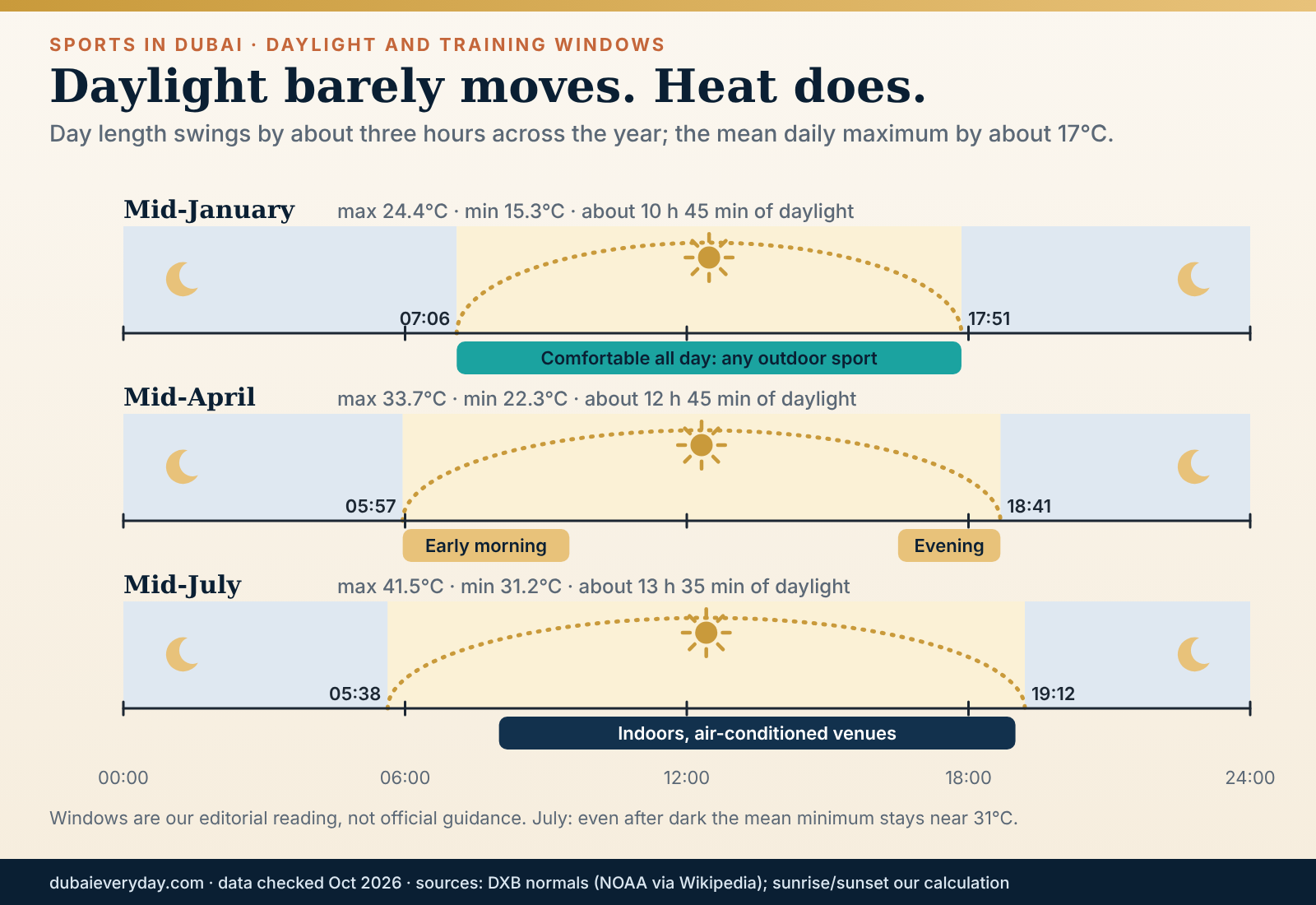
Start with the thermometer, because it decides almost everything else. At Dubai International Airport, the 1991-2020 climate normals (as tabulated on Wikipedia’s Climate of Dubai page, which cites NOAA; a secondary source we use for context) put the mean daily maximum at 24.4°C in January and 41.9°C in August. Overnight minimums in July and August sit around 31°C. Relative humidity runs roughly 50 to 65 per cent through the year, so the heat is rarely the dry kind.
Our reading of those numbers is blunt. From November to March, mean maximums stay between about 24°C and 31°C, which is comfortable for any sport at any hour. April and October are shoulder months: a mean maximum of 33.7°C in April and 35.9°C in October means mornings and evenings work, midday does not. From May to September, mean maximums of 38°C to nearly 42°C, with nights that barely cool, turn outdoor training into a safety question rather than a preference. That is the first filter for any sports Dubai plan.

Light is the second constraint
People forget daylight. Using a standard solar algorithm for Dubai’s latitude and longitude (our calculation, accurate to a couple of minutes), the sun rises at about 07:06 and sets at about 17:51 in the middle of January. That gives you roughly 10 hours 45 minutes of daylight, and the outdoor season therefore has a hard evening cut-off at about 6 pm unless the venue has floodlights. In June the sun is up at about 05:28 and sets at about 19:10, so the usable cool window before sunrise heat is extremely short.
The practical consequence for the sports Dubai residents play is that winter sport is a daytime pursuit, and summer sport is a night-time one. Floodlit padel courts, golf driving ranges, running tracks with lighting and indoor arenas stay useful in July. Open desert cycling tracks and public football pitches without lights do not. Whenever a venue says “open 24 hours”, ask whether that means lit, shaded and staffed, or merely unlocked.
Why the calendar bunches into winter
Promoters follow the weather, so the headline sports Dubai sells to the world are mostly winter products. The Dubai Fitness Challenge, organised by the Dubai Department of Economy and Tourism and the Dubai Sports Council, runs its tenth edition from 31 October to 29 November 2026, as announced by the Dubai Media Office. Racing at Meydan runs “from November to March” according to Dubai Racing Club. The two golf headline events sit in November and January.
If your trip falls near the edge of this window, the fuller month-by-month picture lives on the Dubai events calendar.
The same logic applies to what you should expect to find open and busy. Public tracks and parks are at their most crowded between November and March, particularly at weekends and around dawn and dusk. Hotel pools, beach clubs and gyms soak up the summer demand. For a seasonal view of when to travel in general, the guide to the best time to visit Dubai covers hotel prices, crowds and weather together; this page stays with the sport.
What this page covers, and what it leaves to siblings
A word on scope, so the page does not duplicate its siblings. This is the overview of sports Dubai residents and visitors can actually do or watch. Golf gets a short orientation here, and the detailed comparison of courses, green fees, night golf and visitor access lives in the golf courses in Dubai guide. Gyms and studios sit in the best gyms in Dubai guide, the wider hospitality side is in the luxury Dubai guide, and the all-year events picture is in the events calendar already mentioned.
Sports Dubai at a glance
A few verified numbers frame the rest of the page. They come from the sources listed at the end, and the sections below explain each one.
Those four figures describe four different layers of the same system: infrastructure built by government, a venue built for international fixtures, a domestic league with a small Dubai presence, and a mass-participation programme that reaches far beyond the committed athlete. When you read about the sports Dubai promotes, keep asking which layer you are looking at.
Heat rule of thumb. Treat May to September as an indoor season for hard exercise, whichever of the sports Dubai offers you choose. If you must train outside, finish before the sun is properly up and keep sessions shorter and easier than your cooler-month habit suggests. The health section later in this page gives the warning signs and the official first-aid logic.
A note on Ramadan and sport
Ramadan moves with the lunar calendar and shifts about ten or eleven days earlier each year. In 2026 it fell in February and March. The exact start date is confirmed by moon sighting, so check the announcements closer to the time. For the sports Dubai hosts, it changes opening hours, the timing of matches and training sessions, and how you behave in public places. If your trip or tournament overlaps, read the guide to Dubai etiquette before you pack, and book early-morning or late-evening activity rather than daytime.
Choosing among the sports Dubai offers: a decision guide
Most people choose a sport by what they like. With the sports Dubai offers, it works better to choose by what survives the logistics. A city this spread out, this hot and this car-dependent punishes the sport that needs three partners, a 45-minute drive and an outdoor midday slot. Before you ask which sport, ask three questions: when can I realistically play, who has to be there with me, and how do I get access?
Question one: the time window
Write down the two hours of your week that are genuinely free and cool. For a resident that is usually before work (about 05:30 to 07:30 in summer, a little later in winter) or after sunset. For a visitor it is the first and last two hours of daylight. Any sport that cannot fit in those windows, or needs floodlights you cannot confirm, drops down the list. This single filter removes more options in summer than any budget does.
Question two: the partner problem
Solo sports (running, cycling, swimming, gym work) have no scheduling cost, which is why they dominate the sports Dubai newcomers start with. Pairs sports (tennis, squash, a round of golf for two) need one reliable person. Doubles sports such as padel need three.
Team sports (football, cricket, rugby) need a group and a venue that will let you in. Dubai’s transient population tends to make the larger formats easier than you might expect, because organised leagues and open-play sessions are common, but the commitment is still real. Be honest about whether you will turn up in the fourth week.
Question three: how access works
Access to the sports Dubai residents play comes in five forms. Public and free: tracks, promenades, beaches and the annual mass events. Public with a small gate fee: some parks and event grounds. Pay per use: pitches, courts, ranges, karting, track days. Membership: golf clubs, gyms, racquet clubs and residential-community facilities. Spectator ticketing: the headline events. Each form has different failure points, and the sports sections below say which one applies.

Our friction ratings
The table below is our reading of how much friction each of the sports Dubai offers adds for someone new to the city. It is an editorial judgement built from the access models and constraints described in this page, not a statistic and not a ranking of quality. “Low” means you can start this week with little planning.
| Sport | Best months outdoors | Main way in | Friction (our reading) | Watch-out |
|---|---|---|---|---|
| Running | November to March; dawn in shoulder months | Free tracks, parks, mass events | Low | Heat, daylight, route safety |
| Cycling | November to March | Free tracks, own or rented bike | Low to medium | Helmet, track rules, distance from home |
| Padel | All year at covered or lit courts | Pay per court, or club membership | Medium | Finding three partners and a peak slot |
| Football | November to March outdoors | Pay per pitch, leagues, academies | Medium | Group commitment, pitch booking |
| Cricket | November to March | Clubs, academies, leagues | Medium to high | Ground access, equipment |
| Golf | November to April; early or late in summer | Visitor tee times, membership | Medium to high | Cost, tee-time demand, dress code |
| Track days and karting | All year at indoor kart tracks; winter outdoors | Pay per session | Medium | Age, licence and vehicle rules |
| Horse racing (spectator) | November to March | Race-night tickets | Low (spectating) | Dress, date and ticket category |
Use the table as a filter for the sports Dubai newcomers ask about, not as a verdict. If your goal is meeting people, padel and football carry the highest social return per hour. If your goal is cost control, running and cycling are the cheapest by a margin. If your goal is a corporate or client day, golf and race nights are the two formats Dubai’s hospitality industry has been built around, and the luxury Dubai guide covers the concierge side.
Golf in Dubai
Golf is the sport most associated with Dubai’s international sporting image, and of all the sports Dubai covers here it is the one where this page should say least, because the detailed comparison belongs to the Best Golf Courses in Dubai guide. What follows is orientation: how access works, how heat changes the day, and what the two headline tournaments mean for a visitor.
How access to golf works
The official Dubai Golf group site, dubaigolf.com, lists Dubai Creek (Championship Course), Emirates Golf Club (Majlis, Faldo and a Par 3 Academy course) and Jumeirah Golf Estates (Earth and Fire courses).
It offers separate “Visitor” and “Golf Holiday” tee-time booking options alongside a members’ area, which tells you the basic structure: members hold priority, visitors book through the operator’s channels, and golf-break packages are sold as a distinct product. Green fees were not shown on the page we could read, so we do not quote any. Ask for the all-in price, including buggy and any range balls, before you commit.
Dubai also has driving-range entertainment venues aimed at people who do not play full rounds. The same group’s site lists Topgolf Dubai among its properties, though without describing it in detail. If you are travelling with a mixed group, a range session is a lower-commitment way to spend a golf-minded evening than a full round.
Check before you book. Ask four things: whether the tee time includes a buggy, what the dress code requires (collared shirt and golf shoes are the usual baseline at clubs), whether twilight rates apply, and what happens if heat or wind interrupts play. Policies differ by course and by season.
Golf and the heat: a worked example
Our calculation shows why this is one of the sports Dubai plays by the clock: a morning sport in summer and an all-day sport in winter. Assume a round for a fourball takes about four and a half hours (a typical planning figure, not a course-specific one).
In mid-January the sun sets at about 17:51, so the last tee time that finishes in daylight is around 13:20. In mid-July the sun rises at about 05:38 and the mean daily maximum is 41.5°C, so a round that starts at 06:00 is finished by 10:30, when it is already well into the hot part of the day.
That is why summer golf in Dubai is mostly an early-morning or twilight activity, and why the winter months are likely to be the busiest time to find a tee time. If you are travelling for golf, the shoulder months of late October, November and March offer the best mix of daylight and temperature. If you cannot avoid summer, book the first slot you can and treat the second nine as optional.
The two tournaments that matter for visitors
The DP World Tour Championship runs 12-15 November 2026 on the Earth Course at Jumeirah Golf Estates, with the top 50 players on the Race to Dubai Rankings in the field, according to an Emirates 24/7 report (a secondary source). The report also describes a Ladies Day and Family Day programme with free golf clinics, outdoor Pilates and live music in the championship village, and mentions a free-Thursday-entry offer. It does not give ticket prices, so check the official tournament channels.
The Hero Dubai Desert Classic returns to Emirates Golf Club on 21-24 January 2027, as the 38th edition and the first Rolex Series event of the 2027 DP World Tour season, according to Gulf News’ look at the 2027 GCC schedule. Two events two months apart is a useful structure: the November tournament is a season finale and the January event is a season opener, so you can choose the one that fits your dates.
If you are building a golf trip around either event, hotels near the courses sell early and prices rise. The best luxury hotels guide and the Dubai Marina area guide are the natural next reads, because Jumeirah Golf Estates and Emirates Golf Club sit within easy reach of that corridor.
Who golf in Dubai is not for
It is not for the budget-minded, the impatient or anyone who dislikes a booking system. Among the sports Dubai residents play it is a high-cost one by any measure, and tee-time scarcity at peak winter weekends is a real constraint. If you want the golf atmosphere without the cost, watching a tournament round from the grass is the cheaper route, and a range session is cheaper still. If you want to learn, ask the operators about lessons and academy sessions rather than turning up at the first tee.
Padel, tennis and other racket sports
Padel is the clearest example of how sports Dubai residents adopt can change in a few years. It is played in doubles on an enclosed court about 10 metres wide and 20 metres long, with glass and mesh walls that stay in play, underarm serves and tennis-style scoring, according to the sport’s reference entry on Wikipedia (a secondary source).
The same entry says the number of padel courts across the Gulf countries grew from 20 in 2016 to 1,850 in 2022, with most of them in the UAE, Kuwait, Qatar and Oman. We could not find a verified Dubai-only court count, so we do not quote one.
Why padel works so well here
Our reading is that padel succeeds among sports Dubai residents choose for structural reasons. The court is small enough to cover with shade, a roof or air-conditioning, and small enough to light well, so it escapes the two big constraints on outdoor sport. Doubles means four people share the cost.
The learning curve is gentle for beginners, because the walls keep the ball in play, and rallies start within the first session. For a city of newcomers who want a social sport that does not require a club history, it is the easiest of the racket sports Dubai offers to start.
The trade-off is supply and timing. Peak evening slots are usually the ones everyone wants, and they tend to go first. Courts in residential communities and hotels are often easier for guests or residents of that community than for outsiders, so ask whether non-members can book and how far ahead. If you are new, an off-peak weekday morning is the cheapest and quietest way to find out whether the game suits you.
Illustrative example (not a quote or market fact). The arithmetic of padel is the same wherever you play. If a court cost AED 200 for 90 minutes, four players would each pay AED 50 per session. Two sessions a week for a month, at 4.3 weeks, comes to about AED 430 each, before racket hire, balls or any membership fee. Replace AED 200 with the venue’s actual published price and the sum still works.
Padel events and the professional game
Premier Padel’s calendar lists a Dubai P1 tournament on 8-15 November 2026 and the Premier Padel Finals on 10-13 December 2026, according to the circuit’s official site. The page we could read gave no venue for either event, so confirm the location and ticket arrangements before you plan travel around it. Even if you never plan to attend, the schedule is a handy signal of when padel will be in the news.
Tennis and the winter stadium fortnight
The Dubai Duty Free Tennis Championships are the city’s best-known tennis fixture. The tournament’s own site shows 14-27 February 2027 in its header, at the Dubai Duty Free Tennis Stadium, according to its dates page. It did not split the fortnight between the WTA and ATP events.
For orientation, the 2026 edition ran the women’s WTA 1000 week from 15 to 21 February and the men’s ATP 500 week from 23 to 28 February, per the What’s On round-up of 2026 sporting events, a secondary source. Assume the same pattern, then confirm with the organisers.
Playing tennis is one of the easiest sports Dubai offers to start, if you accept the season. Most public and community courts are hard courts, play is comfortable from November to March, and in summer the game moves to evenings and lit courts. Squash, badminton and table tennis, which sit in the same family of racket sports, are normally indoor and therefore year-round. Many gyms and community clubs offer them. Our guide to the best gyms in Dubai is a better starting point for facilities than a stand-alone list.
Who racket sports are not for
Among racket sports Dubai residents play, padel and tennis are not for people who want guaranteed solitude or flexibility. You need a partner or group, a booked slot and often a membership of some kind. If your schedule changes weekly, running or cycling is a better fit. If you want something that burns calories without a partner, reformer Pilates is a different route, covered in the reformer Pilates guide.
Football in Dubai
Football is one of the sports Dubai follows with two distinct audiences: people who want to play and people who want to watch. The two need different logistics.
Watching: the Dubai clubs
Three Dubai-based clubs play in the UAE Pro League, according to the league’s Wikipedia entry for the 2025-26 season (a secondary source; the 2026-27 fixture list could not be confirmed). Al Nasr play at Al-Maktoum Stadium in Oud Metha, listed at 15,058 capacity. Al Wasl play at Zabeel Stadium, listed at 8,439. Shabab Al Ahli play at Rashid Stadium in Deira, listed at 12,052. The league has 14 clubs in total, so Dubai supplies three of them. Among spectator sports Dubai offers, that makes domestic football the most local option.
The practical advice is to treat domestic league football as a local-flavour option rather than a headline attraction. Crowds vary by fixture, stadium capacity is modest by European standards, and ticketing arrangements change season by season. Check each club’s official channels for the current fixture list and the ticketing route, and do not assume a match on the day you arrive. If your trip is built around a specific fixture, buy tickets first and book the hotel afterwards.
Playing: how pitch access works
Most recreational football in Dubai happens on rented pitches. Five-a-side and seven-a-side pitches are offered by sports complexes, hotels, community clubs and academies, with prices that vary by hour, day and surface. We did not verify any published tariffs, so treat any figure you see in a social post as indicative until you hear it from the operator. Ask four things: whether the pitch is floodlit, what surface it has, how long the booking lasts and what the cancellation policy is.
For team sports Dubai clubs run on artificial turf, the surface matters more than in cooler countries. Artificial turf in direct sun can run well above air temperature, which is a general property of synthetic surfaces rather than a Dubai-specific measurement. Our reading is simple: in October, April and May, play at night; in the cooler months, play when you like; from June to September, play indoors or not at all.
Leagues, academies and children
Leagues and academies are how newcomers find regular games in the team sports Dubai clubs organise. Corporate leagues run in many companies, community leagues form around residential areas, and academies take children from early ages. For children’s sport the more important questions are safeguarding, coach qualifications, group size and the heat policy. Our guide to Dubai with kids covers the family-logistics side, and the schools guide explains how school sport and after-school programmes tie in.
For any academy or coaching programme, ask the operator what licence or approval it holds and which authority issued it. A legitimate operator should be able to say how it is licensed. If it cannot answer clearly, treat that as an answer.
Cricket in Dubai
Cricket has deep roots in Dubai, driven by the size of the South Asian communities living here. Among the sports Dubai fans follow, it is also the one where the city has a global institutional role: the International Cricket Council has its headquarters in Dubai, and the Dubai International Stadium in Dubai Sports City is one of the region’s main venues.
Watching: stadium cricket
According to the ILT20 site, Dubai International Stadium holds 25,000, against 16,500 at Sharjah Cricket Stadium and 20,000 at Zayed Cricket Stadium in Abu Dhabi. For the ILT20 franchise league, the site describes a general-admission category with free seating in all areas except the Platinum Enclosure, a family category in which children aged five and over need a ticket and under-fives enter free if they do not take a seat, and a VIP hospitality category.
E-tickets are emailed 48 hours before the match. Prices were listed as “to be confirmed” on the page we read, and the 2027 season dates were not published there.
Two planning points follow. First, general admission is valid across all three stadiums on the ILT20 site, which makes it more flexible than a match-specific seat, but the key word is “free seating”, which means arriving early. Second, because the league plays across three emirates, check the stadium on your ticket. Dubai to Sharjah and Abu Dhabi are different journeys with different traffic risks.
Playing: grounds, nets and clubs
As with most team sports Dubai clubs run, playing cricket regularly means joining a club, a league or a company team, because proper grounds are managed and booked. Informal tennis-ball cricket, by contrast, is a visible part of open spaces in many communities. If you are new, ask three questions: is it hard-ball or tennis-ball, are nets available for practice, and does the club provide kit? Many clubs run beginner or social sessions, and a handful of academies take children.
The same seasonal rule applies. Most structured club cricket happens from the cooler months, and outdoor nets in July are a poor idea. If you are visiting and want to watch rather than play, the events calendar is the place to check for announced tournaments, and the February events guide is useful because sport is one of that month’s headline themes.
Who stadium cricket suits
Of the spectator sports Dubai hosts, stadium cricket suits people who like an atmosphere more than a scoreboard. It does not suit anyone who dislikes long days, queues at security or a crowd of tens of thousands. Bring sun protection for day matches and expect security checks on what you can carry in. Check the venue’s bag policy before you leave the hotel, not at the gate.
Running in Dubai
Running is the easiest sport to start and the easiest to get wrong. It needs no booking, no partner and no membership, which is why it dominates the free, mass-participation side of sports Dubai promotes. It also needs no warning, which is why heat catches newcomers. The sensible approach is to use the city’s big organised events as anchors, and the rest of the year as a set of short, early, shaded sessions.
Dubai Run: 22 November 2026
Dubai Run takes over Sheikh Zayed Road again on Sunday 22 November, with 5 km and 10 km courses, a 6:30 am start and a 9 am finish deadline when the road reopens to traffic, according to The National’s report (a secondary source; the official challenge site did not list the details when we read it).
The same report says the run is free and open to all ages and abilities, that registration is required, and that a record 307,000 people took part in 2025. It has run since 2019 and is part of the Dubai Fitness Challenge.
Our calculation adds a useful detail. Sunrise in Dubai on 22 November is at about 06:40, so a 06:30 start begins in early twilight. That is good for the heat and a reminder to arrive early, wear something visible and expect crowds to thin out by the time the light is full.
For a crowd of this size, the practical risks are congestion, long walks from the nearest road and the logistics of leaving. Check the road-closure and public-transport notices that the authorities publish for event day, and plan your route before you leave home. If you stay in or near Downtown, the Downtown Dubai area guide shows what is within walking distance of the course, and the Dubai Metro guide covers the network you are most likely to use.
Dubai Marathon: 17 January 2027
The Dubai Marathon’s own site lists the 26th edition for Sunday 17 January 2027, with registration open. Its history page notes that the first international edition started in front of Al Wasl Sports Club in 2000.
A secondary report lists the distances as the marathon (42.195 km), a 10 km road race and a 4 km fun run, and a reader reply attributed to the site’s author said no qualifying time is needed. The entry fee, start time, course map and age limits sit on sub-pages we could not read. Confirm them at dubaimarathon.org before you commit.
The timing is attractive for a sport Dubai only suits in its cooler months: the mean daily maximum for January is 24.4°C at the airport, which is among the best racing temperatures of the year, and the race falls well after the worst of the heat. But the preparation calendar is less friendly.
From 29 October to race day is 80 days, about eleven and a half weeks. That is enough to build towards the 10 km, and tight for a first marathon on a typical build of twelve to twenty weeks. If you are choosing between distances, the 10 km is the realistic target if you are only starting now.
Everyday running: where and when
For everyday running, the cheapest of the sports Dubai offers, the main variables are surface, shade and lighting. Public parks have their own paths and sports facilities; Zabeel Park, for instance, covers 47 hectares around the Dubai Frame and has sports courts and picnic lawns, per Visit Dubai. Entry fees and hours were not stated on the page we read, so check the park’s current terms. Beachside paths and canal-side promenades also draw runners, but they can be crowded with walkers and cyclists at peak times.
The RTA’s cycling rules matter to runners too. The authority says cyclists may not use jogging tracks or pedestrian lanes, which means runners should expect to share space with bikes only on designated cycle tracks. If you choose a cycle track for a long run, stay alert and keep to the edge. Many community routes are fine for both, but the signs are the authority.
Our summer rule for running. When the overnight minimum is above about 28°C (June to September, when airport normals show minimums of 28.0°C to 31.5°C), a night run is not cool. Treat June to September running as an indoor treadmill season, or limit it to short, easy outdoor sessions before sunrise. That is a conservative editorial rule, not medical advice.
Running events beyond the two headliners
Beyond Dubai Run and the marathon, organisers stage 5 km, 10 km, half-marathon and themed runs in the cooler months, often in parks or along the waterfront. We did not verify a full schedule, and many are one-off. Treat the Dubai events calendar as your starting point, check organisers’ pages for registration and safety arrangements, and avoid any event that does not state a clear route, distance and medical cover.
Cycling in Dubai
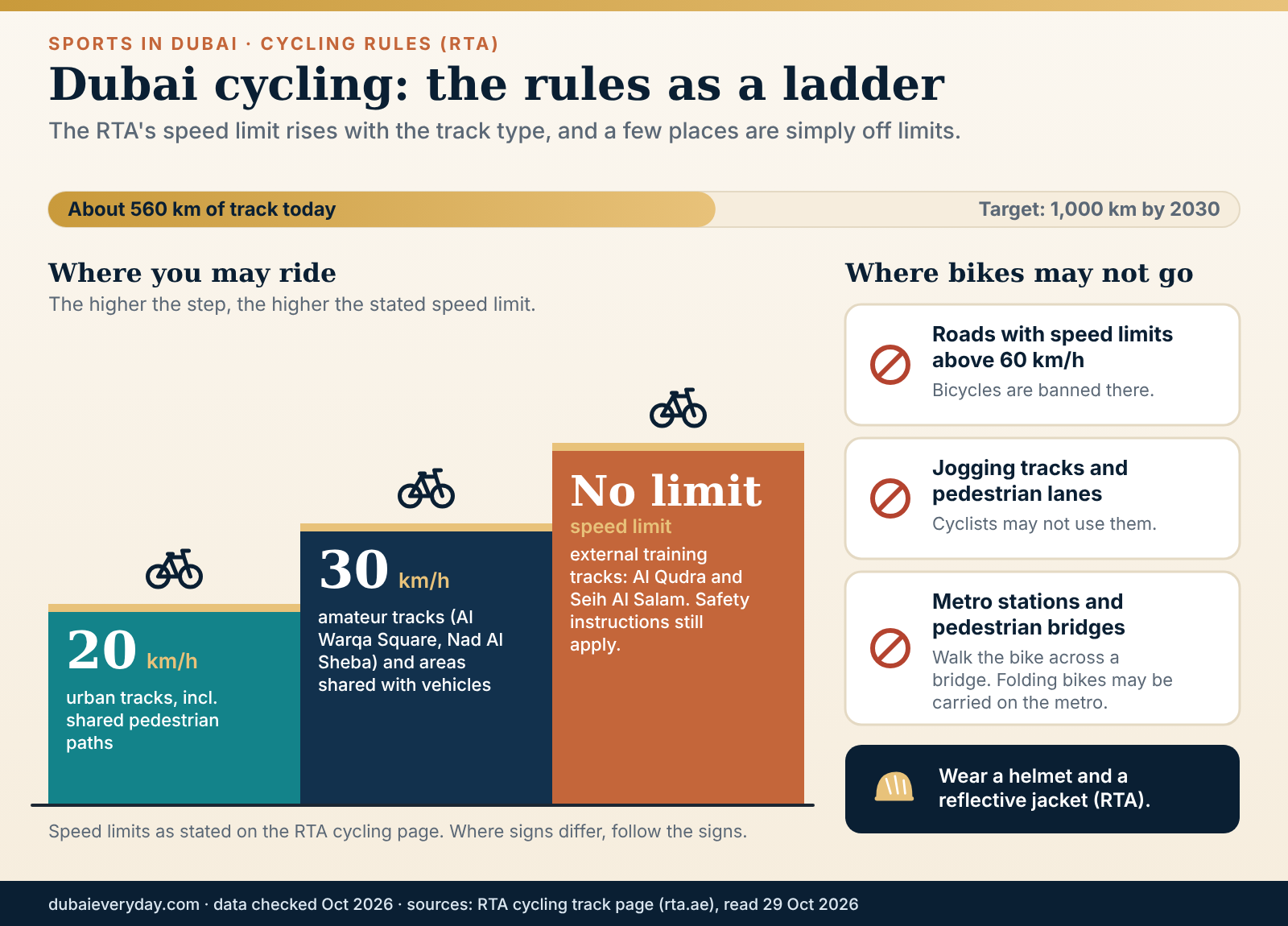
Cycling is one of the sports Dubai has invested in most visibly. It is better organised than most visitors expect, and stricter than most residents assume. The RTA’s cycling page gives the framework: a network of about 560 km, with a target of 1,000 km by 2030.
It lists tracks at Al Qudra, Seih Al Salam, Meydan, Dubai Canal, Dubai Marina, Jumeira Street, Al Quoz, Al Safouh, Khawaneej, Mushrif and Warqaa, and it describes a planned 13.5 km Hessa Street track linking Al Sufouh to Dubai Hills. The source is the RTA’s cycling track page.
The rules that actually matter
The RTA states that bicycles must use designated tracks where they exist and are banned on roads with speed limits above 60 km/h. Cyclists may not use jogging tracks or pedestrian lanes.
Speed limits on the tracks are 20 km/h on urban tracks, including shared pedestrian paths, and 30 km/h on amateur tracks such as Al Warqa Square and Nad Al Sheba or in areas shared with vehicles. Al Qudra and Seih Al Salam are classed as external training tracks with no speed limit, though safety instructions still apply. The page advises wearing a helmet and reflective jacket.
Three details catch people out. Cycling is prohibited in metro stations and on pedestrian bridges, though you may walk your bike across a pedestrian bridge. Folding bikes may be carried on the metro. And the page does not describe track lighting, only advises bright clothing at night, so do not assume a track is lit. Read the full rules on the RTA page before a long ride, because this summary is not a substitute for the official text, and rules can be updated.
Dubai Ride: 1 November 2026
Dubai Ride closes Sheikh Zayed Road to cars on Sunday 1 November, with a 4 km family-friendly route around Dubai Mall, Dubai Opera and Burj Khalifa and a 12 km circuit for more experienced riders, according to The National’s report cited above. Pre-registration is required, and the 2025 edition drew 40,327 cyclists, up from 37,130 in 2024. The start time for 2026 was not stated in the source we read.
Our reading: the 4 km route is a ride for families and for people who want a photo on a road that is normally impossible to cycle on. The 12 km circuit is a gentle outing for a regular cyclist. If you want a long ride, Al Qudra and Seih Al Salam are the better answer. Do not treat Dubai Ride as training. It is a participation day, one of the mass sports Dubai stages each winter.
Hatta and the outdoor sports Dubai offers beyond the city
For off-road riding, Hatta is the usual answer. Visit Dubai’s page for Hatta Wadi Hub lists mountain biking, archery, freefall jumps, wall climbing and ziplining among its activities. The National reported that Hatta Resorts and Wadi Hub reopened on 28 September 2026 for its ninth season, with new activities alongside hiking and mountain biking. Opening hours and prices were not stated, so check the operator before you drive out. Hatta is a longer trip from central Dubai, so it suits a day plan rather than an hour-long ride.
Hatta also features in the Dubai Fitness Challenge. The Dubai Media Office lists Dubai Stand Up Paddle, introduced in 2023, as one of the challenge’s flagship events, held on the waterways of Hatta, alongside Dubai Yoga, which joined in 2024. Dates and registration for those two were not given on the page we read.
Hiring a bike or bringing your own
We did not verify bike-rental operators or prices, so we do not name any. If you bring a road bike, check airline rules on bike boxes and weights before you book, and read the car-rental guide if you plan to carry it by car. For longer rides to Al Qudra, a vehicle is the easiest way to get there, and the best car rental in Dubai guide explains how to compare licensed companies, deposits and total cost.
Racing in Dubai: horses, cars and karts
Racing is where the sports Dubai markets abroad most obviously compete on the world stage, and the one where a visitor with a free evening can spend the most or the least. It comes in three forms: thoroughbred racing at Meydan, motorsport at Dubai Autodrome, and Formula 1 in Abu Dhabi, which is a day trip rather than a Dubai event.
Horse racing at Meydan
Dubai Racing Club says its racing carnival “runs from November to March” and that the Dubai World Cup meeting is held on the last Saturday of March. The 2026 meeting took place on 28 March 2026. The club’s 2026-27 race calendar was blank when we read it, so we could not verify the Dubai World Cup date for 2027. Under the club’s own rule, the last Saturday of March 2027 is 27 March, which is our inference, not an announcement. The source is dubairacingclub.com.
Race nights are the most formal of the spectator sports Dubai offers: structured events with ticket categories, hospitality packages and fashion expectations. The club’s page linked to ticketing and a hospitality brochure but did not list prices or a dress code in what we could read. Expect to need smart clothing and to book ahead for the big meetings. If this is a client or corporate event, the Dubai dress code guide helps you avoid mistakes.
Motorsport at Dubai Autodrome
The Dubai Autodrome site lists car track days and bike track days where you bring your own vehicle, plus Roll Racing DXB, Drift DXB and test days. It also lists driving experiences in cars ranging from Formula DXB Max to Porsche, Ferrari and BMW M models, and hot-lap passenger rides.
The kart side has an outdoor circuit of 1.2 km and an indoor circuit of 600 m. The site states free spectator entry. The main circuit length, age limits and licence requirements were not on the page we read, so ask the operator before you plan a driving day. See dubaiautodrome.ae.
The indoor kart circuit matters for one reason: of the motor sports Dubai offers, it is the one format that does not depend on the weather. If you have children or a group who want a competitive hour in summer, indoor karting is the obvious pick. For a family day, indoor things to do in Dubai lists other summer-proof options.
Formula 1 is in Abu Dhabi
The Abu Dhabi Grand Prix, which closes the season, usually in early December, is held at Yas Marina Circuit in Abu Dhabi, not Dubai. We could not read the official calendar page today, so we do not give the date. If you base yourself in Dubai for race weekend, the trip adds a road transfer and a long evening. If that is your plan, read the Dubai travel guide and the airport guide for arrival logistics, and book accommodation before tickets sell out.
The sports Dubai events calendar, October 2026 to March 2027
This is the dated core of the page, and of any plan for sports Dubai fans want to watch. Everything in the table below was read on 29 October 2026, and the last column says how firm the source is. “Official” means the organiser or a government body. “Secondary” means a news report or reference site. Where a date could not be confirmed, the row says so instead of guessing. Events change, so confirm tickets and times with the organiser before you book flights or hotels.
| Dates | Event | Where | Access | Source level |
|---|---|---|---|---|
| 31 Oct to 29 Nov 2026 | Dubai Fitness Challenge (10th edition) | Citywide | Free participation, 30 minutes daily for 30 days | Official (Dubai Media Office) |
| Sun 1 Nov | Dubai Ride | Sheikh Zayed Road | Pre-registration; 4 km and 12 km routes | Secondary (The National) |
| 8-15 Nov | Dubai P1 (Premier Padel) | Venue not stated on page | Check circuit site | Official (circuit) |
| 12-15 Nov | DP World Tour Championship | Earth Course, Jumeirah Golf Estates | Tickets; check organiser | Secondary (Emirates 24/7) |
| Sun 22 Nov | Dubai Run | Sheikh Zayed Road | Free; registration; 5 km and 10 km | Secondary (The National) |
| 27-29 Nov | Emirates Dubai 7s | The Sevens Stadium | Tickets; 2026 details not confirmed | Secondary (What’s On) |
| 10-13 Dec | Premier Padel Finals | Location not stated | Check circuit site | Official (circuit) |
| Sun 17 Jan 2027 | Dubai Marathon (26th edition) | Course not stated on page | Registration open; fees on sub-pages | Official (race site) |
| 21-24 Jan 2027 | Hero Dubai Desert Classic | Emirates Golf Club | Tickets; check organiser | Secondary (Gulf News) |
| 14-27 Feb 2027 | Dubai Duty Free Tennis Championships | Dubai Duty Free Tennis Stadium | Tickets; WTA/ATP split not stated | Official (tournament header) |
| Nov to Mar | Dubai Racing Carnival | Meydan | Race-night tickets; 2026-27 calendar not readable | Official (Racing Club) |
| Last Saturday of March | Dubai World Cup | Meydan | 2027 date unconfirmed; 27 March is our inference | Official rule, inferred date |
Not in the table because we could not verify the dates: the ILT20 cricket season (the site showed a final at Dubai International Stadium on a Saturday without a year and listed ticket prices as to be confirmed), the 24H Dubai endurance race, and the Abu Dhabi Grand Prix, which is not a Dubai event. The Dubai events calendar is where later announcements will be tracked.

Reading the calendar: our analysis
Three patterns jump out when you lay the sports Dubai fixtures in a line. First, November is the busiest month: the Fitness Challenge, Dubai Ride, Premier Padel Dubai P1, the DP World Tour Championship, Dubai Run and the Sevens all fall inside four weeks. If you want a sporting weekend, November gives you the most options in the shortest window, but hotels around the big venues will be the most contested.
Second, there is a gap in December and early January. Premier Padel Finals are on 10-13 December, but the next confirmed fixtures in our table are in mid-January. If you want a winter trip with fewer crowds and still want a headline event, the January sequence (marathon on the 17th, Desert Classic from the 21st) is a compact package. The Dubai events in January guide covers what else is on that month.
Third, mid-February could overlap Ramadan. Astronomical calendars put the start of Ramadan 2027 in early February, though the official start is decided by moon sighting, so this is our inference and not an announcement. If it holds, the entire tennis fortnight would run inside the fasting month. Tournaments adapt, so evening sessions matter more for any of the sports Dubai fixtures in that fortnight, but your own plans for dining, daytime visits and dress should adapt too. The Dubai events in February guide is the place to watch for confirmed information.
How to book sports Dubai tickets without getting burned
- Buy from the organiser.Use the tournament, club or authority’s own ticket page, or an authorised seller it names. Be wary of resale listings with prices far above face value, and of any seller who will not name the ticket category.
- Book the hotel after you have the ticket.Event-week rooms near venues can sell out, but you do not want a non-refundable room for an event that moves. The best hotels in Dubai guide helps match a hotel to a district.
- Check the registration rules for mass events.Dubai Run and Dubai Ride are free but require registration. Do not assume you can turn up on the day.
- Plan the last mile.Road closures, parking and metro operation change on event days. Look for the authority’s notices in the week before.
- Keep a backup day.Weather is rarely a problem in winter, but schedules, rain and operational changes do happen, and a free day on either side helps.
Who the big events are not for
The headline sports Dubai events are not for anyone who dislikes crowds, early starts or security checks. Dubai Run and Dubai Ride start at dawn, with a reported 307,000 participants in the 2025 run and 40,327 in the 2025 ride. Stadium events involve queues, bag checks and long walks from parking. If you want the sport without the crowd, the quiet days of a golf tournament, early rounds of tennis or a weekday race meeting are calmer than finals day.
Where the sports Dubai hosts happen: a venue map
The venues for the sports Dubai hosts cluster into a handful of districts, and knowing the cluster saves hours. The schematic below is not to scale. It places the venues named in this page by district so you can see which activities combine in one day and which need a separate trip. Positions are approximate, built from the public locations stated by the sources above and from general knowledge of the city’s layout.

Marina and Al Sufouh corridor
Home to two of the golf venues that host headline tournaments (Emirates Golf Club and Jumeirah Golf Estates). The RTA’s list of cycling tracks includes Dubai Marina and Al Safouh, and its planned Hessa Street track would link Al Sufouh to Dubai Hills. See the Dubai Marina guide.
Downtown and Sheikh Zayed Road
The stage for Dubai Run and Dubai Ride, when the road is closed to cars. Combine with the Downtown Dubai guide for food, hotels and getting home.
Creek and Garhoud
The Dubai Duty Free Tennis Stadium and Dubai Creek Golf course sit on the Creek side of the city, close to the airport. See the airport guide if you are combining an event with a transit stop.
Meydan
Dubai Racing Club’s Meydan hosts the racing carnival and the Dubai World Cup. The RTA’s track list also includes a Meydan cycling track and a Nad Al Sheba amateur track.
Oud Metha, Zabeel and Deira
The three Dubai football stadiums sit here: Al-Maktoum Stadium (Oud Metha), Zabeel Stadium and Rashid Stadium (Deira), per the league data cited above.
Sports City, Motor City and the south
Dubai International Stadium (cricket), The Sevens Stadium and Dubai Autodrome sit in this inland area, so a rugby, cricket or motorsport trip often combines well.
Two more places sit outside the clusters. Al Qudra and Seih Al Salam, the RTA’s external training tracks, lie in the desert south of the city and are best reached by car. Hatta, in the mountains to the east, hosts Wadi Hub and its mountain-bike trails and needs a half-day or full-day plan. For metro-friendly options, check the Dubai Metro Red Line guide, because the Red Line serves several of the districts above, and for bigger distances see the car rental comparison.
Heat, safety and etiquette: the rules for sports Dubai players
Dubai is a safe city for the sports Dubai residents play, in the sense that tracks are maintained and events are organised, but heat is still the main risk, and many injuries are simple overexertion. This section is general information, not medical advice. If you have a heart, kidney or respiratory condition, are pregnant, take medication that affects temperature regulation, or are returning to sport after illness, speak to a doctor before training in the heat.
Know the warning signs
The UK’s NHS describes heat exhaustion as tiredness, dizziness, headache, nausea, heavy sweating with pale clammy skin, cramps, a raised temperature and intense thirst. Heatstroke is a medical emergency, with very high temperature, hot skin that is not sweating, fast breathing and heartbeat, confusion, seizure or loss of consciousness.
For heat exhaustion, the NHS advises moving to a cooler place, removing extra clothing, giving water or an isotonic drink, and cooling the skin with water spray, sponging, fanning or cold packs wrapped in cloth. If heatstroke signs appear or the person is not better after about 30 minutes, call emergency services.
The details are in the NHS heat exhaustion and heatstroke guidance.
In the UAE, 999 is the number for police and 998 for an ambulance; confirm the current list in our healthcare in Dubai guide, because we did not re-verify it on an official page today. Tell the operator your location by landmark and nearest road, because desert tracks and park paths do not have street addresses.
Our heat bands
The colour bands on the season wheel earlier in this guide are our reading of the airport normals, not an official standard. We use four bands. A mean daily maximum under about 31°C (November to March) is comfortable for any outdoor sport. From 31°C to 36°C (April and October), outdoor sport works in the early morning and evening, not at midday. From 36°C to 39°C (May in the normals, at 38.2°C), sessions should be short, easy and dawn-only.
When the mean maximum reaches about 39.5°C or the mean overnight minimum reaches 28°C, which describes June to September in the normals, treat hard outdoor exercise as a bad idea and use air-conditioned venues. Airport normals measure air temperature only. Humidity and radiant heat off a pitch or road can make real conditions feel worse.
Hydration and gear for any of the sports Dubai offers
- Carry more water than you think you need, and plan where to refill, especially on desert tracks with no kiosks.
- Wear light, breathable clothing, a cap or visor, sunscreen and sunglasses for daytime sessions.
- Reflective clothing and lights for dawn, dusk and night sessions, as the RTA advises for cyclists.
- A helmet for any cycling, as the RTA’s rules recommend.
- A phone with enough battery and an emergency contact, particularly on solo rides and runs.
- A cooling plan after the session: shade, a cool drink and a rest before you drive.
Rules and etiquette
The sports Dubai hosts are played in a place with its own norms. Public areas expect modest dress away from beaches and pools, so cover up when you leave a swim or workout. Photography of other people without consent, particularly women and families, is a sensitive area. During Ramadan, avoid eating, drinking or smoking in public during daylight hours, and expect shorter facility hours. The Dubai dress code guide and the Dubai etiquette guide cover these in detail, and the legal basics guide explains where to verify rules.
Insurance and injuries
Injuries from sports Dubai visitors try for the first time are a typical gap in travel and health cover. Before you play, check whether your travel insurance covers the specific activity (some policies exclude motorsport, climbing or “hazardous” activities) and whether your health plan includes physiotherapy and emergency care. Residents should read the health insurance guide to understand co-pays and networks, and the insurance overview for cover beyond health.
What sports Dubai residents and visitors pay, and five sample plans
Almost no operator of the sports Dubai offers publishes a full price list that stays accurate for long, so a fixed price table would be out of date within weeks and would invite exactly the kind of invented number this page avoids. Instead, this section gives you a method to price any sport, an arithmetic tool for deciding between membership and pay-per-use, and worked plans built from the dates and daylight figures verified above.
Price the whole session, not the headline
Four layers sit on top of the advertised price. First is the base: court, pitch, green fee, entry or registration. Second is equipment: rackets and balls, clubs and buggy, a helmet and a bike, or kart and driving gear.
Third is travel: fuel, parking, taxis or the metro, and for out-of-town venues like Al Qudra or Hatta, a car. Fourth is recovery and extras: food, water, physiotherapy, laundry and insurance. When you price sports Dubai venues, a “cheap” sport with a long drive and parking can cost more than an “expensive” one on your doorstep.
For travel costs, see the Dubai Metro guide for fares and Nol cards and the car rental guide for total hire cost. For general living costs, the cost of living in Dubai and monthly budget for one person guides show where a sports habit fits.
Membership or pay-per-use: the break-even test
The decision is arithmetic. Divide the membership’s monthly cost by the price of a single pay-per-use session and you get the number of sessions per month at which membership starts to win. Then be honest about how often you will really go.
Illustrative example (not a quote or market fact). Suppose a fictional club charges AED 600 a month for unlimited court access, and the same court costs AED 100 pay-per-use. The break-even is six sessions a month. If you play twice a week you do about 8.7 sessions a month in a four-and-a-third-week month, so membership wins. If you play once a fortnight, you do about two, and pay-per-use is far cheaper. Replace both numbers with the venue’s actual prices and the logic holds.
Two adjustments make the test more honest. First, subtract the sessions you will miss: assume you will use a membership less than you intend in the first months. Second, add the hidden extras that sports Dubai clubs often attach: joining fees, minimum terms and any summer freeze policy. Ask whether the contract can be paused if you travel, how cancellation works and who owns the data. If you are an employee, check whether your employer offers a sports benefit before you pay.
Plan one: a November event weekend for a visitor
This plan uses dates verified above. It suits a visitor who wants the sports Dubai has scheduled for November, plus some sightseeing, without suffering the heat.
- Saturday 31 October, arrival and orientation.The Dubai Fitness Challenge starts today. Sunset is at about 17:40, so a walk or light jog along a waterfront or park is possible in the late afternoon. Register for Dubai Ride if you want to take part.
- Sunday 1 November, Dubai Ride.Sunrise is at about 06:26. The 4 km family route covers the area around Dubai Mall, Dubai Opera and Burj Khalifa. Allow a relaxed breakfast afterwards in Downtown.
- Midweek, Premier Padel week (8-15 November).Padel is the sport to watch or try during this week, but check the venue and ticket arrangements on the circuit’s site, because the page we read did not name a venue.
- Thursday 12 to Sunday 15 November, DP World Tour Championship.Thursday is reported to have a free-entry offer, which makes it the cheapest way to see the course. Weekend days are busier.
- Sunday 22 November, Dubai Run.Sunrise is at about 06:40, so the 06:30 start is in twilight. Be at the road by dawn, and expect to be done by 9 am.
This is a dense itinerary, and we do not suggest doing all of it. Pick two. A first-time visitor should choose one participation event (Dubai Ride or Dubai Run) and one spectator event, then spend the rest of the trip on sightseeing. The things to do in Dubai guide shows how to fit these around the main attractions.
Plan two: a January golf and running trip
January offers the best weather of the year for outdoor sports Dubai hosts, and a pair of headline events. Mean maximums are about 24.4°C, sunrise is about 07:06 and sunset about 17:52 on 17 January, so sessions need to be planned around a ten-hour daylight window.
Arrive in the week before the Dubai Marathon on 17 January if you are racing, and book the first half of the week for rest and light shake-out runs. After the marathon, the Hero Dubai Desert Classic runs from 21 to 24 January at Emirates Golf Club, so there is a clean four-day window for golf viewing.
Use Friday or Saturday for a round of your own if you book a tee time through the operator’s visitor channels well in advance. The January events guide lists what else is on, and the golf courses guide covers courses and access.
Plan three: a summer week of indoor sports Dubai can offer
In July the mean daily maximum is 41.5°C and the overnight minimum is 31.2°C. Our plan for a summer week assumes nothing outdoors between about 08:00 and 19:00 and no hard outdoor exercise at all.
- Padel or squash at an indoor or air-conditioned venue in the evening, booked a few days ahead.
- Indoor kart racing: the Dubai Autodrome lists a 600 m indoor kart circuit.
- A gym session or a reformer Pilates class; see the guides to gyms and reformer Pilates.
- Swimming at an indoor or shaded pool, with the lanes booked in advance.
- A golf range session at dusk or a first-light round with the early-morning tee time booked.
- Rest days and a plan for recovery, because heat is tiring even when you are not exercising.
For summer family planning, the indoor things to do guide offers summer-proof options beyond the sports listed here.
Plan four: a 90-day sports plan for a new resident
If you have just moved, the sports Dubai offers are the fastest route to a social life, and a plan beats a good intention. Our suggested structure, built from the access models above, runs as follows.
In weeks 1 to 2, do the free things. Walk and run the routes near your home, test two parks, and check the nearest cycling track against the RTA’s list. In weeks 3 to 6, try three paid sessions in three different sports on a pay-per-use basis, one racket, one team or social, one individual.
Do not join anything long-term yet. In weeks 7 to 10, commit to the one that you actually attended and find a regular slot. In weeks 11 to 13, decide on membership using the break-even test. By then you will know your real attendance, not your intended attendance.
Moving-day logistics sit in the Moving to Dubai guide and the relocation checklist. If you want a sport you can start in the first week without a partner, running and cycling are the practical answer.
Plan five: a client or corporate sports day
Of all the sports Dubai hospitality sells to clients, the two formats used most for client days are golf and race nights. Both are high-cost and both hinge on timing. For golf, think in terms of a morning round plus lunch, and ask the operator about corporate packages, minimum group sizes, buggy policy and dress code. For racing, ask about hospitality categories for the specific meeting and what the package includes. Avoid planning outdoor activity at midday from May to September.
The planning checklist is short: confirm the date, the group size, the dress code, the transport plan, a weather or heat fallback, and the cancellation terms in writing. If the group includes guests from abroad, include etiquette notes with the invitation. The ultra-luxury hotels guide covers the accommodation side for high-spend guests.
A month-by-month cheat sheet
Use this as a quick check on what each month is good for, sport by sport. Temperatures are the airport mean daily maximums from the climate normals above.
November to February
Mean maximums run from 30.7°C in November down to 24.4°C in January and 26.1°C in February. This is the prime outdoor season: mass events, golf, tennis, racing and cycling. Book early and expect the biggest crowds.
March and April
March (28.9°C) is still comfortable and runs to the Dubai World Cup meeting at the end of the month. April (33.7°C) is a shoulder month. Outdoor sport moves to mornings and evenings.
May to September
Mean maximums run from 38.2°C in May to 41.9°C in August. Overnight minimums stay near 28°C to 31.5°C from June to September. Indoor courts, pools, gyms and karting are the rational choices.
October
At 35.9°C, October is the hinge month. The Fitness Challenge starts on 31 October, and the season of mass events begins. Early mornings and evenings are fine; midday is still too hot for hard sessions.
Sports Dubai mistakes that waste a trip or a membership
Most problems with the sports Dubai visitors and residents take up come from the same handful of errors. These are the ones worth avoiding, with the reason in each case.
Planning outdoor midday sport from May to September
The numbers do not support it. Mean maximums are near or above 40°C from June to August, and overnight minimums near 28°C or higher, so the body gets little recovery. Move the activity to a venue with air conditioning or to the hour around sunrise. The NHS guidance also suggests avoiding strenuous exercise from 11 am to 3 pm in hot weather, which gives a rule you can apply everywhere.
Assuming a track or court is lit
The RTA’s cycling page does not describe lighting, only advises bright clothing at night. Many public pitches and paths have no floodlights, and sunset in winter is before 18:00. Confirm lighting and opening hours with the operator, not the map.
Treating Dubai Ride like a training ride
The Sheikh Zayed Road routes are 4 km and 12 km, and the event is designed as a participation day with tens of thousands of riders. If you want distance, ride Al Qudra or Seih Al Salam.
Booking the event but not the registration
Dubai Run and Dubai Ride are free but require registration. Turning up without it can mean being turned away at a road that has been closed for hours. Register early, keep the confirmation and check the start-time notices.
Buying a long membership on the first visit
Most clubs will sell you a year before you have tested the hours, the crowds or the commute. Do a trial session at the hour you would actually use it. Read the freeze, cancellation and transfer terms. Do not sign on a sales tour with pressure to decide today.
Trusting a ticket from a stranger
Tickets for headline sports Dubai fixtures are a common target for resale scams, as they are everywhere. Buy from the organiser or an authorised seller it names, and keep proof of purchase. If a price is far below face value for a sold-out event, treat it as a warning.
Forgetting the cultural layer
Dress modestly away from the beach or pool, avoid eating or drinking in public during Ramadan daylight hours, and ask before photographing other people. These are small habits that avoid awkward moments, and the etiquette guide explains them.
Skipping insurance and medical cover
A sprained ankle is cheap to ignore until you need an X-ray, and a heat-related hospital visit can be expensive depending on your cover. Check cover before you play, and see the healthcare guide for how emergency care and hospitals work.
The bottom line on sports Dubai offers
Pick the sport that fits the hour you actually have, then pick the season. If you are visiting between November and March, anchor the trip on one event and one participation activity. If you live here, build a routine around dawn or dusk and use the big events as milestones.
Use this sports Dubai guide as a map: the sport sections tell you how access works, the calendar tells you when to be where, and the heat section tells you when to stay indoors. Check dates and prices with organisers before you book, because the most volatile facts on any sports page are the ones that matter most.
FAQ: sports Dubai visitors and residents ask about
What are the most popular sports in Dubai?
There is no official ranking of the sports Dubai residents play that we could verify, so any “top ten” you see is an opinion. What the public evidence shows is where organised effort goes: golf and racing at the elite level, mass-participation running and cycling through the Dubai Fitness Challenge, a fast-growing padel scene across the Gulf, strong cricket and football communities, and motorsport at Dubai Autodrome. For a newcomer, running, cycling, padel and football are the four easiest to start, because each can be done on short notice with little equipment.
When is the best time of year for sports in Dubai?
November to March is the prime outdoor season for the sports Dubai offers. At the airport, the 1991-2020 normals put mean daily maximums between about 24°C and 31°C in those months, and most headline events fall in the same window. April and October work early and late in the day. From June to September, mean maximums reach about 40°C or higher and overnight minimums stay near 28°C or above, so indoor venues are the sensible choice. Our own heat bands in this guide are an editorial reading, not an official standard.
Can tourists play golf in Dubai?
Yes, golf is one of the sports Dubai opens to visitors. The official Dubai Golf site lists separate “Visitor” and “Golf Holiday” tee-time booking options for Dubai Creek, Emirates Golf Club and Jumeirah Golf Estates. Members have a separate area, so peak times can be harder for visitors to get. Green fees were not shown on the page we read, so ask for the all-in price, including buggy, before you book. For course-by-course detail, see our golf courses guide, and confirm dress code and any seasonal changes with the club.
How do I find and book a padel court in Dubai?
Of the racket sports Dubai residents play, padel is the one that needs the most people. It is played in doubles on a court about 10 by 20 metres, so you need four players for a standard game. Courts are run by clubs, hotels, community facilities and dedicated venues, and booking is usually done through the operator’s own channel.
We did not verify a central booking system or published tariffs. Ask whether non-members can book, how far ahead slots open, how long a booking lasts and what the cancellation rule is. Peak evening slots go first, so try a weekday morning to start.
Is it safe to run or cycle in Dubai in summer?
Hard outdoor exercise from June to September is a bad idea for most people, and that applies to every outdoor sport Dubai offers. Airport normals put mean maximums at 40.0°C in June and above 41°C in July and August, with minimums of 28°C to 31.5°C. If you must train outdoors, go before sunrise, keep sessions short and easy, carry water and know the warning signs of heat illness.
The NHS describes heat exhaustion and heatstroke symptoms and cooling steps. This is general information, not medical advice. Anyone with a health condition should ask a doctor first.
Do I need a helmet to cycle in Dubai?
Among the sports Dubai regulates most visibly, cycling has published rules. The RTA’s cycling page lists “wear a helmet and reflective jacket” among its safety rules. We could not verify whether helmets are a legal requirement for every rider and every road, or an official safety instruction, so we recommend wearing one regardless.
The same page sets speed limits of 20 km/h on urban tracks and 30 km/h on amateur tracks, bans bicycles on roads above 60 km/h, and says cyclists may not use jogging tracks or pedestrian lanes. Check the RTA page before a long ride.
Where can I cycle in Dubai?
The RTA lists tracks at Al Qudra, Seih Al Salam, Meydan, Dubai Canal, Dubai Marina, Jumeira Street, Al Quoz, Al Safouh, Khawaneej, Mushrif and Warqaa, with a network of about 560 km and a target of 1,000 km by 2030. Al Qudra and Seih Al Salam are classed as external training tracks with no speed limit, though safety instructions apply. Park tracks, such as Mushrif (4,000 m) and Quranic Park (3,200 m), are shorter and suit gentle rides. For off-road riding, Hatta has mountain-bike trails.
What is Dubai Run and how do I join?
Dubai Run is the best-known of the free mass sports Dubai stages each winter: a participation run on Sheikh Zayed Road, part of the Dubai Fitness Challenge. The National reports that the 2026 edition is on Sunday 22 November with 5 km and 10 km courses, a 6:30 am start and a 9 am finish deadline, and that registration is required.
A record 307,000 people took part in 2025. The official challenge site did not list details when we read it, so check dubaifitnesschallenge.com for registration and any update to timings or routes.
When is the Dubai Marathon in 2027?
The official Dubai Marathon site lists Sunday 17 January 2027 as the date of the 26th edition, with registration open. A secondary report gives the distances as a 42.195 km marathon, a 10 km road race and a 4 km fun run. Entry fees, start times, age limits and routes are on sub-pages of the race site that we could not read, so confirm them at dubaimarathon.org. From 29 October, race day is about eleven and a half weeks away.
Which major sports events are on in Dubai in the next few months?
For the sports Dubai fixtures we could verify: Dubai Fitness Challenge (31 October to 29 November), Dubai Ride (1 November), Premier Padel Dubai P1 (8-15 November), the DP World Tour Championship (12-15 November), Dubai Run (22 November), the Emirates Dubai 7s (reported for 27-29 November), the Dubai Marathon (17 January), the Hero Dubai Desert Classic (21-24 January) and the Dubai Duty Free Tennis Championships (14-27 February 2027). Racing at Meydan runs November to March. Confirm every date with the organiser.
Can I watch Formula 1 in Dubai?
Not in Dubai itself. Among motor sports Dubai hosts, the local options are track days, karting and driving experiences. The Abu Dhabi Grand Prix is held at Yas Marina Circuit in Abu Dhabi, usually at the end of the season in early December.
We could not read the official calendar today, so we do not give a date. Dubai Autodrome offers track days, karting and driving experiences, and the site states free spectator entry. If you plan to travel to Abu Dhabi for a race weekend, book accommodation and transport early and allow extra time for event-day traffic.
Can a newcomer join a football or cricket team in Dubai?
Usually yes. Team sports Dubai clubs run often welcome newcomers through leagues, clubs, corporate teams and social sessions, though we have not verified any specific league or its fees. Ask three things: whether the group is social or competitive, how often it plays and when, and who is responsible for pitch bookings and kit. For cricket, ask whether it is hard-ball or tennis-ball, and whether nets are available. Be sure the pitch has lights if you plan to play in the evening, and avoid unlit sessions after sunset.
Do Ramadan and public holidays affect sport in Dubai?
Yes, for almost all of the sports Dubai plays. During Ramadan, facility hours, match times and training schedules shift, and public eating, drinking and smoking during daylight hours should be avoided. The start of Ramadan depends on moon sighting. On astronomical calendars, 2027 would begin in early February, which could overlap the February tennis fortnight; that is our inference, not an announcement. Check organisers’ notices for the final timing and plan for evening sessions rather than daytime ones.
How much does it cost to play sports in Dubai?
The sports Dubai offers range from free to very expensive, and we do not quote figures we could not verify. Running and cycling on public tracks and the Fitness Challenge events cost nothing beyond equipment and travel. Padel, football pitches, karting and track days are pay-per-use. Golf and clubs usually involve green fees or memberships. Use the four-layer method in this guide: base price, equipment, travel and extras, then run the break-even test between pay-per-use and membership before you commit to a long contract.
Related reading
Sources and further reading (24 links)
- Dubai Media Office: Dubai Fitness Challenge returns for tenth edition — dates, flagship events, organisers
- Dubai Fitness Challenge: official site — 30×30 rules and event descriptions
- The National: Dubai Run 2026 and Dubai Ride dates — dates, routes, participation figures
- Roads and Transport Authority: cycling tracks — network size, track list, speed limits and rules
- Dubai Racing Club: home page — carnival season, Dubai World Cup timing
- Dubai Racing Club: race calendar — 2026-27 calendar not readable
- Premier Padel: official site — Dubai P1 and Finals dates
- Dubai Autodrome: official site — track days, karting circuits, spectator entry
- ILT20: official site — stadium capacities and ticket categories
- Dubai Marathon: official site — 2027 date and registration status
- Run Blog Run: 2027 Dubai Marathon date — distances (secondary)
- Emirates 24/7: DP World Tour Championship programme — dates, venue, family programme (secondary)
- Gulf News: GCC to host six DP World Tour events in 2027 — Desert Classic dates (secondary)
- Dubai Duty Free Tennis Championships: dates page — 2027 header dates
- What’s On: biggest sporting events in the UAE in 2026 — Sevens and 2026 tennis pattern (secondary)
- Dubai Golf: official site — courses and visitor booking options
- Wikipedia: Climate of Dubai — airport normals citing NOAA (secondary)
- NHS: heat exhaustion and heatstroke — symptoms and first aid
- Wikipedia: UAE Pro League — Dubai clubs and stadiums (secondary)
- Wikipedia: Padel — court size, rules, Gulf growth (secondary)
- Visit Dubai: Zabeel Park — park size and facilities
- Visit Dubai: Hatta Wadi Hub — activities
- The National: UAE attractions reopening — Hatta Wadi Hub reopening date
- Visit Dubai: events calendar — checked for sports listings; none dated
Update log: 29 October 2026 — first publication; all facts re-checked against the sources above. Next review due: 16 November 2026, after the November events, then at least annually or sooner if dates, access rules or operator status change. Corrections welcome. This page is general information, not individual medical, legal, financial or travel advice.
About DubaiEveryday and this guide
DubaiEveryday.com is an independent editorial project that publishes practical, research-based guides to everyday life in Dubai: where to live, what things cost, how the rules work and how to get around. This page was written and edited by the DubaiEveryday editorial team. It is not signed by a named expert, doctor, lawyer or adviser, and we do not claim first-hand testing of a venue, clinic or service unless the page says so.
Each guide is built from official sources such as government and regulator pages, operator websites and established news outlets, cross-checked where we can. When we could not confirm something, we say so in the text, and examples that use made-up numbers are labelled as illustrations. Mentions are editorial choices, not paid placements, and a link is not an endorsement.
Dubai changes quickly. If you spot something that is out of date or wrong, please tell us through the contact options on DubaiEveryday.com and we will check it and correct the page.