
Corporate tax in the UAE is self-assessed: nobody sends you a bill, so the registration, the numbers and the filing date are yours to manage. This page explains how corporate tax Dubai business owners should handle registration, taxable income, free zone status, records and the annual return, using the official rulebook as it stands on 29 October 2026.
Your trade licence is on the wall, the bank account works, and the Federal Tax Authority may still have no record that your company exists. That gap is where the expensive surprises live. Nobody posts you a corporate tax bill. You are expected to register, count, file and pay on your own clock, and the penalties for forgetting are fixed amounts, not warnings.
The good news is that the rulebook is shorter than the internet makes it sound. This guide to corporate tax Dubai business owners need walks through who registers, what counts as taxable income, what a free zone company must do to keep a 0% rate, which records to keep and when the return falls due. Read it once, then use the checklists to find out what is still unfinished before your next year-end.
Corporate tax Dubai business owners face is a federal tax of 9% on taxable profit above AED 375,000, with a 0% band below that figure. It applies to licensed companies on the mainland and in free zones, and to individuals only when their business turnover passes AED 1 million in a calendar year. The Federal Tax Authority (FTA) runs it through EmaraTax, and you need a UAE PASS account to log in.
Three duties shape every corporate tax Dubai business file. Register on time, because a late registration costs a fixed AED 10,000. File one return within nine months of the end of your financial year, and pay by the same date. Keep your records for seven years. Small Business Relief can switch the tax off for a business with revenue of AED 3 million or less, and it now runs to tax periods ending on or before 31 December 2029. A free zone company only keeps 0% on qualifying income if it meets every condition, including audited accounts.
Everything below is general information, not individual tax advice. A registered tax agent should confirm your own position.
This is a desk-research guide to corporate tax Dubai business rules. DubaiEveryday.com has not filed a corporate tax return for a client, used any accountant or tax agent, or tested EmaraTax as a taxpayer, and nothing here describes a personal engagement. The rules come from official sources read on 29 October 2026: the Federal Tax Authority, the Ministry of Finance, the UAE government portal and the consolidated text of Federal Decree-Law No. 47 of 2022. Where an official page was not readable, we used law-firm or advisory commentary for context and say so in the text.
We did not rank or recommend any accountant, tax agent or free zone, and inclusion was not paid for. Examples with dirham figures are labelled illustrative: they show the arithmetic, not market data or a quote. Rules and penalty tables have changed several times since 2023, so confirm the current version on tax.gov.ae before you act. General information only: it is not individual tax, legal or financial advice.
What corporate tax Dubai business owners need to settle first
Corporate tax in the UAE is a federal tax created by Federal Decree-Law No. 47 of 2022, issued in December 2022. It applies to financial years starting on or after 1 June 2023. The FTA’s own FAQ gives two examples: a company whose financial year starts on 1 July 2023 is covered from that date, while one whose year starts on 1 January 2023 is covered from 1 January 2024. For most calendar-year companies in Dubai, 2024 was therefore the first taxed year, and the first return was due on 30 September 2025.
The word “Dubai” in the search term does not change the rate or the rulebook. A company licensed by the Dubai Department of Economy and Tourism (DET) and a company licensed by a Dubai free zone authority answer to the same federal law and the same FTA portal. What Dubai adds to corporate tax Dubai business planning is the practical detail: which licence you hold, whether your free zone qualifies, who your customers are, and how your bookkeeping and bank statements are kept. That is where this page spends its time.
What this corporate tax Dubai business page covers, and where to go next
The search job here is narrow: what corporate tax Dubai business owners actually have to do. Registration, taxable income, free zone treatment, records and filing are covered in depth. Adjacent jobs have their own pages. For choosing and pricing an accountant, bookkeeper or outsourced finance team, read our guide to accounting services in Dubai. For monthly ledgers and reconciliations, see bookkeeping in Dubai. For the separate 5% consumption tax, read VAT in Dubai for businesses. Licensing and ownership questions sit in the Dubai business setup guide.
Two areas are only touched lightly. Multinational groups with consolidated revenue of EUR 750 million or more may owe a domestic top-up tax, which applies to financial years starting on or after 1 January 2025 according to the Ministry of Finance, and which needs specialist advice. Banks, insurers, oil and gas, and investment funds have their own rules too.
A five-question self-test
Answer these corporate tax Dubai business questions before reading further. Each “no” or “not sure” points to a section below.
- Do you know your exact financial year-end, and does it match what the FTA has on file?
- Is your company, or your own business as an individual, registered with the FTA for corporate tax?
- Can you produce financial statements for the last completed year without a scramble?
- If you hold a free zone licence, do you know whether you are treated as a Qualifying Free Zone Person, and why?
- Do your invoices, contracts, bank statements and payroll files sit somewhere you could open in a week if the FTA asked?
Who must register for corporate tax in Dubai
The FTA’s registration page says plainly that all juridical persons subject to corporate tax must register and obtain a Corporate Tax Registration Number. A juridical person is a legal entity: an LLC, a free zone company, a public or private shareholding company, a foundation. Corporate tax Dubai business registration does not depend on profit. A company that made a loss is still a juridical person within the regime, and the filing duty follows registration. If yours has not started trading, ask a registered tax agent how to treat it before assuming it can stay off the register.
Companies: mainland, free zone and foreign
The FTA’s resident juridical person page names two groups. The first is any entity incorporated in the UAE, whether under mainland legislation or under free zone regulations, along with entities created by a specific law or decree. The second is a foreign-incorporated company that is effectively managed and controlled in the UAE. For that second group the test is factual: where the strategic, policy and key commercial decisions are regularly and mostly made. A foreign holding company run by directors who sit in Dubai offices can be caught.
A UAE branch of a domestic company is treated as an extension of its head office, so it does not register on its own. A free zone company with a mainland branch is a different case, covered in the free zone section, because the branch income is treated separately.
Individuals, freelancers and landlords
An individual is subject to corporate tax only if two conditions are both met: they conduct a business or business activity in the UAE, and the turnover from it exceeds AED 1 million in a calendar year. Wages, personal investment income and real estate investment income are excluded from the calculation, according to the FTA’s natural person page. The page does not discuss freelancers or rental arrangements in detail, so a landlord with a more complicated structure, or a consultant who bills through several channels, should take advice rather than assume.
For a corporate tax Dubai business run by one person, the AED 1 million line is a turnover test, not a profit test, and it counts the year from January to December whatever your licence dates say. Someone who invoiced AED 1.2 million and spent AED 1.0 million on costs is above the line. Someone who earned AED 900,000 is below it, and the FTA says they should not register. If you are near the edge, your invoicing records for the calendar year are the evidence that decides which side you fall on.
Exempt persons and non-residents
Government entities and certain other categories are exempt, subject to conditions, and the FTA can ask some exempt persons to register. Non-resident companies are taxed on UAE-source business only if they have a permanent establishment or another nexus here. These cases are rare among owner-run Dubai businesses and need individual advice.
Corporate tax Dubai business registration, step by step
Corporate tax Dubai business registration is free, and the FTA estimates about 25 minutes to prepare the application once you have the documents. Review takes about 20 business days from the date the FTA receives a complete file. The whole process runs on EmaraTax, which operates around the clock, but you cannot enter without UAE PASS, because the FTA states that its services are only available through that digital identity.
The steps in order
- Create or confirm your UAE PASS accountThe person who will sign for the company needs a verified UAE PASS. If your authorised signatory is overseas or has no Emirates ID, sort this first, because without it the application cannot start.
- Register an EmaraTax accountActivate the account, open the dashboard and create a New Taxable Person profile for the company.
- Gather the documents as PDFsEach file must be a PDF of 15 MB or less. The FTA lists the certificate of incorporation, memorandum of association or partnership agreement where available, the commercial registration certificate or equivalent from the licensing authority, and the valid trade licence including branch licences.
- Add identity documentsEmirates ID and passport for every owner holding more than 25%, and for authorised signatories, plus proof that the signatory is authorised to act.
- Open the Corporate Tax menu and choose RegisterUse the Action menu under Corporate Tax in the Taxable Person account, complete the application and submit it for review.
- Diarise the first return the day you submitRegistration is not the finish line. Put the first year-end and the nine-month filing date in a shared calendar straight away.
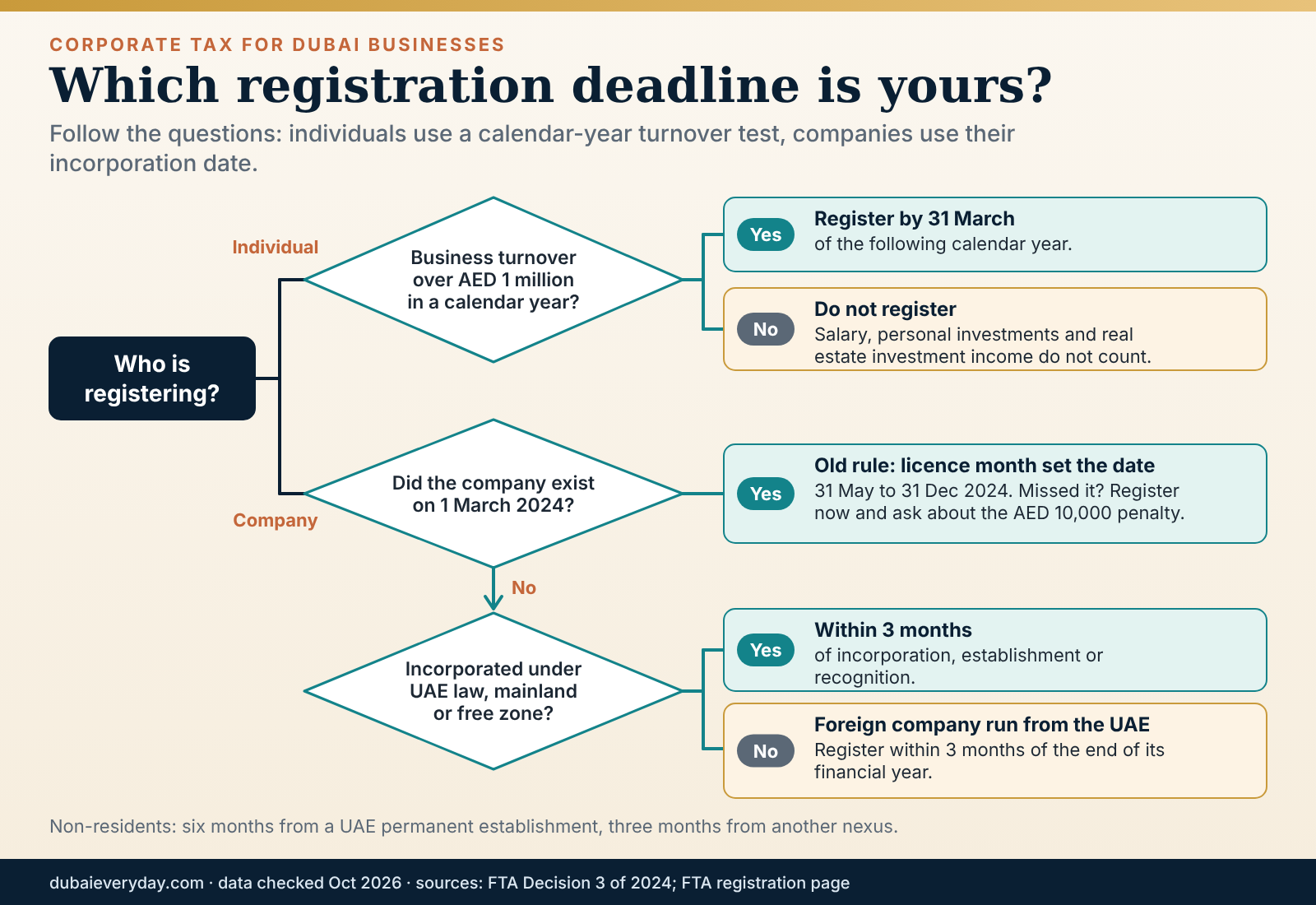
Which corporate tax Dubai business registration deadline applies
The registration deadlines come from FTA Decision No. 3 of 2024, summarised on the FTA’s own news page and in the published text of the decision. The rule for companies that already existed on 1 March 2024 was tied to the month of the earliest licence issue date, whatever the year.
Licences issued in January or February had to register by 31 May 2024, March and April by 30 June, May by 31 July, June by 31 August, July by 30 September, August and September by 31 October, October and November by 30 November, and December by 31 December 2024. Every one of those dates has now passed.
That matters for two groups of corporate tax Dubai business owners. A company that skipped the old deadline is exposed to the late registration penalty and should register now. A company that is unsure whether it registered should check its EmaraTax account, because the registration number and the confirmation are what your bank or a counterparty may eventually ask for. For newer companies, the table below is the live rule.
| Your situation | Register within |
|---|---|
| UAE company (mainland or free zone) incorporated or recognised on or after 1 March 2024 | Three months from incorporation, establishment or recognition |
| Foreign company effectively managed and controlled in the UAE (from 1 March 2024) | Three months from the end of its financial year |
| Individual with business turnover above AED 1 million in a calendar year | 31 March of the following calendar year |
| Non-resident with a UAE permanent establishment (from 1 March 2024) | Six months from the date the establishment existed |
| Non-resident with another UAE nexus (from 1 March 2024) | Three months from the date the nexus was established |
Illustrative example (not a quote or market fact): a new Dubai company that receives its licence on 10 November 2026 should aim to be registered by about 10 February 2027. Do not leave it to the last week, since the FTA’s 20-business-day review time sits inside that window. A sole proprietor who invoiced above AED 1 million during calendar 2026 would register by 31 March 2027.
Late registration and the waiver
Under Cabinet Decision No. 75 of 2023, as amended, the administrative penalty for a late registration application is AED 10,000. The FTA also runs a Late Registration Penalty Waiver Initiative. According to its service page, the penalty is removed if the taxable person submits its first tax return, or annual declaration for an exempt person, within seven months of the end of its first tax period instead of the usual nine. The initiative covers people who registered late, have not yet applied, or were charged the penalty, and a penalty already paid is credited back to the tax account.
Check the date logic before relying on it. The FTA’s 29 July 2025 notice set 31 July 2025 as the last day for most businesses whose first period was calendar 2024, and its pages still describe the initiative today. Whether it applies to a business that registers now, for a later first period, is a question for your tax agent or a private clarification request to the FTA. Do not assume it will absorb the AED 10,000.
A corporate tax Dubai business registration is not the same as being compliant. A registration number with no return filed turns into a stream of monthly late-filing penalties. If you registered in 2024 and nobody has looked at EmaraTax since, log in this week and check the status of every return due.
Taxable income: from accounting profit to tax bill
Corporate tax Dubai business owners pay is calculated on taxable income, and taxable income starts with your accounting profit. The Ministry of Finance describes the starting point as accounting net profit or loss before tax, adjusted for items such as exempt income and expenses that are wholly or partly non-deductible. Article 20 of the law says taxable income is based on standalone financial statements prepared under accounting standards accepted in the UAE. Which standard applies to you (IFRS, IFRS for SMEs or another accepted framework) is a question for your accountant or auditor.
This has a consequence that surprises owners who have never kept formal books. A corporate tax Dubai business return is only as good as the financial statements underneath it. A profit figure assembled from bank deposits and a pile of receipts will not survive a review, and a tax agent cannot repair a ledger that does not exist. If your bookkeeping is the weak link, fix it before the year closes; our guide to monthly bookkeeping routines in Dubai covers that side.
The corporate tax Dubai business calculation in five moves
- Take accounting profitRevenue less costs from your financial statements for the tax period, normally your 12-month financial year.
- Add back what the law will not let you deductFines, bribes, owner distributions, non-qualifying donations, and half of qualifying entertainment spend.
- Remove income the law excludesFor example dividends from a UAE resident company, and qualifying participation income.
- Apply losses and reliefsBrought-forward tax losses, subject to the 75% cap, group relief where it is available, or Small Business Relief if you elect it and qualify.
- Apply the rate0% on the first AED 375,000 of taxable income and 9% on the rest.
A worked example
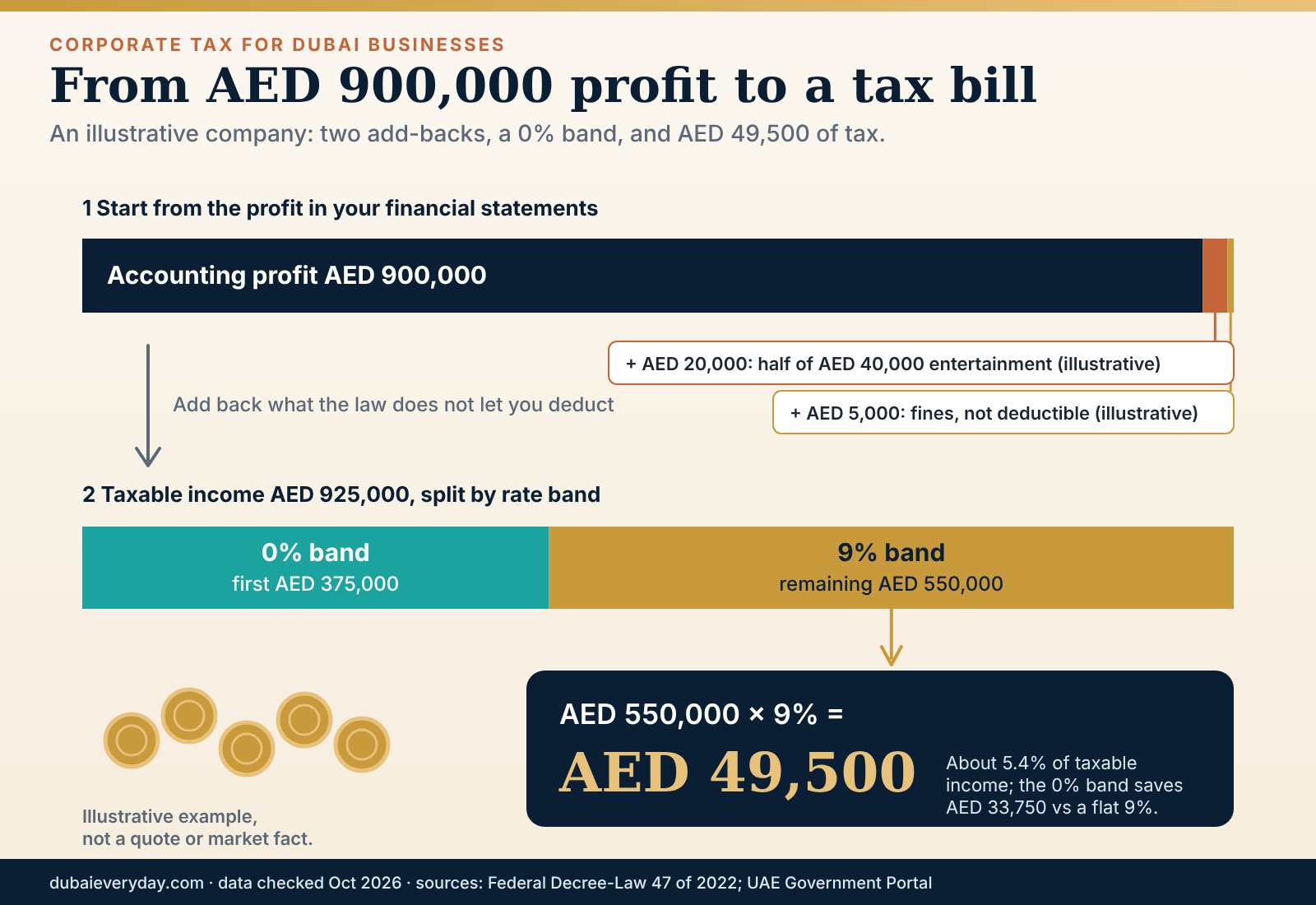
Illustrative example (not a quote or market fact): a Dubai trading company has an accounting profit of AED 900,000. Its books show AED 40,000 of client entertainment and AED 5,000 of traffic and regulatory fines. Only half of the entertainment is deductible, so AED 20,000 is added back. The fines are not deductible, so AED 5,000 is added back. Taxable income is AED 925,000. The first AED 375,000 is taxed at 0%. The remaining AED 550,000 is taxed at 9%, which gives AED 49,500.
The same corporate tax Dubai business, run with sloppy classification, could easily have lumped the entertainment and fines into general expenses and filed on a profit that was AED 25,000 too low. The tax difference here would be only AED 2,250, but the habit scales. A voluntary disclosure to correct an error carries its own monthly penalty, so the cheapest place to fix the classification is the ledger.
Cash or accrual for a corporate tax Dubai business
For a corporate tax Dubai business the default is accrual accounting: income and expenses are recognised when they are earned or incurred under your accounting standard, not when cash moves. The law lets the Minister prescribe a cash basis for some taxpayers, and it allows a switch from cash to accrual on application. Which businesses can use cash is set outside the main text of the law, so confirm it with your adviser before assuming you qualify. Ask early, because switching method creates timing adjustments.
The FTA’s FAQ adds a few practical rules. Legitimate business expenses incurred to earn taxable income are generally deductible, though the timing varies. Capital assets are recognised through depreciation or amortisation rather than being expensed in one go. Expenses that serve both business and private purposes must be apportioned. UAE tax on income of a foreign branch can be reduced by foreign corporate tax paid on that income, where no exemption or election applies. And taxes paid at emirate level cannot be credited against federal corporate tax.
Deductions, exempt income and the rules that catch small companies
Most of the law’s detail is aimed at groups and holding structures, but a handful of rules reach ordinary Dubai companies. These are the corporate tax Dubai business rules that show up in a normal year, with the article of the consolidated law in brackets so your adviser can find them quickly. The consolidated text on the Ministry of Finance site is an unofficial translation, so treat the Arabic as authoritative.
Entertainment is half-deductible
Only 50% of qualifying entertainment expenditure can be deducted (Article 32). Client dinners, event hospitality and similar costs need their own ledger code so the add-back is a number, not an estimate.
Fines, bribes and owner draws
Non-qualifying donations, fines (other than compensation), bribes and distributions to owners are non-deductible (Article 33). Cash that owners take out is not a business expense, however it is booked.
Dividends and share sales
Dividends from a resident company are excluded from taxable income (Article 22). A participation exemption can also apply where you hold at least 5% for at least 12 months (Article 23).
Interest caps
Net interest is deductible up to 30% of tax-adjusted EBITDA (Article 30), and a Ministerial Decision sets a de minimis of AED 12 million of net interest. Banks, insurers and individuals are outside it, so most small borrowers never meet the cap.
Related-party pricing
Transactions with related parties must match what unrelated parties would agree (Article 34). The arm’s length rule applies to every business, even where no formal documentation is due.
Losses
A tax loss can be used against later taxable income, but the offset is capped at 75% of taxable income in a year (Article 37). Tax losses are a tracked balance, so keep a schedule, not just a memory.
Related parties: where a corporate tax Dubai business slips
The related-party definition is wide. Under Article 35 it includes natural persons within the fourth degree of kinship and persons with 50% or more ownership or control. For an owner-managed company that means a spouse’s firm, a sibling’s trading company or the owner’s other licence can all be related parties. The arm’s length principle then applies to rent charged between them, management fees, loans and sales.
Transfer pricing paperwork: who has to produce it
The documentation duty is narrower than the arm’s length duty. Under Ministerial Decision No. 97 of 2023, a taxable person has to maintain a master file and local file if it belongs to a multinational group with consolidated revenue of AED 3.15 billion or more, or if its own revenue in the period is AED 200 million or more.
The decision says documents must be submitted within 30 days of a request from the FTA. Below those thresholds you still apply the arm’s length principle and must support it with information if asked, and a disclosure form with the tax return may be required.
Tax groups in a corporate tax Dubai business structure
Two or more UAE companies under common ownership can sometimes be treated as one taxable person, if the parent holds at least 95% of each subsidiary and the companies share a financial year and accounting standard (Article 40). Groups of Dubai companies should model that before the first return, because it changes who files and who owes.
Small Business Relief: when AED 3 million switches the tax off
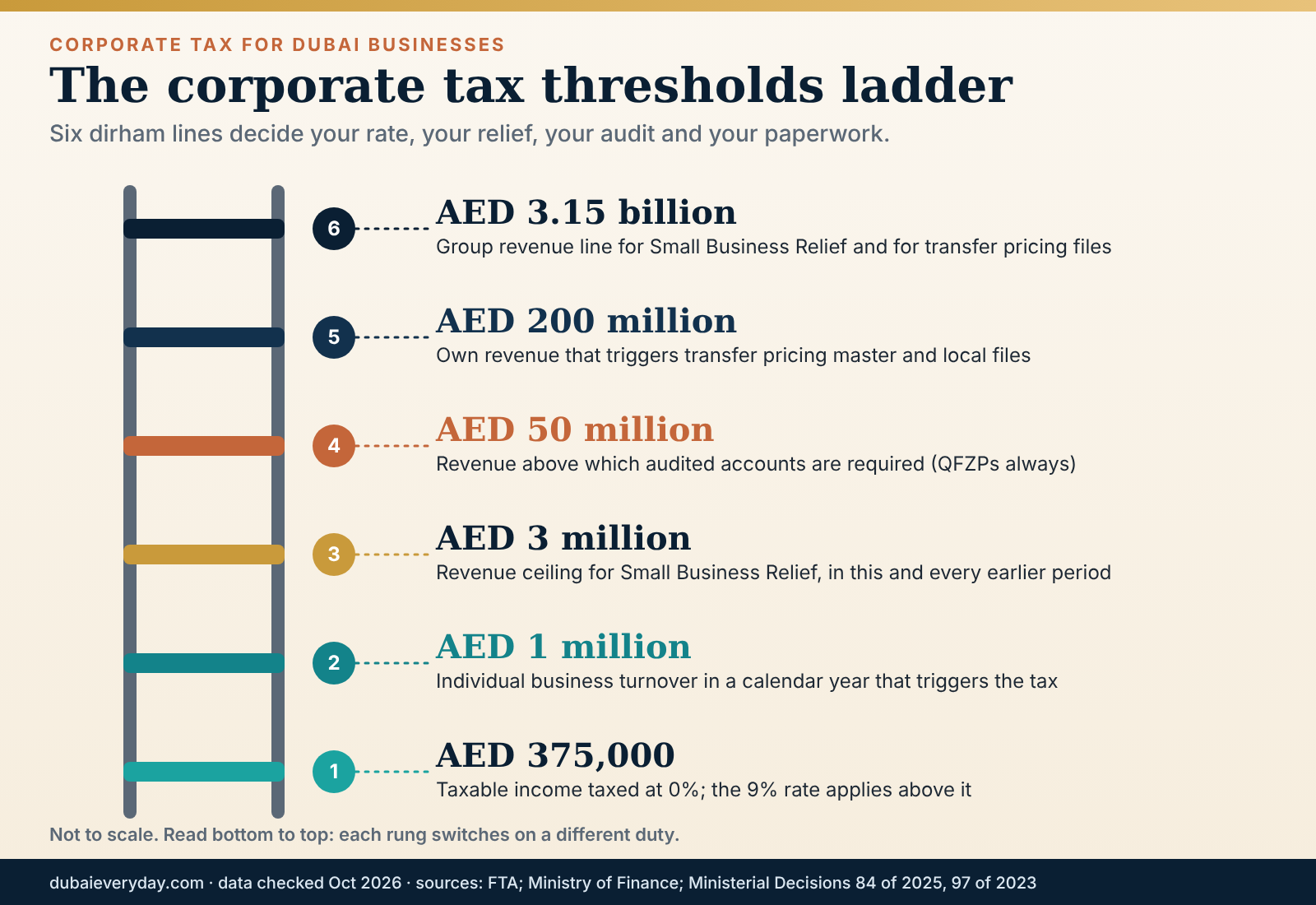
Small Business Relief is the most valuable provision in corporate tax Dubai business law for a small company, and the most misunderstood. A resident person can elect, for each tax period, to be treated as having no taxable income. Eligibility rests on revenue of AED 3,000,000 or less in the current tax period and in every previous tax period, according to the FTA’s relief page. It is revenue, not profit.
The relief was due to expire for tax periods ending after 31 December 2026. The Ministry of Finance announced on 7 August 2026 that Ministerial Decision No. 131 of 2026 extends it to tax periods ending on or before 31 December 2029. The FTA’s relief page predates that announcement and does not mention the extension, so use the Ministry’s news item as the authority on the dates.
The relief conditions that trip corporate tax Dubai business owners
The first catch is the lookback. The test covers the current period and all previous periods, so a business that billed AED 4.3 million in an earlier year is ineligible, even if it fell to AED 1.9 million this year. The FTA’s own example makes that exact point. Relief cannot be recovered by shrinking.
The second catch is who is excluded. Qualifying Free Zone Persons cannot elect, and neither can members of a multinational group with consolidated revenue above AED 3.15 billion. The third is what the election gives up: the FTA says other exemptions, reliefs and deductions are not available while relief applies, and the page does not explain how losses behave. In a loss-making year, ask an adviser before electing, because you may be better off keeping the loss for later.
The fourth catch is that relief is not the same as having no duties. You are still registered, you still file a return, you still keep records, and the arm’s length principle still applies, even though transfer pricing documentation is not required. Relief reduces the tax, not the corporate tax Dubai business administration.
Free zone companies and the 0% corporate tax rate
A free zone licence does not by itself mean 0%. The Ministry of Finance’s overview says a free zone person that meets the conditions of a Qualifying Free Zone Person (QFZP) can apply a 0% rate to its qualifying income, and the law states a 9% rate on other taxable income (Article 3). A free zone corporate tax Dubai business must register and file like everyone else. The 0% is an outcome of passing a test every year, not a feature of the licence.
The detailed test comes from the FTA’s Free Zone Persons guide and the ministerial decisions behind it. The summaries below rely on the FTA guide as described by law firms and advisers, because the guide itself was not readable on the day we checked. Read them as a map and confirm each point against the decision text.
The conditions for being a Qualifying Free Zone Person
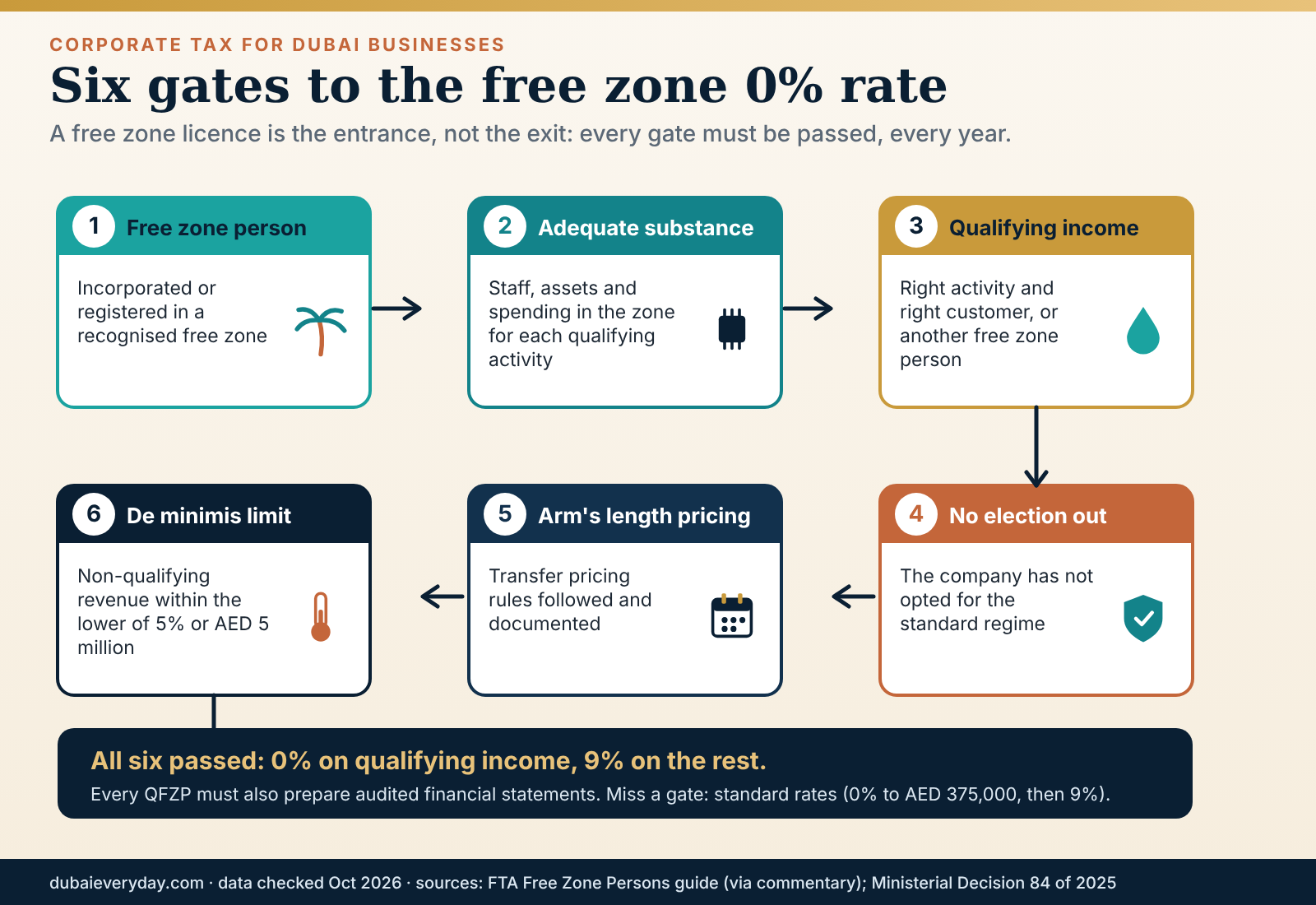
The FTA guide sets out six conditions. The company must be a juridical person incorporated, established or registered in a recognised free zone. It must have adequate substance in that zone: core income-generating activities carried out there, with sufficient assets, employees and operating spending. It must earn qualifying income. It must not have elected to be taxed at the normal rate. It must comply with transfer pricing rules. And its non-qualifying revenue must stay within the de minimis limit.
- Free zone person status, evidenced by your incorporation or registration in the zone
- Adequate substance for each qualifying activity, with staff and spending based in the zone
- Qualifying income from the right counterparties and activities
- No election for the standard regime
- Arm’s length pricing and the documentation that goes with it
- Non-qualifying revenue under the de minimis limit
A separate condition arrived with Ministerial Decision No. 84 of 2025: every QFZP must prepare audited financial statements, whatever its revenue. That is a recurring cost, and it belongs in the decision on whether to chase 0%.
What counts as qualifying income
Qualifying income broadly has three sources. Income from transactions with other free zone persons counts, if those persons are the beneficial recipient of the service or goods and the activity is not an excluded one. Income from qualifying activities counts whoever the customer is. Income from qualifying intellectual property is also covered. Advisers summarise the qualifying activities as including manufacturing and processing, trading of qualifying commodities, holding shares for investment, ship operation, reinsurance, fund and wealth management, headquarter and treasury services to related parties, aircraft leasing, logistics, and distribution from a designated zone.
Everything else is non-qualifying income. That includes revenue from non-free-zone customers for activities that are not on the qualifying list, and dealing with individuals outside a few specified exceptions. A consultancy invoicing mainland and overseas clients is the standard example. Its work may be perfectly legitimate and still sit entirely on the 9% side of the line.
The de minimis trap
Non-qualifying revenue is allowed up to the lower of 5% of total revenue or AED 5 million. Cross it and the FTA guide says the company loses QFZP status for the current period and the following four, so five periods in all.
Illustrative example (not a quote or market fact): a free zone company with AED 4 million of revenue gets AED 300,000 from mainland customers for a non-qualifying service. Five per cent of AED 4 million is AED 200,000, which is lower than AED 5 million, so the limit is AED 200,000. The company is AED 100,000 over, and the 0% rate is gone for five periods, not just on the excess.
This is the cliff that makes corporate tax Dubai business planning matter. Because it is a status test, not a marginal rate, a small slip has a large cost, and one late-December invoice can decide the outcome for five years. Review the revenue split before year-end, not after.
Mainland activity, branches and the election
A free zone company with a mainland branch has what the guide calls a domestic permanent establishment. Its mainland income is treated as that of a separate non-free-zone person and taxed at 9%, according to commentary on the guide, and activities carried out through the branch do not count towards free zone substance. Advisers also stress that tax grouping and loss transfer are not available for income taxed at 9% in this situation. A free zone person can also elect out of QFZP treatment; the election runs for that period and the next four.
What changed in 2025, and what stayed
The Ministry of Finance published two ministerial decisions on 28 August 2025, numbers 229 and 230. Advisory commentary says Decision 229 replaces Ministerial Decision No. 265 of 2023 and is expressed to take effect from 1 June 2023. It widens treasury services, extends distribution from designated zones, adds the audited statement requirement and broadens qualifying commodities to include metals, energy, agricultural and environmental commodities with a quoted price. Decision 230 lists the recognised price reporting agencies.
A free zone licence, a free zone visa and a free zone bank account do not tell you whether you are a QFZP. Only the conditions do. If a company formation agent told you “free zone means zero tax”, ask them to show you which qualifying activity your revenue falls under and which employees perform the core income-generating activities in the zone.
Mainland, free zone or both: what changes for your corporate tax
Founders often ask which structure “saves the most tax”. Corporate tax Dubai business rules have narrowed that question. A mainland company and a non-qualifying free zone company are taxed at the same rates. A qualifying free zone company can reach 0% on qualifying income, but only on strict conditions and with audited accounts. So the tax answer depends less on the address and more on what you sell, to whom, and from where. Our mainland versus free zone comparison covers market access, visas and costs; here is the tax slice.
| Situation | Likely corporate tax position | Check first |
|---|---|---|
| Mainland LLC selling to Dubai customers | 0% up to AED 375,000, 9% above; Small Business Relief if revenue stays at AED 3 million or less | Revenue in every past period; annual relief election |
| Free zone company billing mainland or overseas clients for services | Usually non-qualifying income, so the normal rates; QFZP rarely reachable | Whether any qualifying activity applies; cost of the audit |
| Free zone company trading with other free zone persons or in a qualifying activity | 0% possible on qualifying income if every condition is met | Substance, beneficial recipient, de minimis, audited accounts |
| Free zone company that also holds a mainland licence or branch | Mainland income treated separately and taxed at 9% | Separate ledger for the branch; substance in the zone |
| Freelancer or sole proprietor | Taxable only if business turnover exceeds AED 1 million in a calendar year | Calendar-year invoicing; which income is excluded |
| Holding company owning shares | Dividends from resident companies excluded; participation exemption possible at 5% for 12 months | Ownership percentage and holding period |
The table is a starting point for a corporate tax Dubai business conversation with an adviser, not a verdict. Each row has exceptions, and the facts of your contracts decide the outcome.
Three illustrative corporate tax Dubai business scenarios
These are invented to show reasoning, not to describe real companies or give a quote.
The consultant in a media or technology zone. A sole-owner free zone company bills AED 2.4 million a year, mostly to mainland and overseas clients, for advisory work. Advisory is not a qualifying activity, so most revenue is non-qualifying and the company cannot be a QFZP. It is a resident juridical person with revenue under AED 3 million, so if it is not a QFZP, Small Business Relief may be available. The relief page excludes QFZPs only, but confirm with an adviser before relying on it in a period where the company’s QFZP status is in doubt.
The e-commerce trader. A mainland company imports goods and sells online to UAE customers, with revenue of AED 5.5 million and accounting profit of AED 480,000 after add-backs. Relief is out because revenue exceeds AED 3 million. Taxable income of AED 480,000 means AED 105,000 above the 0% band, so tax is AED 9,450. The return also needs VAT-consistent revenue, so the two filings should reconcile. Our VAT guide covers the other side.
Your licence is part of your tax file
Keep the trade licence, branch licences and renewals with the tax records: the FTA asks for them at registration, and the licensed activity should match the revenue in your ledger, particularly in a free zone where qualifying activities are listed by name. For the licence side, see our guides to mainland company setup and free zone company setup.
Financial statements, audit and seven-year records
Everything in a corporate tax Dubai business return flows from two things: financial statements and the records behind them. Both have specific rules, and both are where small companies usually have to catch up.
Does a corporate tax Dubai business need audited accounts?
Ministerial Decision No. 84 of 2025, which applies to tax periods starting on or after 1 January 2025, sets who must prepare audited financial statements. A taxable person that is not a tax group and has revenue above AED 50,000,000 in the period must. Every Qualifying Free Zone Person must, whatever its revenue. A tax group has to prepare audited special-purpose financial statements in the form the FTA sets. For non-residents, only revenue earned through a permanent establishment or nexus in the UAE counts toward the AED 50 million test.
The decision does not say who may carry out the audit. Choose an auditor licensed to practise in the UAE and ask for evidence of the registration; our guide to accounting services in Dubai shows how to test that. A company below the thresholds is not obliged to audit for corporate tax, though a bank, free zone authority or shareholder agreement may still ask for audited accounts.
What the FTA expects you to keep
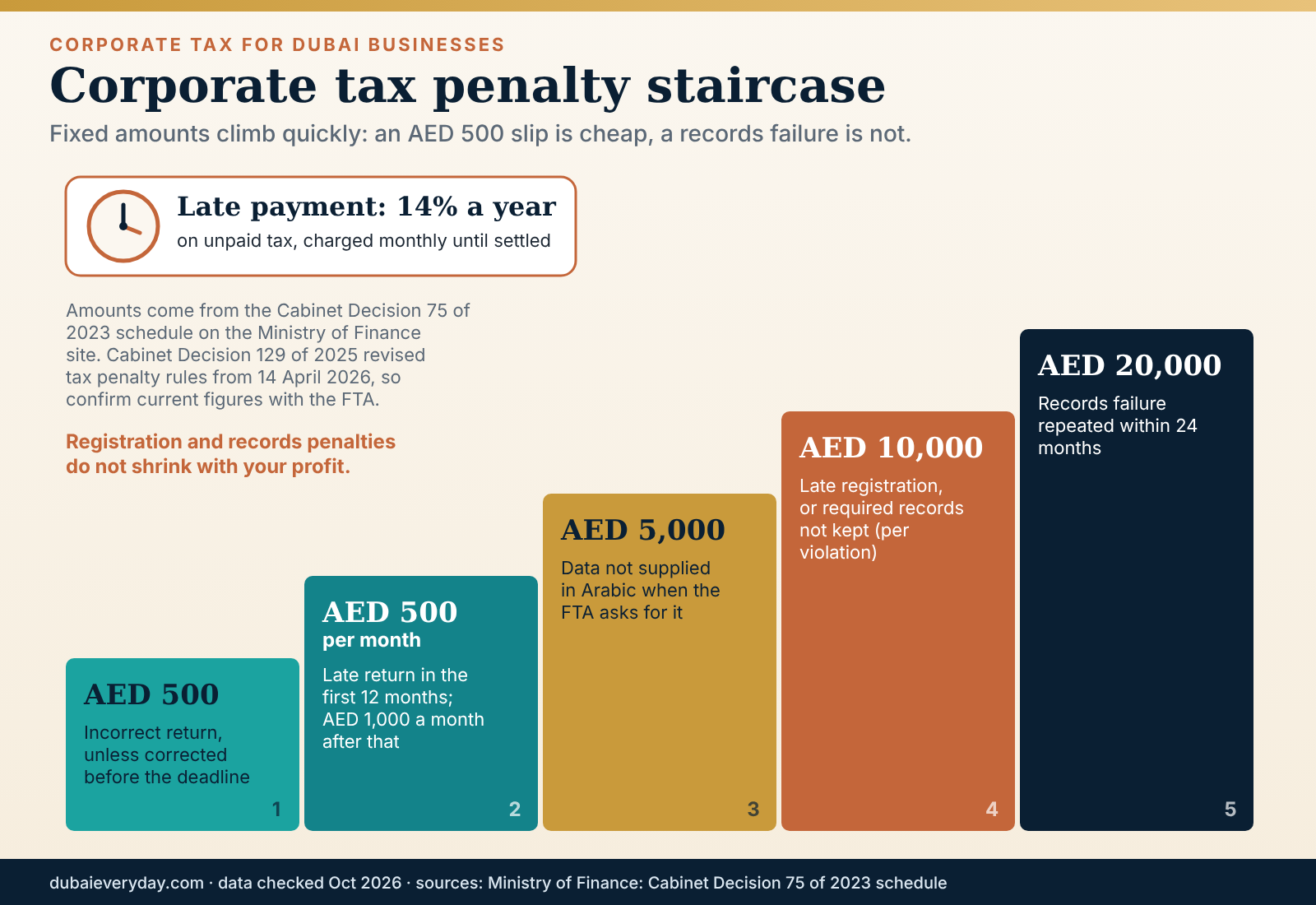
The FTA’s record-keeping notice of August 2025 says corporate tax records must be kept for seven years from the end of the tax period they relate to. It lists transaction records, records of assets and liabilities, and shareholding records. Failure to keep records can lead to administrative penalties. The Cabinet Decision penalty schedule sets AED 10,000 per violation, rising to AED 20,000 for a repeat within 24 months, and AED 5,000 if you cannot provide requested data in Arabic.
A corporate tax Dubai business records checklist for this month
- Trade licence, memorandum or partnership agreement, and every amendment
- Shareholder register and any changes in ownership during the period
- Sales invoices, purchase invoices, credit notes and contracts with major customers and suppliers
- Bank statements for every account, and reconciliations
- Payroll files and the contracts for directors and owner-employees
- Fixed asset register with purchase dates, cost and depreciation
- Loan agreements and interest calculations
- Related-party agreements, with a one-paragraph note on how each price was set
- Tax computation workings, adjustments and the filed return with EmaraTax confirmations
- For free zone companies, evidence of substance and a split of qualifying and non-qualifying revenue
Corporate tax Dubai business year-end close, in an order that works
- Freeze the bankReconcile every account to the last day of the financial year, including card and payment-gateway balances.
- Settle receivables and payablesList what is owed to you and by you at year-end and test anything old.
- Count and value stockTrading companies need a count and a valuation basis that matches their accounting standard.
- Update assets and loansDepreciation, disposals and interest accruals feed the profit figure directly.
- Tag the tax-sensitive linesEntertainment, fines, donations, related-party charges, and for free zone companies, revenue by customer type.
- Hand over a clean packTrial balance, ledgers and schedules, in one folder, three to four months before the filing date.
Filing and paying: the corporate tax Dubai business calendar
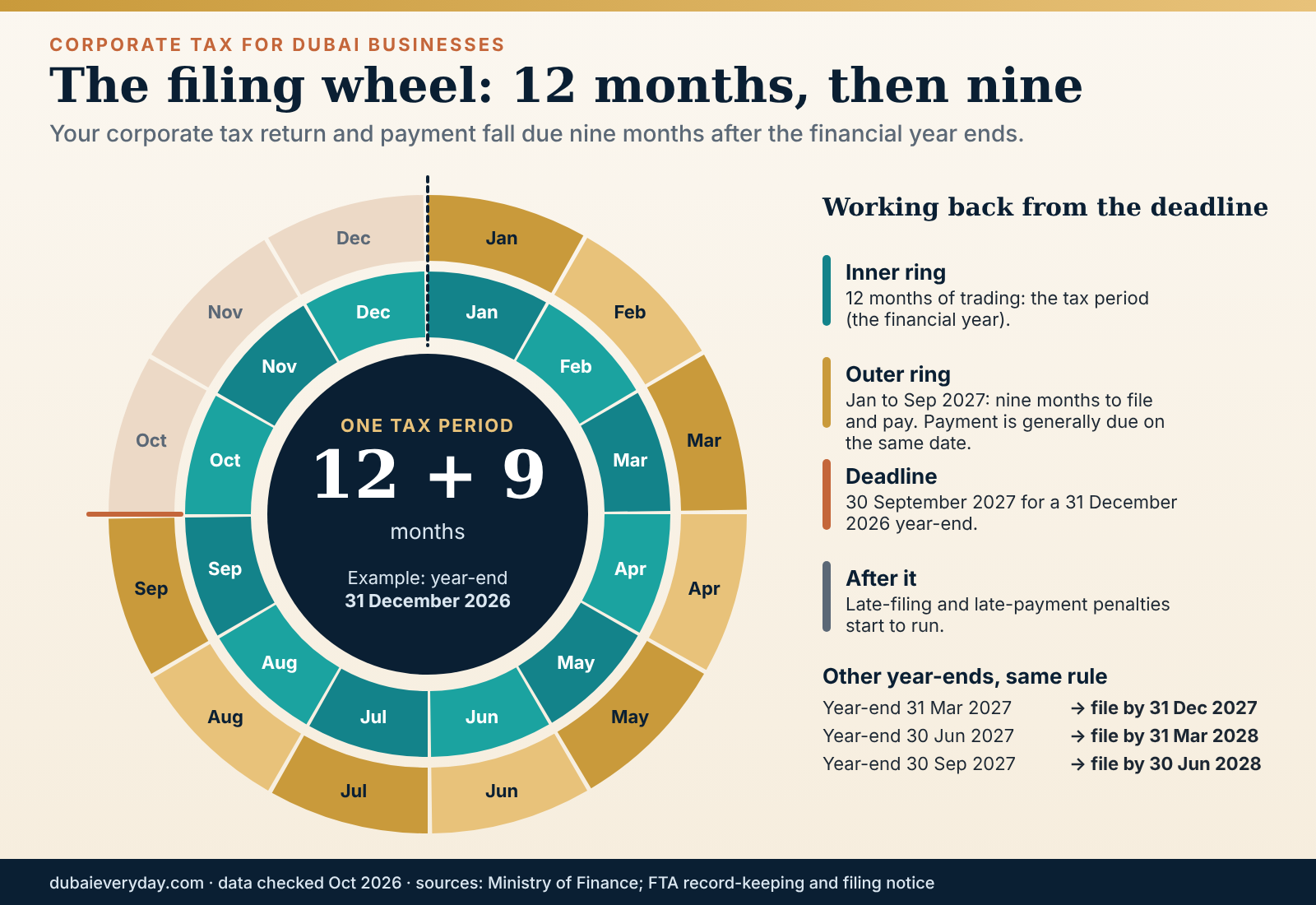
Corporate tax Dubai business filers deal with one main return a year. The tax period is your financial year, and the Ministry of Finance says the return is due within nine months of the end of that period, with payment generally due by the same date. Under corporate tax Dubai business rules, tax is self-assessed: you calculate it, file it in EmaraTax, and pay it. There is no assessment letter to wait for.
The cycle that closed most recently shows how the maths works. The FTA’s August 2025 notice, and the headline on its corporate tax page, put the deadline for a financial year ending on 31 December 2025 at 30 September 2026. The same logic gives you your own date, whatever your year-end.
Your corporate tax Dubai business deadline by year-end
- Year ends 31 December 2026: file and pay by 30 September 2027
- Year ends 31 March 2027: file and pay by 31 December 2027
- Year ends 30 June 2027: file and pay by 31 March 2028
- Year ends 30 September 2027: file and pay by 30 June 2028
Exempt persons whom the FTA has asked to register file an annual declaration within the same nine months. First periods follow the start-of-regime rules: a company with a 1 July to 30 June year was first taxed on the year starting 1 July 2023, and its first return was therefore due nine months after 30 June 2024, which is 31 March 2025. An individual whose first taxed year was calendar 2024 had until 30 September 2025, according to the FTA’s January 2025 notice on natural persons.
Working back from the deadline
The nine months in a corporate tax Dubai business calendar look generous and then disappear. Working backwards from a December year-end, a sensible rhythm is: close the books in January, finish bank reconciliations and stock valuations by February, have draft financial statements by March, and complete any audit by June if one is required. That leaves July and August for the tax computation, September for review and payment, and a buffer before 30 September.
Paying the tax
Payment follows the filing date, and the FTA says it is generally due by the same date as the return. The sources we read do not describe a provisional or instalment system, so estimate the tax during the year and set cash aside monthly. For the illustrative AED 49,500 bill earlier, that is about AED 4,125 a month. A late payment accrues at 14% a year on the unpaid amount, calculated monthly, under the Cabinet Decision penalty schedule.
Changing details, closing down
If your company’s details change, such as the name, address, ownership or signatory, update the FTA record. The schedule lists AED 1,000 for a first failure to notify the FTA of changes to tax record information and AED 5,000 for a repeat within 24 months. If you close the company, apply to deregister. Late deregistration carries AED 1,000, repeated monthly on the same date up to a maximum of AED 10,000. A dormant licence that nobody renews is not the same as a cancelled tax registration.
Closing or not renewing a licence does not close the FTA file. If a company stops trading, someone still has to file the final return, settle the tax and deregister. Leaving this to “later” lets penalties accumulate against a company that has no staff and no bank account.
Penalties and how to recover from a missed deadline
The corporate tax Dubai business penalty schedule is fixed-amount, which makes it easy to cost out. The table in the Cabinet Decision on corporate tax penalties lists the items below, as published by the Ministry of Finance with the amendments it carries. The decision itself took effect on 1 August 2023.
Late registration
AED 10,000 for applying after the deadline, with a first-return waiver route described earlier.
Late return or declaration
AED 500 per month for the first 12 months, then AED 1,000 per month from the 13th month.
Late payment
14% a year on the unpaid tax, applied monthly, from the due date until settled.
Records
AED 10,000 per violation for failing to keep required records, AED 20,000 for a repeat within 24 months.
Incorrect return
AED 500, unless you correct the return before the filing deadline.
Correcting later
A voluntary disclosure of an error carries a monthly 1% penalty on the tax difference; if made after an audit notice, a fixed 15% is added, according to commentary on the revised framework.
A caution about corporate tax Dubai business penalty tables
Cabinet Decision No. 129 of 2025 revised the administrative penalty framework across several tax laws, and law firms report that it took effect on 14 April 2026. The commentary we could read describes lower amounts for several items, a flat 14% annual rate for late payment, and a simpler voluntary disclosure charge. It does not say clearly which lines apply to corporate tax. The amounts above come from the schedule published on the Ministry of Finance site, so confirm the current figure on the FTA’s penalties page before you quote any of them to a client or a partner.
A late-filing example
Illustrative example (not a quote or market fact): a company owes AED 49,500 for its year ending 31 December 2026. The due date is 30 September 2027. It files four months late and settles the tax on the same day. Late-filing penalties are 4 x AED 500 = AED 2,000. Late-payment charges at 14% a year on AED 49,500 for four months are about AED 2,310 on a simple basis.
The total cost of lateness is roughly AED 4,300, before any professional fees to sort it out. The exact count of months and the accrual method depend on the FTA’s calculation.
By comparison, a late registration costs AED 10,000, and missing records cost AED 10,000 or AED 20,000 per violation. In corporate tax Dubai business enforcement, registration and records are the two penalties that do not depend on the size of your profit.
If you have already missed something
- Stop the clockFile the overdue return or complete the registration first. Penalties that accrue monthly keep growing until you do.
- Check for a waiver routeFor late registration, ask whether the first-return waiver applies to your first period.
- Correct errors properlyIf you filed with a mistake, ask a tax agent whether to amend or use a voluntary disclosure. An early correction is cheaper than waiting for a notice.
- Keep the paper trailSave the EmaraTax acknowledgement, payment receipts and your explanation. If the FTA asks, you can show when you acted.
- Ask for a clarification if the rule is unclearThe FTA runs a private clarification process for uncertain positions. It is slower than a phone call and far safer than guessing.
Getting help and a 30-day plan
Whether a corporate tax Dubai business needs paid help depends on complexity, not size. A mainland company with simple sales, no related parties and revenue under AED 3 million may only need a bookkeeper and a one-off review. A free zone company chasing 0%, a group with related-party charges, or any company near the audit threshold should treat a registered tax agent as a standing cost.
The FTA publishes a searchable register of registered tax agents, which can be filtered by emirate and by area of experience, including corporate tax. Use it to confirm that an individual or firm is listed. Agents are regulated; general bookkeeping or company-formation services are not the same thing. Our accounting services guide lays out the scope, models and due-diligence questions in detail.
What to ask a corporate tax Dubai business adviser
- Who files the return, and who signs off the numbers?
- Is the free zone analysis (substance, qualifying activities, de minimis) included, or extra?
- What do you need from me, and by which date each quarter?
- How will you access EmaraTax, and what stays under my own UAE PASS?
- Where are the working papers kept, and can I have them if we part ways?
- What happens if the FTA queries the return after you file it?
Do not hand over your personal UAE PASS credentials. Ask the provider to explain the access route the FTA permits and keep control of the company’s registration details.
A 30-day corporate tax Dubai business plan from today
Because today is 29 October 2026, a December year-end is about nine weeks away. The plan below assumes that, and shifts easily for other year-ends.
- Week 1: confirm the basicsLog in to EmaraTax. Confirm the registration, the year-end on file and any returns outstanding for earlier periods.
- Week 2: classify your positionMainland or free zone, QFZP or not, Small Business Relief eligible or not. Write the answer down with the reason.
- Week 3: fix the evidenceReconcile banks, tag entertainment and related-party lines, and for free zone companies, split revenue by customer type before year-end invoices go out.
- Week 4: lock the calendarBook the audit if required, agree the tax agent’s scope and add the filing date plus a two-week buffer to every owner’s calendar.
The plan costs time rather than money, and it removes the commonest cause of corporate tax Dubai business penalties: not knowing which duties apply.
FAQ about corporate tax for Dubai businesses
What is the corporate tax rate for a Dubai business?
For a corporate tax Dubai business, the standard structure is 0% on taxable income up to AED 375,000 and 9% on the part above it, as described by the UAE government portal. A Qualifying Free Zone Person pays 0% on qualifying income and 9% on other taxable income. Small Business Relief can treat a business with revenue of AED 3 million or less as having no taxable income for a period. Large multinational groups may face a separate top-up tax, which does not affect ordinary owner-run companies.
Do I have to register for corporate tax if my company made a loss?
Yes, corporate tax Dubai business registration is not conditional on profit. The FTA says all juridical persons subject to corporate tax must register, and a loss-making company is still within the regime. You will still file a return for the period. A loss can then be carried forward and offset against later taxable income, up to 75% of taxable income in a given year. Keep a running schedule of losses so the balance is clear when profit arrives.
Do freelancers in Dubai pay corporate tax?
A freelancer becomes a corporate tax Dubai business only if turnover passes AED 1 million in a calendar year. The FTA treats an individual as subject to the tax when they conduct a business or business activity in the UAE and exceed that turnover. Wages, personal investment income and real estate investment income are excluded from the test. If you are over the line, you register by 31 March of the following year. Below it, the FTA says not to register.
Is a free zone company exempt from corporate tax?
No. A free zone corporate tax Dubai business is a taxable person that must register and file. It can apply 0% to qualifying income only if it is a Qualifying Free Zone Person, which requires adequate substance, qualifying income, no election for the normal regime, arm’s length pricing, and non-qualifying revenue within the de minimis limit. Audited financial statements are also required. A company that fails the test pays 9% above the AED 375,000 band like any other company.
When is my corporate tax return due?
A corporate tax Dubai business return is due within nine months after the end of your tax period, which is normally your financial year. Payment is generally due by the same date. For a year ending 31 December 2026, that is 30 September 2027. For a 30 June year-end, it is 31 March of the following year. Because the deadline is tied to the year-end on file with the FTA, confirm that date in EmaraTax and do not rely on your licence renewal date.
What is the penalty for late corporate tax registration?
Late corporate tax Dubai business registration costs AED 10,000 under Cabinet Decision No. 75 of 2023, as amended. The FTA’s Late Registration Penalty Waiver Initiative removes it if the first return is filed within seven months of the end of the first tax period instead of the usual nine, and a penalty already paid is credited back. The 2025 notice set a 31 July 2025 last day for most businesses with a calendar 2024 first period, so ask an adviser whether it applies to your case.
Do I need audited financial statements for corporate tax?
A corporate tax Dubai business needs them if it is a Qualifying Free Zone Person, or if you are not a tax group and your revenue exceeds AED 50 million in the period, under Ministerial Decision No. 84 of 2025. That applies to tax periods starting on or after 1 January 2025. Tax groups prepare audited special-purpose statements. Other companies are not required to audit for corporate tax, but banks or other parties may still ask for audited accounts.
Can I claim Small Business Relief?
A corporate tax Dubai business can claim it if it is a resident person with revenue of AED 3 million or less in the current period and every previous period, and you elect for the period. Qualifying Free Zone Persons and members of large multinational groups cannot. The Ministry of Finance extended the relief to tax periods ending on or before 31 December 2029. Electing means other reliefs and deductions are not available for that period, so consider losses first.
How long must I keep corporate tax records?
A corporate tax Dubai business must keep records for seven years from the end of the tax period they relate to, according to the FTA’s August 2025 release. The records include transactions, assets and liabilities, and shareholding. Failure to keep them can attract AED 10,000 per violation, rising to AED 20,000 for a repeat within 24 months. If the FTA asks for data and you cannot provide it in Arabic, a separate AED 5,000 penalty is listed in the schedule.
Is rental income from my Dubai flat subject to corporate tax?
For an individual, the FTA’s natural person page excludes real estate investment income from the business-activity test, so an ordinary landlord is not drawn in by rent alone. If a company owns the property, the rent is part of the company’s profit. Ask a tax agent before assuming an exclusion applies.
Sources and further reading (25 links)
- Federal Tax Authority: Corporate Tax Registration service. Registration steps, documents, fees, timelines, late registration waiver
- Federal Tax Authority: Small Business Relief. Eligibility, exclusions, example
- Federal Tax Authority: Basis of Taxation, Natural Person. AED 1 million turnover test and exclusions
- Federal Tax Authority: Resident Juridical Person. Incorporation and effective management tests
- Federal Tax Authority: Corporate Tax FAQs. Effective date, taxable income, deductions, foreign branches
- Federal Tax Authority: Corporate Tax topics. Index of official topic pages
- Federal Tax Authority: Corporate Tax guides, references and public clarifications. Guides and clarifications list
- Federal Tax Authority: registration deadline notice for December licences. How deadlines followed licence months
- Federal Tax Authority: late registration penalty waiver notice. Waiver conditions and 31 July 2025 date
- Federal Tax Authority: corporate tax records and filing notice. Seven-year records and nine-month filing
- Federal Tax Authority: notice to natural persons on registration. Individual registration and first return
- Ministry of Finance: Corporate Tax in the UAE. Overview, tax period, deadlines, free zone persons
- Ministry of Finance: Federal Decree-Law No. 47 of 2022 and amendments (unofficial English). Articles on rates, deductions, losses, groups
- Ministry of Finance: Cabinet Decision No. 75 of 2023 on administrative penalties. Penalty schedule
- Ministry of Finance: Ministerial Decision No. 84 of 2025 on audited financial statements. Audit thresholds and QFZPs
- Ministry of Finance: extension of Small Business Relief to 2029. Extended relief dates
- Ministry of Finance: Top-Up Tax. EUR 750 million group threshold
- UAE Government Portal: Corporate Tax. Rate structure and AED 375,000 band
- PwC Middle East: Ministerial Decisions 229 and 230 of 2025. Commentary on qualifying activities and commodities
- PwC Middle East: Free Zone Persons guide summary. Commentary on QFZP conditions and de minimis
- DLA Piper: FTA guide on Free Zone Persons. Commentary on six QFZP conditions
- PwC Middle East: Ministerial Decision No. 97 of 2023. Transfer pricing documentation thresholds
- Crowe UAE: general interest deduction limitation rule. AED 12 million and 30% EBITDA
- PwC Middle East: revised administrative penalty framework. Cabinet Decision 129 of 2025 changes
- Published copy of FTA Decision No. 3 of 2024 on registration timelines. Deadline table by situation
Update log: 29 October 2026, first publication; all facts re-checked against the sources above. Next review due: by 30 January 2027, and immediately after any new FTA, Ministry of Finance or Cabinet decision on corporate tax. Corrections welcome.
General information only: this page does not replace advice from a registered tax agent, auditor or lawyer who has seen your documents.
About DubaiEveryday and this guide
DubaiEveryday.com is an independent editorial project that publishes practical, research-based guides to everyday life in Dubai: where to live, what things cost, how the rules work and how to get around. This page was written and edited by the DubaiEveryday editorial team. It is not signed by a named expert, doctor, lawyer or adviser, and we do not claim first-hand testing of a venue, clinic or service unless the page says so.
Each guide is built from official sources such as government and regulator pages, operator websites and established news outlets, cross-checked where we can. When we could not confirm something, we say so in the text, and examples that use made-up numbers are labelled as illustrations. Mentions are editorial choices, not paid placements, and a link is not an endorsement.
Dubai changes quickly. If you spot something that is out of date or wrong, please tell us through the contact options on DubaiEveryday.com and we will check it and correct the page.