
Two adults can live in Dubai on about AED 9,800 a month or on more than AED 44,000, and rent plus a car explain most of the gap. This Dubai budget couple guide prices four dated, illustrative budgets, with housing, utilities, cars, dining, health and savings, then shows the combined pay each one needs.
Two people can move to Dubai together and spend about AED 9,800 a month, or more than AED 44,000. Same sunshine, same dirham. The gap comes mostly from two decisions made in the first week: which lease to sign and whether to buy a car.
This Dubai budget couple guide prices four lifestyles line by line, from rent and DEWA to cars, dinners, health cover and savings. It shows the cash you need on day one, what changes if only one of you has a job, and the pay each budget demands before a dirham is saved. Every number is dated and labelled, so you can swap in your own lease and see where the plan bends. It is general information, not financial advice.
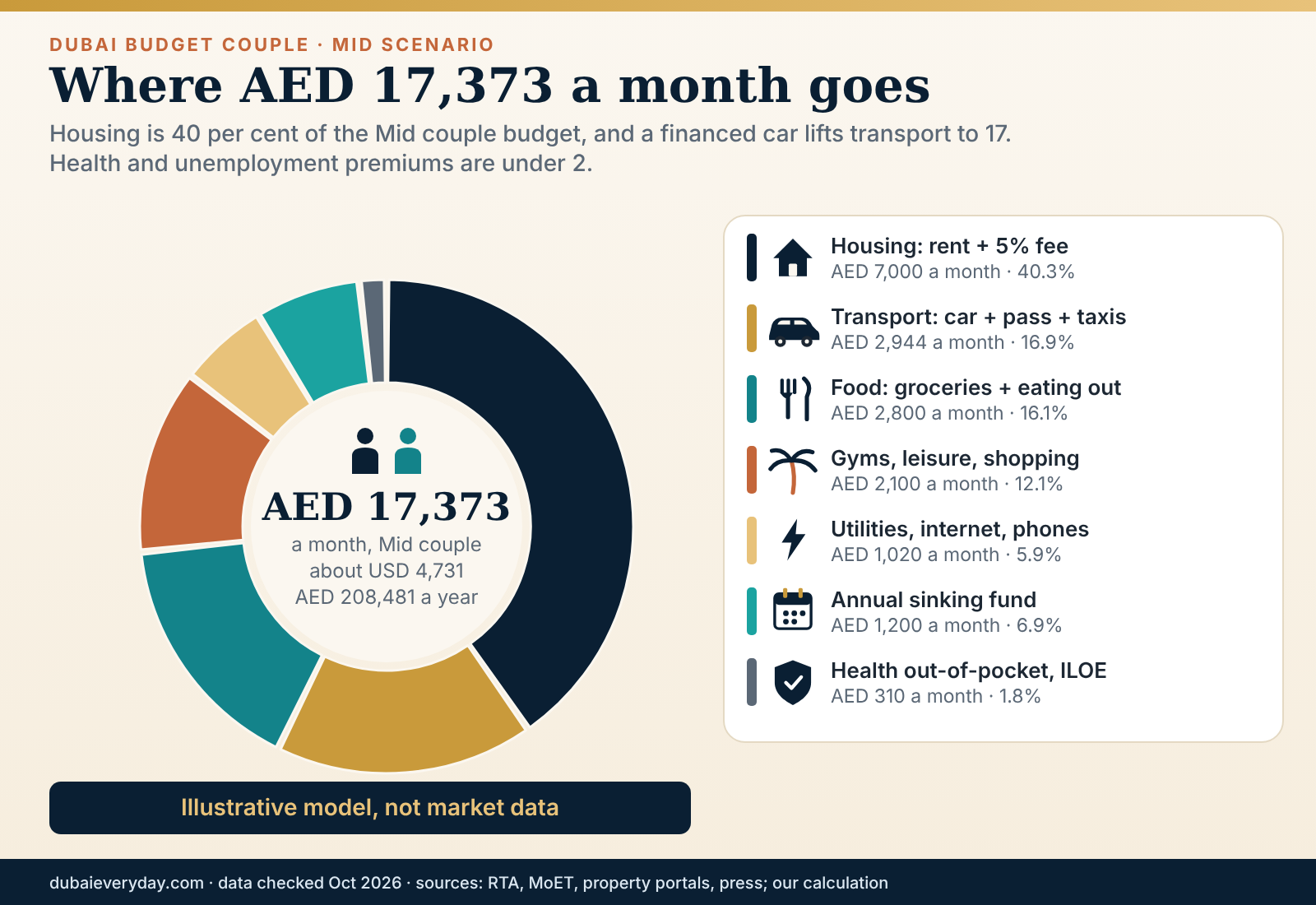
A workable Dubai budget couple plan costs about AED 9,800 a month (roughly USD 2,670) for a one-bedroom in a lower-cost community with no car, about AED 17,400 (USD 4,730) for a mainstream one-bedroom with one car, about AED 30,700 (USD 8,350) for a two-bedroom in a district-cooled tower, and about AED 44,900 (USD 12,230) for a Marina or Downtown-type lifestyle with two cars. Those are our illustrative models, built from dated inputs. They are not market averages.
Housing is the biggest line in all four: rent plus the municipality housing fee takes 49, 40, 37 and 33 per cent. The second lever is the car. One financed car with its running costs adds roughly AED 2,400 a month compared with two annual Nol passes. Eating out, gyms and phones matter much less than they feel.
To save 20 per cent you need combined take-home pay of roughly AED 12,200, 21,700, 38,300 or 56,100 a month. A couple costs about 1.3 to 1.5 times what one person costs at a similar tier, not twice. This is general information, not financial advice: swap in your real lease before trusting any total.
This Dubai budget couple guide is desk research. Nobody on the DubaiEveryday team has rented the flats, driven the roads or eaten at the places priced here, and we claim no first-hand experience. On 29 October 2026 we read the RTA Nol fare table, the Dubai Land Department Ejari page, the Dubai government health insurance and ILOE pages, the UAE government pages on spouse sponsorship, taxation and end-of-service benefits, the Ministry of Economy price platform and the Central Bank licensing page.
Other inputs come from press and property-portal pages (rents, DEWA slabs, fuel, visa fee stacks, insurance ranges) and from our companion guides’ research logs of the same date. Each is labelled by type. We could not open DEWA’s own tariff page, operator plan pages or any official rent-by-area table. Every total is our own arithmetic, and every restaurant, leisure and car-finance line is an allowance, not a measured price. No provider paid to be mentioned. General information only, not individual financial, legal or insurance advice.
How this Dubai budget couple model works
Search for a Dubai budget couple plan and you tend to meet one of two pages. One offers a single “average” that matches nobody. The other lists thirty prices and never adds them up. Neither helps when you hold two job offers, a lease draft and an argument about whether you need a second car. This page does one job: it builds a complete Dubai budget couple model for two adults, shows every line, and lets you replace our assumptions with your own quotes.
Two neighbouring jobs are deliberately left to other pages. The cost of living across the whole city, including families, schools and the long-run price trend, sits in the cost of living in Dubai guide. The same arithmetic for one adult sits in the monthly budget for one person in Dubai. Households with children need school fees and childcare lines that are not modelled here.
What counts in a Dubai budget couple plan
Fifteen lines make up every Dubai budget couple scenario below: rent, the municipality housing fee, DEWA, district cooling where it applies, home internet, two mobile lines, transport, groceries, eating out, gyms, out-of-pocket health costs, the unemployment-insurance premium for each earner, leisure, shopping and miscellaneous, and an annual sinking fund. The last one converts yearly costs into a monthly figure: flights home for two, ID renewals, a new laptop, a gift or two.
Left out on purpose: savings and investments (treated in their own section), debt repayments, money sent to family, buying furniture, and the one-off cost of moving in. That last item has its own section because it is the largest cash demand a newly arrived couple meets.
Two earners are the base case in a Dubai budget couple plan
Each Dubai budget couple scenario assumes both partners hold employment contracts and that each employer pays for that person’s health cover, which is the usual arrangement in Dubai. That keeps the base figures clean. The alternative, one earner and one sponsored partner, adds a health premium, a visa stack and a sharper dependence on a single salary. Those effects are priced separately in the section on one income or two, so you can add them only if they apply.
Four Dubai budget couple scenarios, one logic
The four anchor households in this Dubai budget couple model are not “typical” couples. None is a statistic. They are fixed points that show how the lines interact.
Lean
A one-bedroom at AED 55,000 a year in a lower-rent community, two annual Nol passes, mostly home cooking, a modest gym line and a fibre plan in the entry tier.
Mid
A one-bedroom at AED 80,000 a year in a mainstream area, one financed car plus one metro pass, a regular dinner out each week and a mid-tier gym plan.
Comfortable
A two-bedroom at AED 130,000 a year in a district-cooled tower, one financed car plus one pass, frequent dining and a fuller leisure line.
Premium
A two-bedroom at AED 170,000 a year in a Marina or Downtown-type tower, two financed cars, premium gyms and dining out about three times a week.
Rules behind every Dubai budget couple number
First, every published price is typed: official page, press report, property portal, or our own allowance. Second, tariffs are multiplied by stated usage, never by a feeling. Third, VAT at 5 per cent is added where a source excludes it. Fourth, USD figures use the long-standing peg of 3.6725 dirhams per dollar, which we did not re-read on the Central Bank’s own page today.
Fifth, when two sources disagree we say so and plan with a range. Sixth, any Dubai budget couple plan is a snapshot. Fuel is repriced monthly, and Dubai’s consumer price index rose 5.54 per cent year on year in August 2026 according to EnterpriseAM’s report on official data, so a figure that was right in spring may be short now.
None of these four Dubai budget couple households exists. The totals show which lines move the result and which barely register. If an employer pays your housing, transport or school-age extras, delete those lines. If you already hold a lease, replace our rent first, because rent is the input the budget is most sensitive to.
How this page relates to the companion guides
Our Dubai budget couple totals are higher than the single-person guide’s by design, because two adults need two phones, two gym memberships, two sets of out-of-pocket health costs and a larger flat. We compare the two in the section on where the dirhams are. The result is the figure to remember: a couple’s budget lands near 1.3 to 1.5 times a single person’s at a matching tier, which makes the per-person cost about 72 to 77 per cent of living alone.
Dubai budget couple: four monthly budgets side by side
Here are the four Dubai budget couple scenarios in one place. Figures are dirhams per month for the whole household, rounded, so a column can differ from its total by a dirham or two. Annual transport, cooling and insurance costs are spread across twelve months, and DEWA is an annual average of a winter, shoulder and summer bill.
| Line (AED a month) | Lean | Mid | Comfortable | Premium |
|---|---|---|---|---|
| Rent | 4,583 | 6,667 | 10,833 | 14,167 |
| Housing fee (5% of rent) | 229 | 333 | 542 | 708 |
| DEWA (annual average) | 390 | 410 | 313 | 365 |
| District cooling | 0 | 0 | 800 | 900 |
| Internet and two mobile lines | 420 | 610 | 690 | 950 |
| Transport | 595 | 2,944 | 4,368 | 6,921 |
| Groceries | 1,150 | 1,600 | 2,300 | 2,800 |
| Eating out | 540 | 1,200 | 3,000 | 5,400 |
| Gyms for two | 418 | 600 | 1,000 | 1,468 |
| Health out-of-pocket and ILOE | 170 | 310 | 520 | 720 |
| Leisure, shopping and misc | 700 | 1,500 | 3,800 | 6,500 |
| Annual sinking fund | 600 | 1,200 | 2,500 | 4,000 |
| Total a month | 9,795 | 17,373 | 30,667 | 44,899 |
| Approximate USD a month | 2,670 | 4,730 | 8,350 | 12,230 |
| Total a year | 117,500 | 208,500 | 368,000 | 538,800 |
What the Dubai budget couple table says without anyone arguing
Look at the housing share of the Dubai budget couple plan first. It falls from 49 per cent in the Lean budget to 33 per cent in the Premium one, which looks like relief until you notice that the other lines grow faster than rent does. Wealthier households do not spend a smaller amount on rent. They spend a much larger amount on everything else.
Transport tells a sharper story. Moving from the Lean column to the Mid column adds only AED 25,000 a year to rent, but it adds more than AED 28,000 a year to transport, because a financed car and its running costs replace two annual metro passes. In percentage terms transport leaps from 6 per cent of the household budget to 17 per cent.
Food, groceries plus eating out, is steady at 16 to 18 per cent in all four columns. The mix changes (more restaurants, fewer lentils) but the share does not. Utilities and telecoms fall from 8 per cent in the Lean budget to about 5 per cent in the Premium one, which is the usual shape of a fixed cost seen against a growing total.
The Dubai budget couple sensitivity ranking
If you could change only one line in a Dubai budget couple plan, which one would move the total most? Using the Mid column, we ran each lever alone. Dropping rent by AED 15,000 a year, a move from an AED 80,000 flat to an AED 65,000 one, saves AED 1,313 a month including the housing fee. Selling the car and using two passes saves about AED 2,400. Halving eating out saves AED 600. Halving the gym line saves AED 300.
So the order of operations, for a couple who wants to save more, is clear: transport, then rent, then everything else. People tend to attack the coffee habit first because it is visible. It rarely matters.
How to use the Dubai budget couple table with your own numbers
Pick the Dubai budget couple column closest to your plan, then replace the two or three lines you know for certain: your rent, your car decision and your internet package. Keep our allowances for everything else until you have three months of real card statements. After that, replace the allowances too. The fastest sanity check is the rent share. If rent plus fee is above 50 per cent of your planned total, you are in the Lean zone whether you meant to be or not.
Housing: rent for two, 1BR or 2BR
Rent decides the shape of any Dubai budget couple plan, and it is also the number with the weakest public data. The Dubai Land Department runs an official rental index, but we could not find an area-by-area table that is open to the public, so every rent below is an advertised-price estimate from a property portal or broker. Treat the figures as bands, and treat the top of each band as a ceiling, not a promise.
What the advertised rent data says for a Dubai budget couple
Property Finder’s June 2026 community data, reported by Gulf Business on 10 August 2026, gave average advertised one-bedroom rents of AED 55,000 in Al Nahda, AED 60,000 in Deira, AED 65,000 in Dubai Silicon Oasis and Dubai Sports City, and about AED 75,000 in Al Barsha and Al Furjan. Those are listing prices recorded over three months, not signed leases.
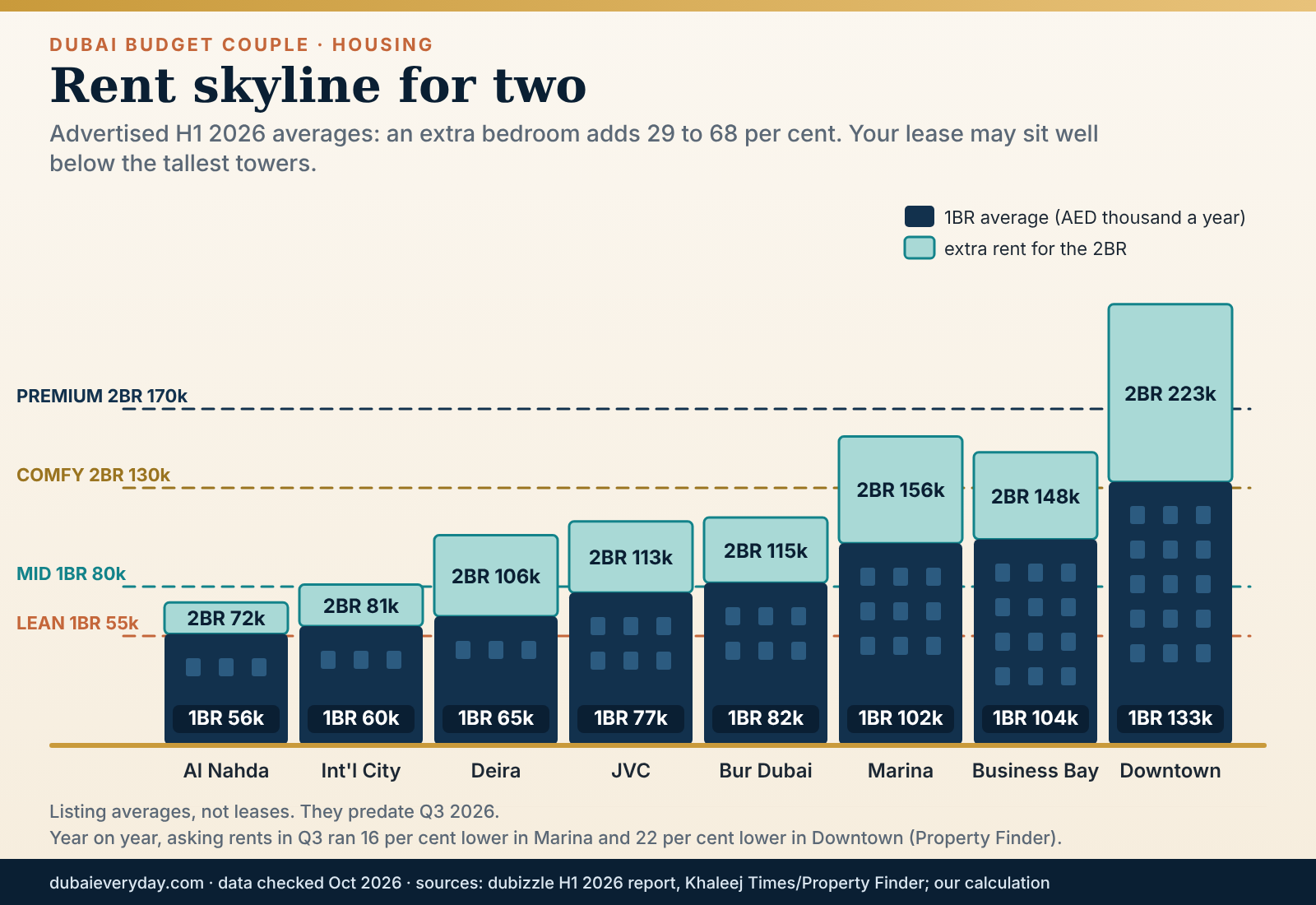
The dubizzle H1 2026 market report, published 28 July 2026, gives averages by area for both bedroom counts. For one-bedrooms it lists AED 56,000 in Al Nahda, 60,000 in International City, 77,000 in Jumeirah Village Circle, 82,000 in Bur Dubai, 102,000 in Dubai Marina, 104,000 in Business Bay and 133,000 in Downtown Dubai. Our Dubai budget couple scenario rents of AED 55,000, 80,000, 130,000 and 170,000 sit inside that spread.
Expect disagreement between sources. For Jumeirah Village Circle, a broker’s Q1 2026 article gave a one-bedroom band of AED 50,000 to 65,000, while the dubizzle H1 average was AED 77,000. Different methods, different periods, different building mixes. When two sources differ by a fifth, the safe move is to price three live listings in the exact building yourself.
The direction of travel
Rents have been falling in the tower districts since the peak. Property Finder data reported by Khaleej Times on 18 October 2026 put the citywide median asking rent for apartments at AED 135,000 in December 2025, AED 100,000 in June and August 2026, and AED 105,000 in September. Year on year, asking rents fell 21.7 per cent in Downtown and 16.1 per cent in Dubai Marina.
Savills figures for Q3 2026, as reported in the press, showed the same pattern for apartments: Marina down 12.8 per cent, Business Bay down 12.2, Jumeirah Village Circle down 10.4, Al Furjan down 7.5 and DIFC down 7.3, while International City barely moved at minus 0.4. Press coverage of the same Property Finder data describes tenants as having more choice and more bargaining power than a year ago.
That does not make every flat a bargain for a Dubai budget couple, and it can reverse. It does mean an April rent band may now be a ceiling, and that a renewal quote at last year’s price deserves a counter-offer. The rules that cap increases are covered below and in the tenant rights guide.
One bedroom or two in a Dubai budget couple plan: the price of the extra room
Using the same dubizzle averages, the second bedroom adds 29 per cent in Al Nahda, 35 per cent in International City, 40 in Bur Dubai, 42 in Business Bay, 47 in Jumeirah Village Circle, 53 in Dubai Marina, 63 in Deira and 68 in Downtown. That is our calculation from two published averages per area, and it varies with the stock of each area.
In dirhams, including the 5 per cent housing fee, the extra room costs about AED 1,400 a month in Al Nahda, AED 3,150 in Jumeirah Village Circle, AED 3,850 in Business Bay, AED 4,725 in Marina and AED 7,875 in Downtown. So ask what that room is for. A second person working from home, a guest room that is occupied twelve nights a year, and a wardrobe overflow are different answers, and only the first earns its keep.
If neither of you works from home, the one-bedroom in a better-connected building usually beats the two-bedroom further out. If one of you does, price a shared workspace or a laptop-friendly cafe habit against the room before you commit to 12 months of it.
In a Dubai budget couple plan, cheap rent far from the metro is a loan
Here is the original calculation that changes more couples’ plans than any other. Compare a one-bedroom in Business Bay (AED 104,000 on the dubizzle average) with one in Jumeirah Village Circle (AED 77,000). The difference is AED 27,000 a year, or AED 2,363 a month with the housing fee.
Now compare that with the net cost of the car that the cheaper area often requires. In our Mid scenario a financed car with running costs adds about AED 2,400 a month over two metro passes. The saving and the cost are almost identical. A cheaper area is a genuine saving only if you can still live without a car, or if you were going to own one anyway.
The reverse holds too. A pricier address that lets you drop a car, or avoid buying the second one, can be cheaper in total. We checked only the arithmetic. Commute time, noise, building quality and service charges are real trade-offs that a budget cannot price.
Fees and rules that sit on top of rent
The municipality housing fee, 5 per cent of annual rent collected in twelve instalments, appears on the DEWA bill according to broker explainers. We could not confirm it on an official page today, and it is included in every scenario. Registering the tenancy contract on Ejari costs AED 177.75 through the Dubai REST app or the Dubai Land Department website, or AED 220 at a registered trustee centre, according to the Dubai Land Department page we read.
At renewal, Decree No. 43 of 2013 caps increases using the rent index. If your rent is up to 10 per cent below the index average for similar units, no increase is allowed. Between 11 and 20 per cent below, up to 5 per cent. Between 21 and 30, up to 10 per cent. Between 31 and 40, up to 15. More than 40 per cent below, up to 20 per cent. Press reports say landlords must give 90 days’ notice of changed terms.
Worked example, labelled illustrative: a one-bedroom at AED 80,000 whose index average is AED 100,000 sits 20 per cent below it, so the cap is 5 per cent. That is AED 4,000 a year, or AED 350 a month, plus AED 17.50 on the housing fee. A tenant paying AED 80,000 against an index of AED 88,000 sits only 9 per cent below and faces no increase. Always check your own rent against the index before agreeing to anything.
Where a Dubai budget couple’s rent is likely to land
For a first lease, the Lean AED 55,000 flat is realistic in the lower-cost communities above. The Mid AED 80,000 sits near Jumeirah Village Circle or Bur Dubai averages, or at the low end of Al Barsha and the cheaper Business Bay towers after the recent falls.
The Comfortable AED 130,000 two-bedroom is a figure between the Jumeirah Village Circle (AED 113,000) and Business Bay (AED 148,000) averages. The Premium AED 170,000 two-bedroom is plausible in Marina or Dubai Hills, and below Downtown’s average of AED 223,000. For a sense of the neighbourhood itself, the Downtown Dubai area guide covers daily convenience and costs there.
Moving in as a couple: day-one cash
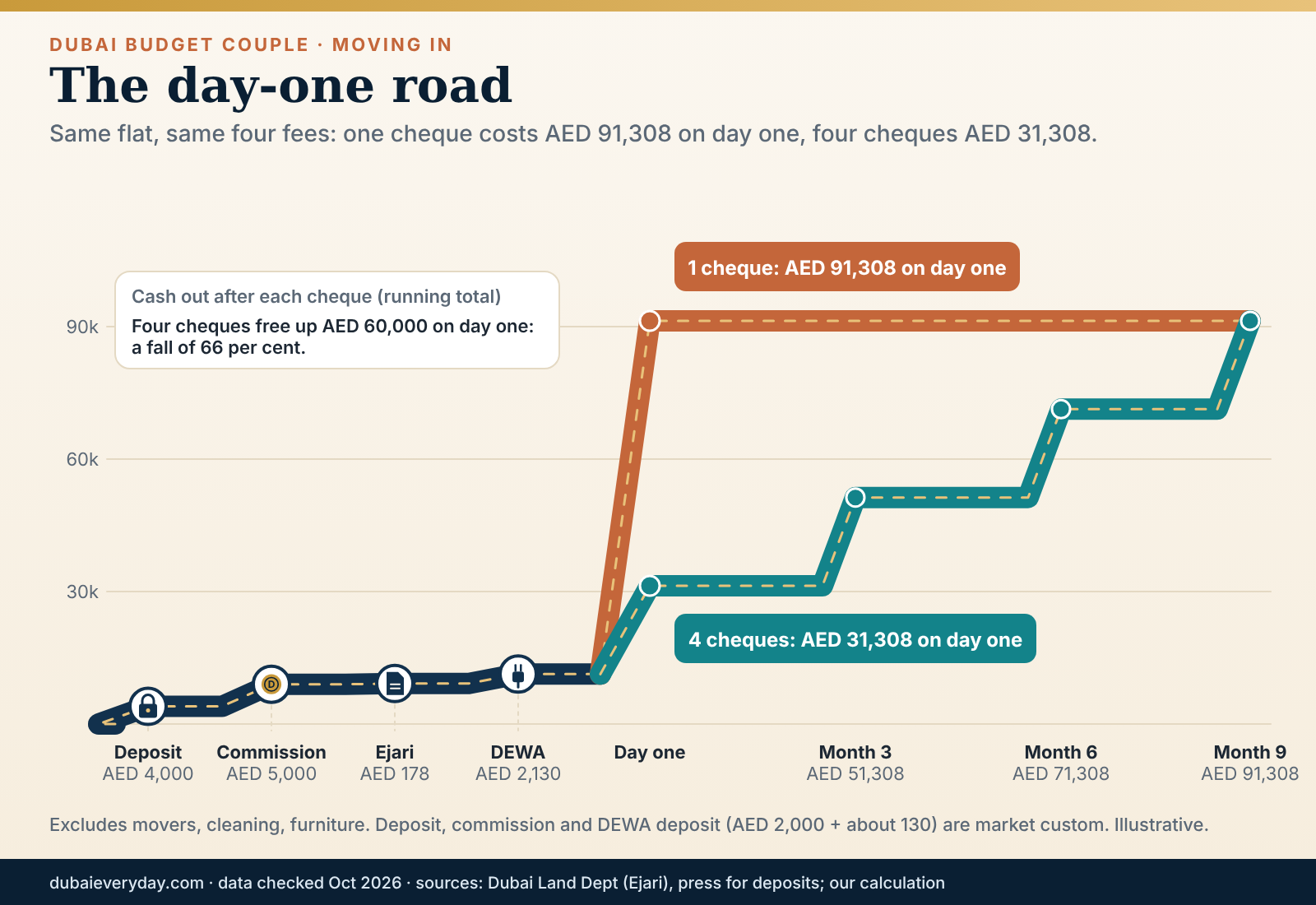
Monthly Dubai budget couple totals hide the biggest cash demand of all: the first week. A couple arriving in Dubai, or moving between flats, needs far more money on day one than the monthly average suggests, and the amount depends heavily on how many cheques the landlord accepts. This is where many Dubai budget couple plans fail quietly, before the first month even starts.
The day-one stack in a Dubai budget couple plan
- First rent cheque (annual rent divided by the number of cheques you agree)
- Security deposit, customarily 5 per cent of annual rent for an unfurnished flat and refundable at the end of the lease
- Agency commission, customarily 5 per cent of annual rent; we use the higher of 5 per cent and AED 5,000 as a prudent figure
- Ejari registration, AED 177.75 online or AED 220 at a trustee centre (Dubai Land Department page)
- DEWA deposit of AED 2,000 for an apartment plus about AED 130 in connection charges (press report, carried from a companion guide)
- Movers and cleaning, roughly AED 1,200 to 2,100 combined on press estimates
The deposit, commission and moving costs are market custom, not law. Negotiate them. In a market where asking rents are falling, as the figures above show, a landlord may accept a lower commission or a larger number of cheques more readily than a year ago.
Day-one cash by number of cheques
The table shows our calculation for each Dubai budget couple scenario, from one cheque to twelve. The totals include deposit, commission, Ejari, DEWA deposit and connection, and exclude movers, cleaning and furniture. Amounts are rounded to the nearest dirham.
| Cash needed on day one (AED) | 1 cheque | 2 cheques | 4 cheques | 6 cheques | 12 cheques |
|---|---|---|---|---|---|
| Lean (rent 55,000) | 65,058 | 37,558 | 23,808 | 19,224 | 14,641 |
| Mid (rent 80,000) | 91,308 | 51,308 | 31,308 | 24,641 | 17,974 |
| Comfortable (rent 130,000) | 145,308 | 80,308 | 47,808 | 36,974 | 26,141 |
| Premium (rent 170,000) | 189,308 | 104,308 | 61,808 | 47,641 | 33,474 |
Going from one cheque to four cuts the Mid couple’s day-one cash from AED 91,308 to AED 31,308, a fall of 66 per cent. Going to twelve cheques cuts it to AED 17,974. Few landlords offer twelve, and the option is rarely free.
What a cheque really costs
Landlords sometimes quote a higher annual rent for more cheques. The extra is the price of the credit they give you, so treat it like an interest rate. Illustrative example (not a quote or market fact): a landlord asks AED 80,000 in one cheque or AED 82,000 in four equal cheques paid at months 0, 3, 6 and 9.
Paying in four, you hold on to AED 59,500 for the first three months, AED 39,000 for the next three, AED 18,500 for the next three and you are AED 2,000 behind in the last quarter. The average sum you keep is AED 28,750. You pay AED 2,000 for that, so the implied cost is about 7 per cent a year.
Whether that is worth it depends on what the money would otherwise do. If the alternative is a credit card or an overdraft, four cheques are cheap. If the money would otherwise sit unused in a current account for three months, you are paying for liquidity you do not need. Do the sum with the landlord’s real figures, because the premium can be zero or can be considerably more than in our example.
Moving costs against the rent
Excluding the refundable deposit, our estimate of the one-off cost of arriving is AED 6,508 to 7,408 for the Lean and Mid flats, AED 8,008 to 8,908 for the Comfortable one and AED 10,008 to 10,908 for the Premium one. That is 11.8 to 13.5 per cent of the annual rent in the Lean case and 5.9 to 6.4 per cent in the Premium one. A cheap flat has a proportionally dearer entry fee, because the AED 5,000 commission floor does not shrink with the rent.
The practical lesson for any Dubai budget couple plan is that a move has to save a lot before it pays for itself. If you move from an AED 80,000 flat to a AED 70,000 one, you save AED 10,000 a year but spend roughly AED 6,500 to 7,400 to arrive. The saving takes most of a year to cover the fee, and a landlord counter-offer on your current flat is worth taking seriously.
Furniture is a separate decision
We could not verify furniture prices from a dated source, so none appears in any scenario. If you plan to buy for an unfurnished flat, collect real quotes and put the total on its own line, because it is the one-off cost most likely to double your first-month spend. Furnished flats carry a rent premium instead; compare the premium over the time you expect to live there, not just year one. If your tenancy ends early or the lease terms change, the rules on notice and deposits are summarised in the Dubai legal basics guide.
One income or two: sponsoring a spouse
Most Dubai budget couple searches come from one of two households: two employed adults, or one employed adult who wants to bring a spouse. The costs overlap, but the risks do not. This section prices the second case, because it adds a visa stack, a health premium and a single point of failure that the two-earner base case does not have.
The rules that decide whether you can sponsor
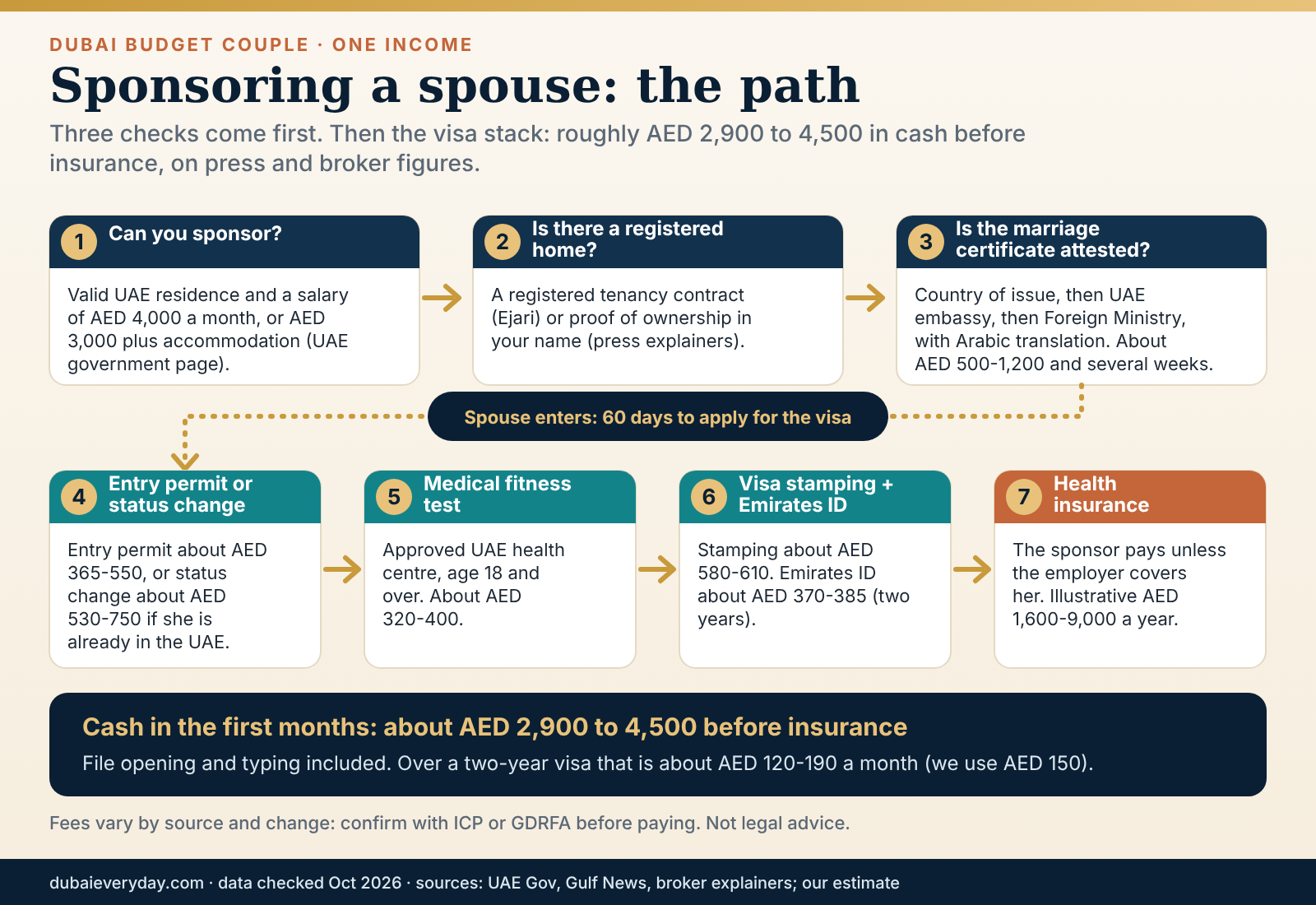
According to the UAE government’s family-sponsorship page, the sponsor must be an expatriate resident with a valid residence permit and a minimum monthly salary of AED 4,000, or AED 3,000 plus accommodation. A spouse aged 18 or over must pass a medical fitness test at an approved centre in the UAE, and once the spouse has entered on an entry permit you have 60 days to apply for the residence visa.
The official page does not list fees, the tenancy requirement or the marriage certificate rules. For those we relied on Gulf News and a property-broker explainer: a registered tenancy contract such as Ejari or proof of ownership, and a marriage certificate that is attested in the country of issue, then by the UAE embassy there, then by the Ministry of Foreign Affairs, with an Arabic translation. Start early. The attestation chain can take several weeks, and the UAE embassy stamp has to be obtained before travelling.
These are the rules as reported on 29 October 2026 and they change. Confirm the current list with the Federal Authority for Identity, Citizenship, Customs and Port Security (ICP) or GDRFA before you pay for anything.
What the visa stack costs
Two secondary sources give different fee stacks, which is itself a warning. Gulf News (August 2025) lists an entry permit of AED 550, file opening AED 300, a two-year Emirates ID AED 385, the medical test AED 320, visa stamping AED 580, and a status-change fee of AED 750 if the spouse is already in the country. That is AED 2,135 before the status change.
A broker explainer dated June 2026 lists file opening near AED 230, an entry permit between about AED 365 and 530, a status change between about AED 530 and 650, a medical between AED 320 and 400, an Emirates ID near AED 370 and stamping near AED 610. Add typing charges of AED 300 to 500 and, for a foreign-issued marriage certificate, AED 500 to 1,200 for attestation all-in.
Reading the two together, our estimate for a couple already outside the UAE is roughly AED 2,100 to 2,800 in government and medical fees, plus AED 500 to 1,200 for attestation and AED 300 to 500 for typing: about AED 2,900 to 4,500 in cash in the first month or two, before insurance. Spread over a two-year visa, it is about AED 120 to 190 a month, and we use AED 150 below.
The health premium sponsors forget
Under Law No. 11 of 2013, which the Dubai government’s health insurance page summarises, employers insure employees and sponsors insure dependants, including spouses. In practice some employers extend cover to spouses as a benefit, others do not, and a spouse who is not covered becomes the sponsor’s cost. Ask which in writing before you accept an offer. Our health insurance in Dubai guide covers the mandate, networks and co-pays in depth.
The prices are wide. The Dubai Health Authority’s Essential Benefits Plan circular gives an index band of AED 550 to 750 per member per year plus VAT, according to the insurer-hosted copy we could read. A broker explainer puts a basic plan for a non-working married woman aged 18 to 45 near AED 1,600 a year, and a PolicyBazaar page dated 9 October 2026 gives Dubai ranges of AED 725 to 5,945 for basic plans, 1,300 to 6,600 for semi-comprehensive and 3,000 to 12,000 for comprehensive. Premiums depend on age, gender, plan and network.
For the one-earner variant below we use illustrative spouse premiums of AED 1,600 (AED 133 a month), 3,500 (AED 292), 6,000 (AED 500) and 9,000 (AED 750) a year for the four scenarios. They are placeholders for a rising plan level, not quotes.
The one-earner Dubai budget couple variant
Take each base Dubai budget couple scenario, remove the second earner’s ILOE premium, add the spouse’s health premium and add AED 150 for the amortised visa stack. The result is the cost of the same lifestyle when only one of you is salaried.
Lean, one earner
AED 10,073 a month, up AED 278. One salary of roughly AED 12,600 saves 20 per cent.
Mid, one earner
AED 17,810 a month, up AED 437. One salary of roughly AED 22,300 saves 20 per cent.
Comfortable, one earner
AED 31,307 a month, up AED 640. One salary of roughly AED 39,100 saves 20 per cent.
Premium, one earner
AED 45,789 a month, up AED 890. One salary of roughly AED 57,200 saves 20 per cent.
The point to take from this is how little the extra costs change a Dubai budget couple bill and how much the single income changes the risk. Sponsorship adds AED 278 to 890 a month. It also puts the whole household on one pay cheque and one residence.
The minimum salary is a floor, not a Dubai budget couple plan
The AED 4,000 threshold decides whether the authority will accept your application. It tells you nothing about whether you can live on the salary. Even our Lean Dubai budget couple scenario costs AED 9,795 a month, which is more than twice the threshold, and a one-bedroom rent alone would exceed it. Do not read the minimum as a guide to what a household needs. It is an eligibility test and nothing more.
When the one salary stops
A sponsored partner’s residence generally follows the sponsor’s. If the sponsor leaves a job, the household has a clock running on two residences at once, with a visa status to settle in addition to a salary to replace. We did not read an official page on the exact grace period, so ask ICP or your employer’s PRO for the current rule and the timelines before you rely on any cushion.
The unemployment scheme helps a little. The Dubai government’s page says employees in the federal and private sectors must subscribe to involuntary loss of employment insurance, with premiums capped at AED 5 a month for basic salaries under AED 16,000 and AED 10 for higher ones. Compensation is 60 per cent of the subscription salary for up to three months, capped at AED 10,000 and AED 20,000 a month respectively. Failing to subscribe carries a AED 400 fine. Investors and domestic workers are excluded.
Unmarried partners and founders
The sponsorship route above is for spouses. We found no official page that lets one resident sponsor an unmarried partner under it, so partners who are not married generally need their own residence basis, such as their own employment, a licence or another permit. The right route depends on nationalities, the type of residence and the facts, and this page does not give legal advice on it. Check with ICP, or a licensed adviser, before assuming either way.
If one of you runs a company, your residence usually follows from the licence rather than from a salary, and the ILOE scheme excludes investors. That is a different cash-flow problem, which the business setup guide and the mainland company guide explain from the company side.
Utilities, cooling, internet and phones
Utilities are the line where Dubai surprises newcomers most in one direction: electricity itself is cheap, and the air conditioning in July is not. A Dubai budget couple plan needs an annual average, not the October bill that lands in your first month.
How a DEWA bill is built
DEWA’s own tariff page would not open for us, so the slabs below come from a Property Finder calculator article dated 20 February 2026, cross-checked against a second property-portal explainer, and are labelled broker-sourced. Electricity is charged at AED 0.23 per kWh for the first 2,000 kWh a month, AED 0.28 up to 4,000, AED 0.32 up to 6,000 and AED 0.38 above.
A fuel surcharge of AED 0.06 per kWh is added, plus a meter service charge of AED 5 to 35 depending on the meter. Water is AED 7.70 per cubic metre up to 27, AED 8.80 up to 54 and AED 10.12 above. VAT of 5 per cent applies.
Because the first 2,000 kWh are the cheapest, a one- or two-bedroom flat rarely reaches the upper slabs. What moves the bill is summer cooling inside the lowest band, so the swing is mostly volume, not tariff.
Our Dubai budget couple usage assumptions and results
We assumed three seasons of four months each: winter (December to March), a shoulder season (April, May, October, November) and summer (June to September). The kWh and cubic-metre figures are our assumptions for two adults, not meter data. They are shown so you can swap in your own readings from a previous tenant’s bill.
- Lean one-bedroom, air-conditioned by the flat’s own unit: 500 kWh and 11 m³ in winter, 850 and 13 in the shoulder, 1,350 and 15 in summer. Bills of about AED 252, 374 and 543; annual average AED 390.
- Mid one-bedroom: 550 and 11, 900 and 13, 1,450 and 15. Bills of about AED 267, 390 and 573; average AED 410.
- Comfortable two-bedroom in a district-cooled tower, where DEWA covers lights, appliances and water but not cooling: 450 and 16, 500 and 18, 600 and 20. Bills of about AED 277, 308 and 355; average AED 313.
- Premium two-bedroom, same arrangement: 500 and 18, 600 and 20, 750 and 24. Bills of about AED 308, 355 and 433; average AED 365.
For comparison, a Real Estate Club Dubai utilities guide (March 2026, broker) gives typical annual-average DEWA bills of AED 300 to 600 for a one-bedroom and AED 400 to 800 for a two-bedroom. Our own figures sit inside the one-bedroom band, and the two-bedroom figures sit below it only because the cooling is billed elsewhere.
The housing fee is in the rent block, not here. It appears on the DEWA bill, so your real monthly bill will be higher than any DEWA figure above by 5 per cent of rent divided by twelve: AED 229 in the Lean case, AED 333 in the Mid case.
District cooling: the bill that arrives separately
In a district-cooled building a separate provider bills chilled water, and the same broker guide gives a two-bedroom range of AED 450 to 750 in winter and AED 900 to 1,500 in summer, around AED 800 on average, with a fixed capacity charge of roughly AED 150 to 300 a month for a one-bedroom that applies even if you never switch the air conditioning on. Those are broker ranges, not tariffs. We use AED 800 for the Comfortable scenario and AED 900 for the Premium one.
AED 800 a month is AED 9,600 a year. That is about 7 per cent of a AED 130,000 rent and is easy to miss when comparing flats. Rent a two-bedroom at AED 120,000 with chilled water billed on top and a rival at AED 130,000 with cooling included in the rent, and the cheaper rent is the dearer flat. Always ask for the last twelve months of cooling bills.
Internet and mobile for two
Home internet is a monopoly choice in many buildings, since a building is typically served by only one of the two providers. A property-portal guide dated March 2026 lists entry, mid and top fibre tiers of AED 299 (250 Mbps), AED 389 (500 Mbps) and AED 549 (1 Gbps) for both du and e&, on 12-month contracts with an AED 1,000 early-termination fee.
A second compilation, in the Bayut guide we used for the single-person page, shows AED 286 to 478 after VAT, so sources disagree by up to AED 70 on the top plan. We use AED 300, 390, 390 and 550.
For mobile we use AED 60, 110, 150 and 200 a line, or AED 120, 220, 300 and 400 for two. Those are allowances, not plan prices, because operator plan pages would not open. The saving that matters is structural: compare the total for two lines, with data, roaming and any device instalment, not the headline price for one.
Seasonality in a Dubai budget couple plan, in one sentence
In our Lean Dubai budget couple scenario the summer DEWA bill (AED 543) is 2.2 times the winter one (AED 252), so a couple who budgets AED 252 in January is short by AED 291 in August. Smooth the line by setting aside the annual average, or by treating the excess in summer as the cost of staying in the flat rather than the cost of the flat.
Cars, metro and taxis for two
Transport is the line where a Dubai budget couple plan swings hardest, because the choice is binary and expensive: own a car, or do not. The decision also depends on your two jobs, your two commutes and where you live, so it deserves its own arithmetic.
The no-car Dubai budget couple baseline: Nol passes and taxis
The RTA fare page we read on 29 October 2026 lists Silver-card single trips at AED 3 within one zone, AED 5 across two adjacent zones and AED 7.50 across more. A 30-day Silver pass costs AED 140 for one zone, AED 230 for two zones and AED 350 for all zones. The annual Silver pass costs AED 1,060, AED 1,770 and AED 2,670 respectively, and Gold-class cards cost double. Children aged five and under ride free.
Taking the two-zone figures, an annual pass works out at AED 147.50 a month against AED 230 for a 30-day pass. Twelve 30-day passes cost AED 2,760, so the annual pass saves AED 990 a year, or 36 per cent. It pays back after about 7.7 months of 30-day passes, so buy the annual card only if you will be here for most of a year. For two commuters the saving is AED 1,980 a year.
How many trips does a 30-day pass need to earn its keep? At AED 5 a trip, a AED 230 pass breaks even at 46 trips, or 23 return journeys a month. At AED 3 a trip the one-zone pass breaks even at about 47 trips. Weekday commuting passes both tests with room to spare, and weekend-only riders do not.
Taxi fares are the least reliable input in this guide. Press reports from November 2025 say app-booked taxis have a minimum fare of AED 13 and flagfall plus peak-time surcharges that vary by day and hour, while the Dubai Taxi website’s FAQ shows a daytime base fare of AED 11 without saying which service it applies to. Our allowance for a typical cross-town ride is AED 35. It is an estimate, not a tariff, and the monthly allowances (AED 250 to 500) are simply that estimate multiplied by a plausible number of rides.
The cost of running one car in a Dubai budget couple plan
Every input below is for a mid-priced petrol car driven 1,200 km a month, which is our assumption and not an average. All are press, portal or allowance figures.
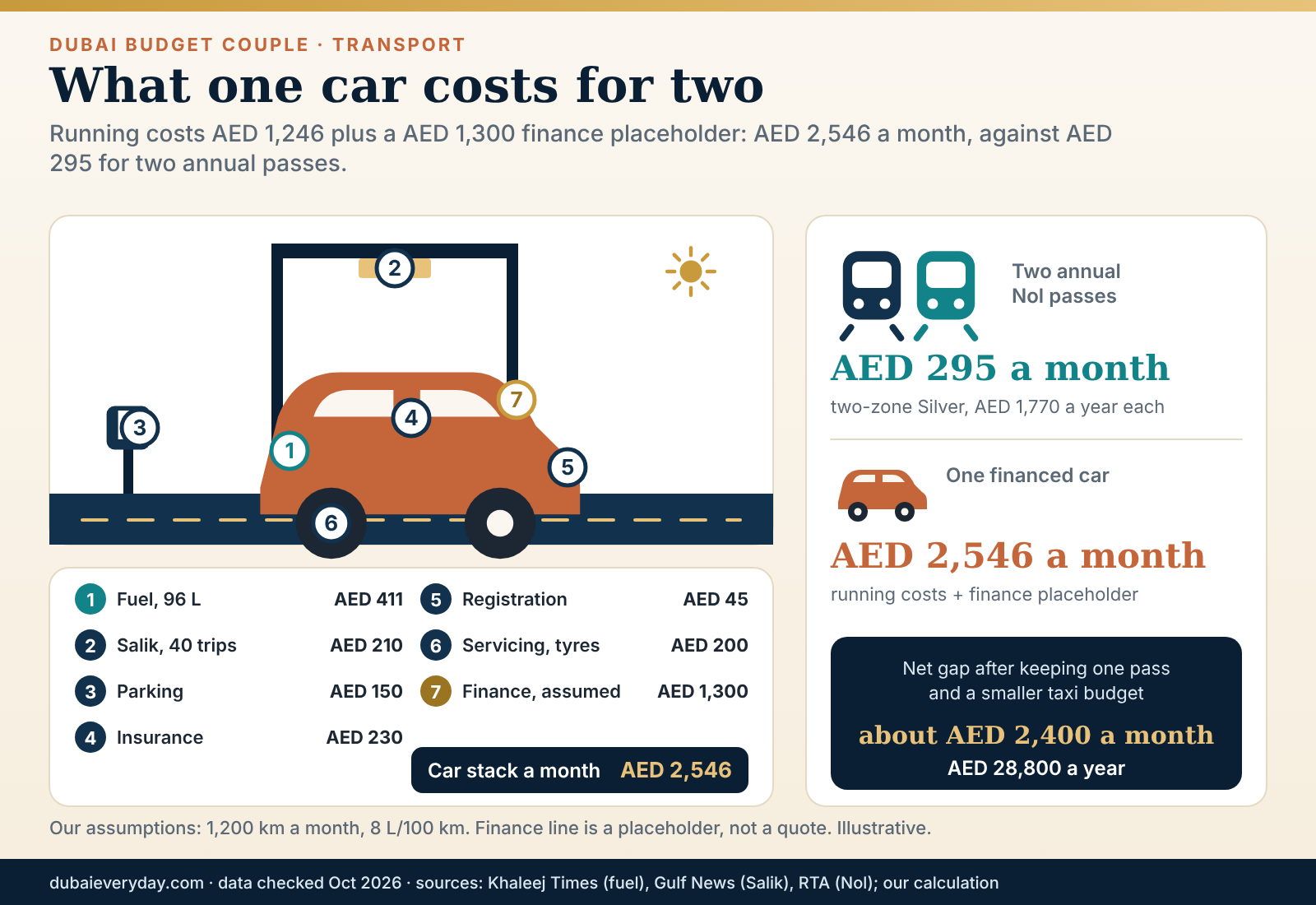
- Fuel: October 2026 prices are AED 4.28 a litre for Special 95 (up from AED 3.69 in September, a rise of 16 per cent), AED 4.40 for Super 98 and AED 4.21 for E-Plus 91. At 8 litres per 100 km, 1,200 km uses 96 litres and costs AED 411 a month, against AED 354 at September prices. A full 62-litre sedan tank costs AED 265.36 on Special 95.
- Salik: from 1 June 2026, AED 6.30 per crossing at peak (6am to 10am and 4pm to 8pm, Monday to Saturday) and AED 4.20 off-peak, including VAT, and the tag is free between 1am and 6am. Forty crossings at an even mix cost AED 210.
- Parking: press reports put Parkin at AED 4 to 6 an hour before VAT, roughly AED 4.20 to 6.30 after it, in most zones between 8am and 10pm. We allow AED 150 a month for a car that is mostly parked at home and work.
- Insurance: a July 2026 portal article lists comprehensive cover at AED 1,300 to 1,600 a year for small sedans, AED 1,500 to 2,000 for midsize sedans, AED 1,800 to 2,500 for compact SUVs and AED 1,890 to 3,000 for midsize SUVs, with third-party from about AED 630. We allow AED 230 a month (AED 2,760 a year), above those mid-points, on the view that a financed car needs comprehensive cover and a new driver pays more.
- Registration and inspection: renewal is AED 350 to 380 plus an AED 20 knowledge and innovation fee, and cars older than three years need a technical inspection at AED 150 to 170, according to portal pages dated July and September 2026. We allow AED 45 a month.
- Servicing, tyres and small repairs: an allowance of AED 200 a month. It is not sourced.
That adds up to AED 1,246 a month in running costs before the car itself. Fuel is the line most exposed to news, since the October rise of 16 per cent in one month added about AED 57 to this one household.
The finance line is the one we cannot price
Most of the cost of a car is the car. We could not verify loan rates, terms or dealer prices from a dated official source, so the instalment in each Dubai budget couple scenario is a placeholder: AED 1,300 for the Mid car, AED 2,200 for the Comfortable one, and both for the Premium household (AED 2,200 plus AED 1,500). Replace it with your actual contract figure. If the car is paid off, delete the line. If you pay cash, price the money you tied up.
The sums that follow depend on it, so be honest about this line. The Mid couple’s car stack is AED 1,246 running plus AED 1,300 instalment, or AED 2,546. Two annual two-zone passes cost AED 295. Because the car household keeps one pass and a smaller taxi budget, the net difference is about AED 2,400 a month, or AED 28,800 a year.
Is a second car ever worth it?
In the Premium Dubai budget couple scenario the second car adds roughly AED 2,550 a month: more fuel, more tolls, a second parking bill, a second insurance policy, a second instalment and a second registration. Against that, the household drops its metro pass and some taxi rides.
Divide that cost by our AED 35 taxi allowance and you get about 73 taxi rides a month, or roughly two and a half a day, before the second car breaks even. Below that rate it is cheaper to take taxis, and above it the car wins. That is our calculation on estimated fares, so test it with your own ride-hailing history. The answer is rarely the second car for a couple living near a metro station and working in the same direction.
A couple whose jobs sit in different parts of the city, neither near a station, is the exception. There the second car buys back hours rather than dirhams, and no budget can tell you what those hours are worth.
Cars and the rest of a Dubai budget couple plan
Owning a car pulls other lines up. Parking at home and at the office, service visits, fines, and the cost of a replacement car during repairs all show up in the sinking fund. Insurance deserves a proper comparison between agency-repair and garage-repair policies, which a portal article says differ by AED 300 to 700 a year in premium. The Dubai insurance guide explains how to compare policies, excess and claims behaviour.
And renewing registration late is expensive. A portal explainer says driving with an expired registration carries a AED 500 fine and four black points, and that late fees start after a 30-day grace period. The renewal itself is a few hundred dirhams, so put the date in both your calendars.
Food: groceries and dining out for two
Food is the line couples argue about most, and in a Dubai budget couple plan it is the one that changes least: 16 to 18 per cent of the total in all four of ours. What changes is who is paying for it, and for what. The staples are cheap and well documented. The restaurant bill is neither.
What the staples cost
The Ministry of Economy and Tourism publishes monthly price monitoring for key commodities on its Essential Goods Prices Platform. Its August 2026 table gives these averages: basmati rice AED 16.62 a kilo, flour AED 7.76 a kilo, fresh full-fat milk AED 9.46 a litre, yogurt AED 1.97 for 170 grams, canola oil AED 15.86 a litre, a tray of 30 brown eggs AED 23.05, a whole chicken AED 22.97 a kilo and sugar AED 8.75 a kilo.
Build a month of staples for two from those prices and the arithmetic is short. Three kilos of rice (AED 49.86), a two-kilo pack of flour (AED 12.26), 12 litres of milk (AED 113.52), one tray of eggs (AED 23.05), four kilos of chicken (AED 91.88), a kilo of sugar (AED 8.75), 1.5 litres of canola oil (AED 23.97) and 20 pots of yogurt (AED 39.40) come to AED 362.69. That basket is our own choice of quantities, not an official one.
AED 363 is about a third of our Lean grocery allowance of AED 1,150, 23 per cent of the Mid allowance, 16 per cent of the Comfortable one and 13 per cent of the Premium one. The rest of a grocery bill is fresh produce, fish, snacks, coffee, cleaning products and toiletries, and that is where lifestyle sets the number.
Where shopping around matters
The same platform’s snapshot dated 28 October 2026 lists the lowest and highest price it found per category across outlets. It does not state pack sizes, so you cannot compare one row with another, but the spread within a category is informative. Rice appeared between AED 4.20 and AED 16.00. Sugar ran from AED 2.35 to AED 5.25, and bread from AED 4.98 to AED 9.17. Cooking oil ranged from AED 5.10 to AED 18.67.
Those spreads reflect different pack sizes, brands and store formats as much as different prices, so they do not show that one retailer is simply dearer. They do show that for the same shopping list, the choice of store format moves the bill by a large factor, and that a couple who buys staples at a hypermarket and fresh food nearby will often spend less than one who buys everything at the nearest premium shop.
The Dubai budget couple grocery allowances, and why they are not double
Our grocery allowances are AED 1,150, 1,600, 2,300 and 2,800 a month. In the companion single-person guide the matching tiers are AED 700, 1,000 and 1,400, so the couple’s bill is about 1.6 times a single adult’s. That is not a coincidence or a law. Shared packs, one oven and one fridge-full of leftovers reduce waste, and cooking for two is only a little more work than cooking for one. A couple that eats separately, at different times, will find the ratio closer to two.
Dining out: an allowance, not a price
We could not find a dated, reliable source for the average cost of a restaurant meal in Dubai. The pages that ranked for it were thin, undated or about tourists. So the eating-out line is built from the number of outings and a spend per outing for two, labelled illustrative:
- Lean: six outings a month at AED 90 for two, AED 540
- Mid: eight outings at AED 150, AED 1,200
- Comfortable: twelve outings at AED 250, AED 3,000
- Premium: twelve outings at AED 450, AED 5,400
These are shapes, not statistics. A Lean outing might be a cafeteria meal or a casual lunch; a Premium one might be a good restaurant with drinks and a tip. Use the structure, not the prices. Count how many times a month the two of you eat out for real, multiply by your usual bill and compare it with ours.
Dining out takes 5.5 per cent of the Lean budget, 6.9 per cent of the Mid one, 9.8 per cent of the Comfortable one and 12 per cent of the Premium one. The percentages grow faster than the totals do, which is why restaurants are the discretionary line that responds most to a raise. They are also the easiest to cut in a hurry.
Food inflation in a Dubai budget couple plan
EnterpriseAM’s report on official data put Dubai’s food prices up 7.4 per cent year on year in August 2026, alongside housing and utilities up 6.7 per cent and transport up 12.7 per cent. If your last budget was built a year ago, assume the food line is already out of date by several per cent. The check is simple: compare two supermarket receipts for the same basket, one from a year ago and one from this month, and update the allowance by the difference.
Health insurance and out-of-pocket costs for two
Health is a legal obligation in Dubai before it is a Dubai budget couple line, so start with who is responsible for what. This section is general information based on government and regulator pages and on press and broker explainers. It is not medical, insurance or legal advice, and a licensed adviser or your insurer should confirm anything that affects a claim.
Who pays for whom
The Dubai government’s health insurance page, last modified 14 April 2026, states that health insurance in Dubai is mandatory, that employers (free zones included) insure their employees, and that sponsors insure their dependants, spouses among them. The Dubai Health Authority’s FAQ, as read for our companion health insurance research, adds that an employer bears the premium of the employee’s cover in full and may not deduct it from salary, and that employers are encouraged but not obliged to cover dependants.
The Dubai budget couple base case therefore costs nothing in premiums while both of you are employed with compliant cover. The moment one of you is a dependant without employer cover, the sponsor pays. Our health insurance in Dubai guide sets out the legal mandate and the penalties in detail.
What the minimum plan covers
The Essential Benefits Plan is the minimum standard for any policy issued in Dubai. According to an insurer-hosted copy of the DHA circular (GC 03/2024, table effective 1 January 2025), which we could not read on the DHA’s own site, it carries an annual limit of AED 150,000, a 20 per cent co-payment on consultations, laboratory work and radiology, a 20 per cent inpatient co-payment capped at AED 500 per encounter and AED 1,000 a year, a medicines allowance of AED 2,500 a year at a 30 per cent co-payment and a dental allowance of AED 500.
The same copy gives maternity limits of AED 10,000 for a normal delivery and AED 10,000 for a caesarean, with 10 per cent co-insurance. Treat these as a guide to what the minimum looks like, not as the terms of your own policy. Your table of benefits is the only document that counts.
The maternity question in a Dubai budget couple plan
If you might have a child in the next couple of years, maternity is the clause to read before you choose a plan, not after. Portal explainers say maternity benefits are subject to a waiting period without stating how long, so ask the insurer for the waiting period, the delivery sub-limit, the newborn cover and the network in writing. A baby also moves the household into a different budget, with childcare, nursery and school lines that this page does not model.
This is not medical advice and we are not suggesting a time or a plan. We are saying that the policy you hold when the question arises is the one that decides who pays, so the right moment to read it is while the question is still hypothetical.
Out-of-pocket costs in a Dubai budget couple plan
Beyond premiums, couples pay co-pays on visits, pharmacy items above the allowance, dental and optical work outside the cover, vaccinations, and anything out of network. Our allowances for these are AED 160 a month for the Lean household, AED 300 for the Mid one, AED 500 for the Comfortable one and AED 700 for the Premium one.
In the single-person guide the Lean, Mid and Comfortable equivalents are AED 100, 150 and 350, so the couple lines run from 1.4 to 2 times as much. They are allowances, not averages. Nobody publishes an average, and your own co-pay history is a better guide than ours.
The ILOE premium (AED 5 a month for each earner on a basic salary under AED 16,000, AED 10 above) is in the same row of the table for convenience, even though it protects income rather than health. It is the cheapest insurance in this guide and it is compulsory.
If you pay for both of you: the Dubai budget couple premium
Some couples, freelancers and founders buy cover for both partners. The PolicyBazaar page we read, updated 9 October 2026, shows Dubai annual premiums per person of AED 725 to 5,945 for basic plans, AED 1,300 to 6,600 for semi-comprehensive plans and AED 3,000 to 12,000 for comprehensive plans.
For two adults that is AED 1,450 to 11,890 a year for basic cover, and AED 6,000 to 24,000 for comprehensive, or about AED 120 to 2,000 a month. Those ranges are very wide, and the same page shows a conflicting comprehensive range of AED 6,200 to 28,000 elsewhere, so use them only to size the problem and get real quotes before you commit.
Age, gender, chronic conditions, network breadth and co-pay level drive the price. Compare the table of benefits line by line, not the headline premium. A cheap plan with a narrow network and a 30 per cent co-pay on everything can cost more over a year than a mid-priced one.
Check who you are buying from
The Dubai Health Authority’s insurance regulation site, ISAHD, lists permitted insurers, third-party administrators and intermediaries. The Central Bank of the UAE publishes its own register of licensed institutions, including a separate list of insurance entities, on its licensing page. Use both before paying a premium to anyone who approached you first. If a broker will not tell you which insurer sits behind the policy, that is the answer. For other cover, such as a car, contents or life policy, the Dubai insurance guide explains how to compare them.
Fitness, leisure and the annual bills
These are the lines most people mean when they say “lifestyle”, and the ones a Dubai budget couple plan can trim without touching the roof over its head. They are also the lines with the weakest data, so every figure in this section is an allowance unless it says otherwise.
Gyms in a Dubai budget couple plan: price the contract, not the poster
Our gym line is AED 418 a month for the Lean household (two memberships at AED 209), AED 600 for the Mid one, AED 1,000 for the Comfortable one and AED 1,468 for the Premium one (two at AED 734). The lower and upper anchors come from operator prices carried over from our companion single-person research; we did not re-read the operators’ pages today, and headline prices on club websites can differ from the price on the club page you actually join.
The sums that matter are per visit. A AED 209 membership used once a week (about 4.3 visits a month) costs about AED 48 a visit. Used three times a week (13 visits) it costs about AED 16. For a couple, the honest question is whether both of you will use it that often. A pair where only one trains regularly should buy one membership, not two, and keep the difference.
Read the exit terms before the price: joining fees, freeze fees, annual versus monthly pricing, and what happens if you move away. The single-person guide found an annual plan broke even against monthly billing after about eight months, so it only pays if you are staying that long. Free options deserve a place too. The Dubai Fitness Challenge, according to the event’s official site as noted in our companion research, runs 31 October to 29 November 2026 with free registration, and running and swimming cost nothing.
Leisure and shopping in a Dubai budget couple plan
Leisure is where the four households diverge most: AED 300, 800, 2,000 and 3,500 a month. It covers the cinema, weekend trips, a beach-club day, an occasional staycation and gifts. Shopping and miscellaneous items (clothes, personal care, household replacements) are AED 400, 700, 1,800 and 3,000. These ranges are shapes of a lifestyle, not market averages.
The cheap end of leisure can be very cheap. The best beaches in Dubai guide compares public and hotel beaches, and the things to do in Dubai guide helps you prioritise attractions, so a weekly outing does not have to cost much beyond transport. The expensive end is optional by definition. A budget that treats a monthly staycation as a necessity has a problem that no spreadsheet will fix.
For the occasional night away, hotel prices in the city vary hugely by season and area, which the Dubai hotels guide covers by budget. We keep the staycation inside the leisure line so it competes with other fun for the same dirhams, which is the honest way to budget for it.
The annual sinking fund in a Dubai budget couple plan
The sinking fund turns lumpy yearly costs into a monthly figure so they stop ambushing you: AED 600 for the Lean household, AED 1,200 for the Mid one, AED 2,500 for the Comfortable one and AED 4,000 for the Premium one. What it has to cover depends on you:
- Flights home for two. We could not verify airfares from a dated source, but EnterpriseAM’s August report on official data put airfares up 23.2 per cent year on year. Price two return tickets now and see whether twelve months of the fund covers them.
- Emirates ID and visa renewals. Our companion research found the Emirates ID at AED 100 a year plus a AED 100 service fee on the ICP page; confirm the current fee on the ICP site.
- Car registration and inspection (already in the transport line) and the excess on any insurance claim.
- A device or appliance every couple of years, because summer heat is hard on both.
- Gifts, weddings, Eid and holiday spending.
A quick test of the Lean fund: AED 600 a month is AED 7,200 a year. That has to cover two return tickets home, two ID renewals and whatever breaks. If your home airport is a long way off, it will not. Raise the line before you cut it.
A year in a Dubai budget couple plan
A month-by-month view shows why an average can mislead. DEWA peaks from June to September, since cooling drives it, and in our Lean scenario the summer bill is 2.2 times the winter bill. Rent cheques land on dates you set: four cheques means four peaks of AED 13,750 in the Lean case and AED 20,000 in the Mid case, each several times the monthly average. Registration renewals and insurance premiums come once a year. Flights cluster around school holidays and Eid.
The simplest defence is a separate savings pot for the sinking fund and the rent cheques, funded monthly, with its balance on the same page as your current account. The pot should cover every cheque due in the next 12 months. If it does not, the household is borrowing from the rest of its budget and will feel it on the day the cheque clears. A rent cheque that does not clear can cause serious trouble with the landlord and the bank, so check the rules for your situation in the tenant rights guide or with a licensed adviser.
Savings in a Dubai budget couple plan
Most Dubai budget couple plans stop at the spending total and call it done. That leaves out the reason many people come here: no personal income tax, so more of each salary can be saved. Savings only happen if the plan sets them aside before the discretionary lines eat them, so this section prices them as a line in their own right.
The pay each Dubai budget couple scenario needs
The UAE government’s taxation page states that individuals are not subject to income tax in the UAE and that VAT is 5 per cent on goods and services. So, for an employee, take-home pay is close to the salary actually paid, though basic salary and allowances are different things and it is the monthly cash that matters here. If a budget total is T and you want to save a share s of take-home pay, you need pay of T divided by (1 minus s). Our calculation for combined household pay, in AED a month:
Lean
Spend 9,795. Pay needed to save 10% is 10,884, 20% is 12,244 and 30% is 13,993.
Mid
Spend 17,373. Pay needed to save 10% is 19,304, 20% is 21,717 and 30% is 24,819.
Comfortable
Spend 30,667. Pay needed to save 10% is 34,074, 20% is 38,334 and 30% is 43,810.
Premium
Spend 44,899. Pay needed to save 10% is 49,888, 20% is 56,124 and 30% is 64,142.
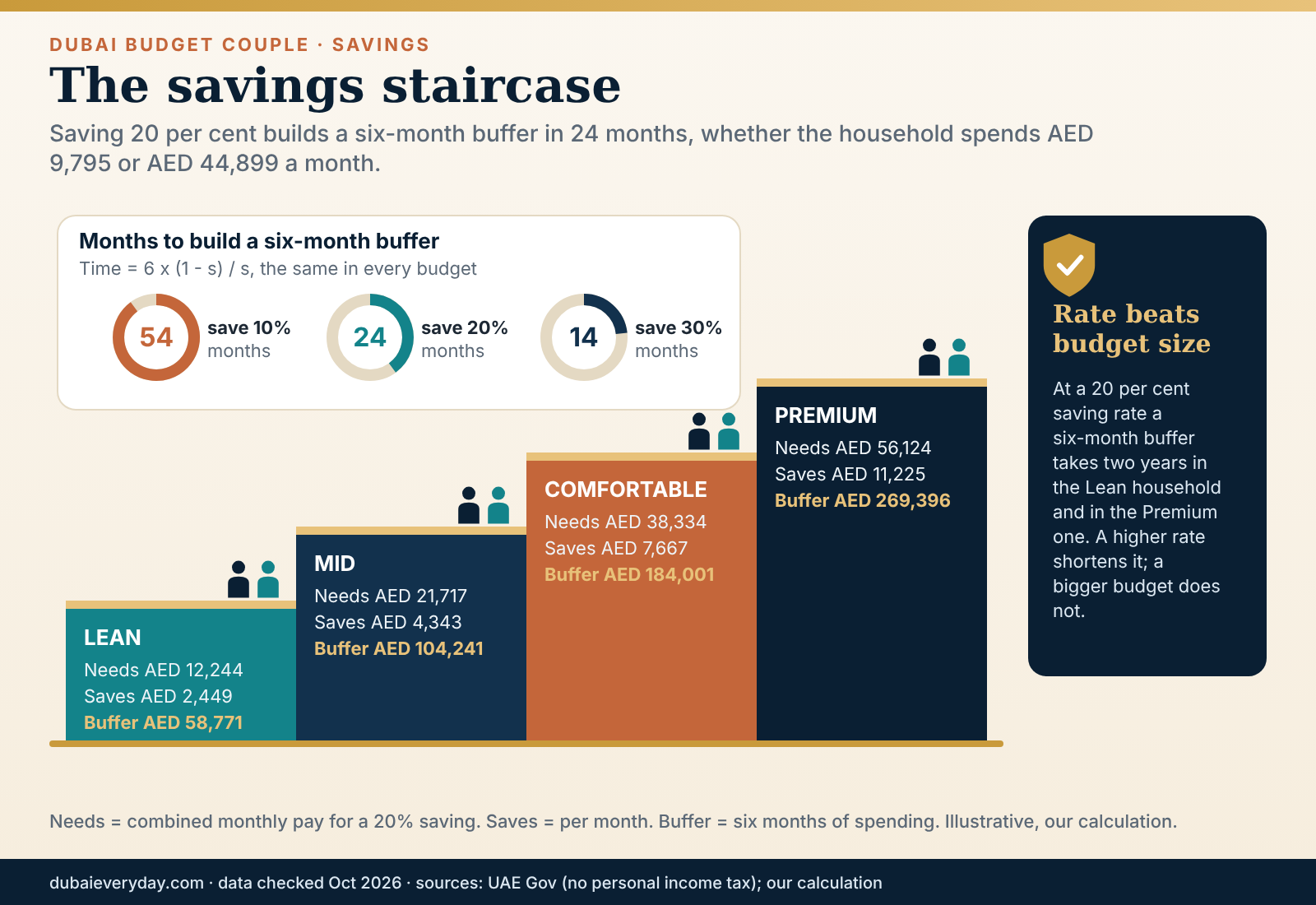
Saving 20 per cent therefore means AED 2,449 a month in the Lean household, 4,343 in the Mid one, 7,667 in the Comfortable one and 11,225 in the Premium one. Over a year that is about AED 29,400, 52,100, 92,000 and 134,700.
How long a safety buffer takes in a Dubai budget couple plan
Here is a result that surprises people. The time to build a buffer of n months of spending at a savings rate s is n times (1 minus s) divided by s, in months. It does not depend on the scenario at all. At a 20 per cent savings rate, a six-month buffer takes 24 months in the Lean household and in the Premium one alike. At 10 per cent it takes 54 months, and at 30 per cent about 14.
The buffer itself is large. Six months of spending is AED 58,800 in the Lean household, 104,200 in the Mid one, 184,000 in the Comfortable one and 269,400 in the Premium one. Three months is half of that. For a couple the case for the buffer is stronger than for a single person, because the household usually depends on a residence, a lease and cheques that all fall due even if one salary stops.
The safety nets, and what they are not
The UAE government’s end-of-service benefits page explains the gratuity for private-sector expatriates: 21 days of basic salary for each of the first five years and 30 days for each year after, calculated on the last basic salary only, with a cap of two years’ wages and no gratuity under one year of service. It is payable within 14 days of termination. An employer can also opt into a voluntary savings scheme, contributing 5.83 per cent of basic pay for staff with under five years and 8.33 per cent beyond that.
Worked example, illustrative: on a basic salary of AED 8,000, three years of service gives 8,000 divided by 30, times 21, times 3, which is AED 16,800. Five years gives AED 28,000. Both partners accrue gratuity separately. Do not count it as an emergency fund. It is paid at the end, it depends on how you leave, it excludes allowances, and basic pay is often well below the total package.
The unemployment cover described in the section on one income or two pays 60 per cent of the insured salary for up to three months. It softens a job loss for the person who is insured. It does nothing for a sponsored partner with no job, and it excludes company owners. Treat it as a short bridge, not a substitute for a buffer.
This page does not recommend a bank, broker, product or return. Savings and investment returns are never guaranteed, and a promise of a fixed high return from an unlicensed firm is the classic warning sign. Before sending money to any bank, exchange house, finance company or insurer, search for it on the Central Bank of the UAE’s licensing register, and confirm any investment firm with its own regulator. General information, not financial advice.
Where to keep it: checks, not recommendations
An emergency fund needs to be available the same week, so it belongs in a current or savings account at a licensed bank, not in anything with a lock-in. Interest rates move with the Central Bank’s base rate, which a CBUAE release of 29 July 2026 shows was left at 3.65 per cent, although a related-news headline on the page we read suggested a different rate on 28 October that we could not verify. So look up the current rate on the day, and compare accounts on terms rather than the headline rate.
Money sent home deserves its own comparison. Illustrative example (not a quote or market fact): sending AED 5,000 a month through a service that charges AED 15 plus 0.5 per cent costs AED 40 a transfer. A service that hides a 1.5 per cent margin in the exchange rate costs AED 75. Over a year that is AED 420, enough to notice. Compare the amount received, not the fee advertised, and use a firm on the Central Bank register.
Splitting a Dubai budget couple’s bills without splitting the household
There are three common ways to share a budget. Equal shares are simple and treat each partner as a peer, but they are only fair when incomes are similar. Proportional shares charge each person the same percentage of take-home pay. A joint pot funded in proportion, with a personal allowance for each person, works for most couples who want both shared costs and private spending.
Worked example, illustrative: the Mid household spends AED 17,373 a month. Partner A takes home AED 15,000 and partner B AED 9,000, so there is AED 6,627 left to save. Split equally, each pays AED 8,687, which leaves A with AED 6,313 and B with only AED 313. Split in proportion to pay (62.5 and 37.5 per cent), A pays AED 10,858 and keeps AED 4,142, and B pays AED 6,515 and keeps AED 2,485. Same total, same savings, very different feelings about fairness.
The right method is the one both of you can describe in a sentence and still agree with in a year. Hold a short monthly review, ten minutes with last month’s card statement, not an annual argument. Keep the review factual: what we planned, what we spent, what changed.
Joint accounts, wills and what to ask
Rules on joint accounts, inheritance and what happens if a partner dies or a marriage ends vary by nationality, religion, the type of account and the bank’s own terms. This page does not give legal advice on them. Ask your bank in writing how a joint account is treated if one holder dies or the account is disputed.
For non-Muslim expats, the DIFC Courts’ Wills and Probate Registry offers will registration. A 2017 practice direction we read set registration fees from AED 5,000 for a single will, with spouses’ mirror wills charged as a pair, and the schedule may have changed, so confirm current fees. The Dubai legal basics guide explains where to verify rules before relying on any summary like this one.
If one of you owns a business, your Dubai budget couple plan changes
A household with a business in it has two money systems, and mixing them is the common failure. Pay yourselves a regular amount from the company, keep company money out of the household budget, and keep the records that let an accountant separate them. The accounting services guide and the bookkeeping guide explain the monthly records, bank reconciliation and tax filings that make this workable. Company owners are also outside the ILOE scheme, so the household buffer should be larger, not smaller.
Where the dirhams are: levers ranked
When the total is too high, the useful question is which change saves most per unit of pain. We ran each lever on the Mid Dubai budget couple scenario, one at a time, using the same inputs as the table above. The ranking is more stable than the individual figures, so it should hold whatever your own numbers are.
- Drop the carNet saving about AED 2,400 a month once you keep one pass and a smaller taxi budget. The largest single lever, and the hardest to reverse.
- Move to a cheaper flatA flat AED 15,000 a year cheaper saves AED 1,313 a month including the housing fee, minus a one-off arrival cost of roughly AED 6,500 to 7,400.
- Stop a rent increaseA 5 per cent cap on AED 80,000 is AED 4,000 a year, or about AED 368 a month with the housing fee. Check the rent index and negotiate before agreeing.
- Halve eating outFrom eight outings to four saves AED 600 a month on our allowance.
- Keep one gym membershipSaves AED 300 a month if only one of you trains regularly.
- Trim groceries by a tenthSaves AED 160 a month and costs only attention, mostly the store format.
- Move down an internet tierSaves about AED 90 a month if your building has more than one plan and you do not need the speed.
That list is the opposite of how most households attack a budget. They start at the bottom, with coffee and subscriptions, and stop before they reach the top. The seven items above total about AED 5,200 a month if every one applied, and the top two account for roughly 70 per cent of it. So decide on the car and the flat first. Everything else is housekeeping.
What a second person really costs in a Dubai budget couple plan
Compare these Dubai budget couple totals with the companion single-person guide’s Lean, Mid and Comfortable scenarios, which total AED 6,826, 11,300 and 21,232. The couple’s totals are AED 9,795, 17,373 and 30,667. In ratio terms that is 1.43, 1.54 and 1.44, so a couple costs about 1.4 to 1.5 times a single person at a similar tier. Per person, the cost is AED 4,898, 8,687 and 15,334 a month, or 72, 77 and 72 per cent of living alone.
Be careful about reading that as a law of nature. The tiers are not like-for-like. A couple’s Mid flat is a one-bedroom at AED 80,000, against AED 65,000 for a single’s, and our allowances for dining, leisure and gyms were set independently for each guide.
The Mid comparison is the least like-for-like of the three, because our couple has a financed car and the single-person Mid scenario does not. Take the car out of the couple’s Mid budget, swapping its transport line for the Lean one, and the total falls to AED 15,024, a ratio of 1.33. Read the result as a range, well below double and well above one.
The reasons are straightforward. A couple shares one flat, one internet connection, one DEWA bill and (usually) one car. The rent ratio is 1.38 in the Lean tier, 1.23 in the Mid and 1.18 in the Comfortable one, not 2. What doubles is personal: phones, gyms, out-of-pocket health costs and, in many households, the restaurant bill. If your second person also arrives without a job, remember the extra lines in the one-income variant.
The practical use of the Dubai budget couple ratio is moving. A single person who is considering a partner joining them can estimate the new total as roughly 1.3 to 1.5 times the old one. If the answer is far above that, something in the plan has been added beyond the second person, usually a bigger flat or a car.
Ten mistakes that break a Dubai budget couple plan
Most failed Dubai budget couple plans fail in the same ten places. None needs advanced maths, only a habit of asking what the number leaves out.
- Budgeting from the advertised rent instead of the whole housing bill. Rent, the 5 per cent housing fee, commission, deposit, DEWA and any cooling charge together make the real cost, and the lease number is only the biggest piece.
- Using the first DEWA bill as the annual figure. In our Lean scenario summer costs 2.2 times winter, and a couple who arrive in January carry the wrong number into July.
- Treating the car instalment as the cost of the car. Fuel, Salik, parking, insurance, registration and servicing came to AED 1,246 a month in the Mid scenario, nearly as much again.
- Assuming a cheaper area is cheaper. A AED 27,000 rent saving can be cancelled by a car that the area forces on you, as the Business Bay and Jumeirah Village Circle comparison showed.
- Forgetting the first-week cash. With one cheque, the Mid couple needs AED 91,308 on day one, which is about 44 per cent of a year’s spending in one go.
- Assuming the employer covers a spouse. Under Dubai’s health law the sponsor insures a dependant who has no employer cover. Ask in writing, before you sign.
- Reading the AED 4,000 sponsor minimum as a living budget. It is an eligibility floor, and no household in this guide lives on it.
- Counting end-of-service gratuity as an emergency fund. It arrives at the end, on basic pay only, and only if you leave on terms that pay it.
- Skipping the conversation on how bills are split. A fair-sounding 50/50 left one partner with AED 313 in our worked example. Agree the method before the first bill arrives.
- Never updating the Dubai budget couple plan. Dubai’s consumer prices rose 5.54 per cent year on year in August 2026, fuel is repriced monthly and rents are moving. A budget written in spring may be wrong by autumn.
Who this page is not for
Households with children need school, nursery and childcare lines that this Dubai budget couple model does not include, and a family’s rent profile is different. Anyone whose employer provides housing, transport or cover should delete those lines and treat what is left as a cross-check. People buying a home need mortgage, service-charge and registration costs that belong in a property guide, not a rent-based budget. And anyone who wants a recommendation on a bank, a product or an investment will not find one here, because the page is built around dated inputs and not around individual advice.
Dubai budget couple: frequently asked questions
How much does a couple need to live in Dubai each month?
In our four illustrative Dubai budget couple models a couple needs about AED 9,800 a month for a one-bedroom without a car, AED 17,400 for a mainstream one-bedroom with one car, AED 30,700 for a two-bedroom in a district-cooled tower and AED 44,900 with two cars in a Marina or Downtown-type lifestyle. Rent and the housing fee are 33 to 49 per cent of those totals. They are models, not averages, so replace our rent and car lines with your real figures before you rely on any total.
Can two people live on AED 10,000 a month in Dubai?
Yes, in our Lean Dubai budget couple model, which costs AED 9,795 a month. It needs a one-bedroom at about AED 55,000 a year in a lower-cost community, no car, two annual Nol passes, mostly home cooking and one modest outing a week. It leaves nothing to save, and a sponsored partner adds about AED 280 a month. A summer DEWA bill or a rent rise can break it, so test it with your real lease first.
Is a couple cheaper than two single people?
Yes. Against the companion single-person budgets, our Dubai budget couple totals are about 1.3 to 1.5 times a single person’s at a similar tier, so each person costs roughly 72 to 77 per cent of living alone. The saving comes from sharing rent, DEWA, internet and often a car. Phones, gyms, restaurant bills and out-of-pocket health costs still double. The comparison is not exact because the couples’ flats are bigger and the allowances were set separately.
What salary do I need to sponsor my spouse?
The UAE government’s sponsorship page says AED 4,000 a month, or AED 3,000 plus accommodation, for an expatriate resident sponsoring a spouse. You also need a registered tenancy or ownership proof and, for a foreign marriage certificate, attestation, according to press and broker explainers. The minimum is an eligibility test and not a living budget: our Lean Dubai budget couple spends AED 9,795. Confirm current requirements with ICP or GDRFA before you pay any fee.
Does a couple need a car in Dubai?
Often not. In the Mid Dubai budget couple model a financed car with running costs adds about AED 2,400 a month over two annual Nol passes, or AED 28,800 a year. A second car adds roughly AED 2,550 a month in the Premium model, which equals about 73 taxi rides at our AED 35 estimate. The answer depends on where you live and work. If a metro station serves both commutes, the car is hard to justify on cost.
How much of our budget should go on rent?
There is no official rule for a Dubai budget couple plan. In our four models rent plus the housing fee is 49, 40, 37 and 33 per cent of the budget. Once it passes about half, there is little left to save unless you also give up a car and most extras, which is the Lean household. A simpler check is the sensitivity ranking: a rent that is AED 15,000 a year lower frees AED 1,313 a month, so compare any flat on its full monthly cost, including the commute.
How much cash do we need to move into a flat?
For the Mid Dubai budget couple flat at AED 80,000 a year, about AED 91,308 on day one if the landlord takes a single cheque, AED 51,308 with two, AED 31,308 with four and AED 17,974 with twelve. That includes a 5 per cent deposit, commission of at least AED 5,000, Ejari and DEWA charges, and excludes movers, cleaning and furniture, which add roughly AED 1,200 to 2,100 for the first two. Deposits and commission are custom, so negotiate.
Is health insurance mandatory for my husband or wife in Dubai?
Yes. Under Dubai’s health insurance law, as summarised by the Dubai government, health insurance is mandatory, employers insure employees and sponsors insure their dependants, spouses included. An employer may extend cover to your spouse as a benefit, but is not obliged to, so ask. Premiums vary widely by age, gender, plan and network. Your table of benefits, not our estimates, sets what is covered. This is general information, not insurance or legal advice.
How much should a couple save each month in Dubai?
There is no single right rate for a Dubai budget couple plan. At 20 per cent of take-home pay, our four households would save about AED 2,449, 4,343, 7,667 and 11,225 a month. A six-month buffer at that rate takes 24 months to build. At 10 per cent it takes 54 months and at 30 per cent about 14. Choose a rate you can keep through a bad summer, and keep emergency money in an account at a licensed bank, available within the week.
Do couples pay income tax in Dubai?
No personal income tax applies to individuals in the UAE, according to the UAE government’s taxation page, and VAT is 5 per cent on goods and services. That does not mean no deductions: you still pay the housing fee, ILOE premiums and any health premium for a sponsored partner. A business owned by one of you may fall under corporate tax rules, which are outside this page. Ask an accountant about the company’s position.
How often should we update our Dubai budget couple plan?
Every three months, and immediately after any lease, job or car change. Dubai’s consumer price index rose 5.54 per cent year on year in August 2026, according to a report on official data, with transport up 12.7 per cent and food up 7.4. Fuel is repriced monthly. Compare three months of actual card statements with the allowances here, then replace the allowances one line at a time with what you really spent.
What changes in a Dubai budget couple plan if we have a baby?
Maternity cover, a possibly larger flat, childcare and eventually school fees all enter the picture, which is why this page covers couples only. Read your policy’s maternity limits, waiting period and newborn cover before you plan, as these vary by plan. The Essential Benefits Plan figures we saw are only a minimum. This is not medical advice. Build a separate family budget once the plan is real, and treat the couple total as the starting point.
Related reading
Sources and further reading (33 links)
- RTA: Nol fares — Silver and Gold single-trip, 30-day and annual pass prices (official)
- Dubai Land Department: register or renew an Ejari contract — Ejari fee of AED 177.75 online or AED 220 at a trustee centre (official)
- Dubai Legislation Portal: Decree No. 43 of 2013 — rent-increase bands at renewal (official)
- UAE Government: sponsorship requirements for family residence visas — salary threshold, medical test and 60-day rule for a spouse (official)
- UAE Government: taxation — no personal income tax, VAT at 5 per cent (official)
- UAE Government: end-of-service benefits in the private sector — gratuity formula, cap and savings scheme (official)
- Dubai Government: health insurance — employer and sponsor duties under the Dubai health law (official)
- Dubai Government: involuntary loss of employment insurance — premiums, compensation, fines and exclusions (official)
- Ministry of Economy and Tourism: Essential Goods Prices Platform — lowest and highest listed prices per category (official)
- Ministry of Economy and Tourism: monthly price monitoring table — average staple prices used in the sample basket (official)
- Central Bank of the UAE: licensing — register of licensed institutions and insurance entities (official)
- Dubai Health Authority ISAHD: FAQ — mandate, employer and sponsor duties, permitted insurers (official; carried from a companion guide)
- DIFC Courts: Practice Direction No. 4 of 2017 — wills registry fee schedule, which may have changed (official)
- Insurer-hosted copy of the DHA Essential Benefits Plan circular — minimum benefits, limits and co-payments (copy of an official document)
- Sharjah24: CBUAE maintains the base rate — Central Bank base-rate decision (press reporting an official release)
- Gulf Business: 15 areas where a one-bedroom still costs under AED 80,000 — Property Finder average advertised rents (press and portal)
- dubizzle: H1 market report on Dubai rentals — average one- and two-bedroom rents by area (property portal)
- Real Estate Club Dubai: rent map — Q1 rent ranges used to show disagreement between sources (broker)
- Khaleej Times: Dubai rents fall in most areas — citywide median asking rent and year-on-year falls (press reporting Property Finder data)
- Khaleej Times: rents in Dubai fall over 12 per cent — Savills Q3 apartment rent changes (press; carried from a companion guide)
- Property Finder: DEWA calculator — electricity and water slabs, fuel surcharge (property portal; DEWA’s own page would not open)
- Real Estate Club Dubai: utilities and monthly bills — DEWA, district cooling and internet ranges (broker)
- Khaleej Times: October fuel prices and full-tank costs — Special 95, Super 98 and E-Plus 91 prices (press)
- Gulf News: Salik and Parkin costs from 1 June — toll and parking rates after VAT (press)
- Zigwheels UAE: the true cost of car ownership — registration, inspection and insurance ranges (portal)
- PolicyBazaar UAE: car registration renewal in Dubai — renewal fee, grace period and fines (broker)
- Khaleej Times: new Dubai taxi fares — app-booked taxi minimum fare and surcharges (press)
- Dubai Taxi: FAQs — base fare, with unclear scope (operator)
- PolicyBazaar UAE: cost of individual health insurance — premium ranges by plan tier, with an internal inconsistency (broker)
- Khaleej Times: is your employer responsible for your family’s health insurance — sponsor duty for dependants (press)
- Gulf News: how to sponsor your wife for a UAE residence visa — documents, attestation chain and fee list (press)
- Real Estate Club Dubai: family visa cost — second fee stack and attestation costs (broker)
- EnterpriseAM: Dubai inflation rises to 5.5 per cent — consumer price index by category (press reporting official data)
Update log: 29 October 2026 — first publication; figures re-checked against the sources above where the pages would open, and others carried from companion research logs of the same date. Next review due: by 28 February 2027, or sooner if rents, fuel prices, tariffs, visa fees or regulations change. Corrections welcome. General information only, not financial, legal, tax or insurance advice; confirm any figure that affects a contract or a payment with the provider or a licensed professional.
About DubaiEveryday and this guide
DubaiEveryday.com is an independent editorial project that publishes practical, research-based guides to everyday life in Dubai: where to live, what things cost, how the rules work and how to get around. This page was written and edited by the DubaiEveryday editorial team. It is not signed by a named expert, doctor, lawyer or adviser, and we do not claim first-hand testing of a venue, clinic or service unless the page says so.
Each guide is built from official sources such as government and regulator pages, operator websites and established news outlets, cross-checked where we can. When we could not confirm something, we say so in the text, and examples that use made-up numbers are labelled as illustrations. Mentions are editorial choices, not paid placements, and a link is not an endorsement.
Dubai changes quickly. If you spot something that is out of date or wrong, please tell us through the contact options on DubaiEveryday.com and we will check it and correct the page.