
Dubai property cash on cash return tells you what a flat or villa pays you each year compared with the cash you actually put in. This guide shows how to build the number, how a mortgage bends it, and where it breaks.
A flat in Dubai rents for AED 70,000 a year, the listing says the yield is over 6%, and the bank will lend you 60% of the price. It sounds like free money. Then the first loan statement arrives, and the instalment swallows almost all of the rent.
That gap between the headline yield and the cash that actually lands in your account is what a Dubai property cash on cash return measures. This guide builds the number from scratch with clearly labelled illustrations. You will see what counts as cash invested, what counts as annual cash flow, how a mortgage changes both, and which assumptions break first. It is general information to help you ask better questions, with no promise of any particular return.
Dubai property cash on cash return is the annual cash your flat or villa pays you after running costs and loan payments, divided by every dirham of your own cash that went into the deal. Both halves matter. The top is money that really arrives in your account. The bottom is not just the deposit: it includes the 4% DLD registration fee, the agent, the trustee office and the bank’s charges.
In our illustrative AED 1,100,000 apartment, rent of AED 70,000 a year leaves about AED 46,158 after vacancy, management, service charge and upkeep. Bought with cash, that is 3.9% on AED 1,176,820 invested. Borrow 60% at 5% over 25 years and your cash invested drops to AED 532,540, but the loan payments take almost the whole income, so the return lands at roughly zero. Same flat, same rent, very different number.
Three rules follow for any Dubai property cash on cash return. Put the fees in the denominator. Subtract principal as well as interest in the numerator, because principal leaves your account even though it builds equity. Then test the result against empty months, a lower renewal rent and a loan rate that resets. If the property’s net yield on total cost is lower than your mortgage rate, borrowing will drain cash every year.
This is a research-based guide, not field-tested advice and not a recommendation to buy anything. The Dubai Land Department (DLD) fee pages and FAQ, the Central Bank of the UAE mortgage rules and its base-rate release were read on 29 October 2026. Market figures come from consultancy and press reports and are labelled as secondary. Every worked number is our calculation from stated assumptions, not a quote, a listing or a promise. Rates, fees, commission and service charges move, so confirm each with whoever will invoice you. General information only, not individual financial, legal or tax advice. Inclusion of any source was not paid for.
What Dubai property cash on cash return actually measures
Most Dubai listings quote one number: gross yield, meaning a year of rent divided by the price. It is quick, it is flattering and it ignores almost everything that decides whether you end up richer. A Dubai property cash on cash return answers a narrower and more practical question. For every dirham of your own money tied up in this property, how many dirhams of cash does it send back each year?
“Your own money” is the part people get wrong. It is not the price. If a bank lends you 60%, your cash is the other 40% plus the registration fee, the agent, the trustee office, the valuation and the lender’s charges. And “cash back” is not the rent. It is what remains after the building has been paid for, the tenant has moved out for a month, the manager has taken a cut and the bank has taken its instalment.
Who this number is for
The Dubai property cash on cash return suits anyone choosing between two investment properties, between a cash purchase and a mortgage, or between a property and some other use of the same capital. Because it is a measure of income, a Dubai property cash on cash return says nothing about whether the price will rise or fall. An owner who buys for capital growth and accepts thin rent can have a poor Dubai property cash on cash return and still be happy, as long as they know that is the bet.
It is less useful for an owner-occupier, because no rent comes in. For living in a place rather than letting it, the first-time buyer guide covers the budget, mortgage and fee timeline.
What this page covers, and what it leaves to its neighbours
One job only: your Dubai property cash on cash return, meaning the annual cash return on the cash you invested, with a mortgage and without. The full lifetime picture, including the sale and the money you get back at the end, is built in our guide to how to calculate Dubai property ROI. The difference between gross and net yield, and what citywide numbers say, sits in the Dubai rental yield guide. Area choice, market cycles and exit planning are in the wider Dubai property investment guide. This page links to them rather than repeating them.
Why it matters more in Dubai right now
Two things make a Dubai property cash on cash return unusually sensitive in late 2026. Rents have softened in several apartment communities, which squeezes the numerator, and the Central Bank of the UAE raised its base rate to 3.9% from 17 September 2026, which makes borrowed money dearer. When income shrinks and debt gets costlier together, the gap between a headline yield and the cash in your pocket widens.
The formula and its two halves
The Dubai property cash on cash return calculation fits on a napkin. Annual pre-tax cash flow divided by total cash invested, expressed as a percentage. Every difficulty lives in deciding what goes into each half, so it helps to write the two halves out in full before touching any numbers.
Top: annual cash flow
Rent actually collected, minus vacancy, minus service charges, minus maintenance, management and insurance, minus the full loan payment (interest and principal). Taken before any tax in your home country.
Bottom: cash invested
Down payment, plus DLD registration, agent, trustee and small government fees, plus loan set-up costs, plus anything you spend to make the unit rentable. Your own money only, never the borrowed part.
Dubai property cash on cash return in one line
Cash-on-cash return = (net operating income − annual debt service) ÷ (down payment + purchase costs + loan costs + set-up spend). Net operating income is the rent you collect less the costs of owning and letting the unit, before any loan. Debt service is twelve loan payments, and the principal part counts, because it is cash leaving your account.
Cash invested is measured once, at purchase, and then kept fixed in the simple version of the calculation, which keeps comparisons between properties honest. Rent, charges and the loan balance all drift, so year one is not year ten. Treat the first-year Dubai property cash on cash return as a snapshot, not a forecast.
The principal question
Some investors prefer a version that adds the principal repaid back into the return, on the logic that principal reduces the debt and so belongs to you. That is a fair way to think about equity growth, and we show it below as an “equity-adjusted” figure. But the classic Dubai property cash on cash return treats principal as an outflow, since you cannot spend it, and that is the version used throughout this page unless a label says otherwise. Mixing the two versions inside one comparison is how bad spreadsheets get made.
The denominator: mortgage equity and every fee
The bottom of the fraction is where a flattering Dubai property cash on cash return is born. A seller’s brochure divides by the price. An honest calculation divides by what left your bank account, and in Dubai that is meaningfully more than the deposit. The easiest way to keep it straight is to build a ledger in the order the money moves.
The down payment, set by the loan limit
The Central Bank of the UAE caps how much a lender may advance against the property value. Its mortgage rules set the maximum loan-to-value at 80% for an expatriate’s first home under AED 5 million (70% above), 60% for an expatriate’s second or investment property, and 50% for any off-plan purchase. The maximum term is 25 years. For a buy-to-let investor, then, the starting point is a minimum of 40% of the price in cash, before a single fee.
Banks generally lend against the lower of the purchase price and their own valuation, so a valuation below price makes your deposit larger. In our example, a valuation 5% under the AED 1,100,000 price cuts the 60% loan from AED 660,000 to AED 627,000 and adds AED 33,000 to the cash you must find. Confirm the valuation basis with your lender, because it differs by bank.
Registration and government fees
The DLD sale registration page lists a registration fee of 2% of the sale value for the seller and 2% for the buyer, a title deed fee of AED 250, map fees (AED 225 for the Dubai Municipality unified map, AED 100 outside it, and a separate AED 250 line for villas and apartments), and knowledge and innovation fees of AED 10 each.
A service partner fee of AED 4,000 plus VAT applies to sales of AED 500,000 or more (AED 2,000 plus VAT below that). The page does not say who pays what beyond the 2% lines.
Who bears the registration fee is a negotiating point on resale, and a 2021 DLD notice to developers describes the buyer or investor settling 4% on a new-build agreement. Our worked example assumes the buyer pays the full 4%, which is the cautious reading. If you negotiate a split, your denominator shrinks, and you should say so explicitly when comparing deals.
Agent, trustee and the rest
The DLD FAQ says broker commission is whatever the parties agree, with customary practice filling the gap. A common working assumption is 2% plus 5% VAT, and that is what the example uses. A developer no-objection certificate is a further cost on many freehold resales, set by the developer, so allow a line for it and ask for the figure in writing. The DLD licensed-broker search is free if you want to confirm the person is registered before you discuss money.
Then come the unglamorous items: cleaning, small repairs, a deep clean before the first viewing, DEWA registration and the Ejari tenancy registration (AED 100 plus AED 10 plus AED 10 on the app or website, or AED 120 plus a partner fee of AED 95 plus VAT through a trustee centre, per the DLD FAQ). Our example bundles these into a single AED 5,000 set-up allowance. If you furnish the unit to let it furnished, the furniture belongs in the denominator too.
Loan set-up costs
The DLD mortgage registration page lists 0.25% of the mortgage value, a title deed fee of AED 250, knowledge and innovation fees of AED 10 each, and a service partner fee of AED 4,000 plus VAT for a standard mortgage (AED 5,000 for a provisional, off-plan mortgage). Banks add a valuation fee and often an arrangement fee. We have no official source for those two, so the example uses AED 3,000 for the valuation and 1% of the loan for the bank, both labelled assumptions. Replace them with the figures on your offer letter.
Down payment
AED 440,000, which is 40% of the AED 1,100,000 price.
Buying costs
AED 76,820: DLD 44,000, agent with VAT 23,100, trustee with VAT 4,200, small fees 520, set-up allowance 5,000.
Loan costs
AED 15,720: registration 1,650, deed 250, small fees 20, partner fee with VAT 4,200, valuation 3,000, bank 6,600.
Cash invested
AED 532,540 with the loan. Without it, AED 1,176,820 (price plus buying costs).
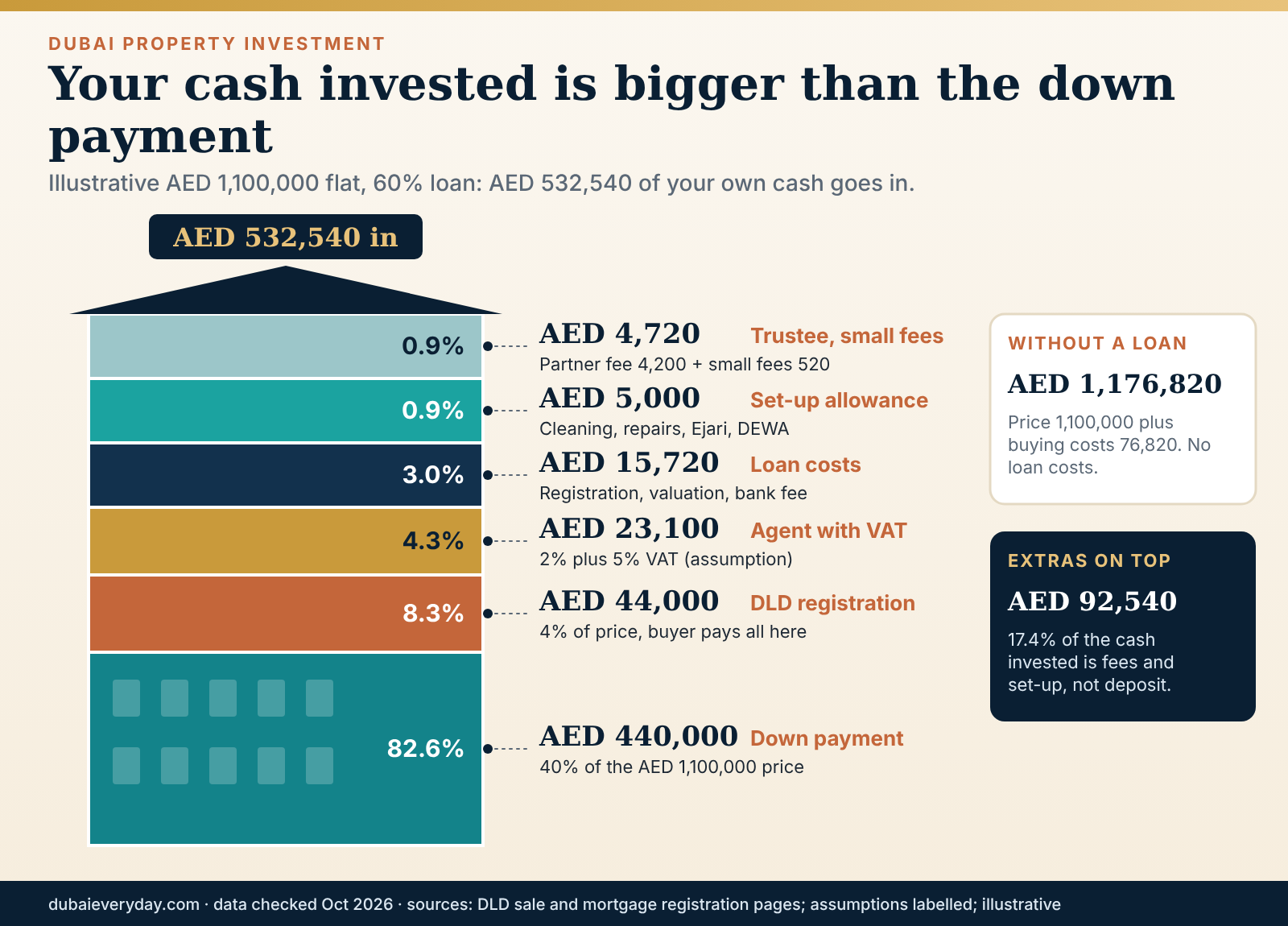
Add the layers and a “40% deposit” becomes 48% of the price. That extra eight points is why a Dubai property cash on cash return computed on the deposit alone always looks better than the real thing. It is also why a cheaper-looking, higher-yielding unit can lose to a better-priced one once the fixed charges (the AED 4,000 partner fees, for instance) are spread over a smaller denominator.
The numerator: annual cash flow before the bank
The top of the fraction starts with a figure that is easy to find and easy to inflate: the rent. Everything after it is a deduction. The result, before any loan, is called net operating income, and it deserves to be calculated and written down on its own, because it is also the number a lender, a cap-rate comparison and an appraiser care about.
Rent: contract, collected and renewed
To keep your Dubai property cash on cash return honest, use the rent you can defend, not the asking price. For an existing tenancy, that is the signed Ejari contract. For a vacant unit, check the DLD Rental Index, which takes the contract end date, property type, area or building, bedrooms and current rent, and gives an indicative reference.
The index is indicative for a new lease and becomes binding only if landlord and tenant disagree at renewal, when an increase of 0% to 20% is allowed depending on how far the rent sits below the market average. Either side wanting to change terms must give 90 days’ notice before expiry.
New and renewing tenants often pay different rents. A broker-published analysis of DLD records put the September 2026 median for new apartment contracts at AED 70,000 against AED 60,000 for renewals. Our example’s AED 70,000 is a round illustrative number that happens to match that median, and a citywide median says little about any one unit. The practical lesson is to model the renewal rent, not the headline new-lease rent, once the first year is over.
Vacancy and the cost of an empty flat
Even a well-priced unit goes empty between tenants: a few weeks to advertise, view, negotiate and register the contract. The example assumes one month a year, which is an assumption and not a market statistic. During those weeks you still pay service charges and may be paying the utility bills. Treat vacancy as a guaranteed line in the budget rather than a bad-luck event, and show the sensitivity, as we do later.
Service charges, which are not optional
Per the DLD FAQ, service charges are annual charges approved by the Real Estate Regulatory Agency (RERA) after an audit by an approved firm. Your share is based on the area on your title deed, and you can estimate it by multiplying the DLD service charge index rate by that area. They cover security, cleaning, maintenance contracts, utilities for common areas, administration, insurance, master-community usage and reserve contributions. Management cannot claim charges before RERA approves them, which is useful when a seller’s figure looks vague.
The example uses AED 15 per square foot on 700 square feet, or AED 10,500 a year. That is an assumption chosen for arithmetic, not a building’s real figure. Real charges vary a great deal by tower and community, so ask the seller for the latest service charge statement, and check it against the DLD’s Service Charge Index and the Mollak system that records budgets and payments. Of all the lines that shape a Dubai property cash on cash return, this one is the most often understated.
Management, upkeep and insurance
A property manager’s fee is a negotiated percentage of rent collected; the example uses 5%. Maintenance is the line investors most often leave at zero. We allow 0.3% of the price a year (AED 3,300) for repairs, air-conditioning servicing and replacements, and AED 1,000 for insurance and sundries. All of these are assumptions. An older building or a villa with a garden and pool will need more, which the villa rental guide explains from the tenant’s side of the contract.
The 5% municipality fee that appears on the electricity bill is described by the DLD FAQ as paid by the tenant, in addition to VAT, so it does not belong in the owner’s costs. If the rent is paid in a way that moves that cost to you, treat it as a negotiated change to the numbers.
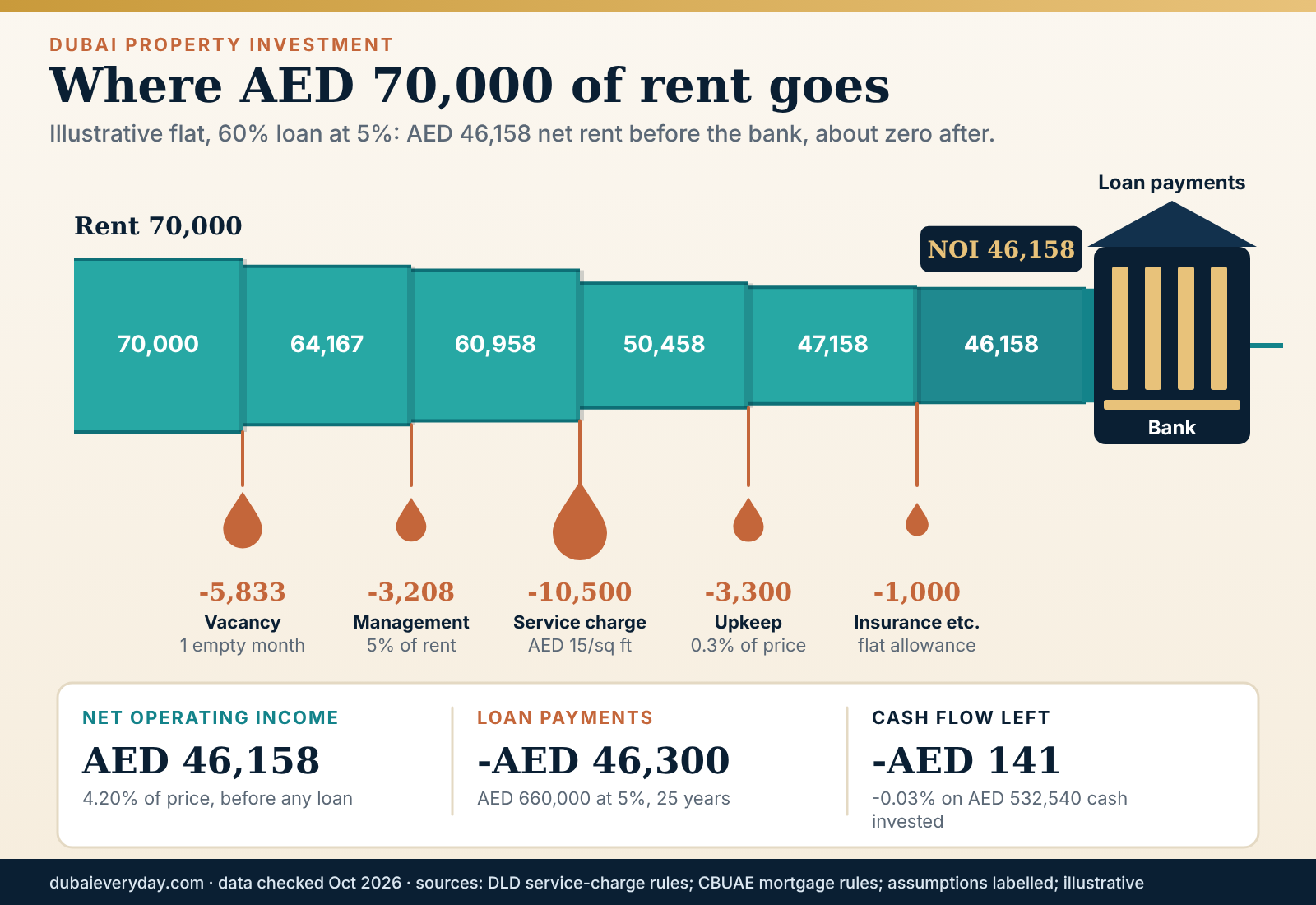
Net operating income for the example
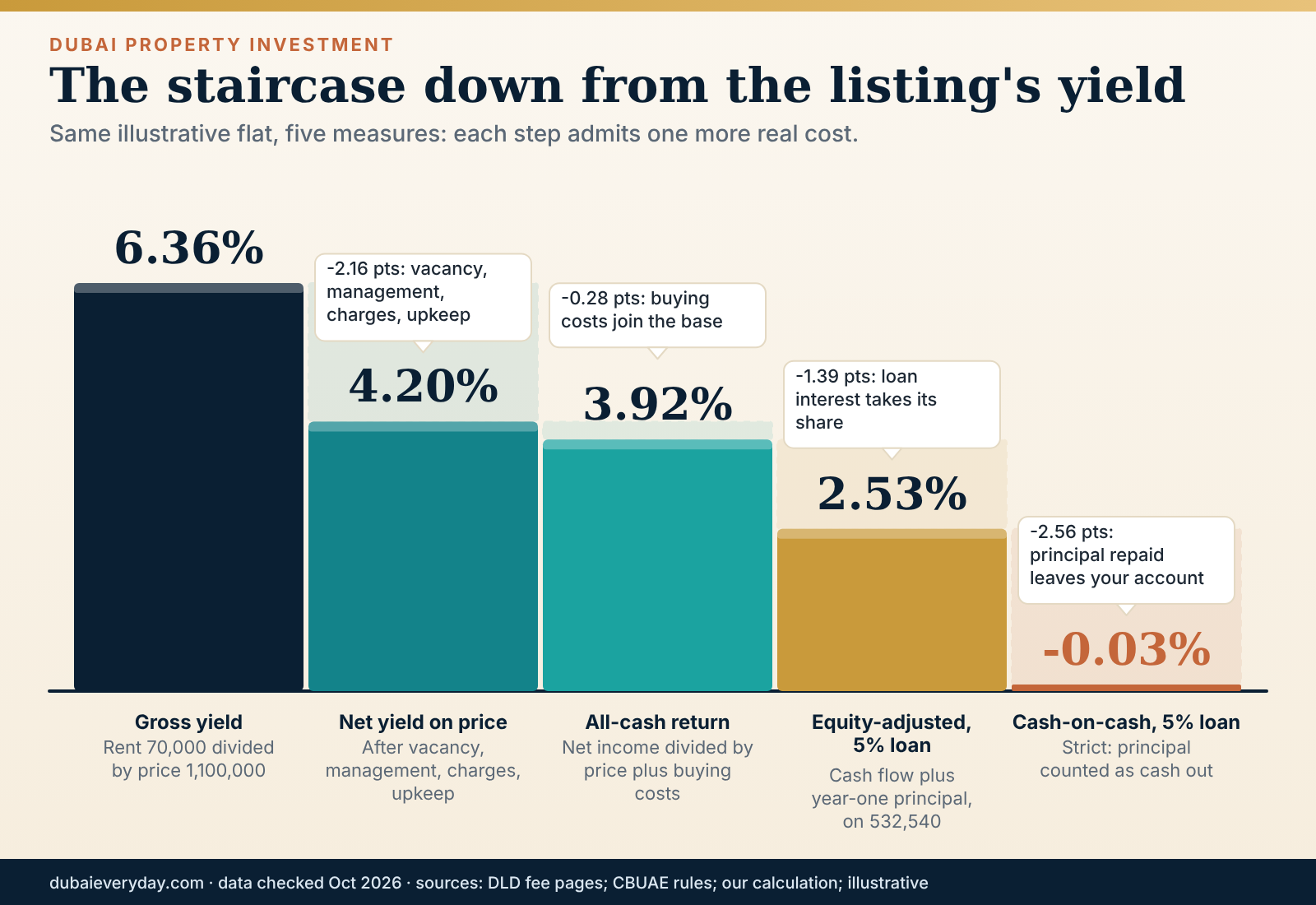
Rent of AED 70,000, less one month of vacancy (AED 5,833), management (AED 3,208), service charge (AED 10,500), maintenance (AED 3,300) and insurance and sundries (AED 1,000), leaves AED 46,158. That is 65.9% of the rent and 4.20% of the purchase price. The gap between the 6.36% gross yield on the listing and the 4.20% net figure is the first thing to notice, and the rental yield guide goes deeper on that bridge. From here, the Dubai property cash on cash return needs only the loan.
Debt service: interest, principal and the real payment
The loan payment is the single biggest deduction in a financed Dubai property cash on cash return calculation, and it is the one most often described loosely. A repayment mortgage charges a level monthly instalment that contains two things: interest to the bank, and principal that reduces what you owe. In the early years most of the instalment is interest. The principal part is real equity, but it is also AED you cannot spend, so a strict Dubai property cash on cash return counts the full instalment as a cost.
What the payment looks like at four rates
Take a loan of AED 660,000 over 25 years, the maximum term under the Central Bank’s mortgage rules. At 4% the instalment is AED 3,484 a month, or AED 41,805 a year. At 5% it is AED 3,858 (AED 46,300 a year). At 6% it is AED 4,252 (AED 51,029) and at 7% it is AED 4,665 (AED 55,977). In year one at 5%, about AED 32,691 of the payments is interest and AED 13,609 is principal. The remaining balance after five years at 5% is roughly AED 584,629, so the loan has barely moved.
These rates are a deliberately wide illustrative band, not today’s quotes. The Central Bank of the UAE raised its Base Rate by 25 basis points to 3.9% from 17 September 2026, following the US Federal Reserve’s move. One broker page, dated June 2026 and flagged by its own table heading as possibly out of date, listed indicative resident fixed rates from 3.75% for one year to 4.19% for five years, a variable rate of 0.70% over three-month EIBOR, and higher rates for non-residents. Treat such pages as context only and ask the bank for a written offer.
What a lender checks before it lends
The same Central Bank rules shape how much you can borrow. The debt burden ratio (all monthly debt payments against income) is capped at 50%. Lenders must stress-test the loan at 2 to 4 percentage points above the current rate, and where an introductory rate applies, the test uses the rate that follows it. For an investment property, a lender must deduct at least two months of rental income when it works out your debt burden, to allow for empty periods. Expatriates may borrow up to 7 times annual income.
For you, the consequence is practical. A bank may approve a loan that your own cash-on-cash calculation says is a bad idea, because a bank cares whether you can pay, not whether the investment is efficient. Approval is a floor, not an endorsement. The foreign buyer guide covers eligibility and financing basics for non-residents.
Interest-only and deferred principal
Paying interest only lifts the Dubai property cash on cash return at once, because the principal stops leaving your account. In the worked example below (Case A) at 4%, interest-only gives AED 19,758 of annual cash flow instead of AED 4,354.
The rulebook text includes a provision allowing principal to be deferred for a limited period on investment loans. We did not re-read it in full for this page, so check the current wording, and ask whether any bank offers it and on what terms. The catch is plain: the debt does not shrink while you wait, and the amortising payment that follows is larger.
Early settlement
If you refinance or sell during a fixed period, the Central Bank limits the early settlement fee to the lower of 1% of the outstanding balance or AED 10,000, according to its October 2019 release. That is a cap on one fee, and the exit sits outside an annual Dubai property cash on cash return. It is covered in the ROI guide.
Worked example: Dubai property cash on cash return with and without a loan
Here is the full Dubai property cash on cash return calculation for one invented apartment, so you can see every input. The unit is a 700 square foot flat priced at AED 1,100,000 and let for AED 70,000 a year. It is not a real listing, and the area is deliberately unnamed so nobody mistakes it for market data. Every operating and loan-cost assumption is listed in the earlier sections and in the research log for this page.
The cash purchase
Cash invested is the price plus buying costs, AED 1,100,000 plus AED 76,820, or AED 1,176,820. Net operating income is AED 46,158. Divide the second by the first and the Dubai property cash on cash return is 3.92%. There is no debt, so there is no payment to subtract, and the figure is also the net yield on total cost. At that rate it would take about 25 years of income to earn back the cash, before any price change.
The same flat with a 60% loan
Now borrow AED 660,000. Cash invested falls to AED 532,540. The loan payment depends on the rate, and so does everything else:
| Scenario (Case A, rent AED 70,000) | Cash invested (AED) | Annual loan payments (AED) | Annual cash flow (AED) | Cash-on-cash | Equity-adjusted* |
|---|---|---|---|---|---|
| All cash | 1,176,820 | 0 | 46,158 | 3.92% | 3.92% |
| 60% loan at 4% | 532,540 | 41,805 | 4,354 | 0.82% | 3.76% |
| 60% loan at 5% | 532,540 | 46,300 | -141 | -0.03% | 2.53% |
| 60% loan at 6% | 532,540 | 51,029 | -4,870 | -0.91% | 1.29% |
| 60% loan at 7% | 532,540 | 55,977 | -9,819 | -1.84% | 0.05% |
*Equity-adjusted adds the first-year principal repaid back to cash flow before dividing by cash invested. Illustrative example, not a quote or market fact.
Read the 5% row slowly. The bank has lent you AED 660,000, your cash invested has fallen by more than half, and your annual cash flow has gone from AED 46,158 to roughly nothing. The flat still earns the same rent. What changed is who gets it. At 5%, almost all of the net rent goes to the lender, leaving you with the price risk and the paperwork.
A higher-yield version, Case B
A Dubai property cash on cash return depends heavily on the starting yield, so here is a second unit with the same price and costs but rent of AED 84,000. That is a 7.64% gross yield, in the region brokers publish for some mid-market apartment communities, though we do not name one. Net operating income is AED 58,350, or 4.96% all cash.
With a 60% loan, cash flow is AED 16,545 at 4%, AED 12,050 at 5%, AED 7,321 at 6% and AED 2,373 at 7%. Strict cash-on-cash is 3.11%, 2.26%, 1.37% and 0.45%. Equity-adjusted, it is 6.05%, 4.82%, 3.58% and 2.34%.
Notice what is the same and what is different. In both cases the strict figure for the loan is lower than the all-cash figure. In Case B the loan stays cash-positive even at 7%, so the deal can absorb a rate shock. In Case A it was negative from 5% upward. The difference between the two units is just AED 14,000 of rent.
When borrowing helps, when it hurts, and the rate reset
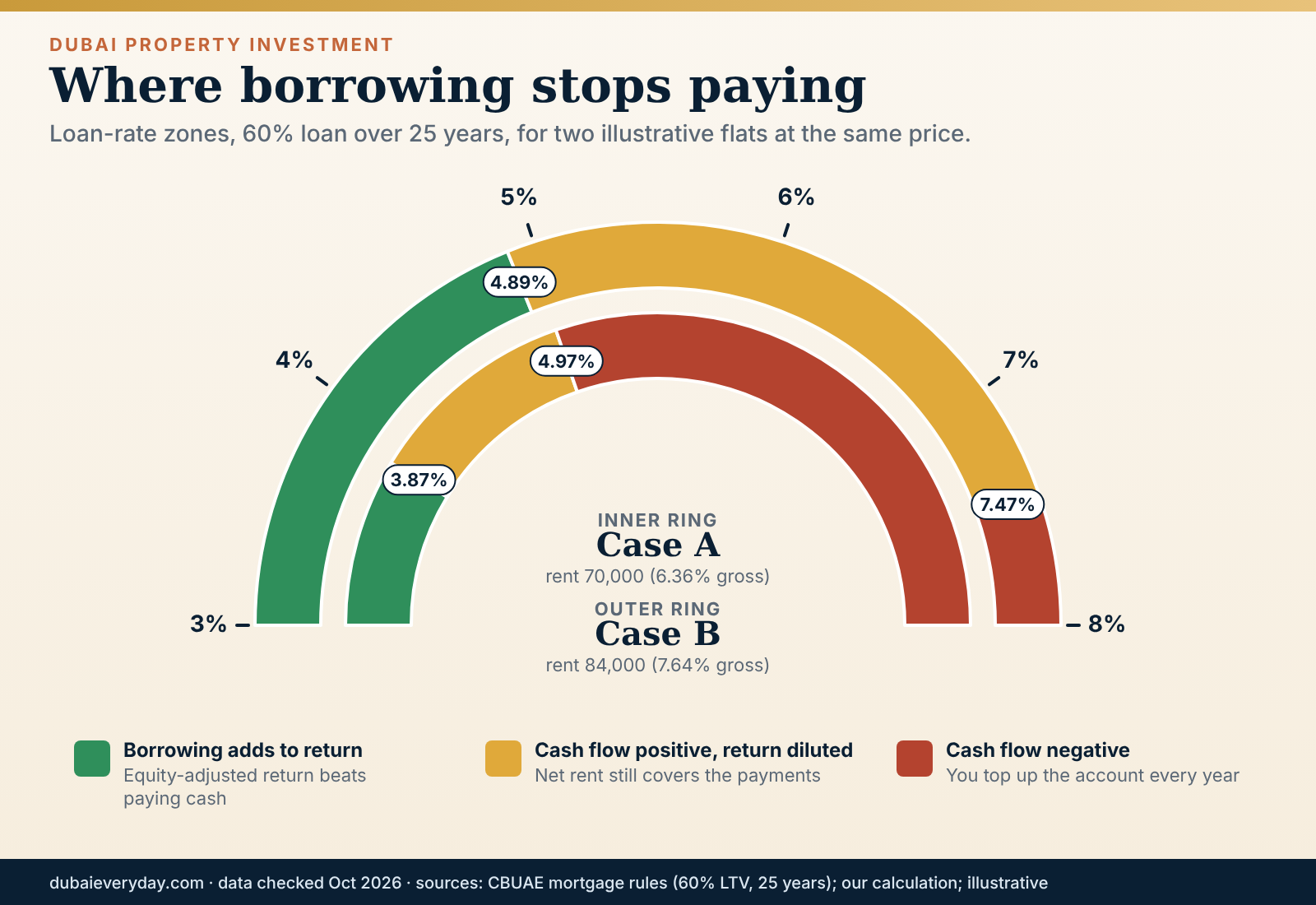
Investors usually borrow in the hope that the property’s income exceeds the cost of the loan. A rough rule captures it: leverage adds to your return only when the property’s net yield on its total cost is higher than the interest rate you pay. A simple test is to divide net operating income by total cost (price plus buying costs) and compare the result with the loan rate. In Case A that is 3.92%, so any loan at 5% or more drags the equity-adjusted return below the all-cash result. In Case B it is 4.96%.
Why a strict Dubai property cash on cash return falls even at a low rate
Here is a counter-intuitive detail. With a 25-year repayment loan, a strict Dubai property cash on cash return is lower than the all-cash figure at every rate, including zero. At 0% interest, Case A would still pay AED 26,400 a year in principal, leaving AED 19,758 of cash flow on AED 532,540, or 3.71%, below 3.92%. That is not a flaw in the maths. It shows why the strict figure and the equity-adjusted figure answer different questions, and why you should say which one you are using.
The crossover rate
Equity-adjusted, the loan matches the cash purchase at a rate of about 3.87% in Case A and about 4.89% in Case B. Above those, borrowing makes the equity-adjusted return worse than paying cash, before any capital growth. Cash flow turns negative at 4.97% in Case A and 7.47% in Case B. Those are our calculations on stated assumptions, and a real deal will move them. The point is to find your own crossover before the bank tells you what rate you qualify for.
How much to borrow without sinking your Dubai property cash on cash return
The size of the loan matters as much as the rate. Holding the rate at 5% in Case A, cash invested and the Dubai property cash on cash return move like this: no loan, AED 1,176,820 and 3.92%; 30% loan, AED 858,415 and 2.68%; 50% loan, AED 641,165 and 1.18%; 60% loan, AED 532,540 and -0.03%. A smaller loan keeps more of the income with you. A larger one lets you spread your capital over more properties, which is a portfolio decision and not a return improvement.
A fixed rate that is attractive for the first one to five years does not last for 25. Work out your cash flow at the rate that applies after the fixed period, which is what the Central Bank requires lenders to test. If the number only works while the teaser lasts, you are modelling a promotion, not a property.
The rate reset, in numbers
Suppose Case A is financed on a three-year fixed rate of 4%, and the loan then reverts to 6%. After 36 months the balance is about AED 610,985. Re-amortised over the remaining 22 years at 6%, the payment rises from AED 3,484 to AED 4,173 a month. Annual cash flow moves from +AED 4,354 to -AED 3,923, taking the strict return from 0.82% to -0.74%. At a reversion rate of 7% the payment is AED 4,542 and the cash flow -AED 8,348. Nothing about the flat changed. Only the lender’s price did.
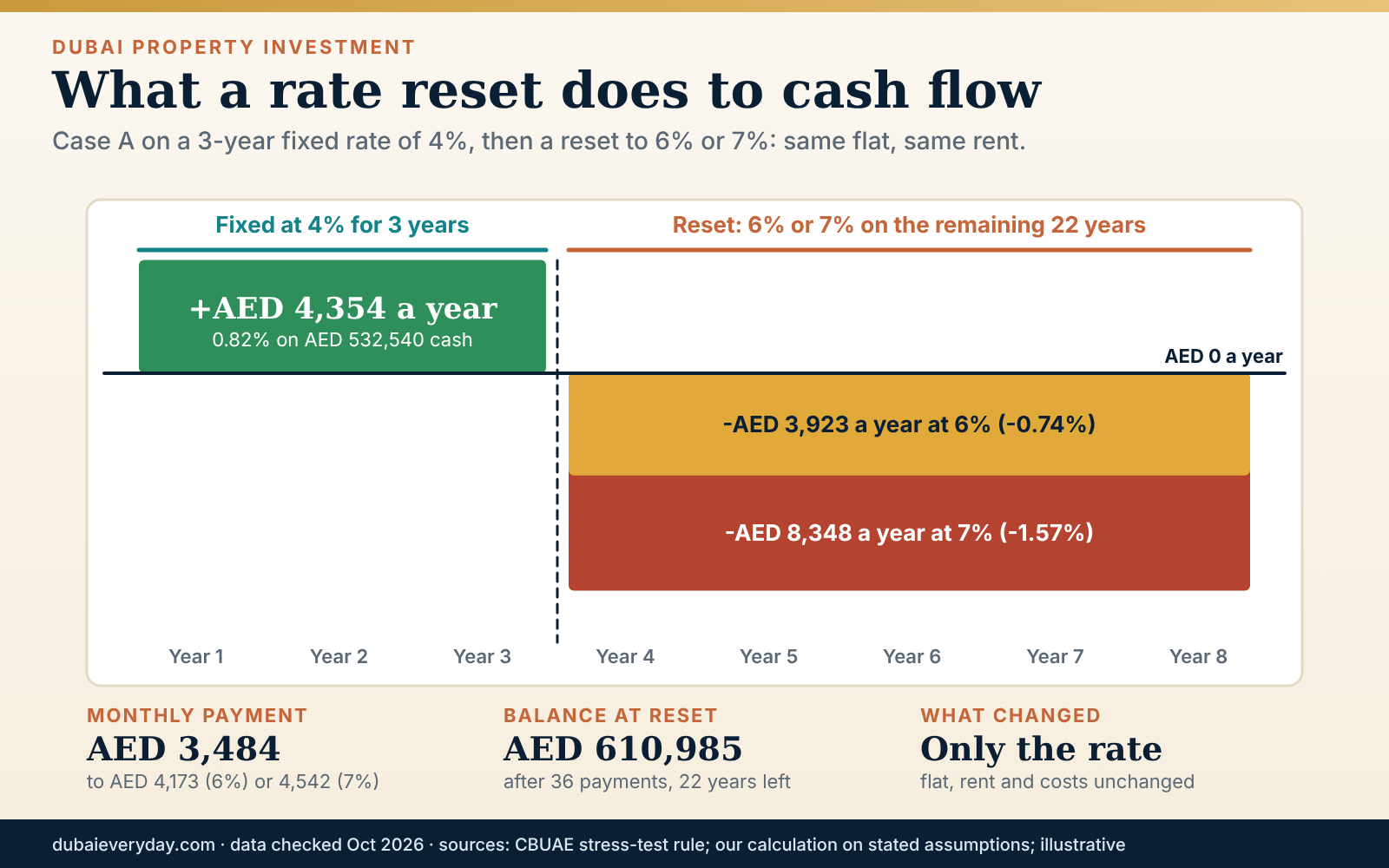
If your mortgage is variable, the same effect arrives gradually as the three-month EIBOR moves with the Central Bank’s base rate. Either way, the sensible habit is to calculate your Dubai property cash on cash return at today’s rate and at a rate two to four points higher, which is the same band the Central Bank asks lenders to use.
Stress tests for your Dubai property cash on cash return
A single-point Dubai property cash on cash return is a story about a good year. A useful one comes with a range, built by changing one input at a time and then changing several together. We run the tests on Case A with a 60% loan at 5%, and show the all-cash result beside it, because the comparison reveals how much a loan amplifies each shock.
Empty months
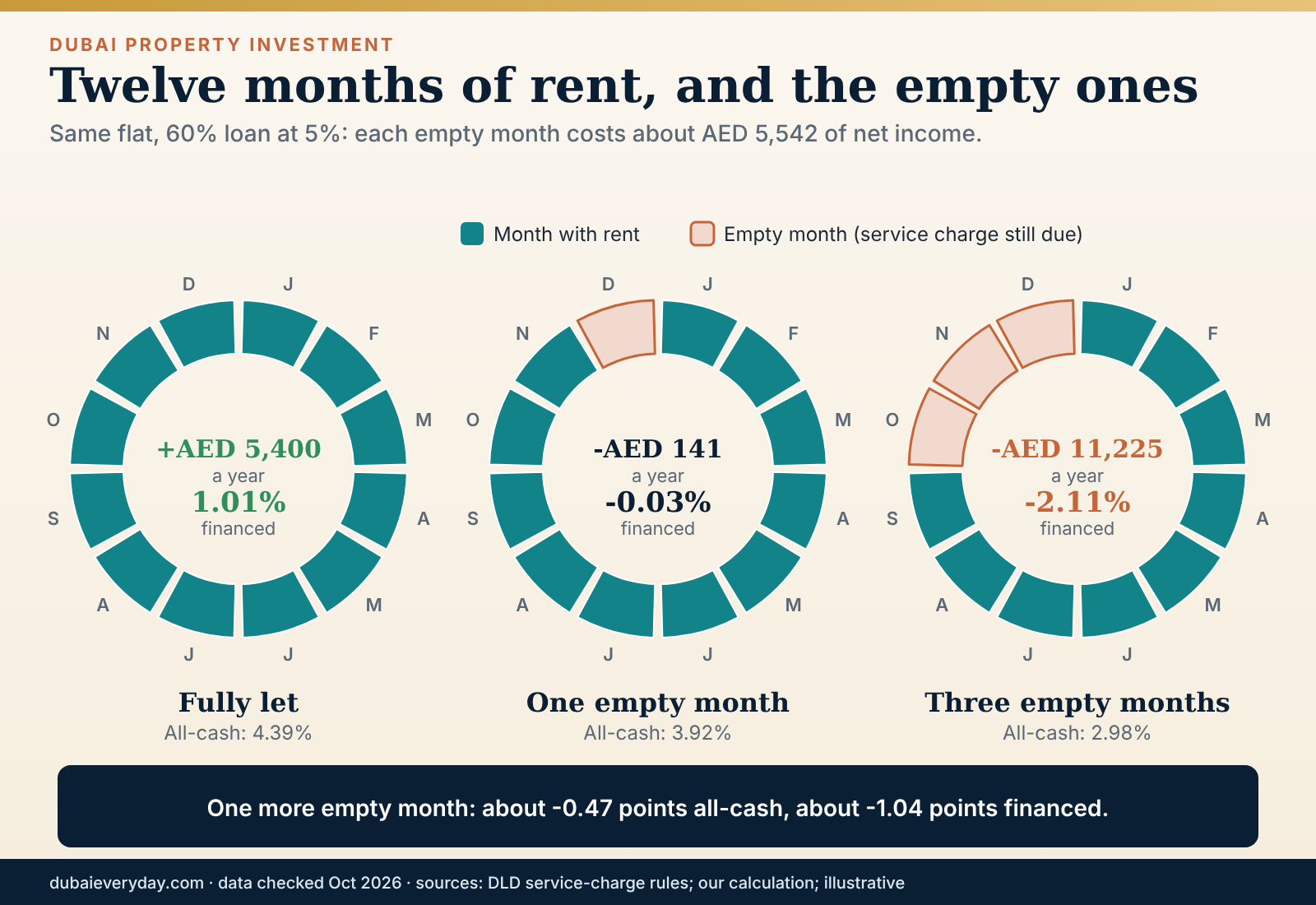
Each month of vacancy removes about AED 5,542 of net operating income, because the rent stops while service charges continue. With no vacancy, the all-cash return is 4.39% and the financed return is 1.01%. At one month, 3.92% and -0.03%. At two months, 3.45% and -1.07%. At three, 2.98% and -2.11%. At four, 2.51% and -3.15%. A month moves the all-cash figure by about 0.47 points and the financed figure by about 1.04 points, because the same dirhams are divided by less cash.
Rent, service charge and a bad year together
If the rent comes in 10% lower (AED 63,000), the all-cash return falls to 3.40% and the financed one to -1.17%. At 20% lower it is 2.89% and -2.32%. A 10% rise to AED 77,000 lifts them to 4.44% and 1.12%. For service charges at AED 10, 15, 20 and 25 per square foot, the all-cash return is 4.22%, 3.92%, 3.62% and 3.33%, and the financed return 0.63%, -0.03%, -0.68% and -1.34%.
Combine a bad year: rent down 10%, three empty months and a service charge of AED 20 per square foot. Net operating income drops to AED 26,588, an all-cash return of 2.26%. With the 5% loan, cash flow is -AED 19,712, or -3.70%; at 6% it is -AED 24,441, or -4.59%. A good year (rent up 5%, no vacancy, AED 12 service charge) gives 4.85% all-cash and 2.03% financed. The spread between good and bad years is wide, and it is wider for the borrower.
A financed return below zero means you top up the account every year from your salary or savings. That can be a rational choice if you are buying for capital growth, but it should be a decision you made, with the monthly amount written down, not a surprise. If you cannot comfortably carry the downside case for two years, the loan is too big.
What the 2026 data says about the inputs to a Dubai property cash on cash return
The rent and price inputs are not stable at the moment, which is why the stress tests above are not exotic. Savills’ third-quarter 2026 report, as covered by Khaleej Times on 13 October, put year-on-year apartment rent changes at -12.8% in Dubai Marina, -12.2% in Business Bay, -10.4% in Jumeirah Village Circle, -7.5% in Al Furjan and -7.3% in DIFC. It put apartment sale prices down 4.8% over the quarter to AED 1,817 per square foot and villa and townhouse prices down 3.3% to AED 1,523. Residential sales in the quarter were 34,500, down 38% from a year earlier.
A broker-published review from July 2026 cited citywide gross yields of roughly 7.1% for apartments and 5.0% for villas as of April 2026, from REIDIN data, with rent growth slowing from 6.2% in December 2025 to 1.5% in April while prices rose faster. These are secondary sources with different methods, and yields move with the rent and the price in the denominator. The direction since April, in the Savills figures, has been softer rents. Our -10% rent test therefore sits inside what several communities have seen, and is a reasonable downside rather than a forecast.
Supply also feeds the vacancy and rent lines. Savills expected 50,000 to 60,000 handovers in the second half of 2026, taking 2026 deliveries to 75,000 to 85,000, with more than 525,000 units scheduled for 2027 to 2030. Scheduled and delivered are different numbers, since projects slip. If you are buying in or near a large pipeline, run the vacancy and rent tests harder. The property investment guide sets out how to screen areas for supply and liquidity.
Cash-on-cash against yield, cap rate, ROI and IRR
Property people use several return measures, often interchangeably and incorrectly. They answer different questions, and the Dubai property cash on cash return is the right one for exactly one of them: how hard is my own money working this year. The table sorts them by what they include.
| Measure | Formula (simplified) | Counts loan? | Counts buying fees? | Use it to |
|---|---|---|---|---|
| Gross yield | Annual rent ÷ price | No | No | Screen listings quickly |
| Net yield or cap rate | Net operating income ÷ price | No | No | Compare units regardless of financing |
| Net yield on total cost | Net operating income ÷ (price + buying costs) | No | Yes | Compare with the loan rate |
| Cash-on-cash | (NOI – loan payments) ÷ cash invested | Yes | Yes | Judge annual cash return on your own money |
| Equity-adjusted return | (NOI – loan payments + principal) ÷ cash invested | Yes | Yes | See the equity you build, with the debt in view |
| ROI or IRR | All cash flows, including sale, over time | Yes | Yes | Judge the whole investment, exit included |
Applied to Case A: gross yield 6.36%, net yield on price 4.20%, net yield on total cost 3.92%, financed cash-on-cash -0.03% at 5%. Each step down the list is a different cost layer being admitted. Our rental yield guide and ROI guide cover the first and last rows in depth.
Why a Dubai property cash on cash return cannot decide alone
It ignores everything that happens when you sell. A deal with a poor annual cash return can still pay off if the price rises, and a pleasant 5% can end badly if the price falls and you pay selling costs. It also ignores time, since year one says nothing about year ten. Use the Dubai property cash on cash return as a way to compare how much current income each deal earns on your capital, then use the ROI or IRR approach for the full picture.
Comparing the cash return with a deposit
An investor often compares a Dubai property cash on cash return with what the same money would earn in the bank. That is a fair instinct with a catch: the property return is risky and illiquid, and a deposit is neither. We did not verify current UAE deposit rates, so take 4% as an illustrative figure only.
At that rate, AED 532,540 earns about AED 21,302 a year, against -AED 141 of cash flow from the financed flat. To match the deposit, the flat would need to gain about AED 21,443 a year in value, roughly 1.9% of the price, before selling costs. For the all-cash version, 4% on AED 1,176,820 is AED 47,073, almost exactly the AED 46,158 the flat pays in net rent.
Off-plan and short-let versions of the calculation
The basic Dubai property cash on cash return formula survives both, but the inputs need rethinking, and the usual shortcuts mislead.
Off-plan: the denominator arrives before the numerator
With an off-plan purchase you commit cash in instalments while the building is built, and income starts only at handover. Central Bank rules cap lending on off-plan at 50% of value, so a mortgage cannot rescue the cash profile before completion.
Illustratively, suppose Case A is bought off plan with a two-year build, funded entirely from your own cash. With the 4% registration, trustee and small fees and the set-up allowance, but no agent, cash invested is AED 1,153,720. In the first rented year the return is 4.00%. Averaged over five years from the booking, with rent only in years three to five, it is 2.40%.
That second figure is the honest one for comparing against a ready flat, because two years of tied-up capital earn nothing. Delay widens the gap, since every extra year before handover removes roughly AED 46,000 of net rent from the five-year total in this example. The ROI guide takes the off-plan payment-plan logic further, and the buying guide explains deposits, escrow and handover.
Short-let: higher revenue, a different cost stack
A holiday-home strategy can raise gross revenue, but the Dubai property cash on cash return arithmetic changes. You add furnishing to the denominator, and the numerator carries cleaning, utilities, supplies, platform and operator fees, and a permit. Permit rules sit with the Department of Economy and Tourism, whose page we could not read in full for this guide, so check them before modelling.
As a break-even, assume an operator takes 20% of revenue and operating costs are AED 12,000 a year (both assumptions), with the other costs as in Case A. Revenue would need to reach about AED 91,198, or 1.30 times the long-let rent, to match the AED 46,158 of net income.
Short-let figures also swing with occupancy and the season. A Dubai property cash on cash return built on a peak-month booking rate is a forecast about demand, not a property measure. If you want the steady version, start with the long-let case in this guide, then decide whether the extra revenue is worth the extra work and risk. The tenant-side practicalities of a normal let are set out in the renting in Dubai guide.
Getting trustworthy inputs from Dubai sources
A Dubai property cash on cash return is only as good as its weakest input, and in a market with many enthusiastic sellers, the weakest input is usually a number somebody else handed you. Dubai has more official verification tools than most markets, and they are free or close to it. Use them in this order, and keep a note of each figure and where it came from.
- Rent evidenceAsk for the current Ejari contract if the unit is let. Then use the DLD Rental Index with the contract end date, property type, area or building, bedrooms and current rent, to see an indicative reference. The DLD also publishes open real-estate datasets that include rents, which are useful for checking a broker’s claims against registered contracts (check the data portal for the current fields).
- Service chargesRequest the latest service charge statement and compare it with the DLD Service Charge Index and the invoices in Mollak, the RERA and DLD system for jointly owned property. Ask whether a reserve-fund top-up or a special levy is planned.
- The seller and the agentSearch the DLD licensed brokers list before you discuss money, and verify the property status and title through the DLD e-services. The foreign buyer and freehold guides explain the ownership side, including freehold areas and title registration.
- The fee linesRead the DLD sale registration page and the mortgage registration page again at the time of purchase. Fees and partner charges are set by the DLD and the registered trustee centres, and have been revised before.
- The loanGet a written offer that states the rate, the fixed period, the rate after it, the arrangement and valuation fees, insurance requirements and early settlement terms. Calculate the payment at the offer rate and at two and four points higher.
Tax: what a pre-tax figure leaves out
A Dubai property cash on cash return is calculated before tax, because tax depends on who you are. The UAE Government Portal states that the UAE does not levy income tax on individuals, and that VAT is 5%.
For corporate tax, secondary summaries of a Federal Tax Authority guide on real estate investment by natural persons (published October 2024) indicate that rental income is generally outside the corporate tax net where no licence is required or held, and that a holiday-home permit can count as a licence. We could not read the FTA document itself, so confirm the current position with an adviser, especially for short-lets.
The portal page does not cover the tax your home country may charge on foreign rental income, which would reduce the figure you actually keep. That is a question for a qualified tax professional in the place you pay tax. An area guide such as the Downtown Dubai guide tells you about daily life, not returns, and no area guide replaces the maths above.
Your worksheet, an audit checklist and ten mistakes
Build your own Dubai property cash on cash return worksheet
You do not need software. Eight lines on paper, or a spreadsheet with eight rows, will do. Put the base case in one column and the bad-year case beside it.
- Price and valuationWrite the agreed price and a cautious guess at the bank’s valuation. Compute the loan on the lower one.
- Buying costsList the registration fee, agent with VAT, trustee fee with VAT, small government fees, any developer fee and your set-up spend.
- Loan costsList the registration, deed, partner fee, valuation and arrangement fee. Add all of it to your down payment to get cash invested.
- RentUse the contract or the renewal rent, not the asking price.
- Operating costsSubtract vacancy, management, service charge, maintenance and insurance. The result is net operating income.
- Loan paymentsCalculate twelve payments at the offer rate, and again at two and four points higher.
- The two ratiosDivide (net operating income minus payments) by cash invested for the strict figure. Add the year-one principal for the equity-adjusted figure.
- The bad yearRepeat with rent down 10%, three empty months and a higher service charge. Write down the yearly shortfall in dirhams.
Reverse the formula: what rent does a target Dubai property cash on cash return need?
You can run the calculation backwards to see what a deal must earn. In Case A with a 60% loan at 5%, the rent needed for a financed Dubai property cash on cash return of zero is about AED 70,162 (a gross yield of 6.38%). For 3% it is about AED 88,508 (8.05% gross). For 5% it is about AED 100,739 (9.16% gross).
If the listing’s rent is far below the figure you need, the price is the issue, not your spreadsheet. To judge what tenants will really pay for a unit, the studio and apartment rental guides show what they prioritise.
Auditing a Dubai property cash on cash return claim you were handed
When a brochure, an agent or a social post quotes a return, ask the same questions each time. They take five minutes and separate real analyses from marketing.
- Is the numerator net of service charges, vacancy, management and maintenance, or is it just rent?
- Is the denominator the price, the deposit, or all the cash including fees?
- Is a loan included, at what rate, for how long, and with principal counted?
- Is the rent a signed contract, a renewal rent or an asking price?
- Is the figure for year one, or an average? Does it assume rent growth?
- For any guaranteed rent, who is the guarantor, for how long, and what happens afterwards?
Ten mistakes that quietly inflate the number
- Dividing by the price instead of the cash you invested.
- Leaving the 4% registration fee and the agent out of the cash invested.
- Using the asking rent when the tenant will pay the renewal rent.
- Assuming no vacancy.
- Using last year’s service charge without checking the approved budget.
- Counting interest but not principal as a cost, then calling it a strict Dubai property cash on cash return.
- Modelling the fixed-rate period, not the rate after it.
- Forgetting that a valuation below the price raises the deposit.
- Comparing a financed, pre-tax figure with a bank deposit that pays you without risk or effort.
- Treating one year’s number as a forecast.
The bottom line
A Dubai property cash on cash return is a small, honest piece of arithmetic that makes good deals look fine and weak deals look weak. It is worth the effort precisely because the listing’s headline yield rarely shows the registration fee, the loan payment or the empty month. In our illustrative flat, a 6.36% gross yield became 4.20% after operating costs, 3.92% on the total cost of buying, and roughly zero once a 60% loan at 5% took its share.
Use your Dubai property cash on cash return to compare, not to promise. Calculate it with and without a loan, test a bad year, work out the crossover rate where borrowing stops helping, and compare the answer with your own tolerance for topping up the account. Then widen the lens with the ROI guide for the exit and the investment guide for area and cycle risk. If the numbers only work in the good-year column, they do not work.
Dubai property cash on cash return FAQ
What is a good Dubai property cash on cash return?
There is no official benchmark, and a figure quoted as “good” without assumptions tells you little. A useful yardstick is relative: compare it with the loan rate, with what the same cash could earn elsewhere with less risk, and with your bad-year result. In our illustrative flat the all-cash figure was 3.92%, which roughly matched a hypothetical 4% deposit but carried property risk. Judge a figure by how it behaves when rent, vacancy and rates move against you.
How do I calculate Dubai property cash on cash return with a mortgage?
Add up your cash invested: the down payment, the DLD registration fee, agent and trustee costs, small government fees, loan set-up costs and any set-up spend. Then take a year of collected rent, subtract vacancy, service charge, management, maintenance and insurance, and subtract twelve mortgage payments, interest and principal both. Divide that annual cash flow by the cash invested. Repeat at higher loan rates, since a fixed rate may not last.
Does a Dubai property cash on cash return include the DLD fee?
It should. The DLD registration fee is cash you pay at purchase, so it belongs in the denominator with the other buying costs. The DLD sale registration page shows 2% for the seller and 2% for the buyer, and a DLD notice to developers describes the buyer or investor settling 4% on a new-build agreement. On a resale, the split is negotiated. State in your worksheet who pays what, because it changes the result.
Is Dubai property cash on cash return the same as rental yield?
No. Gross rental yield is a year of rent divided by the price. Net yield subtracts operating costs. Cash-on-cash subtracts the loan payments too and divides by your own cash invested rather than by the price. For an all-cash purchase, cash-on-cash equals net yield on total cost, including fees. For a financed one, it can be well below any yield figure on the listing, as the worked example shows.
Should mortgage principal be counted in Dubai property cash on cash return?
In the strict version, yes, because principal leaves your bank account each month even though it reduces the debt. Some investors add it back and call the result an equity-adjusted return, which is a legitimate measure of how much equity you build. Use one definition consistently, say which one you chose, and do not compare a strict figure on one property with an equity-adjusted figure on another.
Can a mortgage make a Dubai property cash on cash return negative?
Yes. If the loan payments exceed net operating income, annual cash flow is negative and you fund the gap. In our Case A, a 60% loan at 5% gave about zero, and at 6% and 7% it turned negative. This happens when the net yield on total cost is below the loan rate. Check the break-even rate before you borrow, and test the rate that applies after any fixed period.
How much can an investor borrow in Dubai?
Under the Central Bank of the UAE’s mortgage rules, the maximum loan-to-value for an expatriate buying a second or investment property is 60%, against 80% for a first home under AED 5 million and 50% for off-plan. The maximum term is 25 years, the debt burden ratio is capped at 50%, and lenders stress-test the loan at higher rates. Banks may lend less than the cap, and the rules can change, so confirm with the lender.
How do service charges affect the calculation?
They are among the largest annual deductions. In Dubai they are approved by RERA, based on the area on the title deed, and cover items such as security, cleaning, maintenance contracts, insurance and reserves. Because the same dirham amount is divided by your cash invested, a few dirhams per square foot move the result more when you borrow. In Case A, going from AED 15 to AED 25 per square foot lowered the financed return by 1.3 points.
Do I pay tax on Dubai rental income?
The UAE Government Portal states that the UAE does not levy income tax on individuals. Corporate tax and VAT have their own rules, and secondary summaries of Federal Tax Authority guidance suggest a licence, such as a holiday-home permit, can change the position. Your home country may tax foreign rental income. This is general information, so ask a qualified tax adviser about your own situation before you rely on a pre-tax figure.
Keep reading
Sources and further reading (18 links)
- Dubai Land Department: Property sale registration — registration fee, title deed, map, knowledge, innovation and partner fees
- Dubai Land Department: Request for mortgage registration — 0.25% fee, deed fee and partner fee
- Dubai Land Department: DLD calls on developers to pay property registration fees within 60 days — 4% fee, buyer or investor settles
- Dubai Land Department: Frequently asked questions — service charges, rent increases, Ejari, municipality fee, commission
- Dubai Land Department: Service Charge Index — how to check a building’s charge
- Mollak: About us — service-charge oversight and invoicing
- Dubai Land Department: Rental Index — indicative rent reference
- Dubai Land Department: Real estate open data — registered transaction and rent datasets
- Dubai Land Department: Licensed real estate brokers — broker verification
- Central Bank of the UAE Rulebook: mortgage lending — loan-to-value, term, burden ratio, stress test
- Central Bank of the UAE: eases mortgage loan requirements — early settlement cap
- Central Bank of the UAE: raises the Base Rate by 25 basis points — Base Rate of 3.9% from 17 September 2026
- UAE Government Portal: Taxation — individual income tax, VAT and corporate tax scope
- Khaleej Times: Rents in Dubai fall over 12% (Savills Q3 2026 report) — rent, price, sales and supply figures (secondary)
- Real Estate Club Dubai: Dubai rental yield compression 2026 — citywide gross yield context from REIDIN data (secondary)
- FAM Properties: September 2026 real estate report — new-lease and renewal rent medians (secondary)
- Huspy: Monthly mortgage rates in the UAE — indicative fixed and variable rate context (secondary)
- KPMG: UAE guide on corporate tax treatment of real estate investment by natural persons — summary of FTA guidance (secondary)
Update log: 29 October 2026 — first publication; fees, Central Bank mortgage rules and the base rate were re-checked against the sources above, and all worked figures were recomputed in code. Next review due: 28 January 2027, or sooner after any change to DLD fees, Central Bank mortgage rules, tax guidance or the Base Rate. Corrections welcome. General information only, not investment, tax, legal or mortgage advice.
About DubaiEveryday and this guide
DubaiEveryday.com is an independent editorial project that publishes practical, research-based guides to everyday life in Dubai: where to live, what things cost, how the rules work and how to get around. This page was written and edited by the DubaiEveryday editorial team. It is not signed by a named expert, doctor, lawyer or adviser, and we do not claim first-hand testing of a venue, clinic or service unless the page says so.
Each guide is built from official sources such as government and regulator pages, operator websites and established news outlets, cross-checked where we can. When we could not confirm something, we say so in the text, and examples that use made-up numbers are labelled as illustrations. Mentions are editorial choices, not paid placements, and a link is not an endorsement.
Dubai changes quickly. If you spot something that is out of date or wrong, please tell us through the contact options on DubaiEveryday.com and we will check it and correct the page.