

The Palm is a freehold island of villas, apartment blocks and resorts with one of the best-known coastlines in the world, and a transport problem that glossy brochures skip. This Palm Jumeirah guide covers villas, apartments, resorts, beaches, transport and everyday life, checked against official and published sources on 29 October 2026.
From the air, the Palm looks like the easiest decision in Dubai. On the ground, it raises quieter questions: how do you get on and off the island without a car, and what does a normal Tuesday feel like out there? Beautiful views do not answer either one.
The island is a freehold community of villas, apartments and resorts, and it rewards people who know which part suits them. This Palm Jumeirah guide compares the trunk, the fronds and the crescent, then covers rents, beaches, transport and daily life with the sources named. You will leave knowing who the Palm genuinely suits, what to confirm before you commit, and where the glossy brochures go quiet.
This Palm Jumeirah guide starts with the verdict: the Palm suits people who want a beach, space and a resort-style setting a few kilometres from the Marina towers, and who accept that it is a taxi-and-car island. Nakheel, the developer, puts it at 560 hectares with about 25,000 residents. It has three parts: a trunk of apartment blocks and shops, a set of villa fronds, and an outer crescent of hotels.
On money, the numbers this Palm Jumeirah guide uses come from different yardsticks, so do not mix them. Property Finder’s median advertised rent for Palm apartments was AED 240,000 a year in Q3 2026 and AED 1.5 million for villas. Property Monitor’s average for a one-bedroom was AED 146,315 in May 2026. Cushman & Wakefield recorded Palm apartment prices and rents both down 9% in Q2 2026, with villa prices up 1%.
Getting around is the weak spot. The Palm Monorail’s fares and timetable are published, but its own homepage still carries a maintenance-suspension notice, so treat it as “confirm first”. The Dubai Tram stops at the island’s entrance from 06:00 to 01:00, Monday to Saturday, and from 09:00 on Sunday.
This Palm Jumeirah guide is desk research. Nobody on the editorial team has lived on the Palm, ridden the monorail, slept in a resort or eaten on the Crescent for this page, and nothing here claims otherwise. Facts come from operator and government pages, press reports and a few reference sites, all opened on 29 October 2026. Where a number comes from a broker, a consultancy or Wikipedia, the text says so.
We checked monorail fares, hours and status, the tram and Metro timetable, the Nakheel community page, the Aquaventure and The View pages, the Dubai Municipality beach page, and four property data sources. We did not check opening status of individual restaurants or beach clubs on the day, live room rates, school ratings or clinic hours. Anything we could not confirm is marked “Confirm first”, and invented arithmetic is marked “Illustrative example”.
No venue, hotel, broker or developer paid for inclusion, and there are no affiliate links. This is general information, not legal, financial, medical or property advice. Prices change; the rental and sale figures describe markets, not offers you will be given.
Palm Jumeirah guide: the October 2026 status board
Several things on the island are in flux this autumn, and a Palm Jumeirah guide that skipped them would be out of date within a week. Here is what the sources say as of 29 October 2026, with the confidence level for each. The detail sits in the sections that follow.
Palm Monorail: confirm first
Three official pages disagree in tone. The ticket page lists fares, the train-times page lists a 15-minute service, and the homepage says service is “temporarily suspended until further notice due to maintenance”. Khaleej Times reported a resumption on 9 July 2026. Do not plan a day around it without checking.
St. Regis Dubai, The Palm
Khaleej Times reported on 23 October 2026 that the hotel reopens on 1 November 2026 after about six months of refurbishment. Gulf Business had reported a partial closure from mid-April. Reopening dates in hospitality slip, so confirm with the hotel.
Atlantis restaurants
In April 2026 Khaleej Times reported that Atlantis paused seven restaurants across The Palm and The Royal, including Ossiano and Hakkasan on The Palm. We found no reopening dates. Check before booking a dinner around a specific name.
Property market is softer
Cushman & Wakefield saw Palm apartment prices and rents each fall 9% in Q2 2026 compared with Q1, while villa prices rose 1%. Property Finder’s asking rents were lower year on year in Q3. Asking prices and signed contracts differ.
Security context
The UK Foreign Office, updating its UAE advice on 27 October 2026, calls the regional situation “deeply unpredictable”. Wikipedia’s summary of the 2026 conflict reports drone and interception damage in Dubai, including to Fairmont The Palm. We found no official incident report, so treat that item as reported, not confirmed.
Tram and Metro hours
RTA’s timetable page lists the tram at 06:00 to 01:00, Monday to Saturday, and 09:00 to 01:00 on Sunday. The Metro runs 05:00 to 00:00 Monday to Thursday and Saturday, 05:00 to 01:00 on Friday, and 08:00 to 00:00 on Sunday.
What this Palm Jumeirah guide covers, and what it leaves to others
This Palm Jumeirah guide is the island-level read: what the Palm is, where to live or stay on it, how to reach it, what the days and costs look like. It does not rank hotels or restaurants, because the Palm Jumeirah guide team has not visited any. For a shortlist of stays by area and budget, the best hotels in Dubai guide is the better starting point, and the best luxury hotels in Dubai page covers what the premium buys.
The property process, from offer to title deed, lives in the buying property in Dubai guide. Beach rules across the whole city sit in the best beaches in Dubai page. Here the Palm Jumeirah guide keeps to the island itself, and where the Palm differs from the rest of Dubai, it says how.
What the Palm is: trunk, crescent and fronds
Palm Jumeirah is an artificial island off the Jumeirah coast, launched by Nakheel in 2001 and shaped, from above, like a date palm. Nakheel’s community page describes it as extending about 5 km, covering 560 hectares and home to roughly 25,000 people. Wikipedia’s summary gives 25,550 residents as of 2022 and says the first residential handovers were announced for 2006. Both figures describe a place smaller than most people expect, and the Palm Jumeirah guide starts from that scale: a district, not a city.
The three parts matter because they decide almost everything else, from rent to noise to how you get a taxi. Nakheel names them the trunk, the crescent and the fronds. The sixteen fronds are the “leaves” that carry the villas. Nakheel’s page does not state the frond count, so this Palm Jumeirah guide treats it with care, but sixteen is the number shown in widely published diagrams, so treat it as common knowledge rather than a checked figure. Confirm first if it matters for a project.
How the Palm Jumeirah guide divides the island
In this Palm Jumeirah guide, think of the island as three bands on one axis. At the southern end, where the island meets the mainland, sit the Gateway bridge and the tram and monorail interchange. The trunk runs north from there with apartment blocks, malls, the mosque and Al Ittihad Park. At the far end the trunk meets the crescent, a ring of land around the island’s outer edge that is connected to the trunk by a sub-sea tunnel. The fronds branch off the trunk like ribs.
The trunk
Mixed use. Apartments, retail, clinics and the monorail’s stations sit here, plus the island’s main day-to-day services. Wikipedia describes it as mixed commercial and residential.
The fronds
Mostly villas and townhouses, many with beach frontage. Wikipedia puts villa sizes from 4,000 to 35,000 sq ft, two to ten bedrooms. Quiet streets; every errand is by car.
The crescent
The outer arc. Wikipedia describes it as the luxury-resort band, and it is where Atlantis, the other large resorts and most beach clubs are. It is the most “holiday” part and the least residential.
A short build history, kept to the dates that matter
Construction began in 2001. Wikipedia’s entry on the Palm Islands, a secondary source, gives about 94 million cubic metres of sand dredged from the seabed some six nautical miles offshore and about 5.5 million cubic metres of rock from more than sixteen quarries.
The first resort, Atlantis The Palm, opened on 24 September 2008, and the Palm Jumeirah guide timeline starts from there. The Palm Monorail followed on 30 April 2009. Nakheel Mall, now branded Palm Jumeirah Mall on the monorail operator’s site, opened around the turn of 2019 and 2020; two reference lists give 28 November 2019 and 1 January 2020.
That timeline explains why the island in this Palm Jumeirah guide feels like two eras. The villas and the early apartment blocks date from the mid-2000s and have mature gardens, ageing chillers and corridors that need work. The newer towers and the crescent’s later resorts are shinier, taller and more expensive. When a listing says “Palm Jumeirah”, ask which of those eras it belongs to before you compare it with anything.
Two old controversies, stated honestly
Two stories follow the Palm around the internet, and a Palm Jumeirah guide owes readers a straight answer. In 2009 the New York Times reported that satellite measurements suggested the island was sinking about 5 mm a year; Nakheel replied that it had received no reports of structural problems and that the satellites’ resolution was coarser than the claimed movement. That is where Wikipedia leaves it, and we found no recent official data either way.
The second is water circulation. The original breakwater on the crescent was continuous, which let water stagnate, and gaps were later opened on both sides to restore tidal flow; a 2022 study in the journal Water, as summarised by Wikipedia, found that construction raised nearby surface water temperatures. Jellyfish are commonly reported on nearby beaches in summer. None of this is a reason to avoid the island, and the Palm Jumeirah guide does not suggest it is, but it is a reason to ask a surveyor and a lifeguard rather than a sales brochure.
Palm Jumeirah is not Palm Jebel Ali or Dubai Islands
Nakheel’s other coastal projects share the name or the marketing style, and search results mix them. Palm Jumeirah is the finished, lived-in island that this Palm Jumeirah guide describes. Palm Jebel Ali and Dubai Islands are separate developments with their own timelines, and this Palm Jumeirah guide does not cover them. If a price, a handover date or a “Palm” beach looks too good, check which island the listing means.
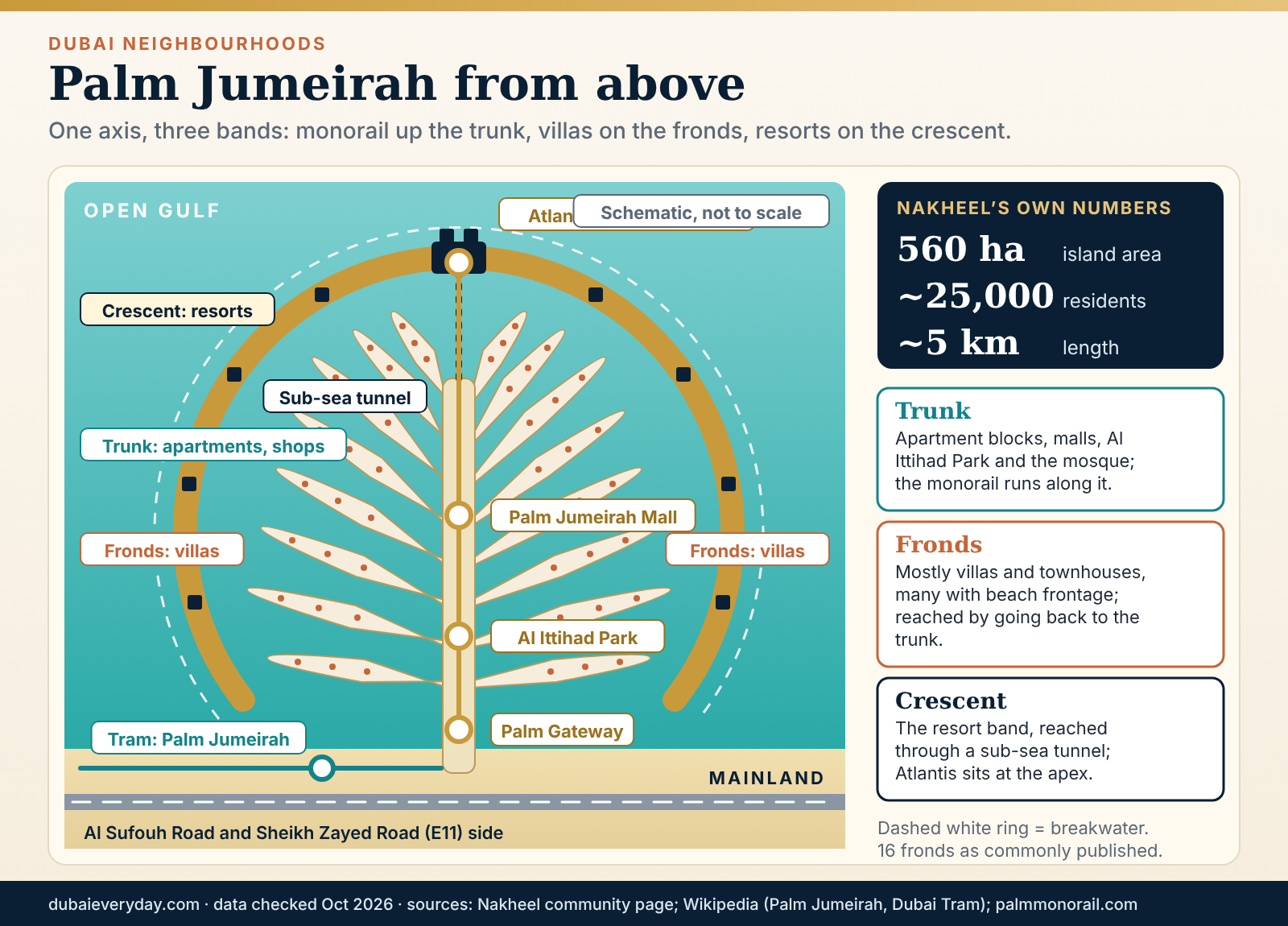
Orientation, from the mainland end to the crescent
Gateway and the entrance. The island joins the mainland at the Gateway bridge, close to Al Sufouh Road. Wikipedia’s tram page says the Palm Jumeirah tram station sits at the entrance to the island and connects to Palm Gateway monorail station by an out-of-station interchange, which means a short walk or a taxi hop rather than a covered link. Bayut’s area guide says the island is reached from Sheikh Zayed Road (E11) and describes a road bridge.
The trunk. From Gateway the trunk runs north. Along it are apartment blocks, among them the Shoreline buildings (Nakheel describes them as four blocks along the trunk), Marina Residences with six towers, Golden Mile with its Galleria shops, Palm Jumeirah Mall, Al Ittihad Park and a boardwalk. The monorail runs above the trunk. Nakheel calls Al Ittihad Park the UAE’s first indigenous park; Bayut’s guide mentions shaded play areas.
The tower with the viewing deck. Nakheel’s page lists Palm Tower as a hotel, residences, restaurants and an attraction, and names an observation deck. The operator of The View at The Palm describes a platform 240 m above sea level and open daily from 09:00 to 19:00, without naming the building. Our reading is that these are the same place, but we have not seen an official page that says so. Confirm first if you are planning around it.
The crescent. The trunk ends at a sub-sea tunnel under the crescent, which holds the resorts. Atlantis The Palm sits at the apex. Wikipedia’s list of around thirty hotels on the trunk and crescent includes names such as Atlantis The Royal, One&Only The Palm, Jumeirah Zabeel Saray, Anantara, Rixos, Raffles, Fairmont, W, Sofitel, Kempinski and Waldorf Astoria. That is a reference list, not a checked operating list.
Why the layout drives your day
For the Palm Jumeirah guide distances, the monorail is 5.45 km long according to Wikipedia, and Nakheel gives the island’s length as about 5 km. So everything on the island is within a few kilometres of everything else, but only along one axis. Moving between two fronds, or from a frond to the trunk’s shops, means going back to the trunk.
There is no walking grid in the usual sense. The practical result is that a villa on a far frond is a car-or-buggy address, and a trunk apartment close to the mall and the monorail is the nearest the Palm gets to a car-light life.
If you only remember one thing from the Palm Jumeirah guide so far, make it this: the island rewards decisions about position more than decisions about building. A mediocre flat on the trunk may suit a person better than a beautiful villa at a frond’s tip, and a resort at the crescent is a different product from a trunk hotel, even when both are listed as “Palm Jumeirah”. The next section turns that into housing choices.
Villas and apartments: what each part of the island offers
Housing in the Palm Jumeirah guide splits into two universes with almost nothing in common except the postcode. Wikipedia describes apartments from 375 to 11,774 sq ft, from studios to six bedrooms, mostly on the trunk. Villas range from about 4,000 to 35,000 sq ft, with two to ten bedrooms, mostly along the fronds and with direct beach access. Bayut’s area guide confirms the pattern and states that the area is freehold and open to all nationalities, a point we cover in the Dubai freehold property guide.
Nakheel’s community page names the residential brands it still promotes, including Como Residences (76 residences), Shoreline Apartments, Marina Residences (six towers), Club Vista Mare, Palma Residences for villas, Palm Views, Azure Residences on the beach and the Golden Mile complex. Bayut adds Tiara Residences and Kingdom of Sheba as rental names and Garden Homes as a villa type. These names are a map of the market, not a Palm Jumeirah guide recommendation, and we have not inspected any of them.
Villas on the fronds
A frond villa is the signature product of any Palm Jumeirah guide, and it is easy to misjudge. The pitch is a private garden, a pool, a few steps to a shared beach strip and a street with no through traffic. The trade-offs are less glamorous. Plots are narrow, so the neighbour’s windows may be closer than the brochure implied. Every errand needs a car, and the walk to the trunk’s shops is long. In the cooler months the beach is a pleasure, and in the summer months it is mostly a view.
Position along a frond matters more than most buyers expect, which is why the Palm Jumeirah guide keeps returning to it. A villa near the base of a frond is closer to the trunk, to the monorail and to the mall, but has a shorter beach and more road noise.
A villa near the tip has more water around it, more privacy and a longer drive to anything. Neither is better; they answer different questions. Ask which end of the frond the house is on, which way the garden faces, and what the beach in front of it actually looks like at low and high tide.
Wikipedia notes that the original breakwater trapped water until gaps were added. If the villa’s beach is part of your reason for living there, the practical check is simple: look at it in the hottest month, not in January, and ask the community office what is done about seaweed and algae.
Palm Jumeirah guide to trunk and beachfront apartments
Trunk apartments are the Palm for people who do not need a garden. They range from older Shoreline-style blocks, where you buy age, space and a lower price per square foot, to newer towers where you buy a view, a gym and a lobby. The sea-facing flat on a high floor is the product the marketing leans on. The flat facing the Marina skyline or the inner lagoon is usually cheaper and, depending on the afternoon sun, quieter.
Beachfront blocks and the crescent’s serviced residences sit between the two worlds. They offer hotel-style services and direct sand, with higher service charges and, in some, short-term guests next door. We could not verify any building’s holiday-home share, which is why “ask the management office” appears in the checklist below.
The Palm Jumeirah guide to listing language
Listing words are not regulated terms, and on an island where the water is the whole selling point, they are worth decoding. The list below is our reading of how the words are commonly used, not a legal definition.
- “Beachfront” can mean your own strip of sand, a shared community beach or a building with a walkway to the sea. Ask for the plan.
- “Sea view” varies from the open Gulf to a slice between two towers. Ask to see it from the balcony at the hour you will use it.
- “Private beach” in a hotel context usually means guests only; in a villa context it usually means a shared community strip. Neither means the sand is yours.
- “Fully upgraded” tells you nothing about the chiller, the pipes or the roof. Ask for maintenance records.
- “Vacant on transfer” and “tenanted” change the notice a buyer must give. The Dubai Land Department FAQ sets out notice periods for owners who want to occupy or sell.
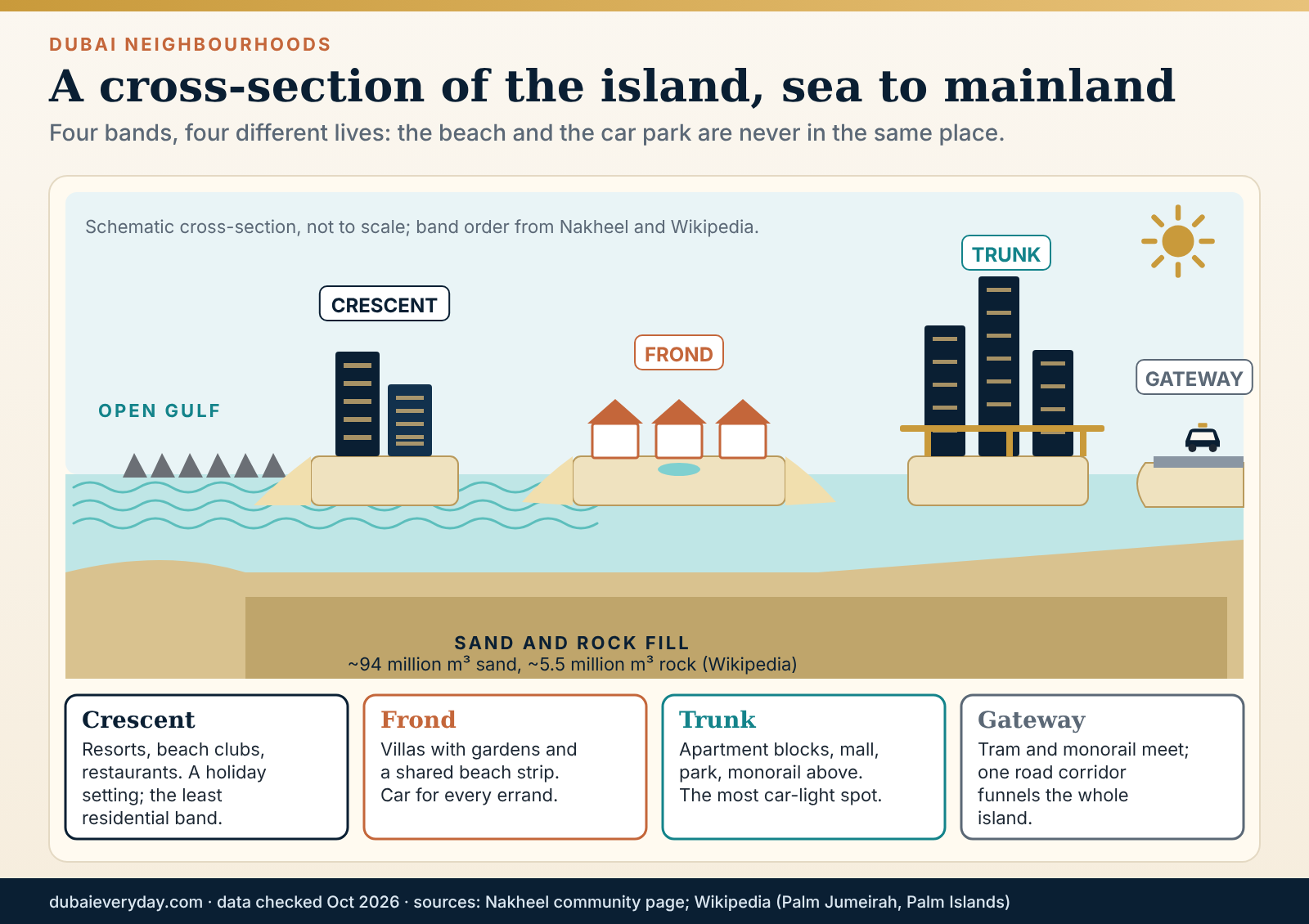
Older and newer stock: what ageing buildings cost
Dubai buildings age quickly in salt air and heat, which a Palm Jumeirah guide cannot ignore. On the Palm, with its mid-2000s villas and early trunk blocks, that shows up in cooling plant, lifts, façades and common areas.
The Dubai Land Department explains that service charges are set through RERA-approved budgets and audited, and that its Service Charge Index lets owners look up the approved rate for a project. We did not find area-level or building-level figures for the Palm, so we do not quote any. The right move is to ask for the last two years of service-charge statements and the reserve-fund position.
For renters the equivalent is the cooling arrangement. Some Dubai buildings charge for district cooling separately, and tenants find the bill after signing. The home setup guide and the apartment renting guide explain chillers and viewing checks in detail; the villa version is in the villa renting guide.
A viewing checklist for the Palm
These are the items this Palm Jumeirah guide treats as specific to the island and easy to forget while standing in a nicely staged living room.
- Which part of the island is it on, and how long does the trunk-to-door drive take at 08:00 and 18:00?
- Where does the sun fall on the balcony in the afternoon, and does the view include a crane or a hotel beach club?
- For a villa: how close are the neighbours’ windows, and who owns the beach strip in front?
- For an apartment: is the cooling metered, and what did the last twelve months cost?
- Is the building popular with short-term guests? Ask the management office, and ask about parking and lift queues at weekends.
- What is the policy on pets, barbecues and boats at the community beach?
- Does the lease or sale paperwork match the title deed and the Ejari record? The tenant rights guide covers renewal and deposit rules.
None of these Palm Jumeirah guide questions is unusual, and none replaces a surveyor, a lawyer or a licensed broker. They simply cost nothing to ask.
Who a Palm villa is not for
In Palm Jumeirah guide terms, a villa is not for the person who wants a short commute without a car, because the island has a single public link and the mainland’s Metro is not at the door. It is not for a household that wants a neighbourhood with schools and a clinic within a short walk. It is also not for anyone whose budget is stretched to the limit, because service charges, cooling and maintenance on a 4,000 sq ft house do not scale down in a soft rental market.
Rents, prices and running costs on the Palm
Every money question in this Palm Jumeirah guide starts with the same warning: the island is a premium district, the data is thin, and the sources measure different things. This section lays out what was published in 2026, converts it to monthly numbers where that helps, and then shows, in labelled examples, how the arithmetic works. None of the Palm Jumeirah guide numbers is a quote, an offer or financial advice.
Three rent measures for one island
The first measure is advertised rent. Property Finder’s analysis, reported by Arabian Business, compared the median asking rent in ten selected apartment communities and ten villa communities on the Palm: apartments fell from AED 251,988 in Q3 2025 to AED 240,000 in Q3 2026 (down 4.76%), and villas from AED 1,677,000 to AED 1,500,000 (down 10.55%). Those are asking prices, not signed leases, and they cover every apartment size in the sample.
The second is an average by unit type. Engel & Völkers, using Property Monitor data for the year to 17 May 2026, puts the average Palm one-bedroom rent at AED 146,315. That is about AED 12,200 a month. For comparison, the same table shows AED 97,434 for a Marina one-bedroom and AED 120,285 for Downtown, so the Palm one-bedroom sits roughly 50% above the Marina and about 22% above Downtown on that yardstick.
The third is market movement. Cushman & Wakefield’s Q2 2026 report has Palm apartment rents down 9% on Q1, and does not state villa rents. Put together, the three measures in this Palm Jumeirah guide say the same thing in different units: the Palm is expensive, and its apartment rents were falling in 2026, though by how much depends on what you measure.
The Palm Jumeirah guide to sale prices
On sale prices, Engel & Völkers lists Palm apartments at AED 4,240 per sq ft for 1 January to 6 June 2026, from Property Monitor’s analysis of Dubai Land Department transactions. Its villa and townhouse table gives AED 8,070 per sq ft, with no stated period. Those figures are about twice the Marina’s AED 2,058 and 1.4 times Downtown’s AED 3,011 on the same page. Cushman & Wakefield recorded Palm apartment prices down 9% in Q2 2026 and villa prices up 1%.
The demand side tells a different story. fäm Properties, analysing Dubai Land Department records for September 2026, ranked the Palm second in Dubai by sales value, at about AED 1.36 billion across apartments, villas and commercial units, behind Business Bay. A soft market in price terms is therefore still a busy one in volume and value terms, which is typical of prime districts. Treat this as one month of one analyst’s data.

Illustrative example: what a Palm purchase costs before the keys
Take a 1,000 sq ft apartment at the Palm’s published apartment average. Illustrative example (not a quote or a market fact): 1,000 sq ft at AED 4,240 is AED 4,240,000. The Dubai Land Department’s fee on a sale is 4% in total, which on this figure is AED 169,600.
The department’s page splits that 2% seller and 2% buyer, and in practice who pays is negotiated. Add registration of AED 4,000 plus VAT for a trustee-centre transfer (AED 500,000 and above), the title deed fee of AED 250, and a broker’s commission if one is used.
The point of the Palm Jumeirah guide arithmetic is the scale of the entry cost. Before a mortgage, a purchase at this price needs well over AED 170,000 in fees and charges on top of the price, which is why the buying guide and the foreign buyer guide treat costs as a separate step. A villa at the table’s villa figure would multiply those numbers several times over.
Illustrative example: gross yield on the Palm
Now combine two of the numbers above, with all the caution that implies. Illustrative example (not a market yield): if a one-bedroom of 1,000 sq ft costs AED 4.24 million and rents at the average of AED 146,315, the gross yield is 3.45% before service charges, cooling, vacancy and maintenance. At 800 sq ft the same rent is 4.3% of a AED 3.39 million price, and at 1,200 sq ft it is 2.9%. The wide range exists because the rent average and the price per sq ft come from different datasets and probably different buildings.
What the exercise shows is directional, and it is the main financial point of this Palm Jumeirah guide. Marina arithmetic using the same publisher’s numbers gives a gross figure above 6%, as the Dubai Marina guide works through. People buy on the Palm for the lifestyle, the scarcity of beachfront land and the resale story, not because rent covers cost. For the proper method, including net yield after service charges, see the rental yield guide and the property ROI guide.
Illustrative example: a renter’s year
For tenants, the fixed costs are easier to see. Illustrative example: a one-bedroom at the Palm average of AED 146,315 has a monthly rent of about AED 12,193. The Dubai Land Department FAQ says tenants may owe a 5% municipality fee on annual rent, billed through the electricity account; that is AED 7,316 a year or AED 610 a month.
The Ejari tenancy registration fee online is AED 120 (AED 100 plus two AED 10 charges), and a trustee centre charges more. Together, that makes the year about AED 153,750 before electricity, water, cooling, internet, parking and any chiller charge.
For a villa at the median asking rent of AED 1.5 million, the monthly rent is AED 125,000, the 5% fee is AED 75,000 a year, and the cooling and garden costs of a large house come on top. We found no verified Palm villa utility figures, so none appear here. The sensible step is to ask the landlord for the last twelve months of DEWA bills, which the DEWA move-in guide explains how to read.
Rent increases, renewals and what the index says
If you already rent on the Palm, the Dubai Land Department’s rental index is the tool that matters. The department’s FAQ says index-based increases need at least three months’ notice, that the index is indicative for a new lease and relevant when the parties disagree at renewal, and that changes of terms need 90 days’ notice.
In a market where asking rents fell in 2026, a renewal discussion is a reasonable moment to check the index. The rental index page asks for the contract end date, area, property type, bedrooms and current rent. Our renting guide covers the process, and the tenant rights guide covers disputes.
A quick caution: the rental index is a government tool with its own rules, and what you pay is a contract between you and your landlord. Brokers and landlords quote “market rent” in ways that favour the person speaking. The data above is for orientation, not negotiation scripts.
Service charges, cooling and the other recurring costs
Service charges are the hidden half of Palm ownership. The Dubai Land Department says charges are RERA-approved, audited and based on the area on the title deed multiplied by an index rate, covering security, cleaning, maintenance, utilities, administration, insurance and reserve funds, and that a developer should not collect them before approval. The Service Charge Index lets you look up a project’s approved rate.
We found no published Palm average, and the island mixes resort-style amenities with older blocks, so a single figure would mislead. Instead of a number, here is a rule of thumb stated as a rule, not a fact: a building with a spa, a beach, concierge and large pools costs more to run than a basic trunk block, and the owner pays the difference. Always ask for the last statement before you make an offer.
Rent or buy: the short version for this island
Renting preserves flexibility in a market where the next 12 months are uncertain, and 2026 has been an unusual year. Buying makes sense for people who plan to stay and who value the specific land, the beach and the layout enough to pay a premium. The sources we read do not support the idea that the Palm is a yield play. Whether it is a growth play depends on supply, rates and demand that nobody can promise. For the full framework, the property investment guide sets out the risks and the exit costs.
The numbers in this Palm Jumeirah guide are market data and labelled examples, not advice. A licensed broker should be checked against the Dubai Land Department’s register, a lawyer should read the contract, and a surveyor should inspect the building. Prices, rents and service charges move.
Resorts and hotels: choosing one without a ranking
Wikipedia’s list of the trunk and crescent hotels runs to about thirty names as of 2024, from Atlantis The Palm and Atlantis The Royal to One&Only The Palm, Jumeirah Zabeel Saray, Anantara, Rixos, Raffles, Fairmont, W, Sofitel, Kempinski, Waldorf Astoria and a long tail of four-star and apart-hotel options.
This Palm Jumeirah guide has not stayed at any of them, did not read all of their pages, and is not ranking them. What follows in the Palm Jumeirah guide is a way to choose, plus the verified facts about the three or four resorts whose official pages we did read.
What the official pages say, and what they don’t
Atlantis The Palm. It opened on 24 September 2008 and, per Wikipedia, has 1,544 rooms in two towers. The resort’s Aquaventure page says guests of the resort get complimentary waterpark access by showing a room key card, lists over 105 attractions and a kilometre of private beach, and gives opening hours as 10:00 to sunset in one place and 10:00 to 18:00 in the FAQ. That conflict is why you should confirm hours before you go. The hotel page lists Bread Street Kitchen and Milos among its restaurants.
Atlantis The Royal. The hotel’s own page lists Nobu by the Beach and says the resort ranks fourth in The 50 Best Hotels 2026, which the awards list also shows. Its room categories run from guest rooms to Royal Club rooms, suites and signature penthouses. The page carries no closure notice, but Khaleej Times reported in April that four of its restaurants were paused, so outlet-level checks still apply.
One&Only The Palm. The resort’s page describes a private stretch of sand, three pools, the restaurant STAY by Yannick Alleno, and a Guerlain spa. St. Regis Dubai, The Palm was closed for refurbishment from mid-April 2026 and, per Khaleej Times on 23 October 2026, reopens on 1 November 2026 with Cordelia, RUYA, KYMA Beach Club and the spa returning. Neither page quotes a price; the room rate depends on the date.
Five questions that decide a Palm stay
Stay selection in this Palm Jumeirah guide comes down to five things that are not star ratings. Work through them in order and the shortlist shrinks quickly.
- What kind of beach?Some resorts offer a managed private strip, some a shared beach club, some only pools. “Beach access” in a listing can be any of them. Ask which, and ask about shade, loungers, sea entry and seaweed in the month you travel.
- How will you move?The crescent is far from the Gateway. A resort at the apex gets you to Aquaventure and nothing else by foot. If you plan to visit the Marina, Downtown or the airport, price the taxis into the stay.
- Who is travelling?Families usually need a kids’ club, a shallow pool and a room layout with a door that closes. Couples often prefer adults-only pools. Atlantis includes waterpark access for guests; other resorts include different perks.
- What noise is acceptable?Beach clubs, fireworks and events can carry. Ask for a room facing away from the club if you want an early night.
- What is open?Resorts can pause restaurants and beach clubs. 2026 has been unusual: Atlantis paused seven restaurants in April and St. Regis was closed for half a year. Check the specific outlet you are booking for.
The price side: what the hotel bill actually includes
Dubai charges a Tourism Dirham per occupied room per night. The Executive Council Resolution No. 2 of 2014 sets it at AED 20 for five-star or higher hotels and luxury hotel apartments, AED 15 for four-star, AED 10 for three- and two-star, and AED 7 for one-star and budget, with the UAE government portal confirming “AED 7 to 20 by category”, collected by the hotel and capped at 30 consecutive nights.
The portal does not state a service charge, municipality fee or VAT; the standard VAT rate is 5%, and a 10% service charge is common but not confirmed by an official page we read.
In May 2026 The National reported that Dubai suspended the 7% municipality tax on hotel and restaurant bills and exempted the Tourism Dirham as part of a relief package, with no end date stated. We could not confirm whether those measures are still in force, so check the rate terms when you book. The bill you see is the number to compare, not the headline room price.
What the 2026 market looks like for the buyer of a night
Hotels have had a hard year. Cavendish Maxwell’s first-half 2026 data, reported by Khaleej Times, showed citywide average daily rate at AED 701, down 7%, and luxury-segment occupancy around 51%. Dubai’s tourism office, quoted by The National, said August 2026 occupancy was 66% with 869,000 international overnight visitors.
None of this is Palm-specific, and this Palm Jumeirah guide does not claim otherwise and none of it predicts what a particular resort charges on a particular date. It does suggest that the usual high-season premium may be negotiable at the shoulder edges, which is a reason to compare dates rather than a promise of a bargain.
For the best-hotels shortlist by budget and area, use the best hotels in Dubai guide. For what the premium buys, see the best luxury hotels page, and for the top end of private beaches and suites, the ultra-luxury hotels guide.
A Palm Jumeirah guide to staying on the island or not
For a first trip to Dubai, the Palm Jumeirah guide advice is that a hotel on the island means spending time at the hotel. Taxi time to Downtown is around 25 to 50 minutes depending on traffic by our estimate, which means a city-sightseeing itinerary costs hours and a daily fare. Our calculation of the metered tariff, at AED 2.45 a km over about 22 road km, is roughly AED 65 to 70 each way before surcharges. The Dubai travel guide and the first-time visitor plan help decide whether a split stay makes sense.
This is an editorial opinion, not a rule: two to four nights of resort time on the Palm and the rest of the trip near Downtown or the Marina is a pattern that avoids both a cramped city hotel and a week of taxi bills. If beach time is the whole purpose of the trip, the Palm is the right shape. If it is not, the island is an expensive way to get wet.
Beaches, beach clubs and the sea
The coastline in this Palm Jumeirah guide is long, but in this Palm Jumeirah guide very little of it counts as a free-for-all. Most sand belongs to a resort, a residential community or a beach club, and the rules follow the owner.
That is the opposite of the municipal beaches along Jumeirah, where the Dubai Municipality says its beach centres charge no entrance fee, apart from fees for requested services. The municipality’s beach page lists only Jumeira Beach and Al Mamzar Beach; no Palm beach appears there, so we cannot call any Palm beach a municipal one.
The four kinds of Palm sand
Resort beaches
For guests, and sometimes for day-pass holders. Atlantis’s Aquaventure page mentions a kilometre of private beach. One&Only describes a private stretch of sand. Rules and hours are the hotel’s.
Beach clubs
Pay-to-enter venues with loungers, a pool and a restaurant. Prices are usually partly or fully redeemable against food and drink; some are not. See the reported prices below.
Community beaches
Strips in front of villa fronds and some apartment blocks, open to residents and their guests. These are managed by the community or master developer, and we found no public rulebook.
Palm West Beach
A Nakheel-run beachfront that Gulf News describes as 1.6 km long, with dogs allowed on a leash but not in the water, and with hours given in 2024 as 08:00 to midnight. We could not read the operator’s page, so entry fees, parking and current hours are unconfirmed. Confirm first.
Beach clubs: what was reported in August 2026
What’s On listed the status and prices of Dubai’s beach clubs on 19 August 2026. We kept only the venues whose listed location clearly placed them on the Palm and where the entry was stated in dirhams. The rest of the Palm’s clubs, including those at Palm West Beach, were unclear in the source about location, so we left them out rather than guess.
| Venue (location as reported) | Reported entry, summer 2026 | Redeemable? |
|---|---|---|
| Tagomago (Azure Residences) | Beach AED 150 weekdays, AED 200 weekends; pool loungers AED 200 and AED 250 | Full rate redeemable on food and drink |
| Bohemia (FIVE Palm Jumeirah) | Free entry Monday to Thursday; passes from AED 100 Friday to Sunday | Not stated |
| Safina (One&Only The Palm) | AED 250 per person weekdays, AED 350 weekends | Not redeemable |
| Wet Deck (W Dubai, The Palm) | Summer day pass AED 150, adults-only pool | Fully redeemable daily |
Treat the table as a price ladder in this Palm Jumeirah guide, not a shortlist. The spread is the useful part: a free weekday entry at one club and a non-redeemable AED 350 weekend ticket at another can be roughly the same hours on the same island. Prices change by season and day, and the source itself said some entries were June-only. Check the venue before you travel, and read the section on beach clubs in the best beaches in Dubai guide for city-wide comparisons.
Public beach rules, and why they do not automatically apply here
Dubai’s municipal beach rules, as summarised in the municipality’s content portal, bar pets, barbecues, shisha, overnight stays and swimwear in walkways, and restrict swimming after sunset to designated night beaches. Those rules apply to municipal beaches. On the Palm, the owner sets the rules. Whatever the owner says, the broader law and etiquette apply: modest cover-ups away from the sand, no topless sunbathing, caution with photography of strangers, and respect at all times. The Dubai dress code page and the etiquette guide go into specifics.
For free municipal sand within a short drive, see the free public beaches guide, and for children-friendly choices, the family beaches guide. If you came to the Palm for the beach and find it closed to you, those are the next calls.
Sea, sun and jellyfish: reading the conditions
Air and sea temperatures drive the beach season more than any resort calendar. Rounded monthly averages from weather2travel, a secondary climate site, put the daily maximum at about 24 °C in January and 41 °C in July and August, and the sea at about 22 °C in February and 33 °C in July to September. Ultraviolet exposure is very high for much of the year; the World Health Organization classes an index of 8 or above as very high, and the same site shows peak UV at 11 or more from April to September.
- Cool season, November to March: the beach is comfortable at midday. The sea is cooler by January and February, which suits walkers more than swimmers.
- Shoulder months, April and October to early November: pleasant mornings and evenings, strong midday sun. Plan the sand for early or late.
- Summer, June to September: sea water near 31 to 33 °C and shade essential. Pools carry the day; the beach is for early morning and the last hour of light.
- Jellyfish: Wikipedia reports that jellyfish are common on the island’s nearby beaches in summer. Follow lifeguard advice and swim where flags allow. Dubai’s flag code, as reported, uses red for unsafe conditions, yellow for caution and purple for harmful marine life.
Heat and children. Sand burns bare feet by late morning from May to October, and young children overheat faster than adults. The National published a child beach-safety guide on 9 October 2026 covering lifeguard hours, supervision and cooler-season swimming. Read it before a family trip.
Palm Jumeirah guide: a seasonal rule of thumb for beach days
Our reading of the temperature data in this Palm Jumeirah guide is that the usable beach season runs from late October to April, with the best swimming-and-sunbathing balance in November, March and early April. For a resort stay you can still enjoy the pool in July, but a villa owner who bought for the beach will find the strip unused for four months of the year. That is not a defect of the island, and a Palm Jumeirah guide should say it before you pay for the frontage.
Getting there and around: monorail, tram, ferry, taxi and car
Transport is where the postcard and the practicalities part ways in any Palm Jumeirah guide. The island has one rail-type service of its own, the monorail, which is short, leisure-oriented and of uncertain status this month. The Dubai Tram stops at the island’s door. The Metro does not reach the island at all. Everything else is taxi, ride-hail or private car, and that reality should shape the housing and hotel decisions above.
Palm Jumeirah guide to the monorail: what the operator publishes
The monorail opened on 30 April 2009 and, per Wikipedia, runs 5.45 km. The operator’s site lists four stations: Palm Gateway, Al Ittihad Park, Palm Jumeirah Mall (the old Nakheel Mall station) and Atlantis Aquaventure. A fifth station, The Pointe, was closed from July 2023 for redevelopment according to Wikipedia, and the operator no longer lists it.
The ticket-price page shows these single fares: Gateway to Al Ittihad Park or to the mall AED 10; Gateway to Atlantis AED 20; Al Ittihad Park to the mall AED 5; Al Ittihad Park or the mall to Atlantis AED 10. Return fares are AED 15, 30, 10 and 15 respectively, and an any-station return is AED 35.
The page also lists a Family Pass at AED 99 for a return trip for four between Gateway and Atlantis, a UAE Resident Monthly Pass at AED 135 for six round trips between those stations, and a Palm Resident Pass at AED 165 for residents of the island.
Seniors over 60 and holders of the People of Determination card pay half, and children under five or under 110 cm travel free. RTA’s Nol page lists the Nakheel monorail among the places a Nol card works, but the operator’s ticket page does not mention it, so confirm at the station.
This also reconciles two numbers you may have seen. Wikipedia quotes AED 20 one way and AED 30 return, which is the end-to-end fare, while Khaleej Times in July 2026 quoted fares “from” AED 5 one way and AED 10 return, which is the shortest segment.
Hours, frequency and the status conflict
The operator’s train-times page says trains run every 15 minutes, every day, with the same timings on weekdays and weekends. The first train leaves Gateway at 09:00 and Atlantis at 09:15; the last leaves Gateway at 21:45 and Atlantis at 22:00. That makes the monorail, in this Palm Jumeirah guide, a visitor and leisure link, not a commuter service: nobody gets to a 08:00 meeting on a train that starts at 09:00. Our reading is that residents use it mainly to reach Atlantis and the mall, and visitors use it as a ride in itself.
The status is the problem. The operator’s homepage on 29 October 2026 said the monorail was “temporarily suspended until further notice due to maintenance”, with no reopening date. Khaleej Times reported on 9 July 2026 that service had resumed after six months of closure. Wikipedia says the line was suspended from 5 December 2025 and gives no reopening. The ticket and train-times pages, which showed no suspension notice, could be stale or current. We cannot resolve it from here. Confirm first with the operator on the day.
During the closure, Khaleej Times reported, residents and tourists were advised to use RTA’s Hala taxi service. That is the practical fallback whenever the monorail is not running.
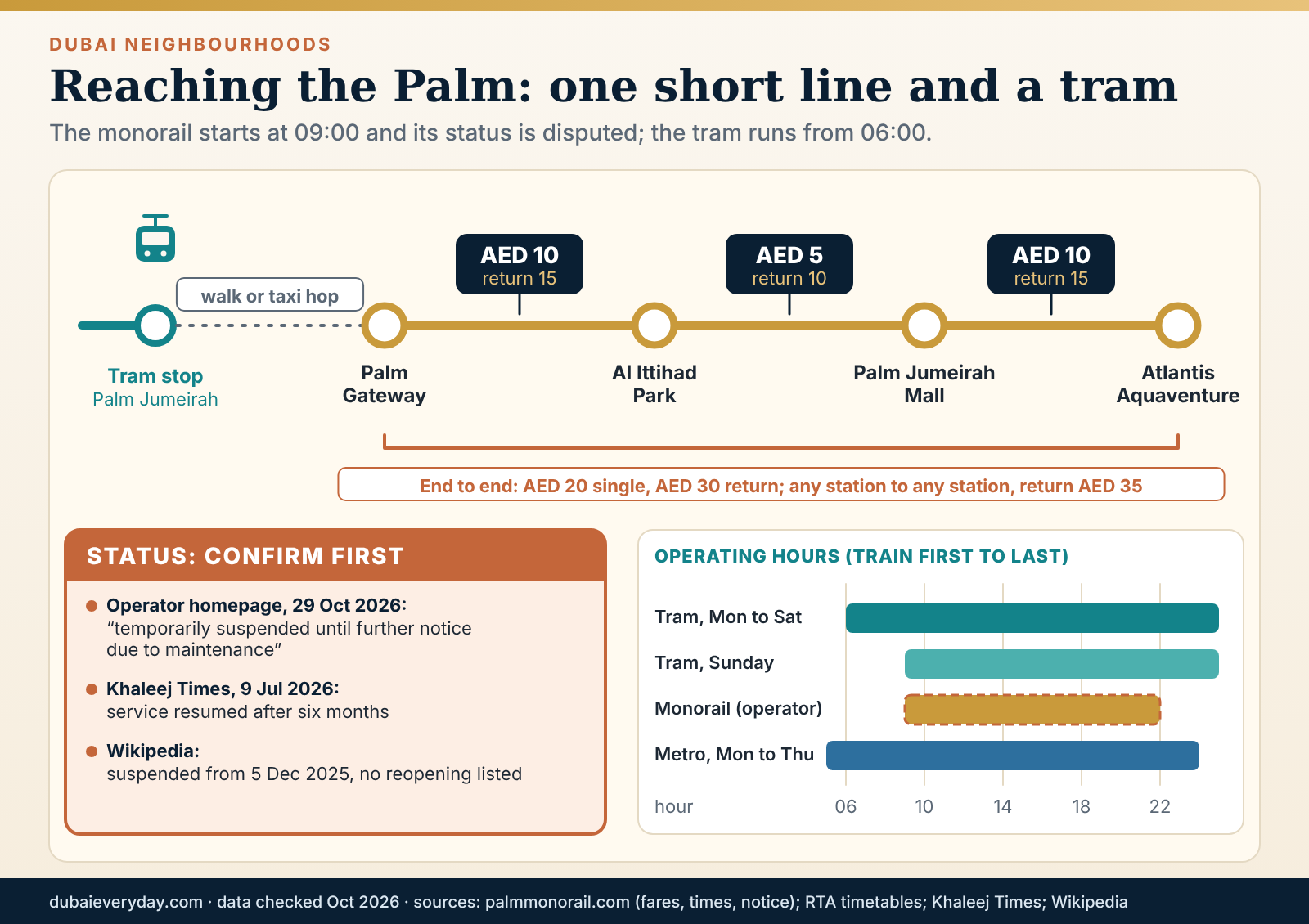
The Dubai Tram link: how to reach the Palm without a car
The tram is the nearest thing to a car-free route. RTA’s timetable page lists tram hours as 06:00 to 01:00, Monday to Saturday, and 09:00 to 01:00 on Sunday. Wikipedia’s tram page lists eleven stops. Palm Jumeirah is the ninth, after Mina Seyahi and Media City, and it is described as an out-of-station interchange with Palm Gateway monorail station.
From the Red Line you change to the tram at Sobha Realty (R36) or DMCC (R37), then ride toward the Palm. From Sobha Realty, the Dubai Marina tram stop is the interchange, and the Palm is four stops on.
RTA does not publish a tram journey time on the pages we read, so the number below is our assumption: about two to three minutes a stop, giving roughly 10 to 12 minutes from the Marina interchange.
Add the walk or taxi hop to the monorail station, and the time from the Metro to a Palm hotel lobby can reach 45 minutes or more. The Dubai Metro guide explains Nol cards and zone fares; the tram uses the same zones, with Silver card fares of AED 3, 5 and 7.50 for one, two and more than two zones.
Metro, buses and the planned extension
Wikipedia’s monorail article says Dubai Internet City is the nearest Dubai Metro Red Line station and notes a planned Red Line extension. We found no dated RTA announcement for it, so do not plan around one. As for buses, we did not verify any RTA route onto the Palm, and the fallbacks the press mentioned were taxis. The Red Line guide covers the stations that matter for the mainland end of the trip.
Ferry from the Marina
RTA’s marine page describes the Dubai Ferry as air-conditioned, seating up to 98 people and covering six routes, but lists no fares. The timetable list (as carried through our sibling research) includes FR4 from Marina Mall toward Atlantis and the Palm. We did not read the FR4 timetable, so fares and departure times are unconfirmed. If a ferry matters to your plan, check the RTA timetable page the day before.
Taxis, ride-hailing and what they cost
The Dubai Taxi tariff, as read through our airport research, is AED 2.45 per km with a minimum of AED 12 for a street hail and AED 13 for an e-hail, plus a Salik charge when a toll gate is crossed and AED 25 for a pickup at Dubai International. The calculation in the table below applies that tariff to approximate road distances. Ride-hailing apps price differently and surge at peak times, so treat the numbers as the metered baseline, not a quote.
Palm Jumeirah guide traffic model: the commute, modelled
Bayut’s area guide names congestion at the entry and exit points at peak times as one of the island’s drawbacks, and that matches the geometry: every car leaves through the same trunk. We built a simple model from straight-line distances between approximate coordinates, a 1.3 road factor, and two assumed speeds, 55 km/h for light traffic and 30 km/h for heavy traffic. These are assumptions, not measurements, and short urban hops cost extra time at junctions, so we have rounded up.
| From the Palm Gateway to | Approx. road km | Light traffic | Heavy traffic | Metered taxi baseline |
|---|---|---|---|---|
| Dubai Marina | 3.5 | 5 to 10 min | 10 to 15 min | about AED 20 |
| Dubai Internet City | 3.5 | 5 to 10 min | 10 to 15 min | about AED 20 |
| Mall of the Emirates | 8 | 10 to 15 min | 15 to 25 min | about AED 30 |
| Expo City | 20 | 25 to 30 min | 40 to 50 min | about AED 60 |
| Business Bay | 20 | 25 to 30 min | 40 to 50 min | about AED 60 |
| Downtown and Dubai Mall | 22 | 25 to 35 min | 45 to 55 min | about AED 65 |
| DIFC | 24 | 30 to 35 min | 50 to 60 min | about AED 70 |
| Al Maktoum International | 30 | 35 to 40 min | 60 to 70 min | about AED 85 |
| Dubai International (DXB) | 37 | 40 to 50 min | 70 to 80 min | about AED 100 |
All figures are our calculation, rounded, before Salik and surcharges. Bayut gives “roughly 30 minutes” to Dubai International, which sits near the light-traffic end of our range. The airport page in our Dubai airport guide explains terminals and transfers. The Palm Jumeirah guide rule of thumb that falls out is simple: the Marina side is minutes away and the city side is 25 to 60 minutes, and the difference between 25 and 60 is mostly the time of day.
Salik, parking and driving rules
Salik is Dubai’s electronic toll. Press reports in May 2026 put the charge at AED 6.30 in peak periods (06:00 to 10:00 and 16:00 to 20:00, Monday to Saturday), AED 4.20 off-peak, and free from 01:00 to 06:00, including 5% VAT from 1 June 2026. Sunday is flat-rate in some reports and not in others.
We could not load the Salik site, so confirm the rate and which gates your route crosses on its map. Parking inside the island is usually in buildings and at destinations; Bayut mentions parking at Palm Jumeirah Mall and The Pointe, but we did not verify paid-parking zones or tariffs.
If you are visiting without a car, the cost comparison is stark: a hire car, Salik and parking for a short stay can exceed taxi fares on the Palm. The car rental guide explains deposits and total cost, and the airport car rental page covers pickup and returns.
Car-light life on the Palm: is it possible?
The Palm Jumeirah guide answer is: possible, yes; easy, no. A trunk apartment near the monorail, the mall and the supermarket needs a car less than anything else on the island, because daily groceries, a clinic and a gym are within a short ride. But the monorail’s 09:00 start, the mainland Metro’s distance and the heat in summer mean that a car-light household still pays for taxis.
Our advice, and the advice of this Palm Jumeirah guide, is to price the taxi bill honestly before moving. Illustrative example: ten return taxi trips a month at AED 40 each way is AED 800; thirty return trips at AED 65 each way is AED 3,900, a meaningful line in a monthly budget. Those fares are our calculation, not quotes.
A Palm Jumeirah guide day for visitors, with dining and shopping
A day on the Palm works best when it has one anchor, a stay or a sight, and everything else is chosen to avoid backtracking along the trunk. In this Palm Jumeirah guide the anchor list is short. The attractions we could verify on the operators’ own pages are the observation deck, the waterpark and the beach. Everything else is dining and walking. This part of the Palm Jumeirah guide sets out a cool-season plan, a summer plan and the money side, then covers eating and shopping.
The attractions that have official pages
The View at The Palm. The operator’s page describes a platform 240 m above sea level, calls it the highest vantage point on the island and lists opening hours of 09:00 to 19:00 daily. It shows standard admission “from” two figures, 115 and 80, without saying which is current or naming a currency; marketplace listings we saw in our sibling research use AED 115. The upgraded “Next Level” ticket shows 190 and 130. No closure notice appeared on the page. Verify the price on the operator’s site.
Aquaventure at Atlantis. The page lists more than 105 attractions, a Guinness-certified record for the most waterslides in a waterpark, hours as “10am to sunset” in one place and 10:00 to 18:00 in the FAQ, a 1.2 m height limit for some rides, and an under-13 accompaniment rule. It does not print ticket prices. Marketplace listings we saw put adult tickets between AED 234 and AED 285, which is a resale-platform range, not the operator’s price. Hotel guests get entry included. The Dubai with kids guide has the wider family picture.
Lost Chambers and the rest of Atlantis. Wikipedia says the aquarium holds more than 65,000 marine animals. We did not read the aquarium’s operator page, so hours and prices are unconfirmed. Skydive Dubai’s Palm drop zone was reported in 2026 at AED 2,200 to AED 2,500 for a tandem jump; treat that as a reported range and check the operator.
The things to do in Dubai guide puts these in the context of the whole city. For no-cost options see the free things to do in Dubai page. When heat is the problem, the indoor things to do guide has the alternatives.
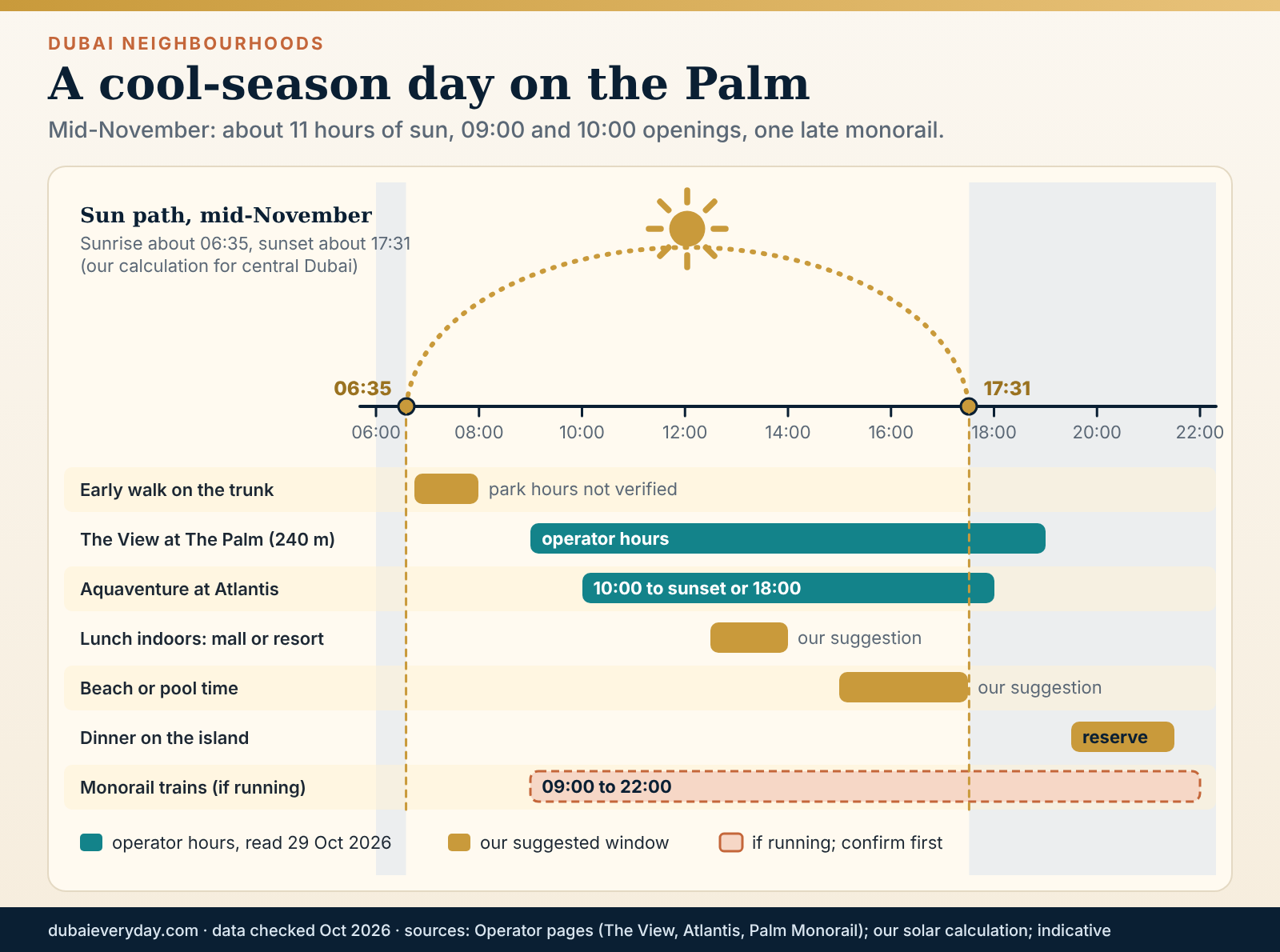
A cool-season day, November to April
- Early walk on the trunkThe sun rises at about 06:35 in mid-November by our calculation. Al Ittihad Park and the boardwalk are the island’s walking options; park hours were not verified, so check them.
- The View when it opens at 09:00Going at opening time is an editorial suggestion to avoid the afternoon crowd, not a measured fact. Allow an hour or so.
- Atlantis from 10:00If you have children or want the waterpark, this is the anchor, and it uses most of the day. If not, replace it with the beach.
- Lunch indoorsPalm Jumeirah Mall and Golden Mile Galleria are the trunk’s retail options; a resort restaurant is the other.
- Sand and sunsetSunset is about 17:30 in mid-November. Leave the beach 30 minutes before to avoid the evening taxi queue.
- Dinner and the last trainIf the monorail is running, the last departures are 21:45 from Gateway and 22:00 from Atlantis. Do not rely on it for a late dinner.
A summer day, June to September
Midday sun, 39 to 41 °C air and 31 to 33 °C sea turn the Palm into an indoor and pool destination.
The Palm Jumeirah guide plan is to treat the day as two short outdoor windows, one in the first hour after sunrise and one after 18:30 (sunset is about 19:10 at the June solstice by our calculation), and to spend the middle in air-conditioned places: The View, the mall, a resort spa, a beach-club pool with a covered lounger. Aquaventure is a summer product by design, but the same heat applies to queues. Water, a hat and sun protection are non-negotiable.
Illustrative example: what a day costs
Take two adults on a cool-season day. Illustrative example (not a quote): two View tickets at AED 115 is AED 230; a weekday beach-club entry at AED 150 each is AED 300, redeemable on food and drink at that venue; a monorail return from Gateway to Atlantis for two is AED 60 at the published AED 30 fare, if it runs.
The sum is AED 590 before lunch, dinner, a taxi to the island and a taxi back. The point is that the Palm is not a cheap day out, though it can be a free-heavy one if the park, boardwalk and a public beach fill the hours.
Dining in the Palm Jumeirah guide: how to choose
Eating on the island falls into three groups. Hotel and resort dining, which holds nearly all the high-end names. Mall and Golden Mile dining, which is the casual and family layer. And the cafés and delivery that residents use daily. We have not eaten at any of them and do not rank them.
The best restaurants in Dubai guide explains how to choose, and the cafés guide and specialty coffee guide cover the daytime. One coffee brand, Mokha 1450, lists a venue in Golden Mile Galleria and a co-working lounge at Andaz Dubai The Palm on its own site.
The Michelin Guide Dubai 2026 gave stars to several restaurants on the Palm, by our count of the located listings in our sibling research: Tresind Studio and FZN by Björn Frantzen (three stars each), STAY by Yannick Alleno (two stars), and one-star entries including Hakkasan, Ossiano and Dinner by Heston Blumenthal.
The National reported on 7 October 2026 that Ossiano and Dinner by Heston were among the temporarily closed restaurants keeping their stars, and Khaleej Times had reported in April that Atlantis paused Hakkasan and Ossiano. Tresind Studio’s Michelin page, as read in our sibling research, gives its address as St. Regis Gardens on the Palm, so the hotel’s 1 November reopening matters for it. Restaurant status moves, and these hotel restaurants usually need a reservation. Our Michelin restaurants guide explains stars, Bib Gourmand and booking.
Alcohol is served in licensed venues, which on the Palm are mostly resorts and beach clubs. The nightlife guide covers the rules, and the best bars guide lists the neighbourhoods. Our own Palm Jumeirah guide advice is practical: book dinner before you book the beach club, and check that the specific outlet is open.
Shopping on the island
The Palm has three retail clusters we could name from official or reference pages: Palm Jumeirah Mall, formerly Nakheel Mall; Golden Mile Galleria, within the Golden Mile complex; and The Pointe on the crescent, whose monorail station Wikipedia says closed from July 2023 for redevelopment.
Bayut’s area guide mentions parking at the mall and The Pointe. We did not verify store lists or opening hours, and the redevelopment status of The Pointe is unconfirmed. For serious shopping, the city’s malls are 25 minutes or more away; the Dubai shopping guide and the Dubai Mall guide are the next stops.
Daily life: groceries, schools, clinics, gyms, pets and home setup
Daily life in this Palm Jumeirah guide is a story of good coverage for the basics and thin coverage for everything that needs scale. The island has supermarkets, clinics, gyms and nurseries; it has no full hospital that the sources we read name, and a limited school choice. This part of the Palm Jumeirah guide lists what the published sources say is there, and flags what a household must check.
Groceries and deliveries
Bayut’s area guide lists Spinneys, Waitrose, Choithrams and Carrefour, with Carrefour at Nakheel Mall (now Palm Jumeirah Mall). A separate Bayut list of Waitrose branches includes a Nakheel Mall branch. In December 2024 Gulf News reported that Carrefour’s quick-delivery service, promising delivery in 60 minutes or less around the clock from a hub that started at the Marina, would launch first in areas including the Palm.
That is a 2024 report, so confirm that the service is available to your address. The supermarkets guide compares the chains, and the Carrefour guide explains its delivery and loyalty model.
The practical point is simple. A frond villa is a drive from the trunk’s supermarkets, so app delivery is likely to cover many of the gaps that the lack of walking-distance retail creates. Delivery windows and fees are the things to test in your first week.
Schools and nurseries: be realistic
Bayut’s area guide names Regent International School (foundation stage to Year 13, British curriculum with IGCSE and A-Level routes), Jumeirah International Nurseries (ages 45 days to 6 years) and Blossom Nursery Palm Jumeirah (British EYFS). That is a secondary source, and we could not read the Knowledge and Human Development Authority’s directory, which blocks automated access. This Palm Jumeirah guide therefore gives no ratings, no fees and no judgement of any school.
For a household with school-age children, the likelier pattern is a school-run to the mainland, which means the Gateway bottleneck twice a day. Ask any school you are considering about its bus routes and timings. The Dubai schools guide explains curricula and admissions, and the KHDA ratings guide explains what the inspection grades do and do not tell you. The official KHDA school directory is the place to confirm any school’s rating and fees.
Clinics, hospitals and insurance
Bayut lists Medcare Medical Centre at Seven Palm, Dubai London Clinic at Nakheel Mall, and Al Das Medical Clinic in the Shoreline Apartments, and names no full hospital on the island. We did not verify any clinic’s licence, hours or insurance network. Before using one, check its licence with the Dubai Health Authority; the DHA licensing system page gives the official contact details. In an emergency the standard UAE numbers are 999 for the police and 998 for an ambulance, widely published but not re-read on an official page today.
A practical rule: ask your insurer which hospital is in your network before you choose a home, because the nearest facility to a Palm address may be on the mainland and your plan may not cover it in full. The healthcare guide, the hospitals guide and the health insurance guide explain the system. This is general information and not medical advice.
Gyms, studios and outdoor exercise
Fitness First’s club page for The Palm, as read in our gym research, shows weekday opening at 06:00, close at 23:00 on weekdays and 21:00 on weekends, five studios and a ladies-only gym. Bayut names Pinpoint Fitness, Alchemy Gym and TribeFit Studio. A pilates studio, Posture, lists a Palm location on its site.
We did not compare prices or quality. The boardwalk and Al Ittihad Park are the outdoor options; the park is shaded and has play areas according to Bayut. See the best gyms guide and the pilates guide for how to choose by contract terms and crowding.
Pets
Gulf News (August 2024) reported a dog park in Al Ittihad Park and dogs allowed on Palm West Beach on a leash but not in the sea. The article is dated, so treat it as a lead, not a rule. Building rules vary: some towers bar pets; most villa communities allow them with conditions. The pet ownership guide and the pet registration guide explain licensing, microchips and vaccinations. In summer, a dog walk on a hot pavement is an animal-welfare issue, not a convenience.
Setting up a Palm home
The administrative steps in the Palm Jumeirah guide are the same as elsewhere in Dubai: register the tenancy through Ejari, activate DEWA, arrange internet and, where applicable, sort out cooling and parking. What is different on the Palm is the number of villa communities and master-managed buildings with their own approval rules for works, deliveries, moving days and contractors. Ask the management office for the move-in rules before the removal van arrives. The home setup guide covers the checklist, the DEWA move-in page covers utilities, and the home internet guide covers provider availability by building.
For deep cleans before move-in or after move-out, see the deep cleaning guide; for ongoing help, the cleaning services guide explains licensing and booking quality. Home insurance questions belong in the insurance guide.
The mosque, the community and what is missing
Bayut’s guide lists the Abdul Rahman Siddik Mosque on the trunk. What the sources do not describe is a town centre: no market street, no school cluster and no civic building that anchors the island the way a high street does in other cities. The mall, the park and the resort promenades fill that role partially. Whether the island feels like a community therefore depends on your building, your frond and your neighbours, and it is worth asking current residents before you commit.
Lifestyle and safety: noise, seasons, neighbours and 2026 context
Lifestyle in the Palm Jumeirah guide is shaped by three things: the weather, the neighbours and whatever is happening on the crescent that week. This section covers the rhythm of the year, noise, short-term guests and rules, and then the 2026 security context, which any honest island guide published this autumn has to address.
A Palm Jumeirah guide calendar, month by month
The rounded climate averages from weather2travel give the shape: the daily maximum is about 24 °C in January, climbs to 37 °C in May, peaks at 41 °C in July and August, and falls to 31 °C in November. Our reading of those numbers, as a Palm Jumeirah guide lifestyle calendar, is below. It is an editorial summary of secondary climate data, not a forecast.
- November to March: the island’s best months. Outdoor dining, beach time, cycling on the boardwalk and long walks in Al Ittihad Park all work. This is also when hotel demand and event traffic are highest, so expect more taxis and more people.
- April and May: warm-up. Mornings and evenings stay pleasant; by May the middle of the day is for air conditioning.
- June to September: hot and humid. Villa gardens need watering and shade, pools become the focus, and the beach is for the first hour of the day.
- October: the transition back. The sea is still warm, the air eases, and beach clubs and terraces reopen their outdoor sections.
The best time to visit Dubai guide goes deeper on weather, crowds and hotel prices, and the Dubai events calendar shows how to track what is on. The Palm is also a stage for large events such as fireworks, where road closures can apply. The 2025 to 2026 New Year’s Eve pattern for Downtown is described in our Downtown guide; for the Palm, check Nakheel and RTA notices in December.
Noise, crowds and the neighbour next door
Three noise sources matter. Beach clubs and resort events carry across water, and the Palm’s geometry means a villa on a frond can hear a venue at the crescent. Construction continues on and near the island. And in buildings with short-term guests, weekend turnover is a noise and a security question. Ask every one of these questions at the viewing, at the time of day you will actually be home.
Short-term rentals in Dubai are licensed. We could not read the Department of Economy and Tourism’s holiday-home pages today, so we quote no permit conditions or fees, but the rule is that a landlord renting by the night needs a permit, and that your tenancy or ownership paperwork can restrict it. If you are buying a flat as a holiday let, read the rental yield guide’s short-let arithmetic and then ask your management company in writing.
Etiquette on the island, in brief
The Palm has a more international, resort-like feel than most of the city, which can lull people into forgetting that Dubai’s rules and etiquette apply on the beach and in the hotel lobby alike. Cover up away from the sand and pool, avoid photographing strangers, and respect the call to prayer and Ramadan daytime etiquette where they apply. The etiquette guide and the dress code guide explain the specifics. Drones need permission; The National described tighter rules in January 2025, and recreational use was under review.
Palm Jumeirah guide security and safety context, October 2026
Readers of a Palm Jumeirah guide will want a plain statement, so here it is. The UK Foreign Office, in advice updated on 27 October 2026, calls the wider Middle East situation “deeply unpredictable” with a high risk of sudden escalation, warns of possible flight cancellations and airspace closures at short notice, tells travellers who are told to shelter to stay indoors or find the nearest safe or designated shelter, and advises insurance that covers your itinerary and expenses in an emergency.
Wikipedia’s summary of the UAE in the 2026 Iran war lists a ceasefire from 8 April 2026, reports drone and interception damage at several places in Dubai, and says a drone reportedly struck Fairmont The Palm, with debris from interceptions also damaging structures around the island. The article’s latest dated source is from May. We found no official incident report for the Palm, and Wikipedia is a secondary source. We offer this as context, not as an assessment of risk at any address.
What follows for planning is practical and general. Buy travel insurance that explicitly covers your itinerary and read its war and civil-unrest exclusions. Keep flights flexible, since the airport has been closed or disrupted several times this year according to the same Wikipedia summary. Use official government channels for alerts rather than social media, because Wikipedia also reports arrests for filming or sharing footage of strikes. And check any hotel’s current status directly. Our legal basics guide explains where to verify local rules.
Everyday safety on the island
We did not find crime statistics for the Palm and make no claims about them. The ordinary hazards are the usual ones: heat, sun, rip currents and jellyfish at the beach, traffic at the Gateway, and lifeguard hours that stop at sunset. Buildings and communities usually run their own security, which is part of what the service charge pays for. If safety is a deciding factor in a housing choice, ask the management company for its security arrangements and the police station’s contact details.
Who the Palm suits: six scenarios
The scenarios below are composites built from the numbers in this Palm Jumeirah guide, not real people. Each Palm Jumeirah guide scenario ends with a verdict and the one check that matters most.
1. The single professional with a car
A professional working at Internet City or Media City is the Palm’s best commuter case: our model puts the trip at about 5 to 10 minutes in light traffic and 10 to 15 minutes in heavy traffic. A trunk apartment near the mall keeps errands short. The cost is rent at roughly AED 146,000 a year for the average one-bedroom, against about AED 97,000 in the Marina. The check: test the Gateway at 08:00 on a weekday before signing.
2. The couple, one working from home, no car
This is possible but taxi-dependent. A trunk apartment close to the monorail and the mall minimises trips, but the monorail’s 09:00 start and uncertain status mean that mainland trips are taxis. Budget realistically: see the illustrative taxi figures above. The check: confirm that fast internet is available in the building, and see the home internet guide.
3. The family with two school-age children
A villa is attractive for the garden and the pool, and costly: advertised villa rents had a median of AED 1.5 million in Q3 2026. The school run is the weak point, because we found only a few schools listed on the island and the rest are on the mainland. The check: map the school run first, then choose the frond, as the Palm Jumeirah guide advises for any family.
4. The short-stay visitor
The Palm is right for two to four nights of resort time and wrong for a sightseeing-heavy week. Choose a resort for its beach type and its restaurants, not its brand. The check: confirm the specific outlet and the pool or beach you are paying for, and whether the monorail is running.
5. The remote worker on a 12-month lease
The island suits a calm daily routine, a walk on the boardwalk and a pool nearby. It suits less if you need to meet clients in Downtown twice a week, which costs about AED 130 round trip in taxis by our calculation. The check: the rent, the cooling bill and the building’s internet options.
6. The buyer-investor
The published numbers do not support a case based on yield: our illustrative arithmetic gives a gross figure around 3% to 4% before costs. A case on scarcity and lifestyle is possible but is a bet on the market, not a fact. Cushman & Wakefield expects further price moderation at the Dubai level. This is not advice. The check: read the property investment guide and speak to a licensed professional.
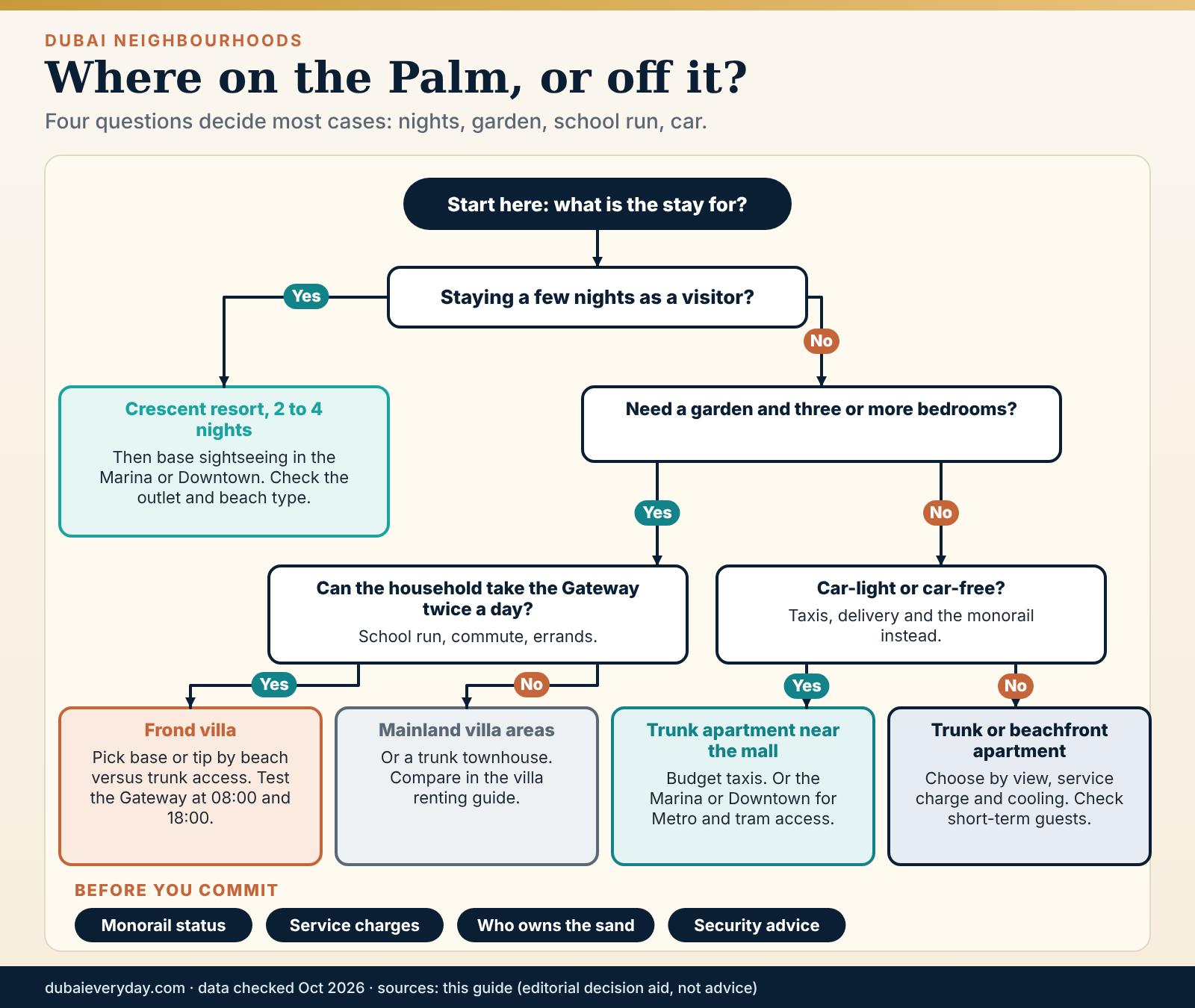
Palm Jumeirah vs the Marina, Downtown, JBR and Dubai Islands
Most readers of a Palm Jumeirah guide are really choosing between the Palm and one or two alternatives. The figures below use the same publisher’s May 2026 average one-bedroom rents (Engel & Völkers, Property Monitor) so that the comparison is like with like, plus the Property Finder asking medians where we have them. They are market averages, not offers.
Dubai Marina and JBR
Next door by distance: about 2.7 km straight-line from the Palm Gateway by our estimate. One-bedroom average AED 97,434 (Marina) and AED 107,774 (JBR). The Marina is walkable and tram-served; the Palm is not. Read the Dubai Marina guide.
Downtown Dubai
About 22 road km away. One-bedroom average AED 120,285, Metro-served, with the Dubai Mall on the doorstep. A better base for sightseers and city workers than the Palm. See the Downtown guide.
Business Bay and JLT
Business Bay averages AED 94,206 for a one-bedroom and JLT AED 82,234, which makes them the value options in this set. JLT has a Metro interchange at DMCC. Neither has a beach.
Dubai Islands
A separate Nakheel development with its own timeline. We did not research it for this page. Check which island a listing means before comparing prices.
Palm Jumeirah vs the Marina in one paragraph
The Marina is where you live if you want to leave the building on foot and reach a tram, a promenade and a beach strip without a car. The Palm is where you live if you want a bigger home, quieter streets, sea in front of the door and are willing to drive or take taxis for everything else.
On the same data the Palm one-bedroom costs roughly 50% more to rent, and sells at about twice the price per square foot. Whether that premium is worth it, in the Palm Jumeirah guide view, depends on whether the lifestyle is yours or the postcode is.
Palm Jumeirah guide comparison with Downtown: visitors and residents differ
For a resident with a city job, Downtown is shorter by half an hour each way at rush hour, and Metro-served. For a visitor, the Palm is a resort stay and Downtown is a sightseeing base. The detail is in the hotel guide, and the cost of living guide puts the rent premium in the context of a monthly budget.
Ten essential checks before you commit
If this Palm Jumeirah guide has to shrink to a list, it is this one: the Palm Jumeirah guide checklist. Use it whether you are booking a week at a resort or signing a twelve-month lease.
- Confirm the monorail on the dayThe operator’s pages disagree with each other and with the press. If your plan needs it, ask the operator the morning you travel.
- Pick a position, not a buildingTrunk, frond base, frond tip or crescent: each is a different lifestyle with a different car dependence.
- Price the taxis and the car honestlyUse the distance table above, then add Salik and parking. A car-light life on the island is possible but not free.
- Know which rent number you are looking atAsking median, signed average and rental-index range are different things. Ask for the Dubai Land Department index result when negotiating.
- Ask for service-charge statementsTwo years of them, with reserve-fund balance and cooling arrangements, before an offer or a lease.
- Check who owns the sandResort, community, club or public. The rules, hours and fees belong to the owner.
- Check the outlet, not the brandAtlantis paused seven restaurants in April; St. Regis was shut until 1 November. Confirm the specific restaurant, pool or club.
- Verify the paperworkLicensed broker, title deed, Ejari, notice periods. The Dubai Land Department publishes tools for all of these.
- Ask about short-term guests and noiseDo it in writing, and visit at the hour that matters to you.
- Re-read the security adviceCheck the UK Foreign Office or your own government’s advice, buy insurance that fits and keep flights flexible.
One-line version. The Palm Jumeirah guide in a sentence: the Palm is a place to choose with your eyes open about the transport, not with your heart set on the view.
Palm Jumeirah guide FAQ
What is Palm Jumeirah and who is it for?
As this Palm Jumeirah guide explains, Palm Jumeirah is a freehold artificial island in Dubai, 560 hectares in size with about 25,000 residents according to Nakheel, divided into a trunk, a crescent and fronds. It suits people who want villas, beachfront apartments or resort stays, and who accept that transport is mainly by car or taxi. It is a poor fit for people who want to walk to a Metro station or who need a short commute without a car.
How do I get to Palm Jumeirah without a car?
The closest car-free route is the Dubai Tram to Palm Jumeirah station, then a short transfer to Palm Gateway monorail station, per Wikipedia. The Metro does not reach the island; Dubai Internet City is the nearest Red Line station. The tram runs 06:00 to 01:00 Monday to Saturday and 09:00 to 01:00 on Sunday, per RTA. Taxis are the other option, and during the monorail closure the press advised RTA’s Hala taxi service.
Is the Palm Monorail running?
It is uncertain. The operator’s homepage on 29 October 2026 said service was suspended until further notice for maintenance, while Khaleej Times reported on 9 July 2026 that services resumed after six months. The ticket and train-times pages showed no suspension notice. Confirm with the operator on the day. When it runs, trains leave every 15 minutes, first train 09:00 and last 21:45 from Gateway, per the operator’s page.
How much does the Palm Monorail cost?
On the operator’s ticket page, single fares are AED 5 between Al Ittihad Park and the mall, AED 10 for most other segments and AED 20 from Gateway to Atlantis Aquaventure, with return fares of AED 10, 15 and 30 respectively. There is a Family Pass at AED 99 and monthly passes for residents. Children under five or under 110 cm are free, and seniors over 60 pay half. Confirm before travelling, as the service status is unclear.
Is Palm Jumeirah a good place to live?
According to this Palm Jumeirah guide, it is a good place for some households and a poor one for others. The upside is space, sea access, resort amenities and a calm setting. The downside is cost, traffic at the island’s entry, few schools and a dependence on cars or taxis. Palm apartment rents and prices fell in 2026 according to published reports, which can help bargaining, but this guide cannot predict the market. The scenarios section shows which profiles fit best.
How much is rent on Palm Jumeirah?
It depends on which measure you use. Property Finder reported median advertised rents of AED 240,000 a year for apartments and AED 1.5 million for villas in Q3 2026. Property Monitor’s May 2026 average for a one-bedroom was AED 146,315. These are market indicators, not offers. Always check the Dubai Land Department’s rental index and the actual lease terms, and see the renting guide.
Can foreigners buy property on Palm Jumeirah?
Bayut’s area guide says the Palm is a freehold area open to all nationalities. Buying involves Dubai Land Department fees, which total 4% of the price, and other costs. The exact rights and process depend on the property and your circumstances, so check the Dubai Land Department’s tools and speak to a licensed professional. The foreign buyer guide explains the steps. This is general information, not legal advice.
Are there free public beaches on Palm Jumeirah?
We could not confirm one. The Dubai Municipality’s beach page lists only Jumeira Beach and Al Mamzar Beach, and most Palm sand belongs to resorts, communities and clubs. Gulf News has described Palm West Beach as a public-style beachfront with dogs allowed on a leash, but we could not read the operator’s page for fees or hours. For free municipal sand nearby, see the free public beaches guide.
How far is Palm Jumeirah from Dubai airport and Downtown?
By our model, about 37 road km to Dubai International and 22 to Downtown, with 40 to 80 minutes to the airport and 25 to 55 to Downtown depending on traffic. Bayut says roughly 30 minutes to the airport, which matches the light-traffic end. A metered taxi baseline is about AED 100 to the airport and AED 65 to Downtown before Salik and surcharges. These are our calculations, not quotes.
When is the best time to visit Palm Jumeirah?
November to March is the comfortable season: daily maximums of about 24 to 31 °C and a sea of 22 to 28 °C according to climate averages. April and October are shoulder months with strong midday sun. June to September brings 39 to 41 °C air and 31 to 33 °C sea, so pools and indoor activities carry the day. Hotel and event demand is highest in the cool season, which is the trade-off.
Is Palm Jumeirah safe?
This Palm Jumeirah guide found no crime statistics for the island and make no claim about them. For wider security, the UK Foreign Office, updated on 27 October 2026, describes the regional situation as deeply unpredictable and urges travellers to prepare for disruption, follow shelter guidance and carry suitable insurance. Wikipedia’s summary reports 2026 incidents in Dubai, including a reported strike on Fairmont The Palm. Check official advice for your nationality before travel.
Should I stay on the Palm or in the Marina?
Choose the Palm for a resort stay centred on a beach and pool, and the Marina or Downtown if you want to explore the city on foot, tram or Metro. On May 2026 data, a Palm one-bedroom rents for roughly 50% more than a Marina one. The Dubai Marina guide sets out the other side, and the best hotels guide covers the stays.
Is the Palm sinking, and is the water clean?
In 2009 the New York Times reported satellite data suggesting a sinking rate of about 5 mm a year; Nakheel said it had no reports of structural problems and questioned the resolution. We found no recent official data. On water, Wikipedia says the original breakwater trapped water until gaps were added, and jellyfish are common in summer. We found no official water-quality data for Palm beaches and make no claim.
Where to go next
This Palm Jumeirah guide is one piece of the Dubai picture, and the links below connect it to the next decisions. Use the links below to move from the island to the decisions around it.
Sources and further reading (29 links)
- Nakheel: Palm Jumeirah community page — size, residents, residential brands, sub-sea tunnel
- Palm Monorail: homepage — stations and the suspension notice
- Palm Monorail: ticket prices — fares, passes and discounts
- Palm Monorail: train times — first and last trains, frequency
- Khaleej Times: Palm Monorail services resume — resumption report and fares
- RTA: Metro and Tram timetables — operating hours
- RTA: Nol fares — zone fares
- RTA: About marine transport — Dubai Ferry and water taxi
- Dubai Municipality: Discover Dubai beaches — beaches listed and fee statement
- Atlantis: Aquaventure Waterpark — hours, attractions, guest access
- The View at The Palm — height, hours, ticket tiers
- UK FCDO: UAE travel advice — security context, insurance, shelter guidance
- Wikipedia: Palm Jumeirah — history, housing sizes, hotels list (secondary)
- Wikipedia: Palm Jumeirah Monorail — opening, length, stations, suspension note (secondary)
- Wikipedia: Dubai Tram — station order and the Palm interchange (secondary)
- Wikipedia: Palm Islands — sand and rock volumes (secondary)
- Wikipedia: Atlantis The Palm — opening date, rooms, aquarium (secondary)
- Wikipedia: UAE in the 2026 Iran war — Dubai and Palm incidents, ceasefire (secondary; latest source May 2026)
- Engel & Völkers: average price per sq ft — Palm, Marina, Downtown prices (secondary)
- Engel & Völkers: average apartment rent — May 2026 averages (secondary; carried from sibling research)
- Arabian Business: Dubai rents Q3 2026 — Property Finder asking medians (secondary)
- Cushman & Wakefield: Dubai residential Q2 2026 — Palm quarterly changes (secondary)
- fäm Properties: September 2026 report — Palm sales value rank (secondary)
- Dubai Land Department: FAQ — service charges, rent rules, Ejari, notice (carried from sibling research)
- Dubai Land Department: property sale registration — fees (carried from sibling research)
- Gulf Business: Dubai hotels undergoing renovation — St. Regis partial closure (secondary)
- Bayut: Palm Jumeirah area guide — schools, clinics, supermarkets, drawbacks (secondary)
- What’s On: Dubai beach clubs open and closed this summer — beach club prices (secondary)
- weather2travel: Dubai climate — monthly temperatures and UV (secondary; rounded)
Update log: 29 October 2026 — first publication; all facts re-checked against the sources above. Next review due: April 2027, or sooner if the monorail status, the St. Regis reopening, hotel openings or the security advice change. Corrections welcome.
This guide is general information based on desk research, not legal, financial, medical, property or travel-safety advice. Check prices, hours and rules with the operator or the official source before you rely on them.
About DubaiEveryday and this guide
DubaiEveryday.com is an independent editorial project that publishes practical, research-based guides to everyday life in Dubai: where to live, what things cost, how the rules work and how to get around. This page was written and edited by the DubaiEveryday editorial team. It is not signed by a named expert, doctor, lawyer or adviser, and we do not claim first-hand testing of a venue, clinic or service unless the page says so.
Each guide is built from official sources such as government and regulator pages, operator websites and established news outlets, cross-checked where we can. When we could not confirm something, we say so in the text, and examples that use made-up numbers are labelled as illustrations. Mentions are editorial choices, not paid placements, and a link is not an endorsement.
Dubai changes quickly. If you spot something that is out of date or wrong, please tell us through the contact options on DubaiEveryday.com and we will check it and correct the page.