
Dubai public transport fares are set by zones crossed, not by distance or vehicle: AED 3, 5 or 7.50 a journey on a Silver nol card. This guide prices the Metro, tram, buses, water transport and taxis, then adds up what a visitor day and a resident month really cost.
You tap in at a Metro gate, ride for twenty minutes, and the screen takes AED 7.50. Your friend rode half as far on the same line and paid AED 3. Neither of you did anything wrong. Dubai public transport fares run on zones, not kilometres, and once you see how the zones work the numbers stop looking random.
This guide prices the whole system in one place: Metro, tram, buses, abras, the water taxi and the taxi you take when the last train has gone. It then turns those fares into daily and monthly spending, so you can set a budget for a long weekend or a year of commuting before you buy a single card. Every number comes from an official page or is labelled as our own arithmetic.
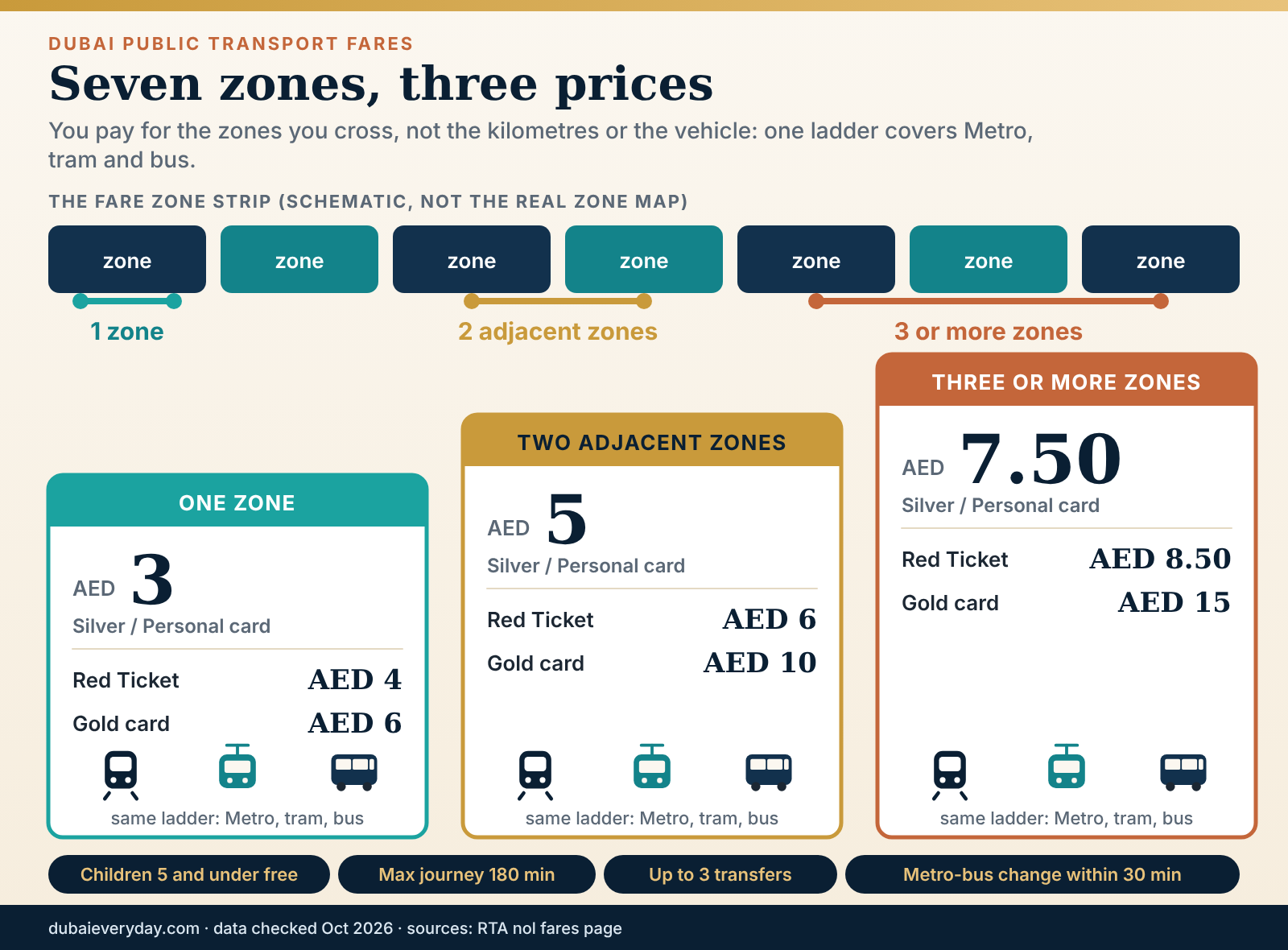
Dubai public transport fares depend on how many zones you cross, not on how far you ride or which vehicle you board. On a Silver nol card a journey costs AED 3 inside one zone, AED 5 across two adjacent zones and AED 7.50 beyond that, on the Metro, the tram and RTA buses alike. Gold cards double those figures, a paper Red Ticket adds AED 1 to each, and children aged five and under travel free.
A Silver card costs AED 25 and comes with AED 19 of credit, so the card itself effectively costs AED 6. You need AED 7.50 on it to start any trip. Creek abras cost AED 1 to 2, the Marina water taxi AED 7 to 21, and a taxi meter starts at AED 5 in the street or AED 9 to 13 by app, plus AED 2.45 a kilometre.
By our calculation, Dubai public transport fares for a sightseeing day of four journeys come to AED 16 to 23 on a Silver card, and a commuter making 44 journeys a month pays at most AED 330, which is why the AED 350 monthly pass only wins from about 47 journeys.
This is a desk-research guide. DubaiEveryday.com has not ridden these services for this page, and nothing here describes a personal journey. The zone-based Dubai public transport fares, passes, concessions, transfer rules and card prices come from the Roads and Transport Authority (RTA) fare and nol pages. Marine fares and public-transport hours come from the RTA marine and timetable pages. Taxi rates come from the Dubai Taxi tariff page. Ridership comes from a Dubai Media Office release.
Intercity and Hatta bus fares, the reported daily cap, the day pass and the Salik and fuel numbers came from secondary sources (dubizzle, Property Finder, Khaleej Times, Gulf News) and are labelled as reported each time. The RTA zone map is a graphic, so we could not list which station sits in which zone. Sums marked “our calculation” are arithmetic on those inputs, and scenarios marked “illustrative” are not quotes or market facts. No link is paid or affiliate, and this is general information, not individual travel advice. Confirm Dubai public transport fares in the RTA app before you travel.
Dubai public transport fares at a glance
The headline is simple, and it has been simple for years: Dubai public transport fares are a three-step ladder. The RTA fare page, read on 29 October 2026, shows the same ladder of Dubai public transport fares for the Metro, the tram and the bus. It does not print a separate bus price or tram price at all. Where people get surprised by Dubai public transport fares is everything around the ladder: the card you carry, the minimum balance, the transfer clock and the modes that sit outside it.
Scale explains why this matters. According to a Dubai Media Office release on 2025 ridership, the Metro carried 294.7 million journeys, public buses 197.2 million, the tram 9.9 million and marine transport 18.4 million, with taxis at 209 million. A system that busy does not negotiate Dubai public transport fares at the gate, so the rules below apply to everyone equally, tourist or resident.
The Dubai public transport fares cheat sheet
Use this as the one-screen summary, then read the sections that match your trip. Everything in the “Source” column marked RTA or operator was read on the official page; “reported” means a secondary source.
| Mode | Fare (AED) | Pay with | Source |
|---|---|---|---|
| Metro, tram, city bus (Silver) | 3 / 5 / 7.50 by zones | Nol card | RTA fare page |
| Metro, tram, city bus (Red Ticket) | 4 / 6 / 8.50 | Paper ticket, AED 2 | RTA fare page |
| Metro and tram, Gold | 6 / 10 / 15 | Gold nol card | RTA fare page |
| Creek abra, motorised | 1 per trip | Cash | RTA marine page |
| Creek abra, petrol heritage; air-conditioned abra | 2 per trip | Not stated | RTA marine page |
| Marina water taxi | 7 per segment, up to 21 | Not stated | RTA marine page |
| Taxi, street hail | 5 start (5.50 at night) plus 2.45 per km, minimum 12 | Cash, card, nol | Dubai Taxi |
| Intercity bus | about 10 to 25 by destination | Nol card | Reported (dubizzle) |
One caveat before the detail. The RTA publishes its zone map as a graphic, and we could not turn it into a reliable station-to-station price list. So this page never claims that a named pair of stations costs AED 3 or AED 5. It gives you the ladder, the logic and the budgets, and tells you where to get the exact tier for your own route.
What this page covers, and what it leaves to others
This page prices journeys and builds budgets from Dubai public transport fares. The mechanics of the card itself (types, top-up channels, balance checks, the pending-top-up trap) sit in the nol card guide. Lines, stations, interchanges and the first-ride routine are in the Dubai Metro guide, and station-by-station detail is in the Red Line and Green Line guides. Here you get the money.
How Dubai public transport fares are calculated
The RTA fare page is headed with a seven-zone message, and the fare you pay is a function of one thing: how many of those zones your journey touches. Distance inside a zone is free. Crossing a boundary is what costs. That is why a long ride along one corridor can be cheaper than a short hop that crosses two boundaries, and why the fare printed on a gate screen can feel arbitrary until you think in zones.
The three tiers of Dubai public transport fares
The page defines three tiers: one zone, two adjacent zones, and more than two zones. Reading the tiers literally, you reach the top fare as soon as your journey touches a third zone, which means the top tier is the price of most cross-city rides. With seven zones in total, the top tier covers everything from a three-zone hop to a trip across the whole city, which is the single most useful fact for budgeting: the maximum Silver fare for any one journey is AED 7.50.
Who pays which column of Dubai public transport fares
The RTA lists five columns of Dubai public transport fares. Silver and the Personal card (still called “blue” in older articles) charge the same: AED 3, 5 and 7.50. A regular Red Ticket charges AED 4, 6 and 8.50, and a Gold Red Ticket AED 8, 12 and 17. Gold cards pay AED 6, 10 and 15. Two discounts sit on top. Students, social-affairs cases and senior Emiratis and citizens pay half on the Personal card, and people of determination ride free. Children aged five and under are free on every card and ticket.
Notice what is missing: there is no visitor discount, no child fare for ages six and up, and no off-peak fare on that page. A family with a seven-year-old and a ten-year-old pays four full fares. In short, Dubai public transport fares are a flat-fare-by-zone system with a short list of concessions, and the concessions are tied to a registered Personal card, not to a tourist status.
The transfer clock
Three rules decide whether two legs count as one journey. A journey can last up to 180 minutes. It can include up to three transfers. And a change between Metro and bus has to happen within 30 minutes. If you check out of a Metro station and board a bus inside that window, the system adds the zones of both legs and charges one fare for the combined trip. Linger over a coffee and the second leg starts a new journey with a new charge.
Our reading of the fare page is that the 30-minute rule is written for Metro and bus changes specifically. It does not say the same window applies to the tram, so if your plan chains the Metro and tram, treat any change as a possible second charge and check the balance after you exit. The Gold surcharge is also only applied once per zone when you move between tram and Metro, according to the RTA.
How to find your tier in Dubai public transport fares
Three steps get you a reliable answer without a zone map in your head.
- Plan the trip in an RTA channelThe RTA journey planner (and its app) shows the route and is the official place for the fare. Treat any third-party fare calculator as a guess.
- Count your legs and your gapsMetro to bus inside 30 minutes is one journey. Anything longer is two, and each pays its own fare.
- Assume the top tier for cross-city plansIf your journey runs between two far corners of the network, budget AED 7.50. Budget AED 3 only for a short hop you know stays in one zone.
The tier you land in is rarely the interesting part of your Dubai public transport fares bill. The interesting part is how the cheap tier and the minimum balance interact, which comes up again in the section on cards.
Metro and tram fares, and what Gold changes
On the Metro and the tram, Dubai public transport fares follow the zone ladder exactly. The RTA fare page lists no tram-specific price, so a tram ride is priced like any other journey by the zones it crosses. That has one awkward consequence: a single tram stop is not cheaper than three. Whatever you ride, the first AED 3 buys the shortest trip the system sells, and a tap-in costs you the same whether you stay on for one stop or ten inside the same zone.
Hours decide the last fare of the day
Dubai public transport fares are the same all day, but the clock still shapes your spending. The RTA timetable page gives Metro station opening hours of 05:00 to midnight Monday to Thursday and on Saturday, 05:00 to 01:00 on Friday, and 08:00 to midnight on Sunday. Tram stations open 06:00 to 01:00 Monday to Saturday and 09:00 to 01:00 on Sunday. Those are station opening hours, not last-departure times, so leave a margin.
The practical point for the budget is simple. After the Metro closes, the cheapest remaining option is usually a night bus or a taxi, and a taxi is the most expensive way to finish a night out. If your evening runs past midnight on any day except Friday, the tier you save on the way there can be spent several times over on the way back. The Dubai Metro guide covers the timing detail line by line.
What Gold actually buys
A Gold card costs the same AED 25 as Silver and carries the same AED 19 of credit. The difference is the fare. On the Metro and tram, Gold passengers pay AED 6, 10 or 15 per journey instead of 3, 5 or 7.50, and in return they can use the Gold cabin on the Metro and tram. The RTA says the Gold surcharge applies on the Metro and tram only, not on buses, and that it is not charged twice for the same zone when you change between tram and Metro.
Our calculation shows what that premium means in a day. Four top-tier journeys cost AED 30 on Silver and AED 60 on Gold, so the cabin costs an extra AED 30 for the day. For a solo traveller on a long cross-city route in the evening rush, some people will think that is fair. For a family of four it is AED 120 more for the same trip. Gold is a comfort purchase, not a time saver, and it does not make the train faster.
Metro and tram together
The two networks meet at SOBHA Realty and DMCC, according to the RTA timetable page, which is how most Marina and JBR journeys connect to the Red Line. The fare logic is the same: zones touched across both legs. The transfer window of 30 minutes is written for Metro and bus, so treat a Metro-to-tram change as something to verify on your balance rather than assume. If you stay in the Marina area, the beach routes show how often that interchange matters for a day by the sea.
For airport trips, Dubai public transport fares do not change either. Dubai Airports lists Metro service at Terminals 1 and 3. The ride is priced by zones like any other journey, so a long airport run to the far side of the city sits in the top tier. We cannot name the exact tier for a given hotel, and the honest budgeting figure is AED 7.50 each way per adult.
Bus fares: city, night, Hatta and intercity
Buses are the second-busiest public mode in the city: the Dubai Media Office counted 197.2 million bus journeys in 2025, against the Metro’s 294.7 million. The key fact about Dubai public transport fares on city buses is that there is no separate bus tariff. The RTA fare page puts buses under the same zone fares, and a dubizzle guide updated in 2026 repeats the same table for Silver, Gold, Personal and Red Ticket, adding that Gold surcharges apply to the Metro and tram only, not buses.
City buses and Dubai public transport fares on the zone ladder
So a city bus within one zone costs AED 3 on Silver, two adjacent zones AED 5, and a longer ride AED 7.50. What a Gold card pays on a bus is unclear. The RTA says the Gold surcharge applies on the Metro and tram only, yet its table lists Gold at AED 6, 10 and 15 without naming a mode, and the dubizzle bus table repeats those figures for buses. Since the pages disagree in spirit, carry a Silver card for bus-heavy days and keep Gold for the Metro cabin.
Dubai Bus runs from 04:00 to 01:00 the next day, according to the RTA timetable page, and the page says route C01 will run 24 hours. Feeder buses are reported to run during Metro hours. Hatta routes have their own schedule: the H02 express from Dubai Mall runs 07:00 to 19:00, every two hours, and the H04 hop-on hop-off runs 07:00 to 21:00, every 30 minutes.
The RTA fare section says bus fares are paid by nol card, but one 2026 explainer’s FAQ says you can pay in cash or by card. Those statements conflict, and the RTA pages we could read do not settle it. Plan on a nol card and a balance above AED 7.50 for every bus trip, and treat cash as a bonus if it works, not a plan.
Hatta and the on-demand service
Two products sit outside the plain zone version of Dubai public transport fares. A dubizzle guide reports the Hatta H02 express at AED 25 per rider per journey and the H04 hop-on hop-off at AED 2 per rider per stop. The RTA timetable page confirms the routes and hours but prints no price, so treat those two fares as reported and confirm them in the RTA app. For a Hatta day trip, a return on the H02 would be AED 50 per person on that figure, our arithmetic, which is still cheaper than most private hires but far from free.
The same guide mentions a Bus On-Demand service at AED 5 a trip plus AED 4 for each extra passenger, and it flags that figure as unverified itself. We could not confirm it on an RTA page, so we do not build any budget on it. If you do try on-demand, check the price shown in the app before you confirm the booking.
Night buses and cross-border services
The same secondary source lists two night routes, N30 from International City to Terminal 2 and N55 from Al Ghubaiba to Al Maktoum Airport, running 21:00 to 05:00. We could not confirm either route on an RTA page, so check the route and time in the RTA app before relying on one for a late flight.
Intercity buses: Dubai public transport fares by destination
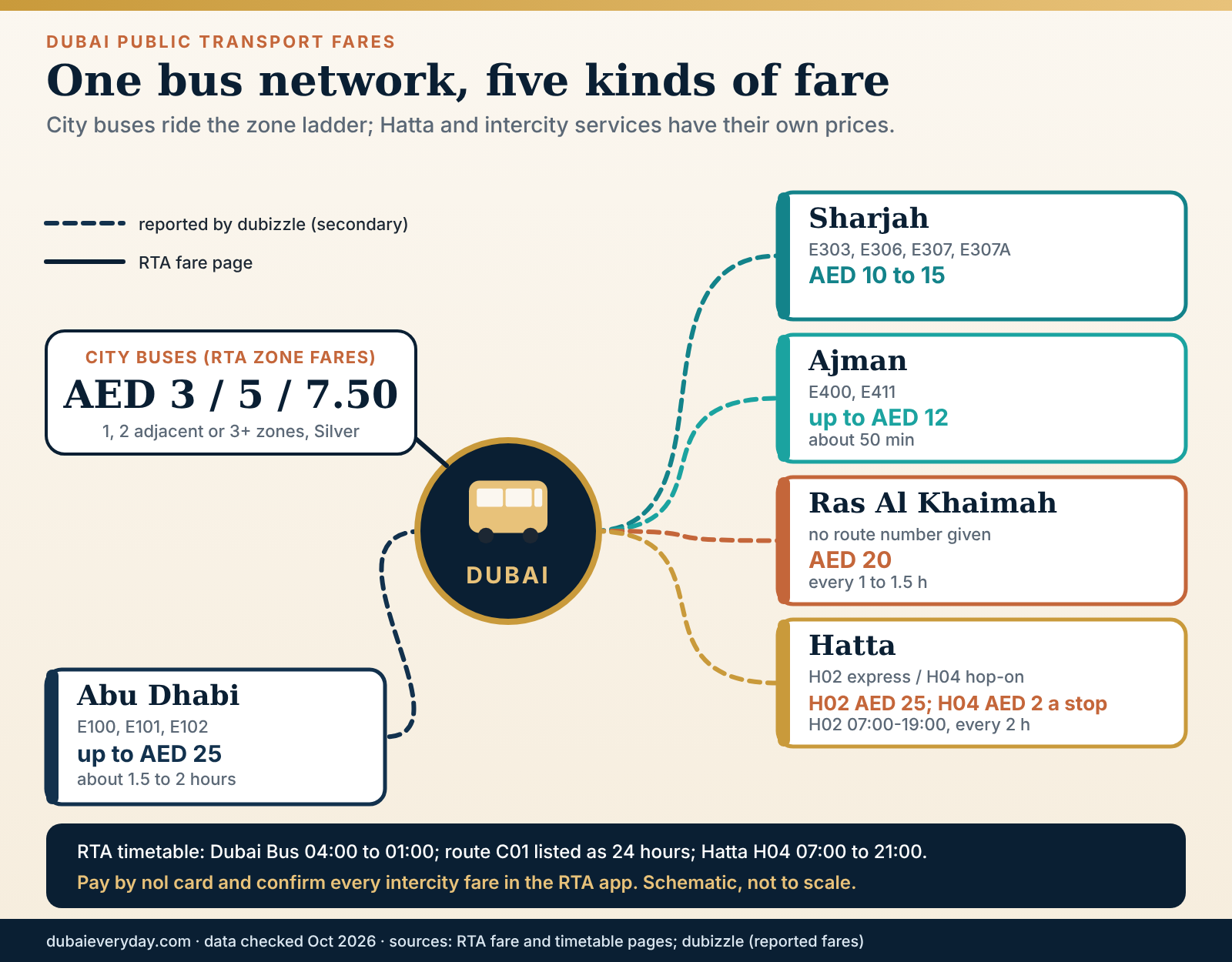
Intercity services leave the zone system. A dubizzle explainer on inter-emirate buses, last modified in March 2026, reports these one-way fares, all paid by nol card for Dubai departures.
Sharjah
Reported AED 10 to 15 on routes E303, E306, E307 and E307A. The RTA bus list names E303 as Union Square to Al Jubail Bus Station and E307 as Deira City Centre to the same station.
Ajman
Reported at up to AED 12 on E400 and E411, about 50 minutes, daily. E400 runs from Union Square to Ajman Bus Station.
Abu Dhabi
Reported at up to AED 25 on E100, E101 and E102, with a journey of roughly 1.5 to 2 hours. E100 leaves Al Ghubaiba, E101 and E102 leave Ibn Battuta.
Ras Al Khaimah
Reported at AED 20, with departures about every one to one and a half hours. The source does not say how you pay.
These are secondary figures. The RTA bus list we could read prints the routes but not the fares, and the source article was first published in 2021, so a price could have moved. For the same journey, Dubai Taxi adds a fixed AED 20 on top of the meter when a taxi enters Sharjah, which is worth remembering when you compare a bus fare of AED 10 to 15 with a cab. Weekly and monthly drivers who cross emirates regularly should also read our weekly car rental guide before deciding.
Abra, water taxi and ferry fares
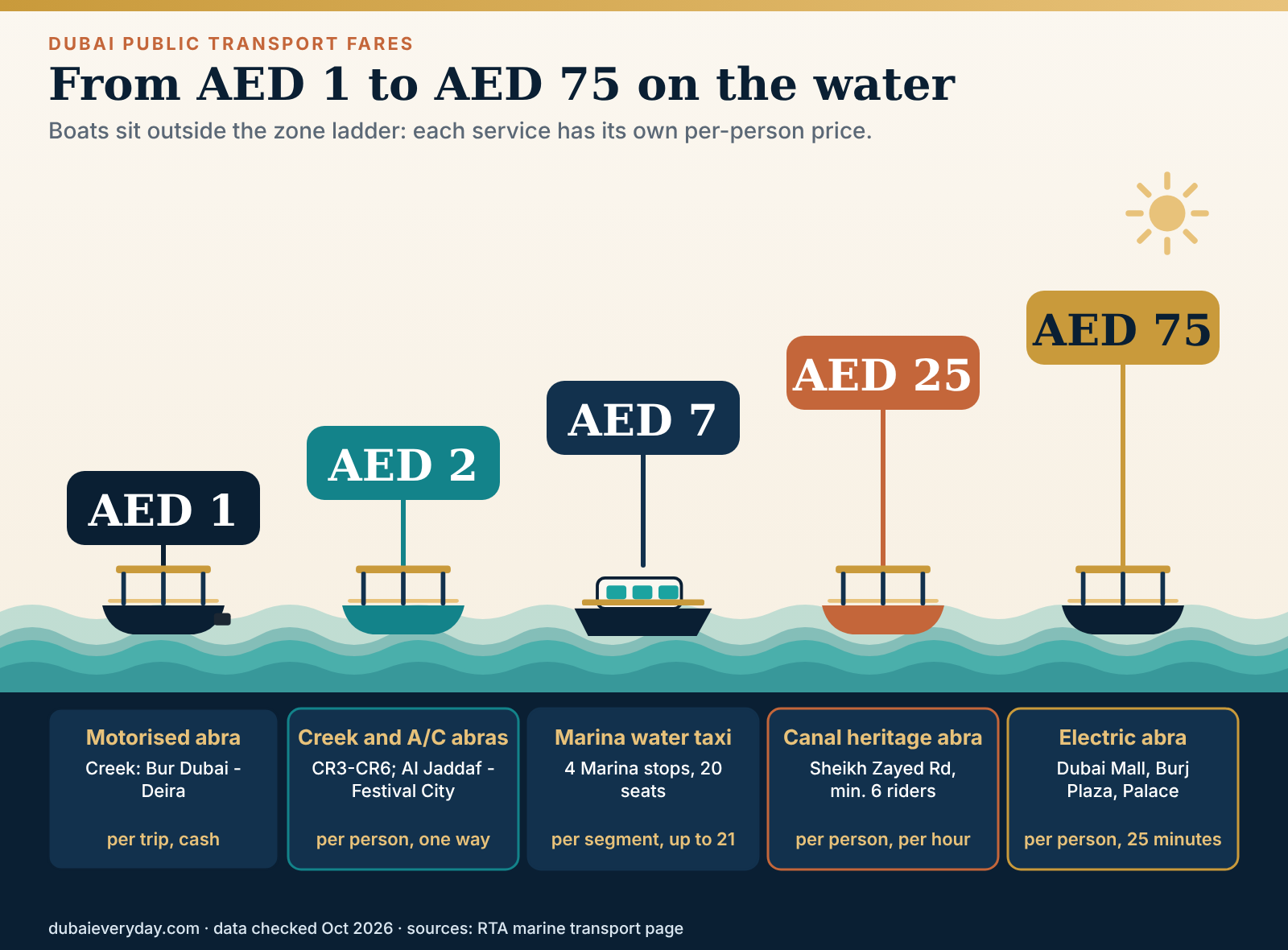
Water transport sits outside the zone ladder of Dubai public transport fares, and it is where the lowest fare in Dubai lives. The RTA marine page prices the motorised traditional abra between Bur Dubai and Deira Old Souq, and between Dubai Old Souq and Al Sabkha, at AED 1 per passenger per trip, and states that fare as a cash payment. Marine services carried 18.4 million journeys in 2025, according to the Dubai Media Office, so this is not a tourist curiosity only.
Creek crossings and canal rides
The petrol heritage abras on the Creek cost AED 2 on the four listed routes (CR3 to CR6), such as Dubai Old Souq to Baniyas or Al Seef to Baniyas. The air-conditioned abra between Al Jaddaf Marine Station and Dubai Festival City (route BM2) is also AED 2 per person each way, and the RTA says nol cards can be bought at those air-conditioned stations.
On the Dubai Water Canal, the page lists AED 2 per stop on some petrol abra routes and AED 25 per person for the hour-long heritage ride from Sheikh Zayed Road Marine Station, with a minimum of six passengers.
The honest pricing note is that “AED 1” and “AED 2” are per person, per crossing. A family of four crossing the Creek and back on motorised abras pays AED 8. On the petrol heritage boats the same return is AED 16, about the price of two top-tier Metro fares. Per person, a Creek crossing costs less than the cheapest Metro journey, which is why it is the best value among Dubai public transport fares.
The Marina water taxi and the ferry
The Dubai Water Taxi runs between four Marina stops: Marina Terrace, Marina Walk, Dubai Marina Mall and Marina Promenade. The fare is AED 7 per segment, and the full route from Marina Promenade to Marina Terrace costs between AED 7 and AED 21 depending on how many stops you cross. The BM3 service from Marina Mall South to Bluewaters is also AED 7. It seats 20 and is air-conditioned. For one adult, a three-segment ride at AED 21 costs more than the longest Silver Metro fare, our comparison, so it is a scenic choice rather than a cheap one.
The Dubai Ferry is the gap in our data. The RTA marine page describes six routes, one of them intercity, and says the boat seats up to 98 passengers, but it prints no fare and refers readers to a timetable page. We therefore give no ferry price. Check the RTA marine booking channel on the day.
Electric abras and charter
The most expensive listed ride is the electric traditional abra at Dubai Mall, Burj Plaza and The Palace, and at Global Village. The RTA page lists AED 75 per person for a 25-minute ride and AED 52.50 to book the whole abra per trip of 12 to 15 minutes. That second figure looks low next to the first, so confirm at the ticket office how the price is counted before you commit. A motorised abra can also be chartered for AED 120 an hour, and a canal heritage abra for AED 300 an hour.
Two rules matter for families. Unaccompanied children under 12 may not use the marine modes, and children under 12 travelling with an adult must wear a life jacket. Carry a few AED 1 coins as well as your card, because the motorised abra fare is stated as cash and we cannot confirm that every landing has a working reader.
The Palm Monorail
The Palm Jumeirah Monorail is run by Nakheel, not by the RTA, and its official site lists four stations: Palm Gateway, Al Ittihad Park, Palm Jumeirah Mall and Atlantis Aquaventure. On 29 October 2026 the site carried a notice that the service was temporarily suspended until further notice for maintenance, and its ticket prices sit on a separate page that we could not read. We therefore give no monorail fare and no budget line for it. Check the operator before planning a Palm day around it.
Nol cards and passes: when each pays off
Every one of the Dubai public transport fares above gets paid through a card or ticket, and the choice of card changes your cost more than the mode does. This section looks only at the price effect. Types, top-up channels and balance checks are in the nol card guide.
What the card itself adds to Dubai public transport fares
The RTA “choose your nol card” page lists four cards. A Red Ticket costs AED 2, can be loaded with up to 10 journeys or 5 daily passes, and lasts 90 days or 10 trips. Silver and Gold cost AED 25 each, include AED 19 of credit, and last five years. The Personal card costs AED 70 with AED 20 of credit, and is the one that carries concessions and balance recovery. Anonymous Silver and Gold hold up to AED 1,000, registered ones up to AED 5,000.
Our reading of the numbers: a Silver or Gold card effectively costs AED 6, because AED 19 of the AED 25 is spendable. The RTA does not itemise that AED 6, so treat it as arithmetic. A Personal card effectively costs AED 50. For a visitor, the AED 6 is a one-off entry fee on a card that works for the whole stay and for any later trip within five years.
The AED 7.50 floor
The RTA nol page requires AED 7.50 on the card to check in, whatever the real fare. A card that finishes a one-zone ride at AED 4.50 cannot start the next trip, though the money is still yours. In practice each card carries a float of up to AED 7.49 that you cannot spend on fares. For one adult it is a nuisance. For four cards it is up to roughly AED 30 sitting idle, our calculation, which is a large share of a family’s daily fare bill.
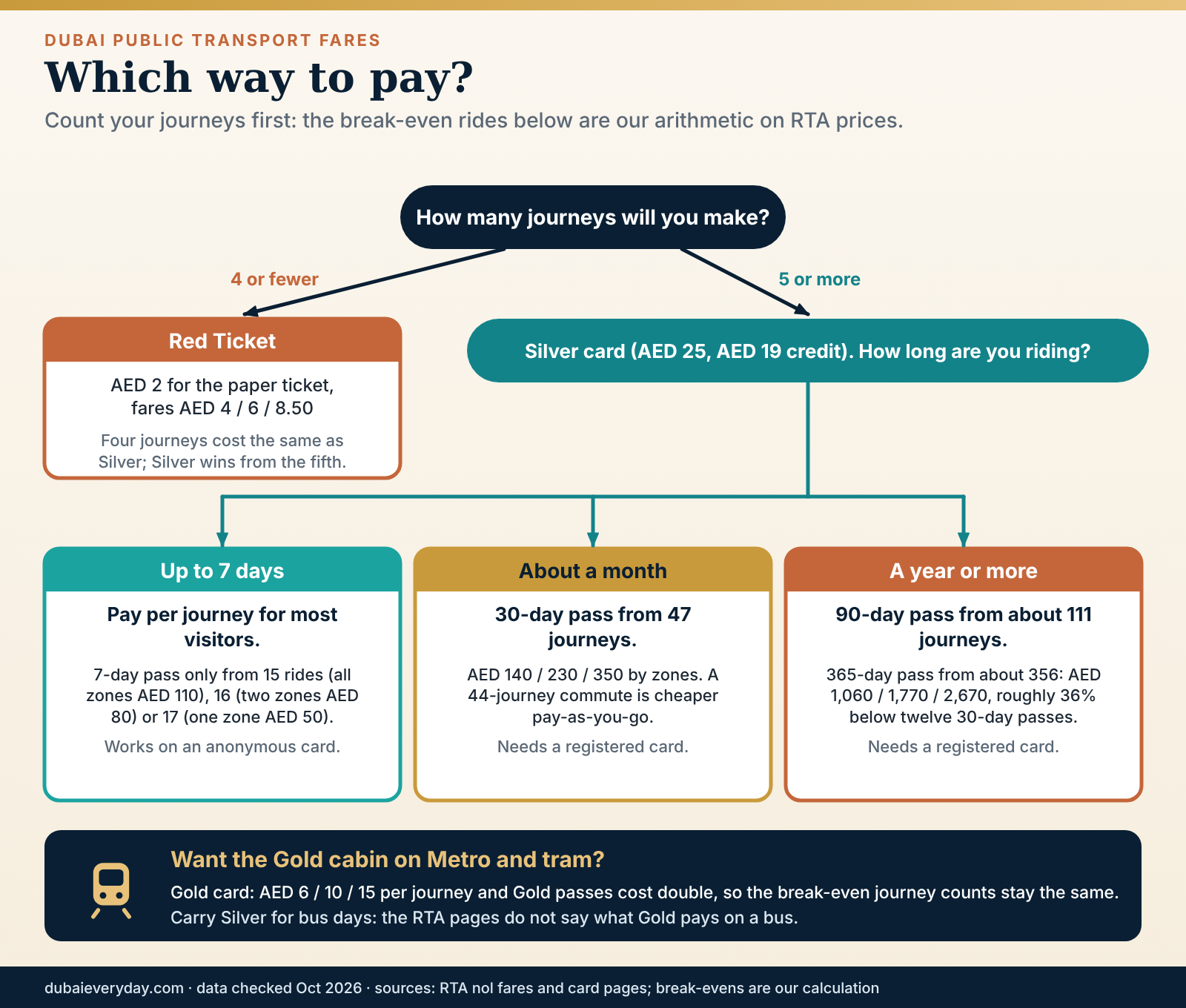
Red Ticket or Silver: the fifth-journey rule
Compare the two on arithmetic. A Red Ticket costs AED 2 and charges AED 1 more per journey than Silver in every tier. Silver nets AED 6 for the card and saves AED 1 per journey. Over four journeys the two cost exactly the same, so Silver is cheaper from the fifth. At AED 3-tier fares, four journeys cost AED 18 on either. A Red Ticket also works on one mode at a time and cannot be reloaded, so it only wins for a very short stay with very little riding.
Passes: the break-even ladder
The RTA sells time passes, which prepay Dubai public transport fares, loaded onto Silver or Gold cards and priced by how many zones they cover. Silver prices are below. Gold passes cost exactly double, and student and senior passes half, according to the fare page.
7 days
AED 50 for one zone, AED 80 for two, AED 110 for all zones. Our break-even: 15 journeys at AED 7.50, 16 at AED 5, 17 at AED 3. Anonymous cards can hold this pass.
30 days
AED 140, 230 and 350. Break-even: 47 journeys at AED 3, 46 at AED 5, 47 at AED 7.50. Needs a registered card.
90 days
AED 330, 550 and 830. Break-even about 110 to 111 journeys, roughly 1.2 a day. Needs a registered card.
365 days
AED 1,060, 1,770 and 2,670. Break-even 354 to 356 journeys, about one a day. Needs a registered card.
The pattern is consistent: the longer the pass, the fewer rides per day justify it. A seven-day visitor making two journeys a day makes 14 and just misses the pass. The page does not say whether a pass clock starts at purchase or at first use, so confirm that before you load one for a short stay.
One-day products and the cap question
The only dated day-pass price we could confirm is tied to Etihad Rail. Khaleej Times reported on 29 September 2026 a nol One-Day Pass at AED 22 per passenger, or AED 42 for the Gold version, covering unlimited eligible Metro, tram and RTA bus journeys within the applicable zones on one day.
The report says it can be bought with an Etihad Rail booking or through the RTA’s nol Pay and S’hail channels, and it does not say whether you need a train ticket. By our arithmetic it beats a Silver card when you make 3 top-tier journeys, 5 mid-tier ones or 8 one-zone hops in the day. The RTA’s own Red Ticket page mentions “daily passes” without a price.
Property Finder reports that Silver cards “typically” stop charging at AED 14 a day. The RTA fare page we read mentions no cap or day pass at all, and the AED 22 One-Day Pass would make little sense if a free AED 14 ceiling applied to everyone. Our reading is that the cap is unproven. Budget with ordinary per-journey Dubai public transport fares, and treat any saving as a bonus you can verify on your own balance.
Taxi against public transport
Taxis are not part of the RTA zone system, but every honest comparison of Dubai public transport fares ends up here, because the taxi is what you take when the Metro does not fit. The Dubai Taxi tariff page, read on 29 October 2026, gives the pieces of a metered fare.
How the meter is built
A red-roof taxi hailed in the street starts at AED 5 between 06:00 and 22:00 and AED 5.50 overnight.
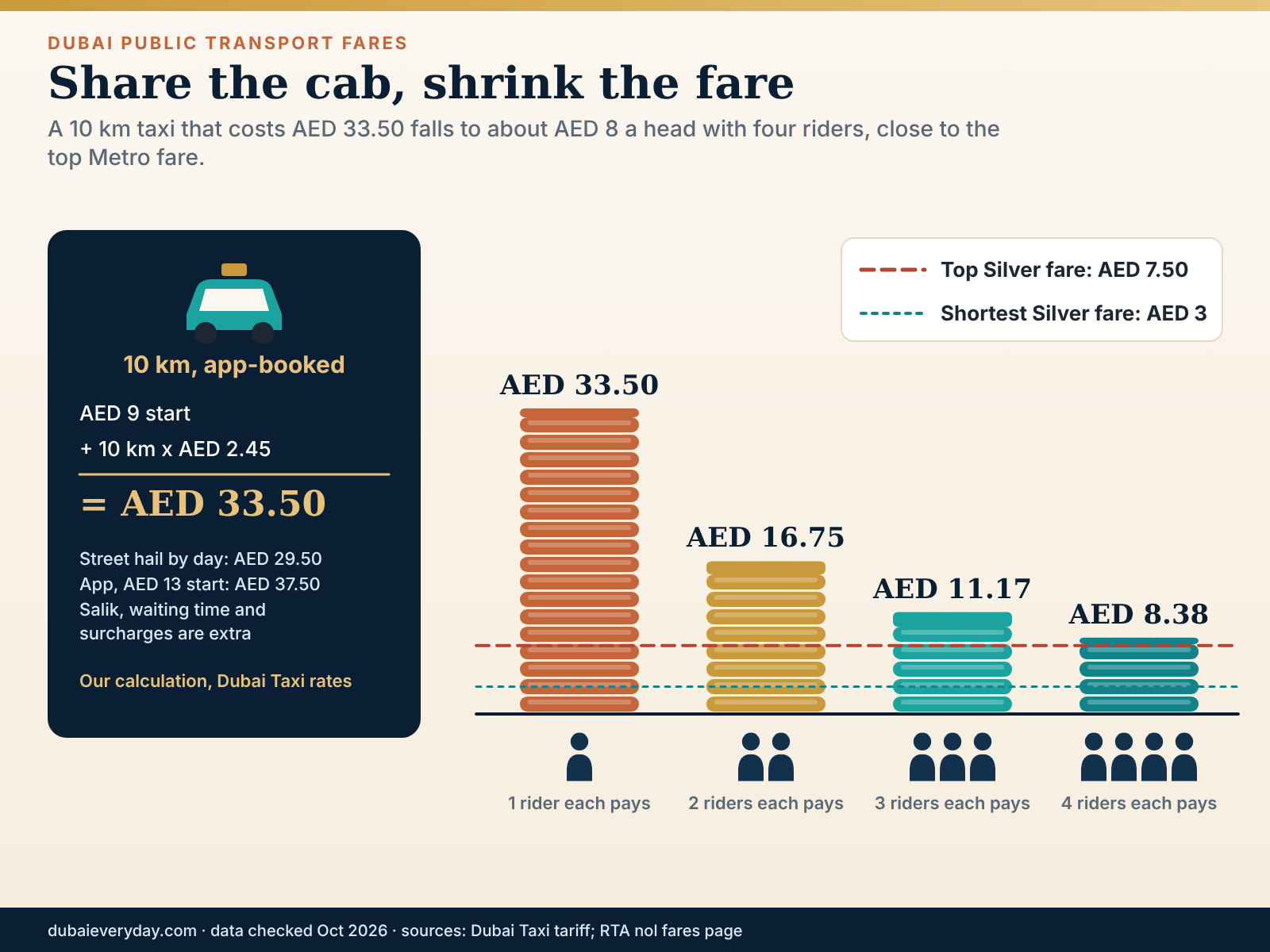
Booked through an app (the page names Bolt, S’hail and Careem), the start fare is AED 9 or 13 on weekdays depending on the time band, and AED 10 overnight. On weekdays the page shows AED 13 in the 08:00 to 10:00 and 16:00 to 20:00 windows and AED 9 in between. The distance rate is AED 2.45 per kilometre for both, waiting costs AED 0.50 a minute, and the minimum is AED 12 on the street or AED 13 for an e-hail.
Extras are where budgets leak. Salik gate charges are added, but the page gives no amount. Entering Sharjah adds AED 20. Peak, event and New Year’s Eve surcharges can apply without a stated figure. Payment can be cash, card, Apple Pay, Samsung Pay, Alipay QR or a nol card. At Dubai International Airport the start fare is AED 25, according to Dubai Airports, a far higher start than anything else on the tariff.
Three trips priced
These are our calculation for three illustrative distances, using the Dubai Taxi rates above. They exclude Salik, waiting time and any surcharge, so real metered fares in traffic will run higher.
| Distance | Street hail, daytime | App, AED 9 start | App, AED 13 start |
|---|---|---|---|
| 5 km | AED 17.25 | AED 21.25 | AED 25.25 |
| 10 km | AED 29.50 | AED 33.50 | AED 37.50 |
| 20 km | AED 54.00 | AED 58.00 | AED 62.00 |
Set that against the top Silver fare of AED 7.50. A solo traveller on a 10 km cross-town trip pays about four to five times as much in a cab. The gap closes only with company. Divide a 10 km app fare of AED 33.50 by four and each person pays AED 8.38, within a dirham of the top Metro fare, before Salik and before the walk at either end.
When the taxi wins
Four situations favour the cab on cost or sense. The first is a group of three or four on a long route, where the split fare nears a Metro ticket. The second is luggage on a trip that would need two changes. The third is any hour after the stations close. The fourth is the last stretch from a station in July, when a 15-minute walk on hot pavement costs more than the AED 12 minimum fare buys back in comfort. The Dubai travel guide covers how to sequence arrival day.
The cab loses when the trip is solo, the route runs along a Metro line, and the trip falls in a peak window when the AED 13 start fare and traffic stack. The better habit is a hybrid: take the train for the long leg and pay the minimum fare for the short one. We did not price Uber-style premium vehicles or surge pricing, because the sources we could read did not publish them.
What a visitor day costs
Dubai public transport fares become useful when they become a number you can put in a trip budget. The tier of any particular ride depends on zones we could not map, so we price days by tier mix instead of by station name. Every figure below is an illustrative scenario built from Silver-card Dubai public transport fares. They are not quotes, and your own day will land somewhere in the range.
Three day types
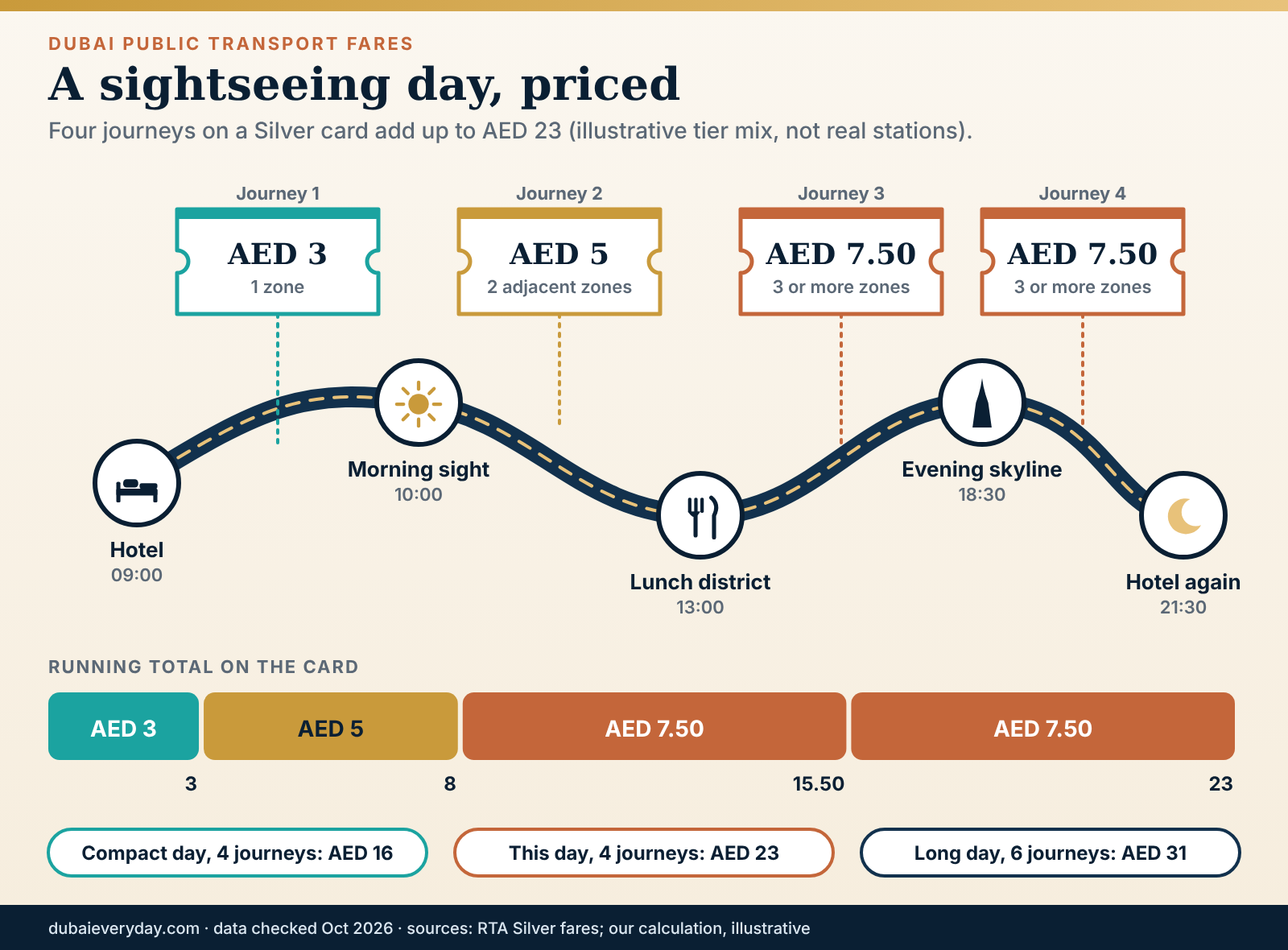
Compact day: AED 16
Four journeys: two short hops at AED 3 and two mid-range rides at AED 5. Typical when your hotel is on a Metro line and you stay in one or two districts.
Sightseeing day: AED 23
Four journeys: one at AED 3, one at AED 5 and two at AED 7.50. Typical for a hotel-to-attraction-and-back day with one cross-city leg each way.
Long cross-city day: AED 31
Six journeys: two at each tier, covering AED 6, 10 and 15. Typical when you split a day between Old Dubai, a beach and the evening skyline.
Add water if you take it. A motorised abra return across the Creek is AED 2 per person. For the stay, pay AED 6 once for the card itself (the AED 25 price minus the AED 19 credit), as calculated earlier. If you are planning a route around the Downtown area and the sights in the things to do guide, count each one-way trip as a journey in these days.
A five-day stay, priced
Take a five-day stay of one compact day, three sightseeing days and one long day. That is 22 journeys. Dubai public transport fares for the stay total AED 116 (16 plus 3 times 23 plus 31), and with the AED 6 card the bill is AED 122, or about USD 33 at the fixed peg of 3.6725 dirhams. That averages AED 5.27 a journey.
Now test the alternative. An all-zones seven-day pass costs AED 110, and with the same card AED 116 in total. It saves AED 6 on this itinerary, by our arithmetic. With a pass the break-even is 21 journeys at that average fare, and you have 22, so the win is real but small. It is not worth the risk of an unclear pass clock. Pay per journey unless the trip is a full seven days with a heavy schedule.
A family of four
Now add two children aged seven and ten, who pay full fare. A sightseeing day for four is 4 times AED 23, or AED 92. The cards for the family cost AED 24 in total. The same four journeys by taxi, with one cab for the whole family at 10 km each, come to roughly AED 118 to 150, so the family saves AED 26 to 58 a day on the train, in our estimate, and loses some flexibility. For children aged five and under the cost falls away, because they ride free on every card.
A hotel next to a station removes the largest hidden cost, which is the short taxi to the train. Our hotel area guide explains how location changes your daily transport bill. Beach days follow the same logic, as the beach guide shows: pick sand that sits near a station or tram stop.
Dubai public transport fares for residents: the monthly maths
For residents, Dubai public transport fares are a monthly line item, and the pass question matters because the stakes repeat for twelve months. Start with the base case: a commuter making two journeys on each of 22 working days, which is 44 journeys.
Pay per journey or buy the 30-day pass
At the three Silver tiers, 44 journeys cost AED 132, AED 220 or AED 330 a month. The matching 30-day passes cost AED 140, 230 and 350. So at 44 journeys, paying per journey is cheaper in every tier, by AED 8, AED 10 and AED 20. The pass starts to win at 46 to 47 journeys. Add eight weekend journeys to reach 52, and the top tier costs AED 390 paid journey by journey against AED 350 for the pass, a saving of AED 40.
The decision rule is therefore about weekends. If you only use public transport to commute, pay as you go. If you use it at weekends, for the gym or for shopping, the pass pays for itself. Nothing in Dubai public transport fares rewards a short commute with an early-bird discount, and no part of the RTA page we read offers a reduced rate for frequent riders.
The annual pass
The 365-day pass is where the real money is. The RTA prices it at AED 1,060, 1,770 and 2,670. Twelve 30-day passes would cost AED 1,680, 2,760 and 4,200, so the annual pass saves AED 620, 990 and 1,530, or roughly 36 to 37 percent, our calculation. Against pay-per-journey at 44 journeys a month (528 a year) the saving is AED 524, AED 870 and AED 1,290.
At a steady 44 journeys a month, you break even on the annual pass after about eight months, when the running count passes 354 to 356 journeys. The risks are specific. You pay up front, it requires a registered card, and we did not read an RTA refund rule for a pass you stop using. If your job or home might change within eight months, the 90-day pass is the safer middle step.
Driving against Dubai public transport fares, for scale
Residents often weigh a car against Dubai public transport fares. Here is an illustrative commute, not a market fact: 15 km each way, a car using 9 litres per 100 km, and fuel at the October 2026 Special 95 price of AED 4.28 a litre reported by Khaleej Times. That is 30 km a day, 2.7 litres, about AED 11.56 of fuel. Add two Salik crossings at the AED 6.30 peak rate reported by Gulf News, AED 12.60. The daily running cost is about AED 24, or about AED 531 over 22 days, before parking, insurance, servicing or depreciation.
Compare that with AED 330 for the top-tier Metro commute. Even with free parking at work, the running cost alone is about AED 200 above the Metro figure. Paid parking at the reported Parkin rate of AED 4.20 an hour, for eight hours (AED 33.60 a day), adds about AED 739 a month. For longer-term needs, the monthly car rental guide and the cheap car rental guide show the other fees that add up, and the driving licence guide covers what you need first.
A realistic hybrid
Most residents blend. A Silver commuter at the top tier pays AED 330 for 44 journeys. Add four late-night app taxis at roughly AED 35 each, an assumption on our part, and the month is about AED 470. That is below the driving running cost above and leaves the car, its insurance and its parking out of the picture entirely. The point is not that one mode is best, but that Dubai public transport fares give you a cap you can plan around, where a taxi budget has none.
Mistakes that quietly raise your fare
Most overspending on Dubai public transport fares comes from small structural habits, not from big decisions. These are the ones the rules of Dubai public transport fares make easy to fall into, with the arithmetic that shows why.
- Thinking distance sets the price. A long ride within one zone costs AED 3, while a short hop that crosses two boundaries costs AED 5.
- Letting the balance drift below AED 7.50. The gate refuses entry, you queue at a machine, and the leftover AED 4.50 or so remains stranded until you top up.
- Buying a Red Ticket for a stay with more than four journeys. From the fifth ride Silver is cheaper, and a Red Ticket cannot be reloaded.
- Carrying Gold for a family. The cabin costs an extra AED 30 per person on a four-journey top-tier day, our calculation, and Gold does not speed anything up.
- Waiting more than 30 minutes between Metro and bus. The second leg then starts a fresh journey instead of joining the first.
- Buying the 30-day pass at 44 journeys a month. Pay-as-you-go is cheaper until about 47, and an annual pass is better again for steady riders.
- Counting on a cap or on cash. Neither is confirmed on the RTA pages we read.
- Forgetting the extras on a taxi: Salik, waiting time, the AED 20 Sharjah supplement and the AED 25 airport start fare.
- Trusting an old blog. Dubai public transport fares and conditions move, so any figure not dated and traceable to the RTA deserves a second look.
One more habit is worth adding for visitors on an anonymous card. Its balance travels with the plastic, so a lost card takes the money with it. Keep the loaded amount small and top up as you go, as the nol card guide explains.
What could change the fares
The structure of Dubai public transport fares on the RTA pages looked settled on 29 October 2026, but the payment layer around it is in transition. A Dubai Media Office release dated 5 July 2026 says the RTA’s move from card-based to account-based ticketing was 72 percent complete, with all phases due by the end of the first quarter of 2027.
The three phases are QR-code ticketing through digital channels, new-generation nol cards compatible with bank card technology and linked to an account, and then bank cards and digital wallets for fares. The release says QR tickets will carry “flexible fares across public transport modes”, but it names no amounts and says nothing about fare capping. So read it as a change in how you pay, with the price ladder unannounced.
For planning, that means three practical things. Do not expect a bank card to open a Metro gate yet. Do not pre-buy more card stock than a trip needs. And re-check the fare page before a stay that starts after early 2027. Network growth matters for the long run: the Metro guide tracks the Blue Line and Gold Line, though neither changes today’s Dubai public transport fares. We review this page every six months and after any announced change.
Dubai public transport fares: frequently asked questions
How much is a Dubai Metro ticket?
Dubai public transport fares for a single Metro journey are AED 3, 5 or 7.50 on a Silver nol card, depending on whether you cross one zone, two adjacent zones or more. A paper Red Ticket costs AED 4, 6 or 8.50. Gold cards pay AED 6, 10 or 15 for the Gold cabin. The RTA does not publish a station-to-station table, so use its journey planner for the exact tier of your route.
How much is a bus in Dubai?
City buses charge the same Dubai public transport fares as the Metro: AED 3, 5 or 7.50 on a Silver card. Hatta and intercity services are priced separately. Reported figures are AED 25 on the Hatta H02 express and roughly AED 10 to 25 for services to Sharjah, Ajman and Abu Dhabi, so confirm those in the RTA app.
Does the tram cost the same as the Metro?
Yes. The RTA lists no separate tram fare, so a tram journey is charged on the same Dubai public transport fares ladder, by zones crossed. Gold card holders pay the Gold surcharge on the tram as well as the Metro. The lowest tram fare is therefore AED 3 on Silver, even for a single stop.
Are Dubai public transport fares based on distance?
No. Dubai public transport fares depend on the number of zones you cross: one zone, two adjacent zones, or more than two. A long ride inside one zone costs the minimum, and a short ride across a boundary costs more. The RTA fare page refers to seven zones, and its zone map is the final authority for your route.
How much does a nol card cost?
A Silver or Gold card costs AED 25 and includes AED 19 of credit, so it effectively costs AED 6. A Red Ticket costs AED 2. The Personal card costs AED 70 with AED 20 of credit. You need AED 7.50 on any card to start a journey, so the usable balance is lower than the headline.
Is there a daily cap on Dubai public transport fares?
We could not confirm one. The RTA fare page mentions no daily cap, although Property Finder reports that Silver cards typically stop charging at AED 14. A reported nol One-Day Pass at AED 22 suggests no universal ceiling of that size. Budget with ordinary Dubai public transport fares, and treat any cap as an unverified bonus.
Do children pay on public transport in Dubai?
Children aged five and under travel free on every card and ticket, according to the RTA fare page. From age six, the page lists no child fare, so children pay the normal zone fare. Students and senior Emiratis receive half price only on a registered Personal card, so a visiting family should budget full Dubai public transport fares for everyone aged six and over.
How much should a tourist budget for Dubai public transport fares per day?
Our calculation gives AED 16 for a compact four-journey day, AED 23 for a typical sightseeing day and AED 31 for a long six-journey day on a Silver card, plus a one-off AED 6 for the card itself. Add taxis for late nights or hot last-mile stretches, and a small amount for abras. These are illustrative, not quotes.
Is the monthly pass worth buying?
Only if you ride about 47 times or more in 30 days. At the standard 44 commuting journeys, paying per journey is cheaper in every tier. Add weekend rides and the pass starts to pay. An annual pass is better again for steady riders, saving roughly 36 percent against twelve monthly passes and breaking even at about eight months.
Can I pay with a bank card or phone at the gate?
Not yet, according to the RTA’s July 2026 upgrade release, which lists bank cards and digital wallets as the third and last phase, with all phases due by the end of the first quarter of 2027. Until then, a nol card or ticket opens the gate. The release also says QR-code tickets are coming through digital channels.
How much is a taxi compared with the Metro?
A solo 10 km ride costs about AED 29.50 to 37.50 in a taxi against at most AED 7.50 on the Metro, before Salik and waiting time. The gap shrinks with company: four people sharing a AED 33.50 fare pay about AED 8.38 each. Airport rides start at AED 25 and Sharjah trips add AED 20.
Related reading
Sources and further reading (18 links)
- RTA: Nol fares — zone fares, passes, concessions, transfer rules, Gold surcharge
- RTA: Choose your nol card — card prices, credit, balance limits, validity
- RTA: About nol card — AED 7.50 minimum balance (read by our Metro guide)
- RTA: Timetables — Metro, tram and bus hours, Hatta services
- RTA: Marine transport — abra, water taxi, ferry and canal fares and rules
- RTA: Dubai Bus — journey planner and bus pages (fare content did not load)
- Dubai Media Office: RTA records 802 million riders in 2025 — ridership by mode
- Dubai Media Office: nol digital payment system — account-based ticketing, QR, bank cards and wallets
- Dubai Taxi: taxi tariff — flag fall, per-kilometre rate, minimum fare, Sharjah supplement
- Dubai Airports: taxi — AED 25 start fare at the airport (read by our airport guides)
- Dubai Airports: Metro — Terminals 1 and 3 Metro service (read by our Metro guide)
- Palm Monorail: official site — stations and service notice
- Khaleej Times: nol One-Day Pass with Etihad Rail — secondary: AED 22 and AED 42 day pass
- dubizzle: RTA buses — secondary: bus zone table, Hatta and night-bus fares
- dubizzle: inter-emirate bus services — secondary: intercity routes and fares
- Property Finder: Dubai Metro fare calculator — secondary: reported AED 14 daily cap
- Gulf News: Salik and Parkin rates after VAT — secondary: Salik and parking comparison
- Khaleej Times: UAE petrol prices for October 2026 — secondary: fuel price for the driving comparison
Update log: 29 October 2026 — first publication of this Dubai public transport fares guide; fares, hours and rules re-checked against the sources above, except where a source is marked as read by a sibling guide. Next review due: 29 April 2027, or sooner after any RTA fare, pass or payment-system change. Corrections welcome. This page is general information, not an official fare table or professional advice; confirm every fare in the RTA app before you travel.
About DubaiEveryday and this guide
DubaiEveryday.com is an independent editorial project that publishes practical, research-based guides to everyday life in Dubai: where to live, what things cost, how the rules work and how to get around. This page was written and edited by the DubaiEveryday editorial team. It is not signed by a named expert, doctor, lawyer or adviser, and we do not claim first-hand testing of a venue, clinic or service unless the page says so.
Each guide is built from official sources such as government and regulator pages, operator websites and established news outlets, cross-checked where we can. When we could not confirm something, we say so in the text, and examples that use made-up numbers are labelled as illustrations. Mentions are editorial choices, not paid placements, and a link is not an endorsement.
Dubai changes quickly. If you spot something that is out of date or wrong, please tell us through the contact options on DubaiEveryday.com and we will check it and correct the page.