
Licensed recruitment agencies Dubai companies use are paid by the employer, not by you, and sit under the UAE labour ministry. This page explains how they work, what they charge whom, which kinds exist, what they expect from candidates and how to spot the ones you should walk away from.
Picture a message landing on a stranger’s phone: a polished job title, a tax-free salary, and a request for a passport copy “to speed things up”. Some messages like that come from licensed professionals who will genuinely help. Others are the front end of a fee scam. They can look almost identical, which is the whole problem.
Searching for recruitment agencies dubai usually means you want to know which camp a sender belongs to, who actually pays them, and whether replying is worth your time. This guide explains how agencies are licensed and paid, which kinds exist, what they expect from you, and the checks that take ten minutes and can save weeks. It is a research-based guide built from official sources, not a ranking of firms.
Recruitment agencies Dubai employers use are licensed by the Ministry of Human Resources and Emiratisation (MOHRE) and paid by the employer, normally when a candidate is hired. The UAE government’s own job-search guidance says job seekers are not required to pay any recruitment agency, and the labour law bars charging workers recruitment fees. If any of the recruitment agencies Dubai hiring teams use wants money from you for a vacancy, an interview, a visa or an offer, treat it as a stop sign.
An agency is a middleman. It introduces candidates to an employer, and in the ordinary mediation model it does not become a party to your employment contract. Staffing and outsourcing agencies are different: they can be your actual employer, which changes what you should check before signing.
Our reading of the evidence: recruitment agencies Dubai employers brief are most useful for specialist mid-level and senior roles where an employer needs a short list quickly, and least useful for junior roles with huge applicant pools. Below you get the licence rules, the four agency models, how fees work, the sectors recruitment agencies Dubai hiring teams lean on, a vetting routine and the red flags that official warnings keep repeating.
This is a desk-research guide. DubaiEveryday.com has not registered with, hired or been placed by any agency, and nothing here describes a personal experience. Rules come from official UAE pages read on 29 October 2026: the federal government portal’s recruitment-agency and labour-rights pages, its fraud tips, and MOHRE’s own service page for agency licences. Enforcement news, licence-condition summaries and hiring data come from named press reports and are labelled as such.
We do not rank, recommend or name any agency, and inclusion was not paid for. There is no official fee schedule for placement fees, so every fee figure below is either a labelled commercial claim or an illustrative example. Some points could not be settled from official pages, and we say so where it matters. General information only: it is not individual legal or employment advice.
What recruitment agencies in Dubai actually do
Recruitment agencies Dubai companies work with sit between two parties who both want something. The employer wants a hire who can start soon, at a salary it can justify, without wading through hundreds of applications. The candidate wants a role they would not have found, or a clearer view of one they already know about. The agency earns its keep by shrinking the distance between them.
MOHRE describes the activity in similar terms. On its licensing service page, the ministry says an agency brings the two parties together to negotiate the terms of an employment contract, whether or not an employment relationship results, and does not become a party to that contract. The page lists three licence types: mediation, temporary employment and outsourcing, and a combined licence covering both.
What an agency does for the employer
Day to day, a recruiter at one of the recruitment agencies Dubai hiring managers call takes a brief, searches its own database and networks, advertises selectively, screens by phone, and submits a short list. Many roles never reach a public advert at all. In a Gulf News piece updated on 18 August 2026, one recruitment-firm owner said many roles are filled through networks, databases, referrals and direct approaches before an advert appears. That matters for you: being known to the right recruiter can put you in front of vacancies you would never see on a job board.
The agency also manages friction. It handles salary expectations on both sides, chases feedback, coordinates interview slots across time zones and, when the candidate is abroad, keeps the process moving while the visa paperwork starts. A good one tells the employer when its budget is unrealistic. That last service is rarer than the brochure suggests.
What recruitment agencies Dubai employers use do for you, and what they do not
For a candidate, the better recruitment agencies Dubai employers use offer three things: access to roles that are not advertised, a read on what the employer actually cares about, and a person to negotiate through. It does not offer a guaranteed job, a visa, or a promise to represent you indefinitely. It earns nothing unless an employer hires someone, so its attention goes to candidates it believes it can place quickly.
That incentive is not sinister, just worth knowing. If your profile sits outside what the employer is buying, the polite silence you get is not a verdict on your talent. It is a recruiter spending its hours where the commission is likelier. The rest of this guide helps you work with that logic instead of against it.
Where this page stops
This page covers recruitment agencies Dubai employers use: how they are licensed, how they earn, what to expect and how to vet one. The wider job hunt, including the job-seeker visa, LinkedIn tactics and CV advice, sits in our guide to finding a job in Dubai. The visa chain after you accept an offer is covered in the Dubai work visa guide, and what a pay package should contain is in the Dubai salary guide. We link rather than repeat, so the sections below stay on the agency question.
The licence behind a legitimate agency
Every one of the recruitment agencies Dubai employers use needs a MOHRE licence on top of its ordinary trade licence. The trade licence, issued by the Department of Economy and Tourism or a free zone, says a company may exist and trade. The MOHRE licence says it may broker employment. One does not replace the other, and a business card showing only a trade licence number proves less than it appears to.
The three licence types and what they cost an agency
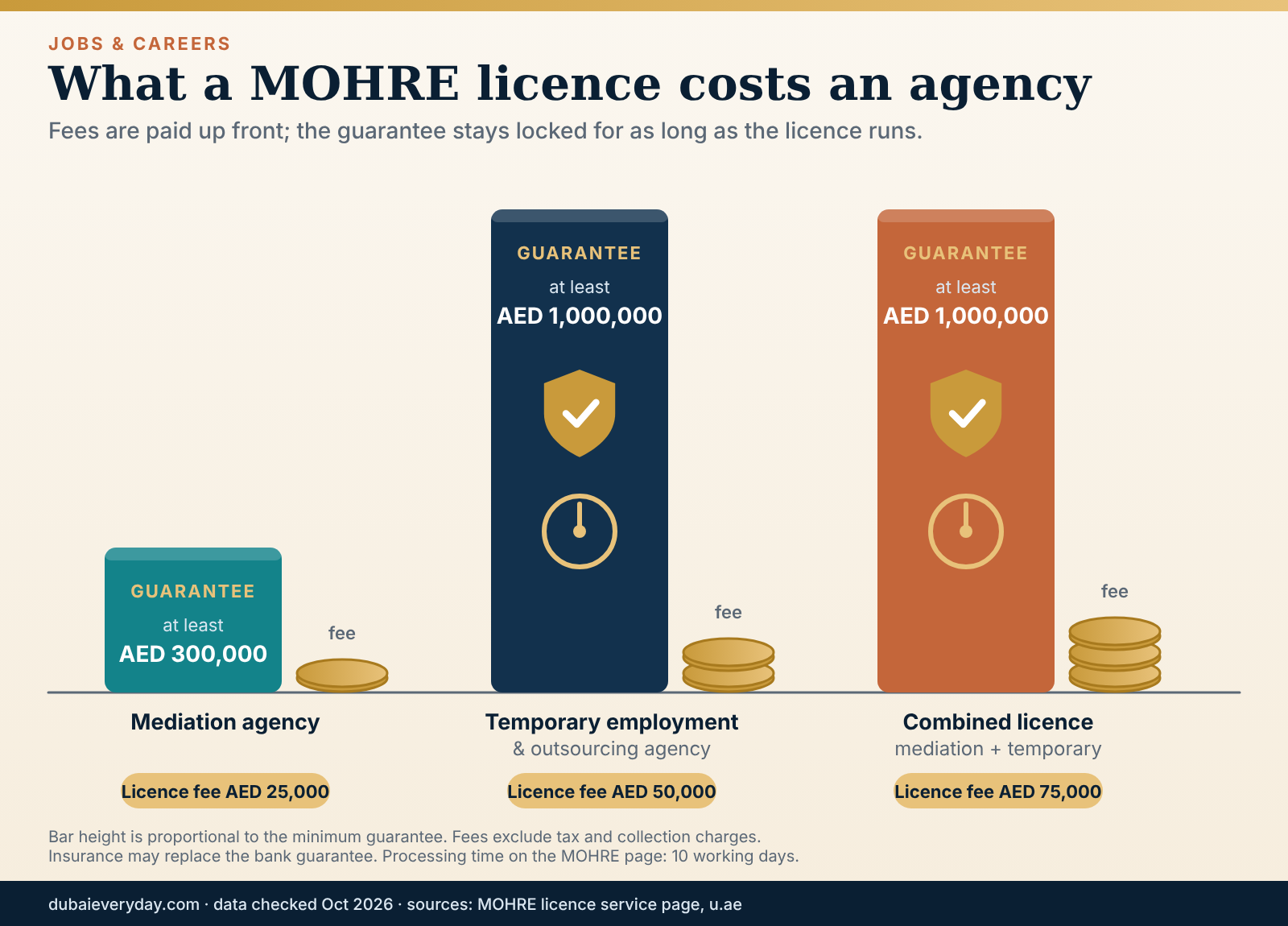
MOHRE’s service page for new agency licences gives figures that help you judge how seriously a licensed agency has committed. All amounts exclude tax and collection charges, and the page carries no publication date.
Temporary employment, outsourcing and combined licences require a guarantee of at least AED 1,000,000. The guarantee must be maintained for the licence’s whole validity and renews automatically, and an insurance arrangement may stand in for it. MOHRE may draw on it to cover amounts the agency owes or obligations it fails to meet. The application takes ten working days once complete.
Our reading: a licensed mediation agency, the model behind most recruitment agencies Dubai job seekers meet, has paid AED 25,000 and tied up AED 300,000 of backing before it places anyone. That is not proof of good service, but it is a reason to doubt that a number with no address, no named staff and a promise of “UAE visas guaranteed” holds a licence at all.
Who can get one
The ministry lists conditions that apply to the applicant and any partner in a company. They must not work for the ministry or be a spouse or second-degree relative of an employee there. They need a clearly identifiable business address unless MOHRE permits electronic recruitment activity. A credit report and police clearance are required, and a person with convictions for offences such as breach of trust or human trafficking is excluded unless rehabilitated or a year has passed after a fine. Gulf News summarised the same conditions in June 2025, and a law-firm note from DLA Piper reported them as well.
One point sources do not agree on is nationality. The federal government portal says agency licences are granted to UAE citizens only. MOHRE’s licensing page lists no nationality condition among its requirements, and a free-zone marketing page we read describes foreign-owned set-ups. We could not reconcile these. So do not use “is the owner Emirati?” as a legitimacy test. Check the licence itself.
What the rules say recruitment agencies Dubai firms hire owe you
Press summaries of MOHRE’s 2022 agency regulation, which implements the current labour law, describe duties that matter to candidates. Recruitment agencies Dubai employers deal with must keep records of workers and employers for at least two years. They must draft accurate contracts consistent with the labour law. Gulf News also reports that agencies must not take cash or commission, which we read as aimed at workers and which fits the portal’s line that candidates pay nothing. Treat the press summary as a pointer and the ministry as the authority on the exact text.
Enforcement exists. A Gulf News report from 11 February 2026 said 230 social media accounts promoting domestic-worker recruitment without a licence were shut in 2025, and described penalties of at least one year in prison and a fine of AED 200,000 to AED 1 million under the domestic workers rules. That report concerns household recruitment, not corporate recruitment agencies Dubai firms hire, but it shows the ministry does act against unlicensed brokers.
Four kinds of agency, and who your employer is
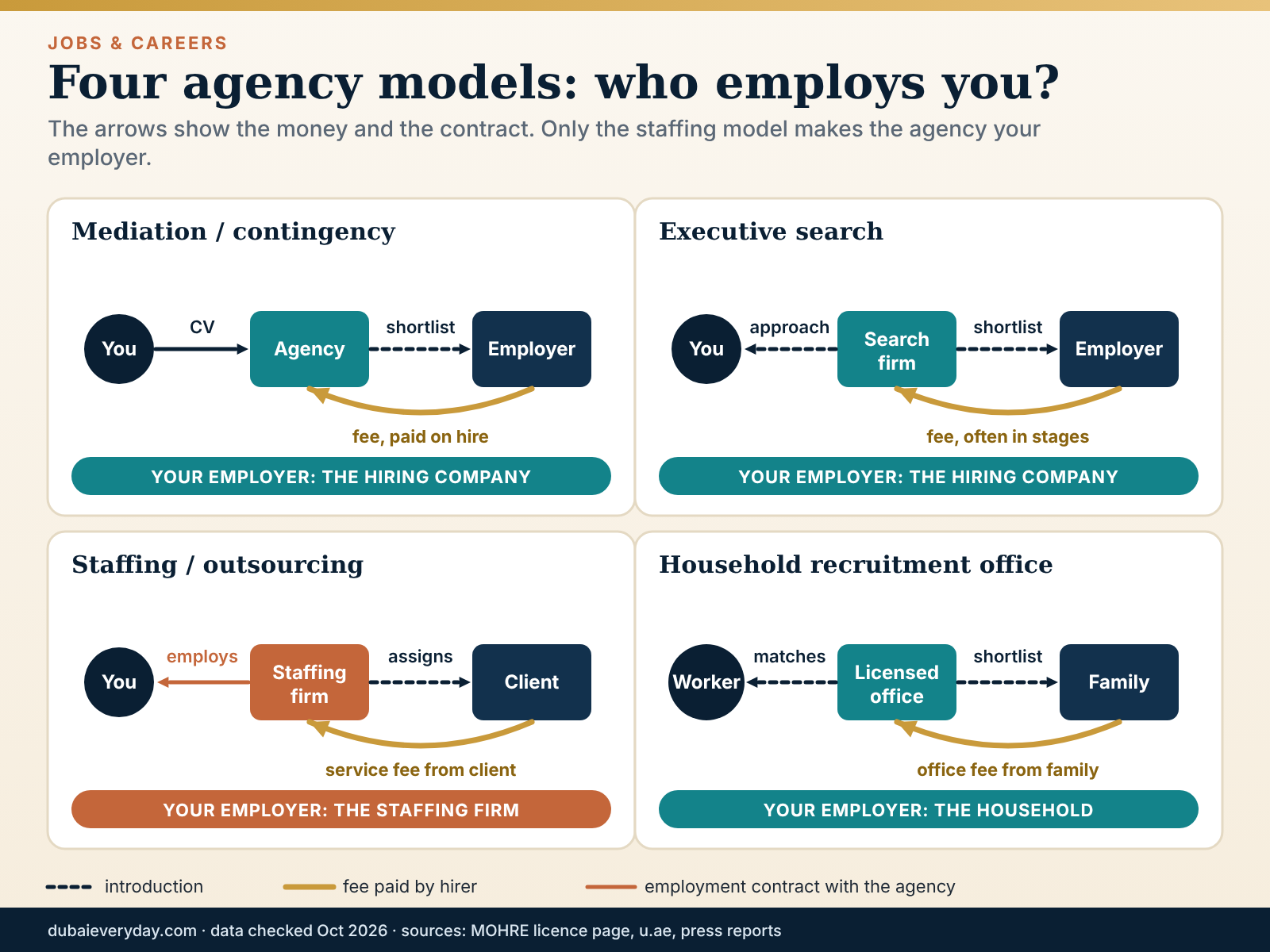
“Agency” is a loose word in Dubai. The recruitment agencies Dubai residents come across include firms that email you a vacancy, firms that put you on their own payroll, and household recruitment offices that sit under a different law. The distinction that matters most is simple: after you sign, who is your employer?
Mediation and contingency agencies
This is the model most people mean by recruitment agencies Dubai employers use. The agency is paid only if the employer hires someone it introduced. Under MOHRE’s wording this is a mediation licence: the agency connects the parties and does not become a party to the contract. You sign with the hiring company, the company sponsors your permit, and the agency’s role ends when you start, apart from any replacement guarantee it gave the employer.
A commercial source we read, a staffing firm’s own blog, describes this success-fee model as suiting middle-management roles and urgent fills. That is a company claim, not an official classification, but it matches how the arrangement works in practice. Speed is what the employer is buying.
Executive search and retained work
Search firms are hired for senior or scarce roles and are typically paid in stages rather than only on success. The same blog describes executive search as an upfront fee for a broad hunt. For you, the practical difference is the direction of contact. Search consultants find candidates, they rarely reply to unsolicited CVs, and they remember how people behave when approached. A short, courteous, quick reply to a first message is worth more than a long cover letter.
These firms still sit under the mediation rules, like other recruitment agencies Dubai employers pay, in the sense that the candidate pays nothing. A “retainer” that you are asked to pay is not search; it is a fee for a service you did not ask for.
Staffing, outsourcing and temporary employment
Here the agency employs you and places you with a client. MOHRE licenses this separately and sets the higher AED 1,000,000 guarantee for it. Your visa, payroll, insurance and contract usually sit with the staffing firm, while your daily work happens at the client’s office. A press summary of the 2022 regulation says such agencies must meet employer obligations toward workers even if the client company fails its own side of the arrangement.
This model is legitimate and common for project work, contract roles and some high-volume fields. It simply makes the staffing firm your employer, so the checks you apply to an employer apply to it, and the contract questions in our Dubai employment contract guide apply to the document the staffing firm gives you. Ask what happens to your visa if the client ends the assignment early.
Household staff recruitment offices
Nannies, maids and drivers hired for a home go through a separate regime. In 2022, Gulf News reported that licensed domestic-worker recruitment agencies replaced the Tadbeer service centres under a MOHRE decision, with applicants and managers required to be UAE nationals and a bank guarantee of AED 500,000 for the agency. We could not confirm whether those terms have since changed, so check the ministry. What has not changed in the reporting is the advice: deal only with licensed offices and check the list on the MOHRE website.
If your relocation includes hiring help at home, the Dubai relocation checklist shows where that sits in your first weeks. The rest of this page is about corporate hiring.
What is not an agency
Job boards, professional networks and an employer’s own talent team are not recruitment agencies. An in-house recruiter works for one company, and a message from one is often the most direct route into a process. A job board sells advertising and database access. Treating them as interchangeable leads to misplaced trust: a board listing is not a vetted vacancy, and a polished profile is not a licence.
| Model | Who pays the agency | Who employs you | Best used for | First check |
|---|---|---|---|---|
| Mediation / contingency | The employer, on hire | The hiring company | Specialist mid-level roles, urgent fills | MOHRE licence; named employer |
| Executive search | The employer, often in stages | The hiring company | Senior or scarce roles | Who the client is; no fee to you |
| Staffing / outsourcing | The client, through service fees | The staffing firm | Contract, project, high-volume roles | Contract, visa, end-of-assignment terms |
| Household recruitment office | The family hiring help | The household | Domestic workers | Listed on the MOHRE site |
Fees: who pays, how much, and why it shapes your offer
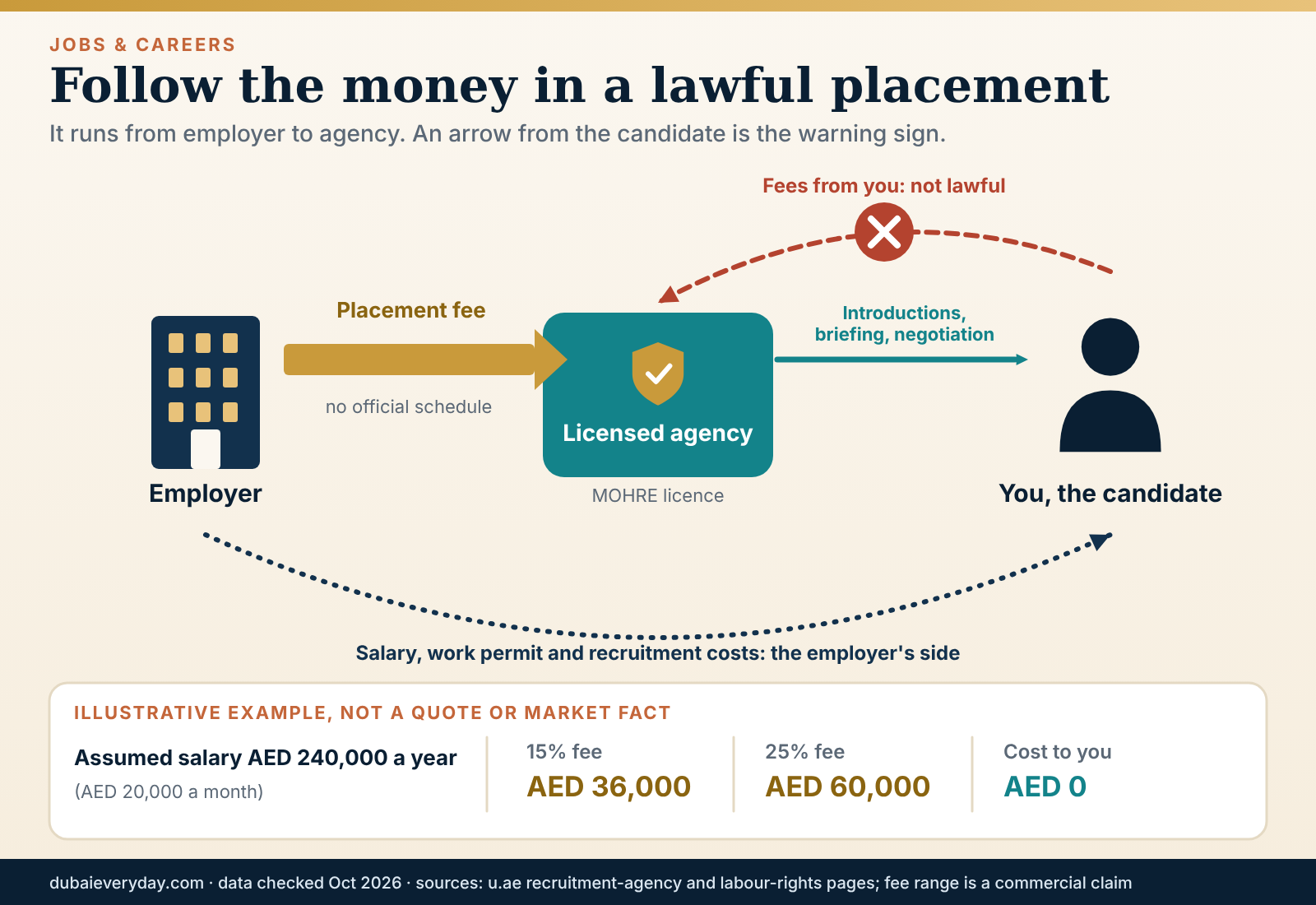
The legal position on recruitment agencies Dubai job seekers meet is clear and consistent across the sources. The federal government’s recruitment-agency page says job seekers are not required to pay money to any recruitment agency and that the employer is responsible for the fees. The labour-rights page goes further: charging recruitment fees to prospective employees is illegal, and recruitment, travel and residency permit costs are borne by the employer you agree a contract with. The labour law itself (Federal Decree-Law 33 of 2021, as amended) bars employers from charging workers recruitment fees directly or indirectly.
What employers pay, and how much is a claim
There is no official placement-fee schedule for recruitment agencies Dubai employers hire. Fees are a commercial agreement between agency and employer. A staffing firm’s blog says the majority of recruitment agencies Dubai employers pay take a cut of the candidate’s yearly salary in the range of 15 to 25 per cent, and that specialised searches may use fixed fees or monthly retainers. That is one company’s description of its own market and is not verified, so read it as an order of magnitude, not a price list.
Illustrative example (not a quote or market fact): a role with a base salary of AED 20,000 a month is AED 240,000 a year. At 15 per cent the agency fee would be AED 36,000 (about USD 9,800 at 3.6725), and at 25 per cent it would be AED 60,000 (about USD 16,300). Those numbers are our arithmetic on an assumed salary, shown only to explain the incentive.
Why this matters to you
Because the fee scales with salary, a recruiter at one of the recruitment agencies Dubai employers pay has a built-in reason to land you a good package, up to the point where the employer walks away. On our reading, that alignment is real but narrow. If the employer’s budget is AED 22,000 and your expectation is AED 30,000, the agency gains nothing from a stalemate and will likely move on. If you accept AED 22,000 and leave in month four, the employer may claim a replacement or refund, and the agency has an interest in you passing probation and remaining in the job.
A fee percentage also explains oddities. Recruitment agencies Dubai firms brief often ask for your current package, since the offer is usually built from it. They may push back on a very high ask early, because an employer that balks at the salary balks at the fee too. And a “confidential client” label can stay on a vacancy for days, because recruitment agencies Dubai employers use protect their introduction to the employer. None of this requires you to pay anything or to accept bad treatment. It simply shows the economics under the courtesy.
Replacement guarantees, and why they are the employer’s business
Many recruitment agencies Dubai employers use promise the employer a free replacement or partial refund if a hire leaves within a stated period. The blog we read confirms the practice exists without stating a standard length, and we found no official rule that sets one. For candidates the consequence is practical: probation is the window in which an exit costs the agency money, so a recruiter’s goal is a person who passes it. The labour law’s probation and notice rules, and the one-year permit ban that can follow leaving in probation, are covered in the work visa guide.
If you are the one hiring
Small businesses and families sometimes use recruitment agencies Dubai-side as buyers, not candidates. The same logic applies in reverse. Ask for the agency’s MOHRE licence number, then confirm it with the ministry. Get the fee basis in writing, whether a percentage of annual salary, a fixed amount or a retainer, and ask what is payable if the candidate leaves in probation. Compare the replacement terms before you compare the percentage, because a low fee with no replacement clause can cost more than a higher fee with one. Employers carry the recruitment, travel and permit costs under the labour-rights guidance, and may not pass them to the worker.
What you may legitimately pay for
Not every paid service is suspect. A CV review, interview coaching or a LinkedIn profile rewrite is an ordinary purchase when the seller does not promise a job, a visa or access to a vacancy. The test is what you are buying. Paying for advice you choose is fine. Paying for a vacancy, an interview slot, a work permit, a medical, training or a background check is the pattern the government’s guidance describes as the sign of a non-genuine offer. A genuine agency may also help with your own relocation tasks, but your employer carries the permit costs.
Specialisms: where recruitment agencies Dubai employers use earn their place
Most agencies organise around sectors, because a recruiter who knows the market for finance controllers or site engineers can judge a CV in seconds. When you approach recruitment agencies Dubai employers actually use, the useful question is which desk covers your job, not how big the firm is. A generalist inbox that accepts every CV is the weakest version of the service.
What the hiring data says, and what it cannot say
The most useful public number we found is the Naukrigulf Hiring Index, reported by Khaleej Times on 6 July 2026. It compared April and May 2026 with the same months of 2025 and measured job postings, not completed hires. It reported UAE postings down 23 per cent overall. By monthly salary band, postings fell 26 per cent up to AED 10,000 and about 22 per cent for AED 11,000 to 20,000. The decline narrowed higher up: about 19 per cent for AED 21,000 to 40,000, 11 per cent for AED 41,000 to 80,000, and 5 per cent for AED 80,000 to 150,000.
By sector, the same index showed sales and marketing down 42 per cent, HR and finance each down 34 per cent, oil, gas and energy down 30 per cent, healthcare and pharmaceuticals down 24 per cent, and real estate and construction down 20 per cent. Engineering was down 16 per cent, IT and digital down 6 per cent, and tech roles down 3 per cent. AI, machine learning, cybersecurity and data postings were up about 20 per cent.
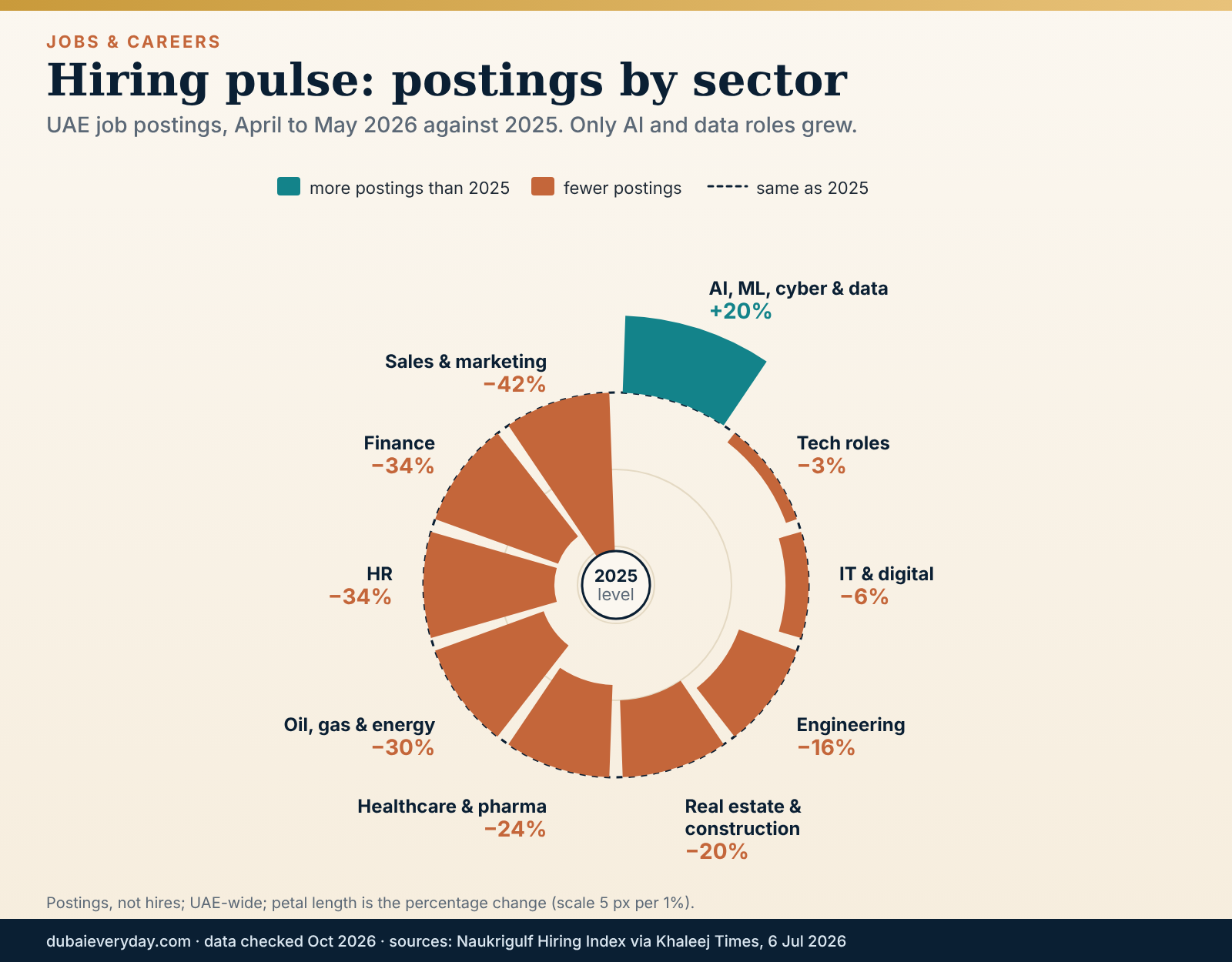
Read these with care. Postings are not placements, the index covers the UAE rather than Dubai alone, and one salary band above AED 150,000 showed a 23 per cent fall on a small sample that the report itself called volatile. The article tied the slowdown to the regional conflict that began on 28 February 2026, which we mention because it shapes the mood of the market rather than because we have independent data on it.
What recruiters themselves are saying
Gulf News, in a piece updated on 18 August 2026, quoted three recruitment professionals. One expected technology, financial services, healthcare, logistics, real estate, construction and professional services to stay among the strongest areas. Another said hospitality hiring was still down but might recover into the winter season. A third described the slowdown as selective: some firms used unpaid leave, shorter shifts or slower salary growth instead of large job cuts, and she expected stronger momentum in 2027. One of them also noted more employers briefing recruitment agencies Dubai-side on several roles at once, which she read as returning confidence.
The same piece makes three points that matter to candidates. Employers increasingly favour people already in the region. Overseas recruitment continues for niche roles in areas such as technology, product development, buying and strategy. And evidence of work, such as a project, dashboard or case study, is favoured over a degree alone, particularly at firms in the financial centres.
Our reading: where recruitment agencies Dubai employers brief add most
Likely to help
Specialist mid-level and senior roles in finance, technology, healthcare administration, project-led construction and professional services, where a hiring manager wants three good CVs this week.
Often a poor fit
Entry-level jobs with very large applicant pools, career changes with no evidence of transferable work, and any role where the employer is already inundated. In these cases direct applications and networking carry more weight, and recruitment agencies Dubai employers use will often not call.
Different rules apply
Licensed professions such as medicine need regulator approval and exams before you can practise, as the federal portal notes for doctors and laboratory technicians. An agency can find the post but cannot shortcut the licence.
Sourcing channels differ too. The recruiters quoted by Gulf News said LinkedIn matters most for specialist, technical and senior roles, while Indeed, GulfTalent and Bayt generate higher volumes for operational, entry-level and administrative jobs, and Naukrigulf is useful for people relocating from South Asia. We mention the platforms neutrally. This is their description of the market, not a ranking.
Emiratisation changes some briefs
Some vacancies are shaped by national hiring targets. Gulf News reported on 27 October 2025 that private firms with 50 or more employees must raise Emirati hires in skilled roles by 2 per cent annually, and that firms with 20 to 49 workers must hire at least one Emirati citizen. Non-compliant firms face financial contributions from 1 January 2026. A recruiter quoted by Gulf News linked these requirements to local hiring in banking, insurance, real estate and technology. If an agency tells you a role is “for nationals only”, that can be a legitimate client instruction, and it is not a comment on you.
From first call to first payslip
A placement through one of the recruitment agencies Dubai firms hire has a recognisable shape. Knowing the stages lets you notice when something is out of order, such as an offer that arrives before an interview or a request for money at a stage where no cost belongs to you.
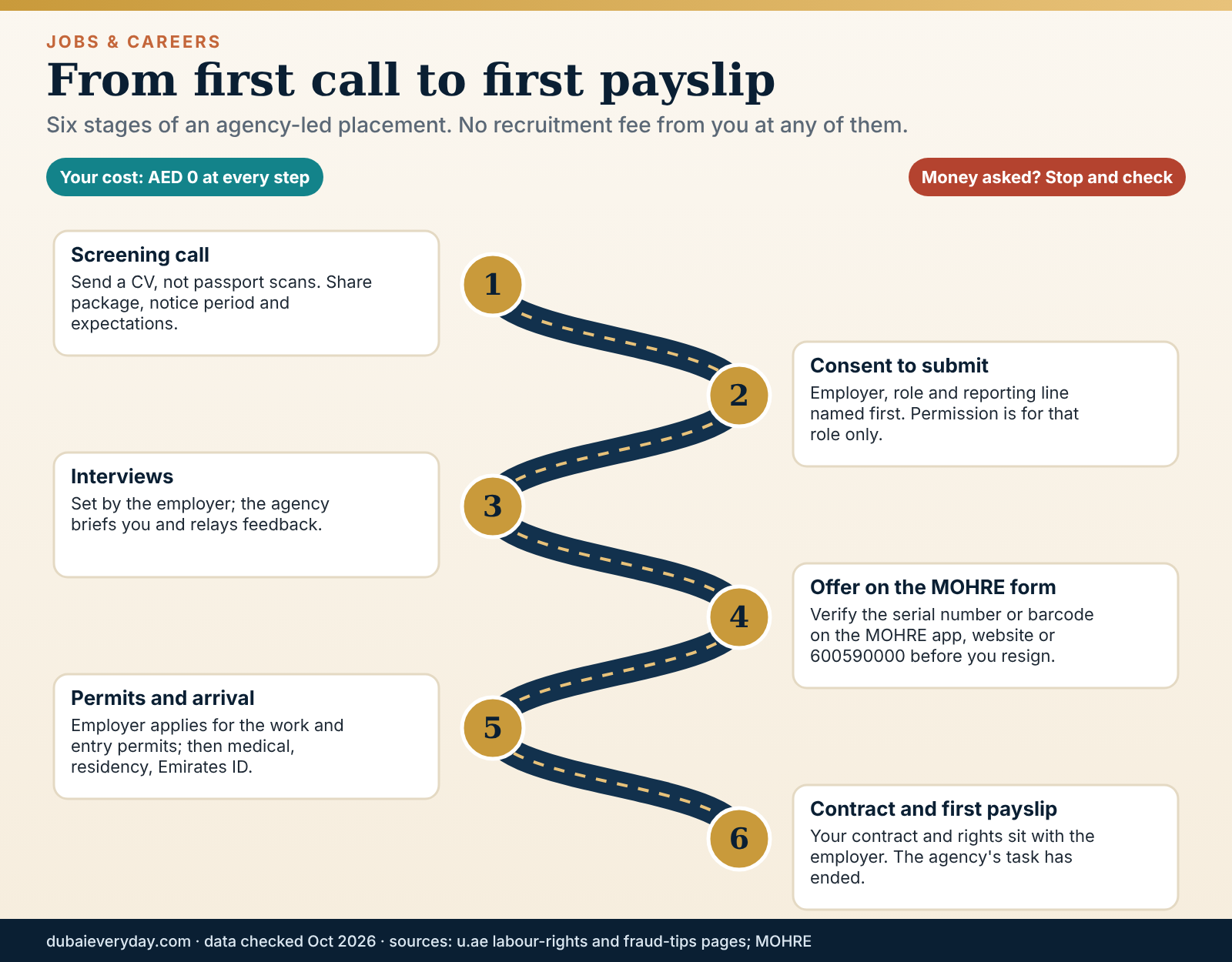
- Registration and screening call.You send a CV, not passport scans. The recruiter checks your experience, notice period, current package and expectations, and may ask your right-to-work status.
- Consent to submit.A good recruiter names the employer and role before sending your CV anywhere. A “confidential client” label is acceptable briefly. Ask what the role is, why it is open and who you would report to.
- Interviews.The agency briefs you and relays feedback. Panels and tests are set by the employer. You never pay to be interviewed.
- Offer.The agency may negotiate terms. The binding document is the employer’s offer on the MOHRE-approved form, which carries a unique serial number or barcode that you can verify.
- Permits and arrival.For a candidate abroad, the employer arranges the work permit and entry permit, and you arrive, take the medical test, then complete residency and Emirates ID steps.
- Contract and first month.The agency’s work is done at hire apart from any guarantee it gave the employer. Your employment contract and rights now sit with the employer.
If you are abroad, and if you are already in the UAE
Employers lean toward candidates already in the region, and recruiters say so openly. If you are abroad, expect interviews by video and a longer lead time. The employer must start the work-permit process, and MOHRE’s guidance says a visit or tourist visa does not authorise work, so be wary of any “start now and we will fix the visa later” promise. The full sequence is laid out in the work visa guide, with the medical fitness test and Emirates ID steps in their own pages.
If you are already in Dubai on another status, one of the recruitment agencies Dubai firms hire can still place you. A spouse on a family visa, for example, can be placed under a family-sponsored resident work permit, one of the permit types the portal lists, though the employer needs to arrange it. Check the details in the residence visa guide before you resign anything.
A short interview trip can be cheaper than waiting for video rounds to finish. The government’s job-seeker visit permit lets eligible people look for work without a local sponsor, and our jobs guide explains eligibility and the clock. For flights and a first base, the Dubai travel guide and hotel guide cover the arrival side.
Candidate expectations, both ways
A working relationship with a recruiter at one of the recruitment agencies Dubai employers use is a trade of information for access. They give you vacancy detail and a route to a hiring manager. You give them accurate facts and quick replies. Most friction on both sides comes from one party withholding something the other assumed was obvious.
What a recruiter will expect from you
Expect questions about your current package, your target package, your notice period and your right-to-work status, usually in the first call. Answer them straight. Under the UAE labour law the standard notice period runs from 30 to 90 days, and a non-compete clause can run up to two years under Article 10, so a recruiter needs to know early whether you can start in a month or in three. If you left a previous Dubai job in probation, tell them. A one-year work-permit ban can follow certain exits, and it is far better to learn that before an employer applies for your permit than after.
Speed counts. Recruiters move fast for candidates who reply the same day, flag interview clashes early and tell them where else they are in process. That last point prevents a quiet disaster: if two recruitment agencies Dubai firms hire submit you to the same employer, the employer may drop the application rather than decide whose introduction it is. Name your other conversations, even if only by employer.
Realism helps most. If your salary ask is far above the band for your experience, a recruiter cannot place you, and the polite response is silence. If you can tell them the three things you will trade for pay, such as remote days, title or sponsorship of a course, you become easier to place.
What you can reasonably expect in return
- The employer’s name and the role’s reporting line before any signed commitment, and before your passport or Emirates ID copy.
- Honest feedback after each interview, even if it is brief.
- No fee at any stage, with that stated in writing if you doubt it.
- Straight answers about salary range, benefits, probation and whether the role is new or a replacement.
- Your CV sent only to the employers you agreed to, for the role discussed.
What you cannot reasonably expect is an obligation to keep you informed forever. Recruiters call when they have a role that fits. Not hearing from one between vacancies is the normal pattern, not a rejection. A short note every few months with a changed job title or a finished project keeps you findable without sounding desperate.
Your data when you send a CV
A CV holds your phone number, employer history, salary and often your date of birth and nationality. Recruitment agencies Dubai employers hire keep that in a database and share it with clients, so send only what the role needs. Leave out the passport number, Emirates ID number and photographs of documents. Ask how your details will be stored and whether they will be shared only for roles you agree to. A recruiter who answers plainly is behaving as a professional should, and one who bristles at the question has told you something.
The right-to-represent request
Some recruitment agencies Dubai job seekers deal with ask for your written permission to submit you to a named employer. That is reasonable and protects you from duplicate submissions. Be wary if the permission is open-ended, for all employers for six months, or if it turns into an exclusivity agreement that stops you applying directly. A role-specific permission is the safer form: this role, this employer, this date. Nothing in a legitimate arrangement requires you to pay for the privilege of being represented.
When the offer arrives
The job of recruitment agencies Dubai employers hire during negotiation is to close the gap, so use it. Ask what has been agreed on base salary, housing, schooling support, flights, insurance and bonus, and get it into the offer, not into a promise. Our salary guide explains how a total package is built, and the employment contract guide covers the probation and clause questions. If you have children, check what a school allowance would actually cover against the real figures in the school fees guide.
Recruiters will also tell you what the employer worries about. Ask for it. A concern about job-hopping or a gap is easier to address in a call than in a silent rejection.
Agency or direct application: a decision guide
Using recruitment agencies Dubai companies work with is a choice, not a default. The table is our reading of the evidence above, with one rule behind it: recruitment agencies Dubai employers brief add most where the employer is short on time and the candidate is scarce, and least where the employer has hundreds of applicants.
| Your situation | Agency worth it? | What to do |
|---|---|---|
| Specialist, mid-level, five or more years in a sought-after skill | Yes | Register with two or three agencies that cover your sector; keep LinkedIn current |
| Senior or director level | Yes, through search firms | Respond quickly and politely to approaches; do not pay anyone to be considered |
| Junior or fresh graduate, applying from abroad | Rarely | Apply directly; use agencies only for named roles; check job-seeker visa rules |
| Already in Dubai, same sector, wanting a step up | Often | Combine agencies with direct applications and your network |
| Changing sector with little transferable evidence | Seldom | Build proof of work first; target employers directly |
| Contract or project work | Often, via staffing firms | Read who the employer is, and what happens when the assignment ends |
| Spouse on a family visa seeking work | Sometimes | Ask the employer to arrange the right permit; verify the offer |
| Hiring help for your home | Yes, licensed offices only | Use the ministry’s list of licensed offices |
Direct applications still work. Recruiters quoted by Gulf News describe a mix of sourcing: networks and databases first, adverts second. If you are junior, your best use of recruitment agencies Dubai firms hire is a polite, specific enquiry about a role they already advertise. If you are senior, it is staying visible. In between, a handful of well-chosen recruitment agencies Dubai companies work with is plenty. Fifteen registrations produce fifteen identical inboxes and duplicate submissions.
Vetting recruitment agencies Dubai job seekers meet
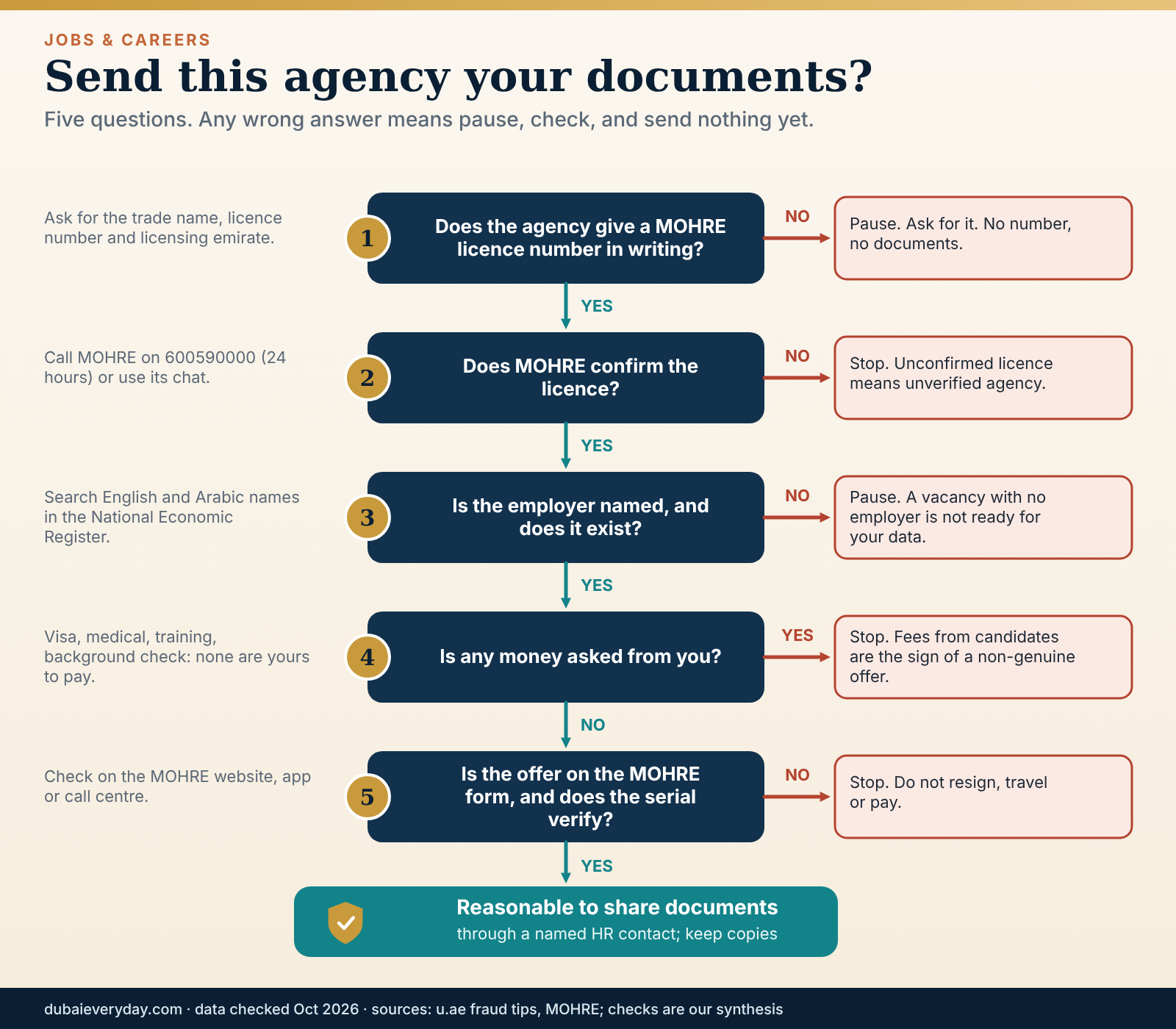
Before you share anything beyond a CV with any of the recruitment agencies Dubai job seekers meet, a ten-minute routine removes a fair amount of the risk. The steps below combine MOHRE’s and the federal portal’s guidance with common sense. None requires special access.
- Ask for the licence details in writing.Request the trade name, MOHRE licence number and the licensing emirate or free zone. A legitimate agency expects this and answers without fuss.
- Check the licence with the ministry.The federal portal says you can check an agency’s licence with MOHRE. The ministry’s call centre is 600590000, which MOHRE’s service page lists as available 24 hours. We did not find a public lookup for corporate agency licences during our research, so a phone or chat check is the realistic route.
- Get the employer’s identity.Name, role, location and reporting line. Then confirm the company exists by searching its English and Arabic names in the National Economic Register, as the federal fraud-tips page advises.
- Look at the people and the domain.Named consultants with a visible work history, an email on the agency’s own domain, and a website that matches the licence name. Free-mail addresses and brand-new profiles are signs to slow down.
- Confirm there is no fee.Ask: “Is there any charge to me at any stage?” The answer is no. If you doubt it, ask for that in writing.
- Send a CV only.Hold passport and Emirates ID copies until a verified offer exists and an identifiable HR contact asks for them.
- Verify the offer.A genuine UAE job offer uses the MOHRE-approved form with a unique serial number or barcode. Check it on the MOHRE website, the MOHRE UAE app, or the 600590000 line before you pay for or resign anything.
Reading an agency’s adverts and website
Adverts are evidence. A genuine vacancy names the role, the location and the type of employer, even if the client name is held back. A vague advert with a high salary, no responsibilities and a WhatsApp number is a different animal. Among recruitment agencies Dubai job seekers find online, expect a company name that matches the licence, named consultants, a landline or office address, and sector-specific roles. Recruitment agencies Dubai-licensed firms operate often list a licence number in the footer or terms. Treat any claim as the start of your check with the ministry, not the end of it.
If the agency is also the employer
For a staffing or outsourcing firm, add two checks. Ask for the contract before you resign from another job, and confirm the employer’s legal name on it matches the entity on your offer. Then ask what happens to your visa and pay if the client ends the assignment. A licence for temporary employment carries a larger guarantee because the agency takes on employer duties, which is a good sign, but it does not replace reading your own contract.
If the agency says it is “approved” or “recognised”
Be careful with vague badges. A claim of “government approved” or “MOHRE recognised” is not a licence number. Ask for the number and verify. Likewise, a polished website or a large LinkedIn presence are not evidence of a licence, and the ministry’s action against unlicensed social-media recruiters of household staff shows that polished profiles can be unlicensed.
Red flags and scams
Fake job offers are the largest practical risk around recruitment agencies Dubai job seekers deal with, particularly for people applying from abroad. They work because the stakes are high, the timeline feels urgent and the real process is unfamiliar. The patterns below come from official and press warnings, not from our own investigation.
What the warnings describe
The National reported on 21 January 2026 on Dubai Police warnings: scammers use real company names and convincing websites, promise guaranteed jobs or visas, then ask for fees for visa processing, training, medical tests or background checks. After payment the contact tends to disappear, and the scammer may keep the passport or Emirates ID details you sent. MOHRE’s warning, reported by Gulf News in an article updated on 8 August 2026, adds that scammers promise high pay, immediate hiring and fast recruitment, then ask for fees or sensitive personal and banking details.
The federal government’s job-search guidance gives the cleanest rule in official language: a company that asks for money to process a visa or medical test is not genuine. It also tells candidates to check that a sender’s email domain matches the organisation. Separate guidance says working on a visit or tourist visa leads to fines and legal liability, so a recruiter who suggests you “start now” on such a visa is describing a legal problem, not a shortcut.
If money moves from you to them before the first salary moves from them to you, stop. The only normal exception is a service you chose for your own benefit, such as a CV review from someone who claims no link to a vacancy.
Red flags among recruitment agencies Dubai job seekers should know
- A “registration”, “processing”, “placement” or “training” fee charged to you.
- A promised job or visa before any interview with a named person.
- An offer that arrives by messaging app from a free-mail address, with no MOHRE-form offer and no serial number to check.
- No licence number, or one that the ministry cannot confirm.
- Pressure: a deadline of hours, “only two places left”, threats that the offer will be withdrawn.
- Requests for passport, Emirates ID or bank details at the first or second contact.
- An agency that will not name the employer even after you have been interviewed.
- Pay that is far above the market for the role, and a start date that is immediate.
- A wish to move the conversation to a private chat group or ask you to pay into a personal account.
Two of these deserve more weight than the rest. In our reading, a request to pay into a personal bank account is an exceptionally poor sign, since a lawful agency is paid by employers and has no reason to collect from you. And a refusal to put a no-fee promise in writing, when asked politely, tells you what you need.
Impersonation, and what real looks like
Dubai Police describe scammers using real company names. The same logic applies to real recruitment agencies Dubai employers use: a convincing logo and a real firm’s name on a message prove nothing, since both can be copied. Contact the agency or employer through the number on its official website, not the number in the message. Confirm the recruiter works there by calling the main line. A genuine agency does not mind.
A real process has interviews with named people, a company-domain email, a MOHRE offer you can verify, no fees from you, an employer who applies for your permit, and enough time to read the contract. The pattern is boring, which is the point.
Stop replying and send no more money. Keep evidence: screenshots, emails, offer letters, payment requests. Reports in the press cite Dubai Police advice to report through the Dubai Police app or eCrime platform, by calling 999 or 901, or at a police station, and to contact your bank at once if you made a transfer. If you shared a passport or Emirates ID image, ask your embassy or the relevant authority about protective steps. For a complaint about a licensed agency, MOHRE’s call centre is 600590000. General information only; a lawyer or the police can advise on your case.
Complaints and disputes after you have started
If a licensed agency or an employer breaks the rules after you have joined, the labour-rights page points to MOHRE’s online complaint services, including separate forms for private-sector employees, free zone employees, domestic workers and salary complaints. Its Labour Claims and Advisory Call Centre number is 80084, and workers are exempt from litigation fees for claims under AED 100,000, according to the same page. The federal fraud-tips page lists MOHRE’s phone line and email for questions about employment and recruitment.
Mistakes that cost weeks
Most delays and losses with recruitment agencies Dubai job seekers use come from a short list of habits. Each is avoidable, and a few of them cost money.
- Sending a passport copy and Emirates ID to the first recruiter who asks, before any verification.
- Letting two recruitment agencies Dubai firms hire submit your CV to the same employer without telling either.
- Quoting your current package inaccurately, then watching the offer fall apart at the reference stage.
- Resigning before the MOHRE-form offer is verified and the contract is in hand.
- Assuming a staffing firm is a neutral intermediary and ignoring that it may be your employer.
- Treating a recruiter’s silence as a judgement, and sending a string of anxious follow-ups.
- Registering with a dozen recruitment agencies Dubai employers use and tracking none of them.
- Believing “we have a licence” without a number you can check.
- Paying a “visa fee” to an agency, when the employer is responsible for the permit cost.
- Starting work on a visit visa on a promise that the paperwork will be regularised.
A simple tracker beats good intentions
Whichever recruitment agencies Dubai job seekers choose, keep one list with six columns: agency, recruiter name, employer and role, what you consented to, date submitted, and next step. Update it after each call. It prevents duplicate submissions, makes follow-ups specific and gives you something to show if a dispute arises. It also keeps the process from taking over your head, which matters more than it sounds when you are juggling a current job, time zones and a relocation.
A plan for the next 30 days
- Week 1: prepare.Update your CV and profile, write down your current package, target range, notice period and non-negotiables, and gather certificates that may need attestation. Do not send documents yet.
- Week 2: shortlist.Choose two or three recruitment agencies Dubai employers use in your sector. Run the seven-step vetting routine on each, and look for named consultants who handle your kind of role.
- Week 3: brief them.Share your CV, answer the screening questions straight, and agree role-specific permission to submit. Ask what feedback cadence to expect.
- Week 4: review.Compare responses. Drop agencies that went quiet or asked for money, keep the ones that explained their client. Continue direct applications in parallel.
FAQ: recruitment agencies Dubai
Do I have to pay a recruitment agency in Dubai?
No. For recruitment agencies Dubai employers pay, the UAE government portal states that job seekers are not required to pay any recruitment agency and that the employer bears the fees. The labour-rights page adds that charging recruitment fees to prospective employees is illegal. If an agency asks for money for a vacancy, interview, visa, medical or offer, treat it as a red flag and verify its licence with MOHRE. Paying for optional services such as a CV review is a separate matter, as long as nobody links it to a job.
How do I check whether a recruitment agency in Dubai is licensed?
For recruitment agencies Dubai job seekers want to test, the federal portal says you can check a licence with MOHRE, which grants these licences. Ask the agency for its trade name and licence number in writing, then confirm with the ministry, whose call centre is 600590000. We did not find a public lookup page for corporate agency licences, so a call or chat is the practical route. For household recruitment offices, MOHRE publishes a list of licensed offices on its website.
How much do recruitment agencies Dubai employers use charge?
There is no official fee schedule, and the employer pays, not you. One staffing firm’s blog says most recruitment agencies Dubai companies hire charge 15 to 25 per cent of the candidate’s annual salary, with fixed fees or retainers for specialised searches. Treat that as a commercial claim, not a standard. As an illustration only, 20 per cent of an AED 240,000 annual salary would be AED 48,000. Your own cost is zero in a lawful placement.
Can a recruitment agency ask for my passport?
Eventually, yes, but not at the start. Send a CV first. Once an offer is verified and an identifiable HR contact is involved, copies of your passport are normal for permit applications. Be wary of anyone asking for original documents or for copies at the first contact. The labour law bars employers from withholding a worker’s official documents, and the labour-rights page prohibits confiscating passports.
Can I register with more than one agency?
Yes, and many people sign up with more than one of the recruitment agencies Dubai employers use. The risk is duplicate submission: if two agencies send your CV to the same employer, the employer may drop the application. Keep a tracker, tell each recruiter which employers you are already in process with, and give role-specific permission to submit rather than blanket permission. Two or three agencies that cover your sector are usually enough.
Are recruitment agencies Dubai employers use better than applying directly?
It depends on your seniority and how scarce your skills are. Agencies help most with specialist mid-level and senior roles where employers want short lists quickly. For junior roles with very large applicant pools, direct applications and networking carry more weight. Recruiters quoted by Gulf News say many roles are filled through networks and databases before advertising. The best approach is usually both, tracked carefully.
What is the difference between a recruitment agency and a staffing company?
A recruitment (mediation) agency introduces you to an employer and does not become a party to your contract. A staffing or outsourcing company employs you and places you with clients. MOHRE licenses them separately, with a higher minimum guarantee for temporary employment and outsourcing. With a staffing company, your visa, contract and pay sit with the staffing firm, so check its terms as you would any employer’s.
Does an agency sponsor my visa?
In the ordinary mediation model, no. The hiring employer applies for your work permit and sponsors your residence. A staffing or outsourcing firm that is your employer may sponsor you instead. In either case the employer carries recruitment and permit costs, not you. Our work visa guide covers the steps after the offer.
What if a recruiter says I can start work on a visit visa?
Do not accept. The federal portal says a visit or tourist entry permit does not authorise employment, and working on one leads to fines and legal liability. MOHRE has issued similar warnings. A promise to fix the paperwork later is not a safeguard. Ask for the work permit and entry permit before you travel or start, and verify the offer on MOHRE’s channels.
Do recruitment agencies in Dubai guarantee a job?
No. None of the recruitment agencies Dubai job seekers deal with can honestly promise a job. An agency introduces candidates; the employer decides. A guaranteed job or visa is a hallmark of the scams that police and MOHRE warn about. A good agency will tell you how many candidates are in process, what the employer is worried about and what it can reasonably do for you. It will not promise outcomes.
How do I report a suspicious agency or job offer?
For a possible scam, press reports of Dubai Police advice point to the Dubai Police app or eCrime platform, 999 or 901, or a police station. Keep screenshots, emails and payment evidence. For a licensing or labour complaint, contact MOHRE on 600590000 or through its online complaint services. If you paid by bank transfer, tell your bank straight away.
How do I find a licensed agency to hire household help?
Use only licensed domestic-worker recruitment offices and check the ministry’s list on the MOHRE website, as MOHRE has advised. Unlicensed brokers advertising on social media have been shut down, and the ministry says using them risks losing legal rights and skipping medical and background checks. Penalties for unlicensed domestic recruitment are severe, as reported by Gulf News in February 2026.
Related reading
Sources and further reading (19 links)
- UAE Government Portal: Recruitment agencies — job seekers do not pay, MOHRE licensing, licence checks and complaints
- MOHRE: Issuance of a new licence for a temporary employment and mediation agency — licence types, fees, bank guarantees, conditions, call centre
- UAE Government Portal: Labour rights — recruitment fees illegal, employer pays recruitment costs, complaint channels, hotline 80084
- UAE Government Portal: Tips to avoid labour and visa fraud — MOHRE offer letters, National Economic Register, contact channels
- UAE Government Portal: Preparing to work — visit visa and work rules, attestation, regulated professions
- MOHRE: Federal Decree-Law No. 33 of 2021 on employment relations — recruitment fees, documents, notice and non-compete provisions
- Gulf News: New guidelines for recruitment agency licensing in the UAE — summary of licence conditions
- DLA Piper: New guidelines for recruitment agency licensing — law-firm note on the same conditions
- Gulf News: Rules recruitment agencies need to follow — summary of the 2022 ministerial resolution and agency duties
- Gulf Labour Markets and Migration: Manual for licensing and regulating work employment agencies — summary of Administrative Resolution No. 26 of 2022
- Gulf News: Domestic worker recruitment agencies replace Tadbeer centres — household recruitment licensing as reported in 2022
- Gulf News: UAE shuts down 230 social media accounts for unlicensed recruitment services — enforcement and penalties for unlicensed household recruitment
- Gulf News: MOHRE warns job seekers about recruitment scams — MOHRE offer form, barcode check, do not pay early
- The National: How Dubai Police are cracking down on fake jobs using real company names — scam patterns and reporting channels
- Khaleej Times: UAE hiring for salaries under Dh10,000 drops — Naukrigulf Hiring Index figures by salary band and sector
- Gulf News: UAE jobs, sectors hiring and skills that get noticed — recruiter commentary on sectors and sourcing
- Gulf News: Meet Emiratisation targets or face fines — private-sector targets by company size
- TASC Outsourcing: Recruitment agencies, selecting the right partner — commercial description of agency models and fee percentages (company claims)
- Meydan Free Zone: Labour recruitment brokerage office setup — free-zone marketing page on separate MOHRE permit and ownership claims
Update log: 29 October 2026 — first publication; all facts re-checked against the sources above. Next review due: April 2027, or sooner if MOHRE changes agency licensing, fees or verification channels. Corrections welcome. General information only: this is not individual legal or employment advice, and a qualified professional should confirm your position.
About DubaiEveryday and this guide
DubaiEveryday.com is an independent editorial project that publishes practical, research-based guides to everyday life in Dubai: where to live, what things cost, how the rules work and how to get around. This page was written and edited by the DubaiEveryday editorial team. It is not signed by a named expert, doctor, lawyer or adviser, and we do not claim first-hand testing of a venue, clinic or service unless the page says so.
Each guide is built from official sources such as government and regulator pages, operator websites and established news outlets, cross-checked where we can. When we could not confirm something, we say so in the text, and examples that use made-up numbers are labelled as illustrations. Mentions are editorial choices, not paid placements, and a link is not an endorsement.
Dubai changes quickly. If you spot something that is out of date or wrong, please tell us through the contact options on DubaiEveryday.com and we will check it and correct the page.