
Salaries Dubai employers quote can mean basic pay, gross monthly pay or a whole yearly package, and the three can differ by thousands of dirhams. This guide shows how to read an offer, price the housing, schooling, insurance and bonus around it, and work out the total package you actually need.
A job offer that says AED 30,000 a month can be worth very different amounts depending on three words you will not find on the first page: basic, allowance and package. Two people on the same headline can leave with gratuity cheques thousands of dirhams apart, and one of them may be paying school fees that the other’s employer covers.
That is why salaries Dubai employers quote are only the start of the conversation. This guide takes a package apart line by line: basic pay, housing, schooling, insurance, bonus and gratuity, with the law and the 2026 figures behind each. It ends with a worked comparison of two offers and a model of what three kinds of household need to ask for. Bring a real offer if you have one, because the arithmetic is more useful on your numbers than on ours.
Salaries Dubai employers advertise only become comparable once you know what sits inside the number. The UAE Labour Law separates the basic wage (the contract figure before allowances) from the wage (basic plus cash allowances and in-kind benefits), and gratuity is calculated on basic alone. So a generous gross with a thin basic is worth less than it looks.
For scale, Michael Page’s 2026 UAE guide, as reported in the press, puts most of the 500-plus roles it tracks between AED 10,000 and AED 40,000 a month; the firm says its figures include housing and transport allowances but not bonus. Employers must fund employee health insurance and may not charge the premium to you. Schooling, flights and housing are contract terms, not legal rights. There is no personal income tax.
Our rule-of-thumb model keeps rent, school fees and dependants’ insurance near half of gross pay. On that rule a single person in a JVC studio needs roughly AED 9,000 a month, a couple in a Business Bay one-bedroom about AED 17,700, and a family of four with two children at AED 40,000 schools about AED 41,500. These are illustrative, not market averages.
This is desk research. Nobody at DubaiEveryday has negotiated these offers, run these payrolls or paid these school invoices, and we claim no first-hand experience. On 29 October 2026 we read the UAE government pages on wages, gratuity, family sponsorship and the Wage Protection System, the text of Federal Decree-Law 33 of 2021 on the MOHRE site, Dubai Law 11 of 2013, and the KHDA announcement on 2026-27 fees.
The figures behind the salaries Dubai comparisons here come from recruiter guides (Michael Page, Robert Walters, Cooper Fitch) as reported by their own pages or the press; we did not see the full paid guides. Inclusion was not paid for. This is general information, not legal, tax or financial advice. Confirm anything that affects your contract with MOHRE or a licensed adviser.
What salaries Dubai employers quote actually include
Search for salaries Dubai wide and you will meet a problem before you meet a number. One guide gives monthly averages with housing and transport folded in. Another gives monthly salary excluding benefits and bonuses. A job advert says “AED 18,000 package”. A recruiter says “AED 12,000 basic plus allowances”. All four sentences describe pay, and no two of them describe the same thing.
This page covers one job: reading and pricing the salaries Dubai employers offer, piece by piece. It does not cover how to find vacancies (see the guide to finding a job in Dubai), the clauses of the contract itself (the Dubai employment contract guide handles those), or the full monthly living budget. It stays on the money you are offered and what that money really buys.
Three numbers that hide inside one offer
The Labour Law gives you the vocabulary. Article 1 of Federal Decree-Law 33 of 2021 defines the basic wage as the wage stipulated in the employment contract, excluding allowances and in-kind benefits. It defines the wage as the basic wage plus cash allowances and in-kind benefits, which can include cost-of-living allowances and percentages of sales or profits where the contract provides for them. Those two definitions generate three practical numbers behind every offer.
Basic salary
The contract figure before any allowance. It drives gratuity, the ILOE premium category, and often the overtime rate. Employers sometimes keep it low on purpose, because it makes every basic-linked cost smaller.
Gross monthly pay
Basic plus the cash allowances, usually housing, transport and sometimes utilities or a phone. This is the figure most adverts and many salary guides mean, and the one that lands in your account before you spend it.
Total package
Gross pay across twelve months plus everything with a price tag but no payslip line: school allowance, flights, bonus, medical cover for family, gratuity accrual. It is the only number that compares two offers fairly.
The first rule of reading salaries Dubai recruiters publish is to ask which of the three is on the page. When the answer is not obvious, assume the most flattering one. A figure labelled “package” without a breakdown has not told you what is basic.
Why salaries Dubai guides give different numbers for the same role
Take two respected sources. Michael Page’s current UAE guide page says its figures are monthly averages in thousands of dirhams and that they include basic pay, housing, transport and other allowances, while bonuses and commissions are excluded. Robert Walters’ 2026 Middle East survey lists monthly salary ranges for UAE roles and, as the document reads, excludes benefits and bonuses unless stated, without saying whether housing and transport are inside.
So a Robert Walters marketing manager range of AED 25,000 to 35,000 and a Michael Page range for a similar role are not strictly like for like, even before you consider company size and sector. That is not a criticism of either firm. The point is that you cannot subtract one guide from another and call the difference a negotiating gap.
The same caution applies to every one of the salaries Dubai guides publish, including the figures below. Treat them as the shape of the market, not a price list. Where a number comes from a recruiter guide, it is labelled as such, and where it is our own arithmetic it says “our calculation”.
No minimum wage to anchor against
The government’s wage-payment page states that the UAE has no stipulated minimum salary for private-sector workers, only a requirement that wages are sufficient to meet an employee’s basic needs. That is why salaries Dubai employers advertise for similar jobs can differ widely, and why the family-sponsorship and visa thresholds covered later end up acting as informal floors. Salaries Dubai employers pay at the bottom of the range are set by the market, the nationality and experience of the candidate, and what the employer can get away with, not by statute.
There is also no personal income tax. The UAE government’s taxation page says the country does not levy income tax on individuals, and VAT is 5 per cent on what you buy. When you compare salaries Dubai employers pay with pay in most home countries, this is the biggest single difference: the number in your contract is the number you keep, apart from small deductions. The dirham is pegged at 3.6725 to the US dollar, so AED 20,000 is roughly USD 5,450.
Anatomy of a package: base salary, allowances and benefits
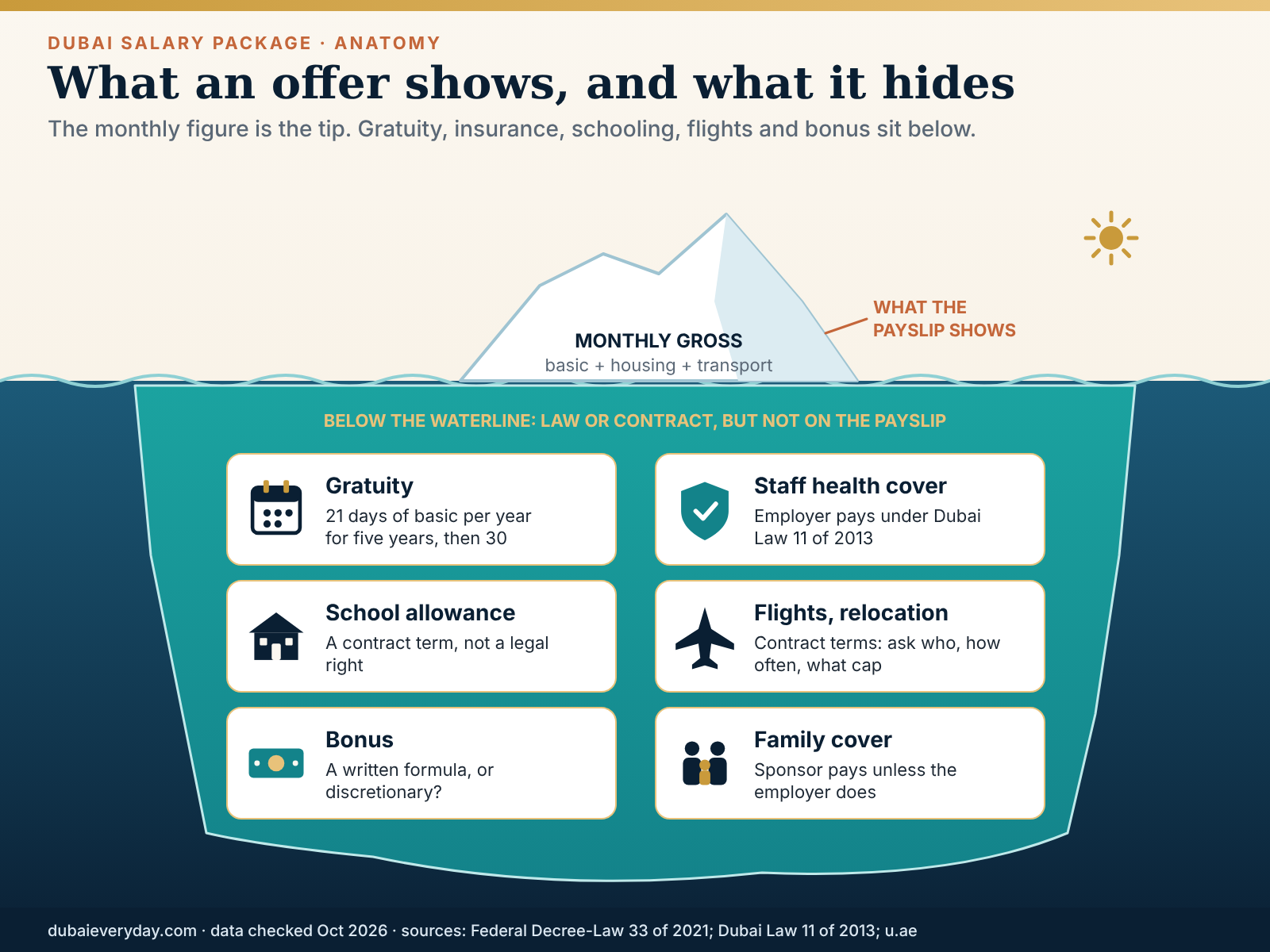
A Dubai package is easier to judge as a stack of layers than as one number. The bottom layers are fixed by contract and paid monthly. The upper layers are conditional, deferred or paid to someone else on your behalf. Most disputes, and most disappointments, start on the upper layers, because they are the ones people never see on a payslip.
The layers, from solid to slippery
Basic salary comes first in any breakdown of salaries Dubai employers offer. It is the only layer the Labour Law and several government schemes look at. End-of-service gratuity uses it, the unemployment-insurance premium category uses it, and the optional end-of-service savings scheme calculates employer contributions as a percentage of it. Overtime, where it applies, is also calculated from the basic wage under Article 19, at a minimum of 25 per cent on top for ordinary overtime and 50 per cent for work between 10 pm and 4 am.
Housing, transport and utility allowances sit above it. They are cash, they appear on the payslip, and they are part of the wage in the Article 1 sense. But they do not count towards gratuity. A rise applied to allowances alone leaves every basic-linked entitlement where it was, so ask which line a rise lands on.
Then come the layers with price tags but no payslip line. A school allowance, an annual flight, a family medical upgrade, a relocation payment and a bonus can each be worth thousands of dirhams, and each lives in a clause that may have a cap, a condition or an expiry. The UAE government’s labour-rights page confirms one item here: employers bear recruitment and travel costs and the expense of your residence permit under the contract. Everything else on this list is negotiated, not guaranteed.
What the law fixes and what it leaves to the contract
Set by law
Wage payment in dirhams (unless the contract agrees another currency), 30 days of annual leave, gratuity on basic wage, the 48-hour working week, overtime premiums, limits on wage deductions, and in Dubai the employer’s duty to insure employees.
Left to the contract
The split between basic and allowances, housing or its cash equivalent, school and education support, flights and their class, bonus structure, relocation money, mobile and transport extras, and whether family cover is included.
Often unwritten
Rise timing, promotion criteria, and what “discretionary bonus” means in a bad year. If it is not on paper, treat it as a hope. The employment contract guide shows where to look for these.
Eight questions that turn an offer into a package
Before you compare salaries Dubai offers side by side, get answers in writing to the following. A reluctance to answer is itself information.
- What is the basic salary, and what is the monthly total in cash?
- Is housing a cash allowance, a company flat or a lump-sum cheque arrangement, and is it fixed for the contract term?
- Does the package include a school allowance, and is it per child, capped, or paid on receipts?
- Who is insured: you only, or also your spouse and children, and at what plan level?
- Is there an annual flight, for whom, in what class, and is cash in lieu allowed?
- Is the bonus contractual or discretionary, and what are the targets and payment dates?
- Is any end-of-service money handled through the standard gratuity or a savings scheme?
- Which entity employs you, which law governs the contract, and who pays visa and relocation costs?
Salaries Dubai by sector, and the pay trend behind them
Real role data on salaries Dubai wide is scarcer than the internet suggests. The best public figures come from recruitment firms that publish annual guides, and those guides are built on their own placements and client briefs, not on payroll data from the whole market. That is useful and limited in equal measure. Use the salaries Dubai figures below as a plausibility check on an offer, not as a ceiling or a promise.
The scale of the market
As reported by The National, Michael Page’s UAE Salary Guide 2026 found that more than 60 per cent of the 500-plus roles it recorded fall between AED 10,000 and AED 40,000 a month, that the top 10 per cent of salaries start at AED 70,000 or more, that the lowest average was AED 7,000 (a retail sales associate) and the highest AED 130,000 (a managing director in banking). Banking and financial services averaged AED 53,020 in that reporting, secretarial and office support AED 16,550.
Those averages describe a sample handled by one firm, with allowances included according to Michael Page’s own description of its figures. They do not tell you what the median resident earns. For that, none of the sources we checked offered a public payroll statistic, so treat any website that quotes a single “average salary in Dubai” with suspicion.
Salaries Dubai recruiters published for 2026: role ranges
Robert Walters’ 2026 Middle East survey lists monthly ranges for UAE roles, and What’s On, reporting Michael Page’s 2026 guide, gives a few sector examples. Here is a small sample of salaries Dubai employers pay, in AED per month. Remember the earlier warning: the two firms define their figures differently, so look at each card on its own.
Finance and accounting
Robert Walters: GL or AP/AR accountant 15,000 to 20,000; management accountant 18,000 to 30,000; financial controller 35,000 to 55,000. Michael Page, banking accountants: 20,000 to 27,000.
Marketing and sales
Robert Walters: marketing or digital executive 18,000 to 25,000; marketing manager 25,000 to 35,000; sales or business development executive 15,000 to 25,000; key account or sales manager 30,000 to 40,000.
Technology and data
Robert Walters: software engineer 25,000 to 40,000; IT manager 35,000 to 45,000. Michael Page, data and engineering: entry level about 25,000 on average, mid-level 35,000 to 45,000.
HR, legal and support
Robert Walters: HR manager 20,000 to 35,000; executive or personal assistant 20,000 to 35,000. Michael Page: paralegal about 22,500 on average; entry-level HR about 25,000.
Two patterns in these salaries Dubai guides are worth noticing. First, the spread inside each role is wide, often 30 to 70 per cent between the bottom and top of the range. Employer size, sector, years in the region and who negotiates explain most of that. Second, management jumps are steep: the financial controller range starts above the top of the management accountant range. Moving from specialist to manager is where the money is, which is why job titles deserve more scrutiny than they usually get.
Pay growth, hiring and inflation behind salaries Dubai wide
Recent movement in salaries Dubai wide is modest. Cooper Fitch’s UAE Salary Guide 2026, summarised by Enterprise and Khaleej Times, found most employers planning rises between 0 and 5 per cent, a projected average of 1.6 per cent, and about 15 per cent planning lower salary ranges for new joiners. Employers projected 0 per cent for 2025 and delivered 2.6 per cent, so the author expects 2026 to land nearer 4 per cent. Korn Ferry projects 4.1 per cent, per Khaleej Times. Michael Page reports rises of 4 to 6 per cent in some key sectors during 2025.
Prices have moved faster. Dubai’s consumer price index rose 5.54 per cent year on year in August 2026, according to Enterprise’s report on figures from the Dubai Data and Statistics Establishment, with housing and utilities up 6.7 per cent, food up 7.4 per cent and transport up 12.7 per cent. Our reading: with planned rises of 1.6 to 4 per cent against inflation above 5 per cent, flat salaries Dubai employers quote this year are a real pay cut. That is why the non-salary layers matter more than usual in 2026.
Hiring has also cooled. Naukrigulf’s Hiring Index, reported by Khaleej Times, showed UAE postings in April and May 2026 down 23 per cent on the same months in 2025, with the sharpest falls in sales and marketing (42 per cent), HR and finance (34 per cent each) and the lowest salary band, up to AED 10,000 (26 per cent). AI, machine learning, cybersecurity and data postings rose about 20 per cent. These are postings, not hires, and Naukrigulf attributes the slowdown to the regional conflict that began on 28 February.
One more data point matters to relocators. Cooper Fitch notes that firms are differentiating between UAE-experienced and new-to-market hires, with lower starting pay for those without local experience. A recruiter quoted in the same coverage says companies are restoring family benefits, schooling allowances and enhanced medical cover while base pay has changed little. In other words, expect talks about salaries Dubai employers offer to be about the package, not the base.
Housing: allowance or paid-for flat
Housing is the biggest line in the salaries Dubai employers offer, and it comes in three shapes. The first is a cash housing allowance, paid monthly or in a few instalments, which you spend on a flat of your choosing. The second is company accommodation, from a shared staff flat to a family villa. The third is a lump sum or up-front cheque arrangement, which some employers use to match the way many landlords expect rent to be paid. Each one changes who carries the risk when rents move.
What a flat costs right now
Dubizzle’s H1 2026 rental report gives average annual rents for six communities. In a Dubai Marina one-bedroom the figure is AED 102,000 and in Downtown AED 133,000. Dubai Hills Estate is AED 107,000. Business Bay is AED 104,000, JVC AED 77,000 and International City AED 60,000. Studios run AED 40,000 in International City, AED 54,000 in JVC and AED 72,000 in Business Bay. For two bedrooms the range stretches from AED 81,000 in International City to AED 223,000 in Downtown.
Those were first-half averages, and the market has moved since. Property Finder data reported by Khaleej Times on 18 October 2026 showed year-on-year median asking rents falling in nine of ten tracked apartment communities, by 21.7 per cent in Downtown and 16.1 per cent in Dubai Marina, with Dubai Hills Estate flat. The combined median asking rent for apartments peaked at AED 135,000 in December 2025, dropped to AED 100,000 by June and edged back to AED 105,000 in September. Listings were up 55 per cent year on year, and Property Finder’s analyst called it a good time for tenants to negotiate.
For a candidate that means a housing allowance drafted in spring may be generous or stingy against today’s market, depending on the area. Check it against current listings in the specific community you would choose, not against a headline average. The Downtown Dubai area guide explains why the premium areas cost what they do, and the moving to Dubai guide walks through the housing step of the relocation.
Doing the arithmetic on a housing allowance
Divide the annual rent of the home you would really rent by twelve and compare it with the monthly allowance. Our calculation for a Business Bay one-bedroom at the H1 average: AED 104,000 a year is AED 8,667 a month. An allowance of AED 9,000 covers it with AED 333 to spare. An allowance of AED 7,000 leaves a monthly gap of AED 1,667, which comes out of the rest of your pay. If the allowance exceeds the rent, the surplus is yours, tax free, but it is still not part of your basic.
Also check whether the allowance is fixed for the whole contract, whether it is paid only against a tenancy contract, and who owns the problem when a landlord raises the rent at renewal. In most offers it is you.
When the employer provides the flat
In-kind benefits count as part of the wage under the Article 1 definition, but they do not turn into cash when you leave. Ask about size, location relative to the office, who pays utilities and cooling, whether family can live there, and what happens during notice. The family-sponsorship rules recognise employer accommodation: the requirement is a salary of AED 4,000, or AED 3,000 plus accommodation. The page does not define accommodation or say whether salary means basic or gross, so confirm with the immigration authority before relying on a thin cash number.
Schooling: the allowance that decides family packages
If you are moving with children, schooling will outweigh every other line in the salaries Dubai employers offer. It can also be the least defined. Nothing in the Labour Law provisions we read requires an employer to pay school fees. An education allowance exists only if the contract says so, and the contract decides how much, for whom, until when and on what evidence.
The fee landscape you are pricing
School fees in Dubai are regulated by the Knowledge and Human Development Authority. Its announcement of 22 May 2026, carried by the Dubai Media Office, confirmed no private-school fee increase for the 2026-27 academic year, alongside about 9,000 additional affordable places added this academic year and 7,500 more planned over two years. Private schools in Dubai offer 17 curricula. A freeze helps your budget this year, but it does not say what 2027-28 will bring.
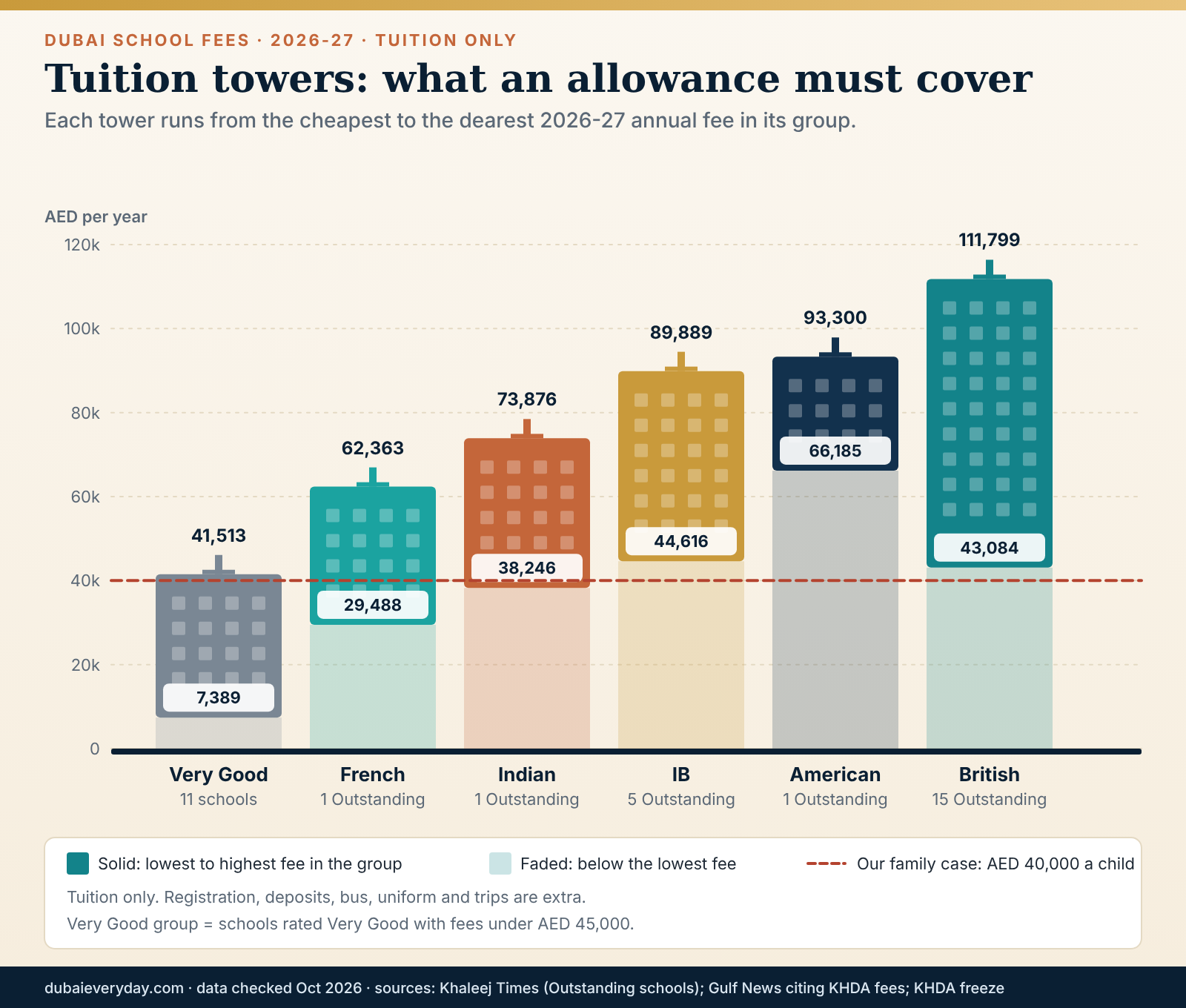
Khaleej Times compiled 2026-27 fees for Outstanding-rated schools: the lowest was AED 29,488 (a French-curriculum preschool) and the highest AED 111,799 (Year 13 at a British school). By curriculum the annual ranges were British AED 43,084 to 111,799, IB 44,616 to 89,889, American 66,185 to 93,300, Indian 38,246 to 73,876 and French 29,488 to 62,363. The article does not name its data source. Gulf News, citing KHDA-approved fee information, lists eleven Very Good schools under AED 45,000, with fees from AED 7,389 to AED 41,513.
Why a fixed allowance can fall short
Fees climb with age. In the British curriculum the highest fee in the Khaleej Times table is about 2.6 times the lowest (AED 111,799 against AED 43,084), our calculation, and that gap is mostly the distance between early years and the sixth form. An allowance set when your child is five may cover the school comfortably and then fail at twelve. Ask whether the cap is indexed, whether it follows the child through the school or resets on each renewal, and whether the employer will pay the school directly.
Count the extras too. Registration fees, deposits, bus transport, uniforms and trips sit outside tuition, and the Dubai school fees guide prices them one at a time. Allowances in Dubai packages are often written as “tuition fees only”, which leaves those extras with you.
Worked example: what a school allowance is worth
Illustrative example (not a quote or market fact). A family has two children, each in a school charging AED 40,000 a year. Tuition is AED 80,000 a year, or AED 6,667 a month. If the employer pays all of it, the benefit is worth the equivalent of AED 6,667 of extra monthly pay, tax free. If the allowance is capped at AED 30,000 per child, the family pays AED 10,000 per child a year out of pocket, AED 1,667 a month for two children. If the family chooses a school at AED 15,000, the unused part of an AED 30,000 cap may simply be lost. The wording decides.
Choosing the school is a separate decision with its own tools. Start with the Dubai schools guide for curricula and admissions, and read the KHDA ratings guide before treating an inspection grade as a promise. Admission timetables run well ahead of the school year, so negotiate the allowance and shortlist the schools in parallel rather than one after the other.
Insurance: what the law makes your employer pay
Health insurance is the one benefit in salaries Dubai packages where Dubai law, not the negotiating table, sets the floor. The Dubai government’s health-insurance page states that cover is mandatory under Law No. 11 of 2013, that employers, free-zone employers included, must insure their staff, and that sponsors must extend cover to spouses, children and domestic workers. Dubai residents should treat a missing insurance line as a question rather than a saving.
What Law 11 of 2013 says about who pays
The English text of the law, on the Dubai Legislation Portal, makes the employer responsible for enrolling employees in a policy that meets at least the Basic Coverage, keeping them insured throughout their service, and issuing an insurance card. Article 10(2) says the employer bears the enrolment cost and may not charge it to the beneficiary. Gulf News, answering a reader question, reaches the same conclusion for Dubai: employers cannot deduct the premium from salary.
Dependants are different. Article 11 puts the duty on the sponsor to insure sponsored persons who are not covered by an employer-provided policy. In practice, whether your spouse and children are insured by the company, or by you at your own cost, is a negotiated term. The law also lets employers and sponsors buy supplementary cover above the basic level, and penalties for non-compliance range from AED 500 to AED 150,000, doubling for a repeat violation within a year. The Arabic text prevails over the English one.
What a family policy costs when you pay
Premiums depend on age, plan level and network, and the best public figures come from brokers, so treat them as indicative. Gulf News reports that a basic Essential Benefits Plan premium in Dubai typically runs between AED 550 and AED 650. Pacific Prime, a broker, published annual family premiums on 28 May 2026: for two adults, AED 1,300 on a basic plan, AED 4,200 mid-tier and AED 9,800 premium; for two adults and two children, AED 2,600, AED 6,800 and AED 14,900.
Our calculation from the broker’s table: if you are insured by your employer, covering a spouse and two children yourself would cost about AED 1,950 a year on a basic plan, AED 4,700 mid-tier or AED 10,000 premium. Those totals subtract an assumed per-adult share from the family price, so they are rough. The gap between basic and premium is large enough to matter in a negotiation, because an employer that pays for “family cover” at the basic level has given you a very different benefit from one that pays for a premium plan.
Five things to ask about the policy
- Plan tier and network: which hospitals and clinics accept the card directly.
- Co-payments and annual limits, in writing, including maternity and dental if they matter to you.
- Who is covered and from when, including the date a newborn is added.
- What happens to cover at the end of notice, and whether the policy can be continued privately.
The moving to Dubai guide covers the health-cover step of the relocation timeline. Unemployment insurance is a separate scheme, covered in the section on salary thresholds below.
Bonus, gratuity and savings schemes
These are the parts of salaries Dubai employers promise that arrive later: a bonus at the end of the year, gratuity when the contract ends, savings-scheme money when you leave. They are easy to ignore on day one and large by year three, which is exactly why they are worth reading carefully before you sign.
Bonus: contractual or hopeful
The Labour Law’s wage definition includes percentages of sales or profits where the contract provides for them. A written commission or fixed bonus formula is therefore part of the deal. A line saying that a bonus “may be awarded at the company’s discretion” is not. Robert Walters reports that 82 per cent of professionals in its Middle East survey have a bonus scheme, and Cooper Fitch says firms are leaning on performance-driven bonuses instead of fixed pay rises. Both facts point the same way: a bonus is common, and it is also where employers keep flexibility.
When you compare salaries Dubai offers, count the bonus at a discount. Our rule of thumb is to value the guaranteed part at 100 per cent, the target part at no more than half, and anything described as discretionary at zero until you have seen the payout history. Ask three questions: what percentage of staff received the full target last year, whether you must still be employed on the payment date, and whether the bonus is calculated on basic or on gross. This is general information, not legal advice.
End-of-service gratuity: the formula
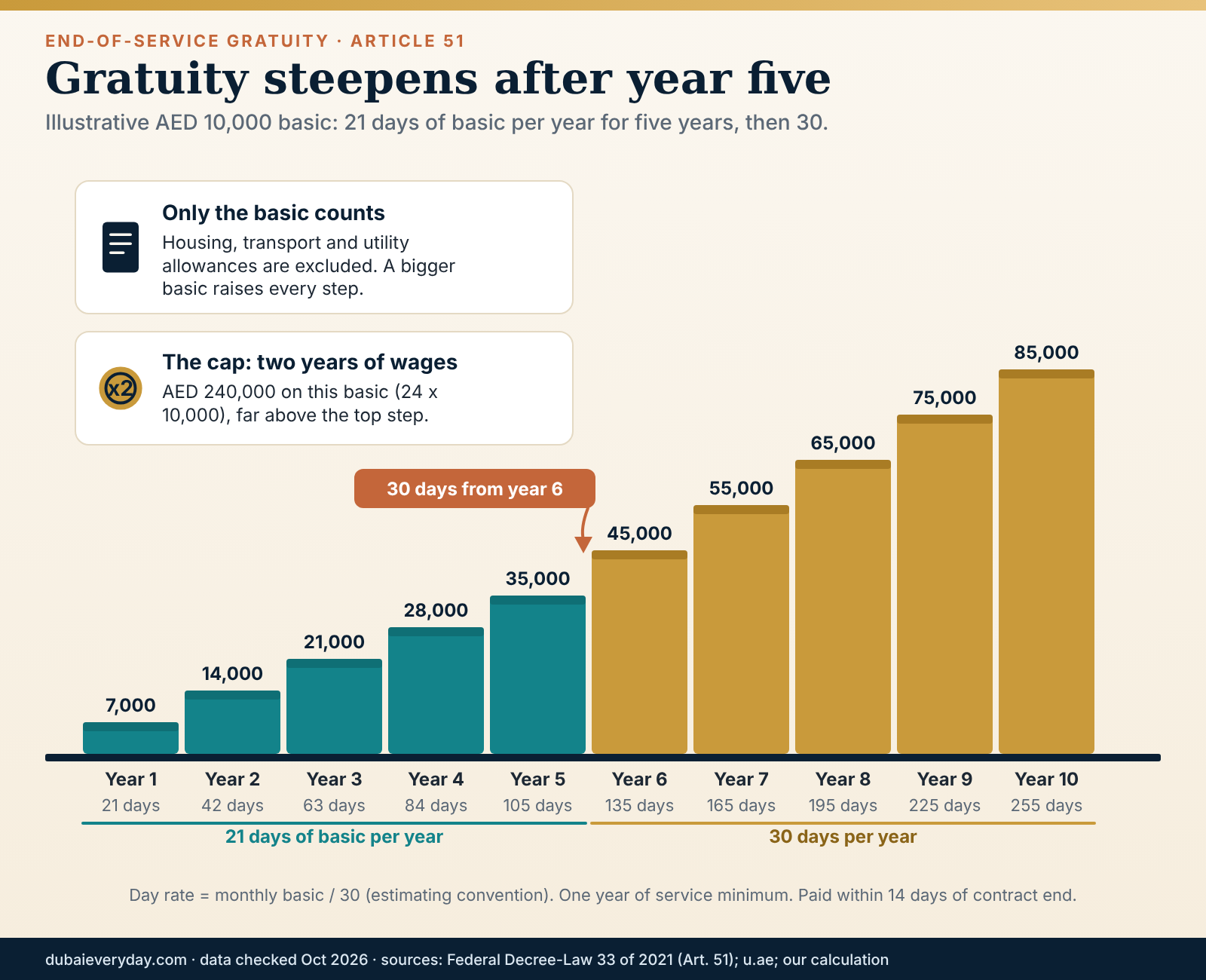
Gratuity is the statutory part of salaries Dubai professionals receive at the end rather than the start. For foreign workers on full-time contracts, Article 51 of Federal Decree-Law 33 of 2021 sets gratuity at 21 days of basic wage for each of the first five years and 30 days for each year beyond five. At least one year of continuous service is required, partial years are paid pro rata after that, and the total cannot exceed two years’ wages.
The UAE government’s end-of-service page confirms that housing, transport, utilities and furniture allowances are excluded, that unpaid absence does not count as service, and that outstanding wages and gratuity are payable within 14 days of the contract ending. Employers may deduct amounts the worker owes.
Payroll teams commonly turn “21 days” into money by dividing monthly basic by 30. That convention is widely used in calculators, but the page does not spell it out, so use it for estimates and ask for the employer’s own computation when it matters.
Why the basic matters: a worked example
Illustrative example (not a quote or market fact). With a basic of AED 10,000, a day is about AED 333. After three years the gratuity is 63 days, about AED 21,000. After five years it is 105 days, AED 35,000. After ten years it is 105 plus 150 days, 255 in all, AED 85,000. The two-year cap would be AED 240,000, far beyond anything this ladder reaches.
Now compare two employees with the same AED 34,000 gross. One has a basic of AED 17,000 and the other AED 25,000. In the first five years the first earns about AED 11,900 of gratuity a year and the second about AED 17,500. The difference is AED 5,600 a year, or AED 28,000 over five years. Same gross, same job, different leaving cheque, and a gap that headline salaries Dubai figures never show. The basic is also the number that sets your unemployment-insurance category, and it is the base for employer contributions if the company uses a savings scheme.
The savings-scheme alternative
MOHRE offers a voluntary alternative to gratuity. Employers who opt in contract with an investment fund approved by the Securities and Commodities Authority and pay contributions every month. Per the UAE government’s end-of-service page, the employer contributes 5.83 per cent of monthly basic for employees with under five years’ service and 8.33 per cent beyond that. Employees can add voluntary contributions, and funds can be capital-guaranteed, risk-based or Sharia-compliant. Accrued gratuity from before enrolment still has to be settled.
Those percentages are not arbitrary. Our check: 21 days divided by 30, divided by 12 months, is 5.83 per cent; 30 days gives 8.33 per cent. The scheme mirrors the gratuity accrual rates. The difference is risk: gratuity is a promise from the company, while a fund balance moves with markets and sits outside the company’s balance sheet. DIFC has its own employment law and its own Employee Workplace Savings plan with the same two rates, according to law-firm commentary.
Salary thresholds that quietly shape offers
Several rules in the UAE switch on or off at a particular salary. They do not change what you earn, but they change what you can do with it: sponsor a family, qualify for a long-term visa, or fall into a higher insurance premium band. Salaries Dubai employers set near these lines are often set there deliberately, so it pays to know where the lines are.
Sponsoring your family
The UAE government’s page on residence visas for family members states that the sponsor needs a minimum salary of AED 4,000, or AED 3,000 plus accommodation. Eligible family members listed there are the spouse, unmarried daughters, sons under 25 and children with special needs. Family members aged 18 or over must pass a medical fitness test. The page does not say whether salary means basic or gross, and conditions change, so confirm with the immigration authority. For process detail, see the guides to the Dubai residence visa and the medical fitness test.
Long-term visas that look at pay
The Abu Dhabi government’s own page for its golden-visa route for skilled professionals lists a minimum monthly salary of AED 30,000, a role in MOHRE skill level 1 or 2 and at least a bachelor’s degree. A consultancy article on the federal route says the figure applies to basic pay only. The Dubai-facing pages we opened did not state one, so treat AED 30,000 as a reported threshold to confirm with the federal immigration authority (ICP). Secondary sources also quote AED 15,000 for the skilled-employee Green visa, which we could not confirm on an official page.
If a threshold sits just above your real pay, never agree to a contract that states a higher salary than you will receive. The government’s job-offers page says providing false information to the ministry can attract fines of up to AED 20,000. Contracts are registered with MOHRE, and salary payments move through the Wage Protection System, so the paperwork can be compared with the money. A legitimate employer raises the actual pay, restructures the package or says no.
Unemployment insurance
The ILOE scheme (involuntary loss of employment insurance) covers Emiratis and residents in the federal government and private sectors, with exemptions including owner-investors, domestic helpers, temporary-contract workers and people under 18.
The monthly premium is AED 5 plus VAT for a basic salary of AED 16,000 or below (category A) and AED 10 plus VAT above that (category B). The benefit is 60 per cent of your average basic salary over the six months before job loss, for up to three months per claim, capped at AED 10,000 a month in category A and AED 20,000 in category B.
You must have paid premiums for 12 consecutive months before a claim, and lifetime payments cannot exceed 12 monthly benefits. The page does not say who pays the premium, so look at your payslip and contract. Illustrative example (not a quote or market fact): with a basic of AED 12,000 the monthly benefit would be AED 7,200, or AED 21,600 over a full three-month claim. A basic of AED 8,000 on an AED 24,000 gross would pay only AED 4,800, which is basic-versus-gross again in salaries Dubai contracts.
Salaries Dubai households need: three scenarios
Most readers searching salaries Dubai wide arrive with a different question from “what do people earn”: what do I need to ask for? Our approach is a simple model, clearly an illustration, that starts from the three costs that your salary has to carry before anything else: rent, school fees and the insurance cover for dependants. Everything else (food, transport, utilities, phone, leisure, savings) has to fit in whatever is left.
The rule of thumb behind the numbers
We assume those three fixed items should stay at or below about half of gross monthly package, our rule of thumb and not an official benchmark. That leaves the other half for daily life and saving. Divide the fixed items by 0.5 and you get a gross package for that household. We also show 60 per cent, which is tight but workable if the rest of your costs are low, and 40 per cent, which is comfortable.
| Illustrative model (AED) | Single | Couple, one income | Family of four |
|---|---|---|---|
| Home assumed | Studio, JVC | 1-bed, Business Bay | 2-bed, Dubai Hills |
| Annual rent (H1 2026 average) | 54,000 | 104,000 | 164,000 |
| School, two children (assumed) | none | none | 2 x 40,000 = 80,000 |
| Dependants’ insurance, mid-tier (broker figures) | 0 | 2,100 | 4,700 |
| Fixed commitments, per month | 4,500 | 8,842 | 20,725 |
| Gross package at 50 per cent share | 9,000 | 17,700 | 41,500 |
| Gross package at 60 per cent share (tight) | 7,500 | 14,700 | 34,500 |
| Gross package at 40 per cent share (comfortable) | 11,300 | 22,100 | 51,800 |
Rents are dubizzle’s H1 2026 averages and the insurance figures come from the Pacific Prime broker table described earlier, with the employee’s own cover assumed to be paid by the employer. The school figure is our assumption, inside the KHDA-regulated ranges. At the 50 per cent line the single household needs about USD 2,450 a month, the couple about USD 4,820 and the family about USD 11,300.
What moves the answer most
Lower-cost family
Two-bedroom in JVC (AED 113,000), two children at AED 15,000 each, basic family cover (about AED 1,950 for dependants). Fixed commitments about AED 12,100 a month; package at 50 per cent roughly AED 24,200.
Our family case
Dubai Hills two-bedroom, two children at AED 40,000 each, mid-tier cover. Fixed commitments AED 20,700 a month; package at 50 per cent about AED 41,500.
Premium-school family
The same home with both children at AED 75,000 and mid-tier cover. Fixed commitments about AED 26,600 a month; package at 50 per cent about AED 53,100.
In the same Dubai Hills home, changing the schools from AED 15,000 to AED 75,000 per child adds AED 10,000 a month to fixed costs and AED 20,000 to the package needed at the 50 per cent line. That is why a school allowance is such a large lever in a family offer. If the employer pays all or most of the fees, the package you need in cash falls dramatically, which our scenarios do not show because they assume you pay everything yourself.
Rents fell during 2026, so the rent column may now be a ceiling in several communities, and the model ignores one-off setup costs, which the Dubai relocation checklist covers. Use the table as a calculator template for salaries Dubai offers: replace our rent, school and insurance lines with your own quotes and divide by your chosen share.
Comparing two offers: a worked example
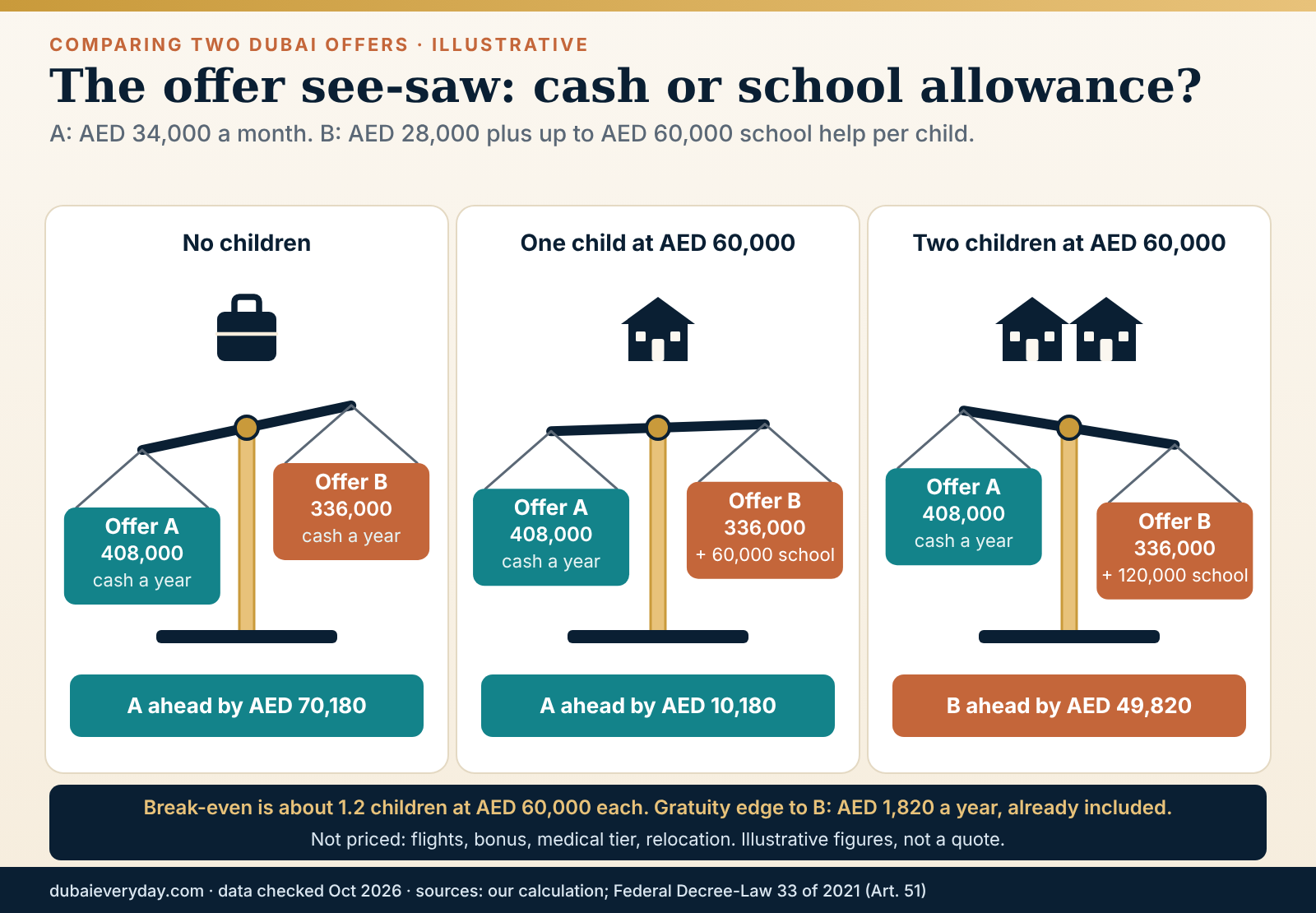
Here is the method for comparing salaries Dubai offers in practice. Illustrative example (not a quote or market fact): you hold two offers. Offer A is cash-heavy, AED 34,000 a month with a basic of AED 17,000 and no extras. Offer B pays AED 28,000 a month with a basic of AED 19,600 and a school allowance of up to AED 60,000 a year per child, for up to two children. Which is better depends entirely on how many children you have.
| Line (AED, per year unless stated) | Offer A | Offer B |
|---|---|---|
| Monthly gross / basic | 34,000 / 17,000 | 28,000 / 19,600 |
| Cash over 12 months | 408,000 | 336,000 |
| Gratuity accrual, first five years (basic / 30 x 21) | 11,900 | 13,720 |
| No children: A ahead by | 70,180 | |
| One child at AED 60,000: A ahead by | 10,180 | |
| Two children at AED 60,000: B ahead by | 49,820 | |
The break-even sits at about 1.2 children at that fee level, our calculation. A childless candidate should take A without a second thought, and the family with two children in AED 60,000 schools should take B. The case in the middle is closest, and there the small things decide: whether the allowance can be used for a cheaper school, whether it is paid to the school or reimbursed, and whether flights, bonus or the medical tier are better on one side.
Four valuation mistakes
People comparing salaries Dubai offers tend to make the same errors. They count a school allowance for children they do not have. They count a full allowance when the chosen school costs less. They compare gross figures while ignoring that basic differs, so gratuity does too. And they treat a target bonus as salary. The first two inflate the benefit-heavy offer, the third undervalues it, and the fourth inflates whichever offer carries the bonus.
Once you have a preferred offer among the salaries Dubai employers have sent you, the paperwork starts. The employment contract guide explains what the MOHRE contract adds to the offer, and the Dubai work visa guide shows the order of permits, medicals and ID that follow. Both depend on the salary and allowances you have just agreed.
Getting paid: WPS, deadlines and deductions
The salaries Dubai employers promise are only as good as their payment record. Under Article 22 of the Labour Law, wages are paid on their due dates in dirhams, unless both sides agree another currency in the contract. Private-sector pay moves through the Wage Protection System, so MOHRE can see whether salaries arrive in full and on time.
The 2026 payment clock for salaries Dubai employers owe
Ministerial Resolution 340 of 2026, in force from 1 June 2026, replaced the earlier rules. The UAE government’s summary says salaries for the previous month are due on the first day of each Gregorian month, and that employers must transfer at least 85 per cent of total wages due on time, up from 80 per cent according to law-firm commentary. Counting from the due date, the escalation runs as follows.
- Day 2: notifications and alerts to non-compliant employers.
- Day 5: suspension of new work permits, with a warning to pay.
- Day 11: administrative fine and reclassification to the third category for a repeat violation within six months.
- Day 16: automatic registration of a labour dispute in the cases the resolution lists.
- Day 21: enforcement steps that can include attachment, travel bans and prosecution referral for larger or repeat offenders.
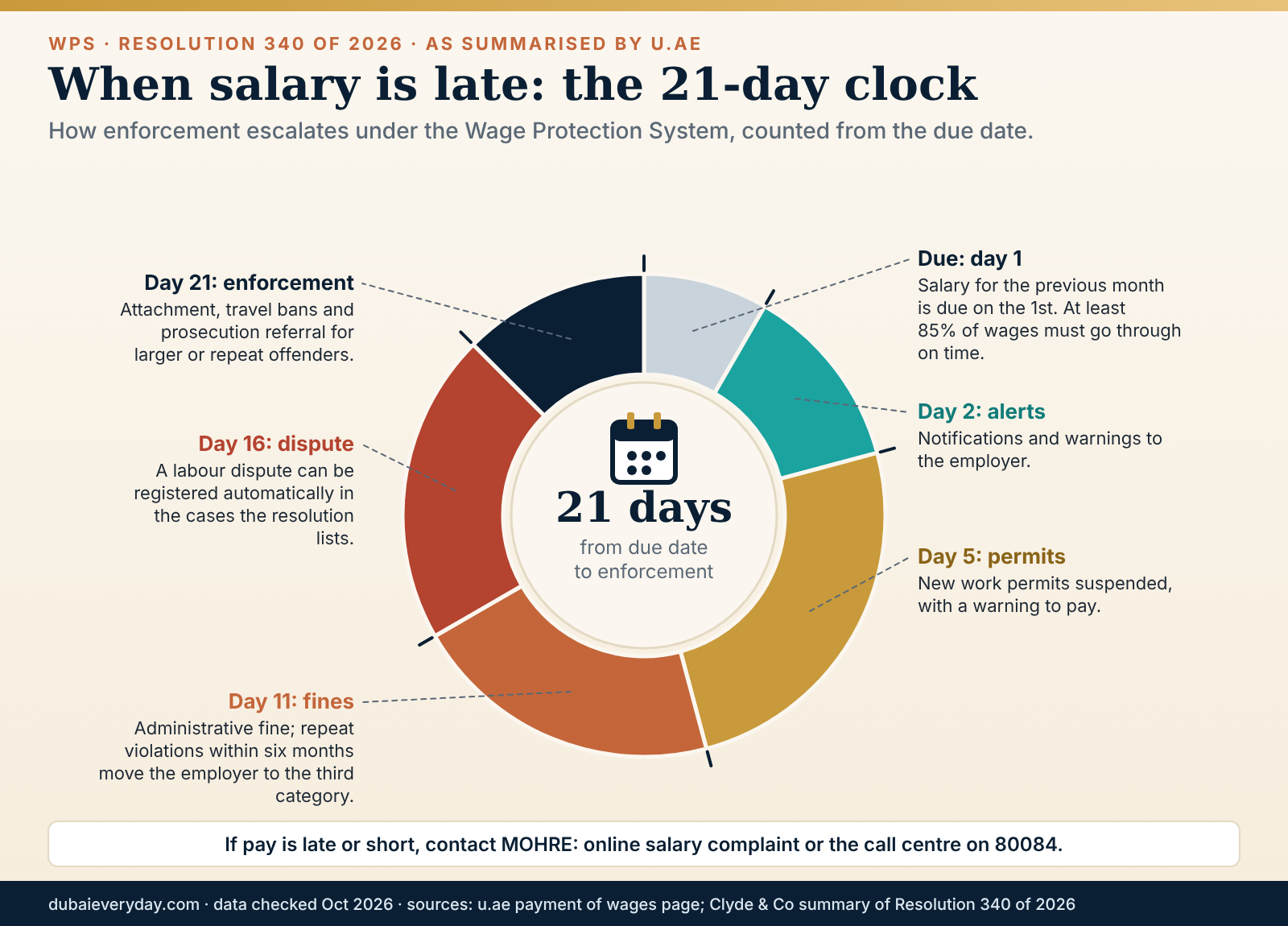
If your pay is late or short, contact MOHRE promptly; it offers an online salary-complaint service, and its Labour Claims and Advisory Call Centre is 80084. Keep your offer, contract, payslips and bank statements. Final wages and entitlements, gratuity included, are due within 14 days of the contract ending.
What can be deducted
Article 25 allows deductions from salaries Dubai employers pay only in listed cases: loans repaid with written consent and no interest, overpayments (up to 20 per cent of the wage), violation penalties (up to 5 per cent), court-ordered debts (up to a quarter, with alimony excepted) and damage caused by the worker (up to five days’ wage a month unless a court approves more). All deductions together cannot exceed half the wage. A payslip deduction that fits none of these categories is worth querying, as is any attempt to charge you the health-insurance premium in Dubai.
Salary red flags and offer checks
Among the salaries Dubai adverts list, the easiest warning sign is one that does not fit the role. Compare an advert with the sector ranges earlier on this page. A junior marketing job paying AED 40,000 is not proof of fraud, but it is a reason to slow down. MOHRE’s own warning lists three red flags: promises of unusually high salaries or immediate hiring, requests for fees or payments, and requests for sensitive personal or banking details.
A verification route before you resign or fly
- Check the formA genuine offer uses the MOHRE-approved job-offer form with a unique serial number or barcode. Verify it through the MOHRE UAE smart app, the MOHRE website or the call centre on 600590000.
- Check the companySearch the English and Arabic names in the National Economic Register, as the government fraud-tips page advises. Dubai entry permits can be checked on the GDRFA website.
- Match the numbersThe salary, allowances and benefits you were told must be the ones on the form. The contract you sign after arriving has to match the job offer signed beforehand.
- Pay nothingRecruitment expenses are the employer’s. Charging recruitment fees to prospective employees is illegal, and a visit visa does not permit work.
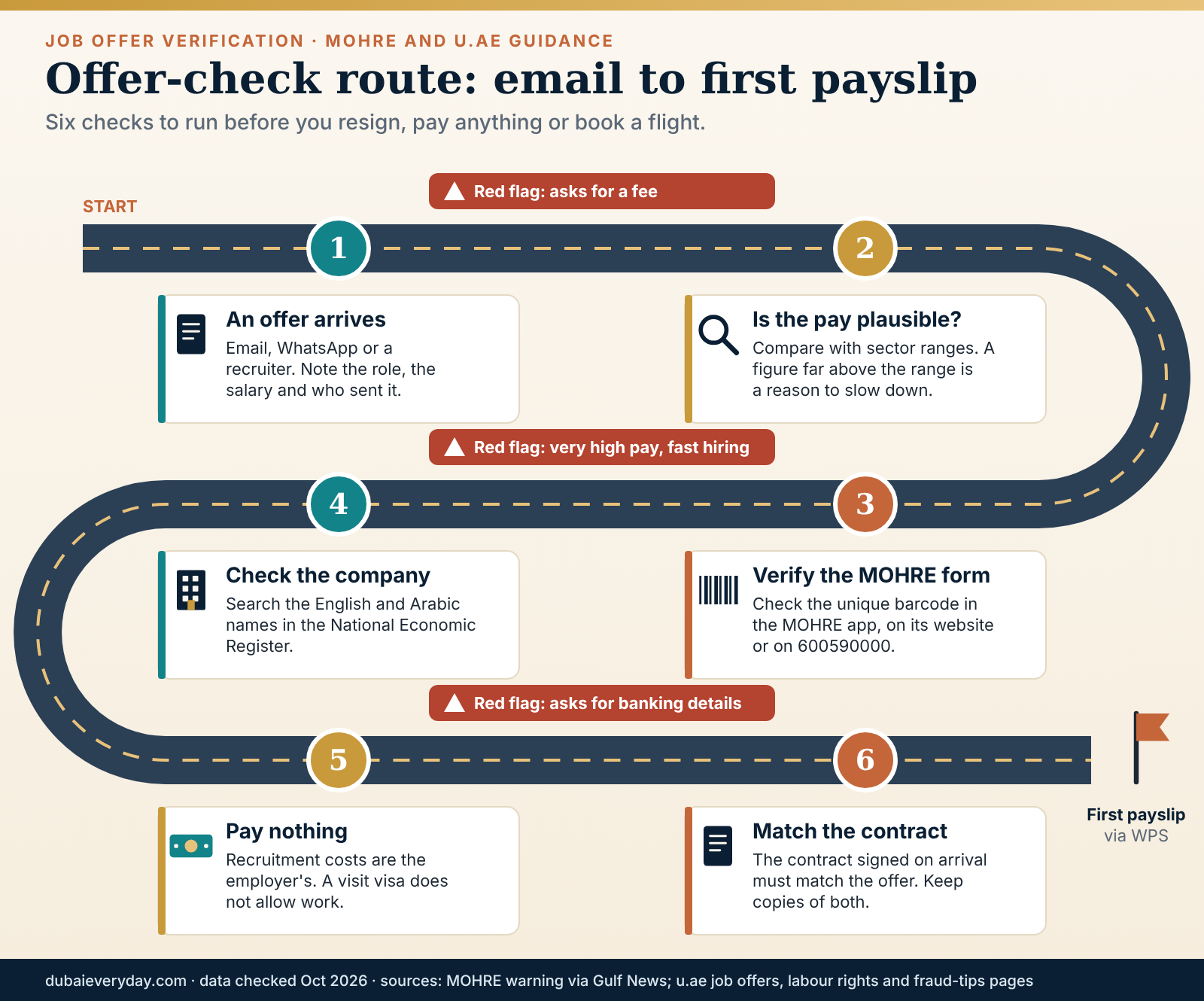
If someone asks you to pay for a visa, medical test, training or placement before your offer is verified, stop. The employer pays recruitment costs, and MOHRE’s warning names fee requests as a red flag. Report the approach and verify through MOHRE rather than through the sender’s own links. For the search side, the guide to finding a job in Dubai covers recruiters and scam checks in detail.
Salaries Dubai: frequently asked questions
What is a good salary in Dubai?
It depends on your household, not on a national average of salaries Dubai wide. Michael Page’s 2026 guide, as reported by The National, places most of the roles it tracks between AED 10,000 and AED 40,000 a month. Our illustrative model suggests about AED 9,000 for a single person in a studio, AED 17,700 for a couple in a one-bedroom and AED 41,500 for a family of four with two children at AED 40,000 schools, if rent, school and dependants’ cover are to stay near half of gross pay.
Are salaries Dubai employers quote gross or net?
Salaries Dubai employers quote are normally gross, but with no personal income tax in the UAE, gross and net are close. The UAE government’s taxation page says the country does not levy income tax on individuals. Deductions that do exist, such as loan repayments you agreed to or court-ordered debts, are capped by Article 25 of the Labour Law. The more important question is whether the number is basic, gross monthly or a yearly package.
What is the difference between basic salary and total salary?
Under Article 1 of Federal Decree-Law 33 of 2021, the basic wage is the contract wage before allowances and in-kind benefits. The wage adds cash allowances and benefits. Gratuity is calculated on the basic wage only, and ILOE premium bands are based on it. Housing, transport and utility allowances are excluded from gratuity, which is why two jobs with the same total can leave you with different end-of-service payments. Always ask for the basic when comparing salaries Dubai offers.
Does my employer have to pay for health insurance in Dubai?
Yes for employees. Dubai Law 11 of 2013 requires employers to insure staff at no less than the Basic Coverage, and Article 10(2) says the cost is borne by the employer and not charged to the employee. Dependants are the sponsor’s responsibility unless the employer’s policy covers them, so ask whether your spouse and children are included and at what plan level.
Do Dubai employers have to pay school fees?
Nothing in the Labour Law provisions we read requires it. A school or education allowance exists only if your contract says so, with whatever cap, child limit and conditions it states. KHDA regulates fees and confirmed no private-school fee increase for 2026-27. Ask whether the allowance is paid to the school or reimbursed, whether it covers extras such as buses and uniforms, and whether it rises as fees climb with your child’s age.
How is end-of-service gratuity calculated?
For foreign full-time workers with at least one year of service, it is 21 days of basic wage per year for the first five years and 30 days for each year after, paid pro rata for part years and capped at two years’ wages. Allowances are excluded. Many calculators divide monthly basic by 30 to get a day rate, which is an estimating convention, so ask for the employer’s own calculation. Payment is due within 14 days of the contract ending.
Is there a minimum wage behind the salaries Dubai employers pay?
The UAE government’s wage-payment page says there is no stipulated minimum salary for the private sector, only a requirement that wages meet employees’ basic needs. Some rules still work like floors. Sponsoring family requires AED 4,000, or AED 3,000 plus accommodation, and certain visa routes set higher thresholds. Those thresholds are about eligibility for sponsorship or residency, not a guaranteed pay rate for your job.
How much should a housing allowance be?
Enough to cover the rent of the home you will actually live in, checked against current listings. Our calculation for a Business Bay one-bedroom at the H1 2026 average: AED 104,000 a year, or AED 8,667 a month. Asking rents fell in most tracked communities by September 2026, according to Property Finder data, so compare the allowance with today’s market in your chosen area and ask whether the allowance is fixed for the whole contract.
Are bonuses guaranteed in the salaries Dubai employers quote?
Only if the contract makes them so. A written formula or fixed bonus is part of the deal. A discretionary bonus is a possibility. Robert Walters reports that most surveyed Middle East professionals have a bonus scheme, but that says little about what you will receive. When comparing offers, value guaranteed amounts in full, target bonuses at no more than half, and discretionary ones at zero until you see the payout history.
When must the salaries Dubai employers owe be paid under the WPS?
Under the framework in force since 1 June 2026, as summarised by the UAE government, salaries for the previous month are due on the first day of each month, and employers must transfer at least 85 per cent of total wages due on time. Escalation starts at day 2 and builds towards enforcement by day 21. If pay is late, contact MOHRE or the call centre on 80084.
How can I check that the salaries Dubai adverts promise are genuine?
Look for the MOHRE-approved job-offer form with a unique barcode and verify it through the MOHRE UAE smart app, the MOHRE website or 600590000. Check the company in the National Economic Register. Never pay fees, since recruitment costs are the employer’s, and be wary of salaries far above the usual range for the role. The contract you sign on arrival must match the offer you accepted.
Start with the part of salaries Dubai offers you can control: ask for the basic, each allowance, the bonus rules and the dependants’ cover in writing. Run the two-offer table with your own figures. Then move to the paperwork, because the contract and the visa follow from the salary you agree, not the other way round. These guides pick up from here.
Sources and further reading (33 links)
- UAE Government portal: Residence visa for family members — AED 4,000 or AED 3,000 plus accommodation, eligible dependants, medical test
- Dubai Legislation Portal: Law No. (11) of 2013 — employer and sponsor insurance duties, cost bearing, penalties
- Government of Dubai: Health insurance — mandatory cover, employers and sponsors
- MOHRE: Federal Decree-Law No. 33 of 2021 and amendments — wage definitions, payment, deductions, gratuity, leave, overtime
- UAE Government portal: Payment of wages — no minimum salary, WPS due date, 85 per cent threshold, escalation timeline
- UAE Government portal: End of service benefits for employees in the private sector — gratuity rules and the voluntary savings scheme
- UAE Government portal: Labour rights — employer-paid recruitment costs, contract matching the offer, hotline
- UAE Government portal: Job offers and the employment process — binding offer, signing, fines for false information
- UAE Government portal: Tips to avoid labour and visa fraud — offer reference check, National Economic Register, visit visas
- UAE Government portal: Taxation — no personal income tax, VAT at 5 per cent
- ILOE: unemployment insurance scheme — premiums, categories, benefit rules
- Dubai Media Office: KHDA confirms no fee increase — 2026-27 private school fees, affordable places
- Khaleej Times: Dubai school fees 2026-27 at Outstanding schools — fee ranges by curriculum
- Gulf News: Very Good rated Dubai schools under Dh45,000 — lower-cost fee range from KHDA-approved fees
- dubizzle: H1 2026 Dubai rental market report — average annual rents by area (portal data)
- Khaleej Times: Dubai rents fall in most areas — Property Finder asking-rent changes to September 2026
- The National: UAE salary guide 2026 — Michael Page headline ranges and averages
- Michael Page UAE: Salary guide — definition of figures (monthly; allowances included; bonus excluded)
- What’s On: UAE salary guide 2026 — sector examples from Michael Page
- Arabian Business: UAE salary guide 2026 — 2025 pay movement and professional sentiment
- Robert Walters: Middle East Salary Survey 2026 — monthly role ranges, bonus prevalence, pay-rise expectations
- Enterprise: UAE salary growth to slow in 2026 — Cooper Fitch salary guide findings
- Khaleej Times: UAE salaries to rise in 2026 — Cooper Fitch and Korn Ferry forecasts, benefits commentary
- Khaleej Times: UAE hiring for salaries under Dh10,000 drops — Naukrigulf Hiring Index by salary band and function
- Enterprise: Dubai inflation rises to 5.5 per cent — August 2026 consumer prices
- Gulf News: Does your employer have to pay for your health insurance — Dubai employer duty, basic premium range
- Pacific Prime: Family health insurance in Dubai and the UAE — broker premium tiers (context only)
- Gulf News: MOHRE warns about high-paying job offers — red flags and offer verification
- Clyde & Co: UAE introduces stricter wage protection enforcement framework — Resolution 340 of 2026 and the 85 per cent threshold
- Abu Dhabi Department of Economic Development: Golden visa for skilled professionals — AED 30,000 threshold (Abu Dhabi route)
- QAS Pro Global: Can a salaried employee get a UAE Golden Visa — consultancy view that basic pay is what counts (secondary)
- Al Tamimi & Co: DIFC Employee Workplace Savings scheme — DEWS contribution rates (law firm; secondary)
- The National: UAE dirham peg — AED 3.6725 per US dollar
Update log: 29 October 2026 — first publication; facts checked against the sources above. Next review due: by 28 February 2027, or sooner after any change to the WPS rules, health-insurance regulation, KHDA fees or visa thresholds. Corrections welcome. General information only, not legal, tax, financial or insurance advice; confirm any figure that affects a contract with MOHRE, the immigration authority or a licensed professional.
About DubaiEveryday and this guide
DubaiEveryday.com is an independent editorial project that publishes practical, research-based guides to everyday life in Dubai: where to live, what things cost, how the rules work and how to get around. This page was written and edited by the DubaiEveryday editorial team. It is not signed by a named expert, doctor, lawyer or adviser, and we do not claim first-hand testing of a venue, clinic or service unless the page says so.
Each guide is built from official sources such as government and regulator pages, operator websites and established news outlets, cross-checked where we can. When we could not confirm something, we say so in the text, and examples that use made-up numbers are labelled as illustrations. Mentions are editorial choices, not paid placements, and a link is not an endorsement.
Dubai changes quickly. If you spot something that is out of date or wrong, please tell us through the contact options on DubaiEveryday.com and we will check it and correct the page.