

Most Dubai property ROI figures you meet are a rent divided by a price. This guide builds the real number instead, line by line, from the registration fees on day one to the agent’s invoice on exit day, with every worked example labelled as an illustration.
A listing says the yield is high, the maths looks simple, and the rent divided by the price gives a tidy percentage. It is a comforting number. It also leaves out registration fees on day one, service charges every year, loan costs and the agent’s invoice when you sell.
What does the property really return on the cash you put in? To find your own dubai property roi, you need every cash flow, in order, with its date. This guide builds that figure line by line with clearly labelled illustrations, so a flattering headline yield stops fooling you and you can compare deals on honest ground.
Dubai property ROI is the yearly return on the cash you actually put in, after the costs of buying, holding, financing and selling. You find it by listing every cash flow with its date, from the deposit to the sale cheque, and solving for the rate that makes them balance. A spreadsheet’s IRR function does that in one cell. A plain rent-over-price yield skips most of those cash flows, which is why it flatters.
Five blocks of inputs feed the answer. Purchase costs start with the Dubai Land Department (DLD) registration fee of 4% of the price, which the DLD’s own news release says the buyer pays, plus trustee, title deed and agent fees. Rent should be what you collect, not what is advertised. Service charges are approved by RERA and published in the DLD’s Service Charge Index. Finance adds loan costs, interest and a balance to repay. Sale costs include the agent, the developer’s no-objection certificate and any lender fees.
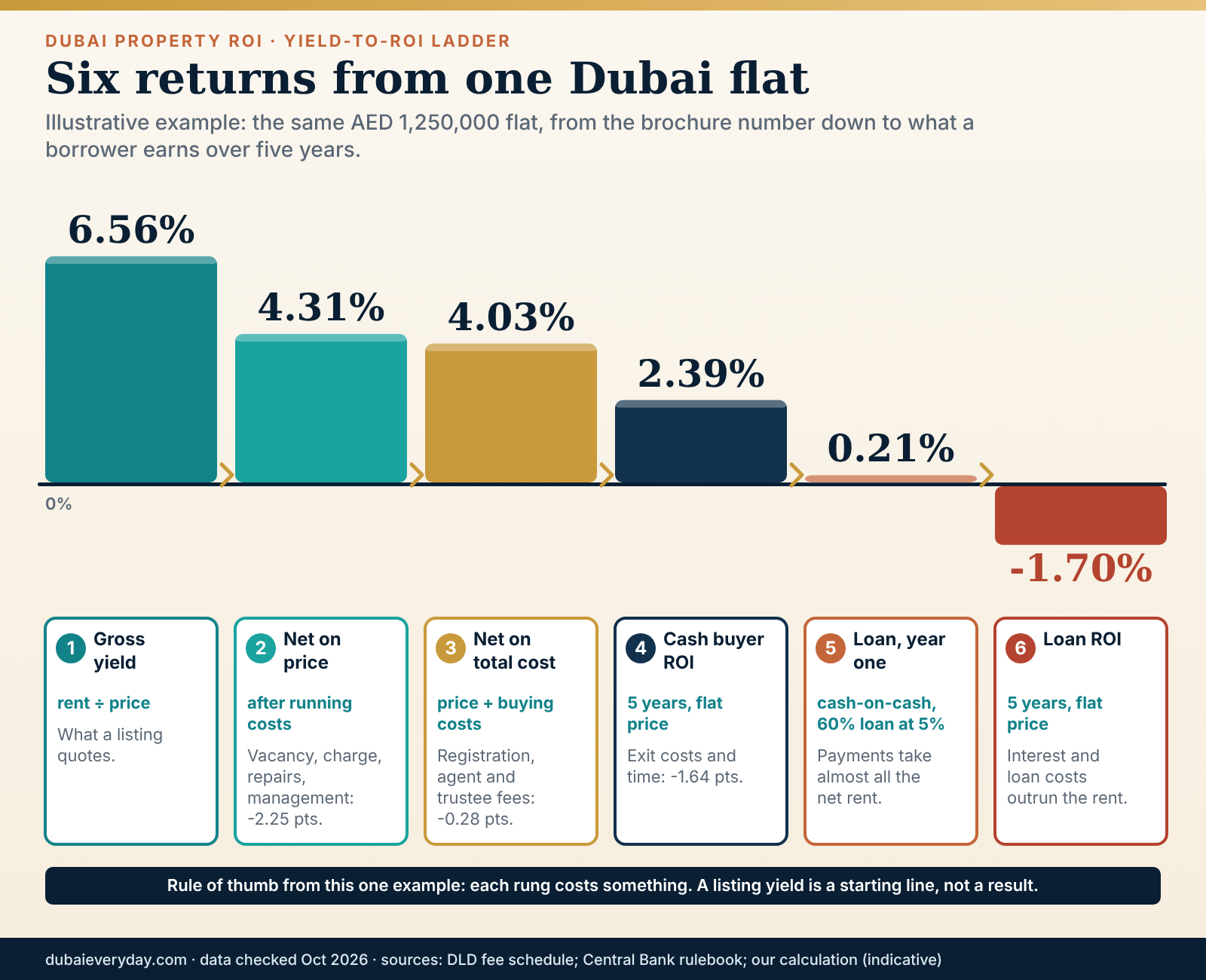
Illustrative example (not a market quote): an AED 1,250,000 flat that rents for AED 82,000 shows a 6.56% gross yield and a 4.03% net yield on total cost. Its five-year annualised return is 2.39% for a cash buyer if the price stays flat, and -1.70% a year with a 60% loan at 5%. One flat, four numbers. The sections below show where each part of the Dubai property ROI comes from, so you can rerun the sums with your own figures. This is general information, not investment advice.
This Dubai property ROI guide is desk research. DubaiEveryday.com has not bought, let or sold a flat in Dubai for this page, and nothing here describes a personal property deal. There is no named author persona and no field testing, because there is nothing to field-test: the work is reading official fee schedules and doing arithmetic on them.
Fees and rules were read on 29 October 2026 from the DLD property sale registration page, the mortgage registration page, the page on selling a mortgaged property, the DLD FAQ, the Service Charge Index, Mollak, the Central Bank’s mortgage rulebook entry and its base-rate release, and the UAE government’s taxation page. Market context comes from consultancy reports quoted in the press and is labelled as secondary.
Not verified: current bank mortgage rates and arrangement fees, brokerage commission (the DLD says it is set by agreement), developer NOC fees, valuation fees, holiday-home permit rules (the Dubai Department of Economy and Tourism page did not load its content), and anyone’s tax position outside the UAE. Every worked figure is labelled “Illustrative example” and was computed in code, not by hand. No bank, broker, developer or platform is recommended, inclusion was not paid for, and this is general information, not individual financial, legal or tax advice.
What Dubai property ROI actually measures
Ask five people in a Dubai majlis, a WhatsApp group or a broker’s office what their Dubai property ROI is and you can get five different numbers for the same flat. One is quoting rent over price. One has taken off the service charge. One has counted only the deposit as invested. One includes the price rise. One has quietly left out the agent. None of them is lying; they are answering different questions with the same three letters.
The versions worth separating are these. Gross yield is annual rent divided by price. Net yield is rent after running costs, divided by price or, better, by price plus buying costs. Cash-on-cash return is the year’s cash left after loan payments, divided by the cash you put in. Total ROI adds the sale: profit over the whole holding period, divided by the cash invested, and usually expressed per year. The equity multiple is total cash back divided by total cash in.
On this page, “Dubai property ROI” means the annualised total return: the internal rate of return (IRR) on the cash flows of one specific purchase, held for a stated number of years and then sold. That choice is deliberate. It is the only version that has to confront the 4% registration fee, the agent on both ends, the loan and the exit price in one figure. It is also the version that is hardest to fake in a brochure.
Where this page fits. This page is the full calculation, from purchase costs to sale costs, with worked scenarios. For a deeper look at yield definitions, vacancy and service-charge look-ups, read our Dubai rental yield guide. For the question of whether, where and how to invest, read the Dubai property investment guide. For the purchase process itself, see buying property in Dubai.
Which number answers which question
The mistake is not choosing the wrong measure; it is using one measure to answer another measure’s question. A gross yield is fine for a first filter across listings. It is useless for deciding whether to borrow. The table below pairs each decision with the figure that suits it and the trap that comes with it.
| Your question | Use this number | The trap |
|---|---|---|
| Is this listing worth a second look? | Gross yield, with a signed rent | Asking rents and brochure rents are not income |
| What will the flat earn me each year? | Net yield on price plus buying costs | Using a service charge from a brochure, not the approved figure |
| Can I carry the loan? | Annual cash flow after debt service, then cash-on-cash | Counting principal repayments as lost income, or as profit |
| Is borrowing improving my return? | IRR with the loan against IRR without it | Comparing the loan rate with the yield instead of with the IRR |
| Is this better than another asset? | Annualised total ROI over the same years | Comparing a pre-tax, pre-cost yield with a bank rate |
| How long until I am safe? | Break-even sale price by year held | Assuming the price must rise, when it only has to avoid falling far |
| Should I buy or keep renting? | Break-even price growth against renting and investing the difference | Treating rent as money thrown away and ignoring the equity you tie up |
Why listings quote gross, and why you should not copy them
A listing quotes gross yield because it is the one number that needs no knowledge of your finances, your tenant or your building. It is also the number most likely to look good. The honest use of a gross yield is as a sieve, not a verdict. The Dubai property ROI is what you compute after the sieve. If it is already below what you would accept after costs, move on; if it passes, you have only reached the starting line.
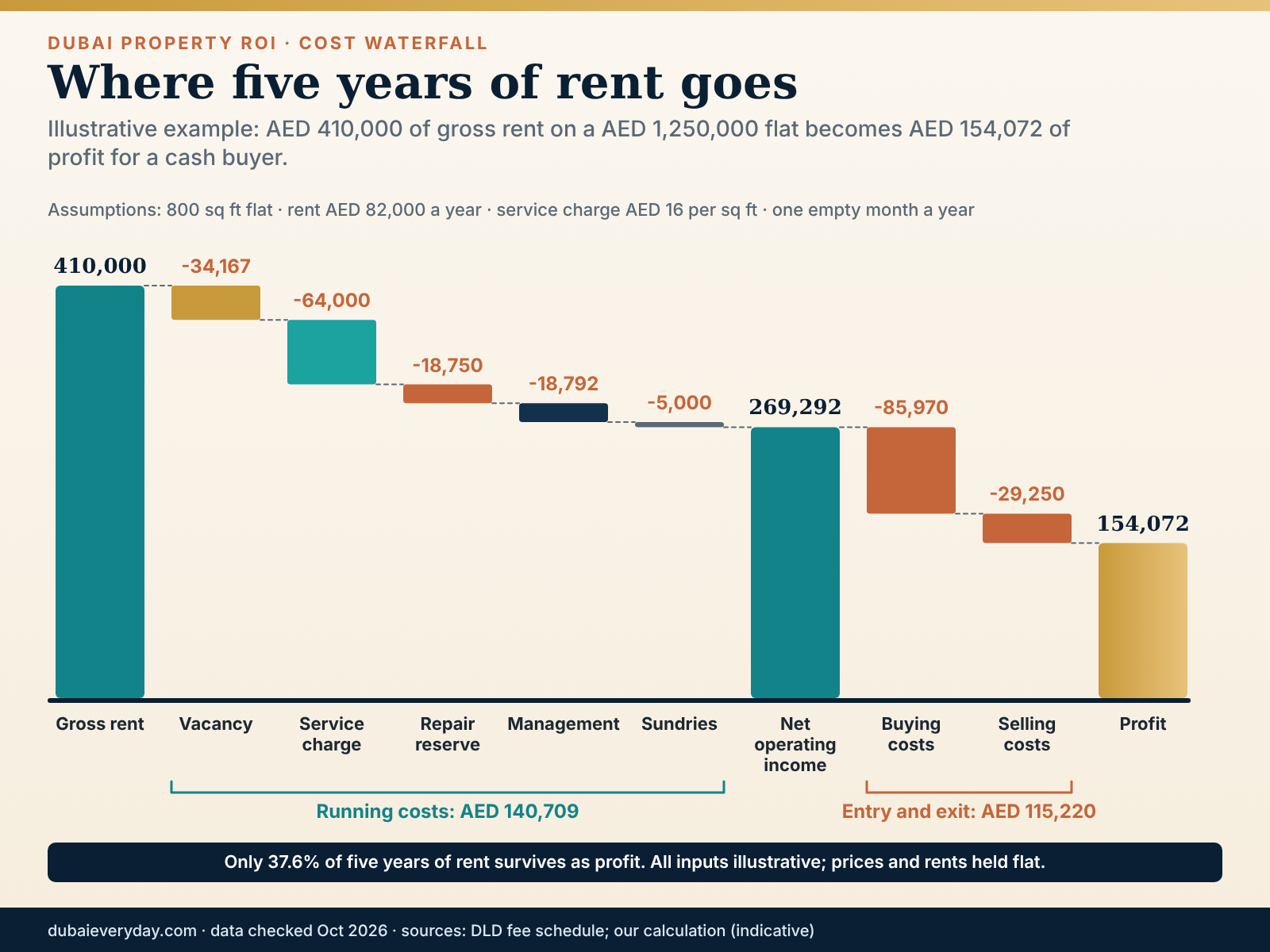
The gap between gross and net is not small. In our illustrative example below, only 65.7% of the rent survives to net operating income, and only 37.6% of five years of rent survives as profit after buying and selling costs. That is not a Dubai scandal. It is what happens when a 6.56% number meets vacancy, a service charge and two rounds of fees.
The Dubai property ROI formula on one page
Every Dubai property ROI calculation, however fancy the spreadsheet, is six lines of arithmetic. Write them down once and the rest of this guide is just filling in the lines with defensible numbers.
- Cash in on day onePrice, minus any loan, plus every buying cost (registration, trustee, agent, small fees) and every loan cost (mortgage registration, valuation, bank fee).
- Net operating income each yearRent actually collected, minus service charge, maintenance, management, insurance and sundries.
- Debt service each yearThe loan payment, interest and principal together. Zero for a cash buyer.
- Cash flow each yearNet operating income minus debt service. This can be negative.
- Cash out on exit daySale price, minus agent, developer NOC, any seller-side registration share, any lender settlement fee, minus the loan balance still owed.
- ReturnPut lines 1, 4 and 5 on a timeline. Total profit is the sum of everything after day one minus the cash in. The annualised figure is the IRR of the timeline.
Two traps hide in that list. First, line 1 is larger than the price suggests, because buying costs are paid on day one and earn nothing. Second, line 5 is smaller than the sale price suggests, because the loan and the sale costs come off before you see a dirham. A calculation that ignores either is not a Dubai property ROI; it is a yield.
The example flat used throughout
To keep the arithmetic traceable, most sections use one made-up flat. It is not a listing, not an area and not a forecast. Change the inputs to match your own deal and the method still holds.
Illustrative example: the inputs. A ready one-bedroom flat bought for AED 1,250,000, 800 sq ft on the title deed. Rent AED 82,000 a year (a 6.56% gross yield). Service charge AED 16 per sq ft, so AED 12,800 a year. One month of vacancy a year. Management at 5% of rent collected. Maintenance at 0.3% of the price, AED 3,750. Insurance and sundries AED 1,000. Agent at 2% plus 5% VAT on the way in and on the way out. A developer NOC of AED 3,000 on exit. Price, rent and costs held flat for five years, then sale.
Every one of these except the DLD and trustee fees is an assumption, and the guide says which is which.
The flat-everything choice matters. Real rents drift and real prices move. But a model with growth built in lets the optimistic assumption hide inside the answer. We start with nothing growing, see what the costs alone do, and then add movement as a labelled scenario.
Step 1: purchase costs, the day-one ledger
Buying costs are the part of a Dubai property ROI that is easiest to get exactly right and most often gets rounded away. They fall into three groups: fixed official fees, negotiated fees, and lender fees. The first two are covered here; lender fees come in the finance step. All of them are paid on day one, before the flat has produced a single dirham of rent.
The DLD registration fee: 4%, and who pays it
The DLD’s property sale registration page lists a 2% seller fee and a 2% buyer fee. It does not say who settles which share. A DLD news release from 31 May 2021 about off-plan registrations states that the fee is 4% of the agreed price and that the buyer or investor settles it. The page on selling a mortgaged property lists the 4% as a single manager’s cheque payable to the Department.
Our reading: the buyer pays the full 4% in the base case, which is how the model treats it, and any split is a negotiating term in your sale agreement rather than a rule you can assume. If the seller agrees to carry their 2% on the way in, that is worth 0.42 percentage points of annualised return to the buyer in our example (2.81% instead of 2.39%). If a seller expects you to carry their share too, you have found out something about the price.
The small official fees and the VAT on them
The same DLD page lists a trustee-centre (“service partner”) fee of AED 4,000 plus VAT for a sale of AED 500,000 or more, and AED 2,000 plus VAT below that. It adds a title deed fee of AED 250, a map fee of AED 250 for apartments and villas, and AED 10 each for the knowledge and innovation fees. The UAE government’s taxation page describes a 5% VAT on goods and services, so we load the trustee fee at 5%: AED 4,200. The small fees add up to AED 520.
The agent, and the costs nobody puts in the brochure
On commission the DLD’s FAQ says it is set by agreement between the parties, and customary practice applies if nothing is written. Property portals commonly quote 2% plus VAT for a resale, and we use that for both the purchase and the sale, flagged as an assumption. It is negotiable. It is also worth checking that the agent appears on the DLD’s licensed broker list before any money moves; our buying guide walks through those checks.
Then there is a rentable-condition allowance: Ejari registration (AED 120 online per the DLD FAQ), a deep clean, a handful of fixes, perhaps the first month of paying the bills before a tenant moves in. We use AED 5,000, and treat it as an assumption. Furnishing is excluded; a furnished let is a different model.
Illustrative example: the day-one ledger. On the AED 1,250,000 example flat: DLD 4% = AED 50,000; trustee AED 4,000 + 5% VAT = AED 4,200; title deed, map, knowledge and innovation fees = AED 520; agent 2% + 5% VAT = AED 26,250; rentable allowance AED 5,000. Total AED 85,970, which is 6.88% of the price. A cash buyer therefore invests AED 1,335,970 to own a flat with a AED 1,250,000 sticker.
Fee ledger with sources and status
The table lists each fee used in this guide with the amount, who normally pays and how solid the evidence is. “Official” means we read it on a government or regulator page on 29 October 2026. “Secondary” means a portal or press article, used as a range only.
| Item | Amount | Normally paid by | Status |
|---|---|---|---|
| DLD registration | 4% of price (page lists 2% + 2%) | Buyer, per DLD release; negotiable | Official |
| Trustee (service partner) | AED 4,000 + VAT from AED 500,000; AED 2,000 + VAT below | Page silent | Official |
| Title deed, map, knowledge, innovation | AED 250, AED 250, AED 10, AED 10 | Page silent | Official |
| Mortgage registration | 0.25% of loan + AED 250 deed + AED 20 + AED 4,000 partner fee + VAT | Borrower, usually via bank | Official; page unclear if 0.25% and AED 250 stack |
| Agent commission | By agreement; 2% + VAT commonly quoted | Buyer on resale, by convention | “By agreement”: official. Rate: secondary |
| Developer NOC | Set by developer; AED 500 to 5,000 + VAT quoted | Usually seller | Secondary range |
| Lender’s valuation | AED 2,500 to 3,500 + VAT quoted | Borrower | Secondary range |
| Early settlement of a home loan | Capped at the lower of 1% of balance or AED 10,000 | Borrower | Official (Central Bank, 2019) |
| Ejari tenancy registration | AED 100 + AED 10 + AED 10 online | Landlord and tenant | Official |
| Municipality housing fee | 5% of annual rent, on the tenant’s electricity bill | Tenant | Official |
What the ledger still leaves out
Some real costs are too personal to model. A lawyer’s review, a pre-purchase inspection, attestation and translation of foreign documents, a power of attorney, bank charges and exchange-rate spreads on international transfers all belong in your own sheet if they apply.
A January 2025 press report said banks stopped financing the 4% DLD fee and the broker fee inside a mortgage; that was carried over from earlier research on this site and not re-read, so confirm it with your lender. The practical point survives either way: assume the fees come from your own cash. Whatever you decide to include, include it consistently, because a Dubai property ROI that pairs a fully loaded buying cost with a bare-bones exit is quietly biased.
Step 2: rent, the income line
Rent is the number everyone argues about in a Dubai property ROI and the one with the least official data behind it. The model needs rent collected, which is lower than asking rent, lower than a brochure’s “projected” rent and sometimes lower than last year’s. The discipline is to treat every rent figure as having a type: asking, signed or renewed.
Where to find a rent you can defend
The DLD publishes a Rental Index service where you enter the contract end date, property type, area or building, bedrooms and current rent. The FAQ calls the index indicative for a new lease, binding only when landlord and tenant disagree at renewal. The DLD’s open data also offers a Rents dataset with registration and end dates, whether a contract is new or a renewal, annual amount, size and rooms, which lets you build your own comparison from registered contracts.
A defensible rent for the model is the median of recent registered contracts for the same building and bedroom count, adjusted for size. If the flat is already let, ask for the Ejari certificate and the contract, and check the rent against the index. If the seller’s number is far above both, the seller is selling a story.
New contracts and renewals are different markets
A September 2026 analysis of DLD records published by fäm Properties, carried over from our rental yield research and treated as secondary, put the median new apartment rent at AED 70,000 and the median renewal at AED 60,000. The gap is not a flaw in the data. New tenants pay current prices; sitting tenants are often protected by the renewal rules. If your plan assumes rent resets to a new-tenant rate every year, the data says that is not how most contracts behave.
The renewal rules matter for the same reason. The DLD FAQ says a party wanting to change the rent or terms must give 90 days’ notice, that an index-based increase needs three months’ notice, and that the Smart Residential Rent Index allows increases from 0% to 20% depending on the gap between the current rent and the average market rent. Reading it plainly: if your tenant already pays near the market rate, the index allows little or nothing.
Vacancy is a rent decision, not an accident
Vacancy is the cheapest assumption to get wrong in a Dubai property ROI model, and the easiest to fix. The base case assumes one empty month a year, which is one-twelfth of the rent. That is a planning number, not a forecast; it covers the gap between tenants, a repaint and a bad quarter. Because the model charges management as a percentage of rent collected, each empty month costs AED 6,492 of net operating income in the example, not the full AED 6,833.
Illustrative example: vacancy against net operating income. Same flat, same costs, different empty months. Zero months: net operating income AED 60,350 (4.83% of price). One month: AED 53,858 (4.31%). Two: AED 47,367 (3.79%). Three: AED 40,875 (3.27%). Four: AED 34,383 (2.75%). Each month of vacancy removes about half a percentage point of net yield on price.
What the 2026 market says about your rent input
Rents are not rising everywhere, and trackers disagree on size. The Savills Q3 2026 report, quoted by Khaleej Times on 13 October 2026, reported year-on-year apartment rent falls of 12.8% in Dubai Marina, 12.2% in Business Bay and 10.4% in Jumeirah Village Circle. Another brokerage’s Q3 report, from betterhomes, put the city-wide median apartment rent down 3.8% between June and September. Different indices, different periods, different answers.
For the model, the useful lesson is about direction. In a softening rental market, holding rent flat is not a cautious assumption; it is a neutral one. Test the downside in the stress section before you decide. For area context, our guides to Dubai Marina, Downtown Dubai and Palm Jumeirah describe how those communities work day to day, though none publishes a yield.
Rent growth is a weak lever
People who expect rents to rise tend to overrate how much it helps. In the example, letting rent and costs grow by 3% a year, with the sale price held flat, lifts the five-year Dubai property ROI from 2.39% to only 2.72%. A 10% change in the sale price alone moves it by roughly 1.7 to 1.9 points, up or down. Rent growth is nice; price and holding period are what decide the outcome, so a Dubai property ROI that needs rent growth to look decent is leaning on the weakest lever.
The tenant’s side of the same number
The DLD FAQ says tenants pay a municipality fee of 5% of the annual rent, shown separately on the electricity bill and distinct from VAT. That fee does not reduce your income, but it is part of what your tenant thinks the flat costs, which limits the rent they will accept. If you are on the other side of the table, our renting in Dubai guide and tenant rights overview cover what renters are entitled to expect.
Step 3: service charges and running costs
Service charges are the biggest line between gross rent and net rent in most Dubai apartments, and the only one with a public regulator behind it. Of all the lines in a Dubai property ROI model, it is the one you can check before you pay a deposit. That makes them the easiest cost to pin down before you buy, and the one buyers most often leave to a verbal “around AED 15”.
What the DLD says the charge is
According to the DLD FAQ, service charges are annual amounts approved by RERA to pay for managing, operating, maintaining and repairing jointly owned property. The budget is audited by a RERA-approved firm, and a management company cannot collect a charge RERA has not approved. Your share follows the area on your title deed, and you can estimate it by multiplying the approved rate in the Service Charge Index by that area.
The FAQ lists what a charge can cover: security, cleaning, maintenance contracts, utilities, administration, insurance, master-community usage charges and reserve contributions. Usage charges for shared facilities in a master community are described as separate annual charges. The reserve fund is described as an annual sum collected for emergency and major repairs after a long period. Read together, that means the number you see for a building may not be the only number you pay.
How to look up the figure before you buy
The DLD’s Service Charge Index asks for the project name, its use and the year, and returns the approved fees immediately, for all residency statuses, via the DLD website, the Mollak system or the Dubai REST app. The page does not say in what unit the result appears. The DLD’s own FAQ wording implies a rate per square foot, so confirm the unit on screen before you multiply.
Mollak is the system behind it. It describes itself as the RERA platform that oversees service charges: management companies must upload financial statements and supplier contracts, budgets are approved through it, and owners receive invoices, which the page says arrive quarterly. For an investor, the practical use is to ask the seller for the latest invoice and the building’s most recent approved budget, then compare them with the index.
One-year budgets and three-year budgets
On 10 December 2025 the DLD and Dubai Holding Community Management announced the first three-year fixed service-fee budget, for the Palm Jumeirah Master Community, through Mollak. The release says any community management company can apply the same approach, and companies that prefer one-year budgets can keep them. It gives no amounts. For an investor the implication is narrow but useful: ask whether your building’s budget is annual or multi-year, because a fixed multi-year figure makes the cost line easier to forecast.
Cost per square foot in the model
The example uses AED 16 per sq ft as a placeholder, which is an assumption, not a statement about any building. At 800 sq ft that is AED 12,800 a year. Each AED 1 per sq ft costs AED 800 a year, or 0.064 percentage points of net yield on price.
Moving the charge from AED 10 to AED 22 per sq ft moves the five-year Dubai property ROI from 2.76% to 2.02%, which is a real effect but smaller than most buyers fear. Not knowing the figure is the larger risk, because a wrong guess shifts your Dubai property ROI in every year of the hold.
The DLD’s 2019 compilation of the Jointly Owned Property law (Law No. 6 of 2019) was read for the buying guide on this site, not for this page. It indicates that service charges are RERA-approved and that unpaid charges can block a sale. Treat the clause details as unconfirmed here and ask a lawyer before relying on them. The practical consequence for exit planning is simple: arrive at the sale with the charge account clear.
The other running costs, and where the numbers come from
Maintenance is a reserve, not a bill. We use 0.3% of the price a year, AED 3,750 on the example flat, because repair costs arrive in lumps: an air-conditioning unit, a water heater, a repaint between tenants. No official source publishes a Dubai figure, so this is an assumption. Villas need more than apartments because the owner looks after more of the building. If the lease passes responsibility for minor repairs to the tenant, say so in the contract and be realistic about what tenants do.
Management at 5% of rent collected is also an assumption. Self-managing sets it to zero in the sums but not in your time. Insurance and sundries are set at AED 1,000, covering contents or liability cover if you take it, Ejari renewals and paperwork. When the flat is empty, the owner usually carries the utilities; our DEWA move-in guide and home setup guide show what that involves. If the building has district cooling that is billed separately, ask who pays under the tenancy contract.
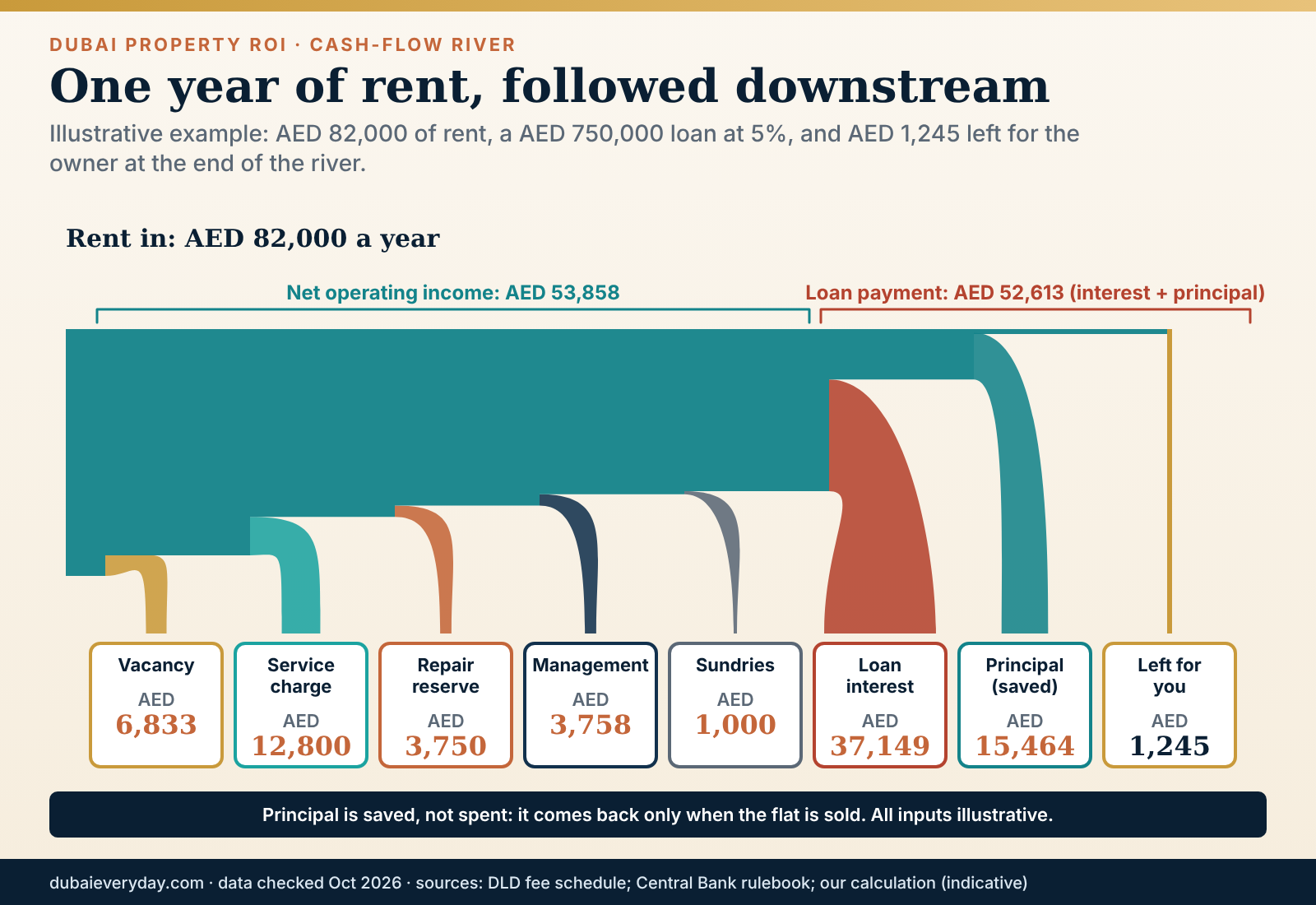
Illustrative example: net operating income, year one. Rent AED 82,000, minus vacancy AED 6,833, service charge AED 12,800, maintenance AED 3,750, management AED 3,758 (5% of AED 75,167 collected) and sundries AED 1,000. Net operating income AED 53,858. That is 4.31% of the price, 4.03% of price plus buying costs, and 65.7% of the gross rent.
Step 4: finance, from loan costs to cash-on-cash
A mortgage changes three things at once in any Dubai property ROI model: how much cash you put in, what you pay out each year, and what you owe on exit day. It does not change what the flat earns. Whether it helps your Dubai property ROI depends on the spread between the cost of the loan and the return of the whole deal, which the leverage section tests. This step is only about getting the loan’s cash flows right.
The rules that size the loan
The Central Bank’s mortgage rulebook entry sets the ceilings. For an expatriate, the loan-to-value cap is 80% for a first home under AED 5 million and 70% above it. For a second or investment property it is 60%, and for off-plan purchases it is 50% regardless of purpose. The maximum tenor is 25 years and the debt burden ratio cap is 50%. Lenders must stress-test at 2 to 4 percentage points above the current rate, and for investment property must deduct at least two months’ rental income when calculating the burden ratio.
The rulebook also allows deferred principal only on investment loans, for no longer than five years from first drawdown. In practice that means an interest-only period is available to investors, not owner-occupiers, and it lifts cash flow at the price of owing more at the end. We model a standard 25-year repayment loan, the plainest case.
The rate you plug in
The Central Bank’s release dated 16 September 2026 raised the Base Rate by 25 basis points to 3.9%, effective 17 September; trading-data site Trading Economics reports it was held on 28 October, which we treat as secondary. Mortgage rates are set by banks, and we did not retrieve any today. A broker’s rate page dated June 2026 listed resident fixed rates from 3.75% (one year) to 4.19% (five years) and variable at 0.70% over three-month EIBOR; it is indicative, of unclear month, and secondary.
So we use an illustrative band of 4%, 5%, 6% and 7%. The low end is roughly where those quotes sat. The high end is what the stress-test rule asks lenders to check against: your plan should still work at a rate 2 to 3 points above today’s. If you are shopping for a real loan, get written quotes and read the early-settlement and rate-reset clauses.
Loan costs on day one
The DLD’s mortgage registration page lists 0.25% of the mortgage value, a title deed fee of AED 250, AED 10 each for the knowledge and innovation fees, and a service-partner fee of AED 4,000 plus VAT. The page does not make clear whether the 0.25% and the AED 250 apply together, so we count both, which is the cautious reading. A lender’s valuation is a secondary-source range of AED 2,500 to 3,500; we use AED 3,000. The bank’s own arrangement fee is a 1% placeholder, an assumption, because we found no source.
Illustrative example: the loan on the example flat. A 60% loan of AED 750,000 over 25 years. Loan costs: registration AED 1,875, title deed AED 250, knowledge and innovation fees AED 20, partner fee AED 4,200, valuation AED 3,000, bank fee AED 7,500. Total AED 16,845. Cash invested: AED 500,000 equity, plus AED 85,970 buying costs, plus AED 16,845 loan costs = AED 602,815.
What the loan does to annual cash flow
At 5%, the monthly payment on AED 750,000 over 25 years is AED 4,384, or AED 52,613 a year. Of that, AED 37,149 is interest and AED 15,464 is principal in year one. Net operating income of AED 53,858 therefore leaves AED 1,245 of cash flow, a cash-on-cash return of 0.21%. At 4% the year’s cash flow is AED 6,353 (1.05%); at 6% it is minus AED 4,129 (-0.68%); at 7% it is minus AED 9,752 (-1.62%). Cash flow crosses zero at a rate of about 5.24%.
Principal is not income, and it is not a cost either
People disagree on how to treat the principal portion of a payment, and both camps are half right. It is cash that leaves your account, so cash-on-cash return counts it.
It also reduces what you owe, so it is equity you get back on sale. In year one, the AED 15,464 of principal plus the AED 1,245 of cash flow equals AED 16,709, which is 2.77% of the cash invested. That figure is a return on equity, not a return in your pocket, and it only becomes real if the sale price holds. None of this changes what the flat earns; it changes how much of the Dubai property ROI is yours.
For feasibility, keep the two views separate: cash-on-cash tells you whether you can carry the flat, and the total Dubai property ROI tells you whether it was worth owning. If you plan to borrow, our guide to buying as a foreigner covers who can get a mortgage and how, and the property investment guide covers the lender conversations to have first.
Step 5: sale costs and the net exit
A Dubai property ROI is only real once the flat is sold, and the sale has its own invoice. Most buyers model the purchase carefully and then assume exit day costs “a couple of percent”. It does, but that percentage is the visible part, and the loan, if you have one, is the bigger subtraction.
The exit ledger
The agent is the largest line: 2% plus 5% VAT on a AED 1,250,000 sale is AED 26,250. The developer’s no-objection certificate (NOC) is set by the developer; a portal gives a range of AED 500 to 5,000 plus VAT, and we use AED 3,000 as an allowance.
If the buyer pays the full 4% DLD fee, as in our base case, the seller carries none of it. If your sale agreement splits the fee, the seller’s 2% is AED 25,000 on this price, and it lowers the Dubai property ROI on the cash case from 2.39% to 2.02%.
The mortgage adds its own steps. The DLD’s page on registering the sale of a mortgaged property says the seller needs a bank liability letter, and the parties bring three manager’s cheques: one to the bank or developer for the debt, one to the seller for the remainder and one to the DLD for the 4% fee. It also lists several release and registrar fee lines in the low thousands of dirhams, and one line that looks like a typo.
We use an AED 2,500 allowance for release and trustee-office costs, and the Central Bank’s early-settlement cap of the lower of 1% of the balance or AED 10,000 (an October 2019 release). Your lender’s actual terms govern.
Illustrative example: exit day after five years, flat price. Cash buyer: sale price AED 1,250,000, minus agent AED 26,250, minus NOC AED 3,000 = AED 1,220,750 in hand. Mortgage buyer: the same sale, minus a loan balance of AED 664,351 after 60 payments at 5%, minus an early-settlement fee of AED 6,644 (1% of the balance, under the AED 10,000 cap), minus the AED 2,500 allowance = AED 547,255 in hand.
Things that delay or shrink the exit
Selling a tenanted flat is routine, but the rules shape the timing. The DLD FAQ says a landlord who wants vacant possession for a genuine sale must give the tenant 12 months’ notice through a notary or registered mail, and that a new owner who keeps the tenant takes over the previous landlord’s obligations and may raise rent but not the deposit. If you may need to sell within a year, a tenancy that ends on a date you choose is part of the plan.
Carrying costs while it sells are real too. The service charge and a maintenance reserve cost about AED 1,380 a month on the example flat, so a three-month sale adds roughly AED 4,100 with no rent against it. Clear any service-charge balance before listing, because the buyer’s lawyer and the developer’s NOC process will ask.
Tax on the gain
The UAE government’s taxation page states that the UAE does not levy income tax on individuals. It does not mention capital gains or property taxes, and we found none in the sources read, but absence from one page is not proof. Your home country may tax a gain on foreign property or tax you on worldwide income. That is a question for a tax adviser in each country, and it is outside the model, yet it is the one input that can still change a Dubai property ROI after everything else is settled.
Putting it together: a five-year Dubai property ROI
Now the six lines can be filled in and the Dubai property ROI calculated. We run the example flat twice over five years with prices, rent and costs held flat: once for a cash buyer, once for a buyer with the AED 750,000 loan at 5%.
Illustrative example: the cash-flow timelines. Cash buyer. Day one: minus AED 1,335,970. Years one to four: plus AED 53,858 each. Year five: plus AED 53,858 and AED 1,220,750 from the sale, so plus AED 1,274,608. Total profit AED 154,072, which is 11.5% on the cash invested over five years and an equity multiple of 1.115. The Dubai property ROI (the IRR) is 2.39%.
Mortgage buyer. Day one: minus AED 602,815. Years one to four: plus AED 1,245 each. Year five: plus AED 1,245 and AED 547,255 from the sale, so plus AED 548,500. Total result minus AED 49,334, which is -8.2% on the cash invested. The Dubai property ROI is -1.70%.
From brochure yield to Dubai property ROI
Line the flat’s numbers up from the most flattering to the least. Gross yield is 6.56%. After vacancy and running costs, net yield on price is 4.31%. Counting buying costs in the denominator, net yield on total cost is 4.03%. Include the exit and hold for five years at a flat price and the cash buyer’s Dubai property ROI is 2.39%. Borrow at 5% and cash-on-cash in year one is 0.21%, while the Dubai property ROI is -1.70%.
Why the annualised figure is so much lower than the net yield
Net yield on total cost earns 4.03% a year, and the flat holds its value on paper. But the AED 85,970 of buying costs and AED 29,250 of selling costs never come back. Spread over five years that is AED 23,044 a year, about 1.7% of the cash invested. Subtract that from 4.03% and you land near the 2.39% that the IRR reports (the exact result differs slightly because of timing). Friction is front-loaded, so a longer hold dilutes it, and a shorter hold magnifies it.
Where the money goes is easier to see over five years of rent. Gross rent is AED 410,000. Vacancy takes AED 34,167, service charges AED 64,000, maintenance AED 18,750, management AED 18,792 and sundries AED 5,000, leaving net operating income of AED 269,292. Buying costs then take AED 85,970 and selling costs AED 29,250. The profit is AED 154,072, or 37.6% of the rent. The waterfall earlier in this guide draws exactly this.
The same flat for other holding periods
Holding the same flat longer helps, slowly, because the one-off costs get spread. With nothing growing and the cash case, the Dubai property ROI is -0.29% if you sell after two years, 1.19% after three, 2.39% after five, 2.90% after seven and 3.29% after ten. It approaches the net yield on total cost but never reaches it, since the exit costs are always there. A flip-style hold in a flat market does not make the sums work.
Break-even maths: how long, how far, how much rent
A Dubai property ROI is a single number for a single scenario. Break-evens answer a friendlier question about your Dubai property ROI: how wrong can the plan be before it loses money? There are three to compute, and each one tells you something different about the deal.
Time to recover the friction
Divide the buying costs by the yearly net operating income and you learn how long the flat needs to earn back what it cost to enter. On the example, AED 85,970 divided by AED 53,858 is 1.6 years. Add the AED 29,250 of selling costs and the total friction of AED 115,220 takes 2.1 years of net income. Under that holding period, a flat price gives a negative Dubai property ROI by default.
Price you can afford to lose
The more useful break-even is the sale price at which total profit is zero. For the cash case it depends sharply on how long you hold: sale price AED 1,257,664 (up 0.6%) for a two-year hold, AED 1,202,651 (down 3.8%) for three years, AED 1,092,623 (down 12.6%) for five, AED 982,596 (down 21.4%) for seven and AED 817,555 (down 34.6%) for ten. Rent pays you to wait, so the longer you hold, the more price fall you can absorb before you lose capital.
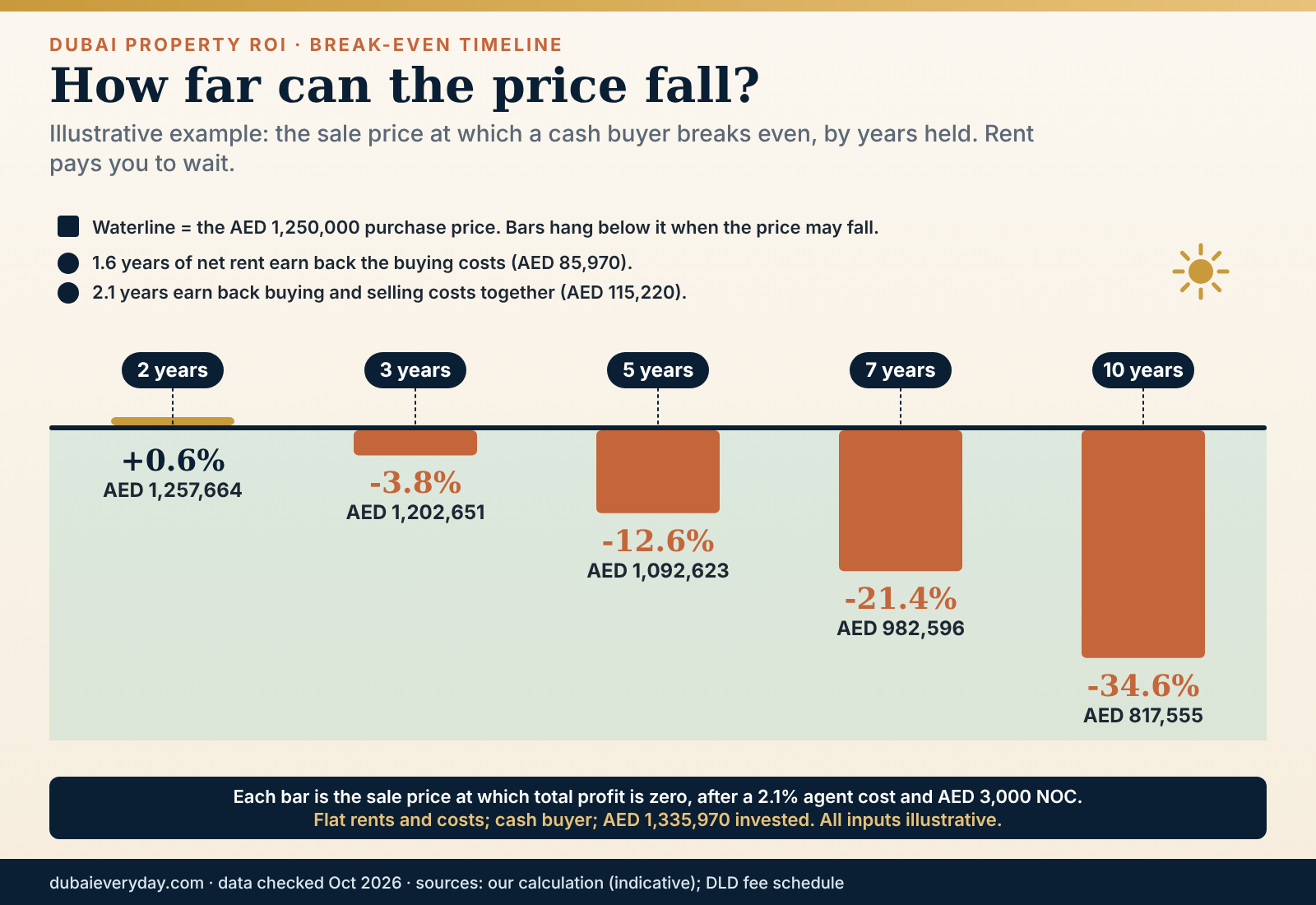
This is a break-even on capital, not on opportunity cost. The five-year cash buyer who sells for AED 1,092,623 gets their money back and nothing more, having tied up AED 1.3 million for five years. Whether that is acceptable is a question about your alternatives, covered in the time and money section.
Rent you need for a target return
Turn the question around: what rent produces a target Dubai property ROI, if the price stays flat for five years and the cash case applies? Our calculation says AED 46,615 a year (a 3.73% gross yield) for zero return, AED 91,098 (7.29%) for 3%, AED 120,804 (9.66%) for 5% and AED 135,672 (10.85%) for 6%.
Read that as a reality check on any plan to earn a mid-single-digit Dubai property ROI in a flat market from rent alone. At the example’s costs, you would need a gross yield near 10%. That is why investment returns in the real world lean on price movement, and why this guide treats price as a scenario, not a given. The property investment guide looks at what the 2026 market data says about price risk.
Break-even for a borrower
With the loan, the key break-even is the interest rate at which annual cash flow hits zero: about 5.24% on the example. Above that rate the flat needs a top-up from your salary every month; below it, it pays its own way, barely. Another way to say it: the buffer at 5% is AED 1,245 a year, which is less than a fifth of one empty month.
Stress tests: what moves your Dubai property ROI most
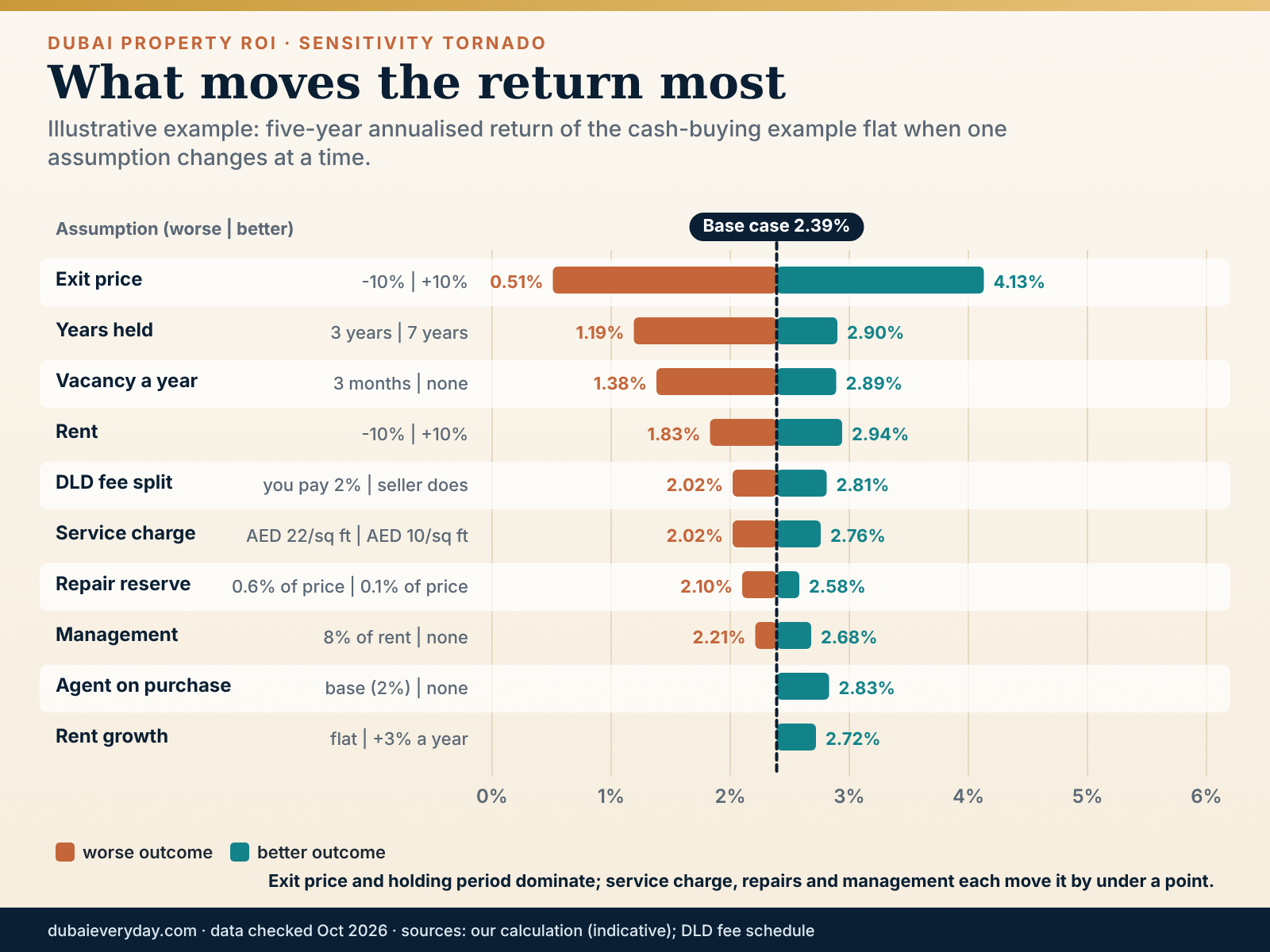
A single result hides which assumptions it leans on. The simplest stress test for a Dubai property ROI changes one input at a time, keeps the rest at base values and records the Dubai property ROI. The cash case on the example flat starts at 2.39%. Here is what each swing does, from the largest to the smallest.
The ranking, in numbers
Exit price comes first by a distance: a 10% lower sale price gives 0.51% and a 10% higher one gives 4.13%, a swing of 3.62 points. Holding period is second: three years gives 1.19%, seven years 2.90%. Vacancy is third: three empty months a year gives 1.38%, none gives 2.89%. Rent comes fourth: 10% lower rent gives 1.83%, 10% higher gives 2.94%.
Who carries the DLD fee comes next: paying a 2% share yourself when you sell gives 2.02%, while having the seller carry theirs when you buy gives 2.81%. The service charge follows: AED 22 per sq ft gives 2.02% and AED 10 gives 2.76%. Maintenance at 0.6% of price against 0.1% gives 2.10% and 2.58%. Management at 8% against none gives 2.21% and 2.68%. Not paying an agent on the way in lifts the base to 2.83%, and 3% a year of rent growth lifts it to 2.72%.
The pattern is hard to miss. Price and time dominate; the running-cost lines each matter by well under a point. That does not mean running costs are unimportant, since they all hit together and every one of them is a certainty rather than a scenario. It means the debate that improves a Dubai property ROI the most per hour is the price you pay and the horizon you can hold.
The negotiating effect is smaller than it looks
Buyers love a discount, and a discount helps. But it only improves a Dubai property ROI as much as it is a real undervaluation.
If you buy the example flat for 5% less with the same rent, and it later sells at the same lower level, the return rises from 2.39% to about 2.60%. If instead the flat later sells at the original AED 1,250,000, because the discount reflected a motivated seller and not a lower value, the return is about 3.52%. The first case is arithmetic; the second is a view on the market.
The price paths: how much you win or lose
Fix everything else and let the five-year sale price land at five different places. For the cash buyer the Dubai property ROI and the total result are: price down 20%, -1.52% and minus AED 90,678; down 10%, 0.51% and AED 31,697; flat, 2.39% and AED 154,072; up 10%, 4.13% and AED 276,447; up 20%, 5.76% and AED 398,822. Every 10% of price is worth about AED 122,000 of profit, which is a little over two years of the flat’s net rent.
The combined downside and upside cases
One bad input is a nuisance; four together are a scenario. We stack a downside: rent 10% lower, three empty months a year, a service charge of AED 20 per sq ft and a 10% lower exit. Net operating income drops to AED 31,833, or 2.55% of the price. The cash buyer then earns -1.27% a year and ends AED 78,433 down. The mortgage buyer at 5% sees annual cash flow of minus AED 20,781 and a return of -10.77%, ending AED 281,838 down.
The matching upside stacks rent 10% higher, half a month of vacancy, a service charge of AED 14 and a 10% higher exit. Net operating income becomes AED 66,170, the cash buyer’s return is 5.05% and the profit AED 338,003. Both extremes are inventions to show the spread. The point is that the plausible range for one flat can be wider than the gap between two listings that look very different on a portal.
None of these scenarios predicts what Dubai prices or rents will do. They show how the arithmetic reacts. In late 2026 the market data itself was mixed: the Savills report quoted in the press showed apartment prices down 4.8% quarter on quarter to AED 1,817 per sq ft, while betterhomes reported a September median apartment price of AED 1,404 per sq ft, up 2.2% year on year. Different indices, different baskets. Use them to calibrate the spread of your scenarios, not to pick the likeliest.
Does the loan help your Dubai property ROI?
Borrowing raises a return only when the flat earns more on the borrowed money than the loan costs. That sounds obvious, yet it is the test most often applied wrongly, because people compare the loan rate with the rental yield. Borrowing is a Dubai property ROI decision before it is a monthly-payment decision. The right comparison is the loan’s all-in cost against the unlevered annualised return, which includes the fees and the exit.
The crossover on the example flat
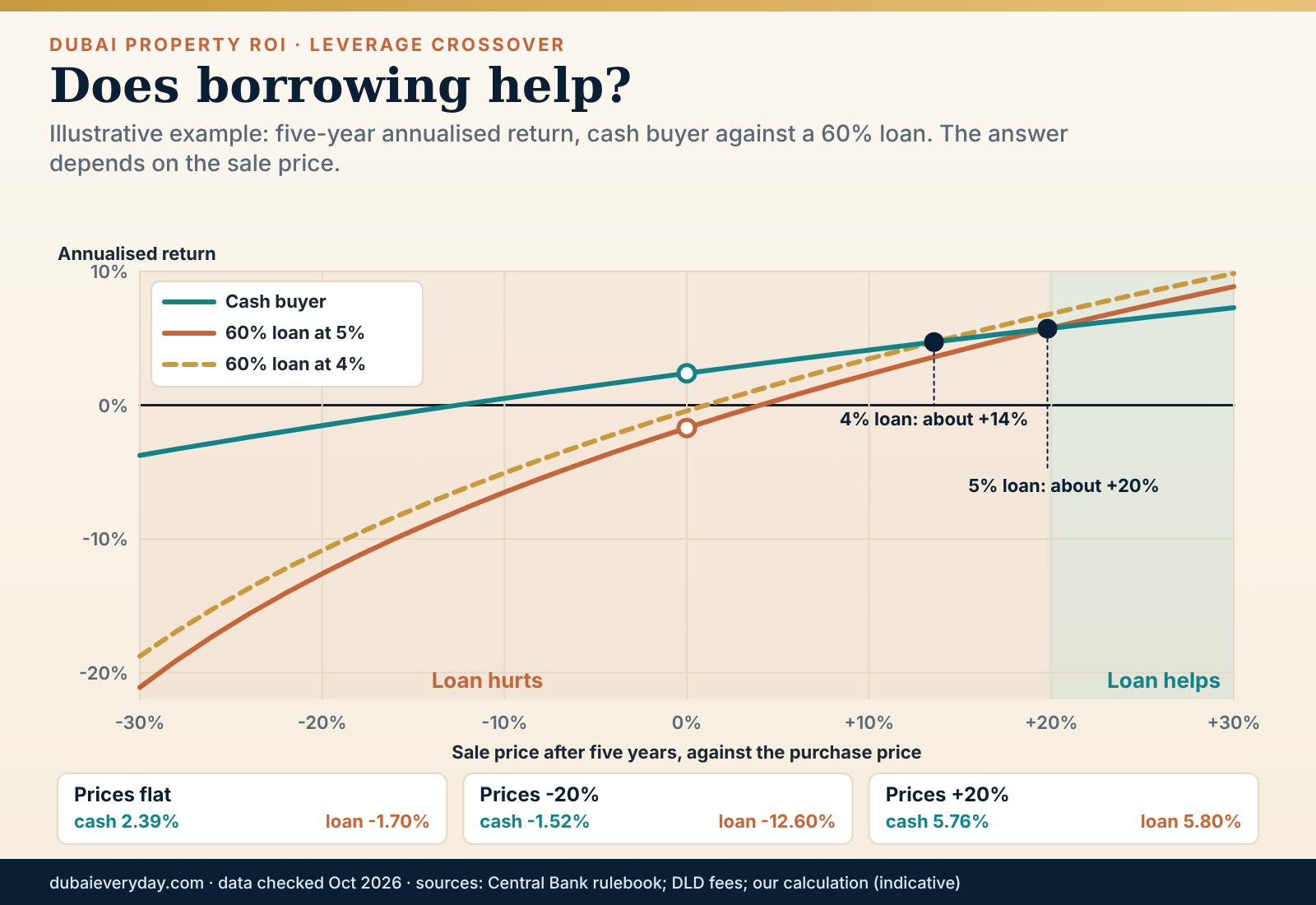
With a 60% loan at 5% and flat prices, the Dubai property ROI is -1.70%, against 2.39% for the cash buyer. The price has to rise by roughly 20% over five years before the loan catches up: at +20% the cash buyer earns 5.76% and the borrower 5.80%. At +10% the figures are 4.13% against 2.32%; at -10% they are 0.51% against -6.52%; at -20%, -1.52% against -12.60%. With a 4% loan, the crossover moves to about +14%.
Why the yield-versus-rate shortcut misleads
The net yield on price is 4.31%, which is above a 4% loan rate. The shortcut says borrowing is positive carry and therefore good. Yet at 4% the borrower’s Dubai property ROI is -0.43%, still below the cash buyer’s 2.39%. The reason is that the flat’s unlevered return is 2.39% once costs are paid, and a loan that costs 4% a year plus AED 16,845 upfront is dearer than that. With these costs the rate at which levered and unlevered returns match is about 1.7%, below any rate a lender offers.
Growth changes the story. In a scenario where rent, costs and the sale price all grow 3% a year, the cash buyer earns 5.34%, and the 60% loan earns 6.00% at 4%, 4.92% at 5% and 3.82% at 6%. Leverage works if the price rises and the rate is low, which is a bet on both. The downside is not symmetrical: a 20% price fall costs the cash buyer AED 90,678 and the borrower AED 294,084, which is 49% of the borrower’s invested cash.
A rule that survives the arithmetic
Borrow because you need liquidity elsewhere, or because you have a real view on prices and can survive being wrong, not because the yield exceeds the rate. Check that annual cash flow stays non-negative at a rate 2 to 3 points above your quote, which is roughly what the Central Bank asks lenders to test. Then compare the two Dubai property ROI figures, not the two headline yields.
Time, inflation, currency and what else your money could earn
A Dubai property ROI of 2.39% a year is only good or bad compared with something. Three comparisons matter: inflation, the exchange rate you live in, and the best alternative use of the same cash.
The alternative use of the cash
The cash buyer in the example ties up AED 1,335,970. If that money earned 4% a year, compounding for five years, it would grow by AED 289,442, against the flat’s AED 154,072 profit with flat prices. The 4% is an illustrative assumption, not a quoted deposit rate; we did not retrieve current bank deposit rates, so use your own current offer, after any tax you owe at home. The flat beats the alternative only if prices rise enough, which circles back to price as the deciding assumption.
Inflation
Divide the nominal Dubai property ROI by an assumed 2% inflation and the real return on the cash case is about 0.38%. Property can protect against inflation if rents and prices follow it, but the Dubai rent rules allow increases only in line with the gap to market, and we did not retrieve a current Dubai inflation figure. The 2% is illustrative.
Currency
The dirham has been pegged to the US dollar at 3.6725 for many years; we did not re-read the Central Bank’s page for this guide, so confirm the peg before relying on it.
If you earn or save in another currency, the exchange rate at the sale matters as much as the flat. As an illustration: if your home currency gains 10% against the dollar over the hold and you convert all AED proceeds at the end, the AED 1,490,042 of total cash back is worth about AED 1,354,583 in today’s terms, leaving a profit of roughly AED 18,600, not AED 154,072. We are not forecasting; we are showing the size of the exposure.
Time: why the IRR, not the simple ROI
Simple ROI, which is profit divided by cash invested, treats a dirham received in year one the same as a dirham received in year ten. IRR does not, which is why we use it. Two deals with the same 11.5% total profit can have annualised returns that differ by a factor of two if one takes five years and the other ten. When anyone quotes “ROI” without a period, ask for the period, and ask what is in the denominator.
Living in it: the owner-occupier version of Dubai property ROI
If you plan to live in the flat, nobody pays you rent, so the usual yield has nothing to divide. The return still exists. An owner-occupier’s Dubai property ROI is the rent you stop paying, minus what owning costs, set against the cash you tie up. That makes the question “buy or keep renting?”, and it has an answer you can compute.
The setup
Illustrative example: owner-occupier on a AED 2,000,000 flat. A 1,200 sq ft flat bought for AED 2,000,000, which would rent for AED 120,000 a year. An 80% loan (the first-home cap for an expatriate under AED 5 million) of AED 1,600,000 at 5% over 25 years. Buying costs: DLD AED 80,000, trustee AED 4,200, small fees AED 520, agent AED 42,000. Loan costs: AED 27,470 (registration AED 4,000, deed AED 250, fees AED 20, partner fee AED 4,200, valuation AED 3,000, bank fee AED 16,000). Cash invested: AED 554,190.
Ownership then costs, in year one, a loan payment of AED 112,241, a service charge of AED 19,200 (AED 16 per sq ft, an assumption), maintenance of AED 6,000 (0.3% of price) and AED 1,000 of insurance and sundries. The total is AED 138,441, against rent of AED 120,000. Owning costs AED 18,441 more in cash each year, before you count the principal that builds equity.
The owner’s yield
Strip out the principal and the owner’s version of net yield is the rent you save, minus interest, minus the holding costs: AED 120,000 minus AED 79,251 of year-one interest minus AED 26,200 equals AED 14,549. On the AED 554,190 of cash invested, that is 2.63% a year before any price change. It is the return on living there, and it is small because you also pay the lender.
The break-even price growth
To compare properly, assume the renter invests the same AED 554,190 at an illustrative 4% a year and also invests the AED 18,441 a year that owning would have cost extra. At the end, compare the renter’s pot with the owner’s sale proceeds after the sale costs, the loan balance and the settlement fee. The annual price growth at which the two end equal is the break-even.
On these assumptions, with rent and costs held flat, the break-even is 3.84% a year for a three-year stay, 2.42% for five years, 1.82% for seven and 1.35% for ten. The longer you stay, the lower the hurdle, because the one-off fees are spread out. Change one input and it moves. A 4% loan gives 1.64% for a five-year stay and a 6% loan gives 3.19%. Letting rent and costs grow 3% a year gives 2.14%.
The 4% alternative return is an assumption, not a quoted rate. If you earn less on savings, the break-even falls; if you can reliably earn more, it rises. The point of the exercise is the shape: buying a home to live in is a long-stay decision financially, and the first three years are mostly paying for the privilege of changing your mind later.
What the maths leaves out
Security of tenure, the freedom to renovate, a forced savings habit and not being at the mercy of a landlord’s sale plans are real values with no line in the sheet. So are the costs of being tied to one place, one school zone or one employer. Our apartment rental guide and villa rental guide show what renting actually gets you, and the cost of living guide puts housing next to everything else in a monthly budget. If you are still planning the move, start with moving to Dubai.
Off-plan: Dubai property ROI with a payment plan
Off-plan buying changes the shape of the cash flows more than the size of the costs. You pay in instalments, you earn no rent until handover, the lender’s cap falls to 50%, and your return depends on what the finished unit is worth when the keys arrive. The IRR handles all of that, which is exactly why it is the right tool. A Dubai property ROI for an off-plan unit is a timeline problem before it is a yield problem.
Rules that change the model
The Central Bank rulebook caps loans on off-plan purchases at 50% for any buyer. The DLD release on registration fees describes the 4% as payable by the buyer or investor through the developer, with the developer expected to start the payment within 60 days. The DLD’s brokerage practice guide, read for the buying guide on this site and not re-read today, says buyers should pay only into the project’s escrow account. Our buying property in Dubai guide covers the off-plan checks in detail.
The model
Illustrative example: the same AED 1,250,000, bought off-plan. A made-up payment plan: 20% at booking, 20% after one year, 20% after two, 40% at handover after three. The DLD fee of AED 50,000 and AED 4,720 of trustee and small fees are paid at booking, an allowance of AED 5,000 to make it rentable at handover, no agent fee on the way in (an assumption) and rent from year four. The flat is then let for two years at the example’s net operating income of AED 53,858 and sold at the end of year five with a 2.1% agent cost and AED 3,000 NOC.
Cash paid before handover: AED 804,720, or 64.4% of the price, with no rent against it.
If the unit is worth exactly the contract price at handover, the Dubai property ROI is 0.44% and the profit AED 18,747, against 2.39% and AED 154,072 for the ready flat bought the same day. For the off-plan buyer to match the ready flat, the handover value has to be about 7.0% above the contract price; to break even it can be 1.5% below it. A 10% uplift gives 3.19%, 20% gives 5.76% and 30% gives 8.15%, while a 10% shortfall gives -2.54%.
Selling at handover instead is harder. At a flat value the result is -5.23% and a loss of AED 83,970, which is simply the DLD fee, the small fees and the agent and NOC on exit. It breaks even only if the unit has gained about 6.9%. A 10% uplift gives 2.27%, and 20% gives 9.07%.
What the numbers say about the premium for waiting
In an off-plan Dubai property ROI, waiting three years for a finished unit with no rent in the meantime has a price, and in the model it is about 7% of value. Developers’ payment plans, launch discounts or a genuine pricing gap may well cover that. Sometimes they will not. The calculation does not tell you which; it tells you how big the claim has to be before you pay a deposit. For wider context on foreign buyers and which areas allow ownership, see the foreign buyer guide and the freehold property guide.
Short-let: when the extra income pays for the extra work
A short-let can earn more per year than an annual let, with higher costs and more work. The Dubai property ROI question is therefore a break-even: how much revenue does the short-let need to beat the long-let net operating income? The work is the same arithmetic with different cost lines, and a short-let Dubai property ROI is only worth chasing if the break-even occupancy is realistic. Our rental yield guide develops the short-let yield in more detail; here is the Dubai property ROI shortcut.
Illustrative example: short-let break-even on the example flat. Assume 20% of revenue goes to an operator or platform and management, AED 14,000 a year for cleaning, utilities, internet and supplies, AED 5,000 a year for furnishing wear, plus the same AED 12,800 service charge, AED 3,750 maintenance and AED 1,000 sundries. To match the long-let net operating income of AED 53,858, revenue must be AED 113,010, which is 1.38 times the AED 82,000 long-let rent. That is AED 442 a night at 70% occupancy, AED 516 at 60% or AED 387 at 80%.
These cost assumptions are ours. Permit and tourism-dirham charges are excluded because we could not read the Dubai Department of Economy and Tourism’s holiday-home permit page; its content did not load on 29 October 2026. Check the permit requirement, fees and any building rules with DET and your community’s management before you plan a short-let. A short-let also changes the tax analysis discussed below.
Tax and legal checks that change the answer
This section is about where the model could be wrong for reasons that sit outside the spreadsheet. Tax can move a Dubai property ROI more than a rent negotiation can. It is not tax or legal advice, and none of it replaces a licensed adviser who knows your residency and your home country.
What the UAE says about personal tax
The UAE government’s taxation page states that the UAE does not levy income tax on individuals, lists a 5% VAT on goods and services and says corporate tax applies to businesses. It does not address rental income or capital gains on property.
Summaries of the Federal Tax Authority’s October 2024 guide on real-estate investment by individuals, published by Hadef & Partners and KPMG, say that an individual’s income from selling or leasing real estate is generally outside corporate tax when it does not require or involve a licence. Both are secondary sources; the guide itself was not readable by our tools.
The Hadef summary adds a point that matters for short-lets: a DET permit for holiday-home letting counts as a licence, so that activity would not fall under the exclusion, and Ejari registration is described as an administrative record, not a licence. Whether that applies to you is a question for a UAE tax adviser. Our accounting services guide explains what such advisers do.
VAT in the model
VAT shows up in the model in two places. Agent and trustee fees carry 5%, which is built into the ledger. The sale and lease of residential property, according to a 2017 Federal Tax Authority statement reported by Taxscan, is generally exempt, with the first supply of a new residential building within three years zero-rated and commercial property at the standard 5%. That is a nine-year-old statement from a secondary source; read the FTA’s current guidance if your deal involves a new building or a commercial unit.
Home-country tax and the paperwork around it
Your home country may tax your rental income, a gain on sale or both, and may require you to report the property. The UK government’s guidance on buying property in the UAE is one example of a foreign government pointing buyers to local professionals; it is dated and general, so use it as a prompt, not as a rule. Put the tax cost into the cash flow once you have an adviser’s figure, since it changes every Dubai property ROI in this guide.
Legal checks that protect the numbers
The numbers rest on documents. Verify the title deed and the property status on the DLD’s free tools, confirm the broker’s licence, read the sale agreement’s clauses on fees and the date of transfer, and see our guide to Dubai legal basics for residents for where rules live and how to check them. Insurance is a separate decision; the building’s policy is usually part of the service charge, and our insurance guide explains what home and contents cover looks like.
Build your own Dubai property ROI worksheet
Everything above fits on one sheet, and the sheet is the fastest route to a trustworthy Dubai property ROI of your own. Put the inputs in a block at the top (price, area, rent, vacancy months, service charge per sq ft, maintenance percentage, management percentage, sundries, agent percentage, loan-to-value, rate, term, holding years, exit price change, sale agent percentage and NOC) and name the cells. Then build these lines. The formulas work in Excel and Google Sheets; replace the names with cell references.
- Buying costs
= price*0.04 + 4000*1.05 + 520 + price*agent*1.05 + allowance. Edit the 4% and the AED figures if the DLD schedule changes. - Loan and loan costs
loan = price*LTVandloan_costs = loan*0.0025 + 250 + 20 + 4000*1.05 + valuation + loan*bank_fee. Replace the bank fee with the quote you receive. - Cash in
= price - loan + buying_costs + loan_costs. This is the amount on day one, and it is the denominator for cash-on-cash. - Net operating income
= rent*(1 - vacancy_months/12)*(1 - mgmt) - area*sc_psf - price*maint - sundries. Use the approved service charge from the Service Charge Index. - Debt service and balance
payment = -PMT(rate/12, term*12, loan)*12andbalance = -FV(rate/12, hold*12, -payment/12, loan). For a cash buyer both are zero. - Net sale proceeds
= price*(1+g)^hold*(1 - sale_agent*1.05) - NOC - balance - (MIN(0.01*balance, 10000) + release_allowance). The last bracket applies only if you have a loan. - The timelineYear 0: minus cash in. Years 1 to hold: NOI minus payment. Add net sale proceeds to the last year.
- The answers
=IRR(timeline)for annualised ROI,=SUM(timeline)for total profit, and the sum of years 1 to hold divided by cash in for the equity multiple.
Check your sheet against a known case before trusting it. With the example inputs, the cash buyer’s cash in should come to AED 1,335,970, net operating income AED 53,858, net sale proceeds AED 1,220,750 and the IRR 2.39%. The mortgage version at 5% should show AED 602,815, a payment of AED 52,613 a year, a balance of AED 664,351 and an IRR of -1.70%. If you match, your sheet is sound; if you do not, one of the lines is wrong.
Eight rules for an honest Dubai property ROI sheet
- Fill the rent cell from a signed, registered contract or recent registered comparables, never from an advert.
- Fill the service charge from the DLD Service Charge Index for the project and year, then check the unit on screen.
- Run the base case with nothing growing, then run price scenarios separately.
- Always run the loan at a rate 2 to 3 points above the quote.
- Keep a vacancy of at least one month a year until you have a reason to lower it.
- Show total profit in dirhams, not just percentages. A 2% return on AED 1.3 million is still AED 26,000 a year.
- Run three holding periods: the one you plan, a shorter one and a longer one.
- Save a dated copy. In six months you will want to compare the inputs, not just the results.
A ten-minute version without a spreadsheet
For a first filter, use three steps. Take the signed rent and multiply by 0.65, because 65.7% of the rent survived to net operating income in the example (a rule of thumb from one illustrative flat, to be replaced by the real building’s numbers). Divide by price times 1.07, since buying costs were 6.88% of the price.
Then subtract about 1.7 points for a five-year hold to account for the one-off costs. A gross yield of 6.56% becomes roughly 2.3%, which is close to the full answer of 2.39%. Use it to screen, not to decide.
Auditing someone else’s Dubai property ROI claim
You will meet Dubai property ROI figures in brochures, WhatsApp forwards and agent presentations. Most can be tested in ten minutes with the same six lines, if you know what to ask. The goal is not to catch anyone out; it is to turn a headline Dubai property ROI into a set of assumptions you can compare.
Questions to put to any Dubai property ROI figure
- Over what period, and does it include the sale?
- What is in the denominator: the price, the price plus fees, or only the deposit?
- Is the rent signed and registered, or projected? Can I see the Ejari certificate?
- What service charge was used, and does it match the Service Charge Index?
- Are buying costs, vacancy, maintenance and exit costs inside the number?
- Does the figure include loan interest, and at what rate?
- Is any price growth assumed, and how much?
- Is there a guarantee, who gives it, and where does the money come from?
Red flags that deserve a hard stop
A guaranteed return is the loudest. None of the official pages we read supports a guarantee, so if one is offered, ask who pays it, for how long and whether it is built into the price you pay. The DLD’s brokerage practice guide, read for the buying guide on this site and not re-read today, tells buyers to pay only into the project’s escrow account and to verify licences and permits.
A figure that cannot state its period, a “net” yield with no service charge, an urgent deadline that stops you checking, and a request to pay anywhere but escrow or a registered trustee centre are the other four. The property investment guide has a longer list of warning signs and a due-diligence checklist.
Ten Dubai property ROI mistakes
These are the errors that most often make a Dubai property ROI look better than the deal underneath it. Each one comes with the number from our example.
1. Calculating from the asking rent
Asking rents are opening positions. Use signed, registered rents. A 10% overstatement of rent cost the example about 0.6 points of annualised return.
2. Leaving the buying costs out of the denominator
The 4% registration fee plus the agent and small fees were 6.88% of the price. Ignoring them turns a 4.03% net yield into a 4.31% one on paper.
3. Using a brochure service charge
The approved figure is public. A wrong figure of AED 6 per sq ft on 800 sq ft is AED 4,800 a year, every year, with nothing to show for it.
4. Modelling zero vacancy
Zero empty months gives 4.83% net on price in the example. One month gives 4.31%. Tenants leave, flats get repainted, markets soften.
5. Treating the whole loan payment as a cost, or as income
Interest is a cost; principal is saving you only recover at sale. Keep them in separate columns, as in the finance step.
6. Comparing the loan rate with the yield
Compare it with the unlevered annualised return. In the example, a 4% loan against a 4.31% yield still lowered the return from 2.39% to -0.43%.
7. Forgetting the exit invoice
The agent and NOC alone take AED 29,250 from a AED 1,250,000 sale, before any loan balance or settlement fee. A model that stops at “sale price” is a yield.
8. Quoting a Dubai property ROI without a period
A 12% total return over eight years is not the same as 12% over three. Always say per year, over how many years.
9. Assuming who pays the 4%
The DLD page lists 2% each side and a DLD release says the buyer pays; practice varies. Put it in the offer. Moving that 2% from one side to the other is worth about 0.4 points of annualised return in the example.
10. Ignoring tax and currency at home
Your home country’s tax on rent or gain, and the exchange rate on the day you sell, can erase a 2.4% return. They belong in the sheet once you know them.
The bottom line on Dubai property ROI
A reliable Dubai property ROI comes from honest inputs, not clever formulas. List the official fees on day one, use a signed rent, take the service charge from the DLD index, run the loan at a stressed rate and put the exit invoice on the timeline. Then look at the answer as a range, because the sale price and the holding period decide more than the rest combined.
On the made-up flat in this guide, a 6.56% gross yield became a 2.39% annualised return with flat prices and a negative one with a loan. That is not a verdict on Dubai, and your own Dubai property ROI will differ. It is a reminder that a flat has to grow, or yield more than 6.56%, before it clears its own costs. Use the worksheet, test your own flat, and treat any quoted Dubai property ROI that you cannot rebuild as marketing.
Not advice. This guide is general information and arithmetic. It is not investment, tax, legal or mortgage advice, and every worked figure is an illustration, not a quote or forecast. Fees, rules and rates change; confirm them with the DLD, your lender and licensed advisers before committing money.
Dubai property ROI FAQ
How do you calculate Dubai property ROI?
Put every cash flow on a timeline. Day one is minus the price, minus buying costs (the 4% DLD fee, trustee, title deed and agent fees), plus any loan, minus loan costs. Each year is rent collected minus service charge, maintenance, management and other costs, minus loan payments. The last year adds the sale price minus agent, NOC, loan balance and settlement fees. The annualised Dubai property ROI is the IRR of that timeline, which a spreadsheet’s IRR function returns in one cell.
What is a good ROI for Dubai property?
There is no official benchmark for a good Dubai property ROI, and any figure offered without a period and a cost list is marketing. “Good” means better than your best alternative for the same cash and years, after tax and after the risks you are taking. On the illustrative flat in this guide, a 6.56% gross yield became 2.39% a year over five flat-price years. Decide what return you need, then test whether the rent, service charge and price assumptions can deliver it in a cautious scenario, not only a hopeful one.
What is the difference between ROI and rental yield in Dubai?
Rental yield is a one-year measure of income against price or cost, in gross or net form. ROI, as used here, is a whole-holding measure: it includes the sale, the buying and selling costs, the loan and the timing of every payment. A yield can be 4% while the ROI is 2% or 6%, depending on the price change and the holding period. Our rental yield guide covers the yield side in depth.
Does the 4% DLD fee count in the ROI?
Yes. It is a cost you pay on day one that never returns, so it belongs in the cash behind your Dubai property ROI. On the AED 1,250,000 example it is AED 50,000, which is the largest single buying cost. Leaving it out lifts the Dubai property ROI noticeably and misleads. If a seller agrees to carry their share, put the saving in the sheet as a lower buying cost, not as extra rent.
Who pays the DLD fee, buyer or seller?
The DLD sale registration page lists 2% for the seller and 2% for the buyer and does not say who settles them. A DLD news release from 31 May 2021 about off-plan registrations says the buyer or investor pays the 4%. In practice the split is a negotiated term of the sale agreement, so settle it before you sign and model both versions. If the seller carries their 2% when you buy, the example’s annualised return rises by about 0.42 points; if you carry a 2% share when you sell, it falls by about 0.37.
How do I find the service charge for a building before I buy?
Use the DLD’s Service Charge Index, available on the DLD website, the Mollak system and the Dubai REST app. You enter the project, its use and the year, and the approved fees appear immediately. Multiply by the area on your title deed after confirming the unit shown on screen. Also ask the seller for the latest Mollak invoice, and ask whether the building has usage charges, a reserve contribution or a multi-year budget.
Is mortgage interest included in ROI?
In the whole-holding Dubai property ROI, yes: loan payments are part of each year’s cash flow and the loan balance is subtracted on exit. In a net yield, no: yields measure the property, not the financing. That is why borrowing can leave a net yield untouched and still cut the ROI. In the example, a 5% loan took the five-year Dubai property ROI from 2.39% to -1.70% with flat prices.
Should price appreciation be included in the calculation?
Include the sale, but not as a prediction. Run the base case with the exit price equal to the purchase price, then show scenarios of down 10%, up 10% and so on. Exit price was by far the largest driver in our sensitivity test: 10% either way moved the example’s return by roughly 1.7 to 1.9 points. A Dubai property ROI that assumes a rise without saying so hides its biggest assumption.
How long do I need to hold a Dubai property to recover the costs?
On the example flat with flat prices, buying costs took 1.6 years of net rent to recover, and buying plus selling costs took about 2.1 years. Capital break-even depends on how far the price can fall: the cash buyer’s break-even sale price was 0.6% above purchase for a two-year hold, 12.6% below for five years and 34.6% below for ten. The longer you hold, the more cushion rent provides, and the less a price dip hurts your Dubai property ROI.
Is rental income taxed in Dubai?
The UAE government states that it levies no income tax on individuals. Summaries of the Federal Tax Authority’s October 2024 guide, from law and advisory firms, say individuals’ real-estate income is generally outside corporate tax if no licence is required or held, and that a DET holiday-home permit counts as a licence. We could not read the guide itself, so confirm with a UAE tax adviser. Taxes in your home country are a separate question.
Is off-plan ROI better than ready property?
Not automatically. In our illustrative model, an off-plan unit bought at the same price on a 20/20/20/40 plan needed about 7% of value uplift by handover to match the ready flat’s 2.39%, because 64% of the price was paid before any rent. If the uplift is real, the maths favours off-plan; if it is a brochure promise, it does not. The calculation shows how large the claim must be.
Can I use this method for a villa or a holiday home?
Yes, with different inputs. Villas typically need a larger maintenance reserve and have different service-charge structures, and a holiday home needs the short-let cost lines: operator fees, cleaning, furnishing wear and permits. The six-line structure of the Dubai property ROI is the same. The example short-let break-even in this guide required about 1.38 times the long-let rent to match its net income, and the permit costs were not included because the DET page would not load.
Where to go next
Sources and further reading (18 links)
- Dubai Land Department: Property sale registration — registration fee split, trustee fee, title deed, map, knowledge and innovation fees
- Dubai Land Department: Request for mortgage registration — 0.25% fee, deed fee, partner fee
- Dubai Land Department: Registering the sale of a mortgaged property — exit steps, cheques and fee lines
- Dubai Land Department: DLD calls on developers to pay property registration fees within 60 days — 4% fee, buyer or investor pays
- Dubai Land Department: Frequently asked questions — service charges, rent increases, Ejari, municipality fee, commission, eviction notice
- Dubai Land Department: Service Charge Index — inputs, channels
- Mollak: About us — service-charge oversight, invoices, management company duties
- Dubai Land Department: Three-year fixed service fees for the Palm Jumeirah Master Community — multi-year budget option
- Dubai Land Department: Rental Index and open real-estate data — rent evidence tools
- Dubai Land Department: Licensed real estate brokers — broker verification
- Central Bank of the UAE rulebook: mortgage lending limits — loan-to-value, tenor, burden ratio, stress test, interest-only
- Central Bank of the UAE: eases mortgage loan requirements — early settlement cap
- Central Bank of the UAE: Base Rate raised to 3.9% and its 29 July 2026 release at 3.65% — interest-rate context
- UAE Government Portal: Taxation — no personal income tax, 5% VAT, corporate tax scope
- Federal Tax Authority: VAT — 5% VAT rate label
- Dubai Department of Economy and Tourism: Apply for a holiday home permit — page content did not load; nothing taken from it
- GOV.UK: How to buy property in the UAE — foreign-government buyer guidance, dated; context only
- Secondary, for context only: Hadef & Partners summary of the FTA real-estate guide, KPMG summary, Taxscan report on the 2017 FTA VAT statement, Khaleej Times on the Savills Q3 2026 report, betterhomes Q3 2026 report, fäm Properties September 2026 report, Huspy mortgage rate page, Trading Economics UAE rate page and Property Finder DLD fees guide (or carried over from earlier research on this site where stated)
Update log: 29 October 2026 — first publication; fees, rules and the Central Bank base rate re-checked against the sources above, and all worked figures recomputed in code. Next review due: 28 April 2027, or sooner after any change to DLD fees, Central Bank mortgage rules or UAE tax guidance. Corrections welcome. General information only, not investment, tax, legal or mortgage advice.
About DubaiEveryday and this guide
DubaiEveryday.com is an independent editorial project that publishes practical, research-based guides to everyday life in Dubai: where to live, what things cost, how the rules work and how to get around. This page was written and edited by the DubaiEveryday editorial team. It is not signed by a named expert, doctor, lawyer or adviser, and we do not claim first-hand testing of a venue, clinic or service unless the page says so.
Each guide is built from official sources such as government and regulator pages, operator websites and established news outlets, cross-checked where we can. When we could not confirm something, we say so in the text, and examples that use made-up numbers are labelled as illustrations. Mentions are editorial choices, not paid placements, and a link is not an endorsement.
Dubai changes quickly. If you spot something that is out of date or wrong, please tell us through the contact options on DubaiEveryday.com and we will check it and correct the page.