
Choosing a general practitioner Dubai insurers accept is mostly a matching exercise: licence, insurance network, appointment access, records and referrals all have to line up. This guide shows how to check each one before you are ill, and how to keep the result.
Most people in Dubai only start looking for a doctor when they already feel rotten. That is the worst possible moment to learn that your insurer pays one clinic but not the one down the road, that the nice doctor from last time works somewhere else now, and that nobody can say where last month’s blood test went.
A little groundwork turns that scramble into a ten-minute job. This page shows how to choose a general practitioner Dubai insurers, regulators and your own diary will all accept: how to check a licence, how to read your network, how to get an appointment when you need one, and how to keep your records and referrals tidy. There is no “best doctor” list here, because nobody can honestly publish one. There is a method, some worked arithmetic and a short list of questions that save a surprising amount of money and time.
Finding a general practitioner Dubai residents can rely on comes down to four checks, in this order. First, confirm that the doctor and the facility both hold an active licence in the Dubai Health Authority (DHA) registry, Sheryan. Second, confirm the clinic is in your insurance network for direct billing, using the network name on your card rather than the insurer’s brand name. Third, test appointment access: how soon you can be seen, through which channel, and what happens after hours.
Fourth, ask how your records and referrals travel, because under the DHA’s essential benefits table a specialist visit is not paid for unless a licensed GP has recorded the referral.
Dubai has no official ranking of doctors, and the DHA’s advertising standard bans words such as “best” in social-media promotion, so any list that crowns a winner is opinion. What you can verify is licence status, network status, how quickly you are seen and whether your history follows you. A good fit on all four beats a famous name on none. This page covers choosing and keeping a general practitioner Dubai insurers recognise; it does not compare clinics area by area, explain the whole health system or decode your policy line by line, and it points to guides that do.
This is a desk-research guide. Nobody on the DubaiEveryday team has been a patient at the clinics discussed, and nothing here is a review, a clinical opinion or a recommendation of a doctor. On 29 October 2026 we read the DHA’s telehealth policy, its NABIDH patient-rights standard and its essential benefits table; the UAE government pages on health insurance, telemedicine and patients’ rights; the Patients’ Rights Charter text; Dubai Health’s centre and FAQ pages; the Dubai Media Office’s 2025 facility figures; and several news explainers, which we label as secondary where we use them.
We could not run live searches in the Sheryan registry, so no private doctor or clinic is named as verified or as “best”. Inclusion was not paid for, and there are no affiliate links. Prices are not quoted as market facts, because Dubai publishes no official price list for routine consultations; worked examples use invented numbers and are labelled illustrative. This is general information, not medical, insurance or legal advice.
General practitioner Dubai: what this page covers and what it leaves to other guides
A search for a general practitioner Dubai offers tends to return three kinds of page: directories that list whoever paid, ranking posts with no stated method, and clinic sites explaining why they are the one. None of those can tell you which doctor suits your policy, your commute and your health, because that depends on facts about you.
So this page is built around five questions that decide whether a general practitioner Dubai offers will work for you: is the doctor licensed, is the clinic in your network, can you get an appointment, will your history follow you, and what happens when you need a specialist?
The boundaries matter, because several neighbouring guides cover adjacent jobs. For a side-by-side method of comparing whole clinics, including same-day care and lab access, see the guide to choosing the best clinics in Dubai. For the big picture of public and private care, emergencies and pharmacies, start with the Dubai healthcare guide. For how a policy works, including co-pays and exclusions, use the health insurance guide for Dubai residents. Hospitals and emergency departments sit in the hospital comparison guide.
What stays here is the general practitioner Dubai relationship itself: how to find one, check one, reach one, keep one, and use one as the gateway to everything else. If your question is dental or skin-related, the dental and dermatology guides take it from there, and this page mentions where a GP fits before those visits.
What a GP does in Dubai, and why there is no sign-up list
A general practitioner Dubai patients see first is the first-contact doctor: the person who sees the cough, the back pain, the blood-pressure reading, the child’s fever and the form that needs a signature, and who decides whether something needs a specialist. In Dubai the DHA’s registry treats this as a professional title. Its licensing FAQ describes a three-part scheme of category (doctor, dentist, nursing, allied health), title (such as general practitioner, specialist or consultant) and specialty (such as cardiology or paediatrics). That is why a doctor’s registry entry tells you more than the word “family” on a clinic sign.
Where a general practitioner Dubai clinic can be found
A general practitioner Dubai patients visit is not a single kind of building. Doctors in this role work in standalone clinics, in multi-specialty polyclinics, in hospital outpatient departments, in public health centres and, increasingly, on a screen. The DHA’s 2025 facility figures, released through the Dubai Media Office, list about 5,800 licensed facilities, including 126 general medical clinics, 55 hospitals, 68 specialised clinics and 70 general dental clinics. The release does not itemise polyclinics, pharmacies or laboratories, and the listed types add up to a small share of the total.
Our reading of that: 126 is the count of one licence category, not a count of every general practitioner Dubai clinic, hospital desk or health centre. Hospital outpatient departments, polyclinics and Dubai Health’s own centres also provide first-contact care, so the real choice is wider than the figure suggests. It is also less tidy, because those doors work differently for booking, billing and records.
No registration, no assigned doctor
People who have used a national health service often look for the step where you register with a practice. We found no official page describing a patient-registration or named general practitioner Dubai scheme for private care. The essential benefits table talks about seeing “a DHA-licensed GP” before a specialist, not about your GP. In practice you pick a clinic for each visit, and nothing stops you from changing, which is both a freedom and a risk.
The freedom is obvious: if a clinic is slow, rude or outside your network, you walk out and try another. The risk is that continuity becomes your job. Nobody holds the whole story unless you or a shared system does. Later sections cover how to do that deliberately, because it is the part most guides skip.
Six doors to a general practitioner Dubai offers, compared
The table below is our own decision aid, built from the sources listed at the end. It describes what each kind of general practitioner Dubai door is generally good for and what to verify, not a ranking, and it names no clinic.
| Door | Generally suits | Watch out for | Verify first |
|---|---|---|---|
| Private general practitioner Dubai clinic | Routine illness, repeat prescriptions, forms, building a long relationship with one doctor | Network is narrow on some plans; hours vary clinic by clinic | Doctor and facility status in Sheryan; direct billing for your exact network name |
| Polyclinic or medical centre | One site for GP, lab, imaging and some specialists | Your GP may rotate; referral may stay in-house whether or not it is the best fit | Whether your plan covers the on-site lab and imaging, not just the consultation |
| Dubai Health centre | Preventive care and long-term condition follow-up through the public provider | Services differ by centre; the site says 26 centres but lists 23 | Call 800 60 or use the app to confirm the centre, service, insurance and fees |
| Hospital outpatient clinic | When you already expect tests or specialists under one roof | Can be a bigger journey for a small problem; confirm the fee before booking | Whether a GP clinic exists inside the hospital and takes your plan |
| Virtual consultation | Quick advice, follow-up chats, prescription renewals where allowed | No physical examination; some issues will be sent to a clinic anyway | That the provider holds a DHA telehealth licence and that your plan counts virtual visits |
| Overnight urgent care | Non-emergency problems at hours when clinics are shut | Not a continuity solution; hours change | Current hours by phone before you travel |
Checking a general practitioner Dubai licence before you book
Dubai regulates clinics and clinicians through the DHA, so the first habit for any general practitioner Dubai search is to treat the licence as a fact you check, not a feeling you get from a waiting room. The DHA runs a public registry, Sheryan, where a facility and the professionals attached to it can be looked up. It will not tell you whether a doctor is good. It will tell you whether the person in front of you is allowed to practise there, which is the minimum that everything else rests on.
What the registry rules mean for you
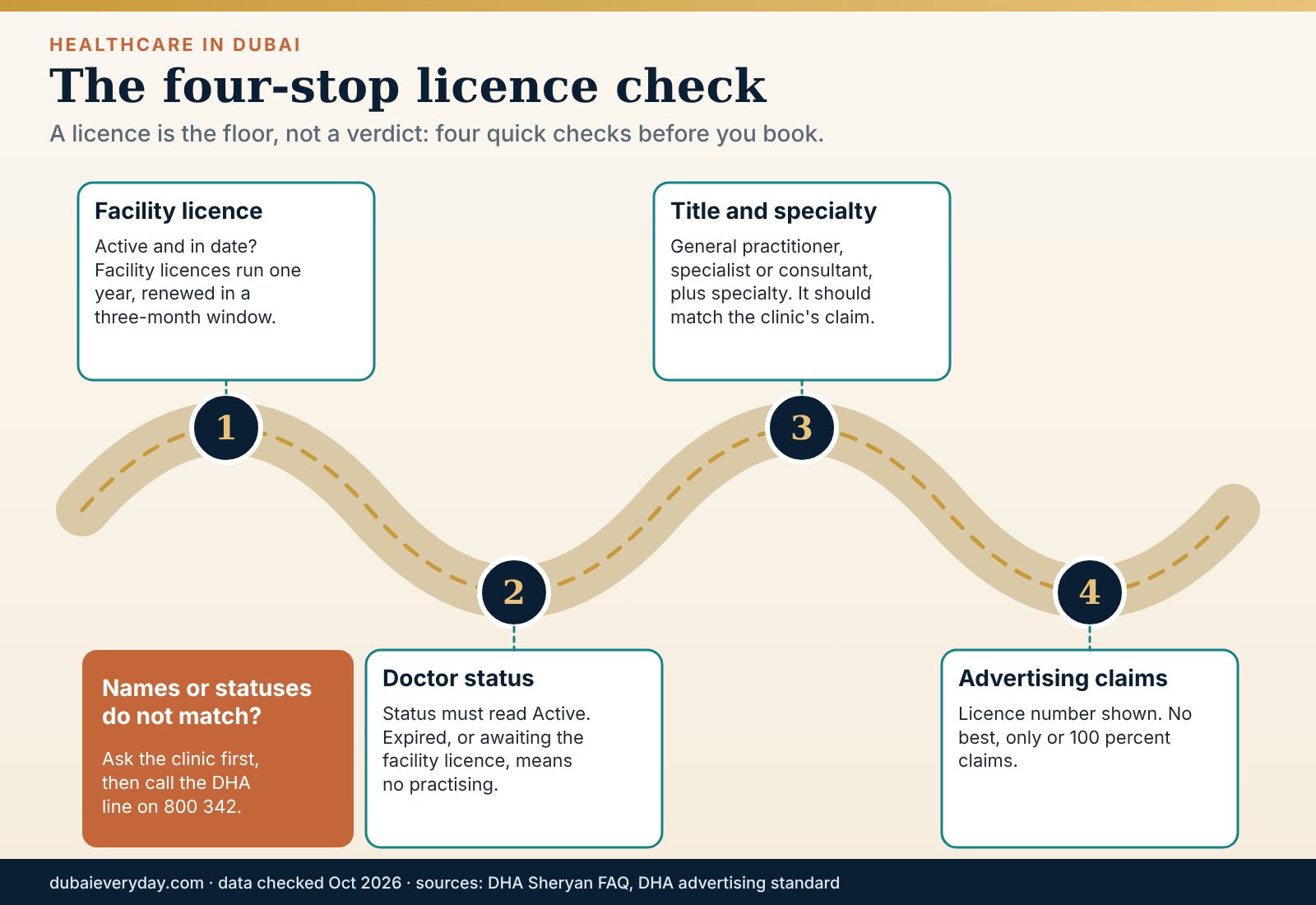
The DHA’s own licensing FAQ sets out several rules that translate directly into patient checks. Facility licences are valid for one year and renewed within a three-month window before expiry. Professional licences run for one, two or three years. A professional may practise only when the status is Active, and a doctor attached to a facility whose licence is not yet active shows as “Inactive – Awaiting Facility Licence”. An expired licence means the professional must not practise.
There is one more rule that quietly explains something many patients notice. Part-time licences let a professional work at a second facility, and the FAQ says a general practitioner Dubai clinics employ can hold one such licence, while non-surgical specialists can hold two and surgical specialists or consultants four. So a doctor appearing at two clinics is not suspicious in itself. It is also why “my doctor moved” is a common cause of lost continuity.
A five-minute check, step by step
- Get exact names.Take the doctor’s full name and the clinic’s licensed name from the clinic’s own site or by phone. Brand names on signs sometimes differ from the licensed entity.
- Search the doctor.Use the professional search in the DHA’s Sheryan registry. For any general practitioner Dubai clinics advertise, look for an Active status, a title that matches what the clinic claims, and the facility where the doctor is attached.
- Search the facility.Check that the clinic itself is licensed and active, and that its category matches what it does. A facility showing as inactive means the doctors there may not be allowed to practise yet.
- Compare with what is displayed.Licence cards and the facility licence are meant to be on display. Gulf News, in a 2022 explainer, lists the card, the displayed licence and the online registry as the three ways to check.
- Escalate mismatches.If names, titles or statuses do not line up, ask the clinic to explain. If the answer is vague, the DHA health regulation line on 800 342 can confirm what is and is not licensed.
We could not run live registry searches while preparing this page, so we cannot describe exactly what the screen shows today. If the portal is awkward, the DHA line is a legitimate fallback, and a clinic that dislikes the question has answered it anyway.
What a licence cannot tell you about a general practitioner Dubai clinic
A clean registry entry says nothing about waiting times, bedside manner, whether the doctor listens, or whether the clinic’s lab is competent. It also does not turn a title into a quality grade. “Consultant” is a level of seniority in a specialty, not a promise of a better first-contact doctor, and a GP with a patient-friendly diary can serve you better than a consultant booked six weeks out. For clinical questions, a qualified clinician makes the call; this page can only help you reach one.
The advertising rules offer a useful second filter. The DHA’s standard for medical advertising on social media requires facility accounts to show a medical advertising licence number, restricts “Dr.” to physicians, dentists and recognised doctorates, and bans absolute claims such as “best”, “only”, “safest” and “100%”. A clinic page that guarantees outcomes is either unaware of the standard or ignoring it. Neither helps your decision.
Insurance network: which general practitioner Dubai plans actually pay for
Most arguments at a clinic reception desk are about the network, because one general practitioner Dubai clinic can be inside one network and outside another. An insurer, or the third-party administrator it uses, contracts with clinics at agreed rates. If your clinic is inside your network, it bills the insurer directly and you pay your share. If it is not, you usually pay the full bill and ask for a refund later, if your policy allows refunds at all. The difficulty is that “accepts insurance” on a clinic website rarely tells you which of an insurer’s several networks it accepts.
The rules behind the card
Under Dubai’s health insurance rules, employers insure their employees and sponsors insure their resident dependants. The UAE government portal says that from 1 January 2025 a policy must be in place before residence permits for private-sector employees and domestic workers in Dubai are issued or renewed. The detail of that mandate and how plans compare belongs to the Dubai health insurance guide; here, what matters is how a general practitioner Dubai visit is paid.
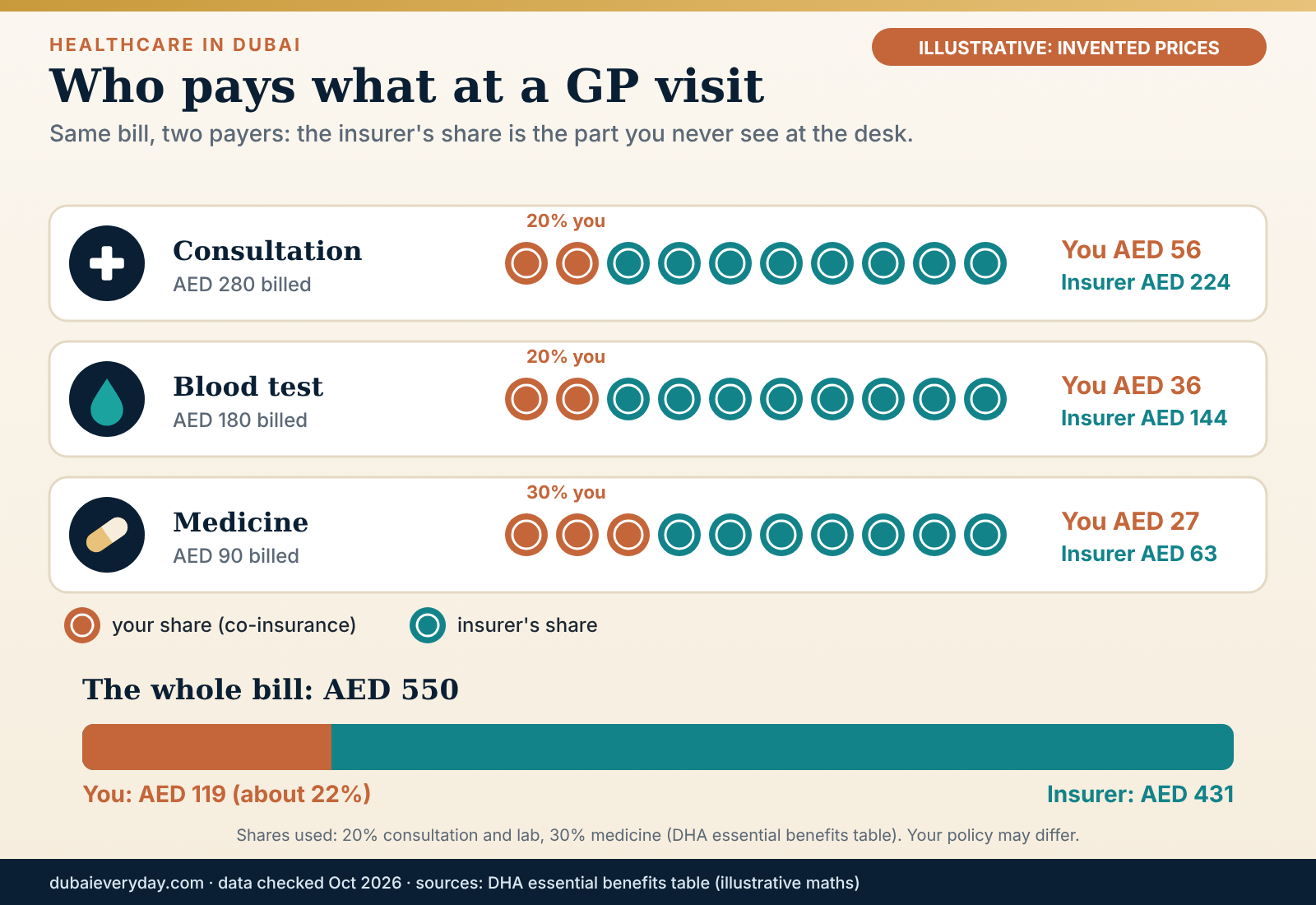
The DHA’s essential benefits table, effective from 1 January 2025 and read through an insurer-hosted copy of circular GC 03/2024, sets the floor for Dubai plans. For outpatient care it describes 20% co-insurance per GP or specialist visit, with no co-insurance on a follow-up within seven days, 20% for laboratory and radiology services at the assigned authorised facility, 30% for medicines up to an annual limit of AED 2,500, and virtual consultations included. It also allows a limited network, provided it offers adequate access across Dubai relative to where the member lives and works.
The UAE government portal’s description of the basic package differs: 25% outpatient co-payment capped at AED 100 per visit, and an annual medicines cap of AED 1,500. We cannot tell which version applies to you, because many employers buy better cover than the basic floor and insurers write their own schedules. Your policy’s table of benefits is the document that decides, and it overrides anything on this page.
Reading your network name
Your card or policy schedule should carry a network name or code. A broker explainer on checking networks makes the practical point that a hospital may accept only certain sub-networks of the same insurer, and that upgrading or downgrading a plan often changes the network. So “I have Insurer X” is not enough. Quote the network name exactly, and recheck every provider after a plan change.
A worked cost walk for a general practitioner Dubai visit (illustrative)
Take an invented general practitioner Dubai visit. The consultation is billed at AED 280, a blood test at AED 180 and a medicine at AED 90, so the clinic bills AED 550. Using the percentages in the DHA table, you pay 20% of the consultation (AED 56), 20% of the lab (AED 36) and 30% of the medicine (AED 27). That is AED 119 for you and AED 431 for the insurer. These are not market prices, and your policy may have different shares or caps; the point is the arithmetic, which you can repeat with your own numbers.
Now the same visit outside the network. You pay AED 550 at the desk. Whether anything comes back depends on your policy, because a network-only plan may refund nothing. Where refunds are allowed, a Gulf News explainer updated in October 2025 describes paying in full, sending the claim form with original reports and receipts, and waiting roughly seven to 30 working days. Treat that timing as indicative, since it comes from a secondary source.
The seven-day follow-up window at a general practitioner Dubai clinic
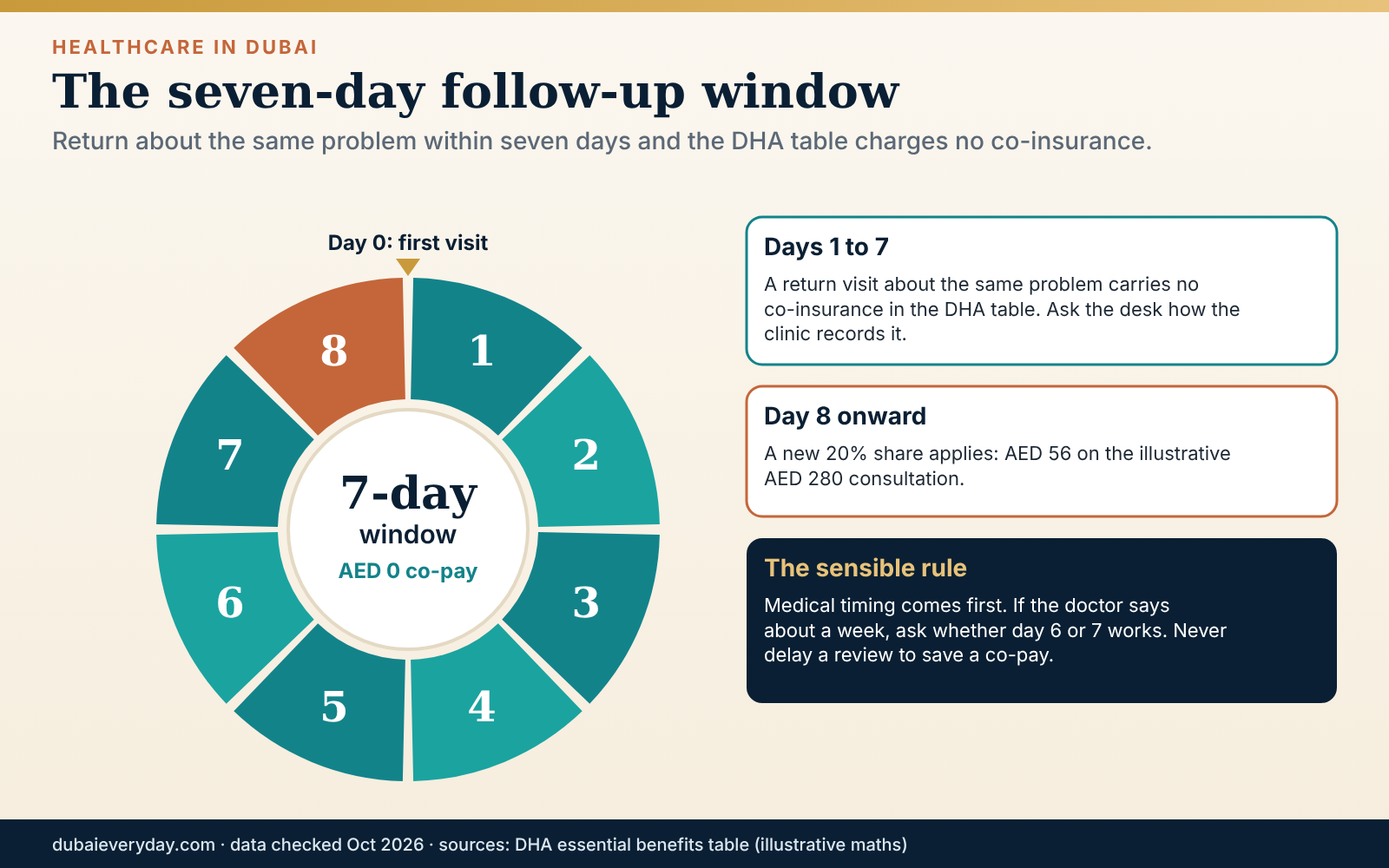
For a general practitioner Dubai visit, the follow-up rule is the most useful single detail in the table. If the doctor asks you to return about the same problem, a visit within seven days carries no co-insurance in the DHA table, while a visit on day eight would. On the illustrative AED 280 consultation, that is the difference between AED 0 and AED 56.
The clinical date comes first: never delay a review to save money. But when the doctor says “come back in a week”, ask whether day six or seven works, and ask the front desk how the clinic bills a follow-up.
Five questions to ask a general practitioner Dubai clinic before the first visit
- My card shows network name [exactly as printed]. Is Dr [name] direct-billed under that network today?
- Is the on-site laboratory and imaging in my network, or only the consultation?
- What is my co-payment for this visit, and does a follow-up within seven days count as free?
- Does anything you are likely to order need prior approval, such as MRI or CT?
- Do you offer virtual consultations, and does my plan count them?
Ask for the answer by message or email if you can, so there is a record when the bill differs. This is also where the narrow-network question surfaces. If the nearest in-network GP is a long way from both home and work, the table’s wording on adequate access gives you a fair question to put to your insurer, even if the answer is not always the one you want.
Appointment access: walk-in, booked, virtual and after hours
A doctor you cannot reach is a doctor in name only. Access to a general practitioner Dubai patients can actually reach has four parts: how you book, how soon you are seen, what happens outside working hours, and whether a screen can stand in for a room. Each is checkable before you need it, and none requires a visit. The method below is deliberately dull: a handful of phone calls made while you are well.
Booking channels you can verify
Dubai Health, the public provider, publishes the clearest booking route for a general practitioner Dubai appointment. Its pages say you can book through a 24/7 customer experience line on 800 60, an online booking page, WhatsApp or its app, and that you can filter doctors who offer virtual consultations. The app’s store listing describes booking, managing and cancelling appointments, viewing lab results and prescriptions, and downloading attested sick-leave certificates. Its insurance pages say a variety of plans are accepted and that you should confirm yours with 800 60 or your insurer.
Private general practitioner Dubai clinics run their own systems: a phone line, an app, a messaging number, a web form, or sometimes just the front desk. We found no official source for private-clinic opening hours or walk-in policies, so we do not state them. Ask. A clinic that answers a simple question about next-available slots in a clear sentence is showing you how it will treat the harder questions later.
What happens after hours
Most routine care assumes office hours, and illness does not. Gulf News reported in July 2025 that Aster Hospital in Al Qusais runs an overnight urgent care clinic from 10pm to 6am, with walk-ins for minor injuries, colds and flu, stomach upsets, pregnancy concerns and children’s problems. An older Gulf News report from 2018 described 24-hour urgent care at two Dubai Health centres, but we could not confirm current hours at either. Treat both as leads to verify by phone, not as a schedule.
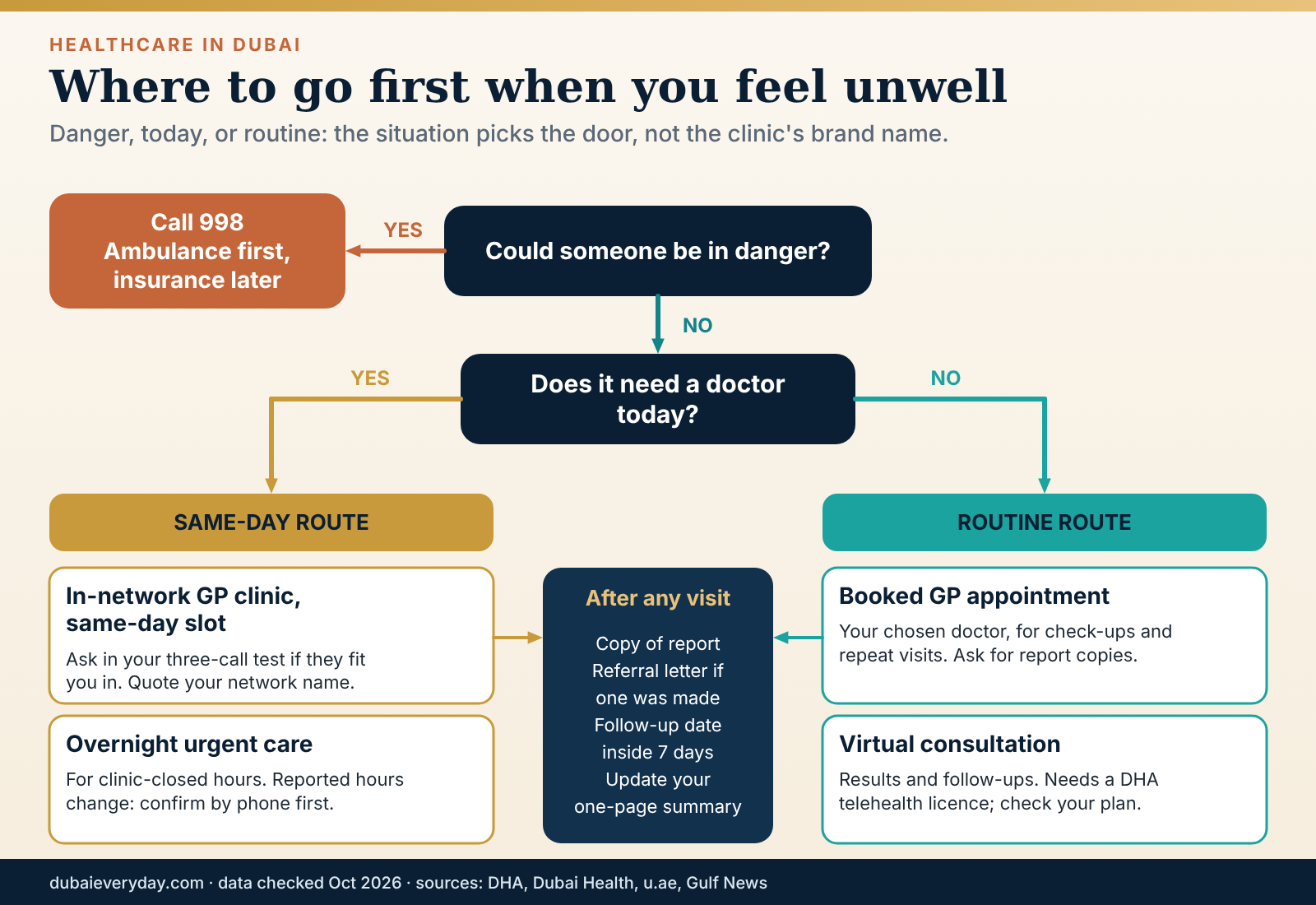
The useful principle is simpler than any list. Decide in advance where you would go at 9pm on a Friday for something that is not an emergency but cannot wait until Monday. Save that number. Write down which hospital emergency department is nearest, and read the guide to Dubai hospitals and emergency services for how hospitals differ.
If someone may be in danger, call the ambulance on 998 and do not wait for a clinic to open. A GP is for problems that can wait for a consultation. Dubai Health’s own FAQ notes that its hospitals have emergency departments and that two health centres also offer emergency services, so an emergency does not need your insurance question answered first.
Virtual consultations: what the official data shows
Telehealth is a recognised part of Dubai’s system, not a pandemic leftover. The DHA reported in October 2024 that it recorded nearly 375,000 telehealth consultations in 2023, about 28% more than in 2022. Electronic prescriptions passed 230,000, and 85% of telehealth consultations were completed within two days. Patient satisfaction was reported at 92%, and more than 140 telehealth providers held a DHA licence. These are the regulator’s own figures and say nothing about any one provider.
The DHA’s telehealth policy requires telehealth services to hold a DHA licence, requires patient consent before sharing information with another entity, and generally keeps health data inside the UAE. The UAE government portal also describes a DHA service, “Doctor for Every Citizen”, offering free voice and video consultations, first for Emiratis and later extended to all Dubai residents after the pandemic. The page is general, so check that the service still operates before relying on it.
What suits a virtual general practitioner Dubai visit? Our reading, not clinical advice: conversations that do not need hands or instruments, such as discussing results you already have, agreeing a plan with a doctor who knows you, or asking whether something needs to be seen in person. A good virtual service says plainly when a physical examination is needed and sends you onward. Check that your plan counts virtual visits; the DHA table includes them.
The three-call test
Shortlist three general practitioner Dubai clinics that are in your network and within a sensible journey. Call each on a weekday and ask the same three things: when is the next routine appointment with a GP, can I be seen the same day if I turn up unwell, and what do I do at night or on a Friday? Write down the answers and, if it matters to you, how long you waited to speak to a human. It takes fifteen minutes and tells you more than any ranking.
Distance deserves a number. Say the closest option is 12 minutes away and a better-liked clinic is 35. With six visits a year, which is an invented but plausible pattern for a household with one ongoing prescription, the extra 23 minutes each way adds up to 276 minutes, about four and a half hours a year.
That may be worth paying for a doctor you trust. It rarely is for a clinic you merely admire online. The same arithmetic favours choosing near the place where you are when you fall ill, which for many people is home in the evening and work during the day. A virtual option can cover the other half.
Continuity: keeping the same doctor, or the next best thing
Continuity means that whoever sees you already knows the story, or can read it. A general practitioner Dubai lets you pick visit by visit, in a system with no registration, so continuity does not arrive by default. It is built from small habits, and it matters most for people with long-term prescriptions, children whose histories are easy to lose, and anyone who moves between employers and policies in the same year.
Why Dubai makes continuity harder
Four things break the thread. Doctors move: the licensing FAQ’s part-time licence rules show doctors can work in more than one facility, and they can leave one. Plans change: a new employer or renewal can move you to a different network, which can put your clinic out of reach. People move house or office. And records are held clinic by clinic unless a shared system joins them, which the records section below covers.
None of this is a defect. It is the shape of a mobile market, and the sensible response is a personal system that does not depend on one clinic staying in your network or one doctor staying in post.
Three levels of general practitioner Dubai continuity
Same doctor
Ask for the named doctor when you book and say you are returning. If that doctor is unavailable, ask whether a colleague at the same clinic can see you with the notes in front of them.
Same clinic
If the doctor leaves, the file usually stays with the facility. Ask at your first visit whether the clinic keeps your history in one file and how another doctor there would see it.
Same story
If you change clinic, you carry the story: a one-page summary and copies of key reports. This is the level you can always control, whatever your insurer does.
A one-page health summary
Keep one page, on paper and on your phone, and update it after each significant visit. It should list current medicines and doses as written on the packaging, allergies, past diagnoses and operations, vaccination dates, the dates and results of your last major tests, and the name of the clinic and doctor who last saw you. A new general practitioner Dubai clinic can absorb that in two minutes, and it is a fraction of the time spent trying to recall it under pressure. Nothing here is medical advice; the page simply records what your own documents already say.
Habits that help
- Book check-ups and repeat prescriptions with the same doctor where possible, and say so when you book.
- Ask for a copy of any report or test result at the visit, not weeks later.
- When your plan or employer changes, check the network again before the next visit, not after the bill.
When to change your general practitioner Dubai clinic
Changing is reasonable when the doctor is repeatedly unreachable, when appointments are consistently far from the time you were given, when the clinic falls out of your network, or when you do not feel heard. The Patients’ Rights Charter gives you the right to choose the facility you use and to know the identity and specialty of the people treating you. It also lets you request a medical report, your test results and a copy of your health file, which makes a clean handover straightforward: ask for the copy before you leave.
If you do switch, tell the new general practitioner Dubai clinic what the old one prescribed and why you moved, rather than assuming the new clinic will find out. The shared record can help, but only where both clinics are connected and you have not opted out. The next section covers that.
Records: your file, NABIDH, reports and sick-leave certificates
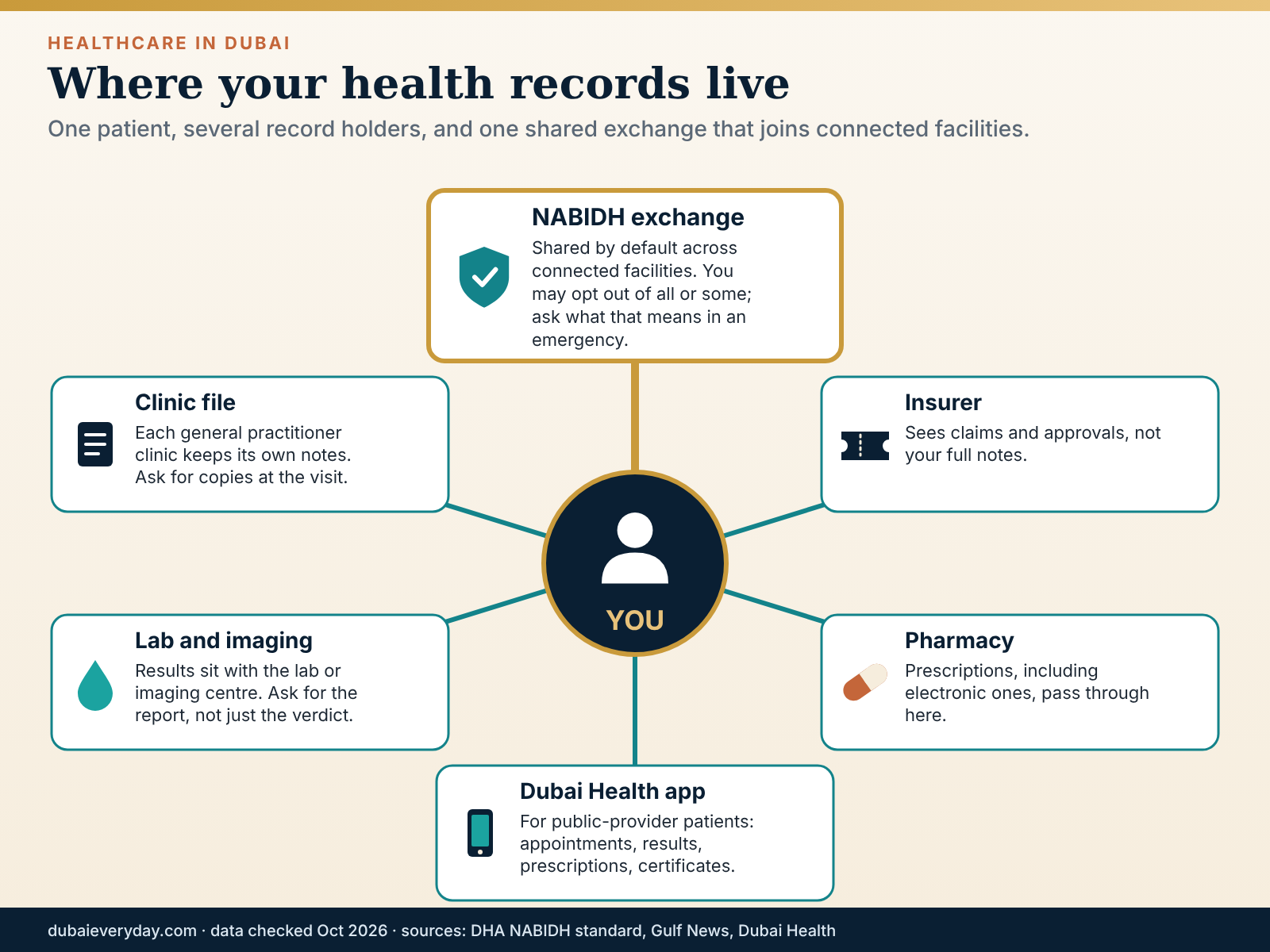
Your medical history in Dubai is not in one place. Each general practitioner Dubai clinic keeps its own file. Laboratories and imaging centres hold results. Your insurer sees claims. Pharmacies see prescriptions. Dubai Health patients have an app. And above them sits NABIDH, the DHA’s health information exchange, which is meant to join the pieces for connected facilities. Knowing which piece holds what is the difference between a five-minute handover and a week of phone calls.
NABIDH in plain terms
According to a Gulf News explainer last updated in March 2024, NABIDH combines patient records from public and private hospitals and clinics so that connected providers can see recent history, medications and other relevant data. The categories listed include demographics, allergies, vitals, problem lists, procedures, lab results, radiology reports, discharge summaries, immunisations, medication orders and insurance information. At a connected facility you are asked whether you agree to share your information through the system. The explainer describes consent as voluntary.
The DHA’s own standard on patients’ rights in NABIDH, version 1.0 of September 2020, adds detail. Sharing is the default unless you opt out of NABIDH entirely or of particular facilities. You can opt back in at any time.
You have the right to see relevant records in a readable electronic form without a doctor as intermediary, to upload documents from care received outside Dubai, to add supplementary information, and to request a report of who accessed your information. If you suspect a breach you can request an investigation. The standard sets no response deadlines, so the speed of an answer depends on NABIDH and the facility.
Gulf News says that opting out blocks access to your information, including in emergencies, which may slow a doctor who needs your history. The DHA standard separately describes emergency “break-glass” access and says patients should be notified when it is used. We could not reconcile the two descriptions, so ask the facility what an opt-out would mean in practice before you sign, and note the DHA line on 800 342 for opting back in.
Your rights over the file itself
The UAE’s Patients’ Rights and Responsibilities Charter, issued through Ministerial Resolution 14 of 2021, says you can request a medical report on your condition, accurate test results and a copy of your health file, and that you are entitled to detailed invoices. It also treats your health information as yours: it may be shared with your permission or where the law requires.
Separately, a law-firm summary of Federal Law 2 of 2019 says health data must be kept for 25 years from the last procedure, kept confidential and, as a general rule, not transferred outside the UAE. Law-firm summaries are not the statute, so treat this as orientation.
What follows for you is practical. Records outlive your time at a clinic, so you do not need to hoard everything. But copies in your own hands make switching painless. The sources do not describe fees or turnaround for a copy of the file, so ask the clinic both at the time you request it.
A records request that works
- Ask at the visit.When a test or report is produced, ask for a copy before you leave rather than reconstructing it later.
- Ask in writing for the rest.For older records, send a short message naming the dates, the doctor and what you need: report, results, imaging, prescriptions, vaccination entries.
- Bring identity.The Charter expects you to present the required identity documents, and facilities will need them to find the right file.
- Check what arrives.Look for your name, the date, the doctor’s name and the facility. Gaps are easier to fix while the memory is fresh.
- Store a duplicate.Keep one copy on your phone and one in a cloud folder you control. Do not email full records to yourself on shared devices.
Sick-leave certificates
A general practitioner Dubai visit often ends with a certificate. A Gulf News summary updated in March 2025 says private-sector employees can take up to 90 days of sick leave a year once probation ends, the first 15 days on full pay, the next 30 on half pay and the remaining 45 unpaid. It also says a medical report from an authorised medical entity must support the leave.
For Dubai, it says certificates need approval from the city’s health authority before electronic submission through the federal system, and that leave of more than five days generally needs attestation. The newspaper’s text is a summary, not the law, so ask your HR team which format they accept.
In practice, ask the clinic before you leave: can you issue the certificate electronically, does it carry the attestation my employer’s system expects, and is there a charge? For Dubai Health patients, the app’s store listing says attested sick-leave certificates can be downloaded. A certificate reflects what the doctor finds, so do not ask for dates that do not match your illness; that is a labour-law problem, not a clinic favour.
One related detail from the DHA table: investigations for non-medical purposes, such as employment, travel, licensing or insurance, are among the exclusions. A fitness letter for a job, visa or flight may therefore be self-pay even when your normal consultation is covered. Ask the price first.
Referrals: how a GP sends you onward and what it costs
The most expensive decision a general practitioner Dubai patients consult makes is often the next doctor you see. Under the DHA’s essential benefits table, specialist or consultant advice, consultations and treatments are not payable by the insurer unless you have first been seen by a DHA-licensed GP, or a DHA-designated equivalent, who records the referral and its reasons in the DHA’s e-referral system. That sentence is why choosing a general practitioner Dubai insurers recognise carefully matters even if you never intend to be a frequent visitor.
Is a referral always needed?
No. Richer employer plans and international policies often let you book a specialist directly, and some secondary guides say specialists generally need no referral. We cannot verify that as a rule, because it depends on the plan. The only safe approach is to read the line in your own table of benefits that begins with specialists, or ask your insurer by message: “Do I need a GP referral recorded in the DHA system before seeing a specialist under my plan?”
Pregnancy has its own rules in the table, including how antenatal care is delivered and approved, so check that section separately if it applies. For skin, teeth and other specialist areas, the dermatologist guide and the dental guide explain how direct booking and licensing differ there.
A worked general practitioner Dubai referral route (illustrative)
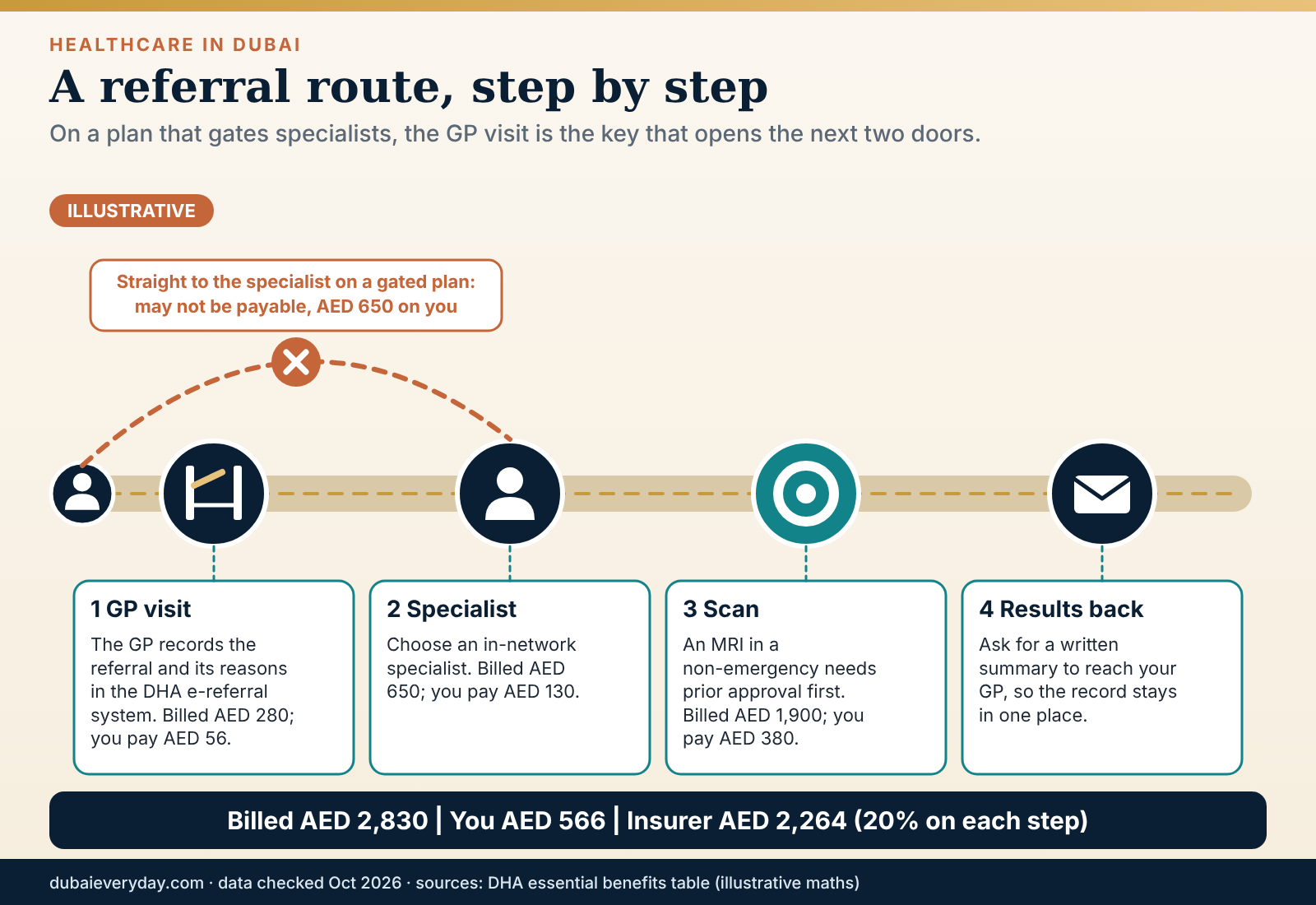
Invent a path with round numbers. The GP consultation is AED 280, the specialist visit AED 650 and an MRI AED 1,900, so the bills total AED 2,830. With 20% co-insurance on each in the DHA table, you pay AED 56, AED 130 and AED 380, which is AED 566. The insurer pays AED 2,264. The MRI is also one of the services the table says needs prior approval in non-emergencies, so the clinic must obtain that before the scan.
Now skip the general practitioner Dubai step on a plan that gates specialists. The specialist visit may not be payable at all, which would put the whole AED 650 on you, and whatever that specialist orders could meet the same difficulty. The arithmetic is invented, but the shape is not: the referral turns a possible AED 650 problem into an AED 130 share. Plans without the gate remove the problem, which is why reading your own schedule comes first.
What to ask your general practitioner Dubai clinic when a referral is mentioned
- Which specialty is this, and what question are we asking?
- Is the referral recorded in the DHA e-referral system, and can I have a copy of the letter?
- Is the specialist in my network, and is there an in-network alternative?
- Will scans or procedures need prior approval, and who requests it?
- Can the results come back to you, so the story stays in one file?
A referral inside the same group of clinics may be convenient, and it is also the easiest to accept without asking. You are free to choose your facility under the Charter, so asking for an in-network alternative is ordinary, not rude.
Same-day stacking and second opinions
The DHA table excludes more than one specialist consultation or follow-up on the same day unless the treating physician refers you. Booking two specialists back-to-back to save time can therefore leave the second one uncovered. The table does not mention second opinions, and neither does the Charter summary we read, so treat a second opinion as a coverage question for your insurer before you book, not an assumption.
When the specialist’s work is done, ask for a short written summary to be sent to your general practitioner Dubai clinic. A referral is a loop, not a one-way street, and the loop closes only if someone sends the result back.
Visitors, new arrivals and self-pay patients
Everything above assumes a resident with an insurance card. Three groups do not fit that picture neatly: visitors, people in their first weeks in Dubai, and residents who pay for care themselves. The checks are the same, but the order changes.
Visitors on a short trip
If you are visiting, your insurance is probably a travel policy from home. Dubai Health says its facilities accept guarantee-of-payment requests from international and travel insurers and that you should contact your insurer to start approval, which in practice means calling your emergency assistance number before, not after, you pay. Private clinics set their own rules. Expect to be asked for ID and payment details, and ask what you will owe before the consultation.
Keep paperwork for your insurer back home: original receipts, an itemised invoice, the doctor’s notes and any test results. The Charter says you are entitled to detailed invoices, and a Gulf News reimbursement explainer lists consultation notes, test results, prescription invoices and payment receipts as the usual documents. For wider trip planning, including heat and what to carry, the Dubai travel guide is the starting point. A general practitioner Dubai clinic is the right door for a minor problem. Anything that feels serious goes through the emergency number in the warning above.
The first weeks after arrival
New residents commonly face a gap between arriving and receiving an insurance card. The practical moves are small. Ask HR for the policy start date, the network name and an e-card as soon as one exists. Choose your general practitioner Dubai clinic from the in-network list once you have it, rather than picking a clinic by its sign and finding out at the desk. And note that dependants are insured by the sponsor, so ask for their cards too. The insurance guide covers the policy side in more detail.
It is also the best time for a low-stakes first visit. Booking a general consultation while you are well lets you meet the clinic, settle your NABIDH consent decision calmly and start your file, which is cheaper than doing all of that while you are feverish.
Paying for yourself
Dubai has no official public price list for routine consultations, so we do not quote a market price. What you can do is ask for a written, itemised estimate, as the Charter says you are entitled to learn the estimated costs of proposed treatment and tests. Compare like with like: consultation only, or consultation plus basic tests; whether a follow-up is free or discounted; and what the clinic charges for a report or certificate.
Self-pay does not mean second-class records. You still receive a file, can still ask for copies and can still opt in to a shared record.
Mistakes and red flags when choosing a general practitioner Dubai clinic
Most of the avoidable trouble in this area is repetitive. The same seven errors follow from the structure of the rules.
- Choosing by superlatives. “Best” is banned from medical advertising in the DHA social-media standard, so a clinic that uses it either is not following the rule or is not licensed to advertise at all.
- Assuming “we accept insurance” means your insurance. Insist on your network name, spoken or written.
- Skipping the GP on a plan that gates specialists, then discovering the specialist visit is not payable.
- Booking the follow-up on day eight when day six was available.
- Leaving without a copy of the report or result.
- Opting out of the shared record without asking what that does in an emergency.
- Treating a virtual consultation as a replacement for an examination when the doctor has said you need one.
Red flags at the front desk
- No licence displayed and no clear answer when you ask for the doctor’s full name.
- The doctor or facility cannot be found in the DHA registry, or shows an inactive status.
- Promises of outcomes, or comparisons with other clinics presented as fact.
- Prices that only appear after the examination, or refusal to give an itemised bill.
- Reluctance to give you your own report, results or invoice.
- Pressure to buy a package before you have been examined.
Any one of these is a reason to pause, not proof of wrongdoing. If something seems wrong after you have been treated, begin with the clinic, since the Charter expects facilities to investigate complaints and respond in writing. If that fails, the DHA health regulation line on 800 342 is the starting point for Dubai-licensed facilities, and the UAE government portal notes that complaints about private facilities are also routed to the federal health ministry, so ask which channel suits your case.
Seven steps to a general practitioner Dubai residents keep, with three scenarios
Here is the whole page as a sequence you can do in an evening. It takes about an hour of effort spread across a week, mostly waiting for replies.
- Read your schedule.Find your network name and the lines on outpatient co-insurance, follow-up, specialist referral and prior approval.
- List three in-network clinics.Use your insurer’s provider search to find a general practitioner Dubai clinic in your network, then phone to confirm direct billing for your exact network name.
- Check the licences.Search each doctor and facility in the DHA registry and look for Active status.
- Run the three-call test.Next routine slot, same-day policy, after-hours route. Note the answers.
- Book a low-stakes first visit.Use it to meet the doctor, decide your shared-record consent and ask how referrals and certificates work.
- Build your one-page summary.Medicines, allergies, history, vaccination dates and the clinic’s details, kept on paper and on your phone.
- Set a review reminder.Recheck the network after renewals, job changes or a house move, and once a year anyway.
Scenario A: new arrival, card pending
An invented new resident has a job offer, a visa in process and no insurance card yet. The sequence: ask HR for the network name and policy start date, build a shortlist from the insurer’s search once the card arrives, run the licence check on two clinics, and book a general consultation within the first month. A first visit that costs a co-payment of about 20% of a consultation, using our earlier illustration of AED 280, is AED 56.
Scenario B: long-term prescription, new insurer
An invented resident takes a regular medicine and their employer has changed insurer. Their old clinic is outside the new network. Before the next refill, they compare the new network list, find an in-network general practitioner Dubai clinic, send the old clinic a records request in writing, and bring the one-page summary and medicine boxes to the first appointment. They also check the medicines co-insurance and the annual limit on their new schedule, because the DHA table’s AED 2,500 annual medicine limit may differ from theirs.
Scenario C: self-pay freelancer wants a specialist
An invented freelancer pays for care without a gated plan and wants a specialist for a recurring problem. With no referral requirement, they could book directly, but a short general practitioner Dubai visit first gives them a recorded opinion, a referral letter if useful and an in-network or fair-priced alternative. They ask for itemised estimates from two specialists, request copies of any tests so they are not repeated, and send the specialist’s summary back to the GP.
General practitioner Dubai FAQ
How do I find a general practitioner Dubai insurers will pay for?
Start with your policy schedule to find the network name, then use your insurer’s provider search to list GP clinics in that network near your home or work. Phone the clinic and quote the network name exactly, asking whether direct billing applies to your plan today. Then check the doctor and facility in the DHA registry. Do not rely on “we accept all insurance” on a website, because insurers often run more than one network and a clinic may accept only some of them.
Do I need to register with a general practitioner Dubai clinic?
We found no official page describing a patient registration or named-GP scheme for private care in Dubai. In practice you choose a general practitioner Dubai clinic for each visit and can change freely. Some clinics will open a file at your first visit, and the DHA essential benefits table refers to seeing “a DHA-licensed GP” before a specialist, not to a specific named doctor. Continuity is therefore something you build, using the habits in the continuity section.
Can I see a specialist without seeing a general practitioner Dubai clinic first?
It depends on your plan. The DHA’s essential benefits table says specialist care is not payable unless a licensed GP has seen you first and recorded the referral in the DHA e-referral system. Richer employer or international plans often allow direct access, but we could not verify that as a general rule. Read the specialist line in your own table of benefits or ask your insurer by message before booking, because a wrong guess can leave the bill with you.
How can I check that a doctor is licensed in Dubai?
Use the DHA’s Sheryan registry to look up the doctor and the facility, and look for an Active status and a title that matches what the clinic says. Licence cards and the facility licence should also be displayed. If anything does not match, the DHA health regulation line on 800 342 can confirm. A licence shows that someone may practise, not that they are a good fit, so it is a minimum check rather than a recommendation.
How much does a general practitioner Dubai visit cost?
There is no official public price list for routine consultations, so we do not quote a market price. With insurance you pay your share, which in the DHA essential benefits table is 20% of the visit with no charge for a follow-up within seven days, though your own plan may differ. Without insurance, ask for a written itemised estimate that covers consultation, any tests and any report or certificate, and compare two clinics on the same basis.
Can I walk in without an appointment?
Some clinics take walk-ins and others work by appointment, and we found no official source listing which is which, so ask. Dubai Health centres are booked through 800 60, its app or its booking page. For problems outside office hours, Gulf News reported an overnight urgent care clinic at Aster Hospital in Al Qusais in 2025, but confirm current hours by phone. In an emergency, call 998 instead of booking.
Is a virtual consultation as good as seeing a general practitioner Dubai doctor in person?
It depends on the problem. A virtual visit cannot include a physical examination, so it suits conversations such as reviewing results or agreeing a plan, and a good provider will tell you when you need to be seen in person. Telehealth providers in Dubai must hold a DHA licence, and the DHA essential benefits table includes virtual consultations. Check that your plan counts them and that the provider is licensed before you book.
What is NABIDH and should I opt out?
NABIDH is the DHA’s health information exchange, which lets connected facilities see your shared health information. Sharing is the default, but you can opt out of NABIDH or of specific facilities, and opt back in. Gulf News says opting out blocks access even in emergencies, while the DHA standard describes emergency access with patient notification, so ask the facility what your choice would mean. Whether to opt out is a personal decision, and this page does not recommend either choice.
Can my GP give me a sick-leave certificate?
A licensed doctor can issue a medical report supporting sick leave, and Gulf News summarises the rules as requiring a report from an authorised medical entity, with attestation generally needed for leave of more than five days. Ask the clinic before you leave whether the certificate is issued electronically, whether it carries the attestation your employer expects, and whether there is a charge. Your HR team and the current labour rules decide what counts.
What if my insurer’s network changes after renewal?
Recheck every provider you use. Upgrading or downgrading a plan often changes the network, and the same insurer may run several. Before your next visit, ask your clinic whether it is direct-billed under the new network name. If it is not, you can choose an in-network clinic, ask your insurer about continuity-of-care arrangements, or pay as out-of-network and claim where the policy permits. Do not assume the old arrangement carries over.
Can visitors see a general practitioner Dubai clinics offer?
Yes, as patients of a licensed facility. Dubai Health says it accepts guarantee-of-payment requests from international and travel insurers, which your insurer must approve, and private clinics set their own terms. Ask what you will owe before the consultation, keep original receipts, ask for an itemised invoice and the doctor’s notes for your own insurer, and call the emergency number if the situation is serious. Do not assume treatment will be covered by a policy you have not read.
How do I complain about a doctor or clinic?
Begin with the clinic. The Patients’ Rights Charter expects facilities to take complaints seriously, investigate them and respond in writing. If you are not satisfied, the DHA health regulation line on 800 342 handles questions about Dubai-licensed facilities. The UAE government portal also notes that private-facility complaints can go to the federal health ministry, so ask which channel fits your case. Keep copies of invoices, reports and messages, since a clear paper trail helps whichever route you take.
Related reading
Sources and further reading (21 links)
- Dubai Health Authority: NABIDH Policies and Standards, Subject of Care Rights — patient rights in the health information exchange
- Dubai Health Authority: Telehealth Policy — licensing, consent and data rules for telehealth
- Dubai Health Authority: telehealth figures for 2023 — consultations, e-prescriptions and licensed providers
- Dubai Health Authority: Sheryan FAQ — licence validity, statuses, titles and part-time licences
- Dubai Health Authority: Standards for Medical Advertisement Content in Social Media — advertising licence number, titles and banned claims
- DHA Essential Benefits Plan table, circular GC 03/2024 (insurer-hosted copy) — co-insurance, follow-up window, referral, prior approval, exclusions
- UAE Government portal: Getting a health insurance — who must insure and the basic package description
- UAE Government portal: Telemedicine — Dubai’s free virtual consultation service
- UAE Government portal: Patients’ rights and responsibilities — the charter and complaint routes
- Ministry of Health and Prevention: Ministerial Resolution No. 14 of 2021 — patient charter text
- Dubai Health: Ambulatory health centres — public centres and booking routes
- Dubai Health: FAQs — booking line, virtual consultations, emergency services
- Dubai Health: Our insurance partners — guarantee of payment for international and travel plans
- Dubai Media Office: Dubai’s healthcare ecosystem posts record growth in 2025 — facility counts
- Simmons & Simmons: New health data protection law in the UAE — law-firm summary of retention and confidentiality rules
- Gulf News: NABIDH explainer — data shared, consent and opt-out
- Gulf News: Sick leave in the UAE — secondary summary of sick-leave rules and certificates
- Gulf News: How to claim a health insurance reimbursement in the UAE — direct billing versus reimbursement
- InsuranceMarket.ae: How to check network hospitals in the UAE — broker explainer on network names, used as secondary context
- Gulf News: Dubai hospital opens overnight urgent care clinic in Al Qusais — example of overnight walk-in care
- Gulf News: 3 ways to check if your doctor or clinic is licensed in Dubai — secondary explainer on licence checks
Update log: 29 October 2026 — first publication; facts re-checked against the sources above. Next review due: April 2027 (every six months), sooner if the DHA or Dubai Health changes its rules or pages. Corrections welcome.
This guide is general information, not medical, insurance or legal advice, and it does not recommend a clinic, doctor or treatment. Confirm licences, fees, hours and coverage with the provider, your insurer and the DHA before you rely on them.
About DubaiEveryday and this guide
DubaiEveryday.com is an independent editorial project that publishes practical, research-based guides to everyday life in Dubai: where to live, what things cost, how the rules work and how to get around. This page was written and edited by the DubaiEveryday editorial team. It is not signed by a named expert, doctor, lawyer or adviser, and we do not claim first-hand testing of a venue, clinic or service unless the page says so.
Each guide is built from official sources such as government and regulator pages, operator websites and established news outlets, cross-checked where we can. When we could not confirm something, we say so in the text, and examples that use made-up numbers are labelled as illustrations. Mentions are editorial choices, not paid placements, and a link is not an endorsement.
Dubai changes quickly. If you spot something that is out of date or wrong, please tell us through the contact options on DubaiEveryday.com and we will check it and correct the page.