

A GP for the routine things, a specialist when you are referred, a same-day slot when it cannot wait, and a lab that does not send you across the city. This guide shows how to find the best clinics Dubai has for that mix, with a public list built from an official page, a method for private clinics and the arithmetic of what you actually pay.
Picture a Tuesday morning: a cough that has outstayed its welcome, a work calendar that will not budge, and a phone full of clinic ads that all promise the same thing. Every one of them claims to be the best. Dubai’s own health regulator, as it happens, bans that exact word from clinic advertising, which tells you something about how to read the lists.
So this page does not crown a winner. It shows you how to find the best clinics Dubai has for your own life: where you live, what your policy pays for, whether you need a GP, a specialist or a same-day slot, and where the blood test actually happens. There is a public list built from an official page, a six-point method for private clinics, and worked examples with the arithmetic shown. Ten quiet minutes now can save you a bad hour later.
The best clinics Dubai residents end up using are the ones that pass six tests for their own life: a GP who can be seen soon, specialist access that your insurer will pay for, a realistic same-day option, a network that includes the clinic, a lab and imaging route without detours, and a location you will really travel to when you feel unwell. There is no official ranking of clinics in Dubai, and the Dubai Health Authority (DHA) tells clinics not to claim to be “the best” in social-media advertising, so a list that crowns a winner is opinion or marketing.
What can be verified is narrower and more useful. Dubai Health, the public provider, publishes a list of ambulatory health centres you can book through one number (800 60). For private clinics, the DHA registry (Sheryan) shows whether a facility and its doctors hold an active licence, and your insurer’s network list shows whether a visit is covered. Check those two things, then use the six tests below to narrow the best clinics Dubai offers to a shortlist of two or three. This page covers general clinics, specialist clinics and same-day care; hospitals and emergency departments have their own guide.
This is a desk-research guide. Nobody on the DubaiEveryday team has been a patient at the clinics discussed, and nothing here is a review or a clinical recommendation. On 29 October 2026 we read the Dubai Health pages for ambulatory centres, booking, insurance partners and its app; the DHA’s essential benefits table, telehealth announcement, facility statistics and social-media advertising standard; the Sheryan licensing FAQ; and the official u.ae insurance page. Where only a news report was available, we say so.
Selection rules: the best clinics Dubai has are not ranked here, and a clinic is named only if an official page lists it. We could not run live searches in the Sheryan registry, so no private clinic is named as verified or as “best”, and inclusion was not paid for. Prices are not quoted as market facts, because Dubai has no official public price list for routine consultations. Worked examples use invented numbers and are labelled illustrative. This is general information, not medical or insurance advice.
Best clinics Dubai: what this page covers and why it names no private winner
Search for the best clinics Dubai has and you will mostly meet three kinds of page: directories paid by the clinics they list, ranking posts with no stated method, and a clinic’s own site explaining why it is the one. None of these can tell you which clinic suits your policy, your street and your health, because that depends on facts about you. This page works the other way round. It gives you the questions that separate the best clinics Dubai has from merely well-marketed ones, the official sources that answer them, and a list you can verify yourself.
The DHA’s own rules explain why you will not find a neutral official ranking. Its standard for medical advertising on social media, issued in 2022, lists absolute wording that facilities should avoid, including claims of being the best, the only, the safest or “100%”. It also rules out unsupported comparisons with other providers. A clinic that markets itself as one of the best clinics Dubai has is therefore, at minimum, ignoring the regulator’s language. That is worth knowing before you read any ranking, ours included.
What this guide covers, and what it hands to other guides
Our scope for the best clinics Dubai offers is the walk-in and appointment layer of healthcare: general practice, outpatient specialist clinics, urgent care that is not an emergency, telehealth, labs and imaging as they relate to a clinic visit, and the insurance rules that decide who pays. For the full picture of the system, including pharmacies, records and emergency numbers, read the Dubai healthcare guide. For emergency departments, inpatient care and surgery, use the best hospitals in Dubai comparison.
Dental work and skin care have their own pages because the decision looks different. If your question is about a tooth, the Dubai dentist guide is the better start. If it is about a rash, acne or a mole check, see the dermatologist guide. Here we stay with the general and specialist layer and the question every reader shares: how do I find the best clinics Dubai has without being sold to?
Who this page is for
Residents with employer insurance mainly need to know which of the best clinics Dubai insurers include in their networks and what referral rules apply. Residents who pay themselves care more about price transparency. Visitors and health tourists need licence checks and clear quotes. Each group gets a section below.
Clinic types in Dubai: which door fits which problem
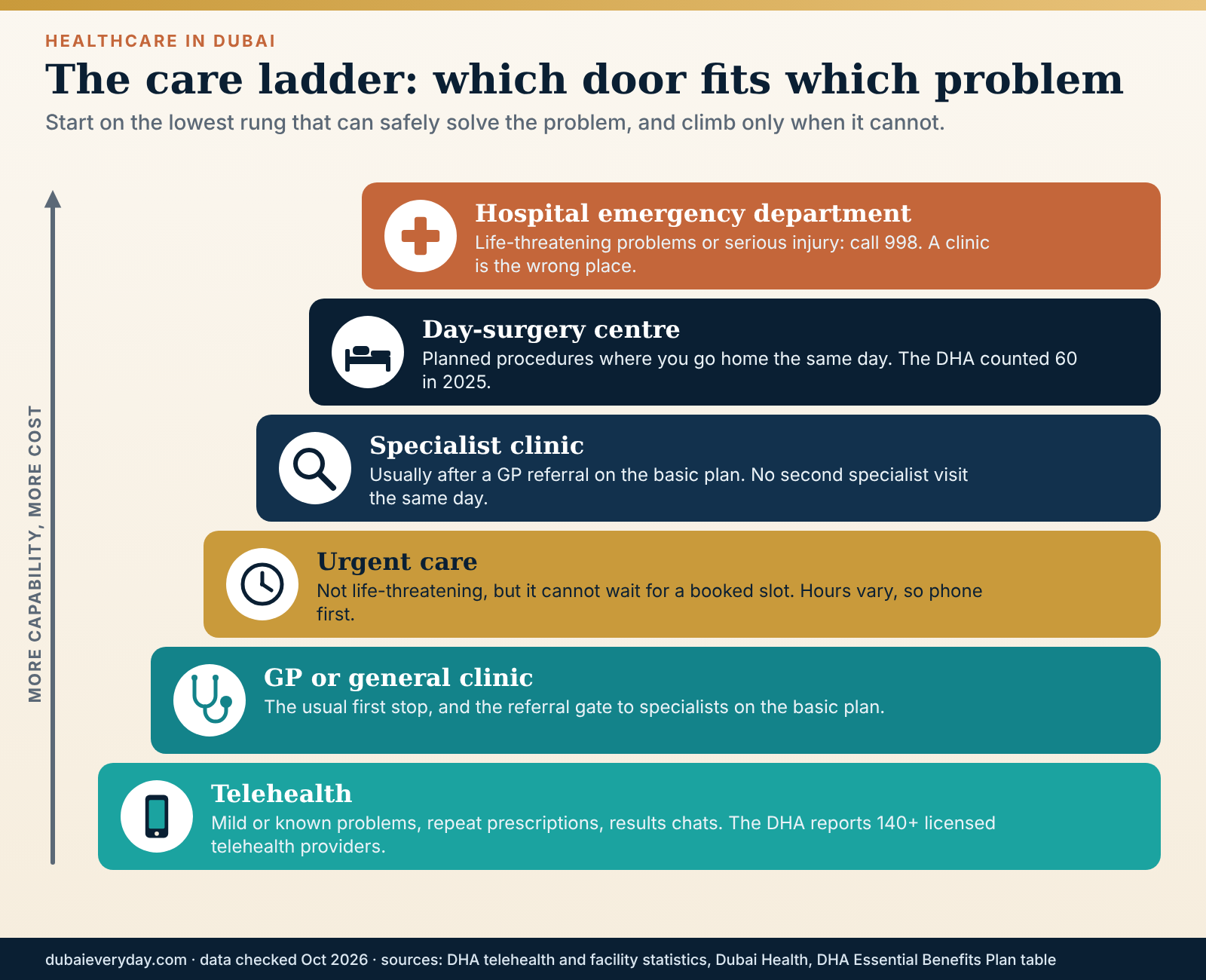
Most confusion about the best clinics Dubai offers starts with the word “clinic”, which covers very different facilities. The DHA licenses them in categories, and the Sheryan FAQ mentions hospitals, day-surgery centres, fertility centres and polyclinics among the facility types. The practical split for a patient is simpler. Think of it as a ladder: you start on the lowest rung that can safely solve the problem, and move up only when it cannot.
General clinics and GP practices
A general medical clinic is where most adults should start, and it is the first place to test the best clinics Dubai has to offer. It handles coughs, infections, blood pressure checks, repeat prescriptions, minor injuries, sick-leave notes and the referral that unlocks specialist care on most insurance plans. DHA statistics for 2025 count 126 licensed general medical clinics in Dubai. That number reflects the categories the DHA chose to itemise, so it understates the number of places where a GP actually works, since polyclinics and some hospital outpatient departments also employ them.
Polyclinics and specialist clinics
A polyclinic gathers several specialties under one licence: typically a GP, a paediatrician, a gynaecologist, sometimes dermatology, orthopaedics or ENT. The convenience is real, because one registration and one file serve the whole family. The risk is a different one: a long specialty list on a brochure does not prove that each doctor is present on the day, or licensed there. The Sheryan FAQ notes that part-time professional licences let a doctor work at another facility, with limits by seniority, which is one way a small clinic can list many names.
Single-specialty clinics, such as cardiology, ophthalmology or fertility practices, usually offer more depth in their field and less flexibility outside it. The DHA counted 68 specialised clinics in 2025 in the same release. Both numbers come from a government news release, not a searchable register, so treat them as scale, not as a shopping list.
Urgent care, telehealth and day surgery
Urgent care sits between a GP and an emergency department: non-life-threatening problems that cannot wait for a booked appointment. Telehealth is a remote consultation with a DHA-licensed provider, and the DHA says more than 140 telehealth providers hold a licence. Day-surgery centres handle planned procedures where you go home the same day; the DHA counted 60 in 2025. Hospitals, with emergency departments and overnight beds, are on the top rung and covered in the sibling guide linked above.
How to judge the best clinics Dubai offers: six lenses
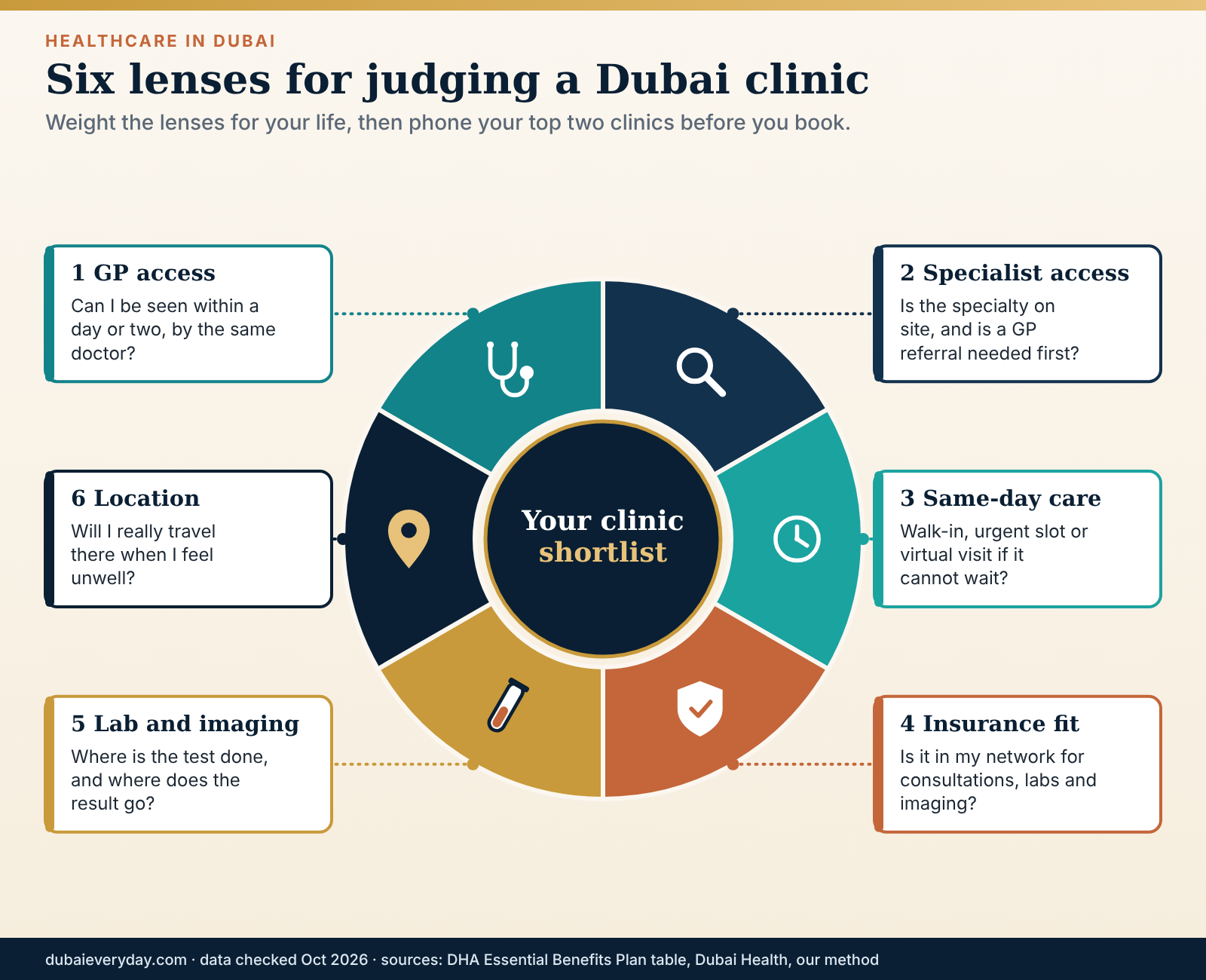
Our method for finding the best clinics Dubai offers has six lenses, each tied to a question you can answer with a phone call or a registry search. They match the job this guide is built around: GP access, specialist access, same-day capability, insurance fit, lab access and location. We do not score clinics on bedside manner, clinical outcomes or waiting times, because no official source we could read publishes them for individual clinics.
1. GP access
Can you see a general doctor within a day or two, and see the same one again? Continuity matters for chronic conditions and for referrals.
2. Specialist access
Does the clinic have the specialty on site, and does your plan require a GP referral first? Ask which days the specialist sits there.
3. Same-day capability
Is there a walk-in line, an urgent slot or a virtual option when the problem cannot wait? Hours change, so confirm them on the day.
4. Insurance fit
Is the facility inside your network, and for which services? A clinic can be in network for consultations and out for imaging.
5. Lab and imaging access
Are tests done on site or sent to an assigned lab, and where do results land afterwards? Prior approval may add a step.
6. Location
Can you reach it comfortably when you feel poorly, on a weekday evening and at the weekend, without a taxi you cannot afford?
Turning six lenses into a decision
Weights matter more than scores when you compare the best clinics Dubai has to offer. A parent of young children will weight same-day access heavily, because fevers do not wait for appointments. Someone managing diabetes will weight GP continuity and lab access. A commuter whose employer plan has a narrow network will find that insurance fit overrides everything else, since the best clinics Dubai has on paper mean little if a visit is not covered.
Here is an illustrative example, not real clinic data. Rate each lens for how much it matters to you (1 to 3), then rate each candidate for how well it fits (0 to 3). Multiply and add. Suppose your importance scores are GP 3, specialist 1, same-day 3, insurance 3, lab 2, location 3, giving a maximum of 45. Clinic A fits 3, 1, 2, 3, 2, 3 and scores 9 + 1 + 6 + 9 + 4 + 9 = 38. Clinic B fits 2, 3, 3, 1, 2, 2 and scores 6 + 3 + 9 + 3 + 4 + 6 = 31.
Clinic B has the stronger specialist offer, but A wins for this person because insurance and location carry the weight.
The score is a conversation aid, not a verdict on which are the best clinics Dubai has. If two clinics land within five points of each other, call both. The gap between a polite, clear phone answer and an evasive one tells you more than a decimal.
A verified public shortlist: Dubai Health ambulatory centres
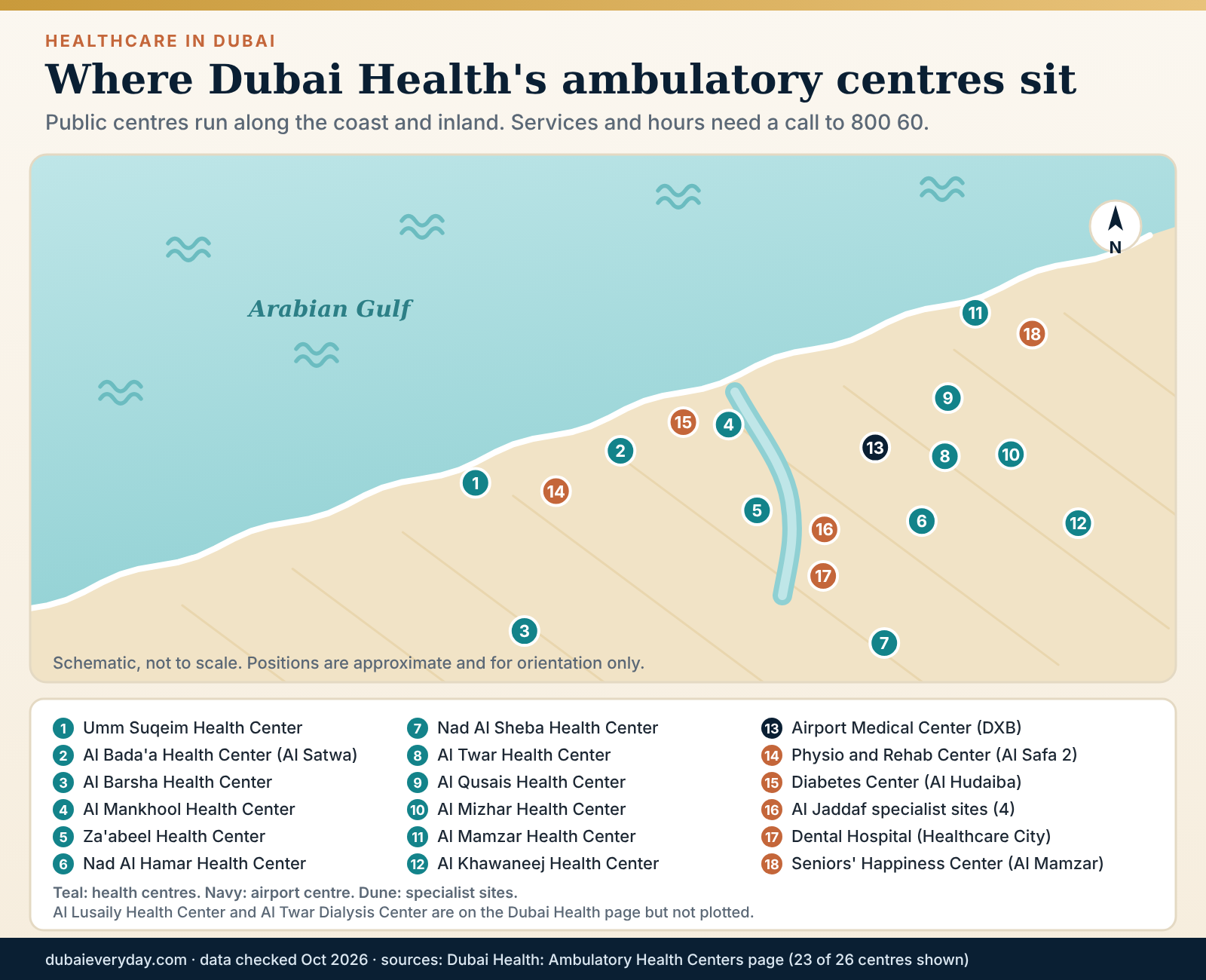
The only list in this guide that comes straight from an official page is the network of Dubai Health, the government health provider. Its Ambulatory Health Centers page says there are 26 centres and shows 23 of them when read on 29 October 2026; we list what the page shows.
It describes the centres in general terms, from preventive services and routine health checks to the management of chronic conditions. It does not give services, opening hours or 24/7 status for individual centres, so those need a phone call. It is a verified starting list, not a ranking of the best clinics Dubai has.
The primary care centres, by area
These are the centres whose names read as general health centres, with the area as printed on the page. Services at each need confirming.
- Al Bada’a Health Center, Al Satwa
- Al Barsha Health Center, Al Barsha 3
- Al Khawaneej Health Center, Al Khawaneej
- Al Lusaily Health Center, Al Lusaily
- Al Mamzar Health Center, Cairo Street, Al Mamzar
- Al Mankhool Health Center, Al Mankhool Road
- Al Mizhar Health Center, Al Mizhar 1
- Al Qusais Health Center, Al Qusais 1
- Al Twar Health Center, Al Nahda Street, Al Twar
- Nad Al Hamar Health Center, Nad Al Hamar
- Nad Al Sheba Health Center, Nad Al Sheba
- Umm Suqeim Health Center, Umm Suqeim
- Za’abeel Health Center, Za’abeel 2
- Airport Medical Center, Dubai International Airport
The specialist sites on the same page
The page also lists single-purpose centres: a Dental Hospital in Dubai Healthcare City, a Diabetes Center in Al Hudaiba, a Fertility Center in Al Jaddaf, a Physiotherapy and Rehabilitation Center in Al Safa 2, a Thalassemia Center in Al Jaddaf, the Al Twar Dialysis Center, a Blood Donation Center and a Cord Blood and Research Center (both Al Jaddaf), and a Seniors’ Happiness Center in Al Mamzar. Their names suggest their purpose, but the page does not describe what each offers or how a patient is accepted.
How to book, and what the page does not say
The page and the Dubai Health FAQ give the same routes: call 800 60 (the Customer Experience Team is described as available 24/7), use the Book an Appointment page, send a WhatsApp message to the same number, or use the Dubai Health app. You can filter doctors who offer virtual consultations. The Al Twar Dialysis Center has its own number, 800 543639.
The FAQ also says Al Barsha Health Center and Nad Al Hamar Health Center offer emergency services. A Gulf News report from 2018 described both as having 24-hour urgent care, but that article is eight years old and we could not confirm current hours. Ask before you travel.
What we could not verify: whether an expatriate resident can book a routine GP visit at each centre on the same terms as a Dubai citizen, what a self-pay visit costs, how long the wait is, or which centres have a laboratory and X-ray on site. The page is silent on all of it. That gap is why this list is a starting point for comparing the best clinics Dubai residents can reach, not a recommendation. If you rely on one of these centres, call 800 60 and ask the five questions in the checklist below.
- Is a GP available today or this week, and is there a walk-in line?
- Do you accept my insurer and plan, and do you need a guarantee of payment first?
- Are blood tests and X-rays done in the building, and who reads them?
- What are the opening hours this week, including Friday and holidays?
- If I need a specialist, which one sits here and how long is the wait?
On insurance, the Dubai Health insurance page lists ten insurers and administrators on its first page, out of three pages, and says it accepts guarantee of payment from international and travel insurance plans. It tells you to contact your insurer to start approval. That is a useful statement for visitors, though it does not promise that every procedure will be authorised. Our guide to health insurance for Dubai residents explains networks, co-pays and claims in more detail.
GP access: the clinic you will use most
The clinic that matters most is rarely the famous one. It is the ordinary general practice that knows your insurance card and has your history, and it is also where the system sends you first. The DHA’s Essential Benefits Plan, the minimum scheme that applies to many Dubai employees, will not pay for specialist or consultant care unless you were first seen by a licensed GP, and the GP has to record the referral and its reasons in the DHA’s e-referral system.
That gatekeeping rule changes what the best clinics Dubai has for GP care need to offer. It is not only a place for a cough. It is the entry point to everything else, so the questions that matter are practical ones: how soon can you get in, will it be the same doctor, can they refer without friction, and do your records follow you?
What a GP visit should settle in one go
A well-run visit at any of the best clinics Dubai has can cover the problem you came with, a repeat prescription, a sick-leave note, a referral and any routine tests the doctor orders. The Dubai Health app, for instance, lists the download of attested sick-leave certificates and access to lab results and prescriptions among its features. Private clinics vary, so ask at the desk whether the clinic issues certificates your employer accepts and whether prescriptions can be collected from the clinic pharmacy or sent elsewhere.
Plan the visit as well. Write down your symptoms, medicines, allergies and any earlier test results before you go; take your Emirates ID and insurance card; and ask at the end what the next step is and who will call you with results. Those are administrative habits, not medical advice, and they make a short appointment far more productive.
Continuity: the hidden quality marker
Continuity is the least advertised and most valuable feature among the best clinics Dubai GP care can offer. Seeing the same doctor lets them notice changes, remember what worked and avoid repeating tests. In Dubai there are two ways to lose it. The first is clinic hopping, chasing the earliest slot at a different place each time. The second is a doctor leaving the clinic, which is common enough that a good practice will tell you who takes over your file.
The state of the digital record helps. The DHA’s NABIDH health information exchange links records across connected public and private facilities, so a clinician can see allergies, past procedures and lab results for a patient. It is not universal: reports note that not every facility is connected, and the list of connected providers is searchable on the NABIDH site. If continuity matters to you, ask a prospective clinic whether it is connected and what you would be consenting to share.
Specialist clinics: referral, direct booking and the same-day trap
Specialist care is where Dubai’s insurance rules bite hardest, and where the best clinics Dubai offers differ most by plan. On the basic plan the route is GP first, then a referral, then the specialist. Many employer-funded and premium plans allow direct access to specialists inside the network, but you must read your own table of benefits rather than assume. The easiest mistake is to book a cardiologist or an orthopaedic surgeon because their profile looks impressive, then find out at the desk that the visit needs a referral your plan does not have.
Checking a specialist before you book
Specialist titles are regulated. The DHA advertising standard says staff must state their name, title, qualification and speciality as they appear on their DHA licence, and it bans invented titles such as aesthetic or cosmetic “consultant” or “specialist”. The Sheryan registry shows a professional’s licence category, status and work history, and facility pages show licensed specialties. A thirty-second search on your shortlisted doctor’s name should confirm that the licence is active and that the clinic where you plan to see them is the one on record.
For cosmetic treatments, the picture is different again, because most plans exclude them and the advertising is heavier. We keep those decisions in separate guides, such as the ones on Botox and dermal fillers, where provider credentials and risks get the space they need. The same logic applies to dental implants, which sit in the dental world with their own licensing checks.
The same-day specialist trap
The Essential Benefits Plan lists as an exclusion more than one specialist consultation or follow-up on the same day, unless the treating physician referred you. This catches people who try to be efficient. Booking a dermatologist and an orthopaedist back to back in a polyclinic, because you are already in the building, may leave you paying for one of them in full. If you need two specialties, ask the clinic whether the second visit is a referral from the first doctor, and ask your insurer before you sit down.
The same table excludes investigations for non-medical purposes, such as employment, travel or licensing, and care provided by a relative of the patient. If a clinic offers a “fit to fly” or pre-employment test, expect to pay for it yourself.
Specialist fees at the best clinics Dubai offers: what we can and cannot say
There is no official public price list for outpatient specialist consultations in Dubai; each facility sets its fees. One commercial directory shows an indicative range of AED 300 to AED 1,200 for a specialist consultation in Dubai, on a page that says plainly it is the directory’s own estimate and not a quote. We include it only to show how wide the spread can be, not as a benchmark. The sensible habit is to ask for the consultation fee, any registration fee and the likely cost of tests in the same call, and to write the answer down.
Same-day care: urgent care, telehealth and when a clinic is the wrong place
Same-day access is the lens that separates the best clinics Dubai has from merely convenient ones. A clinic that works well when you book three weeks ahead is a poor choice for a child’s fever on a Friday evening. The question is not only whether a slot exists today, but whether the clinic will look at the problem or send you elsewhere after a long wait.
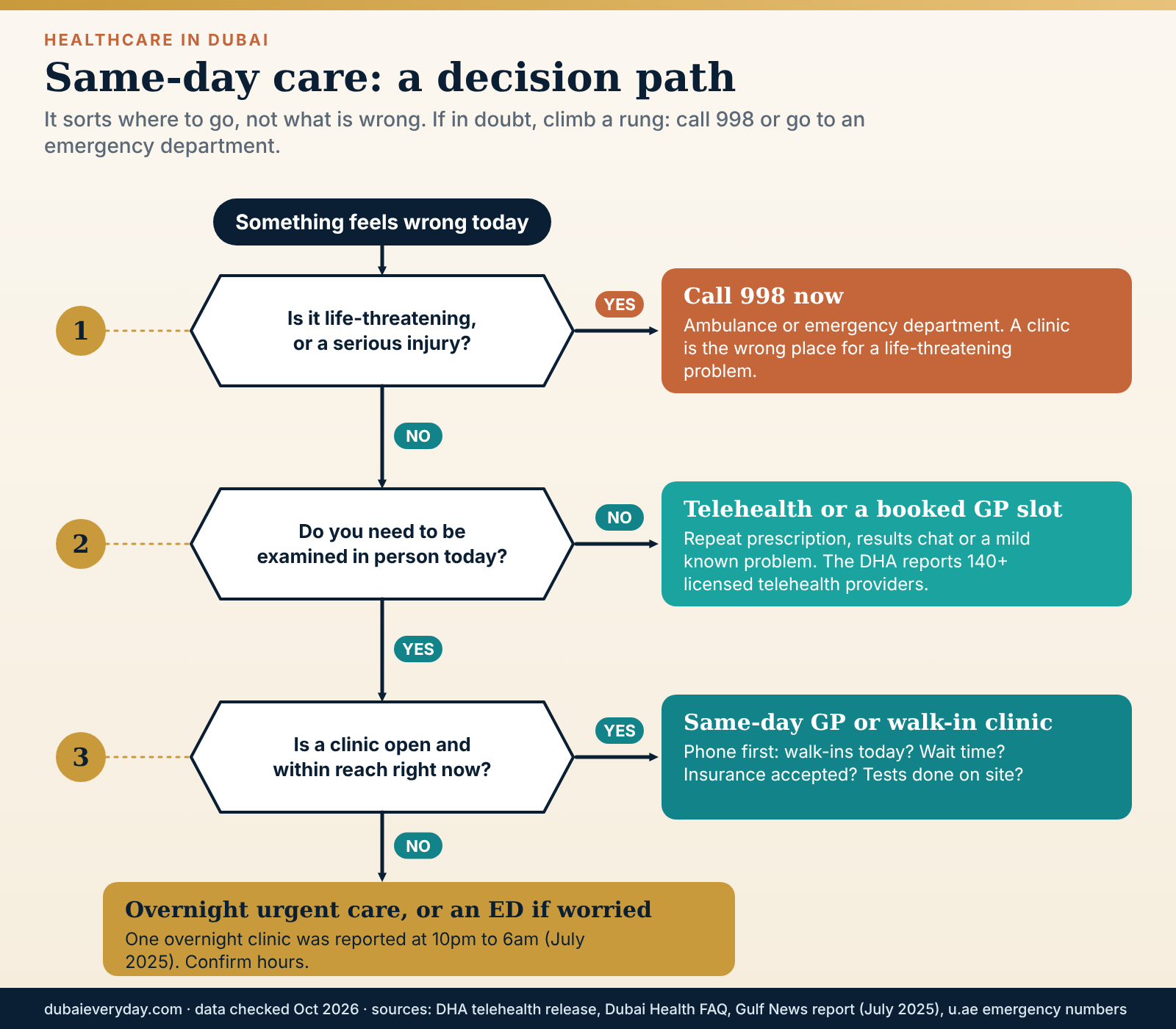
If someone has severe chest pain, difficulty breathing, signs of a stroke, heavy bleeding, a serious injury or is unresponsive, do not look for a clinic. Call 998 for an ambulance in Dubai. A clinic is the wrong place for a life-threatening problem, and hospital emergency departments are covered in our hospitals guide. This page is general information, not triage advice.
Walk-in and urgent care options
Dubai has no single official register of walk-in clinics, so the best clinics Dubai offers for same-day care have to be checked one by one. Three kinds of evidence exist. First, Dubai Health says that Al Barsha Health Center and Nad Al Hamar Health Center offer emergency services, and its hospitals all have emergency departments.
Second, individual private operators advertise urgent care. A July 2025 news report described an overnight Urgent Care Clinic at Aster Hospital in Al Qusais, open daily from 10pm to 6am for walk-ins, handling minor injuries, cold and flu symptoms, stomach upsets, pregnancy-related concerns and children’s problems, and covered under standard plans. We could not re-confirm those hours today, so treat them as a lead to verify.
Third, ordinary GP clinics often keep same-day slots, but nothing official says how many. That is why the practical test in the six lenses is a phone call: ask “if I come at 6pm today, who sees me and how long is the wait?” The answer tells you whether the clinic sees same-day care as part of its job.
Telehealth: faster, with limits
Telehealth is the lowest rung of the ladder and often the quickest. The DHA reported nearly 375,000 telehealth consultations in 2023, up 28% on 2022, and said 85% were completed within two days. It also reported over 230,000 electronic prescriptions and more than 140 licensed telehealth providers. The Essential Benefits Plan includes virtual consultations, with usage monitored, and Dubai Health lets you filter its booking page for doctors who offer them.
Telehealth suits a repeat prescription, a results discussion or a first look at a mild problem. It does not suit anything that needs examination, an injury or a rapidly worsening illness. A good provider will say so and redirect you. If one never does, that is a red flag.
What to ask when you phone for a same-day slot
- Do you take walk-ins, and until what time today?
- Will I see a GP, a nurse or a specialist first?
- Is my insurance accepted for a same-day visit without a prior referral?
- If tests are needed, can they be done here today?
- If you cannot treat this, where do you send me?
The last question is the revealing one. A clinic that has a clear transfer route for cases beyond its scope is usually a clinic that knows its limits, a trait worth looking for in any shortlist of the best clinics Dubai offers.
Insurance and the best clinics Dubai networks allow: a worked cost walk
The clinic that looks best on a map can be the worst on your bill. In Dubai, health insurance is compulsory for residents: employers insure their employees and sponsors insure their dependants, and from 1 January 2025 a policy must be in place before a residence permit is issued or renewed for private-sector employees and domestic workers in Dubai and Abu Dhabi, according to the official u.ae insurance page.
That makes network and co-pay rules a daily reality for most people reading this. The wider rules are in our health insurance guide for residents; this section covers only what bears on choosing a clinic.
Network: the first filter
Your insurer or its administrator publishes a network of facilities where your plan applies, and the best clinics Dubai has for you sit inside it. The DHA’s Essential Benefits Plan table allows a limited network, but only if it gives adequate access across Dubai relative to where the insured lives and works. That is a useful hook. If your assigned network leaves you a long journey from both home and office, you have a basis for asking your insurer or employer what can be done. Basic services are covered within Dubai; emergencies are covered across the UAE.
Always check the network at the level of the service, not the logo, when you compare the best clinics Dubai offers. A clinic can be in network for consultations and outside it for imaging or physiotherapy. Ask whether the clinic bills the insurer directly or expects you to pay and claim, and whether a guarantee of payment from your insurer is needed first, as the Dubai Health insurance page describes for international plans.
Co-pay and the disagreement between two official pages
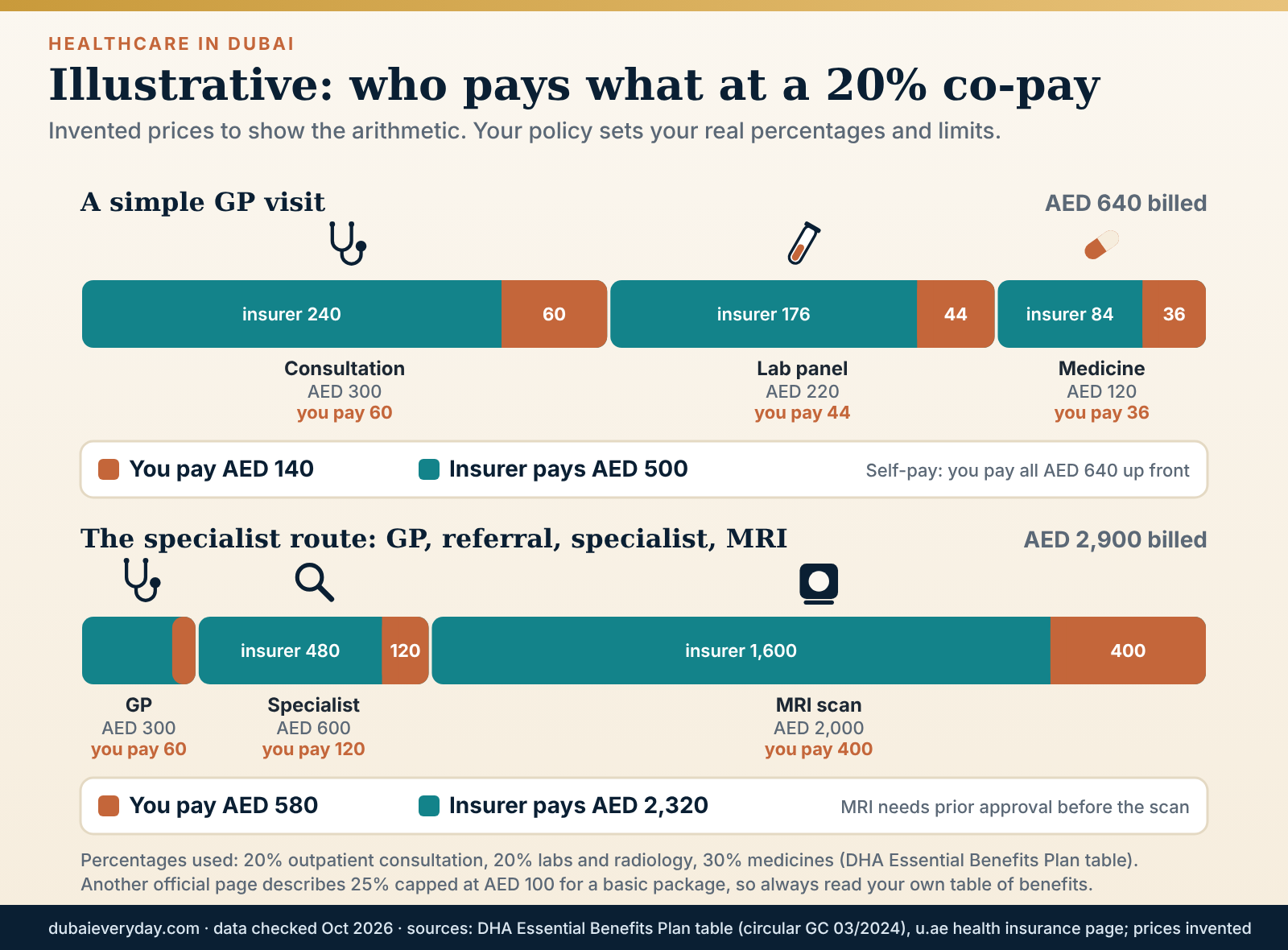
Two official sources describe basic-plan co-payments differently, and we would rather show you that than choose silently. The DHA circular for the Essential Benefits Plan (table effective 1 January 2025) puts outpatient coinsurance at 20% per visit, with none for a follow-up within seven days, 20% for laboratory tests and radiology, and 30% for medicines with an annual medicine limit of AED 2,500. The u.ae page describes a basic package with 25% outpatient co-payment capped at AED 100 per visit and a medicines cap of AED 1,500.
The likely explanation is that these are different schemes or different versions, but neither page says so. Your policy schedule is the document that binds your insurer, so read the table of benefits for your own plan, and treat both numbers above as examples of how such plans are built.
Our calculation: what a visit might cost you
This is an illustrative example, not a price list. Suppose a GP charges AED 300 for the consultation, AED 220 for a blood panel and AED 120 for medicines, a total of AED 640. Under the DHA table’s percentages, you pay 20% of the consultation (AED 60), 20% of the lab (AED 44) and 30% of the medicines (AED 36), a total of AED 140. The insurer pays AED 500. Without insurance, you pay AED 640 up front.
Now a longer route. The same GP visit, then a specialist at AED 600 after a referral, then an MRI quoted at AED 2,000. Billed total: AED 2,900. At 20% for the consultations and the scan, you would pay AED 60, AED 120 and AED 400, so AED 580, and the insurer AED 2,320.
Two warnings follow. The MRI needs prior approval in a non-emergency, so you should have the insurer’s approval before the scan, not after. And ask whether the quoted specialist fee is the amount your insurer will recognise, because any gap may land on you, which is why the written quote matters.
Prior approval, referrals and exclusions in plain words
- Specialist care generally follows a GP referral on the basic plan, recorded in the DHA e-referral system.
- MRI, CT and endoscopy in non-emergencies need prior approval; ask who requests it, you or the clinic.
- Two specialist consultations on the same day are excluded unless the treating physician referred you.
- Tests for employment, travel or licensing are excluded; alternative medicine is excluded.
- Medicines follow a formulary where available, and the annual medicine limit can run out.
When something goes wrong, start with the insurer’s complaints process, then use the DHA’s channels. A 2021 Gulf News guide lists the DHA call centre (800 342) and an email address for complaints about doctors and facilities; because that guidance is old, confirm the current route before relying on it.
Lab access: where the test happens and who sees the result
Lab access is the lens people forget when comparing the best clinics Dubai offers, until the doctor hands them a form. Then a simple appointment turns into a second trip, a second payment and a wait. Because labs and imaging often have separate network rules, the best clinics Dubai offers for your plan are the ones where the whole chain, from request to result, stays inside the arrangement you have.
Three ways a clinic handles tests
In-clinic lab
Sample taken and processed on site or collected for processing. Fastest and simplest; ask whether that lab is in your network.
Assigned or partner lab
The clinic sends you to a named lab. The DHA table says lab tests are covered at the authorised facility assigned to the insured.
Standalone diagnostic centre
Useful for imaging or a wide test menu. The DHA counted 119 diagnostic centres for 2023, a figure we cannot split by service.
Home healthcare is a separate licensed category, with 222 centres in the DHA’s 2025 figures. Some such providers collect samples at home, but the category itself does not say so, which is why you should ask a specific provider what it does, who processes the sample and whether your insurer accepts it.
Where the result goes afterwards
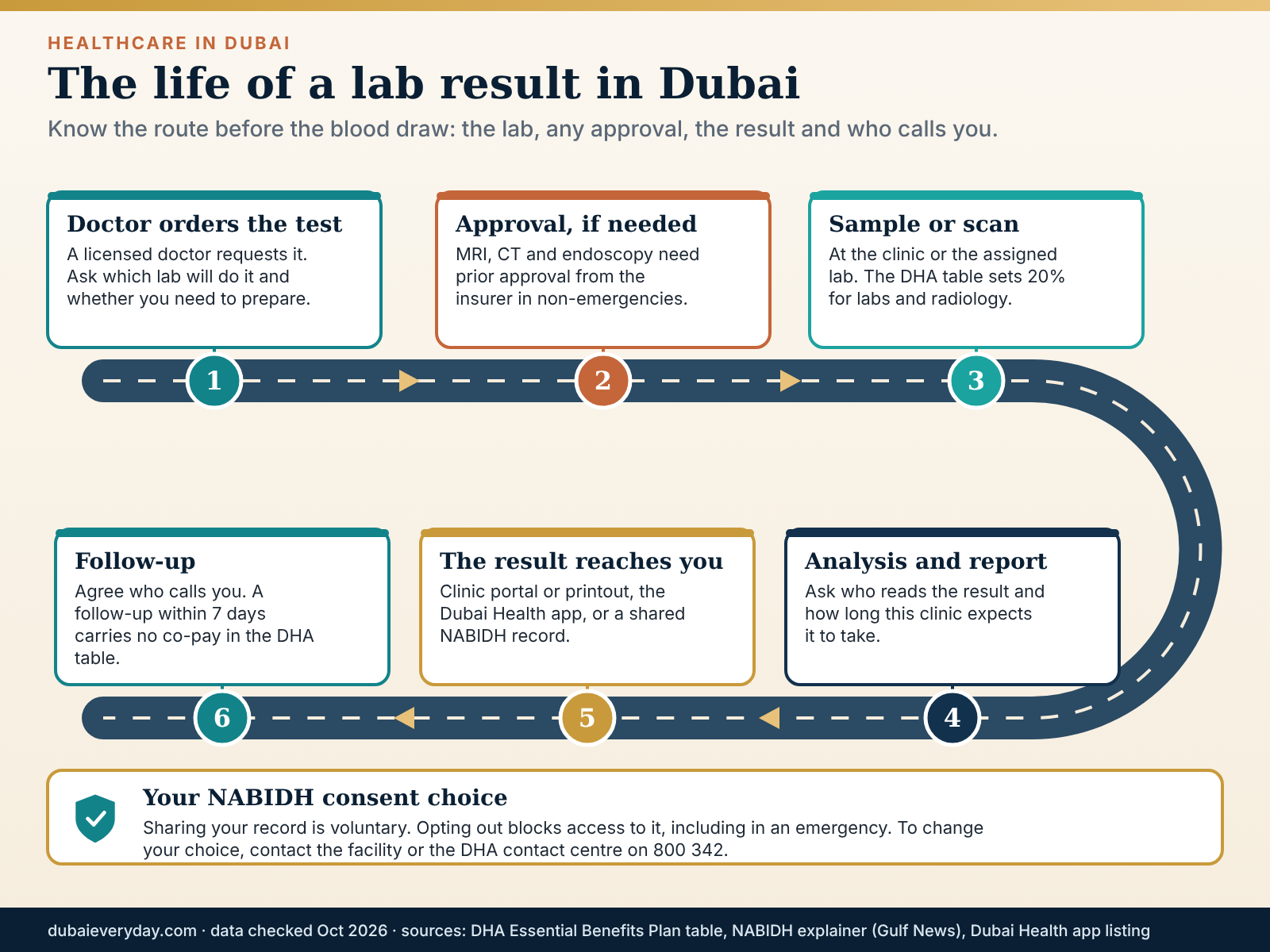
Results can reach you in several ways: a printed report, an email or portal from the clinic, the Dubai Health app if you were seen in a Dubai Health facility, or the shared NABIDH record that connected clinicians can open. The DHA says NABIDH holds lab results, radiology reports and discharge summaries along with allergies, immunisations and medication orders.
Consent is the catch. At a connected facility you are asked whether to share your data, and the choice is voluntary. A Gulf News explainer notes that opting out blocks access to your information, including in an emergency, which could slow your care. To change your choice you contact the facility or the DHA contact centre on 800 342. That is a personal decision; we only recommend making it deliberately, not by ticking a form at the desk.
Questions to settle before the needle
- Which lab will process this, and is it in my network?
- Do I need to prepare, and who gives me the instructions?
- How and when will I get the result, and who explains it?
- Does the test need prior approval, and who requests it?
- Will the result be added to my shared record, and what are my consent options?
Imaging deserves its own line when you rank the best clinics Dubai has for your plan. MRI, CT and endoscopy need prior approval in non-emergencies under the DHA table, so book the clinic visit first and the scan second, with the approval in hand.
Location: choosing a clinic by home, work and route
Location is the least glamorous lens in judging the best clinics Dubai has, and the one that decides whether a clinic is used. A clinic that is a thirty-minute drive away will be put off until the problem is worse. A clinic that is a five-minute walk gets used for the small things, and that is where good primary care does its work.
Home, work or the route between them
There is no universal answer, so use a simple rule. If you have a chronic condition with regular visits, pick a clinic near home or on your daily route, because you will go often and often when tired. If you work long hours in an office district, a clinic near work may suit a quick GP visit or a prescription refill. For children and older relatives, near home usually wins.
Here is an illustrative calculation. If a monthly follow-up means 12 visits a year and a distant clinic adds 20 minutes each way, that is 480 minutes, or eight hours, of extra travel a year. The more convenient clinic does not need to be any better medically to rank among the best clinics Dubai offers for your routine.
Reading the Dubai geography
The Dubai Health list shows public centres spread along the coast, in central districts and inland, as the map above sketches. If your district has none, the best clinics Dubai has for you may well be private; the Sheryan registry is the place to look, and Dubai Healthcare City is a free zone where many clinics operate.
If you live or work in the city’s centre, read our Downtown Dubai area guide for the neighbourhood’s services and daily logistics before choosing a clinic there. Visitors who want a clinic close to their hotel should choose the hotel first; our guide to the best hotels in Dubai covers areas, and the hotel front desk can often point to a clinic that handles visitors, though you should still verify it.
Private clinics: a six-step check for your own shortlist
Most clinics in Dubai are private, and we have deliberately not named any as one of the best clinics Dubai has. What we can give you is the method we would apply to any private name, in an order that wastes the least time. It takes about twenty minutes per clinic, mostly on the phone.
- Find the facility in the DHA registrySearch the Dubai Medical Registry (Sheryan) for the clinic. You are looking for an active facility, the right category and the specialties it claims. Facility licences run for one year, so an old licence on the wall is not proof.
- Check each doctor you plan to seeSearch the doctor’s name. The registry shows licence category, status and work history. Professionals may practise only when the status is Active, and a doctor attached to an inactive facility shows as awaiting a facility licence.
- Confirm the network in writingAsk your insurer or administrator, not just the clinic, whether the facility is in your network for consultation, lab, imaging and pharmacy. A screenshot or email is better than a verbal yes.
- Get the price before the visitAsk for the consultation fee, registration fee, likely tests and what your co-pay will be. The DHA advertising standard says advertised prices must be accurate and state their conditions.
- Read their marketing against the rulesUnder the DHA standard, titles must match the licence, “Dr” is reserved for physicians, dentists and recognised PhD holders, and absolute claims are discouraged. Heavy “best”, “100%” or “no side effects” language is a reason to look harder.
- Ask about records and consentIs the clinic connected to NABIDH, how do you get your results, and what will you be asked to consent to? Decide on purpose.
A registry check tells you that a facility and its doctors are permitted to practise in Dubai. It does not tell you how good they are, how long you will wait or whether they suit your condition. Use it as a floor, and then use the other five lenses. If you cannot find a clinic or a doctor in the registry, ask the clinic to explain; do not accept “it is being updated” without seeing a current licence.
Dubai Healthcare City and free-zone clinics
Many clinics operate inside Dubai Healthcare City, a health free zone with its own authority. The Gulf News licence explainer says all health facilities in Dubai, including those in free zones, are licensed by the DHA, so the registry is still the place to check. If a clinic tells you it is regulated by someone else, ask which licences it holds and check them. Do not assume that a free-zone address means lighter or heavier oversight; the point is simply to know which authority to contact.
How a clinic looks on its website
No website can prove that a clinic is among the best clinics Dubai has, but it can show whether the owners understand the rules. Look for named doctors with titles that match their licences, a stated address, plain information about insurance and fees, and no promises of cures. Before-and-after photos have specific rules: the same person, the same lens, no editing and a disclaimer that results vary. For aesthetic work, our dermatologist guide goes deeper into credential checks.
Visitors, health tourists and self-pay patients
Residents are the main readers of this guide, but visitors who fall ill and people who travel for treatment also need the best clinics Dubai can offer them, found by the same checks. The checks are similar; the cost exposure is not.
If you fall ill on a trip
Call your travel insurer first if you can, and check whether your policy requires notification or an approved provider. Dubai Health’s insurance page says it accepts guarantee of payment from international and travel insurance plans, and tells patients to contact their insurer to begin approval. That is good news, but it is a process, not a free pass.
Ask any clinic for an itemised estimate before treatment, keep all receipts and reports, and ask for a medical report in English for your claim. For anything urgent, go to an emergency department or call 998. Treat a clinic your hotel suggests as a starting point for your best clinics Dubai shortlist, and run the registry check yourself. Our Dubai travel guide covers the broader pre-arrival checklist, including insurance.
For minor problems, a walk-in or telehealth consultation can be faster than a hospital. The DHA’s figures for telehealth cover Dubai providers licensed by the authority, so ask the provider for its DHA licence details and whether your travel policy covers virtual consultations.
If you travel to Dubai for treatment
Health tourism has its own paperwork. In 2026 the General Directorate of Residency and Foreigners Affairs in Dubai and the DHA announced a partnership to make medical visa applications more efficient, including for members of the Dubai Health Experience network, with a smart medical visa mentioned as a future innovation. The report gives no details on sponsors, duration or process, so confirm the current requirements with the hospital or clinic that will treat you and with the immigration authority before booking flights.
Insist on a written treatment plan and a total price, including what is excluded, before you pay a deposit. Ask who will manage complications if they arise after you fly home, and in which jurisdiction. Be especially cautious about packages that bundle accommodation and treatment under promotional wording; the DHA standard says time-limited offers that cannot be honoured are not acceptable.
If you pay for yourself
Self-pay is more common than it sounds: residents between jobs, people who top up a basic plan, and those who choose to pay for a service their insurer excludes. The practical rules are to ask for the price up front, to request an itemised invoice, and to check whether a package price includes tests and follow-up visits. Some people use telehealth for the first conversation and a clinic for the examination.
There is no official price list to compare against, so compare quotes between at least two licensed facilities on your best clinics Dubai shortlist for anything beyond a basic consultation.
Mistakes and red flags when comparing the best clinics Dubai advertises
These mistakes, common when choosing among the best clinics Dubai advertises, come from the rules and sources we read, not from patient anecdotes. Each one costs money, time or both, and each has a simple counter.
Trusting a ranking or a star count
A star rating on a map app or a “top 10” post titled “best clinics Dubai” is not a regulator’s finding. Rankings can be paid for, gamed or based on a handful of reviews, and the DHA’s own standard discourages superlatives in clinic marketing. Use ratings to spot patterns in complaints about waiting or billing, not as proof of clinical quality.
Assuming “in network” means everything is covered
Network status, even at the best clinics Dubai insurers list, can apply to consultations but not to some tests, procedures or pharmacy items. Ask the insurer in writing, and ask the clinic what it will bill you for before the visit. Under the DHA table, certain services also need prior approval, and some are excluded outright.
Booking two specialists in one trip
As covered above, the basic-plan table excludes more than one specialist consultation or follow-up on the same day unless the treating physician referred you. Convenience can cost you a full fee.
Ignoring the consent question
If a connected clinic asks whether to share your record on NABIDH, think before you decline or accept. The DHA’s exchange helps clinicians see allergies and past results, including in an emergency, but you have the right to choose.
Paying a deposit on a limited-time offer
The DHA standard says time-limited discounts or inducements that cannot actually be honoured are not acceptable, and that prices must be accurate with their conditions. If a clinic pressures you to pay today, step back. A genuine price will still be there tomorrow.
Treating a clinic as a hospital
Clinics have limits. If a clinic cannot say where it sends cases it cannot manage, or discourages you from going to an emergency department when you are worried, leave. Our hospital comparison explains the hospital rung of the ladder.
Six households, six shortlists
These are invented households used to show how the same method gives different answers to the search for the best clinics Dubai has. They are not case studies or reviews, and the numbers are illustrative.
The employee on a basic plan
Priorities: insurance fit, GP access, location near work. Steps: read the table of benefits, find in-network GP clinics near the office, ask whether a referral is needed for specialists, and keep one base clinic. Public Dubai Health centres can be a candidate if the plan lists them.
The family with two young children
Priorities: same-day capability, paediatric cover, location near home. Steps: shortlist a polyclinic with a paediatrician, ask about evening and weekend hours, note the overnight urgent care options that exist, and check that the insurer covers children’s visits without a referral.
The self-sponsored freelancer
Priorities: price transparency and a plan with a sensible outpatient limit. Steps: ask for fee schedules, compare two licensed clinics on a basic consultation and a blood panel, and use telehealth for repeat prescriptions where the clinic allows it.
The resident managing a long-term condition
Priorities: GP continuity, lab access, specialist access. Steps: choose a clinic near home, confirm the lab is in network, ask how results reach you, and agree a standing plan for repeat visits and medicines against the annual medicine limit.
The short-stay visitor
Priorities: same-day access, payment method, documents. Steps: call the travel insurer first, find a licensed clinic near the hotel, ask for an itemised estimate, keep a medical report for the claim, and go to an emergency department for anything urgent.
The patient travelling for treatment
Priorities: licence verification, total price, aftercare. Steps: verify the facility and surgeon in the registry, get a written plan with exclusions, confirm visa requirements with the provider and the authority, and plan for follow-up care at home.
One evening, one shortlist
You can build a shortlist of the best clinics Dubai has for you in a single evening. Spend ten minutes finding your insurer’s network list and the clinics within a short journey of home and work. Spend ten minutes checking the top three in the registry. Spend twenty minutes calling the best two with the five same-day questions and the price question. Write the answers in a note on your phone, with the clinic’s phone number and the date you checked.
Then save the winner as your base clinic, and keep the runner-up as your same-day fallback. Repeat the check once a year, when your policy renews, because networks and facility licences both change. If you also need dental or skin care, start from the dentist guide or the dermatologist guide, and keep your base clinic for everything else.
Best clinics Dubai FAQ
What are the best clinics in Dubai?
There is no official ranking, and the DHA’s advertising standard discourages clinics from calling themselves the best. The most defensible answer is a process: shortlist clinics inside your insurance network, confirm the facility and its doctors in the DHA registry, then compare them on GP access, specialist access, same-day capability, lab access and location. The only list we can verify from an official page is the Dubai Health ambulatory centre list above; private clinics need your own checks.
How do I check that a clinic in Dubai is licensed?
Search the Dubai Medical Registry (Sheryan) on the DHA services portal for the facility and the doctor. It shows whether the licence is active and which category and specialties apply. Facility licences run for one year and professionals must have Active status to practise. A licence card or certificate should also be on display at the clinic. A registry listing proves permission to practise, not quality, so it cannot tell you which are the best clinics Dubai has.
Can I walk into a clinic in Dubai without an appointment?
Often yes at private general clinics and urgent care centres, but no official source tells you which clinics on a best clinics Dubai shortlist take walk-ins or until what time. Phone first and ask who will see you, how long the wait is and whether your insurance covers a visit without a referral. A July 2025 report described an overnight walk-in urgent care clinic at Aster Hospital in Al Qusais, 10pm to 6am; confirm current hours before you go.
Do I need a GP referral to see a specialist in Dubai?
It depends on your plan. Under the DHA’s Essential Benefits Plan, specialist care is not paid unless you first saw a licensed GP, who records the referral in the DHA e-referral system. Many employer and premium plans allow direct specialist access inside the network, which widens the best clinics Dubai offers you. Read your table of benefits, and ask the insurer, not just the clinic. Self-pay patients can usually book a specialist directly, but should get the fee in advance.
How much does a doctor’s visit cost in Dubai?
There is no official public price list for routine consultations, so we do not quote a market price for the best clinics Dubai offers. Each facility sets its own fees. One commercial directory shows an indicative AED 300 to AED 1,200 for specialists, but says that is its own estimate, not a quote. If you are insured, your cost is the co-pay: the DHA table lists 20% per outpatient visit, though your own policy governs. Always ask for the fee, tests and any registration charge before booking.
Can expats use Dubai Health centres?
We could not verify the eligibility and fee rules for residents and visitors at each centre. The Dubai Health pages say its facilities accept a range of insurance plans and accept guarantee of payment from international and travel insurance, and that you can book on 800 60, online or via the app. Because the centre pages do not state eligibility or prices for non-citizens, call 800 60 and ask before you travel to a particular centre.
Can I see a doctor online in Dubai?
Yes. The DHA reports more than 140 licensed telehealth providers and nearly 375,000 telehealth consultations in 2023. Dubai Health lets you filter its booking page for doctors who offer virtual consultations, and the DHA’s essential benefits table includes virtual consultations. Ask any clinic on your best clinics Dubai shortlist whether it offers telehealth. It suits repeat prescriptions, results discussions and mild problems; anything needing an examination or that is getting worse needs an in-person visit or an emergency department.
Where can I get blood tests done in Dubai?
At the clinic’s own lab, at an assigned or partner lab, or at a standalone diagnostic centre; the DHA counted 119 diagnostic centres for 2023. Under the DHA table, laboratory tests are covered at the authorised facility assigned to the insured, with 20% coinsurance. When comparing the best clinics Dubai has, ask where the test will be processed, whether your plan covers that lab, and how you will receive the results.
What do I do if my insurer refuses to pay for a clinic visit?
Start with the insurer’s complaints process, quoting your policy schedule and the clinic’s invoice. If that fails, escalate through the DHA. A 2021 Gulf News guide lists the DHA call centre on 800 342 and a complaints email address, with target handling times of one to seven working days by category; confirm the current route before relying on it. Keep every receipt, referral and approval message.
What should a visitor do if they need a doctor in Dubai?
For anything urgent, call 998 or go to an emergency department. For minor problems, contact your travel insurer, find a licensed clinic or a telehealth provider and ask for an itemised estimate. Dubai Health says it accepts guarantee of payment from international and travel plans, so ask your insurer to start approval. Keep receipts and a written medical report for your claim.
Related reading
Sources and further reading (20 links)
- Dubai Health: Ambulatory Health Centers — list of centres, areas, booking routes
- Dubai Health: Frequently asked questions — booking, virtual consultations, emergency services at two centres
- Dubai Health: Our insurance partners — insurers shown, guarantee of payment for international plans
- Dubai Health app: App Store listing — booking, records, lab results and sick-leave certificates
- Dubai Media Office: Dubai’s healthcare ecosystem posts record growth in 2025 — licensed facility counts by type
- Dubai Health Authority: facility growth news item — 2023 counts including diagnostic centres
- Dubai Health Authority: telehealth progress and guidelines — telehealth volumes and licensed providers
- Dubai Health Authority: NABIDH phase 1 launch — health information exchange background
- Dubai Health Authority: Standards for Medical Advertisement Content in Social Media (ST-21) — claims, titles, prices, before-and-after rules
- Dubai Health Authority: Sheryan FAQ — licence validity, statuses, part-time licences, facility categories
- DHA Essential Benefits Plan table, circular GC 03/2024 (insurer-hosted copy) — co-pays, referral, prior approval, exclusions
- UAE Government portal: Getting a health insurance — who must insure, 2025 residency rule, basic package terms
- Gulf News: 3 ways to check if your doctor or clinic is licensed in Dubai — secondary explainer on licence checks
- Gulf News: NABIDH explainer — data shared, consent and opt-out
- Gulf News: Dubai issues social media rules for doctors, health facilities and influencers — news coverage of the advertising rules
- Gulf News: Dubai hospital opens overnight urgent care clinic in Al Qusais — example of late-night walk-in urgent care
- Gulf News: 24-hour urgent care at two Dubai health centres — older report on two health centres, used for history only
- Gulf News: How to file a complaint against a doctor, hospital or clinic — DHA complaint channels, older guidance
- Gulf News: Dubai simplifies medical visas to boost health tourism — GDRFA and DHA partnership
- Zavis directory: consultation pricing pages for Dubai — commercial directory used only for context on price spread
Update log: 29 October 2026 — first publication; facts re-checked against the sources above. Next review due: April 2027 (every six months), sooner if the DHA or Dubai Health changes its pages. Corrections welcome.
This guide is general information, not medical, insurance or legal advice, and it does not recommend a clinic, doctor or treatment. Confirm licences, fees, hours and coverage with the provider, your insurer and the DHA before you rely on them.
About DubaiEveryday and this guide
DubaiEveryday.com is an independent editorial project that publishes practical, research-based guides to everyday life in Dubai: where to live, what things cost, how the rules work and how to get around. This page was written and edited by the DubaiEveryday editorial team. It is not signed by a named expert, doctor, lawyer or adviser, and we do not claim first-hand testing of a venue, clinic or service unless the page says so.
Each guide is built from official sources such as government and regulator pages, operator websites and established news outlets, cross-checked where we can. When we could not confirm something, we say so in the text, and examples that use made-up numbers are labelled as illustrations. Mentions are editorial choices, not paid placements, and a link is not an endorsement.
Dubai changes quickly. If you spot something that is out of date or wrong, please tell us through the contact options on DubaiEveryday.com and we will check it and correct the page.