

Healthcare in Dubai is a licensed, insurance-driven system with a public network, a large private sector and a free-zone medical district. This guide shows you which door to use for which problem, how to check that a clinic is legitimate, how the bill is split and how to get an appointment.
Imagine you wake up with a fever at 2 am, or your child has a sudden rash. Do you call an ambulance, find a clinic or wait for morning? When you are new to a city, that choice feels heavier than it should. Most people have no map for it until they need one.
Healthcare in Dubai is a licensed system with public centres, private hospitals and an insurance card that shapes much of what happens at reception. The right door depends on the problem, and the wrong one costs time or money. This guide helps you match the situation to the right level of care, check that a clinic is licensed and understand how the bill is split, calmly and before you need it.
Healthcare in Dubai runs on three things: a regulator (the Dubai Health Authority, DHA), a layered set of providers (public hospitals and health centres, private hospitals and clinics, and a medical free zone) and an insurance card that decides most of what happens at the reception desk. For a life-threatening emergency, call 998 and go to the nearest emergency department; hospitals are required to give initial emergency treatment, and the argument about payment comes afterwards.
For everything else, use the lowest level of care that fits the problem: a pharmacist for minor, familiar complaints, a GP or video consultation for most illnesses, a specialist when your plan and the problem call for one (some plans ask for a GP referral first), the emergency department only when it is urgent.
Before you book, confirm the doctor and facility on the DHA register, and ask your insurer whether the clinic is in your network and whether the procedure needs pre-approval. Employers must insure employees and sponsors must insure dependants; the basic plan has an annual ceiling of AED 150,000 and you pay a share of most outpatient items.
Visitors should not rely on healthcare in Dubai to absorb a surprise bill. Buy travel insurance that covers medical treatment and evacuation, and keep a card or policy number where a stranger can find it. The rest of this page works through healthcare in Dubai in order, step by step, and flags what could not be verified.
This is a desk-research guide to healthcare in Dubai. DubaiEveryday.com has not been a patient at any facility named here, has not phoned a hotline or used an appointment app, and nothing below describes a personal visit.
Facts come from official sources read on 29 October 2026: the UAE government portal, Dubai Health (the public provider network), the Dubai Health Authority and the Dubai Executive Council resolution that regulates healthcare professions. Where a source is a news report or an insurer-hosted copy of a regulator document, the text says so.
Selection of facilities is not a ranking. We name only the public network that Dubai Health itself lists, and we teach you how to check any private provider on the official register instead of recommending one. Inclusion was not paid for, and there are no booking links. Prices and co-payment figures are labelled with their source and date; where sources disagree, we show the disagreement. This page is general information, not medical, legal or insurance advice. It cannot diagnose anything, and a licensed professional should decide your care.
Healthcare in Dubai at a glance
If you read nothing else, keep these four numbers and one rule. The first three are contact points published by the UAE government portal, Dubai Health and the Dubai Health Authority; the fourth is the annual ceiling of the basic insurance plan in the regulator document we used. The rule is the one that saves most people money: check the licence and the network before the appointment, not after the bill.
Different readers need different parts of this page first. The grid below sends you to the right place for the way you will use healthcare in Dubai.
New employee
Start with insurance, then the licence check and the first-month checklist. Your employer arranges your cover; you choose where to use it.
Family and dependants
Read who pays for dependants, then children and maternity. The sponsor is responsible for dependants’ cover, so confirm it before you need it.
Visitor
Go to emergency care and visitors and self-pay, then medicines if you travel with prescriptions.
Overseas patient
See medical travel and verification first. The entry permit, the sponsor hospital and the itemised package matter more than the brochure.
How healthcare in Dubai is organised
Four names come up constantly in healthcare in Dubai, and they are often mistaken for one another: the Dubai Health Authority (DHA), Dubai Health, Dubai Healthcare City (DHCC) and the federal Ministry of Health and Prevention. They do different jobs. Knowing which does what in healthcare in Dubai helps you work out who to ask when a bill looks wrong, a licence looks doubtful or an appointment cannot be found.
This page covers the whole journey through healthcare in Dubai: choosing where to go, paying, booking, medicines and rights. For a ranking-style comparison of individual hospitals, use our separate guide to comparing hospitals in Dubai by emergency services, specialists, networks and location. For the detail of policies, premiums and claims, the companion pieces are health insurance for Dubai residents and the broader Dubai insurance guide. Here we keep insurance to what you need to make care decisions.
The regulator of healthcare in Dubai: the Dubai Health Authority
The DHA is the emirate’s health regulator. According to a Gulf News explainer on the split between roles, it sets health strategy and policy, licenses providers and professionals, inspects facilities, and oversees insurance, healthcare financing and public-health policy. It also handles medico-legal matters such as medical-negligence cases. Its history runs back to a Department of Health and Medical Services created in 1970 and renamed the DHA in 2007.
The rules are not just administrative. Under Executive Council Resolution No. 49 of 2024, announced on 9 September 2024, facilities and professionals need a DHA permit before they operate, the resolution covers free zones and the Dubai International Financial Centre, licences run for one year, and facilities may not employ unlicensed or visiting doctors. The DHA and the Medical Practice Committee can close a facility or suspend a professional for up to three months while an investigation runs. Federal government entities and their professionals sit outside that resolution.
The public provider of healthcare in Dubai: Dubai Health
Dubai Health is the emirate’s integrated academic health system, previously the Dubai Academic Health Corporation (established in 2021) and rebranded on 11 November 2023. It is a provider, not the regulator. Its network, per its own site, includes six hospitals, a set of ambulatory health centres, medical fitness centres, the Mohammed Bin Rashid University of Medicine and Health Sciences, and the Al Jalila Foundation. The hospitals are Rashid, Dubai, Latifa, Hatta, Jebel Ali and Al Jalila Children’s.
A caution on numbers: Dubai Health’s own pages are not always consistent. One page says there are 26 ambulatory health centres and lists 23; the medical-fitness network is quoted as 20, 21 and 25 on different pages. We avoid quoting totals for that reason, and recommend you ask the 24-hour customer line, 800 60, when a specific location matters.
The free zone: Dubai Healthcare City
Dubai Healthcare City is a healthcare free zone established in 2002, governed by the Dubai Healthcare City Authority (DHCA) under Law No. 16 of 2024. The DHCA licenses and inspects commercial entities inside the zone. Crucially for patients, the same law says anyone carrying out healthcare activity there must also hold DHA licences in addition to DHCA permits.
So a clinic in the free zone is not outside the DHA’s reach; it is regulated twice. DHCC lists Phase 1 on Oud Metha Road, Bur Dubai, and Phase 2 in Al Jaddaf. Its site counts 4,425 healthcare professionals and 168 clinical facilities, but the hospital count on the same site disagrees with itself (ten in one place, five in another), so treat any single figure as indicative.
The federal layer
Federal bodies matter for Dubai residents in three practical ways. The Ministry of Health and Prevention issues personal-import permits for some medicines and runs a hotline for suspected fake or harmful products. Federal rules govern controlled medicines nationwide. And Riayati, the National Unified Medical Record, links health information across facilities in the country, integrated with Dubai’s own exchange platform, NABIDH, which the DHA developed so that public and private facilities in Dubai can share unified health information.
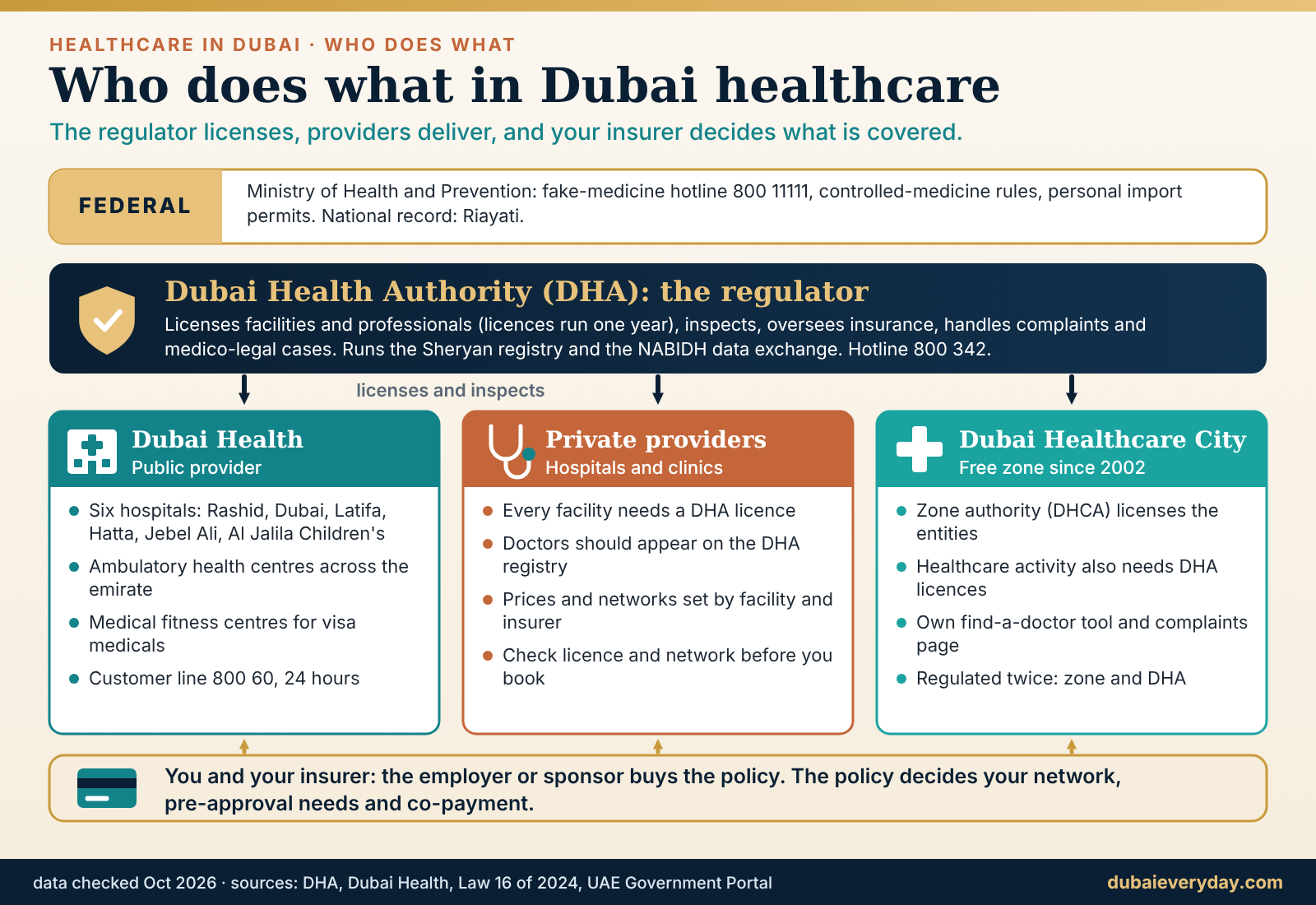
Why the structure of healthcare in Dubai matters to you
It matters because every practical question has an owner. A licence question goes to the DHA register. A service complaint about a public hospital goes to Dubai Health’s customer team, on 800 60, or through the Dubai government’s 04 platform.
Professional negligence and clinical complaints sit with the DHA, which says it handles patient complaints through its Health Regulation Sector on 800 342 (800 DHA). A coverage dispute goes to your insurer first and then to the insurance regulator side of the DHA. A medicine-import question goes to the federal ministry. If you send the right question to the wrong door, you lose days.
The private side of healthcare in Dubai sits across all of this. We could not find a verified, current count of private facilities that we trust enough to publish, and we will not repeat older national statistics as if they described Dubai today. What matters is the rule: a private hospital or clinic must be DHA-licensed, and the DHA register is how you check it.
One-line rule. Treat the DHA as the authority on whether a person or place is allowed to practise, Dubai Health as one large provider, your insurer as the authority on what is covered, and the facility itself as the authority only on what it will charge.
Choosing the right door in healthcare in Dubai
The most expensive mistake in healthcare in Dubai is not picking the “wrong” hospital. It is picking the wrong level of care. An emergency department is built, staffed and billed for emergencies. A pharmacy counter is built for minor, familiar complaints and for dispensing what a doctor has already prescribed. A GP clinic sits between the two. Mixing them up costs money, time, or, at the other extreme, safety.
The decision path below, built for healthcare in Dubai, is our own editorial framework, not a clinical protocol. It sorts problems by how fast they need attention, then by what kind of professional can deal with them. It does not diagnose anything. If you are unsure which branch you are on, treat the problem as the more serious one and call 998; the operator is there to make that call with you.
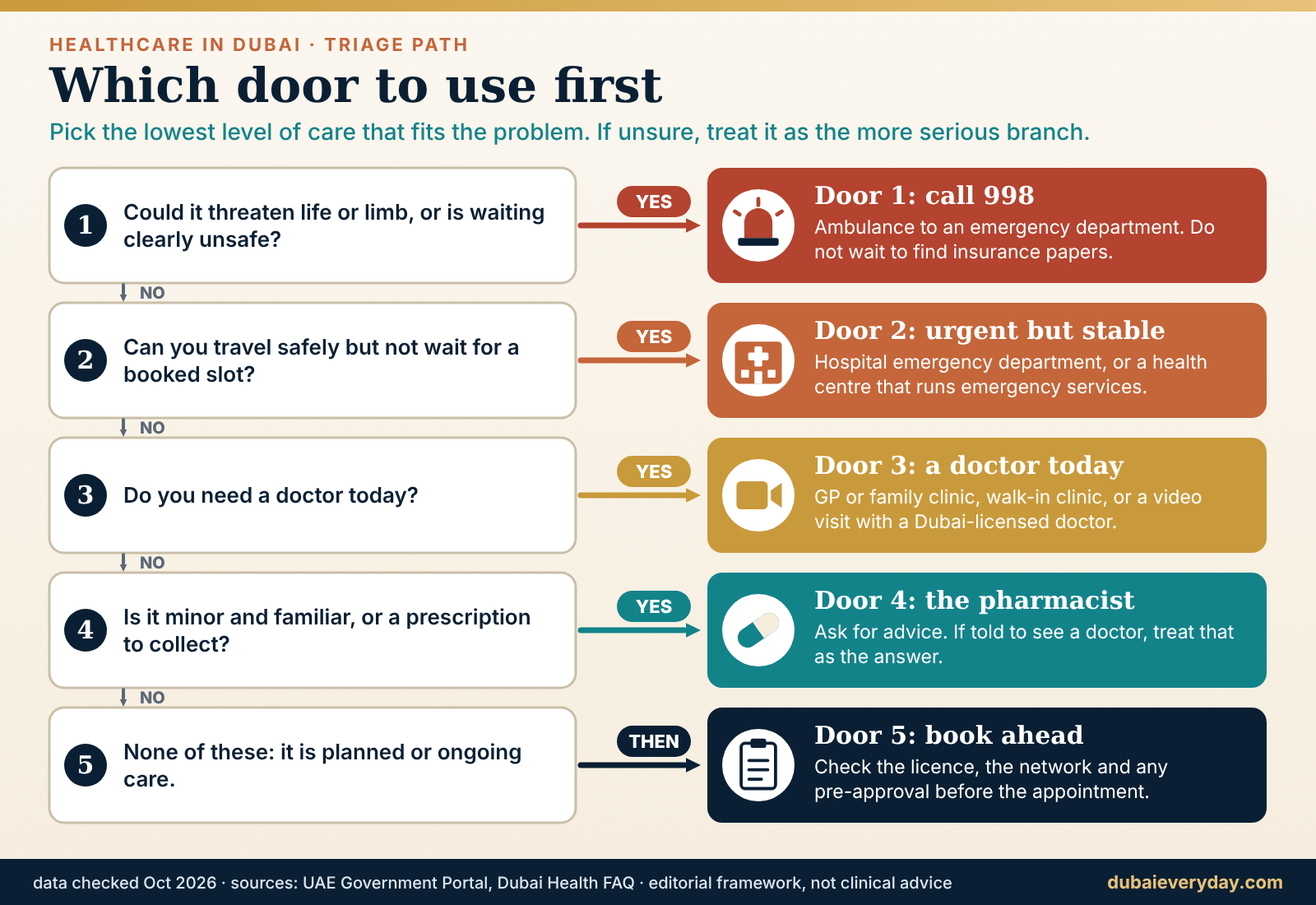
The five doors of healthcare in Dubai, in order of urgency
Door 1: 998 and the ER
For anything that could threaten life or limb, or where waiting is clearly unsafe. You call 998 from anywhere in the UAE, and the ambulance can take you to a hospital with an emergency department.
Door 2: urgent but stable
Serious enough that it cannot wait for a booked slot, but you can travel safely: a hospital emergency department, or one of the health centres with emergency services. Expect triage by urgency, not by arrival time.
Door 3: a doctor today
Fever, infections, minor injuries, repeat prescriptions that cannot wait. A GP or family-medicine clinic, a walk-in clinic, or a video consultation where the doctor is licensed in Dubai.
Door 4: the pharmacist
Minor, familiar complaints and medicines you already use under a doctor’s guidance. Pharmacists can advise on over-the-counter products and tell you when something needs a doctor instead.
Door 5: planned care
Check-ups, chronic conditions, specialists, scans, dental and skin care. This is where booking ahead, referrals, network checks and pre-approvals pay off.
When 998 is the right call
Emergency services publish their own lists, and you should read them rather than rely on ours. As a general pattern, the kinds of situations people are told to treat as emergencies include chest pain or pressure, signs of stroke (sudden weakness on one side, slurred speech, facial droop), severe difficulty breathing, heavy bleeding that does not stop, loss of consciousness, a seizure that does not stop, serious burns, a suspected overdose or poisoning, and major trauma after a road crash or a fall.
The UAE government portal lists 998 as the ambulance number and says an air ambulance can be dispatched if needed.
Two practical points. First, do not drive a person who may be having a heart attack or stroke if an ambulance is available; the crew can start treatment on the way and alert the hospital. Second, the Dubai ambulance service has its own app for requesting an ambulance with automatic location sharing, which is useful if you are a visitor who cannot say exactly where you are. The UAE portal names it as the DCAS SOS app.
Do not wait to find an insurance card before calling for help. The UAE portal states that hospitals must give initial treatment in any medical emergency. What happens to the bill is a separate conversation that starts after you are stable.
When a doctor today is enough for healthcare in Dubai
Most people who search for healthcare in Dubai are not in an emergency. They have a child with a temperature at 8 pm, a sore throat that has lasted a week, a rash, a sprained ankle, or a prescription running out. For these, the practical questions are availability, network and price.
A GP or family-medicine clinic can see you the same day in many cases, but “walk-in” availability varies by clinic and time of day, and we could not verify any clinic’s current waiting times. Phone first, ask whether a doctor is available now, and ask whether your insurance is accepted for this visit type.
Video consultations are now part of everyday primary healthcare in Dubai. Dubai Health’s own FAQ says virtual consultations are bookable through its Book Appointment page by filtering for doctors who offer them. Private clinics and apps offer similar services; the key check is that the doctor is licensed in Dubai, not merely in another country. We cover how to check in the licensing section.
When the pharmacist is the right first stop
A pharmacist is the right first stop for a short list of familiar, minor complaints, and the wrong stop for anything new, severe, recurring, or involving a child under a doctor’s care. We cover how pharmacies work, and what you can and cannot buy, in the pharmacies section. The short version: if a pharmacist tells you to see a doctor, take that as the answer, not as a sales tactic.
The mistake that costs the most in healthcare in Dubai
A common pattern in healthcare in Dubai is that people with a non-urgent problem go to an emergency department because it is open at night, it is the name they know, or it is the only place they believe will “do everything”. Dubai Health’s FAQ is direct that emergency services are not free and that coverage depends on your insurance plan, including co-pays, deductibles and non-covered services.
On a basic plan, a non-emergency visit coded as an emergency may be treated differently from an outpatient visit. We cannot tell you how your insurer will code a visit; we can tell you to ask the insurer before you go, if the situation allows, and to ask the hospital how it will be billed if it does not.
A useful habit. Save three contacts in your phone today: your insurer’s 24-hour line, the nearest emergency department’s name and area, and a Dubai-licensed telehealth or GP option that accepts your insurance. You will not use them often, but you will use them when thinking is hardest.
Emergency care: 998, the ER and what happens next
Emergency care is the one part of healthcare in Dubai where speed matters more than any amount of research. So this section is built to be read once, calmly, and then forgotten until you need it. The numbers below come from the UAE government’s emergency page, read on 29 October 2026.
For a marine emergency in Dubai specifically, the same page lists a Dubai Coast Guard number, +971 56 682 4343, and says police on 999 handle marine emergencies in the other emirates. For road accidents, the instruction is to call 999 and, if anyone is injured, to leave vehicles where they are until the ambulance arrives. A crash is therefore often two calls: 999 for the police process and 998 for the medical one, and the ambulance operator can tell you if they will also notify the police.
What happens when you call 998
We have not called the line and cannot describe the call from experience. From official and press descriptions, the logic is simple. A call-taker asks where you are, what has happened and whether the person is conscious and breathing, then dispatches a crew and may talk you through basic steps while it travels. The Dubai ambulance service’s app is built to send your location, which solves the most common problem for visitors: not knowing the name of the street.
Prepare four facts before you dial, or have someone else prepare them: the exact location (building, area, nearest landmark), what happened in one sentence, the person’s approximate age, and whether they are awake and breathing. Keep your phone line free afterwards in case the crew calls back for directions. In a tower, send someone to the lobby to meet the crew; Dubai’s large buildings can add several minutes between the ambulance arriving and reaching the patient.
Which hospital the ambulance takes you to
We could not find an official public rule that says patients may choose their destination in every case, and we will not invent one. In practice, the decision depends on the nature of the emergency, which emergency departments are able to receive that patient, and distance. If you have a strong reason to ask for a particular hospital (for example, your child’s records are there), say so to the crew, and expect a clinical answer.
Dubai Health states that all six of its hospitals have emergency departments, and that the Al Barsha and Nad Al Hamar health centres also offer emergency services. Private hospitals run their own emergency departments, and you can check what they are licensed for on the DHA register.
Pre-hospital checklist. If someone is conscious and you have a minute, grab: Emirates ID (or passport for a visitor), insurance card or policy number, a list of current medicines and allergies, and a phone charger. If there is no minute, bring nothing and go. Paperwork can be sent later; time cannot.
Inside the emergency department
Emergency departments everywhere triage: patients are seen in order of clinical urgency, not arrival time, so someone who arrived after you may go in first, and a minor problem may wait for hours. Healthcare in Dubai is no different in principle.
What differs between hospitals is capacity, so a quiet Tuesday and a Friday night after a long weekend are not the same experience. We cannot give verified waiting times for any department, and any site that quotes a “typical wait” without a dated source should be treated with suspicion.
Registration usually involves identity and insurance details. Dubai Health’s FAQ is explicit that emergency services are not free and that coverage depends on your plan, which means co-pays, deductibles and exclusions apply as they would elsewhere. Dubai Health’s homepage also mentions free parking for patients receiving emergency care, a small but practical detail if you are driving yourself and do not want a ticket on top of everything else.
Emergencies and insurance: the stabilisation rule
Under the Essential Benefits Plan, the Dubai basic plan, the document we read (effective 1 January 2025, hosted on an insurer’s site and described as an appendix to the regulator’s requirements) says emergencies must be covered until the patient is stabilised, even for some categories that are otherwise outside health insurance.
One of those categories is road-traffic injuries, which it places outside the scope of health insurance; in practice, motor insurance and the police process are involved, and the hospital will tell you what it needs. We read this as a rule about who pays for what once you are stable, not about whether you will be treated. If you are in a crash and later get an unexpected bill, the question to ask the insurer is “which policy responds”, not “why did you treat me”.
If you are a visitor, emergency care is still available, but the bill is yours unless travel insurance or another policy responds. We cover visitor insurance and self-pay in a later section; for now, make sure your travel policy’s emergency assistance number is saved in your phone.
After the emergency
Once you are stable, three things matter in healthcare in Dubai, as anywhere: getting a discharge summary or medical report you can show to a GP and an insurer, understanding any follow-up appointments and medication, and keeping copies of the itemised bill.
Ask for each of these before you leave, because it is much harder to retrieve them a week later. If you have been admitted, ask who the responsible consultant is and how the insurer’s pre-approval process is being handled; the insurance section explains why that question can save money.
Finally, remember the aftercare logic that runs through healthcare in Dubai. An emergency visit is a starting point, not a course of treatment. A follow-up with a GP or specialist in the weeks after an acute episode is normally planned and booked, usually inside your insurer’s network.
If the hospital gave you a follow-up slot in its own outpatient clinic, ask whether that visit counts as a follow-up under your plan, because the Essential Benefits Plan we read waives the co-payment for a follow-up within seven days in some situations.
Hospitals, health centres and clinics: reading the map
Healthcare in Dubai is delivered through several types of facility, and the names are looser than people expect. A “medical centre” can be a single-doctor clinic or a multi-specialty outpatient building; a “polyclinic” is usually several specialties under one licence; a “hospital” implies inpatient beds and, in most cases, an emergency department. Do not rely on the name. The DHA register lists the licensed facility type and its specialties, which is the version that counts.
What the public side of healthcare in Dubai looks like
Dubai Health publishes its own list of locations, and it is the only large network of healthcare in Dubai where we could verify addresses on an official page. The six hospitals are Rashid Hospital in Umm Hurair; Dubai Hospital on Al Khaleej Street in Deira; Latifa Hospital and Al Jalila Children’s Hospital, both listed in Al Jaddaf; Jebel Ali Hospital, listed at Dubai Industrial City; and Hatta Hospital in Hill Park, Hatta.
A seventh site, the Hamdan Bin Rashid Cancer Hospital in Al Jaddaf, was shown as “Opening soon” on 29 October 2026, so we do not count it as available.
Alongside the hospitals sit the ambulatory health centres. The ones listed by area include Al Barsha 3, Al Qusais 1, Nad Al Hamar, Umm Suqeim, Za’abeel 2, Al Mamzar, Al Mankhool, Al Mizhar 1, Al Khawaneej, Al Lusaily, Al Satwa, Al Twar, Nad Al Sheba and an Airport Medical Center at Dubai International Airport.
A number are specialised: a dental hospital in Dubai Healthcare City, a diabetes centre in Al Hudaiba, a fertility centre in Al Jaddaf, a physiotherapy and rehabilitation centre in Al Safa 2, a dialysis centre in Al Twar, a thalassemia centre and a blood-donation centre in Al Jaddaf. The listing page does not show opening hours or say which centres run urgent care, so for those questions you need the 800 60 line.
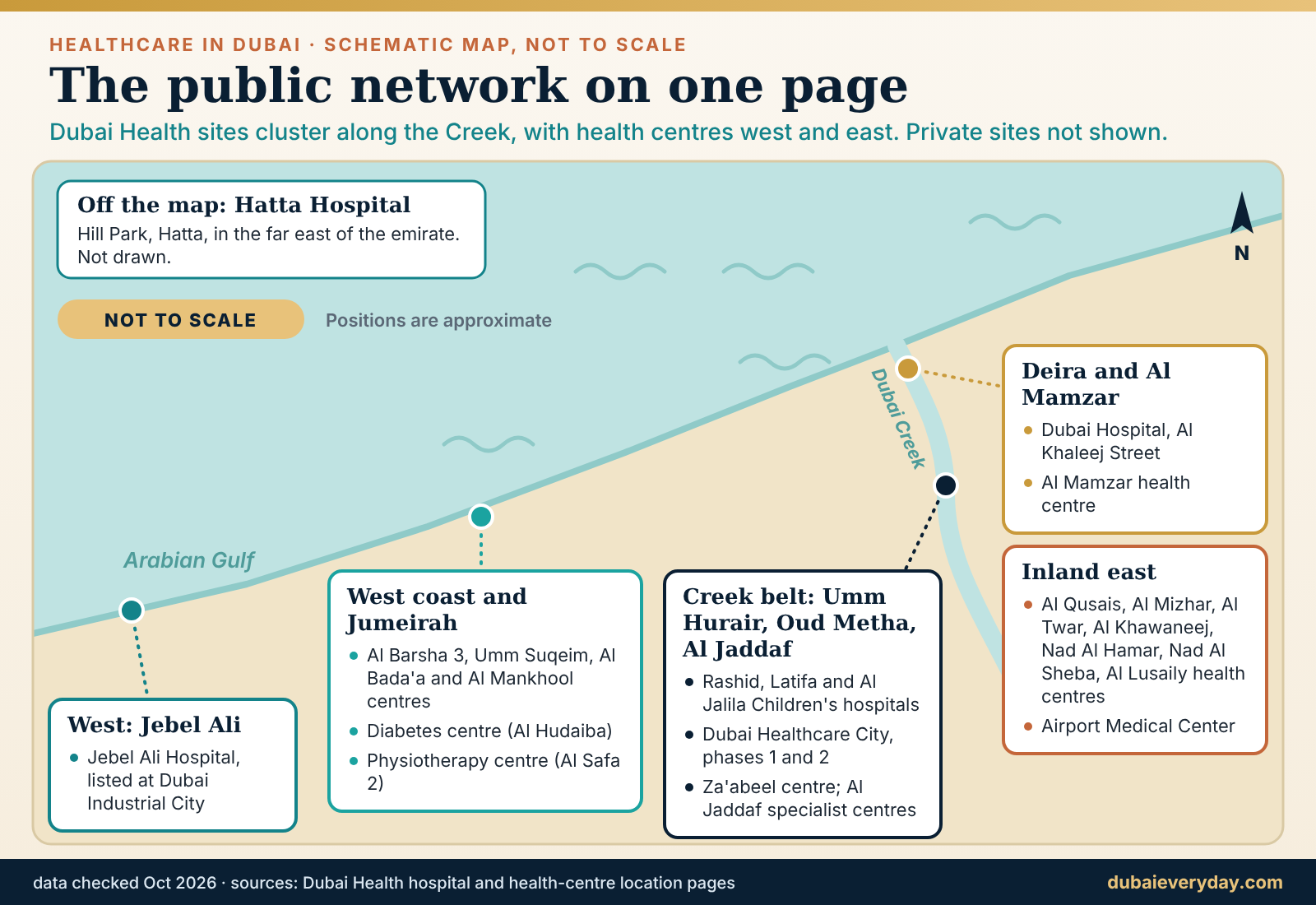
Our reading of the map: the largest cluster sits along the inner Creek, in Umm Hurair, Oud Metha and Al Jaddaf, where Rashid Hospital, Latifa Hospital, Al Jalila Children’s Hospital and Dubai Healthcare City’s two phases are within a short area of one another. That cluster is a genuine advantage if you live in Bur Dubai, Karama, Business Bay or Downtown and want a choice of facilities.
It is less useful if you live in Dubai Marina or Dubai Hills; there, a health centre in Al Barsha or Umm Suqeim, or a private hospital near you, may be a more realistic first stop. This is a location observation, not a quality claim. If you are planning a move, the relevant area guides, such as Dubai Marina and Downtown Dubai, cover the transport side of the question.
Public, private or free-zone healthcare in Dubai: what changes for you
In healthcare in Dubai, the labels describe ownership and regulation. They do not guarantee quality, price or waiting time. What you can say with confidence is how each type tends to fit particular needs.
| Type | Typically good for | Watch for |
|---|---|---|
| Public hospital or health centre (Dubai Health) | Emergencies, inpatient care, chronic-condition follow-up, a single integrated record, visa medicals at the fitness centres | Insurance acceptance depends on your plan; a few specialist services are in separate centres; confirm hours by phone |
| Private hospital | Broad specialist cover under one roof, choice of consultant, appointments often easier to arrange | Network status and pre-approval rules; price differences for the same service; ask for an estimate before elective care |
| Polyclinic or medical centre | Same-day GP visits, minor procedures, vaccinations, lab tests, referrals | Check the licence covers the specialty advertised; confirm the doctor, not only the facility, is on the register |
| Free-zone clinic (Dubai Healthcare City) | Specialist and day-case services, medical-tourism packages, clusters of related specialists | Licensed by both the free-zone authority and the DHA; the insurer’s network can differ from the mainland counterpart |
| Home-visit and telehealth providers | Minor illness at home, repeat prescriptions, follow-ups, convenience at night | Must be licensed in Dubai; check whether labs, drip-style services or prescriptions fall inside your policy |
Note the common thread in healthcare in Dubai: in every row, the check you make before you go (licence, network, estimate) is more reliable than any reputation you read online. That is the point of the next two sections.
A five-question filter for choosing healthcare in Dubai
- Is the doctor and facility licensed for this?Check the DHA register, not the clinic’s website. The register shows licence type, category and, for facilities, licensed specialties.
- Is it in my network, and under which plan?Network lists are plan-specific. A hospital can be in-network for a comprehensive plan and out of network for a basic one.
- Is pre-approval needed?For scans such as MRI and CT in non-emergency situations, endoscopies and non-urgent inpatient care, the basic plan’s wording requires prior approval. Ask the clinic to request it before the appointment.
- What will it cost?For anything planned, ask for an itemised estimate: consultation, tests, procedure, facility fee, follow-up, medication. Write down the quote and the name of the person who gave it.
- Can I get there, and is there emergency back-up?For surgery or procedures with sedation, check what happens if something goes wrong and where you would be taken.
A word on “best hospital” claims
Plenty of pages rank hospitals, and healthcare in Dubai gets more than its share of them. We do not, because the evidence needed for a fair ranking is not public in a comparable form: outcome data by procedure, infection rates, waiting times and patient-reported results are not published uniformly for Dubai’s facilities.
Accreditation badges and awards exist, but a badge describes a system or department at a point in time. It does not say how your own procedure will go. Our separate comparison guide to hospitals in Dubai walks through what to compare, and what to ignore, without turning into a league table.
Treat ratings with care. Star ratings on maps and marketplaces are not regulatory data. They can be useful for spotting service problems (waiting, billing, communication) but they do not measure clinical quality. A five-star clinic that is not on the DHA register is a problem; a four-star one that is licensed and in your network is a normal choice.
How to check a doctor, clinic or pharmacy is licensed
Of all the steps in healthcare in Dubai, licence checking is the cheapest and the most skipped. It takes a few minutes, it is free, and it settles the one question no review can: is this person or place legally allowed to treat you?
Under the Executive Council resolution covering healthcare professions, facilities and professionals in Dubai, including those in free zones and the DIFC, need a DHA permit or licence, and facilities may not employ unlicensed or visiting doctors. A licence lasts one year and has to be renewed, so “licensed once” is not the same as “licensed now”.
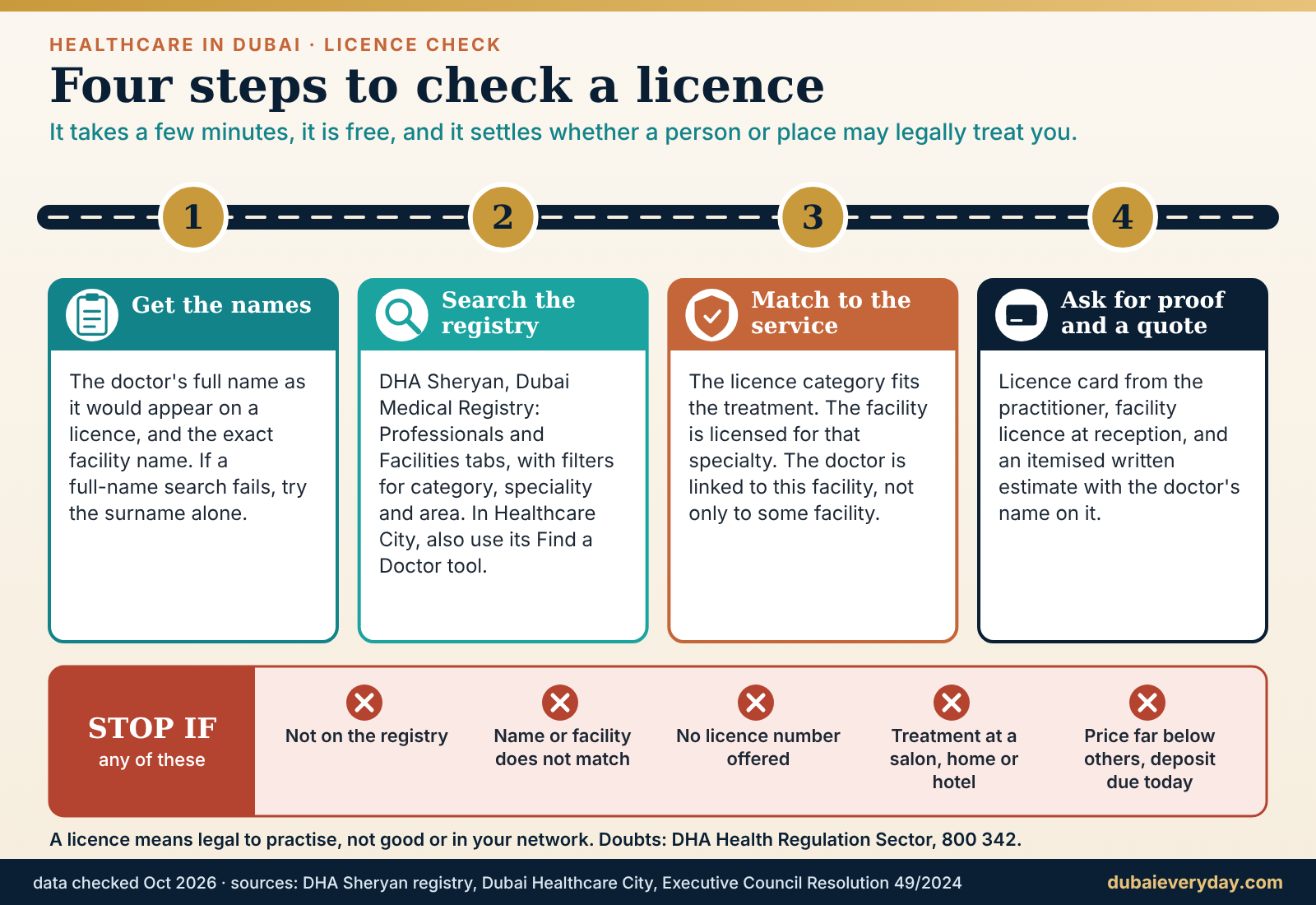
Step 1: get the full name and the facility name
Ask the reception, or find on the clinic’s own page, the doctor’s full name as it would appear on a licence and the exact name of the facility. Many practitioners use a short name in marketing. The registry looks for the formal one, and spellings of Arabic, South Asian and Filipino names can vary by a letter or two. If a search for the full name fails, try the surname only, then the first name, before concluding anything.
Step 2: search the Dubai Medical Registry
The DHA’s Sheryan portal hosts the Dubai Medical Registry. On the version we read on 29 October 2026 it has two tabs, “Professionals” and “Facilities”, and a filter panel with licence type, category, speciality, language, area, facility, nationality and gender.
A Gulf News explainer on checking a doctor says the professional entry shows the licence details, the category (for example physician, dentist or nurse) and the person’s work history in Dubai; for a facility, it shows the licensed specialties. The registry page is a JavaScript application and its layout can change, so if the link moves, start from the DHA’s Sheryan page or call the DHA’s Health Regulation Sector on 800 342 (800 DHA).
For clinics inside Dubai Healthcare City, the DHCC runs its own “Find a Doctor / Service” tool and says a regulatory arm handles complaints and compliance. Because the law requires DHA licences in addition to the DHCA’s permits for healthcare activity, a DHCC clinic and doctor should also be traceable on the DHA side. If the two sources disagree, ask the clinic to explain, and do not proceed until they do.
Step 3: match the licence to the service
Being on the register is the start, not the end. Check three matches. First, the licence category should fit the service: a dentist’s licence does not cover general surgery, and a nurse’s licence does not cover prescribing. Second, the facility’s licensed specialties should include what you are booking.
Third, the doctor should be linked to this facility, not only to some facility. The resolution says facilities may not employ visiting doctors who are not licensed; if a clinic advertises a “visiting consultant” from abroad, ask how that person is licensed to treat patients at this site on the day you are booked.
Step 4: ask for the licence card and the written estimate
The Gulf News explainer lists two further simple checks: practitioners carry a DHA licence card, and the facility’s licence is displayed at reception or the entrance. Ask politely. A legitimate clinic expects the question. Then ask for the estimate in writing, with the doctor’s name on it. This does double duty: you see what the clinic thinks it is licensed to do, and you have a record if the final bill differs.
Red flags that mean stop
The doctor or facility is not on the registry. The licence belongs to a different name. The clinic will not give a licence number. The treatment is being done at a salon, a home, a hotel room or by someone “visiting this week”. The price is far below everyone else’s with no explanation.
Yellow flags that mean ask
The doctor’s specialty on the register differs from the one on the poster. The facility is new and the registry entry is thin. The clinic says insurance “will definitely cover” something before the insurer has said so. The booking needs a large cash deposit with no itemised estimate.
What a licence does not tell you
It does not say how good the doctor is, whether the facility is in your network, or what it will charge. It says only that the person and place are legally allowed to practise. That is necessary, and it is not sufficient.
Pharmacies and other facilities
Pharmacies are regulated health facilities too. The Sheryan registry’s Facilities tab is where we would start, but we could not confirm from the registry page we read that pharmacies appear in the same search as clinics, so we are not going to claim it. If you doubt a pharmacy, the DHA’s 800 342 line is the official route. A separate hotline applies to products rather than premises: the federal ministry lists 800 11111 for reporting suspected fake or harmful medicines.
For cosmetic and aesthetic work, the licence question is sharper because injectables are often sold as a beauty service rather than a medical one. Our guides to Botox in Dubai, dermal fillers in Dubai and choosing a dermatologist explain what to check for each. For dental work, including implants, start with choosing a dentist in Dubai and dental implants.
If something goes wrong with healthcare in Dubai
The DHA says its Health Regulation Sector manages patient complaints as part of its supervision and inspection role, and the Clinical Audit and Control Department handles medical complaints and investigates malpractice and drug errors. For service issues at a Dubai Health facility, the customer team on 800 60 and the Dubai government’s 04 platform are the stated routes.
At a Dubai Healthcare City facility, the zone has its own complaint page. Keep a record of what happened, with dates, the names of staff you dealt with and the itemised bill, and ask the facility for your medical record or a summary of treatment before you start the complaint.
Health insurance and what a plan actually pays
Insurance is where healthcare in Dubai becomes arithmetic. The rules are set by Dubai Health Insurance Law No. 11 of 2013, which took effect in January 2014. A law-firm summary of it says employers must provide cover that meets the minimum for their staff, and that employees’ visa renewals depend on valid cover.
The UAE government portal puts it plainly for Dubai: employers must cover employees, and sponsors must insure resident dependants. Our companion guides, health insurance for Dubai residents and mandatory health insurance in Dubai, go deeper on plans and claims. This section gives you the part of the insurance picture that changes decisions about healthcare in Dubai.
Who has to pay for healthcare in Dubai
Three situations cover most people paying for healthcare in Dubai. If you are an employee, your employer arranges the policy, and for the basic plan, the law summary we read says the employer may not pass that cost on to you. If you are a dependant, such as a spouse or child on a family visa, the sponsor arranges and pays for the cover.
If you are self-sponsored, for example on a freelance, investor or similar visa, you are your own sponsor, so you buy it. Since 1 January 2025, the portal says, employers of private-sector and domestic workers must buy a policy before a residency permit is issued or renewed, in Dubai and Abu Dhabi.
The penalty side matters mainly for sponsors. In a December 2017 statement the DHA said sponsors who failed to renew were fined AED 500 per person per month, deducted when the visa is renewed. A law-firm summary lists wider fines for employers who fail to provide cover. These figures are dated; the point is that the system is enforced through the residency process, not through a separate inspection you might never see.
The basic plan for healthcare in Dubai: what the Essential Benefits Plan sets
The Essential Benefits Plan (EBP) is the minimum. It is the cover that sits behind the basic AED 550 to 750 per person premium band mentioned in the regulator document we read. We did not locate the regulator’s own copy of the plan, so we used an insurer-hosted copy of the appendix, labelled as effective 1 January 2025. Treat the numbers below as the version we saw on 29 October 2026, and check your policy schedule, which is the only document that binds your insurer.
Beyond those headline figures, the appendix says: laboratory tests and radiology carry 20% coinsurance; MRI, CT scans and endoscopies in non-emergency situations need prior approval; non-urgent inpatient care also needs prior approval, with a 20% share capped as above; medicines are limited to AED 2,500 a year including coinsurance, formulary products where available; maternity carries 10% coinsurance, with a maximum benefit of AED 10,000 per normal delivery and AED 10,000 for medically necessary caesareans or complications.
It lists 41 non-basic exclusions, including cosmetic services, obesity treatment, IVF, dental prostheses and contraception, and a further group outside health-insurance scope, such as road-traffic injuries and work-related illnesses, though emergencies must be covered until you are stabilised.
Sources disagree: read your own schedule. The UAE government portal’s page on getting health insurance shows an older-looking basic package: outpatient co-payment 25% capped at AED 100 per visit, medicines 30% capped at AED 1,500 a year, and a stated price of AED 320 a year for a two-year validity.
An insurer’s page for its basic plan also shows AED 1,500 for medicines and a six-month wait for chronic and pre-existing conditions, while the portal says there is no waiting period for workers with chronic illness. We cannot reconcile these from desk research. They may reflect different plan years or products. Use the policy schedule and the insurer’s table of benefits as the final word.
A worked bill: what you pay versus what the insurer pays
Numbers in a table of benefits for healthcare in Dubai only make sense once they are applied to a bill. The figures below are our calculation, using the 2025 appendix percentages and caps and deliberately round, illustrative prices. They are not market prices and not quotes.
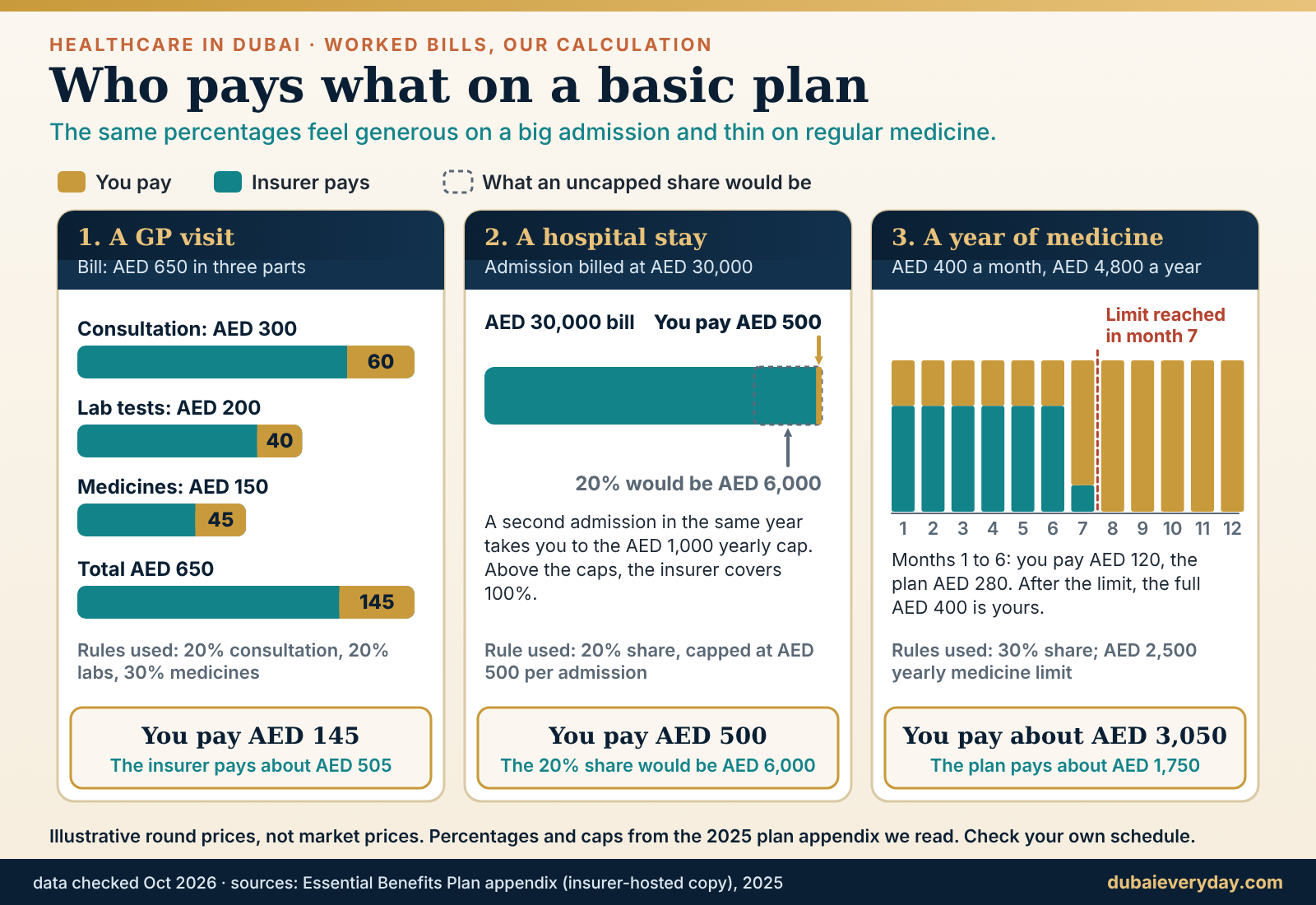
- Visit: a GP consultation of AED 300, lab tests of AED 200 and medicines of AED 150, total AED 650. At 20%, 20% and 30%, you pay AED 60, AED 40 and AED 45, so AED 145, and the insurer pays about AED 505.
- Hospital stay: a non-urgent admission billed at AED 30,000. The 20% share would be AED 6,000, but the cap is AED 500 per encounter, so you pay AED 500. A second admission the same year would take you to the AED 1,000 annual cap.
- Regular medicine: AED 400 a month at 30% coinsurance means you pay AED 120 and the plan AED 280. With an annual medicine limit of AED 2,500 including coinsurance, total spending hits that limit after a little over six months. After that, the rest of the year is yours to pay in full unless the plan is better than the basic one.
The lesson for healthcare in Dubai is not that the basic plan is bad. It is that its generosity is uneven: it is strong for a big admission and thin for chronic medicine. People who manage a long-term condition should compare the medicine limit, not just the headline AED 150,000.
Network, pre-approval and direct billing
Three words decide whether your card works at a given desk: network, pre-approval and direct billing. Network means the insurer has an agreement with the facility, usually at a plan-specific tier. Pre-approval means the insurer’s medical team must agree before an item is performed; for the basic plan, the appendix names MRI, CT, endoscopy and non-urgent admissions. Direct billing means the facility claims from the insurer and you pay your share. Without it, you pay in full and claim back.
Dubai Health lists its insurance partners on a public page, with insurers and third-party administrators including Neuron, Almadallah, Mednet UAE, NAS Administration Services and others across several pages; for coverage details it points you to each insurer. It also says it accepts guarantees of payment from international and travel insurance plans, and that you contact your insurer to start the approval. For any private hospital, ask the front desk: “Is my plan, by name and tier, in network here for this specialty, and does this need pre-approval?”
Upgrading from the basic plan for healthcare in Dubai
Many employers offer more than the minimum, and many people top up for family or dental. What an upgrade tends to change, in general terms, is the annual limit, the share you pay, the network (larger hospitals and specialists), and coverage for areas the EBP excludes, such as dental or cosmetic services.
We cannot verify any specific insurer’s current product and do not recommend one. When comparing, ask five questions: annual limit, outpatient co-pay and any cap, medicine limit, network tier at the hospitals you would actually use, and which pre-existing conditions are covered and from when. The Dubai insurance guide explains policy comparison across other lines of cover too.
Claims and complaints
The government portal says the DHA’s insurance side (the Dubai Health Insurance Corporation) regulates the sector and the insured’s rights, with an eClaim service for filing claims and an iPROMeS channel for complaints or feedback about insurance providers and regulators. Start with the insurer’s own complaints process, keep written records, then escalate. Keep every invoice, report and pre-approval number; most claim disputes are about missing paperwork.
Money check. If your monthly health spending is rising, compare it to your budget. Our cost of living guide and the single-person monthly budget show where insurance and medical co-pays fit among rent, transport and food.
Paying without local insurance, and visitors
Not everyone using healthcare in Dubai has a Dubai policy. Visitors, people between jobs, new arrivals whose cover has not started and people who simply choose to pay for a service their plan excludes all end up at the desk with a card or cash. The rules are looser here than in the insured system, so the work shifts to you.
Visitors: what is and is not clear
One thing is clear about healthcare in Dubai for visitors: emergency care will not be refused, and the bill will follow. Another is murky: whether visitors must hold health insurance. A report in Arabian Business, based on remarks attributed to an executive at the Dubai Health Insurance Corporation, said the DHA considers insurance mandatory for visitors under the law and was working on a new mechanism to cover them for the length of a stay, with packages said to start at AED 525 and a basic ceiling of AED 150,000.
The article carries no date, and describes a plan rather than a rule in force. We could not find an official notice that the requirement is being checked at entry, so we do not tell visitors it is, and we do not tell them it is not. The practical advice is the same either way: arrive with travel insurance that covers medical treatment.
When choosing a travel policy, check four things in the wording rather than the brochure: whether medical expenses and emergency evacuation are both covered, whether the policy pays the hospital directly or reimburses you later, what activities are excluded (desert driving, diving and similar), and how pre-existing conditions are handled. Save the policy number and the 24-hour assistance line to your phone before you land. If you are still planning your trip, our Dubai travel guide and the first-time-in-Dubai plan cover the other pre-arrival tasks.
Dubai Health’s insurance page adds something specific and useful: it says it accepts guarantees of payment from international and travel insurance plans, and that patients should contact their insurer directly to start the approval process. In plain terms, if a travel insurer issues a guarantee, a public hospital can treat it as payment security. If it does not, expect to pay first and claim afterwards.
Heat is a medical issue here. Long outdoor days in summer add to the list of reasons visitors end up in clinics. If you are travelling between June and September, our best time to visit Dubai guide explains the seasonal trade-offs, and indoor things to do gives you somewhere to be during the hottest hours.
Self-pay for residents: paying for healthcare in Dubai directly
Residents pay out of pocket for healthcare in Dubai in four common cases: services excluded from the plan (the basic plan’s exclusions include cosmetic services, obesity treatment, IVF, dental prostheses and contraception), items above a policy limit, out-of-network care, and the gap between employer start date and card issue. In every case, the same discipline applies.
- Ask for an itemised estimate before you agreeConsultation, tests, imaging, procedure, facility fee, medication, follow-up and any deposit should appear as separate lines. A single “package” price is fine if the inclusions are listed.
- Ask what is not includedAnaesthesia, overnight stay, implants or devices, pathology and follow-up visits are common extras on an advertised price. Our own guides to dental implants and All-on-4 treatment show how an advertised dental price differs from the total cost.
- Ask about deposits and cancellationFor planned procedures, ask what is refundable, when, and what happens if the doctor decides not to proceed.
- Get the receipt and the medical reportBoth are needed for a later insurance claim or a second opinion. Receipts should name the treating doctor and the facility.
We have not included typical consultation or procedure prices for self-pay patients. No official price list covers private providers, and the marketplace figures we saw were not comparable. Anyone quoting a “standard” GP or specialist fee for healthcare in Dubai without a dated, named source is guessing. If you need a ballpark, call two or three licensed facilities and ask for written estimates for the same described service; the spread you see is the real information.
Booking appointments for healthcare in Dubai: phone, app, walk-in and video
Once you know where to go, booking is the step in healthcare in Dubai that most often wastes a morning. The channels differ by provider, but the logic is consistent: choose a channel, give identity and insurance details, be clear about what the visit is for, and ask what to bring.
Booking at Dubai Health facilities
Dubai Health says appointments can be booked by calling its 24/7 Customer Experience Team on 800 60, through its website or through its app. Its booking page lets you filter doctors by facility, department, specialty, language and gender, and says you can book either virtually or at a convenient location.
Virtual consultations are bookable by filtering for doctors who offer them. The page quotes more than 1,400 specialists across 16 departments, and a WhatsApp link to +971 800 60. A patient login sits on a separate services site. The page does not say whether login is required before booking or what details are mandatory, so be ready for either.
Booking elsewhere
Private hospitals and clinics usually take bookings by phone, through their website or app, or by walking in. Dubai Healthcare City offers a “Find & Book a Doctor” route on its site. The DHA’s own appointment booking for private providers is not something we could verify, so we do not claim it exists.
For any new provider, phone once even if the website offers booking, because the person on the phone can answer the questions the form cannot: is this doctor taking new patients, is my plan accepted for this visit type, and is pre-approval needed.
Before you book: what to have ready
- Emirates ID (residents) or passport and entry stamp or permit (visitors).
- Insurance card, policy number and plan name, plus the insurer or administrator’s phone number.
- A short written history: current medicines with doses as written on the box, allergies, past procedures and relevant test results.
- Referral letter or previous report, if the visit is a follow-up or a specialist consultation.
- A list of the three questions you most need answered, written before you walk in.
Referrals, follow-ups and second opinions
Some plans require a GP referral before a specialist visit; some do not. We could not verify a single rule for all plans, so ask the insurer. Follow-ups are worth understanding: the basic plan appendix we read waives the outpatient co-payment for a follow-up within seven days, which is a reason to return to the same doctor rather than start with a new one for the same problem.
For a second opinion, ask for a copy of your reports and imaging first. Dubai’s exchange platform, NABIDH, lets public and private facilities share unified health information, and the national record Riayati is integrated with it. In practice, this should reduce repeat tests, but you should still carry your own documents.
Video consultations in healthcare in Dubai
Video appointments suit repeat prescriptions, results discussions, minor illness and follow-ups. They are less suited to anything that needs examination, a procedure or immediate tests. Check three things before booking: the doctor’s name on the DHA register, whether your insurance covers virtual visits (some policies treat them differently), and how prescriptions reach you. A video doctor who is not licensed in Dubai cannot lawfully treat you here, whatever app they use.
The questions that save an hour. On the phone, ask: “Is Dr [name] licensed with the DHA, and in which specialty?”, “Is my plan [name, tier] accepted for this visit?”, “What will I pay today, and what needs pre-approval?” and “What should I bring?” Four questions, two minutes, and you avoid most of the queue-at-reception surprises.
Pharmacies and medicines
Pharmacies are the most visible part of healthcare in Dubai and the least understood. They are everywhere, they are often the first stop for minor complaints, and the rules for what they can supply are tighter than in many visitors’ home countries. This section covers what we could verify from official sources and, just as important, what we could not.
What the official sources say
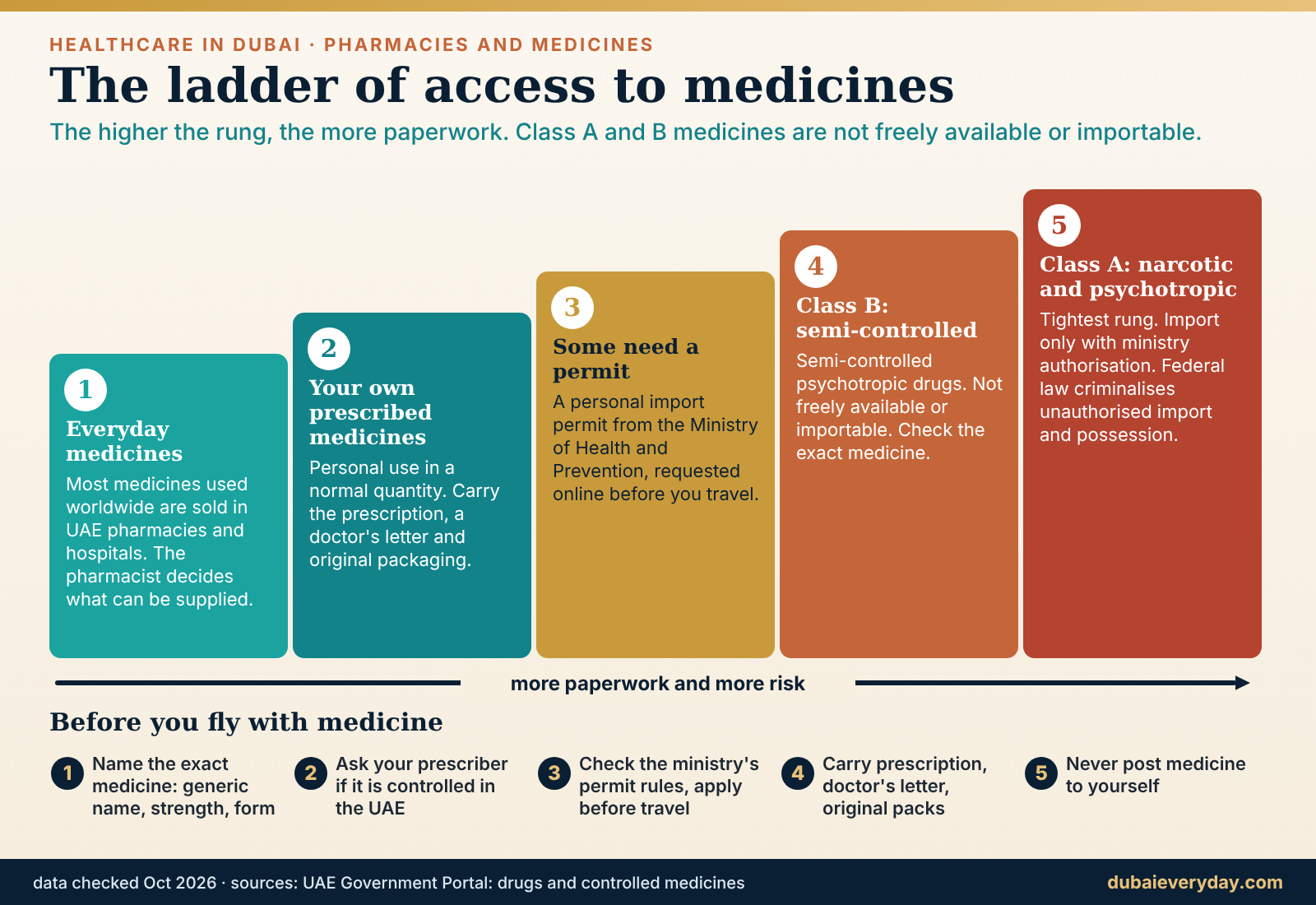
The UAE government portal states that most medicines used worldwide are available in UAE community pharmacies and hospitals. It also divides tightly controlled medicines into two classes. Class A (CDa) covers narcotic and psychotropic drugs, formerly known as “Registered Prescription” or “Group 4” drugs. Class B (CDb) covers semi-controlled psychotropic drugs. Both classes are neither freely available nor freely importable.
The page does not list example products and does not give quantity limits, so for a specific medicine you need the ministry, not a blog post. Federal Law by Decree No. 30 of 2021 criminalises the production, import, export and possession of narcotic and psychotropic substances except for supervised medical or scientific use.
We could not verify Dubai-specific prescription rules for individual medicine categories (for example, which antibiotics or painkillers need a prescription), pharmacy opening hours, or the operating rules for home delivery. Pharmacists, not websites, are the authority on what they can dispense. If a product that is over the counter in your home country is refused, or a pharmacist asks for a prescription you did not expect, that is the rule working, not rudeness.
Using a pharmacy well
- Bring the box or a photo of it, with the generic (active-ingredient) name. Brand names differ between countries.
- Say plainly who the medicine is for, their age and any other medicines or allergies. Pharmacists need this to say yes or no.
- If you have insurance, ask before the prescription is filled whether the pharmacy is in your network and whether the brand prescribed is in your plan’s formulary; the basic plan limits medicines to formulary products where available.
- Keep receipts and prescriptions for claims. Under the basic plan we read, you pay 30% of each prescription and nothing is covered above the AED 2,500 annual limit.
- Ask whether a generic equivalent exists; this can change both price and your share.
Counterfeits, online sellers and social media
The portal lists a federal ministry hotline, 800 11111, for suspected fake or harmful medicines. That is the official place to report a product.
The sensible habits are simple: buy from a licensed pharmacy, be suspicious of a social-media seller offering prescription-only medicines, avoid injectable or weight-loss products from unlicensed sources, and be wary of any “pharmacy” that does not ask for a prescription when you would expect one. If you are checking a pharmacy, the DHA’s 800 342 line is the starting point, as described in the licence section.
Travelling in with medicines
The portal’s wording for visitors and new arrivals is brief: you may bring other prescribed medicines for personal use in “normal quantity”, while Class A and B controlled medicines are not freely importable. A personal import permit issued by the Ministry of Health and Prevention is needed for some medicines, via an online service the ministry runs, and a separate authorisation exists for narcotic drugs. The portal refers to the Dubai Customs passenger guide for customs rules, which we could not retrieve for this guide.
- Identify the exact medicineWrite down the generic name, strength and form from the label, and ask your prescriber whether it falls into a controlled class in the UAE.
- Carry the prescription and a doctor’s letterThe letter should name the condition, medicine, dose and daily quantity. Keep medicines in original packaging.
- Check permits earlyIf the medicine needs a personal import permit or is controlled, apply through the ministry before you fly, not at the airport.
- Do not post medicines to yourselfPostal and courier routes make customs queries harder to resolve and are not the intended route for personal supplies.
- Plan for a gapIf a permit is delayed, ask your prescriber about alternatives available in the UAE rather than risking carrying it without permission.
Do not guess with controlled medicines. The penalty for getting this wrong can be severe, because the law covers possession as well as import. People are sometimes surprised that medicines used routinely at home, such as certain sedatives, strong painkillers or ADHD treatments, may need extra steps. We cannot say whether yours is controlled. The ministry can.
Specialist areas of healthcare in Dubai: dental, skin, maternity, children and mental health
Most major service areas have their own guides on this site. What matters for a general guide to healthcare in Dubai is the frame: what kind of facility, what the basic insurance plan generally covers, and where to read more. We keep each short on purpose, to avoid repeating what the dedicated pages explain better.
Dental care
Dental work is the area of healthcare in Dubai where the gap between insurance and reality is widest. The basic plan’s exclusion list includes dental prostheses, and many plans treat dental as an optional extra. Public provision exists: Dubai Health lists a Dental Hospital in Dubai Healthcare City, and its university includes the Hamdan Bin Mohammed College of Dental Medicine.
Private dental clinics are plentiful and licensed by the DHA, so the register check applies. For choosing a clinic and understanding costs, see our Dubai dentist guide; for implants specifically, the dental implants and All-on-4 pages cover candidacy, risk and total cost.
Skin and aesthetic care
Medical dermatology and cosmetic procedures are different services under the same word “skin”. Cosmetic services are among the basic plan’s exclusions, so expect to pay privately. Our dermatologist guide separates the medical from the cosmetic, and the pages on Botox and fillers cover credentials, risks and aftercare. The licence check in this guide is the first filter for any injectable provider.
Pregnancy and birth
Maternity is one of the clearest places in healthcare in Dubai where the basic plan’s numbers matter. The appendix we read sets 10% coinsurance for inpatient maternity and outpatient antenatal care, a maximum benefit of AED 10,000 per normal delivery and AED 10,000 for medically necessary caesareans, complications or termination, and prior approval or notification within 24 hours for emergency treatment.
Actual delivery costs vary by hospital and room type, and we could not verify any price, so ask your insurer for the maternity benefit schedule and the hospital for a package estimate before you book. Dubai Health lists a fertility centre in Al Jaddaf, but IVF is among the basic plan’s exclusions. For newborn logistics, our Dubai with a baby guide covers strollers, feeding and heat.
Children
Al Jalila Children’s Hospital is part of Dubai Health, and many private facilities run paediatric clinics. For routine children’s healthcare in Dubai, a family-medicine or paediatric clinic in your network is the practical choice. The UAE’s Al Hosn app, according to the portal, stores each user’s vaccination history and lets them share it securely, which can help with school or nursery paperwork; check what your school asks for. If you are weighing schools, our guides to Dubai schools and Dubai with kids cover the wider family logistics.
Mental health
The UAE government portal says mental-health services are provided through Emirates Health Services and names Al Amal Psychiatric Hospital, a federal facility, as serving patients from Dubai and the northern emirates, with outpatient clinics for children, adults and older adults. The portal does not list a dedicated mental-health helpline, so we do not give one.
In an emergency, call 998 or 999. The federal mental-health law the portal summarises protects confidentiality, the right to complain and a discharge care plan. For ordinary counselling or therapy within healthcare in Dubai, the practical route is a DHA-licensed psychologist or psychiatrist, found through the register, with a call to your insurer to learn what outpatient mental-health cover exists.
Staying well
Prevention is not an insurance line item in most basic plans, but it affects how often you need the system. Exercise, sleep and a manageable routine are a personal matter, and our guides to gyms, Pilates and reformer studios cover the logistics of staying active in a hot city. They are not medical advice, and anyone with a health condition should ask their doctor before starting a new programme.
Residency medicals, records, rights and complaints
The administrative side of healthcare in Dubai is where new residents lose the most time. Four tasks come up in the first months: the residency medical, building a medical record, knowing your rights, and knowing where to complain. None is difficult once you know the order.
The residency medical
The UAE government portal says applicants for a work or residence permit must be free of communicable diseases such as HIV and TB. Extra tests apply to particular jobs: syphilis and hepatitis B tests for nursery workers, domestic workers, food handlers, restaurant and cafe workers, salon and beauty-centre staff and health-club workers; and a pregnancy test for female domestic workers.
Under a 2016 Cabinet Resolution, the portal says, all resident expatriates are screened for TB when renewing their visas, and Dubai, unlike Abu Dhabi, does not require a chest X-ray as part of that screening. Applicants with scars, active TB or drug-resistant TB can receive a conditional fitness certificate and a one-year residence visa, and must then get treatment in the UAE.
In Dubai, Dubai Health runs medical fitness centres that offer fitness exams, occupational-health screening and unified health screenings for residents and newcomers. Its page lists locations including Al Muhaisnah, Al Karama, Bur Dubai, DIFC, Dubai Airport, JAFZA and Zaabeel, plus three Smart Salem centres in City Walk, Index and Dubai Knowledge Park. It quotes results within 6 to 24 hours for the premium exam and about 30 minutes at the Smart Salem VIP service.
The page does not publish fees or hours, and the number of centres differs between pages, so confirm by calling 800 60. The portal page itself points to Emirates Health Services for the medical fitness exam, so check which channel your visa typist or employer expects. Our guides to the residence visa and the work visa cover where the medical sits in the sequence, and the relocation checklist shows the timeline.
Building your record
Record-keeping in healthcare in Dubai gets help from a health information exchange, NABIDH, developed by the DHA so that public and private facilities in the emirate can exchange unified health information securely, and the national record, Riayati, links more than 3,000 facilities and integrates with NABIDH. For you, the benefit is fewer repeated tests and better continuity between providers.
It does not replace your own paper trail. Ask for a copy of important reports and imaging, and keep a single folder, physical or digital, with vaccination records, allergy and medicine lists, and discharge summaries. If you move to a new provider, giving them that folder on day one saves time.
The DHA’s Health Informatics and Smart Health Department develops the policies for the exchange platform and oversees health-information security and patient privacy. If you believe a provider has handled your information improperly, that is the part of the regulator whose job it is.
Your rights as a patient in healthcare in Dubai
The UAE has a Patient’s Charter of Rights and Responsibilities, established by Ministerial Resolution No. 14 of 2021, which the government portal says clinics and hospitals must display. We could not retrieve the charter’s text, so we do not paraphrase it. In general terms, charters of this kind cover respect, information, consent, privacy and the right to complain, together with the patient’s own duties, such as giving accurate information and following agreed treatment. If a facility cannot show you the charter, that tells you something about the facility.
Where to complain about healthcare in Dubai, in order
- The facility itselfAsk for the complaints or patient-relations contact and put the issue in writing, with dates, names and the bill.
- The right regulator or channelFor a Dubai Health facility, the 24/7 customer line on 800 60 or the Dubai government’s 04 platform. For professional conduct or licensing questions, the DHA’s Health Regulation Sector on 800 342, or its Clinical Audit and Control Department, which investigates malpractice and drug errors. For a Dubai Healthcare City clinic, the zone’s own complaint page, with the DHA as the parallel regulator.
- Your insurer, for coverage and billingUse its complaints procedure, then the insurance-regulator channels the portal mentions: eClaim for filing claims and iPROMeS for complaints and feedback about insurers.
- Legal advice, if harm is seriousMedical negligence and liability are for qualified lawyers and the relevant committees. Our overview of Dubai legal basics explains where to verify rules, and the DHA has said it handles medico-legal cases.
Medical travel: healthcare in Dubai for overseas patients
Some people come to Dubai specifically for treatment. This corner of healthcare in Dubai has a name and a structure: the DHA has a Health Tourism Department that governs health-tourism services, and the government portal lists Dubai Health Experience as the medical-tourism portal, through which international visitors can book procedures and arrange visas, appointments, hotels and transport.
The medical entry permit
The portal’s page on patient and companion entry permits says a foreign patient can enter the UAE for treatment if sponsored by the medical establishment providing it, which processes the permit on the patient’s request. For Dubai, the application goes through the General Directorate of Residency and Foreigners Affairs, and the sponsor must be a UAE-licensed, registered hospital.
The documents listed for the patient are a passport copy, a medical report, a photo, a letter from the host justifying the visit and health insurance; companions need a passport copy, a photo, a copy of the patient’s visa and a hospital letter. Permit length is 90 or 180 days, with single or multiple entry. The page also notes a financial security deposit, that the companion must enter with the patient, and that a companion’s permit can be extended only once and only with a certified medical report. Fees are not listed.
Planning a treatment trip sensibly
- Verify the doctor and facility on the DHA register before you pay a deposit, and ask what the facility is licensed to do.
- Ask for an itemised package: procedure, hospital stay, tests, follow-up, medication, and what happens if complications need extra days or treatment.
- Ask the surgeon, in writing, how soon after a procedure you can fly and what follow-up you need back home.
- Check whether your home insurer will cover complications of treatment abroad. Many do not.
- Ask who will treat you if there is a problem after you leave, and how records are shared with your doctor at home.
- Be sceptical of any promise of results. No licensed practitioner can guarantee an outcome.
For a recovery stay, location and access matter more than stars. Our guides to hotels by area and budget and the airport guide help with the logistics of arriving and leaving without surprises. We do not name or rank medical-tourism providers; the selection of a clinician is a medical decision that belongs between you, a licensed doctor and your own insurer.
Eight situations worked through
The sections above give you the rules of healthcare in Dubai. This one applies them. The scenarios are illustrative: they are built from the official facts and our own reasoning, not from real cases, and the prices are round numbers chosen to show the arithmetic. None is medical advice. In every case, a licensed professional makes the clinical decision.
1. A visitor hurts an ankle on day two
The situation: a visitor with travel insurance feels a sharp pain after stepping off a kerb. They can limp but not walk normally. The right door depends on how bad it looks, and it is not an ambulance case unless there is a deformity, severe pain or inability to move. Door 2 or 3 is likely: a hospital emergency department or a clinic that can do an X-ray.
The first call should go to the travel insurer’s assistance line, which can direct you to a facility that accepts its guarantee of payment. Dubai Health’s insurance page says it accepts such guarantees from international and travel plans once the insurer starts the approval. Keep the report, the X-ray report and the itemised bill; the claim will need them.
2. A new employee with a fever before the card arrives
The situation: it is the third day of a new job, the employer has applied for insurance, and the card has not arrived. Ask HR for the policy number and the insurer’s helpline; many insurers can confirm cover by phone before a physical card exists. If the problem is routine, a GP or video visit in network is enough.
If cover genuinely has not started, a self-pay GP visit with an itemised receipt is the fallback; keep it for a later claim. If it is an emergency, go to the ER first and sort paperwork afterwards, as in the emergency section. Insurance start dates are a classic gap for new arrivals in healthcare in Dubai, and the moving-in sequence in our moving to Dubai guide is worth reading with this in mind.
3. A child with a temperature late in the evening
The situation: a parent has a feverish child at 11 pm. This is an area where we do not offer clinical rules, because they depend on age and symptoms. Practical routes: your insurer’s helpline or a Dubai-licensed telehealth service to decide whether it needs to be seen; a hospital emergency department with paediatric capability if it cannot wait; Al Jalila Children’s Hospital is the public children’s hospital in Dubai Health’s network.
If there are signs a doctor has told you to treat as emergencies, or you are worried, call 998. Whatever happens, write down the child’s temperature, time, medicines given and doses, so the doctor does not have to rely on memory.
4. A long-term medicine that runs out of cover
The situation: a resident on a basic plan for healthcare in Dubai takes a daily medicine costing AED 400 a month. By our calculation using the appendix figures, they pay AED 120 a month at 30% and the plan pays AED 280, until the AED 2,500 annual medicine limit is reached after about six months of spend. From then, the full price falls to them. Over a year of AED 4,800 in medicine, that works out at roughly AED 3,050 paid by the resident and AED 1,750 by the plan.
The sensible steps are to ask the doctor whether a generic or formulary alternative exists, ask the insurer whether the medicine is on the formulary, and compare the medicine limit before the next renewal. For some, a plan upgrade that costs a few hundred dirhams more than the basic one pays for itself. That depends on the plan; we cannot verify any specific product.
5. Bringing in a prescription medicine from home
The situation: a new arrival takes a prescribed stimulant, strong painkiller or sedative and wants to bring a three-month supply. The portal says Class A and B controlled medicines are not freely importable and that some need a personal import permit from the Ministry of Health and Prevention. The first step is to find out, from the ministry, whether the medicine is controlled and what the permit process needs, before packing it.
The second is to get a doctor’s letter and keep everything in original packaging. The third is to line up a UAE doctor for the long term, who can prescribe locally where the rules allow. Do not rely on a friend’s advice or a social-media post. The consequences for getting this wrong are far beyond a fine.
6. An MRI that needs pre-approval
The situation: a doctor recommends an MRI. The basic plan appendix says MRI, CT and endoscopy in non-emergency situations need prior approval, and 20% coinsurance applies to radiology. Suppose the scan is quoted at AED 2,000. If approved, your share is AED 400 under that percentage; if the clinic books it without approval, you may face a claim problem and the whole amount.
Ask the clinic to request approval and give you the approval reference before the appointment. If the clinic is out of network, ask about the cost difference and whether another in-network centre can do it sooner. Keep the radiologist’s report and the images for any later specialist.
7. A cosmetic procedure offered at a deep discount
The situation: a clinic is advertising an injectable treatment far below other quotes. The licence check is the first step: is the clinic on the registry, and is the person doing the injection a licensed professional whose category covers the treatment? Ask for the product name and batch details, an itemised price and the consultation process.
Treat very low prices, pressure to pay a deposit that day and treatment in non-clinical settings as signs to leave. Cosmetic services are outside the basic insurance plan, so complications you pay for yourself can be expensive. Our guides to Botox and fillers list questions to ask.
8. A road collision on a major road
The situation: after a collision, someone is hurt. The government guidance is to call 999 and, if anyone is injured, to leave vehicles where they are until the ambulance arrives; call 998 for the medical response. At the hospital, emergency care comes first. The basic plan appendix we read places road-traffic injuries outside health insurance scope, with emergency care covered until stabilisation, which suggests motor insurance and the police process will matter for the bill.
Ask the hospital what documents it needs, and ask your motor insurer which policy responds. If you are renting a car, our guide to licensed car rental explains the insurance side. This is general information; the actual allocation depends on your policies and the circumstances.
What the scenarios have in common. In each case, three calls solve most of the problem in healthcare in Dubai: the insurer (is this covered, is approval needed), the facility (is the doctor licensed and in network, what will I pay) and, where relevant, the regulator (is this legal and licensed). Make those calls before the appointment, not after the bill.
Five myths about healthcare in Dubai
Some beliefs about healthcare in Dubai circulate so widely that they are repeated as fact in forums and group chats. Each of the five below is contradicted or qualified by an official source we read.
Myth 1: healthcare in Dubai is free for residents
It is not. The system runs on mandatory insurance, with employers insuring staff and sponsors insuring dependants. Dubai Health’s own FAQ says emergency services are not free and that coverage depends on your plan. What residents often mean is that they do not pay a premium; the employer does. They still pay co-payments.
Myth 2: a licensed clinic is a good clinic
A licence means the person and place are legally allowed to practise. It says nothing about your outcome, the price or the waiting time. Treat the licence as the entry ticket. Network, price and communication then do the sorting.
Myth 3: my insurance card works at every hospital
Networks are plan-specific. A hospital may accept your insurer at one tier and not another, and some services need pre-approval. The only reliable test is a phone call that names your plan, the specialty and the service.
Myth 4: the emergency department is the fastest way to see a doctor
Emergency departments see patients by clinical urgency. If your problem is not urgent, you may wait longer than you would at a clinic, and pay differently. The triage path earlier on this page shows where non-emergencies belong.
Myth 5: any prescription from home will work here
Many ordinary medicines are fine to carry in a normal personal quantity, but controlled medicines in Classes A and B are not freely importable, and some need a ministry permit. The wrong assumption here has legal consequences, not just administrative ones.
A plain-English glossary
Insurance and clinic jargon causes more confusion than the medicine does. These definitions are general, not policy wording; your own schedule rules.
- Coinsurance: the percentage of an eligible bill that you pay. The basic plan we read uses 20% for outpatient visits, labs and radiology, and 30% for medicines.
- Deductible: a fixed amount you pay before the insurer starts paying. Dubai Health’s FAQ mentions deductibles alongside co-pays, so check whether your plan has one.
- Network: the facilities and doctors your insurer has agreements with. It varies by plan tier.
- Third-party administrator (TPA): a company that processes claims and approvals for an insurer. Dubai Health’s insurance partners page lists several.
- Pre-approval: the insurer’s agreement, before treatment, that an item is eligible. Get the reference number.
- Guarantee of payment: a written promise from an insurer to pay a facility, which Dubai Health says it accepts from international and travel plans.
- Formulary: the insurer’s list of medicines it covers. The basic plan limits medicines to formulary products where available.
- Polyclinic: a facility with several specialties under one roof; a label, not a quality grade.
- NABIDH: Dubai’s health information exchange, built by the DHA for sharing patient information between public and private facilities.
Mistakes and red flags
Most avoidable problems in healthcare in Dubai come from a short list of habits. We built it by reading what the rules imply, not from anecdotes, so treat it as a checklist of where the system’s own wording can trip you.
- Using the emergency department as a default clinic. Dubai Health says emergency services are not free and coverage depends on your plan, so a non-urgent visit can cost more in time and money than a clinic.
- Skipping the licence check because the clinic looks polished. A beautiful reception is not a licence; the registry is.
- Assuming “my insurer” means “every hospital”. Networks are plan-specific, and tiering means a hospital can be in network on one plan and out on another.
- Booking a scan or admission without pre-approval where the plan requires it. The basic plan appendix names MRI, CT, endoscopy and non-urgent admissions.
- Assuming an employer covers the family. The law puts dependants on the sponsor; the employer’s duty is to the employee.
- Arriving as a visitor without travel insurance and counting on the system to absorb the bill.
- Importing a controlled medicine on the basis of a home-country prescription alone.
- Treating star ratings and “best of” lists as regulatory data. They are not.
- Paying a large deposit without an itemised written estimate.
- Not keeping records: reports, imaging, invoices, pre-approval numbers and a medication list make every future visit, claim and complaint easier.
One more pattern in healthcare in Dubai deserves a mention: believing a rule you read on a forum. Insurance figures, import rules and fees change, and the same number can be right in one plan year and wrong in the next. We found direct evidence of this while writing: two official-looking sources gave different basic-plan co-payments. When in doubt, go to the primary document or phone the regulator on 800 342.
Your first-month healthcare checklist
If you have just arrived, this sequence gets you from zero to ready for healthcare in Dubai without doing everything at once. It works for individuals and families; adjust for your own situation.
- Day 1 to 3: save the essentialsPut 998 and 999 in your phone, plus the insurer’s helpline, the policy number and the name of the nearest emergency department. Download your insurer’s app.
- Week 1: confirm insuranceAsk your employer or sponsor for the policy document, plan name and tier, start date and whether dependants are included. Ask for the network list for the areas you live and work in.
- Week 1 to 2: find a GP in networkCheck the doctor on the DHA register, call to confirm the plan is accepted, and book a first appointment so you are an existing patient before you need one.
- Week 2 to 3: complete the residency medicalFollow your employer’s or visa agent’s instructions. Our residence visa guide shows where it sits.
- Week 3: build your recordGather vaccination records, allergy and medicine lists and any important reports from home. Check what your children’s school asks for.
- Week 4: sort medicines and pharmaciesIf you take regular medicine, confirm that it is available locally, whether it is controlled, and whether your plan’s medicine limit fits your needs. Identify a pharmacy near home.
- Month 2: reviewRead the policy schedule once, all the way through. Note the annual limit, co-payments, exclusions and pre-approval list, and put the key figures in a note on your phone.
For the rest of your move, our relocation checklist and moving to Dubai guide place this health sequence among housing, banking and transport.
Putting healthcare in Dubai together
Strip away the detail and healthcare in Dubai comes down to four decisions you make in a sensible order. First, choose the level of care that fits the problem: 998 for emergencies, a clinic or video visit for most illness, a pharmacist for minor and familiar things, booked care for the rest.
Second, check the person and place on the DHA register before you commit. Third, check your insurance, by name and tier, for network and pre-approval. Fourth, keep records, because every later claim, referral and complaint is easier with a folder than without.
The system rewards people who ask the boring questions early. It punishes those who find out on the day, at the desk, with a sick child or an unexpected invoice. None of this needs expertise. It needs five minutes and a phone. If this page has one job, it is to move those five minutes to before the appointment.
For the next layer of detail, use the companion guides: comparing hospitals, resident health insurance and the wider insurance guide. For clinical questions, only a licensed doctor can answer.
FAQ: healthcare in Dubai
Where should I start with healthcare in Dubai as a newcomer?
Start with insurance. Ask your employer or sponsor for the policy document, plan tier, start date and network list, and confirm whether dependants are included. Then save 998, your insurer’s helpline and the nearest emergency department. Choose a GP in your network, check the doctor on the DHA register and book a first visit so you are already a patient when you need one. Complete the residency medical when your employer or agent tells you to. The first-month checklist above puts these in order.
What number do I call for an ambulance in Dubai?
Call 998 from anywhere in the UAE. The government portal lists 998 as the ambulance number and says an air ambulance can be sent if needed. Police are on 999 and fire on 997. In Dubai there is also an ambulance service app, named on the portal as the DCAS SOS app, which uses an SOS feature to locate the patient. If the situation involves a road collision, call 999 as well and leave vehicles in place if anyone is injured until the ambulance arrives.
Is healthcare in Dubai free?
No. Healthcare in Dubai runs on mandatory insurance, not free access. Dubai Health states that emergency services are not free and that coverage depends on your insurance plan, including co-pays, deductibles and non-covered services. Employers must insure employees and sponsors must insure dependants. Emergency treatment is available regardless; the portal says hospitals must give initial treatment in any medical emergency, and the billing follows. Visitors should carry travel insurance.
Is health insurance mandatory in Dubai?
For residents, yes: healthcare in Dubai is built on mandatory cover. Dubai Health Insurance Law No. 11 of 2013, in effect since January 2014, requires employers to cover employees and sponsors to cover dependants.
The government portal also says that, from 1 January 2025, employers of private-sector and domestic workers must buy a policy before a residency permit is issued or renewed. The DHA stated in 2017 that sponsors who failed to renew faced a fine of AED 500 per person per month; check the current position with the DHA or your insurer.
Do tourists need health insurance to visit Dubai?
We could not find an official, current notice that visitors are checked for health insurance at entry. An undated Arabian Business report cites a DHA-linked executive saying insurance is mandatory for visitors under the law and a mechanism is being developed, but it describes a plan, not a rule in force. Regardless, carry travel insurance that covers medical treatment and evacuation. Dubai Health’s insurance page says it accepts guarantees of payment from international and travel plans once your insurer starts the approval.
How do I check whether a doctor or clinic offering healthcare in Dubai is licensed?
Search the Dubai Medical Registry on the DHA’s Sheryan portal, which has Professionals and Facilities tabs. Enter the full name, check the licence category and, for facilities, the licensed specialties. Also ask for the practitioner’s licence card and look for the facility’s licence at reception. For Dubai Healthcare City, use its own Find a Doctor tool as well, since free-zone healthcare activity also needs a DHA licence. For doubts, call the DHA’s Health Regulation Sector on 800 342.
How do I book an appointment at a Dubai Health hospital?
Dubai Health says you can call its 24/7 Customer Experience Team on 800 60, book through its website or use its app. The website lets you filter by facility, department, specialty, language and gender, and virtual consultations are available by filtering for doctors who offer them. Dubai Health facilities accept a range of insurance plans; check its insurance partners page, the 800 60 line or your insurer to confirm yours before the visit.
Can I go to a hospital emergency department without insurance?
Yes in a real emergency: the portal says hospitals must give initial treatment in any medical emergency. But you will be billed according to your cover. Without insurance, you pay the facility’s charges yourself, so ask for an itemised bill and keep the discharge report. Visitors with travel insurance should contact the insurer’s assistance line as soon as possible, because a guarantee of payment can simplify admission. Do not delay emergency care to find paperwork.
What does the basic Essential Benefits Plan cover?
In the 2025 appendix we read, the basic plan for healthcare in Dubai has an annual limit of AED 150,000, 20% coinsurance on outpatient visits (none for a follow-up within seven days), 20% on labs and radiology, 30% on medicines up to AED 2,500 a year, and inpatient coinsurance capped at AED 500 per encounter and AED 1,000 a year. It excludes cosmetic services, obesity treatment, IVF, dental prostheses and contraception, among others. Figures on other official-looking pages differ, so read your own policy schedule.
Can I see a specialist without a GP referral?
In healthcare in Dubai this depends on the plan and the facility, and we could not verify one rule for all. Some plans need a GP referral or pre-approval for specialist visits; others allow direct access within the network.
Ask the insurer before booking, and ask the facility whether the specialist is in your network and whether your plan treats the visit as a consultation or a follow-up. If you pay yourself, you can usually book directly, but check that the specialist is licensed in the relevant specialty on the DHA register.
Can I buy medicines without a prescription in Dubai?
Some products are sold without one, but the rules differ from many countries and we could not verify a Dubai-wide list. The pharmacist decides what can be supplied, and some medicines you buy freely at home may need a prescription here. Controlled medicines, classes A and B in the federal system, are tightly restricted. The practical approach is to ask the pharmacist, bring the generic name, and accept a refusal as the rule working. Report suspected fake medicines to the ministry’s hotline, 800 11111.
Can I bring my prescription medication to Dubai?
The government portal says you may bring other prescribed medicines for personal use in “normal quantity”, but Class A and Class B controlled medicines are not freely importable, and some medicines need a personal import permit from the Ministry of Health and Prevention. It does not list example products or quantity limits. Check your exact medicine with the ministry before you travel, carry the prescription, a doctor’s letter and the original packaging, and apply for any permit well before departure.
Where do I complain about a clinic or hospital in Dubai?
For any complaint about healthcare in Dubai, start with the facility’s patient-relations team, in writing. For Dubai Health facilities, call 800 60 or use the Dubai government’s 04 platform. For licensing, conduct or malpractice, the DHA’s Health Regulation Sector (800 342) and its Clinical Audit and Control Department are the stated channels. In Dubai Healthcare City, the zone has a complaints page. For insurer disputes, use the insurer’s process, then the insurance regulator channels such as iPROMeS. Keep dates, names and bills.
What is the difference between the DHA and Dubai Health?
In healthcare in Dubai, the Dubai Health Authority is the regulator: it sets policy, licenses providers and professionals, inspects, and oversees insurance and public-health policy. Dubai Health, rebranded in November 2023 from the Dubai Academic Health Corporation, is a provider network with six hospitals, ambulatory health centres, medical fitness centres, a medical university and the Al Jalila Foundation. A licence question goes to the DHA; an appointment or service complaint at a public hospital goes to Dubai Health.
Do I need a medical test for a Dubai residence visa?
Yes. The government portal says applicants must be free of communicable diseases such as HIV and TB, with extra tests for certain jobs and TB screening at renewal. Dubai Health runs medical fitness centres for the exams, quoting results from about 30 minutes at its Smart Salem VIP centres to 6 to 24 hours for the premium exam. Your employer or visa agent will usually tell you which route to use. Fees and hours are not published on the pages we read, so confirm by phone.
Related reading
Sources and further reading (29 links)
- UAE Government Portal: Handling emergencies — emergency numbers 998, 999, 997, 996, Dubai ambulance app, Dubai Coast Guard, “hospitals must treat initially”
- UAE Government Portal: Getting a health insurance — who must insure, Dubai rules, 2025 employer duty, claims and complaints channels
- UAE Government Portal: Healthcare providers — Dubai Healthcare City, DHA listings, Dubai Health Experience portal
- UAE Government Portal: Patients’ rights and responsibilities — Patient’s Charter, Ministerial Resolution No. 14 of 2021, complaint routes
- UAE Government Portal: Drugs and controlled medicines — Class A and B, personal import permit, fake-medicine hotline
- UAE Government Portal: Mental health — services, Al Amal Psychiatric Hospital, federal mental-health law
- UAE Government Portal: Health conditions for UAE residence visa — medical fitness and TB screening rules
- UAE Government Portal: Patient and companion entry permits — medical entry permit for Dubai
- UAE Government Portal: Digital health ecosystem — Riayati, NABIDH, Al Hosn vaccination history
- Dubai Health: Frequently asked questions — booking, 800 60, emergency fees, complaints, insurance
- Dubai Health: Book an appointment — filters, virtual or in-person booking
- Dubai Health: Hospitals — hospital locations
- Dubai Health: Ambulatory health centres — centre list and areas
- Dubai Health: Our insurance partners — insurers and TPAs, guarantees of payment from travel insurance
- Dubai Health: Medical fitness centres — visa medical locations and turnaround
- Al Jalila Foundation: About Dubai Health — network components
- Gulf News: What is Dubai Health and how is it different from DHA — roles of regulator and provider, key dates (secondary)
- Dubai Health Authority: Sheryan licensing system — 800 342, Health Regulation Sector
- Dubai Health Authority: Health Regulation Sector — departments, complaints, health tourism, informatics
- DHA Sheryan: Dubai Medical Registry — professionals and facilities search
- Dubai Protocol: Resolution regulating healthcare activities and professions (No. 49 of 2024) — licensing duties and enforcement
- Dubai Legislation Portal: Law No. 16 of 2024 Concerning the Dubai Healthcare City — DHCA role, dual licensing
- Dubai Healthcare City: official site — free zone facts, find-a-doctor tool, locations
- Gulf News: 3 ways to check if your doctor or clinic is licensed in Dubai — registry and licence-card checks (secondary)
- Al Tamimi & Co: Compulsory health insurance touches down in Dubai — summary of Law No. 11 of 2013 (law-firm summary)
- Dubai Health Authority: news item — AED 500 per person per month renewal fine (dated)
- Essential Benefits Plan appendix (insurer-hosted copy; effective 1 January 2025) — limits, coinsurance, exclusions
- Salama: basic health plan page — comparison of an insurer’s stated basic-plan terms (insurer page)
- Arabian Business: Dubai announces mandatory health insurance for visitors (report) — undated report on visitor cover (secondary)
Update log: 29 October 2026 — first publication; all facts re-checked against the sources above. Next review due: April 2027 (six-monthly cycle), or sooner if the DHA, Dubai Health or the Essential Benefits Plan changes. Corrections welcome. This page is general information, not medical, legal or insurance advice; ask a licensed professional about your own situation.
About DubaiEveryday and this guide
DubaiEveryday.com is an independent editorial project that publishes practical, research-based guides to everyday life in Dubai: where to live, what things cost, how the rules work and how to get around. This page was written and edited by the DubaiEveryday editorial team. It is not signed by a named expert, doctor, lawyer or adviser, and we do not claim first-hand testing of a venue, clinic or service unless the page says so.
Each guide is built from official sources such as government and regulator pages, operator websites and established news outlets, cross-checked where we can. When we could not confirm something, we say so in the text, and examples that use made-up numbers are labelled as illustrations. Mentions are editorial choices, not paid placements, and a link is not an endorsement.
Dubai changes quickly. If you spot something that is out of date or wrong, please tell us through the contact options on DubaiEveryday.com and we will check it and correct the page.