
Choosing a hospital in Dubai is a four-way match between emergency capability, specialist depth, your insurance network and where you actually live and work. This guide to the best hospitals Dubai residents and visitors can compare gives you the method, a shortlist you can verify yourself, and the emergency numbers first.
Picture this: it is a Friday night, someone at home has a pain that will not settle, and you are scrolling a ranked list of hospitals on your phone. That is the worst moment to start comparing. Glossy lists tend to skip the questions that matter right then: how far away is the emergency department, does your insurer’s network include it, and is the licence genuine?
Doing that homework on a calm evening changes everything. The best hospitals Dubai offers look different once you put your own address and your own policy next to them. This guide walks through that comparison step by step, with the emergency numbers up front, so you can build a short, checked list before you ever need it.
The best hospitals Dubai offers are not a single ranked list. They are a match between four things that glossy lists rarely line up: how close the emergency department is to your daily routine, what the hospital can treat under one roof, whether your insurer’s network includes it, and whether its licence checks out in the Dubai regulator’s public registry.
This page gives you a way to compare those four, plus a shortlist you can verify yourself. It does not rank hospitals by quality, because no public Dubai dataset lets anyone do that fairly.
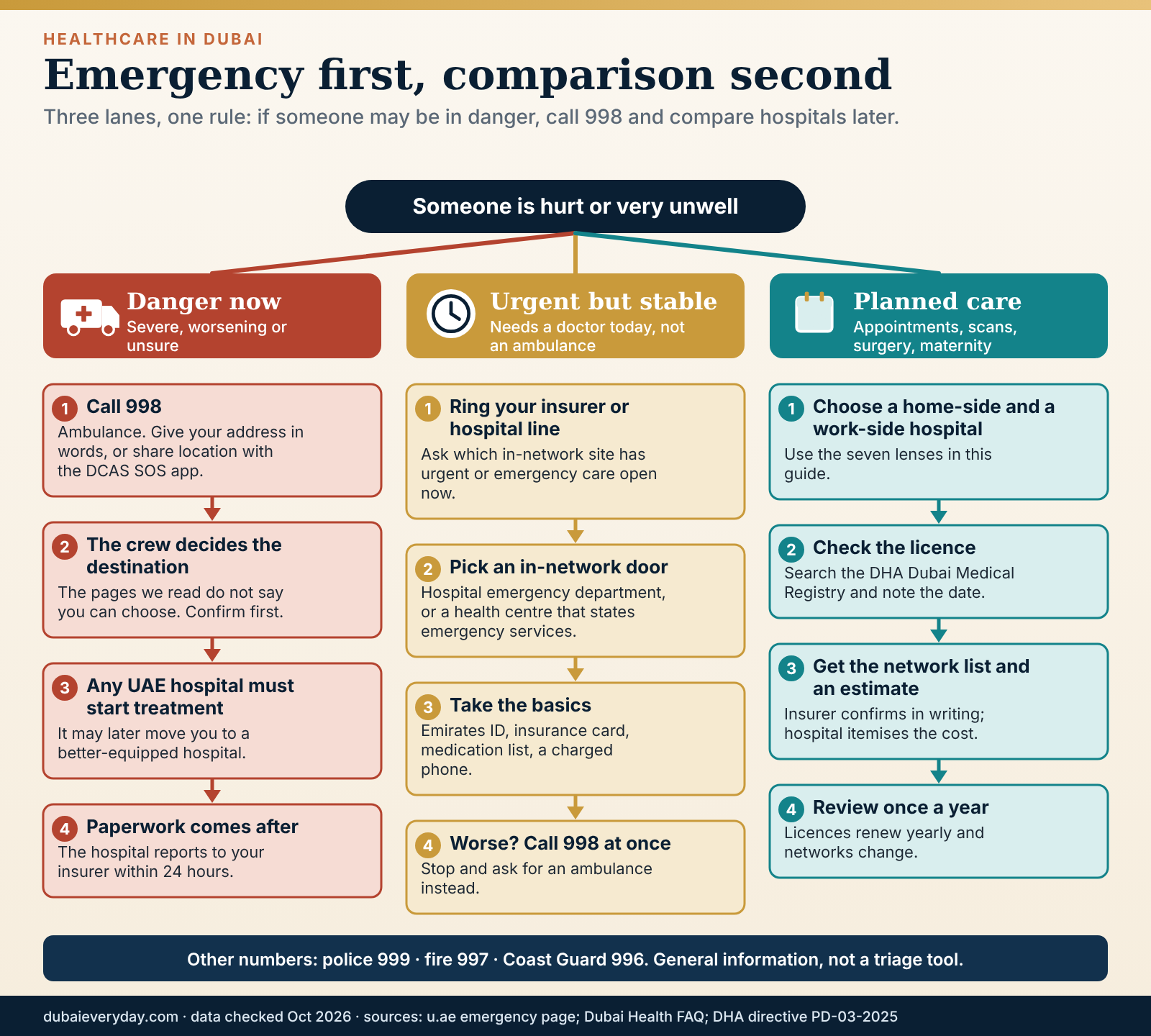
If someone is in danger right now, call 998 for an ambulance (999 is police, 997 is fire). Everything else on this page can wait.
For the shortlist, the six hospitals run by Dubai Health are confirmed from its official hospital page, and Dubai Health states that all six have emergency departments. Seven private hospitals are listed as examples to run through the same checks. The pages we could read did not display a Dubai Health Authority (DHA) licence, so each private entry carries a “Confirm first” label for the Sheryan registry.
Under Dubai’s emergency rules, insurers must cover emergency care regardless of network until you are stable. After that, your network, approvals and co-pay decide the bill. Choose one hospital near home and one near work before you need either; that pair is the only best hospitals Dubai answer that matters for your household.
Ambulance 998. Police 999. Fire 997. Coast Guard 996 (Dubai also publishes a separate Coast Guard line on the government emergency page). These are the numbers listed on the UAE government’s handling emergencies page. Do not use a comparison guide to decide whether something is an emergency. This page is general information, not medical advice, and no clinician has reviewed this draft.
This is desk research. DubaiEveryday.com has not been treated at these hospitals, has not toured their emergency departments and has not tested their booking, billing or insurance desks. Nothing here describes a personal visit, and no doctor, nurse or hospital manager has reviewed or endorsed the text.
Facts for this best hospitals Dubai comparison were read on 29 October 2026 from the Dubai Health hospital and FAQ pages, the Dubai health insurance regulation site (including the emergency coverage directives), DHA statistics published through the Dubai Media Office, the UAE government portal, and the public pages of the private hospitals named below. Some pages could not be opened or showed no detail, and those gaps are written into the text as “Confirm first”.
Selection of the best hospitals Dubai examples here is research-based, not field-tested. Hospitals are included when an official or institutional source places them in Dubai and describes an emergency or general-hospital role. Inclusion was not paid for, nothing here earns commission, and the page contains no booking links. A qualified medical reviewer has not yet checked the clinical context; until one does, treat anything medical here as orientation only.
Best hospitals Dubai: what this comparison covers and what it does not
People type “best hospitals Dubai” into a search box for very different reasons. One person has chest pain and wants the nearest emergency room. Another has just been offered a job, has a pre-existing condition and wants to know which hospitals her employer’s insurer will actually pay.
A third is planning a knee operation and is comparing prices across the hospitals that best hospitals Dubai lists keep repeating. The honest answer to all three starts with the same admission: nobody publishes a fair, public quality league table for Dubai hospitals, so any best hospitals Dubai list that crowns a number one is selling something.
What can be compared, and checked, is more practical for anyone researching the best hospitals Dubai has. You can see which hospitals state a 24-hour emergency department, which ones belong to a government network with a published insurance page, which departments they advertise, and where they sit on a map relative to your front door. You can also check, in public, whether a facility holds a current Dubai licence. That is the scope of this page.
How this page differs from the general healthcare guide
DubaiEveryday.com already has a system overview in the Dubai healthcare guide, which explains how the regulators, public and private sectors, pharmacies and appointments fit together. This page does one narrower job: it is the best hospitals Dubai comparison method. It covers emergency services, specialists, insurance networks and location, and it names facilities only to show the method at work. For how the policy itself pays out, co-pays and claims, the health insurance guide for residents goes further than we do here.
Two other pages sit nearby. The legal duty to hold cover, and the penalties for employers who do not provide it, are in the mandatory health insurance guide. Dental care has its own comparison method in the Dubai dentist guide, so this page leaves routine dentistry aside.
Why a “best hospitals Dubai” list is the wrong tool
There are three reasons, and they are specific to Dubai. First, DHA’s social media advertising standard for health facilities (reference ST-21, read for our dentist guide and not reopened for this page) bars absolute or exaggerated claims, and it names words such as “best” and “100%” as examples. A list that repeats those superlatives is repeating claims the regulator tells facilities not to make.
Second, quality depends on the condition. A hospital with a strong maternity unit may be the wrong place for a hand injury, and a trauma centre may be oversized for a sore throat. Third, what decides most people’s real-world experience of the best hospitals Dubai has is not prestige. It is whether you can get there quickly, whether your insurer will pay, and whether the doctor you need is on duty. Those are things you can plan for.
What you get here
A seven-lens best hospitals Dubai comparison method, a government shortlist confirmed from an official page, private examples with their open questions, the emergency insurance rules, and a verification route you can run in about thirty minutes.
What you do not get
A best hospitals Dubai quality ranking, clinical outcome claims, waiting-time promises, price lists we could not verify, or any recommendation of a named doctor. We have no data that would justify them.
Who it suits
Residents setting up a family plan, newcomers matching hospitals to an insurance card, visitors planning treatment, and anyone who wants a best hospitals Dubai short list before the day it matters.
The numbers behind the best hospitals Dubai question
DHA statistics published by the Dubai Media Office on 18 February 2026 put the number of licensed healthcare facilities in Dubai at about 5,800 for 2025, up from 5,340 a year earlier. The same release counts 55 hospitals. An earlier DHA release, dated 20 February 2024, counted 53 government and private hospitals for 2023. So any best hospitals Dubai shortlist is drawn from a few dozen hospitals, not hundreds, and the number is small enough that a household can reasonably learn the ones that matter to it.
One caution on those figures. The two DHA releases split facilities into different categories, so you cannot subtract one list from the other to see what changed by type. The hospital totals (53 then 55) are the only like-for-like comparison, and even that is a reading of two press summaries rather than of DHA’s full tables. The takeaway is scale, not growth rate.
Emergency first: numbers, decision flow and what happens next
A comparison guide is the wrong place to learn what to do in an emergency, so this section is deliberately short on judgement and long on facts that officials have published. Even the best hospitals Dubai has cannot help until someone reaches them, and for anything life-threatening that someone is usually an ambulance crew, not you at the wheel.
The numbers, and the app
The UAE government’s emergency page lists 999 for police, 998 for an ambulance, 997 for fire and 996 for the Coast Guard. In Dubai it also lists a separate Coast Guard line, +971 566 8243 43, which matters if the problem is on the water. For ambulances, the same page points Dubai users to the DCAS SOS app, which shares your location with the Dubai Corporation for Ambulance Services, and it notes that an air ambulance can be sent if the patient needs one.
Hospital websites for the best hospitals Dubai residents mention are less consistent than the government. The American Hospital Dubai emergency page tells readers to call 999 if they cannot reach the department, while Mediclinic pages print “999/998”. All of that is compatible: both are emergency lines. The point is to have 998 saved and to know your own building’s address in words a dispatcher can follow, because “Marina” is not an address.
What hospitals must do, and who pays
According to the government page, any UAE hospital can handle a medical emergency and will admit you for initial treatment, and it may transfer you afterwards to a facility better equipped for your condition. The same page says treatment needed to stabilise you in an emergency is free, with other treatment paid by cash, card or insurance. Dubai Health’s own FAQ reads differently: it says emergency care is not free and that coverage depends on your plan.
Those two statements can both be partly true, because the official insurance rules assign the bill in a particular order (more on that in the insurance section). Our reading is practical rather than legal: get stabilised first, expect the billing question to be settled afterwards, and do not delay a call because you are unsure about cost. Where the wording matters to you, treat it as “Confirm first” with the hospital’s billing team or your insurer.
The UAE government page says stabilising emergency treatment is free. The Dubai Health FAQ says emergency care is not free and depends on insurance. We could not reconcile the two from the pages read. If you are uninsured or a visitor, ask about charges and any deposit as soon as you are safe, and keep every receipt.
What counts as an emergency for insurance purposes
Dubai’s health insurance rules define an emergency in plain terms. Under the DHA policy directive PD 02-2017, which is hosted on the insurance regulator’s site, an emergency is a sudden illness, injury or condition with acute symptoms, severe pain included, that needs immediate and unscheduled care because delay could seriously endanger life or health, cause serious organ dysfunction or lasting disfigurement, or harm a pregnancy. The directive adds that the patient’s condition when they arrive, not the final diagnosis, decides whether immediate treatment was needed.
That second point is quietly useful. If you rush to an emergency department with symptoms that turn out to be harmless, the rules are written to judge the situation you faced, not the answer the tests later gave. It does not mean every bill will be accepted without question, and the newer directive says a specialist physician makes the determination. It does mean you should not stay home to avoid an argument with an insurer.
Which door to use
For a best hospitals Dubai emergency shortlist, Dubai Health says that all six of its hospitals have emergency departments, and that Al Barsha Health Center and Nad Al Hamar Health Center also provide emergency services. For young children it points families to Al Jalila Children’s Hospital, which handles paediatric emergencies from birth to age 18, and it says children under 13 should go there. Latifa Hospital’s page confirms its own emergency department runs around the clock for women and sends children to Al Jalila, in the same complex.
Private hospitals publish their own claims, and those claims are what many best hospitals Dubai lists repeat. The Saudi German Hospital Dubai and American Hospital Dubai pages each say their emergency department is open 24 hours a day, seven days a week, and Medcare Hospital’s Al Safa page says its department works round the clock. We list these in the private section with the caveats they need. Hospitals that do not state 24-hour emergency cover on the page we read are not assumed to have it.
Two minutes that matter. Save 998 and the DCAS SOS app on every phone in the household. Write your home and work addresses, a nearby landmark and your building’s entrance in a note on the lock screen or on the fridge. Put Emirates ID photos, the insurance card and a short medication list in one folder. None of it is clinical advice; it just shortens the questions you will be asked when you are least able to answer them.
Who decides where the ambulance goes
The pages we read do not say whether a patient can choose the destination hospital when DCAS transports them, and the emergency directives are silent on the point. Our reading is that the crew will decide based on the condition and what the receiving hospital can handle, and that you can state a preference but should not count on it. Treat that as “Confirm first” with DCAS or your insurer; do not build a plan that depends on picking your hospital from the back of an ambulance.
The billing side is clearer. Directive PD 01-2018 says ambulance services are billed to the patient’s payer at the rates in Executive Council Resolution 1 of 2018, that DHA lets DCAS check a patient’s active policy to bill the right party, and that insurers may not reject such claims or demand pre-approval. A later directive, PD-03-2025, repeats the point for patients transferred by DCAS. Both leave out what the patient personally pays, so check your policy’s ambulance wording.
After the first hour
Once the emergency is over, the insurance rules take over, and they shape which of the best hospitals Dubai offers will keep treating you. The 2025 emergency coverage directive says the hospital must report the emergency to the insurer or TPA within 24 hours, and that continuing care after stabilisation follows your policy’s terms, including prior approval.
The Essential Benefits Plan wording we reviewed for the resident insurance guide also asks for notice within 24 hours of an emergency admission where possible. So even though the hospital carries the formal duty, a short call or message from a relative to the insurer on day one is cheap insurance against a later dispute.
Keep paperwork. Ask for the discharge summary, itemised bill and any referral letters before you leave, and ask which reports are being shared through Dubai’s health information exchange. DHA’s NABIDH platform, described in our healthcare guide, is designed to let licensed facilities see a shared record, but that guide’s research did not confirm how a particular hospital uses it, so ask rather than assume.
How to compare the best hospitals Dubai offers: seven lenses
Every claim a hospital makes about itself falls into one of seven buckets. If you sort what you learn into those buckets, a messy best hospitals Dubai search becomes a short comparison you can repeat for any hospital, in any emirate, for any member of the family. The seven lenses below, which structure every best hospitals Dubai comparison on this page, are our editorial framework, built from the regulatory structure described in the sources, not a standard issued by DHA or anyone else.

Lens 1: emergency capability
When you compare the best hospitals Dubai offers on emergency capability, start with what the department says it does. A stated 24-hour emergency department is the minimum for any hospital you might use in a crisis. Then look for the detail that separates a general emergency room from a specialised one: a named trauma centre, a children’s emergency unit, obstetric cover, stroke or chest pain pathways.
Hospitals describe these in their own words, so read them as claims. The Dubai Media Office’s account of a 2023 visit to Saudi German Hospital, for example, describes a 55-bed emergency department with a trauma centre and a dedicated children’s unit; that is an official report of what the hospital showed its visitors, which is a step stronger than a brochure but still not an audit.
Lens 2: specialist depth
Depth is about the people and equipment behind the department list. Ask how many of the specialities you need are available on site, whether they are staffed round the clock or by appointment, and whether the hospital has intensive care and neonatal units if you might need them. The DHA registry lets you search doctors by speciality, so a hospital that lists cardiology can be checked for cardiologists. We return to this in the specialists section.
Lens 3: licence and accreditation
A facility licence is the legal floor, and accreditation is an optional extra. The DHA Sheryan portal says facility licences are valid for one year and renewed within three months before expiry, so a licence is a snapshot of right now, not of last year’s brochure. Accreditation, such as the Joint Commission International badge that several hospitals mention, comes from a private body, is voluntary, and is claimed by the hospital. Verify it with the accrediting body, not the hospital’s footer.
Lens 4: insurance network
This is the lens that changes the bill most often, and the one that best hospitals Dubai lists skip most often. A hospital can be excellent and still sit outside your plan’s network. The question is not “do they accept insurance” but “does my insurer’s network for my plan tier include this hospital and this department, and what needs prior approval”. The insurance section works through that, including the one case where network status stops mattering: genuine emergencies.
Lens 5: location and access
Distance in kilometres is a poor guide to the best hospitals Dubai has near you, in a city where the same road can be quick at midday and slow at school pick-up. Think in terms of the time of day you are most likely to need care, which entrance the emergency department uses, where relatives would park, and whether the route has alternatives. We cover this later, with a schematic map.
Lens 6: communication and cost transparency
In any best hospitals Dubai comparison, language support, a written estimate for planned care, a clear deposit policy and a visible complaints route are signals of how a hospital treats patients as customers. Dubai’s patient charter (Ministerial Resolution 14 of 2021, described on the UAE government’s patient rights page) sets rights that facilities should display. None of this tells you about clinical skill; it tells you how likely you are to be surprised by a bill.
Lens 7: continuity
Care rarely ends at discharge, and a best hospitals Dubai shortlist should reflect that. Look at whether the hospital runs follow-up clinics, whether you can see the same specialist again, whether a telemedicine option exists, and how your records move to your regular doctor. Dubai Health, for example, says on its FAQ page that patients can book virtual consultations in the same way as in-person appointments.
Rate fit and evidence separately. Score each lens twice. First, how well does the hospital meet your need, from 0 to 3? Second, how good is the evidence: 1 means only the hospital says so, 2 means an official or independent source says so, 3 means you checked it yourself in the registry or by phone.
Multiply fit by how much the lens matters to your household (0 to 3) and add up. Then list every lens where evidence is still 1. That list is your to-do list. The total is a fit score for your situation, never a quality score for the hospital.
A worked example with invented hospitals
Illustrative example (not a quote or market fact). A family with a toddler and a mother on regular medication rates the lenses by importance: emergency 3, specialist depth 2, licence 3, network 3, location 3, communication 1, continuity 2. The best possible total is 51. Hospital A is close to home and states a children’s emergency unit on its own page, and the insurer’s app lists it. Hospital B is further away, and the family has phoned its department and looked it up in the registry.
Hospital A earns fit scores of 3, 2, 3, 3, 3, 1 and 1 across the seven lenses, which multiplies out to 43. Hospital B earns 2, 3, 3, 3, 1, 2 and 2, which comes to 39. A wins on paper.
But two of A’s strongest lenses, emergency and licence, rest on evidence level 1, because nobody has checked them. The sensible move is to phone A’s department and search the registry before trusting that 43. If the claims hold, A is the better household fit. If they do not, B was the safer pick all along.
What we did and did not score
We applied the best hospitals Dubai framework only to what is publicly visible and only for evidence, not quality. For each hospital in the shortlists we recorded what the official or hospital page says about emergency care, where it is, and what we could not confirm. We did not score clinical skill, wait times, patient satisfaction or price, because we have no verified data on any of them. If you see a Dubai hospital ranking elsewhere that does, ask where the data came from.
Hospital types: where each kind of facility sits on the ladder
Dubai licenses a wide range of facilities, and a large share of the confusion in the best hospitals Dubai searches comes from lumping them together. DHA’s 2025 statistics, as published through the Dubai Media Office, list hospitals (55), day-surgery centres (60), specialised clinics, general medical clinics, general dental clinics, home healthcare centres and alternative medicine centres among its categories. The Sheryan FAQ adds fertility centres and polyclinics to the facility types it mentions. A “hospital” in the narrow licensing sense is the group at the top of the ladder, with inpatient beds.

The rungs, from the bottom
At the bottom are self-care, pharmacies and telemedicine. Dubai Health says its virtual consultations can be booked like any other appointment, and many insurers include virtual visits in their plans; the Essential Benefits Plan wording we reviewed lists them as covered. Next come general and family clinics, where a GP is also the gatekeeper for referrals under the basic plan. After that sit specialised clinics and polyclinics, then day-surgery centres for planned procedures that do not need an overnight stay.
Above those are facilities with emergency capacity but no full hospital behind them. Dubai Health’s FAQ names Al Barsha Health Center and Nad Al Hamar Health Center as providing emergency services, which makes them a useful step between a clinic and a hospital for some problems. We have no verified detail on what they can and cannot treat, so ask before relying on one.
General, specialty and tertiary hospitals
A general hospital covers a broad range of medicine and surgery with inpatient beds, an emergency department and intensive care. A specialty hospital focuses on one area, such as women and children, eyes or rehabilitation. The Dubai Health page for Dubai Hospital calls it a multispecialty tertiary hospital, and the DHA insurance directive PD 02-2017 refers to “DHA Tertiary Hospitals” as the one place a stable-but-unfit-for-transfer patient may be moved. In other words, the regulator itself distinguishes tertiary hospitals, even if the public pages do not publish a full list.
Be careful with the word “specialty” in a name on a best hospitals Dubai list. A specialty hospital may have an emergency department or may not. The Moorfields Eye Hospital Dubai entry on the British government’s medical facilities list, for example, is described as private and ophthalmology-focused; that tells you what it treats, not that it takes walk-in emergencies of every kind.
Free zone hospitals and the double check
Dubai Healthcare City (DHCC) is a free zone with its own health regulator, and several private hospitals that turn up in best hospitals Dubai searches sit inside it. Our dentist research found that DHCC clinics are licensed by the free zone’s regulator and that DHA licences also matter; the details differ by activity.
In practice: for a DHCC hospital, check the Sheryan registry and DHCC’s own regulator pages, and do not assume that being in a free zone means being outside Dubai’s rules. Mark this as “Confirm first” for any DHCC facility until you have seen both.
Government hospitals: the Dubai Health shortlist
This is the part of the best hospitals Dubai shortlist we can confirm from a single official source. Dubai Health’s own hospital page lists six hospitals in Dubai, plus a seventh, the Hamdan Bin Rashid Cancer Hospital in Al Jaddaf, marked “Opening soon”. The page text says “six hospitals” while showing seven entries, which is exactly the sort of small mismatch worth knowing about: the seventh is not open for patients according to that page, so do not plan around it.
Dubai Health is the Dubai Government’s health system, and our healthcare guide’s research notes that it took its current name in November 2023. Its pages describe all six open hospitals as offering inpatient, outpatient and emergency services, accredited by the Joint Commission International and at stage 6 of the HIMSS EMRAM digital maturity model. Those are the network’s own statements. We repeat them as claims, not as audit results.
| Hospital | Area (as listed) | What its page says | Emergency |
|---|---|---|---|
| Rashid Hospital | Umm Hurair | Emergency and Trauma Center with a multidisciplinary team; departments include critical care, cardiac care and neurosciences | 24/7 (stated) |
| Dubai Hospital | Al Khaleej Street, Deira | Multispecialty tertiary hospital operating since 1983; centres of excellence in cancer care and ophthalmology | 24/7 (stated) |
| Latifa Hospital | Al Jaddaf | Women, babies and children; pregnancy, childbirth, gynaecology and neonatal units; opened 1987 | 24/7 for women; children go to Al Jalila |
| Al Jalila Children’s Hospital | Al Jaddaf | Children’s hospital in the same complex as Latifa; paediatric emergency care from birth to 18 per the FAQ | Paediatric emergency (per FAQ) |
| Jebel Ali Hospital | Dubai Industrial City | Network hospital; no per-hospital detail on the pages read | Has an ED (per FAQ) |
| Hatta Hospital | Hill Park, Hatta | Network hospital for the Hatta area; no per-hospital detail on the pages read | Has an ED (per FAQ) |
The table reflects what each Dubai Health page said on 29 October 2026. “Stated” means the hospital’s own page says it. Where the page was silent, we say so rather than fill the gap from memory.
What each hospital is, in plain terms
Rashid Hospital
The hospital Dubai Health describes as having an Emergency and Trauma Center serving Dubai and the Northern Emirates. It is in Umm Hurair. Read that as the network’s trauma-heavy emergency address, subject to your own location and condition.
Dubai Hospital
A tertiary multispecialty hospital in Deira, open since 1983, with cancer care and ophthalmology named as centres of excellence. It is the obvious reference point for the Deira, Al Rigga and Bur Dubai side of the creek.
Latifa Hospital
Focused on women and newborns, including high-risk pregnancy and neonatal units. It holds UNICEF Baby-Friendly status according to its page. Its emergency department is for women; children are directed next door.
Al Jalila Children’s Hospital
The network’s children’s hospital, sharing a complex with Latifa in Al Jaddaf. Dubai Health says its paediatric emergency care covers patients from birth to age 18 and that children under 13 should go there.
Jebel Ali Hospital
Located in Dubai Industrial City. For anyone living or working along the southern stretch of the emirate, it is the Dubai Health hospital on that side. We found no per-hospital detail, so ask what it covers.
Hatta Hospital
The network hospital for the mountain enclave of Hatta, listed at Hill Park. If a day out in Hatta is on your plan, knowing this exists is worth the ten seconds, though we have no verified detail on services.
Insurance and access
Dubai Health publishes an insurance partners page that lists ten insurers and administrators on its first page of three, so the full list is longer than what we could see. The page also says the network accepts guarantees of payment from all international and travel insurance plans, and tells patients to contact their insurer directly to start the approval process.
We could not find a page that spells out which expatriates can use which government services for non-emergency care, so treat eligibility as “Confirm first” and call the 24/7 line, 800 60, which is the number printed on the hospital pages.
There is one rule worth knowing about in advance. The regulator’s contractual-relationship circulars and emergency directives treat public hospitals under the Government of Dubai differently in one respect: a 2022 circular, GC 04-2022, excludes them from the standard 1.3 negotiation factor that otherwise applies to out-of-network emergency claims. We only saw the title of that circular, not its text, so it is mentioned here for completeness rather than as advice.
How the government network fits the seven lenses
On emergency capability, the government half of the best hospitals Dubai shortlist is strong on paper: every hospital is said to have an emergency department, with trauma, women’s and children’s emergency care assigned to named sites. On licence, a government operator does not remove the need to check, but the facility licences are the regulator’s own to see. On network, the insurance partners page is explicit.
On location, the six sites cluster around Umm Hurair, Deira and Al Jaddaf in the older central districts, with one in the south-west and one in the mountains. For many households in Marina, Palm Jumeirah or Dubai Hills, a government hospital is not the nearest one, which is why the private half of any best hospitals Dubai shortlist matters.
On specialists, the pages list departments but not the number of consultants, and on continuity, the network says patients can book through the Smart App, the website or the 24/7 line, with virtual consultations available. The honest summary is that the Dubai Health network is the best-documented starting point for anyone building a best hospitals Dubai shortlist, which is a statement about documentation, not about care quality.
If you live around Downtown Dubai, the central creek-side districts of Umm Hurair and Al Jaddaf are the closest of these sites, though the journey time depends on the hour and the route, which no page we read publishes.
Private hospitals: examples to run through the method
The private side is where the best hospitals Dubai searches get noisy, and where our evidence is thinner. Most private hospitals publish a polished website, but the pages we could read rarely displayed a DHA licence number or statement, and the registry that proves the point (Sheryan) is a search portal rather than a printable list. We therefore treat the seven entries below as examples to check, not as a verified best hospitals Dubai roll of honour. Every one carries “Confirm first” for the licence.
How these seven were chosen
We included a private hospital when at least one official or institutional source placed it in Dubai in a general-hospital or emergency role. The sources were the Dubai Media Office, the British government’s published list of medical facilities in the UAE (updated March 2023, which is a consular convenience list and explicitly not an endorsement), the Dubai Healthcare City press office, and the hospital’s own public page.
We aimed for a spread of areas. We did not choose by size, price, reputation or advertising, and we make no claim that other hospitals are worse. Dubai has 55 licensed hospitals, so seven examples are a sample, not a best hospitals Dubai ranking.
| Hospital | Area (source) | What the source says about emergency care | Licence |
|---|---|---|---|
| American Hospital Dubai | Not stated on pages read; widely described as Oud Metha | Own emergency page: open 24/7; paediatric and obstetric cases; burns, fractures and head or spinal injuries listed | Confirm first |
| Saudi German Hospital Dubai | Al Barsha (Dubai Media Office) | Own page: 24/7 department with trauma and chest pain accreditations claimed; Media Office report: 55-bed department with trauma centre and children’s unit | Confirm first |
| Mediclinic City Hospital | Dubai Healthcare City (own page; FCDO list) | Emergency number 999/998 and an emergency page are shown; round-the-clock cover not stated on the page read | Confirm first (free zone: also check DHCC) |
| King’s College Hospital London, Dubai Hills | Dubai Hills, Al Khail Road (own page; FCDO list) | Own page lists a 24/7 emergency hospital department; no detail on hours or services beyond that | Confirm first |
| Medcare Hospital, Al Safa | Opposite Safa Park Gate 1, Jumeirah (own page) | Own page: emergency department works round the clock for medical and surgical emergencies; 64 beds | Confirm first |
| Clemenceau Medical Center Dubai | Dubai Healthcare City Phase 2, Al Jaddaf (FCDO list; DHCC news, 2016) | Described in 2016 as a planned general hospital; current emergency role not confirmed from a current page | Confirm first (free zone) |
| Moorfields Eye Hospital Dubai | Dubai Healthcare City, Al Razi Building (FCDO list) | Listed as private, ophthalmology; not a general emergency address; eye-emergency role not confirmed | Confirm first (free zone) |
Other private hospitals that a best hospitals Dubai article could fairly have featured appear on the same British list, among them Mediclinic Parkview in Al Barsha, Mediclinic Welcare in Al Garhoud and Valiant Clinic and Hospital at City Walk. We did not examine them in detail, and the Welcare page we opened did not state its emergency hours. Leaving them out is a limit of this page, not a judgement.
What we can and cannot say about each
American Hospital Dubai’s emergency page is the most detailed of the group on conditions: it lists injuries, illnesses, surgical problems, burns, fractures and head, neck and spinal injuries, and says paediatric and obstetric cases are seen. It also says its emergency physicians are American Board-certified, which is a statement about individual doctors, not a facility accreditation. The page gives no street address and no licence statement.
Saudi German Hospital Dubai’s emergency page describes itself as a certified trauma centre and an accredited chest pain centre, and lists cardiac, stroke, breathing, seizure and pregnancy-related emergencies. The Dubai Media Office report on a 2023 ministerial-level visit adds that the hospital had 200 beds and over 150 outpatient clinics then, and that the Director General of DHA received the visitor. That is the closest we found to an official acknowledgement, but the report does not mention licensing.
Mediclinic City Hospital’s page says it has 280 beds, opened in 2008 as the first multidisciplinary hospital in Dubai Healthcare City, and mentions JCI-related accreditation news items from 2021. The page showed a stroke unit, a heart and vascular centre and a cancer centre among its services. It did not state 24-hour emergency hours in the text we could read, though it lists an emergency page and the 999/998 numbers.
King’s College Hospital London’s Dubai Hills campus lists over 80 services and describes itself as JCI accredited. Its main phone line is printed in the footer. The footer also shows a code labelled “MOH”, which we could not interpret and do not treat as evidence of a DHA licence. Medcare’s Al Safa hospital describes itself as a JCI-accredited multi-specialty facility with a round-the-clock emergency department. All of these accreditation statements are the hospitals’ own.
What a “24/7 emergency department” does and does not tell you
It tells you the doors are open. It does not tell you what is behind them at 3 a.m. Before you rely on any hospital for a particular kind of emergency, there are specific questions worth asking, ideally on a calm afternoon rather than in a car park.
- Is an emergency physician in the department at all hours, or on call from elsewhere in the hospital?
- Is there a separate area or team for children, and from what age?
- Is obstetric cover available in the department itself, or does it route to a labour ward?
- Are CT and MRI scanning, a laboratory and a blood bank on site and available overnight?
- Are intensive care and neonatal intensive care beds in the same building?
- Is there a catheterisation lab or neurosurgery team on call for heart or head emergencies, and what happens if there is not?
- If the hospital cannot treat your condition, which hospital does it transfer to, and who arranges the ambulance?
Those questions are not medical advice. They are the same questions a careful relative would ask a hospital manager when comparing the best hospitals Dubai offers, and a hospital that answers them clearly and specifically has told you something real. A hospital that answers with a brochure has also told you something.
Where each private example sits on the seven lenses
On emergency capability, the strongest evidence in this list is the Saudi German Hospital’s combination of its own page and the Dubai Media Office report, followed by American Hospital Dubai, Medcare Al Safa and King’s, each with a 24-hour claim on its own page.
Mediclinic City, Clemenceau and Moorfields have weaker emergency evidence in what we could read. That is an observation about documentation, not about care. If one of them happens to be your insurer’s preferred hospital, a phone call to the emergency desk settles the matter faster than any web page.
On location, they spread across Al Barsha, Jumeirah, Dubai Hills, Dubai Healthcare City and Al Jaddaf, which gives most households at least one private and one government option to test on the map. The location section turns that into a plan. For more on how insurers’ networks usually treat private hospitals, see the Dubai insurance guide.
Specialists, centres of excellence and accreditation claims
When people search for the best hospitals Dubai has, what they often mean is “where is the best doctor for my problem”. A hospital’s name is a poor stand-in for that. The practical approach is to check three layers in order: the facility, the department and the individual doctor. Most public confusion comes from mixing them up.
Check the doctor, not the logo
For any best hospitals Dubai shortlist, DHA’s Sheryan portal hosts the Dubai Medical Registry, with separate tabs for professionals and facilities. According to the portal’s public directory page, professionals can be filtered by licence type, category, speciality, language, area, facility, nationality and gender. The portal’s FAQ adds that a professional’s status can show as active or inactive, and that professionals should not practise until active.
So a name on a hospital website is a claim, while a result in the registry is the regulator’s current record. We could not run a live search from our research setup, so the exact fields you will see are described from the portal’s own pages and a 2022 Gulf News explainer; look at the screen rather than trusting our description.
Two practical checks follow. First, search the doctor’s name and confirm the speciality shown matches what you were told. Second, look at which facility the licence is tied to. Dubai’s licensing resolutions, announced in 2024 and described in our healthcare guide, ended unlicensed and visiting-doctor arrangements, with closures or suspensions of up to three months as the penalty; that is press-reported, so confirm the current rule with DHA before relying on it.
Titles, advertising and the word “best”
DHA’s advertising standard for social media, as summarised in our dentist research, requires that professional titles match the licence and that “Dr” is used only for physicians, dentists and recognised PhD holders. It also bars exaggerated claims.
The practical effect for a patient is this: a clinic page that calls someone “the best surgeon in Dubai” is either breaking the guidance or not describing a Dubai-licensed professional. Neither is reassuring. If a hospital’s marketing leans heavily on superlatives, as some best hospitals Dubai pages do, put more of your effort into the registry check, not less.
The same logic applies to cosmetic work. Aesthetic procedures are mostly delivered in clinics rather than hospitals, and they follow their own rules, covered in the dermatologist guide, the Botox guide and the dermal filler guide. This page is about hospital care, where the stakes and the paperwork are different.
“Centre of excellence” and other phrases that need unpacking
Hospitals love the phrase, and best hospitals Dubai lists love repeating it. Dubai Health’s page for Dubai Hospital names cancer care and ophthalmology as centres of excellence. King’s College Hospital’s Dubai Hills page lists several, among them surgical proctology, endoscopy, orthopaedic surgery, breast treatment and spine surgery. We found no regulatory definition of the phrase in the sources we read.
Treat it as the hospital’s way of saying “we put effort and investment here” and then ask for substance: how many specialists work in the unit, whether a multidisciplinary team reviews complex cases, how many procedures of your type the unit performs in a year, and who covers when the lead doctor is away.
Those questions are fair, and a good hospital expects them. Ask them in writing or by phone, and keep the answers with your records. If a unit cannot give you a straight answer on its own volume or team, you have learned something useful without any rankings.
What accreditation does and does not mean
JCI accreditation
Several hospitals describe themselves as accredited by the Joint Commission International, a private body. It looks at processes such as safety and quality systems. It is voluntary and time-limited, and it is stated here by the hospitals themselves. We could not open JCI’s public directory, so we have not verified any private hospital’s claim.
HIMSS EMRAM stage
Dubai Health says its hospitals reached stage 6 of this model. It measures how far a hospital’s electronic records are developed. It says something about digital maturity, not about clinical results.
Programme badges
Latifa Hospital’s UNICEF Baby-Friendly status concerns breastfeeding support. “Certified trauma centre” or “accredited chest pain centre” on a private hospital’s page refers to a specific programme. Ask which body certified it and when.
Accreditation is a useful tiebreaker between two hospitals that are otherwise equal on a best hospitals Dubai shortlist. It is not a reason to skip the registry check, the network check or a conversation with the department. And it is never a substitute for knowing whether the particular doctor you will see is licensed in the speciality you need.
Referrals, second opinions and telemedicine
The Essential Benefits Plan, the minimum standard for policies issued in Dubai, ties specialist cover to a referral from a licensed GP via an e-referral, according to the insurer-hosted copy of DHA’s circular we reviewed for the resident insurance guide. Many employer plans are more generous and let you see a specialist directly, but plans differ, so read your own table of benefits. If you are on a plan with a referral requirement and you walk into a specialist’s clinic uninvited, the bill may be yours.
For a serious diagnosis, a second opinion from a different hospital’s specialist is a normal request. Telemedicine can help here: Dubai Health says patients can filter its appointment page for doctors offering virtual consultations. Ask whether your insurer covers a second opinion and whether scans from the first hospital can be shared in digital form, which saves repeating imaging.
A short list of questions for any specialist unit
- Who will treat me?Ask for the name and registry category of the doctor, not just the department.
- What is the plan if something goes wrong?Ask which beds, ICU and on-call teams support the unit overnight and at weekends.
- What does this cost, in writing?Request an itemised estimate with the doctor’s fee, facility charges, implants or consumables, and a note of what insurers usually decline.
- Is it covered, and who has approved it?Ask the insurer, not only the hospital, whether prior approval is on file and for how many days it is valid.
- Where do my records go afterwards?Ask for a discharge summary and imaging copies, and for the follow-up schedule.
Insurance networks: how cover, networks and emergencies interact
In a city where most residents are insured through an employer, the best hospitals Dubai has for your household are the ones your policy lets you use without a fight. That sentence sounds cynical, but it follows from the structure of the system. A hospital is a place; a network is a contract. You can be standing in the former and be outside the latter.
Policy, network and approval are three different things
Your policy says what is covered and what you pay: co-pay percentages, annual limits, exclusions. Your network says where the insurer has agreed prices and billing arrangements with providers. A prior approval is a case-by-case permission for a specific treatment, which the hospital usually requests and the insurer grants or refuses. A hospital can accept your insurer’s name and still decline your plan’s tier, and a procedure can be covered in principle yet unapproved in practice. Always ask which of the three is the problem.
The legal base is Dubai Law No. 11 of 2013. Employers must insure employees, sponsors must insure dependants, and since 1 January 2025 the UAE government says a policy must be bought before applying for or renewing residency permits for private-sector employees and domestic workers. Our health insurance mandate guide sets out the duties and penalties, and the resident cover guide explains the plan mechanics. This page deals with only one slice: how insurance shapes the best hospitals Dubai choice for your household.
How networks work in Dubai
The insurance regulator publishes lists of permitted insurers, participating insurers, permitted third-party administrators and permitted intermediaries on its site, and it issues circulars on the contractual relationship between healthcare providers and insurers (GC 03-2023 and GC 01-2024; we saw the titles, not the text). In plain terms: networks are built by contract between insurers or their TPAs and each hospital. The regulator sets the framework, but the list of hospitals in your network belongs to your insurer.
The DHA minimum plan, the Essential Benefits Plan, allows a limited network as long as there is adequate geographic access, according to the insurer-hosted copy of DHA Circular GC 03/2024 we reviewed. That is the reason two colleagues with the same employer can end up with different best hospitals Dubai shortlists if they hold different plan tiers. It is also why the number you should care about is the one on your own policy schedule, not a hospital’s statement that it “accepts all major insurance”.
The emergency rule that overrides the network
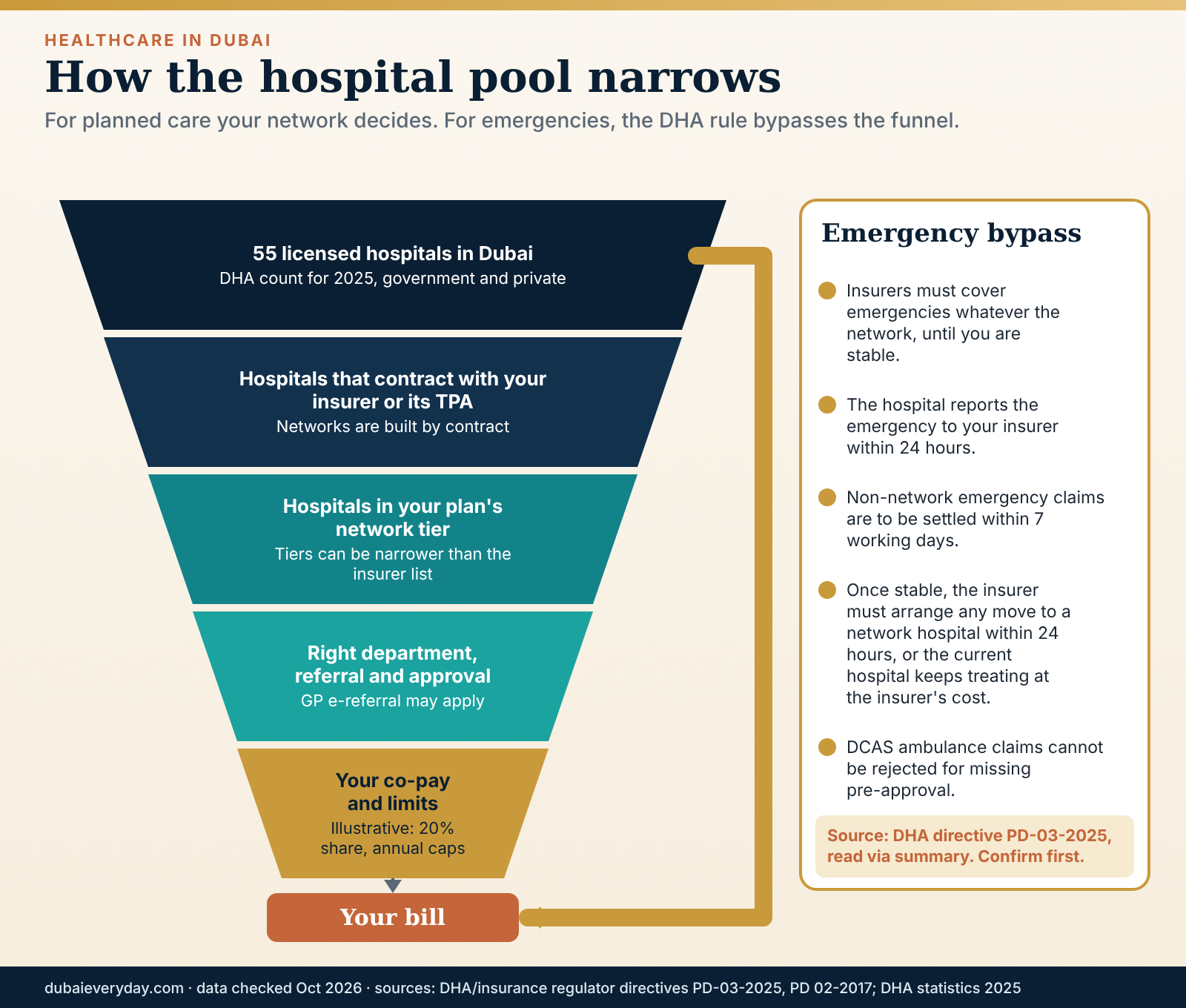
The most important sentence in this whole area is in the emergency coverage directive, PD-03-2025, which the regulator hosts on its insurance site. We read it through an automated summary and cross-checked the main points against the earlier directive PD 02-2017. It says that insurers must cover emergencies regardless of network affiliation and must not reject or delay emergency claims because of network status, location or lack of pre-authorisation. A summary is not the legal text, so the details below are marked “Confirm first” where they matter.
- Providers must give immediate emergency care regardless of insurance status or network membership, and must report the emergency to the insurer or TPA within 24 hours.
- Insurers must settle non-network emergency claims within seven working days, through the eClaimLink system.
- A standard negotiation factor of 1.3 applies to out-of-network emergency claims. Public hospitals under the Government of Dubai are excluded, according to a 2022 circular’s title.
- Insurers cannot reject claims for DCAS ambulance transfers because pre-authorisation is missing, and DCAS bills the payer under the 2018 ambulance directive.
- If an employer or sponsor never enrolled someone who should have been insured, they are liable for the emergency costs, whatever the cause of the emergency.
- Examples of penalties include AED 10,000 per incident for a provider that fails to treat an emergency patient until the threat to life has passed.
The emergency is defined as over when the patient is stable. At that point the directive distinguishes two cases. If the patient is stable and fit for transfer and the insurer wants to continue care at a network hospital, the insurer has to arrange the transfer within 24 hours of notice.
If it does not, the current hospital keeps treating, and the insurer bears the cost from the moment the patient became transferable. If the patient is stable but not fit to move, they stay, and the 2017 directive says the only exception is a move to a DHA tertiary hospital.
What does that mean for choosing among the best hospitals Dubai offers? The first call you make in a crisis does not need to depend on your card. But the second decision, the one after stabilisation, does.
If you are admitted to a hospital outside your network and told you can be moved, your insurer may ask you to transfer, and the hospital must keep treating you at the insurer’s cost if the insurer does not organise the move in time. You can also ask to stay and negotiate. Expect to be given a choice of who pays for what, and ask for it in writing.
A worked example of the 1.3 factor
Illustrative example (not a quote or market fact). Suppose a reference tariff line for an emergency service is AED 1,000. If the factor of 1.3 works as a multiplier on that line, the insurer would owe AED 1,300 to an out-of-network hospital for that line. This is our reading of a summary, not DHA’s explanation. Its significance for patients is indirect: it means insurers have a price incentive to move stable patients to their own network quickly, and it shows why a discharge or transfer conversation can start early in an admission.
Planned care: where network status bites
For anything non-emergency, the network matters a lot when you pick among the best hospitals Dubai offers. The basic plan wording we reviewed requires prior approval for non-urgent inpatient admissions and for MRI, CT and endoscopy outside emergencies. Policy details such as co-pay shares, annual limits and a cap on inpatient co-pay differ from plan to plan, and the official pages we read disagree with each other on outpatient percentages and medicine limits, as our resident guide notes. So the checklist below is a set of questions, not answers.
- Is this hospital in my plan’s network for inpatient and outpatient care, and for the specific department?
- Do I need a GP e-referral before seeing a specialist or having a scan?
- What needs prior approval, who requests it, and how long is it valid?
- What is my co-pay for consultation, lab, imaging, medicines and an overnight stay?
- Is there an annual limit that this treatment could use up?
- If I go out of network, is anything reimbursed, and on what basis?
- Does the hospital bill the insurer directly, or do I pay and claim?
Co-pay arithmetic, illustrated
Illustrative example (not a quote or market fact). Take a planned outpatient MRI billed at AED 2,400. On a plan that charges a 20% share on radiology, you pay AED 480. The same scan at an out-of-network hospital might be declined, in which case the full AED 2,400 is yours; the plan’s table of benefits tells you which.
Now take an overnight admission billed at AED 30,000. Under the minimum plan described in the insurer-hosted DHA circular, the inpatient share is 20% but capped at AED 500 per encounter and AED 1,000 per year, so the out-of-pocket amount for that bill would be AED 500. The cap looks generous, and it is, but only inside the network and only for covered services.
For comparison, the UAE government’s federal basic-plan page describes outpatient visits at 25% capped at AED 100, and the DHA circular describes 20% for outpatient consultations. Two official sources, two numbers; the resident guide flags the same mismatch. If your plan is the federal product, the arithmetic above changes. This is why your own table of benefits beats any guide, including this one.
Employer plans, tiers and the “good plan, wrong hospital” problem
Employer plans vary more than the minimum plan suggests. Some include wide networks and some restrict members to a handful of hospitals. If you have a choice at joining, ask HR for the network list in writing before you accept; if you have no choice, read the list as soon as the card arrives.
It is easy to find, in the first week, that the nearest hospital to your flat is outside your tier, and much harder to fix that after a hospital stay. Our moving to Dubai guide and the relocation checklist both put insurance paperwork early in the timeline for the same reason.
Self-employed residents and sponsors buying individual or family plans have more control and more homework. The network is part of the price, and the cheapest premium often comes with the narrowest list. A short best hospitals Dubai list of two nearby hospitals you would actually use, checked against each candidate plan, beats any comparison of premiums alone. For the wider picture, the insurance overview compares health with car, home and travel cover.
Complaints when the network or approval goes wrong
Our resident guide notes that Sanadak runs a resolution process for financial and insurance disputes in which you contact the insurer first, and that the patient charter gives you a route to complain about a facility. We could not confirm which body takes which type of health insurance complaint, so ask the insurer for its complaint procedure in writing and keep every reference number.
If a hospital refused emergency care because of insurance, that is a different matter, and the directive’s penalty for providers who fail to treat an emergency suggests the regulator takes it seriously. Report it to DHA, whose Health Regulation Sector line is published as 800 342; confirm the number and hours before you call.
Location and logistics: a hospital near home and a hospital near work
Most lists of the best hospitals Dubai offers treat location as a footnote. It deserves better. The same emergency department can be a short hop at midday and a slow crawl in the evening rush, and you do not choose when you need it. The most useful habit is to pick two reference hospitals in advance: one on the home side and one on the work side. If you also have children or a pregnancy in the household, add a third for them.
Reading the map by area
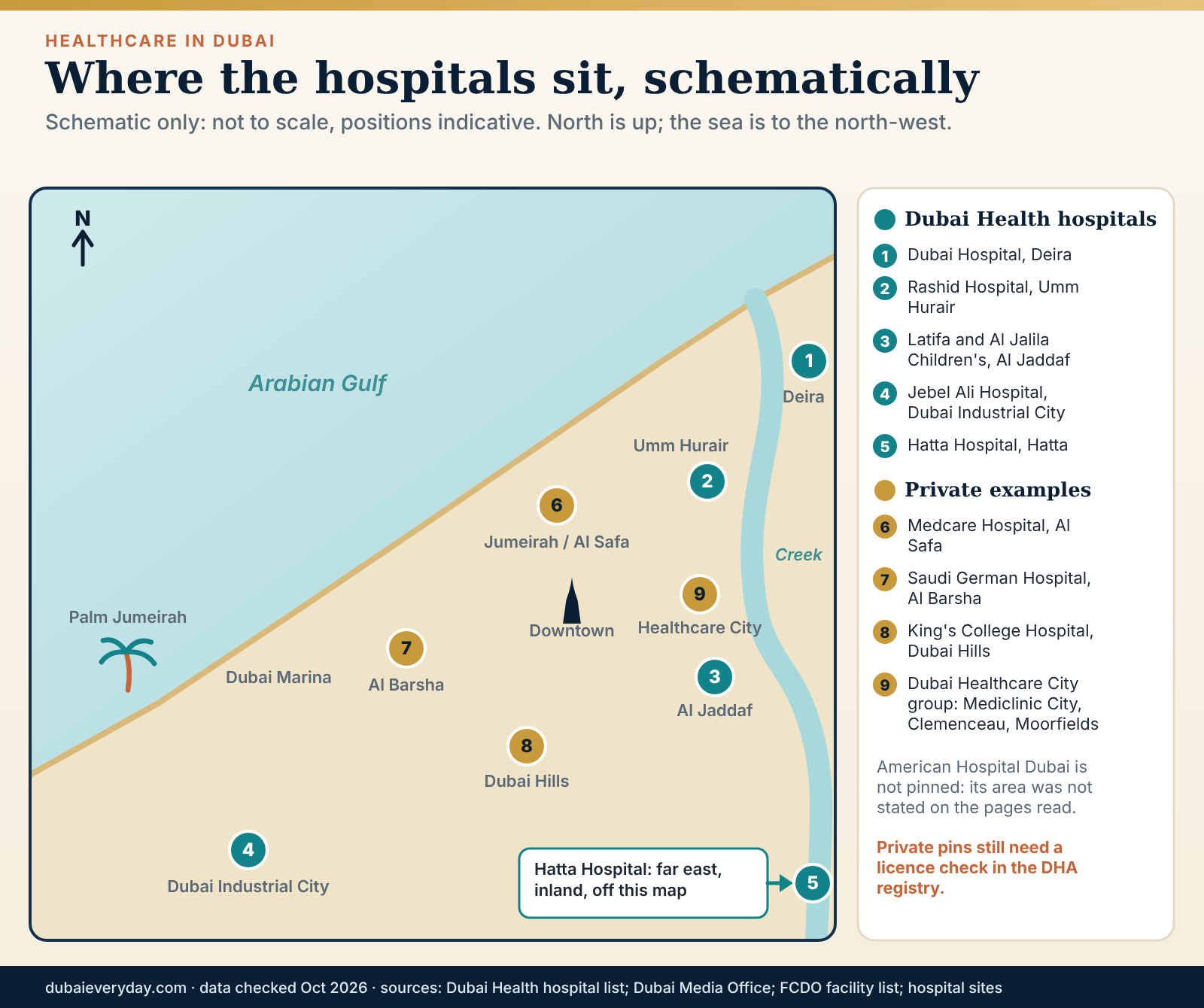
On the schematic, the Dubai Health hospitals cluster on the creek side of the city: Dubai Hospital in Deira, Rashid Hospital in Umm Hurair, and Latifa and Al Jalila Children’s in Al Jaddaf. Jebel Ali Hospital sits inland in Dubai Industrial City, and Hatta Hospital is well to the east in the mountains, off the map’s usual frame.
The private examples spread along the main axis: Medcare near Safa Park in Jumeirah, Saudi German in Al Barsha, King’s in Dubai Hills, and the Dubai Healthcare City group (Mediclinic City, Clemenceau, Moorfields) near Al Jaddaf.
If you live in Dubai Marina or on Palm Jumeirah, none of the hospitals we confirmed sits within your own district. Nearer on the map are the Al Barsha and Dubai Hills options, which is a geographical observation and not a recommendation. Around Downtown Dubai and Business Bay, the creek-side group is the closest. The sources give no journey times, and we are not going to invent them.
The three-hour dry run
Instead of trusting a distance figure on a best hospitals Dubai list, run a simple test using any mapping app. For each candidate hospital, check the estimated drive time at three moments: the morning commute, the evening commute and late at night. Write down the worst of the three and the best. A hospital that is twelve minutes away at 2 a.m. and fifty minutes away at 6 p.m. is, for planning purposes, not a twelve-minute hospital. This is our method, not an official standard, and the numbers are yours to collect.
For a medical emergency, an ambulance is the answer, and the ambulance crew’s route is theirs to choose. But for everything short of that, such as a fever that will not break at 7 p.m. or a child’s injury that is serious but stable, the family’s own transport decision matters. Know your route, know the entrance, and know whether parking is a problem at the other end. Ask the hospital’s information line about emergency entrances and parking, since we found no published detail.
Who should weigh location most heavily
- Households with infants, toddlers or someone in late pregnancy.
- People with a heart, lung or neurological condition who have been told to expect urgent episodes.
- Anyone living far from the central districts, such as Dubai South, Jebel Ali or Hatta.
- People without a car, who depend on taxis or the Metro for non-emergency visits.
- Families with elderly relatives who find long waits and long journeys hard.
Add a hospital check to the home search
If you are still choosing where to live, put your best hospitals Dubai check into the viewing routine. The renting guide and the apartment viewing checklist cover buildings, fees and contracts; none of them will tell you how far the nearest emergency department is at 6 p.m. Add that to your list. The same goes for the district you pick when comparing the cost of different neighbourhoods in the cost of living guide: a cheaper rent that adds forty minutes to a hospital trip is not necessarily cheaper.
Days out, heat and remote places
On a desert trip, a Hatta hike or a day on the water, the nearest emergency department may be a long way off. Tell someone where you are going, carry the policy number, and save the emergency numbers, including the Dubai Coast Guard line for the sea.
Operators of organised trips, such as those discussed in the desert safari guide, typically describe their own safety arrangements; ask about them in advance. Summer heat is a separate concern, covered from the visitor’s side in the best time to visit Dubai page, and it is a reason not to leave a hospital check until after you arrive.
Children, pregnancy, injuries, long-term care and planned surgery
The general best hospitals Dubai method holds for every situation, but some situations tilt the weights. Here is how the seven lenses shift for the cases that come up most often. None of this is medical advice, and in every case a doctor who knows your history outranks a guide that does not.
Children and babies
For emergencies, Dubai Health points children to Al Jalila Children’s Hospital: paediatric emergency care from birth to 18, with children under 13 directed there, as the FAQ puts it. Private hospitals vary. The Dubai Media Office report on Saudi German Hospital mentions a dedicated children’s emergency unit, and American Hospital Dubai’s page lists paediatric cases among those it sees.
For everyday needs, a paediatric clinic near home matters as much as a hospital. The Dubai with kids and Dubai with a baby guides cover family logistics, and this best hospitals Dubai guide covers the hospital side: know your nearest children’s emergency address before the first fever.
Pregnancy and birth
Latifa Hospital’s page describes services for low- and high-risk pregnancy, childbirth, gynaecological surgery and neonatal units, and several private hospitals advertise maternity wings. The decisions here are planned, so lean on the planning lenses: network, estimate and continuity.
The Essential Benefits Plan wording we reviewed covers maternity with a 10% share and prior approval, limits of AED 10,000 for a normal delivery and AED 10,000 for a caesarean or complications, eight antenatal visits and three scans, and gives a newborn the mother’s benefits for 30 days. Those limits are tight against typical delivery bills, so ask your hospital for a package price and your insurer what happens above the limit. Hospital delivery bills are not published, so we give none.
Injuries and trauma
Rashid Hospital describes an emergency and trauma centre, and Saudi German describes itself as a certified trauma centre. For road accidents, the 2017 directive says standard policy exclusions, such as road traffic accidents and work injuries, do not remove the insurer’s obligation to cover emergency treatment up to stabilisation, with the insurer then able to recover from motor or workers’ compensation cover where it applies. If you play sport, the sports guide shows how much of Dubai’s calendar is physical; knowing where to go for a broken wrist is part of that.
Heart, stroke and other time-critical problems
This is the area where we say least on purpose. The conditions are time-critical, the ambulance is the right first step, and any claim about outcomes belongs to clinicians, not a comparison guide. What can be compared is the hospital’s stated capability.
Saudi German’s page describes an accredited chest pain centre, and Mediclinic City’s page lists a stroke unit and a heart and vascular centre. Treat those as prompts for a phone call, ask which pathway applies and how it is staffed overnight, and do not use them as a reason to drive past a nearer emergency department.
Cancer and long-term conditions
Dubai Hospital names cancer care as a centre of excellence on its Dubai Health page, and the Hamdan Bin Rashid Cancer Hospital in Al Jaddaf is listed as opening soon. Mediclinic City and King’s list cancer centres on their own pages. For long-term conditions the lenses that matter most are continuity and network: a hospital whose outpatient clinics, laboratory and pharmacy sit inside your plan will cost less and be simpler than one where each step is out of network.
Under the minimum plan we reviewed, pre-existing conditions cannot be denied but chronic or pre-existing conditions may carry up to a six-month exclusion for a person’s first UAE scheme, and the annual medicines limit is modest. Both matter if you take regular medication.
Planned surgery and day-surgery centres
DHA counts 60 day-surgery centres in 2025, up from 58 in 2023. For a planned procedure that does not need an overnight stay, a day-surgery centre can be an alternative to a hospital; whether it is right depends on your condition, the procedure and your insurer, and your surgeon is the person to ask. Get at least two written estimates, ask which doctor will do the procedure and which hospital or centre will host it, and have your insurer confirm prior approval before you book a date.
Mental health
Mental health emergencies are emergencies. In a crisis, call 998 or 999. For non-urgent care, the healthcare guide’s research notes that Dubai has a dedicated psychiatric hospital run by the government, but we did not verify its current status or intake process for this page, so mark it “Confirm first”. The minimum plan covers mental health outpatient care with a modest annual limit, so ask your insurer what applies to you.
Visitors, health tourists and self-pay patients
People who are not covered by a Dubai employer plan have the most to gain from a clear picture of the best hospitals Dubai offers, and the most to lose from a vague one. There are three groups: tourists who fall ill, people who come to Dubai for planned treatment, and residents who pay out of pocket.
If you are a visitor and something goes wrong
The emergency rules above apply to anyone in the UAE: call 998, and any hospital will admit you for initial treatment, according to the government page. The money side is where visitors differ.
Dubai Health’s insurance page says it accepts guarantees of payment from all international and travel insurance plans, and tells patients to contact their insurer directly to start the approval process. That is a helpful signal that the government network is set up to work with foreign insurers, but it is an instruction to call, not a promise that your policy will pay.
- Before you travelSave your travel insurer’s 24-hour assistance number and policy number in your phone, and read whether the policy covers emergency hospital care, ambulance and repatriation.
- At the hospitalShow the policy and ask the hospital to contact your insurer to arrange a guarantee of payment. Ask whether a deposit is expected and keep every receipt.
- Within the first dayCall the insurer yourself too. Insurer rules differ and some require notice quickly.
- Before you leaveCollect the discharge summary, itemised bill, prescriptions and imaging copies, since your insurer will want them for any reimbursement.
Whether visitors in general must hold health insurance in Dubai is unsettled in the sources we read. The regulator’s FAQ says the law applies to visitors, and one undated trade-press report we saw described visitor cover as a plan rather than a rule. We found no official page saying tourists must show a policy at the border. Treat cover as a practical necessity, not a legal formality you can look up. The Dubai travel guide and first-time visitor plan put insurance in the pre-trip checklist for exactly this reason.
If you are coming for planned treatment
Dubai’s own government pages describe medical entry permits for people travelling for treatment: the UAE government portal says a hospital acts as sponsor, the application goes through the immigration authority, and the permit can be valid for 90 or 180 days, with a deposit and a list of documents.
We reused that description from our healthcare guide’s research and did not reopen the page today, so confirm the current rules with the hospital and the immigration authority before you book flights. The airport guide is the place for arrival logistics, and hotel planning is worth thinking about early if you will need a recovery stay close to the hospital.
Planning a medical trip is a place to apply the best hospitals Dubai lenses carefully. Ask the hospital for a written treatment plan and itemised estimate, the name and registry category of the treating doctor, what happens if a complication keeps you longer than planned, and what the hospital charges for a follow-up that happens after you fly home.
Ask your own doctor whether and when you are fit to fly. Marketing materials for medical tourism are among the most superlative-heavy content in the sector, which is precisely where DHA’s advertising rules should make claims more cautious, not bolder.
If you pay yourself
Some residents pay out of pocket: people between jobs, those on policies with high deductibles, or people seeking treatment their plan excludes. The rule of thumb is simple. Ask for a written estimate before any non-emergency treatment, and ask what it includes. A typical bill has a doctor’s fee, hospital facility charges, consumables or implants, medication, tests, and a room charge for each night. Estimates often cover only part of this.
Illustrative example (not a quote or market fact). A planned procedure is quoted at AED 18,000 and the quote assumes a one-night stay at AED 1,800. If recovery needs two extra nights, the room line alone adds AED 3,600, a 20% increase on the original quote before any extra medication or tests. A good estimate states what it assumes about the length of stay and what happens when the assumption fails. The numbers are made up, but the shape of the problem is common.
The insurance regulator’s list of directives includes one titled “Insurance coverage for emergency cases and DHA price list” (PD 01-2016). We saw only the title, not the content, so we cannot say what prices DHA sets or whether they apply to self-pay emergencies. Ask the hospital’s billing team whether any regulated tariff applies to your case. Some hospitals also list instalment plans; King’s College Hospital’s Dubai Hills page links to one, and we cannot comment on the terms.
Verification route for the best hospitals Dubai shortlist: from brochure claim to checked fact
A hospital’s marketing page is the start of your best hospitals Dubai research, not the end. This section is the thirty-minute route we would follow before putting a hospital on a family’s shortlist. It uses only public tools, and it is deliberately boring: write down what you check and when, so that a year from now you know how stale it is.
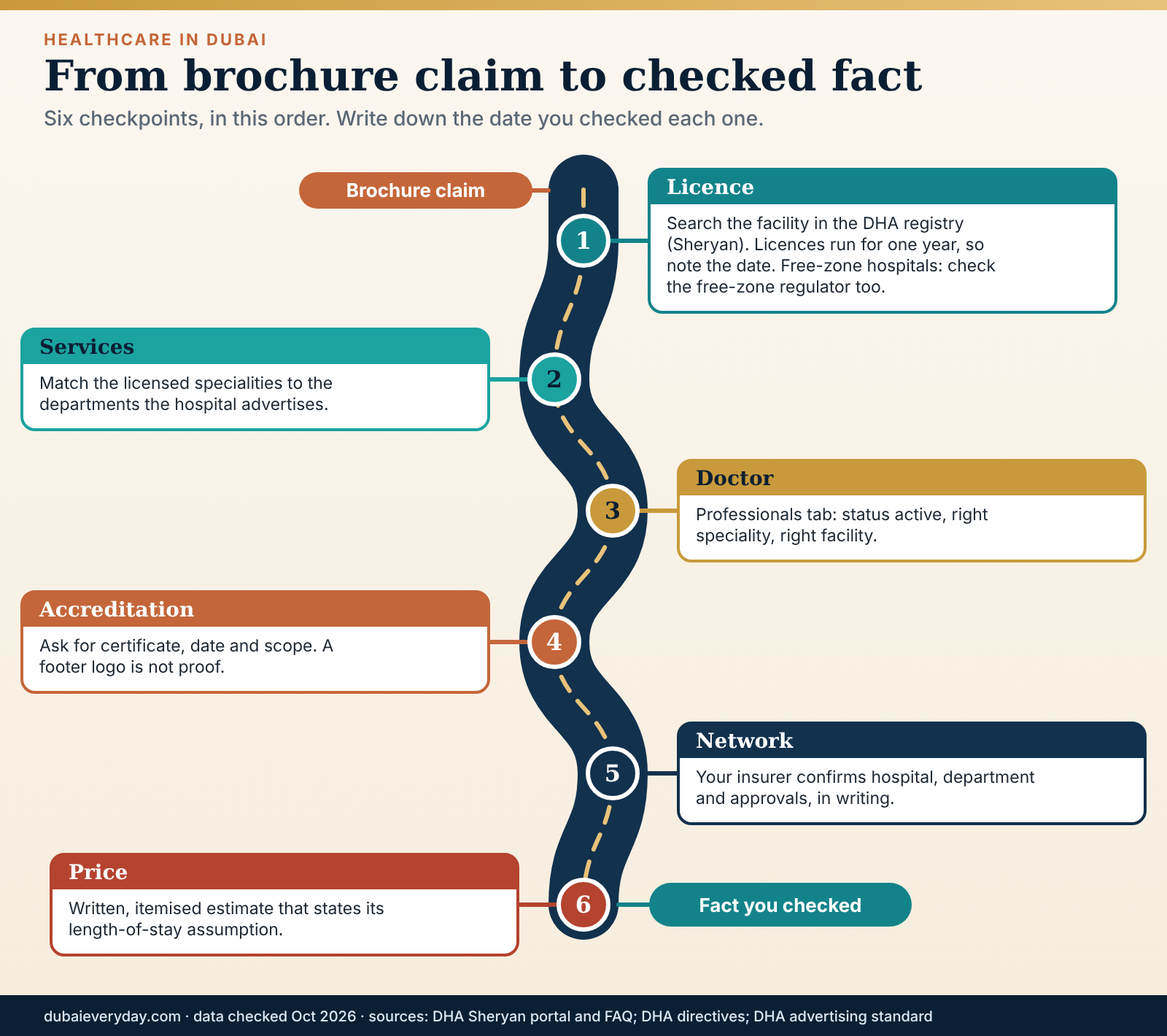
- LicenceSearch the facility on the DHA Dubai Medical Registry (Sheryan) and note its status and the date. Facility licences run for one year, so an old screenshot proves little. For Dubai Healthcare City facilities, also look for the free zone regulator’s record.
- ServicesCheck the licensed specialities against the departments the hospital advertises. If it advertises a speciality that the registry does not show for the facility, ask why.
- DoctorSearch the doctor under the professionals tab. Confirm that the status is active, the speciality matches what you were told, and the facility matches.
- AccreditationAsk for the certificate, date and scope. Verify with the accrediting body where a public directory exists. A footer logo is not verification.
- NetworkPhone your insurer, or use its app, and ask whether this hospital and this department are in your plan’s network. Ask for the answer by email.
- PriceRequest a written, itemised estimate and the deposit policy. For emergencies, ask about billing afterwards, not before.
What the registry can and cannot do
The registry tells you a facility and a professional hold a current licence and what they are licensed to do. It does not tell you how good they are, how long you will wait, or whether your insurer pays them. Older guides describe the registry’s fields, and portals change, so rely on what the live screen shows.
If a facility or doctor you are told about does not appear, do not assume a glitch. Ask the facility to show its licence, and if you remain unsure, contact DHA’s Health Regulation Sector on the number it publishes, 800 342, after confirming the number and hours.
If you are comparing licensed professionals for dental work, the process is described in the dentist guide, and for implants specifically, the implant guide explains the extra privilege DHA requires. Those pages show how the same registry logic extends to a specialty.
Keep a one-page record
For each hospital on your shortlist, note the date you searched the registry, what it said, who you spoke to at the insurer, the reference number of any email, and the estimate if you asked for one. It takes five minutes and turns a half-remembered phone call into evidence, which is useful if a claim is later refused. It also reminds you when to repeat the check; given the one-year licence cycle, a yearly review is a reasonable habit.
Mistakes and red flags when choosing among the best hospitals Dubai offers
The mistakes below recur in best hospitals Dubai research because each one feels sensible at the time. None requires bad luck; they only require not having looked.
- Treating a “top ten” list of the best hospitals Dubai offers as evidenceNo public Dubai dataset ranks hospitals by clinical quality, so any list that does has an unstated method or a commercial motive. Ask what data produced the order.
- Learning your network on the dayNetwork lists live in the insurer’s app or on the card’s helpline. Look them up in a calm week, not in a waiting room.
- Hearing “we accept insurance” as “we accept your plan”Acceptance can depend on tier, department and approval. Ask about all three.
- Skipping the GP referralUnder the minimum plan, specialist cost may not be payable without a licensed GP’s e-referral. Walk-in specialists can mean a walk-in bill.
- Ignoring prior approvalNon-urgent inpatient care and scans such as MRI and CT often need approval first. Ask who requests it and whether it is on file.
- Forgetting the free zone double checkFor hospitals in Dubai Healthcare City, look at both the DHA registry and the free zone regulator.
- Confusing accreditation with licenceA badge is optional and voluntary; a licence is a legal requirement. Both are worth checking, but they answer different questions.
- Delaying an emergency call over costThe emergency directive obliges providers to treat first, and insurers to pay for emergencies without network or approval objections. Money is for afterwards.
- Leaving without paperworkDischarge summary, itemised bill and imaging copies are far easier to collect before you leave than three weeks later.
- Accepting or refusing a transfer without knowing who paysAfter stabilisation, ask the hospital and insurer in plain words who bears the cost of staying and of moving.
Red flags in how a hospital presents itself
- No licence visible and no answer when you ask where to find it.
- Superlatives such as “best”, “number one” or “guaranteed” about results.
- Before-and-after style promises for medical (not cosmetic) outcomes.
- Quotes that cannot be itemised or that change after you have paid a deposit.
- Pressure to decide on a planned procedure within hours.
- A demand for payment before assessing someone in an emergency. The directive as summarised says providers must give immediate emergency care regardless of insurance status; if this happens, keep notes and report it to the regulator.
None of these proves wrongdoing, and none is a reason to stay away from a hospital that is otherwise clearly the right place in an emergency. They are reasons to slow down and check on any planned decision. For legal questions about consumer rights in Dubai more generally, the legal basics guide explains where to verify rules.
Six households worked through, and your own one-evening plan
The scenarios below are invented composites, built only to show the best hospitals Dubai method working on different inputs. They are not real people, and no one here has been treated anywhere. Each uses only facts established earlier in this guide, and each ends with what would still need confirming.
1. A family of four in Dubai Marina
Two adults on employer plans, children aged three and six, no car on weekdays. Lens weights: emergency, location and children’s care top the list. None of the confirmed hospitals sits in the Marina itself, so the first move is the three-hour dry run for the Al Barsha, Dubai Hills and Jumeirah options, plus the creek-side group for completeness.
The insurer’s app decides which of those are in network. The children’s emergency question points to Al Jalila if the family goes government, or to a private hospital that states a children’s unit. Confirm first: the network tier, the children’s emergency hours, and the evening drive time. See also the Dubai Marina guide for the district itself.
2. A single employee near Jebel Ali on the basic plan
One person working in the south-west, insured at the minimum standard, rarely ill. Jebel Ali Hospital in Dubai Industrial City is the Dubai Health site on that side, so the first check is whether the employer’s insurer lists it. Because the basic plan ties specialists to a GP referral, the second check is which GP clinic is in network, and where. For an emergency, nothing depends on the card. For a planned scan, the prior-approval rule does. Confirm first: Jebel Ali Hospital’s services, the plan’s network and the nearest in-network GP.
3. A retired couple in Deira with long-term conditions
Both take regular medication and see specialists. Continuity and network dominate, then location. Dubai Hospital in Deira is the Dubai Health site closest to them, with cancer care and ophthalmology named as centres of excellence on its page, which may or may not matter to their conditions. The more important check is whether their outpatient pharmacy, laboratory and specialist clinics sit in one network. Confirm first: whether their policy is an individual plan with its own network, the chronic-condition rules, and the annual medicines limit.
4. A pregnant resident in Jumeirah, five months before the due date
This is a planned decision, so every planning lens applies. Latifa Hospital’s page describes pregnancy, childbirth and neonatal services, and several private hospitals advertise maternity wings, among them hospitals near her. She compares the network list, requests a written package price, asks what happens if the baby needs neonatal care, and compares the minimum plan’s maternity limits with the quote. Confirm first: prior approval, which ward would admit her in an emergency overnight, and the newborn’s cover from day thirty. The resident insurance guide covers the newborn rules in more detail.
5. A tourist family in a Downtown hotel
A week-long stay, travel insurance bought at home. The plan: save 998 and the DCAS app, ask the hotel front desk where its guests are usually sent, and read the insurer’s rules on guarantee of payment. Dubai Health says it accepts those guarantees from international and travel plans. Confirm first: whether the policy covers an emergency without pre-notification, and what the hospital will ask for as a deposit. The Dubai travel guide carries the rest of the pre-trip list.
6. A freelancer planning a knee operation, self-pay
No employer cover, savings set aside, no urgency. This is the most research-heavy case and the one where the verification route pays off. She builds a best hospitals Dubai shortlist of two or three hospitals, checks each licence and surgeon in the registry, asks for itemised estimates with the length-of-stay assumption written in, compares day-surgery options where her surgeon says they are suitable, and holds a buffer for the extra nights.
Confirm first: the surgeon’s registry category, what the estimate excludes, and whether any follow-up is included. Our cost of living guide and the single-person budget help set a realistic buffer for health costs.
Your one-evening best hospitals Dubai plan
You can build your best hospitals Dubai shortlist in one sitting, with a laptop and the insurance card. The order matters because each step narrows the next.
- Save the emergency basicsPut 998, 999, 997 and the DCAS SOS app on every phone. Write the home and work addresses in words.
- Get the network listAsk your insurer or HR for the hospital network for your exact plan tier, in writing or in the app.
- Mark the candidatesPick two hospitals near home, two near work, and one for children or pregnancy if relevant, from the lists in this guide and your insurer’s. This becomes your personal best hospitals Dubai shortlist.
- Run the dry runCheck drive times at morning, evening and late night.
- Run the registry checkSearch each facility and note date and status.
- Make three phone callsOne to the insurer about approvals and referrals, one to each hospital’s emergency or information desk about the questions in the private section.
- Write it on one pageHome hospital, work hospital, children’s hospital, insurer line, policy number, and the date to review.
Bottom line
The best hospitals Dubai has are the ones that pass four tests for you in particular. You can reach them at the hour you are most likely to need them, they hold a current licence in the public registry, your insurer’s network includes them for the care you expect, and they will put in writing what they plan to do and what it will cost. No guide can run those tests for you, which is why this page is a method and not a league table.
Use the shortlist as a starting point, treat every private-hospital entry as unchecked until you have searched the registry, and keep 998 saved. The best hospitals Dubai offers will not look the same for a toddler’s household in Marina as for a retired couple in Deira, and that difference is the whole point of comparing them yourself.
Repeat the exercise when you move home, change job or insurer, or add a child. Facility licences renew annually and insurer networks change, so a quick yearly review is realistic. If any detail here looks out of date when you read it, check with DHA or your insurer first; we update this guide every six months.
Best hospitals Dubai FAQ
What is the ambulance number in Dubai?
998 is the ambulance number listed on the UAE government’s emergency page. Police is 999, fire is 997 and the Coast Guard is 996, with a separate Dubai Coast Guard line also published. In Dubai the government page points to the DCAS SOS app, which shares your location with the ambulance service. Some hospital pages print 999 or “999/998”, which also reaches emergency services. Save 998 on every phone in the household, and know your address in words, not only a map pin. This is general information, not medical advice.
Which are the best hospitals Dubai residents should use in an emergency?
There is no official ranking, and any list that crowns one is guessing. In a true emergency, call 998 and let the ambulance crew take you to a hospital with an emergency department; any UAE hospital must admit you for initial treatment. For planning, Dubai Health states that all six of its hospitals have emergency departments, and several private hospitals state a 24-hour department on their own pages. Choose one near home and one near work, and check that each fits your insurance network.
Is there an official ranking of the best hospitals Dubai offers?
We found none in the sources we read. DHA publishes facility counts and licensing information, not a public league table of clinical quality. Its advertising standard also tells facilities not to make absolute claims such as “best”. Accreditation badges exist, such as Joint Commission International, but they are voluntary, claimed by hospitals themselves, and measure systems and processes rather than ranking anyone. Treat third-party best hospitals Dubai rankings with caution and ask how they were built.
How do I check whether a hospital or doctor is licensed in Dubai?
Use the DHA Dubai Medical Registry on the Sheryan portal, which has separate tabs for professionals and facilities. Search the facility or doctor, then note the licence status and date. Facility licences are valid for one year, and a professional’s status can be active or inactive. Facilities in Dubai Healthcare City are regulated by the free zone’s own authority as well, so check both. If you cannot find a facility or doctor, ask them to show the licence, and contact DHA on the number it publishes (800 342) if you remain unsure.
Do I have to use a network hospital in an emergency?
No. Under the DHA emergency coverage directive as we read it, insurers must cover emergencies regardless of network, and must not reject or delay emergency claims for network status, location or lack of pre-authorisation. The hospital must report the emergency to your insurer within 24 hours. After you are stable, the position changes: the insurer may want to move you to a network facility, and it must arrange that within 24 hours of notice or bear the cost of you staying. Confirm the current wording with your insurer.
Will my insurance pay for an ambulance?
Probably, in the sense that the rules say insurers cannot reject claims for ambulance services provided by the Dubai Corporation for Ambulance Services for lack of pre-approval, and DCAS bills the patient’s payer at rates set by an Executive Council resolution. What you personally pay depends on your plan’s wording; a separate 2020 directive covers co-payments for emergencies transferred by ambulance, and we saw only its title. Check your policy for ambulance co-pay, and ask whether air ambulance is covered.
Can expats use Dubai government hospitals?
Dubai Health’s pages list insurance partners and say its facilities accept a range of plans, so insured residents can check whether theirs is included. They also say emergency care is not free and depends on cover. We found no page that sets out eligibility rules for non-emergency care by nationality, so call the 24/7 line, 800 60, and ask your insurer. For emergencies, every UAE hospital must provide initial treatment, so eligibility should not stop you being seen.
Which of the best hospitals Dubai offers suits children?
We cannot name a best one. Dubai Health says Al Jalila Children’s Hospital provides paediatric emergency care from birth to age 18, and that children under 13 should go there. Some private hospitals state children’s emergency units, such as the one described in the Dubai Media Office report on Saudi German Hospital. For a child, add a paediatric clinic near home and check that your insurance network includes your chosen hospital’s children’s services. The Dubai with kids guide has family logistics.
Which of the best hospitals Dubai has is right for giving birth?
There is no verified comparison of delivery quality. Latifa Hospital, run by Dubai Health, describes services for low- and high-risk pregnancy, childbirth and neonatal units, and many private hospitals advertise maternity wings. Compare network inclusion, written package prices, neonatal intensive care availability and what your plan pays: the minimum plan we reviewed limits a normal delivery to AED 10,000 and a caesarean to AED 10,000. Your obstetrician is the best person to advise on clinical fit.
Can tourists use Dubai hospitals, and how do they pay?
Yes for emergencies: any UAE hospital will admit a patient for initial treatment. Payment depends on circumstances. Dubai Health says it accepts guarantees of payment from international and travel insurance plans and asks patients to contact their insurer to start approval. Without insurance, expect to be asked about deposits and charges once you are stable. Save your insurer’s assistance number before you travel, keep receipts, and read the travel guide checklist.
What does JCI accreditation mean for a Dubai hospital?
Joint Commission International is a private body that accredits healthcare organisations against standards on safety and quality processes. Several Dubai hospitals state they are JCI accredited, including the Dubai Health network and some private hospitals. It is voluntary and time-limited, and we could not verify any hospital’s claim in JCI’s own directory. It is a useful tiebreaker, not a ranking, and it does not replace a Dubai facility licence or a doctor’s registry check.
How many hospitals are there in Dubai?
DHA statistics published through the Dubai Media Office on 18 February 2026 count 55 hospitals among about 5,800 licensed healthcare facilities in 2025. An earlier DHA release counted 53 government and private hospitals for 2023. Those are press summaries, not full DHA tables, and the facility categories differ between the two releases. Dubai also has 60 day-surgery centres according to the 2025 figures. Any best hospitals Dubai list is drawn from that pool, and the numbers change as new facilities open, so treat them as a snapshot.
Related reading
Once your best hospitals Dubai shortlist has two or three reference hospitals, these pages cover the questions that usually come next: how the wider system works, how your policy pays, and how the rest of settling in fits together.
Sources and further reading (28 links)
- UAE Government Portal: Handling emergencies — emergency numbers, initial hospital treatment, DCAS SOS app
- Dubai Health: Our hospitals — hospital list, areas, opening status
- Dubai Health: Hospitals — network-wide accreditation statements and the 800 60 line
- Dubai Health: Frequently asked questions — emergency departments, paediatric emergency, cost statement, booking
- Dubai Health: Our insurance partners — accepted plans, guarantee of payment for international and travel insurance
- Dubai Health: Rashid Hospital — emergency and trauma centre, departments
- Dubai Health: Dubai Hospital — tertiary hospital in Deira, centres of excellence
- Dubai Health: Latifa Hospital — women and newborn services, emergency for women
- Dubai Media Office: Dubai’s healthcare ecosystem posts record growth in 2025 — DHA facility counts for 2025
- Dubai Health Authority: Dubai’s healthcare sector witnesses extraordinary growth — 2023 facility counts, 53 hospitals
- Dubai health insurance regulation site: Law and regulations — index of emergency and provider-contract directives
- Emergency Coverage Regulation PD-03-2025 (v2) — network, 24-hour and seven-working-day rules (read through an automated summary)
- Policy Directive 02-2017: Emergency definition — definition and stabilisation categories
- Policy Directive 01-2018: Ambulance patients — ambulance billing and claims
- DHA Sheryan: Frequently asked questions — facility types, licence validity, professional status
- DHA Sheryan: Dubai Medical Registry — professionals and facilities directory (page read for the dentist guide)
- Dubai Media Office: Ahmed bin Mohammed visits Saudi German Hospital in Al Barsha — location, beds, emergency department description
- Saudi German Hospital: Emergency Dubai — hospital’s own emergency claims
- American Hospital Dubai: Emergency Department — hospital’s own emergency claims
- Mediclinic City Hospital — beds, services, accreditation news
- King’s College Hospital London, Dubai — location, emergency listing, accreditation claim
- Medcare Hospital, Al Safa — location, emergency, beds
- Dubai Healthcare City: First hospital to launch in Phase 2 — Clemenceau Medical Center announcement, 2016
- UK Foreign, Commonwealth and Development Office: List of medical facilities in the UAE — consular list of Dubai facilities, not an endorsement
- UAE Government Portal: Getting a health insurance — 2025 permit rule and federal basic plan (read for the resident insurance guide)
- Government of Dubai: Health insurance — Law No. 11 of 2013 duties (read for the insurance guides)
- UAE Government Portal: Patients’ rights and responsibilities — Patient Charter reference (read for the resident insurance guide)
- Gulf News: 3 ways to check if your doctor or clinic is licensed in Dubai — secondary explainer from 2022, context only (read for the dentist guide)
Update log: 29 October 2026, first publication; all facts re-checked against the sources above, with private-hospital licence status left as “Confirm first”. Next review due: 29 April 2027, then every six months, and sooner if DHA changes its licensing or emergency coverage rules, if the Hamdan Bin Rashid Cancer Hospital opens, or if a hospital on the best hospitals Dubai shortlist changes its emergency services. Corrections welcome. This page is general information, not individual medical, insurance or legal advice. No qualified medical reviewer has checked this draft yet, so clinical context should be read as orientation only.
About DubaiEveryday and this guide
DubaiEveryday.com is an independent editorial project that publishes practical, research-based guides to everyday life in Dubai: where to live, what things cost, how the rules work and how to get around. This page was written and edited by the DubaiEveryday editorial team. It is not signed by a named expert, doctor, lawyer or adviser, and we do not claim first-hand testing of a venue, clinic or service unless the page says so.
Each guide is built from official sources such as government and regulator pages, operator websites and established news outlets, cross-checked where we can. When we could not confirm something, we say so in the text, and examples that use made-up numbers are labelled as illustrations. Mentions are editorial choices, not paid placements, and a link is not an endorsement.
Dubai changes quickly. If you spot something that is out of date or wrong, please tell us through the contact options on DubaiEveryday.com and we will check it and correct the page.