
Mainland vs free zone Dubai is mostly a question about where your customers sit, how many people you need and how your income will be taxed. This guide compares the two routes on market access, office, visas, ownership, cost and business model, with official figures checked on 29 October 2026.
Picture two founders who pay roughly the same to start a company in Dubai. One invoices the customers they planned for from week one. The other finds out three months in that the licence they bought does not let them sell to the people next door. The mainland vs free zone Dubai question looks like a choice between two logos on a trade licence, but it is really a bet on where your customers, staff and profit will sit.
Brochures usually answer it with a price, normally the lowest one they can print. This page answers it with a sequence: who you can sell to, what space and visas you need, who owns what, what the first year really costs and how the tax works. By the end you should know which route fits your business, or at least which three questions to ask before anyone takes a deposit.
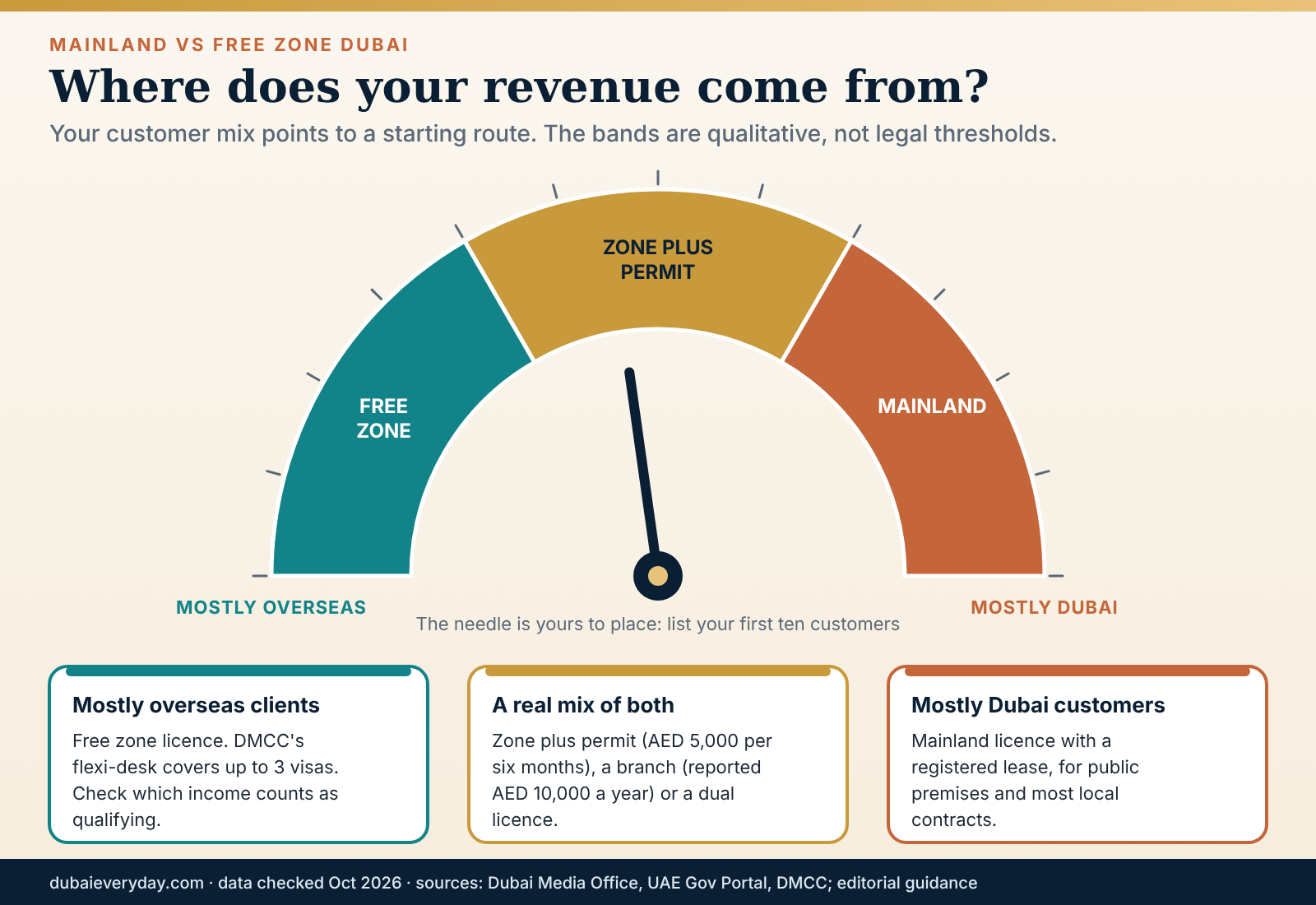
The mainland vs free zone Dubai decision comes down to where your revenue will come from, not which licence sounds more prestigious. A mainland licence from Dubai Economy and Tourism (DET) lets you trade across Dubai, sell to local customers and compete for local contracts, but it needs a registered physical office. A free zone licence is usually faster and can run from a flexi-desk, yet it is built for business inside the zone or abroad.
Foreign ownership is open on both routes for most activities. Since 2025 a free zone company can also add a mainland permit (AED 5,000 for six months) or a branch licence (reported at AED 10,000 a year). Our rule of thumb: mostly Dubai customers, start on the mainland; mostly overseas customers, other zone companies or goods in bond, start in a free zone; split revenue, price the two-licence route before paying for either.
Two things do not change with the mainland vs free zone Dubai label. Corporate tax follows the type of income, not the address, and the licence fee is only one line of the first-year bill.
This is a desk-research guide to mainland vs free zone Dubai. DubaiEveryday.com has not formed a company, opened a corporate bank account or bought a package from any adviser or free zone mentioned here, and nothing below describes a personal experience. On 29 October 2026 we read government and regulator pages (Dubai and UAE portals, Dubai Media Office, Ministry of Finance, Federal Tax Authority, GDRFA) plus the public price lists of two free zones, DMCC and Meydan. They are worked examples, not recommendations, and inclusion was not paid for.
Mainland government fee schedules did not load, so mainland figures come from news reports and adviser pages and are labelled as such. Law-firm summaries are used only for the 2025 free zone resolution, whose full text we could not read. This page has no affiliate links, referral codes or paid placements; if that changes, it will be stated here. It is general information, not legal, tax or financial advice.
What actually separates mainland and free zone
Mainland vs free zone Dubai looks like a choice between two licence types. In practice it is a choice between two legal territories with different gatekeepers. A mainland company is licensed by DET, normally through the Invest in Dubai portal, and may operate anywhere in Dubai outside the free zones. A free zone company is licensed by its zone authority, which sets its own fees, entity types, office rules and visa limits.
The Dubai government portal lists 21 free zones, from DMCC, DIFC and JAFZA to Dubai Internet City, Dubai South, Expo City Dubai and Dubai Science Park. They are not interchangeable: each has a sector focus and a rulebook. So when this mainland vs free zone Dubai guide says “free zone” it is describing a family of 21 arrangements, and when it quotes a price it names the zone it came from.
Three axes, not one
The mainland vs free zone Dubai comparison is easier in three questions. Where can the company legally sell? Where must it physically exist? And how will the state treat its profit? Cost, speed and ownership sit on top of those three.
The axes can point in different directions for the same company. A consultant with overseas clients may want a free zone for premises and visas, yet gain nothing on tax. A cafe owner needs the mainland for access, and the zone’s price list is irrelevant.
What this page covers and what it leaves out
This page owns one job: helping you settle the mainland vs free zone Dubai question. The step-by-step process for each route lives in our guides to mainland company setup in Dubai and free zone company setup, and the wider picture (banking, licences, ongoing costs) is in the Dubai business setup guide. Tax filing and bookkeeping appear only where they change the choice.
Mainland vs free zone Dubai at a glance
The table below summarises the mainland vs free zone Dubai comparison from the official pages and zone price lists, with detail and caveats in the sections that follow.
| Question | Mainland (DET) | Free zone |
|---|---|---|
| Licensing body | DET, via Invest in Dubai | The authority of the chosen zone |
| Selling inside Dubai | Allowed for the licensed activity | Direct mainland sales are generally not permitted without a mainland licence, permit or distributor |
| Premises | Registered physical address required | Flexi-desk, serviced or physical unit, depending on zone |
| Foreign ownership | Up to 100% for most activities; some excluded | 100% foreign ownership |
| Visas | Tied to office space and the establishment card | Tied to the zone’s package or office size |
| Corporate tax | 0% to AED 375,000 of profit, 9% above | Same standard rates, unless the income is qualifying income of a qualifying free zone person |
| Typical cost shape | Many small government items plus a lease | One larger package price plus visa and renewal fees |
| Strongest fit | Local customers, public-facing premises, local contracts | Overseas clients, sector clusters, goods in bond |
Market access: who you can sell to
Market access is the axis that decides most mainland vs free zone Dubai outcomes, and it is the one cheap packages talk about least. A licence is permission to do a stated activity in a stated territory. The mainland licence territory is the whole emirate outside the zones. A free zone licence territory is, in the strict version, the zone plus the world outside the UAE.
What the government says a free zone company can do
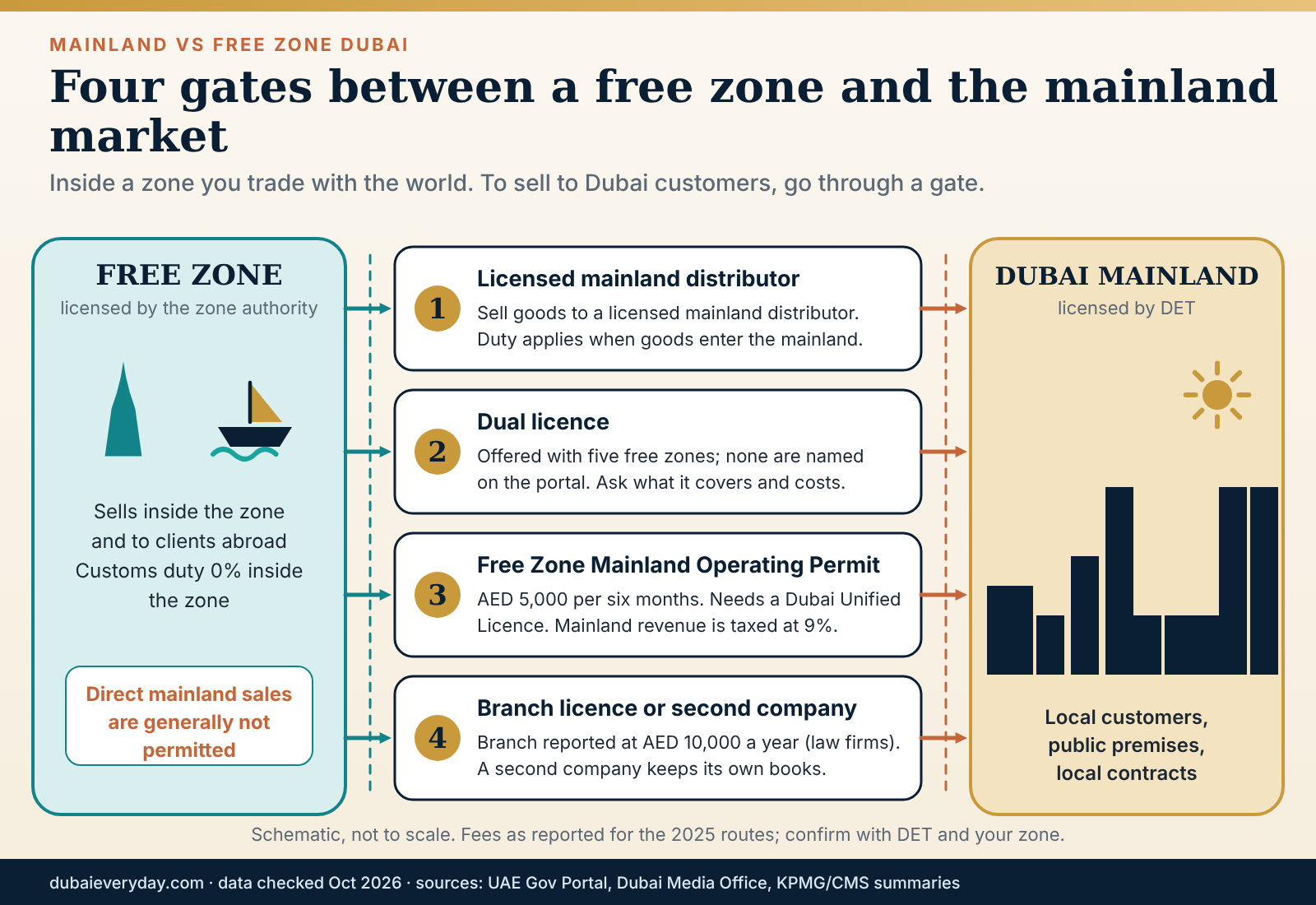
The UAE government’s page on running a business in a free zone states that free zone companies are fully foreign-owned and can import, export and re-export. Customs duty is 0% inside the zone and applies when goods move into the mainland market. The same page says that to reach mainland customers, a zone company needs a licensed mainland distributor or its own mainland branch or company, and that direct sales in the mainland are generally not permitted without the relevant licences and approvals.
What a free zone company cannot do, in the standard model, is open for business with the Dubai public under its own zone licence. It can sell goods to a licensed mainland distributor, or deliver services to a client abroad.
The 2025 change that thinned the mainland vs free zone Dubai border
The mainland vs free zone Dubai border moved in March 2025, when Dubai issued Executive Council Resolution No. 11 of 2025, which lets free zone entities (other than financial entities in DIFC) apply for permission to operate on the Dubai mainland. Law-firm summaries from KPMG and CMS describe three routes: an onshore branch licence, a branch licence for a company whose headquarters stays in the zone, and a temporary permit for certain activities.
They report AED 10,000 a year for the branch licence and AED 5,000 for a permit lasting up to six months. We could not read the resolution itself, so treat those fee details as reported, not official.
On 8 October 2025 the Dubai Media Office announced the operating version for most small firms, the Free Zone Mainland Operating Permit. It costs AED 5,000 for six months, renewable at the same price, and is open to free zone companies holding a Dubai Unified Licence. Applications go through Invest in Dubai. The first phase covers non-regulated activities in technology, consultancy, design, professional services and trading, with regulated sectors planned for later.
Three conditions matter. Mainland revenue is taxed at 9%. The company must keep separate financial records. And it may use existing free zone employees on the mainland without new visas. We could not confirm that DET has published the full list of eligible activities or widened the first phase, so confirm your own activity before relying on the permit.
Government tenders and large local clients
One line in the official announcement matters for any mainland vs free zone Dubai plan. The Media Office statement says permit holders gain access to government tenders and contracts that were previously limited to mainland-licensed firms. If public-sector clients are central to your plan, the permit or a mainland licence belongs in the plan from day one, and the tendering entity can tell you which licence it accepts.
Private clients are less formal, but a supplier form may still ask for a trade licence and a Dubai address. That is a commercial habit, not a legal rule, so ask your three largest prospects directly.
The dual licence
The Dubai government portal describes a dual licence as a way to operate on the mainland without extra office space or a local partner, and says it is offered with five free zones. The page does not name the five, and we could not find a primary list, so ask any zone whether it offers the dual licence, what activities it covers and what the second licence costs. Do not assume that “dual licence” means the same thing in every brochure.
Beyond Dubai
A Dubai mainland licence is a Dubai licence. The 2025 resolution does not authorise activity in other emirates, which need their own authority’s approval. If you plan to sell across the UAE, ask those departments what they require.
Office and premises: the mainland vs free zone Dubai space question
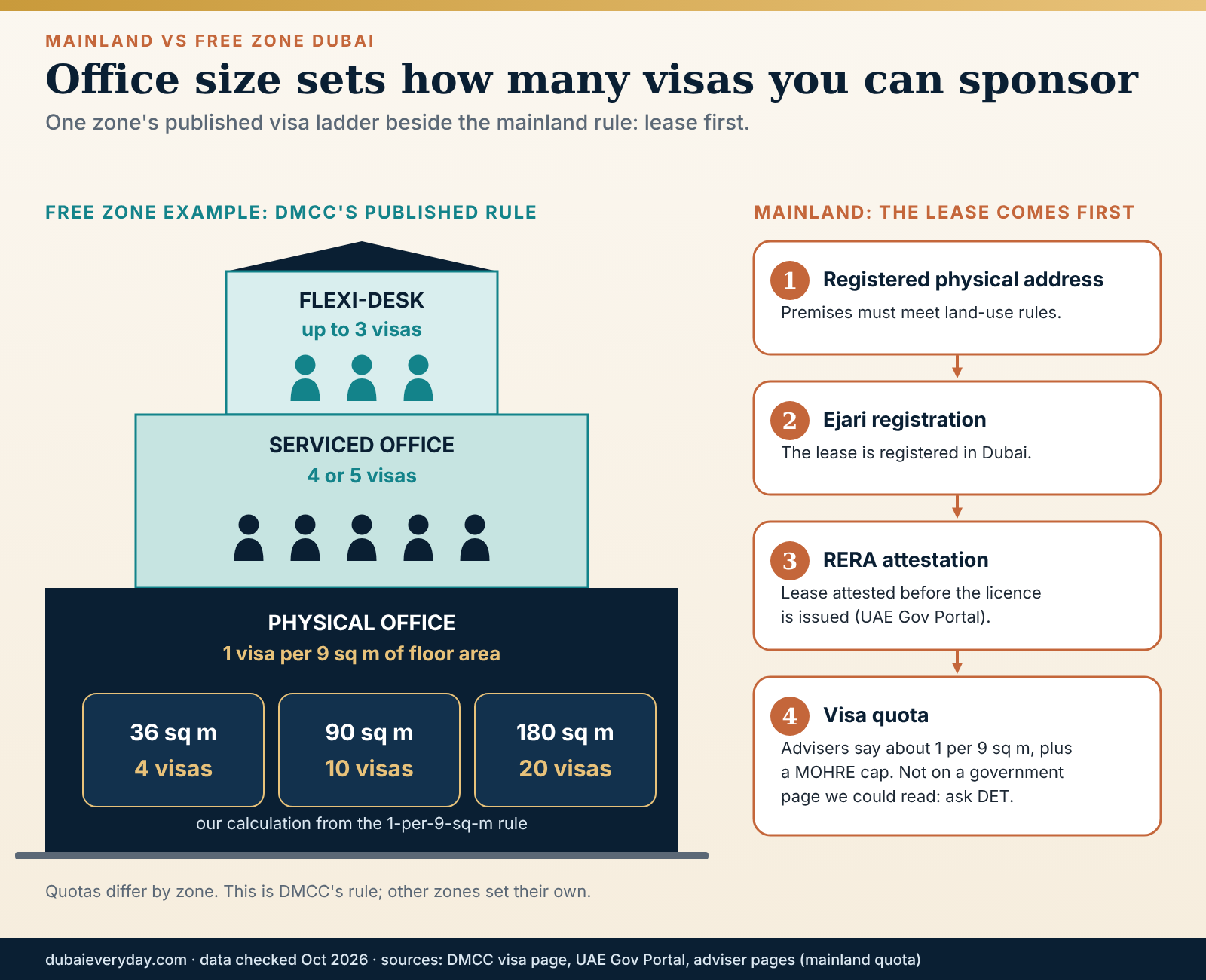
The office question in mainland vs free zone Dubai is where cost, visas and legitimacy meet. A mainland company must have a physical address. The UAE government’s steps page says the premises must meet the emirate’s and the municipality’s land-use rules, and in Dubai the lease must be registered with Ejari and, per the same page, attested by RERA before the licence is issued.
We could not confirm the Ejari fee for a commercial lease. The Dubai Land Department page lists AED 177.75 through its app or website and AED 220 at a typing centre, but it does not state commercial rates. Budget for the lease first and ask for the registration cost in writing.
What a free zone gives you instead
Free zones sell premises as a product, on a ladder from flexi-desk (a registered address and occasional desk access) through serviced offices to physical units and warehouses. The zone’s own lease is the registered address, so one invoice can cover licence, desk and address.
The two price lists we read show how different the pricing logic is in a mainland vs free zone Dubai comparison. Meydan Free Zone’s published guide includes a flexi-desk in its base licence, lists a dedicated desk at AED 3,500 a month, a shared office at AED 15,000 a year and a dedicated office at AED 30,000 a year.
Our calculation: twelve months of the dedicated desk is AED 42,000, which is 40% more than the dedicated office and 2.8 times the shared office. A monthly price that looks small can be the expensive option once you stay a full year.
The virtual-office question on the mainland
Can a mainland company run on a virtual address? We found no government rule saying so either way. A Khaleej Times guide from March 2025, quoting DET agents, says the Instant licence (for activities needing no external approvals) includes a virtual site for the first year, and that the eTrader licence suits home-based businesses. Those are reported statements, not published rules. Ask DET what happens after year one.
When the space is the point
Some businesses cannot avoid proper premises. A restaurant, salon, clinic, gym or shop needs a unit that suits its use, and land-use and municipal approvals follow the unit. A workshop or warehouse needs floor area and, often, loading access. For those businesses the free zone’s flexi-desk package is irrelevant, and the real mainland vs free zone Dubai comparison is between a mainland unit and a zone’s industrial or retail space. If your customers visit you, location matters; our Downtown Dubai area guide shows what a central district is like to reach and work in day to day.
Visas, staff and residency in mainland vs free zone Dubai
Visas are where mainland vs free zone Dubai comparisons usually go wrong, because the number you can sponsor is tied to space, and the process differs. In a free zone, the authority handles work permits and residence visas for companies it licenses. The UAE government’s page on recruiting in free zones says the first visa normally goes to the person named on the licence, most zones cap the number of visas, and you raise the cap by taking a larger office or getting an approved increase.
How many visas the office buys
DMCC’s own visa page gives the clearest published rule we found. A flexi-desk package allows up to three visas, a serviced office four or five, and a physical office one visa per nine square metres. Our calculation from that rule: four visas need 36 square metres, ten need 90 and twenty need 180. If you plan to hire ten people within two years, the cheapest desk is the wrong starting point. Other zones set their own quotas, so this is one zone’s rule, not a universal formula.
On the mainland the logic is similar, but we cannot point to a government page that states it. Consultancy pages commonly say each employment visa needs about nine square metres of Ejari-registered space, with the MOHRE establishment card setting its own ceiling. Treat that as a prompt to ask DET and MOHRE, not as a rule.
The process, side by side
The Dubai government’s work-visa page describes the sequence for an employee: offer, work permit, entry permit or change of status, medical test, health insurance, Emirates ID biometrics, then the visa, normally within about two days of the medical result and valid for two years at first. A free zone runs a close variant through its own portal.
In mainland vs free zone Dubai terms, fees differ more than the steps. DMCC’s schedule lists an employment visa for a person already in the UAE at AED 2,672 for one year or AED 3,407.50 for two. Our calculation: two one-year visas cost AED 5,344, so the two-year option saves AED 1,936.50, or about 36%, if the zone allows it on your licence term.
Meydan’s page lists visa allocation at AED 1,850 each (up to six) plus an employment visa at AED 3,500. An adviser page reporting mainland fees puts an employee visa at AED 7,000 to 8,000 including the labour card, which is not an official figure and bundles items the free zone prices separately.
Residency for the owner
A company is one route to owner residency. GDRFA Dubai’s “green residence” for partners and investors offers up to five years. The fees we read total AED 740 (200, 10, 10, 500 in-country and 20 delivery, our calculation), the documents include the partnership agreement or memorandum of association and the trade licence, and the page states no minimum capital. The UAE government’s Golden Visa page lists a five-year entrepreneur route needing proof of the project and a letter from an incubator or authority.
DMCC’s own investor visa sets a shareholding and share-capital threshold (AED 50,000 of share capital in the version we read), so a zone may add conditions. If residency matters more than the business, our Dubai legal basics guide covers the wider rules.
Staff rules that follow the licence
Dubai’s health insurance law makes employers responsible for insuring employees; our guides to health insurance in Dubai and business and personal insurance explain how cover is chosen. The government page quotes AED 550 to 750 per person a year before VAT for mandatory cover, which we repeat as the figure quoted, not a market price.
Labour-law coverage differs by zone (DIFC has its own employment regime), and we did not verify each one, so confirm with your zone. Emiratisation applies to private companies with 50 or more employees, who must raise skilled Emirati headcount by 2% a year. Reports from late June 2026 put the contribution for an unfilled post at AED 10,000 a month (AED 120,000 a year). We could not verify whether free zone companies are bound.
Ownership and control: is 100% really 100%?
Ownership used to be the main reason to choose a free zone. That reason has largely gone from the mainland vs free zone Dubai debate. Federal Decree-Law No. 26 of 2020 amended the commercial companies law, and from 1 June 2021 Dubai permits up to 100% foreign ownership on the mainland for most activities. The Dubai Media Office clarification at the time said more than 1,000 commercial and industrial activities qualified, no Emirati partner was required, and no extra fee, guarantee or capital applied.
What stays restricted
The exceptions matter. The UAE government’s ownership page names security and defence, telecoms, banks and exchange houses, insurance, commercial agencies, Hajj and Umrah services, Quran recitation institutes and certain fishing and pearl activities among the restricted areas. It also says the Cabinet can designate “strategic impact” activities, and the Dubai statement mentioned seven such sectors. We could not find a current official list, so check your activity against DET’s activity list before assuming that 100% applies to you.
The local service agent confusion
Two official statements do not line up. The UAE government’s steps page still lists a service agent agreement for companies wholly owned by non-GCC nationals, while the 2021 Dubai Economy clarification says no Emirati partner is needed. A service agent is a different role from a partner: a representative who does not own shares. Ask DET in writing which applies to your activity before paying anyone to set up the company.
Free zone ownership
Free zones have offered 100% foreign ownership throughout. The Dubai portal describes the main structures: a single-shareholder FZE, a multi-shareholder FZCO, an LLC with two to fifty shareholders, a public joint-stock company and a branch. Not every zone registers every type, so if you plan to bring in investors, check that your zone offers the entity type you want.
Control lives in the documents
Ownership percentages tell you who holds shares, not who decides. Mainland LLCs need a memorandum of association prepared or attested by UAE law firms, courts or notaries. Many zones offer standard articles at a fixed fee; DMCC lists AED 2,000 for standard and AED 3,000 for non-standard. A template is fine for one owner. With partners, a bespoke shareholder agreement is worth the legal fee on either side of the mainland vs free zone Dubai line.
Costs in mainland vs free zone Dubai: advertised price against first-year bill
Cost is the question most mainland vs free zone Dubai readers arrive with, and headline prices answer it badly. A free zone sells a package; the mainland sells a sequence of small government payments plus a lease. Comparing the two is comparing a menu with a receipt. This section lines up what we could verify and shows the arithmetic.
A free zone bill, line by line (DMCC)
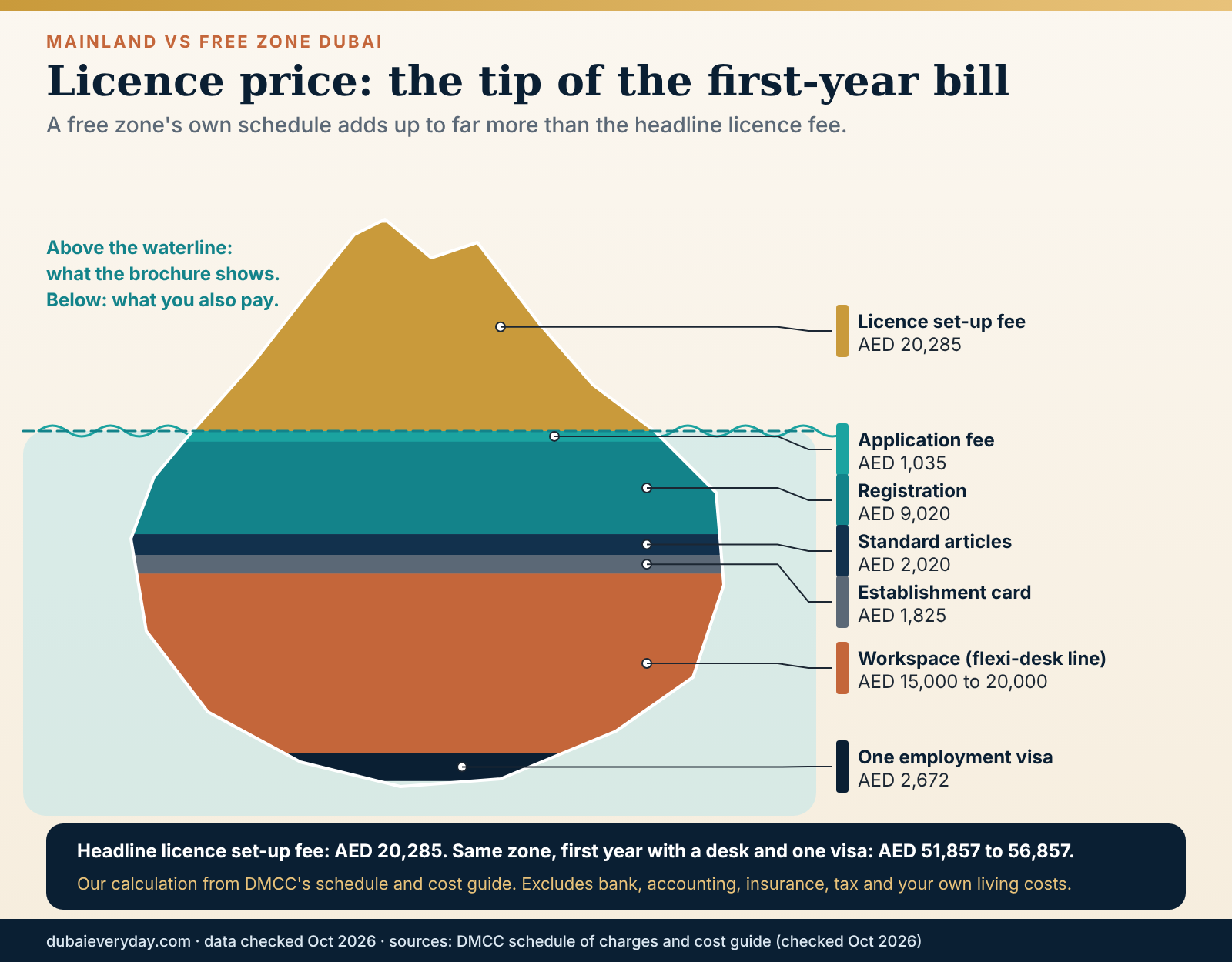
DMCC’s schedule of charges is one of the few free zone price lists published in full, and it says charges may change without notice. A new company meets an application fee of AED 1,035, registration of AED 9,020, standard articles of AED 2,020, the licence set-up fee of AED 20,285 and an establishment card of AED 1,825. Our calculation: those five items total AED 34,185.
Add a workspace and a visa. DMCC’s cost guide puts the office line at AED 15,000 to 20,000, and an employment visa for a person inside the UAE is AED 2,672 for one year. Our calculation: AED 49,185 to 54,185 with the office, and AED 51,857 to 56,857 with one visa. DMCC’s guide describes a typical first year of AED 35,000 to 50,000, so the schedule’s parts add up to at or above the top of that band.
DMCC also sells a bundled flexi-desk package, Jump Start, at AED 43,780 for one year, or AED 46,452 with the visa (our calculation). If it contains the same elements, which we could not confirm, it is roughly AED 5,400 to 10,400 cheaper than buying them separately. A two-year term at AED 81,881 is AED 40,940.50 a year (6.5% lower) and three years at AED 120,000 is AED 40,000 a year (8.6% lower). Multi-year prices are paid up front, and we found no refund rules.
A cheaper entry price (Meydan)
Meydan Free Zone’s cost guide shows how low the entry can look. A licence starts at AED 12,500 with up to three activity groups and a flexi-desk included. Add visa allocation at AED 1,850, an investor visa at about AED 4,000 and an optional residency add-on at AED 2,250, and the advertised lines come to AED 20,600 (our calculation). The page contradicts itself in places (its summary says “registration from 9,000”, the body says the licence starts at 12,500), so confirm the live price in writing.
A mainland bill, as far as it can be seen
We could not read DET’s fee schedule, because the pages render their fees dynamically. Two secondary sources agree on small items. A Khaleej Times guide from March 2025, citing DET agents, gives AED 120 for initial approval and AED 620 for trade-name booking, and an eTrader total of AED 1,370. An adviser fee page updated in September 2026 adds typing and service-centre costs, a memorandum of association at AED 1,200 to 1,500, a trade licence at AED 11,500 to 13,500 and an establishment card at AED 750. It cites no official schedule, so use it as a rough guide.
Our calculation from those adviser lines: AED 14,654 to 16,954 for licence-side government and typing items, or AED 18,754 to 21,054 with a partner visa listed at AED 4,100. That excludes the lease, the swing item. We have no verified rental figure, so ask for quotes for the exact space and area you want.
What the mainland vs free zone Dubai cost comparison tells you
The government-fee layer is closer than most people expect; the structure is what differs. The free zone folds the address into one invoice, while the mainland splits it between licence and landlord. The honest summary of mainland vs free zone Dubai on cost is that the cheaper route is the one matching your premises and visa needs. A one-visa founder usually spends less on a flexi-desk zone. A founder who needs a shop pays for a lease either way and gets nothing from a zone package.
The cost of crossing the border
If your mainland vs free zone Dubai answer is “both”, the second licence has a price. The permit is AED 5,000 per six months, so AED 10,000 over twelve (our calculation), the same as the annual branch fee law firms report. Meydan’s advertised AED 20,600 plus a twelve-month permit comes to AED 30,600 before separate records and the 9% tax on mainland profit (our calculation). Hold that against a mainland licence plus lease.
What is rarely on the quote
- Renewal of the licence. DMCC’s renewal is AED 20,265, almost the same as the first-year licence fee, so the headline is a recurring cost, not a one-off.
- Late-renewal penalties. DMCC charges AED 2,500 for renewal 31 to 60 days late and AED 5,000 for 61 to 90 days, which is 12.3% and 24.7% of the renewal fee (our calculation).
- Bookkeeping, VAT returns and, for some free zone companies, audited accounts. Our guides to accounting services in Dubai and bookkeeping cover outsourcing.
- Health insurance for you and staff, and the cost of residence-visa medicals and Emirates ID.
- Your own living costs during the months before revenue. Our single-person budget and cost of living guide give a realistic runway figure to subtract from your capital.
Tax: what the mainland vs free zone Dubai label does not change
The most expensive misconception in the mainland vs free zone Dubai debate is that a free zone company pays no tax. The reality is narrower and hinges on the type of income, not the address. This is general information; a tax adviser should confirm how it applies to your numbers.
The baseline both routes share
Start with what both sides of the mainland vs free zone Dubai line share. Federal corporate tax applies to financial years starting on or after 1 June 2023. According to the Ministry of Finance, taxable income up to AED 375,000 is taxed at 0% and the excess at 9%, for mainland and free zone companies alike unless the free zone company is a qualifying free zone person with qualifying income. Our calculation: a company with AED 500,000 of taxable income pays 9% of AED 125,000, which is AED 11,250 before any relief.
How a free zone person gets 0%
Under Article 3 of Cabinet Decision No. 100 of 2023, a qualifying free zone person’s income counts as qualifying in three main cases. Income from other free zone persons qualifies unless it comes from an excluded activity. Income from anyone outside the free zones qualifies only for a qualifying activity that is not an excluded one. And qualifying intellectual property income can qualify under a calculation. Other income is tolerated only within a small de minimis limit.
Ministerial Decision No. 229 of 2025 sets the lists. Qualifying activities include manufacturing and processing, trading in qualifying commodities, holding shares for investment, ship ownership, reinsurance, fund and wealth management, headquarter and treasury services to related parties, aircraft leasing, logistics, and distribution in or from a designated zone. Excluded activities include banking, most insurance, most finance and leasing, and immovable property with exceptions.
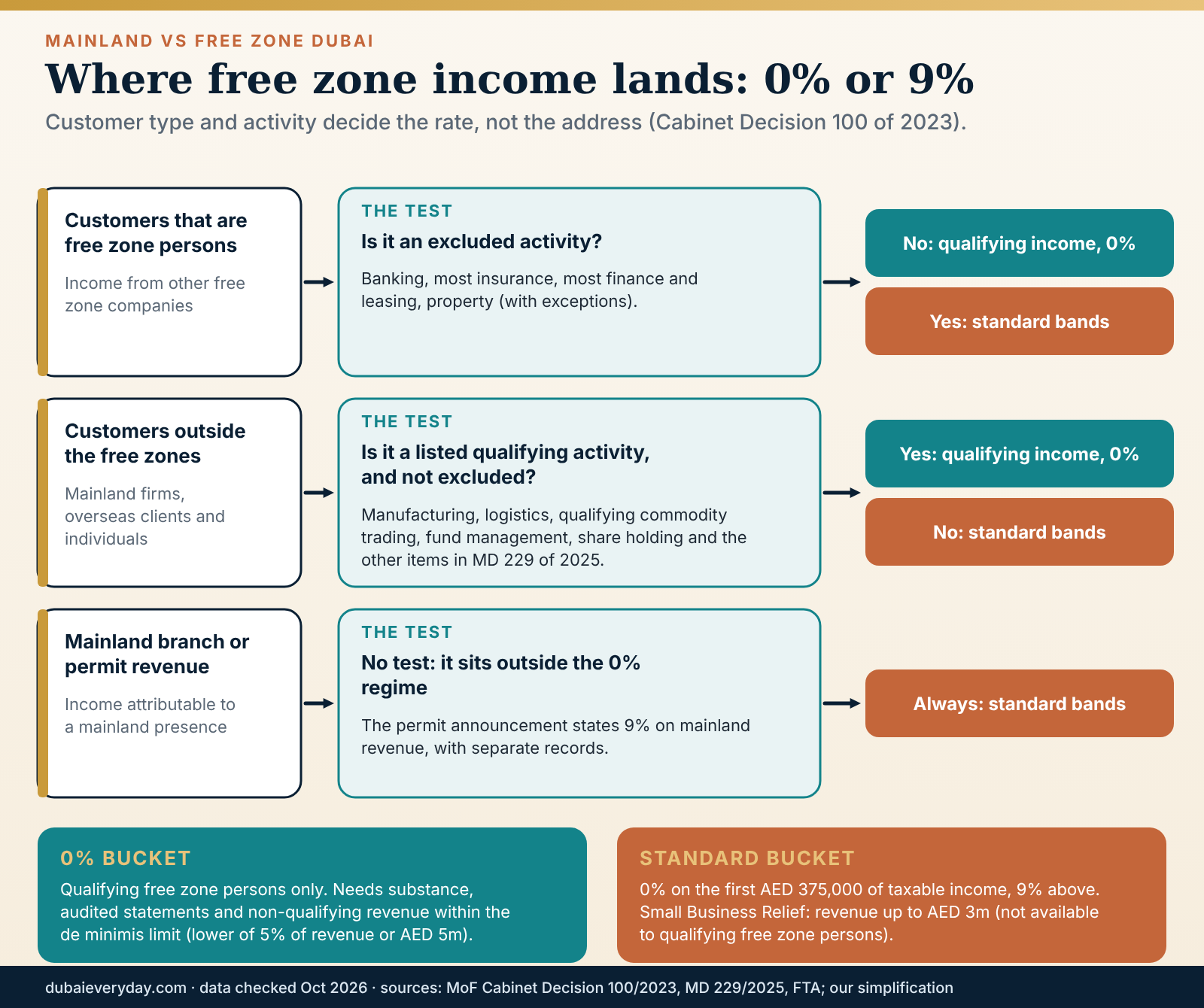
Our reading of Article 3 and the activity list is that a free zone company selling services such as consulting, design, marketing or software development to clients outside the free zones, in the UAE or abroad, is not performing a listed qualifying activity. Income from those clients is likely to be non-qualifying and taxed at the standard rates, with the same 0% on the first AED 375,000. In a mainland vs free zone Dubai decision, never choose a zone because a brochure says “0% tax” without asking your tax adviser which of your income lines would actually qualify.
The de minimis and the cliff
The de minimis limit tolerates non-qualifying revenue up to the lower of 5% of total revenue or AED 5 million. Our calculation: for a company with AED 2 million of revenue, 5% is AED 100,000. Exceed the limit and the company stops being a qualifying free zone person for that tax period and the four after it, per the Ministry’s decision. The same decision requires audited financial statements for qualifying free zone persons, which is a real cost to put against a zero rate.
Small business relief and why it matters here
Small Business Relief lets a resident business with revenue of AED 3 million or less in the current and all previous periods elect to be treated as having no taxable income. It is elected per period and is not available to qualifying free zone persons. Ministerial Decision No. 131 of 2026, reported in August 2026, extended the relief to tax periods ending on or before 31 December 2029. For a small consultancy, a mainland company and a non-qualifying free zone company may owe the same: nothing, while revenue stays under the cap and the company registers.
The permit and the 9% on mainland income
The permit announcement states that mainland revenue is taxed at 9%, with separate records. That is consistent with Article 3, which excludes income attributable to a domestic permanent establishment from qualifying income. For mainland vs free zone Dubai planning, the permit does not raise your rate above what a mainland company would pay, but it can remove a 0% rate you were counting on for that revenue.
Registration and VAT
Corporate tax registration is free through the FTA’s EmaraTax portal, but late registration carries an AED 10,000 penalty, and individuals running a business register if turnover exceeds AED 1 million in a calendar year. VAT registration is the same on both routes: mandatory above AED 375,000 of taxable supplies in the previous twelve months or expected in the next thirty days, voluntary from AED 187,500. We did not verify VAT for goods in designated zones. Our accounting services guide explains how outsourced providers handle both filings.
Banking, speed and paperwork
Speed is a poor reason to settle the mainland vs free zone Dubai question, because both are fast at the licence step and slow at other steps. The UAE government’s free zone page says a licence is issued within 14 working days of an application being reviewed. DMCC’s cost guide quotes two to three weeks for set-up. Meydan advertises a one-person route that takes under an hour for the licence.
On the mainland, the Dubai portal describes three stages: initial approval, trade-name reservation and licence collection, and the payment for the licence has to be made within 30 days of the payment voucher.
Those are licence times. The delays come afterwards: visa medicals, tax registration, any sector regulator and, above all, the bank account. This is the stage where mainland vs free zone Dubai matters least, because the same banks serve both, and they ask the same questions about who owns the company and where its money comes from.
The bank account, and what the numbers do and do not say
Dubai’s licensing corporation has been publishing claims about faster banking. Gulf News reported in November 2025 that the average time to open a business account fell from about 65 days to about five, with more than 3,000 accounts opened through the Dubai Unified Licence since October 2024, and Emirates NBD and Mashreq connected. A September 2026 interview in the same paper quotes the corporation’s chief executive saying about 90 days had fallen to about three. The starting figures differ between the two articles, and both are the issuer’s own claims about its system.
Read them as a direction of travel, not a promise. A bank still decides whether to take you. DMCC and Meydan list the same friction points: incomplete paperwork, an activity or jurisdiction the bank considers high-risk, no residency visa, inconsistent names and an unclear source of funds. Our reading is that these hit applicants on both sides of the mainland vs free zone Dubai line, and that a company with a real office, real contracts and a clean paper trail has an easier time whichever licence it holds.
The Dubai Unified Licence in practice
The DET announcement of the Dubai Unified Licence on 11 December 2023 described a single digital registry for mainland and free zone companies, with a QR code in place of the paper certificate. The practical benefit is verification: you can look up a supplier or client by name or licence number through DET e-services or the UAE government’s directory of licence inquiry services and see its status, expiry and activities. A trade licence on a brochure proves nothing; the lookup does.
Business model fit: nine profiles for mainland vs free zone Dubai
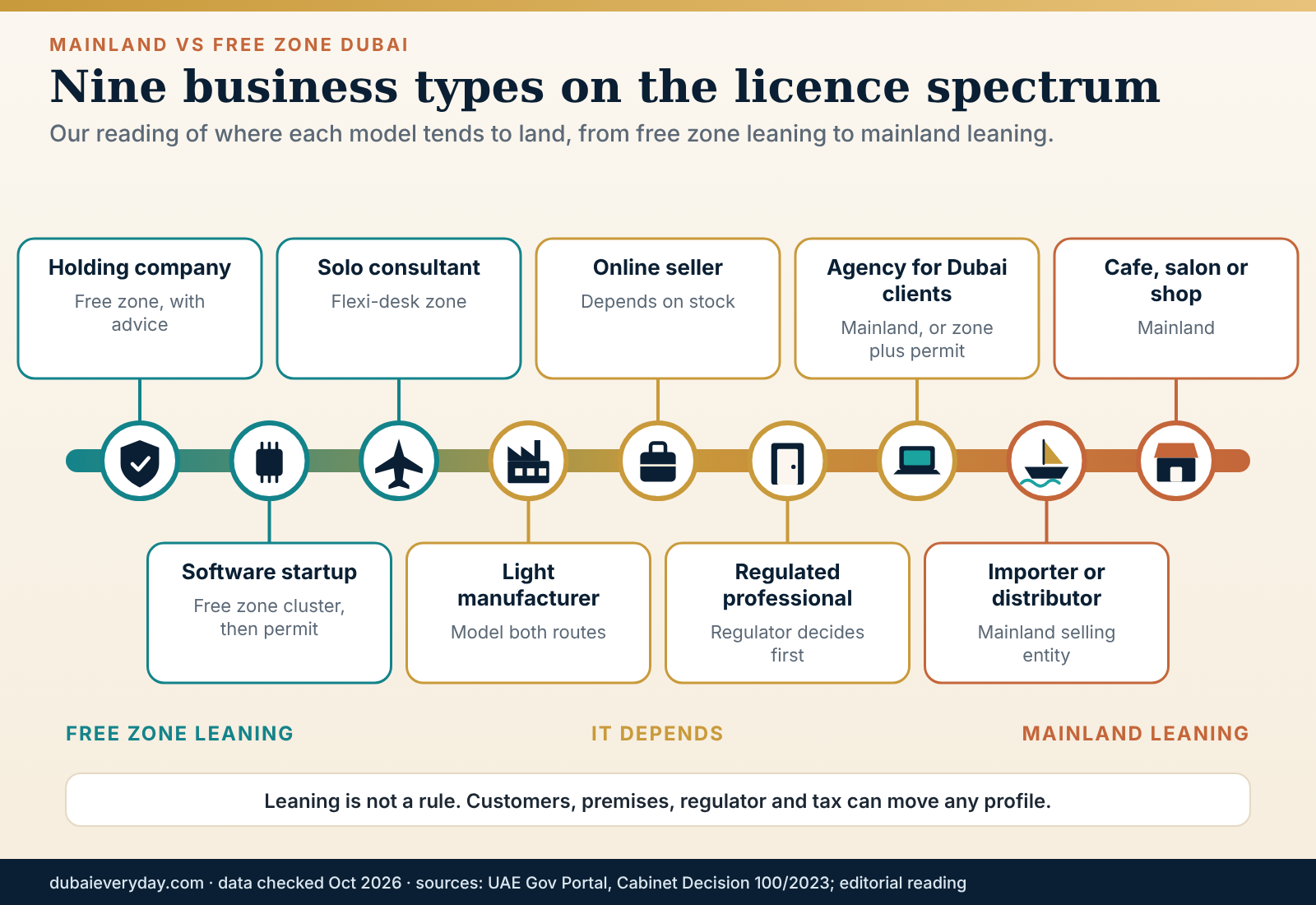
The sections above are the general mainland vs free zone Dubai comparison. This one applies it. We describe nine business profiles and say which route our reading of the rules favours, why, and what would change the answer. These are editorial judgements built from the verified rules, not official classifications, and the profiles are archetypes, not real clients.
The solo consultant with overseas clients
This profile leans free zone. One person, one visa, clients abroad and no walk-in trade fit a flexi-desk package neatly. The weak point is tax: consulting is not a listed qualifying activity, so income is probably taxed on the standard 0% and 9% bands, with Small Business Relief available under the AED 3 million revenue cap. The answer changes if Dubai clients become important, in which case the permit or a mainland licence enters the plan.
The agency or consultancy selling to Dubai companies
Lean mainland, or free zone plus permit. Local clients may expect a Dubai licence, tenders may require one, and the permit explicitly covers consultancy, design and professional services in its first phase. The question is arithmetic: AED 10,000 a year for a permit against the cost of a mainland licence and lease. If you need more than a few staff, mainland space grows more naturally than a zone package.
The online seller
It depends on stock. A seller that holds goods in a free zone warehouse benefits from 0% customs duty inside the zone, and pays duty only when goods move to the mainland market, per the UAE government’s page. If the buyers are Dubai consumers, the company still needs a legal route to sell to them. For a small home-based seller, the eTrader licence exists, but a Khaleej Times guide citing DET agents says trading activities under it are limited to UAE and GCC nationals. Treat that as a lead to verify, not a rule.
The importer or distributor
Lean mainland for the selling entity. A distributor sells to retailers and trade customers in Dubai, which is the activity a free zone licence does not cover. The common structure is a zone entity holding stock and a licensed mainland distributor taking the local sale, which is what the government page describes. Customs and VAT treatment of goods in zones is technical and unverified here, so ask a customs adviser before copying a model from a brochure.
The restaurant, cafe, salon, gym or shop
Mainland. These businesses need public-facing premises, municipal and often health approvals, and a lease in the right location. The zone package adds nothing to the unit you must rent. Budget the lease, fit-out and approvals first, and treat the licence fee as a smaller part of the bill. The right order for such a business is location, then approvals, then company paperwork.
The workshop or light manufacturer
Either, and worth modelling. Manufacturing and processing are on the list of qualifying activities for a qualifying free zone person, so a manufacturer in a free zone selling into the mainland may keep a 0% rate on that income, subject to the substance and audit conditions. Against that, a mainland industrial licence puts you near local customers without a permit. Have a tax adviser model both before leasing a unit.
The software or tech startup selling globally
Lean free zone. Dubai lists tech-focused zones such as Dubai Internet City, Dubai Silicon Oasis and d3 among its 21, and a cluster with startup support and investor-friendly entity types is a plausible fit. The same tax caution applies as for consulting: service income is not qualifying income. If your first enterprise customers sit in Dubai, plan for the permit from the first contract, rather than after invoicing the wrong entity.
The holding company or investor
Lean free zone, with care. Holding shares for investment for at least twelve months is a listed qualifying activity, and a zone company is a common wrapper. Immovable property is an excluded activity, with exceptions, so property ownership through a zone company is not a tax shortcut. Financial entities regulated in DIFC are in a separate regime. Because ownership, tax and succession interact, this profile needs a lawyer and a tax adviser, not a licensing agent.
The regulated professional
Start with the regulator. Clinics, schools, financial advisers, law practices and similar activities need a sector licence or a purpose-built zone such as Dubai Healthcare City or DIFC. On the mainland the sector authority approves the activity and the unit. The territory follows from the regulator’s rules, not the other way round. Our guides to insurance in Dubai and legal basics for residents sit beside this, since professional cover and contract law shape the choice as well.
Hybrid routes: crossing the border later
Mainland vs free zone Dubai is a softer choice than it was because you can add the other territory. The question is when. The cheapest moment to choose is before you sign a lease and a bank mandate, because changing the entity later means re-papering the bank account, contracts, visas and tax registrations.
Four ways across the mainland vs free zone Dubai divide
The first way is a dual licence, offered with five free zones, which the Dubai portal says avoids extra office space or a local partner. The second is the mainland operating permit at AED 5,000 per six months, for zone companies with a Dubai Unified Licence. The third is a branch licence, reported at AED 10,000 a year, which can be an onshore branch or a branch with its headquarters in the zone. The fourth is simply a second company or a mainland distributor, which has the most paperwork and the clearest separation.
Which one when
Use the permit when mainland work is new, short-term or a test. Use the branch when mainland revenue is steady enough for a twelve-month licence. Use a dual licence if your zone offers it and covers the activity. Use a separate mainland company when that side will have its own staff, premises and investors, because it is then a different business.
If you are already trading outside the zone
Resolution 11 of 2025 came with a one-year transitional period from 3 March 2025 for companies already operating on the mainland without the right licence, with a possible one-year extension, according to law-firm summaries. We could not confirm whether it was extended. If a free zone company is invoicing mainland clients without a permit, branch or distributor, speak to DET and a lawyer before the next invoice.
Keeping two sets of books
Crossing the border adds admin. Mainland revenue under the permit must be recorded separately, and the 9% rate applies to it. A branch is a branch of the same legal entity, so it shares liability but needs its own records. A second company has its own accounts, VAT position and corporate tax return, and dealings between the two will need documenting. If your finance function is a part-time bookkeeper, the practical cost of the second licence can exceed its fee.
A mainland vs free zone Dubai decision checklist you can run in an evening
Everything above reduces to a short mainland vs free zone Dubai sequence. Do it on paper before you talk to any adviser, because a salesperson who works for a zone will not start by telling you the mainland fits better. The aim is to arrive with your own answers and a list of questions, not to be walked through somebody else’s funnel.
- Write down your first ten customers.Where are they, who signs, and would they ask for a Dubai trade licence? Count how many are in Dubai, abroad or in a free zone.
- Name the regulator.Check whether your activity needs approval from a sector body. If so, start there.
- Count heads and desks.How many visas will you need in the first two years, and what office size does that imply under the zone’s quota or the mainland lease?
- Price the premises first.Get a written quote for the exact desk, unit or lease, not a licence-only price.
- Sort the income for tax.List each income line and ask a tax adviser whether it could be qualifying income. If the answer is “no” for most lines, remove tax from the reasons to choose a zone.
- Price the border crossing.If both markets matter, add the permit, branch or second company to the zone quote and compare it to the mainland quote.
- Ask for the renewal and exit terms.Renewal price, penalties and the cost of closing if the idea fails.
A mainland vs free zone Dubai decision table
The table below turns the main mainland vs free zone Dubai signals into a lean. It is our editorial summary of the rules above. If your situation produces two conflicting signals, pay for an hour with a lawyer or tax adviser who has no commission at stake.
| Signal in your plan | Leans | Why | Verify with |
|---|---|---|---|
| Most customers in Dubai | Mainland, or zone plus permit | Free zone licence is not built for direct local sales | DET, and your top clients |
| Shop, cafe, clinic or salon | Mainland | Public premises and local approvals | Municipality and sector regulator |
| Overseas clients, 1 to 3 people | Free zone flexi-desk | Low premises cost, visas within quota | Zone price list and quota |
| Hiring 10 or more soon | Compare both | Quota follows floor area | Zone quota, MOHRE, landlord |
| Government or semi-government clients | Mainland, or permit | Tenders were previously limited to mainland-licensed firms | The tendering entity |
| Goods in bond, re-export | Free zone | 0% customs inside the zone | Customs adviser |
| Share holding or investment vehicle | Free zone, with advice | Holding shares is a listed qualifying activity | Tax adviser, lawyer |
| Wants “0% tax” as the main reason | Neither, until income is sorted | Most service income is non-qualifying | Tax adviser |
Three illustrative founders
These made-up mainland vs free zone Dubai profiles show the logic; they are not real people or market data. Founder A, a brand designer with four clients abroad and no staff, fits a flexi-desk zone, and the question to ask is what year two costs. Founder B imports kitchen equipment for Dubai restaurants, so the mainland, or a zone warehouse plus a licensed distributor, is the logical start.
Founder C runs a four-person software consultancy with half the revenue from Dubai companies and a possible government client: a tech zone plus the permit first, and a mainland licence later if government work becomes core.
Questions for any adviser or zone
- Is the quote for the exact activity, office type and visa count I described, in writing?
- What is the renewal price, and what penalty applies if I am late?
- What happens to my visas if I close or move the company?
- Which of my income lines could be qualifying income, and who confirms that?
- Are you paid by the zone, a bank or another provider for this referral, and does that change the options you show me?
- Can I see your own Dubai licence on the DET or zone lookup?
Mistakes and red flags
Most costly errors in the mainland vs free zone Dubai choice are not exotic. They come from one wrong assumption early on and a series of correct steps built on top of it. The most common ones follow.
Choosing on the headline price
A “from AED 12,500” licence and a “from AED 9,000” registration are real prices for real items, but neither is the bill. Compare line by line, using the cost section above as a template, and ask for the first-year total with your visas and office included. If a quote cannot give you a single total, that is information.
Assuming 0% tax follows the address
It does not. The 0% rate attaches to qualifying income of a qualifying free zone person who meets the substance, audit and de minimis conditions. Planning a business on a tax assumption that your adviser has not tested against your income lines is a risk you can remove for the price of an hour of advice.
Picking the zone before the regulator
If your activity needs a sector approval, the zone cannot override it. A common cause of long delays, in our reading, is a licence that cannot cover the real work. The remedy is to ask for the activity code, the approving body and any pre-approval conditions before paying a deposit.
Under-buying visas
A flexi-desk with a three-visa ceiling is a sound start for one person and a poor plan for a team of eight. Check what moving up a tier costs. On the mainland, lease size plays the same role.
Selling to the mainland from a zone licence
Invoicing Dubai customers directly from a free zone entity without a permit, branch or distributor is the situation the 2025 framework was designed to regularise, and the transitional window’s current status is unconfirmed. Fix the structure before you grow into the problem.
Mainland vs free zone Dubai advice can look free because the adviser is paid elsewhere, for example by a zone or a provider. We have no verified statistic on how common that is. Ask directly whether the adviser is paid by what they recommend, ask for the mainland alternative in the same detail, and avoid anyone who guarantees a bank account, a tax outcome or a licence for an activity they have not checked.
FAQ: mainland vs free zone Dubai questions
Mainland vs free zone Dubai: which is better for a small business?
Neither wins in general. The mainland suits businesses that sell to Dubai customers, need public-facing premises or bid for local contracts. A free zone suits businesses serving overseas clients, trading through a zone or using a sector cluster. If revenue is split, the 2025 permit and branch routes let a zone company reach the mainland, so price that against a mainland licence first. Decide on customers, then premises and visas, then tax.
Can a free zone company sell to customers on the Dubai mainland?
In mainland vs free zone Dubai terms, not directly in the standard model. The UAE government’s free zone guidance says mainland sales go through a licensed mainland distributor or a mainland branch or company, and that direct mainland sales are generally not permitted without the right licences. Since 2025, Dubai free zone companies with a Dubai Unified Licence can apply for the Free Zone Mainland Operating Permit, AED 5,000 for six months, covering a first phase of non-regulated activities. Check that your activity is included.
Do free zone companies pay 0% corporate tax?
Only on qualifying income, and only if the company is a qualifying free zone person. Cabinet Decision No. 100 of 2023 treats income from non-free-zone customers as qualifying only when it comes from a listed qualifying activity such as manufacturing, logistics or certain fund management. In our reading, consulting or design income is not on that list, so it falls under the standard bands: 0% up to AED 375,000, 9% above. Confirm with a tax adviser.
Can a foreigner own 100% of a mainland company in Dubai?
For most activities, yes. Since 1 June 2021, Federal Decree-Law No. 26 of 2020 has allowed up to 100% foreign ownership on the Dubai mainland, and the Dubai Media Office said no Emirati partner, extra fee or extra capital applied. Strategic-impact activities and a negative list stay restricted, and the UAE government’s steps page still mentions a service agent agreement for some foreign-owned companies. Ask DET about your activity in writing.
Mainland vs free zone Dubai: which costs less?
Sometimes. In a mainland vs free zone Dubai cost comparison, Meydan advertises a licence from AED 12,500 with a flexi-desk, while DMCC’s schedule lines add up to AED 34,185 before office and visa. On the mainland, adviser-reported government items run about AED 14,654 to 16,954 before the lease, which is the swing cost. For one person with overseas clients a flexi-desk zone is often cheaper. For a team or a shop, the mainland lease is the main cost either way.
Can I get a UAE residence visa through a free zone company?
Yes. Free zone authorities process work permits and residence visas for the companies they license, within a quota linked to office type. Owners can also use routes such as GDRFA Dubai’s green residence for partners and investors, up to five years, with government fees totalling AED 740 in the version we read, or the Golden Visa routes on the UAE government portal. Each zone sets its own conditions, so ask for them in writing.
What is a dual licence?
The Dubai government portal describes it as a way for a free zone company to operate on the mainland without extra office space or a local partner, offered with five free zones. It does not name them and we found no primary list. Ask the zone whether it offers one, which activities it covers and what the second licence costs. It is not the same thing as the 2025 permit.
Mainland vs free zone Dubai: can I switch later?
You can add the mainland to a free zone company through a permit, branch or dual licence, or set up a separate mainland company. We found no official page describing a direct transfer of one licence into the other, so assume a new licence and plan for new paperwork, bank mandates and visas. The cheapest moment to choose is before you sign leases and contracts.
Can free zone companies bid for government tenders?
Historically they were limited. The Dubai Media Office announcement of the permit says holders gain access to government tenders and contracts previously limited to mainland-licensed firms. That describes the permit’s benefit; it is not a guarantee for each tender, so ask the entity running the tender what licence it requires before paying for either route.
Related reading
Sources and further reading (37 links)
- UAE Government Portal: Steps to start a business on the mainland — mainland process, premises, Ejari, initial approval, service agent mention
- UAE Government Portal: Full foreign ownership of commercial companies — restricted activities and 100% ownership rules
- UAE Government Portal: Running a business in a free zone — customs, mainland distributor rule, direct-sales limits
- UAE Government Portal: Starting a business in a free zone — entity types, licence timing
- UAE Government Portal: Recruiting in free zones — visas, quotas, free zone employment rules
- Dubai.ae: Starting a business — mainland stages, legal forms, document attestation
- Dubai.ae: Business set-up options — free zone entity types, dual licence description
- Dubai.ae: Free zones in Dubai — list of 21 free zones
- Dubai.ae: Residence visa for work — employee visa sequence
- Dubai.ae: Health insurance — employer obligation and quoted premium band
- Dubai Media Office: Dubai launches Free Zone Mainland Operating Permit — permit fee, scope, tax, tenders
- Dubai Department of Economy and Tourism: New growth for investors — permit announcement and date
- Dubai Media Office: Dubai Economy clarifies full ownership procedures for foreign investors — mainland ownership change
- Dubai Media Office: Dubai Unified Licence launch — single registry across mainland and zones
- Invest in Dubai: Dubai Unified Licence guide — single business identity
- UAE Government Portal: Inquire about licences, names and activities — verifying a company licence
- Ministry of Finance: Cabinet Decision No. 100 of 2023 on Qualifying Income — Article 3 qualifying income rules
- Ministry of Finance: Ministerial Decision No. 229 of 2025 — qualifying and excluded activities, de minimis
- Ministry of Finance: Explanatory guide for corporate tax purposes — 0% and 9% bands
- Federal Tax Authority: Small Business Relief — AED 3 million revenue condition
- Federal Tax Authority: Corporate tax registration — registration, penalty, natural persons
- Federal Tax Authority: Registration for VAT — registration thresholds
- DMCC: Schedule of charges — free zone fee lines used in the worked example
- DMCC: Dubai free zone company set-up cost — typical first-year range, flexi-desk packages
- DMCC: The four types of free zone visa — visa quota by office type
- Meydan Free Zone: Company set-up cost breakdown — second free zone price example
- GDRFA Dubai: Green residence for partners and investors — owner residence fees and documents
- UAE Government Portal: Golden Visa — entrepreneur and investor routes
- Dubai Land Department: Register or renew an Ejari contract — Ejari fee for tenancy contracts
- KPMG UAE: Dubai issues resolution enabling free zone companies to operate on the mainland — adviser summary of Resolution 11 of 2025
- CMS: New Executive Council Resolution unlocks mainland access for free zone companies — adviser summary of routes, fees, transition
- Gulf News: How Dubai is making business setup faster and easier — licensing figures and the corporation’s banking claim
- Gulf News: Dubai cuts business bank account opening time — earlier banking-time claim
- Khaleej Times: Dubai trade licence types, process, verification — Instant and eTrader licences, reported small fees
- Gulf Today: Deadline for Emiratisation target — Emiratisation contribution
- The National: UAE extends corporate tax relief for small businesses until 2029 — Small Business Relief extension
- Avyanco: Dubai mainland cost (adviser page) — unofficial mainland fee estimates, used with caution
Update log: 29 October 2026 — first publication; facts re-checked against the sources above. Next review due: January 2027, or sooner if DET publishes the permit activity list, a fee schedule changes or corporate tax guidance is amended. Corrections welcome. This page is general information, not legal, tax or financial advice; confirm your own case with DET, your chosen free zone and a licensed adviser.
About DubaiEveryday and this guide
DubaiEveryday.com is an independent editorial project that publishes practical, research-based guides to everyday life in Dubai: where to live, what things cost, how the rules work and how to get around. This page was written and edited by the DubaiEveryday editorial team. It is not signed by a named expert, doctor, lawyer or adviser, and we do not claim first-hand testing of a venue, clinic or service unless the page says so.
Each guide is built from official sources such as government and regulator pages, operator websites and established news outlets, cross-checked where we can. When we could not confirm something, we say so in the text, and examples that use made-up numbers are labelled as illustrations. Mentions are editorial choices, not paid placements, and a link is not an endorsement.
Dubai changes quickly. If you spot something that is out of date or wrong, please tell us through the contact options on DubaiEveryday.com and we will check it and correct the page.