
Two flats of the same size and price can be very different purchases once the building is part of the deal. This guide shows how to buy apartment Dubai stock on evidence, judging quality, service charges, parking, views, management and resale before you commit, using Dubai Land Department and government sources checked on 29 October 2026.
The flat has a balcony view, a fair price and an agent who answers every message within minutes. None of that tells you what the building will cost you in 2030, whether your car has a legal place to sleep, or who will want to buy the flat when you leave. The brochure is silent on all three, and that is where the money goes.
Fortunately, most of the answers sit on public Dubai Land Department tools that take minutes to use. This guide to buy apartment Dubai property walks through building quality, service charges, parking, views, management and resale, including the new 20-year safety law. None of it needs an engineering degree. Read it before the viewing, and the viewing becomes a test instead of a sales pitch.
To buy apartment Dubai buyers should judge the building first and the flat second, because the building decides what you pay every year, whether you can park, how the common areas age and how easily you can sell. Check six things before you make an offer: the age and build quality, the approved service charge per square foot, the parking bay written on the title deed, what could be built in front of your view, who manages the tower, and how often similar units resell.
Under Law No. 6 of 2019 you own the unit and share the common parts, so the service charge, the owners’ committee and the developer’s warranty all come with the purchase. A new Dubai law, Law No. 3 of 2026, adds a Quality and Safety Certificate for buildings that reach 20 years from completion, which matters if you are looking at older towers.
Most of these checks are free and take minutes on the Dubai Land Department (DLD) website or the Dubai REST app. Do them before you book the viewing, not after the offer. The step-by-step process behind a buy apartment Dubai deal, from offer to transfer, sits in our guide to buying property in Dubai.
This buy apartment Dubai guide is research-based, not field-tested. On 29 October 2026 we read the DLD’s published copy of Law No. 6 of 2019 on jointly owned property, its service pages for the Service Charge Index, project status, sale registration and open data, its FAQ, the Mollak system page, the Dubai Legislation Portal text of Law No. 3 of 2026 on building quality and safety and Law No. 8 of 2007 on escrow accounts, and the Central Bank of the UAE mortgage rulebook.
Consultancy reports, an aggregator built on DLD records and press articles are named as such and used for market context only. We did not inspect any building, and no developer, broker or management company paid to be mentioned. Per-building service charges are not published in a form we could reproduce here, so the numbers in worked examples are labelled illustrative. This is general information, not legal, financial or mortgage advice.
What you actually own when you buy an apartment in Dubai
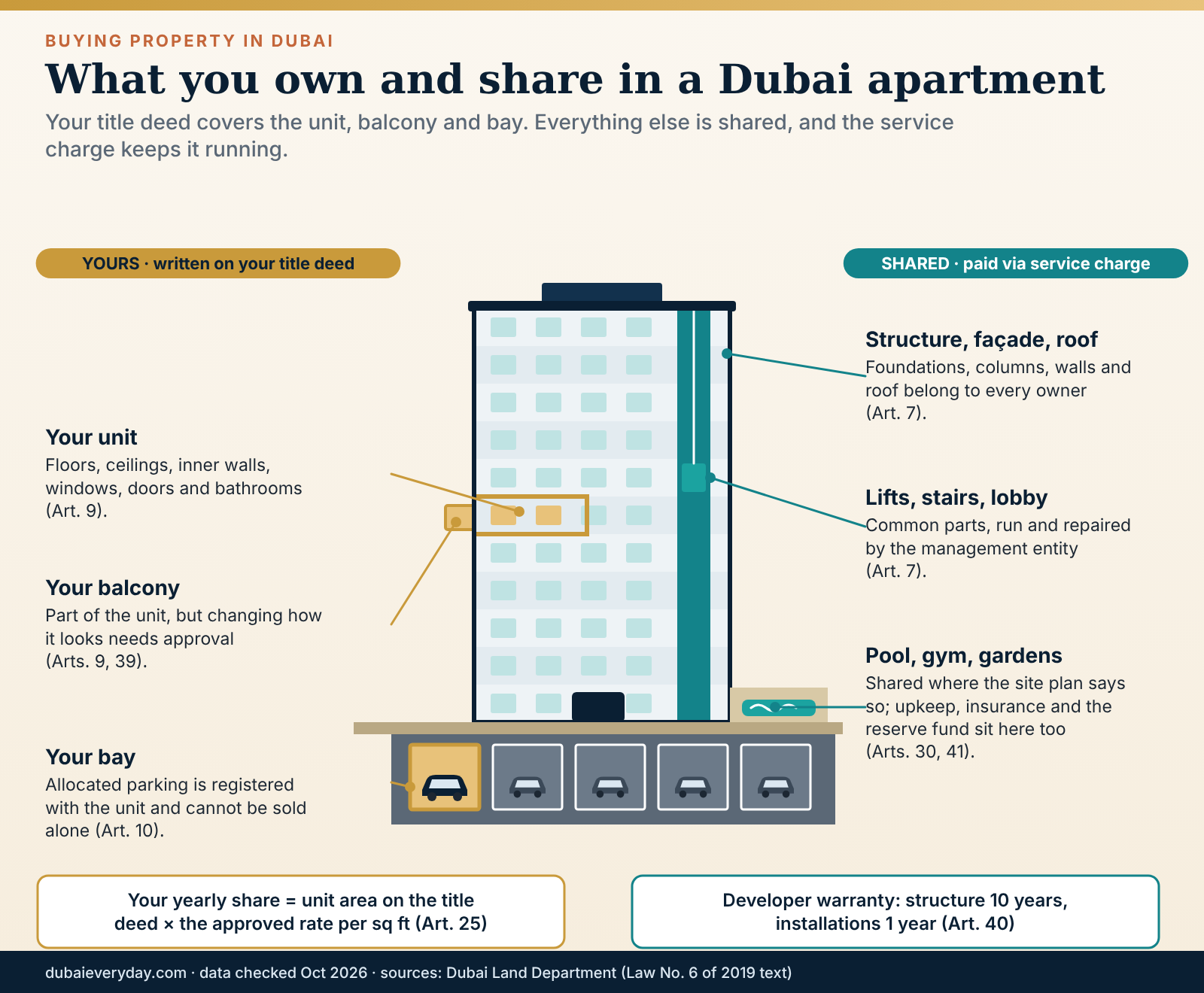
When you buy apartment Dubai units in a tower, you do not buy a sealed box outright. Law No. 6 of 2019 divides a jointly owned building into units and common parts. Your unit covers the floor finishes, ceilings, non-load-bearing internal walls, windows, doors, bathrooms and any balcony allocated to you. The foundations, columns, façade, roof, stairs, entrance halls, lifts and main utility equipment belong to everyone and are paid for by everyone, in proportion to unit area.
Car parks and storage rooms allocated to your unit count as part of the unit as well, even when they are far from your front door. They are registered with the unit and, under the same law, cannot be sold on their own. That detail matters later, when we get to parking.
This is why a buy apartment Dubai search is really a search for a building with a flat inside it. The flat you can inspect in forty minutes. The building you will live with, fund and one day try to sell takes longer to understand, and most of what you need to know is on public registers.
What this guide covers, and what it leaves to others
This page answers one question: how do you choose and judge the building around the flat before you buy apartment Dubai options? The mechanics of an offer, Form F, the DLD fee and the transfer are in our buying property guide. Mortgage sizing and a first-purchase budget are in the first-time buyer guide. Who may buy and where is covered in the foreign buyer guide and the freehold property guide. Returns are in the rental yield guide.
It is written for four readers who all end up asking the same buy apartment Dubai questions: a tenant thinking about owning, a first-time owner-occupier, an investor comparing towers, and an existing owner wondering whether the tower they hold is a good one. The checks are the same for all four.
The apartment market you are buying into
Apartments are most of what Dubai sells, so any buy apartment Dubai plan starts with that market. In September 2026 a report from FAM Properties, an aggregator that analyses DLD records, counted 11,340 sales worth AED 29.73 billion, of which 9,124 were apartments. That is about four in five. The same report puts the median apartment price at AED 1,675 per square foot, 3.5% lower than a year earlier, and the number of apartment sales 47.2% lower. Treat it as one aggregator’s reading of DLD data, not a DLD publication.
The report also splits sales by channel. Primary sales, meaning purchases directly from a developer (which can include ready stock, not only off-plan), made up 64.2% of deals at a median of AED 1,701 per square foot. Resales were 35.8% at AED 1,517. The gap is tempting to read as a “resale discount”, but the two groups contain different buildings, different ages and different areas, so it is a mix effect as much as a price effect.
Prices and supply, as consultancies read them
Cushman & Wakefield’s second-quarter 2026 residential report says citywide sale prices fell 4% on the previous quarter, led by apartments, and rents fell 6%. Among apartment areas it lists Palm Jumeirah at minus 9%, Downtown Dubai and Business Bay at minus 7%, Dubai Hills Estate at minus 4% and Jumeirah Village Circle at minus 3%. It counts more than 13,200 completions in the quarter, expects about 32,000 in the second half of 2026, and describes a supply pipeline that runs through 2030, while warning that contractor capacity and supply-chain limits may delay handovers.
For anyone about to buy apartment Dubai stock, here are two readings of those numbers, both ours. First, more completed stock means more choice and more room to negotiate on a resale, so you can afford to be picky about the building. Second, when many similar units compete, the ones with higher charges, weaker management or no parking are the ones that sit unsold. Building quality shows up at resale most clearly when the market is soft.
Sources use different indices and periods, so we avoid forecasting. What the numbers support is simple: the market is large, liquid and currently buyer-friendly in many apartment areas, and the spread between a good tower and a poor one is yours to measure before you buy apartment Dubai units. For the investor angle see the property investment guide.
Building quality: age, warranties and a walk-through that works
Quality here does not mean marble lobbies. It means four boring things: a sound structure, mechanical and plumbing systems that work, a façade and roof that keep water out, and a maintenance routine that someone actually funds. A glossy tower can fail the last test while an unremarkable one passes. When you buy apartment Dubai stock, the lobby is marketing and the car park ceiling is evidence. Judge each buy apartment Dubai candidate on those four things.
Start with the age and the paperwork
For every buy apartment Dubai candidate, find the completion year first. It sets which warranty clocks are still running, whether the building is approaching the 20-year certificate described below, and what the common systems (lifts, pumps, chillers, fire panels) are likely to need in the next decade. The DLD publishes a list of approved developers through its Licensed Developers service, and the Project Status Enquiry shows a project’s completion percentage and details by land number, project number or name. Both are free and open to all residency statuses.
DLD also classifies buildings for its Smart Rental Index, announced in January 2025. The criteria it names are technical and structural characteristics, the quality of finishes and maintenance, location, and services such as maintenance, cleanliness and parking management.
The DLD FAQ adds that an owner can ask for a building to be reclassified. We did not find a public look-up of a building’s class on the pages we read, so ask the seller or the management company whether the building has been rated, and treat a rating as one data point rather than a verdict. Tenants face the same question; our rent an apartment guide shows the renter’s version of the building checklist.
Warranty clocks: what the developer owes and for how long
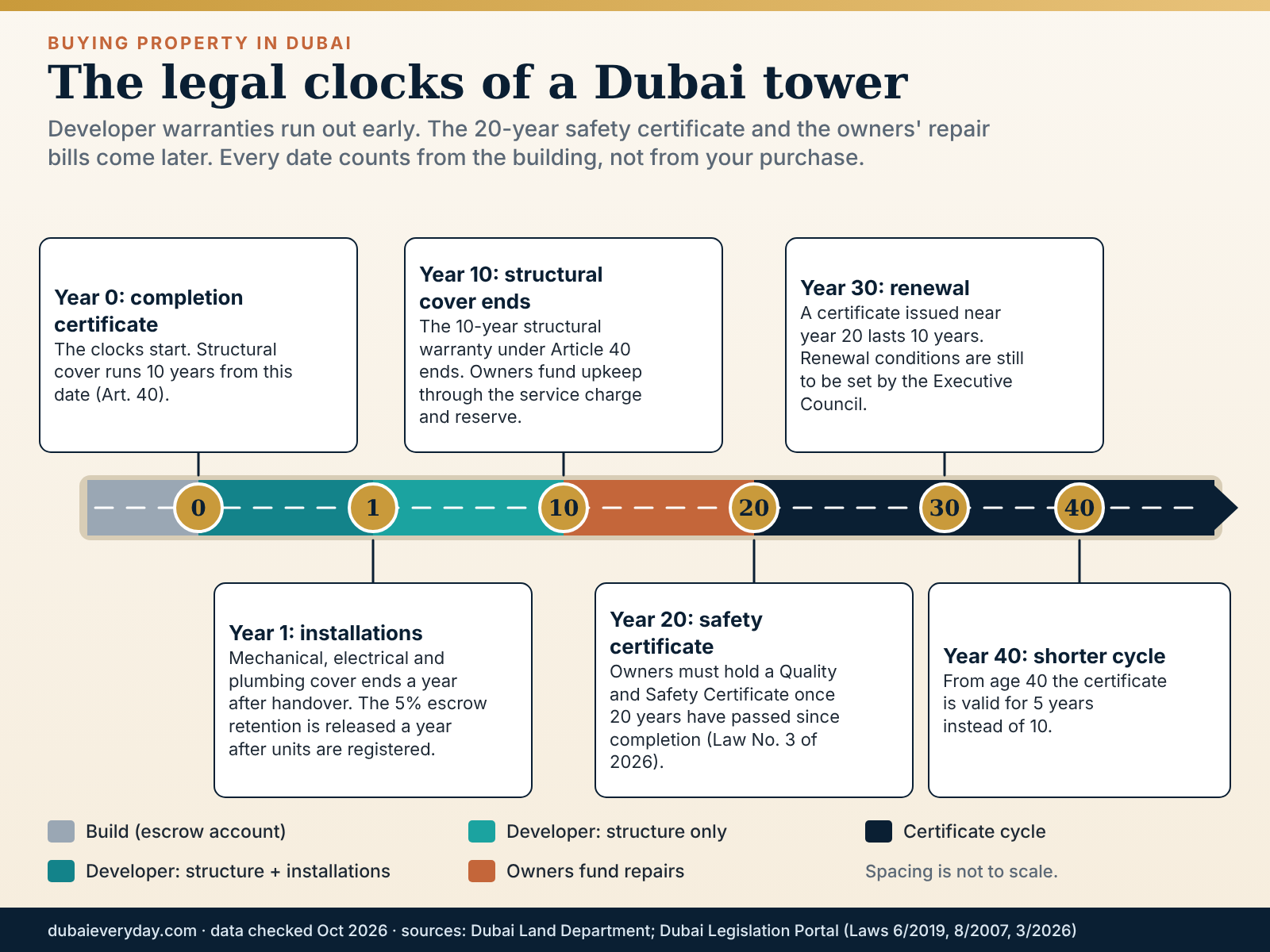
Law No. 6 of 2019 sets two clocks in Article 40. The developer must repair structural defects for 10 years from the date of the completion certificate. Defects in mechanical, electrical and plumbing or sewerage installations are covered for 1 year from handover; if the owner delays taking possession, the year runs from the completion certificate instead. Any agreement that cuts these rights is void under the same article, so a contract clause cannot waive them.
A second protection sits in the escrow law. Under Article 14 of Law No. 8 of 2007, the escrow agent holds back 5% of the value of each project’s escrow account once the completion certificate is issued, and releases it a year after the units are registered in the purchasers’ names. The DLD FAQ describes that 5% as the cushion for defects visible at completion or appearing within a year of handover. The statute text we read does not itself say what the retention is for, so treat the DLD’s explanation as the official gloss.
What this means if you buy apartment Dubai resale units is less comforting. The clocks run from the building’s dates, not from your purchase date. A buyer in year six inherits whatever is left of the 10-year structural cover and, in practice, none of the one-year installation cover. From then on, a failed pump or a cracked riser is paid for by the owners through the service charge or the reserve fund. That is our reading of the statutory dates, not a legal opinion.
Older towers and the new 20-year rule
Law No. 3 of 2026, issued by the Ruler of Dubai and announced on 10 March 2026, applies to all buildings in the emirate, including those in special development zones and free zones. Owners, expressly including unit owners under Law No. 6, must obtain a Quality and Safety Certificate once 20 years have passed since the completion certificate.
A licensed engineering firm inspects the building and writes a technical report, the owner approves a repair plan, a contractor does the work, and the competent authority (the Dubai Municipality, or the zone authority in free zones) inspects before issuing the certificate. The certificate lasts 10 years for buildings under 40 years old and 5 years from age 40.
For a buy apartment Dubai shortlist, the practical rule is to note each tower’s completion year and count 20 years forward.
Buildings under 20 years old are not exempt from duties either: owners must carry out periodic maintenance and fix defects that create risk. Fines run from AED 100 to AED 1,000,000, doubling for repeat offences within two years up to AED 2,000,000, and the authority can suspend building permits and the attestation of lease contracts for units in a non-compliant building.
Owners, contractors and engineering firms get one year from the effective date to comply, which the Executive Council chairman can extend. The law takes effect 60 days after Official Gazette publication; we could not confirm the Gazette date, so the exact deadlines are uncertain.
The law says that, in a building under Law No. 6, the management entity performs the owner’s duties while each owner stays responsible for monitoring it and paying the related fees. A law-firm briefing treats the executive regulations as still pending, and the summary of the law we read does not say how repair costs are shared between owners. Before you offer, ask the management company in writing whether an engineering firm has been appointed, what the timetable is, and whether the reserve fund or a one-off levy will pay for any repairs.
A walk-through that tells you more than the brochure
You do not need engineering training to read a building. You need to look where nobody staged anything, at the times nobody warned you about. A viewing at 6 pm tells you about lift queues and parking; one at 11 am on a weekday tells you about noise and cleaning standards. Use this list at every buy apartment Dubai viewing.
- Car park ceilings and columns: water stains, rust streaks, patched cracks, damp smell.
- Lifts: how long you wait at peak time, whether all cars run, the date on the inspection certificate.
- Corridors and lobbies on upper floors: smell, carpet and paint condition, clear fire exits.
- Façade and balconies: staining below windows, loose sealant, dripping air-conditioning condensate from units above.
- Pool deck, gym and garbage rooms: fixtures that work, equipment that is not taped up.
- Notice boards: works notices, arrears warnings, meeting minutes, insurance certificate.
- Inside the unit: water pressure, window seals, humidity marks on ceilings, how the air conditioning behaves with the balcony door open.
The DLD open data also helps. Its Building dataset lists counts of flats, shops, pools and elevators, plus floors and parking. Dividing flats by lifts gives a rough comparison between towers of similar height. We found no official benchmark for that ratio, so use it to compare buildings against each other, never as a pass mark.
On fire safety, a 2018 news report on the UAE’s updated Fire and Life Safety code said new developments must use fire-safe external cladding and that older buildings with non-compliant cladding should replace it during maintenance. Treat that as background. Ask the management company whether the building holds current Civil Defence approvals, and note the answer.
Service charges: reading the number before you buy apartment Dubai
When you buy apartment Dubai property, the service charge is the closest thing to a second mortgage payment, and it never ends. It is also the number a listing is least likely to print. Fortunately it is regulated, searchable and comparable, which is more than can be said for most costs of owning a home.
How the charge is set and who checks it
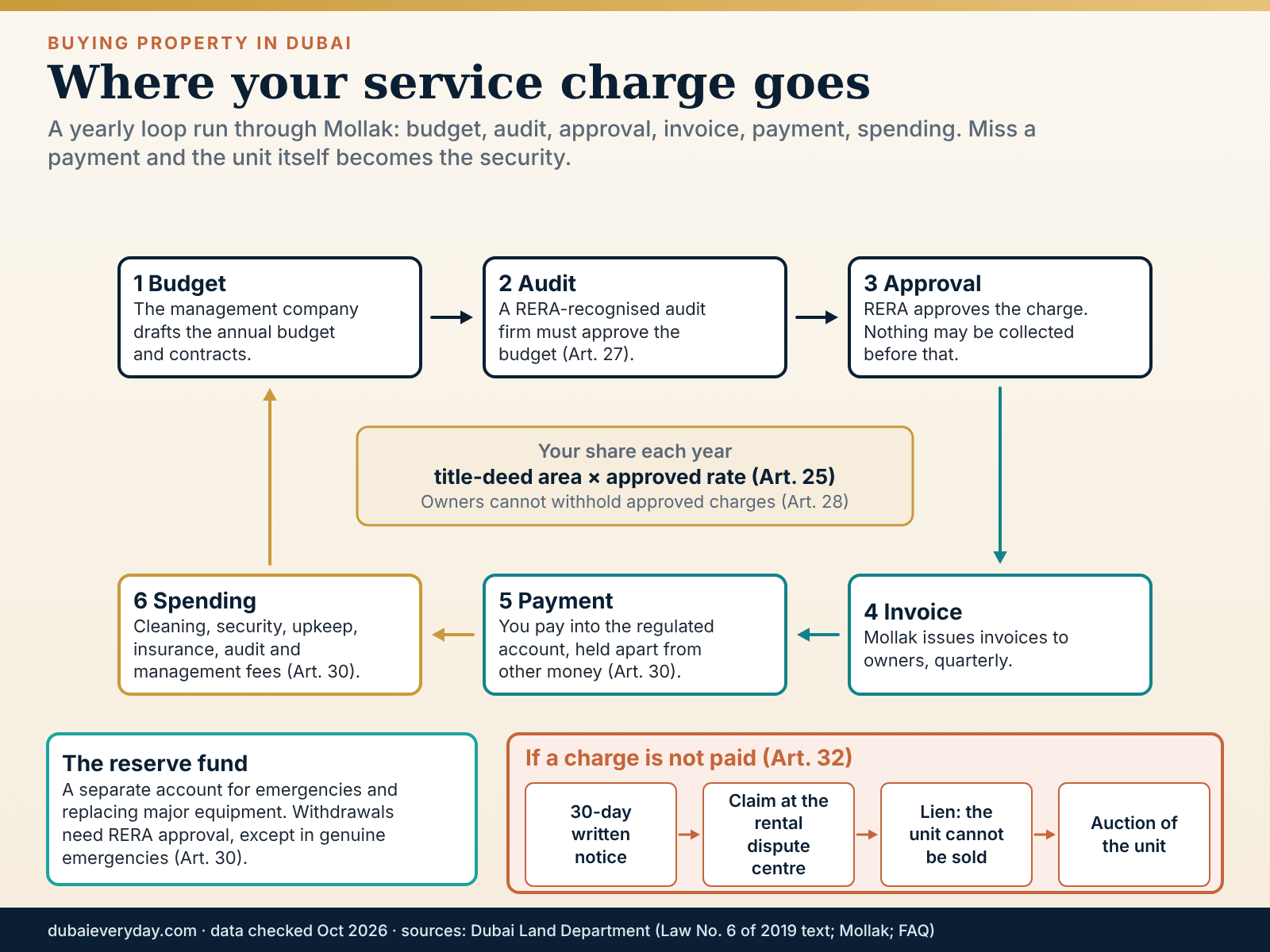
Each owner’s share is calculated from the unit area on the title deed (Article 25 of Law No. 6 of 2019). The management body prepares a budget, a RERA-recognised audit firm must approve it, and RERA must approve the resulting charge (Article 27). The DLD FAQ adds that management bodies may not collect service charges before RERA approval, and that collecting unapproved charges can lead to legal action. Owners cannot withhold approved charges (Article 28).
Invoices are issued through Mollak, the DLD’s electronic system for jointly owned property. Its own page says owners receive quarterly invoices, management companies register on it and upload financial statements and contracts, and communities submit financial records and audit reports through it. Payment goes to the regulated bank account printed on the invoice, or through the Noqodi wallet. Article 30 requires service charges to be held in a separate bank account that creditors cannot seize, deposited within seven working days, and spent only on things like cleaning, security, upkeep, insurance, audit and management fees.
The reserve is a separate account again. It is meant for emergencies and for replacing major equipment, withdrawals need RERA approval except in genuine emergencies, and if it runs short the DLD can ask owners to cover emergency costs with RERA’s prior approval (Article 30). Insurance for the building is the management’s duty and the premiums are part of the service charges (Article 41).
What a buy apartment Dubai service charge looks like
Gulf News, in an explainer last updated in February 2026, put charges at roughly AED 3 to AED 30 or more per square foot a year, with villas and amenity-heavy communities at the top. That is a wide band, and it only helps as a reminder that a quoted figure for one tower tells you nothing about another.
To get the real one, use the DLD Service Charge Index. The service page lists three inputs, the project name, the use and the year, and three channels: the DLD website, the Mollak site and the Dubai REST app. It does not state the unit of the result, so check whether the figure you see is per square foot per year before you multiply.
The same article describes a route that starts from the title-deed number and shows the management company and a fee breakdown. We could not confirm that detail on the DLD page itself. If the tool will not give you a breakdown, ask the seller for the latest invoice and the approved budget.
Here is why it deserves attention in any buy apartment Dubai comparison. The table below is an illustrative example, not a quote: a 900 sq ft flat at the median apartment price of about AED 1,675 per square foot from the September 2026 report, which comes to roughly AED 1.5 million.
| Illustrative charge per sq ft per year | Annual cost, 900 sq ft | Per month | Share of a AED 1.5m price a year | Over 10 years, same rate |
|---|---|---|---|---|
| AED 12 | AED 10,800 | AED 900 | 0.72% | AED 108,000 |
| AED 20 | AED 18,000 | AED 1,500 | 1.20% | AED 180,000 |
| AED 30 | AED 27,000 | AED 2,250 | 1.80% | AED 270,000 |
Our calculation: the gap between AED 12 and AED 20 is AED 7,200 a year. If you value a flat on a 5% net yield, that stream is worth about AED 144,000 of purchase price, nearly 10% of the flat. In plain words, a building with a much higher charge has to be much cheaper, or much better, to be the same deal. Charges also change, so look at the Index for the last few years rather than one.
What the charge does and does not include
The DLD FAQ lists security, cleaning, maintenance contracts, utilities, administration, insurance and, for master communities, master community charges as typical heads. Large master-planned projects can also have a separate usage charge for shared facilities (Article 31). Ask for each unit which of these applies and what sits outside.
The classic hole is cooling. In a building on district cooling, the operator bills for it separately. Emicool’s FAQ describes a capacity charge, fixed per year from the contracted refrigeration tons and paid monthly regardless of use, plus a monthly consumption charge per ton-hour, a refundable deposit of eight months of capacity charge, a one-time AED 200 activation fee, and a DEWA surcharge.
The page does not say whether the building service charge covers any of this, so the question for any district-cooled building is whether the quoted service charge includes chilled water or not. Our rent apartment guide explains the same split from the tenant’s side.
Also ask what the building bills on top, such as access cards and move-in deposits. Those are not in the Index.
Cheap is not always good, and dear is not always bad
If you buy apartment Dubai towers on the strength of a low charge, remember it can mean an efficient building. It can also mean a reserve that is too thin and maintenance that has been deferred. A high charge can mean cooling, a gym and a pool are properly funded, or it can mean an expensive management contract. You cannot tell from the number alone, so compare like with like: same age, similar height, similar amenities, same area. Then ask three questions. What is the reserve fund balance? What major works are planned in the next five years? Has the charge been raised or cut at the last approval?
Article 32 gives the management entity a lien on every unit and says a unit may not be disposed of until the charges are paid. After a written 30-day notice the claim can be enforced at the Rental Dispute Settlement Centre, and ultimately the unit can be auctioned. A 2020 Gulf News report described sale registration being refused and an owner being asked for charges that pre-dated his purchase. Get a written statement of the unit’s service-charge account from the management company before you pay a meaningful deposit to buy apartment Dubai property, and make the seller settle any balance before transfer.
Parking: what the title deed gives you
Parking is the feature most people who buy apartment Dubai units assume and fewest verify. The legal position is clearer than the sales talk. Under Articles 9 and 10 of Law No. 6 of 2019, car parks designated to a unit are an integral part of that unit, are registered with it, and cannot be sold separately. Buying an additional bay is possible, but only within rules set by the DLD Director General.
The practical routes are in the DLD FAQ. To add a parking space to a unit you need the title deed, a no-objection certificate from the developer or management company, a bank letter if the building is mortgaged, and the unit or purchase contract. A 4% fee applies if the space is bought at or above market price. The bay must not already be allocated to another unit, and the change is filed as an amendment report through a trustee centre or the DLD’s customer service channels.
If a sales contract names a bay that is missing from the title deed, the DLD checks its records and the developer has to correct the data or confirm the position by letter.
How many bays to expect, and what a second one costs
There is no single statutory number per flat that we could find. Property Finder’s parking explainer, last modified in July 2024, says studios to two-bedroom flats usually get one space and larger flats two, with Dubai Marina allocating one per apartment because of density and some newer areas offering more. It also puts the cost of renting an extra space through a building at about AED 36,000 a year on average. That is an old, secondary and tenant-oriented figure, so read it as a warning about scarcity rather than a price.
The informal “rent a bay from a neighbour” arrangements it mentions are not official contracts.
The reasoning matters more than the number. If the building allocates one bay per flat and your household has two cars, the second car lives on the street or in a rented bay for as long as you own the flat. The next buyer will do the same arithmetic, so one-bay flats in one-bay buildings suit solo owners and couples with one car, and are a harder sell to families.
What to confirm about parking before you buy apartment Dubai units
- The bay number appears on the title deed or the sale contract. If it does not, resolve it before transfer.
- Whether the bay is numbered and reserved or “first come, first served”, and which level it is on.
- Bay width, ceiling height and distance to the lift, checked with your actual car.
- Visitor parking rules, and whether guests can be locked out at peak hours.
- Access cards or tags, and what the building charges for a replacement.
- Electric vehicle charging: we could not open DEWA’s directive page, so ask the management company and DEWA directly what is permitted and who approves it.
The DLD open data can back this up. The Unit dataset lists parking and the allocation type per unit, and the Transactions dataset records a parking field. Neither is a legal proof of your bay, but a pattern of “no parking” among recent sales in a tower tells you something the brochure does not.
Views, floors and the sun: what you can and cannot count on
If a view drives your decision to buy apartment Dubai towers, know that it is the most expensive thing in a flat and the least protected. In the sources we read we found no provision that guarantees a view or stops a neighbouring plot from being built, and we would be cautious of any listing that treats a view as permanent. What exists instead is paperwork you can check.
Check what can be built in front of you
Ask the developer or seller for the site plan and master community declaration. Under Article 21 the master developer issues the declaration before sales and RERA approves it, with amendments that affect buyers also needing RERA approval. Then look beyond it. The DLD Project Status Enquiry and the Project dataset in the open data show registered projects, their stage and percentage complete, so you can see whether the empty plot next door already has a project number. Cranes, hoardings and enabling works on site are visible evidence that planning is more than a rumour.
On site, test the view yourself, on the same floor and orientation as the unit. Photographs for listings are often taken from the roof or from a higher floor, and “Burj Khalifa view” or “sea view” can mean a slice visible only from one corner of the balcony. If your shortlist is in the central high-rise cluster, our Downtown Dubai area guide covers what living there involves day to day.
Floors, balconies and noise
Higher floors tend to cost more per square foot, but we found no official premium-per-floor data. Use the Unit dataset (floor, size, balcony area) and the Transactions dataset (amount, size, project) to see the pattern inside one building. It takes a spreadsheet and an hour, and it beats an agent’s rule of thumb when you buy apartment Dubai units on higher floors. Higher floors also mean longer lift waits, more wind on the balcony and less street noise, while lower floors can sit above restaurants, pool decks, loading bays and generator rooms.
A balcony is part of your unit under Article 9, but Article 39 requires approval from the master developer, the DLD and the competent authority for substantial changes to a unit’s structure or external appearance. Enclosing a balcony, adding a shutter or putting up an awning without checking is a way to start a dispute with the owners’ committee.
Which way the glass faces
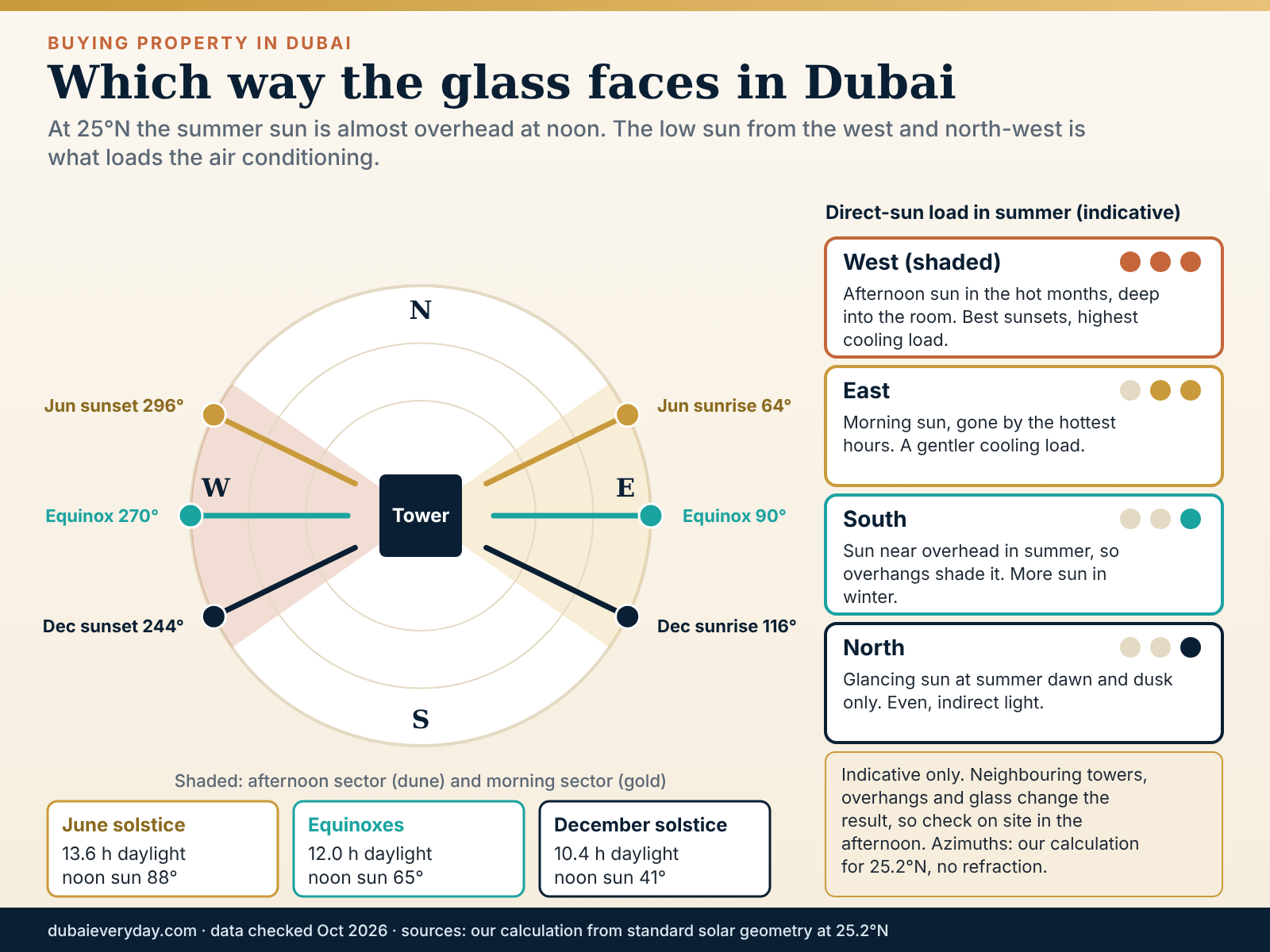
Orientation is a buy apartment Dubai decision that affects cooling bills for years. Dubai sits at about 25.2 degrees north. Our calculation from standard solar geometry, ignoring atmospheric refraction, gives the following for the sun’s path. On the June solstice it rises at an azimuth of roughly 64 degrees (north-east) and sets at 296 degrees (north-west), with a midday altitude of about 88 degrees, almost straight overhead, and about 13.6 hours of daylight.
At the equinoxes it rises due east and sets due west, with a noon altitude near 65 degrees. On the December solstice it rises at about 116 degrees (south-east) and sets at 244 degrees (south-west), with a noon altitude near 41 degrees and about 10.4 hours of daylight.
What that means for a flat, as indicative guidance. West-facing glass takes the afternoon sun in summer, when cooling demand is at its peak, and the sun is low enough to reach deep into the room. East-facing glass gets the morning sun, which is gentler by the time you are home. The south wall gets little direct sun in summer because the sun is nearly overhead, so a balcony overhang shades it, but it collects more in winter when the sun is lower.
A north face receives only glancing sun at summer dawn and dusk. Neighbouring towers can change all of this, so confirm on site in the afternoon.
Management: the committee, the company and the complaints route
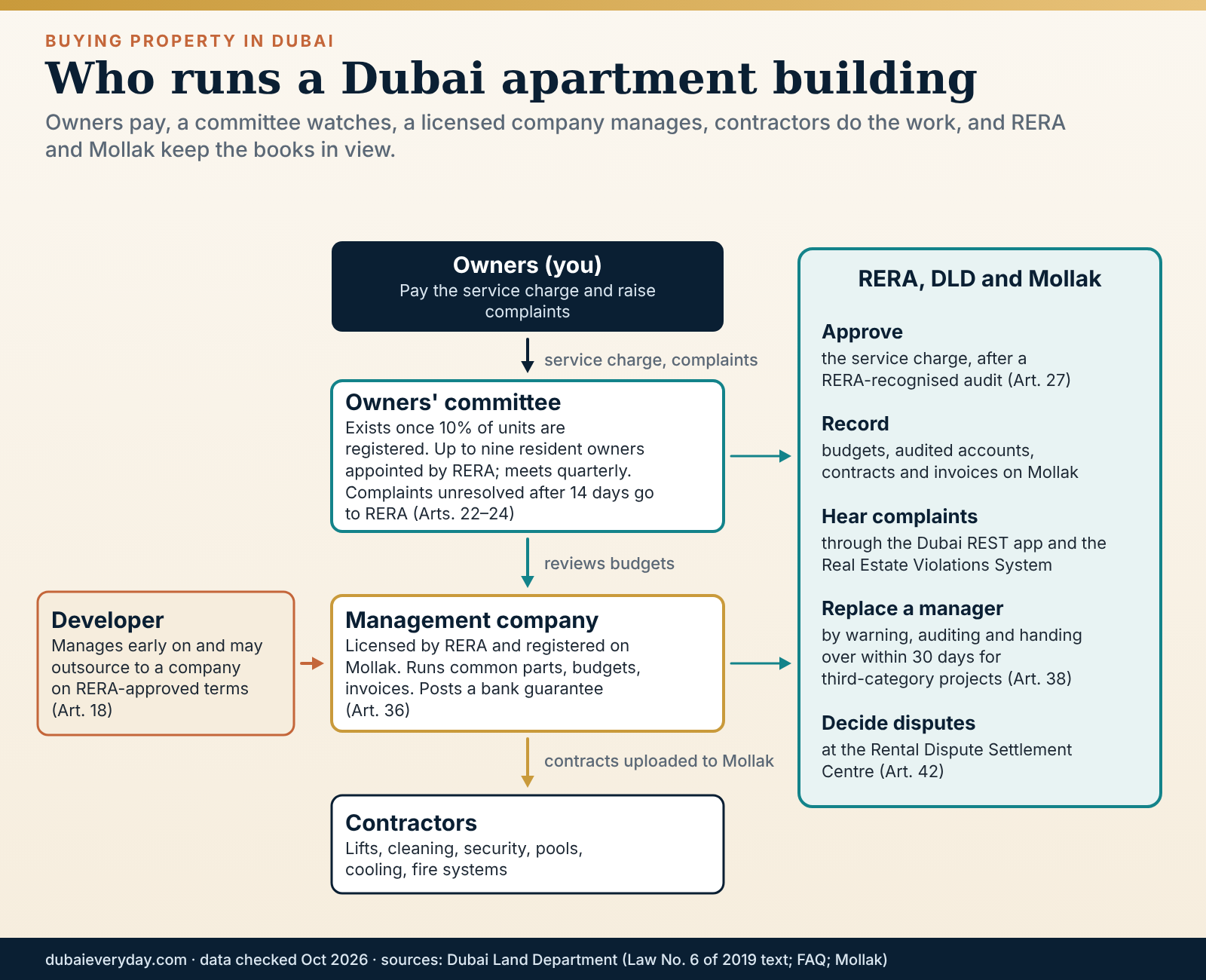
Before you buy apartment Dubai property, find out who runs the building. Every jointly owned building has a management entity. Law No. 6 of 2019 describes three categories, and the DLD FAQ puts the practical point plainly: the management company is the party answerable to owners for running the property, keeping common facilities in good condition and handling their enquiries and complaints. It must be licensed by RERA and registered on Mollak, along with its employees, its contracts, its statutory auditors and its banks. Under Article 36 it must also post a bank guarantee in the DLD’s favour, which RERA can draw on to repair common areas damaged by negligence.
The owners’ committee: what it is and when it exists
The owners’ committee does not exist from day one. Under Article 22 it is formed once at least 10% of the units in the project are registered to owners. It has up to nine members appointed by RERA, who must be resident owners with a clean record who pay their charges and attend meetings. It meets quarterly, with the first meeting within 30 days of formation (Article 23).
Its role, set out in Article 24, is to check that the manager follows the law, review budgets, request financial reports and pass on owners’ complaints. Complaints not resolved within 14 days go to RERA, and the committee can ask RERA to replace a manager of the third category and report structural defects.
Our reading of those articles: in a brand-new tower, the first service-charge budgets and the first maintenance contracts are decided before owners have a formal voice. That is not a flaw so much as a reason to read the first budget closely, and to ask the developer which company manages the building and on what terms. Under Article 18 a developer may outsource management to a company on RERA-approved terms.
Replacing a poor manager, and where to complain
The law does let owners push back. For third-category projects, Article 38 sets a sequence: RERA informs the owners’ committee and asks its opinion, issues a written warning with 14 days to respond, orders a certified audit of the service-charge account, and the outgoing company has 30 days to hand over. In practice that is a slow process, so the best protection when you buy apartment Dubai units is picking a building that does not need it.
Smaller complaints have a faster route. The DLD FAQ says owners can raise complaints about poor service or maintenance through the Dubai REST app and the Real Estate Violations System. Disputes under the law fall under the Rental Dispute Settlement Centre (Article 42), and an owner can also file a written grievance with the DLD Director General within 30 days of a decision, which is decided within 30 days (Article 46).
Questions to put to the management company
Send these before you buy apartment Dubai units, because most good managers answer in a day. A manager who will not is also answering.
- Latest approved budget and audited accounts, and the service charge for the last three years.
- Reserve fund balance, and any planned works that will draw on it.
- Number of units in arrears, and whether the management has begun enforcement.
- Minutes of the last two committee meetings, or confirmation that a committee exists.
- Maintenance contracts: who services lifts, pumps, fire systems and cooling, and when they were last renewed.
- The building’s rules on short lets, renovations, move-in and move-out, and pets.
- Insurance certificate for the building and the date it expires.
Pay attention to churn. A building that has changed management company three times in five years has either had a bad run or an unhappy owners’ body, and either way it will show up in the next resale. For the investor’s view of how that feeds into net income, the rental yield guide shows gross-to-net arithmetic.
Ready, new or off-plan: how age changes the buy apartment Dubai checks
The same six factors apply to every buy apartment Dubai decision, but the weight shifts with age. A new tower has warranties and no history. A 15-year-old one has history and no warranties. The table below sets out the main risk and the first check for each stage. It is our summary of the rules above, not an official classification.
| Stage | Main risk | Clock or rule in play | First check |
|---|---|---|---|
| Off-plan | Delay, change of specification, payment outside escrow | Escrow law; developer licence; project status | Project Status Enquiry, licensed developers list, escrow account |
| Under 1 year since handover | Snags and installation defects | 1-year installation liability; 5% retention | Independent inspection, written snag list, deadline |
| 1 to 10 years | First-wave maintenance, charge rises | 10-year structural liability | Service Charge Index history, reserve balance |
| 10 to 20 years | Equipment replacement, thin reserve | Periodic maintenance duty under Law No. 3 of 2026 | Major works plan, audited accounts, lift records |
| 20 years and over | Certificate cost, special levies, finance limits | Quality and Safety Certificate | Engineer’s report status, management timetable |
Off-plan: what changes
To buy apartment Dubai units off-plan is to move most of the due diligence to the developer and the project. The DLD says off-plan transactions are recorded in an initial register until the project is complete. Once the developer receives the completion certificate, fully paid units move to the main registry and the buyer receives the title deed. A buyer can verify the project through the Project Status Enquiry, and the developer through the approved list.
Two protections are specific to apartments. First, the DLD FAQ says the developer cannot claim payment for extra area beyond the contract figure unless the contract expressly allows it, and must compensate the buyer if the finished unit is more than 5% smaller than the contracted net area.
Second, the Central Bank limits off-plan mortgages to 50% of value for all buyers, so the cash you need is higher than for a ready flat. Cushman & Wakefield’s note that contractor capacity could delay handovers is a reminder to treat handover dates as estimates. Our buying property guide covers the off-plan registration and payment steps, and the first-time buyer guide covers how the loan limits affect your cash.
Ready resale: what changes
If you buy apartment Dubai resale units that are ready, you can see everything you are buying, and the previous owner has left a paper trail. The sale registration page shows the seller needs a developer e-NOC in freehold areas, obtained through the Dubai REST app, and that registration itself takes about 20 minutes at a trustee centre. Everything else on your checklist, from service-charge history to management minutes, is research you do beforehand. In our reading, a ready flat that is a few years old often offers the best balance: the first-wave defects are behind it and the 20-year question is far away.
Resale: how to buy apartment Dubai with the exit in mind
When you buy apartment Dubai property you are not only buying a home; you are also manufacturing a future listing. The next buyer will run the same checks you ran, with the same public tools, and will discount whatever they find. So the cheapest time to fix a resale problem is before you buy.
Read the building’s transaction record
The DLD’s Transactions dataset lists sales with the amount, size, rooms, project and parking, and can be downloaded as a CSV after you filter by area and date. The page does not say how often it updates, and it carries no stated licence terms on the page we read, so check the terms before reusing the data publicly. Before you buy apartment Dubai units in a tower, it answers questions an agent may blur: how many units in this tower sold in the last 12 months, at what price per square foot, and whether the two-bedroom prices are drifting apart from the one-bedroom ones.
A tower with steady sales at consistent prices is liquid. A tower with few sales is hard to value and harder to exit. A tower with many sales and a falling price per square foot may have an owner problem you have not found yet. None of that is advice to avoid a building. It is a prompt to ask why.
What exit costs look like
On the DLD sale registration page, the registration fee is 2% of the sale value for the seller and 2% for the buyer, plus AED 250 for the title deed, AED 250 for the villa and apartment map fee, AED 10 for knowledge and AED 10 for innovation, and a service partner fee of AED 4,000 plus VAT for sales of AED 500,000 or more. In practice, who pays what is a matter of contract, and reports of market custom vary, so read the sale agreement before you assume.
Broker commission is not set by the DLD pages we read; 2% plus VAT is commonly quoted in the market, which we use below as an assumption.
Our calculation for a buy apartment Dubai budget, labelled illustrative. Take a AED 1.5 million apartment, a buyer paying the whole 4% DLD fee, the trustee fee with VAT (AED 4,200), the small fees (AED 520) and a 2% broker commission with 5% VAT. Extras at purchase come to AED 96,220, or 6.4% of the price.
If you later sell through a broker at 2.1% all-in and pay no registration fee, the sale price has to reach about AED 1.63 million, roughly 8.7% higher, before you merely get your cash back. That ignores service charges you paid, rent you avoided and any mortgage interest. The effect is that holding for a few years is not the same as flipping. Our property ROI guide and cash-on-cash guide carry this through with financing.
The seller’s checklist, which becomes your risk
When you sell, the same hurdles appear in reverse, and they are worth knowing now because they can stall your future buyer.
- Clear the service-charge accountArticle 32 says a unit may not be disposed of until charges are paid. Ask the management company for a statement.
- Get the developer NOCIn freehold areas the sale registration needs an e-NOC from the developer through Dubai REST.
- Settle or transfer the mortgageThe DLD FAQ says a mortgaged property cannot be transferred without the bank’s consent.
- Agree the contractPrice, deposit, who pays which fees and the transfer date, in the sale agreement.
- Register at a trustee centreThe service itself takes about 20 minutes once documents are complete.
Each of these is a place where an unprepared seller loses weeks.
What tends to help or hurt resale
For a buy apartment Dubai shortlist, this list is our judgement from the rules and data above, not a forecast. Helping: a charge in line with comparable towers, a management company that publishes accounts, a bay on the title, a layout that suits the most common buyer in the area, and no looming major works.
Hurting: a high charge for the amenities, many units in arrears, a view that depends on an empty plot, a building that will need a Quality and Safety Certificate soon without a funded plan, and a one-bay allocation in a family-sized flat. Banks also set their own rules on building age and valuation; those are not public on the pages we read, so ask a lender early if you will need a mortgage on an older unit.
If you are buying to let, remember that tenants also check the building. Our rent apartment guide shows what renters look at, and the renting in Dubai guide covers the tenancy side, both useful as a mirror image of this one.
Mistakes that cost money when you buy apartment Dubai units
These are the buy apartment Dubai mistakes that follow from the rules above, not anecdotes. Each is avoidable with a free check.
The first buy apartment Dubai mistake is judging the flat and ignoring the building. A renovated kitchen takes six weeks to fit; a failing building takes years to fix. The second is comparing asking prices without comparing service charges. A cheaper flat with a charge AED 8 per square foot higher is not cheaper after a few years, as the table earlier showed.
The third buy apartment Dubai mistake is assuming parking. If the bay is not written on the title deed or the sale contract, it is a promise, not a right. The fourth is paying for a view that a neighbouring plot can erase. Check the project data and the site plan, and price the flat as if the view might change.
The fifth is buying an older tower without asking about the 20-year certificate. Whether or not the costs land on you, the timetable will affect the building’s budget and its saleability. The sixth is skipping the management questions. A refusal to share the budget is information.
The seventh is letting off-plan marketing stand in for a building review when you buy apartment Dubai units. A render says nothing about structure, lifts or maintenance. Use the project status, escrow and licensed-developer checks, and read the contract for handover dates, area tolerance and what the 5% retention rule means in practice. The eighth is forgetting that you will sell. A fast exit needs a clean service-charge account, a developer NOC and a buyer who can finance it.
A 30-minute plan and a scorecard before you buy apartment Dubai
Everything above can be turned into a desk exercise that costs half an hour per building. Do it for every serious buy apartment Dubai candidate, in this order, and keep the results in one note so you can compare buildings side by side.
- Developer and project, 5 minutesLook up the developer in the DLD Licensed Developers list and the project in the Project Status Enquiry. Note the completion date or percentage.
- Service Charge Index, 5 minutesPull the approved charge for the project for the last three years. Note the trend and confirm the unit of the result.
- Transactions and building data, 10 minutesIn the DLD open data, filter the Transactions dataset by project for the last 12 months, and note count, price per square foot and parking. Check the Building dataset for floors, flats and elevators.
- Property status and title, 5 minutesRun the Property Status Enquiry for the plot and check that the unit, bay and area on the contract match the title records.
- Management email, 5 minutesSend the seven questions from the management section. A reply, or the lack of one, is already a data point.
Then visit, twice, at different times of day, with a torch, a measuring tape and the car. Look at the car park, the lifts, the corridors and the afternoon sun. If anything on the list fails, do not argue yourself out of it because the flat looks good or the buy apartment Dubai listing promises a lot.
The scorecard
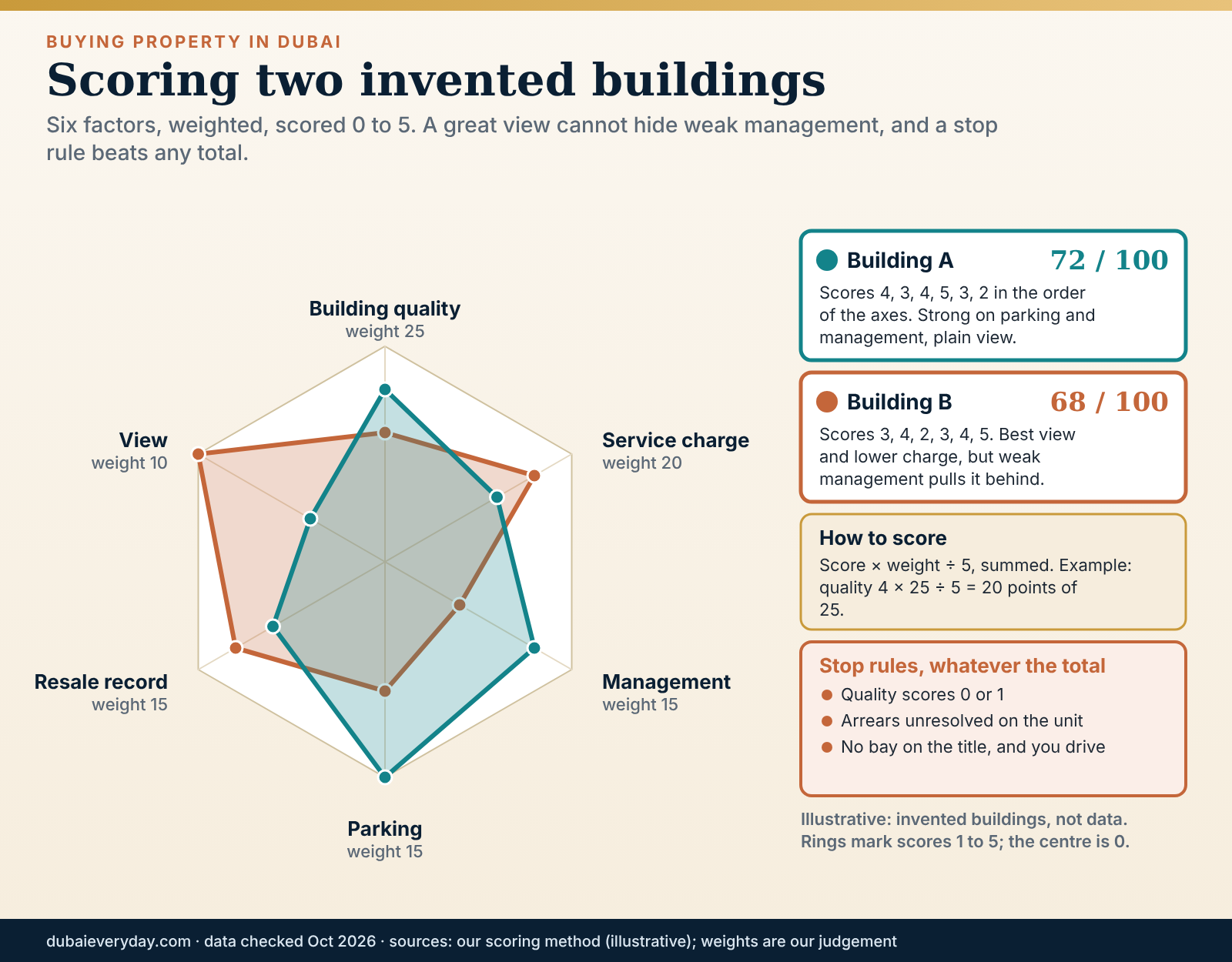
Use this scorecard to rank any buy apartment Dubai shortlist. Give each factor a score from 0 to 5, multiply by its weight, and add up to a total out of 100. Our weights are 25 for building quality and age, 20 for service charge, 15 for management, 15 for parking, 15 for resale record and 10 for view and orientation. They are a starting point. An owner-occupier who works from home may raise the view and the noise score, an investor will raise the service charge and resale weights, and a family with two cars will give parking more than 15.
The score is only half the method. Add stop rules: a score of 0 or 1 on building quality, an unresolved arrears claim on the unit, or no bay on the title when you drive, ends the discussion whatever the total says.
Our worked example uses two invented buildings. Building A scores 4 on quality, 3 on charges, 4 on management, 5 on parking, 3 on resale and 2 on view, for 72 out of 100. Building B scores 3, 4, 2, 3, 4 and 5, for 68. B has the better view and the lower charge, but weaker management drags it behind. These are illustrative buildings, not real ones.
Buy apartment Dubai: frequently asked questions
What should I check first when I buy apartment Dubai units?
Check the building before the flat. Start with the developer and project status, then the approved service charge for the last few years, then the transaction record for the tower, then the management company. Each takes minutes on the DLD website or the Dubai REST app. Only after the building passes should you spend time on the layout, the view and the price. A great flat in a poor building is a poor purchase.
What service charge should I expect when I buy apartment Dubai units?
Gulf News, in an explainer last updated in February 2026, puts them at roughly AED 3 to AED 30 or more per square foot a year, with villas and amenity-heavy communities at the top. The figure for a specific tower is on the DLD Service Charge Index. A 900 sq ft flat at AED 20 per square foot pays AED 18,000 a year, or AED 1,500 a month, before any separate cooling bill.
Who pays the service charge, the owner or the tenant?
The owner is liable to the management company, and Article 32 of Law No. 6 of 2019 lets the management enforce against the unit. The DLD FAQ, as we read it, treats service fees as the landlord’s cost while noting that fees of use can fall to the tenant depending on the contract. If you rent the flat out, read the contract so that the split is written down, not assumed.
Does a Dubai apartment come with parking?
When you buy apartment Dubai property, parking usually comes with it, but the number varies. Property Finder’s explainer, last modified in July 2024, says studios to two-bedroom flats typically get one bay and larger flats two, with Dubai Marina at one per apartment. Under Article 10 of Law No. 6, allocated bays are part of the unit and registered with it. Confirm the bay number on the title deed or sale contract before you pay a deposit.
What is Mollak?
Mollak is the DLD’s electronic system, run through RERA, for jointly owned property. Owners receive quarterly service-charge invoices through it, management companies register and upload financial statements and contracts, and communities submit audit reports. The service charge budget approval process and a regulated account for each community also run through it. The word means “owners” in Arabic.
What warranty does a new Dubai apartment have?
Article 40 of Law No. 6 of 2019 makes the developer liable for structural defects for 10 years from the completion certificate and for defective mechanical, electrical and plumbing installations for 1 year from handover. These rights cannot be waived by contract. Separately, 5% of each project’s escrow account is held back for a year after units are registered to buyers, which the DLD describes as covering defects. Resale buyers inherit only what is left of the clock.
What is the new 20-year building certificate in Dubai?
Law No. 3 of 2026 requires owners, including unit owners, to obtain a Quality and Safety Certificate once 20 years have passed since the building’s completion certificate. A licensed engineering firm inspects, and the certificate lasts 10 years for buildings under 40 years old and 5 years after that. Owners get a year from the effective date to comply, extendable. Fines run from AED 100 to AED 1,000,000. Executive regulations are still pending, so ask the management for its plan.
Should I buy apartment Dubai stock new or resale?
Neither is better by default. New stock has warranties and modern systems but no maintenance history, and off-plan adds delivery risk. Resale lets you inspect the building and read years of charges, but the warranties have run out. In our reading, flats a few years past handover often balance the two.
How much cash do I need on top of the price to buy apartment Dubai units?
On our illustrative AED 1.5 million flat, a buyer paying the whole 4% DLD fee, trustee fee with VAT, small fees and a 2% broker commission with VAT would add about AED 96,220, or 6.4%, before any mortgage costs. The DLD page lists 2% each for buyer and seller, so check who pays in your contract. Our first-time buyer guide works through the cash needed with a loan.
Can an expat get a mortgage to buy apartment Dubai units?
Yes, within Central Bank limits. For expatriates buying a first home, loan-to-value is capped at 80% up to AED 5 million and 70% above. Second homes and investment properties are capped at 60% for expatriates, and off-plan purchases at 50% for everyone. The maximum term is 25 years, debt repayments are capped at 50% of income, and lenders must stress-test at 2 to 4 percentage points above the current rate.
How can I see what other flats in a building sold for?
Use the DLD open data. The Transactions dataset lists the amount, size, rooms, project and parking for each sale, searchable by date range, area and property type, and downloadable as a CSV. The Unit dataset adds floor and balcony area. It takes a spreadsheet, and the page does not say how often the data is refreshed, so ask your broker for the source of any comparison they show you.
Where to go next
Once a building passes the checks, these guides cover the rest of how to buy apartment Dubai property and the numbers behind it.
Sources and further reading (22 links)
- Dubai Land Department: Law No. 6 of 2019 on jointly owned real property for units, common parts, parking, service charges, the owners’ committee, management and developer liability
- Dubai Land Department: Frequently asked questions for service charges, reserve charges, the 5% retention, parking changes, off-plan area rules and complaints routes
- Dubai Land Department: Service Charge Index for looking up approved service fees by project
- Dubai Land Department: Mollak, about us for how invoices, management company filings and audits work
- Dubai Land Department: Property sale registration for registration fees, trustee fee and the developer e-NOC
- Dubai Land Department: Real estate open data for the Transactions, Unit, Building and Project datasets
- Dubai Land Department: Smart Rental Index announcement for the building classification criteria
- Dubai Land Department: Project Status Enquiry for checking a project’s completion percentage
- Dubai Land Department: Licensed developers for the list of approved developers
- Dubai Land Department: Property Status Enquiry for checking a property by area and land number
- Dubai Legislation Portal: Law No. 3 of 2026 on the quality and safety of buildings for the 20-year certificate, maintenance duties and penalties
- Dubai Media Office: Law on the quality and safety of buildings for the announcement and summary of the law
- Dubai Legislation Portal: Law No. 8 of 2007 on escrow accounts for the 5% retention after completion
- Central Bank of the UAE Rulebook: Mortgage loan ratios for loan-to-value, debt burden, term and stress-test rules
- Emicool: Frequently asked questions for how a district cooling operator describes capacity and consumption charges
- Cushman & Wakefield: Dubai residential MarketBeat, Q2 2026 for quarterly price, rent and completion figures (consultancy; context only)
- FAM Properties: Dubai real estate report for DLD-derived sales counts and medians (aggregator; context only)
- Al Tamimi & Company: Dubai building quality and safety law for a law-firm briefing on Law No. 3 of 2026 (context only)
- Gulf News: What are service charges in Dubai? for the per-square-foot range (press; context only)
- Gulf News: Owners need to clear service fee dues to rent or sell for how arrears block sales and leases (press; context only)
- Gulf News: Dubai gets tougher on fire safety for background on the updated fire code and cladding (press; context only)
- Property Finder: How many parking spaces are you entitled to? for typical bay allocations and extra-bay costs (portal; context only)
Update log: 29 October 2026, first publication; facts re-checked against the sources above. Next review due by 29 January 2027, or sooner when the executive regulations for Law No. 3 of 2026 are published or DLD fees change. Corrections welcome. This page is general information, not legal, financial or mortgage advice.
About DubaiEveryday and this guide
DubaiEveryday.com is an independent editorial project that publishes practical, research-based guides to everyday life in Dubai: where to live, what things cost, how the rules work and how to get around. This page was written and edited by the DubaiEveryday editorial team. It is not signed by a named expert, doctor, lawyer or adviser, and we do not claim first-hand testing of a venue, clinic or service unless the page says so.
Each guide is built from official sources such as government and regulator pages, operator websites and established news outlets, cross-checked where we can. When we could not confirm something, we say so in the text, and examples that use made-up numbers are labelled as illustrations. Mentions are editorial choices, not paid placements, and a link is not an endorsement.
Dubai changes quickly. If you spot something that is out of date or wrong, please tell us through the contact options on DubaiEveryday.com and we will check it and correct the page.