
The easiest Dubai 3 day itinerary follows three corridors, not three lists of famous names: Old Dubai and the Creek, Downtown, then the coast. This Dubai 3 day itinerary is built from official timetables, fares and opening notices checked on 29 October 2026, with the closures of this autumn already taken out.
Most first-timers plan Dubai by fame: the tower, the Palm, the old souks and the desert, all squeezed into three days and joined up by taxi. The map does not care about your list. Those places sit at opposite ends of a coastline that runs for miles, and the meter keeps ticking while you sit in traffic between them.
A better Dubai 3 day itinerary groups the sights by corridor, so the Metro does the heavy lifting and your days stay short on transport. Old Dubai and the Creek come first, Downtown second, the coast last. This version also has the closed places taken out, because the Museum of the Future, Al Fahidi Fort and the Palm Monorail are not available right now. Read on and you will leave with a route, a rough budget and a plan B for the heat.
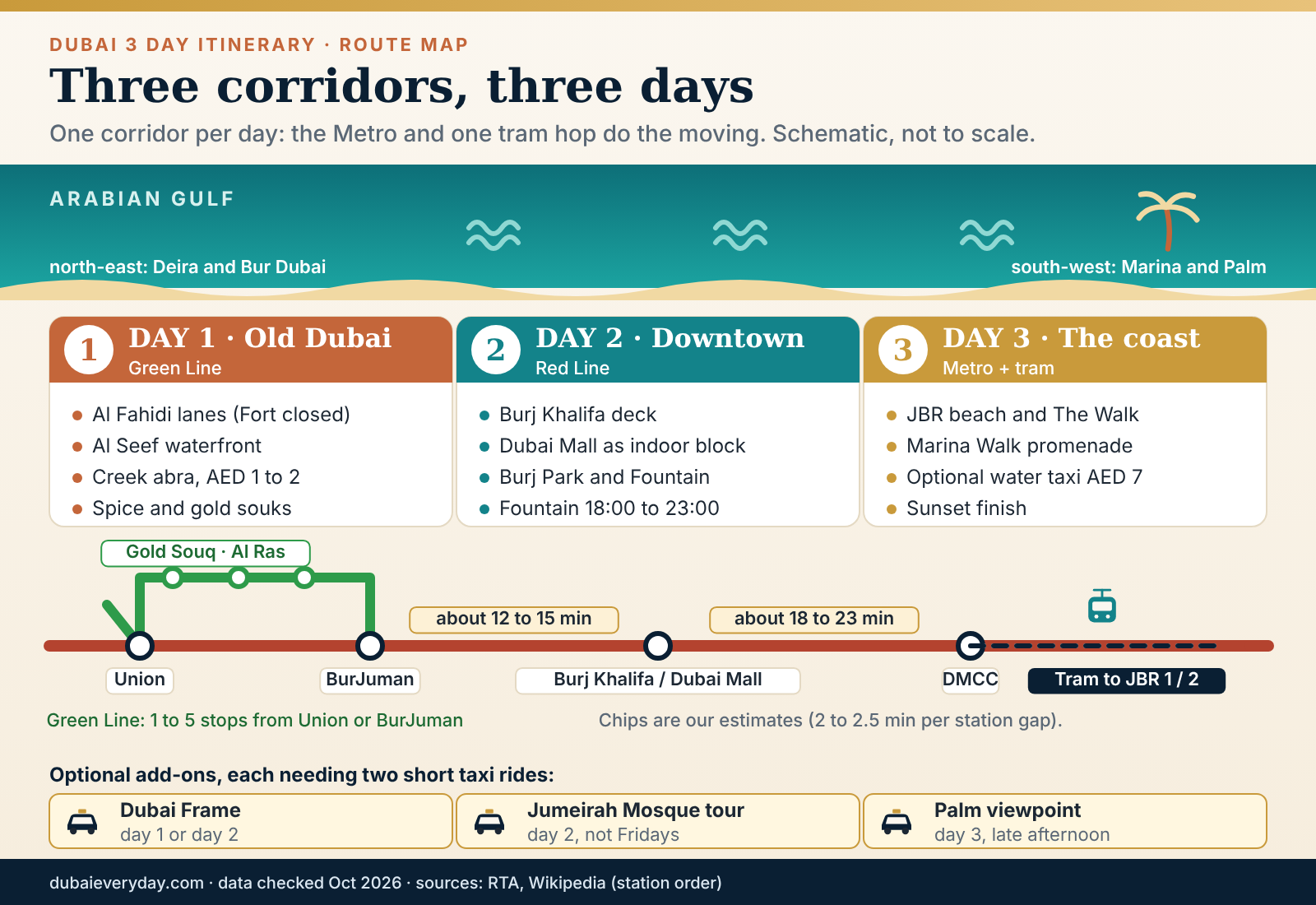
The best Dubai 3 day itinerary for a first visit spends day one in Old Dubai (Al Fahidi lanes, Al Seef, an abra across the Creek, the Deira souks), day two in Downtown (Burj Khalifa, Dubai Mall, the Dubai Fountain at night) and day three on the coast (JBR, Marina Walk, a sunset finish). Each day stays inside one corridor, so the Metro, one short tram hop and your own feet do the moving.
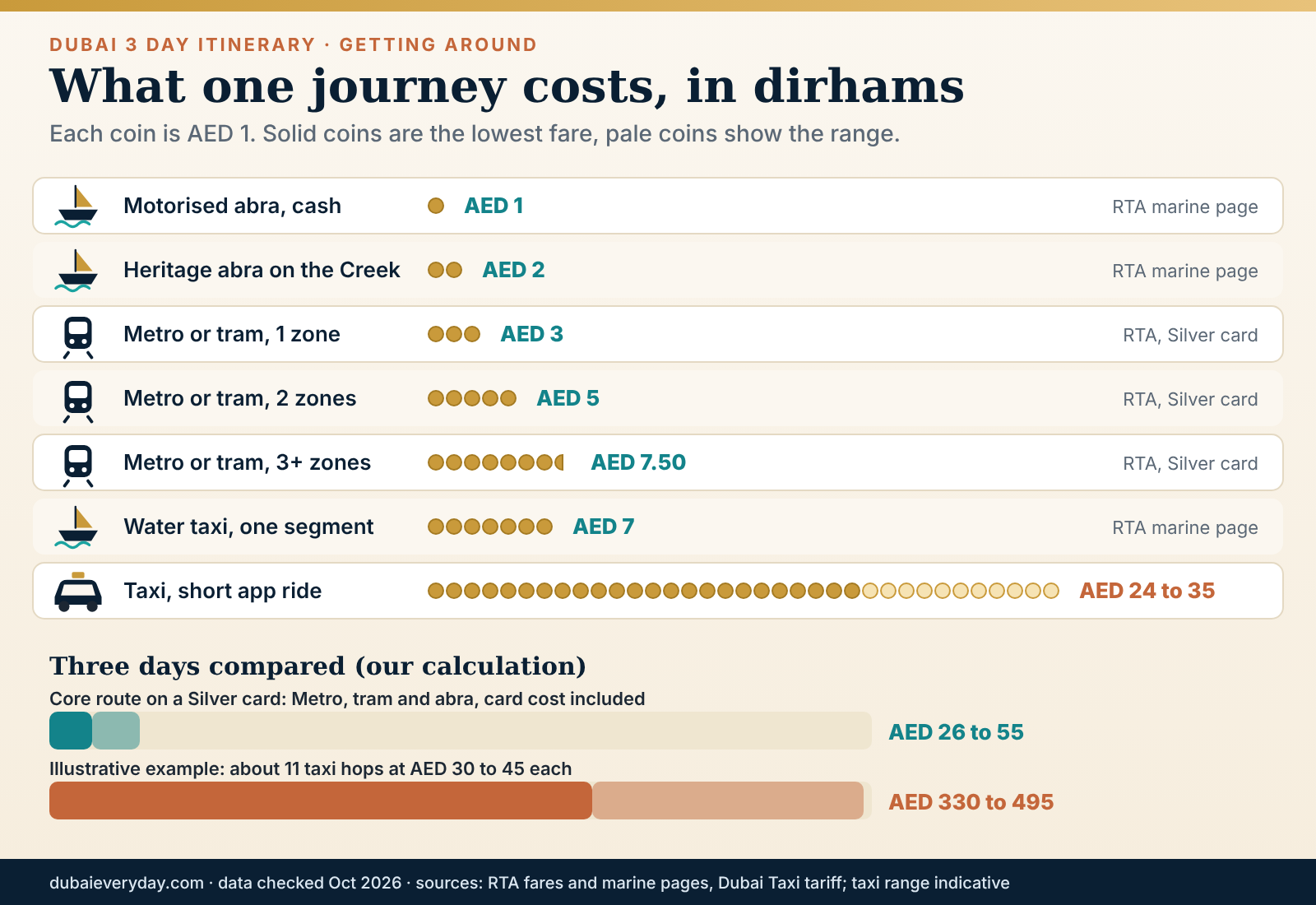
By our calculation the core of this Dubai 3 day itinerary needs no taxi at all and costs roughly AED 26 to 55 in public transport fares for the three days.
Three optional add-ons (the Dubai Frame, the Jumeirah Mosque tour, a Palm Jumeirah viewpoint) each cost two short taxi rides, so take one a day at most. Three headline sights are not available right now: the Museum of the Future is closed for a rebuild, Al Fahidi Fort is shut for restoration, and the Palm Monorail showed as suspended on its operator page today. Start later on a Sunday, because the Metro opens at 08:00 and the tram at 09:00. From May to September, move every outdoor block to before 10:00 or after 17:00.
This Dubai 3 day itinerary is desk research. DubaiEveryday.com has not walked this route, ridden these trains or queued at these attractions, and nothing here describes a personal visit. It is an editorial plan built from published information, and the page has no named author because no one on the site travelled for it.
Fares, Metro and tram hours and abra fares come from the Roads and Transport Authority (RTA) pages. The Jumeirah Mosque tour comes from the Sheikh Mohammed Centre for Cultural Understanding, Al Shindagha Museum hours from Dubai Culture, taxi tariffs from Dubai Taxi, and Dubai International (DXB) taxi and Metro notes from Dubai Airports.
Closures and tourism figures come from press reports and the Dubai Airports media centre. Ticket prices for the Burj Khalifa deck, the Dubai Frame and The View at The Palm are marketplace or secondary figures, because the operators’ own pages did not load for us. They are labelled as such. Climate figures are NOAA 1991 to 2020 airport normals; sunrise and sunset are our own calculation.
Anything marked “our calculation” is our arithmetic, and “illustrative example” means invented numbers used to show logic. Inclusion was not paid for, there are no affiliate links, and no attraction was asked for a mention. This is general travel information, not individual safety, medical, legal or insurance advice.
What is closed or changed before you plan a Dubai 3 day itinerary
Many a Dubai 3 day itinerary written before 2026 still sends you to places that are now shut. Start with the list of what has changed, because this autumn it is long enough to rearrange a trip.
Landmarks you cannot visit right now
The Museum of the Future closed on 1 September 2026 for a rebuild of its exhibitions. Its own website says it is temporarily closed and gives no reopening date; Gulf News, updated 27 October, reports the first quarter of 2027 as the expectation. Al Fahidi Fort, the building that housed the Dubai Museum, has been closed since 2021 for restoration. Euronews quoted a Dubai Culture official on 18 September saying it should reopen “in the coming weeks or months”, which is not a date.
The Burj Al Arab hotel closed in April 2026 for an 18-month refurbishment, with October 2027 the reported reopening. You can still photograph its outline from the public coast; you cannot go in. The Palm Monorail is the fourth. Press reported in July that service had resumed after a six-month shutdown, yet the operator’s own page on 29 October said it is “temporarily suspended until further notice due to maintenance”. Treat it as unavailable and plan the Palm by road.
What is working
The Dubai Fountain is running. Gulf News reported on 26 October that regular shows continue, with a small stretch of the waterfront fenced off while new installations are finished. Emaar’s published schedule gives evening shows every 30 minutes from 18:00 to 23:00, plus afternoon shows. The RTA timetable page shows normal Metro and tram hours with no suspension notice, the Dubai Mall and Dubai Aquarium pages show normal operating hours, and a ticket marketplace was still selling Burj Khalifa deck tickets.
One quiet effect of the closures: a Dubai 3 day itinerary is now a more comfortable fit. The two biggest “museum” slots of a first visit are gone, so the Dubai 3 day itinerary below leaves open time instead of squeezing in replacements. If either reopens before you travel, it slots into day one (the fort) or day two (the museum) without disturbing the rest. Your broader list of things to do in Dubai keeps the longer menu.
As read on 29 October 2026, the UK Foreign Office page for the UAE (updated 27 October) says the regional situation “remains deeply unpredictable” and tells travellers to expect possible flight cancellations and airspace closures.
Dubai Airports reported that first-half 2026 passenger numbers fell 31.3% year on year to 31.5 million, and its chief executive was quoted in September expecting full operations by year-end. Some foreign airlines had not resumed service. Check your own government’s advice, your airline and your insurance wording before booking, and keep flexible fares in mind. Visit Dubai also carries a “travel updates” page. This is general information, not advice on your risk.
How this Dubai 3 day itinerary is built
Dubai is long, thin and spread along a coast, and the famous sights sit at opposite ends of it. Plan by fame and you zigzag: the Creek, then the Palm, then back to the Frame, with a taxi meter running at every turn. Plan by corridor and the same sights fit in three tidy blocks. That single choice is the whole design of this Dubai 3 day itinerary.
The five rules behind this Dubai 3 day itinerary
First, one corridor per day. Each day starts and ends on a Metro line, and nothing in the core of the Dubai 3 day itinerary needs a road vehicle. Second, one anchor per half-day. A morning anchor and an evening anchor, with a long, deliberately soft middle, is what stops day two from collapsing into a mall food court at 15:00 with sore feet.
Third, indoors in the middle of the day whenever it is warm. NOAA’s 1991 to 2020 airport normals put the mean daily high at 35.9 °C in October and 41.9 °C in August, against 24.4 °C in January. Fourth, free things carry the days and paid things are chosen. Walking the old lanes, crossing the Creek, watching the Fountain and strolling the Marina cost nothing or almost nothing. Fifth, every paid item is listed with a source and a doubt, so you can drop it.
What the route leaves out on purpose
A three-day plan is a set of cuts. We cut theme parks, because they swallow a day each and sit far from the corridors above. We cut the Museum of the Future and Al Fahidi Fort because they are closed. We cut Abu Dhabi and other day trips, because each would eat a day and deserves its own planning. We cut shopping for its own sake, except where a mall doubles as air conditioning. And we cut nightlife, which has a separate set of rules about dress, alcohol and transport that a daytime route does not need.
If you want a longer stay with room for the desert and a slower coast, the same logic extends to a four-day plan, and our desert safari comparison covers the half-day you would most likely add. For a wider planning checklist covering visas, money and etiquette, start with the main Dubai travel guide. This page covers only the sequence of a Dubai 3 day itinerary.
Where to base yourself
The route assumes your hotel is within a short walk of a Red Line station somewhere between BurJuman and Burj Khalifa/Dubai Mall. That covers Downtown, Business Bay, the Trade Centre strip and the Karama and BurJuman side. From any of them, every day of this Dubai 3 day itinerary starts with a Metro ride of roughly 5 to 25 minutes. If you are staying elsewhere, the ride times change but the order of days does not.
Four bases and what each does to the plan
A Downtown or Business Bay base makes day two effortless and adds about 15 to 25 minutes each way on days one and three. A BurJuman, Karama or Bur Dubai base makes day one nearly a walk and day two a 12 to 15 minute ride. A Deira base, near Union or the Green Line stations, is cheapest for day one and longest for days two and three. A Marina or JBR base makes day three a stroll and turns days one and two into rides of roughly 30 to 45 minutes, which is fine if the beach is the point of the trip.
That difference is measurable. Using the rule of thumb that a Metro station gap takes about 2 to 2.5 minutes, Burj Khalifa/Dubai Mall to BurJuman is six gaps (12 to 15 minutes) and to Union seven (14 to 18). Treat these as our estimates; RTA publishes timetables but no station-to-station journey times. Where you stay is a bigger lever on any Dubai 3 day itinerary than a single attraction you pick.
For comparing districts by price and beach access, the hotel area guide goes deeper, and the budget hotel guide concentrates on options near Metro stations. If you want the premium end, the luxury hotel guide explains what the extra money actually buys. For the Downtown option specifically, see the Downtown Dubai area guide.
Getting around: nol card, Metro, tram, abra and taxis
You can run a whole Dubai 3 day itinerary on public transport and a pocketful of coins. The system is cheap, the stations are air-conditioned, and the main limit is the clock rather than the money. Here is what to know, with every number taken from the RTA unless stated.
The card, the fares and the clock
Fares depend on how many of the city’s seven zones you cross, not on the mode. On a Silver nol card the fare is AED 3 for one zone, AED 5 for two adjacent zones and AED 7.50 for more than two. A paper Red Ticket costs AED 4, 6 or 8.50 for the same bands. Gold class doubles the Silver fares. Children aged five and under travel free. The maximum journey length is 180 minutes with up to three transfers, and a change between Metro and bus must happen within 30 minutes to count as one journey.
Metro station hours are Monday to Thursday 05:00 to midnight, Friday 05:00 to 01:00, Saturday 05:00 to midnight and Sunday 08:00 to midnight. The Dubai Tram runs Monday to Saturday 06:00 to 01:00 and Sunday 09:00 to 01:00. A secondary source puts the Silver card at AED 25 including AED 19 of credit, so the card costs AED 6 net. The RTA pages we could read did not print card prices, so check the machine. You need at least AED 7.50 balance to tap in.
RTA publishes fares by number of zones and a zone map as a graphic, so we could not confirm the exact zone count for each station pair. In this article, a journey costs AED 3 to 7.50 and we budget at both ends. Passes make sense only for longer stays: the Silver seven-day all-zone pass is AED 110, which beats pay-per-trip at the top fare only from the fifteenth journey. In three days you will not get there.
Abras, trams and water taxis
The abra is the best-value ride in the city. RTA lists a motorised traditional abra at AED 1 per person paid in cash, running between Bur Dubai and Deira Old Souq, and petrol heritage abras on the Creek at AED 2 on several short routes, including Al Fahidi to Deira Old Souq and Al Seef to Baniyas. Carry coins. The Dubai Tram uses the same nol card and zone fares, and joins the Metro at the Sobha Realty and DMCC stations. Dubai Water Taxi charges AED 7 per segment on its Marina routes.
Taxis: what they actually cost
You will still use a taxi for the add-ons and possibly at the end of a long day, so know the tariff. Dubai Taxi lists a street-hail start fare of AED 5 between 06:00 and 22:00 and AED 5.50 overnight, with AED 2.45 per kilometre, a minimum fare of AED 12 (AED 13 for app bookings) and AED 0.50 per minute of waiting. App bookings carry a start fare of AED 9 to 13 depending on the time band. Salik road tolls are added, and a taxi from DXB starts at AED 25 according to Dubai Airports.
For an illustrative short ride of 6 to 9 km, our arithmetic gives AED 15 to 22 in distance plus AED 9 to 13 for an app start, so roughly AED 24 to 35 before tolls. Distance is our assumption; the meter decides. Compare that with a Metro journey at AED 3 to 7.50, and the logic of this Dubai 3 day itinerary becomes plain.
Day 1: Old Dubai, the Creek and the souks
Day one of the Dubai 3 day itinerary is the cheapest and the most walkable, which is why it goes first: you get your bearings on cheap fares and flat ground before the tall, expensive part of the city. The anchor is the Creek, the saltwater inlet that split the old town in two. Bur Dubai sits on one bank and Deira on the other, and an abra crossing is the hinge of the day.
Morning: Al Fahidi lanes and the Bur Dubai waterfront
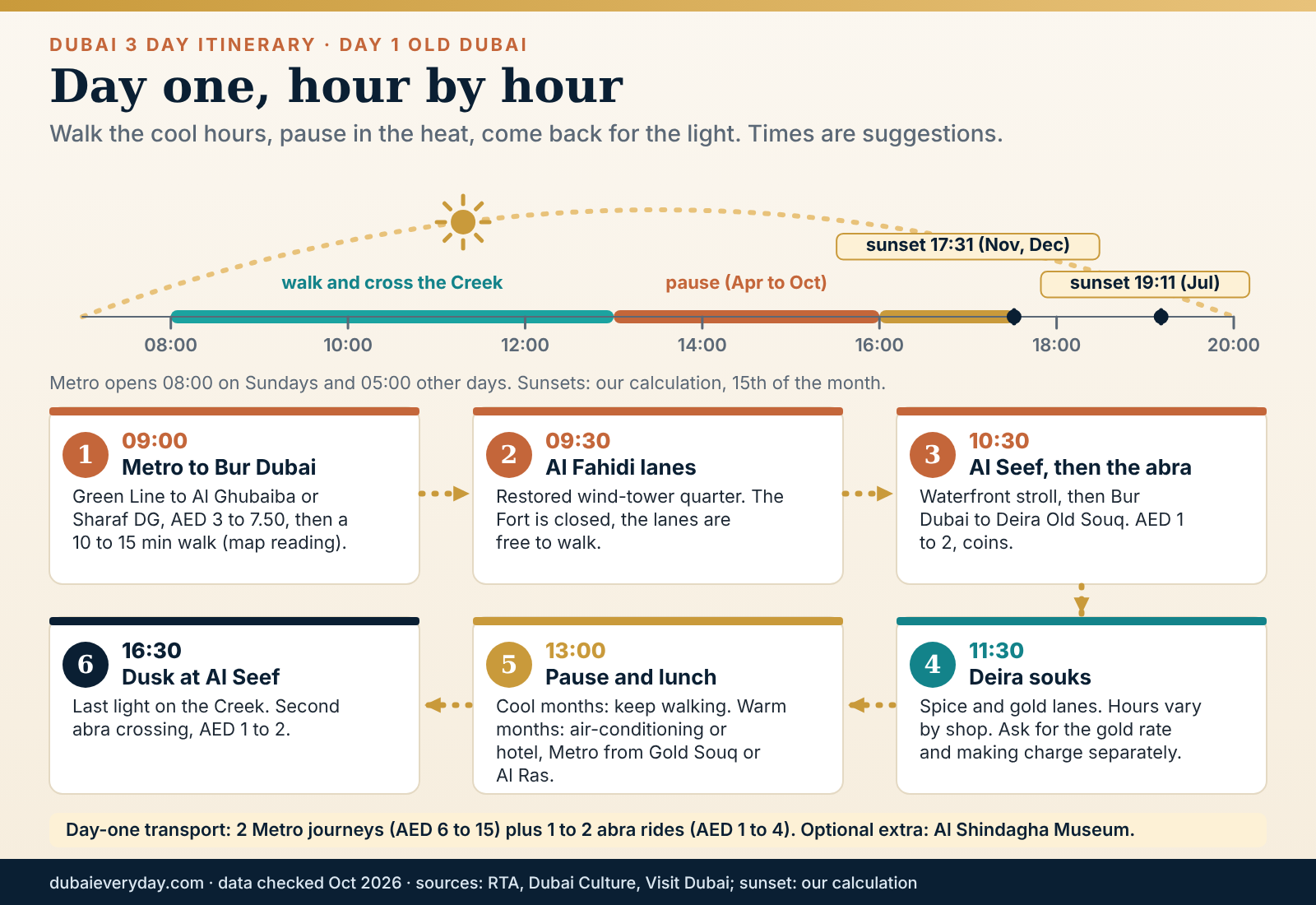
Take the Metro to Al Ghubaiba (G24) or Sharaf DG (G25) on the Green Line, both a short walk from the old quarter. From BurJuman it is one or two stops, about 2 to 5 minutes by our estimate; from Union, four or five. On a Sunday the first train is at 08:00, so a 09:00 start is realistic any day of the week. Walking time from either station to the lanes is our map reading, roughly 10 to 15 minutes, so check the route on your phone.
Visit Dubai describes the Al Fahidi Historical Neighbourhood as the restored old town, with wind-tower buildings, galleries and small museums along its lanes. Individual venues keep their own hours and some close for the afternoon, so treat the lanes as a morning walk rather than a list to tick. Al Fahidi Fort at the edge is closed, as above, but the surrounding streets are still the best compact picture of pre-oil Dubai you can get without a ticket.
From there, continue along the waterfront. Al Seef is a waterfront strip styled on the old town, with cafes and a boardwalk along the Creek. Al Shindagha Museum, a little further along the Bur Dubai bank, is ticketed and open daily from 10:00 to 20:00 with last entry at 19:00, according to Dubai Culture. Its page lists AED 15 for entry to two heritage houses, while the museum itself has been reported at AED 50, so check which ticket you actually want. We keep it as an optional hour, not a core stop.
Midday: the abra crossing and the Deira souks
Around 10:30 or 11:00, cross the Creek. Per the RTA’s marine page, a motorised traditional abra runs between Bur Dubai and Deira Old Souq at AED 1 per person, cash only, and petrol heritage abras on routes such as Al Fahidi to Deira Old Souq charge AED 2. It is a working transport service rather than an attraction, which makes it one of the few places where the cheapest option is also the best one, and the fare costs less than a bottle of water.
On the Deira side you are in the Old Souq area, with the spice and gold lanes within walking distance of the landing. Shop hours vary by trader, and we could not verify a fixed opening time, so do not build the morning around a promise of an open stall. Gold is typically priced by weight against a daily rate with the workmanship charged separately, so ask for both figures before you compare shops. Bargaining is common in textiles and souvenirs and much less so for gold; both are general practice rather than rules.
If you are buying anything expensive, our list of free things to do in Dubai is a better companion here than a shopping list, because the souk lanes cost nothing to walk and the old quarter works as a free half-day on its own.
Afternoon and dusk: a pause, then the waterfront again
Between roughly 13:00 and 16:00, take a break. In the cooler months you can keep walking, perhaps with a longer lunch in Deira. From April to October, go back to the hotel or into the nearest air-conditioned space; the Gold Souq (G22) and Al Ras (G23) stations are handy exits, and a return Metro journey costs AED 3 to 7.50. Dubai’s heat is not subtle in the afternoon, and a lane map does not show you where the shade ends.
Come back for the last hour of light if you have the legs. Sunset in mid-November and mid-December is at about 17:31 by our calculation, and about 19:11 in mid-July, so the Al Seef boardwalk and the Creek lights fit most seasons. A second abra crossing costs AED 1 to 2. If you only have the energy for one evening plan, make it this one: it is flat, free and has no booking.
Day one’s core transport cost in this Dubai 3 day itinerary is two Metro journeys (AED 6 to 15) plus one or two abra rides (AED 1 to 4), so roughly AED 8 to 19 before any museum ticket or food. The optional extra is the Dubai Frame, covered in the add-ons section, which sits in Zabeel Park and is better seen as an add-on than a core stop.
Day 2: Downtown, Burj Khalifa and the Fountain
Day two of the Dubai 3 day itinerary is the part everyone has already seen in photographs, and the logistics are the opposite of day one: everything is close together, the walking is indoors, and the money goes on tickets. The route is built around a single Metro station, Burj Khalifa/Dubai Mall, which puts you at the edge of the mall.
Morning: the Burj Khalifa deck
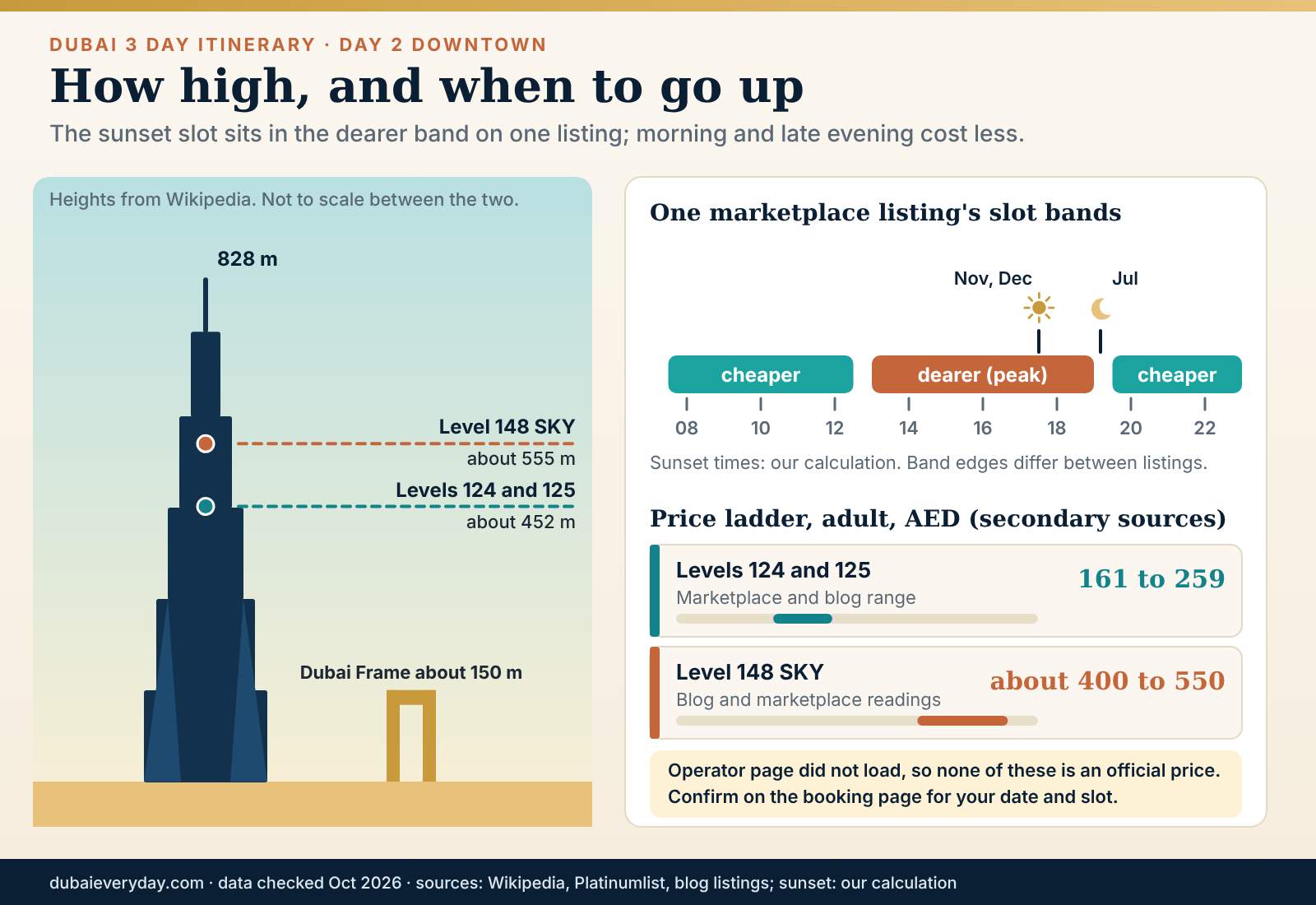
The tower is 828 m tall. The At the Top decks on levels 124 and 125 sit at about 452 m, and the Level 148 SKY deck at about 555 m, per Wikipedia’s building summary. Prices change with the slot and the seller. Across the marketplace pages and blogs we found, adult tickets for levels 124 and 125 ranged from AED 161 to AED 259, including AED 186 on one Platinumlist page on 29 October. Level 148 appeared at about AED 400 to 550. We could not load the operator’s own page, so every figure is secondary.
Our reading of those conflicting sources is that you should plan for AED 160 to 260 for the standard decks and about double for Level 148, then confirm on the booking page. One listing divides slots into non-peak (07:30 to 12:30 and 19:30 to 23:00) and peak (13:00 to 19:00). Hours also differ between sources and seasons, so pick a slot only once the booking page shows availability for your date. Book a morning slot if you are watching the budget; the sunset slot sits in the dearer band.
Midday: Dubai Mall as an indoor block
From the Metro station, an air-conditioned walkway runs to the mall. A 2012 press report put it at 820 m with travelators, which at normal walking pace is roughly 10 to 14 minutes by our calculation. The Dubai Mall’s own page gives retail hours of 10:00 to 23:00 Monday to Thursday and 10:00 to 00:00 Friday to Sunday, with restaurants a little later.
Use the mall as a heat shield and a lunch stop, not as a shopping mission. The Dubai Aquarium and Underwater Zoo is the obvious indoor anchor: its own page gives Monday to Friday hours of 10:00 to 23:00 (last entry 22:15) and weekend hours of 10:00 to midnight (last entry 23:15), and suggests 15 to 30 minutes for the tunnel plus 45 to 90 for the zoo.
Marketplace prices start around AED 209 for general entry. Skip it if the budget is tight or you saw one at home. More options are in the guide to indoor things to do in Dubai, which also covers days that go wrong with weather.
Evening: Burj Park, the Fountain and dinner
Aim to be outside around an hour before the first evening show. Emaar’s published schedule gives evening Dubai Fountain performances every 30 minutes from 18:00 to 23:00 daily, with afternoon shows at 13:00 and 13:30 Saturday to Thursday and 14:00 and 14:30 on Friday. Emaar lists the waterfront promenade at the mall, the Souk Al Bahar terraces, Burj Park and the Fountain Boardwalk as viewing points. Visit Dubai says the boardwalk starts from AED 25 and lake rides from AED 73.
A small part of the waterfront is fenced off for construction, according to Gulf News, so the closest rail may be moved. The free viewing points are the sensible choice. After the first show, you can walk into the mall or the Souk Al Bahar for dinner without going further. By our sunset calculation, the 18:00 show starts after sunset from October to January and in full daylight from March to September, so in the long-daylight months a later show is the better bet if you want to see the lights against a dark sky.
Transport on day two of the Dubai 3 day itinerary is two Metro journeys (AED 6 to 15 depending on your base). Everything else is tickets: the deck (AED 160 to 260 for the standard levels), optionally the aquarium, and food. Our Downtown Dubai area guide goes into where to eat, stay and park if you decide to spend more of the trip here.
Day 3: the coast, JBR, Marina and a sunset finish
The last day of the Dubai 3 day itinerary is the loosest on purpose. By now you will have a feel for your own pace, and the coast rewards drifting more than scheduling. The corridor is JBR and Dubai Marina, reached without a car by riding the Red Line south and swapping to the tram, which is the one place where the Metro and a second system join up neatly.
Getting there: Metro to DMCC, tram to JBR
Ride the Red Line to DMCC (R37), the station that interchanges with the tram at Jumeirah Lakes Towers. From Burj Khalifa/Dubai Mall that is about nine station gaps, so 18 to 23 minutes by our rule of thumb.
Then take the tram one stop to Jumeirah Beach Residence (JBR) 2 or two to JBR 1, going by the stop order on Wikipedia’s tram page. The RTA says a change of mode within 30 minutes is charged as one journey; its page words that for Metro and bus, so we assume the tram counts too and budget AED 3 to 7.50 for the whole trip, which you should confirm on your card balance. Sobha Realty (R36) is the other interchange, for the Dubai Marina tram stop.
The tram runs Monday to Saturday from 06:00 and Sunday from 09:00, until 01:00 every night. We found no published frequency, so assume a wait. Do not count on the Palm Monorail connection, because the operator says it is suspended. If you start the day on a Sunday, the Metro opens at 08:00, so the realistic first beach time is about 09:30.
Morning on the sand, midday in the shade
JBR is a long strip of towers with a pedestrian promenade (The Walk) and a seafront mall (The Beach) running along the shore. The Beach’s own page describes public access and gives retail hours of 10:00 to 23:00 Sunday to Thursday, to midnight on Friday and Saturday, with restaurants open later. We could not confirm lifeguard hours, beach rules or whether a particular stretch is free, so follow the signs on the sand and read our guide to free public beaches and the wider beach comparison before choosing where to spread a towel.
The sea is warm for most of the year. Secondary data tabulated on Wikipedia puts the average sea temperature at about 20.6 to 20.8 °C in January and February and 32.8 °C in August, so a swim is comfortable in most months and bath-warm in summer. Treat these as indicative. UV is the bigger risk: the same table shows an index of 11 or 12 from April to September, so sunscreen and a shirt matter more than the water temperature.
Afternoon and evening: Marina Walk and three endings
From midday to mid-afternoon, use the mall for lunch and a break. Then walk or tram to the Marina, where the promenade runs along the canal-style waterway between the towers. Wikipedia counts roughly 8 km of walkways in the district. Dubai Water Taxi runs on Marina routes at AED 7 per segment, which gives you the waterway from the water side if you want one short boat ride, and RTA says children under 12 must wear life jackets and may not travel unaccompanied.
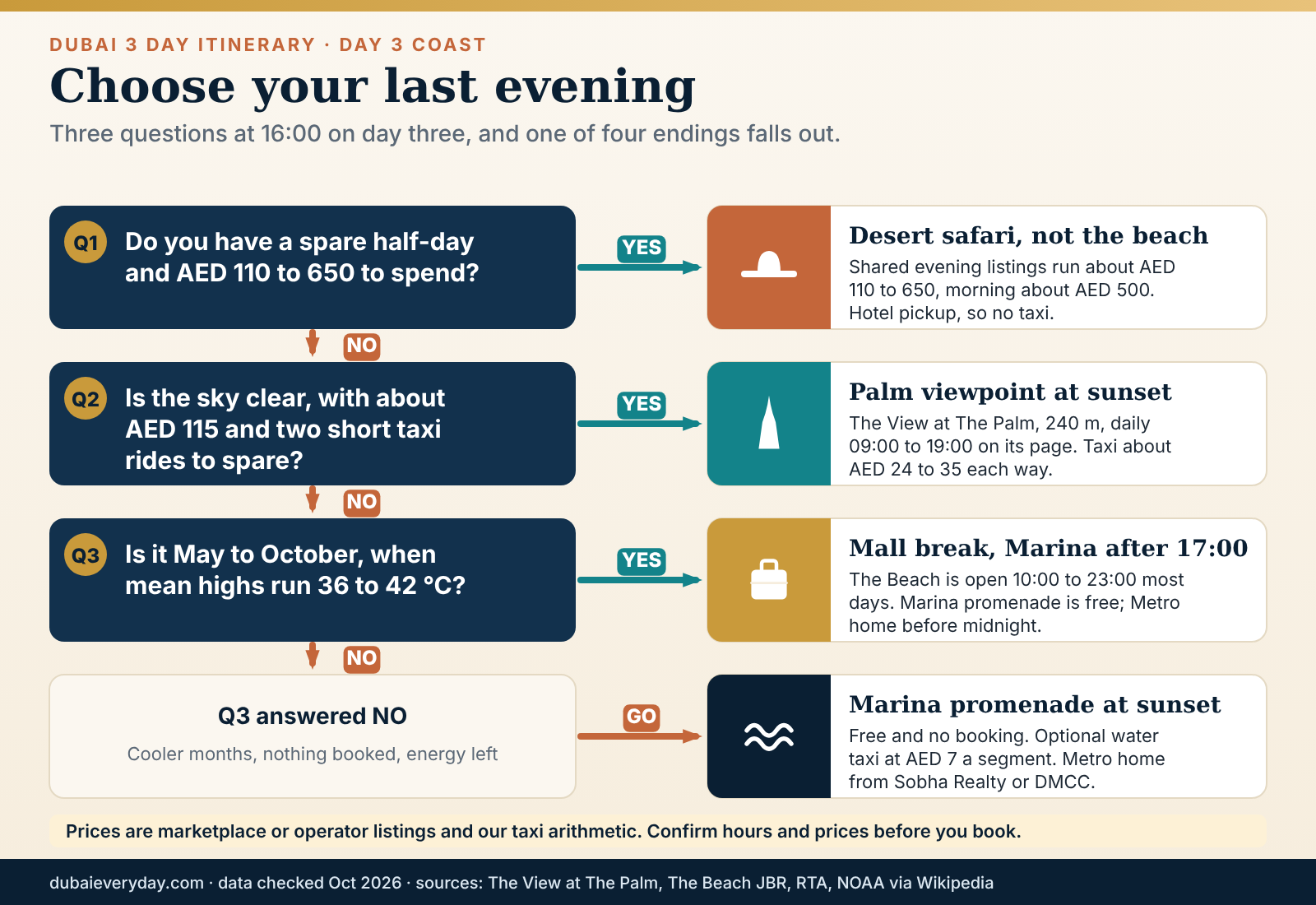
For the sunset ending, pick one of three. The default is to stay on the Marina promenade, eat there and take the Metro home from Sobha Realty or DMCC while the trains are still running (midnight, or 01:00 on Fridays). That costs nothing extra and needs no booking. The second is a Palm viewpoint by taxi. The third is an evening desert safari, which swallows the whole afternoon and is only worth it if you drop the beach. Both are in the add-ons below, along with their costs.
Ending the trip on the coast has a practical advantage too. DXB is reachable from the Red Line without a change if you are flying the next morning, since Terminals 1 and 3 are on it. Check the airport guide for how departures work and how long the check-in window is.
Add-ons and swaps for your Dubai 3 day itinerary
The core of this Dubai 3 day itinerary needs no taxis. Add-ons are the extras that do, because each of them sits away from the Metro corridors. Pick one per day at most, and drop a core block to make room, rather than stacking them on top. A day that goes past nine hours of actual sightseeing stops being a holiday.
Dubai Frame (day 1 late afternoon or day 2 morning)
The Dubai Frame is a 150-metre-tall, roughly 95-metre-wide picture frame in Zabeel Park, with a deck that looks over both Old and New Dubai. The independent visitor guide we found says tickets start from about AED 49 online (a marketplace listing showed AED 52.50), opening hours of 08:00 or 09:00 until 21:00, and that the Red Line station to use is Max (also called Al Jafiliya in some sources) followed by a short taxi to Gate 4. Station names and hours conflict across sources, so check before you go.
Our estimate for adding it to a Dubai 3 day itinerary is a half-day with two short taxi legs.
Jumeirah Mosque tour (day 2 morning)
The Sheikh Mohammed Centre for Cultural Understanding runs the Jumeirah Mosque visit every day except Friday at 10:00 and 14:00, lasting about 1 hour 15 minutes, at AED 45 per person with refreshments included. The page says booking in advance is not required, with registration opening 30 minutes beforehand, but also offers a booking form and WhatsApp number, so confirm before you go.
It does not state a dress code on that page, so ask the centre. The mosque is on the Jumeirah coast road, away from the Metro, so budget two taxi rides of roughly AED 24 to 35 each (our arithmetic).
Palm Jumeirah viewpoint (day 3 late afternoon)
The View at The Palm gives a 240 m view of the island and the coastline.
Its own page listed daily hours of 09:00 to 19:00 and a set of packages with unlabelled prices, the standard ticket appearing as 115 (a marketplace listing also showed from AED 115). With the Monorail suspended, the way up is by taxi from the Marina or the tram’s Palm Jumeirah stop. Check the closing time against sunset: by our calculation the sun sets after 19:00 only in June and July, and at about 18:55 in May and August, so the deck is a daytime view in those months.
Desert safari (replaces the afternoon and evening of day 3)
Operator and marketplace listings put a shared morning reserve safari at about AED 500 for four hours, and shared evening safaris anywhere from roughly AED 110 for basic packages to AED 650 for premium camps. Pickup is from your hotel, which is why it is the one add-on with no taxi cost. Our safari comparison explains the formats, and the morning safari guide is the better fit if you want to keep your evening. It is, in effect, the cost of a day: do not try to fit it around a full beach day.
| Add-on | Indicative entry cost | Taxi legs | Time added | Skip it if |
|---|---|---|---|---|
| Dubai Frame | About AED 50 | 2 short | 2.5 to 3 hours | You are already doing the Burj deck |
| Jumeirah Mosque tour | AED 45 | 2 (AED 24 to 35 each) | 3 to 3.5 hours | Your free day falls on a Friday |
| Palm viewpoint | About AED 115 | 2 (AED 24 to 35 each) | 2.5 to 3 hours | Cloud or haze is forecast |
| Morning desert safari | About AED 500 shared | 0 (hotel pickup) | 4 to 5 hours | You have no spare half-day |
| Dubai Aquarium | From about AED 209 | 0 | 1.5 to 3 hours | It is a cool, dry day |
The table shows entry costs from sources that conflict, so read it as a way to compare, not to budget to the dirham. Time added is our estimate. For other ways to replace a block, the guide to things to do in Dubai has the full menu, and the free-things list is the cheapest substitute for any paid slot above.
Adjusting your Dubai 3 day itinerary by season, daylight and heat
The order of days in a Dubai 3 day itinerary stays the same all year. What moves is the hour each block happens, and that is where a first visit goes wrong. A Dubai 3 day itinerary that is easy in January becomes a test of endurance in July, with no change in distance. Here is how to bend it to your month, using the NOAA 1991 to 2020 airport normals as tabulated on Wikipedia and our own sunrise and sunset calculation for central Dubai.
Three seasons, three versions of a Dubai 3 day itinerary
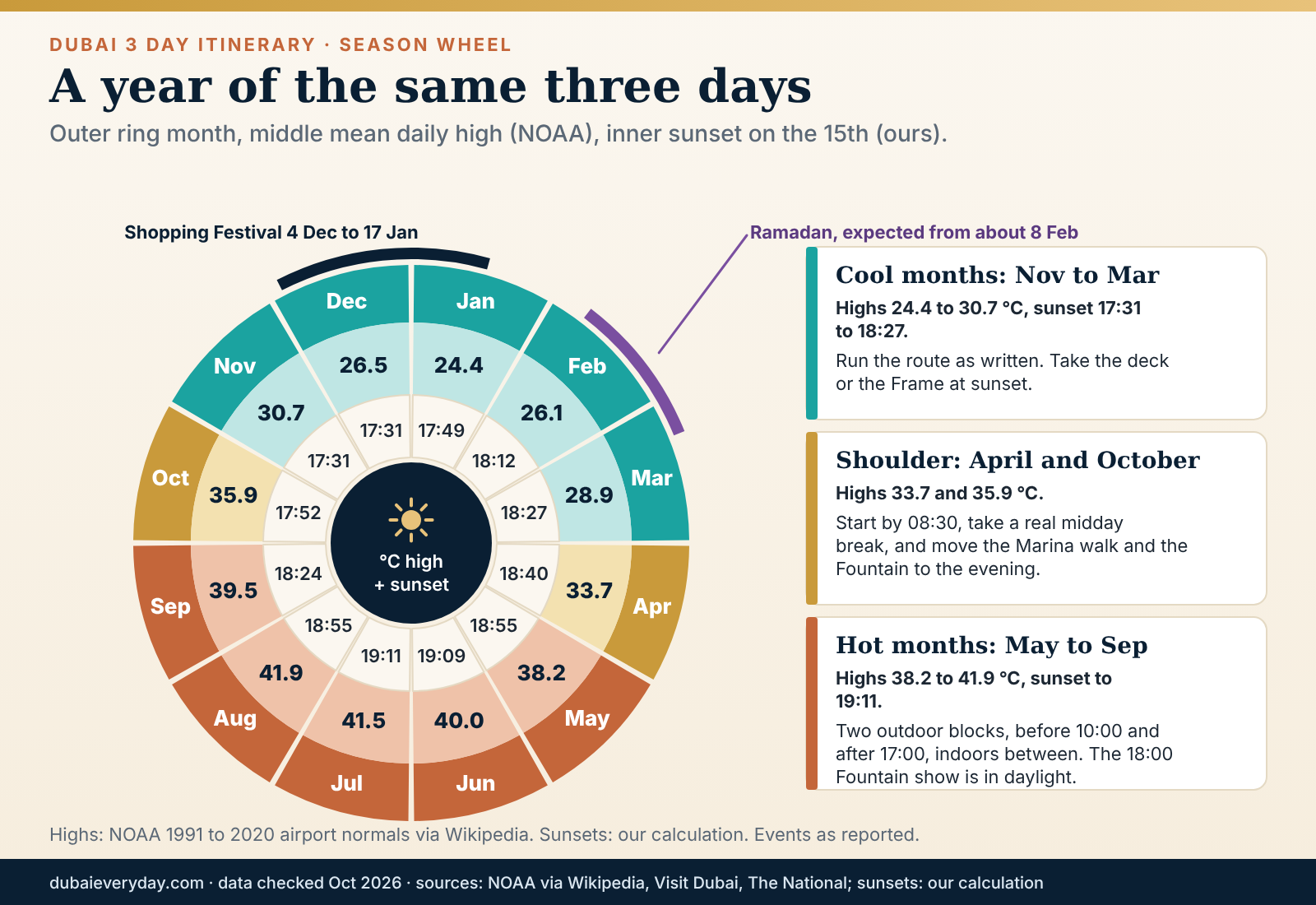
From November to March, mean daily highs run from 24.4 °C (January) to 30.7 °C (November), and sunset is between 17:31 and 18:27. Run the Dubai 3 day itinerary as written, keep the break on day one short, and put the Burj deck or the Frame at sunset if you want the best light. Daylight is the scarce resource: mid-December gives about 10 hours 35 minutes between sunrise at 06:56 and sunset at 17:31, so the end of the day arrives early.
April and October are the shoulder. Highs are 33.7 °C in April and 35.9 °C in October. Start by 08:30, take the midday break seriously, and move the Marina walk and the Fountain to the evening.
By May the mean high is 38.2 °C, and from June to September it is 39.5 to 41.9 °C. In those months the sensible version of a Dubai 3 day itinerary is two short outdoor blocks, before about 10:00 and after about 17:00, with air-conditioned time between. Mid-July daylight stretches to 13 hours 34 minutes (05:37 to 19:11), so dusk is late, and the Fountain’s 18:00 show happens in full light.
The NOAA normals above are averages, so individual days run hotter, and humidity is not in the highs. The same Wikipedia table lists a UV index of 11 or 12 from April to September, and the World Health Organization advises shade, cover and sunscreen at index 8 and above. Health agencies such as the NHS advise limiting strenuous activity in the hottest part of the day, which in Dubai is roughly 11:00 to 15:00. Carry water, wear a hat, and treat dizziness or heavy sweating as a reason to stop and get indoors. This is general information, not medical advice.
Calendar dates that change a Dubai 3 day itinerary
The Dubai Shopping Festival is listed on Visit Dubai for 4 December 2026 to 17 January 2027, and the winter school holiday is reported as running from 14 December to 3 January. December 2025 was the busiest month of that year, with more than two million international overnight visitors according to the tourism department as reported by AGBI. Book the Burj deck and any add-on early for those weeks, and plan for slow Metro platforms near the mall in the evening. Our January events guide and the events calendar guide track the dates.
Ramadan 2027 is expected to start around 8 February, with Eid al-Fitr about 9 to 10 March, depending on moon sighting. During Ramadan, attraction hours change, the Fountain’s evening schedule shifts later, and UK guidance advises visitors not to eat or drink in public during daylight hours. If your trip falls in that window, check each venue’s hours and move meals to hotels or places that are clearly open. The best-time-to-visit guide compares months by weather, crowds and prices.
If it rains
Dubai gets little rain, but when it falls, it is not gentle. NOAA’s January normal is 20.8 mm and December 14.8 mm, and Wikipedia notes a single storm in April 2024 that dropped 255 mm. A wet day mostly hurts day three, when the beach plan fails. Keep the order, spend the spare hours on the mall or aquarium time you did not use on day two, and see the indoor activities guide for more backups.
What a Dubai 3 day itinerary costs
The cost of a Dubai 3 day itinerary splits into the things we could price from official sources (transport) and the things we could only price from marketplaces (tickets). We have not priced food or hotels because we found no verified figures, so those are yours to add. Everything below is our calculation from the prices quoted earlier, with a Silver nol card.
| Day | Transport (Silver card) | Core paid items | Time spent moving (our estimate) |
|---|---|---|---|
| Day 1: Old Dubai | AED 8 to 19 (2 Metro + 1 to 2 abra) | None | About 1 to 1.5 hours |
| Day 2: Downtown | AED 6 to 15 (2 Metro) | Burj deck, AED 160 to 260 | About 1 hour including the mall walkway |
| Day 3: Coast | AED 6 to 15 (Metro + tram, 2 journeys) | None | About 1 to 1.25 hours |
| Three days | AED 20 to 49, plus AED 6 net for the card | AED 160 to 260 | About 3 to 4 hours |
So the core of a Dubai 3 day itinerary costs AED 186 to 315 in transport and tickets together, before food, accommodation, and any add-on. That is the headline. The point of this Dubai 3 day itinerary is that most of the money is spent on one thing you chose, the tower, and the movement is almost free.
The all-taxi comparison
As an illustrative example (not a quote), imagine moving between the same stops by taxi: roughly 11 point-to-point hops over three days, at an average of AED 30 to 45 each for rides of 6 to 14 km on the tariff above. That adds up to AED 330 to 495 for transport alone, against AED 26 to 55 on the Metro route. The gap of roughly AED 275 to 440 is about what the Burj deck and the Palm viewpoint cost together (AED 275 to 375).
We cannot price your time stuck in traffic, because we have no verified congestion data, but the arithmetic alone explains the route.
Where the budget moves
Add-ons can double the ticket line: the Frame adds about AED 50, the mosque AED 45, the Palm viewpoint about AED 115, and each costs two taxi rides of around AED 24 to 35. Level 148 at the Burj adds roughly AED 140 to 390 over the standard decks, by our arithmetic from conflicting listings. A desert safari adds AED 110 to 650 depending on format. Where you stay and eat moves the total far more than any ticket, so use the budget hotel guide and the luxury hotel guide to set that part first.
Fitting a Dubai 3 day itinerary around your flights
A “three-day” trip in airline terms usually means two partial days and one full one. Be honest about which you have. If you land in the morning and leave the evening of the third day, run the Dubai 3 day itinerary as written, with day one starting after check-in. If you land in the evening and leave early, you have two real days, and the cut is the Old Dubai afternoon.
From the airport, the Red Line serves Terminals 1 and 3. Dubai Airports says tickets and nol cards are sold there, that you may carry up to two pieces of luggage, and that the Metro runs 05:00 to midnight on most days, 05:00 to 01:00 on Fridays and 08:00 to midnight on Sundays. A taxi from DXB starts at AED 25, which makes a late arrival after the last train the main time you will want one. The DXB airport guide and the Terminal 1 guide cover the arrival routes.
Given the airport disruption described at the start, leave a buffer on the last day and consider whether to keep the final evening free of anything that cannot be moved. A stopover shorter than 24 hours cannot hold a Dubai 3 day itinerary. Pick Downtown (day two) and a Fountain evening, and use the Metro both ways. For money, dress and bookings before you land, the first-time visitor plan is the companion to this page.
Mistakes that waste a day
These are the errors in a Dubai 3 day itinerary that the timetables and closures above suggest, rather than stories from anyone’s trip. None needs money to fix.
- Building a day around the Museum of the Future, Al Fahidi Fort or the Palm Monorail, all unavailable right now.
- Starting on a Sunday at 07:00. The Metro opens at 08:00 and the tram at 09:00.
- Booking a hotel far from a Red Line station to save a few dirhams a night, then paying it back in taxis.
- Booking the Burj sunset slot without checking which price band it falls in.
- Arriving at the mosque on a Friday, when the visit programme does not run.
- Counting on the abra without coins. The AED 1 boat is paid in cash.
- Stacking three add-ons on one day because each looked small on its own.
- Leaving an outdoor block in the middle of the day between May and September.
The common thread is sequencing, not spending. A Dubai 3 day itinerary is long enough to see Dubai’s three main faces and short enough that two bad blocks hurt. When in doubt, cut the optional item and keep the evening: the Creek at dusk, the Fountain, or the Marina at sunset.
Dubai 3 day itinerary: FAQ
Is three days enough for Dubai?
Three days is enough for a first look at the three areas most visitors come for: Old Dubai, Downtown and the coast. It is not enough for theme parks, a desert night and a slow beach as well. A Dubai 3 day itinerary works when you accept one corridor per day and drop the rest. If you want the desert too, either replace the afternoon of day three or add a fourth day.
What is the best Dubai 3 day itinerary for a first-timer?
Our pick is Old Dubai and the Creek on day one, Downtown on day two, and JBR and the Marina on day three. It uses the Green Line, the Red Line and one tram hop, with no taxi in the core route. The order also eases you in from cheap and flat to expensive and tall. Swap days only if your flights force it, and check opening days first, since the Jumeirah Mosque tour does not run on Fridays.
Can I follow a Dubai 3 day itinerary without a car or taxis?
Yes, the core of this Dubai 3 day itinerary is designed that way. Metro stations are open 05:00 to midnight on most days (Fridays to 01:00, Sundays from 08:00), the tram links the Marina area, and an abra crosses the Creek for AED 1 to 2. Taxis only come in for add-ons such as the Dubai Frame, the Jumeirah Mosque and the Palm viewpoint, or for a late return after the last train. Budget AED 24 to 35 per short ride as an indication.
How much does a Dubai 3 day itinerary cost?
Our calculation puts transport for a Dubai 3 day itinerary at AED 26 to 55 for the three days on a Silver nol card, including the AED 6 net card cost. Add the Burj Khalifa deck at roughly AED 160 to 260, and the core route comes to about AED 186 to 315 before food and your hotel. Each add-on adds a ticket and two taxi rides. We could not verify food or accommodation prices, so we do not give figures for those.
What should I book in advance for a Dubai 3 day itinerary?
Book the Burj Khalifa deck with a timed slot, because price and availability vary by time of day, and any desert safari, which needs a hotel pickup. The Jumeirah Mosque page says prior booking is not required but offers a form, so confirm that one. The Dubai Fountain, the souks, the Creek abras and the Marina need no booking. During the Shopping Festival and school holidays, book everything earlier.
Where should I stay for a Dubai 3 day itinerary?
Stay within a short walk of a Red Line station between BurJuman and Burj Khalifa/Dubai Mall, which covers Downtown, Business Bay and the Karama and BurJuman side. Every day then starts with a Metro ride of roughly 5 to 25 minutes by our estimate. A Marina or JBR base suits a beach-first trip but lengthens days one and two. Our hotel guides compare areas and prices in more depth.
Is the Museum of the Future open?
No. The Museum of the Future closed on 1 September 2026 for a rebuild, and its website says it is temporarily closed without giving a reopening date. Gulf News, updated 27 October, reports the first quarter of 2027 as the expectation. Al Fahidi Fort, the old Dubai Museum site, is also closed for restoration. Neither appears in this Dubai 3 day itinerary, and both can be added back if they reopen before your trip.
Can I do this Dubai 3 day itinerary in summer?
You can, with changes. From May to September, mean daily highs run from 38.2 °C to 41.9 °C, so move outdoor blocks to before about 10:00 and after about 17:00 and spend the middle on the mall, the aquarium and the Metro. The order of the days stays the same. The beach morning becomes a short early swim, and the Fountain’s 18:00 show happens in daylight, so wait for a later one.
When is the best time to watch the Dubai Fountain?
Emaar’s schedule lists evening shows every 30 minutes from 18:00 to 23:00, plus afternoon shows at 13:00 and 13:30 Saturday to Thursday and 14:00 and 14:30 on Friday. By our calculation, shows after dark suit the lights best, which means the 18:00 show from October to January and later ones in other months. A section of the waterfront is fenced for works, so the closest rail may move. Free viewing points are Burj Park, the promenade and Souk Al Bahar terraces.
How do I get from the airport to the start of the Dubai 3 day itinerary?
The Red Line serves Terminals 1 and 3, with tickets and nol cards sold at both, and you can carry up to two pieces of luggage. Trains run 05:00 to midnight on most days, to 01:00 on Fridays, and from 08:00 on Sundays. A taxi from DXB has a start fare of AED 25. Because Dubai Airports says services can change on public holidays and during events, check the RTA page for your date.
What should I wear on a Dubai 3 day itinerary?
Dress for heat, but modestly in public and at religious sites. The Jumeirah Mosque page does not state a dress code, so ask the centre before you go. Dubai Mall describes a courtesy dress code on its own page, and beachwear belongs on the beach. Carry a light layer for the over-cooled Metro and malls. This is general guidance; the venue’s current rules decide.
Related reading
Sources and further reading (40 links)
- Roads and Transport Authority: nol fares — zone fares, Red Ticket and Gold fares, passes, transfer rules
- Roads and Transport Authority: About nol card — minimum balance to tap in
- Roads and Transport Authority: timetables — Metro and tram station opening hours
- Roads and Transport Authority: marine transport — abra fares and routes, water taxi fares, child rules
- Dubai Taxi Company: taxi tariff — start fares, per-kilometre rate, minimum fare, waiting time
- Dubai Airports: taxi at DXB — airport start fare and pickups
- Dubai Airports: Metro at DXB — Red Line access, tickets, luggage rule
- Sheikh Mohammed Centre for Cultural Understanding: Jumeirah Mosque visit — days, times, price, booking
- Dubai Culture: Al Shindagha Museum, plan your visit — opening hours and ticket listing
- Visit Dubai: Al Fahidi Historical Neighbourhood — description of the quarter
- Visit Dubai: The Dubai Fountain — show start, boardwalk and lake ride prices
- Visit Dubai: travel updates — official visitor updates page
- Emaar: Dubai Fountain show timings — evening and afternoon schedule, viewing points
- The Dubai Mall: opening hours — retail and restaurant hours
- Dubai Aquarium and Underwater Zoo: plan your visit — hours and suggested durations
- The Beach JBR: FAQ — public access, hours, Metro and tram directions
- Museum of the Future: official site — temporary closure notice
- Palm Monorail: official site — service suspension notice
- The View at The Palm: official site — hours, height and package listing
- UK Foreign, Commonwealth and Development Office: UAE travel advice — current regional warnings
- Dubai Airports media centre: DXB second-half release — first-half 2026 passenger figures
- Fortune: Dubai airport traffic recovery — chief executive’s recovery comments
- Gulf News: Dubai landmarks reopening in 2027 — Museum of the Future and Burj Al Arab closures
- Euronews: Al Fahidi Fort set to reopen — fort closure and reopening wording
- Gulf News: Dubai Fountain new look — fountain operating with works
- Gulf News: Palm Monorail reopens — July reopening report
- Wikipedia: Climate of Dubai — NOAA 1991 to 2020 normals, sea temperature, UV (secondary)
- Wikipedia: Burj Khalifa — tower and deck heights (secondary)
- Wikipedia: Dubai Frame — dimensions (secondary)
- Wikipedia: Dubai Tram — stop order and interchanges (secondary)
- Wikipedia: Green Line (Dubai Metro) — station names and order (secondary)
- Platinumlist: At the Top, Burj Khalifa — marketplace price and slot bands (not the operator)
- Danni Bin Dubai: Burj Khalifa ticket prices — blog price comparison (secondary)
- Dubai Frame independent visitor guide — hours, price and gate notes (unofficial)
- Visit Dubai Pass: morning desert safari listing — shared morning safari price and length
- Arabian Adventures: evening desert safari — evening safari price band
- Visit Dubai: Dubai Shopping Festival — festival dates
- The National: Ramadan 2027 dates — expected start and Eid dates
- AGBI: international visitors and Dubai hotels in 2025 — visitor volume by month
- Gulf News: UAE school holidays 2026 to 2027 — winter break dates
Update log: 29 October 2026, first publication; all facts re-checked against the sources above. Next review due: by 31 January 2027, or sooner if the Museum of the Future, Al Fahidi Fort or the Palm Monorail reopens, or fares and hours change. Corrections welcome. This page is general travel information, not individual safety, medical, legal or insurance advice.
About DubaiEveryday and this guide
DubaiEveryday.com is an independent editorial project that publishes practical, research-based guides to everyday life in Dubai: where to live, what things cost, how the rules work and how to get around. This page was written and edited by the DubaiEveryday editorial team. It is not signed by a named expert, doctor, lawyer or adviser, and we do not claim first-hand testing of a venue, clinic or service unless the page says so.
Each guide is built from official sources such as government and regulator pages, operator websites and established news outlets, cross-checked where we can. When we could not confirm something, we say so in the text, and examples that use made-up numbers are labelled as illustrations. Mentions are editorial choices, not paid placements, and a link is not an endorsement.
Dubai changes quickly. If you spot something that is out of date or wrong, please tell us through the contact options on DubaiEveryday.com and we will check it and correct the page.