

Dubai has a handful of genuinely free, lifeguarded beaches, and the useful question is what each one gives you besides sand: showers, toilets, parking, shade, safety cover and a way in for families. This guide to the public beaches Dubai offers for free answers that from official sources checked on 29 October 2026, and says plainly where the official pages go quiet.
Picture arriving with two children, a cool box and a free beach, then realising you have no idea whether there is a shower, a toilet or anywhere to park. Sand is the easy part of a beach day. The small facilities decide whether the day goes well. And the official pages do not always say.
This guide to public beaches Dubai Municipality runs sorts out the free, lifeguarded options along the coast, one by one. It covers showers, parking, lifeguard hours and family access, and says plainly where the published information goes quiet. You can plan a beach day around what is confirmed rather than hoping for the best.
The public beaches Dubai Municipality manages are free to enter, open to the public around the clock, and staffed by lifeguards from sunrise to sunset. The current free list is the Khor Al Mamzar lagoon beach, Jumeirah 1, Jumeirah 2, Jumeirah 3, Umm Suqeim 1 and Umm Suqeim 2. Jumeirah 2, Jumeirah 3 and Umm Suqeim 1 also have lit night-swimming zones.
The catch is facilities. The municipality’s beach pages list jogging tracks, playgrounds, gym equipment, lounges and access corridors for people of determination, but none of the pages we read lists showers, toilets or parking. Plan as if showers are not guaranteed, assume metered parking is chargeable from 08:00 to 22:00 (free on Sundays and public holidays), and find the lifeguard post before you unpack.
For families, Jumeirah 2 and the Khor Al Mamzar lagoon have the most documented child-friendly features. For sunset, Umm Suqeim 2. For a beach reachable without a car, none of the public beaches Dubai Municipality runs has a Metro station, so JBR (a commercial strip, not a municipal beach) is the rail-and-tram exception. Nobody at this site has visited these beaches; this is a source-checked guide, not a field test.
Public beaches Dubai in October 2026: the status board
Start with what is open among the public beaches Dubai residents use, because this coastline changed more in the first ten months of 2026 than in the previous five years. The biggest news is the Khor Al Mamzar lagoon beach, which Dubai Municipality opened on 5 May 2026 as the first phase of a wider Al Mamzar development. Jumeirah 1 was rebuilt and reopened in February. A second Al Mamzar beach, a women-only Corniche, was announced but was still not confirmed open in the sources we could read.
A quick note on scope before the detail. Our broader guide to the best beaches in Dubai compares free sand, gated parks, hotel beaches and beach clubs and prices the paid options. This page does the opposite job: it takes only the free, lifeguarded side of the public beaches Dubai offers and goes deep on the practical questions of showers, parking, lifeguards and family access. If you are weighing a club day pass, read that one. If you want shallow water and play areas for toddlers specifically, the family beaches guide goes further than the family section here.
The shortlist at a glance
Seven names matter among the public beaches Dubai has today. Six are municipal beaches you can use for free, and the seventh, JBR, is a public-access commercial strip that behaves differently. Everything below is expanded in the profiles later on, but the one-line version is useful for planning.
Khor Al Mamzar lagoon beach
Newest and longest: a 3.6 km swimming shoreline, 12 lifeguard towers, a 300 m night beach and a swim-only design. Opened May 2026.
Jumeirah 1
Rebuilt and reopened in 2026 with lockers, Wi-Fi and new paths reported. The quietest-feeling stretch on the Jumeirah road, but facility detail is thin.
Jumeirah 2 (Open Beach)
648 m, swimming only, with a playground, gym equipment, a beach library and a night-swimming zone. The best-documented family beach.
Jumeirah 3
About 1,980 m with a kite zone, a 125 m seating platform and a night-swimming zone. Easy to reach from Sheikh Zayed Road.
Umm Suqeim 1 (Kite Beach area)
About 2.4 km, active and busy. Night swimming with lifeguards to midnight, according to its municipal page.
Umm Suqeim 2 (Sunset Beach)
615 m with separate swim and surf zones, about 1 km from the Burj Al Arab. The sunset beach, with daytime lifeguards only.
JBR’s The Beach sits outside that grid on purpose. It is open to everyone, but its parking is priced by the mall operator and its layout is a promenade with shops, not a municipal beach with a published lifeguard roster. We cover it in the profiles because many visitors will end up there, and because it is the only option on this list that a Metro rider can reach with one tram change.
Two entries that appear on many older lists of public beaches Dubai wide should not drive your plans. The Al Mamzar Corniche, planned as a women-only beach with night swimming, was still described as not yet open by Khaleej Times on 14 September 2026, and we found no official opening notice after Dubai Municipality’s April update. Al Sufouh, sometimes called Secret Beach, has conflicting reports about public access and is not on the municipal list. Treat both as unconfirmed.
How we chose and checked the public beaches Dubai entries
A shortlist of free beaches has an obvious weakness: if everything is free, ranking by price is pointless, and ranking by “vibe” is just opinion. So this page does not give you a league table of public beaches Dubai wide. It uses six practical tests, applies them to every beach, and shows the evidence behind each answer. Where the evidence does not exist, the page says so instead of filling the gap with a guess.
This is a desk-research guide. Nobody on the editorial team visited these beaches, swam at them or inspected their facilities, and nothing here is described as personal experience. Facts come from Dubai Municipality (dm.gov.ae) beach pages, the Dubai Media Office, Gulf News, Khaleej Times, Time Out Dubai and The National, the UK Foreign Office travel advice for the UAE, and operator pages where a beach sits inside a commercial district.
On 29 October 2026 we re-read the municipal pages for Jumeirah 2, Umm Suqeim 1, Umm Suqeim 2, the Mamzar lagoon and the general beach listing, plus the Khor Al Mamzar opening release, the Gulf News guide to night-swimming beaches, the Gulf News parking-zone explainer, The National’s children’s safety piece and the UK Foreign Office page. A few inputs (the JBR parking terms, Metro and tram hours, climate tables) were carried over from our broader beach guide, checked the same day, and are labelled. Inclusion was not paid for, no link is an affiliate link, and nothing is ordered by commission. This is general information, not individual safety advice.
The six tests
- Access: is it free to enter, and who says so?
- Lifeguards: are hours published, and do they cover the time you will actually be there?
- Facilities: showers, toilets, changing, shade, play areas, tracks and food, as published or reported.
- Parking and transport: how do you reach it, and what does the car park cost?
- Family and access: playgrounds, swim-only zones, access corridors, family-only days.
- Rules and conditions: night swimming, closures, heat and the season.
Three evidence grades
Every claim about the public beaches Dubai Municipality manages belongs to one of three grades. Published means a Dubai Municipality, Dubai Media Office or operator page states it. Reported means a dated news article said it and we could not find the matching official page. Not published means we looked and found no statement either way. That last grade matters most on this topic, and you will see it often, because the municipality’s beach pages say very little about showers, toilets or parking.
Not published does not mean absent. A beach can have toilets that nobody bothered to list online. It means you cannot plan around them with confidence, which is a different and more useful thing to know. Where we offer a calculation, such as the cost of a morning’s parking or the length of the guarded day, we label it “our calculation” and show the inputs so you can redo the sum.
What we could not check. We did not find any beach-by-beach list of showers, toilets or parking bays from an official source. We could not read the Visit Dubai beach pages, the Dubai Municipality FAQ or the RTA bus route pages on the day. We found no published water-quality result for individual beaches, and no verified description of how crowded any beach feels at a given hour. Wherever one of those gaps affects a decision below, the text says so.
What “free” and “public” really mean on the Dubai coast
“Free public beach” sounds like one thing. Among the public beaches Dubai has, it is at least four, and mixing them up is the commonest way to end up paying for something you thought was free, or walking away from something you were allowed to use. The distinction is about who runs the sand, not about whether the sea charges you.
Public beaches Dubai Municipality manages: no entrance fee
Dubai Municipality’s beach listing says its beach centres do not require an entrance fee, apart from fees for requested services. That is the legal and practical basis for calling the Jumeirah, Umm Suqeim and Khor Al Mamzar beaches free. The same municipality describes them as open to the public at all hours, with lifeguards on duty in daylight. These are the core of the public beaches Dubai residents mean when they say “just go to the public beach”.
Gated parks: cheap, not free
Al Mamzar Beach Park is public in the sense that anyone can buy a ticket, but it has a gate. The municipality lists hours of 08:00 to 22:00, and a 2024 Gulf News report put walk-in entry at AED 5 a person and AED 30 a car. We include it as a comparison point and in the family section, but it is not a free beach, so it is not on the shortlist.
Commercial strips with public access
The Beach at JBR is the clearest example. Its own site says visitors have public access to the beach, but the car park is operated by the district and priced by the hour. J1 Beach, the redeveloped southern part of La Mer, is mostly a dining and beach-club destination; the sand there is not a municipal swim beach. These places are “public” in the sense that the doors are open, not in the sense that someone has promised you lifeguards, showers or free parking.
Hotel and club sand
Beaches attached to hotels and clubs are private commercial spaces, not public beaches Dubai Municipality manages. Access is by guest status, day pass or minimum spend. They sit outside this page, and the broader beach guide covers the money side. If you are choosing a hotel partly for its beach, the guide to choosing hotels by area, budget and beach access explains what private sand changes.
A quick test. Ask three questions of any “free beach”: who operates it, is there a gate or a pay-and-display car park, and are the loungers on the sand a municipal amenity or a vendor’s stock? If you cannot answer the third one from the sign in front of you, assume you are looking at a rental.
The coast in order: where the public beaches Dubai residents use actually sit
Dubai’s shoreline runs from the Sharjah border in the north-east to Jebel Ali in the south-west, and the public beaches Dubai Municipality runs cluster in two places. One is the Al Mamzar end, beside the border. The other is a continuous strip along Jumeirah Beach Road (the D94) through Jumeirah 1, 2, 3 and Umm Suqeim 1 and 2. Between them, around the Creek, the port and the city centre, there is no swimming beach among the public beaches Dubai Municipality lists. That gap surprises visitors staying in Deira or Downtown, and it is the first reason to think about transport before you pick a beach.
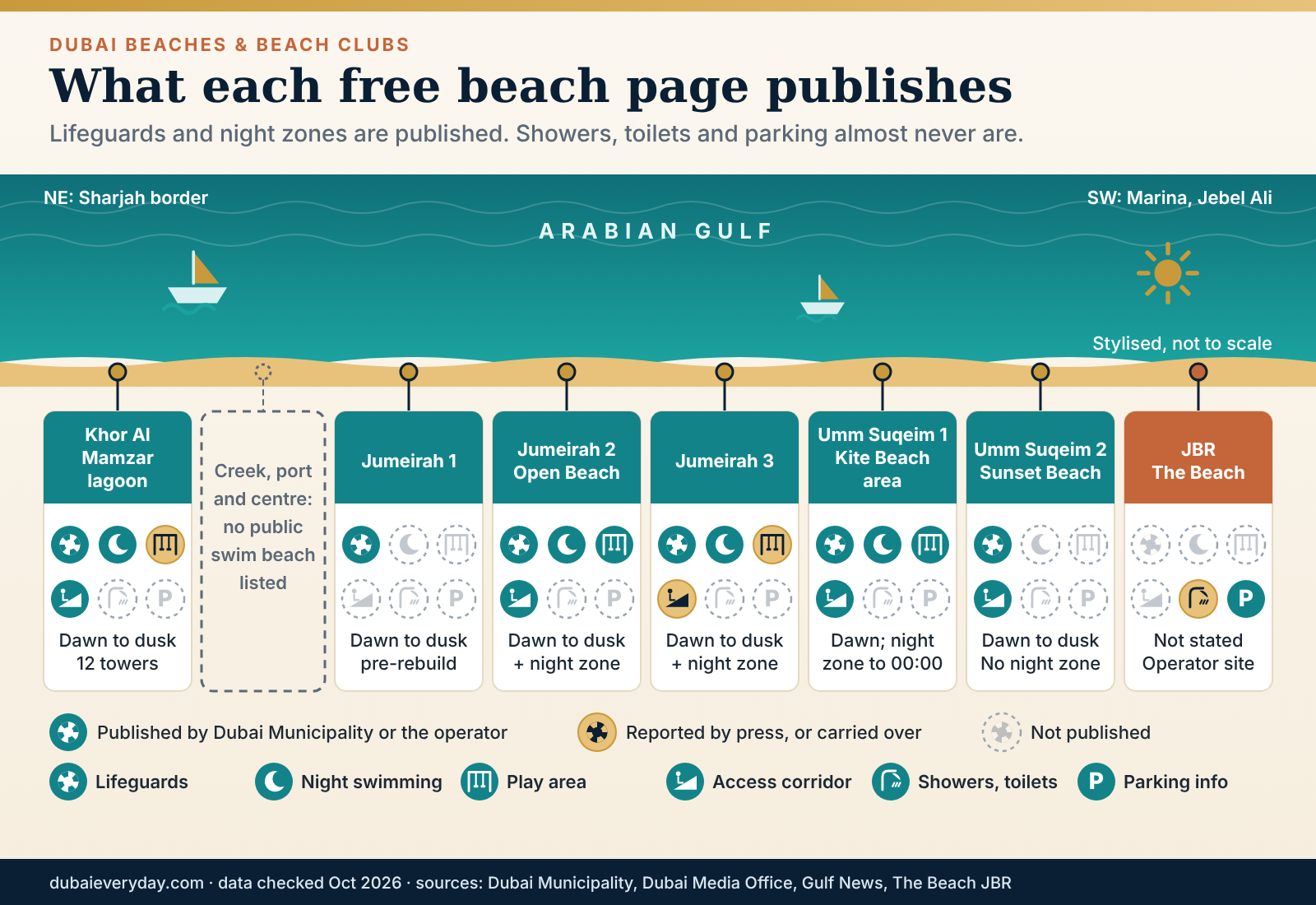
The second consequence of the geography is that the Jumeirah strip behaves as one system. A single road, a handful of side streets and a run of beaches a few minutes apart by car means you can sample two in a day, or choose the one with the easiest parking on the morning you go. Al Mamzar behaves as a separate trip entirely. It sits at the opposite end of the coast from Marina and Umm Suqeim, and a swim at Al Mamzar followed by a sunset at Umm Suqeim 2 is a cross-city drive, not a stroll.
If you are staying near the Burj Khalifa, the Downtown Dubai area guide shows what you can reach without a car, and the honest answer is that the nearest guarded municipal sand is a short taxi ride away. If you are staying in the Marina, the Dubai Marina guide explains the tram and walking links to the JBR beachfront, which is the one place on this page where a rail trip makes sense.
Public beaches Dubai Municipality runs, one by one: facilities, lifeguards and family access
The profiles run from north-east to south-west. Each says what the municipality or operator publishes, what the page leaves out, who the beach suits and what to watch. Lifeguard hours are the published ones, not a promise about staffing on a particular afternoon, and every figure carries a grade from the method section. These are the public beaches Dubai residents and visitors actually use, in the order the coast presents them.
Khor Al Mamzar lagoon beach
Dubai Municipality opened this beach on 5 May 2026, and the opening release gives the scale: a 3.6 km swimming shoreline, about 182,000 square metres of sandy beachfront, more than 5.5 km of running, walking and cycling tracks and a 300-metre night beach that the release says operates 24 hours a day. It lists 12 lifeguard towers, 12 emergency call points, 20 public facilities, 19 food and beverage outlets, an outdoor gym, a beach volleyball court, padel courts and a floating walkway. Published
The municipality’s older page for the lagoon describes a beach of about 3.5 km reserved entirely for swimming, open round the clock, with lifeguards from sunrise to sunset and access corridors for people of determination and older visitors. Khaleej Times reported on 14 September that the beach had drawn more than 1.75 million visitors since opening. A Gulf News breakdown of the beach programme adds children’s play areas and shaded spaces. Reported
Two things the sources do not settle. The release says nothing about opening hours for the main beach, an entry fee, showers, toilets or parking, so none of those is confirmed. And the old page says “no water sports” while the newer material mentions kayaking and water-sports zones, so look for the marked swim area and flags when you arrive. Not published for showers, toilets and parking.
Who it suits: families who want long, uncluttered water and somewhere to walk afterwards, and anyone put off by the Jumeirah crowds; it is the newest of the public beaches Dubai Municipality has opened. Watch-outs: a beach with 1.75 million visits in under five months will be busy at weekends, and the length means the walk from car park to the swim zone could be real. Pick your entry point by the lifeguard towers, not by the nearest car space.
Al Mamzar Corniche: announced, not confirmed
The second phase of the same project is the Corniche, about 1.25 million square feet, planned as a fully enclosed women-only beach with night swimming, female lifeguards, food outlets, tracks, a covered skate park and fitness zones. A Gulf News breakdown put it at 88 per cent complete in April 2026. Khaleej Times, on 14 September 2026, still described it as being prepared for opening and as the city’s prospective eighth public beach.
Sources disagree about whether it has opened, and we found no official opening notice after April. Treat it as announced, not as one of the public beaches Dubai can offer today. If you need a women-and-children option today, the park’s ladies’ days are the older route, though the schedule we saw came from secondary sources and may have changed.
An “opening soon” line in a news piece is not a timetable. If the Corniche matters to you, check Dubai Municipality’s official channels the week you travel, and keep a fallback that is open today.
Al Mamzar Beach Park: the gated comparison
Strictly this is not one of the free public beaches Dubai Municipality lists, but it is the benchmark everything else gets compared with. The municipality’s listing gives hours of 08:00 to 22:00 and says the beach centres need no entrance fee apart from fees for requested services, while a 2024 Gulf News report put walk-in entry at AED 5 a person and AED 30 a car, with children under two and people of determination free. Those figures are reported, not current official numbers, so confirm at the gate.
What the gate buys is structure: lawns, barbecue areas, playgrounds, pools and chalets, with separate swimming beaches inside the park. Municipal rules there prohibit swimming after sunset, pets, barbecues outside the designated areas and overnight stays. It suits families who value fences and picnic infrastructure over openness. It does not suit anyone who wants an evening swim.
Jumeirah 1
This stretch was rebuilt and reopened in February 2026. Time Out Dubai, writing in January when the works were 95 per cent complete, described a beach of over 1,400 metres with about 250,000 cubic metres of added sand, wireless internet, electronic information displays, smart lockers, AI-enabled rescue monitoring and new pedestrian, cycling and jogging paths, plus 15 commercial opportunities for dining and activities. Reported
The municipality’s own page predates the rebuild. It calls the beach one of the quietest in Dubai, mainly used by residents, open round the clock, designated entirely for swimming, with lifeguards from sunrise to sunset. It does not list night swimming. The Time Out piece did not mention showers, toilets, changing rooms, parking, play areas or shade. That makes Jumeirah 1 the place among the public beaches Dubai now offers where the gap between what was built and what was published is widest.
Who it suits: swimmers and walkers who like a smaller crowd and are curious about the rebuilt facilities. Watch-outs: commercial units change the feel quickly, the lifeguard hours are the last published pre-rebuild ones, and the lockers are a reported feature whose price and operator we could not confirm. Not published for showers, toilets, parking and fees.
Jumeirah 2 (Jumeirah Open Beach)
The municipality’s page describes a 648-metre beach designated entirely for swimming, with fitness areas with gym equipment, a jogging track, a boardwalk, beach lounges, a children’s playground, a beach library with books for all ages and a beach access corridor for people of determination and older visitors. Lifeguards are posted from sunrise to sunset and patrol the full length of the beach. The page calls it one of the most attractive beaches for families. Published
It is one of the three public beaches Dubai Municipality opened for night swimming in 2023, along with Jumeirah 3 and Umm Suqeim 1. Gulf News places it on the D94 just after Mercato Mall. Showers, toilets and parking are not mentioned on the page. Not published
Who it suits: families who want a playground and open sand, evening swimmers escaping daytime heat, and visitors who like an outdoor gym. Watch-outs: at 648 metres it is short, so weekends concentrate people, and the municipality has reserved it for families on peak days such as New Year’s Eve. The page does not say whether “beach lounges” are free seating or rental stock; ask before you sit down.
Jumeirah 3
At about 1,980 metres this is the longest of the three Jumeirah stretches among the public beaches Dubai residents use. Gulf News lists a kite-surfing area, a jogging track, a boardwalk, gym fitness zones and a 125-metre seating platform nicknamed the Happiness Platform, which doubles as a sunset or fishing spot. Our broader research log, carried over from the municipal page, adds a children’s playground, a beach library, beach lounges and an access corridor for people of determination. Lifeguards stand on posts from sunrise to sunset, and the lit night zone is part of the 2023 programme.
Gulf News also gives a useful route: take Umm Al Sheif Road from Sheikh Zayed Road (the E11), which makes this one of the easier Jumeirah beaches to reach from the motorway. Who it suits: mixed groups in which one person swims, another walks and a third watches the kites. Watch-outs: stay inside the marked swim area, because the kite zone shares the shore. Not published for showers, toilets and parking.
Umm Suqeim 1 (the Kite Beach area)
The municipal page describes a 2.4 km beach overlooking the Burj Al Arab, with a kite-surfing area, a jogging track and boardwalk, public beach lounges, children’s play areas and access corridors. (The page attributes these to “Umm Suqeim 2”, so there may be a naming slip in the listing.) Motorised options such as jet skis and banana boats are kept apart from swimming areas. Lifeguards are on duty from sunrise at fixed posts, and a night swimming area runs after sunset until midnight, lit by smart poles and staffed until midnight. Published
“Kite Beach” is the popular name that visitors use for this stretch, and the mapping to Umm Suqeim 1 is our reading, not an official statement. Older reports describe the night beaches as operating from sunset to sunrise, so the notice board on site beats both. Who it suits: runners, paddlers and anyone who wants food and activity within sight of the sand. Watch-outs: it is the busiest of the public beaches Dubai Municipality manages at weekends and parking is reported to fill. Not published for showers, toilets and parking.
Umm Suqeim 2 (Sunset Beach)
The municipality describes a 615-metre beach about one kilometre from the Burj Al Arab, split into a swimming-only area and a surfing-only area, with a jogging track, public beach lounges and an access corridor for people of determination and older visitors. Lifeguards are on dedicated posts from sunrise to sunset. The page does not say who watches the water after that. Night swimming is not listed. Published
Among the public beaches Dubai offers for free, this is the sunset pick. Who it suits: couples and photographers timing the sunset, and swimmers who want a defined swim zone apart from the surf. Watch-outs: in winter the sun sets around 17:30 by our calculation, so there is almost no gap between golden light and the end of lifeguard cover. Swim first, photograph afterwards. Umm Suqeim is also the subject of a large redevelopment plan, covered in the status notes below, so check for works before a long drive.
JBR The Beach: public access, commercial rules
The Beach’s own site says visitors have public access to the beach and gives a 600-metre running track, free Wi-Fi, a prayer room and baby-changing facilities. Parking is the catch: its FAQ lists standard parking at AED 20 an hour, with the first three hours free if you spend at least AED 100 on a validated bill at participating outlets. To arrive by rail, take the Metro to DMCC and change to the tram for JBR 1 or JBR 2. These terms are carried over from our broader beach research and should be confirmed with the operator.
The FAQ is silent on lifeguards, and a 2024 newspaper guide said night swimming is not allowed, so look for lifeguard posts and flags rather than assuming. It is the most rail-friendly of the public beaches Dubai visitors ask about. Who it suits: visitors who want food and shops beside the swim, and people without a car. For the Marina area, the Marina guide covers the tram and walking links. Operator-published
On the watch-list: Jebel Ali, Al Sufouh, Palm West and Dubai Islands
Jebel Ali Beach appears in municipal planning: in July 2024 a master plan was approved for 6.6 km of beach inside the Jebel Ali Wildlife Sanctuary area, including a 2 km swimmable beach and parking for 1,000 vehicles, with no opening date announced. Al Sufouh, between the Burj Al Arab and the Palm, has conflicting public-access reports. Palm West Beach and Dubai Islands Beach are promoted by Visit Dubai, but we could not read operator pages on fees, hours or lifeguards. None belongs among the public beaches Dubai visitors should plan around this week.
What is changing: the AED 3 billion beach programme
A Gulf News breakdown updated on 23 April 2026 describes a municipal programme for the public beaches Dubai Municipality runs, worth about AED 3 billion and phased to 2030, aiming to raise beach capacity by 170 per cent. It names Al Mamzar, Jumeirah 1 with Jumeirah 2 and 3 to follow, Umm Suqeim 1 and 2 and Jebel Ali. For Umm Suqeim it lists 30 per cent more usable space, a 38-metre observation tower, six gateways, expanded public facilities, raised beach levels and a 2 km retaining wall.
The practical reading for a visitor: expect construction, closures of sections and rule changes at Umm Suqeim and, later, Jumeirah 2 and 3. We found no dated closure schedule. If a beach matters to your plan, check the municipality’s channels before you travel, and have a second beach in mind within ten minutes’ drive.
The evidence ledger: what is published and what is missing
With the profiles done, put the evidence for the public beaches Dubai Municipality manages side by side. The ledger below records only what a source states, with a dash where nothing was found. It is deliberately dull, and it is the most useful thing on this page, because it tells you which questions you must answer on arrival instead of from your phone.
| Beach | Lifeguards published | Night swimming | Family features published | Access corridor | Showers / toilets | Parking |
|---|---|---|---|---|---|---|
| Khor Al Mamzar lagoon | Sunrise to sunset; 12 towers | 300 m night beach | Swim-only design; play areas reported | Yes | 20 facilities, unspecified | – |
| Jumeirah 1 | Sunrise to sunset (pre-rebuild page) | Not listed | Swim-only; lockers reported | – | – | – |
| Jumeirah 2 | Sunrise to sunset | Yes | Playground, library, gym | Yes | – | – |
| Jumeirah 3 | Sunrise to sunset | Yes | Kite zone, platform; playground carried over | Yes (carried over) | – | – |
| Umm Suqeim 1 | From sunrise; night zone to midnight | Yes | Playgrounds, boardwalk | Yes | – | – |
| Umm Suqeim 2 | Sunrise to sunset | Not listed | Swim and surf zones, lounges | Yes | – | – |
| JBR The Beach | Not stated | Reported not allowed (2024) | Baby-changing, prayer room | – | Baby-changing only | AED 20/h (operator) |
Read down the last two columns and the pattern is hard to miss. Across the six public beaches Dubai Municipality runs, the sources we read give a parking rule for none of them and a shower or toilet list for none of them. That is a finding, not a failure of effort: we read the municipal beach pages, the opening release and four newspaper guides. Either the information lives on a page we could not reach, or it has not been published in a form a visitor can find.
Our reading of the data. Where an official page lists a feature, we treat it as the baseline you can plan on. Where only a news report mentions it, we treat it as likely but unconfirmed. Where nothing mentions it, we plan on the assumption that you will bring your own solution. That rule is conservative on purpose: the cost of carrying a towel and a bottle of water is small, and the cost of arriving with a toddler and no plan is not.
Showers, toilets and changing at public beaches Dubai wide: planning around the gap
Here is the awkward truth for a page promising to cover showers. We found no official, beach-by-beach list of showers or public toilets for any of the free public beaches Dubai Municipality runs. The Khor Al Mamzar release counts “20 public facilities” without naming them. The Jumeirah 1 coverage mentions smart lockers and Wi-Fi. JBR’s operator mentions baby-changing facilities and a prayer room. Everything else, including the question every parent asks first, is not published.
You can read that two ways. One is that the facilities exist and nobody wrote them down. The other is that they are patchy. Without a source, both are possible, and you cannot tell from your phone which one you are about to meet. The sensible response is to plan for the worse case and be pleasantly surprised by the better one, which costs you a bag and a few minutes of packing.
What to assume
At most public beaches Dubai Municipality manages, assume no hot shower, no private changing cubicle and no towel service. Assume that a rinse is possible only if you bring the water. Assume that toilets, if there are any, may be a walk from where you sit, and that on a busy weekend the queue is part of the visit. These are planning assumptions, not claims about any particular beach. If you arrive and find better, good.
A rinse kit that fits in a bag
- A large refillable water bottle or a small jerrycan, kept in the shade, to rinse feet and children’s hands before the car.
- Two towels per person if you will walk or drive in wet clothes: one for the sea, one for the seat.
- A dry change of clothes in a sealed bag, and a spare for each small child.
- A cover-up or long shirt: municipal beach rules restrict swimwear away from the sand, as the rules section explains.
- A waterproof bag for wet things, and a mat or tarp to keep sand off the boot or footwell.
Changing without a cubicle
Public decency rules in Dubai are not optional, and the UK Foreign Office advice says swimming attire should only be worn on beaches or at pools. Changing on open sand is not a plan. Put swimwear on under clothes before you leave, carry loose clothing to put on afterwards, and use a towel wrap only where privacy is genuinely adequate. If you need a private space for a child, the car is more reliable than any assumption about a beach building.
Toilets: three honest options
One: use whatever facility the beach has and treat finding it as part of arrival, alongside the lifeguard post. Two: choose a beach where the operator publishes toilets, which on this page means the gated Al Mamzar Beach Park or the JBR strip, both of which have more infrastructure than open municipal sand. Three: plan the day around a nearby café or mall, where a purchase is the customary price of using the toilet. None of these is guaranteed, which is the reason to ask the lifeguard first.
The one phone call worth making. Dubai Municipality’s service line is 800900. If a toilet or shower matters to your day, a short call on the morning of the visit is better than any page we can quote. Ask about the specific beach name, the facilities, the lifeguard hours that day and whether any section is closed for works.
Babies and toddlers
With a baby the gap matters more. Nappy changing is the main problem: the only published baby-changing facility on the shortlist is the one at JBR, and it belongs to the mall operator. If you travel with an infant, pack a changing mat, spare swim nappies and wipes, and read the guide to Dubai with a baby for the wider logistics of strollers, taxis, feeding and heat. A beach is usually the hardest place in the city for infant logistics, and the best days for it are cool, shaded and short.
Parking at public beaches Dubai wide, and getting there without a bad surprise
Parking is the second blank on the pages for the public beaches Dubai Municipality manages. None of the beach pages we read says where the car parks are, whether they are free or what they cost. What we can do is describe how Dubai’s paid parking works in general, and the rules matter because a free beach with a car park is a free beach with a bill. These are our reading of the data, not a beach-specific tariff.
How Dubai’s paid parking works
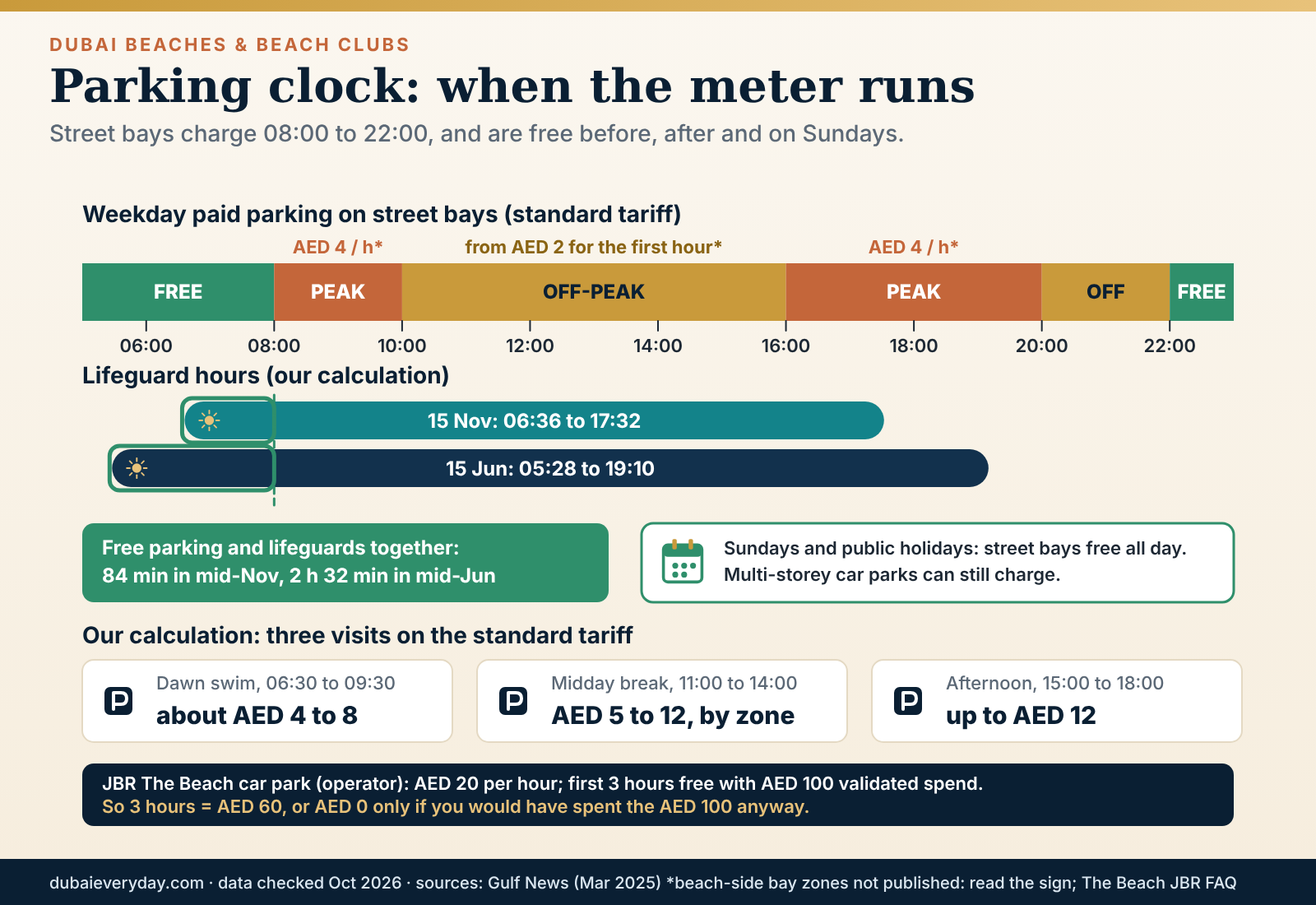
Gulf News, explaining the revised tariffs in March 2025, reported that public parking is charged from 08:00 to 22:00 and free outside those hours, free on Sundays and public holidays, and that multi-storey facilities charge around the clock. It gave peak hours as 08:00 to 10:00 and 16:00 to 20:00, and off-peak as 10:00 to 16:00 and 20:00 to 22:00. For standard-tariff bays, the peak price is AED 4 an hour, with the premium tariff at AED 6.
Off-peak prices vary by zone: for a standard bay, the table in that report shows AED 2 for the first hour in zones C and D and AED 3 in zone B, and an AED 4 premium rate in zone A. Standard bays run in blocks of one to four hours. The article did not say how to pay, and it dates from before the new tariff took effect, so confirm against the sign on the bay and the operator’s current tariff.
What we could not find. No page we read says which parking zone covers the bays beside Jumeirah 1, 2 or 3 or Umm Suqeim, whether those bays are standard or premium, or where municipal car parks sit. The sums below therefore give a range, not a quote. The sign on the bay is the only authority that counts on the day.
Our calculation: what a beach visit costs in parking
Using the March 2025 tariff table, here are four typical visits for a standard bay on a weekday. These are illustrations of the arithmetic, not offers or quotes, and the real number depends on the zone sign in front of you.
| Visit | Chargeable time | Standard-tariff range |
|---|---|---|
| Dawn swim, 06:30 to 09:30 | 08:00 to 09:30 (peak) | About AED 4 to 8 |
| Midday break, 11:00 to 14:00 | 3 hours off-peak | AED 5 to 12, by zone |
| Afternoon, 15:00 to 18:00 | 1 hour off-peak, 2 hours peak | Up to AED 12 |
| Sunday, any time | None for on-street bays | AED 0 (check lots) |
Two lessons fall out. First, the cheapest guarded swim in winter is the early one: sunrise is around 06:36 in mid-November, parking is free until 08:00, and a swim and a coffee are usually done by the time the meter starts. Second, Sundays are free on street bays, which is both a saving and a warning, because the free day is also the busy one. If you can, avoid being part of the crowd that the free tariff creates.
JBR’s parking is a different system. The Beach’s FAQ lists standard parking at AED 20 an hour, which makes a three-hour visit AED 60, or free for the first three hours if you spend AED 100 on a validated bill at participating outlets. Validation only saves money if you would have spent the AED 100 anyway; if not, you pay AED 100 to avoid AED 60. These terms are carried over from our broader research and may change.
Reaching the sand without a car
No Metro line touches the Jumeirah strip, so for most public beaches Dubai Municipality runs the choice is taxi or car. The Marina end is the exception, through the Metro-and-tram route to JBR described above. RTA’s published timetables give Metro hours of 05:00 to midnight Monday to Thursday and Saturday, 05:00 to 01:00 on Fridays and 08:00 to midnight on Sundays, and tram hours of 06:00 to 01:00 Monday to Saturday and from 09:00 to 01:00 on Sundays. If you plan an early swim on a Sunday, the first Metro leaves later than you want.
For the Jumeirah beaches the practical answer is a taxi or ride-hailing car, and a plan for the return trip, since a taxi rank on a hot afternoon is a poor place to wait. Dubai Taxi publishes a per-kilometre rate and a minimum fare, plus Salik toll charges where a route uses them, so use an in-app estimate rather than a guess. The Dubai Metro guide explains stations and nol fares if part of your trip is by rail, and the car rental guide covers deposits and insurance if you decide a car is worth it for the week.
Al Mamzar by public transport
Gulf News reported in 2024 an RTA weekend bus, route W20, running between Stadium Metro station and Al Mamzar Beach Park in the evening at roughly half-hour intervals for AED 3. That is a 2024 report about a seasonal-looking service, so treat it as a lead and check the RTA planner. For the lagoon beach, the Gulf News directions say to drive on the D92 past the Corniche and the park; we found no public transport route for it. The practical rule: for Al Mamzar, assume a taxi.
The return-trip rule. Before you leave your hotel, check how you will leave the beach, not just how you will arrive. In heat, with wet children and sand in everything, the return is the hard half. If the plan depends on finding a taxi at a particular corner, add a backup: a ride-hailing app that works on your phone, and a second pick-up point a few minutes’ walk away.
Lifeguards at public beaches Dubai wide: flags and the guarded window
The single most important fact about the public beaches Dubai Municipality runs is one that sits quietly on every page: the beach is open round the clock, but the lifeguard is not. The municipality’s pages for the lagoon, Jumeirah 1, 2 and 3 and Umm Suqeim 2 describe trained, licensed lifeguards on posts and patrolling from sunrise to sunset. The sand is open when the lifeguard is not. Swim only inside the guarded hours and the guarded zone, with the exception of the lit night zones.
The guarded day, by season
Using the standard sunrise-and-sunset formula for Dubai’s coordinates, our calculation gives these mid-month windows: about 07:06 to 17:49 in mid-January, 06:29 to 18:28 in mid-March, 05:28 to 19:10 in mid-June and 06:36 to 17:32 in mid-November. The guarded day runs from about 10.6 hours in December to about 13.7 hours in June. At the public beaches Dubai Municipality guards, the day is longest exactly when the sun is least friendly, and shortest when the sea is at its most pleasant.
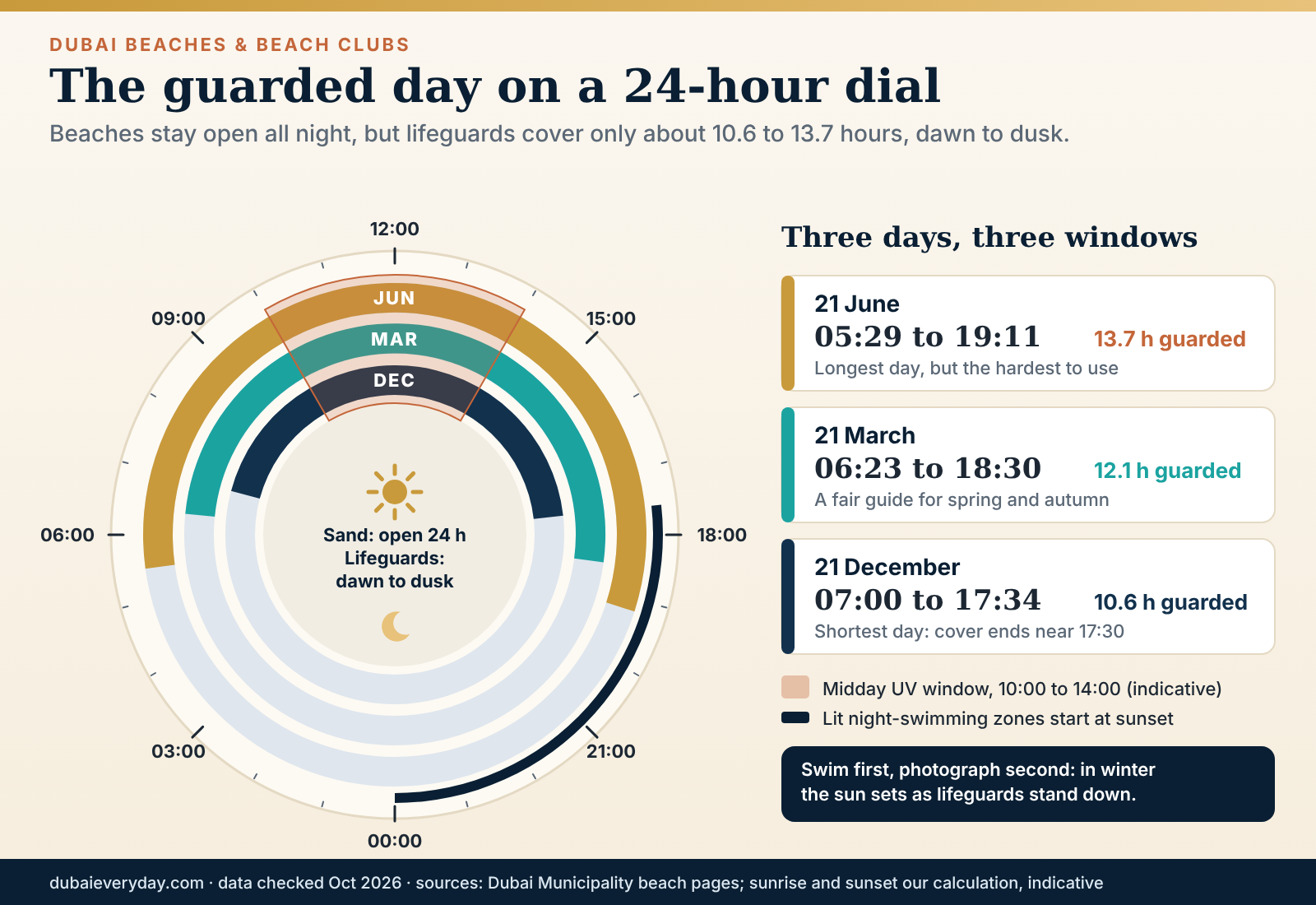
The consequence for winter visitors is worth saying bluntly. Sunset falls around 17:30 from mid-November to the end of December, and temperatures drop quickly afterwards. A swim that starts at 16:45 puts you in the water as the guards pack up. If the plan includes sunset photographs, do the swimming first. If you want an evening swim, use one of the lit night zones, not the open sand beside them.
Night swimming at public beaches Dubai has: three beaches and a lagoon strip
Dubai Municipality introduced night swimming at Jumeirah 2, Jumeirah 3 and Umm Suqeim 1 in 2023. The Gulf News guide describes the zones as lit, with electronic safety screens, and the municipality asks swimmers to use only the designated area. The Umm Suqeim 1 page puts lifeguard cover until midnight; older reports say sunset to sunrise, so the notice board wins. The Khor Al Mamzar lagoon beach adds a 300-metre night beach that the opening release says operates 24 hours.
Night swimming at public beaches Dubai has is a real safety question, not just a convenience. Visibility is lower, fewer people are around, and your assessment of distance is worse. Stay inside the lit zone, stay within reach of the lifeguards, and do not treat a floodlit beach as a place to swim alone. The nearby unlit stretch of the same beach is not covered by the same arrangements.
Heat and the night beaches. From June to September, evening and night swimming is the only version of a free beach day that most people enjoy. The air and the sea are still warm, but you avoid the worst of the midday UV. If you are planning a summer visit, build the day around a morning session and a night session, and spend the middle in an air-conditioned place; the indoor activities guide sorts the options.
Flags: what the colours mean
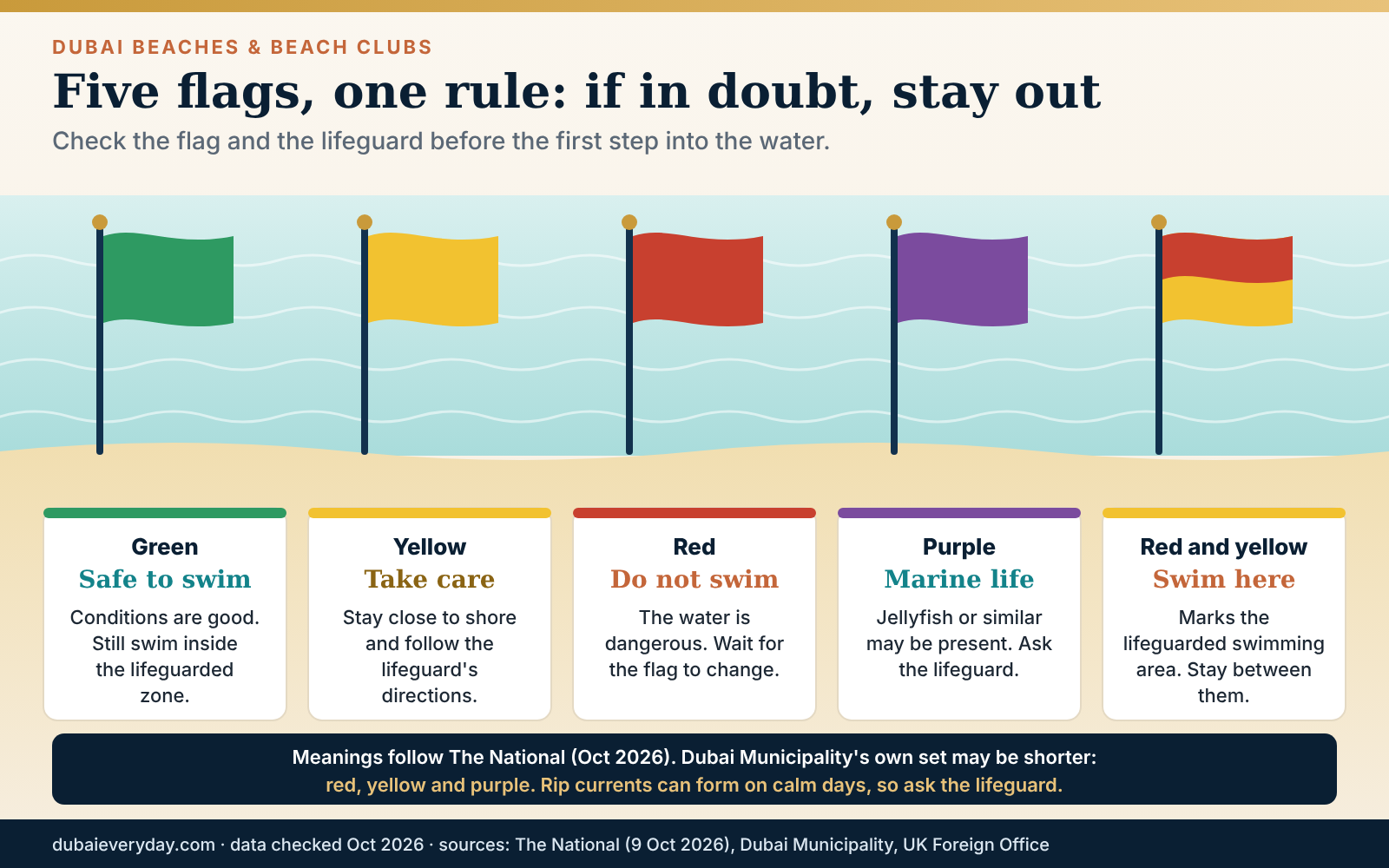
The National’s October 2026 guide lists five signals. Green means conditions are safe for swimming, yellow means exercise caution, red means do not enter the water, purple warns of potentially harmful marine life such as jellyfish, and red-and-yellow flags mark the designated, lifeguarded swimming area. Dubai Municipality’s own flag guidance, as reported in July 2026, uses a smaller set; where the sets differ, follow the sign and the lifeguard in front of you.
Rip currents and the sea
The UK Foreign Office warns that rip currents can occur at any beach and can pull strong swimmers out to sea. It advises swimming only at approved beaches with lifeguards and flags indicating it is safe, and treating red flags as a signal that swimming is dangerous. General guidance from the US National Weather Service, carried over from our broader research, says rip currents often form on days that look calm and sunny, which is the reason to ask the lifeguard instead of judging by appearance.
If you are caught in a current, the general advice is to stay calm, signal for help and avoid fighting it head-on; the lifeguard’s instructions override any general advice. Stay clear of rocks, breakwaters and the lanes used by jet skis and kite-surfers. Kite Beach and Jumeirah 3 have kite zones, and Umm Suqeim 2 has a separate surf area, so staying inside the swim-only boundary is not a formality.
Supervising children
The National’s guidance, drawing on water-safety experts, is practical. Adults should supervise children at all times and keep their eyes on the water, not the phone. Children should stay in shallow water and within lifeguarded areas, wear bright rash vests (orange and pink show up best), and the family should agree a plan about where the lifeguard is and who calls for help. It also describes how drowning looks: usually quiet and fast, with little splashing, a child upright in the water with the waterline near the chin.
Municipal rules, as read in our broader research, make parents and accompanying adults responsible for children. Float aids and inflatable toys are not safety equipment. If someone is in difficulty, alert the lifeguard first and do not attempt a rescue without training. The same article notes that drowning figures are not published centrally for all seven emirates, so we cannot offer a Dubai-specific statistic.
About the Blue Flag. A 2024 Gulf News report on Eid beach arrangements said the municipality’s supervised beaches hold international Blue Flag certification. We could not check the Blue Flag register, so we cannot say which beaches hold it today or what it covers. Treat it as context, not as a guarantee of water quality, and still follow the local flag.
If something goes wrong
Tell the nearest lifeguard first. The UAE emergency numbers are widely published as 999 for police and 998 for ambulance, although we could not confirm them on an official portal on the day. Keep your phone charged and in a waterproof pouch, and know the beach name and the nearest road. This is general information, not individual safety advice; if the flag is red, do not swim.
Family access at public beaches Dubai offers
Family access is a broader idea than “child-friendly”. It covers who can physically get onto the sand, who is allowed in on a given day, what happens if a child needs a toilet, a nap or a rescue, and whether the adults can relax at all. Here is what the sources support for each part of the public beaches Dubai offers families, and where the evidence ends. For shallow-water detail and play-area specifics, the dedicated family beaches guide goes deeper than a page about all free beaches can.
Getting onto the sand: access corridors
Every municipal beach page we read for Jumeirah 2, Umm Suqeim 1 and 2 and the Mamzar lagoon lists a beach access corridor or path for people of determination and older visitors. The Khor Al Mamzar release says the new beach was designed to ensure accessibility. That is the strongest accessibility statement on the list, and it is a statement about a route to the sand, not about wheelchairs or mobility aids on it.
We did not verify whether any beach lends beach wheelchairs or lays sand mats, how long the corridors are or whether they reach the water. If that matters, call 800900 before you go. For wider accessibility planning across the city, including taxis and attractions, the Dubai travel guide for first-time visitors is the starting point.
Family-only days
On peak days the municipality reserves some public beaches Dubai wide for families. For Eid Al Adha in 2024, a circular issued on 7 June 2024 reserved eight supervised beaches for families: the Khor Al Mamzar and Al Mamzar Corniche beaches, Jumeirah 1, 2 and 3, Umm Suqeim 1 and 2 and Jebel Ali Beach. It reported 140 safety and rescue personnel and a 65-member field supervisory team. For New Year’s Eve 2025 into 2026, Gulf News reported Jumeirah 2, Jumeirah 3, Umm Suqeim 1 and Umm Suqeim beach reserved exclusively for families.
Neither report defined “family” or addressed groups of friends and solo visitors. The implication is that a group of adults without children may be turned away on those days, and that is a reason to check announcements the day before any holiday. The next Ramadan is expected to fall in February to March 2027, and Eid dates depend on moon sighting, so look at the Dubai events calendar when you plan travel around holidays.
Playgrounds, tracks and the boring features that matter
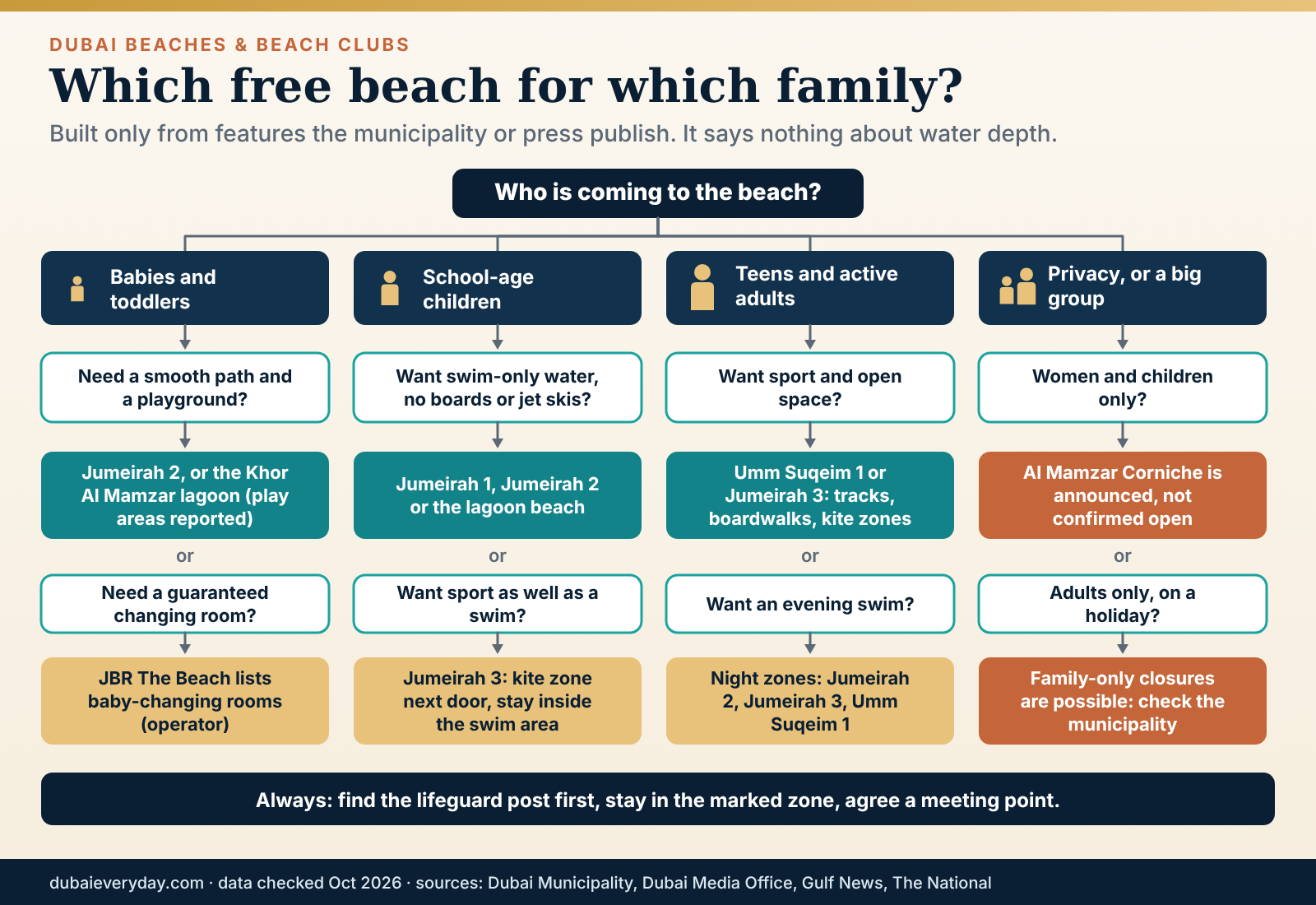
Published child-friendly features at the public beaches Dubai Municipality manages, by beach: Jumeirah 2 lists a children’s playground and a beach library; Umm Suqeim 1 lists children’s play areas; Jumeirah 3 and the lagoon have play areas in our carried-over and reported sources respectively. Jumeirah 1, Umm Suqeim 2 and JBR do not publish a playground in anything we read, though JBR has the baby-changing rooms. The three Jumeirah beaches and Umm Suqeim 1 all list boardwalks or jogging tracks, which matters because a smooth path is the only way a stroller travels with you.
Shade is the feature that families notice and the pages for public beaches Dubai Municipality runs rarely list. The Gulf News programme breakdown mentions shaded spaces for the lagoon beach and Corniche. Umm Suqeim 2’s page lists beach lounges. No source we read says whether pop-up tents or umbrellas are allowed on municipal sand, so bring a sun umbrella or a tent only if you have checked, and expect rules to be stricter on busy days. A rash vest and a hat do not depend on anyone’s permission.
By age: what to prioritise
Babies and toddlers. Prioritise a short day in cool months, an early start, shade you bring yourself and a beach with a playground you can reach on a smooth path. Jumeirah 2 and the Khor Al Mamzar lagoon are the best documented. Keep the car close for changing and naps, and read the baby travel guide before choosing the date.
School-age children. The swim-only design at Jumeirah 1, Jumeirah 2 and the lagoon removes one risk, which is boards and jet skis, and the playground adds a second activity for when the water gets cold. Agree a “check in with the lifeguard post” ritual on arrival. The Dubai with kids guide places a beach morning within a wider family week.
Teenagers. Umm Suqeim 1 and Jumeirah 3 have the most activity, from kite zones to running tracks. The rules matter more here: photography of strangers, behaviour in public, and the family-only closure on holidays. Teens swimming at night should do it only in lit zones and within sight of an adult.
Mixed-age groups. Among the public beaches Dubai offers, the longer ones handle this best. Jumeirah 3 at about 1,980 metres and the lagoon at 3.5 to 3.6 km give people space to split into groups, with a boardwalk or track for walkers and a marked zone for swimmers.
Women, privacy and women-only provision
The only published women-only beach is the planned Al Mamzar Corniche, and it is not confirmed open. Secondary sources say Al Mamzar Beach Park runs ladies’ days on Mondays and Wednesdays; we could not confirm the schedule from an official page. If privacy matters, call before you travel. For clothing guidance beyond the beach, the Dubai dress code guide separates beaches, malls and mosques.
Pets
Dubai Municipality’s rules at the Mamzar beaches prohibit pets, and we found nothing allowing them on the municipal Jumeirah or Umm Suqeim sand. Dubai Islands Beach and Palm West Beach are reported as pet-friendly in designated areas, with details to confirm. The pet ownership guide covers registration and where dogs are welcome.
Family arrival routine. On arrival, do three things before anyone swims: find the lifeguard post, find the nearest toilet or decide you will not use one, and agree a meeting point that is not “the beach”. Then set up. Ten minutes spent here saves the half hour you would otherwise lose searching for a child or a bag.
The best season for public beaches Dubai offers: sea, heat and UV
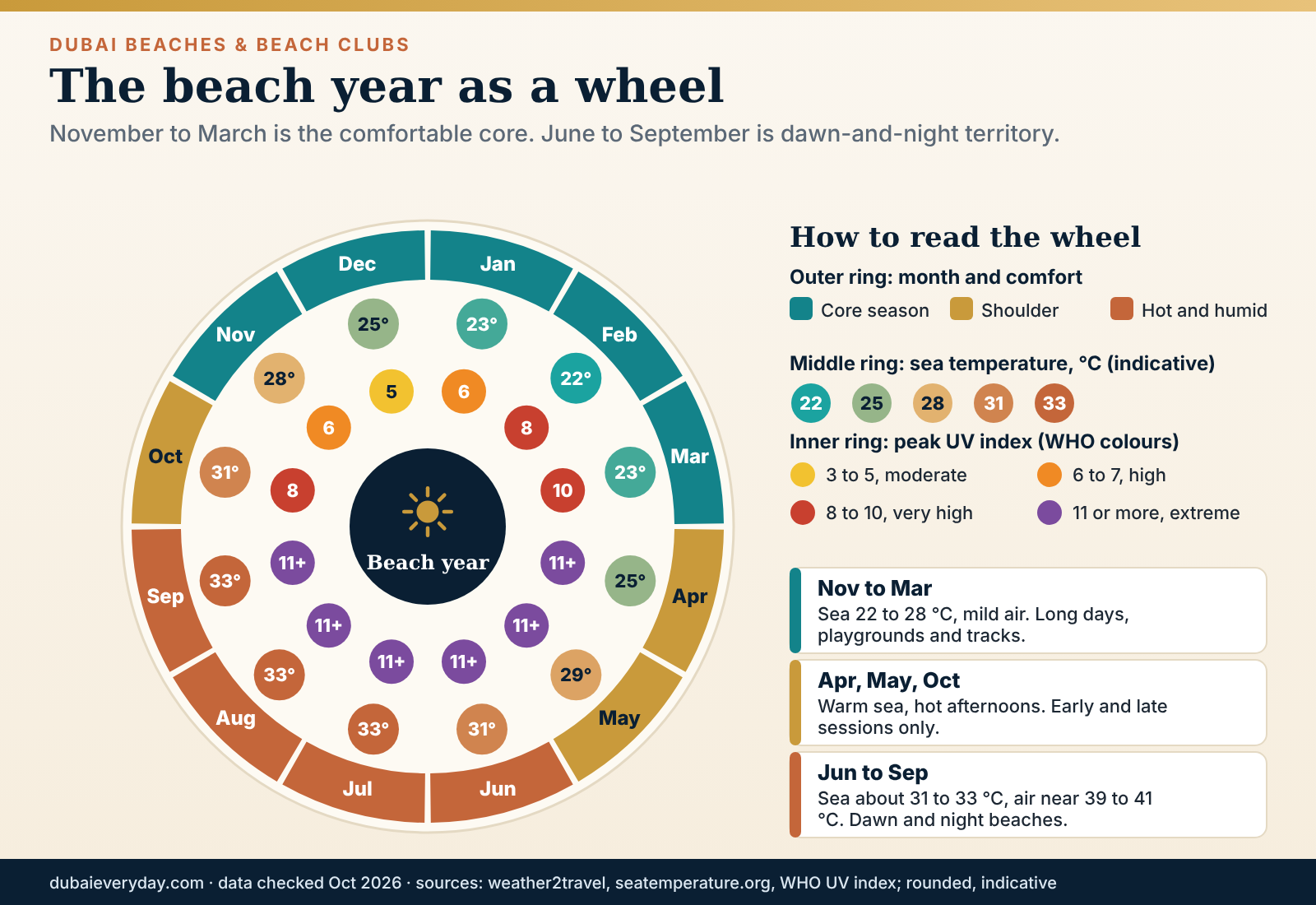
The season for public beaches Dubai offers is not summer. The sea is warmest in July to September, when it also stops cooling you down, and the comfortable window for most people runs from late October to April. The figures below are rounded and indicative, taken from published climate tables carried over from our broader research. Sea temperature differs by one to three degrees between sources, which is why we do not quote decimals.
Month by month: our reading
November to March, the core season. Sea temperature falls from about 28 °C in November to 22 or 23 °C in February, and afternoon air runs from roughly 31 °C in November to 24 °C in January. This is the window for long days, outdoor gyms, playgrounds and sunset walks. If you swim for exercise in January or February, a rash vest or wetsuit top is sensible.
April and October, the shoulder. Sea at about 25 °C in April and about 31 °C in October. Swimming is easy, afternoons are hot, UV is high. Plan for mornings and late afternoons.
May. Warm sea, hot afternoons. Fine for early and late sessions, not for the middle of the day.
June to September. Sea around 31 to 33 °C, afternoon air near 39 to 41 °C, and the climate table rates heat and humidity as extreme. The public beaches Dubai Municipality runs are usable at dawn and after dark. If you are planning a trip around beach time, the best time to visit Dubai guide sets this against hotel prices and crowds.
UV is the quiet risk
The World Health Organization says a UV index of 8 or more is “very high” and advises limiting midday exposure, with the reported index being the daily maximum around solar noon. The climate table we used has peak UV at 11 or higher from April to September, 8 in February and October, and 5 or 6 in December, January and November. Our calculation puts solar noon in Dubai between about 12:00 and 12:30 through the year.
The practical conclusion for any of the public beaches Dubai Municipality runs: between roughly 10:00 and 14:00, unshaded sand is a place to be briefly, not for hours, in nearly every month. Winter sun feels gentle because the air is mild, but the UV can still be high. Sunscreen, a hat, sunglasses and a rash vest are year-round gear, not summer extras.
Heat rule of thumb. From May to September, put beach time in the first two hours after sunrise or the last hours before sunset, or move it to the night beaches. Bring water for every person, take shade breaks, and treat dizziness, nausea or a pounding headache as a reason to get indoors and cool down. This is general information, not medical advice; for heat illness, see the healthcare guide.
Weekdays, weekends and holidays
For most employers the UAE weekend is Saturday and Sunday, with a half day on Friday, a change reported in 2022. Property-portal guides to Kite Beach describe Friday and Saturday as the busiest days and Tuesday and Wednesday as the quietest. We read those as soft signals, not measurements. Expect Friday afternoons, Saturdays, Sundays and public holidays to be crowded, and expect a weekday morning to be calm.
Sundays have another effect: on-street parking is free, which pulls more cars to the public beaches Dubai Municipality runs. Event days also matter. The January events guide and the February equivalent describe how outdoor events and school holidays change demand across the city.
Rules and etiquette on public beaches Dubai wide
The rules on public beaches Dubai wide mix three layers: municipal regulations posted on site, UAE law that applies everywhere, and etiquette that nobody will fine you for but others will notice. Separating them helps you remember them. The municipal rule text below is carried over from our broader research; the UAE-law notes come from the UK Foreign Office page updated on 27 October 2026, which is a foreign government’s advice and not UAE law itself.
Municipal rules at public beaches Dubai wide
The rules we have seen at the Mamzar beaches prohibit pets, barbecues, fires and shisha outside designated areas, overnight stays, photography of other visitors without permission, and swimwear in passageways away from the sand. They also prohibit swimming after sunset except in the night-swimming zones. On-site signs beat any summary, including this one.
UAE law and general etiquette
- Swimming attire should only be worn on beaches and at pools, according to the UK Foreign Office; cover up for walks, car parks and cafés.
- Do not photograph people without permission. The same advice says men have been arrested for photographing women on beaches.
- It is illegal to drink alcohol or be under the influence in a public place; the legal drinking age in Dubai is 21.
- Public displays of affection are frowned upon, and kissing in public can lead to arrest.
- Swearing and rude gestures, including online, are treated as obscene acts.
Drones, speakers and ball games
Recreational drone use in Dubai is under review after rules were tightened in January 2025, and the UK page does not mention drones, so do not fly one on a beach without a permit you have seen in writing. We found no source that sets rules on portable speakers or ball games at public beaches Dubai wide. A good test is the one every lifeguard applies: if it could hit, startle or bother a swimmer, do it elsewhere.
Ramadan and holidays
Rules do not change dramatically in Ramadan, but expectations do. The UK advice notes that eating, drinking, smoking or chewing gum in public in daylight, playing loud music, dancing or swearing may cause offence. Be discreet if you are not fasting, and expect hours at nearby cafés to shift. The Dubai etiquette guide covers the wider picture.
Six beach-day plans, worked through
The plans below are illustrations of how the evidence turns into a day at the public beaches Dubai offers for free. They are not itineraries anyone has field-tested, and the times are our calculation from published sunrise and sunset logic, not promises. Each says what to check before you commit. If you want a broader trip around them, the things to do in Dubai guide and the free things to do guide sort the other half of the day.
1. Family of four, winter weekday, with a taxi
Illustrative example: two adults and two children, aged about six and nine, in mid-November, staying near Downtown. Choose Jumeirah 2, which publishes a swim-only design, a playground and daytime lifeguards. Aim to be on the sand at 08:00, after the 06:36 sunrise and before the day’s UV climbs. Swim until about 10:30, play on the playground, and leave by 11:30.
Parking arithmetic (our calculation, standard tariff): arriving at 07:45 and leaving at 11:30 means 08:00 to 11:30 chargeable, roughly AED 8 for the first two hours at peak plus about AED 3 to 6 for the rest, or about AED 11 to 14 depending on zone. A taxi costs more than that and takes the parking question away. Check beforehand: whether the beach has works, where the toilets are, and the weather.
2. Solo traveller, three free hours, no car
Illustrative example: a business traveller with a free afternoon and a hotel near the Marina. The pragmatic pick is JBR, via the Metro to DMCC and the tram to JBR 1 or JBR 2, which avoids the parking question altogether. Allow the time the rail legs take, plus the walk, and do the swim only where you can find a lifeguard post and a flag.
Before you commit: the 08:00 Sunday Metro start, the tram hours, and whether you will buy a meal at The Beach (which is not free, but is the realistic price of using the strip). The Dubai Metro guide shows stations and nol fares. If you have only three hours, a short swim and an early finish beat a long trip that leaves no margin.
3. Couple, sunset at Umm Suqeim 2 in December
Illustrative example: sunset in mid-December falls near 17:31 by our calculation, and lifeguards stand down at sunset. Plan to be in the water by 15:00, out by 16:15, and dry on the sand by 16:30, which leaves an hour for walking and photographs. Parking from 15:00 is a mix of one off-peak hour and peak hours, so budget up to AED 12 on the standard tariff.
The risk in this plan is the temptation to swim late for the light. Do not. Also check for construction: the Umm Suqeim redevelopment is large, and a long drive is a bad time to discover a closed section. Have Jumeirah 3 or Umm Suqeim 1 as a fallback within a few minutes.
4. Fitness morning at Jumeirah 3 or Umm Suqeim 1
Illustrative example: a resident or long-stay visitor who wants a run, a few exercises and a swim. Both beaches list a jogging track and boardwalk, and Jumeirah 3 has outdoor gym equipment while Umm Suqeim 1 has a kite zone. In winter, sunrise is around 07:00 and lifeguards start at sunrise, so run first and swim once the posts are staffed. Parking is free until 08:00.
In the warm months, shift everything earlier: sunrise in mid-June is 05:28, and by 09:30 the UV is already high. The free-parking window and the guarded window overlap neatly in the first hours after dawn, which is one of the few good-value coincidences on this coast.
5. Summer survival, June, a free beach with children
Illustrative example: a family arriving in mid-June, when sunrise is 05:28 and sunset 19:10 by our calculation. Daytime sea is around 31 °C or warmer and the climate table rates heat as extreme. Go at 05:45 to Jumeirah 2 for a short swim, leave by 08:00, and spend 10:00 to 17:00 indoors. Return after 20:00 to the lit night zone, with children in bright vests and an adult in reach.
Parking is the quiet saving here: before 08:00 and after 22:00 it is free on street bays. The indoor activities guide fills the middle of the day. Check the night-zone hours on the notice board, because sources disagree about when lifeguard cover ends.
6. Friends’ group on a holiday weekend
Illustrative example: six adults, no children, on a public holiday. This is the scenario in which a free beach plan fails most often. The municipality has reserved several beaches for families on peak days, with “family” undefined in the reports we read, so a group of adults could be turned away. Check the municipality’s announcement the day before, and have a paid alternative in mind, such as a gated park or a day pass.
If the public beaches Dubai Municipality runs are closed to your group, the broader beach guide prices the paid options, and the luxury Dubai guide covers the resort end. Do not argue with a lifeguard or a municipal supervisor at the gate: the closure is lawful, the queue is the problem, and the alternative is cheaper than a fine.
Mistakes that spoil a free beach day, and the checklist
Most of the damage on a day at public beaches Dubai wide comes from a short list of avoidable assumptions. Several of them are cheap to fix. Each below includes the fix, and the list ends with a pre-trip and packing checklist you can screenshot.
Ten mistakes, and what to do instead
- Treating “open 24 hours” as “guarded 24 hours”The sand is open round the clock; the lifeguards stand on posts from sunrise to sunset. Swim only when the posts are staffed, or inside a lit night zone.
- Assuming parking is freeOn-street bays are chargeable from 08:00 to 22:00 except Sundays and public holidays. Look for the sign, and park early if you can.
- Counting on a shower or a toiletNo official source we read lists them. Bring a rinse kit and plan your toilet stops, especially with children.
- Swimming for sunset in winterSunset is about 17:30, and so is the end of lifeguard cover. Swim first, photograph second.
- Ignoring the kite and surf zonesJumeirah 3, Umm Suqeim 1 and Umm Suqeim 2 share the shore with kites and boards. Stay inside the swim area.
- Trusting a list that includes the Corniche or Al SufouhBoth are unconfirmed. Use the beaches that the municipality documents as open today.
- Skipping the holiday checkFamily-only closures hit Eid and New Year’s Eve. Read the municipality’s announcement the day before.
- Going at midday in summerAir near 40 °C, extreme UV and sea above 30 °C is a bad combination. Go at dawn or after dark.
- No plan for the ride backA taxi at a hot roadside is the worst part of the day. Book or confirm a pick-up and have a backup.
- Leaving valuables on the sandSmart lockers are reported at Jumeirah 1, but we could not confirm pricing or access. Carry less, and keep keys, cards and phones in a waterproof pouch.
Pre-trip checklist
- Check the beach name, today’s flag and any closure or works on Dubai Municipality’s channels, or call 800900.
- Confirm lifeguard hours and where the swim zone is when you arrive.
- Check whether the day is a public holiday or family-only day.
- Check parking signs and payment method before you leave the car.
- Agree a meeting point and a plan for a child who gets separated.
- Confirm the return transport before you arrive.
What to pack
- Water for every person, more than you think, plus a rinse bottle.
- Two towels each if you are travelling wet, a dry change and a cover-up.
- Sunscreen, hats, sunglasses and rash vests, including in winter.
- A waterproof pouch for phone, keys and cards.
- A sun umbrella or tent only if you have checked that it is allowed.
- Snacks and a cooler bag; food outlets are reported at the lagoon, but not published for the others.
Public beaches Dubai: frequently asked questions
Are there free public beaches in Dubai?
Yes. Dubai Municipality’s listing says its beach centres do not require an entrance fee, apart from fees for requested services. The free public beaches Dubai Municipality runs are the Khor Al Mamzar lagoon beach, Jumeirah 1, Jumeirah 2, Jumeirah 3, Umm Suqeim 1 and Umm Suqeim 2. Al Mamzar Beach Park is a gated park with a small entry fee, so it is not free. Parking, food and any rental kit are separate costs that may apply, so “free” describes the sand, not the whole day.
Which is the best free public beach in Dubai?
Among the public beaches Dubai offers for free, it depends on the job. Jumeirah 2 has the best-documented family features. The Khor Al Mamzar lagoon beach has the longest swimming shoreline and the most lifeguard towers. Umm Suqeim 2 is the sunset choice, and Umm Suqeim 1 suits runners and water-sports fans. We do not rank them overall, because none of the sources compares water quality or crowding. Use the decision flow in the family section to match the beach to your group.
Do public beaches in Dubai have showers?
We found no official list of showers at any of the public beaches Dubai Municipality runs. The Khor Al Mamzar release counts 20 public facilities without naming them, and JBR’s operator lists baby-changing rooms. Jumeirah 1 is reported to have smart lockers. Showers may exist, but they are not published, so plan to bring water to rinse with and a change of clothes. For a firm answer on the day, call Dubai Municipality on 800900.
Is parking free at Dubai’s public beaches?
Not by default. The pages for public beaches Dubai Municipality runs do not state parking rules. Dubai’s public paid parking is reported to be charged from 08:00 to 22:00 and free outside those hours, on Sundays and on public holidays, with multi-storey car parks charging around the clock. A standard peak rate was reported at AED 4 an hour in March 2025. JBR’s The Beach lists AED 20 an hour. Always read the sign on the bay.
Are there lifeguards at night?
Only in the designated night zones. The municipality says lifeguards stand on posts from sunrise to sunset at its beaches. Jumeirah 2, Jumeirah 3 and Umm Suqeim 1 are open for night swimming in lit zones, and the Umm Suqeim 1 page puts lifeguards there until midnight. The Khor Al Mamzar lagoon beach has a 300-metre night beach. Elsewhere, assume no cover after sunset and do not swim.
Can I swim at the public beaches at night?
Yes, in the night-swimming zones and nowhere else. Dubai Municipality opened three beaches for night swimming in 2023: Jumeirah 2, Jumeirah 3 and Umm Suqeim 1. The lagoon beach added a 300 m night beach in 2026. Stay inside the lit, marked area and within reach of the lifeguards. At beaches without a night zone, municipal rules at Al Mamzar prohibit swimming after sunset, and the sea is not supervised.
Are Dubai’s public beaches safe for children?
The public beaches Dubai Municipality manages are lifeguarded in daylight, which is a major advantage, but children still need an adult within arm’s reach. The National’s October 2026 guidance recommends supervising without distraction, using bright rash vests, staying in lifeguarded shallow areas and agreeing a family plan. Drowning is typically quiet and fast. Swim-only designations at Jumeirah 1, Jumeirah 2 and the lagoon beach remove boards and jet skis from the swim area.
What should I wear on a public beach in Dubai?
Normal swimwear is fine on the sand and in the water at public beaches Dubai wide. The UK Foreign Office advises that swimming attire should only be worn on beaches and at pools, so cover up for walking to a car park, a café or a shop. Avoid transparent clothes and offensive slogans. For a more detailed breakdown by place, including malls and mosques, see the Dubai dress code guide. Ramadan makes people more sensitive to behaviour, not to swimwear.
Can I drink alcohol on a public beach?
No. The UK Foreign Office advice says it is illegal to drink or be under the influence of alcohol in a public place anywhere in the UAE, and the legal drinking age in Dubai is 21. Alcohol is served in licensed venues, including some hotel and club beaches, which is a different category from free municipal sand. Pack soft drinks and water for the public beaches Dubai Municipality runs, and keep alcohol for licensed venues.
Is there a women-only public beach in Dubai?
One has been announced: the Al Mamzar Corniche, planned as a fully enclosed women-only beach with night swimming and female lifeguards. As of mid-September 2026, Khaleej Times still described it as being prepared for opening, and we found no official opening notice. Secondary sources mention ladies’ days at Al Mamzar Beach Park, but we could not verify the schedule. Check Dubai Municipality before you travel.
Can I take my dog to a public beach in Dubai?
Not to the municipal beaches we reviewed. Municipal rules at the Mamzar beaches prohibit pets, and we found nothing allowing dogs on the Jumeirah or Umm Suqeim sand. Dubai Islands Beach and Palm West Beach are reported to offer pet-friendly areas, but details such as hours and leash rules should be confirmed with the operator. The pets guide on this site covers registration and where dogs are welcome.
When is the best time of year for a free beach day?
November to March is the comfortable core, with sea temperatures of roughly 22 to 28 °C and mild air. April and October are workable with early or late sessions. From June to September, heat and humidity are rated extreme, so use dawn and the night beaches. UV is high in most months, so sunscreen and a hat are year-round gear. See the month-by-month reading above.
Can I reach a public beach in Dubai by Metro?
Not directly. No Metro line touches the Jumeirah strip, and the same goes for most public beaches Dubai Municipality runs. The closest rail-and-tram route is to JBR: Metro to DMCC, then tram to JBR 1 or JBR 2, according to The Beach’s FAQ. Metro hours are 05:00 to midnight on most days, 05:00 to 01:00 on Fridays and from 08:00 on Sundays. For the municipal beaches, expect a taxi or ride-hailing car, or a car if you have one.
Will the free beaches be closed on holidays?
Public beaches Dubai wide are not closed, but sometimes restricted. The municipality has reserved supervised beaches for families on Eid Al Adha in 2024 and on New Year’s Eve 2025, with eight beaches in the 2024 circular and four in 2025. “Family” was not defined in the reports we read, so groups without children may be turned away. Check the municipality’s announcement the day before any public holiday.
The bottom line, and what to read next
The free public beaches Dubai offers are better than their reputation for facilities and weaker than their reputation for information. The sand is free, the lifeguards are real in daylight, the night zones are a genuine option and the family features are real at Jumeirah 2 and the Khor Al Mamzar lagoon. What is missing is a published list of showers, toilets and car parks, which is the thing that decides whether a visit goes smoothly.
So plan like a pessimist and swim like an optimist; that is the whole method for public beaches Dubai wide. Go early, park before 08:00 if you can, find the lifeguard post first, carry your own water and your own rinse kit, and check the day’s announcements for a holiday closure. If you need a stricter set of guarantees, such as showers, loungers and towels, that is the point at which the paid options in our broader beach guide start to earn their price.
Sources and further reading (20 links)
- Dubai Municipality: Discover Dubai beaches — no entrance fee statement, Al Mamzar hours
- Dubai Municipality: Jumeirah 2 beach page — length, facilities, lifeguards
- Dubai Municipality: Umm Suqeim 1 beach page — length, night swimming, lifeguards
- Dubai Municipality: Umm Suqeim 2 beach page — length, zones, lifeguards
- Dubai Municipality: Mamzar Lagoon Beach page — length, swim-only design, lifeguards
- Dubai Municipality: three new night-swimming beaches — carried over from our broader beach research
- Dubai Media Office: Khor Al Mamzar beach opens — scale, lifeguard towers, facilities
- Gulf News: Dubai’s Dh3 billion beach transformation — programme, Corniche and Umm Suqeim plans
- Khaleej Times: public parks footfall, first half 2026 — seven public beaches, 1.75 million visitors, Corniche status
- Time Out Dubai: Jumeirah Beach 1 rebuild — reported features of the rebuilt beach
- Gulf News: guide to Dubai’s public beaches with night swimming — features and directions
- Gulf News: Dubai parking zones and costs — tariff table and hours
- The National: keeping children safe on UAE beaches — lifeguard hours, flags, supervision
- Gulf News: New Year’s Eve family-only beaches — beaches reserved for families
- Gulf News: Eid Al Adha family-only beaches — 2024 circular, rescuers, Blue Flag mention
- UK Foreign Office: UAE safety and security — rip currents, dress, photography, alcohol
- The Beach JBR: FAQ — parking terms and facilities, carried over
- RTA: Metro and tram timetables — operating hours, carried over
- World Health Organization: the UV index — UV categories, carried over
- weather2travel: Dubai climate — monthly air, sea and UV figures, context only
Update log: 29 October 2026 — first publication; the facts above were re-checked against the sources listed, with carried-over items labelled. Next review due: annually, or sooner if a beach opens or closes, a fee or parking rule changes, or the Al Mamzar Corniche opens. Corrections welcome. General information, not individual safety, legal or medical advice.
About DubaiEveryday and this guide
DubaiEveryday.com is an independent editorial project that publishes practical, research-based guides to everyday life in Dubai: where to live, what things cost, how the rules work and how to get around. This page was written and edited by the DubaiEveryday editorial team. It is not signed by a named expert, doctor, lawyer or adviser, and we do not claim first-hand testing of a venue, clinic or service unless the page says so.
Each guide is built from official sources such as government and regulator pages, operator websites and established news outlets, cross-checked where we can. When we could not confirm something, we say so in the text, and examples that use made-up numbers are labelled as illustrations. Mentions are editorial choices, not paid placements, and a link is not an endorsement.
Dubai changes quickly. If you spot something that is out of date or wrong, please tell us through the contact options on DubaiEveryday.com and we will check it and correct the page.