

Dubai International has three terminals that behave like three different airports, and the one printed on your booking decides almost everything that follows. This Dubai airport guide covers terminals, transport, connections, lounges and arrival basics, checked against official sources on 29 October 2026.
Say you land at 11 pm after a long flight, bags somewhere behind you, and your booking says Terminal 2. Your first thought is the Metro. There is no Metro station at that terminal. Dubai International is really three airports sharing one name, and the terminal printed on your ticket shapes your whole first hour.
This Dubai airport guide walks you through the journey in order: which terminal you will use, how arrival and passport control tend to go, and what each way into the city involves. It also covers connections, lounges and how much time to leave before departure. You finish it knowing what to do at each door instead of working it out while tired.
This Dubai airport guide starts from one practical fact: Dubai International (DXB) is split into Terminal 1, Terminal 2 and Terminal 3, and most of the time people lose at DXB comes from not knowing which one is theirs. Terminal 3 is Emirates territory, shared with flydubai, United, Air Canada and Qantas, and it has a Metro station. Terminal 1 takes the long tail of foreign airlines and also has a Metro station. Terminal 2 handles flydubai flights, regional and charter carriers, and has no Metro at all.
For arrivals, the numbers in this Dubai airport guide come from Dubai Airports itself, which reported that 98.95% of passengers cleared arrival passport control in under 15 minutes in the first half of 2026. The unpredictable part is the baggage hall. To reach the city, a single Metro trip costs AED 7.50 at most on a Silver nol card, but trains run only 05:00 to midnight on most days and start at 08:00 on Sundays. Taxis start at AED 25 plus distance.
For departures, the Dubai airport guide rule is the airport’s own advice: aim for about three hours before the flight. Connecting on one ticket is routine. Connecting on two separate tickets needs four hours as a floor, for reasons the transfer section works out. And 2026 is not a normal year for any Dubai airport guide: DXB is flying again but with fewer airlines than in 2025, so confirm your flight before you rely on any schedule you saw earlier.
This Dubai airport guide is desk research. DubaiEveryday.com has not walked these terminals, queued at these counters, ridden these trains or used these lounges, and nothing below describes a personal visit.
Facts come from official or operator sources read on 29 October 2026: Dubai Airports and its press office, the Roads and Transport Authority (RTA), Dubai Taxi, the Federal Authority for Identity, Citizenship, Customs and Port Security, Dubai Customs and Emirates. News reports from Khaleej Times, Time Out Dubai and Dubai Standard are used only for airline return dates and the 2026 timeline, and Wikipedia only for the Red Line station order. All of these are labelled as secondary.
In this Dubai airport guide, where a number could not be confirmed, we say so rather than guess: lounge and sleep-pod prices, minimum connection times and Metro journey times were not published in a form we could read. Anything labelled “our calculation” or “our estimate” is arithmetic on verified inputs with the assumptions stated. Inclusion of any lounge, service or operator was not paid for, and there are no booking links. This is general travel information, not individual immigration, customs or medical advice.
Dubai airport guide: the October 2026 status board
Every Dubai airport guide written before March 2026 needs an asterisk, and this section is the asterisk. In 2025 DXB handled a record 95.2 million passengers, up 3.1% on 2024, with 291 destinations in 110 countries and 108 international airlines. Then the regional security crisis of early 2026 interrupted flying across the Gulf, and the airport’s year changed shape.
What happened, in order
According to Khaleej Times reporting on the airport’s own statements, DXB resumed limited flights on 2 March after UAE airspace closures, was briefly suspended again on 7 March, and on 16 March saw flights gradually resume after a drone-related fire at a fuel tank near the airport, with some flights diverted to Al Maktoum International (DWC). By 13 March, UAE national carriers were at 44.6% of normal operating levels. March passenger traffic was 2.5 million, down 65.7% on March 2025.
Recovery has been steady rather than dramatic. The airport’s August 2026 half-year release gives monthly guests of 3.5 million in April, 4.5 million in May and 5 million in June, with 13 million in the second quarter. Load factors were described as approaching 2025 levels. For comparison, December 2025 alone was 8.7 million. The recovery staircase is drawn in the infographic below.
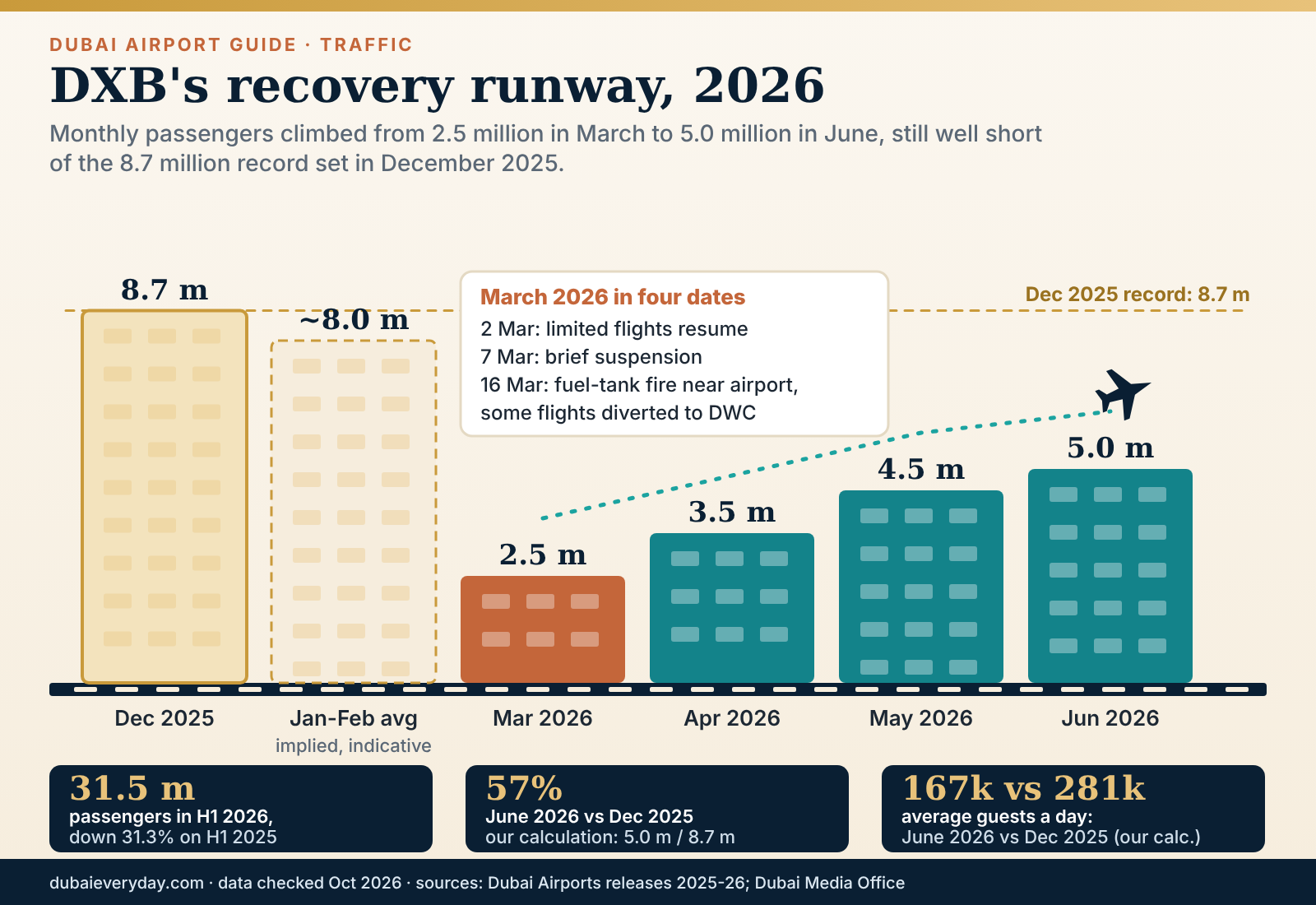
What is running now, and what is not
DXB itself is open and operating, and Emirates and flydubai are flying. The gap is foreign carriers. Dubai Airports’ chief executive said many airlines had struggled to secure insurance for the region, as reported by Time Out Dubai on 27 October 2026. That report lists several carriers not expected back until 2027, and a separate 24 October round-up lists others returning this week.
Returning or flying
Lufthansa resumed Munich on 25 October and Frankfurt on 26 October. SWISS restarts daily Zurich on 27 October. Aegean has daily Athens flights from 26 October. Eurowings follows on 1 November and Austrian on 12 December. Turkish, Air India, IndiGo and Philippine Airlines are operating.
Still paused (per press reports)
KLM is reported cancelled up to and including 27 March 2027. Cathay Pacific is reported cancelled to 31 January. Wizz Air returns on 28 March 2027, Air Canada at the end of March and United’s Newark flight in March 2027. Finnair is reported unlikely before October 2027.
What it means for you
If your itinerary was built from a pre-March timetable, re-check the operating airline, the date and the terminal in your booking. Airlines restart and re-pause on short notice, so treat every date in this row of cards as a snapshot from 27 October, and read this Dubai airport guide the same way.
Airline return dates in this Dubai airport guide come from news reports dated 24 and 27 October 2026, not from the airlines themselves, and they change. Use them to understand the shape of the winter, then confirm your own flight with the airline or on the Dubai Airports flight boards. Service levels, by contrast, have held: in the first half of 2026, 98.98% of departing passengers cleared passport control in under 10 minutes and 99.34% cleared security in under five.
How to use this Dubai airport guide
This Dubai airport guide is the hub for the whole airport. It answers the practical questions in the order a journey raises them: which terminal, how to arrive, how to leave, how to connect, where to wait. It deliberately stops short of the detail that belongs on the terminal-level pages. If you already know you are flying with a non-Emirates foreign carrier, the Terminal 1 guide goes deeper on that building. If your ticket says flydubai or a regional airline, the Terminal 2 guide covers what makes that terminal different.
Two other adjacent jobs are handled elsewhere. Renting a car at the airport, with desks, deposits and return timing, sits on the airport car rental page, and this guide only touches the arrival-hall logistics. Metro fares, zones and station-by-station detail belong to the Dubai Metro guide; here we cover only the two airport stations and the trip into town.
Who gets the most from this Dubai airport guide
First-time visitors will use the arrival, transport and departure sections of this Dubai airport guide. People connecting through Dubai on the way to somewhere else should read the transfer and layover sections twice, because the most expensive mistakes happen there. Residents collecting guests or flying out on a work trip will care most about parking, drop-off and the Metro window. If you are planning the whole trip rather than the airport leg, the Dubai travel guide and the first-time-in-Dubai plan are the better starting points.
One editorial position, stated early so you can disagree with it: the best airport plan is the boring one. Know your terminal, arrive when the airport suggests, carry a nol card or a taxi app, and keep generous gaps on connections. Almost none of the clever options in this Dubai airport guide beat that.
DXB layout: three terminals, five gate groups and Al Maktoum
Dubai International sits inside the urban area rather than on its edge, which keeps Deira and Garhoud close and puts the Marina and the Palm on the far side of town. For orientation in this Dubai airport guide, the airport has three terminals and five gate groups. Dubai Airports’ transfer page names them as A, B and C gates in Terminal 3, D gates in Terminal 1 and F gates in Terminal 2. The ICAO code is OMDB and the IATA code is DXB, which is what you will see on boarding passes and baggage tags.

Terminal 3: the Emirates building
Terminal 3 contains the A, B and C gate groups. Emirates describes it as its own terminal, with flights arriving at and departing from gates A, B or C. Dubai Airports lists Emirates, flydubai, United Airlines, Air Canada and Qantas in its airline directory under Terminal 3. You can walk between B and C gates, but the A gates are a short airport train ride away. That train matters for timing, and we come back to it in the departures and transfer sections.
Terminal 3 is also where much of the practical infrastructure in this Dubai airport guide clusters. The GDRFA visa office is in Terminal 3 arrivals near Entrance 1, open 24 hours. The Visit Dubai information kiosk is here, and so are the Terminal 3 left luggage and baggage delivery counters, free showers at A and B gates, and the free TaxiDXB buggy service for Concourses B and C.
Terminal 1: the long tail of foreign carriers
Terminal 1 serves the D gates, reached by a short airport train trip. The official airline directory lists around 100 names under Terminal 1 in the part of the page we could read, from Qatar Airways, British Airways, Lufthansa, Air India and Turkish Airlines to smaller regional operators. The directory is a reference list rather than a timetable, which is a useful caution for anyone reading a Dubai airport guide: a list of names is not a schedule. It still shows carriers that stopped flying years ago, such as Jet Airways and Go First, so presence in the list proves nothing about whether an airline flies today.
Terminal 1 has a Red Line Metro station reached from the arrivals area. This Dubai airport guide stays at hub level. If you want building-level detail, including how the D gates work, the DXB Terminal 1 guide goes further than this hub can.
Terminal 2: separate, regional, no Metro
Terminal 2 serves the F gates and, in Dubai Airports’ words, regional and international flights. The directory lists flydubai here alongside Air India Express, SalamAir, RwandAir, Nepal Airlines and a few dozen other regional and charter operators, about 30 names in total. Two practical points matter more than the airline list.
First, there is no Metro station: Dubai Airports’ Metro page says the Red Line serves Terminals 1 and 3 and does not mention Terminal 2. Second, the Assisted Travel Lounge, a calm space for People of Determination and travellers with hidden disabilities, is in Terminal 2.
If you have booked flydubai, check the terminal rather than assuming. The same airline appears under both Terminal 2 and Terminal 3 in the directory. The Terminal 2 guide explains how access works there.
| Question | Terminal 1 | Terminal 2 | Terminal 3 |
|---|---|---|---|
| Gate group | D gates | F gates | A, B and C gates |
| Metro station | Yes, Red Line | No | Yes, Red Line |
| Who flies here (directory examples) | Qatar Airways, British Airways, Lufthansa, Air India, Turkish, Singapore Airlines | flydubai (some flights), Air India Express, SalamAir, RwandAir | Emirates, flydubai (some flights), United, Air Canada, Qantas |
| Reaching the gates | D gates by short airport train | F gates, in the terminal building | B and C on foot; A by airport train |
| Left luggage, standard / large bag (up to 12 hours) | AED 40 / AED 50 | AED 40 / AED 50 | AED 35 / AED 40 |
| Porter with trolley | From AED 30 | From AED 30 | AED 40 regular; AED 100 flat-bed |
| Parking, 1 day (Premium / Economy) | AED 125 / AED 85 | AED 125 / AED 70 | AED 125 (one area) |
| Walk from car park | 2-3 min Premium; 7-9 min Economy | 3-5 min Premium; 10-12 min Economy | 2-3 min |
The table compiles figures from Dubai Airports’ baggage and car parking pages, read on 29 October 2026. Rates are the airport’s published tariffs, so confirm on the day before you rely on them.
Where Al Maktoum (DWC) fits in a Dubai airport guide
Dubai’s second airport, Dubai World Central or Al Maktoum International, is about 60 km from DXB according to Dubai Airports. It is not an alternative terminal. When we read the DWC site on 29 October, the visible flight-board entries were Moscow routes. Most visitors will never use it, so this Dubai airport guide mentions it briefly, but you should know two things.
In March, some DXB flights were diverted there during the disruption. And the long-term plan is large: Dubai Airports’ release recalls a May 2024 announcement of a US$35 billion expansion with five runways, aiming at 150 million passengers a year over the next decade and 260 million eventually.
For a traveller, that plan changes nothing today. If a flight ever does list DWC as its airport, Dubai Airports’ guidance for connecting passengers is to clear passport control and collect bags at DXB, then take a taxi or the Metro to Ibn Battuta station and a dedicated bus to DWC. Parking at DWC is free for all guests, according to the airport FAQ, whereas DXB charges by the terminal and zone.
Which terminal will your flight use?
The honest answer is that the booking tells you, and a Dubai airport guide can only tell you the pattern. The pattern is simple enough to remember. Emirates is at Terminal 3. Most other long-haul foreign airlines are at Terminal 1. A large share of flydubai flying and small regional carriers are at Terminal 2, with some flydubai flights at Terminal 3. Anything else needs checking.
The three-minute terminal check
- Read the booking, not the codeshare.If you bought a ticket from one airline but the flight is operated by another, the terminal follows the operating carrier. The operating airline name is in the booking details and usually in small print on the boarding pass.
- Open the airline app the day before.Terminals are normally printed on the confirmation, but a change should appear in the app and in email notifications before it appears anywhere else.
- Check the Dubai Airports flight board.The arrivals and departures boards on dubaiairports.ae list the terminal by flight number. On 29 October the homepage boards were not displaying flights when we read the page, so keep the airline app as your primary source.
- Tell the driver the terminal, not the airline.For a taxi or ride-hailing trip to the airport, say “Terminal 1”, “Terminal 2” or “Terminal 3”. Drivers know the buildings; they do not always know which terminal a lesser-known carrier uses.
Terminals do change, which is why this Dubai airport guide keeps telling you to check. A Gulf News explainer from June 2021 carried the headline that some flights would move from Terminals 2 and 3 when Terminal 1 reopened, and the 2026 disruption reshuffled which foreign airlines are present at all. When a carrier returns after a long pause, assume nothing about where it will operate until you have seen it in your own booking.
The cost of choosing the wrong building
Mistakes here are rarely fatal but they are annoying. Terminals 1 and 3 are linked by the Metro, which makes a wrong-terminal correction possible for the price of a fare, though you must leave the secure side and queue again if you have already checked in.
Terminal 2 has no Metro, so going from Terminal 3 or Terminal 1 to Terminal 2 or back means a taxi, a ride-hailing car or a bus from the arrivals stands. The airport does not publish an inter-terminal shuttle timetable that we could verify, so check with your airline or a Guest Experience Ambassador on arrival, which is also what Dubai Airports recommends.
Smart habit. Screenshot the terminal and flight number, then check once more when you are in the departure lane. If the airline app and the airport board disagree, go to the nearest check-in desk or information desk before you commit to a long walk, a train ride or a taxi.
If you are meeting someone, the same rule applies in reverse. Ask them for the flight number, then look up the arrival terminal on the airline app or the airport board rather than the terminal they happened to use last time. Terminal 1 and Terminal 3 are on the same Metro line but are separate buildings, and neither has a public pick-up area at arrivals, as the parking section explains.
Arrival basics: passport control, bags, customs and the first hour
Arrival at DXB is a four-stage sequence: get from the aircraft to the immigration hall, clear passport control, collect bags, and pass customs. Most of the time lost is in stage three. The airport publishes service-level figures for the first two stages and for baggage, which is rare enough to be worth using, so this part of the Dubai airport guide builds the plan around them rather than around anyone’s impression of a queue.

Passport control and visas
Entry rules sit with the UAE federal authorities and Dubai’s immigration department (GDRFA), not with the airport. Dubai Airports’ passport control page explains the baseline. GCC citizens need no visa or permit. A listed group of nationalities receives a free visa on arrival, and everyone else must have a visa arranged before they travel. The page lists 47 visa-on-arrival countries, among them the United Kingdom, the United States, Canada, Australia, Japan, South Korea, Singapore, China, Russia and most EU states.
Treat that list as a floor, not as the last word, and treat any Dubai airport guide, this one included, the same way. Visa rules change, the page itself tells readers to confirm with their airline, GDRFA and the UAE Ministry of Foreign Affairs, and we could not match it against a current ICP list.
The practical test is this: if your nationality is not obviously on the airport’s list, check before you buy the ticket. Airlines check entry documents at departure, and a missing visa usually ends at the check-in desk. GDRFA’s visa office in Terminal 3 arrivals, near Entrance 1, is open around the clock for problems on the ground.
The ICP frequently-asked-questions page adds numbers that a Dubai airport guide reader applying in advance will need. Most visit visas run 30 to 90 days. Tourist visa applications go through a licensed tourism establishment, the passport must be valid for at least six months, and the applicant needs valid health insurance and a travel ticket. Processing is described as 48 hours once requirements are met. Some visitors also complete an eye scan at passport control, so do not be surprised by a camera.
Smart Gates: who can skip the desk
Smart Gates are automated passport lanes at both DXB and DWC. Dubai Airports says they are open to UAE and GCC nationals, UAE residents, visa-on-arrival guests with biometric passports, and returning tourists with biometric passports. First-time users register at a passport control desk on arrival; after that, you look at the green light and the gate recognises you without scanning a document. Remove hats, glasses or masks, and keep your passport and boarding pass in hand.
Not everyone can use them. The airport’s page excludes People of Determination, guests with large strollers, families with children and guests under 1.2 metres tall. A later press release says children over 12 can use the gates, so the sensible reading is that a family with younger children goes to a staffed desk, while teenagers can try the gates. In first-half 2026, 98.95% of passengers cleared arrival passport control in under 15 minutes, which is a ceiling that held for all but about one passenger in a hundred.
Our reading of the data. A 15-minute ceiling for 99 in 100 passengers tells you the average wait is shorter than 15 minutes, but it does not tell you how bad the worst 1% is. If your plan involves a driver waiting at the kerb with a meter running or a hotel check-in cut-off, build in a buffer on top of the published figure.
The baggage hall
Screens above each carousel show which flight’s bags it serves. If your flight is not displayed, Dubai Airports advises asking a Guest Experience Ambassador or a nearby airport team member. Trolleys are free at many points across DXB and DWC. Porters charge: a regular trolley starts from AED 30 in Terminals 1 and 2 and rises with time, while Terminal 3 lists AED 40 for a regular trolley and AED 100 for a flat-bed. Pay the porter directly and agree the amount first.
The key published numbers for this Dubai airport guide come from the airport’s 2025 results. 89% of arriving bags were delivered within 45 minutes of the aircraft reaching its stand, and the mishandled bag rate was 2.47 per 1,000 passengers in 2025, then 2.7 per 1,000 in the first half of 2026, against a global benchmark the airport puts at about 4.9. In plain terms, bags rarely go missing, but about one in nine takes longer than 45 minutes to appear. That is the number that matters when you have a driver or a booking waiting.
Oversized items need extra time. Bags longer than 90 cm, taller than 75 cm or wider than 60 cm, or without a single flat surface, go through the oversized baggage counter. If your bag does not arrive, report it to your airline’s baggage service desk before leaving the hall, since lost and damaged baggage is an airline matter, not an airport one. The airport’s lost-and-found service is for items left behind in terminals.
Customs: allowances, cash and permits
Dubai Customs publishes a passenger customs guide, dated April 2021 on its site. Its duty-free allowances for arriving adults are gifts up to AED 3,000 in total value, 200 cigarettes or 50 cigars or 500 grams of tobacco, and up to 4 litres of alcohol or two cartons of beer (each of 24 cans of no more than 355 ml). The guide says excess alcohol is confiscated and excess tobacco is dutiable. Passengers under 18 cannot bring in tobacco or alcohol.
Cash is the rule that catches people. You must declare cash, cheques, payment orders, precious metals or stones worth more than AED 60,000 (or the equivalent in other currencies) when entering. The airport FAQ gives AED 100,000 as the threshold for declaring cash on leaving Dubai. Declarations can be made through the iDeclare app. Because the guide is a 2021 document, ask Dubai Customs on 800 1886 or by email if you carry anything near a limit.
The guide also lists categories that need a permit from the relevant authority: medicines and medical equipment, drones, and various wireless, electronic, filming and food items. Prohibited goods include narcotics, counterfeit goods, gambling equipment and obscene material.
The airport’s FAQ adds that medicines are allowed on departure or transit in original packaging with a prescription, while some need prior approval from the airline and the Ministry of Health and Prevention (MOHAP) before arrival in the UAE. If you take any prescription medicine that is controlled in your home country, resolve this before you fly and not at the green channel.
The customs guide does not mention e-cigarettes or vaping devices specifically, and Dubai Airports’ FAQ says smoking devices are allowed in carry-on. Those two facts do not settle what customs permits on arrival. Check current Dubai Customs guidance before bringing a device or liquids. For medicines, MOHAP’s own process is the authority, and neither a travel blog nor this Dubai airport guide can replace it.
Meet-and-greet and fast-track services
marhaba sells airport assistance at all three terminals, including meet-and-greet, immigration fast-track, family assistance, transfer help and chauffeur service, according to the Dubai Airports listing. Dubai Airports also lists an Al Majlis VIP service. Prices are not published on the airport pages, so we cannot say what they cost or whether they are worth it.
Our view in this Dubai airport guide: with passport control clearing 99% of passengers in under 15 minutes, a fast-track purchase is hard to justify on speed alone. It makes sense for a family with several small children and a lot of bags, or for travellers who want help with a wheelchair or a tight connection.
The planning total, worked out
Here is our calculation for the arrival leg of this Dubai airport guide, a clean, ordinary arrival using only published ceilings. Add 5 to 20 minutes for the walk, bus or airport train from your gate to the immigration hall, which is an assumption because the airport does not publish it.
Add up to 15 minutes at passport control. Add up to 45 minutes for bags, remembering that about 11% of bags arrive later than that. Add 5 minutes for customs and the exit. That gives a planning total of about 70 to 90 minutes from the aircraft door to the kerb.
If you are booking a driver, a hotel transfer or a meeting, 90 minutes after landing is the default this Dubai airport guide would use for Terminal 3 and Terminal 1 with checked bags. With cabin bags only, roughly 30 to 45 minutes is a fair planning figure. Both are estimates for planning, not promises, and a late-night arrival with several flights landing together can run longer. The airport’s own record is good enough that the default is more likely to be too cautious than too optimistic, which is the right way for a pick-up plan to err.
Your first purchases after customs
Dubai Airports’ services directory lists Travelex currency exchange counters in all three terminals, Planet Tax Free (the VAT-refund operator) in all three terminals, car-hire desks from Dollar, Autostrad, Europcar, National and Budget, a Saudi German Hospital clinic in Terminal 1, Jumeirah Group hotel bookings in Terminals 1 and 3, and the Visit Dubai kiosk in Terminal 3.
It also has filters for ATMs and telecom providers, but the page text we could read did not name them, so we cannot say which SIM or eSIM sellers are where. If mobile data on arrival matters, the Dubai internet and mobile guide covers eSIMs and plans, and sorting an eSIM before you fly removes the question.
Before you leave the arrivals hall, two behaviour notes belong in any Dubai airport guide. Dress and public conduct rules are the same here as in the city, so a short read of the Dubai etiquette guide pays off on day one. And the exit onto the taxi rank or Metro is where most of the choices in the next section begin.
Getting from the airport to the city
This Dubai airport guide counts five realistic ways out of DXB: Metro, taxi, ride-hailing, RTA bus and a car you drive yourself. Which one is right depends on four things, in this order: your terminal, the time of day you land, how many people and bags you have, and where you are sleeping. The decision flow below compresses that logic, and the sections after it give the verified detail for each option.

Metro: Terminals 1 and 3 only
The Red Line serves Terminal 1 and Terminal 3, with stations in front of each building reachable from the arrivals area, according to Dubai Airports. Terminal 2 has no station. Metro passes are sold at ticket offices and vending machines in Terminals 1 and 3, and you can also buy a nol card, which comes in Gold and Silver types. Luggage is limited to two pieces per passenger, including hand luggage, which suits a backpack and a suitcase but not a family of four with six bags.
From Terminal 3 the Red Line runs through Terminal 1, Al Garhoud, City Centre Deira, Al Rigga, Union, BurJuman, ADCB (Al Karama), Max, World Trade Centre, Emirates Towers and Financial Centre to Burj Khalifa/Dubai Mall, based on the station order on Wikipedia’s Red Line table (a secondary source; confirm against the RTA map).
That is 12 stops from Terminal 3 and 11 from Terminal 1 to the Dubai Mall station. Union is the interchange for the Green Line, which matters if your hotel is in Deira, Bur Dubai or Creek. The Red Line guide and Green Line guide cover the stations.
Metro timings: the window that decides your plan
Dubai Airports gives these Metro hours: Monday to Thursday and Saturday, 5 AM to midnight; Friday, 5 AM to 1 AM the next day; Sunday, 8 AM to midnight. Hours can change on public holidays, so check RTA. Read that table as a map of dead zones; it is the most useful Metro fact in this Dubai airport guide.
If you land between midnight and 5 AM on a Monday to Thursday or Saturday, there is no train until 5 AM. If you land in the early hours of a Sunday, the first train is at 8 AM, three hours later than on most days. The only late-night extension is Friday, when service runs to 1 AM on Saturday morning.
The same gaps apply in reverse for early departures. A 06:00 Sunday flight cannot be reached by Metro, and a Monday flight at 05:30 would need you to be on the first train, which would not get you to the terminal three hours early anyway. For those, a taxi, a ride-hailing car or a pre-booked transfer is the working option.
Fares and what you actually pay
The RTA fare table lists Silver card fares of AED 3 for one zone, AED 5 for two adjacent zones and AED 7.50 for more than two zones. Gold class costs double (AED 6, 10 and 15), and a single-use Red Ticket is priced at AED 4, 6 and 8.50 in regular class.
Children aged 5 and under travel free. The RTA table lists no separate airport supplement, but confirm at the machine. For any single Metro trip from the airport into town, the most a Silver card can charge is AED 7.50, about USD 2.04 at the AED 3.6725 peg.
Two practical points come from the RTA nol card page. You need at least AED 7.50 on a card to check in, so a nearly empty card will fail at the gate. And a journey can include up to three transfers within 180 minutes, with Metro-to-bus transfers made within 30 minutes. A Silver card has been sold at AED 25 with AED 19 of travel credit; the RTA page we read did not restate that price, so confirm at the machine.
Estimated time in the train
RTA publishes no airport-to-Dubai Mall journey time that we could read. Our estimate is built from the 74-minute end-to-end figure for the Red Line (Centrepoint to Expo 2020) and the fact that Terminal 3 to Dubai Mall covers roughly a third of the line’s stations. That suggests 20 to 30 minutes in the carriage. Add a walk from the arrivals hall to the platform, which depends on the terminal and which we cannot size, and a wait of a few minutes.
Peak intervals are reported at 6 to 8 minutes in the morning and 5 to 6 minutes in the evening. Door to door, from the arrivals hall to a station near Downtown, about 40 to 50 minutes is a reasonable planning figure for this Dubai airport guide, and the Downtown Dubai guide and the Dubai Mall guide pick up from there.
Taxis and ride-hailing
Taxis are the default for many arrivals, so this Dubai airport guide starts with the fare rules. Dubai Taxi Corporation taxis operate 24 hours a day from designated ranks in each terminal. Dubai Airports gives the starting fare as AED 25, plus charges based on distance. Dubai Taxi’s own page lists AED 2.45 per kilometre for street-hail and app bookings, a minimum fare of AED 12 for street-hail and AED 13 for e-hail, waiting time at AED 0.50 a minute, and Salik toll fees added. Taxis accept cash, cards and nol cards, and the DTC app shows fare estimates before you book.
Uber, Careem and Bolt also operate at the airport. Dubai Airports’ instruction is to book in the app and then follow the signs to the marked pickup point. We did not find an airport fare table for ride-hailing, and app prices vary with demand, so treat any figure quoted by a third party as indicative. The one habit worth insisting on is agreeing the terminal with the driver. Terminal 2 has no Metro link, so for that building a taxi, a ride-hailing car or a bus is the whole menu.
RTA buses
Buses leave from dedicated stands at Arrivals in Terminals 1, 2 and 3. Cash is not accepted, so you need a nol card, which can be bought and topped up at airport terminals, Metro stations and some bus stations. Frequencies vary by route and time of day.
The airport page gives no route numbers, destinations or fares and refers readers to the RTA website or app, and RTA’s own bus page returned no route data when read, so this Dubai airport guide does not list route numbers it cannot verify. Use the RTA journey planner or the S’hail app with your hotel address. For Terminal 2 travellers who want public transport, the bus is the only option.
Driving yourself
Car hire desks from Dollar, Autostrad, Europcar, National and Budget are listed in the airport’s services directory, with coverage varying by terminal. If you plan to drive from the airport, read the airport car rental guide for desks, documents and deposits, and the car rental comparison for how to judge licensed companies. For a short stay centred on Downtown, the Marina or the Palm, driving is, in our Dubai airport guide reading, usually the most expensive way to move around once parking and Salik are counted.
What the ride really costs: a worked comparison
Published fares make a proper comparison possible, which most airport pages never attempt. The inputs are the AED 25 airport taxi start fare, AED 2.45 per kilometre, a maximum Silver Metro fare of AED 7.50 and the AED 12 street-hail minimum fare for a short last-mile hop. The distances are illustrative: we have not measured any route, so replace them with your own from the DTC app or a map.
One taxi, three trip lengths
Our calculation for a direct airport taxi is AED 25 plus AED 2.45 per kilometre. A 10 km trip comes to AED 49.50 (about USD 13.50). A 20 km trip is AED 74.00 (about USD 20.15), and a 30 km trip is AED 98.50 (about USD 26.80), all before Salik tolls and any waiting charge. The same 10 km taxi costs the same as roughly 6.6 Silver Metro journeys. In other words, a taxi is never cheaper per head than the Metro for one traveller on a route the Metro serves.
| Travellers | Direct taxi, 10 km | Metro only (max Silver fare) | Metro plus AED 12 last-mile taxi | Our reading |
|---|---|---|---|---|
| 1 | AED 49.50 | AED 7.50 | AED 19.50 | Metro wins by a distance |
| 2 | AED 49.50 | AED 15.00 | AED 27.00 | Metro still saves AED 22 to 34 |
| 3 | AED 49.50 | AED 22.50 | AED 34.50 | Metro saves AED 15 to 27 |
| 4 | AED 49.50 | AED 30.00 | AED 42.00 | Saving shrinks; bags and patience decide |
The table assumes everyone pays the maximum Silver fare, ignores card purchase costs, and uses the AED 12 minimum for the last-mile hop, so real taxi legs cost more if they run past the minimum. It also assumes your hotel is near a Metro station. If it is not, the Metro saves less than the table suggests, and may save nothing.
What the arithmetic means in practice
Money is only one cost, and a Dubai airport guide that stops at fares misses the other two. For a solo traveller or a pair with light bags, the Metro is cheap, but only if the hotel is near a station and the arrival falls inside the operating window. For a family with checked bags, a taxi is closer to the real price of the trip: AED 49.50 for four people with a direct drop at the hotel door against AED 30 plus effort. For night arrivals, the question is moot. And at Terminal 2 it never arises.
Time is the second cost. A direct taxi skips the walk to the station, the ticket machine and the last-mile leg, which is why it often wins on total door-to-door time by a margin the table cannot show. Your hotel location is the tie-breaker. If you have not yet picked an area, the best hotels in Dubai guide shows how location trades off against price, and the budget hotels guide focuses on options near Metro stations.
The rule we would use. In this Dubai airport guide, the rule is: one or two people, light bags, hotel within ten minutes’ walk of a Red or Green Line station, landing between 08:00 and 23:00 (or 05:00 on most days): take the Metro. Three or more people, heavy bags, a late arrival or Terminal 2: take a taxi or a pre-booked car and treat the AED 25 start fare as the price of the first hour of sleep. This is our editorial judgement from the published fares, not a rule from RTA.
Departures: check-in, security and passport control
Most departure stress at DXB, and most departure questions in a Dubai airport guide, comes from a mismatch between two pieces of official advice. The airport’s FAQ says counters open about three hours before scheduled departure and tells guests to arrive at least three hours before. A July 2026 press release tells guests not to arrive more than three hours before. Read together, they point to one number: aim for about three hours, adjusted by the airline’s own rules, and do not treat it as optional on a peak day.

Building your own countdown
Dubai Airports publishes ceilings for two stages: 98.98% of departing guests cleared passport control in under 10 minutes in the first half of 2026, and 99.34% cleared security in under five minutes. It does not publish a check-in or bag-drop time, because that depends on the airline, the hour and how many flights are leaving together. So our countdown fills the gaps with allowances, and says so. The aim is to give you slack at the stages that vary and not waste it at the ones that do not.
- Three hours before: arrive and check in.Counters open about now, so this is the best time to avoid a queue. Our allowance for check-in and bag drop is 20 to 40 minutes, which is an assumption, longer if you need excess-baggage or document checks.
- About two and a half hours: bags gone, move on.Once bags are dropped, there is no benefit to lingering landside unless you are meeting someone or sending a parcel.
- About two hours: passport control.Allow up to 10 minutes. Dubai Airports’ ceiling is for 99 in 100 guests, so build a few spare minutes for the 1% case.
- About an hour and fifty minutes: security.Allow up to five minutes at the ceiling figure. Have liquids in a clear bag, power banks in your cabin bag and your boarding pass in hand.
- About an hour and a half: reach your gate zone.Terminal 3’s A gates and Terminal 1’s D gates need a short airport train ride. B and C gates are walkable. Our allowance is 10 to 20 minutes, with more for A gates at peak times.
- Boarding.Your airline sets boarding and gate-closing times, and they are printed on your boarding pass or app. Stay near the gate at least 45 minutes before departure unless you have verified otherwise.
The point of this Dubai airport guide countdown is not precision. It is to show that a three-hour arrival leaves roughly 60 to 90 minutes of slack when everything runs to the published ceiling, and that slack is what buys you a meal, a shower or a lounge visit. If you arrive 90 minutes before the flight, you have not saved time; you have converted slack into risk.
Check-in options
Online check-in is available for most airlines and shortens the airport leg to bag drop and security. The airport’s July 2026 advice said Emirates passengers can also check in at home, in the city or at self-service kiosks. We could not verify the exact cut-off times for those services, which Emirates sets, so treat them as a way to move the time-consuming step out of the airport and confirm the rules on your booking. Baggage wrapping is offered at check-in areas, and the airport suggests weighing your bags before wrapping to avoid delays.
Left-luggage counters, open 24 hours in all three terminals, also help on departure day when you have checked out of a hotel hours before a night flight. A standard bag is AED 40 in Terminals 1 and 2 and AED 35 in Terminal 3, for up to 12 hours. For a city day before an evening flight, that is the neat solution: store the bag, then go back out. The Metro and the luggage counter at Terminal 3 mean a 12-hour layover is practical, as the layover section explains.
Security rules in this Dubai airport guide: what the airport itself says
Dubai Airports’ FAQ sets the liquids rule at containers of 100 ml or less, placed in a clear, resealable bag that is fully closed. Baby food is permitted in amounts needed for the flight. Smoking devices are allowed in carry-on. Pets are not allowed in carry-on, so talk to your airline. Confiscated items cannot be retrieved, which means anything you lose at the checkpoint is gone. The July 2026 release adds that spare batteries and power banks must be packed in hand luggage only, not checked bags.
Medicines are allowed on departure and in transit in original packaging with a prescription. If you are bringing medicine into the UAE rather than just through it, the permit steps sit with MOHAP, as the arrival section notes. For general travel documents and visas on the way out, the airport says to check the requirements of your final destination, because travellers without the correct visa may not be allowed to travel.
Two quick wins. Pack the liquids bag where you can reach it without unpacking, and keep the laptop, power bank and passport in the same pocket. Dubai Airports also promotes DXB Express Maps, a QR-code wayfinding tool for gates and updates, which is useful in a terminal where a connecting walk can be long.
Departure passport control and cash limits
The departure Smart Gates follow the same eligibility rules as arrivals: UAE and GCC nationals, UAE residents, and returning tourists with biometric passports can use them after first registration. Everyone else queues at a staffed desk. If you carry more than AED 100,000 in cash or equivalents, including traveller’s cheques, you must declare it on departure. That is an unusual situation for most visitors, but business travellers moving cash should know the rule exists.
Getting to the terminal
Metro riders should remember the hours from the previous section of this Dubai airport guide. First train at 5 AM on most days and 8 AM on Sundays means an early-morning departure can fail on logistics rather than time. For taxi and ride-hailing, say the terminal clearly and use the departure level. Dubai Airports tells drivers and guests to use designated drop-off areas near the terminal entrances, which have a time limit. Do not wait in the lane; the bays carry a time limit for a reason.
For ride timing, a road trip depends on traffic that we cannot forecast, so the Metro has one real advantage on a departure day: its run time does not depend on the road. If your hotel is near a Red Line station, the Metro is a time-reliable way to reach Terminal 1 or Terminal 3 on an evening when the roads are crowded. For a late-evening departure from a hotel on the Palm or in the Marina, a taxi is more convenient but carries the traffic risk.
Parking, drop-off and pick-up
The Dubai Airports parking page lists Premium and Economy zones for Terminals 1 and 2 and one all-levels area for Terminal 3. Payment is by scanning the QR code on the ticket or at an automatic pay station before you return to the car, and Salik is accepted if your balance is sufficient and the fee is unpaid, with the amount deducted on exit. Parking can be reserved through the Mawgif booking site. Our reading of the tariff for this Dubai airport guide is below.
Terminal 1
Premium (2-3 minutes’ walk): AED 5 for 5 min, AED 15 for 15 min, AED 30 for 30 min, AED 40 up to 2 hours, AED 55 for 3 hours, AED 65 for 4 hours, AED 125 for a day, then AED 100 for each additional day. Economy (7-9 minutes’ walk): AED 25 for 1 hour, AED 30 for 2 hours, AED 35 for 3, AED 45 for 4, AED 85 for a day, then AED 75 for each extra day.
Terminal 2
Premium (3-5 minutes’ walk): AED 30 for 1 hour, AED 40 for 2 hours, AED 55 for 3, AED 65 for 4, AED 125 for a day, then AED 100 each extra day. Economy (10-12 minutes’ walk): AED 15 for 1 hour, AED 20 for 2, AED 25 for 3, AED 30 for 4, AED 70 for a day, then AED 50 each extra day.
Terminal 3
One all-levels area, 2-3 minutes’ walk: AED 5 for 5 min, AED 15 for 15 min, AED 30 for 30 min, AED 40 up to 2 hours, AED 55 for 3 hours, AED 65 for 4 hours, AED 125 for a day, then AED 100 for each additional day.
Short stays: the pick-up question
Here is the surprise that every Dubai airport guide should flag, from the airport’s own FAQ: there is no pick-up area at Arrivals, so guests collecting someone must use the car park at any terminal. That makes the first-hour tariff the real price of meeting a flight.
At Terminal 3 or Terminal 1 Premium, a 45-minute wait costs AED 40, the same as a two-hour wait, because the tariff steps from AED 30 at 30 minutes to AED 40 up to two hours. At Terminal 1 Economy it is AED 25 for up to an hour, at the price of a 7 to 9 minute walk. At Terminal 2 Economy it is AED 15 for an hour.
If you are the passenger, you can lower the stress by telling the driver to wait until you have bags and are at the door. If you are the driver, remember the baggage hall: 11% of bags take more than 45 minutes in the airport’s 2025 data, so plan for the AED 40 tier, not the AED 15 one.
Long stays versus a taxi or the Metro
Our calculation for a three-day trip: Terminal 3 parking is AED 125 plus two extra days at AED 100, or AED 325. Terminal 1 Economy is AED 85 plus two at AED 75, or AED 235. Terminal 2 Economy is AED 70 plus two at AED 50, or AED 170.
For a seven-day trip, Terminal 3 reaches AED 725 (AED 125 plus six at AED 100), Terminal 1 Economy AED 535 and Terminal 2 Economy AED 370. Compare that with a 10 km taxi each way: AED 99 at the formula in the earlier section, or AED 15 for two Silver Metro journeys if your home is by a station.
The conclusion of this Dubai airport guide on parking is blunt: parking at DXB for a multi-day trip rarely beats a taxi or the Metro for a single traveller. It is competitive only for a group, for a late arrival to somewhere the Metro does not reach, or for a business trip where you need the car at both ends. The airport lists “day” and “each additional day” without defining whether a day is a calendar day or 24 hours, so confirm that on the ticket before a long stay.
Accessible parking. For People of Determination, Dubai Airports’ FAQ lists two hours of free parking at DXB, and you may need to show a Persons with Disabilities card. DWC parking is free for all guests. If this applies to you, confirm the process with the airport’s contact centre before you rely on it.
Connecting through DXB: transfer rules and buffers
Connecting is the job DXB does best, and it is worth a section of any Dubai airport guide that takes the airport seriously. Dubai Airports’ chief executive put annual transfer traffic at 22.4 million passengers, about a third of the region’s transfer traffic, in comments reported by Khaleej Times. In the first half of July 2026, the airport said about half of guests were transfer passengers. If you are one of them, the rules in this Dubai airport guide matter more than any lounge.
Same ticket, one airline
On a single ticket, you collect your onward boarding pass at the dedicated transfer desks if you were not given it earlier, and the airline handles the baggage through to your final destination. Signs, interactive maps and Guest Experience Ambassadors help you find the desks, according to the airport’s transfer page. Airlines and booking systems set a minimum connection time, and a ticket sold as one journey will normally not be offered below it.
We could not find a published DXB minimum connection time from Dubai Airports or Emirates, so this Dubai airport guide will not state one. The practical lesson of this Dubai airport guide is that the airline took responsibility when it sold you the connection, which is exactly what you lose on separate tickets.
Separate tickets: the rule that changes everything
The most important rule in this Dubai airport guide comes straight from the airport, and its wording is blunt. On a separate ticket, if you do not need a visa or you hold a Dubai visa, you must clear passport control, collect your bags and check in for the connecting flight. If you do not hold a Dubai visa and need help moving bags, Marhaba Services at the transfer desk can assist, and fees apply. Both routes mean you cannot rely on the through-checking that makes a same-ticket connection easy.
That has a time cost, and we can price it from published service levels. Our calculation adds the stages in order: a walk or train from the arrival gate (5 to 20 minutes, our allowance), arrival passport control (up to 15 minutes at the 98.95% figure), baggage (up to 45 minutes at the 89% figure), check-in for the second flight (20 to 40 minutes, our allowance), departure passport control (up to 10 minutes), security (up to five minutes) and a walk or train to the gate (10 to 20 minutes).
Add a 45-minute buffer before departure for gate closure, which is also our allowance. The sum is roughly 2 hours 35 minutes to 3 hours 20 minutes.
Now add margin for the tails: 11% of bags arrive after 45 minutes, and about 1% of passengers wait longer than 15 minutes at arrival passport control. A first flight that lands 30 minutes late erases a lot of that margin.
Our conclusion for this Dubai airport guide, offered as a judgement and not a guarantee, is that four hours is the floor for a separate-ticket connection with checked bags and no terminal change, and five to six hours is the sensible figure if the flights are in different terminals or the first flight is on a carrier that runs late. If you must go below four hours, travel with cabin baggage only.
The separate-ticket trap. If the first flight is delayed and you miss a second flight booked on a different ticket, the second airline typically treats it as your problem, because it is not part of the same booking. We could not find an official DXB statement on this, so check your fare rules. The only reliable protections are a single ticket or a very large buffer.
Changing terminals or gate groups
The airport’s guidance for transfers between concourses or terminals is to check with your airline or a Guest Experience Ambassador on arrival. The facts it gives are specific enough to plan around. In Terminal 3, you can walk between B and C gates and take a short airport train to the A gates.
The D gates in Terminal 1 are reached by a short airport train trip. Terminal 2 serves the F gates. Emirates says it is easy to transfer between terminals by bus, train or on foot, which is true in principle, but we could not verify an official transfer-time table.
If you connect from Terminal 3 to Terminal 1, or the reverse, the Metro is the only transport between buildings that we can verify: both have Red Line stations, one stop apart per the line order we found, although you would leave the secure area to use it and need a ticket. In practice most passengers on one ticket will be moved by the airline’s arrangements. If your itinerary involves Terminal 2, there is no Metro and the logistics are heavier, so leave a longer buffer.
Connecting to DWC
If your itinerary lists Al Maktoum International, remember that it is about 60 km from DXB. Dubai Airports’ route is to clear passport control and collect bags at DXB, then take a taxi or the Metro to Ibn Battuta station, from which a dedicated bus goes to DWC. That is a half-day exercise and not a transfer, so do not accept a short connection between DXB and DWC without confirming how the airline expects you to do it.
Leaving the airport on a layover
The question every long-layover reader of a Dubai airport guide asks is whether to leave the airport at all. Two answers matter: whether you are allowed, and whether it is worth it. The first is a visa question. The second is arithmetic.

Are you allowed to leave?
Three official facts apply. The airport’s FAQ says certain nationalities can get a visa on arrival if their transit is longer than eight hours, and to confirm with the airline and immigration. The ICP FAQ lists a transit visa with a validity of 96 hours. And Emirates’ Dubai Connect service includes a complimentary 48-hour UAE visa for passengers it accommodates. Nationalities that need a visa should arrange it at least 48 hours before arrival, while others may get one on arrival subject to UAE Immigration approval.
The nationality lists on Dubai Airports’ page are not complete enough to settle your case, and we could not confirm the transit-visa rules for non-Emirates airlines. So the process is: look at your passport nationality against the airline’s own page, then ask the airline. Do not leave the transit area on the assumption that a visa will be issued at the desk.
Is it worth leaving? The city-time formula
Our calculation for this Dubai airport guide uses a conservative model for someone on a through ticket who must reclaim hand baggage, clear passport control, travel to the city and return. Subtract 45 minutes for clearing arrival with cabin bags only, 45 minutes each way for travel between the terminal and the city (door to door by Metro or taxi, our estimate), and a 180-minute return buffer so that you reach the airport three hours before your onward flight. That is 315 minutes of overhead, or 5 hours 15 minutes.
Apply that to real layovers. A seven-hour layover leaves 1 hour 45 minutes in the city, which is a coffee and a photo at best. Nine hours leaves 3 hours 45 minutes, enough for one anchor activity. Twelve hours leaves 6 hours 45 minutes, a proper half day.
Our view in this Dubai airport guide: do not leave the airport on a layover under about eight hours unless you want a specific thing, and do not leave at all if the layover is under six. The numbers move if your bags are checked through and you hold a Dubai-compatible visa, but the point stands.
Under 3 hours
Stay airside. Use the time for food, a shower and walking to your next gate. Free showers are available at Terminal 3, A and B gates, per the airport FAQ.
3 to 6 hours
Lounge, spa or sleep pod. Dubai Airports lists Sleepover lounges at T1 D gates and T3 A, B and C gates with pods and cabins for stays from a nap to a night.
6 to 10 hours
City dash only with a clear target. Store your bag for AED 35 to AED 40 (up to 12 hours), use the Metro, and set a hard return time.
10 to 24 hours
A hotel or day-use room makes sense. Compare airport hotels with city options; the DXB Hotel is in Terminal 3, and Emirates offers Dubai Connect on eligible itineraries.
Dubai Connect, read carefully
The Emirates page describes Dubai Connect as a complimentary service for passengers with a long layover. It can include a free hotel stay with applicable meals, free coach transfers and the 48-hour visa.
You may qualify if no better connection time is available for your itinerary, and the page adds that it may be offered in other cases depending on booking date, fare and flight selection. Passengers under 18 can use it only with an adult over 18. Booking is through Manage Booking, by phone or via a travel agent, and you meet the Dubai Connect desk in Arrivals.
The page does not state a minimum or maximum layover length, and it contradicts itself on the booking deadline: the main text says at least 12 hours before the inbound flight, while a footnote says at least 24 hours before departure. If you want to use it, book as early as possible and confirm the terms with Emirates. It is not available for every Emirates ticket, and we cannot say how often it is offered.
What to do with the hours
If you do go out, pick one thing; a Dubai airport guide cannot make a short layover longer. The things to do in Dubai guide ranks what is open, and the free things to do list is handy when the budget is tight. In summer, outdoor sightseeing in the afternoon is a poor use of a short stop, so lean on the indoor options. The best time to visit Dubai page explains why the heat decides so much.
If you plan to stay overnight, the hotel guide shows how area and price trade off. For layovers over about 14 hours, you can also schedule the stay around a half-day Old Dubai walk or a Downtown evening; the Downtown Dubai guide shows what is close to a Metro station.
Lounges, sleep and showers
Dubai Airports lists a long menu of ways to wait, and the sensible way to approach it in a Dubai airport guide is to start from what you need, not from the lounge list. The honest limitation first: none of the official airport pages we read publish lounge, sleep-pod or hotel prices, and the operators’ own pages either blocked automated reading or showed prices only after a booking form.
So this part of the Dubai airport guide gives locations and services that are verified, and a method for judging value, but no price table. A single 2020 price in an old news article is not good enough to repeat.
What is listed, and where
The airport’s relax and refresh directory names the following. In Terminal 3, there are Ahlan lounges with an international buffet and premium alcoholic drinks, a Plaza Premium Lounge, a DXB Hotel, Timeless Spa and XpresSpa, a gaming lounge called Game Space and a DXB Family Zone in the B gates. In Terminal 1, there are Ahlan Business Class and First Class lounges for passengers on airlines without their own lounge, a British Airways lounge, and an Emirates lounge for unaccompanied minors. In Terminal 2, there is the Assisted Travel Lounge.
The Plaza Premium Lounge is in the Terminal 3 A gates departures area. The airport lists Arabic, Asian and international cooking, tea, coffee and soft drinks, an “Aerobar” with alcoholic drinks, a family suite, showers and a children’s play area. The airport page does not state who may enter or what it costs, so check the operator before you rely on it. Marhaba lounges are listed in Terminal 1 D gates arrivals, the Terminal 2 main terminal, Terminal 3 A and B gates departures, Terminal 3 B gates arrivals and Terminal 3 C gates departures.
Check the airline first. Several airlines run their own lounges at DXB, including Emirates in Terminal 3, and some foreign airlines that use Terminal 1 have lounges that are open only when they are flying. Because many foreign carriers are still suspended, a lounge tied to an absent airline may not be operating. The British Airways lounge in Terminal 1, for instance, is listed on the airport site, while one report puts the carrier’s planned return at 3 November, not guaranteed. If a lounge matters to your plan, confirm that it is open on your date.
Sleep options
Dubai Airports lists Sleepover lounges in four airside departures areas: Terminal 1 D gates, and Terminal 3 A, B and C gates. The facilities include sleep pods and single, double and bunk cabins, each with a workspace, and shower facilities and restrooms at select locations only. Stays are described as running from a one-hour nap to a full night. The booking site lists Terminals 1 and 3 and says guests can sleep 24 hours a day, but it shows prices only after you enter your details.
The DXB Hotel in Terminal 3 has seven departures-side locations near the A, B and C gates, with a range of rooms and suites. The airport page does not give rates or say who may book. Both options exist for a layover that is too long for a lounge chair and too short for a city hotel, and our earlier ladder puts that in the three-to-ten-hour band.
Showers and freshening up
Free showers are at Terminal 3 A and B gates, per the airport FAQ, with paid facilities available through the relevant lounge or the DXB Hotel. That is a rare no-cost useful fact. If your plan is to arrive tired after a long flight and want to freshen up before a connection, check where the showers are before you commit to a lounge purchase. For spa services, Timeless Spa lists 71 treatment rooms across the airport, and XpresSpa is also in Terminal 3.
How to decide, without prices
Here is the logic this Dubai airport guide would apply, as editorial judgement. First, count the hours you will actually wait after security. Under two hours, a lounge rarely beats a decent meal and a seat at your gate. Between two and four hours, a lounge starts to make sense if it includes food and drink that you would otherwise buy, or if you need to work in a quiet room. Over four hours, compare a lounge with a sleep pod or cabin on cost per hour of useful rest.
Second, check access that you may already hold. Many premium-cabin tickets, airline status tiers, lounge membership programmes and some bank cards include access; read the terms for DXB specifically, because access lists change and some lounges cap occupancy at busy times. Third, think about what you need. A parent with two children and a long layover has different needs from a business traveller with an hour of emails. The Terminal 3 DXB Family Zone in the B gates and Plaza Premium’s play area address the first group, and the lounge Wi-Fi and workspace address the second.
Need food and quiet
Lounge. Look for one in your own gate group, so you do not spend the benefit walking. Check opening hours for your departure time.
Need sleep
Sleep pod, cabin or the DXB Hotel in Terminal 3. Compare rates for the length of stay you actually need.
Need to freshen up
Free showers at Terminal 3 A and B gates, or lounge showers. Take a small towel and a change of clothes in your cabin bag.
Need to occupy children
DXB Family Zone in the B gates, or a lounge with a play area. A short walk before boarding helps everyone more than another hour of tablet time.
Money, SIMs, left luggage and other services
The services directory is the airport’s quiet strength: not glamorous, but it answers the questions that actually arise once you are through customs. These are the entries this Dubai airport guide could verify, with the gaps flagged.
Currency, ATMs and VAT refunds
Travelex multi-currency exchange counters are listed in Terminals 1, 2 and 3. The directory also has an ATM category, but the text we could read did not name providers. We could not verify exchange rates or fees at the airport, and we cannot say whether the airport counters are cheaper or dearer than city exchange houses. If your plan involves large sums, do the comparison before you fly and declare any amount over AED 60,000 on arrival.
Planet Tax Free, the operator of the tourist VAT refund scheme, is listed in all three terminals. We could not read the Federal Tax Authority’s page on the scheme because it blocked automated reading, so we do not state minimum spends or fees. If you plan to shop seriously, ask each retailer about the refund before you pay, keep the paperwork where you can reach it at the airport, and read the Dubai shopping guide for how the process fits into a trip.
Phones and data
There is a telecom category in the services directory, but the page text we read does not name providers or prices. The practical advice is to arrange an eSIM before arrival, so you can order a ride or look up directions as soon as you land. The internet and mobile guide covers the options. We could not verify the airport Wi-Fi’s terms, since the airport FAQ does not address them.
Left luggage and baggage delivery
Left luggage is open 24 hours in Terminals 1, 2 and 3, with charges that cover up to 12 hours. A standard bag, defined as up to 21 by 24 by 11 inches, costs AED 40 at Terminals 1 and 2 and AED 35 at Terminal 3.
A non-standard, valuable or large item is AED 50 at Terminals 1 and 2 and AED 40 at Terminal 3. In Terminal 1 the counter is run by dnata Baggage Services on the arrival level near Boots Pharmacy and Etisalat. In Terminal 3 it is Emirates Left Luggage on the arrival level near Exit 1, behind Boots Pharmacy.
Emirates also runs a baggage delivery service within the UAE, booked at the Arrivals baggage counter in Terminal 3 near Exit 1: up to four bags cost AED 200 to AED 250 depending on the delivery location, and each extra bag is AED 10. That is a real option for a traveller who wants to step straight onto the Metro with a small bag. Whether it is good value depends on the drop-off point, and the fee is not trivial against an AED 7.50 Metro trip.
Medical help, hotel bookings and tourist information
A Saudi German Hospital clinic is listed in Terminal 1, and the Dubai Corporation for Ambulance Services provides ambulance cover at the airport. Jumeirah Group hotel bookings are listed in Terminals 1 and 3, and a Visit Dubai information kiosk is in Terminal 3. For longer-term health questions, the healthcare in Dubai guide explains how emergency and routine care work in the city, and the insurance guide covers travel cover in general terms.
Accessibility, families and special assistance
Dubai Airports says it applies inclusive design from kerb to gate, covering parking, lifts, travelators, toilets, lounges, airport trains, seating, prayer rooms, loading bridges, bus transfers and baggage collection. That is a design claim and not a service guarantee, so use the specifics in this Dubai airport guide.
People of Determination
Wheelchairs and other assistance should be booked through your airline in advance. Priority lanes are available at all checkpoints and counters, and Guest Experience Ambassadors can help. The sunflower lanyard for hidden disabilities is collected at the special assistance desk, and staff are trained to assist guests wearing it. Terminal 2 has the Assisted Travel Lounge, a calm space open to People of Determination and travellers with hidden disabilities. Free TaxiDXB buggies run in Terminal 3 Concourses B and C, subject to availability.
Two limits are worth knowing. Smart Gates are not for People of Determination, so use the staffed desks. And RTA’s nol Blue card lets People of Determination travel free on buses and the Metro, which makes the Metro a more affordable option for Terminal 1 and 3 arrivals. DXB lists two hours of free parking for People of Determination, and you may need to show a Persons with Disabilities card.
Families with children
Families with children are not eligible for Smart Gates in the airport’s own guidance, although children over 12 can use them in the press-release version, so go to a staffed desk unless every child is old enough. marhaba’s Family Meet and Greet gives immigration fast-track and baggage help for families with young children, at a price we cannot confirm. Baby food is permitted in the amounts your baby needs on the flight. Large strollers are excluded from Smart Gates. The Metro is free for children aged 5 and under.
For broader planning, the Dubai with kids guide and the Dubai with a baby guide go well beyond what any Dubai airport guide can cover. If you are bringing a pet, remember that pets are not allowed in carry-on at DXB and that the airline sets the rules for cargo; the pet ownership guide covers the local side.
Medical assistance
For travellers who need medical transport between airport medical centres, dnata provides transport with medical escorts, to be arranged through the airline. In an emergency, ambulance services are provided by DCAS. Any specific medical need, from oxygen to mobility equipment, is a conversation with the airline before the ticket is bought, not something to improvise at the terminal.
Peak days and the best time to use DXB
Crowding is easiest to understand through the daily totals, and this Dubai airport guide can use what Dubai Airports has published. In December 2025, the busiest month on record, DXB handled 8.7 million guests. In the August 2025 back-to-school window the airport forecast about 280,000 guests a day, with a peak above 290,000 on Friday 15 August. In the first half of July 2026 it forecast daily traffic regularly above 200,000, with the busiest day, 12 July, over 225,000.
What the numbers say about 2026
Our calculation from the monthly totals: December 2025 at 8.7 million over 31 days is about 281,000 guests a day, while June 2026 at 5.0 million over 30 days is about 167,000 a day. That makes June about 57% of the December record. The airport, in other words, has been running at roughly 60% of its peak intensity through the middle of this year, with the July peak days still reaching 200,000 or more. Put simply, the same infrastructure carried far fewer people this summer than in the record weeks of 2025.
That will not last, and any Dubai airport guide written from summer numbers would mislead you. Dubai Airports expects stronger momentum in the second half, citing returning airline networks and frequencies, rising transfer traffic, easing travel advisories in key source markets, the winter schedule and Dubai’s event calendar. More foreign carriers are restarting in late October and November, which pushes passenger numbers back up. If you are travelling between December and March, plan as if the airport is at full intensity and treat the quieter 2026 summer figures as the exception.
The calendar that drives peaks
The airport’s own releases tie the busiest days to the school calendar: a surge of departures as residents leave on holiday in early July, and a surge of returns around the start of the new school year in August.
The same pattern is likely to apply at the end of the winter term, but we could not find 2026-27 school dates in a form we could verify, so check the school calendar and the airline schedule for your dates. Big events matter too, and the Dubai events calendar, the January events guide and the February events guide show when demand clusters.
For time of day, this Dubai airport guide found no hourly traffic profile in the official material. Hub airports like DXB run in banks of arrivals and departures, with about half of July guests being transfer passengers, but we do not know the specific waves and will not guess them. Practical approach: check your own flight’s departure time, and if it falls in the late-evening or early-morning rush, take the three-hour guidance literally. For wider planning, the best time to visit Dubai page covers when the city itself is busy and expensive.
Heat is a transit factor too. The kerb-to-building walk from Terminal 3 parking is listed at two to three minutes, but the Economy car parks at Terminals 1 and 2 are 7 to 12 minutes on foot, and a marked ride-hailing pickup point is also outside. Between June and September, that outdoor stretch is where the heat bites, so factor it into the choice of car park and pickup spot. The seasonal guide explains how hot it gets.
Mistakes that cost the most time or money
These common mistakes in a Dubai airport guide come from the official data and rules above, not from anecdotes. They are the places where a published fact, and the gap between it and what travellers assume, creates a problem.
Before you leave for the airport
The first is assuming the terminal. Terminals differ by airline and can shift when a carrier returns after a long pause, so read your booking. The second is assuming the Metro serves all three terminals. It serves Terminal 1 and Terminal 3 only. The third is ignoring the Metro window: the first train is at 5 AM on most days and 8 AM on Sunday, and a Sunday-morning arrival or an early Sunday flight cannot use it.
The fourth is relying on a pre-March timetable. About 50 international airlines serve DXB now, against 108 in 2025, so a route that existed last year may not exist this winter. The fifth is skipping visa checks because a friend with a different passport walked in. The airport’s own list of visa-on-arrival countries has 47 entries, and your nationality may not be on it.
On arrival
Booking a driver for 30 minutes after landing is the classic. The airport’s own baggage figures show that 11% of bags take more than 45 minutes, so a driver should be booked for at least 75 to 90 minutes after landing for a checked-bag flight, and told to track the flight. The second is bringing cash close to AED 60,000 without declaring it. The third is carrying controlled medicine without a plan: the airport says some medicines need prior approval from the airline and MOHAP.
The fourth is buying a taxi ride for a group of one in a Metro-served area and assuming the AED 25 start fare is the whole price. It is the start; distance and Salik come on top. The fifth is the opposite: trying to haul six bags onto the Metro when the limit is two pieces per passenger, including hand luggage. For a family with heavy bags, the taxi is the mode the luggage rules favour.
On departure and connection
The first departure mistake in any Dubai airport guide is arriving 90 minutes before an international flight. Dubai Airports recommends about three hours. The second is packing power banks in checked bags, which the airport’s July 2026 advice says must go in hand luggage. The third is putting liquids over 100 ml in cabin baggage. The fourth, the expensive one, is booking two tickets with a short gap and no buffer, which the transfer section prices at four hours as a floor.
The fifth is assuming a lounge or sleep pod will be open and priced as you expect. We could not verify prices or hours for lounges, sleep pods or the airport hotel, so look up the operator on the day. The sixth is leaving valuables in left luggage: the airport charges a higher rate for valuable or non-standard items for a reason, and you should not store things you cannot afford to lose.
Finally, do not rely on a general-purpose search result, or on any Dubai airport guide including this one, for a government rule. Customs, visas, medicines and the VAT refund scheme are government-administered, and the primary sources for them are Dubai Customs, ICP, GDRFA, MOHAP and the Federal Tax Authority. For related practical guidance, the dress code guide and the legal basics page cover what applies after you leave the terminal.
Five traveller scenarios, worked through
The scenarios below apply the numbers in this Dubai airport guide to common situations. They are illustrative, not records of real trips, and every distance and time is labelled as an assumption.
Scenario 1: A couple lands at Terminal 3 on a Tuesday afternoon
They have two suitcases and a hotel within a short walk of a Red Line station. The Metro is open, the group is small and the bags fit under the two-piece limit only if each person keeps hand luggage to one item. Plan: allow about 90 minutes from landing to the kerb, then take the Metro.
The cost is at most AED 15 for two Silver fares (about USD 4.08), plus card purchase if they do not hold nol cards. A 10 km taxi would cost AED 49.50 under the formula, so the Metro saves about AED 34 before the last-mile leg. If the hotel is more than a short walk from the station, a short taxi at the AED 12 minimum brings the total to about AED 27, still below the taxi.
Scenario 2: A family of four arrives at Terminal 2 at 03:10 on a Sunday
Two problems stack: Terminal 2 has no Metro, and even Terminal 1 and 3 trains do not start until 8 AM on Sunday. They have four checked bags and two children. The answer is a taxi or pre-booked car: the formula AED 25 plus AED 2.45 per kilometre gives AED 61.75 for an illustrative 15 km trip, plus Salik.
Smart Gates are not an option for the whole family if the children are young, so expect a staffed desk. Their arrival-to-kerb time should be planned at around 90 minutes, and their hotel should be told about the late arrival.
Scenario 3: A business traveller connects from Terminal 1 to Terminal 3 on two tickets
The first flight lands at Terminal 1 at 10:00, the second leaves Terminal 3 at 15:00. Five hours, one terminal change, checked bags. Under the transfer rules, the traveller must clear passport control, collect the bag and check in again.
The ceiling-based sum is 2 hours 35 minutes to 3 hours 20 minutes, plus the move from Terminal 1 to Terminal 3 (Metro, one stop, leaving the secure area), plus margin for the 11% slow-bag case. Five hours is workable but not generous; a delay on the first flight turns it into a gamble. Their best move is to shift to a single ticket if the fare difference is modest.
Scenario 4: A nine-hour layover on an Emirates itinerary
A traveller lands at Terminal 3 at 08:00 and departs at 17:00. On our formula, the layover leaves 3 hours 45 minutes in the city after 315 minutes of overhead. If the nationality is visa-free or the traveller holds a Dubai Connect visa, the plan is: store the cabin bag at AED 35 if needed, take the Metro to Burj Khalifa/Dubai Mall, see one thing, and be back at the airport by 14:00.
The alternative is a quiet lounge or sleep pod and a shower, which the traveller will not regret on a long journey. Our recommendation for a first visit with only 3 hours 45 minutes is simple: the Dubai airport guide answer is to pick one place and not try to see the city.
Scenario 5: A resident drops off a friend and collects a visitor
Drop-off at departures uses the designated bays, which the FAQ describes as time-limited without mentioning a fee. The pick-up is the expensive step because there is no pick-up area at Arrivals. At Terminal 3, waiting up to two hours costs AED 40. At Terminal 2 Economy, up to an hour costs AED 15, and at Terminal 1 Economy it costs AED 25.
If the visitor’s flight is delayed past the two-hour mark, the cost steps up to AED 55 at three hours. The alternative is to ask the visitor to take the Metro or a taxi and meet at home; compare their fare with the parking tariff above before deciding.
Dubai airport guide FAQ
How many terminals does Dubai International Airport have?
DXB has three terminals. Terminal 3 contains the A, B and C gates and is used mainly by Emirates, with flydubai, United, Air Canada and Qantas also listed there. Terminal 1 contains the D gates and serves many foreign airlines, including Qatar Airways, British Airways, Lufthansa, Air India and Turkish Airlines when they are flying. Terminal 2 contains the F gates and serves regional and international flights, including many flydubai services. Every Dubai airport guide ends at the same advice: your booking states the terminal, and it is worth checking again the day before travel.
Which Dubai airport terminals have a Metro station?
Terminals 1 and 3 have Red Line Metro stations, reachable from the arrivals areas, according to Dubai Airports. Terminal 2 has no Metro station, so passengers there use taxis, ride-hailing or RTA buses from the stands at Arrivals. Trains run Monday to Thursday and Saturday from 5 AM to midnight, on Friday from 5 AM to 1 AM, and on Sunday from 8 AM to midnight, with changes possible on public holidays. Luggage is limited to two pieces per passenger.
How early should I arrive at Dubai airport for an international flight?
Dubai Airports’ FAQ says check-in counters open about three hours before scheduled departure and advises arriving at least three hours before. A July 2026 press release advised not arriving more than three hours before. The practical reading in this Dubai airport guide is to target about three hours, subject to your airline’s own rules, and to use online check-in where it is offered. Passport control and security are quick at the published service levels, but check-in and bag drop vary by airline and hour.
How much is a taxi from Dubai airport to the city?
Dubai Airports gives the airport taxi starting fare as AED 25, plus charges based on distance. Dubai Taxi lists AED 2.45 per kilometre, with Salik tolls added. Our illustrative formula gives about AED 49.50 for a 10 km trip, AED 74 for 20 km and AED 98.50 for 30 km, before tolls and waiting time. Distances here are examples, not measured routes, so use the DTC app for an estimate. Taxis accept cash, cards and nol cards, and ranks operate around the clock in every terminal.
Does the Dubai Metro run all night from the airport?
No. According to Dubai Airports, the Red Line runs from 5 AM to midnight Monday to Thursday and Saturday, from 5 AM to 1 AM on Fridays, and from 8 AM to midnight on Sundays. That leaves gaps overnight, and a long one on Sunday morning, when the first train is at 8 AM. If you land in the early hours, plan on a taxi or a pre-booked car. Only Terminals 1 and 3 have stations. Check RTA for holiday changes before you rely on a particular train.
How long does passport control take at DXB?
This Dubai airport guide’s figures come from Dubai Airports, which reported that in the first half of 2026, 98.95% of guests cleared arrival passport control in under 15 minutes and 98.98% cleared departure passport control in under 10 minutes. Those are service levels for 99 in 100 passengers, not guarantees for every flight. Smart Gates can speed up eligible travellers, including UAE and GCC nationals, residents and some returning tourists with biometric passports. Families with young children and large strollers normally use staffed desks. Arrival bags are the slower step, with 89% delivered within 45 minutes in 2025.
Can I get a visa on arrival at Dubai airport?
Citizens of a listed group of countries receive a free visa on arrival, according to Dubai Airports, and its page lists 47 countries including the UK, US, Canada, Australia, Japan, South Korea, Singapore, China, Russia and most EU states. GCC citizens need no visa. Other nationalities must arrange a visa in advance through the proper channels, and the page tells readers to confirm with their airline, GDRFA and the UAE Ministry of Foreign Affairs. This Dubai airport guide gives general information and not immigration advice, because rules change.
What is the minimum layover time at Dubai airport?
This Dubai airport guide could not find a published DXB minimum connection time, and airlines set their own. On one ticket, the booking system should not sell a connection shorter than the carrier’s minimum. On separate tickets, our calculation from published service levels suggests four hours as a floor with checked bags, and five to six hours if you change terminals. You must clear passport control, collect bags and check in again, so a short gap is a real risk.
Can I leave the airport on a layover in Dubai?
It depends on your nationality and itinerary. Dubai Airports’ FAQ says certain nationalities can get a visa on arrival if their transit is longer than eight hours, and ICP lists a 96-hour transit visa. Emirates’ Dubai Connect service includes a complimentary 48-hour visa for the passengers it accommodates. Confirm with your airline before you leave the transit area. On this Dubai airport guide’s formula, a layover under about eight hours leaves little time in the city, because arrival, travel and a three-hour return buffer take about five hours and 15 minutes.
Are there free showers or places to sleep at DXB?
The airport FAQ says free showers are at Terminal 3, Gates A and B, with paid facilities available through lounges or the DXB Hotel. Sleepover lounges with pods and cabins are listed at Terminal 1 D gates and Terminal 3 A, B and C gates, and the DXB Hotel is in Terminal 3. Prices are not published on the airport pages we could read, so check the operator. Plaza Premium Lounge in the A gates also lists showers. Hours and eligibility should be confirmed before you plan around any of them.
How much does parking cost at Dubai airport?
The parking tariffs in this Dubai airport guide start with Terminal 1 and Terminal 3 Premium at AED 5, 15 and 30 for up to 5, 15 and 30 minutes, then AED 40 up to two hours, AED 125 for a day and AED 100 for each additional day.
Economy parking is cheaper: for example, Terminal 2 Economy is AED 15 for an hour and AED 70 for a day, then AED 50 for each additional day. Terminal 3 has a single area. Payment is by QR code, pay station or Salik, and parking can be reserved through Mawgif.
What can I bring into Dubai through customs?
Dubai Customs’ passenger guide, dated April 2021, lists allowances for arriving adults of gifts up to AED 3,000, 200 cigarettes or 50 cigars or 500 grams of tobacco, and up to 4 litres of alcohol or two cartons of beer. Cash, cheques and precious metals worth more than AED 60,000 must be declared. Medicines, drones and some electronic and wireless equipment need permits, and narcotics and counterfeit goods are prohibited. Because the guide is a few years old, confirm with Dubai Customs before travel.
Is DXB operating normally in October 2026?
As of 29 October 2026, when this Dubai airport guide was checked, DXB is open and operating, with Emirates and flydubai flying and a growing number of foreign airlines restarting. The airport carried 31.5 million passengers in the first half of 2026, down 31.3% on the same period of 2025, and served about 50 international airlines and 217 destinations against 108 airlines and 291 destinations in 2025. Several airlines remain suspended into 2027 according to press reports, so confirm your own flight with your airline.
How current is the information in this Dubai airport guide?
Every fact here was checked against official or operator sources on 29 October 2026, and the page carries an update log. The volatile items are airline return dates, Metro hours, parking tariffs and customs allowances. Airline dates come from press reports dated 24 and 27 October and can change within days. The next scheduled review is 30 November 2026, and sooner if the airport changes a terminal allocation, fee or rule. Confirm anything that affects a booking with the airline or the airport.
Where is Dubai’s other airport, and do I need it?
Dubai World Central, also called Al Maktoum International or DWC, is about 60 km from DXB. When we read its flight board on 29 October, the visible flights were to Moscow. Most visitors will use DXB, and some DXB flights were diverted to DWC in March during the disruption. If your ticket lists DWC, Dubai Airports suggests taking a taxi or the Metro to Ibn Battuta station and a dedicated bus to the airport. Parking at DWC is free for all guests.
Related reading
If this Dubai airport guide has settled the airport leg, these pages cover the questions that usually come next.
Sources and further reading (28 links)
- Dubai Airports: Transfers at Dubai Airport — terminal and gate structure, transfer rules, DWC link
- Dubai Airports: Metro — Terminal 1 and 3 stations, hours, luggage limit
- Dubai Airports: Taxi — ranks, AED 25 start fare, ride-hailing pickup
- Dubai Airports: Bus — bus stands and nol requirement
- Dubai Airports: Car parking — tariffs by terminal and zone
- Dubai Airports: Baggage — trolleys, porters, left luggage, delivery
- Dubai Airports: Passport control and visas — visa-on-arrival list, Smart Gates
- Dubai Airports: FAQs — check-in timing, liquids, cash thresholds, showers
- Dubai Airports: Relax and refresh — lounge, spa, sleep and family-zone listings
- Dubai Airports: Services directory — currency exchange, VAT refund, car hire, medical
- Dubai Airports: Airlines directory — airlines by terminal
- Dubai Airports: Special assistance — accessibility, DCAS, dnata medical transport
- Dubai Airports media: DXB enters stronger second half — H1 2026 traffic, service levels, DWC plan
- Dubai Airports media: busy start to summer — July 2026 daily volumes and travel advice
- Dubai Airports media: back-to-school peak — August 2025 daily volumes
- Dubai Media Office: DXB 2025 traffic release — 95.2 million passengers, service levels
- RTA: nol fares — Silver, Gold and Red Ticket fares
- RTA: About nol card — minimum balance, card types
- Dubai Taxi Corporation: taxi service — per-kilometre rate, minimum fares
- Federal Authority for Identity, Citizenship, Customs and Port Security: FAQ — transit and visit visa validity
- Dubai Customs: Passenger Customs Guide — allowances, cash declaration, prohibited items
- Emirates: Dubai Connect — layover hotel and 48-hour visa terms
- Emirates: Dubai International Airport — Terminal 3 and transfers
- Dubai Airports: Al Maktoum International (DWC) — flight board and transport options
- Khaleej Times: Dubai Airports scale operations as UAE airspace reopens — March 2026 timeline (news)
- Time Out Dubai: airlines returning in 2027 — airline return dates (news)
- Dubai Standard: airlines restore European and Asian routes — restart dates (news)
- Wikipedia: Red Line (Dubai Metro) — station order and end-to-end time (secondary source)
Update log: 29 October 2026 — first publication; all facts re-checked against the sources above. Next review due: 30 November 2026 for airline returns and the winter schedule, then at least annually, and sooner if terminal allocations, Metro hours, fees or airline status change. Corrections welcome. This page is general travel information, not individual immigration, customs, legal or medical advice.
About DubaiEveryday and this guide
DubaiEveryday.com is an independent editorial project that publishes practical, research-based guides to everyday life in Dubai: where to live, what things cost, how the rules work and how to get around. This page was written and edited by the DubaiEveryday editorial team. It is not signed by a named expert, doctor, lawyer or adviser, and we do not claim first-hand testing of a venue, clinic or service unless the page says so.
Each guide is built from official sources such as government and regulator pages, operator websites and established news outlets, cross-checked where we can. When we could not confirm something, we say so in the text, and examples that use made-up numbers are labelled as illustrations. Mentions are editorial choices, not paid placements, and a link is not an endorsement.
Dubai changes quickly. If you spot something that is out of date or wrong, please tell us through the contact options on DubaiEveryday.com and we will check it and correct the page.