

A Dubai business license is chosen in two steps: the category that matches what you do, then the route that matches who you are and where you work. This guide maps the commercial, professional, industrial, e-trader, instant, SME, Intelaq and dual licences, with the fees and rules we could verify.
Open the Invest in Dubai portal and the licence list looks like a menu: commercial, professional, industrial, e-trader, instant, SME, Intelaq, dual. Pick the wrong item and the mistake does not show on day one. It shows when the bank asks what you actually do, when a landlord asks what the premises are for, or when a client wants an invoice you are not allowed to issue.
A Dubai business license is not one product in eight flavours. It is the visible end of a chain that starts with what you sell and finishes with who may own, house and staff the business. This guide separates the categories from the fast routes, flags the ones closed to non-nationals, adds up the fees we could verify and lists the questions worth settling before any money moves.
A Dubai business license is chosen in two steps: first the category that matches what you do, then the route that matches who you are and where you work. The category is commercial (buying and selling), professional (services built on skill) or industrial (making, packaging, producing). The route is the standard application, the instant licence, the home-based e-trader licence, the nationals-only SME and Intelaq licences or, for a free zone company, the dual licence.
Most problems start with a wrong pairing, not a wrong price. A freelance designer, an online seller, a two-partner consultancy and a small bakery each land in a different lane, and the lane also decides who may own the business, whether you need premises and which regulator signs off the activity.
The fees we could verify are small and scattered: AED 120 for initial approval and AED 620 to book a trade name, as reported in March 2025, and AED 1,370 in total for an e-trader licence. The main fee for the standard categories was not readable on the official pages, so ask the Department of Economy and Tourism (DET) for a written quote. A Dubai business license normally runs for one year.
This page covers the types of Dubai business license. Forming the company is in our mainland company guide, the zone route is in the free zone company guide, and the head-to-head is in mainland vs free zone.
This is a desk-research guide. DubaiEveryday.com has not applied for a Dubai licence, spoken to a licensing officer or used a formation agent, and nothing below describes a personal experience.
On 29 October 2026 we read the Dubai government portal, the federal portal u.ae, the Invest in Dubai knowledge base, the Dubai Media Office, Dubai’s legislation portal, Dubai Pulse open data, and Dubai Municipality and DMCC publications. Where an official page would not load its detail, we used news reports and say so in the text.
What we could not verify: the DET fee schedule for standard licences and renewals, the names of the five dual-licence free zones, and current SME licence terms. Those pages load dynamically or redirect. Fees quoted from news reports carry their date.
Inclusion was not paid for. We have no referral arrangement, lead relationship or commission with any adviser, formation agent, free zone or bank, and nothing here is ranked. Dubai’s own pages use both “licence” and “license”; running text uses the British spelling and “Dubai business license” is the search phrase. This is general information, not legal, tax or financial advice.
What a Dubai business license is, and what sits behind it
In Dubai, a company name and a laptop do not entitle anyone to trade. Dubai Law No. 13 of 2011, as published on the emirate’s legislation portal, says an economic activity may be carried on only through a business licensed by the Department of Economic Development, which is today’s Department of Economy and Tourism (DET). The law lets DET set the conditions, requires suitable premises, and says those premises may be used only for the purposes written on the licence.
A Dubai business license is therefore best read as a permission with four attachments: a named activity, a legal owner, a place and a term. The term is one year by default, with an option to ask DET for up to four. Renewal falls in the last month before expiry, and changing the legal form or licence details needs approval first. Every type in this guide is a different mix of those four attachments.
The five layers behind one licence
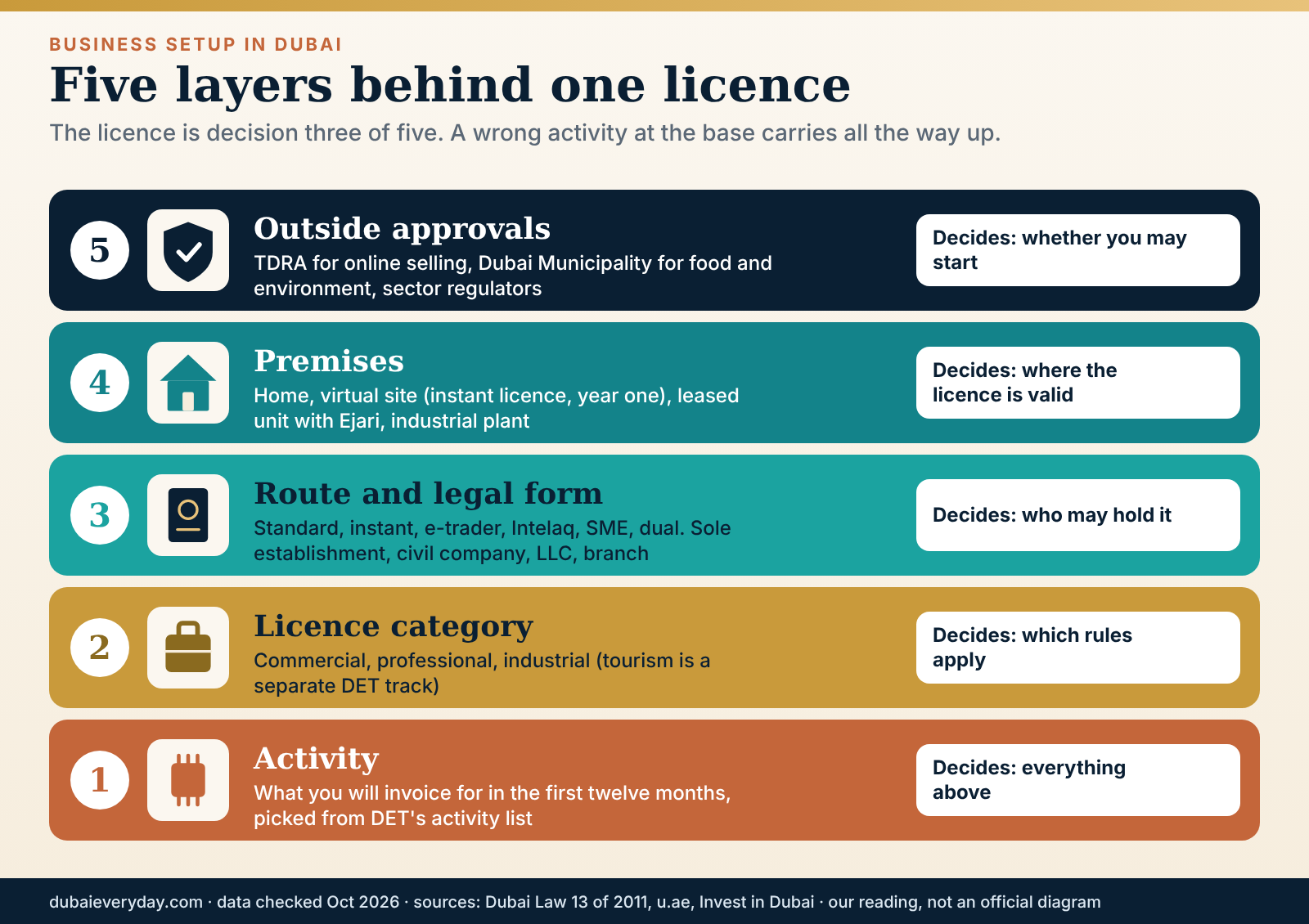
Founders usually ask “which Dubai business license?” as if it were a single choice. It is the third decision in a stack of five, and the layers above and below it constrain what you can pick.
The first layer is the activity: what you will do and invoice for, selected from DET’s classification. The second is the category of Dubai business license, which follows from the activity. The third is the route and legal form: standard, instant, e-trader and so on, each tied to certain legal forms. The fourth is the premises. The fifth is approvals from regulators outside DET. A mistake at layer one travels all the way up.
Mainland, free zones and the Dubai Unified Licence
DET licenses the Dubai mainland. Each free zone licenses its own companies under its own rules, so a free zone licence is a different document from the ones described here. Dubai Pulse, the emirate’s open-data platform, says its DET licence datasets cover professional, commercial, industrial and tourism business licences and leave out free zones. That list of four categories is a useful anchor for the rest of this page.
Tourism licences, for hotels, travel agencies and similar businesses, are a separate DET track and are not covered further here. What links the two worlds is the Dubai Unified Licence (DUL). Invest in Dubai describes it as a single identity for a business across government services, and says you can search the Dubai business directory by business name or DUL number. As you will see in the dual-licence section, holding a DUL is also a condition for one of the newer free-zone-to-mainland permits.
What the licence does not settle
A Dubai business license does not by itself decide your tax position, your visa quota, your bank’s appetite or your right to start trading. The federal portal u.ae is blunt about the last point: initial approval means the government has no objection, and it does not authorise the activity. Some activities need other approvals before you may begin.
Tax is similar. Whether a business owes corporate tax or must register for VAT turns on its income and supplies, not on whether your Dubai business license says commercial or professional. If you want the accounting side explained, our accounting services guide covers VAT, corporate tax and bookkeeping models, and the legal basics guide shows where to verify Dubai rules at the source.
The Dubai business license types at a glance
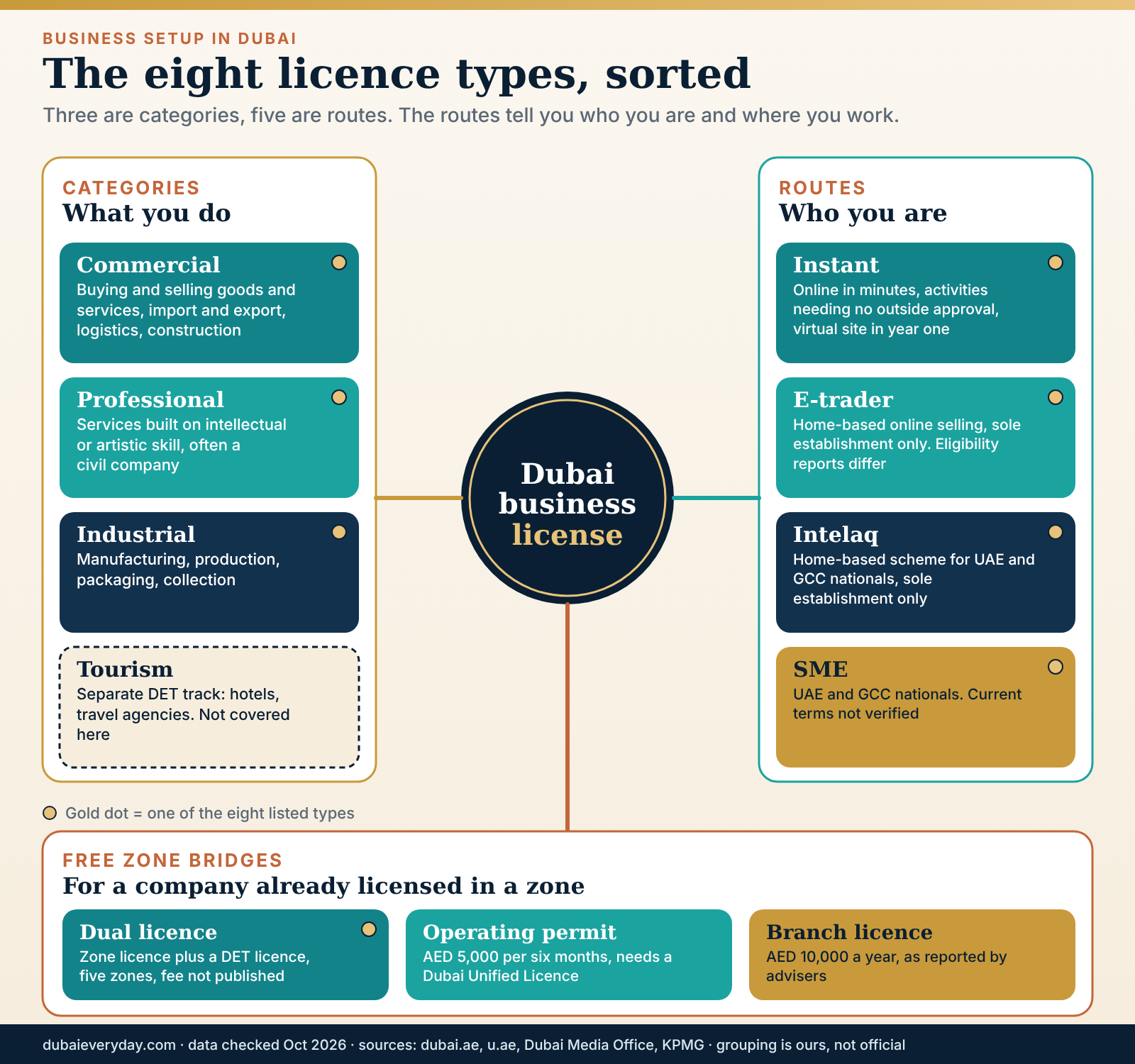
Invest in Dubai and the federal portal u.ae both say there are eight types of Dubai business license: industrial, commercial, professional, eTrader, dual, instant, SME and Intelaq. The Dubai government portal describes five of them in plain language, and the Invest in Dubai knowledge base shows which of them apply to each activity. Read as a menu of eight kinds of Dubai business license, the list is confusing. Read as two different kinds of thing, it is not.
Categories describe the activity, routes describe the holder
Commercial, professional and industrial are categories. They answer the question “what kind of work is this?” and the answer comes from the activity you choose, not from a preference. The other five are routes. They answer “who are you, where do you work and how fast do you need it?” An instant licence, for example, is a quick route to a commercial or professional activity, not a third kind of business.
The published numbers support that reading. Of the 10,707 instant licences issued in the first ten months of 2021, 63% were professional activities and 37% commercial, according to the Dubai Media Office. For e-trader licences issued in 2021, a 2022 Khaleej Times report put the split at 79% professional and 21% commercial. Our reading: most small holders of a Dubai business license are selling skills, not stock. Those are older figures from different years, so they show a pattern, not today’s mix.
A decision table for the eight types of Dubai business license
The table below is a first-pass filter for your Dubai business license. It uses the Dubai government portal, Invest in Dubai, the Dubai Media Office and the law, and it marks where sources disagree or where we could not read the official page. Treat “confirm” cells as questions for DET, not as answers.
| Type | Built for | Legal form, as published | Who can hold it | Confirm before paying |
|---|---|---|---|---|
| Commercial | Buying and selling most goods and services: import and export, logistics, software, construction, real estate | Most forms: LLC, partnerships, branch, sole establishment | Open to foreign owners in most activities | Premises, outside approvals, ownership limits on strategic activities |
| Professional | Services based on intellectual or artistic ability | Sole establishment, LLC, civil company for professional partners | Open to foreign owners in most activities | Activity wording, any professional regulator |
| Industrial | Manufacturing, production, packaging, segregation, collection | Company forms with suitable premises | Open to foreign owners in most activities | Premises zoning, environmental clearance |
| E-trader | Home-based selling through social media and online platforms | Sole establishment only | Sources differ on residents versus nationals | Eligibility, TDRA approval, activity group |
| Dual | A free zone company extending to the mainland | Existing free zone entity | Companies in five participating zones | Which zone, NOC, two sets of fees |
| Instant | Online, same-day issue for activities that need no outside approval | LLC, one-person LLC, sole establishment, civil company | Business owners generally | Whether your activity qualifies, virtual site lasts year one |
| SME | Dubai’s small-business scheme | Not confirmed | UAE and GCC nationals | Current terms, which we could not read |
| Intelaq | Home-based scheme for nationals | Sole establishment only | UAE and GCC nationals | Staff cap, no shopfront, growth rules |
One row deserves a note. The Invest in Dubai knowledge base lists the applicable licence types for each activity, and for the sample activity record we read it shows business, e-trader, Intelaq, instant and SME licences as applicable, with Intelaq and SME limited to UAE and GCC nationals and e-trader and Intelaq limited to the sole establishment form. The next sections take the types one at a time.
Commercial and professional licences: goods versus expertise
These two cover most of the Dubai business license applications that involve a real company with a desk, a lease and a payroll. Their definitions on the Dubai government portal are short, and the dividing line is whether the value you sell is a thing or a skill.
Commercial licence
The portal says a commercial licence is for businesses built around buying and selling most goods and services. The examples it lists are import and export, logistics, physical products, software, construction and real estate. Anything with stock, a shopfront, a warehouse or a contracting crew normally lands here.
Ownership of a commercial Dubai business license is wider than it used to be. Under the 2021 reform announced by Dubai Economy, up to 100% foreign ownership is possible in most activities, with no Emirati partner needed, apart from activities of strategic impact. The federal portal u.ae names examples that remain restricted: security and defence, telecoms, banking and financing, insurance, commercial agencies and a few others. If your activity sits near that list, ask DET before you plan the company around it.
The trade-off is premises. The mainland process on u.ae requires a physical address that meets the emirate’s land-use rules, and in Dubai the lease is registered through Ejari. Our mainland company guide walks through the lease, the memorandum of association and the approvals in order.
Professional licence
The professional Dubai business license is described as being for people who offer services based on their intellectual or artistic abilities. Think consultants, designers, marketers, trainers and similar work. The Dubai government portal separately describes the civil company, a form owned by partners who practise a professional activity, which is the usual vehicle when two or more professionals share one licence.
A solo professional can use a sole establishment or a one-person LLC. A foreign-owned sole establishment comes with a catch: the Invest in Dubai activity record says it is open to foreign investors only if they appoint a UAE local service agent. That is a legal and cost question worth settling before you choose the form, and the business setup guide shows how the form choice fits into the rest of the plan.
Where the line blurs
Mixed businesses are common. A design studio sells printed products. A software consultancy resells licences. A fitness coach sells supplements. The question is not which label you prefer. Dubai’s open data lists every activity with its own group and category, so the classification travels with the activity you choose, and an activity that crosses the line is a conversation with DET, not a drafting choice.
Our rule of thumb for picking a Dubai business license, which is our reading and not a DET rule: if more than half of the revenue you expect in year one comes from handing over goods, start the conversation as commercial; if most of it comes from hours, projects or retainers, start as professional. Then ask whether the secondary activity can sit on the same licence, because we could not verify a general rule on combining groups.
Industrial licence: making, packaging and the approvals behind it
The Dubai government portal defines the industrial Dubai business license as applying to all kinds of manufacturing, production, packaging, segregation or collection, and lists food, textiles, paper, petroleum products, equipment and appliances among its examples. The wording matters because it is wider than “factory”. A business that repackages bulk goods into retail units, or sorts and collects materials for processing, may be industrial even if it never casts a part or bakes a loaf.
Why premises decide this one
For commercial and professional work, an office or a shop can often be found in a week. For an industrial activity the premises are the project. The unit has to be zoned for the use, laid out for the process and acceptable to the authorities that look at safety and the environment. Dubai Municipality, for example, offers an environmental clearance service for industrial projects, and its page on environmental permits says clearances are required for development, infrastructure and industrial projects that may affect the environment.
Which exact clearance applies to a small unit is something we could not verify, and the Municipality’s guidance document is the place to check. The sensible order is the one u.ae sets for every mainland business: activity first, then initial approval, then premises and further approvals. Signing a lease for a unit before the activity is cleared for it is the most expensive way to find out you chose wrong.
Cross-references you may not expect
Other regulators refer back to the industrial licence. A Dubai Municipality guide to food-related permits, for instance, says seafood exporters to the EU must hold a Dubai industrial business licence, and that many food permits require a valid Dubai licence matching the permitted activity. That document dates from 2020, so use it as an illustration of the pattern, not as a current fee list.
The practical lesson is that an industrial Dubai business license tends to bring more outside conversations than a commercial one: the municipality, the landlord and sometimes a product regulator. If your plan is a small food producer, read the food-permit route before you read anything about company names. If your plan is trade with light packaging, ask DET whether the packaging step changes the category.
We could not find a published DET fee for the industrial category, so we have no number to give you. Ask for a written quote that separates the government fee from any service charge.
E-trader licence: the home-based route for online sellers
The e-trader Dubai business license, first launched by Dubai Economy in 2017 and originally branded DED Trader, was built so that people running a small business from home, mostly on social media, could do it legally. The Dubai government portal describes it as a home-based licence for freelancers and entrepreneurs who sell products or services through social media and online platforms, and says it is issued exclusively under the sole proprietorship form, with the owner carrying full legal responsibility.

Who can hold it: the sources disagree
Reports on who may hold an e-trader licence conflict. A September 2026 Emirates 24|7 guide says UAE nationals and residents can apply. A November 2024 The National report says only Emiratis can do trading activities on it, with professional activities allowed; a March 2025 Khaleej Times report says commercial activities are limited to UAE and GCC nationals, with some service activities possibly open to expats and food businesses not. Check the activity record on the Invest in Dubai portal before paying anyone.
Our reading of the disagreement: the e-trader Dubai business license has been described as open to residents in general, but the activity-level rules are tighter, and the safest assumption for an expatriate is that a service activity may qualify and a trading or food activity probably does not. That is an inference from the reports, not a ruling. The Invest in Dubai knowledge base confirms the form restriction, sole establishment only, and a foreign investor on a sole establishment needs a UAE local service agent according to the same record.
What the e-trader Dubai business license costs and includes
A March 2025 Khaleej Times report quotes AED 1,370 in total for the e-trader licence, made up of AED 1,070 in licence, knowledge and innovation fees plus AED 300 for Dubai Chamber membership. The AED 1,070 figure also appears in The National (November 2024) and in Emirates 24|7 (September 2026), which describes the licence as renewable every year. Older reports from 2019 and 2020 give the same base figure, so it has been stable for years, but treat it as media-reported, not as a DET quote.
Reported benefits from the Dubai Media Office in 2020 include Chamber membership for commercial activities, bank facilities, a customs client code for import and export, and the right to take part in exhibitions. Application is online through Invest in Dubai and the licence arrives electronically.
The limits that matter
Several limits come up repeatedly in the reports we read. The licensee cannot open a shop or store. Earlier reports say one licence can carry up to ten activities provided they sit in the same group. A reported route to three visas exists only where ownership is 100% Emirati. The Dubai Media Office also said, in 2020, that licences were issued for 87 activity groups.
The legal limits run in parallel. The federal portal u.ae says mainland sellers need a licence that includes e-commerce activity, and that every e-commerce licence needs approval from the Telecommunications and Digital Government Regulatory Authority (TDRA). It names Federal Decree-Law No. 14 of 2023 on Modern Technology-Based Trade, and the Dubai government page adds that digital traders may sell only goods and services legally approved for trade in the UAE. A 2024 Gulf News guide described the TDRA no-objection certificate as free, with a two-working-day processing time; verify that before relying on it.
When the e-trader Dubai business license stops fitting
This kind of Dubai business license is a ceiling as much as a floor. No shopfront, one owner and a home address mean a partner, a studio or a shop sends you to another route. Instant licences exist for the first step up, and a standard licence for the second. If you are budgeting a first year of self-employment, the fee for the Dubai business license is the small number. Rent, insurance and your own living costs are the large ones, which is why our single-person budget is worth reading beside any licence quote.
For scale, the Khaleej Times report in January 2022 said more than 16,400 e-trader licences had been issued between launch in March 2017 and the end of 2021, including 6,217 in 2021. That is a small, steady lane, not a niche.
Dual licence and the mainland operating permit
A free zone licence normally keeps a company inside its zone and its export business. The federal portal u.ae says duty applies when goods move to the mainland, and mainland sales go through a licensed mainland distributor or a mainland branch or company. For a founder whose first big client turns out to be a Dubai business next door, that is an expensive surprise. Dubai now offers three bridges across that gap, each a different kind of Dubai business license or permit, and they are often confused.
The dual licence
The Dubai government portal says dual licensing lets companies operating in specific free zones extend their presence to the mainland, and that it is currently available in collaboration with five free zones. It does not name them on the page we read. The best-documented example is DMCC. In December 2022 DMCC announced an agreement with the then Department of Economic Development under which member companies can establish a presence and operate on the mainland under a DED licence, with a no-objection certificate from DMCC first and only for some service activities.
Read together, those statements say a dual Dubai business license means holding two licences from two authorities: the zone licence and a DET licence. We could not verify the fee, the activity list or the list of participating zones, so treat the dual licence as a route to ask about, not one to price from this page.
The Free Zone Mainland Operating Permit
The second bridge is newer. On 8 October 2025 the Dubai Business Registration and Licensing Corporation (DBLC), part of DET, launched the Free Zone Mainland Operating Permit with the Dubai Free Zones Council under Executive Council Decision No. 11 of 2025. According to the Dubai Media Office, it is open to free zone companies that hold a Dubai Unified Licence, costs AED 5,000 for six months, renews at the same fee, and is applied for online through Invest in Dubai.
Three conditions matter. Mainland revenue earned under the permit is subject to 9% corporate tax and must be recorded separately. Companies can use existing staff without hiring new employees. And the first phase covers non-regulated activities, with technology, consultancy, design, professional services and trading named as examples, while regulated sectors are planned for later. DET’s announcement refers to more than 10,000 free zone companies as the eligible base.

The branch licence
Law-firm summaries of the same Executive Council resolution, including KPMG’s, describe a third option: a branch licence for a free zone company, reported at AED 10,000 a year, alongside the AED 5,000 temporary permit. Both need approval from DET and the free zone authority, and the resolution excludes financial entities in the Dubai International Financial Centre. We rely on adviser summaries here, because the resolution text was not readable, so check the fee with DET.
Which bridge, if any
Here is our calculation. Two six-month permits cost 2 x AED 5,000 = AED 10,000 over twelve months, which equals the reported annual fee for the branch licence. So fee alone does not separate them. What separates them is commitment and permanence: the permit lets you test the mainland market for six months and stop, while a branch or a standalone mainland company signals a longer stay.
If you only need to invoice a handful of Dubai clients in non-regulated activities, the permit is the lightest start. If you need regulated activities, a mainland shopfront, or a separate mainland entity for banking or procurement reasons, you are heading for a full mainland Dubai business license. Our free zone company guide covers the zone side of this decision, and mainland vs free zone compares the two in market access, cost and fit.
Instant, SME and Intelaq: the fast and nationals-only lanes
These three are not new categories of work. They are shortcuts, each with a different gate, and the gate is the main thing to understand.
Instant licence
The instant Dubai business license is the quick route for ordinary entrepreneurs. The Dubai Media Office described it in 2021 as issued in one step through the Invest in Dubai platform within five minutes, with little human interaction, and a March 2025 Khaleej Times guide says it is for activities that need no external approvals. Four legal forms were reported: limited liability company, one-person LLC, sole proprietorship and civil company.
On issue, the licensee reportedly receives Dubai Chamber membership, a GDRFA establishment card and three work permits from the human resources ministry, plus an electronic memorandum and a virtual site that is valid only for the first year. Businesses can start operating straight away but still need any remaining approvals from other bodies.
The virtual site is the detail to plan around. It is valid for year one only, so plan on a real lease, registered through Ejari, before the first renewal. That is our inference from the one-year limit, so confirm it with DET. Our tenant rights guide explains Ejari from the residential side, and a commercial lease is a separate contract with its own terms.
For scale, the Media Office counted 10,707 instant licences in the first ten months of 2021. By legal form, civil companies were 38%, sole establishments 25%, LLCs 23% and one-person LLCs 14%, which sums to 100%. Our reading: among instant licences in 2021, the civil company, the form built for professional partners, was the most common choice.
SME and Intelaq licences
The Invest in Dubai knowledge base says Intelaq and SME licences are limited to UAE and GCC nationals, and that Intelaq, like the e-trader licence, is available only with the sole establishment form. Dubai’s 2011 licensing law also contemplates this: Article 18 lets DET license certain activities for UAE nationals from home or through business incubators. If you are an expatriate resident, neither kind of Dubai business license is open to you, so treat them as background reading.
For nationals, the detail comes from a September 2026 Meydan Free Zone guide, a free zone operator’s page and therefore secondary evidence. It describes Intelaq as a home-based licence for UAE and GCC nationals living in Dubai, at an indicative AED 1,050 a year. It adds that the business is a sole proprietorship, has no shopfront, walk-in customers or signage, can employ up to three staff, and must move to a standard commercial licence when it outgrows those limits.
Dubai SME, the body behind the SME licence, now sits within Dubai Founders HQ, and the old sme.ae pages redirect to a general site. We could not read current SME licence terms, so we do not describe them. Ask DET or Dubai Founders HQ for eligibility, fees and conversion rules before you plan around either scheme.
Activities: where a Dubai business license is won or lost
The federal portal u.ae says the business activity is the basis for selecting the legal form and the type of licence, and that there are more than 2,000 business activities in the UAE, which a single business may combine. Dubai Economy added in 2021 that more than 1,000 commercial and industrial activities are open to full foreign ownership. These numbers tell you the same thing from two angles: the activity list is where the rules live.
Read the activity record before you read any price list
Invest in Dubai publishes a knowledge-base record for each activity. The one we read, for an information services activity, shows the pieces you need: whether the activity is active, whether it is classed as professional or commercial, which licence types apply, which legal forms are allowed, any conditions on the holder, and the competent authority. That last field is the one that tells you whether DET is the only body you will deal with.
For the sample record the competent authority was DET alone and five licence types applied, including e-trader, Intelaq, instant and SME. Our reading: that is what a low-friction activity looks like, with few outside approvals and several routes open. An activity that names another authority, or that lists only a standard licence, is telling you the route will be longer.
The federal portal u.ae says initial approval means the government has no objection, and it does not authorise the activity. Some activities need other approvals first, and Dubai Municipality, TDRA and sector regulators each have their own. Do not sign a lease, order stock or advertise on the strength of an initial approval alone.
Choosing activities you will actually use
It is tempting to load every activity you might want onto your Dubai business license. Two things argue against that. The law says changes to the licence details need DET approval, and licence holders must tell DET about changes to licensing information within ten working days. And the more activities you add, the more likely one of them pulls in a regulator you did not plan for.
A better approach is to write down what will appear on invoices in the first twelve months, match each item to an activity record, and add the rest later by amendment. We could not verify what DET charges for an amendment, so ask for that figure in your first quote.
Ownership limits sit inside the activity too
Full foreign ownership is the general rule on the mainland, but u.ae lists activities that remain restricted, among them security and defence, telecoms, banks and other financial institutions, insurance, commercial agencies and a few religious services. The Cabinet can also designate activities of strategic impact. We could not verify the current full list, so treat the u.ae examples as a floor: if your activity looks anything like them, ask DET first.
Sole establishments are the other trap. The Invest in Dubai record says a sole establishment is open to foreign investors only with a UAE local service agent. Sources are not fully aligned on when a local service agent is needed elsewhere: u.ae still mentions one for companies wholly owned by non-GCC nationals, while Dubai Economy’s 2021 clarification said no Emirati partner is required. Ask DET which applies to your activity and legal form.
Outside approvals you can predict
Some approvals are easy to spot from the business idea. Online selling needs TDRA approval. Food activities need Dubai Municipality food permits, and the Municipality’s food-permit guide says a home-based trader permit exists for owners of licensed home businesses, listed at AED 200 for one year in a 2020 document. Industrial projects can need environmental clearance. Health, finance, education and security sit with their own regulators.
A practical habit: before you pay for a Dubai business license, list the three or four outside bodies your idea could touch and check each one’s own website for a pre-approval requirement. If a formation agent says there are none, ask them to show you where that is written.
How to choose your Dubai business license
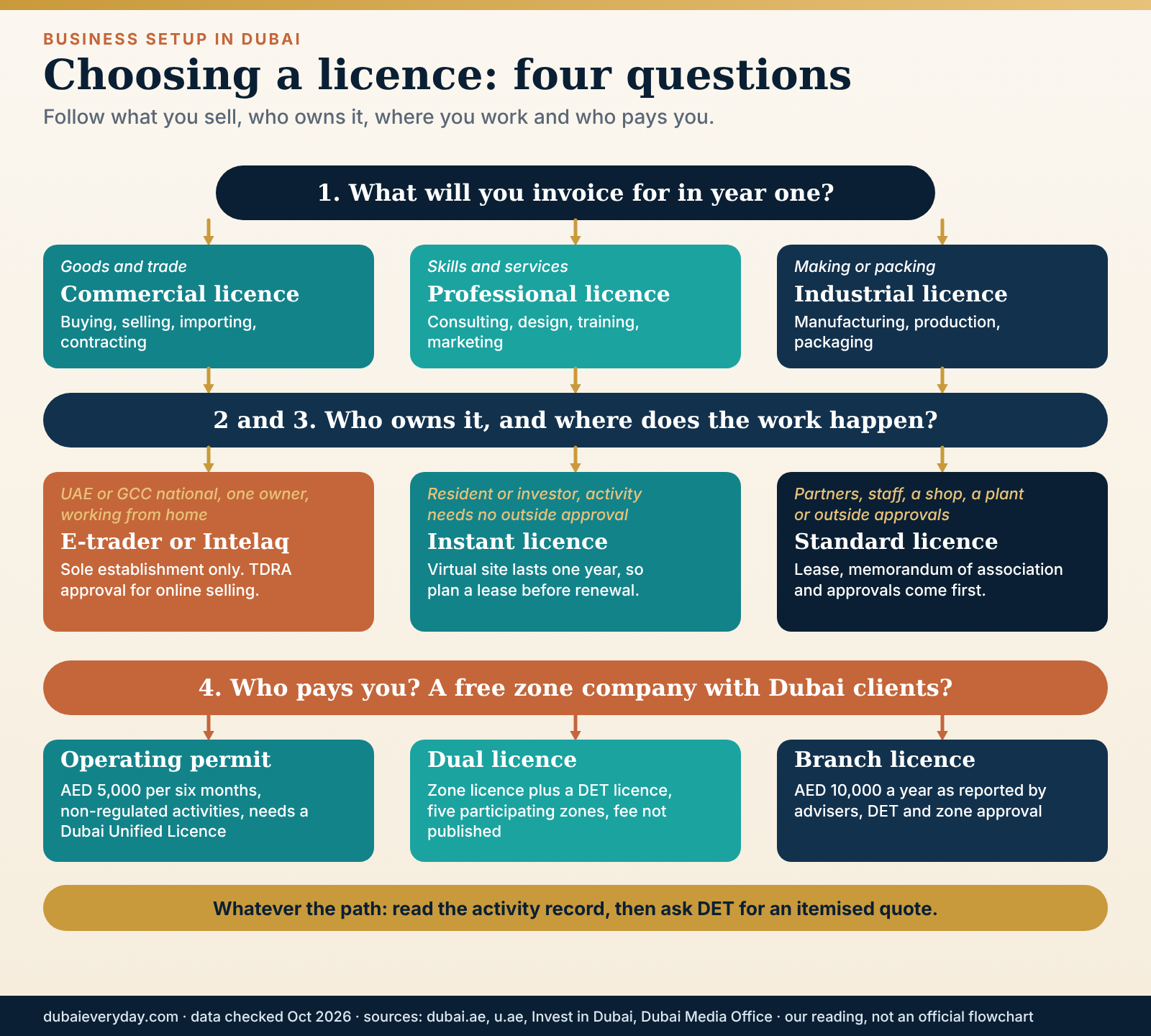
You do not need a flowchart to choose a Dubai business license, but a good one prevents the usual error of picking the cheapest route first. Four questions, asked in this order, settle most cases.
Four questions, in order
First: what will you invoice for in the first twelve months, and is it goods, skills or manufacture? That chooses commercial, professional or industrial. Second: who will own and sign, and are they UAE or GCC nationals, residents or investors abroad? That opens or closes the e-trader, Intelaq, SME and sole establishment routes. Third: where will the work physically happen? A home, a virtual site, a leased unit and a plant are four different premises answers. Fourth: who pays you? Dubai customers, overseas customers and free zone customers imply different licences.
Eight illustrative scenarios
The scenarios below are examples built from the rules above, not case studies of real people and not advice. They show how the four questions pick a Dubai business license. Each ends with what to confirm, because the rules for your activity may differ.
Freelance designer serving clients abroad
Skills, one owner, laptop at home. A professional activity through an instant licence or a standard professional licence is the natural fit if you need Dubai-issued invoices. E-trader may fit if you are eligible and the activity is a service one. Confirm the activity wording and the premises rule.
National resident selling crafts on Instagram
Goods, one owner, home workspace. E-trader or Intelaq are built for this, with TDRA approval for online selling. Confirm the activity group, the cap on activities and staff, and what happens when you want a studio or a stand.
Expatriate resident selling jewellery online
Goods sold online by a non-national. The reports say commercial activities on the e-trader licence are limited to nationals, so a standard commercial or instant route, or a free zone e-commerce licence, is the likelier lane. Confirm eligibility on the portal first.
Two partners starting a consultancy
Skills, two owners, shared desk. A civil company on a professional licence is the form the Dubai government portal describes for partners practising a professional activity. Confirm whether it qualifies for the instant route or needs a lease first.
Importer supplying restaurants
Goods, stock, delivery. A commercial licence with leased premises or storage. Confirm outside approvals for the product, the import side and whether a free zone warehouse with a mainland distributor would suit better. See our mainland vs free zone comparison.
Small bakery supplying cafes
Making and packing food for sale. An industrial or food activity, a licensed kitchen, Dubai Municipality food permits and likely an environmental or safety review. Confirm the unit’s permitted use before signing anything.
Expatriate home cook
Food from a home kitchen. The Khaleej Times report says food and cooking businesses are not open to expats on the e-trader licence, and Intelaq is for nationals. A standard licence with approved premises is the likelier route. Confirm with Dubai Municipality and DET.
Free zone software firm winning a Dubai client
Technology services from a zone with a DUL. The operating permit, at AED 5,000 per six months, covers non-regulated activities such as technology. A dual licence or branch is the next step if the relationship grows. Confirm the permit covers your activity.
Notice what is missing: a recommendation of the cheapest licence. In every scenario above the Dubai business license follows the facts about the work and the owner, and the price follows the licence. Reversing that order is how people end up with a bargain licence for an activity that sits in another category.
The cost of switching
Changing course later is possible but not free. Dubai’s licensing law requires prior approval for changing the legal form, modifying licence details or transferring the licence. The cheaper the starting route, the lower the ceiling, and the e-trader and Intelaq ceilings are low by design. If your plan includes staff, premises or partners within a year, price the standard Dubai business license from the start and compare it with the cheap route plus a later conversion.
Costs, validity and renewal of a Dubai business license
This is the section where we have to be careful about what we can and cannot say. The fees below come from a mix of government announcements and news reports, and the main fee for the standard categories was not readable on the official pages. Think of the numbers as markers on a map, not a price list.
What the published numbers add up to
The Khaleej Times guide of March 2025, citing DET and the Invest in Dubai portal, gave AED 120 for initial approval and AED 620 to book a trade name. Our calculation: 120 + 620 = AED 740 before you have paid for the licence itself, a lease, a memorandum of association or any outside approval. That is a floor, not a quote. The same report put the e-trader licence at AED 1,370 in total, of which AED 300 was Dubai Chamber membership.
For a free zone company, the Dubai Media Office announced the operating permit at AED 5,000 for six months, and law-firm summaries put the branch licence at AED 10,000 a year. We did not find a published DET fee for the commercial, professional or industrial category, a published renewal fee or a published late-renewal fine, so none appears here. A written quote that separates government fees from service charges is the only reliable number.
Validity, renewal and what happens if you stop
Dubai Law No. 13 of 2011 says a Dubai business license is valid for one year and renews for the same period, and that on request and with DET approval the term may be extended to up to four years. Renewal must be made in the last month before expiry, so it is a calendar item, not a reminder to set at the last minute. We could not verify whether a longer term changes the fee.
The law also sets the consequences. It provides for fines from AED 100 to AED 100,000 for violations, with the detailed list set by a separate resolution, and lets DET close a business or revoke a licence, including where it was obtained on false information or after non-renewal and cessation. If you stop trading, the law lets a business request suspension and says no licence fees or non-renewal fines then apply. Closing properly is cheaper than letting a licence lapse.

Renewal is most of the workload
Gulf News reported in September 2026 that the Dubai Business Registration and Licensing Corporation processed 58,337 new licences and 173,652 renewals in the first half of 2026, across the mainland and free zones. Our calculation: 173,652 / 58,337 = 2.98, so about three renewals for every new licence. Our reading: renewing a Dubai business license is the normal, repeated event for a company, and the first renewal is the one where early shortcuts such as a virtual site or a low-cap home licence show up.
The licence fee is one line in a bigger budget
A real first-year budget for a Dubai business license includes premises, the memorandum of association where required, Chamber membership, establishment cards, visas and medical, insurance, an accountant and a bank account. Our insurance guide covers business insurance, and health insurance for employees is a legal duty for employers in Dubai once you hire. Living costs belong in the plan too, which is where the cost of living guide helps.
Tax sits on top of a Dubai business license, not inside it. The Ministry of Finance sets corporate tax at 0% on taxable income up to AED 375,000 and 9% above it, with Small Business Relief for revenue up to AED 3 million, which the Ministry extended to tax periods ending on or before 31 December 2029 according to The National in August 2026. The Federal Tax Authority sets mandatory VAT registration at AED 375,000 of supplies and voluntary registration at AED 187,500. Keep the books from day one; our bookkeeping guide shows how.
Mistakes, red flags and how to verify a licence
Most trouble with a Dubai business license is predictable. The mistakes below are the ones the rules and reports make easy to spot, and each has a quick check.
Ten mistakes worth avoiding
- Choosing the cheapest route before checking the activity record and its competent authority.
- Assuming an expatriate can hold an e-trader, Intelaq or SME licence without checking the activity-level rule.
- Treating initial approval as permission to start trading.
- Signing a lease before the activity, form and use of the premises are cleared.
- Counting on a virtual site beyond the first year of an instant licence.
- Adding every activity you might want, then discovering an extra regulator.
- Picking a sole establishment as a foreigner without pricing the local service agent.
- Assuming a free zone licence lets you invoice mainland customers freely.
- Letting a licence lapse instead of requesting suspension or cancelling properly.
- Paying an adviser for a package before seeing a written breakdown of government fees.
How to verify a Dubai business license in five minutes
The Khaleej Times guide describes the check on the DET website: open e-services, choose licence information, and search by the company’s English or Arabic name or by licence number. The profile shows the licence status, expiry date, legal type, contact details, business activities and, where available, the physical address. The federal portal u.ae lists the same DET service and the Invest in Dubai name search under one directory, and the Dubai business directory takes a Dubai Unified Licence number.
Use it on yourself too. Before you hand a payment to a formation adviser, search the activity you want, the name you want and the adviser’s own company, and check that what they tell you matches what the profile shows.
Red flags in a quote
Be cautious when a package prices one Dubai business license for “any activity”, promises approvals, will not itemise government fees, bundles visas or a bank account as a guarantee, or asks for a deposit before showing the activity record. Ask any adviser how they are paid, because a referral fee from a free zone or bank can shape which option they suggest. We earn nothing from any provider, which is why this page names no adviser and ranks none.
If something in your case is unusual, take the question to DET or a licensed adviser. For the legal side of living and working in Dubai more broadly, the legal basics guide shows where to confirm rules. If you are weighing a central office address, our Downtown Dubai guide covers what the area is like day to day.
FAQ: Dubai business license questions people search
What are the types of Dubai business license?
Invest in Dubai and u.ae list eight: industrial, commercial, professional, eTrader, dual, instant, SME and Intelaq. Commercial, professional and industrial describe the kind of activity. E-trader, instant, SME and Intelaq are routes with their own gates, and the dual licence is a bridge for free zone companies. Dubai’s open data also names tourism as a fourth category of mainland licence, which covers hotels and travel businesses.
What is the difference between a commercial and a professional licence in Dubai?
The Dubai government portal says commercial licences suit businesses built around buying and selling most goods and services, while professional licences suit people who offer services based on their intellectual or artistic abilities. In practice the activity you choose decides the category, since each activity in DET’s classification carries its own group and category. A business that mixes the two should ask DET how its activities will be classified.
Can a foreigner get an e-trader licence in Dubai?
Reports conflict. A September 2026 guide says UAE nationals and residents can apply. Other reports say trading activities are limited to nationals, with some service activities possibly open to residents, and that food businesses are not. The Invest in Dubai records also show the licence is available only as a sole establishment, which for a foreign investor needs a UAE local service agent. Check your activity on the portal before paying.
What is a dual licence in Dubai?
A dual Dubai business license lets a company based in one of five specific free zones extend its presence to the mainland. DMCC, for example, announced an agreement with the licensing department in December 2022 under which members can operate on the mainland under a DED licence after getting a no-objection certificate from DMCC. We could not verify the fee or the full list of zones. Free zone companies can also look at the October 2025 operating permit, which costs AED 5,000 per six months.
How long is a Dubai business license valid, and how do I renew it?
Dubai Law No. 13 of 2011 says a licence is valid for one year and renews for the same period, and that DET may extend the term up to four years on request. Renewal must be made in the last month before expiry. If you stop trading, the law lets you request suspension, and no licence fees or non-renewal fines then apply. Renewal fees were not published where we looked, so ask DET.
Can I run two activities on one licence?
Yes in general. The federal portal u.ae says a business can have more than one activity. Earlier reports say an e-trader licence can carry up to ten activities if they are in the same group. Whether activities from different groups, such as one professional and one commercial, can sit on the same licence depends on the activity records, which we could not verify as a general rule. Ask DET before you plan the invoicing around it.
Do I need an office for a Dubai business license?
For the standard mainland process, yes. u.ae requires a physical address that meets land-use rules, and in Dubai the lease is registered through Ejari. The exceptions are specific: the e-trader and Intelaq licences are home-based, and the instant licence offers a virtual site valid for the first year only. Free zone companies follow their zone’s desk or office rules instead, which our free zone guide covers.
Is a trade licence the same as a business licence in Dubai?
In everyday use, yes. The federal portal u.ae says “trade licence”, the Dubai legislation portal says a business must be “licensed”, and the Invest in Dubai portal says “business licence” in its activity records. All of them point to the permission DET issues for an economic activity on the mainland. Free zone licences are a separate document issued by each zone authority, which is why the word alone does not tell you which one a company holds.
How do I check whether a Dubai company’s licence is valid?
Use the DET website’s e-services and open the licence information search. Search by the English or Arabic name or by licence number, and read the status, expiry date, legal type, activities and address on the profile. The u.ae directory points to the same DET service and to the Invest in Dubai name search, and the Dubai business directory accepts a Dubai Unified Licence number. Free zone companies are verified with their own zone authority.
Can a free zone company serve mainland customers?
Not freely on a plain zone licence. u.ae says mainland sales need a licensed mainland distributor, branch or company. Since October 2025 a free zone company with a Dubai Unified Licence can apply for the Free Zone Mainland Operating Permit for non-regulated activities, at AED 5,000 per six months, with 9% corporate tax on that mainland revenue and separate records. Dual licences and branch licences are the other routes.
Do I need a licence to sell on Instagram in Dubai?
u.ae says mainland sellers need a licence that includes e-commerce activity from the emirate’s economic department, which in Dubai is DET, and that every e-commerce licence needs TDRA approval. The e-trader licence was designed for home-based social media sellers who qualify. Digital traders may sell only goods and services legally approved for trade in the UAE. Selling without a Dubai business license is a legal risk, so check your case before you start.
What does a Dubai business license cost?
No single number applies. Reported fees include AED 120 for initial approval, AED 620 for a trade name and AED 1,370 in total for an e-trader licence, all from a March 2025 report, plus AED 5,000 per six months for the free zone operating permit. The main fee for standard categories was not published where we could read it, and premises, approvals and visas usually cost more than the licence. Ask for a written, itemised quote.
Related reading
Sources and further reading (30 links)
- Dubai Government: Starting a business — definitions of the industrial, commercial, professional, e-trader and dual licences; legal forms
- Dubai Government: eCommerce — e-trader licence as a sole proprietorship home-based licence; TDRA approval; Decree-Law 14 of 2023
- Dubai Government: Free zones in Dubai — list of 21 free zones
- Dubai Government: Accessing and updating business data — DET e-services for licence, activity and name searches
- UAE Government portal: Steps to start a business on the mainland — eight licence types, activities, initial approval, premises, payment window
- UAE Government portal: eCommerce — licence and TDRA approval for online sellers
- UAE Government portal: Running a business on the mainland — advertising approvals and ongoing obligations
- Invest in Dubai: activity knowledge-base record (information services) — applicable licence types, conditions, legal forms, competent authority
- Invest in Dubai: Dubai Unified Licence guide — single business identity and directory search
- Dubai Media Office: Dubai launches Free Zone Mainland Operating Permit — fee, eligibility, tax and activities
- Dubai Department of Economy and Tourism: New growth for investors — operating permit announcement
- Dubai Media Office: Instant licences issued in 2021 — how the instant licence works, legal-form and activity mix
- Dubai Media Office: DED Trader licence — e-trader launch, limits and benefits
- Dubai Media Office: Dubai Economy clarifies full ownership procedures — foreign ownership and strategic activities
- Dubai Legislation Portal: Law No. 13 of 2011 — licence requirement, forms, term, renewal, penalties, amendments
- Dubai Pulse: DET business licence datasets — licence categories and activity classification data
- Dubai Government: Environmental permits — environmental clearance for industrial projects
- Dubai Municipality: Food-related permits and approvals — home-based trader permit and licence cross-references
- DMCC: Dual licensing scheme with the Department of Economic Development — dual licence example
- KPMG UAE: Dubai resolution enabling free zone companies to operate on the mainland — branch licence and permit fees (adviser summary)
- Khaleej Times: Dubai trade licence, types and application process — reported fees, instant licence, verification steps (news report)
- Khaleej Times: Dubai’s e-Trader explained — e-trader limits and licence counts (news report)
- The National: UAE freelance licences from Dh1,070 — e-trader fee and eligibility (news report)
- Emirates 24|7: Dubai e-Trader licence from Dh1,070 — current fee and eligibility statement (news report)
- Gulf News: How to get an eCommerce licence in the UAE — TDRA no-objection certificate (news report)
- Gulf News: How Dubai is making business setup faster and easier — new licence and renewal counts (news report)
- Meydan Free Zone: Intelaq licence guide — Intelaq conditions (free zone operator; secondary source)
- Ministry of Finance: Explanatory guide for corporate tax purposes — corporate tax rates and threshold
- The National: UAE extends corporate tax relief for small businesses until 2029 — Small Business Relief extension (news report)
- Federal Tax Authority: Registration for VAT — mandatory and voluntary VAT thresholds
Update log: 29 October 2026, first publication; all facts re-checked against the sources above. Next review due by 28 February 2027, or sooner after any change to DET licence categories, the free zone operating permit or published fees. Corrections welcome. This page is general information, not legal, tax or financial advice.
About DubaiEveryday and this guide
DubaiEveryday.com is an independent editorial project that publishes practical, research-based guides to everyday life in Dubai: where to live, what things cost, how the rules work and how to get around. This page was written and edited by the DubaiEveryday editorial team. It is not signed by a named expert, doctor, lawyer or adviser, and we do not claim first-hand testing of a venue, clinic or service unless the page says so.
Each guide is built from official sources such as government and regulator pages, operator websites and established news outlets, cross-checked where we can. When we could not confirm something, we say so in the text, and examples that use made-up numbers are labelled as illustrations. Mentions are editorial choices, not paid placements, and a link is not an endorsement.
Dubai changes quickly. If you spot something that is out of date or wrong, please tell us through the contact options on DubaiEveryday.com and we will check it and correct the page.