
Invisalign Dubai treatment moves teeth with a series of clear plastic trays, and the outcome depends far more on the case, the clinician and the paperwork around refinements and retainers than on the brand name. This guide covers who may legally treat you, which cases suit aligners, how to read a quote and what to ask before you sign, checked against Dubai Health Authority documents on 29 October 2026.
Straight teeth are rarely the hard part of a clear aligner plan. The hard part is the fine print: who is actually licensed to treat you, how many extra sets of trays the plan quietly assumes, and what the retainer costs when the trays are done. It is easy to sign up for Invisalign Dubai treatment after one friendly consultation and a smile simulation, and only meet the real questions months later.
This guide puts those questions up front. It sets out what the Dubai Health Authority says about who may provide aligner treatment, which cases tend to go smoothly and which do not, and how to read a quote line by line. You will finish it knowing what to ask, what to get in writing and when a second opinion is cheap insurance.
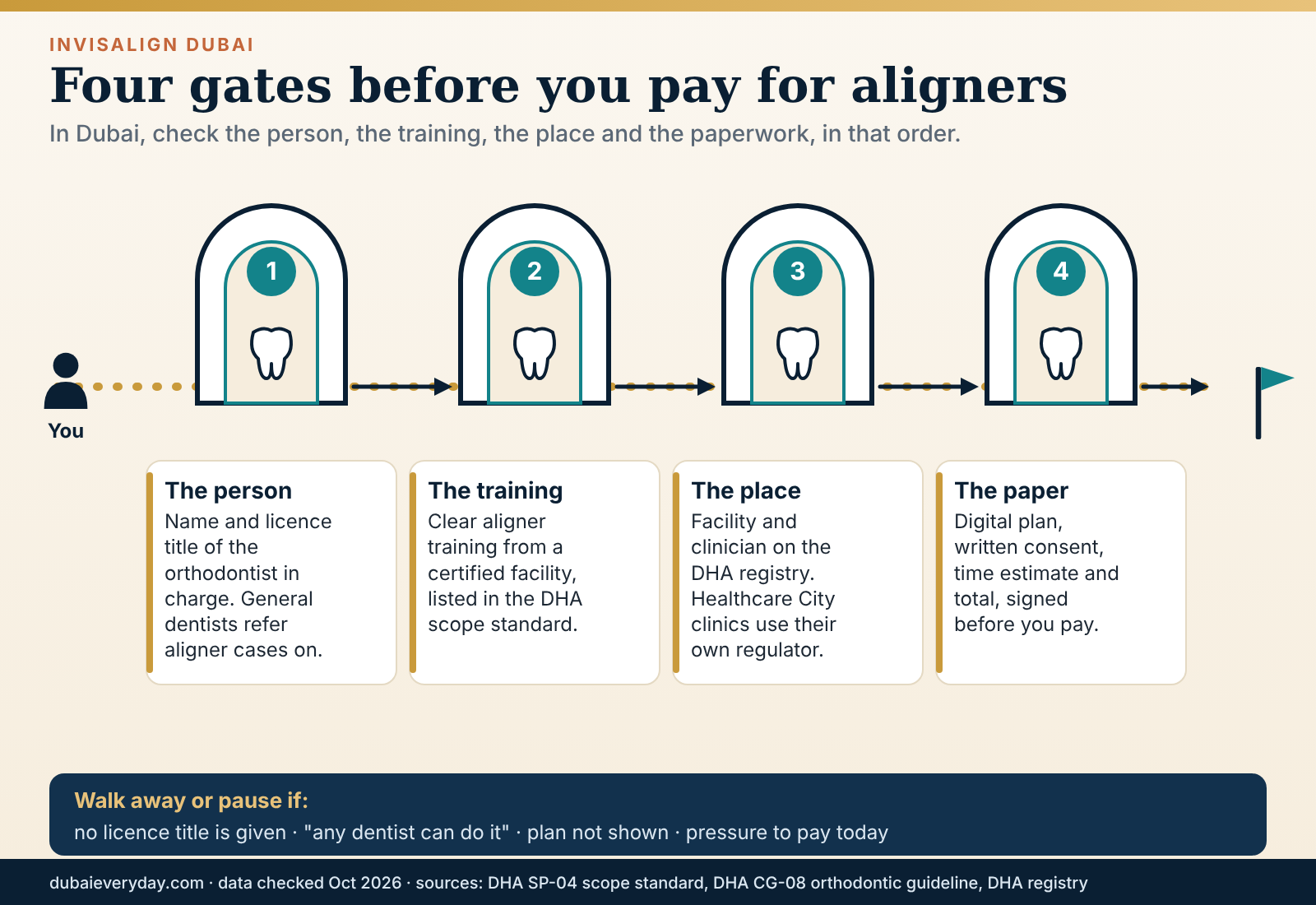
Invisalign Dubai treatment is clear-aligner orthodontics: a digital plan, a run of custom trays you wear for most of the day, and a retainer for the years afterwards. Under the Dubai Health Authority (DHA) scope-of-practice standard we could read, a general dentist should refer clear aligner cases to an orthodontist, and an orthodontist needs training from a certified facility before offering them. So the first check on any Invisalign Dubai plan is the clinician’s DHA licence and speciality, not the clinic’s Instagram.
Aligners work best on mild to moderate problems in adults whose gums and hygiene are in good shape. Deep bites, rotated premolars, extractions and large bite changes are where plans most often fall short and where a refinement, meaning a second set of trays, becomes likely. In one research cohort of 324 patients, 322 needed at least one.
Published Invisalign Dubai prices are scattered. One clinic page lists AED 15,000 to AED 27,000 plus 5% VAT, with retainers listed separately, while discount-code directories show far lower headline figures. Ask for the Invisalign Dubai total in writing, including refinements, retainers and VAT. This is general information, not dental advice.
This is a research-based guide, not a clinic review. We did not visit any clinic, had no treatment, and have no clinical qualification. No dentist has reviewed this draft, so treat it as an informed layperson’s reading of official documents and published studies, and let a licensed clinician correct anything that clashes with your own mouth.
Rules come from DHA documents read on 29 October 2026: the Clinical Guidelines for Orthodontics (CG-08, issue 2, effective 1 March 2026), the earlier 2021 edition, the dental scope-of-practice standard (SP-04) and two circulars. Clinical background comes from the US Food and Drug Administration (via the American Dental Association), the Cochrane Library, the UK National Health Service, Cleveland Clinic and Align Technology’s own pages. Effectiveness figures come from peer-reviewed studies named where used. Invisalign Dubai prices come from clinic and directory pages, and none is a quote.
We name no clinic as best and rank none. Inclusion was not paid for, and there are no affiliate links or booking buttons. Where a figure could not be verified, we say so or leave it out. Illustrative calculations are labelled as such.
Invisalign Dubai: what you are actually buying
Invisalign is the trade name of one manufacturer’s clear aligners, made by Align Technology. People use it the way they use “Hoover” for vacuum cleaners, so a search for Invisalign Dubai usually means “clear aligners in Dubai”, and several other brands compete for the same patients. Everything about case suitability and retainers below applies to clear aligners in general. Where a point is specific to Invisalign, such as its planning software, we say so.
The product is not the plastic. A clinician scans or takes impressions of your teeth, sets a target position in planning software, and the manufacturer produces a sequence of trays that each nudge the teeth a small distance. Small tooth-coloured bumps called attachments are bonded to some teeth to give the plastic something to grip. You change trays on a schedule, attend check-ups, and finish with a retainer. What you pay for in an Invisalign Dubai plan is mostly the clinician’s diagnosis, plan and monitoring.
Why the brand name matters less than the plan
Two patients can wear identical trays and have very different results, because the digital plan decides what the trays are asked to do. An Invisalign Dubai plan that asks for a lot of root movement, a large bite change or the closure of an extraction space is a harder plan than one that gently aligns crowded front teeth. Align’s own site says treatment time varies with product type, wear time and case complexity, and that your doctor must determine it.
That is why this guide spends more time on case complexity, refinements and retainers than on the trays themselves. Those three decide whether the final Invisalign Dubai bill matches the first quote, whether you finish in a year or two, and whether the result survives after the trays stop.
What is covered here and what is not
This page covers Invisalign Dubai treatment, meaning clear-aligner orthodontics: who is allowed to provide it, who it suits, how plans and refinements work, retainers, published prices and alternatives. For choosing a general dentist, understanding licences and what routine care costs, read our Dubai dentist guide. For replacing missing teeth, see dental implants in Dubai. For reshaping the front teeth with shells rather than movement, see veneers in Dubai.
Who may treat you: the DHA rules on clear aligners
This is the most Dubai-specific part of any Invisalign Dubai decision, and the part most guides skip. Dentistry in Dubai is regulated by the DHA for most clinics, with a separate regulator inside Dubai Healthcare City. The DHA publishes a scope-of-practice and core-competencies standard for general and specialist dentists (code SP-04), and it speaks directly to clear aligners.
What the standard says
We read version 2 of the standard, issued on 25 December 2023 and effective from 25 February 2024. Under the general dentist’s out-of-scope list, it says a general dentist may not practise clear aligner treatment and must refer the patient to an orthodontist. Under the orthodontist’s scope, it lists clear aligner therapy as permitted only after the orthodontist completes training from a certified facility. That is the only explicit training requirement for aligners in the document.
A circular dated 24 December 2024 announced an updated version 2.1 of the same standard. We could read the circular but not the updated attachment, so we cannot say whether the wording changed. Treat the version 2 text as the best available public statement and confirm the position with the clinic and, if you wish, the DHA.
What this means when you book
Do not assume that a clinic offering Invisalign Dubai treatment has an orthodontist treating you. Clinics of every kind advertise the brand. We cannot see from outside who plans each case, and there are legitimate arrangements, such as an orthodontist who designs and supervises while another clinician handles routine visits. So the question is practical: who is the DHA-licensed orthodontist responsible for my plan, and will that person see me at the key steps?
For an Invisalign Dubai plan, ask for the clinician’s full name and licence title. The DHA orthodontic guideline refers to consultant and specialist orthodontists, and the registry lets you look up professionals by speciality. If the answer is a general dentist, ask how the clinic reads the DHA standard and who the supervising orthodontist is. A clear, unbothered answer is a good sign. Defensiveness is information too.
Checking the licence in practice
- Get the exact nameAsk for the treating clinician’s full name, as printed on the licence, and the facility name.
- Open the DHA registryThe Dubai Medical Registry on the DHA’s Sheryan portal has separate tabs for professionals and facilities, with filters including speciality and licence type.
- Match the specialityLook for a specialist or consultant orthodontist title. A general dentist title is legitimate for other work but is not the match for clear aligner treatment under the standard we read.
- Check the facilityConfirm the clinic itself is licensed and that the professional is listed against it.
- Note the regulatorClinics inside Dubai Healthcare City answer to that free zone’s own regulator, not the DHA, and its standards are separate.
We could not run a live search on the registry during this review, so the steps above follow the portal’s published structure and the DHA’s own descriptions. If the portal looks different when you open it, trust the portal. For broader background on licences, titles and complaints, our dentist guide goes through them in more depth.
Case complexity: what aligners do well and badly
Complexity is the single biggest driver of Invisalign Dubai cost, time and disappointment, yet it is the thing a glossy consultation tends to blur. The honest version is that aligners are a good tool for a defined range of problems and a harder tool beyond it. The research is clear enough to say where that edge sits, even though it is not perfect.
The planned movement versus the real one
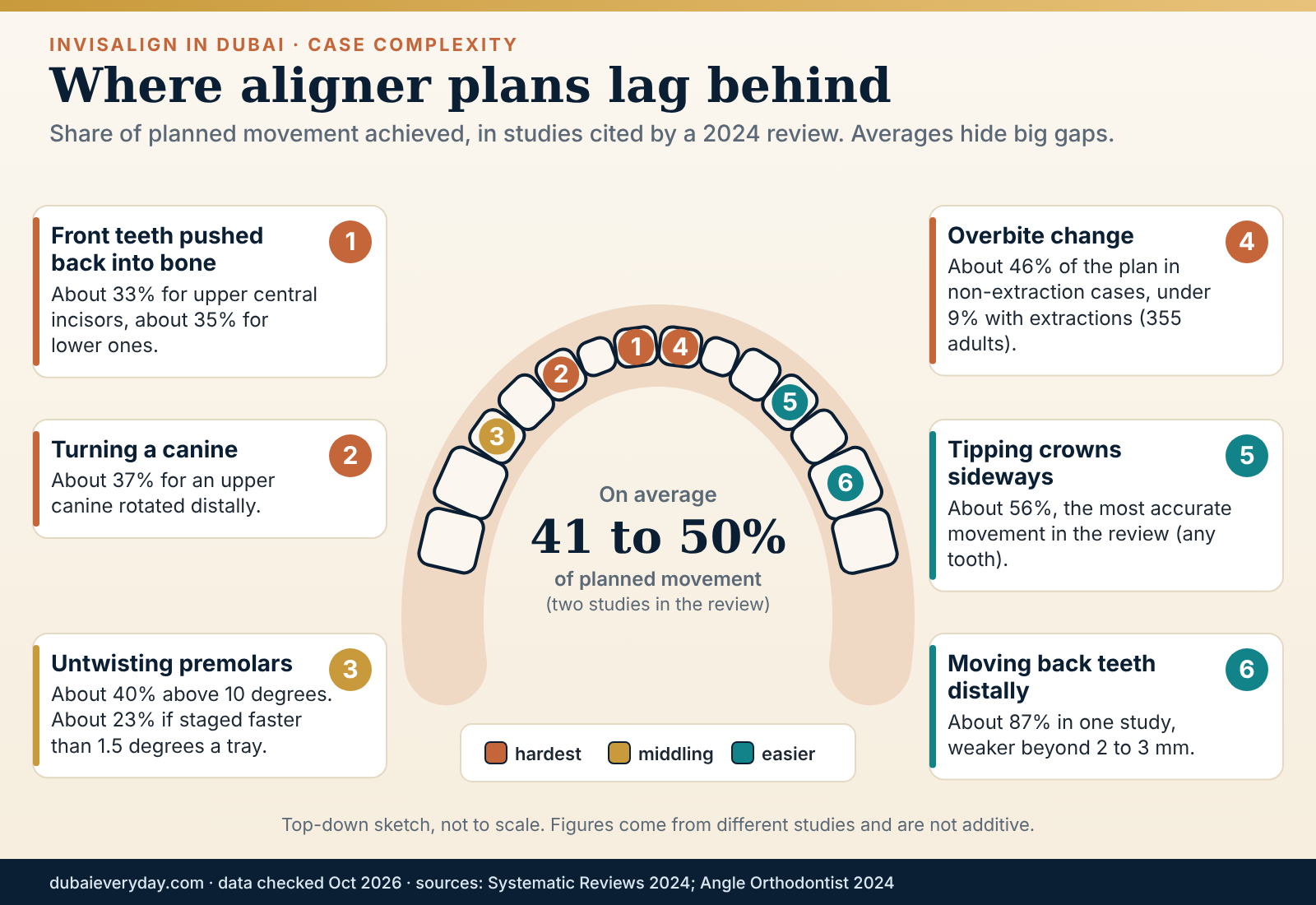
A 2024 systematic review in the journal Systematic Reviews (Caruso and colleagues) pooled 24 studies of the current Invisalign system, covering 1,391 patients. It reported that the share of planned movement actually achieved was around 41% in an older study and about 50% in a later prospective study of 38 patients. Tilting a crown sideways was the most accurate movement at 56%. Rotation was the least accurate at 46%, and the review’s own authors note that high-quality evidence is still scarce.
Averages hide the awkward movements. The review cites figures of about 33% for pushing the upper central incisors back into the bone (intrusion), roughly 35% for the lower incisors, and about 37% for turning an upper canine. Premolar derotation reached about 40% for turns over 10 degrees, and fell to 23% when the plan staged more than 1.5 degrees per tray, against 41.8% below that rate. It also noted that moving back teeth distally beyond 2 to 3 mm and widening the back of the arch are known weak spots.
None of this is a verdict against Invisalign Dubai treatment. The same review concludes that Invisalign is a valid alternative to conventional treatment for mild to moderate, non-extraction cases in adults who have finished growing. The point is where the limits are, so you can ask whether your plan leans on them.
Bite changes are the classic trap
Two retrospective studies show what happens when plans ask for vertical or sagittal change. A 2024 paper in The Angle Orthodontist (Meade and Weir) compared planned and achieved overjet and overbite in 355 adults treated by 12 orthodontists. For non-extraction cases, about 46% of the planned overbite reduction was achieved. For extraction cases it was under 9%. Overall, the achieved overjet change was roughly 44% to 56% of the planned change.
A separate 2024 study in BMC Oral Health followed 15 deep-bite patients who completed Invisalign at one US university. Mean accuracy of overbite correction was about 38.5%, treatment averaged about 23 months, and patients used a mean of 3.27 sets and 68 aligners. Most of the correction came from the first set. These are small samples from specific centres, not Dubai data, so read them as a warning about the type of problem, not a forecast for you.
If an Invisalign Dubai consultation promises a deep bite, a protruding upper jaw or an extraction space will close “just as well as braces”, ask to see the planned movements in millimetres and ask how many refinements the clinic typically needs for cases like yours. The studies above say the first plan often undershoots in exactly these cases.
A decision table for your own case
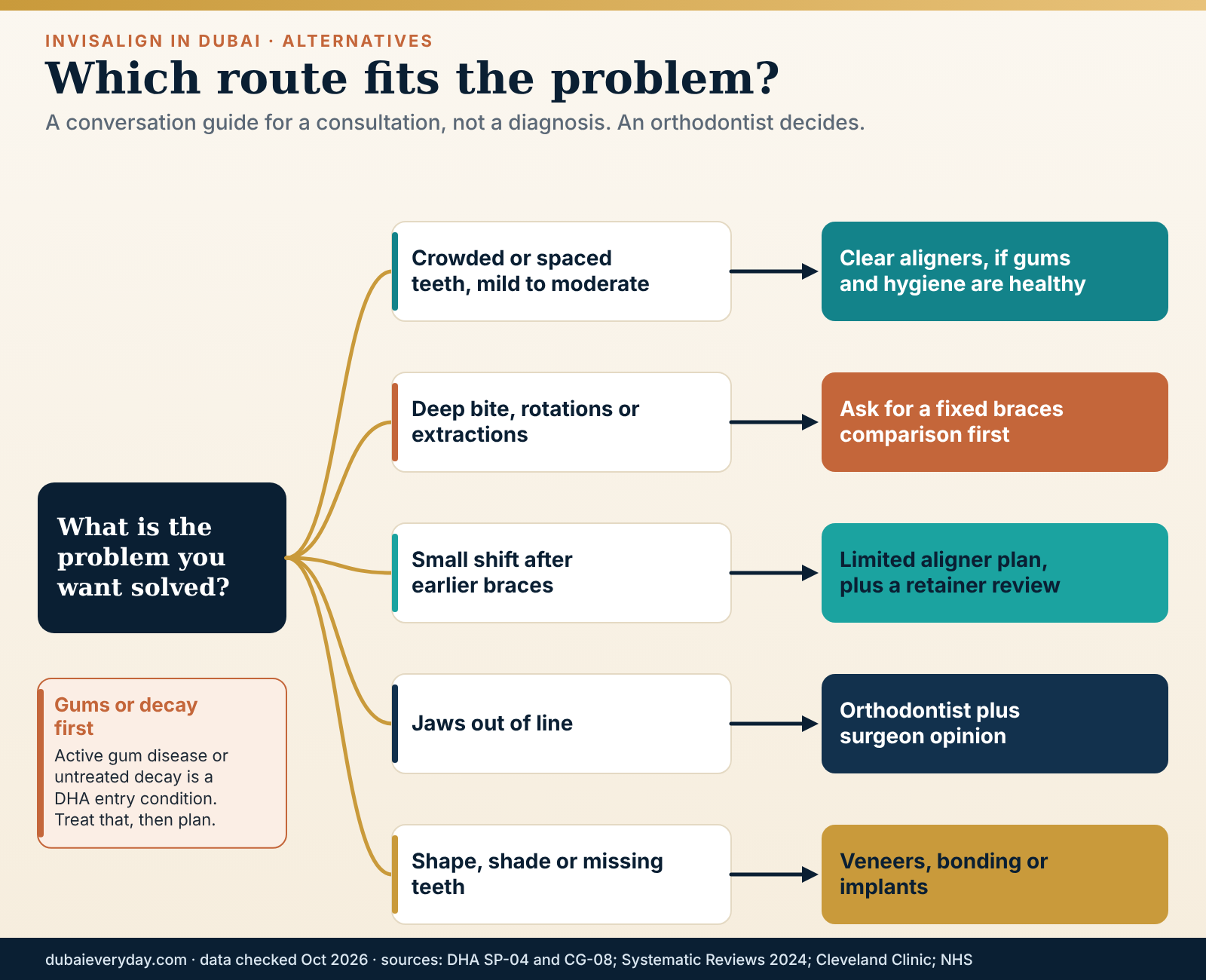
The table below is our reading of the evidence and the DHA text, not a diagnosis. Only an examining orthodontist can place your teeth in a row. Use it to decide how hard to push on questions.
| What you have | Typical fit for aligners | What to ask the clinician |
|---|---|---|
| Mild crowding or small gaps, adult, healthy gums | Usually a good fit; the range most studies describe as suitable | How many aligners are planned, and is a short package enough? |
| Mild relapse after earlier braces | Often a good fit, if the retainer history is clear | Would a limited plan work, and what will keep it stable? |
| Moderate crowding needing spacing work | Possible; may involve enamel reshaping between teeth | How much reshaping is planned and is consent separate? |
| Deep bite | Harder; early undershoot is documented | How is the bite being opened and what is plan B? |
| Rotated premolars or canines | Harder; lower accuracy documented | Will attachments or other aids be used? |
| Extractions needed | More demanding; some studies show weaker bite control | Would braces be more predictable for my case? |
| Significant skeletal mismatch of the jaws | Outside what aligners alone are designed for | Is a jaw-surgery opinion needed first? |
| Active gum disease or untreated decay | Treat that first | When will the gums be stable enough to start? |
The hygiene gate
The 2026 DHA orthodontic guideline sets entry conditions that surprise people. It describes orthodontic treatment as delivered to patients with a good standard of oral hygiene (a plaque score under 1.5 on the Turesky index), healthy or stable gums and no active decay. It says patients with poor hygiene or high sugar intake are unsuitable for active appliance treatment until that is sorted out, and it lists three documented warnings about poor hygiene as grounds for discontinuing treatment.
The text we read does not carve out aligners, so assume it applies. Practically, an Invisalign Dubai clinic may ask you to have a hygiene visit or fillings first, and that is the guideline working as designed, not an upsell. The extra cost is real, so budget for it.
Who is a poor candidate on health grounds
Beyond the table, the guideline treats compromised gum health, including recession and bone loss, as a limiting factor, and warns that root resorption, a shortening of tooth roots whose cause is unknown and cannot be predicted, may call for a pause or removal of appliances. Heavy teeth grinding, jaw joint problems and very short roots are things an examining clinician will weigh, and a general guide cannot. Tell the clinician about any medicines, pregnancy, previous dental trauma or jaw pain at the first visit.
Provider experience: judging an Invisalign Dubai clinic
Everyone selling Invisalign Dubai treatment says “experienced”. Few say experienced at what, with which cases, and with what refinement rate. This section turns a vague word into questions you can ask in a consultation without sounding adversarial.
Specialist versus generalist, in plain terms
Section two covered the licence rule. Experience is a separate layer: an orthodontist completes years of postgraduate study in tooth movement, growth and bite, which is what makes aligner planning safer. The DHA orthodontic guideline expects orthodontists to diagnose with a problem list built from history, examination and records, and to estimate treatment and retention time and visit frequency for you. A clinician who skips that structure is skipping the guideline.
What Invisalign tier badges do and do not mean
Many Invisalign Dubai clinics display labels such as Diamond, Platinum or Gold. These are the manufacturer’s provider levels, and secondary sources describe them as tied to how many Invisalign cases a provider starts over a set period. A UK clinic’s explainer says they are not a quality score, a licence or a guarantee, and that a lower-tier provider can do excellent work on simple cases. We could not verify how Align assigns levels in the UAE, so take it as: a badge says “does a lot of Invisalign”, at best.
That has value. Volume gives a clinician pattern recognition. But volume measures throughput, not outcomes, and it says nothing about how often the clinic’s first plans needed refinement. Ask for that number instead.
Ten questions to put to any Invisalign Dubai clinic
- Who is the DHA-licensed orthodontist responsible for my plan, and how often will that person see me?
- Can I see two or three finished cases with a problem like mine, with the planned and achieved movements?
- In cases like mine, how often do you need a refinement, and how many sets have been your longest?
- Which movements in my plan are the hard ones, and what is your fallback if they stall?
- Will you show the digital plan in full before I sign, including the final position and number of trays?
- Will any enamel be reshaped between teeth, how much, and where is that consented?
- What is the tray-change schedule, and who checks my progress between visits?
- What happens if I move out of Dubai or change jobs midway?
- What retainer is included, how many, and who pays to replace a lost one?
- If we disagree about the result, what is the process and who decides?
Reading before-and-after photos with a sceptical eye
Invisalign Dubai galleries are marketing, and the DHA has rules about them. Its social media standard (ST-21) bans absolute or exaggerated claims such as “best” or “100%”, requires before-and-after images to show the same person with the same lens and no editing, and calls for a risk disclaimer. In 2026 the authority tightened enforcement of those rules. A gallery that crops teeth to a smile without the profile, or claims perfect results for everyone, is not following the spirit of the standard.
Better evidence is a written plan that matches your mouth, a clinician willing to say “this part may not move” and an agreement that names what happens next. Our guide to choosing clinics in Dubai covers the general habit of checking before booking.
The treatment path, from first scan to last tray
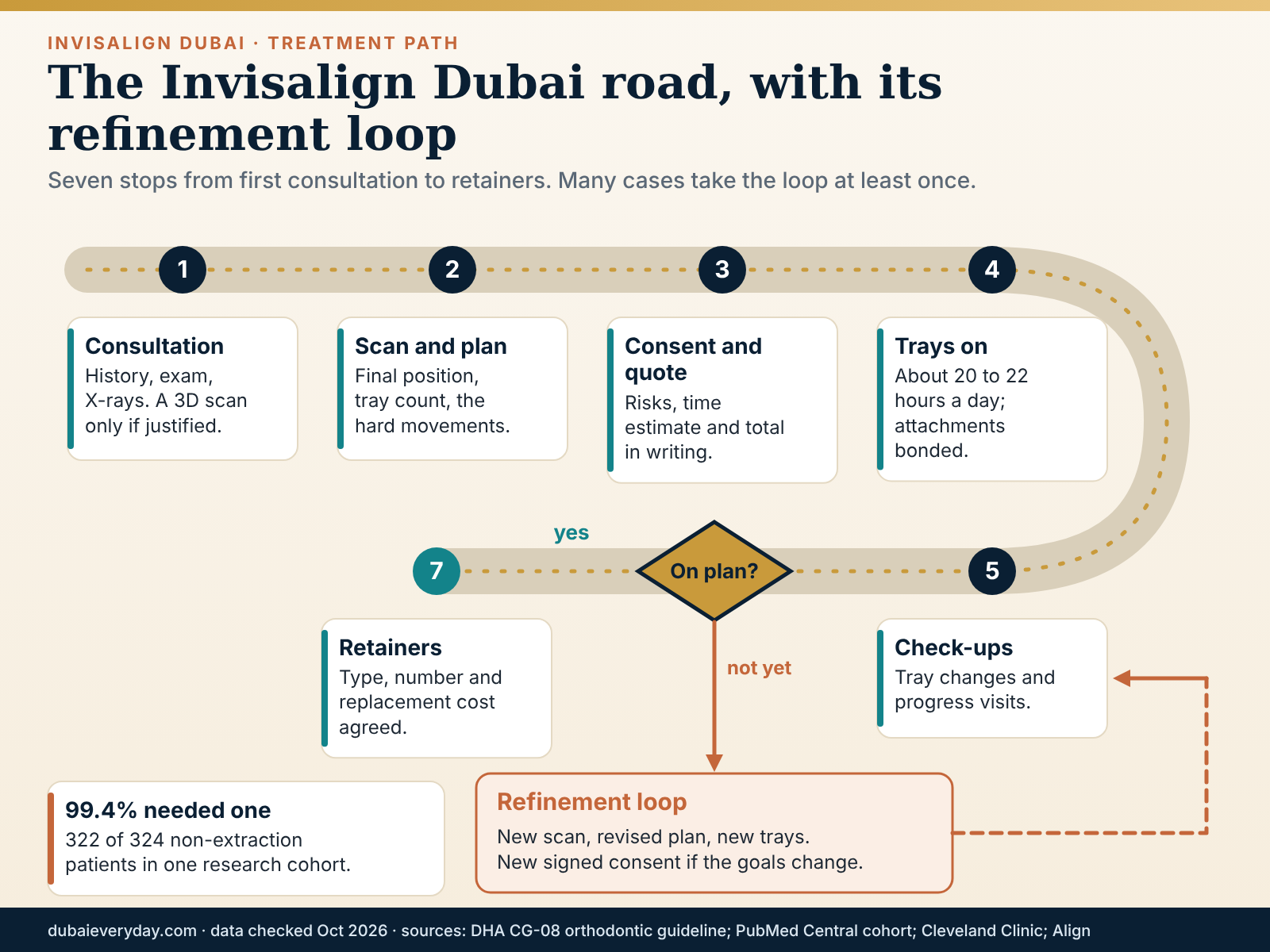
Knowing the sequence helps you spot what is missing from an Invisalign Dubai quote. The order below follows the DHA guideline’s expectations (history, examination and records, then diagnosis, consent and a time estimate) and the manufacturer’s description of its process. Clinics vary in detail, and the dates are rough.
- Consultation and recordsHistory, examination, photographs and usually X-rays. The DHA guideline lists panoramic and side-view skull X-rays for orthodontic diagnosis, and says a 3D scan (CBCT) must be justified for each patient and used only when ordinary films cannot answer the question.
- Digital scan or impressionsThe clinician captures your teeth for the plan. Cleveland Clinic describes the data going to lab technicians who make each aligner.
- The digital planAlign’s planning software, called ClinCheck, shows the staged movements to a final position. This is the moment to look at what is being asked of each tooth.
- Consent and the written quoteThe guideline requires written informed consent covering benefits, risks and complications, and a realistic time estimate for treatment and retention.
- Attachments and fittingSmall bonded bumps go on selected teeth, and you receive the first trays with wear instructions.
- Tray changes and check-upsYou swap trays on the clinician’s schedule and attend progress visits. Some clinics add remote check-ins between them, so ask whether yours does.
- Finish, refine or holdEither the final tray fits and you move to retainers, or the clinician orders a refinement.
How many hours, how often
Manufacturers and clinics quote slightly different wear times. Align’s own page says doctors recommend 20 to 22 hours a day, and Cleveland Clinic says 22 to 23. The gap is small in practice: aligners come out for meals, brushing and flossing, and that is most of the difference. Tray-change timing also varies. Align’s footnote on treatment time assumes about a week per tray, while Cleveland Clinic describes a new set about every two weeks. Your clinician sets the schedule, and the schedule is part of the plan.
Cleveland Clinic also notes that discomfort is common with each new set and usually eases within a few days, that soft foods help at first, and that sharp or lasting pain, bleeding or swollen gums, or a loose tray should prompt a call to the orthodontist. That is ordinary advice, but it is worth asking where you call after hours.
How long does Invisalign Dubai treatment take?
Cleveland Clinic says mild cases with a few slightly crooked teeth may take up to nine months, and more serious problems longer. The DHA orthodontic guideline, which covers all orthodontics, notes treatment may last over two years with visits every five to six weeks. A 2017 comparison cited in the systematic review above found aligner treatment faster than fixed braces in selected cases, at about 13.4 months against 19.1, while fixed appliances achieved better reduction in a standard bite score.
Our calculation, to show why Invisalign Dubai quotes of “6 to 12 months” can slip: in the 324-patient Australasian cohort discussed in the next section, the median initial plan was 26 aligners per arch and the median for refinement plans was 20.5. At weekly tray changes, 26 plus 20.5 trays is about 46 weeks, close to eleven months before gaps for ordering and appointments. At fortnightly changes, the same count is about 93 weeks, a little over 21 months. Medians do not add up neatly, so treat this as arithmetic, not a forecast.
Refinements: why the first plan is rarely the last
In Invisalign Dubai treatment, a refinement is a new set of trays ordered when the teeth have not reached the planned position. It begins with another scan, a revised digital plan and a wait for manufacturing. It is a normal part of aligner treatment, which is exactly why you should understand it before the first tray.
How common are they
A retrospective cohort indexed in PubMed Central used a research database from Australia and New Zealand to follow 324 non-extraction Invisalign patients treated by 11 orthodontists. It found 99.4% needed a refinement (322 patients), with a median of two refinement plans per patient. The authors concluded that patients were prescribed almost double the number of aligners initially predicted. The study counted plans and trays and did not measure final quality or duration, and it is one dataset, not a Dubai statistic.
The deep-bite study above is consistent: completed cases averaged 3.27 sets. Neither study shows that refinements mean failure. They show that the initial number of trays in an Invisalign Dubai quote can be a floor rather than a total.
Why teeth lag behind the plan
Three things recur in the literature. The software predicts movement that the biology does not fully deliver, as the accuracy figures earlier suggest. Wear time slips, because trays in a pocket do not move teeth. And some movements, such as rotating a round tooth or intruding a front tooth, are simply harder with plastic. A clinician who explains which of these is likely in your case is giving you the information you need.
What a refinement should look like in writing
Ask for these items in your Invisalign Dubai treatment agreement, not in a conversation.
- Whether refinement trays are included, and for how long after the first set finishes.
- How many refinement rounds are included before extra fees begin, and what the fee is.
- Whether a new scan, X-ray or attachment set is charged separately.
- Who decides that a refinement is needed and when the clinic will say “this is as good as it gets”.
- What happens to the retainer timeline while you refine.
The same Australasian study cites another report that going beyond three refinements does not necessarily improve the final bite. That is useful framing: a good clinician sometimes stops and accepts a trade-off, or suggests a different appliance, rather than cycling indefinitely.
When the plan changes, the consent should too
The DHA orthodontic guideline requires written informed consent before treatment and a new signed consent whenever the treatment plan changes. Whether a refinement counts as a change will depend on what it alters. If your goals shift, for example from “align” to “also correct the bite”, ask to see and sign the revised plan. In our reading, that is both your protection and the clinic’s.
Be cautious of an Invisalign Dubai contract that promises a fixed price for “the whole treatment” but defines refinements as optional extras at the clinic’s discretion, caps them without saying what happens next, or makes you pay a deposit before the digital plan is shown. If the final tray is “the end” by contract while your teeth are not where the plan said they would be, you may have little in writing to point to when you ask for more trays.
Retainers: the cost and habit that follow Invisalign
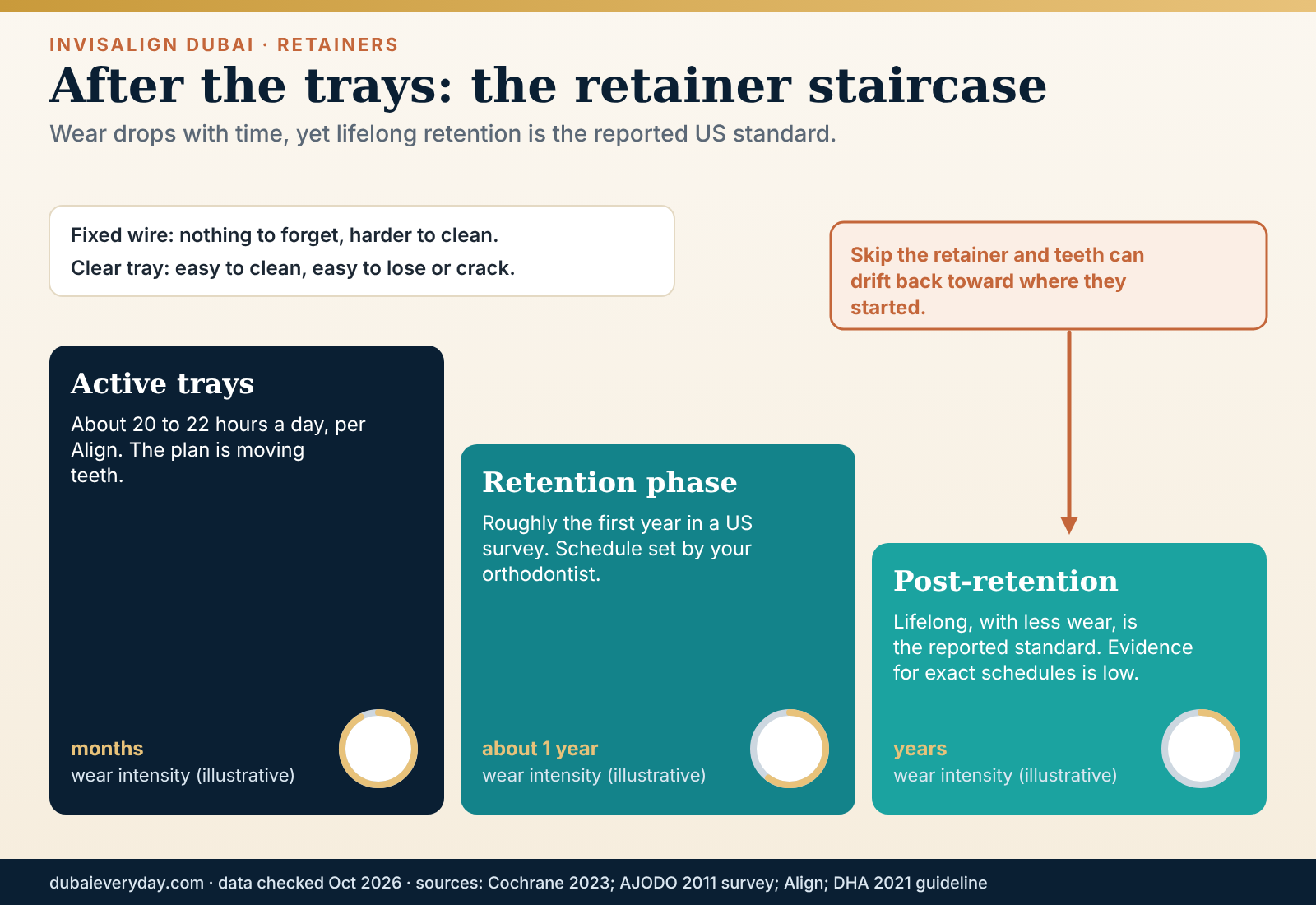
With Invisalign Dubai treatment, moving teeth is half the job. Keeping them there is the other half, and it never fully ends. Align’s retainer page says teeth can drift back toward their old positions because chewing and grinding keep applying forces, and that the doctor sets how long and how often you wear a retainer. The NHS says the same for braces: you will need a retainer, and the orthodontist decides how long.
What the DHA guideline says about stability
The earlier 2021 edition of the DHA orthodontic guideline says that finishing treatment does not guarantee a stable result, and lists growth, ageing, poor compliance with retainers, gum problems, lingering habits and trauma as influences on stability. The 2026 edition requires clinicians to give you a realistic estimate for both treatment and retention, and the visit frequency in each phase. We could not read the 2026 retention recommendations in full, so the retention wording here comes from the 2021 text and the general requirement in the new one.
How long is “long enough”
Nobody can give a number with confidence. A US survey of 1,632 orthodontists, published in the American Journal of Orthodontics and Dentofacial Orthopedics in 2011, reported that lifelong retention is the standard among respondents, split into a first retention phase of roughly the first year and a lifelong post-retention phase with less wear. The authors framed this as practice habit and not proof, and cited a Cochrane review finding too little data to support specific protocols. They also quote earlier work suggesting a large share of patients have unacceptable alignment ten years after treatment.
The 2023 Cochrane update (Martin and colleagues) looked at fixed and removable retainers and reported that differences in relapse were under 1 mm and not clinically significant, with most evidence rated low or very low certainty. It does not state how long to wear one. Our reading: pick the retainer you will actually use, and plan for years, not months.
Fixed or removable
Removable clear retainers
A clear tray you wear at night or part-time. Align sells its own brand and says retainers can be removed to eat, drink, brush and clean. In the Cochrane review, full-time clear retainers were linked to less gum bleeding, but clear retainers were also more often lost or worn inconsistently. They can also be cracked by grinding.
Fixed bonded wire
A thin wire glued behind the front teeth. Nothing to forget, but it is harder to clean around and can come loose, and the Cochrane review notes bonded retainers broke more often in one trial. A failed wire can allow movement without you noticing.
Both together
Some clinicians combine a bonded wire on the lower front teeth with a removable retainer on top. The Cochrane review did not identify a single best design, so this is a conversation about your teeth, not a rule.
Retainer questions for an Invisalign Dubai quote
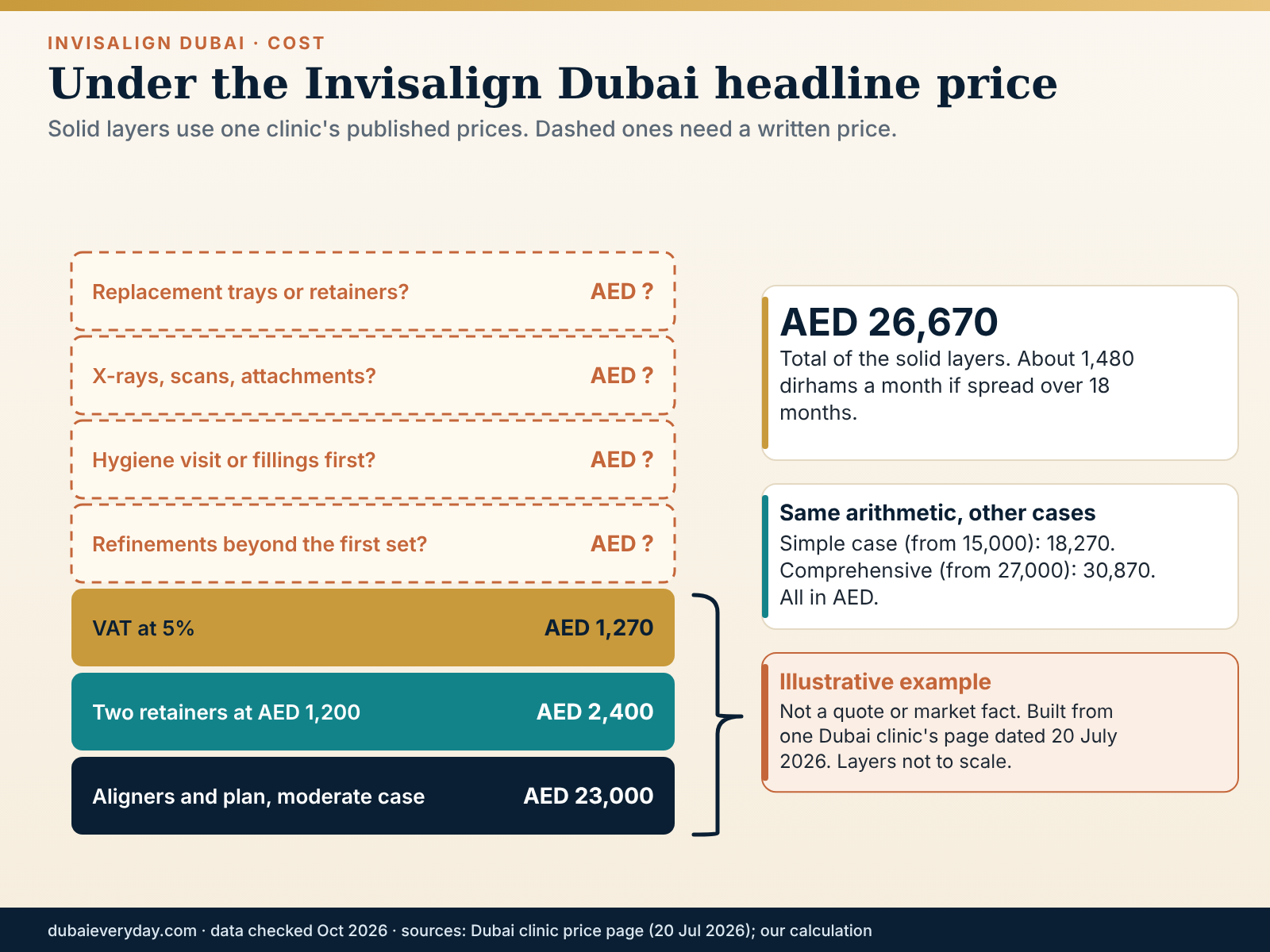
One Dubai clinic’s published price page lists retainers from AED 1,200 per arch for both fixed and removable types, and the page says the written plan should state whether retainers are inside the treatment fee or listed separately. That is the right question for any clinic. Ask which retainers are included, how many sets, what replacement costs, and whether a broken fixed wire is repaired without charge. Another Dubai package page we found included “final retainers” in a promotional price, but its offer window ended in June 2025, so we do not rely on it.
Heat, cases and the mundane ways retainers die
Plastic trays are not heat-proof. Align’s care guidance we read recommends brushing aligners with a soft toothbrush and rinsing in lukewarm water, and keeping them in a protective case whenever they are out. It does not discuss cars. In a city where a parked car can get hot, the sensible reading is to keep trays and retainers on you and not on the dashboard. That is our inference from the lukewarm-water advice, not a manufacturer’s rule.
The two most common ways a retainer fails are being wrapped in a napkin and thrown away, and being left in a pocket. A case that lives in your bag solves both. Ask for a spare set at the end of treatment, or at least ask what a replacement costs and how fast it can be made, because the best time to learn that is not the week a tray cracks.
Invisalign Dubai cost, insurance and payment plans
We found no official or regulator-published price list for Invisalign Dubai treatment. What exists are clinic pages, discount directories and promotional offers. Each tells you something, none is a quote, and the differences are wide enough to be a finding in themselves.
What published Invisalign Dubai prices show
| Source and date | Published figure | How we read it |
|---|---|---|
| Dubai dental clinic price page, 20 July 2026 | Simple case from AED 15,000; moderate from AED 23,000; comprehensive from AED 27,000; prices subject to 5% VAT | “From” prices by case type; one clinic only |
| Same page, retainers | Fixed or removable from AED 1,200 per arch | Implies retainers may be separate; the page says to check |
| Same page, consultations | First consultation free; specialist consultation from AED 250 | Free first visit may not be with the orthodontist |
| Discount-code directory, listings dated 29 October 2026 | Roughly AED 6,500 to AED 18,500, with higher “was” prices struck through | Promotional ranges, inclusions not listed, commission model not verified |
| Hospital-group promotional page | AED 7,000 package with final retainers, valid until June 2025 | Expired; shows how promotions age, not a current price |
A fair summary of Invisalign Dubai pricing is that serious full-case pricing from a clinic that publishes it starts in the mid-teens of thousands of dirhams, while heavily discounted headline figures exist and their scope is unclear. We did not find a verified, current price for fixed braces in Dubai, so we make no direct comparison with aligners. A clinic’s own braces quote is the only fair comparison.
Our calculation: from a “from” price to a realistic Invisalign Dubai total
Illustrative example, not a quote or market fact. Take the clinic page’s “from” prices and add what it says may be extra. For a moderate case at AED 23,000, add two retainers at AED 1,200 each, which makes AED 25,400, then 5% VAT, which brings it to AED 26,670. A simple case at AED 15,000 plus two retainers and VAT comes to AED 18,270, and a comprehensive case at AED 27,000 comes to AED 30,870. Spread AED 26,670 over 18 months and it is roughly AED 1,480 a month.
We have not added refinement fees, X-rays, a hygiene visit or fillings beforehand, or replacement trays, because we found no verified prices for them. They are exactly the items to price in writing. If a clinic includes refinements and retainers and states VAT, its higher-looking number can be the cheaper one.
What a good written Invisalign Dubai quote contains
- Treatment tier or case type, in words, and the number of trays shown in the digital plan.
- Whether consultation, X-rays, scans and attachments are included.
- Refinements: included or charged, how many, and at what price.
- Retainers: type, quantity, replacement price and repair terms.
- Any enamel-reshaping, gum or filling work required first.
- VAT stated, plus the total payable and the payment schedule.
- What is refunded if you stop, move or are told the case is unsuitable.
Insurance and Invisalign Dubai treatment
Dubai’s health insurance regime requires employers to insure employees, but it does not require generous dental cover. The DHA’s 2014 employer information pack describes the minimum Essential Benefits Plan in a way that is internally inconsistent: one passage lists dental diagnosis and treatment at 20% coinsurance, while the exclusions list excludes dental treatment, prostheses and orthodontics. Read your own table of benefits, not summaries of it.
A comparison site, InsuranceMarket.ae, says orthodontics, meaning braces and clear aligners, is frequently excluded from standard dental plans, and that some plans cover it only with a specific orthodontic benefit. It also says dental is usually an add-on or sits in mid and premium tiers, with co-pays in the 20% to 30% range used as an illustration, low annual limits and pre-approval for costly work. Treat that as market colour from a non-regulator. For the basics of cover, see our guide to health insurance for Dubai residents.
If your policy has an orthodontic benefit, ask the insurer, in writing, whether it covers Invisalign Dubai treatment or only braces, what the lifetime or annual cap is, whether it is limited to children, and whether the clinic is in network. Clinics often submit pre-approval for you, but the answer matters before the first payment, not after.
Payment plans: read the fine print
Instalment arrangements for Invisalign Dubai treatment are common. Some listings say no payment is due until you confirm treatment after seeing the doctor, and a sensible clinic will separate a deposit for records from the main fee. Before agreeing, check whether the plan has interest or fees, what happens if you stop paying, and whether you receive trays only as you pay. Do not pay the full fee up front for a multi-year treatment unless the refund terms are written and you are comfortable with them.
Alternatives to Invisalign in Dubai
Invisalign Dubai treatment is one route to straighter teeth, and sometimes the wrong one. A consultation that only discusses one product is a sales conversation. The honest question is which tool fits the problem, the budget and your tolerance for lifestyle change, and the options below are the ones a Dubai orthodontist can reasonably put on the table.
Fixed braces
Brackets and wires remain the workhorse for complex tooth movement. The NHS describes fixed braces as typically worn for one to two years, with adjustment visits every six to eight weeks and a retainer afterwards. In the systematic review discussed earlier, a 2017 comparison found fixed appliances achieved better reduction in a standard bite-quality score, although aligners were faster in that sample. Cleveland Clinic likewise says traditional braces may correct some dental problems faster.
The trade-offs are visible metal or ceramic, harder cleaning and food rules. The DHA guideline’s hygiene gate applies to fixed braces too, and arguably matters more there. Ceramic and tongue-side (lingual) versions exist for people who want less visibility, with their own cost and comfort trade-offs we could not price from verified sources.
Other clear aligner brands
An Invisalign Dubai search turns up one brand, but it is not the only one. Other manufacturers sell similar trays, and the DHA scope rule is about clear aligner treatment, not about a brand. Ask the same questions of any provider: who is the orthodontist, what does the plan show, what are refinements, what are retainers. If a clinic recommends a brand, ask why it suits your case and not only what it costs.
Limited or short courses
If one or two front teeth have moved since braces or from ageing, a smaller plan can be enough. Clinics sometimes sell these as lite or express packages. The risk is a short plan that looks cheap but cannot close the gap you actually have, followed by an upgrade. Ask the clinician to state in writing which problem the short plan treats and which it leaves alone.
Veneers, bonding and contouring
These change the look of a tooth, not its position. They can mask small irregularities but involve preparing or adding to the tooth surface, and they do not solve a bite problem. If your goal is a quick cosmetic change on a few front teeth, they are a legitimate conversation. We cover materials, preparation and cost in our veneers guide. If teeth are missing rather than crooked, the relevant guide is dental implants in Dubai.
Jaw surgery combined with orthodontics
When the problem is the position of the jaws and not just the teeth, an orthodontist may involve an oral and maxillofacial surgeon. The DHA scope-of-practice standard lists multidisciplinary work with surgery among an orthodontist’s tasks. Aligners alone are not designed to change jaw position, so a good clinician will say so early.
At-home or mail-order aligners
An October 2026 ADA News report on a US Food and Drug Administration warning says the agency has not authorised clear aligners sold directly to consumers without a prescription and professional supervision. It lists risks including uneven bite, unintended tooth movement, pain and tooth loss, and advises an evaluation, preferably in person, before starting. It also says registration is not authorisation and that you can check clearance in the FDA database under product code NXC.
That is a US regulator talking about the US market. We did not find a DHA statement specifically on mail-order aligners. But the DHA standard places clear aligner treatment with orthodontists, and a service with no examination does not fit that picture. If an advertisement promises a full result by post, treat it as a red flag and speak to a licensed clinician first.
Doing nothing, or waiting
Mild crowding that bothers nobody does not have to be treated. If the concern is cosmetic and recent, waiting until your gums, budget and schedule are right is a respectable choice. If the concern is cleaning, gum health or a bite that hurts, a dentist may have medical reasons to treat sooner. Our dentist guide explains how to arrange a general check first.
Six scenarios, worked through
These are composite examples built to show reasoning. They are not real patients and not predictions. In each, the first step is the same: an in-person assessment by a licensed orthodontist.
1. The resident with mild front crowding
A 29-year-old office worker has lower front teeth that overlap slightly, healthy gums and no bite complaints. Invisalign Dubai treatment is a reasonable fit, since this is the mild, non-extraction range the studies describe. The questions that matter are cost clarity and discipline. Can they commit to 20 or more hours a day around lunches and client dinners? The quote should list trays, retainers and refinements. A short plan may suffice if the orthodontist confirms the problem is small.
2. Relapse after teenage braces
A 34-year-old had braces at 15, stopped wearing the retainer and now has a front tooth tilting inward. The earlier 2021 edition of the DHA guideline lists poor retainer compliance among the causes of instability, so this is a textbook case. A limited plan may fix it, and the more important decision is the retainer afterwards: ask which type, how long, and who replaces it. Do not accept “you will not need one this time”.
3. Deep bite plus crowding
A 31-year-old has a heavy bite where the upper front teeth overlap the lower by a lot, with crowding. This is the type of problem where the studies show plans often fall short. It is not a reason to say no. It is a reason to ask for a direct comparison with braces, the expected number of refinements and written terms for both. If the clinic only discusses aligners, get a second opinion.
4. The visitor with three weeks
A visitor staying three weeks asks for quick Invisalign Dubai treatment because it looks cheaper than at home. Treatment runs for months with check-ups and a refinement is likely, so the only sensible Dubai role is a consultation, records or a plan to be carried out by an orthodontist at home. Take scans, photographs and X-rays with you, ask for a written summary, and read the local rules in our Dubai travel guide before planning the rest of the trip.
5. The resident who might leave
An employee on a two-year contract is considering a 15-month Invisalign Dubai plan. If the move happens at month nine, who finishes the case? Ask whether the clinic will release the digital plan and records, whether remaining trays are shipped or refunded, and what a handover letter looks like. Put the answer in the agreement. If departure within the plan window is likely, a shorter plan, braces or waiting may all be better than an unfinished case.
6. Gum disease and a long wish list
A 42-year-old has bleeding gums and several old fillings and wants everything fixed. The DHA hygiene gate says orthodontics should wait for stable gums and no active decay. The order of work is likely to be periodontal treatment, fillings, then alignment, then restorative work that depends on final tooth positions. Our guide to finding a GP helps if you also need medical clearance, and the dentist guide covers the dental side. Budget for the preliminary work as part of the real price.
Mistakes and a checklist before you sign
The mistakes below follow from the regulator documents, patient guidance and studies above. They are not about anyone in particular.
Common mistakes
- Choosing an Invisalign Dubai clinic by price alone and discovering later that refinements, retainers and VAT were extra.
- Assuming the clinician is an orthodontist because the clinic says Invisalign on its door.
- Judging a clinic by before-and-after photos that show only the smile and not the bite.
- Treating the number of trays as a promise of how long it will take.
- Skipping the dentist for gums and decay, then being told treatment must pause.
- Wearing trays 12 hours a day and being surprised when teeth lag behind the plan.
- Throwing away or cracking the retainer and not replacing it.
- Starting a case you cannot finish in Dubai without agreeing what happens if you leave.
The Invisalign Dubai pre-signing checklist
- Verify the personName and licence title of the treating orthodontist, checked on the DHA registry, plus the facility licence.
- See the planThe digital plan, the final position, the number of trays and the hard movements.
- Get the total in writingTier, scan, X-rays, attachments, refinements, retainers, VAT, payment schedule.
- Agree the exitsRefund terms, handover if you move, and what happens if the case is unsuitable.
- Check the gum gateHygiene visit or fillings first, priced and scheduled.
- Plan the finishRetainer type, number, replacement cost, and who checks them.
A clinician who answers these questions plainly is a good sign. If answers are vague or the pressure to pay today rises, take your records and see another orthodontist. A second opinion on a multi-thousand-dirham, multi-year plan is not rude, and the DHA guideline itself expects patients to receive enough information to make an informed decision. For where to start with a wider healthcare problem, read the Dubai healthcare guide.
Invisalign Dubai FAQ
How much does Invisalign cost in Dubai?
There is no official Invisalign Dubai price list. One Dubai clinic’s page published on 20 July 2026 lists simple cases from AED 15,000, moderate from AED 23,000 and comprehensive from AED 27,000, plus 5% VAT, with retainers from AED 1,200 per arch. Discount directories show lower promotional figures with unclear scope. Treat all as indicative and ask for a written total including refinements, retainers and VAT. Invisalign Dubai prices are as checked in October 2026.
Can a general dentist provide Invisalign Dubai treatment?
Under the DHA scope-of-practice standard we read (version 2, effective February 2024), a general dentist may not practise clear aligner treatment and must refer the patient to an orthodontist. An updated version 2.1 was announced in December 2024, but we could not read it. Ask the Invisalign Dubai clinic who the licensed orthodontist responsible for your plan is, and confirm on the DHA registry.
How long does Invisalign Dubai treatment take?
It depends on the case. Cleveland Clinic says mild cases may take up to nine months and more serious ones longer. A 2024 study of completed deep-bite cases averaged about 23 months. Tray-change schedules and refinements change the total, and the DHA guideline requires your clinician to give you a realistic estimate for treatment and retention, plus visit frequency. Ask for the estimate in writing.
Does health insurance cover Invisalign Dubai treatment?
Often not. A comparison site says orthodontics is frequently excluded from standard dental plans, and the DHA’s 2014 pack for the minimum plan lists orthodontics among exclusions while also mentioning dental treatment, which is contradictory. Check your table of benefits and ask the insurer in writing whether clear aligners count as orthodontics, what the cap is and whether your chosen clinic is in network before you start.
Are refinements included in an Invisalign Dubai price?
Sometimes, sometimes not. One 324-patient research cohort found 99.4% of non-extraction Invisalign patients needed a refinement, so assume you will. Ask whether refinement trays are included, how many rounds, what triggers an extra fee and whether a new scan or X-ray is charged separately. Get the answers in the treatment agreement and not only in conversation.
How do I check an orthodontist is licensed in Dubai?
Use the Dubai Medical Registry on the DHA’s Sheryan portal, which has professional and facility tabs and a speciality filter. Look for a specialist or consultant orthodontist title and confirm the facility is licensed. Clinics inside Dubai Healthcare City are licensed by that free zone’s regulator instead, so check the right body for the clinic’s address.
Do I need a retainer after Invisalign, and for how long?
Yes, in practice. Align says teeth can drift back without one, and the NHS says your orthodontist decides how long. A US survey found lifelong retention is the reported standard among respondents, though a Cochrane review rates the evidence for specific protocols as low. Plan for years of night-time or part-time wear and ask what a replacement costs.
Is Invisalign Dubai treatment better than braces?
Not universally. A 2024 systematic review calls Invisalign a valid alternative for mild to moderate non-extraction cases in adults, and notes known weak spots such as incisor intrusion, premolar rotation and large bite changes. Fixed braces can be more predictable for complex cases. Aligners are removable and less visible, but only work when worn about 20 to 22 hours a day.
Can tourists get Invisalign Dubai treatment?
Treatment runs for months with check-ups and probably a refinement, so a short visit rarely fits. A tourist can have a consultation and ask for records, scans and a plan to take home to their own orthodontist. Avoid starting a case you cannot monitor, and ask in writing what happens to unused trays if you leave.
Can Invisalign fix an overbite?
Sometimes, but this is a known weak area. In a 2024 study of 355 adults, about 46% of planned overbite reduction was achieved in non-extraction cases and under 9% in extraction cases. A deep-bite study found most correction came from the first set of trays. Ask your orthodontist how the bite will be changed and what happens if it does not move as planned.
Are at-home or mail-order aligners safe?
The US FDA warned in October 2026 about clear aligners sold directly to consumers without professional supervision, citing bite problems, unintended movement, pain and tooth loss. We found no DHA statement on mail-order aligners, but the DHA standard places clear aligner treatment with orthodontists. An in-person assessment first is the safer path.
Keep reading
Sources and further reading (26 links)
- Dubai Health Authority: Clinical Guidelines for Orthodontics (CG-08; issue 2) — consent, records, CBCT, hygiene entry conditions, duration
- Dubai Health Authority: Guidelines for Orthodontics (CG-08; 2021 edition) — retention and stability wording
- Dubai Health Authority: Scope of Practice and Core Competencies of General and Specialist Dentists (SP-04) — clear aligner scope and training
- Dubai Health Authority: Circular on scope of practice version 2.1 — update to the scope standard
- Dubai Health Authority: Circular on the Dubai Dental Guidelines version 2 — the set of eleven dental guidelines
- Dubai Health Authority: Dubai Medical Registry (Sheryan) — professional and facility lookup
- Dubai Health Authority: Standards for Medical Advertisement Content in Social Media (ST-21) — before-and-after and claims rules
- ADA News: FDA warns public about unauthorized direct-to-consumer clear aligners — FDA warning and product code
- Systematic Reviews: An evaluation of the Invisalign aligner technique and consideration of the force system — accuracy of tooth movement
- The Angle Orthodontist: Predicted and achieved overjet and overbite with the Invisalign appliance — bite-change accuracy
- PubMed Central: Retrospective cohort of Invisalign treatment plans and refinements (Australasian Aligner Research Database) — refinement frequency
- BMC Oral Health: Does aligner refinement have the same efficiency in deep bite correction? — deep-bite accuracy and duration
- Cochrane Library: Retention procedures for stabilising tooth position after treatment with orthodontic braces — retainers and relapse
- American Journal of Orthodontics and Dentofacial Orthopedics: Evaluation of retention protocols among American Association of Orthodontists members — lifelong retention practice
- NHS: Orthodontic treatment — braces, retainers, visit intervals
- Cleveland Clinic: Clear aligners — wear time, duration, side effects
- Align Technology: Retainers after Invisalign treatment — manufacturer’s retainer guidance
- Align Technology: Cases for Invisalign aligners — wear time and care
- Align Technology: Invisalign frequently asked questions — footnote on treatment-time assumptions
- Dubai dental clinic: Invisalign cost page — published case-type prices, VAT and retainers; cited for figures only, not an endorsement
- Dr Five: Invisalign and aligner prices and offers in Dubai — discount-code directory; indicative only
- Emirates Hospital Group: Invisalign package page — expired promotion used to show how offers age
- InsuranceMarket.ae: Dental insurance in Dubai — market view on orthodontic exclusions; comparison site, not a regulator
- Dubai Health Authority: Employer’s Information Pack on the Dubai Health Insurance Law — minimum plan wording
- Whites Dental: Invisalign provider levels explained — what provider tiers mean; a UK clinic, context only
- The National: Dubai aesthetic clinics to face disciplinary action over edited social media images — tightened advertising enforcement; secondary report
Update log: 29 October 2026, first publication; all facts re-checked against the sources above. Next review due: 29 April 2027 (six-monthly), or sooner if the DHA publishes a new scope-of-practice or orthodontic document. Corrections welcome.
This page is general information, not individual medical, dental, legal or financial advice. No dentist has reviewed it. A DHA-licensed orthodontist must examine you before anyone can say what you need.
About DubaiEveryday and this guide
DubaiEveryday.com is an independent editorial project that publishes practical, research-based guides to everyday life in Dubai: where to live, what things cost, how the rules work and how to get around. This page was written and edited by the DubaiEveryday editorial team. It is not signed by a named expert, doctor, lawyer or adviser, and we do not claim first-hand testing of a venue, clinic or service unless the page says so.
Each guide is built from official sources such as government and regulator pages, operator websites and established news outlets, cross-checked where we can. When we could not confirm something, we say so in the text, and examples that use made-up numbers are labelled as illustrations. Mentions are editorial choices, not paid placements, and a link is not an endorsement.
Dubai changes quickly. If you spot something that is out of date or wrong, please tell us through the contact options on DubaiEveryday.com and we will check it and correct the page.