

Getting a missing tooth replaced with an implant in Dubai comes down to four things: who is licensed to do it, what imaging and bone work your jaw needs, how many months it really takes, and what the final bill contains. This guide to dental implants Dubai clinics offer works through each one, checked against official sources on 29 October 2026.
A gap where a tooth used to be has a way of taking over your day. You chew on one side, you smile a little less, and you start searching for answers at midnight. Then the quotes arrive and they look nothing alike.
That confusion is normal, because dental implants dubai clinics offer are really a chain of decisions: who places them, what scans and bone work your jaw needs, how many months the process takes and what the final bill includes. This guide explains each link in plain language, so you can ask your dentist sharper questions and compare quotes fairly. It is general information, and your own dentist should always guide the clinical choices.
Dental implants Dubai clinics place are small posts, usually titanium, set into the jawbone to stand in for a missing tooth root and then carry a crown, bridge or denture. In Dubai the dentist needs a Dubai Health Authority (DHA) licence plus a separate implantology privilege added to it. Advanced surgery, such as a sinus lift or major bone grafting, is restricted to oral surgeons, maxillofacial surgeons and periodontists. Look the person up on the DHA registry before you pay a deposit.
Expect a 3D scan (CBCT) only where a plain X-ray cannot answer the question, bone work in some cases, and a process measured in months because the bone needs time to bond. Price is the weakest part of public information: the only two single-implant prices we could read were AED 3,627 (surgery plus crown) and AED 6,000 to 9,000 (all stages), from two providers on 14 October 2026. Everything else in this guide about money is labelled as illustration. Insurance frequently excludes implants altogether.
This page is general information, not medical advice. A DHA-licensed dentist has to examine you before anyone can say what you need.
This is a research-based guide, not a clinic review. We did not visit any clinic, have no treatment of our own to report and have no clinical qualification, and no dentist has reviewed this draft yet, so it should be read as an informed layperson’s summary of official documents.
The rules come from Dubai Health Authority (DHA) documents read on 29 October 2026: the dental implantology privilege requirements (PI-01), the dental scope-of-practice standard (SP-04), the dental radiology guideline (CG-11), the infection control guideline (CG-10), the dental laboratory standard (ST-59) and the social media advertising standard (ST-21).
General clinical background comes from the US Food and Drug Administration, Mayo Clinic and the World Health Organization. Price information comes from one directory that reads clinics’ own published prices, and the two implant rows it held are too few to be a market.
We name no clinic and rank none. Inclusion was not paid for, there are no affiliate links, and no clinic has seen this page. Where we could not verify something, the text says so. Nothing here replaces an examination by a licensed dentist.
Dental implants Dubai: what the treatment is, in plain terms
A dental implant is a small medical device placed in the jaw where a tooth root used to be. The US Food and Drug Administration (FDA) describes it as a device that restores chewing ability or appearance by holding an artificial tooth, whether that is a single crown, a bridge or a denture. The post itself is the part that goes into the bone. Everything you see in the mouth sits on top of it.
Most people picture dental implants Dubai clinics advertise as a screw with a tooth on it, which is roughly right but hides the fact that there are three or four separate components. The FDA lists the implant body, which sits in the bone, the abutment, which passes through the gum, and the artificial tooth on top.
Some systems add a small fixation screw between the implant body and the abutment. Each piece can be made by a different manufacturer or laboratory, and each piece can fail or be replaced on its own.

Why the bone matters more than the tooth
The clever part is biological. Mayo Clinic explains that the post, typically titanium, bonds with the jawbone over several months, a process called osseointegration, which gives a stable base that a bridge or denture cannot offer. Because the bone is loaded again by chewing, the FDA also lists helping to prevent jawbone shrinkage among the benefits. That is why the bone, not the tooth shape, drives most of the planning in dental implants Dubai dentists propose.
It also explains why the treatment is slow. A crown can be made in days. Bone cannot be hurried. When a provider promises a result that skips the waiting, the useful question is which part of the process is being compressed and what that costs you in risk. The timeline section later in this guide works through what can and cannot be shortened, because the timeline in any dental implants Dubai plan deserves as much scrutiny as the price.
Tooth loss is common enough to plan for. The World Health Organization estimates that almost 7% of adults aged 20 and over have lost all their natural teeth, rising to 23% of people aged 60 and over, and describes tooth loss as usually the end point of long-term disease, mainly advanced decay and severe gum disease. Those are global averages, not Dubai figures. Most people who look into dental implants Dubai clinics place are replacing one or a few teeth, not a full set.
What an implant can replace
One implant can replace one tooth, two or three implants can carry a bridge of several teeth, and a handful of implants can hold a whole arch of fixed teeth or a clip-on denture. Mayo Clinic notes that one implant can also support several bridged teeth. Dental implants Dubai clinics offer therefore range from a single molar to a full-mouth rebuild, and the cost, the number of visits and the risk profile scale with that range.
Full-arch treatment, including the All-on-4 concept, is its own subject with its own decisions about temporary teeth, bone volume and maintenance. We cover it in our guide to All-on-4 dental implants in Dubai. This page stays with the single-tooth and small-bridge decisions that make up most searches for dental implants Dubai residents and visitors run.
What this dental implants Dubai guide covers, and where the neighbours take over
This page has one job: helping you decide whether, where and how to get dental implants Dubai clinics provide, and what to ask before you sign. For general dental care, specialists, check-ups and how to choose a clinic in the first place, our Dubai dentist guide goes wider and covers the licence check in more general terms. For health cover in general, see health insurance in Dubai; we only repeat what matters for implants.
Two reading notes. First, prices appear as AED, and where a US dollar figure helps we use the long-standing fixed rate of about 3.67 dirhams to the dollar (we could not open the central bank page to re-confirm it today). Second, wherever the text says “illustrative”, the numbers exist to show arithmetic, not to describe the market.
The first two numbers describe the training that sits behind a privilege, which the credentials section explains. The last one is a warning about evidence: when a directory finds only two published implant prices in a city with hundreds of dental clinics, any confident “average cost of dental implants Dubai” figure you read elsewhere is an estimate of unknown quality.
Quick orientation. If you only have five minutes: read the credentials section, the cost section and the nine checks near the end. Those three cover the decisions where buyers of dental implants Dubai clinics sell lose the most money or take the most risk.
Are you a candidate? Health, gums, bone and habits
Nobody can answer this from a web page, and a clinic that says “everyone is suitable” before examining you has given you information about the clinic, not about your jaw. What a guide can do is list the factors that dentists weigh when they assess dental implants Dubai patients ask about, so you walk into the consultation knowing which of your answers matter and why.
The FDA’s patient page says overall health decides candidacy and singles out two risk raisers: smoking, which can delay healing, and uncontrolled diabetes, which raises the chance of infection around the implant. The World Health Organization adds that tobacco is a main risk factor for gum disease, and that diabetes and gum disease affect each other in both directions. Those are the two habits to be honest about at a first dental implants Dubai consultation, because they shape both the odds and the follow-up.
Four questions the dentist is really asking
Is your general health stable?
Medical history, medicines and supplements all matter. Mayo Clinic lists a full medication review as part of preparation, and says some people with certain heart conditions or joint replacements may be given antibiotics before surgery. Tell the dentist everything, including supplements and anything a specialist has told you to avoid.
Are your gums healthy?
The FDA names untreated gum disease as a risk for implant problems. Expect an exam of the remaining teeth and gums first, and expect gum treatment to come before surgery if it is needed. A clinic that skips straight to the scan has skipped a step.
Is there enough bone, in the right place?
Mayo Clinic says grafting is needed when the jawbone is too thin or too soft to hold an implant. Bone depends on how long the tooth has been missing, what happened to it, and where in the mouth it was. The CBCT section and the bone section deal with this in detail.
Can you keep it clean?
The FDA lists difficulty cleaning around the implant as a risk in its own right. Mayo Clinic recommends interdental brushes and regular check-ups, and treatment for teeth grinding. An implant that cannot be cleaned is a problem waiting for a calendar date.
Things people forget to mention
Some topics rarely come up unless the patient raises them. Anything that changes how bone heals or how you react to surgery is worth saying aloud: previous radiotherapy to the head or neck, long-term medicines that affect bone turnover, blood thinners, an immune condition, pregnancy or plans for it, and any history of problems with anaesthetic or sedation.
We are not suggesting these rule anyone out. Dentists commonly ask about all of them, and the answer can change the order of treatment, the choice of anaesthesia or the decision to involve your doctor.
Age is the other one. Implants are generally planned once the jaws have finished growing, so teenagers are usually handled differently; ask a paediatric or orthodontic specialist if this applies to your family. At the other end, older age alone is not a bar, but general health and the ability to attend follow-ups matter more as the years pass. We could not verify a DHA rule on either, so treat both as questions for your dentist.
No checklist on this page, or any other, can tell you whether an implant is safe for you. Use it to prepare for a dental implants Dubai examination, then let a DHA-licensed dentist decide. If one clinic says “yes, today” and another says “not until the gum treatment is done”, the cautious answer is the one worth understanding, not the one that fits your diary.
Smoking, in numbers we can and cannot give
The pages we read do not give success percentages for smokers, and we are not going to quote a figure from memory. What both the FDA and Mayo Clinic say in words is consistent: smoking is a contributing factor in implants that fail to bond or that become infected, and quitting before surgery and through healing is part of what the dentist will ask. If you smoke or vape, say so, and ask what the plan looks like if you cannot stop.
Who may place dental implants Dubai rules allow, and how to check
This is the section where Dubai differs most from a generic guide. The market for dental implants Dubai wide is not an open field in which any dentist may place implants because the clinic bought a machine. The Dubai Health Authority regulates it through a licence and an extra permission called a privilege. The document that sets it out is the Dental Implantology Privilege Requirements (reference DHA/HRS/HPSD/PI-01, issue 3, dated 10 August 2021).
What the DHA privilege requires
PI-01 says a professional must be licensed and permitted by the DHA to provide implantology, which is the rule behind every dental implants Dubai treatment. General dentists and dental specialists can apply, with the exception of dental radiologists. An applicant must prove either completion of a DHA-recognised implantology course, or that surgical and prosthetic implantology formed part of a recognised postgraduate specialty programme. Completing a course does not itself allow practice: the privilege has to be added to the licence first.
The course rules are specific. The programme must be structured, run for at least 12 months, and be developed with or affiliated to a dental academic institution; courses designed by individuals are not accepted. Hands-on training on patients needs a one-to-one ratio of supervisor to trainee. The trainee must place a minimum of 30 implants across several patients of varying complexity, recorded in a signed logbook with case types that include single implants, multiple implants in one jaw, and full-arch work.
After the course, the dentist applies through the DHA’s online licensing system, Sheryan, with a certificate of good standing and a recent logbook no older than two years, and has to pass a computer-based test. A dentist returning after a gap in implant practice must meet the DHA gap-of-practice requirements, including continuing education credits and a supervised logbook of at least 30 cases.

Who can do the advanced work in dental implants Dubai cases
PI-01 section 5.3 reserves advanced implant-related surgery, such as a sinus lift or advanced bone grafting, for oral surgeons, oral and maxillofacial surgeons and periodontists. The separate dental scope-of-practice standard (SP-04) fills in the detail. It says implantology is not a specialty in its own right, so a dentist needs the privilege to match their licence, and that the scope of a given privilege depends on training length, case volume and difficulty, evidence of proficiency, the facility’s resources and whether a multidisciplinary team is available.
By the same document, periodontists can prepare sites, place implants and manage disease around implants, including removal. Oral surgeons can place implants and perform external and internal sinus lifts, ridge augmentation and grafting. Prosthodontists provide implant-supported crowns, bridges and dentures and refer complex surgical implant cases to oral and maxillofacial surgeons. The standard does not list grafting among general dentists’ duties.
One honesty note on the source. SP-04 is not perfectly consistent: its prosthodontist section lists an internal sinus lift under ridge improvement, while the section on advanced sinus surgery restricts it to the three surgical groups. Rather than guess which wording prevails, ask any dentist who proposes sinus work to state which licence category and privilege they are acting under, and why.
The team model most good cases use
In practice, many dental implants Dubai plans involve more than one professional: one person plans and restores, another places or grafts, a hygienist maintains, and a laboratory makes the teeth. Under DHA’s laboratory standard (ST-59), the dentist remains legally responsible towards the patient for both the clinical treatment and the laboratory work accepted from the technician. That is a useful sentence to remember if a crown fits badly and the clinic blames the lab.
Check the licence in five steps before any dental implants Dubai deposit
- Ask for the full name and licence category.Get the exact name as it appears on the licence, the category (general dentist, periodontist, oral surgeon and so on) and the facility name. A first name and a title on a website are not enough.
- Search the Dubai Medical Registry.The DHA’s registry, part of the Sheryan portal, has a professional search with filters for licence type, category, specialty, language, area, facility, nationality and gender, and a separate tab for facilities. We could not run a live search today, so we cannot describe the result screen.
- Match the facility.Confirm that the clinic where you will be treated is a licensed facility and that the dentist is listed against it. Dentists can work at more than one site, so check the one you will actually visit.
- Ask for the implantology privilege in writing.We could not confirm whether the public registry displays privileges. Ask the clinic to show the licence documentation that includes the implantology privilege, or to confirm it in writing on the treatment plan.
- Check any extra roles.If sedation or general anaesthesia is proposed, DHA scope rules say the facility must be licensed for it and the team trained. If a sinus lift is proposed, ask which of the three specialist categories is doing it.
Dubai Healthcare City is a separate regulator. Clinics inside Dubai Healthcare City are licensed by the Dubai Healthcare City Authority regulator, not the DHA, according to the DHCC FAQ we read. Its own dental standard applies there. The principle is the same, but the register and complaint route differ, so check which regulator licenses the clinic you are considering.
If something goes wrong
Complaints about dental implants Dubai clinics licensed by the DHA go to the DHA. The Ministry of Health and Prevention’s complaint service for private facilities excludes Dubai and Abu Dhabi, according to its own page. Clinics must also display the Patient’s Rights and Responsibilities Charter issued under Ministerial Resolution No. 14 of 2021. The DHA Health Regulation Sector can be reached on 800-342 during office hours, as listed on its dental regulation page; confirm hours before you call.
Before it gets that far, a written treatment plan, a signed consent form and copies of your scans give you something to work with if a dispute about your dental implants Dubai treatment ever arises. Our Dubai dentist guide sets out the same verification route in general terms, and our healthcare in Dubai overview explains how the wider system is organised.
Implant systems: what you are actually buying
Quotes for dental implants Dubai clinics send out often say “implant” in one line and leave the reader to assume that means one standard product. It does not. An implant system is a family of parts from one manufacturer: the implant body in several diameters and lengths, a choice of surface treatments, the abutments that connect to them, the screws, the drills and the prosthetic components the laboratory uses to make the crown.
The FDA’s patient page tells people to ask which brand and model will be used and to keep that information, which is the single most useful piece of advice about systems.
Why the system name matters after the surgery
The system matters most years later, long after the dental implants Dubai quote has been forgotten. If a screw loosens, a crown chips or you move to another country, whoever helps you needs parts that fit that specific implant. Common systems are widely supported, with spare components and trained clinicians in many cities.
A rare or discontinued system can turn a ten-minute repair into a search. We did not verify which systems are most common in Dubai, so we make no claim about it; the point is that you should know what yours is.
The FDA also says that implants can distort certain imaging, which is why it advises telling doctors and imaging technicians about your implants before an MRI or X-ray. A card or letter that names the system and the date makes that conversation shorter.
The components to see on a quote
Implant body
The post that goes into the bone. Ask for brand, model, diameter and length. Different bone and tooth positions call for different sizes, so a quote that gives none of them has not been planned from your scan.
Abutment
The connector that passes through the gum. It may be a stock part or custom-made, and in some protocols it is placed at surgery while in others it waits until healing is done. Mayo Clinic describes both approaches. Ask whether it is in the price.
Crown, bridge or denture
The visible tooth, made in a laboratory from ceramic, metal or other materials. Under DHA’s laboratory standard, the dentist must give the laboratory written specifications for each job. Ask what material is used and how it is joined to the abutment.
Temporary teeth and healing parts
The FDA notes a temporary abutment is usually worn during healing. Many people also want a temporary tooth for appearance. Ask what is provided, how long it is meant to last and whether it costs extra.
Material, connection and surface: what to ask without pretending to be an engineer
Most implants described in the sources we read are titanium. Ceramic (zirconia) implants also exist. We found no DHA or FDA statement ranking one over the other, so we will not either. Reasonable questions are why this material is suggested for you, how many such cases that dentist has treated, what the long-term evidence is, and what happens if it fails.
Manufacturers also differ in how the implant joins the abutment, in the texture of the implant surface and in how the thread is cut. These are engineering choices with trade-offs that clinicians argue about. For a patient, the practical test is simpler: can your dentist explain in plain words why this system suits your case, and will they put the details in writing?
On brand names. You may see well-known manufacturers’ names on dental implants Dubai clinic websites, and unfamiliar names too. We deliberately name none as better or worse, because we did not verify availability, UAE approval or outcomes for any brand. The sensible test is documentation: a reputable clinic can show the packaging label or an implant record card for your own case.
Approval and supply: a question we could not fully answer
Dental implants are medical devices, and medical devices sold in the UAE are generally registered with the Ministry of Health and Prevention. We did not verify how registration applies to specific implant brands, so we cannot tell you where to look it up. What you can do is ask the clinic to confirm in writing that the system is approved for sale in the UAE, who the local distributor is and what warranty the manufacturer offers on the components.
A supplier’s warranty on parts is different from a clinic’s promise about the treatment. The DHA advertising standard bans claims such as “assured success” and “guaranteed” cures in advertising, so a headline promise of a lifetime guarantee should send you to read the actual document: who is bound, for how long, for which components and under which conditions, such as attending check-ups.
Price differences between systems in dental implants Dubai quotes
Part of the gap between two quotes for dental implants Dubai clinics offer can come from the system itself. We have no verified price list by brand, so we cannot say how large that part is. The risk to avoid is comparing a quote that names the system with one that does not. Until both name the implant, the abutment type, the crown material and the laboratory, you are not comparing like with like.
CBCT and planning: what the 3D scan is for
A CBCT scan, short for cone beam computed tomography, builds a three-dimensional picture of the jaw from a single rotation of the machine. For implant planning, it shows how tall and wide the bone is, where the sinus floor sits, and where the main nerve in the lower jaw runs. A flat X-ray cannot show the width of the bone at all, which is why a scan is common before dental implants Dubai surgeons place.
The DHA’s Clinical Guidelines for Dental Radiology (CG-11), effective 1 March 2026, are not shy about it. They list implant planning as a recognised use: before surgery to assess the site and its relationship to anatomical structures, for augmentation planning, and for making static surgical guides or using dynamic navigation. They also list follow-up uses such as an implant that feels mobile or an area that has lost sensation, and routine imaging about one year after placement.

The rule of justification
CG-11 does not treat a CBCT as a default for every patient. It says each scan must be justified for the individual, with benefits outweighing risks, and that it should be used only when lower-dose conventional radiography cannot adequately answer the clinical question. A history and clinical examination come first, and a repeat scan needs a fresh risk-benefit judgement rather than a routine booking.
That has a practical consequence. If you are asked to pay for a scan before anyone has examined your mouth, ask what question it is meant to answer. If a recent scan exists from another clinic, ask whether it can be used instead of repeating the exposure, since the guideline discourages routine repeats. The clinic may still need its own scan, but the question is fair.
Field of view and dose
The guideline tells clinicians to use the smallest scan volume that fits the clinical situation if it lowers dose, to use the lowest-dose resolution the machine allows, and to use light-beam positioning aids. For the teeth and surrounding bone, it gives a reference of about 8 by 8 cm or smaller.
The request form must state the field of view and the area of interest. A single missing molar rarely needs the whole head imaged; a full-arch plan or a sinus question may need a larger field.
The guideline gives occupational dose limits for staff and discusses the principle of keeping exposure as low as reasonably achievable, but it does not give a patient dose figure for implant scans, and we are not going to supply one from memory. Ask the clinic what field they will use and whether they follow the guideline’s approach. If you are or might be pregnant, say so before any imaging.
Who reads the scan
CG-11 says every CBCT needs a full clinical evaluation of the whole dataset, written up as a radiological report. For tooth and bone images up to the floor of the nose, a specially trained dental radiologist should report, or, if that is impracticable, an adequately trained clinician who prescribes CBCT. When findings go beyond the prescriber’s training, a formal report should be requested from a dental or medical radiologist. Soft tissue questions are better served by medical CT or MRI than by CBCT.
For a patient, three questions follow. Who will interpret the scan? Will there be a written report? And will you receive a copy of the images? The guideline does not say patients are entitled to copies, so treat that last question as a courtesy to request, not a right to demand, and ask early, before a second opinion becomes necessary.
The machine and the room
The guideline says new CBCT installations need acceptance testing before use and a quality assurance programme, and that facilities should obtain approvals from the Federal Authority for Nuclear Regulation, known as FANR, when planning new radiology or making significant changes.
You cannot audit that as a patient, but you can ask whether the clinic has its own machine or refers out, and whether the staff operating it have radiation protection training. A clinic that refers to a dedicated imaging centre for a good reason is not a worse clinic.
Digital planning and guided surgery
Once a scan exists, many clinics merge it with a digital scan of the teeth to plan the position of the implant on screen and print a surgical guide that steers the drill. CG-11 lists static guides and dynamic navigation as recognised uses of CBCT. Guides can improve accuracy, but they do not replace surgical judgement and they add a design and manufacturing step. Ask whether a guide is planned, who designs it, and whether it is in the quote or an extra.
What to ask about the scan. Why do I need it? What field of view will you use? Who will write the report? Can I have a copy of the images and the report? Is it included in the quote, and if I proceed elsewhere, will you release the data? Five questions, one minute, and they tell you how a dental implants Dubai clinic works.
Bone grafting, sinus lifts and ridge work
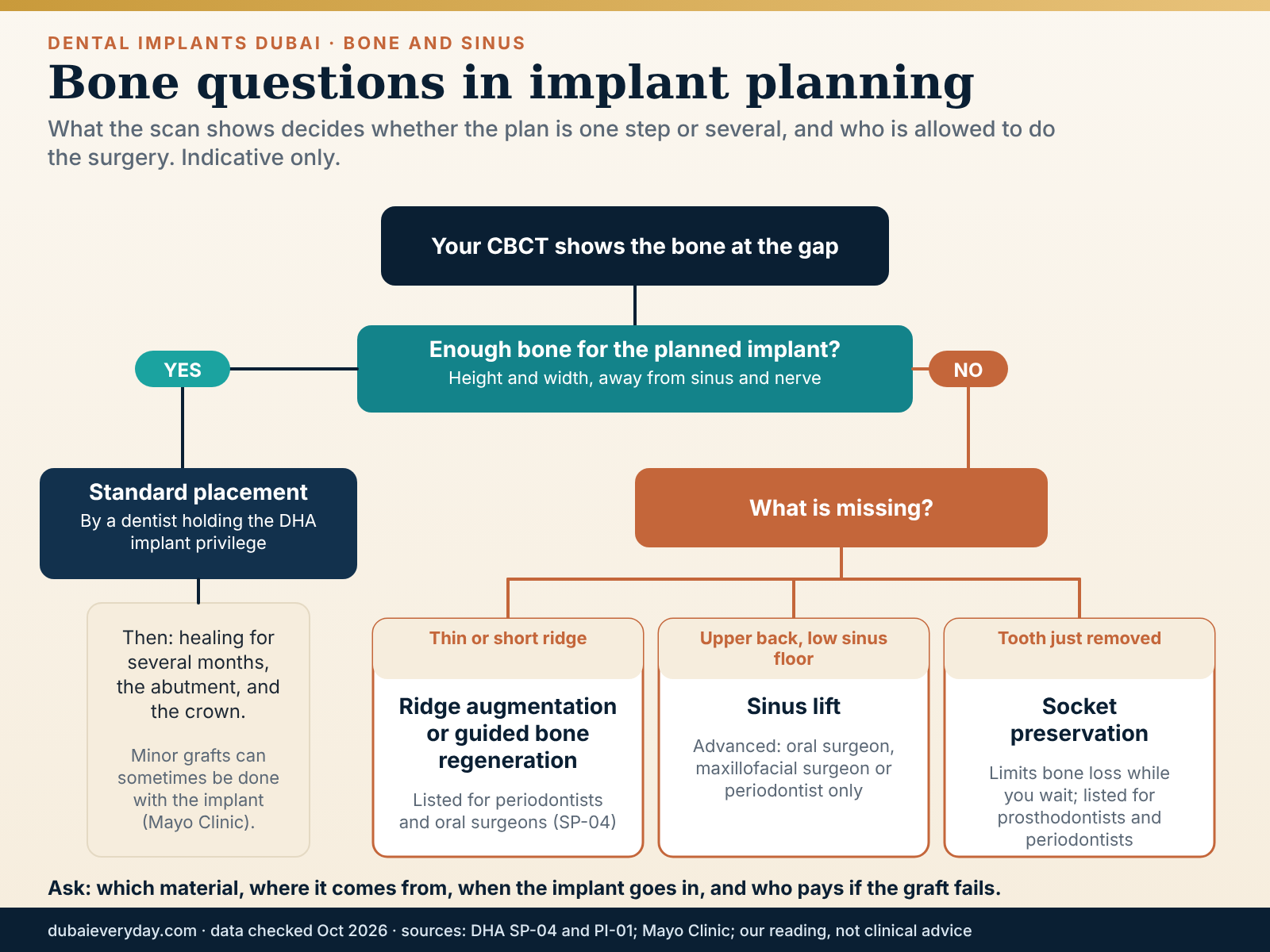
Bone is the part of dental implants Dubai patients are least prepared for. People expect a tooth replacement and are told they also need a graft, a membrane, or a sinus lift, usually with an extra line on the quote. The treatment is normal, not a sign of a dishonest clinic. It does, however, change the schedule, the surgeon, the risk and the price, so you need to understand it before agreeing.
Why bone goes missing
Bone that no longer carries a tooth tends to shrink. After an extraction the socket remodels, and in the upper back jaw the sinus floor can sit lower as the tooth root disappears. Gum disease, infection, injury and a long time without the tooth all make it worse. We did not find DHA text that quantifies this, so treat the following as general clinical background: the longer a gap has existed, the more likely it is that the dentist will talk about bone.
Mayo Clinic puts the rule simply: if the jawbone is too thin or too soft to hold an implant, you may need a bone graft first. The FDA’s list of surgical risks includes sinus perforation and a fractured jawbone, which is why imaging and the right surgeon matter more when the anatomy is tight, in dental implants Dubai wide as anywhere.
The main procedures, in plain words
Socket preservation
Filling the space after a tooth is removed to limit bone loss while you wait. The DHA scope standard lists socket preservation among prosthodontists’ duties for improving ridge height and thickness.
Ridge augmentation or guided bone regeneration
Building up a ridge that is too narrow or short, often with graft material and a barrier membrane. Under SP-04 periodontists and oral surgeons list these procedures; they are not listed for general dentists.
Sinus lift
Raising the floor of the sinus and adding bone beneath it so an upper back implant has enough height. SP-04 and PI-01 restrict advanced sinus lift surgery to oral surgeons, maxillofacial surgeons and periodontists.
Block grafts
Moving a piece of bone from another site, such as the chin or the back of the lower jaw, to build up the area. CG-11 lists such donor sites among the situations where CBCT helps planning.
Where the graft material comes from
Mayo Clinic says graft material can come from your own body, from synthetic sources, or from human or animal donors. Each has trade-offs that your surgeon should explain: taking your own bone adds a second surgical site, while donor and animal-derived materials avoid that but come from other sources.
Ask what the material is, where it comes from and who supplies it. For some patients, the animal or human origin of a material matters for religious, ethical or personal reasons, and a good clinic expects the question. We have not verified any particular supplier or its documentation, so ask for the product name and the packaging label.
Timing: one stage or two
Mayo Clinic says grafts may take several months to integrate, and that minor grafts can sometimes be done during the implant surgery itself. The decision between those paths belongs to the surgeon. A graft followed by a wait before the implant is the cautious route; a combined procedure is shorter but depends on the bone being stable enough to hold the implant while it heals.
For planning, assume that any case involving a major graft or sinus lift adds months and at least one additional surgical visit. If you are a visitor, this is the single biggest reason a one-trip plan for dental implants Dubai clinics offer may not be realistic, and we return to it in the section for residents and dental tourists.
What to ask before any graft
- Which part of my scan shows the bone problem, and can you show me?
- Which procedure is proposed, and which licence category does the surgeon hold?
- What material will be used, what is its source, and is it in the quote?
- Will it be done together with the implant or as a separate stage, and how long do we wait?
- What are the specific risks for my site, such as sinus perforation in the upper jaw or numbness in the lower?
- If the graft does not take, what is the plan and who pays for the repeat?
The last question is the one that separates a clear dental implants Dubai quote from a vague one. A clinic can decide in advance what happens when a graft fails. If the answer is “we will see”, ask for that in writing.
Timelines: from first consultation to final crown
Dental implants Dubai clinics describe as quick are quick in the parts that can be quick. The biological core of the process, bone bonding to the implant, does not run to a marketing calendar. Mayo Clinic says the whole process can take many months, largely because of the waiting for bone healing. That is the sentence to hold on to.
The standard staged sequence for dental implants Dubai patients
- Consultation and examination.History, mouth examination, gum assessment and a discussion of options and costs. Ask for a written plan before you book scans or surgery.
- Imaging and planning.X-rays and, where justified, a CBCT. A digital scan or impressions may follow so the crown and the implant position are planned together.
- Preparing the site.Gum treatment, extraction of the failing tooth, and any bone work. Healing can take weeks to months depending on what was done.
- Implant placement.The gum is opened, the bone is shaped and the implant is placed. Mayo Clinic describes a temporary partial denture or similar appearance aid in some cases.
- Healing and bonding.Bone grows onto the implant, a process Mayo Clinic puts at several months.
- Abutment stage.If it was not placed earlier, a minor procedure under local anaesthesia exposes the implant and adds the abutment. Mayo Clinic says the gums need at least two weeks before the crown goes on.
- Crown and bite check.Impressions or scans, laboratory work, fitting, and adjustment of the bite.
- Maintenance.Regular reviews, hygiene visits and, per CG-11, imaging at around one year after placement where indicated.
What can be shortened, and what the trade-off is
Some cases allow the implant to be placed at the same visit as the extraction, which dentists call immediate placement. Some allow a temporary tooth to be fixed to the implant straight away, which is called immediate loading. Both depend on the bone, the stability the implant achieves in it, the position of the tooth and your bite. They are clinical decisions about a specific site, not a menu choice.
The accurate way to read a dental implants Dubai advert for “teeth in a day” or a single-visit option is that it describes what can happen for suitable cases, not what happens for everyone. Ask what makes you suitable, what the fallback is if the implant is not stable enough on the day, and whether the quote changes. If the answer to the second question is a full refund, ask for it in writing.
Illustrative timeline arithmetic
Illustrative example, not a clinical standard. The ranges below are our own composition from the stage descriptions in Mayo Clinic’s material and commonly quoted clinical ranges. DHA documents we read set no duration for bonding, so check every figure with your dentist.
Take a straightforward single tooth with enough bone and no extraction needed. Allow a couple of weeks for assessment, scan and planning; a few months for the implant to bond, since sources describe it as several months and many clinicians quote roughly three to six; two weeks or more for gum healing after the abutment; and a further few weeks for the crown to be made and fitted. That adds up to roughly four to eight months in total, with the waiting dominated by bone healing.
Add an extraction with a delay before placement and the total stretches by weeks to a couple of months. Add a significant graft and a delay before the implant, and it can approach a year or longer. With a sinus lift followed by a staged implant, plan on more than one surgery and months of healing between them. These are planning ranges, not promises.

Appointments, practicalities and Dubai calendar
A staged plan for dental implants Dubai clinics run means at least four or five visits spread across several months, and each one has a cost in time. If you rely on public transport, our Dubai Metro guide will help you judge whether a clinic within reach of a station is worth a slightly higher fee.
Clinics can also be busier around public holidays and school breaks, so ask early for crown-fitting dates if you plan to travel. We did not verify clinic hours in Ramadan or on holidays, and they vary by clinic.
Plan the surgery for a week when you can take it easy. Mayo Clinic describes swelling, bruising, pain at the site and minor bleeding after surgery, so pencilling in a presentation, a long-haul flight or a wedding the following day is a poor use of optimism.
Surgery day, sedation, sterility and recovery
Surgery for one of the dental implants Dubai clinics place is usually an outpatient procedure, and Mayo Clinic describes it as done in stages with healing between them. The mouth is numbed, the gum is opened, the bone is shaped to receive the implant and the gum is closed over or around it. How long that takes and how comfortable it is depends on the site, the bone and the dentist. We will not put minutes on it, because no source we read does.
Anaesthesia and sedation
Mayo Clinic lists local anaesthesia, sedation and general anaesthesia as options. If you are sedated, expect fasting instructions, a person to take you home and a period of rest afterwards. Under DHA’s scope standard, sedation is a controlled activity: the specialist needs certified training and privileges, the facility must hold a DHA licence to offer sedation services, and every team member needs validated training and a competency assessment.
So if sedation is proposed, ask three things. Who is giving it, and what is their training? Is the clinic licensed for sedation? And what monitoring and emergency equipment are in the room? You are entitled to a straight answer, and a clinic that offers sedation routinely will have one ready. If you are fasting for religious reasons around surgery, say so early so the team can plan timing and medicines.
Sterility: what the DHA expects and what you can sensibly ask
The DHA’s infection control guideline (CG-10, effective 1 March 2026) is detailed. It requires surgeons to carry out surgical hand antisepsis before donning sterile gloves for oral surgery, and to use sterile water or sterile saline as the coolant for dentoalveolar surgery and implant placement.
Surgical handpieces must be sterilised in a pre-vacuum cycle. Items used in oral surgery, such as scalpel blades and syringes, must be sterile at the point of use, and burs are treated as practical single-use items because they are difficult to clean.
The guideline also requires monitoring of sterilisers. A Bowie and Dick test is run daily on pre-vacuum machines, biological indicators are run at least weekly, preferably daily, and a positive result triggers a recall and reprocessing of the affected items. Sterile packs are labelled with the operator, sterilizer, load number and dates, which makes each load traceable. If a wrap is wet, torn or dropped, the instrument is no longer sterile.
None of this asks you to inspect an autoclave. Reasonable patient questions are modest: Are surgical instruments supplied sterile and in sealed, dated packs? Is the same set used for more than one patient without sterilisation? How often are the sterilisers tested? Dental implants Dubai clinics that follow the guideline will find these routine.
What recovery looks like, according to the sources
Mayo Clinic says to expect swelling, bruising, pain at the site and minor bleeding. Pain medicine or antibiotics may be prescribed, soft food is advised while healing, and stitches are usually dissolvable, with any that are not removed at follow-up. It advises contacting the surgeon if swelling or pain worsens in the following days. We do not give medicine names or doses here: those are for the person who examined you.
Give yourself realistic downtime. For the first days, plan soft food and calm routines. In Dubai, that means thinking about heat and hydration if you are heading outdoors, and about whether a long drive or flight is wise soon after upper-jaw sinus work. We did not find a DHA rule on air travel after surgery; ask your surgeon, and tell them your travel dates in advance.
The implant feels loose or painful, pain or swelling gets worse after the first few days, there is numbness that does not settle, or something feels wrong with your bite. The FDA says to contact your dentist right away if an implant feels loose or painful. For severe swelling, difficulty breathing or swallowing, or heavy bleeding, seek urgent medical care rather than waiting for a clinic appointment.
Dental implants Dubai cost: what the numbers show and what they hide
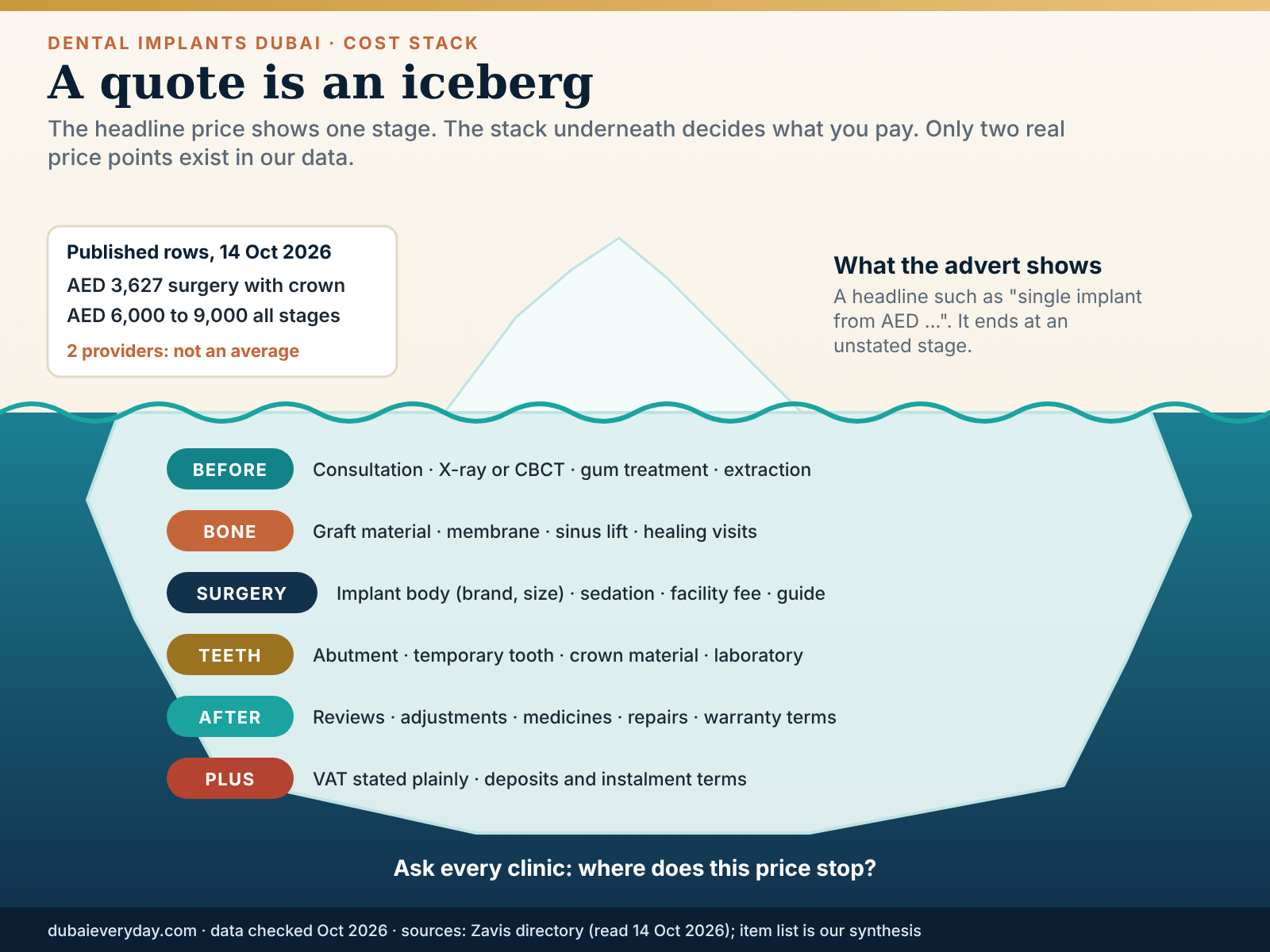
This is the section where most guides to dental implants Dubai prices invent a comfortable average. We would rather show you what we found. A directory of clinic-published prices, read on 14 October 2026, held two single-implant rows in Dubai.
One provider lists AED 3,627 for implant surgery with a crown, with no mention of the abutment. Another lists AED 6,000 to 9,000 per implant with all stages included. The directory itself says a listed price is not a quote and that the two rows differ in scope.
Two data points are not a market, and they cannot stand in for dental implants Dubai prices as a whole. They are also not comparable: one includes a crown but is silent on the abutment, the other says all stages.
If you take away one number, take the span between them: even among published prices, the same headline word covers a difference of more than AED 5,000 once the scope changes. We cannot tell whether VAT is included in either. The directory says provider pages do not all say.
Why the headline is not the bill
A price for “an implant” in a dental implants Dubai advert can mean the implant body alone, the surgery, or everything through to the crown. The honest question is always: what stage does this price end at? A clinic can quote one stage at a very competitive number and recover the difference at the next stage, which is not necessarily deceptive but makes comparison impossible.
The cost stack for dental implants Dubai quotes, item by item
Every quote for dental implants Dubai clinics produce should be readable as a stack of items. The more of these are named, the easier it is to compare. A useful quote separates the following, and says for each whether it is included, extra, or not needed in your case.
- Consultation and examination, and whether the fee is credited against treatment
- X-rays and CBCT, with the field of view and who reports
- Extraction of the failing tooth, if needed
- Gum treatment before surgery, if needed
- Bone graft, membrane or sinus lift, with the material named
- Implant body: brand, model, size, per implant
- Surgery, anaesthesia or sedation, and the facility fee
- Surgical guide, if planned
- Abutment (stock or custom) and any temporary tooth
- Final crown, bridge or denture: material and laboratory
- Follow-up visits, adjustments and the review at around a year
- Medicines and any repeat imaging
- VAT treatment, stated plainly
- What is covered if something fails, and for how long
Illustrative example: two quotes that look different and are not
Illustrative example (not a quote or market fact). The numbers below are invented to show the arithmetic. They are not prices charged by any clinic.
Clinic A advertises “single implant AED 4,500”. Clinic B quotes “AED 7,200, all stages”. Ask Clinic A what is outside its headline and you might find the following, still imaginary, items.
| Item | Clinic A headline | Clinic A extras (illustrative) | Clinic B all-in (illustrative) |
|---|---|---|---|
| Examination and CBCT | Not included | AED 500 | Included |
| Implant and placement | AED 4,500 | – | Included |
| Abutment | Not included | AED 900 | Included |
| Crown | Not included | AED 2,300 | Included |
| Follow-up visits | Not included | AED 0 | Included |
| Total | AED 8,200 | AED 7,200 |
The headline gap was AED 2,700 in favour of Clinic A. After adding the extras, the order flips by AED 1,000. The lesson is not that one type of clinic is cheaper; it is that a total only means something once both clinics have priced the same finish. Ask each for a written, itemised quote, then compare the totals.
Several implants: how the arithmetic scales
When more than one tooth is missing, the total for dental implants Dubai clinics quote is not a simple multiple. A rough structure is: shared costs (examination, scan, sedation, facility fee) once, plus a per-implant cost (implant, abutment, crown) for each, plus any bone work.
If three teeth in a row are missing, a dentist may propose three implants with three crowns, or two implants carrying a three-unit bridge. The second uses fewer implants, but the bridge is one connected piece, and a problem with one implant affects all three teeth.
Neither choice is automatically better for dental implants Dubai patients. The point for a patient is to ask for both versions priced side by side, with the reasons the dentist prefers one, since the cheaper option on day one is not always the cheaper over fifteen years. For full-arch treatment priced as a package, see our guide to All-on-4 in Dubai.
The long game with dental implants Dubai: maintenance and replacement
Mayo Clinic says that keeping implants clean, attending regular check-ups, avoiding hard objects such as ice, avoiding tobacco and treating teeth grinding all help them last. The crown on top may need repair or replacement at some point even if the implant body lasts, and the screw that holds the abutment can loosen.
We do not know of any official figure for the lifetime cost of dental implants Dubai patients face, so we leave it out. Ask the clinic what the typical repair is called and what it costs, and whether a maintenance plan exists.
VAT, instalments and deposits on dental implants Dubai quotes
We could not verify how UAE VAT applies to dental implants Dubai clinics sell; the Federal Tax Authority page was closed to automated reading. UAE VAT is a flat rate on most goods and services, and healthcare has special rules, but the practical step is simple: the quote should say whether VAT is included, and if some items carry it and others do not, which ones.
The DHA advertising standard allows clinics to state fees and regularly accepted instalment plans, but requires price information to be accurate and to state any conditions or variables. Time-limited discounts that cannot be honoured are not acceptable. If you are offered a deposit, ask what happens to it if the plan changes after your scan, and get the terms before paying.
Insurance, instalments and who pays what
Do not assume your health insurance helps with dental implants Dubai clinics quote. Our earlier guides explain the structure of cover in Dubai in more depth: see health insurance for Dubai residents and the wider Dubai insurance guide. Here is what matters for this treatment.
What the sources say
Under the Dubai Health Insurance Law, employers must insure employees, and residents must have cover. For the lowest-paid group, the Essential Benefits Plan sets a minimum. The DHA’s 2014 employer information pack lists dental diagnosis and treatment at 20 per cent coinsurance in the benefits text yet also lists dental treatment, prostheses and orthodontics among exclusions, so the document contradicts itself on dental. Do not infer implant cover from either line.
The comparison site InsuranceMarket.ae, which is context and not a regulator, says implants may be excluded or only available in higher-tier plans, and lists them among commonly excluded high-cost procedures. It also says dental add-ons often have low annual limits, some plans impose waiting periods, higher-cost treatment may need prior approval, and gives a co-pay example of 20 to 30 per cent. It gives no figures for annual caps.
Illustrative example: when a limit bites
Illustrative example (not a quote or market fact). Suppose a policy covers dental treatment at 80 per cent after a 20 per cent co-pay, with an annual dental limit of AED 5,000, and covers implants at all, which many do not. Your dentist estimates AED 12,000 for the crown on an implant plus surgery.
Eighty per cent of AED 12,000 would be AED 9,600, but the annual limit caps the insurer’s share at AED 5,000. You would pay AED 7,000 yourself, not AED 2,400. If the policy excludes implants, you would pay all AED 12,000. Neither is a criticism of insurance; the point is that “covered” is meaningless until you know the limit, the percentage and the exclusions.
Questions that settle it before you commit
- Read your table of benefits.Look for the words implant, prosthesis, bone graft, sinus lift and oral surgery, and for the annual dental limit.
- Ask for pre-approval in writing.If your insurer allows it, the clinic can send the treatment plan and codes. Do not treat a phone assurance as approval.
- Check network status.Cashless billing usually requires the clinic to be in your network, and that can differ for the surgeon and the clinic.
- Check waiting periods.If you changed policy recently, a waiting period may apply to major dental work.
- Put the split on paper.Ask the clinic to show what you pay, what the insurer pays and what is excluded, before surgery.
If you are budgeting a move to Dubai or planning around monthly outgoings, put a realistic line for dental implants Dubai costs next to the other big-ticket items in our cost of living in Dubai guide. An implant is not a monthly expense, but when it arrives it dwarfs the usual dental line in a household budget, so it deserves a savings plan of its own.
Comparing quotes and reading clinic adverts
Searching for dental implants Dubai clinics offer produces a wall of adverts, each with a smile, a price starting with “from” and a promise. The adverts are not worthless. They tell you which clinics want your business and sometimes what they sell. They are a poor basis for choosing who puts a titanium post in your jaw, and Dubai’s own rules say as much.
What DHA advertising rules ban, and why it helps with dental implants Dubai choices
The DHA’s Standards for Medical Advertisement Content in Social Media (ST-21, effective October 2022) ban terms such as “best”, “unique”, “safest”, “the only”, “100%” and “assured success”. Advertisers may not claim a treatment is guaranteed, always effective, or superior to a competitor’s. Titles must match the DHA licence, and “Dr.” is for physicians, dentists and recognised PhD holders. The facility’s official account has to display its medical advertisement licence number from the Ministry of Health and Prevention.
For before-and-after pictures, the standard requires the same person, the same lens and no editing, together with a risk statement and a disclaimer in the same font size that there is no guarantee that the result will be the same. Patient images and testimonials need documented written consent. Press reports in September 2026 say the DHA tightened enforcement of these rules in August, with disciplinary action possible; we read the reports, not the circular itself.
The practical use is a filter for dental implants Dubai adverts. An advert that promises “guaranteed” results or “the best implants in Dubai” is breaking the standard, or at least testing it. That does not make the dentist unqualified, but it does tell you how carefully the marketing team read the rules. A before-and-after image with no disclaimer deserves a second look.
Pressure is information. ST-21 says time-limited discounts that cannot be honoured are not acceptable, and that price information must state its conditions. If you are told a price is valid only today or only this week, ask for the offer terms in writing. A treatment decision that involves surgery should survive a night’s sleep and a second opinion.
A fair way to compare two or three dental implants Dubai plans
- Get the same inputs.Where possible, share the same scan and photos with each clinic so they plan from the same facts. If each takes its own images, expect small differences.
- Ask for an itemised written plan.It should name the implant system, the abutment, the crown material, the laboratory, the sedation and the follow-up.
- Line the items up.Use the cost-stack list above. Put “included”, “extra” or “not needed” against each line for each clinic.
- Compare the process, not just the total.Number of visits, length of healing, who performs which stage and where you can reach them afterwards.
- Check each credential separately.Run the registry check for every clinician who will touch your case, including the one doing the surgery and the one doing the crown.
- Decide on risk, then on price.If two plans differ because one skips a scan, a graft or a specialist, the cheaper one is not the same product.
When a second opinion is worth the fee
A second opinion on dental implants Dubai plans is worth paying for in four situations: when the plan involves a major graft or sinus lift; when the proposal is a full-arch treatment; when two clinics diagnose the same scan differently; and when you are told that several teeth need removing. A consultation fee is usually small next to the treatment, and it is the cheapest piece of risk management available.
Be open about what you are doing when you compare dental implants Dubai clinics. Most dentists are used to it, and a clinic that reacts badly to a request to share your scan or plan is telling you something. Our Dubai dentist guide also covers consent and second opinions in a more general setting.
Red flags worth slowing down for in dental implants Dubai quotes
- A quote that names no implant system, abutment or crown material
- Pressure to pay a deposit before an examination or before you see a written plan
- An implant plan with no scan or X-ray at all
- Advanced surgery proposed without saying which specialist will perform it
- Promises of guaranteed success, painless treatment or the best result
- No answer on what happens if the implant fails or a graft does not take
- Refusal to share your records, scans or plan with another dentist
- Titles or credentials that you cannot match to a registry entry
None of these proves bad intent alone. Several together, particularly alongside an unusually low price, is the pattern that tends to end with a patient seeking a fix from somebody else.
Risks, complications, failure and aftercare
Implants have a good record in the clinical sources we read, and none of them says the treatment is risk-free. Mayo Clinic says that most implants succeed. The FDA lists a set of risks that patients should be told about. Putting both together gives a fair picture: usually fine, sometimes not, and better when the plan, the surgeon and your own habits line up.
The risk list for dental implants Dubai patients, from the FDA and Mayo Clinic
During or soon after surgery
Infection at the site; damage to nearby teeth or blood vessels; nerve injury causing pain, numbness or tingling in teeth, gums, lips or chin; and, for upper-jaw implants, sinus problems if the implant projects into the sinus. The FDA also mentions sinus perforation and a fractured jawbone.
Healing problems
Implant looseness or loss, which can follow infection, delayed healing (more likely in smokers) or uncontrolled diabetes-related infection. If the bone does not bond, the implant is removed and the site cleaned, and Mayo Clinic says the procedure can be retried after about three months.
Later problems
A loosening abutment screw, poor bite function, difficulty cleaning around the implant, untreated gum disease and numbness. The FDA says complications can appear soon after surgery or much later, and failure may need another operation.
Peri-implant disease: the long-term risk nobody advertises
Gums and bone around an implant can become inflamed or infected, much as they do around natural teeth. Clinicians use the terms peri-implant mucositis and peri-implantitis for the stages of this. The DHA scope standard says periodontists manage disease around implants, and CG-11 lists peri-implantitis as a reason for CBCT. We did not find prevalence figures in the sources we read and will not guess.
The practical message for dental implants Dubai owners is the one Mayo Clinic and the FDA both give: clean carefully, attend check-ups, treat gum disease, and do not smoke. Ask the dentist how often you should be reviewed and who will do it. A clinic that places implants but provides no maintenance plan has left out half the job.
What “failure” means, and who bears the cost
People use the word failure for three different things in dental implants Dubai conversations: an implant that never bonded in the first months, an implant that was lost years later, and a restoration, such as a crown, that broke or came loose while the implant itself is fine. They have different causes, different remedies and, importantly, different costs.
Before surgery, ask for the clinic’s position in writing. Does it replace a failed implant without charge, and for how long? Which costs are covered if a crown breaks? What conditions apply, such as attending reviews? A written warranty is a contract matter, and we could not verify any DHA rule that sets its content, so the document itself is what counts. A promise in an advert is not a warranty.
Your records are part of the aftercare
Keep a folder, paper or digital, with the written plan, signed consent, scan and report, a record of the implant system (brand, model, size, date), the crown material and lab, and any warranty. The FDA advice to record the brand and model exists for a reason: it is what a new dentist will need if you move house, change clinic or have a problem.
If you have a complication, contact the treating dentist first, because they know your case. If you are not satisfied with the response, the DHA complaint route applies to DHA-licensed clinics in Dubai. Our guide to Dubai legal basics for residents explains how to approach consumer disputes generally, and the Dubai hospitals guide helps if you need urgent care out of hours.
Alternatives: bridge, denture, All-on-4 or waiting
Dental implants Dubai dentists recommend are not the only answer to a missing tooth, and a sensible consultation presents the alternatives honestly. Mayo Clinic says implants can be a good choice when dentures or bridges fit poorly or when there are not enough natural roots to support them. That implies the converse, which is that they are not mandatory when other options work well.
Fixed bridge
A false tooth joined to crowns on neighbouring teeth. It is usually quicker than an implant and avoids surgery on the jaw. The trade-off, which a dentist will explain, is that it relies on the neighbouring teeth for support and so usually involves preparing them.
Removable denture
A partial or full denture that can be taken out. It is often the lowest upfront cost and needs no surgery. The trade-offs are comfort, stability and cleaning, which vary a great deal from person to person.
Implant-retained denture
A removable denture that clips onto a few implants. Mayo Clinic notes that removable options can be partial or full and snap onto abutments. It sits between a plain denture and fixed teeth in cost and complexity.
Full-arch fixed implants
A whole arch of fixed teeth on a small number of implants, including All-on-4. Its candidacy, temporary teeth and bone questions are different from single-tooth work, so we cover it separately in our All-on-4 guide.
Doing nothing is also an option, with conditions
Leaving a gap is sometimes reasonable, for example at the back of the mouth where it does not affect chewing or appearance. But a gap is not neutral: the bone can shrink, and neighbouring or opposing teeth can drift. Ask your dentist what is likely to happen at your site, and how long the window is before a later implant becomes more complicated.
Whatever you choose, get the other options costed in the same written format. If a clinic only quotes implants, you cannot tell whether the recommendation comes from your mouth or from the price list. We cover wider dental care, from fillings to dentures, in the Dubai dentist guide.
Residents, new arrivals and dental tourists
Three kinds of people search for dental implants Dubai clinics provide, and they face different problems. A long-term resident has an insurance question and a follow-up advantage. A new arrival has a waiting-period question and a paperwork question. A visitor planning treatment around a trip has a calendar problem, because bone healing is not scheduled around flights. Pick the paragraph that sounds like you.
If you already live in Dubai
Your advantage is time and proximity. A staged plan for dental implants Dubai residents choose suits them, because a quick check at three weeks or three months costs an hour and a taxi. That makes reach the main factor in choosing a clinic: one a short Metro ride away may be a better choice than a famous one across town if you will be there six times. Our Dubai Metro guide helps with the practical side.
Your other decision is who pays. Check your table of benefits, look at the annual dental limit and ask your employer’s insurance contact about pre-approval. If you are budgeting for a larger year, a cost line for dental work belongs next to rent and school fees in the monthly budget for one person in Dubai exercise.
If you have just arrived
The first months of a Dubai life are crowded with admin: visa stamping, Emirates ID, a tenancy, a bank account. Dental implants Dubai patients seek are not urgent for most people, and the sensible order is to settle the insurance and the address first. Waiting periods on dental benefits are common enough that InsuranceMarket.ae notes them, so ask before you assume you can claim in month one.
Our Dubai relocation checklist and the wider moving to Dubai guide show where dental care fits in a first-month plan. If a tooth is causing pain or infection, that is urgent care, not an implant decision: see a licensed dentist promptly and plan the replacement afterwards.
If you are visiting for dental implants Dubai treatment
Here the logic of the timeline for dental implants Dubai visitors consider bites. A staged implant needs a surgery visit, a wait of months, and a restoration visit. Unless the case suits an immediate approach, one trip cannot do the whole job, and even immediate approaches need review visits. The consequence is not that visitors should avoid treatment in Dubai, but that they should plan for the second half before they begin the first.
Before you fly
Ask which stages will be done in Dubai, when the next stage falls and what the plan is if it cannot happen on schedule. Get the written plan, scan data and implant record so your home dentist can see what was done. Check your own country’s rules for sharing records.
While you are here
Allow recovery days with nothing demanding. Our best time to visit Dubai guide explains why summer heat makes outdoor plans harder, and our indoor things to do guide suits slow days. Stay close to the clinic if you can.
When you go home
Ask who handles a problem after you leave, whether the clinic offers remote review of photos, and which dentists at home are willing to take over maintenance. A treatment with no handover plan is a loose end.
Travel arithmetic for a staged dental implants Dubai plan
Illustrative example (not a quote or market fact). The figures below are placeholders to show how travel adds to treatment. Replace them with real quotes.
Suppose a visitor is quoted AED 7,200 for a single implant, all stages, and the plan needs two trips of five nights. If each return flight costs AED 2,500 and each night in a hotel costs AED 450, the travel adds 2 × 2,500 = AED 5,000 for flights and 10 × 450 = AED 4,500 for rooms.
The total is AED 16,700, of which treatment is 43 per cent. In that example, a cheaper local option at home might beat Dubai even at a higher treatment price.
Run your own sum before deciding. The structure matters more than the invented numbers: treatment price, plus flights per trip times trips, plus nights times rate, plus time off work, plus the cost of a complication that happens after you are home.
For hotel choices near a clinic, our best hotels in Dubai guide explains how to choose by area, and the Dubai travel guide covers arrival basics. We did not verify any Dubai visa category for medical travel, so check entry rules separately; the Dubai airport guide helps with the DXB side of the journey.
Flying after implant surgery
We found no DHA rule on flying soon after dental implants Dubai surgery, and cabin pressure is a question for your surgeon, especially after a sinus lift. Ask in writing what restrictions apply and for how long, and schedule the flight accordingly. A bleeding or swollen mouth on a long-haul flight is a poor way to discover that the schedule was too tight.
Five scenarios, worked through
These are illustrative scenarios for dental implants Dubai readers might recognise, not patient cases, and none describes a real person or clinic. They show how the guide’s logic plays out when several factors interact. In each, the real decision belongs to a licensed dentist after an examination.
Scenario one: a resident with one missing lower molar
She lost the tooth two years ago, has no gum disease, doesn’t smoke and has dental cover that excludes implants. The best path is probably a straightforward staged plan. She asks for a written plan from two clinics, checks the credentials of the surgeon and the person making the crown, and asks about the CBCT field of view and the lower-jaw nerve. Because insurance excludes implants, she prices the whole stack and decides how to pay.
The decision that matters is the quote format. Clinic A names the system and includes the crown; Clinic B quotes the surgery only. She compares like with like, picks on the lower total of the complete stack and the clinic’s maintenance plan, and books the second visit before the surgery date so the crown does not wait for a diary slot.
Scenario two: a long-missing upper molar and a low sinus
He lost an upper back tooth years ago and has been told the bone is thin under the sinus. Here, a sinus lift is likely to be discussed. Under DHA rules, that part must be performed by an oral surgeon, maxillofacial surgeon or periodontist, so he asks which one is proposed and checks the licence category on the registry.
He also asks whether the implant can be placed at the same time as the lift or needs a wait, and he builds a realistic calendar: a graft healing period, the implant, a bonding period, the abutment and the crown. Total time is closer to a year than to a season. He asks what the clinic does if the graft does not take, and gets the answer on paper.
Scenario three: a visitor with ten days in Dubai
She is in town for work and wants to “get it done” before flying home. The honest conversation is about the process, not the price. A staged implant cannot be finished in ten days, and she needs a plan for what follows. She asks whether her case suits an immediate approach, what review visits would be needed and whether the clinic can send records to a dentist at home.
She does the travel arithmetic: if a second trip is unavoidable, the saving from dental implants Dubai clinics quote may disappear. She may decide to do the examination and scan now, then choose where to treat with the data in hand, which is a legitimate use of a short visit and costs far less than committing to surgery.
Scenario four: a smoker with managed diabetes and receding gums
He wants a front-tooth implant, which makes it one of the more appearance-sensitive dental implants Dubai cases. Both the FDA and WHO flag smoking and diabetes as factors that raise risk, and the FDA names untreated gum disease as a problem. His dentist is likely to propose gum treatment first, a discussion about smoking, and coordination with his doctor on blood sugar control. This is not a refusal; it is the order in which the risks get reduced.
He should be wary of any clinic that skips these steps to start surgery quickly. The better question for him is what the plan is if he cannot quit, and what the maintenance schedule looks like. A front tooth is also an appearance case, where gum shape matters, and a periodontist or prosthodontist may be involved.
Scenario five: three missing teeth and a tight budget
Three back teeth in a row are gone, and the quote for three implants and three crowns is more than the family can easily pay. The dentist offers alternatives: two implants and a bridge, a partial denture, or a staged plan that deals with the most important tooth first. The family asks for all three costed in the same format, with maintenance and replacement included.
They compare the immediate costs, the likely repair costs, and what happens if one implant fails. The cheapest first-day price might not be the cheapest over ten years, and the most expensive might not be necessary. They get a second opinion on the implant-bridge design, then decide with the figures side by side. For a whole-arch option, they read our All-on-4 guide.
Nine checks and the mistakes they prevent
Everything above compresses into nine checks. Each one answers a mistake that costs patients money, time or health. Use them as a one-page filter before you pay any deposit for dental implants Dubai clinics propose, and keep the answers with your records.
- Licence and privilege confirmed.The clinician is on the DHA registry, in the right category, at the right facility, and the implantology privilege is documented. Mistake prevented: treatment by someone outside their permission.
- The right surgeon for the job.For sinus lifts and advanced grafting, an oral surgeon, maxillofacial surgeon or periodontist is named. Mistake prevented: complex surgery done by someone not allowed to do it.
- A reason for the scan.You know why a CBCT is needed, what field is used and who reports it. Mistake prevented: repeat or unnecessary radiation.
- A named system.Brand, model, size and abutment type are written down. Mistake prevented: unfixable parts years later.
- An itemised written quote.It covers every stage through the final crown, and states VAT. Mistake prevented: a headline price that doubles.
- A bone plan.If a graft or lift is proposed, the material, timing and failure policy are written. Mistake prevented: an open-ended second bill.
- A realistic calendar.The months of healing, the visits and your travel are mapped. Mistake prevented: a rushed crown or a missed review.
- Insurance confirmed in writing.Exclusions, limits and pre-approval are known. Mistake prevented: assuming cover that does not exist.
- An aftercare and warranty document.Maintenance visits, who handles problems and what is guaranteed are on paper. Mistake prevented: being alone with a complication.
The most common dental implants Dubai mistakes, in one place
Choosing a dental implants Dubai clinic on the headline price is the biggest mistake, because the headline rarely ends at the same stage as the next clinic’s. Close behind is skipping the credential check, because the clinic looked professional and the dentist had a title. Third is rushing: an implant plan made in a single visit with a deposit demanded the same day gives you no time to compare.
The quieter dental implants Dubai mistakes are about the long term. Not asking for the implant record is one. Not booking maintenance is another, since Mayo Clinic and the FDA both point to hygiene and check-ups as what keeps implants working. Ignoring smoking or gum disease before surgery is the third. None of these is dramatic, which is why they are so common.
A last practical step. Before you commit to any plan for dental implants Dubai dentists propose, ask the clinic to email you the written plan and the quote. Read it the next day with this page open. Anything that you cannot match to a line on the plan is a question for the clinic, and a clinic that welcomes those questions is the sort you want to be treated by.
That is the whole argument of this dental implants Dubai guide in one habit. Verify the person, understand the stage, price the whole stack, and leave time between the idea and the surgery.
Dental implants Dubai FAQ
How much do dental implants cost in Dubai?
No reliable average for dental implants Dubai wide exists in public sources. A directory that reads clinics’ own websites held only two single-implant prices on 14 October 2026: AED 3,627 for surgery with a crown, and AED 6,000 to 9,000 for all stages per implant. The scopes differ, and VAT treatment was unclear. Bone work, scans, sedation and follow-ups can sit outside a headline price. Ask each clinic for an itemised written quote for dental implants Dubai treatment and compare totals, not headlines.
Is a DHA licence enough to place implants in Dubai?
No. For dental implants Dubai rules sit in DHA policy PI-01, which says the dentist needs an implantology privilege added to the licence, after a recognised course or a postgraduate programme that included implantology, and after passing the DHA test. Completing a course does not itself allow practice. Ask for the privilege to be shown or confirmed in writing, and check the licence category and facility on the Dubai Medical Registry.
Who can do a sinus lift or major bone grafting in Dubai?
Under DHA documents PI-01 and SP-04, advanced surgery for dental implants Dubai patients, such as a sinus lift or advanced bone grafting is reserved for oral surgeons, oral and maxillofacial surgeons and periodontists. The scope standard has one internal inconsistency about prosthodontists and internal sinus lifts, so ask any dentist who proposes sinus work to state their licence category and why they are acting within it.
How long do dental implants take from start to finish?
Mayo Clinic says the whole process can take many months, largely because bone needs several months to bond with the implant, and gums need at least two weeks to heal after the abutment before the crown goes on. For dental implants Dubai wide, a straightforward single tooth often lands in the range of several months. Grafts, sinus lifts and extractions add more. Your dentist’s written plan matters more than any average.
Do I need a CBCT scan before an implant?
Often, but not automatically, for dental implants Dubai dentists plan. DHA guideline CG-11 lists implant planning as a recognised use, yet says each scan must be justified for the individual and used only when lower-dose conventional radiography cannot answer the clinical question. It also says to use the smallest field of view that fits, and that a trained clinician should report the whole scan. Ask why it is needed and who reads it.
Does health insurance cover dental implants in Dubai?
Frequently not. A comparison site we read says implants may be excluded or limited to higher-tier plans, and that dental add-ons often have low annual limits, waiting periods and pre-approval rules. The DHA’s 2014 employer pack contradicts itself on dental benefits under the Essential Benefits Plan. Read your table of benefits, then ask the insurer for pre-approval in writing before you start. See our health insurance in Dubai guide.
Will I need a bone graft?
Not always. Mayo Clinic says a graft is needed when the jawbone is too thin or too soft to support an implant, and that minor grafts can sometimes be done during the implant surgery. Whether you need one depends on your scan and the site. If one is proposed, ask which material, when it is placed, who performs it and what happens if it does not take.
Are dental implants painful?
Surgery for dental implants Dubai clinics perform is done under anaesthesia, and Mayo Clinic describes swelling, bruising, pain at the site and minor bleeding afterwards, with prescribed pain medicine or antibiotics in some cases and soft food while healing. Individual experience varies, and a dentist should tell you what to expect for your case. Contact the clinic if pain or swelling worsens after the first days, or if the implant feels loose.
How long do dental implants last?
Mayo Clinic says most implants succeed, and the sources we read give no single lifetime figure for dental implants Dubai or anywhere else, so we do not offer one. Longevity depends on bone, gum health, hygiene, smoking, grinding and regular check-ups. The crown may need repair or replacement before the implant does. Ask the clinic what its maintenance plan and warranty cover, and get both in writing.
Can I get teeth in one day?
Among dental implants Dubai clinics place, some suitable cases allow immediate placement or a temporary tooth the same day, but the implant still needs months to bond before the final tooth is fitted. Whether you qualify depends on bone, implant stability and bite. Ask what makes you suitable, what the fallback is if the implant is not stable enough on the day, and whether the price changes in that case.
Can I have implants as a visitor on a short trip?
You can have the first stage of dental implants Dubai clinics offer, depending on your case, but a staged plan needs a gap of months before the final crown, so a single short trip rarely completes it. Plan the second visit, ask for your records and implant details, and find out who will handle problems after you leave. We could not verify any visa category for medical travel; check entry rules separately.
How do I check an implant dentist’s credentials in Dubai?
For dental implants Dubai credentials, get the dentist’s full name, licence category and facility. Search the Dubai Medical Registry on the DHA’s Sheryan portal, which offers filters for licence type, category, specialty and facility. Then ask the clinic to show the implantology privilege or confirm it in writing. Clinics in Dubai Healthcare City are regulated by a different authority, so check which regulator applies.
Which implant brand is best?
No official source we read ranks brands for dental implants Dubai patients, and we do not either. Ask your dentist why a particular system suits your case, request the brand, model, size and abutment in writing, and ask whether it is approved for sale in the UAE and supported locally. A system with available parts and trained clinicians nearby is easier to maintain years later.
Keep reading
Sources and further reading (19 links)
- Dubai Health Authority: Dental Implantology Privilege Requirements (DHA/HRS/HPSD/PI-01; issue 3) — privilege, training, logbook, advanced surgery rules
- Dubai Health Authority: Scope of Practice and Core Competencies for Dentists (SP-04) — who does implants, grafts, sinus lifts, sedation, CBCT
- Dubai Health Authority: Clinical Guidelines for Dental Radiology (CG-11) — CBCT justification, field of view, reporting, implant uses
- Dubai Health Authority: Clinical Guidelines for Infection Control in Dentistry (CG-10) — sterile coolant, handpieces, sterilisation monitoring
- Dubai Health Authority: Standard for Dental Laboratory Services (ST-59) — dentist responsibility for laboratory work, implant-supported prostheses
- Dubai Health Authority: Standards for Medical Advertisement Content in Social Media (ST-21) — banned claims, before-and-after images, pricing, titles
- Dubai Health Authority: Circular CIR-2026-00000050, Updated Dubai Dental Guidelines Version 2 — existence of an implant dentistry guideline, issued 26 March 2026
- Dubai Health Authority: Dubai Medical Registry (Sheryan) — professional and facility search filters
- Dubai Health Authority: licensing and regulations, dental — Health Regulation Sector contact line
- US Food and Drug Administration: Dental Implants, What You Should Know — components, risks, questions to ask, imaging note
- Mayo Clinic: Dental implant surgery — stages, grafting, healing, risks, aftercare
- World Health Organization: Oral health fact sheet — tooth loss prevalence, tobacco and diabetes links
- Zavis healthcare directory: dental implant prices in Dubai — two clinic-published prices; indicative only
- InsuranceMarket.ae: dental insurance in Dubai — comparison-site context on implant exclusions, limits, waiting periods
- Dubai Health Authority Employer’s Information Pack on the Dubai Health Insurance Law (hosted by UNESCWA) — mandatory cover, Essential Benefits Plan wording
- Dubai Healthcare City Authority: FAQ — separate regulator and complaints route
- Ministry of Health and Prevention: complaints about private health facilities — scope excludes Dubai
- UAE Government portal: patients’ rights and responsibilities — charter under Ministerial Resolution No. 14 of 2021
- The National: Dubai aesthetic clinics to face disciplinary action over edited social media images — August 2026 DHA advertising circular as reported
Update log: 29 October 2026 — first publication; all facts re-checked against the sources above. Next review due: April 2027 (six-month cadence), or sooner if the DHA publishes a new implant guideline text, changes the implantology privilege rules or the registry changes.
Corrections welcome.
This page is general information, not medical, legal or insurance advice. A DHA- or DHCC-licensed dentist must examine you and decide on treatment, and your insurer must confirm what your policy covers. No dentist has yet reviewed this draft; clinical statements are summaries of the cited sources.
About DubaiEveryday and this guide
DubaiEveryday.com is an independent editorial project that publishes practical, research-based guides to everyday life in Dubai: where to live, what things cost, how the rules work and how to get around. This page was written and edited by the DubaiEveryday editorial team. It is not signed by a named expert, doctor, lawyer or adviser, and we do not claim first-hand testing of a venue, clinic or service unless the page says so.
Each guide is built from official sources such as government and regulator pages, operator websites and established news outlets, cross-checked where we can. When we could not confirm something, we say so in the text, and examples that use made-up numbers are labelled as illustrations. Mentions are editorial choices, not paid placements, and a link is not an endorsement.
Dubai changes quickly. If you spot something that is out of date or wrong, please tell us through the contact options on DubaiEveryday.com and we will check it and correct the page.