
Prenatal yoga Dubai listings are easy to find and surprisingly hard to judge. This guide shows how to check the teacher, get medical sign-off, match the class to your trimester and pick a format that survives the Dubai summer.
Two lines on a test, a grainy scan, a doctor who says “stay active”, and by evening your phone is full of studio ads promising a calm, strong, easy pregnancy. Searching for prenatal yoga Dubai gives you pages of class listings and almost nothing about who is teaching them or what they know. Meanwhile the car park is a long walk in the heat, and you are not sure whether your first trimester counts as “allowed”.
This guide follows the order a careful friend would: what your obstetrician or midwife needs to say first, what each trimester can handle, how to read a teacher’s training and which class format fits your week. It is built from health-service guidance and public listings, not field visits, and it says plainly where the evidence stops. By the end you should have one message to send a studio and a short list of questions that make the good teachers easy to spot.
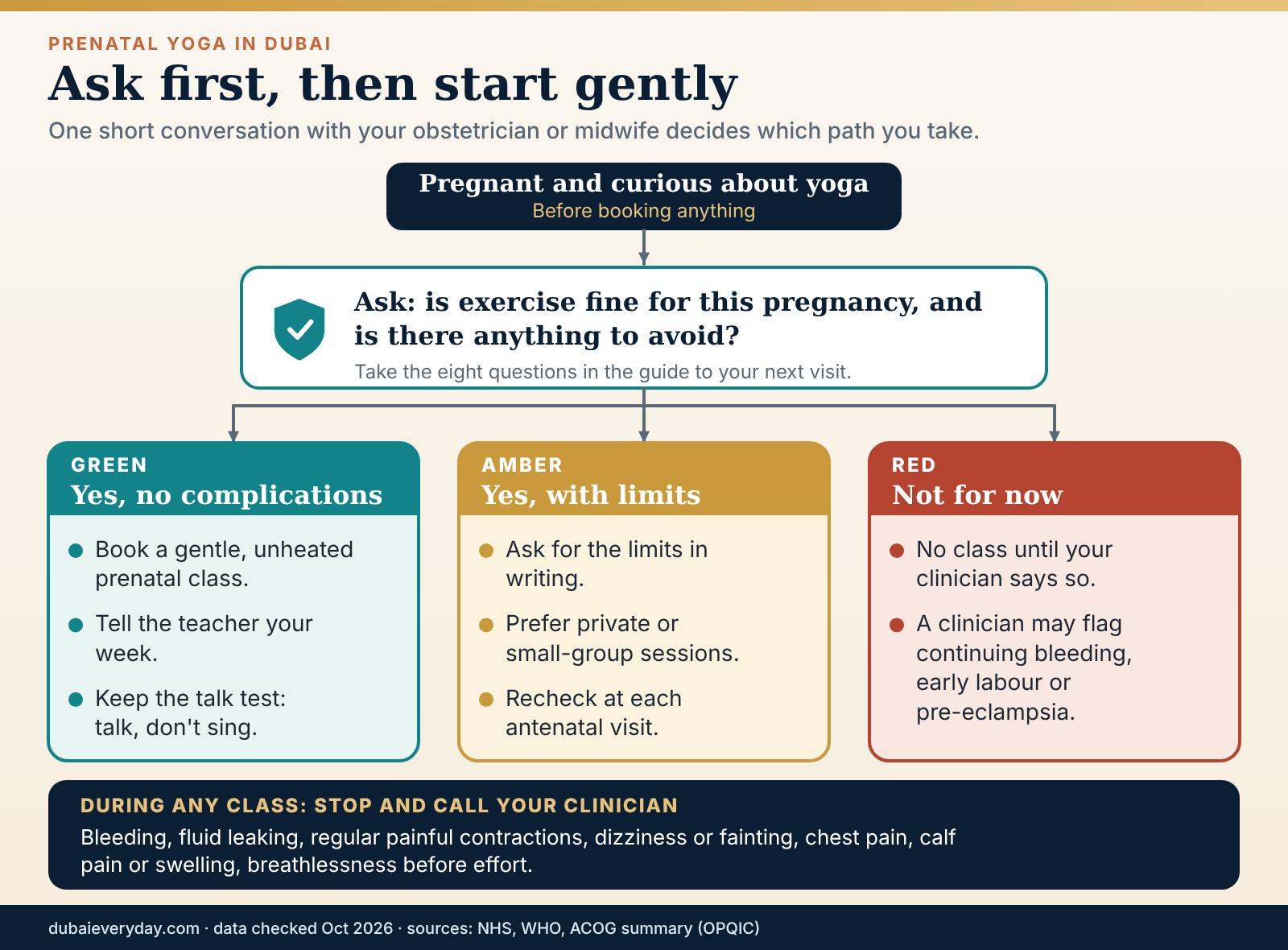
Good prenatal yoga Dubai classes share three traits: a teacher with pregnancy-specific training on top of a general yoga qualification, a room that is cool rather than heated, and a booking process that asks for your due date and any complications before you step on a mat. Before the first class, ask your obstetrician or midwife whether exercise is fine for your pregnancy. Most healthy pregnancies get a yes; a short list of conditions gets a no or a modified plan.
Then choose the format that fits your week. Studio groups are the cheapest per session and the best for company. Private sessions suit complications, a nervous start or a tight schedule. Online classes help in July, in traffic and in the last weeks. Whatever you pick, the same stop signals apply: bleeding, fluid leaking, regular painful tightenings, dizziness, chest pain, calf pain or breathlessness before you have done anything. Stop, then call your clinician.
This is a desk-research guide. Nobody on the editorial team attended the classes mentioned, and we have not assessed any teacher in person. We read national health-service guidance on exercise in pregnancy, Yoga Alliance material on prenatal credentials, the Dubai Fitness Challenge announcement, and public class listings, all checked on 29 October 2026. Public listings of prenatal yoga Dubai studios change often and several older roundups we found were years out of date, so this page names very few studios and gives no class prices. Inclusion was not paid for. It is general information, not medical advice: your own obstetrician or midwife decides what is safe for you.
What prenatal yoga Dubai classes are, and what this guide covers
Prenatal yoga is yoga adapted for pregnancy. The shapes are familiar, but the emphasis shifts: slower breathing, gentle strength in the legs and back, hip and shoulder mobility, pelvic floor awareness, plenty of props, and a long final rest. It is not a medical treatment, and it is not a way to guarantee an easier labour. It is a structured, supervised way to keep moving while your body changes week by week.
The NHS counts yoga towards the weekly activity pregnant women are encouraged to do, and says it can also count as muscle-strengthening work. That is a modest claim, and it is the right one. Anyone promising that a class will shorten labour, turn a baby or prevent complications is selling more than the evidence supports. Judge a prenatal yoga Dubai class by whether it keeps you comfortable, mobile and calm, and by how carefully it is run.
The search job this page answers
A search for prenatal yoga Dubai usually hides four separate questions. Who is qualified to teach this? Am I allowed to do it yet, and when must I stop? What should each trimester look like? And what are my real options for format, from a studio group to a private session at home? The headings below follow that order, because the answers build on each other. You cannot sensibly pick a format before you know what your doctor has cleared.
Three neighbouring guides cover adjacent jobs, so this prenatal yoga Dubai guide does not repeat them. If you want a general overview of studios, styles and packages, read the guide to yoga studios in Dubai. Heated rooms are covered in the hot yoga in Dubai guide, and the short version for this page is that pregnancy is a reason to skip them. For mat and equipment-based alternatives, see the overview of Pilates in Dubai.
Who this guide is for
Most readers of this prenatal yoga Dubai guide are residents in the first or second trimester who have been told to stay active and do not know where to start. Some are experienced yogis who want to know what to change. Others are visitors on a babymoon or a medical stay, who need a drop-in class and a teacher who will not turn them away. Each group asks different questions, so the guide flags where advice changes.
If you are travelling in while pregnant, your airline and insurer set their own rules on how late you may fly, and those are outside this page. The Dubai travel guide covers arrival planning in general. Residents who are still working out where to give birth and which plan pays for it should start with the Dubai healthcare guide and the page on health insurance for Dubai residents, because those decisions shape your antenatal timetable.
The five decisions, in the order to make them
1. Clearance
Ask your obstetrician or midwife whether exercise suits this pregnancy. Do it first, because everything else depends on the answer.
2. Stage
Match the class to your trimester. The first twelve weeks, the middle months and the final stretch call for different things.
3. Teacher
Check pregnancy-specific training, how the teacher handles complications, and whether they will talk to you before class.
4. Format
Group, private, online or provider-led. Pick for your schedule, your budget and how much supervision you need.
5. Conditions
Room temperature, travel time, parking and timing. In Dubai the logistics decide whether you actually go.
What the evidence can and cannot tell you
Large health bodies agree on the broad message: for most women with uncomplicated pregnancies, regular moderate activity is safe and worth doing. They do not agree on every detail, and few guidelines single out yoga as a method. They talk about activity types, intensity, heat and warning signs. Studio marketing often borrows the credibility of those guidelines and applies it to claims they never made.
Medical clearance before your first prenatal yoga Dubai class
Clearance is a conversation, not a form. The person who can say yes is the clinician who knows your scan results, blood pressure, placenta position and history: your obstetrician or midwife. A yoga teacher, however experienced, cannot. A good prenatal yoga Dubai teacher will ask whether you have spoken to your clinician and will not argue if you say you have not yet. They will simply ask you to wait.
In Dubai, antenatal care is delivered through licensed hospitals and clinics, often with a named obstetrician who sees you throughout. If you are still choosing one, the guides to hospitals in Dubai, clinics in Dubai and finding a GP explain how to compare them. The point for this page is simple: raise exercise at an appointment you already have. You do not need a special visit.
What health bodies say about exercise in pregnancy
The NHS says exercise is safe in pregnancy and that it is usually fine to carry on with activities you already do. It suggests that anyone with an existing health condition speaks to their midwife about what suits them. The World Health Organization’s physical activity guidelines include pregnant and postpartum women as a group they want moving, and its fact sheet links regular activity with lower risks of pre-eclampsia, gestational hypertension, gestational diabetes and postpartum depression.
The American College of Obstetricians and Gynecologists says much the same in its committee opinion on exercise: clinicians should encourage patients to start or continue activity when there are no obstetric or medical complications. Its working figure, shared with WHO, is around 150 minutes of moderate activity a week for pregnant women without contraindications. Spread over a week, that is about 20 minutes a day. A weekly prenatal yoga Dubai class covers part of it. A walk on the other days covers the rest.
Conditions that change the answer
Obstetric guidance, including the ACOG opinion, separates conditions where exercise is generally not advised from those where it needs closer supervision. The first group includes significant heart or lung disease, a cervix that opens early, bleeding that continues in the second or third trimester, a low-lying placenta that covers the cervix late in pregnancy, ruptured membranes, early labour in the current pregnancy, pre-eclampsia, and a multiple pregnancy at risk of early birth.
The second group is wider and fuzzier: poorly controlled blood pressure, diabetes or thyroid conditions, severe anaemia, very low body weight, heavy smoking, orthopaedic limits and a history of babies who grew slowly. For those, the answer is rarely a flat no. It is usually a modified plan, with lower intensity, fewer positions and a clinician who knows what you are doing. Pelvic girdle pain, back pain and carpal tunnel symptoms are not reasons to stop, but they are reasons to tell the teacher exactly where it hurts.
Do not diagnose yourself from this list. Use it only to know what to ask. If your pregnancy was conceived with fertility treatment, or follows a loss, many clinicians are more cautious early on, and the right advice is whatever yours gives you.
Eight questions to take to your appointment
- Is there any reason this pregnancy should avoid regular exercise, or any type of exercise?
- Is there a position, such as lying flat on my back or deep forward folds, that I should avoid now or later?
- Where is my placenta, and does its position affect what I can do?
- Is there a heart-rate or effort limit I should keep to?
- How will you want me to adjust if my blood pressure or blood sugar changes?
- Which symptoms mean I stop and call you, and which mean I go to the emergency department?
- Is it fine to practise in a studio with other people, or would you prefer a one-to-one setting?
- When would you want to review this plan again?
Write the answers on your phone. When a studio asks about your pregnancy, you can pass them on word for word. Teachers who work with pregnant clients regularly are glad to get this; it saves them guessing.
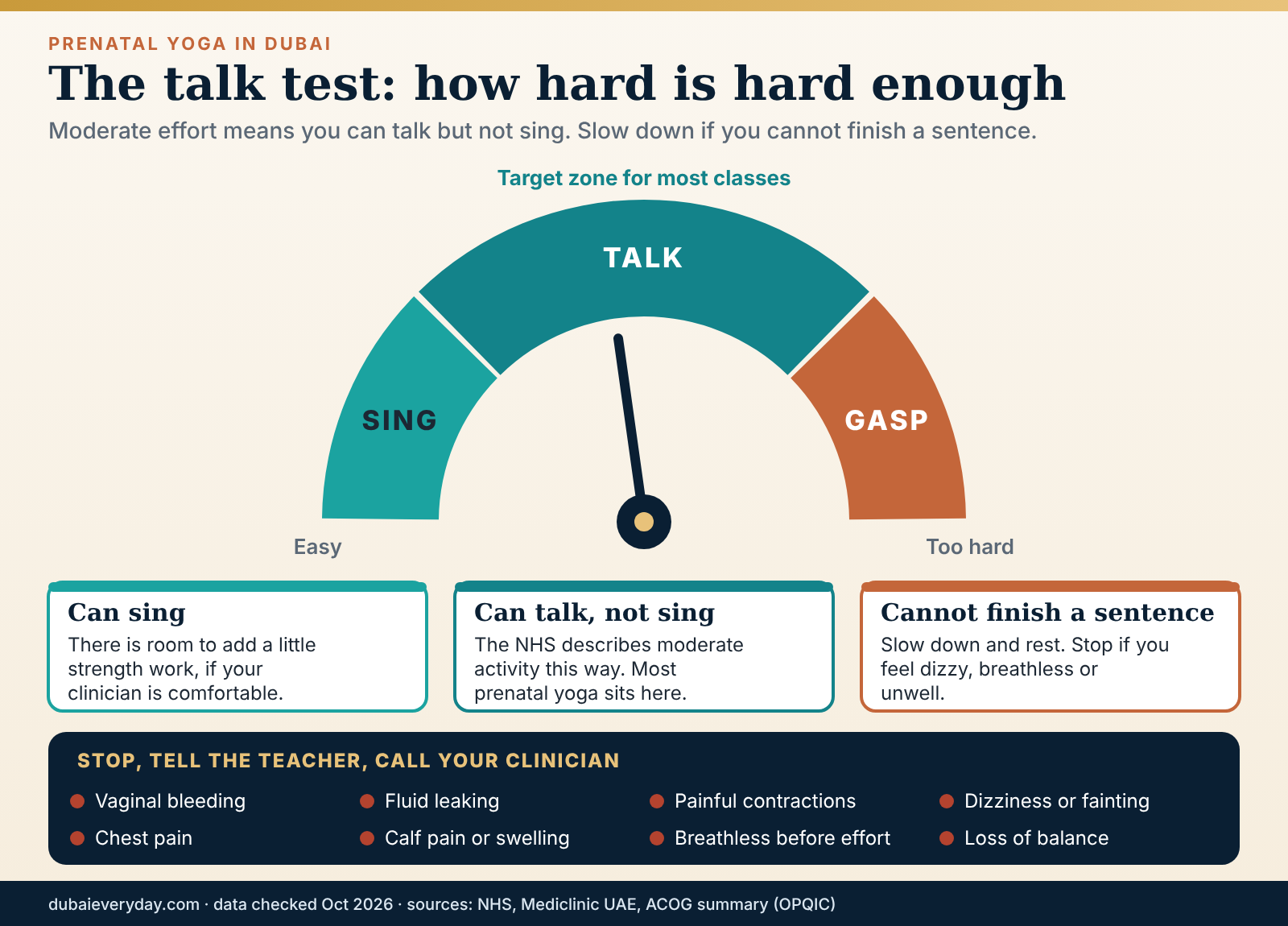
Health-service guidance lists the same stop signals again and again: vaginal bleeding, fluid leaking, regular painful contractions, dizziness or fainting, a bad headache, chest pain, calf pain or swelling, sudden breathlessness before exertion, and muscle weakness that affects your balance. If one appears in a class, stop, tell the teacher, sit or lie on your left side, and phone your clinician. If it is severe or you are frightened, go to emergency care. A class is never a reason to ignore a symptom.
What a prenatal yoga Dubai studio may ask of you
Studios that run prenatal yoga Dubai classes set their own admission rules, and they vary. Some ask only for your due date and any conditions on a health form. Some ask for a clinician’s note. Some set a minimum gestation for group classes, often after the first trimester, because early pregnancy can bring nausea and unpredictable tiredness, and because early loss is common enough that teachers are cautious. Others accept first-trimester students on a gentle basis. None of this is set by one rule that applies across Dubai, as far as we could find, so read the booking page and ask.
If a studio makes no enquiry about your pregnancy at all, treat that as information. It may have a perfectly good teacher who simply never updated the form. It may also be running a standard class with a pregnancy label.
Insurance and who pays for what
Your health plan will not normally pay for a yoga class, but your antenatal visits, scans and delivery fall under its maternity terms, which differ a lot between plans. The guide to health insurance in Dubai explains waiting periods, networks and co-pays. Treat a prenatal yoga Dubai class as a personal wellness cost, and keep your clinician’s advice on your phone in case a provider asks for it.
Pregnancy stages: what changes in each trimester
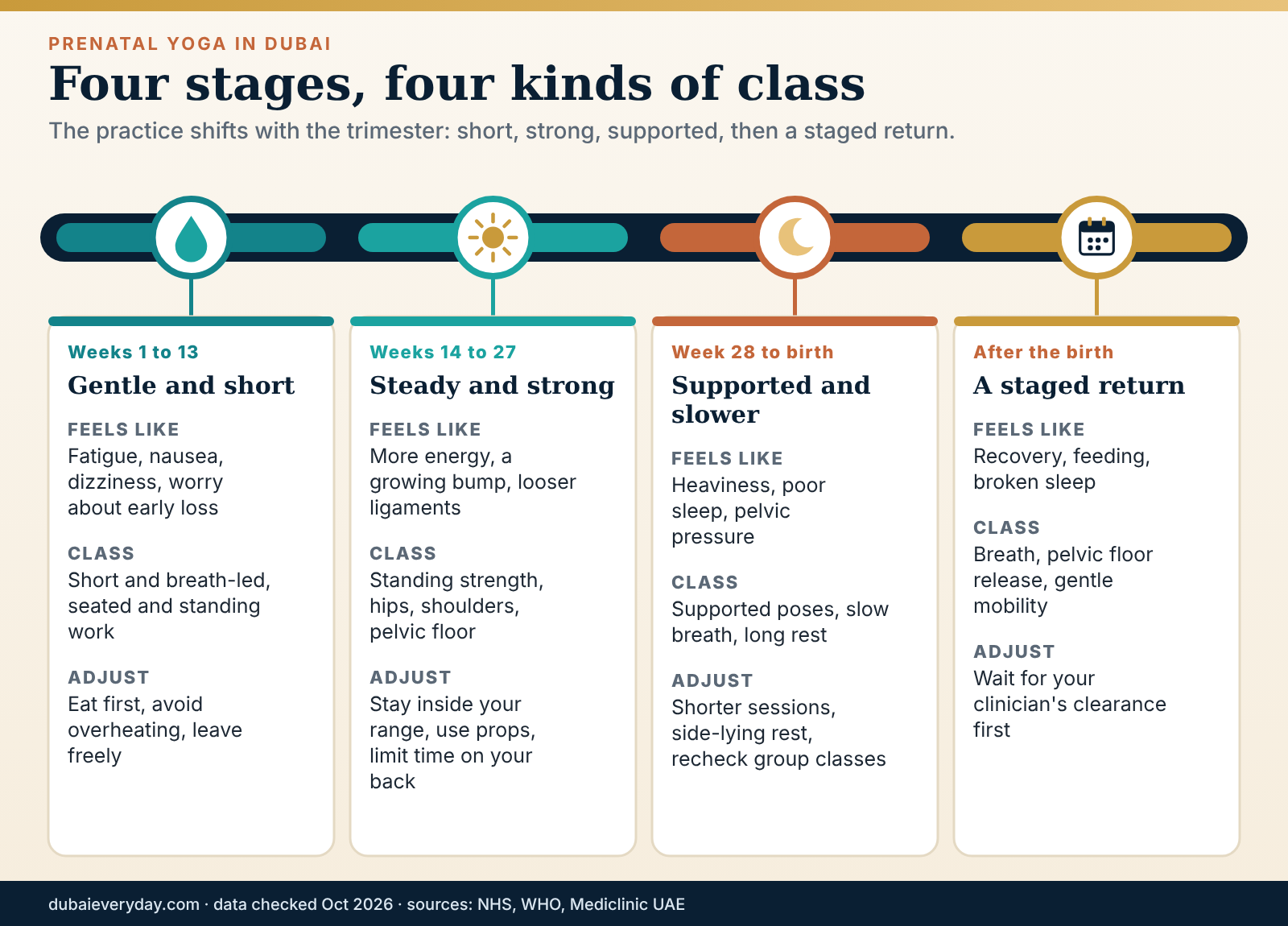
Clinicians count pregnancy in weeks from the first day of your last period and group them into three trimesters: roughly weeks 1 to 13, 14 to 27 and 28 to birth. Studios use the same scale, and good ones will ask for your week, not your month, because the difference between week 11 and week 15 matters more than the label. A prenatal yoga Dubai class that treats all pregnant students as one group is making a compromise. You should know what it is compromising.
First trimester (about weeks 1 to 13)
The body is doing enormous work that nobody can see. Tiredness, nausea, light-headedness and a strange sensitivity to smells are common, and the practice that works is often the opposite of ambitious. Short sessions, plenty of water, a snack beforehand and a quiet exit if you need one. The NHS advises against exercising on an empty stomach because it can make you faint, which matters most when morning sickness has you skipping breakfast.
Many women keep an early pregnancy private. Telling a prenatal yoga Dubai teacher is still worth it. They do not need the story, only the information: your approximate week and anything your clinician has flagged. They can then offer lower-effort alternatives without drawing attention in a group room. Expect most prenatal teachers to steer you away from forceful breathing practices, long breath holds and anything that makes you dizzy. Evidence on these specific techniques is thin, so the caution is conservative rather than proven, and it is a fair rule when nothing is gained by pushing.
Second trimester (about weeks 14 to 27)
For many people this is the comfortable stretch. Nausea often eases, energy returns and the bump is not yet in the way. It is also when prenatal yoga Dubai classes feel most like proper yoga: standing work, hip openers, supported squats, gentle strengthening for legs, back and shoulders. Pregnancy hormones soften ligaments, so it is easy to stretch further than usual without feeling it, and a teacher who coaches you to stay well inside your range is doing you a favour.
Balance starts to shift as the belly grows. Expect a wall, a chair or a block to appear in standing poses, and a wider stance. Expect the teacher to stop asking you to lie flat on your back for long. The NHS says to avoid lying flat on your back for more than a few minutes in later pregnancy, because it can make you feel dizzy and is not good for the baby. In practice, teachers use a bolster or folded blankets to raise the upper body, or ask you to lie on your side.
Third trimester (about week 28 to birth)
Now the body is heavy, sleep is patchy and the baby presses on everything. Heartburn, breathlessness, swollen ankles and pelvic pressure are normal reasons to shorten a session. The practice turns towards breath, supported positions, hip and lower-back comfort, and practising the relaxation you will want in labour. Strength still matters, but a class that pushes it is the wrong class.
A caution about marketing. Some prenatal yoga Dubai classes promise to help your baby into a better position or to prepare you for an easier birth. The available evidence supports the idea that staying active is good for you; it does not support specific positional claims for yoga poses. A teacher who frames the practice as comfort, confidence and calm is on firmer ground than one who promises outcomes.
In the final weeks, check three things again with your clinician: whether you can still attend group classes, whether any new condition has been diagnosed, and what to do if the class is interrupted by a contraction or a leak. If you have a due date in the summer, read the section on heat below before you book anything outdoors.
Stage-by-stage decision table
| Stage | Common experience | Class emphasis | Ask or adjust |
|---|---|---|---|
| Weeks 1 to 13 | Fatigue, nausea, dizziness, anxiety about early loss | Short, gentle, breath-led; seated and standing work | Eat first; leave freely; avoid forceful breathing and overheating |
| Weeks 14 to 27 | More energy, growing bump, looser ligaments | Standing strength, hips, shoulders, pelvic floor awareness | Stay inside your range; props for balance; limit time on your back |
| Weeks 28 to birth | Heaviness, poor sleep, pelvic pressure, breathlessness | Supported positions, slow breath, relaxation, comfort | Shorter sessions; side-lying rest; recheck group classes with your clinician |
| After the birth | Recovery from birth or surgery, broken sleep, feeding | Breath, pelvic floor, gentle mobility, a staged return | Wait for your clinician’s clearance, often at the postnatal check |
Where mixed-stage prenatal yoga Dubai classes fall short
An open prenatal class may hold a woman at week 14 beside one at week 38, and the teacher cannot cue for both. Look for classes that split by stage, or teachers who say which version suits which stage. If your studio has only one weekly prenatal yoga Dubai class, a private session every few weeks can fill the gaps.
This is also where prenatal Pilates sometimes fits better, particularly on a reformer for people who want more load for the legs and back. See the guide to reformer Pilates studios in Dubai for how those classes are set up, and ask any studio the same questions about training and clearance that this page suggests for yoga.
Prenatal yoga Dubai instructor training: how to read a teacher’s credentials
Yoga teaching is largely self-regulated. A 200-hour certificate has become the usual baseline, and Yoga Alliance, a US-based registry, is the best-known body that lists teachers and schools worldwide. That baseline tells you the teacher completed a general course. It says very little about pregnancy, which is why instructor training is the single most useful filter for any prenatal yoga Dubai search.
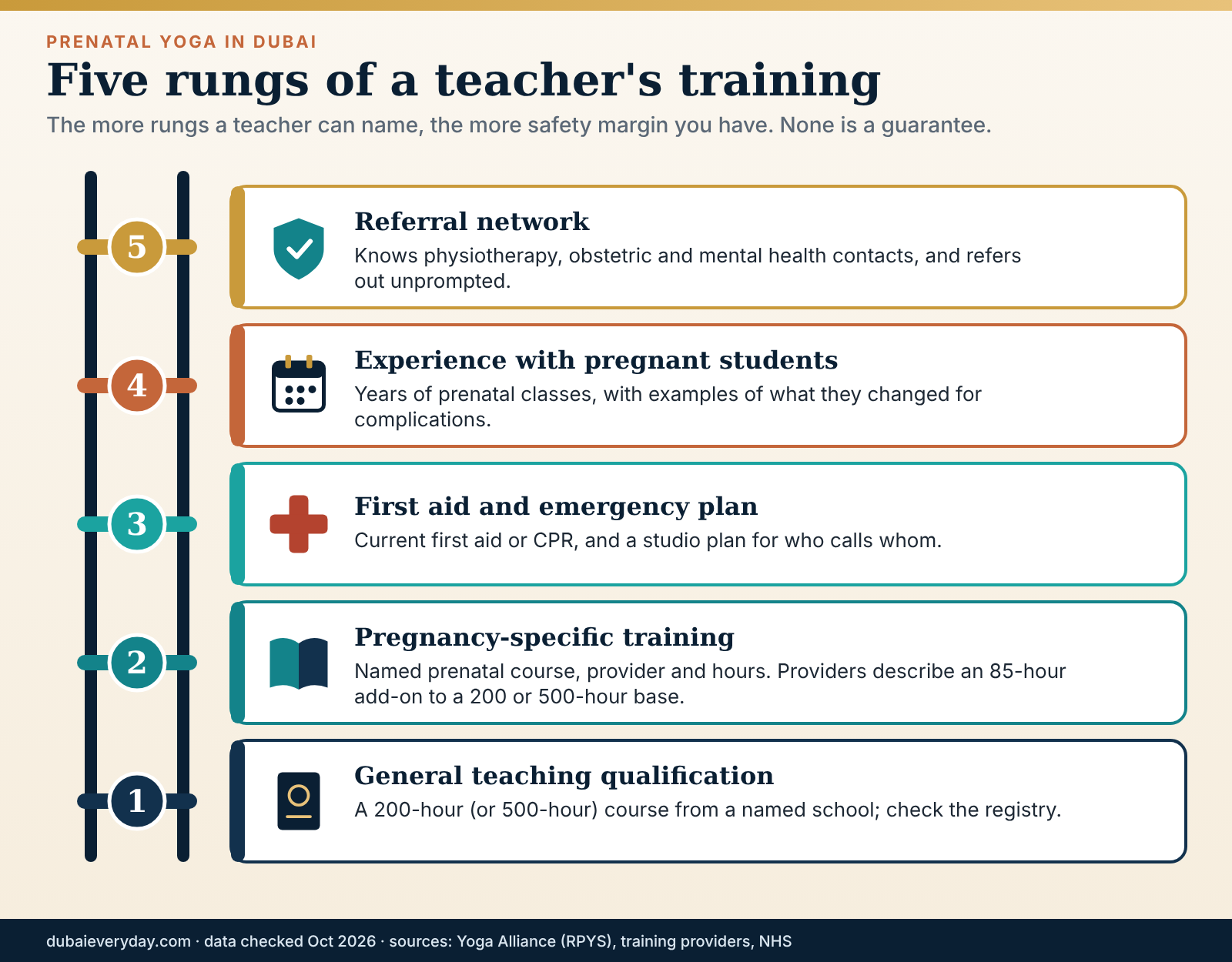
Prenatal-specific credentials exist, but they are voluntary. We found no official Dubai register of prenatal yoga teachers, so verifying a credential is your job, and a good teacher will treat the request as normal. The ladder below shows the layers worth asking about, from the base up.
Rung one: a general teaching qualification
Look for a recognised 200-hour course, or a 500-hour one, from a named school. Ask for the school and the year. Yoga Alliance lets you search its public directory by teacher name, which is a quick way to confirm a registration. Not every excellent teacher is registered, and not every registered teacher is excellent, so treat registration as a starting point and not a verdict.
Rung two: pregnancy-specific training
Yoga Alliance has a Registered Prenatal Yoga School credential, designed for schools that train teachers to support expecting parents. Training providers describe the matching teacher route as an add-on of about 85 hours on top of a registered 200 or 500-hour base. Other routes exist: courses from birth-education organisations, pelvic health and physiotherapy-led programmes, and a doula or midwifery background. Those can be as good or better. Ask what the course was, who ran it, how many hours it lasted and what it covered.
Good answers name the provider and include anatomy of pregnancy, trimester changes, common complications, pelvic floor, birth preparation and postpartum recovery. Vague answers such as “I did a workshop” are not disqualifying, but they should make you ask more questions in the next rung.
Rung three: first aid and emergency readiness
A teacher who sees pregnant students should know what to do if one feels faint, bleeds or goes into labour in class. Ask whether they hold a current first aid or CPR certificate, and whether the studio has a plan: who calls whom, where the nearest emergency department is and whether the room can be cleared quickly. These questions feel awkward and take thirty seconds.
Rung four: hands-on experience with pregnant students
Certificates are one thing, hours in front of pregnant students another. Ask how long the teacher has run prenatal yoga Dubai classes and how often they see complications in the room. Someone who has taught for years will have stories about the student who arrived with a low-lying placenta or pelvic girdle pain, told in terms of what they changed, not whom they impressed.
Rung five: a referral network
Teachers are not clinicians. Pelvic floor dysfunction, diastasis, persistent pain and mood symptoms need a physiotherapist, an obstetrician or a mental health professional. The best teachers know where to send you, and say so unprompted. A centre that keeps a physiotherapist or midwife on the team, or has a standing relationship with one, is showing one of the stronger signals that it takes pregnancy seriously. Ask who they would refer you to.
Questions that reveal more than a certificate
Try three scenario questions, by message or on a trial call. A student at 32 weeks feels dizzy lying on her back: what happens? A student reports sudden swelling in the face and a headache: what happens? A student at 20 weeks has a history of back pain and wants to do deep twists: what happens?
Strong answers are specific and calm. For the first, roll onto the left side, sit up slowly, take water, stay with the student and suggest she tell her clinician. For the second, treat it as a medical concern, stop the session and send her for urgent assessment. For the third, offer gentle, open twists that do not compress the belly, and ask about the pain before choosing. Weak answers are generic, cheerful or dismissive.
Be wary of a teacher who promises a shorter labour, a better baby position or a guaranteed outcome. Be wary of anyone who pushes through your discomfort, adjusts your belly with force, asks you to hold your breath, to lie face down or on your back for long, or to practise in a heated room. Be wary of a class that never asks about your week or conditions, or one that treats a symptom as something to breathe through. Leave, and tell your clinician if anything happened.
What a good teacher does before the class begins
Look at how a prenatal yoga Dubai booking and the first five minutes work. A teacher with pregnancy-specific training will usually ask for your due date, your clinician’s advice, any complications and what you want from the class. They will explain how the session runs, show you the props and make it clear that you may leave or rest at any moment. They set the room so that no one is lying on their back for the opening minutes.
Some people prefer a woman-only space, or a female teacher. That is a legitimate criterion, and there is no need to apologise for it. Women-only sessions do exist in Dubai, and the guide to women-only gyms in Dubai covers how those spaces handle privacy, trainers and childcare. Ask the studio directly about the teacher and the room if this matters to you.
Insurance and liability
Ask whether the teacher or studio carries professional liability cover. A reputable teacher will answer without discomfort. The question matters most for private home sessions, where a studio’s cover may not apply, and for hotel or wellness-centre sessions, where the venue’s rules may differ from the teacher’s.
Prenatal yoga Dubai class formats compared
The format decides how much supervision you get, what you pay per useful session and how often you actually turn up. The prenatal yoga Dubai market offers the usual spread, and the choice is less about taste than about your pregnancy, your schedule and your tolerance for travelling in July. This section compares them directly, then shows how to price a pack without being fooled by the headline number.
Dedicated prenatal yoga Dubai group classes
A class built for pregnant students from the first minute is the default recommendation for a healthy pregnancy. The room is set up with bolsters and blocks, the teacher expects a mix of bumps and sizes, and nobody looks twice if you leave to be sick. The weakness is the mixed-stage problem described earlier. The other is availability: dedicated slots are few, tend to sit on weekday mornings or early evenings, and may disappear from the timetable when the teacher goes on leave.
Online booking platforms show that such classes exist in the city. On 29 October 2026, a ClassPass search for prenatal yoga in the UAE returned Dubai listings including ZOGA and Crimson Chambers Flow Yoga Studio at The Sustainable City, alongside a studio in Abu Dhabi. A listing shows that a studio tagged a class as prenatal. It does not show who teaches it, what that teacher is trained in or whether the class is running this month, so use it as a lead, not a recommendation.
General yoga classes that welcome pregnant students
Many studios say that pregnant students are welcome in gentle classes. That can work well when the teacher has prenatal training and the class is not heated or fast. It works badly when the class is a vigorous flow, when the teacher has no pregnancy training or when the room is packed. If you go this route, tell the teacher before class, take your own props, stay near the edge so you can leave, and skip anything that does not feel right. The guide to yoga studios in Dubai covers how to judge a general class.
Private and semi-private prenatal yoga Dubai sessions
One-to-one work costs more per hour and gives more per hour. It is the sensible choice when your clinician has asked you to modify, when you are new to yoga, when pelvic girdle pain needs specific adjustments or when a studio class is too far to reach comfortably. A teacher can come to your home, though not every teacher does, and a home session solves the problem of parking and heat entirely. The trade-off is the loss of company, which many people value more than they expect.
A small group of two to four friends, sometimes called semi-private, splits the cost and often keeps the personal attention. It works well for expat groups from antenatal classes, and for colleagues who are pregnant at the same time. Ask the teacher whether stage matching is possible.
Online and hybrid prenatal yoga Dubai classes
Live online classes remove commute, heat and parking, which is why they are useful in summer and in the final weeks. They also remove the teacher’s eyes from your alignment, so choose classes with small cohorts where the teacher can see you on camera, and set up a space with a wall, a chair and a place to lie on your side. Recorded libraries suit a practice you already know, not a first pregnancy class. Hybrid timetables let you switch between studio and screen as your pregnancy changes.
Antenatal classes are not yoga classes
Hospital-run antenatal classes cover birth preparation: labour, pain relief options, birthing positions, hospital procedures, newborn care and breastfeeding. Mediclinic’s Dubai hospitals, for instance, run free antenatal classes that cover these topics, with registration advised from 24 weeks and a first-come, first-served booking process; its page does not mention yoga. Other hospitals have their own programmes. They are an excellent complement and a poor substitute, so use both if your calendar allows. Ask your own maternity unit what it offers.
Prenatal Pilates, swimming and walking as alternatives
Prenatal Pilates adds resistance for legs and back, swimming takes weight off the joints and stays cool, and walking in an air-conditioned mall is underrated. The guides to Pilates in Dubai and gyms in Dubai show what is on offer; the same clearance and training questions apply.
Decision table: formats side by side
| Format | Best for | Watch for | Ask the provider |
|---|---|---|---|
| Dedicated prenatal group | Healthy pregnancy, wanting company and a set routine | Mixed stages; few time slots; timetable changes | Teacher’s prenatal training; stage grouping; cancellation rules |
| General class, pregnancy welcome | Experienced yogis, gentle styles | Pace, heat, crowding; teacher may lack training | Is the room heated? Will you modify poses for me? |
| Private or home session | Complications, new to yoga, tight schedule, long commute | Highest cost per hour; liability cover; less company | Credentials; insurance; travel and cancellation fees |
| Small semi-private group | Friends at similar weeks | Group needs drift apart; one cancellation affects everyone | Minimum numbers; what happens if one person drops out |
| Live online | Summer, final weeks, travel, unreliable parking | Teacher cannot adjust; home set-up; no emergency help in the room | Camera on? Class size? Who contacts me if I leave suddenly |
| Hospital antenatal class | Birth, feeding and newborn preparation | Not an exercise class; fixed dates; limited places | Dates, eligibility, registration week |
Pricing a prenatal yoga Dubai pack without being fooled
We did not find current, verifiable price lists for prenatal yoga Dubai classes, and the most-cited roundups date from 2021, so this page gives no prices. What it can give you is the arithmetic that matters more than the sticker. Price per attended class equals the pack price divided by the sessions you will realistically use before the pack expires or the baby arrives, not by the number printed on the pack.
Illustrative example (not a quote or market fact): a ten-class pack at AED 650 looks like AED 65 a class. If you will attend only seven before it expires, you pay about AED 93 each. A single drop-in at AED 90 would have cost the same. In our reading, three questions change the maths most: how long the pack is valid, whether it can be paused or transferred, and whether it can be shared with a friend.
Timing matters. A three-month pack bought at week 34 may expire after the birth. A monthly membership bought in the first trimester may sit unused during a rough patch of nausea. Buy a single class first, then a short pack, and only commit to a longer package when you have been a few times and your clinician is happy.
What happens inside a good prenatal yoga Dubai class
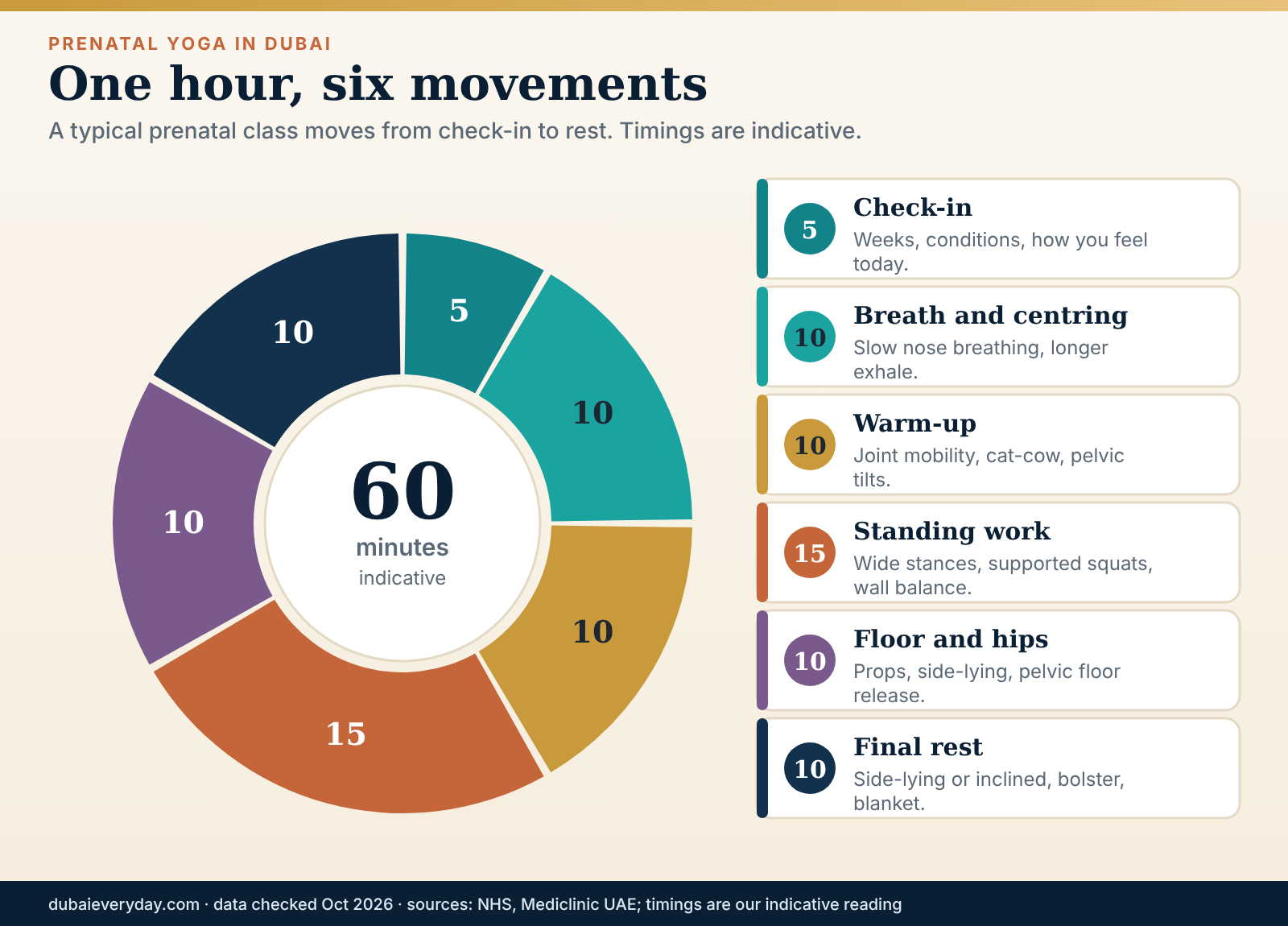
Knowing the shape of a good session helps you spot a weak one in the first ten minutes. Prenatal yoga Dubai teachers use different styles, but sound classes share a rhythm: arrive and check in, settle the breath, warm up slowly, work the legs and back while standing, open the hips on the floor, then finish with a long rest. Aim for sessions of around an hour in the middle months, shorter at the edges.
The opening five minutes: check-in
Look for a quiet question round: how many weeks, how are you feeling today, anything hurting, anything your clinician told you. It sounds like a formality. It is the moment the teacher decides how to adapt the class, and it is the cleanest test of whether they are paying attention. If a prenatal yoga Dubai teacher launches straight into a sequence, nobody has asked who is in the room.
Breath and centering
Pregnancy changes breathing mechanics. The diaphragm has less room, and breathlessness is common, especially late on. Good classes teach slow nose breathing with a longer exhale, which many people find calming, and avoid forceful breathing techniques and breath holds. Relaxation here is a skill you will want later, so it tends to come back every class in small doses.
Warm-up and standing work
Gentle joint mobility, cat-cow variations on hands and knees, supported side stretches and pelvic tilts come first. Standing work follows with wide stances, supported squats, wall-assisted balance and arm-and-shoulder strengthening. This is where balance changes show up, so there should be walls, chairs and blocks within reach. A teacher who instructs you to balance on one foot in the middle of the room without support has not thought about falls.
Hips, floor and pelvic floor
Floor work is where props earn their keep. Supported butterfly, side-lying rest, bolstered seated positions and gentle hip circles feel good and do not require lying flat on your back. Pelvic floor work in a good class teaches both gentle engagement and complete release, because a floor that never lets go is as unhelpful in labour as one that never holds. If you leak urine, feel heaviness or have pain, see a pelvic health physiotherapist; yoga is not a diagnosis.
The final rest
Many people come for this part. A side-lying rest with a bolster between the knees, a blanket and a quiet voice is a solid ten minutes of recovery. It also doubles as practice for labour relaxation, whatever kind of birth you plan. The NHS advice about not lying flat on your back for more than a few minutes in later pregnancy applies here, so the teacher should offer an incline or side-lying set-up without being asked.
Positions and moves in prenatal yoga Dubai classes: welcome, modified or skipped
The lists below reflect common prenatal teaching conventions and general health-service cautions about falls, heat and lying on your back. They are not clinical rules. Your clinician’s advice always overrides them, and your own body gets a vote too.
Usually welcome
Cat-cow on hands and kneesWide-legged stancesSupported squatsSide-lying restWall-assisted balanceSlow nose breathing
These build strength, mobility and calm with low risk, as long as you stay inside your range.
Usually modified
Twists, opened away from the bellyForward folds with a hingeLunges with a chair or blockCore work without crunchingDeep squats with support
The idea stays. The depth, direction or support changes so the belly is not compressed and balance is protected.
Usually skipped
Lying on your back for longLying face downInversions and arm balancesForceful breathing, breath holdsHeated roomsExtreme stretching
Falls, overheating, dizziness and over-stretching loose ligaments are the main reasons.
Core work is the area people misjudge most. Mediclinic’s pregnancy workout advice for UAE readers suggests pelvic tilts, deep core breathing and side-lying work, and advises avoiding lying flat on your back and intense crunches. A class that asks for repeated boat pose or planks in the second half of pregnancy is not following that approach, and it is reasonable to say so politely.
The talk test, and how hard is hard enough
You do not need a heart-rate monitor. The NHS describes moderate activity in pregnancy as a pace at which you can talk but not sing. A prenatal yoga Dubai class rarely climbs above that, which is part of its appeal. If you find you cannot talk in full sentences, slow down. If you can sing, you probably have room to add a little strength work, as long as your clinician is comfortable.
What to bring and wear to prenatal yoga Dubai classes
Bring your own mat if you can, a large water bottle, a small snack and a light layer for the cooler studio. Wear breathable clothing that does not squeeze the bump. Many studios provide bolsters, blocks and blankets, but a studio that has none is telling you something. Eat a small snack beforehand, because the NHS warns that exercising on an empty stomach can make you faint, and skip a heavy meal in the last hour.
Prenatal yoga Dubai in the heat: air-conditioning, Ramadan and timing
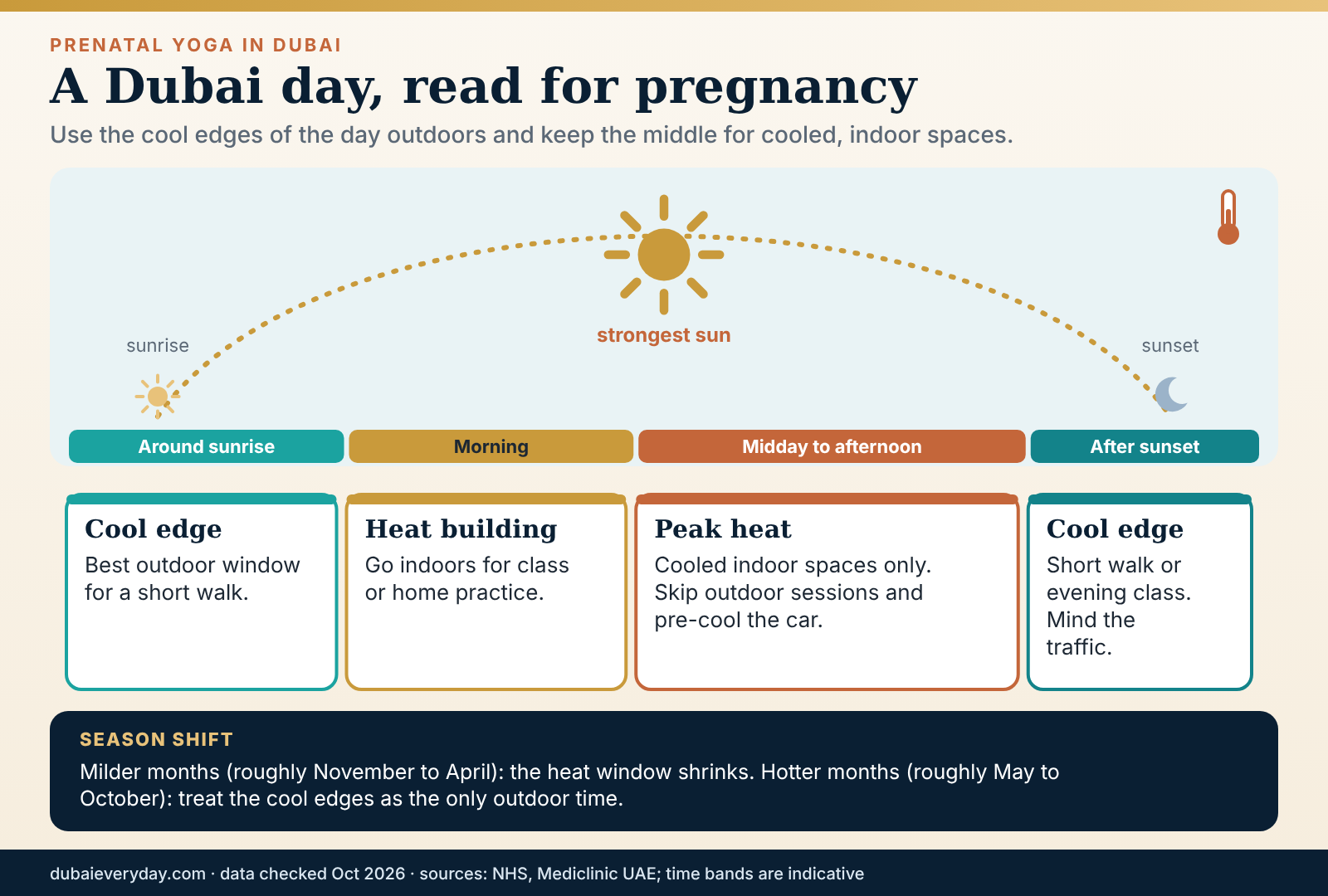
Heat is the Dubai-specific variable in every prenatal yoga Dubai decision. The NHS tells pregnant women to keep cool when exercising by choosing suitable clothing and drinking water, and to stop if they feel too hot. Mediclinic, writing for UAE readers about pregnancy workouts in hot weather, leans on indoor sessions in cool, well-ventilated spaces and lists feeling overheated, light-headed, unusually tired or short of breath as reasons to slow down or stop.
Put those two together and the Dubai rule writes itself: the studio is rarely the problem, but everything around it can be. The walk from the car park, an open-air terrace class, a rooftop session at noon and a beach yoga event in August are where overheating happens.
Why heated rooms are the wrong call
Hot yoga heats the room deliberately, often well above normal comfort, and asks you to stay there. That is the opposite of the cooling guidance above. For a pregnant body that already runs warm and has a lower tolerance for dehydration, it is a poor trade. The guide to hot yoga in Dubai covers studio heat and medical considerations in detail. For prenatal yoga Dubai students, the safe rule is simple: choose an unheated room, and ask for the temperature rather than accepting words like “warm” or “gentle flow”.
If you practised hot yoga before pregnancy, ask your clinician whether and how to continue. Do not assume that experience is protective. It is a conversation to have, not a decision to make alone.
Studio air-conditioning: the opposite problem
Dubai studios often run cold, especially in summer. After a warm walk indoors, sweating under a vent and then lying still in the final rest can leave you shivering. Pack a light layer, avoid the mat directly under the air-conditioning outlet, and ask for the fan to be moved if you feel a draught. Cold is a comfort issue, not a safety one, but it can make you tense in the final relaxation, which defeats the point.
A seasonal reading of the year
From roughly November to April, Dubai’s weather is mild enough for short outdoor walks and, with shade and water, for an outdoor class in the early or late hours. From roughly May to October, outdoor midday activity is a poor idea for anyone, pregnant or not, and the classes that work are indoor ones with a short, cooled transfer from door to door. Our reading is that the month you are due, and the months you will be in the third trimester, should shape how you book.
A third trimester in summer favours online classes, basement parking, private home sessions and early starts. A winter one is more forgiving.
The Dubai Fitness Challenge window
The tenth edition of the Dubai Fitness Challenge runs from 31 October to 29 November 2026, organised by the Dubai Department of Economy and Tourism and the Dubai Sports Council. It asks participants to do 30 minutes of activity a day for 30 days. Dubai Yoga is listed among its flagship events for 2026, and the programme includes free fitness hubs. None of the official material we read describes sessions designed for pregnant participants.
For pregnant residents, the useful part is the permission: 30 minutes of walking or a prenatal yoga Dubai class counts, and the month falls in the cooler season. The sensible approach is to treat large outdoor events as optional, use shaded or indoor options, check the schedule for any session that is explicitly beginner-friendly and speak to the instructor before starting. Check dates, locations and entry on the official challenge channels, because event details change.
Ramadan and fasting
Ramadan is expected to begin around 8 February 2027, subject to moon sighting. Many studios reduce or move their timetables, and classes shift to evenings. Whether to fast while pregnant is a medical and personal decision, and your clinician is the right person to discuss it with. If you are fasting, an evening session after the meal tends to be calmer than one late in the fasting day, and many teachers will lower the intensity for everyone in the room during the month.
If you are not fasting but your teacher is, remember that their energy may be lower in the afternoons. If you are fasting, tell the teacher. They cannot adapt to what they do not know, and a class cut short because you felt faint is better than one pushed through.
Getting there without arriving wilted
Parking, valet queues, a long taxi line and an uncooled walkway all add heat. For a pregnant student the best studio may not be the nearest one but the one with covered or basement parking and an indoor route to the door. Ask. The beach guide is a good reminder that Dubai’s outdoor spaces rarely give you shade without a plan, and the same logic applies to any outdoor class or event.
How to choose a prenatal yoga Dubai class: a 12-point check
You can run this prenatal yoga Dubai check in an evening, mostly by reading a booking page and sending one message. No score is meant to be mathematical. Treat points one to four as essentials, and the rest as ways to break a tie. If a class fails any of the first four, the other eight do not rescue it.
Safety first (points 1 to 4)
- The room is not heated. Ask for the temperature if the listing says “warm” or “flow”.
- The booking process asks about your pregnancy. Due date, complications and your clinician’s advice, at minimum.
- The teacher can name their prenatal training. Course, provider and hours, plus a general teaching qualification beneath it.
- There is an emergency plan. A first aid-trained teacher or staff member, and a clear idea of what happens if someone is unwell.
Teaching quality (points 5 to 8)
- Stage is considered. Classes grouped by trimester, or teaching that gives clear options for each.
- Props are provided. Bolsters, blocks, blankets, a wall or chair for balance.
- The language is about comfort, not outcomes. No promises about labour, baby position or birth results.
- The class size allows attention. A teacher cannot watch fifteen pregnant students at once.
Fit and practicalities (points 9 to 12)
- You can reach it easily. Door-to-door time in your usual traffic, plus parking you can manage at 36 weeks.
- The timing works for your energy. Morning classes suit some, evenings others; pregnancy shifts that unpredictably.
- The cancellation and pack rules are fair. Late cancellation fees, expiry dates, pauses and transfers.
- The space suits you. Women-only if that matters, a teacher whose language you share, a room you find calming.
The message to send before you book
One short message gets most of the answers. Something like: “Hello, I’m 22 weeks pregnant with no complications, and my doctor has said exercise is fine. I’m looking at your prenatal class on Thursday. Could you tell me who teaches it, what prenatal training they have, whether the room is heated, how many people usually attend and what your cancellation rule is? Do you need anything from my doctor?”
How the studio replies is the signal. A prompt, specific reply is a good sign. A reply that says “all our teachers are qualified” without specifics is a weaker one. No reply at all costs you nothing except a studio you would have regretted.
The trial prenatal yoga Dubai class: what to watch
- Arrive ten minutes early.Meet the teacher, say your week and any concern, find the exit and the toilet, and check where the air-conditioning blows.
- Notice the check-in.Does the teacher ask each person how they are today, or just start?
- Test the pace.You should be able to talk in the standing section. If you are out of breath in the first twenty minutes, the class is too hard.
- Watch the props and the options.A good teacher offers a version for different weeks, and says that stopping is fine.
- Notice how you feel an hour later.Calm, a little tired, nothing painful or odd. Anything else is information for your clinician and for the next class choice.
When to walk away from a class
You are allowed to leave a class mid-session. You are allowed to refuse an adjustment, a pose or a prop. You are allowed to stop going without explaining. Pregnant students sometimes feel they owe a teacher loyalty or an explanation, and they do not. If you felt pressure, ignored discomfort, were told to push through, or were touched without being asked, say so to the studio manager and to your clinician if physical symptoms followed, and find another class.
The same applies to the opposite problem: a class that is too timid for you. If you are fit and your clinician has cleared moderate strength work, you may find a gentle prenatal class dull. That is a fit issue, not a safety one. Ask the teacher what a stronger option looks like, or look at premium gyms and studios in Dubai that offer specialist coaches.
Logistics: travel time, passes, visitors
Most dropped prenatal yoga Dubai classes are lost to logistics, not motivation. Measure your real door-to-door time at the hour you would travel, and cap it. In the third trimester a 25-minute drive that was fine in week 14 becomes a negotiation. Prefer a studio with parking or valet you can use without a long walk, and one whose timetable is stable across the summer, when many teachers travel and schedules thin out. Ask about cover arrangements for holidays.
Booking platforms and multi-studio passes make it easy to sample several studios, though not every class on them is suitable for pregnancy. Filter by prenatal, then read the class description and message the studio. A pass that lets you try three teachers in a month is worth more than a long membership at one. Hotel spas and wellness centres sometimes run yoga for guests and non-members; ask whether the teacher has prenatal training, as hotel timetables often rely on general instructors. The hotel guide helps if you are choosing a stay with a wellness programme.
Prenatal yoga Dubai options if you are visiting while pregnant
Visitors and short-stay patients should email ahead: give your week, ask for drop-in availability, and carry your clinician’s note or scan summary. Studios may refuse first-timers beyond a certain gestation, and you do not want to learn that at the door. Online classes at your hotel are often the easiest option, and a gentle walk in the cooler hours works as well. The things to do in Dubai guide shows lower-effort days that still feel like a trip.
Common mistakes, and when yoga is not the right tool
Five mistakes recur. Waiting until week 30 to start, then choosing a class that is too hard. Picking a studio by Instagram feed rather than by teacher training. Buying a long pack before a trial class. Skipping the clinician conversation because “yoga is gentle”. And treating a symptom as something to breathe through.
Some problems belong with other professionals. Persistent pelvic or back pain, leaking, a feeling of heaviness, or a visible gap down the middle of the abdomen are cases for a physiotherapist who works with pregnancy. Low mood, panic or sleep that will not come deserve a clinician’s attention, not a better pose. Yoga can sit beside that care, not replace it.
After the birth: returning to yoga
Many studios offer postnatal classes, often with babies on the mat. Return is staged and individual: recovery from a vaginal birth differs from recovery from surgery, and clinicians usually give the go-ahead at a postnatal check. Start with breath, pelvic floor release and gentle mobility rather than a full flow. Ask the same training questions of a postnatal teacher, who should understand recovery, feeding and sleep loss.
If you plan to stay with one teacher through both stages, say so at the start. Some offer a bridge from late pregnancy into early postnatal classes, which makes the return less of a cold start.
Prenatal yoga Dubai: frequently asked questions
Is a prenatal yoga Dubai class safe in the first trimester?
For most uncomplicated pregnancies, health services say gentle activity is fine, and yoga counts. Early pregnancy brings fatigue, nausea and dizziness, so keep sessions short, eat first, avoid overheating and tell the teacher your week. Some studios accept only students past the first trimester. Ask your clinician first, especially after fertility treatment or a previous loss.
Do I need a doctor’s note for prenatal yoga Dubai classes?
It depends on the studio. Some ask only for your due date on a health form, others want written clinician approval. No single Dubai rule applies, as far as we could find. Either way, speak to your obstetrician or midwife and keep their advice on your phone to share when asked.
Can I do hot yoga while pregnant?
Health guidance stresses staying cool when exercising in pregnancy, and heated studios work against that. The usual advice is to choose an unheated room. If you practised hot yoga before pregnancy, discuss it with your clinician instead of assuming it is fine. The hot yoga guide on this site explains studio heat in detail.
What certification should a prenatal yoga Dubai teacher have?
A recognised general qualification, usually 200 hours, plus pregnancy-specific training. Yoga Alliance has a Registered Prenatal Yoga School credential, and providers describe an 85-hour add-on to a registered base. Other routes, such as physiotherapy or birth-education courses, can also be strong. Ask for the course name, provider and hours.
Does insurance cover prenatal yoga Dubai classes?
Normally no. Yoga classes are a wellness expense. Antenatal visits, scans and delivery come under your plan’s maternity terms, which differ between policies, so check the details with your insurer or HR team before assuming anything.
Is an online prenatal yoga Dubai class as good as a studio class?
It is more convenient and sometimes cheaper, and it suits summer and the last weeks. It is less personal, because the teacher cannot adjust you or help in an emergency. Choose live, small classes with camera on if you can, and keep recorded libraries for routines you already know.
How often should I attend prenatal yoga Dubai classes?
Follow your clinician’s advice. Health bodies suggest around 150 minutes of moderate activity a week for healthy pregnancies, which one or two yoga classes can contribute to alongside walking. Quality matters more than frequency, and rest days are part of the plan.
Can visitors join a prenatal yoga Dubai class?
Often yes, but policies differ. Email the studio first with your week and ask about drop-in places. Bring a clinician’s note if you have one, and expect to be asked about complications. Online classes can fill the gap if a studio is full.
When should I stop going to a prenatal yoga Dubai class?
Stop immediately on bleeding, fluid leaking, regular painful contractions, dizziness, chest pain, calf pain or unusual breathlessness, and call your clinician. Otherwise, many women attend until close to the due date. Ask your clinician about group classes in the final weeks, and shift to shorter or online sessions as needed.
Sources and further reading (13 links)
- NHS: Exercise in pregnancy — activity types to avoid, lying on your back, overheating, talk test, telling your instructor
- World Health Organization: Physical activity fact sheet — benefits of activity in pregnancy and postpartum
- World Health Organization: WHO guidelines on physical activity and sedentary behaviour — guideline coverage of pregnant and postpartum women
- OPQIC: ACOG Committee Opinion No. 804 summary — obstetric guidance on exercise when there are no complications
- Yoga Alliance: Explore credentialing options — Registered Prenatal Yoga School credential for training schools
- Yoga Alliance: Registered Prenatal Yoga School standards — what the school credential is designed for
- Yoga Alliance: Yoga teacher designations — registry and designation structure
- MyVinyasaPractice: How to get certified in prenatal yoga — a training provider’s description of the 85-hour add-on route
- Mediclinic UAE: Safe pregnancy workouts in hot weather — indoor cool-space advice, core work and warning signs for UAE readers
- Mediclinic UAE: Antenatal classes — topics, registration and format of hospital-run classes
- Dubai Media Office: Dubai Fitness Challenge returns for tenth edition — dates, organisers, 30-minute format and flagship events
- ClassPass: Prenatal yoga search, United Arab Emirates — evidence that Dubai studios tag classes as prenatal (a listing; not an endorsement)
- Gulf News: Prenatal fitness classes in Dubai — context only; an older roundup used to show why prices are not repeated here
Update log: 29 October 2026 — first publication; facts re-checked against the sources above. Next review due: October 2027, or sooner if guidance, studio listings or event dates change. Corrections welcome. This page is general information, not medical advice; your obstetrician or midwife decides what is safe for your pregnancy.
About DubaiEveryday and this guide
DubaiEveryday.com is an independent editorial project that publishes practical, research-based guides to everyday life in Dubai: where to live, what things cost, how the rules work and how to get around. This page was written and edited by the DubaiEveryday editorial team. It is not signed by a named expert, doctor, lawyer or adviser, and we do not claim first-hand testing of a venue, clinic or service unless the page says so.
Each guide is built from official sources such as government and regulator pages, operator websites and established news outlets, cross-checked where we can. When we could not confirm something, we say so in the text, and examples that use made-up numbers are labelled as illustrations. Mentions are editorial choices, not paid placements, and a link is not an endorsement.
Dubai changes quickly. If you spot something that is out of date or wrong, please tell us through the contact options on DubaiEveryday.com and we will check it and correct the page.