
The furnished vs unfurnished Dubai choice turns on three things: how much extra rent you pay, how much cash you lock up, and how long you stay. This guide shows the arithmetic, the paperwork gaps and the checks that protect your deposit.
Sooner or later every Dubai viewing reaches the same moment: the agent opens the door on a flat with a sofa already in it, and you start wondering what that sofa costs per month. The furnished vs unfurnished Dubai question looks like a matter of taste, but it behaves more like a small financial decision with a paperwork trap attached. Nobody mentions that the sofa also moves the deposit, the commission and the length of lease you can sensibly sign.
Furnished listings usually cost more rent, a bigger deposit and a larger housing fee, because those follow the rent. Unfurnished ones ask you to find and fund a whole household before the first week is out. The official tenancy contract has no box for either word, so whatever you were promised exists only if it is written down. Below you will find the break-even arithmetic, an inspection routine and the clauses that keep your deposit yours.
Furnished vs unfurnished Dubai comes down to one sum: how many months you will stay, set against the extra rent you pay for someone else’s furniture. Published broker guides put the furnished premium at roughly 10% to 30% of annual rent, but none of them names a dataset, so treat that as a range to test against live listings, not as a rule.
In our worked example (illustrative, AED 80,000 unfurnished rent and a 20% premium), buying a mid-priced set of furniture starts to beat paying the premium after about nine months. A 12-month lease therefore already leans unfurnished if you must buy everything new, and two years leans strongly that way. Furnished wins for stays under about six months or so, for people arriving with a suitcase, and for anyone who cannot spare the furniture cash.
Two details catch people out in the furnished vs unfurnished Dubai market. The official Dubai tenancy contract has no furnished field and no inventory list, so your protection is a signed inventory addendum, not the word “furnished” in an advert. And the premium does not stay in the rent: the 10% furnished deposit custom, the housing fee and broker commission all grow with it.
This is a desk-research guide, not a field test. On 29 October 2026 we read the Dubai Land Department (DLD) pages on Ejari, the Unified Tenancy Contract, the Smart Rental Index, Flexi Rent and rental-dispute fees; the Dubai Legislation Portal text of Law No. 26 of 2007 and Decree No. 43 of 2013; and the Federal Tax Authority (FTA) guidance on property. Market claims about the furnished vs unfurnished Dubai premium, furniture costs and bills come from broker and media articles, and we label them as claims.
What we could not verify: any official dataset that separates furnished from unfurnished rents, DEWA’s own tariff pages (our tools could not open them), district-cooling tariffs and the official wording on tenancy contracts for visas. Every worked example uses round, illustrative numbers and says so. Nothing here was paid for, and nothing is individual legal, tax or financial advice.
What furnished and unfurnished actually mean in a Dubai lease
Listings for furnished vs unfurnished Dubai homes use three labels. Unfurnished means the flat comes without loose furniture, though in Dubai it often still has fitted kitchen cabinets and built-in wardrobes, and sometimes a cooker or fridge. Semi-furnished usually means those white goods plus perhaps curtains or a washing machine. Fully furnished means beds, sofa, dining set, TV and the usual small items. The exact list varies from one landlord to the next.
Those are market labels, not legal categories. We checked the DLD Unified Tenancy Contract: it has no furnished or unfurnished field and no inventory schedule. Its “Additional Terms” box is a blank numbered line, with a note that extra terms can go in an addendum signed by all parties. Law No. 26 of 2007, which governs landlord and tenant relations, talks about “the property” and does not single out furniture. The practical meaning is simple: whatever you were promised exists only if it is written down.
What this page covers, and what it leaves to others
This guide answers one question about furnished vs unfurnished Dubai rentals: which to choose, and what each choice changes in rent, furniture quality, deposits, bills and the length of stay. For the full renting process, from searching to Ejari and renewal, see our complete guide to renting in Dubai. Building-specific issues such as chillers, parking and amenities sit in the apartment rental guide, with separate pages for studios and villas.
The furnished vs unfurnished Dubai decision matters to four kinds of reader, and the page speaks to all of them. Tenants want the cheapest workable home. Newcomers want somewhere to land. Owners want a sensible rent without a wrecked sofa. Buyers and investors want to know whether furnishing a unit pays. The sections below keep those viewpoints apart so the numbers do not blur.
Why the definition is worth five minutes
A fridge in an “unfurnished” flat can be the landlord’s or the previous tenant’s, and the difference shows up when it breaks. A “fully furnished” listing can mean a mattress on a frame and nothing else. In any furnished vs unfurnished Dubai comparison, compare lists before you compare prices. Ask the agent for the inventory in writing, line by line, and treat any item that is not on it as not included.
One more point on vocabulary. “Furnished” tells you about contents, not about bills. Whether electricity, water, cooling and internet are included is a separate question that the standard contract answers with “no”: it assigns those charges to the tenant unless you agree otherwise in writing. We return to that in the utilities section.
Furnished vs unfurnished Dubai rent premium: what is known
Start with the honest position: there is no official Dubai figure for the furnished vs unfurnished rent gap. The DLD publishes rental data and a rent index, but the pages we read do not separate furnished from unfurnished units. Everything below is a published claim from the market, and the claims do not agree with each other.
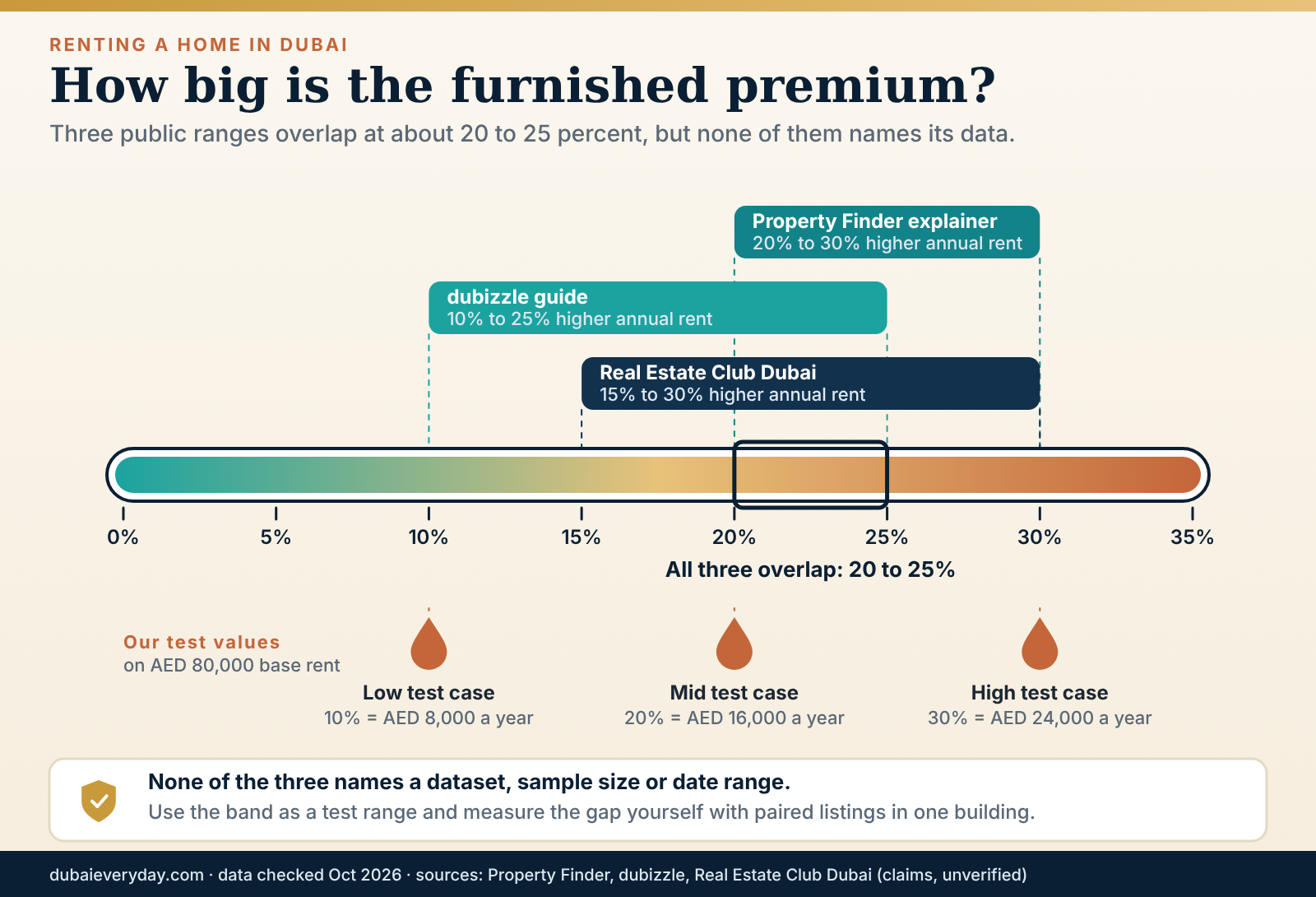
Three published ranges for furnished vs unfurnished Dubai rents
Property Finder’s furnished-versus-unfurnished explainer says furnished units typically command 20% to 30% higher annual rent. The dubizzle guide on furnished apartments says usually 10% to 25%, with a Bur Dubai example of about AED 7,000 a month unfurnished against roughly AED 8,500 furnished. Real Estate Club Dubai, which describes itself as an informational platform rather than a licensed brokerage, gives 15% to 30% with about 20% as the average, and suggests 30% or more in tourist-heavy areas and 10% to 15% in suburban family districts.
Notice what is missing. None of the three cites a dataset, a sample size or a date range for the premium. Property Finder points readers to its own benchmark tool without saying the figures come from it. Checking against live listings is the right instruction, and we follow it below. Our worked examples use 10%, 20% and 30% so you can read across, and we do not claim any of those is today’s Dubai average.
Why the furnished vs unfurnished Dubai gap is not one number
Several things push it around. The quality and completeness of the package matters: a bed, sofa and white goods are one thing, a designer-styled set with crockery is another. Location matters too, because areas that attract short-term and corporate tenants tend to have more furnished stock and landlords who know what that demand will pay. Building age, view and floor all alter the base rent, and the premium is applied on top of that base.
The market cycle matters as well. According to Property Finder data reported by Khaleej Times on 18 October 2026, the average number of apartments listed for rent each day in September 2026 was 55.1% higher than a year earlier, while enquiries per listing fell 23%. Median asking rents were down year on year in nine of ten tracked apartment communities, including Downtown Dubai (down 21.7%) and Dubai Marina (down 16.1%). The article did not mention furnished units.
Even so, a market where tenants can compare many listings is one where the furnished vs unfurnished Dubai gap is easier to haggle down. If you are weighing a prime area, our Downtown Dubai area guide covers what daily life there costs beyond rent.
How to measure the furnished vs unfurnished Dubai gap yourself
- Pair the listingsFind three furnished and three unfurnished listings in the same building, or the same tower cluster, with the same bedrooms and similar size and floor.
- Compare asking rentsWork out the percentage gap for each pair, then take the middle value rather than the average so one odd listing does not skew it.
- Check the adverts are realScan the QR code on each advert. DLD’s Madmoun service shows the authorised details and whether the unit is still marked available, and DLD advises dealing only with ads that carry the code.
- Ask for achieved rentsAsking prices are opening bids. Ask the agent what similar units in the building actually signed at recently, and treat a refusal as information.
The premium is bigger than it looks
In furnished vs unfurnished Dubai comparisons, a premium of AED 16,000 on an AED 80,000 base is not just AED 16,000. Some brokers charge up to 5% of total rent, according to the government’s leasing page, so commission rises by AED 800. The Dubai Municipality housing fee is 5% of annual rent, so another AED 800 a year arrives on your DEWA bill. And the custom of a 10% furnished deposit turns a bigger rent into a much bigger locked-up sum, which we cover in the deposits section.
Renewal and the rent index
At renewal, Decree No. 43 of 2013 caps increases by how far your rent sits below the area average: no increase when rent is within 10% below average, 5% when it is 11% to 20% below, 10% for 21% to 30%, 15% for 31% to 40% and 20% beyond that. Increases need 90 days’ written notice, and the Smart Rental Index adds building classification to the calculation.
Here is the gap in the published material on furnished vs unfurnished Dubai renewals. The Wasl explainer says the calculator compares residential units by area, property type and bedrooms, and the DLD index pages we read list contract values, area averages and building classification. None mentions furnished status. Our reading is that a furnished flat can sit above area averages, in which case the bands leave little room for an increase, but we could not confirm how the index treats furnishing. If a renewal letter arrives with a rise, ask to see the index result, not just the landlord’s figure.
Furniture quality: what to inspect and who fixes it
A premium buys access to furniture, not good furniture. In furnished vs unfurnished Dubai listings, quality is the variable that one word flattens. Two furnished flats at the same rent can differ by years of wear, and the contract is where that difference either gets recorded or disappears.
What the law says about condition and repairs
The relevant articles of Law No. 26 of 2007 are short. The landlord must hand over the property in good condition, allowing full use as stated in the contract (Article 15). Unless the parties agree otherwise, the landlord maintains it and repairs defects or damage that affect the tenant’s use (Article 16), and is responsible for defects and wear not caused by the tenant (Article 17). The tenant maintains the property as an ordinary person would their own (Article 19) and returns it in the condition received, except ordinary wear and tear (Article 21).
Two things follow. First, the statute never mentions furniture or appliances, so a furnished vs unfurnished Dubai tenancy runs on the contract and the inventory. Second, “ordinary wear and tear” is not defined with examples, which is why dated photographs matter. The Unified Tenancy Contract adds that the tenant confirms inspecting the unit and accepting it in its current condition (Clause 1), so any defect you do not record can later be read as accepted.
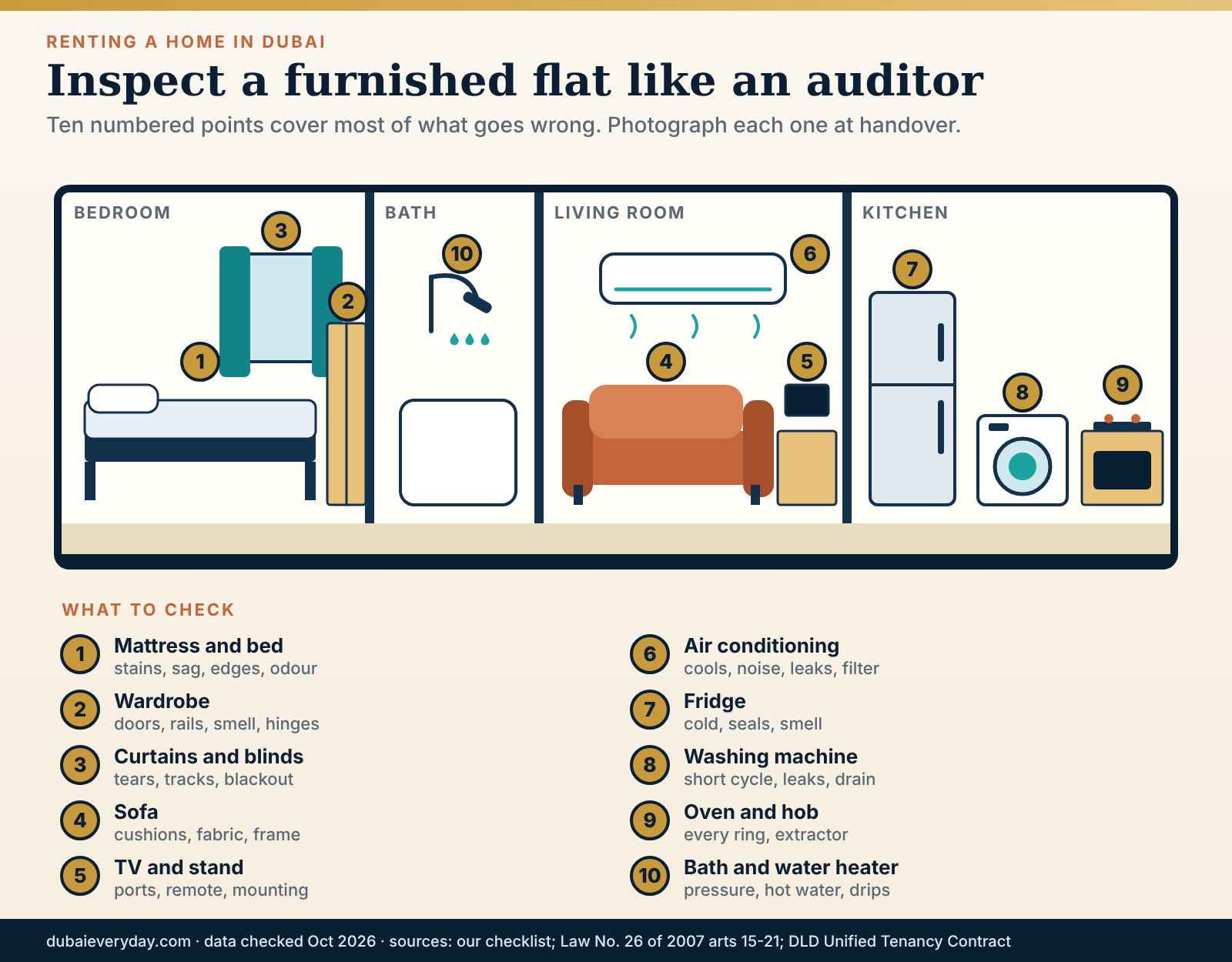
A viewing routine for a furnished flat
Treat the viewing as an audit. Open every wardrobe door and drawer, sit on the sofa and lift the cushions, press the mattress and check its edges and underside for stains or marks, and run the washing machine through a short cycle if the landlord allows it. Switch on every air-conditioning unit and listen to it, then look at the filters. Run the taps, the shower and the oven. Check sockets with a phone charger. Smell the wardrobes and the sofa fabric; odour is hard to fix and impossible to photograph.
Ask three questions about each major item: how old is it, who owns it (landlord or a previous tenant who left it), and who repairs or replaces it if it fails. For appliances, ask whether a warranty or service contract exists. Landlord-supplied furniture is often chosen for price and durability because many different tenants will use it, so expect functional rather than fussy. That is our reading of how rental stock works, not a measured fact.
Who pays when something breaks
In furnished vs unfurnished Dubai contracts, the repair clause is where the two diverge most.
Under Article 16 the default is the landlord, unless the contract says otherwise. A furnished lease can quietly flip that if the contract makes the tenant responsible for appliance servicing or for any damage to furnishings. dubizzle’s guide states that tenants are liable for damage to furniture and other pre-installed items, which is true in the sense of damage the tenant causes, and a good reason to define normal wear in advance. Put the answer in the addendum in one sentence per category: appliances, furniture, soft furnishings and air-conditioning.
Deposits, cheques and the cash you lock up
Law No. 26 of 2007 lets a landlord collect a security deposit to secure the property’s upkeep, and requires the landlord to refund it, or the balance, at the end of the lease (Article 20). It sets no amount and no refund deadline. The Unified Tenancy Contract has a “Security Deposit Amount” field and no clause explaining how the deposit is held or what can be deducted. That gap is where the furnished vs unfurnished Dubai deposit question lives.
The furnished vs unfurnished Dubai deposit figures people quote are market custom. The Gulf News guide to moving-in costs, updated 22 October 2026, gives 5% of annual rent for unfurnished and 10% for furnished, and the Property Finder and Real Estate Club Dubai guides repeat it. Custom is not law, so the percentage is negotiable, and in a market with plenty of supply you have more room to ask for the lower figure or for the furnished premium to be reflected differently.
What the bigger deposit really costs you
Take the illustrative AED 80,000 unfurnished flat and a 20% premium, which puts the furnished rent at AED 96,000. The unfurnished deposit at 5% is AED 4,000. The furnished deposit at 10% is AED 9,600, so AED 5,600 more is parked with the landlord. It is refundable, but it earns nothing for you and it comes back only after an end-of-lease inspection, usually when you are also paying for the next place.
The deposit is also the pot a landlord can claim against. If you disagree about a deduction, the Rental Dispute Centre route has a fee: DLD’s fee page lists financial claims at 3.5% of the amount, with a minimum of AED 500. On a AED 9,600 deposit, 3.5% is AED 336, so the AED 500 floor applies, and that is before any translation or service charges. Small disputes are therefore worth fighting only if your evidence is good, which brings us back to the inventory.
A larger furnished deposit protects the landlord’s furniture, not you. Without a signed, dated inventory with photographs, the landlord can describe the sofa’s condition at move-out and you cannot show how it looked at move-in. Do not pay a 10% deposit against an unwritten list.
Day-one cash for furnished vs unfurnished Dubai: the same flat, two ways
Here is the arithmetic for a first-day payment with four cheques, using our illustrative rents. We use the 5% broker figure as a ceiling, since the government leasing page says some brokers charge up to 5% of total rent, and the Ejari online fee of AED 177.75 from DLD. DEWA’s refundable deposit of AED 2,000 for an apartment and roughly AED 130 activation are as reported by Gulf News, because we could not read DEWA’s own pages.
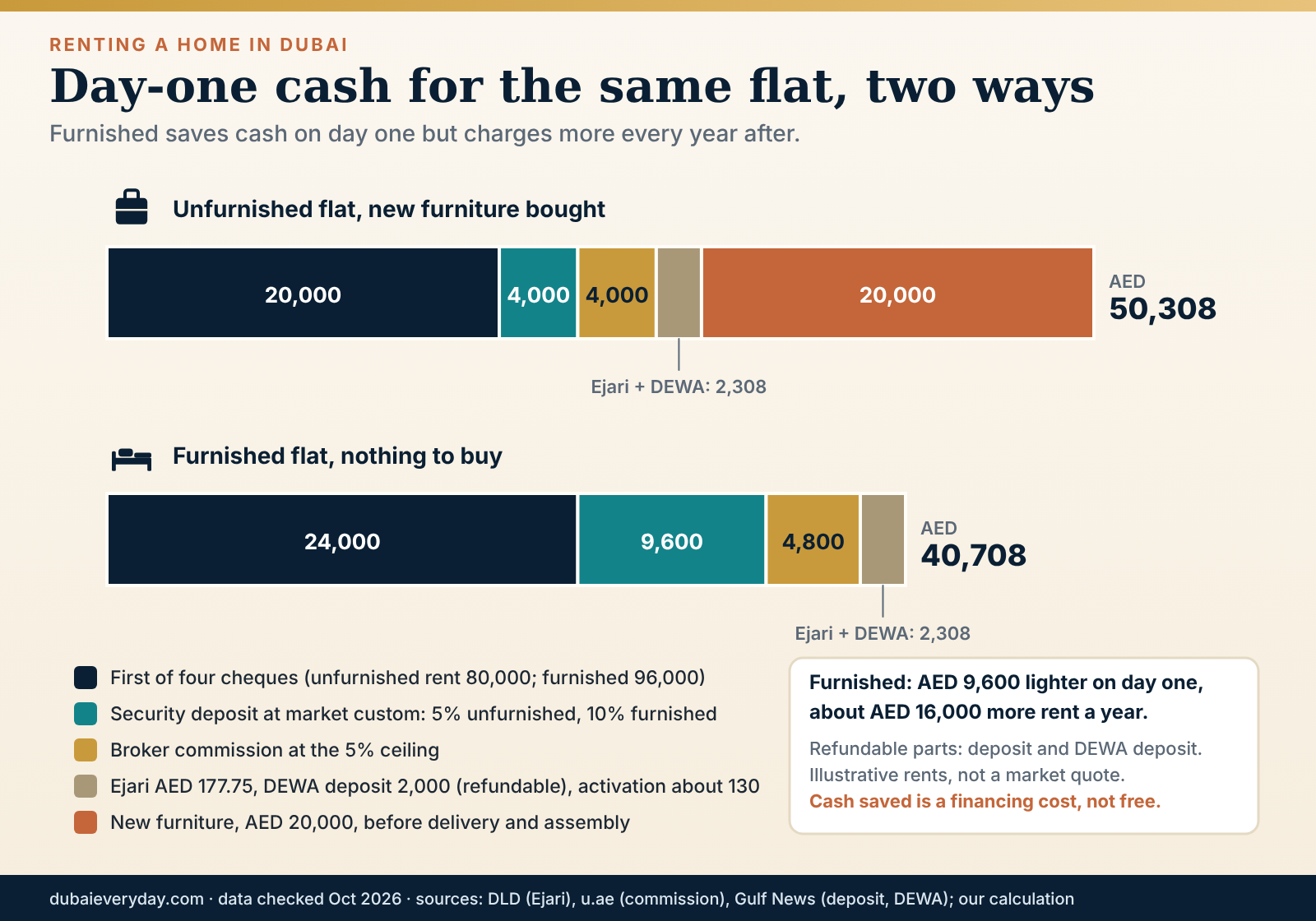
Unfurnished: first cheque AED 20,000, deposit AED 4,000, commission AED 4,000, Ejari AED 177.75, DEWA deposit AED 2,000 and activation AED 130, a total of AED 30,307.75. Furnished: first cheque AED 24,000, deposit AED 9,600, commission AED 4,800 and the same AED 2,307.75 of Ejari and DEWA items, a total of AED 40,707.75. Add a AED 20,000 furniture purchase to the unfurnished route, before delivery and assembly, and it becomes AED 50,307.75.
So the furnished vs unfurnished Dubai day-one gap is about AED 9,600 in furnished’s favour in this example, against about AED 16,000 a year more in rent. Cash is the thing furnished flats save you at the start, and the premium is the price of that saving. If you are short of capital, that is a legitimate reason to choose furnished. Just call it what it is: a financing cost.
Cheques, instalments and Flexi Rent
Dubai rent is traditionally paid by post-dated cheques, and the government leasing page says it can be a lump sum or instalments as agreed with the broker or landlord. On 23 June 2026 DLD launched a Flexi Rent pilot with 11 named real-estate companies, offering monthly, quarterly or semi-annual payment on eligible units they own or manage. The DLD announcement does not say whether the units are furnished, nor define “eligible”, and it describes payment flexibility rather than shorter leases.
If you have a choice, ask whether the unit you like is in the scheme before you accept a 12-cheque or 1-cheque trade-off.
Utilities and bills: what changes and what does not
The default in the Unified Tenancy Contract (Clause 4) is that the tenant pays the electricity, water, cooling and gas charges that come from occupying the unit, unless the parties agree otherwise in writing. In furnished vs unfurnished Dubai leases alike, that default applies. So a furnished flat does not automatically come with bills, and an unfurnished one does not automatically make you pay them. What changes is smaller and more specific.
The DEWA bill, rebuilt
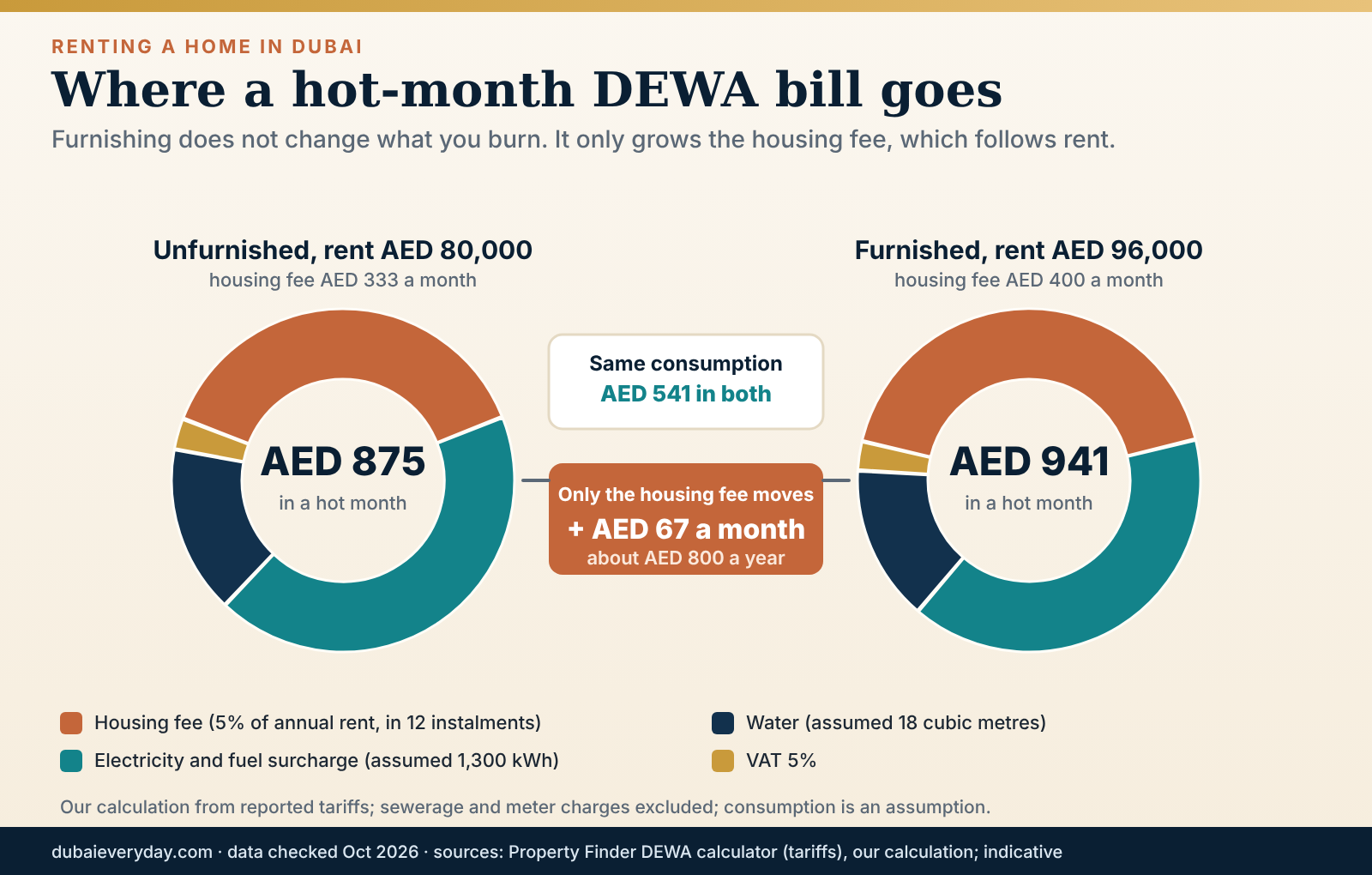
Property Finder’s DEWA calculator page (dated February 2026) lists residential electricity at 23, 28, 32 and 38 fils per kWh across four monthly slabs, a fuel surcharge of 6 fils per kWh, water at AED 7.70, 8.80 and 10.12 per cubic metre across three tiers, 5% VAT on applicable components, and the 5% Dubai Municipality housing fee on annual rent spread over 12 monthly instalments. It leaves sewerage and meter charges unquantified, so we leave them out too, and you should expect the real bill to be a little higher.
We used consumption assumptions (they are assumptions, not DEWA data): a mild month at 500 kWh and 15 cubic metres, and a hot month at 1,300 kWh and 18 cubic metres. On an AED 80,000 unfurnished rent, our calculation gives roughly AED 607 and AED 875. On the AED 96,000 furnished rent it is AED 674 and AED 941. In the furnished vs unfurnished Dubai comparison, consumption is identical, so the whole AED 67 monthly gap is the housing fee, about AED 800 a year.
Cooling: the line that moves the total
In many towers the big variable is district cooling, not DEWA. Better Homes explained in March 2026 that “chiller-inclusive” means the landlord pays cooling and builds it into the rent, while “chiller-free” means the tenant pays the cooling provider separately. Its example compared a chiller-free flat at AED 90,000 with a chiller-inclusive one at AED 95,000 and, adding an average AED 900 a month, found the first costs about AED 100,800, so the second is cheaper. It also put summer peaks at AED 1,000 to 1,500 a month in Marina and Downtown.
That matters for furnished vs unfurnished Dubai choices because furnished listings are common in the towers where chiller arrangements vary. Compare the all-in annual cost, not the headline rent. We could not read the cooling providers’ own tariffs, so we do not give a cooling figure beyond those reported ones.
“Bills included” and other furnished vs unfurnished Dubai utility questions
Short-term furnished stays usually include water, electricity and internet, as Bayut’s guide to short-term rentals notes, and some operators cap usage and charge for excess. A landlord offering an annual furnished lease with bills included is offering something unusual, and it needs a paragraph in the addendum: which bills, any monthly cap, who holds the DEWA account, and what happens if usage spikes. Ejari registration is required before utilities can be connected, per the government leasing page, so the account question has a legal anchor.
Two smaller furnished vs unfurnished Dubai items. First, a furnished flat has a TV but not a subscription, and rarely an internet plan, so budget for both. Second, appliances in a furnished flat may be older than the ones you would buy, which could raise electricity use. We cannot quantify that, and neither can the sources we read, so inspect the fridge and the water heater and treat unusual noise or heat as a warning.
Length of stay: the break-even maths
Strip away the lifestyle talk and the furnished vs unfurnished Dubai choice is a rent-versus-buy problem on a small scale. Furnished rent is a recurring charge for the use of furniture. Unfurnished means you buy the furniture once, use it, and sell what you can at the end. The longer you stay, the more the recurring charge outweighs the one-off cost. The question is where those lines cross.
The inputs, labelled as illustrative
We use an unfurnished rent of AED 80,000 a year (about USD 21,800 at the 3.6725 peg). It is a round number, not a Dubai average.
Furniture budgets are AED 10,000, 20,000 and 35,000 for a one-bedroom, which brackets the ranges in the articles we read: Property Finder suggests AED 15,000 to 35,000 for a one or two-bedroom setup, dubizzle roughly AED 10,000 to 15,000, and Real Estate Club Dubai offers budget, mid-range and premium totals of AED 6,200, 16,500 and 38,500. We assume you recover 40% of the purchase price on resale (Real Estate Club Dubai says 30% to 50%, without a source) and spend AED 1,500 on delivery, assembly and disposal, a figure we chose for illustration.
The premium side includes what the premium drags along: 5% housing fee on the extra rent each year and 5% commission on the extra rent once. Our calculation of the furnished vs unfurnished Dubai break-even, as the months after which buying becomes cheaper than renting furnished:
| Furnished premium (on AED 80,000) | Furniture AED 10,000 | Furniture AED 20,000 | Furniture AED 35,000 |
|---|---|---|---|
| 10% (AED 8,000 a year) | about 10 months | about 19 months | about 32 months |
| 20% (AED 16,000 a year) | about 5 months | about 9 months | about 16 months |
| 30% (AED 24,000 a year) | about 3 months | about 6 months | about 10 months |
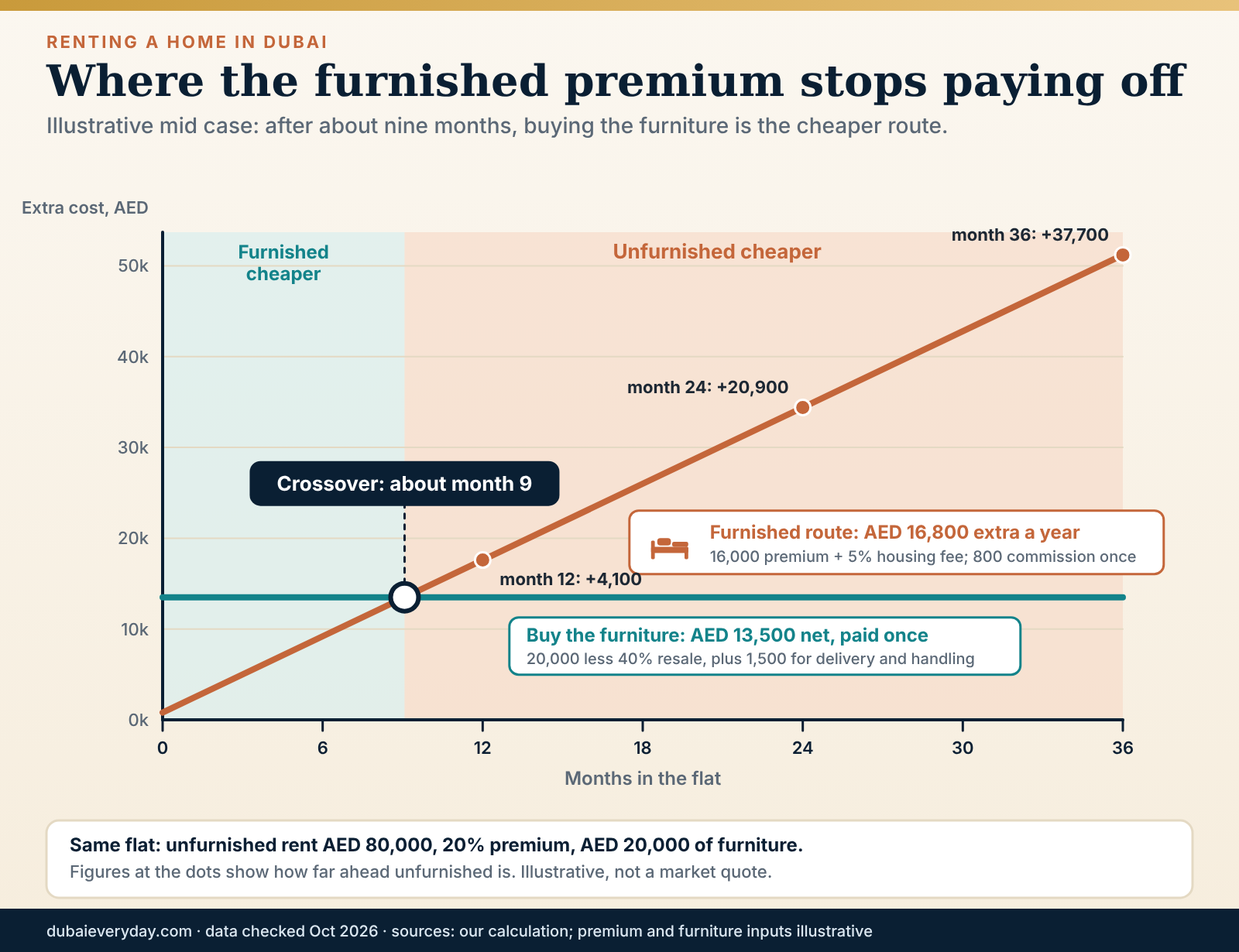
Read the furnished vs unfurnished Dubai table like this: stay shorter than the figure and furnished is cheaper; stay longer and buying wins. With a 20% premium and AED 20,000 of furniture, the crossover is about nine months. Without any resale at all, the same cell moves out to about 15 months, and the 10% premium with AED 35,000 of furniture moves beyond four years.
What the mid case looks like over time
In the 20% and AED 20,000 case, the extra cost of the furnished route is about AED 9,200 at six months, AED 17,600 at 12 months, AED 34,400 at 24 months and AED 51,200 at 36 months. The unfurnished route costs a fixed AED 13,500 after resale and handling, whether you stay a year or three. So at 12 months unfurnished is ahead by about AED 4,100, at 24 months by about AED 20,900, and at 36 months by about AED 37,700.
The furnished vs unfurnished Dubai model is blunt in both directions. It ignores the time value of money, which favours furnished a little, and it ignores the AED 5,600 of extra deposit. It also assumes you buy nothing you would not otherwise own. If you already have furniture, because you are moving between Dubai homes or you have shipped a household in, the furniture cost is close to zero and unfurnished wins almost immediately. If you will leave Dubai with the furniture unsold in a hurry, the resale assumption collapses and the first table is too generous to unfurnished.
Things the break-even does not price
Several things sit outside the model. Time is one. Buying, delivering and assembling a household takes days of effort, and we did not verify retailer lead times, so ask. Taste is another: some people hate living with someone else’s sofa and will pay to avoid it.
Flexibility is the third, and it is easy to overrate. A furnished flat does not make the lease shorter. As we read Law No. 26 of 2007, tenants have no right to leave early unilaterally, so an early exit is whatever your contract says, and an annual contract is normally written for 12 months whether furnished or not. If you want to be able to leave, negotiate the exit clause, whichever kind of flat it is.
For longer horizons, the cost of the premium compounds with the housing fee and with renewals. In a market with plenty of listings, a furnished tenant has some room to negotiate the premium at renewal, because a vacant furnished flat costs the landlord rent. For wider budgeting, our guide on renting in Dubai sets the lease, Ejari and renewal steps around these numbers.
Short stays and the grey zone below 12 months
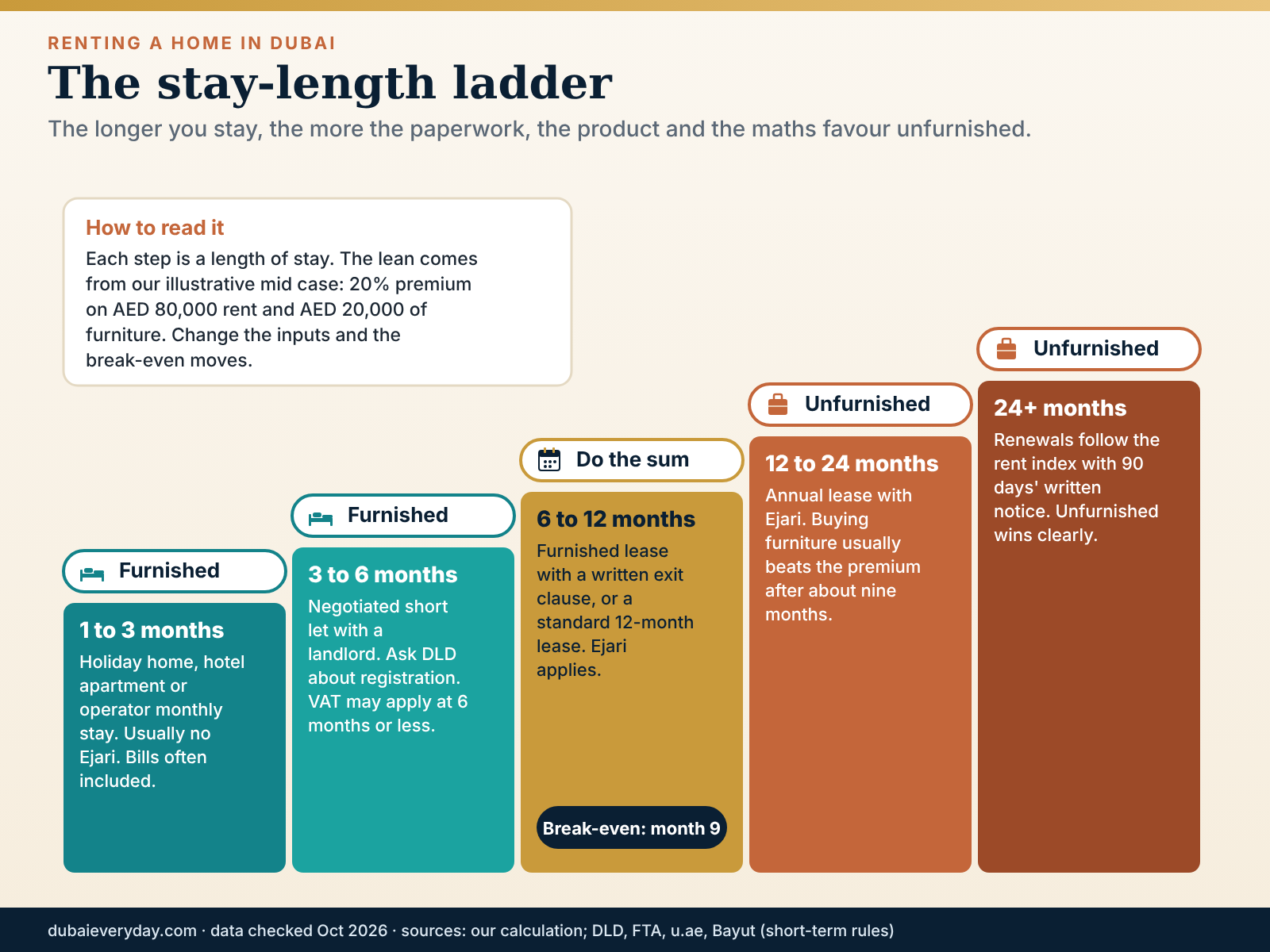
The break-even table says furnished is cheapest below roughly six to nine months. That is also where the paperwork gets slippery, because Dubai has several different products that all get called “furnished rentals”, and furnished vs unfurnished Dubai rules differ between them.
The four products behind the label
Holiday homes. Short-term rentals are regulated by the Department of Economy and Tourism (DET). Bayut’s October 2026 guide says they need a permit, are typically furnished with water, electricity and internet included, and need not be registered in Ejari. Hotel apartments are hotel establishments, outside the tenancy system. Direct landlord short lets are negotiated, and whether the contract can be registered is a question for DLD (line 800 4488). Standard 12-month leases are the Ejari world, with a registered contract, cheques and index-based renewals.
A monthly furnished stay sold by an operator is usually one of the first two. It can be a fine solution for a first month in the city, but it is not a tenancy with Ejari protection, so the deposit, repair and eviction rules we have discussed may not apply in the same way. Read what you are signing, and ask which regime it falls under. Our Dubai travel guide and the hotel selection guide are the better starting points for stays of a few weeks.
VAT on short leases
This one surprises people. A 2018 joint press release from the FTA and DLD said residential rent is not taxable, but described the exemption as depending on the lease period being more than six months or the tenant holding a federal identity card, and excluded serviced and hotel apartments. FTA’s property guidance on the government portal lists “short lets (6 months or less)” and serviced apartments under commercial buildings.
Our reading for furnished vs unfurnished Dubai stays: a lease of six months or less to someone without an Emirates ID may attract 5% VAT, which would add AED 400 a month to a AED 8,000 rent.
Neither document spells out the consequence, so confirm with FTA or a tax adviser before you sign.
Ask any monthly furnished provider for the holiday-home permit number or the registration basis, in writing, before sending money. A July 2026 market article notes that it found no confirmed public tool for guests to verify a permit number, so keep the paperwork yourself. And compare any short-lease price with a 12-month lease that has an exit clause before you accept it.
Residency, Emirates ID and the tenancy contract
Newcomers often wonder whether a short-stay booking is enough for their visa process. We could not verify official ICP or GDRFA wording on whether a tenancy contract or Ejari is required for residence visas, Emirates ID addresses or family sponsorship, and market articles disagree in tone. Ask your employer’s PRO or the visa service you are using which documents they need before choosing the stay product, so you do not pay for a short stay and then need a registered lease anyway.
The “third option” pitch
In August 2026 Gulf Today reported a furnished short-term rental model of one to three months being promoted as a “third option” between holiday homes and annual leases, citing brokerage data on rising demand. The article named no regulator, registration rule or effective date, and we could not find an official DLD or DET page for it. Treat it as a broker offer for now, whatever the furnished vs unfurnished Dubai label, and apply the same questions: which permit, which registration, which bills.
Furnished vs unfurnished Dubai scenarios: who should pick what
Numbers settle the arithmetic, but people arrive at this decision from different places. These scenarios apply the furnished vs unfurnished Dubai framework above. They are composite situations built for illustration, not case studies of real people.
New arrival, family joining in three or four months
You need a bed within a week and a proper home by spring. A short furnished stay, either a monthly product or a furnished lease with a negotiated exit, avoids buying furniture you will not need in the next home. Our furnished vs unfurnished Dubai recommendation here: furnished, short, and do not sign 12 months of anything until the family’s plans and your school and commute choices are settled. The renting guide covers the viewing and contract steps for the move that follows.
Couple planning two to three years in one flat
This is the clearest unfurnished case in the furnished vs unfurnished Dubai debate. With a mid premium and mid furniture budget the crossover sits near nine months, and the gap at 24 months is roughly AED 20,000 in the unfurnished route’s favour in our example. The furniture is also yours to take, sell or move at the end. On furnished vs unfurnished Dubai grounds, take the savings, buy second-hand where it makes sense, and keep receipts for resale.
Professional on probation or with an unstable role
If your job could end in months, certainty matters more than the cheapest option. The risk is not the furniture, it is the 12-month contract. Look for a furnished unit with a written early-termination clause, or pay more for a monthly product first and sign a longer lease after probation. If the lease has no exit clause, a furnished unit does not rescue you, and the furnished vs unfurnished Dubai question is secondary.
Family looking at a villa
Premiums scale with rent, and villas have larger rents. A 20% premium on AED 200,000 is AED 40,000 a year, which can fund a lot of beds. A furnished package built for a flat rarely suits a household with children and a garden. For a villa family, unfurnished is the usual route in the furnished vs unfurnished Dubai comparison, and our villa rental guide covers maintenance and community fees.
Studio renter watching cash
For a studio, the absolute premium is smaller and furniture needs are modest, so both routes are cheap. If your cash is tight, the unfurnished route’s up-front buy is the problem, not the premium. A furnished studio can be the sensible compromise in the furnished vs unfurnished Dubai trade-off; see the studio rental guide for the budget trade-offs that apply.
Relocating with a shipped household
If you are importing furniture, the furnished premium buys you nothing you already own. Choose unfurnished, but price the shipping and storage first, because those are the costs we did not verify and they can change the comparison.
For owners and investors: should you furnish the unit?
Owners face the same furnished vs unfurnished Dubai sum from the other side. The furnished premium is revenue; furnishing cost, wear, extra vacancy and upkeep are costs. Whether the premium covers them depends on its size, and the published range is wide enough to flip the answer.
An illustrative owner calculation
Assume the same AED 80,000 unfurnished rent. You spend AED 25,000 furnishing the flat, treat it as a five-year asset (AED 5,000 a year of depreciation), spend AED 3,000 a year on upkeep and replacement, and the unit sits empty two weeks longer per year than an unfurnished one, which costs about AED 3,700 of furnished rent. These are our assumptions. The annual gain is the premium minus AED 11,700.
At a 10% premium (AED 8,000) you lose about AED 3,700 a year. At 20% (AED 16,000) you gain about AED 4,300, roughly 17% a year on the AED 25,000 spent. At 30% (AED 24,000) you gain about AED 12,300. The sign changes inside the published range, which is why the furnished vs unfurnished Dubai decision for an owner should not rest on a premium quoted in a brochure. Test the premium against comparable listings first, as we showed earlier.
What to count and what to leave out
The AED 25,000 is capital you could have put elsewhere or against a mortgage, so it belongs in the denominator of a cash-on-cash calculation; our guide to cash-on-cash return for Dubai property shows how to include it. Furnishing also changes net yield as our rental yield guide explains, and the full cost picture, including sale costs, is in the ROI calculation guide. For wider investment context, see the Dubai property investment guide.
Legal points for furnished vs unfurnished Dubai landlords
Under Article 16 the landlord maintains the property unless the contract says otherwise, so a furnished landlord who does not write appliance responsibility into the lease inherits the repair bill by default. Put the inventory in an addendum signed by both sides and keep a copy. Do not treat furniture as a licence to exceed the index: the rent increase rules and 90-day notice apply to the whole rent, and the index pages we read do not give a furnished exception.
VAT matters too. Residential rent is exempt under the FTA and DLD’s description, subject to the lease-period and identity-card conditions we noted earlier, while short lets and serviced apartments are treated as commercial. Operating a short-let model is a different business with DET permits and guest rules. We do not cover it here, and you should take tax and legal advice before pivoting.
If you are buying a furnished unit
Buyers sometimes inherit furniture and a tenancy together. Put the inventory in the sale paperwork and ask for the tenancy contract, Ejari certificate and any addendum, so you know what you are buying. Our buying property guide and the first-time buyer guide cover the transfer steps, and non-resident owners letting from abroad should also read about buying as a foreigner.
Negotiating and documenting a furnished lease
Furnished vs unfurnished Dubai deals are won or lost in the addendum. Good paperwork turns “furnished” from a hope into an enforceable list. The steps below work for tenants; owners can use the same list in reverse to protect their furniture.
- Ask for the inventory firstGet a line-by-line list before you view, so you can compare it with the flat and with the next listing.
- View with the list in handTick items off, note age and condition, and photograph anything missing or worn.
- Negotiate the premium, not just the rentShow your paired listings. Ask for the premium to be cut, for the deposit to be 5%, or for unwanted items to be removed.
- Write the addendumThe Unified Tenancy Contract says extra terms go in a signed addendum. List items, condition, who repairs what, and what counts as wear.
- Define bills and exitsState which utilities are included, any cap, who holds the DEWA account and what the early-exit terms are.
- Register the leaseEjari costs AED 177.75 online or about AED 220 at a trustee centre per DLD. The app route needs a contract copy, so attach the signed addendum.
- Record handoverTake a dated video and photographs, sign the inventory and keep both with the lease.
- Check out against the listAt the end, inspect together with the same inventory before the deposit conversation starts.
Two clauses are worth adding when the landlord is willing. One is a replacement standard: if a listed item fails through no fault of yours, the landlord replaces it with an equivalent within a stated number of days. The other is a removal clause: the landlord may swap or remove items only with written agreement. Neither is in the standard contract, which is exactly why they need to be written.
Mistakes that cost money, and a final checklist
Most losses in the furnished vs unfurnished Dubai choice come from a handful of repeat errors. None needs special knowledge to avoid; each needs a pause before signing.
Comparing monthly numbers
A furnished rent that looks only AED 1,300 higher a month hides the 5% housing fee, the extra commission and the bigger deposit. Compare annual all-in cost.
Buying for a short stay
Furniture bought for a seven-month stay is sold at a loss or abandoned. Under about the break-even months, rent furnished.
Trusting the photos
Listing photos show the best angle and the day they were taken. Only the inventory and your own inspection count.
Assuming bills are included
The standard contract puts electricity, water, cooling and gas on the tenant. Included bills must be written, with a cap.
Skipping the handover record
Dated photographs and a signed inventory are the only things that separate ordinary wear from damage at move-out.
Ignoring the exit
A furnished flat is not a flexible lease. If you may leave early, negotiate the clause before you sign.
The bottom line
Furnished vs unfurnished Dubai is not a style question. It is a duration question with a paperwork layer. Below roughly six to nine months, at a normal premium, furnished is cheaper and simpler. Beyond a year, unfurnished usually wins unless you cannot fund the furniture or already own it.
Either way, the furnished vs unfurnished Dubai result stands or falls on the written inventory, the deposit terms and a clear statement of who pays the bills. Run your own numbers with the grid above and change one input at a time. Furnished vs unfurnished Dubai advice that skips the arithmetic is guesswork.
The final furnished vs unfurnished Dubai checklist
- I know my likely stay in months and compared it with the break-even for my premium and furniture budget.
- I measured the premium using paired listings in the same building, not a headline percentage.
- I have a written inventory with condition notes and photographs, signed by both sides.
- The addendum says who repairs appliances, furniture and air-conditioning, and defines ordinary wear.
- I know the deposit percentage, when it is refunded and how deductions are decided.
- I checked which bills are mine, whether cooling is separate, and who holds the DEWA account.
- I priced the housing fee, commission and Ejari on the full furnished rent.
- For a stay of six months or less, I asked about the registration basis and VAT.
- I have a written exit clause if my job or plans may change.
- I scanned the advert’s QR code and the details match the unit.
Frequently asked questions
In furnished vs unfurnished Dubai pricing, is furnished always more expensive?
Usually, but not always, and by how much varies. Published guides quote premiums from about 10% to 30% of annual rent, none with a named dataset. In a market with many listings, owners sometimes price furnished units close to unfurnished ones to fill them. Compare paired listings in the same building, and negotiate the premium, because it is an asking price rather than a fixed rate.
How big is the furnished vs unfurnished Dubai rent premium?
There is no official figure. Property Finder says 20% to 30%, dubizzle says 10% to 25%, and Real Estate Club Dubai says 15% to 30% with about 20% typical. We use 10%, 20% and 30% in our examples. Measure the gap yourself with three furnished and three unfurnished listings of the same size in the same building, and use the median.
What security deposit should I expect on a furnished lease?
In furnished vs unfurnished Dubai leases, market custom is 5% of annual rent for unfurnished and 10% for furnished, as reported by Gulf News on 22 October 2026. It is custom, not law: Law No. 26 of 2007 allows a deposit but sets no amount. You can ask for a lower figure, especially when the flat has been listed for a while. Make sure the lease or addendum says when the refund is due.
Do furnished rentals include DEWA, internet and cooling?
Not by default on an annual lease, in the furnished vs unfurnished Dubai market or any other. The Unified Tenancy Contract puts electricity, water, cooling and gas on the tenant unless you agree otherwise in writing. Short-term furnished stays from operators often include bills, sometimes with a usage cap. If a landlord promises bills included, get the scope, the cap and the account holder in the addendum.
Can I rent a furnished home for less than a year?
Yes. The furnished vs unfurnished Dubai options below a year are several different products. Holiday homes and hotel apartments are not standard Ejari tenancies. A direct landlord short let is negotiated, and whether it can be registered is a question for DLD on 800 4488. Ask which regime applies before paying, because deposit, repair and eviction protections depend on it.
Is VAT charged on furnished rent in Dubai?
For furnished vs unfurnished Dubai rent alike, long residential leases are generally exempt. A 2018 FTA and DLD release described the exemption as depending on a lease longer than six months or the tenant holding a federal identity card, and excluded serviced and hotel apartments. FTA guidance lists short lets of six months or less under commercial buildings. So a short furnished lease may attract 5% VAT. Confirm with FTA or a tax adviser.
Who pays if the furniture breaks?
The default under Law No. 26 of 2007 is that the landlord maintains the property and repairs defects unless the contract says otherwise, while the tenant is responsible for damage they cause and returns the property as received except ordinary wear. The statute does not mention furniture, so your addendum should state who handles appliances, furniture and soft furnishings, and what counts as wear.
Do I need an inventory list for a furnished flat?
In furnished vs unfurnished Dubai leases the inventory is not a legal requirement, but it is your best protection. The official contract has no furnished field or inventory schedule, and the tenant confirms accepting the unit as inspected. A signed list with condition notes and dated photographs lets you show what you received. Add it as an addendum, signed by all parties, and keep a copy with your lease.
Can I ask the landlord to remove the furniture?
You can ask, and in a market with lots of supply the request is often worth making, particularly if a furnished listing is the only one you like in a building. Nothing obliges the landlord to agree. If they do, record the change in writing and ask for the rent to be repriced, since you are now taking an unfurnished flat.
Is Ejari needed for a furnished flat?
For an annual lease, yes, furnished or not. The government leasing page says lease registration is compulsory to connect utilities, and DLD charges AED 177.75 online or about AED 220 at a trustee centre. Holiday-home and hotel stays are different regimes and may not produce an Ejari certificate, so check what you are being sold.
Can the landlord raise a furnished rent more than the rent index allows?
Renewal increases follow Decree No. 43 of 2013, the DLD rent index, and a 90-day written notice. The pages we read do not describe a furnished exception, and we could not confirm how the index treats furnishing. If you receive a rise, ask for the index result and the notice date, and use the Rental Dispute Centre if you think the increase is not allowed.
Will furnished or unfurnished affect my visa or Emirates ID?
We could not verify official ICP or GDRFA wording on whether a tenancy contract or Ejari is needed for specific visa steps, and market articles disagree. Ask your employer’s PRO or the visa service which documents they need. Choose the housing product after that, not before, so you do not pay for a short stay and then need a registered lease anyway.
Sources and further reading (20 links)
- Dubai Land Department: Register or renew an Ejari contract — Ejari fees, channels and documents
- Dubai Land Department: Unified Tenancy Contract — handover, utilities, maintenance, addendum and deposit field
- Dubai Legislation Portal: Law No. (26) of 2007 — landlord and tenant duties, deposit, return of property
- Dubai Legislation Portal: Decree No. (43) of 2013 — renewal rent increase bands
- Dubai Land Department: Smart Rent Index and market transparency — index inputs and notice rules
- Dubai Land Department: Flexi Rent initiative — payment options and partners
- Dubai Land Department: First instance lawsuit service — Rental Dispute Centre filing fees
- Dubai Land Department and Federal Tax Authority: VAT impact on the real estate sector — residential lease VAT conditions
- UAE Government Portal: VAT treatment of properties — residential, commercial and short-let classification
- UAE Government Portal: Leasing a property in the UAE — registration, housing fee, commission, documents
- Wasl: RERA rental calculator — calculator inputs and renewal rules
- Property Finder: Furnished vs unfurnished — premium, deposit and furniture cost claims
- dubizzle: Pros and cons of renting furnished apartments — premium range and tenant liability
- Real Estate Club Dubai: Furnished vs unfurnished rental — premium range and furniture cost claims
- Property Finder: DEWA calculator — slab tariffs, surcharge, VAT and housing fee
- Better Homes: Chiller-free vs chiller-inclusive apartments — cooling arrangements and cost example
- Gulf News: Renting in Dubai, 11 extra costs — deposit custom, commission, DEWA deposit
- Khaleej Times: Dubai rents fall as tenants get more choice — listing supply and asking-rent trends
- Bayut: Guide to short-term rentals in Dubai — permits, Ejari and bills for short stays
- Gulf Today: Furnished rental option with one to three month leases — short-term furnished offer
Update log: 29 October 2026, first publication; facts re-checked against the sources above. Next review due by April 2027, or sooner after any change to tenancy rules, the rent index or DEWA tariffs. Corrections welcome. This is general information, not individual legal, tax or financial advice.
About DubaiEveryday and this guide
DubaiEveryday.com is an independent editorial project that publishes practical, research-based guides to everyday life in Dubai: where to live, what things cost, how the rules work and how to get around. This page was written and edited by the DubaiEveryday editorial team. It is not signed by a named expert, doctor, lawyer or adviser, and we do not claim first-hand testing of a venue, clinic or service unless the page says so.
Each guide is built from official sources such as government and regulator pages, operator websites and established news outlets, cross-checked where we can. When we could not confirm something, we say so in the text, and examples that use made-up numbers are labelled as illustrations. Mentions are editorial choices, not paid placements, and a link is not an endorsement.
Dubai changes quickly. If you spot something that is out of date or wrong, please tell us through the contact options on DubaiEveryday.com and we will check it and correct the page.