
Laser hair removal Dubai clinics offer comes down to six decisions: who operates the laser, which device suits your skin, how many sessions, how you handle the sun, what the course really costs, and how you check the clinic. This guide covers all six, checked against Dubai Health Authority documents and medical sources on 29 October 2026.
Hair removal sounds like the simplest beauty decision in the city, until someone mentions that the machine is a regulated medical device. Then it turns out your skin colour decides which laser is safe to point at you, and your weekend tan decides whether you should be in the chair at all. Add a Dubai summer and a package price that looks too good, and the choice gets less simple very quickly.
Laser hair removal Dubai clinics offer sits in a corner of healthcare with real rules, which is good news once you know what they say. This guide follows the decisions in the order they tend to bite: who is allowed to operate the laser, which laser suits your skin, how many sessions to expect, what the sun does to your calendar, what the course really costs, and how to check a clinic before paying a deposit. It is research from regulator documents and medical sources, not a clinic review, so use it to ask sharper questions and let a licensed doctor judge your skin.
Laser hair removal Dubai treatment is a medical-device procedure regulated by the Dubai Health Authority (DHA), so the safest route is a licensed facility where a dermatologist, plastic surgeon or suitably qualified physician supervises the laser, and where you are examined and consented before the first pulse. Beauty salons were barred from offering it around 2011 unless they re-licensed as healthcare facilities.
For anyone weighing laser hair removal Dubai clinics, skin tone decides which device is appropriate. The sources we read agree on the direction: longer-wavelength lasers such as Nd:YAG are the usual option for deeper skin, alexandrite and diode suit lighter skin, and darker or tanned skin carries a higher risk of burns and lasting colour change. Expect roughly four to eight sessions several weeks apart, then occasional maintenance. The realistic goal is a large reduction in hair, not a guarantee of none.
The sun is Dubai’s particular complication. Monthly UV peaks stay above the level at which the World Health Organization advises protection in every month of the year, so a fresh tan is a reason to postpone, not a detail to hide. We found no official price list for laser hair removal Dubai packages, so compare quotes by total cost of a completed course, including VAT, consultation and touch-ups. Ten checks in the clinic-safety section help you verify a clinic before paying.
This laser hair removal Dubai guide is desk research. DubaiEveryday.com has not had laser treatment, visited a clinic or tested a device, and nothing below describes a personal experience. No clinic is ranked or recommended, no clinic paid for inclusion, and there are no booking or affiliate links.
Rules come from three regulator documents read on 29 October 2026: the DHA Standards for Non-Surgical Cosmetic Procedures (version 2), the DHA Laser and Intense Pulsed Light Hair Reduction Standards (2016 edition) and the Dubai Healthcare City (DHCC) standard for non-surgical cosmetic procedures. Clinical points come from Mayo Clinic, Cleveland Clinic, the StatPearls review, the American Academy of Dermatology and WebMD. Monthly UV figures come from a commercial climate site and are indicative.
Not verified: any market price, which device brands are registered in the UAE, whether DHA has updated its standards since 2024, and the rules for home devices. This is general information, not medical advice. A DHA-licensed doctor who has examined your skin decides what is right for you.
One boundary before we start. This laser hair removal Dubai page covers laser and light-based hair reduction only. If you are choosing a skin doctor for acne, pigmentation or a mole check, the dermatologist in Dubai guide is the right page. Injectables have their own pages on Botox in Dubai and dermal fillers in Dubai, and none of them is repeated here.
How laser hair removal works, and why “permanent” is the wrong word
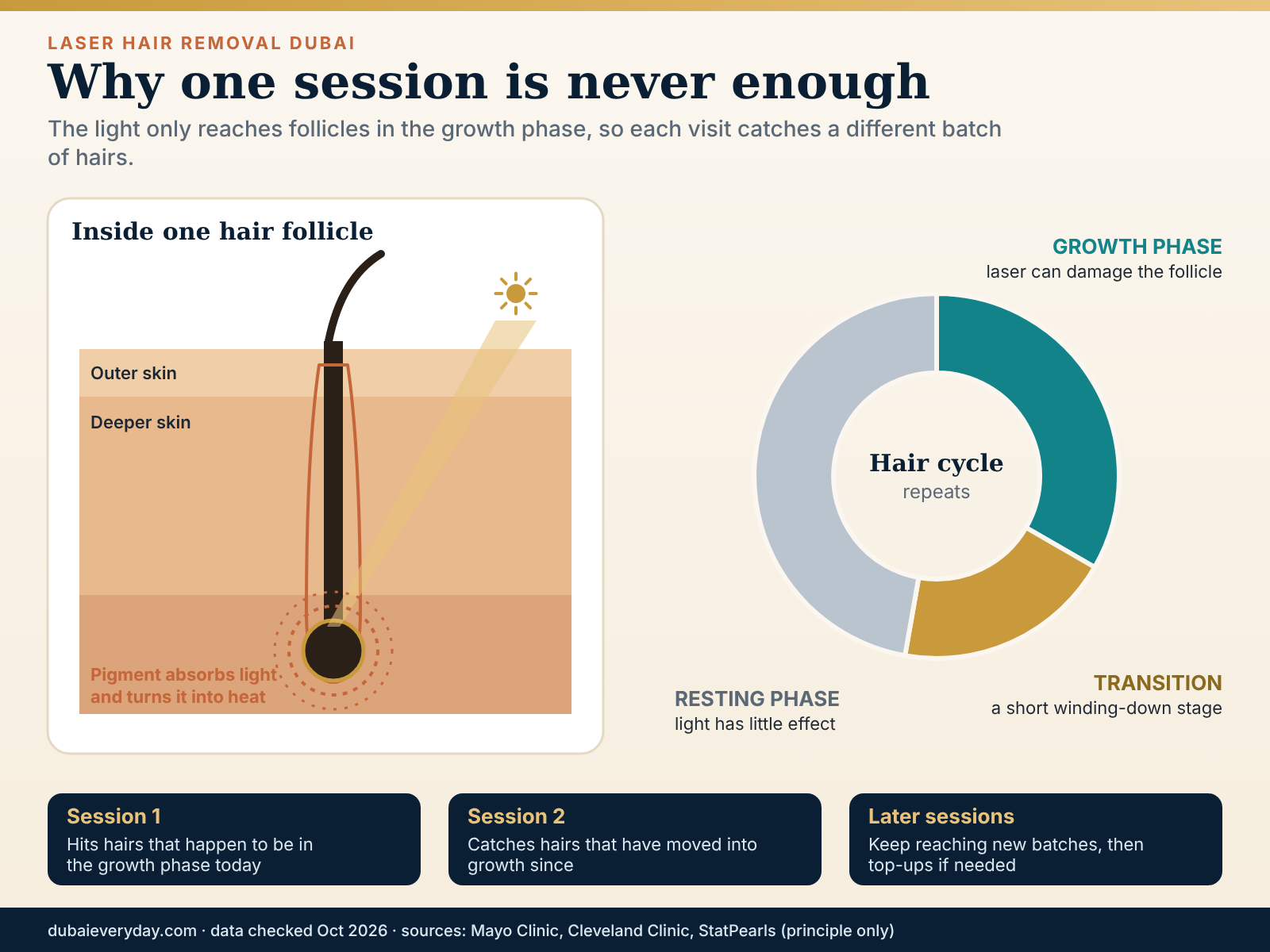
A laser hair removal Dubai appointment looks simple from the couch: a handpiece, a click, a snap against the skin. The mechanism is narrower than that. Pigment in the hair absorbs the light, the light turns into heat, and the heat damages the follicle enough to slow or stop regrowth. Mayo Clinic and Cleveland Clinic both describe it in those terms, and both stress that contrast helps. Dark hair on lighter skin gives the laser an easy target.
That one sentence explains most of what follows. If the pigment is in the hair, the device works best when the hair is dark and the surrounding skin is not. If the skin is also rich in pigment, some of the light is absorbed there instead, which is where burns and colour changes come from. Blonde, grey, white and red hair have little pigment to grab. Mayo lists them as poor responders.
Why one session is never enough
Hair does not grow all at once. Each follicle cycles through a growth phase, a short transition phase and a resting phase. The Cleveland Clinic and StatPearls reviews note that the laser affects follicles in the active growth phase, so a single visit only catches the hairs that happen to be growing that day. Later visits catch the ones that were resting before. This is the whole reason a laser hair removal Dubai course is spaced weeks apart.
“Permanent” versus “reduction”
Laser hair removal Dubai adverts love the word permanent. The medical sources are more careful. Mayo says growth is greatly reduced but regrowth is not guaranteed to stop, and any regrowth is often finer and lighter. Cleveland Clinic says plainly that the treatment is not permanent. StatPearls calls lasers among the most effective options for long-term reduction but rarely a permanent cure, and describes maintenance sessions every six to twelve months as common. The American Academy of Dermatology is more upbeat for most body areas, while noting that on a woman’s face hormones keep the hair coming.
Notice the regulator’s own wording. The DHA document governing this service is titled the Laser and Intense Pulsed Light Hair Reduction Standards. A fair reading is that laser hair removal Dubai clinics are really selling a large, lasting drop in density and thickness, with the option of top-ups, not a lifetime guarantee. A laser hair removal Dubai clinic that promises zero regrowth is promising more than the evidence does.
When hair is a symptom, not a nuisance
Mayo points out that hair driven by hormonal conditions may keep growing because the laser does not touch the cause. StatPearls advises evaluating hormones when excess hair looks like hirsutism. If you have sudden or heavy new hair growth, irregular periods or other symptoms, a doctor’s visit comes first and laser hair removal Dubai appointments come later. A general practitioner is a sensible starting point, and our guide to finding a GP in Dubai explains how referrals and networks work.
Laser hair removal Dubai rules: who may operate the laser
Two DHA documents govern laser hair removal Dubai clinics. The first is the Standards for Non-Surgical Cosmetic Procedures (version 2), which lists every cosmetic service by who may perform it. The second is the older Laser and Intense Pulsed Light Hair Reduction Standards, a 2016 edition of a rulebook first developed in 2011. We read both on 29 October 2026. DHA also circulated a version 2.1 of the cosmetic standard in December 2024 whose changes we could not see, so treat clause numbers as a guide and ask the clinic which edition it follows.
The licensed-facility rule for laser hair removal Dubai services
The 2016 standard allows laser hair removal Dubai services, which it calls laser and IPL hair reduction, in hospitals, day surgical centres and outpatient care facilities. It says the laser service may not open directly onto a beauty centre or retail shop. The facility needs a full-time physician as service in-charge, DHA-licensed laser technicians, equipment registered with the Ministry of Health and approved by a recognised international authority, and a maintenance contract. It also needs written policies for consent, infection control and records.
The history explains why. In 2011 the DHA told salons and cosmetic centres to stop offering hair removal with lasers and IPL machines unless they re-registered as healthcare providers. Khaleej Times reported a deadline of 27 July 2011, and Gulf News reported fines of up to AED 10,000 for violators. Both are old articles, so read them as history, not as today’s fine schedule. The principle has stayed: a place that only holds a beauty licence should not be firing a medical laser.
Who may hold the handpiece
The cosmetic standard’s table of procedures has a row for hair laser removal and IPL. Our reading of it, with the hair-specific 2016 rules alongside, is below.
Dermatologist or plastic surgeon
May perform and supervise hair laser and IPL without an extra training certificate. The standard asks that one such consultant or specialist be available in the facility to supervise non-surgical cosmetic work.
Family medicine, internal medicine, GP
May supervise only with a separate DHA hair laser licence and a training certificate. For GPs the cosmetic standard also asks for at least five years of experience in non-surgical cosmetic procedures.
Nurse or beauty therapist
May treat only after an accredited hair-reduction course and ten documented hands-on cases, with the title Laser Hair Technician, a signed undertaking not to go beyond that scope, and a supervisor. Class 2 or higher devices follow the physician’s written plan.
Not permitted
Physiotherapists, massage therapists and orthodontic, prosthodontic or maxillofacial dentists are not listed for this procedure. Beauty therapists cannot do laser or IPL hair removal without supervision.
Two practical consequences for laser hair removal Dubai bookings. First, “laser specialist” and “aesthetician” are not DHA titles. The cosmetic standard says professionals may not use a title different from their licence, so ask what the licence says. Second, a doctor’s name on the wall is not enough. The 2016 standard puts a physician in charge of the service, and says a physician completes a clinical and physical examination and sets the treatment plan before treatment. A technician who has never been told your skin type is a red flag.
Gender matching
Both DHA documents say the person performing laser or IPL hair removal should be the same gender as the patient, with an exception for the face and external extremities. If a facility treats both genders at once, areas must be physically separated, or dedicated times must be posted at the entrance. For many people, laser hair removal Dubai gender matching is a comfort point as much as a rule. If you have a preference, ask when booking, and ask which sessions are scheduled for your gender if the clinic splits its day.
The room and the machine
You can check more of this at a laser hair removal Dubai clinic than you might think. The standards require a treatment room of at least 7.5 square metres with 90 centimetres of clearance on each side and at the foot of the couch, a laser warning sign on the door, matt walls, non-reflective lights and instruments, no carpet, no metallic surfaces or mirrors, and a white or white-covered couch. Protective eyewear must be checked for the correct wavelength and optical density before use. Smoking is banned in laser rooms.
Devices must be registered under Ministry of Health rules, tested before use with records and a re-test date, and serviced by authorised people. You cannot audit a maintenance log. You can ask the brand and model, ask whether the clinic is willing to say which wavelength it will use on your skin, and notice whether the room looks like the description above.
Dubai Healthcare City is a separate regulator
Clinics inside Dubai Healthcare City answer to the DHCC regulator, not the DHA. The 2016 DHA hair-reduction standard says it excludes Dubai Healthcare City. The DHCC cosmetic standard we read does not mention hair removal by name, but it defines IPL as a light source used for hair removal and covers lasers generally.
It asks for a supervising dermatologist or plastic surgeon on the premises, patch testing before treatment, eye goggles during laser work and a minimum one-day cooling-off period, meaning no treatment on the day of the first consultation. We did not verify the DHCC public register, so ask a DHCC clinic for its licence details directly.
What the standards leave open
Even a careful reader should notice the gaps. The DHA cosmetic standard asks for safety measures including testing patches but does not describe a laser-specific test protocol. It sets no cooling-off period, names no laser safety officer and sets no minimum age for hair removal, although patients under 18 need a parent or guardian to sign the consent form. In laser hair removal Dubai practice, those gaps are where a clinic’s own policies matter, and where your questions earn their keep. The next sections turn them into things to ask.
Skin tone and hair colour: what decides whether you are a good candidate
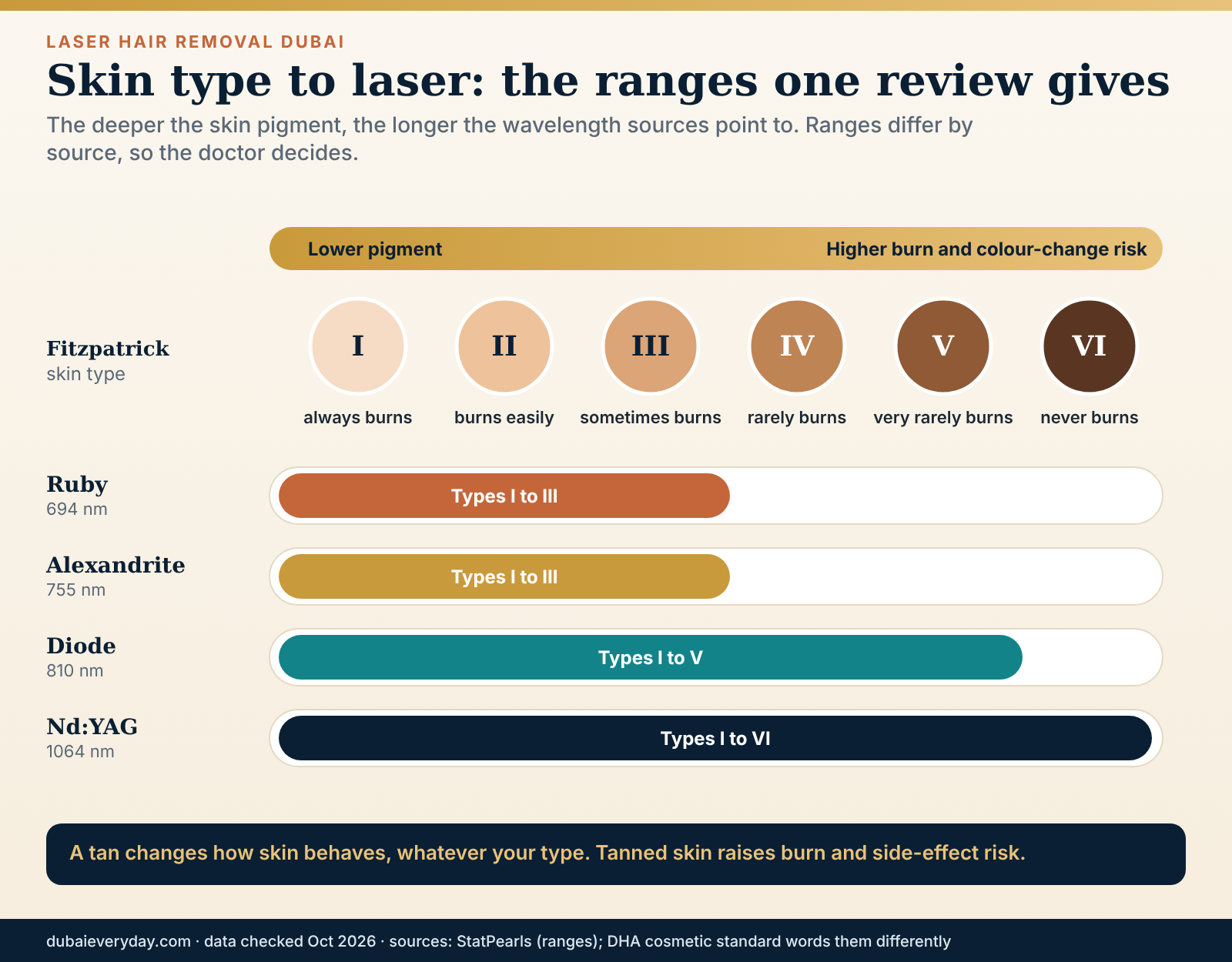
Dermatology uses the Fitzpatrick scale to describe how skin reacts to sun, from type I (pale skin that always burns) to type VI (deeply pigmented skin that never burns). StatPearls uses it to set laser choices. It is a measure of reaction, not a colour chart, and a careful clinician asks how your skin behaves in the sun, not only how it looks under the clinic lights. In a city whose residents come from every part of the scale, a laser hair removal Dubai clinic that applies one setting to everyone is the first thing to question.
Two contrasts, not one
Think of two contrasts. The first is hair against skin. Mayo Clinic says treatment works best on dark hair with light skin, and that blonde, white, grey and red hair respond poorly. Fine, pale vellus hair on the cheeks or arms is a common disappointment. The second is skin against its own baseline. A deep tan or a recently peeled sunburn changes how much light the skin absorbs, which is why Cleveland Clinic warns that tanned skin can reduce effectiveness and increase side effects.
Darker skin: possible, with the right device and hands
Mayo is direct on this point. Darker skin carries a higher risk of burns and lasting colour changes, especially with sun exposure, but people with darker skin can be treated safely by experienced providers who choose the right laser and settings. WebMD adds that blistering is more likely in darker complexions and that a doctor may prescribe a lightening cream beforehand. Neither source says laser hair removal is off the table. Both say who holds the handpiece and which device they use matter more than they do for lighter skin.
The DHA cosmetic standard itself ties device choice to skin type in an appendix on lasers. In the summary we read, ruby lasers are unsuitable for darker skin, alexandrite suits light olive skin, diode suits darker skin, and a long-pulse Nd:YAG can be used on all skin types, including tanned skin. StatPearls draws the ranges a little differently, as the next section shows. The direction is the same in both: the deeper the skin pigment, the longer the wavelength.
A decision table you can take to the consultation
The table below is our summary of the sources for laser hair removal Dubai patients, arranged as questions to ask. It is not a diagnosis, and every row ends with the same instruction: the examining doctor decides.
| Your situation | What the sources say | What to ask the clinic |
|---|---|---|
| Dark hair, fair or light olive skin | The combination Mayo Clinic describes as working best. Several devices are suitable. | Which device and wavelength, and how many sessions they expect for this area. |
| Dark hair, medium brown skin | More melanin in the skin means more competition for the light. Diode and Nd:YAG are named for deeper tones; settings matter. | Do you test a small patch first, and what do you record if the skin reacts? |
| Dark hair, deep brown or black skin | Safe treatment is possible with experienced hands. StatPearls and the DHA summary both name Nd:YAG as usable on the deepest tones, and burn and pigment risk is higher. | How many deep-skin patients does the practitioner treat, and what is the plan if pigment changes? |
| Recent tan or sunburn | Tanned skin can reduce effectiveness and raise side effects. Sun avoidance is advised before and after treatment. | How long after tanning will you postpone, and is there a fee to rebook? |
| Light brown, blonde, red, grey or white hair | Little pigment for the laser to target. Poor response is expected. | Is laser worth trying at all, and what is the alternative? |
| Fine facial hair, possible hormonal cause | Hormone-driven hair may keep returning because laser does not treat the cause. | Should I see a doctor about hormones first? |
Tattoos and moles belong in this conversation too. Mayo says laser hair removal is not suited to tattooed skin or to the area around the eyes and eyebrows. WebMD says lasers should not be used on the eyelids or tattooed skin. If you have a mole in the area, ask the clinician how they treat around it.
Laser type: alexandrite, diode, Nd:YAG, ruby and IPL
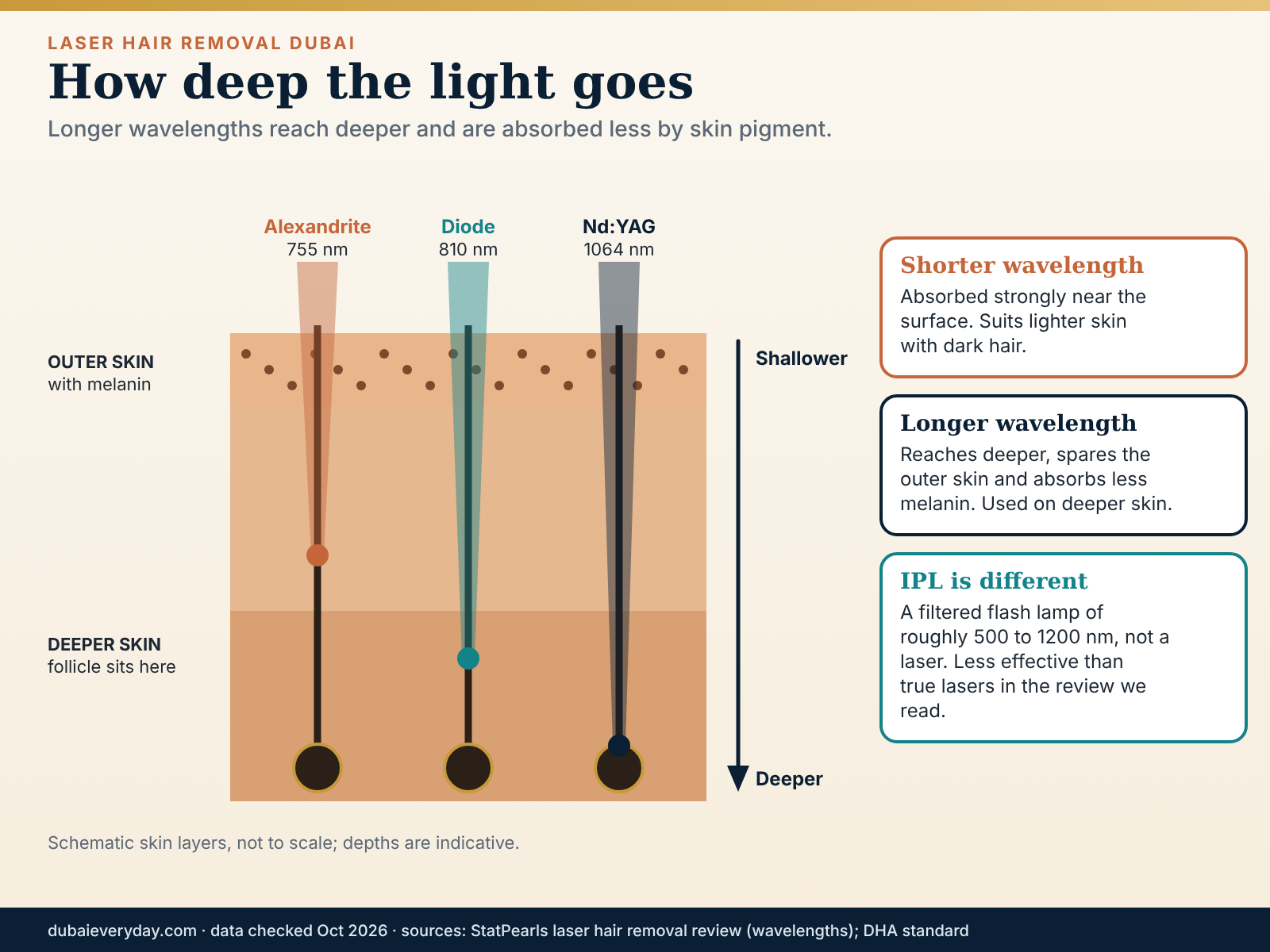
Every laser used in laser hair removal Dubai clinics is defined by wavelength, measured in nanometres. Shorter wavelengths are absorbed strongly by melanin near the surface. Longer wavelengths travel deeper and are absorbed less by skin pigment. StatPearls lists the main options like this.
- Ruby (694 nm): best on lighter skin with dark hair, types I to III.
- Alexandrite (755 nm): penetrates deeper and suits lighter skin, listed for types I to III.
- Diode (810 nm): deeper still, higher energy and less surface injury, listed for types I to V.
- Nd:YAG (1064 nm): deepest, spares the outer skin layer and absorbs less melanin, listed for types I to VI.
- IPL (roughly 500 to 1200 nm): not a laser, but a flash lamp with filters. Covers larger areas and costs less, but StatPearls says it is less effective than true lasers.
Where sources disagree, and what that means
StatPearls puts alexandrite at skin types I to III. The DHA summary says it suits light olive skin. Sources draw the lines differently. The same device can be applied with different pulse lengths and cooling, so a range in a textbook is not the same as a safe setting for you. Our reading: treat any “this laser is for all skin types” line as a marketing summary of a range, and ask about settings and cooling, not just the machine name.
The trade-off nobody puts on the poster
A longer wavelength absorbs less melanin. That protects the skin and, by the same logic, gives the hair less light to work with. It is one reason that a laser described as safe for all skin types is not the same promise as one that delivers identical results on all skin types. This is our inference from the StatPearls description, not a quoted finding. The practical question is how many sessions the clinic expects for your hair and skin, and why.
Why IPL deserves a separate laser hair removal Dubai question
DHA’s rules treat laser and IPL under the same hair-removal row, with the same supervision logic. IPL devices are often advertised as laser hair removal Dubai deals even though they are not lasers. If a price looks very low, ask what device is used. Cheaper IPL is not automatically unsafe, but it is a different tool with a different efficacy profile, and StatPearls also links the rare paradoxical increase in hair growth more often with IPL.
A good laser hair removal Dubai clinic with more than one device can match the machine to the skin. A clinic with one device should be able to tell you honestly which skin types it does not treat and who it refers them to.
The first visit: consultation, test patch and consent
A proper laser hair removal Dubai consultation is a medical appointment with a price list attached, not a sales call with a laser at the end. The DHA cosmetic standard makes a face-to-face consultation and assessment mandatory before any non-surgical cosmetic procedure. Remote consultations and home visits are not acceptable. The 2016 hair-reduction standard adds that a physician completes a clinical and physical examination and sets the treatment plan before treatment begins.
What should happen before anyone fires a laser
- History and medicinesThe cosmetic standard expects a thorough medical history, including medicines. Cleveland Clinic says pregnant patients, people on certain acne treatments, people with genital herpes or frequent cold sores, people with keloid scars and people with a history of skin cancer should talk to a provider first. WebMD flags blood thinners.
- Skin and hair assessmentSkin type, current tan, hair colour and thickness, and the area. StatPearls recommends consented pre-treatment photographs, and the DHA standard asks for marked drawings of the treatment area in your file.
- Written informationRisks, possible complications, expected outcomes and the financial implications, in writing and unbiased. The standard says consent is written, signed before the procedure and reconfirmed on the day.
- A test patchThe DHA text refers to testing patches as a safety measure, and the DHCC standard requires patch testing before treatment. Neither describes a protocol, so ask what the clinic does, where on the body, and how long it waits to review the skin.
- A plan with numbersDevice, wavelength, number of sessions expected, spacing, and what happens if you need more.
DHCC clinics add a rule worth knowing. The Healthcare City standard requires a one-day cooling-off period, meaning no treatment on the day of the first consultation. A clinic outside DHCC is not bound by that clause, but a good one may still offer you a night to think before you sign for a large package.
Questions that separate a thorough clinic from a quick one
- Who examines me, and who will operate the laser? What are their licence titles?
- Which device and wavelength will you use on my skin type, and why?
- Will you test a small patch first, and what will you record?
- How many sessions do you expect for this area, and what is the spacing?
- What happens if my skin reacts badly, and is the doctor available for follow-up? The DHA standard says the treating professional should be available for follow-up care.
- What do you do if I arrive with a tan?
For laser hair removal Dubai patients under 18, a parent or guardian must sign the consent form under the DHA standard. The standard sets no specific age limit for hair removal. If a teenager is asking, the doctor’s view on skin and hormones matters more than the clinic’s minimum age policy, and the parent signs for it.
How many sessions, how far apart, and a worked timeline
Ask five medical sources about laser hair removal Dubai courses and you get five slightly different numbers, which is itself useful. Mayo Clinic says most people need four to eight sessions several weeks apart. Cleveland Clinic says about six to eight sessions, six to eight weeks apart, with roughly a 10 to 25 per cent reduction after the first. StatPearls says at least four to six sessions, four to six weeks apart, with maintenance about every six to twelve months. WebMD says two to six treatments, four to six weeks apart. The American Academy of Dermatology says six or more.
Our reading for a laser hair removal Dubai course: budget for six to eight sessions, treat four as the low end, and treat any “full body in three sessions” claim with suspicion. The clinic should give you an expected range for your hair and skin and explain why it differs by area, because the spacing is set by how fast hair cycles back into the growth phase.
Why spacing is not negotiable
The gap has a biological reason. It lets the next set of follicles enter the growth phase, where the laser can reach them, and gives the skin time to recover. Compressing sessions yourself is a bad idea. If you want a faster plan, ask the doctor what the shortest safe gap is for your skin, and accept the answer.
A worked timeline, based on a November start
This laser hair removal Dubai timeline is our calculation, not a clinic’s schedule. Take a resident who starts on Monday 9 November 2026, with six-week gaps and eight sessions, the upper end of Mayo’s and Cleveland’s ranges. The sessions fall on 9 November, 21 December, 1 February 2027, 15 March, 26 April, 7 June, 19 July and 30 August. That is 42 weeks from the first visit to the last, about nine and a half months.
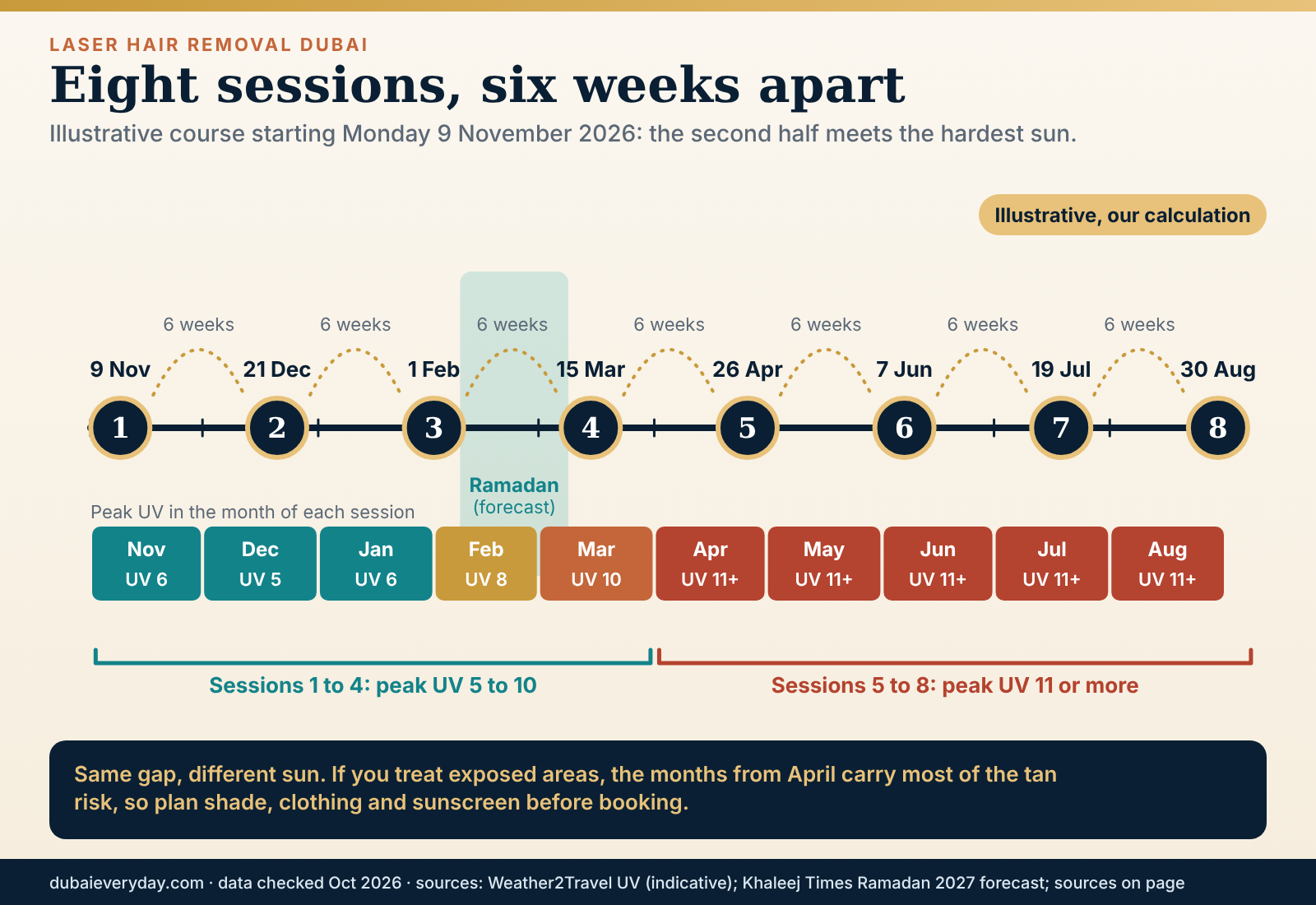
Look at what the calendar does. The first four sessions sit in November to March, when peak UV runs between 5 and 10 on the scale. Sessions five to eight land in April to August, when the same source lists peak UV at 11 or more. In other words, the second half of the course meets the hardest sun. If you treat legs, arms or face, that is the stretch where sun discipline decides the outcome. If you treat covered areas, it matters less, though not zero.
Ramadan is forecast to begin around 8 February 2027, with Eid Al Fitr likely on 9 or 10 March, subject to moon sighting. On this timeline the whole of Ramadan falls in the gap between sessions three and four. Clinic hours often change during Ramadan. We did not verify any clinic’s schedule, so ask when booking and book the next appointment before you leave the building.
Sun exposure in Dubai: the tan problem and the calendar
Every medical source we read gives the same instruction about sun, in different words. Mayo Clinic says to avoid sun and tanning beds before treatment, use broad-spectrum sunscreen of SPF 30 or higher, skip self-tanners, and protect treated skin for six weeks or as directed. WebMD says to limit sun for six weeks before and after. StatPearls suggests starting sunscreen four to six weeks before, especially on exposed areas. Cleveland Clinic says tanned skin reduces effectiveness and raises side effects.
In most countries that advice means “mind your summer holiday”. For laser hair removal Dubai patients it means something closer to “mind your commute”. The climate site we used lists peak UV index at 11 or more from April to August, 11 in September, 8 in October, and between 5 and 8 even in the winter months from November to February. The World Health Organization advises sun protection once the UV index reaches 3. On those numbers, there is no month in which Dubai skin is outside the range where protection is advised.
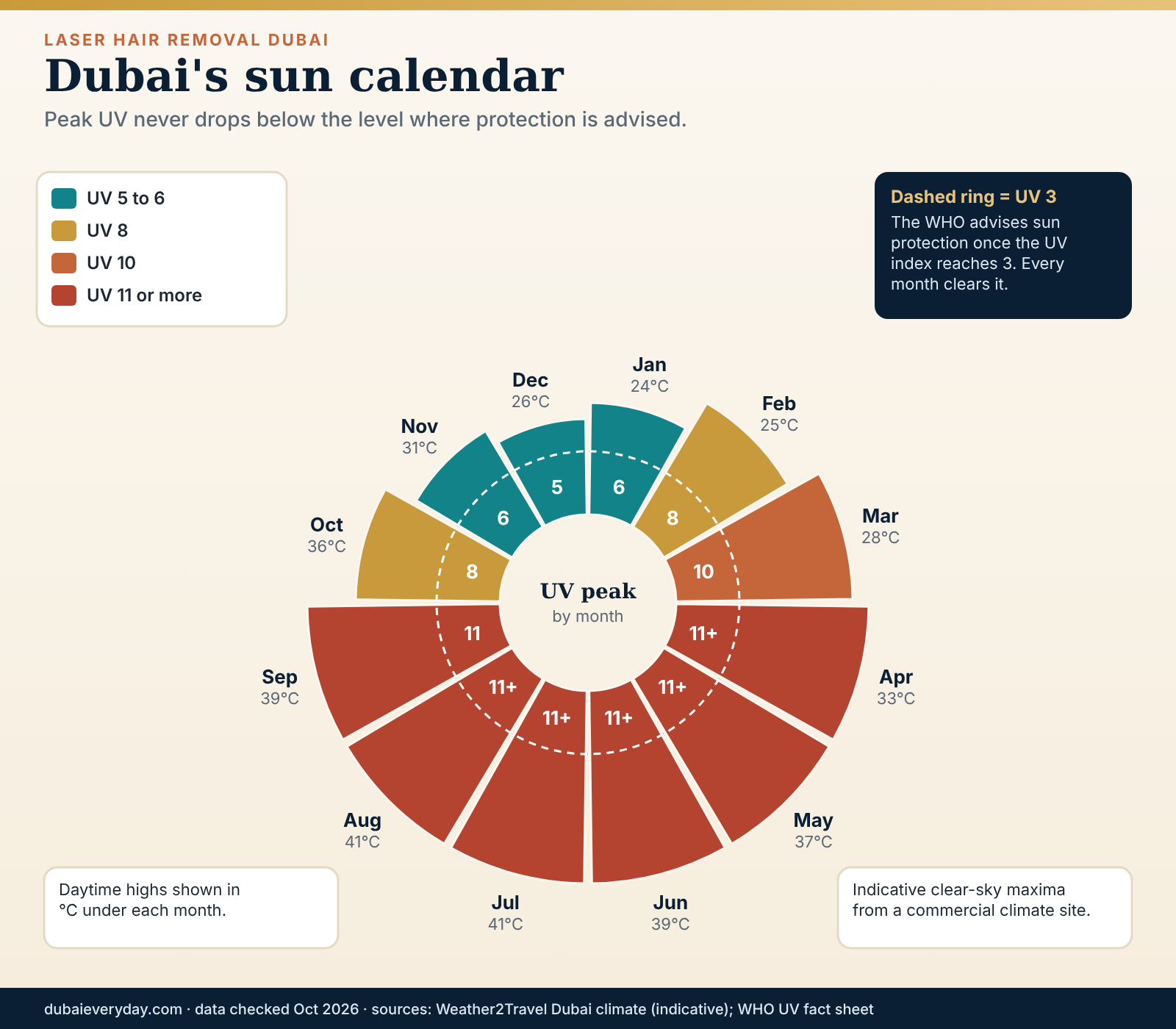
What counts as a tan
A beach day obviously counts. So does a Friday brunch on a terrace, a weekend of padel, a morning run, a week of walking to the car park without sleeves, or a holiday in a sunnier country between sessions. The WHO says shade and clothing protect better than sunscreen, and that sunscreen should not be used to extend time in the sun. Those two lines are a better plan for the weeks around a laser hair removal Dubai session than a thicker coat of lotion.
If you arrive with a fresh tan or a sunburn, say so. Tanned skin can raise the risk of burns and pigment changes, and a clinic that treats it without comment is giving you less than the sources recommend. Ask in advance how the clinic handles late changes and whether rebooking carries a fee. Never use self-tanner or a tanning bed to “even out” before an appointment.
Our reading of the calendar
Three observations, all based on the monthly figures above.
First, October to March carries the lowest UV peaks, from 5 in December up to 10 in March. A laser hair removal Dubai course aimed at exposed areas has an easier time starting in October or November, though the worked timeline earlier shows that an eight-session course stretches into the high-UV months anyway. Second, April to September is the stretch where protection matters most for the face, arms and legs, so the longer your gaps, the more of the hard sun you have to manage.
Third, and this is a judgement, not a fact from a source: summer is not necessarily a bad time to start laser hair removal Dubai treatment for someone who truly lives indoors from mid-morning to dusk, because in 41 degree heat many people cover up and avoid direct sun anyway.
It is a bad time for anyone with a daily outdoor routine, regular beach days or a wish to wear sleeveless tops at the weekend. If you cannot keep that discipline, choose the cooler months and plan around them. The beach pages on this site, such as our guide to the best beaches in Dubai, are exactly the places to skip in the weeks around a session.
Which areas the sun reaches
Underarms, bikini line and chest or back that stay under clothing are less likely to pick up a tan than legs, forearms or the face. That is basic common sense rather than a figure from the sources, and it comes with a catch: sleeveless tops, swimwear and gym kit change the picture. Mention what you wear and where you swim when the clinician maps your areas.
Aftercare, risks and what to do if something goes wrong
This is general laser hair removal Dubai aftercare information from the sources we read, not instructions. Your clinic’s own instructions, given to you in writing, override this section.
Aftercare, as the sources describe it
Immediately afterwards the skin may look red and feel swollen or sunburned. WebMD says that feeling lasts one to two days, and Mayo says colour changes and swelling usually settle within hours. Cool compresses or ice packs help, and a steroid cream may be prescribed for a stronger reaction. Treated hairs shed over days to weeks, and the sources say not to pluck or wax them in the meantime. Mayo and Cleveland add that you should avoid sun on treated skin and use sunscreen daily for several weeks.
What the sources do not cover well is gyms, saunas, swimming pools and shaving routines. Those are exactly the questions to put to your clinic. If you train a lot, our guide to gyms in Dubai may help with the logistics of timing, but the clinic decides when to resume.
Risks, from common to rare
Common and short-lived: redness, swelling, itching, stinging, discomfort. Less common: blistering, crusting, burns, and darker or lighter patches of skin, which Mayo says can sometimes be lasting in darker skin, particularly with sun exposure. Rare: scarring, infection, a herpes outbreak in people prone to cold sores, eye injury from exposure to the beam, and a paradoxical increase in hair growth, which StatPearls says is rare and more often seen in skin type III and with IPL. That is why the eyewear checks matter.
When to call the clinic
- Blisters, crusting, weeping or severe pain in the treated area.
- Darkening or whitening of the skin that does not fade over the following days.
- Signs of infection, such as spreading redness, warmth or pus, or a cold-sore outbreak.
- Any eye pain or visual change after treatment near the face.
For anything severe or fast-moving, treat it as a medical problem, not a beauty one. Go to a doctor or hospital. Our guides to healthcare in Dubai and hospitals in Dubai explain the options, and the dermatologist guide covers how to book a skin specialist.
If something goes wrong: records and complaints
After any laser hair removal Dubai problem, ask for a copy of your consent form, treatment plan, device and settings used, and the clinician’s name. The DHA standard requires patient records and consent documentation, so asking is reasonable.
DHA’s service catalogue says complaints about healthcare facilities or professionals can be filed online through the Sheryan portal, free of charge, by nationals, residents and visitors, for events no older than three years. It lists an Emirates ID for nationals and residents and says processing typically takes one to six months. That catalogue is a 2022 document, so confirm current details with the DHA on 800342 before relying on the timeline.
Money disputes, such as a package you paid for and cannot use, are a different route. Dubai Economy and Tourism runs a consumer complaint platform. A news explainer we read says it expects a valid invoice from a Dubai-licensed business, advises trying the seller first, and excludes certain categories. It did not say whether health services are covered or redirected to DHA, so we cannot tell you which door a laser hair removal Dubai dispute goes through. Keep every receipt and message.
Laser hair removal Dubai cost: how quotes are built
We found no official price list for laser hair removal Dubai clinics must follow, and the DHA documents we read do not set prices. What they do require is that you receive clear written information on risks, outcomes and financial implications before you consent. That makes the quote a document you are entitled to read properly. Laser hair removal Dubai prices on social media and aggregator sites are advertising, and the cheapest-looking number is rarely the one you end up paying.
One advertised price, read carefully
The only laser hair removal Dubai clinic price we could verify from an operator’s own page is a package at Canadian Specialist Hospital Dubai: full-arm laser hair removal, four sessions for AED 900, described as performed by dermatologists. The page, read on 29 October 2026, is undated, and does not say what is included, how long the package lasts or whether VAT is added. Our arithmetic gives AED 225 per session, about USD 245 for the package at the 3.6725 peg.
Treat it as one data point, not a market average. It also illustrates a point from the clinical sources. Four sessions is the low end of the four-to-eight range. A package that stops at four may leave you buying more.
What a quote should spell out
- Per session or per package, and the number of sessions included.
- What an “area” means. A full arm, a half arm and an underarm are different products.
- Whether the consultation and the test patch are free, paid or credited against the package.
- Whether VAT is included. In 2018 Gulf News reported that elective cosmetic treatments not prescribed for a medical condition fall outside the health-care zero rating and attract VAT, at the UAE’s 5 per cent standard rate. Ask whether the figure on the offer includes it.
- How long the package is valid, whether sessions can be transferred, and what happens to unused sessions if you move away or the clinic closes.
- The price of extra sessions if your plan needs more than the package, and the price of an annual top-up.
Illustrative example: three quotes for the same six sessions
The numbers below are invented to show the arithmetic. They are not quotes or market facts. Imagine three laser hair removal Dubai clinics each offering six sessions of the same area, and compare the totals.
| Illustrative example (not a quote or market fact) | Clinic A | Clinic B | Clinic C |
|---|---|---|---|
| Headline offer | AED 180 per session, VAT extra | AED 900 for six sessions, VAT included | AED 599 for four sessions, VAT extra |
| Consultation | Free | AED 150 (VAT included) | AED 150, VAT extra |
| Sessions 5 and 6 | Included in the six | Included in the six | AED 200 each, VAT extra |
| Total for six sessions | AED 1,134 | AED 1,050 | AED 1,206 |
| Effective price per session | AED 189 | AED 175 | AED 201 |
Clinic C had the smallest headline number and the largest total. Clinic A looks cheapest per session and loses to B once VAT is added. The method matters more than the figures: write down the total for a complete course, include VAT and the consultation, and divide by the number of sessions. If a clinic will not give a total in writing, that is information too.
Costs people forget
Sessions are not the only line in a laser hair removal Dubai quote. Maintenance top-ups come later, with StatPearls suggesting every six to twelve months for some patients. A postponed session because of a tan can carry a rebooking fee. A pigment problem or burn may need prescription creams and follow-up appointments, and you should ask in advance what the clinic charges, or does not charge, for complications from its own treatment. Do not assume it is free until you have asked.
Insurance
Mayo Clinic says cosmetic hair removal is usually not covered by insurance, though medically related cases may be, and the American Academy of Dermatology says insurance does not cover it. A Gulf News explainer on UAE policies lists non-medical cosmetology among common exclusions. If a doctor believes your hair growth has a medical cause, ask the insurer before treatment, not after. Our guide to health insurance for Dubai residents explains how exclusions and pre-approvals work, and we did not verify whether any specific plan covers laser.
Paying for laser hair removal Dubai packages safely
For laser hair removal Dubai packages, pay by card, not cash, so there is a record. Get the package terms in writing. Be wary of anything that pushes you to pay a large sum the same day for sessions you will take over most of a year. This is general consumer sense, not legal advice, and we have not verified Dubai rules on prepaid packages.
Choosing a laser hair removal Dubai clinic: ten safety checks
This is not a ranking. Choosing a laser hair removal Dubai clinic is a verification job, and every item below can be checked or asked about before you pay. If you need a general-purpose clinic first, our guide to the best clinics in Dubai covers GP and specialist access.
- Find the facility in the Dubai Medical RegistryDHA’s registry on the Sheryan portal has separate tabs for professionals and facilities. The DHA catalogue describes it as a free, searchable database of professionals and facilities with active registration or licences, available to nationals, residents and visitors. A DHCC clinic will be under its own regulator, so ask it for its DHCC licence details.
- Look up the supervising physicianThe 2016 standard requires a full-time physician as service in-charge. The registry lets you filter professionals by speciality, so check that the named doctor holds the title the clinic gives.
- Check the operator’s titleA physician, or a nurse or beauty therapist holding the Laser Hair Technician title under supervision. “Laser specialist” is not a DHA title.
- Insist on a face-to-face examinationA physician examines you and sets the plan before treatment. No remote consultation, no home visit, no “just come in and we will start”.
- Ask for skin typing and a device matchWhich device, which wavelength, and why. The DHA appendix links device choice to skin type.
- Ask about the test patchWhat, where, and how long they review it.
- Look at the roomA warning sign on the door, matt walls, no mirrors or carpet, a white couch, and protective eyewear for you and the operator.
- Read the consent and the information sheetWritten, in a language you understand, with risks, outcomes and costs. Do not sign under time pressure.
- Ask for the device name and modelThe standard requires registration with the Ministry of Health. You may not be able to verify registration yourself, but a clinic that cannot name its device is not a good sign.
- Settle follow-up, records and termsWho you contact if the skin reacts, whether the doctor is available, and package terms in writing.
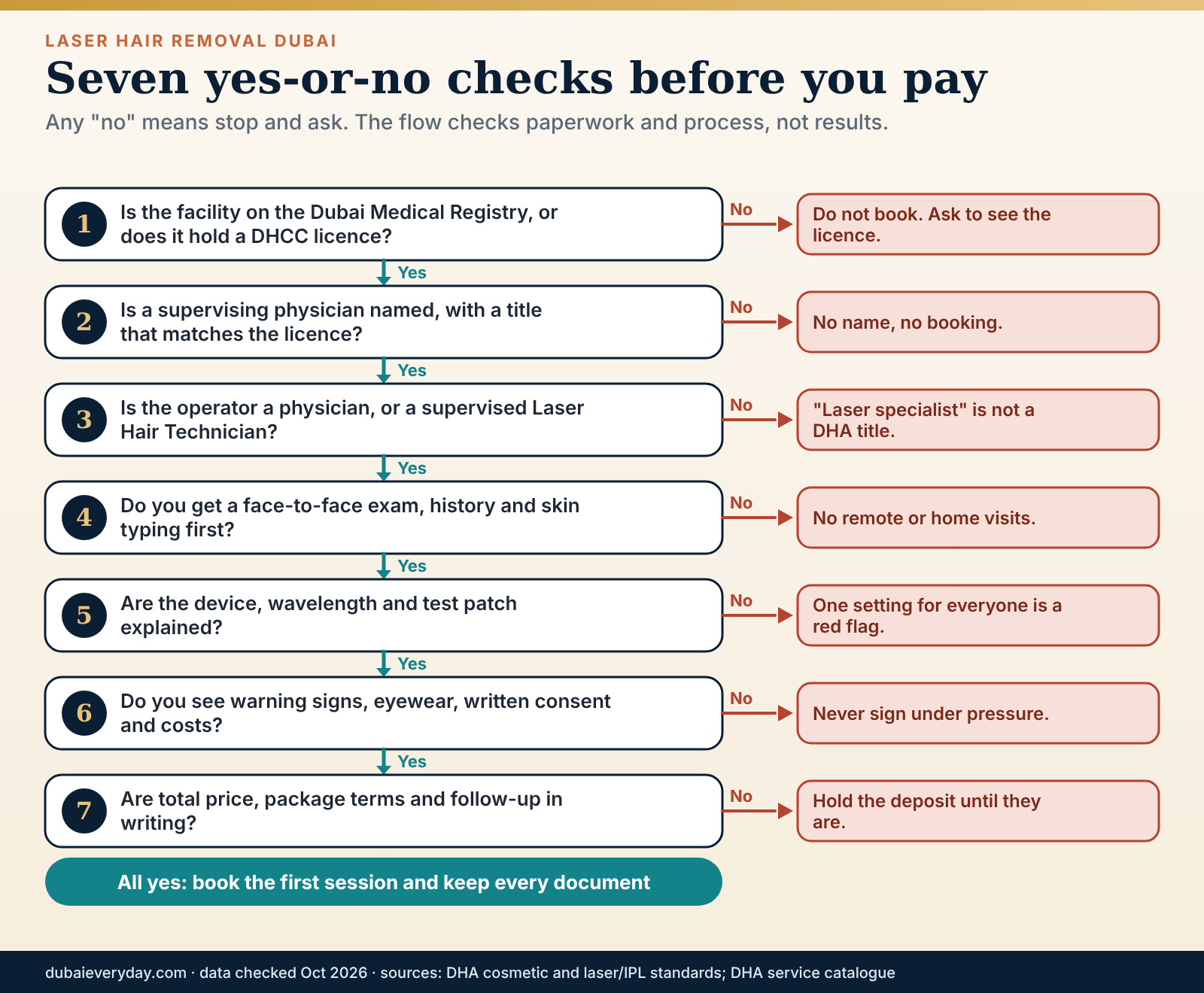
Laser hair removal Dubai offers from a salon or spa with no medical licence, or at your home. No examination before the first session. Treatment on the day of a first visit with no questions about your skin or medicines. One setting for everyone. A promise of permanent or guaranteed results. No eyewear. An operator who cannot tell you their licence title. Pressure to pay for a large package today.
Marketing phrases decoded
“FDA-approved” or “CE-approved” describes the machine. The DHA 2016 standard accepts approval by FDA, Health Canada or CE alongside Ministry of Health registration, so it is a legitimate box to tick. It says nothing about the operator or the settings.
“Permanent” overstates what the clinical sources say about laser hair removal Dubai results. “Painless” is rarely true: Mayo and Cleveland describe snapping or stinging sensations, and a numbing cream is sometimes used. “Unlimited sessions” needs terms in writing: for how long, for which areas, and what counts as a session. “Safe for all skin types” is a statement about a range, not about your skin. “Doctor-supervised” should be followed by “on site?”; the DHA standard asks for a supervisor available in the facility, and the DHCC standard asks for one on the premises.
Seven situations and the sensible next step
These are general scenarios built from the sources, not individual advice. In each case the examining doctor has the final word.
A visitor with ten days in Dubai
A course needs repeated visits weeks apart, so one session on holiday gives a one-off hit, not a result. A face-to-face assessment is required by the DHA, and treated skin needs sun protection in a city with strong sun. If you come back regularly, a clinic that can continue the course is worth more than a bargain. Our Dubai travel guide helps plan the trip around it.
A resident with fair skin and dark hair, starting in November
This is the straightforward case in the sources. Expect a plan of six to eight sessions, a start in the lower-UV months and a second half of the course that meets summer. Decide now how you will handle beach days between sessions.
Deeper skin, wanting to begin in June
Ask for a device suited to your skin type, ask how many deep-skin patients the practitioner treats, and ask about the test patch. Mayo and WebMD both flag a higher risk of burns and colour change with sun. The cooler months are easier on exposed areas.
Someone who tans in a weekend
Start with areas that stay covered, keep a firm line on sun and tanning beds, and tell the clinic about any tan. If you cannot avoid the sun, postponing costs less than a pigment problem.
A man treating beard line, neck or back
The American Academy of Dermatology notes growing interest among men, for example against razor burn and ingrown hairs. We found no solid figure on the number of sessions for facial hair, so ask for the clinic’s expected range. Under the DHA standard, the operator’s gender should match yours except on the face and external extremities.
Heavy facial hair with irregular periods
See a doctor first. Mayo says hormone-driven hair may keep growing, StatPearls advises evaluating hormones when hirsutism is suspected, and the AAD says laser is not permanent on a woman’s face because of hormones. The dermatologist guide is the better starting point.
Pregnant, or planning to be
Cleveland Clinic lists pregnancy among the reasons to talk to a provider before treatment. Ask your obstetrician or doctor, and do not treat the absence of an explicit rule in the DHA standards as permission.
Laser hair removal Dubai FAQ
Is laser hair removal Dubai legal at beauty salons?
The DHA said around 2011 that beauty establishments could not offer hair removal using lasers or IPL unless they registered as healthcare providers. The current cosmetic standard allows beauty therapists to treat only as supervised Laser Hair Technicians in a DHA-licensed facility. A place holding only a beauty licence is not the route the rules describe, so ask for the DHA licence and the supervising doctor.
Who may perform laser hair removal Dubai clinics sell?
Dermatologists and plastic surgeons, with no extra training certificate. Other doctors only with the right hair laser licence and training. Nurses and beauty therapists only as supervised Laser Hair Technicians after an accredited course and hands-on cases, working to a physician’s plan. All in a licensed facility. Dubai Healthcare City clinics follow the DHCC regulator’s standard instead.
How many laser hair removal Dubai sessions will I need?
The sources range from two to eight, with most saying about four to eight sessions several weeks apart. Cleveland Clinic suggests six to eight, six to eight weeks apart, and StatPearls adds maintenance every six to twelve months for some people. Hair colour, skin type and body area change the number, so ask the clinic for an expected range and the reasoning in writing.
Is laser hair removal Dubai treatment safe for dark skin?
Mayo Clinic says people with darker skin can be treated safely by experienced providers who choose the right laser and settings, while noting higher risks of burns and lasting colour change, particularly with sun. A long-wavelength device such as Nd:YAG is the one most often named for deeper tones. Ask about the test patch and the practitioner’s experience, and avoid tanning.
Can I have laser hair removal Dubai treatment in summer?
It is possible if you truly avoid the sun before and after treatment, but Dubai’s UV index peaks at 11 or more from April to August on the figures we used, and the sources advise limiting sun for around six weeks on either side. People with outdoor routines, beach days or recent tans often find the cooler months easier. Tell the clinic about any tan.
How much does laser hair removal Dubai treatment cost?
There is no official laser hair removal Dubai price list that we found. The one operator page we verified lists a full-arm package of four sessions at AED 900, undated and without stated inclusions. Compare quotes by the total for a complete course, including consultation, VAT, extra sessions and top-ups, as in the worked example earlier. Anything much cheaper deserves questions about device and operator.
Does health insurance cover laser hair removal Dubai clinics offer?
Usually not for cosmetic reasons. Mayo Clinic says insurance usually does not cover it, though medically related cases may be covered, and Gulf News lists non-medical cosmetology among common UAE policy exclusions. If a doctor recommends treatment for a medical reason, ask your insurer for written pre-approval before booking. We did not check specific plans.
Does laser hair removal Dubai treatment hurt?
Mayo Clinic describes brief snapping sensations, and Cleveland Clinic describes rapid stinging, with cooling tips, sprays or gels used for comfort and numbing cream in some cases. Small areas take minutes and larger ones up to an hour or more. If a clinic says it is entirely painless, ask what they mean. Discomfort varies by area and person.
How should I prepare for a session?
The sources agree on the basics: avoid tanning and heavy sun, skip self-tanner, stop waxing, plucking and electrolysis for several weeks, and shave before the session. Mayo says shave the day before and Cleveland says two to three days before, so follow your clinic’s instruction. Tell them about medicines and skin conditions. Your clinic’s written instructions come first.
Can I use a home laser or IPL device instead?
Cleveland Clinic says the US FDA has approved some home laser devices, but without a trained provider the risk of misuse and injury rises. We did not verify the status of home devices in the UAE or how the Emirates Drug Establishment treats them. The DHA standards we read cover licensed facilities. Check with a doctor before using one, especially on deeper skin.
Is there a minimum age?
The DHA cosmetic standard sets no specific age limit for laser or IPL hair removal, but patients under 18 need a parent or guardian to sign the consent form. The Dubai Healthcare City standard treats under-18s more cautiously for cosmetic procedures in general. For a teenager, a doctor’s view on skin and hormones matters more than the clinic’s minimum age.
Is laser hair removal Dubai treatment permanent?
Not guaranteed. Mayo Clinic says growth is greatly reduced but regrowth is not guaranteed to stop, Cleveland Clinic says the treatment is not permanent, and StatPearls describes maintenance sessions. The American Academy of Dermatology is more optimistic for most body areas. The DHA names the service hair reduction. Expect a lasting decrease, with possible touch-ups.
Related reading
Sources and further reading (20 links)
- Dubai Health Authority: Standards for Non-Surgical Cosmetic Procedures (version 2) — who may perform hair laser and IPL, supervision, facility, device and consent rules
- Dubai Health Authority: Laser and Intense Pulsed Light (IPL) Hair Reduction Standards — facility types, physician examination, technicians, gender matching, room and eyewear rules
- Dubai Healthcare City: Standards for Non-Surgical Cosmetic Procedures — lasers and IPL, supervision, patch testing, cooling-off
- Dubai Health Authority: Dubai Medical Registry (Sheryan) — professionals and facilities search
- Dubai Health Authority: Health regulation service catalogue — registry access, licence validity, complaints process
- Dubai Health Authority: FAQ — privileges for cosmetic procedures and contact details
- Mayo Clinic: Laser hair removal — how it works, skin tone, risks, preparation, aftercare
- Cleveland Clinic: Laser hair removal — sessions, preparation, who should check first, home devices
- StatPearls (NCBI Bookshelf): Laser hair removal — wavelengths, skin types, intervals, complications
- American Academy of Dermatology: Laser hair removal overview — sessions, permanence, insurance
- WebMD: Laser hair removal — session spacing, sun advice, aftercare
- World Health Organization: Ultraviolet radiation fact sheet — UV index threshold for sun protection
- Weather2Travel: Dubai climate by month — indicative monthly UV, temperature and sunshine
- Khaleej Times: Dubai gets tough with laser treatment at salons — 2011 salon rules (historical context)
- Gulf News: DHA bans use of laser systems in beauty parlours — salon restriction and reported fines (historical context)
- Gulf News: Will health care services be taxed in UAE? — VAT on elective cosmetic treatment
- Gulf News: Is this treatment covered in my insurance? — common exclusions
- Gulf News: How to file a consumer complaint in Dubai — Dubai Economy and Tourism complaint steps
- Khaleej Times: Ramadan, Eid Al Fitr and Eid Al Adha 2027 likely dates — forecast start of Ramadan 2027
- Canadian Specialist Hospital: Laser hair removal full arm package — one advertised package price
Update log: 29 October 2026 — first publication; facts re-checked against the sources above. Next review due: April 2027 (six-month cadence), or sooner if the DHA publishes a new version of its cosmetic or hair-reduction standards. Corrections welcome. This page is general information, not individual medical, legal or insurance advice; it does not recommend any clinic, and no clinic paid for inclusion.
About DubaiEveryday and this guide
DubaiEveryday.com is an independent editorial project that publishes practical, research-based guides to everyday life in Dubai: where to live, what things cost, how the rules work and how to get around. This page was written and edited by the DubaiEveryday editorial team. It is not signed by a named expert, doctor, lawyer or adviser, and we do not claim first-hand testing of a venue, clinic or service unless the page says so.
Each guide is built from official sources such as government and regulator pages, operator websites and established news outlets, cross-checked where we can. When we could not confirm something, we say so in the text, and examples that use made-up numbers are labelled as illustrations. Mentions are editorial choices, not paid placements, and a link is not an endorsement.
Dubai changes quickly. If you spot something that is out of date or wrong, please tell us through the contact options on DubaiEveryday.com and we will check it and correct the page.