

Dermal fillers are injectable gels placed under the skin to add volume or support, and in Dubai they are handled as prescription-only medical procedures that only certain licensed doctors may perform. This fillers Dubai guide explains hyaluronic acid, facial areas, reversal, complications, costs and injector checks, using regulator documents and medical sources read on 29 October 2026.
A quick lunchtime filler appointment can sound as casual as a haircut. It is not. It is a prescription-only medical procedure, and the person holding the syringe matters as much as the product inside it. Most people never ask what happens if something goes wrong.
If you are weighing fillers Dubai clinics advertise, a few calm checks beforehand make the whole experience safer and clearer for you. Who is licensed to inject? What can be reversed, and how is a quote built? This guide covers those questions plainly, along with the warning signs that deserve a call to your doctor.
Fillers Dubai clinics offer are injectable gels, most often hyaluronic acid (HA), that add volume or support under the skin, and in Dubai they count as prescription-only medical procedures. The Dubai Health Authority (DHA) cosmetic standard requires a face-to-face consultation first, written consent reconfirmed on the day, and a trained, privileged physician as the injector.
In the fillers Dubai rulebook, nurses are not on the permitted list for face fillers, general dentists may not inject them, and nose and body fillers are limited to dermatologists and plastic surgeons. Under-18s are not permitted under that standard.
Three checks do most of the work in any fillers Dubai appointment. First, the person: confirm the licence on the Dubai Medical Registry, not on a social media profile. Second, the product: ask to see the sealed pack, label and batch, because HA can be dissolved with an enzyme called hyaluronidase while many other fillers cannot be reversed.
Third, the plan: ask what the clinic does if a filler blocks a blood vessel. That rare complication is the reason emergency preparation matters. Severe pain, pale or mottled skin, vision change or stroke signs mean urgent care, and the UAE ambulance number is 998.
There is no official fillers Dubai price list. A quote is built from product, injector time, consultation and VAT, and the worked example further down (illustrative, not a market fact) shows how a headline price turns into a different total.
This is desk research. DubaiEveryday.com has not had fillers, visited clinics or watched procedures, and nothing here describes a personal experience. No doctor or other clinician has reviewed this draft, so read every clinical statement as a summary of the cited source, not as a clinician’s opinion.
The fillers Dubai rules come from the regulators, read on 29 October 2026: the DHA Standards for Non-Surgical Cosmetic Procedures (version 2), the Dubai Healthcare City standard, DHA circulars, and the federal medical liability decree-law. Medical information comes from the US Food and Drug Administration, Cleveland Clinic, the NHS and peer-reviewed articles. Where a source is a news report, a case report or a short letter, the text says so.
Three limits shape this fillers Dubai guide. We could not read DHA standard version 2.1 (issued December 2024), so this page rests on version 2 plus later circulars. We found no official Dubai price list and give none.
And product approvals cited here are American, because we could not find a readable UAE list of approved filler uses. Where something is unverified it is marked “Confirm first”. Inclusion of any source was not paid for, no clinic or brand is recommended or ranked, and this is general information, not individual medical advice.
How to use this fillers Dubai guide
This page covers fillers Dubai residents and visitors can actually book: what they are, where they go on the face, who may legally inject them in Dubai, how they are reversed, what can go wrong and how quotes are built.
If your question is about wrinkle-relaxing injections, that is a different product and a different risk profile, covered in our Botox in Dubai guide. If your question is about acne, pigmentation, moles or rashes, start with the dermatologist guide. Both are linked again where they matter. Think of this page as a fillers Dubai primer for someone who has not booked yet.
The reading routes are simple. If you have ten minutes, read the short answer, the complication ladder and the eight checks. If you are comparing quotes, go to the cost section and the marketing section. If something already feels wrong after an injection, skip to the complications section now, and do not wait for a reply from an article or a chat group.
One point of honesty about evidence. Filler safety is not a single number. The sources used here are regulators, a university-affiliated hospital system, a national health service and peer-reviewed reviews, and none of them gives a fillers Dubai complication rate. This page therefore describes what can happen and what regulators require, and it does not tell you how likely any outcome is for you. That is a conversation for an examined patient and a licensed doctor.
After a filler injection, severe or unusual pain, skin that turns white, grey, blue or mottled, any change in vision, or weakness, facial droop or confusion needs urgent medical attention. Contact the treating clinic at once and call 998 for an ambulance if you cannot reach one quickly. This is general guidance based on the FDA and Cleveland Clinic pages cited below, not individual advice.
What dermal fillers are: hyaluronic acid and the other materials
The US Food and Drug Administration (FDA) describes dermal fillers as medical device implants approved to give a smoother or fuller facial appearance. Some are absorbed by the body over time, which is why treatment has to be repeated, and how long a result lasts depends on the product and the place it is injected.
That one sentence already explains most of the decisions in this fillers Dubai guide. A filler is a device, not a skincare product, and it stays in the tissue until the body breaks it down or someone removes it.
Hyaluronic acid: the filler most people mean
Hyaluronic acid is a sugar-based substance that occurs naturally in skin and holds water, and the fillers made from it are cross-linked so they last longer than the natural molecule would. Cleveland Clinic lists HA fillers as adding volume and hydration, with results lasting roughly six months to a year. Most “lip filler”, “cheek filler” and “tear trough filler” searches in Dubai are about HA products, so fillers Dubai buyers meet HA first, and this guide centres on it.
HA matters for a second reason. An enzyme, hyaluronidase, breaks HA down, so an HA filler can usually be dissolved if the result is wrong or a complication appears. A short 2024 letter in the journal Skin Research and Technology describes that enzyme acting only on filler it physically reaches, which is why technique and dosing matter. The reversal section below deals with this properly. For now, remember the asymmetry: HA offers an exit, and several other materials do not.
Other materials: biostimulators, permanent fillers and silicone
Cleveland Clinic also describes fillers based on calcium hydroxylapatite (a bone-like mineral, typically used for deeper folds and lasting about a year), poly-L-lactic acid (which prompts the body to make its own collagen, with results that can last two years or more) and polymethylmethacrylate (tiny beads in a collagen carrier that stay under the skin). Fat grafting uses the patient’s own fat. These are sometimes called biostimulators or collagen stimulators, and they behave differently from HA gels.
The FDA draws two firm lines. Non-absorbable (permanent) fillers are approved only for nasolabial folds and cheek acne scars in the US, and injectable silicone is not approved for any aesthetic use, with warnings about long-term pain, infection, scarring, disfigurement and embolism. The FDA also says removal can be difficult or impossible, especially for permanent and non-HA fillers. If a fillers Dubai clinic offers a “permanent” filler for lips or cheeks, treat that as a reason to ask many more questions.
| Material family | Plain description | Duration cited by Cleveland Clinic | Can hyaluronidase dissolve it? |
|---|---|---|---|
| Hyaluronic acid (HA) | Water-holding gel for volume, lips, cheeks, folds | About 6 months to a year | Yes, this is what the enzyme acts on |
| Calcium hydroxylapatite | Mineral particles in a gel, often for deeper folds | Around a year | No; the FDA says removal of non-HA fillers can be difficult or impossible |
| Poly-L-lactic acid | Prompts collagen production, builds gradually | Two years or more | No; same FDA caution |
| Polymethylmethacrylate | Beads in collagen that stay in place | Not stated by the source | No; the FDA lists permanent fillers as hardest to remove |
The table is a map of families, not a product list. Durations are Cleveland Clinic’s general figures, not the claims of any particular brand, and individual results vary with the filler, the site and the person. Ask the injector for the specific product’s leaflet rather than relying on a family-level number.
Skin boosters, threads and the grey zone
Fillers Dubai menus also list treatments that sit near fillers without being fillers: “skin boosters” (thin injectable HA aimed at skin quality rather than volume), polynucleotide injections, platelet-rich plasma, and thread lifts. The DHA standard we read does not name skin boosters or polynucleotides at all. Its closest categories are mesotherapy (injectable, or derma rollers over 0.5 mm), listed for dermatologists, plastic surgeons and other physicians, and facial threading, restricted to consultant or specialist dermatologists and plastic surgeons.
For skin boosters and polynucleotides, that gap means the category is a question to put to the clinic: under which line of the DHA appendix does this treatment fall, and who holds the privilege to give it? We could not confirm an official classification, so treat this as “Confirm first”. The same question works well for anything with a new name.
Medical versus cosmetic uses
Most fillers Dubai residents ask about are cosmetic and elective, and Dubai insurers usually treat them that way, which the costs section returns to. The FDA does list a medical use: restoring facial fat loss in people with HIV. Fillers are also approved for acne scars in certain products. A medically driven filler plan should come from a treating doctor, with a diagnosis, and this article cannot tell you whether you qualify. It simply keeps the two categories apart so a cosmetic price is never mistaken for a medical one.
Facial layers: where filler goes and why depth matters
A face is not a flat surface with wrinkles on it. It is a stack: skin (epidermis and dermis), a layer of fat under the skin, a sheet of connective tissue and muscle that doctors call the SMAS, deeper fat pads, and bone covered by a thin membrane.
A 2023 narrative review in the World Journal of Otorhinolaryngology describes the SMAS as the middle layer, with facial nerves and blood vessels running through it, and says the planes above and below it are the most common injection targets. Fine lines can be treated with tiny superficial injections into the skin itself.

Why does this matter to a fillers Dubai patient? Because the same product behaves differently at different depths, and the risk profile changes with the neighbourhood. The review notes that putting HA too close to the surface under thin skin, such as the under-eye area, raises the chance of a bluish tint known as the Tyndall effect. It also notes that blood vessels sit in several layers, and that some areas, including the nose and the fold beside it, had the highest complication rates in a systematic review it cites.
Needle or cannula: a question you can ask
The fillers Dubai clinics use are placed with a fine needle or a blunt-tipped flexible tube called a cannula. The FDA page tells providers to use needles or cannulas, and never needle-free devices, which are not approved for fillers.
The 2023 review reports that in one cohort cannulas were associated with lower odds of vascular occlusion than needles, while stressing that the injector’s experience also matters. A cannula is therefore not a guarantee, and a needle is not a warning sign. What you can reasonably ask is which tool will be used in each area, and why.
You do not need to understand the anatomy to benefit from it. You need to understand two consequences. One: “how deep, and with what” is an expert judgement that cannot be settled by a price list or a social media video. Two: the injector’s ability to recognise and respond to a blocked vessel is as important as their eye for symmetry. The fillers Dubai credential checks later in this guide exist for that second reason.
Fillers Dubai clinics offer by facial area
Fillers Dubai clinics tend to sell treatment by area, so it helps to know how the regulators and the medical literature treat each one. Two lenses are used below.
The first is the FDA’s consumer page, which lists the uses the US has approved for absorbable fillers: moderate to severe wrinkles and folds including nasolabial folds and perioral lines, and volume for the lips, cheeks, chin and back of the hand. The second is the DHA appendix, which decides who may inject in Dubai. Neither tells you what suits your face, and neither is a fillers Dubai price guide.
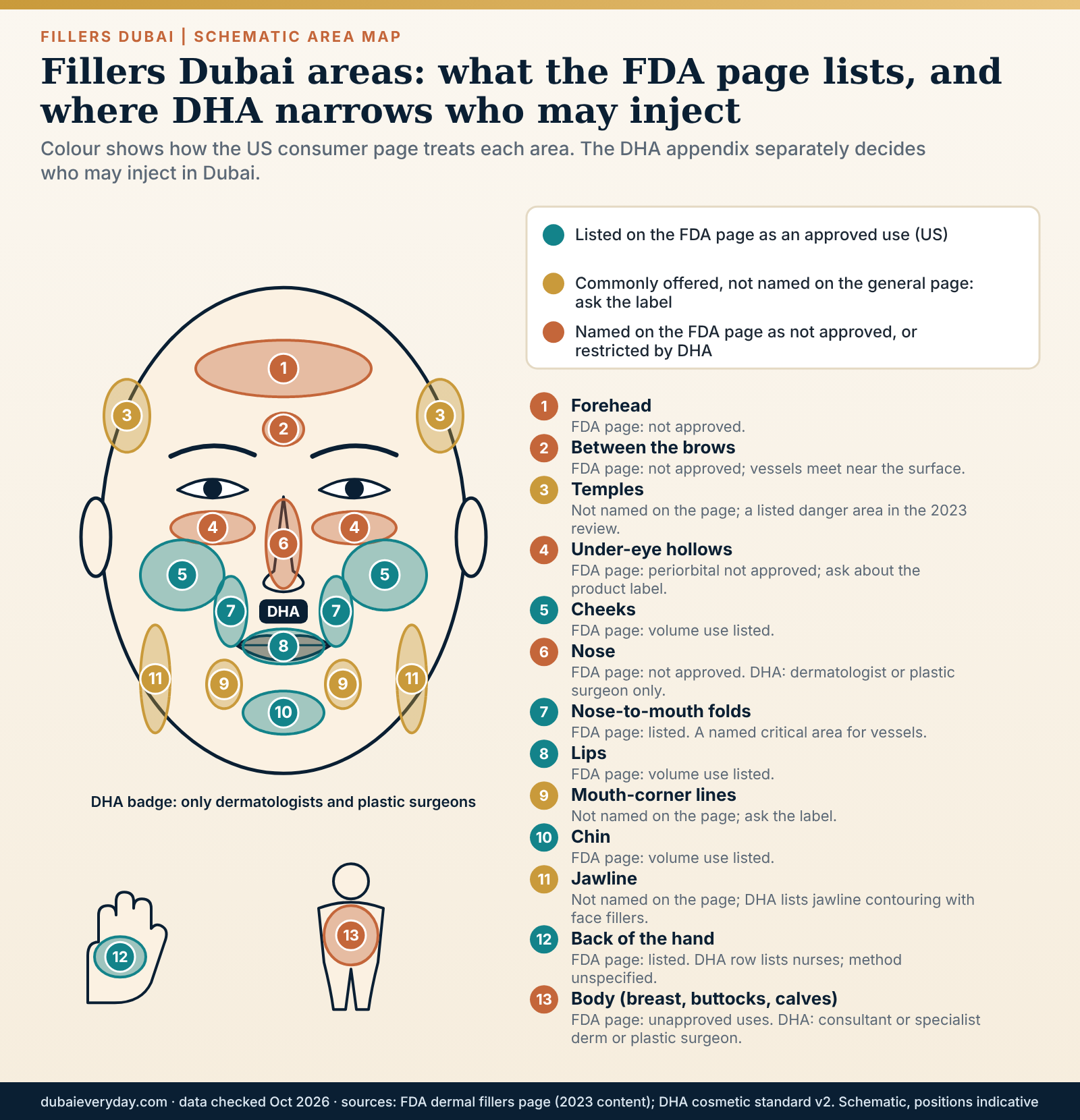
Treat the map as vocabulary for a fillers Dubai consultation, not as a menu. Read it with one caveat. The FDA page’s content was dated mid-2023, and approvals attach to individual products, so a specific filler may now be cleared for an area the general page does not name. “Not named on the general page” therefore means “ask what the product’s label says for this area”, not “forbidden”.
Lips
In any fillers Dubai conversation about lips, the FDA lists them for volume augmentation and they are a common request. Swelling and bruising are the expected side effects, and Cleveland Clinic describes them as usually mild and gone within a few days. The lip is also a reminder that “natural” is a conversation: the DHA standard requires documented patient selection and an assessment of expectations, so a good consultation should include what you want the lips to look like and what will not be attempted.
Cheeks and midface
Cheek volume is another FDA-listed use. In practice, cheek filler is often discussed as support for the middle of the face, with downstream effects on folds below it. That cuts both ways: it can mean fewer injections elsewhere, and it can mean a clinic proposes cheeks first when you came for a fold. Ask what each syringe is for and what you would lose by doing less.
Chin and jawline
The chin is on the FDA’s list. The jawline is not named on the general page, so ask which product label covers it. The DHA appendix places jawline contouring and double chin lifting in the same row as other face fillers, which means the same permitted categories apply. A separate row restricts invasive fat-dissolving or tightening procedures that open the skin to plastic surgeons, so a “double chin” offer needs a precise description of what is being injected.
Temples
Temple hollowing is a popular request, but the FDA’s general page does not name temples. The 2023 review lists the temple as a danger area because named arteries and veins run through its fat pad. That is not a reason to refuse, but it is a reason to ask about the product’s labelled use, the planned technique, and the injector’s experience with this specific area.
Nasolabial folds and marionette lines
The folds from nose to mouth are on the FDA’s approved list, and they are also where an angular artery runs close to the surface. A 2020 German case report of vascular occlusion after HA injection into the nasolabial folds called them a critical area, and the 2023 review reports that this fold and the nose had the highest complication rates in a systematic review. Common does not mean low-stakes. Ask how the clinic would recognise trouble here and what it would do in the first hour.
Tear troughs and under-eye hollows
The FDA’s general page lists the periorbital area among sites that are not approved, though product-specific approvals may have appeared since mid-2023 and you should ask. The 2023 review warns that superficial placement under thin eyelid skin raises the Tyndall effect risk and that this area should not be overfilled. Many people want this area treated. It also happens to be the area where a poor plan is easiest to see and hardest to hide.
Nose
In Dubai, nose fillers and nose Botox sit in a row of the DHA appendix limited to dermatologists and plastic surgeons. The FDA page lists the nose among unapproved sites, and the 2023 review ranks it among the highest-complication areas because of dense vascular branching. If you meet a pitch for “liquid rhinoplasty” among fillers Dubai offers, treat it as the single treatment where the credential check should be strictest, and ask to see the licence category before the consultation ends.
Forehead and between the brows
The forehead and the area between the eyebrows are also on the FDA’s unapproved list, and the 2023 review notes that several arteries meet there close to the surface. Frown lines and forehead lines are mostly movement lines, which is usually a toxin conversation rather than a filler one. Our Botox guide explains that separation, and the table in its section on fillers versus toxin is a quick way to match a complaint to a tool.
Hands
Back-of-hand volume is an FDA-listed use, and the FDA warns about caution in people with joint, tendon or blood-vessel disease. The DHA appendix is looser here than for the face: a “hand rejuvenation” row lists dermatologists, plastic surgeons, other physicians and nurses, with the method not specified. Because the row does not say the method is a filler, ask whether yours is an HA filler, a laser or a peel, and who exactly will do it.
Body fillers and “enhancement” offers
The DHA appendix limits fillers in body parts to dermatologists and plastic surgeons at consultant or specialist level, and within their specialty. It reserves fat aspiration and injection, non-surgical calf enhancement and non-surgical buttock augmentation with fat injections to plastic surgeons. The FDA page lists breast augmentation, buttock enlargement and foot fullness among unapproved filler uses and recommends against them. If a fillers Dubai pitch uses the word “filler” for a body part, ask what the product is and what the FDA and DHA say about it.
Fillers or toxin: matching the problem to the tool
Fillers add volume or support, so they suit hollows, thin lips, folds that show at rest and loss of contour. Botulinum toxin weakens muscles, so it suits lines that appear when you frown or squint. Skin texture, pigmentation and sun damage belong to other treatments. The two injections are often discussed together, and the FDA notes that safety of fillers used with Botox is not established. A good fillers Dubai plan therefore names each product, each area and the order, and avoids doing everything on one day without a reason.
Who may inject fillers in Dubai: DHA and Healthcare City rules
Two regulators shape the fillers Dubai rules. The Dubai Health Authority licenses clinics and doctors across most of Dubai, and Dubai Healthcare City, a free zone with its own regulator, licenses facilities inside its boundaries under a separate standard. Both treat cosmetic fillers as medical procedures, which is the foundation of every fillers Dubai rule in this section. They agree on the big points and differ on details, and a few details are the ones a patient notices: nurses, general practitioners, waiting periods and supervision.
What the DHA standard requires
The DHA Standards for Non-Surgical Cosmetic Procedures (version 2; reference DHA/HRS/HPSD/ST-05) call Botox and fillers prescription-only medicines that may be given only by a trained, privileged, licensed physician (clause 11.2). Before any procedure, a face-to-face assessment is mandatory, and the standard says remote consultations and home-visit assessments are not acceptable (11.1). Written informed consent must be given beforehand and reconfirmed on the day (11.3), and treatment of under-18s is not permitted (11.5).
The standard also requires written, unbiased information on risks, costs, complications and outcomes (11.6), documented patient-selection criteria (11.8), marked drawings of the treatment area in the file (11.9), and a treating professional who is available for follow-up (11.11). Facilities need staff, equipment and procedures for medical and other emergencies (10.1), and at least one DHA-licensed dermatologist or plastic surgeon available in the facility to supervise (8.1). Practitioners need an active licence within scope, a valid basic life support certificate and malpractice insurance (7.1).
| Treatment (DHA appendix entry) | Who the DHA appendix lists |
|---|---|
| Face fillers, including jawline contouring and double chin lifting | Dermatologists and plastic surgeons; other physicians (GPs) with the extra conditions below; orthodontic, prosthodontic and maxillofacial specialists |
| Nose fillers and nose Botox | Dermatologists and plastic surgeons only |
| Fillers and Botox in body parts | Dermatologists and plastic surgeons at consultant or specialist level, within their specialty |
| Facial threading, including brow lift | Consultant or specialist dermatologists and plastic surgeons |
| Mesotherapy (injectable) | Dermatologists, plastic surgeons and other physicians |
| Hand rejuvenation (method not specified) | Dermatologists, plastic surgeons, other physicians and nurses |
| Invasive skin opening for tightening, lifting or fat dissolving | Plastic surgeons only |
The fillers Dubai table paraphrases the appendix of version 2, read on 29 October 2026. DHA issued version 2.1 in a circular dated 24 December 2024 (CIR-2024-00000250), and the circular page does not describe what changed. Treat the table as the best reading available, and confirm the current appendix with the clinic or DHA before you rely on a specific row.
In short, the fillers Dubai credential picture has three layers: the licence category, the privilege to do this procedure in this facility, and the supervising specialist. The registry shows licences. Privileges are granted inside the clinic by its Medical Director, so those two layers are questions you ask in person.
General practitioners: allowed, with strings attached
A general physician can give face fillers in Dubai, but the DHA standard attaches conditions: documented training, at least two years of clinical experience after graduation, a year of mentorship, privileges from the clinic’s committee, and work in accordance with a licensed consultant or specialist dermatologist or plastic surgeon (clause 7.10). Training is expected to be a recognised in-person course with at least half of it hands-on (9.2). Specialists who are not dermatologists or plastic surgeons must take direct responsibility for treatment consequences and complication management (7.8.3).
For you, that translates into two questions that are perfectly polite to ask: who is the supervising dermatologist or plastic surgeon for this clinic, and what training and privileges does today’s injector hold? A clinic that cannot answer these in plain words has not earned your trust, whatever its Instagram feed looks like.
Dentists, nurses and beauty therapists
General dentists and dental specialities may not inject cosmetic fillers under the DHA standard, with one exception: orthodontic, prosthodontic and maxillofacial specialists appear in the face-filler row and need recognised training (clause 7.9). This is the standard’s own wording, and it is the reason a general dentist offering lip filler as an add-on at a check-up deserves a question. Our Dubai dentist guide explains dental scope more broadly.
Registered nurses, physiotherapists, massage therapists and beauty therapists may perform only limited procedures that a dermatologist or plastic surgeon prescribes under a written plan (clause 7.11), and face fillers are not among the entries that list nurses. The Dubai Healthcare City standard is stricter on the same point: it says nurses are not permitted to inject fillers. A beauty salon, a pop-up event or someone visiting your flat therefore sits outside the fillers Dubai rules, however pleasant the setting.
The Healthcare City standard
The Dubai Healthcare City standard (SD/HCO/007/03) lets plastic surgeons, dermatologists and general aesthetic medicine physicians inject fillers, and general physicians only with a certificate of accredited training and supervision. A supervising plastic surgeon or dermatologist must be physically on the premises. It requires a face-to-face consultation, written consent reconfirmed on the day, documented selection criteria and a mandatory cooling-off period of at least one day, meaning no treatment on the day of the first consultation.
It also says patients under 18 are not to be considered unless clinically justified, with referral to a licensed psychologist or psychiatrist, and it requires malpractice insurance, basic life support training and honest advertising that does not exploit poor body image. If your fillers Dubai clinic is inside Healthcare City, that one-day gap is a rule. Outside it, we found no equivalent clause in the DHA standard, so a waiting period is a clinic policy, not a requirement we could verify.
What neither standard says. Neither document mentions hyaluronidase, a filler-specific emergency kit, product batch records or a filler complication protocol, and the DHA standard does not name skin boosters, polynucleotides or non-HA fillers. That does not mean fillers Dubai clinics have none of these, only that you cannot assume a rule exists. Ask about them directly in the consultation and expect a specific answer.
Eight essential checks before you book fillers in Dubai
The fillers Dubai checks below turn the rules into questions you can ask at the front desk or put in a message before you pay a deposit. They are drawn from the DHA and Healthcare City standards, the FDA and NHS advice on choosing an injector, and news reports quoting Dubai doctors about unlicensed work. None of them depends on a clinic’s reputation, price or view.

1. The person: is the injector licensed, and for what?
For any fillers Dubai booking, use the Dubai Medical Registry on the DHA’s Sheryan portal, which has separate tabs for professionals and facilities and filters for licence type, category and speciality. A DHA service catalogue page (a 2023 document) says the registry can be searched free by anyone, including visitors, and that professional licences are valid for one year.
We could not render the search results in our reading tool, so the steps rest on what the page shows. Compare the name on the licence card with the person who will inject.
2. Privileges: is this person approved to inject fillers here?
A licence says what a doctor is registered as. Privileges say what this facility has approved them to do. The DHA FAQ says the Medical Director grants privileges for non-surgical cosmetic procedures. Ask who holds the privilege for the exact area on your plan, and note that DHA titles must match the licence, so labels such as “aesthetic specialist” or “cosmetic specialist” do not appear on a licence and should be translated into a real category.
3. The facility: where will this happen?
Look for a licensed facility. The DHA inspection checklist for non-surgical cosmetic services starts with the facility licence and its scope, so a clinic should be comfortable showing both.
Home visits are excluded from the assessment stage by the standard, and a Khaleej Times report from August 2025 quoted Dubai doctors listing homes, salons and hotel rooms among the red flags, after a Dubai Police raid on an apartment clinic. The NHS lists mobile services working from homes or hotels and practitioners who only advertise on social media as warning signs, which is useful as a general benchmark.
4. The product: what exactly is in the syringe?
For fillers Dubai products, ask for the name, the manufacturer, the batch number and the expiry date, and ask to see the sealed pack opened in front of you. The FDA page warns that counterfeit fillers have been identified in the US and tells people not to buy fillers online.
In the UAE, a DHA circular dated 23 June 2026 passed on an Emirates Drug Establishment warning about one falsified lot of a Botox product, which shows that falsified injectables are an official concern here, though we found no equivalent filler-specific warning. Ask for a record of the product in your notes.
5. The plan, in writing
A written plan should name each area, product and expected volume, and the order of treatment. The DHA standard requires marked drawings in the file and a patient-selection record, so the clinic should be able to show you both. The practical value is accountability: if your face, budget or timing changes, the plan is what you compare against. If a clinic will not write the plan down, the plan is likely to move on the day.
6. Risks and reversal: what happens if something goes wrong?
Ask four questions: what are the risks of this specific area, is hyaluronidase kept on site, who responds if blood flow is blocked, and how do I reach someone after hours? The DHA standard requires written information on complications (11.6) and emergency procedures (10.1) but names no drug, so the answer must come from the clinic. An injector who answers calmly and specifically is doing what the FDA page expects: having an emergency plan and training staff to respond.
7. Consent and time: are you being rushed?
Under both standards, consent is written, understood and reconfirmed on the day. The Healthcare City standard adds that information must be unbiased and that you must be given time to decide. A “today only” price that expires when you leave is the opposite of that. Treat a pressure tactic as data about the clinic. The NHS also lists being asked to pay before a consultation among its red flags.
8. Cost and follow-up: what is the total, and what happens afterwards?
Ask for an itemised quote that shows the consultation fee, the product, the injector’s fee, VAT and any review visit. Ask whether touch-ups are charged, what the clinic charges if you need hyaluronidase, and what follow-up is included. Since cosmetic treatment is often excluded from insurance, ask whether the clinic will treat a complication under the same bill. Our fillers Dubai cost section works through the arithmetic, and the dermatologist guide covers the broader credential checks for any clinic.
The appointment, step by step
A fillers Dubai appointment is shorter than people expect and more procedural than they imagine. The sequence below combines the DHA and Healthcare City requirements with Cleveland Clinic’s description of the procedure. Your clinic’s routine may differ, and the point of knowing the sequence is to notice what is missing, not to expect every clinic to match it.
- Consultation, face to faceThe doctor takes your medical history, asks about medicines and allergies, examines your face and discusses what you want. Cleveland Clinic says your face may be marked and photographed. Under the DHA standard this visit cannot be done remotely.
- Information and a written planYou should receive unbiased written information on risks, complications, outcomes and costs, and time to read it. Selection criteria and marked drawings go into the file.
- Consent on the dayYou sign, or reconfirm, written consent in a language you understand. Both Dubai standards expect consent to be reconfirmed on the day of treatment, not signed once and forgotten.
- Preparation and treatmentThe skin is cleaned and numbing cream may be applied. A thin needle or cannula places small amounts of filler. Cleveland Clinic describes a pinch or sting and gives the duration as anywhere from less than half an hour to about an hour.
- Aftercare and the recordThe clinic cleans the skin, may offer an ice pack, and should give written aftercare and a way to reach the team. Ask for the product name and batch in your records.
What to tell the doctor
The FDA page lists several situations where an injector should be cautious or delay: inflamed or infected skin, bleeding disorders, severe allergies or anaphylaxis, and allergy to collagen, eggs, animal products, lidocaine or bacteria. It says safety has not been established in pregnancy, breastfeeding, people under 22, people prone to keloid or hypertrophic scars, long-term repeated use, or when fillers are combined with Botox. Say so if any of those applies. Do not stop any prescribed medicine on your own; ask the doctor how your medicines affect the plan.
Cleveland Clinic adds that some drugs can raise the risk of complications, and that you should mention bleeding or bruising after past procedures, neurological problems and skin conditions. The FDA also lists inflammation after illness, vaccination or dental work as a possible reaction, which is a reason to mention recent illnesses, vaccinations or dental treatment, and to avoid scheduling filler right before or after them without asking.
A word on numbing and pain
Some fillers contain lidocaine, a local anaesthetic, and the FDA lists lidocaine allergy as a caution. Tell the doctor about any past reaction to local anaesthetics, including at the dentist. Whether to use topical numbing, a nerve block or neither is a clinical decision. A clinic that waves away the question deserves a follow-up question.
Settling in and wearing off: a timeline for fillers Dubai patients can plan around
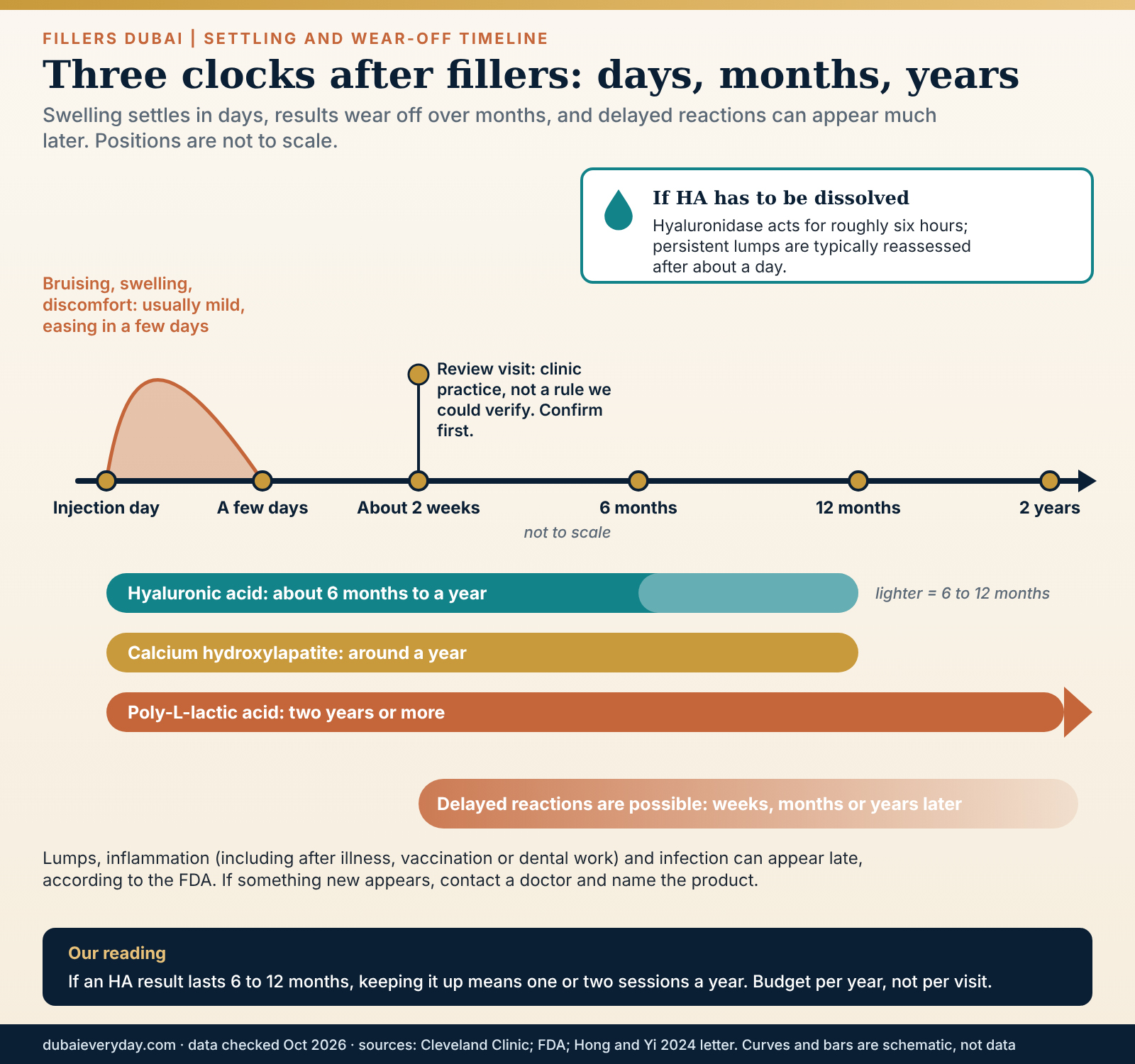
The honest summary of fillers Dubai timing is that three clocks run at once: the days of swelling, the months of wear-off, and a long tail of possible delayed reactions. The timeline below draws the three on one line, using only durations that a named source states. Where no source gave a number, the graphic says “ask your injector” instead of inventing one.
The first days
For fillers Dubai patients, Cleveland Clinic describes bruising, swelling and discomfort as usually mild and gone in a few days, and says most people can return to normal activities straight away, with rigorous exercise restricted for a day or two in some cases.
Recovery depends on the number of areas, the filler type and general health. Results are often visible immediately, so the shape you see in the mirror that evening includes swelling and is not the final look. Treat that first evening as a preview of your fillers Dubai result.
That leads to a practical point for anyone with a diary full of events. Do not book filler for the day before a wedding, a photo shoot or a flight you cannot move. Leave a buffer, and ask the clinic how long its patients usually take to settle for the area you are treating. No official Dubai guidance on this exists in the standards we read, so the buffer is a matter of clinic advice and your own risk tolerance.
The review visit
The DHA standard says the treating professional should be available for follow-up care (clause 11.11), and the Healthcare City standard requires follow-up through the clinic or a formal arrangement. Neither sets a review date. Many clinics book a check after a couple of weeks, which is clinic practice rather than a rule we could verify, so ask for it and put it in the plan. A review visit is where you learn whether anything needs adjusting, and it is cheaper to schedule it up front than to chase it later.
Months: how long fillers last
The FDA says duration depends on the filler and the injection site. Cleveland Clinic gives general figures: HA fillers six months to a year, calcium hydroxylapatite around a year, poly-L-lactic acid two years or more. Our reading of those figures is simple. If an HA result lasts six to twelve months, a person who wants to keep it will have one or two sessions a year, and that frequency is the number to multiply when you compare prices.
Be sceptical of duration claims that exceed the product’s leaflet. Social media captions tend to quote the best case. The leaflet lists what was studied, in whom, and in which area, which is exactly the information you need. If the clinic cannot show a leaflet, the claim has no paper behind it.
Weeks to years: delayed reactions
The FDA page states that some side effects can appear weeks, months or years after injection. It lists lumps and granulomas, infection and inflammation, including inflammation that follows an illness, vaccination or dental work. That is why a “set and forget” attitude is the wrong one, and why access to the same clinic or a clear arrangement is worth paying for. If a lump or redness appears months later, go back to the injector or a doctor and say which product you had.
Complications: from expected swelling to urgent warning signs
Complications after fillers Dubai clinics inject fall into a ladder. At the bottom are the expected, short-lived effects. Above them are problems that deserve a call to the clinic the same day. At the top are the signs that suggest a blocked blood vessel, which are emergencies. This section describes the ladder in general terms drawn from the FDA, Cleveland Clinic and peer-reviewed articles. It is not a diagnosis tool, and when in doubt the right step is to contact a doctor.

Expected and usually short-lived
The FDA lists bruising, redness, swelling, pain, tenderness, itching and rash as common reactions. Cleveland Clinic adds lumps, asymmetry and numbness among the possible effects and says bruising, swelling and discomfort generally ease within a few days. Mild tenderness and swelling are part of the procedure. The ladder’s first rung is “expected”, but it is not “ignore forever”: effects that get worse rather than better after the first few days belong on the next rung.
Call the clinic the same day
Cleveland Clinic says to call the provider right away for bleeding or pain, signs of infection such as fever, or redness and swelling at the injection site, and for allergic symptoms. The FDA lists infection, lumps, granulomas, open wounds and allergic reaction as less common complications. If a clinic does not give you a number to ring, or does not answer when you do, that is a finding about the clinic, and you should seek care elsewhere rather than wait.
Vascular occlusion: the one to understand
The most serious filler complication, according to the FDA, is unintended injection into a blood vessel or pressure that blocks blood flow, which can cause tissue death, vision problems including blindness, or stroke. These effects can be permanent. A 2019 review in the Journal of Drugs in Dermatology calls vascular occlusion the most serious complication, says most others are mild, and concludes that anatomical knowledge and careful technique lower the risk and that injectors must recognise and manage it quickly.
The FDA page gives patients the signs to act on: unusual pain, vision changes, and white, grey or blue skin, along with stroke signs. A German case report published in 2020 described sudden one-sided pain during injection and blanching of the skin as early warning signs, with a violet net-like discolouration appearing days later. One case does not prove a pattern, and the report is quoted here only to show what clinicians describe. None of the sources gives a complication rate we can responsibly quote, so we do not.
If, during or after a filler injection, you have severe or increasing pain, skin that turns white, grey, blue or mottled, any change in vision, or facial droop, weakness on one side or confusion, treat it as an emergency. Tell the clinic immediately and call 998 for an ambulance. The u.ae portal states that hospitals in the UAE must accept you for initial treatment. Tell the hospital which filler you had and when.
What a prepared fillers Dubai clinic does
The FDA page tells providers to know the anatomy, avoid areas near blood vessels, inject slowly with minimal pressure, stop immediately if signs of vascular injection appear, have an emergency plan and train staff to respond. The 2020 case report lists keeping hyaluronidase available as an emergency drug and treating promptly with the enzyme directly into and around the affected skin, ideally within hours. For you, the useful translation is a question: “If this happened to me here, what would the first hour look like?”
Non-HA fillers and permanent products
Complications from non-HA and permanent fillers are harder to manage because, as the FDA notes, removal can be difficult or impossible. The FDA also warns about injectable silicone, which it says is not approved for any aesthetic use, and lists long-term pain, infection, scarring, permanent disfigurement, embolism, stroke and death among the risks. If you were not told which material you received, ask for the record now, because a future clinician will need it.
Illegal operators and counterfeit products
The August 2025 Khaleej Times report quotes a Dubai hospital medical director and a dermatologist describing infections and abscesses from contaminated fillers, burns, scarring, allergic reactions, nerve injury and tissue death from unlicensed work. It also reports that Dubai Police, working with the DHA, raided a residential apartment running an illegal clinic. This is a news report, not a statistic, but the warning is consistent with the standards: licensed facility, licensed doctor, sealed product.
Reporting a reaction
In the US, patients are directed to the FDA’s MedWatch system. The Emirates Drug Establishment’s website lists pharmacovigilance among its services and a hotline, 800 33784, but we could not confirm that it takes reports about fillers Dubai patients receive or has a public device-reporting form. Treat that as “Confirm first”. The route we can confirm is your clinic and the DHA complaint channels covered in the “if treatment goes wrong” section.
Reversal: what hyaluronidase can and cannot do
Reversibility is the single biggest difference between HA fillers Dubai clinics use and most of the alternatives, and it is also the most over-sold. Hyaluronidase is an enzyme that breaks HA down. In a short 2024 letter in Skin Research and Technology, two clinicians list reasons it is used: incorrect placement, excess filler, asymmetry, migration, hard lumps, a bluish tint, granulomas, patient dissatisfaction and suspected or confirmed vascular complications. That list is the reason a clinic that injects HA should have a plan for reversal.
How it works, in plain terms
The letter describes the enzyme as a large molecule that acts only on filler it directly contacts, so dissolving proceeds gradually from the outside of the filler inwards. It also says newer, more heavily cross-linked fillers may need considerably more enzyme than older, lighter products, that activity lasts roughly six hours, and that enzyme exposed to blood is inactivated within minutes. A persistent mass is typically reassessed after a day, which means complete dissolving is not always a one-visit event.
Notice what this implies for you. Reversal is a medical procedure with its own technique, its own cost and its own follow-up. It is not a rinse. Two patients with the same filler in the same place can need different amounts of enzyme, depending on the product, how long it has been in the tissue and how the lump sits. That is a decision for the injector after examination, and it is not something a patient can plan from a price list.
Urgent versus elective reversal
Doctors use hyaluronidase in two quite different situations. Elective reversal happens when someone is unhappy with a result: asymmetry, too much volume, a visible bluish tint, lumps. It can be planned, discussed and, where appropriate, staged.
Urgent reversal happens when a vascular complication is suspected, and the 2024 letter says such cases call for much larger doses, spread widely around the affected area, with repeat injections possibly needed. The 2020 case report adds that the best time window has not been studied systematically, but that treatment is usually advised as early as possible, ideally within hours.
The practical conclusion is not that you should arrange to dissolve filler yourself. It is that an HA filler’s reversibility only protects you if hyaluronidase is physically available and a trained doctor is reachable quickly. That is why the checks earlier in this guide ask where the enzyme is kept and who responds.
Limits and side effects
Hyaluronidase acts on HA only. The FDA says removal of non-HA and permanent fillers can be difficult or impossible, so “it can be dissolved” is true of one family and not of the others. The enzyme can also trigger allergic-type reactions such as itching and redness, which is why the 2024 letter suggests a skin test when necessary and having antihistamines and steroids to hand. Whether a skin test is advisable for you is for the doctor to say.
We also want to be plain about the evidence. The letter presents no original data. Its advice rests on case series and reviews, and its dosing figures are framed as estimates and as dependent on the filler type. The 2020 case report notes that using hyaluronidase for this purpose is off-label. This does not mean reversal is unreliable, only that protocols are expert opinion more than trial evidence, and that confident promises about “guaranteed dissolving” are not supported by the sources we read.
Questions to ask about reversal before you start
- Which product will you use, and is it HA? If not, how would you remove it?
- Do you keep hyaluronidase on site, and who is trained to use it in an emergency?
- If I want it dissolved, what will the visit, the enzyme and any repeat session cost?
- Will I be seen at the same clinic outside office hours if I have a problem?
- Do you test for allergy to the enzyme, and when do you consider that necessary?
For fillers Dubai clinics, we could not confirm which hyaluronidase products are registered in the UAE or whether any rule requires clinics to stock them. The DHA and Healthcare City standards do not mention the enzyme. That makes the questions above ones for the clinic, not ones a regulator can answer for you. Mark this one “Confirm first”.
Fillers Dubai cost: how quotes are built and compared
We found no official fillers Dubai price list, and no regulator that publishes a tariff. Fillers Dubai price pages on aggregator websites and clinic blogs exist in large numbers, but they are marketing, not data, so none is used here. What can be said honestly is how a quote is built, how to compare two quotes, and how the arithmetic behaves. All numbers below are labelled “illustrative” and exist only to show the logic.
The parts of a filler quote
A complete fillers Dubai quote has up to seven parts. The consultation fee comes first, which some clinics credit against treatment and others do not. The product comes next: usually charged by syringe, and syringe volumes vary, so the useful unit is the cost per millilitre of a named product. Then the injector’s fee, which may be bundled or separate, followed by numbing and consumables. Finally VAT, a review visit, and a line for touch-ups and reversal if either is needed.
VAT deserves a note. A Gulf News report on the executive regulations to the VAT law, last updated in November 2018, says elective cosmetic treatments are not health care services and therefore subject to VAT, while treatment prescribed to treat or prevent a medical condition can be zero-rated. The standard rate in the UAE is 5%. We did not find a current Federal Tax Authority page addressing fillers Dubai clinics sell, so ask the clinic whether the quote includes VAT. Mark this “Confirm first”.
Advertised price versus total price
Illustrative example (not a quote or market fact). Imagine two written quotes for the same plan of two syringes. Quote A advertises AED 999 per syringe: 2 x 999 = AED 1,998. It then adds a consultation (AED 300), an injector fee (AED 500) and numbing and consumables (AED 100), giving AED 2,898 before VAT. At 5%, VAT is AED 144.90, and the total is AED 3,042.90, about USD 829 at 3.6725. The headline covered about 66% of the final bill.
Quote B lists AED 1,750 per syringe including the injector fee and consumables, with the consultation credited: 2 x 1,750 = AED 3,500, plus VAT of AED 175, for AED 3,675 (about USD 1,001). On the headline, B looks AED 751 per syringe dearer, a gap of AED 1,502 over two syringes. On the totals the gap is AED 632.10. Whether either is good value depends on the product, the volume actually used and who injects, none of which the headline shows.

Comparing quotes properly
Three rules make fillers Dubai comparison fair. Compare the same named product, because a family-level “HA filler” can mean very different products. Compare the same volume in millilitres, not the same count of syringes. And compare the same level of injector: a plastic surgeon’s fee and a general physician’s fee are not the same service, and a lower price may reflect experience. If two quotes differ on any of the three, the price difference is partly a product difference.
Ask each clinic for a written, itemised quote, keep the invoices and receipts, and avoid paying a large deposit before a consultation. The NHS names being asked to pay before a consultation and vouchers bought through discount sites among its red flags, and the August 2025 Khaleej Times report lists missing receipts and consent forms and prices far below the market among the warning signs. Without a price list, “far below” means “far below the other written quotes you have collected”.
The annual cost, not the visit cost
HA results are temporary, so the right unit for fillers Dubai budgeting is cost per year. If the Cleveland Clinic range of six months to a year applies, one result means one or two sessions a year. On the illustrative total above, that is AED 3,042.90 to AED 6,085.80 a year, about USD 829 to USD 1,657.
This is our arithmetic on invented numbers. It shows why a discount that tempts you into a second area is worth examining: it adds to a recurring cost, not a one-off. That is the real shape of fillers Dubai pricing.
If you track a household budget, a fillers Dubai plan is a discretionary recurring line, similar to a gym or a salon habit. Our cost of living in Dubai guide shows how the fixed lines compete with that kind of spending. For a single person, a line such as this is easy to underestimate when it is paid in separate visits.
Does insurance pay for fillers Dubai treatments?
Usually not for cosmetic work. A Gulf News explainer updated in December 2024 describes cosmetic non-medical treatment as a common exclusion, and one insurer’s example basic plan document, the Cigna Middle East Essential Benefits Plan table of benefits, excludes cosmetic services. That is one plan from one insurer and not a rule for every policy.
What is less clear is whether a complication from an excluded procedure is covered, and the sources we read do not say. Ask your insurer before treatment, in writing, and see our guides to health insurance for Dubai residents and insurance in Dubai for how exclusions and networks work.
Visitors and residents: timing, travel, insurance and daily life
The fillers Dubai rules do not change with your passport. A DHA-licensed clinic must carry out a face-to-face assessment of a tourist exactly as it would for a resident, and the standard says remote consultations are not acceptable as the assessment. A video call before you land can help you shortlist questions, but it cannot replace the in-person consultation, so build at least one clinic visit into the trip before any injection.
If you are visiting
For fillers Dubai visitors, time is the constraint. Inside Dubai Healthcare City, the standard’s minimum one-day gap means treatment cannot happen on the day of the first consultation. Elsewhere in Dubai, the DHA standard has no such clause that we found, and some clinics may offer same-day treatment anyway.
You should decide for yourself whether you want that. A trip of four or five days leaves room for a consultation, a day to think, the procedure and a review before you fly, and an extra day is cheap compared with managing a problem from another country.
Our advice, as editors rather than clinicians, is to plan the filler early in the trip and the beach days later. Your first-time-in-Dubai plan and the wider Dubai travel guide are written around arrival logistics. Add a clinic slot to the itinerary the same way you would an excursion, and keep the days after the injection light by reading our things to do list for options that do not depend on strenuous activity.
Flying, heat and exercise
For fillers Dubai visitors planning flights, we found no official rule or regulator guidance on flying after fillers, on saunas, or on sun and heat exposure. The only timing detail in the sources is Cleveland Clinic’s note that rigorous exercise may be restricted for a day or two.
Mark flying and heat “Confirm first” and ask the clinic for its written aftercare sheet. If the sheet says nothing about flights, ask. If a long flight follows soon after treatment, the airport side of your day is covered in our Dubai airport guide.
Dubai’s summer heat is real, and it shapes where you spend your time, but no source we read links heat to filler outcomes, so we do not claim a connection. What heat does change is practicality: outdoor time, beaches and queues. If you are considering the beach days in the best beaches guide after a treatment, ask your injector about sun, swimming and swelling first. The best time to visit Dubai guide shows how seasons affect everything else.
Where to stay, and where to recover
Choose a base you can reach the clinic from without a long drive, because follow-up is the part of the plan that tends to slip when the trip is busy. The hotels guide compares areas and budgets, and the Metro guide helps if the clinic is on a line. A hotel with a quiet room and easy access to a hospital emergency department is a better recovery base than a view with a long taxi ride.
If you live here
Fillers Dubai residents have an advantage that visitors do not: they can build a relationship with one clinic and see the same doctor over years. They also have two traps. The first is treating filler like a subscription, with a package of sessions prepaid and an assumption that more is better. The second is changing clinics for each offer, so that nobody holds the full history. Keep your own record of products, areas, dates and batches, in a note on your phone, and bring it to any new doctor.
If you have just arrived and are still setting up healthcare, our moving to Dubai guide and the healthcare guide explain registration, clinics and how emergency care works. Compare insurance terms in our health insurance guide, and check the exclusions list before assuming any cosmetic visit is covered.
Emergencies in Dubai
The u.ae government portal lists 998 for an ambulance anywhere in the UAE and 999 for police. It also states that hospitals must accept you for initial treatment, and that treatment to stabilise an emergency is free, though other treatment must be paid for. Our best hospitals guide explains how to compare emergency departments in advance. When you arrive, say that you had a filler injection, name the product if you know it, and say when.
Filler advertising in Dubai: what the new DHA standard changes
On 17 August 2026, a DHA circular (CIR-2026-00000144) told all licensed private health facilities and professionals in Dubai about new Standards for Medical Advertisement Content on Social Media. The circular page describes the aim as credible, ethical advertising that patients can rely on, says non-compliance will lead to disciplinary action, and does not itself list banned wording, photo rules or an effective date. The details below come from news reports of the standards, so read them as reported.
What the reports say is restricted
Khaleej Times, on 1 September 2026, reported that the standards bar exaggerated and absolute claims, including phrases such as “the best”, “100%”, “has no side effects”, “immediate results”, “safest”, “the only”, “magic” and “miraculous”, and claims that one service is better or “safer than” another. Guarantees, fear-based ads and ads that exploit patients’ limited medical knowledge are also banned, results must be backed by evidence, and ads for invasive procedures must state risks. Gulf News adds that titles must match the DHA licence.
Gulf News also reports rules for before-and-after photos: the same person in both, taken with the same lens, unedited, with a disclaimer that results vary, and with written consent. Patient testimonials need written consent. Influencers who promote a facility are covered, posts that identify a facility need the medical director’s approval, and the facility remains liable for content filmed on its premises. Neither report states penalties or an effective date, so we cannot say how strictly this is enforced.
What this means when you read an ad
Use the reported list as a filter for fillers Dubai ads. If a clinic’s post promises “no downtime”, “instant results”, “zero risk”, “permanent” or “best filler in Dubai”, it is using the kind of language the new standard is reported to ban.
That alone is not proof of bad practice, and a clean ad is not proof of good practice. It is one more input when you judge a fillers Dubai clinic, and it is about as reliable as the clinic’s willingness to show you a licence and a product label.
“Natural-looking results”
A taste, not a specification. Ask for the written plan: areas, volumes, product and what will not be done.
“Dissolvable, so no risk”
Reversibility is not risk-free. It depends on the product being HA, the enzyme being on hand and a trained doctor being reachable.
“Original, premium product”
Ask to see the sealed pack, label, batch and expiry. A claim on a post is not a pack on the table.
“Today only” or “limited slots”
Pressure conflicts with the time to decide that Healthcare City requires. A real plan survives waiting a day.
“Doctor-led” or “specialist”
Which doctor, with which licence category? Titles should match the licence, so check the registry entry.
“Liquid facelift” or “liquid rhinoplasty”
Branding for a bundle of injections. Ask what is injected, where and who is allowed to inject the nose.
Fillers Dubai influencer posts deserve the same scepticism. Under the reported rules, a post that names a clinic needs the medical director’s approval and the clinic is liable for it, which tells you that a sponsored or gifted post is clinic marketing. Honest inclusion of risks, a licence number you can look up and a plain statement of the product are the marks of material worth trusting.
If treatment goes wrong: records, complaints and the liability law
If a fillers Dubai treatment goes wrong, the first priority is medical: if you have any urgent sign from the complication ladder, get care and tell the clinic, then deal with paperwork. Once you are safe, the second priority is documentation, because everything that follows depends on it. The sequence below is general information about how complaints work in Dubai, not legal advice, and some of it comes from dated documents that you should confirm.
- Record everythingSave the invoice, consent form, product name and batch, aftercare sheet and your messages with the clinic. Take dated photos as symptoms change. Write a short timeline while it is fresh.
- Go back to the clinic in writingDescribe what happened, ask for a review with the treating doctor or medical director, and ask for the proposed plan and its cost. Both Dubai standards expect facilities to have complaint and redress processes.
- Get a second opinionSee another licensed doctor, ideally a dermatologist or plastic surgeon, and bring your records. Ask them to document their findings.
- Use the regulator if the clinic does not resolve itComplaints about a DHA-licensed facility go to the DHA; the Healthcare City regulator handles facilities inside the free zone.
DHA complaints in outline
A DHA Health Regulation Sector service catalogue, updated in March 2023, describes an online complaint through the Sheryan portal that is free, uses an Emirates ID for nationals and residents, and cannot be filed for events more than three years old. It describes a route through a Medical Liability Committee, then a Higher Committee and a Medical Practice Committee, with 30-day appeal periods and typical processing of one to six months. This is a 2023 document, so confirm the current process. The DHA FAQ lists phone 800342.
Tourists are not shut out in principle: a 2021 Gulf News article, citing DHA channels, said visitors treated at DHA-licensed facilities can complain. That article is old and secondary, so treat it as “Confirm first”. If your treatment took place at an unlicensed location, a licensing complaint may not fit the facts, and the August 2025 Khaleej Times report says illegal medical activity can be reported to Dubai Police through its Police Eye service or by calling 901. That route is also secondary and worth confirming.
What the federal liability law says
The UAE Legislation portal lists Federal Decree-Law concerning Medical Liability (enacted 2016, page last updated September 2023). It requires physicians to keep the patient informed about the condition and treatment options and to warn of possible complications before an intervention (Article 4). It defines a medical error as arising from ignorance of basic technical knowledge, failure to follow professional standards, lack of due diligence or negligence (Article 6). It also says that liability does not arise where recognised or unexpected complications occur without error (Article 17).
That last point matters. A complication is not automatically a legal error. What the law examines is whether the standards were followed and whether you were properly informed, which is why the consent forms, written information and records matter so much. Complaints are referred by the health authority to a Medical Liability Committee (Article 19), and practice requires insurance against civil liability for medical errors. Our legal basics guide explains where to verify rules, and for a specific claim you need a lawyer.
One caution about going public. Posting accusations about a named clinic or doctor online can create its own risks. We did not research UAE defamation or cybercrime law for this guide, so we cannot tell you where the line is. Take legal advice before you publish anything beyond a factual complaint to the clinic and the regulator.
Eight situations and the sensible next step
Rules and checklists are easier to use when attached to a recognisable moment. These eight fillers Dubai situations are composites we wrote to illustrate the logic, not stories about real people. Each applies the standards and sources above, and none replaces a consultation.
A friend knows someone who does fillers at home
The DHA standard says home-visit assessments are not acceptable, and both standards expect treatment in a licensed facility with emergency capability. A home setting cannot show you a facility licence, a supervising specialist or an emergency plan. The 2025 raid reported by Khaleej Times shows what enforcement looks like. The sensible next step is polite refusal and a booking at a licensed clinic, where the person injecting can be looked up on the registry.
A visitor has three days and wants lips done
Start with where the clinic is. Inside Healthcare City, the standard blocks same-day treatment after a first consultation. Elsewhere, ask the clinic whether it has its own waiting period. With three days, a consultation on day one and treatment on day two leaves day three for a check. If a clinic insists on treating at the first visit and then wants you to leave, ask how follow-up would work after you return home. An honest answer may be to do the consultation now and the treatment on a longer trip.
A dentist offers lip filler during a check-up
Under the DHA standard, general dentists and most dental specialities may not give cosmetic fillers. Orthodontists, prosthodontists and maxillofacial surgeons can, in the face, with recognised training. So ask two things: what is your DHA licence category, and which appendix entry covers this procedure? If the answer is a general dentist, decline politely and ask for a referral to a physician or an eligible specialist. Our dentist guide covers the routine dental side.
A nurse injector says a doctor “signs off” remotely
Face fillers are not among the appendix entries that list nurses, and the Healthcare City standard says nurses are not permitted to inject them. A remote sign-off also conflicts with the requirement for a face-to-face consultation. If you moved from the UK, remember the NHS says fillers there do not always need a prescription and that a nurse can be a prescriber for toxins. Dubai’s rules are different, and UK assumptions do not carry over. Ask for the injector’s licence category and the supervising specialist’s name.
Someone offers “liquid rhinoplasty” for a weekend
Nose fillers are restricted to dermatologists and plastic surgeons under the DHA appendix, the FDA page lists the nose among unapproved filler sites, and a 2023 review puts it among the areas with the highest complication rates. A weekend slot and a bundled price are not reasons to skip the checks. Verify the registry entry yourself, ask the product, and ask what the plan is for a blocked vessel. If any answer is vague, walk away, because this is the area where being polite costs most.
The lips look lumpy two weeks later
Lumps are a listed possibility with any filler, fillers Dubai included, and many are discussed and managed in the weeks after treatment. This is a same-day call to the clinic, not an emergency, unless the area is also painful, hot, pale or discoloured, in which case treat it as higher up the ladder. Ask for a review, ask whether the product is HA, and ask what the doctor recommends and what it will cost. Do not massage, poke or dissolve anything on the advice of a chat group.
Severe pain and a pale patch hours after treatment near the nose
This matches the warning signs the FDA and Cleveland Clinic list. Contact the clinic immediately, say you suspect a vascular problem, and call 998 if you cannot reach a doctor who can see you at once, or if you notice any vision change, facial droop, weakness or confusion. Do not wait to see if it passes overnight. Tell the emergency team the product and the time of injection. This is general guidance, and the clinic and emergency doctors decide what to do.
An AED 399 offer lands on Instagram
Without a price list, a very low number cannot be judged alone, but it can be tested. Ask which product, how many millilitres, who injects, whether the quote includes consultation, injector fee and VAT, and whether you see the sealed pack. Compare with two or three itemised written quotes. The reported DHA advertising rules ban superlatives and fear tactics, and the August 2025 report lists prices far below the market among its warning signs. If the number falls apart under questions, it was bait.
The fillers Dubai checklist to take with you
Save this fillers Dubai list on your phone before you visit a clinic. It condenses the whole guide to twelve lines, and you can tick items off while you wait.
- I looked up the injector and the facility on the Dubai Medical Registry, and the names match.
- The injector holds the privilege for this exact area, and the supervising dermatologist or plastic surgeon is named.
- The treatment will happen in a licensed clinic, not a home, salon or hotel room.
- I will see the sealed pack, label, batch number and expiry, and I will record them.
- The product is HA, or I have been told in writing how a non-HA product could be removed.
- I have a written plan that names areas, volumes, order and what will not be done.
- I received written information on risks and complications and had time to read it.
- I know where hyaluronidase is kept and who responds to a blocked vessel.
- I have an after-hours number and a booked review visit.
- I have an itemised quote with VAT, and I know the charges for touch-ups and reversal.
- I have asked my insurer, in writing, what it covers if there is a complication.
- I know the urgent signs: severe pain, pale or mottled skin, vision change, stroke signs, and I know 998.
The point of the fillers Dubai checklist is to slow the decision down to the speed of a medical one. None of the lines costs money, and several can be answered in a short message before you travel to the clinic. A fillers Dubai clinic that welcomes the list is behaving the way the regulations expect, and a clinic that bristles at it has told you something useful.
Fillers Dubai FAQ
Are fillers legal in Dubai, and who can inject them?
Yes. The fillers Dubai patients can book are legal when licensed doctors give them in licensed facilities. The DHA standard treats cosmetic fillers as prescription-only medicines that a trained, privileged physician may give, after a face-to-face consultation and with written consent reconfirmed on the day.
Face fillers may be given by dermatologists, plastic surgeons, other physicians who meet extra conditions, and orthodontic, prosthodontic or maxillofacial specialists. Nose and body fillers are limited to dermatologists and plastic surgeons. Under-18s are not permitted. Dubai Healthcare City has its own standard. Always check the licence on the Dubai Medical Registry.
How much do fillers Dubai clinics charge?
We found no official fillers Dubai price list and will not quote a market figure. A quote is built from consultation, product, injector fee, consumables, VAT and any review or touch-up, so a headline price per syringe rarely equals the total. In our illustrative example, a headline of AED 999 per syringe became AED 3,042.90 for two syringes once fees and VAT were added. Collect two or three itemised written quotes for the same named product and volume, and ask whether VAT is included.
How long do fillers last?
Fillers Dubai results depend on the product, the area and the person, according to the FDA. Cleveland Clinic gives general ranges: hyaluronic acid fillers six months to a year, calcium hydroxylapatite around a year, and poly-L-lactic acid two years or more. Results are temporary because the body gradually breaks the material down. Ask for the specific product’s leaflet rather than relying on a general range, and be sceptical of any claim that exceeds what the leaflet reports.
Can fillers be dissolved?
The hyaluronic acid fillers Dubai clinics use can usually be dissolved, using an enzyme called hyaluronidase, which breaks down HA it directly contacts. A 2024 letter in Skin Research and Technology notes that dosing depends on the filler and that persistent lumps may need repeat treatment. Non-HA and permanent fillers are different: the FDA says removal can be difficult or impossible. Ask which product you are receiving, whether the clinic keeps hyaluronidase on site, and what dissolving would cost before you begin.
Are dermal fillers safe?
No injection is risk-free, and we cannot give you a fillers Dubai safety rate because none of our sources gives a verified Dubai figure. The FDA lists common effects such as bruising and swelling, less common problems such as infection, lumps and allergic reaction, and rare but serious ones including blocked blood vessels that can cause tissue death, vision problems or stroke. Risk depends on product, area, technique and the injector’s preparedness. The safest steps are a licensed doctor, a sealed genuine product and a clear emergency plan.
Can a nurse or beautician inject fillers in Dubai?
Not under the rules we read. Face fillers are not among the DHA appendix entries that list nurses, and nurses, physiotherapists, massage therapists and beauty therapists may only perform limited procedures prescribed by a dermatologist or plastic surgeon under a written plan. The Healthcare City standard says nurses are not permitted to inject fillers. A beauty salon is therefore the wrong place. Ask for the injector’s DHA licence category and look it up yourself.
Can dentists in Dubai inject fillers?
General dentists and most dental specialities may not, according to the DHA standard. The exception is orthodontic, prosthodontic and maxillofacial specialists, who appear in the face-filler row of the appendix and need recognised training. Confirm the dentist’s licence category on the registry, and ask which appendix entry the offered procedure falls under. For routine dental care and referrals, our dentist guide explains how clinics are organised.
Can I have fillers on the day of my first consultation?
It depends on where the clinic is. Dubai Healthcare City’s standard sets a minimum one-day cooling-off period, so treatment cannot happen on the day of the first consultation there. We found no equivalent clause in the DHA standard, so outside Healthcare City a waiting period is a clinic policy. Even where same-day treatment is offered, a day to think is wise, and the DHA standard requires that you get unbiased information and written consent reconfirmed on the day.
Does health insurance cover fillers Dubai clinics offer?
Usually not for cosmetic use. A Gulf News explainer updated in December 2024 describes cosmetic non-medical treatment as a common exclusion, and one insurer’s example basic plan excludes cosmetic services. Plans differ, so read your own policy. Whether a complication from an excluded procedure is covered is a separate question that our sources do not answer, so ask the insurer in writing before treatment. Our health insurance guide and the wider insurance guide explain exclusions, networks and co-pays.
What should I do if I get a lump or severe pain after fillers?
Sort it by urgency. Severe or increasing pain, white, grey, blue or mottled skin, vision changes, facial droop, one-sided weakness or confusion are urgent: tell the clinic immediately and call 998. Redness, fever, bleeding, spreading swelling or a tender lump deserve a same-day call to the clinic, according to Cleveland Clinic. Lumps can also appear weeks or months later, according to the FDA. Do not wait, and do not treat yourself on advice from social media. This is general guidance, not individual advice.
How do I check a doctor’s or clinic’s licence in Dubai?
Use the Dubai Medical Registry on the DHA’s Sheryan portal, which has professionals and facilities tabs and filters for licence type, category and speciality. A DHA service catalogue says anyone can search it free, including visitors. Match the name and category to the person who will inject, and ask the clinic which doctor holds the filler privilege. For Dubai Healthcare City, ask for the Healthcare City licence. We could not render search results in our tool, so confirm the steps on the portal.
Can I fly after having fillers?
We found no official rule or regulator guidance on flying after fillers, so we cannot give a waiting time. Ask the clinic for its written aftercare sheet and tell the doctor your travel dates before treatment. The sensible logic is to avoid a flight when a complication would be hardest to manage, and to leave time for a review visit. Some effects can also appear weeks later, so know how to reach the clinic from abroad. Mark this “Confirm first”.
Fillers or Botox: which do I need?
They do different jobs. The fillers Dubai clinics offer add volume or support, so they suit hollows, thin lips and folds that show at rest. Botulinum toxin relaxes muscles, so it suits lines that appear when you frown or squint. Many people need neither, and some need a skin treatment instead. A doctor decides after examining you. Our Botox in Dubai guide covers the toxin side, and our dermatologist guide helps if your concern is skin quality, pigmentation or a medical skin condition.
Related reading
Sources and further reading (26 links)
- Dubai Health Authority: Standards for Non-Surgical Cosmetic Procedures (DHA/HRS/HPSD/ST-05; version 2) — filler clauses, Appendix 1 practitioner categories, consent, supervision, advertising (re-read for the filler rows)
- DHA circular CIR-2024-00000250 — version 2.1 of the standard issued; contents not described on the page
- DHA circular CIR-2026-00000094 — warning on a falsified Botox Cosmetic lot, passing on an Emirates Drug Establishment circular
- DHA circular CIR-2026-00000144 — new Standards for Medical Advertisement Content on Social Media
- Dubai Healthcare City: Standard for Non-Surgical Cosmetic Procedures (SD/HCO/007/03) — who may inject, supervision, cooling-off, consent, advertising
- DHA: frequently asked questions — privileges granted by the Medical Director; contact details
- DHA Sheryan: Dubai Medical Registry — professionals and facilities search tabs and filters
- DHA Health Regulation Sector: service catalogue — licence validity, free registry search, complaint route; 2023 document
- DHA: Non-Surgical Cosmetic Services inspection checklist — what inspectors check
- US FDA: Dermal Fillers (Soft Tissue Fillers) — approved uses, unapproved uses, risks, cautions, counterfeit warnings; US source
- Cleveland Clinic: Dermal fillers — filler families, durations, procedure, recovery, when to call
- NHS: Choosing who will do your cosmetic procedure — red flags and questions; UK context, not UAE rules
- Clark, Pan and Barrett: Facial fillers: relevant anatomy, injection techniques and complications — layers, danger zones, cannula versus needle; narrative review
- Hong and Yi: Fundamental considerations for the use of hyaluronidase — how the enzyme works, indications, allergy; short letter without original data
- Zidane, Eisert and Nast: Vascular occlusion after filler injection with hyaluronic acid — single German-language case report: warning signs, hyaluronidase
- Doerfler and Hanke: Arterial occlusion and necrosis following hyaluronic acid injection — review abstract on vascular occlusion
- UAE government portal: Handling emergencies — 998 ambulance, 999 police, hospital initial-treatment rule
- UAE Legislation portal: Federal Decree-Law concerning Medical Liability — duty to warn of complications, definition of medical error, committees
- Emirates Drug Establishment — federal regulator homepage: hotline, pharmacovigilance listing; device pages not found
- Khaleej Times: Doctors warn of permanent damage from illegal home clinics — news report; harms, raid, red flags; secondary source
- Khaleej Times: Dubai authority lists words clinics cannot use in ads — news report of the advertising standard; secondary source
- Gulf News: Dubai issues social media rules for doctors, health facilities and influencers — before-and-after photo, testimonial and influencer rules as reported; secondary source
- Gulf News: Will health care services be taxed in UAE? — VAT on elective cosmetic treatment; dated secondary source
- Gulf News: Is this treatment covered in my insurance? — cosmetic exclusions; secondary source
- Cigna Middle East: Essential Benefits Plan table of benefits — one insurer’s example: cosmetic services excluded; undated PDF
- Gulf News: How to file a complaint against a doctor, hospital or clinic — DHA complaint channels, visitors can complain; dated secondary source
Update log: 29 October 2026 — first publication; DHA, Healthcare City, FDA, Cleveland Clinic and peer-reviewed facts re-checked against the sources above. Next review due: April 2027 (six-month cadence), or sooner if DHA publishes a new cosmetic standard, a filler-specific circular, a price source or product-registration lookup. Corrections welcome. This page is general information, not individual medical, legal or insurance advice; no clinician has reviewed it, it does not recommend any clinic, doctor or brand, and no source or provider paid for inclusion.
About DubaiEveryday and this guide
DubaiEveryday.com is an independent editorial project that publishes practical, research-based guides to everyday life in Dubai: where to live, what things cost, how the rules work and how to get around. This page was written and edited by the DubaiEveryday editorial team. It is not signed by a named expert, doctor, lawyer or adviser, and we do not claim first-hand testing of a venue, clinic or service unless the page says so.
Each guide is built from official sources such as government and regulator pages, operator websites and established news outlets, cross-checked where we can. When we could not confirm something, we say so in the text, and examples that use made-up numbers are labelled as illustrations. Mentions are editorial choices, not paid placements, and a link is not an endorsement.
Dubai changes quickly. If you spot something that is out of date or wrong, please tell us through the contact options on DubaiEveryday.com and we will check it and correct the page.