
A hair transplant Dubai patients can verify begins with a diagnosis, a licence check and a clear idea of who will hold the blade. This guide covers FUE and FUT, the donor area, DHA surgeon rules, realistic costs and a recovery timeline that survives a Dubai summer.
You have seen the before-and-after photos, the hairline that looks too good to be true, and a long list of clinics that all promise natural results. What you probably have not seen is who will actually hold the blade, how many follicles your scalp can spare, or what the first two weeks look like in a Dubai summer. Those are the details that decide whether surgery goes well.
A hair transplant Dubai patients can trust starts with a diagnosis, a licence check and a written plan, long before any price or package. This guide explains FUE and FUT in plain English, what the Dubai Health Authority expects from surgeons and technicians, how to read a quote, and what recovery really involves. It is general information, not medical advice, and a licensed doctor who has examined your scalp has the final say.
A hair transplant Dubai clinics can document properly starts with paperwork, not before-and-after photos. In Dubai the operation is regulated as minor surgery, so you confirm that the facility and the surgeon are licensed by the Dubai Health Authority (DHA), or by the Dubai Healthcare City regulator if the clinic sits inside that free zone, and that the person making the incisions is the licensed doctor rather than a technician.
Then comes the method. FUE removes follicles one at a time and leaves many tiny round scars. FUT removes a strip of scalp and leaves one thin line. Neither wins in the abstract, and labels such as DHI, sapphire or robotic describe tools or marketing more than a different operation. The donor area, the band of permanent hair at the back and sides, is finite, so the plan matters more than the brand name.
Money is the least comparable part. We found no official tariff. Two secondary indications put a single FUE session at roughly AED 10,000 to AED 35,000, which is about USD 2,700 to 9,500, and insurance usually does not pay for it. Recovery is slow: transplanted hairs shed within weeks, new growth shows from about month four, and results keep developing for 10 to 18 months.
This is a desk-research guide. We read the DHA Standards for Hair Transplant Services, the DHA inspection checklist for the service, the Dubai Healthcare City standard, the Dubai Medical Registry search page, and patient information from the NHS and the International Society of Hair Restoration Surgery (ISHRS) on 29 October 2026. Nobody here has had, watched or been quoted for any hair transplant Dubai clinics offer.
Prices come from two secondary indications and are labelled that way. No clinic is named, ranked or recommended, and inclusion was not paid for. This is general information, not medical advice: a licensed doctor who has examined your scalp decides what is right for you.
Is a hair transplant Dubai clinics offer right for you? Diagnosis first
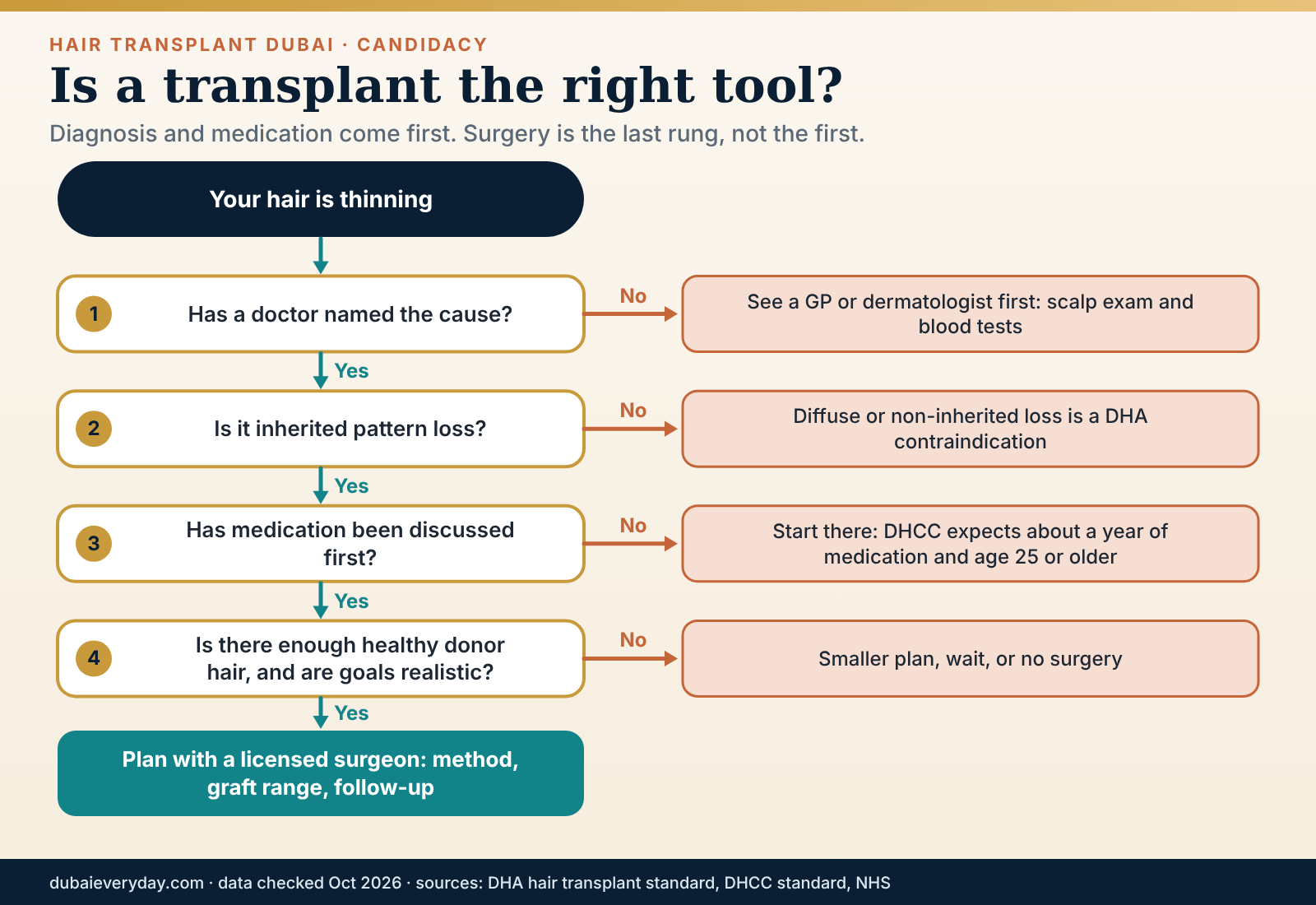
The word “transplant” makes any hair transplant Dubai enquiry sound like a first step. It should be near the last. Hair loss has many causes, and a transplant only helps some of them. Pattern baldness, the inherited kind, is the classic case: the hairs on the top thin, while the hairs at the back and sides stay put. Moving those stubborn hairs to the thin zone is the whole idea.
Other kinds of loss behave differently. The NHS notes that temporary shedding can follow illness, emotional stress, cancer treatment, rapid weight loss or low iron, and it suggests seeing a GP before a private hair clinic. That order makes sense for a hair transplant Dubai patient too. A general practitioner can order basic blood tests, and a dermatologist in Dubai can look at the scalp under magnification. If you need help finding either, the guide to finding a GP in Dubai covers networks, referrals and records.
What the DHA standard says about who is suitable
The DHA standard lists what a hair transplant Dubai surgeon should look for. Good candidates have pattern hair loss, a decent donor area, good general health and reasonable expectations. The contraindications are longer and more useful to read before you fall in love with a hairline photo: diffuse pattern thinning, hair loss that is not the inherited type, a weakened immune system, drug sensitivities, a tendency to keloid scars and connective tissue disease.
The same document flags cases for extra caution. These include significant psychiatric conditions (where a psychiatrist or psychologist should help with the decision), advanced baldness with poor density at the back, unrealistic expectations, significant systemic illness and very young patients, roughly 21 to 23, outside a few specific situations. The Dubai Healthcare City standard is stricter on age: it recommends 25 or older, and says the patient should have had an inadequate response to medication after a year.
Our reading of those two documents is simple. A proper hair transplant Dubai clinic is allowed to say no, and sometimes should. If a consultant agrees with everything you ask for within ten minutes, treat that as information.
Medication and surgery are not rivals
The NHS names finasteride and minoxidil as the main medicines for male pattern baldness, says neither works for everyone, and says both have to be continued to keep the effect. Women are advised to avoid finasteride. We give no dosing or prescribing advice here, because that belongs to your doctor. What matters for planning is the DHA point that most patients need ongoing medical treatment alongside surgery, since the hairs that were not transplanted keep thinning. A hair transplant Dubai surgeons perform fixes a map of today, not the scalp of fifteen years from now.
Women, beards and eyebrows
ISHRS says men and women can both be candidates when properly diagnosed, and that surgery can also be used for eyebrows, eyelashes, facial hair and areas damaged by trauma or scarring. The wrinkle for women is that much female thinning is diffuse rather than patterned, and diffuse patterned alopecia is on the DHA contraindication list. That does not close the door. It means the diagnosis step carries extra weight, and you should expect more questions and possibly more tests before anyone offers a date.
What this page covers, and what it leaves to others
This hair transplant Dubai page is about the surgical route: methods, donor planning, who may operate, price logic and recovery. It does not rank clinics. For general skin and scalp medicine, the wider dermatologist guide explains licensing and insurance in more depth. Injectables sit elsewhere, in the guides to Botox and dermal fillers, and removing hair rather than growing it is the job of the laser hair removal guide.
FUE vs FUT: how the two main hair transplant methods differ
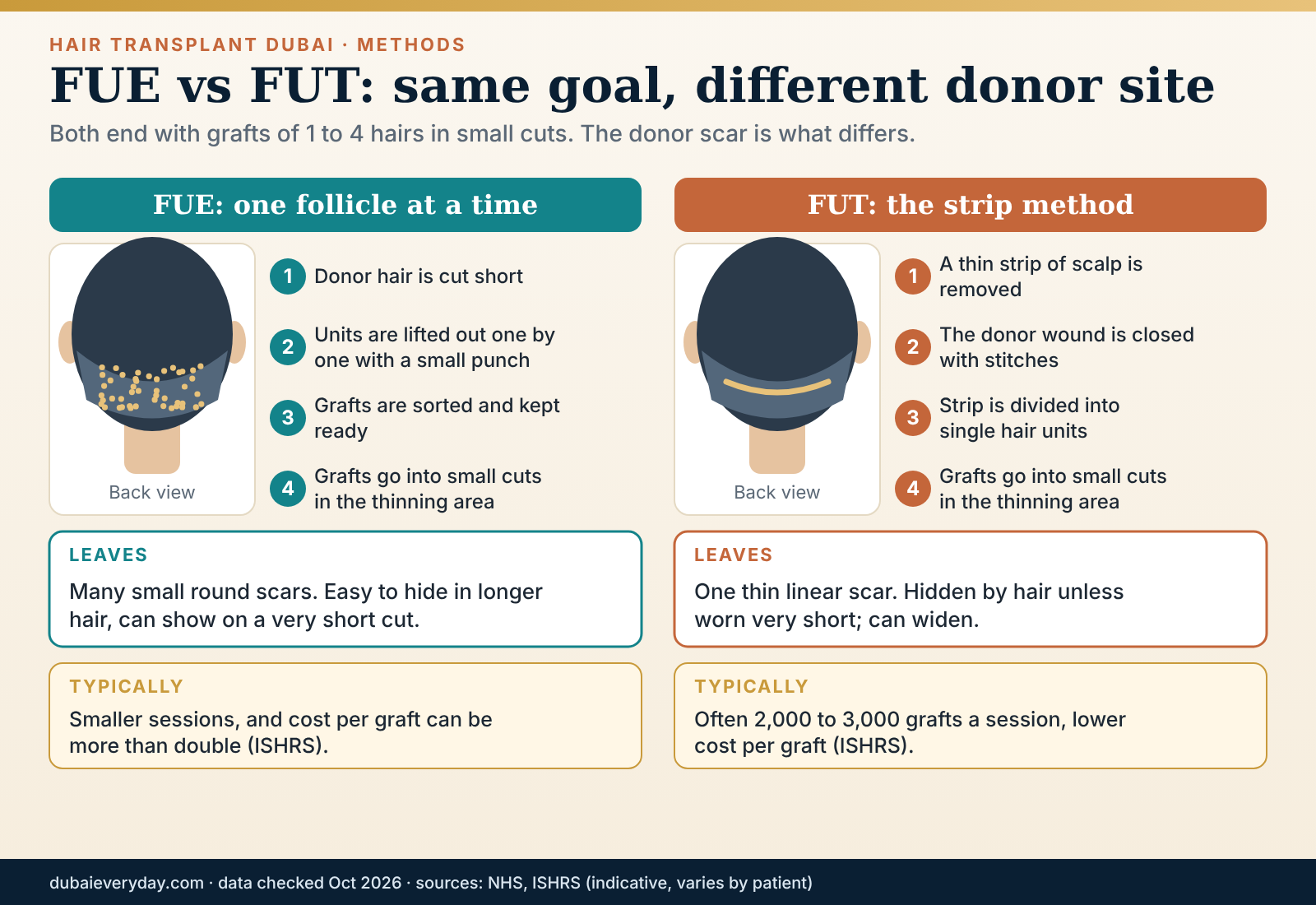
Every hair transplant Dubai clinics advertise is a variation on two ways of getting hair out of the back of the head. Both end the same way, with tiny grafts placed into small cuts in the thinning area. The difference is what happens at the donor site, and that difference decides your scar, your haircut and, often, your invoice.
FUT: the strip method
In follicular unit transplantation (FUT), the surgeon removes a thin strip of scalp from the back of the head and closes the gap with stitches. Technicians then divide the strip under a microscope into natural groups of one to four hairs. The NHS describes the result as a linear scar that is usually hidden by the hair around it, except when the hair is worn very short. ISHRS adds that the scar can widen in some people, particularly those with collagen disorders.
The trade-off is plain. FUT usually yields more grafts in one sitting. ISHRS says strip sessions commonly reach 2,000 to 3,000 grafts and sometimes more than 4,000. In return you accept a line, a tight, achy scalp for the first few days and a strip that cannot be taken again and again without the scalp running out of slack.
FUE: one follicle at a time
Follicular unit excision (FUE) skips the strip. A small circular punch frees individual follicular units, and the surgeon or a device lifts them out. The NHS says the back of the head is shaved for this, and ISHRS notes that donor hair has to be cut quite short, especially in large harvests. Many small round scars replace one line. They are usually easy to hide in longer hair, and they can show as pale or dark dots on a very short cut.
ISHRS is blunt that FUE is not scar-free, whatever the advertising says. It is also blunt about two practical points. FUE sessions tend to be smaller than strip sessions, and the cost per graft can be more than double. Curly or very wavy hair is harder to harvest this way, and heavy harvesting can leave a patchy, moth-eaten look at the back if it is spread badly.
| Question | FUT (strip) | FUE (individual follicles) |
|---|---|---|
| Donor-site mark | One linear scar | Many small round scars |
| Donor haircut | Only the strip area trimmed, per the NHS | Back and sides shortened, especially for big sessions |
| Typical session size (ISHRS) | Commonly 2,000 to 3,000 grafts, sometimes above 4,000 | Usually fewer, with some surgeons reporting over 2,000 |
| Price per graft (ISHRS) | Generally lower | Can be more than double |
| Hair type | Suits virtually all types | Harder with curly or very wavy hair |
| Stitches | Donor wound closed with stitches | No donor stitches described |
| Who tends to prefer it | People who keep hair longer and want more grafts per session | People who want short hair, no line, or a small touch-up |
Read the table as a starting point for a hair transplant Dubai conversation, not a verdict. A surgeon who has measured your donor density, your scalp laxity and your hair calibre can tell you which of these generalisations hold for you.
DHI, sapphire, robotic: names, not new operations
Open any hair transplant Dubai clinic page and you will meet DHI, sapphire FUE, robotic FUE and other branded variants. ISHRS has a view on the first: direct hair implantation is a name for implanting grafts with a sharp implanter pen, and it is not a separate transplant method. More broadly, ISHRS says clinics often rename standard FUE to look unique, and that unfamiliar names deserve closer questions.
Sapphire usually refers to the blade used to create recipient sites, and robotic usually means a machine helps with extraction. We did not find DHA or DHCC material that treats either as a distinct procedure, so treat them as equipment choices. The sensible response is not suspicion but specificity. Ask what exactly differs from standard FUE, who performs each step, and what the difference costs. A secondary price source we checked says DHI typically costs more than standard FUE, which is exactly why the question is worth asking.
Three numbers to ask any hair transplant Dubai surgeon for
The Dubai Healthcare City standard requires records of graft counts, hairs per graft and, for FUE, partial and total transection rates, meaning how often a follicle is cut during extraction. DHA’s standard separately requires a logbook that includes graft or follicle count and the harvesting method. You cannot audit a clinic’s logbook, but you can ask the doctor how they track these figures and what their typical transection rate is. A surgeon who measures it will answer. One who has never heard the term has told you something.
The donor area: the limit no hair transplant Dubai clinic can negotiate
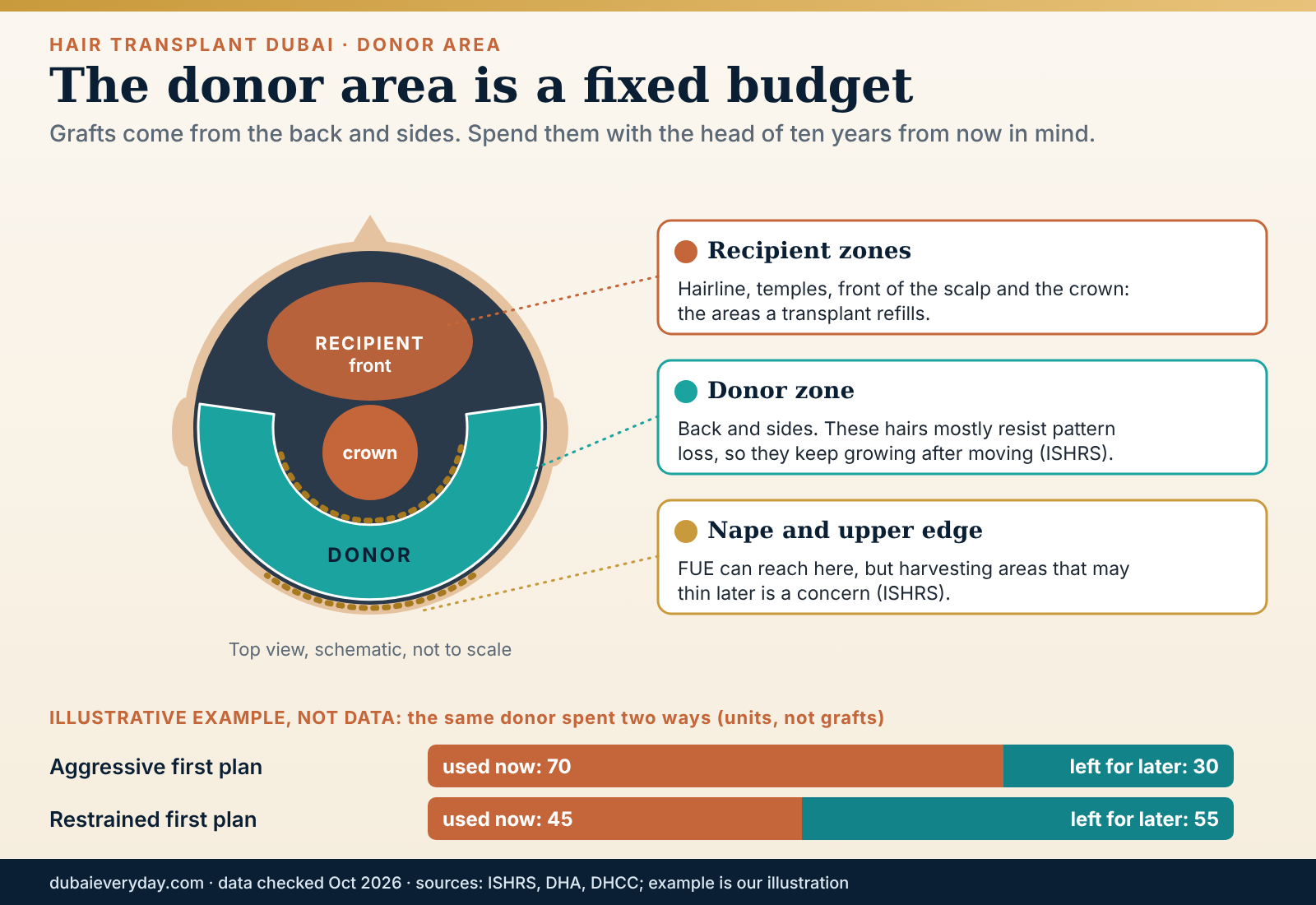
The donor area is the horseshoe of hair at the back and sides of the scalp. ISHRS explains that these hairs are generally resistant to the hormonal process behind pattern baldness, which is why they keep growing after relocation. Every plan for a hair transplant Dubai surgeons design is limited by how many of those follicles can be taken without leaving a visible deficit.
The limit is not a published number. The DHA standard declines to set a fixed cap on grafts per session or per patient. It says the maximum depends on the safe donor area, donor density, head size, technique, donor skin elasticity, and the patient’s age and future needs. The Dubai Healthcare City standard adds hair thickness and scalp laxity, and notes that shafts thicker than about 70 microns give denser coverage. Those variables are why two people asking for “3,000 grafts” may be asking for very different things.
Treat the donor like a budget with no top-ups
Here is the logic that matters for any hair transplant Dubai plan, and it is ours rather than a regulator’s. Pattern baldness usually keeps progressing. A transplant puts permanent hair into today’s thin areas, but the untreated hair around it can still thin, so the surgeon is designing for a head you will have in ten or twenty years, not just next spring.
Illustrative example (not a quote or market fact). Imagine a man in his late twenties whose donor area could safely supply 100 units of hair across his lifetime.
A low, dense hairline in a first session might use 70 of them. If his crown then thins over the next decade, only 30 units remain for a larger area, and the result looks sparse in the one place everybody sees from behind. A restrained first plan might use 45 and leave 55 for later. The first plan looks better in month twelve; the second often looks better in year fifteen. This is why a good consultation includes the uncomfortable question about your future pattern.
Limited donor? Ask about the alternatives, not the miracle
ISHRS says FUE can reach areas such as the nape and the higher scalp, which may enlarge the supply, and that body hair can sometimes be used. It also warns that harvesting areas that may later thin is a concern. If a hair transplant Dubai clinic proposes body or beard hair, ask what percentage of the plan relies on it and what the hair is expected to do differently from scalp hair. A plan that depends mostly on borrowed donors is a plan with a weak foundation.
The DHCC standard lists densitometers among the expected equipment, which suggests donor density should be measured rather than guessed. Ask for the measurement, ask for dated photos of the donor area before surgery, and ask what graft count the surgeon considers a safe maximum for you, written in the consent documents. That sentence costs nothing and sorts out a surprising number of conversations.
Hair transplant Dubai rules: what DHA and DHCC require
Dubai regulates hair transplantation as a health service, not as a beauty treatment. That matters because it gives you something solid to check against. Two regulators are relevant. The Dubai Health Authority (DHA) licenses most facilities and professionals in the emirate. Dubai Healthcare City (DHCC) is a free zone with its own regulator, and clinics inside it follow the DHCC standard instead. If you are not sure which regulator covers your chosen hair transplant Dubai clinic, ask: the answer takes one sentence and tells you where to look them up.
The DHA hair transplant Dubai standard in plain English
The DHA document behind every licensed hair transplant Dubai service is titled Standards for Hair Transplant Services, code DHA/HRS/HPSD/ST-02. The edition we read is dated July 2023, with a revision due in 2028. An earlier 2022 edition added general practitioners as permitted providers, subject to training and privileges. The document itself is slightly inconsistent about its own version number, so check the DHA website for whatever edition is current when you read this. The main points, as we read them:
Where it may happen
In hospitals, day-surgery centres or outpatient facilities that have a procedure room. DHA treats the operation as minor surgery. A facility adding the service needs DHA permission first, and must have documented routes for transferring a complicated case.
Who may operate
Licensed physicians with privileges. Plastic surgeons qualify directly. Dermatologists, general surgeons and GPs also need an accredited hair restoration certificate, at least two years of recent hair transplant experience with a logbook, and a DHA assessment. GPs need five years in their field as well.
What must be documented
Signed informed consent from the physician, including risks, benefits and alternatives. The costs of surgery and of follow-up. The limits of the procedure and whether more sessions may be needed. Pre-operative blood tests are listed too.
Two lines in the standard deserve underlining for any hair transplant Dubai patient. First, a physician may perform only one hair transplant procedure at a time. Second, the logbook has to record graft or follicle count, harvesting method, and whether the doctor worked independently or under supervision. Together they describe the opposite of an assembly line.
The standard also expects patients to be told that proper growth takes about nine months, that follow-up visits will be arranged, and that most patients need concurrent medical treatment for ongoing hair loss. Advertising has to follow the DHA’s medical advertisement rules. On hospital access, cross-check the Dubai healthcare guide for how facilities, insurance and appointments fit together.
What the DHCC standard adds
The Dubai Healthcare City standard is older. The version we read was issued in 2018 with a review date of 2020, so confirm that it has not been replaced. It is more specific about the role of technicians: they must not make FUE incisions, remove a strip or make recipient-site incisions, including with sharp implanters. They may assist, remove grafts the surgeon has already incised, and process or trim grafts.
It also recommends patients be 25 or older, expects a year of medication before surgery, asks for photographs before and after with consent, and says patient information should use accurate diagrams or real patient photos rather than models. Procedure rooms must be at least 11 square metres, and grafts from different patients must not be processed in the same room. These are the kind of small details an inspector, and a careful hair transplant Dubai patient, can actually see.
What neither document says
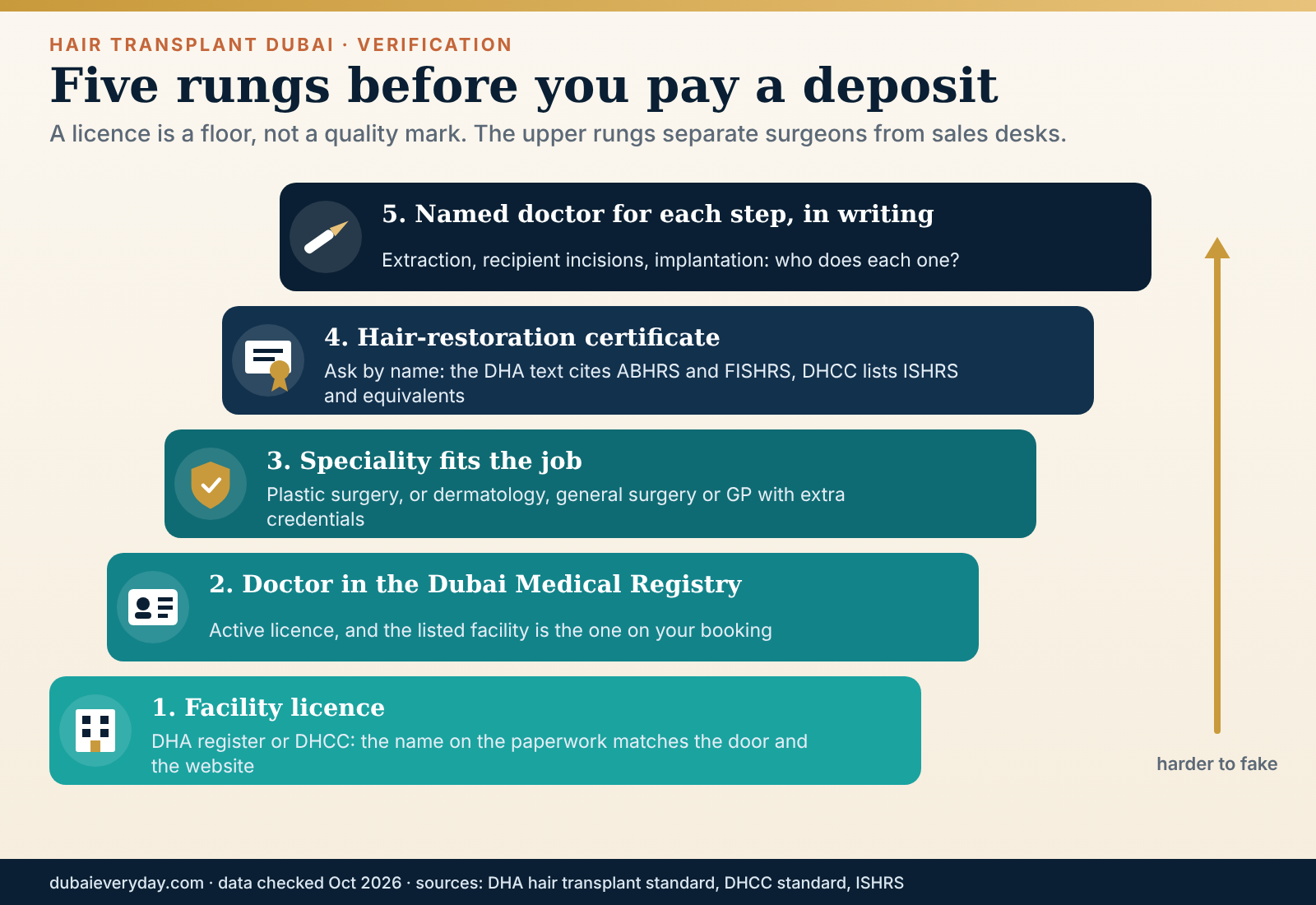
Neither standard, in what we read, sets a cooling-off period, a fixed graft limit or a price cap. The DHA text we read does not cover anaesthesia or platelet-rich plasma (PRP). So the protections a hair transplant Dubai patient has are real but narrower than people assume. Nothing in them promises a result, and nothing stops a licensed clinic from being expensive, rushed or mediocre. Licensing is a floor, not a quality mark.
DHA also publishes a hair transplant inspection checklist, which covers registration, facility, professionals, patient selection, counselling and consent, and infection control. Its existence tells you what inspectors look at, and it makes a handy list of topics for your own questions.
Surgeon credentials: how to check who will operate
Credentials are the most checkable part of any hair transplant Dubai decision, and the one most often skipped because the website looked polished. The checks below take about twenty minutes. Do them for the doctor and for the facility, and do them before you pay a deposit, not after.
- Ask for the facility name and licence.The name on the paperwork should match the name on the door and the website. DHA expects a patient rights charter in Arabic and English displayed at the entrance, which you can look for on arrival.
- Search the Dubai Medical Registry.The DHA’s public registry has separate tabs for professionals and facilities, with filters for licence type, category, speciality, language, area, facility, nationality and gender. Confirm that the doctor is listed, that the licence is active, and that the listed facility matches where you will be treated.
- Match the speciality to the job.Plastic surgery is a direct route under DHA rules. Dermatology, general surgery and general practice need the extra certificate and experience. A registry entry for another speciality, such as a dentist or a cosmetic physician with no extra credentials, needs a clear explanation.
- Ask for the hair-restoration qualification by name.The DHA text names ABHRS (American Board of Hair Restoration Surgery) and FISHRS (an ISHRS fellowship). The DHCC standard lists ISHRS, ABHRS and the American Hair Loss Association, or an equivalent. A “certificate of quality” from a body that is not a medical board does not count.
- Ask who does each step, in writing.Extraction, recipient-site incisions, implantation and graft preparation can be done by different people. Ask for a named doctor beside each step you care about.
- Ask about volume.How many procedures does the doctor perform in a typical week, and does the doctor ever operate on two patients at once? DHA’s one-at-a-time rule makes the second question perfectly fair.
- Ask for the doctor’s own results.Photographs of the doctor’s own patients, taken at comparable intervals, with consent, beat stock images every time. ISHRS and DHCC both warn against marketing based on models or altered photographs.
ISHRS tells patients to confirm that the surgeon listed, not an unlicensed technician, performs the surgery. Its black-market awareness material describes clinics where one doctor nominally oversees ten to sixty patients a day. For a hair transplant Dubai patient, the DHA standard sets qualifications for technicians but, in what we read, does not list which steps they may perform; the DHCC standard does, and bars technicians from making incisions. Whichever regulator applies, get the division of work written down.
What a registry entry can and cannot tell you
A registry search confirms that a person holds a licence and where they are registered. It does not rate skill, record complaints or tell you how many hair transplants someone has done. Treat it as the entry ticket. The hair-restoration certificate, the logbook discussion and the photographs of real patients are what separate a licensed surgeon from a licensed surgeon who is good at this.
If you want to compare facility types before choosing, the guides to clinics in Dubai and hospitals in Dubai explain how to read networks, locations and emergency capability. For a hair transplant Dubai patient the hospital question is about backup: the DHA standard expects equipment and trained staff for emergencies and a documented route to move a patient if something goes wrong. Ask what that route is.
The consultation and the day of surgery
A good hair transplant Dubai consultation is closer to a medical appointment than a sales call. The DHCC standard expects the physician to examine you, take a history and build a care plan, and it says consent is the treating physician’s job and cannot be delegated. The DHA standard likewise puts consent with the physician. If your first conversation is with a “patient advisor” who quotes a graft count before anyone has looked at your scalp, you have met the sales desk, not the consultation.
What a proper consultation contains
Expect questions about family history, other medical conditions, medicines and supplements, previous scalp procedures and how fast the thinning has moved. Expect an examination of both the thinning area and the donor area. Expect the doctor to name a diagnosis and, where relevant, to discuss medication before or alongside surgery. Expect a plan that says roughly where the hairline will go, how many grafts the doctor has in mind, how many sessions that might take and what the donor area can safely give.
The DHA standard lists pre-operative blood tests: haemoglobin, a full blood count including platelets, bleeding and clotting tests (or PT and aPTT), and a blood chemistry panel including glucose. Those are listed as part of pre-operative counselling, so a clinic that skips all bloods for a simple booking is skipping something the standard itself mentions. Ask for the consent form in advance and read it at home, not at the reception desk with a pen being offered.
- Which exact method is proposed, and why that one for me?
- How many grafts are planned, and what is the written safe maximum for my donor area?
- Who makes the donor extraction, the recipient incisions and the implantation?
- What follow-up visits are included, and for how long?
- What happens if the result is thinner than planned? Is a touch-up priced already?
- Which complications do you treat here, and where would I be transferred in an emergency?
- What will you ask me to do about medication for ongoing hair loss?
One more point, and it is about timing. Neither standard we read sets a cooling-off period for hair transplants, so nothing forces a pause between consultation and surgery. Give yourself one anyway. Sleep on the quote, compare two consultations, and decide on a day when nobody is offering a “today only” price.
What happens on the day of a hair transplant Dubai surgery
The NHS says the operation is usually done under local anaesthetic with sedation, takes a day, and does not need an overnight stay. Larger areas may need two or more sessions on separate days. Sedation changes the practical plan: you will want someone to take you home, and you should not drive afterwards. Ask the clinic whether sedation is used and what their rules are.
The sequence of a hair transplant Dubai day is broadly this. The doctor marks the hairline and recipient zones with you and photographs the starting point. Local anaesthetic numbs the donor area. In FUE, follicles are extracted one by one; in FUT, the strip is removed and the donor wound closed. The grafts are trimmed and sorted, the recipient sites are created, and the grafts are placed. A dressing goes on, and you leave with written aftercare instructions and a follow-up date.
The DHCC standard adds some human details that are worth knowing. Patients are told to wash their hair with an antiseptic the night before. They sit for a long time, so the standard mentions pressure-area protection, hydration and meals during long procedures. It also notes that people who struggle with long sitting, back or neck problems or claustrophobia may find the procedure harder. If any of those apply, say so at the consultation, not on the chair.
Hair transplant Dubai costs: what a price can and cannot tell you
The honest summary on hair transplant Dubai pricing is that there is no official price list, and we did not find any regulator-published tariff. What exists is what clinics quote, plus a few aggregators. We checked two secondary indications on 29 October 2026 and label them as such.
The two ranges overlap, which is some comfort, and both are wide, which is the real message. Neither says how many grafts the price covers. A 1,500-graft touch-up and a 4,000-graft session cannot sit under one number. Treat these hair transplant Dubai ranges as a sanity check, not a budget, and ask every clinic for a written quote built on the same inputs.
What moves the price
The medical-tourism article lists graft count, technique, the expertise of the surgical team, facility quality, pre-operative tests, post-operative care and medication, and whether the price is a bundled package. ISHRS adds a general point on technique: FUE can cost more than double per graft compared with strip surgery. Beyond that, the usual extras are the consultation fee, blood tests, medication, any optional PRP add-on, and the days of work you lose. The NHS suggests one to two weeks off work for the early healing stage, though a desk job and a sweaty site visit are different cases.
A worked comparison: cost per documented graft
Headline hair transplant Dubai prices hide the thing that matters, which is how much you pay per graft that actually goes into your scalp and appears in your record. DHCC requires clinics to record the graft count, and DHA’s logbook includes it, so the figure exists. Our calculation below divides the full price, including add-ons, by the documented count.
Illustrative example (not a quote or market fact). Three imaginary quotes for similar-looking results:
| Quote | Headline | Extras not included | Documented grafts | Total | Cost per documented graft |
|---|---|---|---|---|---|
| A | AED 12,000 “up to 3,000” | AED 2,000 (labs, medication, two follow-ups) | 2,000 | AED 14,000 | AED 7.00 |
| B | AED 15,000 itemised | None | 2,400 | AED 15,000 | AED 6.25 |
| C | AED 9,000 “up to 4,000” | AED 1,000 | 4,000 | AED 10,000 | AED 2.50 |
Quote A looks cheapest after its headline, then moves above B once extras and the real graft count enter the arithmetic. Quote C looks like the bargain and is the one to worry about. ISHRS names a very low price combined with a very high graft count as a red flag, because a donor area can rarely give that much safely, and because volume is easier to promise than to deliver. Our reading: the cheaper the cost per graft looks, the harder you should ask about donor limits and who is doing the work.
Insurance and payment hygiene
For a hair transplant Dubai procedure, plan on paying yourself. A Gulf News explainer updated in December 2024 says the Basic Benefits Plan excludes treatment for alopecia, baldness and hair shedding, and lists non-medical cosmetology as a common exclusion. Higher-tier or employer plans differ, so ask your insurer in writing before assuming either way. The wider health insurance guide for Dubai residents explains networks, co-pays and exclusions, which matters for the blood tests and any treatment of complications, even if the transplant itself is excluded.
- Get an itemised written quote with the graft range, method and named surgeon.
- Ask what the deposit covers and when it is refundable.
- Ask what happens if fewer grafts are placed than quoted.
- Ask who pays for treating a complication and for a revision.
- Ask for the price of a second session, so you can see the whole plan.
- Be wary of hotel, flight and “VIP” bundles that lead with the trip, not the surgeon. ISHRS lists this as a red flag.
Recovery: week by week and month by month
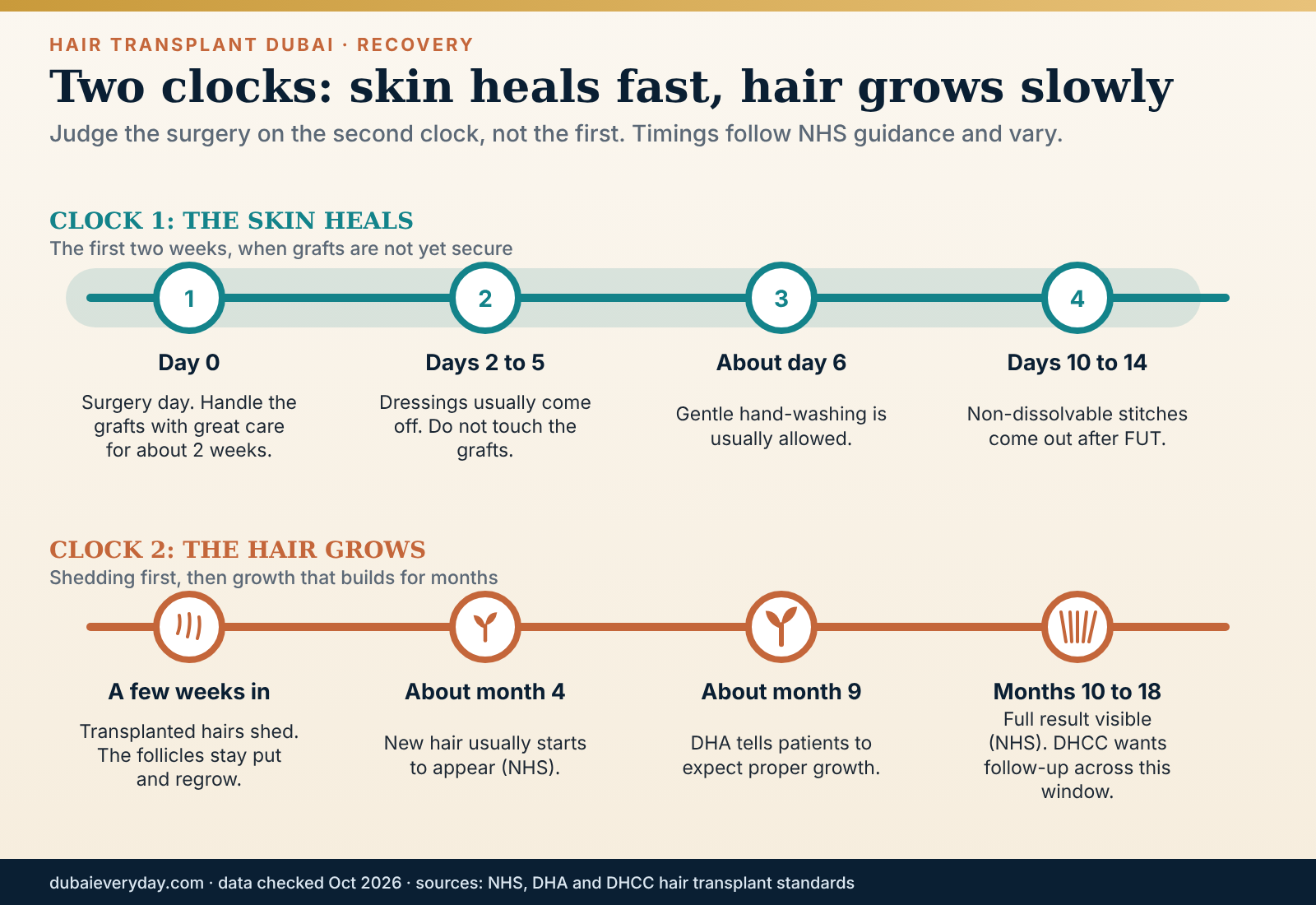
Recovery from a hair transplant Dubai patients undergo has two clocks. The first is the healing of the skin, which is quick and mostly over in two weeks. The second is the hair cycle, which is slow and not under anyone’s control. Confusing the two is the reason so many people panic at week four.
The first two weeks: protect the grafts
The NHS timeline is a good baseline for a hair transplant Dubai recovery. Dressings can usually come off after two to five days, and you should not touch the grafts. A tight, achy, swollen scalp for a few days is common, and so are temporary scabs at the graft sites. Gentle hand-washing is usually allowed from around day six. After FUT, non-dissolvable stitches usually come out at ten to fourteen days. The NHS also says to be very careful with the transplanted hair for the first two weeks, because the grafts are not yet secure.
Clinics differ in their detail, and your written instructions beat any general guide, including this one. As an example of how specific they get, one US practice’s published leaflet says crusts clear in about a week to ten days, asks patients to avoid sunburn for 30 days, and allows pools after day 10 and the sea after day 14. Yours may say something different, and that is fine. The point is that a good clinic gives you dates, not vibes.
Weeks 2 to 12: the shedding phase
Within a few weeks the transplanted hairs usually shed, and the NHS says they later regrow. The follicles stay in place under the skin; the visible shafts fall out. If nobody warned you, this feels like failure. If somebody did, it is a Tuesday. Take photographs once a month in the same light and angle so you can see progress that the mirror hides.
Existing, untransplanted hair in the area can also thin temporarily after surgery. Surgeons often call this shock loss; whether it applies to you is a question for your doctor, not a forum. The DHCC standard asks clinics to tell patients about complication warning signs, including pain, swelling, bleeding and infection. If something looks wrong, call the clinic early rather than waiting for the next scheduled visit.
Month 4 onwards: growth, in stages
The NHS says new hair usually begins to appear around month four and full results should be visible between 10 and 18 months. The DHA standard tells patients to expect proper growth about nine months after transplantation. These figures are not in conflict. First growth is thin and fine; fuller growth builds over several months; the final density and thickness take longer. DHCC adds that results can take up to 18 months and that follow-up should continue across that period.
Here is how we would read the three sources together. Judge your hair transplant Dubai result at month nine at the earliest, and at month twelve to eighteen for the real verdict. A clinic that offers no follow-up appointments inside that window is a clinic that does not intend to look at its own results.
Exercise, work and daily life
The NHS suggests reducing exercise in the first month to limit scarring, and one to two weeks off work as a typical early-healing guide. For hair transplant Dubai residents who start the day at the gym, that translates into a real pause. Ask your surgeon when walking, light cardio and weights are acceptable, and read the best gyms in Dubai guide only after you have the answer in writing. Shared equipment, sweat and head contact with benches are all on the questions list.
- Do not pick scabs, even when they itch.
- Follow the wash instructions to the letter, including products the clinic specifies.
- Take the prescribed medicines, and do not stop ongoing hair-loss treatment on your own.
- Attend every follow-up, especially the 10 to 14 day check after FUT.
- Keep the clinic’s out-of-hours number somewhere you will actually find it.
Dubai heat, sun and sweat: planning the healing window
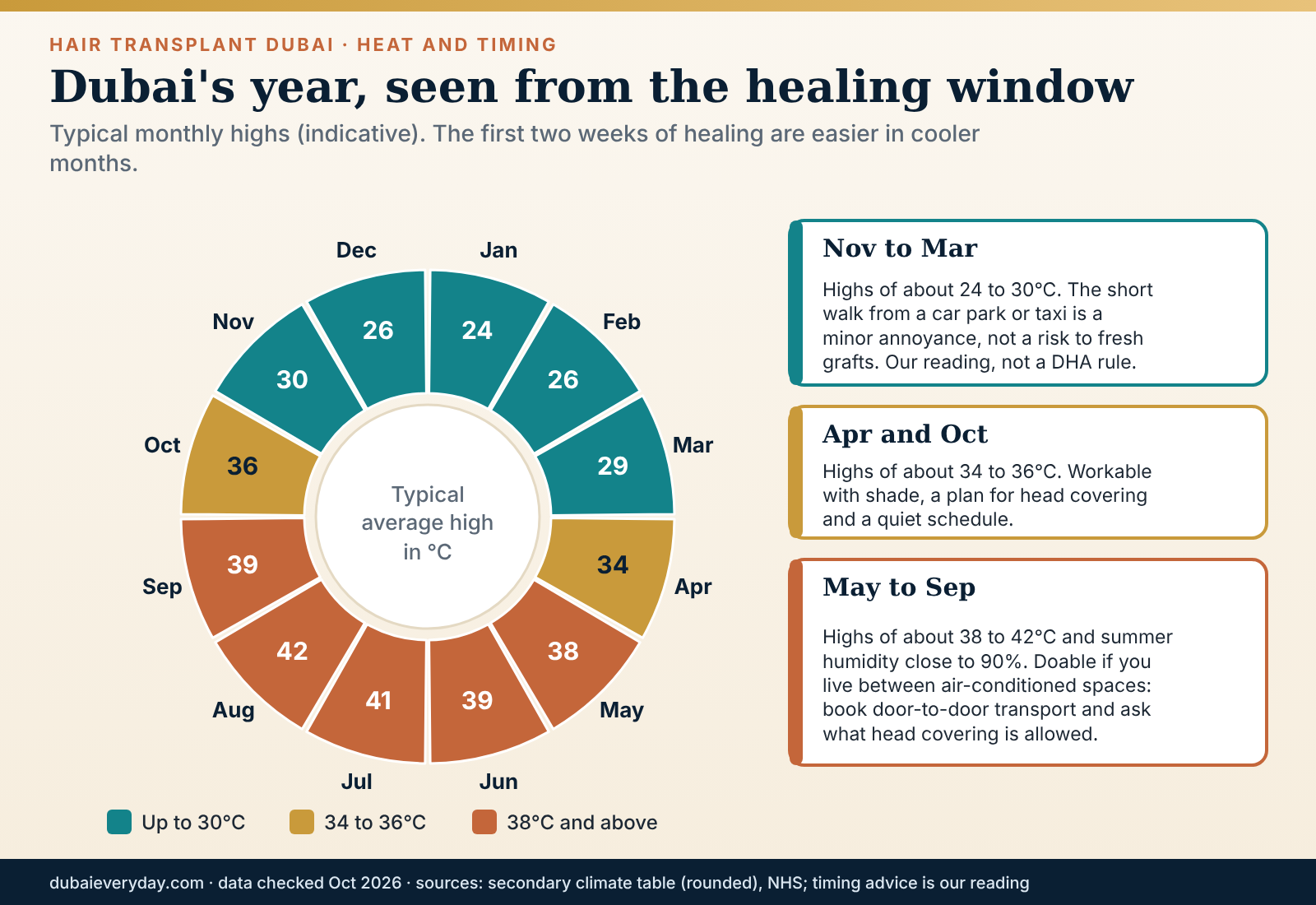
Most hair transplant advice is written for temperate countries. For a hair transplant Dubai patient the first fortnight of recovery coincides with whatever the weather is doing, and the weather does a lot. A secondary table of typical monthly average highs puts January at about 24 degrees Celsius and August at about 42, with summer humidity close to 90 per cent. It does not name its data source, so treat the figures as rounded and indicative.
Our reading: cooler months are easier, hot months are manageable
Nothing in the DHA or DHCC standards says when in the year to schedule a hair transplant Dubai surgery. The following is our own reasoning. The grafts are most delicate in the first two weeks, and the daily hazards in Dubai are short but intense: walking from a taxi to a door at midday, a car park without shade, a sweaty commute, or a cap that is too tight. From roughly November to March those are mild annoyances. From June to September they are the main event.
That does not mean summer is off limits. Residents who live between air-conditioned homes, cars and offices can plan a quiet first fortnight in July with no more risk than anyone else. The adjustment is behavioural: book door-to-door transport, avoid the sun for as long as your surgeon says, and ask what head covering is allowed. Tight caps and hoods can press on fresh grafts, and clinics differ on what they permit.
Sun, swimming and the beach
Scalp skin that has just healed is sensitive to sun, and the example leaflet mentioned earlier asks for 30 days of sunburn avoidance. Ask your own clinic for a number and write it down. The same goes for swimming. Pools and the Arabian Gulf are tempting in Dubai at almost any time of year, so get the date for each in writing. When you are cleared, the best beaches in Dubai guide helps you choose where to go.
A practical note for Ramadan: if you fast, ask your doctor how hydration and medication timing work around surgery and healing. The DHCC standard mentions hydration and meals during long procedures, which is a reminder that the day itself is long. Nobody we read gave a Dubai-specific rule here, so this is a question for your surgeon rather than an answer.
Visitors and health tourists: fitting surgery into a trip
Dubai receives patients from abroad for hair transplant Dubai procedures, and the logistics are different from those of a resident. The risk is not the surgery day. It is the gap between a flight home and the first week of healing, when problems are most likely to appear and your surgeon is a long way away.
Build the trip around the follow-up, not the other way round
Ask the clinic for its follow-up schedule before you book flights. From the NHS timeline, the delicate period is the first week or two, with dressings off around days two to five, the first wash around day six and stitches out at ten to fourteen days after FUT. Many people plan to stay at least until the dressing is off and the first wash has been done under supervision. That is a planning habit, not a rule, so ask your surgeon how long they want you in town.
We did not find an official rule on flying after a hair transplant Dubai visit, so we cannot state one. Ask the surgeon in writing, and ask what to do about cabin pressure, sleeping upright and carrying your instructions. For the rest of the trip, plan quiet days. The Dubai travel guide and the things to do in Dubai page are better used for the days after clearance than the days before it. A hotel with reliable air conditioning, a firm pillow and easy transport matters more than a view; the hotels guide explains how to choose by area and budget.
Visas, records and remote follow-up
A Gulf News explainer, last updated in February 2023, says a licensed UAE hospital can sponsor a medical treatment entry permit for a foreign patient, and that for Dubai the permit can allow entry within 60 days and a stay of up to 90 days. Documents listed include a passport copy, a hospital letter and a recent bank statement.
That article is dated, and in June 2026 GDRFA Dubai and DHA announced an agreement to streamline medical visas and develop a smart medical visa, without publishing patient-facing details. Whether you need a medical permit, rather than a normal visit visa, depends on your nationality and plans, so confirm with the clinic and GDRFA before you travel.
Before you leave, ask for copies of the operative record, the graft count, the method, the medications you were given, your pre- and post-operative photographs and the follow-up schedule. These help any doctor at home to treat you if a problem appears. Also ask how remote follow-up works: who answers messages, in what time and in which language. ISHRS warns that cross-border cheap-clinic procedures have produced complications and that unhappy patients often live far from the clinic, which leaves them little recourse. Check whether your travel insurance excludes elective procedures; many policies are written that way.
Hair transplant Dubai risks, red flags and what to do if it goes wrong
The NHS calls hair transplants generally safe and lists the small risks: bleeding, infection, an allergic reaction to the anaesthetic, grafts that fail to take, a noticeable scar, and continued thinning around the transplanted area. ISHRS adds method-specific issues. After FUT, scars can widen. After FUE, grafts can occasionally be buried under the skin and form cysts. Both methods can cause altered sensation, and poorly performed FUE can thin the donor area or leave visible scarring.
The less discussed risk is disappointment without any complication. A transplant cannot create hair that the donor area does not have, and it does not stop untreated hair from thinning. ISHRS says the procedure cannot be undone but can be revised with later surgery, so a poor design is fixable only to the extent that donor supply remains. That is the strongest argument for a conservative first plan.
A hair transplant Dubai price quoted before anyone has examined your scalp. A very low cost paired with a very large graft count. Promises of no pain, no scars or guaranteed density. Packages that lead with hotels and flights. A “certificate of quality” from a body that is not a medical board. A surgeon who will not say who does the incisions. Before-and-after photos with no information about who the patient was or when the photo was taken. Pressure to pay today.
If something looks wrong after surgery
Call the clinic first. The NHS advises contacting the clinic promptly for severe pain or unexpected symptoms, and the DHCC standard expects patients to be told which warning signs matter, including pain, swelling, bleeding and infection. If you cannot reach them, or the symptoms are severe, go to an emergency department, and bring your discharge papers and medication list. The hospitals guide explains how emergency access works in Dubai.
For a second opinion on the scalp, a dermatologist is a sensible start. Keep your records: the quote, signed consent, photographs, prescriptions and messages. If you want to question a clinic’s licence or conduct, the DHA lists a telephone line (800342) and the email [email protected] on its FAQ page, though that page does not explain a complaint procedure, so confirm the current route directly. Clinics inside Dubai Healthcare City answer to that regulator instead.
Six hair transplant Dubai situations and a sensible next step for each
A resident in his late twenties who wants a lower hairline
Start with the diagnosis and the medication conversation, and ask for a plan that leaves donor hair for the future. DHCC recommends 25 or older and a trial of medication first; DHA flags very young patients for caution. A second consultation costs little and may confirm that the first plan was too aggressive.
A woman in her forties with thinning all over
Diffuse loss is on the DHA contraindication list, so the question is whether a transplant is the right tool at all. Ask for blood tests, a scalp examination and a clear statement of the cause before anyone discusses grafts.
A visitor with five days in Dubai
Ask for the follow-up schedule before booking. If the surgeon wants you for ten to fourteen days, plan for that or choose a different time. Ask for your records, and for the name of the person who answers messages once you are home.
Someone holding a quote for 4,000 grafts at a very low price
Return to the cost-per-documented-graft arithmetic above. Ask for the donor density measurement and the written safe maximum, and ask who will perform each step. If the answers are vague, the price is not the bargain it appears to be.
A person with an old strip scar
ISHRS says FUE can be used to camouflage existing strip scars. Ask the surgeon how many follicles are realistic for the scar and whether the result will look dense enough with your hair length.
A resident who can only go in August
It is doable. Book door-to-door transport, ask about head coverings, avoid midday sun for as long as your surgeon says, and ask whether a cooler-month date is available if your schedule allows it. Treat the heat as a logistics problem rather than a reason to cancel.
Hair transplant Dubai FAQ
Is a hair transplant regulated in Dubai?
Yes. For every hair transplant Dubai facility it licenses, DHA publishes a Standards for Hair Transplant Services document and an inspection checklist, and Dubai Healthcare City has its own standard for clinics inside that free zone. The standards set rules on facility type, surgeon qualifications, technicians, consent and documentation. They do not guarantee results, and a licence is a minimum rather than a quality mark.
How much does a hair transplant cost in Dubai?
There is no official hair transplant Dubai tariff. Two secondary indications we checked suggest roughly AED 10,000 to AED 35,000 for an FUE session, and USD 4,000 to 12,000 (about AED 14,700 to 44,100) in a medical-tourism article. Both ranges are wide and neither states the graft count. Ask for an itemised written quote and compare the cost per documented graft.
Which is better, FUE or FUT?
Neither is better for everyone. FUT leaves one linear scar and often yields more grafts per session at a lower price per graft. FUE leaves many small round scars, usually needs a shorter donor haircut and can cost more than double per graft, according to ISHRS. Your hair type, donor area, haircut preference and budget decide it.
Who is allowed to perform a hair transplant in Dubai?
Under the DHA standard, licensed physicians with privileges: plastic surgeons directly, and dermatologists, general surgeons or GPs with an accredited hair restoration certificate, recent experience and a DHA assessment. Technicians have separate qualification rules. The DHCC standard bars technicians from making incisions. Get the division of work written down.
Does health insurance cover a hair transplant in Dubai?
Usually not for a hair transplant Dubai patient on a basic plan. Gulf News reported in December 2024 that the Basic Benefits Plan excludes treatment for alopecia, baldness and hair shedding, and non-medical cosmetic care is a common exclusion. Some higher plans may differ, so check your policy wording and ask your insurer in writing before you book.
How long until I see results?
After a hair transplant Dubai operation, transplanted hairs typically shed within a few weeks. The NHS says new hair usually begins to appear around four months and full results show at 10 to 18 months. The DHA standard tells patients to expect proper growth about nine months after surgery. Ask for follow-up appointments across that period.
Is DHI a different procedure from FUE?
ISHRS says direct hair implantation is a term for implanting with sharp implanter pens and is not a separate transplant method. A secondary source says DHI is typically priced higher than standard FUE. Ask what exactly is different, who does each step and what the added cost buys.
How do I check that a clinic or surgeon is licensed?
To check a hair transplant Dubai clinic, use the DHA’s Dubai Medical Registry, which has separate searches for professionals and facilities, and confirm that the doctor’s registration matches the facility where you will be treated. For clinics inside Dubai Healthcare City, check with that regulator. Then ask for the hair restoration certificate and the name of the person doing the incisions.
Can women have a hair transplant in Dubai?
Women can be hair transplant Dubai candidates when properly diagnosed, according to ISHRS. However, diffuse patterned alopecia is a contraindication in the DHA standard, and a lot of female thinning is diffuse. Expect a careful diagnosis, blood tests and possibly a recommendation for non-surgical treatment first.
Can I have a hair transplant in Dubai in summer?
Nothing in the DHA or DHCC hair transplant Dubai standards forbids it. Our reasoning is that the first two weeks are the delicate part, and heat, humidity and midday sun make that fortnight harder from June to September. Plan door-to-door transport, ask about head coverings and follow your surgeon’s sun instructions.
Is a hair transplant painful?
The NHS says it is usually done under local anaesthetic with sedation, and ISHRS describes postoperative discomfort as usually mild. A tight, achy, swollen scalp for a few days is common. Ask what pain relief is recommended and which symptoms should prompt a call to the clinic.
Before you book a hair transplant Dubai clinic: the short checklist
- Diagnosis confirmed by a doctor, with causes other than pattern loss considered.
- Facility and doctor found in the relevant registry, speciality matched to the procedure.
- Hair-restoration certificate seen, and a named doctor beside each surgical step.
- Written itemised quote with graft range, method, follow-up and cost per documented graft.
- Donor density measured and a safe maximum written down.
- Follow-up schedule that runs for at least a year, with dates.
- Recovery window planned around Dubai heat, work, travel and the gym.
Sources and further reading (20 links)
- Dubai Health Authority: Standards for Hair Transplant Services — facility types, surgeon and technician qualifications, consent, patient selection
- Dubai Health Authority: Standards for Hair Transplant Services (earlier edition) — earlier version and the introduction of GPs as providers
- Dubai Health Authority: Hair Transplant inspection checklist — what inspectors check
- Dubai Healthcare City Regulatory: Hair Transplant Service Standard — technician limits, patient age, records, room requirements
- Dubai Health Authority: Dubai Medical Registry — public search for professionals and facilities
- Dubai Health Authority: FAQ — contact lines for regulation enquiries
- NHS: Hair transplant — methods, recovery timeline, risks, choosing a surgeon
- NHS: Hair loss — causes, when to see a GP, medicines
- ISHRS: Comparison between strip harvesting and follicular unit extraction — scars, session size, cost per graft
- ISHRS: Surgical treatments for hair loss — techniques, donor area, risks
- ISHRS: Why FUE is so confusing — branded variants and questions to ask
- ISHRS: Black market awareness campaign — unlicensed technician risks and red flags
- Gulf News: Is this treatment covered in my insurance? — hair-related exclusions in basic plans
- Gulf News: Health tourism in the UAE, how to obtain a visa for medical treatment — hospital-sponsored medical entry permit
- Dubai Media Office: GDRFA Dubai and DHA sign health tourism MoU — medical visa direction
- Zavis: Hair transplant cost in Dubai, indicative range — secondary price indication
- Better by MTA: Hair transplant cost in UAE and Dubai — secondary price indication and cost factors
- Bayut: Average temperature in Dubai by month — rounded typical highs for context
- Example clinic leaflet: After hair transplant instructions — one practice’s aftercare schedule, used as an example only
- The National: UAE dirham dollar peg — AED 3.6725 per USD
Update log: 29 October 2026, first publication; facts checked against the sources above. Next review due April 2027 (six-month cadence), or sooner if DHA or DHCC publish a new hair transplant standard. Corrections welcome. This page is general information, not individual medical, legal or insurance advice; it does not recommend any clinic or surgeon, and no listed source paid for inclusion.
About DubaiEveryday and this guide
DubaiEveryday.com is an independent editorial project that publishes practical, research-based guides to everyday life in Dubai: where to live, what things cost, how the rules work and how to get around. This page was written and edited by the DubaiEveryday editorial team. It is not signed by a named expert, doctor, lawyer or adviser, and we do not claim first-hand testing of a venue, clinic or service unless the page says so.
Each guide is built from official sources such as government and regulator pages, operator websites and established news outlets, cross-checked where we can. When we could not confirm something, we say so in the text, and examples that use made-up numbers are labelled as illustrations. Mentions are editorial choices, not paid placements, and a link is not an endorsement.
Dubai changes quickly. If you spot something that is out of date or wrong, please tell us through the contact options on DubaiEveryday.com and we will check it and correct the page.