
District cooling is the chilled-water service that air-conditions a large share of Dubai’s towers, and it arrives as a separate bill from a company that is not DEWA. This guide explains how it works, who supplies it, how the charges are built and what a tenant should ask and do.
Most Dubai rental listings spend two words on cooling: “chiller free” or “chiller included”. Those two words can shift your yearly housing cost by several thousand dirhams, and they rarely get explained before the viewing. If you have ever wondered why a flat comes with a modest DEWA bill and then a separate invoice from a company you have never heard of, you have already met the system behind it.
This is the plain-English guide to district cooling Dubai tenants keep running into. It covers how the chilled-water network works, who the providers are, what every line on the bill means, and which questions to ask before you sign. There is also a worked example, built from published charges, so you can price a flat’s cooling before the viewing instead of after the first summer invoice.
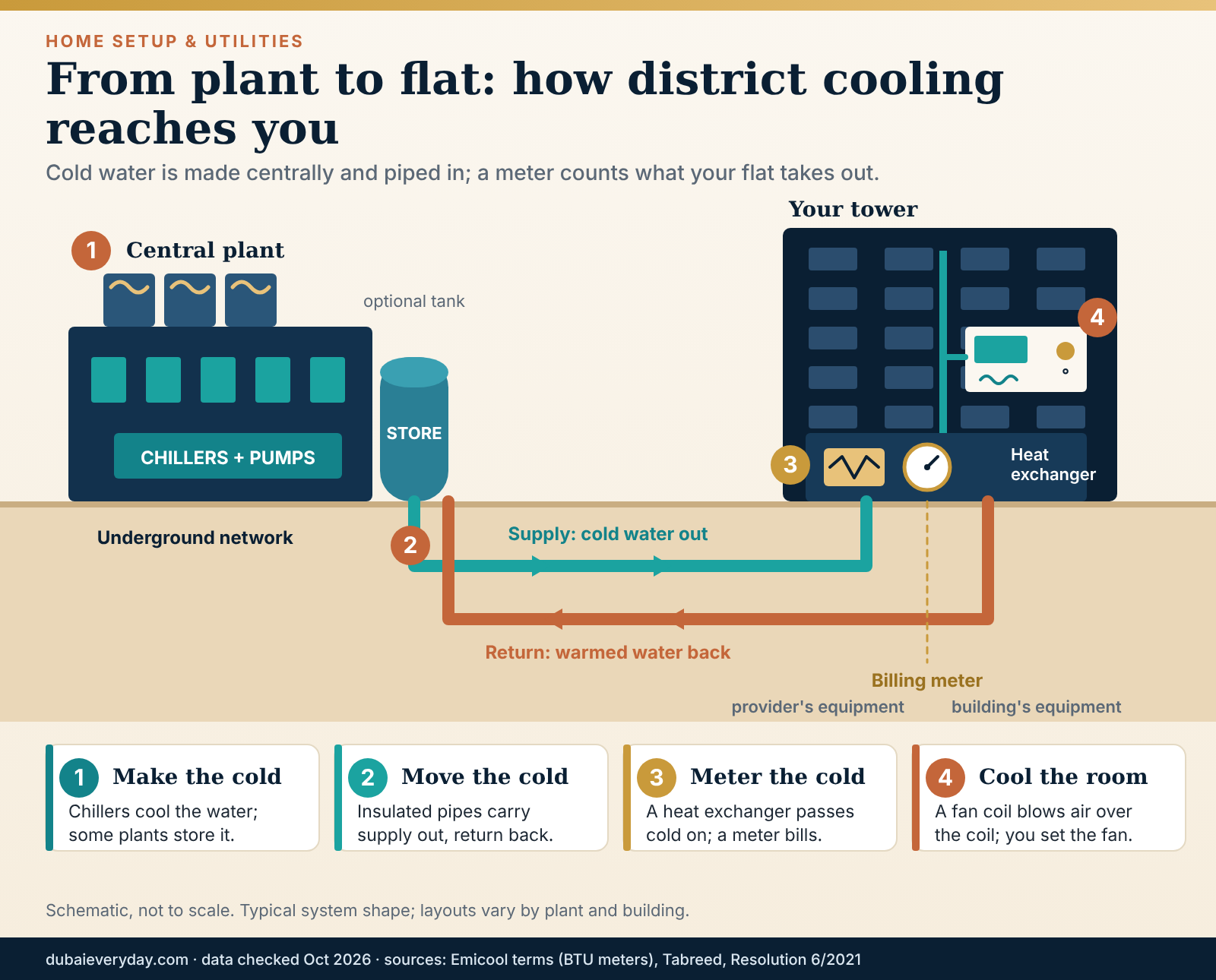
District cooling Dubai buildings rely on is a shared chilled-water service. A central plant chills water, insulated underground pipes carry it to your tower, and a meter in the building records how much cooling your flat takes out. You pay the district cooling Dubai provider, such as Empower or Emicool, not DEWA, for that service.
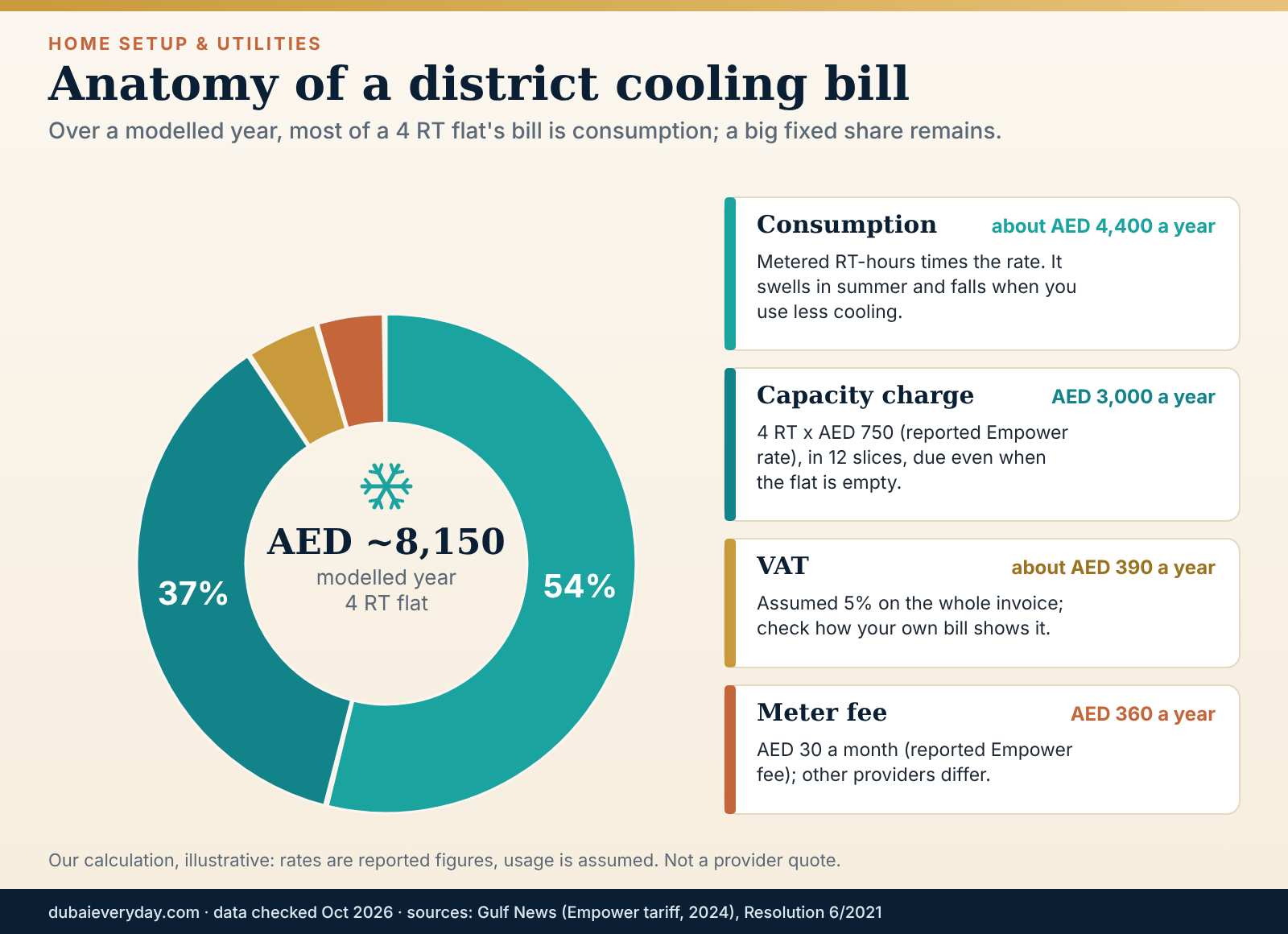
The bill has two main parts. The capacity charge is a fixed rate per refrigeration ton (RT) assigned to your unit, billed in monthly slices whether or not you switch the AC on. The consumption charge follows the cooling the meter actually records. Add a small monthly meter fee and VAT as shown on your invoice.
As a tenant of a district cooling Dubai building you normally register with the provider using your Ejari, Emirates ID and passport or visa copy, pay a refundable deposit and then receive invoices on the provider’s cycle. “Chiller free” in a listing usually means you pay the provider yourself; “chiller included” means the landlord does and the rent is higher. In our worked example, a 4 RT flat costs roughly AED 6,300 to AED 10,000 a year to cool, which is why the label can swing a lease by thousands.
Before you sign, ask who the provider is, how many RT the unit carries and to see the last twelve invoices.
This is a research-based guide. Nobody on the editorial team has lived in or tested any provider’s service, and we have not called any call centre. On 29 October 2026 we read the pages of Emicool (FAQ, customer terms, service charter, move-out process, district list), Empower (home, registration, FAQ, final-bill procedure, calculator), Tabreed, the Dubai Media Office, the Dubai Land Department and the Dubai Legal Portal text of Executive Council Resolution No. 6 of 2021.
Some pages could not be read: Empower’s “charges explanation” page returned only a redirect, and the Regulatory and Supervisory Bureau site blocked our tool. Where a figure comes from a news or property-portal article rather than a provider, we say so and treat it as indicative. The worked example uses clearly labelled assumptions. Inclusion of any company is editorial, was not paid for, and is not a recommendation. This is general information, not legal or financial advice.
What district cooling in Dubai is and how the system works
The idea behind the system
Start with the idea, because the jargon hides a simple trade. In a conventional building, every flat or the building as a whole runs its own air-conditioning compressors, and you pay for the electricity through your DEWA bill. In a district cooling Dubai building, the compressors sit somewhere else. A central plant chills water, pipes deliver it, and your flat only needs a coil and a fan to pull heat out of the air into that cold water.
The practical result for a resident is that the cost of cooling moves from one bill to another. The electricity your AC would have drawn largely disappears from your DEWA statement. In its place comes an invoice from the district cooling Dubai provider. Anyone comparing a district cooling Dubai flat with a conventionally cooled one has to compare the two bills together, not the DEWA bill alone.
It is also a big system, not a niche add-on. Empower, the largest provider by connected capacity, told the Dubai Media Office in May 2026 that it had about 1.7 million refrigeration tons connected, 90 plants at the end of 2025, a pipe network of more than 430 km, and roughly 160,000 customers across 1,776 buildings. If you rent in a newer tower, the odds of renting into a district cooling Dubai building are real.
The search job this page answers
This page answers one question: if my Dubai building uses district cooling, how does it work, and what will it cost and require of me? That means the mechanics, the providers, the charges, the tenant paperwork, the owner-versus-tenant question and the move-out steps.
Adjacent jobs have their own guides. For the full first-week checklist covering Ejari, internet and gas, use our home setup guide for Dubai. For electricity and water activation, deposits and timing, see the DEWA move-in guide. For choosing a flat on its wider merits, see the guide to renting an apartment in Dubai. Here we stay with the cooling.
Why the topic trips people up
Three things make district cooling Dubai rentals confusing. First, the provider is not the utility most residents already know, so the district cooling Dubai bill feels like a surprise. Second, the vocabulary (RT, RTh, demand charge, capacity charge, chiller free) varies between providers and listings. Third, the tenant, landlord and building manager each hold a different piece of the paperwork, so nobody sees the whole picture until the first invoice lands.
None of this is hard once it is laid out. The sections below take it in the order you will meet it: the physics, the providers, the labels, the bill, the numbers, the sign-up, the liability, the comparison and the exit.
How district cooling Dubai buildings get cold, from plant to thermostat
The explanation below is general engineering rather than a claim about any one provider’s plant, so treat the details as the typical shape of a system. The numbers we give for individual providers elsewhere come from their own pages.
Step one: the central plant
A typical district cooling Dubai plant is a building full of large chillers, pumps and cooling towers or other heat-rejection equipment. It cools water to a low temperature and sends it out. Some plants also store cooling in tanks so they can make cold water when electricity is cheaper or demand is lower. Tabreed’s own page, for example, describes a 25,000 RT thermal storage tank within its Downtown Dubai system.
Plants are sized for the peak afternoon demand of the buildings they serve. That is why providers speak in “refrigeration tons”. One RT is the cooling effect of melting a ton of ice in 24 hours, equal to 12,000 BTU per hour or about 3.5 kW of heat removal. The unit is old, but it is still the common currency for both plant capacity and your contract.
Step two: the pipe network
Insulated pipes run underground, usually in service corridors planned by the master developer. One set carries supply water out; another brings warmer return water back to the plant. Resolution No. 6 of 2021 even requires developers to provide shared service corridors for network routes, which is a quiet reminder that cooling is planned into a community from the start rather than added later.
This is also why you cannot simply switch provider the way you switch an internet plan. The network that reaches your tower belongs to one operator, and the building is connected to that network physically.
Step three: the energy transfer station and the meter
Where the network reaches your building, there is a plant room, often called an energy transfer station. A heat exchanger there passes cold from the district network to the building’s own internal water loop, keeping the two circuits separate. Between the two sits the billing meter. Emicool’s customer terms say it bills using BTU meters, which measure the energy content of chilled water by combining flow with the temperature difference between supply and return.
The ownership line matters. Under Emicool’s published terms, the provider installs and maintains equipment from the plant up to the metering point, and the customer side takes responsibility for equipment after that point. The meter itself is the provider’s asset.
Step four: the fan coil in your flat
Inside the unit, chilled water from the building loop flows through a coil. A fan blows room air across it, the air cools, and the warmed water returns. Your thermostat controls the fan speed or a valve. There is no compressor in your flat, which is why district cooled apartments tend to be quiet and why the AC electricity vanishes from your DEWA statement.
One behavioural point follows directly. Because the meter counts the heat removed from the building loop, anything that makes your flat gain heat or lose cold, such as open balcony doors, unshaded glass or a thermostat set very low, shows up on the consumption line. Empower’s own FAQ says the same in plainer words: adjust the thermostat, limit losses through windows and doors and turn cooling off when you do not need it.
District cooling Dubai providers: Empower, Emicool, Tabreed and others
The district cooling Dubai market has a handful of operators, and which one serves you depends on the building, not on your choice. Three names cover most of what a district cooling Dubai tenant will see. The facts below come from each operator’s own pages; the area lists at the end of the section are the weakest part, and we explain why.
Empower
Empower describes itself as the largest district cooling services provider in the world by capacity. The May 2026 release on the Dubai Media Office site puts total connected capacity at about 1.7 million RT, with 33,500 RT added in the first quarter of 2026, 90 plants at the end of 2025, a pipeline network above 430 km and around 160,000 customers in 1,776 buildings.
The same release names expansion projects at Business Bay (a fifth plant, about 44,000 RT in design), Deira Waterfront (a plant that began operating in 2025, serving more than 46 buildings), Al Sufouh 2, Jumeirah Village and Dubai Science Park. It does not list every community served. Customer service runs through an e-services portal, and billing questions go to the helpdesk on +971 4 559 2888 or [email protected], according to its site.
Emicool
Emirates District Cooling, known as Emicool, says on its FAQ that it was established in 2003 and is a joint venture between Dubai Investments and Actis. Its districts page lists plants in Dubai Investments Park (plants 1 to 5), Dubai Motor City, Dubai Sports City (plants 1 and 2), Mirdif Uptown, Culture Village, Expo and Jumeirah Bay, and says its plants together deliver 355,000 tonnes of refrigeration. The page mentions 20 plants but itemises fewer, so assume the list is not exhaustive.
Emicool publishes more consumer-facing detail than most. Its FAQ, customer terms and service charter set out documents, fees, response times and an escalation ladder. We lean on those pages heavily below because they are the clearest primary material available.
Tabreed and other operators
Tabreed’s website shows its district cooling Dubai network concentrated in Downtown Dubai, with an ultimate contracted capacity of 235,000 RT, installed capacity of 170,000 RT, a 35 km network and clients such as Burj Khalifa, Dubai Opera and Dubai Mall. Residential tenants in Downtown may therefore meet Tabreed or a building-level arrangement; our Downtown Dubai area guide covers the neighbourhood itself.
Other arrangements exist. A property-portal guide notes that Emaar provides district cooling to some of its communities and that Palm Utilities once served Palm Jumeirah before Empower took it over. Treat both as background, not as confirmed current coverage, and check with the building.
Which areas have it, and how reliable are the lists?
You will find online lists of Dubai communities with district cooling, and they vary. We read one from a property portal, last updated 15 October 2026. It names dozens of areas, among them Business Bay, Jumeirah Lake Towers, Jumeirah Village Circle, Dubai Silicon Oasis, Dubai Sports City, Palm Jumeirah, Jumeirah Beach Residence and Barsha Heights, and it lists several communities under both Empower and Emicool without resolving the overlap.
That inconsistency is the lesson. Area lists are a starting point for a search, not an answer for a given flat, because coverage is often building by building and some towers have their own plant or arrangement. For readers of our Dubai Marina guide or the Palm Jumeirah guide, the same rule applies: ask the landlord or building manager, then confirm with the district cooling Dubai provider using the unit’s premise number.
Empower
Largest network by connected capacity; registration online with the DEWA premise number; deposit and connection amounts shown during sign-up and varying by project.
Emicool
Plants in Dubai Investments Park, Motor City, Sports City, Mirdif Uptown and more; published fee schedule, service charter and a three-stage escalation path.
Tabreed
Downtown Dubai network with a large thermal storage tank; its public pages say little about residential tariffs or sign-up, so go through the building first.
Who oversees the providers
Executive Council Resolution No. 6 of 2021 regulates the provision of district cooling in Dubai. Under the English text on the Dubai Legal Portal, the Regulatory and Supervisory Bureau regulates the sector, providers need both a licence and a bureau permit, and the Supreme Council of Energy must approve every proposed charge, including connection, disconnection, capacity, consumption, meter and surcharge fees. Providers may not charge without that approval.
The resolution also says the Arabic text prevails if the two versions differ, and it covers providers in special development zones and free zones such as DIFC. For a district cooling Dubai tenant, the useful takeaway is that charges are not supposed to be invented per customer: they sit in an approved tariff, and the bill has to show certain items.
Chiller free, chiller included and the labels that mislead
“Chiller” is Dubai shorthand for the cooling service. Listings add words around it, and the words are not standardised. This is the single most expensive vocabulary problem in the district cooling Dubai rental market.
The two common meanings
In current usage, as described in a March 2026 guide by a brokerage, “chiller included” means the landlord pays the cooling charges and the cost is built into the rent, so the tenant pays only the DEWA bill. “Chiller free” means the tenant pays the cooling provider directly, with a consumption charge and a fixed demand charge.
The wording tricks people because “free” sounds like a benefit. It is not. A chiller-free flat is a flat where cooling is not covered by the rent. Some older explainers have used the term the other way round (management pays), and some describe the cost being folded into the service charge or rent. The label alone settles nothing.
Four arrangements you may actually meet
- Tenant registers with the district cooling Dubai provider and pays the invoice directly (the clearest version of “chiller free”).
- Landlord keeps the account in their name and pays; the rent already reflects it.
- Cooling is paid through the building’s service charge, which the owner pays, so the tenant sees nothing.
- Landlord keeps the account but passes a monthly amount to the tenant on top of rent, which should be written into the tenancy contract.
Only the first changes your paperwork. The other three still affect what you should be willing to pay in rent, which is the subject of the comparison section below.
The rule of thumb that survives all the labels
Ignore the label and ask a direct question: “Whose name is on the provider’s account, and where is that written in the contract?” If the answer is the tenant, you will see invoices and a deposit. If the answer is the landlord or owners’ association, you should see it reflected in the rent or service charge. If nobody can answer, treat that as a risk and read the tenancy clauses before signing, ideally alongside our tenant rights guide.
Your district cooling Dubai bill, line by line
The structure of a district cooling Dubai invoice is more consistent than the rates, and the regulation helps. Under Article 11(b) of Resolution No. 6 of 2021, bills have to show contracted capacity and its rate, consumption and its rate, and the billing charges, all in dirhams, plus anything else the regulator requires. If your district cooling Dubai invoice hides one of those, ask why.
The capacity charge (demand charge)
This is the fixed part. Emicool defines it as an annual fee based on a fixed rate per refrigeration ton of contracted capacity, split into 12 monthly payments that are due regardless of connection or consumption. Empower’s FAQ says the developer sets the RT for your unit based on its area and premise type, which means you cannot negotiate it down.
A 2024 Gulf News report on Empower’s tariff gave a demand charge of AED 750 per RT per year, billed monthly in advance and prorated by the days in the month. That is a secondary source from before this year, and Empower says its tariffs can be revised with input costs and the general inflation index, so use it as an order of magnitude and confirm your own rate.
The consumption charge
This is the variable part, billed per refrigeration-ton hour (RTh) recorded by the meter. One RTh means one RT of cooling delivered for one hour. If your flat has a 4 RT contract and the AC is working at a quarter of that for a month of 720 hours, the meter records about 720 RTh.
The 2024 Gulf News article printed Empower’s consumption rate as “0.568 fils per RT per hour”, and a 2026 brokerage guide copied the figure while noting that the unit looks wrong, since 0.568 dirhams equals 568 fils. We could not read Empower’s charges page to settle it. Because a rate in fils would make cooling almost free, which does not match what residents report paying, our worked example reads it as dirhams and labels that as an assumption.
Meter fee, surcharges and VAT
Emicool charges a fixed monthly metering fee per meter and per invoice. Empower’s meter maintenance fee was reported in 2024 as AED 30 monthly or AED 50 quarterly depending on location. Emicool also passes on a fuel surcharge set monthly by DEWA, reflecting the electricity cost of making chilled water.
That surcharge has a regulatory history. In December 2020 the Dubai Supreme Council of Energy directed district cooling companies to apply a cut in the electricity fuel surcharge from 6.5 to 5 fils per kWh, and Emicool published its compliance. Those are 2020 numbers and are not today’s surcharge; the point is that it is a regulated pass-through, not a margin line. Emicool’s fee schedule is stated plus VAT, and invoices normally show VAT, so check yours.
One-off charges
- Security deposit: Emicool sets it at eight months of the unit’s contracted capacity charge and says it is refundable. Empower’s amounts depend on project and building and are shown during online registration; a 2024 report gave AED 2,000 for a flat and AED 3,000 for a villa.
- Activation: Emicool charges a one-time AED 200 when billing starts for a unit.
- Connection: both providers describe a one-time connection charge for first connection; Emicool gives no amount on its FAQ, and Empower shows it at sign-up.
- Late payment: Emicool applies AED 100, with its FAQ giving 15 days from the invoice date as the due period.
- Reconnection: Emicool’s customer terms list AED 100 while its service charter says AED 500 and a 24-hour turnaround; ask which applies.
- Express service for registration or final bills: AED 500 plus VAT at Emicool, with limited hours.
A worked example: what a 4 RT flat might pay
Published rates are patchy, so this is our calculation, not a quote. It shows the arithmetic, so you can swap in your own provider’s numbers once you have them. Treat every figure in this section as illustrative.
The assumptions
- Contracted capacity: 4 RT. We picked it as a plausible size for a one-bedroom, not because any rule assigns it; your unit’s RT comes from the developer.
- Capacity rate: AED 750 per RT per year, the reported Empower figure from 2024.
- Consumption rate: AED 0.568 per RTh, reading the printed figure as dirhams (see the bill section).
- Meter fee: AED 30 a month. VAT: 5% on the whole invoice.
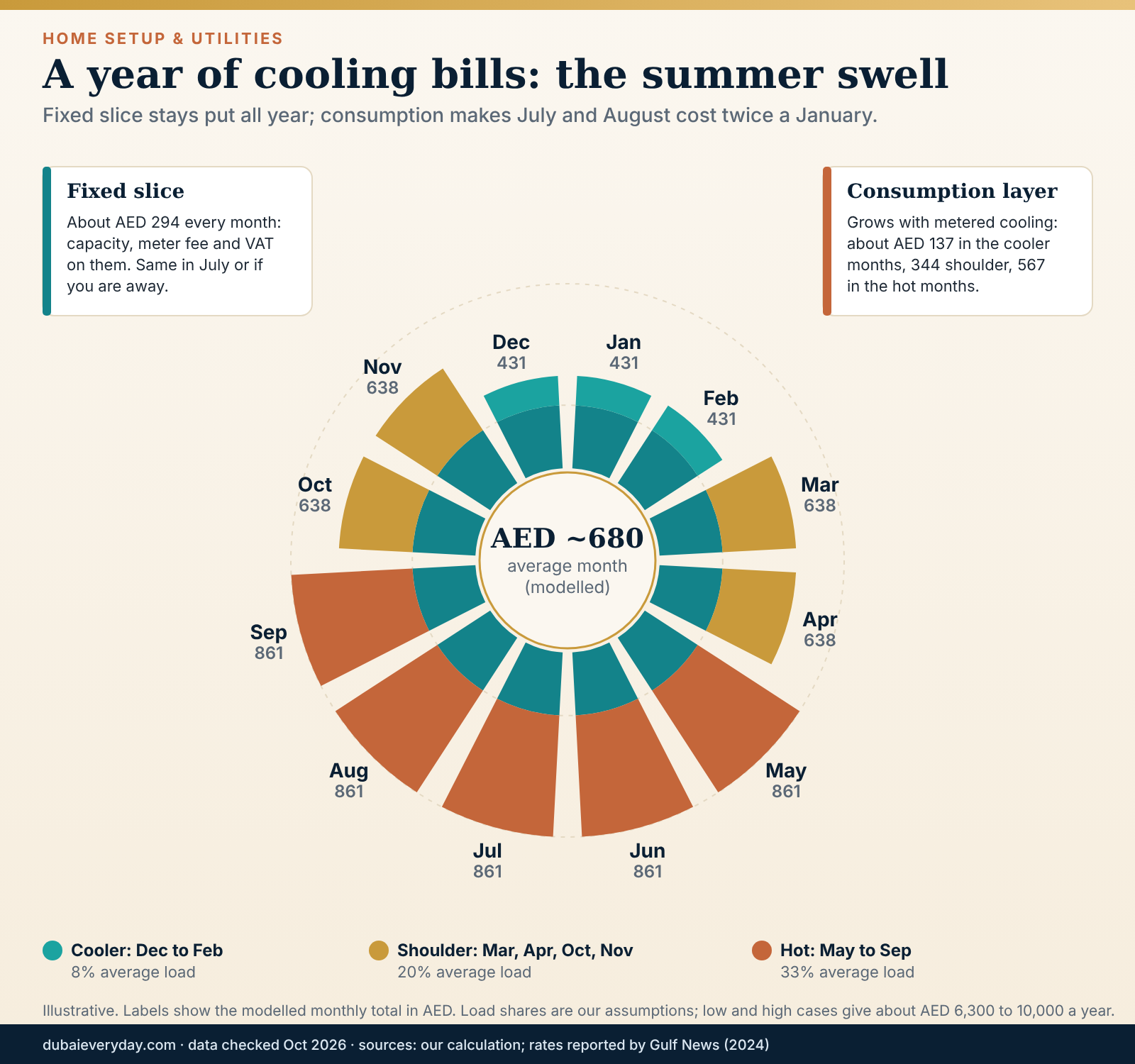
- Average load as a share of contracted RT, which is our assumption: 8% in the cooler months (December to February), 20% in the shoulder months (March, April, October, November) and 33% in the hot months (May to September).
The load shares are the shakiest input. Contracted capacity is sized for the hottest afternoon, so a unit runs well below it most of the time. The percentages are chosen to land near the summer ranges that brokers publish, which is why we also show a low and a high case rather than pretending to precision.
The monthly result
With 720 hours in a month, a 4 RT unit running at 33% records about 950 RTh, which at AED 0.568 is roughly AED 540. Add AED 250 capacity (4 RT times AED 750, divided by 12), AED 30 meter fee and 5% VAT and a hot month comes to about AED 861.
| Season (months) | Capacity | Consumption | Meter fee | VAT | Monthly total |
|---|---|---|---|---|---|
| Cooler (3) | AED 250 | AED 131 | AED 30 | AED 21 | AED 431 |
| Shoulder (4) | AED 250 | AED 327 | AED 30 | AED 30 | AED 638 |
| Hot (5) | AED 250 | AED 540 | AED 30 | AED 41 | AED 861 |
Over a year that adds up to about AED 8,150, or an average of roughly AED 680 a month (about USD 2,220 for the year at 3.6725 AED per USD). If the load shares are 40% lower the year drops to about AED 6,300; if they are 40% higher it rises to about AED 10,000. Those are the ends of the range quoted in the short answer above.
What the example teaches
First, the fixed share is large. In our mid case, capacity, meter fee and VAT on them make up over 40% of the year even though the AC is hardly working in January. Going away for a month does not cancel the capacity slice; Emicool’s FAQ says the monthly instalments are due regardless of connection or consumption.
Second, the seasonal swing is steep. The hot-month bill in the model is roughly double the cooler-month bill, which is why a lease signed in January can feel fine until the first July invoice. If you move in during winter, budget from the summer column.
Third, unit size matters more than it looks. The same rates for 3, 4, 5 and 6 RT give capacity charges of AED 2,250, 3,000, 3,750 and 4,500 a year, before a dirham of consumption. A larger-capacity unit in the same-sized flat costs more every month, so ask for the RT in writing and compare it between flats.
Fourth, the deposit scales with capacity under Emicool’s rule. Eight months of a 4 RT capacity charge at the Empower rate would be AED 2,000. Emicool’s own rate is not published on the pages we read, so that sum mixes one provider’s rate with the other’s deposit rule and is only an order of magnitude.
Sanity check against other numbers
A March 2026 brokerage guide gave AED 900 a month as an average district cooling Dubai cost in some tower areas, with AED 1,000 to AED 1,500 in peak summer months in places such as Dubai Marina and Downtown. Our hot-month figure of about AED 860 sits a little below that, which is plausible for a smaller unit. Brokers publish modelled figures and have an interest in the topic, so we treat them as context, not evidence. The honest answer is that your own invoices decide.
Setting up a district cooling Dubai account as a tenant
The sequence is simple, but the order matters, because some steps depend on documents you only receive after others. Providers also differ on a few details, so the list below marks where.
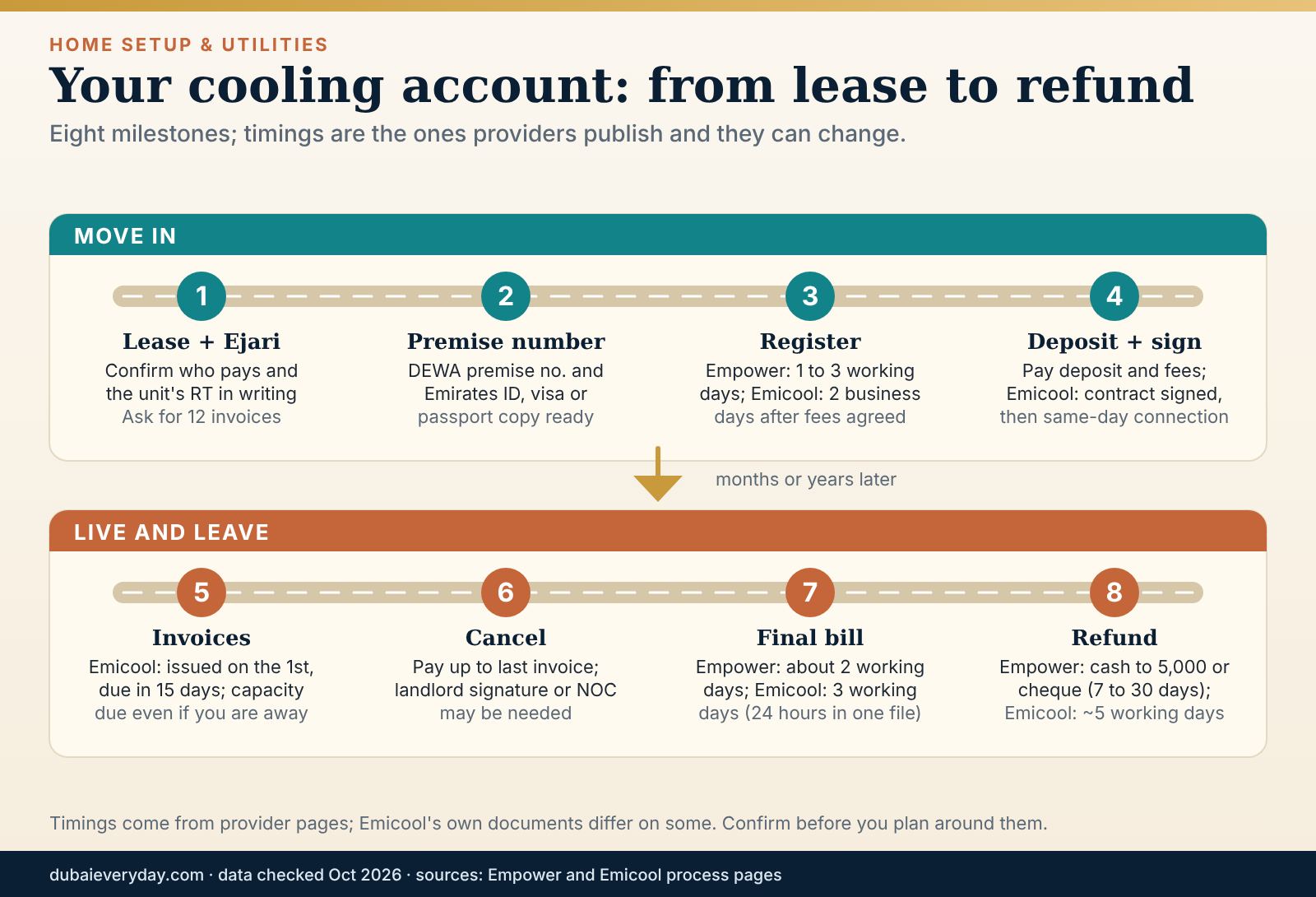
- Confirm the arrangement before signing. Ask whether cooling is in the rent, paid via service charge or billed to you. Get the provider’s name and the unit’s RT. If you must register, get the clause in the tenancy contract.
- Get your Ejari and Emirates ID in order. Both providers ask for the tenancy contract or Ejari. Empower also asks for a visa page copy and Emirates ID front and back; Emicool lists passport, Emirates ID, mobile, email and a current IBAN.
- Have the DEWA premise number ready. Empower’s registration flow asks you to select the premise using the nine-digit DEWA premise number. Our DEWA move-in guide explains where it appears.
- Register and upload documents. Empower: e-services portal, OTP, premise, customer type, details, documents. Emicool: documents by portal, email or office counter. Both show or confirm the charges before you finish.
- Clear any old balance. Empower says registration completes only after outstanding balances on active accounts under the same name are cleared. Emicool’s move-in process requires the landlord’s account to be settled before the new tenant pays the deposit.
- Pay the deposit and fees; sign the contract. Emicool issues a tripartite contract, on paper or by DocuSign, that landlord and tenant both sign, and says it can connect the same day it receives the signed contract.
- Wait for the first invoice. Emicool generates invoices on the 1st of the month, due within 15 days. Check the contracted RT and rates on it against what you were told.
Timing you can plan around
Empower says e-registration requests take one to three working days. Emicool’s FAQ says registration is completed within two business days once requirements, fees and charges are finalised, and its service charter lists two working days for tenant registration under the normal service, or three working hours at a customer service centre with the express option. Allow for a day or two even if the paperwork is perfect.
A flat with no active district cooling Dubai account in a Dubai summer is not a place you want to wait in. Start registration as soon as the Ejari exists and before the removal van arrives. Our Dubai relocation checklist puts the utilities steps in order alongside the rest of the move.
What a new tenant should keep
- The registration confirmation and reference number.
- The deposit receipt, because the refund process asks for it.
- The first invoice and a note of the contracted RT.
- Photos of the meter reading or screen on move-in day, taken with a date visible.
- The move-in inventory and handover document from the landlord.
Owner, landlord and tenant: who is liable
Who actually owes the district cooling Dubai provider? The answer comes from three layers: the provider’s account holder, the tenancy contract and the owners’ obligations under the jointly owned property law.
The account holder owes the provider
As far as the district cooling Dubai provider is concerned, the registered customer owes the bill. If you registered, the district cooling Dubai invoices are yours, and Empower’s refund rules say the deposit refund goes only to the registered customer. Owners register separately: Emicool’s FAQ asks individual owners for the master developer’s no-objection certificate or a new title deed.
The contract decides between landlord and tenant
Between the two of you, the tenancy contract governs. If it says the tenant pays cooling directly, you do. If it says the landlord pays, an invoice arriving in your name is a mistake to fix, not a debt to settle. The cleanest approach is to make the contract name the district cooling Dubai provider, the account holder and the responsibility for any arrears left by the previous occupant.
What the property law says about owners
In January 2020 the Dubai Land Department published a Rental Disputes Center explanation of Article 16(b) of Law No. 6 of 2019 on jointly owned real estate. In summary, the owner is liable for service charges and usage charges unless the lease says otherwise, and remains responsible even if a tenant fails to pay. The notice describes common areas as including shared parts of the property and says the charges include district cooling for those areas.
The lease can move payment duties onto the tenant, and Article 16(a) obliges both owners and tenants to follow the community rules. That is general information about one article, not advice on your case. For rent, maintenance and deposit disputes in the round, use our tenant rights guide and the legal basics in Dubai legal basics for residents.
If you own the unit
Owners register as owners, with the title deed or sales and purchase agreement, ID and, at Emicool, a master developer NOC when no new title deed exists. On a sale, Emicool’s terms describe agreeing a cutoff date with the master developer, clearing all bills including any tenant balance, then having the buyer pay the deposit and sign. Empower offers an optional owner clearance certificate, valid for 30 days, that settles dues without disconnecting service. If you are weighing yield as well, the rental yield guide shows how service-related costs affect returns.
Comparing two flats before you sign
This is where the earlier numbers earn their keep. A chiller-free flat looks cheaper on the rent line and a chiller-included flat looks expensive. Neither impression is reliable until you put the district cooling Dubai cost on the same footing.
The break-even sum
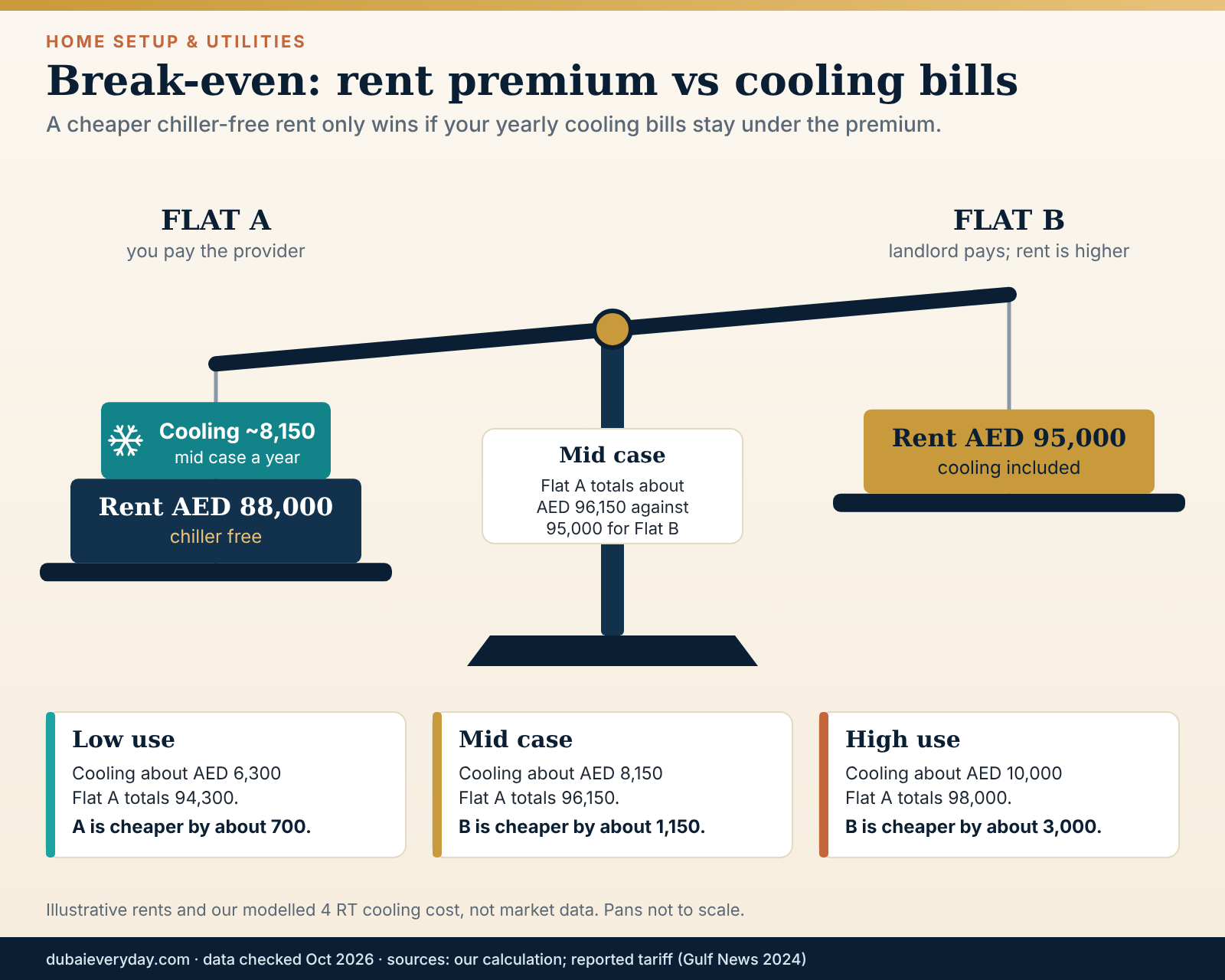
Take two flats of similar size. Flat A is chiller free at AED 88,000 a year. Flat B is chiller included at AED 95,000. The rent gap is AED 7,000, so Flat B is cheaper if Flat A’s district cooling Dubai bills would exceed AED 7,000 over the year, which is about AED 583 a month.
Using our model, that depends on how you live. In the low case (cooling about AED 6,300) Flat A wins by roughly AED 700. In the mid case (about AED 8,150) Flat B wins by about AED 1,150. In the high case (about AED 10,000) Flat B wins by about AED 3,000. The invented rents are there to show the method, not to say what a flat costs.
What the sum leaves out
Money is not the only difference. With a chiller-included flat, your cost is fixed for the lease year, which helps budgeting and removes the deposit, but the landlord’s cost can be passed through at renewal, and you have no incentive to save cooling. With a chiller-free flat you control the district cooling Dubai bill, but you carry the registration, the deposit and the summer spike.
Habits matter too. If you work from home, keep the AC on all day and set it low, you are the high-case tenant. If the flat sits empty on weekdays and you travel often, you are the low case, yet the capacity charge still runs. The break-even moves with your lifestyle, not just with the listing.
Questions to ask the landlord or agent
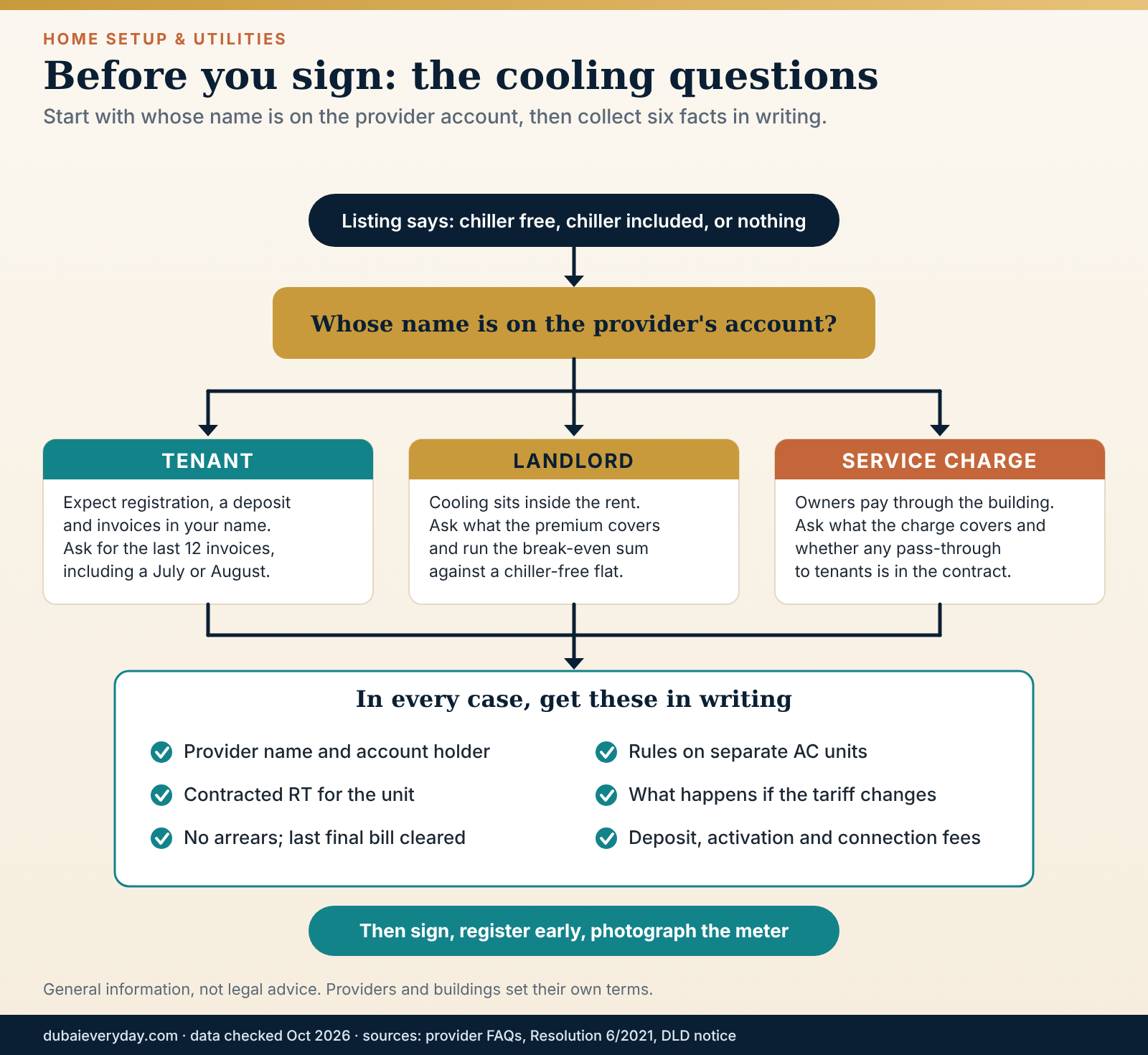
- Who is the district cooling Dubai provider, and is the account held by the tenant, the landlord or the owners’ association?
- How many RT does this unit carry, and where is that stated?
- Can I see the last twelve invoices, including at least one from July or August?
- Are there arrears, an unpaid final bill or an unsettled deposit from the previous occupant?
- What are the deposit, activation and connection amounts, and who pays the connection charge?
- Does the contract say what happens if the district cooling Dubai provider raises its tariff mid-lease?
- Are there rules on separate AC units, window units or portable coolers?
The invoices question does the most work. A landlord who is comfortable showing twelve months of bills is giving you better evidence than any broker table, and one who cannot find them has told you something too. If you also want to price the rest of the lease, our renting in Dubai guide and Dubai cost of living guide show where cooling sits among other housing costs.
Negotiation angles that are fair
If a chiller-free flat is listed at a rent close to a chiller-included equivalent, you can reasonably point to the modelled annual cost and ask for a lower rent. If a chiller-included flat is priced much higher than the neighbouring tower, ask what cooling cost the landlord actually pays. Keep the conversation factual; you are comparing two annual totals, not arguing about fairness.
Moving out: cancellation, final bill and refund
Ending a district cooling Dubai account is a process of its own, and it runs alongside the electricity and water closure rather than inside it. Our DEWA move-out guide covers the DEWA side, including the clearance certificate landlords often ask for.
If you are leaving a flat with Empower
Empower’s procedure runs through the e-services portal or app. For a tenant: create a “Final Settlement” request, select the account or premise, settle any outstanding amount, then upload the Ejari or tenancy contract, Emirates ID or passport and an IBAN statement header (or a declaration and authorisation form). A landlord NOC is needed if the tenancy ended early or expired more than 15 days earlier.
Empower says the final bill is normally available online within two working days, payable by cash or card, with collection at its Al Jadaf headquarters. Refunds are booked as appointments. Cash is available up to AED 5,000 for individuals, and cheques are recommended above that and for companies, taking 7 to 30 days; a replacement cheque costs AED 150 in deductions. Empower also lets a credit move to another active account in the same name.
If you are leaving a flat with Emicool
For a district cooling Dubai account, Emicool’s process asks you to pay the bill up to the last invoice and the processing fees first, then submit the cancellation by office counter, email to [email protected] or the portal. If you want the refund by transfer, add your IBAN to the portal profile beforehand, otherwise an account-payee cheque is issued.
A property-portal guide says the cancellation form must be signed by both tenant and landlord and submitted in person at an office, with a two to five working day process. The Emicool pages we read are less explicit on who signs, so confirm with the provider before you plan your last week.
Emicool’s move-out document says the final bill is prepared within 24 hours of submission. Its customer terms and service charter say three working days, or three working hours with the AED 500 plus VAT express service, and five working days for the deposit refund. The reconnection fee appears as AED 100 in one place and AED 500 in another. Ask for the current figure in writing and plan for the slower timings.
A sensible move-out sequence
- Start three to five working days before the keys go back. The slowest step is usually the signature, the appointment or the refund, not the calculation.
- Take a final meter photo on handover day. Date it, include the meter or display and keep the handover form.
- Ask for the landlord’s signature or NOC early. Needed for early exits at Empower and as part of the form at Emicool, according to the guide above.
- Settle the last invoice. Providers will not release a final bill with unpaid dues.
- Collect the refund and file the paperwork. Keep the final bill and the confirmation for any later dispute with the landlord over the deposit.
Deposits, timing and the next landlord
The district cooling deposit is separate from the landlord’s security deposit. A landlord may ask for the district cooling Dubai provider’s clearance before releasing theirs, so having the final bill and refund confirmation in hand speeds both. If you are simply changing flats within Dubai, our DEWA move-to guide explains how to carry electricity and water across; the district cooling Dubai account, being tied to the building, generally cannot be carried over and must be closed and opened afresh.
High bills, faulty meters and how to complain
Complaints about district cooling Dubai bills tend to fall into four groups: the bill is higher than expected, the meter looks wrong, the flat is not cold enough, or a fee appeared that nobody mentioned. They have different owners, so the first job is to send each to the right door.
The bill is higher than expected
Start with the arithmetic. Compare the contracted RT and rates on the invoice with your registration confirmation. Then compare consumption with the same month a year earlier, if there is one. Heat, guests, a thermostat set several degrees lower, a long open balcony door and a changed work routine all change the meter. The district cooling Dubai provider cannot fix those.
If the numbers look wrong, raise a billing request through the district cooling Dubai provider’s portal, email or call centre. Emicool’s service charter says complaints are acknowledged within one working day with a response targeted within six working days, and that it escalates through three stages, from the customer service team to the customer success lead to an executive-office lead, before the chief executive may refer unresolved matters to regulators. Empower’s FAQ points billing queries to its helpdesk.
The meter looks wrong
Emicool’s FAQ says that if a meter fails to record consumption accurately, it may bill an estimate using the same month’s consumption from the previous year, for up to two billing cycles, or the previous month if there is no earlier data. That is an official, published rule, so a sudden flat-lined reading is something to report quickly. A sensible district cooling Dubai tenant tells the provider, tells the landlord and keeps a dated record.
Never touch the meter. Emicool’s terms say the meter is the provider’s asset, and that intentional tampering can lead to estimated charges for the period, AED 3,000 for each month of tampering and possible criminal action under UAE law.
The flat is not cold enough
With district cooling Dubai buildings, this is rarely the provider’s problem first. Both Emicool and Empower tell residents to contact the building’s facilities management when cooling is poor, because the fault is usually in the building loop, the fan coil or the thermostat after the metering point. Emicool does publish a 24-hour emergency line for no cooling or leaks; its customer terms and charter list slightly different numbers, so use the one in your welcome email.
Escalating beyond the provider
Resolution No. 6 of 2021 requires providers to handle complaints under procedures approved by the Regulatory and Supervisory Bureau, and lets the bureau try to settle disputes between customers and providers through a committee formed by the Supreme Council of Energy. We could not open the bureau’s own site, so we cannot give you a form or a phone number. Start with the district cooling Dubai provider’s escalation ladder and ask in writing which regulator route applies.
If the argument is with your landlord about who pays, that is a tenancy matter. The tenant rights guide explains the dispute options, and any significant sum is worth a conversation with a licensed lawyer.
Villas, townhouses and the separate AC trap
District cooling Dubai wide is not only an apartment tower story. A property-portal list of district cooling Dubai communities, updated in October 2026, places villas and townhouses on district cooling in communities such as Jumeirah Village Circle, Jumeirah Village Triangle, DAMAC Hills, Motor City, Sports City and Green Community, and says Dubai Hills, Arabian Ranches and Meydan were not covered. Because that is a portal list, not a provider list, confirm any villa individually.
What changes in a villa
The mechanics are the same, but the scale and the habits differ. A larger floor area means a larger contracted RT, so the capacity charge and the deposit are bigger. A reported 2024 Empower deposit was AED 3,000 for a villa against AED 2,000 for a flat. Gardens, glazing and more rooms in use through the day push consumption up in summer.
If you are comparing a villa on a conventional system with a district cooling Dubai villa, the DEWA bill and the cooling bill have to be added together, with the full-year total as the comparison. Our guide to renting a villa in Dubai covers the maintenance, garden and inspection side that sits beside cooling.
The separate AC rule
Emicool’s published customer terms prohibit separate air-conditioning devices on a connected premises. If you install one, the terms say you pay to remove it, AED 3,000 for each month of breach and declared-load fees for the period, and Emicool may notify the Land Department, the owners’ association and the master developer. Other providers and buildings will have their own wording. Ask the landlord and building management before bringing a window unit, a portable cooler or a split system into a district cooled home.
The reason is straightforward. The district cooling Dubai provider has designed and charged for the capacity it supplies to your unit. A second cooling source can distort the load on the building’s loop, and a meter that never sees a room’s cooling cannot bill for it. Whether or not you agree with the rule, it is the contract, and a landlord may be on the hook too.
Heat, pets and people at home
District cooling Dubai homes get steady, whole-home cooling easily, which matters most for homes with babies, elderly relatives or animals. If you share a flat with a pet, our pet ownership guide deals with heat, and the cost of leaving cooling on all day should be built into your monthly budget.
Common mistakes
These district cooling Dubai mistakes come up repeatedly in the provider terms and in property-portal guides, which is as close as we can get without field testing.
- Reading “chiller free” as a perk and not as a cost you now carry.
- Comparing flats by rent and DEWA bill alone, then discovering a fourth bill from a provider.
- Signing without seeing twelve months of invoices, including a summer month.
- Moving in before the district cooling Dubai account is active, then waiting for a connection in the heat.
- Assuming a month away means a smaller capacity charge. Both providers describe capacity as fixed and due regardless of use.
- Forgetting to close the account on move-out, so that the fixed charge keeps accruing and the deposit stays locked.
- Installing a separate AC unit and meeting a penalty clause.
- Trusting an area list for a specific flat instead of asking the building and the provider.
- Failing to photograph the meter or keep the final bill, then having no evidence when the deposit dispute starts.
Pulling those together, the order of attack for a new tenant is short: provider and RT, then invoices, then paperwork, then evidence. Our home setup checklist shows how that sits alongside Ejari, DEWA, internet and gas in the first week. If broadband is the next job, the home internet guide picks it up.
Where to start
If you are still choosing a flat, ask for the provider, the RT and twelve invoices, run the break-even sum and decide on the annual total. If you have signed, register as early as you can with the Ejari in hand, keep the paperwork and photograph the meter. If you are leaving, start the cancellation before the keys go back and keep the final bill. Those three habits cover most of what goes wrong with district cooling Dubai tenancies.
Frequently asked questions
What is district cooling in Dubai?
District cooling Dubai residents use is a service where a central plant chills water and underground pipes carry it to many buildings, instead of each building running its own compressors. Inside your flat, a fan coil uses that cold water to cool the air. You pay the cooling company for the capacity assigned to your unit and for the cooling the meter records, so the cost moves from your DEWA statement to a separate provider invoice.
Is a chiller the same as district cooling?
In everyday Dubai speech, yes. “Chiller” is the nickname for the district cooling charge, and “chiller free” or “chiller included” in a listing says who pays it. Strictly, the chillers are the machines at the plant, not in your building. Because the labels are used loosely, always ask whose name is on the district cooling Dubai provider account and where that is written in the tenancy contract.
Who pays for district cooling, the tenant or the landlord?
It depends on the lease. If the tenancy contract says the tenant pays, you register with the provider, pay a deposit and receive invoices. If it says the landlord pays, the cost is usually in the rent. Between owner and tenant the contract decides; under the jointly owned property law, an owner is liable for service and usage charges unless the lease says otherwise. Get it in writing.
How much does district cooling cost per month in Dubai?
There is no single figure, because it depends on the district cooling Dubai provider’s tariff, your unit’s contracted RT and how hard you run the AC. Our illustrative model for a 4 RT flat gives about AED 430 in cooler months and about AED 860 in the hottest, roughly AED 6,300 to AED 10,000 a year. Brokers quote higher peaks for some towers. Ask the landlord for twelve months of actual invoices.
What is the capacity charge, and do I pay it when I am away?
The capacity charge, also called the demand or contracted-capacity charge, is a fixed rate per refrigeration ton of capacity assigned to your unit. Emicool says it is split into 12 monthly payments due regardless of connection or consumption. Empower’s reported 2024 tariff prorated by days in the month. So a holiday does not remove it; only closing the account at move-out ends it.
What do RT and RTh mean on my invoice?
RT is a refrigeration ton, a unit of cooling capacity equal to 12,000 BTU per hour. It describes how much cooling your unit is allowed to draw. RTh, or RT-hour, is the quantity of cooling actually delivered, which the meter records and the consumption charge multiplies. The capacity charge uses RT; the consumption charge uses RTh.
Can I choose a different district cooling provider?
Usually not. The pipe network belongs to one operator and your building is physically connected to it, so the provider follows the building. What you can choose is the flat, which is why the provider, tariff and invoice history belong on your viewing checklist. Regulation covers permits and charge approval, so a provider cannot invent a charge, but it does not create a market of rivals inside a single tower.
What documents do I need to register as a tenant?
Empower lists the tenancy contract or Ejari, Emirates ID (front and back) and a visa page copy for individuals, with trade licence and authorised-person passport for companies. Emicool lists Ejari, passport copy, Emirates ID copy, mobile number, email and a current IBAN. Registration may also need the DEWA premise number and any landlord balance cleared first. Empower says registrations take one to three working days.
How do I find out whether my building has district cooling?
Ask the landlord or agent for the district cooling Dubai provider’s name, then check with the building management and the provider using the unit’s premise number. Area lists online are a guide only; one property-portal list we read assigns several communities to two providers at once. Empower’s registration tool searches by DEWA premise number, which is a quick practical test if you have the number.
What happens if I do not pay a district cooling bill?
Emicool applies a late-payment fee of AED 100 after the 15-day due period and charges a reconnection fee after disconnection, with two of its pages quoting different amounts. A 2024 report put Empower’s disconnection fee at AED 1,000 and said reconnection needs all dues cleared. These are reported figures; check your contract. Registration of a new account can also be blocked while an old balance is open.
Can I install my own air conditioner in a district cooled flat?
Check first. Emicool’s published terms prohibit separate air-conditioning devices on a connected premises and describe removal costs and a monthly penalty of AED 3,000 for the breach period. Other providers and building rules may differ, but the principle is common: cooling should come through the metered system. Ask the landlord and the building management in writing before buying or fitting anything.
Does district cooling lower my DEWA bill?
Generally yes, because the air-conditioning electricity is used at the central plant, not in your flat, and is paid for through the cooling provider’s charges. The total you pay for cooling still has to be counted. Compare the DEWA bill plus the district cooling Dubai invoice for a full year against a conventionally cooled alternative. The DEWA move-in guide covers the activation side of the electricity account.
Sources and further reading (21 links)
- Emicool: Frequently asked questions — registration, documents, deposit, charges, billing and estimates
- Emicool: Customers, terms and fees — obligations, fee schedule, separate AC and meter tampering terms
- Emicool: Customer service charter — response times, express service, escalation stages
- Emicool: Move-out and move-in process — cancellation, final bill and tripartite contract steps
- Emicool: Districts — plants and capacity
- Emicool: Revised fuel surcharge press release — surcharge regulation context
- Empower: Home — services, e-services portal and contacts
- Empower: How to register — registration steps, documents and timing
- Empower: FAQs — billing, RT assignment and tariff revisions
- Empower: E-final bill procedure — final settlement and deposit refund rules
- Empower: Charges calculator — calculator inputs
- Dubai Media Office: Empower continues expanding district cooling infrastructure — capacity, plants, customers, projects
- Dubai Media Office: Empower’s district cooling consumption increases — consumption and contracted capacity
- Dubai Legal Portal: Executive Council Resolution No. 6 of 2021 — regulator, permits, bill content, charge approval, complaints
- Dubai Media Office: Supreme Council of Energy directs district cooling companies to reduce bills — fuel surcharge directive
- Dubai Land Department: Owner obliged to pay service and usage charges — Article 16 of Law No. 6 of 2019
- Tabreed: Home — Downtown Dubai network details
- Gulf News: What are the district cooling charges in Dubai? — reported Empower tariff and deposits; secondary
- dubizzle: How to discontinue district cooling in Dubai — move-out steps; secondary
- Bayut: Residential areas in Dubai with district cooling — area list; portal, indicative only
- betterhomes: Chiller-free vs chiller-inclusive apartments — label definitions and example costs; broker
Update log: 29 October 2026 — first publication; facts re-checked against the sources above. Next review due: by 28 April 2027, or sooner if Empower, Emicool or Tabreed change fees, procedures or tariffs, or if the district cooling regulation is amended. Corrections welcome. This guide is general information, not legal or financial advice.
About DubaiEveryday and this guide
DubaiEveryday.com is an independent editorial project that publishes practical, research-based guides to everyday life in Dubai: where to live, what things cost, how the rules work and how to get around. This page was written and edited by the DubaiEveryday editorial team. It is not signed by a named expert, doctor, lawyer or adviser, and we do not claim first-hand testing of a venue, clinic or service unless the page says so.
Each guide is built from official sources such as government and regulator pages, operator websites and established news outlets, cross-checked where we can. When we could not confirm something, we say so in the text, and examples that use made-up numbers are labelled as illustrations. Mentions are editorial choices, not paid placements, and a link is not an endorsement.
Dubai changes quickly. If you spot something that is out of date or wrong, please tell us through the contact options on DubaiEveryday.com and we will check it and correct the page.