

Closing your electricity and water account is a ten-minute form, but the order of everything around it decides whether your deposit comes back cleanly. This DEWA move out Dubai guide covers the final reading, the final bill, the refund, the clearance certificate, the new address and the timing, checked on 29 October 2026.
Say your lease ends on Friday and the boxes are already half packed. You have one small job left, closing the electricity and water account, and it feels like the least important item on the list. It is the one that can hold your money hostage. Do it in the wrong order and a deposit that should have come back sits in limbo.
A DEWA move out Dubai request takes only minutes online, yet the steps around it decide how smoothly it goes. Your final reading, final bill, refund and clearance certificate all depend on what you do first. This guide gives you the order that works, the timing to plan around and the proof to keep, so nothing is left unsettled when you hand over the keys.
A DEWA move out Dubai request is submitted on the DEWA website, the DEWA Smart App or DubaiNow, signed in with a DEWA ID or UAE Pass. You pick the move-out date and time, DEWA takes the final meter reading on that date, and you choose how any leftover deposit should reach you: bank transfer (IBAN), cheque, or a transfer to another active DEWA account. Current guides quoting DEWA say supply is cut within 24 working hours of your chosen slot and the final bill follows within another 24 working hours.
Your DEWA security deposit, reported at AED 2,000 for an apartment and AED 4,000 for a villa, is set against that final bill. If the bill is smaller, the surplus comes back to you. If it is larger, you pay the gap. Once the bill is settled, a clearance certificate follows, and your landlord or the Ejari cancellation will want it. The reported move-out fee is AED 145 for a small meter (AED 120 in some guides), so budget around that.
Apply three to five working days before you hand over the keys, not on the last evening. District cooling, internet and your landlord’s own deposit run on separate tracks. This page is about leaving; for the other end of the lifecycle see our DEWA move-in guide.
This is a research-based guide. Nobody on this site has moved out of a Dubai flat and written it up, and nothing here is presented as personal experience. The page is built from published sources read on 29 October 2026, plus our own arithmetic, which is labelled whenever it appears.
One limit matters. DEWA’s own service pages for the DEWA move out Dubai service, Move-To and the clearance certificate returned an error page to our tools, so we could not read them directly. The DEWA steps, fees and timings below come from guides that reproduce the service guide (Gulf News, dubizzle, Bayut, Property Finder, Engel & Völkers), and we say “reported” whenever a figure rests on them. Where those guides disagree, we show both numbers. Dubai Land Department pages, the Dubai Legislation Portal and Emicool’s own documents were read directly.
Nothing here is paid placement; no provider was asked for a quote or a mention. This is general information, not legal or financial advice. Confirm every amount and deadline on the DEWA screen you are looking at before you pay.
DEWA move out Dubai at a glance: what is solid and what is only reported
Most pages on the DEWA move out Dubai topic read like a single confident procedure. The honest picture is messier, and it helps to know which parts you can lean on. Our reading of the sources is that the shape of the process is stable and well documented, while the money amounts and the waiting times are where guides drift apart.
Solid: several current sources agree
The request is online and works with a DEWA ID or UAE Pass. The deposit is applied to the final bill. A surplus is refunded, a shortfall is billed. You choose the date, and DEWA reads the meter on it. Landlord-started Ejari cancellation triggers a DEWA notice to the tenant, and the certificate flows to RERA once the bill is paid.
Reported, and sources disagree
The small-meter fee (AED 100 or AED 125). Whether the clearance certificate is free or AED 50 plus VAT. How quickly a certificate arrives (immediately, 24 hours, up to five business days). How fast the refund lands, since no guide we read states a figure.
Not found anywhere
How DEWA treats the Dubai Municipality housing fee on exit. Whether the fee is netted from your deposit or paid up front. How a part-month bill is calculated. Each of these gets a “Confirm first” tag where it matters.
Because the process is short, people underestimate it. A DEWA move out Dubai request takes minutes, yet the pieces around it (Ejari, the landlord’s inspection, cooling accounts, your bank details) take days. The rest of this guide is mostly about those surrounding pieces and their order.
What this page covers, and what it leaves to the move-in guide
This page is the leaving side: final reading, final bill, deposit refund, disconnection, the move to a new address and the timing of all of it. How you got the account in the first place (Ejari integration, activation, the original deposit, owner versus tenant paperwork) is the job of our DEWA move-in guide, and we do not repeat it here. If you are still choosing a home, the renting in Dubai guide sits one step earlier in the journey.
Who this guide is not for
Businesses, free-zone tenants, owners selling a unit and anyone vacating a building scheduled for demolition follow variants of the process. The sources we read say these cases use DubaiNow or DEWA’s digital channels rather than the automatic residential route, and demolition has its own fee schedule. We note the differences where they matter, but if you are in one of those groups, treat this page as orientation and let the DEWA screen lead.
The order that works: Ejari, landlord, cooling, then DEWA
A DEWA move out Dubai exit is a chain of dependencies, and DEWA sits in the middle of it. Your landlord needs the clearance certificate before returning the deposit. The certificate needs the final bill paid. The final bill needs a final reading. The final reading needs a disconnection date. And in the current system, a landlord-started Ejari cancellation can itself prompt DEWA to ask you to complete move-out.
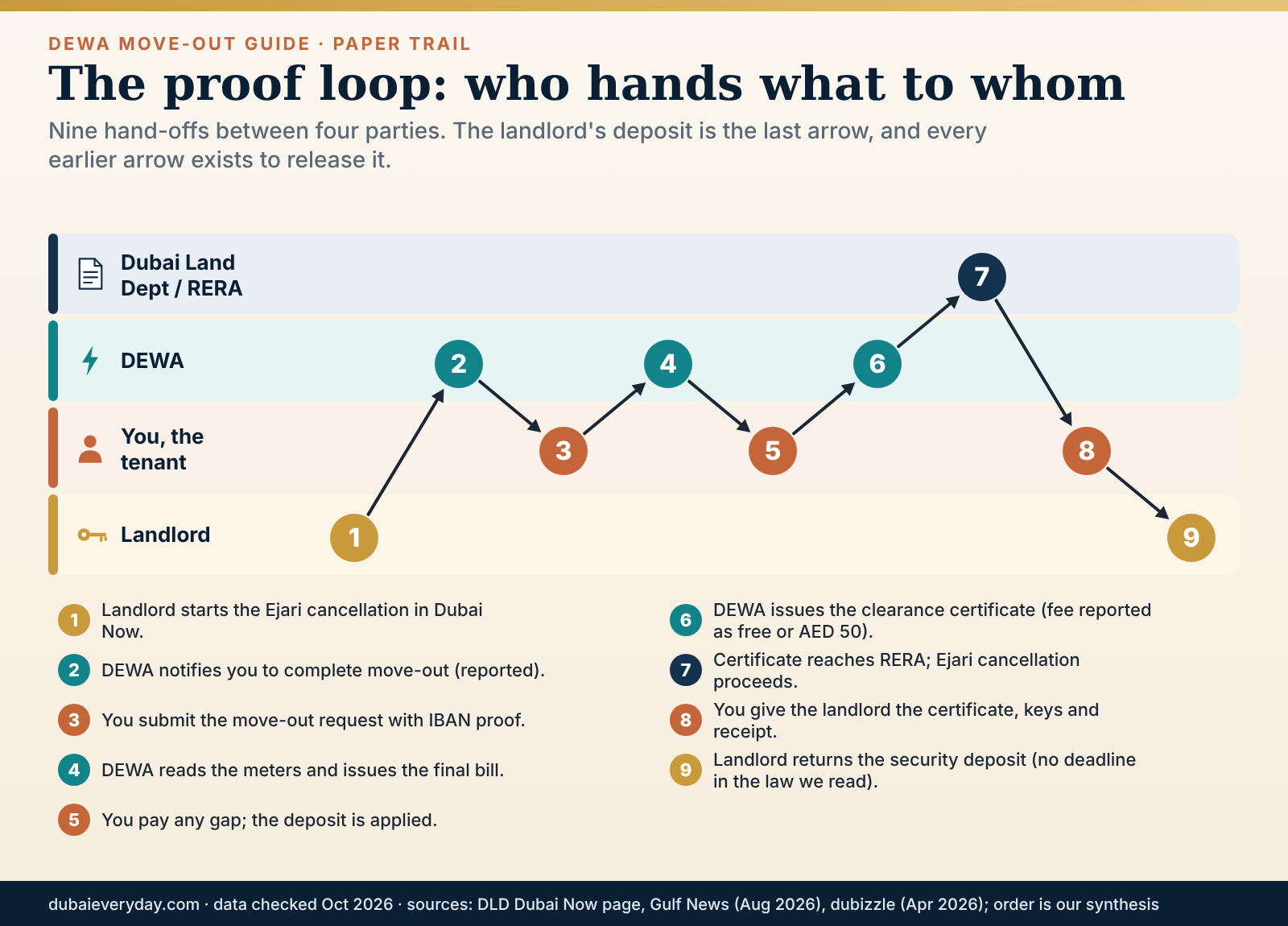
Reading across Gulf News (updated 19 August 2026) and dubizzle (April 2026), the integration works like this. The owner requests cancellation of the Ejari tenancy record. DEWA then notifies the tenant, and the tenant finishes the DEWA move out Dubai request through the link provided. After the final bill is paid, the clearance certificate is sent automatically to the tenant and to RERA, which lets the Ejari cancellation continue. That chain is why doing things in a random order costs people days.
The sequence we recommend
This is our synthesis of the sources, not a DEWA-published checklist. It assumes a normal residential tenancy ending on its date.
- Fix the handover date with your landlord in writing.Agree the day keys change hands and the day of the joint inspection. Every other date is counted back from this one.
- Give or confirm the Ejari cancellation route.Ask whether the landlord or agent will start the cancellation, and when. The owner starts it; you respond.
- Start district cooling cancellation if you have a separate cooling account.Providers often need a landlord-signed form, so this takes the longest to arrange.
- Submit the DEWA move out Dubai request for the handover date.Choose a slot at or just before the inspection so the final reading matches the day you leave.
- Pay the final bill and keep the clearance certificate.Store the PDF and the request number with your tenancy papers.
- Chase the refunds in order of size.Landlord deposit, DEWA surplus, cooling deposit, then anything small.
Notice that DEWA is fourth, not first. In a DEWA move out Dubai plan, cutting the electricity too early can leave you without lights or cooling for the cleaner and the inspection, and a cut after the keys are handed over leaves the landlord paying for your last days. The goal is a reading that matches the moment you stop being responsible, which usually means the handover day itself.
When this order changes
If your landlord is slow, do not let the whole chain wait. The DEWA move out Dubai request, the cooling request and your own cleaning can proceed in parallel, because they depend on you rather than on the landlord. Only the Ejari cancellation and the landlord’s deposit depend on the other party. If you are moving to another Dubai home, a different order applies; the Move-To section explains why you may not want a separate move-out request at all.
For the wider move, including documents, visas and banking, our Dubai relocation checklist carries the timeline. This guide drills into the utilities slice of that timeline, and for tenants it pairs naturally with tenant rights in Dubai, which covers notice, deposits and dispute options in more legal detail than we do here.
Timing a DEWA move out Dubai request: the countdown
The single most useful thing you can do for a DEWA move out Dubai request is count backwards from the day you hand over the keys. DEWA’s published service levels are measured in “working hours”, landlords answer messages on their own schedule, and Dubai’s weekend (Saturday and Sunday for most government services) swallows two days out of seven. A DEWA move out Dubai request that feels instant at 11 pm can still produce a final bill on the following Tuesday.

What each stage is for
The thirty-day mark is about paperwork that nobody else can do for you. Find your DEWA contract account number (ten digits) and premises number (nine digits) on an old bill or in the DEWA account, confirm your UAE Pass works, and decide where a refund should go. If you plan an IBAN refund, locate a bank document showing the IBAN and your name exactly as it appears on the DEWA account.
Two weeks out is when the slow accounts start. District cooling providers often want a form, sometimes signed by the landlord, and that can take days to arrange. This is also when to book cleaners and movers, and to ask your internet provider what its exit rules are. The home internet guide explains why fibre contracts are the other account people forget.
One week out, check the DEWA account for anything unpaid, because the DEWA move out Dubai form asks you to settle outstanding amounts before it proceeds. Then ask the landlord to confirm the inspection time and who will start the Ejari cancellation. That is a conversation, not a form, and it is easier a week early than on the day.
The five-day rule for submitting
Our suggestion is to submit the DEWA move out Dubai request three to five working days before handover. The sources describe the service as available around the clock, so nothing technically forces this. The reasons are practical: the form lets you choose a future date, so you lose nothing by submitting early; you can reschedule or cancel a submitted request if plans shift (dubizzle, April 2026); and an early submission surfaces blockers such as unpaid balances, a mismatched IBAN name or an account in someone else’s name while you can still fix them.
There is a trade-off. Some people worry that an early DEWA move out Dubai request cuts supply early. By the sources we read, supply is disconnected on the date and time you select, within 24 working hours, so the date you choose controls it. Pick the handover day, and pick a time that follows your cleaning and inspection rather than precedes it.
Worked timing examples
These dates are our own calendar arithmetic, using 29 October 2026 as a Thursday. They show how the weekend interacts with the reported 24 working hours; they are not DEWA commitments.
Example A: a Monday handover. Handover is Monday 30 November 2026. Submit by Wednesday 25 November at the latest, or Thursday 26 if you must. Choose a Monday late-morning slot. If disconnection and final bill each take their full 24 working hours, the bill could arrive Tuesday or Wednesday, and the clearance certificate follows payment. The landlord’s inspection and keys are not held up, because the reading is taken on the day.
Handover is Thursday 31 December 2026, and 1 January is a public holiday followed by a weekend. If “working hours” excludes holidays and weekends, a final bill could slide into the week of 4 January. Treat that as a planning risk, not a prediction. Ask the landlord to hold the deposit return until the bill and certificate are in hand, and agree that in writing before the holiday.
These examples make one point: the only date that matters to the landlord is the handover, but the dates that matter to you are the ones after it. If the lease end falls just before a weekend or a public holiday, shift the whole DEWA move out Dubai step earlier, not later. Confirm current public-holiday dates on the official UAE government calendar before you set the date.
When you cannot give five days
Sometimes the lease ends in two days. The process still works, but with less margin. Submit as soon as the contract account number is in front of you, clear any balance by card in the same session, and pick the earliest realistic slot. The risk in a rushed case is not the form; it is the IBAN. A mistyped or mismatched IBAN is the most common way a refund stalls, which is why we cover it in detail in the refund section.
The DEWA move out Dubai request, step by step
There are four doors into the same DEWA move out Dubai process: a login-based online route, a no-login online route, the app, and a Customer Happiness Centre. A fifth, the Customer Care IVR on 04 601 9999, works only when your account has no dues pending. For a DEWA move out Dubai request the online routes are the ones to use, because they give you a request number straight away and let you attach the IBAN proof.
What to have ready before you open the form
- Your ten-digit DEWA contract account number, from a bill or from your DEWA account.
- Your nine-digit premises number, if you use the no-login route.
- A UAE Pass or DEWA ID that is the account holder’s, with a mobile and email that still receive verification codes.
- A card to settle any outstanding balance in the same session.
- For an IBAN refund, a bank document showing the IBAN and the beneficiary name, matching the DEWA customer name.
- The move-out date for your DEWA move out Dubai request, and a time that matches your inspection.
The DEWA move out Dubai request online, with login
The Gulf News walkthrough (updated 19 August 2026), which follows the DEWA service guide, describes the DEWA move out Dubai request like this. Sign in on the DEWA website with your DEWA User ID or UAE Pass. Open Consumer, then Supply Management, then the DEWA move out Dubai service. Select your Contract Account Number. If anything is outstanding, pay it. Choose the move-out date and time, which is when final readings are taken. Choose your refund method. Verify with the code sent to your registered email or mobile. Submit.
After submission you receive an SMS and an email carrying a request number. Keep that number. It is the handle for tracking, rescheduling or cancelling, and for any later conversation with Customer Care. The sources also say the final bill is emailed to your registered address within 24 working hours of the requested disconnection, and that for a future date the clock starts at that date, not at submission.
The DEWA move out Dubai request online, without login
If you cannot get into your account, the no-login tab asks for the ten-digit contract account number and the nine-digit premises number, both printed on a bill. DEWA sends a one-time password to the registered mobile or email, and after that the steps match the login route: pay, choose date, choose refund method, submit. This is the fallback when UAE Pass is not set up, but it relies on the registered contact details being current.
That is where a DEWA move out Dubai request tends to fail for people who changed numbers. If the mobile on the account is one you no longer have, the OTP goes into the void. In that case a visit to a Happiness Centre with your Emirates ID is the way through, which brings us to the in-person route.
The app, DubaiNow and the Customer Happiness Centre
The DEWA Smart App follows the same steps as the website. DubaiNow, the Dubai government app, offers the service to individuals only (businesses are excluded, per the sources). Both are available around the clock according to Gulf News and dubizzle. If you start a DEWA move out Dubai request in the app and the form rejects an IBAN upload, switching to the website on a laptop is often easier for attaching documents.
In person, you visit any DEWA Customer Happiness Centre with the customer account number, the disconnection date, your UAE mobile number and your Emirates ID (Bayut, updated 21 October 2026). You then receive a link to choose the refund option and the move-out notification number. Opening hours reported by Betterhomes in June 2026 were 7:30 am to 3 pm Monday to Thursday and until 11:30 am on Friday, closed on weekends, with the Ibn Battuta Mall centre following mall hours. Confirm before travelling.
Who has to file a DEWA move out Dubai request
The request is made by the DEWA customer, meaning whoever holds the account. In a shared flat that may be a flatmate, an employer or a previous tenant, and that matters. Our reading is that only the holder (or someone with their login and OTP access) can submit it, so if your name is not on the account, the first step is to ask the holder to file or to confirm that the account was properly transferred. Check this early.
It is a reason to open the DEWA account at the start of a tenancy in the name of whoever will actually be around at the end.
Tracking, rescheduling and cancelling a DEWA move out Dubai request
dubizzle’s April 2026 summary says you can track, cancel or reschedule a submitted request, and that any outstanding amounts must be paid before a change is accepted. That is useful if the landlord pushes the handover by two days. It also means you should not leave a small unpaid balance for “later”, because it can block the edit you most need.
If a DEWA move out Dubai request goes wrong, say you picked a date in the past or a wrong time, do not submit a second one. Edit or cancel the first. Duplicate DEWA move out Dubai requests on one account are exactly the kind of thing that leaves a final bill split across two reference numbers, and we found no source describing how DEWA reconciles that. Confirm first with Customer Care on +971 4 601 9999, which the sources describe as available 24 hours.
What a DEWA move out Dubai request costs
The fee for a DEWA move out Dubai request is small; the confusion around it is not. Two current groups of sources give two different small-meter charges. Gulf News (updated 19 August 2026) and dubizzle (April 2026) list AED 125. Bayut (updated 21 October 2026), Property Finder (January 2026) and Square Yards (2023) list AED 100. Every source agrees on AED 300 for a large meter and on two government add-ons of AED 10 each, a knowledge fee and an innovation fee.
We cannot tell which is newer in practice, because the Bayut page text may be an older figure carried through an update. The honest approach is to plan for the higher number and be pleasantly surprised. The screen in front of you is the final authority, so read the amount before you confirm.
| Item (reported, 29 Oct 2026) | Small meter | Large meter |
|---|---|---|
| Move-out fee, higher current reading | AED 125 | AED 300 |
| Move-out fee, lower reading in other guides | AED 100 | AED 300 |
| Knowledge fee plus innovation fee | AED 20 | AED 20 |
| Our total, planning figure | AED 145 (or 120) | AED 320 |
| Move-To transfer, reported total | AED 250 | AED 650 |
The arithmetic, shown
Our calculation: AED 125 plus AED 10 plus AED 10 is AED 145; with the AED 100 reading it is AED 120. For a large meter it is AED 300 plus AED 20, which is AED 320. The Move-To figure of AED 250 comes from a Bayut list of AED 200 (small meters, activation and deactivation together), AED 20 knowledge, AED 20 innovation and AED 10 registration. Because the AED 200 looks like two AED 100 charges, it may predate the AED 125 figure. That is another “Confirm first”.
Discounts, VAT and who pays when
UAE nationals holding Thukher or Sanad cards get a 50% discount on deactivation charges, according to every guide that mentions them. It is not clear whether the knowledge and innovation fees are also halved, so the saving is somewhere between AED 50 and AED 72.50 depending on the base fee and the reading. Nothing we read mentions VAT on the DEWA move out Dubai fee, and nothing says whether the fee is taken at submission or netted against your deposit. Confirm first.
The fee for a DEWA move out Dubai request is a small part of the money in play. The DEWA deposit alone is reported at AED 2,000 for an apartment, so a fee of AED 145 is about 7% of it. The money to protect is the deposit, and the fee is simply the cost of an orderly exit. For a view of where utilities fit among other monthly costs, the cost of living in Dubai guide puts it in context.
The demolition variant
Demolition move-outs have a separate fee schedule in dubizzle’s summary: AED 100 (small) or AED 300 (large), plus an AED 100 admin fee and the AED 10 and AED 10 add-ons, and a demolition NOC issued within ten working days after the final bill is paid and the clearance certificate follows. That is unlikely to concern a tenant leaving at lease end, but it shows why the first screen of the form asks what kind of move-out you are making. Choose the ordinary option unless you are told otherwise.
Final reading and final bill: how the last number is made
The final bill in a DEWA move out Dubai exit is DEWA’s last statement on your account: consumption between your previous bill and the move-out date, plus whatever else was due. The guides we read say that, in a DEWA move out Dubai request, the supply is disconnected on your selected date and final readings are taken then. Bayut’s older text mentions staff visiting to read the meter, while newer guidance simply says readings are taken on the date.
Dubai has been rolling out smart meters, so some readings may be remote. We did not find a source that settles which applies to your building.
What is on the bill
A DEWA statement is made of the same building blocks on a DEWA move out Dubai exit as during the tenancy. Electricity is charged in slabs per month: 23 fils per kWh up to 2,000 kWh, 28 fils from 2,001 to 4,000, 32 fils from 4,001 to 6,000 and 38 fils above, under Executive Council Resolution 16 of 2011.
A fuel surcharge sits on top (reported as 6 fils per kWh in 2026 guides and set monthly by DEWA). Water is charged in cubic metres, reported at AED 7.70, AED 8.80 and AED 10.12 across three slabs of 0 to 27, 27.01 to 54 and above 54 cubic metres, following DEWA’s switch from gallons in the March 2025 billing cycle. There may be a small meter or service charge, and VAT of 5%.
Separately, if you pay the Dubai Municipality housing fee through DEWA, it is part of your bill stream. The fee is reported as 5% of annual rent, collected in monthly instalments, with UAE nationals exempt. We found no source explaining what happens to it on exit, whether the last instalment is prorated, or whether a refund is automatic. Confirm first, and keep your final bill to compare against it.
Illustrative example: a short final bill
Illustrative example (not a quote or market fact). A one-bedroom apartment, and you move out 12 days after your last bill. Assume 380 kWh and 9 m³ in that period, and that DEWA applies the first slab to the whole period. Electricity: 380 × AED 0.23 = AED 87.40. Fuel surcharge at the reported 6 fils: 380 × 0.06 = AED 22.80. Water: 9 × AED 7.70 = AED 69.30. Subtotal AED 179.50. VAT at 5% = AED 8.98. Final bill AED 188.48.
Against a AED 2,000 deposit, the surplus is AED 1,811.52. If the AED 145 move-out fee were netted from the deposit, the refund would be AED 1,666.52. Whether a part-month bill is prorated this way is not documented in anything we could read, so use this only to see the logic, not to forecast your number.
A heavier example for a villa
Illustrative example (not a quote or market fact). A villa in a hot month: 6,500 kWh and 70 m³ for the billing period. Electricity slabs: 2,000 × 0.23 = 460; 2,000 × 0.28 = 560; 2,000 × 0.32 = 640; 500 × 0.38 = 190; total AED 1,850. Surcharge: 6,500 × 0.06 = AED 390. Water: 27 × 7.70 = 207.90; 27 × 8.80 = 237.60; 16 × 10.12 = 161.92; total AED 607.42. Subtotal AED 2,847.42; VAT AED 142.37; bill AED 2,989.79. On a AED 4,000 villa deposit, that leaves AED 1,010.21.
The point of the second example is not the number but the scale: a villa tenant who runs air conditioning through the summer can burn through most of the deposit in a single bill. If your lease ends in August, expect the surplus to be much smaller than the deposit you remember paying. The villa rental guide explains why cooling loads and garden watering make villa bills so different from flats.
“Due immediately” and what that means
Gulf News says the final bill from a DEWA move out Dubai request is due immediately on receipt. In practice that is a prompt for you to open the email within the day and settle. The deposit covers the bill, so for many tenants “paying” means DEWA applying the deposit and then refunding the surplus; for others it means a card payment of the difference. The sequence in the sources is: deposit applied first, then surplus refunded or shortfall billed.
If the bill exceeds the deposit, you will see a balance due. Pay it promptly by card, because the clearance certificate waits on a settled account, and your landlord’s deposit return may wait on the certificate. A balance of AED 80 can hold up a AED 4,000 landlord deposit if the landlord insists on the certificate. That asymmetry is the best argument for paying small gaps within minutes.
If you think the final bill is wrong
Photograph both meters on handover day with the date visible, the electricity and the water, and keep the images with your tenancy papers. If the final bill shows consumption you cannot explain, contact DEWA Customer Care on +971 4 601 9999 with the request number and your photos, and ask for the reading to be checked. Property Finder’s guide on inherited bills also recommends keeping the Ejari certificate, the contract and a move-in report. We did not find an official DEWA dispute timetable, so act quickly and keep everything in writing.
One more thing to watch is a bill that arrives for the wrong period because a prior estimated reading was adjusted. That belongs to the world of smart-meter exceptions and is rare, but when the account has had a long gap between actual readings, ask Customer Care to explain the period on the final bill before you pay. Paying first and querying later still works, but it puts your money at DEWA’s pace rather than yours.
DEWA deposit refund in Dubai: how the money comes back
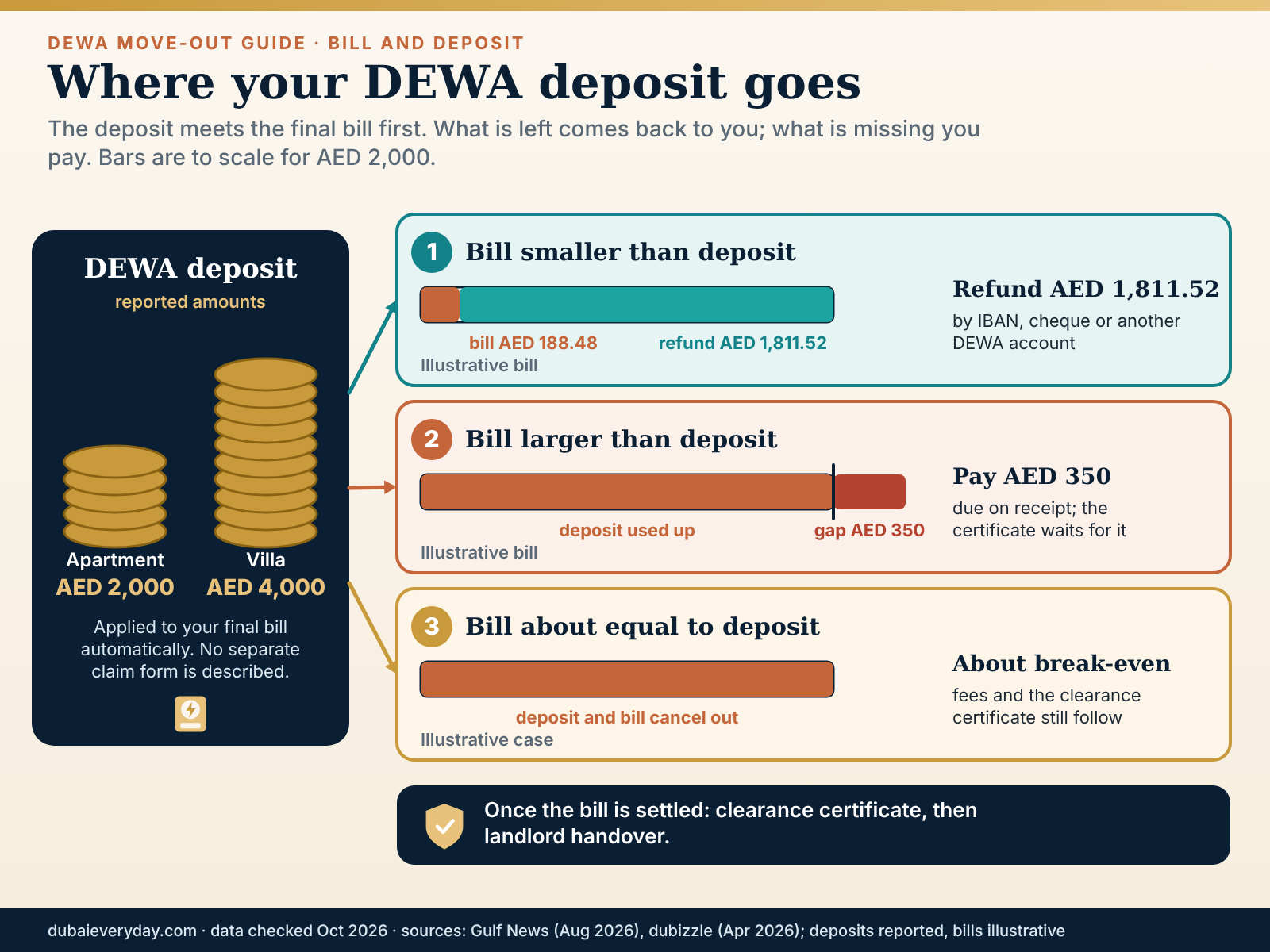
In a DEWA move out Dubai request, your DEWA deposit is not a separate pot you claim afterwards. By the descriptions in Gulf News and dubizzle, it is applied to the final bill automatically, and whatever remains is refunded through the method you picked in the form. Gulf News adds that the refund is processed automatically and that you do not need a separate refund application. That one detail removes a step many older guides still describe.
The three outcomes
Every DEWA move out Dubai request ends in one of three places. The bill is smaller than the deposit, and you get the surplus. The bill is larger than the deposit, and you pay the gap. Or the two nearly match and nothing much moves. In our illustrative figures, a AED 188.48 bill against a AED 2,000 deposit leaves AED 1,811.52 to come back, while a AED 2,350 bill against the same deposit leaves AED 350 to pay.
The second case surprises people because they remember the deposit as “my money”. It was a security against exactly this. If you stay in a flat through a hot summer and your final bill is larger than the deposit, the gap is yours to pay, and the sources say it is due immediately.
Choosing a refund method in your DEWA move out Dubai request
The most recent guides list three refund options in the DEWA move out Dubai form: bank transfer to an IBAN, a cheque, or a transfer to another active DEWA account. A fourth choice, to apply for the refund later, appears in Bayut and dubizzle. Older guidance and Property Finder’s January 2026 FAQ also mention Western Union as a payout option. Gulf News (August 2026) does not list it, so we treat it as probably retired and would not plan around it.
Our reading is that the IBAN is the right choice for almost everyone. It is traceable, it needs no collection trip, and it is the only option with a documented identity check. The DEWA account transfer is the clever one when you are moving to another Dubai home: the surplus lands against the new account instead of in a bank, and you can cover the new deposit shortfall without a second payment. Cheques are slower and rely on a postal or collection route we could not verify.
Getting the IBAN right
According to Gulf News, an IBAN refund requires you to attach bank proof showing the IBAN and the beneficiary name, the beneficiary name must match the DEWA customer name, and only one IBAN can be used per request. That is three separate ways to fail.
- Use a bank letter or app statement, not a screenshot cropped to the number.
- Match spelling and order of names to the DEWA account, including middle names if DEWA shows them.
- Prefer an account in your sole name. Whether a joint account passes the name check is not described anywhere we looked.
- Do not close the bank account before the refund lands, especially if you are leaving the UAE.
If you moved out and later discover the IBAN was wrong, the sources do not describe a correction route. Contact DEWA Customer Care at once with your request number. Because the beneficiary must match the customer name, the fix is a case for a human agent, not a form.
How long should you wait?
No guide we read states a processing time for a DEWA deposit refund. Gulf News and dubizzle both say so by omission, and dubizzle states it outright. One secondary source we came across while researching the move-in side mentioned refunds of up to AED 4,000 landing in as little as eight minutes after an April 2026 update; we could not confirm that on DEWA’s own pages and would not rely on it.
Our suggestion for a planning rule: expect the final bill within about a day of disconnection, then give the refund a week of working days before you chase. That is a judgement call, not a DEWA commitment. When you chase, quote the request number from the SMS and say which refund method you chose. Customer Care can see whether the refund has been released and to which IBAN.
Owners, companies and joint accounts
If you own the property and are not selling, think twice before closing the account. One property portal we read said an owner’s deposit becomes refundable only on sale, while others describe refund on closure after bills are cleared. The sources conflict, so owners should confirm with DEWA before assuming. Tenants in company-leased housing should check whether the company holds the account, because the refund then belongs to the company and its IBAN, not yours.
A last point on shared flats. If three people split one DEWA account, the refund goes to one IBAN. Agree in writing before the request who gets what, because DEWA will not divide it for you. The same applies to a landlord’s deposit, which we turn to in a later section.
The clearance certificate and the proof loop
The clearance certificate is DEWA’s statement that your account is settled. Landlords like it at the end of a DEWA move out Dubai because it is hard to fake and it ends the argument about whose electricity bill that was. Gulf News describes it as part of the DEWA move out Dubai flow: it is issued automatically once the final bill is paid and shared with RERA. DEWA also runs a separate clearance certificate application, which suits cases outside the standard residential flow.
Automatic versus requested
In the standard residential DEWA move out Dubai flow, you do not apply for the certificate. After the final bill is paid, DEWA sends it to you and to RERA, and the Ejari cancellation can proceed. The separate application route is for people outside that flow, such as property sellers and businesses, or for tenants whose landlord asks for a fresh copy.
The separate application is available on the DEWA website, the Smart App and DubaiNow, with the IVR open only to customers who have no dues. Bayut (2024) says tenants who are vacating use the first of four categories. Property Finder (2024 and 2025) says the service is free of charge and the certificate is valid for 30 days, delivered by email and downloadable with a PIN. Engel & Völkers (December 2025) says AED 50 plus VAT. We could not reconcile the two, so check the amount on screen.
How long it takes
Reported timings run from “immediately after the final bill is paid” (Property Finder), to “typically within 24 hours” when vacating (Bayut), to up to three business days when dues or checks remain (Engel & Völkers), to one to five business days after settlement (a separate Property Finder explainer on inherited bills). The spread is wide, and the cleanest reading is that it depends on whether the account is fully settled.
Plan on one working day after payment and treat anything under five as normal. Ask your landlord up front whether they accept the PDF from your email or only a download from your own DEWA account. It saves a round trip.
Validity and what to do with it
A standalone certificate is reported valid for 30 days from issue. If your landlord takes three weeks to arrange the inspection and a second cycle of delays hits, the certificate may expire, and you would need a new one. Send the certificate to the landlord on the day you get it, with the request number and the date of the final reading. Keep the original email.
The landlord, in turn, should check it. The Property Finder explainer on inherited bills notes that a screenshot of a bill is weaker proof than a clearance. If you ever need it for a deposit dispute, the certificate is the cleanest single document you can hold, and the Rental Disputes Centre context for it is covered in our tenant rights guide.
The district cooling twin
DEWA’s certificate covers electricity and water only. If your building uses district cooling, Gulf News’s deposit-recovery guide lists a district cooling clearance as a second item to obtain “where applicable”. A landlord who asks for “all utility clearances” is therefore asking for two papers. We cover the cooling side in a later section; the point here is not to hand over the keys with one of them missing.
Ejari cancellation and the landlord handover
Ejari is the Dubai Land Department’s register of tenancy contracts, and it is the record DEWA uses when it connects a tenant at move-in. At a DEWA move out Dubai exit the register has to be cleaned up too. Cancelling the Ejari removes the contract from the register once it has expired, been terminated or the property has been vacated. It is also the step that frees the property for the next tenant, because only one Ejari can be active per property.
Who starts it
On the Dubai Land Department’s own page for the Dubai Now service, the owner starts the cancellation. The owner opens the Property Wallet, selects the property, chooses “Cancel Tenancy Contract”, fills in the fields and submits the request to the tenant. The tenant logs in, reviews it and approves or declines. The page says the service is for individuals who own and manage their own property, requires a valid Emirates ID and lists no termination fee.
That is the official picture, and it matches what dubizzle (modified September 2026) says about other channels: online cancellation through the Ejari system or the Dubai REST app is free, a Real Estate Trustee Centre charges AED 40 plus VAT, and a tenant cannot cancel without the owner’s consent or a letter from the owner. We rate the dubizzle fees as reported, not confirmed, because the DLD page does not list them.
Where DEWA fits
The DLD termination page does not mention DEWA clearance. The link comes from the DEWA side: Gulf News and dubizzle both describe the integration in which the landlord’s cancellation request prompts DEWA to notify the tenant, the tenant completes the DEWA move out Dubai request, and the clearance certificate then goes to the tenant and to RERA so the cancellation can continue. Gulf News limits this to residential Ejari cases with a single premises number. Owners, businesses and free-zone cases use DubaiNow or DEWA’s digital channels instead.
For a tenant planning a DEWA move out Dubai, the lesson is to ask the landlord a simple question early: “Will you start the Ejari cancellation yourself, and by which date?” If the answer is yes, expect a DEWA notification and respond to it quickly. If the landlord uses a property management company, the DLD page’s “individuals only” wording suggests the route may differ, and we found no source describing it. Ask the agent.
If the landlord will not cancel
A tenant cannot cancel the Ejari alone by the sources we read. What you can do is protect yourself: file your own DEWA move out Dubai request, pay the final bill and hold the certificate; put the handover in writing; and keep the Ejari certificate and contract. We found no source saying an uncancelled old Ejari blocks your next one, since each registration is tied to a property. The stuck party is the landlord, who cannot register the next tenant, so the incentive to act runs in your favour.
Early exits and breaks are a legal topic, not a utilities topic. Law 26 of 2007 does not allow either side to end a fixed-term lease unilaterally (Article 7, as summarised on the Dubai Legislation Portal), and what penalty applies is a matter of your contract. Our tenant rights guide and the broader Dubai legal basics for residents are the places to start, and a licensed adviser is the place to finish.
The handover itself
The handover is where the DEWA move out Dubai reading, the Ejari cancellation and your landlord’s deposit all meet on one day. Three items make it smooth. First, a joint inspection against the condition recorded at move-in, because Article 21 of the tenancy law requires the unit be returned in the condition received, ordinary wear excepted. Second, a signed handover form or key receipt. Third, meter photos.
- Photograph the electricity and water meters with the date visible, before and after you turn off the main switch.
- Photograph every room, including wardrobes, the balcony and the kitchen appliances, with timestamps.
- Collect keys, access cards, parking tags and remote controls, and get a receipt for the count.
- Ask the landlord or agent to write “received” and the date on a one-page form, and take a photo of it before you leave.
- Keep your clearance certificate request number with the form.
Cleaning matters because “ordinary wear” is the line that deposit disputes turn on. A professionally cleaned unit removes the most obvious ground for deductions. Our guides to deep cleaning in Dubai and to choosing a cleaning service cover scope and booking quality, and the sofa cleaning guide helps if furnished-flat upholstery is in your contract. Some buildings also charge for lift booking or move-out deposits; we found no verified figures, so ask building management in writing.
Your landlord’s security deposit is a different animal
People mix up three deposits all the time, and the mix-up leads to wasted calls. The DEWA deposit is held by DEWA and tied to your utility account. The landlord’s security deposit is held by the owner or agent under your tenancy. The cooling deposit is held by the district cooling operator. Each has its own refund route, its own paper and its own timeline.
| Deposit | Held by | Size (reported) | Released after | Paper that unlocks it |
|---|---|---|---|---|
| DEWA deposit | DEWA | AED 2,000 apartment, AED 4,000 villa | Final bill settled | Move-out request number |
| Landlord security deposit | Owner or agent | Custom 5% unfurnished, 10% furnished; no statutory cap found | Handover and inspection | Clearance certificate, key receipt, handover form |
| District cooling deposit | Emicool, Empower or another provider | Emicool: 8 months of capacity charge | Final bill settled | Cancellation form, original deposit receipt |
What the law says, in one paragraph
Under Law 26 of 2007, Article 20, the landlord may take a deposit to cover maintenance and must refund it, or the balance, when the tenancy ends. Article 21 requires the tenant to return the premises as received, excluding normal wear and tear. A Dubai Land Department news item from October 2020 describes the Rental Disputes Centre ordering a AED 6,000 deposit refunded after the landlord delayed, and reports that delay does not defeat the right. Neither the law text we read nor Gulf News names a deadline for the refund.
The order of play when the landlord stalls
Gulf News (updated 1 October 2026) lays out a sequence that we would follow. Check the contract and Ejari. Gather evidence. Obtain the DEWA clearance and any cooling clearance. Request an itemised breakdown of deductions with photos and third-party invoices or quotes. Send a formal written demand with a deadline, which one lawyer quoted there puts at typically five to seven days. Then seek mediation through the Rental Disputes Centre’s Amicable Dispute Settlement Centre, where a settlement is described as immediately enforceable.
That sequence works because it builds a paper trail before it asks for anything. Landlords who delay for no reason often move when a tenant sends a calm, specific email with attachments. Landlords who have a genuine claim for damage will answer with a list, which is also what you want, because a list can be argued line by line.
Costs of escalating, in our arithmetic
If mediation fails, a claim goes to the Rental Disputes Centre. The DLD first-instance filing page lists a court fee for financial claims of 3.5% of the claim, with a minimum of AED 500 and a maximum of AED 15,000, plus small fixed fees. Our calculation: 3.5% of AED 3,000 is AED 105, and of AED 5,000 is AED 175, so both fall to the AED 500 minimum. The percentage only overtakes the minimum above about AED 14,286.
That matters for decisions. Suing over a AED 1,000 deduction costs at least AED 500 in court fees before any other cost, so a disputed amount that small is usually better settled through the amicable route or negotiated down. A AED 6,000 deposit is worth filing over. Check the current schedule before you decide, and note that this is general information, not legal advice.
What you can do before you ever need that
Most deposit disputes are decided by photographs. Take them at move-in, and keep the move-in report. Our apartment viewing checklist and renting in Dubai guide describe how to document a unit at the start, which is the evidence that makes an exit clean. If that ship has sailed, reconstruct the condition from messages, listing photos and the move-in report, and flag gaps honestly.
District cooling, gas, internet and other accounts
DEWA is only one of several accounts that attach to a Dubai home. Many towers on district cooling run a separate bill from a provider such as Empower or Emicool, usually with a separate deposit. Fibre internet has its own contract. Some buildings have central gas billed by a supplier.
Completing a DEWA move out Dubai request does not close any of these, and the landlord who wants “all clearances” may mean all of them. If you are unsure whether your flat has a cooling account, check the tenancy contract and any bill that is not from DEWA; our apartment rental guide explains the chiller-included versus chiller-free distinction that decides who pays.

Emicool: the operator’s own process
Emicool publishes a move-out process document. Cancellation documents go in through an office counter (Dubai Investments Park or Motor City), by email to the customer care address, or by upload on the customer portal. Before submitting, the bill up to the last invoice and the processing fees must be paid. If you want the refund by bank transfer, update your IBAN in the portal’s account information; otherwise Emicool processes an account payee cheque. It says it prepares the final bill within 24 hours, deducts it from the security deposit and refunds the rest.
On the Emicool FAQ page, the security deposit is described as eight months of the contracted capacity charge, and the call centre is 600 534 440, daily from 8 am to 9 pm. Company tenancies receive the cheque in the company’s name and need an authorisation letter on letterhead naming the person who will collect it.
The dubizzle guide (modified 30 September 2026) describes a longer process: a cancellation form signed by tenant and landlord, a process of two to five working days, a final bill within three working days and the refund within five days. Those timings differ from Emicool’s own 24 hours. We would trust the operator’s document for what the system aims at and plan with the guide’s slower figures, because a landlord’s signature is the slow part.
Empower: settlement request and refund appointments
For Empower, the same dubizzle guide and a Gulf News guide (older, July 2024) describe an online settlement request: sign in to the customer portal, open My Services, submit a Settlement Request with the account or premises number, settle outstanding charges, upload Emirates ID, passport and Ejari, accept the terms and submit. The final bill is reported within two working days, although the FAQ in one guide says two to three.
The unusual feature is the refund. Both guides say Empower issues refunds only through pre-booked appointments: you book a slot in the portal, then bring the original deposit receipt and your original Emirates ID or passport. Cash is capped at AED 5,000 and larger amounts are paid by cheque. A landlord NOC is reported as necessary only if you end the contract early. We did not read Empower’s own pages, so treat all of this as reported and verify before you start.
An illustration of cooling-deposit scale
Illustrative example (not a quote or market fact). Suppose a flat’s contracted capacity charge came to AED 190 a month. Eight months, Emicool’s stated deposit basis, would be AED 1,520. The real figure depends on the unit’s contracted capacity and the provider’s rate, so use this only to see that a cooling deposit can rival the DEWA deposit in size. Ask your landlord or the provider’s contract for the real number.
Gas, internet and the quiet extras
For central gas, a Gulf News article on move-in costs (updated 22 October 2026) puts a new connection or transfer at roughly AED 600 to 800, with a deposit possible for central gas. We found no verified procedure for closing a gas account, so ask the building manager or the supplier named on your bill, and request a final reading in writing.
For internet, the main risk is the contract rather than the cancellation form. Minimum terms, early-termination charges and router returns vary by plan, and we have no verified figures for them. Read your own contract, then see our home internet guide for how du and e& installation and availability work, and the wider internet and mobile guide for mobile plans, eSIM and the digital accounts that tie to your address. If the new home is in a building served by the same operator, ask about a relocation instead of a cancellation.
- Cooling: cancel, pay the final bill, keep the clearance.
- Gas: request a final reading and confirm no balance.
- Internet: check the end date, return equipment, keep the return receipt.
- Building: return access cards and parking tags, collect receipts.
- Furniture rental or appliance plans: confirm collection dates before handover.
Finally, the order within the cooling track matters. Start it earlier than DEWA, because it needs the landlord’s signature in at least one reported case. A DEWA move out Dubai request on its own does not stop a cooling account, and an unpaid cooling bill can block a landlord’s clearance just as a DEWA balance can.
Moving within Dubai: Move-To or move out plus move in?
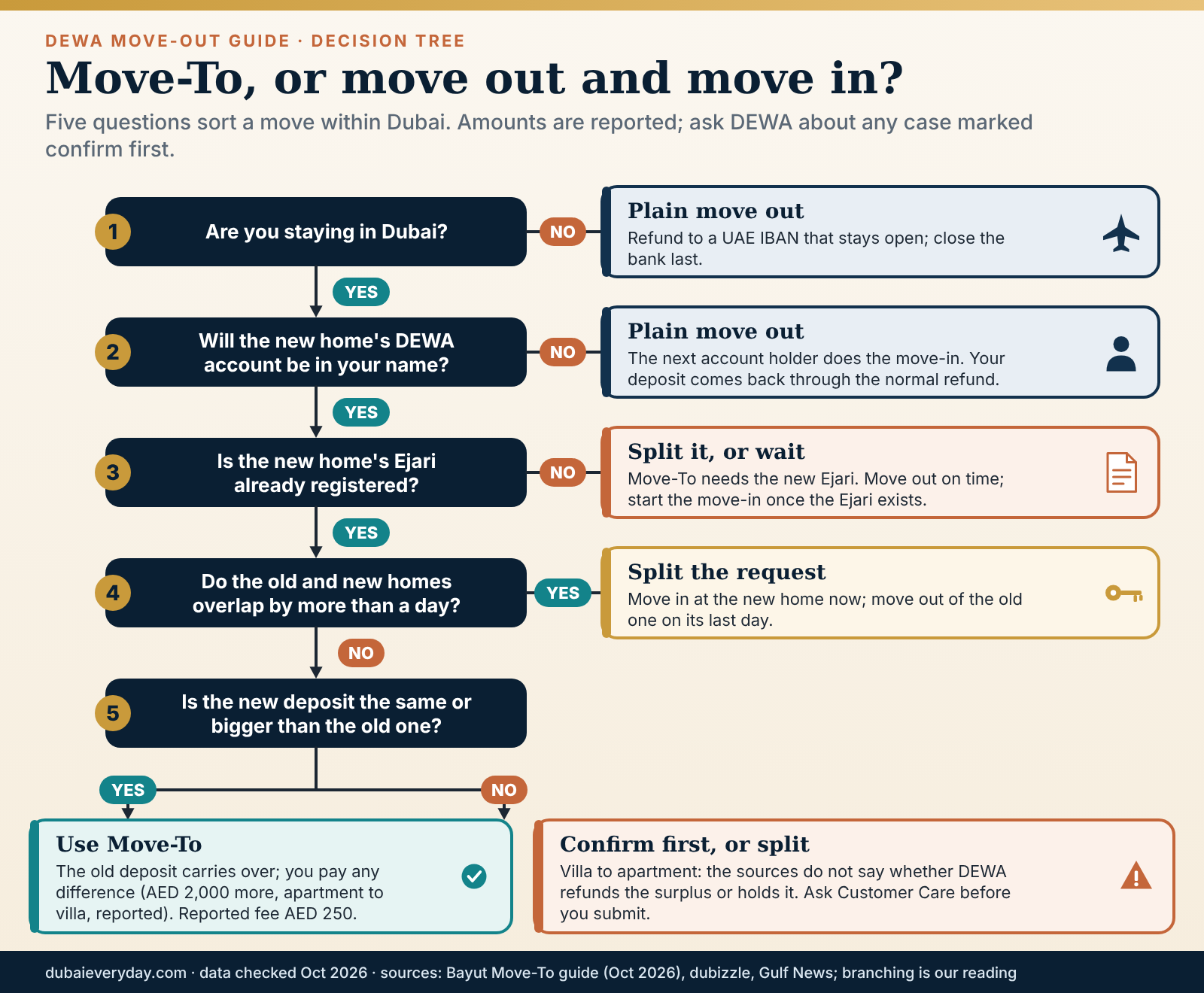
If you are not leaving Dubai, DEWA offers a combined service called Move-To, which transfers your account from the old home to the new one in a single request. It is the neat answer for many households, but it comes with constraints that make a separate DEWA move out Dubai request and move-in the better choice in some cases. This is where this page meets our DEWA move-in guide: Move-To is the bridge between the two.
How Move-To works, compared with a DEWA move out Dubai request
Bayut’s guides (updated 21 October 2026) describe it. Sign in with a DEWA ID or UAE Pass, open Transfer of Electricity/Water (Move-to), and clear any outstanding bills first. Then enter the premises number of the old home, the date and time of the move-out, the premises number of the new home, the contract account number of the current home, and the Ejari number of the new home when you apply through DEWA channels. Submit, and you receive a tracking number.
The deposit moves with you. If the new home needs a higher deposit, for example from apartment to villa, you pay the difference, and the new supply starts only after that is paid. The old premises are disconnected on the date you specify, and a final bill is issued for them. The page does not give a processing time for the transfer.
What it costs against doing it separately
Reported Move-To fees for small meters are AED 200, plus AED 20 knowledge, AED 20 innovation and AED 10 registration: AED 250. Our calculation for the separate route, using the reported DEWA move out Dubai total of AED 120 to 145 and the move-in total of about AED 130 to 155 from our move-in guide, is AED 250 to 300. So the fee is roughly a wash. The gain from Move-To is not the fee but the deposit: it carries over rather than being refunded and paid again.
When to split the request
Three situations argue for a separate DEWA move out Dubai request and move-in. The first is overlap. If you get the keys to the new place a week before you leave the old one, Move-To ties both events to a single date. A separate move-in lets the new home be live early, and a move-out on the old home’s final day closes the old account on time.
The second is the name on the new account. If your flatmate or employer will hold the new DEWA account, there is no transfer to be made, and your own deposit should come back through the normal refund. The third is the Ejari sequence. Move-To needs the new home’s Ejari, which only exists after the new lease is registered, so a slow landlord can hold up the whole transfer while the old date ticks closer.
Surplus when the new deposit is smaller
Moving from a villa to an apartment raises a question the sources leave open: does DEWA refund the excess deposit, or hold it against the new account? Bayut describes the extra-payment case but not the surplus case. That is another “Confirm first”. If you expect a large villa-to-apartment surplus, ask Customer Care before you submit, and consider the separate route, where the refund path is documented.
Whichever route you take, a DEWA move out Dubai or Move-To, the new home still needs the set-up work in our home set-up guide: Ejari, DEWA, internet, cooling and the first-week checklist. Move-To replaces one piece of the DEWA move out Dubai route, not the rest.
Leaving the UAE on a short runway
Leaving Dubai for good compresses everything, including a DEWA move out Dubai request. A flight date replaces the handover date, and the refunds have to reach you after you have gone. The DEWA move out Dubai process itself does not change, but the margin for error does, because you cannot pop into a Happiness Centre from another country. The sources we read describe no separate “leaving the country” version of the DEWA move out Dubai process, so this section is our planning layer on top of the standard one.
The seven-day DEWA move out Dubai plan
Assume you have a week. Residence visa cancellation, final salary and end-of-service benefits belong to other guides (the residence visa guide and the relocation checklist are the starting points); this plan covers the home and its utilities.
- Day 7: lock the dates.Agree handover day with the landlord. Book the DEWA move out Dubai slot for that day, not the flight day, and submit the request.
- Day 7: choose an IBAN you will keep.Use an account that will stay open for at least a month after you leave. Attach the bank proof in the DEWA form.
- Day 6: start cooling cancellation.If you have a provider, send the form and get the landlord’s signature where required.
- Day 5: ask the landlord for a bank transfer return.Request in writing that the security deposit goes to the same UAE account, and agree a date.
- Day 3: clean and photograph.Book cleaning, take timestamped photos, and gather keys, cards and tags.
- Day 0: handover.Joint inspection, meter photos, signed receipt. Leave a person who can respond if the landlord needs something.
- Day 1 to 7 abroad: pay and file.Settle the final bill online, download the certificate, forward it to the landlord, and watch for the refunds.
Why the bank account matters most
The refund path that the sources document in most detail is the IBAN. Gulf News requires bank proof, a matching beneficiary name and a single IBAN. We found no source that lets you name a foreign bank account, so assume a UAE IBAN. If you close the UAE account on the day you fly, the DEWA surplus, the landlord’s deposit and the cooling refund all have nowhere to land.
The practical rule: close the bank account last, after every refund has arrived or after you have confirmed in writing where each one is going. A cheque is the fallback, but a cheque issued to someone who has left the country is a slow route. Our guide on moving to Dubai describes how people open accounts on arrival; the exit is the same journey in reverse.
When someone else has to act for you
An authorised friend or relative can often attend an inspection and collect keys, but we found no verified rule for what DEWA or the landlord requires to accept a representative, such as a power of attorney. For DEWA, the online route needs OTP access to the registered mobile or email, so if you are leaving the country and changing your SIM, keep the old number alive until the refunds arrive. For anything that would require signing for you, ask the landlord and DEWA in writing what they accept, and use a licensed adviser for anything legal.
What if you leave without closing DEWA?
The account stays open under your name, consumption keeps being billed if the unit stays connected, and the clearance certificate that your landlord needs will not exist. A Property Finder explainer (updated April 2026) cites a Rental Disputes Centre position that tenants must settle their utility charges and provide the clearance when vacating, and notes that landlords may use the security deposit to settle a vanished tenant’s liability. In other words, you lose the deposit twice: once to the utility and once to the landlord’s cleanup. A planned DEWA move out Dubai request costs AED 145 and a few minutes.
Pets, school, insurance and other tails
Utilities are not the only tail. If you have a pet, the municipality records in our pet registration guide and the wider pets in Dubai guide tell you what to check. School families should look at the withdrawal terms in the Dubai schools guide. Insurance policies tied to the address or the visa are covered by the Dubai insurance guide, and the notice rules differ policy by policy. We do not give cancellation terms for any of these, because we did not verify them.
New address: what to update after your DEWA move out Dubai
Once the utilities are closed, the next job is making sure the world finds you at the new place. The first thing to say is that no single national “change of address” form exists in the sources we read. Updating an address in Dubai is a collection of separate tasks, each with its own owner. Some of those are official, some are commercial, and some are just courtesy. We rank them by consequence.
Money first: banks, cards and insurers
Banks, card issuers and insurers send documents and sometimes act on the address they hold. Tell them before the move, not after, and ask what proof they want. We have no verified procedure for any specific bank, so we do not list one. If your salary or direct debits depend on an account, confirm that the contact details for verification codes will still work at the new address and on the same phone number.
Identity second: Emirates ID and residency records
The Federal Authority for Identity, Citizenship, Customs and Port Security (ICP) runs the Emirates ID and residency records. A Bayut explainer on updating the card, undated and with its latest reference from 2023, describes an address and occupation as variable, non-key data and lists an “Update Personal Information” service reachable with UAE Pass. It quotes AED 200 for the online update and AED 340 for an in-person one, and says changes should be reported within a month. Its online list of fields does not name address.
That is not strong enough to promise you anything. Our reading is that you should open the ICP app or website, look at what your own record shows, and update it only if an address field is present and wrong. Confirm first. If you need a new card, the charges and timing in that explainer are old, so ask the app.
Utilities and the housing fee at the new place
Your DEWA connection at the new address is the move-in story, with its Ejari integration, deposit and activation, and it is told in our move-in guide. One link between the two stories is worth flagging here: the Dubai Municipality housing fee is reported as 5% of annual rent, collected through DEWA in monthly instalments, so a change in rent changes the monthly amount. A Bayut explainer on the fee reports that the rent record is updated with the municipality through UAE Pass in about three working days. Confirm that with the municipality if your bills look wrong after you move.
Everything else, in a sensible order
- Employer and HR: the address can matter for letters, insurance and some benefits.
- Mobile and home internet: move or recontract, and update the billing address.
- Vehicle and driving records: check the RTA channels for what they hold.
- School and nursery: transport routes and emergency contacts.
- Pet records: municipality and vet details.
- Delivery apps, supermarkets and online shops: remove the old address so parcels do not chase you.
- Friends and the post: a short message does the job.
For grocery delivery and the cost of re-establishing routines, our supermarket guide and Carrefour guide are handy once you are in. The point of the ranking is that missing a bank letter costs real money, while a delivery to the old flat costs a phone call.
A short note for families
Families with school-age children or babies have a longer tail: school transport, clinic registrations and nursery contracts. The Dubai with kids guide and the baby guide cover the everyday logistics, which is a gentler read than a utilities form. Build the move so the children’s routines are the last thing disturbed, not the first.
Seven scenarios, worked through
The process is easier to judge on real-shaped cases. These are constructed examples, not stories about real people. Their numbers are illustrative, built from the reported deposits and fees above, and they are there to show the order of events and the arithmetic.
Scenario 1: a standard DEWA move out Dubai, Monday handover
A tenant ends a lease on Monday 30 November 2026. Rent was AED 85,000 and the landlord holds a deposit at the customary 5%, which is AED 4,250. The DEWA deposit is AED 2,000. Together that is AED 6,250 of the tenant’s money sitting with other people. The tenant submits the DEWA move out Dubai request on Wednesday 25 November for a Monday late-morning slot, with an IBAN refund and bank proof attached.
On the Monday, the landlord inspects, signs a receipt and the meters are photographed. DEWA’s final bill arrives the next day. The tenant pays any gap by card the same hour, the clearance certificate arrives, and the tenant sends it to the landlord with the receipt photo. The DEWA surplus follows in days; the landlord’s deposit follows when the landlord is ready. In this DEWA move out Dubai, the order mattered more than any single number.
Scenario 2: a villa tenant ending in August
A villa lease ends on 31 August. The final period shows 6,500 kWh and 70 m³, producing the AED 2,989.79 final bill from our earlier example, against a AED 4,000 deposit. The surplus is AED 1,010.21 before any fee. The tenant had mentally “banked” AED 4,000 and is shocked, but the arithmetic is simply a summer of air conditioning and irrigation.
The lesson is to budget by consumption, not by the deposit. A tenant who expected AED 4,000 back and has already committed AED 3,000 of it to a new deposit is short. When an August exit is coming, check the previous bills and estimate the last period, and consider requesting the final reading a little earlier if the lease allows it. The villa guide linked above explains why summer loads dominate.
Scenario 3: three flatmates, one DEWA account
Three flatmates share a two-bedroom, the DEWA account is in one name, and one flatmate is leaving. Because the account holder controls the DEWA move out Dubai request, only the holder (or someone with access to their login and OTP) can close it. If the holder leaves, supply is disconnected on the chosen date, and the remaining occupants need a new account of their own, which depends on their Ejari record.
Our reading is that a leaving flatmate who is not the holder cannot move out “their share” of the account. Agree in writing who keeps the account, who gets the deposit and how the bills split. Dubai’s shared-housing law, Law No. 4 of 2026, was reported in force from 26 August 2026 and restricts subletting and unlicensed let arrangements, so the safe course is to be on the actual lease. Our apartment guide covers that law in more detail.
Scenario 4: apartment to villa within Dubai
A family moves from an apartment to a villa in the same month. The new Ejari is registered, the keys arrive two days before the old lease ends, and the deposits are reported at AED 2,000 and AED 4,000. The Move-To route would carry the AED 2,000 across and ask for the AED 2,000 difference before the new supply starts.
Because the two homes overlap by two days, the family chooses a separate route: a move-in on the villa so the air conditioning is live when they arrive, and a move-out on the apartment on its final day with the surplus refunded to the new DEWA account. They pay roughly AED 250 to 300 in fees under our calculation, compared with a reported AED 250 for Move-To, and they get a cleaner overlap. Whether that trade suits you depends on whether the overlap exists.
Scenario 5: a landlord who is slow to sign
In this DEWA move out Dubai case the tenant has paid the final bill and holds the certificate, but the landlord has not started the Ejari cancellation and has not signed the district cooling form. The cooling operator is waiting for the signature, and the tenant is stuck with an open cooling account, which means no cooling clearance, which means the landlord’s own deposit conversation stalls.
The tenant sends a short, polite message with the certificate attached, a list of what is outstanding and a date. It names the two actions the landlord must take and offers to meet at the building. If that fails, the tenant keeps a record and moves to the Rental Disputes Centre’s amicable route, described earlier. The key is that the tenant did everything within their control first, which makes the escalation clean.
Scenario 6: an owner selling the unit
An owner who has sold needs DEWA to show no pending payments, and the buyer will open a new account. The owner can use the standalone clearance certificate route, which the guides we read describe as meant for sellers and tenants alike, valid for 30 days. The timing therefore matters: ask for it close to the transfer date so it does not lapse.
The deposit question for owners is contested in the sources, as noted earlier, with one portal saying the owner’s deposit is refundable only on sale. Owners should confirm with DEWA before the transfer, and should read the property side of the story in our buying property guide and the freehold property guide. The Land Department sale process is separate from the utilities.
Scenario 7: a deposit dispute in numbers
The landlord holds AED 6,000 and proposes to deduct AED 1,800 for repainting and cleaning. The tenant left the flat clean, with a certificate and photos. Under Article 21, ordinary wear is excluded, and Gulf News says landlords generally cannot charge for ordinary ageing or standard repainting unless the contract clearly says so. The tenant asks for an itemised list with photos and invoices.
The landlord answers with a cleaning invoice of AED 400 and nothing for the paint. The tenant accepts the AED 400, and the return is AED 5,600. Had it gone to the Rental Disputes Centre over the AED 1,400 gap, the minimum court fee of AED 500 on our reading of the DLD schedule would have taken a large bite out of any win. The numbers explain why the amicable route and the itemised-list request are the useful first moves.
Mistakes and red flags
Most problems with a DEWA move out Dubai request are timing or paperwork errors, not system failures. The list below is our synthesis of what the sources warn about, ordered by how much damage they do.
The expensive mistakes
- Leaving a small unpaid balance. It blocks changes to the request and delays the certificate your landlord wants.
- Entering an IBAN whose account name does not match the DEWA customer name. The refund can stall and needs a human to fix.
- Closing the bank account before the refunds arrive. DEWA, the landlord and the cooling operator all need somewhere to pay.
- Cutting the supply before the inspection. You may be unable to show appliances working, and the cleaner may have no power.
- Assuming DEWA’s closure closes cooling, gas or internet. It closes none of them.
- Sending the landlord a screenshot of a paid bill instead of the clearance certificate.
- Letting a standalone certificate expire before the landlord acts on it.
The quiet mistakes
Submitting two requests for one account because the first seemed to hang. Skipping meter photos because the numbers seemed obvious on the day. Forgetting that the registered mobile number is the key to every OTP. Trusting a message that says “DEWA refund waiting, click to confirm”. We found no DEWA-specific phishing advisory in our research, so treat this as a general precaution: use only the DEWA website, the DEWA Smart App or DubaiNow, and never read an OTP out to a caller or type it into a link you were sent.
Red flags worth a pause
A landlord who refuses to sign anything at handover. A “fixer” who offers to speed up your refund for a fee. A building that demands cash for a move-out with no receipt. A cooling operator that cannot say what it needs. None of these is proof of wrongdoing, but each is a reason to slow down, write things down and keep the originals. If a dispute is brewing, the tenant rights guide and the legal basics page point to the official channels for each kind of problem.
The final checklist
Eight spokes cover a clean DEWA move out Dubai exit. The wheel below shows them as one circle on purpose: skipping any one tends to hold up the others, and the landlord’s deposit sits at the centre because every other step is there to release it.

Tick-list version
- Handover date and inspection time agreed with the landlord in writing.
- DEWA contract account number, premises number, UAE Pass or DEWA ID and registered mobile ready.
- IBAN bank proof in the exact DEWA customer name, from an account that will stay open.
- Landlord asked who starts the Ejari cancellation, and by when.
- District cooling cancellation started, with the landlord’s signature where needed.
- DEWA move out Dubai request submitted for the handover date, three to five working days ahead, and the request number saved.
- Any outstanding DEWA balance paid the same day.
- Internet, gas and building accounts closed or moved, with receipts for returned equipment.
- Meters, rooms and keys photographed on handover day; signed receipt in hand.
- Final bill paid; clearance certificate downloaded and sent to the landlord within the validity window.
- Cooling final bill paid; cooling clearance obtained.
- Refunds tracked: DEWA surplus, cooling deposit, landlord deposit.
- Emirates ID, bank, insurer, employer and school updated with the new address.
- Old phone number and bank account kept alive until the last refund lands.
If you want the whole move laid out rather than just the DEWA move out Dubai slice, the Dubai relocation checklist sets the timeline, and the home set-up guide covers the new address. Then, once you are in, the move-in guide picks up exactly where this page stops.
Bottom line: a DEWA move out Dubai in one paragraph
Agree the handover date first. Count back three to five working days and submit the DEWA move out Dubai request for that date, with an IBAN you will keep and bank proof in your exact DEWA name. Pay any gap at once, because the clearance certificate waits for a settled account. Start district cooling early, since it may need your landlord’s signature. Photograph the meters, the rooms and the signed receipt on the day. Then send the certificate to the landlord and follow the three refunds separately, in the order of their size.
Everything else is detail, and the details are where this guide earned its length. Where our sources disagree, on the fee, the certificate charge and the waiting times, we showed both numbers and told you to trust the screen. For the sign-up side of the same lifecycle, the DEWA move-in guide is the companion piece.
DEWA move out Dubai: frequently asked questions
How do I do a DEWA move out Dubai request?
Sign in on the DEWA website, the DEWA Smart App or DubaiNow with a DEWA ID or UAE Pass, open the DEWA move out Dubai service, select your contract account, pay anything outstanding, choose the move-out date and time, pick a refund method and verify with the code DEWA sends. You then get an SMS and email with a request number. If you cannot sign in, a no-login route uses your ten-digit account number, your nine-digit premises number and a one-time password. These steps come from guides reproducing the DEWA service guide, so confirm on screen.
How long does DEWA take to disconnect and send the final bill?
Gulf News (updated 19 August 2026) and dubizzle (April 2026) report that a DEWA move out Dubai request leads to disconnection within 24 working hours of the date and time you choose, and a final bill within another 24 working hours. Some guides simply say 24 hours. “Working hours” suggests weekends and public holidays may stretch the wait, so if your handover falls before a holiday weekend, allow extra days and ask your landlord to wait for the bill and certificate.
How much is the DEWA move-out fee?
For a DEWA move out Dubai request, the most recent guides we read list AED 125 for a small meter, AED 300 for a large meter, plus an AED 10 knowledge fee and an AED 10 innovation fee, so AED 145 or AED 320. Other guides still show AED 100 for a small meter, which makes AED 120. UAE nationals with Thukher or Sanad cards get 50% off deactivation charges. Nothing we read mentions VAT or says whether the fee is netted from your deposit, so check the amount on the screen.
When do I get my deposit back after a DEWA move out Dubai?
The deposit is applied to your final bill first, and any surplus is refunded automatically through the method you chose: IBAN, cheque or a transfer to another active DEWA account. We found no guide that states a processing time, and one secondary source’s claim of very fast refunds is unconfirmed. As a planning rule, expect the final bill within about a day of disconnection and allow around a week of working days before you chase with your request number.
Do I need a DEWA clearance certificate to get my landlord’s deposit back?
The law text we read does not name the certificate as a condition, but landlords commonly ask for it, and Gulf News lists it as evidence in a deposit-recovery sequence. In the standard residential DEWA move out Dubai flow, DEWA issues it automatically once the final bill is paid and shares it with RERA. It is the cleanest single proof that the utility account is settled, so get it before you argue about anything else.
Can someone else do my DEWA move out Dubai request for me?
Our reading is that the request belongs to the DEWA account holder, so a friend can help only if they have access to the holder’s login and one-time passwords. In person, the process needs the customer’s account number, Emirates ID and a UAE mobile number. We found no verified rule on what DEWA accepts from a representative, so if you are abroad or the account is in someone else’s name, ask DEWA Customer Care in writing before relying on a stand-in.
What if my final bill is larger than my deposit?
After a DEWA move out Dubai request you pay the difference. The sources say the deposit is applied first and a shortfall is billed, due immediately on receipt. Settle it quickly by card, because the clearance certificate waits on a settled account. A summer villa bill can easily exceed a AED 4,000 deposit, as our worked example shows, so estimate your last period from recent bills rather than assuming the deposit will cover it.
Does cancelling Ejari cancel DEWA?
No, but the two are linked. On the Dubai Land Department’s page, the owner starts the Ejari cancellation and the tenant approves it. Guides describe a DEWA integration in which that request prompts DEWA to notify the tenant to complete move-out, after which the clearance certificate goes to the tenant and RERA. Treat the DEWA move out Dubai request as something you still have to do yourself, and do not assume the landlord’s action closes your account.
What happens if I leave Dubai without closing DEWA?
The account stays in your name, there is no final reading on your departure date and no clearance certificate. A Property Finder explainer cites a Rental Disputes Centre position that tenants are responsible for utilities from their occupancy and that a landlord may use the deposit to settle them. You can lose the DEWA deposit and part of the landlord’s deposit. A planned DEWA move out Dubai request costs roughly AED 145 and a few minutes.
Can I transfer my deposit to a new home instead of a DEWA move out Dubai?
Yes, through Move-To, if you are moving within Dubai rather than doing a DEWA move out Dubai request. Bayut’s description says the old deposit transfers, you pay any difference such as apartment to villa, and the new supply starts after the deposit is paid. You need the new home’s premises number and Ejari number. It works best when dates do not overlap. A surplus in the other direction, villa to apartment, is not described in the sources, so ask first.
Do I need to cancel district cooling separately?
Yes. DEWA covers electricity and water; district cooling providers such as Empower and Emicool run their own accounts, deposits and final bills. Emicool’s own document says to submit cancellation documents, pay the bill up to the last invoice and processing fees, and expect a final bill within 24 hours, with the deposit netted and the balance refunded. Guides report slower timings and, for Emicool, a landlord-signed form. Start early.
What happens to the Dubai Municipality housing fee when I move out?
We could not find a source that explains it. The fee is reported as 5% of annual rent, collected through DEWA bills in monthly instalments, with UAE nationals exempt. Whether the last instalments are prorated, folded into the final bill or refunded is not documented in anything we could read. Keep your final bill, compare it with your earlier ones, and ask DEWA or Dubai Municipality about any housing-fee line you do not recognise.
Related reading
Sources and further reading (33 links)
- DEWA: Deactivation of Electricity/Water (Move-out) service guide — the authoritative page to confirm against; it returned an error to our tools on 29 Oct 2026, so its content was read through the guides below
- DEWA: Transfer of Electricity/Water (Move-to) service guide — same limitation; used as the confirmation target for the transfer service
- DEWA: Request for Clearance Certificate — same limitation; fees and timing read through guides
- Dubai Electricity and Water Authority: official website — channels, Customer Care and the Smart App entry point
- Dubai Land Department: Register / Renew / Terminate Tenancy Contract via Dubai Now — who starts a cancellation, tenant approval, no fee listed
- Dubai Land Department: Register / Renew Ejari Contract — Ejari fees and conditions for context
- Dubai Land Department: tenant refunded security deposit despite landlord’s delay — Rental Disputes Centre example
- Dubai Land Department: first-instance lawsuit service — filing fee structure for the cost arithmetic
- Dubai Legislation Portal: Law No. 26 of 2007 (landlord-tenant relations) — Articles 7, 20 and 21
- Dubai Legislation Portal: Executive Council Resolution No. 16 of 2011 — electricity slabs used in the illustrations
- Dubai Media Office: DEWA adopts cubic metre for water measurement — water unit change
- Dubai Media Office: Law regulating shared housing — context for flatmates
- Emicool: Move-out / move-in process (PDF) — operator’s own cancellation steps
- Emicool: FAQ — deposit basis and contact details
- Gulf News: How to deactivate DEWA when moving out of a Dubai home — steps, timelines, fees, Ejari link
- Gulf News: Dubai landlord refusing to return your security deposit — recovery sequence
- Gulf News: Moving out? A guide to discontinuing district cooling — older cooling steps
- Gulf News: 11 extra costs when moving into a new home — gas connection range, deposit custom
- Bayut: DEWA disconnection and transfer guide — channels, fees, Move-To fees
- Bayut: How to transfer DEWA and move your account in Dubai — Move-To steps and deposit transfer
- Bayut: How to request a DEWA clearance certificate — categories, free service, timing
- Bayut: How to update your Emirates ID — non-key data and fee context, undated
- dubizzle: DEWA disconnection process explained — fees, timelines, demolition variant, managing a request
- dubizzle: The process of Ejari cancellation in Dubai — channels and fees, reported
- dubizzle: How to discontinue district cooling in Dubai — Empower and Emicool timings, reported
- Property Finder: DEWA clearance certificate — channels, validity, free service
- Property Finder: Outstanding DEWA bill from a previous tenant — liability context
- Property Finder: DEWA frequently asked questions — fees, non-payment rules, housing fee basics
- Engel & Völkers: DEWA clearance certificate — conflicting fee and timing
- Square Yards: DEWA disconnection process — older step set and AED 100 fee
- betterhomes: Guide to setting up your DEWA account — Customer Happiness Centre hours
- Bayut: Dubai Municipality housing fee — 5% basis and instalments
- Federal Authority for Identity, Citizenship, Customs and Port Security (ICP) — official entry point for Emirates ID records
Update log: 29 October 2026 — first publication; DEWA, Dubai Land Department, legislation and Emicool sources re-checked as far as the pages could be read, and DEWA service details cross-checked against guides dated between January and October 2026. Next review due: 29 April 2027, or sooner if DEWA changes the move-out service, fees or timelines. Corrections welcome. This page is general information, not legal or financial advice; confirm amounts and deadlines with DEWA, your landlord and your provider before you act.
About DubaiEveryday and this guide
DubaiEveryday.com is an independent editorial project that publishes practical, research-based guides to everyday life in Dubai: where to live, what things cost, how the rules work and how to get around. This page was written and edited by the DubaiEveryday editorial team. It is not signed by a named expert, doctor, lawyer or adviser, and we do not claim first-hand testing of a venue, clinic or service unless the page says so.
Each guide is built from official sources such as government and regulator pages, operator websites and established news outlets, cross-checked where we can. When we could not confirm something, we say so in the text, and examples that use made-up numbers are labelled as illustrations. Mentions are editorial choices, not paid placements, and a link is not an endorsement.
Dubai changes quickly. If you spot something that is out of date or wrong, please tell us through the contact options on DubaiEveryday.com and we will check it and correct the page.